
DR.ATIKAH, MSI
JURUSAN KIMIA FMIPA-UB
         2011
Spektrometri emisi atom nyala
Spektrometri emisi atom arc-spark
Spektrometri emisi atom -ICP
PENDAHULUAN


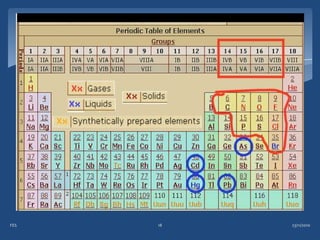
FES       3         23/11/2010
FES   4   23/11/2010
Introduction
Atomic emission spectroscopy (AES or
OES [optical emission spectroscopy) uses
quantitative measurement of the optical
emulsion from excited atoms to
determine analyte concentration.
Analyte atoms in solution are aspirated
into the excitation region where they are
desolvated, vaporized, and atomized by a
flame, discharge, or plasma
Introduction
These high-temperature atomization sources provide sufficient
energy to promote the atoms into high energy levels.
The atoms decay back to lower levels by emitting light.
Since the transitions are between distinct atomic energy levels,
the emission lines in the spectra are narrow
The spectra of samples containing many elements can be very
congested, and spectral separation of nearby atomic transitions
requires a high-resolution spectrometer.
Since all atoms in a sample are excited simultaneously, they can
be detected simultaneously using a polychromator with multiple
detectors. This ability to simultaneously measure multiple
elements is a major advantage of AES compared to AAS
Introduction
AES is a broad area that includes several
analytical chemistry techniques focused
on:
  elemental analysis,
 the identification,
 quantification, and (sometimes)
 speciation of the elemental makeup of
 a sample.
Introduction
AES can be an extremely useful tool and
is utilized in academic and industrial
settings within biological and chemical
sciences.
It is mainly used in quantitative analysis,
but can be used in qualitative work as
well
History and Theory -- Introduction
Atomic spectroscopy began with the
realization in the mid-19th century that salts
in a flame could emit light of wavelength
specific to metallic elements introduced to
the flame as powders or solutions, and
that light of the same wavelength might be
missing from emission from stars (including
the sun) because the elements absorbed
light.
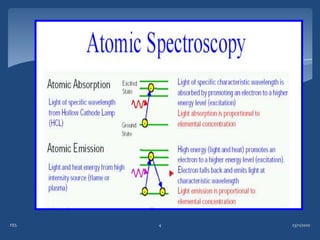
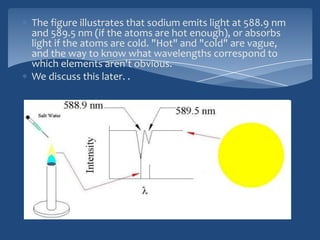
The figure illustrates that sodium emits light at 588.9 nm
and 589.5 nm (if the atoms are hot enough), or absorbs
light if the atoms are cold. "Hot" and "cold" are vague,
and the way to know what wavelengths correspond to
which elements aren't obvious.
We discuss this later. .
FES   11   23/11/2010
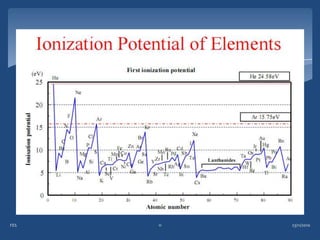
FES   12   23/11/2010
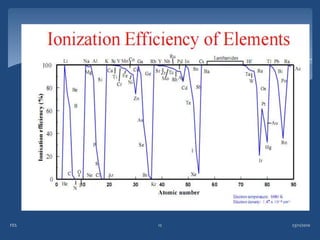
FES   13   23/11/2010
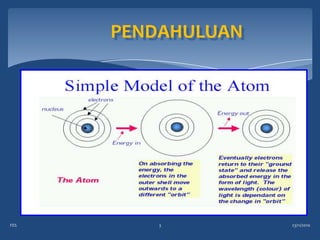
 Bila atom-atom suatu unsur diletakkan dalam sumber
  pengeksitasi
 Ekektron di orbital terluar ( keadaan dasar)
  tereksitasi ke tingkat energi lebih tinggi
 Elektron yang tereksitasi berada dalam keadaan tidak
  stabil
 Segera kembali ke keadaan dasarnya ( ke tk. Energi
  lebih rendah) sambil melepaskan kelebihan energi
  unsur ybs
FES                        14                       23/11/2010
 Kelebihan energi yg dimiliki sewaktu tereksitasi akan
  dibuang ke luar berupa emisi sinar dengan yang
  karakteristik untuk unsur ybs

       X +E          X*         X + E ( dengan khas )

 Emisi yang dipancarkan atom-atom tereksitasi
  memiliki beberapa macam yg karakteristik untuk
  unsur ybs & dengan intensitas berbeda


FES                        15                       23/11/2010
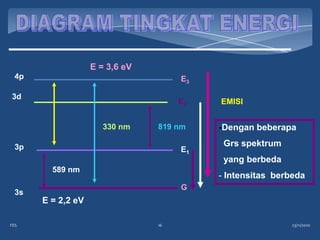
E = 3,6 eV
  4p                                  E3

3d
                                      E2   EMISI


                       330 nm    819 nm    -Dengan beberapa

  3p                                        Grs spektrum
                                      E1
                                            yang berbeda
         589 nm
                                           - Intensitas berbeda
                                      G
  3s
       E = 2,2 eV

FES                              16                        23/11/2010
 Untuk suatu sumber pengeksitasi atom perlu sumber energi
  yang mampu mengeksitasikan elektron di orbital terluar ke
  tingkat energi elektron lebih tinggi

 Proses eksitasi dapat dihasilkan sumber energi :
      - nyala api gas
        ( kelemahan ; hasilkn energi bervariasi )
      - kombinasi gas (asetilen + udara) hasilkan
        intensitas sinar emisi yang baik untuk eksitasi
        logam alkali & alkali tanah pada spektroskopi nyala

FES                            17                             23/11/2010
FES   18   23/11/2010
FES   19   23/11/2010
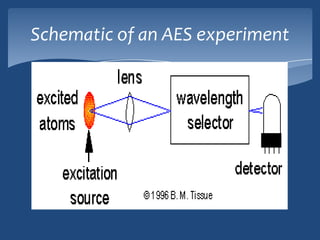
Schematic of an AES experiment
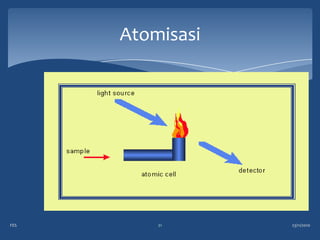
Atomisasi


FES       21      23/11/2010
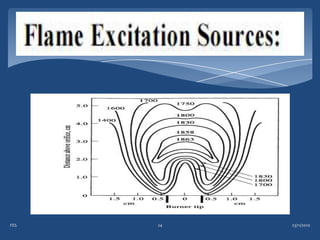
Flame Excitation Source
A flame provides a high-temperature source for
desolvating and vaporizing a sample to obtain
free atoms for spectroscopic analysis. In atomic
absorption spectroscopy ground state atoms
are desired.
For atomic emission spectroscopy the flame
must also excite the atoms to higher energy
levels.
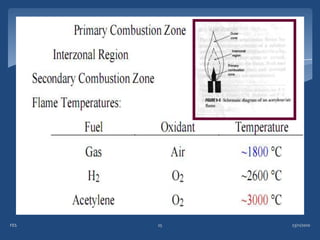
The table lists temperatures that can be
achieved in some commonly used flames.
FES   24   23/11/2010
FES   25   23/11/2010
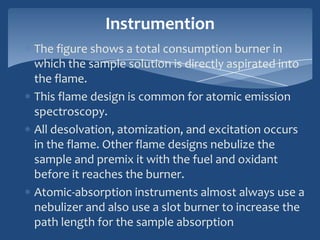
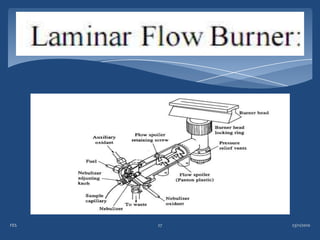
Instrumention
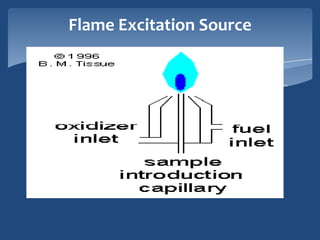
The figure shows a total consumption burner in
which the sample solution is directly aspirated into
the flame.
This flame design is common for atomic emission
spectroscopy.
All desolvation, atomization, and excitation occurs
in the flame. Other flame designs nebulize the
sample and premix it with the fuel and oxidant
before it reaches the burner.
Atomic-absorption instruments almost always use a
nebulizer and also use a slot burner to increase the
path length for the sample absorption
FES   27   23/11/2010
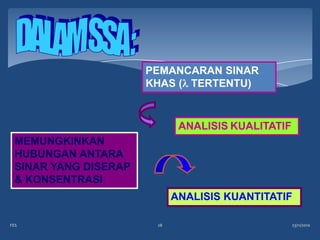
PEMANCARAN SINAR
                       KHAS ( TERTENTU)


                              ANALISIS KUALITATIF
  MEMUNGKINKAN
  HUBUNGAN ANTARA
  SINAR YANG DISERAP
  & KONSENTRASI
                             ANALISIS KUANTITATIF

FES                     28                          23/11/2010
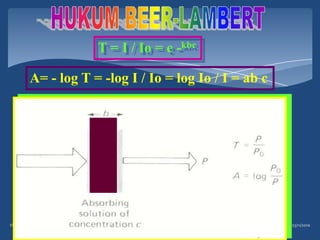
T = I / Io = e -kbc

      A= - log T = -log I / Io = log Io / I = ab c


FES                          29                      23/11/2010
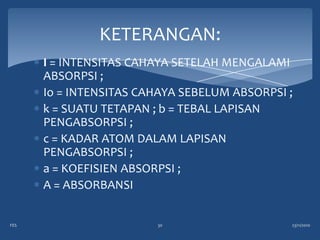
KETERANGAN:
      I = INTENSITAS CAHAYA SETELAH MENGALAMI
      ABSORPSI ;
      Io = INTENSITAS CAHAYA SEBELUM ABSORPSI ;
      k = SUATU TETAPAN ; b = TEBAL LAPISAN
      PENGABSORPSI ;
      c = KADAR ATOM DALAM LAPISAN
      PENGABSORPSI ;
      a = KOEFISIEN ABSORPSI ;
      A = ABSORBANSI


FES                     30                    23/11/2010
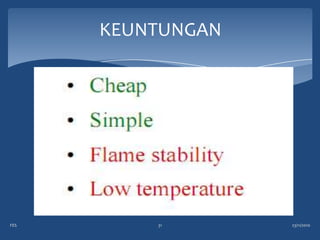
KEUNTUNGAN


FES       31       23/11/2010
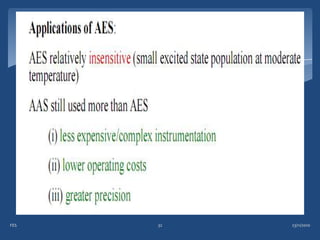
FES   32   23/11/2010
FES   33   23/11/2010

Flame A E S

  • 1.
  • 2.
    Spektrometri emisi atomnyala Spektrometri emisi atom arc-spark Spektrometri emisi atom -ICP
  • 3.
    PENDAHULUAN FES 3 23/11/2010
  • 4.
    FES 4 23/11/2010
  • 5.
    Introduction Atomic emission spectroscopy(AES or OES [optical emission spectroscopy) uses quantitative measurement of the optical emulsion from excited atoms to determine analyte concentration. Analyte atoms in solution are aspirated into the excitation region where they are desolvated, vaporized, and atomized by a flame, discharge, or plasma
  • 6.
    Introduction These high-temperature atomizationsources provide sufficient energy to promote the atoms into high energy levels. The atoms decay back to lower levels by emitting light. Since the transitions are between distinct atomic energy levels, the emission lines in the spectra are narrow The spectra of samples containing many elements can be very congested, and spectral separation of nearby atomic transitions requires a high-resolution spectrometer. Since all atoms in a sample are excited simultaneously, they can be detected simultaneously using a polychromator with multiple detectors. This ability to simultaneously measure multiple elements is a major advantage of AES compared to AAS
  • 7.
    Introduction AES is abroad area that includes several analytical chemistry techniques focused on: elemental analysis, the identification, quantification, and (sometimes) speciation of the elemental makeup of a sample.
  • 8.
    Introduction AES can bean extremely useful tool and is utilized in academic and industrial settings within biological and chemical sciences. It is mainly used in quantitative analysis, but can be used in qualitative work as well
  • 9.
    History and Theory-- Introduction Atomic spectroscopy began with the realization in the mid-19th century that salts in a flame could emit light of wavelength specific to metallic elements introduced to the flame as powders or solutions, and that light of the same wavelength might be missing from emission from stars (including the sun) because the elements absorbed light.
  • 10.
    The figure illustratesthat sodium emits light at 588.9 nm and 589.5 nm (if the atoms are hot enough), or absorbs light if the atoms are cold. "Hot" and "cold" are vague, and the way to know what wavelengths correspond to which elements aren't obvious. We discuss this later. .
  • 11.
    FES 11 23/11/2010
  • 12.
    FES 12 23/11/2010
  • 13.
    FES 13 23/11/2010
  • 14.
     Bila atom-atomsuatu unsur diletakkan dalam sumber pengeksitasi  Ekektron di orbital terluar ( keadaan dasar) tereksitasi ke tingkat energi lebih tinggi  Elektron yang tereksitasi berada dalam keadaan tidak stabil  Segera kembali ke keadaan dasarnya ( ke tk. Energi lebih rendah) sambil melepaskan kelebihan energi unsur ybs FES 14 23/11/2010
  • 15.
     Kelebihan energiyg dimiliki sewaktu tereksitasi akan dibuang ke luar berupa emisi sinar dengan yang karakteristik untuk unsur ybs X +E X* X + E ( dengan khas )  Emisi yang dipancarkan atom-atom tereksitasi memiliki beberapa macam yg karakteristik untuk unsur ybs & dengan intensitas berbeda FES 15 23/11/2010
  • 16.
    E = 3,6eV 4p E3 3d E2 EMISI 330 nm 819 nm -Dengan beberapa 3p Grs spektrum E1 yang berbeda 589 nm - Intensitas berbeda G 3s E = 2,2 eV FES 16 23/11/2010
  • 17.
     Untuk suatusumber pengeksitasi atom perlu sumber energi yang mampu mengeksitasikan elektron di orbital terluar ke tingkat energi elektron lebih tinggi  Proses eksitasi dapat dihasilkan sumber energi : - nyala api gas ( kelemahan ; hasilkn energi bervariasi ) - kombinasi gas (asetilen + udara) hasilkan intensitas sinar emisi yang baik untuk eksitasi logam alkali & alkali tanah pada spektroskopi nyala FES 17 23/11/2010
  • 18.
    FES 18 23/11/2010
  • 19.
    FES 19 23/11/2010
  • 20.
    Schematic of anAES experiment
  • 21.
    Atomisasi FES 21 23/11/2010
  • 22.
  • 23.
    Flame Excitation Source Aflame provides a high-temperature source for desolvating and vaporizing a sample to obtain free atoms for spectroscopic analysis. In atomic absorption spectroscopy ground state atoms are desired. For atomic emission spectroscopy the flame must also excite the atoms to higher energy levels. The table lists temperatures that can be achieved in some commonly used flames.
  • 24.
    FES 24 23/11/2010
  • 25.
    FES 25 23/11/2010
  • 26.
    Instrumention The figure showsa total consumption burner in which the sample solution is directly aspirated into the flame. This flame design is common for atomic emission spectroscopy. All desolvation, atomization, and excitation occurs in the flame. Other flame designs nebulize the sample and premix it with the fuel and oxidant before it reaches the burner. Atomic-absorption instruments almost always use a nebulizer and also use a slot burner to increase the path length for the sample absorption
  • 27.
    FES 27 23/11/2010
  • 28.
    PEMANCARAN SINAR KHAS ( TERTENTU) ANALISIS KUALITATIF MEMUNGKINKAN HUBUNGAN ANTARA SINAR YANG DISERAP & KONSENTRASI ANALISIS KUANTITATIF FES 28 23/11/2010
  • 29.
    T = I/ Io = e -kbc A= - log T = -log I / Io = log Io / I = ab c FES 29 23/11/2010
  • 30.
    KETERANGAN: I = INTENSITAS CAHAYA SETELAH MENGALAMI ABSORPSI ; Io = INTENSITAS CAHAYA SEBELUM ABSORPSI ; k = SUATU TETAPAN ; b = TEBAL LAPISAN PENGABSORPSI ; c = KADAR ATOM DALAM LAPISAN PENGABSORPSI ; a = KOEFISIEN ABSORPSI ; A = ABSORBANSI FES 30 23/11/2010
  • 31.
    KEUNTUNGAN FES 31 23/11/2010
  • 32.
    FES 32 23/11/2010
  • 33.
    FES 33 23/11/2010