The views expressed in this publication are those of the author(s) and do not necessarily reflect the views and policies of the Asian
Development Bank (ADB) or its Board of Governors or the governments they represent. By making any designation of or reference to a
particular territory or geographic area, or by using the term "country" in this document, ADB does not intend to make any judgments as to the
legal or other status of any territory or area.
Five Slides on Reminiscing
for the Future
Olivier Serrat
2016
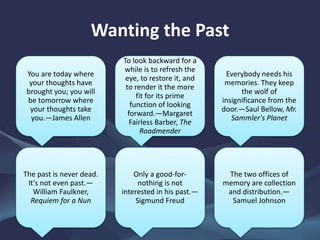
Wanting the Past
You are today where
your thoughts have
brought you; you will
be tomorrow where
your thoughts take
you.—James Allen
To look backward for a
while is to refresh the
eye, to restore it, and
to render it the more
fit for its prime
function of looking
forward.—Margaret
Fairless Barber, The
Roadmender
Everybody needs his
memories. They keep
the wolf of
insignificance from the
door.—Saul Bellow, Mr.
Sammler's Planet
The past is never dead.
It's not even past.—
William Faulkner,
Requiem for a Nun
Only a good-for-
nothing is not
interested in his past.—
Sigmund Freud
The two offices of
memory are collection
and distribution.—
Samuel Johnson
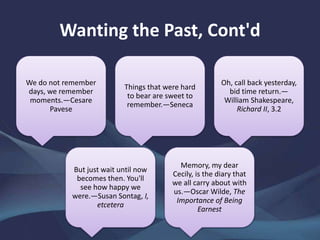
Wanting the Past, Cont'd
We do not remember
days, we remember
moments.—Cesare
Pavese
Things that were hard
to bear are sweet to
remember.—Seneca
Oh, call back yesterday,
bid time return.—
William Shakespeare,
Richard II, 3.2
But just wait until now
becomes then. You'll
see how happy we
were.—Susan Sontag, I,
etcetera
Memory, my dear
Cecily, is the diary that
we all carry about with
us.—Oscar Wilde, The
Importance of Being
Earnest
Recalling Yesterday
In psychology, memory refers
to the processes used to
acquire, store, retain, and
later retrieve information.
Voluntary memory, the
deliberate effort to remember
things past, is the binary
opposite of involuntary
memory, aka flashback.
Even if man is by nature a social
animal, we see ourselves as unique
individuals. Hence, the recollection of
experience through storytelling
satisfies our lifelong need to also be
recognized as such by others. Consider
what happens when you make friends
or engage in a community: you spend
time sharing life histories.
By recalling the past, celebrating accomplishments and—as necessary—
coming to terms with disappointments, individuals can achieve a heightened
sense of personal identity and self-continuity, notably in their social
relationships. At the confluence of voluntary memory and events,
circumstances, and experience, they can find meaning and coherence in life
and work.
Sharing Life Histories
Reminiscence has self-positive
and self-negative functions:
identity exploration, problem
solving, and death
preparation are served by the
first and bitterness revival,
boredom reduction, and
intimacy maintenance by the
second.
Outside medicine, psychology, and
social care, social sciences such as
management find benefits to social
reminiscing on behalf of user groups.
There is particular interest in three or
four of the six types of reminiscence
mentioned earlier more frequently
referred to as integrative,
instrumental, transmissive, narrative,
escapist, and obsessive.
For example, instrumental reminiscence looks to past experience to solve
problems in the present; transmissive reminiscence communicates cultural
and personal knowledge of earlier times; narrative reminiscence uses
storytelling, with conversational and interactional properties, to convey
anecdotal evidence of (usually) positive stories and positive emotions.
Acting Today, Shaping Tomorrow
Memory is created and recreated
in social interactions in which
moments and, above all, their
interpretations at multiple levels
of individual and cultural analysis
are highlighted, shared,
contested, negotiated, enriched,
and confirmed. This leads to
dynamic, fluid, and historical
representations and evaluations
that define selves, others, and
the world.
If memories are both shaped by
and shape our understanding of
history, and if meaning is created
by how we link choices,
achievements, and challenges in
our lives, social reminiscing can
help individuals, groups, and
organizations discover, dream,
design, and deliver for tomorrow.
From this perspective,
instrumental, transmissive, and
narrative reminiscence can be
considered a gain in performance
without practice.
Further Reading
• ADB. 2008. Conducting After-Action Reviews and Retrospects.
Manila. www.adb.org/publications/conducting-after-action-
reviews-and-retrospects
• ――. 2008. Storytelling. Manila.
www.adb.org/publications/storytelling
• ――. 2008. Culture Theory. Manila.
http://www.adb.org/publications/culture-theory
• ――. 2009. Coaching and Mentoring. Manila.
www.adb.org/publications/coaching-and-mentoring
• ――. 2010. ADB: Reflections and Beyond. Manila.
www.adb.org/publications/adb-reflections-and-beyond
Further Reading
• ADB. 2010. Harvesting Knowledge. Manila. Available:
www.adb.org/publications/harvesting-knowledge
• ――. 2010. The Critical Incident Technique. Manila. Available:
www.adb.org/publications/critical-incident-technique
• ――. 2010. Building Narrative Capacity at ADB. Manila.
www.adb.org/publications/building-narrative-capacity-adb
• ――. 2011. On Second Thought. Manila.
www.adb.org/publications/second-thought
• ――. 2011. Learning Histories. Manila.
www.adb.org/publications/learning-histories
Further Reading
• ADB. 2012. Insight Thursday: Beyond The Headlines. Manila.
www.adb.org/publications/insight-thursday-beyond-
headlines
• ——. 2012. Interactive Stories of Sustainable Development.
Manila. www.adb.org/publications/interactive-stories-
sustainable-development
Video
• ADB. 2012. Harvesting Knowledge. Manila.
vimeo.com/67185512
• ——. 2012. The Critical Incident Technique. Manila.
vimeo.com/67185516
• ——. 2016. ADB Sustainable Development Timeline. Manila.
reflections.adb.org
• ——. 2016. ADB: Reflections and Beyond. Manila.
vimeo.com/user26371068
Quick Response Codes
@ADB
@ADB Sustainable
Development Timeline
@Academia.edu
@LinkedIn
@ResearchGate
@Scholar
@SlideShare
@Twitter

Five Slides on Reminiscing for the Future

  • 1.
    The views expressedin this publication are those of the author(s) and do not necessarily reflect the views and policies of the Asian Development Bank (ADB) or its Board of Governors or the governments they represent. By making any designation of or reference to a particular territory or geographic area, or by using the term "country" in this document, ADB does not intend to make any judgments as to the legal or other status of any territory or area. Five Slides on Reminiscing for the Future Olivier Serrat 2016
  • 2.
    Wanting the Past Youare today where your thoughts have brought you; you will be tomorrow where your thoughts take you.—James Allen To look backward for a while is to refresh the eye, to restore it, and to render it the more fit for its prime function of looking forward.—Margaret Fairless Barber, The Roadmender Everybody needs his memories. They keep the wolf of insignificance from the door.—Saul Bellow, Mr. Sammler's Planet The past is never dead. It's not even past.— William Faulkner, Requiem for a Nun Only a good-for- nothing is not interested in his past.— Sigmund Freud The two offices of memory are collection and distribution.— Samuel Johnson
  • 3.
    Wanting the Past,Cont'd We do not remember days, we remember moments.—Cesare Pavese Things that were hard to bear are sweet to remember.—Seneca Oh, call back yesterday, bid time return.— William Shakespeare, Richard II, 3.2 But just wait until now becomes then. You'll see how happy we were.—Susan Sontag, I, etcetera Memory, my dear Cecily, is the diary that we all carry about with us.—Oscar Wilde, The Importance of Being Earnest
  • 4.
    Recalling Yesterday In psychology,memory refers to the processes used to acquire, store, retain, and later retrieve information. Voluntary memory, the deliberate effort to remember things past, is the binary opposite of involuntary memory, aka flashback. Even if man is by nature a social animal, we see ourselves as unique individuals. Hence, the recollection of experience through storytelling satisfies our lifelong need to also be recognized as such by others. Consider what happens when you make friends or engage in a community: you spend time sharing life histories. By recalling the past, celebrating accomplishments and—as necessary— coming to terms with disappointments, individuals can achieve a heightened sense of personal identity and self-continuity, notably in their social relationships. At the confluence of voluntary memory and events, circumstances, and experience, they can find meaning and coherence in life and work.
  • 5.
    Sharing Life Histories Reminiscencehas self-positive and self-negative functions: identity exploration, problem solving, and death preparation are served by the first and bitterness revival, boredom reduction, and intimacy maintenance by the second. Outside medicine, psychology, and social care, social sciences such as management find benefits to social reminiscing on behalf of user groups. There is particular interest in three or four of the six types of reminiscence mentioned earlier more frequently referred to as integrative, instrumental, transmissive, narrative, escapist, and obsessive. For example, instrumental reminiscence looks to past experience to solve problems in the present; transmissive reminiscence communicates cultural and personal knowledge of earlier times; narrative reminiscence uses storytelling, with conversational and interactional properties, to convey anecdotal evidence of (usually) positive stories and positive emotions.
  • 6.
    Acting Today, ShapingTomorrow Memory is created and recreated in social interactions in which moments and, above all, their interpretations at multiple levels of individual and cultural analysis are highlighted, shared, contested, negotiated, enriched, and confirmed. This leads to dynamic, fluid, and historical representations and evaluations that define selves, others, and the world. If memories are both shaped by and shape our understanding of history, and if meaning is created by how we link choices, achievements, and challenges in our lives, social reminiscing can help individuals, groups, and organizations discover, dream, design, and deliver for tomorrow. From this perspective, instrumental, transmissive, and narrative reminiscence can be considered a gain in performance without practice.
  • 7.
    Further Reading • ADB.2008. Conducting After-Action Reviews and Retrospects. Manila. www.adb.org/publications/conducting-after-action- reviews-and-retrospects • ――. 2008. Storytelling. Manila. www.adb.org/publications/storytelling • ――. 2008. Culture Theory. Manila. http://www.adb.org/publications/culture-theory • ――. 2009. Coaching and Mentoring. Manila. www.adb.org/publications/coaching-and-mentoring • ――. 2010. ADB: Reflections and Beyond. Manila. www.adb.org/publications/adb-reflections-and-beyond
  • 8.
    Further Reading • ADB.2010. Harvesting Knowledge. Manila. Available: www.adb.org/publications/harvesting-knowledge • ――. 2010. The Critical Incident Technique. Manila. Available: www.adb.org/publications/critical-incident-technique • ――. 2010. Building Narrative Capacity at ADB. Manila. www.adb.org/publications/building-narrative-capacity-adb • ――. 2011. On Second Thought. Manila. www.adb.org/publications/second-thought • ――. 2011. Learning Histories. Manila. www.adb.org/publications/learning-histories
  • 9.
    Further Reading • ADB.2012. Insight Thursday: Beyond The Headlines. Manila. www.adb.org/publications/insight-thursday-beyond- headlines • ——. 2012. Interactive Stories of Sustainable Development. Manila. www.adb.org/publications/interactive-stories- sustainable-development
  • 10.
    Video • ADB. 2012.Harvesting Knowledge. Manila. vimeo.com/67185512 • ——. 2012. The Critical Incident Technique. Manila. vimeo.com/67185516 • ——. 2016. ADB Sustainable Development Timeline. Manila. reflections.adb.org • ——. 2016. ADB: Reflections and Beyond. Manila. vimeo.com/user26371068
  • 11.
    Quick Response Codes @ADB @ADBSustainable Development Timeline @Academia.edu @LinkedIn @ResearchGate @Scholar @SlideShare @Twitter