 Contents:
 Objectives of the project
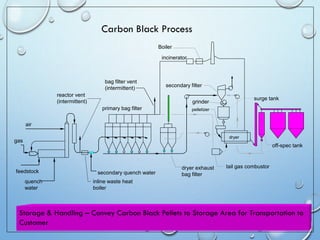
 Flow sheet of the process
 Raw materials
 Reactor
 Process Air Preheater
 Process Oil Preheater
 Bag Filter
 Surge Bin & Powder Pump
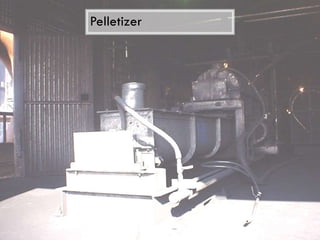
 Pelletizer
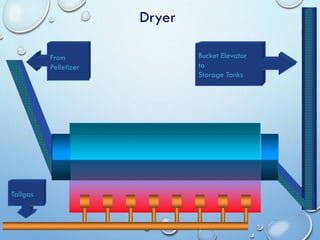
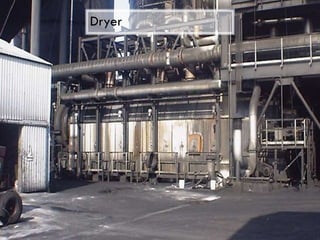
 Dryer
 Storage & Loading
 Problems during Process
 Key Learnings
 The objectives of the project are :-
 To develop skills in the application of theory to practical work situations.
 Gain the Knowledge about DCS.
 Design of Air Pre Heater.
 Design that the heat is generated will reuse that we seen in process.
 Key Learnings:
 We learns that how operations are done and which safety the workers are
taking while working at around the 2000°C.
 Learn about zero liquid discharge.
 Learn about different Heat exchanger.
 The benefits of taking on feedback.
 Future work
 Mass balance
 Energy balance
 Design of Heat Exchanger
Literature review :-
RECOVERED CARBON BLACK FROM WASTE TIRE PYROLYSIS
Source of Article :- Arqam Anjum Journal
RAW MATERIALS
MAKING CARBON BLACK REQUIRES SIX (6) MATERIALS:
• Fuel (natural gas or oil)
• Oxidizer (air)
• Feedstock Oil (No. 6 type oil)
• Water
• Structure control additive (potassium salt)
• Pellet binder
air
gas
feedstock
surge tank
secondary filter
grinder
dryer
off-spec tank
tail gas combustor
primary bag filter
quench
water
pelletizer
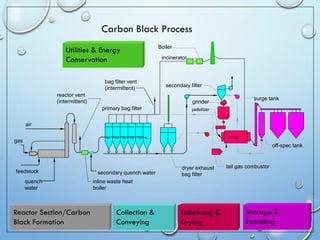
Carbon Black Process
reactor vent
(intermittent)
dryer exhaust
bag filter
secondary quench water
incinerator
bag filter vent
(intermittent)
inline waste heat
boiler
Boiler
Reactor Section/Carbon
Black Formation
Collection &
Conveying
Pelletizing &
Drying
Storage &
Handling
Utilities & Energy
Conservation
air
gas
feedstock
surge tank
secondary filter
grinder
dryer
off-spec tank
tail gas combustor
primary bag filter
quench
water
pelletizer
Carbon Black Process
reactor vent
(intermittent)
dryer exhaust
bag filter
secondary quench water
incinerator
bag filter vent
(intermittent)
inline waste heat
boiler
Boiler
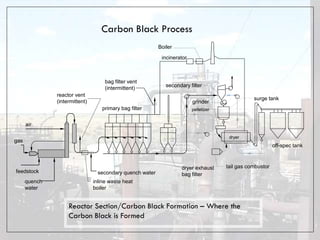
Reactor Section/Carbon Black Formation – Where the
Carbon Black is Formed
Quench
Water
Reactor
Natural
Gas
Alkali
Metal
Additive
Preheated
Air
Feedstock
Oil
Refractory
1650 °C
(3000 °F)
915 m/sec
(3000 ft/sec)
Reaction Time = 0.3 to 1.0 sec
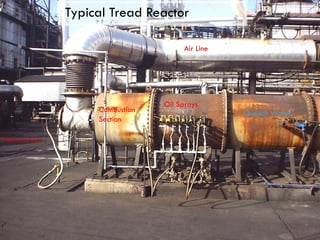
Air Line
Oil Sprays
Combustion
Section
Natural Gas
Quench Water
Typical Tread Reactor
Preheated
Air
650 °C (1200 °F)-
800 °C (1500 °F)
Process Air
Blower
To Oil Preheater
& Smoke Header
Carbon Black Stream
Process Air Preheater
-To Preheat the Incoming Air
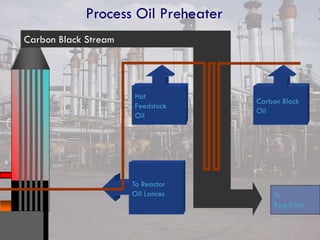
Carbon Black
Oil
Hot
Feedstock
Oil
To Reactor
Oil Lances
Process Oil Preheater
To
Bag Filter
Carbon Black Stream
air
gas
feedstock
surge tank
secondary filter
grinder
dryer
off-spec tank
tail gas combustor
primary bag filter
quench
water
pelletizer
Carbon Black Process
reactor vent
(intermittent)
dryer exhaust
bag filter
secondary quench water
incinerator
bag filter vent
(intermittent)
inline waste heat
boiler
Boiler
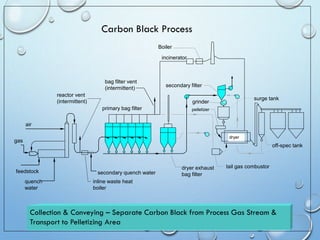
Collection & Conveying – Separate Carbon Black from Process Gas Stream &
Transport to Pelletizing Area
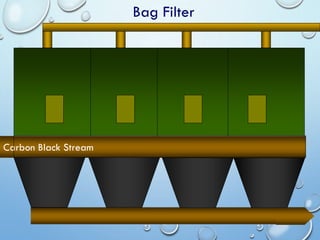
Bag Filter
Carbon Black Stream
Bag Filter
Tailgas
To Dryers &
Incinerator
Carbon Black Stream
To Surge Bin / Pelletizers
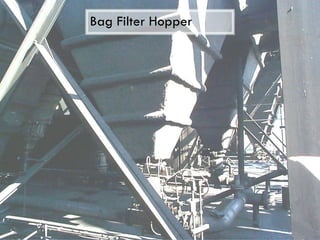
Bag Filter Hopper
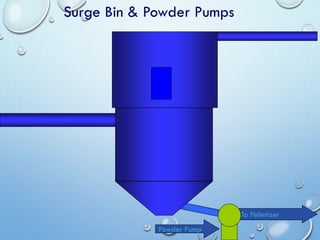
Surge Bin & Powder Pumps
To Pelletizer
Powder Pump
To Pelletizer
Surge Bin & Powder Pumps
Carbon Black
& Air
Clean Air
Powder Pump
air
gas
feedstock
surge tank
secondary filter
grinder
dryer
off-spec tank
tail gas combustor
primary bag filter
quench
water
pelletizer
Carbon Black Process
reactor vent
(intermittent)
dryer exhaust
bag filter
secondary quench water
incinerator
bag filter vent
(intermittent)
inline waste heat
boiler
Boiler
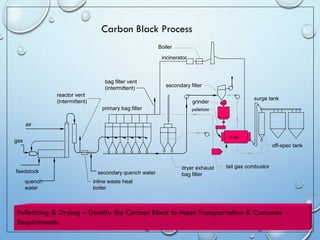
Pelletizing & Drying – Densify the Carbon Black to Meet Transportation & Customer
Requirements
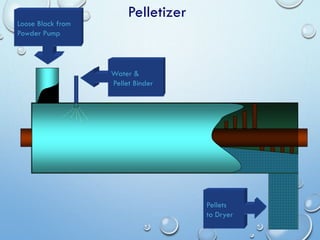
Pellets
to Dryer
Pelletizer
Loose Black from
Powder Pump
Water &
Pellet Binder
Pelletizer
Tailgas
Bucket Elevator
to
Storage Tanks
From
Pelletizer
Dryer
Dryer
air
gas
feedstock
surge tank
secondary filter
grinder
dryer
off-spec tank
tail gas combustor
primary bag filter
quench
water
pelletizer
Carbon Black Process
reactor vent
(intermittent)
dryer exhaust
bag filter
secondary quench water
incinerator
bag filter vent
(intermittent)
inline waste heat
boiler
Boiler
Storage & Handling – Convey Carbon Black Pellets to Storage Area for Transportation to
Customer
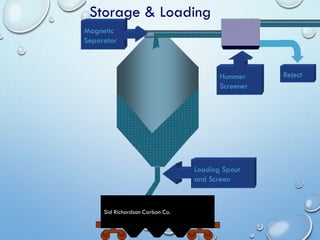
Storage & Loading
Sid Richardson Carbon Co.
Hummer
Screener
Reject
Loading Spout
and Screen
Magnetic
Separator
Storage & Loading
Hummer
Screener
Reject
Loading Spout
and Screen
Magnetic
Separator
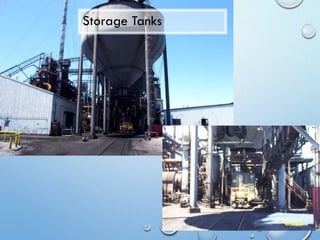
Storage Tanks
air
gas
feedstock
surge tank
secondary filter
grinder
dryer
off-spec tank
tail gas combustor
primary bag filter
quench
water
pelletizer
Carbon Black Process
reactor vent
(intermittent)
dryer exhaust
bag filter
secondary quench water
incinerator
bag filter vent
(intermittent)
inline waste heat
boiler
Boiler
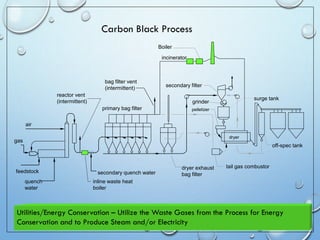
Utilities/Energy Conservation – Utilize the Waste Gases from the Process for Energy
Conservation and to Produce Steam and/or Electricity
 There are two problems:
1. They have big problem of the sodium chloride salts which is generated from
there zero liquid discharge departments.
2. oil which is spraying in the reactor they have to set every time due to that they
to face a cost to change the inner part of the which is refractory bricks.
 Key Learnings:
 We learns that how operations are done and which safety the workers are
taking while working at around the 2000°C.
 Understanding workplace culture.
 How important good communication is.
 The benefits of taking on feedback.
 Future work
 Mass balance
 Energy balance
 Design of Heat Exchanger

First Review for chemical engineering students

  • 1.
     Contents:  Objectivesof the project  Flow sheet of the process  Raw materials  Reactor  Process Air Preheater  Process Oil Preheater  Bag Filter  Surge Bin & Powder Pump  Pelletizer  Dryer  Storage & Loading  Problems during Process  Key Learnings
  • 2.
     The objectivesof the project are :-  To develop skills in the application of theory to practical work situations.  Gain the Knowledge about DCS.  Design of Air Pre Heater.  Design that the heat is generated will reuse that we seen in process.  Key Learnings:  We learns that how operations are done and which safety the workers are taking while working at around the 2000°C.  Learn about zero liquid discharge.  Learn about different Heat exchanger.  The benefits of taking on feedback.  Future work  Mass balance  Energy balance  Design of Heat Exchanger
  • 3.
    Literature review :- RECOVEREDCARBON BLACK FROM WASTE TIRE PYROLYSIS Source of Article :- Arqam Anjum Journal
  • 4.
    RAW MATERIALS MAKING CARBONBLACK REQUIRES SIX (6) MATERIALS: • Fuel (natural gas or oil) • Oxidizer (air) • Feedstock Oil (No. 6 type oil) • Water • Structure control additive (potassium salt) • Pellet binder
  • 5.
    air gas feedstock surge tank secondary filter grinder dryer off-spectank tail gas combustor primary bag filter quench water pelletizer Carbon Black Process reactor vent (intermittent) dryer exhaust bag filter secondary quench water incinerator bag filter vent (intermittent) inline waste heat boiler Boiler Reactor Section/Carbon Black Formation Collection & Conveying Pelletizing & Drying Storage & Handling Utilities & Energy Conservation
  • 6.
    air gas feedstock surge tank secondary filter grinder dryer off-spectank tail gas combustor primary bag filter quench water pelletizer Carbon Black Process reactor vent (intermittent) dryer exhaust bag filter secondary quench water incinerator bag filter vent (intermittent) inline waste heat boiler Boiler Reactor Section/Carbon Black Formation – Where the Carbon Black is Formed
  • 7.
  • 8.
    Air Line Oil Sprays Combustion Section NaturalGas Quench Water Typical Tread Reactor
  • 9.
    Preheated Air 650 °C (1200°F)- 800 °C (1500 °F) Process Air Blower To Oil Preheater & Smoke Header Carbon Black Stream Process Air Preheater -To Preheat the Incoming Air
  • 10.
    Carbon Black Oil Hot Feedstock Oil To Reactor OilLances Process Oil Preheater To Bag Filter Carbon Black Stream
  • 11.
    air gas feedstock surge tank secondary filter grinder dryer off-spectank tail gas combustor primary bag filter quench water pelletizer Carbon Black Process reactor vent (intermittent) dryer exhaust bag filter secondary quench water incinerator bag filter vent (intermittent) inline waste heat boiler Boiler Collection & Conveying – Separate Carbon Black from Process Gas Stream & Transport to Pelletizing Area
  • 12.
  • 13.
    Bag Filter Tailgas To Dryers& Incinerator Carbon Black Stream To Surge Bin / Pelletizers
  • 14.
  • 15.
    Surge Bin &Powder Pumps To Pelletizer Powder Pump
  • 16.
    To Pelletizer Surge Bin& Powder Pumps Carbon Black & Air Clean Air Powder Pump
  • 17.
    air gas feedstock surge tank secondary filter grinder dryer off-spectank tail gas combustor primary bag filter quench water pelletizer Carbon Black Process reactor vent (intermittent) dryer exhaust bag filter secondary quench water incinerator bag filter vent (intermittent) inline waste heat boiler Boiler Pelletizing & Drying – Densify the Carbon Black to Meet Transportation & Customer Requirements
  • 18.
    Pellets to Dryer Pelletizer Loose Blackfrom Powder Pump Water & Pellet Binder
  • 19.
  • 20.
  • 21.
  • 22.
    air gas feedstock surge tank secondary filter grinder dryer off-spectank tail gas combustor primary bag filter quench water pelletizer Carbon Black Process reactor vent (intermittent) dryer exhaust bag filter secondary quench water incinerator bag filter vent (intermittent) inline waste heat boiler Boiler Storage & Handling – Convey Carbon Black Pellets to Storage Area for Transportation to Customer
  • 23.
    Storage & Loading SidRichardson Carbon Co. Hummer Screener Reject Loading Spout and Screen Magnetic Separator
  • 24.
    Storage & Loading Hummer Screener Reject LoadingSpout and Screen Magnetic Separator
  • 25.
  • 26.
    air gas feedstock surge tank secondary filter grinder dryer off-spectank tail gas combustor primary bag filter quench water pelletizer Carbon Black Process reactor vent (intermittent) dryer exhaust bag filter secondary quench water incinerator bag filter vent (intermittent) inline waste heat boiler Boiler Utilities/Energy Conservation – Utilize the Waste Gases from the Process for Energy Conservation and to Produce Steam and/or Electricity
  • 27.
     There aretwo problems: 1. They have big problem of the sodium chloride salts which is generated from there zero liquid discharge departments. 2. oil which is spraying in the reactor they have to set every time due to that they to face a cost to change the inner part of the which is refractory bricks.
  • 28.
     Key Learnings: We learns that how operations are done and which safety the workers are taking while working at around the 2000°C.  Understanding workplace culture.  How important good communication is.  The benefits of taking on feedback.  Future work  Mass balance  Energy balance  Design of Heat Exchanger