First, Break All
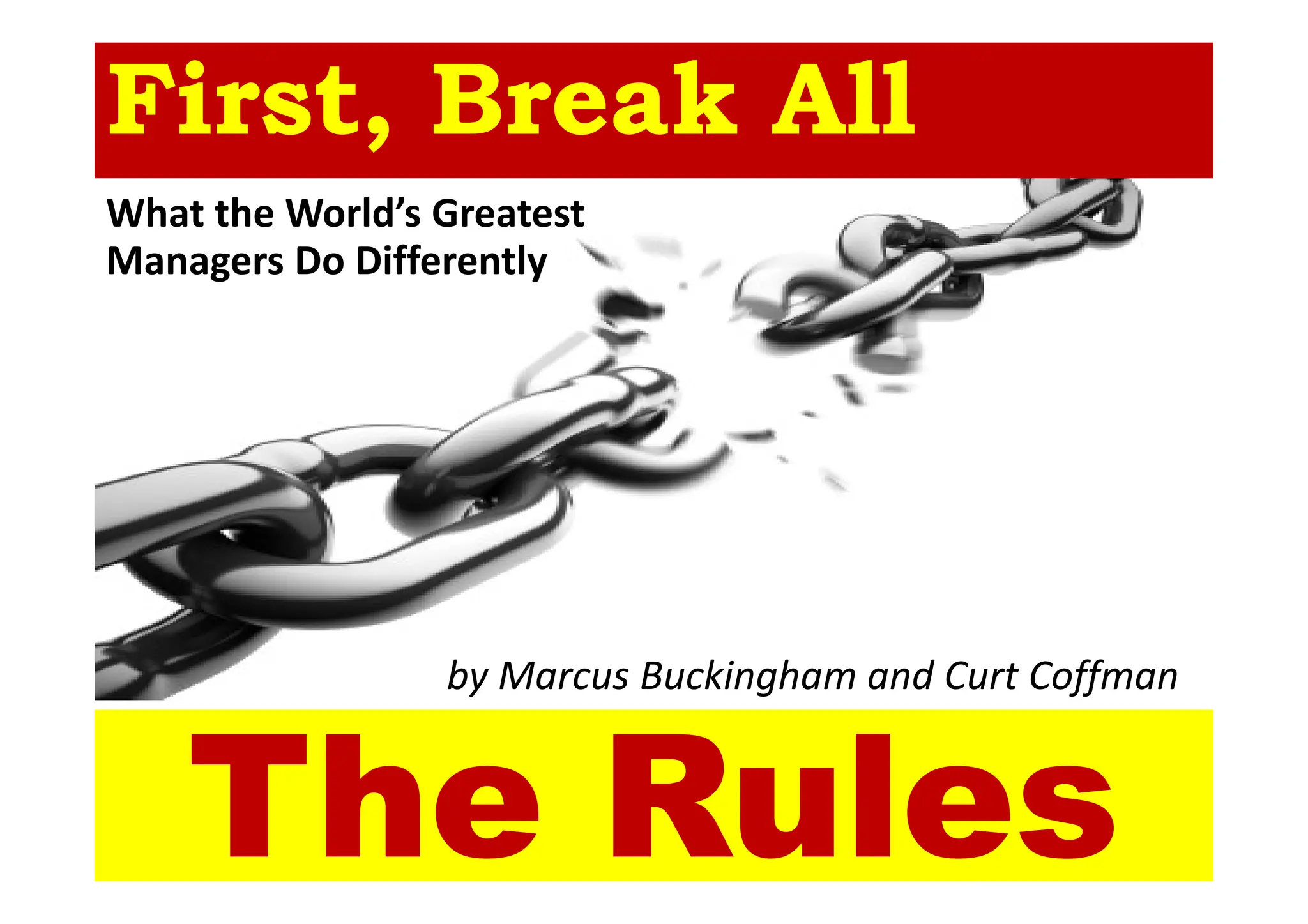
First, Break All
What the World’s Greatest
Managers Do Differently
The Rules
The Rules
by Marcus Buckingham and Curt Coffman
People leave managers, not companies. If you have
a turnover problem, look first to your managers.
ESSENTIAL POINT: Great managers recognize that each person is motivated differently, that each
person has his/her own way of thinking, and own style of relating to others. Great managers know there
is a limit to how much remolding they can do to someone. They don’t bemoan these differences and
try to grind them down – instead they CAPITALIZE on them. They try to help each person become more
and more of who he/she already is.
People don’t change that much. Don’t waste time trying to put in what
was left out Try to draw what was left in. That is hard enough.
They encourage their team to know : “What do I get?”
•1. Do I know what is expected of me?
•2. Do I have the materials and equipment I need to do my work right?
They encourage their team to know : “What do I give?”
•3. Do I have the opportunity to do what I do best every day?
•4. In the last seven days, have I received recognition or praise for good work?
•5. Does my supervisor, or someone at work, seem to care about me as a person?
•6. Is there someone at work who encourages my development?
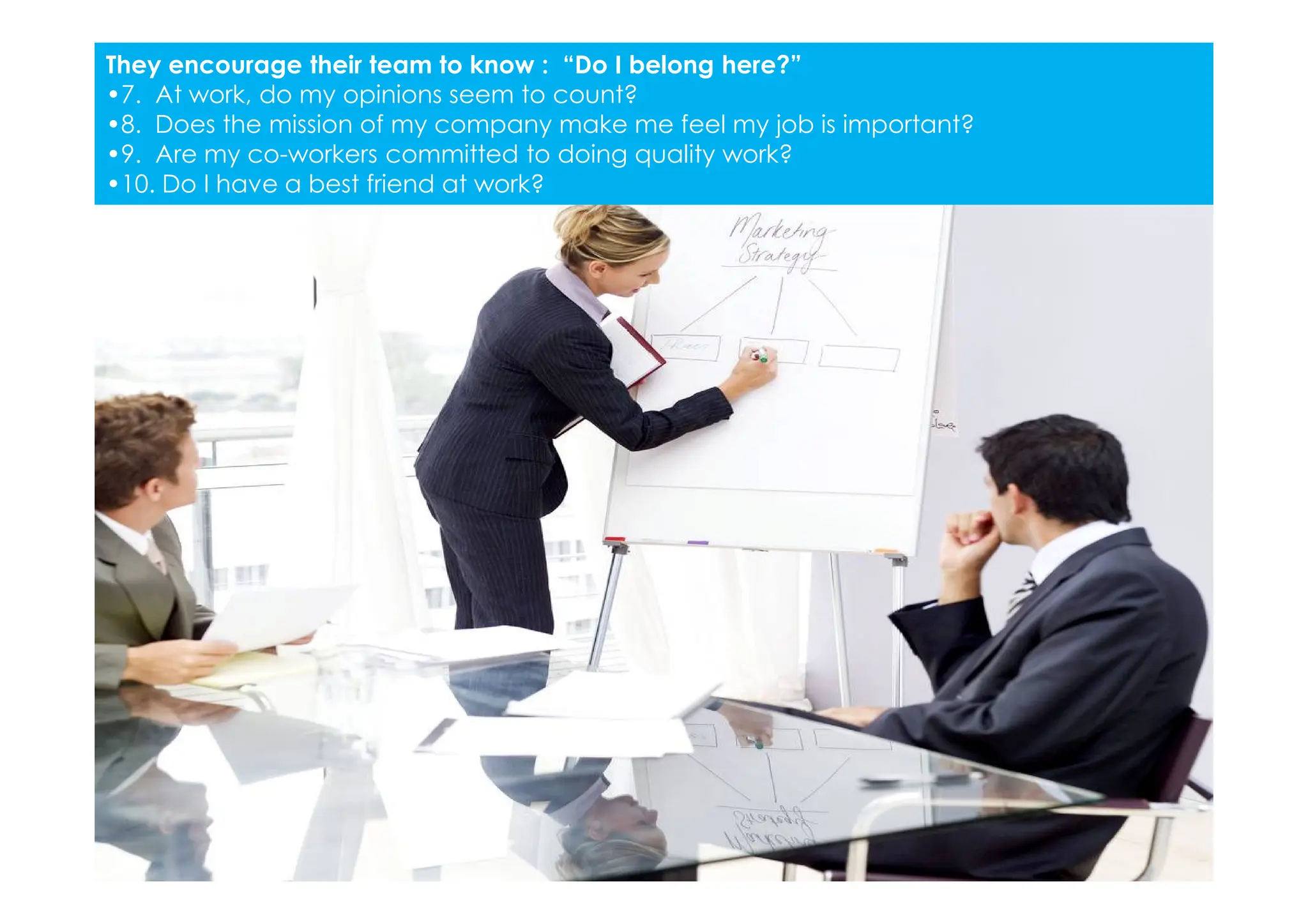
They encourage their team to know : “Do I belong here?”
•7. At work, do my opinions seem to count?
•8. Does the mission of my company make me feel my job is important?
•9. Are my co-workers committed to doing quality work?
•10. Do I have a best friend at work?
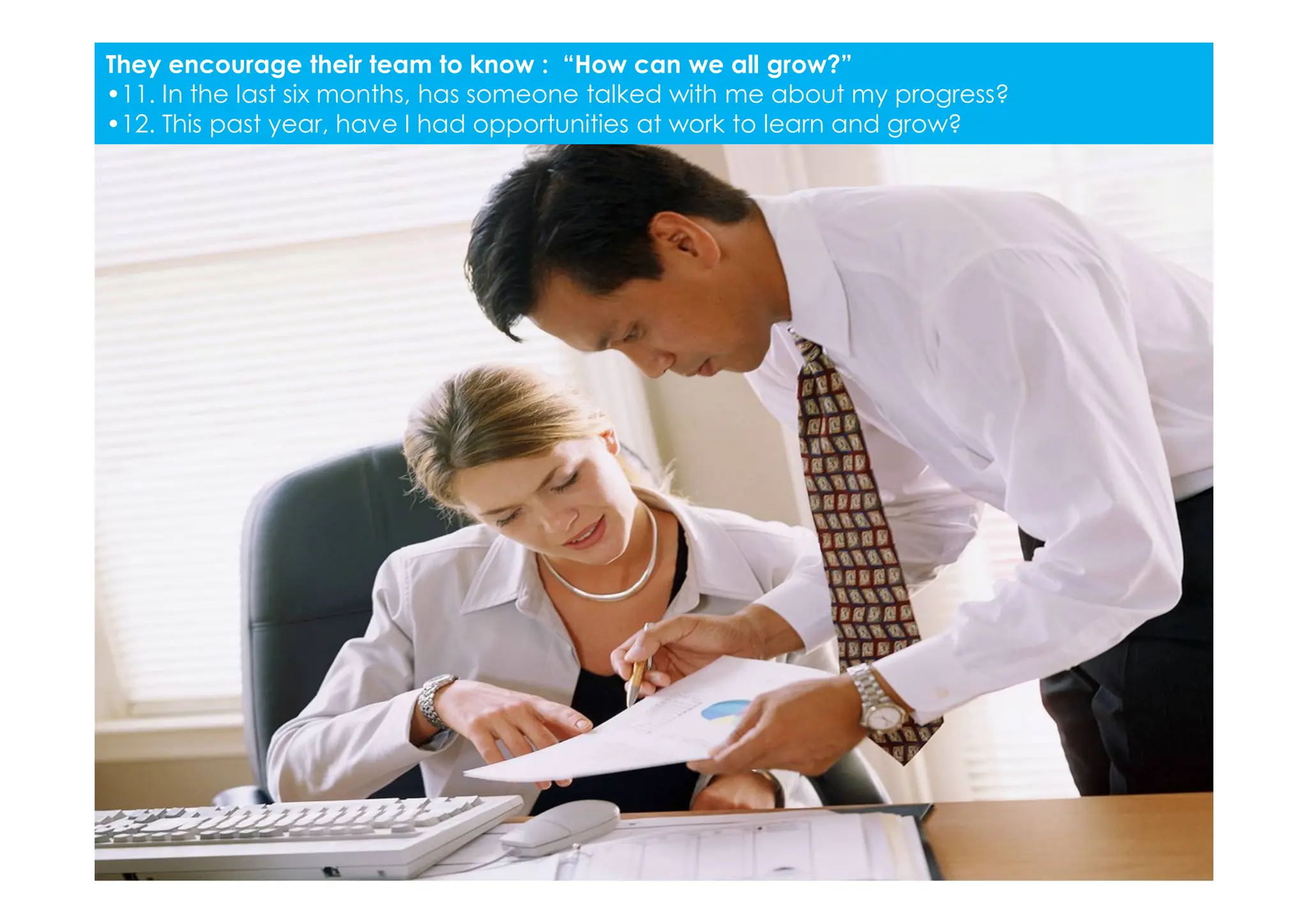
They encourage their team to know : “How can we all grow?”
•11. In the last six months, has someone talked with me about my progress?
•12. This past year, have I had opportunities at work to learn and grow?
The FOUR KEYS of GREAT MANAGERS:
#1 – SELECT FOR TALENT, not simply experience, intelligence, or determination
#2 – DEFINE THE RIGHT OUTCOMES, not the right steps
#3 – FOCUS ON STRENGTHS, not on weaknesses
#4 – FIND THE RIGHT FIT, not simply the next rung on the ladder
A great manager is someone who says,
You come to work with me, and I’ll help you
“You come to work with me, and I’ll help you
be as successful as possible; I’ll help you
grow; I’ll help you make sure you’re in the
right role; I’ll provide the relationship for you
to understand and know yourself. And
I want you to be more successful than me.
“
”
A) SELECT FOR TALENT
•Striving talents: The WHY of a person; why each person is motivated to push and push just that little bit harder
•Thinking talents: The HOW of a person; how each person thinks, weighs alternatives; comes to decisions
•Relating talents: The WHO of a person; whom people trust; builds relationships; confronts; ignores
•What is right for our CUSTOMERS?
•What is right for our COMPANY?
•What is right for the INDIVIDUAL?
B) DEFINE THE RIGHT OUTCOMES
“Define the right outcomes and then let
each person find their own route toward
those outcomes”
C) FOCUS ON STRENGTHS
•Focus on each person’s strengths and manage around the weaknesses
•Don’t try to fix the weaknesses
•Don’t try to perfect each person - Help each person become more of what they all ready are
Consider what happens when
performance is measured
against “excellent” performers
rather than the average.
D) FIND THE RIGHT FIT
Three career development fallacies
•#1 – Each rung of the “promotion ladder”, with
just a little more training – the employee will be
able to repeat the success on the rung above.
•Great managers know that one rung does not
necessarily lead to another
•#2 – Conventional career path is condemned
to create conflict; lots of people vying for limited
opportunities
•Great managers have a better idea: Carve
out alternative career paths by conveying
meaningful prestige on every role.
•#3 – Varied experiences make the employee
more attractive
Self-discovery is the driving, guiding force for a
healthy career. Great managers know that it is
this search for a full understanding of your talents
and non-talents that serves as the source of
energy powering your career.
Here are 15 pearls of wisdom in a nutshell from First,
Break All the Rules
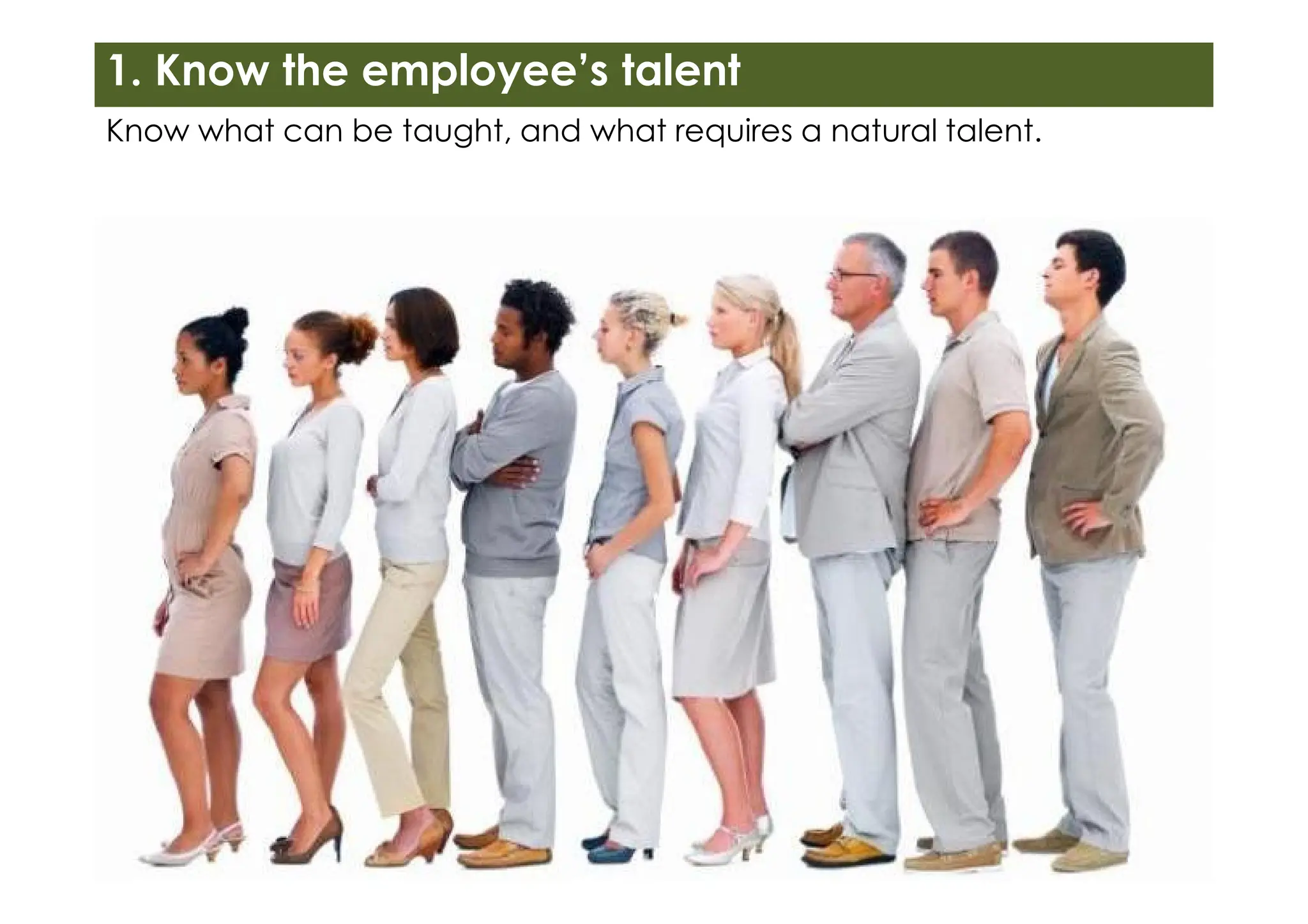
1. Know the employee’s talent
Know what can be taught, and what requires a natural talent.
2. Set the right outcomes, not steps
Standardize the end but not the means. As long as the means are within the
company’s legal boundaries and industry standards, let the employee use his
own style to deliver the result or outcome you want.
3. Motivate by focusing on strengths, not weaknesses.
“The best managers never try to fix weaknesses; instead they focus on strengths and
talent.”
4. Casting is important
If an employee is not performing at excellence, maybe she is not cast in
the right role.
Respect it enough to hire for talent to match.
5. Every role is noble
6. Excel in the art of the interview.
See if the candidate’s recurring patterns of behavior match the role he is to fulfill. Ask
open-ended questions and let him talk. Listen for specifics.
Find ways to measure, count, and reward outcomes.
7. Result-Oriented
Give constant feedback. If you can’t spend an hour every quarter talking to an
employee, then you shouldn’t be a manager.
8. Spend time with your best people
There are many ways of alleviating a problem or non-talent. Devise a support
system, find a complementary partner for him, or an alternative role.
9. Complementary partner
Simply offer bigger rewards within the same range of his work. It is better to have
an excellent highly paid waitress or bartender on your team than promote him or
her to a poor starting-level bar manager.
10. Do not promote someone until he reaches his level of incompetence
Great managers don’t use complicated appraisal systems. Instead, they
concentrate on what to tell each employee and how to tell them.
11. Simplicity
“The best managers reject
conventional wisdom.”
12. Frequent interaction
Great managers also frequently interact with each worker, not just once a year at review
time. Meet, at a minimum, once a quarter to discuss performance. The meeting doesn’t
have to last long, but it must focus on performance. One clear advantage to frequent
feedback is that poor performance can be corrected earlier rather than be left for a
“bombshell” discussion at annual review time.
“The best managers treat every
employee as an individual.”
13. Focus on the future
All reviews should focus on the future. Great managers ask workers to identify where they
want to go and how they are going to go about getting there.
The best managers know they are on
stage everyday. They know their people
are watching every move they make.
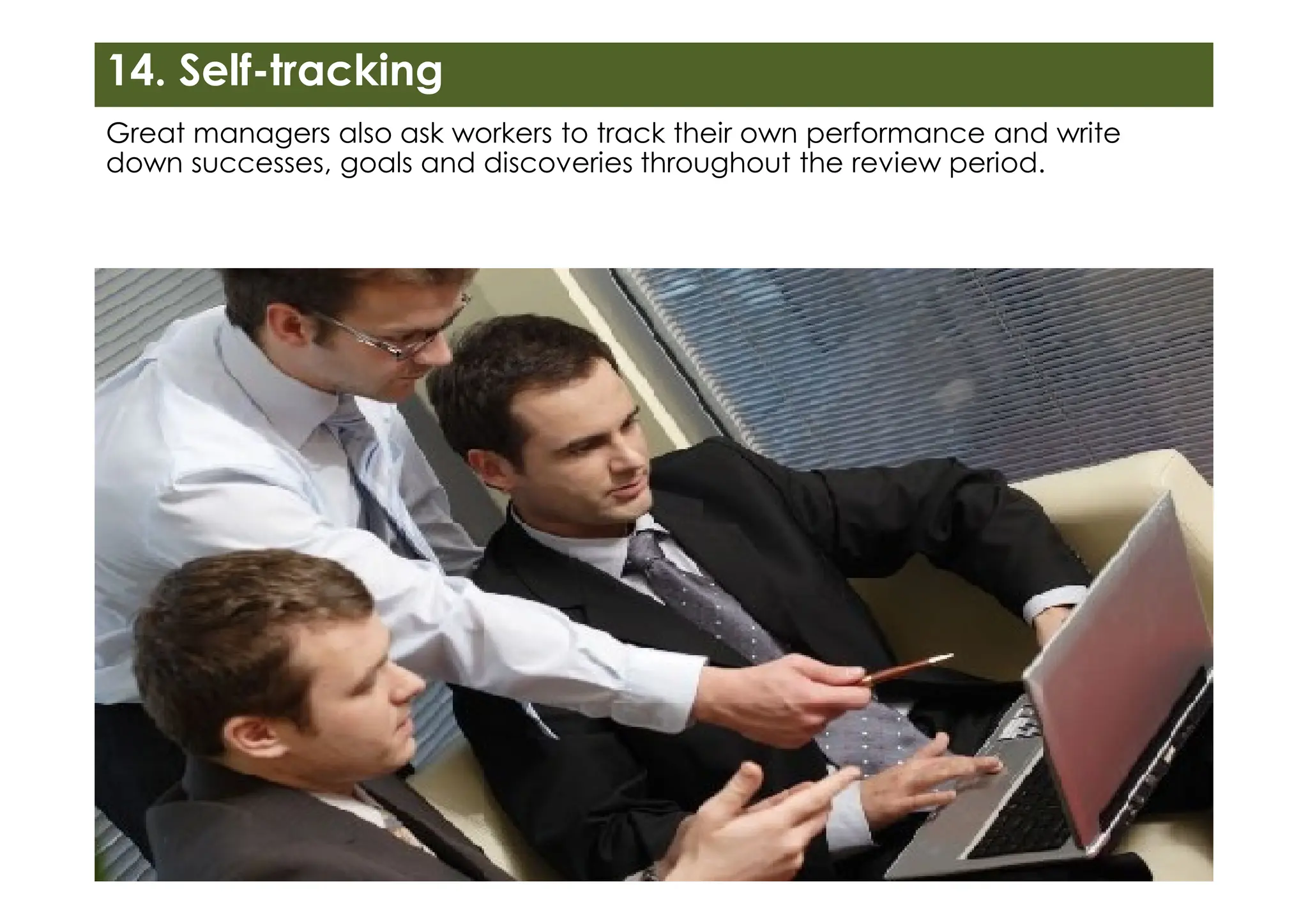
14. Self-tracking
Great managers also ask workers to track their own performance and write
down successes, goals and discoveries throughout the review period.
Study the best managers in the company and revise training to incorporate what they
know. Send your talented people to learn new skills or knowledge. Change recruiting
practices to hire for talent, revise employee job descriptions and qualifications.
15. Some homework to do
1. Know the employee’s talent
2. Set the right outcomes, not steps
3. Motivate by focusing on strengths, not weaknesses.
4. Casting is important
5. Every role is noble
6. Excel in the art of the interview.
7. Result-Oriented
8. Spend time with your best people
9. Complementary partner
10. Do not promote someone until he reaches his level of incompetence
11. Simplicity
Summary :
11. Simplicity
12. Frequent interaction
13. Focus on the future
14. Self-tracking
15. Some homework to do
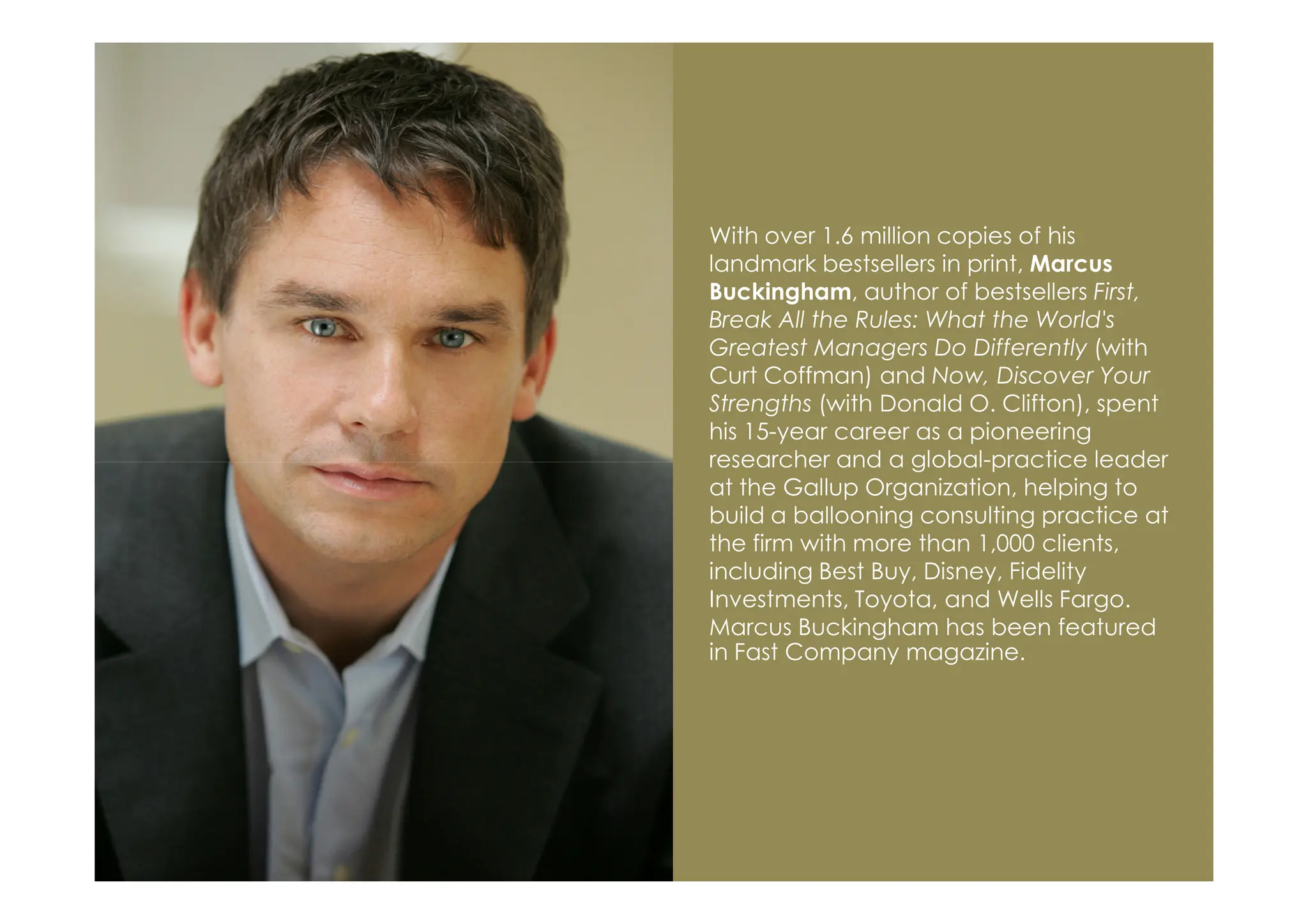
With over 1.6 million copies of his
landmark bestsellers in print, Marcus
Buckingham, author of bestsellers First,
Break All the Rules: What the World's
Greatest Managers Do Differently (with
Curt Coffman) and Now, Discover Your
Strengths (with Donald O. Clifton), spent
his 15-year career as a pioneering
researcher and a global-practice leader
at the Gallup Organization, helping to
build a ballooning consulting practice at
the firm with more than 1,000 clients,
including Best Buy, Disney, Fidelity
Investments, Toyota, and Wells Fargo.
Marcus Buckingham has been featured
in Fast Company magazine.

First Break All The Rules - What the World's Greatwest Managers Do Differentlys

  • 1.
    First, Break All First,Break All What the World’s Greatest Managers Do Differently The Rules The Rules by Marcus Buckingham and Curt Coffman
  • 2.
    People leave managers,not companies. If you have a turnover problem, look first to your managers.
  • 3.
    ESSENTIAL POINT: Greatmanagers recognize that each person is motivated differently, that each person has his/her own way of thinking, and own style of relating to others. Great managers know there is a limit to how much remolding they can do to someone. They don’t bemoan these differences and try to grind them down – instead they CAPITALIZE on them. They try to help each person become more and more of who he/she already is. People don’t change that much. Don’t waste time trying to put in what was left out Try to draw what was left in. That is hard enough.
  • 4.
    They encourage theirteam to know : “What do I get?” •1. Do I know what is expected of me? •2. Do I have the materials and equipment I need to do my work right?
  • 5.
    They encourage theirteam to know : “What do I give?” •3. Do I have the opportunity to do what I do best every day? •4. In the last seven days, have I received recognition or praise for good work? •5. Does my supervisor, or someone at work, seem to care about me as a person? •6. Is there someone at work who encourages my development?
  • 6.
    They encourage theirteam to know : “Do I belong here?” •7. At work, do my opinions seem to count? •8. Does the mission of my company make me feel my job is important? •9. Are my co-workers committed to doing quality work? •10. Do I have a best friend at work?
  • 7.
    They encourage theirteam to know : “How can we all grow?” •11. In the last six months, has someone talked with me about my progress? •12. This past year, have I had opportunities at work to learn and grow?
  • 8.
    The FOUR KEYSof GREAT MANAGERS: #1 – SELECT FOR TALENT, not simply experience, intelligence, or determination #2 – DEFINE THE RIGHT OUTCOMES, not the right steps #3 – FOCUS ON STRENGTHS, not on weaknesses #4 – FIND THE RIGHT FIT, not simply the next rung on the ladder A great manager is someone who says, You come to work with me, and I’ll help you “You come to work with me, and I’ll help you be as successful as possible; I’ll help you grow; I’ll help you make sure you’re in the right role; I’ll provide the relationship for you to understand and know yourself. And I want you to be more successful than me. “ ”
  • 9.
    A) SELECT FORTALENT •Striving talents: The WHY of a person; why each person is motivated to push and push just that little bit harder •Thinking talents: The HOW of a person; how each person thinks, weighs alternatives; comes to decisions •Relating talents: The WHO of a person; whom people trust; builds relationships; confronts; ignores
  • 10.
    •What is rightfor our CUSTOMERS? •What is right for our COMPANY? •What is right for the INDIVIDUAL? B) DEFINE THE RIGHT OUTCOMES “Define the right outcomes and then let each person find their own route toward those outcomes”
  • 11.
    C) FOCUS ONSTRENGTHS •Focus on each person’s strengths and manage around the weaknesses •Don’t try to fix the weaknesses •Don’t try to perfect each person - Help each person become more of what they all ready are Consider what happens when performance is measured against “excellent” performers rather than the average.
  • 12.
    D) FIND THERIGHT FIT Three career development fallacies •#1 – Each rung of the “promotion ladder”, with just a little more training – the employee will be able to repeat the success on the rung above. •Great managers know that one rung does not necessarily lead to another •#2 – Conventional career path is condemned to create conflict; lots of people vying for limited opportunities •Great managers have a better idea: Carve •Great managers have a better idea: Carve out alternative career paths by conveying meaningful prestige on every role. •#3 – Varied experiences make the employee more attractive Self-discovery is the driving, guiding force for a healthy career. Great managers know that it is this search for a full understanding of your talents and non-talents that serves as the source of energy powering your career.
  • 13.
    Here are 15pearls of wisdom in a nutshell from First, Break All the Rules
  • 14.
    1. Know theemployee’s talent Know what can be taught, and what requires a natural talent.
  • 15.
    2. Set theright outcomes, not steps Standardize the end but not the means. As long as the means are within the company’s legal boundaries and industry standards, let the employee use his own style to deliver the result or outcome you want.
  • 16.
    3. Motivate byfocusing on strengths, not weaknesses. “The best managers never try to fix weaknesses; instead they focus on strengths and talent.”
  • 17.
    4. Casting isimportant If an employee is not performing at excellence, maybe she is not cast in the right role.
  • 18.
    Respect it enoughto hire for talent to match. 5. Every role is noble
  • 19.
    6. Excel inthe art of the interview. See if the candidate’s recurring patterns of behavior match the role he is to fulfill. Ask open-ended questions and let him talk. Listen for specifics.
  • 20.
    Find ways tomeasure, count, and reward outcomes. 7. Result-Oriented
  • 21.
    Give constant feedback.If you can’t spend an hour every quarter talking to an employee, then you shouldn’t be a manager. 8. Spend time with your best people
  • 22.
    There are manyways of alleviating a problem or non-talent. Devise a support system, find a complementary partner for him, or an alternative role. 9. Complementary partner
  • 23.
    Simply offer biggerrewards within the same range of his work. It is better to have an excellent highly paid waitress or bartender on your team than promote him or her to a poor starting-level bar manager. 10. Do not promote someone until he reaches his level of incompetence
  • 24.
    Great managers don’tuse complicated appraisal systems. Instead, they concentrate on what to tell each employee and how to tell them. 11. Simplicity “The best managers reject conventional wisdom.”
  • 25.
    12. Frequent interaction Greatmanagers also frequently interact with each worker, not just once a year at review time. Meet, at a minimum, once a quarter to discuss performance. The meeting doesn’t have to last long, but it must focus on performance. One clear advantage to frequent feedback is that poor performance can be corrected earlier rather than be left for a “bombshell” discussion at annual review time. “The best managers treat every employee as an individual.”
  • 26.
    13. Focus onthe future All reviews should focus on the future. Great managers ask workers to identify where they want to go and how they are going to go about getting there. The best managers know they are on stage everyday. They know their people are watching every move they make.
  • 27.
    14. Self-tracking Great managersalso ask workers to track their own performance and write down successes, goals and discoveries throughout the review period.
  • 28.
    Study the bestmanagers in the company and revise training to incorporate what they know. Send your talented people to learn new skills or knowledge. Change recruiting practices to hire for talent, revise employee job descriptions and qualifications. 15. Some homework to do
  • 29.
    1. Know theemployee’s talent 2. Set the right outcomes, not steps 3. Motivate by focusing on strengths, not weaknesses. 4. Casting is important 5. Every role is noble 6. Excel in the art of the interview. 7. Result-Oriented 8. Spend time with your best people 9. Complementary partner 10. Do not promote someone until he reaches his level of incompetence 11. Simplicity Summary : 11. Simplicity 12. Frequent interaction 13. Focus on the future 14. Self-tracking 15. Some homework to do
  • 30.
    With over 1.6million copies of his landmark bestsellers in print, Marcus Buckingham, author of bestsellers First, Break All the Rules: What the World's Greatest Managers Do Differently (with Curt Coffman) and Now, Discover Your Strengths (with Donald O. Clifton), spent his 15-year career as a pioneering researcher and a global-practice leader researcher and a global-practice leader at the Gallup Organization, helping to build a ballooning consulting practice at the firm with more than 1,000 clients, including Best Buy, Disney, Fidelity Investments, Toyota, and Wells Fargo. Marcus Buckingham has been featured in Fast Company magazine.