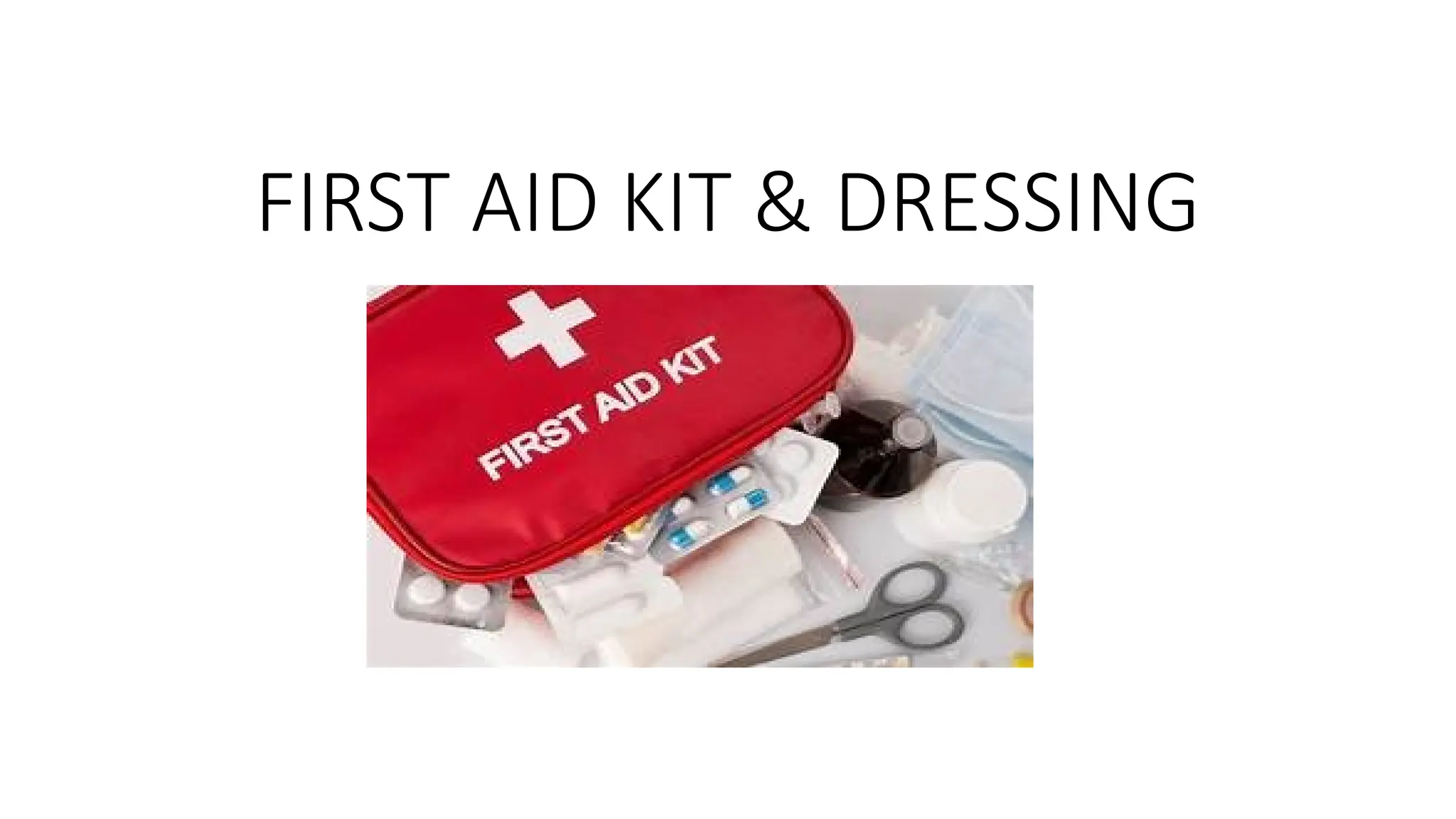
FIRST AID KIT & DRESSING
Contents of the first aid kit required by national regulations.
• The sources specify that all ships subject to the regulations
established by the International Maritime Organization (IMO) and
International Labour Organization (ILO) must have adequate medical
supplies. These supplies should be periodically inspected, kept in
good condition, and ready for use whenever required. The quantities
needed on board will depend on the duration and destination of the
voyage, the number of crew members, and the nature of the cargo.
Additionally, the sources indicate that smaller vessels should carry
medical supplies in accordance with the relevant national guidelines
and in relation to their needs, as determined by length of voyage and
number of crew.
• While the sources do not list the specific first aid kit contents required
by every country's national regulations, they do provide a detailed list
of recommended medical supplies and equipment, which are
intended to meet the requirements of most countries. These
recommendations are aligned with the International Labour
Organization’s Maritime Labour Convention 2006 and the WHO's
Model List of Essential Medicines. The following is a list of the
contents that are suggested for a ship's medicine chest and would
likely be included in a first-aid kit
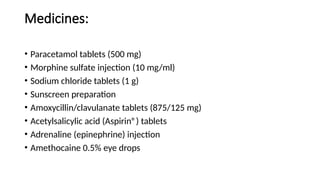
Medicines:
• Paracetamol tablets (500 mg)
• Morphine sulfate injection (10 mg/ml)
• Sodium chloride tablets (1 g)
• Sunscreen preparation
• Amoxycillin/clavulanate tablets (875/125 mg)
• Acetylsalicylic acid (Aspirin®) tablets
• Adrenaline (epinephrine) injection
• Amethocaine 0.5% eye drops
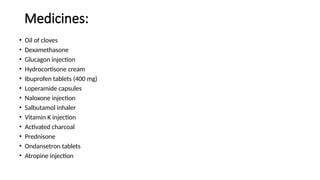
Medicines:
• Oil of cloves
• Dexamethasone
• Glucagon injection
• Hydrocortisone cream
• Ibuprofen tablets (400 mg)
• Loperamide capsules
• Naloxone injection
• Salbutamol inhaler
• Vitamin K injection
• Activated charcoal
• Prednisone
• Ondansetron tablets
• Atropine injection
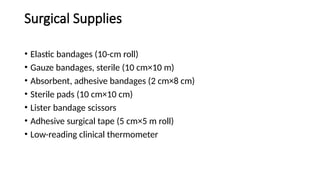
Surgical Supplies
• Elastic bandages (10-cm roll)
• Gauze bandages, sterile (10 cm×10 m)
• Absorbent, adhesive bandages (2 cm×8 cm)
• Sterile pads (10 cm×10 cm)
• Lister bandage scissors
• Adhesive surgical tape (5 cm×5 m roll)
• Low-reading clinical thermometer
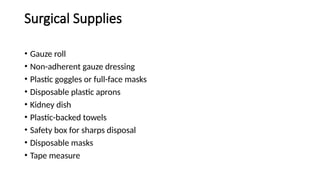
Surgical Supplies
• Gauze roll
• Non-adherent gauze dressing
• Plastic goggles or full-face masks
• Disposable plastic aprons
• Kidney dish
• Plastic-backed towels
• Safety box for sharps disposal
• Disposable masks
• Tape measure
• Digital thermometer
• Rectal thermometer
• Hypothermic thermometer
• Penlight with blue cover
Equipment for Injection, Infusion, and Catheterization:
• Disposable syringes (2 ml and 5 ml)
• Hypodermic subcutaneous needles
• Hypodermic intramuscular needles
• Blunt "drawing up" needles
Equipment for Injection, Infusion, and Catheterization:
• Intravenous infusion cannulas
• Intravenous giving set
• Tourniquet
• Penile sheath set with condom catheter, tube, and bag
• Short-term urine catheter
• Urine collecting bag and tube
General Medical and Nursing Equipment:
• Plastic draw sheets
• Stainless-steel bedpan
• Hot-water bottle
• Male urinal
• Ice bag
• Aluminum foil blanket
• Male condoms
• Plastic wash bottle
• Plastic bottle (1 liter)
• Stainless steel dressing tray
General Medical and Nursing Equipment:
• Stainless steel bowl
• Plastic specimen jars with lids and labels
• Plaster-of-Paris bandages
• Stockinette for splints
• Cotton wool roll
• Alcohol swabs
• Nail brush
General Medical and Nursing Equipment:
• Paraffin gauze dressing
• Elastic fixation bandage
• Sterile compression bandages
• Tubular gauze for finger bandage
• Adhesive elastic bandage
• Triangular sling
• Sterile sheet for burn victims
• Honey for dressing burns
• Adhesive sutures or zinc oxide bandages
• Q-tips
• Safety pins
• Butterfly sutures
• Skin adhesive (2-octyl cyanoacrylate liquid)
• Sutures, absorbable with curved non-traumatic needles
• Disposable examination gloves
• Sterile surgical gloves
Instruments:
• Disposable scalpels
• Stainless-steel instrument box
• Operating scissors
• Bandage scissors
• Splinter forceps
• Toothed tissue forceps
• Needle holder
• Haemostatic clamps
• Disposable razors
Examination and Monitoring Equipment:
• Disposable tongue depressors
• Reactive strips for urine analysis
• Microscope slides
• Stethoscope
• Sphygmomanometer (blood pressure set)
Immobilization and Transportation
Equipment:
• Malleable finger splint
• Malleable forearm/hand splint
Ships carrying dangerous goods
• The sources also emphasize that ships carrying dangerous goods
should have additional medicines, specific antidotes, and special
equipment on board, as prescribed in the International Maritime
Organization’s Medical First Aid Guide for Use in Accidents Involving
Dangerous Goods (MFAG). These items should be stored and
registered together with regular medical supplies.
National regulations
• It is important to note that while these guidelines provide a
comprehensive list, national regulations may vary. Therefore, it is
essential to consult the specific regulations of the country where the
ship is registered or the countries it will visit, in order to ensure
compliance and to carry all necessary items. It is also critical that the
master or designated crew member maintains records of all medical
supplies including expiry dates, storage conditions, and quantities
remaining after purchase or use
Location of first aid kits.
Contents of lifeboat kit
Use of the first aid box in appropriate medical
situation.
Use of Gudwell’s Airways.

First aid KIT & Dressing and bandage notes

  • 1.
    FIRST AID KIT& DRESSING
  • 2.
    Contents of thefirst aid kit required by national regulations.
  • 3.
    • The sourcesspecify that all ships subject to the regulations established by the International Maritime Organization (IMO) and International Labour Organization (ILO) must have adequate medical supplies. These supplies should be periodically inspected, kept in good condition, and ready for use whenever required. The quantities needed on board will depend on the duration and destination of the voyage, the number of crew members, and the nature of the cargo. Additionally, the sources indicate that smaller vessels should carry medical supplies in accordance with the relevant national guidelines and in relation to their needs, as determined by length of voyage and number of crew.
  • 4.
    • While thesources do not list the specific first aid kit contents required by every country's national regulations, they do provide a detailed list of recommended medical supplies and equipment, which are intended to meet the requirements of most countries. These recommendations are aligned with the International Labour Organization’s Maritime Labour Convention 2006 and the WHO's Model List of Essential Medicines. The following is a list of the contents that are suggested for a ship's medicine chest and would likely be included in a first-aid kit
  • 5.
    Medicines: • Paracetamol tablets(500 mg) • Morphine sulfate injection (10 mg/ml) • Sodium chloride tablets (1 g) • Sunscreen preparation • Amoxycillin/clavulanate tablets (875/125 mg) • Acetylsalicylic acid (Aspirin®) tablets • Adrenaline (epinephrine) injection • Amethocaine 0.5% eye drops
  • 6.
    Medicines: • Oil ofcloves • Dexamethasone • Glucagon injection • Hydrocortisone cream • Ibuprofen tablets (400 mg) • Loperamide capsules • Naloxone injection • Salbutamol inhaler • Vitamin K injection • Activated charcoal • Prednisone • Ondansetron tablets • Atropine injection
  • 7.
    Surgical Supplies • Elasticbandages (10-cm roll) • Gauze bandages, sterile (10 cm×10 m) • Absorbent, adhesive bandages (2 cm×8 cm) • Sterile pads (10 cm×10 cm) • Lister bandage scissors • Adhesive surgical tape (5 cm×5 m roll) • Low-reading clinical thermometer
  • 8.
    Surgical Supplies • Gauzeroll • Non-adherent gauze dressing • Plastic goggles or full-face masks • Disposable plastic aprons • Kidney dish • Plastic-backed towels • Safety box for sharps disposal • Disposable masks • Tape measure
  • 9.
    • Digital thermometer •Rectal thermometer • Hypothermic thermometer • Penlight with blue cover
  • 10.
    Equipment for Injection,Infusion, and Catheterization: • Disposable syringes (2 ml and 5 ml) • Hypodermic subcutaneous needles • Hypodermic intramuscular needles • Blunt "drawing up" needles
  • 11.
    Equipment for Injection,Infusion, and Catheterization: • Intravenous infusion cannulas • Intravenous giving set • Tourniquet • Penile sheath set with condom catheter, tube, and bag • Short-term urine catheter • Urine collecting bag and tube
  • 12.
    General Medical andNursing Equipment: • Plastic draw sheets • Stainless-steel bedpan • Hot-water bottle • Male urinal • Ice bag • Aluminum foil blanket • Male condoms • Plastic wash bottle • Plastic bottle (1 liter) • Stainless steel dressing tray
  • 13.
    General Medical andNursing Equipment: • Stainless steel bowl • Plastic specimen jars with lids and labels • Plaster-of-Paris bandages • Stockinette for splints • Cotton wool roll • Alcohol swabs • Nail brush
  • 14.
    General Medical andNursing Equipment: • Paraffin gauze dressing • Elastic fixation bandage • Sterile compression bandages • Tubular gauze for finger bandage • Adhesive elastic bandage • Triangular sling • Sterile sheet for burn victims • Honey for dressing burns • Adhesive sutures or zinc oxide bandages • Q-tips • Safety pins • Butterfly sutures • Skin adhesive (2-octyl cyanoacrylate liquid)
  • 15.
    • Sutures, absorbablewith curved non-traumatic needles • Disposable examination gloves • Sterile surgical gloves
  • 16.
    Instruments: • Disposable scalpels •Stainless-steel instrument box • Operating scissors • Bandage scissors • Splinter forceps • Toothed tissue forceps • Needle holder • Haemostatic clamps • Disposable razors
  • 17.
    Examination and MonitoringEquipment: • Disposable tongue depressors • Reactive strips for urine analysis • Microscope slides • Stethoscope • Sphygmomanometer (blood pressure set)
  • 18.
    Immobilization and Transportation Equipment: •Malleable finger splint • Malleable forearm/hand splint
  • 19.
    Ships carrying dangerousgoods • The sources also emphasize that ships carrying dangerous goods should have additional medicines, specific antidotes, and special equipment on board, as prescribed in the International Maritime Organization’s Medical First Aid Guide for Use in Accidents Involving Dangerous Goods (MFAG). These items should be stored and registered together with regular medical supplies.
  • 20.
    National regulations • Itis important to note that while these guidelines provide a comprehensive list, national regulations may vary. Therefore, it is essential to consult the specific regulations of the country where the ship is registered or the countries it will visit, in order to ensure compliance and to carry all necessary items. It is also critical that the master or designated crew member maintains records of all medical supplies including expiry dates, storage conditions, and quantities remaining after purchase or use
  • 21.
  • 22.
  • 23.
    Use of thefirst aid box in appropriate medical situation.
  • 24.

Editor's Notes

  • #2 Surgical Supplies Elastic bandages (10-cm roll) Gauze bandages, sterile (10 cm×10 m) Absorbent, adhesive bandages (2 cm×8 cm) Sterile pads (10 cm×10 cm) Lister bandage scissors Adhesive surgical tape (5 cm×5 m roll) Low-reading clinical thermometer Gauze roll Non-adherent gauze dressing Paraffin gauze dressing Elastic fixation bandage Sterile compression bandages Tubular gauze for finger bandage Adhesive elastic bandage Triangular sling Sterile sheet for burn victims Honey for dressing burns Adhesive sutures or zinc oxide bandages Q-tips Safety pins Butterfly sutures Skin adhesive (2-octyl cyanoacrylate liquid) Sutures, absorbable with curved non-traumatic needles Disposable examination gloves Sterile surgical gloves Instruments: Disposable scalpels Stainless-steel instrument box Operating scissors Bandage scissors Splinter forceps Toothed tissue forceps Needle holder Haemostatic clamps Disposable razors Examination and Monitoring Equipment: Disposable tongue depressors Reactive strips for urine analysis Microscope slides Stethoscope Sphygmomanometer (blood pressure set) Digital thermometer Rectal thermometer Hypothermic thermometer Penlight with blue cover Equipment for Injection, Infusion, and Catheterization: Disposable syringes (2 ml and 5 ml) Hypodermic subcutaneous needles Hypodermic intramuscular needles Blunt "drawing up" needles Intravenous infusion cannulas Intravenous giving set Tourniquet Penile sheath set with condom catheter, tube, and bag Short-term urine catheter Urine collecting bag and tube General Medical and Nursing Equipment: Plastic goggles or full-face masks Disposable plastic aprons Kidney dish Plastic-backed towels Safety box for sharps disposal Disposable masks Tape measure Plastic draw sheets Stainless-steel bedpan Hot-water bottle Male urinal Ice bag Aluminum foil blanket Male condoms Plastic wash bottle Plastic bottle (1 liter) Stainless steel dressing tray Stainless steel bowl Plastic specimen jars with lids and labels Plaster-of-Paris bandages Stockinette for splints Cotton wool roll Alcohol swabs Nail brush Immobilization and Transportation Equipment: Malleable finger splint Malleable forearm/hand splint The sources also emphasize that ships carrying dangerous goods should have additional medicines, specific antidotes, and special equipment on board, as prescribed in the International Maritime Organization’s Medical First Aid Guide for Use in Accidents Involving Dangerous Goods (MFAG). These items should be stored and registered together with regular medical supplies. It is important to note that while these guidelines provide a comprehensive list, national regulations may vary. Therefore, it is essential to consult the specific regulations of the country where the ship is registered or the countries it will visit, in order to ensure compliance and to carry all necessary items. It is also critical that the master or designated crew member maintains records of all medical supplies including expiry dates, storage conditions, and quantities remaining after purchase or use.
  • #21 The sources specify that the first aid kit and other medical supplies should be kept in the ship’s medicine chest. The medicine chest itself should be located in a place that is easily accessible. The location of the medicine chest is important because it should be readily available for immediate use, especially in emergencies. The sources emphasize that the medicine chest should be organized so that items are easy to identify and use. To facilitate this, the following guidelines are recommended: Emergency medicines and equipment should be kept separately in the most accessible place. Items of the same type or category should be stored together in a labeled box, shelf, or drawer. Controlled medicines must be kept apart in a locked compartment, preferably the master’s safe, in a room that is locked when unoccupied. In addition to the main medicine chest, lifeboats should also carry a first-aid kit. Ships sailing on infrequently used waterways or in colder climates should have a more complete survival kit that is kept at temperatures above freezing but not above room temperature, protected by waterproof packaging, and ready to be placed aboard lifeboats or life rafts when needed. The sources do not specify a particular location on the ship for the main medicine chest beyond it being easily accessible. However, based on the guidance provided, it is essential that the location is known to all crew members, that it is secure, and that it allows for quick access to the necessary supplies in the event of an emergency.
  • #22 The sources specify that lifeboats, life rafts, life floats, and buoyant apparatus should carry certain provisions, including a first-aid kit. Additionally, ships sailing on infrequently used waterways or in colder climates should also carry a more complete survival kit. This kit should be kept at temperatures above freezing but not above room temperature, protected by waterproof packaging, and ready to be placed aboard lifeboats or life rafts when needed. The recommended contents of a medical survival kit for lifeboats aboard merchant vessels, intended for 20–30 survivors are: Bandage, gauze, roll, sterile, 10 cm×10 m, 12s Bandage, absorbent, adhesive, 2 cm×8 cm, 100s Pad, sterile, 10 cm×10 cm, 100s Lister bandage scissors Soap, cake, 20 Sunglasses, 20 Syringe, hypodermic cartridge holder, 2 Tape, adhesive, surgical, 5 cm×5 m roll, 6s Low-reading clinical thermometer, 2 It is important to note that injectable doses of morphine sulfate may be stored in these kits. However, the ship’s compartment in which morphine sulfate is stored should be locked securely at all times and checked at frequent intervals by the master. The master and officer concerned should be the only persons on board with the key or lock combination. While the sources provide a list of recommended items for a lifeboat kit, it should be noted that this list is intended for a specific scenario (20-30 survivors on a merchant vessel) and might need to be adjusted based on the specific needs of the vessel. The sources also emphasize the importance of training crew in the principles and procedures needed to provide medical treatment following the abandonment of a vessel, as there may be little or no time to consult a manual during or shortly after ditching. This training should include regular lifeboat drills and regular briefing of crew and passengers in procedures to be followed after abandoning ship.
  • #23 The sources emphasize that first aid is treatment aimed at preventing death or further damage to health of an ill or injured person in a life-threatening condition. The sources provide guidance on how to use a first aid kit in a variety of medical situations. The first 11 chapters of the source material cover the principles of first aid, including how to respond to choking, bleeding, shock, pain, injuries, wounds, burns, and poisoning. First Steps When using the first aid kit, it is crucial to follow a step-by-step approach. Assess the situation: Determine what happened and if there is still any danger present. If providing first aid would put the rescuer in danger, they should call for help instead. If a person is in danger, they should be removed from the danger before any first aid is administered. Bystanders who may be in danger should be warned. If alone, shout for help. Choose the best place for first aid: This may not be at the location of the accident, especially if there is a fire or other dangerous conditions present. Prioritize care if there are several injured people. Attend first to any unconscious person, checking for pulse and breathing. Begin resuscitation of a person who is not breathing or has no detectable heartbeat. Attend to conscious patients, treating any bleeding by applying pressure to the wound. Other injuries can be dealt with after moving the patient to the sick bay, unless a spinal injury is suspected. Do not give first aid if you have doubts about your ability to do it correctly. Do not enter an enclosed space unless you are sure it is safe. Do not move a person without checking for spinal injuries and fractured long bones. Do not give the patient anything to eat or drink, especially alcohol. Basic Life Support Basic life support is a sequence of actions designed to resuscitate a person whose life is in danger. A person's life is in danger when breathing or blood circulation has stopped or is about to stop. Basic life support restores these two vital functions using the ABC sequence: Airway, Breathing, and Circulation. Cardiopulmonary resuscitation (CPR), which includes artificial respiration and external cardiac compression, is the main component of basic life support. Shake and shout before starting basic life support. Airway: Open the airway by tilting the patient’s head back and lifting the chin. If a spinal injury is suspected, tilt the head back only slightly to keep the airway open and pull the lower jaw forward rather than raising the chin. Use fingers to remove any visible obstructions from the patient’s mouth and throat. Breathing: Check for breathing by looking for chest movements, listening for sounds of breathing at the patient’s mouth, and feeling for exhaled air on your cheek. If there are no signs of breathing, send or shout for help and give two rescue breaths. If normal breathing does not resume, check for airway obstruction and try to restore breathing with two more breaths. If breathing resumes, place the patient in the recovery position. Circulation: Check the patient’s pulse. If there is no detectable pulse, give chest compressions and rescue breaths. Mouth-to-mouth rescue breathing: Pinch the patient's nostrils, form a tight seal with your lips over the patient's mouth, and give rescue breaths. Use a Guedel airway if available. Repeat the cycle 10–12 times per minute. Using a bag and mask resuscitator: Place the mask over the patient’s nose and mouth, hold it in place, and compress the bag to force air into the patient’s lungs. Chest compressions: Place the patient on a solid surface and kneel at their side. Locate the bottom edge of the lowest rib and place the middle finger on the point where the rib joins the sternum. Place your other hand on top of the first and give chest compressions. Do not press on the patient’s ribs. Do not stop compressions until a physician tells you to, the patient’s heart beat and breathing have returned, or you are too exhausted to continue. Use of automatic external defibrillators (AEDs): AEDs can be used to restore a normal heart rhythm when the heart has stopped pumping due to an abnormal rhythm. AEDs can be used safely by people without medical training. Specific Medical Situations The sources outline first-aid steps for specific medical situations: Spinal Injury: Suspect a spinal injury if a patient is unconscious, has fallen from a height, or complains of neck pain or tingling in the extremities. Keep the patient’s head, neck, and chest aligned. Choking: For a conscious patient, perform the Heimlich maneuver. For an unconscious patient, lay them face up and give abdominal thrusts. Bleeding: Apply direct pressure to the wound with a dressing or piece of cloth. If bleeding is from an arm or leg, elevate the limb. Seek medical advice if there is a rapid pulse or a fall in blood pressure. For a nosebleed, have the patient sit up, lean forward, and pinch the soft part of their nose. Seek medical advice if bleeding lasts more than 30 minutes, is profuse, cannot be stopped, or if the patient's blood pressure begins to fall. Shock: Stop any external bleeding and give oxygen. Start an intravenous infusion of normal saline. Seek medical advice. Pain Management: Use analgesic drugs for severe injuries or painful illnesses. Apply ice packs for 10 minutes every two hours to a painful injury within the first 48 hours. Never apply ice directly to the skin. Morphine should not be used in patients with head injuries or shock. Head Injuries: Check for other injuries, especially of the neck or spinal cord. Use the Glasgow Coma Scale (GCS) to assess the degree of impairment of consciousness. Seek medical advice if the GCS score is less than 13 at 30 minutes after the injury. Eye Injuries: Record a full account of the circumstances of the injury and do a careful eye examination. Seek medical advice urgently if the pupil does not react to light. Wounds: Wash hands and put on gloves and eye protection. Inspect the wound for foreign bodies and damage. Apply pressure to stop bleeding. Burns: Cool burned areas with cold water and cover with a clean, dry dressing. Electrocution: Check for injuries and assess the patient. If there are no skin burns, normal pulse, normal mental function, normal speech, and normal ability to walk, serious problems are unlikely. Otherwise, arrange for evacuation to an onshore hospital and administer normal saline. Poisoning: Give appropriate treatment based on the type of poisoning. Abdominal and Chest Injuries: Check vital signs. If there is bleeding, apply pressure. For a sucking chest wound, seal the wound with a large wad of gauze and tape. Fractures: Check sensation and circulation in the hand or foot, apply a sling or splint as needed, and provide analgesics. Other situations: The sources provide information on many other conditions including, but not limited to, near drowning, hypothermia, heart and circulation disorders, gastrointestinal issues, kidney and urinary disorders, pregnancy related issues, skin diseases, infectious diseases, dental issues. Additional Considerations Medical advice: Seek medical advice whenever the caregiver is uncertain about the best course of action. Evacuation: Evacuation by helicopter should be requested only for a patient in a serious condition. Consent: Treatment can be given without consent in emergencies, to an unconscious patient, or to a mentally ill patient endangering others. Nursing care: Good nursing contributes to recovery. Monitor the patient's vital signs regularly. Follow procedures for administering medication, applying dressings, and catheterizing the urinary bladder as outlined in the sources. Record keeping: It is important to keep detailed records of the patient’s condition, the treatment given, and any advice received. The sources emphasize the importance of following these guidelines, as proper use of the first aid kit and correct application of first aid techniques can be essential in saving lives and preventing further health complications.
  • #24 The sources discuss the use of a Guedel airway as part of basic life support, specifically in the context of maintaining an open airway during resuscitation. Key points regarding the use of a Guedel airway, according to the sources: Purpose: A Guedel airway is used to help establish and maintain an open airway in an unconscious patient. Timing of use: A Guedel airway should be used if available, after checking for airway obstruction, and before giving rescue breaths. Insertion: The airway is inserted between the patient’s jaws with the concave curve facing upwards, towards the patient’s head. Rescue breathing: Once the airway is in place, mouth-to-mouth rescue breathing can be performed by pinching the patient's nostrils, forming a tight seal with your lips over and around the patient's mouth and blowing forcefully. The sources also highlight these key steps and considerations when providing basic life support to an unconscious patient: Check the airway: Before inserting a Guedel airway, check again for any obstructions to the airway. Ensure that the head is tilted back enough and the chin is raised enough. Breathing: If the patient is not breathing, attempt rescue breathing. If normal breathing does not resume, check the blood circulation. Circulation: If there is no detectable pulse, give chest compressions and rescue breaths. Mouth-to-mouth rescue breathing: Pinch the patient’s nostrils, form a tight seal around the patient’s mouth, and blow forcefully to give rescue breaths. Oxygen: If available, send someone to bring an oxygen cylinder and attach oxygen tubing to the resuscitator. Do not delay rescue attempts to perform this task. Head tilt: With one hand under the patient’s neck, keep the patient’s head tilted back as far as it will go, unless you suspect a spinal injury. In the case of suspected spinal injury, use minimal tilt. By maintaining an open airway, a Guedel airway can improve the effectiveness of rescue breathing.