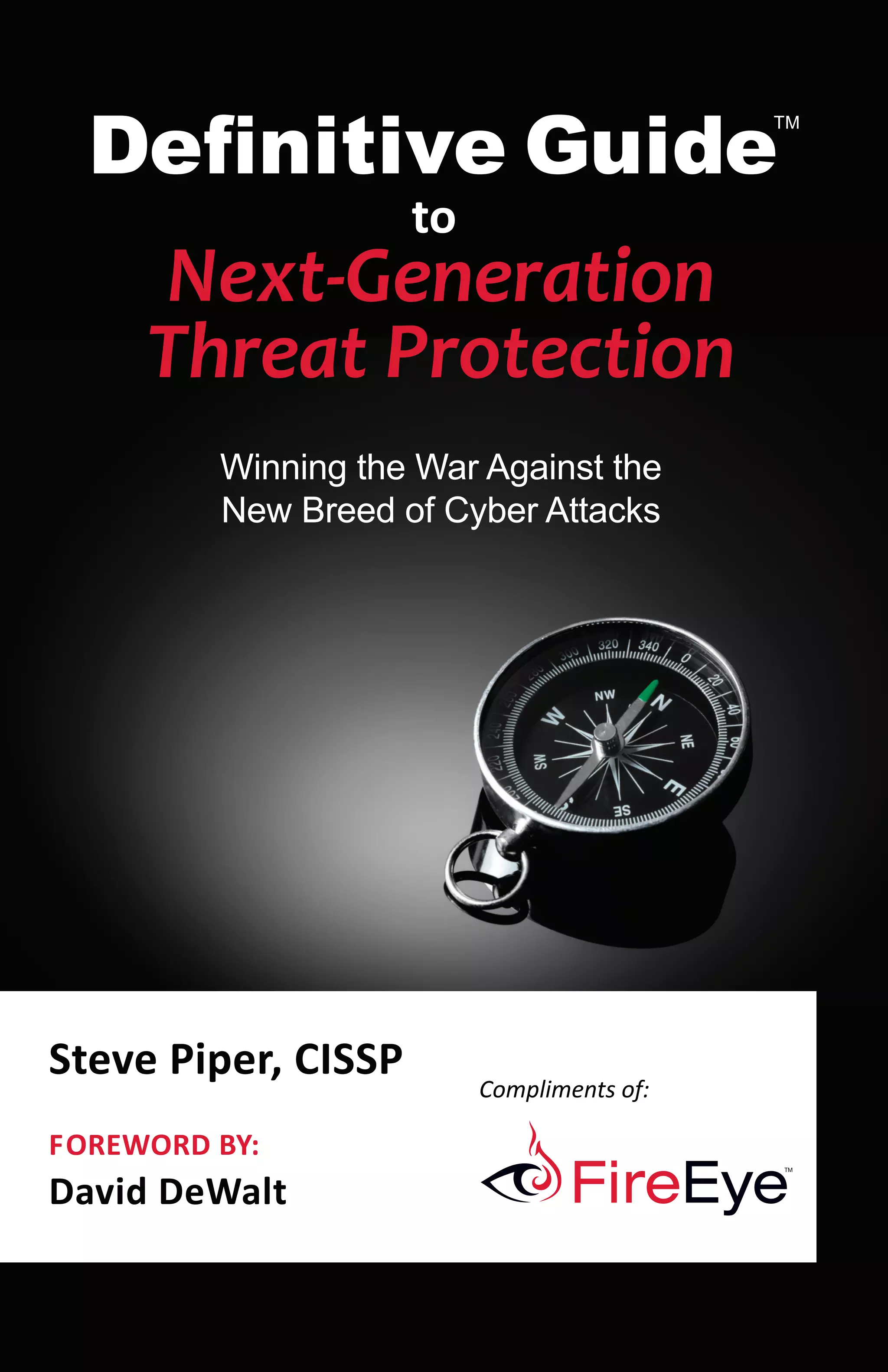
Definitive Guide
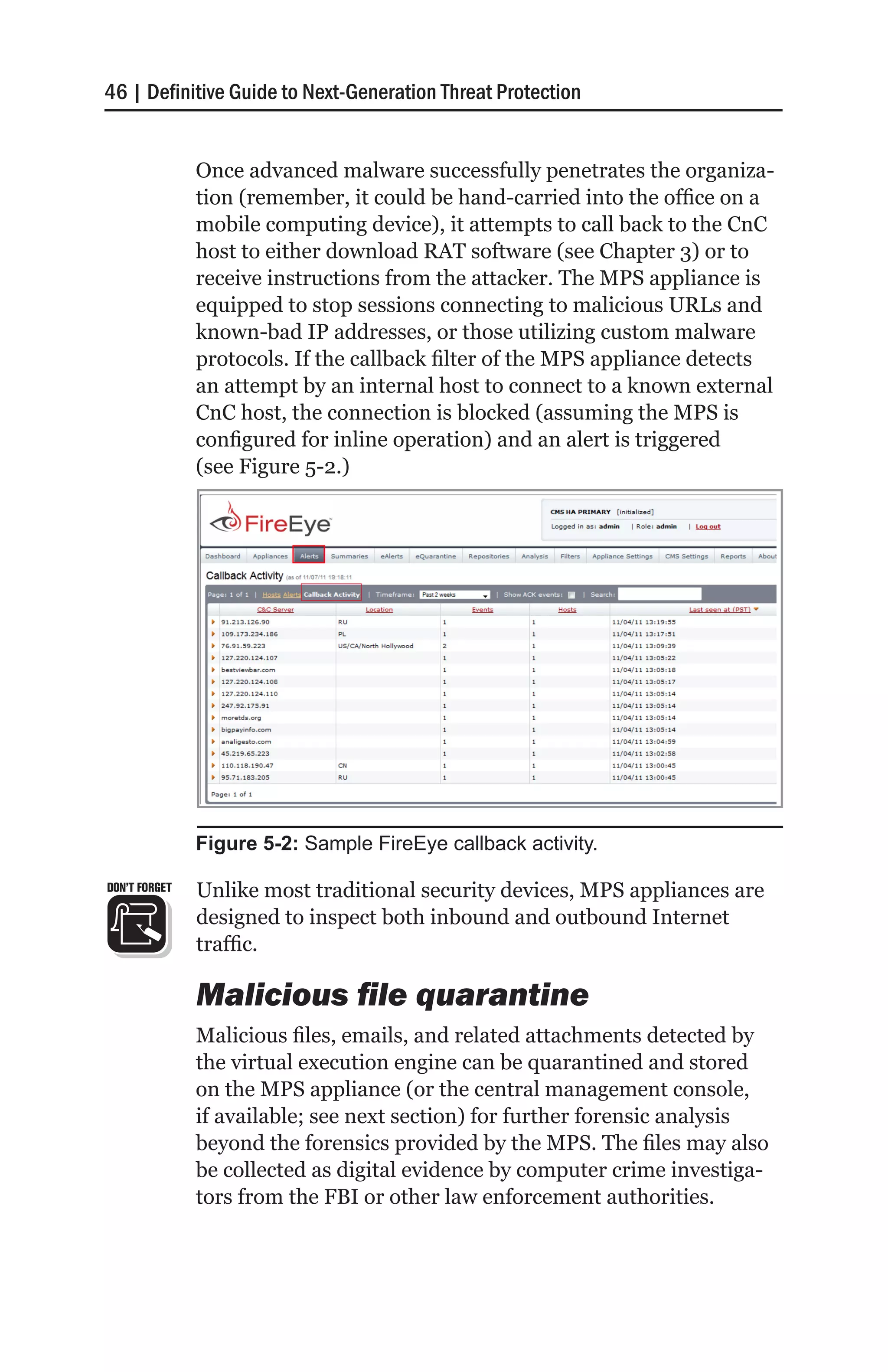
                                            TM


                     to
     Next-Generation
     Threat Protection
         Winning the War Against the
         New Breed of Cyber Attacks


Steve Piper, CISSP
                          Compliments of:

FOREWORD BY:
David DeWalt
About FireEye

FireEye is the leader in stopping today’s new breed of cyber
attacks, such as zero-day and APT attacks, that bypass
traditional defenses and compromise over 95% of networks.
The FireEye platform supplements signature-based firewalls,
IPS, anti-virus, and gateways, and provides the world’s only
cross-enterprise, signature-less protection against Web
and email threat vectors as well as malware resident on file
shares. It is the industry’s only integrated platform that stops
attacks across every stage of an attack life cycle, from exploit
to exfiltration. Using its patented Virtual Execution technology
engine across its platform, FireEye is uniquely able to protect
against today’s new breed of cyber attacks. FireEye solutions
are deployed in over 40 countries and more than 25% of the
Fortune 100.

     •	 Ranked #4 on the Deloitte 2012 Technology Fast
        500™ North America
     •	 Awarded the Wall Street Journal 2012 Technology
        Innovation Award
     •	 Inducted into JPMorgan Chase Hall of Innovation
Definitive Guide
                                 TM


              to
 Next-Generation
 Threat Protection
   Winning the War Against the
   New Breed of Cyber Attacks


    Steve Piper, CISSP
  Foreword by David DeWalt
Definitive Guide™ to Next-Generation Threat Protection
Published by:
CyberEdge Group, LLC
1997 Annapolis Exchange Parkway
Suite 300
Annapolis, MD 21401
(800) 327-8711
www.cyber-edge.com
Copyright © 2013, CyberEdge Group, LLC. All rights reserved. Definitive Guide™ and the
CyberEdge Press logo are trademarks of CyberEdge Group, LLC in the United States and
other countries. All other trademarks and registered trademarks are the property of their
respective owners.
Except as permitted under the United States Copyright Act of 1976, no part of this publication
may be reproduced, stored in a retrieval system or transmitted in any form or by any means,
electronic, mechanical, photocopying, recording, scanning or otherwise, without the prior
written permission of the publisher. Requests to the publisher for permission should be
addressed to Permissions Department, CyberEdge Group, 1997 Annapolis Exchange
Parkway, Suite 300, Annapolis, MD, 21401 or transmitted via email to
info@cyber-edge.com.

 LIMIT OF LIABILITY/DISCLAIMER OF WARRANTY: THE PUBLISHER AND THE AUTHOR
 MAKE NO REPRESENTATIONS OR WARRANTIES WITH RESPECT TO THE ACCURACY OR
 COMPLETENESS OF THE CONTENTS OF THIS WORK AND SPECIFICALLY DISCLAIM ALL
 WARRANTIES, INCLUDING WITHOUT LIMITATION WARRANTIES OF FITNESS FOR A
 PARTICULAR PURPOSE. THE ADVICE AND STRATEGIES CONTAINED HEREIN MAY NOT BE
 SUITABLE FOR EVERY SITUATION. NEITHER THE PUBLISHER NOR THE AUTHOR SHALL BE
 LIABLE FOR DAMAGES ARISING HEREFROM. THE FACT THAT AN ORGANIZATION OR WEBSITE
 IS REFERRED TO IN THIS WORK AS A CITATION AND/OR A POTENTIAL SOURCE OF FURTHER
 INFORMATION DOES NOT MEAN THAT THE AUTHOR OR THE PUBLISHER ENDORSES THE
 INFORMATION THE ORGANIZATION OR WEBSITE MAY PROVIDE OR RECOMMENDATIONS
 IT MAY MAKE. FURTHER, READERS SHOULD BE AWARE THAT INTERNET WEBSITES LISTED
 IN THIS WORK MAY HAVE CHANGED OR DISAPPEARED BETWEEN WHEN THIS WORK WAS
 WRITTEN AND WHEN IT IS READ.


For general information on CyberEdge Group research and marketing consulting services,
or to create a custom Definitive Guide book for your organization, contact our sales
department at 800-327-8711 or info@cyber-edge.com.
ISBN: 978-0-9888233-0-3 (paperback); ISBN: 978-0-9888233-1-0 (eBook)
Printed in the United States of America.
10 9 8 7 6 5 4 3 2 1


Publisher’s Acknowledgements
CyberEdge Group thanks the following individuals for their respective contributions:
Editor: Susan Shuttleworth
Graphic Design: Debbi Stocco, Christian Brennan
Production Coordinator: Valerie Lowery
Special Help from FireEye: Phil Lin, Lisa Matichak, Brent Remai, David DeWalt
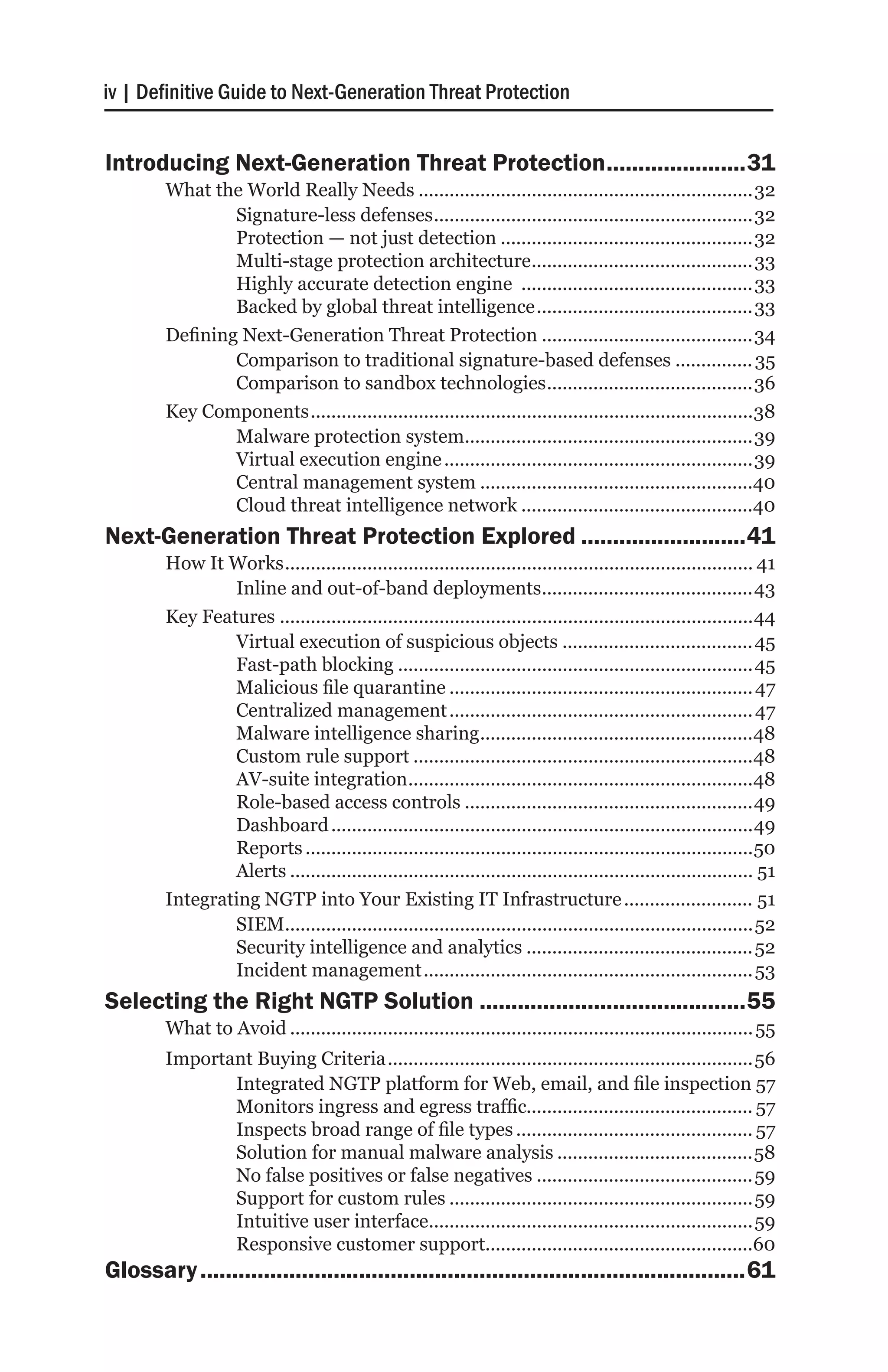
Table of Contents
Foreword........................................................................................ v
Introduction................................................................................. vii
        Chapters at a Glance.................................................................................vii
        Helpful Icons...........................................................................................viii
Defining Next-Generation Threats............................................... 1
        Staggering Statistics...................................................................................2
        Recent Victims............................................................................................3
                Commercial attacks. .....................................................................3
                                            .
                Government attacks......................................................................3
        The Cost of Failure. ....................................................................................4
                             .
        Today’s Threat Landscape.......................................................................... 5
                Traditional threats........................................................................ 5
                Next-generation threats................................................................ 7
Understanding the Enemy..........................................................11
        Who is the Enemy?....................................................................................11
                Cybercriminals............................................................................ 12
                State-sponsored threat actors..................................................... 12
                Hacktivists. ................................................................................. 13
                           .
        How the Enemy Succeeds. ....................................................................... 15
                                      .
                Bypassing signature-based defenses.......................................... 15
                Bypassing anomaly-based defenses........................................... 15
Anatomy of Advanced Cyber Attacks........................................17
        APTs in Depth............................................................................................17
                What APTs are not...................................................................... 18
        APTs in the News...................................................................................... 19
                Flame (2012)...............................................................................20
                RSA SecurID Attack (2011).........................................................20
                Stuxnet (2010)............................................................................ 21
                Operation Aurora (2009). ..........................................................22
                                                     .
        The Ripple Effect of a National APT Attack.............................................22
        APT Attack Life Cycle...............................................................................23
                 Stage 1: Initial intrusion through system exploitation. .............24      .
                 Stage 2: Malware is installed on compromised system . ........... 25
                 Stage 3: Outbound connection is initiated................................. 25
                 Stage 4: Attacker spreads laterally............................................. 25
                 Stage 5: Compromised data is extracted....................................26
                 Attacker covers his tracks, remaining undetected..................... 27
        Telltale Signs of an APT Attack................................................................29
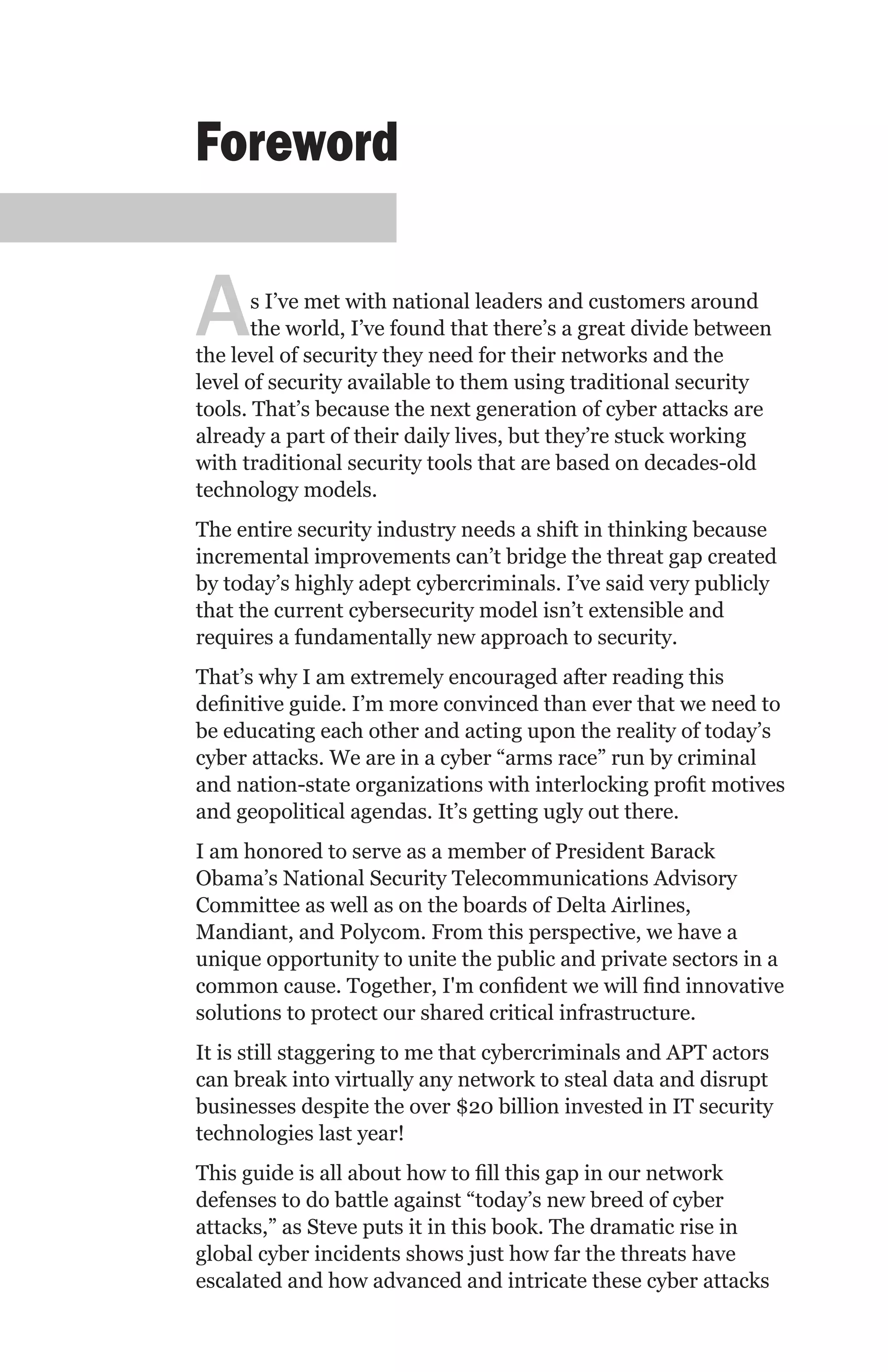
iv | Definitive Guide to Next-Generation Threat Protection


Introducing Next-Generation Threat Protection.......................31
        What the World Really Needs..................................................................32
                Signature-less defenses...............................................................32
                Protection — not just detection..................................................32
                Multi-stage protection architecture. ..........................................33
                                                                  .
                Highly accurate detection engine ..............................................33
                Backed by global threat intelligence...........................................33
        Defining Next-Generation Threat Protection..........................................34
                Comparison to traditional signature-based defenses................ 35
                Comparison to sandbox technologies.........................................36
        Key Components.......................................................................................38
                Malware protection system. .......................................................39
                                                     .
                Virtual execution engine.............................................................39
                Central management system......................................................40
                Cloud threat intelligence network..............................................40
Next-Generation Threat Protection Explored...........................41
        How It Works............................................................................................ 41
                Inline and out-of-band deployments. ........................................43
                                                                        .
        Key Features.............................................................................................44
                Virtual execution of suspicious objects...................................... 45
                Fast-path blocking......................................................................45
                Malicious file quarantine............................................................ 47
                Centralized management............................................................ 47
                Malware intelligence sharing. ....................................................48
                                                            .
                Custom rule support...................................................................48
                AV-suite integration. ..................................................................48
                                              .
                Role-based access controls.........................................................49
                Dashboard...................................................................................49
                Reports........................................................................................50
                Alerts........................................................................................... 51
        Integrating NGTP into Your Existing IT Infrastructure.......................... 51
                SIEM. ..........................................................................................52
                      .
                Security intelligence and analytics............................................. 52
                Incident management................................................................. 53
Selecting the Right NGTP Solution...........................................55
        What to Avoid........................................................................................... 55
        Important Buying Criteria........................................................................56
               Integrated NGTP platform for Web, email, and file inspection.57
               Monitors ingress and egress traffic............................................ 57
               Inspects broad range of file types............................................... 57
               Solution for manual malware analysis.......................................58
               No false positives or false negatives........................................... 59
               Support for custom rules............................................................59
               Intuitive user interface. ..............................................................59
                                          .
               Responsive customer support....................................................60
Glossary.......................................................................................61
Foreword


A      s I’ve met with national leaders and customers around
       the world, I’ve found that there’s a great divide between
the level of security they need for their networks and the
level of security available to them using traditional security
tools. That’s because the next generation of cyber attacks are
already a part of their daily lives, but they’re stuck working
with traditional security tools that are based on decades-old
technology models.
The entire security industry needs a shift in thinking because
incremental improvements can’t bridge the threat gap created
by today’s highly adept cybercriminals. I’ve said very publicly
that the current cybersecurity model isn’t extensible and
requires a fundamentally new approach to security.
That’s why I am extremely encouraged after reading this
definitive guide. I’m more convinced than ever that we need to
be educating each other and acting upon the reality of today’s
cyber attacks. We are in a cyber “arms race” run by criminal
and nation-state organizations with interlocking profit motives
and geopolitical agendas. It’s getting ugly out there.
I am honored to serve as a member of President Barack
Obama’s National Security Telecommunications Advisory
Committee as well as on the boards of Delta Airlines,
Mandiant, and Polycom. From this perspective, we have a
unique opportunity to unite the public and private sectors in a
common cause. Together, I'm confident we will find innovative
solutions to protect our shared critical infrastructure.
It is still staggering to me that cybercriminals and APT actors
can break into virtually any network to steal data and disrupt
businesses despite the over $20 billion invested in IT security
technologies last year!
This guide is all about how to fill this gap in our network
defenses to do battle against “today’s new breed of cyber
attacks,” as Steve puts it in this book. The dramatic rise in
global cyber incidents shows just how far the threats have
escalated and how advanced and intricate these cyber attacks
vi | Definitive Guide to Next-Generation Threat Protection


           have become. I urge you to read this guide and share what you
           learn with your colleagues and peer networking groups. We
           can’t stop this next- generation of cyber attacks without more
           advanced technologies, better cooperation across industries,
           and stronger ties between the public and private sectors.
           For my part, in joining FireEye, I consider this my renewed
           pledge to deliver leading-edge platforms to address today’s
           toughest cybersecurity issues. I considered numerous CEO
           opportunities since McAfee and have watched FireEye on the
           sidelines for years. I am so excited to join a company with
           such game-changing technology. And, by sponsoring this
           guide, my hope is that it will give you a framework to deploy
           a next-generation threat protection platform that forms the
           basis of a more resilient, penetration-resistant network.

           David DeWalt
           CEO, FireEye
Introduction

  I n recent years, enterprises and government agencies have
    fallen prey to a myriad of successful cyber attacks of unprec-
  edented sophistication and reach. Despite spending over $20
  billion annually on traditional security defenses, organizations
  find themselves battling a new generation of cyber attacks,
  such as advanced malware and advanced persistent threats
  (APTs), that are dynamic and stealthy and extremely success-
  ful at compromising today’s networks.

  If there’s any chance of preventing these motivated adversaries
  from attacking our systems, stealing our data, and harming
  our critical infrastructure, we’ve got to think differently. We
  must realize the limitations of traditional signature-based
  defenses and leverage new technology to uncover and stop
  today’s new breed of cyber attacks.

  Fortunately, there is a solution. Introducing next-generation
  threat protection (NGTP), an innovative new network security
  platform proven to help win the war against next-generation
  threats. If you’re charged with securing your organization’s
  network, this is one book you simply can’t afford to miss.


Chapters at a Glance
  Chapter 1, “Defining Next-Generation Threats,”
  reviews staggering statistics on major data breaches, describes
  recent high-profile commercial and government cyber attacks,
  depicts typical costs associated with successful breaches, and
  contrasts traditional and next-generation cyber attacks.

  Chapter 2, “Understanding the Enemy,” categorizes
  three kinds of cyber enemies — cybercriminals, state-spon-
  sored threat actors, and hacktivists — and describes why they
  are so successful in bypassing traditional security defenses.

  Chapter 3, “Anatomy of Advanced Cyber Attacks,”
  defines APTs and reviews high-profile examples that have
  recently made international headlines. The chapter then
viii | Definitive Guide to Next-Generation Threat Protection


               details the potential “ripple effect” of a successful APT on criti-
               cal infrastructure, explores each of the five stages of the APT
               life cycle, and provides telltale signs for detecting APTs in your
               organization.

               Chapter 4, “Introducing Next-Generation Threat
               Protection,” gets to the heart of the matter by defining
               NGTP, describing the characteristics of an ideal NGTP solu-
               tion, and comparing NGTP to traditional signature-based
               defenses and sandbox technologies.

               Chapter 5, “Next-Generation Threat Protection
               Explored,” expands on Chapter 4 by explaining exactly
               how NGTP mitigates the new breed of cyber attacks in email
               messages, Web communications, and files at rest. It explores
               key features of leading NGTP solutions and describes common
               ways to integrate them into existing network infrastructure.

               Chapter 6, “Selecting the Right NGTP Solution,”
               describes exactly what to look for — and, more importantly,
               what to avoid — when shopping for an NGTP solution.

               Glossary provides handy definitions to key terminology
               (appearing in italics) used throughout this book.


         Helpful Icons
   TIP
               Tips provide practical advice that you can apply in your own
               organization.

DON’T FORGET
               When you see this icon, take note as the related content con-
               tains key information that you won’t want to forget.

 CAUTION
               Proceed with caution because if you don’t it may prove costly
               to you and your organization.

TECH TALK
               Content associated with this icon is more technical in nature
               and is intended for IT practitioners.

ON THE WEB
               Want to learn more? Follow the corresponding URL to dis-
               cover additional content available on the Web.
Chapter 1

    Defining Next-Generation
    Threats
In this chapter
    •• Review recent statistics on data breaches
    •• Explore traditional cyber attacks
    •• Understanding advanced malware, zero-day and advanced
       persistent threats


    T    oday’s cyber attacks are more sophisticated than ever. In
         the past year, we’ve witnessed alarming data breaches of
    unprecedented complexity and scale, causing every CISO to
    re-examine the organization’s network security posture.
    At the same time, the cybercrime industry has completely
    transformed — from hacking for kicks to cyber attacks for
    profit, or in some instances, for political gain. Today’s cyber-
    criminals are highly trained and incorporate sophisticated
    attack techniques that are no match for today’s inadequate
    signature-based defenses.
    Organizations now face a new breed of cyber attacks. These
    multi-vectored and multi-staged threats easily evade tradi-
    tional security defenses, such as firewalls, intrusion preven-
    tion systems (IPS), secure Web and email gateways, and
    anti-virus platforms.
    So, how bad has the problem become? Let’s take a look at
    some recent statistics and references to some of the most
    heinous cyber attacks of our day.
2 | Definitive Guide to Next-Generation Threat Protection


      Staggering Statistics
             Several reputable cybersecurity research organizations moni-
             tor cyber attack trends against enterprises. Among these is
             the Verizon RISK (Response, Intelligence, Solutions, and
             Knowledge) Team, which publishes a widely regarded annual
             Data Breach Investigations Report.
             In 2012, Verizon analyzed 855 data breach incidents
             that occurred in the prior year resulting in 174 million
             compromised records. Verizon’s analysis yielded some
             staggering statistics:


               ;;    98 percent of the incidents stemmed from external
                     agents (up 6 percent from the prior year)
               ;;    85 percent took weeks to discover (up 6 percent)

               ;;    81 percent involved some form of hacking (up 31
                     percent)
               ;;    69 percent incorporated malware (up 20 percent)

ON THE WEB
             To download a free copy of the Verizon report, connect to
             www.verizonbusiness.com.
             Also in 2012, FireEye, a leader in next-generation threat
             protection, published its Advanced Threat Report (1H 2012).
             According to the report, enterprises are experiencing an aver-
             age of 643 Web-based malicious events each week effectively
             penetrating traditional security defenses, such as firewalls,
             intrusion prevention systems, and anti-virus software.
             Compared to the same period in 2011, the number of infec-
             tions per company rose by 225 percent.
ON THE WEB
             To download a free copy of the FireEye report, connect to
             www.fireeye.com/info-center/.
             Despite global increases in information security spending
             (currently equating to over $20 billion per year for informa-
             tion security products and services), the percentage of data
             breaches stemming from external hacking is up, attacks incor-
             porating malware are up, and it’s still taking weeks to discover
             major data breaches!
Chapter 1 : Defining Next-Generation Threats | 3


      Recent Victims
        Unless enterprises and government agencies adopt a new,
        more sophisticated approach to mitigating next-generation
        threats, organizations will continue to make headlines in ways
        they never intended. The following is a sampling of recent
        high-profile commercial and government cyber attacks that
        incorporated advanced hacking techniques:

        Commercial attacks
          ;;    Global Payments (March 2012): Attack dating
                back to January 2011 in which a hacker exfiltrated
                information for over 7 million credit cards, costing
                this credit card processor nearly $85 million and
                temporary delisting by Visa and MasterCard.
          ;;    Citigroup (June 2011): The company disclosed
                that a cyber attack resulted in the theft of more than
                360,000 credit card numbers, of which 3,400 were
                used to steal more than $2.7 million.
          ;;    RSA Security (March 2011): Cyber attackers stole
                data related to SecurID tokens, rendering them
                insecure.

TIP
        Jump to the “RSA Security steps forward to describe their APT
        attack” sidebar in Chapter 3 for details of this attack.

        Government attacks
          ;;    South Carolina Department of Revenue (October
                2012): A hacker exfiltrated approximately 3.6 million
                Social Security numbers and 387,000 credit and debit
                card numbers from an external cyber attack.
          ;;    U.S. Environmental Protection Agency (EPA)
                (August 2012): Social Security numbers, bank routing
                numbers, and home addresses of more than 5,000
                EPA employees were exposed after an employee
                clicked on a malicious email attachment.
          ;;    Iran (May 2012): Flame malware allegedly developed
                by the United States and Israel was deployed to slow
                the Iranian nuclear program.
4 | Definitive Guide to Next-Generation Threat Protection


       The Cost of Failure
DON’T FORGET   To mitigate both traditional and next-generation threats, IT
               security organizations must implement a defense-in-depth
               strategy (layers of network and endpoint security defenses).
               Failing to do so can prove costly. In fact, it can bankrupt
               a company!
               In 2012, Ponemon Institute (www.ponemon.org) published
               a third annual report titled “2012 Cost of Cyber Crime Study:
               United States.” Upon analyzing the cost of data breaches
               for 56 U.S.-based enterprises, Ponemon found the average
               annualized cost of cybercrime for each organization to be $8.9
               million, with a range of $1.4 million to $46 million. This is
               up from $8.4 million (6 percent increase) in 2011. Ponemon
               also calculated that each organization averages 102 success-
               ful cyber attacks per week, up from 72 per week in 2011 (42
               percent increase).
ON THE WEB
               To download a free copy of the Ponemon Institute report, con-
               nect to www.ponemon.org/library.
               Companies victimized by large-scale data breaches face enor-
               mous costs, including:


                 ;;    Investigation and forensics costs

                 ;;    Customer and partner communications costs

                 ;;    Public relations costs

                 ;;    Lost revenue due to damaged reputation

                 ;;    Regulatory fines

                 ;;    Civil claims and legal fees

               When it comes to defending against cyber attacks, the old
               adage applies — an ounce of prevention is worth a pound of
               cure. Companies owe it to themselves, their customers, and
               their stockholders to incorporate next-generation threat pro-
               tection into their defense-in-depth architecture to stay ahead
               of today’s new breed of cyber attacks.
Chapter 1 : Defining Next-Generation Threats | 5


Today’s Threat Landscape
  There are dozens of cyber attacks facing today’s enterprises
  and government agencies. I’m going to oversimplify the threat
  landscape by grouping cyber attacks into two broad catego-
  ries — traditional threats and next-generation threats.

  Traditional threats
  The traditional cyber attacks described in this section are
  “oldies but goodies.” But don’t underestimate them. Although
  they can usually be detected by IPS devices, next-generation
  firewalls (NGFW), and anti-virus software, sometimes newer
  variants slip through the cracks.

  Worms, Trojans, and viruses
  A computer worm is a stand-alone malware program that
  replicates itself — typically through vulnerabilities in operat-
  ing systems — over a network in order to propagate. Worms
  typically harm networks by consuming bandwidth, but also
  provide a “lateral” attack vector that may infect supposedly
  protected internal systems or exfiltrate data. Unlike a com-
  puter virus, a worm doesn’t append itself to other programs
  or files.
  A Trojan (or Trojan horse) typically masquerades as a helpful
  software application, with the ultimate purpose of tricking
  a user into granting access to a computer. Trojans may self-
  replicate within the infected system, but cannot propagate to
  other vulnerable computers on their own; they typically join
  networks of other infected computers (called botnets; see
  next section) where they wait to receive further instructions,
  and into which they submit stolen information. Trojans may
  be delivered by means of spam email or social media, or may
  be disguised as a pirated installer for a well-known game
  or application.
  A computer virus is malicious code ranging in severity from
  mildly annoying to completely devastating. It attaches itself
  to a program or file enabling it to spread from one computer
  to another, leaving infections as it travels. However, unlike a
  worm, a virus can’t travel without human action.
6 | Definitive Guide to Next-Generation Threat Protection


            Spyware and botnets
            Spyware is software that covertly gathers user information
            through an Internet connection without the user’s knowledge,
            usually for advertising purposes (called Adware, which
            displays pop-up ads), but sometimes to steal confidential
            information such as usernames, passwords, and credit card
            numbers. Spyware applications are typically bundled as a
            hidden component of shareware or freeware programs down-
            loaded from the Internet. Once installed, the spyware moni-
            tors user activity and then covertly transmits that information
            in the background to someone else.
TECH TALK   A botnet is a collection of compromised Internet-connected
            computers on which malware is running. Each compromised
            device is called a bot (or zombie), and the human controlling a
            botnet is called the bot herder (or botmaster). Command and
            control of a botnet typically involves Web servers (called com-
            mand-and-control or CnC servers) operated for the specific
            purpose of controlling bots, though some older botnets are
            directed by the bot herder using Internet Relay Chat (IRC).
            Bots are often used to commit denial-of-service attacks, relay
            spam, store stolen data, and/or download additional malware
            to the infected host computer.
            Social engineering attacks
            Social engineering attacks — such as phishing and baiting
            — are extremely common. As I discuss in Chapter 3, these
            attacks, when successful, can lead to much broader, more-
            sophisticated cyber attacks.
            Phishing is an attempt to acquire information (and, indirectly,
            money) such as usernames, passwords, credit card informa-
            tion, and Social Security numbers by masquerading as a
            trustworthy entity in email communication. After clicking on
            a (seemingly innocent) hyperlink, the user is directed to enter
            personal details on a fake website that looks and feels almost
            identical to the legitimate one.
            Phishing can be specialized, as follows:


              ;;     Spear phishing targets a specific person or persons
                     within an organization. Attackers will often gather
                     personal information about their target ahead of
                     time to increase the probability of their success.
Chapter 1 : Defining Next-Generation Threats | 7


        ;;    Whaling is directed specifically toward senior
              executives and other high-profile targets within
              an organization.

      Baiting occurs when a criminal casually drops a USB thumb
      drive or CD-ROM in a parking lot or cyber café. This drive or
      disc is labeled with words such as “executive compensation” or
      “company confidential” to pique the interest of whoever finds
      it. When the victim accesses the media, it installs malware on
      his or her computer.

      Buffer overflows and SQL injections
      Two commonly used techniques that exploit vulnerabilities
      are buffer overflows and SQL injection attacks.
      A buffer overflow is a cyber attack where the hacker writes
      more data into a memory buffer than the buffer is designed to
      hold. Some of this data spills into adjacent memory, causing
      the desktop or Web-based application to execute arbitrary
      code with escalated privileges or even crash. Buffer overflows
      are commonly triggered by hacker inputs or by malicious files/
      Web objects that are designed to execute code or alter the way
      that the program operates.
      An SQL injection attacks databases through a website or Web-
      based application. The attacker submits SQL statements into
      a Web form in an attempt to get the Web application to pass
      the rogue SQL command to the database. A successful SQL
      injection attack can reveal database content (such as credit
      card and Social Security numbers, passwords, and more) to
      the attacker.

      Next-generation threats
      Traditional signature-based security defenses — including
      IPS, NGFW, and anti-virus products — are mainly designed to
      detect known threats. But today, it’s the unknown threats that
      are making the biggest headlines.
TIP   This section details the most dangerous cyber attacks facing
      enterprises and government agencies today. In Chapter 2, I
      describe why traditional security defenses are inadequate for
      detecting and preventing them.
8 | Definitive Guide to Next-Generation Threat Protection


               Zero-day threats
               A zero-day threat is a cyber attack on a publicly unknown
               operating system or application vulnerability, so named
               because the attack was launched on (or increasingly before)
               “day zero” of public awareness of the vulnerability — and, in
               many instances, before the vendor was even aware. (Although
               in some instances, the vendor is already aware of the vulner-
               ability, but hasn’t disclosed it publicly because the vulnerabil-
               ity hasn’t yet been patched.)
DON’T FORGET   Zero-day attacks are extremely effective because they can go
               undetected for long periods (usually several months but some-
               times a couple of years), and when they are finally identified
               “in the wild,” patching the vulnerability still takes days or
               even weeks.

               Advanced persistent threats
               Advanced persistent threats (APTs) (also known as advanced
               targeted attacks, or ATAs) are sophisticated network attacks
               in which an unauthorized person gains access to a network
               and stays undetected for a long period of time. The intention
               of an APT is to steal data rather than to cause damage to the
               network. APTs target organizations in sectors with high-value
               information, such as credit card processors, government agen-
               cies, and the financial services industry.
               APTs often use spear phishing (see prior “Phishing and bait-
               ing attacks” section) for gaining initial network entry. Once an
               initial host has been compromised, the APT proceeds using a
               slow-and-low strategy to evade detection.
   TIP         Chapter 3 is dedicated to the topic of APTs and describes how
               sophisticated cybercriminals have used slow-and-low tactics
               in some of the largest data breaches on record.
               Although I’ve proposed a definition for APT in this book, defi-
               nitions across the information security industry vary. Some
               say APTs are only committed by nation-states (such as China
               and Russia) for political motivations, reserving the term ATA
               for financially motivated attacks. Others use the term to define
               any “sophisticated” cyber attack, regardless of methodology.
               However, I believe my definition depicts the majority view of
               information security professionals.
Chapter 1 : Defining Next-Generation Threats | 9


Polymorphic threats
A polymorphic threat is a cyber attack — such as a virus,
worm, spyware, or Trojan — that constantly changes
(“morphs”), making it nearly impossible to detect using
signature-based defenses. Evolution of polymorphic threats
can occur in a variety of ways, such as filename changes and
compression (file size).
Although the appearance of the code within a polymorphic
threat changes with each “mutation,” the essential function
usually remains the same. For example, a spyware program
intended to act as a keylogger (unauthorized malware that
records keystrokes) will continue to perform that function
even though its signature has changed.
The evolution of polymorphic threats has made the jobs
of IT security professionals much more difficult. Vendors
that manufacture signature-based security products must
constantly create and distribute new threat signatures (a very
expensive and time-consuming proposition, I might add),
while enterprises and government agencies — often with
thousands of hosts (especially Microsoft Windows hosts; see
“Why Windows is so prone to cyber attacks” sidebar) to pro-
tect — are constantly deploying the signatures their security
vendors produce. It’s a vicious cycle, that is always well behind
the cybercriminals, with no end in sight.

Blended threats
A blended threat is a cyber attack that combines elements
of multiple types of malware and usually employs multiple
attack vectors (varying paths and targets of attack) to increase
the severity of damage and the speed of contagion. Nimda,
CodeRed, and Conficker are a few well-known examples of
blended threats.
A blended threat typically includes:


  ;;    Multiple means of propagation

  ;;    Exploitation of operating system and/or appli-
        cation vulnerabilities
  ;;    The intent to cause harm to network hosts
10 | Definitive Guide to Next-Generation Threat Protection


 CAUTION     Blended threats are widely considered by information security
             professionals to be the worst risk to network security since the
             inception of viruses, as most blended threats require no
             human intervention to propagate.


                       Why Windows is so prone
                           to cyber attacks
    When you read about high-profile                 designed to let the user have free
    data breaches in the trade press                 rein over the entire operating
    — at least those committed by                    system. However, years later
    Internet-borne threats, rather than              — starting with Windows NT
    involving physically stolen laptops              — Windows was modified to
    or USB thumb drives — virtually all              support multiple user logins.
    of them result from a cyber attack               But rather than re-architecting
    against a Microsoft Windows host.                Windows from scratch as a multi-
                                                     user operating system, Microsoft
    So, does that mean that Windows
                                                     chose to preserve compatibility
    hosts are more prone to cyber
                                                     with programs designed for older
    a tta c ks ? I T s e c u r i t y p u n d i t s
                                                     Windows versions.
    think so and generally offer two
    explanations — both of which I                   In doing so, Microsoft left Windows
    deem as perfectly valid.                         full of holes (vulnerabilities) for
                                                     hackers to exploit. So many, in
    The first explanation merely relates
                                                     fact, that the second Tuesday of
    to the near-monopolistic desktop
                                                     every month is known as “Patch
    operating system market share
                                                     Tuesday,” when Microsoft releases
    that Microsoft enjoys, especially in
                                                     new patches (through Microsoft
    business environments. Although
                                                     security bulletins) mainly to
    analyst estimations vary, most
                                                     address vulnerabilities within
    show that approximately 9 out of
                                                     Windows operating systems.
    10 end-user computing devices
                                                     Although Patch Tuesday began
    feature a Windows operating
                                                     in 2004, it’s still in full operation
    system. Thus, when sophisticated
                                                     today.
    hackers are developing complex
    worms, Trojans, botnets, and                     Does this mean that non-Windows
    spear-phishing attacks, Windows is               operating systems are completely
    clearly the target of choice.                    safe from viruses, malware, and
                                                     other cyber attacks? Of course,
    The second explanation has more
                                                     not. But since Mac OS X and Linux
    of a “technical” slant. Windows,
                                                     were designed from the ground
    as well as Microsoft DOS before
                                                     up with security in mind, these
    it, was designed to be a single-
                                                     platforms are far less susceptible.
    user operating system — frankly,
    with security as an afterthought.
    In other words, Windows was
Chapter 2

    Understanding the Enemy
In this chapter
    •• Categorize three kinds of cyber enemies
    •• Learn how attackers bypass traditional security defenses

     “If you know the enemy and know yourself, you need not
     fear the result of a hundred battles. If you know yourself
     but not the enemy, for every victory gained you will also
     suffer a defeat.”
     — Sun Tzu, The Art of War


   “K        now thy enemy,” an important theme from Sun Tzu’s
             infamous The Art of War manuscript, certainly ties
    nicely to the war against cyber attacks (and now, cyber ter-
    rorism) today. Before we dive into the anatomy of advanced
    persistent threats (in Chapter 3) and how to defend against
    them (in Chapter 4), let’s spend a little time getting to know
    the enemies, including understanding their motivations and
    why they are successful.

 Who is the Enemy?
    The face of cyber attackers has changed dramatically with
    the passing of each decade. In the 1970s and 1980s, phone
    phreaking (unauthorized manipulation of telephone switching
    equipment primarily to place free long-distance phone calls)
    was the craze. In 1983, the movie WarGames, starring a young
    Matthew Broderick, introduced the general public to computer
    hacking by way of modem, and the legend of hackers as cyber
    heroes was born.
12 | Definitive Guide to Next-Generation Threat Protection


               The 1990s brought widespread Internet adoption, including
               the emergence of the World Wide Web. Hackers back then
               defaced public websites primarily for bragging rights — up
               until the turn of the century.
DON’T FORGET   Hacking has now transformed into a multi-billion-dollar
               industry. Long gone are the days of hacking just for kicks.
               Today, there are essentially three types of cyber attackers that
               enterprises and government agencies must contend with—
               cybercriminals, state-sponsored threat actors, and hacktivists.

               Cybercriminals
               Simply put, cybercriminals are individuals who hack for profit.
               In most instances, they break into company networks in an
               attempt to steal credit card numbers (sometimes numbering
               in the tens or even hundreds of thousands) and sell them on
               the open market. Although not quite as profitable, Facebook,
               Twitter, and email account credentials sell for a pretty
               penny, too.
               One of the most notorious cybercriminals ever convicted is
               Albert Gonzalez. In 2010, Gonzalez was convicted of hacking
               into the databases of a regional credit card payment process-
               ing company, stealing more than 170 million credit card num-
               bers over two years. He was sentenced to 20 years in prison
               — the stiffest sentence imposed on a cybercriminal to date.

               State-sponsored threat actors
               Arguably the most notable shift in the hacking community
               within the last decade has been the emergence of state-
               sponsored threat actors. These are individuals employed
               by a government (not necessarily their own government) to
               penetrate commercial and/or government computer systems
               in other countries to compromise data, sabotage computer
               systems, or even commit cyber warfare.
               China and Russia are among the countries most often cited
               for recruiting state-sponsored threat actors. But they are
               not alone. The following are well-known examples of cyber
               attacks allegedly perpetrated by nation-states, including the
               United States:
Chapter 2 : Understanding the Enemy | 13


  ;;    Iran is accused of cyber attacks against U.S. banks
        and oil companies in Saudi Arabia and Qatar (2012).
  ;;    The United States and Israel are accused of creating
        Flame malware targeting Iran, Syria, and others
        (2012).
  ;;    China cracks RSA SecurID tokens (2011).

  ;;    The United States and Israel are accused of launching
        the Stuxnet worm targeting a uranium enrichment
        facility in Iran (2010).
  ;;    China attacks Google (dubbed “Operation Aurora”)
        to access Gmail accounts of Chinese human rights
        activists; the same attack targets Adobe, Juniper,
        Dow Chemical, Northrop Grumman, and others
        (2009).
  ;;    China steals blueprints for America’s new joint strike
        fighter planes, the F-35 and F-22 (2009).
  ;;    Russia attacks the websites of Estonia’s parliament,
        ministries, banks, and newspapers amid relocation of
        the Bronze Soldier of Tallinn memorial (2007).


Iran recently launched an ambitious $1 billion governmental
program to boost national cyber capabilities. Experts believe
that although China’s and Russia’s cyber war capabilities
are vastly superior to Iran’s, politically speaking, Iran is
significantly more likely to target U.S. cyber infrastructure
in light of the ongoing international impasse over Iran’s
nuclear program.

Hacktivists
Hacktivism is the use of digital tools in pursuit of political
ends. Unlike cybercriminals who are motivated by money,
hacktivists are motivated by political ideology. Typical cyber
attacks committed by hacktivists include website deface-
ments, redirects, information theft, and virtual sit-ins through
distributed denial-of-service (DDoS) attacks (overwhelming
websites through hundreds or thousands of simultaneous and
repetitive connections).
Some hacktivists have joined together to collectively target
victims. In 2011, LulzSec claimed responsibility for several
14 | Definitive Guide to Next-Generation Threat Protection


            high-profile cyber attacks, including multiple attacks against
            Sony and the crashing of the U.S. Central Intelligence Agency
            (CIA) website. In 2012, Anonymous claimed responsibility for
            crashing several Israeli government websites following Israel’s
            aerial strikes on Gaza.


                    Cyber mercenaries for hire
   I n a n A u g u st 2 0 1 2 “ D efe n s e        to many Westerners who
   Dossier ” report, the American                  cannot imagine a government
   Foreign Policy Council (AFPC; www.              so intertwined with a criminal
   afpc.org) asserted that Russia is               element.
   allegedly subcontracting some of
                                                   Russia is not the only nation-state
   its state-sponsored cyber attack
                                                   to partner with cybercriminals.
   work to cybercriminals, including
                                                   Network security expert FireEye
   members of the once-renowned
                                                   (www.fireeye.com), a leader in
   Russian Business Network (RBN).
                                                   next-generation threat protection,
   Until its apparent demise in 2008,
                                                   discovered evidence to support
   RBN was involved in just about
                                                   a common theory that China is
   e ve r y c y b e rc r i m i n a l s c h e m e
                                                   partnering with cybercriminals
   imaginable — phishing, malware,
                                                   to purchase access to already-
   DDoS attacks, and more.
                                                   infected machines as a more
   According to the AFPC report,                   streamlined way to infiltrate
   there are two reasons why                       targeted organizations.
   R u s s i a s u b co ntra ct s wo r k to
                                                   In 2011, FireEye researchers
   cybercriminals — or as I call
                                                   spotted an APT class of malware
   them, cyber mercenaries. First, it’s
                                                   associated with Ghostnet, a large-
   extremely cost effective, as these
                                                   scale cyber-spying operation
   cyber mercenaries make money
                                                   with a command-and-control
   on the side when not employed
                                                   infrastructure based in China,
   by the state. And second, even
                                                   on a machine also carrying
   after extensive cyber forensics,
                                                   mainstream malware associated
   their cyber attacks can’t be traced
                                                   with cybercriminal operations.
   back to government computers.
   This is particularly confusing                  A coincidence? I don’t think so.
Chapter 2 : Understanding the Enemy | 15


    How the Enemy Succeeds
          Now that you have a solid understanding of the three main
          types of cyber attackers — cybercriminals, state-sponsored
          threat actors, and hacktivists — I’ll discuss why they’re
          so successful.

          Bypassing signature-based defenses
          Traditional network and endpoint security products — such as
          intrusion prevention systems (IPS), next-generation firewalls
          (NGFW), secure Web gateways, and anti-virus solutions —
          rely on pattern-matching signatures (sometimes called
          rules or filters) to detect known cyber attacks and, in some
          instances, unknown attacks targeting known vulnerabilities.
          These security defenses are extremely effective at detecting
          traditional, known cyber attacks such as worms, Trojans,
          spyware, botnets, and basic computer viruses. But as I
          discuss in Chapter 1, they’re completely inept at detecting
          today’s new breed of cyber attacks, such as zero-day, targeted
          attacks, polymorphic malware, blended attacks, and APTs.
          In fact, in most cases, today’s new breed of cyber attacks pass
          through traditional security defenses as if they weren’t even
          there! That’s simply because no signature exists to detect the
          advanced tactics used in the first stage of an overall attack that
          ultimately gives cyber attackers free rein within the network.
CAUTION   Don’t get me wrong. Traditional signature-based defenses are
          critical components of a well-balanced defense-in-depth strat-
          egy. I’m simply asserting that they’re not enough to defend
          against today’s new breed of cyber attacks that cut across
          communication channels (e.g., Web and email) and take place
          over multiple stages.

          Bypassing anomaly-based defenses
          Better IPS and network behavior analysis (NBA) solutions
          incorporate anomaly-based detection methods to help
          uncover sophisticated cyber attacks. They work by aggregating
          flow records (e.g., NetFlow, sFlow, cFlow) from network rout-
          ers and switches and baselining “normal” network traffic over
          the course of days or even weeks. Once a baseline has been
16 | Definitive Guide to Next-Generation Threat Protection


           established, network anomalies can be detected, such as a host
           sending exorbitant amounts of data outside the organization
           or an end-user computing device communicating directly with
           other end-user computing devices.
           Although anomaly-based security defenses can detect
           certain events caused by next-generation threats, they are
           largely unsuccessful because they’re frequently prone to
           false positives (misclassifying good traffic as bad). And
           they’re also prone to false negatives (misclassifying bad
           traffic as good) due to the “slow and low” nature of advanced
           persistent threats.
Chapter 3

    Anatomy of Advanced
    Cyber Attacks
In this chapter
    •• Define, in detail, advanced persistent threats (APTs)
    •• Review high-profile APTs making international headlines
    •• Understand the life cycle of APT attacks


   I  n Chapter 1, I discuss the differences between traditional
      cyber attacks and today’s new breed of cyber attacks. In
    Chapter 2, I discuss why next-generation threats are so well
    equipped to bypass traditional security defenses. Now I’d
    like to discuss the category of advanced cyber attacks that is,
    by far, generating the most headlines. I’m talking, of course,
    about advanced persistent threats, or APTs.
    In this chapter, I expand upon the definition of APT pro-
    vided in Chapter 1. I detail some of the biggest headlines
    APTs have generated in recent years and then discuss their
    damaging impact on victimized enterprises and government
    agencies. I conclude the chapter by describing the APT
    attack life cycle and provide a list of telltale signs to help you
    determine whether your network has been compromised by
    an APT attack.

 APTs in Depth
    In Chapter 1, I define an APT as “a sophisticated network
    attack in which an unauthorized person gains access to a
    network and stays undetected for a long period of time.”
    Although this is quite true, it’s only part of the story. APTs are
    unlike any cyber attack seen before.
18 | Definitive Guide to Next-Generation Threat Protection


               The term “advanced persistent threat” was actually created by
               information security analysts in the U.S. Air Force in 2006. It
               describes three aspects of the attackers, including their profile,
               intent, and structure:

                 ;;    Advanced: The attacker is an expert in cyber-
                       intrusion methods and is capable of crafting custom
                       exploits and tools.
                 ;;    Persistent: The attacker has a long-term objective
                       and will persistently work to achieve it without detec-
                       tion and without regard for time.
                 ;;    Threat: The attacker is organized, funded, well
                       trained, and highly motivated.

DON’T FORGET   APTs are widely considered the most dangerous type of cyber
               attack today. Cybercriminals who employ APTs are a different
               breed. They’re experts at “flying below the radar” to avoid
               detection as they exfiltrate highly sensitive data from enter-
               prises and government agencies.
               Unfortunately, most organizations don’t know they’ve been
               compromised by an APT attack until it’s too late. According
               to the same 2012 Verizon Data Breach Investigations report
               referenced in Chapter 1, 59 percent of surveyed organizations
               that experienced major data breaches in 2011 were notified of
               the breach by a law enforcement agency!

               What APTs are not
               As important as it is to understand what APTs are, it’s equally
               important to understand what they are not. An APT is not a
               single piece of malware, or even a collection of malware. It is
               not a single activity and it is never launched without a specific
               target or objective in mind.
               APTs are well coordinated, extended campaigns — whether
               motivated by financial gain, personal politics, or national
               interests — intended to achieve an objective against a specific
               target. As you’ll soon discover (see the “APT Attack Life Cycle”
               section later in this chapter), APTs incorporate multiple cyber
               attack techniques and take place over several stages to form a
               single coordinated attack.
Chapter 3: Anatomy of Advanced Cyber Attacks | 19


                Three myths of APT attacks
A P Ts a re a m o n g t h e h o tte st           high-profile, mission-critical
topics of discussion in the                      endpoints only, and that end-user
information security world today.                devices (laptops and desktops)
Unfortunately, there is almost as                rarely come into play. This notion
much misinformation out there                    is a complete fallacy and is actually
about APTs as there is accurate                  the opposite of reality. In virtually
information. Let’s take a moment                 all instances, the initial point of
to reflect on three common myths                 entry for an APT is an end-user
about advanced persistent threats.               computing device compromised by
                                                 a spear-phishing attack, Trojan, or
Myth #1: Only specific industries
                                                 other form of malware.
are targets for APTs.
                                                 Myth #3: APTs can be addressed
A co m m o n m i s co n c e p t i o n i s
                                                 by traditional security defenses.
that only large organizations in
specific industries are targets                  V i r t u a l l y e v e r y i n fo r m a t i o n
of APTs. We know this is false                   security vendor claims at least
based on the headlines alone                     some ability to detect, and in some
(see “APTs in the News” section).                instances prevent, APT attacks. The
APTs have been reported across                   truth of the matter is that very few
a broad spectrum of industries,                  can. Traditional security defenses
including government, financial                  that incorporate threat-detection
services, telecommunications,                    signatures (such as IPS, NGFW, and
e n e rg y, t ra n s p o r t a t i o n , a n d   anti-virus solutions) are virtually
even information security, as                    blind to zero-day attacks and
demonstrated by the attack against               polymorphic threats. Relying on
RSA Security in 2011.                            traditional security defenses alone
                                                 is like showing up to a gunfight
Myth #2: APTs target critical
                                                 with a pocketknife. You simply
endpoints only.
                                                 don’t stand a chance.
A second myth about APTs is that
the perpetrators are targeting


 APTs in the News
         These days, it seems like a week can’t go by without news of
         a major data breach at a company, university, or government
         agency. The following are descriptions of the most newswor-
         thy APT attacks in each of the last four years.
20 | Definitive Guide to Next-Generation Threat Protection


ON THE WEB   To stay on top of major data breaches affecting commercial
             and government organizations, I highly recommend the SC
             Magazine Data Breach Blog at www.scmagazine.com/the-
             data-breach-blog/section/1263/.

             Flame (2012)
             Flame, also known as Flamer, sKyWiper, and Skywiper,
             is an APT that was identified in May 2012 by the MAHER
             Center of Iranian National CERT, Kaspersky Lab, and
             the Budapest University of Technology and Economics.
             Kaspersky Lab was asked by the United Nations International
             Telecommunications Union to investigate reports of a virus
             affecting Iranian Oil Ministry computers.
             Computer experts consider Flame the cause of an attack in
             April 2012 that caused Iranian officials to disconnect their oil
             terminals from the Internet. It is now widely asserted that the
             United States and Israel jointly developed the Flame malware
             to collect intelligence in preparation for cyber-sabotage aimed
             at slowing Iran’s ability to develop a nuclear weapon.
             After the initial exploit stage, Flame begins a complex set of
             operations including calling back to its command-and-control
             servers to download other malware modules. When fully
             deployed, Flame is an uncharacteristically large program
             for malware at 20 megabytes in size — about 20 to 30 times
             larger than a typical computer virus. It is widely regarded
             as the most sophisticated malware ever created. Experts
             believe Flame, which was designed to masquerade as a
             routine Microsoft software update, was created to secretly
             map and monitor Iran’s computer networks, sending
             back a steady stream of intelligence to prepare for a cyber
             warfare campaign.

             RSA SecurID Attack (2011)
             In March 2011, RSA Security (a division of EMC) disclosed
             that it had been victimized by an APT, causing it to notify
             its SecurID two-factor authentication customers and advise
             them to swap out their (compromised) token devices. In the
             months following, reports of data breaches caused, in part, by
             compromised SecurID tokens began to surface. Most notably,
             Lockheed Martin released a statement admitting that its
             network was breached by “sophisticated adversaries,” but the
Chapter 3: Anatomy of Advanced Cyber Attacks | 21


             company said no assets were compromised. Some security
             experts, however, are skeptical as to whether the nation’s
             largest defense contract is being completely forthcoming
             about a breach on which President Obama was reportedly
             personally briefed.
ON THE WEB   Soon after RSA Security disclosed the attack to the public, a
             company official posted a blog providing intricate details
             about how the APT attack was perpetrated over several stages.
             To learn more, read the “RSA Security steps forward to
             describe its APT attack” sidebar later in this chapter.
             In EMC’s 10-Q filing, it was disclosed that the APT attack
             against RSA Security cost the company $81.3 million to
             replace SecurID tokens, monitor customers, harden internal
             systems, and handle fallout from the security breach.

             Stuxnet (2010)
             Stuxnet is a highly sophisticated computer worm discovered
             in June 2010 that was believed to be in place for over a year
             and used in conjunction with an APT attack against Iranian
             uranium enrichment infrastructure. In the first stage, Stuxnet
             initially spread by exploiting a Microsoft Windows vulnerabil-
             ity and then spread laterally in the network to ultimately reach
             targeted Siemens industrial software and equipment causing
             it to malfunction. Although this is not the first time that hack-
             ers have targeted industrial systems, it is the first documented
             case of malware to include a programmable logic controller
             (PLC) rootkit.
             Siemens stated that the worm has not caused any damage to
             its customers, but the Iran nuclear facility procured embar-
             goed Siemens equipment secretly, which was damaged by
             Stuxnet during the attack. Interestingly, Stuxnet’s multiple
             spreading mechanisms caused it to eventually escape from the
             Iranian facility and to infect energy giant Chevron. However,
             company officials said that Stuxnet identified Chevron as an
             innocent target and was programmed to withhold its damag-
             ing payload, thus ending the attack life cycle. As a result, it
             caused no damage to Chevron’s systems and the company was
             able to remove it.
             Experts have found evidence within the Stuxnet source
             code linking the APT attack to the United States and
22 | Definitive Guide to Next-Generation Threat Protection


           Israel, although officials from both countries have denied
           the accusation.

           Operation Aurora (2009)
           Operation Aurora was a high-profile APT attack that began
           in mid-2009 and continued through December 2009. It was
           first publicly disclosed by Google in January 2010 in a blog
           post indicating that the attack originated from China and that
           it targeted the Gmail accounts of Chinese human rights activ-
           ists. Dozens more organizations, including Yahoo, Symantec,
           Northrop Grumman, Morgan Stanley, and Dow Chemical,
           were also targeted by this attack.
           Two days following the attack, McAfee reported the attackers
           had exploited a zero-day vulnerability in Microsoft Internet
           Explorer and dubbed the attack “Operation Aurora.” Once a
           victim’s system was compromised, the next stage of the attack
           consisted of a backdoor connection that masqueraded as an
           SSL connection to command-and-control servers running
           in Illinois, Texas, and Taiwan, including machines that were
           running under stolen Rackspace customer accounts. The
           victim’s machine then began its lateral search for sources
           of intellectual property, specifically the contents of source
           code repositories.

    The Ripple Effect of a
    National APT Attack
           In Chapter 1 (in “The Cost of Failure” section), I itemize com-
           mon costs that companies face when subjected to a large-scale
           data breach, including forensics costs, regulatory fines, and
           lost revenue. But what if APT threat actors decided to target
           something a little more strategic than corporate data?
           Imagine, if you will, a coordinated APT attack against power
           companies in a large region of the United States — say, the
           Northeast. Let’s further imagine that the perpetrators of the
           attack were successful in compromising the SCADA (super-
           visory control and data acquisition) systems that control a
           multi-state power grid, knocking out power for days or even
           weeks. Can you imagine the “ripple effect” such an attack
           might cause?
Chapter 3: Anatomy of Advanced Cyber Attacks | 23


               ;;     Electric power grids crash

               ;;     Gas stations can’t pump fuel

               ;;     ATMs can’t dispense cash

               ;;     Grocery stores are depleted

               ;;     Hospitals and emergency services can’t keep up

             Think such an attack is impossible? Think again. According
             to a 2012 report titled “Terrorism and the Electric Power
             Delivery System” from the National Research Council, a
             successful cyber attack on a regional power grid would make
             Hurricane Sandy look like nothing. Internet-delivered mal-
             ware designed to destroy control systems could black out large
             regions of the nation for weeks or months causing widespread
             civil unrest. According to the report, damage from such an
             attack would cost many billions of dollars more than the
             destruction caused by Hurricane Sandy against the East Coast
             in 2012.
ON THE WEB
             To access the National Research Council report, connect to
             www.nap.edu/catalog.php?record_id=12050

      APT Attack Life Cycle
             The anatomy of advanced persistent threats varies just as
             widely as the victims they target. However, cybersecurity
             experts researching APTs over the past five years have
             unveiled a fairly consistent attack life cycle consisting of five
             distinct stages:


               ;;    Stage 1: Initial intrusion through system
                     exploitation
               ;;    Stage 2: Malware is installed on compromised
                     system
               ;;    Stage 3: Outbound connection is initiated

               ;;    Stage 4: Attacker spreads laterally

               ;;    Stage 5: Compromised data is extracted
24 | Definitive Guide to Next-Generation Threat Protection


            Let’s now explore each of these five APT life cycle stages in
            more detail.

            Stage 1: Initial intrusion through
            system exploitation
            System exploitation is the first stage of an APT attack to
            compromise a system in the targeted organization. By suc-
            cessfully detecting when a system exploitation attempt is
            underway, identification and mitigation of the APT attack is
            much more straightforward. If your defenses cannot detect the
            initial system exploitation, mitigating the APT attack becomes
            more complicated because the attacker has now successfully
            compromised the endpoint, can disrupt endpoint security
            measures, and hide his actions as malware spreads within the
            network and calls back out of the network.
            System exploits are typically delivered through the Web
            (remote exploit) or through email (local exploit) as an attach-
            ment. The exploit code is embedded within a Web object (e.g.,
            JavaScript, JPG) or file (e.g., XLS, PDF) to compromise the
            vulnerable OS or application enabling an attacker to run code,
            such as connect-back shellcode to call back to CnC servers and
            download more malware.
            In the attack against RSA Security in 2011, an employee
            was tricked into opening an email with the subject of “2011
            Recruitment plan.xls,” which included a malicious Microsoft
            Excel spreadsheet attachment that successfully exploited the
            system using a zero-day Adobe Flash vulnerability. (For more
            details, read the sidebar titled “RSA Security steps forward to
            describe its APT attack” later in this chapter.)
TECH TALK   System exploit code is developed by attackers to corrupt mem-
            ory or cause a buffer overflow condition within the vulnerable
            OS or application enabling arbitrary code execution. In the
            case of local exploits, oftentimes social engineering is used to
            initiate the necessary user interaction needed to complete the
            infection. In the case of remote exploits, such as Web drive-by
            downloads, no user interaction is required beyond visiting the
            Web page.
Chapter 3: Anatomy of Advanced Cyber Attacks | 25


            Stage 2: Malware is installed on
            compromised system
            Once a victim system is exploited, arbitrary code is executed
            enabling malware to be installed on the compromised system.
            Visiting a Web page or a simple double-click of the mouse is
            all it takes for the user’s system to become compromised and
            infected with the malware payload.
TECH TALK   Not all spear phishing emails originating from an APT threat
            actor contain attachments. Many contain hyperlinks that, when
            clicked on by the user, open a Web browser (or sometimes
            another application, such as Adobe Reader, Microsoft Word, or
            Microsoft Excel). Each link is then redirected to a hidden
            address with a base64-encoding key. The hidden address refers
            to a dropsite, which assesses the browser for known vulner-
            abilities and returns a Trojan downloader. Upon execution, the
            downloader conveys a base64-encoded instruction to a differ-
            ent dropsite from which a Trojan (malware) is delivered.

            Stage 3: Outbound connection is
            initiated
            The malware installed during the prior stage often contains
            a remote administration tool, or RAT. Once up and running,
            the RAT “phones home” by initiating an outbound connection,
            often an SSL-encrypted channel, between the infected com-
            puter and a CnC server operated by the APT threat actor. APT
            threat actors go to this trouble to establish outbound callbacks
            to bypass traditional and next-generation firewalls, which
            allow session traffic to flow bi-directionally if initiated from
            within the trusted network.
            Once the RAT has successfully connected to the CnC server,
            the attacker has full control over the compromised host.
            Future instructions from the attacker are conveyed to the RAT
            through one of two means — either the CnC server connects to
            the RAT or vice versa. The latter is usually preferred as a host
            initiating an external connection from within the network is
            far less suspicious.

            Stage 4: Attacker spreads laterally
            It’s highly unlikely that the initially breached end-user
            computing device contains strategic data. So the APT attacker
26 | Definitive Guide to Next-Generation Threat Protection


            must spread laterally through the network to search for hosts
            operated by IT administrators (in an effort to steal admin-
            istrative credentials) and high-value servers and databases
            containing sensitive data — the ultimate target of the APT
            attack. This is how Flame operated.
TECH TALK   Lateral movement does not necessarily involve the use of mal-
            ware or tools other than those already supplied by the com-
            promised host operating system, such as command shells,
            NetBIOS commands, VNC, Windows Terminal Services, or
            other similar tools used by network administrators to service
            remote hosts. Once the ultimate target has been identified and
            adequate logon credentials are possessed, the attacker’s hard
            work and determination begin to pay off.

            Stage 5: Compromised data is
            extracted
            In this stage of the network breach, the APT attacker has three
            obstacles to contend with. First, transferring all of the target
            data at once (targeted data is often quantified in gigabytes)
            could trigger a flow-based anomaly alert (if NBA technology
            is used; see Chapter 2) due to an unusually high volume of
            traffic initiated by the targeted server or database. Second, the
            attacker needs to ensure that the host receiving the data can’t
            be linked back to him (or her). And third, transferring data as
            plain text could trigger an alert from a data leakage preven-
            tion (DLP) system. Let’s explore how experienced APT threat
            actors overcome all three obstacles.
            To overcome the first obstacle, a savvy APT attacker will
            exfiltrate data from the target server or database in “chunks”
            — perhaps in increments of 50-100 megabytes. One strategy is
            to group files or records together into compressed, password-
            protected RAR files.
TECH TALK   Some RAR files can be parts of multi-volume sequences,
            enabling the attacker to split a large quantity of data into vol-
            umes. Each RAR file would have an extension to depict the
            number of the volume, such as part1.rar (the first volume),
            part2.rar, part3.rar, and so on.
            The second obstacle is a little more challenging. The attacker
            wants to get the data offsite as soon as possible, but can’t risk
            sending it to a host that can be traced back to the attacker. To
Chapter 3: Anatomy of Advanced Cyber Attacks | 27


               overcome this challenge, the attacker might select for a stag-
               ing area a virtual host that is hosted by a cloud-based service
               provider. That way the host can be instantly destroyed after
               the data has been extracted.
               The third and final obstacle in this phase can be accomplished
               by encrypting each RAR file before it is transferred (often via
               FTP) to the staging host. Most RAR files support strong AES
               128-bit encryption, which is more than sufficient.

               Attacker covers his tracks, remaining
               undetected
DON’T FORGET   If an enterprise or government agency has any hope of detect-
               ing an APT on its own, it’s far more likely to happen while the
               attack is still in progress. This is because most APT attackers
               are extremely good at covering their tracks.
               The following are tactics that APT attackers employ during
               and after the attack to minimize the risk of detection:


                 ;;    Planting malware to distract the IT security staff and
                       keep them busy doing other things.
                 ;;    Spreading to network file shares, which are relatively
                       unprotected and only completely wiped in extreme
                       circumstances.
                 ;;    Deleting the compressed files after they’ve been
                       extracted from the staging server.
                 ;;    Deleting the staging server if it’s hosted in the cloud
                       or taking it offline if under control by the attacker.
                 ;;    Uninstalling malware at the initial point of entry.
28 | Definitive Guide to Next-Generation Threat Protection


                RSA Security steps forward
                to describe its APT attack
   Following RSA Security’s March          performed privilege account
   2011 data breach (described             escalation on non-administrative
   earlier in this chapter; See “APTs in   u s e rs o n o t h e r sy s t e m s . H e
   the News” section), the company         repeated this process until he
   posted details in its corporate blog    stumbled across a high-value
   describing exactly how the attack       target — a computer operated by
   occurred.                               an IT server administrator.
   According to a company official,        Soon after, the attacker located
   the attack started with a spear         highly sensitive servers (allegedly
   phishing attack that targeted           containing top-secret SecurID
   specific company employees              two-factor authentication
   possibly identified through social      algorithms), compromised them,
   media sites. In this case, the          and established access to staging
   attacker sent two different spear       servers at key aggregation points to
   phishing emails over a two-day          get ready for extraction. Then the
   period to two small groups of           attacker went into the servers of
   employees with a subject of             interest, removed data, and moved
   “2011 Recruitment plan.xls” and         it to the staging servers where the
   a Microsoft Excel spreadsheet           data was aggregated, compressed,
   attachment.                             and encrypted for extraction.
   The email was crafted well enough       Finally, the attacker used FTP to
   to trick one of the employees into      transfer many password-protected
   retrieving the email from their         RAR files from the RSA file server
   junk mail (spam) folder and then        to an outside staging server at an
   double-clicking on the attached         external, compromised machine
   Excel file. Unbeknownst to the          at a hosting provider. The files
   user, the spreadsheet contained         were subsequently pulled by the
   a zero-day exploit that installed       attacker and removed from the
   a RAT through an Adobe Flash            external compromised host to
   vulnerability. Once the RAT was         remove any traces of the attack.
   in place, it initiated an outbound
                                           On a personal note, I applaud RSA
   connection and the attacker gained
                                           Security for coming forward with
   full control of the user’s machine.
                                           precise details of this APT attack.
   As the initially compromised PC         By learning these intricate details,
   was not a strategic asset, the          organizations can gain insights
   attacker’s next tactic was to move      from RSA’s misfortune and perhaps
   laterally inside the network by         implement new strategies and
   compromising additional hosts. He       technologies — including next-
   first harvested access credentials      generation threat protection (see
   from the first compromised PC,          Chapter 4) — to help mitigate the
   including credentials to a domain       real risk of APT attacks.
   admin account. The attacker then
Chapter 3: Anatomy of Advanced Cyber Attacks | 29


        Telltale Signs of an APT Attack
          Although APTs are extremely difficult to detect, the following
          is a list of common telltale signs that your organization may
          have been compromised by an APT.

            ;;    Finding system exploit code embedded in email
                  attachments or delivered via Web pages.
            ;;    Increase in elevated logons late at night.

            ;;    Outbound connections to known CnC servers.

            ;;    Finding widespread backdoor Trojans on endpoints
                  and/or network file shares.
            ;;    Large, unexpected flows of data from within the net-
                  work — from server to server, server to client, client
                  to server, or network to network.
            ;;    Discovering large (I’m talking gigabytes, not mega-
                  bytes) chunks of data appearing in places where that
                  data should not exist.
CAUTION
          Be especially wary if you find compressed data in formats not
          normally used by your organization.


            ;;     Abnormal SSL-encrypted network communications.

            ;;     Windows Application Event Log entries of anti-virus
                   and firewall stop and restart commands.

  TIP     A major reason why organizations fail to identify APT attacks
          is because their security devices are only (or mainly) config-
          ured to examine inbound traffic at the perimeter. Acquiring
          and/or configuring security solutions to inspect outbound
          traffic significantly improve your chances of detecting APTs
          and other cyber attacks.
          I hope you never have to face cleaning up from an APT attack.
          If you do, it will be one of the most challenging things you’ve
          ever had to do in your information security career. Prevention
          and early detection — through the use of next-generation
          threat prevention technology — is the best way to minimize
          the potential of being victimized by an APT attack. To learn
          more about this innovative new category of network security
          technology, turn to Chapter 4.
30 | Definitive Guide to Next-Generation Threat Protection


           Financial services CSO counts on
           FireEye to close its IT security gap
   Recently, the chief security officer            were configured for inline
   (CSO) of a large multinational                  operation and both monitored
   financial services firm — a member              identical perimeter traffic. The two
   of the S&P 500 with nearly 10,000               solutions were tested side-by-side
   employees — completed an                        for a period of six weeks.
   assessment of his organization’s
                                                   The results of the dual evaluation
   network security defenses and
                                                   proved to be conclusive. The
   found a gap that needed to be
                                                   FireEye appliance found two
   filled, and fast.
                                                   to three times more legitimate
   T h e ga p t h e C S O d i s co ve re d         t h re a t s t h a n t h e c o m p e t i n g
   pertained to defending against                  solution, with zero false positives.
   a new generation of IT security                 Although the competing appliance
   threats that traditional signature-             generated more alerts than the
   based security defenses simply                  FireEye MPS, the IT security
   cannot detect. These threats                    team was able to prove that
   include zero-day attacks,                       it was because the competing
   polymorphic malware, blended                    box generated numerous false
   threats, and the most damaging of               positives.
   them all, APTs.
                                                   Choosing FireEye over the
   The CSO instructed his team to                  competition was an easy decision.
   evaluate all available advanced                 Not only does FireEye offer the
   threat protection solutions on the              best advanced threat protection
   market to determine which ones                  available for inspecting inbound
   are best equipped to detect and                 traffic, but its callback filter (see
   prevent this new class of nefarious             Chapter 4) makes it easy to detect
   attacks. After researching more                 outbound connections to CnC
   than a half-dozen offerings, he and             hosts for malware hand-carried
   his team narrowed shortlist down                into the organization on laptops or
   to two vendors, one of which was                other mobile devices.
   FireEye.
                                                   Several months later, the company
   The CSO decided to evaluate                     has been well protected from
   the two competing solutions                     today’s new breed of cyber attacks
   c o n c u r re n t l y. H e t e s t e d t h e   w i t h atte m p t s d e te c te d a n d
   FireEye Web Malware Protection                  prevented on an almost-daily basis.
   System (MPS) appliance against                  Although life offers no guarantees,
   a comparable appliance from a                   this company’s CSO is now sleeping
   competing vendor. Both boxes                    much better at night.
Chapter 4

    Introducing
    Next-Generation
    Threat Protection
In this chapter
    •• Visualize an ideal solution for mitigating the new breed of cyber
       attacks
    •• Define next-generation threat protection and review its key
       components
    •• Compare next-generation threat protection to traditional
       signature-based defenses and sandbox technologies


    T    oday’s corporations, universities, and government agen-
         cies are experiencing unprecedented cyber attack activ-
    ity — both in number and sophistication. In a never-ending
    game of cat and mouse, the cat currently has the upper hand.
    And unless your organization is prepared, you may be its
    next victim.
    In prior chapters, I hope you’ve gained an appreciation for
    how serious today’s next-generation threats are and why
    traditional security defenses are helpless to stop them. Now
    it’s time to unveil a new category of network security defense
    — which up until just recently didn’t even exist. I’m talking, of
    course, about next-generation threat protection.
    I begin this chapter by discussing — almost daydreaming
    about — what’s really needed to combat today’s most sophis-
    ticated cyber attacks. Then I segue into next-generation threat
    protection, starting out with a definition followed by details of
    its key components and features.
32 | Definitive Guide to Next-Generation Threat Protection


           We’ve got a lot of ground to cover in this chapter. Let’s start by
           discussing what the world really needs to stay ahead of next-
           generation threats.

    What the World Really Needs
           In a perfect world, there would be no cyber attacks. There
           would be no such things as malware, Trojans, or APTs. And
           businesses, universities, and government agencies wouldn’t
           need to spend over $20 billion per year to stop them.
           Unfortunately, we don’t live in a perfect world. Money and
           politics are fueling cybercriminals, hacktivists, and state-
           sponsored threat actors to use every tool at their disposal to
           break into your organization’s network. Since we don’t live in
           a perfect world, let’s talk about what the world needs to stay
           ahead of the bad guys.

           Signature-less defenses
           Organizations today need to explore a new threat protec-
           tion model in which their defense-in-depth architecture
           incorporates a signature-less layer that specifically addresses
           today’s new breed of cyber attacks.
           Although traditional security defenses are critical for block-
           ing known cyber attacks, experience has shown that it’s the
           unknown cyber attacks that are most worrisome, and on the
           rise. And since these zero-day, polymorphic, and APTs are
           largely unknown and becoming the new norm for success-
           ful breaches, the world needs a signature-less solution to
           stop them.

           Protection — not just detection
           Before there were intrusion prevention systems (IPS), there
           were intrusion detection systems (IDS). An IDS, by design,
           can only detect known threats (or unknown threats targeting
           known vulnerabilities). As time progressed, organizations
           demanded that their IDS not only detect but also block cyber
           attacks. Thus, IPS was born.
           In that vein, the world needs an advanced threat protection
           platform that not only detects the needle in the haystack, but
           blocks it, too, across all potential entry vectors.
Chapter 4 : Introducing Next-Generation Threat Protection | 33


          Multi-stage protection architecture
          In a perfect world, IT would maintain full control of every
          computing device on the network. Then you’d only have to
          worry about cyber attacks originating from outside the net-
          work and attempting to penetrate it through the perimeter.
          Of course, with mobile computing on the rise and IT being
          compelled to implement bring your own device (BYOD) poli-
          cies, sometimes cyber attacks are hand-carried right through
          the office front door. What the world needs is an advanced
          threat protection solution that not only monitors cyber attacks
          from the outside in, but the inside out, as well — across all
          stages as they attempt to call back out or spread laterally
          through the network. If you can’t stop threats from entering
          through the Web, email, or the office front door, then at least
          stop them from communicating out and spreading further.

          Highly accurate detection engine
          As with traditional signature-based defenses, detection
          accuracy is king. What the world needs to adequately defend
          against next-generation threats is an advanced threat protec-
          tion solution that is highly accurate, with no false positives
          (good files classified as bad) and no false negatives (bad files
          classified as good).
CAUTION   False positives and false negatives are products of security
          platforms with poor detection capabilities. False positives are
          mainly a “nuisance” as they consume valuable security analyst
          cycles chasing after false alarms. False negatives, on the other
          hand, can be “company killers” as advanced malware passes
          right through the network security device completely
          undetected.

          Backed by global threat intelligence
          Every cyber attack has a “ground zero” — a single host that
          is the first target on Earth to ever experience a given cyber
          attack. What the world needs is a mechanism for allowing
          advanced threat protection systems to share intelligence, not
          only within a single organization, but also among different
          organizations globally.
34 | Definitive Guide to Next-Generation Threat Protection


           We may not live in a perfect world. But there is an ideal solu-
           tion for combating today’s most sophisticated attacks.
           Introducing next-generation threat protection.

     Defining Next-Generation
     Threat Protection
           Next-generation threat protection (NGTP) is a new breed of
           network security technology specifically designed to identify
           and defend against today’s new breed of cyber attacks.
           Intended to augment — not replace — traditional security
           systems, NGTP represents a new layer in the defense-in-depth
           architecture to form a threat-protection fabric that defends
           against those cyber attacks that go unnoticed by common
           signature-based defenses.
           NGTP platforms customarily ship on high-performance,
           purpose-built rackmount appliances. Preferred NGTP vendors
           offer an integrated platform that inspects email traffic, Web
           traffic, and files at rest, and shares threat intelligence across
           those attack vectors.
 CAUTION   NGTP platforms are unlike any network security offering on
           the market. NGTP appliances inspect traffic and/or files look-
           ing for thousands of suspicious characteristics, including
           obfuscation techniques like XOR encoding and other disguis-
           ing behavior. Sessions are replayed in a (safe) virtual execu-
           tion environment (think virtual machines, but using a custom-
           built virtualization engine specifically designed for security
           analysis) to determine whether the suspicious traffic actually
           contains malware (more on this in the “How it Works” section
           later in this chapter).
Chapter 4 : Introducing Next-Generation Threat Protection | 35


                      Call the bomb squad!
I’ve always been a big fan of using          a good one. Ever hear accounts in
real-world analogies — and, in               the news of bomb squads being
some instances, clichés — to                 called to examine a suspicious
describe how a given technology              bag left at the airport or in a busy
functions or the benefits it                 area like Times Square in New
provides. When it comes to next-             York City? In these instances, the
generation threat protection, I              bomb squad sends in a robot
think I’ve found a good one.                 to examine the suspicious bag
                                             and, if necessary, pick it up and
At first, I considered the “finding
                                             place it in a bomb disposal truck
a needle in a haystack” analogy.
                                             capable of withstanding massive
That’s certainly fair to use when
                                             explosions without affecting its
discussing NGTP solutions, but
                                             surrounding area.
these days large enterprises and
government agencies are targeted             Comparing this analogy to an NGTP
with advanced cyber attacks                  solution, the person who called the
several times each day. So instead           bomb squad is like the malware
of looking for one needle in a               detection algorithm. The robot
haystack of cyber attacks, NGTP is           is analogous to the subsystem
really searching for dozens.                 responsible for redirecting the
                                             suspected malware into the bomb
Then I considered a crash test
                                             disposal truck. And the truck is
d u m m y a n a l o g y, w h e r e t h e
                                             like the virtual session used to
suspicious traffic component
                                             “prod” the suspected malware
(suspected malware) is the dummy
                                             (the suspicious bag) to determine
a n d t h e M i c ro s o f t W i n d o w s
                                             any potential damaging effects (an
session running in the virtual
                                             explosion), but in a safe and secure
execution engine (replicating the
                                             environment.
target environment) is the car. This
analogy also isn’t bad, but it breaks        I hope this analogy helps you
because the car is going to crash            understand how NGTP technology
every time regardless of what’s              works and provides an easy way for
inside. Often files examined by an           you to explain it to less-technical
NGTP appliance are simply benign.            colleagues.
After searching long and hard for
a better analogy, I think I’ve found


        Comparison to traditional signature-
        based defenses
        In Chapter 2 (see the section titled “How the Enemy
        Succeeds”), I describe why and how today’s new breed of
        cyber attacks are able to bypass traditional signature-based
        security defenses such as firewalls (with threat signatures),
36 | Definitive Guide to Next-Generation Threat Protection


           IPS devices, secure email and Web gateways, and anti-virus
           solutions). But as I hadn’t yet introduced NGTP technology, I
           didn’t outright compare these defenses to NGTP solutions. I’ll
           remedy that now.
           Table 4-1 provides a summary of how traditional signature-
           based defenses compare to NGTP solutions. But remember,
           NGTP solutions are a new signature-less layer in your archi-
           tecture to augment signature-based defenses.


                                                        NGTP       Traditional
            Protection Comparison                      Solutions    Defenses
            Detect known malware using IPS-
            style signatures                                          
            Identify attacks within encoded
            binaries                                                 
            Replay suspected traffic in a safe
            virtual environment                                       
                                                                      
            Inspect outbound traffic to stop
            dynamic callback channels                                 
                                                                      
            Auto-generate threat intelligence
            to defend against targeted attacks                        
                                                                      
           Table 4-1: Comparison of NGTP to traditional defenses.
  TIP
           The protections in Table 4-1 will be explored in detail in the
           “Key Features” section later in this chapter.

           Comparison to sandbox technologies
           A sandbox is essentially a small, self-contained version of a
           (typically Windows-based) computing environment offering
           a minimal suite of applications and services. It was originally
           developed for software developers to test new programming
           code in a safe, non-production environment. Sandboxing tech-
           nology was later adopted by information security profession-
           als as a way to manually examine suspicious binaries without
           compromising production systems. The operating system and
           applications contained in the sandbox (virtual machine) typi-
           cally match the organization’s desktop standard so suspected
           malware can exploit those same inherent vulnerabilities.
Chapter 4 : Introducing Next-Generation Threat Protection | 37


CAUTION   Organizations with multiple desktop configuration standards
          — as is the case with most large organizations — are particu-
          larly at risk when relying on so-called NGTP solutions that
          incorporate rudimentary sandboxing technology. If a mal-
          ware-infected file is analyzed within a virtual execution envi-
          ronment equipped with operating systems and/or applica-
          tions that don’t mirror the malware’s target environment,
          then that file may be classified as good, resulting in a poten-
          tially serious false-negative condition.
          As the name implies, a sandbox serves as a safe environ-
          ment for “exploding” (see “Call the bomb squad!” sidebar
          earlier in this chapter) potential malware and examining its
          intended effects. However, by itself it is not a scalable analysis
          technique given the number and volume of suspicious objects
          and file types used to hide exploit code. Also, unfortunately,
          cybercriminals and APT threat actors can detect whether
          their malware is being executed in a sandbox environment,
          and if it is, to quell its damaging payload. For these reasons,
          traditional sandbox technologies are simply no match for
          sophisticated threats.
CAUTION   One more word of caution on the subject of sandbox technol-
          ogy. Regardless of what an NGTP vendor calls it, if the sand-
          box component is hosted by the vendor “in the cloud,” secu-
          rity, performance, and privacy considerations come into play
          (see “Don’t get stuck in the cloud” sidebar). Preferred NGTP
          solutions offer high-performance, dedicated appliances
          enabling suspected malware to be tested onsite within seconds
          — rather than minutes or hours — while always preserving the
          privacy of your data.
38 | Definitive Guide to Next-Generation Threat Protection


                Don’t get stuck in the cloud
   Some NGTP vendors tout their            or pre-filtering heuristics, exporting
   ability to perform virtual malware      all binaries or PDFs to the cloud
   analysis in the cloud, minimizing       to be placed in an inspection
   the horsepower (CPU, memory,            queue (among thousands of
   disk) required in their hardware        other requests) does not scale.
   appliances. In this case, the           This inefficient analysis delays
   vendor’s appliances only inspect        determining wheth er you’ve
   a small subset of traffic and           found malware as well as provides
   redirect suspicious objects to          attackers an easy bypass tactic.
   the cloud, rather than examining        They simply flood the pipe with
   the object in an on-box virtual         benign binaries or PDFs.
   testing environment.
                                           Lastly, when binaries or PDFs
   This sounds nice, as a cloud-           are exported to the cloud for
   based architecture offloads the         inspection, there is always a
   analysis, but when you peel back        risk that a sensitive file could be
   the layers of this onion, there are     exported to the cloud as well,
   three problems with this design         unbeknownst to your organization.
   — security coverage, scalability,       This is a particular concern for
   and privacy.                            certain European countries with
                                           strict privacy laws.
   Malicious code can be embedded
   in dozens of different file types and   F o r t h e s e r e a s o n s , m a r ke t-
   Web objects, but virtual malware        l e a d i n g N G T P v e n d o rs o f fe r
   analysis in the cloud typically only    high-performance, purpose-built
   analyzes two or three file types.       appliances that not only inspect
   Cloud-based NGTP solutions are          traffic and block threats, but also
   often easy to bypass simply by          perform virtual malware testing
   embedding malicious code within         within your own environment.
   a file format not analyzed.
   Beyond limited security coverage,
   without accurate exploit detection


    Key Components
           Now that you have a sense for what next-generation threat
           protection is all about — including how it compares to
           traditional security defenses and how it differs from ordinary
           sandboxing technology — let’s dive deeper and explore the key
           components of leading NGTP solutions.
Chapter 4 : Introducing Next-Generation Threat Protection | 39


            Malware protection system
            At the heart of every NGTP solution is the malware protection
            system (MPS). This component analyzes suspicious object
            types contained in Web traffic, email messages, or files at
            rest. It also blocks known threats using MPS-generated threat
            intelligence to stop inbound threats and unauthorized out-
            bound communications.
CAUTION     The tactics of discerning potential malware in Web traffic and
            in email messages are different. Some vendors offer a one-
            size-fits-all MPS that attempts to detect threats in all three
            mediums (or two, if unable to inspect files at rest). Avoid such
            suboptimized solutions, as they typically suffer from high
            false-positive and false-negative rates. Also, avoid so-called
            NGTP solutions that combine MPS functions with other net-
            work security components, such as firewall, IPS, and applica-
            tion control. These solutions typically offer “rudimentary”
            inspection capabilities limited to just .exe, .pdf, and/or .dll files.

            Virtual execution engine
            Earlier in this chapter, I discussed the role of the virtual
            execution engine and how it compares to ordinary sandbox
            technology. I can’t stress enough how critical this component
            is to the efficacy of a next-generation threat protection system
            — and to your organization’s ability to defend against today’s
            advanced cyber attacks.
CAUTION     A good virtual execution engine can programmatically filter
            for suspicious objects, profile the target victim, and then exe-
            cute the suspicious code against the intended OS and
            application(s) to maximize the chances of detonating the sys-
            tem exploit and accompanying malicious payload. Meanwhile,
            it should yield virtually no false positives or false negatives. It
            can mean the difference between success and failure in the
            war against today’s new breed of cyber attacks.
TECH TALK   Better NGTP offerings contain virtual execution engines
            capable of inspecting dozens of file types (rather than just .exe
            and .dll files), including: asf, com, doc, docx, dll, exe, gif, ico,
            jpeg, jpg, mov, mp3, mp4, pdf, png, ppsx, ppt, pptx, qt, rtf,
            swf, tiff, unk, vcf, xls, xlsx, zip… and the list goes on.
40 | Definitive Guide to Next-Generation Threat Protection


           Once a suspected threat has been classified as malware by the
           virtual execution engine, new threat intelligence is automati-
           cally created and distributed to your other MPS appliances (if
           you have a central management system; see next section) and
           possibly to other organizations around the world (see “Cloud
           threat intelligence network” section just ahead).

           Central management system
           Although most NGTP appliances provide a Web-based
           graphical user interface (GUI) for local administration, better
           NGTP vendors offer both a local GUI and a separate central
           management system appliance for centralized management,
           consolidated threat monitoring, reporting, alerting, and mal-
           ware intelligence distribution.

           Cloud threat intelligence network
           Earlier in this chapter, in the “Don’t get stuck in the cloud”
           sidebar, I discussed why performing malware inspection in
           the cloud is a bad idea for security, scalability, and privacy
           reasons. But the cloud is an ideal place for hosting one key
           NGTP component — the cloud threat intelligence network.
           The cloud threat intelligence network interconnects all MPS
           appliances — at least those from vendors that offer such a
           service — to share threat intelligence (malware profiles and
           callback destinations) for newly discovered cyber attacks.
           NGTP vendors that offer a cloud threat intelligence network
           (not all of them do) typically give their customers two
           options — (1) the ability to receive the threat intelligence and
           (2) the ability to share and receive threat intelligence. Most
           organizations choose the latter option as vendors usually offer
           a discount for sharing intelligence.
  TIP      Since only metadata from infectious objects is needed to cre-
           ate threat intelligence, organizations need not worry about the
           potential for sensitive data to leave the network.
           Now that you’re grounded in the basic components of an
           NGTP solution and you understand how it differs from tradi-
           tional signature-based defenses and sandbox technology, turn
           to Chapter 5 to gain deeper insight into how an NGTP solution
           really works.
Chapter 5

    Next-Generation Threat
    Protection Explored
In this chapter
    •• Understand how NGTP mitigates next-generation threats in
       email messages, Web communications, and files at rest
    •• Explore the key features found in leading NGTP solutions
    •• Integrate NGTP into your existing network infrastructure


    T   raditional signature-based security defenses are simply
        no match for today’s new breed of cyber attacks, such as
    zero-day attacks, polymorphic malware, blended threats, and
    most importantly, APTs. A new generation of cyber attacks
    requires an entirely new way of thinking.
    Now that you have a sense of what next-generation threat pro-
    tection is all about (from Chapter 4), let’s roll up our sleeves
    and understand how it works, what features are important,
    and how an NGTP platform can integrate into your existing
    IT infrastructure.

 How It Works
    Let’s start out by describing where to place your MPS appli-
    ances in relation to how threats enter the organization.
    Typically, administrators will place MPS appliances as the last
    line of defense to inspect Web and/or email traffic for threats
    that have bypassed the firewall and IPS. Web MPS appliances
    are placed behind secure Web gateways while email MPS
    appliances should be positioned behind anti-spam and secure
    email gateways (but in front of the enterprise email server).
    See Figure 5-1 for a typical Web and email MPS deployment.
42 | Definitive Guide to Next-Generation Threat Protection


               MPS appliances should also be deployed in the datacenter to
               inspect file shares to stop the lateral spread of malware and
               protect sensitive data.
                                                                                Cloud Service
                                                                                   (email)
                                      Internet


                                                       Anti-Spam
                                                       Gateway
                                                                                    Mail Servers
                             Egress
                             Router


                           Firewall


                   Web MPS
                    (Check URLs
                    for malicious
                        content)                 CMS
                                                           Email MPS
                                                         (Scans email
                                                         attachments
                    Core Switch                              for APTs)


                         Users
                                                                         SIEM


               Figure 5-1: Typical NGTP implementation diagram.

DON’T FORGET   APT attacks take place over multiple stages. An MPS platform
               should be designed to protect at every stage, from initial
               exploit to data exfiltration, which maximizes your capability to
               defuse the attack and prevent a breach.
               With the MPS platform deployed, the following is a step-by-
               step depiction of how a typical NGTP system functions:
               Step 1: MPS inspects inbound and outbound traffic (and files
               at rest) looking for known threats, CnC callbacks, spear phish-
               ing, and suspicious binaries/Web pages. If a known threat or
               CnC callback is detected, the connection is blocked and an
               alert is triggered.
               Step 2: For unknown, zero-day attack detection, the MPS
               identifies a suspicious binary, attachment, or Web page and
Chapter 5 : Next-Generation Threat Protection Explored | 43


               replays it in the virtual execution engine (within the same
               appliance) for analysis. This is a byte-by-byte reconstruction
               of the identical suspicious flow going to the targeted victim.
   TIP         When evaluating an NGTP solution, be sure its MPS compo-
               nent is capable of inspecting more than just HTTP traffic
               because threats use dozens of protocols, such as HTTP, FTP,
               IRC, custom protocols, and more.
               Step 3: Virtual execution engine launches with a specific
               (patched or unpatched) Microsoft Windows operating system
               and relevant application(s) (e.g., Microsoft Office, Microsoft
               Internet Explorer, Adobe Reader) of the host targeted by the
               suspected threat. The object is replayed and observed for
               malicious behavior, including corrupting a root file system,
               attacking an application using a heap spray, registering a new
               Windows service, or calling back to a known infection URL. If
               the binary is determined to be benign, the event is logged and
               the virtual machine is reset.
               Step 4: If zero-day malicious activity is confirmed, the virtual
               machine captures the rest of the attack life cycle. The malware
               binary is loaded and all malware-generated host activities and
               network traffic is recorded. Threat intelligence is generated
               to stop associated callback traffic across the network, a high-
               priority alert is logged, malware forensics are recorded, and
               a new malware protection profile is created to block this now
               known threat.
DON’T FORGET   Because the callback traffic never leaves the actual host’s net-
               work and the attacker is never notified, the attack has failed
               and sensitive data remains safe in the organization.
               Step 5: The new threat intelligence is forwarded to the
               central management system (CMS) appliance, where it is
               distributed to other MPS appliances in the organization. If the
               organization has subscribed to the cloud threat intelligence
               network (see Chapter 4), then all participating organizations
               are instantly protected.

               Inline and out-of-band deployments
               Organizations have two choices for deploying their email
               and Web MPS appliances. They can be configured for inline
               (active) or out-of-band (passive) operation. (File share MPS
               appliances are always configured for out-of-band operation for
44 | Definitive Guide to Next-Generation Threat Protection


           inspecting files at rest and can quarantine malicious file share
           objects, if so configured.)
           Inline deployments allow an organization to block newly iden-
           tified advanced cyber attacks from calling back to CnC servers
           to prevent future occurrences of the now known attack. The
           deployment places the MPS directly in the flow of traffic (just
           like an IPS or a message transfer agent, or MTA).
           MPS appliances can also be configured for out-of-band opera-
           tion in either monitor-only mode, where the MPS engine
           alerts on detected cyber attacks (just like an IDS), or TCP
           RESET mode, where the MPS submits TCP RESET packets to
           each session partner to disrupt nefarious TCP sessions.
   TIP     For out-of-band operations, connect the Web or email MPS to
           a mirrored switch SPAN port. If no SPAN port is available, a
           network TAP (from Gigamon, VSS Monitoring, NetOptics, and
           others) will suffice (or, configure upstream MTAs to send a
           blind carbon copy to the email MPS).
           Many organizations start with out-of-band monitoring to
           gauge the system’s accuracy and stability. Once the organiza-
           tion is comfortable with the NGTP system, the MPS appli-
           ances are reconfigured for inline blocking mode.
 CAUTION   If you intend to install your MPS appliances for inline opera-
           tion, be sure to select models that support fail-open connectiv-
           ity. In the (unlikely) event the appliance was to lose power or
           otherwise become disabled, traffic would continue to pass
           through its copper interfaces, rather than bringing the net-
           work to a screeching halt. (Fiber interfaces will always pass
           traffic, regardless of the appliance’s state.)

         Key Features
           So now that you know what NGTP is all about and have some
           insight into how it works, let’s review the key features that
           typically comprise today’s leading NGTP solutions to address
           every stage of an APT attack life cycle.
   TIP     NGTP feature sets vary widely. As you review these features,
           take note of which ones are particularly applicable to your
           organization. Then refer to Chapter 6 for additional NGTP
           buying considerations.
Chapter 5 : Next-Generation Threat Protection Explored | 45


          Virtual execution of
          suspicious objects
          Signature-less analysis to detect unknown threats is critical.
          Look for the ability to replay traffic containing suspicious
          objects — such as Web pages, binaries, and files — in the
          safety of a virtual execution environment. This is different
          than forwarding a suspicious file or executable to a sandbox.
          Replay is the byte-by-byte capture and reconstruction of the
          traffic flow within a virtual execution environment. A single
          Web page, for example, is made up of 20 to over 200 different
          objects served from dozens of different Web locations. Replay
          technology is the only way to analyze complex Web-based
          attacks, such as drive-by download attacks.
CAUTION   Don’t get trapped into thinking that today’s new breed of
          cyber attacks can only be present in exe or dll files. As I
          touched on in Chapter 4, malware can be embedded in Web
          pages and dozens of file types.
          The ability of the virtual execution engine to minimize the
          potential of false positives and false negatives is imperative.
          A false positive (good file misclassified as bad) could block
          important content from reaching its destination. A false
          negative (bad file misclassified as good) could be devastating
          — especially if a file containing advanced malware pertaining
          to an APT attack is allowed to pass.

          Fast-path blocking
          Blocking outbound callbacks and now known inbound threats
          goes hand-in-hand with signature-less analysis. Although
          I’ve spent a fair amount of time describing the limitations of
          traditional signature-based defenses, I’ve also acknowledged
          how important they are to stop known attacks in a defense-
          in-depth strategy. Look for NGTP solutions that incorporate
          both signature-based and signature-less techniques to defend
          efficiently against known and unknown attacks, respectively.
          However, in the event your IPS, NGFW, secure Web gateway,
          anti-spam, or other network security device misses an attack
          containing commonly known malware, the fast-path blocking
          capability of an (inline) MPS appliance is designed to instantly
          block or quarantine the attack.
46 | Definitive Guide to Next-Generation Threat Protection


               Once advanced malware successfully penetrates the organiza-
               tion (remember, it could be hand-carried into the office on a
               mobile computing device), it attempts to call back to the CnC
               host to either download RAT software (see Chapter 3) or to
               receive instructions from the attacker. The MPS appliance is
               equipped to stop sessions connecting to malicious URLs and
               known-bad IP addresses, or those utilizing custom malware
               protocols. If the callback filter of the MPS appliance detects
               an attempt by an internal host to connect to a known external
               CnC host, the connection is blocked (assuming the MPS is
               configured for inline operation) and an alert is triggered
               (see Figure 5-2.)


               Figure 5-2: Sample FireEye callback activity.

DON’T FORGET   Unlike most traditional security devices, MPS appliances are
               designed to inspect both inbound and outbound Internet
               traffic.

               Malicious file quarantine
               Malicious files, emails, and related attachments detected by
               the virtual execution engine can be quarantined and stored
               on the MPS appliance (or the central management console,
               if available; see next section) for further forensic analysis
               beyond the forensics provided by the MPS. The files may also
               be collected as digital evidence by computer crime investiga-
               tors from the FBI or other law enforcement authorities.
Chapter 5 : Next-Generation Threat Protection Explored | 47


Centralized management
For organizations with three or more MPS appliances, I highly
recommend acquiring a centralized management appliance
(sometimes called a central management system) to centrally
monitor and manage your NGTP system via an easy-to-use
Web-based interface. Typical tasks performed using a central-
ized management console include:

  ;;    Aggregate event data from all MPS appliances and
        process the data into dashboards, reports, and alerts.
  ;;    Centrally aggregate quarantined malicious objects
        that contain malware.
  ;;    Aggregate and disseminate threat intelligence
        generated by internal MPS appliances and from the
        malware protection cloud; upload threat intelligence
        to the malware protection cloud, if permitted to do so
  ;;    Configure MPS appliance settings and apply them to
        each MPS appliance individually or in groups.
  ;;    Download and apply software updates to all MPS
        appliances from one central location.
  ;;    Monitor the performance of all MPS appliances.

  ;;    Export event data to SIEMs (security information
        and event management), incident management
        systems, or other external applications.
  ;;    Control user access and administrative privileges.

Some NGTP vendors offer multiple centralized manage-
ment appliance models to choose from, depending on the
quantity of MPS appliances managed and the volume of cyber
attack activity.

Malware intelligence sharing
Part of the beauty of an NGTP solution is organizations
(automatically) are protected by their locally generated threat
intelligence and can choose to share this with other organiza-
tions. Through a cloud threat intelligence network (owned
and operated by the NGTP vendor), once one organization has
detected a brand new threat (“ground zero” for the attack), all
other organizations are protected within minutes. Many call
this collective immunity.
48 | Definitive Guide to Next-Generation Threat Protection


               While organizations can defuse APT attacks with a stand-
               alone MPS, collective immunity makes their MPS security
               analysis more efficient by focusing MPS resources on analyz-
               ing truly unknown cyber attacks. Plus, by anonymously
               sharing newly created threat intelligence via the cloud,
               organizations commonly receive a vendor discount on their
               annual cloud threat intelligence network subscriptions for
               their willingness to share threat intelligence.
DON’T FORGET   It’s important to understand that at no time will any of your
               files, or even content contained within those files, ever be sent
               to the cloud threat intelligence network. Threat protection
               profiles, for example, only include anonymized data, such as a
               checksum of the file.

               Custom rule support
               Leading NGTP systems enable more-advanced users to import
               custom malware-detection rules created using the YARA
               rules language. (YARA is a tool designed to help malware
               researchers identify and classify malware samples.) When
               an imported YARA rule is triggered by the MPS, the virtual
               execution engine immediately analyzes associated objects for
               potential cyber attacks. This is helpful for organizations that
               are frequently targeted by a specific class of cyber attack.
               For more information on YARA, connect to http://code.
               google.com/p/yara-project/.

               AV-suite integration
               Preferred NGTP solutions can integrate with popular anti-
               virus (AV) suites (see Figure 5-3), such as McAfee, Symantec,
               Sophos, and more. By integrating the NGTP solution with
               an AV suite, each malicious object can be further analyzed to
               determine if the AV platform was able to detect the malware
               stopped by the MPS. This enables organizations to more
               efficiently prioritize incident response follow-ups.
Chapter 5 : Next-Generation Threat Protection Explored | 49


Figure 5-3: Sample anti-virus platform integration from FireEye.


Role-based access controls
Most NGTP systems provide multiple user roles to ensure
that administrative privileges are only granted to IT person-
nel who require them to do their jobs. Common NGTP user
roles include:

  ;;     System administrator – full administrative con-
         trol over the entire NGTP deployment.
  ;;     Regional administrator – administrative control
         over one or more MPS appliances.
  ;;     Security analyst – access to dashboards and
         reports only; no ability to modify or delete event
         data or modify system settings.


Dashboard
The NGTP dashboard (see Figure 5-4) is the primary interface
used by security analysts to monitor the security state of the
network and the workload of the organization’s MPS appli-
ances. Dashboards are customarily accessed via Web browsers
and are easy to interpret. Better dashboards offer the ability to
“drill down” within event data to reveal details of cyber attacks
to help the security analyst determine next steps.
50 | Definitive Guide to Next-Generation Threat Protection


               Figure 5-4: Sample dashboard from FireEye.


               Reports
               Today’s NGTP solutions provide powerful and convenient
               ways to search for and report on specific types of cyber attacks
               by name or type. Organizations can view event summaries
               such as top infected hosts and top malware and callback
               events, including geolocation details. Some NGTP solutions
               even provide the capability to display security event data in
               Google Earth!
               Reports can be generated by NGTP users on the fly or they
               can be automatically created at specified time intervals (daily,
               weekly, monthly) by the centralized management console.
DON’T FORGET
               Trending reports, in particular, can help demonstrate progress
               in reducing the number of compromised systems.
Chapter 5 : Next-Generation Threat Protection Explored | 51


        Alerts
        Alerts help keep security analysts abreast of potential cyber
        breaches. Alert notifications can typically be sent via SMTP,
        SNMP, syslog, and HTTP POST. Alerts are also displayed
        within the Web-based interface of the centralized manage-
        ment system appliance (see Figure 5-5).


        Figure 5-5: Sample alerts summary from FireEye.

TIP     Upon detection of a new cyber attack with an associated call-
        back, the MPS registers one or more high-severity alerts.
        While the MPS appliance (if configured for inline operation) is
        capable of severing callback communications to defuse the
        attack, it’s important to follow-up and remediate the host
        compromised by that attack.

      Integrating NGTP into Your
      Existing IT Infrastructure
        No information security system should ever operate in a
        vacuum. Security products should work in concert with one
        another — and the network infrastructure supporting them
        — to provide IT with greater context about the environment
        it’s protecting and, ultimately, reduce the risk of successful
        cyber attacks.
52 | Definitive Guide to Next-Generation Threat Protection


           The purpose of this section is to describe how NGTP systems
           integrate with three commonly requested IT platforms, start-
           ing with SIEM.

           SIEM
           A SIEM (security information and event management) is
           one of the most commonly requested platforms for NGTP
           integration, especially in out-of-band deployments. And it’s
           no surprise since the entire purpose of a SIEM is to aggregate
           security events from across the organization and correlate
           them (using dozens of pre-built and custom correlation rules)
           to uncover hidden cyber attacks.
           Security events can be exported in real-time streams to SIEM
           platforms in syslog, Common Event Format (CEF), and
           vendor-proprietary formats that offer more attack details for
           deeper analysis.
   TIP     Organizations also frequently integrate NGTP systems with log
           management products. Like a SIEM, a log manager aggregates
           security events (through syslog data), but unlike a SIEM, it
           (typically) can’t correlate data. Log managers are often chosen
           to satisfy a regulatory compliance mandate (such as PCI DSS),
           but also provide a convenient means for aggregating log data.
           Sample vendors include: HP ArcSight, IBM Q1 Labs,
           LogRhythm, McAfee, RSA, and Splunk.

           Security intelligence and analytics
           Security intelligence and analytics (SIA), also known as net-
           work forensics, captures every single packet that traverses the
           network for a variety of purposes, including:

              ;;    Security incident response (forensics)

              ;;    Cyber attack detection

              ;;    Data loss monitoring and analysis

           Once an NGTP system has classified a new form of malware,
           the analyst can employ “big data” analysis techniques and
           query the SIA database to determine the context in which the
Chapter 5 : Next-Generation Threat Protection Explored | 53


host was compromised and to identify other hosts potentially
compromised by the same attack.
Some SIA vendors provide a universal connector interface that
plugs right into the Web browser so that the NGTP user can
click on an IP addresses straight from the central management
console to initiate a query into the SIA database, speeding the
process of incident response.
Sample vendors include: NetWitness (RSA), Niksun, and
Solera Networks.

Incident management
Incident management (or ticketing) platforms have been
around for years. They are commonly used by internal IT and
help desk staff to track and manage IT incidents. An incident
could be as simple as resolving a help desk call or as complex
as terminating an APT.
Organizations often wish to feed NGTP alerts into their exist-
ing incident management platform. This is accomplished by
forwarding specially formatted SMTP alerts from the NGTP
central management system to the incident management
system or by parsing the XML format alerts to conform to
existing incident alert templates.
Sample vendors include: BMC Remedy, Numara Software,
and RSA Archer.
54 | Definitive Guide to Next-Generation Threat Protection


        National laboratory experiments with
         next-generation threat protection
   Some say, “Ignorance is bliss.”                more mindshare in detecting
   Well, it’s not for the CSO of one              advanced threats than all other
   U.S.-based national laboratory                 NGTP vendors combined — FireEye
   tasked with advancing scientific               (www.fireeye.com).
   discoveries in the disciplines of
                                                  Later that day, a member of
   energy, the environment, and
                                                  t h e t e a m c o n t a c t e d F i re Ey e
   national security. On a daily basis,
                                                  to schedule a meeting, which
   this laboratory handles a huge
                                                  soon after resulted in an onsite
   portfolio of national secrets and
                                                  evaluation. Taking just one day
   sensitive data, making it a prized
                                                  to implement a pilot to monitor
   target for highly motivated and
                                                  network traffic, the FireEye Web
   sophisticated cybercriminals.
                                                  MPS appliance showed immediate
   To g u a r d a g a i n s t p o t e n t i a l   positive results. Within hours,
   data breaches, the laboratory                  alerts were generated by malicious
   deployed a comprehensive                       code that went completely
   range of enterprise-class security             undetected by the lab’s existing
   devices, including firewall, IPS,              security defenses.
   and AV solutions. But one day, the
                                                  Weeks later, the FireEye MPS
   laboratory’s veteran CSO read an
                                                  appliance went into full inline
   article in an information security
                                                  p ro d u c t i o n . T h e a p p l i a n c e ’s
   journal about an organization
                                                  fast-path blocking capability
   about the same size as his that was
                                                  stops known inbound attacks
   being devastated by an APT. He
                                                  and malware callbacks, while its
   also learned how APTs operate and
                                                  powerful virtual execution engine
   why traditional security defenses
                                                  a c c u rate l y d ete c t s u n k n o w n
   are no match.
                                                  cyber attacks.
   After consulting his team of
                                                  The laboratory’s CSO can now rest
   experienced security practitioners,
                                                  much easier knowing that he won’t
   he learned about a relatively
                                                  be reading his laboratory’s name
   new category of network security
                                                  in his favorite information security
   defense — next-generation threat
                                                  journal anytime soon.
   protection. He also learned that
   one vendor, in particular, had
Chapter 6

    Selecting the Right
    NGTP Solution
In this chapter
    •• Learn what to avoid when evaluating NGTP solutions
    •• Compile your list of NGTP buying criteria


    T    here are literally dozens of cybersecurity vendors out
         there, right now, touting their abilities to detect and block
    advanced cyber attacks, including zero-day attacks, polymor-
    phic threats, and APTs. Although each of these vendors may be
    able to detect and block known attacks, very few are capable of
    blocking unknown attacks — especially when they’re targeting
    unknown (at least to the general public) operating system or
    application vulnerabilities.
    It’s important to know what to look for — and, perhaps more
    importantly, what to avoid — when shopping for an NGTP
    system. Let’s start with the latter.

 What to Avoid
    The following is a list of things to avoid when evaluating
    NGTP solutions:
    Avoid detection-only solutions. The best NGTP offerings
    support both inline and out-of-band modes of operation. Many
    organizations start with out-of-band to gain an initial level of
    comfort and then graduate to an inline NGTP configuration to
    block known threats, malware callbacks, and recurrences of
    newly discovered malware. Also, when evaluating MPS appli-
    ances with copper interfaces, be sure they support fail-open
    connectivity for inline deployments.
56 | Definitive Guide to Next-Generation Threat Protection


           Avoid sandbox-based offerings. So-called NGTP solu-
           tions that incorporate legacy sandbox technology are easily
           outsmarted by sophisticated threat actors. These guys design
           malware to detect the presence of traditional sandbox technol-
           ogy, suppressing the payload of a malware-infected file to
           avoid detection.
           Avoid cloud-based malware analysis. Every NGTP solu-
           tion should leverage the power and scalability of the cloud.
           But preferred NGTP solutions leverage the cloud for intel-
           ligence sharing — not for malware analysis, as is the case with
           multi-function network security solutions offering rudimen-
           tary NGTP capabilities. By incorporating the virtual execution
           engine into the MPS appliance, malware analysis is done right
           at your site, drastically improving malware-identification cov-
           erage, scalability, and ensuring confidential files never leave
           the network.
           Avoid all-in-one MPS appliances. For optimal detection
           of today’s new breed of cyber attacks, separate purpose-built
           MPS appliances should be acquired for email, Web, and
           file share protection — but be sure they are integrated to
           share intelligence.
           Now that you know exactly what not to look for, it’s time to
           start compiling your shopping list of NGTP characteristics
           that are important for any security-minded organization. This
           next section will help.

         Important Buying Criteria
           Regardless of an organization’s size or industry, the following
           NGTP buying criteria should be front-of-mind to every enter-
           prise and government agency.
   TIP     Some of the aforementioned buying criteria have already been
           discussed. Consider their corresponding descriptions to be
           concise recaps. But for more-detailed explanations, flip back
           to Chapters 3 and 4 for a quick refresher.
Chapter 6 : Selecting the Right NGTP Solution | 57


               Integrated NGTP platform for Web,
               email, and file inspection
               Although I’ve raised this topic more than once, it’s worth
               mentioning it again. To thwart an APT attack, it is critical to
               have integrated protections across the common entry points
               for malware: Web, email, and files. The best NGTP platforms
               incorporate purpose-built MPS appliances (with uniquely
               different heuristics and algorithms) for detecting malware
               embedded within email messages, Web traffic, and files at
               rest, while correlating the findings to stop the APT attack
               across the enterprise.
               Although you may save a few bucks in the short run by pur-
               chasing an MPS appliance from a vendor that claims coverage
               for two or three of these mediums, in the long run, it’s simply
               not worth the risk to invest in a partial solution.

               Monitors ingress and egress traffic
               Typical NGTP systems monitor ingress (inbound) traffic from
               websites and email messages to identify suspicious binaries
               that may contain advanced malware. Most NGTP systems
               do not monitor egress (outbound) traffic, and then, surpris-
               ingly, some NGTP only monitor egress traffic. By monitoring
               both ingress and egress traffic, the MPS appliance can
               detect both inbound malware and corresponding outbound
               callback attempts.
DON’T FORGET   Monitoring both ingress and egress traffic is an important
               capability found only in leading NGTP solutions. It provides
               an additional layer of defense — especially for potentially
               infected mobile devices hand-carried through the office
               front door.

               Inspects broad range of file types
               You might be shocked to learn that some rudimentary NGTP
               solutions are only capable of uncovering malware in unen-
               crypted exe and dll files. The fact of the matter is that malware
               can be embedded in dozens of object types. This includes
               something as simple as an XOR-encoded binary, in the case
               of Operation Aurora, or a Microsoft Excel file, which triggered
58 | Definitive Guide to Next-Generation Threat Protection


               a zero-day Flash exploit in the attack against RSA Security
               (see “RSA Security steps forward to describe its APT attack”
               sidebar in Chapter 3).
DON’T FORGET   Hybrid document exploits highlight the need for broad net-
               work security coverage. In the case of the RSA Security
               breach, the Excel spreadsheet did not attack Microsoft Excel,
               but rather triggered an exploit against a separate
               application altogether.
               A good NGTP solution applies sophisticated heuristics and
               malware-detection algorithms to uncover advanced malware
               in Web pages as well as across dozens of file types, including
               com, doc, docx, gif, jpg, mov, mp3, mp4, pdf, png, ppt, pptx,
               swf, tiff, xls, xlsx, zip, and many more.

               Solution for manual
               malware analysis
               The virtual execution engine contained within the MPS
               appliance is frequently analyzing (even remotely) suspicious
               files for advanced malware. In doing so, it provides security
               analysts with forensic details about the exploit, including the
               vulnerability exploited to create a buffer overflow condition,
               attempts to escalate privileges within Windows, and the call-
               back coordinates used to exfiltrated data.
               Experienced incident responders sometimes prefer to analyze
               malware by hand to gain a full 360-degree view of the attack,
               from the initial exploit and malware execution to follow-on
               binary download attempts. To satisfy this hunger for rich
               forensic data, leading NGTP providers offer a stand-alone
               malware analysis system (MAS), which is typically packaged
               on a convenient rackmount appliance.
               The MAS should incorporate instrumented, automatically
               configured virtual machines equipped with various versions
               of Microsoft Windows and a number of software applications,
               such as Microsoft Office and Adobe Reader. This environment
               lets analysts drill into suspicious (or known-infected) binaries
               to gain a deep understanding of the intent and targets of the
               cyber attackers, without the overhead of creating and main-
               taining a range of custom test environments.
Chapter 6 : Selecting the Right NGTP Solution | 59


               No false positives or false negatives
               False positives and false negatives resulting from poor NGTP
               detection can prove costly for any organization. A false
               positive (good file classified as bad) could mean blocking a
               business-critical file from reaching its destination, resulting
               in lost time and lost revenue. A false negative (bad file clas-
               sified as good) is even worse as a file infected with malware
               is allowed to proceed to its final destination without further
               cause for analysis. At this point, I don’t think I need to explain
               what this could mean.
               To say that even the best NGTP system on the market will
               never render a false positive or a false negative is, perhaps, a
               bit of a stretch. But such occurrences should be very few and
               far between.
DON’T FORGET   To assess the detection quality of an NGTP solution on your
               shortlist, put it through its paces by performing an onsite eval-
               uation. If you’re evaluating two competing solutions, test them
               both at the same time using the same production traffic (in
               passive, out-of-band mode) and compare their results.

               Support for custom rules
               As discussed in Chapter 5, NGTP administrators sometimes
               wish to import custom byte-level rules created using the YARA
               rules language to trigger analysis of all matched objects for
               threats specific to an organization. (This is akin to creating
               custom signatures for a network IPS.)
               When evaluating competing NGTP offerings, consider the
               extensibility of the solution and its ability to support custom
               malware detection rules.

               Intuitive user interface
               It makes no difference how powerful or feature-rich a security
               application is. If it’s too difficult to use, it’s unlikely to be
               adopted by an IT organization — at least on a large scale.
               NGTP solutions are no exception.
               Unlike security solutions that require tuning or creation of
               policy rule sets, such as a traditional firewall or IPS appli-
               ance, an NGTP system is a far more automated solution.
60 | Definitive Guide to Next-Generation Threat Protection


           However, it’s important that the dashboard be simple and
           easy to use, and constructing reports and alerts should not
           require a PhD in astrophysics.

           Responsive customer support
           Selecting an NGTP vendor is just as important as selecting
           an NGTP product — if not more so. High-quality technical
           support is frequently reported by enterprises and govern-
           ment agencies as a top decision criterion for selecting any
           IT system.
   TIP     Be sure to assess the quality of a vendor’s customer support
           service prior to making your purchasing decision. To do so,
           reach out to the vendor’s technical support department at
           least twice during the evaluation phase, rather than the SE
           assigned to your account. Even if you don’t have any problems
           with your evaluation, make something up. Perhaps ask a gen-
           eral question about the product’s functionality. When doing
           so, gauge the experience and responsiveness of the tech sup-
           port representative and note how long it took you to reach a
           human being. If it took 30 minutes to speak with a representa-
           tive, and that person was unable to answer a simple configura-
           tion question, then it may be time to move onto a
           competing offering.
Glossary

advanced persistent threat (APT): A sophisticated
cyber attack that employs advanced stealth techniques to
remain undetected for extended periods of time.

advanced targeted attack (ATA): Another name for
advanced persistent threat.

baiting: A social-engineering attack in which physical
media (such as a USB flash drive) containing malware is
deliberately left in proximity to a targeted organization.

blended threat: A cyber attack incorporating a
combination of attacks against different vulnerabilities.

bot: An infected computer (or endpoint) centrally
controlled by a command and control (CnC) server.

buffer overflow attack: An attack accomplished by
placing more data into the buffer than it is configured to
hold which ends up enabling the attacker to run custom
code (oftentimes with the escalated privileges granted to
the vulnerable application or network service).

BYOD (bring your own device): An organizational
policy of employees bringing personally owned devices to
their place of work to access the organization’s data.

central management system (CMS): A rackmount
appliance responsible for monitoring and managing MPS
appliances within an NGTP environment.

cloud threat intelligence network: An Internet-
based service managed by an NGTP vendor to distribute
(and receive) cyber attack intelligence to (and from) its
customers’ MPS appliances.

CnC (command-and-control) server: A server
operated by a cybercriminal to provide instructions to
bots.

cybercriminal: A hacker illegally stealing data from
another computer for personal financial gain.
62 | Definitive Guide to Next-Generation Threat Protection


           cyberterrorism: The use of Internet-based attacks in
           terrorist activities, including acts of deliberate, large-scale
           disruption of computer networks.

           cyberwar: Politically motivated hacking to conduct
           sabotage and/or espionage against a nation state.

           data leakage prevention (DLP): A system designed to
           detect potential data loss based on patterns (such as social
           security numbers) in a timely manner.

           defense-in-depth strategy: Installing a series of
           cybersecurity defenses so that a threat missed by one layer
           of security may be caught by another.

           denial-of-service (DoS) attack: A cyber attack
           intended to disrupt or disable a targeted host by flooding
           it with benign communication requests from a single host.

           egress traffic: Computer network traffic flowing from
           inside the network to hosts outside the network.

           fail open: The ability of copper interfaces on a network
           appliance to maintain connectivity to prevent network
           disruption upon appliance power loss or disruption.

           false negative: Misclassifying a file containing malware
           as benign.

           false positive: Misclassifying a benign file as containing
           malware.

           hacktivism: The use of computers and computer
           networks as a means to protest and/or promote political
           ends.

           inline mode: Placement of a network appliance directly
           in the line of network traffic enabling it to block cyber
           attacks.

           ingress traffic: Computer network traffic flowing from
           outside the network to hosts within the network.

           intrusion detection system (IDS): An out-of-band
           signature-based security device that monitors network
           traffic and alerts upon detecting known cyber attacks.
Glossary | 63


intrusion protection system (IPS): An inline (active)
signature-based security device that monitors network
traffic and blocks known cyber attacks upon detection.
keylogger: An application that records keystrokes on a
computer usually unbeknownst to the user.
malware: Malicious software (such as a computer virus,
worm, or Trojan) created to disrupt computer operation,
gather sensitive information, or gain access to private
computer systems. See also spyware, Trojan, and worm.
malware analysis system (MAS): Appliance equipped
with virtual execution engine that enables users to
manually inspect objects suspected of containing malware.
malware protection system (MPS): A rackmount
appliance responsible for detecting suspicious network
objects and forwarding them to the virtual execution
engine (which it also hosts) for signature-less analysis.
multi-staged: A cyber attack incorporating multiple
types of malware designed to be launched at different
phases of an advanced cyber attack.
multi-vectored: A cyber attack designed to target
multiple target hosts within the same organization using
multiple attack techniques.
next-generation threat protection (NGTP): Software
installed on purpose-built, rackmount appliances that is
designed to detect and block today’s new breed of cyber
attacks.
next-generation threats: Today’s new breed of cyber
attacks not easily detected by signature-based security
defenses. Examples include polymorphic malware, zero-
day threats, and APTs.
out-of-band mode: The mode of operation of a network
appliance that enables it to analyze traffic copied from a
network TAP or switch SPAN port.
phishing: The act of sending an email to a user falsely
claiming to be a legitimate entity in an attempt to scam
the user into surrendering private information, such as
credit card and Social Security numbers.
64 | Definitive Guide to Next-Generation Threat Protection


           polymorphic threat: Malware that changes its
           signature (binary pattern) every time it replicates in order
           to evade detection by a security device or application.

           RAT (remote administration tool): Software that
           provides the hacker with a backdoor into the infected
           system to snoop or take control of the host.

           sandbox: A software application designed to analyze
           suspicious binaries in the safety of a virtual machine,
           although often evaded by sophisticated cyberattackers.

           spear phishing: A phishing attempt directed toward
           a specific organization or person(s) within that
           organization.

           SQL injection attack: A form of attack on a database-
           driven Web application in which the attacker executes
           unauthorized SQL commands to exploit insecure code.

           spyware: A type of malware that collects information
           about users, with or without their knowledge.

           state-sponsored threat actor: A cybercriminal
           employed by a nation-state to conduct cyber attacks
           against enemies of the state for politically motivated
           purposes.

           Trojan: Malware that masquerades as a legitimate file or
           helpful application with the ultimate purpose of granting a
           hacker unauthorized access to a computer.

           virtual execution engine: A component on an MPS
           appliance that is responsible for signature-less analysis of
           suspicious objects in the safety of a virtual machine.

           whaling: A cyber attack directed specifically at
           senior executives and other high-profile targets within
           businesses.

           worm: A form of malware that exploits network
           vulnerabilities to propagate itself to other computers.

           zero-day threat: A cyber attack against an unknown (or
           unreported) operating system or application vulnerability.
THE NEW BREED OF CYBER ATTACKS
        HAS PENETRATED 95% OF ALL NETWORKS.

                           THINK YOU’RE IN THE 5%?


       You may think your existing security defenses prevent

       today’s new breed of cyber attacks from entering your

       network and stealing your data. They don’t. Today’s cyber

       attacks easily evade traditional and next-generation

       firewalls, IPS, AV, and gateways.


       FireEye is your best defense. Put a stop to today’s new breed

       of cyber attacks with next-generation threat protection.

       Visit us today at www.FireEye.com and let us help you

       close the hole in your network.


© 2013 FireEye, Inc. All rights reserved.
Fighting a losing battle against today’s new breed of
cyber attacks? Learn to defeat your cyber enemies
through next-generation threat protection (NGTP).
Despite spending over $20 billion annually on traditional security
defenses, organizations find themselves battling a new breed of cyber
attacks, with zero-day exploits, polymorphic malware, and advanced
persistent threats (APTs) leading the charge. If there’s a chance of
defeating today’s well-funded, highly motivated adversaries, we’ve got
to think differently. If you’re charged with securing your organization’s
network, this is one book you simply can’t afford to miss.
•     Defining next-generation threats — contrast traditional cyber attacks
      with a new breed of next-generation threats
•     Understanding the enemy — explore three kinds of cyber enemies and
      how they defeat traditional security defenses
•     Anatomy of advanced cyber attacks — learn the five stages of the ad-
      vanced attack life cycle and discover telltale signs for detecting APTs
•     Introducing NGTP — review key components of NGTP solutions and
      compare NGTP to traditional security defenses
•     NGTP explored — learn how to mitigate next-generation threats in
      email messages, Web communications, and files at rest
•     Selecting the right NGTP solution — know exactly what to look for, and
      what to avoid, when evaluating NGTP solutions


    About the Author
    Steve Piper is an information security veteran with over
    20 years of high-tech experience. A freelance writer
    and consultant, Steve has authored numerous books
    on information security, network infrastructure, and Big     Not for resale

    Data. He holds a CISSP security certification from ISC2
    and bachelor of science and MBA degrees from George
    Mason University. Learn more at www.stevepiper.com.

Fireeye definitive-guide-next-gen-threat-protection-2

  • 1.
    Definitive Guide TM to Next-Generation Threat Protection Winning the War Against the New Breed of Cyber Attacks Steve Piper, CISSP Compliments of: FOREWORD BY: David DeWalt
  • 2.
    About FireEye FireEye isthe leader in stopping today’s new breed of cyber attacks, such as zero-day and APT attacks, that bypass traditional defenses and compromise over 95% of networks. The FireEye platform supplements signature-based firewalls, IPS, anti-virus, and gateways, and provides the world’s only cross-enterprise, signature-less protection against Web and email threat vectors as well as malware resident on file shares. It is the industry’s only integrated platform that stops attacks across every stage of an attack life cycle, from exploit to exfiltration. Using its patented Virtual Execution technology engine across its platform, FireEye is uniquely able to protect against today’s new breed of cyber attacks. FireEye solutions are deployed in over 40 countries and more than 25% of the Fortune 100. • Ranked #4 on the Deloitte 2012 Technology Fast 500™ North America • Awarded the Wall Street Journal 2012 Technology Innovation Award • Inducted into JPMorgan Chase Hall of Innovation
  • 3.
    Definitive Guide TM to Next-Generation Threat Protection Winning the War Against the New Breed of Cyber Attacks Steve Piper, CISSP Foreword by David DeWalt
  • 4.
    Definitive Guide™ toNext-Generation Threat Protection Published by: CyberEdge Group, LLC 1997 Annapolis Exchange Parkway Suite 300 Annapolis, MD 21401 (800) 327-8711 www.cyber-edge.com Copyright © 2013, CyberEdge Group, LLC. All rights reserved. Definitive Guide™ and the CyberEdge Press logo are trademarks of CyberEdge Group, LLC in the United States and other countries. All other trademarks and registered trademarks are the property of their respective owners. Except as permitted under the United States Copyright Act of 1976, no part of this publication may be reproduced, stored in a retrieval system or transmitted in any form or by any means, electronic, mechanical, photocopying, recording, scanning or otherwise, without the prior written permission of the publisher. Requests to the publisher for permission should be addressed to Permissions Department, CyberEdge Group, 1997 Annapolis Exchange Parkway, Suite 300, Annapolis, MD, 21401 or transmitted via email to info@cyber-edge.com. LIMIT OF LIABILITY/DISCLAIMER OF WARRANTY: THE PUBLISHER AND THE AUTHOR MAKE NO REPRESENTATIONS OR WARRANTIES WITH RESPECT TO THE ACCURACY OR COMPLETENESS OF THE CONTENTS OF THIS WORK AND SPECIFICALLY DISCLAIM ALL WARRANTIES, INCLUDING WITHOUT LIMITATION WARRANTIES OF FITNESS FOR A PARTICULAR PURPOSE. THE ADVICE AND STRATEGIES CONTAINED HEREIN MAY NOT BE SUITABLE FOR EVERY SITUATION. NEITHER THE PUBLISHER NOR THE AUTHOR SHALL BE LIABLE FOR DAMAGES ARISING HEREFROM. THE FACT THAT AN ORGANIZATION OR WEBSITE IS REFERRED TO IN THIS WORK AS A CITATION AND/OR A POTENTIAL SOURCE OF FURTHER INFORMATION DOES NOT MEAN THAT THE AUTHOR OR THE PUBLISHER ENDORSES THE INFORMATION THE ORGANIZATION OR WEBSITE MAY PROVIDE OR RECOMMENDATIONS IT MAY MAKE. FURTHER, READERS SHOULD BE AWARE THAT INTERNET WEBSITES LISTED IN THIS WORK MAY HAVE CHANGED OR DISAPPEARED BETWEEN WHEN THIS WORK WAS WRITTEN AND WHEN IT IS READ. For general information on CyberEdge Group research and marketing consulting services, or to create a custom Definitive Guide book for your organization, contact our sales department at 800-327-8711 or info@cyber-edge.com. ISBN: 978-0-9888233-0-3 (paperback); ISBN: 978-0-9888233-1-0 (eBook) Printed in the United States of America. 10 9 8 7 6 5 4 3 2 1 Publisher’s Acknowledgements CyberEdge Group thanks the following individuals for their respective contributions: Editor: Susan Shuttleworth Graphic Design: Debbi Stocco, Christian Brennan Production Coordinator: Valerie Lowery Special Help from FireEye: Phil Lin, Lisa Matichak, Brent Remai, David DeWalt
  • 5.
    Table of Contents Foreword........................................................................................v Introduction................................................................................. vii Chapters at a Glance.................................................................................vii Helpful Icons...........................................................................................viii Defining Next-Generation Threats............................................... 1 Staggering Statistics...................................................................................2 Recent Victims............................................................................................3 Commercial attacks. .....................................................................3 . Government attacks......................................................................3 The Cost of Failure. ....................................................................................4 . Today’s Threat Landscape.......................................................................... 5 Traditional threats........................................................................ 5 Next-generation threats................................................................ 7 Understanding the Enemy..........................................................11 Who is the Enemy?....................................................................................11 Cybercriminals............................................................................ 12 State-sponsored threat actors..................................................... 12 Hacktivists. ................................................................................. 13 . How the Enemy Succeeds. ....................................................................... 15 . Bypassing signature-based defenses.......................................... 15 Bypassing anomaly-based defenses........................................... 15 Anatomy of Advanced Cyber Attacks........................................17 APTs in Depth............................................................................................17 What APTs are not...................................................................... 18 APTs in the News...................................................................................... 19 Flame (2012)...............................................................................20 RSA SecurID Attack (2011).........................................................20 Stuxnet (2010)............................................................................ 21 Operation Aurora (2009). ..........................................................22 . The Ripple Effect of a National APT Attack.............................................22 APT Attack Life Cycle...............................................................................23 Stage 1: Initial intrusion through system exploitation. .............24 . Stage 2: Malware is installed on compromised system . ........... 25 Stage 3: Outbound connection is initiated................................. 25 Stage 4: Attacker spreads laterally............................................. 25 Stage 5: Compromised data is extracted....................................26 Attacker covers his tracks, remaining undetected..................... 27 Telltale Signs of an APT Attack................................................................29
  • 6.
    iv | DefinitiveGuide to Next-Generation Threat Protection Introducing Next-Generation Threat Protection.......................31 What the World Really Needs..................................................................32 Signature-less defenses...............................................................32 Protection — not just detection..................................................32 Multi-stage protection architecture. ..........................................33 . Highly accurate detection engine ..............................................33 Backed by global threat intelligence...........................................33 Defining Next-Generation Threat Protection..........................................34 Comparison to traditional signature-based defenses................ 35 Comparison to sandbox technologies.........................................36 Key Components.......................................................................................38 Malware protection system. .......................................................39 . Virtual execution engine.............................................................39 Central management system......................................................40 Cloud threat intelligence network..............................................40 Next-Generation Threat Protection Explored...........................41 How It Works............................................................................................ 41 Inline and out-of-band deployments. ........................................43 . Key Features.............................................................................................44 Virtual execution of suspicious objects...................................... 45 Fast-path blocking......................................................................45 Malicious file quarantine............................................................ 47 Centralized management............................................................ 47 Malware intelligence sharing. ....................................................48 . Custom rule support...................................................................48 AV-suite integration. ..................................................................48 . Role-based access controls.........................................................49 Dashboard...................................................................................49 Reports........................................................................................50 Alerts........................................................................................... 51 Integrating NGTP into Your Existing IT Infrastructure.......................... 51 SIEM. ..........................................................................................52 . Security intelligence and analytics............................................. 52 Incident management................................................................. 53 Selecting the Right NGTP Solution...........................................55 What to Avoid........................................................................................... 55 Important Buying Criteria........................................................................56 Integrated NGTP platform for Web, email, and file inspection.57 Monitors ingress and egress traffic............................................ 57 Inspects broad range of file types............................................... 57 Solution for manual malware analysis.......................................58 No false positives or false negatives........................................... 59 Support for custom rules............................................................59 Intuitive user interface. ..............................................................59 . Responsive customer support....................................................60 Glossary.......................................................................................61
  • 7.
    Foreword A s I’ve met with national leaders and customers around the world, I’ve found that there’s a great divide between the level of security they need for their networks and the level of security available to them using traditional security tools. That’s because the next generation of cyber attacks are already a part of their daily lives, but they’re stuck working with traditional security tools that are based on decades-old technology models. The entire security industry needs a shift in thinking because incremental improvements can’t bridge the threat gap created by today’s highly adept cybercriminals. I’ve said very publicly that the current cybersecurity model isn’t extensible and requires a fundamentally new approach to security. That’s why I am extremely encouraged after reading this definitive guide. I’m more convinced than ever that we need to be educating each other and acting upon the reality of today’s cyber attacks. We are in a cyber “arms race” run by criminal and nation-state organizations with interlocking profit motives and geopolitical agendas. It’s getting ugly out there. I am honored to serve as a member of President Barack Obama’s National Security Telecommunications Advisory Committee as well as on the boards of Delta Airlines, Mandiant, and Polycom. From this perspective, we have a unique opportunity to unite the public and private sectors in a common cause. Together, I'm confident we will find innovative solutions to protect our shared critical infrastructure. It is still staggering to me that cybercriminals and APT actors can break into virtually any network to steal data and disrupt businesses despite the over $20 billion invested in IT security technologies last year! This guide is all about how to fill this gap in our network defenses to do battle against “today’s new breed of cyber attacks,” as Steve puts it in this book. The dramatic rise in global cyber incidents shows just how far the threats have escalated and how advanced and intricate these cyber attacks
  • 8.
    vi | DefinitiveGuide to Next-Generation Threat Protection have become. I urge you to read this guide and share what you learn with your colleagues and peer networking groups. We can’t stop this next- generation of cyber attacks without more advanced technologies, better cooperation across industries, and stronger ties between the public and private sectors. For my part, in joining FireEye, I consider this my renewed pledge to deliver leading-edge platforms to address today’s toughest cybersecurity issues. I considered numerous CEO opportunities since McAfee and have watched FireEye on the sidelines for years. I am so excited to join a company with such game-changing technology. And, by sponsoring this guide, my hope is that it will give you a framework to deploy a next-generation threat protection platform that forms the basis of a more resilient, penetration-resistant network. David DeWalt CEO, FireEye
  • 9.
    Introduction In recent years, enterprises and government agencies have fallen prey to a myriad of successful cyber attacks of unprec- edented sophistication and reach. Despite spending over $20 billion annually on traditional security defenses, organizations find themselves battling a new generation of cyber attacks, such as advanced malware and advanced persistent threats (APTs), that are dynamic and stealthy and extremely success- ful at compromising today’s networks. If there’s any chance of preventing these motivated adversaries from attacking our systems, stealing our data, and harming our critical infrastructure, we’ve got to think differently. We must realize the limitations of traditional signature-based defenses and leverage new technology to uncover and stop today’s new breed of cyber attacks. Fortunately, there is a solution. Introducing next-generation threat protection (NGTP), an innovative new network security platform proven to help win the war against next-generation threats. If you’re charged with securing your organization’s network, this is one book you simply can’t afford to miss. Chapters at a Glance Chapter 1, “Defining Next-Generation Threats,” reviews staggering statistics on major data breaches, describes recent high-profile commercial and government cyber attacks, depicts typical costs associated with successful breaches, and contrasts traditional and next-generation cyber attacks. Chapter 2, “Understanding the Enemy,” categorizes three kinds of cyber enemies — cybercriminals, state-spon- sored threat actors, and hacktivists — and describes why they are so successful in bypassing traditional security defenses. Chapter 3, “Anatomy of Advanced Cyber Attacks,” defines APTs and reviews high-profile examples that have recently made international headlines. The chapter then
  • 10.
    viii | DefinitiveGuide to Next-Generation Threat Protection details the potential “ripple effect” of a successful APT on criti- cal infrastructure, explores each of the five stages of the APT life cycle, and provides telltale signs for detecting APTs in your organization. Chapter 4, “Introducing Next-Generation Threat Protection,” gets to the heart of the matter by defining NGTP, describing the characteristics of an ideal NGTP solu- tion, and comparing NGTP to traditional signature-based defenses and sandbox technologies. Chapter 5, “Next-Generation Threat Protection Explored,” expands on Chapter 4 by explaining exactly how NGTP mitigates the new breed of cyber attacks in email messages, Web communications, and files at rest. It explores key features of leading NGTP solutions and describes common ways to integrate them into existing network infrastructure. Chapter 6, “Selecting the Right NGTP Solution,” describes exactly what to look for — and, more importantly, what to avoid — when shopping for an NGTP solution. Glossary provides handy definitions to key terminology (appearing in italics) used throughout this book. Helpful Icons TIP Tips provide practical advice that you can apply in your own organization. DON’T FORGET When you see this icon, take note as the related content con- tains key information that you won’t want to forget. CAUTION Proceed with caution because if you don’t it may prove costly to you and your organization. TECH TALK Content associated with this icon is more technical in nature and is intended for IT practitioners. ON THE WEB Want to learn more? Follow the corresponding URL to dis- cover additional content available on the Web.
  • 11.
    Chapter 1 Defining Next-Generation Threats In this chapter •• Review recent statistics on data breaches •• Explore traditional cyber attacks •• Understanding advanced malware, zero-day and advanced persistent threats T oday’s cyber attacks are more sophisticated than ever. In the past year, we’ve witnessed alarming data breaches of unprecedented complexity and scale, causing every CISO to re-examine the organization’s network security posture. At the same time, the cybercrime industry has completely transformed — from hacking for kicks to cyber attacks for profit, or in some instances, for political gain. Today’s cyber- criminals are highly trained and incorporate sophisticated attack techniques that are no match for today’s inadequate signature-based defenses. Organizations now face a new breed of cyber attacks. These multi-vectored and multi-staged threats easily evade tradi- tional security defenses, such as firewalls, intrusion preven- tion systems (IPS), secure Web and email gateways, and anti-virus platforms. So, how bad has the problem become? Let’s take a look at some recent statistics and references to some of the most heinous cyber attacks of our day.
  • 12.
    2 | DefinitiveGuide to Next-Generation Threat Protection Staggering Statistics Several reputable cybersecurity research organizations moni- tor cyber attack trends against enterprises. Among these is the Verizon RISK (Response, Intelligence, Solutions, and Knowledge) Team, which publishes a widely regarded annual Data Breach Investigations Report. In 2012, Verizon analyzed 855 data breach incidents that occurred in the prior year resulting in 174 million compromised records. Verizon’s analysis yielded some staggering statistics: ;;  98 percent of the incidents stemmed from external agents (up 6 percent from the prior year) ;;  85 percent took weeks to discover (up 6 percent) ;;  81 percent involved some form of hacking (up 31 percent) ;;  69 percent incorporated malware (up 20 percent) ON THE WEB To download a free copy of the Verizon report, connect to www.verizonbusiness.com. Also in 2012, FireEye, a leader in next-generation threat protection, published its Advanced Threat Report (1H 2012). According to the report, enterprises are experiencing an aver- age of 643 Web-based malicious events each week effectively penetrating traditional security defenses, such as firewalls, intrusion prevention systems, and anti-virus software. Compared to the same period in 2011, the number of infec- tions per company rose by 225 percent. ON THE WEB To download a free copy of the FireEye report, connect to www.fireeye.com/info-center/. Despite global increases in information security spending (currently equating to over $20 billion per year for informa- tion security products and services), the percentage of data breaches stemming from external hacking is up, attacks incor- porating malware are up, and it’s still taking weeks to discover major data breaches!
  • 13.
    Chapter 1 :Defining Next-Generation Threats | 3 Recent Victims Unless enterprises and government agencies adopt a new, more sophisticated approach to mitigating next-generation threats, organizations will continue to make headlines in ways they never intended. The following is a sampling of recent high-profile commercial and government cyber attacks that incorporated advanced hacking techniques: Commercial attacks ;;  Global Payments (March 2012): Attack dating back to January 2011 in which a hacker exfiltrated information for over 7 million credit cards, costing this credit card processor nearly $85 million and temporary delisting by Visa and MasterCard. ;;  Citigroup (June 2011): The company disclosed that a cyber attack resulted in the theft of more than 360,000 credit card numbers, of which 3,400 were used to steal more than $2.7 million. ;;  RSA Security (March 2011): Cyber attackers stole data related to SecurID tokens, rendering them insecure. TIP Jump to the “RSA Security steps forward to describe their APT attack” sidebar in Chapter 3 for details of this attack. Government attacks ;;  South Carolina Department of Revenue (October 2012): A hacker exfiltrated approximately 3.6 million Social Security numbers and 387,000 credit and debit card numbers from an external cyber attack. ;;  U.S. Environmental Protection Agency (EPA) (August 2012): Social Security numbers, bank routing numbers, and home addresses of more than 5,000 EPA employees were exposed after an employee clicked on a malicious email attachment. ;;  Iran (May 2012): Flame malware allegedly developed by the United States and Israel was deployed to slow the Iranian nuclear program.
  • 14.
    4 | DefinitiveGuide to Next-Generation Threat Protection The Cost of Failure DON’T FORGET To mitigate both traditional and next-generation threats, IT security organizations must implement a defense-in-depth strategy (layers of network and endpoint security defenses). Failing to do so can prove costly. In fact, it can bankrupt a company! In 2012, Ponemon Institute (www.ponemon.org) published a third annual report titled “2012 Cost of Cyber Crime Study: United States.” Upon analyzing the cost of data breaches for 56 U.S.-based enterprises, Ponemon found the average annualized cost of cybercrime for each organization to be $8.9 million, with a range of $1.4 million to $46 million. This is up from $8.4 million (6 percent increase) in 2011. Ponemon also calculated that each organization averages 102 success- ful cyber attacks per week, up from 72 per week in 2011 (42 percent increase). ON THE WEB To download a free copy of the Ponemon Institute report, con- nect to www.ponemon.org/library. Companies victimized by large-scale data breaches face enor- mous costs, including: ;;  Investigation and forensics costs ;;  Customer and partner communications costs ;;  Public relations costs ;;  Lost revenue due to damaged reputation ;;  Regulatory fines ;;  Civil claims and legal fees When it comes to defending against cyber attacks, the old adage applies — an ounce of prevention is worth a pound of cure. Companies owe it to themselves, their customers, and their stockholders to incorporate next-generation threat pro- tection into their defense-in-depth architecture to stay ahead of today’s new breed of cyber attacks.
  • 15.
    Chapter 1 :Defining Next-Generation Threats | 5 Today’s Threat Landscape There are dozens of cyber attacks facing today’s enterprises and government agencies. I’m going to oversimplify the threat landscape by grouping cyber attacks into two broad catego- ries — traditional threats and next-generation threats. Traditional threats The traditional cyber attacks described in this section are “oldies but goodies.” But don’t underestimate them. Although they can usually be detected by IPS devices, next-generation firewalls (NGFW), and anti-virus software, sometimes newer variants slip through the cracks. Worms, Trojans, and viruses A computer worm is a stand-alone malware program that replicates itself — typically through vulnerabilities in operat- ing systems — over a network in order to propagate. Worms typically harm networks by consuming bandwidth, but also provide a “lateral” attack vector that may infect supposedly protected internal systems or exfiltrate data. Unlike a com- puter virus, a worm doesn’t append itself to other programs or files. A Trojan (or Trojan horse) typically masquerades as a helpful software application, with the ultimate purpose of tricking a user into granting access to a computer. Trojans may self- replicate within the infected system, but cannot propagate to other vulnerable computers on their own; they typically join networks of other infected computers (called botnets; see next section) where they wait to receive further instructions, and into which they submit stolen information. Trojans may be delivered by means of spam email or social media, or may be disguised as a pirated installer for a well-known game or application. A computer virus is malicious code ranging in severity from mildly annoying to completely devastating. It attaches itself to a program or file enabling it to spread from one computer to another, leaving infections as it travels. However, unlike a worm, a virus can’t travel without human action.
  • 16.
    6 | DefinitiveGuide to Next-Generation Threat Protection Spyware and botnets Spyware is software that covertly gathers user information through an Internet connection without the user’s knowledge, usually for advertising purposes (called Adware, which displays pop-up ads), but sometimes to steal confidential information such as usernames, passwords, and credit card numbers. Spyware applications are typically bundled as a hidden component of shareware or freeware programs down- loaded from the Internet. Once installed, the spyware moni- tors user activity and then covertly transmits that information in the background to someone else. TECH TALK A botnet is a collection of compromised Internet-connected computers on which malware is running. Each compromised device is called a bot (or zombie), and the human controlling a botnet is called the bot herder (or botmaster). Command and control of a botnet typically involves Web servers (called com- mand-and-control or CnC servers) operated for the specific purpose of controlling bots, though some older botnets are directed by the bot herder using Internet Relay Chat (IRC). Bots are often used to commit denial-of-service attacks, relay spam, store stolen data, and/or download additional malware to the infected host computer. Social engineering attacks Social engineering attacks — such as phishing and baiting — are extremely common. As I discuss in Chapter 3, these attacks, when successful, can lead to much broader, more- sophisticated cyber attacks. Phishing is an attempt to acquire information (and, indirectly, money) such as usernames, passwords, credit card informa- tion, and Social Security numbers by masquerading as a trustworthy entity in email communication. After clicking on a (seemingly innocent) hyperlink, the user is directed to enter personal details on a fake website that looks and feels almost identical to the legitimate one. Phishing can be specialized, as follows: ;;  Spear phishing targets a specific person or persons within an organization. Attackers will often gather personal information about their target ahead of time to increase the probability of their success.
  • 17.
    Chapter 1 :Defining Next-Generation Threats | 7 ;;  Whaling is directed specifically toward senior executives and other high-profile targets within an organization. Baiting occurs when a criminal casually drops a USB thumb drive or CD-ROM in a parking lot or cyber café. This drive or disc is labeled with words such as “executive compensation” or “company confidential” to pique the interest of whoever finds it. When the victim accesses the media, it installs malware on his or her computer. Buffer overflows and SQL injections Two commonly used techniques that exploit vulnerabilities are buffer overflows and SQL injection attacks. A buffer overflow is a cyber attack where the hacker writes more data into a memory buffer than the buffer is designed to hold. Some of this data spills into adjacent memory, causing the desktop or Web-based application to execute arbitrary code with escalated privileges or even crash. Buffer overflows are commonly triggered by hacker inputs or by malicious files/ Web objects that are designed to execute code or alter the way that the program operates. An SQL injection attacks databases through a website or Web- based application. The attacker submits SQL statements into a Web form in an attempt to get the Web application to pass the rogue SQL command to the database. A successful SQL injection attack can reveal database content (such as credit card and Social Security numbers, passwords, and more) to the attacker. Next-generation threats Traditional signature-based security defenses — including IPS, NGFW, and anti-virus products — are mainly designed to detect known threats. But today, it’s the unknown threats that are making the biggest headlines. TIP This section details the most dangerous cyber attacks facing enterprises and government agencies today. In Chapter 2, I describe why traditional security defenses are inadequate for detecting and preventing them.
  • 18.
    8 | DefinitiveGuide to Next-Generation Threat Protection Zero-day threats A zero-day threat is a cyber attack on a publicly unknown operating system or application vulnerability, so named because the attack was launched on (or increasingly before) “day zero” of public awareness of the vulnerability — and, in many instances, before the vendor was even aware. (Although in some instances, the vendor is already aware of the vulner- ability, but hasn’t disclosed it publicly because the vulnerabil- ity hasn’t yet been patched.) DON’T FORGET Zero-day attacks are extremely effective because they can go undetected for long periods (usually several months but some- times a couple of years), and when they are finally identified “in the wild,” patching the vulnerability still takes days or even weeks. Advanced persistent threats Advanced persistent threats (APTs) (also known as advanced targeted attacks, or ATAs) are sophisticated network attacks in which an unauthorized person gains access to a network and stays undetected for a long period of time. The intention of an APT is to steal data rather than to cause damage to the network. APTs target organizations in sectors with high-value information, such as credit card processors, government agen- cies, and the financial services industry. APTs often use spear phishing (see prior “Phishing and bait- ing attacks” section) for gaining initial network entry. Once an initial host has been compromised, the APT proceeds using a slow-and-low strategy to evade detection. TIP Chapter 3 is dedicated to the topic of APTs and describes how sophisticated cybercriminals have used slow-and-low tactics in some of the largest data breaches on record. Although I’ve proposed a definition for APT in this book, defi- nitions across the information security industry vary. Some say APTs are only committed by nation-states (such as China and Russia) for political motivations, reserving the term ATA for financially motivated attacks. Others use the term to define any “sophisticated” cyber attack, regardless of methodology. However, I believe my definition depicts the majority view of information security professionals.
  • 19.
    Chapter 1 :Defining Next-Generation Threats | 9 Polymorphic threats A polymorphic threat is a cyber attack — such as a virus, worm, spyware, or Trojan — that constantly changes (“morphs”), making it nearly impossible to detect using signature-based defenses. Evolution of polymorphic threats can occur in a variety of ways, such as filename changes and compression (file size). Although the appearance of the code within a polymorphic threat changes with each “mutation,” the essential function usually remains the same. For example, a spyware program intended to act as a keylogger (unauthorized malware that records keystrokes) will continue to perform that function even though its signature has changed. The evolution of polymorphic threats has made the jobs of IT security professionals much more difficult. Vendors that manufacture signature-based security products must constantly create and distribute new threat signatures (a very expensive and time-consuming proposition, I might add), while enterprises and government agencies — often with thousands of hosts (especially Microsoft Windows hosts; see “Why Windows is so prone to cyber attacks” sidebar) to pro- tect — are constantly deploying the signatures their security vendors produce. It’s a vicious cycle, that is always well behind the cybercriminals, with no end in sight. Blended threats A blended threat is a cyber attack that combines elements of multiple types of malware and usually employs multiple attack vectors (varying paths and targets of attack) to increase the severity of damage and the speed of contagion. Nimda, CodeRed, and Conficker are a few well-known examples of blended threats. A blended threat typically includes: ;;  Multiple means of propagation ;;  Exploitation of operating system and/or appli- cation vulnerabilities ;;  The intent to cause harm to network hosts
  • 20.
    10 | DefinitiveGuide to Next-Generation Threat Protection CAUTION Blended threats are widely considered by information security professionals to be the worst risk to network security since the inception of viruses, as most blended threats require no human intervention to propagate. Why Windows is so prone to cyber attacks When you read about high-profile designed to let the user have free data breaches in the trade press rein over the entire operating — at least those committed by system. However, years later Internet-borne threats, rather than — starting with Windows NT involving physically stolen laptops — Windows was modified to or USB thumb drives — virtually all support multiple user logins. of them result from a cyber attack But rather than re-architecting against a Microsoft Windows host. Windows from scratch as a multi- user operating system, Microsoft So, does that mean that Windows chose to preserve compatibility hosts are more prone to cyber with programs designed for older a tta c ks ? I T s e c u r i t y p u n d i t s Windows versions. think so and generally offer two explanations — both of which I In doing so, Microsoft left Windows deem as perfectly valid. full of holes (vulnerabilities) for hackers to exploit. So many, in The first explanation merely relates fact, that the second Tuesday of to the near-monopolistic desktop every month is known as “Patch operating system market share Tuesday,” when Microsoft releases that Microsoft enjoys, especially in new patches (through Microsoft business environments. Although security bulletins) mainly to analyst estimations vary, most address vulnerabilities within show that approximately 9 out of Windows operating systems. 10 end-user computing devices Although Patch Tuesday began feature a Windows operating in 2004, it’s still in full operation system. Thus, when sophisticated today. hackers are developing complex worms, Trojans, botnets, and Does this mean that non-Windows spear-phishing attacks, Windows is operating systems are completely clearly the target of choice. safe from viruses, malware, and other cyber attacks? Of course, The second explanation has more not. But since Mac OS X and Linux of a “technical” slant. Windows, were designed from the ground as well as Microsoft DOS before up with security in mind, these it, was designed to be a single- platforms are far less susceptible. user operating system — frankly, with security as an afterthought. In other words, Windows was
  • 21.
    Chapter 2 Understanding the Enemy In this chapter •• Categorize three kinds of cyber enemies •• Learn how attackers bypass traditional security defenses “If you know the enemy and know yourself, you need not fear the result of a hundred battles. If you know yourself but not the enemy, for every victory gained you will also suffer a defeat.” — Sun Tzu, The Art of War “K now thy enemy,” an important theme from Sun Tzu’s infamous The Art of War manuscript, certainly ties nicely to the war against cyber attacks (and now, cyber ter- rorism) today. Before we dive into the anatomy of advanced persistent threats (in Chapter 3) and how to defend against them (in Chapter 4), let’s spend a little time getting to know the enemies, including understanding their motivations and why they are successful. Who is the Enemy? The face of cyber attackers has changed dramatically with the passing of each decade. In the 1970s and 1980s, phone phreaking (unauthorized manipulation of telephone switching equipment primarily to place free long-distance phone calls) was the craze. In 1983, the movie WarGames, starring a young Matthew Broderick, introduced the general public to computer hacking by way of modem, and the legend of hackers as cyber heroes was born.
  • 22.
    12 | DefinitiveGuide to Next-Generation Threat Protection The 1990s brought widespread Internet adoption, including the emergence of the World Wide Web. Hackers back then defaced public websites primarily for bragging rights — up until the turn of the century. DON’T FORGET Hacking has now transformed into a multi-billion-dollar industry. Long gone are the days of hacking just for kicks. Today, there are essentially three types of cyber attackers that enterprises and government agencies must contend with— cybercriminals, state-sponsored threat actors, and hacktivists. Cybercriminals Simply put, cybercriminals are individuals who hack for profit. In most instances, they break into company networks in an attempt to steal credit card numbers (sometimes numbering in the tens or even hundreds of thousands) and sell them on the open market. Although not quite as profitable, Facebook, Twitter, and email account credentials sell for a pretty penny, too. One of the most notorious cybercriminals ever convicted is Albert Gonzalez. In 2010, Gonzalez was convicted of hacking into the databases of a regional credit card payment process- ing company, stealing more than 170 million credit card num- bers over two years. He was sentenced to 20 years in prison — the stiffest sentence imposed on a cybercriminal to date. State-sponsored threat actors Arguably the most notable shift in the hacking community within the last decade has been the emergence of state- sponsored threat actors. These are individuals employed by a government (not necessarily their own government) to penetrate commercial and/or government computer systems in other countries to compromise data, sabotage computer systems, or even commit cyber warfare. China and Russia are among the countries most often cited for recruiting state-sponsored threat actors. But they are not alone. The following are well-known examples of cyber attacks allegedly perpetrated by nation-states, including the United States:
  • 23.
    Chapter 2 :Understanding the Enemy | 13 ;;  Iran is accused of cyber attacks against U.S. banks and oil companies in Saudi Arabia and Qatar (2012). ;;  The United States and Israel are accused of creating Flame malware targeting Iran, Syria, and others (2012). ;;  China cracks RSA SecurID tokens (2011). ;;  The United States and Israel are accused of launching the Stuxnet worm targeting a uranium enrichment facility in Iran (2010). ;;  China attacks Google (dubbed “Operation Aurora”) to access Gmail accounts of Chinese human rights activists; the same attack targets Adobe, Juniper, Dow Chemical, Northrop Grumman, and others (2009). ;;  China steals blueprints for America’s new joint strike fighter planes, the F-35 and F-22 (2009). ;;  Russia attacks the websites of Estonia’s parliament, ministries, banks, and newspapers amid relocation of the Bronze Soldier of Tallinn memorial (2007). Iran recently launched an ambitious $1 billion governmental program to boost national cyber capabilities. Experts believe that although China’s and Russia’s cyber war capabilities are vastly superior to Iran’s, politically speaking, Iran is significantly more likely to target U.S. cyber infrastructure in light of the ongoing international impasse over Iran’s nuclear program. Hacktivists Hacktivism is the use of digital tools in pursuit of political ends. Unlike cybercriminals who are motivated by money, hacktivists are motivated by political ideology. Typical cyber attacks committed by hacktivists include website deface- ments, redirects, information theft, and virtual sit-ins through distributed denial-of-service (DDoS) attacks (overwhelming websites through hundreds or thousands of simultaneous and repetitive connections). Some hacktivists have joined together to collectively target victims. In 2011, LulzSec claimed responsibility for several
  • 24.
    14 | DefinitiveGuide to Next-Generation Threat Protection high-profile cyber attacks, including multiple attacks against Sony and the crashing of the U.S. Central Intelligence Agency (CIA) website. In 2012, Anonymous claimed responsibility for crashing several Israeli government websites following Israel’s aerial strikes on Gaza. Cyber mercenaries for hire I n a n A u g u st 2 0 1 2 “ D efe n s e to many Westerners who Dossier ” report, the American cannot imagine a government Foreign Policy Council (AFPC; www. so intertwined with a criminal afpc.org) asserted that Russia is element. allegedly subcontracting some of Russia is not the only nation-state its state-sponsored cyber attack to partner with cybercriminals. work to cybercriminals, including Network security expert FireEye members of the once-renowned (www.fireeye.com), a leader in Russian Business Network (RBN). next-generation threat protection, Until its apparent demise in 2008, discovered evidence to support RBN was involved in just about a common theory that China is e ve r y c y b e rc r i m i n a l s c h e m e partnering with cybercriminals imaginable — phishing, malware, to purchase access to already- DDoS attacks, and more. infected machines as a more According to the AFPC report, streamlined way to infiltrate there are two reasons why targeted organizations. R u s s i a s u b co ntra ct s wo r k to In 2011, FireEye researchers cybercriminals — or as I call spotted an APT class of malware them, cyber mercenaries. First, it’s associated with Ghostnet, a large- extremely cost effective, as these scale cyber-spying operation cyber mercenaries make money with a command-and-control on the side when not employed infrastructure based in China, by the state. And second, even on a machine also carrying after extensive cyber forensics, mainstream malware associated their cyber attacks can’t be traced with cybercriminal operations. back to government computers. This is particularly confusing A coincidence? I don’t think so.
  • 25.
    Chapter 2 :Understanding the Enemy | 15 How the Enemy Succeeds Now that you have a solid understanding of the three main types of cyber attackers — cybercriminals, state-sponsored threat actors, and hacktivists — I’ll discuss why they’re so successful. Bypassing signature-based defenses Traditional network and endpoint security products — such as intrusion prevention systems (IPS), next-generation firewalls (NGFW), secure Web gateways, and anti-virus solutions — rely on pattern-matching signatures (sometimes called rules or filters) to detect known cyber attacks and, in some instances, unknown attacks targeting known vulnerabilities. These security defenses are extremely effective at detecting traditional, known cyber attacks such as worms, Trojans, spyware, botnets, and basic computer viruses. But as I discuss in Chapter 1, they’re completely inept at detecting today’s new breed of cyber attacks, such as zero-day, targeted attacks, polymorphic malware, blended attacks, and APTs. In fact, in most cases, today’s new breed of cyber attacks pass through traditional security defenses as if they weren’t even there! That’s simply because no signature exists to detect the advanced tactics used in the first stage of an overall attack that ultimately gives cyber attackers free rein within the network. CAUTION Don’t get me wrong. Traditional signature-based defenses are critical components of a well-balanced defense-in-depth strat- egy. I’m simply asserting that they’re not enough to defend against today’s new breed of cyber attacks that cut across communication channels (e.g., Web and email) and take place over multiple stages. Bypassing anomaly-based defenses Better IPS and network behavior analysis (NBA) solutions incorporate anomaly-based detection methods to help uncover sophisticated cyber attacks. They work by aggregating flow records (e.g., NetFlow, sFlow, cFlow) from network rout- ers and switches and baselining “normal” network traffic over the course of days or even weeks. Once a baseline has been
  • 26.
    16 | DefinitiveGuide to Next-Generation Threat Protection established, network anomalies can be detected, such as a host sending exorbitant amounts of data outside the organization or an end-user computing device communicating directly with other end-user computing devices. Although anomaly-based security defenses can detect certain events caused by next-generation threats, they are largely unsuccessful because they’re frequently prone to false positives (misclassifying good traffic as bad). And they’re also prone to false negatives (misclassifying bad traffic as good) due to the “slow and low” nature of advanced persistent threats.
  • 27.
    Chapter 3 Anatomy of Advanced Cyber Attacks In this chapter •• Define, in detail, advanced persistent threats (APTs) •• Review high-profile APTs making international headlines •• Understand the life cycle of APT attacks I n Chapter 1, I discuss the differences between traditional cyber attacks and today’s new breed of cyber attacks. In Chapter 2, I discuss why next-generation threats are so well equipped to bypass traditional security defenses. Now I’d like to discuss the category of advanced cyber attacks that is, by far, generating the most headlines. I’m talking, of course, about advanced persistent threats, or APTs. In this chapter, I expand upon the definition of APT pro- vided in Chapter 1. I detail some of the biggest headlines APTs have generated in recent years and then discuss their damaging impact on victimized enterprises and government agencies. I conclude the chapter by describing the APT attack life cycle and provide a list of telltale signs to help you determine whether your network has been compromised by an APT attack. APTs in Depth In Chapter 1, I define an APT as “a sophisticated network attack in which an unauthorized person gains access to a network and stays undetected for a long period of time.” Although this is quite true, it’s only part of the story. APTs are unlike any cyber attack seen before.
  • 28.
    18 | DefinitiveGuide to Next-Generation Threat Protection The term “advanced persistent threat” was actually created by information security analysts in the U.S. Air Force in 2006. It describes three aspects of the attackers, including their profile, intent, and structure: ;;  Advanced: The attacker is an expert in cyber- intrusion methods and is capable of crafting custom exploits and tools. ;;  Persistent: The attacker has a long-term objective and will persistently work to achieve it without detec- tion and without regard for time. ;;  Threat: The attacker is organized, funded, well trained, and highly motivated. DON’T FORGET APTs are widely considered the most dangerous type of cyber attack today. Cybercriminals who employ APTs are a different breed. They’re experts at “flying below the radar” to avoid detection as they exfiltrate highly sensitive data from enter- prises and government agencies. Unfortunately, most organizations don’t know they’ve been compromised by an APT attack until it’s too late. According to the same 2012 Verizon Data Breach Investigations report referenced in Chapter 1, 59 percent of surveyed organizations that experienced major data breaches in 2011 were notified of the breach by a law enforcement agency! What APTs are not As important as it is to understand what APTs are, it’s equally important to understand what they are not. An APT is not a single piece of malware, or even a collection of malware. It is not a single activity and it is never launched without a specific target or objective in mind. APTs are well coordinated, extended campaigns — whether motivated by financial gain, personal politics, or national interests — intended to achieve an objective against a specific target. As you’ll soon discover (see the “APT Attack Life Cycle” section later in this chapter), APTs incorporate multiple cyber attack techniques and take place over several stages to form a single coordinated attack.
  • 29.
    Chapter 3: Anatomyof Advanced Cyber Attacks | 19 Three myths of APT attacks A P Ts a re a m o n g t h e h o tte st high-profile, mission-critical topics of discussion in the endpoints only, and that end-user information security world today. devices (laptops and desktops) Unfortunately, there is almost as rarely come into play. This notion much misinformation out there is a complete fallacy and is actually about APTs as there is accurate the opposite of reality. In virtually information. Let’s take a moment all instances, the initial point of to reflect on three common myths entry for an APT is an end-user about advanced persistent threats. computing device compromised by a spear-phishing attack, Trojan, or Myth #1: Only specific industries other form of malware. are targets for APTs. Myth #3: APTs can be addressed A co m m o n m i s co n c e p t i o n i s by traditional security defenses. that only large organizations in specific industries are targets V i r t u a l l y e v e r y i n fo r m a t i o n of APTs. We know this is false security vendor claims at least based on the headlines alone some ability to detect, and in some (see “APTs in the News” section). instances prevent, APT attacks. The APTs have been reported across truth of the matter is that very few a broad spectrum of industries, can. Traditional security defenses including government, financial that incorporate threat-detection services, telecommunications, signatures (such as IPS, NGFW, and e n e rg y, t ra n s p o r t a t i o n , a n d anti-virus solutions) are virtually even information security, as blind to zero-day attacks and demonstrated by the attack against polymorphic threats. Relying on RSA Security in 2011. traditional security defenses alone is like showing up to a gunfight Myth #2: APTs target critical with a pocketknife. You simply endpoints only. don’t stand a chance. A second myth about APTs is that the perpetrators are targeting APTs in the News These days, it seems like a week can’t go by without news of a major data breach at a company, university, or government agency. The following are descriptions of the most newswor- thy APT attacks in each of the last four years.
  • 30.
    20 | DefinitiveGuide to Next-Generation Threat Protection ON THE WEB To stay on top of major data breaches affecting commercial and government organizations, I highly recommend the SC Magazine Data Breach Blog at www.scmagazine.com/the- data-breach-blog/section/1263/. Flame (2012) Flame, also known as Flamer, sKyWiper, and Skywiper, is an APT that was identified in May 2012 by the MAHER Center of Iranian National CERT, Kaspersky Lab, and the Budapest University of Technology and Economics. Kaspersky Lab was asked by the United Nations International Telecommunications Union to investigate reports of a virus affecting Iranian Oil Ministry computers. Computer experts consider Flame the cause of an attack in April 2012 that caused Iranian officials to disconnect their oil terminals from the Internet. It is now widely asserted that the United States and Israel jointly developed the Flame malware to collect intelligence in preparation for cyber-sabotage aimed at slowing Iran’s ability to develop a nuclear weapon. After the initial exploit stage, Flame begins a complex set of operations including calling back to its command-and-control servers to download other malware modules. When fully deployed, Flame is an uncharacteristically large program for malware at 20 megabytes in size — about 20 to 30 times larger than a typical computer virus. It is widely regarded as the most sophisticated malware ever created. Experts believe Flame, which was designed to masquerade as a routine Microsoft software update, was created to secretly map and monitor Iran’s computer networks, sending back a steady stream of intelligence to prepare for a cyber warfare campaign. RSA SecurID Attack (2011) In March 2011, RSA Security (a division of EMC) disclosed that it had been victimized by an APT, causing it to notify its SecurID two-factor authentication customers and advise them to swap out their (compromised) token devices. In the months following, reports of data breaches caused, in part, by compromised SecurID tokens began to surface. Most notably, Lockheed Martin released a statement admitting that its network was breached by “sophisticated adversaries,” but the
  • 31.
    Chapter 3: Anatomyof Advanced Cyber Attacks | 21 company said no assets were compromised. Some security experts, however, are skeptical as to whether the nation’s largest defense contract is being completely forthcoming about a breach on which President Obama was reportedly personally briefed. ON THE WEB Soon after RSA Security disclosed the attack to the public, a company official posted a blog providing intricate details about how the APT attack was perpetrated over several stages. To learn more, read the “RSA Security steps forward to describe its APT attack” sidebar later in this chapter. In EMC’s 10-Q filing, it was disclosed that the APT attack against RSA Security cost the company $81.3 million to replace SecurID tokens, monitor customers, harden internal systems, and handle fallout from the security breach. Stuxnet (2010) Stuxnet is a highly sophisticated computer worm discovered in June 2010 that was believed to be in place for over a year and used in conjunction with an APT attack against Iranian uranium enrichment infrastructure. In the first stage, Stuxnet initially spread by exploiting a Microsoft Windows vulnerabil- ity and then spread laterally in the network to ultimately reach targeted Siemens industrial software and equipment causing it to malfunction. Although this is not the first time that hack- ers have targeted industrial systems, it is the first documented case of malware to include a programmable logic controller (PLC) rootkit. Siemens stated that the worm has not caused any damage to its customers, but the Iran nuclear facility procured embar- goed Siemens equipment secretly, which was damaged by Stuxnet during the attack. Interestingly, Stuxnet’s multiple spreading mechanisms caused it to eventually escape from the Iranian facility and to infect energy giant Chevron. However, company officials said that Stuxnet identified Chevron as an innocent target and was programmed to withhold its damag- ing payload, thus ending the attack life cycle. As a result, it caused no damage to Chevron’s systems and the company was able to remove it. Experts have found evidence within the Stuxnet source code linking the APT attack to the United States and
  • 32.
    22 | DefinitiveGuide to Next-Generation Threat Protection Israel, although officials from both countries have denied the accusation. Operation Aurora (2009) Operation Aurora was a high-profile APT attack that began in mid-2009 and continued through December 2009. It was first publicly disclosed by Google in January 2010 in a blog post indicating that the attack originated from China and that it targeted the Gmail accounts of Chinese human rights activ- ists. Dozens more organizations, including Yahoo, Symantec, Northrop Grumman, Morgan Stanley, and Dow Chemical, were also targeted by this attack. Two days following the attack, McAfee reported the attackers had exploited a zero-day vulnerability in Microsoft Internet Explorer and dubbed the attack “Operation Aurora.” Once a victim’s system was compromised, the next stage of the attack consisted of a backdoor connection that masqueraded as an SSL connection to command-and-control servers running in Illinois, Texas, and Taiwan, including machines that were running under stolen Rackspace customer accounts. The victim’s machine then began its lateral search for sources of intellectual property, specifically the contents of source code repositories. The Ripple Effect of a National APT Attack In Chapter 1 (in “The Cost of Failure” section), I itemize com- mon costs that companies face when subjected to a large-scale data breach, including forensics costs, regulatory fines, and lost revenue. But what if APT threat actors decided to target something a little more strategic than corporate data? Imagine, if you will, a coordinated APT attack against power companies in a large region of the United States — say, the Northeast. Let’s further imagine that the perpetrators of the attack were successful in compromising the SCADA (super- visory control and data acquisition) systems that control a multi-state power grid, knocking out power for days or even weeks. Can you imagine the “ripple effect” such an attack might cause?
  • 33.
    Chapter 3: Anatomyof Advanced Cyber Attacks | 23 ;;  Electric power grids crash ;;  Gas stations can’t pump fuel ;;  ATMs can’t dispense cash ;;  Grocery stores are depleted ;;  Hospitals and emergency services can’t keep up Think such an attack is impossible? Think again. According to a 2012 report titled “Terrorism and the Electric Power Delivery System” from the National Research Council, a successful cyber attack on a regional power grid would make Hurricane Sandy look like nothing. Internet-delivered mal- ware designed to destroy control systems could black out large regions of the nation for weeks or months causing widespread civil unrest. According to the report, damage from such an attack would cost many billions of dollars more than the destruction caused by Hurricane Sandy against the East Coast in 2012. ON THE WEB To access the National Research Council report, connect to www.nap.edu/catalog.php?record_id=12050 APT Attack Life Cycle The anatomy of advanced persistent threats varies just as widely as the victims they target. However, cybersecurity experts researching APTs over the past five years have unveiled a fairly consistent attack life cycle consisting of five distinct stages: ;;  Stage 1: Initial intrusion through system exploitation ;;  Stage 2: Malware is installed on compromised system ;;  Stage 3: Outbound connection is initiated ;;  Stage 4: Attacker spreads laterally ;;  Stage 5: Compromised data is extracted
  • 34.
    24 | DefinitiveGuide to Next-Generation Threat Protection Let’s now explore each of these five APT life cycle stages in more detail. Stage 1: Initial intrusion through system exploitation System exploitation is the first stage of an APT attack to compromise a system in the targeted organization. By suc- cessfully detecting when a system exploitation attempt is underway, identification and mitigation of the APT attack is much more straightforward. If your defenses cannot detect the initial system exploitation, mitigating the APT attack becomes more complicated because the attacker has now successfully compromised the endpoint, can disrupt endpoint security measures, and hide his actions as malware spreads within the network and calls back out of the network. System exploits are typically delivered through the Web (remote exploit) or through email (local exploit) as an attach- ment. The exploit code is embedded within a Web object (e.g., JavaScript, JPG) or file (e.g., XLS, PDF) to compromise the vulnerable OS or application enabling an attacker to run code, such as connect-back shellcode to call back to CnC servers and download more malware. In the attack against RSA Security in 2011, an employee was tricked into opening an email with the subject of “2011 Recruitment plan.xls,” which included a malicious Microsoft Excel spreadsheet attachment that successfully exploited the system using a zero-day Adobe Flash vulnerability. (For more details, read the sidebar titled “RSA Security steps forward to describe its APT attack” later in this chapter.) TECH TALK System exploit code is developed by attackers to corrupt mem- ory or cause a buffer overflow condition within the vulnerable OS or application enabling arbitrary code execution. In the case of local exploits, oftentimes social engineering is used to initiate the necessary user interaction needed to complete the infection. In the case of remote exploits, such as Web drive-by downloads, no user interaction is required beyond visiting the Web page.
  • 35.
    Chapter 3: Anatomyof Advanced Cyber Attacks | 25 Stage 2: Malware is installed on compromised system Once a victim system is exploited, arbitrary code is executed enabling malware to be installed on the compromised system. Visiting a Web page or a simple double-click of the mouse is all it takes for the user’s system to become compromised and infected with the malware payload. TECH TALK Not all spear phishing emails originating from an APT threat actor contain attachments. Many contain hyperlinks that, when clicked on by the user, open a Web browser (or sometimes another application, such as Adobe Reader, Microsoft Word, or Microsoft Excel). Each link is then redirected to a hidden address with a base64-encoding key. The hidden address refers to a dropsite, which assesses the browser for known vulner- abilities and returns a Trojan downloader. Upon execution, the downloader conveys a base64-encoded instruction to a differ- ent dropsite from which a Trojan (malware) is delivered. Stage 3: Outbound connection is initiated The malware installed during the prior stage often contains a remote administration tool, or RAT. Once up and running, the RAT “phones home” by initiating an outbound connection, often an SSL-encrypted channel, between the infected com- puter and a CnC server operated by the APT threat actor. APT threat actors go to this trouble to establish outbound callbacks to bypass traditional and next-generation firewalls, which allow session traffic to flow bi-directionally if initiated from within the trusted network. Once the RAT has successfully connected to the CnC server, the attacker has full control over the compromised host. Future instructions from the attacker are conveyed to the RAT through one of two means — either the CnC server connects to the RAT or vice versa. The latter is usually preferred as a host initiating an external connection from within the network is far less suspicious. Stage 4: Attacker spreads laterally It’s highly unlikely that the initially breached end-user computing device contains strategic data. So the APT attacker
  • 36.
    26 | DefinitiveGuide to Next-Generation Threat Protection must spread laterally through the network to search for hosts operated by IT administrators (in an effort to steal admin- istrative credentials) and high-value servers and databases containing sensitive data — the ultimate target of the APT attack. This is how Flame operated. TECH TALK Lateral movement does not necessarily involve the use of mal- ware or tools other than those already supplied by the com- promised host operating system, such as command shells, NetBIOS commands, VNC, Windows Terminal Services, or other similar tools used by network administrators to service remote hosts. Once the ultimate target has been identified and adequate logon credentials are possessed, the attacker’s hard work and determination begin to pay off. Stage 5: Compromised data is extracted In this stage of the network breach, the APT attacker has three obstacles to contend with. First, transferring all of the target data at once (targeted data is often quantified in gigabytes) could trigger a flow-based anomaly alert (if NBA technology is used; see Chapter 2) due to an unusually high volume of traffic initiated by the targeted server or database. Second, the attacker needs to ensure that the host receiving the data can’t be linked back to him (or her). And third, transferring data as plain text could trigger an alert from a data leakage preven- tion (DLP) system. Let’s explore how experienced APT threat actors overcome all three obstacles. To overcome the first obstacle, a savvy APT attacker will exfiltrate data from the target server or database in “chunks” — perhaps in increments of 50-100 megabytes. One strategy is to group files or records together into compressed, password- protected RAR files. TECH TALK Some RAR files can be parts of multi-volume sequences, enabling the attacker to split a large quantity of data into vol- umes. Each RAR file would have an extension to depict the number of the volume, such as part1.rar (the first volume), part2.rar, part3.rar, and so on. The second obstacle is a little more challenging. The attacker wants to get the data offsite as soon as possible, but can’t risk sending it to a host that can be traced back to the attacker. To
  • 37.
    Chapter 3: Anatomyof Advanced Cyber Attacks | 27 overcome this challenge, the attacker might select for a stag- ing area a virtual host that is hosted by a cloud-based service provider. That way the host can be instantly destroyed after the data has been extracted. The third and final obstacle in this phase can be accomplished by encrypting each RAR file before it is transferred (often via FTP) to the staging host. Most RAR files support strong AES 128-bit encryption, which is more than sufficient. Attacker covers his tracks, remaining undetected DON’T FORGET If an enterprise or government agency has any hope of detect- ing an APT on its own, it’s far more likely to happen while the attack is still in progress. This is because most APT attackers are extremely good at covering their tracks. The following are tactics that APT attackers employ during and after the attack to minimize the risk of detection: ;;  Planting malware to distract the IT security staff and keep them busy doing other things. ;;  Spreading to network file shares, which are relatively unprotected and only completely wiped in extreme circumstances. ;;  Deleting the compressed files after they’ve been extracted from the staging server. ;;  Deleting the staging server if it’s hosted in the cloud or taking it offline if under control by the attacker. ;;  Uninstalling malware at the initial point of entry.
  • 38.
    28 | DefinitiveGuide to Next-Generation Threat Protection RSA Security steps forward to describe its APT attack Following RSA Security’s March performed privilege account 2011 data breach (described escalation on non-administrative earlier in this chapter; See “APTs in u s e rs o n o t h e r sy s t e m s . H e the News” section), the company repeated this process until he posted details in its corporate blog stumbled across a high-value describing exactly how the attack target — a computer operated by occurred. an IT server administrator. According to a company official, Soon after, the attacker located the attack started with a spear highly sensitive servers (allegedly phishing attack that targeted containing top-secret SecurID specific company employees two-factor authentication possibly identified through social algorithms), compromised them, media sites. In this case, the and established access to staging attacker sent two different spear servers at key aggregation points to phishing emails over a two-day get ready for extraction. Then the period to two small groups of attacker went into the servers of employees with a subject of interest, removed data, and moved “2011 Recruitment plan.xls” and it to the staging servers where the a Microsoft Excel spreadsheet data was aggregated, compressed, attachment. and encrypted for extraction. The email was crafted well enough Finally, the attacker used FTP to to trick one of the employees into transfer many password-protected retrieving the email from their RAR files from the RSA file server junk mail (spam) folder and then to an outside staging server at an double-clicking on the attached external, compromised machine Excel file. Unbeknownst to the at a hosting provider. The files user, the spreadsheet contained were subsequently pulled by the a zero-day exploit that installed attacker and removed from the a RAT through an Adobe Flash external compromised host to vulnerability. Once the RAT was remove any traces of the attack. in place, it initiated an outbound On a personal note, I applaud RSA connection and the attacker gained Security for coming forward with full control of the user’s machine. precise details of this APT attack. As the initially compromised PC By learning these intricate details, was not a strategic asset, the organizations can gain insights attacker’s next tactic was to move from RSA’s misfortune and perhaps laterally inside the network by implement new strategies and compromising additional hosts. He technologies — including next- first harvested access credentials generation threat protection (see from the first compromised PC, Chapter 4) — to help mitigate the including credentials to a domain real risk of APT attacks. admin account. The attacker then
  • 39.
    Chapter 3: Anatomyof Advanced Cyber Attacks | 29 Telltale Signs of an APT Attack Although APTs are extremely difficult to detect, the following is a list of common telltale signs that your organization may have been compromised by an APT. ;;  Finding system exploit code embedded in email attachments or delivered via Web pages. ;;  Increase in elevated logons late at night. ;;  Outbound connections to known CnC servers. ;;  Finding widespread backdoor Trojans on endpoints and/or network file shares. ;;  Large, unexpected flows of data from within the net- work — from server to server, server to client, client to server, or network to network. ;;  Discovering large (I’m talking gigabytes, not mega- bytes) chunks of data appearing in places where that data should not exist. CAUTION Be especially wary if you find compressed data in formats not normally used by your organization. ;;  Abnormal SSL-encrypted network communications. ;;  Windows Application Event Log entries of anti-virus and firewall stop and restart commands. TIP A major reason why organizations fail to identify APT attacks is because their security devices are only (or mainly) config- ured to examine inbound traffic at the perimeter. Acquiring and/or configuring security solutions to inspect outbound traffic significantly improve your chances of detecting APTs and other cyber attacks. I hope you never have to face cleaning up from an APT attack. If you do, it will be one of the most challenging things you’ve ever had to do in your information security career. Prevention and early detection — through the use of next-generation threat prevention technology — is the best way to minimize the potential of being victimized by an APT attack. To learn more about this innovative new category of network security technology, turn to Chapter 4.
  • 40.
    30 | DefinitiveGuide to Next-Generation Threat Protection Financial services CSO counts on FireEye to close its IT security gap Recently, the chief security officer were configured for inline (CSO) of a large multinational operation and both monitored financial services firm — a member identical perimeter traffic. The two of the S&P 500 with nearly 10,000 solutions were tested side-by-side employees — completed an for a period of six weeks. assessment of his organization’s The results of the dual evaluation network security defenses and proved to be conclusive. The found a gap that needed to be FireEye appliance found two filled, and fast. to three times more legitimate T h e ga p t h e C S O d i s co ve re d t h re a t s t h a n t h e c o m p e t i n g pertained to defending against solution, with zero false positives. a new generation of IT security Although the competing appliance threats that traditional signature- generated more alerts than the based security defenses simply FireEye MPS, the IT security cannot detect. These threats team was able to prove that include zero-day attacks, it was because the competing polymorphic malware, blended box generated numerous false threats, and the most damaging of positives. them all, APTs. Choosing FireEye over the The CSO instructed his team to competition was an easy decision. evaluate all available advanced Not only does FireEye offer the threat protection solutions on the best advanced threat protection market to determine which ones available for inspecting inbound are best equipped to detect and traffic, but its callback filter (see prevent this new class of nefarious Chapter 4) makes it easy to detect attacks. After researching more outbound connections to CnC than a half-dozen offerings, he and hosts for malware hand-carried his team narrowed shortlist down into the organization on laptops or to two vendors, one of which was other mobile devices. FireEye. Several months later, the company The CSO decided to evaluate has been well protected from the two competing solutions today’s new breed of cyber attacks c o n c u r re n t l y. H e t e s t e d t h e w i t h atte m p t s d e te c te d a n d FireEye Web Malware Protection prevented on an almost-daily basis. System (MPS) appliance against Although life offers no guarantees, a comparable appliance from a this company’s CSO is now sleeping competing vendor. Both boxes much better at night.
  • 41.
    Chapter 4 Introducing Next-Generation Threat Protection In this chapter •• Visualize an ideal solution for mitigating the new breed of cyber attacks •• Define next-generation threat protection and review its key components •• Compare next-generation threat protection to traditional signature-based defenses and sandbox technologies T oday’s corporations, universities, and government agen- cies are experiencing unprecedented cyber attack activ- ity — both in number and sophistication. In a never-ending game of cat and mouse, the cat currently has the upper hand. And unless your organization is prepared, you may be its next victim. In prior chapters, I hope you’ve gained an appreciation for how serious today’s next-generation threats are and why traditional security defenses are helpless to stop them. Now it’s time to unveil a new category of network security defense — which up until just recently didn’t even exist. I’m talking, of course, about next-generation threat protection. I begin this chapter by discussing — almost daydreaming about — what’s really needed to combat today’s most sophis- ticated cyber attacks. Then I segue into next-generation threat protection, starting out with a definition followed by details of its key components and features.
  • 42.
    32 | DefinitiveGuide to Next-Generation Threat Protection We’ve got a lot of ground to cover in this chapter. Let’s start by discussing what the world really needs to stay ahead of next- generation threats. What the World Really Needs In a perfect world, there would be no cyber attacks. There would be no such things as malware, Trojans, or APTs. And businesses, universities, and government agencies wouldn’t need to spend over $20 billion per year to stop them. Unfortunately, we don’t live in a perfect world. Money and politics are fueling cybercriminals, hacktivists, and state- sponsored threat actors to use every tool at their disposal to break into your organization’s network. Since we don’t live in a perfect world, let’s talk about what the world needs to stay ahead of the bad guys. Signature-less defenses Organizations today need to explore a new threat protec- tion model in which their defense-in-depth architecture incorporates a signature-less layer that specifically addresses today’s new breed of cyber attacks. Although traditional security defenses are critical for block- ing known cyber attacks, experience has shown that it’s the unknown cyber attacks that are most worrisome, and on the rise. And since these zero-day, polymorphic, and APTs are largely unknown and becoming the new norm for success- ful breaches, the world needs a signature-less solution to stop them. Protection — not just detection Before there were intrusion prevention systems (IPS), there were intrusion detection systems (IDS). An IDS, by design, can only detect known threats (or unknown threats targeting known vulnerabilities). As time progressed, organizations demanded that their IDS not only detect but also block cyber attacks. Thus, IPS was born. In that vein, the world needs an advanced threat protection platform that not only detects the needle in the haystack, but blocks it, too, across all potential entry vectors.
  • 43.
    Chapter 4 :Introducing Next-Generation Threat Protection | 33 Multi-stage protection architecture In a perfect world, IT would maintain full control of every computing device on the network. Then you’d only have to worry about cyber attacks originating from outside the net- work and attempting to penetrate it through the perimeter. Of course, with mobile computing on the rise and IT being compelled to implement bring your own device (BYOD) poli- cies, sometimes cyber attacks are hand-carried right through the office front door. What the world needs is an advanced threat protection solution that not only monitors cyber attacks from the outside in, but the inside out, as well — across all stages as they attempt to call back out or spread laterally through the network. If you can’t stop threats from entering through the Web, email, or the office front door, then at least stop them from communicating out and spreading further. Highly accurate detection engine As with traditional signature-based defenses, detection accuracy is king. What the world needs to adequately defend against next-generation threats is an advanced threat protec- tion solution that is highly accurate, with no false positives (good files classified as bad) and no false negatives (bad files classified as good). CAUTION False positives and false negatives are products of security platforms with poor detection capabilities. False positives are mainly a “nuisance” as they consume valuable security analyst cycles chasing after false alarms. False negatives, on the other hand, can be “company killers” as advanced malware passes right through the network security device completely undetected. Backed by global threat intelligence Every cyber attack has a “ground zero” — a single host that is the first target on Earth to ever experience a given cyber attack. What the world needs is a mechanism for allowing advanced threat protection systems to share intelligence, not only within a single organization, but also among different organizations globally.
  • 44.
    34 | DefinitiveGuide to Next-Generation Threat Protection We may not live in a perfect world. But there is an ideal solu- tion for combating today’s most sophisticated attacks. Introducing next-generation threat protection. Defining Next-Generation Threat Protection Next-generation threat protection (NGTP) is a new breed of network security technology specifically designed to identify and defend against today’s new breed of cyber attacks. Intended to augment — not replace — traditional security systems, NGTP represents a new layer in the defense-in-depth architecture to form a threat-protection fabric that defends against those cyber attacks that go unnoticed by common signature-based defenses. NGTP platforms customarily ship on high-performance, purpose-built rackmount appliances. Preferred NGTP vendors offer an integrated platform that inspects email traffic, Web traffic, and files at rest, and shares threat intelligence across those attack vectors. CAUTION NGTP platforms are unlike any network security offering on the market. NGTP appliances inspect traffic and/or files look- ing for thousands of suspicious characteristics, including obfuscation techniques like XOR encoding and other disguis- ing behavior. Sessions are replayed in a (safe) virtual execu- tion environment (think virtual machines, but using a custom- built virtualization engine specifically designed for security analysis) to determine whether the suspicious traffic actually contains malware (more on this in the “How it Works” section later in this chapter).
  • 45.
    Chapter 4 :Introducing Next-Generation Threat Protection | 35 Call the bomb squad! I’ve always been a big fan of using a good one. Ever hear accounts in real-world analogies — and, in the news of bomb squads being some instances, clichés — to called to examine a suspicious describe how a given technology bag left at the airport or in a busy functions or the benefits it area like Times Square in New provides. When it comes to next- York City? In these instances, the generation threat protection, I bomb squad sends in a robot think I’ve found a good one. to examine the suspicious bag and, if necessary, pick it up and At first, I considered the “finding place it in a bomb disposal truck a needle in a haystack” analogy. capable of withstanding massive That’s certainly fair to use when explosions without affecting its discussing NGTP solutions, but surrounding area. these days large enterprises and government agencies are targeted Comparing this analogy to an NGTP with advanced cyber attacks solution, the person who called the several times each day. So instead bomb squad is like the malware of looking for one needle in a detection algorithm. The robot haystack of cyber attacks, NGTP is is analogous to the subsystem really searching for dozens. responsible for redirecting the suspected malware into the bomb Then I considered a crash test disposal truck. And the truck is d u m m y a n a l o g y, w h e r e t h e like the virtual session used to suspicious traffic component “prod” the suspected malware (suspected malware) is the dummy (the suspicious bag) to determine a n d t h e M i c ro s o f t W i n d o w s any potential damaging effects (an session running in the virtual explosion), but in a safe and secure execution engine (replicating the environment. target environment) is the car. This analogy also isn’t bad, but it breaks I hope this analogy helps you because the car is going to crash understand how NGTP technology every time regardless of what’s works and provides an easy way for inside. Often files examined by an you to explain it to less-technical NGTP appliance are simply benign. colleagues. After searching long and hard for a better analogy, I think I’ve found Comparison to traditional signature- based defenses In Chapter 2 (see the section titled “How the Enemy Succeeds”), I describe why and how today’s new breed of cyber attacks are able to bypass traditional signature-based security defenses such as firewalls (with threat signatures),
  • 46.
    36 | DefinitiveGuide to Next-Generation Threat Protection IPS devices, secure email and Web gateways, and anti-virus solutions). But as I hadn’t yet introduced NGTP technology, I didn’t outright compare these defenses to NGTP solutions. I’ll remedy that now. Table 4-1 provides a summary of how traditional signature- based defenses compare to NGTP solutions. But remember, NGTP solutions are a new signature-less layer in your archi- tecture to augment signature-based defenses. NGTP Traditional Protection Comparison Solutions Defenses Detect known malware using IPS- style signatures    Identify attacks within encoded binaries   Replay suspected traffic in a safe virtual environment      Inspect outbound traffic to stop dynamic callback channels      Auto-generate threat intelligence to defend against targeted attacks      Table 4-1: Comparison of NGTP to traditional defenses. TIP The protections in Table 4-1 will be explored in detail in the “Key Features” section later in this chapter. Comparison to sandbox technologies A sandbox is essentially a small, self-contained version of a (typically Windows-based) computing environment offering a minimal suite of applications and services. It was originally developed for software developers to test new programming code in a safe, non-production environment. Sandboxing tech- nology was later adopted by information security profession- als as a way to manually examine suspicious binaries without compromising production systems. The operating system and applications contained in the sandbox (virtual machine) typi- cally match the organization’s desktop standard so suspected malware can exploit those same inherent vulnerabilities.
  • 47.
    Chapter 4 :Introducing Next-Generation Threat Protection | 37 CAUTION Organizations with multiple desktop configuration standards — as is the case with most large organizations — are particu- larly at risk when relying on so-called NGTP solutions that incorporate rudimentary sandboxing technology. If a mal- ware-infected file is analyzed within a virtual execution envi- ronment equipped with operating systems and/or applica- tions that don’t mirror the malware’s target environment, then that file may be classified as good, resulting in a poten- tially serious false-negative condition. As the name implies, a sandbox serves as a safe environ- ment for “exploding” (see “Call the bomb squad!” sidebar earlier in this chapter) potential malware and examining its intended effects. However, by itself it is not a scalable analysis technique given the number and volume of suspicious objects and file types used to hide exploit code. Also, unfortunately, cybercriminals and APT threat actors can detect whether their malware is being executed in a sandbox environment, and if it is, to quell its damaging payload. For these reasons, traditional sandbox technologies are simply no match for sophisticated threats. CAUTION One more word of caution on the subject of sandbox technol- ogy. Regardless of what an NGTP vendor calls it, if the sand- box component is hosted by the vendor “in the cloud,” secu- rity, performance, and privacy considerations come into play (see “Don’t get stuck in the cloud” sidebar). Preferred NGTP solutions offer high-performance, dedicated appliances enabling suspected malware to be tested onsite within seconds — rather than minutes or hours — while always preserving the privacy of your data.
  • 48.
    38 | DefinitiveGuide to Next-Generation Threat Protection Don’t get stuck in the cloud Some NGTP vendors tout their or pre-filtering heuristics, exporting ability to perform virtual malware all binaries or PDFs to the cloud analysis in the cloud, minimizing to be placed in an inspection the horsepower (CPU, memory, queue (among thousands of disk) required in their hardware other requests) does not scale. appliances. In this case, the This inefficient analysis delays vendor’s appliances only inspect determining wheth er you’ve a small subset of traffic and found malware as well as provides redirect suspicious objects to attackers an easy bypass tactic. the cloud, rather than examining They simply flood the pipe with the object in an on-box virtual benign binaries or PDFs. testing environment. Lastly, when binaries or PDFs This sounds nice, as a cloud- are exported to the cloud for based architecture offloads the inspection, there is always a analysis, but when you peel back risk that a sensitive file could be the layers of this onion, there are exported to the cloud as well, three problems with this design unbeknownst to your organization. — security coverage, scalability, This is a particular concern for and privacy. certain European countries with strict privacy laws. Malicious code can be embedded in dozens of different file types and F o r t h e s e r e a s o n s , m a r ke t- Web objects, but virtual malware l e a d i n g N G T P v e n d o rs o f fe r analysis in the cloud typically only high-performance, purpose-built analyzes two or three file types. appliances that not only inspect Cloud-based NGTP solutions are traffic and block threats, but also often easy to bypass simply by perform virtual malware testing embedding malicious code within within your own environment. a file format not analyzed. Beyond limited security coverage, without accurate exploit detection Key Components Now that you have a sense for what next-generation threat protection is all about — including how it compares to traditional security defenses and how it differs from ordinary sandboxing technology — let’s dive deeper and explore the key components of leading NGTP solutions.
  • 49.
    Chapter 4 :Introducing Next-Generation Threat Protection | 39 Malware protection system At the heart of every NGTP solution is the malware protection system (MPS). This component analyzes suspicious object types contained in Web traffic, email messages, or files at rest. It also blocks known threats using MPS-generated threat intelligence to stop inbound threats and unauthorized out- bound communications. CAUTION The tactics of discerning potential malware in Web traffic and in email messages are different. Some vendors offer a one- size-fits-all MPS that attempts to detect threats in all three mediums (or two, if unable to inspect files at rest). Avoid such suboptimized solutions, as they typically suffer from high false-positive and false-negative rates. Also, avoid so-called NGTP solutions that combine MPS functions with other net- work security components, such as firewall, IPS, and applica- tion control. These solutions typically offer “rudimentary” inspection capabilities limited to just .exe, .pdf, and/or .dll files. Virtual execution engine Earlier in this chapter, I discussed the role of the virtual execution engine and how it compares to ordinary sandbox technology. I can’t stress enough how critical this component is to the efficacy of a next-generation threat protection system — and to your organization’s ability to defend against today’s advanced cyber attacks. CAUTION A good virtual execution engine can programmatically filter for suspicious objects, profile the target victim, and then exe- cute the suspicious code against the intended OS and application(s) to maximize the chances of detonating the sys- tem exploit and accompanying malicious payload. Meanwhile, it should yield virtually no false positives or false negatives. It can mean the difference between success and failure in the war against today’s new breed of cyber attacks. TECH TALK Better NGTP offerings contain virtual execution engines capable of inspecting dozens of file types (rather than just .exe and .dll files), including: asf, com, doc, docx, dll, exe, gif, ico, jpeg, jpg, mov, mp3, mp4, pdf, png, ppsx, ppt, pptx, qt, rtf, swf, tiff, unk, vcf, xls, xlsx, zip… and the list goes on.
  • 50.
    40 | DefinitiveGuide to Next-Generation Threat Protection Once a suspected threat has been classified as malware by the virtual execution engine, new threat intelligence is automati- cally created and distributed to your other MPS appliances (if you have a central management system; see next section) and possibly to other organizations around the world (see “Cloud threat intelligence network” section just ahead). Central management system Although most NGTP appliances provide a Web-based graphical user interface (GUI) for local administration, better NGTP vendors offer both a local GUI and a separate central management system appliance for centralized management, consolidated threat monitoring, reporting, alerting, and mal- ware intelligence distribution. Cloud threat intelligence network Earlier in this chapter, in the “Don’t get stuck in the cloud” sidebar, I discussed why performing malware inspection in the cloud is a bad idea for security, scalability, and privacy reasons. But the cloud is an ideal place for hosting one key NGTP component — the cloud threat intelligence network. The cloud threat intelligence network interconnects all MPS appliances — at least those from vendors that offer such a service — to share threat intelligence (malware profiles and callback destinations) for newly discovered cyber attacks. NGTP vendors that offer a cloud threat intelligence network (not all of them do) typically give their customers two options — (1) the ability to receive the threat intelligence and (2) the ability to share and receive threat intelligence. Most organizations choose the latter option as vendors usually offer a discount for sharing intelligence. TIP Since only metadata from infectious objects is needed to cre- ate threat intelligence, organizations need not worry about the potential for sensitive data to leave the network. Now that you’re grounded in the basic components of an NGTP solution and you understand how it differs from tradi- tional signature-based defenses and sandbox technology, turn to Chapter 5 to gain deeper insight into how an NGTP solution really works.
  • 51.
    Chapter 5 Next-Generation Threat Protection Explored In this chapter •• Understand how NGTP mitigates next-generation threats in email messages, Web communications, and files at rest •• Explore the key features found in leading NGTP solutions •• Integrate NGTP into your existing network infrastructure T raditional signature-based security defenses are simply no match for today’s new breed of cyber attacks, such as zero-day attacks, polymorphic malware, blended threats, and most importantly, APTs. A new generation of cyber attacks requires an entirely new way of thinking. Now that you have a sense of what next-generation threat pro- tection is all about (from Chapter 4), let’s roll up our sleeves and understand how it works, what features are important, and how an NGTP platform can integrate into your existing IT infrastructure. How It Works Let’s start out by describing where to place your MPS appli- ances in relation to how threats enter the organization. Typically, administrators will place MPS appliances as the last line of defense to inspect Web and/or email traffic for threats that have bypassed the firewall and IPS. Web MPS appliances are placed behind secure Web gateways while email MPS appliances should be positioned behind anti-spam and secure email gateways (but in front of the enterprise email server). See Figure 5-1 for a typical Web and email MPS deployment.
  • 52.
    42 | DefinitiveGuide to Next-Generation Threat Protection MPS appliances should also be deployed in the datacenter to inspect file shares to stop the lateral spread of malware and protect sensitive data. Cloud Service (email) Internet Anti-Spam Gateway Mail Servers Egress Router Firewall Web MPS (Check URLs for malicious content) CMS Email MPS (Scans email attachments Core Switch for APTs) Users SIEM Figure 5-1: Typical NGTP implementation diagram. DON’T FORGET APT attacks take place over multiple stages. An MPS platform should be designed to protect at every stage, from initial exploit to data exfiltration, which maximizes your capability to defuse the attack and prevent a breach. With the MPS platform deployed, the following is a step-by- step depiction of how a typical NGTP system functions: Step 1: MPS inspects inbound and outbound traffic (and files at rest) looking for known threats, CnC callbacks, spear phish- ing, and suspicious binaries/Web pages. If a known threat or CnC callback is detected, the connection is blocked and an alert is triggered. Step 2: For unknown, zero-day attack detection, the MPS identifies a suspicious binary, attachment, or Web page and
  • 53.
    Chapter 5 :Next-Generation Threat Protection Explored | 43 replays it in the virtual execution engine (within the same appliance) for analysis. This is a byte-by-byte reconstruction of the identical suspicious flow going to the targeted victim. TIP When evaluating an NGTP solution, be sure its MPS compo- nent is capable of inspecting more than just HTTP traffic because threats use dozens of protocols, such as HTTP, FTP, IRC, custom protocols, and more. Step 3: Virtual execution engine launches with a specific (patched or unpatched) Microsoft Windows operating system and relevant application(s) (e.g., Microsoft Office, Microsoft Internet Explorer, Adobe Reader) of the host targeted by the suspected threat. The object is replayed and observed for malicious behavior, including corrupting a root file system, attacking an application using a heap spray, registering a new Windows service, or calling back to a known infection URL. If the binary is determined to be benign, the event is logged and the virtual machine is reset. Step 4: If zero-day malicious activity is confirmed, the virtual machine captures the rest of the attack life cycle. The malware binary is loaded and all malware-generated host activities and network traffic is recorded. Threat intelligence is generated to stop associated callback traffic across the network, a high- priority alert is logged, malware forensics are recorded, and a new malware protection profile is created to block this now known threat. DON’T FORGET Because the callback traffic never leaves the actual host’s net- work and the attacker is never notified, the attack has failed and sensitive data remains safe in the organization. Step 5: The new threat intelligence is forwarded to the central management system (CMS) appliance, where it is distributed to other MPS appliances in the organization. If the organization has subscribed to the cloud threat intelligence network (see Chapter 4), then all participating organizations are instantly protected. Inline and out-of-band deployments Organizations have two choices for deploying their email and Web MPS appliances. They can be configured for inline (active) or out-of-band (passive) operation. (File share MPS appliances are always configured for out-of-band operation for
  • 54.
    44 | DefinitiveGuide to Next-Generation Threat Protection inspecting files at rest and can quarantine malicious file share objects, if so configured.) Inline deployments allow an organization to block newly iden- tified advanced cyber attacks from calling back to CnC servers to prevent future occurrences of the now known attack. The deployment places the MPS directly in the flow of traffic (just like an IPS or a message transfer agent, or MTA). MPS appliances can also be configured for out-of-band opera- tion in either monitor-only mode, where the MPS engine alerts on detected cyber attacks (just like an IDS), or TCP RESET mode, where the MPS submits TCP RESET packets to each session partner to disrupt nefarious TCP sessions. TIP For out-of-band operations, connect the Web or email MPS to a mirrored switch SPAN port. If no SPAN port is available, a network TAP (from Gigamon, VSS Monitoring, NetOptics, and others) will suffice (or, configure upstream MTAs to send a blind carbon copy to the email MPS). Many organizations start with out-of-band monitoring to gauge the system’s accuracy and stability. Once the organiza- tion is comfortable with the NGTP system, the MPS appli- ances are reconfigured for inline blocking mode. CAUTION If you intend to install your MPS appliances for inline opera- tion, be sure to select models that support fail-open connectiv- ity. In the (unlikely) event the appliance was to lose power or otherwise become disabled, traffic would continue to pass through its copper interfaces, rather than bringing the net- work to a screeching halt. (Fiber interfaces will always pass traffic, regardless of the appliance’s state.) Key Features So now that you know what NGTP is all about and have some insight into how it works, let’s review the key features that typically comprise today’s leading NGTP solutions to address every stage of an APT attack life cycle. TIP NGTP feature sets vary widely. As you review these features, take note of which ones are particularly applicable to your organization. Then refer to Chapter 6 for additional NGTP buying considerations.
  • 55.
    Chapter 5 :Next-Generation Threat Protection Explored | 45 Virtual execution of suspicious objects Signature-less analysis to detect unknown threats is critical. Look for the ability to replay traffic containing suspicious objects — such as Web pages, binaries, and files — in the safety of a virtual execution environment. This is different than forwarding a suspicious file or executable to a sandbox. Replay is the byte-by-byte capture and reconstruction of the traffic flow within a virtual execution environment. A single Web page, for example, is made up of 20 to over 200 different objects served from dozens of different Web locations. Replay technology is the only way to analyze complex Web-based attacks, such as drive-by download attacks. CAUTION Don’t get trapped into thinking that today’s new breed of cyber attacks can only be present in exe or dll files. As I touched on in Chapter 4, malware can be embedded in Web pages and dozens of file types. The ability of the virtual execution engine to minimize the potential of false positives and false negatives is imperative. A false positive (good file misclassified as bad) could block important content from reaching its destination. A false negative (bad file misclassified as good) could be devastating — especially if a file containing advanced malware pertaining to an APT attack is allowed to pass. Fast-path blocking Blocking outbound callbacks and now known inbound threats goes hand-in-hand with signature-less analysis. Although I’ve spent a fair amount of time describing the limitations of traditional signature-based defenses, I’ve also acknowledged how important they are to stop known attacks in a defense- in-depth strategy. Look for NGTP solutions that incorporate both signature-based and signature-less techniques to defend efficiently against known and unknown attacks, respectively. However, in the event your IPS, NGFW, secure Web gateway, anti-spam, or other network security device misses an attack containing commonly known malware, the fast-path blocking capability of an (inline) MPS appliance is designed to instantly block or quarantine the attack.
  • 56.
    46 | DefinitiveGuide to Next-Generation Threat Protection Once advanced malware successfully penetrates the organiza- tion (remember, it could be hand-carried into the office on a mobile computing device), it attempts to call back to the CnC host to either download RAT software (see Chapter 3) or to receive instructions from the attacker. The MPS appliance is equipped to stop sessions connecting to malicious URLs and known-bad IP addresses, or those utilizing custom malware protocols. If the callback filter of the MPS appliance detects an attempt by an internal host to connect to a known external CnC host, the connection is blocked (assuming the MPS is configured for inline operation) and an alert is triggered (see Figure 5-2.) Figure 5-2: Sample FireEye callback activity. DON’T FORGET Unlike most traditional security devices, MPS appliances are designed to inspect both inbound and outbound Internet traffic. Malicious file quarantine Malicious files, emails, and related attachments detected by the virtual execution engine can be quarantined and stored on the MPS appliance (or the central management console, if available; see next section) for further forensic analysis beyond the forensics provided by the MPS. The files may also be collected as digital evidence by computer crime investiga- tors from the FBI or other law enforcement authorities.
  • 57.
    Chapter 5 :Next-Generation Threat Protection Explored | 47 Centralized management For organizations with three or more MPS appliances, I highly recommend acquiring a centralized management appliance (sometimes called a central management system) to centrally monitor and manage your NGTP system via an easy-to-use Web-based interface. Typical tasks performed using a central- ized management console include: ;;  Aggregate event data from all MPS appliances and process the data into dashboards, reports, and alerts. ;;  Centrally aggregate quarantined malicious objects that contain malware. ;;  Aggregate and disseminate threat intelligence generated by internal MPS appliances and from the malware protection cloud; upload threat intelligence to the malware protection cloud, if permitted to do so ;;  Configure MPS appliance settings and apply them to each MPS appliance individually or in groups. ;;  Download and apply software updates to all MPS appliances from one central location. ;;  Monitor the performance of all MPS appliances. ;;  Export event data to SIEMs (security information and event management), incident management systems, or other external applications. ;;  Control user access and administrative privileges. Some NGTP vendors offer multiple centralized manage- ment appliance models to choose from, depending on the quantity of MPS appliances managed and the volume of cyber attack activity. Malware intelligence sharing Part of the beauty of an NGTP solution is organizations (automatically) are protected by their locally generated threat intelligence and can choose to share this with other organiza- tions. Through a cloud threat intelligence network (owned and operated by the NGTP vendor), once one organization has detected a brand new threat (“ground zero” for the attack), all other organizations are protected within minutes. Many call this collective immunity.
  • 58.
    48 | DefinitiveGuide to Next-Generation Threat Protection While organizations can defuse APT attacks with a stand- alone MPS, collective immunity makes their MPS security analysis more efficient by focusing MPS resources on analyz- ing truly unknown cyber attacks. Plus, by anonymously sharing newly created threat intelligence via the cloud, organizations commonly receive a vendor discount on their annual cloud threat intelligence network subscriptions for their willingness to share threat intelligence. DON’T FORGET It’s important to understand that at no time will any of your files, or even content contained within those files, ever be sent to the cloud threat intelligence network. Threat protection profiles, for example, only include anonymized data, such as a checksum of the file. Custom rule support Leading NGTP systems enable more-advanced users to import custom malware-detection rules created using the YARA rules language. (YARA is a tool designed to help malware researchers identify and classify malware samples.) When an imported YARA rule is triggered by the MPS, the virtual execution engine immediately analyzes associated objects for potential cyber attacks. This is helpful for organizations that are frequently targeted by a specific class of cyber attack. For more information on YARA, connect to http://code. google.com/p/yara-project/. AV-suite integration Preferred NGTP solutions can integrate with popular anti- virus (AV) suites (see Figure 5-3), such as McAfee, Symantec, Sophos, and more. By integrating the NGTP solution with an AV suite, each malicious object can be further analyzed to determine if the AV platform was able to detect the malware stopped by the MPS. This enables organizations to more efficiently prioritize incident response follow-ups.
  • 59.
    Chapter 5 :Next-Generation Threat Protection Explored | 49 Figure 5-3: Sample anti-virus platform integration from FireEye. Role-based access controls Most NGTP systems provide multiple user roles to ensure that administrative privileges are only granted to IT person- nel who require them to do their jobs. Common NGTP user roles include: ;;  System administrator – full administrative con- trol over the entire NGTP deployment. ;;  Regional administrator – administrative control over one or more MPS appliances. ;;  Security analyst – access to dashboards and reports only; no ability to modify or delete event data or modify system settings. Dashboard The NGTP dashboard (see Figure 5-4) is the primary interface used by security analysts to monitor the security state of the network and the workload of the organization’s MPS appli- ances. Dashboards are customarily accessed via Web browsers and are easy to interpret. Better dashboards offer the ability to “drill down” within event data to reveal details of cyber attacks to help the security analyst determine next steps.
  • 60.
    50 | DefinitiveGuide to Next-Generation Threat Protection Figure 5-4: Sample dashboard from FireEye. Reports Today’s NGTP solutions provide powerful and convenient ways to search for and report on specific types of cyber attacks by name or type. Organizations can view event summaries such as top infected hosts and top malware and callback events, including geolocation details. Some NGTP solutions even provide the capability to display security event data in Google Earth! Reports can be generated by NGTP users on the fly or they can be automatically created at specified time intervals (daily, weekly, monthly) by the centralized management console. DON’T FORGET Trending reports, in particular, can help demonstrate progress in reducing the number of compromised systems.
  • 61.
    Chapter 5 :Next-Generation Threat Protection Explored | 51 Alerts Alerts help keep security analysts abreast of potential cyber breaches. Alert notifications can typically be sent via SMTP, SNMP, syslog, and HTTP POST. Alerts are also displayed within the Web-based interface of the centralized manage- ment system appliance (see Figure 5-5). Figure 5-5: Sample alerts summary from FireEye. TIP Upon detection of a new cyber attack with an associated call- back, the MPS registers one or more high-severity alerts. While the MPS appliance (if configured for inline operation) is capable of severing callback communications to defuse the attack, it’s important to follow-up and remediate the host compromised by that attack. Integrating NGTP into Your Existing IT Infrastructure No information security system should ever operate in a vacuum. Security products should work in concert with one another — and the network infrastructure supporting them — to provide IT with greater context about the environment it’s protecting and, ultimately, reduce the risk of successful cyber attacks.
  • 62.
    52 | DefinitiveGuide to Next-Generation Threat Protection The purpose of this section is to describe how NGTP systems integrate with three commonly requested IT platforms, start- ing with SIEM. SIEM A SIEM (security information and event management) is one of the most commonly requested platforms for NGTP integration, especially in out-of-band deployments. And it’s no surprise since the entire purpose of a SIEM is to aggregate security events from across the organization and correlate them (using dozens of pre-built and custom correlation rules) to uncover hidden cyber attacks. Security events can be exported in real-time streams to SIEM platforms in syslog, Common Event Format (CEF), and vendor-proprietary formats that offer more attack details for deeper analysis. TIP Organizations also frequently integrate NGTP systems with log management products. Like a SIEM, a log manager aggregates security events (through syslog data), but unlike a SIEM, it (typically) can’t correlate data. Log managers are often chosen to satisfy a regulatory compliance mandate (such as PCI DSS), but also provide a convenient means for aggregating log data. Sample vendors include: HP ArcSight, IBM Q1 Labs, LogRhythm, McAfee, RSA, and Splunk. Security intelligence and analytics Security intelligence and analytics (SIA), also known as net- work forensics, captures every single packet that traverses the network for a variety of purposes, including: ;;  Security incident response (forensics) ;;  Cyber attack detection ;;  Data loss monitoring and analysis Once an NGTP system has classified a new form of malware, the analyst can employ “big data” analysis techniques and query the SIA database to determine the context in which the
  • 63.
    Chapter 5 :Next-Generation Threat Protection Explored | 53 host was compromised and to identify other hosts potentially compromised by the same attack. Some SIA vendors provide a universal connector interface that plugs right into the Web browser so that the NGTP user can click on an IP addresses straight from the central management console to initiate a query into the SIA database, speeding the process of incident response. Sample vendors include: NetWitness (RSA), Niksun, and Solera Networks. Incident management Incident management (or ticketing) platforms have been around for years. They are commonly used by internal IT and help desk staff to track and manage IT incidents. An incident could be as simple as resolving a help desk call or as complex as terminating an APT. Organizations often wish to feed NGTP alerts into their exist- ing incident management platform. This is accomplished by forwarding specially formatted SMTP alerts from the NGTP central management system to the incident management system or by parsing the XML format alerts to conform to existing incident alert templates. Sample vendors include: BMC Remedy, Numara Software, and RSA Archer.
  • 64.
    54 | DefinitiveGuide to Next-Generation Threat Protection National laboratory experiments with next-generation threat protection Some say, “Ignorance is bliss.” more mindshare in detecting Well, it’s not for the CSO of one advanced threats than all other U.S.-based national laboratory NGTP vendors combined — FireEye tasked with advancing scientific (www.fireeye.com). discoveries in the disciplines of Later that day, a member of energy, the environment, and t h e t e a m c o n t a c t e d F i re Ey e national security. On a daily basis, to schedule a meeting, which this laboratory handles a huge soon after resulted in an onsite portfolio of national secrets and evaluation. Taking just one day sensitive data, making it a prized to implement a pilot to monitor target for highly motivated and network traffic, the FireEye Web sophisticated cybercriminals. MPS appliance showed immediate To g u a r d a g a i n s t p o t e n t i a l positive results. Within hours, data breaches, the laboratory alerts were generated by malicious deployed a comprehensive code that went completely range of enterprise-class security undetected by the lab’s existing devices, including firewall, IPS, security defenses. and AV solutions. But one day, the Weeks later, the FireEye MPS laboratory’s veteran CSO read an appliance went into full inline article in an information security p ro d u c t i o n . T h e a p p l i a n c e ’s journal about an organization fast-path blocking capability about the same size as his that was stops known inbound attacks being devastated by an APT. He and malware callbacks, while its also learned how APTs operate and powerful virtual execution engine why traditional security defenses a c c u rate l y d ete c t s u n k n o w n are no match. cyber attacks. After consulting his team of The laboratory’s CSO can now rest experienced security practitioners, much easier knowing that he won’t he learned about a relatively be reading his laboratory’s name new category of network security in his favorite information security defense — next-generation threat journal anytime soon. protection. He also learned that one vendor, in particular, had
  • 65.
    Chapter 6 Selecting the Right NGTP Solution In this chapter •• Learn what to avoid when evaluating NGTP solutions •• Compile your list of NGTP buying criteria T here are literally dozens of cybersecurity vendors out there, right now, touting their abilities to detect and block advanced cyber attacks, including zero-day attacks, polymor- phic threats, and APTs. Although each of these vendors may be able to detect and block known attacks, very few are capable of blocking unknown attacks — especially when they’re targeting unknown (at least to the general public) operating system or application vulnerabilities. It’s important to know what to look for — and, perhaps more importantly, what to avoid — when shopping for an NGTP system. Let’s start with the latter. What to Avoid The following is a list of things to avoid when evaluating NGTP solutions: Avoid detection-only solutions. The best NGTP offerings support both inline and out-of-band modes of operation. Many organizations start with out-of-band to gain an initial level of comfort and then graduate to an inline NGTP configuration to block known threats, malware callbacks, and recurrences of newly discovered malware. Also, when evaluating MPS appli- ances with copper interfaces, be sure they support fail-open connectivity for inline deployments.
  • 66.
    56 | DefinitiveGuide to Next-Generation Threat Protection Avoid sandbox-based offerings. So-called NGTP solu- tions that incorporate legacy sandbox technology are easily outsmarted by sophisticated threat actors. These guys design malware to detect the presence of traditional sandbox technol- ogy, suppressing the payload of a malware-infected file to avoid detection. Avoid cloud-based malware analysis. Every NGTP solu- tion should leverage the power and scalability of the cloud. But preferred NGTP solutions leverage the cloud for intel- ligence sharing — not for malware analysis, as is the case with multi-function network security solutions offering rudimen- tary NGTP capabilities. By incorporating the virtual execution engine into the MPS appliance, malware analysis is done right at your site, drastically improving malware-identification cov- erage, scalability, and ensuring confidential files never leave the network. Avoid all-in-one MPS appliances. For optimal detection of today’s new breed of cyber attacks, separate purpose-built MPS appliances should be acquired for email, Web, and file share protection — but be sure they are integrated to share intelligence. Now that you know exactly what not to look for, it’s time to start compiling your shopping list of NGTP characteristics that are important for any security-minded organization. This next section will help. Important Buying Criteria Regardless of an organization’s size or industry, the following NGTP buying criteria should be front-of-mind to every enter- prise and government agency. TIP Some of the aforementioned buying criteria have already been discussed. Consider their corresponding descriptions to be concise recaps. But for more-detailed explanations, flip back to Chapters 3 and 4 for a quick refresher.
  • 67.
    Chapter 6 :Selecting the Right NGTP Solution | 57 Integrated NGTP platform for Web, email, and file inspection Although I’ve raised this topic more than once, it’s worth mentioning it again. To thwart an APT attack, it is critical to have integrated protections across the common entry points for malware: Web, email, and files. The best NGTP platforms incorporate purpose-built MPS appliances (with uniquely different heuristics and algorithms) for detecting malware embedded within email messages, Web traffic, and files at rest, while correlating the findings to stop the APT attack across the enterprise. Although you may save a few bucks in the short run by pur- chasing an MPS appliance from a vendor that claims coverage for two or three of these mediums, in the long run, it’s simply not worth the risk to invest in a partial solution. Monitors ingress and egress traffic Typical NGTP systems monitor ingress (inbound) traffic from websites and email messages to identify suspicious binaries that may contain advanced malware. Most NGTP systems do not monitor egress (outbound) traffic, and then, surpris- ingly, some NGTP only monitor egress traffic. By monitoring both ingress and egress traffic, the MPS appliance can detect both inbound malware and corresponding outbound callback attempts. DON’T FORGET Monitoring both ingress and egress traffic is an important capability found only in leading NGTP solutions. It provides an additional layer of defense — especially for potentially infected mobile devices hand-carried through the office front door. Inspects broad range of file types You might be shocked to learn that some rudimentary NGTP solutions are only capable of uncovering malware in unen- crypted exe and dll files. The fact of the matter is that malware can be embedded in dozens of object types. This includes something as simple as an XOR-encoded binary, in the case of Operation Aurora, or a Microsoft Excel file, which triggered
  • 68.
    58 | DefinitiveGuide to Next-Generation Threat Protection a zero-day Flash exploit in the attack against RSA Security (see “RSA Security steps forward to describe its APT attack” sidebar in Chapter 3). DON’T FORGET Hybrid document exploits highlight the need for broad net- work security coverage. In the case of the RSA Security breach, the Excel spreadsheet did not attack Microsoft Excel, but rather triggered an exploit against a separate application altogether. A good NGTP solution applies sophisticated heuristics and malware-detection algorithms to uncover advanced malware in Web pages as well as across dozens of file types, including com, doc, docx, gif, jpg, mov, mp3, mp4, pdf, png, ppt, pptx, swf, tiff, xls, xlsx, zip, and many more. Solution for manual malware analysis The virtual execution engine contained within the MPS appliance is frequently analyzing (even remotely) suspicious files for advanced malware. In doing so, it provides security analysts with forensic details about the exploit, including the vulnerability exploited to create a buffer overflow condition, attempts to escalate privileges within Windows, and the call- back coordinates used to exfiltrated data. Experienced incident responders sometimes prefer to analyze malware by hand to gain a full 360-degree view of the attack, from the initial exploit and malware execution to follow-on binary download attempts. To satisfy this hunger for rich forensic data, leading NGTP providers offer a stand-alone malware analysis system (MAS), which is typically packaged on a convenient rackmount appliance. The MAS should incorporate instrumented, automatically configured virtual machines equipped with various versions of Microsoft Windows and a number of software applications, such as Microsoft Office and Adobe Reader. This environment lets analysts drill into suspicious (or known-infected) binaries to gain a deep understanding of the intent and targets of the cyber attackers, without the overhead of creating and main- taining a range of custom test environments.
  • 69.
    Chapter 6 :Selecting the Right NGTP Solution | 59 No false positives or false negatives False positives and false negatives resulting from poor NGTP detection can prove costly for any organization. A false positive (good file classified as bad) could mean blocking a business-critical file from reaching its destination, resulting in lost time and lost revenue. A false negative (bad file clas- sified as good) is even worse as a file infected with malware is allowed to proceed to its final destination without further cause for analysis. At this point, I don’t think I need to explain what this could mean. To say that even the best NGTP system on the market will never render a false positive or a false negative is, perhaps, a bit of a stretch. But such occurrences should be very few and far between. DON’T FORGET To assess the detection quality of an NGTP solution on your shortlist, put it through its paces by performing an onsite eval- uation. If you’re evaluating two competing solutions, test them both at the same time using the same production traffic (in passive, out-of-band mode) and compare their results. Support for custom rules As discussed in Chapter 5, NGTP administrators sometimes wish to import custom byte-level rules created using the YARA rules language to trigger analysis of all matched objects for threats specific to an organization. (This is akin to creating custom signatures for a network IPS.) When evaluating competing NGTP offerings, consider the extensibility of the solution and its ability to support custom malware detection rules. Intuitive user interface It makes no difference how powerful or feature-rich a security application is. If it’s too difficult to use, it’s unlikely to be adopted by an IT organization — at least on a large scale. NGTP solutions are no exception. Unlike security solutions that require tuning or creation of policy rule sets, such as a traditional firewall or IPS appli- ance, an NGTP system is a far more automated solution.
  • 70.
    60 | DefinitiveGuide to Next-Generation Threat Protection However, it’s important that the dashboard be simple and easy to use, and constructing reports and alerts should not require a PhD in astrophysics. Responsive customer support Selecting an NGTP vendor is just as important as selecting an NGTP product — if not more so. High-quality technical support is frequently reported by enterprises and govern- ment agencies as a top decision criterion for selecting any IT system. TIP Be sure to assess the quality of a vendor’s customer support service prior to making your purchasing decision. To do so, reach out to the vendor’s technical support department at least twice during the evaluation phase, rather than the SE assigned to your account. Even if you don’t have any problems with your evaluation, make something up. Perhaps ask a gen- eral question about the product’s functionality. When doing so, gauge the experience and responsiveness of the tech sup- port representative and note how long it took you to reach a human being. If it took 30 minutes to speak with a representa- tive, and that person was unable to answer a simple configura- tion question, then it may be time to move onto a competing offering.
  • 71.
    Glossary advanced persistent threat(APT): A sophisticated cyber attack that employs advanced stealth techniques to remain undetected for extended periods of time. advanced targeted attack (ATA): Another name for advanced persistent threat. baiting: A social-engineering attack in which physical media (such as a USB flash drive) containing malware is deliberately left in proximity to a targeted organization. blended threat: A cyber attack incorporating a combination of attacks against different vulnerabilities. bot: An infected computer (or endpoint) centrally controlled by a command and control (CnC) server. buffer overflow attack: An attack accomplished by placing more data into the buffer than it is configured to hold which ends up enabling the attacker to run custom code (oftentimes with the escalated privileges granted to the vulnerable application or network service). BYOD (bring your own device): An organizational policy of employees bringing personally owned devices to their place of work to access the organization’s data. central management system (CMS): A rackmount appliance responsible for monitoring and managing MPS appliances within an NGTP environment. cloud threat intelligence network: An Internet- based service managed by an NGTP vendor to distribute (and receive) cyber attack intelligence to (and from) its customers’ MPS appliances. CnC (command-and-control) server: A server operated by a cybercriminal to provide instructions to bots. cybercriminal: A hacker illegally stealing data from another computer for personal financial gain.
  • 72.
    62 | DefinitiveGuide to Next-Generation Threat Protection cyberterrorism: The use of Internet-based attacks in terrorist activities, including acts of deliberate, large-scale disruption of computer networks. cyberwar: Politically motivated hacking to conduct sabotage and/or espionage against a nation state. data leakage prevention (DLP): A system designed to detect potential data loss based on patterns (such as social security numbers) in a timely manner. defense-in-depth strategy: Installing a series of cybersecurity defenses so that a threat missed by one layer of security may be caught by another. denial-of-service (DoS) attack: A cyber attack intended to disrupt or disable a targeted host by flooding it with benign communication requests from a single host. egress traffic: Computer network traffic flowing from inside the network to hosts outside the network. fail open: The ability of copper interfaces on a network appliance to maintain connectivity to prevent network disruption upon appliance power loss or disruption. false negative: Misclassifying a file containing malware as benign. false positive: Misclassifying a benign file as containing malware. hacktivism: The use of computers and computer networks as a means to protest and/or promote political ends. inline mode: Placement of a network appliance directly in the line of network traffic enabling it to block cyber attacks. ingress traffic: Computer network traffic flowing from outside the network to hosts within the network. intrusion detection system (IDS): An out-of-band signature-based security device that monitors network traffic and alerts upon detecting known cyber attacks.
  • 73.
    Glossary | 63 intrusionprotection system (IPS): An inline (active) signature-based security device that monitors network traffic and blocks known cyber attacks upon detection. keylogger: An application that records keystrokes on a computer usually unbeknownst to the user. malware: Malicious software (such as a computer virus, worm, or Trojan) created to disrupt computer operation, gather sensitive information, or gain access to private computer systems. See also spyware, Trojan, and worm. malware analysis system (MAS): Appliance equipped with virtual execution engine that enables users to manually inspect objects suspected of containing malware. malware protection system (MPS): A rackmount appliance responsible for detecting suspicious network objects and forwarding them to the virtual execution engine (which it also hosts) for signature-less analysis. multi-staged: A cyber attack incorporating multiple types of malware designed to be launched at different phases of an advanced cyber attack. multi-vectored: A cyber attack designed to target multiple target hosts within the same organization using multiple attack techniques. next-generation threat protection (NGTP): Software installed on purpose-built, rackmount appliances that is designed to detect and block today’s new breed of cyber attacks. next-generation threats: Today’s new breed of cyber attacks not easily detected by signature-based security defenses. Examples include polymorphic malware, zero- day threats, and APTs. out-of-band mode: The mode of operation of a network appliance that enables it to analyze traffic copied from a network TAP or switch SPAN port. phishing: The act of sending an email to a user falsely claiming to be a legitimate entity in an attempt to scam the user into surrendering private information, such as credit card and Social Security numbers.
  • 74.
    64 | DefinitiveGuide to Next-Generation Threat Protection polymorphic threat: Malware that changes its signature (binary pattern) every time it replicates in order to evade detection by a security device or application. RAT (remote administration tool): Software that provides the hacker with a backdoor into the infected system to snoop or take control of the host. sandbox: A software application designed to analyze suspicious binaries in the safety of a virtual machine, although often evaded by sophisticated cyberattackers. spear phishing: A phishing attempt directed toward a specific organization or person(s) within that organization. SQL injection attack: A form of attack on a database- driven Web application in which the attacker executes unauthorized SQL commands to exploit insecure code. spyware: A type of malware that collects information about users, with or without their knowledge. state-sponsored threat actor: A cybercriminal employed by a nation-state to conduct cyber attacks against enemies of the state for politically motivated purposes. Trojan: Malware that masquerades as a legitimate file or helpful application with the ultimate purpose of granting a hacker unauthorized access to a computer. virtual execution engine: A component on an MPS appliance that is responsible for signature-less analysis of suspicious objects in the safety of a virtual machine. whaling: A cyber attack directed specifically at senior executives and other high-profile targets within businesses. worm: A form of malware that exploits network vulnerabilities to propagate itself to other computers. zero-day threat: A cyber attack against an unknown (or unreported) operating system or application vulnerability.
  • 75.
    THE NEW BREEDOF CYBER ATTACKS HAS PENETRATED 95% OF ALL NETWORKS. THINK YOU’RE IN THE 5%? You may think your existing security defenses prevent today’s new breed of cyber attacks from entering your network and stealing your data. They don’t. Today’s cyber attacks easily evade traditional and next-generation firewalls, IPS, AV, and gateways. FireEye is your best defense. Put a stop to today’s new breed of cyber attacks with next-generation threat protection. Visit us today at www.FireEye.com and let us help you close the hole in your network. © 2013 FireEye, Inc. All rights reserved.
  • 76.
    Fighting a losingbattle against today’s new breed of cyber attacks? Learn to defeat your cyber enemies through next-generation threat protection (NGTP). Despite spending over $20 billion annually on traditional security defenses, organizations find themselves battling a new breed of cyber attacks, with zero-day exploits, polymorphic malware, and advanced persistent threats (APTs) leading the charge. If there’s a chance of defeating today’s well-funded, highly motivated adversaries, we’ve got to think differently. If you’re charged with securing your organization’s network, this is one book you simply can’t afford to miss. • Defining next-generation threats — contrast traditional cyber attacks with a new breed of next-generation threats • Understanding the enemy — explore three kinds of cyber enemies and how they defeat traditional security defenses • Anatomy of advanced cyber attacks — learn the five stages of the ad- vanced attack life cycle and discover telltale signs for detecting APTs • Introducing NGTP — review key components of NGTP solutions and compare NGTP to traditional security defenses • NGTP explored — learn how to mitigate next-generation threats in email messages, Web communications, and files at rest • Selecting the right NGTP solution — know exactly what to look for, and what to avoid, when evaluating NGTP solutions About the Author Steve Piper is an information security veteran with over 20 years of high-tech experience. A freelance writer and consultant, Steve has authored numerous books on information security, network infrastructure, and Big Not for resale Data. He holds a CISSP security certification from ISC2 and bachelor of science and MBA degrees from George Mason University. Learn more at www.stevepiper.com.