AHSANULLAH UNIVERSITY OF SCIENCE
AND TECHNOLOGY (AUST)
PAPER ID: SEE 051
FINITEELEMENT MODELING, ANALYSISAND VALIDATIONOF THE
FLEXURALCAPACITYOF RC BEAMSMADE OF STEELFIBER REINFORCED
CONCRETE(SFRC)
Presented by
Sadia Mannan Mitu
Department of Civil Engineering
Ahsanullah University of Science
and Technology (AUST),
Dhaka 1208, Bangladesh
Co-Authors:
Md. Mashfiqul Islam
Mohammed Shakib Rahman
Md. Serajus Salekin
Md. Rakibul Islam
CONTENTS
 Introduction of SFRC
 Experimental program and strategy
 FE modeling and analysis
 Evaluation of FE reults
 Conclusion
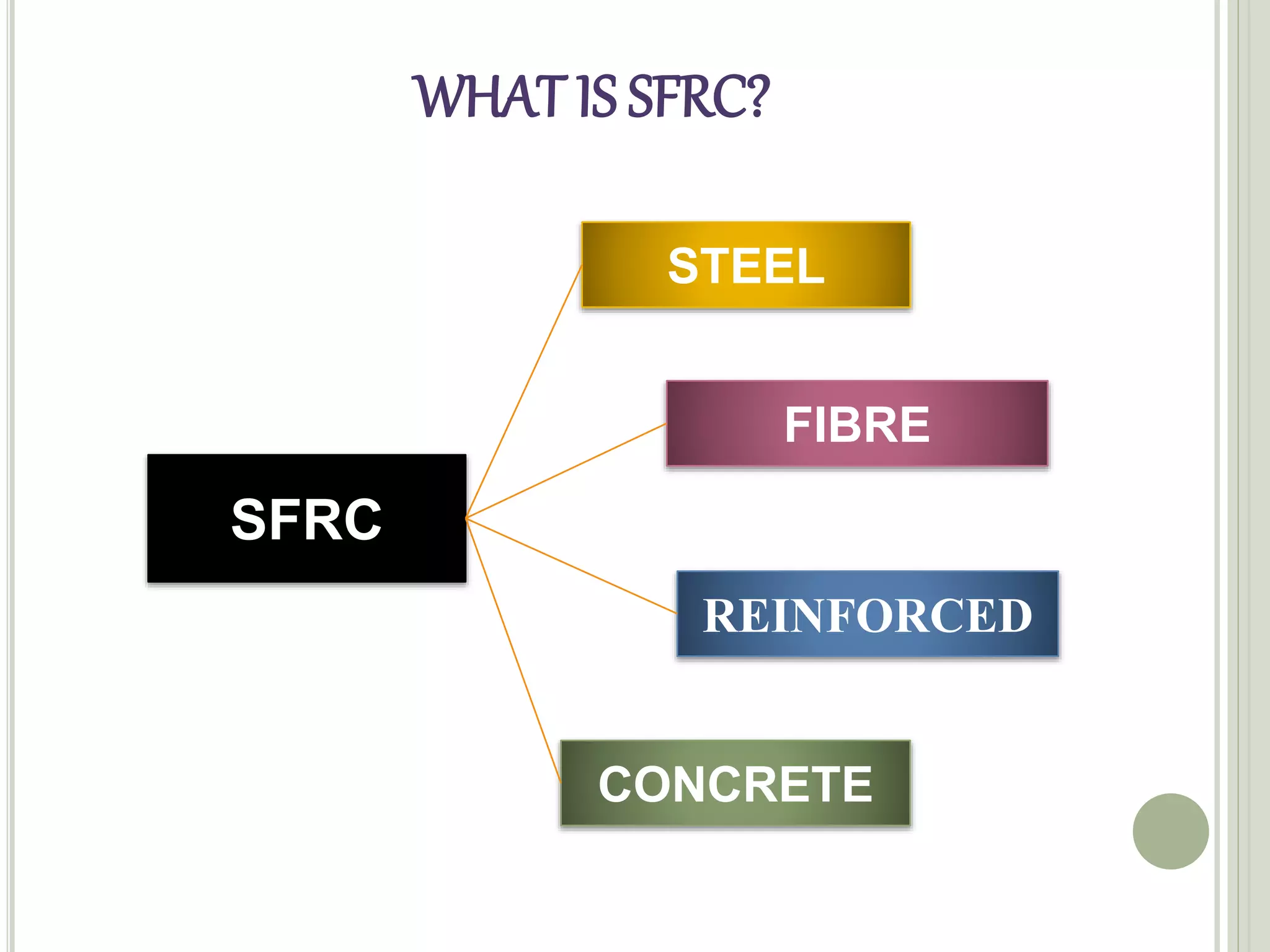
WHAT IS SFRC?
SFRC
STEEL
FIBRE
REINFORCED
CONCRETE
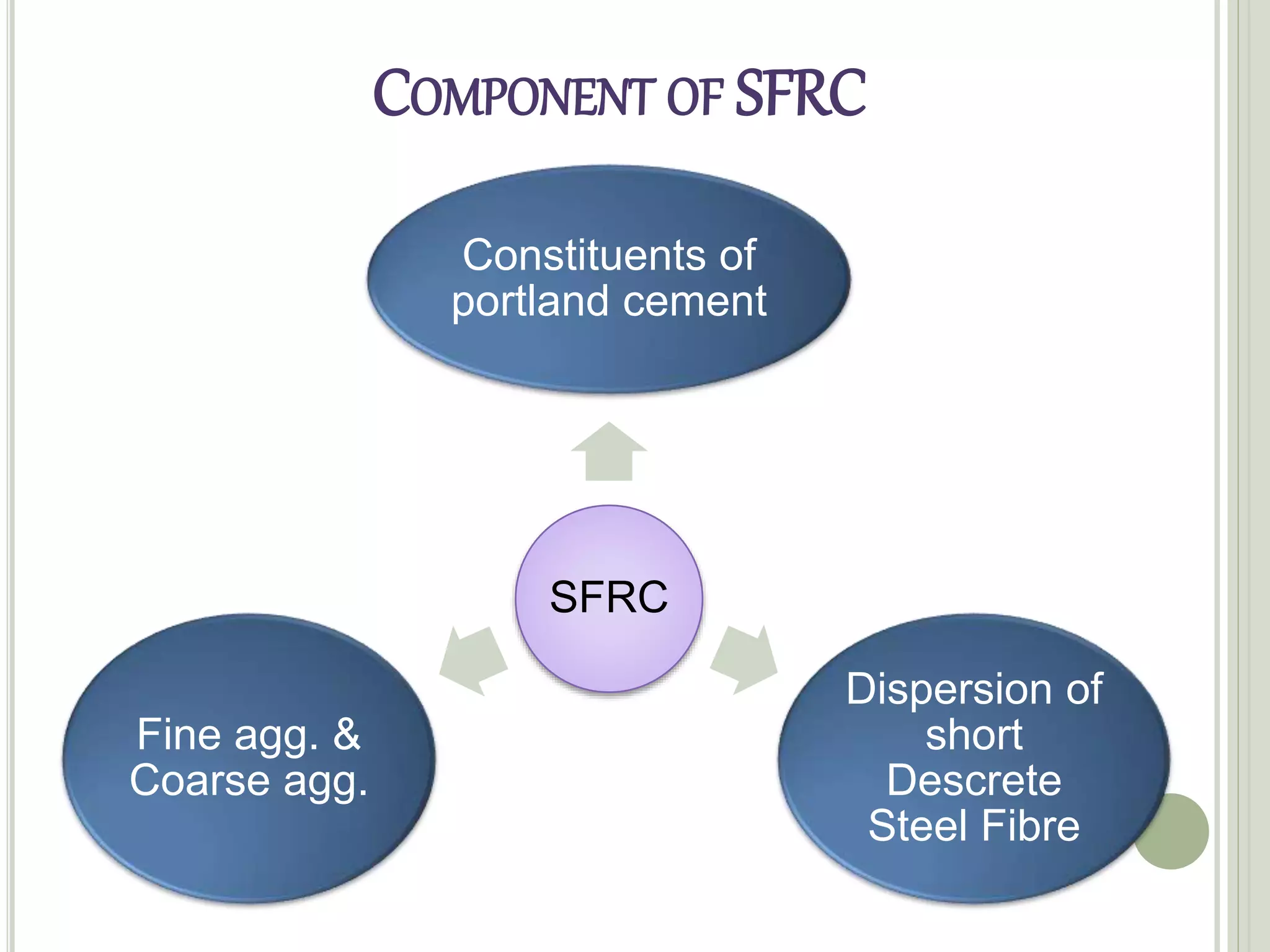
COMPONENT OF SFRC
SFRC
Constituents of
portland cement
Dispersion of
short
Descrete
Steel Fibre
Fine agg. &
Coarse agg.
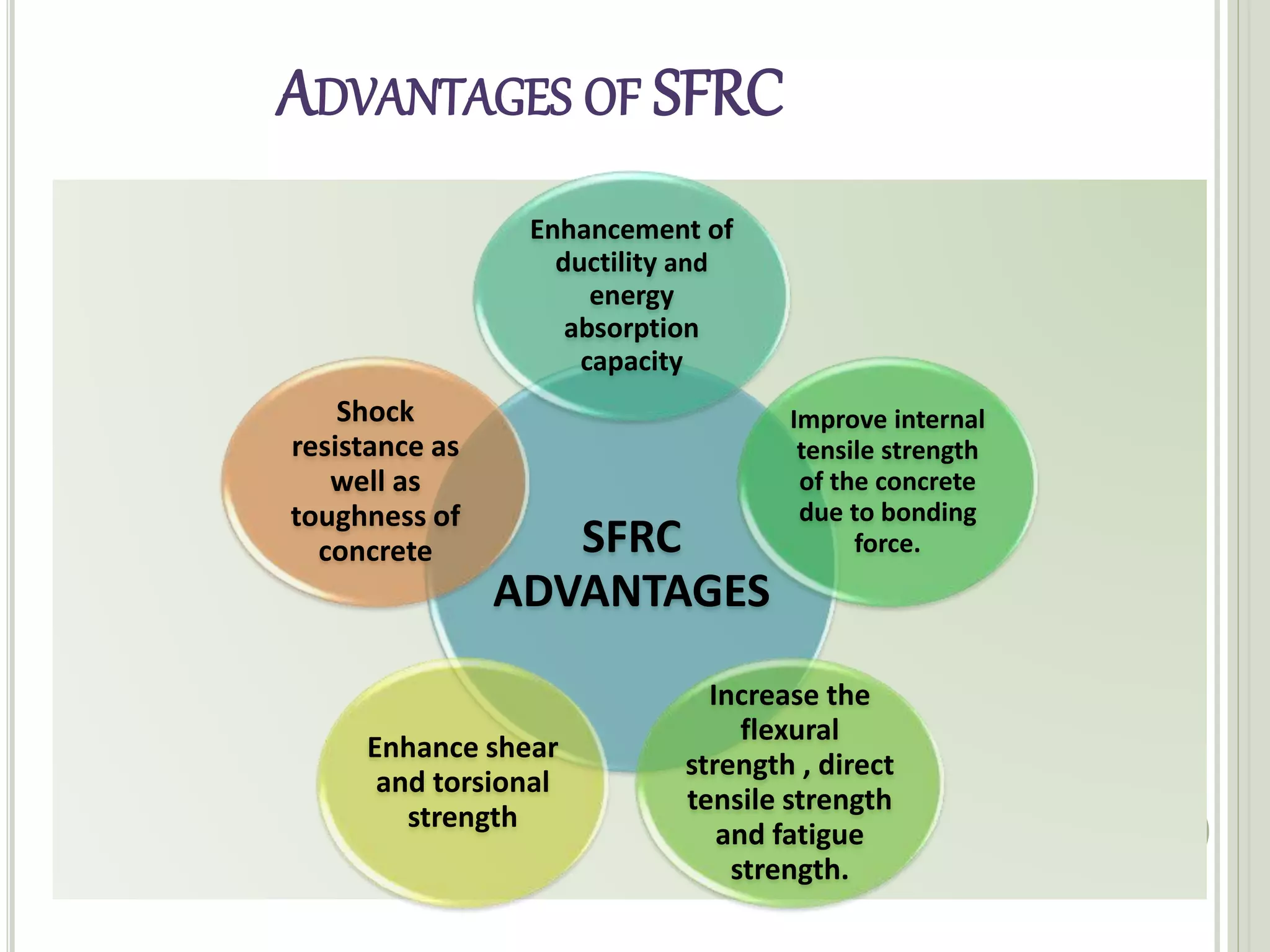
ADVANTAGES OF SFRC
SFRC
ADVANTAGES
Enhancement of
ductility and
energy
absorption
capacity
Improve internal
tensile strength
of the concrete
due to bonding
force.
Increase the
flexural
strength , direct
tensile strength
and fatigue
strength.
Enhance shear
and torsional
strength
Shock
resistance as
well as
toughness of
concrete
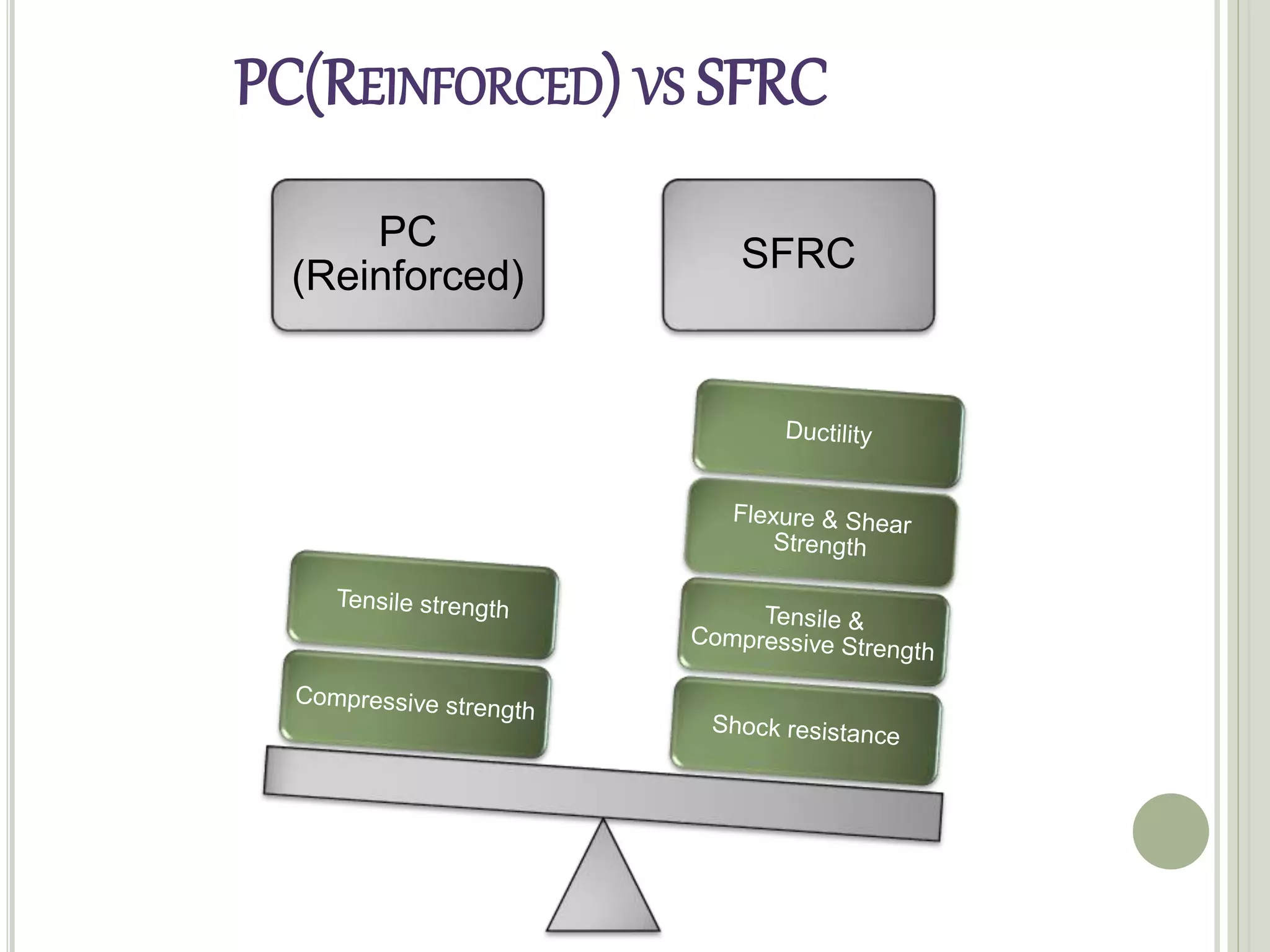
PC(REINFORCED) VS SFRC
PC
(Reinforced)
SFRC
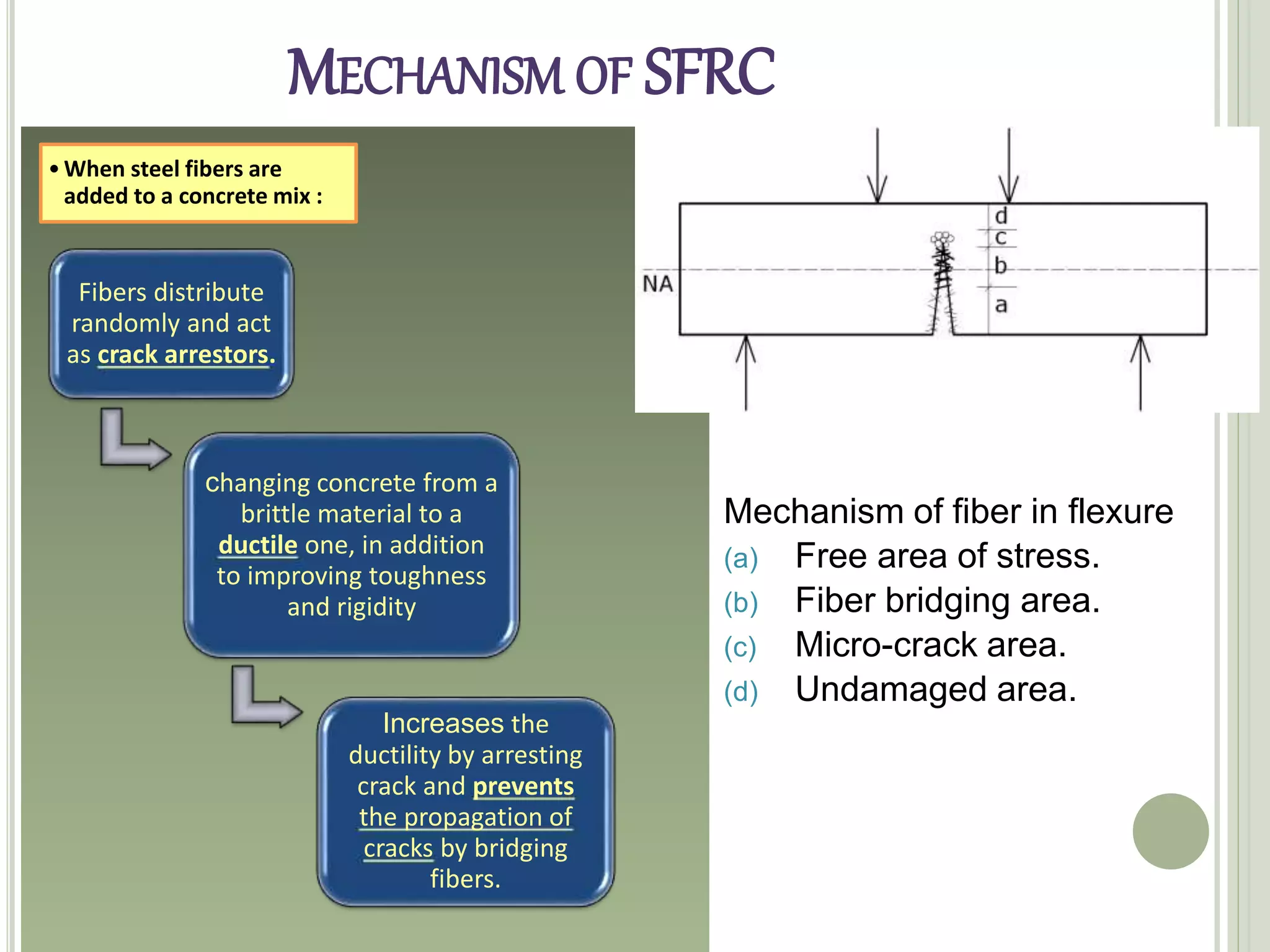
MECHANISM OF SFRC
Fibers distribute
randomly and act
as crack arrestors.
•When steel fibers are
added to a concrete mix :
changing concrete from a
brittle material to a
ductile one, in addition
to improving toughness
and rigidity
Increases the
ductility by arresting
crack and prevents
the propagation of
cracks by bridging
fibers.
Mechanism of fiber in flexure
(a) Free area of stress.
(b) Fiber bridging area.
(c) Micro-crack area.
(d) Undamaged area.
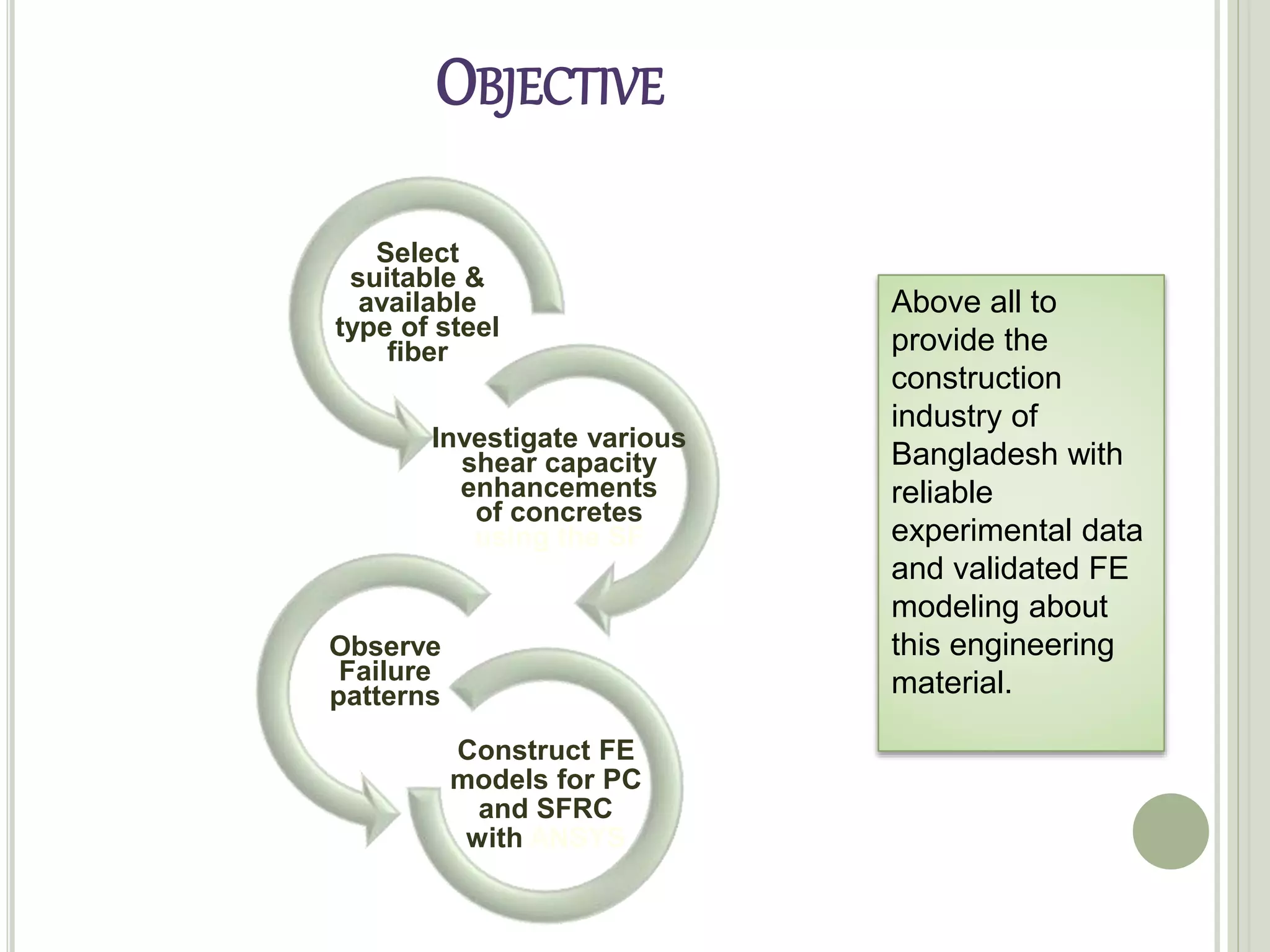
OBJECTIVE
Select
suitable &
available
type of steel
fiber
Investigate various
shear capacity
enhancements
of concretes
using the SF
Observe
Failure
patterns
Construct FE
models for PC
and SFRC
with ANSYS
Above all to
provide the
construction
industry of
Bangladesh with
reliable
experimental data
and validated FE
modeling about
this engineering
material.
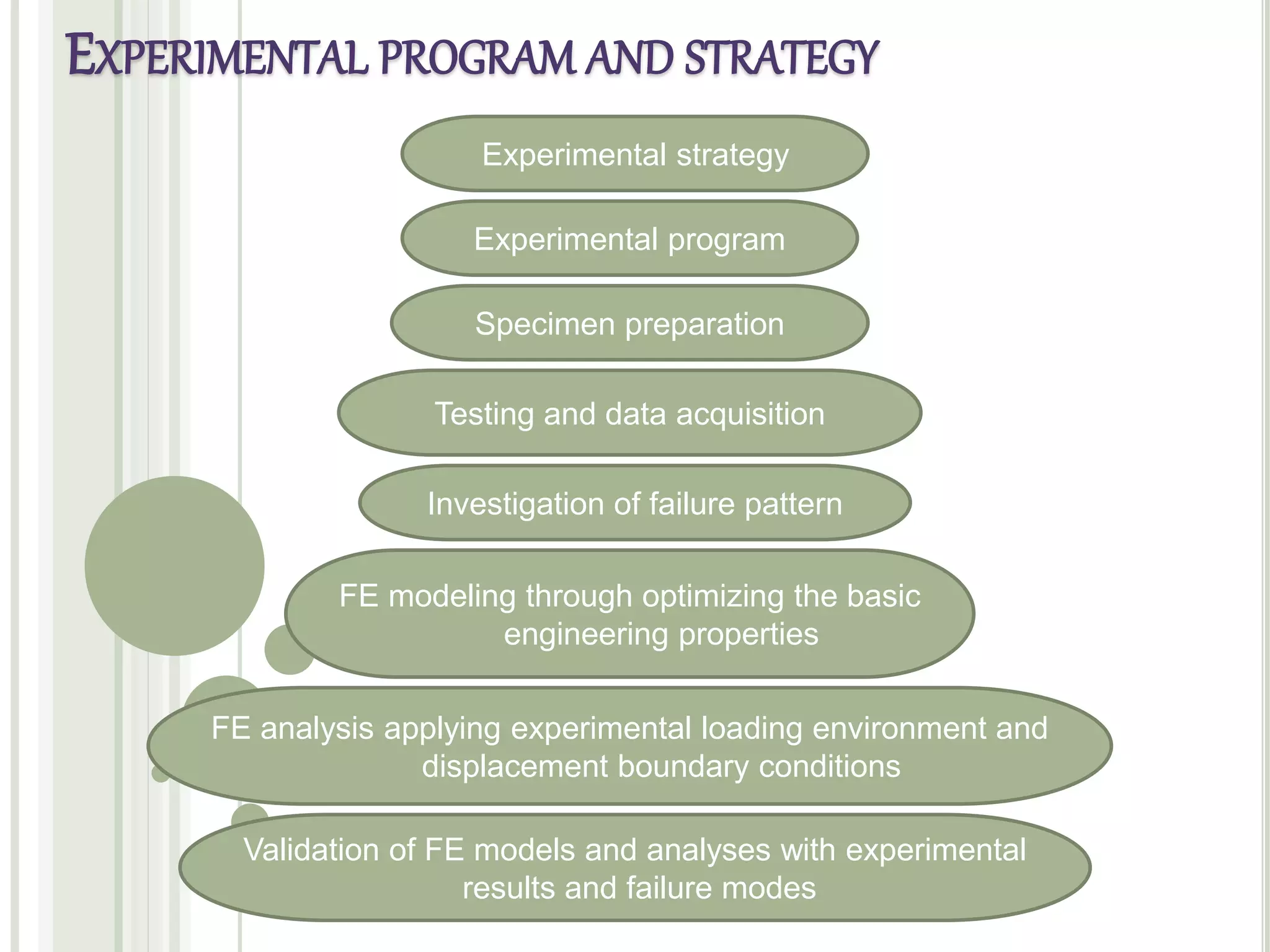
EXPERIMENTAL PROGRAM AND STRATEGY
Experimental strategy
Experimental program
Specimen preparation
Testing and data acquisition
Investigation of failure pattern
FE modeling through optimizing the basic
engineering properties
FE analysis applying experimental loading environment and
displacement boundary conditions
Validation of FE models and analyses with experimental
results and failure modes
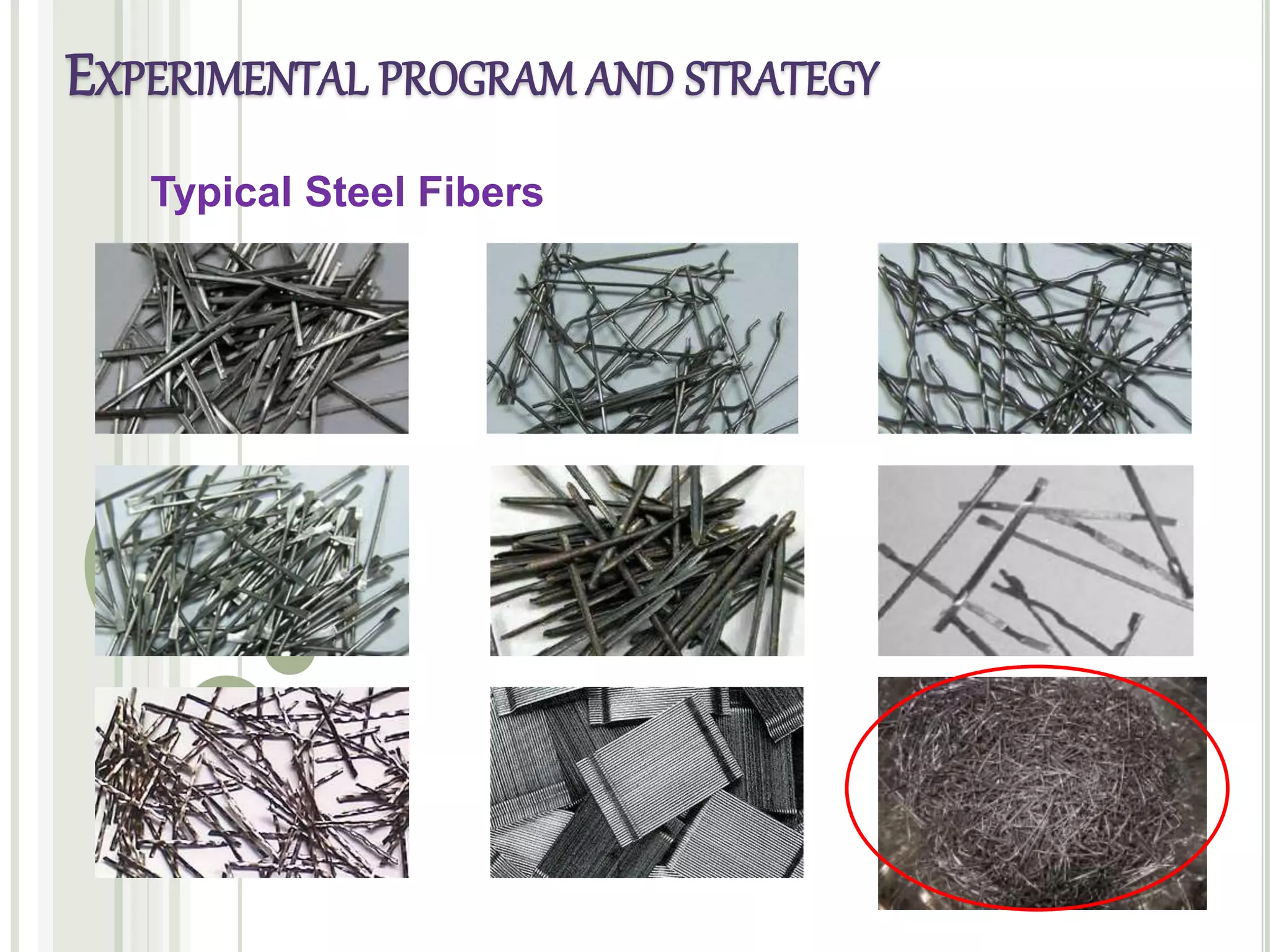
Typical Steel Fibers
EXPERIMENTAL PROGRAM AND STRATEGY
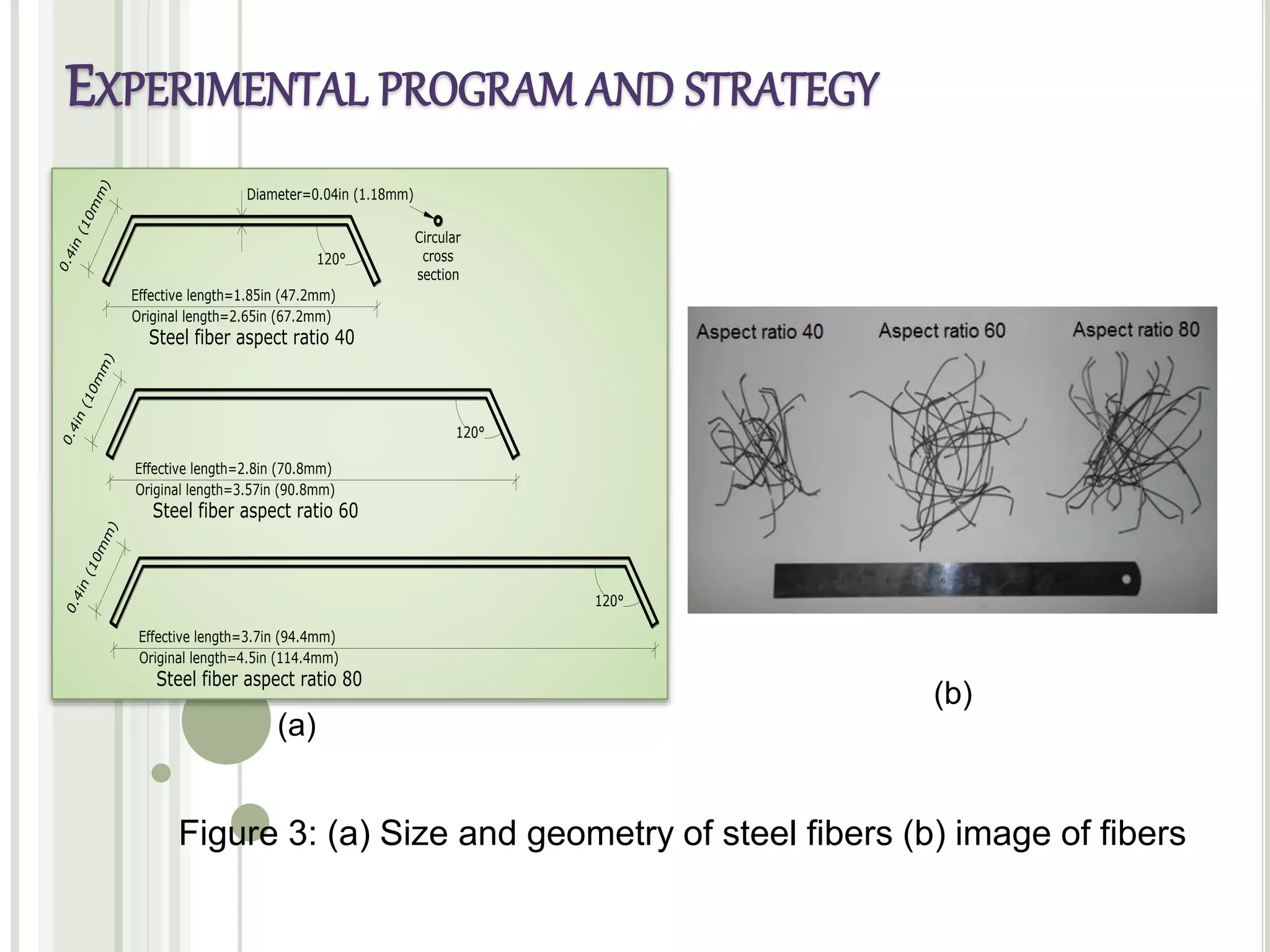
120°
120°
120°
Effective length=1.85in (47.2mm)
Effective length=2.8in (70.8mm)
Effective length=3.7in (94.4mm)
Steel fiber aspect ratio 40
Steel fiber aspect ratio 60
Steel fiber aspect ratio 80
0.4in(10mm)
0.4in(10mm)
0.4in(10mm)
Diameter=0.04in (1.18mm)
Circular
cross
section
Original length=2.65in (67.2mm)
Original length=3.57in (90.8mm)
Original length=4.5in (114.4mm)
(a)
(b)
Figure 3: (a) Size and geometry of steel fibers (b) image of fibers
EXPERIMENTAL PROGRAM AND STRATEGY
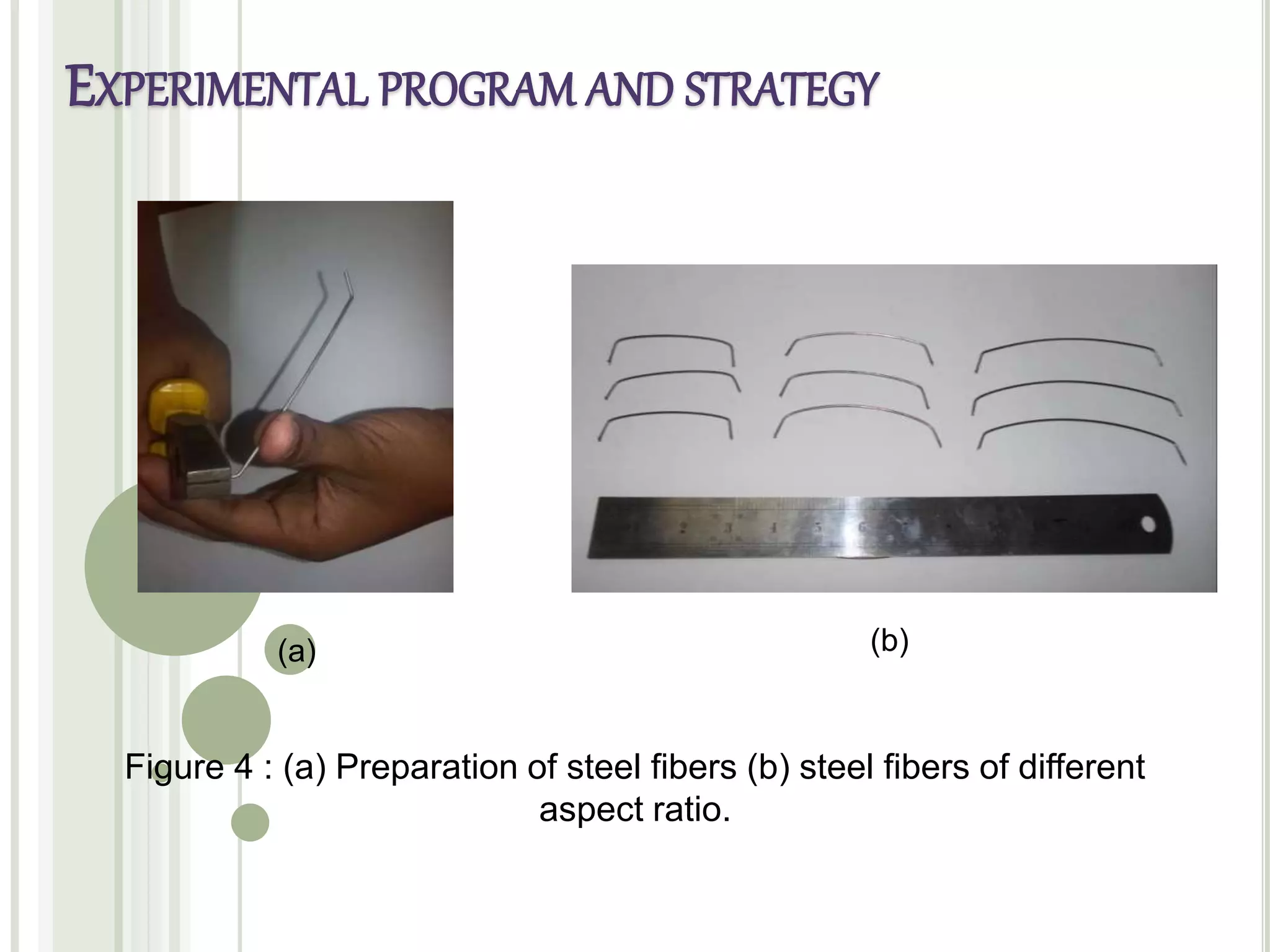
Figure 4 : (a) Preparation of steel fibers (b) steel fibers of different
aspect ratio.
(a) (b)
EXPERIMENTAL PROGRAM AND STRATEGY
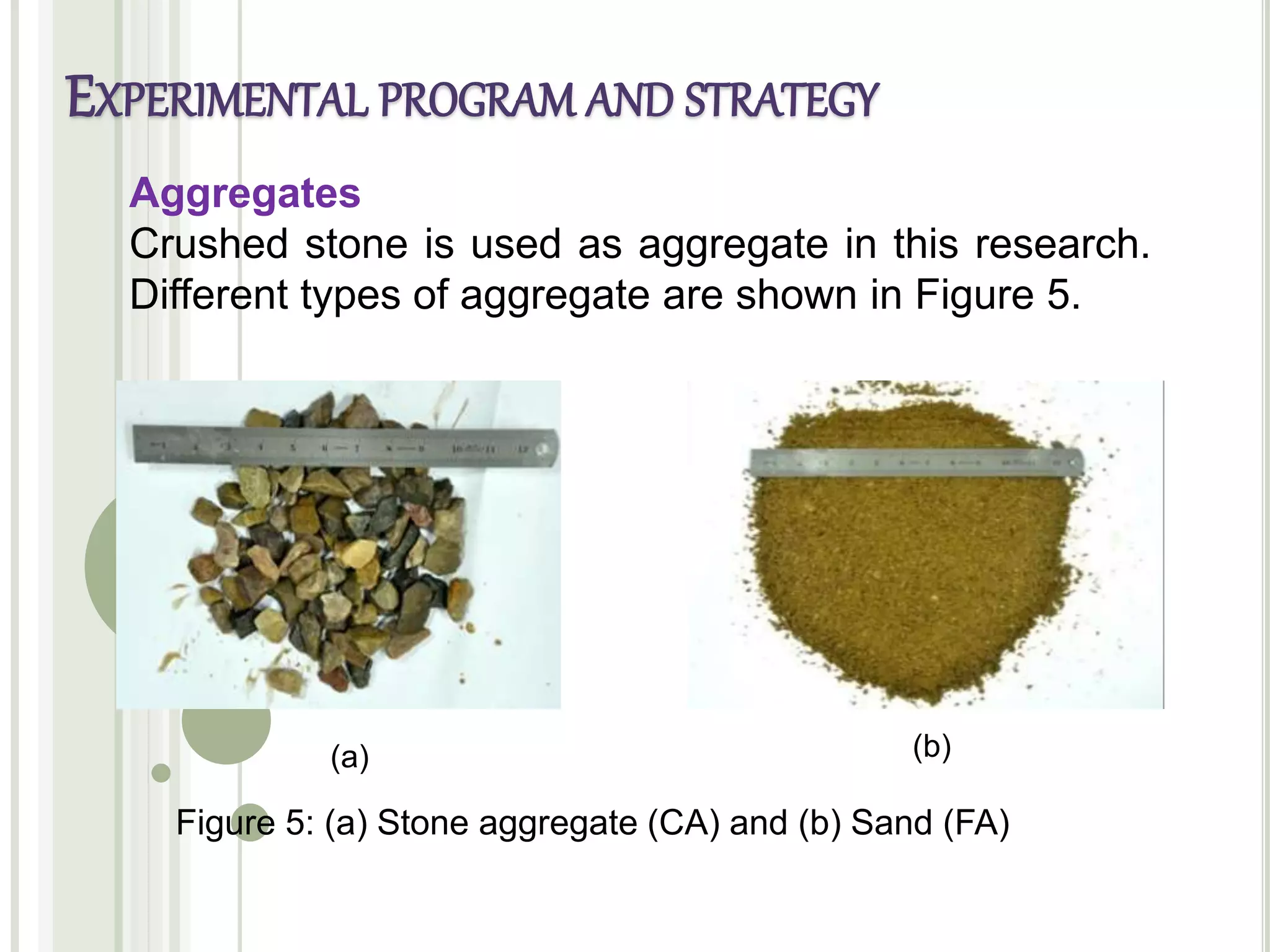
Aggregates
Crushed stone is used as aggregate in this research.
Different types of aggregate are shown in Figure 5.
Figure 5: (a) Stone aggregate (CA) and (b) Sand (FA)
(a) (b)
EXPERIMENTAL PROGRAM AND STRATEGY
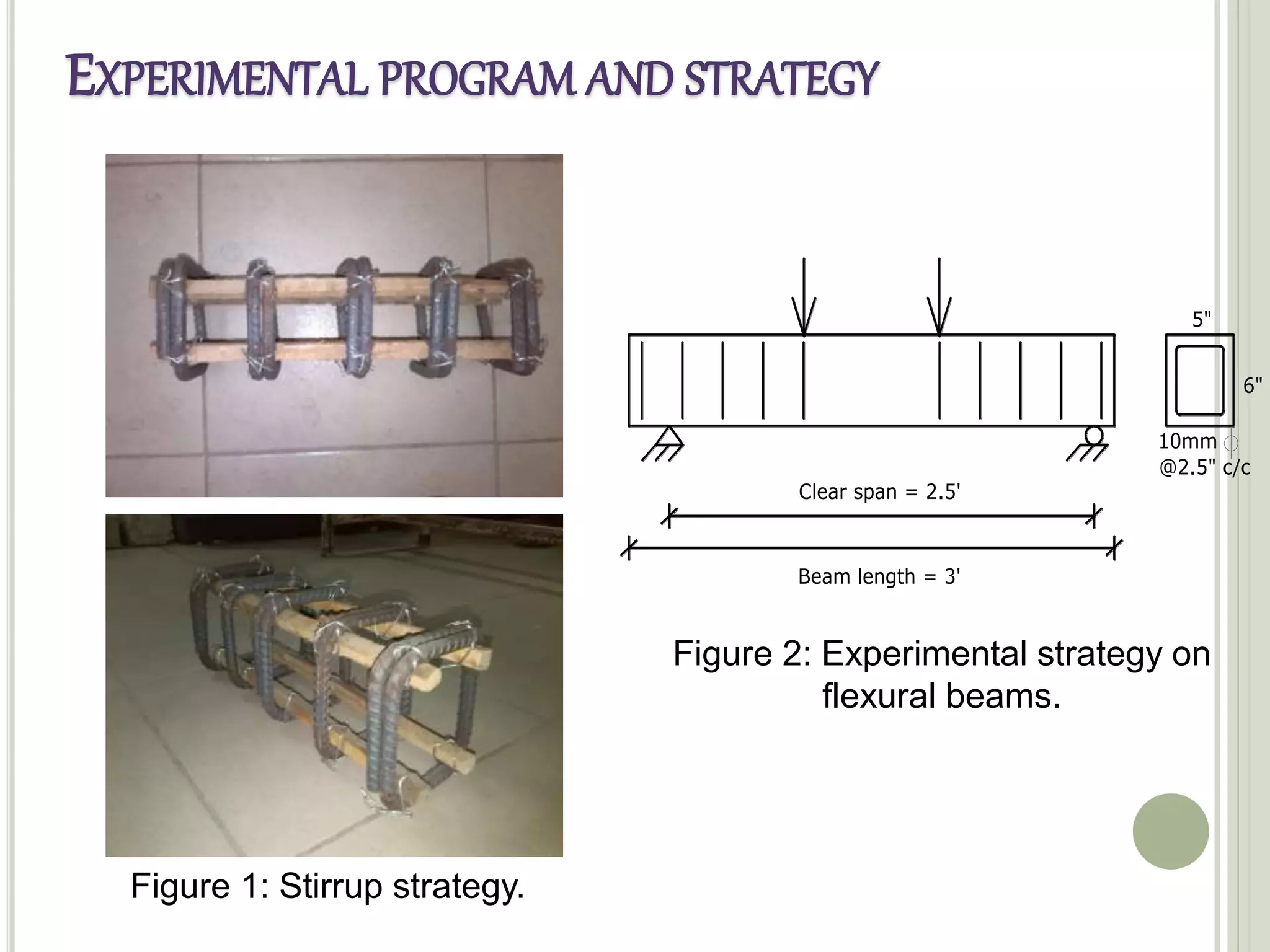
Clear span = 2.5'
Beam length = 3'
5"
6"
10mm
@2.5" c/c
Figure 1: Stirrup strategy.
Figure 2: Experimental strategy on
flexural beams.
EXPERIMENTAL PROGRAM AND STRATEGY
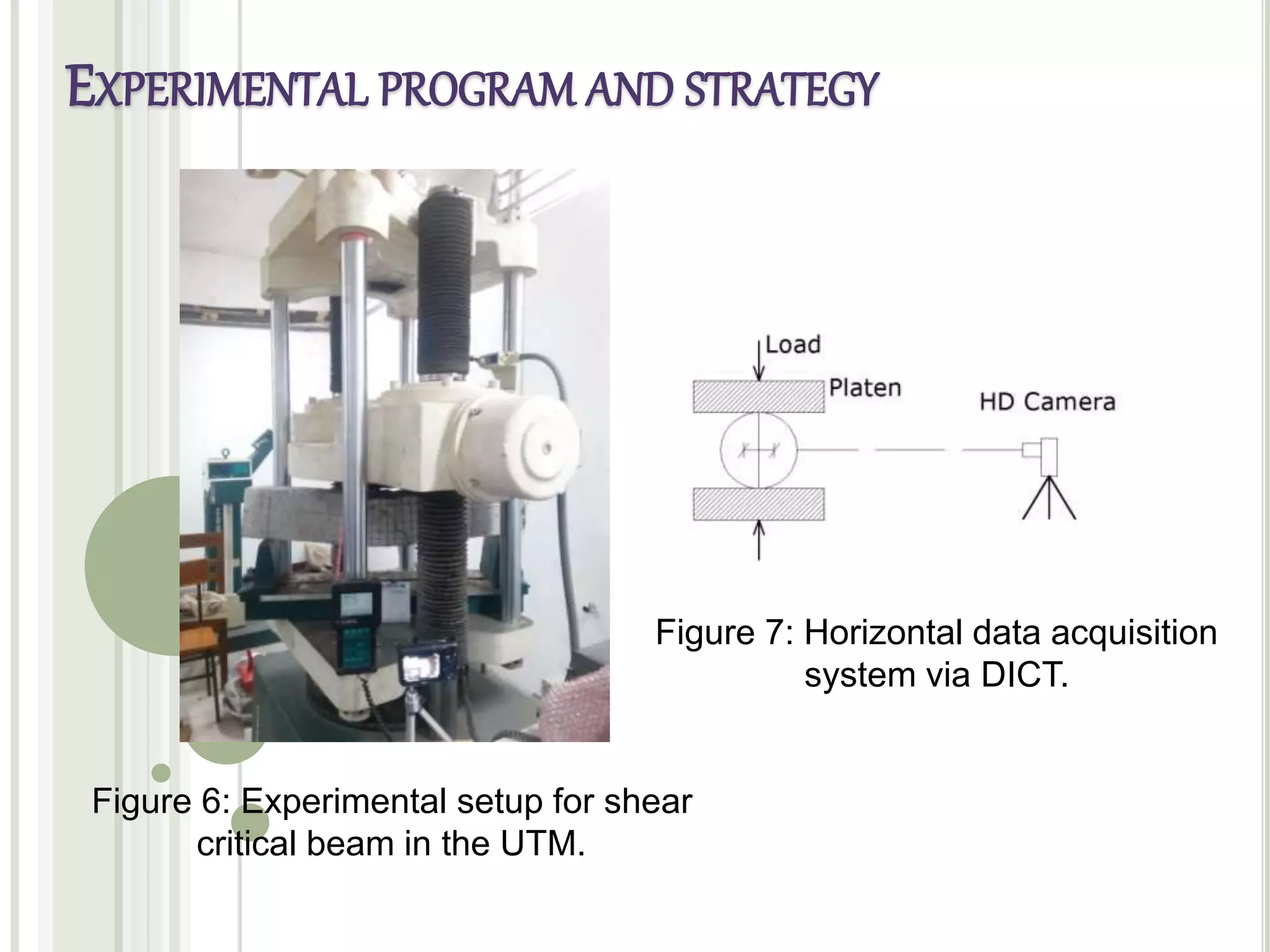
Figure 7: Horizontal data acquisition
system via DICT.
Figure 6: Experimental setup for shear
critical beam in the UTM.
EXPERIMENTAL PROGRAM AND STRATEGY
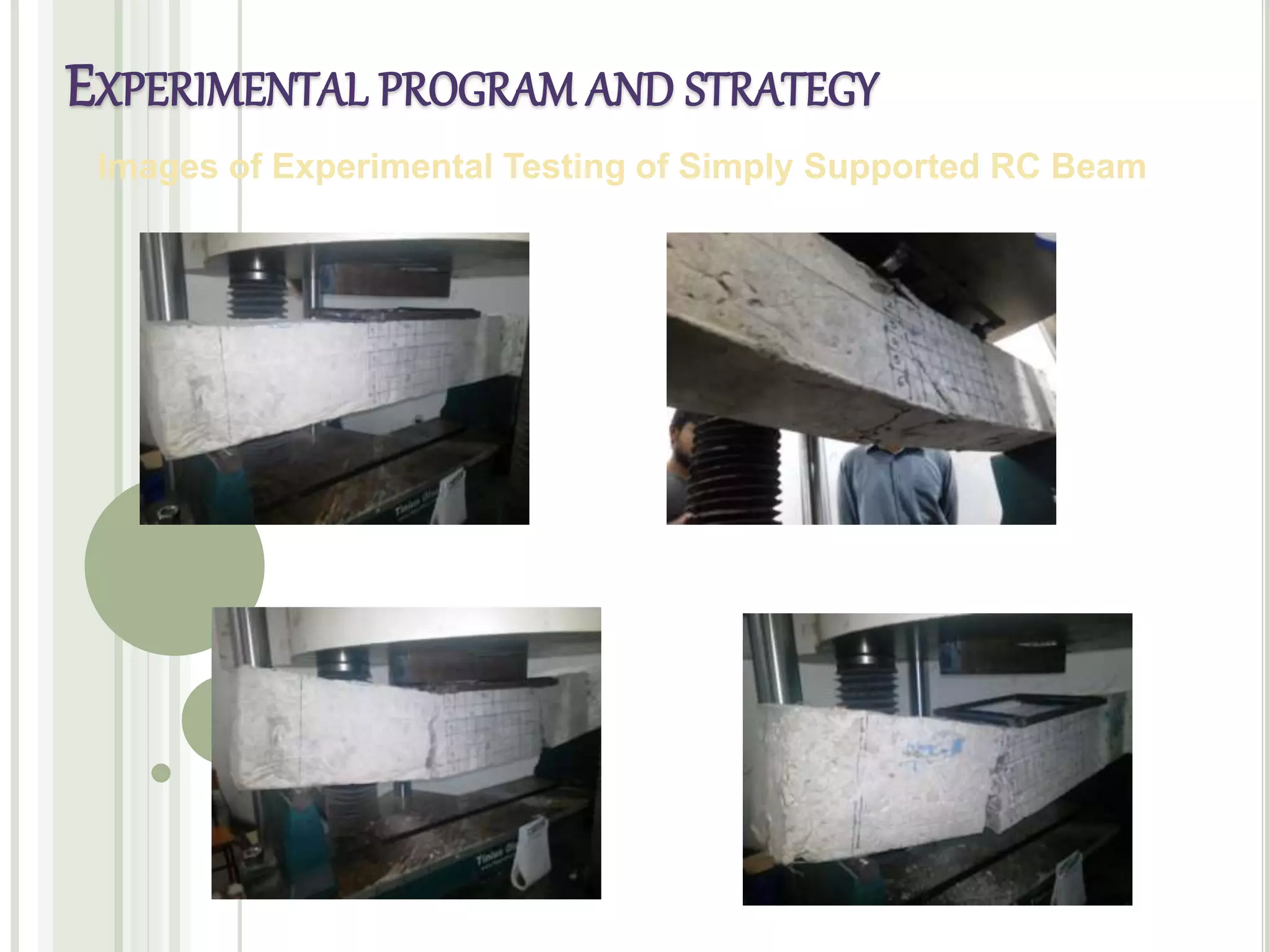
Images of Experimental Testing of Simply Supported RC Beam
EXPERIMENTAL PROGRAM AND STRATEGY
0
1000
2000
3000
4000
5000
0 0.005 0.01 0.015
CSCCON
CSC40
CSC60
CSC80
Compressivestress(psi)
Compressive strain
0
7
14
21
28
35
Compressivestress(MPa)
0
200
400
600
800
1000
1200
1400
0 0.01 0.02 0.03 0.04 0.05 0.06 0.07 0.08
CSTCON
CST40
CST60
CST80
Tensilestress(psi)
Tensile strain
0
1.4
2.8
4.2
5.6
7.0
8.4
9.8
Tensilestress(MPa)
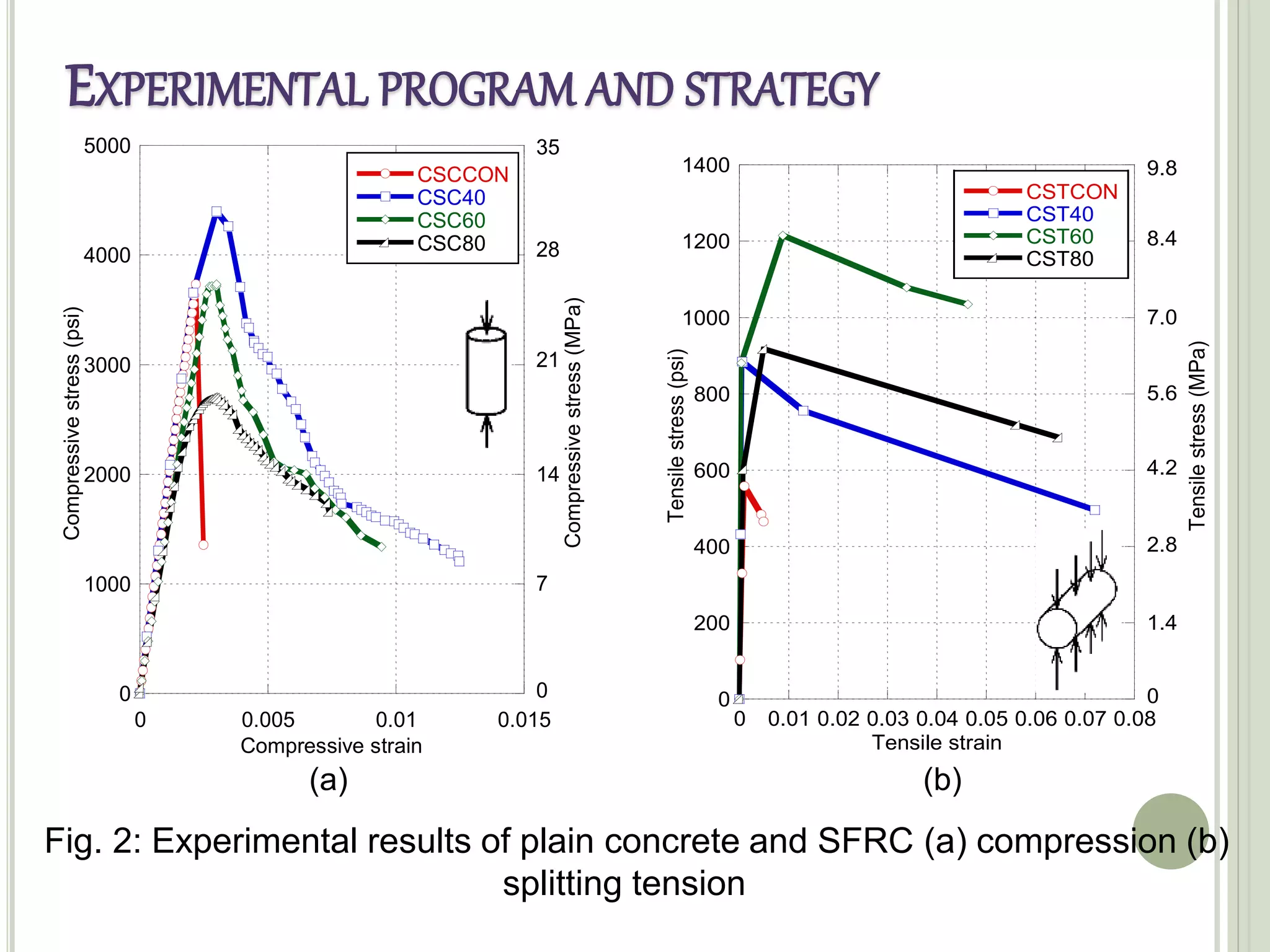
Fig. 2: Experimental results of plain concrete and SFRC (a) compression (b)
splitting tension
EXPERIMENTAL PROGRAM AND STRATEGY
(a) (b)
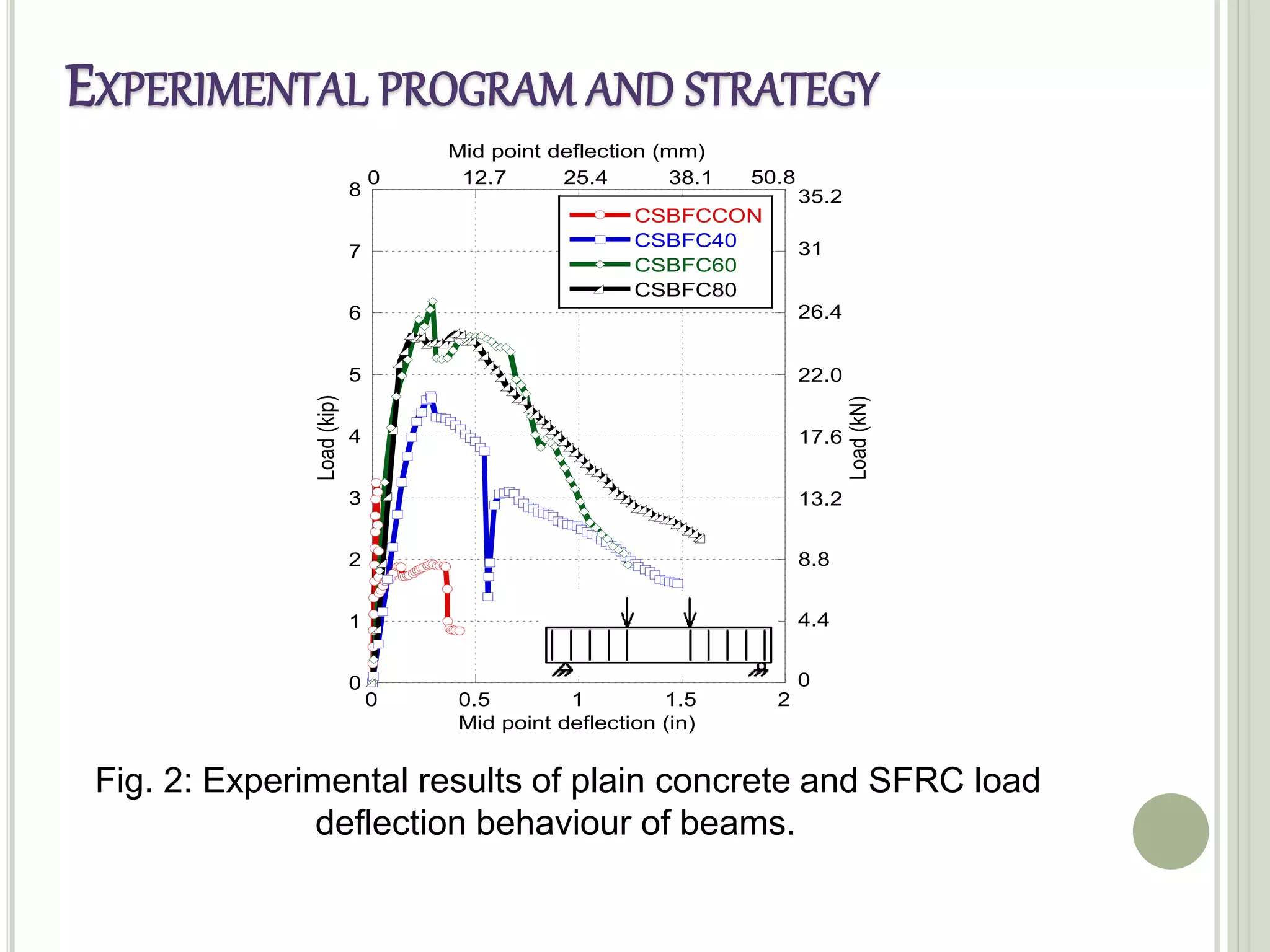
Fig. 2: Experimental results of plain concrete and SFRC load
deflection behaviour of beams.
0
1
2
3
4
5
6
7
8
0 0.5 1 1.5 2
CSBFCCON
CSBFC40
CSBFC60
CSBFC80
Load(kip)
Mid point deflection (in)
0 12.7 25.4 38.1 50.8
Mid point deflection (mm)
0
4.4
8.8
13.2
17.6
22.0
26.4
31
Load(kN)
35.2
EXPERIMENTAL PROGRAM AND STRATEGY
FINITE ELEMENT MODELING AND ANALYSIS
FE modeling
* Suitable element type
* Adequate mesh size
* Optimized material properties
* Appropriate boundary conditions
* Realistic loading environment
* Proper time stepping
20
FE element
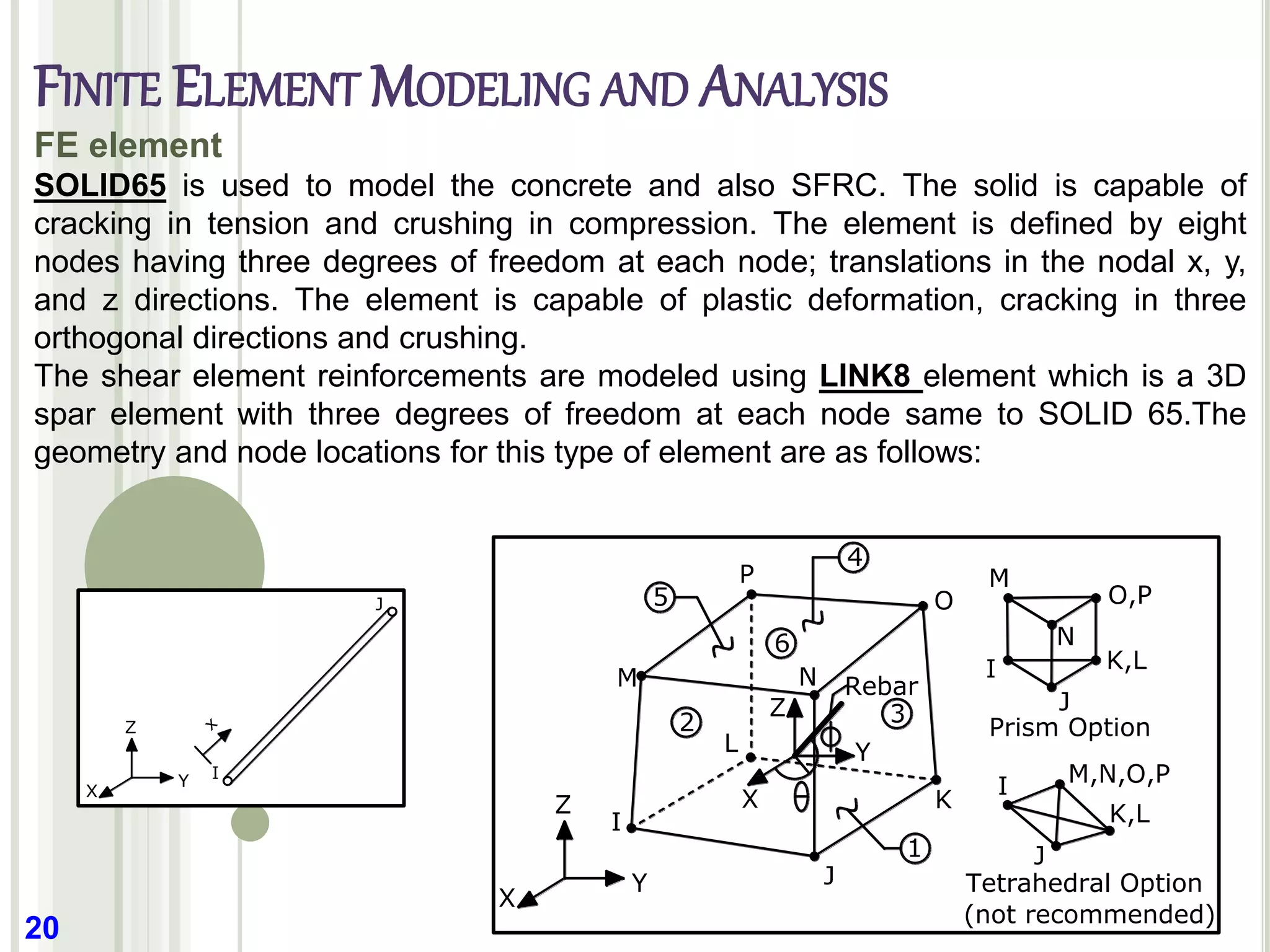
SOLID65 is used to model the concrete and also SFRC. The solid is capable of
cracking in tension and crushing in compression. The element is defined by eight
nodes having three degrees of freedom at each node; translations in the nodal x, y,
and z directions. The element is capable of plastic deformation, cracking in three
orthogonal directions and crushing.
The shear element reinforcements are modeled using LINK8 element which is a 3D
spar element with three degrees of freedom at each node same to SOLID 65.The
geometry and node locations for this type of element are as follows:
K
J
L
I
M
P
O
N
I M,N,O,P
K,L
J
M
I
N
J
O,P
K,L
Prism Option
Tetrahedral Option
(not recommended)
2
6
3
Z
Y
X
Z
Y
X
1
4
5
Rebar
Z
Y
X
I
J
x
FINITE ELEMENT MODELING AND ANALYSIS
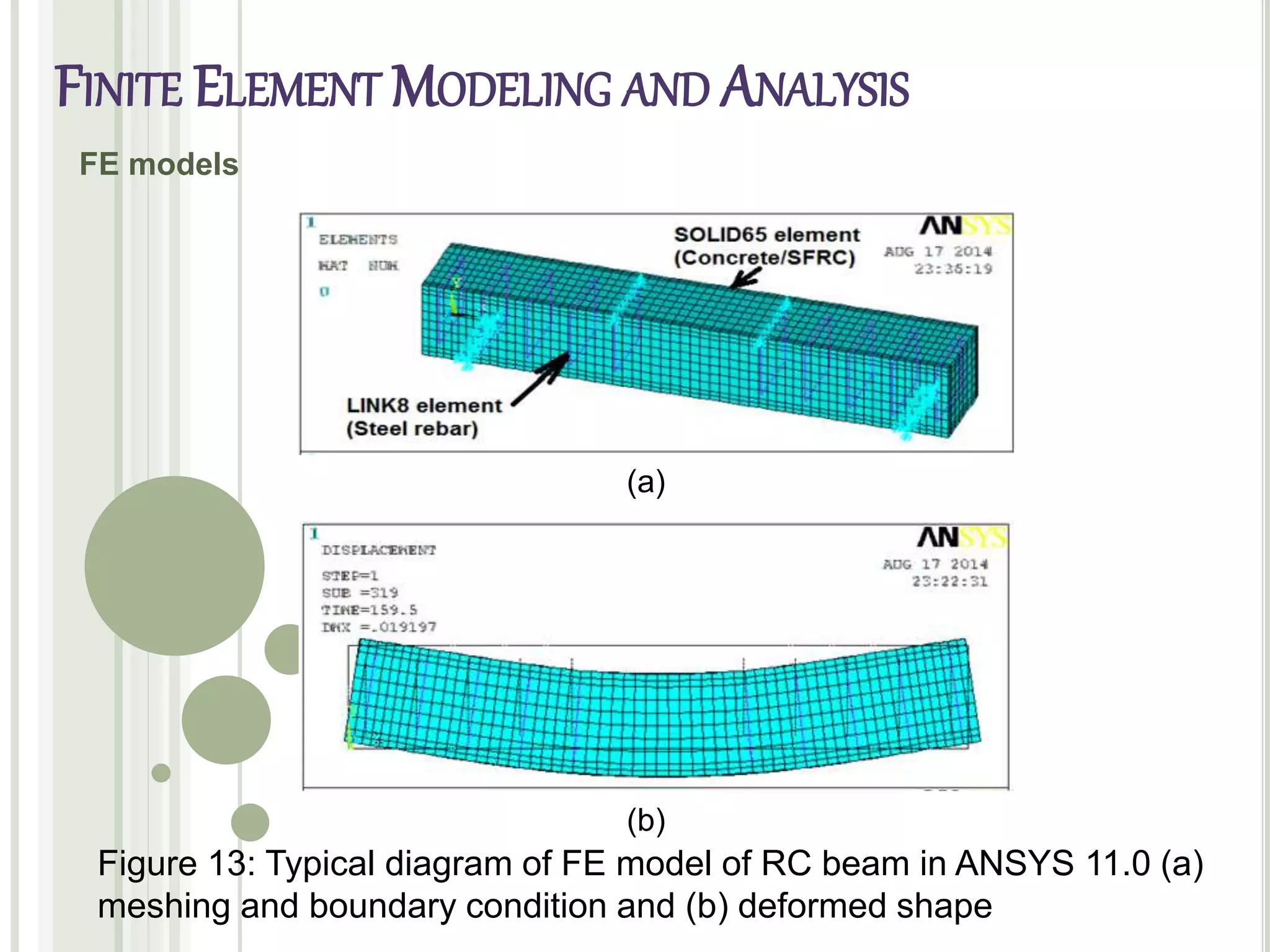
FE models
(a)
(b)
Figure 13: Typical diagram of FE model of RC beam in ANSYS 11.0 (a)
meshing and boundary condition and (b) deformed shape
FINITE ELEMENT MODELING AND ANALYSIS
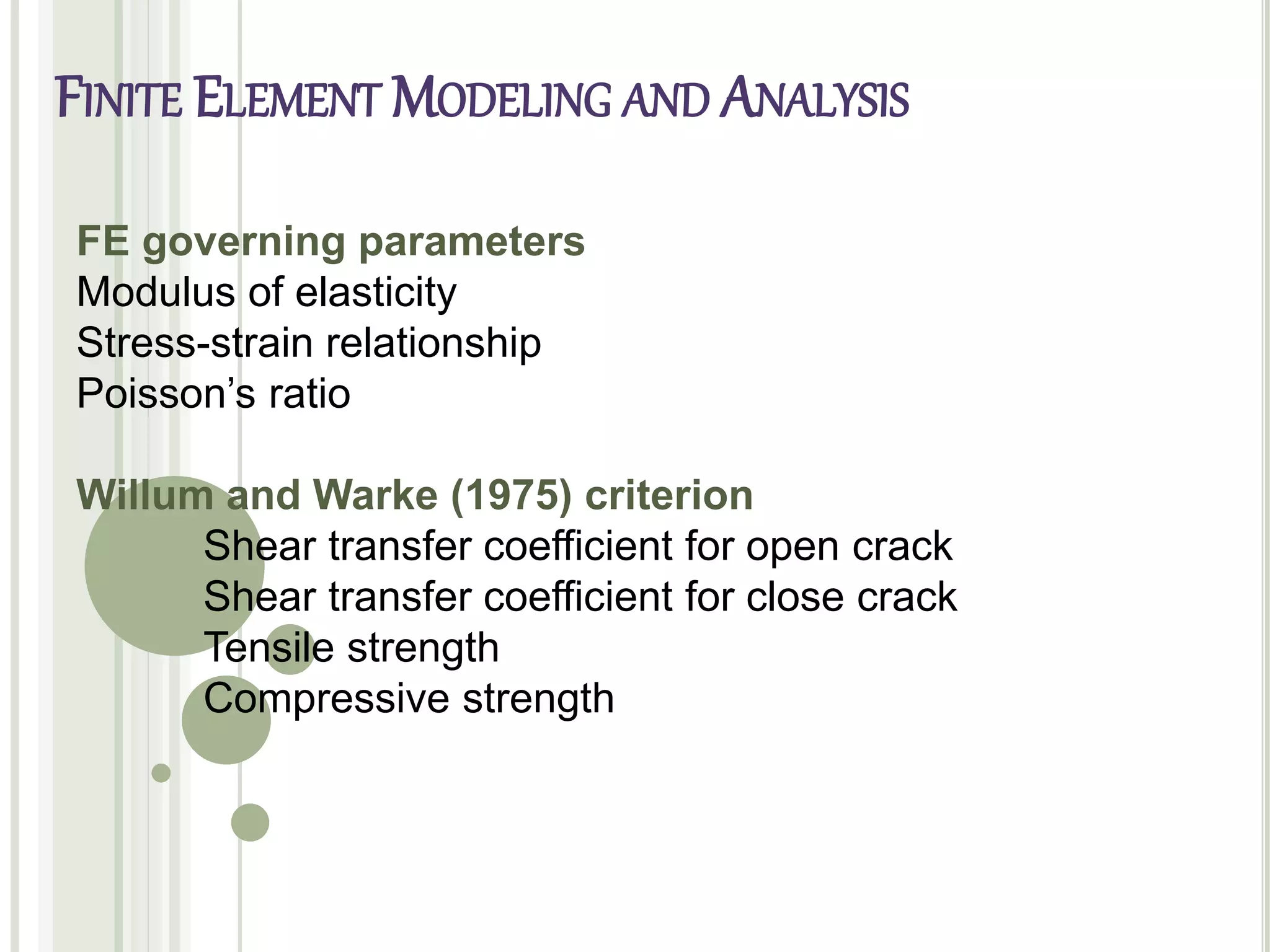
FE governing parameters
Modulus of elasticity
Stress-strain relationship
Poisson’s ratio
Willum and Warke (1975) criterion
Shear transfer coefficient for open crack
Shear transfer coefficient for close crack
Tensile strength
Compressive strength
FINITE ELEMENT MODELING AND ANALYSIS
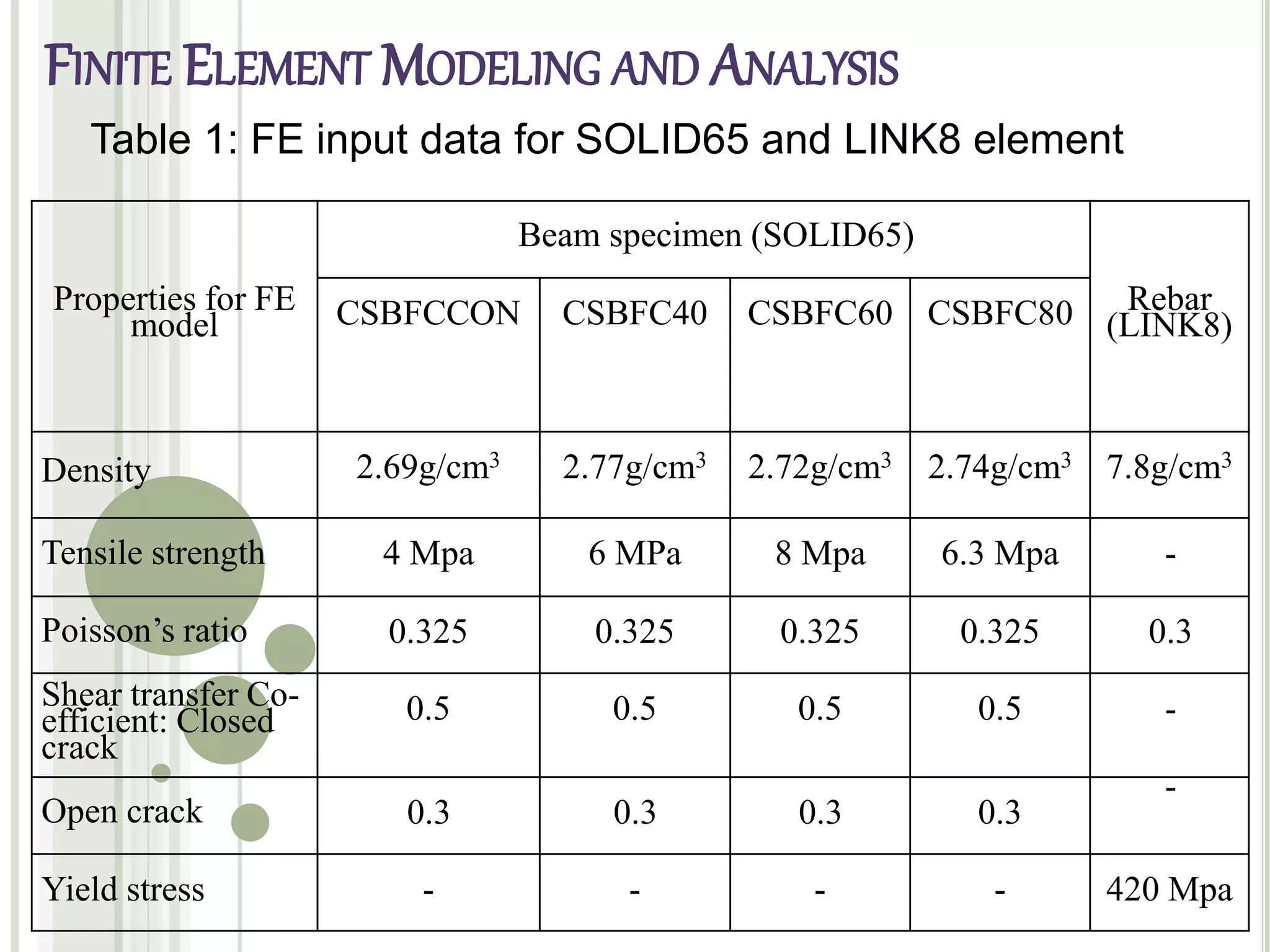
Table 1: FE input data for SOLID65 and LINK8 element
Properties for FE
model
Beam specimen (SOLID65)
Rebar
(LINK8)CSBFCCON CSBFC40 CSBFC60 CSBFC80
Density 2.69g/cm3 2.77g/cm3 2.72g/cm3 2.74g/cm3 7.8g/cm3
Tensile strength 4 Mpa 6 MPa 8 Mpa 6.3 Mpa -
Poisson’s ratio 0.325 0.325 0.325 0.325 0.3
Shear transfer Co-
efficient: Closed
crack
0.5 0.5 0.5 0.5 -
Open crack 0.3 0.3 0.3 0.3
-
Yield stress - - - - 420 Mpa
FINITE ELEMENT MODELING AND ANALYSIS
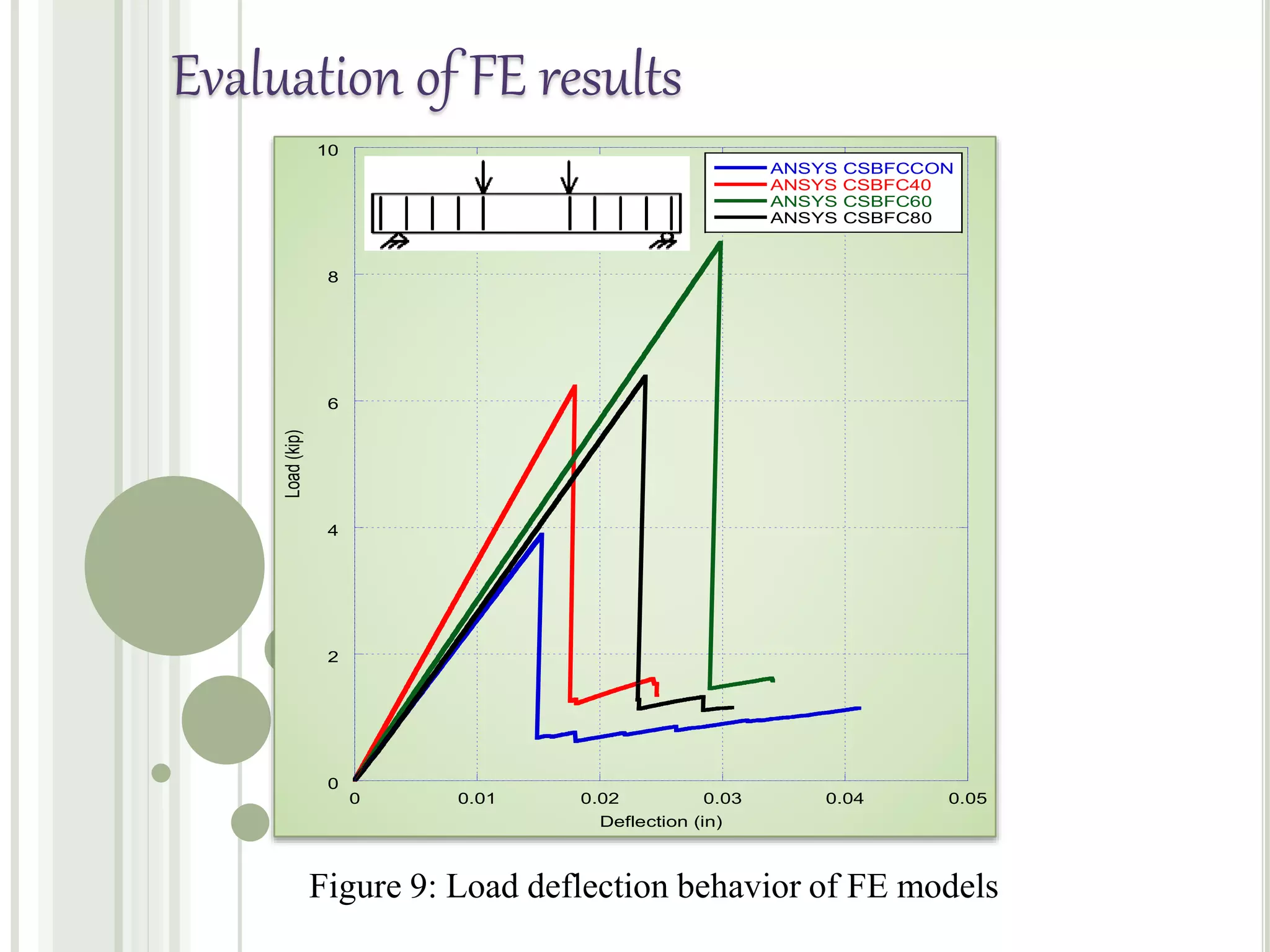
Evaluation of FE results
0
2
4
6
8
10
0 0.01 0.02 0.03 0.04 0.05
ANSYS CSBFCCON
ANSYS CSBFC40
ANSYS CSBFC60
ANSYS CSBFC80
Load(kip)
Deflection (in)
Figure 9: Load deflection behavior of FE models
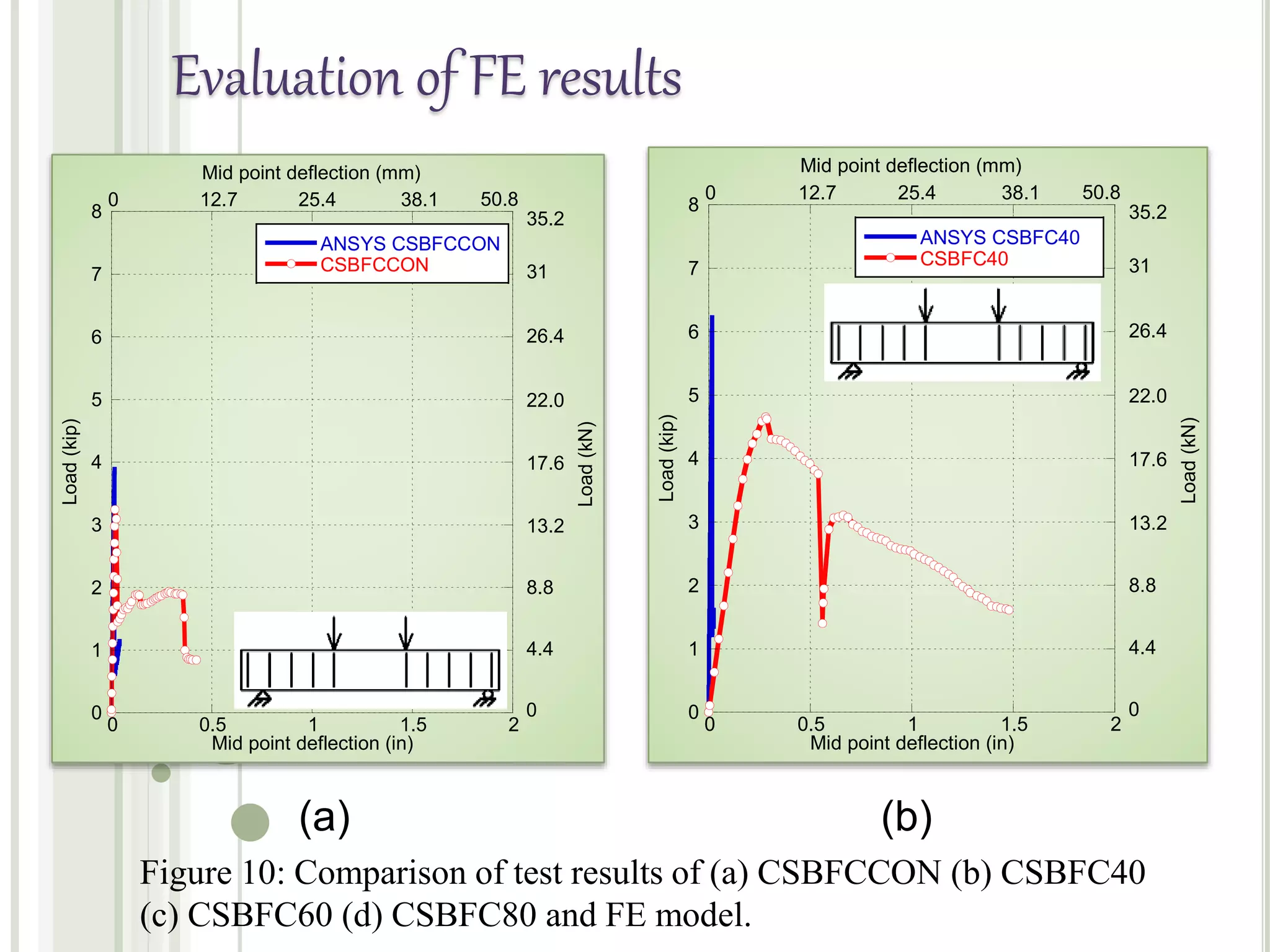
Figure 10: Comparison of test results of (a) CSBFCCON (b) CSBFC40
(c) CSBFC60 (d) CSBFC80 and FE model.
(a)
0
1
2
3
4
5
6
7
8
0 0.5 1 1.5 2
ANSYS CSBFCCON
CSBFCCON
Load(kip)
Mid point deflection (in)
0 12.7 25.4 38.1 50.8
Mid point deflection (mm)
0
4.4
8.8
13.2
17.6
22.0
26.4
31
Load(kN)
35.2
0
1
2
3
4
5
6
7
8
0 0.5 1 1.5 2
ANSYS CSBFC40
CSBFC40
Load(kip)
Mid point deflection (in)
0 12.7 25.4 38.1 50.8
Mid point deflection (mm)
0
4.4
8.8
13.2
17.6
22.0
26.4
31
Load(kN)
35.2
(b)
Evaluation of FE results
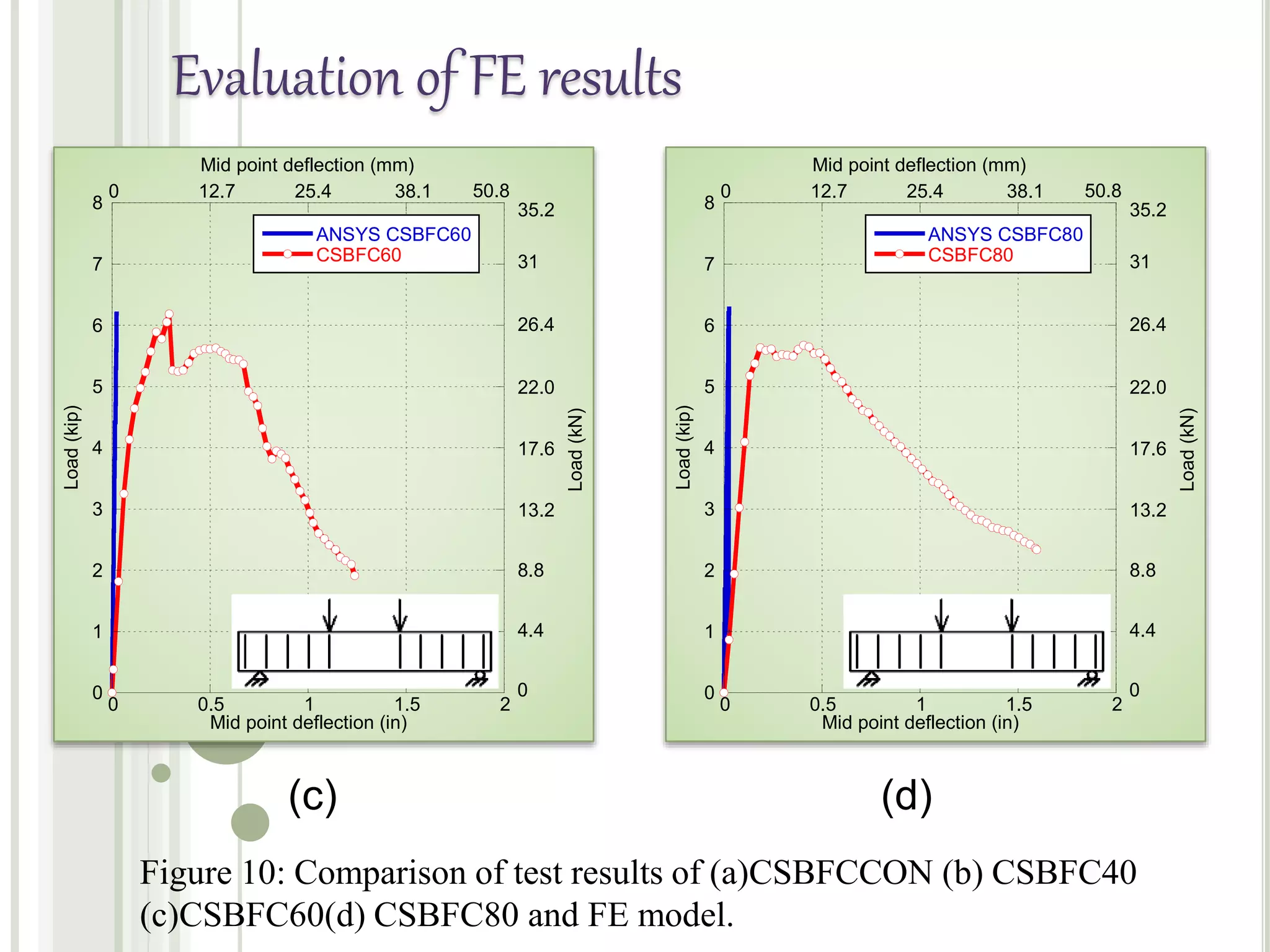
Figure 10: Comparison of test results of (a)CSBFCCON (b) CSBFC40
(c)CSBFC60(d) CSBFC80 and FE model.
(c)
0
1
2
3
4
5
6
7
8
0 0.5 1 1.5 2
ANSYS CSBFC60
CSBFC60
Load(kip)
Mid point deflection (in)
0 12.7 25.4 38.1 50.8
Mid point deflection (mm)
0
4.4
8.8
13.2
17.6
22.0
26.4
31
Load(kN)
35.2
0
1
2
3
4
5
6
7
8
0 0.5 1 1.5 2
ANSYS CSBFC80
CSBFC80
Load(kip)
Mid point deflection (in)
0 12.7 25.4 38.1 50.8
Mid point deflection (mm)
0
4.4
8.8
13.2
17.6
22.0
26.4
31
Load(kN)
35.2
(d)
Evaluation of FE results
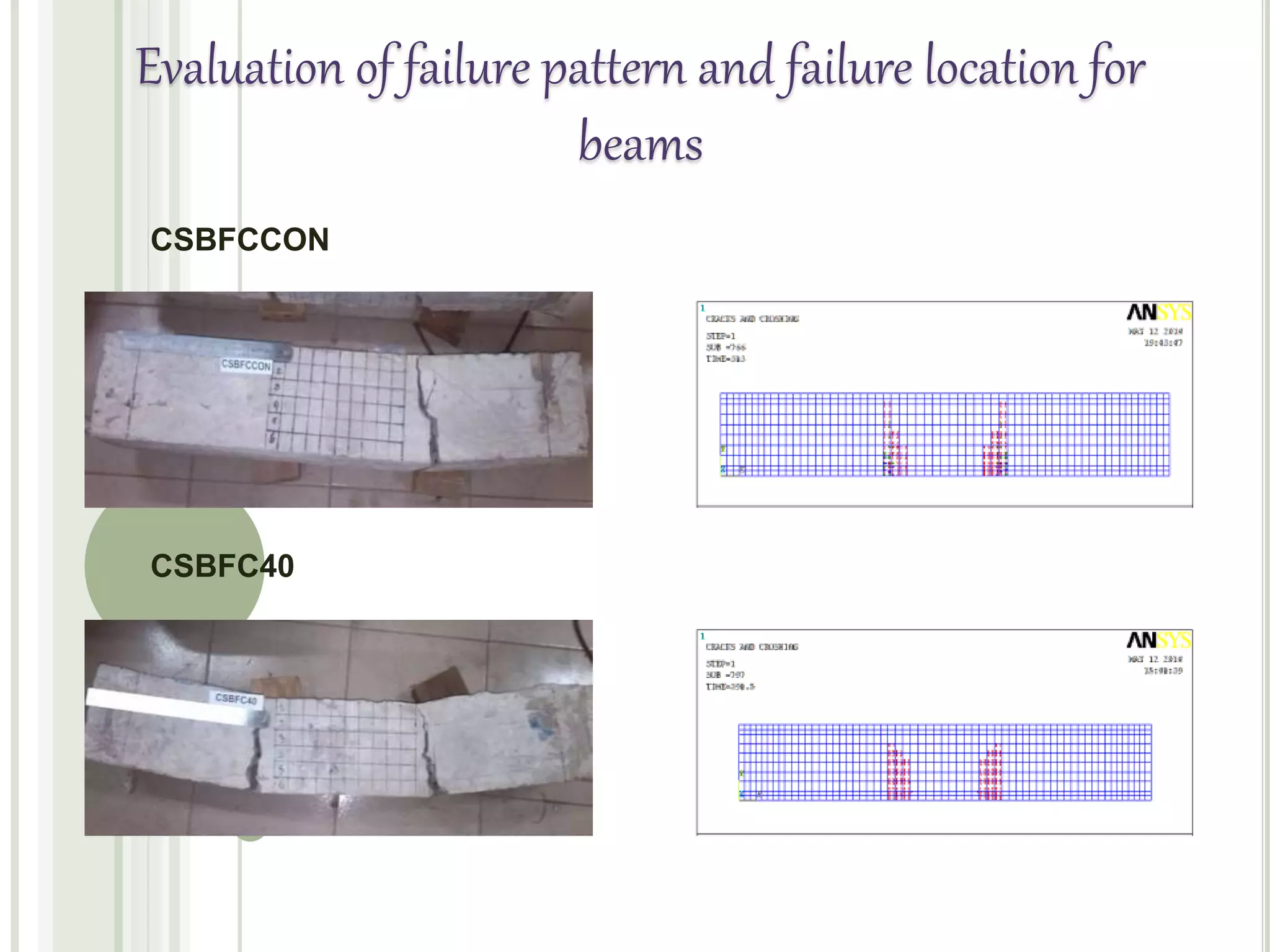
Evaluation of failure pattern and failure location for
beams
CSBFCCON
CSBFC40
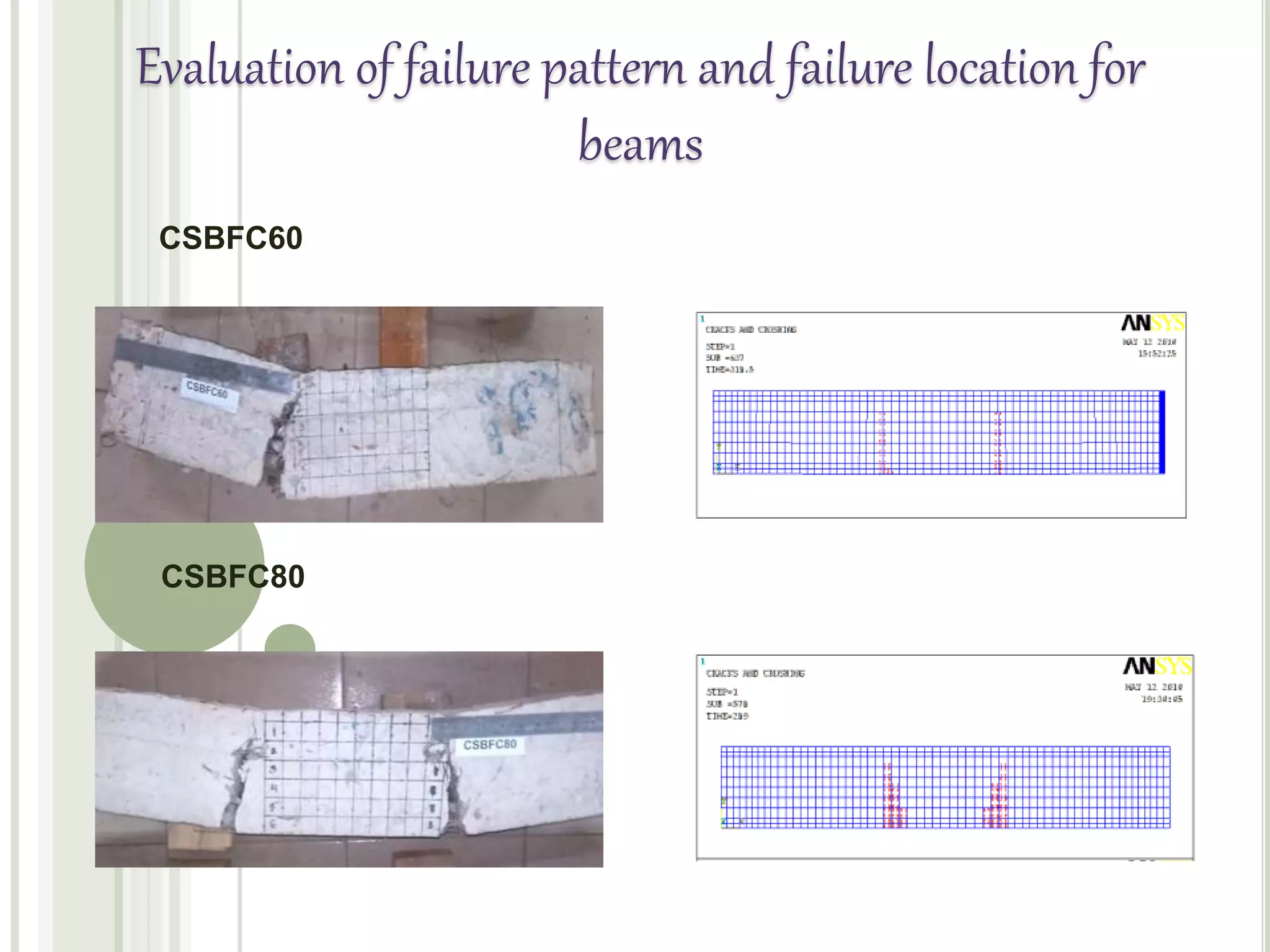
CSBFC60
CSBFC80
Evaluation of failure pattern and failure location for
beams
Conclusion
29
1. The compressive strength increases about 17.6%for SFAR 40 with respect to
control specimen & ductility is increased about 5, 3.6 and 3 times for SFAR 40,
60 & 80 respectively.
2. The tensile strength enhanced about 58%, 117.5% & 64.1% & ductility
increased about 15,9.2, & 13 times respectively.
3. The load deflection behavior shows that the flexural strength increased about
50%, 94% & 79% for the SFAR 40, 60 & 80 respectively and ductility enhanced
3.7, 3.125 & 4 times respectively.
4. The FE showed similar results which ensures the validity of the models and the
FE models are successfully capable of predicting the enhanced capacities due to
SFRC.
5. These FE modeling will definitely provide invaluable information of this
engineering material to the construction industry of Bangladesh.
THANK YOU

FINITE ELEMENT MODELING, ANALYSIS AND VALIDATION OF THE FLEXURAL CAPACITY OF RC BEAMS MADE OF STEEL FIBER REINFORCED CONCRETE (SFRC)

  • 1.
    AHSANULLAH UNIVERSITY OFSCIENCE AND TECHNOLOGY (AUST) PAPER ID: SEE 051 FINITEELEMENT MODELING, ANALYSISAND VALIDATIONOF THE FLEXURALCAPACITYOF RC BEAMSMADE OF STEELFIBER REINFORCED CONCRETE(SFRC) Presented by Sadia Mannan Mitu Department of Civil Engineering Ahsanullah University of Science and Technology (AUST), Dhaka 1208, Bangladesh Co-Authors: Md. Mashfiqul Islam Mohammed Shakib Rahman Md. Serajus Salekin Md. Rakibul Islam
  • 2.
    CONTENTS  Introduction ofSFRC  Experimental program and strategy  FE modeling and analysis  Evaluation of FE reults  Conclusion
  • 3.
  • 4.
    COMPONENT OF SFRC SFRC Constituentsof portland cement Dispersion of short Descrete Steel Fibre Fine agg. & Coarse agg.
  • 5.
    ADVANTAGES OF SFRC SFRC ADVANTAGES Enhancementof ductility and energy absorption capacity Improve internal tensile strength of the concrete due to bonding force. Increase the flexural strength , direct tensile strength and fatigue strength. Enhance shear and torsional strength Shock resistance as well as toughness of concrete
  • 6.
  • 7.
    MECHANISM OF SFRC Fibersdistribute randomly and act as crack arrestors. •When steel fibers are added to a concrete mix : changing concrete from a brittle material to a ductile one, in addition to improving toughness and rigidity Increases the ductility by arresting crack and prevents the propagation of cracks by bridging fibers. Mechanism of fiber in flexure (a) Free area of stress. (b) Fiber bridging area. (c) Micro-crack area. (d) Undamaged area.
  • 8.
    OBJECTIVE Select suitable & available type ofsteel fiber Investigate various shear capacity enhancements of concretes using the SF Observe Failure patterns Construct FE models for PC and SFRC with ANSYS Above all to provide the construction industry of Bangladesh with reliable experimental data and validated FE modeling about this engineering material.
  • 9.
    EXPERIMENTAL PROGRAM ANDSTRATEGY Experimental strategy Experimental program Specimen preparation Testing and data acquisition Investigation of failure pattern FE modeling through optimizing the basic engineering properties FE analysis applying experimental loading environment and displacement boundary conditions Validation of FE models and analyses with experimental results and failure modes
  • 10.
  • 11.
    120° 120° 120° Effective length=1.85in (47.2mm) Effectivelength=2.8in (70.8mm) Effective length=3.7in (94.4mm) Steel fiber aspect ratio 40 Steel fiber aspect ratio 60 Steel fiber aspect ratio 80 0.4in(10mm) 0.4in(10mm) 0.4in(10mm) Diameter=0.04in (1.18mm) Circular cross section Original length=2.65in (67.2mm) Original length=3.57in (90.8mm) Original length=4.5in (114.4mm) (a) (b) Figure 3: (a) Size and geometry of steel fibers (b) image of fibers EXPERIMENTAL PROGRAM AND STRATEGY
  • 12.
    Figure 4 :(a) Preparation of steel fibers (b) steel fibers of different aspect ratio. (a) (b) EXPERIMENTAL PROGRAM AND STRATEGY
  • 13.
    Aggregates Crushed stone isused as aggregate in this research. Different types of aggregate are shown in Figure 5. Figure 5: (a) Stone aggregate (CA) and (b) Sand (FA) (a) (b) EXPERIMENTAL PROGRAM AND STRATEGY
  • 14.
    Clear span =2.5' Beam length = 3' 5" 6" 10mm @2.5" c/c Figure 1: Stirrup strategy. Figure 2: Experimental strategy on flexural beams. EXPERIMENTAL PROGRAM AND STRATEGY
  • 15.
    Figure 7: Horizontaldata acquisition system via DICT. Figure 6: Experimental setup for shear critical beam in the UTM. EXPERIMENTAL PROGRAM AND STRATEGY
  • 16.
    Images of ExperimentalTesting of Simply Supported RC Beam EXPERIMENTAL PROGRAM AND STRATEGY
  • 17.
    0 1000 2000 3000 4000 5000 0 0.005 0.010.015 CSCCON CSC40 CSC60 CSC80 Compressivestress(psi) Compressive strain 0 7 14 21 28 35 Compressivestress(MPa) 0 200 400 600 800 1000 1200 1400 0 0.01 0.02 0.03 0.04 0.05 0.06 0.07 0.08 CSTCON CST40 CST60 CST80 Tensilestress(psi) Tensile strain 0 1.4 2.8 4.2 5.6 7.0 8.4 9.8 Tensilestress(MPa) Fig. 2: Experimental results of plain concrete and SFRC (a) compression (b) splitting tension EXPERIMENTAL PROGRAM AND STRATEGY (a) (b)
  • 18.
    Fig. 2: Experimentalresults of plain concrete and SFRC load deflection behaviour of beams. 0 1 2 3 4 5 6 7 8 0 0.5 1 1.5 2 CSBFCCON CSBFC40 CSBFC60 CSBFC80 Load(kip) Mid point deflection (in) 0 12.7 25.4 38.1 50.8 Mid point deflection (mm) 0 4.4 8.8 13.2 17.6 22.0 26.4 31 Load(kN) 35.2 EXPERIMENTAL PROGRAM AND STRATEGY
  • 19.
    FINITE ELEMENT MODELINGAND ANALYSIS FE modeling * Suitable element type * Adequate mesh size * Optimized material properties * Appropriate boundary conditions * Realistic loading environment * Proper time stepping
  • 20.
    20 FE element SOLID65 isused to model the concrete and also SFRC. The solid is capable of cracking in tension and crushing in compression. The element is defined by eight nodes having three degrees of freedom at each node; translations in the nodal x, y, and z directions. The element is capable of plastic deformation, cracking in three orthogonal directions and crushing. The shear element reinforcements are modeled using LINK8 element which is a 3D spar element with three degrees of freedom at each node same to SOLID 65.The geometry and node locations for this type of element are as follows: K J L I M P O N I M,N,O,P K,L J M I N J O,P K,L Prism Option Tetrahedral Option (not recommended) 2 6 3 Z Y X Z Y X 1 4 5 Rebar Z Y X I J x FINITE ELEMENT MODELING AND ANALYSIS
  • 21.
    FE models (a) (b) Figure 13:Typical diagram of FE model of RC beam in ANSYS 11.0 (a) meshing and boundary condition and (b) deformed shape FINITE ELEMENT MODELING AND ANALYSIS
  • 22.
    FE governing parameters Modulusof elasticity Stress-strain relationship Poisson’s ratio Willum and Warke (1975) criterion Shear transfer coefficient for open crack Shear transfer coefficient for close crack Tensile strength Compressive strength FINITE ELEMENT MODELING AND ANALYSIS
  • 23.
    Table 1: FEinput data for SOLID65 and LINK8 element Properties for FE model Beam specimen (SOLID65) Rebar (LINK8)CSBFCCON CSBFC40 CSBFC60 CSBFC80 Density 2.69g/cm3 2.77g/cm3 2.72g/cm3 2.74g/cm3 7.8g/cm3 Tensile strength 4 Mpa 6 MPa 8 Mpa 6.3 Mpa - Poisson’s ratio 0.325 0.325 0.325 0.325 0.3 Shear transfer Co- efficient: Closed crack 0.5 0.5 0.5 0.5 - Open crack 0.3 0.3 0.3 0.3 - Yield stress - - - - 420 Mpa FINITE ELEMENT MODELING AND ANALYSIS
  • 24.
    Evaluation of FEresults 0 2 4 6 8 10 0 0.01 0.02 0.03 0.04 0.05 ANSYS CSBFCCON ANSYS CSBFC40 ANSYS CSBFC60 ANSYS CSBFC80 Load(kip) Deflection (in) Figure 9: Load deflection behavior of FE models
  • 25.
    Figure 10: Comparisonof test results of (a) CSBFCCON (b) CSBFC40 (c) CSBFC60 (d) CSBFC80 and FE model. (a) 0 1 2 3 4 5 6 7 8 0 0.5 1 1.5 2 ANSYS CSBFCCON CSBFCCON Load(kip) Mid point deflection (in) 0 12.7 25.4 38.1 50.8 Mid point deflection (mm) 0 4.4 8.8 13.2 17.6 22.0 26.4 31 Load(kN) 35.2 0 1 2 3 4 5 6 7 8 0 0.5 1 1.5 2 ANSYS CSBFC40 CSBFC40 Load(kip) Mid point deflection (in) 0 12.7 25.4 38.1 50.8 Mid point deflection (mm) 0 4.4 8.8 13.2 17.6 22.0 26.4 31 Load(kN) 35.2 (b) Evaluation of FE results
  • 26.
    Figure 10: Comparisonof test results of (a)CSBFCCON (b) CSBFC40 (c)CSBFC60(d) CSBFC80 and FE model. (c) 0 1 2 3 4 5 6 7 8 0 0.5 1 1.5 2 ANSYS CSBFC60 CSBFC60 Load(kip) Mid point deflection (in) 0 12.7 25.4 38.1 50.8 Mid point deflection (mm) 0 4.4 8.8 13.2 17.6 22.0 26.4 31 Load(kN) 35.2 0 1 2 3 4 5 6 7 8 0 0.5 1 1.5 2 ANSYS CSBFC80 CSBFC80 Load(kip) Mid point deflection (in) 0 12.7 25.4 38.1 50.8 Mid point deflection (mm) 0 4.4 8.8 13.2 17.6 22.0 26.4 31 Load(kN) 35.2 (d) Evaluation of FE results
  • 27.
    Evaluation of failurepattern and failure location for beams CSBFCCON CSBFC40
  • 28.
    CSBFC60 CSBFC80 Evaluation of failurepattern and failure location for beams
  • 29.
    Conclusion 29 1. The compressivestrength increases about 17.6%for SFAR 40 with respect to control specimen & ductility is increased about 5, 3.6 and 3 times for SFAR 40, 60 & 80 respectively. 2. The tensile strength enhanced about 58%, 117.5% & 64.1% & ductility increased about 15,9.2, & 13 times respectively. 3. The load deflection behavior shows that the flexural strength increased about 50%, 94% & 79% for the SFAR 40, 60 & 80 respectively and ductility enhanced 3.7, 3.125 & 4 times respectively. 4. The FE showed similar results which ensures the validity of the models and the FE models are successfully capable of predicting the enhanced capacities due to SFRC. 5. These FE modeling will definitely provide invaluable information of this engineering material to the construction industry of Bangladesh.
  • 30.