Finite Element Analysis
Of Concrete Filled Steel
Tube Column
Prepared by: Darshika Shah
ME ( III) CASAD
Enrollment No : 120280715012
Guided By :
Dr. M. N. Patel
Prof. M. D. Vakil
Content
 Introduction
 Literature Review
 Summary of literature
 Objective
 Scope of Present Study
 Modeling Procedure in ANSYS Workbench
 Example
 Work Plan
 References
Introduction
 Steel concrete composite
construction combines the
compressive strength of concrete
with the tensile strength of steel
to evolve an effective and
economic structural system.
 Composite construction is
amenable to “fast-track”
construction because of using
rolled steel and pre-fabricated
components.
Conti…
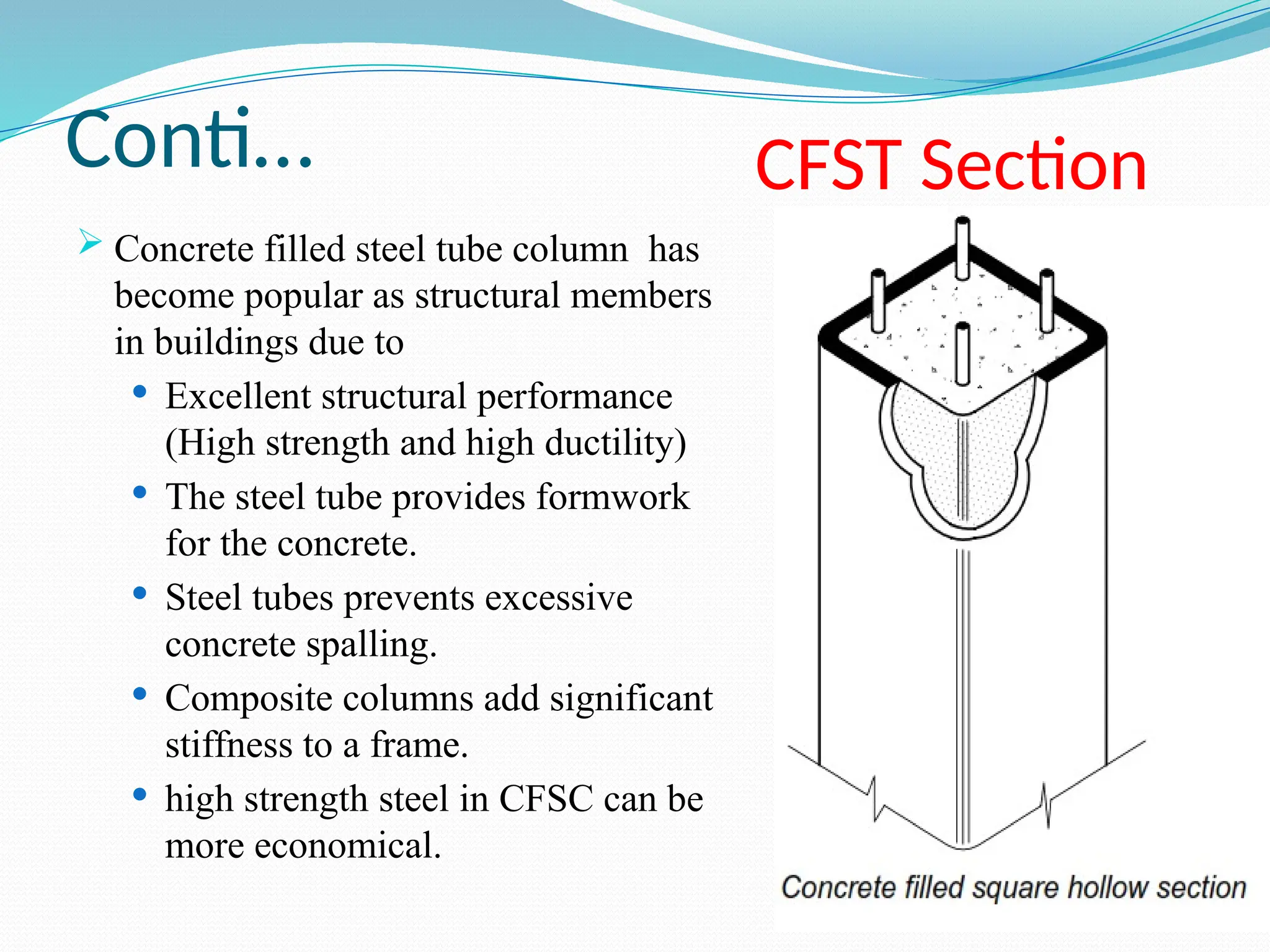
 Concrete filled steel tube column has
become popular as structural members
in buildings due to
 Excellent structural performance
(High strength and high ductility)
 The steel tube provides formwork
for the concrete.
 Steel tubes prevents excessive
concrete spalling.
 Composite columns add significant
stiffness to a frame.
 high strength steel in CFSC can be
more economical.
CFST Section
Literature Review
 Paper : 1
“ Nonlinear analysis of concrete filled steel tubular short
column under axial loading “
Author: Qing Quan Liang , Sam Fragomeni
Journal Of Constructional Steel research (2009)
 In this paper , models for normal and high strength concrete confined
by either normal or high strength circular steel tubes are proposed.
 Extensive parametric studies are conducted to examine the accuracy of
models and the effects of
 Tube diameter-to-thickness ratio,
 Concrete compressive strengths and
 Steel yields strengths on the fundamental behavior of circular
CFST columns. Experimental
Literature Review
 Concl :
 Increasing the tube diameter to thickness ratio reduces the ultimate
strength of the column and axial ductility performance.
 Increasing the concrete compressive strength increases the axial
ultimate load but reduces the section.
 The use of high strength steel tube in circular CFST column
significantly increases the section performance of CFST column.
Literature Review
 Paper 2:
“ Behavior and design calculation on very
slender thin-walled CFST columns”
Author: Yu-Feng An, Lin-Hin Han, Xiao-Ling Zhao
Journal: Thin – Walled Structures (Elsevier) (2012)
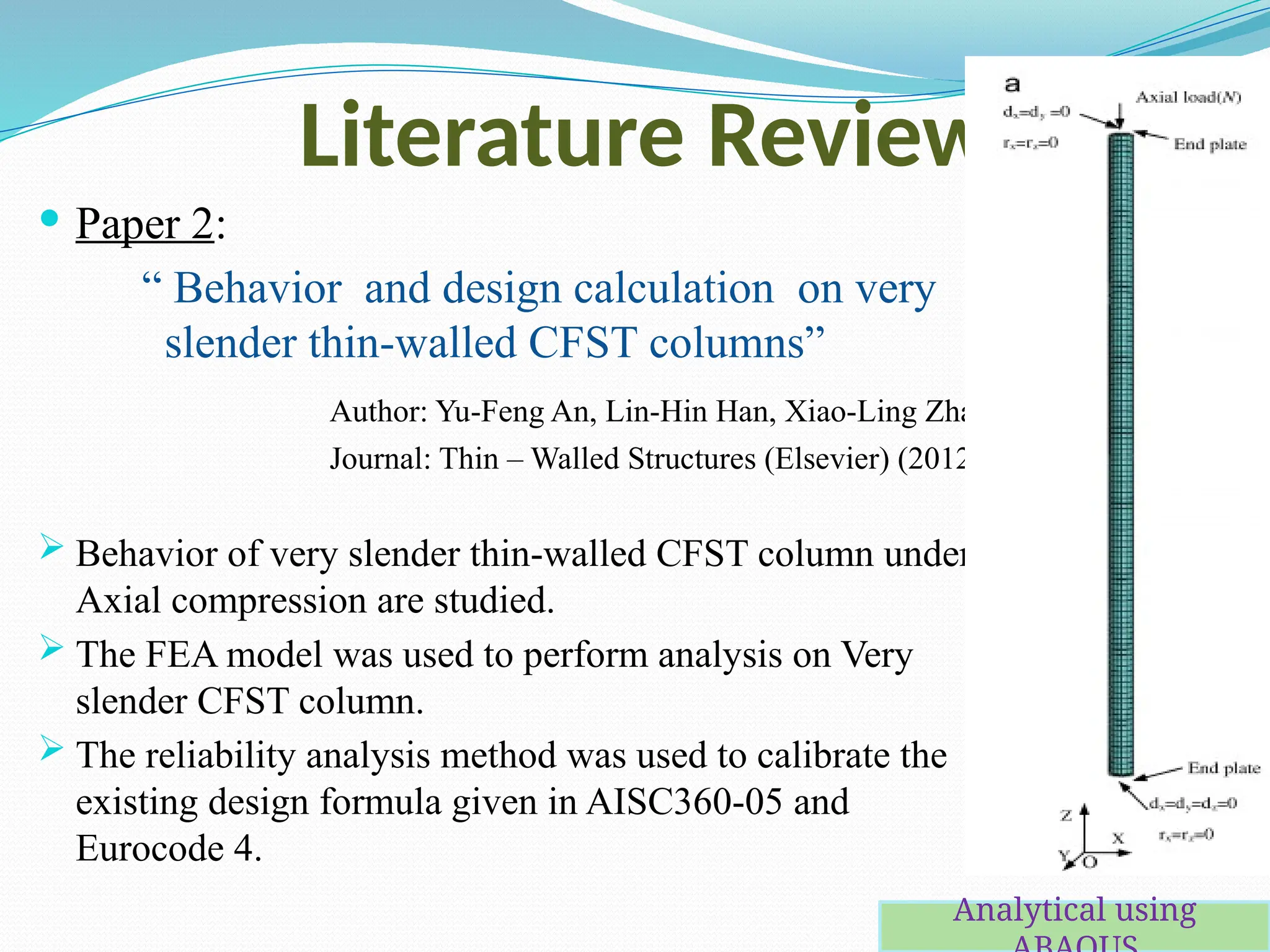
 Behavior of very slender thin-walled CFST column under
Axial compression are studied.
 The FEA model was used to perform analysis on Very
slender CFST column.
 The reliability analysis method was used to calibrate the
existing design formula given in AISC360-05 and
Eurocode 4.
Analytical using
Literature Review
 Concl:
 There is good agreement obtained between the predicted and
measured results.
 The ultimate strength decreases as slenderness increases.
 The design formula for compressive strength of very slender CFST
column provided by AISC 360-05 and Eurocode 4 satisfy the reliable
require in parameter limits.
 The average value of Ncr/Nue =1.089 which means that the nominal
Euler load is higher than test results.
Where Ncr = Nominal Euler Load
Nue = Test results.
Literature Review
 Paper 3:
“Review of design codes of concrete encased steel short column
under axial compression “
Author : K. Z. Soliman, A. I. Arafa, Tamer M. elrakib
HBRC journal (2013) ( housing and Building national research center)
 The current state of design provisions for composite columns from
 The Egyptian codes (ECP203-2007 and ECP-SC-LRFD-2012),
 American Institute of Steel Construction, (AISC-LRFD-2010, ACI-318-2008)
 British Standard (BS-5400-5) was reviewed
 The axial capacity portion of both the encased steel section and the
concrete section was also studied according to the different codes.
 Encased steel concrete columns have been investigated experimentally to
study the effect of concrete confinement and different types of encased
steel sections. The measured axial capacity of the column was compared
with the values calculated by the codes.
Experimental
Literature Review
Concl:
 The confining effect is influenced by the shape of the encased steel
section. The tube shaped steel section led to better confinement
which resulted in a noticeable increase in both ductility and the
ultimate axial capacity of columns.
 From the all codecs, the calculated column strength with the code
ECP-SC-LFRD-2012 formula led to most conservative results.
Literature Review
 Paper 4:
“Experimental and Analytical Investigation of
Concrete Filled Steel Tubular Columns”
Author : Zhijing Ou, Baochun Chen, Kai H. Hsieh,
Marvin W. Halling, and Paul J. Barr.
American society of civil engineers (2011)
 In this paper, an experimental and analytical investigation of concrete-
filled steel tubular (CFST) laced columns are presented.
 The experiments were designed to obtain the load-deflection curves and
to validate an analytical parametric study.
 Finite-element analyses of CFST columns were performed to determine
the ultimate load-carrying capacity and were compared with five building
codes. (AISC , Eurocode 4, CSES28:29, JCJ 01-89, Dl/T 5085-1999)
Experimental
Literature Review
 Concl:
 The forces in the lacing tubes at failure were relatively small.
 The load capacity decreased gradually with an increase in the
slenderness ratio and eccentricity.
 For the stability factor , JCJ 01-89 design criteria result in the
smallest mean squared error.
 For the eccentricity reduction factor, CECS 28:90 design criteria were
found to have the smallest mean squared error.
 The global strength reduction factor for lacing columns =
(The stability factor φ) * (eccentricity reduction factor φ e).
The factors, φ and φ e , are calculated with the JCJ 01-89 and CECS 28:90 design criteria.
Need of Present Study
Literature review concludes that…
 Major work is done on CFST is experimental. Still there is a need
for numerical study is needed to check the parameters which affect
the ultimate strength.
 Less research is done on interface friction characteristics of steel
tube and concrete .
 Role of reinforcement bars in CFST column can be studied with
greater detail.
 Effect of Confinement co-efficient and its value is another imp
focus of this area.
 As the Indian code has not thrown light, for calculating the strength
of CFST column, further research is needed.
Objective
 Parametric study of concrete filled steel tube column using finite
element analysis .
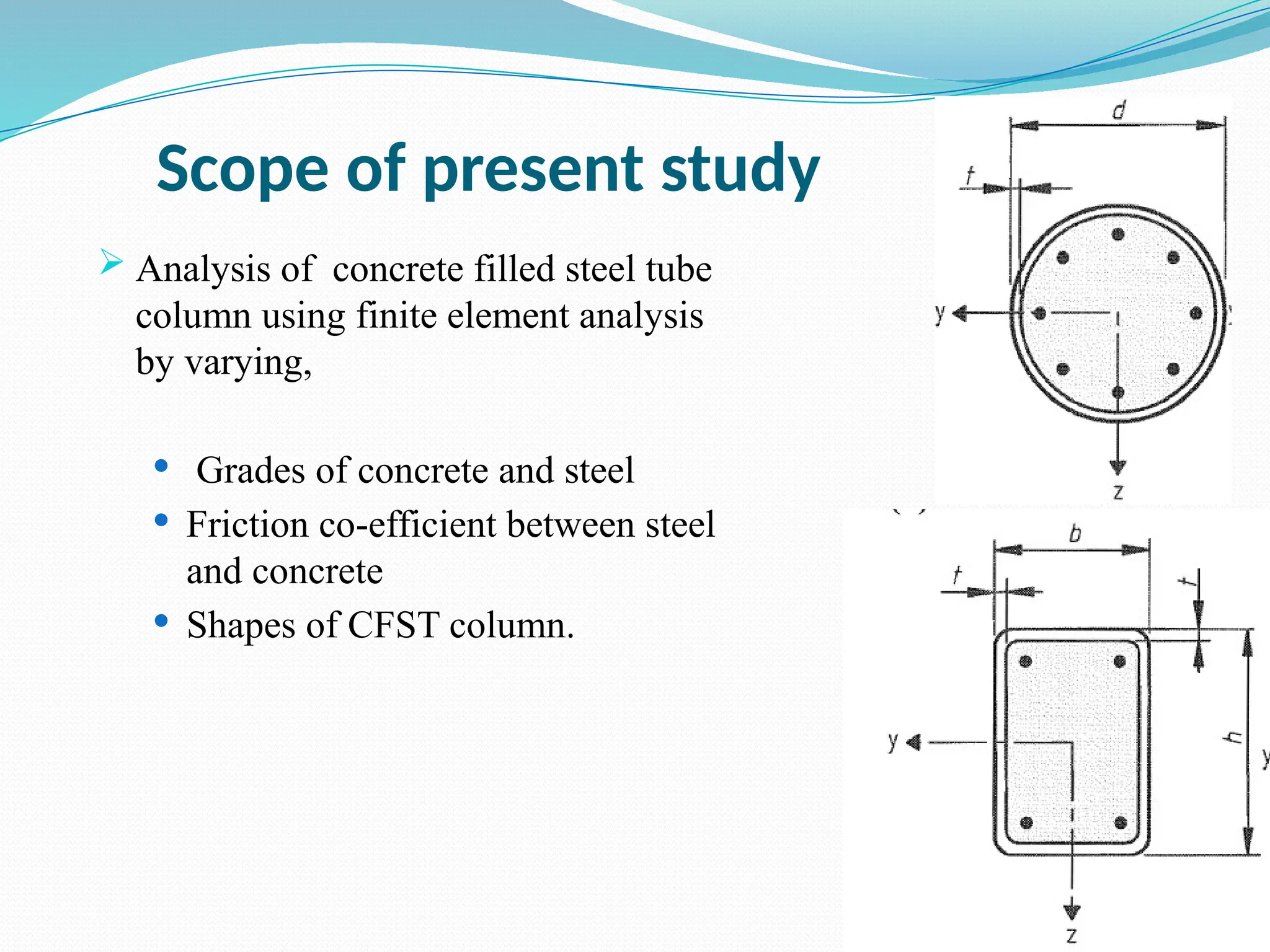
Scope of present study
 Analysis of concrete filled steel tube
column using finite element analysis
by varying,
 Grades of concrete and steel
 Friction co-efficient between steel
and concrete
 Shapes of CFST column.
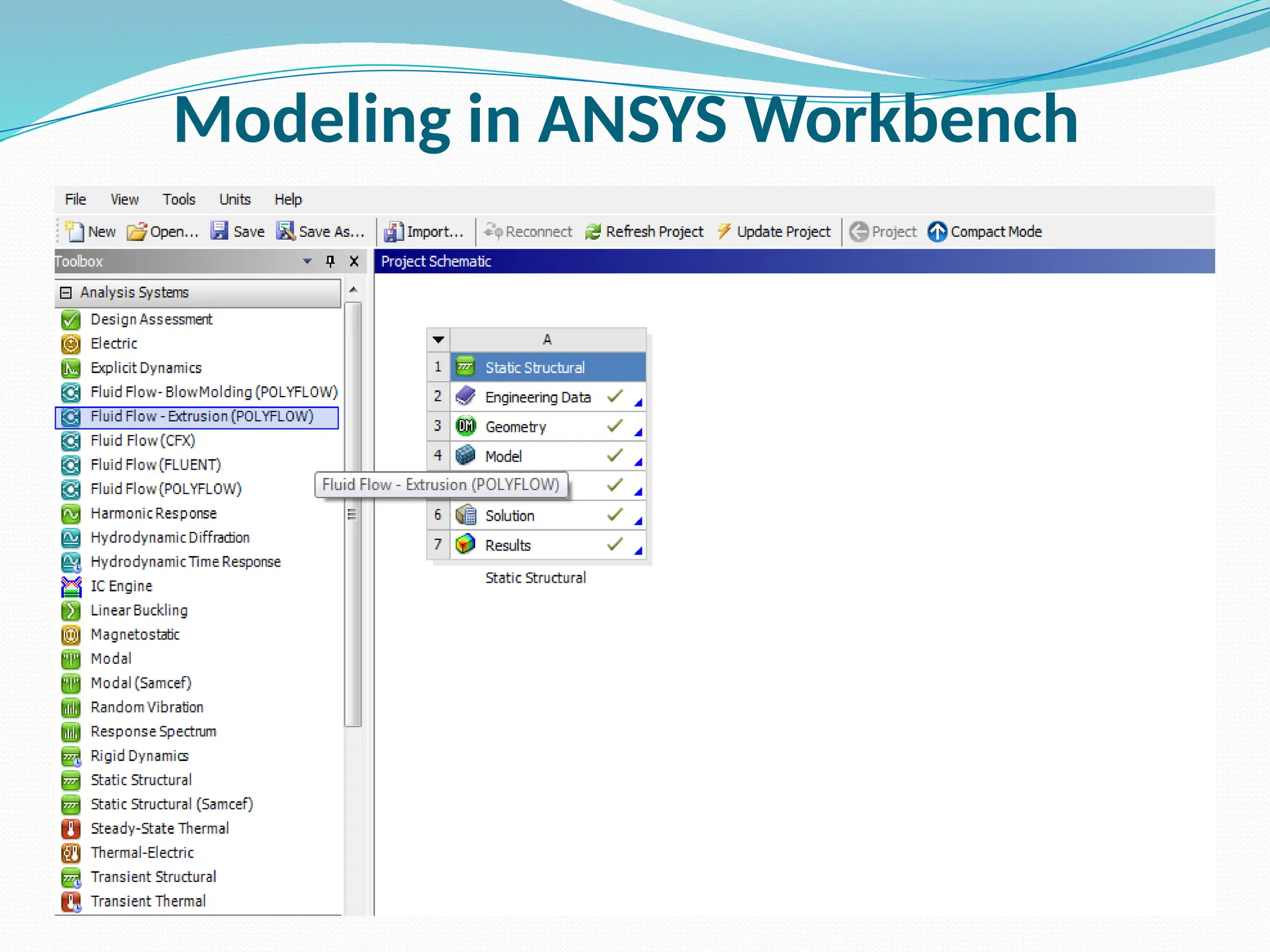
Modeling in ANSYS Workbench
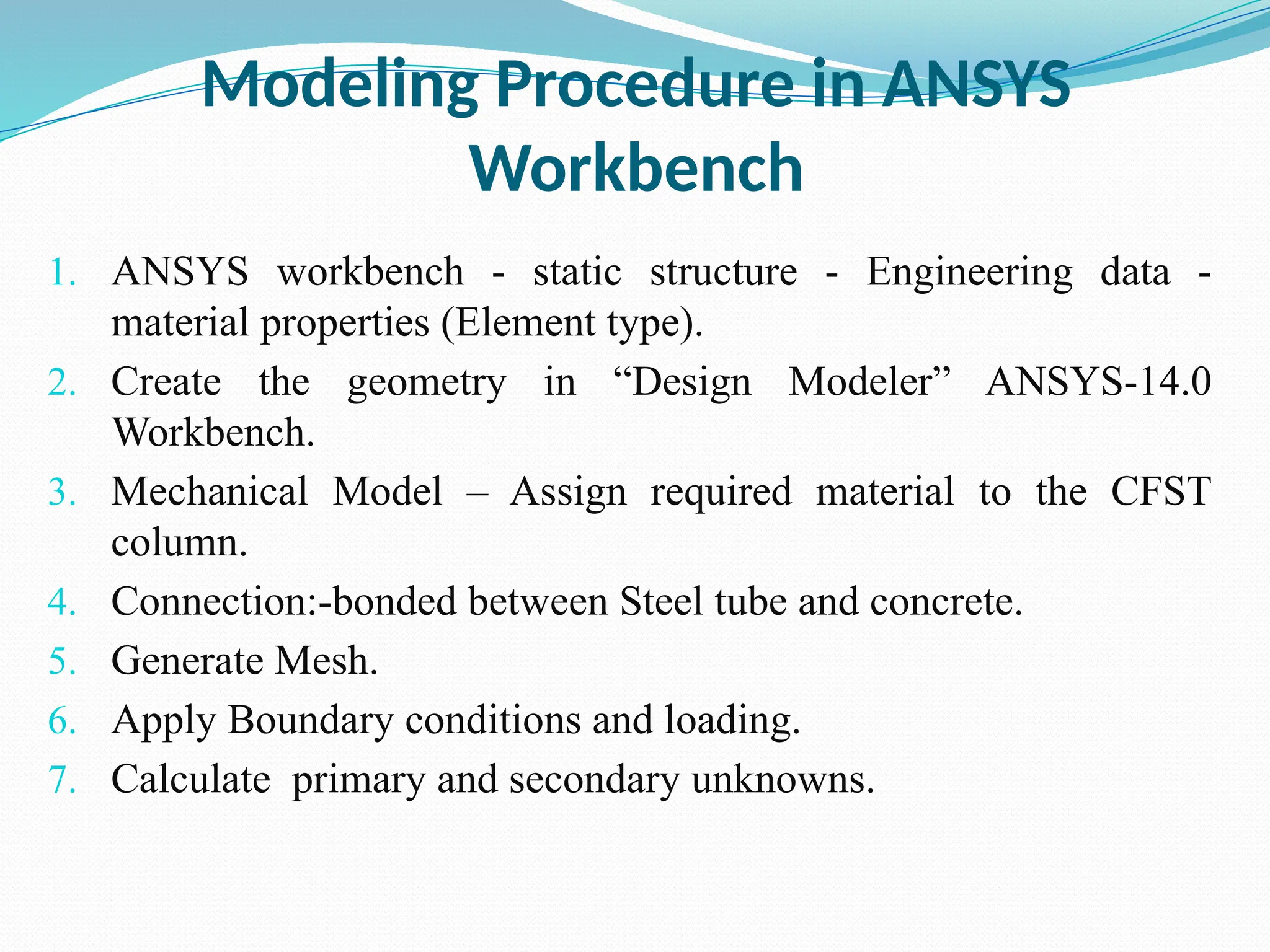
Modeling Procedure in ANSYS
Workbench
1. ANSYS workbench - static structure - Engineering data -
material properties (Element type).
2. Create the geometry in “Design Modeler” ANSYS-14.0
Workbench.
3. Mechanical Model – Assign required material to the CFST
column.
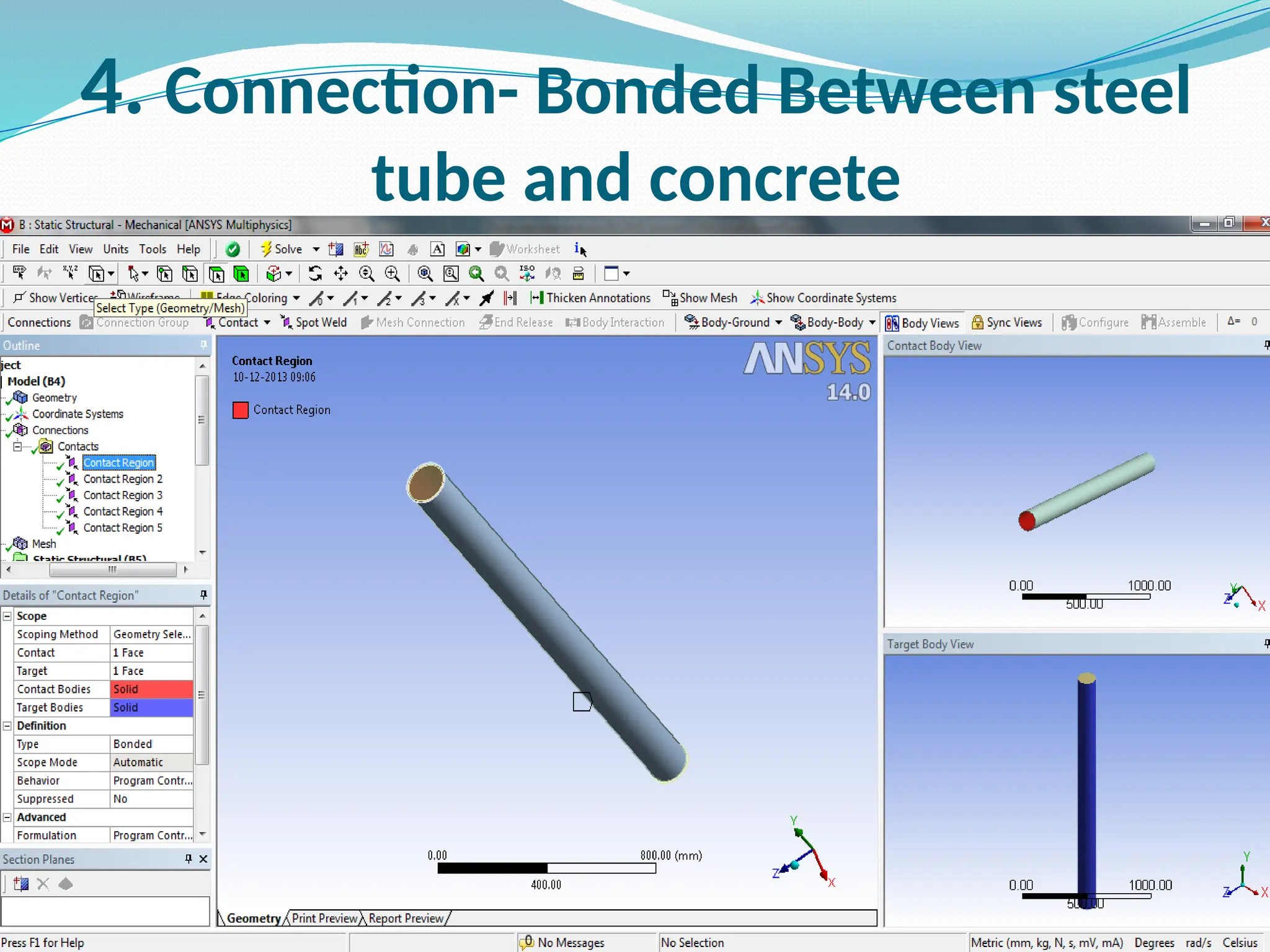
4. Connection:-bonded between Steel tube and concrete.
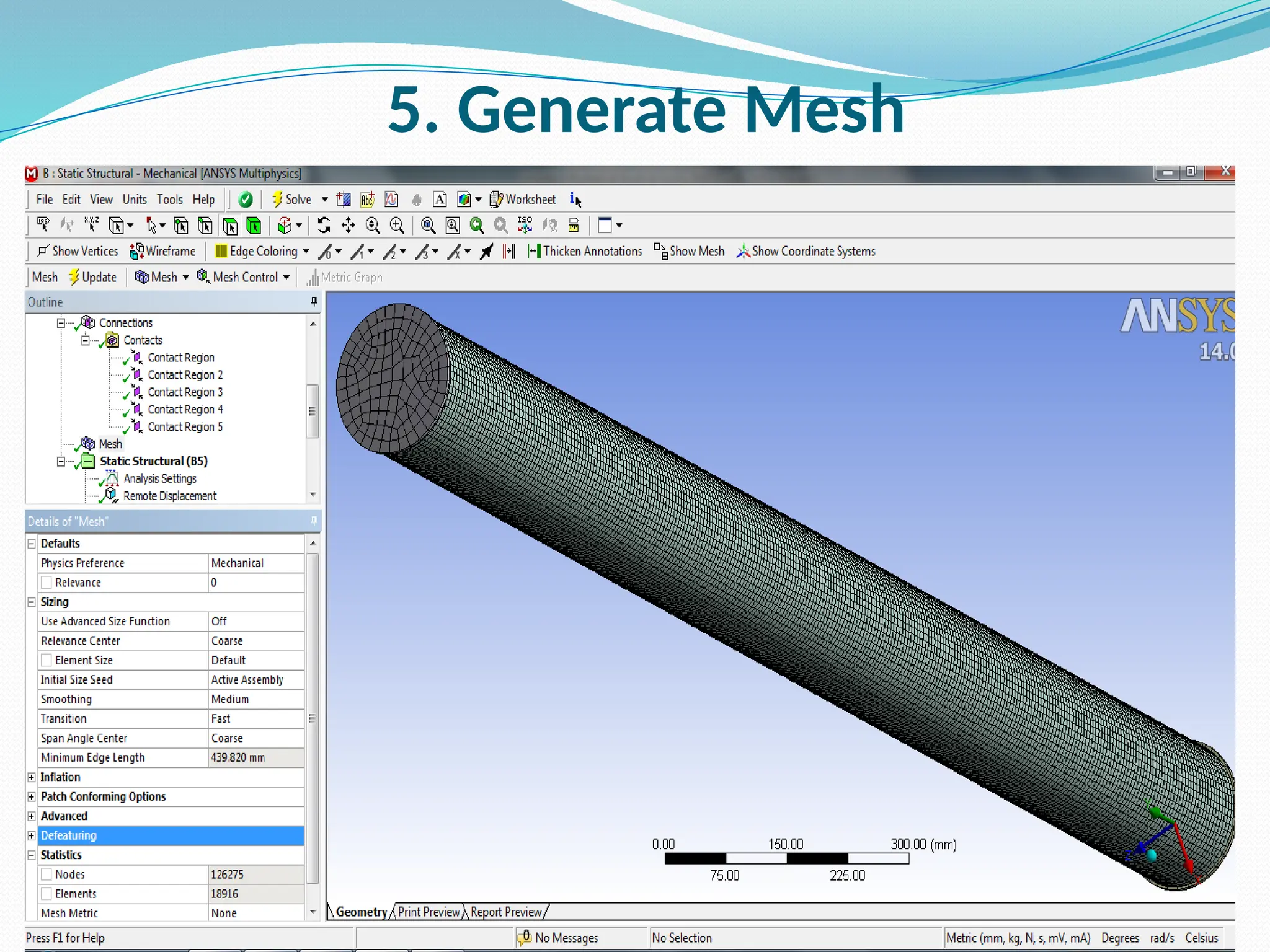
5. Generate Mesh.
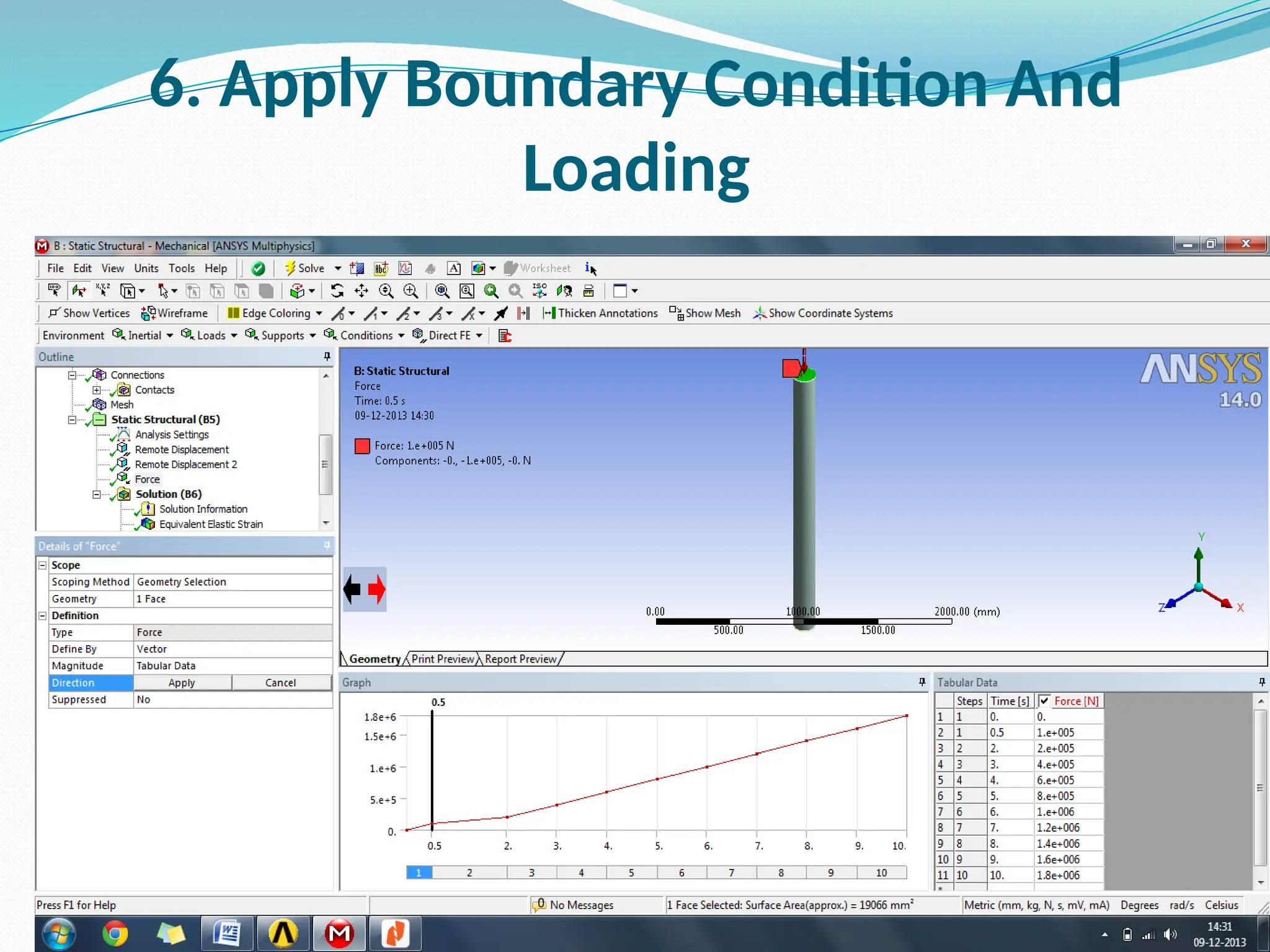
6. Apply Boundary conditions and loading.
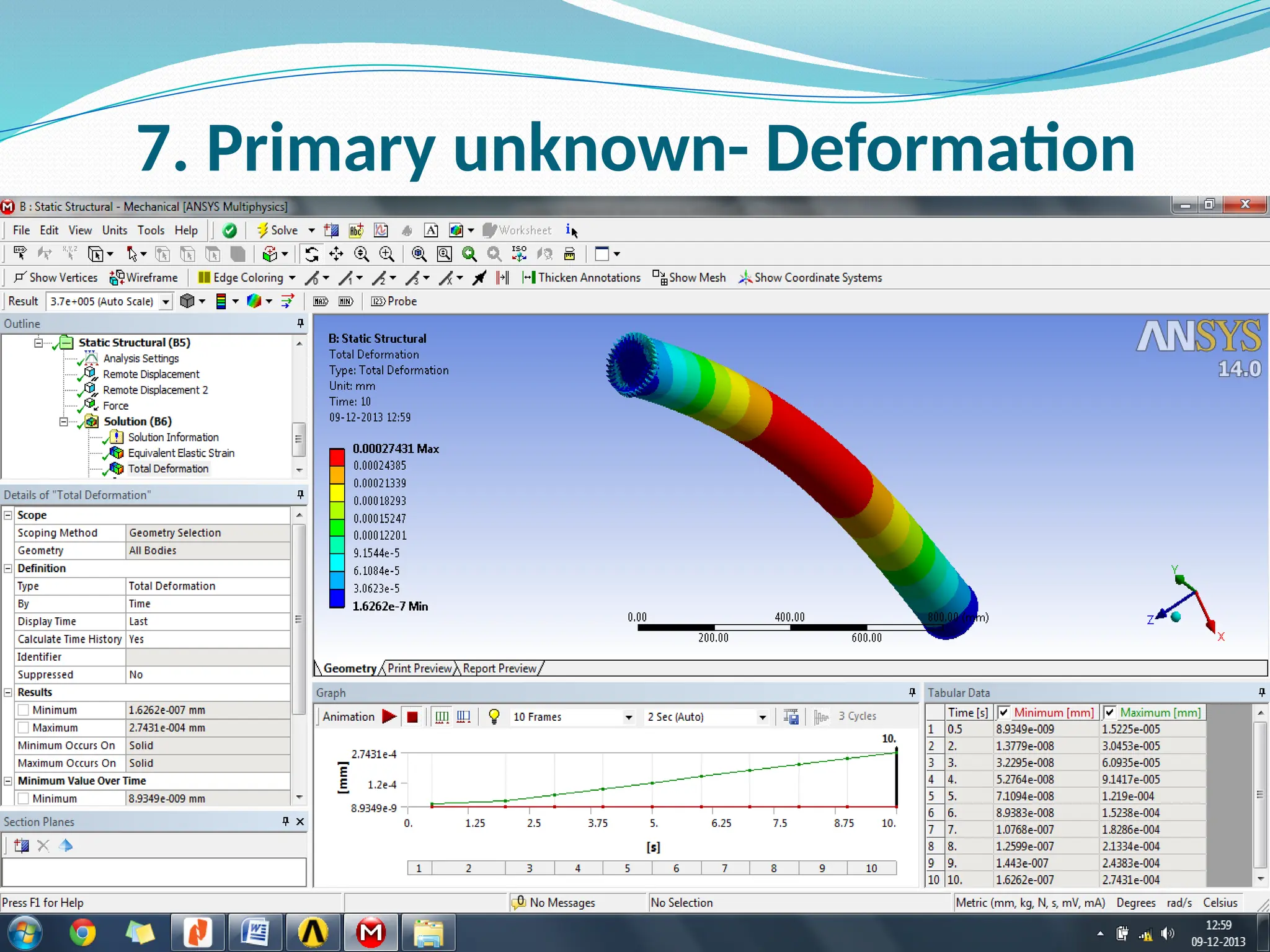
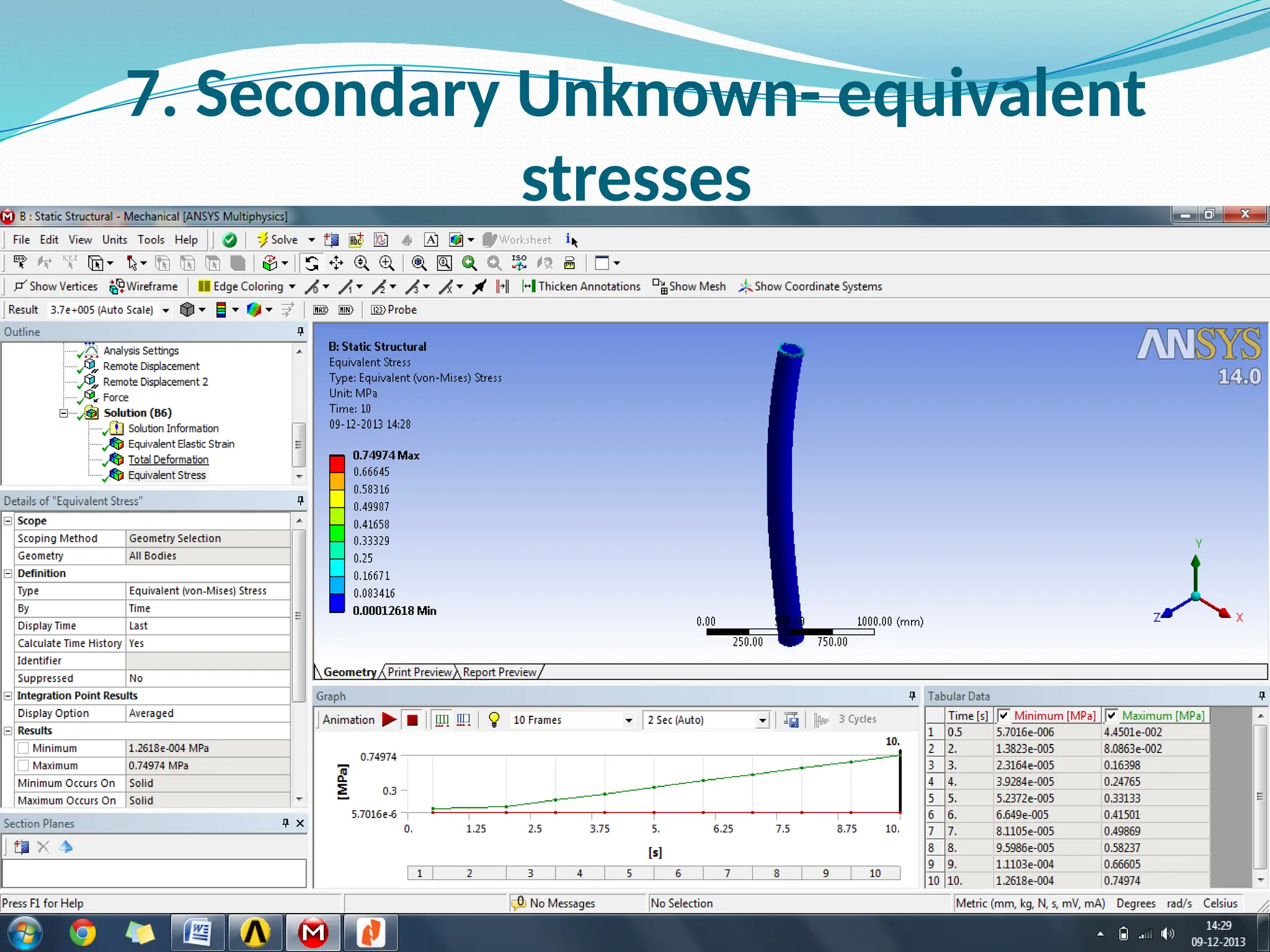
7. Calculate primary and secondary unknowns.
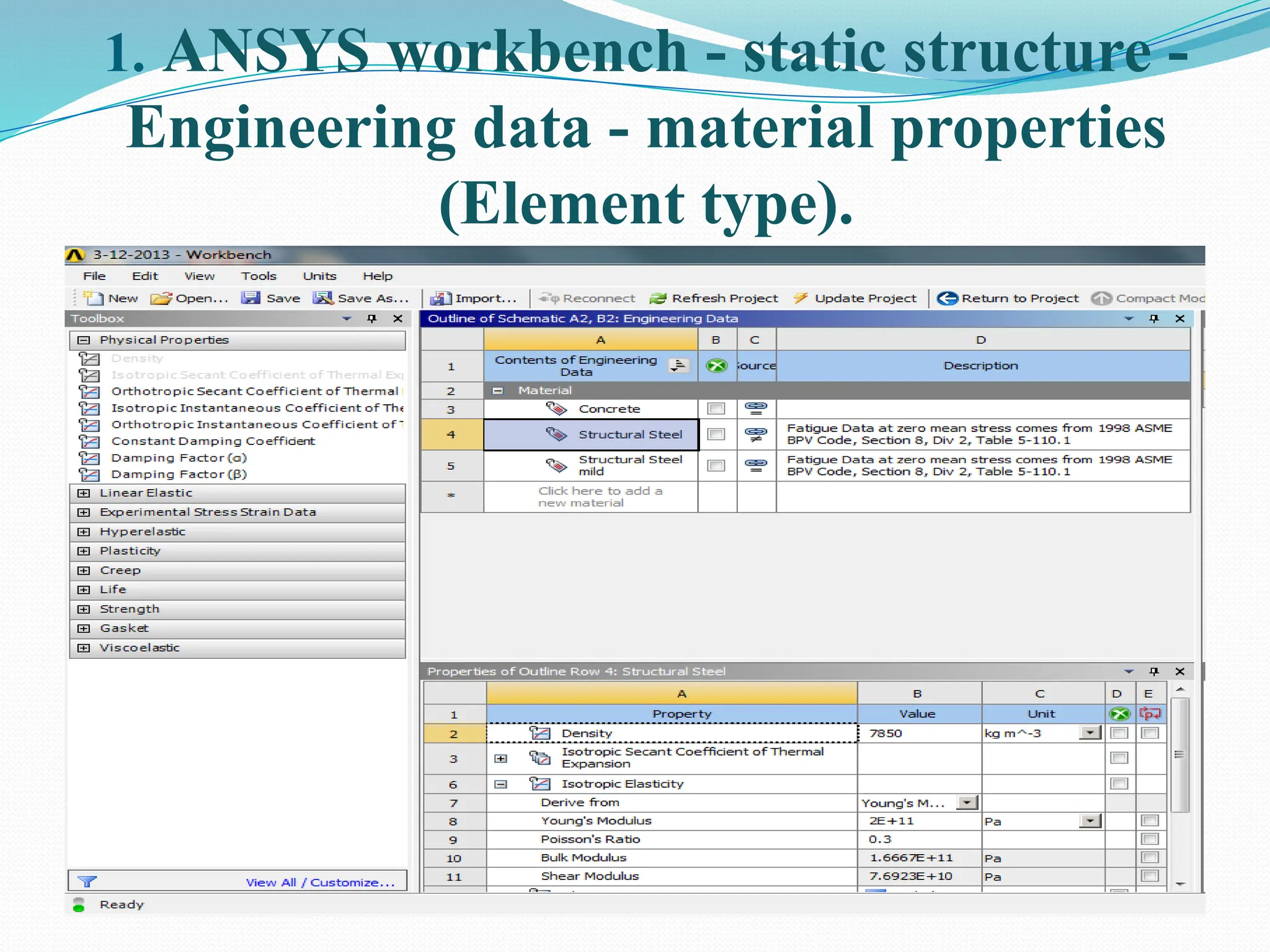
1. ANSYS workbench - static structure -
Engineering data - material properties
(Element type).
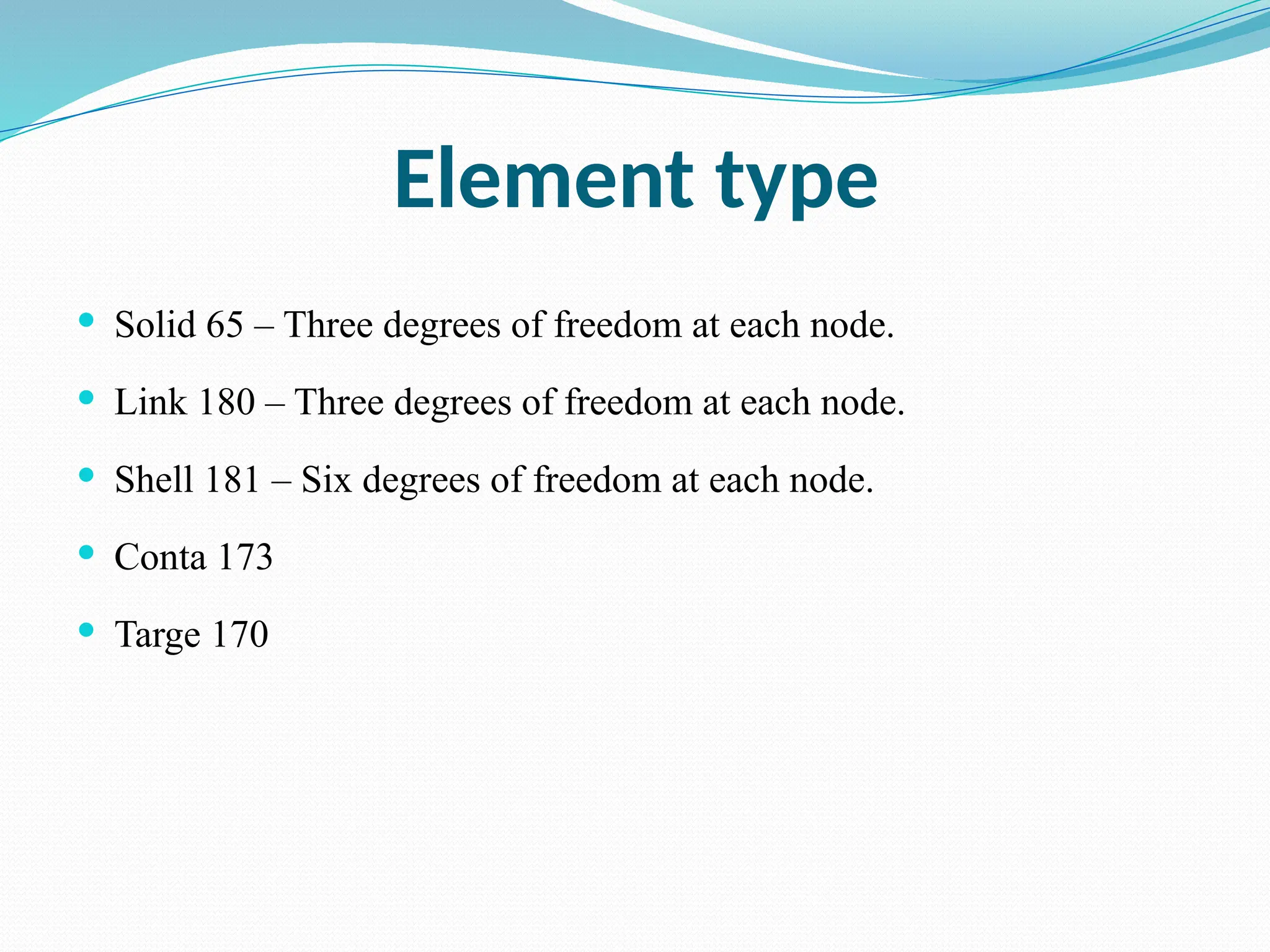
Element type
 Solid 65 – Three degrees of freedom at each node.
 Link 180 – Three degrees of freedom at each node.
 Shell 181 – Six degrees of freedom at each node.
 Conta 173
 Targe 170
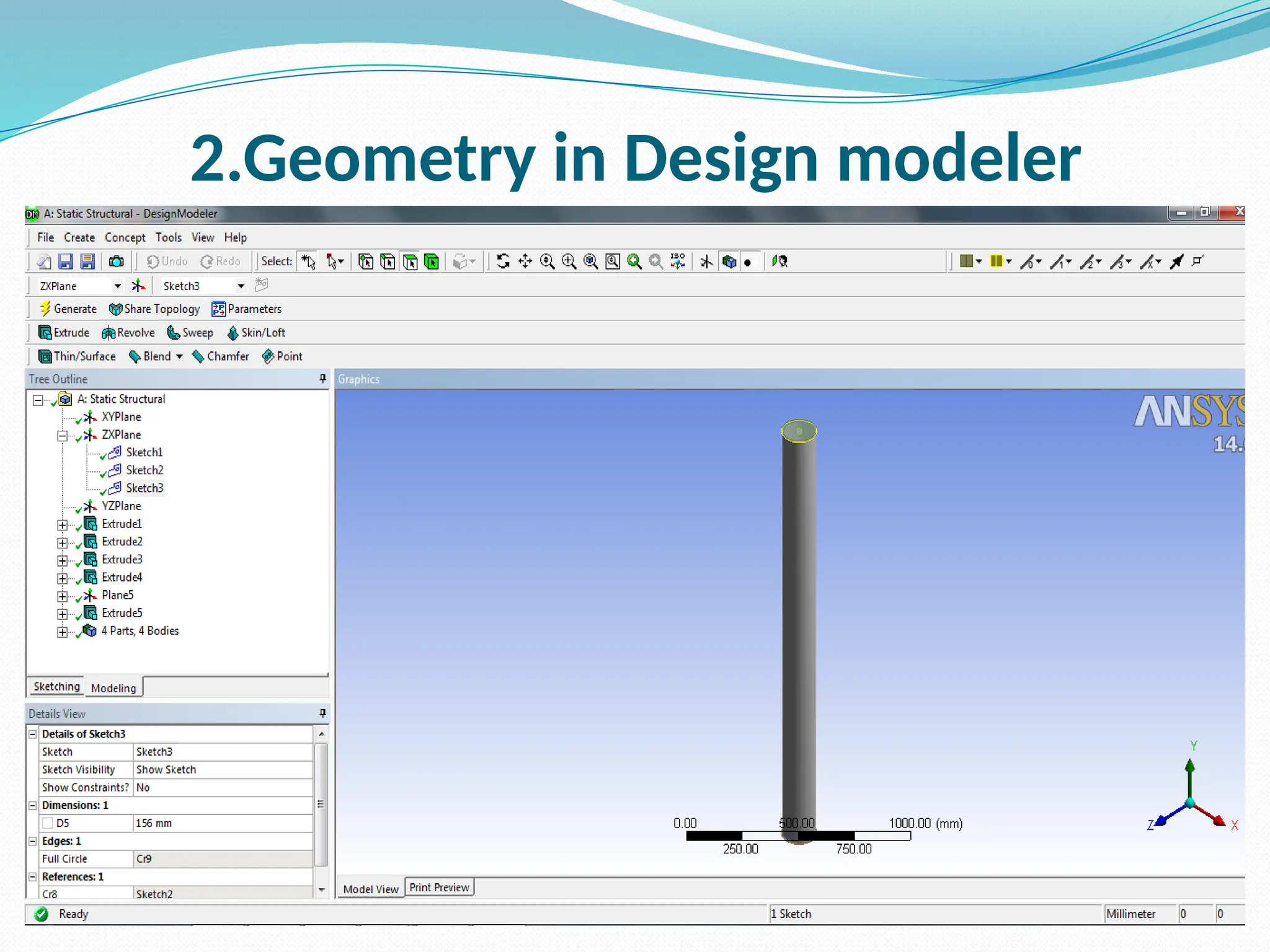
2. Create the geometry in Design
modeler
 Create the geometry by following steps.
 Select the plane in which we want to work
 Click on the new sketch and draw a circle having radius 150 mm.
 Extrude the circle and give length and material take add material to
assign material steel.
 Draw another circle and give a radius 140 mm.
 Extrude the circle and give cut material as operation to make a steel
tube from steel column.
 Again extrude sketch 2 and give material add frozen which
differentiate steel and concrete.
2.Geometry in Design modeler
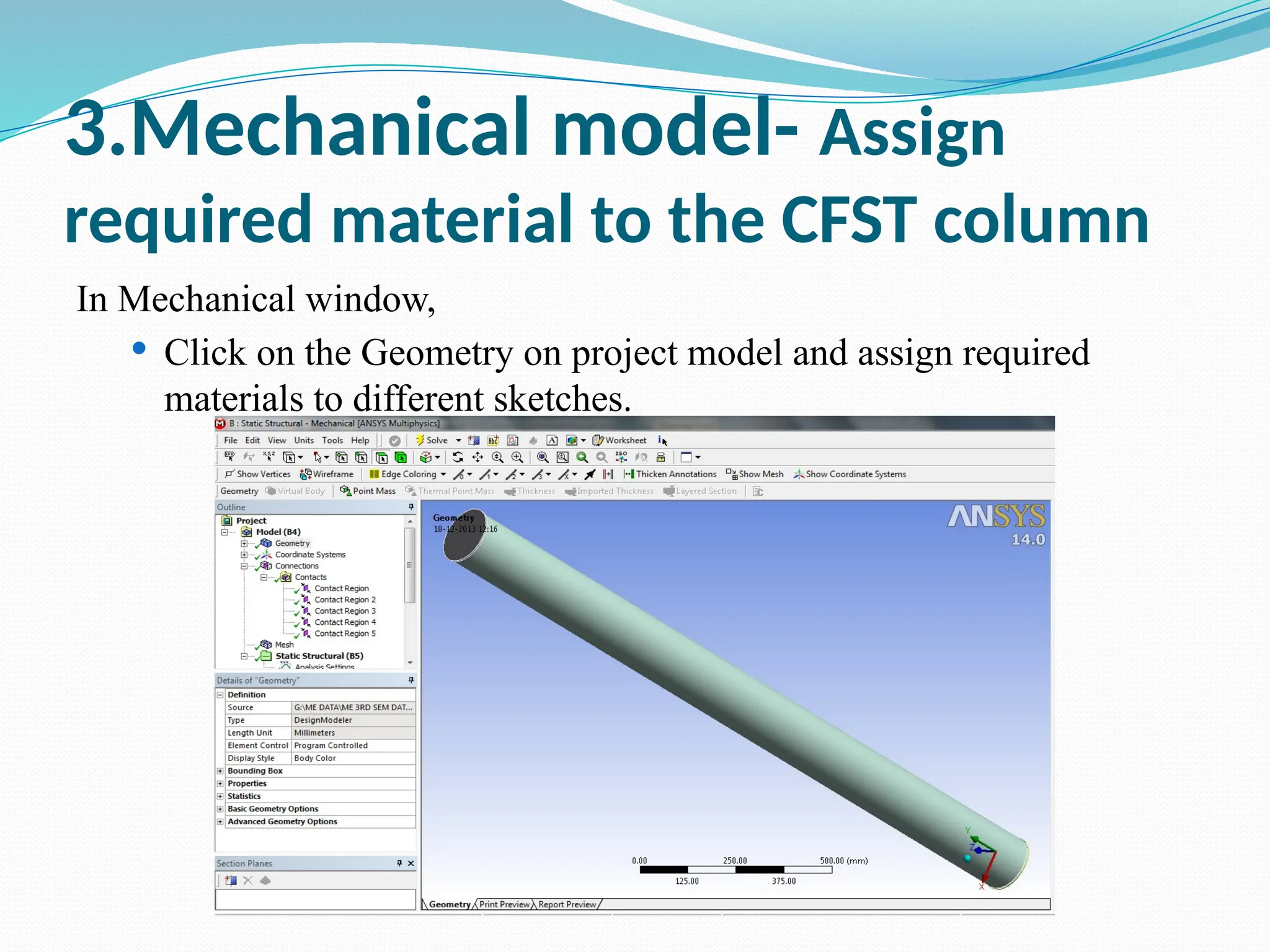
3.Mechanical model- Assign
required material to the CFST column
In Mechanical window,
 Click on the Geometry on project model and assign required
materials to different sketches.
4. Connection- Bonded Between steel
tube and concrete
5. Generate Mesh
6. Apply Boundary Condition And
Loading
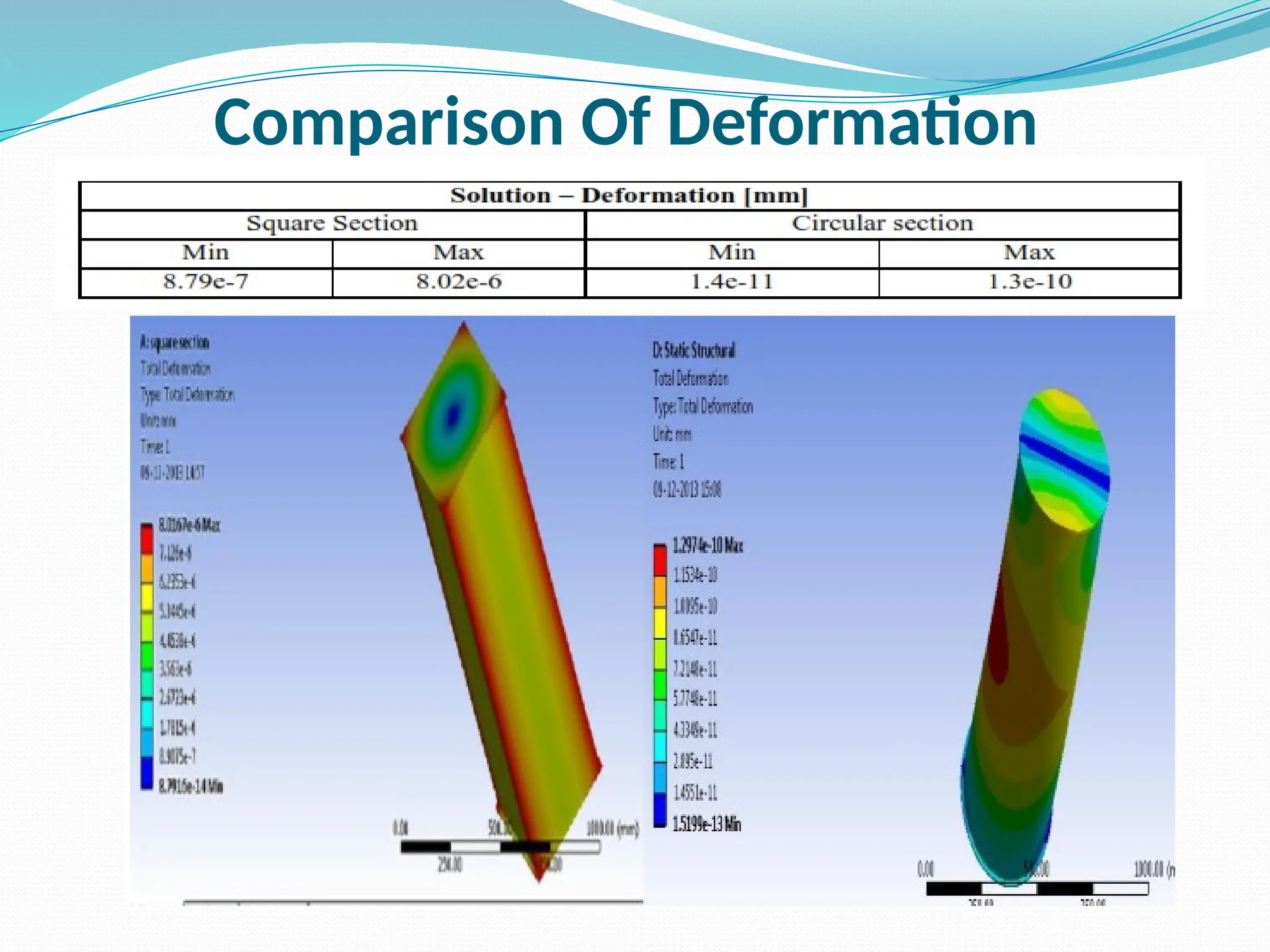
7. Primary unknown- Deformation
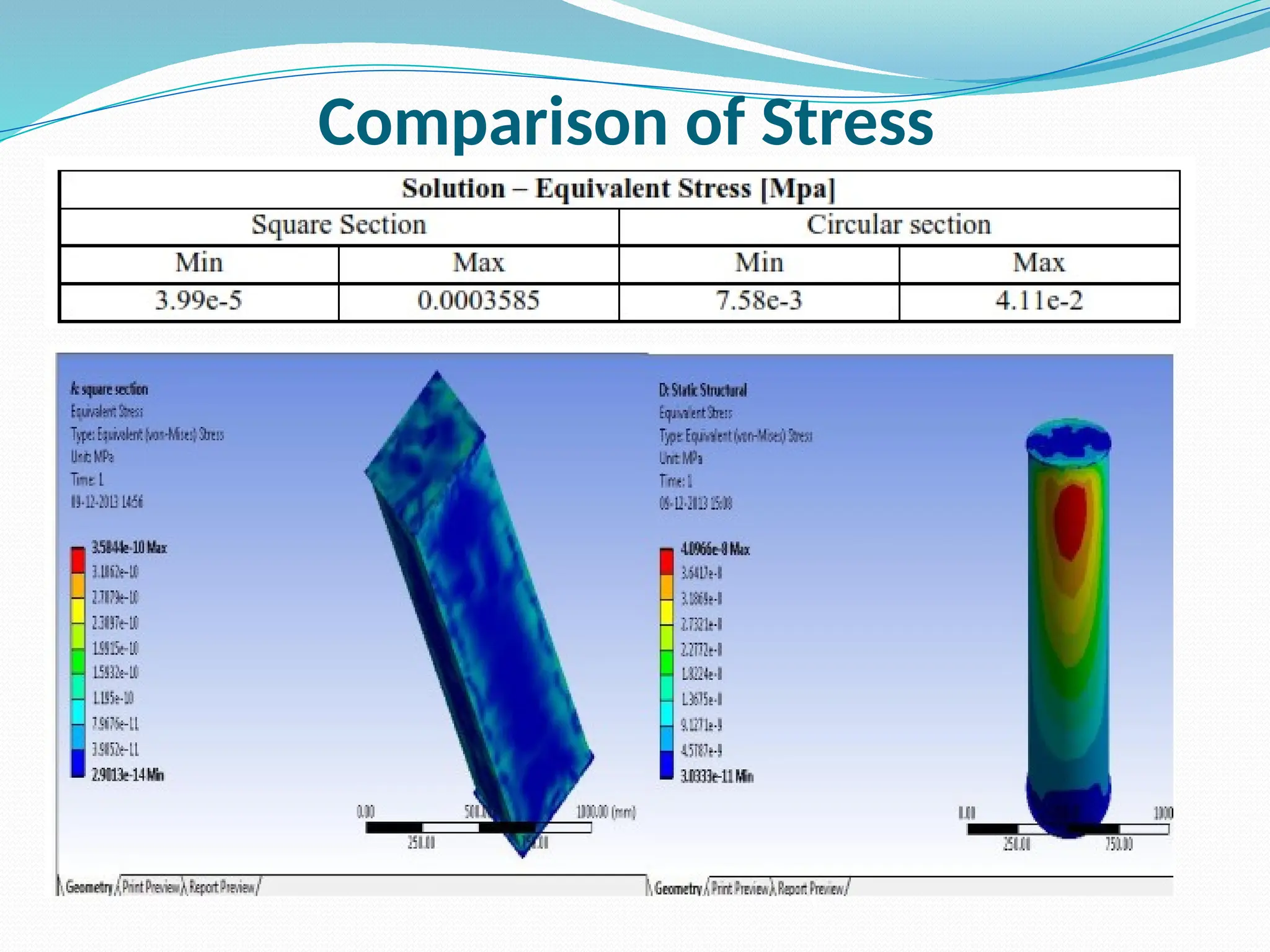
7. Secondary Unknown- equivalent
stresses
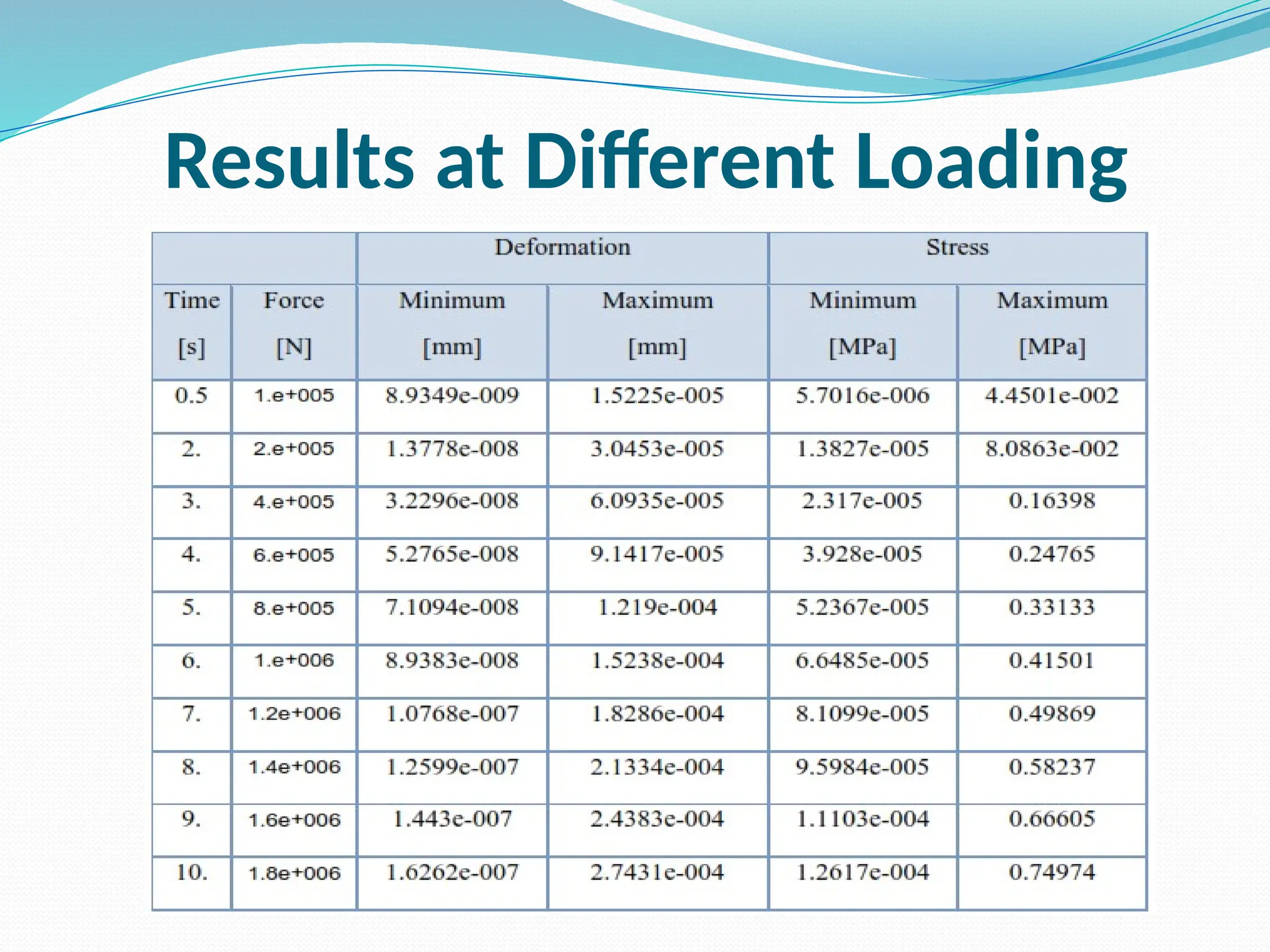
Results at Different Loading
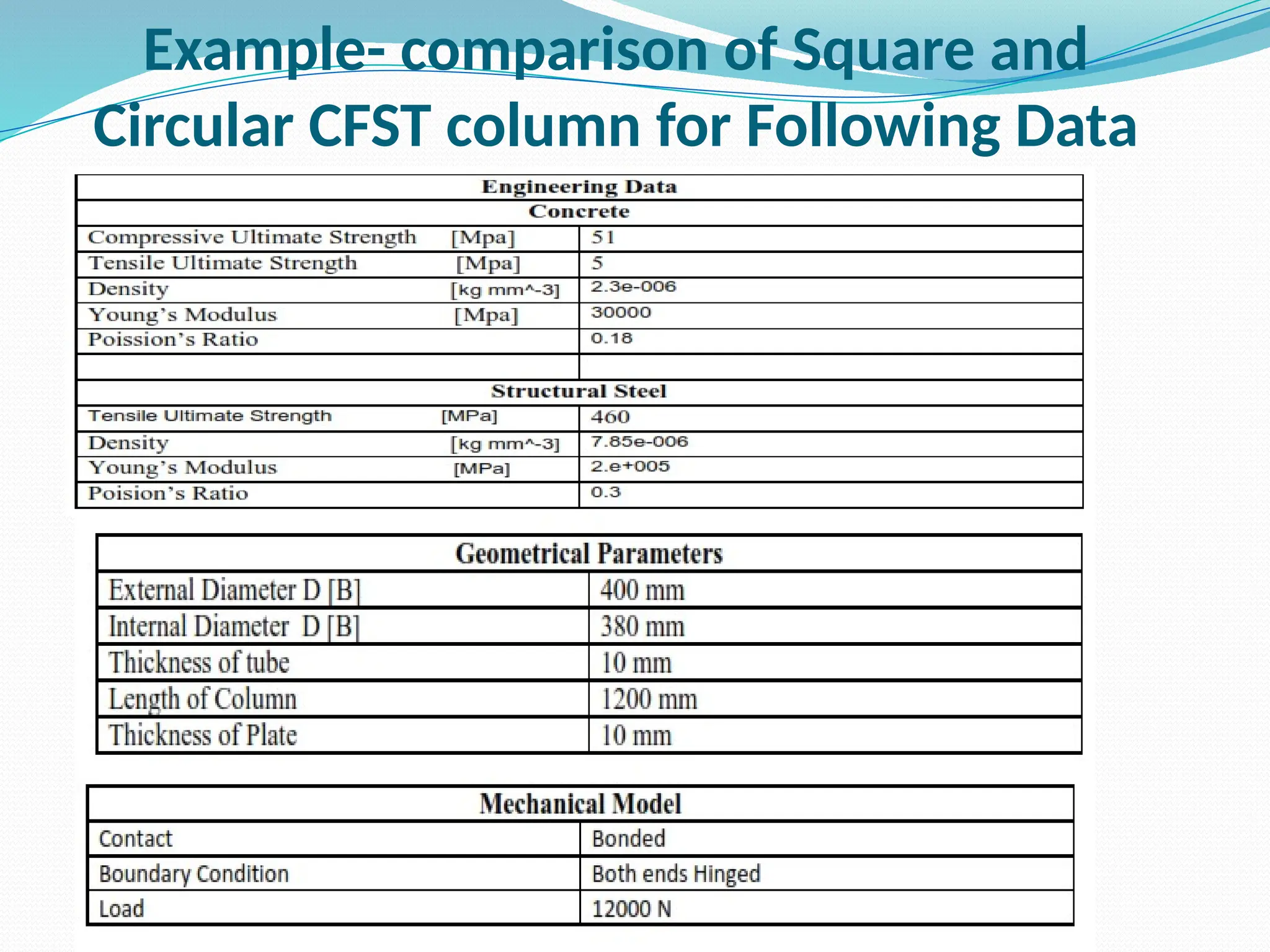
Example- comparison of Square and
Circular CFST column for Following Data
Comparison Of Deformation
Comparison of Stress
WORK PLAN
References
 J.M. Portolés, M. R. (2011). Experimental study of high strength
concrete-filled circular tubular columns under eccentric loading.
Journal of Constructional Steel Research , ELSEVIER, 623-633.
 K.Z. Soliman, A. A. (n.d.). Review of design codes of concrete
encased steel short columns under axial compression. HBRC
Journal.
 Kenji Sakino, H. N. (2004). Behavior of Centrally Loaded Concrete-
Filled Steel-Tube short column. Journal of Structural Engineering ,
180-188.
 Lin-Hai Han, W. L.-F. (2008). Behaviour of concrete-filled steel
tubular stub columns subjected to axially local compression. Journal
of Constructional Steel Research , 377–387.
 M.F. Hassanein, O. K. (2013). Compressive strength of circular
concrete-filled double skin tubular short column. Thin-Walled
Structures .
References
 Qing Quan Liang, S. F. (2009). Nonlinear analysis of circular
concrete-filled steel tubular short columns under axial loading.
Journal of Constructional Steel Research , 2186-2196.
 Yu-Feng An, L.-H. H.-L. (2012). Behaviour and design calculations
on very slender thin-walled CFST columns. Thin-Walled Structures ,
161-175.
 Zhijing Ou, B. C. (2011). Experimental and Analytical Investigation
of Concrete Filled Steel Tubular Columns. journal of Structural
Engineering , 137, 634-645.

Thank you

Finite element analysis Of CFST column.pptx

  • 1.
    Finite Element Analysis OfConcrete Filled Steel Tube Column Prepared by: Darshika Shah ME ( III) CASAD Enrollment No : 120280715012 Guided By : Dr. M. N. Patel Prof. M. D. Vakil
  • 2.
    Content  Introduction  LiteratureReview  Summary of literature  Objective  Scope of Present Study  Modeling Procedure in ANSYS Workbench  Example  Work Plan  References
  • 3.
    Introduction  Steel concretecomposite construction combines the compressive strength of concrete with the tensile strength of steel to evolve an effective and economic structural system.  Composite construction is amenable to “fast-track” construction because of using rolled steel and pre-fabricated components.
  • 4.
    Conti…  Concrete filledsteel tube column has become popular as structural members in buildings due to  Excellent structural performance (High strength and high ductility)  The steel tube provides formwork for the concrete.  Steel tubes prevents excessive concrete spalling.  Composite columns add significant stiffness to a frame.  high strength steel in CFSC can be more economical. CFST Section
  • 5.
    Literature Review  Paper: 1 “ Nonlinear analysis of concrete filled steel tubular short column under axial loading “ Author: Qing Quan Liang , Sam Fragomeni Journal Of Constructional Steel research (2009)  In this paper , models for normal and high strength concrete confined by either normal or high strength circular steel tubes are proposed.  Extensive parametric studies are conducted to examine the accuracy of models and the effects of  Tube diameter-to-thickness ratio,  Concrete compressive strengths and  Steel yields strengths on the fundamental behavior of circular CFST columns. Experimental
  • 6.
    Literature Review  Concl:  Increasing the tube diameter to thickness ratio reduces the ultimate strength of the column and axial ductility performance.  Increasing the concrete compressive strength increases the axial ultimate load but reduces the section.  The use of high strength steel tube in circular CFST column significantly increases the section performance of CFST column.
  • 7.
    Literature Review  Paper2: “ Behavior and design calculation on very slender thin-walled CFST columns” Author: Yu-Feng An, Lin-Hin Han, Xiao-Ling Zhao Journal: Thin – Walled Structures (Elsevier) (2012)  Behavior of very slender thin-walled CFST column under Axial compression are studied.  The FEA model was used to perform analysis on Very slender CFST column.  The reliability analysis method was used to calibrate the existing design formula given in AISC360-05 and Eurocode 4. Analytical using
  • 8.
    Literature Review  Concl: There is good agreement obtained between the predicted and measured results.  The ultimate strength decreases as slenderness increases.  The design formula for compressive strength of very slender CFST column provided by AISC 360-05 and Eurocode 4 satisfy the reliable require in parameter limits.  The average value of Ncr/Nue =1.089 which means that the nominal Euler load is higher than test results. Where Ncr = Nominal Euler Load Nue = Test results.
  • 9.
    Literature Review  Paper3: “Review of design codes of concrete encased steel short column under axial compression “ Author : K. Z. Soliman, A. I. Arafa, Tamer M. elrakib HBRC journal (2013) ( housing and Building national research center)  The current state of design provisions for composite columns from  The Egyptian codes (ECP203-2007 and ECP-SC-LRFD-2012),  American Institute of Steel Construction, (AISC-LRFD-2010, ACI-318-2008)  British Standard (BS-5400-5) was reviewed  The axial capacity portion of both the encased steel section and the concrete section was also studied according to the different codes.  Encased steel concrete columns have been investigated experimentally to study the effect of concrete confinement and different types of encased steel sections. The measured axial capacity of the column was compared with the values calculated by the codes. Experimental
  • 10.
    Literature Review Concl:  Theconfining effect is influenced by the shape of the encased steel section. The tube shaped steel section led to better confinement which resulted in a noticeable increase in both ductility and the ultimate axial capacity of columns.  From the all codecs, the calculated column strength with the code ECP-SC-LFRD-2012 formula led to most conservative results.
  • 11.
    Literature Review  Paper4: “Experimental and Analytical Investigation of Concrete Filled Steel Tubular Columns” Author : Zhijing Ou, Baochun Chen, Kai H. Hsieh, Marvin W. Halling, and Paul J. Barr. American society of civil engineers (2011)  In this paper, an experimental and analytical investigation of concrete- filled steel tubular (CFST) laced columns are presented.  The experiments were designed to obtain the load-deflection curves and to validate an analytical parametric study.  Finite-element analyses of CFST columns were performed to determine the ultimate load-carrying capacity and were compared with five building codes. (AISC , Eurocode 4, CSES28:29, JCJ 01-89, Dl/T 5085-1999) Experimental
  • 12.
    Literature Review  Concl: The forces in the lacing tubes at failure were relatively small.  The load capacity decreased gradually with an increase in the slenderness ratio and eccentricity.  For the stability factor , JCJ 01-89 design criteria result in the smallest mean squared error.  For the eccentricity reduction factor, CECS 28:90 design criteria were found to have the smallest mean squared error.  The global strength reduction factor for lacing columns = (The stability factor φ) * (eccentricity reduction factor φ e). The factors, φ and φ e , are calculated with the JCJ 01-89 and CECS 28:90 design criteria.
  • 13.
    Need of PresentStudy Literature review concludes that…  Major work is done on CFST is experimental. Still there is a need for numerical study is needed to check the parameters which affect the ultimate strength.  Less research is done on interface friction characteristics of steel tube and concrete .  Role of reinforcement bars in CFST column can be studied with greater detail.  Effect of Confinement co-efficient and its value is another imp focus of this area.  As the Indian code has not thrown light, for calculating the strength of CFST column, further research is needed.
  • 14.
    Objective  Parametric studyof concrete filled steel tube column using finite element analysis .
  • 15.
    Scope of presentstudy  Analysis of concrete filled steel tube column using finite element analysis by varying,  Grades of concrete and steel  Friction co-efficient between steel and concrete  Shapes of CFST column.
  • 16.
  • 17.
    Modeling Procedure inANSYS Workbench 1. ANSYS workbench - static structure - Engineering data - material properties (Element type). 2. Create the geometry in “Design Modeler” ANSYS-14.0 Workbench. 3. Mechanical Model – Assign required material to the CFST column. 4. Connection:-bonded between Steel tube and concrete. 5. Generate Mesh. 6. Apply Boundary conditions and loading. 7. Calculate primary and secondary unknowns.
  • 18.
    1. ANSYS workbench- static structure - Engineering data - material properties (Element type).
  • 19.
    Element type  Solid65 – Three degrees of freedom at each node.  Link 180 – Three degrees of freedom at each node.  Shell 181 – Six degrees of freedom at each node.  Conta 173  Targe 170
  • 20.
    2. Create thegeometry in Design modeler  Create the geometry by following steps.  Select the plane in which we want to work  Click on the new sketch and draw a circle having radius 150 mm.  Extrude the circle and give length and material take add material to assign material steel.  Draw another circle and give a radius 140 mm.  Extrude the circle and give cut material as operation to make a steel tube from steel column.  Again extrude sketch 2 and give material add frozen which differentiate steel and concrete.
  • 21.
  • 22.
    3.Mechanical model- Assign requiredmaterial to the CFST column In Mechanical window,  Click on the Geometry on project model and assign required materials to different sketches.
  • 23.
    4. Connection- BondedBetween steel tube and concrete
  • 24.
  • 25.
    6. Apply BoundaryCondition And Loading
  • 26.
  • 27.
    7. Secondary Unknown-equivalent stresses
  • 28.
  • 29.
    Example- comparison ofSquare and Circular CFST column for Following Data
  • 30.
  • 31.
  • 32.
  • 33.
    References  J.M. Portolés,M. R. (2011). Experimental study of high strength concrete-filled circular tubular columns under eccentric loading. Journal of Constructional Steel Research , ELSEVIER, 623-633.  K.Z. Soliman, A. A. (n.d.). Review of design codes of concrete encased steel short columns under axial compression. HBRC Journal.  Kenji Sakino, H. N. (2004). Behavior of Centrally Loaded Concrete- Filled Steel-Tube short column. Journal of Structural Engineering , 180-188.  Lin-Hai Han, W. L.-F. (2008). Behaviour of concrete-filled steel tubular stub columns subjected to axially local compression. Journal of Constructional Steel Research , 377–387.  M.F. Hassanein, O. K. (2013). Compressive strength of circular concrete-filled double skin tubular short column. Thin-Walled Structures .
  • 34.
    References  Qing QuanLiang, S. F. (2009). Nonlinear analysis of circular concrete-filled steel tubular short columns under axial loading. Journal of Constructional Steel Research , 2186-2196.  Yu-Feng An, L.-H. H.-L. (2012). Behaviour and design calculations on very slender thin-walled CFST columns. Thin-Walled Structures , 161-175.  Zhijing Ou, B. C. (2011). Experimental and Analytical Investigation of Concrete Filled Steel Tubular Columns. journal of Structural Engineering , 137, 634-645.
  • 35.