Issues: Berkeley Medical
Journal
Agenda
 Ice Breaker
 Syllabus/Course expectations
 Finding a Research Source (aka
Primary sources)
 Homework
BOOO ICE BREAKERS!!!
 Give your:
◦ Name
◦ Spirit Animal, favorite animal, or least
favorite animal and why.
◦ OR a TV character that you would want to
be your best friend and why.
What you need to pass this
class
 Read the syllabus
 Show up every week
 Do your edits every week
 One 10 minute (max!) presentation
 A final package submission
◦ Your 2 articles
◦ Article images (explained in syllabus)
◦ A short bio of yourself
◦ Proof of rights granted for quotes
◦ Recommendation of editor(s) for publishing
(the editors take care of this)
How to find a research
source
AKA how to begin finding your topic!!
Are you lost? Then it’s time to
EXPOSE YOURSELF & work
backwards
 Common websites to begin with
general information include:
◦ reddit.com/r/science
◦ Bing News
◦ Yahoo News
◦ News.google.com
◦ Popsci.com
◦ Etc.
EXPOSURE YOURSELF SOME
MORE
 More specific resources to explore for
topics:
◦ Nature
◦ UC Berkeley SPH News Letter
◦ MCB News Letter
◦ School of Optometry
◦ UCSF News Center
◦ PubMed
◦ Etc.
If you have a specific interest
 Ask yourself what kind of topics are
you interested in.
◦ Genetic mutations?
◦ Mechanical organs?
◦ Shots/injections
◦ Parasites?
 SEARCH ENGINES AND BOOLEAN
OPERATORS ARE YOUR FRIEND.
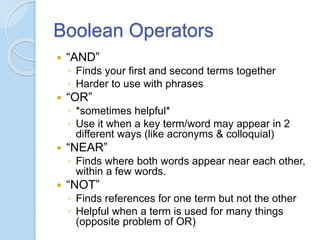
Boolean Operators
 “AND”
◦ Finds your first and second terms together
◦ Harder to use with phrases
 “OR”
◦ *sometimes helpful*
◦ Use it when a key term/word may appear in 2
different ways (like acronyms & colloquial)
 “NEAR”
◦ Finds where both words appear near each other,
within a few words.
 “NOT”
◦ Finds references for one term but not the other
◦ Helpful when a term is used for many things
(opposite problem of OR)
What do we mean by
“Primary?”
 Basically, we want you to find the
paper(s) written by those who did the
research or experiment you want to
write on.
 This includes:
◦ Research facilities/orgs.
◦ Labs
◦ Hospitals
◦ UC Berkeley professors and labs on
campus!!
Characteristics of a Primary
Source
 Report original research, ideas, or scientific
discoveries for the first time
 Report results/findings/data from experiments
or research studies
 May also be referred to as primary research,
primary articles, or research studies
 Are frequently found in peer-reviewed or
scholarly journals
 Should explain the research methodology
used (randomized controlled trial, etc)
 Frequently include methods, results, and
discussion sections
What is a “strong topic?”
 Staying away from clichés like cancer
research, effects of color on memory,
drug addiction, etc.
 Something BRAND NEW, published
within the 1-2 years.
 You could find that very little research is
available on your subject. As much as
you may like your topic, you may want to
give it up at the start if you know you’re
going to run into trouble finding more info
for your paper.
What kind of other information
are you looking for?
 Your article will require more than just
primary sources to help you write.
 Do you need:
◦ History
◦ Facts
◦ Opinions
◦ News reports
 Other resources other than primary
CAN be used.
Where would be a likely place to
look?
 The Internet
 Academic Periodicals
 Newspapers
 Company websites (if commercial)
 OskiCat, the UCB Library Catalog
 Do you need to represent both sides of a
story? (to be continued next week with
4QDs).
How much info do you need?
Homework
 Bring in 3 topics for your primary
(main) article
 Bring in 3 topics for your secondary
(shorter) article

Finding a research topic (BMJ)

  • 1.
  • 2.
    Agenda  Ice Breaker Syllabus/Course expectations  Finding a Research Source (aka Primary sources)  Homework
  • 3.
    BOOO ICE BREAKERS!!! Give your: ◦ Name ◦ Spirit Animal, favorite animal, or least favorite animal and why. ◦ OR a TV character that you would want to be your best friend and why.
  • 4.
    What you needto pass this class  Read the syllabus  Show up every week  Do your edits every week  One 10 minute (max!) presentation  A final package submission ◦ Your 2 articles ◦ Article images (explained in syllabus) ◦ A short bio of yourself ◦ Proof of rights granted for quotes ◦ Recommendation of editor(s) for publishing (the editors take care of this)
  • 5.
    How to finda research source AKA how to begin finding your topic!!
  • 6.
    Are you lost?Then it’s time to EXPOSE YOURSELF & work backwards  Common websites to begin with general information include: ◦ reddit.com/r/science ◦ Bing News ◦ Yahoo News ◦ News.google.com ◦ Popsci.com ◦ Etc.
  • 7.
    EXPOSURE YOURSELF SOME MORE More specific resources to explore for topics: ◦ Nature ◦ UC Berkeley SPH News Letter ◦ MCB News Letter ◦ School of Optometry ◦ UCSF News Center ◦ PubMed ◦ Etc.
  • 8.
    If you havea specific interest  Ask yourself what kind of topics are you interested in. ◦ Genetic mutations? ◦ Mechanical organs? ◦ Shots/injections ◦ Parasites?  SEARCH ENGINES AND BOOLEAN OPERATORS ARE YOUR FRIEND.
  • 9.
    Boolean Operators  “AND” ◦Finds your first and second terms together ◦ Harder to use with phrases  “OR” ◦ *sometimes helpful* ◦ Use it when a key term/word may appear in 2 different ways (like acronyms & colloquial)  “NEAR” ◦ Finds where both words appear near each other, within a few words.  “NOT” ◦ Finds references for one term but not the other ◦ Helpful when a term is used for many things (opposite problem of OR)
  • 10.
    What do wemean by “Primary?”  Basically, we want you to find the paper(s) written by those who did the research or experiment you want to write on.  This includes: ◦ Research facilities/orgs. ◦ Labs ◦ Hospitals ◦ UC Berkeley professors and labs on campus!!
  • 11.
    Characteristics of aPrimary Source  Report original research, ideas, or scientific discoveries for the first time  Report results/findings/data from experiments or research studies  May also be referred to as primary research, primary articles, or research studies  Are frequently found in peer-reviewed or scholarly journals  Should explain the research methodology used (randomized controlled trial, etc)  Frequently include methods, results, and discussion sections
  • 12.
    What is a“strong topic?”  Staying away from clichés like cancer research, effects of color on memory, drug addiction, etc.  Something BRAND NEW, published within the 1-2 years.  You could find that very little research is available on your subject. As much as you may like your topic, you may want to give it up at the start if you know you’re going to run into trouble finding more info for your paper.
  • 13.
    What kind ofother information are you looking for?  Your article will require more than just primary sources to help you write.  Do you need: ◦ History ◦ Facts ◦ Opinions ◦ News reports  Other resources other than primary CAN be used.
  • 14.
    Where would bea likely place to look?  The Internet  Academic Periodicals  Newspapers  Company websites (if commercial)  OskiCat, the UCB Library Catalog  Do you need to represent both sides of a story? (to be continued next week with 4QDs). How much info do you need?
  • 15.
    Homework  Bring in3 topics for your primary (main) article  Bring in 3 topics for your secondary (shorter) article

Editor's Notes

  • #5 Primary articles are 3-4 pages, secondary's are 2-3 pages. Turn to page 4 under Grading/Course Policies to understand how we keep track of points.
  • #7 These are simply starting points that can expose you to science/medical related articles in a way that is easier to understand than a primary source. They are NOT PRIMARY SOURCES. You must find the original article/research that includes the researchers or institution. For example, reddit.com/r/science linked to an article from Lund University about bacteria from bees(specifically their stomachs) acting as a possible alternative to antibiotic. The bacteria, mixed with honey, healed horses with persistent wounds.
  • #10 Most search engines allow you to combine terms with words (referred to as Boolean operators). Most search engines will allow you to apply the Boolean operators in an "advanced search" option.
  • #13 To avoid those pitfalls, it is important to select more than one topic from the start. Find three or four topics that interest you, then, go to the library or an Internet-connected computer at home and conduct a preliminary search of each topic. Determine which project idea can be supported with plenty of published material. This way, you will be able to select a final topic that is both interesting and feasible.
  • #14 Once you’ve found your primary source, ask yourself what kind of other information might you need.
  • #15 Use RELIABLE sources like the New York Times, the United States census reports, books, etc.