Financing Power Projects in Africa
Jeannot Boussougouth
Senior Manager: Energy, Utilities and Infrastructure
Investment Banking Coverage
Jeannot.Boussougouth@standardbank.co.za
Standard Bank
1 July 2011
UNECA 2011, Addis Ababa
2
2
Contents
Section Page
1. Introduction 2
2. Standard Bank 4
2.1 Natural partner in Africa 5
2.2 Recent Accolades 6
2.3 Selected Infrastructure Credentials 7
3. Our African Infrastructure Understanding 10
4. Business and Financing Challenges 13
5. Requirements for Successful Private Sector Participation 16
6. Potential Financial Structure 23
7. Standard Bank’s Value Proposition 25
8. Case Study: Morupule B Coal Power Plant Financing 34
Private and confidential
Section: 1
Introduction
4
 Standard Bank is the largest bank in Africa
– We are present in 17 countries across Africa (especially Sub-Saharan Africa)
– Our current market capitalisation is USD 24.77billion (11 January 2011) and our Total Assets are USD 182.6 billion (June 2010 Interims)
– We are 20% owned by ICBC (the world’s largest bank)
– In most African countries, Standard Bank operates as an integrated corporate and investment bank
 The purpose of today’s presentation is to :
– Introduce Standard Bank to the audience in terms of our offering, capabilities and strengths in Africa
– Highlight business and financing challenges in the African power space
– Highlight Standard Bank’s proposed financing solutions, including ECAs
– Highlight some of the most attractive power projects in Africa
Introduction
Private and confidential
Section: 2
Standard Bank
6
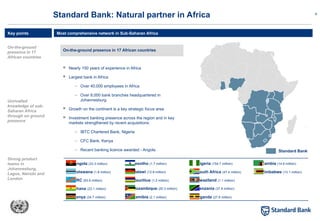
On-the-ground presence in 17 African countries
 Nearly 150 years of experience in Africa
 Largest bank in Africa
– Over 40,000 employees in Africa
– Over 8,000 bank branches headquartered in
Johannesburg
 Growth on the continent is a key strategic focus area
 Investment banking presence across the region and in key
markets strengthened by recent acquisitions:
– IBTC Chartered Bank, Nigeria
– CFC Bank, Kenya
– Recent banking licence awarded - Angola Standard Bank
Angola (33.3 million)
Botswana (1.8 million)
DRC (63.6 million)
Ghana (23.1 million)
Kenya (34.7 million)
Mozambique (20.3 million)
Lesotho (1.7 million)
Malawi (12.8 million)
Mauritius (1.2 million)
Namibia (2.1 million)
Nigeria (154.7 million)
South Africa (47.4 million)
Swaziland (1.1 million)
Tanzania (37.8 million)
Uganda (27.6 million)
Zambia (14.6 million)
Zimbabwe (13.1 million)
Most comprehensive network in Sub-Saharan Africa
Key points
Standard Bank: Natural partner in Africa
On-the-ground
presence in 17
African countries
Unrivalled
knowledge of sub-
Saharan Africa
through on ground
presence
Strong product
teams in
Johannesburg,
Lagos, Nairobi and
London
7
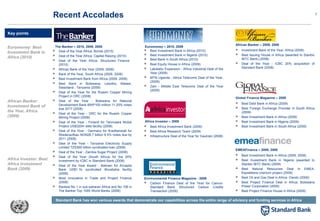
Recent Accolades
Global Finance Magazine – 2009
 Best Africa Investment Bank (2009)
 Best Africa Research Team (2009)
 Infrastructure Deal of the Year for Gautrain (2008)
Africa Investor – 2009
 Best Investment Bank in Africa (2010)
 Best Investment Bank in Nigeria (2010)
 Best Bank in South Africa (2010)
 Best Equity House in Africa (2009)
 Lakatabu Expansion - Africa Industrial Deal of the
Year (2009)
 MTN Uganda - Africa Telecoms Deal of the Year.
(2009)
 Zain - Middle East Telecoms Deal of the Year
(2009)
Euromoney – 2010, 2009
The Banker – 2010, 2009, 2008
 Deal of the Year Africa: Bonds (2010)
 Deal of the Year Africa: Capital Raising (2010)
 Deal of the Year Africa: Structured Finance
(2010)
 African Bank of the Year (2009, 2008)
 Bank of the Year, South Africa (2009, 2008)
 Best Investment Bank from Africa (2009, 2008)
 Best Bank in Botswana, Lesotho, Malawi,
Swaziland , Tanzania (2009)
 Deal of the Year for the Ruashi Copper Mining
Project in DRC (2008)
 Deal of the Year - Botswana for National
Development Bank BWP100 million 11.25% notes
due 2017 (2008)
 Deal of the Year - DRC for the Ruashi Copper
Mining Project (2008)
 Deal of the Year - Finland for Talvivaara Nickel
Project US$320m debt facility (2008)
 Deal of the Year - Germany for Kreditanstalt fur
Wiederaufbau NGN28.7 billion 8.5% notes due by
2011 (2008)
 Deal of the Year - Tanzania Electricity Supply
Limited TZS300 billion syndicated loan (2008)
 Deal of the Year - Zambia Sugar Project (2008)
 Deal of the Year (South Africa) for the 20%
investment by ICBC in Standard Bank (2008)
 Deal of the Year Award - Bahrain for Arcapita
Bank US$1.1b syndicated Murabaha facility
(2008)
 Most innovative in Trade and Project Finance
(2008)
 Ranked No 1 in sub-saharan Africa and No 106 in
The Banker Top 1000 World Banks (2008)
Standard Bank has won various awards that demonstrate our capabilities across the entire range of advisory and funding services in Africa
EMEAFinance – 2009, 2008
 Best Investment Bank in Africa (2009, 2008)
 Best Investment Bank in Nigeria (awarded to
Stanbic IBTC Bank) (2009)
 Best Natural Resources Deal in EMEA:
Kayelekera Uranium project (2009)
 Best Oil and Gas Deal in Africa: Oando (2009)
 Best Project Finance Deal in Africa: Botswana
Power Corporation (2009)
 Best Project Finance House in Africa (2009)
African Banker – 2009, 2008
 Investment Bank of the Year, Africa (2009)
 Best Issuing House in Africa (awarded to Stanbic
IBTC Bank) (2008)
 Deal of the Year - ICBC 20% acquisition of
Standard Bank (2008)
Environmental Finance Magazine - 2009
 Carbon Finance Deal of the Year for Camco-
Standard Bank Structured Carbon Credits
Transaction (2009)
 Best Debt Bank in Africa (2009)
 Best Foreign Exchange Provider in South Africa
(2009)
 Best Investment Bank in Africa (2009)
 Best Investment Bank in Nigeria (2009)
 Best Investment Bank in South Africa (2009)
Key points
Euromoney: Best
Investment Bank in
Africa (2010)
African Banker:
Investment Bank of
the Year, Africa
(2009)
Africa Investor: Best
Africa investment
Bank (2009)
8
 Ongoing – Scatec Solar, South Africa
Standard Bank has been mandated as Sole Financial Arranger and Underwriter, and BEE funding provider to Scatec Solar on its
various Solar PV project in the Northern Cape and Eastern Cape provinces of South Africa
 Ongoing – Solar Reserve, South Africa
Standard Bank has been mandated as financial advisor to Solar Reserve on its Solar CSP plants, using molten salt storage
technology, totalling [80-100]MW, in South Africa
 Ongoing – Confidential, Africa
Standard Bank has been mandated for a confidential Equity raise in Africa
 Ongoing – The Power Company/Built Africa, South Africa
Mandated as financial advisor for The Power Company/Built Africa [20]MW Solar PV Project, over several South African sites
 Ongoing – Gitson Energy, Kenya
Mandated lead arranger & financial advisor for Gitson Energy’s [300MW] Wind Power Project in Bubisa, Kenya
 Ongoing – Solar Capital, South Africa
Standard Bank has been mandated as financial advisor and main lead arranger for Solar Capital on its five Solar PV plants in the
Northern Cape
 Ongoing – African Clean Energy Developments, South Africa
Standard Bank has been mandated as main lead arranger for African Clean Energy Development (ACED) to develop a [400MW]
wind farm in cookhouse in the Eastern Cape
 Ongoing – CGNPC, South Africa
Standard Bank has been mandated as a financial advisor to China Guangdong Nuclear Power Corporation (“CGNPC”), China’s
largest Nuclear Energy company, in support of their bid to build South Africa’s potential nuclear power programme
 Ongoing – Just Energy, South Africa
Financial Advisor to Oxfam’s energy subsidiary, Just Energy, to develop [74MW] of wind farms in the Eastern Cape
 Ongoing – Italgest, South Africa
Standard Bank has been mandated as Financial Advisor to Italgest on its [100 MW] Solar PV project.
Recent Energy, Power & Renewables Credentials (1/3)
9
 Ongoing – BHP Billiton, DRC
Mandated Transaction Advisor to BHP Billiton SA (Pty) Limited on the INGA 3 hydro-electric project concept study in the Democratic
Republic of Congo.
 Ongoing – Mphanda Nkuwa Hydropower Project, Mozambique
Financial advisor to the Mphanda Nkuwa consortium on the development of 1500 MW hydro electric project in Mozambique
 Ongoing – Anglo American, South Africa
Standard Bank has been mandated as the Financial Advisor to Anglo American’s [450MW] discard coal-fired IPP near Witbank
 Ongoing – SARGE, South Africa
Standard Bank has been mandated as the sole Project and Equity Raising Financial Advisor and Lead Arranger to the SARGE 50 MW,
Solar PV project in the Northern Cape, as well as 216 MW of wind projects
 Ongoing – Forest Oil Corporation, South Africa
Standard Bank has been mandated as Financial Adviser to Forest Oil Corporation in connection with the development of an
integrated [750-800 MW] natural gas to power project
 Ongoing - Oelsner Group Wind Farms , South Africa
Standard Bank mandated Financial Advisor and Lead Arranger to Oelsner Groups’ two wind farms being Kerrifontein (20.8MW) and
Langefontein (50MW)
 Ongoing – Confidential , South Africa
Standard Bank has been mandated as the sole Project and Equity Raising Financial Advisor and Lead Arranger to a SA renewable
energy company on a multiple wind farm project
 Ongoing – Volta River Authority, Ghana
Standard bank has been mandated as Financial advisor to VRA on the expansion of the Takoradi power plant
 Ongoing - Aldwych International, Kenya
Joint Lead Arranger for long-term financing to Aldwych International for the 300MW Lake Turkana Wind Project valued at US$760m
 Ongoing - Gulf Power, Kenya
Co-lead Arranger of the Greenfield 84MW Athi River HFO power plant developed by Gulf Energy
Recent Energy, Power & Renewables Credentials (1/2)
10
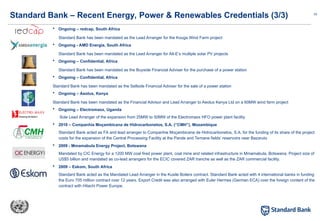
 Ongoing – redcap, South Africa
Standard Bank has been mandated as the Lead Arranger for the Kouga Wind Farm project
 Ongoing - AMD Energia, South Africa
Standard Bank has been mandated as the Lead Arranger for Alt-E’s multiple solar PV projects
 Ongoing – Confidential, Africa
Standard Bank has been mandated as the Buyside Financial Adviser for the purchase of a power station
 Ongoing – Confidential, Africa
Standard Bank has been mandated as the Sellside Financial Adviser for the sale of a power station
 Ongoing – Aeolus, Kenya
Standard Bank has been mandated as the Financial Advisor and Lead Arranger to Aeolus Kenya Ltd on a 60MW wind farm project
 Ongoing – Electromaxx, Uganda
Sole Lead Arranger of the expansion from 25MW to 50MW of the Electromaxx HFO power plant facility
 2010 – Companhia Moçambicana de Hidrocarbonetos, S.A. (“CMH”), Mozambique
Standard Bank acted as FA and lead arranger to Companhia Moçambicana de Hidrocarbonetos, S.A. for the funding of its share of the project
costs for the expansion of the Central Processing Facility at the Pande and Temane fields’ reservoirs near Bazaruto
 2009 - Mmamabula Energy Project, Botswana
Mandated by CIC Energy for a 1200 MW coal fired power plant, coal mine and related infrastructure in Mmamabula, Botswana. Project size of
US$5 billion and mandated as co-lead arrangers for the ECIC covered ZAR tranche as well as the ZAR commercial facility.
 2009 – Eskom, South Africa
Standard Bank acted as the Mandated Lead Arranger in the Kusile Boilers contract. Standard Bank acted with 4 international banks in funding
the Euro 705 million contract over 12 years. Export Credit was also arranged with Euler Hermes (German ECA) over the foreign content of the
contract with Hitachi Power Europe.
Standard Bank – Recent Energy, Power & Renewables Credentials (3/3)
Private and confidential
Section: 3
Our African Infrastructure Understanding
12
 Positive correlation between infrastructure expenditure and GDP
growth (Economic Research (Aschauer, 1989; Munnell, 1990) )
_e.g. through increased productivity, reduced logistics costs etc.
 Conversely, inadequate infrastructure is cited as a key constraint to
investment and growth (ADB, 2007)
 Therefore, the provision of quality infrastructure is a necessary
element of any strategy for economic integration and sustainable
development in Africa
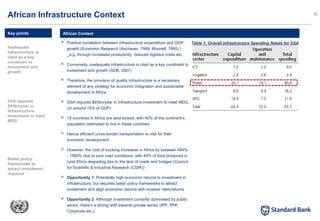
 SSA requires $93bn/year in infrastructure investment to meet MDG,
(or around 15% of GDP)
 15 countries in Africa are land-locked, with 40% of the continent’s
population estimated to live in these countries
 Hence efficient cross-border transportation is vital for their
economic development
 However, the cost of trucking increases in Africa by between 684%
- 1560% due to poor road conditions, with 40% of food produced in
rural Africa degrading due to the lack of roads and bridges (Council
for Scientific & Industrial Research (CSIR))
 Opportunity 1: Potentially high economic returns to investment in
infrastructure, but requires better policy frameworks to attract
investment and align economic returns with investor risks/returns
 Opportunity 2: Although investment currently dominated by public
sector, there’s a strong shift towards private sector (IPP, PPP,
Corporate etc.).
African Context
African Infrastructure Context
Table 1: Overall Infrastructure Spending Needs for SSA
Key points
Inadequate
infrastructure is
cited as a key
constraint to
investment and
growth
SSA requires
$93bn/year in
infrastructure
investment to meet
MDG
Better policy
frameworks to
attract investment
required
13
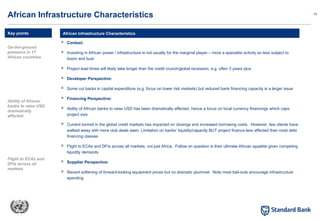
 Context:
 Investing in African power / infrastructure is not usually for the marginal player – more a specialist activity so less subject to
boom and bust
 Project lead times will likely take longer than the credit crunch/global recession, e.g. often 3 years plus
 Developer Perspective:
 Some cut backs in capital expenditure (e.g. focus on lower risk markets) but reduced bank financing capacity is a larger issue
 Financing Perspective:
 Ability of African banks to raise USD has been dramatically affected, hence a focus on local currency financings which caps
project size
 Current turmoil in the global credit markets has impacted on closings and increased borrowing costs. However, few clients have
walked away with more club deals seen. Limitation on banks’ liquidity/capacity BUT project finance less affected than most debt
financing classes
 Flight to ECAs and DFIs across all markets, not just Africa. Follow on question is their ultimate African appetite given competing
liquidity demands
 Supplier Perspective:
 Recent softening of forward-looking equipment prices but no dramatic plummet. Note most bail-outs encourage infrastructure
spending
African Infrastructure Characteristics
Key points
On-the-ground
presence in 17
African countries
Ability of African
banks to raise USD
dramatically
affected
Flight to ECAs and
DFIs across all
markets
Private and confidential
Section: 4
Business and Financing Challenges
15
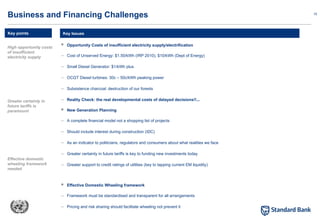
 Opportunity Costs of insufficient electricity supply/electrification
– Cost of Unserved Energy: $1.50/kWh (IRP 2010), $10/kWh (Dept of Energy)
– Small Diesel Generator: $1/kWh plus
– OCGT Diesel turbines: 30c – 50c/kWh peaking power
– Subsistence charcoal: destruction of our forests
– Reality Check: the real developmental costs of delayed decisions!!...
 New Generation Planning
– A complete financial model not a shopping list of projects
– Should include interest during construction (IDC)
– As an indicator to politicians, regulators and consumers about what realities we face
– Greater certainty in future tariffs is key to funding new investments today
– Greater support to credit ratings of utilities (key to tapping current EM liquidity)
 Effective Domestic Wheeling framework
– Framework must be standardised and transparent for all arrangements
– Pricing and risk sharing should facilitate wheeling not prevent it
Key Issues
Business and Financing Challenges
Key points
High opportunity costs
of insufficient
electricity supply
Greater certainty in
future tariffs is
paramount
Effective domestic
wheeling framework
needed
16
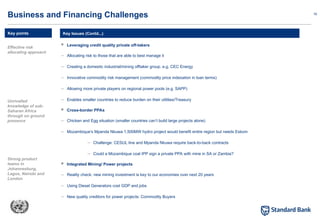
 Leveraging credit quality private off-takers
– Allocating risk to those that are able to best manage it
– Creating a domestic industrial/mining offtaker group. e.g. CEC Energy
– Innovative commodity risk management (commodity price indexation in loan terms)
– Allowing more private players on regional power pools (e.g. SAPP)
– Enables smaller countries to reduce burden on their utilities/Treasury
 Cross-border PPAs
– Chicken and Egg situation (smaller countries can’t build large projects alone)
– Mozambique’s Mpanda Nkuwa 1,500MW hydro project would benefit entire region but needs Eskom
– Challenge: CESUL line and Mpanda Nkuwa require back-to-back contracts
– Could a Mozambique coal IPP sign a private PPA with mine in SA or Zambia?
 Integrated Mining/ Power projects
– Reality check: new mining investment is key to our economies over next 20 years
– Using Diesel Generators cost GDP and jobs
– New quality creditors for power projects: Commodity Buyers
Key Issues (Contd...)
Business and Financing Challenges
Key points
Effective risk
allocating approach
Unrivalled
knowledge of sub-
Saharan Africa
through on ground
presence
Strong product
teams in
Johannesburg,
Lagos, Nairobi and
London
Private and confidential
Section: 5
Requirements for successful private sector participation
18
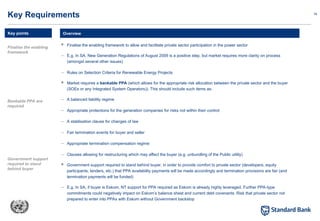
 Finalise the enabling framework to allow and facilitate private sector participation in the power sector
– E.g. In SA. New Generation Regulations of August 2009 is a positive step, but market requires more clarity on process
(amongst several other issues)
– Rules on Selection Criteria for Renewable Energy Projects
 Market requires a bankable PPA (which allows for the appropriate risk allocation between the private sector and the buyer
(SOEs or any Integrated System Operators)). This should include such items as:
– A balanced liability regime
– Appropriate protections for the generation companies for risks not within their control
– A stablisation clause for changes of law
– Fair termination events for buyer and seller
– Appropriate termination compensation regime
– Clauses allowing for restructuring which may affect the buyer (e.g. unbundling of the Public utility)
 Government support required to stand behind buyer, in order to provide comfort to private sector (developers, equity
participants, lenders, etc.) that PPA availability payments will be made accordingly and termination provisions are fair (and
termination payments will be funded)
– E.g. In SA, if buyer is Eskom, NT support for PPA required as Eskom is already highly leveraged. Further PPA-type
commitments could negatively impact on Eskom’s balance sheet and current debt covenants. Risk that private sector not
prepared to enter into PPAs with Eskom without Government backstop
Overview
Key Requirements
Key points
Finalise the enabling
framework
Bankable PPA are
required
Government support
required to stand
behind buyer
19
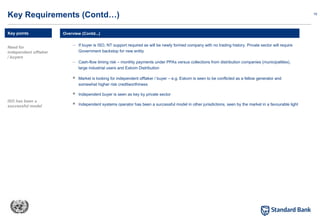
– If buyer is ISO, NT support required as will be newly formed company with no trading history. Private sector will require
Government backstop for new entity
– Cash-flow timing risk – monthly payments under PPAs versus collections from distribution companies (municipalities),
large industrial users and Eskom Distribution
 Market is looking for independent offtaker / buyer – e.g. Eskom is seen to be conflicted as a fellow generator and
somewhat higher risk creditworthiness
 Independent buyer is seen as key by private sector
 Independent systems operator has been a successful model in other jurisdictions, seen by the market in a favourable light
Overview (Contd...)
Key Requirements (Contd…)
Key points
Need for
independent offtaker
/ buyers
ISO has been a
successful model
20
 The PPA grants the concession and sets the tariff. It is the primary document that the SBO would focus on. To some extent all
the others are secondary
PPA 101
Key Requirements (Contd…)
Key points
Grants the concession  Grants the concession - gives the project the right to
exist, and the right to generate electricity. Term
typically 20-25 years from completion of construction
Ownership  BOO or BOT
Sale and purchase of
Net Electricals
 Variable O&M costs recovered through the sale of the
net electrical energy dispatched
Sale and purchase of
capacity
 Generator (IPP) paid on the availability of net
dependable power capacity irrespective of despatch
sufficient to cover debt service, equity return and fixed
O&M
 Procurer (SBO) takes price and despatch risk
 Take or Pay
Indexation  Tariff payments may be indexed for inflation and
movements in Foreign Exchange rates
 Procurer may take inflation and forex movements
risk
 The responsibilities will be split
Specifications and
Performance Standards
of the Plant
 PPA sets out the responsibility of the Generator to
build by a given date a plant to very precisely
documented specifications, operating standards and
designs
 Generator / EPC Contractor takes the responsibility
and risk of building the plant to the requirements of
the Procurer
Revenue Write Down
provisions for non-
Performance
 PPA includes provisions to reduce the payments
payable to the Generator if the tested dependable
capacity at any time or the actual availability [or the
heat rate] is worse then the levels the Generator is
contracted to provide
 Generator takes performance risk
Delay LD’s for late
commissioning
 Delay LDs payable for late commissioning payable by
Generator/ EPC Contractor
 Generator takes risk of late commissioning
Performance criteria
21
 The responsibilities will be split (Contd…)
PPA 101 (Contd...)
Key Requirements (Contd…)
Key points
Third party
responsibilities
Force majeure /
political events
Water and Power
Transmission
interconnections
 Generator would seek to make it an
obligations of the Procurer to design build
and commission all required water and
transmission linkages by an agreed date
and prior to scheduled testing
 Procurer takes responsibility for providing Water and Power
Interconnections
 The PPA sets out provisions for the Procurer to keep the
Generator whole and / or pay compensation if such
facilities are late
Supply of Gas / Coal / Fuel  In many markets, the Generator would seek
to make it an obligation of the Procurer to
supply Gas / Coal / Fuel (ie energy
conversion)
 Generator may take fuel / hydrology risk
assuming satisfactory pricing and supply
risks
 Procurer takes risk of fuel supply and pays deemed
commissioning if fuel is not available Generator takes
efficiency risk through an incentive penalty regime
Permits  PPA allocates responsibility for obtaining
permits
 Split between Procurer and Generator
Natural Force Majeure  PPA sets out provisions in relation to relief
of liability and the provision of insurance
(both damage and business interruption) to
mitigate Natural Force Majeure Risk
 (Lightening, fire, earthquake, accidents,
explosions, epidemics etc.)
 Insurance
Political Force Majeure  There are certain risks which are
uninsurable, political in nature and which
Generators will not accept and need to be
taken by the Procurer
 (Act of war, blockade, boycott, rebellion,
civil commotion, Change in Law and / or
unjustified failure to renew permits)
 Procurer Risk
 Payments of deemed commissioning [or termination buyout
if prolonged] or tariff adjustments to compensate for
additional costs or revenue losses
22
 The responsibilities will be split (Contd…)
PPA 101 (Contd...)
Key Requirements (Contd…)
Key points
Termination
Termination
Water and Power
Transmission
interconnections
 Generator would seek to make it an
obligations of the Procurer to design build
and commission all required water and
transmission linkages by an agreed date
and prior to scheduled testing
 Procurer takes responsibility for providing Water and Power
Interconnections
 The PPA sets out provisions for the Procurer to keep the
Generator whole and / or pay compensation if such
facilities are late
Supply of Gas / Coal / Fuel  In many markets, the Generator would seek
to make it an obligation of the Procurer to
supply Gas / Coal / Fuel (ie energy
conversion)
 Generator may take fuel / hydrology risk
assuming satisfactory pricing and supply
risks
 Procurer takes risk of fuel supply and pays deemed
commissioning if fuel is not available Generator takes
efficiency risk through an incentive penalty regime
Permits  PPA allocates responsibility for obtaining
permits
 Split between Procurer and Generator
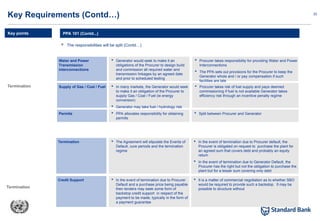
Termination  The Agreement will stipulate the Events of
Default, cure periods and the termination
regime
 In the event of termination due to Procurer default, the
Procurer is obligated on request to purchase the plant for
an agreed sum that covers debt and probably an equity
return
 In the event of termination due to Generator Default, the
Procurer has the right but not the obligation to purchase the
plant but for a lesser sum covering only debt
Credit Support  In the event of termination due to Procurer
Default and a purchase price being payable
then lenders may seek some form of
backstop credit support in respect of the
payment to be made, typically in the form of
a payment guarantee
 It is a matter of commercial negotiation as to whether SBO
would be required to provide such a backstop. It may be
possible to structure without
23
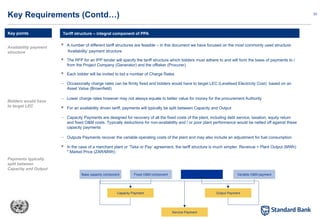
 A number of different tariff structures are feasible – in this document we have focused on the most commonly used structure:
‘Availability’ payment structure
 The RFP for an IPP tender will specify the tariff structure which bidders must adhere to and will form the basis of payments to /
from the Project Company (Generator) and the offtaker (Procurer)
 Each bidder will be invited to bid a number of Charge Rates
– Occasionally charge rates can be firmly fixed and bidders would have to target LEC (Levelised Electricity Cost) based on an
Asset Value (Brownfield)
– Lower charge rates however may not always equate to better value for money for the procurement Authority
 For an availability driven tariff, payments will typically be split between Capacity and Output
– Capacity Payments are designed for recovery of all the fixed costs of the plant, including debt service, taxation, equity return
and fixed O&M costs. Typically deductions for non-availability and / or poor plant performance would be netted off against these
capacity payments
– Outputs Payments recover the variable operating costs of the plant and may also include an adjustment for fuel consumption
 In the case of a merchant plant or ‘Take or Pay’ agreement, the tariff structure is much simpler. Revenue = Plant Output (MWh)
* Market Price (ZAR/MWh)
Tariff structure – integral component of PPA
Key Requirements (Contd…)
Key points
Service Payment
Capacity Payment
Base capacity component Fixed O&M component
Output Payment
Fuel adjustment
payment
Variable O&M payment
Availability payment
structure
Bidders would have
to target LEC
Payments typically
split between
Capacity and Output
Private and confidential
Section: 6
Potential Financing Structure
25
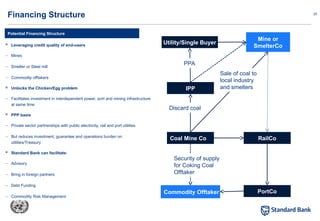
Financing Structure
Coal Mine Co
IPP
PortCo
RailCo
Utility/Single Buyer
Commodity Offtaker
PPA
Discard coal
Mine or
SmelterCo
Security of supply
for Coking Coal
Offtaker
Sale of coal to
local industry
and smelters
Potential Financing Structure
 Leveraging credit quality of end-users
– Mines
– Smelter or Steel mill
– Commodity offtakers
 Unlocks the Chicken/Egg problem
– Facilitates investment in interdependent power, port and mining infrastructure
at same time
 PPP basis
– Private sector partnerships with public electricity, rail and port utilities
– But reduces investment, guarantee and operations burden on
utilities/Treasury
 Standard Bank can facilitate:
– Advisory
– Bring in foreign partners
– Debt Funding
– Commodity Risk Management
Private and confidential
Section 7:
Standard Bank’s Value Proposition
27
Our Project Advisory and Finance Services
Standard Bank’s Value Proposition: Robust Project Advisory/Finance Services
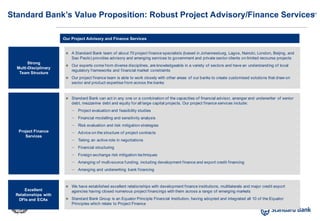
 A Standard Bank team of about 70 project finance specialists (based in Johannesburg, Lagos, Nairobi, London, Beijing, and
Sao Paolo) provides advisory and arranging services to government and private sector clients on limited recourse projects
 Our experts come from diverse disciplines, are knowledgeable in a variety of sectors and have an understanding of local
regulatory frameworks and financial market constraints
 Our project finance team is able to work closely with other areas of our banks to create customised solutions that draw on
sector and product expertise from across the banks
Strong
Multi-Disciplinary
Team Structure
Project Finance
Services
Excellent
Relationships with
DFIs and ECAs
 Standard Bank can act in any one or a combination of the capacities of financial advisor, arranger and underwriter of senior
debt, mezzanine debt and equity for all large capital projects. Our project finance services include:
– Project evaluation and feasibility studies
– Financial modelling and sensitivity analysis
– Risk evaluation and risk mitigation strategies
– Advice on the structure of project contracts
– Taking an active role in negotiations
– Financial structuring
– Foreign exchange risk mitigation techniques
– Arranging of multi-source funding, including development finance and export credit financing
– Arranging and underwriting bank financing
 We have established excellent relationships with development finance institutions, multilaterals and major credit export
agencies having closed numerous project financings with them across a range of emerging markets
 Standard Bank Group is an Equator Principle Financial Institution, having adopted and integrated all 10 of the Equator
Principles which relate to Project Finance
28
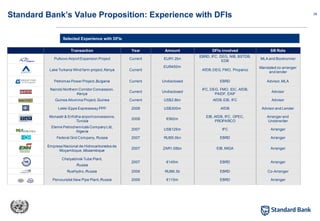
Selected Experience with DFIs
Standard Bank’s Value Proposition: Experience with DFIs
Transaction Year Amount DFIs involved SB Role
Pulkovo AirportExpansion Project Current EUR1.2bn
EBRD, IFC, DEG, NIB, BSTDB,
EDB
MLA and Bookrunner
Lake Turkana Wind farm project,Kenya Current
EUR450m
AfDB,DEG, FMO, Proparco
Mandated co-arranger
and lender
Petromax Power Project,Bulgaria Current Undisclosed EBRD Advisor, MLA
Nairobi Northern Corridor Concession,
Kenya
Current Undisclosed
IFC, DEG, FMO, IDC, AfDB,
PAIDF, EAIF
Advisor
Guinea Allumina Project,Guinea Current US$2.8bn AfDB,EIB, IFC Advisor
Lekki-Eppe Expressway PPP 2008 US$300m AfDB Advisor and Lender
Monastir & Enfidha airportconcessions,
Tunisia
2008 €562m
EIB, AfDB, IFC, OPEC,
PROPARCO
Arranger and
Underwriter
Eleme Petrochemicals Company Ltd,
Nigeria
2007 US$125m IFC Arranger
Federal Grid Company, Russia 2007 RUB5.0bn EBRD Arranger
Empresa Nacional de Hidrocarbonetos de
Moçambique,Mozambique
2007 ZAR1.08bn EIB, MIGA Arranger
Chelyabinsk Tube Plant,
Russia
2007 €145m EBRD Arranger
RusHydro,Russia 2006 RUB6.3b EBRD Co-Arranger
Pervouralsk New Pipe Plant,Russia 2006 €115m EBRD Arranger
INDORAMA
INDORAMA
29
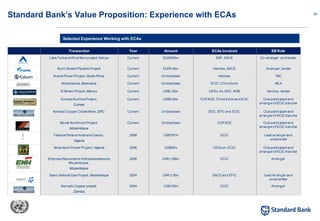
Selected Experience Working with ECAs
Standard Bank’s Value Proposition: Experience with ECAs
Transaction Year Amount ECAs involved SB Role
Lake Turkana Wind farm project, Kenya Current EUR450m EKF, SACE Co-arranger and lender
Nord Stream Pipeline Project Current EUR3.9bn Hermes, SACE Arranger, lender
Kusile Power Project, South Africa Current Undisclosed Hermes TBC
Mmamabula, Botswana Current Undisclosed ECIC, China Exim MLA
El Boleo Project, Mexico Current US$1.2bn US Ex-Im, EDC, KDB Advisor, lender
Guinea Alumina Project,
Guinea
Current US$5.0bn COFACE, China Exim and ECIC Club participant and
arrangerof ECIC tranche
Kolwezi Copper Cobalt Mine, DRC Current Undisclosed EDC, EFIC and ECIC Club participant and
arrangerof ECIC tranche
Mozal Aluminium Project,
Mozambique
Current Undisclosed COFACE Club participant and
arrangerof ECIC tranche
Federal Palace Hoteland Casino,
Nigeria
2008 US$167m ECIC Lead arrangerand
underwriter
Akwa Ibom Power Project, Nigeria 2006 US$60m US Exim, ECIC Club participant and
arrangerof ECIC tranche
Empresa Nacionalde Hidrocarbonetosde
Moçambique,
Mozambique
2006 ZAR1.08bn ECIC Arranger
Sasol Natural Gas Project, Mozambique 2004 ZAR 2.5bn SACE and EFIC Lead Arranger and
underwritter
Kansahi Copper project,
Zambia
2004 US$120m ECIC Arranger
30
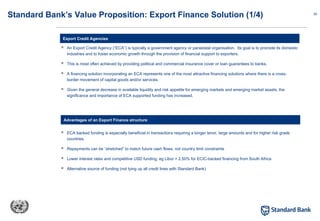
 An Export Credit Agency (“ECA”) is typically a government agency or parastatal organisation. Its goal is to promote its domestic
industries and to foster economic growth through the provision of financial support to exporters.
 This is most often achieved by providing political and commercial insurance cover or loan guarantees to banks.
 A financing solution incorporating an ECA represents one of the most attractive financing solutions where there is a cross-
border movement of capital goods and/or services.
 Given the general decrease in available liquidity and risk appetite for emerging markets and emerging market assets, the
significance and importance of ECA supported funding has increased.
 ECA backed funding is especially beneficial in transactions requiring a longer tenor, large amounts and for higher risk grade
countries.
 Repayments can be “stretched” to match future cash flows, not country limit constraints
 Lower interest rates and competitive USD funding, eg Libor + 2.50% for ECIC-backed financing from South Africa
 Alternative source of funding (not tying up all credit lines with Standard Bank)
Export Credit Agencies
Advantages of an Export Finance structure
Standard Bank’s Value Proposition: Export Finance Solution (1/4)
31
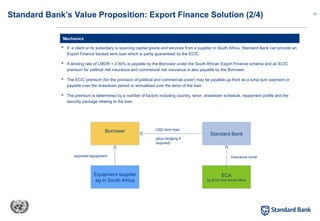
 If a client or its subsidiary is sourcing capital goods and services from a supplier in South Africa, Standard Bank can provide an
Export Finance backed term loan which is partly guaranteed by the ECIC.
 A lending rate of LIBOR + 2.50% is payable by the Borrower under the South African Export Finance scheme and an ECIC
premium for political risk insurance and commercial risk insurance is also payable by the Borrower.
 The ECIC premium (for the provision of political and commercial cover) may be payable up-front as a lump sum payment or
payable over the drawdown period or annualised over the tenor of the loan.
 The premium is determined by a number of factors including country, tenor, drawdown schedule, repayment profile and the
security package relating to the loan.
Mechanics
USD term loan
(plus hedging if
required)
Borrower
Equipment supplier
eg in South Africa
Standard Bank
ECA
eg ECIC from South Africa
Insurance cover
exported equipment
Standard Bank’s Value Proposition: Export Finance Solution (2/4)
32
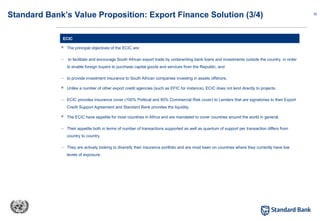
 The principal objectives of the ECIC are:
– to facilitate and encourage South African export trade by underwriting bank loans and investments outside the country, in order
to enable foreign buyers to purchase capital goods and services from the Republic; and
– to provide investment insurance to South African companies investing in assets offshore.
 Unlike a number of other export credit agencies (such as EFIC for instance), ECIC does not lend directly to projects.
– ECIC provides insurance cover (100% Political and 85% Commercial Risk cover) to Lenders that are signatories to their Export
Credit Support Agreement and Standard Bank provides the liquidity.
 The ECIC have appetite for most countries in Africa and are mandated to cover countries around the world in general.
– Their appetite both in terms of number of transactions supported as well as quantum of support per transaction differs from
country to country.
– They are actively looking to diversify their insurance portfolio and are most keen on countries where they currently have low
levels of exposure.
ECIC
Standard Bank’s Value Proposition: Export Finance Solution (3/4)
33
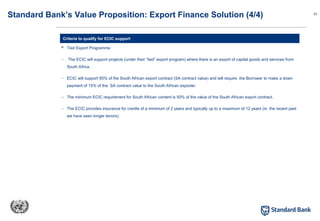
 Tied Export Programme
– The ECIC will support projects (under their “tied” export program) where there is an export of capital goods and services from
South Africa.
– ECIC will support 85% of the South African export contract (SA contract value) and will require the Borrower to make a down
payment of 15% of the SA contract value to the South African exporter.
– The minimum ECIC requirement for South African content is 50% of the value of the South African export contract.
– The ECIC provides insurance for credits of a minimum of 2 years and typically up to a maximum of 12 years (in the recent past
we have seen longer tenors).
Criteria to qualify for ECIC support
Standard Bank’s Value Proposition: Export Finance Solution (4/4)
Private and confidential
Section: 8
Case Study
35
Case Study: Morupule B Coal Power Plant Financing
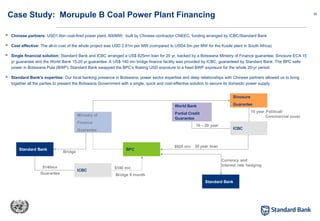
 Chinese partners: USD1.6bn coal-fired power plant, 600MW, built by Chinese contractor CNEEC, funding arranged by ICBC/Standard Bank
 Cost effective: The all-in cost of the whole project was USD 2.91m per MW (compared to USD4.5m per MW for the Kusile plant in South Africa)
 Single financial solution: Standard Bank and ICBC arranged a US$ 825mn loan for 20 yr, backed by a Botswana Ministry of Finance guarantee, Sinosure ECA 15
yr guarantee and the World Bank 15-20 yr guarantee. A US$ 140 mn bridge finance facility was provided by ICBC, guaranteed by Standard Bank. The BPC sells
power in Botswana Pula (BWP). Standard Bank swapped the BPC’s floating USD exposure to a fixed BWP exposure for the whole 20-yr period.
 Standard Bank’s expertise: Our local banking presence in Botswana, power sector expertise and deep relationships with Chinese partners allowed us to bring
together all the parties to present the Botswana Government with a single, quick and cost-effective solution to secure its domestic power supply.
Ministry of
Finance
Guarantee
Standard Bank
ICBC
BPC
ICBC
World Bank
Partial Credit
Guarantee
Sinosure
Guarantee
Standard Bank
$140mn $140 mn
Guarantee Bridge 9 month
Currency and
Interest rate hedging
$825 mn 20 year loan
16 – 20 year
15 year Political/
Commercial cover
Bridge
36
Disclaimer
This presentation is provided for information purposes only on the express understanding that the information contained herein will be regarded as strictly confidential. It is not to be delivered nor
shall its contents be disclosed to anyone other than the entity to which it is being provided and its employees and shall not be reproduced or used, in whole or in part, for any purpose other than for
the consideration of the financing or transaction described herein, without the prior written consent of a member of the Standard Bank Group. The information contained in this presentation does
not purport to be complete and is subject to change. This is a commercial communication. This presentation may relate to derivative products and you should not deal in such products unless
you understand the nature and extent of your exposure to risk. The presentation does not include a personal recommendation and does not constitute an offer, or the solicitation of an offer for the
sale or purchase of any financial product, service, investment or security. The investments and strategies discussed here may not be suitable for all investors; if you have any doubts you should
consult your investment advisor. The investments discussed may fluctuate in price or value Whilst every care has been taken in preparing this presentation, no member of the Standard Bank
Group gives any representation, warranty or undertaking and accepts no responsibility or liability as to the accuracy, or completeness, of the information in this presentation Past performance is
not indicative of future results. For the avoidance of doubt, our duties and responsibilities shall not include tax advisory, legal, regulatory accounting or other specialist or technical advice or
services. You are to rely on your own independent appraisal of and investigations into all matters and things contemplated by this presentation. By accepting this presentation, you agree to be
bound by the foregoing limitations. Kindly note that this presentation does not represent an offer of funding since any facility to be granted in terms of this presentation would be subject to the
Standard Band Group obtaining the requisite internal and external approvals. Copyright 2010 Standard Bank Group. All rights reserved.
UK Residents
This presentation is not intended for the use of retail clients and must not be acted on or relied on by persons who are retail clients. Any investment or investment activity to which this presentation
relates is only available to persons other than retail clients and will be engaged in only with such persons. Standard Bank Plc (SB Plc) is authorised and regulated by the Financial Services
Authority (FSA), entered in the FSA’s register (register number 124823) and has approved this presentation for distribution in the UK only to persons other than retail clients. Persons into whose
possession this presentation comes are required by SB Plc to inform themselves about and to observe these restrictions. Telephone calls may be recorded for quality and regulatory purposes.
Standard Bank Plc, 20 Gresham Street, London, EC2V 7JE.
South African Residents
The Standard Bank of South Africa Limited (Reg.No.1962/000738/06) is regulated by the South African Reserve Bank and is an Authorised Financial Services Provider and Credit Provider.
United States Residents
In the US, Standard Bank Plc is acting through its agents, Standard Americas, Inc. and Standard New York Securities, Inc. Both are affiliates of Standard Bank Plc. Standard Americas, Inc is
registered as a commodity trading advisor and a commodity pool operator with the NFA. Standard New York Securities, Inc is a member of FINRA and SIPC. Neither are banks, regulated by the
United States Federal Reserve Board, nor insured by the FDIC.
Hong Kong Residents
Standard Bank Asia Limited is a fully licensed bank under the Banking Ordinance and is a registered institution under the Securities and Futures Ordinance in Hong Kong. Standard Securities
Asia Limited is a licensed corporation with the Securities and Futures Commission. Any investments and services contained or referred to in this presentation may not be suitable for you and it is
recommended that you consult an independent investment advisor if you are in doubt about such investments or investment services.
Dubai Residents
Standard Bank Plc, Dubai Branch, is regulated by the Dubai Financial Services Authority (‘DFSA) (register number F000028). Within the Dubai International Financial Centre, (‘DIFC’) the financial
products or services to which this marketing material relates will only be made available to Professional Clients, including a Market Counterparty, who meet the regulatory criteria of being a Client.
Turkey Residents
Standard Unlu Menkul Degerler A.S. and Standard Unlu Portfoy Yonetimi A.S. are regulated by the Turkish Capital Markets Board “CMB”). According to CMB’s legislation, the information,
comments and recommendations contained in this presentation are not investment advisory services. Investment advisory services are provided under an investment advisory agreement between
a brokerage house, a portfolio management company, a bank that does not accept deposits or other capital markets professionals and the client. The comments and recommendations contained
in this presentation are based on the personal opinions of the authors. These opinions may not be appropriate for your financial situation and risk and return preferences. For that reason,
investment decisions relying solely on the information contained in this presentation may not meet your expectations.

financing power projects 2011 report by jeannot

  • 1.
    Financing Power Projectsin Africa Jeannot Boussougouth Senior Manager: Energy, Utilities and Infrastructure Investment Banking Coverage Jeannot.Boussougouth@standardbank.co.za Standard Bank 1 July 2011 UNECA 2011, Addis Ababa
  • 2.
    2 2 Contents Section Page 1. Introduction2 2. Standard Bank 4 2.1 Natural partner in Africa 5 2.2 Recent Accolades 6 2.3 Selected Infrastructure Credentials 7 3. Our African Infrastructure Understanding 10 4. Business and Financing Challenges 13 5. Requirements for Successful Private Sector Participation 16 6. Potential Financial Structure 23 7. Standard Bank’s Value Proposition 25 8. Case Study: Morupule B Coal Power Plant Financing 34
  • 3.
  • 4.
    4  Standard Bankis the largest bank in Africa – We are present in 17 countries across Africa (especially Sub-Saharan Africa) – Our current market capitalisation is USD 24.77billion (11 January 2011) and our Total Assets are USD 182.6 billion (June 2010 Interims) – We are 20% owned by ICBC (the world’s largest bank) – In most African countries, Standard Bank operates as an integrated corporate and investment bank  The purpose of today’s presentation is to : – Introduce Standard Bank to the audience in terms of our offering, capabilities and strengths in Africa – Highlight business and financing challenges in the African power space – Highlight Standard Bank’s proposed financing solutions, including ECAs – Highlight some of the most attractive power projects in Africa Introduction
  • 5.
  • 6.
    6 On-the-ground presence in17 African countries  Nearly 150 years of experience in Africa  Largest bank in Africa – Over 40,000 employees in Africa – Over 8,000 bank branches headquartered in Johannesburg  Growth on the continent is a key strategic focus area  Investment banking presence across the region and in key markets strengthened by recent acquisitions: – IBTC Chartered Bank, Nigeria – CFC Bank, Kenya – Recent banking licence awarded - Angola Standard Bank Angola (33.3 million) Botswana (1.8 million) DRC (63.6 million) Ghana (23.1 million) Kenya (34.7 million) Mozambique (20.3 million) Lesotho (1.7 million) Malawi (12.8 million) Mauritius (1.2 million) Namibia (2.1 million) Nigeria (154.7 million) South Africa (47.4 million) Swaziland (1.1 million) Tanzania (37.8 million) Uganda (27.6 million) Zambia (14.6 million) Zimbabwe (13.1 million) Most comprehensive network in Sub-Saharan Africa Key points Standard Bank: Natural partner in Africa On-the-ground presence in 17 African countries Unrivalled knowledge of sub- Saharan Africa through on ground presence Strong product teams in Johannesburg, Lagos, Nairobi and London
  • 7.
    7 Recent Accolades Global FinanceMagazine – 2009  Best Africa Investment Bank (2009)  Best Africa Research Team (2009)  Infrastructure Deal of the Year for Gautrain (2008) Africa Investor – 2009  Best Investment Bank in Africa (2010)  Best Investment Bank in Nigeria (2010)  Best Bank in South Africa (2010)  Best Equity House in Africa (2009)  Lakatabu Expansion - Africa Industrial Deal of the Year (2009)  MTN Uganda - Africa Telecoms Deal of the Year. (2009)  Zain - Middle East Telecoms Deal of the Year (2009) Euromoney – 2010, 2009 The Banker – 2010, 2009, 2008  Deal of the Year Africa: Bonds (2010)  Deal of the Year Africa: Capital Raising (2010)  Deal of the Year Africa: Structured Finance (2010)  African Bank of the Year (2009, 2008)  Bank of the Year, South Africa (2009, 2008)  Best Investment Bank from Africa (2009, 2008)  Best Bank in Botswana, Lesotho, Malawi, Swaziland , Tanzania (2009)  Deal of the Year for the Ruashi Copper Mining Project in DRC (2008)  Deal of the Year - Botswana for National Development Bank BWP100 million 11.25% notes due 2017 (2008)  Deal of the Year - DRC for the Ruashi Copper Mining Project (2008)  Deal of the Year - Finland for Talvivaara Nickel Project US$320m debt facility (2008)  Deal of the Year - Germany for Kreditanstalt fur Wiederaufbau NGN28.7 billion 8.5% notes due by 2011 (2008)  Deal of the Year - Tanzania Electricity Supply Limited TZS300 billion syndicated loan (2008)  Deal of the Year - Zambia Sugar Project (2008)  Deal of the Year (South Africa) for the 20% investment by ICBC in Standard Bank (2008)  Deal of the Year Award - Bahrain for Arcapita Bank US$1.1b syndicated Murabaha facility (2008)  Most innovative in Trade and Project Finance (2008)  Ranked No 1 in sub-saharan Africa and No 106 in The Banker Top 1000 World Banks (2008) Standard Bank has won various awards that demonstrate our capabilities across the entire range of advisory and funding services in Africa EMEAFinance – 2009, 2008  Best Investment Bank in Africa (2009, 2008)  Best Investment Bank in Nigeria (awarded to Stanbic IBTC Bank) (2009)  Best Natural Resources Deal in EMEA: Kayelekera Uranium project (2009)  Best Oil and Gas Deal in Africa: Oando (2009)  Best Project Finance Deal in Africa: Botswana Power Corporation (2009)  Best Project Finance House in Africa (2009) African Banker – 2009, 2008  Investment Bank of the Year, Africa (2009)  Best Issuing House in Africa (awarded to Stanbic IBTC Bank) (2008)  Deal of the Year - ICBC 20% acquisition of Standard Bank (2008) Environmental Finance Magazine - 2009  Carbon Finance Deal of the Year for Camco- Standard Bank Structured Carbon Credits Transaction (2009)  Best Debt Bank in Africa (2009)  Best Foreign Exchange Provider in South Africa (2009)  Best Investment Bank in Africa (2009)  Best Investment Bank in Nigeria (2009)  Best Investment Bank in South Africa (2009) Key points Euromoney: Best Investment Bank in Africa (2010) African Banker: Investment Bank of the Year, Africa (2009) Africa Investor: Best Africa investment Bank (2009)
  • 8.
    8  Ongoing –Scatec Solar, South Africa Standard Bank has been mandated as Sole Financial Arranger and Underwriter, and BEE funding provider to Scatec Solar on its various Solar PV project in the Northern Cape and Eastern Cape provinces of South Africa  Ongoing – Solar Reserve, South Africa Standard Bank has been mandated as financial advisor to Solar Reserve on its Solar CSP plants, using molten salt storage technology, totalling [80-100]MW, in South Africa  Ongoing – Confidential, Africa Standard Bank has been mandated for a confidential Equity raise in Africa  Ongoing – The Power Company/Built Africa, South Africa Mandated as financial advisor for The Power Company/Built Africa [20]MW Solar PV Project, over several South African sites  Ongoing – Gitson Energy, Kenya Mandated lead arranger & financial advisor for Gitson Energy’s [300MW] Wind Power Project in Bubisa, Kenya  Ongoing – Solar Capital, South Africa Standard Bank has been mandated as financial advisor and main lead arranger for Solar Capital on its five Solar PV plants in the Northern Cape  Ongoing – African Clean Energy Developments, South Africa Standard Bank has been mandated as main lead arranger for African Clean Energy Development (ACED) to develop a [400MW] wind farm in cookhouse in the Eastern Cape  Ongoing – CGNPC, South Africa Standard Bank has been mandated as a financial advisor to China Guangdong Nuclear Power Corporation (“CGNPC”), China’s largest Nuclear Energy company, in support of their bid to build South Africa’s potential nuclear power programme  Ongoing – Just Energy, South Africa Financial Advisor to Oxfam’s energy subsidiary, Just Energy, to develop [74MW] of wind farms in the Eastern Cape  Ongoing – Italgest, South Africa Standard Bank has been mandated as Financial Advisor to Italgest on its [100 MW] Solar PV project. Recent Energy, Power & Renewables Credentials (1/3)
  • 9.
    9  Ongoing –BHP Billiton, DRC Mandated Transaction Advisor to BHP Billiton SA (Pty) Limited on the INGA 3 hydro-electric project concept study in the Democratic Republic of Congo.  Ongoing – Mphanda Nkuwa Hydropower Project, Mozambique Financial advisor to the Mphanda Nkuwa consortium on the development of 1500 MW hydro electric project in Mozambique  Ongoing – Anglo American, South Africa Standard Bank has been mandated as the Financial Advisor to Anglo American’s [450MW] discard coal-fired IPP near Witbank  Ongoing – SARGE, South Africa Standard Bank has been mandated as the sole Project and Equity Raising Financial Advisor and Lead Arranger to the SARGE 50 MW, Solar PV project in the Northern Cape, as well as 216 MW of wind projects  Ongoing – Forest Oil Corporation, South Africa Standard Bank has been mandated as Financial Adviser to Forest Oil Corporation in connection with the development of an integrated [750-800 MW] natural gas to power project  Ongoing - Oelsner Group Wind Farms , South Africa Standard Bank mandated Financial Advisor and Lead Arranger to Oelsner Groups’ two wind farms being Kerrifontein (20.8MW) and Langefontein (50MW)  Ongoing – Confidential , South Africa Standard Bank has been mandated as the sole Project and Equity Raising Financial Advisor and Lead Arranger to a SA renewable energy company on a multiple wind farm project  Ongoing – Volta River Authority, Ghana Standard bank has been mandated as Financial advisor to VRA on the expansion of the Takoradi power plant  Ongoing - Aldwych International, Kenya Joint Lead Arranger for long-term financing to Aldwych International for the 300MW Lake Turkana Wind Project valued at US$760m  Ongoing - Gulf Power, Kenya Co-lead Arranger of the Greenfield 84MW Athi River HFO power plant developed by Gulf Energy Recent Energy, Power & Renewables Credentials (1/2)
  • 10.
    10  Ongoing –redcap, South Africa Standard Bank has been mandated as the Lead Arranger for the Kouga Wind Farm project  Ongoing - AMD Energia, South Africa Standard Bank has been mandated as the Lead Arranger for Alt-E’s multiple solar PV projects  Ongoing – Confidential, Africa Standard Bank has been mandated as the Buyside Financial Adviser for the purchase of a power station  Ongoing – Confidential, Africa Standard Bank has been mandated as the Sellside Financial Adviser for the sale of a power station  Ongoing – Aeolus, Kenya Standard Bank has been mandated as the Financial Advisor and Lead Arranger to Aeolus Kenya Ltd on a 60MW wind farm project  Ongoing – Electromaxx, Uganda Sole Lead Arranger of the expansion from 25MW to 50MW of the Electromaxx HFO power plant facility  2010 – Companhia Moçambicana de Hidrocarbonetos, S.A. (“CMH”), Mozambique Standard Bank acted as FA and lead arranger to Companhia Moçambicana de Hidrocarbonetos, S.A. for the funding of its share of the project costs for the expansion of the Central Processing Facility at the Pande and Temane fields’ reservoirs near Bazaruto  2009 - Mmamabula Energy Project, Botswana Mandated by CIC Energy for a 1200 MW coal fired power plant, coal mine and related infrastructure in Mmamabula, Botswana. Project size of US$5 billion and mandated as co-lead arrangers for the ECIC covered ZAR tranche as well as the ZAR commercial facility.  2009 – Eskom, South Africa Standard Bank acted as the Mandated Lead Arranger in the Kusile Boilers contract. Standard Bank acted with 4 international banks in funding the Euro 705 million contract over 12 years. Export Credit was also arranged with Euler Hermes (German ECA) over the foreign content of the contract with Hitachi Power Europe. Standard Bank – Recent Energy, Power & Renewables Credentials (3/3)
  • 11.
    Private and confidential Section:3 Our African Infrastructure Understanding
  • 12.
    12  Positive correlationbetween infrastructure expenditure and GDP growth (Economic Research (Aschauer, 1989; Munnell, 1990) ) _e.g. through increased productivity, reduced logistics costs etc.  Conversely, inadequate infrastructure is cited as a key constraint to investment and growth (ADB, 2007)  Therefore, the provision of quality infrastructure is a necessary element of any strategy for economic integration and sustainable development in Africa  SSA requires $93bn/year in infrastructure investment to meet MDG, (or around 15% of GDP)  15 countries in Africa are land-locked, with 40% of the continent’s population estimated to live in these countries  Hence efficient cross-border transportation is vital for their economic development  However, the cost of trucking increases in Africa by between 684% - 1560% due to poor road conditions, with 40% of food produced in rural Africa degrading due to the lack of roads and bridges (Council for Scientific & Industrial Research (CSIR))  Opportunity 1: Potentially high economic returns to investment in infrastructure, but requires better policy frameworks to attract investment and align economic returns with investor risks/returns  Opportunity 2: Although investment currently dominated by public sector, there’s a strong shift towards private sector (IPP, PPP, Corporate etc.). African Context African Infrastructure Context Table 1: Overall Infrastructure Spending Needs for SSA Key points Inadequate infrastructure is cited as a key constraint to investment and growth SSA requires $93bn/year in infrastructure investment to meet MDG Better policy frameworks to attract investment required
  • 13.
    13  Context:  Investingin African power / infrastructure is not usually for the marginal player – more a specialist activity so less subject to boom and bust  Project lead times will likely take longer than the credit crunch/global recession, e.g. often 3 years plus  Developer Perspective:  Some cut backs in capital expenditure (e.g. focus on lower risk markets) but reduced bank financing capacity is a larger issue  Financing Perspective:  Ability of African banks to raise USD has been dramatically affected, hence a focus on local currency financings which caps project size  Current turmoil in the global credit markets has impacted on closings and increased borrowing costs. However, few clients have walked away with more club deals seen. Limitation on banks’ liquidity/capacity BUT project finance less affected than most debt financing classes  Flight to ECAs and DFIs across all markets, not just Africa. Follow on question is their ultimate African appetite given competing liquidity demands  Supplier Perspective:  Recent softening of forward-looking equipment prices but no dramatic plummet. Note most bail-outs encourage infrastructure spending African Infrastructure Characteristics African Infrastructure Characteristics Key points On-the-ground presence in 17 African countries Ability of African banks to raise USD dramatically affected Flight to ECAs and DFIs across all markets
  • 14.
    Private and confidential Section:4 Business and Financing Challenges
  • 15.
    15  Opportunity Costsof insufficient electricity supply/electrification – Cost of Unserved Energy: $1.50/kWh (IRP 2010), $10/kWh (Dept of Energy) – Small Diesel Generator: $1/kWh plus – OCGT Diesel turbines: 30c – 50c/kWh peaking power – Subsistence charcoal: destruction of our forests – Reality Check: the real developmental costs of delayed decisions!!...  New Generation Planning – A complete financial model not a shopping list of projects – Should include interest during construction (IDC) – As an indicator to politicians, regulators and consumers about what realities we face – Greater certainty in future tariffs is key to funding new investments today – Greater support to credit ratings of utilities (key to tapping current EM liquidity)  Effective Domestic Wheeling framework – Framework must be standardised and transparent for all arrangements – Pricing and risk sharing should facilitate wheeling not prevent it Key Issues Business and Financing Challenges Key points High opportunity costs of insufficient electricity supply Greater certainty in future tariffs is paramount Effective domestic wheeling framework needed
  • 16.
    16  Leveraging creditquality private off-takers – Allocating risk to those that are able to best manage it – Creating a domestic industrial/mining offtaker group. e.g. CEC Energy – Innovative commodity risk management (commodity price indexation in loan terms) – Allowing more private players on regional power pools (e.g. SAPP) – Enables smaller countries to reduce burden on their utilities/Treasury  Cross-border PPAs – Chicken and Egg situation (smaller countries can’t build large projects alone) – Mozambique’s Mpanda Nkuwa 1,500MW hydro project would benefit entire region but needs Eskom – Challenge: CESUL line and Mpanda Nkuwa require back-to-back contracts – Could a Mozambique coal IPP sign a private PPA with mine in SA or Zambia?  Integrated Mining/ Power projects – Reality check: new mining investment is key to our economies over next 20 years – Using Diesel Generators cost GDP and jobs – New quality creditors for power projects: Commodity Buyers Key Issues (Contd...) Business and Financing Challenges Key points Effective risk allocating approach Unrivalled knowledge of sub- Saharan Africa through on ground presence Strong product teams in Johannesburg, Lagos, Nairobi and London
  • 17.
    Private and confidential Section:5 Requirements for successful private sector participation
  • 18.
    18  Finalise theenabling framework to allow and facilitate private sector participation in the power sector – E.g. In SA. New Generation Regulations of August 2009 is a positive step, but market requires more clarity on process (amongst several other issues) – Rules on Selection Criteria for Renewable Energy Projects  Market requires a bankable PPA (which allows for the appropriate risk allocation between the private sector and the buyer (SOEs or any Integrated System Operators)). This should include such items as: – A balanced liability regime – Appropriate protections for the generation companies for risks not within their control – A stablisation clause for changes of law – Fair termination events for buyer and seller – Appropriate termination compensation regime – Clauses allowing for restructuring which may affect the buyer (e.g. unbundling of the Public utility)  Government support required to stand behind buyer, in order to provide comfort to private sector (developers, equity participants, lenders, etc.) that PPA availability payments will be made accordingly and termination provisions are fair (and termination payments will be funded) – E.g. In SA, if buyer is Eskom, NT support for PPA required as Eskom is already highly leveraged. Further PPA-type commitments could negatively impact on Eskom’s balance sheet and current debt covenants. Risk that private sector not prepared to enter into PPAs with Eskom without Government backstop Overview Key Requirements Key points Finalise the enabling framework Bankable PPA are required Government support required to stand behind buyer
  • 19.
    19 – If buyeris ISO, NT support required as will be newly formed company with no trading history. Private sector will require Government backstop for new entity – Cash-flow timing risk – monthly payments under PPAs versus collections from distribution companies (municipalities), large industrial users and Eskom Distribution  Market is looking for independent offtaker / buyer – e.g. Eskom is seen to be conflicted as a fellow generator and somewhat higher risk creditworthiness  Independent buyer is seen as key by private sector  Independent systems operator has been a successful model in other jurisdictions, seen by the market in a favourable light Overview (Contd...) Key Requirements (Contd…) Key points Need for independent offtaker / buyers ISO has been a successful model
  • 20.
    20  The PPAgrants the concession and sets the tariff. It is the primary document that the SBO would focus on. To some extent all the others are secondary PPA 101 Key Requirements (Contd…) Key points Grants the concession  Grants the concession - gives the project the right to exist, and the right to generate electricity. Term typically 20-25 years from completion of construction Ownership  BOO or BOT Sale and purchase of Net Electricals  Variable O&M costs recovered through the sale of the net electrical energy dispatched Sale and purchase of capacity  Generator (IPP) paid on the availability of net dependable power capacity irrespective of despatch sufficient to cover debt service, equity return and fixed O&M  Procurer (SBO) takes price and despatch risk  Take or Pay Indexation  Tariff payments may be indexed for inflation and movements in Foreign Exchange rates  Procurer may take inflation and forex movements risk  The responsibilities will be split Specifications and Performance Standards of the Plant  PPA sets out the responsibility of the Generator to build by a given date a plant to very precisely documented specifications, operating standards and designs  Generator / EPC Contractor takes the responsibility and risk of building the plant to the requirements of the Procurer Revenue Write Down provisions for non- Performance  PPA includes provisions to reduce the payments payable to the Generator if the tested dependable capacity at any time or the actual availability [or the heat rate] is worse then the levels the Generator is contracted to provide  Generator takes performance risk Delay LD’s for late commissioning  Delay LDs payable for late commissioning payable by Generator/ EPC Contractor  Generator takes risk of late commissioning Performance criteria
  • 21.
    21  The responsibilitieswill be split (Contd…) PPA 101 (Contd...) Key Requirements (Contd…) Key points Third party responsibilities Force majeure / political events Water and Power Transmission interconnections  Generator would seek to make it an obligations of the Procurer to design build and commission all required water and transmission linkages by an agreed date and prior to scheduled testing  Procurer takes responsibility for providing Water and Power Interconnections  The PPA sets out provisions for the Procurer to keep the Generator whole and / or pay compensation if such facilities are late Supply of Gas / Coal / Fuel  In many markets, the Generator would seek to make it an obligation of the Procurer to supply Gas / Coal / Fuel (ie energy conversion)  Generator may take fuel / hydrology risk assuming satisfactory pricing and supply risks  Procurer takes risk of fuel supply and pays deemed commissioning if fuel is not available Generator takes efficiency risk through an incentive penalty regime Permits  PPA allocates responsibility for obtaining permits  Split between Procurer and Generator Natural Force Majeure  PPA sets out provisions in relation to relief of liability and the provision of insurance (both damage and business interruption) to mitigate Natural Force Majeure Risk  (Lightening, fire, earthquake, accidents, explosions, epidemics etc.)  Insurance Political Force Majeure  There are certain risks which are uninsurable, political in nature and which Generators will not accept and need to be taken by the Procurer  (Act of war, blockade, boycott, rebellion, civil commotion, Change in Law and / or unjustified failure to renew permits)  Procurer Risk  Payments of deemed commissioning [or termination buyout if prolonged] or tariff adjustments to compensate for additional costs or revenue losses
  • 22.
    22  The responsibilitieswill be split (Contd…) PPA 101 (Contd...) Key Requirements (Contd…) Key points Termination Termination Water and Power Transmission interconnections  Generator would seek to make it an obligations of the Procurer to design build and commission all required water and transmission linkages by an agreed date and prior to scheduled testing  Procurer takes responsibility for providing Water and Power Interconnections  The PPA sets out provisions for the Procurer to keep the Generator whole and / or pay compensation if such facilities are late Supply of Gas / Coal / Fuel  In many markets, the Generator would seek to make it an obligation of the Procurer to supply Gas / Coal / Fuel (ie energy conversion)  Generator may take fuel / hydrology risk assuming satisfactory pricing and supply risks  Procurer takes risk of fuel supply and pays deemed commissioning if fuel is not available Generator takes efficiency risk through an incentive penalty regime Permits  PPA allocates responsibility for obtaining permits  Split between Procurer and Generator Termination  The Agreement will stipulate the Events of Default, cure periods and the termination regime  In the event of termination due to Procurer default, the Procurer is obligated on request to purchase the plant for an agreed sum that covers debt and probably an equity return  In the event of termination due to Generator Default, the Procurer has the right but not the obligation to purchase the plant but for a lesser sum covering only debt Credit Support  In the event of termination due to Procurer Default and a purchase price being payable then lenders may seek some form of backstop credit support in respect of the payment to be made, typically in the form of a payment guarantee  It is a matter of commercial negotiation as to whether SBO would be required to provide such a backstop. It may be possible to structure without
  • 23.
    23  A numberof different tariff structures are feasible – in this document we have focused on the most commonly used structure: ‘Availability’ payment structure  The RFP for an IPP tender will specify the tariff structure which bidders must adhere to and will form the basis of payments to / from the Project Company (Generator) and the offtaker (Procurer)  Each bidder will be invited to bid a number of Charge Rates – Occasionally charge rates can be firmly fixed and bidders would have to target LEC (Levelised Electricity Cost) based on an Asset Value (Brownfield) – Lower charge rates however may not always equate to better value for money for the procurement Authority  For an availability driven tariff, payments will typically be split between Capacity and Output – Capacity Payments are designed for recovery of all the fixed costs of the plant, including debt service, taxation, equity return and fixed O&M costs. Typically deductions for non-availability and / or poor plant performance would be netted off against these capacity payments – Outputs Payments recover the variable operating costs of the plant and may also include an adjustment for fuel consumption  In the case of a merchant plant or ‘Take or Pay’ agreement, the tariff structure is much simpler. Revenue = Plant Output (MWh) * Market Price (ZAR/MWh) Tariff structure – integral component of PPA Key Requirements (Contd…) Key points Service Payment Capacity Payment Base capacity component Fixed O&M component Output Payment Fuel adjustment payment Variable O&M payment Availability payment structure Bidders would have to target LEC Payments typically split between Capacity and Output
  • 24.
    Private and confidential Section:6 Potential Financing Structure
  • 25.
    25 Financing Structure Coal MineCo IPP PortCo RailCo Utility/Single Buyer Commodity Offtaker PPA Discard coal Mine or SmelterCo Security of supply for Coking Coal Offtaker Sale of coal to local industry and smelters Potential Financing Structure  Leveraging credit quality of end-users – Mines – Smelter or Steel mill – Commodity offtakers  Unlocks the Chicken/Egg problem – Facilitates investment in interdependent power, port and mining infrastructure at same time  PPP basis – Private sector partnerships with public electricity, rail and port utilities – But reduces investment, guarantee and operations burden on utilities/Treasury  Standard Bank can facilitate: – Advisory – Bring in foreign partners – Debt Funding – Commodity Risk Management
  • 26.
    Private and confidential Section7: Standard Bank’s Value Proposition
  • 27.
    27 Our Project Advisoryand Finance Services Standard Bank’s Value Proposition: Robust Project Advisory/Finance Services  A Standard Bank team of about 70 project finance specialists (based in Johannesburg, Lagos, Nairobi, London, Beijing, and Sao Paolo) provides advisory and arranging services to government and private sector clients on limited recourse projects  Our experts come from diverse disciplines, are knowledgeable in a variety of sectors and have an understanding of local regulatory frameworks and financial market constraints  Our project finance team is able to work closely with other areas of our banks to create customised solutions that draw on sector and product expertise from across the banks Strong Multi-Disciplinary Team Structure Project Finance Services Excellent Relationships with DFIs and ECAs  Standard Bank can act in any one or a combination of the capacities of financial advisor, arranger and underwriter of senior debt, mezzanine debt and equity for all large capital projects. Our project finance services include: – Project evaluation and feasibility studies – Financial modelling and sensitivity analysis – Risk evaluation and risk mitigation strategies – Advice on the structure of project contracts – Taking an active role in negotiations – Financial structuring – Foreign exchange risk mitigation techniques – Arranging of multi-source funding, including development finance and export credit financing – Arranging and underwriting bank financing  We have established excellent relationships with development finance institutions, multilaterals and major credit export agencies having closed numerous project financings with them across a range of emerging markets  Standard Bank Group is an Equator Principle Financial Institution, having adopted and integrated all 10 of the Equator Principles which relate to Project Finance
  • 28.
    28 Selected Experience withDFIs Standard Bank’s Value Proposition: Experience with DFIs Transaction Year Amount DFIs involved SB Role Pulkovo AirportExpansion Project Current EUR1.2bn EBRD, IFC, DEG, NIB, BSTDB, EDB MLA and Bookrunner Lake Turkana Wind farm project,Kenya Current EUR450m AfDB,DEG, FMO, Proparco Mandated co-arranger and lender Petromax Power Project,Bulgaria Current Undisclosed EBRD Advisor, MLA Nairobi Northern Corridor Concession, Kenya Current Undisclosed IFC, DEG, FMO, IDC, AfDB, PAIDF, EAIF Advisor Guinea Allumina Project,Guinea Current US$2.8bn AfDB,EIB, IFC Advisor Lekki-Eppe Expressway PPP 2008 US$300m AfDB Advisor and Lender Monastir & Enfidha airportconcessions, Tunisia 2008 €562m EIB, AfDB, IFC, OPEC, PROPARCO Arranger and Underwriter Eleme Petrochemicals Company Ltd, Nigeria 2007 US$125m IFC Arranger Federal Grid Company, Russia 2007 RUB5.0bn EBRD Arranger Empresa Nacional de Hidrocarbonetos de Moçambique,Mozambique 2007 ZAR1.08bn EIB, MIGA Arranger Chelyabinsk Tube Plant, Russia 2007 €145m EBRD Arranger RusHydro,Russia 2006 RUB6.3b EBRD Co-Arranger Pervouralsk New Pipe Plant,Russia 2006 €115m EBRD Arranger INDORAMA INDORAMA
  • 29.
    29 Selected Experience Workingwith ECAs Standard Bank’s Value Proposition: Experience with ECAs Transaction Year Amount ECAs involved SB Role Lake Turkana Wind farm project, Kenya Current EUR450m EKF, SACE Co-arranger and lender Nord Stream Pipeline Project Current EUR3.9bn Hermes, SACE Arranger, lender Kusile Power Project, South Africa Current Undisclosed Hermes TBC Mmamabula, Botswana Current Undisclosed ECIC, China Exim MLA El Boleo Project, Mexico Current US$1.2bn US Ex-Im, EDC, KDB Advisor, lender Guinea Alumina Project, Guinea Current US$5.0bn COFACE, China Exim and ECIC Club participant and arrangerof ECIC tranche Kolwezi Copper Cobalt Mine, DRC Current Undisclosed EDC, EFIC and ECIC Club participant and arrangerof ECIC tranche Mozal Aluminium Project, Mozambique Current Undisclosed COFACE Club participant and arrangerof ECIC tranche Federal Palace Hoteland Casino, Nigeria 2008 US$167m ECIC Lead arrangerand underwriter Akwa Ibom Power Project, Nigeria 2006 US$60m US Exim, ECIC Club participant and arrangerof ECIC tranche Empresa Nacionalde Hidrocarbonetosde Moçambique, Mozambique 2006 ZAR1.08bn ECIC Arranger Sasol Natural Gas Project, Mozambique 2004 ZAR 2.5bn SACE and EFIC Lead Arranger and underwritter Kansahi Copper project, Zambia 2004 US$120m ECIC Arranger
  • 30.
    30  An ExportCredit Agency (“ECA”) is typically a government agency or parastatal organisation. Its goal is to promote its domestic industries and to foster economic growth through the provision of financial support to exporters.  This is most often achieved by providing political and commercial insurance cover or loan guarantees to banks.  A financing solution incorporating an ECA represents one of the most attractive financing solutions where there is a cross- border movement of capital goods and/or services.  Given the general decrease in available liquidity and risk appetite for emerging markets and emerging market assets, the significance and importance of ECA supported funding has increased.  ECA backed funding is especially beneficial in transactions requiring a longer tenor, large amounts and for higher risk grade countries.  Repayments can be “stretched” to match future cash flows, not country limit constraints  Lower interest rates and competitive USD funding, eg Libor + 2.50% for ECIC-backed financing from South Africa  Alternative source of funding (not tying up all credit lines with Standard Bank) Export Credit Agencies Advantages of an Export Finance structure Standard Bank’s Value Proposition: Export Finance Solution (1/4)
  • 31.
    31  If aclient or its subsidiary is sourcing capital goods and services from a supplier in South Africa, Standard Bank can provide an Export Finance backed term loan which is partly guaranteed by the ECIC.  A lending rate of LIBOR + 2.50% is payable by the Borrower under the South African Export Finance scheme and an ECIC premium for political risk insurance and commercial risk insurance is also payable by the Borrower.  The ECIC premium (for the provision of political and commercial cover) may be payable up-front as a lump sum payment or payable over the drawdown period or annualised over the tenor of the loan.  The premium is determined by a number of factors including country, tenor, drawdown schedule, repayment profile and the security package relating to the loan. Mechanics USD term loan (plus hedging if required) Borrower Equipment supplier eg in South Africa Standard Bank ECA eg ECIC from South Africa Insurance cover exported equipment Standard Bank’s Value Proposition: Export Finance Solution (2/4)
  • 32.
    32  The principalobjectives of the ECIC are: – to facilitate and encourage South African export trade by underwriting bank loans and investments outside the country, in order to enable foreign buyers to purchase capital goods and services from the Republic; and – to provide investment insurance to South African companies investing in assets offshore.  Unlike a number of other export credit agencies (such as EFIC for instance), ECIC does not lend directly to projects. – ECIC provides insurance cover (100% Political and 85% Commercial Risk cover) to Lenders that are signatories to their Export Credit Support Agreement and Standard Bank provides the liquidity.  The ECIC have appetite for most countries in Africa and are mandated to cover countries around the world in general. – Their appetite both in terms of number of transactions supported as well as quantum of support per transaction differs from country to country. – They are actively looking to diversify their insurance portfolio and are most keen on countries where they currently have low levels of exposure. ECIC Standard Bank’s Value Proposition: Export Finance Solution (3/4)
  • 33.
    33  Tied ExportProgramme – The ECIC will support projects (under their “tied” export program) where there is an export of capital goods and services from South Africa. – ECIC will support 85% of the South African export contract (SA contract value) and will require the Borrower to make a down payment of 15% of the SA contract value to the South African exporter. – The minimum ECIC requirement for South African content is 50% of the value of the South African export contract. – The ECIC provides insurance for credits of a minimum of 2 years and typically up to a maximum of 12 years (in the recent past we have seen longer tenors). Criteria to qualify for ECIC support Standard Bank’s Value Proposition: Export Finance Solution (4/4)
  • 34.
  • 35.
    35 Case Study: MorupuleB Coal Power Plant Financing  Chinese partners: USD1.6bn coal-fired power plant, 600MW, built by Chinese contractor CNEEC, funding arranged by ICBC/Standard Bank  Cost effective: The all-in cost of the whole project was USD 2.91m per MW (compared to USD4.5m per MW for the Kusile plant in South Africa)  Single financial solution: Standard Bank and ICBC arranged a US$ 825mn loan for 20 yr, backed by a Botswana Ministry of Finance guarantee, Sinosure ECA 15 yr guarantee and the World Bank 15-20 yr guarantee. A US$ 140 mn bridge finance facility was provided by ICBC, guaranteed by Standard Bank. The BPC sells power in Botswana Pula (BWP). Standard Bank swapped the BPC’s floating USD exposure to a fixed BWP exposure for the whole 20-yr period.  Standard Bank’s expertise: Our local banking presence in Botswana, power sector expertise and deep relationships with Chinese partners allowed us to bring together all the parties to present the Botswana Government with a single, quick and cost-effective solution to secure its domestic power supply. Ministry of Finance Guarantee Standard Bank ICBC BPC ICBC World Bank Partial Credit Guarantee Sinosure Guarantee Standard Bank $140mn $140 mn Guarantee Bridge 9 month Currency and Interest rate hedging $825 mn 20 year loan 16 – 20 year 15 year Political/ Commercial cover Bridge
  • 36.
    36 Disclaimer This presentation isprovided for information purposes only on the express understanding that the information contained herein will be regarded as strictly confidential. It is not to be delivered nor shall its contents be disclosed to anyone other than the entity to which it is being provided and its employees and shall not be reproduced or used, in whole or in part, for any purpose other than for the consideration of the financing or transaction described herein, without the prior written consent of a member of the Standard Bank Group. The information contained in this presentation does not purport to be complete and is subject to change. This is a commercial communication. This presentation may relate to derivative products and you should not deal in such products unless you understand the nature and extent of your exposure to risk. The presentation does not include a personal recommendation and does not constitute an offer, or the solicitation of an offer for the sale or purchase of any financial product, service, investment or security. The investments and strategies discussed here may not be suitable for all investors; if you have any doubts you should consult your investment advisor. The investments discussed may fluctuate in price or value Whilst every care has been taken in preparing this presentation, no member of the Standard Bank Group gives any representation, warranty or undertaking and accepts no responsibility or liability as to the accuracy, or completeness, of the information in this presentation Past performance is not indicative of future results. For the avoidance of doubt, our duties and responsibilities shall not include tax advisory, legal, regulatory accounting or other specialist or technical advice or services. You are to rely on your own independent appraisal of and investigations into all matters and things contemplated by this presentation. By accepting this presentation, you agree to be bound by the foregoing limitations. Kindly note that this presentation does not represent an offer of funding since any facility to be granted in terms of this presentation would be subject to the Standard Band Group obtaining the requisite internal and external approvals. Copyright 2010 Standard Bank Group. All rights reserved. UK Residents This presentation is not intended for the use of retail clients and must not be acted on or relied on by persons who are retail clients. Any investment or investment activity to which this presentation relates is only available to persons other than retail clients and will be engaged in only with such persons. Standard Bank Plc (SB Plc) is authorised and regulated by the Financial Services Authority (FSA), entered in the FSA’s register (register number 124823) and has approved this presentation for distribution in the UK only to persons other than retail clients. Persons into whose possession this presentation comes are required by SB Plc to inform themselves about and to observe these restrictions. Telephone calls may be recorded for quality and regulatory purposes. Standard Bank Plc, 20 Gresham Street, London, EC2V 7JE. South African Residents The Standard Bank of South Africa Limited (Reg.No.1962/000738/06) is regulated by the South African Reserve Bank and is an Authorised Financial Services Provider and Credit Provider. United States Residents In the US, Standard Bank Plc is acting through its agents, Standard Americas, Inc. and Standard New York Securities, Inc. Both are affiliates of Standard Bank Plc. Standard Americas, Inc is registered as a commodity trading advisor and a commodity pool operator with the NFA. Standard New York Securities, Inc is a member of FINRA and SIPC. Neither are banks, regulated by the United States Federal Reserve Board, nor insured by the FDIC. Hong Kong Residents Standard Bank Asia Limited is a fully licensed bank under the Banking Ordinance and is a registered institution under the Securities and Futures Ordinance in Hong Kong. Standard Securities Asia Limited is a licensed corporation with the Securities and Futures Commission. Any investments and services contained or referred to in this presentation may not be suitable for you and it is recommended that you consult an independent investment advisor if you are in doubt about such investments or investment services. Dubai Residents Standard Bank Plc, Dubai Branch, is regulated by the Dubai Financial Services Authority (‘DFSA) (register number F000028). Within the Dubai International Financial Centre, (‘DIFC’) the financial products or services to which this marketing material relates will only be made available to Professional Clients, including a Market Counterparty, who meet the regulatory criteria of being a Client. Turkey Residents Standard Unlu Menkul Degerler A.S. and Standard Unlu Portfoy Yonetimi A.S. are regulated by the Turkish Capital Markets Board “CMB”). According to CMB’s legislation, the information, comments and recommendations contained in this presentation are not investment advisory services. Investment advisory services are provided under an investment advisory agreement between a brokerage house, a portfolio management company, a bank that does not accept deposits or other capital markets professionals and the client. The comments and recommendations contained in this presentation are based on the personal opinions of the authors. These opinions may not be appropriate for your financial situation and risk and return preferences. For that reason, investment decisions relying solely on the information contained in this presentation may not meet your expectations.