UNIT III
Cost of capital
Course Outcome
• Appraise the concept of cost of capital and its
significance in financial decision making.
• Evaluate the cost of debt under different types of issued
debt.
Definition of Cost of Capital
According to Mittal and Agarwal “the cost of capital is the
minimum rate of return which a company is expected to
earn from a proposed project so as to make no reduction in
the earning per share to equity shareholders and its market
price”.
It should be clear at the outset that the cost
of capital for a project is defined by its risk,
rather than the characteristics of the firm
undertaking the project.
Cost of Capital depends upon
a) Demand and supply of capital (Economic condition, market opp.)
b) Expected rate of inflation (lenders & purchasing power)
c) Various risk involved (business risk, financial risk)
d) Debt-equity ratio of the firm (capital structure)
Significance of Cost of Capital
1) Maximization of the Value of the Firm
2) Capital Budgeting Decisions
3) Management of Working Capital
4) Determination of Capital Structure
5) Evaluation of Financial Performance
MCQ
The cost of capital:
a.will decrease as the risk level of a firm increases.
b.is primarily dependent upon the source of the funds used for a
project.
c.implies a project will produce a positive net present value only when
the rate of return on the project is less than the predetermined cost of
capital.
d.depends on how the funds are going to be utilized
Answer
a. depends on how the funds are going to be
utilized
Components of Cost of Capital
The individual cost of each source of financing is called component of
cost of capital. Such components of cost of capital have been
presented below:
a)Cost of Debt
b)Cost of Preference capital
c)Cost of equity capital
d)Cost of retained earning
Cost of Debt
A company may raise debt in variety of ways. It may borrow
funds from financial institutions or public either in the form
of public deposits or debentures (bonds) for a specified
period of time at a certain rate of interest.
A debenture or bond may be issued at par or at a discount
or premium as compared to its face value.
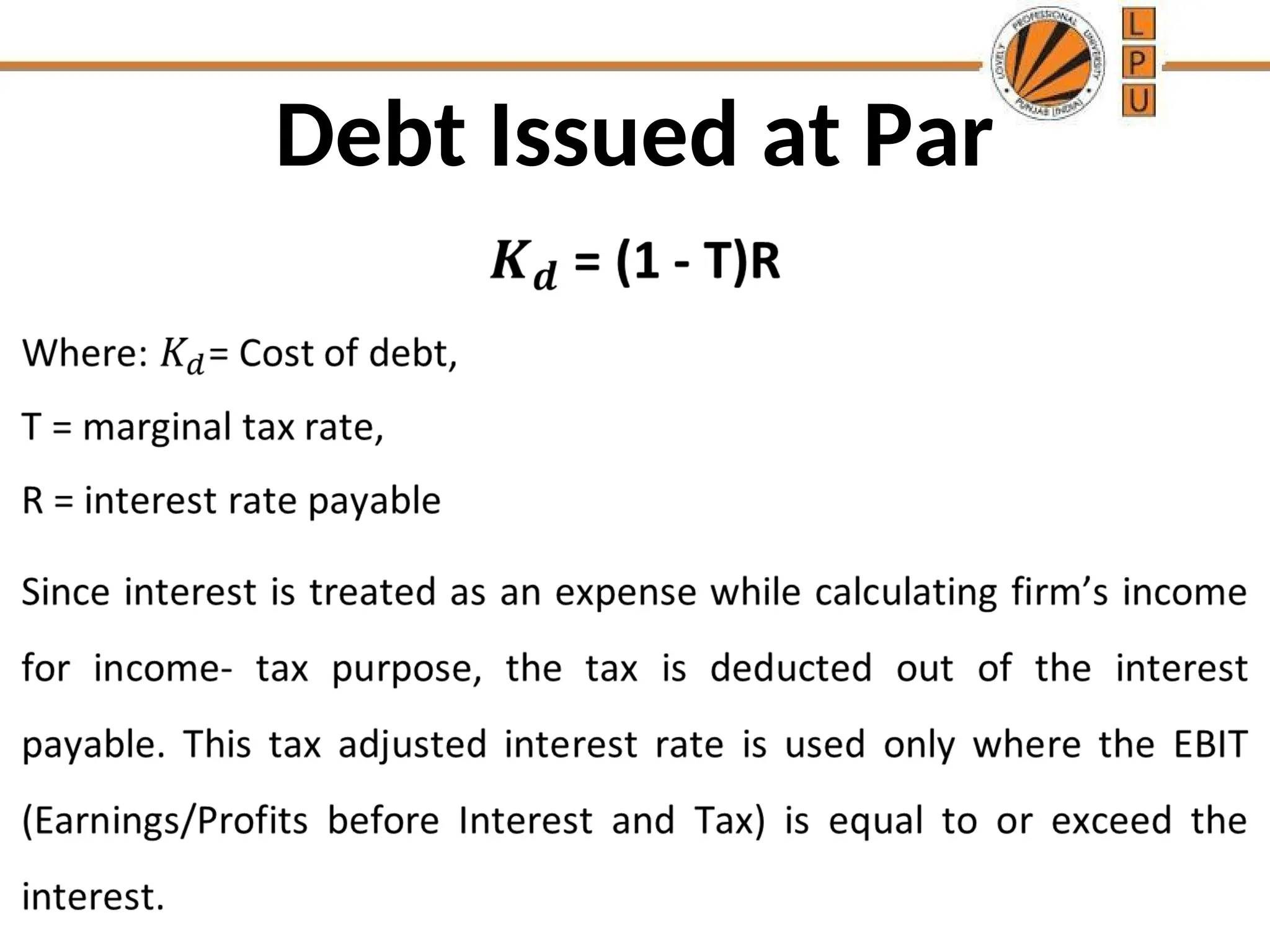
Debt Issued at Par
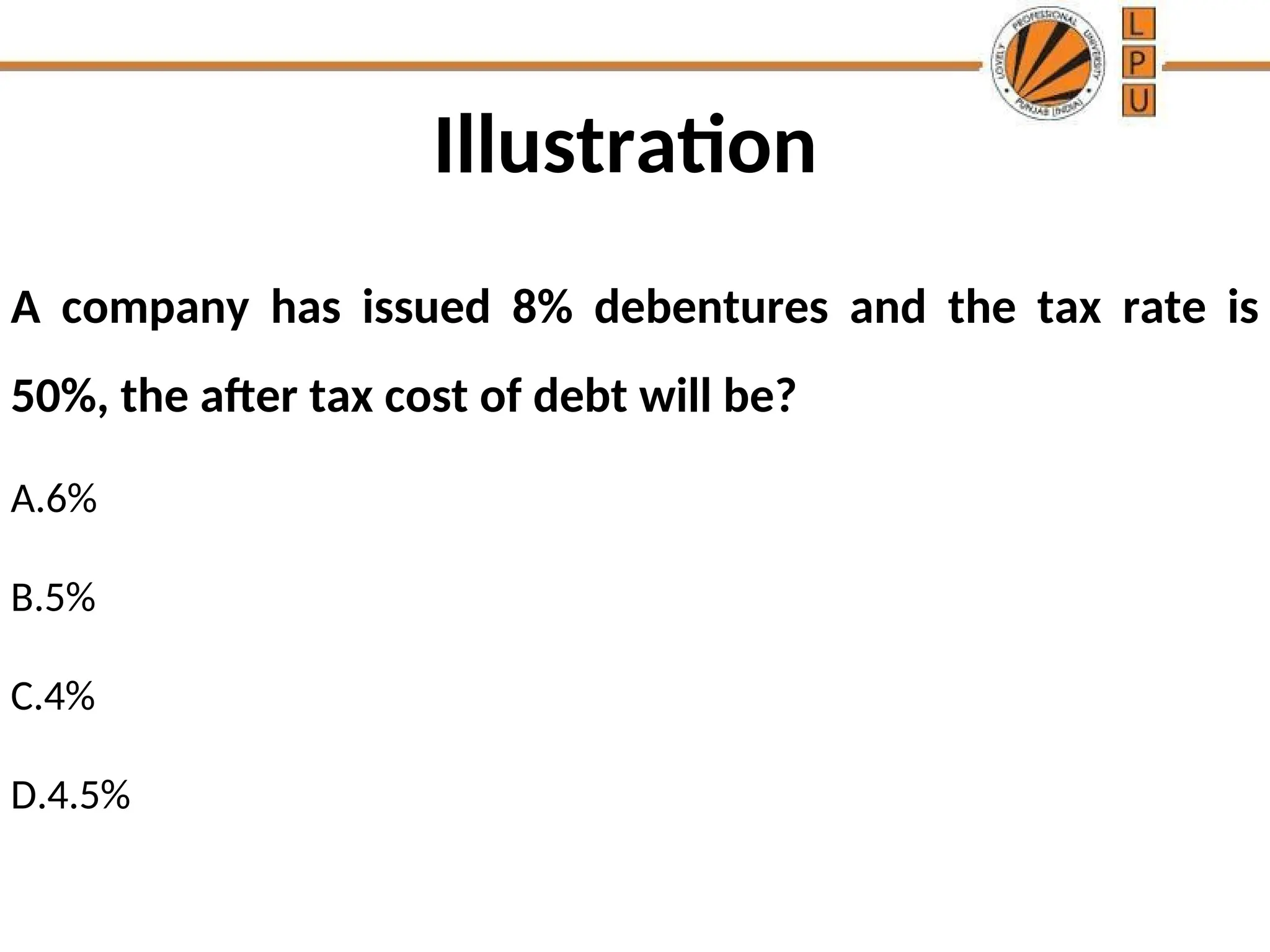
Illustration
A company has issued 8% debentures and the tax rate is
50%, the after tax cost of debt will be?
A.6%
B.5%
C.4%
D.4.5%
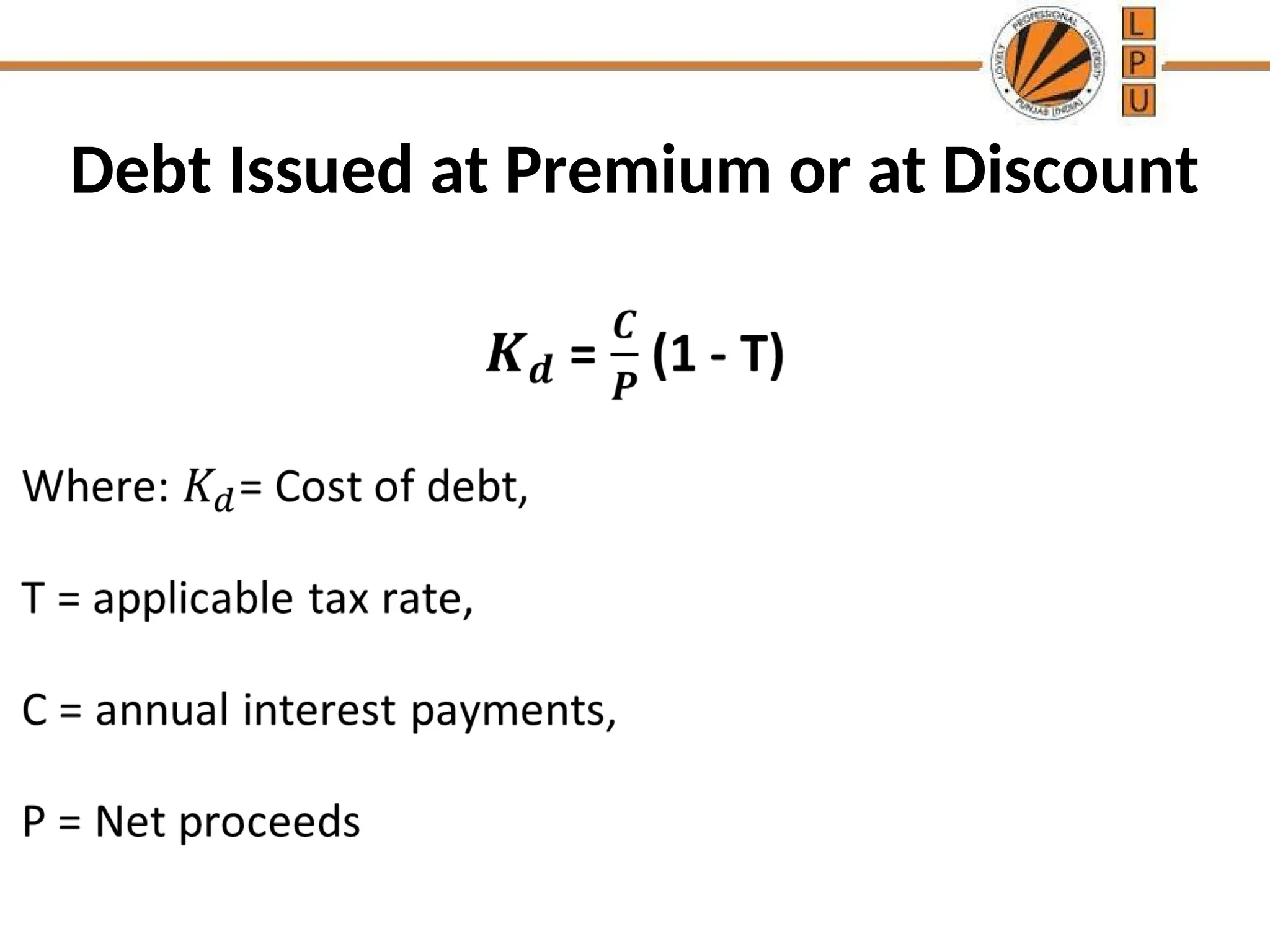
Debt Issued at Premium or at Discount
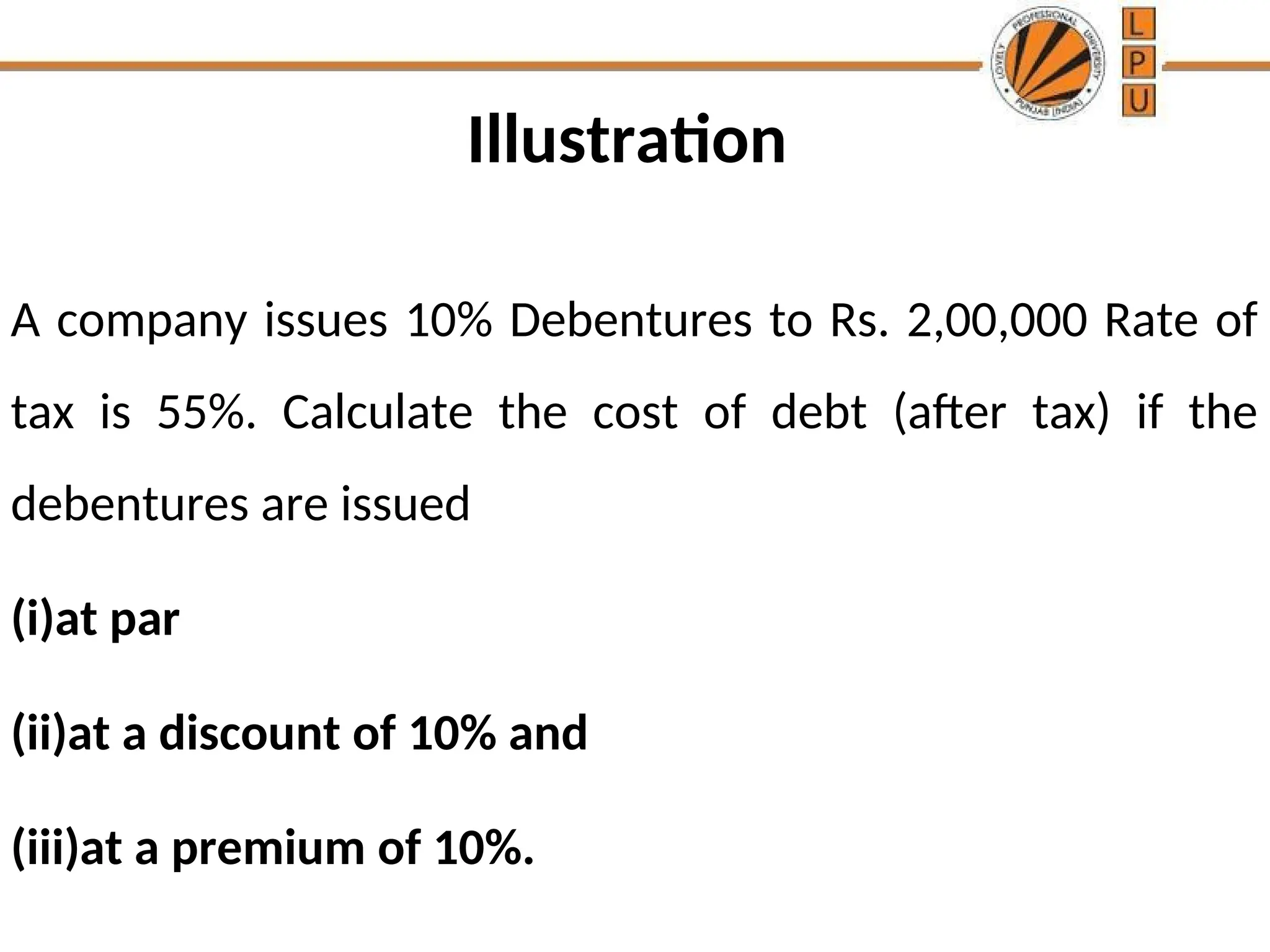
Illustration
A company issues 10% Debentures to Rs. 2,00,000 Rate of
tax is 55%. Calculate the cost of debt (after tax) if the
debentures are issued
(i)at par
(ii)at a discount of 10% and
(iii)at a premium of 10%.
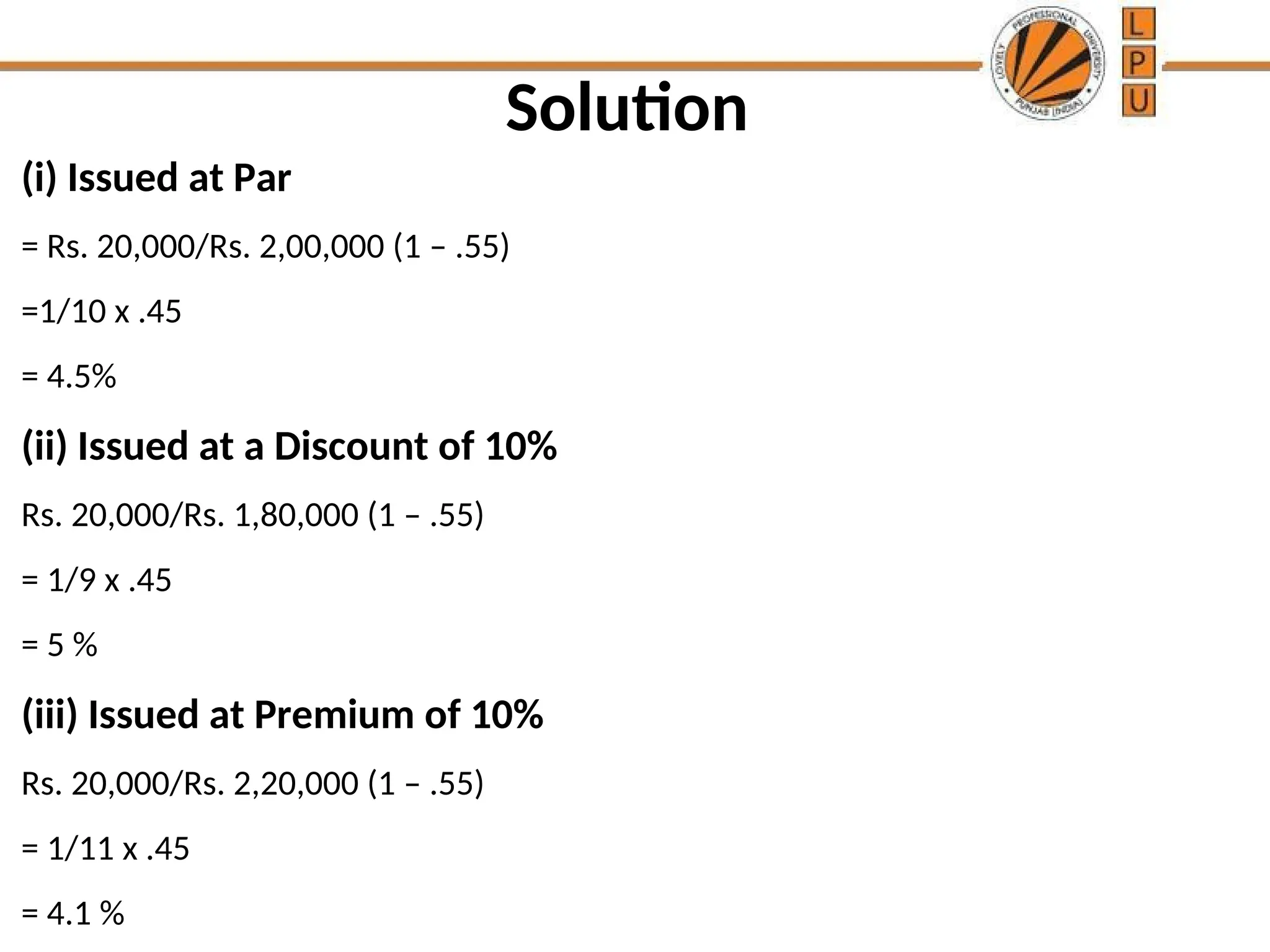
Solution
(i) Issued at Par
= Rs. 20,000/Rs. 2,00,000 (1 – .55)
=1/10 x .45
= 4.5%
(ii) Issued at a Discount of 10%
Rs. 20,000/Rs. 1,80,000 (1 – .55)
= 1/9 x .45
= 5 %
(iii) Issued at Premium of 10%
Rs. 20,000/Rs. 2,20,000 (1 – .55)
= 1/11 x .45
= 4.1 %
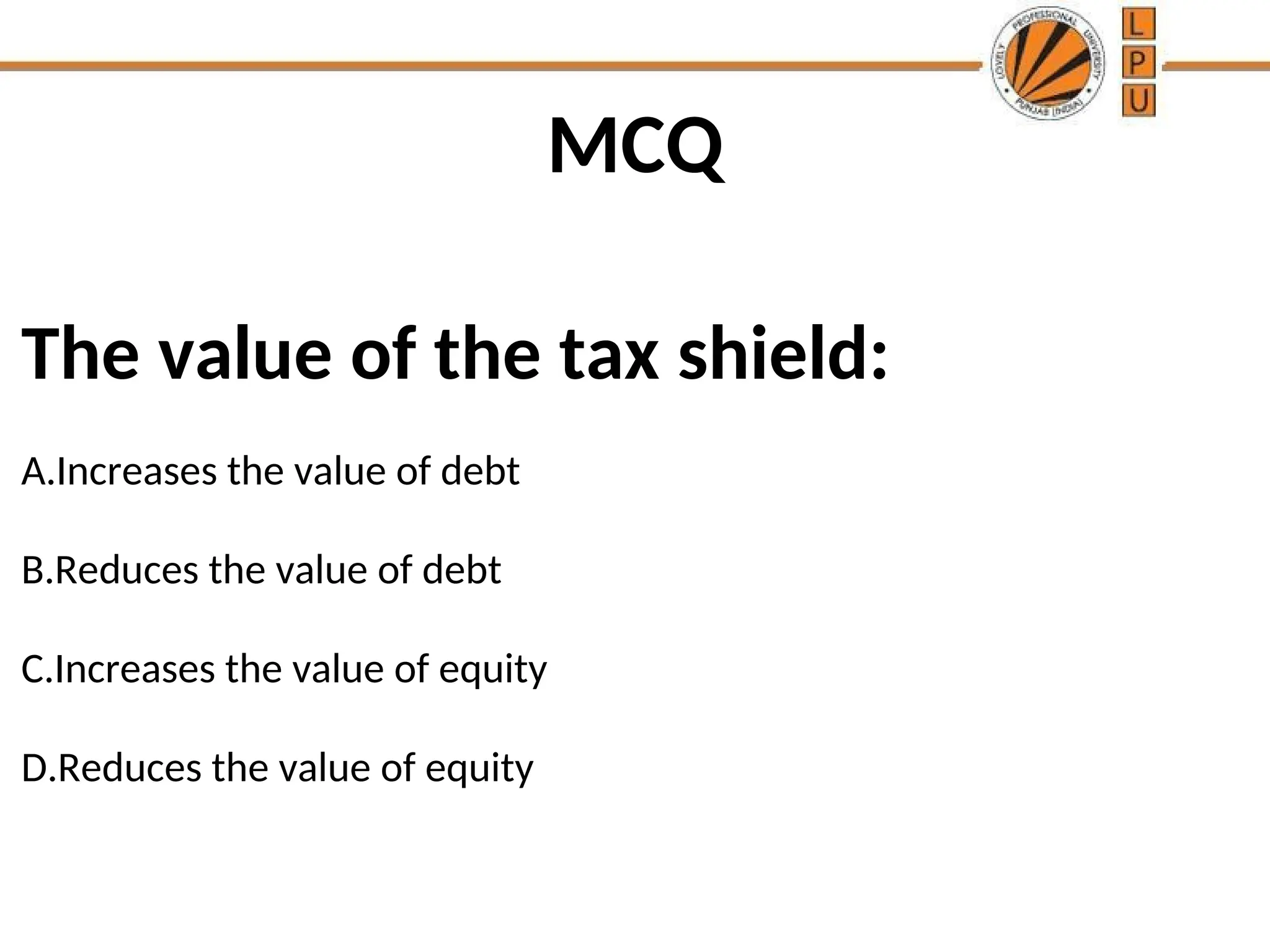
MCQ
The value of the tax shield:
A.Increases the value of debt
B.Reduces the value of debt
C.Increases the value of equity
D.Reduces the value of equity
Answer
C. Increases the value of equity (The tax saving
increases the cash flows for the shareholders and hence
the value of equity.)
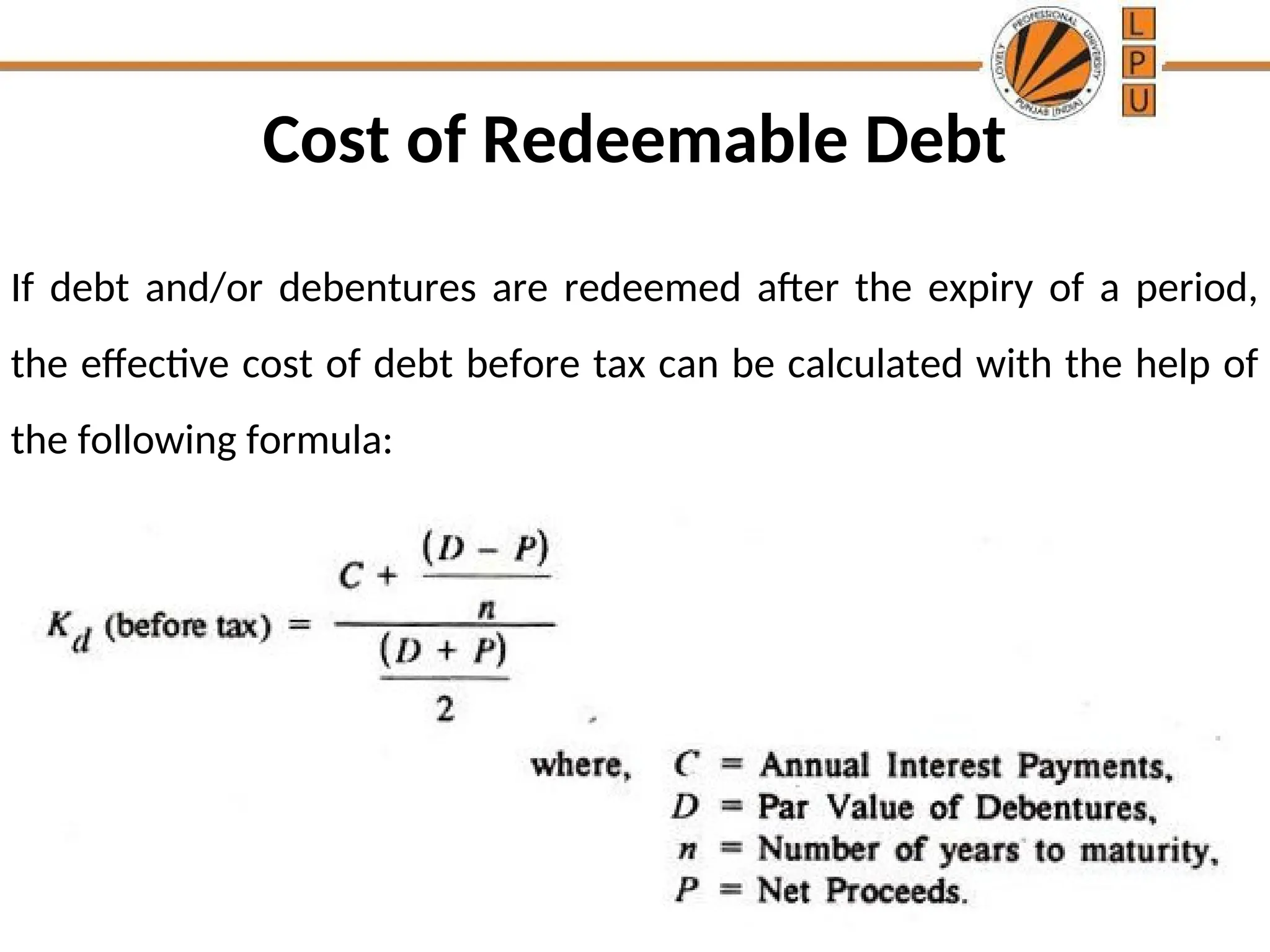
Cost of Redeemable Debt
If debt and/or debentures are redeemed after the expiry of a period,
the effective cost of debt before tax can be calculated with the help of
the following formula:
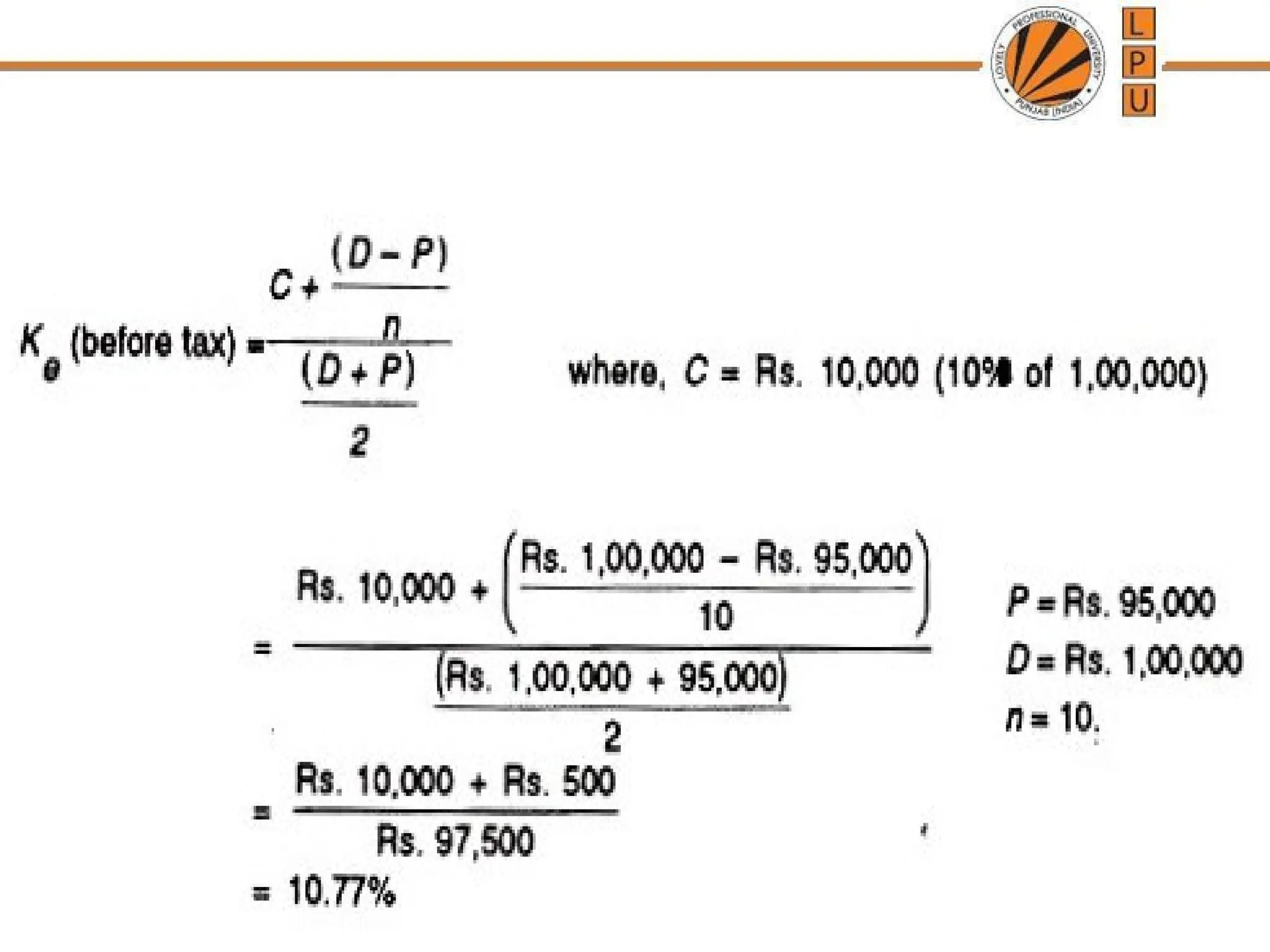
Illustration
A company issues 10,000, 10% Debentures of Rs.10 each and
realizes Rs.95,000 after allowing 5% commission to brokers.
The debentures are redeemed after 10 years. Calculate the
effective cost of debt before tax.
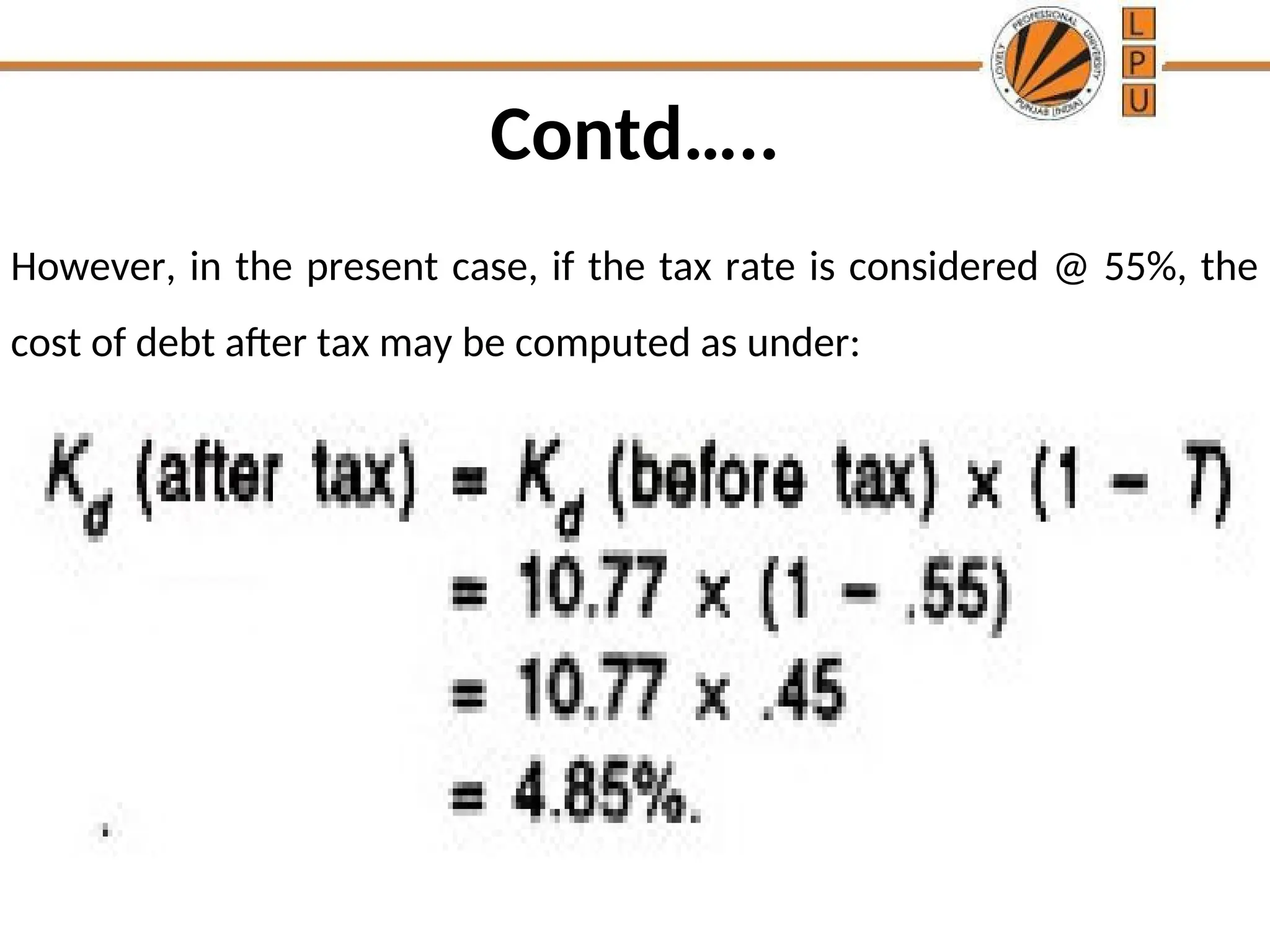
Contd…..
However, in the present case, if the tax rate is considered @ 55%, the
cost of debt after tax may be computed as under:
MCQ
Which one of the following represents the best estimate for
a firm's pre-tax cost of debt?
A.the current yield-to-maturity on the firm's existing debt
B.the firm's historical cost of capital
C.twice the rate of return currently offered on risk-free securities
D.the current coupon on the firm's existing debt
Answer
A. the current yield-to-maturity on the firm's existing
debt

financial statement analysis .Unit 3 1.ppt

  • 1.
  • 2.
    Course Outcome • Appraisethe concept of cost of capital and its significance in financial decision making. • Evaluate the cost of debt under different types of issued debt.
  • 3.
    Definition of Costof Capital According to Mittal and Agarwal “the cost of capital is the minimum rate of return which a company is expected to earn from a proposed project so as to make no reduction in the earning per share to equity shareholders and its market price”.
  • 4.
    It should beclear at the outset that the cost of capital for a project is defined by its risk, rather than the characteristics of the firm undertaking the project.
  • 5.
    Cost of Capitaldepends upon a) Demand and supply of capital (Economic condition, market opp.) b) Expected rate of inflation (lenders & purchasing power) c) Various risk involved (business risk, financial risk) d) Debt-equity ratio of the firm (capital structure)
  • 6.
    Significance of Costof Capital 1) Maximization of the Value of the Firm 2) Capital Budgeting Decisions 3) Management of Working Capital 4) Determination of Capital Structure 5) Evaluation of Financial Performance
  • 7.
    MCQ The cost ofcapital: a.will decrease as the risk level of a firm increases. b.is primarily dependent upon the source of the funds used for a project. c.implies a project will produce a positive net present value only when the rate of return on the project is less than the predetermined cost of capital. d.depends on how the funds are going to be utilized
  • 8.
    Answer a. depends onhow the funds are going to be utilized
  • 9.
    Components of Costof Capital The individual cost of each source of financing is called component of cost of capital. Such components of cost of capital have been presented below: a)Cost of Debt b)Cost of Preference capital c)Cost of equity capital d)Cost of retained earning
  • 10.
    Cost of Debt Acompany may raise debt in variety of ways. It may borrow funds from financial institutions or public either in the form of public deposits or debentures (bonds) for a specified period of time at a certain rate of interest. A debenture or bond may be issued at par or at a discount or premium as compared to its face value.
  • 11.
  • 12.
    Illustration A company hasissued 8% debentures and the tax rate is 50%, the after tax cost of debt will be? A.6% B.5% C.4% D.4.5%
  • 13.
    Debt Issued atPremium or at Discount
  • 14.
    Illustration A company issues10% Debentures to Rs. 2,00,000 Rate of tax is 55%. Calculate the cost of debt (after tax) if the debentures are issued (i)at par (ii)at a discount of 10% and (iii)at a premium of 10%.
  • 15.
    Solution (i) Issued atPar = Rs. 20,000/Rs. 2,00,000 (1 – .55) =1/10 x .45 = 4.5% (ii) Issued at a Discount of 10% Rs. 20,000/Rs. 1,80,000 (1 – .55) = 1/9 x .45 = 5 % (iii) Issued at Premium of 10% Rs. 20,000/Rs. 2,20,000 (1 – .55) = 1/11 x .45 = 4.1 %
  • 16.
    MCQ The value ofthe tax shield: A.Increases the value of debt B.Reduces the value of debt C.Increases the value of equity D.Reduces the value of equity
  • 17.
    Answer C. Increases thevalue of equity (The tax saving increases the cash flows for the shareholders and hence the value of equity.)
  • 18.
    Cost of RedeemableDebt If debt and/or debentures are redeemed after the expiry of a period, the effective cost of debt before tax can be calculated with the help of the following formula:
  • 19.
    Illustration A company issues10,000, 10% Debentures of Rs.10 each and realizes Rs.95,000 after allowing 5% commission to brokers. The debentures are redeemed after 10 years. Calculate the effective cost of debt before tax.
  • 21.
    Contd….. However, in thepresent case, if the tax rate is considered @ 55%, the cost of debt after tax may be computed as under:
  • 22.
    MCQ Which one ofthe following represents the best estimate for a firm's pre-tax cost of debt? A.the current yield-to-maturity on the firm's existing debt B.the firm's historical cost of capital C.twice the rate of return currently offered on risk-free securities D.the current coupon on the firm's existing debt
  • 23.
    Answer A. the currentyield-to-maturity on the firm's existing debt