Learning Objectives;
• Prepareand interpret financial
statement in comparative and common-
size from.
• Compute and interpret financial ratios
that managers use to assess liquidity,
asset and debt management,
profitability and market performance.
3.
Why Managers useFSA?
1. Enables them to better understand how their
company’s results will be interpreted by
stockholders and creditors for the purpose of
making investing and lending decisions.
2. Financial statement analysis provides managers with
valuable feedback regarding their company’s
performance.
4.
Limitations of Financial
1.Comparing Financial Data across Companies
Use of different Accounting methods.( e.g.
Inventory management.)
2. Looking beyond Ratios
Ratios should not be viewed as an end, but rather
as a starting point.
5.
Statement in Comparative
andCommon-Size form
1. Dollar/Peso and percentage changes on statement
(Horizontal Analysis)
2. Common-Size Statements ( Vertical Analysis)
3. Ratios
6.
1. Dollar/Peso andpercentage changes
on statement (Horizontal Analysis)
- Also known as Trend Analysis
- Involves analyzing financial data over time, such as
computing year-to-year dollar/peso and percentage
changes within a set of financial statements.
Comp Balance Sheet.jpeg
Comp Income Statement.jpeg
7.
2. Common-Size Statements
(VerticalAnalysis)
- Focuses on the relations among financial statement accounts at a
given point in time.
- A vertical analysis in which each financial statement account is
expressed as a percentage.
Income Statement – all items are usually expressed as
percentage of sales.
ComSize Balance sheet.jpeg
Balance Sheet – all items are usually expressed as a
percentage of total assets.
ComSize Income statement.jpeg
8.
3. Ratio Analysis
a.Liquidity
- Refers to how quickly an asset can be converted to
cash.
- If a company’s liquid assets are not enough to support
timely payments to short-term creditors, this presents
an important management problem that, if not
remedied, can lead to bankruptcy.
Working Capital = Current Asset-Current Liabilities
9.
3. Ratio Analysis
a.Liquidity
3.a.1.) Current Ratio
=
- A declining ratio might be a sign of deteriorating
financial condition
- An improving ratio might be the result of stockpiling
inventory or might indicate an improving financial
situation.
10.
3. Ratio Analysis
a.Liquidity
3.a.2.) Acid-Test ratio
=
- A more rigorous test of a company’s ability to meet its
short-term debts than the current ratio.
- Inventories and prepaid expenses are excluded from
total current assets, leaving only the more liquid
assets.
11.
3. Ratio Analysis
b.Asset Management
3.b.1) Accounts Receivable Turnover
=
Average Collection Period
=
12.
3. Ratio Analysis
b.Asset Management
3.b.2.) Inventory turnover
=
- Measures how many times a company’s inventory has been
sold and replaced during the year.
3.b.3) Average Sales Period
=
- The number of days needed on average to sell the entire
inventory.
13.
3. Ratio Analysis
b.Asset Management
3.b.2.) Operating Cycle
OC = Average sales period + Average Collection Period
- Measures the elapsed time from when an inventory is
received from suppliers to when cash is received from
customers.
3.b.3) Total Asset Turnover
=
14.
3. Ratio Analysis
c.Debt Management
- Managers need to evaluate their company’s debt management choices
from the vantage point of two stakeholders – a. long-term creditors
and b. common stockholders.
Financial Leverage
- refers to borrowing money to acquire assets in an effort to
increase sales and profits.
If the company’s rate of return on total assets exceeds the rate of
return the company pay its creditors, Financial Leverage is positive.
If the rate of return on total assets is less than the rate of return the
company pay its creditors, Financial Leverage is Negative.
15.
3. Ratio Analysis
c.Debt Management
3.c.1) Times Interest Earned Ratio
=
- measure of company’s ability to provide protection to its
long-term creditors.
- less than 1 is inadequate because interest expense
exceeds the earnings that are available for paying that interest.
16.
3. Ratio Analysis
c.Debt Management
3.c.2) Debt-to-Equity Ratio
=
- a type of leverage ratio that indicates the relative
proportions of debt and equity at one point in time on a
company’s balance sheet.
- As it increases, it indicates that a company in increasing its
financial leverage.
17.
3. Ratio Analysis
c.Debt Management
3.c.3) Equity Multiplier
=
- another type of leverage ratio that indicates the portion of
a company’s assets funded by equity.
- As it increases, it indicates that a company in increasing its
financial leverage.
18.
3. Ratio Analysis
d.Profitability
3.d.1) Gross Margin Percentage
=
- Focuses on only one type of expense (Cost of goods sold)
and its impact on performance.
3.d.2) Net Profit Margin Percentage
=
- looks on how selling and administrative expenses, Interest
expense, and income tax expense have influenced
performance.
19.
3. Ratio Analysis
d.Profitability
3.d.3) Return on Total Assets
=
- Interest is added back to net income to show what
earnings would have been if the company had no debt.
- Manager can evaluate his company’s return on total assets
over time without the analysis being influenced by changes
in the company’s mix of debt and equity over time.
20.
3. Ratio Analysis
d.Profitability
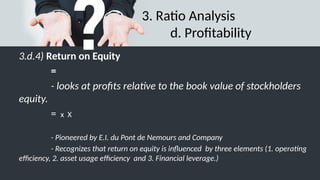
3.d.4) Return on Equity
=
- looks at profits relative to the book value of stockholders
equity.
= x X
- Pioneered by E.I. du Pont de Nemours and Company
- Recognizes that return on equity is influenced by three elements (1. operating
efficiency, 2. asset usage efficiency and 3. Financial leverage.)
21.
3. Ratio Analysis
e.Market Performance
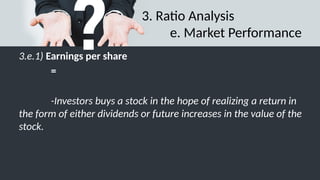
3.e.1) Earnings per share
=
-Investors buys a stock in the hope of realizing a return in
the form of either dividends or future increases in the value of the
stock.
22.
3. Ratio Analysis
e.Market Performance
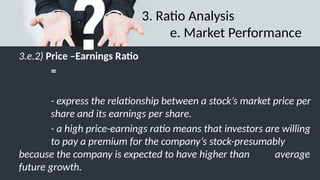
3.e.2) Price –Earnings Ratio
=
- express the relationship between a stock’s market price per
share and its earnings per share.
- a high price-earnings ratio means that investors are willing
to pay a premium for the company’s stock-presumably
because the company is expected to have higher than average
future growth.
23.
3. Ratio Analysis
e.Market Performance
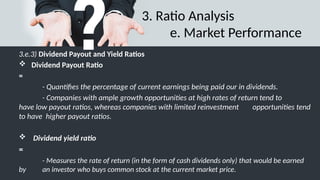
3.e.3) Dividend Payout and Yield Ratios
Dividend Payout Ratio
=
- Quantifies the percentage of current earnings being paid our in dividends.
- Companies with ample growth opportunities at high rates of return tend to
have low payout ratios, whereas companies with limited reinvestment opportunities tend
to have higher payout ratios.
Dividend yield ratio
=
- Measures the rate of return (in the form of cash dividends only) that would be earned
by an investor who buys common stock at the current market price.
24.
3. Ratio Analysis
e.Market Performance
3.e.4) Book Value per Share
=
- Measures the amount that would be distributed to holders of each share of
common stocks if all assets were sold at their balance sheet carrying amounts and if all
creditors were paid off.