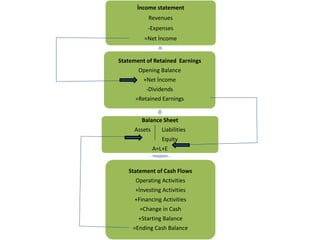
İncome statement
Revenues
-Expenses
=Net İncome
Statement of Retained Earnings
Opening Balance
+Net İncome
-Dividends
=Retained Earnings
Balance Sheet
Assets Liabilities
Equity
A=L+E
Statement of Cash Flows
Operating Activities
+İnvesting Activities
+Financing Activities
=Change in Cash
+Starting Balance
=Ending Cash Balance
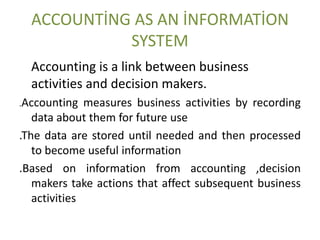
ACCOUNTİNG AS AN İNFORMATİON
SYSTEM
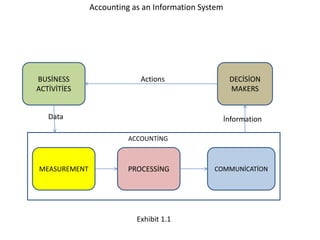
Accounting is a link between business
activities and decision makers.
.Accounting measures business activities by recording
data about them for future use
.The data are stored until needed and then processed
to become useful information
.Based on information from accounting ,decision
makers take actions that affect subsequent business
activities
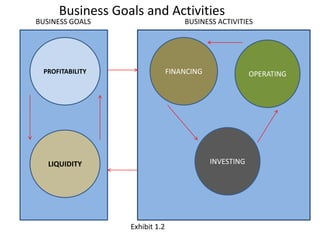
PROFITABILITY
LIQUIDITY
FINANCING OPERATING
INVESTING
BUSINESS GOALS BUSINESS ACTIVITIES
Business Goals and Activities
Exhibit 1.2
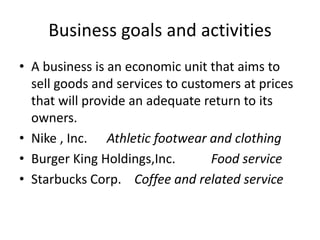
Business goals and activities
• A business is an economic unit that aims to
sell goods and services to customers at prices
that will provide an adequate return to its
owners.
• Nike , Inc. Athletic footwear and clothing
• Burger King Holdings,Inc. Food service
• Starbucks Corp. Coffee and related service
The two major goals of all businesses are profitabilitiy
and liquidity.
Profitability is the ability to earn enough income to
attract and hold investment capital.
Liquidity is the ability to have enough cash to pay
debts when they are due.
Accounting as an Information System
BUSİNESS
ACTİVİTİES
DECİSİON
MAKERS
COMMUNİCATİON
PROCESSİNG
MEASUREMENT
Exhibit 1.1
ACCOUNTİNG
Actions
Data İnformation
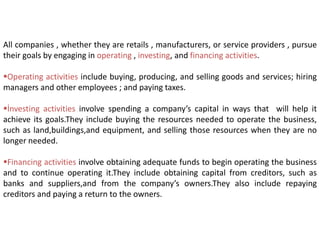
All companies , whether they are retails , manufacturers, or service providers , pursue
their goals by engaging in operating , investing, and financing activities.
Operating activities include buying, producing, and selling goods and services; hiring
managers and other employees ; and paying taxes.
İnvesting activities involve spending a company’s capital in ways that will help it
achieve its goals.They include buying the resources needed to operate the business,
such as land,buildings,and equipment, and selling those resources when they are no
longer needed.
Financing activities involve obtaining adequate funds to begin operating the business
and to continue operating it.They include obtaining capital from creditors, such as
banks and suppliers,and from the company’s owners.They also include repaying
creditors and paying a return to the owners.
Financial and Management Accounting
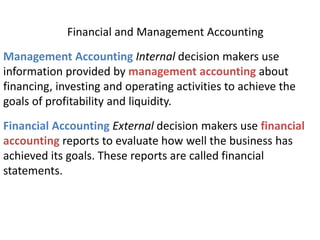
Management Accounting Internal decision makers use
information provided by management accounting about
financing, investing and operating activities to achieve the
goals of profitability and liquidity.
Financial Accounting External decision makers use financial
accounting reports to evaluate how well the business has
achieved its goals. These reports are called financial
statements.
Ethical Financial Reporting
Ethics is a code of conduct that applies to everyday life.It
adresses the question of whether actions are right or wrong.
DECISION MAKERS:THE USERS OF
ACCOUNTING INFORMATION
The people who use accounting information to make decisions fall into
three categories:
•Those who manage a business
•Those outside a business enterprise who have a direct
financial interest in the business
•Those who have an indirect financial interest in a business
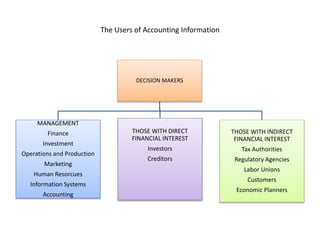
The Users of Accounting Information
DECISION MAKERS
MANAGEMENT
Finance
Investment
Operations and Production
Marketing
Human Resorcues
Information Systems
Accounting
THOSE WITH DIRECT
FINANCIAL INTEREST
Investors
Creditors
THOSE WITH INDIRECT
FINANCIAL INTEREST
Tax Authorities
Regulatory Agencies
Labor Unions
Customers
Economic Planners
Users with a Direct Financial Interest
• The primary external users of accounting
information are investors and creditors.
Users with an Indirect Financial
Interest
• Tax Authorities,
• Regulatory Agencies,
• Other Groups: Labor Unions- Advisors of
Investors and Creditors- Consumer Groups,
Customers, and the General Public- Economic
Planners
THE FINANCIAL STATEMENTS AND
THEIR ELEMENTS
• Four major financial statements are used to
communicate accounting information abut a
buiness:
• the income statemet,
• the statement of retained earnings,
• the balance sheet,
• the statement of cash flows.
Income Statement
The basic elements of an income statement
revenues,expenses,and net income
Statement of retained earnings
Retained earnings represent the accumulated
earnings generated by a business’s income-
producing activities less amounts that have
been paid out to stockholders
Balance sheet
The purpose of a balance sheet is o show the
financial position of a business on a certain
date, usually the end of the month or year.
It often is called the statement of financial
position.
• The date on the balance sheet is a single date ,
whereas the dates on the other three
statements cover a period of time, such as a
month,quarter,or year.
• The balance sheet presents a view of the
business as the holder of resources .
• It has three elements : assets, liabilities (also
called creditors’ equities), and stockholders’
equity.
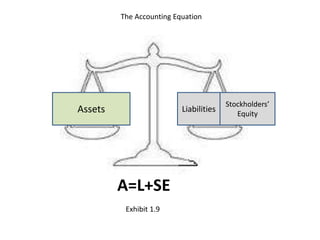
Assets Liabilities
Stockholders’
Equity
A=L+SE
Exhibit 1.9
The Accounting Equation
This equation is known as the accounting equation.
The two sides of the equation must always be equal ,
or be ‘’in balance’’, as shown in Exhibit 1.9.
Assets Assets are the economic resources of company that
are expected to benefit the company’s future operations.
Certain kinds of assets -cash and accounts receivable- are
monetary items.
Other assets – inventories, land, building and equipment –
are nonmonetary phsical items.
Still other assets – the right granted by patents, trademark,
and copyrights- are nonphysical.
Liabilities Liabilities are a business’s present obligations to pay
cash , transfer assets , or provide services to other entities in
the future.
Among these obligations are amounts owed to suppliers for
goods or services bought on credit ( called accounts payable )
Borrowed money ( money owed on bank loans )
Salaries and wages owed to employees
Taxes owed to the government .
Stockholders’ equity stockholders’ equity (also called
shareholders’ equity ) represents the claims of the owners of
a corporation to the assets of the business.
Stockholders’ equity has two parts, contributed capital and
retained earnings :
Stockholders’ Equity = Contributed Capital + Retained
Earnings
Contributed Capital is the amount that stockholders
invest in the business.
Statement f Cash Flows
Whereas the income statement focuses on a company’s
profitabilitiy, the statement os cash flows focuses on its
liquidity.
Cash flows are the inflows and outflows of cash into and out
of a business.
Net cash flows are the difference between the inflows and
outflows.
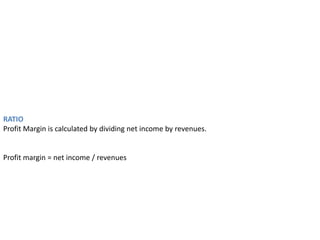
RATIO
Profit Margin is calculated by dividing net income by revenues.
Profit margin = net income / revenues
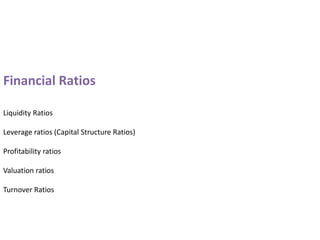
Financial Ratios
Liquidity Ratios
Leverage ratios (Capital Structure Ratios)
Profitability ratios
Valuation ratios
Turnover Ratios
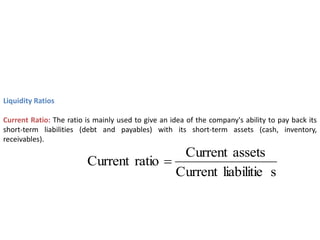
Liquidity Ratios
Current Ratio: The ratio is mainly used to give an idea of the company's ability to pay back its
short-term liabilities (debt and payables) with its short-term assets (cash, inventory,
receivables).
s
liabilitie
Current
assets
Current
ratio
Current 
Quick Ratio: The quick ratio measures the dollar amount of liquid assets available for each
dollar of current liabilities.
Quick Ratio =Cash in hand + Cash at Bank + Receivables + Marketable Securities
Current Liabilities
= (current assets – inventory)/ Current liabilities
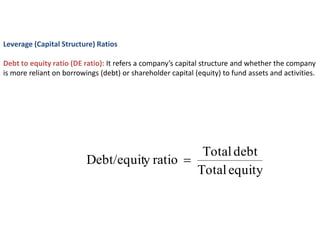
Leverage (Capital Structure) Ratios
Debt to equity ratio (DE ratio): It refers a company’s capital structure and whether the company
is more reliant on borrowings (debt) or shareholder capital (equity) to fund assets and activities.
equity
Total
debt
Total
ratio
y
Debt/equit 
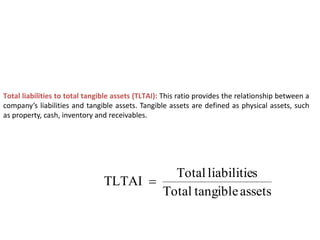
Total liabilities to total tangible assets (TLTAI): This ratio provides the relationship between a
company’s liabilities and tangible assets. Tangible assets are defined as physical assets, such
as property, cash, inventory and receivables.
assets
tangible
Total
s
liabilitie
Total
TLTAI 
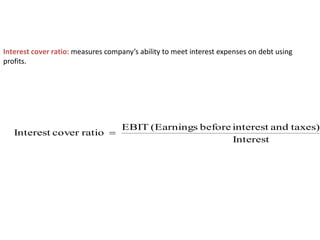
Interest cover ratio: measures company’s ability to meet interest expenses on debt using
profits.
Interest
taxes)
and
interest
before
(Earnings
EBIT
ratio
cover
Interest 
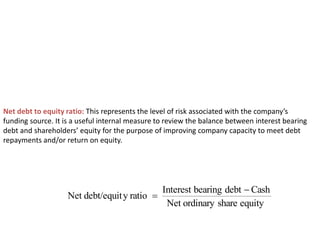
Net debt to equity ratio: This represents the level of risk associated with the company’s
funding source. It is a useful internal measure to review the balance between interest bearing
debt and shareholders’ equity for the purpose of improving company capacity to meet debt
repayments and/or return on equity.
equity
share
ordinary
Net
Cash
debt
bearing
Interest
ratio
y
debt/equit
Net


Profitability Ratios
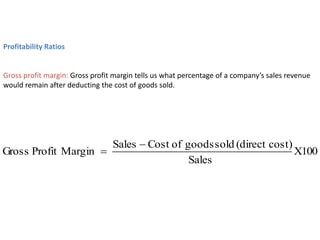
Gross profit margin: Gross profit margin tells us what percentage of a company’s sales revenue
would remain after deducting the cost of goods sold.
100
X
Sales
cost)
(direct
sold
goods
of
Cost
Sales
Margin
Profit
Gross


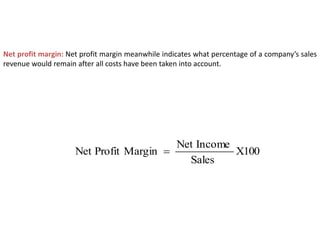
Net profit margin: Net profit margin meanwhile indicates what percentage of a company’s sales
revenue would remain after all costs have been taken into account.
100
X
Sales
Income
Net
Margin
Profit
Net 
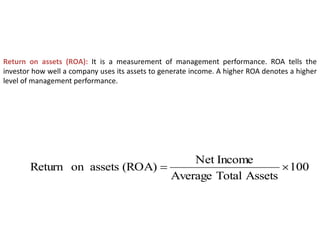
Return on assets (ROA): It is a measurement of management performance. ROA tells the
investor how well a company uses its assets to generate income. A higher ROA denotes a higher
level of management performance.
100
Assets
Total
Average
Income
Net
(ROA)
assets
on
Return 

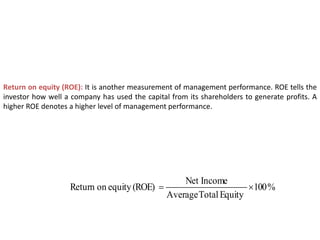
Return on equity (ROE): It is another measurement of management performance. ROE tells the
investor how well a company has used the capital from its shareholders to generate profits. A
higher ROE denotes a higher level of management performance.
%
100
Equity
Total
Average
Income
Net
(ROE)
equity
on
Return 

Valuation Ratios
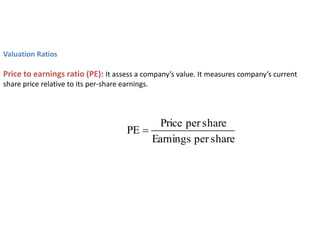
Price to earnings ratio (PE): It assess a company’s value. It measures company’s current
share price relative to its per-share earnings.
share
per
Earnings
share
per
Price
PE 
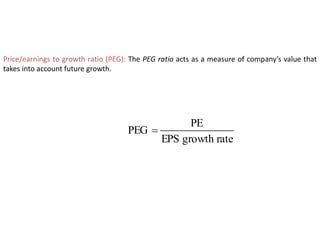
Price/earnings to growth ratio (PEG): The PEG ratio acts as a measure of company’s value that
takes into account future growth.
rate
growth
EPS
PE
PEG 
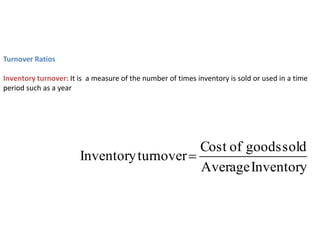
Turnover Ratios
Inventory turnover: It is a measure of the number of times inventory is sold or used in a time
period such as a year
Inventory
Average
sold
goods
of
Cost
turnover
Inventory 

financial-statement-analysis-c-1-ppt-4Ob3.pptx

  • 1.
    İncome statement Revenues -Expenses =Net İncome Statementof Retained Earnings Opening Balance +Net İncome -Dividends =Retained Earnings Balance Sheet Assets Liabilities Equity A=L+E Statement of Cash Flows Operating Activities +İnvesting Activities +Financing Activities =Change in Cash +Starting Balance =Ending Cash Balance
  • 2.
    ACCOUNTİNG AS ANİNFORMATİON SYSTEM Accounting is a link between business activities and decision makers. .Accounting measures business activities by recording data about them for future use .The data are stored until needed and then processed to become useful information .Based on information from accounting ,decision makers take actions that affect subsequent business activities
  • 3.
    PROFITABILITY LIQUIDITY FINANCING OPERATING INVESTING BUSINESS GOALSBUSINESS ACTIVITIES Business Goals and Activities Exhibit 1.2
  • 4.
    Business goals andactivities • A business is an economic unit that aims to sell goods and services to customers at prices that will provide an adequate return to its owners. • Nike , Inc. Athletic footwear and clothing • Burger King Holdings,Inc. Food service • Starbucks Corp. Coffee and related service
  • 5.
    The two majorgoals of all businesses are profitabilitiy and liquidity. Profitability is the ability to earn enough income to attract and hold investment capital. Liquidity is the ability to have enough cash to pay debts when they are due.
  • 6.
    Accounting as anInformation System BUSİNESS ACTİVİTİES DECİSİON MAKERS COMMUNİCATİON PROCESSİNG MEASUREMENT Exhibit 1.1 ACCOUNTİNG Actions Data İnformation
  • 7.
    All companies ,whether they are retails , manufacturers, or service providers , pursue their goals by engaging in operating , investing, and financing activities. Operating activities include buying, producing, and selling goods and services; hiring managers and other employees ; and paying taxes. İnvesting activities involve spending a company’s capital in ways that will help it achieve its goals.They include buying the resources needed to operate the business, such as land,buildings,and equipment, and selling those resources when they are no longer needed. Financing activities involve obtaining adequate funds to begin operating the business and to continue operating it.They include obtaining capital from creditors, such as banks and suppliers,and from the company’s owners.They also include repaying creditors and paying a return to the owners.
  • 8.
    Financial and ManagementAccounting Management Accounting Internal decision makers use information provided by management accounting about financing, investing and operating activities to achieve the goals of profitability and liquidity. Financial Accounting External decision makers use financial accounting reports to evaluate how well the business has achieved its goals. These reports are called financial statements.
  • 9.
    Ethical Financial Reporting Ethicsis a code of conduct that applies to everyday life.It adresses the question of whether actions are right or wrong.
  • 10.
    DECISION MAKERS:THE USERSOF ACCOUNTING INFORMATION The people who use accounting information to make decisions fall into three categories: •Those who manage a business •Those outside a business enterprise who have a direct financial interest in the business •Those who have an indirect financial interest in a business
  • 11.
    The Users ofAccounting Information DECISION MAKERS MANAGEMENT Finance Investment Operations and Production Marketing Human Resorcues Information Systems Accounting THOSE WITH DIRECT FINANCIAL INTEREST Investors Creditors THOSE WITH INDIRECT FINANCIAL INTEREST Tax Authorities Regulatory Agencies Labor Unions Customers Economic Planners
  • 12.
    Users with aDirect Financial Interest • The primary external users of accounting information are investors and creditors.
  • 13.
    Users with anIndirect Financial Interest • Tax Authorities, • Regulatory Agencies, • Other Groups: Labor Unions- Advisors of Investors and Creditors- Consumer Groups, Customers, and the General Public- Economic Planners
  • 14.
    THE FINANCIAL STATEMENTSAND THEIR ELEMENTS • Four major financial statements are used to communicate accounting information abut a buiness: • the income statemet, • the statement of retained earnings, • the balance sheet, • the statement of cash flows.
  • 15.
    Income Statement The basicelements of an income statement revenues,expenses,and net income
  • 16.
    Statement of retainedearnings Retained earnings represent the accumulated earnings generated by a business’s income- producing activities less amounts that have been paid out to stockholders
  • 17.
    Balance sheet The purposeof a balance sheet is o show the financial position of a business on a certain date, usually the end of the month or year. It often is called the statement of financial position.
  • 18.
    • The dateon the balance sheet is a single date , whereas the dates on the other three statements cover a period of time, such as a month,quarter,or year.
  • 19.
    • The balancesheet presents a view of the business as the holder of resources . • It has three elements : assets, liabilities (also called creditors’ equities), and stockholders’ equity.
  • 20.
  • 21.
    This equation isknown as the accounting equation. The two sides of the equation must always be equal , or be ‘’in balance’’, as shown in Exhibit 1.9.
  • 22.
    Assets Assets arethe economic resources of company that are expected to benefit the company’s future operations. Certain kinds of assets -cash and accounts receivable- are monetary items. Other assets – inventories, land, building and equipment – are nonmonetary phsical items. Still other assets – the right granted by patents, trademark, and copyrights- are nonphysical.
  • 23.
    Liabilities Liabilities area business’s present obligations to pay cash , transfer assets , or provide services to other entities in the future. Among these obligations are amounts owed to suppliers for goods or services bought on credit ( called accounts payable ) Borrowed money ( money owed on bank loans ) Salaries and wages owed to employees Taxes owed to the government .
  • 24.
    Stockholders’ equity stockholders’equity (also called shareholders’ equity ) represents the claims of the owners of a corporation to the assets of the business. Stockholders’ equity has two parts, contributed capital and retained earnings : Stockholders’ Equity = Contributed Capital + Retained Earnings Contributed Capital is the amount that stockholders invest in the business.
  • 25.
    Statement f CashFlows Whereas the income statement focuses on a company’s profitabilitiy, the statement os cash flows focuses on its liquidity. Cash flows are the inflows and outflows of cash into and out of a business. Net cash flows are the difference between the inflows and outflows.
  • 26.
    RATIO Profit Margin iscalculated by dividing net income by revenues. Profit margin = net income / revenues
  • 27.
    Financial Ratios Liquidity Ratios Leverageratios (Capital Structure Ratios) Profitability ratios Valuation ratios Turnover Ratios
  • 28.
    Liquidity Ratios Current Ratio:The ratio is mainly used to give an idea of the company's ability to pay back its short-term liabilities (debt and payables) with its short-term assets (cash, inventory, receivables). s liabilitie Current assets Current ratio Current 
  • 29.
    Quick Ratio: Thequick ratio measures the dollar amount of liquid assets available for each dollar of current liabilities. Quick Ratio =Cash in hand + Cash at Bank + Receivables + Marketable Securities Current Liabilities = (current assets – inventory)/ Current liabilities
  • 30.
    Leverage (Capital Structure)Ratios Debt to equity ratio (DE ratio): It refers a company’s capital structure and whether the company is more reliant on borrowings (debt) or shareholder capital (equity) to fund assets and activities. equity Total debt Total ratio y Debt/equit 
  • 31.
    Total liabilities tototal tangible assets (TLTAI): This ratio provides the relationship between a company’s liabilities and tangible assets. Tangible assets are defined as physical assets, such as property, cash, inventory and receivables. assets tangible Total s liabilitie Total TLTAI 
  • 32.
    Interest cover ratio:measures company’s ability to meet interest expenses on debt using profits. Interest taxes) and interest before (Earnings EBIT ratio cover Interest 
  • 33.
    Net debt toequity ratio: This represents the level of risk associated with the company’s funding source. It is a useful internal measure to review the balance between interest bearing debt and shareholders’ equity for the purpose of improving company capacity to meet debt repayments and/or return on equity. equity share ordinary Net Cash debt bearing Interest ratio y debt/equit Net  
  • 34.
    Profitability Ratios Gross profitmargin: Gross profit margin tells us what percentage of a company’s sales revenue would remain after deducting the cost of goods sold. 100 X Sales cost) (direct sold goods of Cost Sales Margin Profit Gross  
  • 35.
    Net profit margin:Net profit margin meanwhile indicates what percentage of a company’s sales revenue would remain after all costs have been taken into account. 100 X Sales Income Net Margin Profit Net 
  • 36.
    Return on assets(ROA): It is a measurement of management performance. ROA tells the investor how well a company uses its assets to generate income. A higher ROA denotes a higher level of management performance. 100 Assets Total Average Income Net (ROA) assets on Return  
  • 37.
    Return on equity(ROE): It is another measurement of management performance. ROE tells the investor how well a company has used the capital from its shareholders to generate profits. A higher ROE denotes a higher level of management performance. % 100 Equity Total Average Income Net (ROE) equity on Return  
  • 38.
    Valuation Ratios Price toearnings ratio (PE): It assess a company’s value. It measures company’s current share price relative to its per-share earnings. share per Earnings share per Price PE 
  • 39.
    Price/earnings to growthratio (PEG): The PEG ratio acts as a measure of company’s value that takes into account future growth. rate growth EPS PE PEG 
  • 40.
    Turnover Ratios Inventory turnover:It is a measure of the number of times inventory is sold or used in a time period such as a year Inventory Average sold goods of Cost turnover Inventory 