DISCOVER . LEARN . EMPOWER
Introduction - Concept
INSTITUTE- Global School of Finance &
Accounting
Masters of Commerce (M.Com)-ACCA
Financial Engineering
24CMT-731
Faculty Name - Mr. Rachit Agarwal
2
CO
Number
Title Level
CO1 The students will be able to Understand various
financial engineering concepts
Develop
CO2 The student will be able to Develop financial
mathematical based equations
Apply
CO3 The student will be able to Analyse various
financial products
Analyze
CO4 The student will be able to Evaluate best financial
services and products.
Evaluate
CO5 The student will be able to Create customized Create
Course Outcome
Financial
Engineering
• Historical Background
• Role of financial engineering in modern
finance
3
FINANCIAL
ENGINEERING
4
Historical Background of FINANCIAL
ENGINEERING
Financial engineering has evolved over decades, integrating
mathematical, statistical, and computational techniques to
solve complex financial problems. Below is a detailed
overview of its historical development:
1. Early Foundations (Pre-20th Century)
•The roots of financial engineering can be traced back to
early economic theories and mathematical applications
in finance.
• Louis Bachelier (1900) introduced the concept of
Brownian motion in his thesis, The Theory of
Speculation, laying the foundation for stochastic
5
2. The Rise of Quantitative Finance
(1950s-1970s)
•The mid-20th century saw the
emergence of quantitative finance,
driven by advancements in
mathematics and computing.
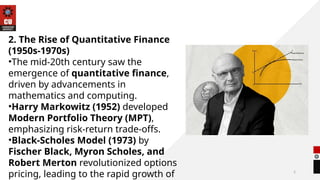
•Harry Markowitz (1952) developed
Modern Portfolio Theory (MPT),
emphasizing risk-return trade-offs.
•Black-Scholes Model (1973) by
Fischer Black, Myron Scholes, and
Robert Merton revolutionized options
pricing, leading to the rapid growth of
6
Inception and Early Stages (1970–
1997)
• Deregulation of interest rates, currencies, and commodity
prices creates need to manage risks.
• Tools created to do so (derivatives, theoretical pricing
models, risk measures).
• Technology provides platform and drives globalization
(telecom advances, hardware, software, first PCs).
• Financial firms build businesses to intermediate risk in
addition to capital.
7
Massive Growth (1998–2006)
• The world of “monoline” financial firms ends as banks, insurers,
traditional, and alternative asset managers combine and enter each others’
businesses globally.
• Asian currency crisis, Russian crisis, and LTCM launch global growth of the
business of enterprise risk management.
• Ongoing deregulation and freer markets spur growth.
• Credit derivatives and securitization grow from zero into the hundreds of
trillions, massively changing how risk and return are originated, held, and
transferred.
• BRICs, sovereign wealth funds emerge as major players in the world
capital market, vastly fueling globalization.
• Huge liquidity, low risk premiums, and low interest rates drive massive
growth in the size of firms (from banks to hedge funds), capital markets
(from emerging to established), and the use of leverage.
8
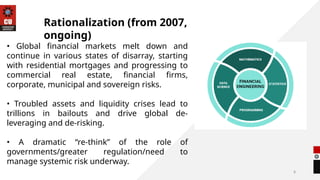
Rationalization (from 2007,
ongoing)
• Global financial markets melt down and
continue in various states of disarray, starting
with residential mortgages and progressing to
commercial real estate, financial firms,
corporate, municipal and sovereign risks.
• Troubled assets and liquidity crises lead to
trillions in bailouts and drive global de-
leveraging and de-risking.
• A dramatic “re-think” of the role of
governments/greater regulation/need to
manage systemic risk underway.
9
Role of Financial Engineering in Modern
Finance
Financial engineering is applied across various domains in modern finance:
A. Corporate Finance
•Helps firms structure financial instruments to maximize
shareholder value.
•Assists in capital budgeting and investment decision-
making.
B. Risk Management
•Uses quantitative models to assess and mitigate
financial risks.
•Develops hedging strategies using derivatives like
options and futures.
10
Role of Financial Engineering in Modern
Finance
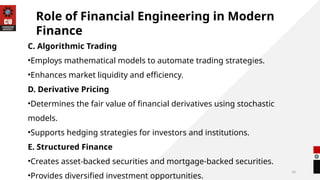
C. Algorithmic Trading
•Employs mathematical models to automate trading strategies.
•Enhances market liquidity and efficiency.
D. Derivative Pricing
•Determines the fair value of financial derivatives using stochastic
models.
•Supports hedging strategies for investors and institutions.
E. Structured Finance
•Creates asset-backed securities and mortgage-backed securities.
•Provides diversified investment opportunities.
11
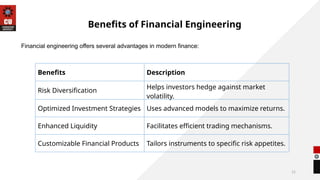
Benefits of Financial Engineering
Benefits Description
Risk Diversification
Helps investors hedge against market
volatility.
Optimized Investment Strategies Uses advanced models to maximize returns.
Enhanced Liquidity Facilitates efficient trading mechanisms.
Customizable Financial Products Tailors instruments to specific risk appetites.
Financial engineering offers several advantages in modern finance:
12
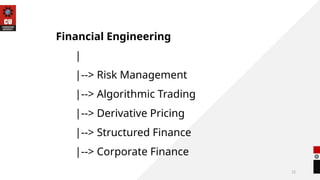
Financial Engineering
|
|--> Risk Management
|--> Algorithmic Trading
|--> Derivative Pricing
|--> Structured Finance
|--> Corporate Finance
13
ASSESSMENT MODULE
14
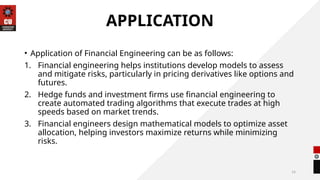
APPLICATION
• Application of Financial Engineering can be as follows:
1. Financial engineering helps institutions develop models to assess
and mitigate risks, particularly in pricing derivatives like options and
futures.
2. Hedge funds and investment firms use financial engineering to
create automated trading algorithms that execute trades at high
speeds based on market trends.
3. Financial engineers design mathematical models to optimize asset
allocation, helping investors maximize returns while minimizing
risks.
15
REFERENCES
TEXTBOOKS
T1 Hanif and Mukherjee, Modern Financial Engineering, Tata Mc Graw Hill, New Delhi
T2 Susanne Chishti and Janos Barberis., An Introduction to Derivatives Securities,
Financial Markets and Risk Management, Vikas Publishing House, New Delhi.
REFERENCE BOOKS
R1 Horngren, Sundem, Financial Algorithms, Prentice Hall India, New Delhi
THANK YOU
For queries
Email: rachit.e13225@cumail.in

Financial Engineering, Time Value of Moeny

  • 1.
    DISCOVER . LEARN. EMPOWER Introduction - Concept INSTITUTE- Global School of Finance & Accounting Masters of Commerce (M.Com)-ACCA Financial Engineering 24CMT-731 Faculty Name - Mr. Rachit Agarwal
  • 2.
    2 CO Number Title Level CO1 Thestudents will be able to Understand various financial engineering concepts Develop CO2 The student will be able to Develop financial mathematical based equations Apply CO3 The student will be able to Analyse various financial products Analyze CO4 The student will be able to Evaluate best financial services and products. Evaluate CO5 The student will be able to Create customized Create Course Outcome Financial Engineering
  • 3.
    • Historical Background •Role of financial engineering in modern finance 3 FINANCIAL ENGINEERING
  • 4.
    4 Historical Background ofFINANCIAL ENGINEERING Financial engineering has evolved over decades, integrating mathematical, statistical, and computational techniques to solve complex financial problems. Below is a detailed overview of its historical development: 1. Early Foundations (Pre-20th Century) •The roots of financial engineering can be traced back to early economic theories and mathematical applications in finance. • Louis Bachelier (1900) introduced the concept of Brownian motion in his thesis, The Theory of Speculation, laying the foundation for stochastic
  • 5.
    5 2. The Riseof Quantitative Finance (1950s-1970s) •The mid-20th century saw the emergence of quantitative finance, driven by advancements in mathematics and computing. •Harry Markowitz (1952) developed Modern Portfolio Theory (MPT), emphasizing risk-return trade-offs. •Black-Scholes Model (1973) by Fischer Black, Myron Scholes, and Robert Merton revolutionized options pricing, leading to the rapid growth of
  • 6.
    6 Inception and EarlyStages (1970– 1997) • Deregulation of interest rates, currencies, and commodity prices creates need to manage risks. • Tools created to do so (derivatives, theoretical pricing models, risk measures). • Technology provides platform and drives globalization (telecom advances, hardware, software, first PCs). • Financial firms build businesses to intermediate risk in addition to capital.
  • 7.
    7 Massive Growth (1998–2006) •The world of “monoline” financial firms ends as banks, insurers, traditional, and alternative asset managers combine and enter each others’ businesses globally. • Asian currency crisis, Russian crisis, and LTCM launch global growth of the business of enterprise risk management. • Ongoing deregulation and freer markets spur growth. • Credit derivatives and securitization grow from zero into the hundreds of trillions, massively changing how risk and return are originated, held, and transferred. • BRICs, sovereign wealth funds emerge as major players in the world capital market, vastly fueling globalization. • Huge liquidity, low risk premiums, and low interest rates drive massive growth in the size of firms (from banks to hedge funds), capital markets (from emerging to established), and the use of leverage.
  • 8.
    8 Rationalization (from 2007, ongoing) •Global financial markets melt down and continue in various states of disarray, starting with residential mortgages and progressing to commercial real estate, financial firms, corporate, municipal and sovereign risks. • Troubled assets and liquidity crises lead to trillions in bailouts and drive global de- leveraging and de-risking. • A dramatic “re-think” of the role of governments/greater regulation/need to manage systemic risk underway.
  • 9.
    9 Role of FinancialEngineering in Modern Finance Financial engineering is applied across various domains in modern finance: A. Corporate Finance •Helps firms structure financial instruments to maximize shareholder value. •Assists in capital budgeting and investment decision- making. B. Risk Management •Uses quantitative models to assess and mitigate financial risks. •Develops hedging strategies using derivatives like options and futures.
  • 10.
    10 Role of FinancialEngineering in Modern Finance C. Algorithmic Trading •Employs mathematical models to automate trading strategies. •Enhances market liquidity and efficiency. D. Derivative Pricing •Determines the fair value of financial derivatives using stochastic models. •Supports hedging strategies for investors and institutions. E. Structured Finance •Creates asset-backed securities and mortgage-backed securities. •Provides diversified investment opportunities.
  • 11.
    11 Benefits of FinancialEngineering Benefits Description Risk Diversification Helps investors hedge against market volatility. Optimized Investment Strategies Uses advanced models to maximize returns. Enhanced Liquidity Facilitates efficient trading mechanisms. Customizable Financial Products Tailors instruments to specific risk appetites. Financial engineering offers several advantages in modern finance:
  • 12.
    12 Financial Engineering | |--> RiskManagement |--> Algorithmic Trading |--> Derivative Pricing |--> Structured Finance |--> Corporate Finance
  • 13.
  • 14.
    14 APPLICATION • Application ofFinancial Engineering can be as follows: 1. Financial engineering helps institutions develop models to assess and mitigate risks, particularly in pricing derivatives like options and futures. 2. Hedge funds and investment firms use financial engineering to create automated trading algorithms that execute trades at high speeds based on market trends. 3. Financial engineers design mathematical models to optimize asset allocation, helping investors maximize returns while minimizing risks.
  • 15.
    15 REFERENCES TEXTBOOKS T1 Hanif andMukherjee, Modern Financial Engineering, Tata Mc Graw Hill, New Delhi T2 Susanne Chishti and Janos Barberis., An Introduction to Derivatives Securities, Financial Markets and Risk Management, Vikas Publishing House, New Delhi. REFERENCE BOOKS R1 Horngren, Sundem, Financial Algorithms, Prentice Hall India, New Delhi
  • 16.
    THANK YOU For queries Email:rachit.e13225@cumail.in