DISCOVER . LEARN. EMPOWER
Introduction - Concept
INSTITUTE- Global School of Finance &
Accounting
Masters of Commerce (M.Com)-ACCA
Financial Engineering
24CMT-731
Faculty Name - Mr. Rachit Agarwal
2.
2
CO
Number
Title Level
CO1 Thestudents will be able to Understand various
financial engineering concepts
Develop
CO2 The student will be able to Develop financial
mathematical based equations
Apply
CO3 The student will be able to Analyse various
financial products
Analyze
CO4 The student will be able to Evaluate best financial
services and products.
Evaluate
CO5 The student will be able to Create customized Create
Course Outcome
Financial
Engineering
3.
• Definition andscope of financial
Engineering
• Historical Background
• Evolution of financial engineering
3
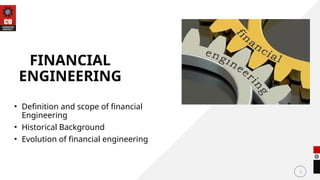
FINANCIAL
ENGINEERING
4.
4
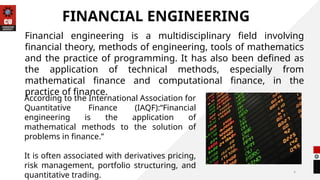
Financial engineering isa multidisciplinary field involving
financial theory, methods of engineering, tools of mathematics
and the practice of programming. It has also been defined as
the application of technical methods, especially from
mathematical finance and computational finance, in the
practice of finance.
FINANCIAL ENGINEERING
According to the International Association for
Quantitative Finance (IAQF):“Financial
engineering is the application of
mathematical methods to the solution of
problems in finance.”
It is often associated with derivatives pricing,
risk management, portfolio structuring, and
quantitative trading.
5.
5
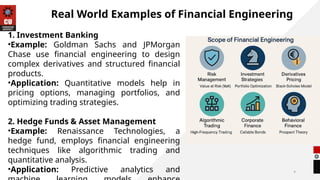
Scope of Financial
Engineering
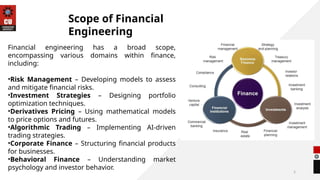
Financialengineering has a broad scope,
encompassing various domains within finance,
including:
•Risk Management – Developing models to assess
and mitigate financial risks.
•Investment Strategies – Designing portfolio
optimization techniques.
•Derivatives Pricing – Using mathematical models
to price options and futures.
•Algorithmic Trading – Implementing AI-driven
trading strategies.
•Corporate Finance – Structuring financial products
for businesses.
•Behavioral Finance – Understanding market
psychology and investor behavior.
9
1. Investment Banking
•Example:Goldman Sachs and JPMorgan
Chase use financial engineering to design
complex derivatives and structured financial
products.
•Application: Quantitative models help in
pricing options, managing portfolios, and
optimizing trading strategies.
2. Hedge Funds & Asset Management
•Example: Renaissance Technologies, a
hedge fund, employs financial engineering
techniques like algorithmic trading and
quantitative analysis.
•Application: Predictive analytics and
Real World Examples of Financial Engineering
10.
10
3. Insurance Industry
•Example:Actuarial models used by companies like Allianz and AIG
help in risk assessment and premium pricing.
•Application: Financial engineering aids in designing insurance
products and managing catastrophe risks.
4. Algorithmic & High-Frequency Trading
•Example: Citadel Securities and Virtu Financial leverage financial
engineering for automated trading strategies.
•Application: AI-driven models execute trades at high speeds based
on market trends.
5. FinTech & Blockchain
•Example: Companies like PayPal and Square use financial
engineering to develop innovative payment solutions.
•Application: Blockchain-based financial products, smart contracts,
and decentralized finance (DeFi) platforms.
Real World Examples of Financial Engineering
12
APPLICATION
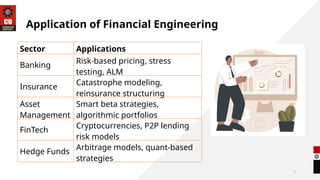
• Application ofFinancial Engineering can be as follows:
1. Financial engineering helps institutions develop models to assess
and mitigate risks, particularly in pricing derivatives like options and
futures.
2. Hedge funds and investment firms use financial engineering to
create automated trading algorithms that execute trades at high
speeds based on market trends.
3. Financial engineers design mathematical models to optimize asset
allocation, helping investors maximize returns while minimizing
risks.
13.
13
REFERENCES
TEXTBOOKS
T1 Hanif andMukherjee, Modern Financial Engineering, Tata Mc Graw Hill, New Delhi
T2 Susanne Chishti and Janos Barberis., An Introduction to Derivatives Securities, Financial Markets
and Risk Management, Vikas Publishing House, New Delhi.
REFERENCE BOOKS
R1 Horngren, Sundem, Financial Algorithms, Prentice Hall India, New Delhi