2008The Financial
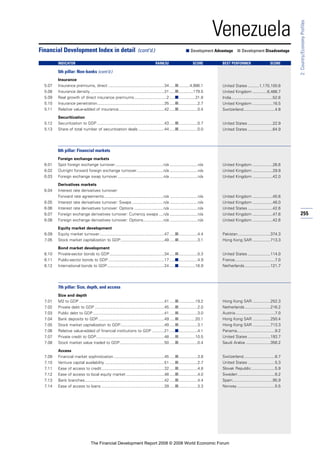
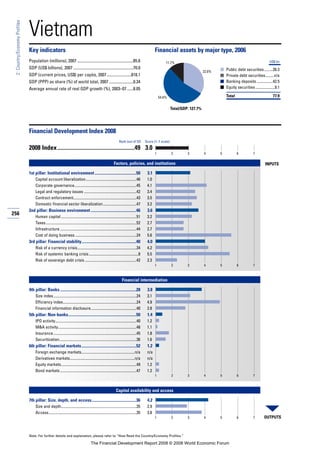
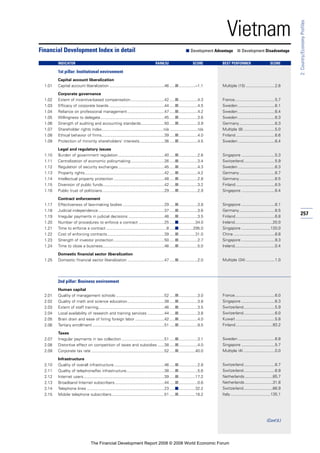
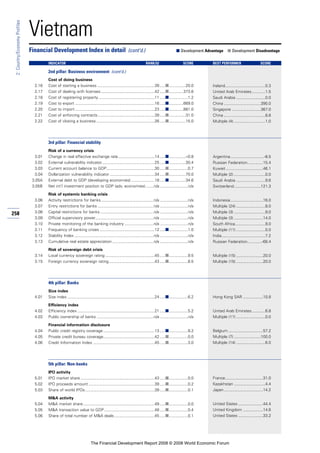
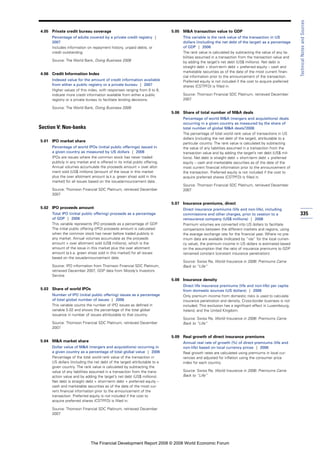
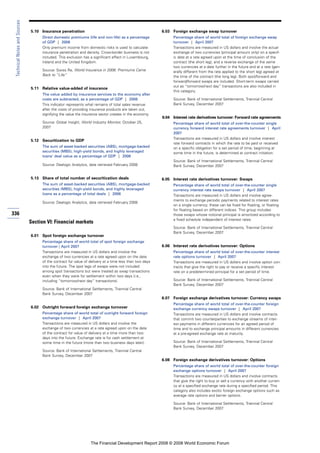
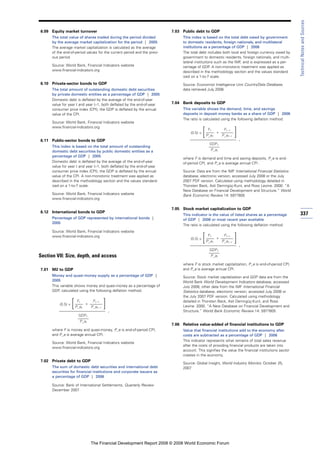
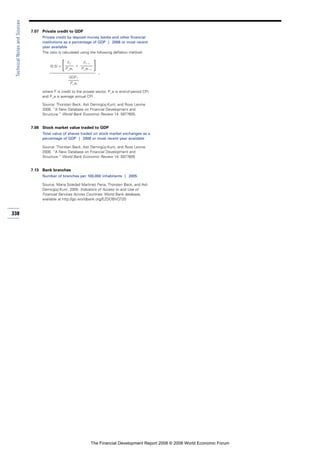
Development Report
The Financial Development Report 2008 © 2008 World Economic Forum
The Financial Development
Report 2008
World Economic Forum
Geneva, Switzerland
World Economic Forum USA Inc.
New York, USA
The Financial Development Report 2008 © 2008 World Economic Forum
The terms country and nation as used in this
report do not in all cases refer to a territorial
entity that is a state as understood by inter-
national law and practice. The terms cover
well-defined, geographically self-contained
economic areas that may not be states but
for which statistical data are maintained on a
separate and independent basis.
World Economic Forum USA Inc.
Copyright © 2008
by the World Economic Forum USA Inc.
All rights reserved. No part of this publication
may be reproduced, stored in a retrieval sys-
tem, or transmitted, in any form or by any
means, electronic, mechanical, photocopying,
or otherwise without the prior permission or
the World Economic Forum.
ISBN-13: 978-92-95044-08-1
ISBN-10: 92-95044-08-8
This book is printed on paper suitable for
recycling and made from fully managed and
sustained forest sources.
A catalogue record for this book is available
from the British Library.
A catalogue record for this book is available
from the Library of Congress.
The Financial Development Report 2008 © 2008 World Economic Forum
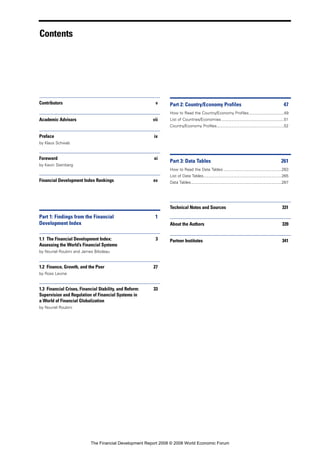
Contents
Contributors v
Academic Advisors vii
Preface ix
by Klaus Schwab
Foreword xi
by Kevin Steinberg
Financial Development Index Rankings xv
Part 1: Findings from the Financial 1
Development Index
1.1 The Financial Development Index: 3
Assessing the World’s Financial Systems
by Nouriel Roubini and James Bilodeau
1.2 Finance, Growth, and the Poor 27
by Ross Levine
1.3 Financial Crises, Financial Stability, and Reform: 33
Supervision and Regulation of Financial Systems in
a World of Financial Globalization
by Nouriel Roubini
Part 2: Country/Economy Profiles 47
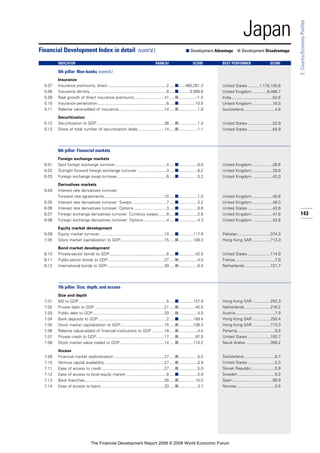
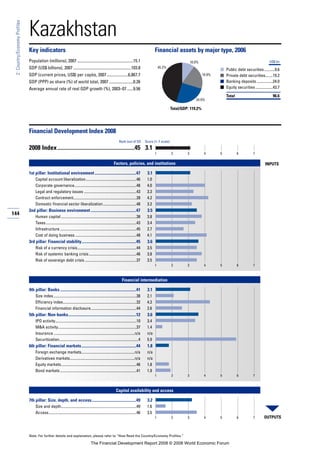
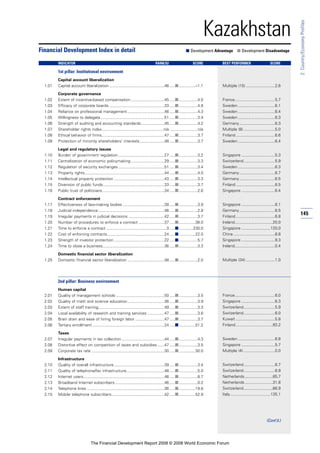
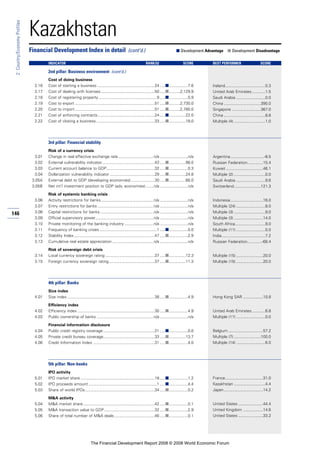
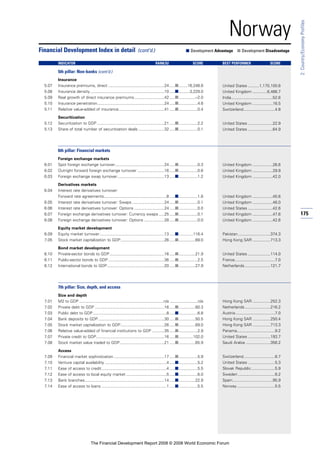
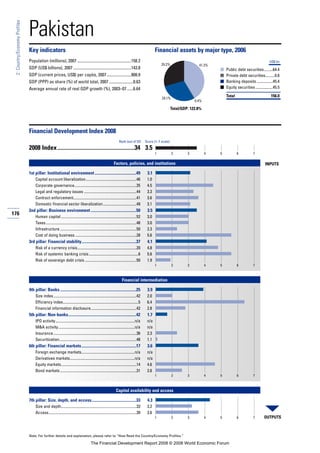
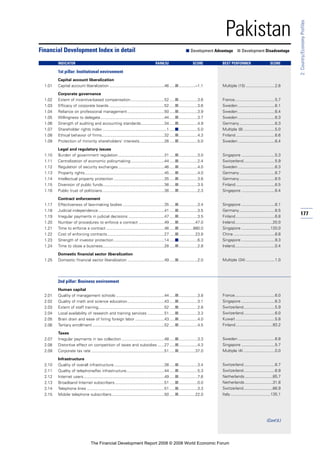
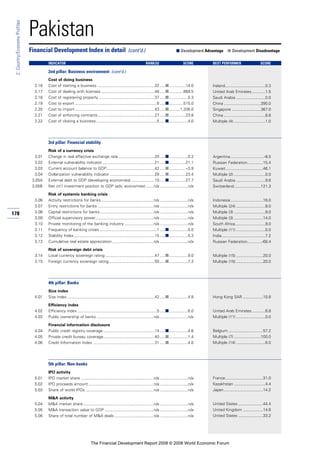
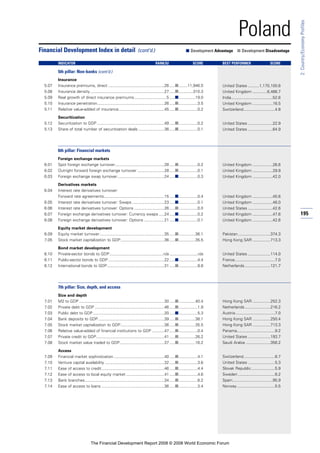
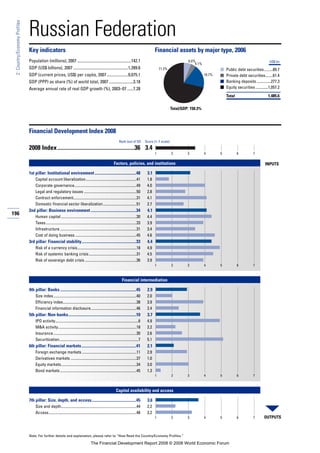
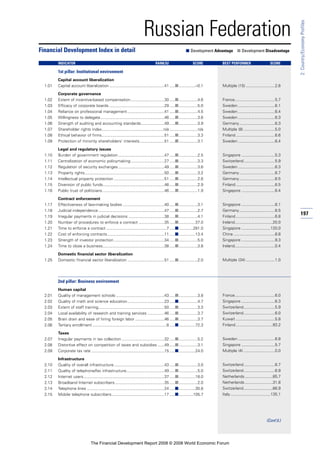
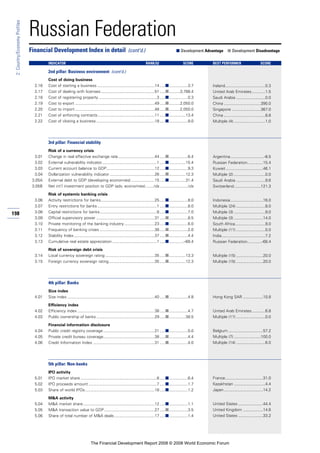
How to Read the Country/Economy Profiles...............................49
List of Countries/Economies........................................................51
Country/Economy Profiles............................................................52
Part 3: Data Tables 261
How to Read the Data Tables ....................................................263
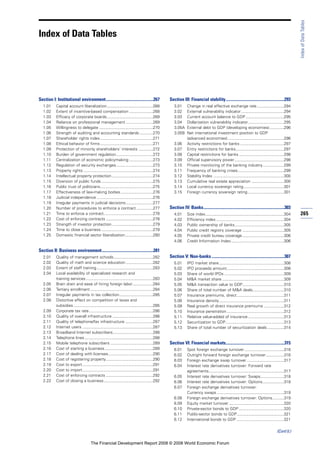
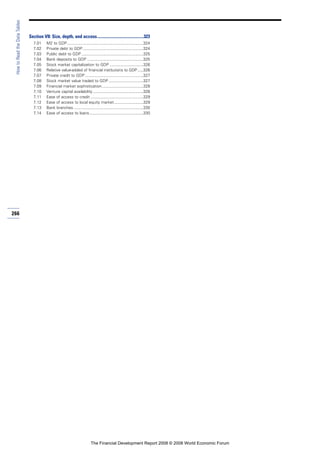
List of Data Tables......................................................................265
Data Tables.................................................................................267
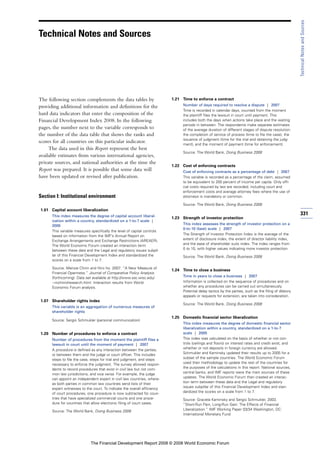
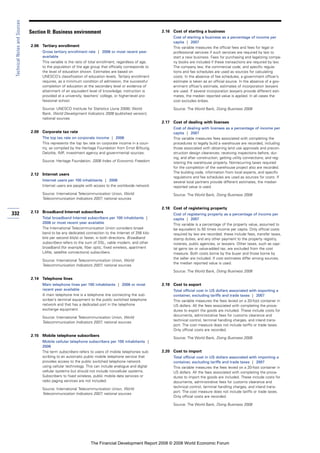
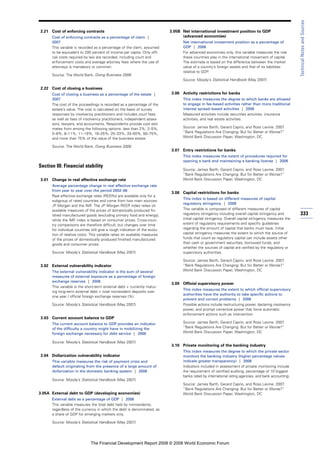
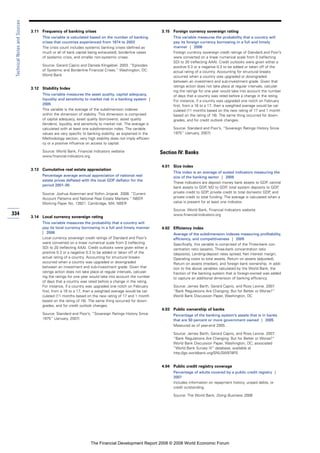
Technical Notes and Sources 331
About the Authors 339
Partner Institutes 341
The Financial Development Report 2008 © 2008 World Economic Forum
v
Contributors
LEAD ACADEMIC
Nouriel Roubini
Professor of Economics and International Business,
New York University and Chairman, RGE Monitor
EDITOR
James Bilodeau
Project Manager and Global Leadership Fellow,
World Economic Forum USA
ECONOMIST
Thierry Geiger
Economist and Global Leadership Fellow, World Economic Forum
PROJECT TEAM
Ayah El Said
Economist, RGE Monitor
Samantha Test
Project Manager, World Economic Forum USA (on secondment
from McKinsey & Co.)
Charles Martorana
Associate, World Economic Forum USA
Steven Strauss
Senior Advisor, World Economic Forum USA
PROJECT ADVISOR
Irene Mia
Director and Senior Economist, World Economic Forum
CONTRIBUTOR
Ross Levine
James and Merryl Tisch Professor of Economics and Director,
William R. Rhodes Center for International Economics
Brown University
ADVISORY COMMITTEE*
Jacob Frenkel
Vice-Chairman, American International Group, Inc.
Lord Peter Levene
Chairman, Lloyd’s
Hans-Joerg Rudloff
Chairman, Barclays Capital
Peter Sands
Group Chief Executive, Standard Chartered Bank
OPERATING COMMITTEE*
Michael Drexler
Head of Strategy and Planning, Barclays Capital
Darragh Gray
Senior Manager, Lloyd’s
Oakley Johnson
Senior Vice President, American International Group, Inc.
Gerard Lyons
Chief Economist, Standard Chartered Bank
Hans-Joerg Rudloff
Chairman, Barclays Capital
We would like to thank Dealogic and Thomson Reuters for their
generous contribution of data for this Report.
FROM THE WORLD ECONOMIC FORUM
Financial Institutions Team
Kevin Steinberg, Chief Operating Officer and Head of the Centre
for Global Industries (New York), World Economic Forum USA
Max von Bismarck, Director and Head of Investors Industry
Giancarlo Bruno, Director and Head of Financial Services Industry
Anuradha Gurung, Associate Director
Gareth Shepherd, Associate Director
Bernd Jan Sikken Associate Director
Bryan Stone, Associate Director
Kerry Wellman Jaggi, Senior Community Manager
Trudy Di Pippo, Community Manager
Lisa Donegan, Community Manager
Nadia Guillot, Senior Coordinator
Michal Richardson, Coordinator
Takae Ishizuka, Coordinator
Global Competitiveness Network
Fiona Paua, Senior Director and Head of Strategic Insight Teams
Jennifer Blanke, Director and Senior Economist
Margareta Drzeniek Hanouz, Director and Senior Economist
Ciara Browne, Senior Community Manager
Agustina Ciocia, Community Manager
Pearl Samandari, Research Assistant
Eva Trujillo Herrera, Research Assistant
We thank Hope Steele and Dianna Rienstra for their superb editing
work and Ha Nguyen for her excellent graphic design and layout.
*The Forum is grateful for the support of the Industry Partners who served on the Advisory and Operating Committees. Any findings contained
in the Report are solely the views of the Report’s authors and do not reflect the opinions of the Advisory or Operating Committee members.
Contributors
The Financial Development Report 2008 © 2008 World Economic Forum
vii
Martin Baily
Brookings Institution
Mario Blejer
Banco Hipotecario
Richard Cooper
Harvard University
Howard Davies
London School of Economics
Eric Feijen
The World Bank
Linda Goldberg
Federal Reserve Bank of New York
Ricardo Hausmann
Harvard University
Subir Lall
International Monetary Fund
Ross Levine
Brown University
Ashoka Mody
International Monetary Fund
Adam Posen
Peterson Institute for International Economics
Howard Shatz
Rand Corporation
Sergio Schmukler
The World Bank
Harold Skipper
Georgia State University
Augusto de la Torre
The World Bank
Edwin M. Truman
Peterson Institute for International Economics
John Williamson
Peterson Institute for International Economics
AcademicAdvisors
Academic Advisors
The Financial Development Report 2008 © 2008 World Economic Forum
ix
Preface
The release of the World Economic Forum’s inaugural
Financial Development Report 2008, comes at a time
when financial stability is of paramount importance to
governments, civil society, and the business community
alike.The United States financial markets, long-revered
as among the strongest and most advanced in the world,
have witnessed a dramatic contraction of credit and an
atrophying of the housing and secondary mortgage mar-
kets that few thought possible. Other developed nations
are questioning the degree to which financial integration
and innovation have brought exposure to this unabated
financial crisis. Emerging markets such as China and
India that have been primary drivers of global economic
growth in the new millennium have yet to see the extent
to which “decoupling” truly exists and if their economic
expansion can continue independent of the financial
trauma plaguing the US and other developed countries.
Against this backdrop, it is easy to forget the bene-
fits that the development of global financial systems and
increased capital flows have conferred upon other parts
of the world.The link between financial development
and economic growth is increasingly well established.
The development of local financial markets in develop-
ing economies is vital to provide needed capital to the
small- and medium-sized companies that drive a large
portion of economic growth in these countries. In addi-
tion, the potential for financial markets to help tackle
the most pressing issues on the global agenda is manifest
in the evolution of microfinance and carbon markets.
In this time of uncertainty, where the potential to
recast many aspects of our financial systems exists, it is
important to take a holistic perspective and consider all
the different factors that contribute to the development
of financial systems and the beneficial impact they can
have on the lives of many. It is in the spirit of providing
this informed and shared perspective that the World
Economic Forum has undertaken the publication of The
Financial Development Report 2008. Started more than a
year ago, the Report was commissioned in collaboration
with the Forum’s Financial Institutions Industry Partners
and Global Competitiveness Network to create an ana-
lytical tool and a common framework for stakeholders
to identify strengths, development areas and priorities
for reform.
In the tradition of the Forum’s multistakeholder
approach to global issues, the creation of this Report
involved an extended program of outreach and dialogue
with members of the academic community, public fig-
ures, representatives of non-governmental organizations
and business leaders from across the world.This work
included numerous interviews and collaborative sessions
to discuss the approach to the design of the Index at the
core of the report.The Report was the subject of sessions
at the Annual Meeting of the New Champions 2007 in
Dalian, China; the India Economic Summit 2007 in
New Delhi; the Forum’s 2008 Annual Meeting in Davos,
Switzerland; and the Latin America Summit 2008 in
Cancun, Mexico. Now that it is completed, the Report
will serve as the basis for future sessions where the results
can be discussed and debated, insights drawn and new
findings incorporated into its revision and publication
next year.
We would like to express our gratitude to the lead
academic on the project, Nouriel Roubini of NewYork
University, for his thought leadership in the design of
the Financial Development Index and contributions to
this report.We are grateful to our industry partners who
served on the project advisory committee including
American International Group, Inc.; Barclays Capital;
Lloyd’s; and Standard Chartered Bank.We are apprecia-
tive of our academic advisors who generously contributed
their time and ideas in helping shape this report.We
would also like to thank James Bilodeau at the World
Economic Forum USA, editor of the report, for his
energy and commitment to the project, as well as the
other members of the project team including Thierry
Geiger, Samantha Test (on secondment from McKinsey
& Co.) and Charles Martorana.We are grateful to Irene
Mia for her guidance as Project Advisor.Appreciation
also goes to Fiona Paua, Head of Strategic Insight
Teams, and other team members: Ciara Browne,Agustina
Ciocia, Pearl Samandari, and Eva Trujillo Herrera.
Finally, we would like to thank our network of 142
Partner Institutes worldwide, without whose enthusiasm
and hard work the annual administration of the
Executive Opinion Survey and this Report would not
be possible.
Preface
KLAUS SCHWAB,
Executive Chairman, World Economic Forum
The Financial Development Report 2008 © 2008 World Economic Forum
The World Economic Forum is proud to release this
first Financial Development Report, which was conceived
and executed as part of our Industry Partnership
Programme. The Report represents the culmination of
a year-long partnership between academic scholars,
industry practitioners, other distinguished experts and
stakeholders, and our organization.We hope that it will
provide a comprehensive and robust fact base related to
the development of the world’s financial systems and
enable a rich series of discussions and analyses for both
private and public sector organizations focused on eco-
nomic development.
The Industry Partnership Programme, under whose
auspices this work was undertaken, provides CEOs and
senior executives of the world’s leading companies the
opportunity to engage with their peers to define and
address critical industry issues through the World
Economic Forum’s unique platform. Last year, the over
75 financial institutions engaged as the Forum’s Industry
Partners identified the deepening and development of
the world’s capital markets and financial systems as one
of the world’s key drivers to deliver sustainable social
development and economic progress.They commis-
sioned this report to draw attention to related issues and
provide a catalyst for reform and change.
We believe the Financial Development Report is
unique in the degree of comprehensiveness with which
it looks at financial systems. Financial systems are inher-
ently complex, spanning foundational aspects such as the
institutional and business environments; financial inter-
mediaries including banks, insurance providers, and
investment banks; financial markets for bonds, equity,
foreign exchange and derivatives; and businesses—the
“consumers” of capital—who ultimately transform
financial resources into improved economic growth
and welfare for a nation’s citizens.Taking this holistic
view is vital to provide stakeholders in financial systems
a common framework with which to cultivate strengths,
develop weaknesses, and establish priorities for reform.
The uncertainty of today’s financial climate makes
this common framework even more vital to develop
a balanced agenda with respect to financial issues.
Core findings
Capturing the above breadth of factors was a considerable
undertaking, requiring the refinement of over 120
different data sets, grouped into seven major pillars.
These seven pillars, which form the foundation of the
Index are:
1. Institutional environment
2. Business environment
3. Financial stability
4. Banks
5. Non-banks
6. Financial markets
7. Size, depth, and access
Data were obtained from a variety of sources, ranging
from The World Bank and other private and publicly
available sources to the World Economic Forum’s
Executive Opinion Survey, which provides a unique
glimpse into the perspective of businesses seeking to
access capital.
On the basis of this holistic view, this year the
United States scores top honors in the rankings closely
followed by the United Kingdom.The collective strength
of financial intermediaries and markets in these countries,
spanning banks, investment banks, insurance companies,
equity markets, and bond markets is unparalleled.Yet,
the Index also reveals development areas in these coun-
tries that should be considered. Besides issues of financial
stability that are common to both countries, regulatory
issues and judicial reform remain lingering areas for
improvement in the United States, while the cost of
doing business in the United Kingdom is an area of
concern.
Following the U.S. and U.K., one finds Germany,
Japan, Canada, France, Switzerland, Hong Kong, the
Netherlands and Singapore in a closely-banded tier
rounding out the top ten. Germany, Japan, Canada and
the Netherlands deliver generally solid performance
across all aspects of the Index. Singapore, Switzerland,
and Hong Kong demonstrate particular strength across
their institutional and business environments. France
shows solid marks with respect to the strength of its
financial intermediaries.
Comparing the different measures across the breadth
of the Index reveals interesting results with respect to
other countries’ relative strengths and weaknesses. For
instance, a number of countries perform significantly
better with respect to the factors, policies, and institutions
that support financial systems (e.g., sound regulatory
xi
Foreword
Foreword
KEVIN STEINBERG,
Chief Operating Officer and Head of the Centre for Global Industries (New York), World Economic Forum USA
The Financial Development Report 2008 © 2008 World Economic Forum
systems, low cost of doing business, financial stability,
etc.) than they do with respect to financial intermedia-
tion (e.g., banks, investment banks, financial markets,
etc.) Countries in this category include Bahrain, Chile,
the Czech Republic, Mexico, the Slovak Republic, and
Peru. Exploring the reasons why countries do not seem
to translate foundational requirements like a sound regu-
latory system and low cost of doing business into more
robust financial intermediation may reveal some inter-
esting insights around priorities for reform.
Still other countries, such as Russia and Kazakhstan,
deliver relatively strong performance with respect to
financial intermediation but, compared to other coun-
tries covered in the Index, do not perform as strongly
with respect to capital availability and access. Conversely,
one sees that Israel scores relatively well with respect to
these access measures, even in the face of relatively less
developed financial intermediaries.The question as to
why countries are able or unable to translate relatively
strong performance in areas such as initial public offer-
ings or banking into ease of access to capital as assessed
by businesses within these countries may be an impor-
tant line of inquiry.
The capital access data contained in this report rep-
resent unique measures of the degree to which business-
es in all these countries feel that they are able to access
different forms of capital such as private credit, bank
loans, or initial public offerings. It is interesting to note
that these assessments do not always seem to correspond
to the total depth of financial assets that are available
within a country. For instance, China and Egypt score
relatively solidly with respect to total financial assets to
GDP but near the bottom of the overall ranking with
respect to measures of capital access. Conversely the
United Arab Emirates ranks relatively low in terms of
depth of total financial assets but ranks quite high in
terms of measures of access.Why are some countries
able to maximize access to capital even when, by certain
measures, there is less overall capital available? We
encourage readers of this report to pursue these patterns
of analysis.
Key contributors
The Financial Development Report represents a collabora-
tive endeavour linking many of the Forum’s Industry
Partner companies together with leading academics and
thinkers, active practitioners, partner institutes from
around the world, and representatives of many parts of
civil society.
The core research team, tasked with crafting and
populating the Index, was drawn from the World
Economic Forum and Roubini Global Economics, and
was comprised of Nouriel Roubini, Lead Academic on
the project, James Bilodeau,Thierry Geiger,Ayah El
Said, Samantha Test, and Charles Martorana.
On behalf of the World Economic Forum, the proj-
ect was ably led by James Bilodeau, who served both as
project manager and as editor of this Report. He worked
closely not only with the core research team, but also
the Forum’s Financial Institutions Team and our Global
Competitiveness Network led by Fiona Paua.We have
also benefitted from a number of academic advisors to
this work and we would particularly like to thank Ross
Levine for his thought leadership in this area.
Intellectual stewardship and guidance was provided
by an Advisory Committee, which included Jacob
Frenkel,Vice-Chairman,American International Group,
Inc.; Lord Peter Levene, Chairman, Lloyd’s; Hans-Joerg
Rudloff, Chairman, Barclays Capital; and Peter Sands,
Group Chief Executive, Standard Chartered Bank.
An active Operating Committee provided feedback,
counsel and refinement of the Index, helping shape its
final formulation. It included Michael Drexler, Head of
Strategy and Planning, Barclays Capital; Darragh Gray,
Senior Manager, Lloyd’s; Oakley Johnson, SeniorVice
President,American International Group, Inc.; Gerard
Lyons, Chief Economist, Standard Chartered Bank; and
Hans-Joerg Rudloff, Chairman, Barclays Capital.
While not necessarily endorsing any of the specific
conclusions reflected in the analyses in the Report, both
the Advisory Committee and Operating Committee
provided detailed feedback and helped ensure the overall
integrity of the work.Any opinions herewith are solely
the views of the authors and do not reflect the opinions
of the Advisory Committee, the Operating Committee
or the World Economic Forum.
Going forward
This first Financial Development Report is, as with many
new endeavors, very much a work in progress which
will evolve in successive years.We nonetheless hope that
even this first version will serve as a valuable framework
for exploring the many issues it raises and lead to dis-
cussions and public debate.
On behalf of the World Economic Forum as well as
the project team, I extend thanks to all involved in cre-
ating this first Index for their tremendous contributions
to this work.We welcome your feedback and reactions,
and hope you will continue your involvement in our
future efforts.
xii
Foreword
The Financial Development Report 2008 © 2008 World Economic Forum
xiii
The Financial Development Index
Rankings
The Financial Development Report 2008 © 2008 World Economic Forum
xv
TheFinancialDevelopmentIndexRankings
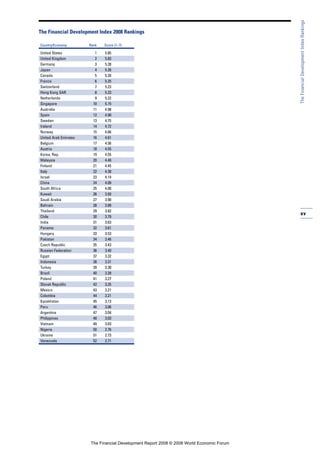
The Financial Development Index 2008 Rankings
Country/Economy Rank Score (1–7)
United States 1 5.85
United Kingdom 2 5.83
Germany 3 5.28
Japan 4 5.28
Canada 5 5.26
France 6 5.25
Switzerland 7 5.23
Hong Kong SAR 8 5.23
Netherlands 9 5.22
Singapore 10 5.15
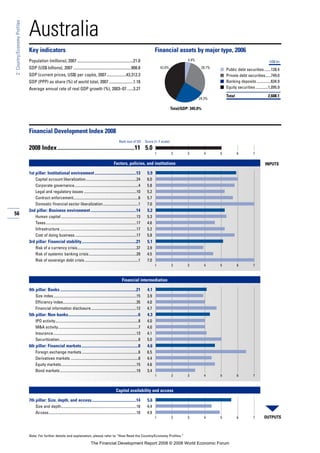
Australia 11 4.98
Spain 12 4.90
Sweden 13 4.75
Ireland 14 4.72
Norway 15 4.66
United Arab Emirates 16 4.61
Belgium 17 4.56
Austria 18 4.55
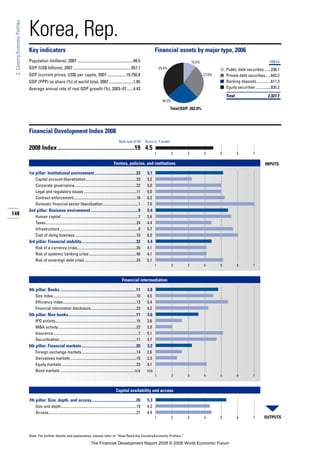
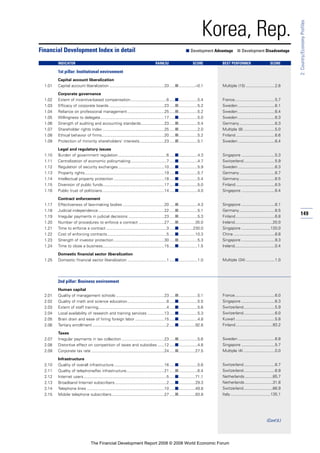
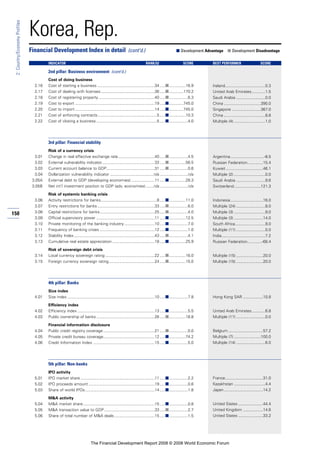
Korea, Rep. 19 4.55
Malaysia 20 4.48
Finland 21 4.45
Italy 22 4.38
Israel 23 4.14
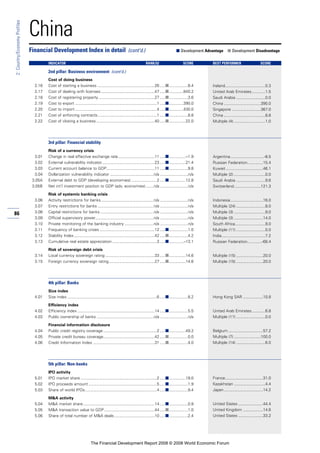
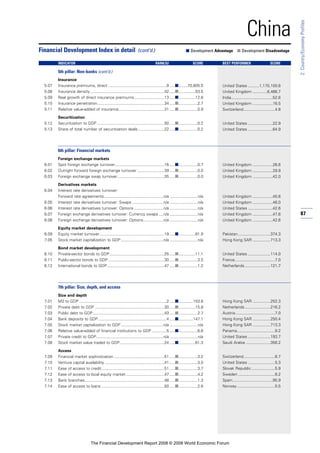
China 24 4.09
South Africa 25 4.00
Kuwait 26 3.93
Saudi Arabia 27 3.90
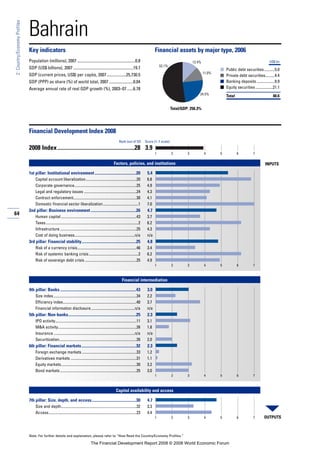
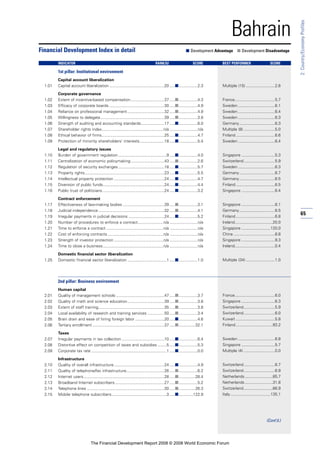
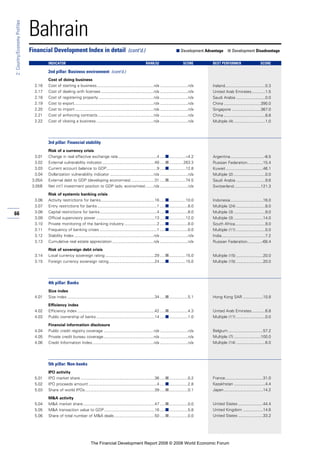
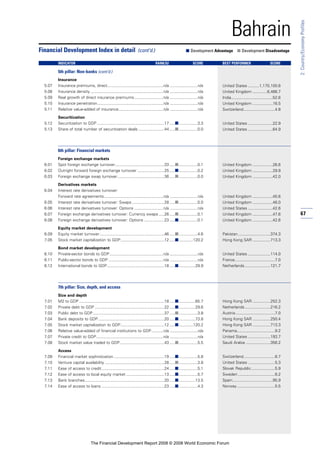
Bahrain 28 3.89
Thailand 29 3.82
Chile 30 3.79
India 31 3.63
Panama 32 3.61
Hungary 33 3.53
Pakistan 34 3.46
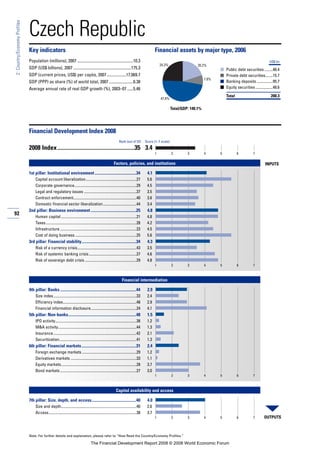
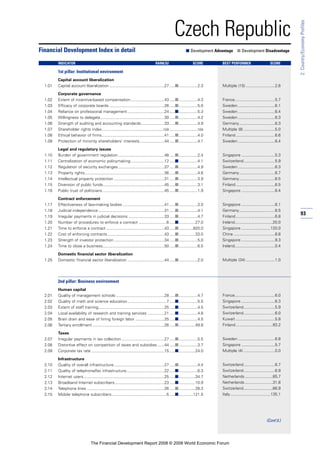
Czech Republic 35 3.43
Russian Federation 36 3.40
Egypt 37 3.32
Indonesia 38 3.31
Turkey 39 3.30
Brazil 40 3.28
Poland 41 3.27
Slovak Republic 42 3.25
Mexico 43 3.21
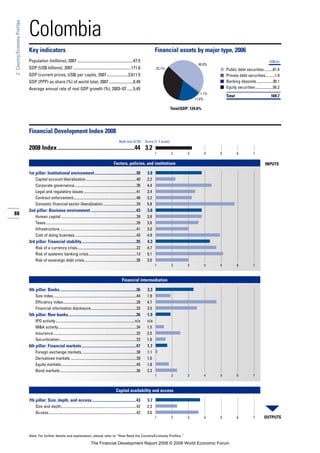
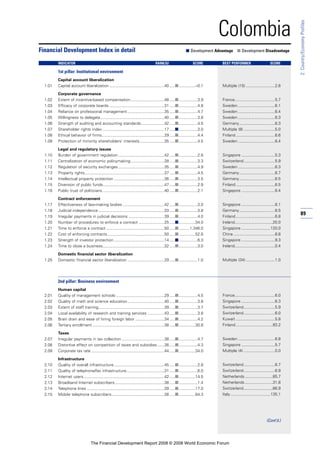
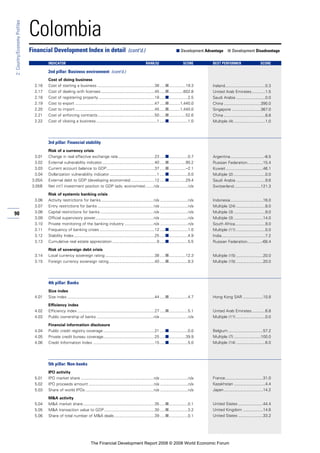
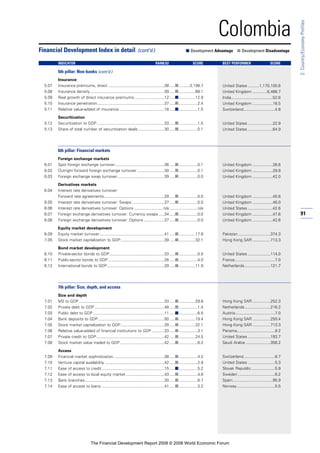
Colombia 44 3.21
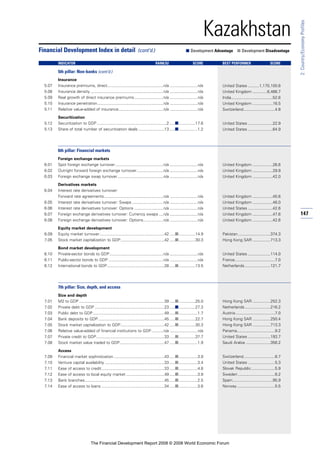
Kazakhstan 45 3.13
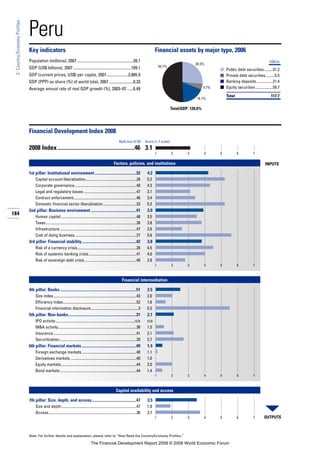
Peru 46 3.06
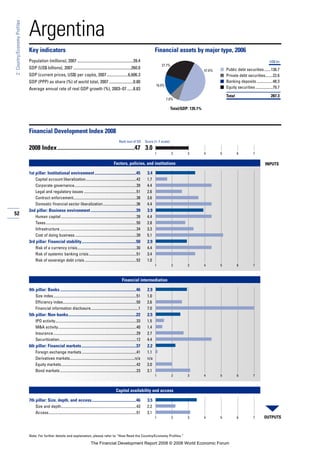
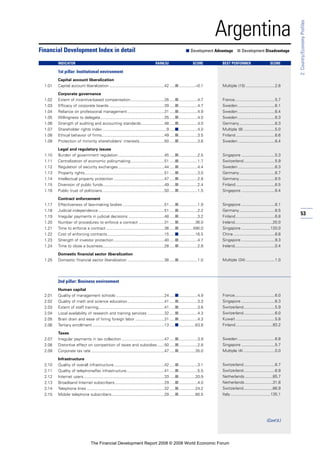
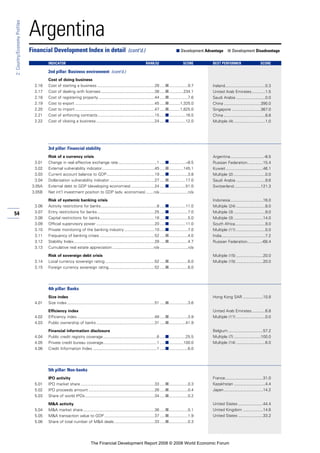
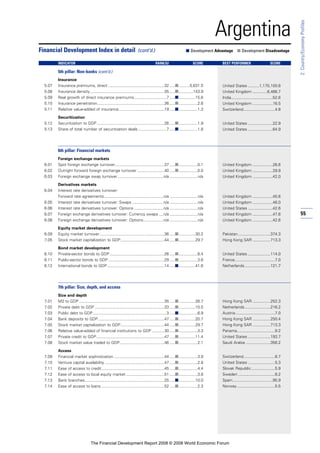
Argentina 47 3.04
Philippines 48 3.03
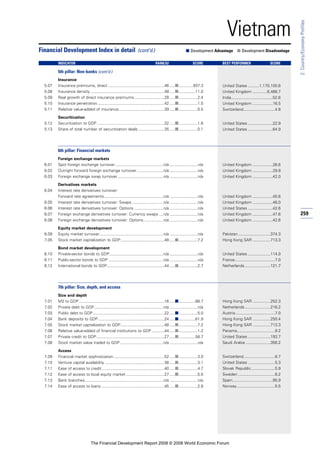
Vietnam 49 3.03
Nigeria 50 2.76
Ukraine 51 2.73
Venezuela 52 2.71
The Financial Development Report 2008 © 2008 World Economic Forum
Part 1
Findings from the Financial
Development Index
The Financial Development Report 2008 © 2008 World Economic Forum
CHAPTER 1.1
The Financial Development
Index: Assessing the World’s
Financial Systems
NOURIEL ROUBINI, New York University
JAMES BILODEAU, World Economic Forum USA
A key factor in economic growth is the development of
financial systems. Despite the prominence of this topic
in discussions of economic growth, there is still surpris-
ingly little agreement about how to define and measure
financial system development.To address this gap, the
World Economic Forum has undertaken a research ini-
tiative aimed at providing business leaders and policy-
makers with a common framework to identify and
discuss the key factors in the development of global
financial systems and markets.
This inaugural Financial Development Report provides
an Index and ranking of 52 of the world’s leading finan-
cial systems.The Report is a tool with which countries
can benchmark themselves and establish priorities for
financial system improvement. It will be published
annually so that countries can continue to benchmark
themselves against their peers and track their progress
over time.
In recognition of the diversity of countries covered
in the Index and the variety of financial activities that
are vital to economic growth, we have taken a holistic
view of financial systems. For the purposes of this Report
and Index we have defined financial development as the
factors, policies, and institutions that lead to effective financial
intermediation and markets, and deep and broad access to
capital and financial services. This definition thus spans the
“inputs” or foundational supports of a financial system,
such as the institutional and business environments, the
financial intermediaries and markets through which effi-
cient risk diversification and capital allocation occur, and
the “outputs” of the financial intermediation process,
which include the availability of and access to capital.
The Index relies upon current academic research
in both selecting the factors that are included and in
determining its overall structure. However, to the extent
possible it also encourages breadth of analysis over a the-
oretical focus on a few specific areas.With this holistic
view, decision-makers can develop a balanced perspec-
tive as to which aspects of their country’s financial system
are most important and empirically calibrate this view
relative to other countries.
Financial development and economic growth and
welfare: The seven pillars of financial development
A vast empirical and analytical literature suggests that in
addition to many other important factors, the perform-
ance and long-run economic growth and welfare of a
country are related to its degree of financial develop-
ment. Financial development is measured by factors such
as size, depth, access, efficiency and stability of a financial
system, including its markets, intermediaries, range of
assets, institutions and regulations.The greater the
3
1.1:TheFinancialDevelopmentIndex
The authors would especially like to thank Ayah El Said for her
extensive research and contributions to this chapter and Report.
The Financial Development Report 2008 © 2008 World Economic Forum
degree of financial development, the wider the availabil-
ity of financial services that allow the diversification of
risks.This increases the long-run growth trajectory of a
country and ultimately improves the welfare and pros-
perity of producers and consumers that have access to
financial services.The link between financial develop-
ment and economic growth can be traced back to the
work of Joseph Schumpeter1
in the early 20th century,
and more recently to Ronald McKinnon and Edward
Shaw.This link is now well established in terms of
empirical evidence.2
Why do financial markets and intermediaries exist
in the first place? Economic theory suggests that finan-
cial markets and intermediaries exist mainly because of
two types of market frictions: information costs and
transaction costs.These frictions lead to the develop-
ment of financial intermediaries and financial markets,
which perform multiple functions, such as:
• facilitating the trading, hedging, diversification, and
pooling of risk;
• providing insurance services;
• allocating savings and resources to the appropriate
investment projects;
• monitoring managers and promoting corporate
control and governance;
• mobilizing savings efficiently; and
• facilitating the exchange of goods and services.
How do financial intermediation and markets affect
economic growth and performance and, more generally,
contribute to increased aggregate economic welfare and
prosperity? They mostly do this through their effect on
capital accumulation (the rate of investment) and on
technological innovation. First, greater financial develop-
ment leads to greater mobilization of savings and its
allocation to the highest return investment projects.This
increased accumulation of capital enhances economic
growth. Second, by appropriately allocating capital to
the right investment projects and promoting sound cor-
porate governance, financial development increases the
rate of technological innovation and productivity
growth, further enhancing economic growth and wel-
fare.As a result, direct measures of economic perform-
ance impacted by these effects of financial development
include variables such as the rate of economic growth,
the rate of capital accumulation, the rate of productivity
growth, and the rate of technological innovation.
Financial markets and intermediation benefit con-
sumers and firms in many other ways that are not
directly related to economic growth.Access to financial
markets for consumers and producers can reduce pover-
ty, such as when the poor have access to banking servic-
es and credit.The importance of microfinance can be
seen in this context.This access allows consumers to
smooth consumption over time by borrowing and/or
lending and stabilizes consumer welfare in the presence
of temporary shocks to wages and income. By contribut-
ing to the diversification of savings and of portfolio
choices, it can also increase the return on savings and
ensure higher income and consumption opportunities.
Insurance services can help mitigate a variety of risks
that individuals and firms face, thus allowing better risk
sharing of individual or even macroeconomic risks.
To understand and measure the degree of financial
development, one must consider all of the different factors
that together contribute to the degree of depth and effi-
ciency of the provision of financial services. Conceptually,
in thinking about an index that measures the degree of
financial development, the various aspects of develop-
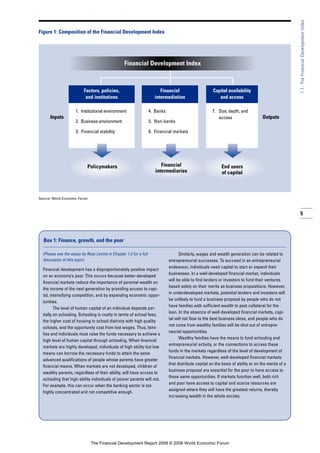
ment can be seen as seven “pillars” grouped into three
broad categories as indicated in Figure 1:
1. Factors, policies, and institutions: the “inputs” that
allow the development of financial intermediaries,
markets, instruments and services
2. Financial intermediation: the variety, size, depth,
and efficiency of the financial intermediaries and
markets that provide financial services
3. Capital availability and access: the “outputs” of
financial intermediation as manifested in the size
and depth of the financial sectors and the availabili-
ty of, and access to, financial services
This combination of “inputs,” financial intermediaries
and markets, and “outputs” provides an organic measure
of the degree of financial development.The seven pillars
are organized and described below according to these
three categories.
Factors, policies, and institutions
This first category covers the inputs supporting financial
intermediation and the optimal provision of financial
services and includes the first three of the seven pillars:
the institutional environment, the business environment,
and the degree of financial stability.
First pillar: Institutional environment
The institutional environment encompasses the laws and
regulations that allow the development of deep and effi-
cient financial intermediaries, markets and services.This
includes the overall laws, regulations and supervision of
the financial sector, as well as the quality of contract
enforcement and corporate governance.
Economic theory proposes that a strong institution-
al environment exists to alleviate information and trans-
action costs.3
Much empirical work has tackled issues
related to the importance of institutions and their
impact on economic activity in general.The presence of
4
1.1:TheFinancialDevelopmentIndex
The Financial Development Report 2008 © 2008 World Economic Forum
5
1.1:TheFinancialDevelopmentIndex
Figure 1: Composition of the Financial Development Index
Source: World Economic Forum
Factors, policies,
and institutions
OutputsInputs
1. Institutional environment
2. Business environment
3. Financial stability
Policymakers
Financial
intermediation
4. Banks
5. Non-banks
6. Financial markets
Financial
intermediaries
Capital availability
and access
7. Size, depth, and
access
End users
of capital
Financial Development Index
(Please see the essay by Ross Levine in Chapter 1.2 for a full
discussion of this topic)
Financial development has a disproportionately positive impact
on an economy’s poor. This occurs because better-developed
financial markets reduce the importance of parental wealth on
the income of the next generation by providing access to capi-
tal, intensifying competition, and by expanding economic oppor-
tunities.
The level of human capital of an individual depends par-
tially on schooling. Schooling is costly in terms of school fees,
the higher cost of housing in school districts with high quality
schools, and the opportunity cost from lost wages. Thus, fami-
lies and individuals must raise the funds necessary to achieve a
high level of human capital through schooling. When financial
markets are highly developed, individuals of high ability but low
means can borrow the necessary funds to attain the same
advanced qualifications of people whose parents have greater
financial means. When markets are not developed, children of
wealthy parents, regardless of their ability, will have access to
schooling that high-ability individuals of poorer parents will not.
For example, this can occur when the banking sector is too
highly concentrated and not competitive enough.
Similarly, wages and wealth generation can be related to
entrepreneurial successes. To succeed in an entrepreneurial
endeavour, individuals need capital to start or expand their
businesses. In a well-developed financial market, individuals
will be able to find lenders or investors to fund their ventures
based solely on their merits as business propositions. However,
in underdeveloped markets, potential lenders and investors will
be unlikely to fund a business proposal by people who do not
have families with sufficient wealth to post collateral for the
loan. In the absence of well-developed financial markets, capi-
tal will not flow to the best business ideas, and people who do
not come from wealthy families will be shut out of entrepre-
neurial opportunities.
Wealthy families have the means to fund schooling and
entrepreneurial activity, or the connections to access these
funds in the markets regardless of the level of development of
financial markets. However, well-developed financial markets
that distribute capital on the basis of ability or on the merits of a
business proposal are essential for the poor to have access to
those same opportunities. If markets function well, both rich
and poor have access to capital and scarce resources are
assigned where they will have the greatest returns, thereby
increasing wealth in the whole society.
Box 1: Finance, growth, and the poor
The Financial Development Report 2008 © 2008 World Economic Forum
legal institutions that safeguard the interests of investors
is an integral part of financial development.4
Reforms
that bolster a country’s legal environment and investor
protection are likely to contribute to better growth
prospects.5
Accordingly, we have included variables relat-
ed to the degree of judicial independence and judicial
efficiency.
Better corporate governance is believed to encour-
age financial development, which in turn has a positive
impact on growth.6
Contract enforcement is also impor-
tant as it limits the scope for default among debtors,
which in turn promotes compliance in the formal trans-
fer of funds from savers to investors.7
Inadequate
investor protection leads to a number of adverse effects,
which can be detrimental to external financing and ulti-
mately the development of well functioning capital mar-
kets.8
In general, inadequate enforcement of financial
contracts has been found to augment the process of
credit rationing, thus hindering the overall process of
growth.9
Other important aspects related to the institutional
environment are a country’s capital account openness
and domestic financial sector liberalization. Financial lib-
eralization generally permits a greater degree of financial
depth, which translates into greater financial intermedia-
tion among savers and investors.This in turn increases
the monetization of an economy, resulting in a more
efficient flow of resources.10
Empirically, however, the
impact of capital account liberalization delivers mixed
evidence. Several studies have asserted that capital
account liberalization has no impact on growth while
others have found a positive, and statistically significant,
impact.11
At the same time, other work asserts that the
relationship is undetermined.
Given such ambiguity over the impact of capital
account openness, it is best examined within the context
of the legal environment.The better a country’s legal
environment, the greater the benefits from capital
account openness, and vice versa.Accordingly, within
the Index we try to capture the relationship between
capital account openness and the level of legal develop-
ment and have interacted the variables used to measure
each (see methodology later in this chapter).The pres-
ence of both a robust legal system and capital account
openness provides a positive indication of the financial
development of a country.
A similar analysis can be extended to the degree of
liberalization of the domestic financial sector.This degree
of liberalization is based on whether a country exerts
interest rate controls (either ceilings or floors), whether
credit ceilings exist, and whether foreign currency
deposits are allowed. In general, the better a country’s
legal and regulatory environment, the greater the impact
of domestic financial sector liberalization on a county’s
economic growth.Variables representing each of these
characteristics have been interacted to represent this
result. Recent research supports the importance of
advanced legal systems and institutions in this respect,
holding that the presence of such institutions is as vital
as having both a developed banking sector and equity
market development.12
Second pillar: Business environment
The second pillar focuses on the business environment
and considers:
• the availability of human capital—that is, skilled
workers who can be employed by the financial sec-
tor and thus provide efficient financial services;
• the state of physical capital—that is, the physical
and technological infrastructure; and
• other aspects of the business environment, including
taxation levels and the costs of doing business for
financial intermediaries.
Measures taken to facilitate the creation and improve-
ment of human capital have been found to assist the
process of economic growth.13
Empirical evidence sup-
ports this relationship showing positive correlations
between human capital and the degree of financial
development.14
Our proxies for the amount of human
capital are related to the enrollment levels of tertiary
education.We also include measures that reflect the
quality of human capital, such as the degree of staff
training, the quality of management schools and math
and science education, and the availability of research
and training services.
Another key area is infrastructure. Physical infra-
structure enhances the process of private capital accu-
mulation by increasing the profitability of investment.15
Our analysis of infrastructure captures different measures
of information and communication technologies that
are important to any business, especially those operating
within a financial context.
Another integral aspect of the business environment
is the cost of doing business in a country. Specifically,
research has shown that the cost of doing business is a
vital feature of the efficiency of financial institutions.
The different costs of doing business are integral to
assessing a country’s business environment as well as the
type of constraints that businesses may be facing.16
As
such, the better the business environment, the better the
performance of financial institutions, and the higher the
degree of financial development.Variables that capture
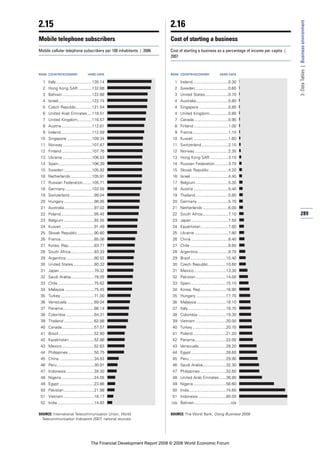
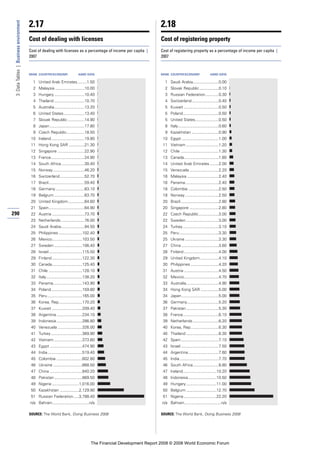
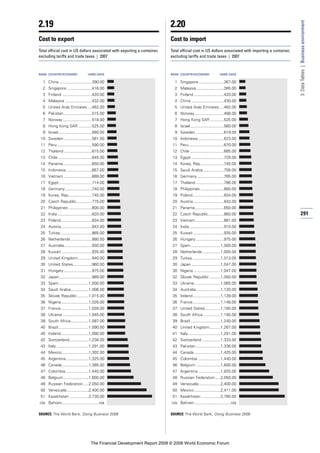
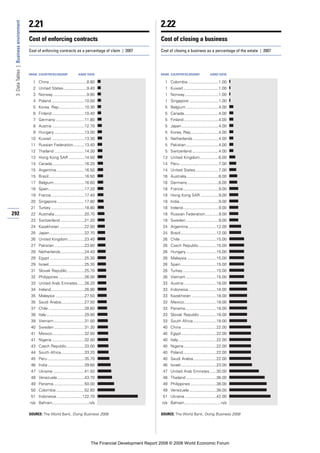
such costs include the World Bank’s measures of the cost
of starting a business, the cost of registering property, the
cost of dealing with licensing, the cost of exporting and
importing, and the cost of closing a business.
Our analysis also considers taxes as another key
constraint that businesses can face. Generally, the higher
the tax rates, the lower the growth rate as higher taxes
deter businesses from operating and expanding.Within
6
1.1:TheFinancialDevelopmentIndex
The Financial Development Report 2008 © 2008 World Economic Forum
the context of financial intermediaries, higher taxes
deter financial intermediaries from expanding, and
hence impede economic growth.
Third pillar: Financial stability
The third pillar addresses the stability of the financial
system.This factor is important given the pervasiveness
of episodes of financial crises that have negative effects
on economic growth and lead to significant losses to
investors, including systemic banking crises, systemic
corporate crises, currency crises and sovereign debt crises.
Financial stability can be considered in terms of a
trade-off between risk and innovation/return. For
example, a financial system that is very heavily super-
vised and regulated may be very stable and never spark a
financial crisis. However, such a controlled system would
hamper the financial development and innovation that
increases returns, diversifies risks, and better allocates
resources to the highest-return investments. Conversely,
a financial system that is very free and innovative and is
very lightly regulated and supervised may eventually
become unstable and trigger credit booms and asset
7
1.1:TheFinancialDevelopmentIndex
(Please see subsequent essay by Nouriel Roubini in Chapter 1.3
for a full discussion of this topic)
Financial crises have important economic and financial conse-
quences that might lead to severe economic contractions such
as recessions or depressions. These contractions may be either
short-lived or persist over time. Financial crises are also associ-
ated with significant bankruptcies among households, corpo-
rate firms and financial institutions, with all the ensuing social
deadweight losses from debt restructurings and bankruptcies.
This makes financial crises expensive. Within this context,
financial stability arises as an important issue given the perva-
siveness of episodes of financial crises, including systemic
banking crises, systemic corporate crises, currency crises and
sovereign debt crises.
Financial stability, a crucial input to financial development,
should be viewed in terms of a trade-off between risk and
return/innovation. A financial system that is highly supervised
and regulated may be very stable but could hamper financial
development and the innovation that allows increased returns,
better diversification of risks, and better allocation of resources.
Conversely, a financial system that lacks financial stability, that
is free and innovative and very lightly regulated may become
unstable, triggering credit booms and asset bubbles that may
have severe effects on growth, returns and welfare if they go
bust.
Asset bubbles occur when an asset price rises above the
underlying fundamental value. Asset bubbles can occur for any
financial or real asset but recent experience shows they are
pervasive in equity markets and in housing and real estate mar-
kets. The perverse interaction between easy money, asset bub-
bles, credit growth and leveraging that feeds asset bubbles has
been observed in many episodes. In the mid 1980s in the United
States, the credit cycle fed the investment boom in commercial
and residential real estate causing a real estate bubble that
went bust in the late 1980s. In the 1990s, the tech and Internet
bubble was in part fed by easy monetary policy, with the Fed
worrying about “irrational exuberance” and doing nothing to
control it. This bubble was also fed by easy credit conditions
that allowed investors to use leverage to increase their pur-
chases of high-tech and Internet stocks. Next, there was the
housing and credit bubble of the 2000s, which was followed by
the housing bust and credit crunch of 2007.
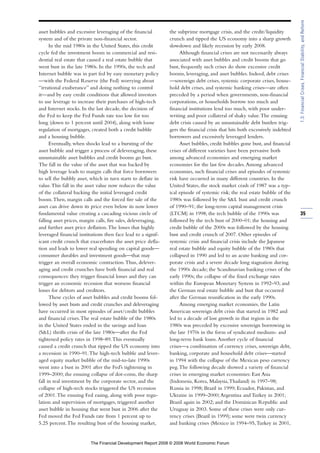
Other episodes of systemic crisis and financial crisis
include the Japanese real estate bubble and equity bubble of
the 1980s that collapsed in 1990 and led to an acute banking and
corporate crisis and a severe decade long stagnation during the
1990s. We witnessed the Scandinavian banking crises of the
early 1990s and the collapse of the fixed exchange rates within
the European Monetary System in 1992–93.
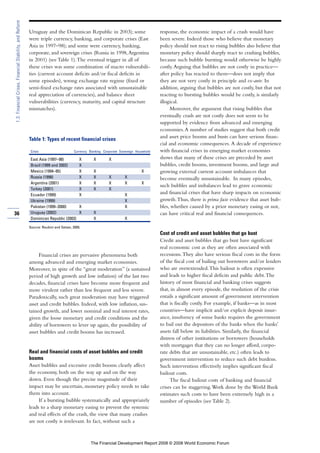
Among emerging market economies, the Latin American
sovereign debt crisis started in 1982 and led to a decade of lost
growth. Another cycle of financial crises, a combination of cur-
rency, sovereign debt, banking, corporate and household debt
crises, started in 1994 with the collapse of the Mexican peso
currency peg. The following decade showed a variety of finan-
cial crises in emerging market economies: East Asia (Thailand,
Indonesia, Malaysia, Korea) in 1997–98; Russia in 1998; Brazil in
1999; Ecuador, Pakistan, and Ukraine in 1999–2000; and Turkey
and Argentina in 2001.
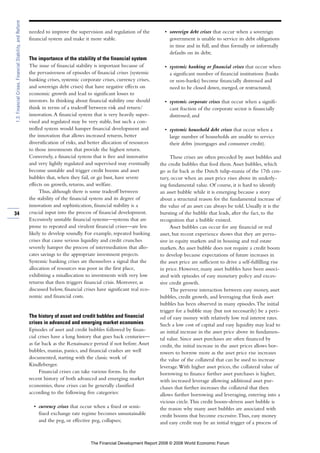
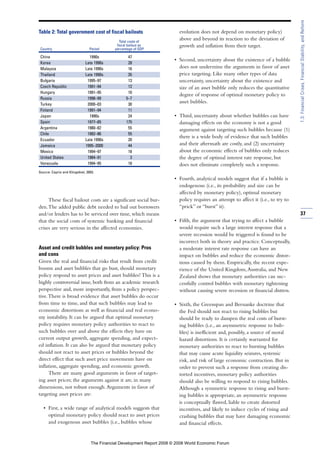
The history of most financial and banking crises suggests
that in almost every episode the resolution of the crisis entails a
significant amount of government intervention that is fiscally
costly. These fiscal bailout costs are a significant social burden.
The added public debt needed to bail out borrowers and/or
lenders has to be serviced over time, which means that the
social costs of systemic banking and financial crises are very
serious in the affected economies.
Within this framework, financial stability becomes an
important factor in assessing the degree of development of a
financial system. While financial crises will never be altogether
eliminated, the frequency and severity of booms and busts of
asset prices and credit that cause financial crises and costly
financial instability can be reduced if appropriate supervision
and regulation is applied. Such reduction will also contribute to
reducing the fiscal costs associated with such crises, thereby
lessening their consequences.
Box 2: The cost of financial crises
The Financial Development Report 2008 © 2008 World Economic Forum
bubbles that can severely affect growth, returns and wel-
fare.While there is some trade-off between the stability
of the financial system and its degree of innovation and
sophistication, financial stability remains an important
input in the process of financial development.
Excessively unstable financial systems—systems that are
prone to repeated and virulent financial crises—are less
likely to grow and develop.
This pillar tries to capture the risk of three types of
crises: currency crises, systemic banking crises and sover-
eign debt crises. For the risk of currency crises, variables
captured include the real effective exchange rate, current
account balance, the dollarization vulnerability indicator,
the external vulnerability indicator, and external debt to
GDP.
The systemic banking crises subpillar captures the
frequency of banking crises since the 1970s, the degree
of banking stability, a measure of cumulative real estate
appreciation, and a measure of the regulation of the
banking institutions. Banking stability is one of the most
important variables that proxies for the risk of systemic
banking crises. Empirical research has shown that coun-
tries that have gone through systemic banking crises or
endured a high degree of financial volatility are more
susceptible to profound short-term negative impacts on
the degree of financial intermediation. More stable
countries were found not to be vulnerable to such
effects and are thus more prone to growth.17
Research has also been conducted on the link
between banking regulatory and supervisory issues and
banking sector development. Policies that induce correct
information disclosure, authorize private sector corpo-
rate control of banks, and provide motivation for private
agents to exercise corporate control tend to encourage
the development, operational efficiency, and stability of
the banking system.This in turn enhances growth.
Fewer regulatory restrictions on banks have also been
shown to decrease banking system vulnerabilities.
Research also shows that countries that foster competi-
tion among banks through national institutions are less
likely to experience a systemic banking crisis.18
The last type of crisis captured within this pillar is
sovereign debt crisis.The best proxy for the risk of this
crisis is sovereign credit ratings.These data were calcu-
lated as an average of both local currency sovereign
credit ratings and foreign currency credit sovereign rat-
ings. Sovereign ratings measure the degree to which a
country is willing and able to pay its debt in a timely
manner and in full.Thus, a high sovereign credit rating
signifies a lesser likelihood of default as occasioned by a
sovereign debt crisis.
The greater the risk of these crises, the greater the
likelihood that the different processes of financial inter-
mediation will be hampered, precipitating lower eco-
nomic growth rates.
Financial intermediaries and markets
The second category of pillars measures the degree of
development of the financial sector as seen in the differ-
ent types of intermediaries.These three pillars are:
banks, non-banks (e.g., investment banks and insurance
firms) and financial markets.
Fourth pillar: Banks
Bank-based financial systems emerge to improve acqui-
sition of financial information and lower transaction
costs, as well as to more efficiently allocate credit.This
role is especially important in developing economies.
The efficient allocation of capital in a financial sys-
tem generally occurs through bank-based systems or
market-based financial systems.19
Some research asserts
that banks finance growth more effectively and efficient-
ly than market-based systems, particularly in under-
developed economies where non-bank financial inter-
mediaries are generally less sophisticated.20
Research also
shows that compared to other forms of financial inter-
mediation, well-established banks form strong ties with
the private sector, which enables them to acquire infor-
mation about firms more efficiently and to persuade
firms to pay their debts in a timely manner.21
Advocates
of bank-based systems argue that banks that are unim-
peded by regulatory restrictions tend to benefit from
economies of scale in the process of collecting informa-
tion and can thus enhance industrial growth. Banks are
also seen as key players in eradicating liquidity risk,
which causes them to increase investments in high-
return, illiquid assets and speed up the process of eco-
nomic growth.22
One of the key measures of the efficacy of the
banking system captured in this pillar is size.The greater
the size of the banking system, the greater the amount
of resources that can be channeled from savers to
investors.This enhances the process of financial develop-
ment, which in turn leads to greater economic growth.
Another key aspect of the banking system is its effi-
ciency. An important aspect of efficiency is the structure
of bank ownership and how this structure affects its per-
formance. Publicly owned banks tend to be less effi-
cient, impeding the process of credit allocation and
channeling of capital, which in turn slows down the
process of financial intermediation.
Another measure of the efficiency of a banking sys-
tem is the degree of foreign ownership of banks, which
reflects a country’s investment climate and the willing-
ness of the government to allow competition.23
Efficiency also encompasses the degree of banking con-
centration, which is captured in a measure of the share
of assets (deposits) in the three largest banks in a coun-
try. Concentrated banking systems are usually less prone
to a systemic banking crisis, which improves the effi-
ciency of their operations.24
A third key aspect of efficiency captured by this pil-
lar is the role of financial information disclosure within
8
1.1:TheFinancialDevelopmentIndex
The Financial Development Report 2008 © 2008 World Economic Forum
the operation of banks. Policies that induce correct
information disclosure, authorize private sector corpo-
rate control of banks, as well as motivate private agents
to exercise corporate control, tend to encourage bank
development, operation, and stability.25
This has a posi-
tive effect on the overall economy.
Fifth pillar: Non-banks
Non-bank financial intermediaries, such as broker deal-
ers, traditional asset managers, alternative asset managers
and insurance companies, are considered both a comple-
ment to banks, as well as a substitute for them.Their
complementary role lies in their efforts to fill any vacu-
um created by commercial banks.Their competition
with banks allows both parties to operate more effi-
ciently in meeting market needs.Activities of non-bank
financial intermediaries include their participation in
securities markets, as well as the mobilization and alloca-
tion of financial resources of a longer-term nature, for
example in insurance activities.
Empirical research has found that banks as well as
non-bank financial intermediaries are larger, more
active, and more efficient in advanced economies.26
Advocates of the market-based system (i.e., non-banks)
point to the fact that the market-based system is able to
finance innovative and high-risk projects.27
As for the
insurance sector, it can be seen as a tool that eases trade
and commerce by providing ample liability coverage.
Insurance also creates liquidity and facilitates the process
of building economies of scale in investment, thereby
improving overall financial efficiency.28
Insurance has
also been found to mobilize illiquid savings to positively
affect growth.29
The degree of development of non-bank financial
intermediaries in general has been found to be a
good proxy of a country’s overall level of financial
development.30
Sixth pillar: Financial markets
The four major types of financial markets include bond
markets (both for government and corporate bonds),
stock markets where equities are traded, foreign
exchange markets and derivatives markets.
Stock market liquidity is statistically significant in
terms of its positive impact on capital accumulation,
productivity growth, and current and future rates of
economic growth.31
More generally, economic theory
suggests that stock markets encourage long-run growth
by promoting specialization, acquiring and disseminating
information, and mobilizing savings in a more efficient
way to promote investment.32
Research also shows that
as countries become richer, stock markets become more
active and efficient relative to banks.33
Bond markets
have received little empirical attention, but recent
research has shown that bond market development does
in fact affect economic output.34
Derivatives markets are an important aspect of this
pillar because they can significantly improve risk man-
agement and risk diversification.The development of
derivatives markets can enhance the confidence of inter-
national investors and financial institutions to participate
in them. Derivatives markets generally are small in
emerging markets.The strengthening of the legal and
regulatory environment can enhance the development
of such markets, which in turn contributes to the
process of economic growth.35
Capital availability and access
This third and final category is comprised of one pillar
which represents the “outputs” of financial intermediation.
Seventh pillar: Size, depth, and access
The measures represented in this last pillar span the size
and depth of the financial system and the degree of
access by both savers and users of capital to financial
services.These macro-level issues of size and depth and
micro-level issues of access are integrally related to the
provision and allocation of capital that drive economic
growth.
Size and depth
Empirical evidence shows that a limited set of variables
is significantly correlated with economic growth and
welfare and can be good proxies for the “output” of
financial intermediation.This output group includes
measures of how large and deep the financial system is,
appropriately scaled to the GDP of the country. It also
includes measures of access to capital and financial serv-
ices by businesses.
Consensus exists on the relationship between the
size and depth of the financial system and the supply
and robustness of financial services that drive economic
growth.36
This effect occurs because the size of financial
markets is viewed as an important determinant of sav-
ings and investment.37
The size of the financial system
also matters because the larger the size of the financial
system, the greater its ability to benefit from economies
of scale given the significant fixed costs prevailing in
financial intermediaries’ activities.A larger financial sys-
tem tends to relieve existing credit constraints.This
facilitates borrowing by firms and further improves the
process of savings mobilization and the channeling of
savings to investors. Given that a large financial system
should allocate capital efficiently and better monitor the
use of funds, improved accessibility to financing will
tend to amplify the resilience of an economy to shocks.
Thus, a larger financial system implies a better allocation
of risks, increasing the level of physical and human capi-
tal accumulation, which leads to higher growth rates.38
Empirical studies concerning financial development
and growth have generally found that cross-country dif-
ferences in the levels of financial development explain a
9
1.1:TheFinancialDevelopmentIndex
The Financial Development Report 2008 © 2008 World Economic Forum
considerable portion of the cross-country differences in
growth rates.39
Correspondingly, improvements in the
depth of financial markets seemed to precipitate improve-
ments in economic growth rates across countries.40
The proxies included to capture size and depth,
include M241
to GDP, stock market capitalization to
GDP, bank deposits to GDP, public as well as private
debt to GDP, and private credit by deposit money banks
and other financial institutions to GDP.
Access
Another integral component of this “output” category is
access to financial services. Empirically, greater access to
financial services has been associated with the usual
proxies for financial development and resulting econom-
ic growth.42
The presence of financial services per se as
reflected by size and depth does not imply their accessi-
bility by the different types of users within an economy.
Thus, the presence of access as part of the output pillar
becomes integral to our analysis.The measures of access
captured include venture capital availability, access to
local equity markets, access to credit, access to loans and
an overall level of financial market sophistication.
Performance in the other pillars contributes to perform-
ance in this subpillar and the extent of access to finan-
cial services by end users.Accessibility, along with the
size and depth of the financial system as a whole, has a
significant effect on a country’s real activity, economic
growth and overall welfare.
Methodological overview
As indicated in the preceding description of the seven
pillars, the Report takes a holistic approach in the design
of the Index by trying to address the breadth of different
factors relevant to financial development.Accordingly, a
large variety of variables were included for the 52 finan-
cial systems covered by the Index.The choice of vari-
ables was guided by two general criteria:
• the findings of the vast body of empirical studies,
which focus on financial development; and
• the availability of data that serve as effective proxies
for the different dimensions of financial develop-
ment across emerging and developed economies.
The variables were organized into the seven pillars using
a methodology similar to that used in other indexes
published by the World Economic Forum.A combina-
tion of hard data from various sources, such as the World
Bank and the Bank of International Settlements, and
survey data collected as part of the Forum’s Executive
Opinion Survey is used.43
This survey captures data that
are otherwise not available through hard data sources,
such as those pertaining to a country’s institutional and
business environment, and the degree to which firms feel
they can easily access different forms of capital such as
venture capital, initial public offerings and private credit.
Approach to standardization
To permit aggregation and cross-country comparisons,
all hard data variables (i.e., not from the Forum’s Survey)
in the Financial Development Index have been standard-
ized.This was done by re-scaling these variables on a 1-
to-7 scale, the former being the least advantageous and
the latter being the most advantageous to financial
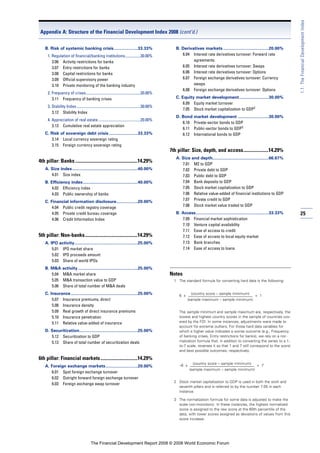
development.The following formula was employed to
standardize those variables:
6 x
(country score – sample minimum)
+ 1
(sample maximum – sample minimum)
The sample minimum and sample maximum are,
respectively, the lowest and highest country scores in the
sample of 52 countries covered by this Index.Thresholds
were identified for outliers in both directions (maximum
and minimum) and high outliers were automatically
given a score of 7 and low outliers a score of 1. For
those variables where a higher raw data value implies a
worse result (such as any vulnerability indicator), we
inverted the standardization formula such that a higher
standardized score is still considered more advantageous.44
Data from the Executive Opinion Survey are presented
in their original form as an aggregation of survey
responses on a 1-to-7 scale.
In certain cases, a “non-monotonic” standardization
had to be employed to ensure that the proportion
between the raw data and standardized score changes
over the range of data for the variable.The public bond
to GDP variable was treated in this manner. In general
we have assumed that low levels of public bonds to GDP
imply low levels of financial development.As the level
of public bonds to GDP increases, the degree of devel-
opment of the bond market improves, which contributes
to financial development as a whole.After a certain
level, however, high debt levels may be considered a
weakness within the economy.To reflect this in the
Index variable, a threshold was selected (60 percent of
GDP) above which the standardized score begins to go
down.This also implies that having debt equivalent to
60 percent of GDP is treated as the “best” level of debt
and thus gets a standardized score of 7.
In some instances, the “interaction” between differ-
ent variables was also captured as certain variables can
be considered more beneficial in the presence of others.
For instance, the effect of liberalizing the capital account
and the domestic financial sector has been found in
empirical studies to be mixed, yielding both positive and
negative results. However, the presence of a strong legal
and regulatory environment tends to mitigate the nega-
tive impacts of the liberalization process.To account for
this, the scores of the capital account liberalization and
domestic financial sector liberalization indexes were
adjusted.Any country above the average standardized
10
1.1:TheFinancialDevelopmentIndex
The Financial Development Report 2008 © 2008 World Economic Forum
score for the legal and regulatory environment45
experi-
enced positive effects as a result of the liberalization
process, while the opposite is true for countries with
scores lower than this average.46
Weighting and scaling of variables
One of the key design principles of the Index is the
inclusion of the breadth of variables relevant to the
financial development of both emerging and developed
economies.The aggregation of these variables into an
overall Index can provide a unified measure of financial
development. However, by examining the individual pil-
lars and constituent variables one gains greater insight
into the strengths and weaknesses of different financial
systems.
Given the emphasis placed on the component parts
of the Index as a framework for analysis, we have taken
a very conservative approach to the weighting of vari-
ables. Unless there is a clear and compelling reason to
the contrary, we have generally weighted different com-
ponents of the Index equally.The seven pillars are
weighted equally as are most of the subpillars that com-
prise each of the pillars.The weightings of the different
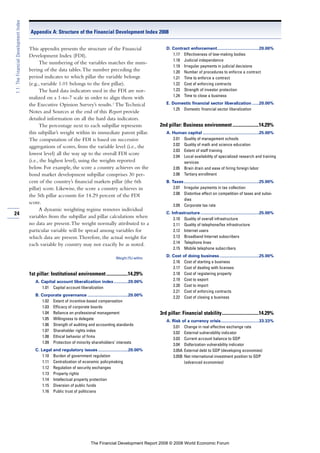
pillars and subpillars as the result of this approach is
described in Appendix A.
We recognize and agree that there is a case to be
made that certain elements of the financial system are
more important for different countries depending on
their unique circumstances and different stages of devel-
opment. For instance, the “sequencing” theory support-
ed by some within the academic community emphasizes
the importance of sequential development of different
aspects of the financial system depending on a country’s
stage of development.A key tenet of this theory asserts
that banks are more important in the process of financial
development and reform for emerging markets, while
capital markets and non-banks (for example equity mar-
kets and investment banks) are more important for
advanced economies.Yet, given the diversity of countries
covered in the Index and the variety of issues they con-
front, we decided that the risks of being overly prescrip-
tive in weighting certain variables for different classes of
countries justified our more conservative approach.
In some instances, there was sufficient cause to
assign different weights to the subpillars within the
Index.Within the risk of systemic crises subpillar, the
regulation of banking institutions and the stability index
are weighted more (30 percent each) as compared to the
frequency of crises and the appreciation of real estate
variables (20 percent each).Within the banking pillar
there are three sub-groups: the size of the banking sys-
tem, efficiency of the banking system, and the role of
financial information disclosure.The first two variables
were weighted 40 percent each in this pillar, while the
last variable was weighted at 20 percent, thus placing
more importance on the size and efficiency of the
banking system.Within the financial markets pillar, a 30
percent weight was assigned to the equity and bond
market subpillars, and a 20 percent weight was assigned
to the foreign exchange and derivatives market subpil-
lars.This was done to signify the relatively greater
importance of equity and bond market development.
For many variables, especially those related to the
size and depth of the financial system, scaling by GDP
was deemed necessary to control for country size.
Scaling by GDP also allows for more relevant cross-
country comparisons.
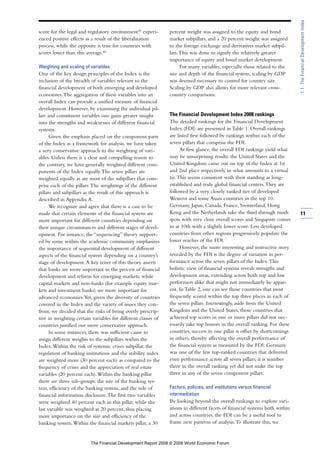
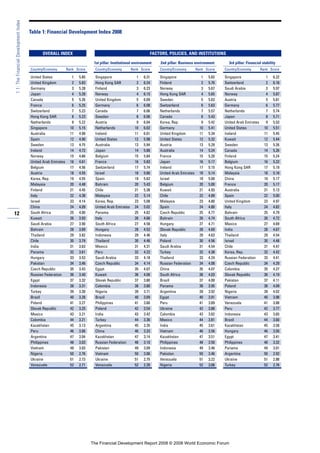
The Financial Development Index 2008 rankings
The detailed rankings for the Financial Development
Index (FDI) are presented in Table 1. Overall rankings
are listed first followed by rankings within each of the
seven pillars that comprise the FDI.
At first glance, the overall FDI rankings yield what
may be unsurprising results: the United States and the
United Kingdom came out on top of the Index at 1st
and 2nd place respectively in what amounts to a virtual
tie.This seems consistent with their standing as long-
established and truly global financial centers.They are
followed by a very closely ranked tier of developed
Western and some Asian countries in the top 10.
Germany, Japan, Canada, France, Switzerland, Hong
Kong and the Netherlands take the third through ninth
spots with very close overall scores and Singapore comes
in at 10th with a slightly lower score. Less developed
countries from other regions progressively populate the
lower reaches of the FDI.
However, the more interesting and instructive story
revealed by the FDI is the degree of variation in per-
formance across the seven pillars of the Index.This
holistic view of financial systems reveals strengths and
development areas, extending across both top and low
performers alike that might not immediately be appar-
ent. In Table 2, one can see those countries that most
frequently scored within the top three places in each of
the seven pillars. Interestingly, aside from the United
Kingdom and the United States, those countries that
achieved top scores in one or more pillars did not nec-
essarily take top honors in the overall ranking. For these
countries, success in one pillar is offset by shortcomings
in others, thereby affecting the overall performance of
the financial system as measured by the FDI. Germany
was one of the few top-ranked countries that delivered
even performance across all seven pillars; it is number
three in the overall ranking yet did not make the top
three in any of the seven component pillars.
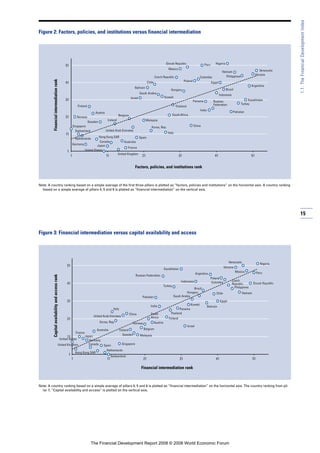
Factors, policies, and institutions versus financial
intermediation
By looking beyond the overall rankings to explore vari-
ations in different facets of financial systems both within
and across countries, the FDI can be a useful tool to
frame new patterns of analysis.To illustrate this, we
11
1.1:TheFinancialDevelopmentIndex
The Financial Development Report 2008 © 2008 World Economic Forum
12
1.1:TheFinancialDevelopmentIndex
Country/Economy Rank Score
United States 1 5.85
United Kingdom 2 5.83
Germany 3 5.28
Japan 4 5.28
Canada 5 5.26
France 6 5.25
Switzerland 7 5.23
Hong Kong SAR 8 5.23
Netherlands 9 5.22
Singapore 10 5.15
Australia 11 4.98
Spain 12 4.90
Sweden 13 4.75
Ireland 14 4.72
Norway 15 4.66
United Arab Emirates 16 4.61
Belgium 17 4.56
Austria 18 4.55
Korea, Rep. 19 4.55
Malaysia 20 4.48
Finland 21 4.45
Italy 22 4.38
Israel 23 4.14
China 24 4.09
South Africa 25 4.00
Kuwait 26 3.93
Saudi Arabia 27 3.90
Bahrain 28 3.89
Thailand 29 3.82
Chile 30 3.79
India 31 3.63
Panama 32 3.61
Hungary 33 3.53
Pakistan 34 3.46
Czech Republic 35 3.43
Russian Federation 36 3.40
Egypt 37 3.32
Indonesia 38 3.31
Turkey 39 3.30
Brazil 40 3.28
Poland 41 3.27
Slovak Republic 42 3.25
Mexico 43 3.21
Colombia 44 3.21
Kazakhstan 45 3.13
Peru 46 3.06
Argentina 47 3.04
Philippines 48 3.03
Vietnam 49 3.03
Nigeria 50 2.76
Ukraine 51 2.73
Venezuela 52 2.71
1st pillar: Institutional environment
Country/Economy Rank Score
Singapore 1 6.31
Hong Kong SAR 2 6.24
Finland 3 6.23
Norway 4 6.15
United Kingdom 5 6.09
Germany 6 6.08
Canada 7 6.06
Sweden 8 6.06
Austria 9 6.04
Netherlands 10 6.02
Ireland 11 6.01
United States 12 5.98
Australia 13 5.94
Japan 14 5.88
Belgium 15 5.84
France 16 5.83
Switzerland 17 5.74
Israel 18 5.66
Spain 19 5.62
Bahrain 20 5.43
Chile 21 5.38
Malaysia 22 5.14
Korea, Rep. 23 5.08
United Arab Emirates 24 5.02
Panama 25 4.82
Italy 26 4.66
South Africa 27 4.58
Hungary 28 4.52
Indonesia 29 4.46
Thailand 30 4.46
Mexico 31 4.31
Peru 32 4.22
Saudi Arabia 33 4.18
Czech Republic 34 4.14
Egypt 35 4.07
Kuwait 36 4.06
Slovak Republic 37 3.80
Colombia 38 3.80
Nigeria 39 3.71
Brazil 40 3.69
Philippines 41 3.60
Poland 42 3.54
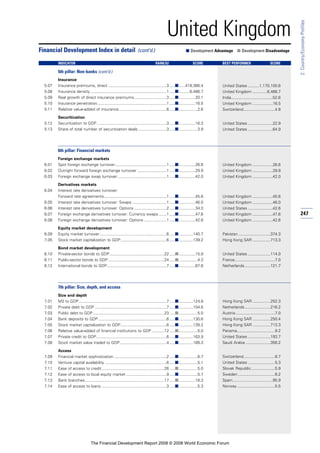
India 43 3.42
Turkey 44 3.36
Argentina 45 3.35
China 46 3.33
Kazakhstan 47 3.14
Russian Federation 48 3.10
Pakistan 49 3.09
Vietnam 50 3.06
Ukraine 51 2.75
Venezuela 52 2.39
2nd pillar: Business environment
Country/Economy Rank Score
Singapore 1 5.82
Finland 2 5.76
Norway 3 5.67
Hong Kong SAR 4 5.65
Sweden 5 5.63
Switzerland 6 5.63
Netherlands 7 5.57
Canada 8 5.43
Korea, Rep. 9 5.42
Germany 10 5.41
United Kingdom 11 5.34
United States 12 5.32
Austria 13 5.29
Australia 14 5.24
France 15 5.20
Japan 16 5.17
Ireland 17 5.15
United Arab Emirates 18 5.14
Israel 19 5.00
Belgium 20 5.00
Kuwait 21 4.93
Chile 22 4.89
Malaysia 23 4.80
Spain 24 4.80
Czech Republic 25 4.77
Bahrain 26 4.74
Hungary 27 4.71
Slovak Republic 28 4.69
Italy 29 4.63
Poland 30 4.56
Saudi Arabia 31 4.54
Turkey 32 4.38
Thailand 33 4.24
Russian Federation 34 4.08
China 35 4.07
South Africa 36 4.03
Brazil 37 4.00
Panama 38 3.95
Argentina 39 3.92
Egypt 40 3.91
Peru 41 3.89
Ukraine 42 3.88
Colombia 43 3.82
Mexico 44 3.81
India 45 3.61
Vietnam 46 3.56
Kazakhstan 47 3.51
Philippines 48 3.50
Indonesia 49 3.46
Pakistan 50 3.46
Venezuela 51 3.22
Nigeria 52 3.08
3rd pillar: Financial stability
Country/Economy Rank Score
Singapore 1 6.22
Switzerland 2 6.18
Saudi Arabia 3 5.97
Norway 4 5.87
Austria 5 5.81
Germany 6 5.77
Netherlands 7 5.74
Japan 8 5.71
United Arab Emirates 9 5.53
United States 10 5.51
Ireland 11 5.45
Kuwait 12 5.44
Sweden 13 5.26
Canada 14 5.26
Finland 15 5.24
Belgium 16 5.22
Hong Kong SAR 17 5.19
Malaysia 18 5.18
China 19 5.17
France 20 5.17
Australia 21 5.13
Spain 22 5.00
United Kingdom 23 4.97
Italy 24 4.82
Bahrain 25 4.79
South Africa 26 4.72
Mexico 27 4.69
India 28 4.67
Thailand 29 4.54
Israel 30 4.48
Chile 31 4.47
Korea, Rep. 32 4.42
Russian Federation 33 4.41
Czech Republic 34 4.29
Colombia 35 4.27
Slovak Republic 36 4.19
Pakistan 37 4.11
Poland 38 4.09
Nigeria 39 4.02
Vietnam 40 3.98
Venezuela 41 3.88
Peru 42 3.77
Indonesia 43 3.65
Brazil 44 3.60
Kazakhstan 45 3.58
Hungary 46 3.50
Egypt 47 3.41
Philippines 48 3.32
Panama 49 3.01
Argentina 50 2.92
Ukraine 51 2.88
Turkey 52 2.76
Table 1: Financial Development Index 2008
FACTORS, POLICIES, AND INSTITUTIONSOVERALL INDEX
The Financial Development Report 2008 © 2008 World Economic Forum
4th pillar: Banks
Country/Economy Rank Score
United States 1 5.80
Malaysia 2 5.72
United Kingdom 3 5.51
United Arab Emirates 4 5.26
Hong Kong SAR 5 5.20
Canada 6 5.15
China 7 4.97
Japan 8 4.92
Germany 9 4.85
Spain 10 4.84
Korea, Rep. 11 4.81
Ireland 12 4.80
Indonesia 13 4.60
France 14 4.55
Thailand 15 4.45
Italy 16 4.41
Belgium 17 4.37
Austria 18 4.32
Netherlands 19 4.25
Norway 20 4.20
Australia 21 4.12
South Africa 22 4.09
Saudi Arabia 23 4.07
Kuwait 24 3.96
Pakistan 25 3.91
Israel 26 3.85
Switzerland 27 3.80
Vietnam 28 3.78
Panama 29 3.77
Chile 30 3.72
Sweden 31 3.67
Singapore 32 3.63
Hungary 33 3.46
Egypt 34 3.40
Slovak Republic 35 3.36
Colombia 36 3.33
Turkey 37 3.32
Poland 38 3.21
Ukraine 39 3.13
Finland 40 3.08
Kazakhstan 41 3.07
Philippines 42 2.96
Bahrain 43 2.96
Czech Republic 44 2.92
Russian Federation 45 2.87
Argentina 46 2.85
Venezuela 47 2.81
Nigeria 48 2.80
Mexico 49 2.65
India 50 2.61
Peru 51 2.51
Brazil 52 2.47
5th pillar: Non-banks
Country/Economy Rank Score
United Kingdom 1 6.55
United States 2 6.05
France 3 5.29
Japan 4 4.50
Canada 5 4.37
Australia 6 4.26
Germany 7 4.12
Netherlands 8 3.87
Spain 9 3.77
Russian Federation 10 3.71
Korea, Rep. 11 3.62
Kazakhstan 12 3.56
Hong Kong SAR 13 3.54
Italy 14 3.35
China 15 3.30
India 16 3.24
Ireland 17 3.15
Switzerland 18 2.99
Singapore 19 2.91
Sweden 20 2.87
Brazil 21 2.82
Argentina 22 2.48
South Africa 23 2.42
Norway 24 2.38
Bahrain 25 2.27
Belgium 26 2.25
Israel 27 2.23
Turkey 28 2.19
Finland 29 2.15
Austria 30 2.12
Peru 31 2.08
Hungary 32 2.01
Ukraine 33 1.99
Panama 34 1.95
Malaysia 35 1.93
Colombia 36 1.89
Thailand 37 1.89
Mexico 38 1.88
United Arab Emirates 39 1.87
Philippines 40 1.78
Egypt 41 1.75
Pakistan 42 1.73
Poland 43 1.72
Chile 44 1.68
Venezuela 45 1.62
Indonesia 46 1.58
Nigeria 47 1.48
Czech Republic 48 1.47
Saudi Arabia 49 1.40
Vietnam 50 1.40
Slovak Republic 51 1.31
Kuwait 52 1.07
6th pillar: Financial markets
Country/Economy Rank Score
United States 1 6.15
United Kingdom 2 5.87
Switzerland 3 5.40
France 4 5.07
Japan 5 5.03
Singapore 6 4.99
Germany 7 4.87
Australia 8 4.58
Netherlands 9 4.35
United Arab Emirates 10 4.28
Hong Kong SAR 11 4.16
Sweden 12 4.13
Canada 13 4.07
Spain 14 3.86
Italy 15 3.83
Belgium 16 3.69
Pakistan 17 3.58
Finland 18 3.40
Kuwait 19 3.34
Korea, Rep. 20 3.15
Turkey 21 3.07
India 22 2.99
Malaysia 23 2.93
Austria 24 2.88
Norway 25 2.88
Ireland 26 2.87
Panama 27 2.84
South Africa 28 2.83
Saudi Arabia 29 2.73
China 30 2.66
Czech Republic 31 2.45
Bahrain 32 2.34
Israel 33 2.31
Brazil 34 2.28
Hungary 35 2.26
Thailand 36 2.25
Argentina 37 2.18
Egypt 38 2.15
Poland 39 2.11
Chile 40 2.10
Russian Federation 41 2.08
Philippines 42 1.97
Venezuela 43 1.87
Kazakhstan 44 1.83
Mexico 45 1.77
Indonesia 46 1.70
Colombia 47 1.66
Slovak Republic 48 1.52
Peru 49 1.43
Nigeria 50 1.30
Ukraine 51 1.27
Vietnam 52 1.16
=7th pillar: Size, depth, and access
Country/Economy Rank Score
Switzerland 1 6.89
Netherlands 2 6.71
Hong Kong SAR 3 6.62
United Kingdom 4 6.48
Canada 5 6.47
Spain 6 6.38
Singapore 7 6.16
United States 8 6.15
Germany 9 5.84
Japan 10 5.72
France 11 5.66
Malaysia 12 5.65
Sweden 13 5.60
Australia 14 5.60
Ireland 15 5.59
Belgium 16 5.57
Israel 17 5.47
Norway 18 5.45
Austria 19 5.41
Korea, Rep. 20 5.33
South Africa 21 5.30
Finland 22 5.27
United Arab Emirates 23 5.17
China 24 5.14
Italy 25 4.97
Thailand 26 4.95
Panama 27 4.93
India 28 4.90
Kuwait 29 4.69
Bahrain 30 4.67
Egypt 31 4.58
Saudi Arabia 32 4.43
Pakistan 33 4.33
Hungary 34 4.28
Chile 35 4.27
Vietnam 36 4.24
Brazil 37 4.10
Philippines 38 4.07
Turkey 39 4.04
Czech Republic 40 3.96
Slovak Republic 41 3.88
Indonesia 42 3.72
Colombia 43 3.71
Poland 44 3.66
Russian Federation 45 3.56
Argentina 46 3.54
Peru 47 3.50
Mexico 48 3.37
Kazakhstan 49 3.24
Ukraine 50 3.23
Venezuela 51 3.16
Nigeria 52 2.92
13
1.1:TheFinancialDevelopmentIndex
Table 1: Financial Development Index 2008 (cont’d.)
CAPITAL AVAILABILITY
AND ACCESSFINANCIAL INTERMEDIATION
The Financial Development Report 2008 © 2008 World Economic Forum
have aggregated the pillar scores with respect to the
broad categories introduced in Figure 1 and described
previously in the chapter. In Figure 2, scores for the
institutional environment, business environment, and
financial stability pillars are averaged and the resulting
rank is presented on the horizontal axis as the measure
“Factors, policies, and institutions.”A ranking according
to a simple average of the banks, non-banks, and finan-
cial markets pillars is presented on the vertical axis as
“Financial intermediation.”
As Figure 2 illustrates, the United States and United
Kingdom both receive top marks with respect to financial
intermediation (pillars four through six) but those factors,
policies, and institutions that are the “inputs” into their
financial systems (pillars one through three) are not as
strong.The United States does not make the top 10
with respect to its institutional and business environ-
ments while the United Kingdom ranks a relatively low
23rd in the financial stability pillar.This results in both
countries being positioned toward the bottom of the
scatter plot in Figure 2.Will uneven performance in
these areas create a long-term development disadvantage,
compromising the ability of financial intermediaries and
markets to efficiently provide capital to end users in
these countries? This question has implications extend-
ing to whether the current pursuit of certain regulatory
reforms should be prioritized to the exclusion of other,
long-term drivers of financial development such as non-
distortionary tax policies and judicial reform.
By contrast, countries such as Norway and
Singapore achieve high marks with respect to their insti-
tutional and business environments and financial stability
but perform relatively poorly with respect to the bank
and non-bank pillars.This accounts for their placement
at the leftmost part of the scatter plot in Figure 2.What
is preventing these countries from translating these
fundamental strengths into more robust financial inter-
mediation and the more effective provision of capital
and financial services to end users? Exploration of the
variables that produce this result and the broader phe-
nomena for which they serve as proxies may have pro-
found implications for financial system development and
enhanced economic growth in these countries.
Taking a different and somewhat narrower perspec-
tive, one may question how Malaysia’s banking system is
able to achieve the relatively high performance shown
in the 4th pillar in Table 1 in light of its relatively lower
performance with respect to its business and institution-
al environments. Increased understanding of this ques-
tion might shed light on how Malaysia could propagate
this success to other aspects of its financial system.
Alternatively, it may provide valuable lessons for other
developing countries as they try to transcend the limita-
tions of their current institutional and business environ-
ments to maximize the benefits of robust financial inter-
mediation.
Financial intermediation versus capital availability and
access
A similar analysis can be performed with respect to the
pillars in the financial intermediation category (the
banks, non-banks and financial markets pillars) and the
one pillar that comprises the capital availability and
access category (the size, depth, and access pillar). In
Figure 3, rankings based on the combined average of the
scores for the pillars in each category are plotted.
Switzerland is ranked number one in terms of capi-
tal availability and access based on a near perfect score
driven by the size and depth of its financial assets.Yet it
does not make the top 10 in terms of financial interme-
diation. Indeed its banking institutions are ranked a rela-
tively low 27th and non-bank financial institutions at
18th. Given this apparent discrepancy are there other
aspects of its financial system such as within its legal and
regulatory or business environment that are more direct-
ly attributable to its relatively large and deep financial
markets? Are these aspects idiosyncratic to the Swiss
financial system or are their lessons for other countries
14
1.1:TheFinancialDevelopmentIndex
Table 2: Countries ranked within the top three of each Index pillar
Financial Development Index pillars
Financial Number of
Development times ranked 1. Institutional 2. Business 3. Financial 6. Financial 7. Size, depth,
Country/Economy Index 2008 rank in top three environment environment stability 4. Banks 5. Non-banks markets and access
Singapore 10 3 1 1 1 — — — —
Switzerland 7 3 — — 2 — — 3 1
United Kingdom 2 3 — — — 3 1 2 —
United States 1 3 — — — 1 2 1 —
Finland 21 2 3 2 — — — — —
Hong Kong SAR 8 2 2 — — — — — 3
France 6 1 — — — — 3 — —
Malaysia 20 1 — — — 2 — — —
Netherlands 9 1 — — — — — — 2
Norway 15 1 — 3 — — — — —
Saudi Arabia 27 1 — — 3 — — — —
FINANCIAL DEVELOPMENT INDEX PILLARS
The Financial Development Report 2008 © 2008 World Economic Forum
15
1.1:TheFinancialDevelopmentIndex
Argentina
Australia
Austria
Bahrain
Belgium
Brazil
Canada
Chile
China
ColombiaCzech Republic
Egypt
Finland
France
Germany
Hong Kong SAR
Hungary
India
Indonesia
Ireland
Israel
Italy
Japan
Kazakhstan
Korea, Rep.
Kuwait
Malaysia
Mexico
Netherlands
Nigeria
Norway
Pakistan
Panama
Peru
Philippines
Poland
Russian
Federation
Saudi Arabia
Singapore
Slovak Republic
SouthAfrica
Spain
Sweden
Switzerland
Thailand
Turkey
Ukraine
United Arab Emirates
United Kingdom
United States
VenezuelaVietnam
1
11
21
31
41
51
1 11 21 31 41 51
Figure 2: Factors, policies, and institutions versus financial intermediation
Note: A country ranking based on a simple average of the first three pillars is plotted as “factors, policies and institutions” on the horizontal axis. A country ranking
based on a simple average of pillars 4, 5 and 6 is plotted as “financial intermediation” on the vertical axis.
Factors, policies, and institutions rank
Financialintermediationrank
Argentina
Australia
Austria
Bahrain
Belgium
Brazil
Canada
Chile
China
Colombia
Czech
Republic
Egypt
Finland
France
Germany
Hong Kong SAR
Hungary
India
Indonesia
Ireland
Israel
Italy
Japan
Kazakhstan
Korea, Rep.
Kuwait
Malaysia
Mexico
Netherlands
Nigeria
Norway
Pakistan
Panama
Peru
Philippines
Poland
Russian Federation
Saudi Arabia
Singapore
Slovak Republic
South
Africa
Spain
Sweden
Switzerland
Thailand
Turkey
Ukraine
United Arab Emirates
United Kingdom
United States
Venezuela
Vietnam
1
11
21
31
41
51
1 11 21 31 41 51
Figure 3: Financial intermediation versus capital availability and access
Note: A country ranking based on a simple average of pillars 4, 5 and 6 is plotted as “financial intermediation” on the horizontal axis. The country ranking from pil-
lar 7, “Capital availability and access” is plotted on the vertical axis.
Financial intermediation rank
Capitalavailabilityandaccessrank
The Financial Development Report 2008 © 2008 World Economic Forum
as they try to maximize the benefits to their economies
of increased access to capital?
By contrast, the Russian Federation is ranked 45th
in terms capital availability and access yet ranks a
stronger 26th based on an average of the financial inter-
mediation pillars. Its non-bank institutions are rated par-
ticularly strong at 10th (see the 5th pillar in Table 1),
driven in large part by healthy initial public offerings
(IPO) and securitization activity, while a relatively low
40th in terms of access to its equity markets (as can be
seen in its country profile contained in Part 2 of this
Report).Why hasn’t Russia been able to translate robust
financial intermediation into economically vital access
to capital? More detailed exploration of this question
may help inform priorities for reforms within its finan-
cial system.
Financial depth versus access
Intriguing variations in country performance can also
be seen within the pillars of the Index. One of these
variations occurs with respect to the two main compo-
nents of pillar seven: the size and depth subpillar, which
includes different measures of financial assets as a per-
centage of GDP and the access subpillar, which uses
unique data from the Forum’s Survey to assess how easily
end users can access different forms of capital. Financial
depth, typically expressed as a country’s financial assets to
GDP, is often cited as a measure of the availability of
capital.Yet, from the perspective of economic growth,
what is also important is how easily end users are able to
access this pool of capital.
In Figure 4, country rankings in terms of total
financial assets to GDP are plotted against rankings of
the average of all the access measures in pillar seven. It is
clear from this graph that the degree of access that end
users have to capital is not necessarily a close function
of the financial depth in a given country. Looking at
China, one can see that even though it has a very high
ratio of financial assets to GDP, this has not translated to
enhanced access for end users of capital within the
country, which accounts for its position at the very top
of the scatter plot.
By contrast, Finland and Norway have roughly the
same degree of financial assets as a percentage of GDP,
but score near the very top of the rankings in terms of
financial access, which accounts for their position towards
the bottom of the scatter plot. Given the importance of
capital access to the end users of capital and businesses
that propel an economy, increased understanding of this
result and how to better translate financial depth to
access could lead to new ways to enhance a financial
system’s impact as a driver of economic growth.
Regional analysis
The preceding examples both across and within the pil-
lars of the FDI illustrate the potential to reframe discus-
sion using the broader dimensions of financial develop-
ment.The country profiles contained in Part 2 of this
16
1.1:TheFinancialDevelopmentIndex
Argentina
Australia
Austria
Bahrain
Belgium
Brazil
Canada
Chile
China
Colombia
Czech
Republic
Egypt
Finland
France
Germany
Hong Kong SAR
Hungary
India
Indonesia
Ireland
Israel
Italy
Japan
Kazakhstan
Korea, Rep.
Kuwait
Malaysia
Mexico
Netherlands
Nigeria
Norway
Pakistan
Panama
Peru
Philippines
Poland
Russian Federation
SaudiArabia
Singapore
Slovak Republic
SouthAfrica
Spain Sweden
Switzerland
Thailand
Turkey
Ukraine
UnitedArab Emirates
United Kingdom
United States
Venezuela
Vietnam
1
11
21
31
41
51
1 11 21 31 41 51
Figure 4: Total financial assets to GDP versus capital access
Note: Total financial assets/GDP displayed on the horizontal axis is based on the same numbers found on the top of each country profile in Part 2 of the Report; the
calculation of this measure is described in the “How to Read the Country/Economy Profiles” at the beginning of Part 2. The vertical axis measures the average
of the different capital access variables contained in pillar 7 (variables 7.09, 7.10, 7.11, 7.12, and 7.14).
Total financial assets/GDP rank
Capitalaccessrank
The Financial Development Report 2008 © 2008 World Economic Forum
Report provide detailed information with which to
undertake this analysis.A summary of highlights drawn
from these profiles is presented below by region.
EUROPE AND NORTH AMERICA
The United States takes 1st place in the FDI, driven
by its strong showing across all different aspects of finan-
cial intermediation. Its banks are ranked as the most effi-
cient in the world in areas such as bank concentration,
interest rate spread and operating margins. Similarly, its
financial markets emerge as best-in-class overall, with
strength across the breadth of equity and bond markets,
foreign exchange and derivatives. Non-bank financial
intermediaries such as investment banks and insurance
companies rank very high, particularly in terms of
mergers and acquisitions and securitization activities.
The United States performs well with respect to overall
measures of size, depth, and access, but these are not
quite on par with the performance of its financial inter-
mediaries.
Relatively weaker areas can be seen with respect to
the institutional and business environments within the
United States.The regulation of security exchanges
(24th) and protection of intellectual and property rights
(21st and 17th) prove problematic according to partici-
pants in the Forum’s Survey. Corruption and the regula-
tory burden were also seen as a development area with
the United Sates ranking in the middle of all countries.
A lack of judicial independence and irregular payments
in judicial decisions were seen as obstacles to improved
contract enforcement.The United States, like many
developed countries, received high scores for the liberal-
ization of its domestic financial sector and capital
account, however, this was accompanied by relatively
low scores in areas related to financial stability.
Consistent with the ongoing financial crisis, the United
States ranked a relatively low 25th with respect to the
potential for currency crises and 22nd with respect to
the potential for systemic banking crises. Corporate tax-
ation and infrastructure also emerged as areas requiring
further attention.
The United Kingdom is ranked 2nd overall in
the FDI in a virtual tie with the United States. Its finan-
cial intermediaries are world class with top ranks for
insurance, securitization, and merger and acquisition
activity.The international orientation of its financial
markets earns it top marks with respect to foreign
exchange markets and it ranked first in all measures of
foreign exchange and interest rate derivatives turnover
except one.The country earned third place in the bank-
ing pillar, with efficiency of the sector driving its per-
formance. In terms of capital access and availability, the
United Kingdom outperforms the United States with a
rank of 4th across the FDI country sample.The overall
institutional environment also ranked higher than the
United States with strong marks for corporate gover-
nance and contract enforcement.The efficacy of corpo-
rate boards, shareholder rights, and the strength of audit-
ing and accounting standards distinguishes the United
Kingdom in this area.
As with the United States, key development areas
exist with respect to financial stability.The potential for
a systemic banking crisis (46th) places a drag on the
United Kingdom’s performance in this area.The United
Kingdom also scores relatively low with respect to cor-
porate taxation (30th) and the associated distortionary
effects of taxation and irregular tax payments.The cost
of doing business as seen in the cost of obtaining licens-
es and registering property is also an area that appears to
have room for improvement.The burden of government
regulation (26th) and lack of centralization in economic
policy-making (32nd) also appear to be areas for further
development.
Germany placed 3rd in the rankings by exhibiting
well-rounded performance and a ranking of 10 or high-
er across all seven pillars of the FDI. Consistent strengths
across the institutional and business environments include
a top ranking in auditing and accounting standards (1st),
excellent protection of property rights, a highly effective
judicial system, and high quality infrastructure within
the context of a liberalized yet stable financial system.A
few potential areas for improvement include better pro-
tection of minority and shareholder rights, a lower regu-
latory burden, and improvements with respect to human
capital. Findings with respect to financial intermediation
confirm the historic strength of Germany’s banking sec-
tor but, interestingly, the country also performs equally
well (in fact, slightly better) with respect to both non-
bank financial institutions and financial markets.While
equity markets are ranked 16th, bond markets, deriva-
tives markets and foreign exchange markets are all
ranked within the top 10 in their categories.
France (6th) is similar to the United Kingdom and
the United States in that the strength of its financial
intermediation, particularly that of its non-bank financial
institutions and financial markets, is a key driver of its
relatively high overall ranking (6th). IPO activity (2nd),
M&A activity (4th), and insurance (2nd) are all particular
strengths, as are its derivatives and bond markets (3rd
and 4th respectively).The country appears less successful
across financial system “inputs.” France is ranked a rela-
tively low 20th in terms of financial stability, dragged
down by a very low score with respect to risk of sys-
temic banking crisis (47th).The business environment
also appears to be a weakness with relatively low marks
with respect to taxation and the cost of doing business.
However, there are also some strengths with respect to
the quality of overall infrastructure and management
schools. Excessive regulatory burden appears the weakest
link in France’s institutional environment, as is protec-
tion of shareholder and investor rights.
17
1.1:TheFinancialDevelopmentIndex
The Financial Development Report 2008 © 2008 World Economic Forum
Switzerland closely follows France achieving 7th
place due in large part to the size (relative to GDP) and
stability of its financial system.While achieving the top
ranking according to the overall size- and depth-related
metrics, this success does not fully translate into
improved access for end users of capital where the
country ranked 12th. Despite the iconic nature of many
of Switzerland’s banks, the country’s financial markets
were ranked considerably higher, particularly its equity
and foreign exchange markets (4th and 3rd respectively).
The Netherlands makes the top 10 in the overall
FDI ranking with a particularly strong showing in both
the size and depth of its financial system (2nd) and in
the degree of access provided to end users of capital
(3rd).The efficiency of its banking system drags down
its rank for the banking pillar (19th), while it ranks in
the top 10 in terms of its non-bank intermediaries (8th)
and financial markets (9th).Although the cost of doing
business in the Netherlands seems to be relatively high,
the country still demonstrates consistent strength across
its institutional environment, business environment and
the stability of its financial system. Neighboring Belgium
(17th) demonstrates consistency across the seven pillars
with rankings all falling between 16th and 20th place.
Finland (21st), Sweden(13th), and Norway
(15th) do not break into the top 10 in terms of their
overall rank, but they generally all score very well across
the “inputs” or factors, policies, and institutions that sup-
port their financial systems. Particular strengths seen
across all three countries include the quality of human
capital, the soundness of the legal and regulatory envi-
ronment, and the quality of their infrastructure.Yet pre-
eminence in these areas contrasts each country’s per-
formance with respect to financial intermediation.
While Sweden’s financial markets come in at 12th place,
those of Norway and Finland did not score as high.
Nearly all of these countries’ banks and non-bank inter-
mediaries scored relatively low.
The FDI ranks Italy (22nd) the lowest of the
Western European countries as a result of its relatively
weak institutional and business environments and low
rankings in terms of financial stability. Relatively low
performance can be seen across all the components of
these pillars such as soundness of corporate governance,
legal and regulatory issues, and cost of doing business.
Despite these obstacles, the country performs consistent-
ly well in terms of bank and non-bank financial inter-
mediaries and financial markets. However, strength in
financial intermediation does not translate into
enhanced capital access where the country scores a rela-
tively low 34th.
Development advantages for the financial system of
the Russian Federation (36th) can be seen with respect
to non-bank activities such as securitizations (7th) and
IPOs (6th). By contrast, neither its banks nor its financial
markets are highly developed. Its institutional environ-
ment is generally weak, characterized by relatively poor
protection of property rights, lax auditing and accounting
standards, and a heavy burden of government regulation.
Its business environment exhibits better performance in
terms of information technology infrastructure and the
quality of human capital, but the cost of doing business
ranks low at 45th.The Russian financial system also
receives low marks for capital availability and access (48th).
ASIA AND THE PACIFIC
Performance across the Asia and Pacific region varies
markedly with Asian countries coming in at all levels of
the rankings. Japan emerged as the highest ranked Asian
country (4th) by delivering well-rounded performance
across all pillars within the FDI. Its strongest scores are
seen with respect to financial intermediation and in par-
ticular its highly efficient banks, IPO and M&A activities,
insurance, foreign exchange and derivatives markets.
Japan’s institutional and business environments appear
less successful. Corporate governance is a weak point
characterized by a need for greater incentive-based
compensation of management and better auditing and
accounting standards.A relative lack of centralization of
economic policymaking and the need for better regula-
tion of exchanges contribute to lackluster performance
with respect to legal and regulatory issues. Japan’s large
public debt, fueled in part by massive spending on public
works projects, goes beyond levels that may be consid-
ered healthy for the financial system. Consistent with
the high rate of IPO activity, businesses reported a rela-
tive ease of access to the local equity markets. But the
difficulty of access to private credit, loans, and venture
capital places Japan in the bottom half of these measures
of capital access.
Despite some areas of integration with China,
Hong Kong’s financial system is still quite distinct in
many respects.The country scores 2nd place with
respect to its institutional environment with strong per-
formance spanning shareholder rights, a low regulatory
burden, effective regulation of security exchanges, and
rigorous contract enforcement. Similar to the mainland
there appears a relative need to improve the quality of
human capital, however, the country receives high marks
for a non-distortionary tax regime and the high quality
of its overall infrastructure. Its banking system scores
well (5th), driven primarily by the size of its banks. In
contrast to the last place ranking of mainland China,
Hong Kong scores first place with respect to access to
different forms of capital.
Similar to Hong Kong, Singapore (10th) delivers a
very strong performance in the institutional and business
environment pillars with a first place finish in each.
The country has the lowest regulatory burden of any
country in the Index and ranks highest in terms of the
effectiveness of its law making bodies and contract
enforcement. It tops the list of countries in the FDI in
18
1.1:TheFinancialDevelopmentIndex
The Financial Development Report 2008 © 2008 World Economic Forum
terms of financial stability while, in contrast, its banking
system is ranked a relatively low 38th resulting in large
part from its relative inefficiency. In contrast, neighbor-
ing Malaysia scores 20th in the Index, with very strong
marks for its banking system across size, efficiency and
financial disclosure. Non-bank financial institutions
delivered less successful results, with relatively low marks
related to IPOs, securitization and insurance. Its fully
liberalized domestic financial sector (1st) stands in con-
trast to the relative lack of liberalization of its capital
account (34th).
Australia falls just short of the top 10 in the over-
all ranking (at 11th place), but delivers solid perform-
ance across all seven pillars of the FDI. Its financial mar-
kets and the associated activities of non-bank financial
institutions (particularly IPOs and securitizations) are a
particular strength.Australia’s banking system does not
achieve quite the same levels of success, dragged down
by low levels of efficiency (35th). Entry restrictions on
banks and rapid real estate appreciation have heightened
susceptibility to systemic banking crises (29th), with rel-
atively low scores for risk of a currency crisis as well
(37th).
Korea, Rep. came in at 19th in the overall FDI
ranking, demonstrating consistent performance across all
aspects of the Index.The country receives strong marks
for the strength of its human capital, the quality of its
technology infrastructure and a low legal and regulatory
burden.The performance of its banking system appears
to be a development advantage both in terms of its size
and efficiency. Non-bank financial institutions are simi-
larly robust, with strength across IPO and securitization
activities as well as insurance. Despite the strength of
these financial intermediaries, Korea, Rep. does not
appear to have fully distanced itself from the financial
contagion of the 1990s, earning relatively low marks for
risk of currency crisis (35th) and systemic banking crises
(40th). However, the degree of centralization in its eco-
nomic policymaking (7th) is seen as a strength.
China is ranked 24th of the 52 countries in the
FDI. Large inflows of capital driven by rapid export-
driven economic growth have promoted the size and
depth of its financial markets.The country ranks 2nd in
terms of M2 to GDP, 4th in terms of bank deposits to
GDP, and 5th in terms of the relative value-added of its
financial institutions to GDP. This financial depth has
increased the size of its banking sector which, in combi-
nation with relatively high levels of banking efficiency,
has bolstered its ranking in this category (16th). China
shows room for improvement across most aspects of its
institutional environment, particularly with respect to
the efficacy of its corporate boards, the liberalization of
its capital account and domestic financial sector, and
shareholder and investor rights.While the cost of doing
business is low, the business environment could be
improved with more focus on the development of
human capital, infrastructure and a more equitable tax
regime. China delivered its worst performance with
respect to measures of access to capital, where it came in
last of all countries in the FDI.
India came in at 31st in terms of its overall rank-
ing.While India delivered solid results in terms of its
financial markets (particularly foreign exchange and
derivatives) and its non-bank institutions, its banks
appear hamstrung by lack of size, low efficiency and
poor information disclosure. Despite this, the banking
system is very stable (5th) likely owing in part to sizable
capital buffers that help it weather credit cycles.The
business environment shows significant room for devel-
opment, characterized by an inhospitable tax regime and
relatively poor contract enforcement. India receives low
marks related to the liberalization of its domestic finan-
cial sector and capital account.The quality of India’s
higher education institutions is apparent as seen in the
high score for the quality of management schools (8th),
but development areas include “brain drain,” the ease of
hiring foreign talent, and enrollment in tertiary schools.
Neighboring Pakistan (34th) comes in a few
notches below India, but demonstrates similar strength
in its financial markets (17th). Its banking system is also
strong, bolstered by very high levels of efficiency (5th).
However, Pakistan’s institutional and business environ-
ments earn very low marks in most areas such as domes-
tic financial sector liberalization and infrastructure.
At 38th, Indonesia shows considerable variation
across the different aspects of its financial system. Its
strong banking system delivers world-class performance
in terms of efficiency (1st).Yet, its non-bank financial
institutions and financial markets rank among the lowest
in the Index (both at 46th). Its relatively strong institu-
tional environment is bolstered by strong corporate gov-
ernance and regulatory effectiveness, but its business
environment ranks as one of the lowest in the FDI
(49th) resulting from poor infrastructure and the high
cost of doing business.
Kazakhstan (45th), the Philippines (48th), and
Vietnam (49th) all scored towards the bottom of the
rankings, demonstrating room for improvement across
all seven pillars of the FDI.All of these countries are in
need of development of their institutional and business
environments, and demonstrate a high degree of risk of
financial instability.Vietnam exhibits relatively higher
strength with respect to its banking system (30th), as
well as capital availability and access (36th).The
Philippines also shows relative strength with respect to
the availability and access of capital (38th).
LATIN AMERICA
A sound institutional and business environment is a key
driver of Chile’s place as the highest ranked Latin
American country on the Index (30th). Liberalization
within the context of a sound legal and regulatory
19
1.1:TheFinancialDevelopmentIndex
The Financial Development Report 2008 © 2008 World Economic Forum
environment has been a key driver of the country’s eco-
nomic growth and also contributes to the success of its
financial system.The efficacy of corporate boards (12th)
and protection of shareholder rights (1st) foster strong
corporate governance, while sound regulatory manage-
ment of securities exchanges (12th) and a low overall
regulatory burden contribute to the country’s successful
regulatory environment. Chile has yet to fully translate
its success in these fundamental aspects of its financial
system to high-performing financial intermediaries and
markets. Healthy stock market capitalization (16th) is
compromised by relatively low turnover (43rd). Chile is
closely followed by Panama (32nd) in the overall rank-
ings, which delivers relatively consistent performance
across the main pillars of the Index.The exception is
financial stability (49th), where it earns low marks for
risk of currency and sovereign debt crises.
While Brazil’s (40th) institutional environment
ranks on par with the country’s overall score, the coun-
try achieves low marks for a high legal and regulatory
burden and an ineffective political environment. Relative-
ly stronger scores for its non-bank financial institutions
and financial markets contrast the weak position of its
banks, which received the lowest possible rank due to
their lack of size and low measures of efficiency.
Mexico ranked 43rd in terms of its overall score on
the FDI.The country appears to have left the financial
turmoil of the mid 1990s well behind, achieving its
highest score across the seven pillars in financial stability
(27th).While exhibiting some strength with respect to
securitizations and foreign exchange, the country gener-
ally does not exhibit very strong performance with respect
to its financial markets (45th), banks (49th) or non-bank
intermediaries (38th).The quality of education under-
pinning the development of human capital detracts from
the business environment, as does the cost of doing
business. Relatively weak auditing and accounting stan-
dards and the inefficacy of corporate boards contribute
to low marks for corporate governance (43rd).
Argentina (47th) has not fully escaped the legacy
of the 2001 financial crisis, scoring very low marks for
financial stability (50th) and a scarcity of capital evident
in the size and depth of its financial markets (43rd).The
country ranked second to last in measures of capital
access (51st). However, development areas for Argentina
exist beyond the short-term implications of financial
crises, since it scores generally low marks across its insti-
tutional and business environments. Low scores on the
legal and regulatory front include a high burden of gov-
ernment regulation, poor property protection and a
political environment marked by a low level of trust.
Argentina’s tertiary and management education is an
advantage. However, a distortionary tax regime, among
other factors, compromises the country’s business envi-
ronment. Despite these shortcomings, signs of strength
in financial intermediation can be seen with respect to
securitization activities and insurance (12th and 29th
respectively).
Colombia (44th), Peru (46th) and Venezuela
(52nd) round out the bottom of the rankings for Latin
American countries on the FDI.All of these countries
suffer from poor business environments and undevel-
oped financial markets.Venezuela was ranked last for its
institutional environment, due to weak protection of
property rights, highly burdensome government regula-
tion and obstructive involvement in the financial sector.
MIDDLE EAST AND NORTH AFRICA
The United Arab Emirates (16th) achieves the high-
est ranking of all Middle Eastern countries in the FDI,
displaying a varied performance across the different ele-
ments of its financial system. Its highly efficient banking
system (1st) contrasts with poor financial information
disclosure (48th). UAE’s business environment is
strengthened by a highly favorable, non-distortionary tax
regime (1st), but is hamstrung by the relatively low
quality of training and education underpinning the
development of human capital.The institutional envi-
ronment benefits from a low burden of government reg-
ulation (5th), but the country scores low marks for cor-
porate governance dragged down by ineffective corpo-
rate boards and a lack of incentive-based compensation.
Access to capital is a strong point, particularly to tradi-
tional forms of financing such as private credit (5th) and
loans (6th).
Israel delivers consistent performance across all the
FDI measures to achieve its ranking of 23rd. Its institu-
tional and business environments are generally a strong
suit, while the risk of currency crises pulls down its
ranking for financial stability (30th).The quality of
human capital and a robust information technology
infrastructure contribute to its generally favorable busi-
ness environment. Israel’s banks are relatively large but
inefficient (43rd), and its financial markets generally less
developed (33rd).The availability of venture capital (5th)
helped deliver a solid score for capital access.
Like the other Gulf countries, Kuwait (26th) offers
a highly favorable tax regime that is enhanced by a
low cost of doing business. Its equity markets are well
developed for a country of its size. However, as with
Saudi Arabia, this factor does not translate to successful
non-bank intermediaries, which captured the lowest
score on the FDI. Its banks are efficient. Similar to the
United Arab Emirates, they have low levels of financial
disclosure. Bahrain placed two places below Kuwait,
but shows significant advantages in terms of the quality
of its institutional environment, including a fully liberal-
ized domestic financial sector (1st). Its taxes are low and
non-distortionary, but the relatively poor quality of
human capital proves a disadvantage for the business
environment.
20
1.1:TheFinancialDevelopmentIndex
The Financial Development Report 2008 © 2008 World Economic Forum
Like the United Arab Emirates, Saudi Arabia
(27th) achieves high marks for the stability of its financial
system (3rd).The country’s favorable tax regime is an
asset to its business environment, but this success is offset
by the relatively low quality of human capital (42nd)
and infrastructure (35th). Saudi Arabia’s well-capitalized
stock markets are active, but its non-bank financial
intermediaries are weak, particularly with respect to
M&A activity, securitization and insurance. Saudi
Arabia’s active stock exchange does not appear to trans-
late to a high degree of access to the equity markets for
end users of capital (40th).
Egypt scores 37th on the overall FDI, and most of
its scores across the different Index measures are banded
relatively closely around this value. Development disad-
vantages can be seen with respect to financial stability
(47th), corporate governance (46th), and access to capital.
While there is a low regulatory burden for the financial
sector, the country’s domestic financial sector remains
among the least liberalized in the Index (46th).
SUB-SAHARAN AFRICA
Only two countries from Sub-Saharan Africa are includ-
ed in the Index this year.
South Africa (25th) achieves solid performance
across most of the pillars in the Index. Its insurance mar-
kets are highly evolved with a high degree of penetration
and healthy growth in premiums. It banks are efficient
and equity markets have a very high level of capitaliza-
tion as a share of GDP (3rd). Its information technology
infrastructure generally scores quite low compromising
the quality of its business environment.The quality of its
human capital is also quite low particularly in terms of
the quality of math and science education, tertiary
enrollment, and ease of hiring foreign labor.
Nigeria ranks 50th in the FDI dragged down by
low rankings particularly in terms of capital availability
and access and financial intermediation.While the coun-
try shows some relative strengths in the areas of contract
enforcement (33rd) and corporate governance (41st),
this was contrasted by a last place showing in its business
environment.While a bright spot would appear to be
the stability of its banking sector it is important to note
the inherent trade-off in stability and financial returns
and innovation described in greater detail in chapter 1.3
of this Report.A banking system that is highly regulated
and characterized by a high degree of government
involvement can be highly stable but lacking in the
innovation and competitiveness that can promote better
diversification of risk and allocation of capital.
Conclusion
The regional summaries above relate only highlights,
and users of this report are urged to explore the richness
of data in the country profiles and data tables that fol-
low.The data that are included are comprehensive but
by no means exhaustive. In making difficult decisions
about the selection and organization of data that best
proxy for the most important factors in the develop-
ment of highly complex financial systems, trade-offs had
to be made. However, we feel the benefits of providing a
comprehensive framework to assess and compare financial
systems justify the effort behind this Report. It is our sin-
cere hope that the information it contains will further
the potential for global financial systems to bring finan-
cial resources to those who most need them and to
become an even more powerful facilitator of human
endeavor.
Notes
1 Schumpeter held that financial intermediaries select the firms that
utilize an economy’s savings. More formally, his view stipulated
that financial intermediaries tend to adjust the process of savings
allocation rather than alter the savings rate itself. Thus,
Schumpeter’s notion of finance and development focuses on the
effect of financial intermediaries on productivity growth and the
rates of technological change.
2 For a detailed review of the literature on finance and growth, see
Levine 2004.
3 Levine 1997.
4 La Porta et al. 1997, 1998, 1999; Levine 1998, 1999; and Barth et
al. 1999.
5 Bekaert et al. 2005 also held explicitly that reforms that strengthen
a country’s legal environment and investor protection are most
likely the true cause for better growth prospects.
6 La Porta et al. 1997; King and Levine 1993.
7 Schleifer and Vishny 1997.
8 Tavares 2002.
9 Galor and Zeira 1993.
10 Fitzgerald 2007.
11 See Grilli and Milesi-Ferretti 1995; Kraay 1998; Rodrik 1998; and
Edison et al. 2002a for findings related to the positive relationship
between liberalization and growth. The works of Quinn 1997;
Klein and Olivei 1999; and Quinn and Toyoda 2003 support the
relationship. Research presented in Edison et al. 2002b; Chandra
2003; and Arteta et al. 2003 found the relationship to be ambigu-
ous.
12 Ito and Chin 2007.
13 Levine 1997.
14 Outreville 1999.
15 Barro 1991.
16 Beck 2006.
17 Loayza and Ranciere 2002.
18 Barth et al. 2004. The concept of fewer restrictions is represented
in terms of lower barriers to bank entry and fewer restrictions on
bank activities.
19 That such channeling and efficient allocation occurs is empha-
sized based on two premises: (1) financial intermediaries provide
liquidity; and (2) financial intermediaries are capable of altering the
riskiness of assets. Claus and Grimes 2003.
21
1.1:TheFinancialDevelopmentIndex
The Financial Development Report 2008 © 2008 World Economic Forum
20 Gerschenkron 1962 in addition to others assert that banks finance
growth in a more effective and efficient way as compared to mar-
ket-based systems, particularly in underdeveloped economies
where non-bank financial intermediaries are generally less sophis-
ticated.
21 Rajan and Zingales 2001.
22 Levine 1997, 2001.
23 If foreign ownership of banks is not permitted, it might be a
reflection of a weak and inefficient banking system that is requir-
ing protection from international competition. Adrianova et al.
2006.
24 Beck et al. 2003.
25 Barth et al. 1999.
26 Demirgüç-Kunt and Levine 2001.
27 Noyer 2006.
28 Lin 2007.
29 Carmichael and Dissou 2000.
30 Vittas 1998.
31 Levine and Zervos 1996 employed several indicators for stock
market indicators spanning size (market capitalization ratio) and
liquidity (stock market turnover and stock market value traded
both as shares of GDP).
32 Arestis et al. 2001. http://www.accessmylibrary.com/coms2/sum-
mary_0286-10601330_ITM.
33 Demirgüç-Kunt and Levine 2001.
34 Fink et al.2003.
35 http://imf.org/external/np/speeches/2007/082207.htm.
36 Goldsmith 1969.
37 Ito and Chinn 2007.
38 Fitzgerald 2007.
39 Khan et al. 2003.
40 Levine 2004.
41 M2 refers to an assessment of the amount of money in coins,
currency, checking accounts, savings accounts and deposits.
42 Beck et al. 2005.
43 Browne and Geiger 2007.
44 The following formula was used to adjust for such variables.
–6 x
(country score – sample minimum)
+ 7
(sample maximum – sample minimum)
45 The average score for the legal and regulatory environment was
4.14.
46 The following formula was used to adjust the values of the two
liberalization indexes:
Indexi x
(legal and regulatory issues score)
(average legal and regulatory issues score)
Where i is both the domestic financial sector liberalization index
and the capital account liberalization index.
References
Andrianova, S., P. Demetriades, and A. Shortland. 2006. “Government
ownership of banks, institutions, and financial development.”
WEF Working Paper 0011. London: ESRC World Economy and
Finance Research Programme, Birkbeck, University of London.
Arestis, P., P. O. Demetriades, and K. B. Luintel. 2001. “Financial
Development and Economic Growth: The Role of Stock Markets.”
Journal of Money, Credit, and Banking 33 (1): 16–41.
Arteta, C. O. 2003. “Are Financially Dollarized Countries More Prone to
Costly Crises?” International Finance Discussion Paper 763. Board
of Governors of the Federal Reserve System (US).
Barro, R. J. 1991. “Economic Growth in a Cross Section of Countries.”
NBER Working Paper 3120. Cambridge: National Bureau of
Economic Research.
Barth, J.R., G. Caprio, and R. Levine. 1999. “Banking Systems Around
the World: Do Regulation and Ownership Affect Performance and
Stability?” World Bank Policy Research Paper 2325. Washington
DC: World Bank.
Beck, T. 2006. “Efficiency in Financial Intermediation: Theory and
Empirical Measurement.” In Microfinance and Public Policy:
Outreach, Performance and Efficiency, edited by Bernd Balkenhol.
Hampshire: Palgrave MacMillan.
Beck, T., A. Demirgüç-Kunt, and R. Levine. 2003. “Bank Concentration
and Crises.” NBER Working Paper 9921. Cambridge: National
Bureau of Economic Research.
Beck, T., A. Demirgüç-Kunt, and M. Peria. 2005. “Reaching out : access
to and use of banking services across countries.” Policy Research
Working Paper Series 3754. Washington, DC: The World Bank.
Bekaert, G. and C. R. Harvey. 2005. “Research in Emerging Markets
Finance: Looking to the Future.” Emerging Markets Review V
3(4): 429–48.
Browne, C. and T. Geiger. 2007. “The Executive Opinion Survey: The
Voice of the Business Community.” The Global Competitiveness
Report 2007–2008. Hampshire: Palgrave MacMillan. 85-96.
Carmichael, B. and Y. Dissou, 2000. “Health Insurance, Liquidity and
Growth.” Scandinavian Journal of Economics 102(2): 269–84.
Chanda, A. 2003. “The Influence of Capital Controls on Long Run
Growth: Where and How Much?” Journal of Development
Economics 77: 441–66.
Claus, I. and A. Grimes. 2003. “Asymmetric Information, Financial
Intermediation and the Monetary Transmission Mechanism: A
Critical Review.” Treasury Working Paper Series 03/19. New
Zealand Treasury.
Demirgüç-Kunt, A. and R. Levine. 2001. Financial Structures and
Economic Growth: A Cross- Country Comparison of Banks,
Markets, and Development. Cambridge: MIT Press.
De Rato, R. 2007. “Economic Growth and Financial Market
Development: A Strengthening Integration.” A speech sponsored
by the International Monetary Fund. August 22. Available at
http://imf.org/external/np/speeches/2007/082207.htm.
Edison, H. J., M. W. Klein, L. Ricci, and T. Sloek. 2002a. “Capital
Account Liberalization and Economic Performance: Survey and
Synthesis.” NBER Working Paper 9100. Cambridge: National
Bureau of Economic Research.
Edison, H. J., R. Levine, L. Ricci, and T. Slok. 2002b. “International
financial integration and economic growth.” Journal of
International Money and Finance, Elsevier 21(6): 749–76.
Fink, G., P. Haiss, and S. Hristoforova. 2003. “Bond Markets and
Economic Growth.” Research Institute for European Affairs,
Working Paper 49.
Fitzgerald, V. 2007. “Financial Development and Economic Growth: a
Critical View.” In Flat World, Big Gaps, ed. K. S. Jomo.
Hyderabad: Orient Longman. Available at http://www.valpyfitzger-
ald.com/files/09EVKFfinance.pdf
Galor, O. and J. Zeira. 1993. “Income Distribution and
Macroeconomics.” Review of Economic Studies 60 (1): 35–52.
Gerschenkron, A. 1962. Economic Backwardness in Historical
Perspective: A Book of Essays. Cambridge: Harvard University
Press.
Goldsmith, R. W. 1969. Financial Structure and Development. Yale
University Press, London and New Haven.
Grilli, V. and G. M. Milesi-Ferretti. 1995. “Economic Effects and
Structural Determinants of Capital Controls.” International
Monetary Fund Working Paper 95/31 Washington, DC:
International Monetary Fund.
22
1.1:TheFinancialDevelopmentIndex
The Financial Development Report 2008 © 2008 World Economic Forum
Ito, H. and M. Chinn. 2007. “Price-based Measurement of Financial
Globalization: A Cross-Country Study of Interest Rate Parity.”
Pacific Economic Review 12 (4): 419–44.
Kahn, M. S., A. Senhadji. 2000. “Financial Development and Economic
Growth: An Overview.” International Monetary Fund Working
Paper 00/209. Washington DC: International Monetary Fund.
King, R. and R. Levine. 1993. “Finance and Growth: Schumpeter Might
Be Right.” The Quarterly Journal of Economics 108: 717–38.
Klein, M. W. and G. Olivei. 1999. “Capital Account Liberalization,
Financial Depth and Economic Growth.” NBER Working Paper
7384. Cambridge: National Bureau for Economic Research.
Kraay, A. 1998. “In Search of the Macroeconomic Effects of Capital
Account Liberalization.” Manuscript, World Bank.
La Porta, R., F. Lopez-de-Silanes, and A. Shleifer. 2000. “Government
Ownership of Banks.” NBER Working Paper 7620. Cambridge:
National Bureau of Economic Research.
La Porta, R., F. Lopez-de-Silanes, A. Shleifer, and R. W. Vishny. 1997.
“Legal Determinants of External Finance.” Journal of Finance 52:
1131–150.
———. 1998. “Law and Finance.” Journal of Political Economy 106:
1113–55.
———. 1999. “Corporate Ownership Around the World.” Journal of
Finance 54: 471–17.
Levine, R. 1997. “Financial Development and Economic Growth: Views
and Agenda.” Journal of Economic Literature 35: 688–726.
———. 1998. “The legal environment, banks, and long-run economic
growth.” Journal of Money, Credit and Banking 30 (3): 598–13.
———. 1999. “Law, Finance, and Economic Growth.” Journal of
Financial Intermediation 8 (1/2): 8–36.
———. 2001. “Bank-Based or Market-Based Financial Systems: Which
Is Better?” NBER Working Paper 9138. Cambridge: National
Bureau of Economic Research.
———. 2004. “Finance and Growth: Theory and Evidence.” NBER
Working Paper 10766. Cambridge: National Bureau of Economic
Research.
Levine, R. and S. Zervos. 1996. “Stock Markets, Banks, and Economic
Growth.” World Bank Policy Research Paper 1690. Washington,
DC: World Bank.
Lin, J.J. 2007. “The Nature and Importance of Insurance.” College of
Commerce at National Chengchi University. Available at
http://www.rmi.nccu.edu.tw/modules/news/data/2007%2020_Nat
ure_and_Importance_Insurance.ppt
Loayza, N. and R. Ranciere. 2002. “Financial Fragility, Financial
Development, and Growth.” World Bank Policy Research Paper
3431. Washington DC: World Bank.
McKinnon, R. I. 1973. “Money and Capital in Economic Development.”
Washington, DC: Brookings Institution.
Nardo, M., M. Saisana, A. Saltelli, S. Tarantola, A. Hoffman, and E.
Giovannini. 2005. “Handbook On Constructing Composite
Indicators: Methodology And User Guide.” OECD Statistics
Working Paper JT00188147, STD/DOC(2005) 3. Paris:
Organisation for Economic Co-operation and Development.
Noyer, C. 2006. “Financial Systems for Economic Growth.” Paper
Presented at the Third Conference of the Monetary Stability
Foundation: Challenges to the Financial System—Ageing and Low
Growth. Frankfurt-am-Main. July 6.
Outreville, J. F. 1999. “Finanacial Development, Human Capital and
Political Stability.” UNCTAD Discussion Paper 142. Geneva:
United Nations Conference on Trade and Development.
Quinn, D. P. 1997. “The Correlates of Changes in International Financial
Regulation.” American Political Science Review 91: 531–51.
Quinn, D. P. and A. M. Toyoda. 2003. “Does Capital Account
Liberalization Lead to Economic Growth? An Empirical
Investigation.” Washington, DC: Georgetown University.
Rajan, R. G. and L. Zingales. 2001. “The Great Reversals: The Politics of
Financial Development in the 20th Century.” NBER Working
Paper 8178. Cambridge: National Bureau of Economic Research.
Rodrik, D. 1998. “Where Did All The Growth Go? External Shocks,
Social Conflict, and Growth Collapses.” NBER Working Paper
6350. Cambridge: National Bureau of Economic Research.
Schumpeter, J. A. 1912. Theorie der Wirtschaftlichen Entwicklung:
Leipzig: Dunker & Humblot. The Theory of Economic
Development. Translated by R. Opie. 1934. Cambridge: Harvard
University Press.
Shaw, E. S. 1973. Financial Deepening in Economic Development. New
York: Oxford University Press.
Shleifer, A. and D. Wolfenzon. 2000. “Investor Protection and Equity
Markets.” Harvard Institute of Economic Research Paper 1906.
Cambridge: Harvard University.
Shleifer, A. and R. Vishny. 1997. “A Survey of Corporate Governance.”
Journal of Finance 52 (2): 737–83.
Tavares, J. 2002. “Firms, Financial Markets and the Law: Institutions
and Economic Growth in Portugal.” Paper presented at the
Desenvolvimento Económico Português No Espaço Europeu:
Determinantes E Political, sponsored by Banco de Portugal. May
24–25.
Vittas, D. 1998. “The role of non-bank financial intermediaries (with
particular reference to Egypt).” Policy Research Working Paper
Series 1892. Washington, DC: World Bank.
23
1.1:TheFinancialDevelopmentIndex
The Financial Development Report 2008 © 2008 World Economic Forum
24
1.1:TheFinancialDevelopmentIndex
This appendix presents the structure of the Financial
Development Index (FDI).
The numbering of the variables matches the num-
bering of the data tables.The number preceding the
period indicates to which pillar the variable belongs
(e.g., variable 1.01 belongs to the first pillar).
The hard data indicators used in the FDI are nor-
malized on a 1-to-7 scale in order to align them with
the Executive Opinion Survey’s results.1
The Technical
Notes and Sources at the end of this Report provide
detailed information on all the hard data indicators.
The percentage next to each subpillar represents
this subpillar’s weight within its immediate parent pillar.
The computation of the FDI is based on successive
aggregations of scores, from the variable level (i.e., the
lowest level) all the way up to the overall FDI score
(i.e., the highest level), using the weights reported
below. For example, the score a country achieves on the
bond market development subpillar comprises 30 per-
cent of the country’s financial markets pillar (the 6th
pillar) score. Likewise, the score a country achieves in
the 5th pillar accounts for 14.29 percent of the FDI
score.
A dynamic weighting regime removes individual
variables from the subpillar and pillar calculations when
no data are present.The weight normally attributed to a
particular variable will be spread among variables for
which data are present.Therefore, the actual weight for
each variable by country may not exactly be as noted.
Weight (%) within
1st pillar: Institutional environment ..................14.29%
A. Capital account liberalization index............20.00%
1.01 Capital account liberalization
B. Corporate governance ..................................20.00%
1.02 Extent of incentive-based compensation
1.03 Efficacy of corporate boards
1.04 Reliance on professional management
1.05 Willingness to delegate
1.06 Strength of auditing and accounting standards
1.07 Shareholder rights index
1.08 Ethical behavior of firms
1.09 Protection of minority shareholders’ interests
C. Legal and regulatory issues .........................20.00%
1.10 Burden of government regulation
1.11 Centralization of economic policymaking
1.12 Regulation of security exchanges
1.13 Property rights
1.14 Intellectual property protection
1.15 Diversion of public funds
1.16 Public trust of politicians
D. Contract enforcement...................................20.00%
1.17 Effectiveness of law-making bodies
1.18 Judicial independence
1.19 Irregular payments in judicial decisions
1.20 Number of procedures to enforce a contract
1.21 Time to enforce a contract
1.22 Cost of enforcing contracts
1.23 Strength of investor protection
1.24 Time to close a business
E. Domestic financial sector liberalization ......20.00%
1.25 Domestic financial sector liberalization
2nd pillar: Business environment ......................14.29%
A. Human capital ...............................................25.00%
2.01 Quality of management schools
2.02 Quality of math and science education
2.03 Extent of staff training
2.04 Local availability of specialized research and training
services
2.05 Brain drain and ease of hiring foreign labor
2.06 Tertiary enrollment
B. Taxes...............................................................25.00%
2.07 Irregular payments in tax collection
2.08 Distortive effect on competition of taxes and subsi-
dies
2.09 Corporate tax rate
C. Infrastructure .................................................25.00%
2.10 Quality of overall infrastructure
2.11 Quality of telephone/fax infrastructure
2.12 Internet users
2.13 Broadband Internet subscribers
2.14 Telephone lines
2.15 Mobile telephone subscribers
D. Cost of doing business .................................25.00%
2.16 Cost of starting a business
2.17 Cost of dealing with licenses
2.18 Cost of registering property
2.19 Cost to export
2.20 Cost to import
2.21 Cost of enforcing contracts
2.22 Cost of closing a business
3rd pillar: Financial stability...............................14.29%
A. Risk of a currency crisis................................33.33%
3.01 Change in real effective exchange rate
3.02 External vulnerability indicator
3.03 Current account balance to GDP
3.04 Dollarization vulnerability indicator
3.05A External debt to GDP (developing economies)
3.05B Net international investment position to GDP
(advanced economies)
Appendix A: Structure of the Financial Development Index 2008
The Financial Development Report 2008 © 2008 World Economic Forum
25
1.1:TheFinancialDevelopmentIndex
B. Risk of systemic banking crisis....................33.33%
1. Regulation of financial/banking institutions................30.00%
3.06 Activity restrictions for banks
3.07 Entry restrictions for banks
3.08 Capital restrictions for banks
3.09 Official supervisory power
3.10 Private monitoring of the banking industry
2. Frequency of crises.........................................................20.00%
3.11 Frequency of banking crises
3. Stability Index...................................................................30.00%
3.12 Stability Index
4. Appreciation of real estate ............................................20.00%
3.13 Cumulative real estate appreciation
C. Risk of sovereign debt crisis ........................33.33%
3.14 Local currency sovereign rating
3.15 Foreign currency sovereign rating
4th pillar: Banks ....................................................14.29%
A. Size index.......................................................40.00%
4.01 Size index
B. Efficiency index..............................................40.00%
4.02 Efficiency index
4.03 Public ownership of banks
C. Financial information disclosure..................20.00%
4.04 Public credit registry coverage
4.05 Private credit bureau coverage
4.06 Credit Information Index
5th pillar: Non-banks............................................14.29%
A. IPO activity.....................................................25.00%
5.01 IPO market share
5.02 IPO proceeds amount
5.03 Share of world IPOs
B. M&A activity ..................................................25.00%
5.04 M&A market share
5.05 M&A transaction value to GDP
5.06 Share of total number of M&A deals
C. Insurance........................................................25.00%
5.07 Insurance premiums, direct
5.08 Insurance density
5.09 Real growth of direct insurance premiums
5.10 Insurance penetration
5.11 Relative value-added of insurance
D. Securitization.................................................25.00%
5.12 Securitization to GDP
5.13 Share of total number of securitization deals
6th pillar: Financial markets...............................14.29%
A. Foreign exchange markets...........................20.00%
6.01 Spot foreign exchange turnover
6.02 Outright forward foreign exchange turnover
6.03 Foreign exchange swap turnover
B. Derivatives markets ......................................20.00%
6.04 Interest rate derivatives turnover: Forward rate
agreements
6.05 Interest rate derivatives turnover: Swaps
6.06 Interest rate derivatives turnover: Options
6.07 Foreign exchange derivatives turnover: Currency
swaps
6.08 Foreign exchange derivatives turnover: Options
C. Equity market development.........................30.00%
6.09 Equity market turnover
7.05 Stock market capitalization to GDP2
D. Bond market development ..........................30.00%
6.10 Private-sector bonds to GDP
6.11 Public-sector bonds to GDP3
6.12 International bonds to GDP
7th pillar: Size, depth, and access.....................14.29%
A. Size and depth...............................................66.67%
7.01 M2 to GDP
7.02 Private debt to GDP
7.03 Public debt to GDP
7.04 Bank deposits to GDP
7.05 Stock market capitalization to GDP
7.06 Relative value-added of financial institutions to GDP
7.07 Private credit to GDP
7.08 Stock market value traded to GDP
B. Access.............................................................33.33%
7.09 Financial market sophistication
7.10 Venture capital availability
7.11 Ease of access to credit
7.12 Ease of access to local equity market
7.13 Bank branches
7.14 Ease of access to loans
Notes
1 The standard formula for converting hard data is the following:
6 x
(country score – sample minimum)
+ 1
(sample maximum – sample minimum)
The sample minimum and sample maximum are, respectively, the
lowest and highest country scores in the sample of countries cov-
ered by the FDI. In some instances, adjustments were made to
account for extreme outliers. For those hard data variables for
which a higher value indicates a worse outcome (e.g., Frequency
of banking crises, Entry restrictions for banks), we rely on a nor-
malization formula that, in addition to converting the series to a 1-
to-7 scale, reverses it so that 1 and 7 still correspond to the worst
and best possible outcomes, respectively:
–6 x
(country score – sample minimum)
+ 7
(sample maximum – sample minimum)
2 Stock market capitalization to GDP is used in both the sixth and
seventh pillars and is referred to by the number 7.05 in each
instance.
3 The normalization formula for some data is adjusted to make the
scale non-monotonic. In these instances, the highest normalized
score is assigned to the raw score at the 60th percentile of the
data, with lower scores assigned as deviations of values from this
score increase.
Appendix A: Structure of the Financial Development Index 2008 (cont’d.)
The Financial Development Report 2008 © 2008 World Economic Forum
CHAPTER 1.2
Finance, Growth, and the Poor
ROSS LEVINE, Brown University and NBER
The operation of the formal financial system is profoundly
important for economic growth and poverty alleviation.
It influences how many people are hungry, homeless,
and in pain. It shapes the gap between the rich and the
poor. It arbitrates who can start a business and who can-
not, who can pay for education and who cannot, who
can attempt to realize one’s dreams and who cannot.
Finance affects the degree to which economic success
and opportunity are defined by talent and initiative or
by parental wealth, racial identity, and social status.
A considerable body of evidence indicates that the
formal financial system affects aggregate economic
growth.1
Recent research has employed different econo-
metric methodologies and data sets in producing two
core results. First, countries with better-developed finan-
cial systems tend to grow faster. Specifically, countries
with (1) large, privately owned banks that funnel credit
to private enterprises and (2) liquid stock exchanges
tend to grow faster than countries with corresponding
lower levels of financial development.A country’s level
of banking development and stock market liquidity each
exert an independent, positive influence on economic
growth. Second, better-functioning financial systems
boost growth by enhancing the efficiency of resource
allocation, not by increasing savings rates. In particular,
financial development makes it easier for the best firms
to obtain external finance, which accelerates economic
growth.
This paper focuses on the poor. Finance might help
the poor by expanding the overall economy. Economic
growth might lead directly to a reduction in poverty. Or
finance might accelerate growth by disproportionately
benefiting the rich without expanding the economic
opportunities of the poor. In other words, financial
development might increase income inequality.A small,
but growing, body of evidence, however, suggests just
the opposite: financial development boosts growth by
disproportionately benefiting the poor.
I stress the formal financial system, which includes
banks, securities markets, and the full range of institutions
covered in standard finance textbooks. I largely ignore
micro-credit programs and informal systems, which
have received considerable attention by development
economists.At one level, there is no need to distinguish
between formal and informal financial arrangements.
Financial development includes contractual and institu-
tional arrangements that lower transaction and informa-
tion costs associated with evaluating and monitoring
of projects and managing risk. It does not matter who
provides these services.At another level, there are practi-
cal reasons for focusing on formal systems. First, all
countries have extensive laws and regulations governing
27
1.2:Finance,Growth,andthePoor
This paper builds on and borrows heavily from the author’s Maxwell Fry
Global Finance Lecture at Birmingham Business School on September
14, 2007, which is forthcoming in The Manchester School as “Finance
and the Poor.”
The Financial Development Report 2008 © 2008 World Economic Forum
formal financial systems, so this seems to be a natural
place to examine the impact of financial policies on the
poor. Second, when informal financial arrangements
become economically substantive at a national level,
these arrangements are moved under the umbrella of
formal regulations. Consequently, I focus on the role of
formal financial systems—and formal financial sector
policies—in affecting poverty and the economic oppor-
tunities of the poor.
What is poverty?
I use three related definitions of poverty. Development
economists frequently define the poverty line as those
living on less than one dollar per day, though it is
becoming increasingly common to use a line of two
dollars per day. In the European Union and the United
States, essentially nobody lives on less than two dollars
per day, so analysts create different poverty lines.While
somewhat arbitrary, the poverty line is useful. It identi-
fies how many people are living in conditions that a
particular society at a particular time finds abhorrent.
Once measured, society has a quantifiable metric of
people living in unacceptable conditions.
Nevertheless, the poverty line provides only a limit-
ed conception of poverty. It implies that there are no
poor people if everyone is above the line.This misses
relevant qualities of what we mean by poverty. Everyone
might be above the poverty line, but the distribution of
income might be highly skewed. Everyone might be
above the poverty line, but many might be stuck at the
bottom with few opportunities to improve their living
standards.The poverty line ignores income distribution
and the degree of economic opportunity.
Consequently, I also consider income distribution,
which measures comparative poverty. It quantifies how
much of an economy’s income goes to the poorest 10
or 20 percent of the population. It gauges how far each
country lies from perfect income equality each year. It
does not, however, measure hunger, disease, or homeless-
ness. Nevertheless, the distribution of income provides
information on a relevant conception of poverty.
We as economists care about income distribution
because we as people care about income distribution.
Many studies suggest that an individual’s welfare depends
on comparative income, not simply on the individual’s
income. If the operation of the financial system influ-
ences income distribution, this will affect social welfare
beyond poverty considerations.Thus, financial policies
should be judged in terms of their distributional effects,
not simply their aggregate efficiency effects. Indeed, I
will make the more provocative claim that financial
policies primarily reflect battles over income distribution,
not disagreements about efficiency.
The third definition of poverty stresses economic
opportunity. This concept is the most difficult to measure
empirically, but it is typically the most central in theory
and public policy debates. One might define the poor as
those whose economic opportunities are severely limit-
ed by parental wealth, race, religion, or other traits.
Comparatively talented and industrious individuals may
face extraordinary obstacles because their parents lack
resources or other characteristics.The role of finance in
shaping economic opportunities has not yet received
much attention in empirical studies of finance and the
poor. Below, I present preliminary empirical work on
the connections between finance and racial discrimina-
tion, which provides some information on finance and
opportunity.
Theory
Financial market imperfections are a keystone of many
influential theories of persistent poverty.What I mean
by a keystone is that financial market imperfections are
necessary for sustaining a persistent class of families who
remain poor across generations.
Implications
In these theories, perfect financial markets imply that
individuals have access to capital to fund education,
training, or business endeavors based only on individual
talent and initiative, not on parental wealth.And in these
theories, perfect financial markets equalize opportunities
by reducing the importance of parental wealth. From
this perspective, financial development might exert a
disproportionately positive influence on the poor. Even
while holding the median level of income constant,
financial development can pull the left part of the distri-
bution of income to the right (i.e., it can increase the
proportional distribution to the less wealthy). Further-
more, in some of these theories, better-functioning
financial markets imply a more efficient allocation of
resources, spurring economic growth and hence reduc-
ing the fraction of the population living below any arbi-
trary poverty line. Financial development might reduce
poverty by accelerating aggregate economic growth while
holding income distribution constant. Finance can push
the whole distribution to the right.Thus, researchers
need to dissect the channels linking finance and financial
sector policies with the fraction of the population living
below the poverty line, the distribution of income, and
the distribution of economic opportunities facing differ-
ent segments of the economy.
Basic framework
To better appreciate the mechanisms linking finance and
the intergenerational persistence of poverty, consider
that the income of a particular generation of a particular
family depends on four things: the level of human capital
in that generation of the family; the wage rate per unit
of human capital, which might be family-specific as I
discuss below; dynastic wealth in this family and genera-
tion; and the return on assets, which may also vary by
28
1.2:Finance,Growth,andthePoor
The Financial Development Report 2008 © 2008 World Economic Forum
family, as discussed below.With this simple framework, it
is easy to see that if the bequest motive that transfers
savings from one generation to the next is positively
related to parental wealth, so that the bequest rate increases
with wealth, then (1) family wealth across generations
will not converge in the steady state, (2) wealth differ-
ences will persist in the long run, and (3) the long-run
distribution of wealth will depend on the initial distri-
bution of wealth.
Human capital accumulation
Next, consider human capital as being a positive function
of both ability and schooling. Further, assume that ability
and schooling are complementary inputs into the pro-
duction of human capital, so that schooling is particular-
ly beneficial for students of greater ability.Also, existing
evidence suggests that ability is not strongly persistent
across generations within a family—that is, there are not
simply intelligent and unintelligent families.
Thus, to promote economic efficiency, highly capa-
ble children should receive lots of schooling.With perfect
capital markets, the economy achieves social efficiency.
People who can best take advantage of higher education
get schooling irrespective of parental wealth, so that
schooling is simply a function of ability.An individual’s
economic opportunities are determined by his or her
abilities.
With imperfect capital markets, however, schooling
is jointly determined by ability and parental wealth. Less
capable children of wealthy parents get relatively too
much education.Very capable children of economically
disadvantaged parents get too little.This occurs because
the smart poor cannot borrow to purchase education,
while less capable children from wealthy backgrounds
have the means to purchase more than is socially optimal.
The underdeveloped financial system has two effects.
First, it increases the cross-generational persistence of
poverty, so that the poor tend to stay poor and rich tend
to remain rich. Second, financial underdevelopment
slows economic growth since resources (education
opportunities) do not flow to where they will have the
biggest returns.
Thus, imperfect loan markets both slow economic
growth by reducing the efficient allocation of resources
and curtail the economic opportunities of the poor, per-
petuating cross-family relative income differences.
Entrepreneurship
Some theories highlight the role of financial market
frictions in determining who can become entrepreneurs
and who cannot.With perfect capital markets, those
with the most entrepreneurial talent have access to the
required funding at the economy-wide interest rate.
Entrepreneurial activity is a function of entrepreneurial
ability, not familial wealth. Furthermore, society’s
resources are funneled to those with the most talent, not
to those with the most assets.
With imperfect capital markets, however, capital
will not simply flow to individuals with the most entre-
preneurial talent.With capital market imperfections,
lenders will demand collateral and large injections of
capital by the entrepreneur before funding a business
endeavor.Thus, the accumulated assets of a family will
influence the ability of that family to attract outside
funding and to open a business.The rate of return on
savings depends positively on both entrepreneurial abili-
ty and familial assets.
With poorly functioning financial markets, society’s
resources are not funneled only to those with the most
talent.A poor person with a great idea might not be
able to get the project funded, while a wealthy person
with a mediocre idea might have easier access to credit.
Thus, the best projects are not necessarily funded, which
slows economic growth. Moreover, the talented poor
cannot realize their dreams, curtailing the economic
opportunities of large segments of society. Finance exerts
a major influence on both aggregate economic growth
and the cross-generational persistence of poverty.
Discrimination
Finally, consider the wage rate. It is common to think of
the wage rate per unit of human capital as not varying
across individuals. However, employers might discrimi-
nate by particular characteristics, such as race. For exam-
ple, blacks with exactly the same skills as whites might
receive lower wage rates because employers are willing
to lose some profits in order to satisfy their preferences
for hiring only white workers. Discrimination might
contribute to the intergenerational persistence of relative
incomes across different groups.
Becker (1957) argues that discrimination is cheaper
when there is little competition.When an owner is
earning large rents, the marginal cost of hiring a more
expensive white worker rather than an equally produc-
tive and less expensive black worker is not a very large
share of the profits.With more intense competition and
smaller profit margins, the cost of discrimination
increases.Thus, competition reduces discrimination in
wage rates and employment.
Financial policy reforms fit comfortably within
Becker’s theory of discrimination. Some financial sector
reforms will spur financial intermediaries to expend
more resources seeking out the best firms rather than
simply granting credit to incumbents. For example, if a
bank has a monopoly, it might lend comfortably to
those with whom it has a long, multidimensional rela-
tionship.There might be other existing or potential firms
with better ideas, but the bank can earn comfortable
profits by lending to its friends. If this bank’s monopoly
position is threatened by regulatory reforms that expose
the bank to more competition, however, the intensified
competition might weaken longstanding bonds between
the bank and firms. Competition might spur the bank
to screen borrowers more carefully. In turn, firms will
29
1.2:Finance,Growth,andthePoor
The Financial Development Report 2008 © 2008 World Economic Forum
compete more intensively to attract bank capital. Firms
will have to demonstrate their superiority in product
markets to attract bank capital. In this way, intensified
competition in banking intensifies competition through-
out the economy, which makes discrimination more
expensive.As a consequence, financial sector reforms
that improve the allocation of capital and intensify com-
petition will tend to reduce discrimination, driving up
the wages of the disadvantaged and expanding their
opportunities.
Alternative views and discussion
Theory does not unambiguously assert that the financial
system exerts a first-order, positive impact on the poor.
Indeed, if the poor are simply excluded from access to
financial services, improvements in the financial system
will help only the rich. Financial development might
not provide a broad array of new and improved financial
services to the poor; financial development might only
improve financial services for the rich who were already
using financial services.Thus, financial development
might increase both the inequality of outcomes and the
inequality of opportunities.
Evidence
On the evidence, I summarize three of my papers that
address the different conceptions of poverty: those living
below a poverty line, the distribution of income, and
economic opportunity. By choosing to discuss my
papers, I am not suggesting that my work is the best in
this area. Rather, I have a comparative advantage in pre-
senting my research. I emphasize weaknesses in these
analyses and urge others to improve the study of how
formal financial institutions and policies affect poverty.
Cross-country evidence
Beck et al. (2007) examine the relationship between
financial development and the fraction of the population
living on less than a dollar a day. For a cross-section of
up to 68 developing economies, we use data on poverty
averaged over the period 1980–2005.Thus, we use one
observation per country.We average over this long time
period to aggregate away any business cycle fluctuations
or crises that might distort our assessment of theories,
which focus on the long-run relationship between the
operation of the financial system and changes in the
fraction of the population living below the poverty line.
In defining financial development, theory focuses
on what the financial system does.The financial system
ameliorates informational problems before investments
are made; it affects corporate governance by reducing
informational problems after investments are initiated; it
facilitates risk diversification and reduces liquidity risk
by lowering transaction costs; and it directly affects the
ease of exchange through both information and transac-
tion costs. Obviously, some financial systems perform
the functions comparatively better than others. Poorly
functioning financial systems do not effectively reduce
information and transaction costs, they do not efficiently
allocate resources, and they frequently encourage crony-
ism in the flow of credit. Other financial systems are
better at providing these financial services to the econo-
my. Differences in the ability of financial systems to
identify good projects, monitor firms, diversify risk, and
ease transactions are what I mean by the level of finan-
cial development.
The empirical proxies for financial development,
however, do not directly measure these concepts.A
common measure of financial development is the vari-
able private credit, which equals the value of credit going
to privately owned firms as a fraction of a country’s
gross domestic product (GDP). Private credit isolates the
intermediation of credit that goes to private firms, and it
excludes credit flowing to the state or the state-owned
enterprises. Nevertheless, private credit is not a direct
measure of overcoming information or transaction costs
to improve credit allocation, corporate governance, and
risk management.The value added of improving our
measures of the level of financial development is much
greater than the value added of improving the econo-
metric methods used to examine the impact of finance
on the economy.
The evidence is quite clear: as financial develop-
ment increases, poverty decreases.This holds even when
controlling for average growth, initial income, initial
poverty, and the full range of country traits mentioned
above. It is worth emphasizing that the negative rela-
tionship between financial development and poverty
alleviation holds when controlling for average growth.
We are not simply finding that finance accelerates eco-
nomic growth, which helps the poor.We are finding
that finance exerts a disproportionately positive influ-
ence on the poor.
Beck et al. (2007) also examine income inequality.
Since the data on income inequality run from 1960 to
2005 for 72 countries, we use a dynamic panel instrumen-
tal estimator to control for potential endogeneity bias.
There is a strong negative relationship between the
level of financial development and income inequality.
Finance exerts an especially positive impact on those at
the bottom of the distribution of income.These results
are also not definitive.The measure of financial develop-
ment is not closely tied to theory.The study does not
examine policy; rather, it examines a proxy for overall
financial development that reflects many factors. Future
work that develops better measures of financial develop-
ment and uses exogenous innovations in particular policy
changes will substantively improve our understanding.
Deregulation across the United States
Beck et al. (2008) test whether a policy reform that
improved the quality of banking services increased,
decreased, or had no effect on the distribution of
30
1.2:Finance,Growth,andthePoor
The Financial Development Report 2008 © 2008 World Economic Forum
income. Individual states within the United States
removed regulatory prohibitions on opening branches
within state boundaries in different years over a 20-year
period, ranging from the mid 1970s to the mid 1990s.
We examined the impact of bank deregulation on the
distribution of income, which has been the central battle
line over bank regulations in the United States since the
administration of George Washington.
Methodologically, the deregulation of intra-state
branching provides a natural setting for identifying and
assessing the impact of regulatory reform on the distri-
bution of income. Kroszner and Strahan (1999) show
that national technological innovations triggered dereg-
ulation, which was exogenous to income distributional
changes within individual states.The invention of auto-
matic teller machines (ATMs), in conjunction with
court rulings that ATMs are not bank branches, weak-
ened the geographical bond between customers and
banks. Checkable money market mutual funds facilitated
banking by mail and telephone, which weakened local
bank monopolies. Improvements in communications
technology lowered the costs of using distant banks.
These innovations reduced the monopoly power of
local banks, and therefore weakened their ability and
desire to fight deregulation. Kroszner and Strahan (1999)
further show that cross-state variation in the timing of
deregulation reflects the interactions of these technolog-
ical innovations with pre-existing conditions.Thus, the
driving forces behind deregulation and its timing were
largely independent of state-level changes in income
distribution. Consequently, we exploit cross-state, cross-
year variation in income distribution and deregulation
to assess the impact of a single policy change on differ-
ent state economies.
The paper’s major finding is that deregulation of
branching restrictions reduced income inequality.After
controlling for national trends in income inequality, the
Gini coefficient of income inequality drops after bank
branch deregulation.
The negative relationship between branch deregula-
tion and inequality is robust to using different measures
of income distribution, examining different components
of income, controlling for many time-varying state char-
acteristics, and conditioning on state and year fixed
effects.While income inequality widened in the United
States during this period, we show that branch deregula-
tion lowered income inequality relative to this national
trend.The magnitude is consequential: deregulation
explains 60 percent of the variation of income inequality
during the sample period relative to state and year aver-
ages. Furthermore, deregulation reduces income inequality
by exerting a disproportionately positive impact on the
poor, not by hurting the rich.
Again, the analysis has limitations.This study exam-
ines the United States. Do these results hold for other
countries? Furthermore, we study one specific regulato-
ry reform. Do these results hold for other policy
reforms that boost competition among banks? Although
these shortcomings should be addressed, the empirical
results thus far support a class of models predicting that
better-functioning financial systems disproportionately
help the poor.
Discrimination
With Levkov and Rubinstein (2008), I have been exam-
ining whether the intensification of bank competition
reduces discrimination. Here, we use the deregulation of
interstate banking restrictions that were imposed by
individual states as an exogenous increase in competition.
We have data on hundreds of thousands of individuals
across all of the US states for the period 1976 to 2005.
Using standard labor market procedures, we com-
pute the race gap: the difference between the wage rates
of white males and black males after controlling for a
wide array of personal characteristics.The race gap is
the difference between white and black wage rates that
is unaccounted for by observable characteristics.As in
other studies, we find a positive race gap: white wage
rates are above black wage rates when holding other
traits constant.Then, controlling for state and year fixed
effects, we study how this race gap varies with deregula-
tion.
We find that the race gap falls after deregulation.
After controlling for individual characteristics, as well as
state and year fixed effects, the race gap drops by about
20 percent after a state removes restrictions on interstate
banking. More specifically, before a state deregulates, a
white man with identical observable characteristics as a
black man earns 14 percent more than the black man.
After a state deregulates, the race gap falls to 11 percent.
These findings suggest that improving the financial sys-
tem reduces discrimination, expanding the opportunities
of groups that have been disproportionately stuck at the
bottom of the distribution of income.
Concluding remarks
I conclude with two observations about policy.
First, improvements in the financial system can
increase both efficiency and equity. For comparison pur-
poses, consider redistributive policies. Many theories
motivate redistributive policies as a mechanism for de-
linking an individual’s opportunities from familial wealth.
As I mentioned earlier, however, one cannot simply
change the distribution of income and hold everything
else constant. Redistributive policies create disincentives
to work and save, though researchers debate the actual
economic magnitudes of these disincentive effects.These
tensions between efficiency and equity, however, vanish
when focusing on financial sector reforms. Financial
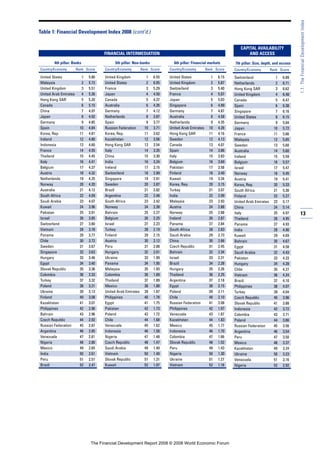
developments that expand individual economic oppor-
tunity create positive, not negative incentive effects, and
avoid the adverse repercussions associated with attempts
to equalize outcomes.
31
1.2:Finance,Growth,andthePoor
The Financial Development Report 2008 © 2008 World Economic Forum
My second policy observation is that this assessment
of the costs of financial development is too good to be
true.The evidence suggests that improvements in the
financial system accelerate economic growth, while dis-
proportionately helping the poor.This raises an obvious
question: if finance is so beneficial, why do only a hand-
ful of countries have well-functioning financial systems?
I believe the answer is also obvious: some people do
not want well-functioning financial systems that give the
economically disenfranchised greater opportunities.
They do not want to compete on equal terms. For
some, there are huge costs associated with financial
development because well-functioning financial systems
will expose them to greater competition. In the United
States, monopolistic banks and their clients benefited
handsomely for almost a century from bank regulations
that protected them from competition.These banks used
their monopolistic rents to maintain political support for
these regulations.The elite favored protective bank regu-
lations even though these regulations stymied aggregate
growth. Indeed, distributional considerations have domi-
nated debates about financial policies since Alexander
Hamilton and Thomas Jefferson first tangled over the
creation of a national bank.2
Similar distributional bat-
tles shape financial policies around the world.3
Many
countries do not have well-functioning financial systems
because decision makers do not view it as in their best
interests to create well-functioning financial systems.
Generating financial reforms, therefore, will involve much
more than identifying which financial sector policies are
good for economic growth in general and the poor in
particular.
Notes
1 See, for example, Levine 1997, 2005.
2 See Beck et al. 2008.
3 See Barth et al. 2006.
References
Barth, J., G. Caprio, and R. Levine. 2006. Rethinking Bank Regulation:
Till Angels Govern. London: Cambridge University Press.
Beck, T., A. Demirgüç-Kunt, and R. Levine. 2007. “Finance, Inequality,
and the Poor.” Journal of Economic Growth 12: 27–49.
Beck, T., R. Levine, and A. Levkov. 2008. “Big Bad Banks? The Impact
of U.S. Branch Deregulation on Income Distribution.” Brown
University, mimeo.
Becker, G. S. 1957. The Economics of Discrimination. Chicago: Chicago
University Press.
Kroszner, R. and P. Strahan. 1999. “What Drives Deregulation?
Economics and Politics of the Relaxation of Bank Branching
Deregulation.” Quarterly Journal of Economics 114: 1437–67.
Levine, R. 1997. “Financial Development and Economic Growth: Views
and Agenda.” Journal of Economic Literature 35: 688–726.
———. 2005. “Finance and Growth: Theory and Evidence.” In
Handbook of Economic Growth, volume 1, eds. P. Aghion and S.
Durlauf. Amsterdam: North-Holland Elsevier Publishers. 865–934.
———. 2008. “Finance and the Poor.” The Manchester School,
Supplement: 1–13.
Levine, R., A. Levkov, and Y. Rubinstein. 2008. “Racial Discrimination
and Competition.” Brown University, mimeo.
32
1.2:Finance,Growth,andthePoor
The Financial Development Report 2008 © 2008 World Economic Forum
CHAPTER 1.3
Financial Crises, Financial
Stability, and Reform:
Supervision and Regulation of
Financial Systems in a World of
Financial Globalization
NOURIEL ROUBINI, New York University and RGE Monitor
The issue of financial stability is central to the assess-
ment of the financial development of a country.The
experience of the last few decades in both emerging
market economies and advanced economies shows the
pervasiveness of financial crises.These crises—signals of
financial instability and the failure of the proper working
of the financial system—have important economic and
financial consequences, and usually lead to severe eco-
nomic contractions—recessions if not depressions—that
may be either short lived or persist over time. If these
real effects persist, the long-run potential and actual
growth rate of an economy may be significantly low-
ered, which has negative effects on long-term welfare.
Financial crises are also expensive, as they are associated
with significant bankruptcies among households, corpo-
rate firms, and financial institutions, with all the ensuing
social deadweight losses from debt restructurings and
bankruptcies. Financial crises often lead to expensive
government intervention, with ensuing fiscal costs to
bail out distressed borrowers (households, firms, and
financial institutions).These fiscal costs can be very
high—often well above 10 percent of GDP.
Thus, persistent and severe financial instability, as
measured by the pervasiveness and severity of financial
crises, is a signal of failure of the financial system: failure
to properly allocate savings to investment projects and
failure of corporate governance. Of course, in a market
economy, some degree of bankruptcy is a healthy sign of
risk-taking.A financial system so “stable” that no bank-
ruptcy would ever occur would indicate low risk-taking
and diminished entrepreneurship; the lack of risky—but
potentially high-return—investment projects would
decrease long-term economic growth.There is a sub-
stantial difference, however, between occasional bank-
ruptcies of firms, households, or banks—bankruptcies
that are healthy developments in flexible and dynamic
market economies—and a systemic banking or corporate
crisis where a large number of financial institutions or
corporations go bankrupt. In short, a systemic financial
crisis is a sign of the failure of the financial system, the
failure of appropriate risk management, and the failure
of proper corporate governance.
This chapter will analyze the issue of financial
crises, the stability of the financial system, and the foun-
dations of sound regulation and supervision. It starts
with an overview of the many financial crises in advanced
and emerging market economies in the last few decades
and the most recent episode of financial turmoil and
distress in advanced economies’ financial systems. It next
considers the role that asset bubbles and credit bubbles—
and their eventual bust—have in financial crises, and then
debates whether monetary and credit policy should be
used to prevent or control such asset and credit bubbles.
Finally, in light of the recent financial crises in advanced
economies, it discusses the market failures and regulatory
failures that led to this turmoil, and provides an overview
of the basic issues and principles that affect the reforms
33
1.3:FinancialCrises,FinancialStability,andReform
The Financial Development Report 2008 © 2008 World Economic Forum
needed to improve the supervision and regulation of the
financial system and make it more stable.
The importance of the stability of the financial system
The issue of financial stability is important because of
the pervasiveness of episodes of financial crises (systemic
banking crises, systemic corporate crises, currency crises,
and sovereign debt crises) that have negative effects on
economic growth and lead to significant losses to
investors. In thinking about financial stability one should
think in terms of a tradeoff between risk and return/
innovation.A financial system that is very heavily super-
vised and regulated may be very stable, but such a con-
trolled system would hamper financial development and
the innovation that allows increased returns, better
diversification of risks, and better allocation of resources
to those investments that provide the highest return.
Conversely, a financial system that is free and innovative
and very lightly regulated and supervised may eventually
become unstable and trigger credit booms and asset
bubbles that, when they fail, or go bust, have severe
effects on growth, returns, and welfare.
Thus, although there is some tradeoff between
the stability of the financial system and its degree of
innovation and sophistication, financial stability is a
crucial input into the process of financial development.
Excessively unstable financial systems—systems that are
prone to repeated and virulent financial crises—are less
likely to develop soundly. For example, repeated banking
crises that cause serious liquidity and credit crunches
severely hamper the process of intermediation that allo-
cates savings to the appropriate investment projects.
Systemic banking crises are themselves a signal that the
allocation of resources was poor in the first place,
exhibiting a misallocation to investments with very low
returns that then triggers financial crisis. Moreover, as
discussed below, financial crises have significant real eco-
nomic and financial costs.
The history of asset and credit bubbles and financial
crises in advanced and emerging market economies
Episodes of asset and credit bubbles followed by finan-
cial crises have a long history that goes back centuries—
as far back as the Renaissance period if not before.Asset
bubbles, manias, panics, and financial crashes are well
documented, starting with the classic work of
Kindleberger.
Financial crises can take various forms. In the
recent history of both advanced and emerging market
economies, these crises can be generally classified
according to the following five categories:
• currency crises that occur when a fixed or semi-
fixed exchange rate regime becomes unsustainable
and the peg, or effective peg, collapses;
• sovereign debt crises that occur when a sovereign
government is unable to service its debt obligations
in time and in full, and thus formally or informally
defaults on its debt;
• systemic banking or financial crises that occur when
a significant number of financial institutions (banks
or non-banks) become financially distressed and
need to be closed down, merged, or restructured;
• systemic corporate crises that occur when a signifi-
cant fraction of the corporate sector is financially
distressed; and
• systemic household debt crises that occur when a
large number of households are unable to service
their debts (mortgages and consumer credit).
These crises are often preceded by asset bubbles and
the credit bubbles that feed them.Asset bubbles, which
go as far back as the Dutch tulip-mania of the 17th cen-
tury, occur when an asset price rises above its underly-
ing fundamental value. Of course, it is hard to identify
an asset bubble while it is emerging because a story
about a structural reason for the fundamental increase of
the value of an asset can always be told. Usually it is the
bursting of the bubble that leads, after the fact, to the
recognition that a bubble existed.
Asset bubbles can occur for any financial or real
asset, but recent experience shows that they are perva-
sive in equity markets and in housing and real estate
markets.An asset bubble does not require a credit boom
to develop because expectations of future increases in
the asset price are sufficient to drive a self-fulfilling rise
in price. However, many asset bubbles have been associ-
ated with episodes of easy monetary policy and exces-
sive credit growth.
The perverse interaction between easy money, asset
bubbles, credit growth, and leveraging that feeds asset
bubbles has been observed in many episodes.The initial
trigger for a bubble may (but not necessarily) be a peri-
od of easy money with relatively low real interest rates.
Such a low cost of capital and easy liquidity may lead to
an initial increase in the asset price above its fundamen-
tal value. Since asset purchases are often financed by
credit, the initial increase in the asset prices allows bor-
rowers to borrow more as the asset price rise increases
the value of the collateral that can be used to increase
leverage.With higher asset prices, the collateral value of
borrowing to finance further asset purchases is higher,
with increased leverage allowing additional asset pur-
chases that further increases the collateral that then
allows further borrowing and leveraging, entering into a
vicious circle.This credit boom–driven asset bubble is
the reason why many asset bubbles are associated with
credit booms that become excessive.Thus, easy money
and easy credit may be an initial trigger of a process of
34
1.3:FinancialCrises,FinancialStability,andReform
The Financial Development Report 2008 © 2008 World Economic Forum
asset bubbles and excessive leveraging of the financial
system and of the private non-financial sector.
In the mid 1980s in the United States, this credit
cycle fed the investment boom in commercial and resi-
dential real estate that caused a real estate bubble that
went bust in the late 1980s. In the 1990s, the tech and
Internet bubble was in part fed by easy monetary policy
—with the Federal Reserve (the Fed) worrying about
“irrational exuberance” and doing nothing to control
it—and by easy credit conditions that allowed investors
to use leverage to increase their purchases of high-tech
and Internet stocks. In the last decade, the decision of
the Fed to keep the Fed Funds rate too low for too
long (down to 1 percent until 2004), along with loose
regulation of mortgages, created both a credit bubble
and a housing bubble.
Eventually, when shocks lead to a bursting of the
asset bubble and trigger a process of deleveraging, these
unsustainable asset bubbles and credit booms go bust.
The fall in the value of the asset that was backed by
high leverage leads to margin calls that force borrowers
to sell the bubbly asset, which in turn starts to deflate in
value.This fall in the asset value now reduces the value
of the collateral backing the initial leveraged credit
boom.Then, margin calls and the forced fire sale of the
asset can drive down its price even below its now lower
fundamental value creating a cascading vicious circle of
falling asset prices, margin calls, fire sales, deleveraging,
and further asset price deflation.The losses that highly
leveraged financial institutions then face lead to a signif-
icant credit crunch that exacerbates the asset price defla-
tion and leads to lower real spending on capital goods—
consumer durables and investment goods—that may
trigger an overall economic contraction.Thus, delever-
aging and credit crunches have both financial and real
consequences: they trigger financial losses and they can
trigger an economic recession that worsens financial
losses for debtors and creditors.
These cycles of asset bubbles and credit booms fol-
lowed by asset busts and credit crunches and deleveraging
have occurred in most episodes of asset/credit bubbles
and financial crises.The real estate bubble of the 1980s
in the United States ended in the savings and loan
(S&L) thrifts crisis of the late 1980s—after the Fed
tightened policy rates in 1998–89.This eventually
caused a credit crunch that tipped the US economy into
a recession in 1990–91.The high-tech bubble and lever-
aged equity market bubble of the mid-to-late 1990s
went into a bust in 2001 after the Fed’s tightening in
1999–2000; the ensuing collapse of dot-coms, the sharp
fall in real investment by the corporate sector, and the
collapse of high-tech stocks triggered the US recession
of 2001.The ensuing Fed easing, along with poor regu-
lation and supervision of mortgages, triggered another
asset bubble in housing that went bust in 2006 after the
Fed moved the Fed Funds rate from 1 percent up to
5.25 percent.The resulting bust of the housing market,
the subprime mortgage crisis, and the credit/liquidity
crunch and tipped the US economy into a sharp growth
slowdown and likely recession by early 2008.
Although financial crises are not necessarily always
associated with asset bubbles and credit booms that go
bust, frequently such crises do show excessive credit
booms, leveraging, and asset bubbles. Indeed, debt crises
—sovereign debt crises, systemic corporate crises, house-
hold debt crises, and systemic banking crises—are often
preceded by a period when governments, non-financial
corporations, or households borrow too much and
financial institutions lend too much, with poor under-
writing and poor collateral of shaky value.The ensuing
debt crisis caused by an unsustainable debt burden trig-
gers the financial crisis that hits both excessively indebted
borrowers and excessively leveraged lenders.
Asset bubbles, credit bubbles gone bust, and financial
crises of different varieties have been pervasive both
among advanced economies and emerging market
economies for the last few decades.Among advanced
economies, such financial crises and episodes of systemic
risk have occurred in many different countries. In the
United States, the stock market crash of 1987 was a typ-
ical episode of systemic risk; the real estate bubble of the
1980s was followed by the S&L bust and credit crunch
of 1990–91; the long-term capital management crisis
(LTCM) in 1998; the tech bubble of the 1990s was
followed by the tech bust of 2000–01; the housing and
credit bubble of the 2000s was followed by the housing
bust and credit crunch of 2007. Other episodes of
systemic crisis and financial crisis include the Japanese
real estate bubble and equity bubble of the 1980s that
collapsed in 1990 and led to an acute banking and cor-
porate crisis and a severe decade long stagnation during
the 1990s decade; the Scandinavian banking crises of the
early 1990s; the collapse of the fixed exchange rates
within the European Monetary System in 1992–93; and
the German real estate bubble and bust that occurred
after the German reunification in the early 1990s.
Among emerging market economies, the Latin
American sovereign debt crisis that started in 1982 and
led to a decade of lost growth in that region in the
1980s was preceded by excessive sovereign borrowing in
the late 1970s in the form of syndicated medium- and
long-term bank loans.Another cycle of financial
crises—a combination of currency crises, sovereign debt,
banking, corporate and household debt crises—started
in 1994 with the collapse of the Mexican peso currency
peg.The following decade showed a variety of financial
crises in emerging market economies: East Asia
(Indonesia, Korea, Malaysia,Thailand) in 1997–98;
Russia in 1998; Brazil in 1999; Ecuador, Pakistan, and
Ukraine in 1999–2000;Argentina and Turkey in 2001;
Brazil again in 2002; and the Dominican Republic and
Uruguay in 2003. Some of these crises were only cur-
rency crises (Brazil in 1999); some were twin currency
and banking crises (Mexico in 1994–95,Turkey in 2001,
35
1.3:FinancialCrises,FinancialStability,andReform
The Financial Development Report 2008 © 2008 World Economic Forum
Uruguay and the Dominican Republic in 2003); some
were triple currency, banking, and corporate crises (East
Asia in 1997–98); and some were currency, banking,
corporate, and sovereign crises (Russia in 1998,Argentina
in 2001) (see Table 1).The eventual trigger in all of
these crises was some combination of macro vulnerabili-
ties (current account deficits and/or fiscal deficits in
some episodes), wrong exchange rate regime (fixed or
semi-fixed exchange rates associated with unsustainable
real appreciation of currencies), and balance sheet
vulnerabilities (currency, maturity, and capital structure
mismatches).
Table 1: Types of recent financial crises
Crisis Currency Banking Corporate Sovereign Household
East Asia (1997–98) X X X
Brazil (1999 and 2002) X
Mexico (1994–95) X X X
Russia (1998) X X X X
Argentina (2001) X X X X X
Turkey (2001) X X X
Ecuador (1999) X X
Ukraine (1999) X
Pakistan (1999–2000) X X
Uruguay (2002) X X
Dominican Republic (2003) X X
Source: Roubini and Setser, 2005.
Financial crises are pervasive phenomena both
among advanced and emerging market economies.
Moreover, in spite of the “great moderation” (a sustained
period of high growth and low inflation) of the last two
decades, financial crises have become more frequent and
more virulent rather than less frequent and less severe.
Paradoxically, such great moderation may have triggered
asset and credit bubbles. Indeed, with low inflation, sus-
tained growth, and lower nominal and real interest rates,
given the loose monetary and credit conditions and the
ability of borrowers to lever up again, the possibility of
asset bubbles and credit booms has increased.
Real and financial costs of asset bubbles and credit
booms
Asset bubbles and excessive credit booms clearly affect
the economy, both on the way up and on the way
down. Even though the precise magnitude of their
impact may be uncertain, monetary policy needs to take
them into account.
If a bursting bubble systematically and appropriately
leads to a sharp monetary easing to prevent the systemic
and real effects of the crash, the view that many crashes
are not costly is irrelevant. In fact, without such a
response, the economic impact of a crash would have
been severe. Indeed those who believe that monetary
policy should not react to rising bubbles also believe that
monetary policy should sharply react to crashing bubbles,
because such bubble bursting would otherwise be highly
costly.Arguing that bubbles are not costly in practice—
after policy has reacted to them—does not imply that
they are not very costly in principle and ex-ante. In
addition, arguing that bubbles are not costly, but that not
reacting to bursting bubbles would be costly, is similarly
illogical.
Moreover, the argument that rising bubbles that
eventually crash are not costly does not seem to be
supported by evidence from advanced and emerging
economies.A number of studies suggest that both credit
and asset price booms and busts can have serious finan-
cial and economic consequences. A decade of experience
with financial crises in emerging market economies
shows that many of these crises are preceded by asset
bubbles, credit booms, investment booms, and large and
growing external current account imbalances that
become eventually unsustainable. In many episodes,
such bubbles and imbalances lead to grave economic
and financial crises that have sharp impacts on economic
growth.Thus, there is prima facie evidence that asset bub-
bles, whether caused by a prior monetary easing or not,
can have critical real and financial consequences.
Cost of credit and asset bubbles that go bust
Credit and asset bubbles that go bust have significant
real economic cost as they are often associated with
recessions.They also have serious fiscal costs in the form
of the fiscal cost of bailing out borrowers and/or lenders
who are overextended.This bailout is often expensive
and leads to higher fiscal deficits and public debt.The
history of most financial and banking crises suggests
that, in almost every episode, the resolution of the crisis
entails a significant amount of government intervention
that is fiscally costly. For example, if banks—as in most
countries—have implicit and/or explicit deposit insur-
ance, insolvency of some banks requires the government
to bail out the depositors of the banks when the banks’
assets fall below its liabilities. Similarly, the financial
distress of other institutions or borrowers (households
with mortgages that they can no longer afford, corpo-
rate debts that are unsustainable, etc.) often leads to
government intervention to reduce such debt burdens.
Such intervention effectively implies significant fiscal
bailout costs.
The fiscal bailout costs of banking and financial
crises can be staggering.Work done by the World Bank
estimates such costs to have been extremely high in a
number of episodes (see Table 2).
36
1.3:FinancialCrises,FinancialStability,andReform
The Financial Development Report 2008 © 2008 World Economic Forum
Table 2: Total government cost of fiscal bailouts
Total costs of
fiscal bailout as
Country Period percentage of GDP
China 1990s 47
Korea Late 1990s 28
Malaysia Late 1990s 16
Thailand Late 1990s 35
Bulgaria 1995–97 13
Czech Republic 1991–94 12
Hungary 1991–95 10
Russia 1998–99 5–7
Turkey 2000–03 30
Finland 1991–94 11
Japan 1990s 24
Spain 1977–85 175
Argentina 1980–82 55
Chile 1982–86 55
Ecuador Late 1990s 20
Jamaica 1995–2000 44
Mexico 1994–97 18
United States 1984–91 3
Venezuela 1994–95 18
Source: Caprio and Klingebiel, 2003.
These fiscal bailout costs are a significant social bur-
den.The added public debt needed to bail out borrowers
and/or lenders has to be serviced over time, which means
that the social costs of systemic banking and financial
crises are very serious in the affected economies.
Asset and credit bubbles and monetary policy: Pros
and cons
Given the real and financial risks that result from credit
booms and asset bubbles that go bust, should monetary
policy respond to asset prices and asset bubbles? This is a
highly controversial issue, both from an academic research
perspective and, more importantly, from a policy perspec-
tive.There is broad evidence that asset bubbles do occur
from time to time, and that such bubbles may lead to
economic distortions as well as financial and real econo-
my instability. It can be argued that optimal monetary
policy requires monetary policy authorities to react to
such bubbles over and above the effects they have on
current output growth, aggregate spending, and expect-
ed inflation. It can also be argued that monetary policy
should not react to asset prices or bubbles beyond the
direct effect that such asset price movements have on
inflation, aggregate spending, and economic growth.
There are many good arguments in favor of target-
ing asset prices; the arguments against it are, in many
dimensions, not robust enough.Arguments in favor of
targeting asset prices are:
• First, a wide range of analytical models suggests that
optimal monetary policy should react to asset prices
and exogenous asset bubbles (i.e., bubbles whose
evolution does not depend on monetary policy)
above and beyond its reaction to the deviation of
growth and inflation from their target.
• Second, uncertainty about the existence of a bubble
does not undermine the arguments in favor of asset
price targeting. Like many other types of data
uncertainty, uncertainty about the existence and
size of an asset bubble only reduces the quantitative
degree of response of optimal monetary policy to
asset bubbles.
• Third, uncertainty about whether bubbles can have
damaging effects on the economy is not a good
argument against targeting such bubbles because (1)
there is a wide body of evidence that such bubbles
and their aftermath are costly, and (2) uncertainty
about the economic effects of bubbles only reduces
the degree of optimal interest rate response, but
does not eliminate completely such a response.
• Fourth, analytical models suggest that if a bubble is
endogenous (i.e., its probability and size can be
affected by monetary policy), optimal monetary
policy requires an attempt to affect it (i.e., to try to
“prick” or “burst” it).
• Fifth, the argument that trying to affect a bubble
would require such a large interest response that a
severe recession would be triggered is found to be
incorrect both in theory and practice. Conceptually,
a moderate interest rate response can have an
impact on bubbles and reduce the economic distor-
tions caused by them. Empirically, the recent expe-
rience of the United Kingdom,Australia, and New
Zealand shows that monetary authorities can suc-
cessfully control bubbles with monetary tightening
without causing severe recession or financial distress.
• Sixth, the Greenspan and Bernanke doctrine that
the Fed should not react to rising bubbles but
should be ready to dampen the real costs of burst-
ing bubbles (i.e., an asymmetric response to bub-
bles) is inefficient and, possibly, a source of moral
hazard distortions. It is certainly warranted for
monetary authorities to react to bursting bubbles
that may cause acute liquidity seizures, systemic
risk, and risk of large economic contraction. But in
order to prevent such a response from creating dis-
torted incentives, monetary policy authorities
should also be willing to respond to rising bubbles.
Although a symmetric response to rising and burst-
ing bubbles is appropriate, an asymmetric response
is conceptually flawed, liable to create distorted
incentives, and likely to induce cycles of rising and
crashing bubbles that may have damaging economic
and financial effects.
37
1.3:FinancialCrises,FinancialStability,andReform
The Financial Development Report 2008 © 2008 World Economic Forum
The uncertainties about bubbles and the other fac-
tors discussed above suggest that monetary policy should
respond to asset bubbles in a cautious and moderate
manner—an aggressive monetary policy approach to
asset bubbles is not needed. Some of the arguments pre-
sented to justify the resistance to fighting rising bubbles
have logic and legitimacy. However, although cautious-
ness is warranted, arguments that there is no case for
responding to asset bubbles tend to be incorrect.
Also, the practice of the US Fed over the last two
decades of not reacting to rising asset bubbles (the high-
tech stock bubble of the late 1990s and the housing
bubble of the last few years) while aggressively counter-
ing bursting bubbles and episodes of systemic risk (in
1987, 1998, 2000, and 2001–03) has contributed to the
asset bubbles and economic imbalances that ended up in
episodes of economic and financial crisis.The real estate
bubble of the 1980s culminated in the S&L crisis of the
late 1980s, which eventually triggered a credit crunch
and a recession in 1990. In the 1990s,Alan Greenspan
warned about “irrational exuberance” when high-tech
stocks started to skyrocket in the mid 1990s, but then
did nothing to control this bubble apart from a token 25
basis points policy rate hike in early 1997.The high-
tech bubble festered and grew even larger after the Fed
eased interest rates by 75 bps following the Long Term
Capital Management (LTCM) hedge fund near collapse;
it went bust in 2000 after the Fed tightened interest
rates by 175 bps between mid 1999 and mid 2000, thus
triggering the 2001 recession.
The Fed responded to this bubble bust and reces-
sion by aggressively easing the policy rate from 6.5 per-
cent in early 2001 to 1 percent by 2004.This aggressive
policy ease, of keeping the Fed Funds rate too low for
too long, then contributed to a new asset bubble— the
housing bubble—that was exacerbated by the failure of
the Fed and other regulators to properly regulate and
supervise mortgages. By 2006, this housing bubble went
bust, triggering a severe liquidity and credit crunch, a
serious financial crisis, and an economic contraction that
is still ongoing.The Fed reacted to this financial crisis,
and the risks to economic growth, by aggressively
reducing the Fed Funds rate from 5.25 percent in the
fall of 2007 to 2 percent by the spring of 2008, and
introducing a whole host of new liquidity facilities for
both banks and systemically important non-bank insti-
tutions.
It can be argued that this latest policy easing,
together with the exchange rate policies of emerging
market economies, contributed to another asset bubble:
the sharp rise in oil, energy, food, and other commodity
prices in 2006–08.This commodity price surge may
now lead to a generalized increase in global inflation,
both among advanced economies and emerging market
economies.
The use of credit policy instruments
In considering an appropriate policy response to asset
bubbles and credit bubbles, one should not be limited to
traditional monetary policy alone. If there is an asset
bubble driven by a credit bubble, the appropriate
response may be a combination of tighter monetary
policy in the form of a higher policy rate as well as an
appropriate credit policy that limits the extent of a cred-
it boom that is becoming excessive.Appropriate regula-
tion and supervision of the banking and financial system
is an important complementary tool that is essential in
controlling credit and asset bubbles.At times monetary
policy, although a necessary instrument to control bub-
bles, may not be the most appropriate tool if used alone.
In the United States, for example, the real estate
bubble of the 1980s was in part the result of loosening
the regulation and supervision of S&L thrifts in the
early 1980s.This led to excesses in commercial and resi-
dential mortgage underwriting. In the 1990s, a more
aggressive Fed tightening, intended to control the “irra-
tional exuberance” in high-tech stocks, would have been
beneficial but limited: if investors expected a 50 to 100
percent a year return on bubbly high-tech stocks, a 50
bps or even 100 or 150 bps policy rate tightening would
have had limited effect. Rather, in addition to that mon-
etary policy tightening, regulations that tightened the
ability of investors to borrow on margin and highly
leverage themselves in their purchase of high-tech stocks
would have been more targeted and effective tools to
deal with the high-tech bubble.Thus, inappropriate reg-
ulation and supervision of such leveraged lending was
one factor that allowed the bubble to fester.
Similarly, in the last decade the Fed certainly made
a mistake in keeping the Fed Funds rate too low for too
long, thus feeding the housing bubble. But with house-
holds expecting bubbly home prices to rise 20 percent
per year, raising the Fed Funds rate sooner would have
had only a limited effect in controlling such a bubble.
An additional policy failure was the laissez-faire
approach of the Fed and of other banking and financial
regulators, which allowed toxic mortgage underwriting
to occur without restraint.Thus, in addition to tighter
monetary policy, better supervision and regulation of
mortgage lending would have been the appropriate
response. More generally, since asset bubbles are usually
fed by credit bubbles, the appropriate response to such
excesses is usually a combination of tighter monetary
policy along with more prudent regulation and supervi-
sion of the financial system to limit these credit cycles.
Such appropriate regulation includes policies to make
capital requirements for financial firms more procyclical.
Arguing that policy should react to credit and asset
bubbles means finding the appropriate combination of
traditional monetary policy and credit policy (including
appropriate regulation and supervision of financial firms)
that can control excessive booms in credit, lending,
leverage, and asset prices.
38
1.3:FinancialCrises,FinancialStability,andReform
The Financial Development Report 2008 © 2008 World Economic Forum
Recent crises of the Western financial system
The decade from 1994 until 2003 was one of repeated
financial crises in emerging market economies: Mexico
in 1994;Thailand, Indonesia, Malaysia, and Korea in
1997–98, Russia in 1998; Brazil, Ecuador, Pakistan, and
Ukraine in 1999;Turkey and Argentina in 2001; and
Uruguay and the Dominican Republic in 2003.These
crises were caused by a combination of macroeconomic
weaknesses, policy mistakes, inappropriate exchange rate
policies, balance sheet vulnerabilities, poor corporate
governance, and weak and poorly supervised and regu-
lated financial systems.
Although not every one of these financial crises
ended up in a systemic crisis of the banking or financial
system or the corporate system, many of them did.The
weaknesses in corporate governance, the emergence of
credit and asset bubbles, the poor supervision and regu-
lation of financial institutions, the distorted incentives
for financial institutions (in part because of moral hazard
distortions created by implicit and/or explicit govern-
ment bailout guarantees), and phenomena such as
directed and connected lending combined led to credit,
debt, and financial excesses that eventually triggered sys-
temic banking and corporate crises.
The resolution of these crises implied a variety of
policy actions, including structural reforms to make cor-
porate and financial systems less vulnerable and more
resilient as well as fundamental reforms of financial reg-
ulation and supervision.At the time of these crises, the
International Monetary Fund (IMF), the United States,
and the G7 countries were highly critical of the finan-
cial weaknesses—particularly the quality of institutions,
regulations, and governance—that had been triggering
factors in these crises.The fact that structural reforms in
the financial sector of these economies did occur—on
top of macro and policy changes—explains the high
growth rate of emerging market economies in the last
few years and their resilience, in spite of global shocks
that have hit advanced economies and their financial
markets in the last few years.
It is thus somehow ironic and paradoxical that,
while a decade ago (1997–98), the United States and
other G7 policymakers were lecturing East Asian and
other emerging market policymakers about the structur-
al weaknesses of their financial systems and prodding
them to implement structural reform, today the financial
turmoil and stress is at the core of the financial systems
of the most advanced economies and financial markets
in the world: those in the United States, in the United
Kingdom, and, to a smaller extent, in the euro zone.
The severe liquidity and credit crunch that started
with the housing bust and the collapse of the subprime
mortgage market in the United States revealed a much
larger credit and asset bubble and financial excesses of
leverage that went well beyond subprime mortgages.
Excessive debt accumulation and risky leverage occurred
in subprime mortgages, near prime mortgages, prime
mortgages, commercial real estate, the whole plethora of
securitized products associated with mortgages and
other asset-backed securities (ABSs), structured finance
products (mortgage-backed securities [MBSs], collateral-
ized debt obligations [CDOs], constant proportion debt
obligations [CPDOs], collateralized mortgage obligations
[CMOs], collateralized loan obligations [CLOs]), unse-
cured consumer credit (credit cards, auto loans, student
loans), leveraged loans financing excessively leveraged
leveraged buy-outs (LBOs), muni bonds, industrial and
commercial loans, junk corporate bonds, and credit
default swaps (CDSs).This credit house of cards began
to sway in 2007 and collapsed in 2008.The excesses
were not limited to the United States but extended to
other advanced economies; housing bubbles and credit
booms in consumer credit were widespread in the
United Kingdom, Spain, Ireland, and—in minor part—
other euro zone economies.The financial turmoil and
credit/liquidity crunch triggered by the subprime melt-
down revealed fundamental weaknesses in the operation
of advanced economies’ financial markets and in the sys-
tem of supervision and regulation of the financial sys-
tem, including banks and non-bank financial institu-
tions.
This crisis has led to the recognition that funda-
mental reforms of the regulation and supervision of the
financial systems of advanced economies are necessary in
a world of financial globalization.A plethora of propos-
als for reform have been advanced by a number of insti-
tutions: the Financial Stability Forum, the Fed, the US
Treasury, the G7, the FSA and other policy bodies in the
United Kingdom, the BIS, the IMF. It is clearly recog-
nized that the system of regulation and supervision of
financial institutions is in trouble and in need of serious
reform.
Which reforms are most appropriate? Instead of
considering the specific reforms suggested by individual
institutions and regulatory bodies, it makes sense to ana-
lyze the fundamental weaknesses, distortions, and open
issues in the advanced economies’ financial markets, and
thus what the appropriate principles for a new system of
regulation and supervision may be.The rest of this chap-
ter considers the most important issues related to reform
of the regulation and supervision of financial institutions
in a world of financial globalization.
Issues of reform in a world of financial globalization
Given the ongoing financial crisis in the United States
and parts of other advanced economies’ financial sys-
tems, the need for the appropriate reform of the system
of supervision and regulation of financial institutions has
become a core and urgent subject of debate among
scholars, market experts, and policymakers.
To understand what the appropriate system of regu-
lation and supervision of financial institutions may be in
a world of financial globalization, one needs to analyze
39
1.3:FinancialCrises,FinancialStability,andReform
The Financial Development Report 2008 © 2008 World Economic Forum
(1) the problems that an increasingly complex and glob-
alized financial system faces and (2) the shortcomings of
the current system of financial regulation and supervi-
sion, both in the United States and around the world.
Only a detailed consideration of such problems and
shortcomings can lead to the recognition of the appro-
priate reforms of the system.
We consider in more detail such problems and
shortcomings of the financial system and of the current
supervisory and regulatory regime.These can be catego-
rized according to 10 issues:
1. The compensation system
The system of compensation of bankers and agents
within the financial system is flawed. It is characterized
by moral hazard in the form of “gambling for redemp-
tion.” The typical agency problems between a financial
firm’s shareholders and the firm’s managers/bankers/
traders are exacerbated by the way the latter are com-
pensated. Because a large fraction of such compensation
is in the form of bonuses tied to short-term profits,
and because such bonuses are one-sided (positive in
good times and at most zero when returns are poor),
managers/bankers/traders have a huge incentive to take
larger risks than warranted by the goal of shareholders’
value maximization. Potential solutions to this gambling-
for-redemption bias are varied.Among possible solutions
are the use of restricted stock that has to be maintained
for a number of years, and a pool of cumulated bonuses
that is not cashed out yearly but that can grow or
shrink depending on medium-term returns to particular
investments.
But, even leaving aside the problem of how to
change such compensation in a highly competitive mar-
ket for talent in the financial sector, it is not obvious that
the suggested solutions would fully work. For example,
in the case of the recent crisis at Bear Stearns, about 30
percent of the firm was owned by its employees as
restricted stock. However, this system of compensation
did not prevent Bear Stearns from making reckless
investments and loans that eventually made it insolvent.
Possibly this was the case because the individual com-
pensation was not tied to the individual investing/
lending decision. Still, compensation of bankers/traders
should be considered a crucial factor that distorts lending
and investment decisions in financial markets.
2. The Originate and Distribute Securitization Model
The current model of securitization (the Originate and
Distribute Model) has serious flaws because it reduces
the incentives for the originator of the claims to monitor
the creditworthiness of the borrower. In the securitiza-
tion food chain for US mortgages, every intermediary
in the chain was making a fee; eventually the credit risk
got transferred to those least able to understand it.
The mortgage broker, the home appraiser, the bank
originating the mortgages and repackaging them into
MBSs, the investment bank repackaging the MBSs into
CDOs, CDOs of CDOs, and even CDOs cubed, the
credit rating agencies giving their AAA blessing to such
toxic instruments—each of these intermediaries was
earning income from charging fees for their step of the
intermediation process and transferring the credit risk
down the line.
One possible solution to this lack of incentives to
undertake proper monitoring of the borrower would be
to force the originating bank and the investment bank
intermediaries to hold some of the credit risk; this could
take the form of some part of the equity tranche in the
CDOs (i.e., the most junior tranche of the CDO that is
the one taking the first loss when the value of the
underlying collateral falls) or a portion of some of the
MBSs that they originate so they have “some skin in the
game.” But it is not obvious that such solutions would
fully resolve the moral hazard problems faced by finan-
cial intermediaries. In fact, although the securitization
process implied a partial transfer of the credit risk from
the mortgage originators and the managers of the
CDOs to final investors, the reality is that banks and
other financial institutions maintained a significant
exposure to mortgages, MBSs, and CDOs. Indeed, in
the United States about 47 percent of all the assets of
major banks are real estate related; the figure for smaller
banks is closer to 67 percent.The model of “originate
and distribute” securitization did not fully transfer the
credit risk of mortgages to capital market investors.
Banks and broker dealers (e.g., Bear Stearns) did main-
tain a significant portion of that credit risk across a vari-
ety of instruments. Indeed, if that credit risk had been
fully transferred, such banks and other financial interme-
diaries would have not suffered the hundreds of billions
of dollars of losses that they have incurred so far and
will have to recognize in the future.
Thus, excessive risk taking and gambling for redemp-
tion did occur in spite of the fact that financial institu-
tions were holding part of the credit risk.Therefore,
proposing that such institutions hold some of that risk
rather than try to transfer it all does not seem to be a
solution that will fully resolve the problems stemming
from misaligned incentives and poor risk management.
If the fundamental problem is one of moral hazard
originating from the way that bankers are compensated,
forcing financial institutions to hold more of the credit
risk will not resolve the problem of inadequate moni-
toring of the creditworthiness of the borrowers and
poor underwriting standards.
3. Regulatory arbitrage and the instability of the shadow
banking system
The regulation and supervision of banks and the
lighter—or in cases such as that of hedge funds, nonex-
istent—regulation and supervision of non-bank financial
institutions has led to significant regulatory arbitrage.
This arbitrage takes the form of the transfer of a large
40
1.3:FinancialCrises,FinancialStability,andReform
The Financial Development Report 2008 © 2008 World Economic Forum
fraction of financial intermediation to non-bank finan-
cial institutions, such as broker dealers, hedge funds,
money market funds, SIVs (Structured Investment
Vehicles), conduits, and so on.
The problems with this financial innovation are
twofold. First, some of the institutions in this shadow
banking system (or shadow financial system) are system-
ically important. Second, most of these institutions are at
risk of bank-like runs on their liabilities as they borrow
in short and liquid ways, are highly leveraged, and invest
in longer and more illiquid ways.
The risk of runs is significantly decreased for banks
by the existence of deposit insurance and by the lender-
of-last-resort support that the central bank can provide.
Publicly provided deposit insurance is generally not
warranted for non-bank financial institutions, because
the protection of small investors or depositors (those
who do not have the expertise to monitor the lending
or investment decisions of banks) is not generally an
issue for such non-banks. But, as the recent Bear Stearns
episode and the run on and collapse of other compo-
nents of the shadow financial system suggest, bank-like
runs on non-banks can occur. In fact, they are more
likely to occur if such institutions do not properly man-
age their liquidity and credit risks.
Although serving as lender of last resort to many
non-bank institutions is not warranted, such support
may be warranted for the few institutions that are sys-
temically important. Indeed, two recent US Fed actions
—the US$30 billion rescue of Bear Stearns, and the
establishment of two new facilities that allow non-bank
primary dealers to access the Fed’s discount window and
to swap their illiquid MBS products for safe Treasury
Bonds—imply that the lender-of-last-resort support of
the Fed has been now extended to systemically impor-
tant non-bank institutions.Thus, the same regulation
and supervision that is applied to banks should also be
applied to these systemically important financial firms,
not just in periods of turmoil (as recommended by the
US Treasury), but on a more permanent basis.
Thus, while the safety net of the Fed and other
central banks should remain restricted to banks and
depository institutions and—subject to some construc-
tive ambiguity—to systemically important non-bank
firms, the regulatory and supervisory framework should
be similar for banks and non-bank financial institutions;
regulatory capital, type of supervision, liquidity ratios,
compliance and disclosure standards, and so on should
be similar for banks and other financial institutions. If
not, then regulatory arbitrage will shift financial inter-
mediation and risks to other more lightly regulated
smaller broker deals and other non-bank financial
institutions.
To take just one example, the loophole that allowed
SIVs and conduits to operate with little supervision and
no capital standard under the pretense that these were
off-balance sheet units—while the sponsoring bank was
providing large credit enhancements and systematic liq-
uidity lines that made these units de facto on-balance
sheet assets and liabilities—was deeply flawed. Unless
these and a whole host of other special purpose vehicles
are regulated and supervised as if they are on-balance
sheet units, this type of regulatory arbitrage will lead
again to the disaster that SIVs created.
Moreover, a comprehensive supervisory and regula-
tory regime that covers both banks and non-banks
would also allow better monitoring and assessment of
systemic financial risks that at the moment are not prop-
erly supervised. Providing regulators and supervisors as
well as investors with adequate reporting and disclosure
of the information required to assess systemic financial
risks will be essential.
Poor liquidity risk management and the risk of
bank-like runs on non-bank financial institutions have
been shown to be a severe problem in the shadow
financial system.The entire SIV/conduit regime has
recently collapsed given the roll-off of their asset-backed
commercial paper liabilities; hedge funds and private
equity funds collapsed because of risky investments and
redemptions or roll-off of short-term credits; money
market funds whose net asset value fell below par had to
be rescued to avoid a run on them; Bear Stearns col-
lapsed because of poor credit/investment choices but
also because of a sudden run on its liquidity. Although
banks are fundamentally maturity-mismatched because
of their reliance on short-term deposits, there is no rea-
son for non-bank financial institutions to have liquidity
or rollover risk, especially as they do not have deposit
insurance and do not have access—apart from the sys-
temically important institutions—to the central banks’
lender-of-last-resort support.
Thus, an essential element of the common regula-
tion of all non-bank financial institutions should be a
greater emphasis given to the management of liquidity
risk. Such financial firms should be asked to significantly
lengthen the maturity and duration of their liabilities in
order to reduce their liquidity risk.A firm that makes
money only because it borrows very short, has little
capital, leverages a lot, and lends long and in illiquid
ways is reckless in its risk management. It should cer-
tainly disclose fully both to supervisors and to investors
the liquidity and other risks that it is undertaking. But it
should also be required to reduce its liquidity risk with
a variety of tools that provide it with a greater liquidity
buffer.
4. Self-regulation versus rules-based regulation
Most regulatory and supervisory regimes have moved in
the direction of emphasizing self-regulation and market
discipline rather than rigid regulations. One of the argu-
ments in favor of this market discipline approach is that
financial innovation is always one or more steps ahead of
regulation; thus, one needs to design a regime that does
41
1.3:FinancialCrises,FinancialStability,andReform
The Financial Development Report 2008 © 2008 World Economic Forum
not rely on rigid rules that would be easily avoidable via
financial innovation.
This market discipline approach—which relies on
principles rather than rigid rules, on internal models of
risk assessment and management in determining how
much capital a firm needs, and on rating agency assess-
ments of creditworthiness—is a key element of the phi-
losophy behind the Basel II agreement. But this market
discipline model has been proven to be vastly flawed
because of the way bankers are compensated and
because of the way the Originate and Distribute Model
provides incentives to ignore internal risk managers in
good times when “the music plays and you gotta dance”
(as the former CEO of Citigroup put it). Similarly the
conflicts of interest of rating agencies lead to mis-ratings
of new and exotic financial instruments.
Thus, while reliance on principles is useful to deal
with financial innovation and regulatory arbitrage, a
more robust set of rules that go with the grain of prin-
ciples-based regulation and supervision is necessary.
Strict reliance on market discipline has been proven
ineffective in a world where bankers are improperly
compensated, agency problems lead to poor monitoring
of lending, flawed transfers of credit risk to those least
able to understand it and manage it occur, and regulato-
ry arbitrage is rampant.
5. Procyclical capital requirements and other issues with
Basel II
Even before being fully implemented, the Basel II
agreement has shown its flaws.These include capital
adequacy ratios that are procyclical and promote credit
booms in good times and credit busts in bad times, low
emphasis on liquidity risk management, excessively low
capital ratios given the risks faced by banks, excessive
reliance on internal risk management models, and
excessive importance given to the rating agencies.
These are serious shortcomings of the new capital
regime for large internationally active banks and
depository institutions.
How to reform Basel II given the current severe
financial crisis is not an easy task, but the urgency of this
reform is undeniable. Particular importance should be
given to measures that would reduce the procyclicality
of capital standards that are a source of booms and busts
in credit cycles and to measures that increase—rather
than decrease—the overall amount of capital held by
financial institutions.As recent history suggests, most
financial institutions have been vastly undercapitalized
given the kind of market, liquidity, credit, and opera-
tional risks that they have faced in an increasingly glob-
alized financial system.
6. Credit rating agencies
By now the conflicts of interest and informational prob-
lems that led the rating agencies to rate—or, better, to
mis-rate—many MBSs and CDOs and other ABS prod-
ucts highly are well known.With a large fraction of
their revenues and profits coming from the rating of
complex structured finance products and the consulting
and modeling services provided to the issuers of such
complex and exotic instruments, it is clear that rating
agencies are ripe with conflicts of interest.This is com-
pounded by a system where competition in the rating
market is limited by the regulatory barriers to entry.
Also the semi-official role that rating agencies have, in
general and in Basel II in particular, exacerbates the
potential biases of a system where rating agencies are
paid by issuers rather than the investors, and underscores
the informational problems of raters that know little
about the underlying risks of new, complex, and exotic
instruments.
What are the potential solutions to these conflicts
of interest and other problems? Solutions could be to
open up competition in the rating agency business, to
drop the semi-official role that rating agencies have in
Basel II and in the investment decisions of asset man-
agers, to forbid activities (such as consulting or modeling)
that cause conflicts of interest, and to drop the reliance
on ratings paid by issuers rather than by investors (the
free-riding problem of having investors pay for ratings
can be solved by pooling the investors’ resources in a
pool that can be used to collectively purchase the rat-
ings). Certainly the reputations of the rating agencies
have been badly damaged in the ABS ratings fiasco, and
only serious and credible reforms—not just cosmetic
changes—will be required to restore their credibility in
the rating business.
7. Asset valuation and fair value accounting
There are fundamental accounting issues about how to
value securities, especially in periods of market volatility
and illiquidity when the fundamental long-term value
of the asset differs from its market price.The current fair
value approach to valuation stresses the use of mark-to-
market valuation where, as much as possible, market
prices should be used to value assets, whether they are
illiquid or not.
There are two possible situations where mark-to-
market accounting may distort valuations: first, when
there are bubbles and the market value may be above
fundamental value; second, when bubbles burst and,
because of market illiquidity, asset prices are potentially
below fundamental value.The latter case has become a
concern in the latest episode of market turmoil as mark-
to-market accounting may force excessive writedowns
and margin calls that may lead to further fire sales of
illiquid assets that, in turn, could cause a cascading fall in
asset prices well below long-term fundamentals.
However, mark-to-market accounting may also create
serious distortions during bubbles when its use may lead
to excessive leverage as high valuation allows investors
to borrow more and leverage more, thus feeding the
asset bubble. In either case, mark-to-market accounting
42
1.3:FinancialCrises,FinancialStability,andReform
The Financial Development Report 2008 © 2008 World Economic Forum
leads to procyclical capital bank capital requirements
given the way that the Basel II capital accord is designed.
The shortcomings of mark-to-market valuation are
known.The main issue is whether one can find an alter-
native that is not subject to gaming by financial institu-
tions. Some have suggested the use of historical cost to
value assets (where assets are booked at the price at
which they were bought); others propose the use of a
discounted cash flow (DCF) model where long-run
fundamentals—cash flows—would have a greater role.
Historical cost does not seem to be an appropriate way
to value assets given the potential for increased inaccu-
racy over the long term.The use of a DCF model may
seem more appealing, but it is not without flaws either.
How should we properly estimate future cash flows?
Which discount rate should we apply to such cash
flows? How should we avoid a situation where users
subjectively game the model to achieve the valuations
that they want by manipulating assumptions about
future cash flows and the appropriate discount factor?
Possibly, mark-to-market may be a better approach
when securities are held in a trading portfolio, and DCF
may be more appropriate when such securities are held
as a long-term investment, that is, until maturity. But the
risk of a DCF approach is that different firms will value
identical assets very differently and that firms will use
any approach different from mark-to-market to manipu-
late their financial results.
The other difficult problem that one has to consid-
er is that any suspension of mark-to-market accounting
in periods of volatility would reduce, rather than
enhance, investors’ confidence in financial institutions.
Part of the recent turmoil and increase in risk aversion
can be seen as an investors’ backlash against an opaque
and nontransparent financial system where investors
cannot properly know the size of the losses experienced
by financial institutions and who are holding the “toxic
waste.” Mark-to-market accounting at least imposes
some discipline and transparency.
One view is that the problem is not mark-to-market
accounting but the procyclical capital requirements of
Basel II; that is correct. But even without such procycli-
cal distortions there is a risk that financial institutions—
not just banks—would retrench too much and too fast
with respect to their leverage and credit positions during
periods of turmoil when they become more risk averse.
Thus, the issue remains open as to whether there are
forms of regulatory forbearance that do not destroy
confidence and that can be used in periods of turmoil
to avoid a cascading and destructive fall in asset prices.
But certainly solutions should be symmetrical—that is,
they should be applied both during periods of rising
asset prices and bubbles (when market prices are above
fundamentals) and when such bubbles go bust (and asset
prices may fall below fundamentals). So far, however,
there is no clear and sensible alternative to mark-to-
market accounting.
8. Lack of transparency in financial markets
The recent financial markets crisis and turmoil has been
partly caused by the fact that, over the last few years,
financial markets have become less transparent in a
number of ways.These include the development of new
exotic and illiquid financial instruments that are hard to
value and price, the development of increasingly com-
plex derivative instruments, the fact that many of these
instruments trade over the counter rather than on an
exchange, the fact that there is little information and
disclosure about such instruments and who is holding
them, and the fact that many new financial institutions
are opaque with little or no regulation (hedge funds,
private equity, SIVs, and other off-balance sheet special
purpose vehicles).These factors have all contributed to a
lack of financial market transparency and increased
opacity of such markets.
But private financial markets cannot function prop-
erly unless there is enough information, reporting, and
disclosure both to market participants and to relevant
regulators and supervisors. How much reporting and
disclosure, and to whom, is a difficult question. But it is
clear that for the last few years financial markets have
become excessively opaque in ways that are destructive
of investors’ confidence.When investors cannot appro-
priately price complex new securities, they cannot
properly assess the overall losses faced by financial insti-
tutions, and when they cannot know who is holding the
risk for “toxic waste,” this turns into generalized “uncer-
tainty” (which cannot be priced, unlike financial “risk”
that can be priced if the statistical distribution of risky
events is known).The outcome is an excessive increase
in risk aversion, lack of trust and confidence in counter-
parties, and a massive seizure of liquidity in financial
markets. Greater transparency and information, including
the use of fair value accounting (that, in spite of its
shortcomings, is still the best way to value assets), along
with prompt recognition by financial institutions of
their exposures and losses, are essential to restore
investors’ confidence in financial markets.
One way to make new, complex, and exotic finan-
cial instruments more liquid and easier to price might
include standardizing such instruments and having them
traded in clearing house–based exchanges rather than
over the counter.The benefits of standardization are
clear: it would allow investors to compare securities
with similar characteristics and would thus improve
their liquidity. Moreover, instruments that are exchange-
traded through a clearing house would have much
lower counterparty risk, would be subject to appropriate
margin requirements, and would be appropriately
marked-to-market on a daily basis.
9. Inadequate regulatory regime
In a world of financial innovation and globalization,
what are the appropriate institutions for financial regula-
tion and supervision? And in what sort of system should
43
1.3:FinancialCrises,FinancialStability,andReform
The Financial Development Report 2008 © 2008 World Economic Forum
they operate? The different models that exist each have
their pros and cons.
An increasingly popular model is that of a unique
and centralized financial regulator and supervisor, as in
the case of the United Kingdom’s FSA where all finan-
cial policies—for banks, securities firms, other financial
institutions, insurance companies, and so on—are under
one umbrella.Another model is that of the United
States, where more than half a dozen financial regulators
and supervisors exist at the federal level, and another
layer is found at the state level. Some have argued that
the US system fosters beneficial competition and propa-
gation of best practices among different regulators.The
shortcomings of the system, including an incoherent set
of overlapping regulations and a “race to the bottom”—
rather than to the top—in terms of excessively deregu-
latory competition, have now become clear. One overall
financial regulator may be too little but 60-plus of them
is obviously too many.A streamlining of such institu-
tions and a concentration of most regulatory and super-
visory activities among a smaller number of institutions
is certainly necessary.
Further, the questions of whether supervisory and
regulatory power over banks, and possibly other systemi-
cally important financial institutions, should be kept
within the central bank (as in the United States) or
whether such power should be given to another regula-
tor (as in the case of the United Kingdom’s FSA) is a
difficult and controversial issue. Some worry that taking
such power away from the central bank while maintain-
ing its role as the lender of last resort would reduce the
ability of the central bank to oversee financial vulnera-
bilities in specific institutions and in the overall financial
system (systemic risk). But as long as there is a proper
exchange of information between the regulator and
supervisor of banks and of other financial institutions
and the central bank, these informational issues can be
properly managed.The UK debacle over Northern
Rock was caused not by the existence of a single finan-
cial authority (the FSA) but rather—in part—by the
lack of coordination and proper information exchange
between the FSA, the Bank of England, and the UK
Treasury.Thus, the UK model of a single financial regu-
lator/supervisor is, in principle, superior to a model
where such powers are fragmented among many and
different institutions. But proper coordination and infor-
mation exchange is essential to make this system work.
10. Lack of international coordination
Finally, reforms of financial regulation and supervision
cannot be done only at the national level because regu-
latory arbitrage may lead financial intermediation to
move to jurisdictions with a lighter and less appropriate
regulatory approach. Indeed, the recent US debate on
reforming capital markets was driven—before the
current market turmoil—by concerns that a tighter
regulatory approach in the United States (such as the
Sarbanes-Oxley legislation) was leading to a competitive
slippage of NewYork relative to London in the provi-
sion of financial services.
In a world of financial globalization, mobile capital,
and lack of capital controls, capital and financial inter-
mediation may move to more lightly regulated shores.
Although the idea of a global financial regulator or
“sheriff” is, for the time being, a bit far-fetched, a much
stronger degree of coordination of financial regulation
and supervision policies is necessary to avoid a race to
the bottom in financial regulation and supervision and
to prevent excessive regulatory arbitrage. Such interna-
tional coordination of financial policies is currently
occurring on a very limited scale and will have to be
seriously enhanced over time. In the euro zone, bank
supervision and regulation occurs only at the national
level, while the European Central Bank would serve as
the lender of last resort in the case of a systemic banking
crisis or when a major systemically important cross-
border institution gets into trouble.This remains an
untested model. Over time, financial supervision and
regulation within the euro zone will have to move from
the national level to a euro zone–wide level.
One further crucial set of issues that is left open is
the difficult one of “quis custodiet ipsos custodes?” or
“who will regulate the regulators?” How do we ensure
that we have a system where the regulators are not
effectively captured by the financial industry that they
regulate? How do we ensure that financial innovation is
not always a step ahead of regulation via regulatory arbi-
trage? And how do we ensure that the regulators have
the necessary skills and expertise to correctly implement
the appropriate regulations and supervision? These issues
of regulatory capture and the limited skills of regulators
and supervisors in the face of constant financial innova-
tion have been behind the regulatory failures that have
caused many of the recent financial crises, including the
recent one in the United States.
Indeed, while the recent financial crisis suggests that
self-regulation, market discipline, internal risk manage-
ment, and reliance only on principles rather than rules
does not work, the issue remains open of how to ensure
that new rules are actually implemented without further
regulatory arbitrage and regulatory capture of the
regulators.This is a most difficult question for which
there is no simple answer.The suggestion has been made
that as long as regulation is relatively simple, appropriate
liquidity requirements and capital sufficiency ratios are
possibly cyclically adjusted, and as long as reporting
requirements are made clear (among other things), the
possibility of regulatory arbitrage and regulatory capture
is limited. But this approach suggests moving away from
principles and relying somewhat more on simple—
rather than complex—rules that cannot be easily manip-
ulated by the regulated entities or by the regulators.
Still, appropriate regulation and especially appropriate
supervision require an element of thoughtful value
44
1.3:FinancialCrises,FinancialStability,andReform
The Financial Development Report 2008 © 2008 World Economic Forum
judgment and assessment of risks that cannot be resolved
with excessively simple rules.
Conclusions
Financial stability is an important factor in assessing the
degree of development of a financial system. Excessive
stability may result in excessive regulation and restric-
tions on financial innovation and risk taking, and thus
may reduce the opportunities for long-run growth.
However, lack of stability that triggers financial crises
(banking crises, sovereign debt crises, systemic corporate
crises, household debt crises, and currency crises) is also
costly and inefficient, as it leads to severe economic
downturns and the large economic and fiscal costs of
cleaning up a financial system in distress and crisis.Thus,
financial stability is an important component of financial
development.
This chapter surveyed the causes and implications
of financial crises in both advanced and emerging market
economies in the last few decades. It also discussed the
main issues involved in reforming the regime of regula-
tion and supervision of the financial system to make it
more resilient in a world of financial globalization.
While financial crises will never be altogether eliminated,
the frequency and severity of booms and busts of asset
prices and credit that cause financial crises and cause
costly financial instability can be reduced if appropriate
supervision and regulation is applied.
Notes
1 Even authors who argue against monetary policy targeting of
asset prices (Bernanke and Gertler 1999, 2001; Ferguson 2005;
Kohn 2004, among others) tend to acknowledge the analytical
channels (wealth effects and credit constraints effects on con-
sumption and investment) that link asset bubbles to real and
financial variables. Also Greenspan referred to the link between
housing prices, private savings and the current account, a pretty
clear evidence of the impact of the recent US housing boom on
the real economy. And there is a general consensus among many
that monetary policy should care about the broader goal of finan-
cial stability.
2 See IMF 2000, 2003; Bordo and Jeanne 2002; Borio and Lowe
2002; Bordo 2003; and Helbling and Bayoumi 2003.
3 See Kawai et al. 2001. See also the exhaustive study of emerging
market crises by Roubini and Setser 2004.
4 The exchange rate policies of emerging economies can include
pegging their currency to the US dollar or providing very aggres-
sive foreign exchange intervention to manage their currency value
and control the rate of appreciation relative to the US dollar.
5 See Prince 2007.
References
Bernanke, B. 2002. “Asset Price ‘Bubbles’ and Monetary Policy.”
Remarks made before the New York Chapter of the National
Association for Business Economics, New York, October 15.
———. 2004. “The Logic of Monetary Policy.” Remarks made before
the National Economists Club, Washington, DC, December 2.
Bernanke, B. and M. Gertler. 1999. “Monetary Policy and Asset Price
Volatility.” In New Challenges for Monetary Policy, a symposium
sponsored by the Federal Reserve Bank of Kansas City. Jackson
Hole, Wyoming. August.
———. 2001. “Should Central Banks Respond to Movements in Asset
Prices?” American Economic Review 91 (2): 253–57.
Blinder, A. and R. Reis. 2005. “Understanding the Greenspan
Standard.” Unpublished manuscript, Princeton University.
Bordo, M. 2003. “Stock Market Crashes, Productivity, Boom Busts and
Recessions: Some Historical Evidence.” Unpublished manuscript,
Rutgers University.
Bordo, M. and O. Jeanne. 2002. “Boom-Bust in Asset Prices, Economic
Instability, and Monetary Policy.” NBER Working Paper No. 8966,
June.
Borio, C. 2005. “Monetary and Financial Stability: So Close and Yet So
Far?” National Institute Economic Review 192 (1): 84–101.
Borio, C. and P. Lowe. 2002. “Asset Prices, Financial and Monetary
Stability: Exploring the Nexus.” BIS Working Paper No. 114, July.
Caprio, G. and D. Klingebiel. 2003. Episodes of Systemic and Borderline
Financial Crises. World Bank. Available at http://siteresources.
worldbank.org/INTRES/Resources/469232-1107449512766/
648083-1108140788422/23456_Table_on_systemic_and_
non-systemic_banking_crises_January_21_2003.pdf.
Cecchetti, S., H. Genberg, J. Lipsky, and S. Wadhwani. 2000. Asset
Prices and Central Bank Policy. Geneva Reports on the World
Economy 2. London: Centre for Economic Policy Research.
Available at http://www.cepr.org/pubs/books/P135.asp
Cecchetti, S. G., H. Genberg, and S. Wadhwani. 2002. “Asset Prices in
a Flexible Inflation Targeting Framework.” NBER Working Paper
No. 8970, June. Cambridge, MA: National Bureau of Economic
Research.
Dupor, W. 2001. “Nominal Price versus Asset Price Stabilization.”
Wharton School of the University of Pennsylvania, Working Paper.
Ferguson, R. W. 2005. “Recessions and Recoveries Associated with
Asset-Price Movements: What Do We Know?” Remarks made at
the Stanford Institute for Economic Policy Research, Stanford,
California, January 12.
Filardo, A. J. 2001. “Should Monetary Policy Respond to Asset Price
Bubbles? Some Experimental Results.” Unpublished manuscript,
July. Federal Reserve Bank of Kansas City.
———. 2000. “Monetary Policy and Asset Prices.” Economic Review,
Federal Reserve Bank of Kansas City.
———. 2004. “Monetary Policy and Asset Price Bubbles: Calibrating
the Monetary Policy Trade-Offs.” BIS Working Paper No. 155,
Basel.
———..2005. “Should Monetary Authorities Prick Asset Price
Bubbles?” Unpublished paper, March, BIS.
Garber, P. 2000. Famous First Bubbles. Cambridge, MA: MIT Press.
Greenspan, A. 1999. “General Discussion: New Challenges for
Monetary Policy.” Speech before a symposium sponsored by the
Federal Reserve Bank of Kansas City. Jackson Hole, Wyoming,
August 28.
———. 2002. “Economic Volatility.” Speech before a symposium spon-
sored by the Federal Reserve Bank of Kansas City. Jackson Hole,
Wyoming, August 30.
———. 2003. “Monetary Policy Under Uncertainty.” Speech made
before a symposium sponsored by the Federal Reserve Bank of
Kansas City. Jackson Hole, Wyoming, August 29.
———. 2004. “Risk and Uncertainty in Monetary Policy.” Remarks
made at the Meetings of the American Economic Association,
San Diego, California, January 3.
———. 2005a. “Closing Remarks.” Speech made before a symposium
sponsored by the Federal Reserve Bank of Kansas City, Jackson
Hole, Wyoming, August 27.
———. 2005b. “Economic Flexibility.” Remarks made to the National
Association for Business Economics Annual Meeting, Chicago,
Illinois, September 27.
45
1.3:FinancialCrises,FinancialStability,andReform
The Financial Development Report 2008 © 2008 World Economic Forum
1.3:FinancialCrises,FinancialStability,andReform
46
Helbling, T. and T. Bayoumi. 2003. “Are They All in the Same Boat? The
2000–1 Growth Slowdown under the G-7 Business Linkages.”
IMF Working Paper 03/46, Washington, DC.
IMF (International Monetary Fund). 2000. “Asset Prices and Business
Cycle.” World Economic Outlook. Washington, DC, International
Monetary Fund.
———. 2003. “Growth and Institutions.” World Economic Outlook.
Washington, DC: International Monetary Fund
Kawai, M., R. Newfarmer, and S. Schmukler. 2001. “Crisis and
Contagion in East Asia: Nine Lessons.” World Bank Working
Paper Series No. 2610. World Bank, Washington, DC.
Kindleberger, C. P. 1978. Manias, Panics, and Crashes: A History of
Financial Crises. Wiley Investment Classics. New York: John
Wiley & Sons.
Kohn, Donald. 2004. “How Should Policymakers Deal with Low-
Probability, High Impact Events?” Remarks made at the European
Central Bank Conference on Monetary Policy and Imperfect
Knowledge, Wurzburg, Germany, October 15.
———. 2005. “Financial Markets, Financial Fragility, and Central
Banking.” Remarks made at a symposium sponsored by the
Federal Reserve of Kansas City, Jackson Hole, Wyoming, August
27.
Posen, A. S. 2003. “It Takes More than a Bubble to Become Japan.”
Peterson Institute Working Paper Series WP03-9. Peterson
Institute for International Economics, Washington, DC.
———. 2004. “Bubbles Are Getting Blown Out of Proportion.” Financial
Times, September 8.
Prince, C., Citigroup Inc Chief Executive. 2007. Financial Times, July.
Roubini, N. 2006. “Why Central Banks Should Burst Bubbles.”
International Finance 9 (1): 87–107.
Roubini, N. and B. Setser. 2004. Bailouts versus Bail-ins? Responding to
Financial Crises in Emerging Markets. Washington, DC: Institute
for International Economics.
Rudebusch, G. D. 2005. “Monetary Policy and Asset Price Bubbles.”
Economic Letter, Federal Reserve Bank of San Francisco, August.
The Financial Development Report 2008 © 2008 World Economic Forum
Part 2
Country/Economy Profiles
The Financial Development Report 2008 © 2008 World Economic Forum
The Country Profiles section presents a four-page
profile for each of the 52 countries covered by the
Financial Development Report 2008.
Page 1
Key indicators
The first section of the Country/Economy Profile
presents a selection of key indicators:
• Population, GDP, and related figures come from
the International Monetary Fund’s World Economic
Outlook of April 2008.
Financial assets by major type, 2006
• Public debt figures are from the Economist
Intelligence Unit’s CountryData Database, as accessed
in July 2008. Private debt data come from the Bank
of International Settlements Quarterly Review,
December 2007. Data on bank deposits are from
the IMF International Financial Statistics database,
electronic version, accessed July 2008 or the July
2007 PDF version. Equity securities data were
downloaded from the market capitalization dataset
on the World Bank’s World Development Indicators
database in July 2008.
• The four financial asset indicators (public and
private debt securities, banking deposits, and equity
securities) are added to measure total financial
assets in the Index countries.The share of depth
attributable to each component is displayed in the
pie chart. Percentages displayed may not add to
100% due to rounding. Private debt data were not
available for Nigeria orVietnam.
• The total financial assets figure is shown as a
percentage of GDP, using the GDP figure from
the Key Indicators section.
• The pie chart shows the share of total financial
assets attributable to each of the four types of
financial asset indicators in a given economy.
Argentina
Key indicators Financial assets by major type, 2006
Population (millions), 2007 .......................................................39.4
GDP (US$ billions), 2007 .........................................................260.0
GDP (current prices) per capita, 2007 ..............................6,606.3
GDP (PPP) as share (%) of world total, 2007........................0.80
Average annual rate of real GDP growth (%), 2003–07 ......8.83
■
■
■
■
Financial Markets Development Index 2008
2008 Index......................................................47 3.0
Factors, policies, and institutions
1st pillar: Institutional environment.........................................45 3.4
Capital account liberalization.....................................................42 1.7
Corporate governance.................................................................39 4.4
Legal and regulatory issues .......................................................51 2.6
Contract enforcement..................................................................38 3.6
Domestic financial sector liberalization...................................36 4.4
2nd pillar: Business environment.............................................39 3.9
Human capital ...............................................................................28 4.4
Taxes...............................................................................................50 2.8
Infrastructure ................................................................................34 3.3
Cost of doing business ................................................................39 5.1
3rd pillar: Financial stability......................................................50 2.9
Risk of a currency crisis..............................................................30 4.4
Risk of systemic banking crisis..................................................51 3.4
Risk of sovereign debt crisis ......................................................52 1.0
Financial intermediation
4th pillar: Banks ...........................................................................46 2.9
Size index.......................................................................................51 1.0
Efficiency index.............................................................................50 2.6
Financial information disclosure..................................................1 7.0
5th pillar: Non-banks...................................................................22 2.5
IPO activity.....................................................................................33 1.5
M&A activity..................................................................................40 1.4
Insurance.......................................................................................29 2.7
Securitization.................................................................................12 4.4
6th pillar: Financial markets......................................................37 2.2
Foreign exchange markets .........................................................41 1.1
Derivatives markets....................................................................n/a n/a
Equity markets...............................................................................42 2.0
Bond markets ................................................................................23 3.1
Capital availability and access
7th pillar: Size, depth, and access............................................46 3.5
Size and depth...............................................................................43 2.2
Access............................................................................................51 3.1
Rank (out of 52) Score (1–7 scale)
OUTPUTS
INPUTS
1 2 3 4 5 6 7
1 2 3 4 5 6 7
1 2 3 4 5 6 7
1 2 3 4 5 6 7
Total/GDP: 135.1%
US$ bn
Public debt securities.......136.7
Private debt securities........22.6
Banking deposits.................48.3
Equity securities ..................79.7
Total 287.3
27.7%
7.8%
16.8%
47.6%
49
HowtoReadtheCountry/EconomyProfiles
How to Read the Country/Economy Profiles
Financial Development Index
This section details the country’s performance on the
various components of the Financial Development
Index (FDI).At the top is the country’s overall rank
out of 52 countries, its score on the 1-to-7 scale, and a
graphical representation of the score.
Below, the seven pillars of the index are organized
thematically.The three themes—factors, policies, and
institutions; financial intermediation; and capital avail-
ability and access—are displayed according to their role
in the continuum of the financial system from inputs to
outputs.
Each pillar and subpillar is listed under the appro-
priate theme.After the pillar or subpillar name, the first
column shows each country’s ranks among the 52 coun-
tries for that pillar or subpillar.The second column
presents the score for that pillar or subpillar on the 1-to-
7 normalized scale. On the right, the normalized score
is represented graphically. For more information on the
methodology and results of the FDI, please refer to
Chapter 1.1 of this Report.
The Financial Development Report 2008 © 2008 World Economic Forum
50
HowtoReadtheCountry/EconomyProfiles
Page 2
The Financial Development Index in detail
This page presents the rank achieved by a country on
each of the indicators entering the composition of the
FDI. Indicators are organized by pillar. Please refer to
Appendix A of Chapter 1.1 for a detailed structure of
the FDI.
Next to the rank, a colored square indicates
whether the indicator constitutes an advantage (blue
square) or a disadvantage (black square) for the country.
In order to identify variables as advantages or disadvan-
tages, the following rules were applied:
• For those economies ranked in the top 10 in the
overall FDI, individual variables ranked between
1 and 10 are considered to be advantages.Any vari-
ables below 10 are considered to be disadvantages.
For instance, in the case of Switzerland, which is
ranked 7 overall, its 5th rank in the variable Bank
deposits to GDP makes this variable a competitive
advantage, whereas Foreign exchange derivatives
turnover: Currency swaps, on which it ranks 23rd,
constitutes a competitive disadvantage for the
country.
• For those economies ranked from 11 to 25 in the
overall FDI, variables ranked higher than the econ-
omy’s overall rank are considered to be advantages.
Any variables ranked equal to or lower than the
economy’s overall rank are considered to be disad-
vantages. In the case of Malaysia, ranked 20th
overall, its 10th rank in the variable Bank deposits to
GDP makes this variable a competitive advantage,
whereas Foreign exchange derivatives turnover: Currency
swaps, on which it ranks 29th, constitutes a compet-
itive disadvantage for the country.
• For those economies ranked lower than 25 in the
overall FDI, any individual variables ranked 25 or
higher are considered as advantages.Any variables
ranked 26th or lower are considered to be disad-
vantages. For Argentina, ranked 47th overall, its rank
of 19th in Relative value-added of insurance constitutes
a competitive advantage for the country, whereas its
47th rank in the variable Bank deposits to GDP
makes this variable a competitive disadvantage.
• After the advantage/disadvantage marker is the raw
score of the listed indicator for the profiled econo-
my. For more information on the significance of the
raw score, such as the units in which it is measured
or the source, please see the data tables in Part 3 of
this Report.
• In the gray box at the right of the profile is the
name and raw score for the top ranked economy of
the given indicator. For indicators in which there is
a tie for the top rank, the word "Multiple" appears
with the number of economies which share that
score in parentheses.
Argentina
1st pillar: Institutional environment
Capital account liberalization
1.01 Capital account liberalization .................................................42 .....■...............–0.1
Corporate governance
1.02 Extent of incentive-based compensation..............................26 .....■.................4.7
1.03 Efficacy of corporate boards .................................................39 .....■.................4.7
1.04 Reliance on professional management.................................31 .....■.................4.9
1.05 Willingness to delegate.........................................................35 .....■.................4.0
1.06 Strength of auditing and accounting standards.....................48 .....■.................4.0
1.07 Shareholder rights index .........................................................9 .....■.................4.0
1.08 Ethical behavior of firms........................................................49 .....■.................3.5
1.09 Protection of minority shareholders’ interests......................50 .....■.................3.6
Legal and regulatory issues
1.10 Burden of government regulation .........................................45 .....■.................2.5
1.11 Centralization of economic policymaking..............................51 .....■.................1.7
1.12 Regulation of security exchanges .........................................44 .....■.................4.4
1.13 Property rights.......................................................................51 .....■.................3.0
1.14 Intellectual property protection .............................................47 .....■.................2.8
1.15 Diversion of public funds.......................................................49 .....■.................2.4
1.16 Public trust of politicians .......................................................50 .....■.................1.5
Contract enforcement
1.17 Effectiveness of law-making bodies .....................................51 .....■.................1.9
1.18 Judicial independence...........................................................51 .....■.................2.2
1.19 Irregular payments in judicial decisions ................................48 .....■.................3.2
1.20 Number of procedures to enforce a contract .......................31 .....■...............36.0
1.21 Time to enforce a contract ....................................................36 .....■.............590.0
1.22 Cost of enforcing contracts...................................................15 .....■...............16.5
1.23 Strength of investor protection .............................................40 .....■.................4.7
1.24 Time to close a business.......................................................28 .....■.................2.8
Domestic financial sector liberalization
1.25 Domestic financial sector liberalization .................................36 .....■.................1.0
2nd pillar: Business environment
Human capital
2.01 Quality of management schools ...........................................24 .....■.................4.9
2.02 Quality of math and science education.................................41 .....■.................3.3
2.03 Extent of staff training...........................................................41 .....■.................3.6
2.04 Local availability of research and training services ...............32 .....■.................4.3
2.05 Brain drain and ease of hiring foreign labor ..........................31 .....■.................4.3
2.06 Tertiary enrollment ................................................................13 .....■...............63.8
Taxes
2.07 Irregular payments in tax collection ......................................47 .....■.................3.9
2.08 Distortive effect on competition of taxes and subsidies ......50 .....■.................2.8
2.09 Corporate tax rate.................................................................47 .....■...............35.0
Infrastructure
2.10 Quality of overall infrastructure.............................................42 .....■.................3.1
2.11 Quality of telephone/fax infrastructure..................................41 .....■.................5.5
2.12 Internet users........................................................................33 .....■...............20.9
2.13 Broadband Internet subscribers............................................29 .....■.................4.0
2.14 Telephone lines .....................................................................32 .....■...............24.2
2.15 Mobile telephone subscribers...............................................29 .....■...............80.5
Financial Markets Development Index in detail ■ Development Advantage ■ Development Disadvantage
INDICATOR RANK/52 SCORE BEST PERFORMER SCORE
Multiple (15) ..........................2.6
France....................................5.7
Sweden .................................6.1
Sweden .................................6.4
Sweden .................................6.3
Germany................................6.3
Multiple (8) ............................5.0
Finland...................................6.6
Sweden .................................6.4
Singapore ..............................5.3
Switzerland............................5.9
Sweden .................................6.3
Germany................................6.7
Germany................................6.5
Finland...................................6.5
Singapore ..............................6.4
Singapore ..............................6.1
Germany................................6.5
Finland...................................6.8
Ireland..................................20.0
Singapore ..........................120.0
China .....................................8.8
Singapore ..............................9.3
Ireland....................................0.4
Multiple (34) ..........................1.0
France....................................6.0
Singapore ..............................6.3
Switzerland............................5.9
Switzerland............................6.0
Kuwait ...................................5.8
Finland.................................93.2
Sweden .................................6.8
Singapore ..............................5.7
Multiple (4) ............................0.0
Switzerland............................6.7
Switzerland............................6.9
Netherlands.........................85.7
Netherlands.........................31.8
Switzerland..........................66.9
Italy....................................135.1
(Cont’d.)
The Financial Development Report 2008 © 2008 World Economic Forum
51
ListofCountries/Economies
51
List of Countries/Economies
Country/Economy Page
Argentina 52
Australia 56
Austria 60
Bahrain 64
Belgium 68
Brazil 72
Canada 76
Chile 80
China 84
Colombia 88
Czech Republic 92
Egypt 96
Finland 100
France 104
Germany 108
Hong Kong SAR 112
Hungary 116
India 120
Indonesia 124
Ireland 128
Israel 132
Italy 136
Japan 140
Kazakhstan 144
Korea, Rep. 148
Kuwait 152
Malaysia 156
Mexico 160
Netherlands 164
Nigeria 168
Norway 172
Pakistan 176
Panama 180
Peru 184
Philippines 188
Poland 192
Russian Federation 196
Saudi Arabia 200
Singapore 204
Slovak Republic 208
Country/Economy Page
South Africa 212
Spain 216
Sweden 220
Switzerland 224
Thailand 228
Turkey 232
Ukraine 236
United Arab Emirates 240
United Kingdom 244
United States 248
Venezuela 252
Vietnam 256
The Financial Development Report 2008 © 2008 World Economic Forum
52
2:Country/EconomyProfiles
Note: For further details and explanation, please refer to “How Read the Country/Economy Profiles.”
Argentina
Key indicators Financial assets by major type, 2006
Population (millions), 2007 .......................................................39.4
GDP (US$ billions), 2007 .........................................................260.0
GDP (current prices, US$) per capita, 2007.....................6,606.3
GDP (PPP) as share (%) of world total, 2007........................0.80
Average annual rate of real GDP growth (%), 2003–07 ......8.83
■
■
■
■
Financial Development Index 2008
2008 Index......................................................47 3.0
Factors, policies, and institutions
1st pillar: Institutional environment.........................................45 3.4
Capital account liberalization.....................................................42 1.7
Corporate governance.................................................................39 4.4
Legal and regulatory issues .......................................................51 2.6
Contract enforcement..................................................................38 3.6
Domestic financial sector liberalization...................................36 4.4
2nd pillar: Business environment.............................................39 3.9
Human capital ...............................................................................28 4.4
Taxes...............................................................................................50 2.8
Infrastructure ................................................................................34 3.3
Cost of doing business ................................................................39 5.1
3rd pillar: Financial stability......................................................50 2.9
Risk of a currency crisis..............................................................30 4.4
Risk of systemic banking crisis..................................................51 3.4
Risk of sovereign debt crisis ......................................................52 1.0
Financial intermediation
4th pillar: Banks ...........................................................................46 2.9
Size index.......................................................................................51 1.0
Efficiency index.............................................................................50 2.6
Financial information disclosure..................................................1 7.0
5th pillar: Non-banks...................................................................22 2.5
IPO activity.....................................................................................33 1.5
M&A activity..................................................................................40 1.4
Insurance.......................................................................................29 2.7
Securitization.................................................................................12 4.4
6th pillar: Financial markets......................................................37 2.2
Foreign exchange markets .........................................................41 1.1
Derivatives markets....................................................................n/a n/a
Equity markets...............................................................................42 2.0
Bond markets ................................................................................23 3.1
Capital availability and access
7th pillar: Size, depth, and access............................................46 3.5
Size and depth...............................................................................43 2.2
Access............................................................................................51 3.1
Rank (out of 52) Score (1–7 scale)
OUTPUTS
INPUTS
1 2 3 4 5 6 7
1 2 3 4 5 6 7
1 2 3 4 5 6 7
1 2 3 4 5 6 7
Total/GDP: 135.1%
US$ bn
Public debt securities.......136.7
Private debt securities........22.6
Banking deposits.................48.3
Equity securities ..................79.7
Total 287.3
27.7%
7.8%
16.8%
47.6%
The Financial Development Report 2008 © 2008 World Economic Forum
53
2:Country/EconomyProfiles
Argentina
1st pillar: Institutional environment
Capital account liberalization
1.01 Capital account liberalization .................................................42 .....■...............–0.1
Corporate governance
1.02 Extent of incentive-based compensation..............................26 .....■.................4.7
1.03 Efficacy of corporate boards .................................................39 .....■.................4.7
1.04 Reliance on professional management.................................31 .....■.................4.9
1.05 Willingness to delegate.........................................................35 .....■.................4.0
1.06 Strength of auditing and accounting standards.....................48 .....■.................4.0
1.07 Shareholder rights index .........................................................9 .....■.................4.0
1.08 Ethical behavior of firms........................................................49 .....■.................3.5
1.09 Protection of minority shareholders’ interests......................50 .....■.................3.6
Legal and regulatory issues
1.10 Burden of government regulation .........................................45 .....■.................2.5
1.11 Centralization of economic policymaking..............................51 .....■.................1.7
1.12 Regulation of security exchanges .........................................44 .....■.................4.4
1.13 Property rights.......................................................................51 .....■.................3.0
1.14 Intellectual property protection .............................................47 .....■.................2.8
1.15 Diversion of public funds.......................................................49 .....■.................2.4
1.16 Public trust of politicians .......................................................50 .....■.................1.5
Contract enforcement
1.17 Effectiveness of law-making bodies .....................................51 .....■.................1.9
1.18 Judicial independence...........................................................51 .....■.................2.2
1.19 Irregular payments in judicial decisions ................................48 .....■.................3.2
1.20 Number of procedures to enforce a contract .......................31 .....■...............36.0
1.21 Time to enforce a contract ....................................................36 .....■.............590.0
1.22 Cost of enforcing contracts...................................................15 .....■...............16.5
1.23 Strength of investor protection .............................................40 .....■.................4.7
1.24 Time to close a business.......................................................28 .....■.................2.8
Domestic financial sector liberalization
1.25 Domestic financial sector liberalization .................................36 .....■.................1.0
2nd pillar: Business environment
Human capital
2.01 Quality of management schools ...........................................24 .....■.................4.9
2.02 Quality of math and science education.................................41 .....■.................3.3
2.03 Extent of staff training...........................................................41 .....■.................3.6
2.04 Local availability of research and training services ...............32 .....■.................4.3
2.05 Brain drain and ease of hiring foreign labor ..........................31 .....■.................4.3
2.06 Tertiary enrollment ................................................................13 .....■...............63.8
Taxes
2.07 Irregular payments in tax collection ......................................47 .....■.................3.9
2.08 Distortive effect on competition of taxes and subsidies ......50 .....■.................2.8
2.09 Corporate tax rate .................................................................47 .....■...............35.0
Infrastructure
2.10 Quality of overall infrastructure.............................................42 .....■.................3.1
2.11 Quality of telephone/fax infrastructure..................................41 .....■.................5.5
2.12 Internet users........................................................................33 .....■...............20.9
2.13 Broadband Internet subscribers............................................29 .....■.................4.0
2.14 Telephone lines .....................................................................32 .....■...............24.2
2.15 Mobile telephone subscribers...............................................29 .....■...............80.5
Financial Development Index in detail ■ Development Advantage ■ Development Disadvantage
INDICATOR RANK/52 SCORE BEST PERFORMER SCORE
Multiple (15) ..........................2.6
France....................................5.7
Sweden .................................6.1
Sweden .................................6.4
Sweden .................................6.3
Germany................................6.3
Multiple (8) ............................5.0
Finland...................................6.6
Sweden .................................6.4
Singapore ..............................5.3
Switzerland............................5.9
Sweden .................................6.3
Germany................................6.7
Germany................................6.5
Finland...................................6.5
Singapore ..............................6.4
Singapore ..............................6.1
Germany................................6.5
Finland...................................6.8
Ireland..................................20.0
Singapore ..........................120.0
China .....................................8.8
Singapore ..............................9.3
Ireland....................................0.4
Multiple (34) ..........................1.0
France....................................6.0
Singapore ..............................6.3
Switzerland............................5.9
Switzerland............................6.0
Kuwait ...................................5.8
Finland.................................93.2
Sweden .................................6.8
Singapore ..............................5.7
Multiple (4) ............................0.0
Switzerland............................6.7
Switzerland............................6.9
Netherlands.........................85.7
Netherlands.........................31.8
Switzerland..........................66.9
Italy....................................135.1
(Cont’d.)
The Financial Development Report 2008 © 2008 World Economic Forum
54
2:Country/EconomyProfiles
Argentina
Cost of doing business
2.16 Cost of starting a business ...................................................28 .....■.................9.7
2.17 Cost of dealing with licenses................................................38 .....■.............234.1
2.18 Cost of registering property ..................................................44 .....■.................7.6
2.19 Cost to export .......................................................................45 .....■..........1,325.0
2.20 Cost to import .......................................................................47 .....■..........1,825.0
2.21 Cost of enforcing contracts...................................................15 .....■...............16.5
2.22 Cost of closing a business ....................................................24 .....■...............12.0
3rd pillar: Financial stability
Risk of a currency crisis
3.01 Change in real effective exchange rate...................................1 .....■...............–8.5
3.02 External vulnerability indicator...............................................45 .....■.............145.1
3.03 Current account balance to GDP...........................................19 .....■.................3.8
3.04 Dollarization vulnerability indicator ........................................27 .....■...............17.0
3.05A External debt to GDP (developing economies) .....................24 .....■...............51.0
3.05B Net int’l investment position to GDP (adv. economies) .......n/a .........................n/a
Risk of systemic banking crisis
3.06 Activity restrictions for banks..................................................8 .....■...............11.0
3.07 Entry restrictions for banks ...................................................25 .....■.................7.0
3.08 Capital restrictions for banks.................................................18 .....■.................5.0
3.09 Official supervisory power ....................................................20 .....■...............11.0
3.10 Private monitoring of the banking industry ...........................10 .....■.................7.0
3.11 Frequency of banking crises .................................................52 .....■.................4.0
3.12 Stability Index........................................................................28 .....■.................4.7
3.13 Cumulative real estate appreciation .....................................n/a .........................n/a
Risk of sovereign debt crisis
3.14 Local currency sovereign rating ............................................52 .....■.................6.0
3.15 Foreign currency sovereign rating.........................................52 .....■.................6.0
4th pillar: Banks
Size index
4.01 Size index ..............................................................................51 .....■.................3.6
Efficiency index
4.02 Efficiency index .....................................................................48 .....■.................3.9
4.03 Public ownership of banks ....................................................31 .....■...............41.9
Financial information disclosure
4.04 Public credit registry coverage................................................6 .....■...............25.5
4.05 Private credit bureau coverage................................................1 .....■.............100.0
4.06 Credit Information Index .........................................................1 .....■.................6.0
5th pillar: Non-banks
IPO activity
5.01 IPO market share ..................................................................33 .....■.................0.3
5.02 IPO proceeds amount ...........................................................26 .....■.................0.4
5.03 Share of world IPOs..............................................................34 .....■.................0.2
M&A activity
5.04 M&A market share................................................................36 .....■.................0.1
5.05 M&A transaction value to GDP.............................................37 .....■.................1.9
5.06 Share of total number of M&A deals....................................33 .....■.................0.3
Financial Development Index in detail (cont’d.) ■ Development Advantage ■ Development Disadvantage
INDICATOR RANK/52 SCORE BEST PERFORMER SCORE
2nd pillar: Business environment (cont’d.)
Ireland....................................0.3
United Arab Emirates............1.5
Saudi Arabia ..........................0.0
China .................................390.0
Singapore ..........................367.0
China .....................................8.8
Multiple (4) ............................1.0
Argentina..............................-8.5
Russian Federation..............15.4
Kuwait .................................46.1
Multiple (2) ............................0.0
Saudi Arabia ..........................9.6
Switzerland........................121.3
Indonesia.............................16.0
Multiple (24) ..........................8.0
Multiple (3) ............................9.0
Multiple (3) ..........................14.0
South Africa...........................9.0
Multiple (11) ..........................0.0
India.......................................7.2
Russian Federation.............-68.4
Multiple (15) ........................20.0
Hong Kong SAR ..................10.8
United Arab Emirates............6.8
Multiple (11) ..........................0.0
Belgium ...............................57.2
Multiple (7) ........................100.0
Multiple (14) ..........................6.0
France..................................31.0
Kazakhstan ............................4.4
Japan...................................14.2
United States ......................44.4
United Kingdom ..................14.6
United States ......................33.2
The Financial Development Report 2008 © 2008 World Economic Forum
55
2:Country/EconomyProfiles
Argentina
Insurance
5.07 Insurance premiums, direct ..................................................32 .....■..........5,631.5
5.08 Insurance density ..................................................................35 .....■.............143.9
5.09 Real growth of direct insurance premiums.............................7 .....■...............15.6
5.10 Insurance penetration............................................................36 .....■.................2.6
5.11 Relative value-added of insurance.........................................19 .....■.................1.3
Securitization
5.12 Securitization to GDP ............................................................26 .....■.................1.9
5.13 Share of total number of securitization deals .........................7 .....■.................1.8
6th pillar: Financial markets
Foreign exchange markets
6.01 Spot foreign exchange turnover............................................37 .....■.................0.1
6.02 Outright forward foreign exchange turnover ........................40 .....■.................0.0
6.03 Foreign exchange swap turnover.........................................n/a .........................n/a
Derivatives markets
6.04 Interest rate derivatives turnover:
Forward rate agreements.....................................................n/a .........................n/a
6.05 Interest rate derivatives turnover: Swaps ............................n/a .........................n/a
6.06 Interest rate derivatives turnover: Options ..........................n/a .........................n/a
6.07 Foreign exchange derivatives turnover: Currency swaps ....n/a .........................n/a
6.08 Foreign exchange derivatives turnover: Options..................n/a .........................n/a
Equity market development
6.09 Equity market turnover..........................................................36 .....■...............30.2
7.05 Stock market capitalization to GDP.......................................44 .....■...............29.7
Bond market development
6.10 Private-sector bonds to GDP.................................................26 .....■.................8.4
6.11 Public-sector bonds to GDP ..................................................29 .....■.................3.6
6.12 International bonds to GDP...................................................14 .....■...............41.6
7th pillar: Size, depth, and access
Size and depth
7.01 M2 to GDP ............................................................................35 .....■...............28.7
7.02 Private debt to GDP ..............................................................33 .....■...............10.5
7.03 Public debt to GDP..................................................................3 .....■.................6.9
7.04 Bank deposits to GDP...........................................................47 .....■...............20.7
7.05 Stock market capitalization to GDP.......................................44 .....■...............29.7
7.06 Relative value-added of financial institutions to GDP ...........30 .....■.................3.3
7.07 Private credit to GDP.............................................................47 .....■...............11.4
7.08 Stock market value traded to GDP........................................46 .....■.................2.1
Access
7.09 Financial market sophistication .............................................44 .....■.................3.9
7.10 Venture capital availability .....................................................47 .....■.................2.8
7.11 Ease of access to credit........................................................45 .....■.................4.4
7.12 Ease of access to local equity market ..................................51 .....■.................3.8
7.13 Bank branches.......................................................................25 .....■...............10.0
7.14 Ease of access to loans ........................................................52 .....■.................2.3
Financial Development Index in detail (cont’d.) ■ Development Advantage ■ Development Disadvantage
INDICATOR RANK/52 SCORE BEST PERFORMER SCORE
5th pillar: Non-banks (cont’d.)
United States ..........1,170,100.6
United Kingdom .............6,466.7
India.....................................52.6
United Kingdom ..................16.5
Switzerland............................4.8
United States ......................22.9
United States ......................64.9
United Kingdom ..................26.6
United Kingdom ..................29.9
United Kingdom ..................42.0
United Kingdom ..................45.6
United Kingdom ..................46.0
United States ......................42.6
United Kingdom ..................47.6
United Kingdom ..................42.6
Pakistan.............................374.3
Hong Kong SAR ................713.3
United States ....................114.0
France....................................7.0
Netherlands.......................121.7
Hong Kong SAR ................252.3
Netherlands.......................216.2
Austria ...................................7.0
Hong Kong SAR ................250.4
Hong Kong SAR ................713.3
Panama..................................9.2
United States ....................193.7
Saudi Arabia ......................356.2
Switzerland............................6.7
United States ........................5.3
Slovak Republic.....................5.9
Sweden .................................6.2
Spain....................................95.9
Norway..................................5.5
The Financial Development Report 2008 © 2008 World Economic Forum
56
2:Country/EconomyProfiles
Note: For further details and explanation, please refer to “How Read the Country/Economy Profiles.”
Australia
Key indicators Financial assets by major type, 2006
Population (millions), 2007 .......................................................21.0
GDP (US$ billions), 2007 .........................................................908.8
GDP (current prices, US$) per capita, 2007...................43,312.3
GDP (PPP) as share (%) of world total, 2007........................1.18
Average annual rate of real GDP growth (%), 2003–07 ......3.27
■
■
■
■
Financial Development Index 2008
2008 Index......................................................11 5.0
Factors, policies, and institutions
1st pillar: Institutional environment.........................................13 5.9
Capital account liberalization.....................................................24 6.0
Corporate governance...................................................................4 5.8
Legal and regulatory issues .......................................................10 5.2
Contract enforcement....................................................................6 5.7
Domestic financial sector liberalization.....................................1 7.0
2nd pillar: Business environment.............................................14 5.2
Human capital ...............................................................................13 5.3
Taxes...............................................................................................17 4.6
Infrastructure ................................................................................17 5.2
Cost of doing business ................................................................17 5.8
3rd pillar: Financial stability......................................................21 5.1
Risk of a currency crisis..............................................................37 3.9
Risk of systemic banking crisis..................................................29 4.5
Risk of sovereign debt crisis ........................................................1 7.0
Financial intermediation
4th pillar: Banks ...........................................................................21 4.1
Size index.......................................................................................15 3.9
Efficiency index.............................................................................35 4.0
Financial information disclosure................................................12 4.7
5th pillar: Non-banks.....................................................................6 4.3
IPO activity.......................................................................................8 4.0
M&A activity....................................................................................7 4.0
Insurance.......................................................................................13 4.1
Securitization...................................................................................8 5.0
6th pillar: Financial markets........................................................8 4.6
Foreign exchange markets ...........................................................6 6.5
Derivatives markets .......................................................................8 4.4
Equity markets...............................................................................15 4.6
Bond markets ................................................................................19 3.4
Capital availability and access
7th pillar: Size, depth, and access............................................14 5.6
Size and depth...............................................................................16 4.4
Access............................................................................................10 4.9
Rank (out of 52) Score (1–7 scale)
OUTPUTS
INPUTS
1 2 3 4 5 6 7
1 2 3 4 5 6 7
1 2 3 4 5 6 7
1 2 3 4 5 6 7
Total/GDP: 345.0%
US$ bn
Public debt securities.......128.4
Private debt securities......749.0
Banking deposits...............634.9
Equity securities .............1,095.9
Total 2,608.1
42.0%
24.3%
4.9%
28.7%
The Financial Development Report 2008 © 2008 World Economic Forum
57
2:Country/EconomyProfiles
Australia
1st pillar: Institutional environment
Capital account liberalization
1.01 Capital account liberalization .................................................24 .....■.................1.2
Corporate governance
1.02 Extent of incentive-based compensation..............................18 .....■.................5.0
1.03 Efficacy of corporate boards ...................................................3 .....■.................5.8
1.04 Reliance on professional management...................................4 .....■.................6.2
1.05 Willingness to delegate.........................................................11 .....■.................5.1
1.06 Strength of auditing and accounting standards.......................4 .....■.................6.2
1.07 Shareholder rights index .........................................................9 .....■.................4.0
1.08 Ethical behavior of firms..........................................................9 .....■.................6.1
1.09 Protection of minority shareholders’ interests........................6 .....■.................5.9
Legal and regulatory issues
1.10 Burden of government regulation .........................................30 .....■.................3.0
1.11 Centralization of economic policymaking..............................13 .....■.................4.1
1.12 Regulation of security exchanges ...........................................2 .....■.................6.2
1.13 Property rights.........................................................................7 .....■.................6.3
1.14 Intellectual property protection ...............................................9 .....■.................5.9
1.15 Diversion of public funds.........................................................7 .....■.................6.1
1.16 Public trust of politicians .........................................................9 .....■.................4.7
Contract enforcement
1.17 Effectiveness of law-making bodies .......................................2 .....■.................5.5
1.18 Judicial independence.............................................................4 .....■.................6.4
1.19 Irregular payments in judicial decisions ..................................6 .....■.................6.6
1.20 Number of procedures to enforce a contract .........................8 .....■...............28.0
1.21 Time to enforce a contract ......................................................6 .....■.............262.0
1.22 Cost of enforcing contracts...................................................22 .....■...............20.7
1.23 Strength of investor protection .............................................22 .....■.................5.7
1.24 Time to close a business.........................................................8 .....■.................1.0
Domestic financial sector liberalization
1.25 Domestic financial sector liberalization ...................................1 .....■.................1.0
2nd pillar: Business environment
Human capital
2.01 Quality of management schools ...........................................15 .....■.................5.4
2.02 Quality of math and science education.................................15 .....■.................5.1
2.03 Extent of staff training...........................................................16 .....■.................5.0
2.04 Local availability of research and training services ...............15 .....■.................5.2
2.05 Brain drain and ease of hiring foreign labor ..........................33 .....■.................4.3
2.06 Tertiary enrollment ..................................................................7 .....■...............72.7
Taxes
2.07 Irregular payments in tax collection ........................................6 .....■.................6.6
2.08 Distortive effect on competition of taxes and subsidies ......15 .....■.................4.7
2.09 Corporate tax rate .................................................................30 .....■...............30.0
Infrastructure
2.10 Quality of overall infrastructure.............................................18 .....■.................5.4
2.11 Quality of telephone/fax infrastructure..................................25 .....■.................6.2
2.12 Internet users........................................................................15 .....■...............52.0
2.13 Broadband Internet subscribers............................................15 .....■...............19.1
2.14 Telephone lines .....................................................................11 .....■...............48.8
2.15 Mobile telephone subscribers...............................................21 .....■...............97.0
Financial Development Index in detail ■ Development Advantage ■ Development Disadvantage
INDICATOR RANK/52 SCORE BEST PERFORMER SCORE
Multiple (15) ..........................2.6
France....................................5.7
Sweden .................................6.1
Sweden .................................6.4
Sweden .................................6.3
Germany................................6.3
Multiple (8) ............................5.0
Finland...................................6.6
Sweden .................................6.4
Singapore ..............................5.3
Switzerland............................5.9
Sweden .................................6.3
Germany................................6.7
Germany................................6.5
Finland...................................6.5
Singapore ..............................6.4
Singapore ..............................6.1
Germany................................6.5
Finland...................................6.8
Ireland..................................20.0
Singapore ..........................120.0
China .....................................8.8
Singapore ..............................9.3
Ireland....................................0.4
Multiple (34) ..........................1.0
France....................................6.0
Singapore ..............................6.3
Switzerland............................5.9
Switzerland............................6.0
Kuwait ...................................5.8
Finland.................................93.2
Sweden .................................6.8
Singapore ..............................5.7
Multiple (4) ............................0.0
Switzerland............................6.7
Switzerland............................6.9
Netherlands.........................85.7
Netherlands.........................31.8
Switzerland..........................66.9
Italy....................................135.1
(Cont’d.)
The Financial Development Report 2008 © 2008 World Economic Forum
58
2:Country/EconomyProfiles
Australia
Cost of doing business
2.16 Cost of starting a business .....................................................4 .....■.................0.8
2.17 Cost of dealing with licenses..................................................5 .....■...............13.2
2.18 Cost of registering property ..................................................33 .....■.................4.9
2.19 Cost to export .......................................................................27 .....■.............930.0
2.20 Cost to import .......................................................................34 .....■..........1,120.0
2.21 Cost of enforcing contracts...................................................22 .....■...............20.7
2.22 Cost of closing a business ....................................................16 .....■.................8.0
3rd pillar: Financial stability
Risk of a currency crisis
3.01 Change in real effective exchange rate.................................42 .....■.................4.8
3.02 External vulnerability indicator.................................................1 .....■.................n/a
3.03 Current account balance to GDP...........................................45 .....■...............–5.4
3.04 Dollarization vulnerability indicator ..........................................1 .....■.................n/a
3.05A External debt to GDP (developing economies) ....................n/a .........................n/a
3.05B Net int’l investment position to GDP (adv. economies)........13 .....■.............–60.6
Risk of systemic banking crisis
3.06 Activity restrictions for banks................................................16 .....■...............10.0
3.07 Entry restrictions for banks ...................................................25 .....■.................7.0
3.08 Capital restrictions for banks................................................n/a .........................n/a
3.09 Official supervisory power ......................................................5 .....■...............13.0
3.10 Private monitoring of the banking industry .............................2 .....■.................8.0
3.11 Frequency of banking crises .................................................12 .....■.................1.0
3.12 Stability Index........................................................................20 .....■.................5.2
3.13 Cumulative real estate appreciation......................................24 .....■...............37.3
Risk of sovereign debt crisis
3.14 Local currency sovereign rating ..............................................1 .....■...............20.0
3.15 Foreign currency sovereign rating...........................................1 .....■...............20.0
4th pillar: Banks
Size index
4.01 Size index ..............................................................................15 .....■.................7.1
Efficiency index
4.02 Efficiency index .....................................................................39 .....■.................4.5
4.03 Public ownership of banks ......................................................1 .....■.................0.0
Financial information disclosure
4.04 Public credit registry coverage..............................................21 .....■.................0.0
4.05 Private credit bureau coverage................................................1 .....■.............100.0
4.06 Credit Information Index .......................................................15 .....■.................5.0
5th pillar: Non-banks
IPO activity
5.01 IPO market share ..................................................................12 .....■.................2.2
5.02 IPO proceeds amount ...........................................................16 .....■.................0.8
5.03 Share of world IPOs................................................................5 .....■.................8.0
M&A activity
5.04 M&A market share..................................................................9 .....■.................2.0
5.05 M&A transaction value to GDP...............................................8 .....■.................7.8
5.06 Share of total number of M&A deals......................................4 .....■.................5.2
Financial Development Index in detail (cont’d.) ■ Development Advantage ■ Development Disadvantage
INDICATOR RANK/52 SCORE BEST PERFORMER SCORE
2nd pillar: Business environment (cont’d.)
Ireland....................................0.3
United Arab Emirates............1.5
Saudi Arabia ..........................0.0
China .................................390.0
Singapore ..........................367.0
China .....................................8.8
Multiple (4) ............................1.0
Argentina..............................-8.5
Russian Federation..............15.4
Kuwait .................................46.1
Multiple (2) ............................0.0
Saudi Arabia ..........................9.6
Switzerland........................121.3
Indonesia.............................16.0
Multiple (24) ..........................8.0
Multiple (3) ............................9.0
Multiple (3) ..........................14.0
South Africa...........................9.0
Multiple (11) ..........................0.0
India.......................................7.2
Russian Federation.............-68.4
Multiple (15) ........................20.0
Hong Kong SAR ..................10.8
United Arab Emirates............6.8
Multiple (11) ..........................0.0
Belgium ...............................57.2
Multiple (7) ........................100.0
Multiple (14) ..........................6.0
France..................................31.0
Kazakhstan ............................4.4
Japan...................................14.2
United States ......................44.4
United Kingdom ..................14.6
United States ......................33.2
The Financial Development Report 2008 © 2008 World Economic Forum
59
2:Country/EconomyProfiles
Australia
Insurance
5.07 Insurance premiums, direct ..................................................12 .....■........52,561.1
5.08 Insurance density ..................................................................14 .....■..........2,580.8
5.09 Real growth of direct insurance premiums...........................30 .....■.................2.1
5.10 Insurance penetration............................................................15 .....■.................7.0
5.11 Relative value-added of insurance...........................................8 .....■.................2.4
Securitization
5.12 Securitization to GDP ..............................................................7 .....■.................8.2
5.13 Share of total number of securitization deals .......................15 .....■.................1.1
6th pillar: Financial markets
Foreign exchange markets
6.01 Spot foreign exchange turnover..............................................6 .....■.................3.5
6.02 Outright forward foreign exchange turnover ..........................8 .....■.................3.5
6.03 Foreign exchange swap turnover............................................7 .....■.................5.2
Derivatives markets
6.04 Interest rate derivatives turnover:
Forward rate agreements........................................................9 .....■.................1.1
6.05 Interest rate derivatives turnover: Swaps.............................10 .....■.................1.2
6.06 Interest rate derivatives turnover: Options ...........................11 .....■.................0.5
6.07 Foreign exchange derivatives turnover: Currency swaps .......3 .....■.................5.7
6.08 Foreign exchange derivatives turnover: Options ....................8 .....■.................1.9
Equity market development
6.09 Equity market turnover..........................................................22 .....■...............77.3
7.05 Stock market capitalization to GDP.......................................13 .....■.............118.3
Bond market development
6.10 Private-sector bonds to GDP.................................................10 .....■...............39.1
6.11 Public-sector bonds to GDP ..................................................37 .....■.................2.2
6.12 International bonds to GDP...................................................15 .....■...............39.3
7th pillar: Size, depth, and access
Size and depth
7.01 M2 to GDP ............................................................................12 .....■...............75.7
7.02 Private debt to GDP ..............................................................12 .....■...............97.5
7.03 Public debt to GDP................................................................45 .....■.................2.2
7.04 Bank deposits to GDP...........................................................18 .....■...............75.2
7.05 Stock market capitalization to GDP.......................................13 .....■.............118.3
7.06 Relative value-added of financial institutions to GDP ...........10 .....■.................5.5
7.07 Private credit to GDP.............................................................14 .....■.............107.5
7.08 Stock market value traded to GDP........................................17 .....■...............84.1
Access
7.09 Financial market sophistication ...............................................7 .....■.................6.3
7.10 Venture capital availability .....................................................10 .....■.................4.7
7.11 Ease of access to credit........................................................28 .....■.................5.0
7.12 Ease of access to local equity market ....................................6 .....■.................5.9
7.13 Bank branches.......................................................................11 .....■...............29.9
7.14 Ease of access to loans ..........................................................9 .....■.................4.9
Financial Development Index in detail (cont’d.) ■ Development Advantage ■ Development Disadvantage
INDICATOR RANK/52 SCORE BEST PERFORMER SCORE
5th pillar: Non-banks (cont’d.)
United States ..........1,170,100.6
United Kingdom .............6,466.7
India.....................................52.6
United Kingdom ..................16.5
Switzerland............................4.8
United States ......................22.9
United States ......................64.9
United Kingdom ..................26.6
United Kingdom ..................29.9
United Kingdom ..................42.0
United Kingdom ..................45.6
United Kingdom ..................46.0
United States ......................42.6
United Kingdom ..................47.6
United Kingdom ..................42.6
Pakistan.............................374.3
Hong Kong SAR ................713.3
United States ....................114.0
France....................................7.0
Netherlands.......................121.7
Hong Kong SAR ................252.3
Netherlands.......................216.2
Austria ...................................7.0
Hong Kong SAR ................250.4
Hong Kong SAR ................713.3
Panama..................................9.2
United States ....................193.7
Saudi Arabia ......................356.2
Switzerland............................6.7
United States ........................5.3
Slovak Republic.....................5.9
Sweden .................................6.2
Spain....................................95.9
Norway..................................5.5
The Financial Development Report 2008 © 2008 World Economic Forum
60
2:Country/EconomyProfiles
Note: For further details and explanation, please refer to “How Read the Country/Economy Profiles.”
Austria
Key indicators Financial assets by major type, 2006
Population (millions), 2007 .........................................................8.3
GDP (US$ billions), 2007 .........................................................373.9
GDP (current prices, US$) per capita, 2007...................45,181.1
GDP (PPP) as share (%) of world total, 2007........................0.49
Average annual rate of real GDP growth (%), 2003–07 ......2.46
■
■
■
■
Financial Development Index 2008
2008 Index......................................................18 4.6
Factors, policies, and institutions
1st pillar: Institutional environment...........................................9 6.0
Capital account liberalization.......................................................1 7.0
Corporate governance.................................................................15 5.5
Legal and regulatory issues .........................................................6 5.3
Contract enforcement..................................................................12 5.5
Domestic financial sector liberalization.....................................1 7.0
2nd pillar: Business environment.............................................13 5.3
Human capital ...............................................................................18 5.1
Taxes...............................................................................................12 4.8
Infrastructure ................................................................................14 5.4
Cost of doing business ................................................................16 5.9
3rd pillar: Financial stability........................................................5 5.8
Risk of a currency crisis..............................................................11 5.5
Risk of systemic banking crisis..................................................15 5.0
Risk of sovereign debt crisis ........................................................1 7.0
Financial intermediation
4th pillar: Banks ...........................................................................18 4.3
Size index.......................................................................................19 3.7
Efficiency index.............................................................................21 5.1
Financial information disclosure................................................27 3.9
5th pillar: Non-banks...................................................................30 2.1
IPO activity.....................................................................................22 2.3
M&A activity..................................................................................38 1.4
Insurance.......................................................................................19 3.5
Securitization.................................................................................42 1.3
6th pillar: Financial markets......................................................24 2.9
Foreign exchange markets .........................................................20 1.6
Derivatives markets .....................................................................21 1.5
Equity markets...............................................................................38 2.6
Bond markets ..................................................................................9 4.9
Capital availability and access
7th pillar: Size, depth, and access............................................19 5.4
Size and depth...............................................................................21 4.2
Access............................................................................................16 4.7
Rank (out of 52) Score (1–7 scale)
OUTPUTS
INPUTS
1 2 3 4 5 6 7
1 2 3 4 5 6 7
1 2 3 4 5 6 7
1 2 3 4 5 6 7
Total/GDP: 324.2%
US$ bn
Public debt securities.......210.3
Private debt securities......335.0
Banking deposits...............313.2
Equity securities ................191.3
Total 1,049.8
18.2%
29.8%
20.0%
31.9%
The Financial Development Report 2008 © 2008 World Economic Forum
61
2:Country/EconomyProfiles
Austria
1st pillar: Institutional environment
Capital account liberalization
1.01 Capital account liberalization ...................................................1 .....■.................2.3
Corporate governance
1.02 Extent of incentive-based compensation..............................17 .....■.................5.0
1.03 Efficacy of corporate boards ...................................................7 .....■.................5.6
1.04 Reliance on professional management.................................12 .....■.................5.9
1.05 Willingness to delegate...........................................................5 .....■.................5.5
1.06 Strength of auditing and accounting standards.......................5 .....■.................6.2
1.07 Shareholder rights index .......................................................25 .....■.................2.0
1.08 Ethical behavior of firms..........................................................8 .....■.................6.1
1.09 Protection of minority shareholders’ interests........................5 .....■.................5.9
Legal and regulatory issues
1.10 Burden of government regulation .........................................14 .....■.................3.7
1.11 Centralization of economic policymaking................................9 .....■.................4.5
1.12 Regulation of security exchanges .........................................15 .....■.................5.8
1.13 Property rights.........................................................................3 .....■.................6.5
1.14 Intellectual property protection .............................................10 .....■.................5.9
1.15 Diversion of public funds.........................................................8 .....■.................5.9
1.16 Public trust of politicians .......................................................10 .....■.................4.7
Contract enforcement
1.17 Effectiveness of law-making bodies .....................................16 .....■.................4.5
1.18 Judicial independence.............................................................8 .....■.................6.1
1.19 Irregular payments in judicial decisions ..................................5 .....■.................6.6
1.20 Number of procedures to enforce a contract .........................5 .....■...............26.0
1.21 Time to enforce a contract ....................................................16 .....■.............397.0
1.22 Cost of enforcing contracts.....................................................8 .....■...............12.7
1.23 Strength of investor protection .............................................46 .....■.................4.0
1.24 Time to close a business.......................................................11 .....■.................1.1
Domestic financial sector liberalization
1.25 Domestic financial sector liberalization ...................................1 .....■.................1.0
2nd pillar: Business environment
Human capital
2.01 Quality of management schools ...........................................21 .....■.................5.2
2.02 Quality of math and science education.................................16 .....■.................5.1
2.03 Extent of staff training.............................................................5 .....■.................5.6
2.04 Local availability of research and training services ...............14 .....■.................5.3
2.05 Brain drain and ease of hiring foreign labor ..........................28 .....■.................4.4
2.06 Tertiary enrollment ................................................................25 .....■...............49.9
Taxes
2.07 Irregular payments in tax collection ........................................5 .....■.................6.6
2.08 Distortive effect on competition of taxes and subsidies ......19 .....■.................4.6
2.09 Corporate tax rate .................................................................17 .....■...............25.0
Infrastructure
2.10 Quality of overall infrastructure...............................................6 .....■.................6.3
2.11 Quality of telephone/fax infrastructure....................................9 .....■.................6.8
2.12 Internet users........................................................................16 .....■...............51.3
2.13 Broadband Internet subscribers............................................18 .....■...............17.7
2.14 Telephone lines .....................................................................18 .....■...............43.4
2.15 Mobile telephone subscribers.................................................8 .....■.............112.8
Financial Development Index in detail ■ Development Advantage ■ Development Disadvantage
INDICATOR RANK/52 SCORE BEST PERFORMER SCORE
Multiple (15) ..........................2.6
France....................................5.7
Sweden .................................6.1
Sweden .................................6.4
Sweden .................................6.3
Germany................................6.3
Multiple (8) ............................5.0
Finland...................................6.6
Sweden .................................6.4
Singapore ..............................5.3
Switzerland............................5.9
Sweden .................................6.3
Germany................................6.7
Germany................................6.5
Finland...................................6.5
Singapore ..............................6.4
Singapore ..............................6.1
Germany................................6.5
Finland...................................6.8
Ireland..................................20.0
Singapore ..........................120.0
China .....................................8.8
Singapore ..............................9.3
Ireland....................................0.4
Multiple (34) ..........................1.0
France....................................6.0
Singapore ..............................6.3
Switzerland............................5.9
Switzerland............................6.0
Kuwait ...................................5.8
Finland.................................93.2
Sweden .................................6.8
Singapore ..............................5.7
Multiple (4) ............................0.0
Switzerland............................6.7
Switzerland............................6.9
Netherlands.........................85.7
Netherlands.........................31.8
Switzerland..........................66.9
Italy....................................135.1
(Cont’d.)
The Financial Development Report 2008 © 2008 World Economic Forum
62
2:Country/EconomyProfiles
Austria
Cost of doing business
2.16 Cost of starting a business ...................................................18 .....■.................5.4
2.17 Cost of dealing with licenses................................................22 .....■...............73.7
2.18 Cost of registering property ..................................................31 .....■.................4.5
2.19 Cost to export .......................................................................24 .....■.............843.0
2.20 Cost to import .......................................................................20 .....■.............843.0
2.21 Cost of enforcing contracts.....................................................8 .....■...............12.7
2.22 Cost of closing a business ....................................................33 .....■...............18.0
3rd pillar: Financial stability
Risk of a currency crisis
3.01 Change in real effective exchange rate.................................21 .....■.................0.4
3.02 External vulnerability indicator.................................................1 .....■.................n/a
3.03 Current account balance to GDP...........................................21 .....■.................3.7
3.04 Dollarization vulnerability indicator ..........................................1 .....■.................n/a
3.05A External debt to GDP (developing economies) ....................n/a .........................n/a
3.05B Net int’l investment position to GDP (adv. economies) .......n/a .........................n/a
Risk of systemic banking crisis
3.06 Activity restrictions for banks................................................29 .....■.................7.0
3.07 Entry restrictions for banks .....................................................1 .....■.................8.0
3.08 Capital restrictions for banks.................................................18 .....■.................5.0
3.09 Official supervisory power ....................................................22 .....■...............10.5
3.10 Private monitoring of the banking industry ..........................n/a .........................n/a
3.11 Frequency of banking crises ...................................................1 .....■.................0.0
3.12 Stability Index........................................................................23 .....■.................5.1
3.13 Cumulative real estate appreciation......................................16 .....■...............15.0
Risk of sovereign debt crisis
3.14 Local currency sovereign rating ..............................................1 .....■...............20.0
3.15 Foreign currency sovereign rating...........................................1 .....■...............20.0
4th pillar: Banks
Size index
4.01 Size index ..............................................................................19 .....■.................6.9
Efficiency index
4.02 Efficiency index .....................................................................23 .....■.................5.2
4.03 Public ownership of banks ....................................................12 .....■.................0.0
Financial information disclosure
4.04 Public credit registry coverage..............................................18 .....■.................1.3
4.05 Private credit bureau coverage..............................................24 .....■...............40.6
4.06 Credit Information Index .........................................................1 .....■.................6.0
5th pillar: Non-banks
IPO activity
5.01 IPO market share ..................................................................20 .....■.................1.1
5.02 IPO proceeds amount ...........................................................12 .....■.................0.9
5.03 Share of world IPOs..............................................................24 .....■.................0.6
M&A activity
5.04 M&A market share................................................................31 .....■.................0.2
5.05 M&A transaction value to GDP.............................................40 .....■.................1.7
5.06 Share of total number of M&A deals....................................26 .....■.................0.5
Financial Development Index in detail (cont’d.) ■ Development Advantage ■ Development Disadvantage
INDICATOR RANK/52 SCORE BEST PERFORMER SCORE
2nd pillar: Business environment (cont’d.)
Ireland....................................0.3
United Arab Emirates............1.5
Saudi Arabia ..........................0.0
China .................................390.0
Singapore ..........................367.0
China .....................................8.8
Multiple (4) ............................1.0
Argentina..............................-8.5
Russian Federation..............15.4
Kuwait .................................46.1
Multiple (2) ............................0.0
Saudi Arabia ..........................9.6
Switzerland........................121.3
Indonesia.............................16.0
Multiple (24) ..........................8.0
Multiple (3) ............................9.0
Multiple (3) ..........................14.0
South Africa...........................9.0
Multiple (11) ..........................0.0
India.......................................7.2
Russian Federation.............-68.4
Multiple (15) ........................20.0
Hong Kong SAR ..................10.8
United Arab Emirates............6.8
Multiple (11) ..........................0.0
Belgium ...............................57.2
Multiple (7) ........................100.0
Multiple (14) ..........................6.0
France..................................31.0
Kazakhstan ............................4.4
Japan...................................14.2
United States ......................44.4
United Kingdom ..................14.6
United States ......................33.2
The Financial Development Report 2008 © 2008 World Economic Forum
63
2:Country/EconomyProfiles
Austria
Insurance
5.07 Insurance premiums, direct ..................................................22 .....■........19,567.6
5.08 Insurance density ..................................................................16 .....■..........2,396.7
5.09 Real growth of direct insurance premiums...........................35 .....■.................0.4
5.10 Insurance penetration............................................................19 .....■.................6.1
5.11 Relative value-added of insurance.........................................13 .....■.................1.9
Securitization
5.12 Securitization to GDP ............................................................44 .....■.................0.6
5.13 Share of total number of securitization deals .......................36 .....■.................0.1
6th pillar: Financial markets
Foreign exchange markets
6.01 Spot foreign exchange turnover............................................19 .....■.................0.4
6.02 Outright forward foreign exchange turnover ........................18 .....■.................0.5
6.03 Foreign exchange swap turnover..........................................19 .....■.................0.5
Derivatives markets
6.04 Interest rate derivatives turnover:
Forward rate agreements......................................................19 .....■.................0.2
6.05 Interest rate derivatives turnover: Swaps.............................17 .....■.................0.3
6.06 Interest rate derivatives turnover: Options ...........................19 .....■.................0.1
6.07 Foreign exchange derivatives turnover: Currency swaps .....17 .....■.................0.5
6.08 Foreign exchange derivatives turnover: Options ..................15 .....■.................0.3
Equity market development
6.09 Equity market turnover..........................................................30 .....■...............43.0
7.05 Stock market capitalization to GDP.......................................33 .....■...............48.3
Bond market development
6.10 Private-sector bonds to GDP...................................................9 .....■...............39.9
6.11 Public-sector bonds to GDP ..................................................23 .....■.................4.4
6.12 International bonds to GDP.....................................................6 .....■...............68.8
7th pillar: Size, depth, and access
Size and depth
7.01 M2 to GDP ...........................................................................n/a .........................n/a
7.02 Private debt to GDP ................................................................8 .....■.............103.9
7.03 Public debt to GDP..................................................................1 .....■.................7.0
7.04 Bank deposits to GDP...........................................................15 .....■...............90.2
7.05 Stock market capitalization to GDP.......................................33 .....■...............48.3
7.06 Relative value-added of financial institutions to GDP ...........22 .....■.................4.0
7.07 Private credit to GDP.............................................................11 .....■.............110.7
7.08 Stock market value traded to GDP........................................38 .....■...............15.0
Access
7.09 Financial market sophistication .............................................18 .....■.................5.8
7.10 Venture capital availability .....................................................20 .....■.................4.2
7.11 Ease of access to credit........................................................44 .....■.................4.4
7.12 Ease of access to local equity market ..................................25 .....■.................5.5
7.13 Bank branches.........................................................................2 .....■...............53.9
7.14 Ease of access to loans ........................................................24 .....■.................4.3
Financial Development Index in detail (cont’d.) ■ Development Advantage ■ Development Disadvantage
INDICATOR RANK/52 SCORE BEST PERFORMER SCORE
5th pillar: Non-banks (cont’d.)
United States ..........1,170,100.6
United Kingdom .............6,466.7
India.....................................52.6
United Kingdom ..................16.5
Switzerland............................4.8
United States ......................22.9
United States ......................64.9
United Kingdom ..................26.6
United Kingdom ..................29.9
United Kingdom ..................42.0
United Kingdom ..................45.6
United Kingdom ..................46.0
United States ......................42.6
United Kingdom ..................47.6
United Kingdom ..................42.6
Pakistan.............................374.3
Hong Kong SAR ................713.3
United States ....................114.0
France....................................7.0
Netherlands.......................121.7
Hong Kong SAR ................252.3
Netherlands.......................216.2
Austria ...................................7.0
Hong Kong SAR ................250.4
Hong Kong SAR ................713.3
Panama..................................9.2
United States ....................193.7
Saudi Arabia ......................356.2
Switzerland............................6.7
United States ........................5.3
Slovak Republic.....................5.9
Sweden .................................6.2
Spain....................................95.9
Norway..................................5.5
The Financial Development Report 2008 © 2008 World Economic Forum
64
2:Country/EconomyProfiles
Note: For further details and explanation, please refer to “How Read the Country/Economy Profiles.”
Bahrain
Key indicators Financial assets by major type, 2006
Population (millions), 2007 .........................................................0.8
GDP (US$ billions), 2007 ...........................................................19.7
GDP (current prices, US$) per capita, 2007...................25,730.5
GDP (PPP) as share (%) of world total, 2007........................0.04
Average annual rate of real GDP growth (%), 2003–07 ......6.78
■
■
■
■
Financial Development Index 2008
2008 Index......................................................28 3.9
Factors, policies, and institutions
1st pillar: Institutional environment.........................................20 5.4
Capital account liberalization.....................................................20 6.8
Corporate governance.................................................................25 4.9
Legal and regulatory issues .......................................................24 4.3
Contract enforcement..................................................................30 4.1
Domestic financial sector liberalization.....................................1 7.0
2nd pillar: Business environment.............................................26 4.7
Human capital ...............................................................................43 3.7
Taxes.................................................................................................2 6.2
Infrastructure ................................................................................25 4.3
Cost of doing business...............................................................n/a n/a
3rd pillar: Financial stability......................................................25 4.8
Risk of a currency crisis..............................................................46 3.4
Risk of systemic banking crisis....................................................2 6.2
Risk of sovereign debt crisis ......................................................25 4.9
Financial intermediation
4th pillar: Banks ...........................................................................43 3.0
Size index.......................................................................................34 2.2
Efficiency index.............................................................................40 3.7
Financial information disclosure..............................................n/a n/a
5th pillar: Non-banks...................................................................25 2.3
IPO activity.....................................................................................11 3.1
M&A activity..................................................................................26 1.8
Insurance .....................................................................................n/a n/a
Securitization.................................................................................26 2.0
6th pillar: Financial markets......................................................32 2.3
Foreign exchange markets .........................................................33 1.2
Derivatives markets .....................................................................31 1.1
Equity markets...............................................................................30 3.2
Bond markets ................................................................................25 3.0
Capital availability and access
7th pillar: Size, depth, and access............................................30 4.7
Size and depth...............................................................................32 3.3
Access............................................................................................23 4.4
Rank (out of 52) Score (1–7 scale)
OUTPUTS
INPUTS
1 2 3 4 5 6 7
1 2 3 4 5 6 7
1 2 3 4 5 6 7
1 2 3 4 5 6 7
Total/GDP: 256.3%
US$ bn
Public debt securities...........5.0
Private debt securities..........4.4
Banking deposits...................9.9
Equity securities ..................21.1
Total 40.6
52.1%
11.0%
12.4%
24.5%
The Financial Development Report 2008 © 2008 World Economic Forum
65
2:Country/EconomyProfiles
Bahrain
1st pillar: Institutional environment
Capital account liberalization
1.01 Capital account liberalization .................................................20 .....■.................2.3
Corporate governance
1.02 Extent of incentive-based compensation..............................37 .....■.................4.3
1.03 Efficacy of corporate boards .................................................30 .....■.................4.9
1.04 Reliance on professional management.................................32 .....■.................4.9
1.05 Willingness to delegate.........................................................39 .....■.................3.8
1.06 Strength of auditing and accounting standards.....................17 .....■.................6.0
1.07 Shareholder rights index.......................................................n/a .........................n/a
1.08 Ethical behavior of firms........................................................25 .....■.................4.7
1.09 Protection of minority shareholders’ interests......................18 .....■.................5.4
Legal and regulatory issues
1.10 Burden of government regulation ...........................................9 .....■.................4.0
1.11 Centralization of economic policymaking..............................43 .....■.................2.6
1.12 Regulation of security exchanges .........................................18 .....■.................5.7
1.13 Property rights.......................................................................23 .....■.................5.5
1.14 Intellectual property protection .............................................24 .....■.................4.7
1.15 Diversion of public funds.......................................................24 .....■.................4.4
1.16 Public trust of politicians .......................................................24 .....■.................3.2
Contract enforcement
1.17 Effectiveness of law-making bodies .....................................39 .....■.................3.1
1.18 Judicial independence...........................................................32 .....■.................4.1
1.19 Irregular payments in judicial decisions ................................24 .....■.................5.2
1.20 Number of procedures to enforce a contract.......................n/a .........................n/a
1.21 Time to enforce a contract ...................................................n/a .........................n/a
1.22 Cost of enforcing contracts..................................................n/a .........................n/a
1.23 Strength of investor protection ............................................n/a .........................n/a
1.24 Time to close a business......................................................n/a .........................n/a
Domestic financial sector liberalization
1.25 Domestic financial sector liberalization ...................................1 .....■.................1.0
2nd pillar: Business environment
Human capital
2.01 Quality of management schools ...........................................47 .....■.................3.7
2.02 Quality of math and science education.................................39 .....■.................3.8
2.03 Extent of staff training...........................................................35 .....■.................3.8
2.04 Local availability of research and training services ...............50 .....■.................3.4
2.05 Brain drain and ease of hiring foreign labor ..........................20 .....■.................4.6
2.06 Tertiary enrollment ................................................................37 .....■...............32.1
Taxes
2.07 Irregular payments in tax collection ......................................10 .....■.................6.4
2.08 Distortive effect on competition of taxes and subsidies ........5 .....■.................5.3
2.09 Corporate tax rate ...................................................................1 .....■.................0.0
Infrastructure
2.10 Quality of overall infrastructure.............................................24 .....■.................4.9
2.11 Quality of telephone/fax infrastructure..................................26 .....■.................6.2
2.12 Internet users........................................................................28 .....■...............28.4
2.13 Broadband Internet subscribers............................................27 .....■.................5.2
2.14 Telephone lines .....................................................................30 .....■...............26.3
2.15 Mobile telephone subscribers.................................................3 .....■.............122.9
Financial Development Index in detail ■ Development Advantage ■ Development Disadvantage
INDICATOR RANK/52 SCORE BEST PERFORMER SCORE
Multiple (15) ..........................2.6
France....................................5.7
Sweden .................................6.1
Sweden .................................6.4
Sweden .................................6.3
Germany................................6.3
Multiple (8) ............................5.0
Finland...................................6.6
Sweden .................................6.4
Singapore ..............................5.3
Switzerland............................5.9
Sweden .................................6.3
Germany................................6.7
Germany................................6.5
Finland...................................6.5
Singapore ..............................6.4
Singapore ..............................6.1
Germany................................6.5
Finland...................................6.8
Ireland..................................20.0
Singapore ..........................120.0
China .....................................8.8
Singapore ..............................9.3
Ireland....................................0.4
Multiple (34) ..........................1.0
France....................................6.0
Singapore ..............................6.3
Switzerland............................5.9
Switzerland............................6.0
Kuwait ...................................5.8
Finland.................................93.2
Sweden .................................6.8
Singapore ..............................5.7
Multiple (4) ............................0.0
Switzerland............................6.7
Switzerland............................6.9
Netherlands.........................85.7
Netherlands.........................31.8
Switzerland..........................66.9
Italy....................................135.1
(Cont’d.)
The Financial Development Report 2008 © 2008 World Economic Forum
66
2:Country/EconomyProfiles
Bahrain
Cost of doing business
2.16 Cost of starting a business...................................................n/a .........................n/a
2.17 Cost of dealing with licenses ...............................................n/a .........................n/a
2.18 Cost of registering property .................................................n/a .........................n/a
2.19 Cost to export.......................................................................n/a .........................n/a
2.20 Cost to import ......................................................................n/a .........................n/a
2.21 Cost of enforcing contracts..................................................n/a .........................n/a
2.22 Cost of closing a business ...................................................n/a .........................n/a
3rd pillar: Financial stability
Risk of a currency crisis
3.01 Change in real effective exchange rate...................................4 .....■...............–4.2
3.02 External vulnerability indicator...............................................48 .....■.............263.3
3.03 Current account balance to GDP.............................................9 .....■...............12.8
3.04 Dollarization vulnerability indicator .......................................n/a .........................n/a
3.05A External debt to GDP (developing economies) .....................31 .....■...............74.5
3.05B Net int’l investment position to GDP (adv. economies) .......n/a .........................n/a
Risk of systemic banking crisis
3.06 Activity restrictions for banks................................................16 .....■...............10.0
3.07 Entry restrictions for banks .....................................................1 .....■.................8.0
3.08 Capital restrictions for banks...................................................4 .....■.................8.0
3.09 Official supervisory power ....................................................13 .....■...............12.0
3.10 Private monitoring of the banking industry .............................2 .....■.................8.0
3.11 Frequency of banking crises ...................................................1 .....■.................0.0
3.12 Stability Index .......................................................................n/a .........................n/a
3.13 Cumulative real estate appreciation .....................................n/a .........................n/a
Risk of sovereign debt crisis
3.14 Local currency sovereign rating ............................................29 .....■...............15.0
3.15 Foreign currency sovereign rating.........................................24 .....■...............15.0
4th pillar: Banks
Size index
4.01 Size index ..............................................................................34 .....■.................5.1
Efficiency index
4.02 Efficiency index .....................................................................42 .....■.................4.3
4.03 Public ownership of banks ....................................................14 .....■.................1.0
Financial information disclosure
4.04 Public credit registry coverage .............................................n/a .........................n/a
4.05 Private credit bureau coverage.............................................n/a .........................n/a
4.06 Credit Information Index.......................................................n/a .........................n/a
5th pillar: Non-banks
IPO activity
5.01 IPO market share ..................................................................36 .....■.................0.2
5.02 IPO proceeds amount .............................................................4 .....■.................2.8
5.03 Share of world IPOs..............................................................39 .....■.................0.1
M&A activity
5.04 M&A market share................................................................47 .....■.................0.0
5.05 M&A transaction value to GDP.............................................16 .....■.................5.8
5.06 Share of total number of M&A deals....................................50 .....■.................0.0
Financial Development Index in detail (cont’d.) ■ Development Advantage ■ Development Disadvantage
INDICATOR RANK/52 SCORE BEST PERFORMER SCORE
2nd pillar: Business environment (cont’d.)
Ireland....................................0.3
United Arab Emirates............1.5
Saudi Arabia ..........................0.0
China .................................390.0
Singapore ..........................367.0
China .....................................8.8
Multiple (4) ............................1.0
Argentina..............................-8.5
Russian Federation..............15.4
Kuwait .................................46.1
Multiple (2) ............................0.0
Saudi Arabia ..........................9.6
Switzerland........................121.3
Indonesia.............................16.0
Multiple (24) ..........................8.0
Multiple (3) ............................9.0
Multiple (3) ..........................14.0
South Africa...........................9.0
Multiple (11) ..........................0.0
India.......................................7.2
Russian Federation.............-68.4
Multiple (15) ........................20.0
Hong Kong SAR ..................10.8
United Arab Emirates............6.8
Multiple (11) ..........................0.0
Belgium ...............................57.2
Multiple (7) ........................100.0
Multiple (14) ..........................6.0
France..................................31.0
Kazakhstan ............................4.4
Japan...................................14.2
United States ......................44.4
United Kingdom ..................14.6
United States ......................33.2
The Financial Development Report 2008 © 2008 World Economic Forum
67
2:Country/EconomyProfiles
Bahrain
Insurance
5.07 Insurance premiums, direct..................................................n/a .........................n/a
5.08 Insurance density .................................................................n/a .........................n/a
5.09 Real growth of direct insurance premiums..........................n/a .........................n/a
5.10 Insurance penetration...........................................................n/a .........................n/a
5.11 Relative value-added of insurance........................................n/a .........................n/a
Securitization
5.12 Securitization to GDP ............................................................17 .....■.................3.3
5.13 Share of total number of securitization deals .......................44 .....■.................0.0
6th pillar: Financial markets
Foreign exchange markets
6.01 Spot foreign exchange turnover............................................33 .....■.................0.1
6.02 Outright forward foreign exchange turnover ........................25 .....■.................0.2
6.03 Foreign exchange swap turnover..........................................36 .....■.................0.0
Derivatives markets
6.04 Interest rate derivatives turnover:
Forward rate agreements.....................................................n/a .........................n/a
6.05 Interest rate derivatives turnover: Swaps.............................28 .....■.................0.0
6.06 Interest rate derivatives turnover: Options ..........................n/a .........................n/a
6.07 Foreign exchange derivatives turnover: Currency swaps .....26 .....■.................0.1
6.08 Foreign exchange derivatives turnover: Options ..................23 .....■.................0.1
Equity market development
6.09 Equity market turnover..........................................................46 .....■.................4.6
7.05 Stock market capitalization to GDP.......................................12 .....■.............120.2
Bond market development
6.10 Private-sector bonds to GDP................................................n/a .........................n/a
6.11 Public-sector bonds to GDP .................................................n/a .........................n/a
6.12 International bonds to GDP...................................................18 .....■...............29.9
7th pillar: Size, depth, and access
Size and depth
7.01 M2 to GDP ............................................................................18 .....■...............65.7
7.02 Private debt to GDP ..............................................................22 .....■...............29.6
7.03 Public debt to GDP................................................................37 .....■.................3.8
7.04 Bank deposits to GDP...........................................................20 .....■...............73.8
7.05 Stock market capitalization to GDP.......................................12 .....■.............120.2
7.06 Relative value-added of financial institutions to GDP...........n/a .........................n/a
7.07 Private credit to GDP............................................................n/a .........................n/a
7.08 Stock market value traded to GDP........................................43 .....■.................5.5
Access
7.09 Financial market sophistication .............................................19 .....■.................5.8
7.10 Venture capital availability .....................................................28 .....■.................3.8
7.11 Ease of access to credit........................................................24 .....■.................5.1
7.12 Ease of access to local equity market ..................................13 .....■.................5.7
7.13 Bank branches.......................................................................20 .....■...............13.5
7.14 Ease of access to loans ........................................................23 .....■.................4.3
Financial Development Index in detail (cont’d.) ■ Development Advantage ■ Development Disadvantage
INDICATOR RANK/52 SCORE BEST PERFORMER SCORE
5th pillar: Non-banks (cont’d.)
United States ..........1,170,100.6
United Kingdom .............6,466.7
India.....................................52.6
United Kingdom ..................16.5
Switzerland............................4.8
United States ......................22.9
United States ......................64.9
United Kingdom ..................26.6
United Kingdom ..................29.9
United Kingdom ..................42.0
United Kingdom ..................45.6
United Kingdom ..................46.0
United States ......................42.6
United Kingdom ..................47.6
United Kingdom ..................42.6
Pakistan.............................374.3
Hong Kong SAR ................713.3
United States ....................114.0
France....................................7.0
Netherlands.......................121.7
Hong Kong SAR ................252.3
Netherlands.......................216.2
Austria ...................................7.0
Hong Kong SAR ................250.4
Hong Kong SAR ................713.3
Panama..................................9.2
United States ....................193.7
Saudi Arabia ......................356.2
Switzerland............................6.7
United States ........................5.3
Slovak Republic.....................5.9
Sweden .................................6.2
Spain....................................95.9
Norway..................................5.5
The Financial Development Report 2008 © 2008 World Economic Forum
68
2:Country/EconomyProfiles
Note: For further details and explanation, please refer to “How Read the Country/Economy Profiles.”
Belgium
Key indicators Financial assets by major type, 2006
Population (millions), 2007 .......................................................10.7
GDP (US$ billions), 2007 .........................................................453.6
GDP (current prices, US$) per capita, 2007...................42,556.9
GDP (PPP) as share (%) of world total, 2007........................0.58
Average annual rate of real GDP growth (%), 2003–07 ......2.27
■
■
■
■
Financial Development Index 2008
2008 Index......................................................17 4.6
Factors, policies, and institutions
1st pillar: Institutional environment.........................................15 5.8
Capital account liberalization.......................................................1 7.0
Corporate governance.................................................................24 4.9
Legal and regulatory issues .......................................................15 4.9
Contract enforcement..................................................................13 5.4
Domestic financial sector liberalization.....................................1 7.0
2nd pillar: Business environment.............................................20 5.0
Human capital .................................................................................3 5.7
Taxes...............................................................................................30 4.0
Infrastructure ................................................................................16 5.3
Cost of doing business ................................................................40 5.0
3rd pillar: Financial stability......................................................16 5.2
Risk of a currency crisis..............................................................15 5.2
Risk of systemic banking crisis..................................................43 3.9
Risk of sovereign debt crisis ......................................................16 6.6
Financial intermediation
4th pillar: Banks ...........................................................................17 4.4
Size index.......................................................................................26 3.0
Efficiency index.............................................................................11 5.7
Financial information disclosure................................................16 4.3
5th pillar: Non-banks...................................................................26 2.2
IPO activity.....................................................................................32 1.5
M&A activity..................................................................................35 1.5
Insurance.......................................................................................18 3.7
Securitization.................................................................................22 2.3
6th pillar: Financial markets......................................................16 3.7
Foreign exchange markets .........................................................10 3.0
Derivatives markets .....................................................................10 3.3
Equity markets...............................................................................36 2.9
Bond markets ..................................................................................5 5.2
Capital availability and access
7th pillar: Size, depth, and access............................................16 5.6
Size and depth...............................................................................14 4.5
Access............................................................................................15 4.8
Rank (out of 52) Score (1–7 scale)
OUTPUTS
INPUTS
1 2 3 4 5 6 7
1 2 3 4 5 6 7
1 2 3 4 5 6 7
1 2 3 4 5 6 7
Total/GDP: 421.7%
US$ bn
Public debt securities.......368.6
Private debt securities......406.4
Banking deposits...............507.8
Equity securities ................396.2
Total 1,679.0
23.6%
24.2%
22.0%
30.2%
The Financial Development Report 2008 © 2008 World Economic Forum
69
2:Country/EconomyProfiles
Belgium
1st pillar: Institutional environment
Capital account liberalization
1.01 Capital account liberalization ...................................................1 .....■.................2.3
Corporate governance
1.02 Extent of incentive-based compensation..............................21 .....■.................4.9
1.03 Efficacy of corporate boards .................................................15 .....■.................5.4
1.04 Reliance on professional management.................................18 .....■.................5.6
1.05 Willingness to delegate.........................................................10 .....■.................5.3
1.06 Strength of auditing and accounting standards.....................16 .....■.................6.0
1.07 Shareholder rights index .......................................................37 .....■.................0.0
1.08 Ethical behavior of firms........................................................17 .....■.................5.4
1.09 Protection of minority shareholders’ interests......................13 .....■.................5.6
Legal and regulatory issues
1.10 Burden of government regulation .........................................36 .....■.................2.8
1.11 Centralization of economic policymaking................................4 .....■.................5.1
1.12 Regulation of security exchanges .........................................12 .....■.................5.8
1.13 Property rights.......................................................................16 .....■.................6.0
1.14 Intellectual property protection .............................................11 .....■.................5.7
1.15 Diversion of public funds.......................................................14 .....■.................5.3
1.16 Public trust of politicians .......................................................18 .....■.................3.6
Contract enforcement
1.17 Effectiveness of law-making bodies .....................................32 .....■.................3.6
1.18 Judicial independence...........................................................17 .....■.................5.4
1.19 Irregular payments in judicial decisions ................................16 .....■.................6.0
1.20 Number of procedures to enforce a contract .........................6 .....■...............27.0
1.21 Time to enforce a contract ....................................................26 .....■.............505.0
1.22 Cost of enforcing contracts...................................................17 .....■...............16.6
1.23 Strength of investor protection .............................................10 .....■.................7.0
1.24 Time to close a business.........................................................5 .....■.................0.9
Domestic financial sector liberalization
1.25 Domestic financial sector liberalization ...................................1 .....■.................1.0
2nd pillar: Business environment
Human capital
2.01 Quality of management schools .............................................2 .....■.................6.0
2.02 Quality of math and science education...................................2 .....■.................6.3
2.03 Extent of staff training...........................................................11 .....■.................5.4
2.04 Local availability of research and training services .................8 .....■.................5.7
2.05 Brain drain and ease of hiring foreign labor ..........................24 .....■.................4.5
2.06 Tertiary enrollment ................................................................14 .....■...............62.8
Taxes
2.07 Irregular payments in tax collection ......................................21 .....■.................5.9
2.08 Distortive effect on competition of taxes and subsidies ......30 .....■.................4.1
2.09 Corporate tax rate .................................................................39 .....■...............33.0
Infrastructure
2.10 Quality of overall infrastructure.............................................12 .....■.................5.9
2.11 Quality of telephone/fax infrastructure..................................14 .....■.................6.6
2.12 Internet users........................................................................18 .....■...............46.9
2.13 Broadband Internet subscribers..............................................9 .....■...............22.6
2.14 Telephone lines .....................................................................15 .....■...............45.3
2.15 Mobile telephone subscribers...............................................23 .....■...............92.6
Financial Development Index in detail ■ Development Advantage ■ Development Disadvantage
INDICATOR RANK/52 SCORE BEST PERFORMER SCORE
Multiple (15) ..........................2.6
France....................................5.7
Sweden .................................6.1
Sweden .................................6.4
Sweden .................................6.3
Germany................................6.3
Multiple (8) ............................5.0
Finland...................................6.6
Sweden .................................6.4
Singapore ..............................5.3
Switzerland............................5.9
Sweden .................................6.3
Germany................................6.7
Germany................................6.5
Finland...................................6.5
Singapore ..............................6.4
Singapore ..............................6.1
Germany................................6.5
Finland...................................6.8
Ireland..................................20.0
Singapore ..........................120.0
China .....................................8.8
Singapore ..............................9.3
Ireland....................................0.4
Multiple (34) ..........................1.0
France....................................6.0
Singapore ..............................6.3
Switzerland............................5.9
Switzerland............................6.0
Kuwait ...................................5.8
Finland.................................93.2
Sweden .................................6.8
Singapore ..............................5.7
Multiple (4) ............................0.0
Switzerland............................6.7
Switzerland............................6.9
Netherlands.........................85.7
Netherlands.........................31.8
Switzerland..........................66.9
Italy....................................135.1
(Cont’d.)
The Financial Development Report 2008 © 2008 World Economic Forum
70
2:Country/EconomyProfiles
Belgium
Cost of doing business
2.16 Cost of starting a business ...................................................17 .....■.................5.3
2.17 Cost of dealing with licenses................................................19 .....■...............63.7
2.18 Cost of registering property ..................................................50 .....■...............12.7
2.19 Cost to export .......................................................................48 .....■..........1,600.0
2.20 Cost to import .......................................................................46 .....■..........1,600.0
2.21 Cost of enforcing contracts...................................................17 .....■...............16.6
2.22 Cost of closing a business ......................................................5 .....■.................4.0
3rd pillar: Financial stability
Risk of a currency crisis
3.01 Change in real effective exchange rate.................................30 .....■.................2.5
3.02 External vulnerability indicator.................................................1 .....■.................n/a
3.03 Current account balance to GDP...........................................25 .....■.................2.3
3.04 Dollarization vulnerability indicator ..........................................1 .....■.................n/a
3.05A External debt to GDP (developing economies) ....................n/a .........................n/a
3.05B Net int’l investment position to GDP (adv. economies) .......n/a .........................n/a
Risk of systemic banking crisis
3.06 Activity restrictions for banks................................................29 .....■.................7.0
3.07 Entry restrictions for banks .....................................................1 .....■.................8.0
3.08 Capital restrictions for banks.................................................28 .....■.................3.0
3.09 Official supervisory power ....................................................11 .....■...............12.5
3.10 Private monitoring of the banking industry ...........................23 .....■.................6.0
3.11 Frequency of banking crises ...................................................1 .....■.................0.0
3.12 Stability Index........................................................................41 .....■.................4.2
3.13 Cumulative real estate appreciation......................................27 .....■...............42.9
Risk of sovereign debt crisis
3.14 Local currency sovereign rating ............................................16 .....■...............19.0
3.15 Foreign currency sovereign rating.........................................16 .....■...............19.0
4th pillar: Banks
Size index
4.01 Size index ..............................................................................26 .....■.................6.1
Efficiency index
4.02 Efficiency index .....................................................................12 .....■.................5.6
4.03 Public ownership of banks ......................................................1 .....■.................0.0
Financial information disclosure
4.04 Public credit registry coverage................................................1 .....■...............57.2
4.05 Private credit bureau coverage..............................................42 .....■.................0.0
4.06 Credit Information Index .......................................................31 .....■.................4.0
5th pillar: Non-banks
IPO activity
5.01 IPO market share ..................................................................28 .....■.................0.4
5.02 IPO proceeds amount ...........................................................33 .....■.................0.3
5.03 Share of world IPOs..............................................................21 .....■.................0.8
M&A activity
5.04 M&A market share................................................................27 .....■.................0.2
5.05 M&A transaction value to GDP.............................................39 .....■.................1.8
5.06 Share of total number of M&A deals....................................23 .....■.................0.8
Financial Development Index in detail (cont’d.) ■ Development Advantage ■ Development Disadvantage
INDICATOR RANK/52 SCORE BEST PERFORMER SCORE
2nd pillar: Business environment (cont’d.)
Ireland....................................0.3
United Arab Emirates............1.5
Saudi Arabia ..........................0.0
China .................................390.0
Singapore ..........................367.0
China .....................................8.8
Multiple (4) ............................1.0
Argentina..............................-8.5
Russian Federation..............15.4
Kuwait .................................46.1
Multiple (2) ............................0.0
Saudi Arabia ..........................9.6
Switzerland........................121.3
Indonesia.............................16.0
Multiple (24) ..........................8.0
Multiple (3) ............................9.0
Multiple (3) ..........................14.0
South Africa...........................9.0
Multiple (11) ..........................0.0
India.......................................7.2
Russian Federation.............-68.4
Multiple (15) ........................20.0
Hong Kong SAR ..................10.8
United Arab Emirates............6.8
Multiple (11) ..........................0.0
Belgium ...............................57.2
Multiple (7) ........................100.0
Multiple (14) ..........................6.0
France..................................31.0
Kazakhstan ............................4.4
Japan...................................14.2
United States ......................44.4
United Kingdom ..................14.6
United States ......................33.2
The Financial Development Report 2008 © 2008 World Economic Forum
71
2:Country/EconomyProfiles
Belgium
Insurance
5.07 Insurance premiums, direct ..................................................17 .....■........37,888.6
5.08 Insurance density ....................................................................9 .....■..........3,442.5
5.09 Real growth of direct insurance premiums...........................44 .....■.............–14.9
5.10 Insurance penetration............................................................10 .....■.................9.2
5.11 Relative value-added of insurance.........................................17 .....■.................1.5
Securitization
5.12 Securitization to GDP ............................................................13 .....■.................3.6
5.13 Share of total number of securitization deals .......................25 .....■.................0.2
6th pillar: Financial markets
Foreign exchange markets
6.01 Spot foreign exchange turnover............................................12 .....■.................1.2
6.02 Outright forward foreign exchange turnover ........................10 .....■.................1.8
6.03 Foreign exchange swap turnover..........................................12 .....■.................1.2
Derivatives markets
6.04 Interest rate derivatives turnover:
Forward rate agreements......................................................13 .....■.................0.5
6.05 Interest rate derivatives turnover: Swaps.............................12 .....■.................1.0
6.06 Interest rate derivatives turnover: Options .............................5 .....■.................1.5
6.07 Foreign exchange derivatives turnover: Currency swaps .....14 .....■.................1.0
6.08 Foreign exchange derivatives turnover: Options ..................14 .....■.................0.6
Equity market development
6.09 Equity market turnover..........................................................39 .....■...............20.4
7.05 Stock market capitalization to GDP.......................................22 .....■...............85.5
Bond market development
6.10 Private-sector bonds to GDP.................................................11 .....■...............35.2
6.11 Public-sector bonds to GDP ..................................................16 .....■.................5.1
6.12 International bonds to GDP.....................................................3 .....■...............82.0
7th pillar: Size, depth, and access
Size and depth
7.01 M2 to GDP ...........................................................................n/a .........................n/a
7.02 Private debt to GDP ................................................................9 .....■.............103.7
7.03 Public debt to GDP................................................................14 .....■.................5.7
7.04 Bank deposits to GDP.............................................................7 .....■.............118.8
7.05 Stock market capitalization to GDP.......................................22 .....■...............85.5
7.06 Relative value-added of financial institutions to GDP ...........19 .....■.................4.3
7.07 Private credit to GDP.............................................................23 .....■...............77.5
7.08 Stock market value traded to GDP........................................32 .....■...............30.7
Access
7.09 Financial market sophistication .............................................16 .....■.................5.9
7.10 Venture capital availability .....................................................18 .....■.................4.2
7.11 Ease of access to credit........................................................42 .....■.................4.6
7.12 Ease of access to local equity market ..................................31 .....■.................5.3
7.13 Bank branches.........................................................................3 .....■...............53.2
7.14 Ease of access to loans ........................................................20 .....■.................4.3
Financial Development Index in detail (cont’d.) ■ Development Advantage ■ Development Disadvantage
INDICATOR RANK/52 SCORE BEST PERFORMER SCORE
5th pillar: Non-banks (cont’d.)
United States ..........1,170,100.6
United Kingdom .............6,466.7
India.....................................52.6
United Kingdom ..................16.5
Switzerland............................4.8
United States ......................22.9
United States ......................64.9
United Kingdom ..................26.6
United Kingdom ..................29.9
United Kingdom ..................42.0
United Kingdom ..................45.6
United Kingdom ..................46.0
United States ......................42.6
United Kingdom ..................47.6
United Kingdom ..................42.6
Pakistan.............................374.3
Hong Kong SAR ................713.3
United States ....................114.0
France....................................7.0
Netherlands.......................121.7
Hong Kong SAR ................252.3
Netherlands.......................216.2
Austria ...................................7.0
Hong Kong SAR ................250.4
Hong Kong SAR ................713.3
Panama..................................9.2
United States ....................193.7
Saudi Arabia ......................356.2
Switzerland............................6.7
United States ........................5.3
Slovak Republic.....................5.9
Sweden .................................6.2
Spain....................................95.9
Norway..................................5.5
The Financial Development Report 2008 © 2008 World Economic Forum
72
2:Country/EconomyProfiles
Note: For further details and explanation, please refer to “How Read the Country/Economy Profiles.”
Brazil
Key indicators Financial assets by major type, 2006
Population (millions), 2007 .....................................................189.3
GDP (US$ billions), 2007 ......................................................1,313.6
GDP (current prices, US$) per capita, 2007.....................6,937.9
GDP (PPP) as share (%) of world total, 2007........................2.81
Average annual rate of real GDP growth (%), 2003–07 ......3.84
■
■
■
■
Financial Development Index 2008
2008 Index......................................................40 3.3
Factors, policies, and institutions
1st pillar: Institutional environment.........................................40 3.7
Capital account liberalization.....................................................39 2.3
Corporate governance.................................................................32 4.5
Legal and regulatory issues .......................................................48 3.0
Contract enforcement..................................................................45 3.5
Domestic financial sector liberalization...................................34 5.1
2nd pillar: Business environment.............................................37 4.0
Human capital ...............................................................................41 3.7
Taxes...............................................................................................42 3.5
Infrastructure ................................................................................38 3.0
Cost of doing business ................................................................21 5.8
3rd pillar: Financial stability......................................................44 3.6
Risk of a currency crisis..............................................................27 4.4
Risk of systemic banking crisis..................................................44 3.9
Risk of sovereign debt crisis ......................................................41 2.5
Financial intermediation
4th pillar: Banks ...........................................................................52 2.5
Size index.......................................................................................50 1.4
Efficiency index.............................................................................51 2.2
Financial information disclosure..................................................6 5.1
5th pillar: Non-banks...................................................................21 2.8
IPO activity.....................................................................................14 2.9
M&A activity..................................................................................29 1.7
Insurance.......................................................................................25 2.8
Securitization.................................................................................17 3.8
6th pillar: Financial markets......................................................34 2.3
Foreign exchange markets .........................................................27 1.3
Derivatives markets .....................................................................27 1.3
Equity markets...............................................................................37 2.6
Bond markets ................................................................................21 3.3
Capital availability and access
7th pillar: Size, depth, and access............................................37 4.1
Size and depth...............................................................................37 2.8
Access............................................................................................37 3.7
Rank (out of 52) Score (1–7 scale)
OUTPUTS
INPUTS
1 2 3 4 5 6 7
1 2 3 4 5 6 7
1 2 3 4 5 6 7
1 2 3 4 5 6 7
Total/GDP: 192.5%
US$ bn
Public debt securities.......499.2
Private debt securities......241.0
Banking deposits...............612.9
Equity securities ................711.1
Total 2,064.1
34.5%
11.7%
24.2%
29.7%
The Financial Development Report 2008 © 2008 World Economic Forum
73
2:Country/EconomyProfiles
Brazil
1st pillar: Institutional environment
Capital account liberalization
1.01 Capital account liberalization .................................................39 .....■.................0.2
Corporate governance
1.02 Extent of incentive-based compensation..............................36 .....■.................4.4
1.03 Efficacy of corporate boards .................................................40 .....■.................4.6
1.04 Reliance on professional management.................................29 .....■.................5.0
1.05 Willingness to delegate.........................................................29 .....■.................4.2
1.06 Strength of auditing and accounting standards.....................36 .....■.................4.8
1.07 Shareholder rights index .......................................................17 .....■.................3.0
1.08 Ethical behavior of firms........................................................45 .....■.................3.8
1.09 Protection of minority shareholders’ interests......................28 .....■.................4.8
Legal and regulatory issues
1.10 Burden of government regulation .........................................51 .....■.................1.9
1.11 Centralization of economic policymaking..............................40 .....■.................2.7
1.12 Regulation of security exchanges .........................................30 .....■.................5.1
1.13 Property rights.......................................................................38 .....■.................4.5
1.14 Intellectual property protection .............................................42 .....■.................3.3
1.15 Diversion of public funds.......................................................51 .....■.................2.2
1.16 Public trust of politicians .......................................................51 .....■.................1.4
Contract enforcement
1.17 Effectiveness of law-making bodies .....................................49 .....■.................2.2
1.18 Judicial independence...........................................................44 .....■.................3.1
1.19 Irregular payments in judicial decisions ................................36 .....■.................4.2
1.20 Number of procedures to enforce a contract .......................47 .....■...............45.0
1.21 Time to enforce a contract ....................................................40 .....■.............616.0
1.22 Cost of enforcing contracts...................................................15 .....■...............16.5
1.23 Strength of investor protection .............................................30 .....■.................5.3
1.24 Time to close a business.......................................................39 .....■.................4.0
Domestic financial sector liberalization
1.25 Domestic financial sector liberalization .................................34 .....■.................1.0
2nd pillar: Business environment
Human capital
2.01 Quality of management schools ...........................................38 .....■.................4.1
2.02 Quality of math and science education.................................50 .....■.................2.8
2.03 Extent of staff training...........................................................30 .....■.................4.2
2.04 Local availability of research and training services ...............25 .....■.................4.7
2.05 Brain drain and ease of hiring foreign labor ..........................29 .....■.................4.3
2.06 Tertiary enrollment ................................................................43 .....■...............25.5
Taxes
2.07 Irregular payments in tax collection ......................................42 .....■.................4.4
2.08 Distortive effect on competition of taxes and subsidies ......29 .....■.................4.2
2.09 Corporate tax rate .................................................................44 .....■...............34.0
Infrastructure
2.10 Quality of overall infrastructure.............................................47 .....■.................2.7
2.11 Quality of telephone/fax infrastructure..................................32 .....■.................6.0
2.12 Internet users........................................................................32 .....■...............22.6
2.13 Broadband Internet subscribers............................................33 .....■.................3.1
2.14 Telephone lines .....................................................................34 .....■...............20.5
2.15 Mobile telephone subscribers...............................................41 .....■...............52.9
Financial Development Index in detail ■ Development Advantage ■ Development Disadvantage
INDICATOR RANK/52 SCORE BEST PERFORMER SCORE
Multiple (15) ..........................2.6
France....................................5.7
Sweden .................................6.1
Sweden .................................6.4
Sweden .................................6.3
Germany................................6.3
Multiple (8) ............................5.0
Finland...................................6.6
Sweden .................................6.4
Singapore ..............................5.3
Switzerland............................5.9
Sweden .................................6.3
Germany................................6.7
Germany................................6.5
Finland...................................6.5
Singapore ..............................6.4
Singapore ..............................6.1
Germany................................6.5
Finland...................................6.8
Ireland..................................20.0
Singapore ..........................120.0
China .....................................8.8
Singapore ..............................9.3
Ireland....................................0.4
Multiple (34) ..........................1.0
France....................................6.0
Singapore ..............................6.3
Switzerland............................5.9
Switzerland............................6.0
Kuwait ...................................5.8
Finland.................................93.2
Sweden .................................6.8
Singapore ..............................5.7
Multiple (4) ............................0.0
Switzerland............................6.7
Switzerland............................6.9
Netherlands.........................85.7
Netherlands.........................31.8
Switzerland..........................66.9
Italy....................................135.1
(Cont’d.)
The Financial Development Report 2008 © 2008 World Economic Forum
74
2:Country/EconomyProfiles
Brazil
Cost of doing business
2.16 Cost of starting a business ...................................................29 .....■...............10.4
2.17 Cost of dealing with licenses................................................17 .....■...............59.4
2.18 Cost of registering property ..................................................20 .....■.................2.8
2.19 Cost to export .......................................................................40 .....■..........1,090.0
2.20 Cost to import .......................................................................39 .....■..........1,240.0
2.21 Cost of enforcing contracts...................................................15 .....■...............16.5
2.22 Cost of closing a business ....................................................24 .....■...............12.0
3rd pillar: Financial stability
Risk of a currency crisis
3.01 Change in real effective exchange rate.................................47 .....■.................9.0
3.02 External vulnerability indicator...............................................36 .....■...............69.2
3.03 Current account balance to GDP...........................................29 .....■.................1.3
3.04 Dollarization vulnerability indicator ..........................................1 .....■.................0.0
3.05A External debt to GDP (developing economies) .......................5 .....■...............18.0
3.05B Net int’l investment position to GDP (adv. economies) .......n/a .........................n/a
Risk of systemic banking crisis
3.06 Activity restrictions for banks................................................22 .....■.................9.0
3.07 Entry restrictions for banks .....................................................1 .....■.................8.0
3.08 Capital restrictions for banks.................................................18 .....■.................5.0
3.09 Official supervisory power ......................................................1 .....■...............14.0
3.10 Private monitoring of the banking industry ...........................10 .....■.................7.0
3.11 Frequency of banking crises .................................................38 .....■.................2.0
3.12 Stability Index........................................................................45 .....■.................3.7
3.13 Cumulative real estate appreciation .....................................n/a .........................n/a
Risk of sovereign debt crisis
3.14 Local currency sovereign rating ............................................43 .....■.................9.9
3.15 Foreign currency sovereign rating.........................................42 .....■.................8.9
4th pillar: Banks
Size index
4.01 Size index ..............................................................................50 .....■.................4.1
Efficiency index
4.02 Efficiency index .....................................................................51 .....■.................3.7
4.03 Public ownership of banks ....................................................32 .....■...............45.2
Financial information disclosure
4.04 Public credit registry coverage..............................................10 .....■...............17.1
4.05 Private credit bureau coverage..............................................21 .....■...............46.4
4.06 Credit Information Index .......................................................15 .....■.................5.0
5th pillar: Non-banks
IPO activity
5.01 IPO market share ....................................................................8 .....■.................2.8
5.02 IPO proceeds amount ...........................................................18 .....■.................0.7
5.03 Share of world IPOs..............................................................13 .....■.................2.0
M&A activity
5.04 M&A market share................................................................18 .....■.................0.7
5.05 M&A transaction value to GDP.............................................36 .....■.................2.0
5.06 Share of total number of M&A deals....................................21 .....■.................0.8
Financial Development Index in detail (cont’d.) ■ Development Advantage ■ Development Disadvantage
INDICATOR RANK/52 SCORE BEST PERFORMER SCORE
2nd pillar: Business environment (cont’d.)
Ireland....................................0.3
United Arab Emirates............1.5
Saudi Arabia ..........................0.0
China .................................390.0
Singapore ..........................367.0
China .....................................8.8
Multiple (4) ............................1.0
Argentina..............................-8.5
Russian Federation..............15.4
Kuwait .................................46.1
Multiple (2) ............................0.0
Saudi Arabia ..........................9.6
Switzerland........................121.3
Indonesia.............................16.0
Multiple (24) ..........................8.0
Multiple (3) ............................9.0
Multiple (3) ..........................14.0
South Africa...........................9.0
Multiple (11) ..........................0.0
India.......................................7.2
Russian Federation.............-68.4
Multiple (15) ........................20.0
Hong Kong SAR ..................10.8
United Arab Emirates............6.8
Multiple (11) ..........................0.0
Belgium ...............................57.2
Multiple (7) ........................100.0
Multiple (14) ..........................6.0
France..................................31.0
Kazakhstan ............................4.4
Japan...................................14.2
United States ......................44.4
United Kingdom ..................14.6
United States ......................33.2
The Financial Development Report 2008 © 2008 World Economic Forum
75
2:Country/EconomyProfiles
Brazil
Insurance
5.07 Insurance premiums, direct ..................................................18 .....■........30,389.7
5.08 Insurance density ..................................................................32 .....■.............160.9
5.09 Real growth of direct insurance premiums...........................17 .....■.................8.9
5.10 Insurance penetration............................................................31 .....■.................2.8
5.11 Relative value-added of insurance.........................................10 .....■.................2.0
Securitization
5.12 Securitization to GDP ............................................................20 .....■.................2.2
5.13 Share of total number of securitization deals .......................10 .....■.................1.4
6th pillar: Financial markets
Foreign exchange markets
6.01 Spot foreign exchange turnover............................................20 .....■.................0.4
6.02 Outright forward foreign exchange turnover ........................34 .....■.................0.1
6.03 Foreign exchange swap turnover..........................................40 .....■.................0.0
Derivatives markets
6.04 Interest rate derivatives turnover:
Forward rate agreements.....................................................n/a .........................n/a
6.05 Interest rate derivatives turnover: Swaps.............................29 .....■.................0.0
6.06 Interest rate derivatives turnover: Options ...........................30 .....■.................0.0
6.07 Foreign exchange derivatives turnover: Currency swaps .....15 .....■.................0.7
6.08 Foreign exchange derivatives turnover: Options ..................33 .....■.................0.0
Equity market development
6.09 Equity market turnover..........................................................34 .....■...............38.1
7.05 Stock market capitalization to GDP.......................................29 .....■...............53.3
Bond market development
6.10 Private-sector bonds to GDP.................................................24 .....■...............12.0
6.11 Public-sector bonds to GDP ....................................................7 .....■.................5.9
6.12 International bonds to GDP...................................................27 .....■...............13.7
7th pillar: Size, depth, and access
Size and depth
7.01 M2 to GDP ............................................................................36 .....■...............26.8
7.02 Private debt to GDP ..............................................................24 .....■...............22.6
7.03 Public debt to GDP................................................................19 .....■.................5.3
7.04 Bank deposits to GDP...........................................................29 .....■...............51.7
7.05 Stock market capitalization to GDP.......................................29 .....■...............53.3
7.06 Relative value-added of financial institutions to GDP ...........17 .....■.................4.4
7.07 Private credit to GDP.............................................................36 .....■...............32.9
7.08 Stock market value traded to GDP........................................34 .....■...............23.8
Access
7.09 Financial market sophistication .............................................24 .....■.................5.4
7.10 Venture capital availability .....................................................52 .....■.................2.5
7.11 Ease of access to credit........................................................39 .....■.................4.7
7.12 Ease of access to local equity market ..................................37 .....■.................4.8
7.13 Bank branches.......................................................................19 .....■...............14.6
7.14 Ease of access to loans ........................................................48 .....■.................2.8
Financial Development Index in detail (cont’d.) ■ Development Advantage ■ Development Disadvantage
INDICATOR RANK/52 SCORE BEST PERFORMER SCORE
5th pillar: Non-banks (cont’d.)
United States ..........1,170,100.6
United Kingdom .............6,466.7
India.....................................52.6
United Kingdom ..................16.5
Switzerland............................4.8
United States ......................22.9
United States ......................64.9
United Kingdom ..................26.6
United Kingdom ..................29.9
United Kingdom ..................42.0
United Kingdom ..................45.6
United Kingdom ..................46.0
United States ......................42.6
United Kingdom ..................47.6
United Kingdom ..................42.6
Pakistan.............................374.3
Hong Kong SAR ................713.3
United States ....................114.0
France....................................7.0
Netherlands.......................121.7
Hong Kong SAR ................252.3
Netherlands.......................216.2
Austria ...................................7.0
Hong Kong SAR ................250.4
Hong Kong SAR ................713.3
Panama..................................9.2
United States ....................193.7
Saudi Arabia ......................356.2
Switzerland............................6.7
United States ........................5.3
Slovak Republic.....................5.9
Sweden .................................6.2
Spain....................................95.9
Norway..................................5.5
The Financial Development Report 2008 © 2008 World Economic Forum
76
2:Country/EconomyProfiles
Note: For further details and explanation, please refer to “How Read the Country/Economy Profiles.”
Canada
Key indicators Financial assets by major type, 2006
Population (millions), 2007 .......................................................32.9
GDP (US$ billions), 2007 ......................................................1,432.1
GDP (current prices, US$) per capita, 2007...................43,484.9
GDP (PPP) as share (%) of world total, 2007........................1.96
Average annual rate of real GDP growth (%), 2003–07 ......2.69
■
■
■
■
Financial Development Index 2008
2008 Index........................................................5 5.3
Factors, policies, and institutions
1st pillar: Institutional environment...........................................7 6.1
Capital account liberalization.......................................................1 7.0
Corporate governance...................................................................3 5.8
Legal and regulatory issues .......................................................13 4.9
Contract enforcement....................................................................9 5.6
Domestic financial sector liberalization.....................................1 7.0
2nd pillar: Business environment...............................................8 5.4
Human capital ...............................................................................10 5.4
Taxes...............................................................................................14 4.7
Infrastructure ..................................................................................9 5.7
Cost of doing business ................................................................15 5.9
3rd pillar: Financial stability......................................................14 5.3
Risk of a currency crisis..............................................................28 4.4
Risk of systemic banking crisis..................................................32 4.4
Risk of sovereign debt crisis ........................................................1 7.0
Financial intermediation
4th pillar: Banks .............................................................................6 5.1
Size index.........................................................................................2 5.8
Efficiency index.............................................................................29 4.6
Financial information disclosure..................................................9 5.0
5th pillar: Non-banks.....................................................................5 4.4
IPO activity.....................................................................................23 2.3
M&A activity....................................................................................3 5.7
Insurance.......................................................................................14 4.1
Securitization...................................................................................5 5.4
6th pillar: Financial markets......................................................13 4.1
Foreign exchange markets .........................................................12 2.8
Derivatives markets .......................................................................5 4.8
Equity markets...............................................................................19 4.4
Bond markets ................................................................................15 4.1
Capital availability and access
7th pillar: Size, depth, and access..............................................5 6.5
Size and depth.................................................................................3 5.8
Access............................................................................................14 4.8
Rank (out of 52) Score (1–7 scale)
OUTPUTS
INPUTS
1 2 3 4 5 6 7
1 2 3 4 5 6 7
1 2 3 4 5 6 7
1 2 3 4 5 6 7
Total/GDP: 404.2%
US$ bn
Public debt securities.......840.6
Private debt securities......633.8
Banking deposits............1,979.7
Equity securities .............1,700.7
Total 5,154.9
33.0%
12.3%
16.3%
38.4%
The Financial Development Report 2008 © 2008 World Economic Forum
77
2:Country/EconomyProfiles
Canada
1st pillar: Institutional environment
Capital account liberalization
1.01 Capital account liberalization ...................................................1 .....■.................2.6
Corporate governance
1.02 Extent of incentive-based compensation................................7 .....■.................5.4
1.03 Efficacy of corporate boards .................................................10 .....■.................5.6
1.04 Reliance on professional management...................................8 .....■.................6.0
1.05 Willingness to delegate...........................................................9 .....■.................5.3
1.06 Strength of auditing and accounting standards.....................13 .....■.................6.1
1.07 Shareholder rights index .........................................................1 .....■.................5.0
1.08 Ethical behavior of firms........................................................10 .....■.................5.9
1.09 Protection of minority shareholders’ interests......................11 .....■.................5.6
Legal and regulatory issues
1.10 Burden of government regulation .........................................20 .....■.................3.5
1.11 Centralization of economic policymaking................................6 .....■.................4.7
1.12 Regulation of security exchanges .........................................20 .....■.................5.6
1.13 Property rights.......................................................................13 .....■.................6.1
1.14 Intellectual property protection .............................................12 .....■.................5.7
1.15 Diversion of public funds.......................................................16 .....■.................5.1
1.16 Public trust of politicians .......................................................16 .....■.................3.7
Contract enforcement
1.17 Effectiveness of law-making bodies .......................................9 .....■.................5.0
1.18 Judicial independence...........................................................11 .....■.................6.0
1.19 Irregular payments in judicial decisions ................................12 .....■.................6.3
1.20 Number of procedures to enforce a contract .......................31 .....■...............36.0
1.21 Time to enforce a contract ....................................................34 .....■.............570.0
1.22 Cost of enforcing contracts...................................................14 .....■...............16.2
1.23 Strength of investor protection ...............................................4 .....■.................8.3
1.24 Time to close a business.........................................................3 .....■.................0.8
Domestic financial sector liberalization
1.25 Domestic financial sector liberalization ...................................1 .....■.................1.0
2nd pillar: Business environment
Human capital
2.01 Quality of management schools .............................................4 .....■.................5.9
2.02 Quality of math and science education.................................12 .....■.................5.2
2.03 Extent of staff training...........................................................20 .....■.................4.9
2.04 Local availability of research and training services ...............10 .....■.................5.7
2.05 Brain drain and ease of hiring foreign labor ..........................22 .....■.................4.6
2.06 Tertiary enrollment ................................................................15 .....■...............62.4
Taxes
2.07 Irregular payments in tax collection ......................................13 .....■.................6.4
2.08 Distortive effect on competition of taxes and subsidies ......31 .....■.................4.1
2.09 Corporate tax rate .................................................................14 .....■...............22.1
Infrastructure
2.10 Quality of overall infrastructure.............................................10 .....■.................6.0
2.11 Quality of telephone/fax infrastructure..................................13 .....■.................6.7
2.12 Internet users..........................................................................4 .....■...............76.8
2.13 Broadband Internet subscribers..............................................8 .....■...............22.9
2.14 Telephone lines .......................................................................3 .....■...............64.5
2.15 Mobile telephone subscribers...............................................40 .....■...............57.6
Financial Development Index in detail ■ Development Advantage ■ Development Disadvantage
INDICATOR RANK/52 SCORE BEST PERFORMER SCORE
Multiple (15) ..........................2.6
France....................................5.7
Sweden .................................6.1
Sweden .................................6.4
Sweden .................................6.3
Germany................................6.3
Multiple (8) ............................5.0
Finland...................................6.6
Sweden .................................6.4
Singapore ..............................5.3
Switzerland............................5.9
Sweden .................................6.3
Germany................................6.7
Germany................................6.5
Finland...................................6.5
Singapore ..............................6.4
Singapore ..............................6.1
Germany................................6.5
Finland...................................6.8
Ireland..................................20.0
Singapore ..........................120.0
China .....................................8.8
Singapore ..............................9.3
Ireland....................................0.4
Multiple (34) ..........................1.0
France....................................6.0
Singapore ..............................6.3
Switzerland............................5.9
Switzerland............................6.0
Kuwait ...................................5.8
Finland.................................93.2
Sweden .................................6.8
Singapore ..............................5.7
Multiple (4) ............................0.0
Switzerland............................6.7
Switzerland............................6.9
Netherlands.........................85.7
Netherlands.........................31.8
Switzerland..........................66.9
Italy....................................135.1
(Cont’d.)
The Financial Development Report 2008 © 2008 World Economic Forum
78
2:Country/EconomyProfiles
Canada
Cost of doing business
2.16 Cost of starting a business .....................................................7 .....■.................0.9
2.17 Cost of dealing with licenses................................................30 .....■.............125.4
2.18 Cost of registering property ..................................................13 .....■.................1.8
2.19 Cost to export .......................................................................46 .....■..........1,385.0
2.20 Cost to import .......................................................................44 .....■..........1,425.0
2.21 Cost of enforcing contracts...................................................14 .....■...............16.2
2.22 Cost of closing a business ......................................................5 .....■.................4.0
3rd pillar: Financial stability
Risk of a currency crisis
3.01 Change in real effective exchange rate.................................33 .....■.................3.0
3.02 External vulnerability indicator.................................................1 .....■.................n/a
3.03 Current account balance to GDP...........................................26 .....■.................1.7
3.04 Dollarization vulnerability indicator ..........................................1 .....■.................n/a
3.05A External debt to GDP (developing economies) ....................n/a .........................n/a
3.05B Net int’l investment position to GDP (adv. economies)..........9 .....■.............–12.6
Risk of systemic banking crisis
3.06 Activity restrictions for banks................................................25 .....■.................8.0
3.07 Entry restrictions for banks .....................................................1 .....■.................8.0
3.08 Capital restrictions for banks.................................................25 .....■.................4.0
3.09 Official supervisory power ....................................................33 .....■.................7.0
3.10 Private monitoring of the banking industry ..........................n/a .........................n/a
3.11 Frequency of banking crises .................................................12 .....■.................1.0
3.12 Stability Index........................................................................18 .....■.................5.2
3.13 Cumulative real estate appreciation......................................17 .....■...............19.6
Risk of sovereign debt crisis
3.14 Local currency sovereign rating ..............................................1 .....■...............20.0
3.15 Foreign currency sovereign rating...........................................1 .....■...............20.0
4th pillar: Banks
Size index
4.01 Size index ................................................................................2 .....■.................9.3
Efficiency index
4.02 Efficiency index .....................................................................31 .....■.................4.9
4.03 Public ownership of banks ......................................................1 .....■.................0.0
Financial information disclosure
4.04 Public credit registry coverage..............................................21 .....■.................0.0
4.05 Private credit bureau coverage................................................1 .....■.............100.0
4.06 Credit Information Index .........................................................1 .....■.................6.0
5th pillar: Non-banks
IPO activity
5.01 IPO market share ..................................................................17 .....■.................1.3
5.02 IPO proceeds amount ...........................................................32 .....■.................0.3
5.03 Share of world IPOs................................................................8 .....■.................3.6
M&A activity
5.04 M&A market share..................................................................3 .....■.................4.8
5.05 M&A transaction value to GDP...............................................5 .....■...............11.6
5.06 Share of total number of M&A deals......................................5 .....■.................5.2
Financial Development Index in detail (cont’d.) ■ Development Advantage ■ Development Disadvantage
INDICATOR RANK/52 SCORE BEST PERFORMER SCORE
2nd pillar: Business environment (cont’d.)
Ireland....................................0.3
United Arab Emirates............1.5
Saudi Arabia ..........................0.0
China .................................390.0
Singapore ..........................367.0
China .....................................8.8
Multiple (4) ............................1.0
Argentina..............................-8.5
Russian Federation..............15.4
Kuwait .................................46.1
Multiple (2) ............................0.0
Saudi Arabia ..........................9.6
Switzerland........................121.3
Indonesia.............................16.0
Multiple (24) ..........................8.0
Multiple (3) ............................9.0
Multiple (3) ..........................14.0
South Africa...........................9.0
Multiple (11) ..........................0.0
India.......................................7.2
Russian Federation.............-68.4
Multiple (15) ........................20.0
Hong Kong SAR ..................10.8
United Arab Emirates............6.8
Multiple (11) ..........................0.0
Belgium ...............................57.2
Multiple (7) ........................100.0
Multiple (14) ..........................6.0
France..................................31.0
Kazakhstan ............................4.4
Japan...................................14.2
United States ......................44.4
United Kingdom ..................14.6
United States ......................33.2
The Financial Development Report 2008 © 2008 World Economic Forum
79
2:Country/EconomyProfiles
Canada
Insurance
5.07 Insurance premiums, direct ....................................................8 .....■........88,200.0
5.08 Insurance density ..................................................................13 .....■..........2,708.3
5.09 Real growth of direct insurance premiums...........................25 .....■.................3.7
5.10 Insurance penetration............................................................16 .....■.................7.0
5.11 Relative value-added of insurance.........................................34 .....■.................0.7
Securitization
5.12 Securitization to GDP ..............................................................8 .....■.................5.1
5.13 Share of total number of securitization deals .........................6 .....■.................1.9
6th pillar: Financial markets
Foreign exchange markets
6.01 Spot foreign exchange turnover............................................14 .....■.................1.1
6.02 Outright forward foreign exchange turnover ........................14 .....■.................1.0
6.03 Foreign exchange swap turnover..........................................10 .....■.................2.0
Derivatives markets
6.04 Interest rate derivatives turnover:
Forward rate agreements........................................................7 .....■.................1.8
6.05 Interest rate derivatives turnover: Swaps.............................14 .....■.................0.7
6.06 Interest rate derivatives turnover: Options .............................6 .....■.................1.3
6.07 Foreign exchange derivatives turnover: Currency swaps .......4 .....■.................4.3
6.08 Foreign exchange derivatives turnover: Options ..................10 .....■.................1.0
Equity market development
6.09 Equity market turnover..........................................................24 .....■...............63.1
7.05 Stock market capitalization to GDP.......................................11 .....■.............123.3
Bond market development
6.10 Private-sector bonds to GDP.................................................20 .....■...............18.7
6.11 Public-sector bonds to GDP ....................................................2 .....■.................6.7
6.12 International bonds to GDP...................................................22 .....■...............27.6
7th pillar: Size, depth, and access
Size and depth
7.01 M2 to GDP ..............................................................................4 .....■.............146.3
7.02 Private debt to GDP ..............................................................18 .....■...............50.6
7.03 Public debt to GDP................................................................10 .....■.................6.7
7.04 Bank deposits to GDP.............................................................3 .....■.............152.0
7.05 Stock market capitalization to GDP.......................................11 .....■.............123.3
7.06 Relative value-added of financial institutions to GDP .............8 .....■.................6.1
7.07 Private credit to GDP...............................................................2 .....■.............183.8
7.08 Stock market value traded to GDP........................................18 .....■...............75.9
Access
7.09 Financial market sophistication ...............................................5 .....■.................6.3
7.10 Venture capital availability .....................................................16 .....■.................4.4
7.11 Ease of access to credit........................................................31 .....■.................4.8
7.12 Ease of access to local equity market ..................................22 .....■.................5.5
7.13 Bank branches.........................................................................6 .....■...............45.6
7.14 Ease of access to loans ........................................................21 .....■.................4.3
Financial Development Index in detail (cont’d.) ■ Development Advantage ■ Development Disadvantage
INDICATOR RANK/52 SCORE BEST PERFORMER SCORE
5th pillar: Non-banks (cont’d.)
United States ..........1,170,100.6
United Kingdom .............6,466.7
India.....................................52.6
United Kingdom ..................16.5
Switzerland............................4.8
United States ......................22.9
United States ......................64.9
United Kingdom ..................26.6
United Kingdom ..................29.9
United Kingdom ..................42.0
United Kingdom ..................45.6
United Kingdom ..................46.0
United States ......................42.6
United Kingdom ..................47.6
United Kingdom ..................42.6
Pakistan.............................374.3
Hong Kong SAR ................713.3
United States ....................114.0
France....................................7.0
Netherlands.......................121.7
Hong Kong SAR ................252.3
Netherlands.......................216.2
Austria ...................................7.0
Hong Kong SAR ................250.4
Hong Kong SAR ................713.3
Panama..................................9.2
United States ....................193.7
Saudi Arabia ......................356.2
Switzerland............................6.7
United States ........................5.3
Slovak Republic.....................5.9
Sweden .................................6.2
Spain....................................95.9
Norway..................................5.5
The Financial Development Report 2008 © 2008 World Economic Forum
80
2:Country/EconomyProfiles
Note: For further details and explanation, please refer to “How Read the Country/Economy Profiles.”
Chile
Key indicators Financial assets by major type, 2006
Population (millions), 2007 .......................................................16.6
GDP (US$ billions), 2007 .........................................................163.8
GDP (current prices, US$) per capita, 2007.....................9,879.1
GDP (PPP) as share (%) of world total, 2007........................0.36
Average annual rate of real GDP growth (%), 2003–07 ......4.93
■
■
■
■
Financial Development Index 2008
2008 Index......................................................30 3.8
Factors, policies, and institutions
1st pillar: Institutional environment.........................................21 5.4
Capital account liberalization.....................................................25 6.0
Corporate governance.................................................................16 5.4
Legal and regulatory issues .......................................................23 4.4
Contract enforcement..................................................................29 4.2
Domestic financial sector liberalization.....................................1 7.0
2nd pillar: Business environment.............................................22 4.9
Human capital ...............................................................................25 4.5
Taxes.................................................................................................8 5.3
Infrastructure ................................................................................28 3.8
Cost of doing business ................................................................14 5.9
3rd pillar: Financial stability......................................................31 4.5
Risk of a currency crisis..............................................................36 4.0
Risk of systemic banking crisis..................................................42 3.9
Risk of sovereign debt crisis ......................................................21 5.5
Financial intermediation
4th pillar: Banks ...........................................................................30 3.7
Size index.......................................................................................29 2.8
Efficiency index.............................................................................39 3.9
Financial information disclosure..................................................4 5.3
5th pillar: Non-banks...................................................................44 1.7
IPO activity.....................................................................................42 1.2
M&A activity..................................................................................32 1.6
Insurance.......................................................................................34 2.5
Securitization.................................................................................37 1.5
6th pillar: Financial markets......................................................40 2.1
Foreign exchange markets .........................................................26 1.3
Derivatives markets .....................................................................36 1.0
Equity markets...............................................................................31 3.1
Bond markets ................................................................................35 2.3
Capital availability and access
7th pillar: Size, depth, and access............................................35 4.3
Size and depth...............................................................................38 2.7
Access............................................................................................22 4.4
Rank (out of 52) Score (1–7 scale)
OUTPUTS
INPUTS
1 2 3 4 5 6 7
1 2 3 4 5 6 7
1 2 3 4 5 6 7
1 2 3 4 5 6 7
Total/GDP: 196.1%
US$ bn
Public debt securities...........7.7
Private debt securities........31.6
Banking deposits.................72.1
Equity securities ................174.6
Total 286.0
61.0%
25.2%
2.7%
11.1%
The Financial Development Report 2008 © 2008 World Economic Forum
81
2:Country/EconomyProfiles
Chile
1st pillar: Institutional environment
Capital account liberalization
1.01 Capital account liberalization .................................................25 .....■.................1.8
Corporate governance
1.02 Extent of incentive-based compensation..............................19 .....■.................5.0
1.03 Efficacy of corporate boards .................................................12 .....■.................5.5
1.04 Reliance on professional management.................................20 .....■.................5.5
1.05 Willingness to delegate.........................................................27 .....■.................4.3
1.06 Strength of auditing and accounting standards.....................22 .....■.................5.5
1.07 Shareholder rights index .........................................................1 .....■.................5.0
1.08 Ethical behavior of firms........................................................14 .....■.................5.5
1.09 Protection of minority shareholders’ interests......................22 .....■.................5.3
Legal and regulatory issues
1.10 Burden of government regulation .........................................12 .....■.................3.8
1.11 Centralization of economic policymaking..............................33 .....■.................3.0
1.12 Regulation of security exchanges ...........................................6 .....■.................6.0
1.13 Property rights.......................................................................25 .....■.................5.4
1.14 Intellectual property protection .............................................30 .....■.................4.0
1.15 Diversion of public funds.......................................................22 .....■.................4.6
1.16 Public trust of politicians .......................................................17 .....■.................3.7
Contract enforcement
1.17 Effectiveness of law-making bodies .....................................30 .....■.................3.8
1.18 Judicial independence...........................................................30 .....■.................4.2
1.19 Irregular payments in judicial decisions ................................22 .....■.................5.4
1.20 Number of procedures to enforce a contract .......................31 .....■...............36.0
1.21 Time to enforce a contract ....................................................25 .....■.............480.0
1.22 Cost of enforcing contracts...................................................37 .....■...............28.6
1.23 Strength of investor protection .............................................17 .....■.................6.0
1.24 Time to close a business.......................................................45 .....■.................4.5
Domestic financial sector liberalization
1.25 Domestic financial sector liberalization ...................................1 .....■.................1.0
2nd pillar: Business environment
Human capital
2.01 Quality of management schools ...........................................17 .....■.................5.3
2.02 Quality of math and science education.................................45 .....■.................3.0
2.03 Extent of staff training...........................................................28 .....■.................4.3
2.04 Local availability of research and training services ...............27 .....■.................4.6
2.05 Brain drain and ease of hiring foreign labor ............................9 .....■.................5.3
2.06 Tertiary enrollment ................................................................27 .....■...............46.6
Taxes
2.07 Irregular payments in tax collection ......................................20 .....■.................6.0
2.08 Distortive effect on competition of taxes and subsidies ........4 .....■.................5.4
2.09 Corporate tax rate ...................................................................7 .....■...............17.0
Infrastructure
2.10 Quality of overall infrastructure.............................................23 .....■.................5.0
2.11 Quality of telephone/fax infrastructure..................................17 .....■.................6.5
2.12 Internet users........................................................................30 .....■...............25.2
2.13 Broadband Internet subscribers............................................25 .....■.................5.9
2.14 Telephone lines .....................................................................35 .....■...............20.2
2.15 Mobile telephone subscribers...............................................33 .....■...............75.6
Financial Development Index in detail ■ Development Advantage ■ Development Disadvantage
INDICATOR RANK/52 SCORE BEST PERFORMER SCORE
Multiple (15) ..........................2.6
France....................................5.7
Sweden .................................6.1
Sweden .................................6.4
Sweden .................................6.3
Germany................................6.3
Multiple (8) ............................5.0
Finland...................................6.6
Sweden .................................6.4
Singapore ..............................5.3
Switzerland............................5.9
Sweden .................................6.3
Germany................................6.7
Germany................................6.5
Finland...................................6.5
Singapore ..............................6.4
Singapore ..............................6.1
Germany................................6.5
Finland...................................6.8
Ireland..................................20.0
Singapore ..........................120.0
China .....................................8.8
Singapore ..............................9.3
Ireland....................................0.4
Multiple (34) ..........................1.0
France....................................6.0
Singapore ..............................6.3
Switzerland............................5.9
Switzerland............................6.0
Kuwait ...................................5.8
Finland.................................93.2
Sweden .................................6.8
Singapore ..............................5.7
Multiple (4) ............................0.0
Switzerland............................6.7
Switzerland............................6.9
Netherlands.........................85.7
Netherlands.........................31.8
Switzerland..........................66.9
Italy....................................135.1
(Cont’d.)
The Financial Development Report 2008 © 2008 World Economic Forum
82
2:Country/EconomyProfiles
Chile
Cost of doing business
2.16 Cost of starting a business ...................................................27 .....■.................8.6
2.17 Cost of dealing with licenses................................................31 .....■.............128.1
2.18 Cost of registering property ..................................................12 .....■.................1.3
2.19 Cost to export .......................................................................13 .....■.............645.0
2.20 Cost to import .......................................................................12 .....■.............685.0
2.21 Cost of enforcing contracts...................................................37 .....■...............28.6
2.22 Cost of closing a business ....................................................26 .....■...............15.0
3rd pillar: Financial stability
Risk of a currency crisis
3.01 Change in real effective exchange rate.................................38 .....■.................4.2
3.02 External vulnerability indicator...............................................39 .....■...............85.9
3.03 Current account balance to GDP...........................................22 .....■.................3.6
3.04 Dollarization vulnerability indicator .......................................n/a .........................n/a
3.05A External debt to GDP (developing economies) .....................16 .....■...............32.7
3.05B Net int’l investment position to GDP (adv. economies) .......n/a .........................n/a
Risk of systemic banking crisis
3.06 Activity restrictions for banks..................................................2 .....■...............14.0
3.07 Entry restrictions for banks ...................................................38 .....■.................4.0
3.08 Capital restrictions for banks.................................................13 .....■.................6.0
3.09 Official supervisory power ....................................................20 .....■...............11.0
3.10 Private monitoring of the banking industry ...........................23 .....■.................6.0
3.11 Frequency of banking crises .................................................38 .....■.................2.0
3.12 Stability Index........................................................................26 .....■.................4.9
3.13 Cumulative real estate appreciation .....................................n/a .........................n/a
Risk of sovereign debt crisis
3.14 Local currency sovereign rating ............................................17 .....■...............18.0
3.15 Foreign currency sovereign rating.........................................23 .....■...............15.0
4th pillar: Banks
Size index
4.01 Size index ..............................................................................29 .....■.................5.7
Efficiency index
4.02 Efficiency index .....................................................................40 .....■.................4.5
4.03 Public ownership of banks ....................................................24 .....■...............17.0
Financial information disclosure
4.04 Public credit registry coverage................................................5 .....■...............26.2
4.05 Private credit bureau coverage..............................................26 .....■...............33.5
4.06 Credit Information Index .......................................................15 .....■.................5.0
5th pillar: Non-banks
IPO activity
5.01 IPO market share ..................................................................41 .....■.................0.1
5.02 IPO proceeds amount ...........................................................41 .....■.................0.1
5.03 Share of world IPOs..............................................................39 .....■.................0.1
M&A activity
5.04 M&A market share................................................................33 .....■.................0.2
5.05 M&A transaction value to GDP.............................................26 .....■.................3.5
5.06 Share of total number of M&A deals....................................38 .....■.................0.2
Financial Development Index in detail (cont’d.) ■ Development Advantage ■ Development Disadvantage
INDICATOR RANK/52 SCORE BEST PERFORMER SCORE
2nd pillar: Business environment (cont’d.)
Ireland....................................0.3
United Arab Emirates............1.5
Saudi Arabia ..........................0.0
China .................................390.0
Singapore ..........................367.0
China .....................................8.8
Multiple (4) ............................1.0
Argentina..............................-8.5
Russian Federation..............15.4
Kuwait .................................46.1
Multiple (2) ............................0.0
Saudi Arabia ..........................9.6
Switzerland........................121.3
Indonesia.............................16.0
Multiple (24) ..........................8.0
Multiple (3) ............................9.0
Multiple (3) ..........................14.0
South Africa...........................9.0
Multiple (11) ..........................0.0
India.......................................7.2
Russian Federation.............-68.4
Multiple (15) ........................20.0
Hong Kong SAR ..................10.8
United Arab Emirates............6.8
Multiple (11) ..........................0.0
Belgium ...............................57.2
Multiple (7) ........................100.0
Multiple (14) ..........................6.0
France..................................31.0
Kazakhstan ............................4.4
Japan...................................14.2
United States ......................44.4
United Kingdom ..................14.6
United States ......................33.2
The Financial Development Report 2008 © 2008 World Economic Forum
83
2:Country/EconomyProfiles
Chile
Insurance
5.07 Insurance premiums, direct ..................................................36 .....■..........4,704.1
5.08 Insurance density ..................................................................29 .....■.............285.7
5.09 Real growth of direct insurance premiums...........................21 .....■.................5.4
5.10 Insurance penetration............................................................30 .....■.................3.3
5.11 Relative value-added of insurance.........................................15 .....■.................1.6
Securitization
5.12 Securitization to GDP ............................................................35 .....■.................1.3
5.13 Share of total number of securitization deals .......................34 .....■.................0.1
6th pillar: Financial markets
Foreign exchange markets
6.01 Spot foreign exchange turnover............................................30 .....■.................0.2
6.02 Outright forward foreign exchange turnover ........................20 .....■.................0.4
6.03 Foreign exchange swap turnover..........................................38 .....■.................0.0
Derivatives markets
6.04 Interest rate derivatives turnover:
Forward rate agreements......................................................33 .....■.................0.0
6.05 Interest rate derivatives turnover: Swaps.............................35 .....■.................0.0
6.06 Interest rate derivatives turnover: Options ..........................n/a .........................n/a
6.07 Foreign exchange derivatives turnover: Currency swaps .....30 .....■.................0.1
6.08 Foreign exchange derivatives turnover: Options..................n/a .........................n/a
Equity market development
6.09 Equity market turnover..........................................................43 .....■...............14.8
7.05 Stock market capitalization to GDP.......................................16 .....■.............103.5
Bond market development
6.10 Private-sector bonds to GDP.................................................18 .....■...............19.9
6.11 Public-sector bonds to GDP ..................................................35 .....■.................2.7
6.12 International bonds to GDP...................................................32 .....■.................9.7
7th pillar: Size, depth, and access
Size and depth
7.01 M2 to GDP ............................................................................24 .....■...............49.7
7.02 Private debt to GDP ..............................................................28 .....■...............21.7
7.03 Public debt to GDP................................................................52 .....■.................1.0
7.04 Bank deposits to GDP...........................................................35 .....■...............46.4
7.05 Stock market capitalization to GDP.......................................16 .....■.............103.5
7.06 Relative value-added of financial institutions to GDP ...........28 .....■.................3.5
7.07 Private credit to GDP.............................................................25 .....■...............74.5
7.08 Stock market value traded to GDP........................................36 .....■...............19.7
Access
7.09 Financial market sophistication .............................................21 .....■.................5.5
7.10 Venture capital availability .....................................................24 .....■.................3.9
7.11 Ease of access to credit........................................................11 .....■.................5.3
7.12 Ease of access to local equity market ....................................7 .....■.................5.9
7.13 Bank branches.......................................................................28 .....■.................9.4
7.14 Ease of access to loans ........................................................22 .....■.................4.3
Financial Development Index in detail (cont’d.) ■ Development Advantage ■ Development Disadvantage
INDICATOR RANK/52 SCORE BEST PERFORMER SCORE
5th pillar: Non-banks (cont’d.)
United States ..........1,170,100.6
United Kingdom .............6,466.7
India.....................................52.6
United Kingdom ..................16.5
Switzerland............................4.8
United States ......................22.9
United States ......................64.9
United Kingdom ..................26.6
United Kingdom ..................29.9
United Kingdom ..................42.0
United Kingdom ..................45.6
United Kingdom ..................46.0
United States ......................42.6
United Kingdom ..................47.6
United Kingdom ..................42.6
Pakistan.............................374.3
Hong Kong SAR ................713.3
United States ....................114.0
France....................................7.0
Netherlands.......................121.7
Hong Kong SAR ................252.3
Netherlands.......................216.2
Austria ...................................7.0
Hong Kong SAR ................250.4
Hong Kong SAR ................713.3
Panama..................................9.2
United States ....................193.7
Saudi Arabia ......................356.2
Switzerland............................6.7
United States ........................5.3
Slovak Republic.....................5.9
Sweden .................................6.2
Spain....................................95.9
Norway..................................5.5
The Financial Development Report 2008 © 2008 World Economic Forum
84
2:Country/EconomyProfiles
Note: For further details and explanation, please refer to “How Read the Country/Economy Profiles.”
China
Key indicators Financial assets by major type, 2006
Population (millions), 2007 ..................................................1,321.1
GDP (US$ billions), 2007 ......................................................3,250.8
GDP (current prices, US$) per capita, 2007.....................2,460.8
GDP (PPP) as share (%) of world total, 2007......................10.83
Average annual rate of real GDP growth (%), 2003–07 ....10.60
■
■
■
■
Financial Development Index 2008
2008 Index......................................................24 4.1
Factors, policies, and institutions
1st pillar: Institutional environment.........................................46 3.3
Capital account liberalization.....................................................46 1.0
Corporate governance.................................................................47 4.0
Legal and regulatory issues .......................................................36 3.6
Contract enforcement..................................................................23 4.6
Domestic financial sector liberalization...................................43 3.4
2nd pillar: Business environment.............................................35 4.1
Human capital ...............................................................................40 3.8
Taxes...............................................................................................41 3.5
Infrastructure ................................................................................42 2.9
Cost of doing business ..................................................................8 6.0
3rd pillar: Financial stability......................................................19 5.2
Risk of a currency crisis................................................................7 5.9
Risk of systemic banking crisis..................................................18 5.0
Risk of sovereign debt crisis ......................................................30 4.7
Financial intermediation
4th pillar: Banks .............................................................................7 5.0
Size index.........................................................................................6 4.8
Efficiency index.............................................................................14 5.4
Financial information disclosure................................................16 4.3
5th pillar: Non-banks...................................................................15 3.3
IPO activity.......................................................................................1 6.8
M&A activity..................................................................................24 2.0
Insurance.......................................................................................24 3.0
Securitization.................................................................................39 1.4
6th pillar: Financial markets......................................................30 2.7
Foreign exchange markets .........................................................23 1.4
Derivatives markets....................................................................n/a n/a
Equity markets...............................................................................24 4.0
Bond markets ................................................................................38 2.2
Capital availability and access
7th pillar: Size, depth, and access............................................24 5.1
Size and depth...............................................................................12 4.7
Access............................................................................................52 2.9
Rank (out of 52) Score (1–7 scale)
OUTPUTS
INPUTS
1 2 3 4 5 6 7
1 2 3 4 5 6 7
1 2 3 4 5 6 7
1 2 3 4 5 6 7
Total/GDP: 287.6%
US$ bn
Public debt securities.......590.6
Private debt securities......421.6
Banking deposits............4,167.0
Equity securities .............2,426.3
Total 7,605.6
31.9%
54.8%
7.8%
5.5%
The Financial Development Report 2008 © 2008 World Economic Forum
85
2:Country/EconomyProfiles
China
1st pillar: Institutional environment
Capital account liberalization
1.01 Capital account liberalization .................................................46 .....■...............–1.1
Corporate governance
1.02 Extent of incentive-based compensation..............................29 .....■.................4.6
1.03 Efficacy of corporate boards .................................................51 .....■.................4.0
1.04 Reliance on professional management.................................38 .....■.................4.5
1.05 Willingness to delegate.........................................................42 .....■.................3.8
1.06 Strength of auditing and accounting standards.....................51 .....■.................3.8
1.07 Shareholder rights index.......................................................n/a .........................n/a
1.08 Ethical behavior of firms........................................................46 .....■.................3.7
1.09 Protection of minority shareholders’ interests......................49 .....■.................3.6
Legal and regulatory issues
1.10 Burden of government regulation .........................................18 .....■.................3.6
1.11 Centralization of economic policymaking..............................19 .....■.................3.8
1.12 Regulation of security exchanges .........................................50 .....■.................3.4
1.13 Property rights.......................................................................40 .....■.................4.3
1.14 Intellectual property protection .............................................41 .....■.................3.4
1.15 Diversion of public funds.......................................................41 .....■.................3.2
1.16 Public trust of politicians .......................................................26 .....■.................3.1
Contract enforcement
1.17 Effectiveness of law-making bodies .....................................23 .....■.................4.1
1.18 Judicial independence...........................................................42 .....■.................3.4
1.19 Irregular payments in judicial decisions ................................37 .....■.................4.1
1.20 Number of procedures to enforce a contract .......................27 .....■...............35.0
1.21 Time to enforce a contract ....................................................18 .....■.............406.0
1.22 Cost of enforcing contracts.....................................................1 .....■.................8.8
1.23 Strength of investor protection .............................................34 .....■.................5.0
1.24 Time to close a business.......................................................17 .....■.................1.7
Domestic financial sector liberalization
1.25 Domestic financial sector liberalization .................................43 .....■.................2.0
2nd pillar: Business environment
Human capital
2.01 Quality of management schools ...........................................49 .....■.................3.6
2.02 Quality of math and science education.................................31 .....■.................4.4
2.03 Extent of staff training...........................................................36 .....■.................3.8
2.04 Local availability of research and training services ...............28 .....■.................4.4
2.05 Brain drain and ease of hiring foreign labor ..........................27 .....■.................4.4
2.06 Tertiary enrollment ................................................................45 .....■...............21.6
Taxes
2.07 Irregular payments in tax collection ......................................40 .....■.................4.4
2.08 Distortive effect on competition of taxes and subsidies ......28 .....■.................4.2
2.09 Corporate tax rate .................................................................39 .....■...............33.0
Infrastructure
2.10 Quality of overall infrastructure.............................................35 .....■.................3.6
2.11 Quality of telephone/fax infrastructure..................................40 .....■.................5.5
2.12 Internet users........................................................................45 .....■...............10.4
2.13 Broadband Internet subscribers............................................30 .....■.................3.8
2.14 Telephone lines .....................................................................28 .....■...............27.8
2.15 Mobile telephone subscribers...............................................45 .....■...............34.8
Financial Development Index in detail ■ Development Advantage ■ Development Disadvantage
INDICATOR RANK/52 SCORE BEST PERFORMER SCORE
Multiple (15) ..........................2.6
France....................................5.7
Sweden .................................6.1
Sweden .................................6.4
Sweden .................................6.3
Germany................................6.3
Multiple (8) ............................5.0
Finland...................................6.6
Sweden .................................6.4
Singapore ..............................5.3
Switzerland............................5.9
Sweden .................................6.3
Germany................................6.7
Germany................................6.5
Finland...................................6.5
Singapore ..............................6.4
Singapore ..............................6.1
Germany................................6.5
Finland...................................6.8
Ireland..................................20.0
Singapore ..........................120.0
China .....................................8.8
Singapore ..............................9.3
Ireland....................................0.4
Multiple (34) ..........................1.0
France....................................6.0
Singapore ..............................6.3
Switzerland............................5.9
Switzerland............................6.0
Kuwait ...................................5.8
Finland.................................93.2
Sweden .................................6.8
Singapore ..............................5.7
Multiple (4) ............................0.0
Switzerland............................6.7
Switzerland............................6.9
Netherlands.........................85.7
Netherlands.........................31.8
Switzerland..........................66.9
Italy....................................135.1
(Cont’d.)
The Financial Development Report 2008 © 2008 World Economic Forum
86
2:Country/EconomyProfiles
China
Cost of doing business
2.16 Cost of starting a business ...................................................26 .....■.................8.4
2.17 Cost of dealing with licenses................................................47 .....■.............840.2
2.18 Cost of registering property ..................................................27 .....■.................3.6
2.19 Cost to export .........................................................................1 .....■.............390.0
2.20 Cost to import .........................................................................4 .....■.............430.0
2.21 Cost of enforcing contracts.....................................................1 .....■.................8.8
2.22 Cost of closing a business ....................................................40 .....■...............22.0
3rd pillar: Financial stability
Risk of a currency crisis
3.01 Change in real effective exchange rate.................................11 .....■...............–1.9
3.02 External vulnerability indicator...............................................23 .....■...............21.4
3.03 Current account balance to GDP...........................................11 .....■.................9.8
3.04 Dollarization vulnerability indicator .......................................n/a .........................n/a
3.05A External debt to GDP (developing economies) .......................2 .....■...............12.8
3.05B Net int’l investment position to GDP (adv. economies) .......n/a .........................n/a
Risk of systemic banking crisis
3.06 Activity restrictions for banks...............................................n/a .........................n/a
3.07 Entry restrictions for banks ..................................................n/a .........................n/a
3.08 Capital restrictions for banks................................................n/a .........................n/a
3.09 Official supervisory power....................................................n/a .........................n/a
3.10 Private monitoring of the banking industry ..........................n/a .........................n/a
3.11 Frequency of banking crises .................................................12 .....■.................1.0
3.12 Stability Index........................................................................42 .....■.................4.2
3.13 Cumulative real estate appreciation........................................3 .....■.............–13.1
Risk of sovereign debt crisis
3.14 Local currency sovereign rating ............................................33 .....■...............14.6
3.15 Foreign currency sovereign rating.........................................27 .....■...............14.6
4th pillar: Banks
Size index
4.01 Size index ................................................................................6 .....■.................8.2
Efficiency index
4.02 Efficiency index .....................................................................14 .....■.................5.5
4.03 Public ownership of banks ...................................................n/a .........................n/a
Financial information disclosure
4.04 Public credit registry coverage................................................2 .....■...............49.2
4.05 Private credit bureau coverage..............................................42 .....■.................0.0
4.06 Credit Information Index .......................................................31 .....■.................4.0
5th pillar: Non-banks
IPO activity
5.01 IPO market share ....................................................................2 .....■...............19.0
5.02 IPO proceeds amount .............................................................5 .....■.................1.9
5.03 Share of world IPOs................................................................4 .....■.................9.4
M&A activity
5.04 M&A market share................................................................14 .....■.................0.9
5.05 M&A transaction value to GDP.............................................44 .....■.................1.0
5.06 Share of total number of M&A deals....................................10 .....■.................2.4
Financial Development Index in detail (cont’d.) ■ Development Advantage ■ Development Disadvantage
INDICATOR RANK/52 SCORE BEST PERFORMER SCORE
2nd pillar: Business environment (cont’d.)
Ireland....................................0.3
United Arab Emirates............1.5
Saudi Arabia ..........................0.0
China .................................390.0
Singapore ..........................367.0
China .....................................8.8
Multiple (4) ............................1.0
Argentina..............................-8.5
Russian Federation..............15.4
Kuwait .................................46.1
Multiple (2) ............................0.0
Saudi Arabia ..........................9.6
Switzerland........................121.3
Indonesia.............................16.0
Multiple (24) ..........................8.0
Multiple (3) ............................9.0
Multiple (3) ..........................14.0
South Africa...........................9.0
Multiple (11) ..........................0.0
India.......................................7.2
Russian Federation.............-68.4
Multiple (15) ........................20.0
Hong Kong SAR ..................10.8
United Arab Emirates............6.8
Multiple (11) ..........................0.0
Belgium ...............................57.2
Multiple (7) ........................100.0
Multiple (14) ..........................6.0
France..................................31.0
Kazakhstan ............................4.4
Japan...................................14.2
United States ......................44.4
United Kingdom ..................14.6
United States ......................33.2
The Financial Development Report 2008 © 2008 World Economic Forum
87
2:Country/EconomyProfiles
China
Insurance
5.07 Insurance premiums, direct ....................................................9 .....■........70,805.5
5.08 Insurance density ..................................................................42 .....■...............53.5
5.09 Real growth of direct insurance premiums...........................13 .....■...............12.8
5.10 Insurance penetration............................................................34 .....■.................2.7
5.11 Relative value-added of insurance.........................................31 .....■.................0.9
Securitization
5.12 Securitization to GDP ............................................................50 .....■.................0.2
5.13 Share of total number of securitization deals .......................22 .....■.................0.2
6th pillar: Financial markets
Foreign exchange markets
6.01 Spot foreign exchange turnover............................................16 .....■.................0.7
6.02 Outright forward foreign exchange turnover ........................39 .....■.................0.0
6.03 Foreign exchange swap turnover..........................................35 .....■.................0.0
Derivatives markets
6.04 Interest rate derivatives turnover:
Forward rate agreements.....................................................n/a .........................n/a
6.05 Interest rate derivatives turnover: Swaps ............................n/a .........................n/a
6.06 Interest rate derivatives turnover: Options ..........................n/a .........................n/a
6.07 Foreign exchange derivatives turnover: Currency swaps ....n/a .........................n/a
6.08 Foreign exchange derivatives turnover: Options..................n/a .........................n/a
Equity market development
6.09 Equity market turnover..........................................................19 .....■...............81.9
7.05 Stock market capitalization to GDP......................................n/a .........................n/a
Bond market development
6.10 Private-sector bonds to GDP.................................................25 .....■...............11.1
6.11 Public-sector bonds to GDP ..................................................30 .....■.................3.5
6.12 International bonds to GDP...................................................47 .....■.................1.2
7th pillar: Size, depth, and access
Size and depth
7.01 M2 to GDP ..............................................................................2 .....■.............153.6
7.02 Private debt to GDP ..............................................................30 .....■...............15.8
7.03 Public debt to GDP................................................................43 .....■.................2.7
7.04 Bank deposits to GDP.............................................................4 .....■.............147.1
7.05 Stock market capitalization to GDP......................................n/a .........................n/a
7.06 Relative value-added of financial institutions to GDP .............5 .....■.................6.6
7.07 Private credit to GDP............................................................n/a .........................n/a
7.08 Stock market value traded to GDP........................................24 .....■...............61.3
Access
7.09 Financial market sophistication .............................................51 .....■.................3.2
7.10 Venture capital availability .....................................................41 .....■.................3.0
7.11 Ease of access to credit........................................................51 .....■.................3.7
7.12 Ease of access to local equity market ..................................47 .....■.................4.2
7.13 Bank branches.......................................................................48 .....■.................1.3
7.14 Ease of access to loans ........................................................50 .....■.................2.6
Financial Development Index in detail (cont’d.) ■ Development Advantage ■ Development Disadvantage
INDICATOR RANK/52 SCORE BEST PERFORMER SCORE
5th pillar: Non-banks (cont’d.)
United States ..........1,170,100.6
United Kingdom .............6,466.7
India.....................................52.6
United Kingdom ..................16.5
Switzerland............................4.8
United States ......................22.9
United States ......................64.9
United Kingdom ..................26.6
United Kingdom ..................29.9
United Kingdom ..................42.0
United Kingdom ..................45.6
United Kingdom ..................46.0
United States ......................42.6
United Kingdom ..................47.6
United Kingdom ..................42.6
Pakistan.............................374.3
Hong Kong SAR ................713.3
United States ....................114.0
France....................................7.0
Netherlands.......................121.7
Hong Kong SAR ................252.3
Netherlands.......................216.2
Austria ...................................7.0
Hong Kong SAR ................250.4
Hong Kong SAR ................713.3
Panama..................................9.2
United States ....................193.7
Saudi Arabia ......................356.2
Switzerland............................6.7
United States ........................5.3
Slovak Republic.....................5.9
Sweden .................................6.2
Spain....................................95.9
Norway..................................5.5
The Financial Development Report 2008 © 2008 World Economic Forum
88
2:Country/EconomyProfiles
Note: For further details and explanation, please refer to “How Read the Country/Economy Profiles.”
Colombia
Key indicators Financial assets by major type, 2006
Population (millions), 2007 .......................................................47.5
GDP (US$ billions), 2007 .........................................................171.6
GDP (current prices, US$) per capita, 2007.....................3,611.5
GDP (PPP) as share (%) of world total, 2007........................0.49
Average annual rate of real GDP growth (%), 2003–07 ......5.45
■
■
■
■
Financial Development Index 2008
2008 Index......................................................44 3.2
Factors, policies, and institutions
1st pillar: Institutional environment.........................................38 3.8
Capital account liberalization.....................................................40 2.2
Corporate governance.................................................................38 4.4
Legal and regulatory issues .......................................................41 3.4
Contract enforcement..................................................................48 3.2
Domestic financial sector liberalization...................................29 5.8
2nd pillar: Business environment.............................................43 3.8
Human capital ...............................................................................39 3.8
Taxes...............................................................................................39 3.6
Infrastructure ................................................................................41 3.0
Cost of doing business ................................................................43 4.9
3rd pillar: Financial stability......................................................35 4.3
Risk of a currency crisis..............................................................22 4.7
Risk of systemic banking crisis..................................................13 5.1
Risk of sovereign debt crisis ......................................................38 3.0
Financial intermediation
4th pillar: Banks ...........................................................................36 3.3
Size index.......................................................................................44 1.9
Efficiency index.............................................................................28 4.7
Financial information disclosure................................................33 3.5
5th pillar: Non-banks...................................................................36 1.9
IPO activity...................................................................................n/a n/a
M&A activity..................................................................................34 1.5
Insurance.......................................................................................32 2.5
Securitization.................................................................................33 1.6
6th pillar: Financial markets......................................................47 1.7
Foreign exchange markets .........................................................38 1.1
Derivatives markets .....................................................................39 1.0
Equity markets...............................................................................45 1.8
Bond markets ................................................................................36 2.3
Capital availability and access
7th pillar: Size, depth, and access............................................43 3.7
Size and depth...............................................................................42 2.3
Access............................................................................................42 3.6
Rank (out of 52) Score (1–7 scale)
OUTPUTS
INPUTS
1 2 3 4 5 6 7
1 2 3 4 5 6 7
1 2 3 4 5 6 7
1 2 3 4 5 6 7
Total/GDP: 124.6%
US$ bn
Public debt securities.........81.4
Private debt securities..........1.9
Banking deposits.................30.1
Equity securities ..................56.2
Total 169.7
17.8%
1.1%
48.0%
33.1%
The Financial Development Report 2008 © 2008 World Economic Forum
89
2:Country/EconomyProfiles
Colombia
1st pillar: Institutional environment
Capital account liberalization
1.01 Capital account liberalization .................................................40 .....■...............–0.1
Corporate governance
1.02 Extent of incentive-based compensation..............................48 .....■.................3.9
1.03 Efficacy of corporate boards .................................................31 .....■.................4.8
1.04 Reliance on professional management.................................35 .....■.................4.7
1.05 Willingness to delegate.........................................................40 .....■.................3.8
1.06 Strength of auditing and accounting standards.....................42 .....■.................4.5
1.07 Shareholder rights index .......................................................17 .....■.................3.0
1.08 Ethical behavior of firms........................................................29 .....■.................4.4
1.09 Protection of minority shareholders’ interests......................35 .....■.................4.5
Legal and regulatory issues
1.10 Burden of government regulation .........................................42 .....■.................2.6
1.11 Centralization of economic policymaking..............................28 .....■.................3.3
1.12 Regulation of security exchanges .........................................35 .....■.................4.9
1.13 Property rights.......................................................................37 .....■.................4.5
1.14 Intellectual property protection .............................................36 .....■.................3.5
1.15 Diversion of public funds.......................................................47 .....■.................2.9
1.16 Public trust of politicians .......................................................40 .....■.................2.1
Contract enforcement
1.17 Effectiveness of law-making bodies .....................................42 .....■.................3.0
1.18 Judicial independence...........................................................33 .....■.................3.8
1.19 Irregular payments in judicial decisions ................................39 .....■.................4.0
1.20 Number of procedures to enforce a contract .......................25 .....■...............34.0
1.21 Time to enforce a contract ....................................................50 .....■..........1,346.0
1.22 Cost of enforcing contracts...................................................50 .....■...............52.6
1.23 Strength of investor protection .............................................14 .....■.................6.3
1.24 Time to close a business.......................................................32 .....■.................3.0
Domestic financial sector liberalization
1.25 Domestic financial sector liberalization .................................29 .....■.................1.0
2nd pillar: Business environment
Human capital
2.01 Quality of management schools ...........................................29 .....■.................4.5
2.02 Quality of math and science education.................................40 .....■.................3.8
2.03 Extent of staff training...........................................................39 .....■.................3.7
2.04 Local availability of research and training services ...............43 .....■.................3.8
2.05 Brain drain and ease of hiring foreign labor ..........................34 .....■.................4.2
2.06 Tertiary enrollment ................................................................38 .....■...............30.8
Taxes
2.07 Irregular payments in tax collection ......................................38 .....■.................4.7
2.08 Distortive effect on competition of taxes and subsidies ......26 .....■.................4.3
2.09 Corporate tax rate .................................................................44 .....■...............34.0
Infrastructure
2.10 Quality of overall infrastructure.............................................45 .....■.................2.8
2.11 Quality of telephone/fax infrastructure..................................31 .....■.................6.0
2.12 Internet users........................................................................42 .....■...............14.5
2.13 Broadband Internet subscribers............................................38 .....■.................1.4
2.14 Telephone lines .....................................................................39 .....■...............17.0
2.15 Mobile telephone subscribers...............................................38 .....■...............64.3
Financial Development Index in detail ■ Development Advantage ■ Development Disadvantage
INDICATOR RANK/52 SCORE BEST PERFORMER SCORE
Multiple (15) ..........................2.6
France....................................5.7
Sweden .................................6.1
Sweden .................................6.4
Sweden .................................6.3
Germany................................6.3
Multiple (8) ............................5.0
Finland...................................6.6
Sweden .................................6.4
Singapore ..............................5.3
Switzerland............................5.9
Sweden .................................6.3
Germany................................6.7
Germany................................6.5
Finland...................................6.5
Singapore ..............................6.4
Singapore ..............................6.1
Germany................................6.5
Finland...................................6.8
Ireland..................................20.0
Singapore ..........................120.0
China .....................................8.8
Singapore ..............................9.3
Ireland....................................0.4
Multiple (34) ..........................1.0
France....................................6.0
Singapore ..............................6.3
Switzerland............................5.9
Switzerland............................6.0
Kuwait ...................................5.8
Finland.................................93.2
Sweden .................................6.8
Singapore ..............................5.7
Multiple (4) ............................0.0
Switzerland............................6.7
Switzerland............................6.9
Netherlands.........................85.7
Netherlands.........................31.8
Switzerland..........................66.9
Italy....................................135.1
(Cont’d.)
The Financial Development Report 2008 © 2008 World Economic Forum
90
2:Country/EconomyProfiles
Colombia
Cost of doing business
2.16 Cost of starting a business ...................................................38 .....■...............19.3
2.17 Cost of dealing with licenses................................................45 .....■.............602.8
2.18 Cost of registering property ..................................................18 .....■.................2.5
2.19 Cost to export .......................................................................47 .....■..........1,440.0
2.20 Cost to import .......................................................................45 .....■..........1,440.0
2.21 Cost of enforcing contracts...................................................50 .....■...............52.6
2.22 Cost of closing a business ......................................................1 .....■.................1.0
3rd pillar: Financial stability
Risk of a currency crisis
3.01 Change in real effective exchange rate.................................23 .....■.................0.7
3.02 External vulnerability indicator...............................................40 .....■...............90.2
3.03 Current account balance to GDP...........................................37 .....■...............–2.1
3.04 Dollarization vulnerability indicator ..........................................1 .....■.................0.0
3.05A External debt to GDP (developing economies) .....................12 .....■...............29.4
3.05B Net int’l investment position to GDP (adv. economies) .......n/a .........................n/a
Risk of systemic banking crisis
3.06 Activity restrictions for banks...............................................n/a .........................n/a
3.07 Entry restrictions for banks ..................................................n/a .........................n/a
3.08 Capital restrictions for banks................................................n/a .........................n/a
3.09 Official supervisory power....................................................n/a .........................n/a
3.10 Private monitoring of the banking industry ..........................n/a .........................n/a
3.11 Frequency of banking crises .................................................12 .....■.................1.0
3.12 Stability Index........................................................................25 .....■.................4.9
3.13 Cumulative real estate appreciation........................................9 .....■.................5.5
Risk of sovereign debt crisis
3.14 Local currency sovereign rating ............................................38 .....■...............12.3
3.15 Foreign currency sovereign rating.........................................40 .....■.................9.3
4th pillar: Banks
Size index
4.01 Size index ..............................................................................44 .....■.................4.7
Efficiency index
4.02 Efficiency index .....................................................................27 .....■.................5.1
4.03 Public ownership of banks ...................................................n/a .........................n/a
Financial information disclosure
4.04 Public credit registry coverage..............................................21 .....■.................0.0
4.05 Private credit bureau coverage..............................................25 .....■...............39.9
4.06 Credit Information Index .......................................................15 .....■.................5.0
5th pillar: Non-banks
IPO activity
5.01 IPO market share .................................................................n/a .........................n/a
5.02 IPO proceeds amount ..........................................................n/a .........................n/a
5.03 Share of world IPOs .............................................................n/a .........................n/a
M&A activity
5.04 M&A market share................................................................35 .....■.................0.1
5.05 M&A transaction value to GDP.............................................30 .....■.................3.2
5.06 Share of total number of M&A deals....................................39 .....■.................0.1
Financial Development Index in detail (cont’d.) ■ Development Advantage ■ Development Disadvantage
INDICATOR RANK/52 SCORE BEST PERFORMER SCORE
2nd pillar: Business environment (cont’d.)
Ireland....................................0.3
United Arab Emirates............1.5
Saudi Arabia ..........................0.0
China .................................390.0
Singapore ..........................367.0
China .....................................8.8
Multiple (4) ............................1.0
Argentina..............................-8.5
Russian Federation..............15.4
Kuwait .................................46.1
Multiple (2) ............................0.0
Saudi Arabia ..........................9.6
Switzerland........................121.3
Indonesia.............................16.0
Multiple (24) ..........................8.0
Multiple (3) ............................9.0
Multiple (3) ..........................14.0
South Africa...........................9.0
Multiple (11) ..........................0.0
India.......................................7.2
Russian Federation.............-68.4
Multiple (15) ........................20.0
Hong Kong SAR ..................10.8
United Arab Emirates............6.8
Multiple (11) ..........................0.0
Belgium ...............................57.2
Multiple (7) ........................100.0
Multiple (14) ..........................6.0
France..................................31.0
Kazakhstan ............................4.4
Japan...................................14.2
United States ......................44.4
United Kingdom ..................14.6
United States ......................33.2
The Financial Development Report 2008 © 2008 World Economic Forum
91
2:Country/EconomyProfiles
Colombia
Insurance
5.07 Insurance premiums, direct ..................................................38 .....■..........3,199.7
5.08 Insurance density ..................................................................39 .....■...............69.1
5.09 Real growth of direct insurance premiums...........................12 .....■...............12.9
5.10 Insurance penetration............................................................37 .....■.................2.4
5.11 Relative value-added of insurance.........................................16 .....■.................1.5
Securitization
5.12 Securitization to GDP ............................................................33 .....■.................1.5
5.13 Share of total number of securitization deals .......................30 .....■.................0.1
6th pillar: Financial markets
Foreign exchange markets
6.01 Spot foreign exchange turnover............................................36 .....■.................0.1
6.02 Outright forward foreign exchange turnover ........................30 .....■.................0.1
6.03 Foreign exchange swap turnover..........................................39 .....■.................0.0
Derivatives markets
6.04 Interest rate derivatives turnover:
Forward rate agreements......................................................29 .....■.................0.0
6.05 Interest rate derivatives turnover: Swaps.............................37 .....■.................0.0
6.06 Interest rate derivatives turnover: Options ..........................n/a .........................n/a
6.07 Foreign exchange derivatives turnover: Currency swaps .....34 .....■.................0.0
6.08 Foreign exchange derivatives turnover: Options ..................37 .....■.................0.0
Equity market development
6.09 Equity market turnover..........................................................41 .....■...............17.8
7.05 Stock market capitalization to GDP.......................................39 .....■...............32.1
Bond market development
6.10 Private-sector bonds to GDP.................................................33 .....■.................0.5
6.11 Public-sector bonds to GDP ..................................................26 .....■.................4.0
6.12 International bonds to GDP...................................................29 .....■...............11.9
7th pillar: Size, depth, and access
Size and depth
7.01 M2 to GDP ............................................................................33 .....■...............29.8
7.02 Private debt to GDP ..............................................................48 .....■.................1.4
7.03 Public debt to GDP................................................................11 .....■.................6.5
7.04 Bank deposits to GDP...........................................................50 .....■...............19.4
7.05 Stock market capitalization to GDP.......................................39 .....■...............32.1
7.06 Relative value-added of financial institutions to GDP ...........33 .....■.................3.1
7.07 Private credit to GDP.............................................................42 .....■...............24.5
7.08 Stock market value traded to GDP........................................42 .....■.................8.3
Access
7.09 Financial market sophistication .............................................38 .....■.................4.2
7.10 Venture capital availability .....................................................42 .....■.................2.9
7.11 Ease of access to credit........................................................15 .....■.................5.2
7.12 Ease of access to local equity market ..................................43 .....■.................4.6
7.13 Bank branches.......................................................................30 .....■.................8.7
7.14 Ease of access to loans ........................................................41 .....■.................3.2
Financial Development Index in detail (cont’d.) ■ Development Advantage ■ Development Disadvantage
INDICATOR RANK/52 SCORE BEST PERFORMER SCORE
5th pillar: Non-banks (cont’d.)
United States ..........1,170,100.6
United Kingdom .............6,466.7
India.....................................52.6
United Kingdom ..................16.5
Switzerland............................4.8
United States ......................22.9
United States ......................64.9
United Kingdom ..................26.6
United Kingdom ..................29.9
United Kingdom ..................42.0
United Kingdom ..................45.6
United Kingdom ..................46.0
United States ......................42.6
United Kingdom ..................47.6
United Kingdom ..................42.6
Pakistan.............................374.3
Hong Kong SAR ................713.3
United States ....................114.0
France....................................7.0
Netherlands.......................121.7
Hong Kong SAR ................252.3
Netherlands.......................216.2
Austria ...................................7.0
Hong Kong SAR ................250.4
Hong Kong SAR ................713.3
Panama..................................9.2
United States ....................193.7
Saudi Arabia ......................356.2
Switzerland............................6.7
United States ........................5.3
Slovak Republic.....................5.9
Sweden .................................6.2
Spain....................................95.9
Norway..................................5.5
The Financial Development Report 2008 © 2008 World Economic Forum
92
2:Country/EconomyProfiles
Note: For further details and explanation, please refer to “How Read the Country/Economy Profiles.”
Czech Republic
Key indicators Financial assets by major type, 2006
Population (millions), 2007 .......................................................10.3
GDP (US$ billions), 2007 .........................................................175.3
GDP (current prices, US$) per capita, 2007...................17,069.7
GDP (PPP) as share (%) of world total, 2007........................0.38
Average annual rate of real GDP growth (%), 2003–07 ......5.46
■
■
■
■
Financial Development Index 2008
2008 Index......................................................35 3.4
Factors, policies, and institutions
1st pillar: Institutional environment.........................................34 4.1
Capital account liberalization.....................................................27 5.6
Corporate governance.................................................................29 4.5
Legal and regulatory issues .......................................................37 3.5
Contract enforcement..................................................................40 3.6
Domestic financial sector liberalization...................................44 3.4
2nd pillar: Business environment.............................................25 4.8
Human capital ...............................................................................21 4.8
Taxes...............................................................................................28 4.2
Infrastructure ................................................................................23 4.5
Cost of doing business ................................................................25 5.6
3rd pillar: Financial stability......................................................34 4.3
Risk of a currency crisis..............................................................43 3.5
Risk of systemic banking crisis..................................................27 4.6
Risk of sovereign debt crisis ......................................................29 4.8
Financial intermediation
4th pillar: Banks ...........................................................................44 2.9
Size index.......................................................................................33 2.4
Efficiency index.............................................................................48 2.9
Financial information disclosure................................................24 4.1
5th pillar: Non-banks...................................................................48 1.5
IPO activity.....................................................................................38 1.2
M&A activity..................................................................................44 1.3
Insurance.......................................................................................42 2.1
Securitization.................................................................................41 1.3
6th pillar: Financial markets......................................................31 2.4
Foreign exchange markets .........................................................29 1.2
Derivatives markets .....................................................................33 1.1
Equity markets...............................................................................28 3.7
Bond markets ................................................................................27 3.0
Capital availability and access
7th pillar: Size, depth, and access............................................40 4.0
Size and depth...............................................................................40 2.6
Access............................................................................................38 3.7
Rank (out of 52) Score (1–7 scale)
OUTPUTS
INPUTS
1 2 3 4 5 6 7
1 2 3 4 5 6 7
1 2 3 4 5 6 7
1 2 3 4 5 6 7
Total/GDP: 140.1%
US$ bn
Public debt securities.........40.4
Private debt securities........15.7
Banking deposits.................95.7
Equity securities ..................48.6
Total 200.3
24.3%
7.8%
20.2%
47.8%
The Financial Development Report 2008 © 2008 World Economic Forum
93
2:Country/EconomyProfiles
Czech Republic
1st pillar: Institutional environment
Capital account liberalization
1.01 Capital account liberalization .................................................27 .....■.................2.3
Corporate governance
1.02 Extent of incentive-based compensation..............................43 .....■.................4.3
1.03 Efficacy of corporate boards .................................................26 .....■.................5.0
1.04 Reliance on professional management.................................24 .....■.................5.3
1.05 Willingness to delegate.........................................................30 .....■.................4.2
1.06 Strength of auditing and accounting standards.....................33 .....■.................4.9
1.07 Shareholder rights index.......................................................n/a .........................n/a
1.08 Ethical behavior of firms........................................................41 .....■.................4.0
1.09 Protection of minority shareholders’ interests......................44 .....■.................4.1
Legal and regulatory issues
1.10 Burden of government regulation .........................................48 .....■.................2.4
1.11 Centralization of economic policymaking..............................12 .....■.................4.1
1.12 Regulation of security exchanges .........................................37 .....■.................4.9
1.13 Property rights.......................................................................36 .....■.................4.6
1.14 Intellectual property protection .............................................31 .....■.................3.9
1.15 Diversion of public funds.......................................................45 .....■.................3.1
1.16 Public trust of politicians .......................................................45 .....■.................1.9
Contract enforcement
1.17 Effectiveness of law-making bodies .....................................41 .....■.................3.0
1.18 Judicial independence...........................................................31 .....■.................4.1
1.19 Irregular payments in judicial decisions ................................33 .....■.................4.7
1.20 Number of procedures to enforce a contract .........................6 .....■...............27.0
1.21 Time to enforce a contract ....................................................43 .....■.............820.0
1.22 Cost of enforcing contracts...................................................43 .....■...............33.0
1.23 Strength of investor protection .............................................34 .....■.................5.0
1.24 Time to close a business.......................................................50 .....■.................6.5
Domestic financial sector liberalization
1.25 Domestic financial sector liberalization .................................44 .....■.................2.0
2nd pillar: Business environment
Human capital
2.01 Quality of management schools ...........................................28 .....■.................4.7
2.02 Quality of math and science education...................................7 .....■.................5.5
2.03 Extent of staff training...........................................................25 .....■.................4.5
2.04 Local availability of research and training services ...............21 .....■.................4.8
2.05 Brain drain and ease of hiring foreign labor ..........................25 .....■.................4.5
2.06 Tertiary enrollment ................................................................26 .....■...............49.8
Taxes
2.07 Irregular payments in tax collection ......................................27 .....■.................5.5
2.08 Distortive effect on competition of taxes and subsidies ......44 .....■.................3.7
2.09 Corporate tax rate .................................................................15 .....■...............24.0
Infrastructure
2.10 Quality of overall infrastructure.............................................27 .....■.................4.4
2.11 Quality of telephone/fax infrastructure..................................22 .....■.................6.3
2.12 Internet users........................................................................25 .....■...............34.7
2.13 Broadband Internet subscribers............................................23 .....■...............10.9
2.14 Telephone lines .....................................................................26 .....■...............28.3
2.15 Mobile telephone subscribers.................................................5 .....■.............121.5
Financial Development Index in detail ■ Development Advantage ■ Development Disadvantage
INDICATOR RANK/52 SCORE BEST PERFORMER SCORE
Multiple (15) ..........................2.6
France....................................5.7
Sweden .................................6.1
Sweden .................................6.4
Sweden .................................6.3
Germany................................6.3
Multiple (8) ............................5.0
Finland...................................6.6
Sweden .................................6.4
Singapore ..............................5.3
Switzerland............................5.9
Sweden .................................6.3
Germany................................6.7
Germany................................6.5
Finland...................................6.5
Singapore ..............................6.4
Singapore ..............................6.1
Germany................................6.5
Finland...................................6.8
Ireland..................................20.0
Singapore ..........................120.0
China .....................................8.8
Singapore ..............................9.3
Ireland....................................0.4
Multiple (34) ..........................1.0
France....................................6.0
Singapore ..............................6.3
Switzerland............................5.9
Switzerland............................6.0
Kuwait ...................................5.8
Finland.................................93.2
Sweden .................................6.8
Singapore ..............................5.7
Multiple (4) ............................0.0
Switzerland............................6.7
Switzerland............................6.9
Netherlands.........................85.7
Netherlands.........................31.8
Switzerland..........................66.9
Italy....................................135.1
(Cont’d.)
The Financial Development Report 2008 © 2008 World Economic Forum
94
2:Country/EconomyProfiles
Czech Republic
Cost of doing business
2.16 Cost of starting a business ...................................................30 .....■...............10.6
2.17 Cost of dealing with licenses..................................................9 .....■...............18.5
2.18 Cost of registering property ..................................................22 .....■.................3.0
2.19 Cost to export .......................................................................20 .....■.............775.0
2.20 Cost to import .......................................................................22 .....■.............860.0
2.21 Cost of enforcing contracts...................................................43 .....■...............33.0
2.22 Cost of closing a business ....................................................26 .....■...............15.0
3rd pillar: Financial stability
Risk of a currency crisis
3.01 Change in real effective exchange rate.................................41 .....■.................4.6
3.02 External vulnerability indicator...............................................35 .....■...............65.5
3.03 Current account balance to GDP...........................................43 .....■...............–4.2
3.04 Dollarization vulnerability indicator .......................................n/a .........................n/a
3.05A External debt to GDP (developing economies) .....................20 .....■...............41.1
3.05B Net int’l investment position to GDP (adv. economies) .......n/a .........................n/a
Risk of systemic banking crisis
3.06 Activity restrictions for banks..................................................4 .....■...............12.0
3.07 Entry restrictions for banks .....................................................1 .....■.................8.0
3.08 Capital restrictions for banks.................................................18 .....■.................5.0
3.09 Official supervisory power ....................................................24 .....■...............10.0
3.10 Private monitoring of the banking industry ...........................23 .....■.................6.0
3.11 Frequency of banking crises .................................................12 .....■.................1.0
3.12 Stability Index........................................................................36 .....■.................4.4
3.13 Cumulative real estate appreciation......................................14 .....■.................9.5
Risk of sovereign debt crisis
3.14 Local currency sovereign rating ............................................28 .....■...............15.3
3.15 Foreign currency sovereign rating.........................................28 .....■...............14.3
4th pillar: Banks
Size index
4.01 Size index ..............................................................................33 .....■.................5.3
Efficiency index
4.02 Efficiency index .....................................................................49 .....■.................3.8
4.03 Public ownership of banks ....................................................15 .....■.................2.5
Financial information disclosure
4.04 Public credit registry coverage..............................................15 .....■.................4.2
4.05 Private credit bureau coverage..............................................18 .....■...............53.0
4.06 Credit Information Index .......................................................15 .....■.................5.0
5th pillar: Non-banks
IPO activity
5.01 IPO market share ..................................................................37 .....■.................0.1
5.02 IPO proceeds amount ...........................................................38 .....■.................0.2
5.03 Share of world IPOs..............................................................38 .....■.................0.1
M&A activity
5.04 M&A market share................................................................43 .....■.................0.1
5.05 M&A transaction value to GDP.............................................42 .....■.................1.3
5.06 Share of total number of M&A deals....................................30 .....■.................0.4
Financial Development Index in detail (cont’d.) ■ Development Advantage ■ Development Disadvantage
INDICATOR RANK/52 SCORE BEST PERFORMER SCORE
2nd pillar: Business environment (cont’d.)
Ireland....................................0.3
United Arab Emirates............1.5
Saudi Arabia ..........................0.0
China .................................390.0
Singapore ..........................367.0
China .....................................8.8
Multiple (4) ............................1.0
Argentina..............................-8.5
Russian Federation..............15.4
Kuwait .................................46.1
Multiple (2) ............................0.0
Saudi Arabia ..........................9.6
Switzerland........................121.3
Indonesia.............................16.0
Multiple (24) ..........................8.0
Multiple (3) ............................9.0
Multiple (3) ..........................14.0
South Africa...........................9.0
Multiple (11) ..........................0.0
India.......................................7.2
Russian Federation.............-68.4
Multiple (15) ........................20.0
Hong Kong SAR ..................10.8
United Arab Emirates............6.8
Multiple (11) ..........................0.0
Belgium ...............................57.2
Multiple (7) ........................100.0
Multiple (14) ..........................6.0
France..................................31.0
Kazakhstan ............................4.4
Japan...................................14.2
United States ......................44.4
United Kingdom ..................14.6
United States ......................33.2
The Financial Development Report 2008 © 2008 World Economic Forum
95
2:Country/EconomyProfiles
Czech Republic
Insurance
5.07 Insurance premiums, direct ..................................................33 .....■..........5,304.5
5.08 Insurance density ..................................................................24 .....■.............519.6
5.09 Real growth of direct insurance premiums...........................37 .....■...............–0.5
5.10 Insurance penetration............................................................25 .....■.................3.8
5.11 Relative value-added of insurance.........................................46 .....■.................0.2
Securitization
5.12 Securitization to GDP ............................................................38 .....■.................0.9
5.13 Share of total number of securitization deals .......................40 .....■.................0.0
6th pillar: Financial markets
Foreign exchange markets
6.01 Spot foreign exchange turnover............................................34 .....■.................0.1
6.02 Outright forward foreign exchange turnover ........................23 .....■.................0.2
6.03 Foreign exchange swap turnover..........................................30 .....■.................0.1
Derivatives markets
6.04 Interest rate derivatives turnover:
Forward rate agreements......................................................21 .....■.................0.1
6.05 Interest rate derivatives turnover: Swaps.............................27 .....■.................0.0
6.06 Interest rate derivatives turnover: Options ...........................27 .....■.................0.0
6.07 Foreign exchange derivatives turnover: Currency swaps .....34 .....■.................0.0
6.08 Foreign exchange derivatives turnover: Options ..................31 .....■.................0.0
Equity market development
6.09 Equity market turnover..........................................................12 .....■.............117.7
7.05 Stock market capitalization to GDP.......................................43 .....■...............29.9
Bond market development
6.10 Private-sector bonds to GDP.................................................27 .....■.................5.9
6.11 Public-sector bonds to GDP ....................................................6 .....■.................6.1
6.12 International bonds to GDP...................................................41 .....■.................4.6
7th pillar: Size, depth, and access
Size and depth
7.01 M2 to GDP ............................................................................17 .....■...............67.7
7.02 Private debt to GDP ..............................................................32 .....■...............11.1
7.03 Public debt to GDP................................................................39 .....■.................3.2
7.04 Bank deposits to GDP...........................................................25 .....■...............60.0
7.05 Stock market capitalization to GDP.......................................43 .....■...............29.9
7.06 Relative value-added of financial institutions to GDP ...........32 .....■.................3.2
7.07 Private credit to GDP.............................................................34 .....■...............37.3
7.08 Stock market value traded to GDP........................................35 .....■...............23.2
Access
7.09 Financial market sophistication .............................................35 .....■.................4.4
7.10 Venture capital availability .....................................................39 .....■.................3.0
7.11 Ease of access to credit........................................................22 .....■.................5.1
7.12 Ease of access to local equity market ..................................44 .....■.................4.5
7.13 Bank branches.......................................................................23 .....■...............11.2
7.14 Ease of access to loans ........................................................38 .....■.................3.4
Financial Development Index in detail (cont’d.) ■ Development Advantage ■ Development Disadvantage
INDICATOR RANK/52 SCORE BEST PERFORMER SCORE
5th pillar: Non-banks (cont’d.)
United States ..........1,170,100.6
United Kingdom .............6,466.7
India.....................................52.6
United Kingdom ..................16.5
Switzerland............................4.8
United States ......................22.9
United States ......................64.9
United Kingdom ..................26.6
United Kingdom ..................29.9
United Kingdom ..................42.0
United Kingdom ..................45.6
United Kingdom ..................46.0
United States ......................42.6
United Kingdom ..................47.6
United Kingdom ..................42.6
Pakistan.............................374.3
Hong Kong SAR ................713.3
United States ....................114.0
France....................................7.0
Netherlands.......................121.7
Hong Kong SAR ................252.3
Netherlands.......................216.2
Austria ...................................7.0
Hong Kong SAR ................250.4
Hong Kong SAR ................713.3
Panama..................................9.2
United States ....................193.7
Saudi Arabia ......................356.2
Switzerland............................6.7
United States ........................5.3
Slovak Republic.....................5.9
Sweden .................................6.2
Spain....................................95.9
Norway..................................5.5
The Financial Development Report 2008 © 2008 World Economic Forum
96
2:Country/EconomyProfiles
Note: For further details and explanation, please refer to “How Read the Country/Economy Profiles.”
Egypt
Key indicators Financial assets by major type, 2006
Population (millions), 2007 .......................................................73.6
GDP (US$ billions), 2007 .........................................................127.9
GDP (current prices, US$) per capita, 2007.....................1,738.8
GDP (PPP) as share (%) of world total, 2007........................0.63
Average annual rate of real GDP growth (%), 2003–07 ......5.14
■
■
■
■
Financial Development Index 2008
2008 Index......................................................37 3.3
Factors, policies, and institutions
1st pillar: Institutional environment.........................................35 4.1
Capital account liberalization.....................................................26 5.9
Corporate governance.................................................................46 4.1
Legal and regulatory issues .......................................................39 3.5
Contract enforcement..................................................................42 3.6
Domestic financial sector liberalization...................................46 3.4
2nd pillar: Business environment.............................................40 3.9
Human capital ...............................................................................49 3.5
Taxes...............................................................................................31 4.0
Infrastructure ................................................................................46 2.6
Cost of doing business ................................................................29 5.5
3rd pillar: Financial stability......................................................47 3.4
Risk of a currency crisis..............................................................33 4.3
Risk of systemic banking crisis..................................................48 3.6
Risk of sovereign debt crisis ......................................................43 2.3
Financial intermediation
4th pillar: Banks ...........................................................................34 3.4
Size index.......................................................................................45 1.7
Efficiency index.............................................................................17 5.2
Financial information disclosure................................................36 3.2
5th pillar: Non-banks...................................................................41 1.7
IPO activity.....................................................................................39 1.2
M&A activity..................................................................................33 1.6
Insurance.......................................................................................38 2.2
Securitization.................................................................................25 2.0
6th pillar: Financial markets......................................................38 2.2
Foreign exchange markets........................................................n/a n/a
Derivatives markets....................................................................n/a n/a
Equity markets...............................................................................32 3.1
Bond markets ................................................................................46 1.2
Capital availability and access
7th pillar: Size, depth, and access............................................31 4.6
Size and depth...............................................................................26 3.8
Access............................................................................................49 3.2
Rank (out of 52) Score (1–7 scale)
OUTPUTS
INPUTS
1 2 3 4 5 6 7
1 2 3 4 5 6 7
1 2 3 4 5 6 7
1 2 3 4 5 6 7
Total/GDP: 290.1%
US$ bn
Public debt securities.......124.8
Private debt securities..........2.3
Banking deposits.................90.9
Equity securities ..................93.5
Total 311.5
30.0%
0.7%
40.1%
29.2%
The Financial Development Report 2008 © 2008 World Economic Forum
97
2:Country/EconomyProfiles
Egypt
1st pillar: Institutional environment
Capital account liberalization
1.01 Capital account liberalization .................................................26 .....■.................2.6
Corporate governance
1.02 Extent of incentive-based compensation..............................49 .....■.................3.8
1.03 Efficacy of corporate boards .................................................45 .....■.................4.4
1.04 Reliance on professional management.................................48 .....■.................4.0
1.05 Willingness to delegate ........................................................47 .....■.................3.5
1.06 Strength of auditing and accounting standards.....................40 .....■.................4.6
1.07 Shareholder rights index .......................................................25 .....■.................2.0
1.08 Ethical behavior of firms........................................................33 .....■.................4.3
1.09 Protection of minority shareholders’ interests......................34 .....■.................4.5
Legal and regulatory issues
1.10 Burden of government regulation .........................................25 .....■.................3.2
1.11 Centralization of economic policymaking..............................48 .....■.................2.1
1.12 Regulation of security exchanges .........................................47 .....■.................3.9
1.13 Property rights ......................................................................32 .....■.................5.1
1.14 Intellectual property protection .............................................37 .....■.................3.5
1.15 Diversion of public funds.......................................................30 .....■.................3.8
1.16 Public trust of politicians ......................................................30 .....■.................2.8
Contract enforcement
1.17 Effectiveness of law-making bodies .....................................34 .....■.................3.4
1.18 Judicial independence...........................................................25 .....■.................4.9
1.19 Irregular payments in judicial decisions ................................31 .....■.................4.8
1.20 Number of procedures to enforce a contract .......................45 .....■...............42.0
1.21 Time to enforce a contract ...................................................48 .....■..........1,010.0
1.22 Cost of enforcing contracts ..................................................29 .....■...............25.3
1.23 Strength of investor protection ............................................34 .....■.................5.0
1.24 Time to close a business.......................................................43 .....■.................4.2
Domestic financial sector liberalization
1.25 Domestic financial sector liberalization .................................46 .....■.................2.0
2nd pillar: Business environment
Human capital
2.01 Quality of management schools ...........................................51 .....■.................3.5
2.02 Quality of math and science education.................................44 .....■.................3.1
2.03 Extent of staff training...........................................................45 .....■.................3.5
2.04 Local availability of research and training services ...............48 .....■.................3.6
2.05 Brain drain and ease of hiring foreign labor .........................45 .....■.................3.8
2.06 Tertiary enrollment ..............................................................34 .....■...............34.7
Taxes
2.07 Irregular payments in tax collection ......................................41 .....■.................4.4
2.08 Distortive effect on competition of taxes and subsidies ......43 .....■.................3.7
2.09 Corporate tax rate ................................................................11 .....■...............20.0
Infrastructure
2.10 Quality of overall infrastructure ............................................34 .....■.................3.7
2.11 Quality of telephone/fax infrastructure..................................24 .....■.................6.2
2.12 Internet users .......................................................................47 .....■.................8.0
2.13 Broadband Internet subscribers ...........................................45 .....■.................0.3
2.14 Telephone lines .....................................................................44 .....■...............14.3
2.15 Mobile telephone subscribers ..............................................49 .....■...............23.9
Financial Development Index in detail ■ Development Advantage ■ Development Disadvantage
INDICATOR RANK/52 SCORE BEST PERFORMER SCORE
Multiple (15) ..........................2.6
France....................................5.7
Sweden .................................6.1
Sweden .................................6.4
Sweden .................................6.3
Germany................................6.3
Multiple (8) ............................5.0
Finland...................................6.6
Sweden .................................6.4
Singapore ..............................5.3
Switzerland............................5.9
Sweden .................................6.3
Germany................................6.7
Germany................................6.5
Finland...................................6.5
Singapore ..............................6.4
Singapore ..............................6.1
Germany................................6.5
Finland...................................6.8
Ireland..................................20.0
Singapore ..........................120.0
China .....................................8.8
Singapore ..............................9.3
Ireland....................................0.4
Multiple (34) ..........................1.0
France....................................6.0
Singapore ..............................6.3
Switzerland............................5.9
Switzerland............................6.0
Kuwait ...................................5.8
Finland.................................93.2
Sweden .................................6.8
Singapore ..............................5.7
Multiple (4) ............................0.0
Switzerland............................6.7
Switzerland............................6.9
Netherlands.........................85.7
Netherlands.........................31.8
Switzerland..........................66.9
Italy....................................135.1
(Cont’d.)
The Financial Development Report 2008 © 2008 World Economic Forum
98
2:Country/EconomyProfiles
Egypt
Cost of doing business
2.16 Cost of starting a business ...................................................44 .....■...............28.6
2.17 Cost of dealing with licenses ...............................................43 .....■.............474.9
2.18 Cost of registering property .................................................10 .....■.................1.0
2.19 Cost to export ......................................................................17 .....■.............714.0
2.20 Cost to import ......................................................................13 .....■.............729.0
2.21 Cost of enforcing contracts ..................................................29 .....■...............25.3
2.22 Cost of closing a business ....................................................40 .....■...............22.0
3rd pillar: Financial stability
Risk of a currency crisis
3.01 Change in real effective exchange rate .................................8 .....■...............–3.4
3.02 External vulnerability indicator...............................................29 .....■...............48.9
3.03 Current account balance to GDP...........................................27 .....■.................1.6
3.04 Dollarization vulnerability indicator ........................................35 .....■...............79.2
3.05A External debt to GDP (developing economies) .......................9 .....■...............27.5
3.05B Net int’l investment position to GDP (adv. economies) .......n/a .........................n/a
Risk of systemic banking crisis
3.06 Activity restrictions for banks...............................................n/a .........................n/a
3.07 Entry restrictions for banks ..................................................n/a .........................n/a
3.08 Capital restrictions for banks................................................n/a .........................n/a
3.09 Official supervisory power....................................................n/a .........................n/a
3.10 Private monitoring of the banking industry ..........................n/a .........................n/a
3.11 Frequency of banking crises .................................................38 .....■.................2.0
3.12 Stability Index .......................................................................39 .....■.................4.3
3.13 Cumulative real estate appreciation ....................................n/a .........................n/a
Risk of sovereign debt crisis
3.14 Local currency sovereign rating ............................................40 .....■...............11.0
3.15 Foreign currency sovereign rating.........................................51 .....■.................7.0
4th pillar: Banks
Size index
4.01 Size index .............................................................................45 .....■.................4.5
Efficiency index
4.02 Efficiency index .....................................................................16 .....■.................5.4
4.03 Public ownership of banks ...................................................n/a .........................n/a
Financial information disclosure
4.04 Public credit registry coverage .............................................16 .....■.................1.6
4.05 Private credit bureau coverage ............................................n/a .........................n/a
4.06 Credit Information Index ......................................................31 .....■.................4.0
5th pillar: Non-banks
IPO activity
5.01 IPO market share .................................................................40 .....■.................0.1
5.02 IPO proceeds amount ..........................................................36 .....■.................0.2
5.03 Share of world IPOs..............................................................39 .....■.................0.1
M&A activity
5.04 M&A market share ...............................................................37 .....■.................0.1
5.05 M&A transaction value to GDP.............................................24 .....■.................3.6
5.06 Share of total number of M&A deals....................................40 .....■.................0.1
Financial Development Index in detail (cont’d.) ■ Development Advantage ■ Development Disadvantage
INDICATOR RANK/52 SCORE BEST PERFORMER SCORE
2nd pillar: Business environment (cont’d.)
Ireland....................................0.3
United Arab Emirates............1.5
Saudi Arabia ..........................0.0
China .................................390.0
Singapore ..........................367.0
China .....................................8.8
Multiple (4) ............................1.0
Argentina..............................-8.5
Russian Federation..............15.4
Kuwait .................................46.1
Multiple (2) ............................0.0
Saudi Arabia ..........................9.6
Switzerland........................121.3
Indonesia.............................16.0
Multiple (24) ..........................8.0
Multiple (3) ............................9.0
Multiple (3) ..........................14.0
South Africa...........................9.0
Multiple (11) ..........................0.0
India.......................................7.2
Russian Federation.............-68.4
Multiple (15) ........................20.0
Hong Kong SAR ..................10.8
United Arab Emirates............6.8
Multiple (11) ..........................0.0
Belgium ...............................57.2
Multiple (7) ........................100.0
Multiple (14) ..........................6.0
France..................................31.0
Kazakhstan ............................4.4
Japan...................................14.2
United States ......................44.4
United Kingdom ..................14.6
United States ......................33.2
The Financial Development Report 2008 © 2008 World Economic Forum
99
2:Country/EconomyProfiles
Egypt
Insurance
5.07 Insurance premiums, direct ..................................................47 .....■.............843.1
5.08 Insurance density .................................................................47 .....■...............11.2
5.09 Real growth of direct insurance premiums...........................40 .....■...............–1.4
5.10 Insurance penetration............................................................46 .....■.................0.8
5.11 Relative value-added of insurance...........................................4 .....■.................2.9
Securitization
5.12 Securitization to GDP ..........................................................16 .....■.................3.4
5.13 Share of total number of securitization deals .......................44 .....■.................0.0
6th pillar: Financial markets
Foreign exchange markets
6.01 Spot foreign exchange turnover ..........................................n/a .........................n/a
6.02 Outright forward foreign exchange turnover .......................n/a .........................n/a
6.03 Foreign exchange swap turnover .......................................n/a .........................n/a
Derivatives markets
6.04 Interest rate derivatives turnover:
Forward rate agreements.....................................................n/a .........................n/a
6.05 Interest rate derivatives turnover: Swaps ...........................n/a .........................n/a
6.06 Interest rate derivatives turnover: Options .........................n/a .........................n/a
6.07 Foreign exchange derivatives turnover: Currency swaps ....n/a .........................n/a
6.08 Foreign exchange derivatives turnover: Options..................n/a .........................n/a
Equity market development
6.09 Equity market turnover .........................................................31 .....■...............42.8
7.05 Stock market capitalization to GDP.......................................23 .....■...............74.6
Bond market development
6.10 Private-sector bonds to GDP................................................n/a .........................n/a
6.11 Public-sector bonds to GDP .................................................n/a .........................n/a
6.12 International bonds to GDP...................................................43 .....■.................3.3
7th pillar: Size, depth, and access
Size and depth
7.01 M2 to GDP ............................................................................11 .....■...............92.4
7.02 Private debt to GDP ..............................................................43 .....■.................2.2
7.03 Public debt to GDP................................................................32 .....■.................4.4
7.04 Bank deposits to GDP...........................................................17 .....■...............78.5
7.05 Stock market capitalization to GDP.......................................23 .....■...............74.6
7.06 Relative value-added of financial institutions to GDP ...........6 .....■.................6.5
7.07 Private credit to GDP.............................................................29 .....■...............55.9
7.08 Stock market value traded to GDP........................................30 .....■...............44.2
Access
7.09 Financial market sophistication .............................................48 .....■.................3.4
7.10 Venture capital availability .....................................................43 .....■.................2.9
7.11 Ease of access to credit........................................................50 .....■.................4.1
7.12 Ease of access to local equity market ..................................38 .....■.................4.8
7.13 Bank branches ......................................................................44 .....■.................3.6
7.14 Ease of access to loans ........................................................49 .....■.................2.7
Financial Development Index in detail (cont’d.) ■ Development Advantage ■ Development Disadvantage
INDICATOR RANK/52 SCORE BEST PERFORMER SCORE
5th pillar: Non-banks (cont’d.)
United States ..........1,170,100.6
United Kingdom .............6,466.7
India.....................................52.6
United Kingdom ..................16.5
Switzerland............................4.8
United States ......................22.9
United States ......................64.9
United Kingdom ..................26.6
United Kingdom ..................29.9
United Kingdom ..................42.0
United Kingdom ..................45.6
United Kingdom ..................46.0
United States ......................42.6
United Kingdom ..................47.6
United Kingdom ..................42.6
Pakistan.............................374.3
Hong Kong SAR ................713.3
United States ....................114.0
France....................................7.0
Netherlands.......................121.7
Hong Kong SAR ................252.3
Netherlands.......................216.2
Austria ...................................7.0
Hong Kong SAR ................250.4
Hong Kong SAR ................713.3
Panama..................................9.2
United States ....................193.7
Saudi Arabia ......................356.2
Switzerland............................6.7
United States ........................5.3
Slovak Republic.....................5.9
Sweden .................................6.2
Spain....................................95.9
Norway..................................5.5
The Financial Development Report 2008 © 2008 World Economic Forum
100
2:Country/EconomyProfiles
Note: For further details and explanation, please refer to “How Read the Country/Economy Profiles.”
Finland
Key indicators Financial assets by major type, 2006
Population (millions), 2007 .........................................................5.3
GDP (US$ billions), 2007 .........................................................245.0
GDP (current prices, US$) per capita, 2007...................46,601.9
GDP (PPP) as share (%) of world total, 2007........................0.29
Average annual rate of real GDP growth (%), 2003–07 ......3.52
■
■
■
■
Financial Development Index 2008
2008 Index......................................................21 4.4
Factors, policies, and institutions
1st pillar: Institutional environment...........................................3 6.2
Capital account liberalization.......................................................1 7.0
Corporate governance...................................................................7 5.7
Legal and regulatory issues .........................................................2 5.7
Contract enforcement....................................................................3 5.8
Domestic financial sector liberalization.....................................1 7.0
2nd pillar: Business environment...............................................2 5.8
Human capital .................................................................................1 5.9
Taxes.................................................................................................9 4.9
Infrastructure ................................................................................10 5.7
Cost of doing business ..................................................................3 6.6
3rd pillar: Financial stability......................................................15 5.2
Risk of a currency crisis..............................................................32 4.4
Risk of systemic banking crisis..................................................33 4.4
Risk of sovereign debt crisis ........................................................1 7.0
Financial intermediation
4th pillar: Banks ...........................................................................40 3.1
Size index.......................................................................................28 3.0
Efficiency index.............................................................................46 3.2
Financial information disclosure................................................39 3.0
5th pillar: Non-banks...................................................................29 2.1
IPO activity.....................................................................................31 1.6
M&A activity..................................................................................28 1.8
Insurance.......................................................................................15 4.0
Securitization.................................................................................43 1.3
6th pillar: Financial markets......................................................18 3.4
Foreign exchange markets .........................................................31 1.2
Derivatives markets .....................................................................24 1.4
Equity markets.................................................................................6 5.6
Bond markets ................................................................................16 4.1
Capital availability and access
7th pillar: Size, depth, and access............................................22 5.3
Size and depth...............................................................................24 3.9
Access..............................................................................................9 5.0
Rank (out of 52) Score (1–7 scale)
OUTPUTS
INPUTS
1 2 3 4 5 6 7
1 2 3 4 5 6 7
1 2 3 4 5 6 7
1 2 3 4 5 6 7
Total/GDP: 268.8%
US$ bn
Public debt securities.........86.1
Private debt securities......102.5
Banking deposits...............109.8
Equity securities ................265.5
Total 563.8
47.1%
19.5%
15.3%
18.2%
The Financial Development Report 2008 © 2008 World Economic Forum
101
2:Country/EconomyProfiles
Finland
1st pillar: Institutional environment
Capital account liberalization
1.01 Capital account liberalization ...................................................1 .....■.................2.3
Corporate governance
1.02 Extent of incentive-based compensation..............................16 .....■.................5.0
1.03 Efficacy of corporate boards ...................................................6 .....■.................5.7
1.04 Reliance on professional management...................................7 .....■.................6.1
1.05 Willingness to delegate...........................................................6 .....■.................5.4
1.06 Strength of auditing and accounting standards.......................7 .....■.................6.2
1.07 Shareholder rights index .......................................................17 .....■.................3.0
1.08 Ethical behavior of firms..........................................................1 .....■.................6.6
1.09 Protection of minority shareholders’ interests........................4 .....■.................5.9
Legal and regulatory issues
1.10 Burden of government regulation ...........................................3 .....■.................4.6
1.11 Centralization of economic policymaking..............................10 .....■.................4.3
1.12 Regulation of security exchanges .........................................13 .....■.................5.8
1.13 Property rights.........................................................................6 .....■.................6.4
1.14 Intellectual property protection ...............................................2 .....■.................6.3
1.15 Diversion of public funds.........................................................1 .....■.................6.5
1.16 Public trust of politicians .........................................................2 .....■.................5.7
Contract enforcement
1.17 Effectiveness of law-making bodies .......................................5 .....■.................5.3
1.18 Judicial independence.............................................................2 .....■.................6.4
1.19 Irregular payments in judicial decisions ..................................1 .....■.................6.8
1.20 Number of procedures to enforce a contract .......................21 .....■...............33.0
1.21 Time to enforce a contract ......................................................5 .....■.............235.0
1.22 Cost of enforcing contracts.....................................................6 .....■...............10.4
1.23 Strength of investor protection .............................................22 .....■.................5.7
1.24 Time to close a business.........................................................5 .....■.................0.9
Domestic financial sector liberalization
1.25 Domestic financial sector liberalization ...................................1 .....■.................1.0
2nd pillar: Business environment
Human capital
2.01 Quality of management schools ...........................................11 .....■.................5.5
2.02 Quality of math and science education...................................3 .....■.................6.2
2.03 Extent of staff training...........................................................12 .....■.................5.3
2.04 Local availability of research and training services .................9 .....■.................5.7
2.05 Brain drain and ease of hiring foreign labor ............................6 .....■.................5.4
2.06 Tertiary enrollment ..................................................................1 .....■...............93.2
Taxes
2.07 Irregular payments in tax collection ........................................2 .....■.................6.8
2.08 Distortive effect on competition of taxes and subsidies ........9 .....■.................4.9
2.09 Corporate tax rate .................................................................20 .....■...............26.0
Infrastructure
2.10 Quality of overall infrastructure...............................................5 .....■.................6.4
2.11 Quality of telephone/fax infrastructure....................................2 .....■.................6.8
2.12 Internet users........................................................................11 .....■...............55.6
2.13 Broadband Internet subscribers..............................................3 .....■...............27.1
2.14 Telephone lines .....................................................................21 .....■...............36.3
2.15 Mobile telephone subscribers...............................................12 .....■.............107.8
Financial Development Index in detail ■ Development Advantage ■ Development Disadvantage
INDICATOR RANK/52 SCORE BEST PERFORMER SCORE
Multiple (15) ..........................2.6
France....................................5.7
Sweden .................................6.1
Sweden .................................6.4
Sweden .................................6.3
Germany................................6.3
Multiple (8) ............................5.0
Finland...................................6.6
Sweden .................................6.4
Singapore ..............................5.3
Switzerland............................5.9
Sweden .................................6.3
Germany................................6.7
Germany................................6.5
Finland...................................6.5
Singapore ..............................6.4
Singapore ..............................6.1
Germany................................6.5
Finland...................................6.8
Ireland..................................20.0
Singapore ..........................120.0
China .....................................8.8
Singapore ..............................9.3
Ireland....................................0.4
Multiple (34) ..........................1.0
France....................................6.0
Singapore ..............................6.3
Switzerland............................5.9
Switzerland............................6.0
Kuwait ...................................5.8
Finland.................................93.2
Sweden .................................6.8
Singapore ..............................5.7
Multiple (4) ............................0.0
Switzerland............................6.7
Switzerland............................6.9
Netherlands.........................85.7
Netherlands.........................31.8
Switzerland..........................66.9
Italy....................................135.1
(Cont’d.)
The Financial Development Report 2008 © 2008 World Economic Forum
102
2:Country/EconomyProfiles
Finland
Cost of doing business
2.16 Cost of starting a business .....................................................8 .....■.................1.0
2.17 Cost of dealing with licenses................................................29 .....■.............122.3
2.18 Cost of registering property ..................................................28 .....■.................4.0
2.19 Cost to export .........................................................................3 .....■.............420.0
2.20 Cost to import .........................................................................3 .....■.............420.0
2.21 Cost of enforcing contracts.....................................................6 .....■...............10.4
2.22 Cost of closing a business ......................................................5 .....■.................4.0
3rd pillar: Financial stability
Risk of a currency crisis
3.01 Change in real effective exchange rate.................................26 .....■.................1.5
3.02 External vulnerability indicator.................................................1 .....■.................n/a
3.03 Current account balance to GDP...........................................15 .....■.................5.8
3.04 Dollarization vulnerability indicator ..........................................1 .....■.................n/a
3.05A External debt to GDP (developing economies) ....................n/a .........................n/a
3.05B Net int’l investment position to GDP (adv. economies)..........8 .....■..............-12.2
Risk of systemic banking crisis
3.06 Activity restrictions for banks................................................22 .....■.................9.0
3.07 Entry restrictions for banks ...................................................25 .....■.................7.0
3.08 Capital restrictions for banks.................................................25 .....■.................4.0
3.09 Official supervisory power ....................................................27 .....■.................9.0
3.10 Private monitoring of the banking industry ...........................23 .....■.................6.0
3.11 Frequency of banking crises .................................................12 .....■.................1.0
3.12 Stability Index..........................................................................3 .....■.................6.1
3.13 Cumulative real estate appreciation......................................21 .....■...............32.9
Risk of sovereign debt crisis
3.14 Local currency sovereign rating ..............................................1 .....■...............20.0
3.15 Foreign currency sovereign rating...........................................1 .....■...............20.0
4th pillar: Banks
Size index
4.01 Size index ..............................................................................28 .....■.................6.0
Efficiency index
4.02 Efficiency index .....................................................................47 .....■.................4.1
4.03 Public ownership of banks ......................................................1 .....■.................0.0
Financial information disclosure
4.04 Public credit registry coverage..............................................21 .....■.................0.0
4.05 Private credit bureau coverage..............................................31 .....■...............14.9
4.06 Credit Information Index .......................................................15 .....■.................5.0
5th pillar: Non-banks
IPO activity
5.01 IPO market share ..................................................................30 .....■.................0.3
5.02 IPO proceeds amount ...........................................................23 .....■.................0.4
5.03 Share of world IPOs..............................................................32 .....■.................0.3
M&A activity
5.04 M&A market share................................................................26 .....■.................0.3
5.05 M&A transaction value to GDP.............................................23 .....■.................3.8
5.06 Share of total number of M&A deals....................................22 .....■.................0.8
Financial Development Index in detail (cont’d.) ■ Development Advantage ■ Development Disadvantage
INDICATOR RANK/52 SCORE BEST PERFORMER SCORE
2nd pillar: Business environment (cont’d.)
Ireland....................................0.3
United Arab Emirates............1.5
Saudi Arabia ..........................0.0
China .................................390.0
Singapore ..........................367.0
China .....................................8.8
Multiple (4) ............................1.0
Argentina..............................-8.5
Russian Federation..............15.4
Kuwait .................................46.1
Multiple (2) ............................0.0
Saudi Arabia ..........................9.6
Switzerland........................121.3
Indonesia.............................16.0
Multiple (24) ..........................8.0
Multiple (3) ............................9.0
Multiple (3) ..........................14.0
South Africa...........................9.0
Multiple (11) ..........................0.0
India.......................................7.2
Russian Federation.............-68.4
Multiple (15) ........................20.0
Hong Kong SAR ..................10.8
United Arab Emirates............6.8
Multiple (11) ..........................0.0
Belgium ...............................57.2
Multiple (7) ........................100.0
Multiple (14) ..........................6.0
France..................................31.0
Kazakhstan ............................4.4
Japan...................................14.2
United States ......................44.4
United Kingdom ..................14.6
United States ......................33.2
The Financial Development Report 2008 © 2008 World Economic Forum
103
2:Country/EconomyProfiles
Finland
Insurance
5.07 Insurance premiums, direct ..................................................23 .....■........19,308.2
5.08 Insurance density ....................................................................7 .....■..........3,681.2
5.09 Real growth of direct insurance premiums...........................22 .....■.................4.8
5.10 Insurance penetration............................................................11 .....■.................9.1
5.11 Relative value-added of insurance.........................................40 .....■.................0.4
Securitization
5.12 Securitization to GDP ............................................................41 .....■.................0.7
5.13 Share of total number of securitization deals .......................40 .....■.................0.0
6th pillar: Financial markets
Foreign exchange markets
6.01 Spot foreign exchange turnover............................................40 .....■.................0.1
6.02 Outright forward foreign exchange turnover ........................32 .....■.................0.1
6.03 Foreign exchange swap turnover..........................................23 .....■.................0.3
Derivatives markets
6.04 Interest rate derivatives turnover:
Forward rate agreements......................................................24 .....■.................0.0
6.05 Interest rate derivatives turnover: Swaps.............................21 .....■.................0.1
6.06 Interest rate derivatives turnover: Options ...........................12 .....■.................0.3
6.07 Foreign exchange derivatives turnover: Currency swaps .....27 .....■.................0.1
6.08 Foreign exchange derivatives turnover: Options ..................26 .....■.................0.1
Equity market development
6.09 Equity market turnover............................................................8 .....■.............138.0
7.05 Stock market capitalization to GDP.......................................14 .....■.............111.1
Bond market development
6.10 Private-sector bonds to GDP.................................................15 .....■...............24.9
6.11 Public-sector bonds to GDP ..................................................18 .....■.................4.8
6.12 International bonds to GDP...................................................10 .....■...............46.6
7th pillar: Size, depth, and access
Size and depth
7.01 M2 to GDP ...........................................................................n/a .........................n/a
7.02 Private debt to GDP ..............................................................20 .....■...............48.9
7.03 Public debt to GDP................................................................28 .....■.................4.6
7.04 Bank deposits to GDP...........................................................31 .....■...............48.5
7.05 Stock market capitalization to GDP.......................................14 .....■.............111.1
7.06 Relative value-added of financial institutions to GDP ...........41 .....■.................1.8
7.07 Private credit to GDP.............................................................24 .....■...............74.6
7.08 Stock market value traded to GDP..........................................7 .....■.............141.6
Access
7.09 Financial market sophistication .............................................12 .....■.................6.0
7.10 Venture capital availability .......................................................2 .....■.................5.2
7.11 Ease of access to credit..........................................................6 .....■.................5.4
7.12 Ease of access to local equity market ..................................18 .....■.................5.6
7.13 Bank branches.......................................................................16 .....■...............19.1
7.14 Ease of access to loans ..........................................................2 .....■.................5.4
Financial Development Index in detail (cont’d.) ■ Development Advantage ■ Development Disadvantage
INDICATOR RANK/52 SCORE BEST PERFORMER SCORE
5th pillar: Non-banks (cont’d.)
United States ..........1,170,100.6
United Kingdom .............6,466.7
India.....................................52.6
United Kingdom ..................16.5
Switzerland............................4.8
United States ......................22.9
United States ......................64.9
United Kingdom ..................26.6
United Kingdom ..................29.9
United Kingdom ..................42.0
United Kingdom ..................45.6
United Kingdom ..................46.0
United States ......................42.6
United Kingdom ..................47.6
United Kingdom ..................42.6
Pakistan.............................374.3
Hong Kong SAR ................713.3
United States ....................114.0
France....................................7.0
Netherlands.......................121.7
Hong Kong SAR ................252.3
Netherlands.......................216.2
Austria ...................................7.0
Hong Kong SAR ................250.4
Hong Kong SAR ................713.3
Panama..................................9.2
United States ....................193.7
Saudi Arabia ......................356.2
Switzerland............................6.7
United States ........................5.3
Slovak Republic.....................5.9
Sweden .................................6.2
Spain....................................95.9
Norway..................................5.5
The Financial Development Report 2008 © 2008 World Economic Forum
104
2:Country/EconomyProfiles
Note: For further details and explanation, please refer to “How Read the Country/Economy Profiles.”
France
Key indicators Financial assets by major type, 2006
Population (millions), 2007 .......................................................61.7
GDP (US$ billions), 2007 ......................................................2,560.3
GDP (current prices, US$) per capita, 2007...................41,511.2
GDP (PPP) as share (%) of world total, 2007........................3.17
Average annual rate of real GDP growth (%), 2003–07 ......1.83
■
■
■
■
Financial Development Index 2008
2008 Index........................................................6 5.3
Factors, policies, and institutions
1st pillar: Institutional environment.........................................16 5.8
Capital account liberalization.......................................................1 7.0
Corporate governance.................................................................18 5.3
Legal and regulatory issues .......................................................18 4.6
Contract enforcement..................................................................15 5.2
Domestic financial sector liberalization.....................................1 7.0
2nd pillar: Business environment.............................................15 5.2
Human capital ...............................................................................14 5.3
Taxes...............................................................................................27 4.2
Infrastructure ................................................................................13 5.5
Cost of doing business ................................................................23 5.7
3rd pillar: Financial stability......................................................20 5.2
Risk of a currency crisis..............................................................24 4.7
Risk of systemic banking crisis..................................................47 3.8
Risk of sovereign debt crisis ........................................................1 7.0
Financial intermediation
4th pillar: Banks ...........................................................................14 4.5
Size index.......................................................................................22 3.2
Efficiency index...............................................................................8 6.0
Financial information disclosure................................................16 4.3
5th pillar: Non-banks.....................................................................3 5.3
IPO activity.......................................................................................2 6.0
M&A activity....................................................................................4 4.6
Insurance.........................................................................................2 5.7
Securitization...................................................................................9 5.0
6th pillar: Financial markets........................................................4 5.1
Foreign exchange markets ...........................................................9 4.4
Derivatives markets .......................................................................3 6.8
Equity markets...............................................................................22 4.2
Bond markets ..................................................................................4 5.2
Capital availability and access
7th pillar: Size, depth, and access............................................11 5.7
Size and depth...............................................................................13 4.7
Access............................................................................................19 4.6
Rank (out of 52) Score (1–7 scale)
OUTPUTS
INPUTS
1 2 3 4 5 6 7
1 2 3 4 5 6 7
1 2 3 4 5 6 7
1 2 3 4 5 6 7
Total/GDP: 350.7%
US$ bn
Public debt securities....1,517.5
Private debt securities...2,254.9
Banking deposits............1,698.2
Equity securities .............2,428.6
Total 7,899.1
30.7%
21.5%
19.2%
28.5%
The Financial Development Report 2008 © 2008 World Economic Forum
105
2:Country/EconomyProfiles
France
1st pillar: Institutional environment
Capital account liberalization
1.01 Capital account liberalization ...................................................1 .....■.................2.6
Corporate governance
1.02 Extent of incentive-based compensation................................1 .....■.................5.7
1.03 Efficacy of corporate boards .................................................18 .....■.................5.4
1.04 Reliance on professional management.................................16 .....■.................5.6
1.05 Willingness to delegate.........................................................21 .....■.................4.6
1.06 Strength of auditing and accounting standards.....................11 .....■.................6.1
1.07 Shareholder rights index .......................................................17 .....■.................3.0
1.08 Ethical behavior of firms........................................................15 .....■.................5.4
1.09 Protection of minority shareholders’ interests......................24 .....■.................5.1
Legal and regulatory issues
1.10 Burden of government regulation .........................................44 .....■.................2.6
1.11 Centralization of economic policymaking..............................25 .....■.................3.4
1.12 Regulation of security exchanges ...........................................9 .....■.................5.9
1.13 Property rights.......................................................................14 .....■.................6.1
1.14 Intellectual property protection ...............................................8 .....■.................5.9
1.15 Diversion of public funds.......................................................15 .....■.................5.2
1.16 Public trust of politicians .......................................................19 .....■.................3.4
Contract enforcement
1.17 Effectiveness of law-making bodies .....................................17 .....■.................4.4
1.18 Judicial independence...........................................................19 .....■.................5.3
1.19 Irregular payments in judicial decisions ................................15 .....■.................6.1
1.20 Number of procedures to enforce a contract .......................10 .....■...............30.0
1.21 Time to enforce a contract ....................................................12 .....■.............331.0
1.22 Cost of enforcing contracts...................................................19 .....■...............17.4
1.23 Strength of investor protection .............................................30 .....■.................5.3
1.24 Time to close a business.......................................................20 .....■.................1.9
Domestic financial sector liberalization
1.25 Domestic financial sector liberalization ...................................1 .....■.................1.0
2nd pillar: Business environment
Human capital
2.01 Quality of management schools .............................................1 .....■.................6.0
2.02 Quality of math and science education...................................6 .....■.................5.7
2.03 Extent of staff training...........................................................19 .....■.................5.0
2.04 Local availability of research and training services ...............11 .....■.................5.6
2.05 Brain drain and ease of hiring foreign labor ..........................35 .....■.................4.2
2.06 Tertiary enrollment ................................................................22 .....■...............56.2
Taxes
2.07 Irregular payments in tax collection ......................................17 .....■.................6.2
2.08 Distortive effect on competition of taxes and subsidies ......20 .....■.................4.5
2.09 Corporate tax rate .................................................................43 .....■...............33.8
Infrastructure
2.10 Quality of overall infrastructure...............................................4 .....■.................6.5
2.11 Quality of telephone/fax infrastructure....................................8 .....■.................6.8
2.12 Internet users........................................................................17 .....■...............49.6
2.13 Broadband Internet subscribers............................................11 .....■...............20.9
2.14 Telephone lines .......................................................................6 .....■...............55.8
2.15 Mobile telephone subscribers...............................................26 .....■...............85.1
Financial Development Index in detail ■ Development Advantage ■ Development Disadvantage
INDICATOR RANK/52 SCORE BEST PERFORMER SCORE
Multiple (15) ..........................2.6
France....................................5.7
Sweden .................................6.1
Sweden .................................6.4
Sweden .................................6.3
Germany................................6.3
Multiple (8) ............................5.0
Finland...................................6.6
Sweden .................................6.4
Singapore ..............................5.3
Switzerland............................5.9
Sweden .................................6.3
Germany................................6.7
Germany................................6.5
Finland...................................6.5
Singapore ..............................6.4
Singapore ..............................6.1
Germany................................6.5
Finland...................................6.8
Ireland..................................20.0
Singapore ..........................120.0
China .....................................8.8
Singapore ..............................9.3
Ireland....................................0.4
Multiple (34) ..........................1.0
France....................................6.0
Singapore ..............................6.3
Switzerland............................5.9
Switzerland............................6.0
Kuwait ...................................5.8
Finland.................................93.2
Sweden .................................6.8
Singapore ..............................5.7
Multiple (4) ............................0.0
Switzerland............................6.7
Switzerland............................6.9
Netherlands.........................85.7
Netherlands.........................31.8
Switzerland..........................66.9
Italy....................................135.1
(Cont’d.)
The Financial Development Report 2008 © 2008 World Economic Forum
106
2:Country/EconomyProfiles
France
Cost of doing business
2.16 Cost of starting a business .....................................................9 .....■.................1.1
2.17 Cost of dealing with licenses................................................13 .....■...............24.9
2.18 Cost of registering property ..................................................38 .....■.................6.1
2.19 Cost to export .......................................................................37 .....■..........1,028.0
2.20 Cost to import .......................................................................36 .....■..........1,148.0
2.21 Cost of enforcing contracts...................................................19 .....■...............17.4
2.22 Cost of closing a business ....................................................18 .....■.................9.0
3rd pillar: Financial stability
Risk of a currency crisis
3.01 Change in real effective exchange rate.................................25 .....■.................0.9
3.02 External vulnerability indicator.................................................1 .....■.................n/a
3.03 Current account balance to GDP...........................................35 .....■...............–2.0
3.04 Dollarization vulnerability indicator ..........................................1 .....■.................n/a
3.05A External debt to GDP (developing economies) ....................n/a .........................n/a
3.05B Net int’l investment position to GDP (adv. economies)..........7 .....■.................4.8
Risk of systemic banking crisis
3.06 Activity restrictions for banks................................................22 .....■.................9.0
3.07 Entry restrictions for banks ...................................................25 .....■.................7.0
3.08 Capital restrictions for banks...................................................4 .....■.................8.0
3.09 Official supervisory power ....................................................27 .....■.................9.0
3.10 Private monitoring of the banking industry ...........................10 .....■.................7.0
3.11 Frequency of banking crises .................................................12 .....■.................1.0
3.12 Stability Index........................................................................27 .....■.................4.7
3.13 Cumulative real estate appreciation......................................30 .....■...............50.3
Risk of sovereign debt crisis
3.14 Local currency sovereign rating ..............................................1 .....■...............20.0
3.15 Foreign currency sovereign rating...........................................1 .....■...............20.0
4th pillar: Banks
Size index
4.01 Size index ..............................................................................22 .....■.................6.3
Efficiency index
4.02 Efficiency index .......................................................................9 .....■.................5.7
4.03 Public ownership of banks ....................................................13 .....■.................0.3
Financial information disclosure
4.04 Public credit registry coverage................................................7 .....■...............24.8
4.05 Private credit bureau coverage..............................................42 .....■.................0.0
4.06 Credit Information Index .......................................................31 .....■.................4.0
5th pillar: Non-banks
IPO activity
5.01 IPO market share ....................................................................1 .....■...............31.0
5.02 IPO proceeds amount .............................................................2 .....■.................3.7
5.03 Share of world IPOs................................................................7 .....■.................5.0
M&A activity
5.04 M&A market share..................................................................4 .....■.................4.4
5.05 M&A transaction value to GDP.............................................14 .....■.................5.9
5.06 Share of total number of M&A deals......................................7 .....■.................4.4
Financial Development Index in detail (cont’d.) ■ Development Advantage ■ Development Disadvantage
INDICATOR RANK/52 SCORE BEST PERFORMER SCORE
2nd pillar: Business environment (cont’d.)
Ireland....................................0.3
United Arab Emirates............1.5
Saudi Arabia ..........................0.0
China .................................390.0
Singapore ..........................367.0
China .....................................8.8
Multiple (4) ............................1.0
Argentina..............................-8.5
Russian Federation..............15.4
Kuwait .................................46.1
Multiple (2) ............................0.0
Saudi Arabia ..........................9.6
Switzerland........................121.3
Indonesia.............................16.0
Multiple (24) ..........................8.0
Multiple (3) ............................9.0
Multiple (3) ..........................14.0
South Africa...........................9.0
Multiple (11) ..........................0.0
India.......................................7.2
Russian Federation.............-68.4
Multiple (15) ........................20.0
Hong Kong SAR ..................10.8
United Arab Emirates............6.8
Multiple (11) ..........................0.0
Belgium ...............................57.2
Multiple (7) ........................100.0
Multiple (14) ..........................6.0
France..................................31.0
Kazakhstan ............................4.4
Japan...................................14.2
United States ......................44.4
United Kingdom ..................14.6
United States ......................33.2
The Financial Development Report 2008 © 2008 World Economic Forum
107
2:Country/EconomyProfiles
France
Insurance
5.07 Insurance premiums, direct ....................................................4 .....■......251,163.8
5.08 Insurance density ....................................................................4 .....■..........4,075.4
5.09 Real growth of direct insurance premiums...........................16 .....■...............10.6
5.10 Insurance penetration..............................................................5 .....■...............11.0
5.11 Relative value-added of insurance.........................................23 .....■.................1.0
Securitization
5.12 Securitization to GDP ............................................................15 .....■.................3.5
5.13 Share of total number of securitization deals .........................5 .....■.................1.9
6th pillar: Financial markets
Foreign exchange markets
6.01 Spot foreign exchange turnover..............................................9 .....■.................2.0
6.02 Outright forward foreign exchange turnover ..........................9 .....■.................1.8
6.03 Foreign exchange swap turnover............................................8 .....■.................4.1
Derivatives markets
6.04 Interest rate derivatives turnover:
Forward rate agreements........................................................4 .....■.................5.6
6.05 Interest rate derivatives turnover: Swaps...............................3 .....■.................9.0
6.06 Interest rate derivatives turnover: Options .............................4 .....■.................6.1
6.07 Foreign exchange derivatives turnover: Currency swaps .......5 .....■.................3.7
6.08 Foreign exchange derivatives turnover: Options ....................7 .....■.................2.2
Equity market development
6.09 Equity market turnover..........................................................20 .....■...............81.9
7.05 Stock market capitalization to GDP.......................................19 .....■...............91.8
Bond market development
6.10 Private-sector bonds to GDP...................................................8 .....■...............41.5
6.11 Public-sector bonds to GDP ....................................................1 .....■.................7.0
6.12 International bonds to GDP...................................................11 .....■...............46.1
7th pillar: Size, depth, and access
Size and depth
7.01 M2 to GDP ...........................................................................n/a .........................n/a
7.02 Private debt to GDP ..............................................................10 .....■.............101.1
7.03 Public debt to GDP..................................................................5 .....■.................6.9
7.04 Bank deposits to GDP...........................................................21 .....■...............70.4
7.05 Stock market capitalization to GDP.......................................19 .....■...............91.8
7.06 Relative value-added of financial institutions to GDP ...........25 .....■.................3.9
7.07 Private credit to GDP.............................................................19 .....■...............94.1
7.08 Stock market value traded to GDP........................................20 .....■...............69.4
Access
7.09 Financial market sophistication .............................................14 .....■.................6.0
7.10 Venture capital availability .....................................................22 .....■.................4.1
7.11 Ease of access to credit........................................................43 .....■.................4.6
7.12 Ease of access to local equity market ..................................21 .....■.................5.5
7.13 Bank branches.........................................................................7 .....■...............43.2
7.14 Ease of access to loans ........................................................31 .....■.................3.8
Financial Development Index in detail (cont’d.) ■ Development Advantage ■ Development Disadvantage
INDICATOR RANK/52 SCORE BEST PERFORMER SCORE
5th pillar: Non-banks (cont’d.)
United States ..........1,170,100.6
United Kingdom .............6,466.7
India.....................................52.6
United Kingdom ..................16.5
Switzerland............................4.8
United States ......................22.9
United States ......................64.9
United Kingdom ..................26.6
United Kingdom ..................29.9
United Kingdom ..................42.0
United Kingdom ..................45.6
United Kingdom ..................46.0
United States ......................42.6
United Kingdom ..................47.6
United Kingdom ..................42.6
Pakistan.............................374.3
Hong Kong SAR ................713.3
United States ....................114.0
France....................................7.0
Netherlands.......................121.7
Hong Kong SAR ................252.3
Netherlands.......................216.2
Austria ...................................7.0
Hong Kong SAR ................250.4
Hong Kong SAR ................713.3
Panama..................................9.2
United States ....................193.7
Saudi Arabia ......................356.2
Switzerland............................6.7
United States ........................5.3
Slovak Republic.....................5.9
Sweden .................................6.2
Spain....................................95.9
Norway..................................5.5
The Financial Development Report 2008 © 2008 World Economic Forum
108
2:Country/EconomyProfiles
Note: For further details and explanation, please refer to “How Read the Country/Economy Profiles.”
Germany
Key indicators Financial assets by major type, 2006
Population (millions), 2007 .......................................................82.2
GDP (US$ billions), 2007 ......................................................3,322.1
GDP (current prices, US$) per capita, 2007...................40,415.4
GDP (PPP) as share (%) of world total, 2007........................4.34
Average annual rate of real GDP growth (%), 2003–07 ......1.39
■
■
■
■
Financial Development Index 2008
2008 Index........................................................3 5.3
Factors, policies, and institutions
1st pillar: Institutional environment...........................................6 6.1
Capital account liberalization.......................................................1 7.0
Corporate governance.................................................................13 5.5
Legal and regulatory issues .........................................................5 5.4
Contract enforcement..................................................................11 5.5
Domestic financial sector liberalization.....................................1 7.0
2nd pillar: Business environment.............................................10 5.4
Human capital ...............................................................................16 5.1
Taxes...............................................................................................15 4.7
Infrastructure ..................................................................................7 5.7
Cost of doing business ..................................................................7 6.1
3rd pillar: Financial stability........................................................6 5.8
Risk of a currency crisis..............................................................12 5.4
Risk of systemic banking crisis..................................................19 4.9
Risk of sovereign debt crisis ........................................................1 7.0
Financial intermediation
4th pillar: Banks .............................................................................9 4.9
Size index.......................................................................................16 3.9
Efficiency index.............................................................................10 5.7
Financial information disclosure..................................................8 5.0
5th pillar: Non-banks.....................................................................7 4.1
IPO activity.....................................................................................13 3.0
M&A activity....................................................................................5 4.3
Insurance.......................................................................................11 4.4
Securitization.................................................................................10 4.8
6th pillar: Financial markets........................................................7 4.9
Foreign exchange markets ...........................................................8 5.0
Derivatives markets .......................................................................7 4.6
Equity markets...............................................................................16 4.5
Bond markets ..................................................................................3 5.3
Capital availability and access
7th pillar: Size, depth, and access..............................................9 5.8
Size and depth...............................................................................10 4.8
Access............................................................................................11 4.9
Rank (out of 52) Score (1–7 scale)
OUTPUTS
INPUTS
1 2 3 4 5 6 7
1 2 3 4 5 6 7
1 2 3 4 5 6 7
1 2 3 4 5 6 7
Total/GDP: 351.6%
US$ bn
Public debt securities....2,069.8
Private debt securities...3,357.5
Banking deposits............3,187.9
Equity securities .............1,637.8
Total 10,253.1
16.0%
31.1%
20.2%
32.7%
The Financial Development Report 2008 © 2008 World Economic Forum
109
2:Country/EconomyProfiles
Germany
1st pillar: Institutional environment
Capital account liberalization
1.01 Capital account liberalization ...................................................1 .....■.................2.3
Corporate governance
1.02 Extent of incentive-based compensation................................4 .....■.................5.6
1.03 Efficacy of corporate boards ...................................................5 .....■.................5.7
1.04 Reliance on professional management...................................2 .....■.................6.2
1.05 Willingness to delegate...........................................................7 .....■.................5.4
1.06 Strength of auditing and accounting standards.......................1 .....■.................6.3
1.07 Shareholder rights index .......................................................33 .....■.................1.0
1.08 Ethical behavior of firms..........................................................7 .....■.................6.1
1.09 Protection of minority shareholders’ interests........................2 .....■.................6.1
Legal and regulatory issues
1.10 Burden of government regulation .........................................29 .....■.................3.1
1.11 Centralization of economic policymaking................................2 .....■.................5.3
1.12 Regulation of security exchanges ...........................................7 .....■.................6.0
1.13 Property rights.........................................................................1 .....■.................6.7
1.14 Intellectual property protection ...............................................1 .....■.................6.5
1.15 Diversion of public funds.......................................................10 .....■.................5.9
1.16 Public trust of politicians .......................................................12 .....■.................4.5
Contract enforcement
1.17 Effectiveness of law-making bodies .....................................10 .....■.................4.9
1.18 Judicial independence.............................................................1 .....■.................6.5
1.19 Irregular payments in judicial decisions ..................................3 .....■.................6.7
1.20 Number of procedures to enforce a contract .......................21 .....■...............33.0
1.21 Time to enforce a contract ....................................................15 .....■.............394.0
1.22 Cost of enforcing contracts.....................................................7 .....■...............11.8
1.23 Strength of investor protection .............................................34 .....■.................5.0
1.24 Time to close a business.......................................................14 .....■.................1.2
Domestic financial sector liberalization
1.25 Domestic financial sector liberalization ...................................1 .....■.................1.0
2nd pillar: Business environment
Human capital
2.01 Quality of management schools ...........................................22 .....■.................5.1
2.02 Quality of math and science education.................................22 .....■.................4.8
2.03 Extent of staff training.............................................................8 .....■.................5.5
2.04 Local availability of research and training services .................3 .....■.................6.0
2.05 Brain drain and ease of hiring foreign labor ..........................16 .....■.................4.8
2.06 Tertiary enrollment ................................................................28 .....■...............46.3
Taxes
2.07 Irregular payments in tax collection ........................................4 .....■.................6.6
2.08 Distortive effect on competition of taxes and subsidies ......21 .....■.................4.4
2.09 Corporate tax rate .................................................................22 .....■...............26.4
Infrastructure
2.10 Quality of overall infrastructure...............................................2 .....■.................6.6
2.11 Quality of telephone/fax infrastructure....................................3 .....■.................6.8
2.12 Internet users........................................................................19 .....■...............46.7
2.13 Broadband Internet subscribers............................................17 .....■...............18.1
2.14 Telephone lines .......................................................................2 .....■...............65.9
2.15 Mobile telephone subscribers...............................................18 .....■.............103.5
Financial Development Index in detail ■ Development Advantage ■ Development Disadvantage
INDICATOR RANK/52 SCORE BEST PERFORMER SCORE
Multiple (15) ..........................2.6
France....................................5.7
Sweden .................................6.1
Sweden .................................6.4
Sweden .................................6.3
Germany................................6.3
Multiple (8) ............................5.0
Finland...................................6.6
Sweden .................................6.4
Singapore ..............................5.3
Switzerland............................5.9
Sweden .................................6.3
Germany................................6.7
Germany................................6.5
Finland...................................6.5
Singapore ..............................6.4
Singapore ..............................6.1
Germany................................6.5
Finland...................................6.8
Ireland..................................20.0
Singapore ..........................120.0
China .....................................8.8
Singapore ..............................9.3
Ireland....................................0.4
Multiple (34) ..........................1.0
France....................................6.0
Singapore ..............................6.3
Switzerland............................5.9
Switzerland............................6.0
Kuwait ...................................5.8
Finland.................................93.2
Sweden .................................6.8
Singapore ..............................5.7
Multiple (4) ............................0.0
Switzerland............................6.7
Switzerland............................6.9
Netherlands.........................85.7
Netherlands.........................31.8
Switzerland..........................66.9
Italy....................................135.1
(Cont’d.)
The Financial Development Report 2008 © 2008 World Economic Forum
110
2:Country/EconomyProfiles
Germany
Cost of doing business
2.16 Cost of starting a business ...................................................20 .....■.................5.7
2.17 Cost of dealing with licenses................................................18 .....■...............63.1
2.18 Cost of registering property ..................................................36 .....■.................5.2
2.19 Cost to export .......................................................................18 .....■.............740.0
2.20 Cost to import .......................................................................16 .....■.............765.0
2.21 Cost of enforcing contracts.....................................................7 .....■...............11.8
2.22 Cost of closing a business ....................................................16 .....■.................8.0
3rd pillar: Financial stability
Risk of a currency crisis
3.01 Change in real effective exchange rate.................................13 .....■...............–0.8
3.02 External vulnerability indicator.................................................1 .....■.................n/a
3.03 Current account balance to GDP...........................................17 .....■.................4.7
3.04 Dollarization vulnerability indicator ..........................................1 .....■.................n/a
3.05A External debt to GDP (developing economies) ....................n/a .........................n/a
3.05B Net int’l investment position to GDP (adv. economies)..........5 .....■...............25.5
Risk of systemic banking crisis
3.06 Activity restrictions for banks................................................29 .....■.................7.0
3.07 Entry restrictions for banks ...................................................33 .....■.................6.0
3.08 Capital restrictions for banks...................................................8 .....■.................7.0
3.09 Official supervisory power ....................................................27 .....■.................9.0
3.10 Private monitoring of the banking industry ...........................10 .....■.................7.0
3.11 Frequency of banking crises .................................................12 .....■.................1.0
3.12 Stability Index........................................................................22 .....■.................5.1
3.13 Cumulative real estate appreciation........................................5 .....■...............–4.6
Risk of sovereign debt crisis
3.14 Local currency sovereign rating ..............................................1 .....■...............20.0
3.15 Foreign currency sovereign rating...........................................1 .....■...............20.0
4th pillar: Banks
Size index
4.01 Size index ..............................................................................16 .....■.................7.1
Efficiency index
4.02 Efficiency index .......................................................................7 .....■.................5.8
4.03 Public ownership of banks ....................................................30 .....■...............40.0
Financial information disclosure
4.04 Public credit registry coverage..............................................20 .....■.................0.7
4.05 Private credit bureau coverage................................................8 .....■...............98.1
4.06 Credit Information Index .........................................................1 .....■.................6.0
5th pillar: Non-banks
IPO activity
5.01 IPO market share ....................................................................7 .....■.................3.7
5.02 IPO proceeds amount ...........................................................28 .....■.................0.3
5.03 Share of world IPOs................................................................9 .....■.................3.1
M&A activity
5.04 M&A market share..................................................................5 .....■.................4.1
5.05 M&A transaction value to GDP.............................................22 .....■.................4.3
5.06 Share of total number of M&A deals......................................6 .....■.................4.7
Financial Development Index in detail (cont’d.) ■ Development Advantage ■ Development Disadvantage
INDICATOR RANK/52 SCORE BEST PERFORMER SCORE
2nd pillar: Business environment (cont’d.)
Ireland....................................0.3
United Arab Emirates............1.5
Saudi Arabia ..........................0.0
China .................................390.0
Singapore ..........................367.0
China .....................................8.8
Multiple (4) ............................1.0
Argentina..............................-8.5
Russian Federation..............15.4
Kuwait .................................46.1
Multiple (2) ............................0.0
Saudi Arabia ..........................9.6
Switzerland........................121.3
Indonesia.............................16.0
Multiple (24) ..........................8.0
Multiple (3) ............................9.0
Multiple (3) ..........................14.0
South Africa...........................9.0
Multiple (11) ..........................0.0
India.......................................7.2
Russian Federation.............-68.4
Multiple (15) ........................20.0
Hong Kong SAR ..................10.8
United Arab Emirates............6.8
Multiple (11) ..........................0.0
Belgium ...............................57.2
Multiple (7) ........................100.0
Multiple (14) ..........................6.0
France..................................31.0
Kazakhstan ............................4.4
Japan...................................14.2
United States ......................44.4
United Kingdom ..................14.6
United States ......................33.2
The Financial Development Report 2008 © 2008 World Economic Forum
111
2:Country/EconomyProfiles
Germany
Insurance
5.07 Insurance premiums, direct ....................................................5 .....■......204,543.9
5.08 Insurance density ..................................................................15 .....■..........2,436.8
5.09 Real growth of direct insurance premiums...........................33 .....■.................0.5
5.10 Insurance penetration............................................................17 .....■.................6.7
5.11 Relative value-added of insurance.........................................29 .....■.................0.9
Securitization
5.12 Securitization to GDP ............................................................12 .....■.................3.9
5.13 Share of total number of securitization deals .........................8 .....■.................1.7
6th pillar: Financial markets
Foreign exchange markets
6.01 Spot foreign exchange turnover............................................10 .....■.................1.9
6.02 Outright forward foreign exchange turnover ..........................5 .....■.................5.4
6.03 Foreign exchange swap turnover............................................9 .....■.................2.4
Derivatives markets
6.04 Interest rate derivatives turnover:
Forward rate agreements........................................................3 .....■.................7.3
6.05 Interest rate derivatives turnover: Swaps...............................4 .....■.................4.1
6.06 Interest rate derivatives turnover: Options .............................8 .....■.................0.7
6.07 Foreign exchange derivatives turnover: Currency swaps .....18 .....■.................0.5
6.08 Foreign exchange derivatives turnover: Options ..................11 .....■.................1.0
Equity market development
6.09 Equity market turnover............................................................5 .....■.............144.7
7.05 Stock market capitalization to GDP.......................................32 .....■...............48.4
Bond market development
6.10 Private-sector bonds to GDP.................................................12 .....■...............34.5
6.11 Public-sector bonds to GDP ..................................................10 .....■.................5.5
6.12 International bonds to GDP.....................................................4 .....■...............80.5
7th pillar: Size, depth, and access
Size and depth
7.01 M2 to GDP ...........................................................................n/a .........................n/a
7.02 Private debt to GDP ................................................................6 .....■.............115.5
7.03 Public debt to GDP..................................................................9 .....■.................6.7
7.04 Bank deposits to GDP...........................................................13 .....■.............102.2
7.05 Stock market capitalization to GDP.......................................32 .....■...............48.4
7.06 Relative value-added of financial institutions to GDP ...........24 .....■.................4.0
7.07 Private credit to GDP.............................................................13 .....■.............108.8
7.08 Stock market value traded to GDP........................................23 .....■...............63.1
Access
7.09 Financial market sophistication .............................................10 .....■.................6.2
7.10 Venture capital availability .....................................................15 .....■.................4.4
7.11 Ease of access to credit........................................................35 .....■.................4.7
7.12 Ease of access to local equity market ..................................20 .....■.................5.5
7.13 Bank branches.........................................................................5 .....■...............49.4
7.14 Ease of access to loans ........................................................16 .....■.................4.4
Financial Development Index in detail (cont’d.) ■ Development Advantage ■ Development Disadvantage
INDICATOR RANK/52 SCORE BEST PERFORMER SCORE
5th pillar: Non-banks (cont’d.)
United States ..........1,170,100.6
United Kingdom .............6,466.7
India.....................................52.6
United Kingdom ..................16.5
Switzerland............................4.8
United States ......................22.9
United States ......................64.9
United Kingdom ..................26.6
United Kingdom ..................29.9
United Kingdom ..................42.0
United Kingdom ..................45.6
United Kingdom ..................46.0
United States ......................42.6
United Kingdom ..................47.6
United Kingdom ..................42.6
Pakistan.............................374.3
Hong Kong SAR ................713.3
United States ....................114.0
France....................................7.0
Netherlands.......................121.7
Hong Kong SAR ................252.3
Netherlands.......................216.2
Austria ...................................7.0
Hong Kong SAR ................250.4
Hong Kong SAR ................713.3
Panama..................................9.2
United States ....................193.7
Saudi Arabia ......................356.2
Switzerland............................6.7
United States ........................5.3
Slovak Republic.....................5.9
Sweden .................................6.2
Spain....................................95.9
Norway..................................5.5
The Financial Development Report 2008 © 2008 World Economic Forum
112
2:Country/EconomyProfiles
Note: For further details and explanation, please refer to “How Read the Country/Economy Profiles.”
Hong Kong SAR
Key indicators Financial assets by major type, 2006
Population (millions), 2007 .........................................................7.0
GDP (US$ billions), 2007 .........................................................206.7
GDP (current prices, US$) per capita, 2007...................29,649.5
GDP (PPP) as share (%) of world total, 2007........................0.45
Average annual rate of real GDP growth (%), 2003–07 ......6.37
■
■
■
■
Financial Development Index 2008
2008 Index........................................................8 5.2
Factors, policies, and institutions
1st pillar: Institutional environment...........................................2 6.2
Capital account liberalization.......................................................1 7.0
Corporate governance...................................................................6 5.7
Legal and regulatory issues .........................................................4 5.4
Contract enforcement....................................................................2 6.1
Domestic financial sector liberalization.....................................1 7.0
2nd pillar: Business environment...............................................4 5.6
Human capital ...............................................................................19 4.9
Taxes.................................................................................................5 5.4
Infrastructure ..................................................................................4 6.0
Cost of doing business ..................................................................6 6.3
3rd pillar: Financial stability......................................................17 5.2
Risk of a currency crisis................................................................3 6.2
Risk of systemic banking crisis..................................................50 3.5
Risk of sovereign debt crisis ......................................................18 5.9
Financial intermediation
4th pillar: Banks .............................................................................5 5.2
Size index.........................................................................................1 7.0
Efficiency index.............................................................................36 4.0
Financial information disclosure................................................26 4.0
5th pillar: Non-banks...................................................................13 3.5
IPO activity.......................................................................................7 4.2
M&A activity..................................................................................10 3.2
Insurance.........................................................................................6 5.1
Securitization.................................................................................31 1.6
6th pillar: Financial markets......................................................11 4.2
Foreign exchange markets ...........................................................7 6.5
Derivatives markets .....................................................................11 3.2
Equity markets...............................................................................12 4.9
Bond markets ................................................................................33 2.5
Capital availability and access
7th pillar: Size, depth, and access..............................................3 6.6
Size and depth.................................................................................5 5.7
Access..............................................................................................1 5.5
Rank (out of 52) Score (1–7 scale)
OUTPUTS
INPUTS
1 2 3 4 5 6 7
1 2 3 4 5 6 7
1 2 3 4 5 6 7
1 2 3 4 5 6 7
Total/GDP: 1235.5%
US$ bn
Public debt securities.........25.3
Private debt securities........95.3
Banking deposits...............512.1
Equity securities .............1,715.0
Total 2,347.6
73.1%
1.1% 4.1%
21.8%
The Financial Development Report 2008 © 2008 World Economic Forum
113
2:Country/EconomyProfiles
Hong Kong SAR
1st pillar: Institutional environment
Capital account liberalization
1.01 Capital account liberalization ...................................................1 .....■.................2.6
Corporate governance
1.02 Extent of incentive-based compensation..............................11 .....■.................5.2
1.03 Efficacy of corporate boards .................................................20 .....■.................5.3
1.04 Reliance on professional management.................................23 .....■.................5.4
1.05 Willingness to delegate.........................................................13 .....■.................5.1
1.06 Strength of auditing and accounting standards.......................9 .....■.................6.2
1.07 Shareholder rights index .........................................................1 .....■.................5.0
1.08 Ethical behavior of firms........................................................12 .....■.................5.8
1.09 Protection of minority shareholders’ interests......................12 .....■.................5.6
Legal and regulatory issues
1.10 Burden of government regulation ...........................................2 .....■.................4.8
1.11 Centralization of economic policymaking..............................14 .....■.................4.1
1.12 Regulation of security exchanges ...........................................3 .....■.................6.2
1.13 Property rights.......................................................................11 .....■.................6.3
1.14 Intellectual property protection .............................................16 .....■.................5.5
1.15 Diversion of public funds.........................................................9 .....■.................5.9
1.16 Public trust of politicians .........................................................7 .....■.................5.2
Contract enforcement
1.17 Effectiveness of law-making bodies .....................................22 .....■.................4.2
1.18 Judicial independence...........................................................13 .....■.................5.9
1.19 Irregular payments in judicial decisions ................................11 .....■.................6.3
1.20 Number of procedures to enforce a contract .........................3 .....■...............24.0
1.21 Time to enforce a contract ......................................................2 .....■.............211.0
1.22 Cost of enforcing contracts...................................................13 .....■...............14.5
1.23 Strength of investor protection ...............................................2 .....■.................9.0
1.24 Time to close a business.......................................................11 .....■.................1.1
Domestic financial sector liberalization
1.25 Domestic financial sector liberalization ...................................1 .....■.................1.0
2nd pillar: Business environment
Human capital
2.01 Quality of management schools ...........................................16 .....■.................5.4
2.02 Quality of math and science education...................................4 .....■.................5.9
2.03 Extent of staff training...........................................................21 .....■.................4.7
2.04 Local availability of research and training services ...............18 .....■.................5.1
2.05 Brain drain and ease of hiring foreign labor ..........................12 .....■.................5.2
2.06 Tertiary enrollment ................................................................36 .....■...............33.0
Taxes
2.07 Irregular payments in tax collection ......................................12 .....■.................6.4
2.08 Distortive effect on competition of taxes and subsidies ........2 .....■.................5.6
2.09 Corporate tax rate ...................................................................8 .....■...............17.5
Infrastructure
2.10 Quality of overall infrastructure...............................................7 .....■.................6.2
2.11 Quality of telephone/fax infrastructure....................................7 .....■.................6.8
2.12 Internet users........................................................................13 .....■...............53.0
2.13 Broadband Internet subscribers..............................................7 .....■...............24.5
2.14 Telephone lines .......................................................................8 .....■...............53.9
2.15 Mobile telephone subscribers.................................................2 .....■.............132.7
Financial Development Index in detail ■ Development Advantage ■ Development Disadvantage
INDICATOR RANK/52 SCORE BEST PERFORMER SCORE
Multiple (15) ..........................2.6
France....................................5.7
Sweden .................................6.1
Sweden .................................6.4
Sweden .................................6.3
Germany................................6.3
Multiple (8) ............................5.0
Finland...................................6.6
Sweden .................................6.4
Singapore ..............................5.3
Switzerland............................5.9
Sweden .................................6.3
Germany................................6.7
Germany................................6.5
Finland...................................6.5
Singapore ..............................6.4
Singapore ..............................6.1
Germany................................6.5
Finland...................................6.8
Ireland..................................20.0
Singapore ..........................120.0
China .....................................8.8
Singapore ..............................9.3
Ireland....................................0.4
Multiple (34) ..........................1.0
France....................................6.0
Singapore ..............................6.3
Switzerland............................5.9
Switzerland............................6.0
Kuwait ...................................5.8
Finland.................................93.2
Sweden .................................6.8
Singapore ..............................5.7
Multiple (4) ............................0.0
Switzerland............................6.7
Switzerland............................6.9
Netherlands.........................85.7
Netherlands.........................31.8
Switzerland..........................66.9
Italy....................................135.1
(Cont’d.)
The Financial Development Report 2008 © 2008 World Economic Forum
114
2:Country/EconomyProfiles
Hong Kong SAR
Cost of doing business
2.16 Cost of starting a business ...................................................13 .....■.................3.1
2.17 Cost of dealing with licenses................................................11 .....■...............21.3
2.18 Cost of registering property ..................................................34 .....■.................5.0
2.19 Cost to export .........................................................................8 .....■.............525.0
2.20 Cost to import .........................................................................7 .....■.............525.0
2.21 Cost of enforcing contracts...................................................13 .....■...............14.5
2.22 Cost of closing a business ....................................................18 .....■.................9.0
3rd pillar: Financial stability
Risk of a currency crisis
3.01 Change in real effective exchange rate...................................5 .....■...............–4.1
3.02 External vulnerability indicator.................................................1 .....■.................n/a
3.03 Current account balance to GDP...........................................12 .....■.................9.3
3.04 Dollarization vulnerability indicator ..........................................1 .....■.................n/a
3.05A External debt to GDP (developing economies) ....................n/a .........................n/a
3.05B Net int’l investment position to GDP (adv. economies) .......n/a .........................n/a
Risk of systemic banking crisis
3.06 Activity restrictions for banks...............................................n/a .........................n/a
3.07 Entry restrictions for banks ..................................................n/a .........................n/a
3.08 Capital restrictions for banks................................................n/a .........................n/a
3.09 Official supervisory power....................................................n/a .........................n/a
3.10 Private monitoring of the banking industry ..........................n/a .........................n/a
3.11 Frequency of banking crises .................................................50 .....■.................3.0
3.12 Stability Index........................................................................11 .....■.................5.4
3.13 Cumulative real estate appreciation......................................25 .....■...............38.0
Risk of sovereign debt crisis
3.14 Local currency sovereign rating ............................................19 .....■...............17.5
3.15 Foreign currency sovereign rating.........................................18 .....■...............17.5
4th pillar: Banks
Size index
4.01 Size index ................................................................................1 .....■...............10.8
Efficiency index
4.02 Efficiency index .....................................................................35 .....■.................4.7
4.03 Public ownership of banks ...................................................n/a .........................n/a
Financial information disclosure
4.04 Public credit registry coverage..............................................21 .....■.................0.0
4.05 Private credit bureau coverage..............................................15 .....■...............64.7
4.06 Credit Information Index .......................................................15 .....■.................5.0
5th pillar: Non-banks
IPO activity
5.01 IPO market share ..................................................................10 .....■.................2.3
5.02 IPO proceeds amount .............................................................3 .....■.................3.3
5.03 Share of world IPOs..............................................................11 .....■.................2.6
M&A activity
5.04 M&A market share................................................................17 .....■.................0.7
5.05 M&A transaction value to GDP...............................................4 .....■...............11.7
5.06 Share of total number of M&A deals....................................14 .....■.................1.6
Financial Development Index in detail (cont’d.) ■ Development Advantage ■ Development Disadvantage
INDICATOR RANK/52 SCORE BEST PERFORMER SCORE
2nd pillar: Business environment (cont’d.)
Ireland....................................0.3
United Arab Emirates............1.5
Saudi Arabia ..........................0.0
China .................................390.0
Singapore ..........................367.0
China .....................................8.8
Multiple (4) ............................1.0
Argentina..............................-8.5
Russian Federation..............15.4
Kuwait .................................46.1
Multiple (2) ............................0.0
Saudi Arabia ..........................9.6
Switzerland........................121.3
Indonesia.............................16.0
Multiple (24) ..........................8.0
Multiple (3) ............................9.0
Multiple (3) ..........................14.0
South Africa...........................9.0
Multiple (11) ..........................0.0
India.......................................7.2
Russian Federation.............-68.4
Multiple (15) ........................20.0
Hong Kong SAR ..................10.8
United Arab Emirates............6.8
Multiple (11) ..........................0.0
Belgium ...............................57.2
Multiple (7) ........................100.0
Multiple (14) ..........................6.0
France..................................31.0
Kazakhstan ............................4.4
Japan...................................14.2
United States ......................44.4
United Kingdom ..................14.6
United States ......................33.2
The Financial Development Report 2008 © 2008 World Economic Forum
115
2:Country/EconomyProfiles
Hong Kong SAR
Insurance
5.07 Insurance premiums, direct ..................................................21 .....■........19,842.3
5.08 Insurance density ..................................................................12 .....■..........2,787.6
5.09 Real growth of direct insurance premiums...........................10 .....■...............14.4
5.10 Insurance penetration..............................................................7 .....■...............10.5
5.11 Relative value-added of insurance...........................................2 .....■.................4.0
Securitization
5.12 Securitization to GDP ............................................................37 .....■.................1.2
5.13 Share of total number of securitization deals .......................25 .....■.................0.2
6th pillar: Financial markets
Foreign exchange markets
6.01 Spot foreign exchange turnover..............................................7 .....■.................3.0
6.02 Outright forward foreign exchange turnover ..........................7 .....■.................3.5
6.03 Foreign exchange swap turnover............................................3 .....■.................5.7
Derivatives markets
6.04 Interest rate derivatives turnover:
Forward rate agreements......................................................17 .....■.................0.2
6.05 Interest rate derivatives turnover: Swaps.............................11 .....■.................1.0
6.06 Interest rate derivatives turnover: Options ...........................16 .....■.................0.2
6.07 Foreign exchange derivatives turnover: Currency swaps .......9 .....■.................1.7
6.08 Foreign exchange derivatives turnover: Options ....................6 .....■.................2.3
Equity market development
6.09 Equity market turnover..........................................................29 .....■...............48.9
7.05 Stock market capitalization to GDP.........................................1 .....■.............713.3
Bond market development
6.10 Private-sector bonds to GDP.................................................21 .....■...............17.9
6.11 Public-sector bonds to GDP ..................................................38 .....■.................1.8
6.12 International bonds to GDP...................................................17 .....■...............32.2
7th pillar: Size, depth, and access
Size and depth
7.01 M2 to GDP ..............................................................................1 .....■.............252.3
7.02 Private debt to GDP ..............................................................19 .....■...............50.2
7.03 Public debt to GDP................................................................48 .....■.................1.9
7.04 Bank deposits to GDP.............................................................1 .....■.............250.4
7.05 Stock market capitalization to GDP.........................................1 .....■.............713.3
7.06 Relative value-added of financial institutions to GDP .............3 .....■.................8.6
7.07 Private credit to GDP...............................................................8 .....■.............138.7
7.08 Stock market value traded to GDP..........................................2 .....■.............258.8
Access
7.09 Financial market sophistication ...............................................3 .....■.................6.5
7.10 Venture capital availability .......................................................9 .....■.................4.9
7.11 Ease of access to credit..........................................................8 .....■.................5.4
7.12 Ease of access to local equity market ....................................3 .....■.................6.0
7.13 Bank branches......................................................................n/a .........................n/a
7.14 Ease of access to loans ........................................................10 .....■.................4.9
Financial Development Index in detail (cont’d.) ■ Development Advantage ■ Development Disadvantage
INDICATOR RANK/52 SCORE BEST PERFORMER SCORE
5th pillar: Non-banks (cont’d.)
United States ..........1,170,100.6
United Kingdom .............6,466.7
India.....................................52.6
United Kingdom ..................16.5
Switzerland............................4.8
United States ......................22.9
United States ......................64.9
United Kingdom ..................26.6
United Kingdom ..................29.9
United Kingdom ..................42.0
United Kingdom ..................45.6
United Kingdom ..................46.0
United States ......................42.6
United Kingdom ..................47.6
United Kingdom ..................42.6
Pakistan.............................374.3
Hong Kong SAR ................713.3
United States ....................114.0
France....................................7.0
Netherlands.......................121.7
Hong Kong SAR ................252.3
Netherlands.......................216.2
Austria ...................................7.0
Hong Kong SAR ................250.4
Hong Kong SAR ................713.3
Panama..................................9.2
United States ....................193.7
Saudi Arabia ......................356.2
Switzerland............................6.7
United States ........................5.3
Slovak Republic.....................5.9
Sweden .................................6.2
Spain....................................95.9
Norway..................................5.5
The Financial Development Report 2008 © 2008 World Economic Forum
116
2:Country/EconomyProfiles
Note: For further details and explanation, please refer to “How Read the Country/Economy Profiles.”
Hungary
Key indicators Financial assets by major type, 2006
Population (millions), 2007 .......................................................10.1
GDP (US$ billions), 2007 .........................................................138.4
GDP (current prices, US$) per capita, 2007...................13,762.2
GDP (PPP) as share (%) of world total, 2007........................0.30
Average annual rate of real GDP growth (%), 2003–07 ......3.66
■
■
■
■
Financial Development Index 2008
2008 Index......................................................33 3.5
Factors, policies, and institutions
1st pillar: Institutional environment.........................................28 4.5
Capital account liberalization.....................................................23 6.0
Corporate governance.................................................................36 4.5
Legal and regulatory issues .......................................................29 3.8
Contract enforcement..................................................................22 4.7
Domestic financial sector liberalization...................................39 3.7
2nd pillar: Business environment.............................................27 4.7
Human capital ...............................................................................24 4.6
Taxes...............................................................................................19 4.6
Infrastructure ................................................................................24 4.4
Cost of doing business ................................................................35 5.3
3rd pillar: Financial stability......................................................46 3.5
Risk of a currency crisis..............................................................50 1.9
Risk of systemic banking crisis..................................................30 4.5
Risk of sovereign debt crisis ......................................................35 4.1
Financial intermediation
4th pillar: Banks ...........................................................................33 3.5
Size index.......................................................................................32 2.5
Efficiency index.............................................................................27 4.7
Financial information disclosure................................................41 2.8
5th pillar: Non-banks...................................................................32 2.0
IPO activity...................................................................................n/a n/a
M&A activity..................................................................................30 1.7
Insurance.......................................................................................28 2.7
Securitization.................................................................................34 1.6
6th pillar: Financial markets......................................................35 2.3
Foreign exchange markets .........................................................32 1.2
Derivatives markets .....................................................................30 1.1
Equity markets...............................................................................35 2.9
Bond markets ................................................................................26 3.0
Capital availability and access
7th pillar: Size, depth, and access............................................34 4.3
Size and depth...............................................................................34 3.0
Access............................................................................................32 3.9
Rank (out of 52) Score (1–7 scale)
OUTPUTS
INPUTS
1 2 3 4 5 6 7
1 2 3 4 5 6 7
1 2 3 4 5 6 7
1 2 3 4 5 6 7
Total/GDP: 171.0%
US$ bn
Public debt securities.........80.8
Private debt securities........14.4
Banking deposits.................56.0
Equity securities ..................41.9
Total 193.1
21.7% 41.8%
29.0%
7.4%
The Financial Development Report 2008 © 2008 World Economic Forum
117
2:Country/EconomyProfiles
Hungary
1st pillar: Institutional environment
Capital account liberalization
1.01 Capital account liberalization .................................................23 .....■.................2.3
Corporate governance
1.02 Extent of incentive-based compensation..............................31 .....■.................4.6
1.03 Efficacy of corporate boards .................................................36 .....■.................4.7
1.04 Reliance on professional management.................................36 .....■.................4.7
1.05 Willingness to delegate.........................................................48 .....■.................3.5
1.06 Strength of auditing and accounting standards.....................29 .....■.................5.1
1.07 Shareholder rights index.......................................................n/a .........................n/a
1.08 Ethical behavior of firms........................................................42 .....■.................3.9
1.09 Protection of minority shareholders’ interests......................29 .....■.................4.7
Legal and regulatory issues
1.10 Burden of government regulation .........................................41 .....■.................2.6
1.11 Centralization of economic policymaking..............................34 .....■.................3.0
1.12 Regulation of security exchanges .........................................33 .....■.................5.0
1.13 Property rights.......................................................................24 .....■.................5.4
1.14 Intellectual property protection .............................................25 .....■.................4.4
1.15 Diversion of public funds.......................................................29 .....■.................3.8
1.16 Public trust of politicians .......................................................35 .....■.................2.3
Contract enforcement
1.17 Effectiveness of law-making bodies .....................................38 .....■.................3.1
1.18 Judicial independence...........................................................27 .....■.................4.4
1.19 Irregular payments in judicial decisions ................................26 .....■.................5.0
1.20 Number of procedures to enforce a contract .......................21 .....■...............33.0
1.21 Time to enforce a contract ....................................................13 .....■.............335.0
1.22 Cost of enforcing contracts.....................................................9 .....■...............13.0
1.23 Strength of investor protection .............................................44 .....■.................4.3
1.24 Time to close a business.......................................................21 .....■.................2.0
Domestic financial sector liberalization
1.25 Domestic financial sector liberalization .................................39 .....■.................2.0
2nd pillar: Business environment
Human capital
2.01 Quality of management schools ...........................................35 .....■.................4.3
2.02 Quality of math and science education.................................14 .....■.................5.1
2.03 Extent of staff training...........................................................40 .....■.................3.6
2.04 Local availability of research and training services ...............38 .....■.................4.0
2.05 Brain drain and ease of hiring foreign labor ..........................39 .....■.................4.0
2.06 Tertiary enrollment ..................................................................9 .....■...............68.6
Taxes
2.07 Irregular payments in tax collection ......................................25 .....■.................5.5
2.08 Distortive effect on competition of taxes and subsidies ......46 .....■.................3.6
2.09 Corporate tax rate ...................................................................6 .....■...............16.0
Infrastructure
2.10 Quality of overall infrastructure.............................................30 .....■.................4.2
2.11 Quality of telephone/fax infrastructure..................................20 .....■.................6.4
2.12 Internet users........................................................................24 .....■...............34.8
2.13 Broadband Internet subscribers............................................22 .....■...............11.9
2.14 Telephone lines .....................................................................22 .....■...............33.4
2.15 Mobile telephone subscribers...............................................20 .....■...............99.0
Financial Development Index in detail ■ Development Advantage ■ Development Disadvantage
INDICATOR RANK/52 SCORE BEST PERFORMER SCORE
Multiple (15) ..........................2.6
France....................................5.7
Sweden .................................6.1
Sweden .................................6.4
Sweden .................................6.3
Germany................................6.3
Multiple (8) ............................5.0
Finland...................................6.6
Sweden .................................6.4
Singapore ..............................5.3
Switzerland............................5.9
Sweden .................................6.3
Germany................................6.7
Germany................................6.5
Finland...................................6.5
Singapore ..............................6.4
Singapore ..............................6.1
Germany................................6.5
Finland...................................6.8
Ireland..................................20.0
Singapore ..........................120.0
China .....................................8.8
Singapore ..............................9.3
Ireland....................................0.4
Multiple (34) ..........................1.0
France....................................6.0
Singapore ..............................6.3
Switzerland............................5.9
Switzerland............................6.0
Kuwait ...................................5.8
Finland.................................93.2
Sweden .................................6.8
Singapore ..............................5.7
Multiple (4) ............................0.0
Switzerland............................6.7
Switzerland............................6.9
Netherlands.........................85.7
Netherlands.........................31.8
Switzerland..........................66.9
Italy....................................135.1
(Cont’d.)
The Financial Development Report 2008 © 2008 World Economic Forum
118
2:Country/EconomyProfiles
Hungary
Cost of doing business
2.16 Cost of starting a business ...................................................35 .....■...............17.7
2.17 Cost of dealing with licenses..................................................3 .....■...............10.4
2.18 Cost of registering property ..................................................49 .....■...............11.0
2.19 Cost to export .......................................................................31 .....■.............975.0
2.20 Cost to import .......................................................................26 .....■.............975.0
2.21 Cost of enforcing contracts.....................................................9 .....■...............13.0
2.22 Cost of closing a business ....................................................26 .....■...............15.0
3rd pillar: Financial stability
Risk of a currency crisis
3.01 Change in real effective exchange rate.................................27 .....■.................1.6
3.02 External vulnerability indicator...............................................48 .....■.............259.9
3.03 Current account balance to GDP...........................................46 .....■................-5.8
3.04 Dollarization vulnerability indicator .......................................n/a .........................n/a
3.05A External debt to GDP (developing economies) .....................32 .....■...............98.6
3.05B Net int’l investment position to GDP (adv. economies) .......n/a .........................n/a
Risk of systemic banking crisis
3.06 Activity restrictions for banks..................................................8 .....■...............11.0
3.07 Entry restrictions for banks .....................................................1 .....■.................8.0
3.08 Capital restrictions for banks...................................................4 .....■.................8.0
3.09 Official supervisory power ......................................................1 .....■...............14.0
3.10 Private monitoring of the banking industry ...........................10 .....■.................7.0
3.11 Frequency of banking crises .................................................12 .....■.................1.0
3.12 Stability Index........................................................................30 .....■.................4.6
3.13 Cumulative real estate appreciation......................................22 .....■...............35.9
Risk of sovereign debt crisis
3.14 Local currency sovereign rating ............................................36 .....■...............13.2
3.15 Foreign currency sovereign rating.........................................31 .....■...............13.2
4th pillar: Banks
Size index
4.01 Size index ..............................................................................32 .....■.................5.4
Efficiency index
4.02 Efficiency index .....................................................................29 .....■.................5.0
4.03 Public ownership of banks ......................................................1 .....■.................0.0
Financial information disclosure
4.04 Public credit registry coverage..............................................21 .....■.................0.0
4.05 Private credit bureau coverage..............................................36 .....■.................6.9
4.06 Credit Information Index .......................................................15 .....■.................5.0
5th pillar: Non-banks
IPO activity
5.01 IPO market share .................................................................n/a .........................n/a
5.02 IPO proceeds amount ..........................................................n/a .........................n/a
5.03 Share of world IPOs .............................................................n/a .........................n/a
M&A activity
5.04 M&A market share................................................................34 .....■.................0.2
5.05 M&A transaction value to GDP.............................................20 .....■.................4.5
5.06 Share of total number of M&A deals....................................34 .....■.................0.3
Financial Development Index in detail (cont’d.) ■ Development Advantage ■ Development Disadvantage
INDICATOR RANK/52 SCORE BEST PERFORMER SCORE
2nd pillar: Business environment (cont’d.)
Ireland....................................0.3
United Arab Emirates............1.5
Saudi Arabia ..........................0.0
China .................................390.0
Singapore ..........................367.0
China .....................................8.8
Multiple (4) ............................1.0
Argentina..............................-8.5
Russian Federation..............15.4
Kuwait .................................46.1
Multiple (2) ............................0.0
Saudi Arabia ..........................9.6
Switzerland........................121.3
Indonesia.............................16.0
Multiple (24) ..........................8.0
Multiple (3) ............................9.0
Multiple (3) ..........................14.0
South Africa...........................9.0
Multiple (11) ..........................0.0
India.......................................7.2
Russian Federation.............-68.4
Multiple (15) ........................20.0
Hong Kong SAR ..................10.8
United Arab Emirates............6.8
Multiple (11) ..........................0.0
Belgium ...............................57.2
Multiple (7) ........................100.0
Multiple (14) ..........................6.0
France..................................31.0
Kazakhstan ............................4.4
Japan...................................14.2
United States ......................44.4
United Kingdom ..................14.6
United States ......................33.2
The Financial Development Report 2008 © 2008 World Economic Forum
119
2:Country/EconomyProfiles
Hungary
Insurance
5.07 Insurance premiums, direct ..................................................37 .....■..........3,789.0
5.08 Insurance density ..................................................................25 .....■.............376.2
5.09 Real growth of direct insurance premiums.............................8 .....■...............14.7
5.10 Insurance penetration............................................................29 .....■.................3.4
5.11 Relative value-added of insurance.........................................28 .....■.................0.9
Securitization
5.12 Securitization to GDP ............................................................27 .....■.................1.9
5.13 Share of total number of securitization deals .......................39 .....■.................0.1
6th pillar: Financial markets
Foreign exchange markets
6.01 Spot foreign exchange turnover............................................29 .....■.................0.2
6.02 Outright forward foreign exchange turnover ........................37 .....■.................0.0
6.03 Foreign exchange swap turnover..........................................27 .....■.................0.2
Derivatives markets
6.04 Interest rate derivatives turnover:
Forward rate agreements......................................................18 .....■.................0.2
6.05 Interest rate derivatives turnover: Swaps.............................26 .....■.................0.0
6.06 Interest rate derivatives turnover: Options ..........................n/a .........................n/a
6.07 Foreign exchange derivatives turnover: Currency swaps .....36 .....■.................0.0
6.08 Foreign exchange derivatives turnover: Options ..................24 .....■.................0.1
Equity market development
6.09 Equity market turnover..........................................................21 .....■...............77.4
7.05 Stock market capitalization to GDP.......................................40 .....■...............31.7
Bond market development
6.10 Private-sector bonds to GDP.................................................28 .....■.................5.0
6.11 Public-sector bonds to GDP ....................................................9 .....■.................5.6
6.12 International bonds to GDP...................................................25 .....■...............15.8
7th pillar: Size, depth, and access
Size and depth
7.01 M2 to GDP ............................................................................26 .....■...............48.0
7.02 Private debt to GDP ..............................................................31 .....■...............12.7
7.03 Public debt to GDP..................................................................6 .....■.................6.8
7.04 Bank deposits to GDP...........................................................37 .....■...............42.3
7.05 Stock market capitalization to GDP.......................................40 .....■...............31.7
7.06 Relative value-added of financial institutions to GDP ...........27 .....■.................3.6
7.07 Private credit to GDP.............................................................30 .....■...............51.4
7.08 Stock market value traded to GDP........................................33 .....■...............27.6
Access
7.09 Financial market sophistication .............................................32 .....■.................4.6
7.10 Venture capital availability .....................................................34 .....■.................3.4
7.11 Ease of access to credit........................................................41 .....■.................4.7
7.12 Ease of access to local equity market ..................................45 .....■.................4.3
7.13 Bank branches.......................................................................12 .....■...............28.3
7.14 Ease of access to loans ........................................................32 .....■.................3.7
Financial Development Index in detail (cont’d.) ■ Development Advantage ■ Development Disadvantage
INDICATOR RANK/52 SCORE BEST PERFORMER SCORE
5th pillar: Non-banks (cont’d.)
United States ..........1,170,100.6
United Kingdom .............6,466.7
India.....................................52.6
United Kingdom ..................16.5
Switzerland............................4.8
United States ......................22.9
United States ......................64.9
United Kingdom ..................26.6
United Kingdom ..................29.9
United Kingdom ..................42.0
United Kingdom ..................45.6
United Kingdom ..................46.0
United States ......................42.6
United Kingdom ..................47.6
United Kingdom ..................42.6
Pakistan.............................374.3
Hong Kong SAR ................713.3
United States ....................114.0
France....................................7.0
Netherlands.......................121.7
Hong Kong SAR ................252.3
Netherlands.......................216.2
Austria ...................................7.0
Hong Kong SAR ................250.4
Hong Kong SAR ................713.3
Panama..................................9.2
United States ....................193.7
Saudi Arabia ......................356.2
Switzerland............................6.7
United States ........................5.3
Slovak Republic.....................5.9
Sweden .................................6.2
Spain....................................95.9
Norway..................................5.5
The Financial Development Report 2008 © 2008 World Economic Forum
120
2:Country/EconomyProfiles
Note: For further details and explanation, please refer to “How Read the Country/Economy Profiles.”
India
Key indicators Financial assets by major type, 2006
Population (millions), 2007 ..................................................1,124.0
GDP (US$ billions), 2007 ......................................................1,098.9
GDP (current prices, US$) per capita, 2007........................977.7
GDP (PPP) as share (%) of world total, 2007........................4.58
Average annual rate of real GDP growth (%), 2003–07 ......8.57
■
■
■
■
Financial Development Index 2008
2008 Index......................................................31 3.6
Factors, policies, and institutions
1st pillar: Institutional environment.........................................43 3.4
Capital account liberalization.....................................................46 1.0
Corporate governance.................................................................20 5.2
Legal and regulatory issues .......................................................28 3.9
Contract enforcement..................................................................49 3.2
Domestic financial sector liberalization...................................38 3.8
2nd pillar: Business environment.............................................45 3.6
Human capital ...............................................................................33 4.2
Taxes...............................................................................................45 3.4
Infrastructure ................................................................................49 2.3
Cost of doing business ................................................................47 4.5
3rd pillar: Financial stability......................................................28 4.7
Risk of a currency crisis..............................................................13 5.3
Risk of systemic banking crisis....................................................5 5.7
Risk of sovereign debt crisis ......................................................39 3.0
Financial intermediation
4th pillar: Banks ...........................................................................50 2.6
Size index.......................................................................................48 1.6
Efficiency index.............................................................................41 3.7
Financial information disclosure................................................45 2.5
5th pillar: Non-banks...................................................................16 3.2
IPO activity.....................................................................................12 3.0
M&A activity..................................................................................16 2.4
Insurance.......................................................................................21 3.3
Securitization.................................................................................13 4.2
6th pillar: Financial markets......................................................22 3.0
Foreign exchange markets .........................................................13 2.6
Derivatives markets .....................................................................14 3.0
Equity markets...............................................................................25 4.0
Bond markets ................................................................................37 2.2
Capital availability and access
7th pillar: Size, depth, and access............................................28 4.9
Size and depth...............................................................................29 3.7
Access............................................................................................26 4.3
Rank (out of 52) Score (1–7 scale)
OUTPUTS
INPUTS
1 2 3 4 5 6 7
1 2 3 4 5 6 7
1 2 3 4 5 6 7
1 2 3 4 5 6 7
Total/GDP: 224.3%
US$ bn
Public debt securities.......559.1
Private debt securities........40.8
Banking deposits...............549.0
Equity securities ................818.9
Total 1,967.7
41.6% 28.4%
27.9%
2.1%
The Financial Development Report 2008 © 2008 World Economic Forum
121
2:Country/EconomyProfiles
India
1st pillar: Institutional environment
Capital account liberalization
1.01 Capital account liberalization .................................................46 .....■...............–1.1
Corporate governance
1.02 Extent of incentive-based compensation..............................32 .....■.................4.5
1.03 Efficacy of corporate boards .................................................25 .....■.................5.0
1.04 Reliance on professional management.................................21 .....■.................5.4
1.05 Willingness to delegate.........................................................23 .....■.................4.5
1.06 Strength of auditing and accounting standards.....................21 .....■.................5.7
1.07 Shareholder rights index .........................................................1 .....■.................5.0
1.08 Ethical behavior of firms........................................................34 .....■.................4.2
1.09 Protection of minority shareholders’ interests......................21 .....■.................5.3
Legal and regulatory issues
1.10 Burden of government regulation .........................................32 .....■.................2.9
1.11 Centralization of economic policymaking..............................18 .....■.................3.9
1.12 Regulation of security exchanges .........................................23 .....■.................5.5
1.13 Property rights.......................................................................27 .....■.................5.3
1.14 Intellectual property protection .............................................29 .....■.................4.0
1.15 Diversion of public funds.......................................................34 .....■.................3.6
1.16 Public trust of politicians .......................................................38 .....■.................2.2
Contract enforcement
1.17 Effectiveness of law-making bodies .....................................15 .....■.................4.5
1.18 Judicial independence...........................................................18 .....■.................5.3
1.19 Irregular payments in judicial decisions ................................30 .....■.................4.8
1.20 Number of procedures to enforce a contract .......................48 .....■...............46.0
1.21 Time to enforce a contract ....................................................51 .....■..........1,420.0
1.22 Cost of enforcing contracts...................................................46 .....■...............39.6
1.23 Strength of investor protection .............................................17 .....■.................6.0
1.24 Time to close a business.......................................................51 .....■...............10.0
Domestic financial sector liberalization
1.25 Domestic financial sector liberalization .................................38 .....■.................2.0
2nd pillar: Business environment
Human capital
2.01 Quality of management schools .............................................8 .....■.................5.7
2.02 Quality of math and science education...................................9 .....■.................5.4
2.03 Extent of staff training...........................................................23 .....■.................4.6
2.04 Local availability of research and training services ...............24 .....■.................4.7
2.05 Brain drain and ease of hiring foreign labor ..........................37 .....■.................4.1
2.06 Tertiary enrollment ................................................................49 .....■...............11.8
Taxes
2.07 Irregular payments in tax collection ......................................45 .....■.................4.2
2.08 Distortive effect on competition of taxes and subsidies ......39 .....■.................4.0
2.09 Corporate tax rate .................................................................39 .....■...............33.0
Infrastructure
2.10 Quality of overall infrastructure.............................................41 .....■.................3.1
2.11 Quality of telephone/fax infrastructure..................................23 .....■.................6.3
2.12 Internet users........................................................................44 .....■...............10.7
2.13 Broadband Internet subscribers............................................47 .....■.................0.2
2.14 Telephone lines .....................................................................50 .....■.................3.6
2.15 Mobile telephone subscribers...............................................52 .....■...............14.8
Financial Development Index in detail ■ Development Advantage ■ Development Disadvantage
INDICATOR RANK/52 SCORE BEST PERFORMER SCORE
Multiple (15) ..........................2.6
France....................................5.7
Sweden .................................6.1
Sweden .................................6.4
Sweden .................................6.3
Germany................................6.3
Multiple (8) ............................5.0
Finland...................................6.6
Sweden .................................6.4
Singapore ..............................5.3
Switzerland............................5.9
Sweden .................................6.3
Germany................................6.7
Germany................................6.5
Finland...................................6.5
Singapore ..............................6.4
Singapore ..............................6.1
Germany................................6.5
Finland...................................6.8
Ireland..................................20.0
Singapore ..........................120.0
China .....................................8.8
Singapore ..............................9.3
Ireland....................................0.4
Multiple (34) ..........................1.0
France....................................6.0
Singapore ..............................6.3
Switzerland............................5.9
Switzerland............................6.0
Kuwait ...................................5.8
Finland.................................93.2
Sweden .................................6.8
Singapore ..............................5.7
Multiple (4) ............................0.0
Switzerland............................6.7
Switzerland............................6.9
Netherlands.........................85.7
Netherlands.........................31.8
Switzerland..........................66.9
Italy....................................135.1
(Cont’d.)
The Financial Development Report 2008 © 2008 World Economic Forum
122
2:Country/EconomyProfiles
India
Cost of doing business
2.16 Cost of starting a business ...................................................50 .....■...............74.6
2.17 Cost of dealing with licenses................................................44 .....■.............519.4
2.18 Cost of registering property ..................................................45 .....■.................7.7
2.19 Cost to export .......................................................................22 .....■.............820.0
2.20 Cost to import .......................................................................24 .....■.............910.0
2.21 Cost of enforcing contracts...................................................46 .....■...............39.6
2.22 Cost of closing a business ....................................................18 .....■.................9.0
3rd pillar: Financial stability
Risk of a currency crisis
3.01 Change in real effective exchange rate.................................15 .....■...............–0.6
3.02 External vulnerability indicator...............................................26 .....■...............33.3
3.03 Current account balance to GDP...........................................40 .....■...............–2.9
3.04 Dollarization vulnerability indicator ........................................24 .....■.................7.1
3.05A External debt to GDP (developing economies) .......................3 .....■...............16.3
3.05B Net int’l investment position to GDP (adv. economies) .......n/a .........................n/a
Risk of systemic banking crisis
3.06 Activity restrictions for banks..................................................8 .....■...............11.0
3.07 Entry restrictions for banks ...................................................33 .....■.................6.0
3.08 Capital restrictions for banks...................................................4 .....■.................8.0
3.09 Official supervisory power ....................................................24 .....■...............10.0
3.10 Private monitoring of the banking industry ..........................n/a .........................n/a
3.11 Frequency of banking crises .................................................12 .....■.................1.0
3.12 Stability Index..........................................................................1 .....■.................7.2
3.13 Cumulative real estate appreciation .....................................n/a .........................n/a
Risk of sovereign debt crisis
3.14 Local currency sovereign rating ............................................41 .....■...............10.7
3.15 Foreign currency sovereign rating.........................................38 .....■...............10.7
4th pillar: Banks
Size index
4.01 Size index ..............................................................................48 .....■.................4.3
Efficiency index
4.02 Efficiency index .....................................................................36 .....■.................4.7
4.03 Public ownership of banks ....................................................33 .....■...............74.0
Financial information disclosure
4.04 Public credit registry coverage..............................................21 .....■.................0.0
4.05 Private credit bureau coverage..............................................34 .....■...............10.8
4.06 Credit Information Index .......................................................31 .....■.................4.0
5th pillar: Non-banks
IPO activity
5.01 IPO market share ..................................................................13 .....■.................1.8
5.02 IPO proceeds amount ...........................................................21 .....■.................0.5
5.03 Share of world IPOs................................................................6 .....■.................5.1
M&A activity
5.04 M&A market share................................................................13 .....■.................1.1
5.05 M&A transaction value to GDP.............................................25 .....■.................3.6
5.06 Share of total number of M&A deals......................................9 .....■.................2.4
Financial Development Index in detail (cont’d.) ■ Development Advantage ■ Development Disadvantage
INDICATOR RANK/52 SCORE BEST PERFORMER SCORE
2nd pillar: Business environment (cont’d.)
Ireland....................................0.3
United Arab Emirates............1.5
Saudi Arabia ..........................0.0
China .................................390.0
Singapore ..........................367.0
China .....................................8.8
Multiple (4) ............................1.0
Argentina..............................-8.5
Russian Federation..............15.4
Kuwait .................................46.1
Multiple (2) ............................0.0
Saudi Arabia ..........................9.6
Switzerland........................121.3
Indonesia.............................16.0
Multiple (24) ..........................8.0
Multiple (3) ............................9.0
Multiple (3) ..........................14.0
South Africa...........................9.0
Multiple (11) ..........................0.0
India.......................................7.2
Russian Federation.............-68.4
Multiple (15) ........................20.0
Hong Kong SAR ..................10.8
United Arab Emirates............6.8
Multiple (11) ..........................0.0
Belgium ...............................57.2
Multiple (7) ........................100.0
Multiple (14) ..........................6.0
France..................................31.0
Kazakhstan ............................4.4
Japan...................................14.2
United States ......................44.4
United Kingdom ..................14.6
United States ......................33.2
The Financial Development Report 2008 © 2008 World Economic Forum
123
2:Country/EconomyProfiles
India
Insurance
5.07 Insurance premiums, direct ..................................................14 .....■........43,032.0
5.08 Insurance density ..................................................................43 .....■...............38.4
5.09 Real growth of direct insurance premiums.............................1 .....■...............52.6
5.10 Insurance penetration............................................................23 .....■.................4.8
5.11 Relative value-added of insurance.........................................25 .....■.................1.0
Securitization
5.12 Securitization to GDP ............................................................24 .....■.................2.0
5.13 Share of total number of securitization deals .........................9 .....■.................1.7
6th pillar: Financial markets
Foreign exchange markets
6.01 Spot foreign exchange turnover............................................13 .....■.................1.1
6.02 Outright forward foreign exchange turnover ........................11 .....■.................1.5
6.03 Foreign exchange swap turnover..........................................17 .....■.................0.6
Derivatives markets
6.04 Interest rate derivatives turnover:
Forward rate agreements.....................................................n/a .........................n/a
6.05 Interest rate derivatives turnover: Swaps.............................18 .....■.................0.2
6.06 Interest rate derivatives turnover: Options ..........................n/a .........................n/a
6.07 Foreign exchange derivatives turnover: Currency swaps .....11 .....■.................1.3
6.08 Foreign exchange derivatives turnover: Options ....................9 .....■.................1.5
Equity market development
6.09 Equity market turnover..........................................................17 .....■...............93.6
7.05 Stock market capitalization to GDP.......................................25 .....■...............70.6
Bond market development
6.10 Private-sector bonds to GDP.................................................32 .....■.................1.0
6.11 Public-sector bonds to GDP ..................................................19 .....■.................4.5
6.12 International bonds to GDP...................................................48 .....■.................1.1
7th pillar: Size, depth, and access
Size and depth
7.01 M2 to GDP ............................................................................19 .....■...............62.9
7.02 Private debt to GDP ..............................................................40 .....■.................4.5
7.03 Public debt to GDP..................................................................7 .....■.................6.8
7.04 Bank deposits to GDP...........................................................28 .....■...............53.0
7.05 Stock market capitalization to GDP.......................................25 .....■...............70.6
7.06 Relative value-added of financial institutions to GDP ...........14 .....■.................4.6
7.07 Private credit to GDP.............................................................32 .....■...............40.2
7.08 Stock market value traded to GDP........................................19 .....■...............70.5
Access
7.09 Financial market sophistication .............................................26 .....■.................5.2
7.10 Venture capital availability .....................................................21 .....■.................4.1
7.11 Ease of access to credit........................................................10 .....■.................5.3
7.12 Ease of access to local equity market ..................................10 .....■.................5.7
7.13 Bank branches.......................................................................38 .....■.................6.3
7.14 Ease of access to loans ........................................................25 .....■.................4.2
Financial Development Index in detail (cont’d.) ■ Development Advantage ■ Development Disadvantage
INDICATOR RANK/52 SCORE BEST PERFORMER SCORE
5th pillar: Non-banks (cont’d.)
United States ..........1,170,100.6
United Kingdom .............6,466.7
India.....................................52.6
United Kingdom ..................16.5
Switzerland............................4.8
United States ......................22.9
United States ......................64.9
United Kingdom ..................26.6
United Kingdom ..................29.9
United Kingdom ..................42.0
United Kingdom ..................45.6
United Kingdom ..................46.0
United States ......................42.6
United Kingdom ..................47.6
United Kingdom ..................42.6
Pakistan.............................374.3
Hong Kong SAR ................713.3
United States ....................114.0
France....................................7.0
Netherlands.......................121.7
Hong Kong SAR ................252.3
Netherlands.......................216.2
Austria ...................................7.0
Hong Kong SAR ................250.4
Hong Kong SAR ................713.3
Panama..................................9.2
United States ....................193.7
Saudi Arabia ......................356.2
Switzerland............................6.7
United States ........................5.3
Slovak Republic.....................5.9
Sweden .................................6.2
Spain....................................95.9
Norway..................................5.5
The Financial Development Report 2008 © 2008 World Economic Forum
124
2:Country/EconomyProfiles
Note: For further details and explanation, please refer to “How Read the Country/Economy Profiles.”
Indonesia
Key indicators Financial assets by major type, 2006
Population (millions), 2007 .....................................................224.9
GDP (US$ billions), 2007 .........................................................432.9
GDP (current prices, US$) per capita, 2007.....................1,924.7
GDP (PPP) as share (%) of world total, 2007........................1.30
Average annual rate of real GDP growth (%), 2003–07 ......5.47
■
■
■
■
Financial Development Index 2008
2008 Index......................................................38 3.3
Factors, policies, and institutions
1st pillar: Institutional environment.........................................29 4.5
Capital account liberalization.....................................................30 4.4
Corporate governance.................................................................26 4.8
Legal and regulatory issues .......................................................30 3.8
Contract enforcement..................................................................51 2.9
Domestic financial sector liberalization...................................25 6.4
2nd pillar: Business environment.............................................49 3.5
Human capital ...............................................................................31 4.3
Taxes...............................................................................................44 3.4
Infrastructure ................................................................................51 2.1
Cost of doing business ................................................................49 4.0
3rd pillar: Financial stability......................................................43 3.6
Risk of a currency crisis..............................................................38 3.9
Risk of systemic banking crisis..................................................16 5.0
Risk of sovereign debt crisis ......................................................47 2.1
Financial intermediation
4th pillar: Banks ...........................................................................13 4.6
Size index.......................................................................................31 2.6
Efficiency index...............................................................................1 7.0
Financial information disclosure................................................28 3.9
5th pillar: Non-banks...................................................................46 1.6
IPO activity.....................................................................................43 1.1
M&A activity..................................................................................47 1.2
Insurance.......................................................................................46 1.8
Securitization.................................................................................23 2.3
6th pillar: Financial markets......................................................46 1.7
Foreign exchange markets .........................................................35 1.1
Derivatives markets .....................................................................32 1.1
Equity markets...............................................................................39 2.4
Bond markets ................................................................................42 1.7
Capital availability and access
7th pillar: Size, depth, and access............................................42 3.7
Size and depth...............................................................................46 2.1
Access............................................................................................30 4.0
Rank (out of 52) Score (1–7 scale)
OUTPUTS
INPUTS
1 2 3 4 5 6 7
1 2 3 4 5 6 7
1 2 3 4 5 6 7
1 2 3 4 5 6 7
Total/GDP: 120.3%
US$ bn
Public debt securities.......142.8
Private debt securities........20.5
Banking deposits...............136.3
Equity securities ................138.9
Total 438.5
31.7% 32.6%
31.1%
4.7%
The Financial Development Report 2008 © 2008 World Economic Forum
125
2:Country/EconomyProfiles
Indonesia
1st pillar: Institutional environment
Capital account liberalization
1.01 Capital account liberalization .................................................30 .....■.................1.2
Corporate governance
1.02 Extent of incentive-based compensation..............................10 .....■.................5.2
1.03 Efficacy of corporate boards .................................................19 .....■.................5.4
1.04 Reliance on professional management.................................22 .....■.................5.4
1.05 Willingness to delegate.........................................................19 .....■.................4.9
1.06 Strength of auditing and accounting standards.....................41 .....■.................4.5
1.07 Shareholder rights index .......................................................25 .....■.................2.0
1.08 Ethical behavior of firms........................................................44 .....■.................3.8
1.09 Protection of minority shareholders’ interests........................9 .....■.................5.7
Legal and regulatory issues
1.10 Burden of government regulation .........................................11 .....■.................3.9
1.11 Centralization of economic policymaking................................5 .....■.................4.7
1.12 Regulation of security exchanges .........................................21 .....■.................5.6
1.13 Property rights.......................................................................48 .....■.................3.4
1.14 Intellectual property protection .............................................44 .....■.................3.1
1.15 Diversion of public funds.......................................................39 .....■.................3.4
1.16 Public trust of politicians .......................................................33 .....■.................2.6
Contract enforcement
1.17 Effectiveness of law-making bodies .....................................37 .....■.................3.2
1.18 Judicial independence...........................................................45 .....■.................3.0
1.19 Irregular payments in judicial decisions ................................50 .....■.................3.1
1.20 Number of procedures to enforce a contract .......................40 .....■...............39.0
1.21 Time to enforce a contract ....................................................34 .....■.............570.0
1.22 Cost of enforcing contracts...................................................51 .....■.............122.7
1.23 Strength of investor protection .............................................22 .....■.................5.7
1.24 Time to close a business.......................................................48 .....■.................5.5
Domestic financial sector liberalization
1.25 Domestic financial sector liberalization .................................25 .....■.................1.0
2nd pillar: Business environment
Human capital
2.01 Quality of management schools ...........................................25 .....■.................4.9
2.02 Quality of math and science education.................................20 .....■.................4.9
2.03 Extent of staff training...........................................................24 .....■.................4.5
2.04 Local availability of research and training services ...............23 .....■.................4.7
2.05 Brain drain and ease of hiring foreign labor ..........................11 .....■.................5.2
2.06 Tertiary enrollment ................................................................47 .....■...............17.0
Taxes
2.07 Irregular payments in tax collection ......................................49 .....■.................3.3
2.08 Distortive effect on competition of taxes and subsidies ......22 .....■.................4.4
2.09 Corporate tax rate .................................................................30 .....■...............30.0
Infrastructure
2.10 Quality of overall infrastructure.............................................49 .....■.................2.6
2.11 Quality of telephone/fax infrastructure..................................47 .....■.................5.0
2.12 Internet users........................................................................52 .....■.................4.7
2.13 Broadband Internet subscribers............................................50 .....■.................0.1
2.14 Telephone lines .....................................................................48 .....■.................6.6
2.15 Mobile telephone subscribers...............................................47 .....■...............28.3
Financial Development Index in detail ■ Development Advantage ■ Development Disadvantage
INDICATOR RANK/52 SCORE BEST PERFORMER SCORE
Multiple (15) ..........................2.6
France....................................5.7
Sweden .................................6.1
Sweden .................................6.4
Sweden .................................6.3
Germany................................6.3
Multiple (8) ............................5.0
Finland...................................6.6
Sweden .................................6.4
Singapore ..............................5.3
Switzerland............................5.9
Sweden .................................6.3
Germany................................6.7
Germany................................6.5
Finland...................................6.5
Singapore ..............................6.4
Singapore ..............................6.1
Germany................................6.5
Finland...................................6.8
Ireland..................................20.0
Singapore ..........................120.0
China .....................................8.8
Singapore ..............................9.3
Ireland....................................0.4
Multiple (34) ..........................1.0
France....................................6.0
Singapore ..............................6.3
Switzerland............................5.9
Switzerland............................6.0
Kuwait ...................................5.8
Finland.................................93.2
Sweden .................................6.8
Singapore ..............................5.7
Multiple (4) ............................0.0
Switzerland............................6.7
Switzerland............................6.9
Netherlands.........................85.7
Netherlands.........................31.8
Switzerland..........................66.9
Italy....................................135.1
(Cont’d.)
The Financial Development Report 2008 © 2008 World Economic Forum
126
2:Country/EconomyProfiles
Indonesia
Cost of doing business
2.16 Cost of starting a business ...................................................51 .....■...............80.0
2.17 Cost of dealing with licenses................................................39 .....■.............286.8
2.18 Cost of registering property ..................................................48 .....■...............10.5
2.19 Cost to export .......................................................................15 .....■.............667.0
2.20 Cost to import .......................................................................10 .....■.............623.0
2.21 Cost of enforcing contracts...................................................51 .....■.............122.7
2.22 Cost of closing a business ....................................................33 .....■...............18.0
3rd pillar: Financial stability
Risk of a currency crisis
3.01 Change in real effective exchange rate.................................46 .....■.................7.8
3.02 External vulnerability indicator...............................................28 .....■...............45.2
3.03 Current account balance to GDP...........................................23 .....■.................2.9
3.04 Dollarization vulnerability indicator ........................................30 .....■...............34.1
3.05A External debt to GDP (developing economies) .....................19 .....■...............37.9
3.05B Net int’l investment position to GDP (adv. economies) .......n/a .........................n/a
Risk of systemic banking crisis
3.06 Activity restrictions for banks..................................................1 .....■...............16.0
3.07 Entry restrictions for banks .....................................................1 .....■.................8.0
3.08 Capital restrictions for banks...................................................8 .....■.................7.0
3.09 Official supervisory power....................................................n/a .........................n/a
3.10 Private monitoring of the banking industry ...........................10 .....■.................7.0
3.11 Frequency of banking crises .................................................38 .....■.................2.0
3.12 Stability Index........................................................................40 .....■.................4.3
3.13 Cumulative real estate appreciation........................................4 .....■..............-10.9
Risk of sovereign debt crisis
3.14 Local currency sovereign rating ............................................44 .....■.................9.6
3.15 Foreign currency sovereign rating.........................................49 .....■.................7.6
4th pillar: Banks
Size index
4.01 Size index ..............................................................................31 .....■.................5.5
Efficiency index
4.02 Efficiency index .......................................................................3 .....■.................6.4
4.03 Public ownership of banks ...................................................n/a .........................n/a
Financial information disclosure
4.04 Public credit registry coverage................................................9 .....■...............20.5
4.05 Private credit bureau coverage..............................................41 .....■.................0.2
4.06 Credit Information Index .......................................................45 .....■.................3.0
5th pillar: Non-banks
IPO activity
5.01 IPO market share ..................................................................38 .....■.................0.1
5.02 IPO proceeds amount ...........................................................43 .....■.................0.1
5.03 Share of world IPOs..............................................................32 .....■.................0.3
M&A activity
5.04 M&A market share................................................................41 .....■.................0.1
5.05 M&A transaction value to GDP.............................................47 .....■.................0.6
5.06 Share of total number of M&A deals....................................35 .....■.................0.2
Financial Development Index in detail (cont’d.) ■ Development Advantage ■ Development Disadvantage
INDICATOR RANK/52 SCORE BEST PERFORMER SCORE
2nd pillar: Business environment (cont’d.)
Ireland....................................0.3
United Arab Emirates............1.5
Saudi Arabia ..........................0.0
China .................................390.0
Singapore ..........................367.0
China .....................................8.8
Multiple (4) ............................1.0
Argentina..............................-8.5
Russian Federation..............15.4
Kuwait .................................46.1
Multiple (2) ............................0.0
Saudi Arabia ..........................9.6
Switzerland........................121.3
Indonesia.............................16.0
Multiple (24) ..........................8.0
Multiple (3) ............................9.0
Multiple (3) ..........................14.0
South Africa...........................9.0
Multiple (11) ..........................0.0
India.......................................7.2
Russian Federation.............-68.4
Multiple (15) ........................20.0
Hong Kong SAR ..................10.8
United Arab Emirates............6.8
Multiple (11) ..........................0.0
Belgium ...............................57.2
Multiple (7) ........................100.0
Multiple (14) ..........................6.0
France..................................31.0
Kazakhstan ............................4.4
Japan...................................14.2
United States ......................44.4
United Kingdom ..................14.6
United States ......................33.2
The Financial Development Report 2008 © 2008 World Economic Forum
127
2:Country/EconomyProfiles
Indonesia
Insurance
5.07 Insurance premiums, direct ..................................................35 .....■..........4,848.6
5.08 Insurance density ..................................................................45 .....■...............21.5
5.09 Real growth of direct insurance premiums...........................36 .....■.................0.3
5.10 Insurance penetration............................................................44 .....■.................1.3
5.11 Relative value-added of insurance.........................................37 .....■.................0.7
Securitization
5.12 Securitization to GDP ............................................................25 .....■.................2.0
5.13 Share of total number of securitization deals .......................20 .....■.................0.5
6th pillar: Financial markets
Foreign exchange markets
6.01 Spot foreign exchange turnover............................................31 .....■.................0.1
6.02 Outright forward foreign exchange turnover ........................29 .....■.................0.1
6.03 Foreign exchange swap turnover..........................................37 .....■.................0.0
Derivatives markets
6.04 Interest rate derivatives turnover:
Forward rate agreements......................................................30 .....■.................0.0
6.05 Interest rate derivatives turnover: Swaps.............................32 .....■.................0.0
6.06 Interest rate derivatives turnover: Options ...........................28 .....■.................0.0
6.07 Foreign exchange derivatives turnover: Currency swaps .....21 .....■.................0.3
6.08 Foreign exchange derivatives turnover: Options ..................27 .....■.................0.0
Equity market development
6.09 Equity market turnover..........................................................28 .....■...............53.7
7.05 Stock market capitalization to GDP.......................................45 .....■...............26.5
Bond market development
6.10 Private-sector bonds to GDP.................................................31 .....■.................2.4
6.11 Public-sector bonds to GDP ..................................................34 .....■.................2.8
6.12 International bonds to GDP...................................................42 .....■.................4.2
7th pillar: Size, depth, and access
Size and depth
7.01 M2 to GDP ............................................................................31 .....■...............40.3
7.02 Private debt to GDP ..............................................................38 .....■.................5.6
7.03 Public debt to GDP................................................................29 .....■.................4.5
7.04 Bank deposits to GDP...........................................................41 .....■...............34.5
7.05 Stock market capitalization to GDP.......................................45 .....■...............26.5
7.06 Relative value-added of financial institutions to GDP ...........43 .....■.................1.4
7.07 Private credit to GDP.............................................................43 .....■...............22.7
7.08 Stock market value traded to GDP........................................39 .....■...............13.4
Access
7.09 Financial market sophistication .............................................47 .....■.................3.6
7.10 Venture capital availability .....................................................25 .....■.................3.9
7.11 Ease of access to credit........................................................23 .....■.................5.1
7.12 Ease of access to local equity market ....................................2 .....■.................6.0
7.13 Bank branches.......................................................................32 .....■.................8.4
7.14 Ease of access to loans ........................................................28 .....■.................4.0
Financial Development Index in detail (cont’d.) ■ Development Advantage ■ Development Disadvantage
INDICATOR RANK/52 SCORE BEST PERFORMER SCORE
5th pillar: Non-banks (cont’d.)
United States ..........1,170,100.6
United Kingdom .............6,466.7
India.....................................52.6
United Kingdom ..................16.5
Switzerland............................4.8
United States ......................22.9
United States ......................64.9
United Kingdom ..................26.6
United Kingdom ..................29.9
United Kingdom ..................42.0
United Kingdom ..................45.6
United Kingdom ..................46.0
United States ......................42.6
United Kingdom ..................47.6
United Kingdom ..................42.6
Pakistan.............................374.3
Hong Kong SAR ................713.3
United States ....................114.0
France....................................7.0
Netherlands.......................121.7
Hong Kong SAR ................252.3
Netherlands.......................216.2
Austria ...................................7.0
Hong Kong SAR ................250.4
Hong Kong SAR ................713.3
Panama..................................9.2
United States ....................193.7
Saudi Arabia ......................356.2
Switzerland............................6.7
United States ........................5.3
Slovak Republic.....................5.9
Sweden .................................6.2
Spain....................................95.9
Norway..................................5.5
The Financial Development Report 2008 © 2008 World Economic Forum
128
2:Country/EconomyProfiles
Note: For further details and explanation, please refer to “How Read the Country/Economy Profiles.”
Ireland
Key indicators Financial assets by major type, 2006
Population (millions), 2007 .........................................................4.3
GDP (US$ billions), 2007 .........................................................258.6
GDP (current prices, US$) per capita, 2007...................59,924.4
GDP (PPP) as share (%) of world total, 2007........................0.29
Average annual rate of real GDP growth (%), 2003–07 ......5.11
■
■
■
■
Financial Development Index 2008
2008 Index......................................................14 4.7
Factors, policies, and institutions
1st pillar: Institutional environment.........................................11 6.0
Capital account liberalization.......................................................1 7.0
Corporate governance.................................................................11 5.6
Legal and regulatory issues .......................................................19 4.6
Contract enforcement....................................................................4 5.8
Domestic financial sector liberalization.....................................1 7.0
2nd pillar: Business environment.............................................17 5.1
Human capital ...............................................................................12 5.4
Taxes.................................................................................................7 5.4
Infrastructure ................................................................................21 4.6
Cost of doing business ................................................................36 5.3
3rd pillar: Financial stability......................................................11 5.5
Risk of a currency crisis..............................................................19 4.8
Risk of systemic banking crisis..................................................28 4.6
Risk of sovereign debt crisis ........................................................1 7.0
Financial intermediation
4th pillar: Banks ...........................................................................12 4.8
Size index.......................................................................................17 3.9
Efficiency index...............................................................................9 5.8
Financial information disclosure................................................12 4.7
5th pillar: Non-banks...................................................................17 3.2
IPO activity.....................................................................................25 2.1
M&A activity..................................................................................25 1.9
Insurance.........................................................................................9 4.8
Securitization.................................................................................15 3.9
6th pillar: Financial markets......................................................26 2.9
Foreign exchange markets .........................................................24 1.4
Derivatives markets .....................................................................20 1.6
Equity markets...............................................................................33 3.1
Bond markets ................................................................................11 4.5
Capital availability and access
7th pillar: Size, depth, and access............................................15 5.6
Size and depth...............................................................................15 4.5
Access............................................................................................13 4.8
Rank (out of 52) Score (1–7 scale)
OUTPUTS
INPUTS
1 2 3 4 5 6 7
1 2 3 4 5 6 7
1 2 3 4 5 6 7
1 2 3 4 5 6 7
Total/GDP: 388.4%
US$ bn
Public debt securities.........58.8
Private debt securities......368.2
Banking deposits...............261.6
Equity securities ................163.4
Total 852.0
19.2%
6.9%
30.7%
43.2%
The Financial Development Report 2008 © 2008 World Economic Forum
129
2:Country/EconomyProfiles
Ireland
1st pillar: Institutional environment
Capital account liberalization
1.01 Capital account liberalization ...................................................1 .....■.................2.6
Corporate governance
1.02 Extent of incentive-based compensation..............................22 .....■.................4.9
1.03 Efficacy of corporate boards .................................................13 .....■.................5.5
1.04 Reliance on professional management...................................5 .....■.................6.1
1.05 Willingness to delegate.........................................................16 .....■.................5.0
1.06 Strength of auditing and accounting standards.......................8 .....■.................6.2
1.07 Shareholder rights index .........................................................9 .....■.................4.0
1.08 Ethical behavior of firms........................................................13 .....■.................5.5
1.09 Protection of minority shareholders’ interests........................7 .....■.................5.8
Legal and regulatory issues
1.10 Burden of government regulation .........................................17 .....■.................3.6
1.11 Centralization of economic policymaking..............................47 .....■.................2.2
1.12 Regulation of security exchanges ...........................................8 .....■.................6.0
1.13 Property rights.........................................................................9 .....■.................6.3
1.14 Intellectual property protection .............................................15 .....■.................5.5
1.15 Diversion of public funds.......................................................13 .....■.................5.6
1.16 Public trust of politicians .......................................................23 .....■.................3.3
Contract enforcement
1.17 Effectiveness of law-making bodies .....................................14 .....■.................4.5
1.18 Judicial independence...........................................................12 .....■.................6.0
1.19 Irregular payments in judicial decisions ................................13 .....■.................6.3
1.20 Number of procedures to enforce a contract .........................1 .....■...............20.0
1.21 Time to enforce a contract ....................................................30 .....■.............515.0
1.22 Cost of enforcing contracts...................................................34 .....■...............26.9
1.23 Strength of investor protection ...............................................4 .....■.................8.3
1.24 Time to close a business.........................................................1 .....■.................0.4
Domestic financial sector liberalization
1.25 Domestic financial sector liberalization ...................................1 .....■.................1.0
2nd pillar: Business environment
Human capital
2.01 Quality of management schools ...........................................13 .....■.................5.5
2.02 Quality of math and science education.................................13 .....■.................5.2
2.03 Extent of staff training...........................................................13 .....■.................5.2
2.04 Local availability of research and training services ...............20 .....■.................5.0
2.05 Brain drain and ease of hiring foreign labor ............................3 .....■.................5.7
2.06 Tertiary enrollment ................................................................18 .....■...............58.8
Taxes
2.07 Irregular payments in tax collection ......................................14 .....■.................6.3
2.08 Distortive effect on competition of taxes and subsidies ......16 .....■.................4.7
2.09 Corporate tax rate ...................................................................5 .....■...............12.5
Infrastructure
2.10 Quality of overall infrastructure.............................................31 .....■.................3.9
2.11 Quality of telephone/fax infrastructure..................................42 .....■.................5.5
2.12 Internet users........................................................................26 .....■...............34.2
2.13 Broadband Internet subscribers............................................21 .....■...............14.3
2.14 Telephone lines .......................................................................9 .....■...............49.9
2.15 Mobile telephone subscribers.................................................9 .....■.............112.6
Financial Development Index in detail ■ Development Advantage ■ Development Disadvantage
INDICATOR RANK/52 SCORE BEST PERFORMER SCORE
Multiple (15) ..........................2.6
France....................................5.7
Sweden .................................6.1
Sweden .................................6.4
Sweden .................................6.3
Germany................................6.3
Multiple (8) ............................5.0
Finland...................................6.6
Sweden .................................6.4
Singapore ..............................5.3
Switzerland............................5.9
Sweden .................................6.3
Germany................................6.7
Germany................................6.5
Finland...................................6.5
Singapore ..............................6.4
Singapore ..............................6.1
Germany................................6.5
Finland...................................6.8
Ireland..................................20.0
Singapore ..........................120.0
China .....................................8.8
Singapore ..............................9.3
Ireland....................................0.4
Multiple (34) ..........................1.0
France....................................6.0
Singapore ..............................6.3
Switzerland............................5.9
Switzerland............................6.0
Kuwait ...................................5.8
Finland.................................93.2
Sweden .................................6.8
Singapore ..............................5.7
Multiple (4) ............................0.0
Switzerland............................6.7
Switzerland............................6.9
Netherlands.........................85.7
Netherlands.........................31.8
Switzerland..........................66.9
Italy....................................135.1
(Cont’d.)
The Financial Development Report 2008 © 2008 World Economic Forum
130
2:Country/EconomyProfiles
Ireland
Cost of doing business
2.16 Cost of starting a business .....................................................1 .....■.................0.3
2.17 Cost of dealing with licenses................................................10 .....■...............19.8
2.18 Cost of registering property ..................................................47 .....■...............10.2
2.19 Cost to export .......................................................................40 .....■..........1,090.0
2.20 Cost to import .......................................................................35 .....■..........1,139.0
2.21 Cost of enforcing contracts...................................................34 .....■...............26.9
2.22 Cost of closing a business ....................................................18 .....■.................9.0
3rd pillar: Financial stability
Risk of a currency crisis
3.01 Change in real effective exchange rate.................................36 .....■.................4.0
3.02 External vulnerability indicator.................................................1 .....■.................n/a
3.03 Current account balance to GDP...........................................39 .....■...............–2.6
3.04 Dollarization vulnerability indicator ..........................................1 .....■.................n/a
3.05A External debt to GDP (developing economies) ....................n/a .........................n/a
3.05B Net int’l investment position to GDP (adv. economies) .......n/a .........................n/a
Risk of systemic banking crisis
3.06 Activity restrictions for banks................................................29 .....■.................7.0
3.07 Entry restrictions for banks .....................................................1 .....■.................8.0
3.08 Capital restrictions for banks.................................................31 .....■.................2.0
3.09 Official supervisory power ......................................................5 .....■...............13.0
3.10 Private monitoring of the banking industry ...........................10 .....■.................7.0
3.11 Frequency of banking crises ...................................................1 .....■.................0.0
3.12 Stability Index..........................................................................9 .....■.................5.5
3.13 Cumulative real estate appreciation......................................26 .....■...............38.1
Risk of sovereign debt crisis
3.14 Local currency sovereign rating ..............................................1 .....■...............20.0
3.15 Foreign currency sovereign rating...........................................1 .....■...............20.0
4th pillar: Banks
Size index
4.01 Size index ..............................................................................17 .....■.................7.1
Efficiency index
4.02 Efficiency index .....................................................................10 .....■.................5.7
4.03 Public ownership of banks ...................................................n/a .........................n/a
Financial information disclosure
4.04 Public credit registry coverage..............................................21 .....■.................0.0
4.05 Private credit bureau coverage................................................1 .....■.............100.0
4.06 Credit Information Index .......................................................15 .....■.................5.0
5th pillar: Non-banks
IPO activity
5.01 IPO market share ..................................................................25 .....■.................0.7
5.02 IPO proceeds amount ...........................................................13 .....■.................0.8
5.03 Share of world IPOs..............................................................26 .....■.................0.4
M&A activity
5.04 M&A market share................................................................24 .....■.................0.3
5.05 M&A transaction value to GDP.............................................21 .....■.................4.4
5.06 Share of total number of M&A deals....................................25 .....■.................0.6
Financial Development Index in detail (cont’d.) ■ Development Advantage ■ Development Disadvantage
INDICATOR RANK/52 SCORE BEST PERFORMER SCORE
2nd pillar: Business environment (cont’d.)
Ireland....................................0.3
United Arab Emirates............1.5
Saudi Arabia ..........................0.0
China .................................390.0
Singapore ..........................367.0
China .....................................8.8
Multiple (4) ............................1.0
Argentina..............................-8.5
Russian Federation..............15.4
Kuwait .................................46.1
Multiple (2) ............................0.0
Saudi Arabia ..........................9.6
Switzerland........................121.3
Indonesia.............................16.0
Multiple (24) ..........................8.0
Multiple (3) ............................9.0
Multiple (3) ..........................14.0
South Africa...........................9.0
Multiple (11) ..........................0.0
India.......................................7.2
Russian Federation.............-68.4
Multiple (15) ........................20.0
Hong Kong SAR ..................10.8
United Arab Emirates............6.8
Multiple (11) ..........................0.0
Belgium ...............................57.2
Multiple (7) ........................100.0
Multiple (14) ..........................6.0
France..................................31.0
Kazakhstan ............................4.4
Japan...................................14.2
United States ......................44.4
United Kingdom ..................14.6
United States ......................33.2
The Financial Development Report 2008 © 2008 World Economic Forum
131
2:Country/EconomyProfiles
Ireland
Insurance
5.07 Insurance premiums, direct ..................................................13 .....■........47,281.3
5.08 Insurance density ....................................................................2 .....■..........5,564.7
5.09 Real growth of direct insurance premiums..........................n/a .........................n/a
5.10 Insurance penetration..............................................................8 .....■...............10.4
5.11 Relative value-added of insurance.........................................18 .....■.................1.5
Securitization
5.12 Securitization to GDP ..............................................................6 .....■.................9.1
5.13 Share of total number of securitization deals .......................25 .....■.................0.2
6th pillar: Financial markets
Foreign exchange markets
6.01 Spot foreign exchange turnover............................................22 .....■.................0.3
6.02 Outright forward foreign exchange turnover ........................24 .....■.................0.2
6.03 Foreign exchange swap turnover..........................................25 .....■.................0.3
Derivatives markets
6.04 Interest rate derivatives turnover:
Forward rate agreements......................................................25 .....■.................0.0
6.05 Interest rate derivatives turnover: Swaps.............................15 .....■.................0.4
6.06 Interest rate derivatives turnover: Options ...........................22 .....■.................0.1
6.07 Foreign exchange derivatives turnover: Currency swaps .....13 .....■.................1.0
6.08 Foreign exchange derivatives turnover: Options ..................19 .....■.................0.2
Equity market development
6.09 Equity market turnover..........................................................26 .....■...............56.2
7.05 Stock market capitalization to GDP.......................................28 .....■...............60.6
Bond market development
6.10 Private-sector bonds to GDP.................................................14 .....■...............28.3
6.11 Public-sector bonds to GDP ..................................................33 .....■.................3.1
6.12 International bonds to GDP.....................................................2 .....■...............87.0
7th pillar: Size, depth, and access
Size and depth
7.01 M2 to GDP ...........................................................................n/a .........................n/a
7.02 Private debt to GDP ................................................................2 .....■.............165.4
7.03 Public debt to GDP................................................................40 .....■.................3.1
7.04 Bank deposits to GDP...........................................................11 .....■.............104.2
7.05 Stock market capitalization to GDP.......................................28 .....■...............60.6
7.06 Relative value-added of financial institutions to GDP ...........31 .....■.................3.2
7.07 Private credit to GDP...............................................................5 .....■.............167.2
7.08 Stock market value traded to GDP........................................31 .....■...............32.1
Access
7.09 Financial market sophistication ...............................................8 .....■.................6.2
7.10 Venture capital availability .......................................................8 .....■.................4.9
7.11 Ease of access to credit........................................................13 .....■.................5.3
7.12 Ease of access to local equity market ..................................32 .....■.................5.2
7.13 Bank branches.......................................................................13 .....■...............23.4
7.14 Ease of access to loans ..........................................................8 .....■.................5.0
Financial Development Index in detail (cont’d.) ■ Development Advantage ■ Development Disadvantage
INDICATOR RANK/52 SCORE BEST PERFORMER SCORE
5th pillar: Non-banks (cont’d.)
United States ..........1,170,100.6
United Kingdom .............6,466.7
India.....................................52.6
United Kingdom ..................16.5
Switzerland............................4.8
United States ......................22.9
United States ......................64.9
United Kingdom ..................26.6
United Kingdom ..................29.9
United Kingdom ..................42.0
United Kingdom ..................45.6
United Kingdom ..................46.0
United States ......................42.6
United Kingdom ..................47.6
United Kingdom ..................42.6
Pakistan.............................374.3
Hong Kong SAR ................713.3
United States ....................114.0
France....................................7.0
Netherlands.......................121.7
Hong Kong SAR ................252.3
Netherlands.......................216.2
Austria ...................................7.0
Hong Kong SAR ................250.4
Hong Kong SAR ................713.3
Panama..................................9.2
United States ....................193.7
Saudi Arabia ......................356.2
Switzerland............................6.7
United States ........................5.3
Slovak Republic.....................5.9
Sweden .................................6.2
Spain....................................95.9
Norway..................................5.5
The Financial Development Report 2008 © 2008 World Economic Forum
132
2:Country/EconomyProfiles
Note: For further details and explanation, please refer to “How Read the Country/Economy Profiles.”
Israel
Key indicators Financial assets by major type, 2006
Population (millions), 2007 .........................................................7.2
GDP (US$ billions), 2007 .........................................................161.9
GDP (current prices, US$) per capita, 2007...................22,475.1
GDP (PPP) as share (%) of world total, 2007........................0.29
Average annual rate of real GDP growth (%), 2003–07 ......4.65
■
■
■
■
Financial Development Index 2008
2008 Index......................................................23 4.1
Factors, policies, and institutions
1st pillar: Institutional environment.........................................18 5.7
Capital account liberalization.......................................................1 7.0
Corporate governance.................................................................21 5.2
Legal and regulatory issues .......................................................21 4.5
Contract enforcement..................................................................25 4.6
Domestic financial sector liberalization.....................................1 7.0
2nd pillar: Business environment.............................................19 5.0
Human capital ...............................................................................17 5.1
Taxes...............................................................................................26 4.3
Infrastructure ................................................................................18 5.1
Cost of doing business ................................................................30 5.5
3rd pillar: Financial stability......................................................30 4.5
Risk of a currency crisis..............................................................40 3.8
Risk of systemic banking crisis..................................................23 4.8
Risk of sovereign debt crisis ......................................................25 4.9
Financial intermediation
4th pillar: Banks ...........................................................................26 3.8
Size index.......................................................................................14 4.0
Efficiency index.............................................................................43 3.4
Financial information disclosure................................................14 4.5
5th pillar: Non-banks...................................................................27 2.2
IPO activity.....................................................................................41 1.2
M&A activity..................................................................................17 2.2
Insurance.......................................................................................22 3.3
Securitization...............................................................................n/a n/a
6th pillar: Financial markets......................................................33 2.3
Foreign exchange markets .........................................................25 1.3
Derivatives markets .....................................................................23 1.4
Equity markets...............................................................................27 3.9
Bond markets ................................................................................40 2.0
Capital availability and access
7th pillar: Size, depth, and access............................................17 5.5
Size and depth...............................................................................17 4.4
Access............................................................................................17 4.7
Rank (out of 52) Score (1–7 scale)
OUTPUTS
INPUTS
1 2 3 4 5 6 7
1 2 3 4 5 6 7
1 2 3 4 5 6 7
1 2 3 4 5 6 7
Total/GDP: 314.2%
US$ bn
Public debt securities.......129.8
Private debt securities........11.1
Banking deposits...............132.8
Equity securities ................173.3
Total 447.0
38.8% 29.0%
29.7%
2.5%
The Financial Development Report 2008 © 2008 World Economic Forum
133
2:Country/EconomyProfiles
Israel
1st pillar: Institutional environment
Capital account liberalization
1.01 Capital account liberalization ...................................................1 .....■.................2.3
Corporate governance
1.02 Extent of incentive-based compensation..............................15 .....■.................5.1
1.03 Efficacy of corporate boards .................................................21 .....■.................5.2
1.04 Reliance on professional management.................................19 .....■.................5.6
1.05 Willingness to delegate.........................................................18 .....■.................4.9
1.06 Strength of auditing and accounting standards.....................18 .....■.................5.9
1.07 Shareholder rights index .......................................................17 .....■.................3.0
1.08 Ethical behavior of firms........................................................22 .....■.................4.9
1.09 Protection of minority shareholders’ interests......................19 .....■.................5.4
Legal and regulatory issues
1.10 Burden of government regulation .........................................16 .....■.................3.6
1.11 Centralization of economic policymaking..............................20 .....■.................3.7
1.12 Regulation of security exchanges .........................................22 .....■.................5.5
1.13 Property rights.......................................................................20 .....■.................5.7
1.14 Intellectual property protection .............................................21 .....■.................5.1
1.15 Diversion of public funds.......................................................21 .....■.................4.8
1.16 Public trust of politicians .......................................................25 .....■.................3.2
Contract enforcement
1.17 Effectiveness of law-making bodies .....................................25 .....■.................4.1
1.18 Judicial independence...........................................................10 .....■.................6.0
1.19 Irregular payments in judicial decisions ................................17 .....■.................6.0
1.20 Number of procedures to enforce a contract .......................27 .....■...............35.0
1.21 Time to enforce a contract ....................................................47 .....■.............890.0
1.22 Cost of enforcing contracts...................................................29 .....■...............25.3
1.23 Strength of investor protection ...............................................4 .....■.................8.3
1.24 Time to close a business.......................................................39 .....■.................4.0
Domestic financial sector liberalization
1.25 Domestic financial sector liberalization ...................................1 .....■.................1.0
2nd pillar: Business environment
Human capital
2.01 Quality of management schools ...........................................14 .....■.................5.5
2.02 Quality of math and science education.................................19 .....■.................4.9
2.03 Extent of staff training...........................................................18 .....■.................5.0
2.04 Local availability of research and training services ...............12 .....■.................5.5
2.05 Brain drain and ease of hiring foreign labor ..........................38 .....■.................4.1
2.06 Tertiary enrollment ................................................................20 .....■...............57.6
Taxes
2.07 Irregular payments in tax collection ......................................29 .....■.................5.4
2.08 Distortive effect on competition of taxes and subsidies ......13 .....■.................4.8
2.09 Corporate tax rate .................................................................28 .....■...............29.0
Infrastructure
2.10 Quality of overall infrastructure.............................................22 .....■.................5.0
2.11 Quality of telephone/fax infrastructure..................................12 .....■.................6.7
2.12 Internet users........................................................................29 .....■...............27.7
2.13 Broadband Internet subscribers............................................12 .....■...............20.8
2.14 Telephone lines .....................................................................17 .....■...............43.9
2.15 Mobile telephone subscribers.................................................4 .....■.............122.7
Financial Development Index in detail ■ Development Advantage ■ Development Disadvantage
INDICATOR RANK/52 SCORE BEST PERFORMER SCORE
Multiple (15) ..........................2.6
France....................................5.7
Sweden .................................6.1
Sweden .................................6.4
Sweden .................................6.3
Germany................................6.3
Multiple (8) ............................5.0
Finland...................................6.6
Sweden .................................6.4
Singapore ..............................5.3
Switzerland............................5.9
Sweden .................................6.3
Germany................................6.7
Germany................................6.5
Finland...................................6.5
Singapore ..............................6.4
Singapore ..............................6.1
Germany................................6.5
Finland...................................6.8
Ireland..................................20.0
Singapore ..........................120.0
China .....................................8.8
Singapore ..............................9.3
Ireland....................................0.4
Multiple (34) ..........................1.0
France....................................6.0
Singapore ..............................6.3
Switzerland............................5.9
Switzerland............................6.0
Kuwait ...................................5.8
Finland.................................93.2
Sweden .................................6.8
Singapore ..............................5.7
Multiple (4) ............................0.0
Switzerland............................6.7
Switzerland............................6.9
Netherlands.........................85.7
Netherlands.........................31.8
Switzerland..........................66.9
Italy....................................135.1
(Cont’d.)
The Financial Development Report 2008 © 2008 World Economic Forum
134
2:Country/EconomyProfiles
Israel
Cost of doing business
2.16 Cost of starting a business ...................................................16 .....■.................4.4
2.17 Cost of dealing with licenses................................................28 .....■.............115.5
2.18 Cost of registering property ..................................................43 .....■.................7.5
2.19 Cost to export .........................................................................9 .....■.............560.0
2.20 Cost to import .........................................................................8 .....■.............560.0
2.21 Cost of enforcing contracts...................................................29 .....■...............25.3
2.22 Cost of closing a business ....................................................46 .....■...............23.0
3rd pillar: Financial stability
Risk of a currency crisis
3.01 Change in real effective exchange rate...................................9 .....■...............–2.6
3.02 External vulnerability indicator...............................................44 .....■.............126.2
3.03 Current account balance to GDP...........................................16 .....■.................4.9
3.04 Dollarization vulnerability indicator .......................................n/a .........................n/a
3.05A External debt to GDP (developing economies) .....................29 .....■...............60.3
3.05B Net int’l investment position to GDP (adv. economies) .......n/a .........................n/a
Risk of systemic banking crisis
3.06 Activity restrictions for banks...............................................n/a .........................n/a
3.07 Entry restrictions for banks ..................................................n/a .........................n/a
3.08 Capital restrictions for banks................................................n/a .........................n/a
3.09 Official supervisory power....................................................n/a .........................n/a
3.10 Private monitoring of the banking industry ..........................n/a .........................n/a
3.11 Frequency of banking crises .................................................12 .....■.................1.0
3.12 Stability Index........................................................................44 .....■.................3.9
3.13 Cumulative real estate appreciation........................................7 .....■...............–2.4
Risk of sovereign debt crisis
3.14 Local currency sovereign rating ............................................22 .....■...............16.0
3.15 Foreign currency sovereign rating.........................................29 .....■...............14.0
4th pillar: Banks
Size index
4.01 Size index ..............................................................................14 .....■.................7.2
Efficiency index
4.02 Efficiency index .....................................................................41 .....■.................4.4
4.03 Public ownership of banks ...................................................n/a .........................n/a
Financial information disclosure
4.04 Public credit registry coverage..............................................21 .....■.................0.0
4.05 Private credit bureau coverage................................................9 .....■...............91.6
4.06 Credit Information Index .......................................................15 .....■.................5.0
5th pillar: Non-banks
IPO activity
5.01 IPO market share ..................................................................42 .....■.................0.1
5.02 IPO proceeds amount ...........................................................42 .....■.................0.1
5.03 Share of world IPOs..............................................................26 .....■.................0.4
M&A activity
5.04 M&A market share................................................................23 .....■.................0.4
5.05 M&A transaction value to GDP...............................................9 .....■.................7.5
5.06 Share of total number of M&A deals....................................31 .....■.................0.3
Financial Development Index in detail (cont’d.) ■ Development Advantage ■ Development Disadvantage
INDICATOR RANK/52 SCORE BEST PERFORMER SCORE
2nd pillar: Business environment (cont’d.)
Ireland....................................0.3
United Arab Emirates............1.5
Saudi Arabia ..........................0.0
China .................................390.0
Singapore ..........................367.0
China .....................................8.8
Multiple (4) ............................1.0
Argentina..............................-8.5
Russian Federation..............15.4
Kuwait .................................46.1
Multiple (2) ............................0.0
Saudi Arabia ..........................9.6
Switzerland........................121.3
Indonesia.............................16.0
Multiple (24) ..........................8.0
Multiple (3) ............................9.0
Multiple (3) ..........................14.0
South Africa...........................9.0
Multiple (11) ..........................0.0
India.......................................7.2
Russian Federation.............-68.4
Multiple (15) ........................20.0
Hong Kong SAR ..................10.8
United Arab Emirates............6.8
Multiple (11) ..........................0.0
Belgium ...............................57.2
Multiple (7) ........................100.0
Multiple (14) ..........................6.0
France..................................31.0
Kazakhstan ............................4.4
Japan...................................14.2
United States ......................44.4
United Kingdom ..................14.6
United States ......................33.2
The Financial Development Report 2008 © 2008 World Economic Forum
135
2:Country/EconomyProfiles
Israel
Insurance
5.07 Insurance premiums, direct ..................................................28 .....■..........7,754.2
5.08 Insurance density ..................................................................21 .....■..........1,132.5
5.09 Real growth of direct insurance premiums...........................26 .....■.................2.9
5.10 Insurance penetration............................................................20 .....■.................5.5
5.11 Relative value-added of insurance...........................................5 .....■.................2.8
Securitization
5.12 Securitization to GDP ...........................................................n/a .........................n/a
5.13 Share of total number of securitization deals.......................n/a .........................n/a
6th pillar: Financial markets
Foreign exchange markets
6.01 Spot foreign exchange turnover............................................23 .....■.................0.3
6.02 Outright forward foreign exchange turnover........................n/a .........................n/a
6.03 Foreign exchange swap turnover..........................................26 .....■.................0.2
Derivatives markets
6.04 Interest rate derivatives turnover:
Forward rate agreements.....................................................n/a .........................n/a
6.05 Interest rate derivatives turnover: Swaps ............................n/a .........................n/a
6.06 Interest rate derivatives turnover: Options ..........................n/a .........................n/a
6.07 Foreign exchange derivatives turnover: Currency swaps ....n/a .........................n/a
6.08 Foreign exchange derivatives turnover: Options ..................20 .....■.................0.2
Equity market development
6.09 Equity market turnover..........................................................27 .....■...............55.1
7.05 Stock market capitalization to GDP.......................................17 .....■.............103.1
Bond market development
6.10 Private-sector bonds to GDP................................................n/a .........................n/a
6.11 Public-sector bonds to GDP .................................................n/a .........................n/a
6.12 International bonds to GDP...................................................26 .....■...............14.3
7th pillar: Size, depth, and access
Size and depth
7.01 M2 to GDP ............................................................................10 .....■...............96.1
7.02 Private debt to GDP ..............................................................35 .....■.................7.5
7.03 Public debt to GDP................................................................13 .....■.................5.8
7.04 Bank deposits to GDP...........................................................16 .....■...............87.3
7.05 Stock market capitalization to GDP.......................................17 .....■.............103.1
7.06 Relative value-added of financial institutions to GDP .............7 .....■.................6.1
7.07 Private credit to GDP.............................................................21 .....■...............87.5
7.08 Stock market value traded to GDP........................................27 .....■...............48.5
Access
7.09 Financial market sophistication .............................................15 .....■.................5.9
7.10 Venture capital availability .......................................................5 .....■.................5.2
7.11 Ease of access to credit........................................................20 .....■.................5.1
7.12 Ease of access to local equity market ..................................15 .....■.................5.7
7.13 Bank branches.......................................................................18 .....■...............14.7
7.14 Ease of access to loans ........................................................14 .....■.................4.5
Financial Development Index in detail (cont’d.) ■ Development Advantage ■ Development Disadvantage
INDICATOR RANK/52 SCORE BEST PERFORMER SCORE
5th pillar: Non-banks (cont’d.)
United States ..........1,170,100.6
United Kingdom .............6,466.7
India.....................................52.6
United Kingdom ..................16.5
Switzerland............................4.8
United States ......................22.9
United States ......................64.9
United Kingdom ..................26.6
United Kingdom ..................29.9
United Kingdom ..................42.0
United Kingdom ..................45.6
United Kingdom ..................46.0
United States ......................42.6
United Kingdom ..................47.6
United Kingdom ..................42.6
Pakistan.............................374.3
Hong Kong SAR ................713.3
United States ....................114.0
France....................................7.0
Netherlands.......................121.7
Hong Kong SAR ................252.3
Netherlands.......................216.2
Austria ...................................7.0
Hong Kong SAR ................250.4
Hong Kong SAR ................713.3
Panama..................................9.2
United States ....................193.7
Saudi Arabia ......................356.2
Switzerland............................6.7
United States ........................5.3
Slovak Republic.....................5.9
Sweden .................................6.2
Spain....................................95.9
Norway..................................5.5
The Financial Development Report 2008 © 2008 World Economic Forum
136
2:Country/EconomyProfiles
Note: For further details and explanation, please refer to “How Read the Country/Economy Profiles.”
Italy
Key indicators Financial assets by major type, 2006
Population (millions), 2007 .......................................................58.7
GDP (US$ billions), 2007 ......................................................2,104.7
GDP (current prices, US$) per capita, 2007...................35,872.4
GDP (PPP) as share (%) of world total, 2007........................2.76
Average annual rate of real GDP growth (%), 2003–07 ......1.07
■
■
■
■
Financial Development Index 2008
2008 Index......................................................22 4.4
Factors, policies, and institutions
1st pillar: Institutional environment.........................................26 4.7
Capital account liberalization.....................................................22 6.1
Corporate governance.................................................................50 3.9
Legal and regulatory issues .......................................................35 3.6
Contract enforcement..................................................................39 3.6
Domestic financial sector liberalization...................................27 6.1
2nd pillar: Business environment.............................................29 4.6
Human capital ...............................................................................23 4.6
Taxes...............................................................................................37 3.8
Infrastructure ................................................................................20 4.9
Cost of doing business ................................................................37 5.2
3rd pillar: Financial stability......................................................24 4.8
Risk of a currency crisis..............................................................21 4.8
Risk of systemic banking crisis..................................................35 4.1
Risk of sovereign debt crisis ......................................................20 5.5
Financial intermediation
4th pillar: Banks ...........................................................................16 4.4
Size index.......................................................................................21 3.3
Efficiency index.............................................................................16 5.2
Financial information disclosure..................................................7 5.1
5th pillar: Non-banks...................................................................14 3.3
IPO activity.....................................................................................17 2.5
M&A activity..................................................................................14 2.7
Insurance.......................................................................................12 4.2
Securitization.................................................................................14 4.0
6th pillar: Financial markets......................................................15 3.8
Foreign exchange markets .........................................................15 2.2
Derivatives markets .....................................................................12 3.1
Equity markets...............................................................................18 4.4
Bond markets ..................................................................................8 4.9
Capital availability and access
7th pillar: Size, depth, and access............................................25 5.0
Size and depth...............................................................................23 4.0
Access............................................................................................34 3.9
Rank (out of 52) Score (1–7 scale)
OUTPUTS
INPUTS
1 2 3 4 5 6 7
1 2 3 4 5 6 7
1 2 3 4 5 6 7
1 2 3 4 5 6 7
Total/GDP: 321.7%
US$ bn
Public debt securities....2,079.0
Private debt securities...1,745.7
Banking deposits............1,126.8
Equity securities .............1,026.6
Total 5,978.1
17.2%
34.8%
29.2%
18.8%
The Financial Development Report 2008 © 2008 World Economic Forum
137
2:Country/EconomyProfiles
Italy
1st pillar: Institutional environment
Capital account liberalization
1.01 Capital account liberalization .................................................22 .....■.................2.6
Corporate governance
1.02 Extent of incentive-based compensation..............................20 .....■.................5.0
1.03 Efficacy of corporate boards .................................................47 .....■.................4.3
1.04 Reliance on professional management.................................52 .....■.................3.6
1.05 Willingness to delegate.........................................................49 .....■.................3.5
1.06 Strength of auditing and accounting standards.....................43 .....■.................4.5
1.07 Shareholder rights index .......................................................33 .....■.................1.0
1.08 Ethical behavior of firms........................................................37 .....■.................4.1
1.09 Protection of minority shareholders’ interests......................46 .....■.................4.0
Legal and regulatory issues
1.10 Burden of government regulation .........................................50 .....■.................2.1
1.11 Centralization of economic policymaking..............................21 .....■.................3.6
1.12 Regulation of security exchanges .........................................42 .....■.................4.5
1.13 Property rights.......................................................................34 .....■.................5.0
1.14 Intellectual property protection .............................................26 .....■.................4.3
1.15 Diversion of public funds.......................................................35 .....■.................3.6
1.16 Public trust of politicians .......................................................39 .....■.................2.2
Contract enforcement
1.17 Effectiveness of law-making bodies .....................................43 .....■.................2.9
1.18 Judicial independence...........................................................34 .....■.................3.8
1.19 Irregular payments in judicial decisions ................................28 .....■.................4.9
1.20 Number of procedures to enforce a contract .......................43 .....■...............41.0
1.21 Time to enforce a contract ....................................................49 .....■..........1,210.0
1.22 Cost of enforcing contracts...................................................38 .....■...............29.9
1.23 Strength of investor protection .............................................22 .....■.................5.7
1.24 Time to close a business.......................................................18 .....■.................1.8
Domestic financial sector liberalization
1.25 Domestic financial sector liberalization .................................27 .....■.................1.0
2nd pillar: Business environment
Human capital
2.01 Quality of management schools ...........................................33 .....■.................4.4
2.02 Quality of math and science education.................................32 .....■.................4.3
2.03 Extent of staff training...........................................................44 .....■.................3.5
2.04 Local availability of research and training services ...............22 .....■.................4.8
2.05 Brain drain and ease of hiring foreign labor ..........................32 .....■.................4.3
2.06 Tertiary enrollment ................................................................11 .....■...............67.0
Taxes
2.07 Irregular payments in tax collection ......................................35 .....■.................4.9
2.08 Distortive effect on competition of taxes and subsidies ......23 .....■.................4.3
2.09 Corporate tax rate .................................................................39 .....■...............33.0
Infrastructure
2.10 Quality of overall infrastructure.............................................36 .....■.................3.5
2.11 Quality of telephone/fax infrastructure..................................39 .....■.................5.5
2.12 Internet users........................................................................14 .....■...............52.9
2.13 Broadband Internet subscribers............................................20 .....■...............14.9
2.14 Telephone lines .....................................................................12 .....■...............46.3
2.15 Mobile telephone subscribers.................................................1 .....■.............135.1
Financial Development Index in detail ■ Development Advantage ■ Development Disadvantage
INDICATOR RANK/52 SCORE BEST PERFORMER SCORE
Multiple (15) ..........................2.6
France....................................5.7
Sweden .................................6.1
Sweden .................................6.4
Sweden .................................6.3
Germany................................6.3
Multiple (8) ............................5.0
Finland...................................6.6
Sweden .................................6.4
Singapore ..............................5.3
Switzerland............................5.9
Sweden .................................6.3
Germany................................6.7
Germany................................6.5
Finland...................................6.5
Singapore ..............................6.4
Singapore ..............................6.1
Germany................................6.5
Finland...................................6.8
Ireland..................................20.0
Singapore ..........................120.0
China .....................................8.8
Singapore ..............................9.3
Ireland....................................0.4
Multiple (34) ..........................1.0
France....................................6.0
Singapore ..............................6.3
Switzerland............................5.9
Switzerland............................6.0
Kuwait ...................................5.8
Finland.................................93.2
Sweden .................................6.8
Singapore ..............................5.7
Multiple (4) ............................0.0
Switzerland............................6.7
Switzerland............................6.9
Netherlands.........................85.7
Netherlands.........................31.8
Switzerland..........................66.9
Italy....................................135.1
(Cont’d.)
The Financial Development Report 2008 © 2008 World Economic Forum
138
2:Country/EconomyProfiles
Italy
Cost of doing business
2.16 Cost of starting a business ...................................................37 .....■...............18.7
2.17 Cost of dealing with licenses................................................32 .....■.............138.2
2.18 Cost of registering property ....................................................8 .....■.................0.6
2.19 Cost to export .......................................................................43 .....■..........1,291.0
2.20 Cost to import .......................................................................41 .....■..........1,291.0
2.21 Cost of enforcing contracts...................................................38 .....■...............29.9
2.22 Cost of closing a business ....................................................40 .....■...............22.0
3rd pillar: Financial stability
Risk of a currency crisis
3.01 Change in real effective exchange rate.................................39 .....■.................4.5
3.02 External vulnerability indicator.................................................1 .....■.................n/a
3.03 Current account balance to GDP...........................................35 .....■...............–2.0
3.04 Dollarization vulnerability indicator ..........................................1 .....■.................n/a
3.05A External debt to GDP (developing economies) ....................n/a .........................n/a
3.05B Net int’l investment position to GDP (adv. economies) .......n/a .........................n/a
Risk of systemic banking crisis
3.06 Activity restrictions for banks..................................................4 .....■...............12.0
3.07 Entry restrictions for banks .....................................................1 .....■.................8.0
3.08 Capital restrictions for banks................................................n/a .........................n/a
3.09 Official supervisory power ....................................................32 .....■.................7.5
3.10 Private monitoring of the banking industry ...........................10 .....■.................7.0
3.11 Frequency of banking crises .................................................12 .....■.................1.0
3.12 Stability Index........................................................................38 .....■.................4.3
3.13 Cumulative real estate appreciation......................................19 .....■...............26.8
Risk of sovereign debt crisis
3.14 Local currency sovereign rating ............................................21 .....■...............16.6
3.15 Foreign currency sovereign rating.........................................20 .....■...............16.6
4th pillar: Banks
Size index
4.01 Size index ..............................................................................21 .....■.................6.3
Efficiency index
4.02 Efficiency index .....................................................................19 .....■.................5.3
4.03 Public ownership of banks ....................................................17 .....■.................9.3
Financial information disclosure
4.04 Public credit registry coverage..............................................11 .....■...............11.0
4.05 Private credit bureau coverage..............................................13 .....■...............71.5
4.06 Credit Information Index .......................................................15 .....■.................5.0
5th pillar: Non-banks
IPO activity
5.01 IPO market share ....................................................................9 .....■.................2.7
5.02 IPO proceeds amount ...........................................................25 .....■.................0.4
5.03 Share of world IPOs..............................................................14 .....■.................1.8
M&A activity
5.04 M&A market share..................................................................8 .....■.................2.0
5.05 M&A transaction value to GDP.............................................29 .....■.................3.3
5.06 Share of total number of M&A deals....................................12 .....■.................2.0
Financial Development Index in detail (cont’d.) ■ Development Advantage ■ Development Disadvantage
INDICATOR RANK/52 SCORE BEST PERFORMER SCORE
2nd pillar: Business environment (cont’d.)
Ireland....................................0.3
United Arab Emirates............1.5
Saudi Arabia ..........................0.0
China .................................390.0
Singapore ..........................367.0
China .....................................8.8
Multiple (4) ............................1.0
Argentina..............................-8.5
Russian Federation..............15.4
Kuwait .................................46.1
Multiple (2) ............................0.0
Saudi Arabia ..........................9.6
Switzerland........................121.3
Indonesia.............................16.0
Multiple (24) ..........................8.0
Multiple (3) ............................9.0
Multiple (3) ..........................14.0
South Africa...........................9.0
Multiple (11) ..........................0.0
India.......................................7.2
Russian Federation.............-68.4
Multiple (15) ........................20.0
Hong Kong SAR ..................10.8
United Arab Emirates............6.8
Multiple (11) ..........................0.0
Belgium ...............................57.2
Multiple (7) ........................100.0
Multiple (14) ..........................6.0
France..................................31.0
Kazakhstan ............................4.4
Japan...................................14.2
United States ......................44.4
United Kingdom ..................14.6
United States ......................33.2
The Financial Development Report 2008 © 2008 World Economic Forum
139
2:Country/EconomyProfiles
Italy
Insurance
5.07 Insurance premiums, direct ....................................................6 .....■......138,679.2
5.08 Insurance density ..................................................................17 .....■..........2,302.2
5.09 Real growth of direct insurance premiums...........................43 .....■...............–4.9
5.10 Insurance penetration............................................................14 .....■.................7.2
5.11 Relative value-added of insurance.........................................32 .....■.................0.9
Securitization
5.12 Securitization to GDP ............................................................14 .....■.................3.5
5.13 Share of total number of securitization deals .......................12 .....■.................1.3
6th pillar: Financial markets
Foreign exchange markets
6.01 Spot foreign exchange turnover............................................15 .....■.................0.9
6.02 Outright forward foreign exchange turnover ........................15 .....■.................0.6
6.03 Foreign exchange swap turnover..........................................14 .....■.................1.0
Derivatives markets
6.04 Interest rate derivatives turnover:
Forward rate agreements......................................................11 .....■.................0.8
6.05 Interest rate derivatives turnover: Swaps...............................9 .....■.................1.6
6.06 Interest rate derivatives turnover: Options .............................7 .....■.................1.0
6.07 Foreign exchange derivatives turnover: Currency swaps .....20 .....■.................0.3
6.08 Foreign exchange derivatives turnover: Options ..................12 .....■.................0.7
Equity market development
6.09 Equity market turnover............................................................7 .....■.............139.2
7.05 Stock market capitalization to GDP.......................................31 .....■...............48.4
Bond market development
6.10 Private-sector bonds to GDP...................................................4 .....■...............49.8
6.11 Public-sector bonds to GDP ..................................................11 .....■.................5.4
6.12 International bonds to GDP...................................................13 .....■...............42.2
7th pillar: Size, depth, and access
Size and depth
7.01 M2 to GDP ...........................................................................n/a .........................n/a
7.02 Private debt to GDP ..............................................................13 .....■...............94.6
7.03 Public debt to GDP................................................................25 .....■.................4.8
7.04 Bank deposits to GDP...........................................................27 .....■...............56.0
7.05 Stock market capitalization to GDP.......................................31 .....■...............48.4
7.06 Relative value-added of financial institutions to GDP ...........13 .....■.................4.7
7.07 Private credit to GDP.............................................................20 .....■...............91.0
7.08 Stock market value traded to GDP........................................22 .....■...............63.3
Access
7.09 Financial market sophistication .............................................36 .....■.................4.3
7.10 Venture capital availability .....................................................45 .....■.................2.9
7.11 Ease of access to credit........................................................49 .....■.................4.2
7.12 Ease of access to local equity market ..................................39 .....■.................4.8
7.13 Bank branches.........................................................................4 .....■...............52.1
7.14 Ease of access to loans ........................................................44 .....■.................2.9
Financial Development Index in detail (cont’d.) ■ Development Advantage ■ Development Disadvantage
INDICATOR RANK/52 SCORE BEST PERFORMER SCORE
5th pillar: Non-banks (cont’d.)
United States ..........1,170,100.6
United Kingdom .............6,466.7
India.....................................52.6
United Kingdom ..................16.5
Switzerland............................4.8
United States ......................22.9
United States ......................64.9
United Kingdom ..................26.6
United Kingdom ..................29.9
United Kingdom ..................42.0
United Kingdom ..................45.6
United Kingdom ..................46.0
United States ......................42.6
United Kingdom ..................47.6
United Kingdom ..................42.6
Pakistan.............................374.3
Hong Kong SAR ................713.3
United States ....................114.0
France....................................7.0
Netherlands.......................121.7
Hong Kong SAR ................252.3
Netherlands.......................216.2
Austria ...................................7.0
Hong Kong SAR ................250.4
Hong Kong SAR ................713.3
Panama..................................9.2
United States ....................193.7
Saudi Arabia ......................356.2
Switzerland............................6.7
United States ........................5.3
Slovak Republic.....................5.9
Sweden .................................6.2
Spain....................................95.9
Norway..................................5.5
The Financial Development Report 2008 © 2008 World Economic Forum
140
2:Country/EconomyProfiles
Note: For further details and explanation, please refer to “How Read the Country/Economy Profiles.”
Japan
Key indicators Financial assets by major type, 2006
Population (millions), 2007 .....................................................127.8
GDP (US$ billions), 2007 ......................................................4,383.8
GDP (current prices, US$) per capita, 2007...................34,312.1
GDP (PPP) as share (%) of world total, 2007........................6.61
Average annual rate of real GDP growth (%), 2003–07 ......2.12
■
■
■
■
Financial Development Index 2008
2008 Index........................................................4 5.3
Factors, policies, and institutions
1st pillar: Institutional environment.........................................14 5.9
Capital account liberalization.......................................................1 7.0
Corporate governance.................................................................19 5.2
Legal and regulatory issues .......................................................20 4.6
Contract enforcement....................................................................8 5.6
Domestic financial sector liberalization.....................................1 7.0
2nd pillar: Business environment.............................................16 5.2
Human capital ...............................................................................15 5.2
Taxes...............................................................................................25 4.3
Infrastructure ................................................................................15 5.4
Cost of doing business ................................................................20 5.8
3rd pillar: Financial stability........................................................8 5.7
Risk of a currency crisis................................................................8 5.9
Risk of systemic banking crisis....................................................9 5.5
Risk of sovereign debt crisis ......................................................19 5.8
Financial intermediation
4th pillar: Banks .............................................................................8 4.9
Size index.......................................................................................18 3.8
Efficiency index...............................................................................6 6.3
Financial information disclosure................................................15 4.4
5th pillar: Non-banks.....................................................................4 4.5
IPO activity.......................................................................................4 5.4
M&A activity....................................................................................6 4.2
Insurance.........................................................................................5 5.3
Securitization.................................................................................18 3.1
6th pillar: Financial markets........................................................5 5.0
Foreign exchange markets ...........................................................5 6.8
Derivatives markets .......................................................................4 5.6
Equity markets...............................................................................10 5.1
Bond markets ................................................................................20 3.4
Capital availability and access
7th pillar: Size, depth, and access............................................10 5.7
Size and depth.................................................................................9 5.0
Access............................................................................................28 4.2
Rank (out of 52) Score (1–7 scale)
OUTPUTS
INPUTS
1 2 3 4 5 6 7
1 2 3 4 5 6 7
1 2 3 4 5 6 7
1 2 3 4 5 6 7
Total/GDP: 505.5%
US$ bn
Public debt securities....7,370.8
Private debt securities...1,973.1
Banking deposits............8,056.5
Equity securities .............4,726.3
Total 22,126.6
21.4% 33.3%
8.9%36.4%
The Financial Development Report 2008 © 2008 World Economic Forum
141
2:Country/EconomyProfiles
Japan
1st pillar: Institutional environment
Capital account liberalization
1.01 Capital account liberalization ...................................................1 .....■.................2.6
Corporate governance
1.02 Extent of incentive-based compensation..............................41 .....■.................4.3
1.03 Efficacy of corporate boards .................................................24 .....■.................5.2
1.04 Reliance on professional management.................................14 .....■.................5.8
1.05 Willingness to delegate.........................................................12 .....■.................5.1
1.06 Strength of auditing and accounting standards.....................26 .....■.................5.2
1.07 Shareholder rights index .........................................................9 .....■.................4.0
1.08 Ethical behavior of firms........................................................16 .....■.................5.4
1.09 Protection of minority shareholders’ interests......................25 .....■.................5.0
Legal and regulatory issues
1.10 Burden of government regulation ...........................................8 .....■.................4.1
1.11 Centralization of economic policymaking..............................41 .....■.................2.7
1.12 Regulation of security exchanges .........................................28 .....■.................5.2
1.13 Property rights.......................................................................12 .....■.................6.2
1.14 Intellectual property protection .............................................14 .....■.................5.6
1.15 Diversion of public funds.......................................................20 .....■.................4.9
1.16 Public trust of politicians .......................................................20 .....■.................3.4
Contract enforcement
1.17 Effectiveness of law-making bodies .....................................12 .....■.................4.8
1.18 Judicial independence...........................................................15 .....■.................5.5
1.19 Irregular payments in judicial decisions ................................10 .....■.................6.3
1.20 Number of procedures to enforce a contract .......................10 .....■...............30.0
1.21 Time to enforce a contract ....................................................11 .....■.............316.0
1.22 Cost of enforcing contracts...................................................25 .....■...............22.7
1.23 Strength of investor protection .............................................10 .....■.................7.0
1.24 Time to close a business.........................................................2 .....■.................0.6
Domestic financial sector liberalization
1.25 Domestic financial sector liberalization ...................................1 .....■.................1.0
2nd pillar: Business environment
Human capital
2.01 Quality of management schools ...........................................40 .....■.................4.1
2.02 Quality of math and science education.................................18 .....■.................5.0
2.03 Extent of staff training.............................................................3 .....■.................5.6
2.04 Local availability of research and training services .................6 .....■.................5.8
2.05 Brain drain and ease of hiring foreign labor ..........................17 .....■.................4.8
2.06 Tertiary enrollment ................................................................21 .....■...............57.3
Taxes
2.07 Irregular payments in tax collection ......................................16 .....■.................6.2
2.08 Distortive effect on competition of taxes and subsidies ......25 .....■.................4.3
2.09 Corporate tax rate .................................................................30 .....■...............30.0
Infrastructure
2.10 Quality of overall infrastructure.............................................13 .....■.................5.9
2.11 Quality of telephone/fax infrastructure....................................6 .....■.................6.8
2.12 Internet users..........................................................................7 .....■...............68.3
2.13 Broadband Internet subscribers............................................13 .....■...............20.6
2.14 Telephone lines .....................................................................19 .....■...............43.0
2.15 Mobile telephone subscribers...............................................31 .....■...............79.3
Financial Development Index in detail ■ Development Advantage ■ Development Disadvantage
INDICATOR RANK/52 SCORE BEST PERFORMER SCORE
Multiple (15) ..........................2.6
France....................................5.7
Sweden .................................6.1
Sweden .................................6.4
Sweden .................................6.3
Germany................................6.3
Multiple (8) ............................5.0
Finland...................................6.6
Sweden .................................6.4
Singapore ..............................5.3
Switzerland............................5.9
Sweden .................................6.3
Germany................................6.7
Germany................................6.5
Finland...................................6.5
Singapore ..............................6.4
Singapore ..............................6.1
Germany................................6.5
Finland...................................6.8
Ireland..................................20.0
Singapore ..........................120.0
China .....................................8.8
Singapore ..............................9.3
Ireland....................................0.4
Multiple (34) ..........................1.0
France....................................6.0
Singapore ..............................6.3
Switzerland............................5.9
Switzerland............................6.0
Kuwait ...................................5.8
Finland.................................93.2
Sweden .................................6.8
Singapore ..............................5.7
Multiple (4) ............................0.0
Switzerland............................6.7
Switzerland............................6.9
Netherlands.........................85.7
Netherlands.........................31.8
Switzerland..........................66.9
Italy....................................135.1
(Cont’d.)
The Financial Development Report 2008 © 2008 World Economic Forum
142
2:Country/EconomyProfiles
Japan
Cost of doing business
2.16 Cost of starting a business ...................................................23 .....■.................7.5
2.17 Cost of dealing with licenses..................................................8 .....■...............17.8
2.18 Cost of registering property ..................................................34 .....■.................5.0
2.19 Cost to export .......................................................................32 .....■.............989.0
2.20 Cost to import .......................................................................30 .....■..........1,047.0
2.21 Cost of enforcing contracts...................................................25 .....■...............22.7
2.22 Cost of closing a business ......................................................5 .....■.................4.0
3rd pillar: Financial stability
Risk of a currency crisis
3.01 Change in real effective exchange rate...................................7 .....■...............–3.9
3.02 External vulnerability indicator.................................................1 .....■.................n/a
3.03 Current account balance to GDP...........................................19 .....■.................3.8
3.04 Dollarization vulnerability indicator ..........................................1 .....■.................n/a
3.05A External debt to GDP (developing economies) ....................n/a .........................n/a
3.05B Net int’l investment position to GDP (adv. economies)..........4 .....■...............42.5
Risk of systemic banking crisis
3.06 Activity restrictions for banks..................................................8 .....■...............11.0
3.07 Entry restrictions for banks ...................................................25 .....■.................7.0
3.08 Capital restrictions for banks.................................................13 .....■.................6.0
3.09 Official supervisory power ....................................................13 .....■...............12.0
3.10 Private monitoring of the banking industry .............................2 .....■.................8.0
3.11 Frequency of banking crises .................................................12 .....■.................1.0
3.12 Stability Index..........................................................................8 .....■.................5.5
3.13 Cumulative real estate appreciation........................................2 .....■.............–26.3
Risk of sovereign debt crisis
3.14 Local currency sovereign rating ............................................20 .....■...............17.2
3.15 Foreign currency sovereign rating.........................................19 .....■...............17.2
4th pillar: Banks
Size index
4.01 Size index ..............................................................................18 .....■.................7.0
Efficiency index
4.02 Efficiency index .......................................................................6 .....■.................6.0
4.03 Public ownership of banks ...................................................n/a .........................n/a
Financial information disclosure
4.04 Public credit registry coverage..............................................21 .....■.................0.0
4.05 Private credit bureau coverage..............................................14 .....■...............68.3
4.06 Credit Information Index .........................................................1 .....■.................6.0
5th pillar: Non-banks
IPO activity
5.01 IPO market share ....................................................................4 .....■.................6.9
5.02 IPO proceeds amount ...........................................................22 .....■.................0.4
5.03 Share of world IPOs................................................................1 .....■...............14.2
M&A activity
5.04 M&A market share..................................................................6 .....■.................3.6
5.05 M&A transaction value to GDP.............................................34 .....■.................2.5
5.06 Share of total number of M&A deals......................................3 .....■.................6.3
Financial Development Index in detail (cont’d.) ■ Development Advantage ■ Development Disadvantage
INDICATOR RANK/52 SCORE BEST PERFORMER SCORE
2nd pillar: Business environment (cont’d.)
Ireland....................................0.3
United Arab Emirates............1.5
Saudi Arabia ..........................0.0
China .................................390.0
Singapore ..........................367.0
China .....................................8.8
Multiple (4) ............................1.0
Argentina..............................-8.5
Russian Federation..............15.4
Kuwait .................................46.1
Multiple (2) ............................0.0
Saudi Arabia ..........................9.6
Switzerland........................121.3
Indonesia.............................16.0
Multiple (24) ..........................8.0
Multiple (3) ............................9.0
Multiple (3) ..........................14.0
South Africa...........................9.0
Multiple (11) ..........................0.0
India.......................................7.2
Russian Federation.............-68.4
Multiple (15) ........................20.0
Hong Kong SAR ..................10.8
United Arab Emirates............6.8
Multiple (11) ..........................0.0
Belgium ...............................57.2
Multiple (7) ........................100.0
Multiple (14) ..........................6.0
France..................................31.0
Kazakhstan ............................4.4
Japan...................................14.2
United States ......................44.4
United Kingdom ..................14.6
United States ......................33.2
The Financial Development Report 2008 © 2008 World Economic Forum
143
2:Country/EconomyProfiles
Japan
Insurance
5.07 Insurance premiums, direct ....................................................2 .....■......460,261.3
5.08 Insurance density ....................................................................8 .....■..........3,589.6
5.09 Real growth of direct insurance premiums...........................41 .....■...............–1.5
5.10 Insurance penetration..............................................................6 .....■...............10.5
5.11 Relative value-added of insurance.........................................14 .....■.................1.9
Securitization
5.12 Securitization to GDP ............................................................36 .....■.................1.3
5.13 Share of total number of securitization deals .......................14 .....■.................1.1
6th pillar: Financial markets
Foreign exchange markets
6.01 Spot foreign exchange turnover..............................................4 .....■.................8.0
6.02 Outright forward foreign exchange turnover ..........................3 .....■.................6.2
6.03 Foreign exchange swap turnover............................................6 .....■.................5.2
Derivatives markets
6.04 Interest rate derivatives turnover:
Forward rate agreements......................................................10 .....■.................1.0
6.05 Interest rate derivatives turnover: Swaps...............................7 .....■.................3.2
6.06 Interest rate derivatives turnover: Options .............................3 .....■.................8.8
6.07 Foreign exchange derivatives turnover: Currency swaps .......8 .....■.................2.8
6.08 Foreign exchange derivatives turnover: Options ....................4 .....■.................4.3
Equity market development
6.09 Equity market turnover..........................................................10 .....■.............117.9
7.05 Stock market capitalization to GDP.......................................15 .....■.............108.3
Bond market development
6.10 Private-sector bonds to GDP...................................................6 .....■...............42.5
6.11 Public-sector bonds to GDP ..................................................27 .....■.................4.0
6.12 International bonds to GDP...................................................39 .....■.................6.4
7th pillar: Size, depth, and access
Size and depth
7.01 M2 to GDP ..............................................................................5 .....■.............137.9
7.02 Private debt to GDP ..............................................................21 .....■...............45.5
7.03 Public debt to GDP................................................................33 .....■.................4.0
7.04 Bank deposits to GDP.............................................................2 .....■.............189.4
7.05 Stock market capitalization to GDP.......................................15 .....■.............108.3
7.06 Relative value-added of financial institutions to GDP ...........18 .....■.................4.4
7.07 Private credit to GDP.............................................................17 .....■...............97.5
7.08 Stock market value traded to GDP........................................14 .....■.............110.2
Access
7.09 Financial market sophistication .............................................27 .....■.................5.2
7.10 Venture capital availability .....................................................27 .....■.................3.9
7.11 Ease of access to credit........................................................27 .....■.................5.0
7.12 Ease of access to local equity market ....................................8 .....■.................5.9
7.13 Bank branches.......................................................................26 .....■...............10.0
7.14 Ease of access to loans ........................................................33 .....■.................3.7
Financial Development Index in detail (cont’d.) ■ Development Advantage ■ Development Disadvantage
INDICATOR RANK/52 SCORE BEST PERFORMER SCORE
5th pillar: Non-banks (cont’d.)
United States ..........1,170,100.6
United Kingdom .............6,466.7
India.....................................52.6
United Kingdom ..................16.5
Switzerland............................4.8
United States ......................22.9
United States ......................64.9
United Kingdom ..................26.6
United Kingdom ..................29.9
United Kingdom ..................42.0
United Kingdom ..................45.6
United Kingdom ..................46.0
United States ......................42.6
United Kingdom ..................47.6
United Kingdom ..................42.6
Pakistan.............................374.3
Hong Kong SAR ................713.3
United States ....................114.0
France....................................7.0
Netherlands.......................121.7
Hong Kong SAR ................252.3
Netherlands.......................216.2
Austria ...................................7.0
Hong Kong SAR ................250.4
Hong Kong SAR ................713.3
Panama..................................9.2
United States ....................193.7
Saudi Arabia ......................356.2
Switzerland............................6.7
United States ........................5.3
Slovak Republic.....................5.9
Sweden .................................6.2
Spain....................................95.9
Norway..................................5.5
The Financial Development Report 2008 © 2008 World Economic Forum
144
2:Country/EconomyProfiles
Note: For further details and explanation, please refer to “How Read the Country/Economy Profiles.”
Kazakhstan
Key indicators Financial assets by major type, 2006
Population (millions), 2007 .......................................................15.1
GDP (US$ billions), 2007 .........................................................103.8
GDP (current prices, US$) per capita, 2007.....................6,867.7
GDP (PPP) as share (%) of world total, 2007........................0.26
Average annual rate of real GDP growth (%), 2003–07 ......9.56
■
■
■
■
Financial Development Index 2008
2008 Index......................................................45 3.1
Factors, policies, and institutions
1st pillar: Institutional environment.........................................47 3.1
Capital account liberalization.....................................................46 1.0
Corporate governance.................................................................48 4.0
Legal and regulatory issues .......................................................43 3.3
Contract enforcement..................................................................28 4.2
Domestic financial sector liberalization...................................48 3.2
2nd pillar: Business environment.............................................47 3.5
Human capital ...............................................................................38 3.8
Taxes...............................................................................................43 3.4
Infrastructure ................................................................................45 2.7
Cost of doing business ................................................................48 4.1
3rd pillar: Financial stability......................................................45 3.6
Risk of a currency crisis..............................................................44 3.5
Risk of systemic banking crisis..................................................46 3.8
Risk of sovereign debt crisis ......................................................37 3.5
Financial intermediation
4th pillar: Banks ...........................................................................41 3.1
Size index.......................................................................................38 2.1
Efficiency index.............................................................................32 4.3
Financial information disclosure................................................44 2.6
5th pillar: Non-banks...................................................................12 3.6
IPO activity.....................................................................................10 3.4
M&A activity..................................................................................37 1.4
Insurance .....................................................................................n/a n/a
Securitization...................................................................................4 5.9
6th pillar: Financial markets......................................................44 1.8
Foreign exchange markets........................................................n/a n/a
Derivatives markets....................................................................n/a n/a
Equity markets...............................................................................46 1.8
Bond markets ................................................................................41 1.9
Capital availability and access
7th pillar: Size, depth, and access............................................49 3.2
Size and depth...............................................................................49 1.6
Access............................................................................................46 3.5
Rank (out of 52) Score (1–7 scale)
OUTPUTS
INPUTS
1 2 3 4 5 6 7
1 2 3 4 5 6 7
1 2 3 4 5 6 7
1 2 3 4 5 6 7
Total/GDP: 119.2%
US$ bn
Public debt securities...........9.6
Private debt securities........19.2
Banking deposits.................24.0
Equity securities ..................43.7
Total 96.6
45.2%
19.9%
24.9%
10.0%
The Financial Development Report 2008 © 2008 World Economic Forum
145
2:Country/EconomyProfiles
Kazakhstan
1st pillar: Institutional environment
Capital account liberalization
1.01 Capital account liberalization .................................................46 .....■...............–1.1
Corporate governance
1.02 Extent of incentive-based compensation..............................45 .....■.................4.0
1.03 Efficacy of corporate boards .................................................33 .....■.................4.8
1.04 Reliance on professional management.................................46 .....■.................4.3
1.05 Willingness to delegate.........................................................51 .....■.................3.4
1.06 Strength of auditing and accounting standards.....................45 .....■.................4.2
1.07 Shareholder rights index.......................................................n/a .........................n/a
1.08 Ethical behavior of firms........................................................47 .....■.................3.7
1.09 Protection of minority shareholders’ interests......................48 .....■.................3.7
Legal and regulatory issues
1.10 Burden of government regulation .........................................27 .....■.................3.2
1.11 Centralization of economic policymaking..............................29 .....■.................3.3
1.12 Regulation of security exchanges .........................................51 .....■.................3.4
1.13 Property rights.......................................................................44 .....■.................4.0
1.14 Intellectual property protection .............................................43 .....■.................3.3
1.15 Diversion of public funds.......................................................33 .....■.................3.7
1.16 Public trust of politicians .......................................................34 .....■.................2.6
Contract enforcement
1.17 Effectiveness of law-making bodies .....................................28 .....■.................3.9
1.18 Judicial independence...........................................................46 .....■.................2.8
1.19 Irregular payments in judicial decisions ................................42 .....■.................3.7
1.20 Number of procedures to enforce a contract .......................37 .....■...............38.0
1.21 Time to enforce a contract ......................................................3 .....■.............230.0
1.22 Cost of enforcing contracts...................................................24 .....■...............22.0
1.23 Strength of investor protection .............................................22 .....■.................5.7
1.24 Time to close a business.......................................................36 .....■.................3.3
Domestic financial sector liberalization
1.25 Domestic financial sector liberalization .................................48 .....■.................2.0
2nd pillar: Business environment
Human capital
2.01 Quality of management schools ...........................................50 .....■.................3.5
2.02 Quality of math and science education.................................36 .....■.................3.9
2.03 Extent of staff training...........................................................49 .....■.................3.3
2.04 Local availability of research and training services ...............47 .....■.................3.6
2.05 Brain drain and ease of hiring foreign labor ..........................47 .....■.................3.7
2.06 Tertiary enrollment ................................................................24 .....■...............51.2
Taxes
2.07 Irregular payments in tax collection ......................................44 .....■.................4.3
2.08 Distortive effect on competition of taxes and subsidies ......47 .....■.................3.5
2.09 Corporate tax rate .................................................................30 .....■...............30.0
Infrastructure
2.10 Quality of overall infrastructure.............................................39 .....■.................3.4
2.11 Quality of telephone/fax infrastructure..................................48 .....■.................5.0
2.12 Internet users........................................................................46 .....■.................8.7
2.13 Broadband Internet subscribers............................................46 .....■.................0.2
2.14 Telephone lines .....................................................................36 .....■...............19.8
2.15 Mobile telephone subscribers...............................................42 .....■...............52.9
Financial Development Index in detail ■ Development Advantage ■ Development Disadvantage
INDICATOR RANK/52 SCORE BEST PERFORMER SCORE
Multiple (15) ..........................2.6
France....................................5.7
Sweden .................................6.1
Sweden .................................6.4
Sweden .................................6.3
Germany................................6.3
Multiple (8) ............................5.0
Finland...................................6.6
Sweden .................................6.4
Singapore ..............................5.3
Switzerland............................5.9
Sweden .................................6.3
Germany................................6.7
Germany................................6.5
Finland...................................6.5
Singapore ..............................6.4
Singapore ..............................6.1
Germany................................6.5
Finland...................................6.8
Ireland..................................20.0
Singapore ..........................120.0
China .....................................8.8
Singapore ..............................9.3
Ireland....................................0.4
Multiple (34) ..........................1.0
France....................................6.0
Singapore ..............................6.3
Switzerland............................5.9
Switzerland............................6.0
Kuwait ...................................5.8
Finland.................................93.2
Sweden .................................6.8
Singapore ..............................5.7
Multiple (4) ............................0.0
Switzerland............................6.7
Switzerland............................6.9
Netherlands.........................85.7
Netherlands.........................31.8
Switzerland..........................66.9
Italy....................................135.1
(Cont’d.)
The Financial Development Report 2008 © 2008 World Economic Forum
146
2:Country/EconomyProfiles
Kazakhstan
Cost of doing business
2.16 Cost of starting a business ...................................................24 .....■.................7.6
2.17 Cost of dealing with licenses................................................50 .....■..........2,129.9
2.18 Cost of registering property ....................................................9 .....■.................0.9
2.19 Cost to export .......................................................................51 .....■..........2,730.0
2.20 Cost to import .......................................................................51 .....■..........2,780.0
2.21 Cost of enforcing contracts...................................................24 .....■...............22.0
2.22 Cost of closing a business ....................................................33 .....■...............18.0
3rd pillar: Financial stability
Risk of a currency crisis
3.01 Change in real effective exchange rate................................n/a .........................n/a
3.02 External vulnerability indicator...............................................43 .....■...............98.0
3.03 Current account balance to GDP...........................................32 .....■.................0.3
3.04 Dollarization vulnerability indicator ........................................29 .....■...............24.8
3.05A External debt to GDP (developing economies) .....................30 .....■...............66.0
3.05B Net int’l investment position to GDP (adv. economies) .......n/a .........................n/a
Risk of systemic banking crisis
3.06 Activity restrictions for banks...............................................n/a .........................n/a
3.07 Entry restrictions for banks ..................................................n/a .........................n/a
3.08 Capital restrictions for banks................................................n/a .........................n/a
3.09 Official supervisory power....................................................n/a .........................n/a
3.10 Private monitoring of the banking industry ..........................n/a .........................n/a
3.11 Frequency of banking crises ...................................................1 .....■.................0.0
3.12 Stability Index........................................................................47 .....■.................2.9
3.13 Cumulative real estate appreciation .....................................n/a .........................n/a
Risk of sovereign debt crisis
3.14 Local currency sovereign rating ............................................37 .....■...............12.3
3.15 Foreign currency sovereign rating.........................................37 .....■...............11.3
4th pillar: Banks
Size index
4.01 Size index ..............................................................................38 .....■.................4.9
Efficiency index
4.02 Efficiency index .....................................................................30 .....■.................4.9
4.03 Public ownership of banks ...................................................n/a .........................n/a
Financial information disclosure
4.04 Public credit registry coverage..............................................21 .....■.................0.0
4.05 Private credit bureau coverage..............................................33 .....■...............13.7
4.06 Credit Information Index .......................................................31 .....■.................4.0
5th pillar: Non-banks
IPO activity
5.01 IPO market share ..................................................................18 .....■.................1.2
5.02 IPO proceeds amount .............................................................1 .....■.................4.4
5.03 Share of world IPOs..............................................................34 .....■.................0.2
M&A activity
5.04 M&A market share................................................................42 .....■.................0.1
5.05 M&A transaction value to GDP.............................................32 .....■.................2.9
5.06 Share of total number of M&A deals....................................46 .....■.................0.1
Financial Development Index in detail (cont’d.) ■ Development Advantage ■ Development Disadvantage
INDICATOR RANK/52 SCORE BEST PERFORMER SCORE
2nd pillar: Business environment (cont’d.)
Ireland....................................0.3
United Arab Emirates............1.5
Saudi Arabia ..........................0.0
China .................................390.0
Singapore ..........................367.0
China .....................................8.8
Multiple (4) ............................1.0
Argentina..............................-8.5
Russian Federation..............15.4
Kuwait .................................46.1
Multiple (2) ............................0.0
Saudi Arabia ..........................9.6
Switzerland........................121.3
Indonesia.............................16.0
Multiple (24) ..........................8.0
Multiple (3) ............................9.0
Multiple (3) ..........................14.0
South Africa...........................9.0
Multiple (11) ..........................0.0
India.......................................7.2
Russian Federation.............-68.4
Multiple (15) ........................20.0
Hong Kong SAR ..................10.8
United Arab Emirates............6.8
Multiple (11) ..........................0.0
Belgium ...............................57.2
Multiple (7) ........................100.0
Multiple (14) ..........................6.0
France..................................31.0
Kazakhstan ............................4.4
Japan...................................14.2
United States ......................44.4
United Kingdom ..................14.6
United States ......................33.2
The Financial Development Report 2008 © 2008 World Economic Forum
147
2:Country/EconomyProfiles
Kazakhstan
Insurance
5.07 Insurance premiums, direct..................................................n/a .........................n/a
5.08 Insurance density .................................................................n/a .........................n/a
5.09 Real growth of direct insurance premiums..........................n/a .........................n/a
5.10 Insurance penetration...........................................................n/a .........................n/a
5.11 Relative value-added of insurance........................................n/a .........................n/a
Securitization
5.12 Securitization to GDP ..............................................................2 .....■...............17.6
5.13 Share of total number of securitization deals .......................13 .....■.................1.2
6th pillar: Financial markets
Foreign exchange markets
6.01 Spot foreign exchange turnover...........................................n/a .........................n/a
6.02 Outright forward foreign exchange turnover........................n/a .........................n/a
6.03 Foreign exchange swap turnover.........................................n/a .........................n/a
Derivatives markets
6.04 Interest rate derivatives turnover:
Forward rate agreements.....................................................n/a .........................n/a
6.05 Interest rate derivatives turnover: Swaps ............................n/a .........................n/a
6.06 Interest rate derivatives turnover: Options ..........................n/a .........................n/a
6.07 Foreign exchange derivatives turnover: Currency swaps ....n/a .........................n/a
6.08 Foreign exchange derivatives turnover: Options..................n/a .........................n/a
Equity market development
6.09 Equity market turnover..........................................................42 .....■...............14.9
7.05 Stock market capitalization to GDP.......................................42 .....■...............30.3
Bond market development
6.10 Private-sector bonds to GDP................................................n/a .........................n/a
6.11 Public-sector bonds to GDP .................................................n/a .........................n/a
6.12 International bonds to GDP...................................................28 .....■...............13.5
7th pillar: Size, depth, and access
Size and depth
7.01 M2 to GDP ............................................................................39 .....■...............25.0
7.02 Private debt to GDP ..............................................................23 .....■...............27.3
7.03 Public debt to GDP................................................................49 .....■.................1.7
7.04 Bank deposits to GDP...........................................................45 .....■...............22.7
7.05 Stock market capitalization to GDP.......................................42 .....■...............30.3
7.06 Relative value-added of financial institutions to GDP...........n/a .........................n/a
7.07 Private credit to GDP.............................................................33 .....■...............37.7
7.08 Stock market value traded to GDP........................................47 .....■.................1.9
Access
7.09 Financial market sophistication .............................................43 .....■.................3.9
7.10 Venture capital availability .....................................................33 .....■.................3.4
7.11 Ease of access to credit........................................................33 .....■.................4.8
7.12 Ease of access to local equity market ..................................49 .....■.................3.9
7.13 Bank branches.......................................................................45 .....■.................2.5
7.14 Ease of access to loans ........................................................34 .....■.................3.6
Financial Development Index in detail (cont’d.) ■ Development Advantage ■ Development Disadvantage
INDICATOR RANK/52 SCORE BEST PERFORMER SCORE
5th pillar: Non-banks (cont’d.)
United States ..........1,170,100.6
United Kingdom .............6,466.7
India.....................................52.6
United Kingdom ..................16.5
Switzerland............................4.8
United States ......................22.9
United States ......................64.9
United Kingdom ..................26.6
United Kingdom ..................29.9
United Kingdom ..................42.0
United Kingdom ..................45.6
United Kingdom ..................46.0
United States ......................42.6
United Kingdom ..................47.6
United Kingdom ..................42.6
Pakistan.............................374.3
Hong Kong SAR ................713.3
United States ....................114.0
France....................................7.0
Netherlands.......................121.7
Hong Kong SAR ................252.3
Netherlands.......................216.2
Austria ...................................7.0
Hong Kong SAR ................250.4
Hong Kong SAR ................713.3
Panama..................................9.2
United States ....................193.7
Saudi Arabia ......................356.2
Switzerland............................6.7
United States ........................5.3
Slovak Republic.....................5.9
Sweden .................................6.2
Spain....................................95.9
Norway..................................5.5
The Financial Development Report 2008 © 2008 World Economic Forum
148
2:Country/EconomyProfiles
Note: For further details and explanation, please refer to “How Read the Country/Economy Profiles.”
Korea, Rep.
Key indicators Financial assets by major type, 2006
Population (millions), 2007 .......................................................48.5
GDP (US$ billions), 2007 .........................................................957.1
GDP (current prices, US$) per capita, 2007...................19,750.8
GDP (PPP) as share (%) of world total, 2007........................1.85
Average annual rate of real GDP growth (%), 2003–07 ......4.43
■
■
■
■
Financial Development Index 2008
2008 Index......................................................19 4.5
Factors, policies, and institutions
1st pillar: Institutional environment.........................................23 5.1
Capital account liberalization.....................................................33 3.2
Corporate governance.................................................................22 5.0
Legal and regulatory issues .......................................................11 5.0
Contract enforcement..................................................................16 5.2
Domestic financial sector liberalization.....................................1 7.0
2nd pillar: Business environment...............................................9 5.4
Human capital .................................................................................7 5.6
Taxes...............................................................................................24 4.4
Infrastructure ..................................................................................8 5.7
Cost of doing business ................................................................10 6.0
3rd pillar: Financial stability......................................................32 4.4
Risk of a currency crisis..............................................................35 4.1
Risk of systemic banking crisis..................................................40 4.1
Risk of sovereign debt crisis ......................................................24 5.1
Financial intermediation
4th pillar: Banks ...........................................................................11 4.8
Size index.......................................................................................10 4.5
Efficiency index.............................................................................13 5.4
Financial information disclosure................................................23 4.2
5th pillar: Non-banks...................................................................11 3.6
IPO activity.....................................................................................15 2.6
M&A activity..................................................................................23 2.0
Insurance.........................................................................................7 5.1
Securitization.................................................................................11 4.7
6th pillar: Financial markets......................................................20 3.2
Foreign exchange markets .........................................................14 2.6
Derivatives markets .....................................................................15 2.3
Equity markets...............................................................................23 4.1
Bond markets ..............................................................................n/a n/a
Capital availability and access
7th pillar: Size, depth, and access............................................20 5.3
Size and depth...............................................................................19 4.3
Access............................................................................................21 4.4
Rank (out of 52) Score (1–7 scale)
OUTPUTS
INPUTS
1 2 3 4 5 6 7
1 2 3 4 5 6 7
1 2 3 4 5 6 7
1 2 3 4 5 6 7
Total/GDP: 262.0%
US$ bn
Public debt securities.......238.1
Private debt securities......643.2
Banking deposits...............611.3
Equity securities ................835.2
Total 2,327.7
35.9%
27.6%
26.3%
10.2%
The Financial Development Report 2008 © 2008 World Economic Forum
149
2:Country/EconomyProfiles
Korea, Rep.
1st pillar: Institutional environment
Capital account liberalization
1.01 Capital account liberalization .................................................33 .....■...............–0.1
Corporate governance
1.02 Extent of incentive-based compensation................................6 .....■.................5.4
1.03 Efficacy of corporate boards .................................................23 .....■.................5.2
1.04 Reliance on professional management.................................25 .....■.................5.2
1.05 Willingness to delegate.........................................................17 .....■.................5.0
1.06 Strength of auditing and accounting standards.....................23 .....■.................5.4
1.07 Shareholder rights index .......................................................25 .....■.................2.0
1.08 Ethical behavior of firms........................................................20 .....■.................5.2
1.09 Protection of minority shareholders’ interests......................23 .....■.................5.1
Legal and regulatory issues
1.10 Burden of government regulation ...........................................6 .....■.................4.3
1.11 Centralization of economic policymaking................................7 .....■.................4.7
1.12 Regulation of security exchanges .........................................10 .....■.................5.9
1.13 Property rights.......................................................................19 .....■.................5.7
1.14 Intellectual property protection .............................................18 .....■.................5.4
1.15 Diversion of public funds.......................................................17 .....■.................5.0
1.16 Public trust of politicians .......................................................14 .....■.................4.0
Contract enforcement
1.17 Effectiveness of law-making bodies .....................................20 .....■.................4.3
1.18 Judicial independence...........................................................22 .....■.................5.1
1.19 Irregular payments in judicial decisions ................................23 .....■.................5.3
1.20 Number of procedures to enforce a contract .......................27 .....■...............35.0
1.21 Time to enforce a contract ......................................................3 .....■.............230.0
1.22 Cost of enforcing contracts.....................................................5 .....■...............10.3
1.23 Strength of investor protection .............................................30 .....■.................5.3
1.24 Time to close a business.......................................................15 .....■.................1.5
Domestic financial sector liberalization
1.25 Domestic financial sector liberalization ...................................1 .....■.................1.0
2nd pillar: Business environment
Human capital
2.01 Quality of management schools ...........................................23 .....■.................5.1
2.02 Quality of math and science education...................................8 .....■.................5.5
2.03 Extent of staff training.............................................................4 .....■.................5.6
2.04 Local availability of research and training services ...............13 .....■.................5.3
2.05 Brain drain and ease of hiring foreign labor ..........................15 .....■.................4.8
2.06 Tertiary enrollment ..................................................................2 .....■...............92.6
Taxes
2.07 Irregular payments in tax collection ......................................23 .....■.................5.6
2.08 Distortive effect on competition of taxes and subsidies ......12 .....■.................4.8
2.09 Corporate tax rate .................................................................24 .....■...............27.5
Infrastructure
2.10 Quality of overall infrastructure.............................................16 .....■.................5.6
2.11 Quality of telephone/fax infrastructure..................................21 .....■.................6.4
2.12 Internet users..........................................................................5 .....■...............71.1
2.13 Broadband Internet subscribers..............................................2 .....■...............29.3
2.14 Telephone lines .....................................................................10 .....■...............49.8
2.15 Mobile telephone subscribers...............................................27 .....■...............83.8
Financial Development Index in detail ■ Development Advantage ■ Development Disadvantage
INDICATOR RANK/52 SCORE BEST PERFORMER SCORE
Multiple (15) ..........................2.6
France....................................5.7
Sweden .................................6.1
Sweden .................................6.4
Sweden .................................6.3
Germany................................6.3
Multiple (8) ............................5.0
Finland...................................6.6
Sweden .................................6.4
Singapore ..............................5.3
Switzerland............................5.9
Sweden .................................6.3
Germany................................6.7
Germany................................6.5
Finland...................................6.5
Singapore ..............................6.4
Singapore ..............................6.1
Germany................................6.5
Finland...................................6.8
Ireland..................................20.0
Singapore ..........................120.0
China .....................................8.8
Singapore ..............................9.3
Ireland....................................0.4
Multiple (34) ..........................1.0
France....................................6.0
Singapore ..............................6.3
Switzerland............................5.9
Switzerland............................6.0
Kuwait ...................................5.8
Finland.................................93.2
Sweden .................................6.8
Singapore ..............................5.7
Multiple (4) ............................0.0
Switzerland............................6.7
Switzerland............................6.9
Netherlands.........................85.7
Netherlands.........................31.8
Switzerland..........................66.9
Italy....................................135.1
(Cont’d.)
The Financial Development Report 2008 © 2008 World Economic Forum
150
2:Country/EconomyProfiles
Korea, Rep.
Cost of doing business
2.16 Cost of starting a business ...................................................34 .....■...............16.9
2.17 Cost of dealing with licenses................................................36 .....■.............170.2
2.18 Cost of registering property ..................................................40 .....■.................6.3
2.19 Cost to export .......................................................................19 .....■.............745.0
2.20 Cost to import .......................................................................14 .....■.............745.0
2.21 Cost of enforcing contracts.....................................................5 .....■...............10.3
2.22 Cost of closing a business ......................................................5 .....■.................4.0
3rd pillar: Financial stability
Risk of a currency crisis
3.01 Change in real effective exchange rate.................................40 .....■.................4.5
3.02 External vulnerability indicator...............................................33 .....■...............56.5
3.03 Current account balance to GDP...........................................31 .....■.................0.6
3.04 Dollarization vulnerability indicator .......................................n/a .........................n/a
3.05A External debt to GDP (developing economies) .....................11 .....■...............28.3
3.05B Net int’l investment position to GDP (adv. economies) .......n/a .........................n/a
Risk of systemic banking crisis
3.06 Activity restrictions for banks..................................................8 .....■...............11.0
3.07 Entry restrictions for banks ...................................................33 .....■.................6.0
3.08 Capital restrictions for banks.................................................25 .....■.................4.0
3.09 Official supervisory power ....................................................11 .....■...............12.5
3.10 Private monitoring of the banking industry ...........................10 .....■.................7.0
3.11 Frequency of banking crises .................................................12 .....■.................1.0
3.12 Stability Index........................................................................43 .....■.................4.1
3.13 Cumulative real estate appreciation......................................18 .....■...............25.9
Risk of sovereign debt crisis
3.14 Local currency sovereign rating ............................................22 .....■...............16.0
3.15 Foreign currency sovereign rating.........................................24 .....■...............15.0
4th pillar: Banks
Size index
4.01 Size index ..............................................................................10 .....■.................7.8
Efficiency index
4.02 Efficiency index .....................................................................13 .....■.................5.5
4.03 Public ownership of banks ....................................................26 .....■...............18.8
Financial information disclosure
4.04 Public credit registry coverage..............................................21 .....■.................0.0
4.05 Private credit bureau coverage..............................................12 .....■...............74.2
4.06 Credit Information Index .......................................................15 .....■.................5.0
5th pillar: Non-banks
IPO activity
5.01 IPO market share ..................................................................11 .....■.................2.2
5.02 IPO proceeds amount ...........................................................19 .....■.................0.6
5.03 Share of world IPOs..............................................................14 .....■.................1.8
M&A activity
5.04 M&A market share................................................................15 .....■.................0.8
5.05 M&A transaction value to GDP.............................................33 .....■.................2.7
5.06 Share of total number of M&A deals....................................15 .....■.................1.5
Financial Development Index in detail (cont’d.) ■ Development Advantage ■ Development Disadvantage
INDICATOR RANK/52 SCORE BEST PERFORMER SCORE
2nd pillar: Business environment (cont’d.)
Ireland....................................0.3
United Arab Emirates............1.5
Saudi Arabia ..........................0.0
China .................................390.0
Singapore ..........................367.0
China .....................................8.8
Multiple (4) ............................1.0
Argentina..............................-8.5
Russian Federation..............15.4
Kuwait .................................46.1
Multiple (2) ............................0.0
Saudi Arabia ..........................9.6
Switzerland........................121.3
Indonesia.............................16.0
Multiple (24) ..........................8.0
Multiple (3) ............................9.0
Multiple (3) ..........................14.0
South Africa...........................9.0
Multiple (11) ..........................0.0
India.......................................7.2
Russian Federation.............-68.4
Multiple (15) ........................20.0
Hong Kong SAR ..................10.8
United Arab Emirates............6.8
Multiple (11) ..........................0.0
Belgium ...............................57.2
Multiple (7) ........................100.0
Multiple (14) ..........................6.0
France..................................31.0
Kazakhstan ............................4.4
Japan...................................14.2
United States ......................44.4
United Kingdom ..................14.6
United States ......................33.2
The Financial Development Report 2008 © 2008 World Economic Forum
151
2:Country/EconomyProfiles
Korea, Rep.
Insurance
5.07 Insurance premiums, direct ....................................................7 .....■......101,179.4
5.08 Insurance density ..................................................................18 .....■..........2,071.3
5.09 Real growth of direct insurance premiums...........................18 .....■.................8.7
5.10 Insurance penetration..............................................................3 .....■...............11.1
5.11 Relative value-added of insurance...........................................7 .....■.................2.5
Securitization
5.12 Securitization to GDP ............................................................19 .....■.................2.6
5.13 Share of total number of securitization deals .........................4 .....■.................3.4
6th pillar: Financial markets
Foreign exchange markets
6.01 Spot foreign exchange turnover............................................11 .....■.................1.4
6.02 Outright forward foreign exchange turnover ........................13 .....■.................1.2
6.03 Foreign exchange swap turnover..........................................18 .....■.................0.5
Derivatives markets
6.04 Interest rate derivatives turnover:
Forward rate agreements......................................................22 .....■.................0.1
6.05 Interest rate derivatives turnover: Swaps.............................16 .....■.................0.3
6.06 Interest rate derivatives turnover: Options ...........................17 .....■.................0.2
6.07 Foreign exchange derivatives turnover: Currency swaps .......6 .....■.................3.2
6.08 Foreign exchange derivatives turnover: Options ..................18 .....■.................0.3
Equity market development
6.09 Equity market turnover.........................................................n/a .........................n/a
7.05 Stock market capitalization to GDP.......................................21 .....■...............86.1
Bond market development
6.10 Private-sector bonds to GDP................................................n/a .........................n/a
6.11 Public-sector bonds to GDP .................................................n/a .........................n/a
6.12 International bonds to GDP ..................................................n/a .........................n/a
7th pillar: Size, depth, and access
Size and depth
7.01 M2 to GDP ............................................................................15 .....■...............69.8
7.02 Private debt to GDP ..............................................................15 .....■...............68.6
7.03 Public debt to GDP................................................................38 .....■.................3.2
7.04 Bank deposits to GDP...........................................................23 .....■...............66.0
7.05 Stock market capitalization to GDP.......................................21 .....■...............86.1
7.06 Relative value-added of financial institutions to GDP .............9 .....■.................5.6
7.07 Private credit to GDP...............................................................9 .....■.............112.5
7.08 Stock market value traded to GDP..........................................6 .....■.............150.9
Access
7.09 Financial market sophistication .............................................25 .....■.................5.2
7.10 Venture capital availability .....................................................13 .....■.................4.5
7.11 Ease of access to credit........................................................16 .....■.................5.1
7.12 Ease of access to local equity market ..................................23 .....■.................5.5
7.13 Bank branches.......................................................................21 .....■...............13.4
7.14 Ease of access to loans ........................................................19 .....■.................4.4
Financial Development Index in detail (cont’d.) ■ Development Advantage ■ Development Disadvantage
INDICATOR RANK/52 SCORE BEST PERFORMER SCORE
5th pillar: Non-banks (cont’d.)
United States ..........1,170,100.6
United Kingdom .............6,466.7
India.....................................52.6
United Kingdom ..................16.5
Switzerland............................4.8
United States ......................22.9
United States ......................64.9
United Kingdom ..................26.6
United Kingdom ..................29.9
United Kingdom ..................42.0
United Kingdom ..................45.6
United Kingdom ..................46.0
United States ......................42.6
United Kingdom ..................47.6
United Kingdom ..................42.6
Pakistan.............................374.3
Hong Kong SAR ................713.3
United States ....................114.0
France....................................7.0
Netherlands.......................121.7
Hong Kong SAR ................252.3
Netherlands.......................216.2
Austria ...................................7.0
Hong Kong SAR ................250.4
Hong Kong SAR ................713.3
Panama..................................9.2
United States ....................193.7
Saudi Arabia ......................356.2
Switzerland............................6.7
United States ........................5.3
Slovak Republic.....................5.9
Sweden .................................6.2
Spain....................................95.9
Norway..................................5.5
The Financial Development Report 2008 © 2008 World Economic Forum
152
2:Country/EconomyProfiles
Note: For further details and explanation, please refer to “How Read the Country/Economy Profiles.”
Kuwait
Key indicators Financial assets by major type, 2006
Population (millions), 2007 .........................................................3.3
GDP (US$ billions), 2007 .........................................................111.3
GDP (current prices, US$) per capita, 2007...................33,634.3
GDP (PPP) as share (%) of world total, 2007........................0.20
Average annual rate of real GDP growth (%), 2003–07 ....10.05
■
■
■
■
Financial Development Index 2008
2008 Index......................................................26 3.9
Factors, policies, and institutions
1st pillar: Institutional environment.........................................36 4.1
Capital account liberalization.....................................................31 4.3
Corporate governance.................................................................31 4.5
Legal and regulatory issues .......................................................33 3.7
Contract enforcement..................................................................27 4.2
Domestic financial sector liberalization...................................41 3.6
2nd pillar: Business environment.............................................21 4.9
Human capital ...............................................................................36 3.9
Taxes.................................................................................................3 5.7
Infrastructure ................................................................................29 3.7
Cost of doing business ..................................................................4 6.4
3rd pillar: Financial stability......................................................12 5.4
Risk of a currency crisis................................................................5 6.0
Risk of systemic banking crisis..................................................14 5.0
Risk of sovereign debt crisis ......................................................22 5.3
Financial intermediation
4th pillar: Banks ...........................................................................24 4.0
Size index.......................................................................................27 3.0
Efficiency index.............................................................................12 5.6
Financial information disclosure................................................43 2.6
5th pillar: Non-banks...................................................................52 1.1
IPO activity...................................................................................n/a n/a
M&A activity..................................................................................51 1.0
Insurance.......................................................................................49 1.1
Securitization.................................................................................50 1.1
6th pillar: Financial markets......................................................19 3.3
Foreign exchange markets........................................................n/a n/a
Derivatives markets....................................................................n/a n/a
Equity markets.................................................................................7 5.5
Bond markets ................................................................................48 1.1
Capital availability and access
7th pillar: Size, depth, and access............................................29 4.7
Size and depth...............................................................................30 3.4
Access............................................................................................27 4.3
Rank (out of 52) Score (1–7 scale)
OUTPUTS
INPUTS
1 2 3 4 5 6 7
1 2 3 4 5 6 7
1 2 3 4 5 6 7
1 2 3 4 5 6 7
Total/GDP: 197.6%
US$ bn
Public debt securities.........10.3
Private debt securities..........3.1
Banking deposits.................52.8
Equity securities ................128.9
Total 195.1
66.1%
27.1%
1.6%5.3%
The Financial Development Report 2008 © 2008 World Economic Forum
153
2:Country/EconomyProfiles
Kuwait
1st pillar: Institutional environment
Capital account liberalization
1.01 Capital account liberalization .................................................31 .....■.................1.2
Corporate governance
1.02 Extent of incentive-based compensation..............................28 .....■.................4.7
1.03 Efficacy of corporate boards .................................................42 .....■.................4.6
1.04 Reliance on professional management.................................49 .....■.................4.0
1.05 Willingness to delegate.........................................................36 .....■.................4.0
1.06 Strength of auditing and accounting standards.....................24 .....■.................5.3
1.07 Shareholder rights index.......................................................n/a .........................n/a
1.08 Ethical behavior of firms........................................................24 .....■.................4.7
1.09 Protection of minority shareholders’ interests......................38 .....■.................4.4
Legal and regulatory issues
1.10 Burden of government regulation .........................................35 .....■.................2.9
1.11 Centralization of economic policymaking..............................49 .....■.................2.1
1.12 Regulation of security exchanges .........................................43 .....■.................4.4
1.13 Property rights.......................................................................26 .....■.................5.4
1.14 Intellectual property protection .............................................34 .....■.................3.6
1.15 Diversion of public funds.......................................................25 .....■.................4.4
1.16 Public trust of politicians .......................................................22 .....■.................3.3
Contract enforcement
1.17 Effectiveness of law-making bodies .....................................26 .....■.................4.0
1.18 Judicial independence...........................................................21 .....■.................5.2
1.19 Irregular payments in judicial decisions ................................27 .....■.................5.0
1.20 Number of procedures to enforce a contract .......................50 .....■...............50.0
1.21 Time to enforce a contract ....................................................33 .....■.............566.0
1.22 Cost of enforcing contracts...................................................10 .....■...............13.3
1.23 Strength of investor protection .............................................14 .....■.................6.3
1.24 Time to close a business.......................................................43 .....■.................4.2
Domestic financial sector liberalization
1.25 Domestic financial sector liberalization .................................41 .....■.................2.0
2nd pillar: Business environment
Human capital
2.01 Quality of management schools ...........................................41 .....■.................4.1
2.02 Quality of math and science education.................................37 .....■.................3.9
2.03 Extent of staff training...........................................................32 .....■.................4.0
2.04 Local availability of research and training services ...............35 .....■.................4.1
2.05 Brain drain and ease of hiring foreign labor ............................1 .....■.................5.8
2.06 Tertiary enrollment ................................................................46 .....■...............17.6
Taxes
2.07 Irregular payments in tax collection ......................................19 .....■.................6.0
2.08 Distortive effect on competition of taxes and subsidies ......32 .....■.................4.1
2.09 Corporate tax rate ...................................................................1 .....■.................0.0
Infrastructure
2.10 Quality of overall infrastructure.............................................25 .....■.................4.8
2.11 Quality of telephone/fax infrastructure..................................33 .....■.................6.0
2.12 Internet users........................................................................27 .....■...............28.9
2.13 Broadband Internet subscribers............................................41 .....■.................0.9
2.14 Telephone lines .....................................................................37 .....■...............18.7
2.15 Mobile telephone subscribers...............................................24 .....■...............91.5
Financial Development Index in detail ■ Development Advantage ■ Development Disadvantage
INDICATOR RANK/52 SCORE BEST PERFORMER SCORE
Multiple (15) ..........................2.6
France....................................5.7
Sweden .................................6.1
Sweden .................................6.4
Sweden .................................6.3
Germany................................6.3
Multiple (8) ............................5.0
Finland...................................6.6
Sweden .................................6.4
Singapore ..............................5.3
Switzerland............................5.9
Sweden .................................6.3
Germany................................6.7
Germany................................6.5
Finland...................................6.5
Singapore ..............................6.4
Singapore ..............................6.1
Germany................................6.5
Finland...................................6.8
Ireland..................................20.0
Singapore ..........................120.0
China .....................................8.8
Singapore ..............................9.3
Ireland....................................0.4
Multiple (34) ..........................1.0
France....................................6.0
Singapore ..............................6.3
Switzerland............................5.9
Switzerland............................6.0
Kuwait ...................................5.8
Finland.................................93.2
Sweden .................................6.8
Singapore ..............................5.7
Multiple (4) ............................0.0
Switzerland............................6.7
Switzerland............................6.9
Netherlands.........................85.7
Netherlands.........................31.8
Switzerland..........................66.9
Italy....................................135.1
(Cont’d.)
The Financial Development Report 2008 © 2008 World Economic Forum
154
2:Country/EconomyProfiles
Kuwait
Cost of doing business
2.16 Cost of starting a business ...................................................10 .....■.................1.6
2.17 Cost of dealing with licenses................................................37 .....■.............209.4
2.18 Cost of registering property ....................................................5 .....■.................0.5
2.19 Cost to export .......................................................................28 .....■.............935.0
2.20 Cost to import .......................................................................25 .....■.............935.0
2.21 Cost of enforcing contracts...................................................10 .....■...............13.3
2.22 Cost of closing a business ......................................................1 .....■.................1.0
3rd pillar: Financial stability
Risk of a currency crisis
3.01 Change in real effective exchange rate................................n/a .........................n/a
3.02 External vulnerability indicator...............................................41 .....■...............90.4
3.03 Current account balance to GDP.............................................1 .....■...............46.1
3.04 Dollarization vulnerability indicator .......................................n/a .........................n/a
3.05A External debt to GDP (developing economies) .......................4 .....■...............17.7
3.05B Net int’l investment position to GDP (adv. economies) .......n/a .........................n/a
Risk of systemic banking crisis
3.06 Activity restrictions for banks................................................16 .....■...............10.0
3.07 Entry restrictions for banks .....................................................1 .....■.................8.0
3.08 Capital restrictions for banks...................................................1 .....■.................9.0
3.09 Official supervisory power....................................................n/a .........................n/a
3.10 Private monitoring of the banking industry ..........................n/a .........................n/a
3.11 Frequency of banking crises .................................................12 .....■.................1.0
3.12 Stability Index........................................................................32 .....■.................4.6
3.13 Cumulative real estate appreciation .....................................n/a .........................n/a
Risk of sovereign debt crisis
3.14 Local currency sovereign rating ............................................22 .....■...............16.0
3.15 Foreign currency sovereign rating.........................................21 .....■...............16.0
4th pillar: Banks
Size index
4.01 Size index ..............................................................................27 .....■.................6.0
Efficiency index
4.02 Efficiency index .....................................................................11 .....■.................5.6
4.03 Public ownership of banks ...................................................n/a .........................n/a
Financial information disclosure
4.04 Public credit registry coverage..............................................21 .....■.................0.0
4.05 Private credit bureau coverage..............................................32 .....■...............14.5
4.06 Credit Information Index .......................................................31 .....■.................4.0
5th pillar: Non-banks
IPO activity
5.01 IPO market share .................................................................n/a .........................n/a
5.02 IPO proceeds amount ..........................................................n/a .........................n/a
5.03 Share of world IPOs .............................................................n/a .........................n/a
M&A activity
5.04 M&A market share................................................................51 .....■.................0.0
5.05 M&A transaction value to GDP.............................................50 .....■.................0.0
5.06 Share of total number of M&A deals....................................51 .....■.................0.0
Financial Development Index in detail (cont’d.) ■ Development Advantage ■ Development Disadvantage
INDICATOR RANK/52 SCORE BEST PERFORMER SCORE
2nd pillar: Business environment (cont’d.)
Ireland....................................0.3
United Arab Emirates............1.5
Saudi Arabia ..........................0.0
China .................................390.0
Singapore ..........................367.0
China .....................................8.8
Multiple (4) ............................1.0
Argentina..............................-8.5
Russian Federation..............15.4
Kuwait .................................46.1
Multiple (2) ............................0.0
Saudi Arabia ..........................9.6
Switzerland........................121.3
Indonesia.............................16.0
Multiple (24) ..........................8.0
Multiple (3) ............................9.0
Multiple (3) ..........................14.0
South Africa...........................9.0
Multiple (11) ..........................0.0
India.......................................7.2
Russian Federation.............-68.4
Multiple (15) ........................20.0
Hong Kong SAR ..................10.8
United Arab Emirates............6.8
Multiple (11) ..........................0.0
Belgium ...............................57.2
Multiple (7) ........................100.0
Multiple (14) ..........................6.0
France..................................31.0
Kazakhstan ............................4.4
Japan...................................14.2
United States ......................44.4
United Kingdom ..................14.6
United States ......................33.2
The Financial Development Report 2008 © 2008 World Economic Forum
155
2:Country/EconomyProfiles
Kuwait
Insurance
5.07 Insurance premiums, direct ..................................................49 .....■.............628.2
5.08 Insurance density ..................................................................30 .....■.............227.2
5.09 Real growth of direct insurance premiums..........................n/a .........................n/a
5.10 Insurance penetration............................................................48 .....■.................0.7
5.11 Relative value-added of insurance.........................................44 .....■.................0.2
Securitization
5.12 Securitization to GDP ............................................................48 .....■.................0.3
5.13 Share of total number of securitization deals .......................49 .....■.................0.0
6th pillar: Financial markets
Foreign exchange markets
6.01 Spot foreign exchange turnover...........................................n/a .........................n/a
6.02 Outright forward foreign exchange turnover........................n/a .........................n/a
6.03 Foreign exchange swap turnover.........................................n/a .........................n/a
Derivatives markets
6.04 Interest rate derivatives turnover:
Forward rate agreements.....................................................n/a .........................n/a
6.05 Interest rate derivatives turnover: Swaps ............................n/a .........................n/a
6.06 Interest rate derivatives turnover: Options ..........................n/a .........................n/a
6.07 Foreign exchange derivatives turnover: Currency swaps ....n/a .........................n/a
6.08 Foreign exchange derivatives turnover: Options..................n/a .........................n/a
Equity market development
6.09 Equity market turnover..........................................................16 .....■...............93.9
7.05 Stock market capitalization to GDP.........................................5 .....■.............153.9
Bond market development
6.10 Private-sector bonds to GDP................................................n/a .........................n/a
6.11 Public-sector bonds to GDP .................................................n/a .........................n/a
6.12 International bonds to GDP...................................................45 .....■.................2.5
7th pillar: Size, depth, and access
Size and depth
7.01 M2 to GDP ............................................................................22 .....■...............52.3
7.02 Private debt to GDP ..............................................................41 .....■.................3.2
7.03 Public debt to GDP................................................................51 .....■.................1.3
7.04 Bank deposits to GDP...........................................................36 .....■...............46.3
7.05 Stock market capitalization to GDP.........................................5 .....■.............153.9
7.06 Relative value-added of financial institutions to GDP ...........29 .....■.................3.4
7.07 Private credit to GDP.............................................................28 .....■...............56.0
7.08 Stock market value traded to GDP........................................12 .....■.............116.4
Access
7.09 Financial market sophistication .............................................33 .....■.................4.6
7.10 Venture capital availability .....................................................23 .....■.................4.0
7.11 Ease of access to credit..........................................................9 .....■.................5.4
7.12 Ease of access to local equity market ..................................12 .....■.................5.7
7.13 Bank branches.......................................................................33 .....■.................8.3
7.14 Ease of access to loans ........................................................12 .....■.................4.6
Financial Development Index in detail (cont’d.) ■ Development Advantage ■ Development Disadvantage
INDICATOR RANK/52 SCORE BEST PERFORMER SCORE
5th pillar: Non-banks (cont’d.)
United States ..........1,170,100.6
United Kingdom .............6,466.7
India.....................................52.6
United Kingdom ..................16.5
Switzerland............................4.8
United States ......................22.9
United States ......................64.9
United Kingdom ..................26.6
United Kingdom ..................29.9
United Kingdom ..................42.0
United Kingdom ..................45.6
United Kingdom ..................46.0
United States ......................42.6
United Kingdom ..................47.6
United Kingdom ..................42.6
Pakistan.............................374.3
Hong Kong SAR ................713.3
United States ....................114.0
France....................................7.0
Netherlands.......................121.7
Hong Kong SAR ................252.3
Netherlands.......................216.2
Austria ...................................7.0
Hong Kong SAR ................250.4
Hong Kong SAR ................713.3
Panama..................................9.2
United States ....................193.7
Saudi Arabia ......................356.2
Switzerland............................6.7
United States ........................5.3
Slovak Republic.....................5.9
Sweden .................................6.2
Spain....................................95.9
Norway..................................5.5
The Financial Development Report 2008 © 2008 World Economic Forum
156
2:Country/EconomyProfiles
Note: For further details and explanation, please refer to “How Read the Country/Economy Profiles.”
Malaysia
Key indicators Financial assets by major type, 2006
Population (millions), 2007 .......................................................26.8
GDP (US$ billions), 2007 .........................................................186.5
GDP (current prices, US$) per capita, 2007.....................6,947.6
GDP (PPP) as share (%) of world total, 2007........................0.52
Average annual rate of real GDP growth (%), 2003–07 ......5.97
■
■
■
■
Financial Development Index 2008
2008 Index......................................................20 4.5
Factors, policies, and institutions
1st pillar: Institutional environment.........................................22 5.1
Capital account liberalization.....................................................34 3.2
Corporate governance.................................................................17 5.4
Legal and regulatory issues .......................................................14 4.9
Contract enforcement..................................................................17 5.2
Domestic financial sector liberalization.....................................1 7.0
2nd pillar: Business environment.............................................23 4.8
Human capital ...............................................................................22 4.7
Taxes...............................................................................................23 4.4
Infrastructure ................................................................................26 4.1
Cost of doing business ................................................................12 6.0
3rd pillar: Financial stability......................................................18 5.2
Risk of a currency crisis................................................................9 5.7
Risk of systemic banking crisis..................................................17 5.0
Risk of sovereign debt crisis ......................................................25 4.9
Financial intermediation
4th pillar: Banks .............................................................................2 5.7
Size index.........................................................................................7 4.8
Efficiency index...............................................................................7 6.0
Financial information disclosure..................................................1 7.0
5th pillar: Non-banks...................................................................35 1.9
IPO activity.....................................................................................29 1.7
M&A activity..................................................................................15 2.5
Insurance.......................................................................................35 2.4
Securitization.................................................................................46 1.2
6th pillar: Financial markets......................................................23 2.9
Foreign exchange markets .........................................................37 1.1
Derivatives markets .....................................................................35 1.0
Equity markets...............................................................................26 3.9
Bond markets ................................................................................12 4.4
Capital availability and access
7th pillar: Size, depth, and access............................................12 5.7
Size and depth...............................................................................11 4.8
Access............................................................................................20 4.4
Rank (out of 52) Score (1–7 scale)
OUTPUTS
INPUTS
1 2 3 4 5 6 7
1 2 3 4 5 6 7
1 2 3 4 5 6 7
1 2 3 4 5 6 7
Total/GDP: 389.3%
US$ bn
Public debt securities.........68.6
Private debt securities......115.3
Banking deposits...............188.3
Equity securities ................235.4
Total 607.6
38.7%
31.0%
19.0%
11.3%
The Financial Development Report 2008 © 2008 World Economic Forum
157
2:Country/EconomyProfiles
Malaysia
1st pillar: Institutional environment
Capital account liberalization
1.01 Capital account liberalization .................................................34 .....■...............–0.1
Corporate governance
1.02 Extent of incentive-based compensation..............................14 .....■.................5.1
1.03 Efficacy of corporate boards .................................................17 .....■.................5.4
1.04 Reliance on professional management.................................17 .....■.................5.6
1.05 Willingness to delegate.........................................................15 .....■.................5.1
1.06 Strength of auditing and accounting standards.....................20 .....■.................5.7
1.07 Shareholder rights index .........................................................9 .....■.................4.0
1.08 Ethical behavior of firms........................................................19 .....■.................5.3
1.09 Protection of minority shareholders’ interests......................16 .....■.................5.5
Legal and regulatory issues
1.10 Burden of government regulation ...........................................4 .....■.................4.6
1.11 Centralization of economic policymaking..............................17 .....■.................3.9
1.12 Regulation of security exchanges .........................................25 .....■.................5.5
1.13 Property rights.......................................................................18 .....■.................5.7
1.14 Intellectual property protection .............................................20 .....■.................5.1
1.15 Diversion of public funds.......................................................19 .....■.................4.9
1.16 Public trust of politicians .......................................................11 .....■.................4.6
Contract enforcement
1.17 Effectiveness of law-making bodies .......................................3 .....■.................5.4
1.18 Judicial independence...........................................................20 .....■.................5.2
1.19 Irregular payments in judicial decisions ................................21 .....■.................5.4
1.20 Number of procedures to enforce a contract .......................10 .....■...............30.0
1.21 Time to enforce a contract ....................................................37 .....■.............600.0
1.22 Cost of enforcing contracts...................................................35 .....■...............27.5
1.23 Strength of investor protection ...............................................3 .....■.................8.7
1.24 Time to close a business.......................................................25 .....■.................2.3
Domestic financial sector liberalization
1.25 Domestic financial sector liberalization ...................................1 .....■.................1.0
2nd pillar: Business environment
Human capital
2.01 Quality of management schools ...........................................20 .....■.................5.2
2.02 Quality of math and science education.................................10 .....■.................5.4
2.03 Extent of staff training...........................................................14 .....■.................5.2
2.04 Local availability of research and training services ...............19 .....■.................5.0
2.05 Brain drain and ease of hiring foreign labor ..........................13 .....■.................4.9
2.06 Tertiary enrollment ................................................................40 .....■...............28.6
Taxes
2.07 Irregular payments in tax collection ......................................26 .....■.................5.5
2.08 Distortive effect on competition of taxes and subsidies ......10 .....■.................4.8
2.09 Corporate tax rate .................................................................23 .....■...............27.0
Infrastructure
2.10 Quality of overall infrastructure.............................................15 .....■.................5.7
2.11 Quality of telephone/fax infrastructure..................................27 .....■.................6.1
2.12 Internet users........................................................................12 .....■...............54.2
2.13 Broadband Internet subscribers............................................32 .....■.................3.5
2.14 Telephone lines .....................................................................40 .....■...............16.8
2.15 Mobile telephone subscribers...............................................34 .....■...............75.5
Financial Development Index in detail ■ Development Advantage ■ Development Disadvantage
INDICATOR RANK/52 SCORE BEST PERFORMER SCORE
Multiple (15) ..........................2.6
France....................................5.7
Sweden .................................6.1
Sweden .................................6.4
Sweden .................................6.3
Germany................................6.3
Multiple (8) ............................5.0
Finland...................................6.6
Sweden .................................6.4
Singapore ..............................5.3
Switzerland............................5.9
Sweden .................................6.3
Germany................................6.7
Germany................................6.5
Finland...................................6.5
Singapore ..............................6.4
Singapore ..............................6.1
Germany................................6.5
Finland...................................6.8
Ireland..................................20.0
Singapore ..........................120.0
China .....................................8.8
Singapore ..............................9.3
Ireland....................................0.4
Multiple (34) ..........................1.0
France....................................6.0
Singapore ..............................6.3
Switzerland............................5.9
Switzerland............................6.0
Kuwait ...................................5.8
Finland.................................93.2
Sweden .................................6.8
Singapore ..............................5.7
Multiple (4) ............................0.0
Switzerland............................6.7
Switzerland............................6.9
Netherlands.........................85.7
Netherlands.........................31.8
Switzerland..........................66.9
Italy....................................135.1
(Cont’d.)
The Financial Development Report 2008 © 2008 World Economic Forum
158
2:Country/EconomyProfiles
Malaysia
Cost of doing business
2.16 Cost of starting a business ...................................................36 .....■...............18.1
2.17 Cost of dealing with licenses..................................................2 .....■...............10.0
2.18 Cost of registering property ..................................................16 .....■.................2.4
2.19 Cost to export .........................................................................4 .....■.............432.0
2.20 Cost to import .........................................................................2 .....■.............385.0
2.21 Cost of enforcing contracts...................................................35 .....■...............27.5
2.22 Cost of closing a business ....................................................26 .....■...............15.0
3rd pillar: Financial stability
Risk of a currency crisis
3.01 Change in real effective exchange rate.................................10 .....■...............–2.1
3.02 External vulnerability indicator...............................................21 .....■...............21.1
3.03 Current account balance to GDP.............................................5 .....■...............17.1
3.04 Dollarization vulnerability indicator .......................................n/a .........................n/a
3.05A External debt to GDP (developing economies) .....................17 .....■...............34.1
3.05B Net int’l investment position to GDP (adv. economies) .......n/a .........................n/a
Risk of systemic banking crisis
3.06 Activity restrictions for banks..................................................8 .....■...............11.0
3.07 Entry restrictions for banks .....................................................1 .....■.................8.0
3.08 Capital restrictions for banks................................................n/a .........................n/a
3.09 Official supervisory power ......................................................5 .....■...............13.0
3.10 Private monitoring of the banking industry ...........................10 .....■.................7.0
3.11 Frequency of banking crises .................................................38 .....■.................2.0
3.12 Stability Index........................................................................29 .....■.................4.6
3.13 Cumulative real estate appreciation........................................6 .....■...............–4.3
Risk of sovereign debt crisis
3.14 Local currency sovereign rating ............................................22 .....■...............16.0
3.15 Foreign currency sovereign rating.........................................29 .....■...............14.0
4th pillar: Banks
Size index
4.01 Size index ................................................................................7 .....■.................8.2
Efficiency index
4.02 Efficiency index .......................................................................8 .....■.................5.7
4.03 Public ownership of banks ......................................................1 .....■.................0.0
Financial information disclosure
4.04 Public credit registry coverage................................................4 .....■...............44.5
4.05 Private credit bureau coverage.............................................n/a .........................n/a
4.06 Credit Information Index .........................................................1 .....■.................6.0
5th pillar: Non-banks
IPO activity
5.01 IPO market share ..................................................................39 .....■.................0.1
5.02 IPO proceeds amount ...........................................................40 .....■.................0.2
5.03 Share of world IPOs..............................................................10 .....■.................2.8
M&A activity
5.04 M&A market share................................................................25 .....■.................0.3
5.05 M&A transaction value to GDP.............................................12 .....■.................6.1
5.06 Share of total number of M&A deals....................................11 .....■.................2.4
Financial Development Index in detail (cont’d.) ■ Development Advantage ■ Development Disadvantage
INDICATOR RANK/52 SCORE BEST PERFORMER SCORE
2nd pillar: Business environment (cont’d.)
Ireland....................................0.3
United Arab Emirates............1.5
Saudi Arabia ..........................0.0
China .................................390.0
Singapore ..........................367.0
China .....................................8.8
Multiple (4) ............................1.0
Argentina..............................-8.5
Russian Federation..............15.4
Kuwait .................................46.1
Multiple (2) ............................0.0
Saudi Arabia ..........................9.6
Switzerland........................121.3
Indonesia.............................16.0
Multiple (24) ..........................8.0
Multiple (3) ............................9.0
Multiple (3) ..........................14.0
South Africa...........................9.0
Multiple (11) ..........................0.0
India.......................................7.2
Russian Federation.............-68.4
Multiple (15) ........................20.0
Hong Kong SAR ..................10.8
United Arab Emirates............6.8
Multiple (11) ..........................0.0
Belgium ...............................57.2
Multiple (7) ........................100.0
Multiple (14) ..........................6.0
France..................................31.0
Kazakhstan ............................4.4
Japan...................................14.2
United States ......................44.4
United Kingdom ..................14.6
United States ......................33.2
The Financial Development Report 2008 © 2008 World Economic Forum
159
2:Country/EconomyProfiles
Malaysia
Insurance
5.07 Insurance premiums, direct ..................................................29 .....■..........7,536.7
5.08 Insurance density ..................................................................28 .....■.............292.2
5.09 Real growth of direct insurance premiums...........................32 .....■.................0.9
5.10 Insurance penetration............................................................22 .....■.................4.9
5.11 Relative value-added of insurance.........................................21 .....■.................1.1
Securitization
5.12 Securitization to GDP ............................................................45 .....■.................0.4
5.13 Share of total number of securitization deals .......................40 .....■.................0.0
6th pillar: Financial markets
Foreign exchange markets
6.01 Spot foreign exchange turnover............................................32 .....■.................0.1
6.02 Outright forward foreign exchange turnover ........................33 .....■.................0.1
6.03 Foreign exchange swap turnover..........................................32 .....■.................0.1
Derivatives markets
6.04 Interest rate derivatives turnover:
Forward rate agreements......................................................27 .....■.................0.0
6.05 Interest rate derivatives turnover: Swaps.............................30 .....■.................0.0
6.06 Interest rate derivatives turnover: Options ...........................28 .....■.................0.0
6.07 Foreign exchange derivatives turnover: Currency swaps .....29 .....■.................0.1
6.08 Foreign exchange derivatives turnover: Options ..................35 .....■.................0.0
Equity market development
6.09 Equity market turnover..........................................................37 .....■...............26.6
7.05 Stock market capitalization to GDP.........................................9 .....■.............133.9
Bond market development
6.10 Private-sector bonds to GDP...................................................3 .....■...............52.4
6.11 Public-sector bonds to GDP ..................................................15 .....■.................5.2
6.12 International bonds to GDP...................................................23 .....■...............22.4
7th pillar: Size, depth, and access
Size and depth
7.01 M2 to GDP ..............................................................................6 .....■.............124.8
7.02 Private debt to GDP ..............................................................14 .....■...............77.4
7.03 Public debt to GDP................................................................24 .....■.................4.9
7.04 Bank deposits to GDP...........................................................10 .....■.............110.2
7.05 Stock market capitalization to GDP.........................................9 .....■.............133.9
7.06 Relative value-added of financial institutions to GDP ...........38 .....■.................2.5
7.07 Private credit to GDP.............................................................12 .....■.............110.2
7.08 Stock market value traded to GDP........................................29 .....■...............44.9
Access
7.09 Financial market sophistication .............................................23 .....■.................5.4
7.10 Venture capital availability .....................................................14 .....■.................4.5
7.11 Ease of access to credit........................................................25 .....■.................5.0
7.12 Ease of access to local equity market ..................................16 .....■.................5.6
7.13 Bank branches.......................................................................27 .....■.................9.8
7.14 Ease of access to loans ........................................................13 .....■.................4.6
Financial Development Index in detail (cont’d.) ■ Development Advantage ■ Development Disadvantage
INDICATOR RANK/52 SCORE BEST PERFORMER SCORE
5th pillar: Non-banks (cont’d.)
United States ..........1,170,100.6
United Kingdom .............6,466.7
India.....................................52.6
United Kingdom ..................16.5
Switzerland............................4.8
United States ......................22.9
United States ......................64.9
United Kingdom ..................26.6
United Kingdom ..................29.9
United Kingdom ..................42.0
United Kingdom ..................45.6
United Kingdom ..................46.0
United States ......................42.6
United Kingdom ..................47.6
United Kingdom ..................42.6
Pakistan.............................374.3
Hong Kong SAR ................713.3
United States ....................114.0
France....................................7.0
Netherlands.......................121.7
Hong Kong SAR ................252.3
Netherlands.......................216.2
Austria ...................................7.0
Hong Kong SAR ................250.4
Hong Kong SAR ................713.3
Panama..................................9.2
United States ....................193.7
Saudi Arabia ......................356.2
Switzerland............................6.7
United States ........................5.3
Slovak Republic.....................5.9
Sweden .................................6.2
Spain....................................95.9
Norway..................................5.5
The Financial Development Report 2008 © 2008 World Economic Forum
160
2:Country/EconomyProfiles
Note: For further details and explanation, please refer to “How Read the Country/Economy Profiles.”
Mexico
Key indicators Financial assets by major type, 2006
Population (millions), 2007 .....................................................105.4
GDP (US$ billions), 2007 .........................................................893.4
GDP (current prices, US$) per capita, 2007.....................8,478.7
GDP (PPP) as share (%) of world total, 2007........................2.07
Average annual rate of real GDP growth (%), 2003–07 ......3.31
■
■
■
■
Financial Development Index 2008
2008 Index......................................................43 3.2
Factors, policies, and institutions
1st pillar: Institutional environment.........................................31 4.3
Capital account liberalization.....................................................32 4.0
Corporate governance.................................................................43 4.2
Legal and regulatory issues .......................................................40 3.5
Contract enforcement..................................................................32 4.0
Domestic financial sector liberalization...................................28 5.9
2nd pillar: Business environment.............................................44 3.8
Human capital ...............................................................................47 3.6
Taxes...............................................................................................32 3.9
Infrastructure ................................................................................39 3.0
Cost of doing business ................................................................44 4.7
3rd pillar: Financial stability......................................................27 4.7
Risk of a currency crisis..............................................................16 5.2
Risk of systemic banking crisis..................................................25 4.7
Risk of sovereign debt crisis ......................................................34 4.2
Financial intermediation
4th pillar: Banks ...........................................................................49 2.6
Size index.......................................................................................49 1.5
Efficiency index.............................................................................47 3.0
Financial information disclosure................................................22 4.2
5th pillar: Non-banks...................................................................38 1.9
IPO activity.....................................................................................35 1.4
M&A activity..................................................................................43 1.3
Insurance.......................................................................................33 2.5
Securitization.................................................................................21 2.3
6th pillar: Financial markets......................................................45 1.8
Foreign exchange markets .........................................................21 1.4
Derivatives markets .....................................................................29 1.2
Equity markets...............................................................................43 2.0
Bond markets ................................................................................39 2.1
Capital availability and access
7th pillar: Size, depth, and access............................................48 3.4
Size and depth...............................................................................48 1.8
Access............................................................................................45 3.5
Rank (out of 52) Score (1–7 scale)
OUTPUTS
INPUTS
1 2 3 4 5 6 7
1 2 3 4 5 6 7
1 2 3 4 5 6 7
1 2 3 4 5 6 7
Total/GDP: 111.4%
US$ bn
Public debt securities.......195.7
Private debt securities......188.6
Banking deposits...............203.0
Equity securities ................348.3
Total 935.5
37.2%
21.7%
20.2%
20.9%
The Financial Development Report 2008 © 2008 World Economic Forum
161
2:Country/EconomyProfiles
Mexico
1st pillar: Institutional environment
Capital account liberalization
1.01 Capital account liberalization .................................................32 .....■.................1.2
Corporate governance
1.02 Extent of incentive-based compensation..............................25 .....■.................4.7
1.03 Efficacy of corporate boards .................................................41 .....■.................4.6
1.04 Reliance on professional management.................................37 .....■.................4.6
1.05 Willingness to delegate.........................................................32 .....■.................4.1
1.06 Strength of auditing and accounting standards.....................39 .....■.................4.6
1.07 Shareholder rights index .......................................................33 .....■.................1.0
1.08 Ethical behavior of firms........................................................31 .....■.................4.4
1.09 Protection of minority shareholders’ interests......................37 .....■.................4.4
Legal and regulatory issues
1.10 Burden of government regulation .........................................43 .....■.................2.6
1.11 Centralization of economic policymaking..............................23 .....■.................3.5
1.12 Regulation of security exchanges .........................................31 .....■.................5.1
1.13 Property rights.......................................................................41 .....■.................4.3
1.14 Intellectual property protection .............................................38 .....■.................3.5
1.15 Diversion of public funds.......................................................40 .....■.................3.3
1.16 Public trust of politicians .......................................................42 .....■.................2.1
Contract enforcement
1.17 Effectiveness of law-making bodies .....................................47 .....■.................2.4
1.18 Judicial independence...........................................................38 .....■.................3.6
1.19 Irregular payments in judicial decisions ................................41 .....■.................3.8
1.20 Number of procedures to enforce a contract .......................37 .....■...............38.0
1.21 Time to enforce a contract ....................................................19 .....■.............415.0
1.22 Cost of enforcing contracts...................................................41 .....■...............32.0
1.23 Strength of investor protection .............................................17 .....■.................6.0
1.24 Time to close a business.......................................................18 .....■.................1.8
Domestic financial sector liberalization
1.25 Domestic financial sector liberalization .................................28 .....■.................1.0
2nd pillar: Business environment
Human capital
2.01 Quality of management schools ...........................................31 .....■.................4.4
2.02 Quality of math and science education.................................49 .....■.................2.8
2.03 Extent of staff training...........................................................37 .....■.................3.8
2.04 Local availability of research and training services ...............36 .....■.................4.1
2.05 Brain drain and ease of hiring foreign labor ..........................36 .....■.................4.2
2.06 Tertiary enrollment ................................................................42 .....■...............26.1
Taxes
2.07 Irregular payments in tax collection ......................................34 .....■.................4.9
2.08 Distortive effect on competition of taxes and subsidies ......34 .....■.................4.0
2.09 Corporate tax rate .................................................................25 .....■...............28.0
Infrastructure
2.10 Quality of overall infrastructure.............................................37 .....■.................3.4
2.11 Quality of telephone/fax infrastructure..................................37 .....■.................5.7
2.12 Internet users........................................................................35 .....■...............19.0
2.13 Broadband Internet subscribers............................................34 .....■.................2.8
2.14 Telephone lines .....................................................................38 .....■...............18.3
2.15 Mobile telephone subscribers...............................................43 .....■...............52.6
Financial Development Index in detail ■ Development Advantage ■ Development Disadvantage
INDICATOR RANK/52 SCORE BEST PERFORMER SCORE
Multiple (15) ..........................2.6
France....................................5.7
Sweden .................................6.1
Sweden .................................6.4
Sweden .................................6.3
Germany................................6.3
Multiple (8) ............................5.0
Finland...................................6.6
Sweden .................................6.4
Singapore ..............................5.3
Switzerland............................5.9
Sweden .................................6.3
Germany................................6.7
Germany................................6.5
Finland...................................6.5
Singapore ..............................6.4
Singapore ..............................6.1
Germany................................6.5
Finland...................................6.8
Ireland..................................20.0
Singapore ..........................120.0
China .....................................8.8
Singapore ..............................9.3
Ireland....................................0.4
Multiple (34) ..........................1.0
France....................................6.0
Singapore ..............................6.3
Switzerland............................5.9
Switzerland............................6.0
Kuwait ...................................5.8
Finland.................................93.2
Sweden .................................6.8
Singapore ..............................5.7
Multiple (4) ............................0.0
Switzerland............................6.7
Switzerland............................6.9
Netherlands.........................85.7
Netherlands.........................31.8
Switzerland..........................66.9
Italy....................................135.1
(Cont’d.)
The Financial Development Report 2008 © 2008 World Economic Forum
162
2:Country/EconomyProfiles
Mexico
Cost of doing business
2.16 Cost of starting a business ...................................................31 .....■...............13.3
2.17 Cost of dealing with licenses................................................26 .....■.............103.5
2.18 Cost of registering property ..................................................32 .....■.................4.7
2.19 Cost to export .......................................................................44 .....■..........1,302.0
2.20 Cost to import .......................................................................50 .....■..........2,411.0
2.21 Cost of enforcing contracts...................................................41 .....■...............32.0
2.22 Cost of closing a business ....................................................33 .....■...............18.0
3rd pillar: Financial stability
Risk of a currency crisis
3.01 Change in real effective exchange rate.................................18 .....■.................0.1
3.02 External vulnerability indicator...............................................30 .....■...............50.2
3.03 Current account balance to GDP...........................................33 .....■...............–0.2
3.04 Dollarization vulnerability indicator ........................................25 .....■.................7.9
3.05A External debt to GDP (developing economies) .......................6 .....■...............19.0
3.05B Net int’l investment position to GDP (adv. economies) .......n/a .........................n/a
Risk of systemic banking crisis
3.06 Activity restrictions for banks................................................36 .....■.................5.0
3.07 Entry restrictions for banks .....................................................1 .....■.................8.0
3.08 Capital restrictions for banks................................................n/a .........................n/a
3.09 Official supervisory power ....................................................18 .....■...............11.5
3.10 Private monitoring of the banking industry .............................2 .....■.................8.0
3.11 Frequency of banking crises .................................................38 .....■.................2.0
3.12 Stability Index..........................................................................5 .....■.................5.7
3.13 Cumulative real estate appreciation .....................................n/a .........................n/a
Risk of sovereign debt crisis
3.14 Local currency sovereign rating ............................................29 .....■...............15.0
3.15 Foreign currency sovereign rating.........................................36 .....■...............12.0
4th pillar: Banks
Size index
4.01 Size index ..............................................................................49 .....■.................4.2
Efficiency index
4.02 Efficiency index .....................................................................44 .....■.................4.2
4.03 Public ownership of banks ...................................................n/a .........................n/a
Financial information disclosure
4.04 Public credit registry coverage..............................................21 .....■.................0.0
4.05 Private credit bureau coverage..............................................16 .....■...............61.2
4.06 Credit Information Index .........................................................1 .....■.................6.0
5th pillar: Non-banks
IPO activity
5.01 IPO market share ..................................................................24 .....■.................0.7
5.02 IPO proceeds amount ...........................................................35 .....■.................0.2
5.03 Share of world IPOs..............................................................34 .....■.................0.2
M&A activity
5.04 M&A market share................................................................28 .....■.................0.2
5.05 M&A transaction value to GDP.............................................46 .....■.................0.8
5.06 Share of total number of M&A deals....................................29 .....■.................0.4
Financial Development Index in detail (cont’d.) ■ Development Advantage ■ Development Disadvantage
INDICATOR RANK/52 SCORE BEST PERFORMER SCORE
2nd pillar: Business environment (cont’d.)
Ireland....................................0.3
United Arab Emirates............1.5
Saudi Arabia ..........................0.0
China .................................390.0
Singapore ..........................367.0
China .....................................8.8
Multiple (4) ............................1.0
Argentina..............................-8.5
Russian Federation..............15.4
Kuwait .................................46.1
Multiple (2) ............................0.0
Saudi Arabia ..........................9.6
Switzerland........................121.3
Indonesia.............................16.0
Multiple (24) ..........................8.0
Multiple (3) ............................9.0
Multiple (3) ..........................14.0
South Africa...........................9.0
Multiple (11) ..........................0.0
India.......................................7.2
Russian Federation.............-68.4
Multiple (15) ........................20.0
Hong Kong SAR ..................10.8
United Arab Emirates............6.8
Multiple (11) ..........................0.0
Belgium ...............................57.2
Multiple (7) ........................100.0
Multiple (14) ..........................6.0
France..................................31.0
Kazakhstan ............................4.4
Japan...................................14.2
United States ......................44.4
United Kingdom ..................14.6
United States ......................33.2
The Financial Development Report 2008 © 2008 World Economic Forum
163
2:Country/EconomyProfiles
Mexico
Insurance
5.07 Insurance premiums, direct ..................................................25 .....■........15,072.2
5.08 Insurance density ..................................................................36 .....■.............139.1
5.09 Real growth of direct insurance premiums...........................11 .....■...............13.1
5.10 Insurance penetration............................................................39 .....■.................1.8
5.11 Relative value-added of insurance.........................................24 .....■.................1.0
Securitization
5.12 Securitization to GDP ............................................................39 .....■.................0.8
5.13 Share of total number of securitization deals .......................18 .....■.................0.7
6th pillar: Financial markets
Foreign exchange markets
6.01 Spot foreign exchange turnover............................................21 .....■.................0.4
6.02 Outright forward foreign exchange turnover ........................31 .....■.................0.1
6.03 Foreign exchange swap turnover..........................................20 .....■.................0.5
Derivatives markets
6.04 Interest rate derivatives turnover:
Forward rate agreements......................................................23 .....■.................0.1
6.05 Interest rate derivatives turnover: Swaps.............................19 .....■.................0.2
6.06 Interest rate derivatives turnover: Options ...........................20 .....■.................0.1
6.07 Foreign exchange derivatives turnover: Currency swaps .....33 .....■.................0.0
6.08 Foreign exchange derivatives turnover: Options ..................25 .....■.................0.1
Equity market development
6.09 Equity market turnover..........................................................38 .....■...............25.5
7.05 Stock market capitalization to GDP.......................................38 .....■...............33.5
Bond market development
6.10 Private-sector bonds to GDP.................................................29 .....■.................4.8
6.11 Public-sector bonds to GDP ..................................................31 .....■.................3.2
6.12 International bonds to GDP...................................................30 .....■...............11.3
7th pillar: Size, depth, and access
Size and depth
7.01 M2 to GDP ............................................................................38 .....■...............26.4
7.02 Private debt to GDP ..............................................................26 .....■...............22.5
7.03 Public debt to GDP................................................................42 .....■.................2.9
7.04 Bank deposits to GDP...........................................................48 .....■...............20.3
7.05 Stock market capitalization to GDP.......................................38 .....■...............33.5
7.06 Relative value-added of financial institutions to GDP ...........39 .....■.................2.3
7.07 Private credit to GDP.............................................................44 .....■...............19.5
7.08 Stock market value traded to GDP........................................41 .....■.................9.5
Access
7.09 Financial market sophistication .............................................34 .....■.................4.6
7.10 Venture capital availability .....................................................49 .....■.................2.8
7.11 Ease of access to credit........................................................38 .....■.................4.7
7.12 Ease of access to local equity market ..................................42 .....■.................4.6
7.13 Bank branches.......................................................................36 .....■.................7.6
7.14 Ease of access to loans ........................................................47 .....■.................2.8
Financial Development Index in detail (cont’d.) ■ Development Advantage ■ Development Disadvantage
INDICATOR RANK/52 SCORE BEST PERFORMER SCORE
5th pillar: Non-banks (cont’d.)
United States ..........1,170,100.6
United Kingdom .............6,466.7
India.....................................52.6
United Kingdom ..................16.5
Switzerland............................4.8
United States ......................22.9
United States ......................64.9
United Kingdom ..................26.6
United Kingdom ..................29.9
United Kingdom ..................42.0
United Kingdom ..................45.6
United Kingdom ..................46.0
United States ......................42.6
United Kingdom ..................47.6
United Kingdom ..................42.6
Pakistan.............................374.3
Hong Kong SAR ................713.3
United States ....................114.0
France....................................7.0
Netherlands.......................121.7
Hong Kong SAR ................252.3
Netherlands.......................216.2
Austria ...................................7.0
Hong Kong SAR ................250.4
Hong Kong SAR ................713.3
Panama..................................9.2
United States ....................193.7
Saudi Arabia ......................356.2
Switzerland............................6.7
United States ........................5.3
Slovak Republic.....................5.9
Sweden .................................6.2
Spain....................................95.9
Norway..................................5.5
The Financial Development Report 2008 © 2008 World Economic Forum
164
2:Country/EconomyProfiles
Note: For further details and explanation, please refer to “How Read the Country/Economy Profiles.”
Netherlands
Key indicators Financial assets by major type, 2006
Population (millions), 2007 .......................................................16.6
GDP (US$ billions), 2007 .........................................................768.7
GDP (current prices, US$) per capita, 2007...................46,260.7
GDP (PPP) as share (%) of world total, 2007........................0.98
Average annual rate of real GDP growth (%), 2003–07 ......2.11
■
■
■
■
Financial Development Index 2008
2008 Index........................................................9 5.2
Factors, policies, and institutions
1st pillar: Institutional environment.........................................10 6.0
Capital account liberalization.......................................................1 7.0
Corporate governance.................................................................12 5.5
Legal and regulatory issues .........................................................7 5.3
Contract enforcement..................................................................14 5.4
Domestic financial sector liberalization.....................................1 7.0
2nd pillar: Business environment...............................................7 5.6
Human capital .................................................................................8 5.5
Taxes...............................................................................................10 4.9
Infrastructure ..................................................................................1 6.2
Cost of doing business ................................................................22 5.7
3rd pillar: Financial stability........................................................7 5.7
Risk of a currency crisis..............................................................17 5.2
Risk of systemic banking crisis..................................................12 5.1
Risk of sovereign debt crisis ........................................................1 7.0
Financial intermediation
4th pillar: Banks ...........................................................................19 4.2
Size index.........................................................................................5 4.9
Efficiency index.............................................................................42 3.6
Financial information disclosure................................................21 4.2
5th pillar: Non-banks.....................................................................8 3.9
IPO activity.....................................................................................19 2.4
M&A activity..................................................................................11 3.0
Insurance.........................................................................................8 4.8
Securitization...................................................................................6 5.2
6th pillar: Financial markets........................................................9 4.3
Foreign exchange markets .........................................................17 2.1
Derivatives markets .....................................................................16 2.2
Equity markets...............................................................................11 4.9
Bond markets ..................................................................................1 6.7
Capital availability and access
7th pillar: Size, depth, and access..............................................2 6.7
Size and depth.................................................................................2 6.0
Access..............................................................................................5 5.1
Rank (out of 52) Score (1–7 scale)
OUTPUTS
INPUTS
1 2 3 4 5 6 7
1 2 3 4 5 6 7
1 2 3 4 5 6 7
1 2 3 4 5 6 7
Total/GDP: 508.1%
US$ bn
Public debt securities.......342.9
Private debt securities...1,421.5
Banking deposits...............864.8
Equity securities ................779.6
Total 3,408.8
22.9%
25.4% 41.7%
10.1%
The Financial Development Report 2008 © 2008 World Economic Forum
165
2:Country/EconomyProfiles
Netherlands
1st pillar: Institutional environment
Capital account liberalization
1.01 Capital account liberalization ...................................................1 .....■.................2.6
Corporate governance
1.02 Extent of incentive-based compensation................................9 .....■.................5.3
1.03 Efficacy of corporate boards ...................................................8 .....■.................5.6
1.04 Reliance on professional management...................................6 .....■.................6.1
1.05 Willingness to delegate...........................................................3 .....■.................5.7
1.06 Strength of auditing and accounting standards.....................15 .....■.................6.0
1.07 Shareholder rights index .......................................................25 .....■.................2.0
1.08 Ethical behavior of firms..........................................................6 .....■.................6.1
1.09 Protection of minority shareholders’ interests......................14 .....■.................5.6
Legal and regulatory issues
1.10 Burden of government regulation .........................................24 .....■.................3.2
1.11 Centralization of economic policymaking..............................16 .....■.................3.9
1.12 Regulation of security exchanges .........................................19 .....■.................5.7
1.13 Property rights.........................................................................5 .....■.................6.4
1.14 Intellectual property protection ...............................................5 .....■.................6.0
1.15 Diversion of public funds.........................................................6 .....■.................6.1
1.16 Public trust of politicians .........................................................6 .....■.................5.4
Contract enforcement
1.17 Effectiveness of law-making bodies .....................................11 .....■.................4.9
1.18 Judicial independence.............................................................3 .....■.................6.4
1.19 Irregular payments in judicial decisions ..................................7 .....■.................6.6
1.20 Number of procedures to enforce a contract .........................4 .....■...............25.0
1.21 Time to enforce a contract ....................................................29 .....■.............514.0
1.22 Cost of enforcing contracts...................................................28 .....■...............24.4
1.23 Strength of investor protection .............................................40 .....■.................4.7
1.24 Time to close a business.......................................................11 .....■.................1.1
Domestic financial sector liberalization
1.25 Domestic financial sector liberalization ...................................1 .....■.................1.0
2nd pillar: Business environment
Human capital
2.01 Quality of management schools ...........................................10 .....■.................5.6
2.02 Quality of math and science education.................................11 .....■.................5.3
2.03 Extent of staff training.............................................................7 .....■.................5.5
2.04 Local availability of research and training services .................7 .....■.................5.8
2.05 Brain drain and ease of hiring foreign labor ..........................14 .....■.................4.9
2.06 Tertiary enrollment ................................................................16 .....■...............59.8
Taxes
2.07 Irregular payments in tax collection ......................................11 .....■.................6.4
2.08 Distortive effect on competition of taxes and subsidies ........6 .....■.................5.1
2.09 Corporate tax rate .................................................................20 .....■...............26.0
Infrastructure
2.10 Quality of overall infrastructure.............................................14 .....■.................5.8
2.11 Quality of telephone/fax infrastructure..................................11 .....■.................6.7
2.12 Internet users..........................................................................1 .....■...............85.7
2.13 Broadband Internet subscribers..............................................1 .....■...............31.8
2.14 Telephone lines .....................................................................14 .....■...............45.6
2.15 Mobile telephone subscribers...............................................16 .....■.............105.9
Financial Development Index in detail ■ Development Advantage ■ Development Disadvantage
INDICATOR RANK/52 SCORE BEST PERFORMER SCORE
Multiple (15) ..........................2.6
France....................................5.7
Sweden .................................6.1
Sweden .................................6.4
Sweden .................................6.3
Germany................................6.3
Multiple (8) ............................5.0
Finland...................................6.6
Sweden .................................6.4
Singapore ..............................5.3
Switzerland............................5.9
Sweden .................................6.3
Germany................................6.7
Germany................................6.5
Finland...................................6.5
Singapore ..............................6.4
Singapore ..............................6.1
Germany................................6.5
Finland...................................6.8
Ireland..................................20.0
Singapore ..........................120.0
China .....................................8.8
Singapore ..............................9.3
Ireland....................................0.4
Multiple (34) ..........................1.0
France....................................6.0
Singapore ..............................6.3
Switzerland............................5.9
Switzerland............................6.0
Kuwait ...................................5.8
Finland.................................93.2
Sweden .................................6.8
Singapore ..............................5.7
Multiple (4) ............................0.0
Switzerland............................6.7
Switzerland............................6.9
Netherlands.........................85.7
Netherlands.........................31.8
Switzerland..........................66.9
Italy....................................135.1
(Cont’d.)
The Financial Development Report 2008 © 2008 World Economic Forum
166
2:Country/EconomyProfiles
Netherlands
Cost of doing business
2.16 Cost of starting a business ...................................................21 .....■.................6.0
2.17 Cost of dealing with licenses................................................23 .....■...............76.0
2.18 Cost of registering property ..................................................39 .....■.................6.2
2.19 Cost to export .......................................................................26 .....■.............880.0
2.20 Cost to import .......................................................................28 .....■..........1,005.0
2.21 Cost of enforcing contracts...................................................28 .....■...............24.4
2.22 Cost of closing a business ......................................................5 .....■.................4.0
3rd pillar: Financial stability
Risk of a currency crisis
3.01 Change in real effective exchange rate.................................28 .....■.................1.9
3.02 External vulnerability indicator.................................................1 .....■.................n/a
3.03 Current account balance to GDP...........................................10 .....■.................9.9
3.04 Dollarization vulnerability indicator ..........................................1 .....■.................n/a
3.05A External debt to GDP (developing economies) ....................n/a .........................n/a
3.05B Net int’l investment position to GDP (adv. economies)..........6 .....■...............13.8
Risk of systemic banking crisis
3.06 Activity restrictions for banks................................................35 .....■.................6.0
3.07 Entry restrictions for banks ...................................................25 .....■.................7.0
3.08 Capital restrictions for banks.................................................18 .....■.................5.0
3.09 Official supervisory power....................................................n/a .........................n/a
3.10 Private monitoring of the banking industry .............................2 .....■.................8.0
3.11 Frequency of banking crises ...................................................1 .....■.................0.0
3.12 Stability Index........................................................................19 .....■.................5.2
3.13 Cumulative real estate appreciation......................................15 .....■...............10.6
Risk of sovereign debt crisis
3.14 Local currency sovereign rating ..............................................1 .....■...............20.0
3.15 Foreign currency sovereign rating...........................................1 .....■...............20.0
4th pillar: Banks
Size index
4.01 Size index ................................................................................5 .....■.................8.3
Efficiency index
4.02 Efficiency index .....................................................................43 .....■.................4.3
4.03 Public ownership of banks ....................................................16 .....■.................4.5
Financial information disclosure
4.04 Public credit registry coverage..............................................21 .....■.................0.0
4.05 Private credit bureau coverage..............................................11 .....■...............78.1
4.06 Credit Information Index .......................................................15 .....■.................5.0
5th pillar: Non-banks
IPO activity
5.01 IPO market share ..................................................................14 .....■.................1.7
5.02 IPO proceeds amount ...........................................................17 .....■.................0.7
5.03 Share of world IPOs..............................................................19 .....■.................1.1
M&A activity
5.04 M&A market share................................................................11 .....■.................1.6
5.05 M&A transaction value to GDP.............................................10 .....■.................7.4
5.06 Share of total number of M&A deals....................................16 .....■.................1.5
Financial Development Index in detail (cont’d.) ■ Development Advantage ■ Development Disadvantage
INDICATOR RANK/52 SCORE BEST PERFORMER SCORE
2nd pillar: Business environment (cont’d.)
Ireland....................................0.3
United Arab Emirates............1.5
Saudi Arabia ..........................0.0
China .................................390.0
Singapore ..........................367.0
China .....................................8.8
Multiple (4) ............................1.0
Argentina..............................-8.5
Russian Federation..............15.4
Kuwait .................................46.1
Multiple (2) ............................0.0
Saudi Arabia ..........................9.6
Switzerland........................121.3
Indonesia.............................16.0
Multiple (24) ..........................8.0
Multiple (3) ............................9.0
Multiple (3) ..........................14.0
South Africa...........................9.0
Multiple (11) ..........................0.0
India.......................................7.2
Russian Federation.............-68.4
Multiple (15) ........................20.0
Hong Kong SAR ..................10.8
United Arab Emirates............6.8
Multiple (11) ..........................0.0
Belgium ...............................57.2
Multiple (7) ........................100.0
Multiple (14) ..........................6.0
France..................................31.0
Kazakhstan ............................4.4
Japan...................................14.2
United States ......................44.4
United Kingdom ..................14.6
United States ......................33.2
The Financial Development Report 2008 © 2008 World Economic Forum
167
2:Country/EconomyProfiles
Netherlands
Insurance
5.07 Insurance premiums, direct ..................................................11 .....■........62,669.1
5.08 Insurance density ....................................................................6 .....■..........3,828.8
5.09 Real growth of direct insurance premiums...........................23 .....■.................4.8
5.10 Insurance penetration..............................................................9 .....■.................9.4
5.11 Relative value-added of insurance.........................................12 .....■.................1.9
Securitization
5.12 Securitization to GDP ..............................................................4 .....■...............13.4
5.13 Share of total number of securitization deals .......................17 .....■.................0.8
6th pillar: Financial markets
Foreign exchange markets
6.01 Spot foreign exchange turnover............................................26 .....■.................0.2
6.02 Outright forward foreign exchange turnover ........................12 .....■.................1.4
6.03 Foreign exchange swap turnover..........................................16 .....■.................0.7
Derivatives markets
6.04 Interest rate derivatives turnover:
Forward rate agreements......................................................16 .....■.................0.3
6.05 Interest rate derivatives turnover: Swaps...............................8 .....■.................1.6
6.06 Interest rate derivatives turnover: Options ...........................15 .....■.................0.2
6.07 Foreign exchange derivatives turnover: Currency swaps .....12 .....■.................1.1
6.08 Foreign exchange derivatives turnover: Options ..................17 .....■.................0.3
Equity market development
6.09 Equity market turnover..........................................................14 .....■.............111.3
7.05 Stock market capitalization to GDP.......................................18 .....■.............102.9
Bond market development
6.10 Private-sector bonds to GDP...................................................2 .....■...............69.5
6.11 Public-sector bonds to GDP ....................................................4 .....■.................6.2
6.12 International bonds to GDP.....................................................1 .....■.............121.7
7th pillar: Size, depth, and access
Size and depth
7.01 M2 to GDP ...........................................................................n/a .........................n/a
7.02 Private debt to GDP ................................................................1 .....■.............216.2
7.03 Public debt to GDP................................................................15 .....■.................5.6
7.04 Bank deposits to GDP.............................................................8 .....■.............118.5
7.05 Stock market capitalization to GDP.......................................18 .....■.............102.9
7.06 Relative value-added of financial institutions to GDP ...........15 .....■.................4.6
7.07 Private credit to GDP...............................................................3 .....■.............168.6
7.08 Stock market value traded to GDP........................................11 .....■.............121.3
Access
7.09 Financial market sophistication ...............................................9 .....■.................6.2
7.10 Venture capital availability .......................................................3 .....■.................5.2
7.11 Ease of access to credit........................................................19 .....■.................5.1
7.12 Ease of access to local equity market ..................................17 .....■.................5.6
7.13 Bank branches.........................................................................9 .....■...............34.2
7.14 Ease of access to loans ..........................................................4 .....■.................5.3
Financial Development Index in detail (cont’d.) ■ Development Advantage ■ Development Disadvantage
INDICATOR RANK/52 SCORE BEST PERFORMER SCORE
5th pillar: Non-banks (cont’d.)
United States ..........1,170,100.6
United Kingdom .............6,466.7
India.....................................52.6
United Kingdom ..................16.5
Switzerland............................4.8
United States ......................22.9
United States ......................64.9
United Kingdom ..................26.6
United Kingdom ..................29.9
United Kingdom ..................42.0
United Kingdom ..................45.6
United Kingdom ..................46.0
United States ......................42.6
United Kingdom ..................47.6
United Kingdom ..................42.6
Pakistan.............................374.3
Hong Kong SAR ................713.3
United States ....................114.0
France....................................7.0
Netherlands.......................121.7
Hong Kong SAR ................252.3
Netherlands.......................216.2
Austria ...................................7.0
Hong Kong SAR ................250.4
Hong Kong SAR ................713.3
Panama..................................9.2
United States ....................193.7
Saudi Arabia ......................356.2
Switzerland............................6.7
United States ........................5.3
Slovak Republic.....................5.9
Sweden .................................6.2
Spain....................................95.9
Norway..................................5.5
The Financial Development Report 2008 © 2008 World Economic Forum
168
2:Country/EconomyProfiles
Note: For further details and explanation, please refer to “How Read the Country/Economy Profiles.”
Nigeria
Key indicators Financial assets by major type, 2006
Population (millions), 2007 .....................................................143.9
GDP (US$ billions), 2007 .........................................................166.8
GDP (current prices, US$) per capita, 2007.....................1,159.4
GDP (PPP) as share (%) of world total, 2007........................0.39
Average annual rate of real GDP growth (%), 2003–07 ......7.78
■
■
■
■
Financial Development Index 2008
2008 Index......................................................50 2.8
Factors, policies, and institutions
1st pillar: Institutional environment.........................................39 3.7
Capital account liberalization.....................................................43 1.7
Corporate governance.................................................................41 4.2
Legal and regulatory issues .......................................................45 3.2
Contract enforcement..................................................................33 4.0
Domestic financial sector liberalization...................................31 5.4
2nd pillar: Business environment.............................................52 3.1
Human capital ...............................................................................50 3.2
Taxes...............................................................................................47 3.1
Infrastructure ................................................................................52 2.0
Cost of doing business ................................................................50 4.0
3rd pillar: Financial stability......................................................39 4.0
Risk of a currency crisis............................................................n/a n/a
Risk of systemic banking crisis....................................................4 6.0
Risk of sovereign debt crisis ......................................................48 2.1
Financial intermediation
4th pillar: Banks ...........................................................................48 2.8
Size index.......................................................................................41 2.0
Efficiency index.............................................................................30 4.5
Financial information disclosure................................................49 1.0
5th pillar: Non-banks...................................................................47 1.5
IPO activity.....................................................................................36 1.4
M&A activity..................................................................................27 1.8
Insurance.......................................................................................50 1.1
Securitization.................................................................................32 1.6
6th pillar: Financial markets......................................................50 1.3
Foreign exchange markets........................................................n/a n/a
Derivatives markets....................................................................n/a n/a
Equity markets...............................................................................47 1.5
Bond markets ................................................................................49 1.1
Capital availability and access
7th pillar: Size, depth, and access............................................52 2.9
Size and depth...............................................................................52 1.3
Access............................................................................................50 3.2
Rank (out of 52) Score (1–7 scale)
OUTPUTS
INPUTS
1 2 3 4 5 6 7
1 2 3 4 5 6 7
1 2 3 4 5 6 7
1 2 3 4 5 6 7
Total/GDP: 49.4%
US$ bn
Public debt securities.........17.5
Private debt securities.........n/a
Banking deposits.................22.2
Equity securities ..................32.8
Total 72.5
45.3%
30.7%
24.1%
The Financial Development Report 2008 © 2008 World Economic Forum
169
2:Country/EconomyProfiles
Nigeria
1st pillar: Institutional environment
Capital account liberalization
1.01 Capital account liberalization .................................................43 .....■...............–0.4
Corporate governance
1.02 Extent of incentive-based compensation..............................51 .....■.................3.6
1.03 Efficacy of corporate boards .................................................28 .....■.................5.0
1.04 Reliance on professional management.................................34 .....■.................4.8
1.05 Willingness to delegate.........................................................43 .....■.................3.8
1.06 Strength of auditing and accounting standards.....................46 .....■.................4.1
1.07 Shareholder rights index .......................................................17 .....■.................3.0
1.08 Ethical behavior of firms........................................................43 .....■.................3.8
1.09 Protection of minority shareholders’ interests......................40 .....■.................4.3
Legal and regulatory issues
1.10 Burden of government regulation .........................................21 .....■.................3.3
1.11 Centralization of economic policymaking..............................36 .....■.................2.9
1.12 Regulation of security exchanges .........................................32 .....■.................5.1
1.13 Property rights.......................................................................46 .....■.................3.8
1.14 Intellectual property protection .............................................46 .....■.................2.9
1.15 Diversion of public funds.......................................................50 .....■.................2.4
1.16 Public trust of politicians .......................................................44 .....■.................2.0
Contract enforcement
1.17 Effectiveness of law-making bodies .....................................33 .....■.................3.4
1.18 Judicial independence...........................................................40 .....■.................3.5
1.19 Irregular payments in judicial decisions ................................44 .....■.................3.6
1.20 Number of procedures to enforce a contract .......................40 .....■...............39.0
1.21 Time to enforce a contract ....................................................22 .....■.............457.0
1.22 Cost of enforcing contracts...................................................41 .....■...............32.0
1.23 Strength of investor protection .............................................22 .....■.................5.7
1.24 Time to close a business.......................................................21 .....■.................2.0
Domestic financial sector liberalization
1.25 Domestic financial sector liberalization .................................31 .....■.................1.0
2nd pillar: Business environment
Human capital
2.01 Quality of management schools ...........................................48 .....■.................3.6
2.02 Quality of math and science education.................................42 .....■.................3.2
2.03 Extent of staff training...........................................................42 .....■.................3.6
2.04 Local availability of research and training services ...............37 .....■.................4.1
2.05 Brain drain and ease of hiring foreign labor ..........................44 .....■.................3.8
2.06 Tertiary enrollment ................................................................50 .....■...............10.2
Taxes
2.07 Irregular payments in tax collection ......................................52 .....■.................2.9
2.08 Distortive effect on competition of taxes and subsidies ......35 .....■.................4.0
2.09 Corporate tax rate .................................................................30 .....■...............30.0
Infrastructure
2.10 Quality of overall infrastructure.............................................52 .....■.................2.3
2.11 Quality of telephone/fax infrastructure..................................46 .....■.................5.1
2.12 Internet users........................................................................50 .....■.................6.0
2.13 Broadband Internet subscribers............................................52 .....■.................0.0
2.14 Telephone lines .....................................................................52 .....■.................1.3
2.15 Mobile telephone subscribers...............................................48 .....■...............24.1
Financial Development Index in detail ■ Development Advantage ■ Development Disadvantage
INDICATOR RANK/52 SCORE BEST PERFORMER SCORE
Multiple (15) ..........................2.6
France....................................5.7
Sweden .................................6.1
Sweden .................................6.4
Sweden .................................6.3
Germany................................6.3
Multiple (8) ............................5.0
Finland...................................6.6
Sweden .................................6.4
Singapore ..............................5.3
Switzerland............................5.9
Sweden .................................6.3
Germany................................6.7
Germany................................6.5
Finland...................................6.5
Singapore ..............................6.4
Singapore ..............................6.1
Germany................................6.5
Finland...................................6.8
Ireland..................................20.0
Singapore ..........................120.0
China .....................................8.8
Singapore ..............................9.3
Ireland....................................0.4
Multiple (34) ..........................1.0
France....................................6.0
Singapore ..............................6.3
Switzerland............................5.9
Switzerland............................6.0
Kuwait ...................................5.8
Finland.................................93.2
Sweden .................................6.8
Singapore ..............................5.7
Multiple (4) ............................0.0
Switzerland............................6.7
Switzerland............................6.9
Netherlands.........................85.7
Netherlands.........................31.8
Switzerland..........................66.9
Italy....................................135.1
(Cont’d.)
The Financial Development Report 2008 © 2008 World Economic Forum
170
2:Country/EconomyProfiles
Nigeria
Cost of doing business
2.16 Cost of starting a business ...................................................49 .....■...............56.6
2.17 Cost of dealing with licenses................................................49 .....■..........1,016.0
2.18 Cost of registering property ..................................................51 .....■...............22.2
2.19 Cost to export .......................................................................36 .....■..........1,026.0
2.20 Cost to import .......................................................................30 .....■..........1,047.0
2.21 Cost of enforcing contracts...................................................41 .....■...............32.0
2.22 Cost of closing a business ....................................................40 .....■...............22.0
3rd pillar: Financial stability
Risk of a currency crisis
3.01 Change in real effective exchange rate................................n/a .........................n/a
3.02 External vulnerability indicator..............................................n/a .........................n/a
3.03 Current account balance to GDP..........................................n/a .........................n/a
3.04 Dollarization vulnerability indicator .......................................n/a .........................n/a
3.05A External debt to GDP (developing economies) ....................n/a .........................n/a
3.05B Net int’l investment position to GDP (adv. economies) .......n/a .........................n/a
Risk of systemic banking crisis
3.06 Activity restrictions for banks...............................................n/a .........................n/a
3.07 Entry restrictions for banks ..................................................n/a .........................n/a
3.08 Capital restrictions for banks................................................n/a .........................n/a
3.09 Official supervisory power....................................................n/a .........................n/a
3.10 Private monitoring of the banking industry ..........................n/a .........................n/a
3.11 Frequency of banking crises .................................................12 .....■.................1.0
3.12 Stability Index..........................................................................2 .....■.................6.6
3.13 Cumulative real estate appreciation .....................................n/a .........................n/a
Risk of sovereign debt crisis
3.14 Local currency sovereign rating ............................................48 .....■.................9.0
3.15 Foreign currency sovereign rating.........................................45 .....■.................8.0
4th pillar: Banks
Size index
4.01 Size index ..............................................................................41 .....■.................4.8
Efficiency index
4.02 Efficiency index .....................................................................28 .....■.................5.0
4.03 Public ownership of banks ...................................................n/a .........................n/a
Financial information disclosure
4.04 Public credit registry coverage..............................................21 .....■.................0.0
4.05 Private credit bureau coverage..............................................42 .....■.................0.0
4.06 Credit Information Index .......................................................49 .....■.................0.0
5th pillar: Non-banks
IPO activity
5.01 IPO market share ..................................................................35 .....■.................0.2
5.02 IPO proceeds amount ...........................................................27 .....■.................0.4
5.03 Share of world IPOs..............................................................39 .....■.................0.1
M&A activity
5.04 M&A market share................................................................30 .....■.................0.2
5.05 M&A transaction value to GDP.............................................19 .....■.................5.2
5.06 Share of total number of M&A deals....................................44 .....■.................0.1
Financial Development Index in detail (cont’d.) ■ Development Advantage ■ Development Disadvantage
INDICATOR RANK/52 SCORE BEST PERFORMER SCORE
2nd pillar: Business environment (cont’d.)
Ireland....................................0.3
United Arab Emirates............1.5
Saudi Arabia ..........................0.0
China .................................390.0
Singapore ..........................367.0
China .....................................8.8
Multiple (4) ............................1.0
Argentina..............................-8.5
Russian Federation..............15.4
Kuwait .................................46.1
Multiple (2) ............................0.0
Saudi Arabia ..........................9.6
Switzerland........................121.3
Indonesia.............................16.0
Multiple (24) ..........................8.0
Multiple (3) ............................9.0
Multiple (3) ..........................14.0
South Africa...........................9.0
Multiple (11) ..........................0.0
India.......................................7.2
Russian Federation.............-68.4
Multiple (15) ........................20.0
Hong Kong SAR ..................10.8
United Arab Emirates............6.8
Multiple (11) ..........................0.0
Belgium ...............................57.2
Multiple (7) ........................100.0
Multiple (14) ..........................6.0
France..................................31.0
Kazakhstan ............................4.4
Japan...................................14.2
United States ......................44.4
United Kingdom ..................14.6
United States ......................33.2
The Financial Development Report 2008 © 2008 World Economic Forum
171
2:Country/EconomyProfiles
Nigeria
Insurance
5.07 Insurance premiums, direct ..................................................48 .....■.............716.4
5.08 Insurance density ..................................................................50 .....■.................5.3
5.09 Real growth of direct insurance premiums..........................n/a .........................n/a
5.10 Insurance penetration............................................................49 .....■.................0.6
5.11 Relative value-added of insurance.........................................43 .....■.................0.3
Securitization
5.12 Securitization to GDP ............................................................29 .....■.................1.9
5.13 Share of total number of securitization deals .......................36 .....■.................0.1
6th pillar: Financial markets
Foreign exchange markets
6.01 Spot foreign exchange turnover...........................................n/a .........................n/a
6.02 Outright forward foreign exchange turnover........................n/a .........................n/a
6.03 Foreign exchange swap turnover.........................................n/a .........................n/a
Derivatives markets
6.04 Interest rate derivatives turnover:
Forward rate agreements.....................................................n/a .........................n/a
6.05 Interest rate derivatives turnover: Swaps ............................n/a .........................n/a
6.06 Interest rate derivatives turnover: Options ..........................n/a .........................n/a
6.07 Foreign exchange derivatives turnover: Currency swaps ....n/a .........................n/a
6.08 Foreign exchange derivatives turnover: Options..................n/a .........................n/a
Equity market development
6.09 Equity market turnover..........................................................44 .....■...............11.4
7.05 Stock market capitalization to GDP.......................................46 .....■...............21.3
Bond market development
6.10 Private-sector bonds to GDP................................................n/a .........................n/a
6.11 Public-sector bonds to GDP .................................................n/a .........................n/a
6.12 International bonds to GDP...................................................46 .....■.................1.5
7th pillar: Size, depth, and access
Size and depth
7.01 M2 to GDP ............................................................................40 .....■...............20.6
7.02 Private debt to GDP..............................................................n/a .........................n/a
7.03 Public debt to GDP................................................................47 .....■.................1.9
7.04 Bank deposits to GDP...........................................................51 .....■...............17.2
7.05 Stock market capitalization to GDP.......................................46 .....■...............21.3
7.06 Relative value-added of financial institutions to GDP ...........46 .....■.................0.7
7.07 Private credit to GDP.............................................................46 .....■...............12.2
7.08 Stock market value traded to GDP........................................45 .....■.................3.1
Access
7.09 Financial market sophistication .............................................46 .....■.................3.7
7.10 Venture capital availability .....................................................48 .....■.................2.8
7.11 Ease of access to credit........................................................52 .....■.................3.5
7.12 Ease of access to local equity market ..................................28 .....■.................5.4
7.13 Bank branches.......................................................................47 .....■.................1.6
7.14 Ease of access to loans ........................................................51 .....■.................2.5
Financial Development Index in detail (cont’d.) ■ Development Advantage ■ Development Disadvantage
INDICATOR RANK/52 SCORE BEST PERFORMER SCORE
5th pillar: Non-banks (cont’d.)
United States ..........1,170,100.6
United Kingdom .............6,466.7
India.....................................52.6
United Kingdom ..................16.5
Switzerland............................4.8
United States ......................22.9
United States ......................64.9
United Kingdom ..................26.6
United Kingdom ..................29.9
United Kingdom ..................42.0
United Kingdom ..................45.6
United Kingdom ..................46.0
United States ......................42.6
United Kingdom ..................47.6
United Kingdom ..................42.6
Pakistan.............................374.3
Hong Kong SAR ................713.3
United States ....................114.0
France....................................7.0
Netherlands.......................121.7
Hong Kong SAR ................252.3
Netherlands.......................216.2
Austria ...................................7.0
Hong Kong SAR ................250.4
Hong Kong SAR ................713.3
Panama..................................9.2
United States ....................193.7
Saudi Arabia ......................356.2
Switzerland............................6.7
United States ........................5.3
Slovak Republic.....................5.9
Sweden .................................6.2
Spain....................................95.9
Norway..................................5.5
The Financial Development Report 2008 © 2008 World Economic Forum
172
2:Country/EconomyProfiles
Note: For further details and explanation, please refer to “How Read the Country/Economy Profiles.”
Norway
Key indicators Financial assets by major type, 2006
Population (millions), 2007 .........................................................4.7
GDP (US$ billions), 2007 .........................................................391.5
GDP (current prices, US$) per capita, 2007...................83,922.5
GDP (PPP) as share (%) of world total, 2007........................0.38
Average annual rate of real GDP growth (%), 2003–07 ......2.73
■
■
■
■
Financial Development Index 2008
2008 Index......................................................15 4.7
Factors, policies, and institutions
1st pillar: Institutional environment...........................................4 6.2
Capital account liberalization.......................................................1 7.0
Corporate governance...................................................................5 5.7
Legal and regulatory issues .........................................................9 5.2
Contract enforcement....................................................................5 5.8
Domestic financial sector liberalization.....................................1 7.0
2nd pillar: Business environment...............................................3 5.7
Human capital .................................................................................9 5.4
Taxes...............................................................................................16 4.7
Infrastructure ..................................................................................5 5.9
Cost of doing business ..................................................................1 6.7
3rd pillar: Financial stability........................................................4 5.9
Risk of a currency crisis................................................................6 5.9
Risk of systemic banking crisis..................................................26 4.7
Risk of sovereign debt crisis ........................................................1 7.0
Financial intermediation
4th pillar: Banks ...........................................................................20 4.2
Size index.......................................................................................11 4.3
Efficiency index.............................................................................37 4.0
Financial information disclosure................................................16 4.3
5th pillar: Non-banks...................................................................24 2.4
IPO activity.....................................................................................16 2.6
M&A activity..................................................................................21 2.1
Insurance.......................................................................................23 3.1
Securitization.................................................................................29 1.8
6th pillar: Financial markets......................................................25 2.9
Foreign exchange markets .........................................................18 1.9
Derivatives markets .....................................................................17 1.8
Equity markets...............................................................................20 4.4
Bond markets ................................................................................28 2.7
Capital availability and access
7th pillar: Size, depth, and access............................................18 5.4
Size and depth...............................................................................22 4.1
Access..............................................................................................6 5.1
Rank (out of 52) Score (1–7 scale)
OUTPUTS
INPUTS
1 2 3 4 5 6 7
1 2 3 4 5 6 7
1 2 3 4 5 6 7
1 2 3 4 5 6 7
Total/GDP: 255.4%
US$ bn
Public debt securities.......206.0
Private debt securities......187.5
Banking deposits...............187.2
Equity securities ................281.1
Total 861.8
32.6%
21.8%
21.7%
23.9%
The Financial Development Report 2008 © 2008 World Economic Forum
173
2:Country/EconomyProfiles
Norway
1st pillar: Institutional environment
Capital account liberalization
1.01 Capital account liberalization ...................................................1 .....■.................2.6
Corporate governance
1.02 Extent of incentive-based compensation..............................27 .....■.................4.7
1.03 Efficacy of corporate boards .................................................11 .....■.................5.6
1.04 Reliance on professional management...................................3 .....■.................6.2
1.05 Willingness to delegate...........................................................2 .....■.................5.7
1.06 Strength of auditing and accounting standards.....................14 .....■.................6.1
1.07 Shareholder rights index .........................................................9 .....■.................4.0
1.08 Ethical behavior of firms..........................................................4 .....■.................6.2
1.09 Protection of minority shareholders’ interests........................8 .....■.................5.8
Legal and regulatory issues
1.10 Burden of government regulation .........................................15 .....■.................3.6
1.11 Centralization of economic policymaking..............................24 .....■.................3.4
1.12 Regulation of security exchanges .........................................14 .....■.................5.8
1.13 Property rights.......................................................................10 .....■.................6.3
1.14 Intellectual property protection .............................................13 .....■.................5.6
1.15 Diversion of public funds.........................................................5 .....■.................6.2
1.16 Public trust of politicians .........................................................4 .....■.................5.5
Contract enforcement
1.17 Effectiveness of law-making bodies .......................................6 .....■.................5.1
1.18 Judicial independence.............................................................7 .....■.................6.1
1.19 Irregular payments in judicial decisions ..................................9 .....■.................6.5
1.20 Number of procedures to enforce a contract .......................21 .....■...............33.0
1.21 Time to enforce a contract ....................................................10 .....■.............310.0
1.22 Cost of enforcing contracts.....................................................3 .....■.................9.9
1.23 Strength of investor protection .............................................12 .....■.................6.7
1.24 Time to close a business.........................................................5 .....■.................0.9
Domestic financial sector liberalization
1.25 Domestic financial sector liberalization ...................................1 .....■.................1.0
2nd pillar: Business environment
Human capital
2.01 Quality of management schools ...........................................18 .....■.................5.3
2.02 Quality of math and science education.................................30 .....■.................4.4
2.03 Extent of staff training.............................................................9 .....■.................5.4
2.04 Local availability of research and training services ...............17 .....■.................5.1
2.05 Brain drain and ease of hiring foreign labor ............................7 .....■.................5.4
2.06 Tertiary enrollment ..................................................................5 .....■...............77.5
Taxes
2.07 Irregular payments in tax collection ........................................9 .....■.................6.4
2.08 Distortive effect on competition of taxes and subsidies ......14 .....■.................4.7
2.09 Corporate tax rate .................................................................25 .....■...............28.0
Infrastructure
2.10 Quality of overall infrastructure.............................................20 .....■.................5.3
2.11 Quality of telephone/fax infrastructure..................................10 .....■.................6.7
2.12 Internet users..........................................................................2 .....■...............81.7
2.13 Broadband Internet subscribers..............................................4 .....■...............26.8
2.14 Telephone lines .....................................................................16 .....■...............44.3
2.15 Mobile telephone subscribers...............................................11 .....■.............107.9
Financial Development Index in detail ■ Development Advantage ■ Development Disadvantage
INDICATOR RANK/52 SCORE BEST PERFORMER SCORE
Multiple (15) ..........................2.6
France....................................5.7
Sweden .................................6.1
Sweden .................................6.4
Sweden .................................6.3
Germany................................6.3
Multiple (8) ............................5.0
Finland...................................6.6
Sweden .................................6.4
Singapore ..............................5.3
Switzerland............................5.9
Sweden .................................6.3
Germany................................6.7
Germany................................6.5
Finland...................................6.5
Singapore ..............................6.4
Singapore ..............................6.1
Germany................................6.5
Finland...................................6.8
Ireland..................................20.0
Singapore ..........................120.0
China .....................................8.8
Singapore ..............................9.3
Ireland....................................0.4
Multiple (34) ..........................1.0
France....................................6.0
Singapore ..............................6.3
Switzerland............................5.9
Switzerland............................6.0
Kuwait ...................................5.8
Finland.................................93.2
Sweden .................................6.8
Singapore ..............................5.7
Multiple (4) ............................0.0
Switzerland............................6.7
Switzerland............................6.9
Netherlands.........................85.7
Netherlands.........................31.8
Switzerland..........................66.9
Italy....................................135.1
(Cont’d.)
The Financial Development Report 2008 © 2008 World Economic Forum
174
2:Country/EconomyProfiles
Norway
Cost of doing business
2.16 Cost of starting a business ...................................................12 .....■.................2.3
2.17 Cost of dealing with licenses................................................15 .....■...............46.2
2.18 Cost of registering property ..................................................18 .....■.................2.5
2.19 Cost to export .........................................................................7 .....■.............518.0
2.20 Cost to import .........................................................................6 .....■.............468.0
2.21 Cost of enforcing contracts.....................................................3 .....■.................9.9
2.22 Cost of closing a business ......................................................1 .....■.................1.0
3rd pillar: Financial stability
Risk of a currency crisis
3.01 Change in real effective exchange rate.................................35 .....■.................3.9
3.02 External vulnerability indicator.................................................1 .....■.................n/a
3.03 Current account balance to GDP.............................................6 .....■...............16.7
3.04 Dollarization vulnerability indicator ..........................................1 .....■.................n/a
3.05A External debt to GDP (developing economies) ....................n/a .........................n/a
3.05B Net int’l investment position to GDP (adv. economies)..........3 .....■...............63.9
Risk of systemic banking crisis
3.06 Activity restrictions for banks...............................................n/a .........................n/a
3.07 Entry restrictions for banks ..................................................n/a .........................n/a
3.08 Capital restrictions for banks................................................n/a .........................n/a
3.09 Official supervisory power....................................................n/a .........................n/a
3.10 Private monitoring of the banking industry ..........................n/a .........................n/a
3.11 Frequency of banking crises .................................................12 .....■.................1.0
3.12 Stability Index........................................................................35 .....■.................4.5
3.13 Cumulative real estate appreciation......................................13 .....■.................8.7
Risk of sovereign debt crisis
3.14 Local currency sovereign rating ..............................................1 .....■...............20.0
3.15 Foreign currency sovereign rating...........................................1 .....■...............20.0
4th pillar: Banks
Size index
4.01 Size index ..............................................................................11 .....■.................7.6
Efficiency index
4.02 Efficiency index .....................................................................37 .....■.................4.7
4.03 Public ownership of banks ...................................................n/a .........................n/a
Financial information disclosure
4.04 Public credit registry coverage..............................................21 .....■.................0.0
4.05 Private credit bureau coverage................................................1 .....■.............100.0
4.06 Credit Information Index .......................................................31 .....■.................4.0
5th pillar: Non-banks
IPO activity
5.01 IPO market share ..................................................................19 .....■.................1.1
5.02 IPO proceeds amount ...........................................................10 .....■.................1.0
5.03 Share of world IPOs..............................................................17 .....■.................1.3
M&A activity
5.04 M&A market share................................................................20 .....■.................0.5
5.05 M&A transaction value to GDP.............................................18 .....■.................5.3
5.06 Share of total number of M&A deals....................................20 .....■.................0.8
Financial Development Index in detail (cont’d.) ■ Development Advantage ■ Development Disadvantage
INDICATOR RANK/52 SCORE BEST PERFORMER SCORE
2nd pillar: Business environment (cont’d.)
Ireland....................................0.3
United Arab Emirates............1.5
Saudi Arabia ..........................0.0
China .................................390.0
Singapore ..........................367.0
China .....................................8.8
Multiple (4) ............................1.0
Argentina..............................-8.5
Russian Federation..............15.4
Kuwait .................................46.1
Multiple (2) ............................0.0
Saudi Arabia ..........................9.6
Switzerland........................121.3
Indonesia.............................16.0
Multiple (24) ..........................8.0
Multiple (3) ............................9.0
Multiple (3) ..........................14.0
South Africa...........................9.0
Multiple (11) ..........................0.0
India.......................................7.2
Russian Federation.............-68.4
Multiple (15) ........................20.0
Hong Kong SAR ..................10.8
United Arab Emirates............6.8
Multiple (11) ..........................0.0
Belgium ...............................57.2
Multiple (7) ........................100.0
Multiple (14) ..........................6.0
France..................................31.0
Kazakhstan ............................4.4
Japan...................................14.2
United States ......................44.4
United Kingdom ..................14.6
United States ......................33.2
The Financial Development Report 2008 © 2008 World Economic Forum
175
2:Country/EconomyProfiles
Norway
Insurance
5.07 Insurance premiums, direct ..................................................24 .....■........16,248.8
5.08 Insurance density ..................................................................10 .....■..........3,229.0
5.09 Real growth of direct insurance premiums...........................42 .....■...............–2.0
5.10 Insurance penetration............................................................24 .....■.................4.6
5.11 Relative value-added of insurance.........................................41 .....■.................0.4
Securitization
5.12 Securitization to GDP ............................................................21 .....■.................2.2
5.13 Share of total number of securitization deals .......................32 .....■.................0.1
6th pillar: Financial markets
Foreign exchange markets
6.01 Spot foreign exchange turnover............................................24 .....■.................0.3
6.02 Outright forward foreign exchange turnover ........................16 .....■.................0.6
6.03 Foreign exchange swap turnover..........................................13 .....■.................1.2
Derivatives markets
6.04 Interest rate derivatives turnover:
Forward rate agreements........................................................8 .....■.................1.6
6.05 Interest rate derivatives turnover: Swaps.............................24 .....■.................0.1
6.06 Interest rate derivatives turnover: Options ...........................24 .....■.................0.0
6.07 Foreign exchange derivatives turnover: Currency swaps .....25 .....■.................0.1
6.08 Foreign exchange derivatives turnover: Options ..................28 .....■.................0.0
Equity market development
6.09 Equity market turnover..........................................................13 .....■.............116.4
7.05 Stock market capitalization to GDP.......................................26 .....■...............69.0
Bond market development
6.10 Private-sector bonds to GDP.................................................16 .....■...............21.9
6.11 Public-sector bonds to GDP ..................................................36 .....■.................2.5
6.12 International bonds to GDP...................................................20 .....■...............27.9
7th pillar: Size, depth, and access
Size and depth
7.01 M2 to GDP ...........................................................................n/a .........................n/a
7.02 Private debt to GDP ..............................................................16 .....■...............60.3
7.03 Public debt to GDP..................................................................8 .....■.................6.8
7.04 Bank deposits to GDP...........................................................30 .....■...............50.5
7.05 Stock market capitalization to GDP.......................................26 .....■...............69.0
7.06 Relative value-added of financial institutions to GDP ...........35 .....■.................2.9
7.07 Private credit to GDP.............................................................16 .....■.............102.0
7.08 Stock market value traded to GDP........................................21 .....■...............65.9
Access
7.09 Financial market sophistication .............................................17 .....■.................5.9
7.10 Venture capital availability .......................................................4 .....■.................5.2
7.11 Ease of access to credit..........................................................4 .....■.................5.5
7.12 Ease of access to local equity market ....................................5 .....■.................6.0
7.13 Bank branches.......................................................................14 .....■...............22.9
7.14 Ease of access to loans ..........................................................1 .....■.................5.5
Financial Development Index in detail (cont’d.) ■ Development Advantage ■ Development Disadvantage
INDICATOR RANK/52 SCORE BEST PERFORMER SCORE
5th pillar: Non-banks (cont’d.)
United States ..........1,170,100.6
United Kingdom .............6,466.7
India.....................................52.6
United Kingdom ..................16.5
Switzerland............................4.8
United States ......................22.9
United States ......................64.9
United Kingdom ..................26.6
United Kingdom ..................29.9
United Kingdom ..................42.0
United Kingdom ..................45.6
United Kingdom ..................46.0
United States ......................42.6
United Kingdom ..................47.6
United Kingdom ..................42.6
Pakistan.............................374.3
Hong Kong SAR ................713.3
United States ....................114.0
France....................................7.0
Netherlands.......................121.7
Hong Kong SAR ................252.3
Netherlands.......................216.2
Austria ...................................7.0
Hong Kong SAR ................250.4
Hong Kong SAR ................713.3
Panama..................................9.2
United States ....................193.7
Saudi Arabia ......................356.2
Switzerland............................6.7
United States ........................5.3
Slovak Republic.....................5.9
Sweden .................................6.2
Spain....................................95.9
Norway..................................5.5
The Financial Development Report 2008 © 2008 World Economic Forum
176
2:Country/EconomyProfiles
Note: For further details and explanation, please refer to “How Read the Country/Economy Profiles.”
Pakistan
Key indicators Financial assets by major type, 2006
Population (millions), 2007 .....................................................158.2
GDP (US$ billions), 2007 .........................................................143.8
GDP (current prices, US$) per capita, 2007........................908.9
GDP (PPP) as share (%) of world total, 2007........................0.63
Average annual rate of real GDP growth (%), 2003–07 ......6.64
■
■
■
■
Financial Development Index 2008
2008 Index......................................................34 3.5
Factors, policies, and institutions
1st pillar: Institutional environment.........................................49 3.1
Capital account liberalization.....................................................46 1.0
Corporate governance.................................................................35 4.5
Legal and regulatory issues .......................................................44 3.3
Contract enforcement..................................................................41 3.6
Domestic financial sector liberalization...................................49 3.1
2nd pillar: Business environment.............................................50 3.5
Human capital ...............................................................................52 3.0
Taxes...............................................................................................48 3.0
Infrastructure ................................................................................50 2.3
Cost of doing business ................................................................28 5.6
3rd pillar: Financial stability......................................................37 4.1
Risk of a currency crisis..............................................................20 4.8
Risk of systemic banking crisis....................................................6 5.6
Risk of sovereign debt crisis ......................................................50 1.9
Financial intermediation
4th pillar: Banks ...........................................................................25 3.9
Size index.......................................................................................42 2.0
Efficiency index...............................................................................5 6.4
Financial information disclosure................................................42 2.8
5th pillar: Non-banks...................................................................42 1.7
IPO activity...................................................................................n/a n/a
M&A activity................................................................................n/a n/a
Insurance.......................................................................................36 2.3
Securitization.................................................................................48 1.1
6th pillar: Financial markets......................................................17 3.6
Foreign exchange markets........................................................n/a n/a
Derivatives markets....................................................................n/a n/a
Equity markets...............................................................................14 4.6
Bond markets ................................................................................31 2.6
Capital availability and access
7th pillar: Size, depth, and access............................................33 4.3
Size and depth...............................................................................33 3.2
Access............................................................................................39 3.6
Rank (out of 52) Score (1–7 scale)
OUTPUTS
INPUTS
1 2 3 4 5 6 7
1 2 3 4 5 6 7
1 2 3 4 5 6 7
1 2 3 4 5 6 7
Total/GDP: 122.8%
US$ bn
Public debt securities.........64.4
Private debt securities..........0.6
Banking deposits.................45.4
Equity securities ..................45.5
Total 156.0
29.2%
0.4%
29.1%
41.3%
The Financial Development Report 2008 © 2008 World Economic Forum
177
2:Country/EconomyProfiles
Pakistan
1st pillar: Institutional environment
Capital account liberalization
1.01 Capital account liberalization .................................................46 .....■...............–1.1
Corporate governance
1.02 Extent of incentive-based compensation..............................52 .....■.................3.6
1.03 Efficacy of corporate boards .................................................52 .....■.................3.6
1.04 Reliance on professional management.................................50 .....■.................3.9
1.05 Willingness to delegate.........................................................44 .....■.................3.7
1.06 Strength of auditing and accounting standards.....................34 .....■.................4.9
1.07 Shareholder rights index .........................................................1 .....■.................5.0
1.08 Ethical behavior of firms........................................................32 .....■.................4.3
1.09 Protection of minority shareholders’ interests......................26 .....■.................5.0
Legal and regulatory issues
1.10 Burden of government regulation .........................................31 .....■.................3.0
1.11 Centralization of economic policymaking..............................44 .....■.................2.4
1.12 Regulation of security exchanges .........................................46 .....■.................4.0
1.13 Property rights.......................................................................45 .....■.................4.0
1.14 Intellectual property protection .............................................35 .....■.................3.6
1.15 Diversion of public funds.......................................................36 .....■.................3.5
1.16 Public trust of politicians .......................................................36 .....■.................2.3
Contract enforcement
1.17 Effectiveness of law-making bodies .....................................35 .....■.................3.4
1.18 Judicial independence...........................................................41 .....■.................3.5
1.19 Irregular payments in judicial decisions ................................47 .....■.................3.5
1.20 Number of procedures to enforce a contract .......................49 .....■...............47.0
1.21 Time to enforce a contract ....................................................46 .....■.............880.0
1.22 Cost of enforcing contracts...................................................27 .....■...............23.8
1.23 Strength of investor protection .............................................14 .....■.................6.3
1.24 Time to close a business.......................................................28 .....■.................2.8
Domestic financial sector liberalization
1.25 Domestic financial sector liberalization .................................49 .....■.................2.0
2nd pillar: Business environment
Human capital
2.01 Quality of management schools ...........................................44 .....■.................3.8
2.02 Quality of math and science education.................................43 .....■.................3.1
2.03 Extent of staff training...........................................................52 .....■.................2.8
2.04 Local availability of research and training services ...............51 .....■.................3.3
2.05 Brain drain and ease of hiring foreign labor ..........................43 .....■.................4.0
2.06 Tertiary enrollment ................................................................52 .....■.................4.5
Taxes
2.07 Irregular payments in tax collection ......................................48 .....■.................3.3
2.08 Distortive effect on competition of taxes and subsidies ......27 .....■.................4.3
2.09 Corporate tax rate .................................................................51 .....■...............37.0
Infrastructure
2.10 Quality of overall infrastructure.............................................38 .....■.................3.4
2.11 Quality of telephone/fax infrastructure..................................44 .....■.................5.3
2.12 Internet users........................................................................49 .....■.................7.6
2.13 Broadband Internet subscribers............................................51 .....■.................0.0
2.14 Telephone lines .....................................................................51 .....■.................3.3
2.15 Mobile telephone subscribers...............................................50 .....■...............22.0
Financial Development Index in detail ■ Development Advantage ■ Development Disadvantage
INDICATOR RANK/52 SCORE BEST PERFORMER SCORE
Multiple (15) ..........................2.6
France....................................5.7
Sweden .................................6.1
Sweden .................................6.4
Sweden .................................6.3
Germany................................6.3
Multiple (8) ............................5.0
Finland...................................6.6
Sweden .................................6.4
Singapore ..............................5.3
Switzerland............................5.9
Sweden .................................6.3
Germany................................6.7
Germany................................6.5
Finland...................................6.5
Singapore ..............................6.4
Singapore ..............................6.1
Germany................................6.5
Finland...................................6.8
Ireland..................................20.0
Singapore ..........................120.0
China .....................................8.8
Singapore ..............................9.3
Ireland....................................0.4
Multiple (34) ..........................1.0
France....................................6.0
Singapore ..............................6.3
Switzerland............................5.9
Switzerland............................6.0
Kuwait ...................................5.8
Finland.................................93.2
Sweden .................................6.8
Singapore ..............................5.7
Multiple (4) ............................0.0
Switzerland............................6.7
Switzerland............................6.9
Netherlands.........................85.7
Netherlands.........................31.8
Switzerland..........................66.9
Italy....................................135.1
(Cont’d.)
The Financial Development Report 2008 © 2008 World Economic Forum
178
2:Country/EconomyProfiles
Pakistan
Cost of doing business
2.16 Cost of starting a business ...................................................32 .....■...............14.0
2.17 Cost of dealing with licenses................................................48 .....■.............869.5
2.18 Cost of registering property ..................................................37 .....■.................5.3
2.19 Cost to export .........................................................................6 .....■.............515.0
2.20 Cost to import .......................................................................43 .....■..........1,336.0
2.21 Cost of enforcing contracts...................................................27 .....■...............23.8
2.22 Cost of closing a business ......................................................5 .....■.................4.0
3rd pillar: Financial stability
Risk of a currency crisis
3.01 Change in real effective exchange rate.................................20 .....■.................0.2
3.02 External vulnerability indicator...............................................21 .....■...............21.1
3.03 Current account balance to GDP...........................................42 .....■...............–3.9
3.04 Dollarization vulnerability indicator ........................................28 .....■...............23.4
3.05A External debt to GDP (developing economies) .....................10 .....■...............27.7
3.05B Net int’l investment position to GDP (adv. economies) .......n/a .........................n/a
Risk of systemic banking crisis
3.06 Activity restrictions for banks...............................................n/a .........................n/a
3.07 Entry restrictions for banks ..................................................n/a .........................n/a
3.08 Capital restrictions for banks................................................n/a .........................n/a
3.09 Official supervisory power....................................................n/a .........................n/a
3.10 Private monitoring of the banking industry ..........................n/a .........................n/a
3.11 Frequency of banking crises ...................................................1 .....■.................0.0
3.12 Stability Index........................................................................15 .....■.................5.3
3.13 Cumulative real estate appreciation .....................................n/a .........................n/a
Risk of sovereign debt crisis
3.14 Local currency sovereign rating ............................................47 .....■.................9.0
3.15 Foreign currency sovereign rating.........................................50 .....■.................7.3
4th pillar: Banks
Size index
4.01 Size index ..............................................................................42 .....■.................4.8
Efficiency index
4.02 Efficiency index .......................................................................5 .....■.................6.0
4.03 Public ownership of banks ...................................................n/a .........................n/a
Financial information disclosure
4.04 Public credit registry coverage..............................................14 .....■.................4.6
4.05 Private credit bureau coverage..............................................40 .....■.................1.4
4.06 Credit Information Index .......................................................31 .....■.................4.0
5th pillar: Non-banks
IPO activity
5.01 IPO market share .................................................................n/a .........................n/a
5.02 IPO proceeds amount ..........................................................n/a .........................n/a
5.03 Share of world IPOs .............................................................n/a .........................n/a
M&A activity
5.04 M&A market share...............................................................n/a .........................n/a
5.05 M&A transaction value to GDP ............................................n/a .........................n/a
5.06 Share of total number of M&A deals ...................................n/a .........................n/a
Financial Development Index in detail (cont’d.) ■ Development Advantage ■ Development Disadvantage
INDICATOR RANK/52 SCORE BEST PERFORMER SCORE
2nd pillar: Business environment (cont’d.)
Ireland....................................0.3
United Arab Emirates............1.5
Saudi Arabia ..........................0.0
China .................................390.0
Singapore ..........................367.0
China .....................................8.8
Multiple (4) ............................1.0
Argentina..............................-8.5
Russian Federation..............15.4
Kuwait .................................46.1
Multiple (2) ............................0.0
Saudi Arabia ..........................9.6
Switzerland........................121.3
Indonesia.............................16.0
Multiple (24) ..........................8.0
Multiple (3) ............................9.0
Multiple (3) ..........................14.0
South Africa...........................9.0
Multiple (11) ..........................0.0
India.......................................7.2
Russian Federation.............-68.4
Multiple (15) ........................20.0
Hong Kong SAR ..................10.8
United Arab Emirates............6.8
Multiple (11) ..........................0.0
Belgium ...............................57.2
Multiple (7) ........................100.0
Multiple (14) ..........................6.0
France..................................31.0
Kazakhstan ............................4.4
Japan...................................14.2
United States ......................44.4
United Kingdom ..................14.6
United States ......................33.2
The Financial Development Report 2008 © 2008 World Economic Forum
179
2:Country/EconomyProfiles
Pakistan
Insurance
5.07 Insurance premiums, direct ..................................................45 .....■.............949.0
5.08 Insurance density ..................................................................49 .....■.................5.9
5.09 Real growth of direct insurance premiums.............................9 .....■...............14.5
5.10 Insurance penetration............................................................47 .....■.................0.8
5.11 Relative value-added of insurance........................................n/a .........................n/a
Securitization
5.12 Securitization to GDP ............................................................46 .....■.................0.4
5.13 Share of total number of securitization deals .......................40 .....■.................0.0
6th pillar: Financial markets
Foreign exchange markets
6.01 Spot foreign exchange turnover...........................................n/a .........................n/a
6.02 Outright forward foreign exchange turnover........................n/a .........................n/a
6.03 Foreign exchange swap turnover.........................................n/a .........................n/a
Derivatives markets
6.04 Interest rate derivatives turnover:
Forward rate agreements.....................................................n/a .........................n/a
6.05 Interest rate derivatives turnover: Swaps ............................n/a .........................n/a
6.06 Interest rate derivatives turnover: Options ..........................n/a .........................n/a
6.07 Foreign exchange derivatives turnover: Currency swaps ....n/a .........................n/a
6.08 Foreign exchange derivatives turnover: Options..................n/a .........................n/a
Equity market development
6.09 Equity market turnover............................................................1 .....■.............374.3
7.05 Stock market capitalization to GDP.......................................37 .....■...............33.6
Bond market development
6.10 Private-sector bonds to GDP................................................n/a .........................n/a
6.11 Public-sector bonds to GDP ..................................................25 .....■.................4.2
6.12 International bonds to GDP...................................................49 .....■.................0.8
7th pillar: Size, depth, and access
Size and depth
7.01 M2 to GDP ............................................................................27 .....■...............45.4
7.02 Private debt to GDP ..............................................................50 .....■.................0.5
7.03 Public debt to GDP................................................................12 .....■.................6.3
7.04 Bank deposits to GDP...........................................................42 .....■...............34.5
7.05 Stock market capitalization to GDP.......................................37 .....■...............33.6
7.06 Relative value-added of financial institutions to GDP...........n/a .........................n/a
7.07 Private credit to GDP.............................................................39 .....■...............26.5
7.08 Stock market value traded to GDP........................................16 .....■...............98.2
Access
7.09 Financial market sophistication .............................................42 .....■.................4.0
7.10 Venture capital availability .....................................................50 .....■.................2.8
7.11 Ease of access to credit........................................................30 .....■.................4.8
7.12 Ease of access to local equity market ..................................36 .....■.................4.9
7.13 Bank branches.......................................................................41 .....■.................4.7
7.14 Ease of access to loans ........................................................27 .....■.................4.0
Financial Development Index in detail (cont’d.) ■ Development Advantage ■ Development Disadvantage
INDICATOR RANK/52 SCORE BEST PERFORMER SCORE
5th pillar: Non-banks (cont’d.)
United States ..........1,170,100.6
United Kingdom .............6,466.7
India.....................................52.6
United Kingdom ..................16.5
Switzerland............................4.8
United States ......................22.9
United States ......................64.9
United Kingdom ..................26.6
United Kingdom ..................29.9
United Kingdom ..................42.0
United Kingdom ..................45.6
United Kingdom ..................46.0
United States ......................42.6
United Kingdom ..................47.6
United Kingdom ..................42.6
Pakistan.............................374.3
Hong Kong SAR ................713.3
United States ....................114.0
France....................................7.0
Netherlands.......................121.7
Hong Kong SAR ................252.3
Netherlands.......................216.2
Austria ...................................7.0
Hong Kong SAR ................250.4
Hong Kong SAR ................713.3
Panama..................................9.2
United States ....................193.7
Saudi Arabia ......................356.2
Switzerland............................6.7
United States ........................5.3
Slovak Republic.....................5.9
Sweden .................................6.2
Spain....................................95.9
Norway..................................5.5
The Financial Development Report 2008 © 2008 World Economic Forum
180
2:Country/EconomyProfiles
Note: For further details and explanation, please refer to “How Read the Country/Economy Profiles.”
Panama
Key indicators Financial assets by major type, 2006
Population (millions), 2007 .........................................................3.3
GDP (US$ billions), 2007 ...........................................................19.7
GDP (current prices, US$) per capita, 2007.....................5,904.3
GDP (PPP) as share (%) of world total, 2007........................0.05
Average annual rate of real GDP growth (%), 2003–07 ......7.75
■
■
■
■
Financial Development Index 2008
2008 Index......................................................32 3.6
Factors, policies, and institutions
1st pillar: Institutional environment.........................................25 4.8
Capital account liberalization.....................................................21 6.3
Corporate governance.................................................................33 4.5
Legal and regulatory issues .......................................................32 3.7
Contract enforcement..................................................................47 3.3
Domestic financial sector liberalization...................................26 6.3
2nd pillar: Business environment.............................................38 3.9
Human capital ...............................................................................37 3.9
Taxes...............................................................................................40 3.6
Infrastructure ................................................................................37 3.2
Cost of doing business ................................................................38 5.2
3rd pillar: Financial stability......................................................49 3.0
Risk of a currency crisis..............................................................51 1.8
Risk of systemic banking crisis..................................................21 4.9
Risk of sovereign debt crisis ......................................................43 2.3
Financial intermediation
4th pillar: Banks ...........................................................................29 3.8
Size index.......................................................................................30 2.6
Efficiency index.............................................................................26 4.9
Financial information disclosure................................................29 3.8
5th pillar: Non-banks...................................................................34 2.0
IPO activity...................................................................................n/a n/a
M&A activity..................................................................................13 2.8
Insurance.......................................................................................47 1.6
Securitization.................................................................................38 1.5
6th pillar: Financial markets......................................................27 2.8
Foreign exchange markets........................................................n/a n/a
Derivatives markets....................................................................n/a n/a
Equity markets...............................................................................48 1.5
Bond markets ................................................................................13 4.2
Capital availability and access
7th pillar: Size, depth, and access............................................27 4.9
Size and depth...............................................................................28 3.7
Access............................................................................................24 4.4
Rank (out of 52) Score (1–7 scale)
OUTPUTS
INPUTS
1 2 3 4 5 6 7
1 2 3 4 5 6 7
1 2 3 4 5 6 7
1 2 3 4 5 6 7
Total/GDP: 181.1%
US$ bn
Public debt securities.........10.5
Private debt securities..........0.8
Banking deposits.................14.1
Equity securities ....................5.7
Total 31.0
18.4%
2.5%
45.4%
33.7%
The Financial Development Report 2008 © 2008 World Economic Forum
181
2:Country/EconomyProfiles
Panama
1st pillar: Institutional environment
Capital account liberalization
1.01 Capital account liberalization .................................................21 .....■.................2.6
Corporate governance
1.02 Extent of incentive-based compensation..............................24 .....■.................4.7
1.03 Efficacy of corporate boards .................................................37 .....■.................4.7
1.04 Reliance on professional management.................................42 .....■.................4.4
1.05 Willingness to delegate.........................................................34 .....■.................4.0
1.06 Strength of auditing and accounting standards.....................28 .....■.................5.2
1.07 Shareholder rights index.......................................................n/a .........................n/a
1.08 Ethical behavior of firms........................................................30 .....■.................4.4
1.09 Protection of minority shareholders’ interests......................43 .....■.................4.2
Legal and regulatory issues
1.10 Burden of government regulation .........................................22 .....■.................3.3
1.11 Centralization of economic policymaking..............................45 .....■.................2.3
1.12 Regulation of security exchanges .........................................17 .....■.................5.8
1.13 Property rights.......................................................................30 .....■.................5.1
1.14 Intellectual property protection .............................................28 .....■.................4.1
1.15 Diversion of public funds.......................................................38 .....■.................3.5
1.16 Public trust of politicians .......................................................43 .....■.................2.0
Contract enforcement
1.17 Effectiveness of law-making bodies .....................................48 .....■.................2.4
1.18 Judicial independence...........................................................49 .....■.................2.5
1.19 Irregular payments in judicial decisions ................................43 .....■.................3.7
1.20 Number of procedures to enforce a contract .......................18 .....■...............31.0
1.21 Time to enforce a contract ....................................................42 .....■.............686.0
1.22 Cost of enforcing contracts...................................................49 .....■...............50.0
1.23 Strength of investor protection .............................................40 .....■.................4.7
1.24 Time to close a business.......................................................26 .....■.................2.5
Domestic financial sector liberalization
1.25 Domestic financial sector liberalization .................................26 .....■.................1.0
2nd pillar: Business environment
Human capital
2.01 Quality of management schools ...........................................45 .....■.................3.7
2.02 Quality of math and science education.................................47 .....■.................2.9
2.03 Extent of staff training...........................................................34 .....■.................3.9
2.04 Local availability of research and training services ...............42 .....■.................3.9
2.05 Brain drain and ease of hiring foreign labor ..........................26 .....■.................4.4
2.06 Tertiary enrollment ................................................................31 .....■...............45.5
Taxes
2.07 Irregular payments in tax collection ......................................36 .....■.................4.9
2.08 Distortive effect on competition of taxes and subsidies ......48 .....■.................3.4
2.09 Corporate tax rate .................................................................30 .....■...............30.0
Infrastructure
2.10 Quality of overall infrastructure.............................................29 .....■.................4.2
2.11 Quality of telephone/fax infrastructure..................................34 .....■.................5.9
2.12 Internet users........................................................................40 .....■...............15.3
2.13 Broadband Internet subscribers............................................40 .....■.................1.0
2.14 Telephone lines .....................................................................43 .....■...............14.9
2.15 Mobile telephone subscribers...............................................37 .....■...............66.1
Financial Development Index in detail ■ Development Advantage ■ Development Disadvantage
INDICATOR RANK/52 SCORE BEST PERFORMER SCORE
Multiple (15) ..........................2.6
France....................................5.7
Sweden .................................6.1
Sweden .................................6.4
Sweden .................................6.3
Germany................................6.3
Multiple (8) ............................5.0
Finland...................................6.6
Sweden .................................6.4
Singapore ..............................5.3
Switzerland............................5.9
Sweden .................................6.3
Germany................................6.7
Germany................................6.5
Finland...................................6.5
Singapore ..............................6.4
Singapore ..............................6.1
Germany................................6.5
Finland...................................6.8
Ireland..................................20.0
Singapore ..........................120.0
China .....................................8.8
Singapore ..............................9.3
Ireland....................................0.4
Multiple (34) ..........................1.0
France....................................6.0
Singapore ..............................6.3
Switzerland............................5.9
Switzerland............................6.0
Kuwait ...................................5.8
Finland.................................93.2
Sweden .................................6.8
Singapore ..............................5.7
Multiple (4) ............................0.0
Switzerland............................6.7
Switzerland............................6.9
Netherlands.........................85.7
Netherlands.........................31.8
Switzerland..........................66.9
Italy....................................135.1
(Cont’d.)
The Financial Development Report 2008 © 2008 World Economic Forum
182
2:Country/EconomyProfiles
Panama
Cost of doing business
2.16 Cost of starting a business ...................................................42 .....■...............22.0
2.17 Cost of dealing with licenses................................................33 .....■.............143.9
2.18 Cost of registering property ..................................................16 .....■.................2.4
2.19 Cost to export .......................................................................14 .....■.............650.0
2.20 Cost to import .......................................................................21 .....■.............850.0
2.21 Cost of enforcing contracts...................................................49 .....■...............50.0
2.22 Cost of closing a business ....................................................33 .....■...............18.0
3rd pillar: Financial stability
Risk of a currency crisis
3.01 Change in real effective exchange rate................................n/a .........................n/a
3.02 External vulnerability indicator...............................................48 .....■.............265.8
3.03 Current account balance to GDP...........................................44 .....■...............–4.6
3.04 Dollarization vulnerability indicator .......................................n/a .........................n/a
3.05A External debt to GDP (developing economies) .....................28 .....■...............54.3
3.05B Net int’l investment position to GDP (adv. economies) .......n/a .........................n/a
Risk of systemic banking crisis
3.06 Activity restrictions for banks..................................................8 .....■...............11.0
3.07 Entry restrictions for banks .....................................................1 .....■.................8.0
3.08 Capital restrictions for banks.................................................18 .....■.................5.0
3.09 Official supervisory power ....................................................13 .....■...............12.0
3.10 Private monitoring of the banking industry ...........................10 .....■.................7.0
3.11 Frequency of banking crises .................................................12 .....■.................1.0
3.12 Stability Index........................................................................21 .....■.................5.2
3.13 Cumulative real estate appreciation .....................................n/a .........................n/a
Risk of sovereign debt crisis
3.14 Local currency sovereign rating ............................................48 .....■.................9.0
3.15 Foreign currency sovereign rating.........................................41 .....■.................9.0
4th pillar: Banks
Size index
4.01 Size index ..............................................................................30 .....■.................5.6
Efficiency index
4.02 Efficiency index .....................................................................26 .....■.................5.1
4.03 Public ownership of banks ....................................................21 .....■...............12.3
Financial information disclosure
4.04 Public credit registry coverage..............................................21 .....■.................0.0
4.05 Private credit bureau coverage..............................................23 .....■...............41.6
4.06 Credit Information Index .........................................................1 .....■.................6.0
5th pillar: Non-banks
IPO activity
5.01 IPO market share .................................................................n/a .........................n/a
5.02 IPO proceeds amount ..........................................................n/a .........................n/a
5.03 Share of world IPOs .............................................................n/a .........................n/a
M&A activity
5.04 M&A market share................................................................39 .....■.................0.1
5.05 M&A transaction value to GDP...............................................3 .....■...............12.7
5.06 Share of total number of M&A deals....................................49 .....■.................0.0
Financial Development Index in detail (cont’d.) ■ Development Advantage ■ Development Disadvantage
INDICATOR RANK/52 SCORE BEST PERFORMER SCORE
2nd pillar: Business environment (cont’d.)
Ireland....................................0.3
United Arab Emirates............1.5
Saudi Arabia ..........................0.0
China .................................390.0
Singapore ..........................367.0
China .....................................8.8
Multiple (4) ............................1.0
Argentina..............................-8.5
Russian Federation..............15.4
Kuwait .................................46.1
Multiple (2) ............................0.0
Saudi Arabia ..........................9.6
Switzerland........................121.3
Indonesia.............................16.0
Multiple (24) ..........................8.0
Multiple (3) ............................9.0
Multiple (3) ..........................14.0
South Africa...........................9.0
Multiple (11) ..........................0.0
India.......................................7.2
Russian Federation.............-68.4
Multiple (15) ........................20.0
Hong Kong SAR ..................10.8
United Arab Emirates............6.8
Multiple (11) ..........................0.0
Belgium ...............................57.2
Multiple (7) ........................100.0
Multiple (14) ..........................6.0
France..................................31.0
Kazakhstan ............................4.4
Japan...................................14.2
United States ......................44.4
United Kingdom ..................14.6
United States ......................33.2
The Financial Development Report 2008 © 2008 World Economic Forum
183
2:Country/EconomyProfiles
Panama
Insurance
5.07 Insurance premiums, direct ..................................................50 .....■.............474.4
5.08 Insurance density ..................................................................34 .....■.............144.3
5.09 Real growth of direct insurance premiums..........................n/a .........................n/a
5.10 Insurance penetration............................................................33 .....■.................2.7
5.11 Relative value-added of insurance.........................................30 .....■.................0.9
Securitization
5.12 Securitization to GDP ............................................................30 .....■.................1.7
5.13 Share of total number of securitization deals .......................50 .....■.................0.0
6th pillar: Financial markets
Foreign exchange markets
6.01 Spot foreign exchange turnover...........................................n/a .........................n/a
6.02 Outright forward foreign exchange turnover........................n/a .........................n/a
6.03 Foreign exchange swap turnover.........................................n/a .........................n/a
Derivatives markets
6.04 Interest rate derivatives turnover:
Forward rate agreements.....................................................n/a .........................n/a
6.05 Interest rate derivatives turnover: Swaps ............................n/a .........................n/a
6.06 Interest rate derivatives turnover: Options ..........................n/a .........................n/a
6.07 Foreign exchange derivatives turnover: Currency swaps ....n/a .........................n/a
6.08 Foreign exchange derivatives turnover: Options..................n/a .........................n/a
Equity market development
6.09 Equity market turnover..........................................................49 .....■.................1.8
7.05 Stock market capitalization to GDP.......................................41 .....■...............30.9
Bond market development
6.10 Private-sector bonds to GDP................................................n/a .........................n/a
6.11 Public-sector bonds to GDP .................................................n/a .........................n/a
6.12 International bonds to GDP...................................................12 .....■...............45.9
7th pillar: Size, depth, and access
Size and depth
7.01 M2 to GDP ............................................................................14 .....■...............72.3
7.02 Private debt to GDP ..............................................................39 .....■.................4.5
7.03 Public debt to GDP..................................................................2 .....■.................6.9
7.04 Bank deposits to GDP...........................................................19 .....■...............74.3
7.05 Stock market capitalization to GDP.......................................41 .....■...............30.9
7.06 Relative value-added of financial institutions to GDP .............1 .....■.................9.2
7.07 Private credit to GDP.............................................................26 .....■...............74.4
7.08 Stock market value traded to GDP........................................49 .....■.................0.5
Access
7.09 Financial market sophistication .............................................22 .....■.................5.5
7.10 Venture capital availability .....................................................26 .....■.................3.9
7.11 Ease of access to credit..........................................................7 .....■.................5.4
7.12 Ease of access to local equity market ..................................30 .....■.................5.4
7.13 Bank branches.......................................................................22 .....■...............12.9
7.14 Ease of access to loans ........................................................17 .....■.................4.4
Financial Development Index in detail (cont’d.) ■ Development Advantage ■ Development Disadvantage
INDICATOR RANK/52 SCORE BEST PERFORMER SCORE
5th pillar: Non-banks (cont’d.)
United States ..........1,170,100.6
United Kingdom .............6,466.7
India.....................................52.6
United Kingdom ..................16.5
Switzerland............................4.8
United States ......................22.9
United States ......................64.9
United Kingdom ..................26.6
United Kingdom ..................29.9
United Kingdom ..................42.0
United Kingdom ..................45.6
United Kingdom ..................46.0
United States ......................42.6
United Kingdom ..................47.6
United Kingdom ..................42.6
Pakistan.............................374.3
Hong Kong SAR ................713.3
United States ....................114.0
France....................................7.0
Netherlands.......................121.7
Hong Kong SAR ................252.3
Netherlands.......................216.2
Austria ...................................7.0
Hong Kong SAR ................250.4
Hong Kong SAR ................713.3
Panama..................................9.2
United States ....................193.7
Saudi Arabia ......................356.2
Switzerland............................6.7
United States ........................5.3
Slovak Republic.....................5.9
Sweden .................................6.2
Spain....................................95.9
Norway..................................5.5
The Financial Development Report 2008 © 2008 World Economic Forum
184
2:Country/EconomyProfiles
Note: For further details and explanation, please refer to “How Read the Country/Economy Profiles.”
Peru
Key indicators Financial assets by major type, 2006
Population (millions), 2007 .......................................................28.1
GDP (US$ billions), 2007 .........................................................109.1
GDP (current prices, US$) per capita, 2007.....................3,885.9
GDP (PPP) as share (%) of world total, 2007........................0.33
Average annual rate of real GDP growth (%), 2003–07 ......6.49
■
■
■
■
Financial Development Index 2008
2008 Index......................................................46 3.1
Factors, policies, and institutions
1st pillar: Institutional environment.........................................32 4.2
Capital account liberalization.....................................................28 5.2
Corporate governance.................................................................40 4.3
Legal and regulatory issues .......................................................47 3.1
Contract enforcement..................................................................46 3.4
Domestic financial sector liberalization...................................33 5.2
2nd pillar: Business environment.............................................41 3.9
Human capital ...............................................................................48 3.5
Taxes...............................................................................................36 3.8
Infrastructure ................................................................................47 2.6
Cost of doing business ................................................................27 5.6
3rd pillar: Financial stability......................................................42 3.8
Risk of a currency crisis..............................................................26 4.5
Risk of systemic banking crisis..................................................41 4.0
Risk of sovereign debt crisis ......................................................40 2.8
Financial intermediation
4th pillar: Banks ...........................................................................51 2.5
Size index.......................................................................................43 2.0
Efficiency index.............................................................................52 1.6
Financial information disclosure..................................................3 5.5
5th pillar: Non-banks...................................................................31 2.1
IPO activity...................................................................................n/a n/a
M&A activity..................................................................................36 1.5
Insurance.......................................................................................41 2.1
Securitization.................................................................................20 2.7
6th pillar: Financial markets......................................................49 1.4
Foreign exchange markets .........................................................40 1.1
Derivatives markets .....................................................................40 1.0
Equity markets...............................................................................44 2.0
Bond markets ................................................................................44 1.4
Capital availability and access
7th pillar: Size, depth, and access............................................47 3.5
Size and depth...............................................................................47 1.9
Access............................................................................................36 3.7
Rank (out of 52) Score (1–7 scale)
OUTPUTS
INPUTS
1 2 3 4 5 6 7
1 2 3 4 5 6 7
1 2 3 4 5 6 7
1 2 3 4 5 6 7
Total/GDP: 126.6%
US$ bn
Public debt securities.........31.2
Private debt securities..........5.5
Banking deposits.................21.4
Equity securities ..................59.7
Total 117.7
26.5%
18.1%
50.7%
4.7%
The Financial Development Report 2008 © 2008 World Economic Forum
185
2:Country/EconomyProfiles
Peru
1st pillar: Institutional environment
Capital account liberalization
1.01 Capital account liberalization .................................................28 .....■.................2.6
Corporate governance
1.02 Extent of incentive-based compensation..............................46 .....■.................3.9
1.03 Efficacy of corporate boards .................................................38 .....■.................4.7
1.04 Reliance on professional management.................................43 .....■.................4.4
1.05 Willingness to delegate.........................................................38 .....■.................3.9
1.06 Strength of auditing and accounting standards.....................37 .....■.................4.8
1.07 Shareholder rights index.......................................................n/a .........................n/a
1.08 Ethical behavior of firms........................................................40 .....■.................4.0
1.09 Protection of minority shareholders’ interests......................42 .....■.................4.2
Legal and regulatory issues
1.10 Burden of government regulation .........................................49 .....■.................2.3
1.11 Centralization of economic policymaking..............................37 .....■.................2.9
1.12 Regulation of security exchanges .........................................26 .....■.................5.3
1.13 Property rights.......................................................................47 .....■.................3.6
1.14 Intellectual property protection .............................................50 .....■.................2.7
1.15 Diversion of public funds.......................................................44 .....■.................3.1
1.16 Public trust of politicians .......................................................48 .....■.................1.7
Contract enforcement
1.17 Effectiveness of law-making bodies .....................................50 .....■.................2.0
1.18 Judicial independence...........................................................50 .....■.................2.2
1.19 Irregular payments in judicial decisions ................................51 .....■.................2.8
1.20 Number of procedures to enforce a contract .......................43 .....■...............41.0
1.21 Time to enforce a contract ....................................................23 .....■.............468.0
1.22 Cost of enforcing contracts...................................................45 .....■...............35.7
1.23 Strength of investor protection .............................................12 .....■.................6.7
1.24 Time to close a business.......................................................35 .....■.................3.1
Domestic financial sector liberalization
1.25 Domestic financial sector liberalization .................................33 .....■.................1.0
2nd pillar: Business environment
Human capital
2.01 Quality of management schools ...........................................30 .....■.................4.4
2.02 Quality of math and science education.................................52 .....■.................2.1
2.03 Extent of staff training...........................................................47 .....■.................3.5
2.04 Local availability of research and training services ...............45 .....■.................3.7
2.05 Brain drain and ease of hiring foreign labor ..........................40 .....■.................4.0
2.06 Tertiary enrollment ................................................................33 .....■...............35.1
Taxes
2.07 Irregular payments in tax collection ......................................30 .....■.................5.4
2.08 Distortive effect on competition of taxes and subsidies ......45 .....■.................3.7
2.09 Corporate tax rate .................................................................30 .....■...............30.0
Infrastructure
2.10 Quality of overall infrastructure.............................................50 .....■.................2.5
2.11 Quality of telephone/fax infrastructure..................................35 .....■.................5.9
2.12 Internet users........................................................................31 .....■...............22.9
2.13 Broadband Internet subscribers............................................37 .....■.................1.7
2.14 Telephone lines .....................................................................47 .....■.................8.5
2.15 Mobile telephone subscribers...............................................46 .....■...............30.9
Financial Development Index in detail ■ Development Advantage ■ Development Disadvantage
INDICATOR RANK/52 SCORE BEST PERFORMER SCORE
Multiple (15) ..........................2.6
France....................................5.7
Sweden .................................6.1
Sweden .................................6.4
Sweden .................................6.3
Germany................................6.3
Multiple (8) ............................5.0
Finland...................................6.6
Sweden .................................6.4
Singapore ..............................5.3
Switzerland............................5.9
Sweden .................................6.3
Germany................................6.7
Germany................................6.5
Finland...................................6.5
Singapore ..............................6.4
Singapore ..............................6.1
Germany................................6.5
Finland...................................6.8
Ireland..................................20.0
Singapore ..........................120.0
China .....................................8.8
Singapore ..............................9.3
Ireland....................................0.4
Multiple (34) ..........................1.0
France....................................6.0
Singapore ..............................6.3
Switzerland............................5.9
Switzerland............................6.0
Kuwait ...................................5.8
Finland.................................93.2
Sweden .................................6.8
Singapore ..............................5.7
Multiple (4) ............................0.0
Switzerland............................6.7
Switzerland............................6.9
Netherlands.........................85.7
Netherlands.........................31.8
Switzerland..........................66.9
Italy....................................135.1
(Cont’d.)
The Financial Development Report 2008 © 2008 World Economic Forum
186
2:Country/EconomyProfiles
Peru
Cost of doing business
2.16 Cost of starting a business ...................................................45 .....■...............29.9
2.17 Cost of dealing with licenses................................................35 .....■.............165.0
2.18 Cost of registering property ..................................................25 .....■.................3.3
2.19 Cost to export .......................................................................11 .....■.............590.0
2.20 Cost to import .......................................................................11 .....■.............670.0
2.21 Cost of enforcing contracts...................................................45 .....■...............35.7
2.22 Cost of closing a business ....................................................14 .....■.................7.0
3rd pillar: Financial stability
Risk of a currency crisis
3.01 Change in real effective exchange rate.................................12 .....■...............–0.9
3.02 External vulnerability indicator...............................................24 .....■...............27.7
3.03 Current account balance to GDP...........................................24 .....■.................2.6
3.04 Dollarization vulnerability indicator ........................................33 .....■...............60.5
3.05A External debt to GDP (developing economies) .....................14 .....■...............30.3
3.05B Net int’l investment position to GDP (adv. economies) .......n/a .........................n/a
Risk of systemic banking crisis
3.06 Activity restrictions for banks..................................................4 .....■...............12.0
3.07 Entry restrictions for banks ...................................................33 .....■.................6.0
3.08 Capital restrictions for banks.................................................31 .....■.................2.0
3.09 Official supervisory power ....................................................13 .....■...............12.0
3.10 Private monitoring of the banking industry ...........................30 .....■.................5.0
3.11 Frequency of banking crises .................................................12 .....■.................1.0
3.12 Stability Index........................................................................33 .....■.................4.5
3.13 Cumulative real estate appreciation .....................................n/a .........................n/a
Risk of sovereign debt crisis
3.14 Local currency sovereign rating ............................................39 .....■...............11.2
3.15 Foreign currency sovereign rating.........................................39 .....■.................9.4
4th pillar: Banks
Size index
4.01 Size index ..............................................................................43 .....■.................4.8
Efficiency index
4.02 Efficiency index .....................................................................52 .....■.................3.1
4.03 Public ownership of banks ....................................................22 .....■...............12.4
Financial information disclosure
4.04 Public credit registry coverage................................................8 .....■...............20.7
4.05 Private credit bureau coverage..............................................27 .....■...............33.0
4.06 Credit Information Index .........................................................1 .....■.................6.0
5th pillar: Non-banks
IPO activity
5.01 IPO market share .................................................................n/a .........................n/a
5.02 IPO proceeds amount ..........................................................n/a .........................n/a
5.03 Share of world IPOs .............................................................n/a .........................n/a
M&A activity
5.04 M&A market share................................................................38 .....■.................0.1
5.05 M&A transaction value to GDP.............................................31 .....■.................3.1
5.06 Share of total number of M&A deals....................................42 .....■.................0.1
Financial Development Index in detail (cont’d.) ■ Development Advantage ■ Development Disadvantage
INDICATOR RANK/52 SCORE BEST PERFORMER SCORE
2nd pillar: Business environment (cont’d.)
Ireland....................................0.3
United Arab Emirates............1.5
Saudi Arabia ..........................0.0
China .................................390.0
Singapore ..........................367.0
China .....................................8.8
Multiple (4) ............................1.0
Argentina..............................-8.5
Russian Federation..............15.4
Kuwait .................................46.1
Multiple (2) ............................0.0
Saudi Arabia ..........................9.6
Switzerland........................121.3
Indonesia.............................16.0
Multiple (24) ..........................8.0
Multiple (3) ............................9.0
Multiple (3) ..........................14.0
South Africa...........................9.0
Multiple (11) ..........................0.0
India.......................................7.2
Russian Federation.............-68.4
Multiple (15) ........................20.0
Hong Kong SAR ..................10.8
United Arab Emirates............6.8
Multiple (11) ..........................0.0
Belgium ...............................57.2
Multiple (7) ........................100.0
Multiple (14) ..........................6.0
France..................................31.0
Kazakhstan ............................4.4
Japan...................................14.2
United States ......................44.4
United Kingdom ..................14.6
United States ......................33.2
The Financial Development Report 2008 © 2008 World Economic Forum
187
2:Country/EconomyProfiles
Peru
Insurance
5.07 Insurance premiums, direct ..................................................44 .....■..........1,082.7
5.08 Insurance density ..................................................................44 .....■...............38.1
5.09 Real growth of direct insurance premiums...........................20 .....■.................8.1
5.10 Insurance penetration............................................................45 .....■.................1.2
5.11 Relative value-added of insurance.........................................27 .....■.................0.9
Securitization
5.12 Securitization to GDP ............................................................22 .....■.................2.2
5.13 Share of total number of securitization deals .......................19 .....■.................0.7
6th pillar: Financial markets
Foreign exchange markets
6.01 Spot foreign exchange turnover............................................41 .....■.................0.0
6.02 Outright forward foreign exchange turnover ........................35 .....■.................0.1
6.03 Foreign exchange swap turnover.........................................n/a .........................n/a
Derivatives markets
6.04 Interest rate derivatives turnover:
Forward rate agreements.....................................................n/a .........................n/a
6.05 Interest rate derivatives turnover: Swaps.............................34 .....■.................0.0
6.06 Interest rate derivatives turnover: Options ..........................n/a .........................n/a
6.07 Foreign exchange derivatives turnover: Currency swaps ....n/a .........................n/a
6.08 Foreign exchange derivatives turnover: Options..................n/a .........................n/a
Equity market development
6.09 Equity market turnover..........................................................45 .....■.................7.2
7.05 Stock market capitalization to GDP.......................................30 .....■...............51.0
Bond market development
6.10 Private-sector bonds to GDP.................................................30 .....■.................4.0
6.11 Public-sector bonds to GDP ..................................................39 .....■.................1.2
6.12 International bonds to GDP...................................................34 .....■.................9.2
7th pillar: Size, depth, and access
Size and depth
7.01 M2 to GDP ............................................................................37 .....■...............26.8
7.02 Private debt to GDP ..............................................................37 .....■.................5.9
7.03 Public debt to GDP................................................................35 .....■.................3.9
7.04 Bank deposits to GDP...........................................................46 .....■...............21.2
7.05 Stock market capitalization to GDP.......................................30 .....■...............51.0
7.06 Relative value-added of financial institutions to GDP ...........40 .....■.................2.1
7.07 Private credit to GDP.............................................................45 .....■...............17.3
7.08 Stock market value traded to GDP........................................44 .....■.................4.6
Access
7.09 Financial market sophistication .............................................37 .....■.................4.2
7.10 Venture capital availability .....................................................40 .....■.................3.0
7.11 Ease of access to credit........................................................12 .....■.................5.3
7.12 Ease of access to local equity market ..................................35 .....■.................5.0
7.13 Bank branches.......................................................................43 .....■.................4.2
7.14 Ease of access to loans ........................................................37 .....■.................3.4
Financial Development Index in detail (cont’d.) ■ Development Advantage ■ Development Disadvantage
INDICATOR RANK/52 SCORE BEST PERFORMER SCORE
5th pillar: Non-banks (cont’d.)
United States ..........1,170,100.6
United Kingdom .............6,466.7
India.....................................52.6
United Kingdom ..................16.5
Switzerland............................4.8
United States ......................22.9
United States ......................64.9
United Kingdom ..................26.6
United Kingdom ..................29.9
United Kingdom ..................42.0
United Kingdom ..................45.6
United Kingdom ..................46.0
United States ......................42.6
United Kingdom ..................47.6
United Kingdom ..................42.6
Pakistan.............................374.3
Hong Kong SAR ................713.3
United States ....................114.0
France....................................7.0
Netherlands.......................121.7
Hong Kong SAR ................252.3
Netherlands.......................216.2
Austria ...................................7.0
Hong Kong SAR ................250.4
Hong Kong SAR ................713.3
Panama..................................9.2
United States ....................193.7
Saudi Arabia ......................356.2
Switzerland............................6.7
United States ........................5.3
Slovak Republic.....................5.9
Sweden .................................6.2
Spain....................................95.9
Norway..................................5.5
The Financial Development Report 2008 © 2008 World Economic Forum
188
2:Country/EconomyProfiles
Note: For further details and explanation, please refer to “How Read the Country/Economy Profiles.”
Philippines
Key indicators Financial assets by major type, 2006
Population (millions), 2007 .......................................................88.7
GDP (US$ billions), 2007 .........................................................144.1
GDP (current prices, US$) per capita, 2007.....................1,624.7
GDP (PPP) as share (%) of world total, 2007........................0.46
Average annual rate of real GDP growth (%), 2003–07 ......5.79
■
■
■
■
Financial Development Index 2008
2008 Index......................................................48 3.0
Factors, policies, and institutions
1st pillar: Institutional environment.........................................41 3.6
Capital account liberalization.....................................................38 2.3
Corporate governance.................................................................30 4.5
Legal and regulatory issues .......................................................46 3.1
Contract enforcement..................................................................50 2.9
Domestic financial sector liberalization...................................32 5.2
2nd pillar: Business environment.............................................48 3.5
Human capital ...............................................................................45 3.7
Taxes...............................................................................................49 3.0
Infrastructure ................................................................................48 2.4
Cost of doing business ................................................................42 4.9
3rd pillar: Financial stability......................................................48 3.3
Risk of a currency crisis..............................................................42 3.6
Risk of systemic banking crisis..................................................38 4.1
Risk of sovereign debt crisis ......................................................45 2.3
Financial intermediation
4th pillar: Banks ...........................................................................42 3.0
Size index.......................................................................................39 2.1
Efficiency index.............................................................................33 4.3
Financial information disclosure................................................47 2.1
5th pillar: Non-banks...................................................................40 1.8
IPO activity.....................................................................................28 1.7
M&A activity..................................................................................42 1.3
Insurance.......................................................................................40 2.1
Securitization.................................................................................27 1.9
6th pillar: Financial markets......................................................42 2.0
Foreign exchange markets .........................................................39 1.1
Derivatives markets .....................................................................38 1.0
Equity markets...............................................................................41 2.1
Bond markets ................................................................................22 3.1
Capital availability and access
7th pillar: Size, depth, and access............................................38 4.1
Size and depth...............................................................................36 2.8
Access............................................................................................43 3.6
Rank (out of 52) Score (1–7 scale)
OUTPUTS
INPUTS
1 2 3 4 5 6 7
1 2 3 4 5 6 7
1 2 3 4 5 6 7
1 2 3 4 5 6 7
Total/GDP: 187.1%
US$ bn
Public debt securities.........78.4
Private debt securities........11.6
Banking deposits.................61.7
Equity securities ..................68.4
Total 220.0
35.6%
5.3%
31.1%
28.0%
The Financial Development Report 2008 © 2008 World Economic Forum
189
2:Country/EconomyProfiles
Philippines
1st pillar: Institutional environment
Capital account liberalization
1.01 Capital account liberalization .................................................38 .....■.................0.2
Corporate governance
1.02 Extent of incentive-based compensation..............................39 .....■.................4.3
1.03 Efficacy of corporate boards .................................................35 .....■.................4.7
1.04 Reliance on professional management.................................28 .....■.................5.1
1.05 Willingness to delegate.........................................................25 .....■.................4.4
1.06 Strength of auditing and accounting standards.....................32 .....■.................5.0
1.07 Shareholder rights index .......................................................17 .....■.................3.0
1.08 Ethical behavior of firms........................................................48 .....■.................3.5
1.09 Protection of minority shareholders’ interests......................30 .....■.................4.7
Legal and regulatory issues
1.10 Burden of government regulation .........................................46 .....■.................2.5
1.11 Centralization of economic policymaking..............................42 .....■.................2.6
1.12 Regulation of security exchanges .........................................38 .....■.................4.8
1.13 Property rights.......................................................................39 .....■.................4.3
1.14 Intellectual property protection .............................................45 .....■.................3.1
1.15 Diversion of public funds.......................................................48 .....■.................2.5
1.16 Public trust of politicians .......................................................49 .....■.................1.7
Contract enforcement
1.17 Effectiveness of law-making bodies .....................................44 .....■.................2.5
1.18 Judicial independence...........................................................43 .....■.................3.3
1.19 Irregular payments in judicial decisions ................................49 .....■.................3.1
1.20 Number of procedures to enforce a contract .......................35 .....■...............37.0
1.21 Time to enforce a contract ....................................................45 .....■.............842.0
1.22 Cost of enforcing contracts...................................................32 .....■...............26.0
1.23 Strength of investor protection .............................................47 .....■.................3.7
1.24 Time to close a business.......................................................49 .....■.................5.7
Domestic financial sector liberalization
1.25 Domestic financial sector liberalization .................................32 .....■.................1.0
2nd pillar: Business environment
Human capital
2.01 Quality of management schools ...........................................27 .....■.................4.7
2.02 Quality of math and science education.................................46 .....■.................2.9
2.03 Extent of staff training...........................................................22 .....■.................4.6
2.04 Local availability of research and training services ...............40 .....■.................3.9
2.05 Brain drain and ease of hiring foreign labor ..........................52 .....■.................3.2
2.06 Tertiary enrollment ................................................................41 .....■...............28.5
Taxes
2.07 Irregular payments in tax collection ......................................50 .....■.................3.3
2.08 Distortive effect on competition of taxes and subsidies ......37 .....■.................4.0
2.09 Corporate tax rate .................................................................47 .....■...............35.0
Infrastructure
2.10 Quality of overall infrastructure.............................................48 .....■.................2.6
2.11 Quality of telephone/fax infrastructure..................................43 .....■.................5.5
2.12 Internet users........................................................................51 .....■.................5.9
2.13 Broadband Internet subscribers............................................49 .....■.................0.1
2.14 Telephone lines .....................................................................49 .....■.................4.3
2.15 Mobile telephone subscribers...............................................44 .....■...............50.7
Financial Development Index in detail ■ Development Advantage ■ Development Disadvantage
INDICATOR RANK/52 SCORE BEST PERFORMER SCORE
Multiple (15) ..........................2.6
France....................................5.7
Sweden .................................6.1
Sweden .................................6.4
Sweden .................................6.3
Germany................................6.3
Multiple (8) ............................5.0
Finland...................................6.6
Sweden .................................6.4
Singapore ..............................5.3
Switzerland............................5.9
Sweden .................................6.3
Germany................................6.7
Germany................................6.5
Finland...................................6.5
Singapore ..............................6.4
Singapore ..............................6.1
Germany................................6.5
Finland...................................6.8
Ireland..................................20.0
Singapore ..........................120.0
China .....................................8.8
Singapore ..............................9.3
Ireland....................................0.4
Multiple (34) ..........................1.0
France....................................6.0
Singapore ..............................6.3
Switzerland............................5.9
Switzerland............................6.0
Kuwait ...................................5.8
Finland.................................93.2
Sweden .................................6.8
Singapore ..............................5.7
Multiple (4) ............................0.0
Switzerland............................6.7
Switzerland............................6.9
Netherlands.........................85.7
Netherlands.........................31.8
Switzerland..........................66.9
Italy....................
Financial Development Report 2008

Financial Development Report 2008

  • 1.
  • 2.
    The Financial DevelopmentReport 2008 © 2008 World Economic Forum
  • 3.
    The Financial Development Report2008 World Economic Forum Geneva, Switzerland World Economic Forum USA Inc. New York, USA The Financial Development Report 2008 © 2008 World Economic Forum
  • 4.
    The terms countryand nation as used in this report do not in all cases refer to a territorial entity that is a state as understood by inter- national law and practice. The terms cover well-defined, geographically self-contained economic areas that may not be states but for which statistical data are maintained on a separate and independent basis. World Economic Forum USA Inc. Copyright © 2008 by the World Economic Forum USA Inc. All rights reserved. No part of this publication may be reproduced, stored in a retrieval sys- tem, or transmitted, in any form or by any means, electronic, mechanical, photocopying, or otherwise without the prior permission or the World Economic Forum. ISBN-13: 978-92-95044-08-1 ISBN-10: 92-95044-08-8 This book is printed on paper suitable for recycling and made from fully managed and sustained forest sources. A catalogue record for this book is available from the British Library. A catalogue record for this book is available from the Library of Congress. The Financial Development Report 2008 © 2008 World Economic Forum
  • 5.
    Contents Contributors v Academic Advisorsvii Preface ix by Klaus Schwab Foreword xi by Kevin Steinberg Financial Development Index Rankings xv Part 1: Findings from the Financial 1 Development Index 1.1 The Financial Development Index: 3 Assessing the World’s Financial Systems by Nouriel Roubini and James Bilodeau 1.2 Finance, Growth, and the Poor 27 by Ross Levine 1.3 Financial Crises, Financial Stability, and Reform: 33 Supervision and Regulation of Financial Systems in a World of Financial Globalization by Nouriel Roubini Part 2: Country/Economy Profiles 47 How to Read the Country/Economy Profiles...............................49 List of Countries/Economies........................................................51 Country/Economy Profiles............................................................52 Part 3: Data Tables 261 How to Read the Data Tables ....................................................263 List of Data Tables......................................................................265 Data Tables.................................................................................267 Technical Notes and Sources 331 About the Authors 339 Partner Institutes 341 The Financial Development Report 2008 © 2008 World Economic Forum
  • 6.
    The Financial DevelopmentReport 2008 © 2008 World Economic Forum
  • 7.
    v Contributors LEAD ACADEMIC Nouriel Roubini Professorof Economics and International Business, New York University and Chairman, RGE Monitor EDITOR James Bilodeau Project Manager and Global Leadership Fellow, World Economic Forum USA ECONOMIST Thierry Geiger Economist and Global Leadership Fellow, World Economic Forum PROJECT TEAM Ayah El Said Economist, RGE Monitor Samantha Test Project Manager, World Economic Forum USA (on secondment from McKinsey & Co.) Charles Martorana Associate, World Economic Forum USA Steven Strauss Senior Advisor, World Economic Forum USA PROJECT ADVISOR Irene Mia Director and Senior Economist, World Economic Forum CONTRIBUTOR Ross Levine James and Merryl Tisch Professor of Economics and Director, William R. Rhodes Center for International Economics Brown University ADVISORY COMMITTEE* Jacob Frenkel Vice-Chairman, American International Group, Inc. Lord Peter Levene Chairman, Lloyd’s Hans-Joerg Rudloff Chairman, Barclays Capital Peter Sands Group Chief Executive, Standard Chartered Bank OPERATING COMMITTEE* Michael Drexler Head of Strategy and Planning, Barclays Capital Darragh Gray Senior Manager, Lloyd’s Oakley Johnson Senior Vice President, American International Group, Inc. Gerard Lyons Chief Economist, Standard Chartered Bank Hans-Joerg Rudloff Chairman, Barclays Capital We would like to thank Dealogic and Thomson Reuters for their generous contribution of data for this Report. FROM THE WORLD ECONOMIC FORUM Financial Institutions Team Kevin Steinberg, Chief Operating Officer and Head of the Centre for Global Industries (New York), World Economic Forum USA Max von Bismarck, Director and Head of Investors Industry Giancarlo Bruno, Director and Head of Financial Services Industry Anuradha Gurung, Associate Director Gareth Shepherd, Associate Director Bernd Jan Sikken Associate Director Bryan Stone, Associate Director Kerry Wellman Jaggi, Senior Community Manager Trudy Di Pippo, Community Manager Lisa Donegan, Community Manager Nadia Guillot, Senior Coordinator Michal Richardson, Coordinator Takae Ishizuka, Coordinator Global Competitiveness Network Fiona Paua, Senior Director and Head of Strategic Insight Teams Jennifer Blanke, Director and Senior Economist Margareta Drzeniek Hanouz, Director and Senior Economist Ciara Browne, Senior Community Manager Agustina Ciocia, Community Manager Pearl Samandari, Research Assistant Eva Trujillo Herrera, Research Assistant We thank Hope Steele and Dianna Rienstra for their superb editing work and Ha Nguyen for her excellent graphic design and layout. *The Forum is grateful for the support of the Industry Partners who served on the Advisory and Operating Committees. Any findings contained in the Report are solely the views of the Report’s authors and do not reflect the opinions of the Advisory or Operating Committee members. Contributors The Financial Development Report 2008 © 2008 World Economic Forum
  • 8.
    The Financial DevelopmentReport 2008 © 2008 World Economic Forum
  • 9.
    vii Martin Baily Brookings Institution MarioBlejer Banco Hipotecario Richard Cooper Harvard University Howard Davies London School of Economics Eric Feijen The World Bank Linda Goldberg Federal Reserve Bank of New York Ricardo Hausmann Harvard University Subir Lall International Monetary Fund Ross Levine Brown University Ashoka Mody International Monetary Fund Adam Posen Peterson Institute for International Economics Howard Shatz Rand Corporation Sergio Schmukler The World Bank Harold Skipper Georgia State University Augusto de la Torre The World Bank Edwin M. Truman Peterson Institute for International Economics John Williamson Peterson Institute for International Economics AcademicAdvisors Academic Advisors The Financial Development Report 2008 © 2008 World Economic Forum
  • 10.
    The Financial DevelopmentReport 2008 © 2008 World Economic Forum
  • 11.
    ix Preface The release ofthe World Economic Forum’s inaugural Financial Development Report 2008, comes at a time when financial stability is of paramount importance to governments, civil society, and the business community alike.The United States financial markets, long-revered as among the strongest and most advanced in the world, have witnessed a dramatic contraction of credit and an atrophying of the housing and secondary mortgage mar- kets that few thought possible. Other developed nations are questioning the degree to which financial integration and innovation have brought exposure to this unabated financial crisis. Emerging markets such as China and India that have been primary drivers of global economic growth in the new millennium have yet to see the extent to which “decoupling” truly exists and if their economic expansion can continue independent of the financial trauma plaguing the US and other developed countries. Against this backdrop, it is easy to forget the bene- fits that the development of global financial systems and increased capital flows have conferred upon other parts of the world.The link between financial development and economic growth is increasingly well established. The development of local financial markets in develop- ing economies is vital to provide needed capital to the small- and medium-sized companies that drive a large portion of economic growth in these countries. In addi- tion, the potential for financial markets to help tackle the most pressing issues on the global agenda is manifest in the evolution of microfinance and carbon markets. In this time of uncertainty, where the potential to recast many aspects of our financial systems exists, it is important to take a holistic perspective and consider all the different factors that contribute to the development of financial systems and the beneficial impact they can have on the lives of many. It is in the spirit of providing this informed and shared perspective that the World Economic Forum has undertaken the publication of The Financial Development Report 2008. Started more than a year ago, the Report was commissioned in collaboration with the Forum’s Financial Institutions Industry Partners and Global Competitiveness Network to create an ana- lytical tool and a common framework for stakeholders to identify strengths, development areas and priorities for reform. In the tradition of the Forum’s multistakeholder approach to global issues, the creation of this Report involved an extended program of outreach and dialogue with members of the academic community, public fig- ures, representatives of non-governmental organizations and business leaders from across the world.This work included numerous interviews and collaborative sessions to discuss the approach to the design of the Index at the core of the report.The Report was the subject of sessions at the Annual Meeting of the New Champions 2007 in Dalian, China; the India Economic Summit 2007 in New Delhi; the Forum’s 2008 Annual Meeting in Davos, Switzerland; and the Latin America Summit 2008 in Cancun, Mexico. Now that it is completed, the Report will serve as the basis for future sessions where the results can be discussed and debated, insights drawn and new findings incorporated into its revision and publication next year. We would like to express our gratitude to the lead academic on the project, Nouriel Roubini of NewYork University, for his thought leadership in the design of the Financial Development Index and contributions to this report.We are grateful to our industry partners who served on the project advisory committee including American International Group, Inc.; Barclays Capital; Lloyd’s; and Standard Chartered Bank.We are apprecia- tive of our academic advisors who generously contributed their time and ideas in helping shape this report.We would also like to thank James Bilodeau at the World Economic Forum USA, editor of the report, for his energy and commitment to the project, as well as the other members of the project team including Thierry Geiger, Samantha Test (on secondment from McKinsey & Co.) and Charles Martorana.We are grateful to Irene Mia for her guidance as Project Advisor.Appreciation also goes to Fiona Paua, Head of Strategic Insight Teams, and other team members: Ciara Browne,Agustina Ciocia, Pearl Samandari, and Eva Trujillo Herrera. Finally, we would like to thank our network of 142 Partner Institutes worldwide, without whose enthusiasm and hard work the annual administration of the Executive Opinion Survey and this Report would not be possible. Preface KLAUS SCHWAB, Executive Chairman, World Economic Forum The Financial Development Report 2008 © 2008 World Economic Forum
  • 12.
    The Financial DevelopmentReport 2008 © 2008 World Economic Forum
  • 13.
    The World EconomicForum is proud to release this first Financial Development Report, which was conceived and executed as part of our Industry Partnership Programme. The Report represents the culmination of a year-long partnership between academic scholars, industry practitioners, other distinguished experts and stakeholders, and our organization.We hope that it will provide a comprehensive and robust fact base related to the development of the world’s financial systems and enable a rich series of discussions and analyses for both private and public sector organizations focused on eco- nomic development. The Industry Partnership Programme, under whose auspices this work was undertaken, provides CEOs and senior executives of the world’s leading companies the opportunity to engage with their peers to define and address critical industry issues through the World Economic Forum’s unique platform. Last year, the over 75 financial institutions engaged as the Forum’s Industry Partners identified the deepening and development of the world’s capital markets and financial systems as one of the world’s key drivers to deliver sustainable social development and economic progress.They commis- sioned this report to draw attention to related issues and provide a catalyst for reform and change. We believe the Financial Development Report is unique in the degree of comprehensiveness with which it looks at financial systems. Financial systems are inher- ently complex, spanning foundational aspects such as the institutional and business environments; financial inter- mediaries including banks, insurance providers, and investment banks; financial markets for bonds, equity, foreign exchange and derivatives; and businesses—the “consumers” of capital—who ultimately transform financial resources into improved economic growth and welfare for a nation’s citizens.Taking this holistic view is vital to provide stakeholders in financial systems a common framework with which to cultivate strengths, develop weaknesses, and establish priorities for reform. The uncertainty of today’s financial climate makes this common framework even more vital to develop a balanced agenda with respect to financial issues. Core findings Capturing the above breadth of factors was a considerable undertaking, requiring the refinement of over 120 different data sets, grouped into seven major pillars. These seven pillars, which form the foundation of the Index are: 1. Institutional environment 2. Business environment 3. Financial stability 4. Banks 5. Non-banks 6. Financial markets 7. Size, depth, and access Data were obtained from a variety of sources, ranging from The World Bank and other private and publicly available sources to the World Economic Forum’s Executive Opinion Survey, which provides a unique glimpse into the perspective of businesses seeking to access capital. On the basis of this holistic view, this year the United States scores top honors in the rankings closely followed by the United Kingdom.The collective strength of financial intermediaries and markets in these countries, spanning banks, investment banks, insurance companies, equity markets, and bond markets is unparalleled.Yet, the Index also reveals development areas in these coun- tries that should be considered. Besides issues of financial stability that are common to both countries, regulatory issues and judicial reform remain lingering areas for improvement in the United States, while the cost of doing business in the United Kingdom is an area of concern. Following the U.S. and U.K., one finds Germany, Japan, Canada, France, Switzerland, Hong Kong, the Netherlands and Singapore in a closely-banded tier rounding out the top ten. Germany, Japan, Canada and the Netherlands deliver generally solid performance across all aspects of the Index. Singapore, Switzerland, and Hong Kong demonstrate particular strength across their institutional and business environments. France shows solid marks with respect to the strength of its financial intermediaries. Comparing the different measures across the breadth of the Index reveals interesting results with respect to other countries’ relative strengths and weaknesses. For instance, a number of countries perform significantly better with respect to the factors, policies, and institutions that support financial systems (e.g., sound regulatory xi Foreword Foreword KEVIN STEINBERG, Chief Operating Officer and Head of the Centre for Global Industries (New York), World Economic Forum USA The Financial Development Report 2008 © 2008 World Economic Forum
  • 14.
    systems, low costof doing business, financial stability, etc.) than they do with respect to financial intermedia- tion (e.g., banks, investment banks, financial markets, etc.) Countries in this category include Bahrain, Chile, the Czech Republic, Mexico, the Slovak Republic, and Peru. Exploring the reasons why countries do not seem to translate foundational requirements like a sound regu- latory system and low cost of doing business into more robust financial intermediation may reveal some inter- esting insights around priorities for reform. Still other countries, such as Russia and Kazakhstan, deliver relatively strong performance with respect to financial intermediation but, compared to other coun- tries covered in the Index, do not perform as strongly with respect to capital availability and access. Conversely, one sees that Israel scores relatively well with respect to these access measures, even in the face of relatively less developed financial intermediaries.The question as to why countries are able or unable to translate relatively strong performance in areas such as initial public offer- ings or banking into ease of access to capital as assessed by businesses within these countries may be an impor- tant line of inquiry. The capital access data contained in this report rep- resent unique measures of the degree to which business- es in all these countries feel that they are able to access different forms of capital such as private credit, bank loans, or initial public offerings. It is interesting to note that these assessments do not always seem to correspond to the total depth of financial assets that are available within a country. For instance, China and Egypt score relatively solidly with respect to total financial assets to GDP but near the bottom of the overall ranking with respect to measures of capital access. Conversely the United Arab Emirates ranks relatively low in terms of depth of total financial assets but ranks quite high in terms of measures of access.Why are some countries able to maximize access to capital even when, by certain measures, there is less overall capital available? We encourage readers of this report to pursue these patterns of analysis. Key contributors The Financial Development Report represents a collabora- tive endeavour linking many of the Forum’s Industry Partner companies together with leading academics and thinkers, active practitioners, partner institutes from around the world, and representatives of many parts of civil society. The core research team, tasked with crafting and populating the Index, was drawn from the World Economic Forum and Roubini Global Economics, and was comprised of Nouriel Roubini, Lead Academic on the project, James Bilodeau,Thierry Geiger,Ayah El Said, Samantha Test, and Charles Martorana. On behalf of the World Economic Forum, the proj- ect was ably led by James Bilodeau, who served both as project manager and as editor of this Report. He worked closely not only with the core research team, but also the Forum’s Financial Institutions Team and our Global Competitiveness Network led by Fiona Paua.We have also benefitted from a number of academic advisors to this work and we would particularly like to thank Ross Levine for his thought leadership in this area. Intellectual stewardship and guidance was provided by an Advisory Committee, which included Jacob Frenkel,Vice-Chairman,American International Group, Inc.; Lord Peter Levene, Chairman, Lloyd’s; Hans-Joerg Rudloff, Chairman, Barclays Capital; and Peter Sands, Group Chief Executive, Standard Chartered Bank. An active Operating Committee provided feedback, counsel and refinement of the Index, helping shape its final formulation. It included Michael Drexler, Head of Strategy and Planning, Barclays Capital; Darragh Gray, Senior Manager, Lloyd’s; Oakley Johnson, SeniorVice President,American International Group, Inc.; Gerard Lyons, Chief Economist, Standard Chartered Bank; and Hans-Joerg Rudloff, Chairman, Barclays Capital. While not necessarily endorsing any of the specific conclusions reflected in the analyses in the Report, both the Advisory Committee and Operating Committee provided detailed feedback and helped ensure the overall integrity of the work.Any opinions herewith are solely the views of the authors and do not reflect the opinions of the Advisory Committee, the Operating Committee or the World Economic Forum. Going forward This first Financial Development Report is, as with many new endeavors, very much a work in progress which will evolve in successive years.We nonetheless hope that even this first version will serve as a valuable framework for exploring the many issues it raises and lead to dis- cussions and public debate. On behalf of the World Economic Forum as well as the project team, I extend thanks to all involved in cre- ating this first Index for their tremendous contributions to this work.We welcome your feedback and reactions, and hope you will continue your involvement in our future efforts. xii Foreword The Financial Development Report 2008 © 2008 World Economic Forum
  • 15.
    xiii The Financial DevelopmentIndex Rankings The Financial Development Report 2008 © 2008 World Economic Forum
  • 16.
    The Financial DevelopmentReport 2008 © 2008 World Economic Forum
  • 17.
    xv TheFinancialDevelopmentIndexRankings The Financial DevelopmentIndex 2008 Rankings Country/Economy Rank Score (1–7) United States 1 5.85 United Kingdom 2 5.83 Germany 3 5.28 Japan 4 5.28 Canada 5 5.26 France 6 5.25 Switzerland 7 5.23 Hong Kong SAR 8 5.23 Netherlands 9 5.22 Singapore 10 5.15 Australia 11 4.98 Spain 12 4.90 Sweden 13 4.75 Ireland 14 4.72 Norway 15 4.66 United Arab Emirates 16 4.61 Belgium 17 4.56 Austria 18 4.55 Korea, Rep. 19 4.55 Malaysia 20 4.48 Finland 21 4.45 Italy 22 4.38 Israel 23 4.14 China 24 4.09 South Africa 25 4.00 Kuwait 26 3.93 Saudi Arabia 27 3.90 Bahrain 28 3.89 Thailand 29 3.82 Chile 30 3.79 India 31 3.63 Panama 32 3.61 Hungary 33 3.53 Pakistan 34 3.46 Czech Republic 35 3.43 Russian Federation 36 3.40 Egypt 37 3.32 Indonesia 38 3.31 Turkey 39 3.30 Brazil 40 3.28 Poland 41 3.27 Slovak Republic 42 3.25 Mexico 43 3.21 Colombia 44 3.21 Kazakhstan 45 3.13 Peru 46 3.06 Argentina 47 3.04 Philippines 48 3.03 Vietnam 49 3.03 Nigeria 50 2.76 Ukraine 51 2.73 Venezuela 52 2.71 The Financial Development Report 2008 © 2008 World Economic Forum
  • 18.
    The Financial DevelopmentReport 2008 © 2008 World Economic Forum
  • 19.
    Part 1 Findings fromthe Financial Development Index The Financial Development Report 2008 © 2008 World Economic Forum
  • 20.
    The Financial DevelopmentReport 2008 © 2008 World Economic Forum
  • 21.
    CHAPTER 1.1 The FinancialDevelopment Index: Assessing the World’s Financial Systems NOURIEL ROUBINI, New York University JAMES BILODEAU, World Economic Forum USA A key factor in economic growth is the development of financial systems. Despite the prominence of this topic in discussions of economic growth, there is still surpris- ingly little agreement about how to define and measure financial system development.To address this gap, the World Economic Forum has undertaken a research ini- tiative aimed at providing business leaders and policy- makers with a common framework to identify and discuss the key factors in the development of global financial systems and markets. This inaugural Financial Development Report provides an Index and ranking of 52 of the world’s leading finan- cial systems.The Report is a tool with which countries can benchmark themselves and establish priorities for financial system improvement. It will be published annually so that countries can continue to benchmark themselves against their peers and track their progress over time. In recognition of the diversity of countries covered in the Index and the variety of financial activities that are vital to economic growth, we have taken a holistic view of financial systems. For the purposes of this Report and Index we have defined financial development as the factors, policies, and institutions that lead to effective financial intermediation and markets, and deep and broad access to capital and financial services. This definition thus spans the “inputs” or foundational supports of a financial system, such as the institutional and business environments, the financial intermediaries and markets through which effi- cient risk diversification and capital allocation occur, and the “outputs” of the financial intermediation process, which include the availability of and access to capital. The Index relies upon current academic research in both selecting the factors that are included and in determining its overall structure. However, to the extent possible it also encourages breadth of analysis over a the- oretical focus on a few specific areas.With this holistic view, decision-makers can develop a balanced perspec- tive as to which aspects of their country’s financial system are most important and empirically calibrate this view relative to other countries. Financial development and economic growth and welfare: The seven pillars of financial development A vast empirical and analytical literature suggests that in addition to many other important factors, the perform- ance and long-run economic growth and welfare of a country are related to its degree of financial develop- ment. Financial development is measured by factors such as size, depth, access, efficiency and stability of a financial system, including its markets, intermediaries, range of assets, institutions and regulations.The greater the 3 1.1:TheFinancialDevelopmentIndex The authors would especially like to thank Ayah El Said for her extensive research and contributions to this chapter and Report. The Financial Development Report 2008 © 2008 World Economic Forum
  • 22.
    degree of financialdevelopment, the wider the availabil- ity of financial services that allow the diversification of risks.This increases the long-run growth trajectory of a country and ultimately improves the welfare and pros- perity of producers and consumers that have access to financial services.The link between financial develop- ment and economic growth can be traced back to the work of Joseph Schumpeter1 in the early 20th century, and more recently to Ronald McKinnon and Edward Shaw.This link is now well established in terms of empirical evidence.2 Why do financial markets and intermediaries exist in the first place? Economic theory suggests that finan- cial markets and intermediaries exist mainly because of two types of market frictions: information costs and transaction costs.These frictions lead to the develop- ment of financial intermediaries and financial markets, which perform multiple functions, such as: • facilitating the trading, hedging, diversification, and pooling of risk; • providing insurance services; • allocating savings and resources to the appropriate investment projects; • monitoring managers and promoting corporate control and governance; • mobilizing savings efficiently; and • facilitating the exchange of goods and services. How do financial intermediation and markets affect economic growth and performance and, more generally, contribute to increased aggregate economic welfare and prosperity? They mostly do this through their effect on capital accumulation (the rate of investment) and on technological innovation. First, greater financial develop- ment leads to greater mobilization of savings and its allocation to the highest return investment projects.This increased accumulation of capital enhances economic growth. Second, by appropriately allocating capital to the right investment projects and promoting sound cor- porate governance, financial development increases the rate of technological innovation and productivity growth, further enhancing economic growth and wel- fare.As a result, direct measures of economic perform- ance impacted by these effects of financial development include variables such as the rate of economic growth, the rate of capital accumulation, the rate of productivity growth, and the rate of technological innovation. Financial markets and intermediation benefit con- sumers and firms in many other ways that are not directly related to economic growth.Access to financial markets for consumers and producers can reduce pover- ty, such as when the poor have access to banking servic- es and credit.The importance of microfinance can be seen in this context.This access allows consumers to smooth consumption over time by borrowing and/or lending and stabilizes consumer welfare in the presence of temporary shocks to wages and income. By contribut- ing to the diversification of savings and of portfolio choices, it can also increase the return on savings and ensure higher income and consumption opportunities. Insurance services can help mitigate a variety of risks that individuals and firms face, thus allowing better risk sharing of individual or even macroeconomic risks. To understand and measure the degree of financial development, one must consider all of the different factors that together contribute to the degree of depth and effi- ciency of the provision of financial services. Conceptually, in thinking about an index that measures the degree of financial development, the various aspects of develop- ment can be seen as seven “pillars” grouped into three broad categories as indicated in Figure 1: 1. Factors, policies, and institutions: the “inputs” that allow the development of financial intermediaries, markets, instruments and services 2. Financial intermediation: the variety, size, depth, and efficiency of the financial intermediaries and markets that provide financial services 3. Capital availability and access: the “outputs” of financial intermediation as manifested in the size and depth of the financial sectors and the availabili- ty of, and access to, financial services This combination of “inputs,” financial intermediaries and markets, and “outputs” provides an organic measure of the degree of financial development.The seven pillars are organized and described below according to these three categories. Factors, policies, and institutions This first category covers the inputs supporting financial intermediation and the optimal provision of financial services and includes the first three of the seven pillars: the institutional environment, the business environment, and the degree of financial stability. First pillar: Institutional environment The institutional environment encompasses the laws and regulations that allow the development of deep and effi- cient financial intermediaries, markets and services.This includes the overall laws, regulations and supervision of the financial sector, as well as the quality of contract enforcement and corporate governance. Economic theory proposes that a strong institution- al environment exists to alleviate information and trans- action costs.3 Much empirical work has tackled issues related to the importance of institutions and their impact on economic activity in general.The presence of 4 1.1:TheFinancialDevelopmentIndex The Financial Development Report 2008 © 2008 World Economic Forum
  • 23.
    5 1.1:TheFinancialDevelopmentIndex Figure 1: Compositionof the Financial Development Index Source: World Economic Forum Factors, policies, and institutions OutputsInputs 1. Institutional environment 2. Business environment 3. Financial stability Policymakers Financial intermediation 4. Banks 5. Non-banks 6. Financial markets Financial intermediaries Capital availability and access 7. Size, depth, and access End users of capital Financial Development Index (Please see the essay by Ross Levine in Chapter 1.2 for a full discussion of this topic) Financial development has a disproportionately positive impact on an economy’s poor. This occurs because better-developed financial markets reduce the importance of parental wealth on the income of the next generation by providing access to capi- tal, intensifying competition, and by expanding economic oppor- tunities. The level of human capital of an individual depends par- tially on schooling. Schooling is costly in terms of school fees, the higher cost of housing in school districts with high quality schools, and the opportunity cost from lost wages. Thus, fami- lies and individuals must raise the funds necessary to achieve a high level of human capital through schooling. When financial markets are highly developed, individuals of high ability but low means can borrow the necessary funds to attain the same advanced qualifications of people whose parents have greater financial means. When markets are not developed, children of wealthy parents, regardless of their ability, will have access to schooling that high-ability individuals of poorer parents will not. For example, this can occur when the banking sector is too highly concentrated and not competitive enough. Similarly, wages and wealth generation can be related to entrepreneurial successes. To succeed in an entrepreneurial endeavour, individuals need capital to start or expand their businesses. In a well-developed financial market, individuals will be able to find lenders or investors to fund their ventures based solely on their merits as business propositions. However, in underdeveloped markets, potential lenders and investors will be unlikely to fund a business proposal by people who do not have families with sufficient wealth to post collateral for the loan. In the absence of well-developed financial markets, capi- tal will not flow to the best business ideas, and people who do not come from wealthy families will be shut out of entrepre- neurial opportunities. Wealthy families have the means to fund schooling and entrepreneurial activity, or the connections to access these funds in the markets regardless of the level of development of financial markets. However, well-developed financial markets that distribute capital on the basis of ability or on the merits of a business proposal are essential for the poor to have access to those same opportunities. If markets function well, both rich and poor have access to capital and scarce resources are assigned where they will have the greatest returns, thereby increasing wealth in the whole society. Box 1: Finance, growth, and the poor The Financial Development Report 2008 © 2008 World Economic Forum
  • 24.
    legal institutions thatsafeguard the interests of investors is an integral part of financial development.4 Reforms that bolster a country’s legal environment and investor protection are likely to contribute to better growth prospects.5 Accordingly, we have included variables relat- ed to the degree of judicial independence and judicial efficiency. Better corporate governance is believed to encour- age financial development, which in turn has a positive impact on growth.6 Contract enforcement is also impor- tant as it limits the scope for default among debtors, which in turn promotes compliance in the formal trans- fer of funds from savers to investors.7 Inadequate investor protection leads to a number of adverse effects, which can be detrimental to external financing and ulti- mately the development of well functioning capital mar- kets.8 In general, inadequate enforcement of financial contracts has been found to augment the process of credit rationing, thus hindering the overall process of growth.9 Other important aspects related to the institutional environment are a country’s capital account openness and domestic financial sector liberalization. Financial lib- eralization generally permits a greater degree of financial depth, which translates into greater financial intermedia- tion among savers and investors.This in turn increases the monetization of an economy, resulting in a more efficient flow of resources.10 Empirically, however, the impact of capital account liberalization delivers mixed evidence. Several studies have asserted that capital account liberalization has no impact on growth while others have found a positive, and statistically significant, impact.11 At the same time, other work asserts that the relationship is undetermined. Given such ambiguity over the impact of capital account openness, it is best examined within the context of the legal environment.The better a country’s legal environment, the greater the benefits from capital account openness, and vice versa.Accordingly, within the Index we try to capture the relationship between capital account openness and the level of legal develop- ment and have interacted the variables used to measure each (see methodology later in this chapter).The pres- ence of both a robust legal system and capital account openness provides a positive indication of the financial development of a country. A similar analysis can be extended to the degree of liberalization of the domestic financial sector.This degree of liberalization is based on whether a country exerts interest rate controls (either ceilings or floors), whether credit ceilings exist, and whether foreign currency deposits are allowed. In general, the better a country’s legal and regulatory environment, the greater the impact of domestic financial sector liberalization on a county’s economic growth.Variables representing each of these characteristics have been interacted to represent this result. Recent research supports the importance of advanced legal systems and institutions in this respect, holding that the presence of such institutions is as vital as having both a developed banking sector and equity market development.12 Second pillar: Business environment The second pillar focuses on the business environment and considers: • the availability of human capital—that is, skilled workers who can be employed by the financial sec- tor and thus provide efficient financial services; • the state of physical capital—that is, the physical and technological infrastructure; and • other aspects of the business environment, including taxation levels and the costs of doing business for financial intermediaries. Measures taken to facilitate the creation and improve- ment of human capital have been found to assist the process of economic growth.13 Empirical evidence sup- ports this relationship showing positive correlations between human capital and the degree of financial development.14 Our proxies for the amount of human capital are related to the enrollment levels of tertiary education.We also include measures that reflect the quality of human capital, such as the degree of staff training, the quality of management schools and math and science education, and the availability of research and training services. Another key area is infrastructure. Physical infra- structure enhances the process of private capital accu- mulation by increasing the profitability of investment.15 Our analysis of infrastructure captures different measures of information and communication technologies that are important to any business, especially those operating within a financial context. Another integral aspect of the business environment is the cost of doing business in a country. Specifically, research has shown that the cost of doing business is a vital feature of the efficiency of financial institutions. The different costs of doing business are integral to assessing a country’s business environment as well as the type of constraints that businesses may be facing.16 As such, the better the business environment, the better the performance of financial institutions, and the higher the degree of financial development.Variables that capture such costs include the World Bank’s measures of the cost of starting a business, the cost of registering property, the cost of dealing with licensing, the cost of exporting and importing, and the cost of closing a business. Our analysis also considers taxes as another key constraint that businesses can face. Generally, the higher the tax rates, the lower the growth rate as higher taxes deter businesses from operating and expanding.Within 6 1.1:TheFinancialDevelopmentIndex The Financial Development Report 2008 © 2008 World Economic Forum
  • 25.
    the context offinancial intermediaries, higher taxes deter financial intermediaries from expanding, and hence impede economic growth. Third pillar: Financial stability The third pillar addresses the stability of the financial system.This factor is important given the pervasiveness of episodes of financial crises that have negative effects on economic growth and lead to significant losses to investors, including systemic banking crises, systemic corporate crises, currency crises and sovereign debt crises. Financial stability can be considered in terms of a trade-off between risk and innovation/return. For example, a financial system that is very heavily super- vised and regulated may be very stable and never spark a financial crisis. However, such a controlled system would hamper the financial development and innovation that increases returns, diversifies risks, and better allocates resources to the highest-return investments. Conversely, a financial system that is very free and innovative and is very lightly regulated and supervised may eventually become unstable and trigger credit booms and asset 7 1.1:TheFinancialDevelopmentIndex (Please see subsequent essay by Nouriel Roubini in Chapter 1.3 for a full discussion of this topic) Financial crises have important economic and financial conse- quences that might lead to severe economic contractions such as recessions or depressions. These contractions may be either short-lived or persist over time. Financial crises are also associ- ated with significant bankruptcies among households, corpo- rate firms and financial institutions, with all the ensuing social deadweight losses from debt restructurings and bankruptcies. This makes financial crises expensive. Within this context, financial stability arises as an important issue given the perva- siveness of episodes of financial crises, including systemic banking crises, systemic corporate crises, currency crises and sovereign debt crises. Financial stability, a crucial input to financial development, should be viewed in terms of a trade-off between risk and return/innovation. A financial system that is highly supervised and regulated may be very stable but could hamper financial development and the innovation that allows increased returns, better diversification of risks, and better allocation of resources. Conversely, a financial system that lacks financial stability, that is free and innovative and very lightly regulated may become unstable, triggering credit booms and asset bubbles that may have severe effects on growth, returns and welfare if they go bust. Asset bubbles occur when an asset price rises above the underlying fundamental value. Asset bubbles can occur for any financial or real asset but recent experience shows they are pervasive in equity markets and in housing and real estate mar- kets. The perverse interaction between easy money, asset bub- bles, credit growth and leveraging that feeds asset bubbles has been observed in many episodes. In the mid 1980s in the United States, the credit cycle fed the investment boom in commercial and residential real estate causing a real estate bubble that went bust in the late 1980s. In the 1990s, the tech and Internet bubble was in part fed by easy monetary policy, with the Fed worrying about “irrational exuberance” and doing nothing to control it. This bubble was also fed by easy credit conditions that allowed investors to use leverage to increase their pur- chases of high-tech and Internet stocks. Next, there was the housing and credit bubble of the 2000s, which was followed by the housing bust and credit crunch of 2007. Other episodes of systemic crisis and financial crisis include the Japanese real estate bubble and equity bubble of the 1980s that collapsed in 1990 and led to an acute banking and corporate crisis and a severe decade long stagnation during the 1990s. We witnessed the Scandinavian banking crises of the early 1990s and the collapse of the fixed exchange rates within the European Monetary System in 1992–93. Among emerging market economies, the Latin American sovereign debt crisis started in 1982 and led to a decade of lost growth. Another cycle of financial crises, a combination of cur- rency, sovereign debt, banking, corporate and household debt crises, started in 1994 with the collapse of the Mexican peso currency peg. The following decade showed a variety of finan- cial crises in emerging market economies: East Asia (Thailand, Indonesia, Malaysia, Korea) in 1997–98; Russia in 1998; Brazil in 1999; Ecuador, Pakistan, and Ukraine in 1999–2000; and Turkey and Argentina in 2001. The history of most financial and banking crises suggests that in almost every episode the resolution of the crisis entails a significant amount of government intervention that is fiscally costly. These fiscal bailout costs are a significant social burden. The added public debt needed to bail out borrowers and/or lenders has to be serviced over time, which means that the social costs of systemic banking and financial crises are very serious in the affected economies. Within this framework, financial stability becomes an important factor in assessing the degree of development of a financial system. While financial crises will never be altogether eliminated, the frequency and severity of booms and busts of asset prices and credit that cause financial crises and costly financial instability can be reduced if appropriate supervision and regulation is applied. Such reduction will also contribute to reducing the fiscal costs associated with such crises, thereby lessening their consequences. Box 2: The cost of financial crises The Financial Development Report 2008 © 2008 World Economic Forum
  • 26.
    bubbles that canseverely affect growth, returns and wel- fare.While there is some trade-off between the stability of the financial system and its degree of innovation and sophistication, financial stability remains an important input in the process of financial development. Excessively unstable financial systems—systems that are prone to repeated and virulent financial crises—are less likely to grow and develop. This pillar tries to capture the risk of three types of crises: currency crises, systemic banking crises and sover- eign debt crises. For the risk of currency crises, variables captured include the real effective exchange rate, current account balance, the dollarization vulnerability indicator, the external vulnerability indicator, and external debt to GDP. The systemic banking crises subpillar captures the frequency of banking crises since the 1970s, the degree of banking stability, a measure of cumulative real estate appreciation, and a measure of the regulation of the banking institutions. Banking stability is one of the most important variables that proxies for the risk of systemic banking crises. Empirical research has shown that coun- tries that have gone through systemic banking crises or endured a high degree of financial volatility are more susceptible to profound short-term negative impacts on the degree of financial intermediation. More stable countries were found not to be vulnerable to such effects and are thus more prone to growth.17 Research has also been conducted on the link between banking regulatory and supervisory issues and banking sector development. Policies that induce correct information disclosure, authorize private sector corpo- rate control of banks, and provide motivation for private agents to exercise corporate control tend to encourage the development, operational efficiency, and stability of the banking system.This in turn enhances growth. Fewer regulatory restrictions on banks have also been shown to decrease banking system vulnerabilities. Research also shows that countries that foster competi- tion among banks through national institutions are less likely to experience a systemic banking crisis.18 The last type of crisis captured within this pillar is sovereign debt crisis.The best proxy for the risk of this crisis is sovereign credit ratings.These data were calcu- lated as an average of both local currency sovereign credit ratings and foreign currency credit sovereign rat- ings. Sovereign ratings measure the degree to which a country is willing and able to pay its debt in a timely manner and in full.Thus, a high sovereign credit rating signifies a lesser likelihood of default as occasioned by a sovereign debt crisis. The greater the risk of these crises, the greater the likelihood that the different processes of financial inter- mediation will be hampered, precipitating lower eco- nomic growth rates. Financial intermediaries and markets The second category of pillars measures the degree of development of the financial sector as seen in the differ- ent types of intermediaries.These three pillars are: banks, non-banks (e.g., investment banks and insurance firms) and financial markets. Fourth pillar: Banks Bank-based financial systems emerge to improve acqui- sition of financial information and lower transaction costs, as well as to more efficiently allocate credit.This role is especially important in developing economies. The efficient allocation of capital in a financial sys- tem generally occurs through bank-based systems or market-based financial systems.19 Some research asserts that banks finance growth more effectively and efficient- ly than market-based systems, particularly in under- developed economies where non-bank financial inter- mediaries are generally less sophisticated.20 Research also shows that compared to other forms of financial inter- mediation, well-established banks form strong ties with the private sector, which enables them to acquire infor- mation about firms more efficiently and to persuade firms to pay their debts in a timely manner.21 Advocates of bank-based systems argue that banks that are unim- peded by regulatory restrictions tend to benefit from economies of scale in the process of collecting informa- tion and can thus enhance industrial growth. Banks are also seen as key players in eradicating liquidity risk, which causes them to increase investments in high- return, illiquid assets and speed up the process of eco- nomic growth.22 One of the key measures of the efficacy of the banking system captured in this pillar is size.The greater the size of the banking system, the greater the amount of resources that can be channeled from savers to investors.This enhances the process of financial develop- ment, which in turn leads to greater economic growth. Another key aspect of the banking system is its effi- ciency. An important aspect of efficiency is the structure of bank ownership and how this structure affects its per- formance. Publicly owned banks tend to be less effi- cient, impeding the process of credit allocation and channeling of capital, which in turn slows down the process of financial intermediation. Another measure of the efficiency of a banking sys- tem is the degree of foreign ownership of banks, which reflects a country’s investment climate and the willing- ness of the government to allow competition.23 Efficiency also encompasses the degree of banking con- centration, which is captured in a measure of the share of assets (deposits) in the three largest banks in a coun- try. Concentrated banking systems are usually less prone to a systemic banking crisis, which improves the effi- ciency of their operations.24 A third key aspect of efficiency captured by this pil- lar is the role of financial information disclosure within 8 1.1:TheFinancialDevelopmentIndex The Financial Development Report 2008 © 2008 World Economic Forum
  • 27.
    the operation ofbanks. Policies that induce correct information disclosure, authorize private sector corpo- rate control of banks, as well as motivate private agents to exercise corporate control, tend to encourage bank development, operation, and stability.25 This has a posi- tive effect on the overall economy. Fifth pillar: Non-banks Non-bank financial intermediaries, such as broker deal- ers, traditional asset managers, alternative asset managers and insurance companies, are considered both a comple- ment to banks, as well as a substitute for them.Their complementary role lies in their efforts to fill any vacu- um created by commercial banks.Their competition with banks allows both parties to operate more effi- ciently in meeting market needs.Activities of non-bank financial intermediaries include their participation in securities markets, as well as the mobilization and alloca- tion of financial resources of a longer-term nature, for example in insurance activities. Empirical research has found that banks as well as non-bank financial intermediaries are larger, more active, and more efficient in advanced economies.26 Advocates of the market-based system (i.e., non-banks) point to the fact that the market-based system is able to finance innovative and high-risk projects.27 As for the insurance sector, it can be seen as a tool that eases trade and commerce by providing ample liability coverage. Insurance also creates liquidity and facilitates the process of building economies of scale in investment, thereby improving overall financial efficiency.28 Insurance has also been found to mobilize illiquid savings to positively affect growth.29 The degree of development of non-bank financial intermediaries in general has been found to be a good proxy of a country’s overall level of financial development.30 Sixth pillar: Financial markets The four major types of financial markets include bond markets (both for government and corporate bonds), stock markets where equities are traded, foreign exchange markets and derivatives markets. Stock market liquidity is statistically significant in terms of its positive impact on capital accumulation, productivity growth, and current and future rates of economic growth.31 More generally, economic theory suggests that stock markets encourage long-run growth by promoting specialization, acquiring and disseminating information, and mobilizing savings in a more efficient way to promote investment.32 Research also shows that as countries become richer, stock markets become more active and efficient relative to banks.33 Bond markets have received little empirical attention, but recent research has shown that bond market development does in fact affect economic output.34 Derivatives markets are an important aspect of this pillar because they can significantly improve risk man- agement and risk diversification.The development of derivatives markets can enhance the confidence of inter- national investors and financial institutions to participate in them. Derivatives markets generally are small in emerging markets.The strengthening of the legal and regulatory environment can enhance the development of such markets, which in turn contributes to the process of economic growth.35 Capital availability and access This third and final category is comprised of one pillar which represents the “outputs” of financial intermediation. Seventh pillar: Size, depth, and access The measures represented in this last pillar span the size and depth of the financial system and the degree of access by both savers and users of capital to financial services.These macro-level issues of size and depth and micro-level issues of access are integrally related to the provision and allocation of capital that drive economic growth. Size and depth Empirical evidence shows that a limited set of variables is significantly correlated with economic growth and welfare and can be good proxies for the “output” of financial intermediation.This output group includes measures of how large and deep the financial system is, appropriately scaled to the GDP of the country. It also includes measures of access to capital and financial serv- ices by businesses. Consensus exists on the relationship between the size and depth of the financial system and the supply and robustness of financial services that drive economic growth.36 This effect occurs because the size of financial markets is viewed as an important determinant of sav- ings and investment.37 The size of the financial system also matters because the larger the size of the financial system, the greater its ability to benefit from economies of scale given the significant fixed costs prevailing in financial intermediaries’ activities.A larger financial sys- tem tends to relieve existing credit constraints.This facilitates borrowing by firms and further improves the process of savings mobilization and the channeling of savings to investors. Given that a large financial system should allocate capital efficiently and better monitor the use of funds, improved accessibility to financing will tend to amplify the resilience of an economy to shocks. Thus, a larger financial system implies a better allocation of risks, increasing the level of physical and human capi- tal accumulation, which leads to higher growth rates.38 Empirical studies concerning financial development and growth have generally found that cross-country dif- ferences in the levels of financial development explain a 9 1.1:TheFinancialDevelopmentIndex The Financial Development Report 2008 © 2008 World Economic Forum
  • 28.
    considerable portion ofthe cross-country differences in growth rates.39 Correspondingly, improvements in the depth of financial markets seemed to precipitate improve- ments in economic growth rates across countries.40 The proxies included to capture size and depth, include M241 to GDP, stock market capitalization to GDP, bank deposits to GDP, public as well as private debt to GDP, and private credit by deposit money banks and other financial institutions to GDP. Access Another integral component of this “output” category is access to financial services. Empirically, greater access to financial services has been associated with the usual proxies for financial development and resulting econom- ic growth.42 The presence of financial services per se as reflected by size and depth does not imply their accessi- bility by the different types of users within an economy. Thus, the presence of access as part of the output pillar becomes integral to our analysis.The measures of access captured include venture capital availability, access to local equity markets, access to credit, access to loans and an overall level of financial market sophistication. Performance in the other pillars contributes to perform- ance in this subpillar and the extent of access to finan- cial services by end users.Accessibility, along with the size and depth of the financial system as a whole, has a significant effect on a country’s real activity, economic growth and overall welfare. Methodological overview As indicated in the preceding description of the seven pillars, the Report takes a holistic approach in the design of the Index by trying to address the breadth of different factors relevant to financial development.Accordingly, a large variety of variables were included for the 52 finan- cial systems covered by the Index.The choice of vari- ables was guided by two general criteria: • the findings of the vast body of empirical studies, which focus on financial development; and • the availability of data that serve as effective proxies for the different dimensions of financial develop- ment across emerging and developed economies. The variables were organized into the seven pillars using a methodology similar to that used in other indexes published by the World Economic Forum.A combina- tion of hard data from various sources, such as the World Bank and the Bank of International Settlements, and survey data collected as part of the Forum’s Executive Opinion Survey is used.43 This survey captures data that are otherwise not available through hard data sources, such as those pertaining to a country’s institutional and business environment, and the degree to which firms feel they can easily access different forms of capital such as venture capital, initial public offerings and private credit. Approach to standardization To permit aggregation and cross-country comparisons, all hard data variables (i.e., not from the Forum’s Survey) in the Financial Development Index have been standard- ized.This was done by re-scaling these variables on a 1- to-7 scale, the former being the least advantageous and the latter being the most advantageous to financial development.The following formula was employed to standardize those variables: 6 x (country score – sample minimum) + 1 (sample maximum – sample minimum) The sample minimum and sample maximum are, respectively, the lowest and highest country scores in the sample of 52 countries covered by this Index.Thresholds were identified for outliers in both directions (maximum and minimum) and high outliers were automatically given a score of 7 and low outliers a score of 1. For those variables where a higher raw data value implies a worse result (such as any vulnerability indicator), we inverted the standardization formula such that a higher standardized score is still considered more advantageous.44 Data from the Executive Opinion Survey are presented in their original form as an aggregation of survey responses on a 1-to-7 scale. In certain cases, a “non-monotonic” standardization had to be employed to ensure that the proportion between the raw data and standardized score changes over the range of data for the variable.The public bond to GDP variable was treated in this manner. In general we have assumed that low levels of public bonds to GDP imply low levels of financial development.As the level of public bonds to GDP increases, the degree of devel- opment of the bond market improves, which contributes to financial development as a whole.After a certain level, however, high debt levels may be considered a weakness within the economy.To reflect this in the Index variable, a threshold was selected (60 percent of GDP) above which the standardized score begins to go down.This also implies that having debt equivalent to 60 percent of GDP is treated as the “best” level of debt and thus gets a standardized score of 7. In some instances, the “interaction” between differ- ent variables was also captured as certain variables can be considered more beneficial in the presence of others. For instance, the effect of liberalizing the capital account and the domestic financial sector has been found in empirical studies to be mixed, yielding both positive and negative results. However, the presence of a strong legal and regulatory environment tends to mitigate the nega- tive impacts of the liberalization process.To account for this, the scores of the capital account liberalization and domestic financial sector liberalization indexes were adjusted.Any country above the average standardized 10 1.1:TheFinancialDevelopmentIndex The Financial Development Report 2008 © 2008 World Economic Forum
  • 29.
    score for thelegal and regulatory environment45 experi- enced positive effects as a result of the liberalization process, while the opposite is true for countries with scores lower than this average.46 Weighting and scaling of variables One of the key design principles of the Index is the inclusion of the breadth of variables relevant to the financial development of both emerging and developed economies.The aggregation of these variables into an overall Index can provide a unified measure of financial development. However, by examining the individual pil- lars and constituent variables one gains greater insight into the strengths and weaknesses of different financial systems. Given the emphasis placed on the component parts of the Index as a framework for analysis, we have taken a very conservative approach to the weighting of vari- ables. Unless there is a clear and compelling reason to the contrary, we have generally weighted different com- ponents of the Index equally.The seven pillars are weighted equally as are most of the subpillars that com- prise each of the pillars.The weightings of the different pillars and subpillars as the result of this approach is described in Appendix A. We recognize and agree that there is a case to be made that certain elements of the financial system are more important for different countries depending on their unique circumstances and different stages of devel- opment. For instance, the “sequencing” theory support- ed by some within the academic community emphasizes the importance of sequential development of different aspects of the financial system depending on a country’s stage of development.A key tenet of this theory asserts that banks are more important in the process of financial development and reform for emerging markets, while capital markets and non-banks (for example equity mar- kets and investment banks) are more important for advanced economies.Yet, given the diversity of countries covered in the Index and the variety of issues they con- front, we decided that the risks of being overly prescrip- tive in weighting certain variables for different classes of countries justified our more conservative approach. In some instances, there was sufficient cause to assign different weights to the subpillars within the Index.Within the risk of systemic crises subpillar, the regulation of banking institutions and the stability index are weighted more (30 percent each) as compared to the frequency of crises and the appreciation of real estate variables (20 percent each).Within the banking pillar there are three sub-groups: the size of the banking sys- tem, efficiency of the banking system, and the role of financial information disclosure.The first two variables were weighted 40 percent each in this pillar, while the last variable was weighted at 20 percent, thus placing more importance on the size and efficiency of the banking system.Within the financial markets pillar, a 30 percent weight was assigned to the equity and bond market subpillars, and a 20 percent weight was assigned to the foreign exchange and derivatives market subpil- lars.This was done to signify the relatively greater importance of equity and bond market development. For many variables, especially those related to the size and depth of the financial system, scaling by GDP was deemed necessary to control for country size. Scaling by GDP also allows for more relevant cross- country comparisons. The Financial Development Index 2008 rankings The detailed rankings for the Financial Development Index (FDI) are presented in Table 1. Overall rankings are listed first followed by rankings within each of the seven pillars that comprise the FDI. At first glance, the overall FDI rankings yield what may be unsurprising results: the United States and the United Kingdom came out on top of the Index at 1st and 2nd place respectively in what amounts to a virtual tie.This seems consistent with their standing as long- established and truly global financial centers.They are followed by a very closely ranked tier of developed Western and some Asian countries in the top 10. Germany, Japan, Canada, France, Switzerland, Hong Kong and the Netherlands take the third through ninth spots with very close overall scores and Singapore comes in at 10th with a slightly lower score. Less developed countries from other regions progressively populate the lower reaches of the FDI. However, the more interesting and instructive story revealed by the FDI is the degree of variation in per- formance across the seven pillars of the Index.This holistic view of financial systems reveals strengths and development areas, extending across both top and low performers alike that might not immediately be appar- ent. In Table 2, one can see those countries that most frequently scored within the top three places in each of the seven pillars. Interestingly, aside from the United Kingdom and the United States, those countries that achieved top scores in one or more pillars did not nec- essarily take top honors in the overall ranking. For these countries, success in one pillar is offset by shortcomings in others, thereby affecting the overall performance of the financial system as measured by the FDI. Germany was one of the few top-ranked countries that delivered even performance across all seven pillars; it is number three in the overall ranking yet did not make the top three in any of the seven component pillars. Factors, policies, and institutions versus financial intermediation By looking beyond the overall rankings to explore vari- ations in different facets of financial systems both within and across countries, the FDI can be a useful tool to frame new patterns of analysis.To illustrate this, we 11 1.1:TheFinancialDevelopmentIndex The Financial Development Report 2008 © 2008 World Economic Forum
  • 30.
    12 1.1:TheFinancialDevelopmentIndex Country/Economy Rank Score UnitedStates 1 5.85 United Kingdom 2 5.83 Germany 3 5.28 Japan 4 5.28 Canada 5 5.26 France 6 5.25 Switzerland 7 5.23 Hong Kong SAR 8 5.23 Netherlands 9 5.22 Singapore 10 5.15 Australia 11 4.98 Spain 12 4.90 Sweden 13 4.75 Ireland 14 4.72 Norway 15 4.66 United Arab Emirates 16 4.61 Belgium 17 4.56 Austria 18 4.55 Korea, Rep. 19 4.55 Malaysia 20 4.48 Finland 21 4.45 Italy 22 4.38 Israel 23 4.14 China 24 4.09 South Africa 25 4.00 Kuwait 26 3.93 Saudi Arabia 27 3.90 Bahrain 28 3.89 Thailand 29 3.82 Chile 30 3.79 India 31 3.63 Panama 32 3.61 Hungary 33 3.53 Pakistan 34 3.46 Czech Republic 35 3.43 Russian Federation 36 3.40 Egypt 37 3.32 Indonesia 38 3.31 Turkey 39 3.30 Brazil 40 3.28 Poland 41 3.27 Slovak Republic 42 3.25 Mexico 43 3.21 Colombia 44 3.21 Kazakhstan 45 3.13 Peru 46 3.06 Argentina 47 3.04 Philippines 48 3.03 Vietnam 49 3.03 Nigeria 50 2.76 Ukraine 51 2.73 Venezuela 52 2.71 1st pillar: Institutional environment Country/Economy Rank Score Singapore 1 6.31 Hong Kong SAR 2 6.24 Finland 3 6.23 Norway 4 6.15 United Kingdom 5 6.09 Germany 6 6.08 Canada 7 6.06 Sweden 8 6.06 Austria 9 6.04 Netherlands 10 6.02 Ireland 11 6.01 United States 12 5.98 Australia 13 5.94 Japan 14 5.88 Belgium 15 5.84 France 16 5.83 Switzerland 17 5.74 Israel 18 5.66 Spain 19 5.62 Bahrain 20 5.43 Chile 21 5.38 Malaysia 22 5.14 Korea, Rep. 23 5.08 United Arab Emirates 24 5.02 Panama 25 4.82 Italy 26 4.66 South Africa 27 4.58 Hungary 28 4.52 Indonesia 29 4.46 Thailand 30 4.46 Mexico 31 4.31 Peru 32 4.22 Saudi Arabia 33 4.18 Czech Republic 34 4.14 Egypt 35 4.07 Kuwait 36 4.06 Slovak Republic 37 3.80 Colombia 38 3.80 Nigeria 39 3.71 Brazil 40 3.69 Philippines 41 3.60 Poland 42 3.54 India 43 3.42 Turkey 44 3.36 Argentina 45 3.35 China 46 3.33 Kazakhstan 47 3.14 Russian Federation 48 3.10 Pakistan 49 3.09 Vietnam 50 3.06 Ukraine 51 2.75 Venezuela 52 2.39 2nd pillar: Business environment Country/Economy Rank Score Singapore 1 5.82 Finland 2 5.76 Norway 3 5.67 Hong Kong SAR 4 5.65 Sweden 5 5.63 Switzerland 6 5.63 Netherlands 7 5.57 Canada 8 5.43 Korea, Rep. 9 5.42 Germany 10 5.41 United Kingdom 11 5.34 United States 12 5.32 Austria 13 5.29 Australia 14 5.24 France 15 5.20 Japan 16 5.17 Ireland 17 5.15 United Arab Emirates 18 5.14 Israel 19 5.00 Belgium 20 5.00 Kuwait 21 4.93 Chile 22 4.89 Malaysia 23 4.80 Spain 24 4.80 Czech Republic 25 4.77 Bahrain 26 4.74 Hungary 27 4.71 Slovak Republic 28 4.69 Italy 29 4.63 Poland 30 4.56 Saudi Arabia 31 4.54 Turkey 32 4.38 Thailand 33 4.24 Russian Federation 34 4.08 China 35 4.07 South Africa 36 4.03 Brazil 37 4.00 Panama 38 3.95 Argentina 39 3.92 Egypt 40 3.91 Peru 41 3.89 Ukraine 42 3.88 Colombia 43 3.82 Mexico 44 3.81 India 45 3.61 Vietnam 46 3.56 Kazakhstan 47 3.51 Philippines 48 3.50 Indonesia 49 3.46 Pakistan 50 3.46 Venezuela 51 3.22 Nigeria 52 3.08 3rd pillar: Financial stability Country/Economy Rank Score Singapore 1 6.22 Switzerland 2 6.18 Saudi Arabia 3 5.97 Norway 4 5.87 Austria 5 5.81 Germany 6 5.77 Netherlands 7 5.74 Japan 8 5.71 United Arab Emirates 9 5.53 United States 10 5.51 Ireland 11 5.45 Kuwait 12 5.44 Sweden 13 5.26 Canada 14 5.26 Finland 15 5.24 Belgium 16 5.22 Hong Kong SAR 17 5.19 Malaysia 18 5.18 China 19 5.17 France 20 5.17 Australia 21 5.13 Spain 22 5.00 United Kingdom 23 4.97 Italy 24 4.82 Bahrain 25 4.79 South Africa 26 4.72 Mexico 27 4.69 India 28 4.67 Thailand 29 4.54 Israel 30 4.48 Chile 31 4.47 Korea, Rep. 32 4.42 Russian Federation 33 4.41 Czech Republic 34 4.29 Colombia 35 4.27 Slovak Republic 36 4.19 Pakistan 37 4.11 Poland 38 4.09 Nigeria 39 4.02 Vietnam 40 3.98 Venezuela 41 3.88 Peru 42 3.77 Indonesia 43 3.65 Brazil 44 3.60 Kazakhstan 45 3.58 Hungary 46 3.50 Egypt 47 3.41 Philippines 48 3.32 Panama 49 3.01 Argentina 50 2.92 Ukraine 51 2.88 Turkey 52 2.76 Table 1: Financial Development Index 2008 FACTORS, POLICIES, AND INSTITUTIONSOVERALL INDEX The Financial Development Report 2008 © 2008 World Economic Forum
  • 31.
    4th pillar: Banks Country/EconomyRank Score United States 1 5.80 Malaysia 2 5.72 United Kingdom 3 5.51 United Arab Emirates 4 5.26 Hong Kong SAR 5 5.20 Canada 6 5.15 China 7 4.97 Japan 8 4.92 Germany 9 4.85 Spain 10 4.84 Korea, Rep. 11 4.81 Ireland 12 4.80 Indonesia 13 4.60 France 14 4.55 Thailand 15 4.45 Italy 16 4.41 Belgium 17 4.37 Austria 18 4.32 Netherlands 19 4.25 Norway 20 4.20 Australia 21 4.12 South Africa 22 4.09 Saudi Arabia 23 4.07 Kuwait 24 3.96 Pakistan 25 3.91 Israel 26 3.85 Switzerland 27 3.80 Vietnam 28 3.78 Panama 29 3.77 Chile 30 3.72 Sweden 31 3.67 Singapore 32 3.63 Hungary 33 3.46 Egypt 34 3.40 Slovak Republic 35 3.36 Colombia 36 3.33 Turkey 37 3.32 Poland 38 3.21 Ukraine 39 3.13 Finland 40 3.08 Kazakhstan 41 3.07 Philippines 42 2.96 Bahrain 43 2.96 Czech Republic 44 2.92 Russian Federation 45 2.87 Argentina 46 2.85 Venezuela 47 2.81 Nigeria 48 2.80 Mexico 49 2.65 India 50 2.61 Peru 51 2.51 Brazil 52 2.47 5th pillar: Non-banks Country/Economy Rank Score United Kingdom 1 6.55 United States 2 6.05 France 3 5.29 Japan 4 4.50 Canada 5 4.37 Australia 6 4.26 Germany 7 4.12 Netherlands 8 3.87 Spain 9 3.77 Russian Federation 10 3.71 Korea, Rep. 11 3.62 Kazakhstan 12 3.56 Hong Kong SAR 13 3.54 Italy 14 3.35 China 15 3.30 India 16 3.24 Ireland 17 3.15 Switzerland 18 2.99 Singapore 19 2.91 Sweden 20 2.87 Brazil 21 2.82 Argentina 22 2.48 South Africa 23 2.42 Norway 24 2.38 Bahrain 25 2.27 Belgium 26 2.25 Israel 27 2.23 Turkey 28 2.19 Finland 29 2.15 Austria 30 2.12 Peru 31 2.08 Hungary 32 2.01 Ukraine 33 1.99 Panama 34 1.95 Malaysia 35 1.93 Colombia 36 1.89 Thailand 37 1.89 Mexico 38 1.88 United Arab Emirates 39 1.87 Philippines 40 1.78 Egypt 41 1.75 Pakistan 42 1.73 Poland 43 1.72 Chile 44 1.68 Venezuela 45 1.62 Indonesia 46 1.58 Nigeria 47 1.48 Czech Republic 48 1.47 Saudi Arabia 49 1.40 Vietnam 50 1.40 Slovak Republic 51 1.31 Kuwait 52 1.07 6th pillar: Financial markets Country/Economy Rank Score United States 1 6.15 United Kingdom 2 5.87 Switzerland 3 5.40 France 4 5.07 Japan 5 5.03 Singapore 6 4.99 Germany 7 4.87 Australia 8 4.58 Netherlands 9 4.35 United Arab Emirates 10 4.28 Hong Kong SAR 11 4.16 Sweden 12 4.13 Canada 13 4.07 Spain 14 3.86 Italy 15 3.83 Belgium 16 3.69 Pakistan 17 3.58 Finland 18 3.40 Kuwait 19 3.34 Korea, Rep. 20 3.15 Turkey 21 3.07 India 22 2.99 Malaysia 23 2.93 Austria 24 2.88 Norway 25 2.88 Ireland 26 2.87 Panama 27 2.84 South Africa 28 2.83 Saudi Arabia 29 2.73 China 30 2.66 Czech Republic 31 2.45 Bahrain 32 2.34 Israel 33 2.31 Brazil 34 2.28 Hungary 35 2.26 Thailand 36 2.25 Argentina 37 2.18 Egypt 38 2.15 Poland 39 2.11 Chile 40 2.10 Russian Federation 41 2.08 Philippines 42 1.97 Venezuela 43 1.87 Kazakhstan 44 1.83 Mexico 45 1.77 Indonesia 46 1.70 Colombia 47 1.66 Slovak Republic 48 1.52 Peru 49 1.43 Nigeria 50 1.30 Ukraine 51 1.27 Vietnam 52 1.16 =7th pillar: Size, depth, and access Country/Economy Rank Score Switzerland 1 6.89 Netherlands 2 6.71 Hong Kong SAR 3 6.62 United Kingdom 4 6.48 Canada 5 6.47 Spain 6 6.38 Singapore 7 6.16 United States 8 6.15 Germany 9 5.84 Japan 10 5.72 France 11 5.66 Malaysia 12 5.65 Sweden 13 5.60 Australia 14 5.60 Ireland 15 5.59 Belgium 16 5.57 Israel 17 5.47 Norway 18 5.45 Austria 19 5.41 Korea, Rep. 20 5.33 South Africa 21 5.30 Finland 22 5.27 United Arab Emirates 23 5.17 China 24 5.14 Italy 25 4.97 Thailand 26 4.95 Panama 27 4.93 India 28 4.90 Kuwait 29 4.69 Bahrain 30 4.67 Egypt 31 4.58 Saudi Arabia 32 4.43 Pakistan 33 4.33 Hungary 34 4.28 Chile 35 4.27 Vietnam 36 4.24 Brazil 37 4.10 Philippines 38 4.07 Turkey 39 4.04 Czech Republic 40 3.96 Slovak Republic 41 3.88 Indonesia 42 3.72 Colombia 43 3.71 Poland 44 3.66 Russian Federation 45 3.56 Argentina 46 3.54 Peru 47 3.50 Mexico 48 3.37 Kazakhstan 49 3.24 Ukraine 50 3.23 Venezuela 51 3.16 Nigeria 52 2.92 13 1.1:TheFinancialDevelopmentIndex Table 1: Financial Development Index 2008 (cont’d.) CAPITAL AVAILABILITY AND ACCESSFINANCIAL INTERMEDIATION The Financial Development Report 2008 © 2008 World Economic Forum
  • 32.
    have aggregated thepillar scores with respect to the broad categories introduced in Figure 1 and described previously in the chapter. In Figure 2, scores for the institutional environment, business environment, and financial stability pillars are averaged and the resulting rank is presented on the horizontal axis as the measure “Factors, policies, and institutions.”A ranking according to a simple average of the banks, non-banks, and finan- cial markets pillars is presented on the vertical axis as “Financial intermediation.” As Figure 2 illustrates, the United States and United Kingdom both receive top marks with respect to financial intermediation (pillars four through six) but those factors, policies, and institutions that are the “inputs” into their financial systems (pillars one through three) are not as strong.The United States does not make the top 10 with respect to its institutional and business environ- ments while the United Kingdom ranks a relatively low 23rd in the financial stability pillar.This results in both countries being positioned toward the bottom of the scatter plot in Figure 2.Will uneven performance in these areas create a long-term development disadvantage, compromising the ability of financial intermediaries and markets to efficiently provide capital to end users in these countries? This question has implications extend- ing to whether the current pursuit of certain regulatory reforms should be prioritized to the exclusion of other, long-term drivers of financial development such as non- distortionary tax policies and judicial reform. By contrast, countries such as Norway and Singapore achieve high marks with respect to their insti- tutional and business environments and financial stability but perform relatively poorly with respect to the bank and non-bank pillars.This accounts for their placement at the leftmost part of the scatter plot in Figure 2.What is preventing these countries from translating these fundamental strengths into more robust financial inter- mediation and the more effective provision of capital and financial services to end users? Exploration of the variables that produce this result and the broader phe- nomena for which they serve as proxies may have pro- found implications for financial system development and enhanced economic growth in these countries. Taking a different and somewhat narrower perspec- tive, one may question how Malaysia’s banking system is able to achieve the relatively high performance shown in the 4th pillar in Table 1 in light of its relatively lower performance with respect to its business and institution- al environments. Increased understanding of this ques- tion might shed light on how Malaysia could propagate this success to other aspects of its financial system. Alternatively, it may provide valuable lessons for other developing countries as they try to transcend the limita- tions of their current institutional and business environ- ments to maximize the benefits of robust financial inter- mediation. Financial intermediation versus capital availability and access A similar analysis can be performed with respect to the pillars in the financial intermediation category (the banks, non-banks and financial markets pillars) and the one pillar that comprises the capital availability and access category (the size, depth, and access pillar). In Figure 3, rankings based on the combined average of the scores for the pillars in each category are plotted. Switzerland is ranked number one in terms of capi- tal availability and access based on a near perfect score driven by the size and depth of its financial assets.Yet it does not make the top 10 in terms of financial interme- diation. Indeed its banking institutions are ranked a rela- tively low 27th and non-bank financial institutions at 18th. Given this apparent discrepancy are there other aspects of its financial system such as within its legal and regulatory or business environment that are more direct- ly attributable to its relatively large and deep financial markets? Are these aspects idiosyncratic to the Swiss financial system or are their lessons for other countries 14 1.1:TheFinancialDevelopmentIndex Table 2: Countries ranked within the top three of each Index pillar Financial Development Index pillars Financial Number of Development times ranked 1. Institutional 2. Business 3. Financial 6. Financial 7. Size, depth, Country/Economy Index 2008 rank in top three environment environment stability 4. Banks 5. Non-banks markets and access Singapore 10 3 1 1 1 — — — — Switzerland 7 3 — — 2 — — 3 1 United Kingdom 2 3 — — — 3 1 2 — United States 1 3 — — — 1 2 1 — Finland 21 2 3 2 — — — — — Hong Kong SAR 8 2 2 — — — — — 3 France 6 1 — — — — 3 — — Malaysia 20 1 — — — 2 — — — Netherlands 9 1 — — — — — — 2 Norway 15 1 — 3 — — — — — Saudi Arabia 27 1 — — 3 — — — — FINANCIAL DEVELOPMENT INDEX PILLARS The Financial Development Report 2008 © 2008 World Economic Forum
  • 33.
    15 1.1:TheFinancialDevelopmentIndex Argentina Australia Austria Bahrain Belgium Brazil Canada Chile China ColombiaCzech Republic Egypt Finland France Germany Hong KongSAR Hungary India Indonesia Ireland Israel Italy Japan Kazakhstan Korea, Rep. Kuwait Malaysia Mexico Netherlands Nigeria Norway Pakistan Panama Peru Philippines Poland Russian Federation Saudi Arabia Singapore Slovak Republic SouthAfrica Spain Sweden Switzerland Thailand Turkey Ukraine United Arab Emirates United Kingdom United States VenezuelaVietnam 1 11 21 31 41 51 1 11 21 31 41 51 Figure 2: Factors, policies, and institutions versus financial intermediation Note: A country ranking based on a simple average of the first three pillars is plotted as “factors, policies and institutions” on the horizontal axis. A country ranking based on a simple average of pillars 4, 5 and 6 is plotted as “financial intermediation” on the vertical axis. Factors, policies, and institutions rank Financialintermediationrank Argentina Australia Austria Bahrain Belgium Brazil Canada Chile China Colombia Czech Republic Egypt Finland France Germany Hong Kong SAR Hungary India Indonesia Ireland Israel Italy Japan Kazakhstan Korea, Rep. Kuwait Malaysia Mexico Netherlands Nigeria Norway Pakistan Panama Peru Philippines Poland Russian Federation Saudi Arabia Singapore Slovak Republic South Africa Spain Sweden Switzerland Thailand Turkey Ukraine United Arab Emirates United Kingdom United States Venezuela Vietnam 1 11 21 31 41 51 1 11 21 31 41 51 Figure 3: Financial intermediation versus capital availability and access Note: A country ranking based on a simple average of pillars 4, 5 and 6 is plotted as “financial intermediation” on the horizontal axis. The country ranking from pil- lar 7, “Capital availability and access” is plotted on the vertical axis. Financial intermediation rank Capitalavailabilityandaccessrank The Financial Development Report 2008 © 2008 World Economic Forum
  • 34.
    as they tryto maximize the benefits to their economies of increased access to capital? By contrast, the Russian Federation is ranked 45th in terms capital availability and access yet ranks a stronger 26th based on an average of the financial inter- mediation pillars. Its non-bank institutions are rated par- ticularly strong at 10th (see the 5th pillar in Table 1), driven in large part by healthy initial public offerings (IPO) and securitization activity, while a relatively low 40th in terms of access to its equity markets (as can be seen in its country profile contained in Part 2 of this Report).Why hasn’t Russia been able to translate robust financial intermediation into economically vital access to capital? More detailed exploration of this question may help inform priorities for reforms within its finan- cial system. Financial depth versus access Intriguing variations in country performance can also be seen within the pillars of the Index. One of these variations occurs with respect to the two main compo- nents of pillar seven: the size and depth subpillar, which includes different measures of financial assets as a per- centage of GDP and the access subpillar, which uses unique data from the Forum’s Survey to assess how easily end users can access different forms of capital. Financial depth, typically expressed as a country’s financial assets to GDP, is often cited as a measure of the availability of capital.Yet, from the perspective of economic growth, what is also important is how easily end users are able to access this pool of capital. In Figure 4, country rankings in terms of total financial assets to GDP are plotted against rankings of the average of all the access measures in pillar seven. It is clear from this graph that the degree of access that end users have to capital is not necessarily a close function of the financial depth in a given country. Looking at China, one can see that even though it has a very high ratio of financial assets to GDP, this has not translated to enhanced access for end users of capital within the country, which accounts for its position at the very top of the scatter plot. By contrast, Finland and Norway have roughly the same degree of financial assets as a percentage of GDP, but score near the very top of the rankings in terms of financial access, which accounts for their position towards the bottom of the scatter plot. Given the importance of capital access to the end users of capital and businesses that propel an economy, increased understanding of this result and how to better translate financial depth to access could lead to new ways to enhance a financial system’s impact as a driver of economic growth. Regional analysis The preceding examples both across and within the pil- lars of the FDI illustrate the potential to reframe discus- sion using the broader dimensions of financial develop- ment.The country profiles contained in Part 2 of this 16 1.1:TheFinancialDevelopmentIndex Argentina Australia Austria Bahrain Belgium Brazil Canada Chile China Colombia Czech Republic Egypt Finland France Germany Hong Kong SAR Hungary India Indonesia Ireland Israel Italy Japan Kazakhstan Korea, Rep. Kuwait Malaysia Mexico Netherlands Nigeria Norway Pakistan Panama Peru Philippines Poland Russian Federation SaudiArabia Singapore Slovak Republic SouthAfrica Spain Sweden Switzerland Thailand Turkey Ukraine UnitedArab Emirates United Kingdom United States Venezuela Vietnam 1 11 21 31 41 51 1 11 21 31 41 51 Figure 4: Total financial assets to GDP versus capital access Note: Total financial assets/GDP displayed on the horizontal axis is based on the same numbers found on the top of each country profile in Part 2 of the Report; the calculation of this measure is described in the “How to Read the Country/Economy Profiles” at the beginning of Part 2. The vertical axis measures the average of the different capital access variables contained in pillar 7 (variables 7.09, 7.10, 7.11, 7.12, and 7.14). Total financial assets/GDP rank Capitalaccessrank The Financial Development Report 2008 © 2008 World Economic Forum
  • 35.
    Report provide detailedinformation with which to undertake this analysis.A summary of highlights drawn from these profiles is presented below by region. EUROPE AND NORTH AMERICA The United States takes 1st place in the FDI, driven by its strong showing across all different aspects of finan- cial intermediation. Its banks are ranked as the most effi- cient in the world in areas such as bank concentration, interest rate spread and operating margins. Similarly, its financial markets emerge as best-in-class overall, with strength across the breadth of equity and bond markets, foreign exchange and derivatives. Non-bank financial intermediaries such as investment banks and insurance companies rank very high, particularly in terms of mergers and acquisitions and securitization activities. The United States performs well with respect to overall measures of size, depth, and access, but these are not quite on par with the performance of its financial inter- mediaries. Relatively weaker areas can be seen with respect to the institutional and business environments within the United States.The regulation of security exchanges (24th) and protection of intellectual and property rights (21st and 17th) prove problematic according to partici- pants in the Forum’s Survey. Corruption and the regula- tory burden were also seen as a development area with the United Sates ranking in the middle of all countries. A lack of judicial independence and irregular payments in judicial decisions were seen as obstacles to improved contract enforcement.The United States, like many developed countries, received high scores for the liberal- ization of its domestic financial sector and capital account, however, this was accompanied by relatively low scores in areas related to financial stability. Consistent with the ongoing financial crisis, the United States ranked a relatively low 25th with respect to the potential for currency crises and 22nd with respect to the potential for systemic banking crises. Corporate tax- ation and infrastructure also emerged as areas requiring further attention. The United Kingdom is ranked 2nd overall in the FDI in a virtual tie with the United States. Its finan- cial intermediaries are world class with top ranks for insurance, securitization, and merger and acquisition activity.The international orientation of its financial markets earns it top marks with respect to foreign exchange markets and it ranked first in all measures of foreign exchange and interest rate derivatives turnover except one.The country earned third place in the bank- ing pillar, with efficiency of the sector driving its per- formance. In terms of capital access and availability, the United Kingdom outperforms the United States with a rank of 4th across the FDI country sample.The overall institutional environment also ranked higher than the United States with strong marks for corporate gover- nance and contract enforcement.The efficacy of corpo- rate boards, shareholder rights, and the strength of audit- ing and accounting standards distinguishes the United Kingdom in this area. As with the United States, key development areas exist with respect to financial stability.The potential for a systemic banking crisis (46th) places a drag on the United Kingdom’s performance in this area.The United Kingdom also scores relatively low with respect to cor- porate taxation (30th) and the associated distortionary effects of taxation and irregular tax payments.The cost of doing business as seen in the cost of obtaining licens- es and registering property is also an area that appears to have room for improvement.The burden of government regulation (26th) and lack of centralization in economic policy-making (32nd) also appear to be areas for further development. Germany placed 3rd in the rankings by exhibiting well-rounded performance and a ranking of 10 or high- er across all seven pillars of the FDI. Consistent strengths across the institutional and business environments include a top ranking in auditing and accounting standards (1st), excellent protection of property rights, a highly effective judicial system, and high quality infrastructure within the context of a liberalized yet stable financial system.A few potential areas for improvement include better pro- tection of minority and shareholder rights, a lower regu- latory burden, and improvements with respect to human capital. Findings with respect to financial intermediation confirm the historic strength of Germany’s banking sec- tor but, interestingly, the country also performs equally well (in fact, slightly better) with respect to both non- bank financial institutions and financial markets.While equity markets are ranked 16th, bond markets, deriva- tives markets and foreign exchange markets are all ranked within the top 10 in their categories. France (6th) is similar to the United Kingdom and the United States in that the strength of its financial intermediation, particularly that of its non-bank financial institutions and financial markets, is a key driver of its relatively high overall ranking (6th). IPO activity (2nd), M&A activity (4th), and insurance (2nd) are all particular strengths, as are its derivatives and bond markets (3rd and 4th respectively).The country appears less successful across financial system “inputs.” France is ranked a rela- tively low 20th in terms of financial stability, dragged down by a very low score with respect to risk of sys- temic banking crisis (47th).The business environment also appears to be a weakness with relatively low marks with respect to taxation and the cost of doing business. However, there are also some strengths with respect to the quality of overall infrastructure and management schools. Excessive regulatory burden appears the weakest link in France’s institutional environment, as is protec- tion of shareholder and investor rights. 17 1.1:TheFinancialDevelopmentIndex The Financial Development Report 2008 © 2008 World Economic Forum
  • 36.
    Switzerland closely followsFrance achieving 7th place due in large part to the size (relative to GDP) and stability of its financial system.While achieving the top ranking according to the overall size- and depth-related metrics, this success does not fully translate into improved access for end users of capital where the country ranked 12th. Despite the iconic nature of many of Switzerland’s banks, the country’s financial markets were ranked considerably higher, particularly its equity and foreign exchange markets (4th and 3rd respectively). The Netherlands makes the top 10 in the overall FDI ranking with a particularly strong showing in both the size and depth of its financial system (2nd) and in the degree of access provided to end users of capital (3rd).The efficiency of its banking system drags down its rank for the banking pillar (19th), while it ranks in the top 10 in terms of its non-bank intermediaries (8th) and financial markets (9th).Although the cost of doing business in the Netherlands seems to be relatively high, the country still demonstrates consistent strength across its institutional environment, business environment and the stability of its financial system. Neighboring Belgium (17th) demonstrates consistency across the seven pillars with rankings all falling between 16th and 20th place. Finland (21st), Sweden(13th), and Norway (15th) do not break into the top 10 in terms of their overall rank, but they generally all score very well across the “inputs” or factors, policies, and institutions that sup- port their financial systems. Particular strengths seen across all three countries include the quality of human capital, the soundness of the legal and regulatory envi- ronment, and the quality of their infrastructure.Yet pre- eminence in these areas contrasts each country’s per- formance with respect to financial intermediation. While Sweden’s financial markets come in at 12th place, those of Norway and Finland did not score as high. Nearly all of these countries’ banks and non-bank inter- mediaries scored relatively low. The FDI ranks Italy (22nd) the lowest of the Western European countries as a result of its relatively weak institutional and business environments and low rankings in terms of financial stability. Relatively low performance can be seen across all the components of these pillars such as soundness of corporate governance, legal and regulatory issues, and cost of doing business. Despite these obstacles, the country performs consistent- ly well in terms of bank and non-bank financial inter- mediaries and financial markets. However, strength in financial intermediation does not translate into enhanced capital access where the country scores a rela- tively low 34th. Development advantages for the financial system of the Russian Federation (36th) can be seen with respect to non-bank activities such as securitizations (7th) and IPOs (6th). By contrast, neither its banks nor its financial markets are highly developed. Its institutional environ- ment is generally weak, characterized by relatively poor protection of property rights, lax auditing and accounting standards, and a heavy burden of government regulation. Its business environment exhibits better performance in terms of information technology infrastructure and the quality of human capital, but the cost of doing business ranks low at 45th.The Russian financial system also receives low marks for capital availability and access (48th). ASIA AND THE PACIFIC Performance across the Asia and Pacific region varies markedly with Asian countries coming in at all levels of the rankings. Japan emerged as the highest ranked Asian country (4th) by delivering well-rounded performance across all pillars within the FDI. Its strongest scores are seen with respect to financial intermediation and in par- ticular its highly efficient banks, IPO and M&A activities, insurance, foreign exchange and derivatives markets. Japan’s institutional and business environments appear less successful. Corporate governance is a weak point characterized by a need for greater incentive-based compensation of management and better auditing and accounting standards.A relative lack of centralization of economic policymaking and the need for better regula- tion of exchanges contribute to lackluster performance with respect to legal and regulatory issues. Japan’s large public debt, fueled in part by massive spending on public works projects, goes beyond levels that may be consid- ered healthy for the financial system. Consistent with the high rate of IPO activity, businesses reported a rela- tive ease of access to the local equity markets. But the difficulty of access to private credit, loans, and venture capital places Japan in the bottom half of these measures of capital access. Despite some areas of integration with China, Hong Kong’s financial system is still quite distinct in many respects.The country scores 2nd place with respect to its institutional environment with strong per- formance spanning shareholder rights, a low regulatory burden, effective regulation of security exchanges, and rigorous contract enforcement. Similar to the mainland there appears a relative need to improve the quality of human capital, however, the country receives high marks for a non-distortionary tax regime and the high quality of its overall infrastructure. Its banking system scores well (5th), driven primarily by the size of its banks. In contrast to the last place ranking of mainland China, Hong Kong scores first place with respect to access to different forms of capital. Similar to Hong Kong, Singapore (10th) delivers a very strong performance in the institutional and business environment pillars with a first place finish in each. The country has the lowest regulatory burden of any country in the Index and ranks highest in terms of the effectiveness of its law making bodies and contract enforcement. It tops the list of countries in the FDI in 18 1.1:TheFinancialDevelopmentIndex The Financial Development Report 2008 © 2008 World Economic Forum
  • 37.
    terms of financialstability while, in contrast, its banking system is ranked a relatively low 38th resulting in large part from its relative inefficiency. In contrast, neighbor- ing Malaysia scores 20th in the Index, with very strong marks for its banking system across size, efficiency and financial disclosure. Non-bank financial institutions delivered less successful results, with relatively low marks related to IPOs, securitization and insurance. Its fully liberalized domestic financial sector (1st) stands in con- trast to the relative lack of liberalization of its capital account (34th). Australia falls just short of the top 10 in the over- all ranking (at 11th place), but delivers solid perform- ance across all seven pillars of the FDI. Its financial mar- kets and the associated activities of non-bank financial institutions (particularly IPOs and securitizations) are a particular strength.Australia’s banking system does not achieve quite the same levels of success, dragged down by low levels of efficiency (35th). Entry restrictions on banks and rapid real estate appreciation have heightened susceptibility to systemic banking crises (29th), with rel- atively low scores for risk of a currency crisis as well (37th). Korea, Rep. came in at 19th in the overall FDI ranking, demonstrating consistent performance across all aspects of the Index.The country receives strong marks for the strength of its human capital, the quality of its technology infrastructure and a low legal and regulatory burden.The performance of its banking system appears to be a development advantage both in terms of its size and efficiency. Non-bank financial institutions are simi- larly robust, with strength across IPO and securitization activities as well as insurance. Despite the strength of these financial intermediaries, Korea, Rep. does not appear to have fully distanced itself from the financial contagion of the 1990s, earning relatively low marks for risk of currency crisis (35th) and systemic banking crises (40th). However, the degree of centralization in its eco- nomic policymaking (7th) is seen as a strength. China is ranked 24th of the 52 countries in the FDI. Large inflows of capital driven by rapid export- driven economic growth have promoted the size and depth of its financial markets.The country ranks 2nd in terms of M2 to GDP, 4th in terms of bank deposits to GDP, and 5th in terms of the relative value-added of its financial institutions to GDP. This financial depth has increased the size of its banking sector which, in combi- nation with relatively high levels of banking efficiency, has bolstered its ranking in this category (16th). China shows room for improvement across most aspects of its institutional environment, particularly with respect to the efficacy of its corporate boards, the liberalization of its capital account and domestic financial sector, and shareholder and investor rights.While the cost of doing business is low, the business environment could be improved with more focus on the development of human capital, infrastructure and a more equitable tax regime. China delivered its worst performance with respect to measures of access to capital, where it came in last of all countries in the FDI. India came in at 31st in terms of its overall rank- ing.While India delivered solid results in terms of its financial markets (particularly foreign exchange and derivatives) and its non-bank institutions, its banks appear hamstrung by lack of size, low efficiency and poor information disclosure. Despite this, the banking system is very stable (5th) likely owing in part to sizable capital buffers that help it weather credit cycles.The business environment shows significant room for devel- opment, characterized by an inhospitable tax regime and relatively poor contract enforcement. India receives low marks related to the liberalization of its domestic finan- cial sector and capital account.The quality of India’s higher education institutions is apparent as seen in the high score for the quality of management schools (8th), but development areas include “brain drain,” the ease of hiring foreign talent, and enrollment in tertiary schools. Neighboring Pakistan (34th) comes in a few notches below India, but demonstrates similar strength in its financial markets (17th). Its banking system is also strong, bolstered by very high levels of efficiency (5th). However, Pakistan’s institutional and business environ- ments earn very low marks in most areas such as domes- tic financial sector liberalization and infrastructure. At 38th, Indonesia shows considerable variation across the different aspects of its financial system. Its strong banking system delivers world-class performance in terms of efficiency (1st).Yet, its non-bank financial institutions and financial markets rank among the lowest in the Index (both at 46th). Its relatively strong institu- tional environment is bolstered by strong corporate gov- ernance and regulatory effectiveness, but its business environment ranks as one of the lowest in the FDI (49th) resulting from poor infrastructure and the high cost of doing business. Kazakhstan (45th), the Philippines (48th), and Vietnam (49th) all scored towards the bottom of the rankings, demonstrating room for improvement across all seven pillars of the FDI.All of these countries are in need of development of their institutional and business environments, and demonstrate a high degree of risk of financial instability.Vietnam exhibits relatively higher strength with respect to its banking system (30th), as well as capital availability and access (36th).The Philippines also shows relative strength with respect to the availability and access of capital (38th). LATIN AMERICA A sound institutional and business environment is a key driver of Chile’s place as the highest ranked Latin American country on the Index (30th). Liberalization within the context of a sound legal and regulatory 19 1.1:TheFinancialDevelopmentIndex The Financial Development Report 2008 © 2008 World Economic Forum
  • 38.
    environment has beena key driver of the country’s eco- nomic growth and also contributes to the success of its financial system.The efficacy of corporate boards (12th) and protection of shareholder rights (1st) foster strong corporate governance, while sound regulatory manage- ment of securities exchanges (12th) and a low overall regulatory burden contribute to the country’s successful regulatory environment. Chile has yet to fully translate its success in these fundamental aspects of its financial system to high-performing financial intermediaries and markets. Healthy stock market capitalization (16th) is compromised by relatively low turnover (43rd). Chile is closely followed by Panama (32nd) in the overall rank- ings, which delivers relatively consistent performance across the main pillars of the Index.The exception is financial stability (49th), where it earns low marks for risk of currency and sovereign debt crises. While Brazil’s (40th) institutional environment ranks on par with the country’s overall score, the coun- try achieves low marks for a high legal and regulatory burden and an ineffective political environment. Relative- ly stronger scores for its non-bank financial institutions and financial markets contrast the weak position of its banks, which received the lowest possible rank due to their lack of size and low measures of efficiency. Mexico ranked 43rd in terms of its overall score on the FDI.The country appears to have left the financial turmoil of the mid 1990s well behind, achieving its highest score across the seven pillars in financial stability (27th).While exhibiting some strength with respect to securitizations and foreign exchange, the country gener- ally does not exhibit very strong performance with respect to its financial markets (45th), banks (49th) or non-bank intermediaries (38th).The quality of education under- pinning the development of human capital detracts from the business environment, as does the cost of doing business. Relatively weak auditing and accounting stan- dards and the inefficacy of corporate boards contribute to low marks for corporate governance (43rd). Argentina (47th) has not fully escaped the legacy of the 2001 financial crisis, scoring very low marks for financial stability (50th) and a scarcity of capital evident in the size and depth of its financial markets (43rd).The country ranked second to last in measures of capital access (51st). However, development areas for Argentina exist beyond the short-term implications of financial crises, since it scores generally low marks across its insti- tutional and business environments. Low scores on the legal and regulatory front include a high burden of gov- ernment regulation, poor property protection and a political environment marked by a low level of trust. Argentina’s tertiary and management education is an advantage. However, a distortionary tax regime, among other factors, compromises the country’s business envi- ronment. Despite these shortcomings, signs of strength in financial intermediation can be seen with respect to securitization activities and insurance (12th and 29th respectively). Colombia (44th), Peru (46th) and Venezuela (52nd) round out the bottom of the rankings for Latin American countries on the FDI.All of these countries suffer from poor business environments and undevel- oped financial markets.Venezuela was ranked last for its institutional environment, due to weak protection of property rights, highly burdensome government regula- tion and obstructive involvement in the financial sector. MIDDLE EAST AND NORTH AFRICA The United Arab Emirates (16th) achieves the high- est ranking of all Middle Eastern countries in the FDI, displaying a varied performance across the different ele- ments of its financial system. Its highly efficient banking system (1st) contrasts with poor financial information disclosure (48th). UAE’s business environment is strengthened by a highly favorable, non-distortionary tax regime (1st), but is hamstrung by the relatively low quality of training and education underpinning the development of human capital.The institutional envi- ronment benefits from a low burden of government reg- ulation (5th), but the country scores low marks for cor- porate governance dragged down by ineffective corpo- rate boards and a lack of incentive-based compensation. Access to capital is a strong point, particularly to tradi- tional forms of financing such as private credit (5th) and loans (6th). Israel delivers consistent performance across all the FDI measures to achieve its ranking of 23rd. Its institu- tional and business environments are generally a strong suit, while the risk of currency crises pulls down its ranking for financial stability (30th).The quality of human capital and a robust information technology infrastructure contribute to its generally favorable busi- ness environment. Israel’s banks are relatively large but inefficient (43rd), and its financial markets generally less developed (33rd).The availability of venture capital (5th) helped deliver a solid score for capital access. Like the other Gulf countries, Kuwait (26th) offers a highly favorable tax regime that is enhanced by a low cost of doing business. Its equity markets are well developed for a country of its size. However, as with Saudi Arabia, this factor does not translate to successful non-bank intermediaries, which captured the lowest score on the FDI. Its banks are efficient. Similar to the United Arab Emirates, they have low levels of financial disclosure. Bahrain placed two places below Kuwait, but shows significant advantages in terms of the quality of its institutional environment, including a fully liberal- ized domestic financial sector (1st). Its taxes are low and non-distortionary, but the relatively poor quality of human capital proves a disadvantage for the business environment. 20 1.1:TheFinancialDevelopmentIndex The Financial Development Report 2008 © 2008 World Economic Forum
  • 39.
    Like the UnitedArab Emirates, Saudi Arabia (27th) achieves high marks for the stability of its financial system (3rd).The country’s favorable tax regime is an asset to its business environment, but this success is offset by the relatively low quality of human capital (42nd) and infrastructure (35th). Saudi Arabia’s well-capitalized stock markets are active, but its non-bank financial intermediaries are weak, particularly with respect to M&A activity, securitization and insurance. Saudi Arabia’s active stock exchange does not appear to trans- late to a high degree of access to the equity markets for end users of capital (40th). Egypt scores 37th on the overall FDI, and most of its scores across the different Index measures are banded relatively closely around this value. Development disad- vantages can be seen with respect to financial stability (47th), corporate governance (46th), and access to capital. While there is a low regulatory burden for the financial sector, the country’s domestic financial sector remains among the least liberalized in the Index (46th). SUB-SAHARAN AFRICA Only two countries from Sub-Saharan Africa are includ- ed in the Index this year. South Africa (25th) achieves solid performance across most of the pillars in the Index. Its insurance mar- kets are highly evolved with a high degree of penetration and healthy growth in premiums. It banks are efficient and equity markets have a very high level of capitaliza- tion as a share of GDP (3rd). Its information technology infrastructure generally scores quite low compromising the quality of its business environment.The quality of its human capital is also quite low particularly in terms of the quality of math and science education, tertiary enrollment, and ease of hiring foreign labor. Nigeria ranks 50th in the FDI dragged down by low rankings particularly in terms of capital availability and access and financial intermediation.While the coun- try shows some relative strengths in the areas of contract enforcement (33rd) and corporate governance (41st), this was contrasted by a last place showing in its business environment.While a bright spot would appear to be the stability of its banking sector it is important to note the inherent trade-off in stability and financial returns and innovation described in greater detail in chapter 1.3 of this Report.A banking system that is highly regulated and characterized by a high degree of government involvement can be highly stable but lacking in the innovation and competitiveness that can promote better diversification of risk and allocation of capital. Conclusion The regional summaries above relate only highlights, and users of this report are urged to explore the richness of data in the country profiles and data tables that fol- low.The data that are included are comprehensive but by no means exhaustive. In making difficult decisions about the selection and organization of data that best proxy for the most important factors in the develop- ment of highly complex financial systems, trade-offs had to be made. However, we feel the benefits of providing a comprehensive framework to assess and compare financial systems justify the effort behind this Report. It is our sin- cere hope that the information it contains will further the potential for global financial systems to bring finan- cial resources to those who most need them and to become an even more powerful facilitator of human endeavor. Notes 1 Schumpeter held that financial intermediaries select the firms that utilize an economy’s savings. More formally, his view stipulated that financial intermediaries tend to adjust the process of savings allocation rather than alter the savings rate itself. Thus, Schumpeter’s notion of finance and development focuses on the effect of financial intermediaries on productivity growth and the rates of technological change. 2 For a detailed review of the literature on finance and growth, see Levine 2004. 3 Levine 1997. 4 La Porta et al. 1997, 1998, 1999; Levine 1998, 1999; and Barth et al. 1999. 5 Bekaert et al. 2005 also held explicitly that reforms that strengthen a country’s legal environment and investor protection are most likely the true cause for better growth prospects. 6 La Porta et al. 1997; King and Levine 1993. 7 Schleifer and Vishny 1997. 8 Tavares 2002. 9 Galor and Zeira 1993. 10 Fitzgerald 2007. 11 See Grilli and Milesi-Ferretti 1995; Kraay 1998; Rodrik 1998; and Edison et al. 2002a for findings related to the positive relationship between liberalization and growth. The works of Quinn 1997; Klein and Olivei 1999; and Quinn and Toyoda 2003 support the relationship. Research presented in Edison et al. 2002b; Chandra 2003; and Arteta et al. 2003 found the relationship to be ambigu- ous. 12 Ito and Chin 2007. 13 Levine 1997. 14 Outreville 1999. 15 Barro 1991. 16 Beck 2006. 17 Loayza and Ranciere 2002. 18 Barth et al. 2004. The concept of fewer restrictions is represented in terms of lower barriers to bank entry and fewer restrictions on bank activities. 19 That such channeling and efficient allocation occurs is empha- sized based on two premises: (1) financial intermediaries provide liquidity; and (2) financial intermediaries are capable of altering the riskiness of assets. Claus and Grimes 2003. 21 1.1:TheFinancialDevelopmentIndex The Financial Development Report 2008 © 2008 World Economic Forum
  • 40.
    20 Gerschenkron 1962in addition to others assert that banks finance growth in a more effective and efficient way as compared to mar- ket-based systems, particularly in underdeveloped economies where non-bank financial intermediaries are generally less sophis- ticated. 21 Rajan and Zingales 2001. 22 Levine 1997, 2001. 23 If foreign ownership of banks is not permitted, it might be a reflection of a weak and inefficient banking system that is requir- ing protection from international competition. Adrianova et al. 2006. 24 Beck et al. 2003. 25 Barth et al. 1999. 26 Demirgüç-Kunt and Levine 2001. 27 Noyer 2006. 28 Lin 2007. 29 Carmichael and Dissou 2000. 30 Vittas 1998. 31 Levine and Zervos 1996 employed several indicators for stock market indicators spanning size (market capitalization ratio) and liquidity (stock market turnover and stock market value traded both as shares of GDP). 32 Arestis et al. 2001. http://www.accessmylibrary.com/coms2/sum- mary_0286-10601330_ITM. 33 Demirgüç-Kunt and Levine 2001. 34 Fink et al.2003. 35 http://imf.org/external/np/speeches/2007/082207.htm. 36 Goldsmith 1969. 37 Ito and Chinn 2007. 38 Fitzgerald 2007. 39 Khan et al. 2003. 40 Levine 2004. 41 M2 refers to an assessment of the amount of money in coins, currency, checking accounts, savings accounts and deposits. 42 Beck et al. 2005. 43 Browne and Geiger 2007. 44 The following formula was used to adjust for such variables. –6 x (country score – sample minimum) + 7 (sample maximum – sample minimum) 45 The average score for the legal and regulatory environment was 4.14. 46 The following formula was used to adjust the values of the two liberalization indexes: Indexi x (legal and regulatory issues score) (average legal and regulatory issues score) Where i is both the domestic financial sector liberalization index and the capital account liberalization index. References Andrianova, S., P. Demetriades, and A. Shortland. 2006. “Government ownership of banks, institutions, and financial development.” WEF Working Paper 0011. London: ESRC World Economy and Finance Research Programme, Birkbeck, University of London. Arestis, P., P. O. Demetriades, and K. B. Luintel. 2001. “Financial Development and Economic Growth: The Role of Stock Markets.” Journal of Money, Credit, and Banking 33 (1): 16–41. Arteta, C. O. 2003. “Are Financially Dollarized Countries More Prone to Costly Crises?” International Finance Discussion Paper 763. Board of Governors of the Federal Reserve System (US). Barro, R. J. 1991. “Economic Growth in a Cross Section of Countries.” NBER Working Paper 3120. Cambridge: National Bureau of Economic Research. Barth, J.R., G. Caprio, and R. Levine. 1999. “Banking Systems Around the World: Do Regulation and Ownership Affect Performance and Stability?” World Bank Policy Research Paper 2325. Washington DC: World Bank. Beck, T. 2006. “Efficiency in Financial Intermediation: Theory and Empirical Measurement.” In Microfinance and Public Policy: Outreach, Performance and Efficiency, edited by Bernd Balkenhol. Hampshire: Palgrave MacMillan. Beck, T., A. Demirgüç-Kunt, and R. Levine. 2003. “Bank Concentration and Crises.” NBER Working Paper 9921. Cambridge: National Bureau of Economic Research. Beck, T., A. Demirgüç-Kunt, and M. Peria. 2005. “Reaching out : access to and use of banking services across countries.” Policy Research Working Paper Series 3754. Washington, DC: The World Bank. Bekaert, G. and C. R. Harvey. 2005. “Research in Emerging Markets Finance: Looking to the Future.” Emerging Markets Review V 3(4): 429–48. Browne, C. and T. Geiger. 2007. “The Executive Opinion Survey: The Voice of the Business Community.” The Global Competitiveness Report 2007–2008. Hampshire: Palgrave MacMillan. 85-96. Carmichael, B. and Y. Dissou, 2000. “Health Insurance, Liquidity and Growth.” Scandinavian Journal of Economics 102(2): 269–84. Chanda, A. 2003. “The Influence of Capital Controls on Long Run Growth: Where and How Much?” Journal of Development Economics 77: 441–66. Claus, I. and A. Grimes. 2003. “Asymmetric Information, Financial Intermediation and the Monetary Transmission Mechanism: A Critical Review.” Treasury Working Paper Series 03/19. New Zealand Treasury. Demirgüç-Kunt, A. and R. Levine. 2001. Financial Structures and Economic Growth: A Cross- Country Comparison of Banks, Markets, and Development. Cambridge: MIT Press. De Rato, R. 2007. “Economic Growth and Financial Market Development: A Strengthening Integration.” A speech sponsored by the International Monetary Fund. August 22. Available at http://imf.org/external/np/speeches/2007/082207.htm. Edison, H. J., M. W. Klein, L. Ricci, and T. Sloek. 2002a. “Capital Account Liberalization and Economic Performance: Survey and Synthesis.” NBER Working Paper 9100. Cambridge: National Bureau of Economic Research. Edison, H. J., R. Levine, L. Ricci, and T. Slok. 2002b. “International financial integration and economic growth.” Journal of International Money and Finance, Elsevier 21(6): 749–76. Fink, G., P. Haiss, and S. Hristoforova. 2003. “Bond Markets and Economic Growth.” Research Institute for European Affairs, Working Paper 49. Fitzgerald, V. 2007. “Financial Development and Economic Growth: a Critical View.” In Flat World, Big Gaps, ed. K. S. Jomo. Hyderabad: Orient Longman. Available at http://www.valpyfitzger- ald.com/files/09EVKFfinance.pdf Galor, O. and J. Zeira. 1993. “Income Distribution and Macroeconomics.” Review of Economic Studies 60 (1): 35–52. Gerschenkron, A. 1962. Economic Backwardness in Historical Perspective: A Book of Essays. Cambridge: Harvard University Press. Goldsmith, R. W. 1969. Financial Structure and Development. Yale University Press, London and New Haven. Grilli, V. and G. M. Milesi-Ferretti. 1995. “Economic Effects and Structural Determinants of Capital Controls.” International Monetary Fund Working Paper 95/31 Washington, DC: International Monetary Fund. 22 1.1:TheFinancialDevelopmentIndex The Financial Development Report 2008 © 2008 World Economic Forum
  • 41.
    Ito, H. andM. Chinn. 2007. “Price-based Measurement of Financial Globalization: A Cross-Country Study of Interest Rate Parity.” Pacific Economic Review 12 (4): 419–44. Kahn, M. S., A. Senhadji. 2000. “Financial Development and Economic Growth: An Overview.” International Monetary Fund Working Paper 00/209. Washington DC: International Monetary Fund. King, R. and R. Levine. 1993. “Finance and Growth: Schumpeter Might Be Right.” The Quarterly Journal of Economics 108: 717–38. Klein, M. W. and G. Olivei. 1999. “Capital Account Liberalization, Financial Depth and Economic Growth.” NBER Working Paper 7384. Cambridge: National Bureau for Economic Research. Kraay, A. 1998. “In Search of the Macroeconomic Effects of Capital Account Liberalization.” Manuscript, World Bank. La Porta, R., F. Lopez-de-Silanes, and A. Shleifer. 2000. “Government Ownership of Banks.” NBER Working Paper 7620. Cambridge: National Bureau of Economic Research. La Porta, R., F. Lopez-de-Silanes, A. Shleifer, and R. W. Vishny. 1997. “Legal Determinants of External Finance.” Journal of Finance 52: 1131–150. ———. 1998. “Law and Finance.” Journal of Political Economy 106: 1113–55. ———. 1999. “Corporate Ownership Around the World.” Journal of Finance 54: 471–17. Levine, R. 1997. “Financial Development and Economic Growth: Views and Agenda.” Journal of Economic Literature 35: 688–726. ———. 1998. “The legal environment, banks, and long-run economic growth.” Journal of Money, Credit and Banking 30 (3): 598–13. ———. 1999. “Law, Finance, and Economic Growth.” Journal of Financial Intermediation 8 (1/2): 8–36. ———. 2001. “Bank-Based or Market-Based Financial Systems: Which Is Better?” NBER Working Paper 9138. Cambridge: National Bureau of Economic Research. ———. 2004. “Finance and Growth: Theory and Evidence.” NBER Working Paper 10766. Cambridge: National Bureau of Economic Research. Levine, R. and S. Zervos. 1996. “Stock Markets, Banks, and Economic Growth.” World Bank Policy Research Paper 1690. Washington, DC: World Bank. Lin, J.J. 2007. “The Nature and Importance of Insurance.” College of Commerce at National Chengchi University. Available at http://www.rmi.nccu.edu.tw/modules/news/data/2007%2020_Nat ure_and_Importance_Insurance.ppt Loayza, N. and R. Ranciere. 2002. “Financial Fragility, Financial Development, and Growth.” World Bank Policy Research Paper 3431. Washington DC: World Bank. McKinnon, R. I. 1973. “Money and Capital in Economic Development.” Washington, DC: Brookings Institution. Nardo, M., M. Saisana, A. Saltelli, S. Tarantola, A. Hoffman, and E. Giovannini. 2005. “Handbook On Constructing Composite Indicators: Methodology And User Guide.” OECD Statistics Working Paper JT00188147, STD/DOC(2005) 3. Paris: Organisation for Economic Co-operation and Development. Noyer, C. 2006. “Financial Systems for Economic Growth.” Paper Presented at the Third Conference of the Monetary Stability Foundation: Challenges to the Financial System—Ageing and Low Growth. Frankfurt-am-Main. July 6. Outreville, J. F. 1999. “Finanacial Development, Human Capital and Political Stability.” UNCTAD Discussion Paper 142. Geneva: United Nations Conference on Trade and Development. Quinn, D. P. 1997. “The Correlates of Changes in International Financial Regulation.” American Political Science Review 91: 531–51. Quinn, D. P. and A. M. Toyoda. 2003. “Does Capital Account Liberalization Lead to Economic Growth? An Empirical Investigation.” Washington, DC: Georgetown University. Rajan, R. G. and L. Zingales. 2001. “The Great Reversals: The Politics of Financial Development in the 20th Century.” NBER Working Paper 8178. Cambridge: National Bureau of Economic Research. Rodrik, D. 1998. “Where Did All The Growth Go? External Shocks, Social Conflict, and Growth Collapses.” NBER Working Paper 6350. Cambridge: National Bureau of Economic Research. Schumpeter, J. A. 1912. Theorie der Wirtschaftlichen Entwicklung: Leipzig: Dunker & Humblot. The Theory of Economic Development. Translated by R. Opie. 1934. Cambridge: Harvard University Press. Shaw, E. S. 1973. Financial Deepening in Economic Development. New York: Oxford University Press. Shleifer, A. and D. Wolfenzon. 2000. “Investor Protection and Equity Markets.” Harvard Institute of Economic Research Paper 1906. Cambridge: Harvard University. Shleifer, A. and R. Vishny. 1997. “A Survey of Corporate Governance.” Journal of Finance 52 (2): 737–83. Tavares, J. 2002. “Firms, Financial Markets and the Law: Institutions and Economic Growth in Portugal.” Paper presented at the Desenvolvimento Económico Português No Espaço Europeu: Determinantes E Political, sponsored by Banco de Portugal. May 24–25. Vittas, D. 1998. “The role of non-bank financial intermediaries (with particular reference to Egypt).” Policy Research Working Paper Series 1892. Washington, DC: World Bank. 23 1.1:TheFinancialDevelopmentIndex The Financial Development Report 2008 © 2008 World Economic Forum
  • 42.
    24 1.1:TheFinancialDevelopmentIndex This appendix presentsthe structure of the Financial Development Index (FDI). The numbering of the variables matches the num- bering of the data tables.The number preceding the period indicates to which pillar the variable belongs (e.g., variable 1.01 belongs to the first pillar). The hard data indicators used in the FDI are nor- malized on a 1-to-7 scale in order to align them with the Executive Opinion Survey’s results.1 The Technical Notes and Sources at the end of this Report provide detailed information on all the hard data indicators. The percentage next to each subpillar represents this subpillar’s weight within its immediate parent pillar. The computation of the FDI is based on successive aggregations of scores, from the variable level (i.e., the lowest level) all the way up to the overall FDI score (i.e., the highest level), using the weights reported below. For example, the score a country achieves on the bond market development subpillar comprises 30 per- cent of the country’s financial markets pillar (the 6th pillar) score. Likewise, the score a country achieves in the 5th pillar accounts for 14.29 percent of the FDI score. A dynamic weighting regime removes individual variables from the subpillar and pillar calculations when no data are present.The weight normally attributed to a particular variable will be spread among variables for which data are present.Therefore, the actual weight for each variable by country may not exactly be as noted. Weight (%) within 1st pillar: Institutional environment ..................14.29% A. Capital account liberalization index............20.00% 1.01 Capital account liberalization B. Corporate governance ..................................20.00% 1.02 Extent of incentive-based compensation 1.03 Efficacy of corporate boards 1.04 Reliance on professional management 1.05 Willingness to delegate 1.06 Strength of auditing and accounting standards 1.07 Shareholder rights index 1.08 Ethical behavior of firms 1.09 Protection of minority shareholders’ interests C. Legal and regulatory issues .........................20.00% 1.10 Burden of government regulation 1.11 Centralization of economic policymaking 1.12 Regulation of security exchanges 1.13 Property rights 1.14 Intellectual property protection 1.15 Diversion of public funds 1.16 Public trust of politicians D. Contract enforcement...................................20.00% 1.17 Effectiveness of law-making bodies 1.18 Judicial independence 1.19 Irregular payments in judicial decisions 1.20 Number of procedures to enforce a contract 1.21 Time to enforce a contract 1.22 Cost of enforcing contracts 1.23 Strength of investor protection 1.24 Time to close a business E. Domestic financial sector liberalization ......20.00% 1.25 Domestic financial sector liberalization 2nd pillar: Business environment ......................14.29% A. Human capital ...............................................25.00% 2.01 Quality of management schools 2.02 Quality of math and science education 2.03 Extent of staff training 2.04 Local availability of specialized research and training services 2.05 Brain drain and ease of hiring foreign labor 2.06 Tertiary enrollment B. Taxes...............................................................25.00% 2.07 Irregular payments in tax collection 2.08 Distortive effect on competition of taxes and subsi- dies 2.09 Corporate tax rate C. Infrastructure .................................................25.00% 2.10 Quality of overall infrastructure 2.11 Quality of telephone/fax infrastructure 2.12 Internet users 2.13 Broadband Internet subscribers 2.14 Telephone lines 2.15 Mobile telephone subscribers D. Cost of doing business .................................25.00% 2.16 Cost of starting a business 2.17 Cost of dealing with licenses 2.18 Cost of registering property 2.19 Cost to export 2.20 Cost to import 2.21 Cost of enforcing contracts 2.22 Cost of closing a business 3rd pillar: Financial stability...............................14.29% A. Risk of a currency crisis................................33.33% 3.01 Change in real effective exchange rate 3.02 External vulnerability indicator 3.03 Current account balance to GDP 3.04 Dollarization vulnerability indicator 3.05A External debt to GDP (developing economies) 3.05B Net international investment position to GDP (advanced economies) Appendix A: Structure of the Financial Development Index 2008 The Financial Development Report 2008 © 2008 World Economic Forum
  • 43.
    25 1.1:TheFinancialDevelopmentIndex B. Risk ofsystemic banking crisis....................33.33% 1. Regulation of financial/banking institutions................30.00% 3.06 Activity restrictions for banks 3.07 Entry restrictions for banks 3.08 Capital restrictions for banks 3.09 Official supervisory power 3.10 Private monitoring of the banking industry 2. Frequency of crises.........................................................20.00% 3.11 Frequency of banking crises 3. Stability Index...................................................................30.00% 3.12 Stability Index 4. Appreciation of real estate ............................................20.00% 3.13 Cumulative real estate appreciation C. Risk of sovereign debt crisis ........................33.33% 3.14 Local currency sovereign rating 3.15 Foreign currency sovereign rating 4th pillar: Banks ....................................................14.29% A. Size index.......................................................40.00% 4.01 Size index B. Efficiency index..............................................40.00% 4.02 Efficiency index 4.03 Public ownership of banks C. Financial information disclosure..................20.00% 4.04 Public credit registry coverage 4.05 Private credit bureau coverage 4.06 Credit Information Index 5th pillar: Non-banks............................................14.29% A. IPO activity.....................................................25.00% 5.01 IPO market share 5.02 IPO proceeds amount 5.03 Share of world IPOs B. M&A activity ..................................................25.00% 5.04 M&A market share 5.05 M&A transaction value to GDP 5.06 Share of total number of M&A deals C. Insurance........................................................25.00% 5.07 Insurance premiums, direct 5.08 Insurance density 5.09 Real growth of direct insurance premiums 5.10 Insurance penetration 5.11 Relative value-added of insurance D. Securitization.................................................25.00% 5.12 Securitization to GDP 5.13 Share of total number of securitization deals 6th pillar: Financial markets...............................14.29% A. Foreign exchange markets...........................20.00% 6.01 Spot foreign exchange turnover 6.02 Outright forward foreign exchange turnover 6.03 Foreign exchange swap turnover B. Derivatives markets ......................................20.00% 6.04 Interest rate derivatives turnover: Forward rate agreements 6.05 Interest rate derivatives turnover: Swaps 6.06 Interest rate derivatives turnover: Options 6.07 Foreign exchange derivatives turnover: Currency swaps 6.08 Foreign exchange derivatives turnover: Options C. Equity market development.........................30.00% 6.09 Equity market turnover 7.05 Stock market capitalization to GDP2 D. Bond market development ..........................30.00% 6.10 Private-sector bonds to GDP 6.11 Public-sector bonds to GDP3 6.12 International bonds to GDP 7th pillar: Size, depth, and access.....................14.29% A. Size and depth...............................................66.67% 7.01 M2 to GDP 7.02 Private debt to GDP 7.03 Public debt to GDP 7.04 Bank deposits to GDP 7.05 Stock market capitalization to GDP 7.06 Relative value-added of financial institutions to GDP 7.07 Private credit to GDP 7.08 Stock market value traded to GDP B. Access.............................................................33.33% 7.09 Financial market sophistication 7.10 Venture capital availability 7.11 Ease of access to credit 7.12 Ease of access to local equity market 7.13 Bank branches 7.14 Ease of access to loans Notes 1 The standard formula for converting hard data is the following: 6 x (country score – sample minimum) + 1 (sample maximum – sample minimum) The sample minimum and sample maximum are, respectively, the lowest and highest country scores in the sample of countries cov- ered by the FDI. In some instances, adjustments were made to account for extreme outliers. For those hard data variables for which a higher value indicates a worse outcome (e.g., Frequency of banking crises, Entry restrictions for banks), we rely on a nor- malization formula that, in addition to converting the series to a 1- to-7 scale, reverses it so that 1 and 7 still correspond to the worst and best possible outcomes, respectively: –6 x (country score – sample minimum) + 7 (sample maximum – sample minimum) 2 Stock market capitalization to GDP is used in both the sixth and seventh pillars and is referred to by the number 7.05 in each instance. 3 The normalization formula for some data is adjusted to make the scale non-monotonic. In these instances, the highest normalized score is assigned to the raw score at the 60th percentile of the data, with lower scores assigned as deviations of values from this score increase. Appendix A: Structure of the Financial Development Index 2008 (cont’d.) The Financial Development Report 2008 © 2008 World Economic Forum
  • 44.
    The Financial DevelopmentReport 2008 © 2008 World Economic Forum
  • 45.
    CHAPTER 1.2 Finance, Growth,and the Poor ROSS LEVINE, Brown University and NBER The operation of the formal financial system is profoundly important for economic growth and poverty alleviation. It influences how many people are hungry, homeless, and in pain. It shapes the gap between the rich and the poor. It arbitrates who can start a business and who can- not, who can pay for education and who cannot, who can attempt to realize one’s dreams and who cannot. Finance affects the degree to which economic success and opportunity are defined by talent and initiative or by parental wealth, racial identity, and social status. A considerable body of evidence indicates that the formal financial system affects aggregate economic growth.1 Recent research has employed different econo- metric methodologies and data sets in producing two core results. First, countries with better-developed finan- cial systems tend to grow faster. Specifically, countries with (1) large, privately owned banks that funnel credit to private enterprises and (2) liquid stock exchanges tend to grow faster than countries with corresponding lower levels of financial development.A country’s level of banking development and stock market liquidity each exert an independent, positive influence on economic growth. Second, better-functioning financial systems boost growth by enhancing the efficiency of resource allocation, not by increasing savings rates. In particular, financial development makes it easier for the best firms to obtain external finance, which accelerates economic growth. This paper focuses on the poor. Finance might help the poor by expanding the overall economy. Economic growth might lead directly to a reduction in poverty. Or finance might accelerate growth by disproportionately benefiting the rich without expanding the economic opportunities of the poor. In other words, financial development might increase income inequality.A small, but growing, body of evidence, however, suggests just the opposite: financial development boosts growth by disproportionately benefiting the poor. I stress the formal financial system, which includes banks, securities markets, and the full range of institutions covered in standard finance textbooks. I largely ignore micro-credit programs and informal systems, which have received considerable attention by development economists.At one level, there is no need to distinguish between formal and informal financial arrangements. Financial development includes contractual and institu- tional arrangements that lower transaction and informa- tion costs associated with evaluating and monitoring of projects and managing risk. It does not matter who provides these services.At another level, there are practi- cal reasons for focusing on formal systems. First, all countries have extensive laws and regulations governing 27 1.2:Finance,Growth,andthePoor This paper builds on and borrows heavily from the author’s Maxwell Fry Global Finance Lecture at Birmingham Business School on September 14, 2007, which is forthcoming in The Manchester School as “Finance and the Poor.” The Financial Development Report 2008 © 2008 World Economic Forum
  • 46.
    formal financial systems,so this seems to be a natural place to examine the impact of financial policies on the poor. Second, when informal financial arrangements become economically substantive at a national level, these arrangements are moved under the umbrella of formal regulations. Consequently, I focus on the role of formal financial systems—and formal financial sector policies—in affecting poverty and the economic oppor- tunities of the poor. What is poverty? I use three related definitions of poverty. Development economists frequently define the poverty line as those living on less than one dollar per day, though it is becoming increasingly common to use a line of two dollars per day. In the European Union and the United States, essentially nobody lives on less than two dollars per day, so analysts create different poverty lines.While somewhat arbitrary, the poverty line is useful. It identi- fies how many people are living in conditions that a particular society at a particular time finds abhorrent. Once measured, society has a quantifiable metric of people living in unacceptable conditions. Nevertheless, the poverty line provides only a limit- ed conception of poverty. It implies that there are no poor people if everyone is above the line.This misses relevant qualities of what we mean by poverty. Everyone might be above the poverty line, but the distribution of income might be highly skewed. Everyone might be above the poverty line, but many might be stuck at the bottom with few opportunities to improve their living standards.The poverty line ignores income distribution and the degree of economic opportunity. Consequently, I also consider income distribution, which measures comparative poverty. It quantifies how much of an economy’s income goes to the poorest 10 or 20 percent of the population. It gauges how far each country lies from perfect income equality each year. It does not, however, measure hunger, disease, or homeless- ness. Nevertheless, the distribution of income provides information on a relevant conception of poverty. We as economists care about income distribution because we as people care about income distribution. Many studies suggest that an individual’s welfare depends on comparative income, not simply on the individual’s income. If the operation of the financial system influ- ences income distribution, this will affect social welfare beyond poverty considerations.Thus, financial policies should be judged in terms of their distributional effects, not simply their aggregate efficiency effects. Indeed, I will make the more provocative claim that financial policies primarily reflect battles over income distribution, not disagreements about efficiency. The third definition of poverty stresses economic opportunity. This concept is the most difficult to measure empirically, but it is typically the most central in theory and public policy debates. One might define the poor as those whose economic opportunities are severely limit- ed by parental wealth, race, religion, or other traits. Comparatively talented and industrious individuals may face extraordinary obstacles because their parents lack resources or other characteristics.The role of finance in shaping economic opportunities has not yet received much attention in empirical studies of finance and the poor. Below, I present preliminary empirical work on the connections between finance and racial discrimina- tion, which provides some information on finance and opportunity. Theory Financial market imperfections are a keystone of many influential theories of persistent poverty.What I mean by a keystone is that financial market imperfections are necessary for sustaining a persistent class of families who remain poor across generations. Implications In these theories, perfect financial markets imply that individuals have access to capital to fund education, training, or business endeavors based only on individual talent and initiative, not on parental wealth.And in these theories, perfect financial markets equalize opportunities by reducing the importance of parental wealth. From this perspective, financial development might exert a disproportionately positive influence on the poor. Even while holding the median level of income constant, financial development can pull the left part of the distri- bution of income to the right (i.e., it can increase the proportional distribution to the less wealthy). Further- more, in some of these theories, better-functioning financial markets imply a more efficient allocation of resources, spurring economic growth and hence reduc- ing the fraction of the population living below any arbi- trary poverty line. Financial development might reduce poverty by accelerating aggregate economic growth while holding income distribution constant. Finance can push the whole distribution to the right.Thus, researchers need to dissect the channels linking finance and financial sector policies with the fraction of the population living below the poverty line, the distribution of income, and the distribution of economic opportunities facing differ- ent segments of the economy. Basic framework To better appreciate the mechanisms linking finance and the intergenerational persistence of poverty, consider that the income of a particular generation of a particular family depends on four things: the level of human capital in that generation of the family; the wage rate per unit of human capital, which might be family-specific as I discuss below; dynastic wealth in this family and genera- tion; and the return on assets, which may also vary by 28 1.2:Finance,Growth,andthePoor The Financial Development Report 2008 © 2008 World Economic Forum
  • 47.
    family, as discussedbelow.With this simple framework, it is easy to see that if the bequest motive that transfers savings from one generation to the next is positively related to parental wealth, so that the bequest rate increases with wealth, then (1) family wealth across generations will not converge in the steady state, (2) wealth differ- ences will persist in the long run, and (3) the long-run distribution of wealth will depend on the initial distri- bution of wealth. Human capital accumulation Next, consider human capital as being a positive function of both ability and schooling. Further, assume that ability and schooling are complementary inputs into the pro- duction of human capital, so that schooling is particular- ly beneficial for students of greater ability.Also, existing evidence suggests that ability is not strongly persistent across generations within a family—that is, there are not simply intelligent and unintelligent families. Thus, to promote economic efficiency, highly capa- ble children should receive lots of schooling.With perfect capital markets, the economy achieves social efficiency. People who can best take advantage of higher education get schooling irrespective of parental wealth, so that schooling is simply a function of ability.An individual’s economic opportunities are determined by his or her abilities. With imperfect capital markets, however, schooling is jointly determined by ability and parental wealth. Less capable children of wealthy parents get relatively too much education.Very capable children of economically disadvantaged parents get too little.This occurs because the smart poor cannot borrow to purchase education, while less capable children from wealthy backgrounds have the means to purchase more than is socially optimal. The underdeveloped financial system has two effects. First, it increases the cross-generational persistence of poverty, so that the poor tend to stay poor and rich tend to remain rich. Second, financial underdevelopment slows economic growth since resources (education opportunities) do not flow to where they will have the biggest returns. Thus, imperfect loan markets both slow economic growth by reducing the efficient allocation of resources and curtail the economic opportunities of the poor, per- petuating cross-family relative income differences. Entrepreneurship Some theories highlight the role of financial market frictions in determining who can become entrepreneurs and who cannot.With perfect capital markets, those with the most entrepreneurial talent have access to the required funding at the economy-wide interest rate. Entrepreneurial activity is a function of entrepreneurial ability, not familial wealth. Furthermore, society’s resources are funneled to those with the most talent, not to those with the most assets. With imperfect capital markets, however, capital will not simply flow to individuals with the most entre- preneurial talent.With capital market imperfections, lenders will demand collateral and large injections of capital by the entrepreneur before funding a business endeavor.Thus, the accumulated assets of a family will influence the ability of that family to attract outside funding and to open a business.The rate of return on savings depends positively on both entrepreneurial abili- ty and familial assets. With poorly functioning financial markets, society’s resources are not funneled only to those with the most talent.A poor person with a great idea might not be able to get the project funded, while a wealthy person with a mediocre idea might have easier access to credit. Thus, the best projects are not necessarily funded, which slows economic growth. Moreover, the talented poor cannot realize their dreams, curtailing the economic opportunities of large segments of society. Finance exerts a major influence on both aggregate economic growth and the cross-generational persistence of poverty. Discrimination Finally, consider the wage rate. It is common to think of the wage rate per unit of human capital as not varying across individuals. However, employers might discrimi- nate by particular characteristics, such as race. For exam- ple, blacks with exactly the same skills as whites might receive lower wage rates because employers are willing to lose some profits in order to satisfy their preferences for hiring only white workers. Discrimination might contribute to the intergenerational persistence of relative incomes across different groups. Becker (1957) argues that discrimination is cheaper when there is little competition.When an owner is earning large rents, the marginal cost of hiring a more expensive white worker rather than an equally produc- tive and less expensive black worker is not a very large share of the profits.With more intense competition and smaller profit margins, the cost of discrimination increases.Thus, competition reduces discrimination in wage rates and employment. Financial policy reforms fit comfortably within Becker’s theory of discrimination. Some financial sector reforms will spur financial intermediaries to expend more resources seeking out the best firms rather than simply granting credit to incumbents. For example, if a bank has a monopoly, it might lend comfortably to those with whom it has a long, multidimensional rela- tionship.There might be other existing or potential firms with better ideas, but the bank can earn comfortable profits by lending to its friends. If this bank’s monopoly position is threatened by regulatory reforms that expose the bank to more competition, however, the intensified competition might weaken longstanding bonds between the bank and firms. Competition might spur the bank to screen borrowers more carefully. In turn, firms will 29 1.2:Finance,Growth,andthePoor The Financial Development Report 2008 © 2008 World Economic Forum
  • 48.
    compete more intensivelyto attract bank capital. Firms will have to demonstrate their superiority in product markets to attract bank capital. In this way, intensified competition in banking intensifies competition through- out the economy, which makes discrimination more expensive.As a consequence, financial sector reforms that improve the allocation of capital and intensify com- petition will tend to reduce discrimination, driving up the wages of the disadvantaged and expanding their opportunities. Alternative views and discussion Theory does not unambiguously assert that the financial system exerts a first-order, positive impact on the poor. Indeed, if the poor are simply excluded from access to financial services, improvements in the financial system will help only the rich. Financial development might not provide a broad array of new and improved financial services to the poor; financial development might only improve financial services for the rich who were already using financial services.Thus, financial development might increase both the inequality of outcomes and the inequality of opportunities. Evidence On the evidence, I summarize three of my papers that address the different conceptions of poverty: those living below a poverty line, the distribution of income, and economic opportunity. By choosing to discuss my papers, I am not suggesting that my work is the best in this area. Rather, I have a comparative advantage in pre- senting my research. I emphasize weaknesses in these analyses and urge others to improve the study of how formal financial institutions and policies affect poverty. Cross-country evidence Beck et al. (2007) examine the relationship between financial development and the fraction of the population living on less than a dollar a day. For a cross-section of up to 68 developing economies, we use data on poverty averaged over the period 1980–2005.Thus, we use one observation per country.We average over this long time period to aggregate away any business cycle fluctuations or crises that might distort our assessment of theories, which focus on the long-run relationship between the operation of the financial system and changes in the fraction of the population living below the poverty line. In defining financial development, theory focuses on what the financial system does.The financial system ameliorates informational problems before investments are made; it affects corporate governance by reducing informational problems after investments are initiated; it facilitates risk diversification and reduces liquidity risk by lowering transaction costs; and it directly affects the ease of exchange through both information and transac- tion costs. Obviously, some financial systems perform the functions comparatively better than others. Poorly functioning financial systems do not effectively reduce information and transaction costs, they do not efficiently allocate resources, and they frequently encourage crony- ism in the flow of credit. Other financial systems are better at providing these financial services to the econo- my. Differences in the ability of financial systems to identify good projects, monitor firms, diversify risk, and ease transactions are what I mean by the level of finan- cial development. The empirical proxies for financial development, however, do not directly measure these concepts.A common measure of financial development is the vari- able private credit, which equals the value of credit going to privately owned firms as a fraction of a country’s gross domestic product (GDP). Private credit isolates the intermediation of credit that goes to private firms, and it excludes credit flowing to the state or the state-owned enterprises. Nevertheless, private credit is not a direct measure of overcoming information or transaction costs to improve credit allocation, corporate governance, and risk management.The value added of improving our measures of the level of financial development is much greater than the value added of improving the econo- metric methods used to examine the impact of finance on the economy. The evidence is quite clear: as financial develop- ment increases, poverty decreases.This holds even when controlling for average growth, initial income, initial poverty, and the full range of country traits mentioned above. It is worth emphasizing that the negative rela- tionship between financial development and poverty alleviation holds when controlling for average growth. We are not simply finding that finance accelerates eco- nomic growth, which helps the poor.We are finding that finance exerts a disproportionately positive influ- ence on the poor. Beck et al. (2007) also examine income inequality. Since the data on income inequality run from 1960 to 2005 for 72 countries, we use a dynamic panel instrumen- tal estimator to control for potential endogeneity bias. There is a strong negative relationship between the level of financial development and income inequality. Finance exerts an especially positive impact on those at the bottom of the distribution of income.These results are also not definitive.The measure of financial develop- ment is not closely tied to theory.The study does not examine policy; rather, it examines a proxy for overall financial development that reflects many factors. Future work that develops better measures of financial develop- ment and uses exogenous innovations in particular policy changes will substantively improve our understanding. Deregulation across the United States Beck et al. (2008) test whether a policy reform that improved the quality of banking services increased, decreased, or had no effect on the distribution of 30 1.2:Finance,Growth,andthePoor The Financial Development Report 2008 © 2008 World Economic Forum
  • 49.
    income. Individual stateswithin the United States removed regulatory prohibitions on opening branches within state boundaries in different years over a 20-year period, ranging from the mid 1970s to the mid 1990s. We examined the impact of bank deregulation on the distribution of income, which has been the central battle line over bank regulations in the United States since the administration of George Washington. Methodologically, the deregulation of intra-state branching provides a natural setting for identifying and assessing the impact of regulatory reform on the distri- bution of income. Kroszner and Strahan (1999) show that national technological innovations triggered dereg- ulation, which was exogenous to income distributional changes within individual states.The invention of auto- matic teller machines (ATMs), in conjunction with court rulings that ATMs are not bank branches, weak- ened the geographical bond between customers and banks. Checkable money market mutual funds facilitated banking by mail and telephone, which weakened local bank monopolies. Improvements in communications technology lowered the costs of using distant banks. These innovations reduced the monopoly power of local banks, and therefore weakened their ability and desire to fight deregulation. Kroszner and Strahan (1999) further show that cross-state variation in the timing of deregulation reflects the interactions of these technolog- ical innovations with pre-existing conditions.Thus, the driving forces behind deregulation and its timing were largely independent of state-level changes in income distribution. Consequently, we exploit cross-state, cross- year variation in income distribution and deregulation to assess the impact of a single policy change on differ- ent state economies. The paper’s major finding is that deregulation of branching restrictions reduced income inequality.After controlling for national trends in income inequality, the Gini coefficient of income inequality drops after bank branch deregulation. The negative relationship between branch deregula- tion and inequality is robust to using different measures of income distribution, examining different components of income, controlling for many time-varying state char- acteristics, and conditioning on state and year fixed effects.While income inequality widened in the United States during this period, we show that branch deregula- tion lowered income inequality relative to this national trend.The magnitude is consequential: deregulation explains 60 percent of the variation of income inequality during the sample period relative to state and year aver- ages. Furthermore, deregulation reduces income inequality by exerting a disproportionately positive impact on the poor, not by hurting the rich. Again, the analysis has limitations.This study exam- ines the United States. Do these results hold for other countries? Furthermore, we study one specific regulato- ry reform. Do these results hold for other policy reforms that boost competition among banks? Although these shortcomings should be addressed, the empirical results thus far support a class of models predicting that better-functioning financial systems disproportionately help the poor. Discrimination With Levkov and Rubinstein (2008), I have been exam- ining whether the intensification of bank competition reduces discrimination. Here, we use the deregulation of interstate banking restrictions that were imposed by individual states as an exogenous increase in competition. We have data on hundreds of thousands of individuals across all of the US states for the period 1976 to 2005. Using standard labor market procedures, we com- pute the race gap: the difference between the wage rates of white males and black males after controlling for a wide array of personal characteristics.The race gap is the difference between white and black wage rates that is unaccounted for by observable characteristics.As in other studies, we find a positive race gap: white wage rates are above black wage rates when holding other traits constant.Then, controlling for state and year fixed effects, we study how this race gap varies with deregula- tion. We find that the race gap falls after deregulation. After controlling for individual characteristics, as well as state and year fixed effects, the race gap drops by about 20 percent after a state removes restrictions on interstate banking. More specifically, before a state deregulates, a white man with identical observable characteristics as a black man earns 14 percent more than the black man. After a state deregulates, the race gap falls to 11 percent. These findings suggest that improving the financial sys- tem reduces discrimination, expanding the opportunities of groups that have been disproportionately stuck at the bottom of the distribution of income. Concluding remarks I conclude with two observations about policy. First, improvements in the financial system can increase both efficiency and equity. For comparison pur- poses, consider redistributive policies. Many theories motivate redistributive policies as a mechanism for de- linking an individual’s opportunities from familial wealth. As I mentioned earlier, however, one cannot simply change the distribution of income and hold everything else constant. Redistributive policies create disincentives to work and save, though researchers debate the actual economic magnitudes of these disincentive effects.These tensions between efficiency and equity, however, vanish when focusing on financial sector reforms. Financial developments that expand individual economic oppor- tunity create positive, not negative incentive effects, and avoid the adverse repercussions associated with attempts to equalize outcomes. 31 1.2:Finance,Growth,andthePoor The Financial Development Report 2008 © 2008 World Economic Forum
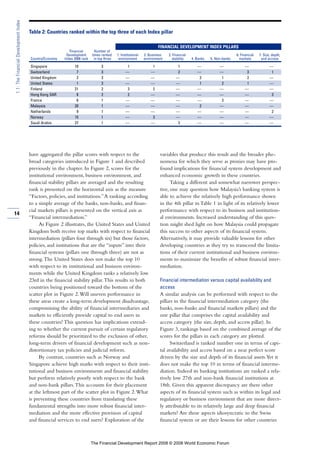
  • 50.
    My second policyobservation is that this assessment of the costs of financial development is too good to be true.The evidence suggests that improvements in the financial system accelerate economic growth, while dis- proportionately helping the poor.This raises an obvious question: if finance is so beneficial, why do only a hand- ful of countries have well-functioning financial systems? I believe the answer is also obvious: some people do not want well-functioning financial systems that give the economically disenfranchised greater opportunities. They do not want to compete on equal terms. For some, there are huge costs associated with financial development because well-functioning financial systems will expose them to greater competition. In the United States, monopolistic banks and their clients benefited handsomely for almost a century from bank regulations that protected them from competition.These banks used their monopolistic rents to maintain political support for these regulations.The elite favored protective bank regu- lations even though these regulations stymied aggregate growth. Indeed, distributional considerations have domi- nated debates about financial policies since Alexander Hamilton and Thomas Jefferson first tangled over the creation of a national bank.2 Similar distributional bat- tles shape financial policies around the world.3 Many countries do not have well-functioning financial systems because decision makers do not view it as in their best interests to create well-functioning financial systems. Generating financial reforms, therefore, will involve much more than identifying which financial sector policies are good for economic growth in general and the poor in particular. Notes 1 See, for example, Levine 1997, 2005. 2 See Beck et al. 2008. 3 See Barth et al. 2006. References Barth, J., G. Caprio, and R. Levine. 2006. Rethinking Bank Regulation: Till Angels Govern. London: Cambridge University Press. Beck, T., A. Demirgüç-Kunt, and R. Levine. 2007. “Finance, Inequality, and the Poor.” Journal of Economic Growth 12: 27–49. Beck, T., R. Levine, and A. Levkov. 2008. “Big Bad Banks? The Impact of U.S. Branch Deregulation on Income Distribution.” Brown University, mimeo. Becker, G. S. 1957. The Economics of Discrimination. Chicago: Chicago University Press. Kroszner, R. and P. Strahan. 1999. “What Drives Deregulation? Economics and Politics of the Relaxation of Bank Branching Deregulation.” Quarterly Journal of Economics 114: 1437–67. Levine, R. 1997. “Financial Development and Economic Growth: Views and Agenda.” Journal of Economic Literature 35: 688–726. ———. 2005. “Finance and Growth: Theory and Evidence.” In Handbook of Economic Growth, volume 1, eds. P. Aghion and S. Durlauf. Amsterdam: North-Holland Elsevier Publishers. 865–934. ———. 2008. “Finance and the Poor.” The Manchester School, Supplement: 1–13. Levine, R., A. Levkov, and Y. Rubinstein. 2008. “Racial Discrimination and Competition.” Brown University, mimeo. 32 1.2:Finance,Growth,andthePoor The Financial Development Report 2008 © 2008 World Economic Forum
  • 51.
    CHAPTER 1.3 Financial Crises,Financial Stability, and Reform: Supervision and Regulation of Financial Systems in a World of Financial Globalization NOURIEL ROUBINI, New York University and RGE Monitor The issue of financial stability is central to the assess- ment of the financial development of a country.The experience of the last few decades in both emerging market economies and advanced economies shows the pervasiveness of financial crises.These crises—signals of financial instability and the failure of the proper working of the financial system—have important economic and financial consequences, and usually lead to severe eco- nomic contractions—recessions if not depressions—that may be either short lived or persist over time. If these real effects persist, the long-run potential and actual growth rate of an economy may be significantly low- ered, which has negative effects on long-term welfare. Financial crises are also expensive, as they are associated with significant bankruptcies among households, corpo- rate firms, and financial institutions, with all the ensuing social deadweight losses from debt restructurings and bankruptcies. Financial crises often lead to expensive government intervention, with ensuing fiscal costs to bail out distressed borrowers (households, firms, and financial institutions).These fiscal costs can be very high—often well above 10 percent of GDP. Thus, persistent and severe financial instability, as measured by the pervasiveness and severity of financial crises, is a signal of failure of the financial system: failure to properly allocate savings to investment projects and failure of corporate governance. Of course, in a market economy, some degree of bankruptcy is a healthy sign of risk-taking.A financial system so “stable” that no bank- ruptcy would ever occur would indicate low risk-taking and diminished entrepreneurship; the lack of risky—but potentially high-return—investment projects would decrease long-term economic growth.There is a sub- stantial difference, however, between occasional bank- ruptcies of firms, households, or banks—bankruptcies that are healthy developments in flexible and dynamic market economies—and a systemic banking or corporate crisis where a large number of financial institutions or corporations go bankrupt. In short, a systemic financial crisis is a sign of the failure of the financial system, the failure of appropriate risk management, and the failure of proper corporate governance. This chapter will analyze the issue of financial crises, the stability of the financial system, and the foun- dations of sound regulation and supervision. It starts with an overview of the many financial crises in advanced and emerging market economies in the last few decades and the most recent episode of financial turmoil and distress in advanced economies’ financial systems. It next considers the role that asset bubbles and credit bubbles— and their eventual bust—have in financial crises, and then debates whether monetary and credit policy should be used to prevent or control such asset and credit bubbles. Finally, in light of the recent financial crises in advanced economies, it discusses the market failures and regulatory failures that led to this turmoil, and provides an overview of the basic issues and principles that affect the reforms 33 1.3:FinancialCrises,FinancialStability,andReform The Financial Development Report 2008 © 2008 World Economic Forum
  • 52.
    needed to improvethe supervision and regulation of the financial system and make it more stable. The importance of the stability of the financial system The issue of financial stability is important because of the pervasiveness of episodes of financial crises (systemic banking crises, systemic corporate crises, currency crises, and sovereign debt crises) that have negative effects on economic growth and lead to significant losses to investors. In thinking about financial stability one should think in terms of a tradeoff between risk and return/ innovation.A financial system that is very heavily super- vised and regulated may be very stable, but such a con- trolled system would hamper financial development and the innovation that allows increased returns, better diversification of risks, and better allocation of resources to those investments that provide the highest return. Conversely, a financial system that is free and innovative and very lightly regulated and supervised may eventually become unstable and trigger credit booms and asset bubbles that, when they fail, or go bust, have severe effects on growth, returns, and welfare. Thus, although there is some tradeoff between the stability of the financial system and its degree of innovation and sophistication, financial stability is a crucial input into the process of financial development. Excessively unstable financial systems—systems that are prone to repeated and virulent financial crises—are less likely to develop soundly. For example, repeated banking crises that cause serious liquidity and credit crunches severely hamper the process of intermediation that allo- cates savings to the appropriate investment projects. Systemic banking crises are themselves a signal that the allocation of resources was poor in the first place, exhibiting a misallocation to investments with very low returns that then triggers financial crisis. Moreover, as discussed below, financial crises have significant real eco- nomic and financial costs. The history of asset and credit bubbles and financial crises in advanced and emerging market economies Episodes of asset and credit bubbles followed by finan- cial crises have a long history that goes back centuries— as far back as the Renaissance period if not before.Asset bubbles, manias, panics, and financial crashes are well documented, starting with the classic work of Kindleberger. Financial crises can take various forms. In the recent history of both advanced and emerging market economies, these crises can be generally classified according to the following five categories: • currency crises that occur when a fixed or semi- fixed exchange rate regime becomes unsustainable and the peg, or effective peg, collapses; • sovereign debt crises that occur when a sovereign government is unable to service its debt obligations in time and in full, and thus formally or informally defaults on its debt; • systemic banking or financial crises that occur when a significant number of financial institutions (banks or non-banks) become financially distressed and need to be closed down, merged, or restructured; • systemic corporate crises that occur when a signifi- cant fraction of the corporate sector is financially distressed; and • systemic household debt crises that occur when a large number of households are unable to service their debts (mortgages and consumer credit). These crises are often preceded by asset bubbles and the credit bubbles that feed them.Asset bubbles, which go as far back as the Dutch tulip-mania of the 17th cen- tury, occur when an asset price rises above its underly- ing fundamental value. Of course, it is hard to identify an asset bubble while it is emerging because a story about a structural reason for the fundamental increase of the value of an asset can always be told. Usually it is the bursting of the bubble that leads, after the fact, to the recognition that a bubble existed. Asset bubbles can occur for any financial or real asset, but recent experience shows that they are perva- sive in equity markets and in housing and real estate markets.An asset bubble does not require a credit boom to develop because expectations of future increases in the asset price are sufficient to drive a self-fulfilling rise in price. However, many asset bubbles have been associ- ated with episodes of easy monetary policy and exces- sive credit growth. The perverse interaction between easy money, asset bubbles, credit growth, and leveraging that feeds asset bubbles has been observed in many episodes.The initial trigger for a bubble may (but not necessarily) be a peri- od of easy money with relatively low real interest rates. Such a low cost of capital and easy liquidity may lead to an initial increase in the asset price above its fundamen- tal value. Since asset purchases are often financed by credit, the initial increase in the asset prices allows bor- rowers to borrow more as the asset price rise increases the value of the collateral that can be used to increase leverage.With higher asset prices, the collateral value of borrowing to finance further asset purchases is higher, with increased leverage allowing additional asset pur- chases that further increases the collateral that then allows further borrowing and leveraging, entering into a vicious circle.This credit boom–driven asset bubble is the reason why many asset bubbles are associated with credit booms that become excessive.Thus, easy money and easy credit may be an initial trigger of a process of 34 1.3:FinancialCrises,FinancialStability,andReform The Financial Development Report 2008 © 2008 World Economic Forum
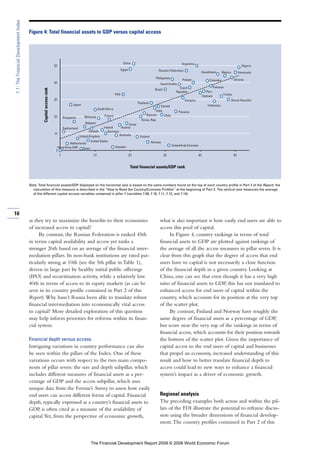
  • 53.
    asset bubbles andexcessive leveraging of the financial system and of the private non-financial sector. In the mid 1980s in the United States, this credit cycle fed the investment boom in commercial and resi- dential real estate that caused a real estate bubble that went bust in the late 1980s. In the 1990s, the tech and Internet bubble was in part fed by easy monetary policy —with the Federal Reserve (the Fed) worrying about “irrational exuberance” and doing nothing to control it—and by easy credit conditions that allowed investors to use leverage to increase their purchases of high-tech and Internet stocks. In the last decade, the decision of the Fed to keep the Fed Funds rate too low for too long (down to 1 percent until 2004), along with loose regulation of mortgages, created both a credit bubble and a housing bubble. Eventually, when shocks lead to a bursting of the asset bubble and trigger a process of deleveraging, these unsustainable asset bubbles and credit booms go bust. The fall in the value of the asset that was backed by high leverage leads to margin calls that force borrowers to sell the bubbly asset, which in turn starts to deflate in value.This fall in the asset value now reduces the value of the collateral backing the initial leveraged credit boom.Then, margin calls and the forced fire sale of the asset can drive down its price even below its now lower fundamental value creating a cascading vicious circle of falling asset prices, margin calls, fire sales, deleveraging, and further asset price deflation.The losses that highly leveraged financial institutions then face lead to a signif- icant credit crunch that exacerbates the asset price defla- tion and leads to lower real spending on capital goods— consumer durables and investment goods—that may trigger an overall economic contraction.Thus, delever- aging and credit crunches have both financial and real consequences: they trigger financial losses and they can trigger an economic recession that worsens financial losses for debtors and creditors. These cycles of asset bubbles and credit booms fol- lowed by asset busts and credit crunches and deleveraging have occurred in most episodes of asset/credit bubbles and financial crises.The real estate bubble of the 1980s in the United States ended in the savings and loan (S&L) thrifts crisis of the late 1980s—after the Fed tightened policy rates in 1998–89.This eventually caused a credit crunch that tipped the US economy into a recession in 1990–91.The high-tech bubble and lever- aged equity market bubble of the mid-to-late 1990s went into a bust in 2001 after the Fed’s tightening in 1999–2000; the ensuing collapse of dot-coms, the sharp fall in real investment by the corporate sector, and the collapse of high-tech stocks triggered the US recession of 2001.The ensuing Fed easing, along with poor regu- lation and supervision of mortgages, triggered another asset bubble in housing that went bust in 2006 after the Fed moved the Fed Funds rate from 1 percent up to 5.25 percent.The resulting bust of the housing market, the subprime mortgage crisis, and the credit/liquidity crunch and tipped the US economy into a sharp growth slowdown and likely recession by early 2008. Although financial crises are not necessarily always associated with asset bubbles and credit booms that go bust, frequently such crises do show excessive credit booms, leveraging, and asset bubbles. Indeed, debt crises —sovereign debt crises, systemic corporate crises, house- hold debt crises, and systemic banking crises—are often preceded by a period when governments, non-financial corporations, or households borrow too much and financial institutions lend too much, with poor under- writing and poor collateral of shaky value.The ensuing debt crisis caused by an unsustainable debt burden trig- gers the financial crisis that hits both excessively indebted borrowers and excessively leveraged lenders. Asset bubbles, credit bubbles gone bust, and financial crises of different varieties have been pervasive both among advanced economies and emerging market economies for the last few decades.Among advanced economies, such financial crises and episodes of systemic risk have occurred in many different countries. In the United States, the stock market crash of 1987 was a typ- ical episode of systemic risk; the real estate bubble of the 1980s was followed by the S&L bust and credit crunch of 1990–91; the long-term capital management crisis (LTCM) in 1998; the tech bubble of the 1990s was followed by the tech bust of 2000–01; the housing and credit bubble of the 2000s was followed by the housing bust and credit crunch of 2007. Other episodes of systemic crisis and financial crisis include the Japanese real estate bubble and equity bubble of the 1980s that collapsed in 1990 and led to an acute banking and cor- porate crisis and a severe decade long stagnation during the 1990s decade; the Scandinavian banking crises of the early 1990s; the collapse of the fixed exchange rates within the European Monetary System in 1992–93; and the German real estate bubble and bust that occurred after the German reunification in the early 1990s. Among emerging market economies, the Latin American sovereign debt crisis that started in 1982 and led to a decade of lost growth in that region in the 1980s was preceded by excessive sovereign borrowing in the late 1970s in the form of syndicated medium- and long-term bank loans.Another cycle of financial crises—a combination of currency crises, sovereign debt, banking, corporate and household debt crises—started in 1994 with the collapse of the Mexican peso currency peg.The following decade showed a variety of financial crises in emerging market economies: East Asia (Indonesia, Korea, Malaysia,Thailand) in 1997–98; Russia in 1998; Brazil in 1999; Ecuador, Pakistan, and Ukraine in 1999–2000;Argentina and Turkey in 2001; Brazil again in 2002; and the Dominican Republic and Uruguay in 2003. Some of these crises were only cur- rency crises (Brazil in 1999); some were twin currency and banking crises (Mexico in 1994–95,Turkey in 2001, 35 1.3:FinancialCrises,FinancialStability,andReform The Financial Development Report 2008 © 2008 World Economic Forum
  • 54.
    Uruguay and theDominican Republic in 2003); some were triple currency, banking, and corporate crises (East Asia in 1997–98); and some were currency, banking, corporate, and sovereign crises (Russia in 1998,Argentina in 2001) (see Table 1).The eventual trigger in all of these crises was some combination of macro vulnerabili- ties (current account deficits and/or fiscal deficits in some episodes), wrong exchange rate regime (fixed or semi-fixed exchange rates associated with unsustainable real appreciation of currencies), and balance sheet vulnerabilities (currency, maturity, and capital structure mismatches). Table 1: Types of recent financial crises Crisis Currency Banking Corporate Sovereign Household East Asia (1997–98) X X X Brazil (1999 and 2002) X Mexico (1994–95) X X X Russia (1998) X X X X Argentina (2001) X X X X X Turkey (2001) X X X Ecuador (1999) X X Ukraine (1999) X Pakistan (1999–2000) X X Uruguay (2002) X X Dominican Republic (2003) X X Source: Roubini and Setser, 2005. Financial crises are pervasive phenomena both among advanced and emerging market economies. Moreover, in spite of the “great moderation” (a sustained period of high growth and low inflation) of the last two decades, financial crises have become more frequent and more virulent rather than less frequent and less severe. Paradoxically, such great moderation may have triggered asset and credit bubbles. Indeed, with low inflation, sus- tained growth, and lower nominal and real interest rates, given the loose monetary and credit conditions and the ability of borrowers to lever up again, the possibility of asset bubbles and credit booms has increased. Real and financial costs of asset bubbles and credit booms Asset bubbles and excessive credit booms clearly affect the economy, both on the way up and on the way down. Even though the precise magnitude of their impact may be uncertain, monetary policy needs to take them into account. If a bursting bubble systematically and appropriately leads to a sharp monetary easing to prevent the systemic and real effects of the crash, the view that many crashes are not costly is irrelevant. In fact, without such a response, the economic impact of a crash would have been severe. Indeed those who believe that monetary policy should not react to rising bubbles also believe that monetary policy should sharply react to crashing bubbles, because such bubble bursting would otherwise be highly costly.Arguing that bubbles are not costly in practice— after policy has reacted to them—does not imply that they are not very costly in principle and ex-ante. In addition, arguing that bubbles are not costly, but that not reacting to bursting bubbles would be costly, is similarly illogical. Moreover, the argument that rising bubbles that eventually crash are not costly does not seem to be supported by evidence from advanced and emerging economies.A number of studies suggest that both credit and asset price booms and busts can have serious finan- cial and economic consequences. A decade of experience with financial crises in emerging market economies shows that many of these crises are preceded by asset bubbles, credit booms, investment booms, and large and growing external current account imbalances that become eventually unsustainable. In many episodes, such bubbles and imbalances lead to grave economic and financial crises that have sharp impacts on economic growth.Thus, there is prima facie evidence that asset bub- bles, whether caused by a prior monetary easing or not, can have critical real and financial consequences. Cost of credit and asset bubbles that go bust Credit and asset bubbles that go bust have significant real economic cost as they are often associated with recessions.They also have serious fiscal costs in the form of the fiscal cost of bailing out borrowers and/or lenders who are overextended.This bailout is often expensive and leads to higher fiscal deficits and public debt.The history of most financial and banking crises suggests that, in almost every episode, the resolution of the crisis entails a significant amount of government intervention that is fiscally costly. For example, if banks—as in most countries—have implicit and/or explicit deposit insur- ance, insolvency of some banks requires the government to bail out the depositors of the banks when the banks’ assets fall below its liabilities. Similarly, the financial distress of other institutions or borrowers (households with mortgages that they can no longer afford, corpo- rate debts that are unsustainable, etc.) often leads to government intervention to reduce such debt burdens. Such intervention effectively implies significant fiscal bailout costs. The fiscal bailout costs of banking and financial crises can be staggering.Work done by the World Bank estimates such costs to have been extremely high in a number of episodes (see Table 2). 36 1.3:FinancialCrises,FinancialStability,andReform The Financial Development Report 2008 © 2008 World Economic Forum
  • 55.
    Table 2: Totalgovernment cost of fiscal bailouts Total costs of fiscal bailout as Country Period percentage of GDP China 1990s 47 Korea Late 1990s 28 Malaysia Late 1990s 16 Thailand Late 1990s 35 Bulgaria 1995–97 13 Czech Republic 1991–94 12 Hungary 1991–95 10 Russia 1998–99 5–7 Turkey 2000–03 30 Finland 1991–94 11 Japan 1990s 24 Spain 1977–85 175 Argentina 1980–82 55 Chile 1982–86 55 Ecuador Late 1990s 20 Jamaica 1995–2000 44 Mexico 1994–97 18 United States 1984–91 3 Venezuela 1994–95 18 Source: Caprio and Klingebiel, 2003. These fiscal bailout costs are a significant social bur- den.The added public debt needed to bail out borrowers and/or lenders has to be serviced over time, which means that the social costs of systemic banking and financial crises are very serious in the affected economies. Asset and credit bubbles and monetary policy: Pros and cons Given the real and financial risks that result from credit booms and asset bubbles that go bust, should monetary policy respond to asset prices and asset bubbles? This is a highly controversial issue, both from an academic research perspective and, more importantly, from a policy perspec- tive.There is broad evidence that asset bubbles do occur from time to time, and that such bubbles may lead to economic distortions as well as financial and real econo- my instability. It can be argued that optimal monetary policy requires monetary policy authorities to react to such bubbles over and above the effects they have on current output growth, aggregate spending, and expect- ed inflation. It can also be argued that monetary policy should not react to asset prices or bubbles beyond the direct effect that such asset price movements have on inflation, aggregate spending, and economic growth. There are many good arguments in favor of target- ing asset prices; the arguments against it are, in many dimensions, not robust enough.Arguments in favor of targeting asset prices are: • First, a wide range of analytical models suggests that optimal monetary policy should react to asset prices and exogenous asset bubbles (i.e., bubbles whose evolution does not depend on monetary policy) above and beyond its reaction to the deviation of growth and inflation from their target. • Second, uncertainty about the existence of a bubble does not undermine the arguments in favor of asset price targeting. Like many other types of data uncertainty, uncertainty about the existence and size of an asset bubble only reduces the quantitative degree of response of optimal monetary policy to asset bubbles. • Third, uncertainty about whether bubbles can have damaging effects on the economy is not a good argument against targeting such bubbles because (1) there is a wide body of evidence that such bubbles and their aftermath are costly, and (2) uncertainty about the economic effects of bubbles only reduces the degree of optimal interest rate response, but does not eliminate completely such a response. • Fourth, analytical models suggest that if a bubble is endogenous (i.e., its probability and size can be affected by monetary policy), optimal monetary policy requires an attempt to affect it (i.e., to try to “prick” or “burst” it). • Fifth, the argument that trying to affect a bubble would require such a large interest response that a severe recession would be triggered is found to be incorrect both in theory and practice. Conceptually, a moderate interest rate response can have an impact on bubbles and reduce the economic distor- tions caused by them. Empirically, the recent expe- rience of the United Kingdom,Australia, and New Zealand shows that monetary authorities can suc- cessfully control bubbles with monetary tightening without causing severe recession or financial distress. • Sixth, the Greenspan and Bernanke doctrine that the Fed should not react to rising bubbles but should be ready to dampen the real costs of burst- ing bubbles (i.e., an asymmetric response to bub- bles) is inefficient and, possibly, a source of moral hazard distortions. It is certainly warranted for monetary authorities to react to bursting bubbles that may cause acute liquidity seizures, systemic risk, and risk of large economic contraction. But in order to prevent such a response from creating dis- torted incentives, monetary policy authorities should also be willing to respond to rising bubbles. Although a symmetric response to rising and burst- ing bubbles is appropriate, an asymmetric response is conceptually flawed, liable to create distorted incentives, and likely to induce cycles of rising and crashing bubbles that may have damaging economic and financial effects. 37 1.3:FinancialCrises,FinancialStability,andReform The Financial Development Report 2008 © 2008 World Economic Forum
  • 56.
    The uncertainties aboutbubbles and the other fac- tors discussed above suggest that monetary policy should respond to asset bubbles in a cautious and moderate manner—an aggressive monetary policy approach to asset bubbles is not needed. Some of the arguments pre- sented to justify the resistance to fighting rising bubbles have logic and legitimacy. However, although cautious- ness is warranted, arguments that there is no case for responding to asset bubbles tend to be incorrect. Also, the practice of the US Fed over the last two decades of not reacting to rising asset bubbles (the high- tech stock bubble of the late 1990s and the housing bubble of the last few years) while aggressively counter- ing bursting bubbles and episodes of systemic risk (in 1987, 1998, 2000, and 2001–03) has contributed to the asset bubbles and economic imbalances that ended up in episodes of economic and financial crisis.The real estate bubble of the 1980s culminated in the S&L crisis of the late 1980s, which eventually triggered a credit crunch and a recession in 1990. In the 1990s,Alan Greenspan warned about “irrational exuberance” when high-tech stocks started to skyrocket in the mid 1990s, but then did nothing to control this bubble apart from a token 25 basis points policy rate hike in early 1997.The high- tech bubble festered and grew even larger after the Fed eased interest rates by 75 bps following the Long Term Capital Management (LTCM) hedge fund near collapse; it went bust in 2000 after the Fed tightened interest rates by 175 bps between mid 1999 and mid 2000, thus triggering the 2001 recession. The Fed responded to this bubble bust and reces- sion by aggressively easing the policy rate from 6.5 per- cent in early 2001 to 1 percent by 2004.This aggressive policy ease, of keeping the Fed Funds rate too low for too long, then contributed to a new asset bubble— the housing bubble—that was exacerbated by the failure of the Fed and other regulators to properly regulate and supervise mortgages. By 2006, this housing bubble went bust, triggering a severe liquidity and credit crunch, a serious financial crisis, and an economic contraction that is still ongoing.The Fed reacted to this financial crisis, and the risks to economic growth, by aggressively reducing the Fed Funds rate from 5.25 percent in the fall of 2007 to 2 percent by the spring of 2008, and introducing a whole host of new liquidity facilities for both banks and systemically important non-bank insti- tutions. It can be argued that this latest policy easing, together with the exchange rate policies of emerging market economies, contributed to another asset bubble: the sharp rise in oil, energy, food, and other commodity prices in 2006–08.This commodity price surge may now lead to a generalized increase in global inflation, both among advanced economies and emerging market economies. The use of credit policy instruments In considering an appropriate policy response to asset bubbles and credit bubbles, one should not be limited to traditional monetary policy alone. If there is an asset bubble driven by a credit bubble, the appropriate response may be a combination of tighter monetary policy in the form of a higher policy rate as well as an appropriate credit policy that limits the extent of a cred- it boom that is becoming excessive.Appropriate regula- tion and supervision of the banking and financial system is an important complementary tool that is essential in controlling credit and asset bubbles.At times monetary policy, although a necessary instrument to control bub- bles, may not be the most appropriate tool if used alone. In the United States, for example, the real estate bubble of the 1980s was in part the result of loosening the regulation and supervision of S&L thrifts in the early 1980s.This led to excesses in commercial and resi- dential mortgage underwriting. In the 1990s, a more aggressive Fed tightening, intended to control the “irra- tional exuberance” in high-tech stocks, would have been beneficial but limited: if investors expected a 50 to 100 percent a year return on bubbly high-tech stocks, a 50 bps or even 100 or 150 bps policy rate tightening would have had limited effect. Rather, in addition to that mon- etary policy tightening, regulations that tightened the ability of investors to borrow on margin and highly leverage themselves in their purchase of high-tech stocks would have been more targeted and effective tools to deal with the high-tech bubble.Thus, inappropriate reg- ulation and supervision of such leveraged lending was one factor that allowed the bubble to fester. Similarly, in the last decade the Fed certainly made a mistake in keeping the Fed Funds rate too low for too long, thus feeding the housing bubble. But with house- holds expecting bubbly home prices to rise 20 percent per year, raising the Fed Funds rate sooner would have had only a limited effect in controlling such a bubble. An additional policy failure was the laissez-faire approach of the Fed and of other banking and financial regulators, which allowed toxic mortgage underwriting to occur without restraint.Thus, in addition to tighter monetary policy, better supervision and regulation of mortgage lending would have been the appropriate response. More generally, since asset bubbles are usually fed by credit bubbles, the appropriate response to such excesses is usually a combination of tighter monetary policy along with more prudent regulation and supervi- sion of the financial system to limit these credit cycles. Such appropriate regulation includes policies to make capital requirements for financial firms more procyclical. Arguing that policy should react to credit and asset bubbles means finding the appropriate combination of traditional monetary policy and credit policy (including appropriate regulation and supervision of financial firms) that can control excessive booms in credit, lending, leverage, and asset prices. 38 1.3:FinancialCrises,FinancialStability,andReform The Financial Development Report 2008 © 2008 World Economic Forum
  • 57.
    Recent crises ofthe Western financial system The decade from 1994 until 2003 was one of repeated financial crises in emerging market economies: Mexico in 1994;Thailand, Indonesia, Malaysia, and Korea in 1997–98, Russia in 1998; Brazil, Ecuador, Pakistan, and Ukraine in 1999;Turkey and Argentina in 2001; and Uruguay and the Dominican Republic in 2003.These crises were caused by a combination of macroeconomic weaknesses, policy mistakes, inappropriate exchange rate policies, balance sheet vulnerabilities, poor corporate governance, and weak and poorly supervised and regu- lated financial systems. Although not every one of these financial crises ended up in a systemic crisis of the banking or financial system or the corporate system, many of them did.The weaknesses in corporate governance, the emergence of credit and asset bubbles, the poor supervision and regu- lation of financial institutions, the distorted incentives for financial institutions (in part because of moral hazard distortions created by implicit and/or explicit govern- ment bailout guarantees), and phenomena such as directed and connected lending combined led to credit, debt, and financial excesses that eventually triggered sys- temic banking and corporate crises. The resolution of these crises implied a variety of policy actions, including structural reforms to make cor- porate and financial systems less vulnerable and more resilient as well as fundamental reforms of financial reg- ulation and supervision.At the time of these crises, the International Monetary Fund (IMF), the United States, and the G7 countries were highly critical of the finan- cial weaknesses—particularly the quality of institutions, regulations, and governance—that had been triggering factors in these crises.The fact that structural reforms in the financial sector of these economies did occur—on top of macro and policy changes—explains the high growth rate of emerging market economies in the last few years and their resilience, in spite of global shocks that have hit advanced economies and their financial markets in the last few years. It is thus somehow ironic and paradoxical that, while a decade ago (1997–98), the United States and other G7 policymakers were lecturing East Asian and other emerging market policymakers about the structur- al weaknesses of their financial systems and prodding them to implement structural reform, today the financial turmoil and stress is at the core of the financial systems of the most advanced economies and financial markets in the world: those in the United States, in the United Kingdom, and, to a smaller extent, in the euro zone. The severe liquidity and credit crunch that started with the housing bust and the collapse of the subprime mortgage market in the United States revealed a much larger credit and asset bubble and financial excesses of leverage that went well beyond subprime mortgages. Excessive debt accumulation and risky leverage occurred in subprime mortgages, near prime mortgages, prime mortgages, commercial real estate, the whole plethora of securitized products associated with mortgages and other asset-backed securities (ABSs), structured finance products (mortgage-backed securities [MBSs], collateral- ized debt obligations [CDOs], constant proportion debt obligations [CPDOs], collateralized mortgage obligations [CMOs], collateralized loan obligations [CLOs]), unse- cured consumer credit (credit cards, auto loans, student loans), leveraged loans financing excessively leveraged leveraged buy-outs (LBOs), muni bonds, industrial and commercial loans, junk corporate bonds, and credit default swaps (CDSs).This credit house of cards began to sway in 2007 and collapsed in 2008.The excesses were not limited to the United States but extended to other advanced economies; housing bubbles and credit booms in consumer credit were widespread in the United Kingdom, Spain, Ireland, and—in minor part— other euro zone economies.The financial turmoil and credit/liquidity crunch triggered by the subprime melt- down revealed fundamental weaknesses in the operation of advanced economies’ financial markets and in the sys- tem of supervision and regulation of the financial sys- tem, including banks and non-bank financial institu- tions. This crisis has led to the recognition that funda- mental reforms of the regulation and supervision of the financial systems of advanced economies are necessary in a world of financial globalization.A plethora of propos- als for reform have been advanced by a number of insti- tutions: the Financial Stability Forum, the Fed, the US Treasury, the G7, the FSA and other policy bodies in the United Kingdom, the BIS, the IMF. It is clearly recog- nized that the system of regulation and supervision of financial institutions is in trouble and in need of serious reform. Which reforms are most appropriate? Instead of considering the specific reforms suggested by individual institutions and regulatory bodies, it makes sense to ana- lyze the fundamental weaknesses, distortions, and open issues in the advanced economies’ financial markets, and thus what the appropriate principles for a new system of regulation and supervision may be.The rest of this chap- ter considers the most important issues related to reform of the regulation and supervision of financial institutions in a world of financial globalization. Issues of reform in a world of financial globalization Given the ongoing financial crisis in the United States and parts of other advanced economies’ financial sys- tems, the need for the appropriate reform of the system of supervision and regulation of financial institutions has become a core and urgent subject of debate among scholars, market experts, and policymakers. To understand what the appropriate system of regu- lation and supervision of financial institutions may be in a world of financial globalization, one needs to analyze 39 1.3:FinancialCrises,FinancialStability,andReform The Financial Development Report 2008 © 2008 World Economic Forum
  • 58.
    (1) the problemsthat an increasingly complex and glob- alized financial system faces and (2) the shortcomings of the current system of financial regulation and supervi- sion, both in the United States and around the world. Only a detailed consideration of such problems and shortcomings can lead to the recognition of the appro- priate reforms of the system. We consider in more detail such problems and shortcomings of the financial system and of the current supervisory and regulatory regime.These can be catego- rized according to 10 issues: 1. The compensation system The system of compensation of bankers and agents within the financial system is flawed. It is characterized by moral hazard in the form of “gambling for redemp- tion.” The typical agency problems between a financial firm’s shareholders and the firm’s managers/bankers/ traders are exacerbated by the way the latter are com- pensated. Because a large fraction of such compensation is in the form of bonuses tied to short-term profits, and because such bonuses are one-sided (positive in good times and at most zero when returns are poor), managers/bankers/traders have a huge incentive to take larger risks than warranted by the goal of shareholders’ value maximization. Potential solutions to this gambling- for-redemption bias are varied.Among possible solutions are the use of restricted stock that has to be maintained for a number of years, and a pool of cumulated bonuses that is not cashed out yearly but that can grow or shrink depending on medium-term returns to particular investments. But, even leaving aside the problem of how to change such compensation in a highly competitive mar- ket for talent in the financial sector, it is not obvious that the suggested solutions would fully work. For example, in the case of the recent crisis at Bear Stearns, about 30 percent of the firm was owned by its employees as restricted stock. However, this system of compensation did not prevent Bear Stearns from making reckless investments and loans that eventually made it insolvent. Possibly this was the case because the individual com- pensation was not tied to the individual investing/ lending decision. Still, compensation of bankers/traders should be considered a crucial factor that distorts lending and investment decisions in financial markets. 2. The Originate and Distribute Securitization Model The current model of securitization (the Originate and Distribute Model) has serious flaws because it reduces the incentives for the originator of the claims to monitor the creditworthiness of the borrower. In the securitiza- tion food chain for US mortgages, every intermediary in the chain was making a fee; eventually the credit risk got transferred to those least able to understand it. The mortgage broker, the home appraiser, the bank originating the mortgages and repackaging them into MBSs, the investment bank repackaging the MBSs into CDOs, CDOs of CDOs, and even CDOs cubed, the credit rating agencies giving their AAA blessing to such toxic instruments—each of these intermediaries was earning income from charging fees for their step of the intermediation process and transferring the credit risk down the line. One possible solution to this lack of incentives to undertake proper monitoring of the borrower would be to force the originating bank and the investment bank intermediaries to hold some of the credit risk; this could take the form of some part of the equity tranche in the CDOs (i.e., the most junior tranche of the CDO that is the one taking the first loss when the value of the underlying collateral falls) or a portion of some of the MBSs that they originate so they have “some skin in the game.” But it is not obvious that such solutions would fully resolve the moral hazard problems faced by finan- cial intermediaries. In fact, although the securitization process implied a partial transfer of the credit risk from the mortgage originators and the managers of the CDOs to final investors, the reality is that banks and other financial institutions maintained a significant exposure to mortgages, MBSs, and CDOs. Indeed, in the United States about 47 percent of all the assets of major banks are real estate related; the figure for smaller banks is closer to 67 percent.The model of “originate and distribute” securitization did not fully transfer the credit risk of mortgages to capital market investors. Banks and broker dealers (e.g., Bear Stearns) did main- tain a significant portion of that credit risk across a vari- ety of instruments. Indeed, if that credit risk had been fully transferred, such banks and other financial interme- diaries would have not suffered the hundreds of billions of dollars of losses that they have incurred so far and will have to recognize in the future. Thus, excessive risk taking and gambling for redemp- tion did occur in spite of the fact that financial institu- tions were holding part of the credit risk.Therefore, proposing that such institutions hold some of that risk rather than try to transfer it all does not seem to be a solution that will fully resolve the problems stemming from misaligned incentives and poor risk management. If the fundamental problem is one of moral hazard originating from the way that bankers are compensated, forcing financial institutions to hold more of the credit risk will not resolve the problem of inadequate moni- toring of the creditworthiness of the borrowers and poor underwriting standards. 3. Regulatory arbitrage and the instability of the shadow banking system The regulation and supervision of banks and the lighter—or in cases such as that of hedge funds, nonex- istent—regulation and supervision of non-bank financial institutions has led to significant regulatory arbitrage. This arbitrage takes the form of the transfer of a large 40 1.3:FinancialCrises,FinancialStability,andReform The Financial Development Report 2008 © 2008 World Economic Forum
  • 59.
    fraction of financialintermediation to non-bank finan- cial institutions, such as broker dealers, hedge funds, money market funds, SIVs (Structured Investment Vehicles), conduits, and so on. The problems with this financial innovation are twofold. First, some of the institutions in this shadow banking system (or shadow financial system) are system- ically important. Second, most of these institutions are at risk of bank-like runs on their liabilities as they borrow in short and liquid ways, are highly leveraged, and invest in longer and more illiquid ways. The risk of runs is significantly decreased for banks by the existence of deposit insurance and by the lender- of-last-resort support that the central bank can provide. Publicly provided deposit insurance is generally not warranted for non-bank financial institutions, because the protection of small investors or depositors (those who do not have the expertise to monitor the lending or investment decisions of banks) is not generally an issue for such non-banks. But, as the recent Bear Stearns episode and the run on and collapse of other compo- nents of the shadow financial system suggest, bank-like runs on non-banks can occur. In fact, they are more likely to occur if such institutions do not properly man- age their liquidity and credit risks. Although serving as lender of last resort to many non-bank institutions is not warranted, such support may be warranted for the few institutions that are sys- temically important. Indeed, two recent US Fed actions —the US$30 billion rescue of Bear Stearns, and the establishment of two new facilities that allow non-bank primary dealers to access the Fed’s discount window and to swap their illiquid MBS products for safe Treasury Bonds—imply that the lender-of-last-resort support of the Fed has been now extended to systemically impor- tant non-bank institutions.Thus, the same regulation and supervision that is applied to banks should also be applied to these systemically important financial firms, not just in periods of turmoil (as recommended by the US Treasury), but on a more permanent basis. Thus, while the safety net of the Fed and other central banks should remain restricted to banks and depository institutions and—subject to some construc- tive ambiguity—to systemically important non-bank firms, the regulatory and supervisory framework should be similar for banks and non-bank financial institutions; regulatory capital, type of supervision, liquidity ratios, compliance and disclosure standards, and so on should be similar for banks and other financial institutions. If not, then regulatory arbitrage will shift financial inter- mediation and risks to other more lightly regulated smaller broker deals and other non-bank financial institutions. To take just one example, the loophole that allowed SIVs and conduits to operate with little supervision and no capital standard under the pretense that these were off-balance sheet units—while the sponsoring bank was providing large credit enhancements and systematic liq- uidity lines that made these units de facto on-balance sheet assets and liabilities—was deeply flawed. Unless these and a whole host of other special purpose vehicles are regulated and supervised as if they are on-balance sheet units, this type of regulatory arbitrage will lead again to the disaster that SIVs created. Moreover, a comprehensive supervisory and regula- tory regime that covers both banks and non-banks would also allow better monitoring and assessment of systemic financial risks that at the moment are not prop- erly supervised. Providing regulators and supervisors as well as investors with adequate reporting and disclosure of the information required to assess systemic financial risks will be essential. Poor liquidity risk management and the risk of bank-like runs on non-bank financial institutions have been shown to be a severe problem in the shadow financial system.The entire SIV/conduit regime has recently collapsed given the roll-off of their asset-backed commercial paper liabilities; hedge funds and private equity funds collapsed because of risky investments and redemptions or roll-off of short-term credits; money market funds whose net asset value fell below par had to be rescued to avoid a run on them; Bear Stearns col- lapsed because of poor credit/investment choices but also because of a sudden run on its liquidity. Although banks are fundamentally maturity-mismatched because of their reliance on short-term deposits, there is no rea- son for non-bank financial institutions to have liquidity or rollover risk, especially as they do not have deposit insurance and do not have access—apart from the sys- temically important institutions—to the central banks’ lender-of-last-resort support. Thus, an essential element of the common regula- tion of all non-bank financial institutions should be a greater emphasis given to the management of liquidity risk. Such financial firms should be asked to significantly lengthen the maturity and duration of their liabilities in order to reduce their liquidity risk.A firm that makes money only because it borrows very short, has little capital, leverages a lot, and lends long and in illiquid ways is reckless in its risk management. It should cer- tainly disclose fully both to supervisors and to investors the liquidity and other risks that it is undertaking. But it should also be required to reduce its liquidity risk with a variety of tools that provide it with a greater liquidity buffer. 4. Self-regulation versus rules-based regulation Most regulatory and supervisory regimes have moved in the direction of emphasizing self-regulation and market discipline rather than rigid regulations. One of the argu- ments in favor of this market discipline approach is that financial innovation is always one or more steps ahead of regulation; thus, one needs to design a regime that does 41 1.3:FinancialCrises,FinancialStability,andReform The Financial Development Report 2008 © 2008 World Economic Forum
  • 60.
    not rely onrigid rules that would be easily avoidable via financial innovation. This market discipline approach—which relies on principles rather than rigid rules, on internal models of risk assessment and management in determining how much capital a firm needs, and on rating agency assess- ments of creditworthiness—is a key element of the phi- losophy behind the Basel II agreement. But this market discipline model has been proven to be vastly flawed because of the way bankers are compensated and because of the way the Originate and Distribute Model provides incentives to ignore internal risk managers in good times when “the music plays and you gotta dance” (as the former CEO of Citigroup put it). Similarly the conflicts of interest of rating agencies lead to mis-ratings of new and exotic financial instruments. Thus, while reliance on principles is useful to deal with financial innovation and regulatory arbitrage, a more robust set of rules that go with the grain of prin- ciples-based regulation and supervision is necessary. Strict reliance on market discipline has been proven ineffective in a world where bankers are improperly compensated, agency problems lead to poor monitoring of lending, flawed transfers of credit risk to those least able to understand it and manage it occur, and regulato- ry arbitrage is rampant. 5. Procyclical capital requirements and other issues with Basel II Even before being fully implemented, the Basel II agreement has shown its flaws.These include capital adequacy ratios that are procyclical and promote credit booms in good times and credit busts in bad times, low emphasis on liquidity risk management, excessively low capital ratios given the risks faced by banks, excessive reliance on internal risk management models, and excessive importance given to the rating agencies. These are serious shortcomings of the new capital regime for large internationally active banks and depository institutions. How to reform Basel II given the current severe financial crisis is not an easy task, but the urgency of this reform is undeniable. Particular importance should be given to measures that would reduce the procyclicality of capital standards that are a source of booms and busts in credit cycles and to measures that increase—rather than decrease—the overall amount of capital held by financial institutions.As recent history suggests, most financial institutions have been vastly undercapitalized given the kind of market, liquidity, credit, and opera- tional risks that they have faced in an increasingly glob- alized financial system. 6. Credit rating agencies By now the conflicts of interest and informational prob- lems that led the rating agencies to rate—or, better, to mis-rate—many MBSs and CDOs and other ABS prod- ucts highly are well known.With a large fraction of their revenues and profits coming from the rating of complex structured finance products and the consulting and modeling services provided to the issuers of such complex and exotic instruments, it is clear that rating agencies are ripe with conflicts of interest.This is com- pounded by a system where competition in the rating market is limited by the regulatory barriers to entry. Also the semi-official role that rating agencies have, in general and in Basel II in particular, exacerbates the potential biases of a system where rating agencies are paid by issuers rather than the investors, and underscores the informational problems of raters that know little about the underlying risks of new, complex, and exotic instruments. What are the potential solutions to these conflicts of interest and other problems? Solutions could be to open up competition in the rating agency business, to drop the semi-official role that rating agencies have in Basel II and in the investment decisions of asset man- agers, to forbid activities (such as consulting or modeling) that cause conflicts of interest, and to drop the reliance on ratings paid by issuers rather than by investors (the free-riding problem of having investors pay for ratings can be solved by pooling the investors’ resources in a pool that can be used to collectively purchase the rat- ings). Certainly the reputations of the rating agencies have been badly damaged in the ABS ratings fiasco, and only serious and credible reforms—not just cosmetic changes—will be required to restore their credibility in the rating business. 7. Asset valuation and fair value accounting There are fundamental accounting issues about how to value securities, especially in periods of market volatility and illiquidity when the fundamental long-term value of the asset differs from its market price.The current fair value approach to valuation stresses the use of mark-to- market valuation where, as much as possible, market prices should be used to value assets, whether they are illiquid or not. There are two possible situations where mark-to- market accounting may distort valuations: first, when there are bubbles and the market value may be above fundamental value; second, when bubbles burst and, because of market illiquidity, asset prices are potentially below fundamental value.The latter case has become a concern in the latest episode of market turmoil as mark- to-market accounting may force excessive writedowns and margin calls that may lead to further fire sales of illiquid assets that, in turn, could cause a cascading fall in asset prices well below long-term fundamentals. However, mark-to-market accounting may also create serious distortions during bubbles when its use may lead to excessive leverage as high valuation allows investors to borrow more and leverage more, thus feeding the asset bubble. In either case, mark-to-market accounting 42 1.3:FinancialCrises,FinancialStability,andReform The Financial Development Report 2008 © 2008 World Economic Forum
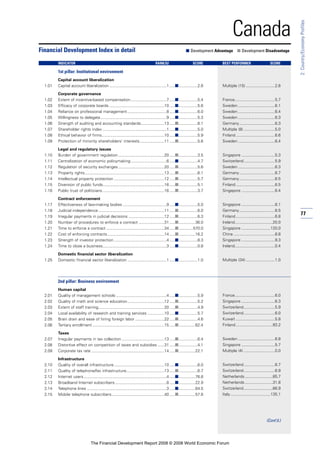
  • 61.
    leads to procyclicalcapital bank capital requirements given the way that the Basel II capital accord is designed. The shortcomings of mark-to-market valuation are known.The main issue is whether one can find an alter- native that is not subject to gaming by financial institu- tions. Some have suggested the use of historical cost to value assets (where assets are booked at the price at which they were bought); others propose the use of a discounted cash flow (DCF) model where long-run fundamentals—cash flows—would have a greater role. Historical cost does not seem to be an appropriate way to value assets given the potential for increased inaccu- racy over the long term.The use of a DCF model may seem more appealing, but it is not without flaws either. How should we properly estimate future cash flows? Which discount rate should we apply to such cash flows? How should we avoid a situation where users subjectively game the model to achieve the valuations that they want by manipulating assumptions about future cash flows and the appropriate discount factor? Possibly, mark-to-market may be a better approach when securities are held in a trading portfolio, and DCF may be more appropriate when such securities are held as a long-term investment, that is, until maturity. But the risk of a DCF approach is that different firms will value identical assets very differently and that firms will use any approach different from mark-to-market to manipu- late their financial results. The other difficult problem that one has to consid- er is that any suspension of mark-to-market accounting in periods of volatility would reduce, rather than enhance, investors’ confidence in financial institutions. Part of the recent turmoil and increase in risk aversion can be seen as an investors’ backlash against an opaque and nontransparent financial system where investors cannot properly know the size of the losses experienced by financial institutions and who are holding the “toxic waste.” Mark-to-market accounting at least imposes some discipline and transparency. One view is that the problem is not mark-to-market accounting but the procyclical capital requirements of Basel II; that is correct. But even without such procycli- cal distortions there is a risk that financial institutions— not just banks—would retrench too much and too fast with respect to their leverage and credit positions during periods of turmoil when they become more risk averse. Thus, the issue remains open as to whether there are forms of regulatory forbearance that do not destroy confidence and that can be used in periods of turmoil to avoid a cascading and destructive fall in asset prices. But certainly solutions should be symmetrical—that is, they should be applied both during periods of rising asset prices and bubbles (when market prices are above fundamentals) and when such bubbles go bust (and asset prices may fall below fundamentals). So far, however, there is no clear and sensible alternative to mark-to- market accounting. 8. Lack of transparency in financial markets The recent financial markets crisis and turmoil has been partly caused by the fact that, over the last few years, financial markets have become less transparent in a number of ways.These include the development of new exotic and illiquid financial instruments that are hard to value and price, the development of increasingly com- plex derivative instruments, the fact that many of these instruments trade over the counter rather than on an exchange, the fact that there is little information and disclosure about such instruments and who is holding them, and the fact that many new financial institutions are opaque with little or no regulation (hedge funds, private equity, SIVs, and other off-balance sheet special purpose vehicles).These factors have all contributed to a lack of financial market transparency and increased opacity of such markets. But private financial markets cannot function prop- erly unless there is enough information, reporting, and disclosure both to market participants and to relevant regulators and supervisors. How much reporting and disclosure, and to whom, is a difficult question. But it is clear that for the last few years financial markets have become excessively opaque in ways that are destructive of investors’ confidence.When investors cannot appro- priately price complex new securities, they cannot properly assess the overall losses faced by financial insti- tutions, and when they cannot know who is holding the risk for “toxic waste,” this turns into generalized “uncer- tainty” (which cannot be priced, unlike financial “risk” that can be priced if the statistical distribution of risky events is known).The outcome is an excessive increase in risk aversion, lack of trust and confidence in counter- parties, and a massive seizure of liquidity in financial markets. Greater transparency and information, including the use of fair value accounting (that, in spite of its shortcomings, is still the best way to value assets), along with prompt recognition by financial institutions of their exposures and losses, are essential to restore investors’ confidence in financial markets. One way to make new, complex, and exotic finan- cial instruments more liquid and easier to price might include standardizing such instruments and having them traded in clearing house–based exchanges rather than over the counter.The benefits of standardization are clear: it would allow investors to compare securities with similar characteristics and would thus improve their liquidity. Moreover, instruments that are exchange- traded through a clearing house would have much lower counterparty risk, would be subject to appropriate margin requirements, and would be appropriately marked-to-market on a daily basis. 9. Inadequate regulatory regime In a world of financial innovation and globalization, what are the appropriate institutions for financial regula- tion and supervision? And in what sort of system should 43 1.3:FinancialCrises,FinancialStability,andReform The Financial Development Report 2008 © 2008 World Economic Forum
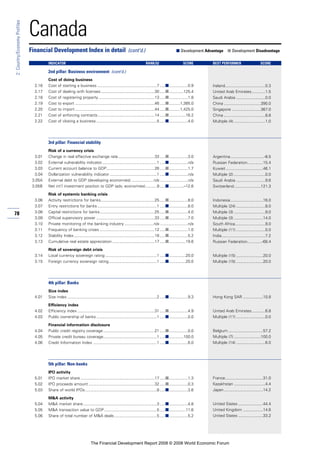
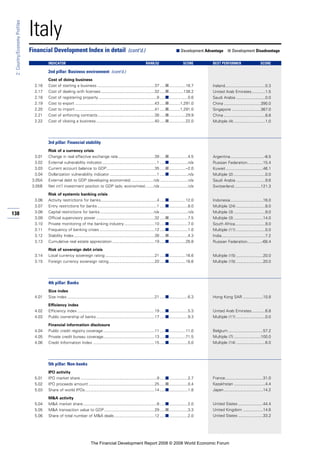
  • 62.
    they operate? Thedifferent models that exist each have their pros and cons. An increasingly popular model is that of a unique and centralized financial regulator and supervisor, as in the case of the United Kingdom’s FSA where all finan- cial policies—for banks, securities firms, other financial institutions, insurance companies, and so on—are under one umbrella.Another model is that of the United States, where more than half a dozen financial regulators and supervisors exist at the federal level, and another layer is found at the state level. Some have argued that the US system fosters beneficial competition and propa- gation of best practices among different regulators.The shortcomings of the system, including an incoherent set of overlapping regulations and a “race to the bottom”— rather than to the top—in terms of excessively deregu- latory competition, have now become clear. One overall financial regulator may be too little but 60-plus of them is obviously too many.A streamlining of such institu- tions and a concentration of most regulatory and super- visory activities among a smaller number of institutions is certainly necessary. Further, the questions of whether supervisory and regulatory power over banks, and possibly other systemi- cally important financial institutions, should be kept within the central bank (as in the United States) or whether such power should be given to another regula- tor (as in the case of the United Kingdom’s FSA) is a difficult and controversial issue. Some worry that taking such power away from the central bank while maintain- ing its role as the lender of last resort would reduce the ability of the central bank to oversee financial vulnera- bilities in specific institutions and in the overall financial system (systemic risk). But as long as there is a proper exchange of information between the regulator and supervisor of banks and of other financial institutions and the central bank, these informational issues can be properly managed.The UK debacle over Northern Rock was caused not by the existence of a single finan- cial authority (the FSA) but rather—in part—by the lack of coordination and proper information exchange between the FSA, the Bank of England, and the UK Treasury.Thus, the UK model of a single financial regu- lator/supervisor is, in principle, superior to a model where such powers are fragmented among many and different institutions. But proper coordination and infor- mation exchange is essential to make this system work. 10. Lack of international coordination Finally, reforms of financial regulation and supervision cannot be done only at the national level because regu- latory arbitrage may lead financial intermediation to move to jurisdictions with a lighter and less appropriate regulatory approach. Indeed, the recent US debate on reforming capital markets was driven—before the current market turmoil—by concerns that a tighter regulatory approach in the United States (such as the Sarbanes-Oxley legislation) was leading to a competitive slippage of NewYork relative to London in the provi- sion of financial services. In a world of financial globalization, mobile capital, and lack of capital controls, capital and financial inter- mediation may move to more lightly regulated shores. Although the idea of a global financial regulator or “sheriff” is, for the time being, a bit far-fetched, a much stronger degree of coordination of financial regulation and supervision policies is necessary to avoid a race to the bottom in financial regulation and supervision and to prevent excessive regulatory arbitrage. Such interna- tional coordination of financial policies is currently occurring on a very limited scale and will have to be seriously enhanced over time. In the euro zone, bank supervision and regulation occurs only at the national level, while the European Central Bank would serve as the lender of last resort in the case of a systemic banking crisis or when a major systemically important cross- border institution gets into trouble.This remains an untested model. Over time, financial supervision and regulation within the euro zone will have to move from the national level to a euro zone–wide level. One further crucial set of issues that is left open is the difficult one of “quis custodiet ipsos custodes?” or “who will regulate the regulators?” How do we ensure that we have a system where the regulators are not effectively captured by the financial industry that they regulate? How do we ensure that financial innovation is not always a step ahead of regulation via regulatory arbi- trage? And how do we ensure that the regulators have the necessary skills and expertise to correctly implement the appropriate regulations and supervision? These issues of regulatory capture and the limited skills of regulators and supervisors in the face of constant financial innova- tion have been behind the regulatory failures that have caused many of the recent financial crises, including the recent one in the United States. Indeed, while the recent financial crisis suggests that self-regulation, market discipline, internal risk manage- ment, and reliance only on principles rather than rules does not work, the issue remains open of how to ensure that new rules are actually implemented without further regulatory arbitrage and regulatory capture of the regulators.This is a most difficult question for which there is no simple answer.The suggestion has been made that as long as regulation is relatively simple, appropriate liquidity requirements and capital sufficiency ratios are possibly cyclically adjusted, and as long as reporting requirements are made clear (among other things), the possibility of regulatory arbitrage and regulatory capture is limited. But this approach suggests moving away from principles and relying somewhat more on simple— rather than complex—rules that cannot be easily manip- ulated by the regulated entities or by the regulators. Still, appropriate regulation and especially appropriate supervision require an element of thoughtful value 44 1.3:FinancialCrises,FinancialStability,andReform The Financial Development Report 2008 © 2008 World Economic Forum
  • 63.
    judgment and assessmentof risks that cannot be resolved with excessively simple rules. Conclusions Financial stability is an important factor in assessing the degree of development of a financial system. Excessive stability may result in excessive regulation and restric- tions on financial innovation and risk taking, and thus may reduce the opportunities for long-run growth. However, lack of stability that triggers financial crises (banking crises, sovereign debt crises, systemic corporate crises, household debt crises, and currency crises) is also costly and inefficient, as it leads to severe economic downturns and the large economic and fiscal costs of cleaning up a financial system in distress and crisis.Thus, financial stability is an important component of financial development. This chapter surveyed the causes and implications of financial crises in both advanced and emerging market economies in the last few decades. It also discussed the main issues involved in reforming the regime of regula- tion and supervision of the financial system to make it more resilient in a world of financial globalization. While financial crises will never be altogether eliminated, the frequency and severity of booms and busts of asset prices and credit that cause financial crises and cause costly financial instability can be reduced if appropriate supervision and regulation is applied. Notes 1 Even authors who argue against monetary policy targeting of asset prices (Bernanke and Gertler 1999, 2001; Ferguson 2005; Kohn 2004, among others) tend to acknowledge the analytical channels (wealth effects and credit constraints effects on con- sumption and investment) that link asset bubbles to real and financial variables. Also Greenspan referred to the link between housing prices, private savings and the current account, a pretty clear evidence of the impact of the recent US housing boom on the real economy. And there is a general consensus among many that monetary policy should care about the broader goal of finan- cial stability. 2 See IMF 2000, 2003; Bordo and Jeanne 2002; Borio and Lowe 2002; Bordo 2003; and Helbling and Bayoumi 2003. 3 See Kawai et al. 2001. See also the exhaustive study of emerging market crises by Roubini and Setser 2004. 4 The exchange rate policies of emerging economies can include pegging their currency to the US dollar or providing very aggres- sive foreign exchange intervention to manage their currency value and control the rate of appreciation relative to the US dollar. 5 See Prince 2007. References Bernanke, B. 2002. “Asset Price ‘Bubbles’ and Monetary Policy.” Remarks made before the New York Chapter of the National Association for Business Economics, New York, October 15. ———. 2004. “The Logic of Monetary Policy.” Remarks made before the National Economists Club, Washington, DC, December 2. Bernanke, B. and M. Gertler. 1999. “Monetary Policy and Asset Price Volatility.” In New Challenges for Monetary Policy, a symposium sponsored by the Federal Reserve Bank of Kansas City. Jackson Hole, Wyoming. August. ———. 2001. “Should Central Banks Respond to Movements in Asset Prices?” American Economic Review 91 (2): 253–57. Blinder, A. and R. Reis. 2005. “Understanding the Greenspan Standard.” Unpublished manuscript, Princeton University. Bordo, M. 2003. “Stock Market Crashes, Productivity, Boom Busts and Recessions: Some Historical Evidence.” Unpublished manuscript, Rutgers University. Bordo, M. and O. Jeanne. 2002. “Boom-Bust in Asset Prices, Economic Instability, and Monetary Policy.” NBER Working Paper No. 8966, June. Borio, C. 2005. “Monetary and Financial Stability: So Close and Yet So Far?” National Institute Economic Review 192 (1): 84–101. Borio, C. and P. Lowe. 2002. “Asset Prices, Financial and Monetary Stability: Exploring the Nexus.” BIS Working Paper No. 114, July. Caprio, G. and D. Klingebiel. 2003. Episodes of Systemic and Borderline Financial Crises. World Bank. Available at http://siteresources. worldbank.org/INTRES/Resources/469232-1107449512766/ 648083-1108140788422/23456_Table_on_systemic_and_ non-systemic_banking_crises_January_21_2003.pdf. Cecchetti, S., H. Genberg, J. Lipsky, and S. Wadhwani. 2000. Asset Prices and Central Bank Policy. Geneva Reports on the World Economy 2. London: Centre for Economic Policy Research. Available at http://www.cepr.org/pubs/books/P135.asp Cecchetti, S. G., H. Genberg, and S. Wadhwani. 2002. “Asset Prices in a Flexible Inflation Targeting Framework.” NBER Working Paper No. 8970, June. Cambridge, MA: National Bureau of Economic Research. Dupor, W. 2001. “Nominal Price versus Asset Price Stabilization.” Wharton School of the University of Pennsylvania, Working Paper. Ferguson, R. W. 2005. “Recessions and Recoveries Associated with Asset-Price Movements: What Do We Know?” Remarks made at the Stanford Institute for Economic Policy Research, Stanford, California, January 12. Filardo, A. J. 2001. “Should Monetary Policy Respond to Asset Price Bubbles? Some Experimental Results.” Unpublished manuscript, July. Federal Reserve Bank of Kansas City. ———. 2000. “Monetary Policy and Asset Prices.” Economic Review, Federal Reserve Bank of Kansas City. ———. 2004. “Monetary Policy and Asset Price Bubbles: Calibrating the Monetary Policy Trade-Offs.” BIS Working Paper No. 155, Basel. ———..2005. “Should Monetary Authorities Prick Asset Price Bubbles?” Unpublished paper, March, BIS. Garber, P. 2000. Famous First Bubbles. Cambridge, MA: MIT Press. Greenspan, A. 1999. “General Discussion: New Challenges for Monetary Policy.” Speech before a symposium sponsored by the Federal Reserve Bank of Kansas City. Jackson Hole, Wyoming, August 28. ———. 2002. “Economic Volatility.” Speech before a symposium spon- sored by the Federal Reserve Bank of Kansas City. Jackson Hole, Wyoming, August 30. ———. 2003. “Monetary Policy Under Uncertainty.” Speech made before a symposium sponsored by the Federal Reserve Bank of Kansas City. Jackson Hole, Wyoming, August 29. ———. 2004. “Risk and Uncertainty in Monetary Policy.” Remarks made at the Meetings of the American Economic Association, San Diego, California, January 3. ———. 2005a. “Closing Remarks.” Speech made before a symposium sponsored by the Federal Reserve Bank of Kansas City, Jackson Hole, Wyoming, August 27. ———. 2005b. “Economic Flexibility.” Remarks made to the National Association for Business Economics Annual Meeting, Chicago, Illinois, September 27. 45 1.3:FinancialCrises,FinancialStability,andReform The Financial Development Report 2008 © 2008 World Economic Forum
  • 64.
    1.3:FinancialCrises,FinancialStability,andReform 46 Helbling, T. andT. Bayoumi. 2003. “Are They All in the Same Boat? The 2000–1 Growth Slowdown under the G-7 Business Linkages.” IMF Working Paper 03/46, Washington, DC. IMF (International Monetary Fund). 2000. “Asset Prices and Business Cycle.” World Economic Outlook. Washington, DC, International Monetary Fund. ———. 2003. “Growth and Institutions.” World Economic Outlook. Washington, DC: International Monetary Fund Kawai, M., R. Newfarmer, and S. Schmukler. 2001. “Crisis and Contagion in East Asia: Nine Lessons.” World Bank Working Paper Series No. 2610. World Bank, Washington, DC. Kindleberger, C. P. 1978. Manias, Panics, and Crashes: A History of Financial Crises. Wiley Investment Classics. New York: John Wiley & Sons. Kohn, Donald. 2004. “How Should Policymakers Deal with Low- Probability, High Impact Events?” Remarks made at the European Central Bank Conference on Monetary Policy and Imperfect Knowledge, Wurzburg, Germany, October 15. ———. 2005. “Financial Markets, Financial Fragility, and Central Banking.” Remarks made at a symposium sponsored by the Federal Reserve of Kansas City, Jackson Hole, Wyoming, August 27. Posen, A. S. 2003. “It Takes More than a Bubble to Become Japan.” Peterson Institute Working Paper Series WP03-9. Peterson Institute for International Economics, Washington, DC. ———. 2004. “Bubbles Are Getting Blown Out of Proportion.” Financial Times, September 8. Prince, C., Citigroup Inc Chief Executive. 2007. Financial Times, July. Roubini, N. 2006. “Why Central Banks Should Burst Bubbles.” International Finance 9 (1): 87–107. Roubini, N. and B. Setser. 2004. Bailouts versus Bail-ins? Responding to Financial Crises in Emerging Markets. Washington, DC: Institute for International Economics. Rudebusch, G. D. 2005. “Monetary Policy and Asset Price Bubbles.” Economic Letter, Federal Reserve Bank of San Francisco, August. The Financial Development Report 2008 © 2008 World Economic Forum
  • 65.
    Part 2 Country/Economy Profiles TheFinancial Development Report 2008 © 2008 World Economic Forum
  • 66.
    The Financial DevelopmentReport 2008 © 2008 World Economic Forum
  • 67.
    The Country Profilessection presents a four-page profile for each of the 52 countries covered by the Financial Development Report 2008. Page 1 Key indicators The first section of the Country/Economy Profile presents a selection of key indicators: • Population, GDP, and related figures come from the International Monetary Fund’s World Economic Outlook of April 2008. Financial assets by major type, 2006 • Public debt figures are from the Economist Intelligence Unit’s CountryData Database, as accessed in July 2008. Private debt data come from the Bank of International Settlements Quarterly Review, December 2007. Data on bank deposits are from the IMF International Financial Statistics database, electronic version, accessed July 2008 or the July 2007 PDF version. Equity securities data were downloaded from the market capitalization dataset on the World Bank’s World Development Indicators database in July 2008. • The four financial asset indicators (public and private debt securities, banking deposits, and equity securities) are added to measure total financial assets in the Index countries.The share of depth attributable to each component is displayed in the pie chart. Percentages displayed may not add to 100% due to rounding. Private debt data were not available for Nigeria orVietnam. • The total financial assets figure is shown as a percentage of GDP, using the GDP figure from the Key Indicators section. • The pie chart shows the share of total financial assets attributable to each of the four types of financial asset indicators in a given economy. Argentina Key indicators Financial assets by major type, 2006 Population (millions), 2007 .......................................................39.4 GDP (US$ billions), 2007 .........................................................260.0 GDP (current prices) per capita, 2007 ..............................6,606.3 GDP (PPP) as share (%) of world total, 2007........................0.80 Average annual rate of real GDP growth (%), 2003–07 ......8.83 ■ ■ ■ ■ Financial Markets Development Index 2008 2008 Index......................................................47 3.0 Factors, policies, and institutions 1st pillar: Institutional environment.........................................45 3.4 Capital account liberalization.....................................................42 1.7 Corporate governance.................................................................39 4.4 Legal and regulatory issues .......................................................51 2.6 Contract enforcement..................................................................38 3.6 Domestic financial sector liberalization...................................36 4.4 2nd pillar: Business environment.............................................39 3.9 Human capital ...............................................................................28 4.4 Taxes...............................................................................................50 2.8 Infrastructure ................................................................................34 3.3 Cost of doing business ................................................................39 5.1 3rd pillar: Financial stability......................................................50 2.9 Risk of a currency crisis..............................................................30 4.4 Risk of systemic banking crisis..................................................51 3.4 Risk of sovereign debt crisis ......................................................52 1.0 Financial intermediation 4th pillar: Banks ...........................................................................46 2.9 Size index.......................................................................................51 1.0 Efficiency index.............................................................................50 2.6 Financial information disclosure..................................................1 7.0 5th pillar: Non-banks...................................................................22 2.5 IPO activity.....................................................................................33 1.5 M&A activity..................................................................................40 1.4 Insurance.......................................................................................29 2.7 Securitization.................................................................................12 4.4 6th pillar: Financial markets......................................................37 2.2 Foreign exchange markets .........................................................41 1.1 Derivatives markets....................................................................n/a n/a Equity markets...............................................................................42 2.0 Bond markets ................................................................................23 3.1 Capital availability and access 7th pillar: Size, depth, and access............................................46 3.5 Size and depth...............................................................................43 2.2 Access............................................................................................51 3.1 Rank (out of 52) Score (1–7 scale) OUTPUTS INPUTS 1 2 3 4 5 6 7 1 2 3 4 5 6 7 1 2 3 4 5 6 7 1 2 3 4 5 6 7 Total/GDP: 135.1% US$ bn Public debt securities.......136.7 Private debt securities........22.6 Banking deposits.................48.3 Equity securities ..................79.7 Total 287.3 27.7% 7.8% 16.8% 47.6% 49 HowtoReadtheCountry/EconomyProfiles How to Read the Country/Economy Profiles Financial Development Index This section details the country’s performance on the various components of the Financial Development Index (FDI).At the top is the country’s overall rank out of 52 countries, its score on the 1-to-7 scale, and a graphical representation of the score. Below, the seven pillars of the index are organized thematically.The three themes—factors, policies, and institutions; financial intermediation; and capital avail- ability and access—are displayed according to their role in the continuum of the financial system from inputs to outputs. Each pillar and subpillar is listed under the appro- priate theme.After the pillar or subpillar name, the first column shows each country’s ranks among the 52 coun- tries for that pillar or subpillar.The second column presents the score for that pillar or subpillar on the 1-to- 7 normalized scale. On the right, the normalized score is represented graphically. For more information on the methodology and results of the FDI, please refer to Chapter 1.1 of this Report. The Financial Development Report 2008 © 2008 World Economic Forum
  • 68.
    50 HowtoReadtheCountry/EconomyProfiles Page 2 The FinancialDevelopment Index in detail This page presents the rank achieved by a country on each of the indicators entering the composition of the FDI. Indicators are organized by pillar. Please refer to Appendix A of Chapter 1.1 for a detailed structure of the FDI. Next to the rank, a colored square indicates whether the indicator constitutes an advantage (blue square) or a disadvantage (black square) for the country. In order to identify variables as advantages or disadvan- tages, the following rules were applied: • For those economies ranked in the top 10 in the overall FDI, individual variables ranked between 1 and 10 are considered to be advantages.Any vari- ables below 10 are considered to be disadvantages. For instance, in the case of Switzerland, which is ranked 7 overall, its 5th rank in the variable Bank deposits to GDP makes this variable a competitive advantage, whereas Foreign exchange derivatives turnover: Currency swaps, on which it ranks 23rd, constitutes a competitive disadvantage for the country. • For those economies ranked from 11 to 25 in the overall FDI, variables ranked higher than the econ- omy’s overall rank are considered to be advantages. Any variables ranked equal to or lower than the economy’s overall rank are considered to be disad- vantages. In the case of Malaysia, ranked 20th overall, its 10th rank in the variable Bank deposits to GDP makes this variable a competitive advantage, whereas Foreign exchange derivatives turnover: Currency swaps, on which it ranks 29th, constitutes a compet- itive disadvantage for the country. • For those economies ranked lower than 25 in the overall FDI, any individual variables ranked 25 or higher are considered as advantages.Any variables ranked 26th or lower are considered to be disad- vantages. For Argentina, ranked 47th overall, its rank of 19th in Relative value-added of insurance constitutes a competitive advantage for the country, whereas its 47th rank in the variable Bank deposits to GDP makes this variable a competitive disadvantage. • After the advantage/disadvantage marker is the raw score of the listed indicator for the profiled econo- my. For more information on the significance of the raw score, such as the units in which it is measured or the source, please see the data tables in Part 3 of this Report. • In the gray box at the right of the profile is the name and raw score for the top ranked economy of the given indicator. For indicators in which there is a tie for the top rank, the word "Multiple" appears with the number of economies which share that score in parentheses. Argentina 1st pillar: Institutional environment Capital account liberalization 1.01 Capital account liberalization .................................................42 .....■...............–0.1 Corporate governance 1.02 Extent of incentive-based compensation..............................26 .....■.................4.7 1.03 Efficacy of corporate boards .................................................39 .....■.................4.7 1.04 Reliance on professional management.................................31 .....■.................4.9 1.05 Willingness to delegate.........................................................35 .....■.................4.0 1.06 Strength of auditing and accounting standards.....................48 .....■.................4.0 1.07 Shareholder rights index .........................................................9 .....■.................4.0 1.08 Ethical behavior of firms........................................................49 .....■.................3.5 1.09 Protection of minority shareholders’ interests......................50 .....■.................3.6 Legal and regulatory issues 1.10 Burden of government regulation .........................................45 .....■.................2.5 1.11 Centralization of economic policymaking..............................51 .....■.................1.7 1.12 Regulation of security exchanges .........................................44 .....■.................4.4 1.13 Property rights.......................................................................51 .....■.................3.0 1.14 Intellectual property protection .............................................47 .....■.................2.8 1.15 Diversion of public funds.......................................................49 .....■.................2.4 1.16 Public trust of politicians .......................................................50 .....■.................1.5 Contract enforcement 1.17 Effectiveness of law-making bodies .....................................51 .....■.................1.9 1.18 Judicial independence...........................................................51 .....■.................2.2 1.19 Irregular payments in judicial decisions ................................48 .....■.................3.2 1.20 Number of procedures to enforce a contract .......................31 .....■...............36.0 1.21 Time to enforce a contract ....................................................36 .....■.............590.0 1.22 Cost of enforcing contracts...................................................15 .....■...............16.5 1.23 Strength of investor protection .............................................40 .....■.................4.7 1.24 Time to close a business.......................................................28 .....■.................2.8 Domestic financial sector liberalization 1.25 Domestic financial sector liberalization .................................36 .....■.................1.0 2nd pillar: Business environment Human capital 2.01 Quality of management schools ...........................................24 .....■.................4.9 2.02 Quality of math and science education.................................41 .....■.................3.3 2.03 Extent of staff training...........................................................41 .....■.................3.6 2.04 Local availability of research and training services ...............32 .....■.................4.3 2.05 Brain drain and ease of hiring foreign labor ..........................31 .....■.................4.3 2.06 Tertiary enrollment ................................................................13 .....■...............63.8 Taxes 2.07 Irregular payments in tax collection ......................................47 .....■.................3.9 2.08 Distortive effect on competition of taxes and subsidies ......50 .....■.................2.8 2.09 Corporate tax rate.................................................................47 .....■...............35.0 Infrastructure 2.10 Quality of overall infrastructure.............................................42 .....■.................3.1 2.11 Quality of telephone/fax infrastructure..................................41 .....■.................5.5 2.12 Internet users........................................................................33 .....■...............20.9 2.13 Broadband Internet subscribers............................................29 .....■.................4.0 2.14 Telephone lines .....................................................................32 .....■...............24.2 2.15 Mobile telephone subscribers...............................................29 .....■...............80.5 Financial Markets Development Index in detail ■ Development Advantage ■ Development Disadvantage INDICATOR RANK/52 SCORE BEST PERFORMER SCORE Multiple (15) ..........................2.6 France....................................5.7 Sweden .................................6.1 Sweden .................................6.4 Sweden .................................6.3 Germany................................6.3 Multiple (8) ............................5.0 Finland...................................6.6 Sweden .................................6.4 Singapore ..............................5.3 Switzerland............................5.9 Sweden .................................6.3 Germany................................6.7 Germany................................6.5 Finland...................................6.5 Singapore ..............................6.4 Singapore ..............................6.1 Germany................................6.5 Finland...................................6.8 Ireland..................................20.0 Singapore ..........................120.0 China .....................................8.8 Singapore ..............................9.3 Ireland....................................0.4 Multiple (34) ..........................1.0 France....................................6.0 Singapore ..............................6.3 Switzerland............................5.9 Switzerland............................6.0 Kuwait ...................................5.8 Finland.................................93.2 Sweden .................................6.8 Singapore ..............................5.7 Multiple (4) ............................0.0 Switzerland............................6.7 Switzerland............................6.9 Netherlands.........................85.7 Netherlands.........................31.8 Switzerland..........................66.9 Italy....................................135.1 (Cont’d.) The Financial Development Report 2008 © 2008 World Economic Forum
  • 69.
    51 ListofCountries/Economies 51 List of Countries/Economies Country/EconomyPage Argentina 52 Australia 56 Austria 60 Bahrain 64 Belgium 68 Brazil 72 Canada 76 Chile 80 China 84 Colombia 88 Czech Republic 92 Egypt 96 Finland 100 France 104 Germany 108 Hong Kong SAR 112 Hungary 116 India 120 Indonesia 124 Ireland 128 Israel 132 Italy 136 Japan 140 Kazakhstan 144 Korea, Rep. 148 Kuwait 152 Malaysia 156 Mexico 160 Netherlands 164 Nigeria 168 Norway 172 Pakistan 176 Panama 180 Peru 184 Philippines 188 Poland 192 Russian Federation 196 Saudi Arabia 200 Singapore 204 Slovak Republic 208 Country/Economy Page South Africa 212 Spain 216 Sweden 220 Switzerland 224 Thailand 228 Turkey 232 Ukraine 236 United Arab Emirates 240 United Kingdom 244 United States 248 Venezuela 252 Vietnam 256 The Financial Development Report 2008 © 2008 World Economic Forum
  • 70.
    52 2:Country/EconomyProfiles Note: For furtherdetails and explanation, please refer to “How Read the Country/Economy Profiles.” Argentina Key indicators Financial assets by major type, 2006 Population (millions), 2007 .......................................................39.4 GDP (US$ billions), 2007 .........................................................260.0 GDP (current prices, US$) per capita, 2007.....................6,606.3 GDP (PPP) as share (%) of world total, 2007........................0.80 Average annual rate of real GDP growth (%), 2003–07 ......8.83 ■ ■ ■ ■ Financial Development Index 2008 2008 Index......................................................47 3.0 Factors, policies, and institutions 1st pillar: Institutional environment.........................................45 3.4 Capital account liberalization.....................................................42 1.7 Corporate governance.................................................................39 4.4 Legal and regulatory issues .......................................................51 2.6 Contract enforcement..................................................................38 3.6 Domestic financial sector liberalization...................................36 4.4 2nd pillar: Business environment.............................................39 3.9 Human capital ...............................................................................28 4.4 Taxes...............................................................................................50 2.8 Infrastructure ................................................................................34 3.3 Cost of doing business ................................................................39 5.1 3rd pillar: Financial stability......................................................50 2.9 Risk of a currency crisis..............................................................30 4.4 Risk of systemic banking crisis..................................................51 3.4 Risk of sovereign debt crisis ......................................................52 1.0 Financial intermediation 4th pillar: Banks ...........................................................................46 2.9 Size index.......................................................................................51 1.0 Efficiency index.............................................................................50 2.6 Financial information disclosure..................................................1 7.0 5th pillar: Non-banks...................................................................22 2.5 IPO activity.....................................................................................33 1.5 M&A activity..................................................................................40 1.4 Insurance.......................................................................................29 2.7 Securitization.................................................................................12 4.4 6th pillar: Financial markets......................................................37 2.2 Foreign exchange markets .........................................................41 1.1 Derivatives markets....................................................................n/a n/a Equity markets...............................................................................42 2.0 Bond markets ................................................................................23 3.1 Capital availability and access 7th pillar: Size, depth, and access............................................46 3.5 Size and depth...............................................................................43 2.2 Access............................................................................................51 3.1 Rank (out of 52) Score (1–7 scale) OUTPUTS INPUTS 1 2 3 4 5 6 7 1 2 3 4 5 6 7 1 2 3 4 5 6 7 1 2 3 4 5 6 7 Total/GDP: 135.1% US$ bn Public debt securities.......136.7 Private debt securities........22.6 Banking deposits.................48.3 Equity securities ..................79.7 Total 287.3 27.7% 7.8% 16.8% 47.6% The Financial Development Report 2008 © 2008 World Economic Forum
  • 71.
    53 2:Country/EconomyProfiles Argentina 1st pillar: Institutionalenvironment Capital account liberalization 1.01 Capital account liberalization .................................................42 .....■...............–0.1 Corporate governance 1.02 Extent of incentive-based compensation..............................26 .....■.................4.7 1.03 Efficacy of corporate boards .................................................39 .....■.................4.7 1.04 Reliance on professional management.................................31 .....■.................4.9 1.05 Willingness to delegate.........................................................35 .....■.................4.0 1.06 Strength of auditing and accounting standards.....................48 .....■.................4.0 1.07 Shareholder rights index .........................................................9 .....■.................4.0 1.08 Ethical behavior of firms........................................................49 .....■.................3.5 1.09 Protection of minority shareholders’ interests......................50 .....■.................3.6 Legal and regulatory issues 1.10 Burden of government regulation .........................................45 .....■.................2.5 1.11 Centralization of economic policymaking..............................51 .....■.................1.7 1.12 Regulation of security exchanges .........................................44 .....■.................4.4 1.13 Property rights.......................................................................51 .....■.................3.0 1.14 Intellectual property protection .............................................47 .....■.................2.8 1.15 Diversion of public funds.......................................................49 .....■.................2.4 1.16 Public trust of politicians .......................................................50 .....■.................1.5 Contract enforcement 1.17 Effectiveness of law-making bodies .....................................51 .....■.................1.9 1.18 Judicial independence...........................................................51 .....■.................2.2 1.19 Irregular payments in judicial decisions ................................48 .....■.................3.2 1.20 Number of procedures to enforce a contract .......................31 .....■...............36.0 1.21 Time to enforce a contract ....................................................36 .....■.............590.0 1.22 Cost of enforcing contracts...................................................15 .....■...............16.5 1.23 Strength of investor protection .............................................40 .....■.................4.7 1.24 Time to close a business.......................................................28 .....■.................2.8 Domestic financial sector liberalization 1.25 Domestic financial sector liberalization .................................36 .....■.................1.0 2nd pillar: Business environment Human capital 2.01 Quality of management schools ...........................................24 .....■.................4.9 2.02 Quality of math and science education.................................41 .....■.................3.3 2.03 Extent of staff training...........................................................41 .....■.................3.6 2.04 Local availability of research and training services ...............32 .....■.................4.3 2.05 Brain drain and ease of hiring foreign labor ..........................31 .....■.................4.3 2.06 Tertiary enrollment ................................................................13 .....■...............63.8 Taxes 2.07 Irregular payments in tax collection ......................................47 .....■.................3.9 2.08 Distortive effect on competition of taxes and subsidies ......50 .....■.................2.8 2.09 Corporate tax rate .................................................................47 .....■...............35.0 Infrastructure 2.10 Quality of overall infrastructure.............................................42 .....■.................3.1 2.11 Quality of telephone/fax infrastructure..................................41 .....■.................5.5 2.12 Internet users........................................................................33 .....■...............20.9 2.13 Broadband Internet subscribers............................................29 .....■.................4.0 2.14 Telephone lines .....................................................................32 .....■...............24.2 2.15 Mobile telephone subscribers...............................................29 .....■...............80.5 Financial Development Index in detail ■ Development Advantage ■ Development Disadvantage INDICATOR RANK/52 SCORE BEST PERFORMER SCORE Multiple (15) ..........................2.6 France....................................5.7 Sweden .................................6.1 Sweden .................................6.4 Sweden .................................6.3 Germany................................6.3 Multiple (8) ............................5.0 Finland...................................6.6 Sweden .................................6.4 Singapore ..............................5.3 Switzerland............................5.9 Sweden .................................6.3 Germany................................6.7 Germany................................6.5 Finland...................................6.5 Singapore ..............................6.4 Singapore ..............................6.1 Germany................................6.5 Finland...................................6.8 Ireland..................................20.0 Singapore ..........................120.0 China .....................................8.8 Singapore ..............................9.3 Ireland....................................0.4 Multiple (34) ..........................1.0 France....................................6.0 Singapore ..............................6.3 Switzerland............................5.9 Switzerland............................6.0 Kuwait ...................................5.8 Finland.................................93.2 Sweden .................................6.8 Singapore ..............................5.7 Multiple (4) ............................0.0 Switzerland............................6.7 Switzerland............................6.9 Netherlands.........................85.7 Netherlands.........................31.8 Switzerland..........................66.9 Italy....................................135.1 (Cont’d.) The Financial Development Report 2008 © 2008 World Economic Forum
  • 72.
    54 2:Country/EconomyProfiles Argentina Cost of doingbusiness 2.16 Cost of starting a business ...................................................28 .....■.................9.7 2.17 Cost of dealing with licenses................................................38 .....■.............234.1 2.18 Cost of registering property ..................................................44 .....■.................7.6 2.19 Cost to export .......................................................................45 .....■..........1,325.0 2.20 Cost to import .......................................................................47 .....■..........1,825.0 2.21 Cost of enforcing contracts...................................................15 .....■...............16.5 2.22 Cost of closing a business ....................................................24 .....■...............12.0 3rd pillar: Financial stability Risk of a currency crisis 3.01 Change in real effective exchange rate...................................1 .....■...............–8.5 3.02 External vulnerability indicator...............................................45 .....■.............145.1 3.03 Current account balance to GDP...........................................19 .....■.................3.8 3.04 Dollarization vulnerability indicator ........................................27 .....■...............17.0 3.05A External debt to GDP (developing economies) .....................24 .....■...............51.0 3.05B Net int’l investment position to GDP (adv. economies) .......n/a .........................n/a Risk of systemic banking crisis 3.06 Activity restrictions for banks..................................................8 .....■...............11.0 3.07 Entry restrictions for banks ...................................................25 .....■.................7.0 3.08 Capital restrictions for banks.................................................18 .....■.................5.0 3.09 Official supervisory power ....................................................20 .....■...............11.0 3.10 Private monitoring of the banking industry ...........................10 .....■.................7.0 3.11 Frequency of banking crises .................................................52 .....■.................4.0 3.12 Stability Index........................................................................28 .....■.................4.7 3.13 Cumulative real estate appreciation .....................................n/a .........................n/a Risk of sovereign debt crisis 3.14 Local currency sovereign rating ............................................52 .....■.................6.0 3.15 Foreign currency sovereign rating.........................................52 .....■.................6.0 4th pillar: Banks Size index 4.01 Size index ..............................................................................51 .....■.................3.6 Efficiency index 4.02 Efficiency index .....................................................................48 .....■.................3.9 4.03 Public ownership of banks ....................................................31 .....■...............41.9 Financial information disclosure 4.04 Public credit registry coverage................................................6 .....■...............25.5 4.05 Private credit bureau coverage................................................1 .....■.............100.0 4.06 Credit Information Index .........................................................1 .....■.................6.0 5th pillar: Non-banks IPO activity 5.01 IPO market share ..................................................................33 .....■.................0.3 5.02 IPO proceeds amount ...........................................................26 .....■.................0.4 5.03 Share of world IPOs..............................................................34 .....■.................0.2 M&A activity 5.04 M&A market share................................................................36 .....■.................0.1 5.05 M&A transaction value to GDP.............................................37 .....■.................1.9 5.06 Share of total number of M&A deals....................................33 .....■.................0.3 Financial Development Index in detail (cont’d.) ■ Development Advantage ■ Development Disadvantage INDICATOR RANK/52 SCORE BEST PERFORMER SCORE 2nd pillar: Business environment (cont’d.) Ireland....................................0.3 United Arab Emirates............1.5 Saudi Arabia ..........................0.0 China .................................390.0 Singapore ..........................367.0 China .....................................8.8 Multiple (4) ............................1.0 Argentina..............................-8.5 Russian Federation..............15.4 Kuwait .................................46.1 Multiple (2) ............................0.0 Saudi Arabia ..........................9.6 Switzerland........................121.3 Indonesia.............................16.0 Multiple (24) ..........................8.0 Multiple (3) ............................9.0 Multiple (3) ..........................14.0 South Africa...........................9.0 Multiple (11) ..........................0.0 India.......................................7.2 Russian Federation.............-68.4 Multiple (15) ........................20.0 Multiple (15) ........................20.0 Hong Kong SAR ..................10.8 United Arab Emirates............6.8 Multiple (11) ..........................0.0 Belgium ...............................57.2 Multiple (7) ........................100.0 Multiple (14) ..........................6.0 France..................................31.0 Kazakhstan ............................4.4 Japan...................................14.2 United States ......................44.4 United Kingdom ..................14.6 United States ......................33.2 The Financial Development Report 2008 © 2008 World Economic Forum
  • 73.
    55 2:Country/EconomyProfiles Argentina Insurance 5.07 Insurance premiums,direct ..................................................32 .....■..........5,631.5 5.08 Insurance density ..................................................................35 .....■.............143.9 5.09 Real growth of direct insurance premiums.............................7 .....■...............15.6 5.10 Insurance penetration............................................................36 .....■.................2.6 5.11 Relative value-added of insurance.........................................19 .....■.................1.3 Securitization 5.12 Securitization to GDP ............................................................26 .....■.................1.9 5.13 Share of total number of securitization deals .........................7 .....■.................1.8 6th pillar: Financial markets Foreign exchange markets 6.01 Spot foreign exchange turnover............................................37 .....■.................0.1 6.02 Outright forward foreign exchange turnover ........................40 .....■.................0.0 6.03 Foreign exchange swap turnover.........................................n/a .........................n/a Derivatives markets 6.04 Interest rate derivatives turnover: Forward rate agreements.....................................................n/a .........................n/a 6.05 Interest rate derivatives turnover: Swaps ............................n/a .........................n/a 6.06 Interest rate derivatives turnover: Options ..........................n/a .........................n/a 6.07 Foreign exchange derivatives turnover: Currency swaps ....n/a .........................n/a 6.08 Foreign exchange derivatives turnover: Options..................n/a .........................n/a Equity market development 6.09 Equity market turnover..........................................................36 .....■...............30.2 7.05 Stock market capitalization to GDP.......................................44 .....■...............29.7 Bond market development 6.10 Private-sector bonds to GDP.................................................26 .....■.................8.4 6.11 Public-sector bonds to GDP ..................................................29 .....■.................3.6 6.12 International bonds to GDP...................................................14 .....■...............41.6 7th pillar: Size, depth, and access Size and depth 7.01 M2 to GDP ............................................................................35 .....■...............28.7 7.02 Private debt to GDP ..............................................................33 .....■...............10.5 7.03 Public debt to GDP..................................................................3 .....■.................6.9 7.04 Bank deposits to GDP...........................................................47 .....■...............20.7 7.05 Stock market capitalization to GDP.......................................44 .....■...............29.7 7.06 Relative value-added of financial institutions to GDP ...........30 .....■.................3.3 7.07 Private credit to GDP.............................................................47 .....■...............11.4 7.08 Stock market value traded to GDP........................................46 .....■.................2.1 Access 7.09 Financial market sophistication .............................................44 .....■.................3.9 7.10 Venture capital availability .....................................................47 .....■.................2.8 7.11 Ease of access to credit........................................................45 .....■.................4.4 7.12 Ease of access to local equity market ..................................51 .....■.................3.8 7.13 Bank branches.......................................................................25 .....■...............10.0 7.14 Ease of access to loans ........................................................52 .....■.................2.3 Financial Development Index in detail (cont’d.) ■ Development Advantage ■ Development Disadvantage INDICATOR RANK/52 SCORE BEST PERFORMER SCORE 5th pillar: Non-banks (cont’d.) United States ..........1,170,100.6 United Kingdom .............6,466.7 India.....................................52.6 United Kingdom ..................16.5 Switzerland............................4.8 United States ......................22.9 United States ......................64.9 United Kingdom ..................26.6 United Kingdom ..................29.9 United Kingdom ..................42.0 United Kingdom ..................45.6 United Kingdom ..................46.0 United States ......................42.6 United Kingdom ..................47.6 United Kingdom ..................42.6 Pakistan.............................374.3 Hong Kong SAR ................713.3 United States ....................114.0 France....................................7.0 Netherlands.......................121.7 Hong Kong SAR ................252.3 Netherlands.......................216.2 Austria ...................................7.0 Hong Kong SAR ................250.4 Hong Kong SAR ................713.3 Panama..................................9.2 United States ....................193.7 Saudi Arabia ......................356.2 Switzerland............................6.7 United States ........................5.3 Slovak Republic.....................5.9 Sweden .................................6.2 Spain....................................95.9 Norway..................................5.5 The Financial Development Report 2008 © 2008 World Economic Forum
  • 74.
    56 2:Country/EconomyProfiles Note: For furtherdetails and explanation, please refer to “How Read the Country/Economy Profiles.” Australia Key indicators Financial assets by major type, 2006 Population (millions), 2007 .......................................................21.0 GDP (US$ billions), 2007 .........................................................908.8 GDP (current prices, US$) per capita, 2007...................43,312.3 GDP (PPP) as share (%) of world total, 2007........................1.18 Average annual rate of real GDP growth (%), 2003–07 ......3.27 ■ ■ ■ ■ Financial Development Index 2008 2008 Index......................................................11 5.0 Factors, policies, and institutions 1st pillar: Institutional environment.........................................13 5.9 Capital account liberalization.....................................................24 6.0 Corporate governance...................................................................4 5.8 Legal and regulatory issues .......................................................10 5.2 Contract enforcement....................................................................6 5.7 Domestic financial sector liberalization.....................................1 7.0 2nd pillar: Business environment.............................................14 5.2 Human capital ...............................................................................13 5.3 Taxes...............................................................................................17 4.6 Infrastructure ................................................................................17 5.2 Cost of doing business ................................................................17 5.8 3rd pillar: Financial stability......................................................21 5.1 Risk of a currency crisis..............................................................37 3.9 Risk of systemic banking crisis..................................................29 4.5 Risk of sovereign debt crisis ........................................................1 7.0 Financial intermediation 4th pillar: Banks ...........................................................................21 4.1 Size index.......................................................................................15 3.9 Efficiency index.............................................................................35 4.0 Financial information disclosure................................................12 4.7 5th pillar: Non-banks.....................................................................6 4.3 IPO activity.......................................................................................8 4.0 M&A activity....................................................................................7 4.0 Insurance.......................................................................................13 4.1 Securitization...................................................................................8 5.0 6th pillar: Financial markets........................................................8 4.6 Foreign exchange markets ...........................................................6 6.5 Derivatives markets .......................................................................8 4.4 Equity markets...............................................................................15 4.6 Bond markets ................................................................................19 3.4 Capital availability and access 7th pillar: Size, depth, and access............................................14 5.6 Size and depth...............................................................................16 4.4 Access............................................................................................10 4.9 Rank (out of 52) Score (1–7 scale) OUTPUTS INPUTS 1 2 3 4 5 6 7 1 2 3 4 5 6 7 1 2 3 4 5 6 7 1 2 3 4 5 6 7 Total/GDP: 345.0% US$ bn Public debt securities.......128.4 Private debt securities......749.0 Banking deposits...............634.9 Equity securities .............1,095.9 Total 2,608.1 42.0% 24.3% 4.9% 28.7% The Financial Development Report 2008 © 2008 World Economic Forum
  • 75.
    57 2:Country/EconomyProfiles Australia 1st pillar: Institutionalenvironment Capital account liberalization 1.01 Capital account liberalization .................................................24 .....■.................1.2 Corporate governance 1.02 Extent of incentive-based compensation..............................18 .....■.................5.0 1.03 Efficacy of corporate boards ...................................................3 .....■.................5.8 1.04 Reliance on professional management...................................4 .....■.................6.2 1.05 Willingness to delegate.........................................................11 .....■.................5.1 1.06 Strength of auditing and accounting standards.......................4 .....■.................6.2 1.07 Shareholder rights index .........................................................9 .....■.................4.0 1.08 Ethical behavior of firms..........................................................9 .....■.................6.1 1.09 Protection of minority shareholders’ interests........................6 .....■.................5.9 Legal and regulatory issues 1.10 Burden of government regulation .........................................30 .....■.................3.0 1.11 Centralization of economic policymaking..............................13 .....■.................4.1 1.12 Regulation of security exchanges ...........................................2 .....■.................6.2 1.13 Property rights.........................................................................7 .....■.................6.3 1.14 Intellectual property protection ...............................................9 .....■.................5.9 1.15 Diversion of public funds.........................................................7 .....■.................6.1 1.16 Public trust of politicians .........................................................9 .....■.................4.7 Contract enforcement 1.17 Effectiveness of law-making bodies .......................................2 .....■.................5.5 1.18 Judicial independence.............................................................4 .....■.................6.4 1.19 Irregular payments in judicial decisions ..................................6 .....■.................6.6 1.20 Number of procedures to enforce a contract .........................8 .....■...............28.0 1.21 Time to enforce a contract ......................................................6 .....■.............262.0 1.22 Cost of enforcing contracts...................................................22 .....■...............20.7 1.23 Strength of investor protection .............................................22 .....■.................5.7 1.24 Time to close a business.........................................................8 .....■.................1.0 Domestic financial sector liberalization 1.25 Domestic financial sector liberalization ...................................1 .....■.................1.0 2nd pillar: Business environment Human capital 2.01 Quality of management schools ...........................................15 .....■.................5.4 2.02 Quality of math and science education.................................15 .....■.................5.1 2.03 Extent of staff training...........................................................16 .....■.................5.0 2.04 Local availability of research and training services ...............15 .....■.................5.2 2.05 Brain drain and ease of hiring foreign labor ..........................33 .....■.................4.3 2.06 Tertiary enrollment ..................................................................7 .....■...............72.7 Taxes 2.07 Irregular payments in tax collection ........................................6 .....■.................6.6 2.08 Distortive effect on competition of taxes and subsidies ......15 .....■.................4.7 2.09 Corporate tax rate .................................................................30 .....■...............30.0 Infrastructure 2.10 Quality of overall infrastructure.............................................18 .....■.................5.4 2.11 Quality of telephone/fax infrastructure..................................25 .....■.................6.2 2.12 Internet users........................................................................15 .....■...............52.0 2.13 Broadband Internet subscribers............................................15 .....■...............19.1 2.14 Telephone lines .....................................................................11 .....■...............48.8 2.15 Mobile telephone subscribers...............................................21 .....■...............97.0 Financial Development Index in detail ■ Development Advantage ■ Development Disadvantage INDICATOR RANK/52 SCORE BEST PERFORMER SCORE Multiple (15) ..........................2.6 France....................................5.7 Sweden .................................6.1 Sweden .................................6.4 Sweden .................................6.3 Germany................................6.3 Multiple (8) ............................5.0 Finland...................................6.6 Sweden .................................6.4 Singapore ..............................5.3 Switzerland............................5.9 Sweden .................................6.3 Germany................................6.7 Germany................................6.5 Finland...................................6.5 Singapore ..............................6.4 Singapore ..............................6.1 Germany................................6.5 Finland...................................6.8 Ireland..................................20.0 Singapore ..........................120.0 China .....................................8.8 Singapore ..............................9.3 Ireland....................................0.4 Multiple (34) ..........................1.0 France....................................6.0 Singapore ..............................6.3 Switzerland............................5.9 Switzerland............................6.0 Kuwait ...................................5.8 Finland.................................93.2 Sweden .................................6.8 Singapore ..............................5.7 Multiple (4) ............................0.0 Switzerland............................6.7 Switzerland............................6.9 Netherlands.........................85.7 Netherlands.........................31.8 Switzerland..........................66.9 Italy....................................135.1 (Cont’d.) The Financial Development Report 2008 © 2008 World Economic Forum
  • 76.
    58 2:Country/EconomyProfiles Australia Cost of doingbusiness 2.16 Cost of starting a business .....................................................4 .....■.................0.8 2.17 Cost of dealing with licenses..................................................5 .....■...............13.2 2.18 Cost of registering property ..................................................33 .....■.................4.9 2.19 Cost to export .......................................................................27 .....■.............930.0 2.20 Cost to import .......................................................................34 .....■..........1,120.0 2.21 Cost of enforcing contracts...................................................22 .....■...............20.7 2.22 Cost of closing a business ....................................................16 .....■.................8.0 3rd pillar: Financial stability Risk of a currency crisis 3.01 Change in real effective exchange rate.................................42 .....■.................4.8 3.02 External vulnerability indicator.................................................1 .....■.................n/a 3.03 Current account balance to GDP...........................................45 .....■...............–5.4 3.04 Dollarization vulnerability indicator ..........................................1 .....■.................n/a 3.05A External debt to GDP (developing economies) ....................n/a .........................n/a 3.05B Net int’l investment position to GDP (adv. economies)........13 .....■.............–60.6 Risk of systemic banking crisis 3.06 Activity restrictions for banks................................................16 .....■...............10.0 3.07 Entry restrictions for banks ...................................................25 .....■.................7.0 3.08 Capital restrictions for banks................................................n/a .........................n/a 3.09 Official supervisory power ......................................................5 .....■...............13.0 3.10 Private monitoring of the banking industry .............................2 .....■.................8.0 3.11 Frequency of banking crises .................................................12 .....■.................1.0 3.12 Stability Index........................................................................20 .....■.................5.2 3.13 Cumulative real estate appreciation......................................24 .....■...............37.3 Risk of sovereign debt crisis 3.14 Local currency sovereign rating ..............................................1 .....■...............20.0 3.15 Foreign currency sovereign rating...........................................1 .....■...............20.0 4th pillar: Banks Size index 4.01 Size index ..............................................................................15 .....■.................7.1 Efficiency index 4.02 Efficiency index .....................................................................39 .....■.................4.5 4.03 Public ownership of banks ......................................................1 .....■.................0.0 Financial information disclosure 4.04 Public credit registry coverage..............................................21 .....■.................0.0 4.05 Private credit bureau coverage................................................1 .....■.............100.0 4.06 Credit Information Index .......................................................15 .....■.................5.0 5th pillar: Non-banks IPO activity 5.01 IPO market share ..................................................................12 .....■.................2.2 5.02 IPO proceeds amount ...........................................................16 .....■.................0.8 5.03 Share of world IPOs................................................................5 .....■.................8.0 M&A activity 5.04 M&A market share..................................................................9 .....■.................2.0 5.05 M&A transaction value to GDP...............................................8 .....■.................7.8 5.06 Share of total number of M&A deals......................................4 .....■.................5.2 Financial Development Index in detail (cont’d.) ■ Development Advantage ■ Development Disadvantage INDICATOR RANK/52 SCORE BEST PERFORMER SCORE 2nd pillar: Business environment (cont’d.) Ireland....................................0.3 United Arab Emirates............1.5 Saudi Arabia ..........................0.0 China .................................390.0 Singapore ..........................367.0 China .....................................8.8 Multiple (4) ............................1.0 Argentina..............................-8.5 Russian Federation..............15.4 Kuwait .................................46.1 Multiple (2) ............................0.0 Saudi Arabia ..........................9.6 Switzerland........................121.3 Indonesia.............................16.0 Multiple (24) ..........................8.0 Multiple (3) ............................9.0 Multiple (3) ..........................14.0 South Africa...........................9.0 Multiple (11) ..........................0.0 India.......................................7.2 Russian Federation.............-68.4 Multiple (15) ........................20.0 Multiple (15) ........................20.0 Hong Kong SAR ..................10.8 United Arab Emirates............6.8 Multiple (11) ..........................0.0 Belgium ...............................57.2 Multiple (7) ........................100.0 Multiple (14) ..........................6.0 France..................................31.0 Kazakhstan ............................4.4 Japan...................................14.2 United States ......................44.4 United Kingdom ..................14.6 United States ......................33.2 The Financial Development Report 2008 © 2008 World Economic Forum
  • 77.
    59 2:Country/EconomyProfiles Australia Insurance 5.07 Insurance premiums,direct ..................................................12 .....■........52,561.1 5.08 Insurance density ..................................................................14 .....■..........2,580.8 5.09 Real growth of direct insurance premiums...........................30 .....■.................2.1 5.10 Insurance penetration............................................................15 .....■.................7.0 5.11 Relative value-added of insurance...........................................8 .....■.................2.4 Securitization 5.12 Securitization to GDP ..............................................................7 .....■.................8.2 5.13 Share of total number of securitization deals .......................15 .....■.................1.1 6th pillar: Financial markets Foreign exchange markets 6.01 Spot foreign exchange turnover..............................................6 .....■.................3.5 6.02 Outright forward foreign exchange turnover ..........................8 .....■.................3.5 6.03 Foreign exchange swap turnover............................................7 .....■.................5.2 Derivatives markets 6.04 Interest rate derivatives turnover: Forward rate agreements........................................................9 .....■.................1.1 6.05 Interest rate derivatives turnover: Swaps.............................10 .....■.................1.2 6.06 Interest rate derivatives turnover: Options ...........................11 .....■.................0.5 6.07 Foreign exchange derivatives turnover: Currency swaps .......3 .....■.................5.7 6.08 Foreign exchange derivatives turnover: Options ....................8 .....■.................1.9 Equity market development 6.09 Equity market turnover..........................................................22 .....■...............77.3 7.05 Stock market capitalization to GDP.......................................13 .....■.............118.3 Bond market development 6.10 Private-sector bonds to GDP.................................................10 .....■...............39.1 6.11 Public-sector bonds to GDP ..................................................37 .....■.................2.2 6.12 International bonds to GDP...................................................15 .....■...............39.3 7th pillar: Size, depth, and access Size and depth 7.01 M2 to GDP ............................................................................12 .....■...............75.7 7.02 Private debt to GDP ..............................................................12 .....■...............97.5 7.03 Public debt to GDP................................................................45 .....■.................2.2 7.04 Bank deposits to GDP...........................................................18 .....■...............75.2 7.05 Stock market capitalization to GDP.......................................13 .....■.............118.3 7.06 Relative value-added of financial institutions to GDP ...........10 .....■.................5.5 7.07 Private credit to GDP.............................................................14 .....■.............107.5 7.08 Stock market value traded to GDP........................................17 .....■...............84.1 Access 7.09 Financial market sophistication ...............................................7 .....■.................6.3 7.10 Venture capital availability .....................................................10 .....■.................4.7 7.11 Ease of access to credit........................................................28 .....■.................5.0 7.12 Ease of access to local equity market ....................................6 .....■.................5.9 7.13 Bank branches.......................................................................11 .....■...............29.9 7.14 Ease of access to loans ..........................................................9 .....■.................4.9 Financial Development Index in detail (cont’d.) ■ Development Advantage ■ Development Disadvantage INDICATOR RANK/52 SCORE BEST PERFORMER SCORE 5th pillar: Non-banks (cont’d.) United States ..........1,170,100.6 United Kingdom .............6,466.7 India.....................................52.6 United Kingdom ..................16.5 Switzerland............................4.8 United States ......................22.9 United States ......................64.9 United Kingdom ..................26.6 United Kingdom ..................29.9 United Kingdom ..................42.0 United Kingdom ..................45.6 United Kingdom ..................46.0 United States ......................42.6 United Kingdom ..................47.6 United Kingdom ..................42.6 Pakistan.............................374.3 Hong Kong SAR ................713.3 United States ....................114.0 France....................................7.0 Netherlands.......................121.7 Hong Kong SAR ................252.3 Netherlands.......................216.2 Austria ...................................7.0 Hong Kong SAR ................250.4 Hong Kong SAR ................713.3 Panama..................................9.2 United States ....................193.7 Saudi Arabia ......................356.2 Switzerland............................6.7 United States ........................5.3 Slovak Republic.....................5.9 Sweden .................................6.2 Spain....................................95.9 Norway..................................5.5 The Financial Development Report 2008 © 2008 World Economic Forum
  • 78.
    60 2:Country/EconomyProfiles Note: For furtherdetails and explanation, please refer to “How Read the Country/Economy Profiles.” Austria Key indicators Financial assets by major type, 2006 Population (millions), 2007 .........................................................8.3 GDP (US$ billions), 2007 .........................................................373.9 GDP (current prices, US$) per capita, 2007...................45,181.1 GDP (PPP) as share (%) of world total, 2007........................0.49 Average annual rate of real GDP growth (%), 2003–07 ......2.46 ■ ■ ■ ■ Financial Development Index 2008 2008 Index......................................................18 4.6 Factors, policies, and institutions 1st pillar: Institutional environment...........................................9 6.0 Capital account liberalization.......................................................1 7.0 Corporate governance.................................................................15 5.5 Legal and regulatory issues .........................................................6 5.3 Contract enforcement..................................................................12 5.5 Domestic financial sector liberalization.....................................1 7.0 2nd pillar: Business environment.............................................13 5.3 Human capital ...............................................................................18 5.1 Taxes...............................................................................................12 4.8 Infrastructure ................................................................................14 5.4 Cost of doing business ................................................................16 5.9 3rd pillar: Financial stability........................................................5 5.8 Risk of a currency crisis..............................................................11 5.5 Risk of systemic banking crisis..................................................15 5.0 Risk of sovereign debt crisis ........................................................1 7.0 Financial intermediation 4th pillar: Banks ...........................................................................18 4.3 Size index.......................................................................................19 3.7 Efficiency index.............................................................................21 5.1 Financial information disclosure................................................27 3.9 5th pillar: Non-banks...................................................................30 2.1 IPO activity.....................................................................................22 2.3 M&A activity..................................................................................38 1.4 Insurance.......................................................................................19 3.5 Securitization.................................................................................42 1.3 6th pillar: Financial markets......................................................24 2.9 Foreign exchange markets .........................................................20 1.6 Derivatives markets .....................................................................21 1.5 Equity markets...............................................................................38 2.6 Bond markets ..................................................................................9 4.9 Capital availability and access 7th pillar: Size, depth, and access............................................19 5.4 Size and depth...............................................................................21 4.2 Access............................................................................................16 4.7 Rank (out of 52) Score (1–7 scale) OUTPUTS INPUTS 1 2 3 4 5 6 7 1 2 3 4 5 6 7 1 2 3 4 5 6 7 1 2 3 4 5 6 7 Total/GDP: 324.2% US$ bn Public debt securities.......210.3 Private debt securities......335.0 Banking deposits...............313.2 Equity securities ................191.3 Total 1,049.8 18.2% 29.8% 20.0% 31.9% The Financial Development Report 2008 © 2008 World Economic Forum
  • 79.
    61 2:Country/EconomyProfiles Austria 1st pillar: Institutionalenvironment Capital account liberalization 1.01 Capital account liberalization ...................................................1 .....■.................2.3 Corporate governance 1.02 Extent of incentive-based compensation..............................17 .....■.................5.0 1.03 Efficacy of corporate boards ...................................................7 .....■.................5.6 1.04 Reliance on professional management.................................12 .....■.................5.9 1.05 Willingness to delegate...........................................................5 .....■.................5.5 1.06 Strength of auditing and accounting standards.......................5 .....■.................6.2 1.07 Shareholder rights index .......................................................25 .....■.................2.0 1.08 Ethical behavior of firms..........................................................8 .....■.................6.1 1.09 Protection of minority shareholders’ interests........................5 .....■.................5.9 Legal and regulatory issues 1.10 Burden of government regulation .........................................14 .....■.................3.7 1.11 Centralization of economic policymaking................................9 .....■.................4.5 1.12 Regulation of security exchanges .........................................15 .....■.................5.8 1.13 Property rights.........................................................................3 .....■.................6.5 1.14 Intellectual property protection .............................................10 .....■.................5.9 1.15 Diversion of public funds.........................................................8 .....■.................5.9 1.16 Public trust of politicians .......................................................10 .....■.................4.7 Contract enforcement 1.17 Effectiveness of law-making bodies .....................................16 .....■.................4.5 1.18 Judicial independence.............................................................8 .....■.................6.1 1.19 Irregular payments in judicial decisions ..................................5 .....■.................6.6 1.20 Number of procedures to enforce a contract .........................5 .....■...............26.0 1.21 Time to enforce a contract ....................................................16 .....■.............397.0 1.22 Cost of enforcing contracts.....................................................8 .....■...............12.7 1.23 Strength of investor protection .............................................46 .....■.................4.0 1.24 Time to close a business.......................................................11 .....■.................1.1 Domestic financial sector liberalization 1.25 Domestic financial sector liberalization ...................................1 .....■.................1.0 2nd pillar: Business environment Human capital 2.01 Quality of management schools ...........................................21 .....■.................5.2 2.02 Quality of math and science education.................................16 .....■.................5.1 2.03 Extent of staff training.............................................................5 .....■.................5.6 2.04 Local availability of research and training services ...............14 .....■.................5.3 2.05 Brain drain and ease of hiring foreign labor ..........................28 .....■.................4.4 2.06 Tertiary enrollment ................................................................25 .....■...............49.9 Taxes 2.07 Irregular payments in tax collection ........................................5 .....■.................6.6 2.08 Distortive effect on competition of taxes and subsidies ......19 .....■.................4.6 2.09 Corporate tax rate .................................................................17 .....■...............25.0 Infrastructure 2.10 Quality of overall infrastructure...............................................6 .....■.................6.3 2.11 Quality of telephone/fax infrastructure....................................9 .....■.................6.8 2.12 Internet users........................................................................16 .....■...............51.3 2.13 Broadband Internet subscribers............................................18 .....■...............17.7 2.14 Telephone lines .....................................................................18 .....■...............43.4 2.15 Mobile telephone subscribers.................................................8 .....■.............112.8 Financial Development Index in detail ■ Development Advantage ■ Development Disadvantage INDICATOR RANK/52 SCORE BEST PERFORMER SCORE Multiple (15) ..........................2.6 France....................................5.7 Sweden .................................6.1 Sweden .................................6.4 Sweden .................................6.3 Germany................................6.3 Multiple (8) ............................5.0 Finland...................................6.6 Sweden .................................6.4 Singapore ..............................5.3 Switzerland............................5.9 Sweden .................................6.3 Germany................................6.7 Germany................................6.5 Finland...................................6.5 Singapore ..............................6.4 Singapore ..............................6.1 Germany................................6.5 Finland...................................6.8 Ireland..................................20.0 Singapore ..........................120.0 China .....................................8.8 Singapore ..............................9.3 Ireland....................................0.4 Multiple (34) ..........................1.0 France....................................6.0 Singapore ..............................6.3 Switzerland............................5.9 Switzerland............................6.0 Kuwait ...................................5.8 Finland.................................93.2 Sweden .................................6.8 Singapore ..............................5.7 Multiple (4) ............................0.0 Switzerland............................6.7 Switzerland............................6.9 Netherlands.........................85.7 Netherlands.........................31.8 Switzerland..........................66.9 Italy....................................135.1 (Cont’d.) The Financial Development Report 2008 © 2008 World Economic Forum
  • 80.
    62 2:Country/EconomyProfiles Austria Cost of doingbusiness 2.16 Cost of starting a business ...................................................18 .....■.................5.4 2.17 Cost of dealing with licenses................................................22 .....■...............73.7 2.18 Cost of registering property ..................................................31 .....■.................4.5 2.19 Cost to export .......................................................................24 .....■.............843.0 2.20 Cost to import .......................................................................20 .....■.............843.0 2.21 Cost of enforcing contracts.....................................................8 .....■...............12.7 2.22 Cost of closing a business ....................................................33 .....■...............18.0 3rd pillar: Financial stability Risk of a currency crisis 3.01 Change in real effective exchange rate.................................21 .....■.................0.4 3.02 External vulnerability indicator.................................................1 .....■.................n/a 3.03 Current account balance to GDP...........................................21 .....■.................3.7 3.04 Dollarization vulnerability indicator ..........................................1 .....■.................n/a 3.05A External debt to GDP (developing economies) ....................n/a .........................n/a 3.05B Net int’l investment position to GDP (adv. economies) .......n/a .........................n/a Risk of systemic banking crisis 3.06 Activity restrictions for banks................................................29 .....■.................7.0 3.07 Entry restrictions for banks .....................................................1 .....■.................8.0 3.08 Capital restrictions for banks.................................................18 .....■.................5.0 3.09 Official supervisory power ....................................................22 .....■...............10.5 3.10 Private monitoring of the banking industry ..........................n/a .........................n/a 3.11 Frequency of banking crises ...................................................1 .....■.................0.0 3.12 Stability Index........................................................................23 .....■.................5.1 3.13 Cumulative real estate appreciation......................................16 .....■...............15.0 Risk of sovereign debt crisis 3.14 Local currency sovereign rating ..............................................1 .....■...............20.0 3.15 Foreign currency sovereign rating...........................................1 .....■...............20.0 4th pillar: Banks Size index 4.01 Size index ..............................................................................19 .....■.................6.9 Efficiency index 4.02 Efficiency index .....................................................................23 .....■.................5.2 4.03 Public ownership of banks ....................................................12 .....■.................0.0 Financial information disclosure 4.04 Public credit registry coverage..............................................18 .....■.................1.3 4.05 Private credit bureau coverage..............................................24 .....■...............40.6 4.06 Credit Information Index .........................................................1 .....■.................6.0 5th pillar: Non-banks IPO activity 5.01 IPO market share ..................................................................20 .....■.................1.1 5.02 IPO proceeds amount ...........................................................12 .....■.................0.9 5.03 Share of world IPOs..............................................................24 .....■.................0.6 M&A activity 5.04 M&A market share................................................................31 .....■.................0.2 5.05 M&A transaction value to GDP.............................................40 .....■.................1.7 5.06 Share of total number of M&A deals....................................26 .....■.................0.5 Financial Development Index in detail (cont’d.) ■ Development Advantage ■ Development Disadvantage INDICATOR RANK/52 SCORE BEST PERFORMER SCORE 2nd pillar: Business environment (cont’d.) Ireland....................................0.3 United Arab Emirates............1.5 Saudi Arabia ..........................0.0 China .................................390.0 Singapore ..........................367.0 China .....................................8.8 Multiple (4) ............................1.0 Argentina..............................-8.5 Russian Federation..............15.4 Kuwait .................................46.1 Multiple (2) ............................0.0 Saudi Arabia ..........................9.6 Switzerland........................121.3 Indonesia.............................16.0 Multiple (24) ..........................8.0 Multiple (3) ............................9.0 Multiple (3) ..........................14.0 South Africa...........................9.0 Multiple (11) ..........................0.0 India.......................................7.2 Russian Federation.............-68.4 Multiple (15) ........................20.0 Multiple (15) ........................20.0 Hong Kong SAR ..................10.8 United Arab Emirates............6.8 Multiple (11) ..........................0.0 Belgium ...............................57.2 Multiple (7) ........................100.0 Multiple (14) ..........................6.0 France..................................31.0 Kazakhstan ............................4.4 Japan...................................14.2 United States ......................44.4 United Kingdom ..................14.6 United States ......................33.2 The Financial Development Report 2008 © 2008 World Economic Forum
  • 81.
    63 2:Country/EconomyProfiles Austria Insurance 5.07 Insurance premiums,direct ..................................................22 .....■........19,567.6 5.08 Insurance density ..................................................................16 .....■..........2,396.7 5.09 Real growth of direct insurance premiums...........................35 .....■.................0.4 5.10 Insurance penetration............................................................19 .....■.................6.1 5.11 Relative value-added of insurance.........................................13 .....■.................1.9 Securitization 5.12 Securitization to GDP ............................................................44 .....■.................0.6 5.13 Share of total number of securitization deals .......................36 .....■.................0.1 6th pillar: Financial markets Foreign exchange markets 6.01 Spot foreign exchange turnover............................................19 .....■.................0.4 6.02 Outright forward foreign exchange turnover ........................18 .....■.................0.5 6.03 Foreign exchange swap turnover..........................................19 .....■.................0.5 Derivatives markets 6.04 Interest rate derivatives turnover: Forward rate agreements......................................................19 .....■.................0.2 6.05 Interest rate derivatives turnover: Swaps.............................17 .....■.................0.3 6.06 Interest rate derivatives turnover: Options ...........................19 .....■.................0.1 6.07 Foreign exchange derivatives turnover: Currency swaps .....17 .....■.................0.5 6.08 Foreign exchange derivatives turnover: Options ..................15 .....■.................0.3 Equity market development 6.09 Equity market turnover..........................................................30 .....■...............43.0 7.05 Stock market capitalization to GDP.......................................33 .....■...............48.3 Bond market development 6.10 Private-sector bonds to GDP...................................................9 .....■...............39.9 6.11 Public-sector bonds to GDP ..................................................23 .....■.................4.4 6.12 International bonds to GDP.....................................................6 .....■...............68.8 7th pillar: Size, depth, and access Size and depth 7.01 M2 to GDP ...........................................................................n/a .........................n/a 7.02 Private debt to GDP ................................................................8 .....■.............103.9 7.03 Public debt to GDP..................................................................1 .....■.................7.0 7.04 Bank deposits to GDP...........................................................15 .....■...............90.2 7.05 Stock market capitalization to GDP.......................................33 .....■...............48.3 7.06 Relative value-added of financial institutions to GDP ...........22 .....■.................4.0 7.07 Private credit to GDP.............................................................11 .....■.............110.7 7.08 Stock market value traded to GDP........................................38 .....■...............15.0 Access 7.09 Financial market sophistication .............................................18 .....■.................5.8 7.10 Venture capital availability .....................................................20 .....■.................4.2 7.11 Ease of access to credit........................................................44 .....■.................4.4 7.12 Ease of access to local equity market ..................................25 .....■.................5.5 7.13 Bank branches.........................................................................2 .....■...............53.9 7.14 Ease of access to loans ........................................................24 .....■.................4.3 Financial Development Index in detail (cont’d.) ■ Development Advantage ■ Development Disadvantage INDICATOR RANK/52 SCORE BEST PERFORMER SCORE 5th pillar: Non-banks (cont’d.) United States ..........1,170,100.6 United Kingdom .............6,466.7 India.....................................52.6 United Kingdom ..................16.5 Switzerland............................4.8 United States ......................22.9 United States ......................64.9 United Kingdom ..................26.6 United Kingdom ..................29.9 United Kingdom ..................42.0 United Kingdom ..................45.6 United Kingdom ..................46.0 United States ......................42.6 United Kingdom ..................47.6 United Kingdom ..................42.6 Pakistan.............................374.3 Hong Kong SAR ................713.3 United States ....................114.0 France....................................7.0 Netherlands.......................121.7 Hong Kong SAR ................252.3 Netherlands.......................216.2 Austria ...................................7.0 Hong Kong SAR ................250.4 Hong Kong SAR ................713.3 Panama..................................9.2 United States ....................193.7 Saudi Arabia ......................356.2 Switzerland............................6.7 United States ........................5.3 Slovak Republic.....................5.9 Sweden .................................6.2 Spain....................................95.9 Norway..................................5.5 The Financial Development Report 2008 © 2008 World Economic Forum
  • 82.
    64 2:Country/EconomyProfiles Note: For furtherdetails and explanation, please refer to “How Read the Country/Economy Profiles.” Bahrain Key indicators Financial assets by major type, 2006 Population (millions), 2007 .........................................................0.8 GDP (US$ billions), 2007 ...........................................................19.7 GDP (current prices, US$) per capita, 2007...................25,730.5 GDP (PPP) as share (%) of world total, 2007........................0.04 Average annual rate of real GDP growth (%), 2003–07 ......6.78 ■ ■ ■ ■ Financial Development Index 2008 2008 Index......................................................28 3.9 Factors, policies, and institutions 1st pillar: Institutional environment.........................................20 5.4 Capital account liberalization.....................................................20 6.8 Corporate governance.................................................................25 4.9 Legal and regulatory issues .......................................................24 4.3 Contract enforcement..................................................................30 4.1 Domestic financial sector liberalization.....................................1 7.0 2nd pillar: Business environment.............................................26 4.7 Human capital ...............................................................................43 3.7 Taxes.................................................................................................2 6.2 Infrastructure ................................................................................25 4.3 Cost of doing business...............................................................n/a n/a 3rd pillar: Financial stability......................................................25 4.8 Risk of a currency crisis..............................................................46 3.4 Risk of systemic banking crisis....................................................2 6.2 Risk of sovereign debt crisis ......................................................25 4.9 Financial intermediation 4th pillar: Banks ...........................................................................43 3.0 Size index.......................................................................................34 2.2 Efficiency index.............................................................................40 3.7 Financial information disclosure..............................................n/a n/a 5th pillar: Non-banks...................................................................25 2.3 IPO activity.....................................................................................11 3.1 M&A activity..................................................................................26 1.8 Insurance .....................................................................................n/a n/a Securitization.................................................................................26 2.0 6th pillar: Financial markets......................................................32 2.3 Foreign exchange markets .........................................................33 1.2 Derivatives markets .....................................................................31 1.1 Equity markets...............................................................................30 3.2 Bond markets ................................................................................25 3.0 Capital availability and access 7th pillar: Size, depth, and access............................................30 4.7 Size and depth...............................................................................32 3.3 Access............................................................................................23 4.4 Rank (out of 52) Score (1–7 scale) OUTPUTS INPUTS 1 2 3 4 5 6 7 1 2 3 4 5 6 7 1 2 3 4 5 6 7 1 2 3 4 5 6 7 Total/GDP: 256.3% US$ bn Public debt securities...........5.0 Private debt securities..........4.4 Banking deposits...................9.9 Equity securities ..................21.1 Total 40.6 52.1% 11.0% 12.4% 24.5% The Financial Development Report 2008 © 2008 World Economic Forum
  • 83.
    65 2:Country/EconomyProfiles Bahrain 1st pillar: Institutionalenvironment Capital account liberalization 1.01 Capital account liberalization .................................................20 .....■.................2.3 Corporate governance 1.02 Extent of incentive-based compensation..............................37 .....■.................4.3 1.03 Efficacy of corporate boards .................................................30 .....■.................4.9 1.04 Reliance on professional management.................................32 .....■.................4.9 1.05 Willingness to delegate.........................................................39 .....■.................3.8 1.06 Strength of auditing and accounting standards.....................17 .....■.................6.0 1.07 Shareholder rights index.......................................................n/a .........................n/a 1.08 Ethical behavior of firms........................................................25 .....■.................4.7 1.09 Protection of minority shareholders’ interests......................18 .....■.................5.4 Legal and regulatory issues 1.10 Burden of government regulation ...........................................9 .....■.................4.0 1.11 Centralization of economic policymaking..............................43 .....■.................2.6 1.12 Regulation of security exchanges .........................................18 .....■.................5.7 1.13 Property rights.......................................................................23 .....■.................5.5 1.14 Intellectual property protection .............................................24 .....■.................4.7 1.15 Diversion of public funds.......................................................24 .....■.................4.4 1.16 Public trust of politicians .......................................................24 .....■.................3.2 Contract enforcement 1.17 Effectiveness of law-making bodies .....................................39 .....■.................3.1 1.18 Judicial independence...........................................................32 .....■.................4.1 1.19 Irregular payments in judicial decisions ................................24 .....■.................5.2 1.20 Number of procedures to enforce a contract.......................n/a .........................n/a 1.21 Time to enforce a contract ...................................................n/a .........................n/a 1.22 Cost of enforcing contracts..................................................n/a .........................n/a 1.23 Strength of investor protection ............................................n/a .........................n/a 1.24 Time to close a business......................................................n/a .........................n/a Domestic financial sector liberalization 1.25 Domestic financial sector liberalization ...................................1 .....■.................1.0 2nd pillar: Business environment Human capital 2.01 Quality of management schools ...........................................47 .....■.................3.7 2.02 Quality of math and science education.................................39 .....■.................3.8 2.03 Extent of staff training...........................................................35 .....■.................3.8 2.04 Local availability of research and training services ...............50 .....■.................3.4 2.05 Brain drain and ease of hiring foreign labor ..........................20 .....■.................4.6 2.06 Tertiary enrollment ................................................................37 .....■...............32.1 Taxes 2.07 Irregular payments in tax collection ......................................10 .....■.................6.4 2.08 Distortive effect on competition of taxes and subsidies ........5 .....■.................5.3 2.09 Corporate tax rate ...................................................................1 .....■.................0.0 Infrastructure 2.10 Quality of overall infrastructure.............................................24 .....■.................4.9 2.11 Quality of telephone/fax infrastructure..................................26 .....■.................6.2 2.12 Internet users........................................................................28 .....■...............28.4 2.13 Broadband Internet subscribers............................................27 .....■.................5.2 2.14 Telephone lines .....................................................................30 .....■...............26.3 2.15 Mobile telephone subscribers.................................................3 .....■.............122.9 Financial Development Index in detail ■ Development Advantage ■ Development Disadvantage INDICATOR RANK/52 SCORE BEST PERFORMER SCORE Multiple (15) ..........................2.6 France....................................5.7 Sweden .................................6.1 Sweden .................................6.4 Sweden .................................6.3 Germany................................6.3 Multiple (8) ............................5.0 Finland...................................6.6 Sweden .................................6.4 Singapore ..............................5.3 Switzerland............................5.9 Sweden .................................6.3 Germany................................6.7 Germany................................6.5 Finland...................................6.5 Singapore ..............................6.4 Singapore ..............................6.1 Germany................................6.5 Finland...................................6.8 Ireland..................................20.0 Singapore ..........................120.0 China .....................................8.8 Singapore ..............................9.3 Ireland....................................0.4 Multiple (34) ..........................1.0 France....................................6.0 Singapore ..............................6.3 Switzerland............................5.9 Switzerland............................6.0 Kuwait ...................................5.8 Finland.................................93.2 Sweden .................................6.8 Singapore ..............................5.7 Multiple (4) ............................0.0 Switzerland............................6.7 Switzerland............................6.9 Netherlands.........................85.7 Netherlands.........................31.8 Switzerland..........................66.9 Italy....................................135.1 (Cont’d.) The Financial Development Report 2008 © 2008 World Economic Forum
  • 84.
    66 2:Country/EconomyProfiles Bahrain Cost of doingbusiness 2.16 Cost of starting a business...................................................n/a .........................n/a 2.17 Cost of dealing with licenses ...............................................n/a .........................n/a 2.18 Cost of registering property .................................................n/a .........................n/a 2.19 Cost to export.......................................................................n/a .........................n/a 2.20 Cost to import ......................................................................n/a .........................n/a 2.21 Cost of enforcing contracts..................................................n/a .........................n/a 2.22 Cost of closing a business ...................................................n/a .........................n/a 3rd pillar: Financial stability Risk of a currency crisis 3.01 Change in real effective exchange rate...................................4 .....■...............–4.2 3.02 External vulnerability indicator...............................................48 .....■.............263.3 3.03 Current account balance to GDP.............................................9 .....■...............12.8 3.04 Dollarization vulnerability indicator .......................................n/a .........................n/a 3.05A External debt to GDP (developing economies) .....................31 .....■...............74.5 3.05B Net int’l investment position to GDP (adv. economies) .......n/a .........................n/a Risk of systemic banking crisis 3.06 Activity restrictions for banks................................................16 .....■...............10.0 3.07 Entry restrictions for banks .....................................................1 .....■.................8.0 3.08 Capital restrictions for banks...................................................4 .....■.................8.0 3.09 Official supervisory power ....................................................13 .....■...............12.0 3.10 Private monitoring of the banking industry .............................2 .....■.................8.0 3.11 Frequency of banking crises ...................................................1 .....■.................0.0 3.12 Stability Index .......................................................................n/a .........................n/a 3.13 Cumulative real estate appreciation .....................................n/a .........................n/a Risk of sovereign debt crisis 3.14 Local currency sovereign rating ............................................29 .....■...............15.0 3.15 Foreign currency sovereign rating.........................................24 .....■...............15.0 4th pillar: Banks Size index 4.01 Size index ..............................................................................34 .....■.................5.1 Efficiency index 4.02 Efficiency index .....................................................................42 .....■.................4.3 4.03 Public ownership of banks ....................................................14 .....■.................1.0 Financial information disclosure 4.04 Public credit registry coverage .............................................n/a .........................n/a 4.05 Private credit bureau coverage.............................................n/a .........................n/a 4.06 Credit Information Index.......................................................n/a .........................n/a 5th pillar: Non-banks IPO activity 5.01 IPO market share ..................................................................36 .....■.................0.2 5.02 IPO proceeds amount .............................................................4 .....■.................2.8 5.03 Share of world IPOs..............................................................39 .....■.................0.1 M&A activity 5.04 M&A market share................................................................47 .....■.................0.0 5.05 M&A transaction value to GDP.............................................16 .....■.................5.8 5.06 Share of total number of M&A deals....................................50 .....■.................0.0 Financial Development Index in detail (cont’d.) ■ Development Advantage ■ Development Disadvantage INDICATOR RANK/52 SCORE BEST PERFORMER SCORE 2nd pillar: Business environment (cont’d.) Ireland....................................0.3 United Arab Emirates............1.5 Saudi Arabia ..........................0.0 China .................................390.0 Singapore ..........................367.0 China .....................................8.8 Multiple (4) ............................1.0 Argentina..............................-8.5 Russian Federation..............15.4 Kuwait .................................46.1 Multiple (2) ............................0.0 Saudi Arabia ..........................9.6 Switzerland........................121.3 Indonesia.............................16.0 Multiple (24) ..........................8.0 Multiple (3) ............................9.0 Multiple (3) ..........................14.0 South Africa...........................9.0 Multiple (11) ..........................0.0 India.......................................7.2 Russian Federation.............-68.4 Multiple (15) ........................20.0 Multiple (15) ........................20.0 Hong Kong SAR ..................10.8 United Arab Emirates............6.8 Multiple (11) ..........................0.0 Belgium ...............................57.2 Multiple (7) ........................100.0 Multiple (14) ..........................6.0 France..................................31.0 Kazakhstan ............................4.4 Japan...................................14.2 United States ......................44.4 United Kingdom ..................14.6 United States ......................33.2 The Financial Development Report 2008 © 2008 World Economic Forum
  • 85.
    67 2:Country/EconomyProfiles Bahrain Insurance 5.07 Insurance premiums,direct..................................................n/a .........................n/a 5.08 Insurance density .................................................................n/a .........................n/a 5.09 Real growth of direct insurance premiums..........................n/a .........................n/a 5.10 Insurance penetration...........................................................n/a .........................n/a 5.11 Relative value-added of insurance........................................n/a .........................n/a Securitization 5.12 Securitization to GDP ............................................................17 .....■.................3.3 5.13 Share of total number of securitization deals .......................44 .....■.................0.0 6th pillar: Financial markets Foreign exchange markets 6.01 Spot foreign exchange turnover............................................33 .....■.................0.1 6.02 Outright forward foreign exchange turnover ........................25 .....■.................0.2 6.03 Foreign exchange swap turnover..........................................36 .....■.................0.0 Derivatives markets 6.04 Interest rate derivatives turnover: Forward rate agreements.....................................................n/a .........................n/a 6.05 Interest rate derivatives turnover: Swaps.............................28 .....■.................0.0 6.06 Interest rate derivatives turnover: Options ..........................n/a .........................n/a 6.07 Foreign exchange derivatives turnover: Currency swaps .....26 .....■.................0.1 6.08 Foreign exchange derivatives turnover: Options ..................23 .....■.................0.1 Equity market development 6.09 Equity market turnover..........................................................46 .....■.................4.6 7.05 Stock market capitalization to GDP.......................................12 .....■.............120.2 Bond market development 6.10 Private-sector bonds to GDP................................................n/a .........................n/a 6.11 Public-sector bonds to GDP .................................................n/a .........................n/a 6.12 International bonds to GDP...................................................18 .....■...............29.9 7th pillar: Size, depth, and access Size and depth 7.01 M2 to GDP ............................................................................18 .....■...............65.7 7.02 Private debt to GDP ..............................................................22 .....■...............29.6 7.03 Public debt to GDP................................................................37 .....■.................3.8 7.04 Bank deposits to GDP...........................................................20 .....■...............73.8 7.05 Stock market capitalization to GDP.......................................12 .....■.............120.2 7.06 Relative value-added of financial institutions to GDP...........n/a .........................n/a 7.07 Private credit to GDP............................................................n/a .........................n/a 7.08 Stock market value traded to GDP........................................43 .....■.................5.5 Access 7.09 Financial market sophistication .............................................19 .....■.................5.8 7.10 Venture capital availability .....................................................28 .....■.................3.8 7.11 Ease of access to credit........................................................24 .....■.................5.1 7.12 Ease of access to local equity market ..................................13 .....■.................5.7 7.13 Bank branches.......................................................................20 .....■...............13.5 7.14 Ease of access to loans ........................................................23 .....■.................4.3 Financial Development Index in detail (cont’d.) ■ Development Advantage ■ Development Disadvantage INDICATOR RANK/52 SCORE BEST PERFORMER SCORE 5th pillar: Non-banks (cont’d.) United States ..........1,170,100.6 United Kingdom .............6,466.7 India.....................................52.6 United Kingdom ..................16.5 Switzerland............................4.8 United States ......................22.9 United States ......................64.9 United Kingdom ..................26.6 United Kingdom ..................29.9 United Kingdom ..................42.0 United Kingdom ..................45.6 United Kingdom ..................46.0 United States ......................42.6 United Kingdom ..................47.6 United Kingdom ..................42.6 Pakistan.............................374.3 Hong Kong SAR ................713.3 United States ....................114.0 France....................................7.0 Netherlands.......................121.7 Hong Kong SAR ................252.3 Netherlands.......................216.2 Austria ...................................7.0 Hong Kong SAR ................250.4 Hong Kong SAR ................713.3 Panama..................................9.2 United States ....................193.7 Saudi Arabia ......................356.2 Switzerland............................6.7 United States ........................5.3 Slovak Republic.....................5.9 Sweden .................................6.2 Spain....................................95.9 Norway..................................5.5 The Financial Development Report 2008 © 2008 World Economic Forum
  • 86.
    68 2:Country/EconomyProfiles Note: For furtherdetails and explanation, please refer to “How Read the Country/Economy Profiles.” Belgium Key indicators Financial assets by major type, 2006 Population (millions), 2007 .......................................................10.7 GDP (US$ billions), 2007 .........................................................453.6 GDP (current prices, US$) per capita, 2007...................42,556.9 GDP (PPP) as share (%) of world total, 2007........................0.58 Average annual rate of real GDP growth (%), 2003–07 ......2.27 ■ ■ ■ ■ Financial Development Index 2008 2008 Index......................................................17 4.6 Factors, policies, and institutions 1st pillar: Institutional environment.........................................15 5.8 Capital account liberalization.......................................................1 7.0 Corporate governance.................................................................24 4.9 Legal and regulatory issues .......................................................15 4.9 Contract enforcement..................................................................13 5.4 Domestic financial sector liberalization.....................................1 7.0 2nd pillar: Business environment.............................................20 5.0 Human capital .................................................................................3 5.7 Taxes...............................................................................................30 4.0 Infrastructure ................................................................................16 5.3 Cost of doing business ................................................................40 5.0 3rd pillar: Financial stability......................................................16 5.2 Risk of a currency crisis..............................................................15 5.2 Risk of systemic banking crisis..................................................43 3.9 Risk of sovereign debt crisis ......................................................16 6.6 Financial intermediation 4th pillar: Banks ...........................................................................17 4.4 Size index.......................................................................................26 3.0 Efficiency index.............................................................................11 5.7 Financial information disclosure................................................16 4.3 5th pillar: Non-banks...................................................................26 2.2 IPO activity.....................................................................................32 1.5 M&A activity..................................................................................35 1.5 Insurance.......................................................................................18 3.7 Securitization.................................................................................22 2.3 6th pillar: Financial markets......................................................16 3.7 Foreign exchange markets .........................................................10 3.0 Derivatives markets .....................................................................10 3.3 Equity markets...............................................................................36 2.9 Bond markets ..................................................................................5 5.2 Capital availability and access 7th pillar: Size, depth, and access............................................16 5.6 Size and depth...............................................................................14 4.5 Access............................................................................................15 4.8 Rank (out of 52) Score (1–7 scale) OUTPUTS INPUTS 1 2 3 4 5 6 7 1 2 3 4 5 6 7 1 2 3 4 5 6 7 1 2 3 4 5 6 7 Total/GDP: 421.7% US$ bn Public debt securities.......368.6 Private debt securities......406.4 Banking deposits...............507.8 Equity securities ................396.2 Total 1,679.0 23.6% 24.2% 22.0% 30.2% The Financial Development Report 2008 © 2008 World Economic Forum
  • 87.
    69 2:Country/EconomyProfiles Belgium 1st pillar: Institutionalenvironment Capital account liberalization 1.01 Capital account liberalization ...................................................1 .....■.................2.3 Corporate governance 1.02 Extent of incentive-based compensation..............................21 .....■.................4.9 1.03 Efficacy of corporate boards .................................................15 .....■.................5.4 1.04 Reliance on professional management.................................18 .....■.................5.6 1.05 Willingness to delegate.........................................................10 .....■.................5.3 1.06 Strength of auditing and accounting standards.....................16 .....■.................6.0 1.07 Shareholder rights index .......................................................37 .....■.................0.0 1.08 Ethical behavior of firms........................................................17 .....■.................5.4 1.09 Protection of minority shareholders’ interests......................13 .....■.................5.6 Legal and regulatory issues 1.10 Burden of government regulation .........................................36 .....■.................2.8 1.11 Centralization of economic policymaking................................4 .....■.................5.1 1.12 Regulation of security exchanges .........................................12 .....■.................5.8 1.13 Property rights.......................................................................16 .....■.................6.0 1.14 Intellectual property protection .............................................11 .....■.................5.7 1.15 Diversion of public funds.......................................................14 .....■.................5.3 1.16 Public trust of politicians .......................................................18 .....■.................3.6 Contract enforcement 1.17 Effectiveness of law-making bodies .....................................32 .....■.................3.6 1.18 Judicial independence...........................................................17 .....■.................5.4 1.19 Irregular payments in judicial decisions ................................16 .....■.................6.0 1.20 Number of procedures to enforce a contract .........................6 .....■...............27.0 1.21 Time to enforce a contract ....................................................26 .....■.............505.0 1.22 Cost of enforcing contracts...................................................17 .....■...............16.6 1.23 Strength of investor protection .............................................10 .....■.................7.0 1.24 Time to close a business.........................................................5 .....■.................0.9 Domestic financial sector liberalization 1.25 Domestic financial sector liberalization ...................................1 .....■.................1.0 2nd pillar: Business environment Human capital 2.01 Quality of management schools .............................................2 .....■.................6.0 2.02 Quality of math and science education...................................2 .....■.................6.3 2.03 Extent of staff training...........................................................11 .....■.................5.4 2.04 Local availability of research and training services .................8 .....■.................5.7 2.05 Brain drain and ease of hiring foreign labor ..........................24 .....■.................4.5 2.06 Tertiary enrollment ................................................................14 .....■...............62.8 Taxes 2.07 Irregular payments in tax collection ......................................21 .....■.................5.9 2.08 Distortive effect on competition of taxes and subsidies ......30 .....■.................4.1 2.09 Corporate tax rate .................................................................39 .....■...............33.0 Infrastructure 2.10 Quality of overall infrastructure.............................................12 .....■.................5.9 2.11 Quality of telephone/fax infrastructure..................................14 .....■.................6.6 2.12 Internet users........................................................................18 .....■...............46.9 2.13 Broadband Internet subscribers..............................................9 .....■...............22.6 2.14 Telephone lines .....................................................................15 .....■...............45.3 2.15 Mobile telephone subscribers...............................................23 .....■...............92.6 Financial Development Index in detail ■ Development Advantage ■ Development Disadvantage INDICATOR RANK/52 SCORE BEST PERFORMER SCORE Multiple (15) ..........................2.6 France....................................5.7 Sweden .................................6.1 Sweden .................................6.4 Sweden .................................6.3 Germany................................6.3 Multiple (8) ............................5.0 Finland...................................6.6 Sweden .................................6.4 Singapore ..............................5.3 Switzerland............................5.9 Sweden .................................6.3 Germany................................6.7 Germany................................6.5 Finland...................................6.5 Singapore ..............................6.4 Singapore ..............................6.1 Germany................................6.5 Finland...................................6.8 Ireland..................................20.0 Singapore ..........................120.0 China .....................................8.8 Singapore ..............................9.3 Ireland....................................0.4 Multiple (34) ..........................1.0 France....................................6.0 Singapore ..............................6.3 Switzerland............................5.9 Switzerland............................6.0 Kuwait ...................................5.8 Finland.................................93.2 Sweden .................................6.8 Singapore ..............................5.7 Multiple (4) ............................0.0 Switzerland............................6.7 Switzerland............................6.9 Netherlands.........................85.7 Netherlands.........................31.8 Switzerland..........................66.9 Italy....................................135.1 (Cont’d.) The Financial Development Report 2008 © 2008 World Economic Forum
  • 88.
    70 2:Country/EconomyProfiles Belgium Cost of doingbusiness 2.16 Cost of starting a business ...................................................17 .....■.................5.3 2.17 Cost of dealing with licenses................................................19 .....■...............63.7 2.18 Cost of registering property ..................................................50 .....■...............12.7 2.19 Cost to export .......................................................................48 .....■..........1,600.0 2.20 Cost to import .......................................................................46 .....■..........1,600.0 2.21 Cost of enforcing contracts...................................................17 .....■...............16.6 2.22 Cost of closing a business ......................................................5 .....■.................4.0 3rd pillar: Financial stability Risk of a currency crisis 3.01 Change in real effective exchange rate.................................30 .....■.................2.5 3.02 External vulnerability indicator.................................................1 .....■.................n/a 3.03 Current account balance to GDP...........................................25 .....■.................2.3 3.04 Dollarization vulnerability indicator ..........................................1 .....■.................n/a 3.05A External debt to GDP (developing economies) ....................n/a .........................n/a 3.05B Net int’l investment position to GDP (adv. economies) .......n/a .........................n/a Risk of systemic banking crisis 3.06 Activity restrictions for banks................................................29 .....■.................7.0 3.07 Entry restrictions for banks .....................................................1 .....■.................8.0 3.08 Capital restrictions for banks.................................................28 .....■.................3.0 3.09 Official supervisory power ....................................................11 .....■...............12.5 3.10 Private monitoring of the banking industry ...........................23 .....■.................6.0 3.11 Frequency of banking crises ...................................................1 .....■.................0.0 3.12 Stability Index........................................................................41 .....■.................4.2 3.13 Cumulative real estate appreciation......................................27 .....■...............42.9 Risk of sovereign debt crisis 3.14 Local currency sovereign rating ............................................16 .....■...............19.0 3.15 Foreign currency sovereign rating.........................................16 .....■...............19.0 4th pillar: Banks Size index 4.01 Size index ..............................................................................26 .....■.................6.1 Efficiency index 4.02 Efficiency index .....................................................................12 .....■.................5.6 4.03 Public ownership of banks ......................................................1 .....■.................0.0 Financial information disclosure 4.04 Public credit registry coverage................................................1 .....■...............57.2 4.05 Private credit bureau coverage..............................................42 .....■.................0.0 4.06 Credit Information Index .......................................................31 .....■.................4.0 5th pillar: Non-banks IPO activity 5.01 IPO market share ..................................................................28 .....■.................0.4 5.02 IPO proceeds amount ...........................................................33 .....■.................0.3 5.03 Share of world IPOs..............................................................21 .....■.................0.8 M&A activity 5.04 M&A market share................................................................27 .....■.................0.2 5.05 M&A transaction value to GDP.............................................39 .....■.................1.8 5.06 Share of total number of M&A deals....................................23 .....■.................0.8 Financial Development Index in detail (cont’d.) ■ Development Advantage ■ Development Disadvantage INDICATOR RANK/52 SCORE BEST PERFORMER SCORE 2nd pillar: Business environment (cont’d.) Ireland....................................0.3 United Arab Emirates............1.5 Saudi Arabia ..........................0.0 China .................................390.0 Singapore ..........................367.0 China .....................................8.8 Multiple (4) ............................1.0 Argentina..............................-8.5 Russian Federation..............15.4 Kuwait .................................46.1 Multiple (2) ............................0.0 Saudi Arabia ..........................9.6 Switzerland........................121.3 Indonesia.............................16.0 Multiple (24) ..........................8.0 Multiple (3) ............................9.0 Multiple (3) ..........................14.0 South Africa...........................9.0 Multiple (11) ..........................0.0 India.......................................7.2 Russian Federation.............-68.4 Multiple (15) ........................20.0 Multiple (15) ........................20.0 Hong Kong SAR ..................10.8 United Arab Emirates............6.8 Multiple (11) ..........................0.0 Belgium ...............................57.2 Multiple (7) ........................100.0 Multiple (14) ..........................6.0 France..................................31.0 Kazakhstan ............................4.4 Japan...................................14.2 United States ......................44.4 United Kingdom ..................14.6 United States ......................33.2 The Financial Development Report 2008 © 2008 World Economic Forum
  • 89.
    71 2:Country/EconomyProfiles Belgium Insurance 5.07 Insurance premiums,direct ..................................................17 .....■........37,888.6 5.08 Insurance density ....................................................................9 .....■..........3,442.5 5.09 Real growth of direct insurance premiums...........................44 .....■.............–14.9 5.10 Insurance penetration............................................................10 .....■.................9.2 5.11 Relative value-added of insurance.........................................17 .....■.................1.5 Securitization 5.12 Securitization to GDP ............................................................13 .....■.................3.6 5.13 Share of total number of securitization deals .......................25 .....■.................0.2 6th pillar: Financial markets Foreign exchange markets 6.01 Spot foreign exchange turnover............................................12 .....■.................1.2 6.02 Outright forward foreign exchange turnover ........................10 .....■.................1.8 6.03 Foreign exchange swap turnover..........................................12 .....■.................1.2 Derivatives markets 6.04 Interest rate derivatives turnover: Forward rate agreements......................................................13 .....■.................0.5 6.05 Interest rate derivatives turnover: Swaps.............................12 .....■.................1.0 6.06 Interest rate derivatives turnover: Options .............................5 .....■.................1.5 6.07 Foreign exchange derivatives turnover: Currency swaps .....14 .....■.................1.0 6.08 Foreign exchange derivatives turnover: Options ..................14 .....■.................0.6 Equity market development 6.09 Equity market turnover..........................................................39 .....■...............20.4 7.05 Stock market capitalization to GDP.......................................22 .....■...............85.5 Bond market development 6.10 Private-sector bonds to GDP.................................................11 .....■...............35.2 6.11 Public-sector bonds to GDP ..................................................16 .....■.................5.1 6.12 International bonds to GDP.....................................................3 .....■...............82.0 7th pillar: Size, depth, and access Size and depth 7.01 M2 to GDP ...........................................................................n/a .........................n/a 7.02 Private debt to GDP ................................................................9 .....■.............103.7 7.03 Public debt to GDP................................................................14 .....■.................5.7 7.04 Bank deposits to GDP.............................................................7 .....■.............118.8 7.05 Stock market capitalization to GDP.......................................22 .....■...............85.5 7.06 Relative value-added of financial institutions to GDP ...........19 .....■.................4.3 7.07 Private credit to GDP.............................................................23 .....■...............77.5 7.08 Stock market value traded to GDP........................................32 .....■...............30.7 Access 7.09 Financial market sophistication .............................................16 .....■.................5.9 7.10 Venture capital availability .....................................................18 .....■.................4.2 7.11 Ease of access to credit........................................................42 .....■.................4.6 7.12 Ease of access to local equity market ..................................31 .....■.................5.3 7.13 Bank branches.........................................................................3 .....■...............53.2 7.14 Ease of access to loans ........................................................20 .....■.................4.3 Financial Development Index in detail (cont’d.) ■ Development Advantage ■ Development Disadvantage INDICATOR RANK/52 SCORE BEST PERFORMER SCORE 5th pillar: Non-banks (cont’d.) United States ..........1,170,100.6 United Kingdom .............6,466.7 India.....................................52.6 United Kingdom ..................16.5 Switzerland............................4.8 United States ......................22.9 United States ......................64.9 United Kingdom ..................26.6 United Kingdom ..................29.9 United Kingdom ..................42.0 United Kingdom ..................45.6 United Kingdom ..................46.0 United States ......................42.6 United Kingdom ..................47.6 United Kingdom ..................42.6 Pakistan.............................374.3 Hong Kong SAR ................713.3 United States ....................114.0 France....................................7.0 Netherlands.......................121.7 Hong Kong SAR ................252.3 Netherlands.......................216.2 Austria ...................................7.0 Hong Kong SAR ................250.4 Hong Kong SAR ................713.3 Panama..................................9.2 United States ....................193.7 Saudi Arabia ......................356.2 Switzerland............................6.7 United States ........................5.3 Slovak Republic.....................5.9 Sweden .................................6.2 Spain....................................95.9 Norway..................................5.5 The Financial Development Report 2008 © 2008 World Economic Forum
  • 90.
    72 2:Country/EconomyProfiles Note: For furtherdetails and explanation, please refer to “How Read the Country/Economy Profiles.” Brazil Key indicators Financial assets by major type, 2006 Population (millions), 2007 .....................................................189.3 GDP (US$ billions), 2007 ......................................................1,313.6 GDP (current prices, US$) per capita, 2007.....................6,937.9 GDP (PPP) as share (%) of world total, 2007........................2.81 Average annual rate of real GDP growth (%), 2003–07 ......3.84 ■ ■ ■ ■ Financial Development Index 2008 2008 Index......................................................40 3.3 Factors, policies, and institutions 1st pillar: Institutional environment.........................................40 3.7 Capital account liberalization.....................................................39 2.3 Corporate governance.................................................................32 4.5 Legal and regulatory issues .......................................................48 3.0 Contract enforcement..................................................................45 3.5 Domestic financial sector liberalization...................................34 5.1 2nd pillar: Business environment.............................................37 4.0 Human capital ...............................................................................41 3.7 Taxes...............................................................................................42 3.5 Infrastructure ................................................................................38 3.0 Cost of doing business ................................................................21 5.8 3rd pillar: Financial stability......................................................44 3.6 Risk of a currency crisis..............................................................27 4.4 Risk of systemic banking crisis..................................................44 3.9 Risk of sovereign debt crisis ......................................................41 2.5 Financial intermediation 4th pillar: Banks ...........................................................................52 2.5 Size index.......................................................................................50 1.4 Efficiency index.............................................................................51 2.2 Financial information disclosure..................................................6 5.1 5th pillar: Non-banks...................................................................21 2.8 IPO activity.....................................................................................14 2.9 M&A activity..................................................................................29 1.7 Insurance.......................................................................................25 2.8 Securitization.................................................................................17 3.8 6th pillar: Financial markets......................................................34 2.3 Foreign exchange markets .........................................................27 1.3 Derivatives markets .....................................................................27 1.3 Equity markets...............................................................................37 2.6 Bond markets ................................................................................21 3.3 Capital availability and access 7th pillar: Size, depth, and access............................................37 4.1 Size and depth...............................................................................37 2.8 Access............................................................................................37 3.7 Rank (out of 52) Score (1–7 scale) OUTPUTS INPUTS 1 2 3 4 5 6 7 1 2 3 4 5 6 7 1 2 3 4 5 6 7 1 2 3 4 5 6 7 Total/GDP: 192.5% US$ bn Public debt securities.......499.2 Private debt securities......241.0 Banking deposits...............612.9 Equity securities ................711.1 Total 2,064.1 34.5% 11.7% 24.2% 29.7% The Financial Development Report 2008 © 2008 World Economic Forum
  • 91.
    73 2:Country/EconomyProfiles Brazil 1st pillar: Institutionalenvironment Capital account liberalization 1.01 Capital account liberalization .................................................39 .....■.................0.2 Corporate governance 1.02 Extent of incentive-based compensation..............................36 .....■.................4.4 1.03 Efficacy of corporate boards .................................................40 .....■.................4.6 1.04 Reliance on professional management.................................29 .....■.................5.0 1.05 Willingness to delegate.........................................................29 .....■.................4.2 1.06 Strength of auditing and accounting standards.....................36 .....■.................4.8 1.07 Shareholder rights index .......................................................17 .....■.................3.0 1.08 Ethical behavior of firms........................................................45 .....■.................3.8 1.09 Protection of minority shareholders’ interests......................28 .....■.................4.8 Legal and regulatory issues 1.10 Burden of government regulation .........................................51 .....■.................1.9 1.11 Centralization of economic policymaking..............................40 .....■.................2.7 1.12 Regulation of security exchanges .........................................30 .....■.................5.1 1.13 Property rights.......................................................................38 .....■.................4.5 1.14 Intellectual property protection .............................................42 .....■.................3.3 1.15 Diversion of public funds.......................................................51 .....■.................2.2 1.16 Public trust of politicians .......................................................51 .....■.................1.4 Contract enforcement 1.17 Effectiveness of law-making bodies .....................................49 .....■.................2.2 1.18 Judicial independence...........................................................44 .....■.................3.1 1.19 Irregular payments in judicial decisions ................................36 .....■.................4.2 1.20 Number of procedures to enforce a contract .......................47 .....■...............45.0 1.21 Time to enforce a contract ....................................................40 .....■.............616.0 1.22 Cost of enforcing contracts...................................................15 .....■...............16.5 1.23 Strength of investor protection .............................................30 .....■.................5.3 1.24 Time to close a business.......................................................39 .....■.................4.0 Domestic financial sector liberalization 1.25 Domestic financial sector liberalization .................................34 .....■.................1.0 2nd pillar: Business environment Human capital 2.01 Quality of management schools ...........................................38 .....■.................4.1 2.02 Quality of math and science education.................................50 .....■.................2.8 2.03 Extent of staff training...........................................................30 .....■.................4.2 2.04 Local availability of research and training services ...............25 .....■.................4.7 2.05 Brain drain and ease of hiring foreign labor ..........................29 .....■.................4.3 2.06 Tertiary enrollment ................................................................43 .....■...............25.5 Taxes 2.07 Irregular payments in tax collection ......................................42 .....■.................4.4 2.08 Distortive effect on competition of taxes and subsidies ......29 .....■.................4.2 2.09 Corporate tax rate .................................................................44 .....■...............34.0 Infrastructure 2.10 Quality of overall infrastructure.............................................47 .....■.................2.7 2.11 Quality of telephone/fax infrastructure..................................32 .....■.................6.0 2.12 Internet users........................................................................32 .....■...............22.6 2.13 Broadband Internet subscribers............................................33 .....■.................3.1 2.14 Telephone lines .....................................................................34 .....■...............20.5 2.15 Mobile telephone subscribers...............................................41 .....■...............52.9 Financial Development Index in detail ■ Development Advantage ■ Development Disadvantage INDICATOR RANK/52 SCORE BEST PERFORMER SCORE Multiple (15) ..........................2.6 France....................................5.7 Sweden .................................6.1 Sweden .................................6.4 Sweden .................................6.3 Germany................................6.3 Multiple (8) ............................5.0 Finland...................................6.6 Sweden .................................6.4 Singapore ..............................5.3 Switzerland............................5.9 Sweden .................................6.3 Germany................................6.7 Germany................................6.5 Finland...................................6.5 Singapore ..............................6.4 Singapore ..............................6.1 Germany................................6.5 Finland...................................6.8 Ireland..................................20.0 Singapore ..........................120.0 China .....................................8.8 Singapore ..............................9.3 Ireland....................................0.4 Multiple (34) ..........................1.0 France....................................6.0 Singapore ..............................6.3 Switzerland............................5.9 Switzerland............................6.0 Kuwait ...................................5.8 Finland.................................93.2 Sweden .................................6.8 Singapore ..............................5.7 Multiple (4) ............................0.0 Switzerland............................6.7 Switzerland............................6.9 Netherlands.........................85.7 Netherlands.........................31.8 Switzerland..........................66.9 Italy....................................135.1 (Cont’d.) The Financial Development Report 2008 © 2008 World Economic Forum
  • 92.
    74 2:Country/EconomyProfiles Brazil Cost of doingbusiness 2.16 Cost of starting a business ...................................................29 .....■...............10.4 2.17 Cost of dealing with licenses................................................17 .....■...............59.4 2.18 Cost of registering property ..................................................20 .....■.................2.8 2.19 Cost to export .......................................................................40 .....■..........1,090.0 2.20 Cost to import .......................................................................39 .....■..........1,240.0 2.21 Cost of enforcing contracts...................................................15 .....■...............16.5 2.22 Cost of closing a business ....................................................24 .....■...............12.0 3rd pillar: Financial stability Risk of a currency crisis 3.01 Change in real effective exchange rate.................................47 .....■.................9.0 3.02 External vulnerability indicator...............................................36 .....■...............69.2 3.03 Current account balance to GDP...........................................29 .....■.................1.3 3.04 Dollarization vulnerability indicator ..........................................1 .....■.................0.0 3.05A External debt to GDP (developing economies) .......................5 .....■...............18.0 3.05B Net int’l investment position to GDP (adv. economies) .......n/a .........................n/a Risk of systemic banking crisis 3.06 Activity restrictions for banks................................................22 .....■.................9.0 3.07 Entry restrictions for banks .....................................................1 .....■.................8.0 3.08 Capital restrictions for banks.................................................18 .....■.................5.0 3.09 Official supervisory power ......................................................1 .....■...............14.0 3.10 Private monitoring of the banking industry ...........................10 .....■.................7.0 3.11 Frequency of banking crises .................................................38 .....■.................2.0 3.12 Stability Index........................................................................45 .....■.................3.7 3.13 Cumulative real estate appreciation .....................................n/a .........................n/a Risk of sovereign debt crisis 3.14 Local currency sovereign rating ............................................43 .....■.................9.9 3.15 Foreign currency sovereign rating.........................................42 .....■.................8.9 4th pillar: Banks Size index 4.01 Size index ..............................................................................50 .....■.................4.1 Efficiency index 4.02 Efficiency index .....................................................................51 .....■.................3.7 4.03 Public ownership of banks ....................................................32 .....■...............45.2 Financial information disclosure 4.04 Public credit registry coverage..............................................10 .....■...............17.1 4.05 Private credit bureau coverage..............................................21 .....■...............46.4 4.06 Credit Information Index .......................................................15 .....■.................5.0 5th pillar: Non-banks IPO activity 5.01 IPO market share ....................................................................8 .....■.................2.8 5.02 IPO proceeds amount ...........................................................18 .....■.................0.7 5.03 Share of world IPOs..............................................................13 .....■.................2.0 M&A activity 5.04 M&A market share................................................................18 .....■.................0.7 5.05 M&A transaction value to GDP.............................................36 .....■.................2.0 5.06 Share of total number of M&A deals....................................21 .....■.................0.8 Financial Development Index in detail (cont’d.) ■ Development Advantage ■ Development Disadvantage INDICATOR RANK/52 SCORE BEST PERFORMER SCORE 2nd pillar: Business environment (cont’d.) Ireland....................................0.3 United Arab Emirates............1.5 Saudi Arabia ..........................0.0 China .................................390.0 Singapore ..........................367.0 China .....................................8.8 Multiple (4) ............................1.0 Argentina..............................-8.5 Russian Federation..............15.4 Kuwait .................................46.1 Multiple (2) ............................0.0 Saudi Arabia ..........................9.6 Switzerland........................121.3 Indonesia.............................16.0 Multiple (24) ..........................8.0 Multiple (3) ............................9.0 Multiple (3) ..........................14.0 South Africa...........................9.0 Multiple (11) ..........................0.0 India.......................................7.2 Russian Federation.............-68.4 Multiple (15) ........................20.0 Multiple (15) ........................20.0 Hong Kong SAR ..................10.8 United Arab Emirates............6.8 Multiple (11) ..........................0.0 Belgium ...............................57.2 Multiple (7) ........................100.0 Multiple (14) ..........................6.0 France..................................31.0 Kazakhstan ............................4.4 Japan...................................14.2 United States ......................44.4 United Kingdom ..................14.6 United States ......................33.2 The Financial Development Report 2008 © 2008 World Economic Forum
  • 93.
    75 2:Country/EconomyProfiles Brazil Insurance 5.07 Insurance premiums,direct ..................................................18 .....■........30,389.7 5.08 Insurance density ..................................................................32 .....■.............160.9 5.09 Real growth of direct insurance premiums...........................17 .....■.................8.9 5.10 Insurance penetration............................................................31 .....■.................2.8 5.11 Relative value-added of insurance.........................................10 .....■.................2.0 Securitization 5.12 Securitization to GDP ............................................................20 .....■.................2.2 5.13 Share of total number of securitization deals .......................10 .....■.................1.4 6th pillar: Financial markets Foreign exchange markets 6.01 Spot foreign exchange turnover............................................20 .....■.................0.4 6.02 Outright forward foreign exchange turnover ........................34 .....■.................0.1 6.03 Foreign exchange swap turnover..........................................40 .....■.................0.0 Derivatives markets 6.04 Interest rate derivatives turnover: Forward rate agreements.....................................................n/a .........................n/a 6.05 Interest rate derivatives turnover: Swaps.............................29 .....■.................0.0 6.06 Interest rate derivatives turnover: Options ...........................30 .....■.................0.0 6.07 Foreign exchange derivatives turnover: Currency swaps .....15 .....■.................0.7 6.08 Foreign exchange derivatives turnover: Options ..................33 .....■.................0.0 Equity market development 6.09 Equity market turnover..........................................................34 .....■...............38.1 7.05 Stock market capitalization to GDP.......................................29 .....■...............53.3 Bond market development 6.10 Private-sector bonds to GDP.................................................24 .....■...............12.0 6.11 Public-sector bonds to GDP ....................................................7 .....■.................5.9 6.12 International bonds to GDP...................................................27 .....■...............13.7 7th pillar: Size, depth, and access Size and depth 7.01 M2 to GDP ............................................................................36 .....■...............26.8 7.02 Private debt to GDP ..............................................................24 .....■...............22.6 7.03 Public debt to GDP................................................................19 .....■.................5.3 7.04 Bank deposits to GDP...........................................................29 .....■...............51.7 7.05 Stock market capitalization to GDP.......................................29 .....■...............53.3 7.06 Relative value-added of financial institutions to GDP ...........17 .....■.................4.4 7.07 Private credit to GDP.............................................................36 .....■...............32.9 7.08 Stock market value traded to GDP........................................34 .....■...............23.8 Access 7.09 Financial market sophistication .............................................24 .....■.................5.4 7.10 Venture capital availability .....................................................52 .....■.................2.5 7.11 Ease of access to credit........................................................39 .....■.................4.7 7.12 Ease of access to local equity market ..................................37 .....■.................4.8 7.13 Bank branches.......................................................................19 .....■...............14.6 7.14 Ease of access to loans ........................................................48 .....■.................2.8 Financial Development Index in detail (cont’d.) ■ Development Advantage ■ Development Disadvantage INDICATOR RANK/52 SCORE BEST PERFORMER SCORE 5th pillar: Non-banks (cont’d.) United States ..........1,170,100.6 United Kingdom .............6,466.7 India.....................................52.6 United Kingdom ..................16.5 Switzerland............................4.8 United States ......................22.9 United States ......................64.9 United Kingdom ..................26.6 United Kingdom ..................29.9 United Kingdom ..................42.0 United Kingdom ..................45.6 United Kingdom ..................46.0 United States ......................42.6 United Kingdom ..................47.6 United Kingdom ..................42.6 Pakistan.............................374.3 Hong Kong SAR ................713.3 United States ....................114.0 France....................................7.0 Netherlands.......................121.7 Hong Kong SAR ................252.3 Netherlands.......................216.2 Austria ...................................7.0 Hong Kong SAR ................250.4 Hong Kong SAR ................713.3 Panama..................................9.2 United States ....................193.7 Saudi Arabia ......................356.2 Switzerland............................6.7 United States ........................5.3 Slovak Republic.....................5.9 Sweden .................................6.2 Spain....................................95.9 Norway..................................5.5 The Financial Development Report 2008 © 2008 World Economic Forum
  • 94.
    76 2:Country/EconomyProfiles Note: For furtherdetails and explanation, please refer to “How Read the Country/Economy Profiles.” Canada Key indicators Financial assets by major type, 2006 Population (millions), 2007 .......................................................32.9 GDP (US$ billions), 2007 ......................................................1,432.1 GDP (current prices, US$) per capita, 2007...................43,484.9 GDP (PPP) as share (%) of world total, 2007........................1.96 Average annual rate of real GDP growth (%), 2003–07 ......2.69 ■ ■ ■ ■ Financial Development Index 2008 2008 Index........................................................5 5.3 Factors, policies, and institutions 1st pillar: Institutional environment...........................................7 6.1 Capital account liberalization.......................................................1 7.0 Corporate governance...................................................................3 5.8 Legal and regulatory issues .......................................................13 4.9 Contract enforcement....................................................................9 5.6 Domestic financial sector liberalization.....................................1 7.0 2nd pillar: Business environment...............................................8 5.4 Human capital ...............................................................................10 5.4 Taxes...............................................................................................14 4.7 Infrastructure ..................................................................................9 5.7 Cost of doing business ................................................................15 5.9 3rd pillar: Financial stability......................................................14 5.3 Risk of a currency crisis..............................................................28 4.4 Risk of systemic banking crisis..................................................32 4.4 Risk of sovereign debt crisis ........................................................1 7.0 Financial intermediation 4th pillar: Banks .............................................................................6 5.1 Size index.........................................................................................2 5.8 Efficiency index.............................................................................29 4.6 Financial information disclosure..................................................9 5.0 5th pillar: Non-banks.....................................................................5 4.4 IPO activity.....................................................................................23 2.3 M&A activity....................................................................................3 5.7 Insurance.......................................................................................14 4.1 Securitization...................................................................................5 5.4 6th pillar: Financial markets......................................................13 4.1 Foreign exchange markets .........................................................12 2.8 Derivatives markets .......................................................................5 4.8 Equity markets...............................................................................19 4.4 Bond markets ................................................................................15 4.1 Capital availability and access 7th pillar: Size, depth, and access..............................................5 6.5 Size and depth.................................................................................3 5.8 Access............................................................................................14 4.8 Rank (out of 52) Score (1–7 scale) OUTPUTS INPUTS 1 2 3 4 5 6 7 1 2 3 4 5 6 7 1 2 3 4 5 6 7 1 2 3 4 5 6 7 Total/GDP: 404.2% US$ bn Public debt securities.......840.6 Private debt securities......633.8 Banking deposits............1,979.7 Equity securities .............1,700.7 Total 5,154.9 33.0% 12.3% 16.3% 38.4% The Financial Development Report 2008 © 2008 World Economic Forum
  • 95.
    77 2:Country/EconomyProfiles Canada 1st pillar: Institutionalenvironment Capital account liberalization 1.01 Capital account liberalization ...................................................1 .....■.................2.6 Corporate governance 1.02 Extent of incentive-based compensation................................7 .....■.................5.4 1.03 Efficacy of corporate boards .................................................10 .....■.................5.6 1.04 Reliance on professional management...................................8 .....■.................6.0 1.05 Willingness to delegate...........................................................9 .....■.................5.3 1.06 Strength of auditing and accounting standards.....................13 .....■.................6.1 1.07 Shareholder rights index .........................................................1 .....■.................5.0 1.08 Ethical behavior of firms........................................................10 .....■.................5.9 1.09 Protection of minority shareholders’ interests......................11 .....■.................5.6 Legal and regulatory issues 1.10 Burden of government regulation .........................................20 .....■.................3.5 1.11 Centralization of economic policymaking................................6 .....■.................4.7 1.12 Regulation of security exchanges .........................................20 .....■.................5.6 1.13 Property rights.......................................................................13 .....■.................6.1 1.14 Intellectual property protection .............................................12 .....■.................5.7 1.15 Diversion of public funds.......................................................16 .....■.................5.1 1.16 Public trust of politicians .......................................................16 .....■.................3.7 Contract enforcement 1.17 Effectiveness of law-making bodies .......................................9 .....■.................5.0 1.18 Judicial independence...........................................................11 .....■.................6.0 1.19 Irregular payments in judicial decisions ................................12 .....■.................6.3 1.20 Number of procedures to enforce a contract .......................31 .....■...............36.0 1.21 Time to enforce a contract ....................................................34 .....■.............570.0 1.22 Cost of enforcing contracts...................................................14 .....■...............16.2 1.23 Strength of investor protection ...............................................4 .....■.................8.3 1.24 Time to close a business.........................................................3 .....■.................0.8 Domestic financial sector liberalization 1.25 Domestic financial sector liberalization ...................................1 .....■.................1.0 2nd pillar: Business environment Human capital 2.01 Quality of management schools .............................................4 .....■.................5.9 2.02 Quality of math and science education.................................12 .....■.................5.2 2.03 Extent of staff training...........................................................20 .....■.................4.9 2.04 Local availability of research and training services ...............10 .....■.................5.7 2.05 Brain drain and ease of hiring foreign labor ..........................22 .....■.................4.6 2.06 Tertiary enrollment ................................................................15 .....■...............62.4 Taxes 2.07 Irregular payments in tax collection ......................................13 .....■.................6.4 2.08 Distortive effect on competition of taxes and subsidies ......31 .....■.................4.1 2.09 Corporate tax rate .................................................................14 .....■...............22.1 Infrastructure 2.10 Quality of overall infrastructure.............................................10 .....■.................6.0 2.11 Quality of telephone/fax infrastructure..................................13 .....■.................6.7 2.12 Internet users..........................................................................4 .....■...............76.8 2.13 Broadband Internet subscribers..............................................8 .....■...............22.9 2.14 Telephone lines .......................................................................3 .....■...............64.5 2.15 Mobile telephone subscribers...............................................40 .....■...............57.6 Financial Development Index in detail ■ Development Advantage ■ Development Disadvantage INDICATOR RANK/52 SCORE BEST PERFORMER SCORE Multiple (15) ..........................2.6 France....................................5.7 Sweden .................................6.1 Sweden .................................6.4 Sweden .................................6.3 Germany................................6.3 Multiple (8) ............................5.0 Finland...................................6.6 Sweden .................................6.4 Singapore ..............................5.3 Switzerland............................5.9 Sweden .................................6.3 Germany................................6.7 Germany................................6.5 Finland...................................6.5 Singapore ..............................6.4 Singapore ..............................6.1 Germany................................6.5 Finland...................................6.8 Ireland..................................20.0 Singapore ..........................120.0 China .....................................8.8 Singapore ..............................9.3 Ireland....................................0.4 Multiple (34) ..........................1.0 France....................................6.0 Singapore ..............................6.3 Switzerland............................5.9 Switzerland............................6.0 Kuwait ...................................5.8 Finland.................................93.2 Sweden .................................6.8 Singapore ..............................5.7 Multiple (4) ............................0.0 Switzerland............................6.7 Switzerland............................6.9 Netherlands.........................85.7 Netherlands.........................31.8 Switzerland..........................66.9 Italy....................................135.1 (Cont’d.) The Financial Development Report 2008 © 2008 World Economic Forum
  • 96.
    78 2:Country/EconomyProfiles Canada Cost of doingbusiness 2.16 Cost of starting a business .....................................................7 .....■.................0.9 2.17 Cost of dealing with licenses................................................30 .....■.............125.4 2.18 Cost of registering property ..................................................13 .....■.................1.8 2.19 Cost to export .......................................................................46 .....■..........1,385.0 2.20 Cost to import .......................................................................44 .....■..........1,425.0 2.21 Cost of enforcing contracts...................................................14 .....■...............16.2 2.22 Cost of closing a business ......................................................5 .....■.................4.0 3rd pillar: Financial stability Risk of a currency crisis 3.01 Change in real effective exchange rate.................................33 .....■.................3.0 3.02 External vulnerability indicator.................................................1 .....■.................n/a 3.03 Current account balance to GDP...........................................26 .....■.................1.7 3.04 Dollarization vulnerability indicator ..........................................1 .....■.................n/a 3.05A External debt to GDP (developing economies) ....................n/a .........................n/a 3.05B Net int’l investment position to GDP (adv. economies)..........9 .....■.............–12.6 Risk of systemic banking crisis 3.06 Activity restrictions for banks................................................25 .....■.................8.0 3.07 Entry restrictions for banks .....................................................1 .....■.................8.0 3.08 Capital restrictions for banks.................................................25 .....■.................4.0 3.09 Official supervisory power ....................................................33 .....■.................7.0 3.10 Private monitoring of the banking industry ..........................n/a .........................n/a 3.11 Frequency of banking crises .................................................12 .....■.................1.0 3.12 Stability Index........................................................................18 .....■.................5.2 3.13 Cumulative real estate appreciation......................................17 .....■...............19.6 Risk of sovereign debt crisis 3.14 Local currency sovereign rating ..............................................1 .....■...............20.0 3.15 Foreign currency sovereign rating...........................................1 .....■...............20.0 4th pillar: Banks Size index 4.01 Size index ................................................................................2 .....■.................9.3 Efficiency index 4.02 Efficiency index .....................................................................31 .....■.................4.9 4.03 Public ownership of banks ......................................................1 .....■.................0.0 Financial information disclosure 4.04 Public credit registry coverage..............................................21 .....■.................0.0 4.05 Private credit bureau coverage................................................1 .....■.............100.0 4.06 Credit Information Index .........................................................1 .....■.................6.0 5th pillar: Non-banks IPO activity 5.01 IPO market share ..................................................................17 .....■.................1.3 5.02 IPO proceeds amount ...........................................................32 .....■.................0.3 5.03 Share of world IPOs................................................................8 .....■.................3.6 M&A activity 5.04 M&A market share..................................................................3 .....■.................4.8 5.05 M&A transaction value to GDP...............................................5 .....■...............11.6 5.06 Share of total number of M&A deals......................................5 .....■.................5.2 Financial Development Index in detail (cont’d.) ■ Development Advantage ■ Development Disadvantage INDICATOR RANK/52 SCORE BEST PERFORMER SCORE 2nd pillar: Business environment (cont’d.) Ireland....................................0.3 United Arab Emirates............1.5 Saudi Arabia ..........................0.0 China .................................390.0 Singapore ..........................367.0 China .....................................8.8 Multiple (4) ............................1.0 Argentina..............................-8.5 Russian Federation..............15.4 Kuwait .................................46.1 Multiple (2) ............................0.0 Saudi Arabia ..........................9.6 Switzerland........................121.3 Indonesia.............................16.0 Multiple (24) ..........................8.0 Multiple (3) ............................9.0 Multiple (3) ..........................14.0 South Africa...........................9.0 Multiple (11) ..........................0.0 India.......................................7.2 Russian Federation.............-68.4 Multiple (15) ........................20.0 Multiple (15) ........................20.0 Hong Kong SAR ..................10.8 United Arab Emirates............6.8 Multiple (11) ..........................0.0 Belgium ...............................57.2 Multiple (7) ........................100.0 Multiple (14) ..........................6.0 France..................................31.0 Kazakhstan ............................4.4 Japan...................................14.2 United States ......................44.4 United Kingdom ..................14.6 United States ......................33.2 The Financial Development Report 2008 © 2008 World Economic Forum
  • 97.
    79 2:Country/EconomyProfiles Canada Insurance 5.07 Insurance premiums,direct ....................................................8 .....■........88,200.0 5.08 Insurance density ..................................................................13 .....■..........2,708.3 5.09 Real growth of direct insurance premiums...........................25 .....■.................3.7 5.10 Insurance penetration............................................................16 .....■.................7.0 5.11 Relative value-added of insurance.........................................34 .....■.................0.7 Securitization 5.12 Securitization to GDP ..............................................................8 .....■.................5.1 5.13 Share of total number of securitization deals .........................6 .....■.................1.9 6th pillar: Financial markets Foreign exchange markets 6.01 Spot foreign exchange turnover............................................14 .....■.................1.1 6.02 Outright forward foreign exchange turnover ........................14 .....■.................1.0 6.03 Foreign exchange swap turnover..........................................10 .....■.................2.0 Derivatives markets 6.04 Interest rate derivatives turnover: Forward rate agreements........................................................7 .....■.................1.8 6.05 Interest rate derivatives turnover: Swaps.............................14 .....■.................0.7 6.06 Interest rate derivatives turnover: Options .............................6 .....■.................1.3 6.07 Foreign exchange derivatives turnover: Currency swaps .......4 .....■.................4.3 6.08 Foreign exchange derivatives turnover: Options ..................10 .....■.................1.0 Equity market development 6.09 Equity market turnover..........................................................24 .....■...............63.1 7.05 Stock market capitalization to GDP.......................................11 .....■.............123.3 Bond market development 6.10 Private-sector bonds to GDP.................................................20 .....■...............18.7 6.11 Public-sector bonds to GDP ....................................................2 .....■.................6.7 6.12 International bonds to GDP...................................................22 .....■...............27.6 7th pillar: Size, depth, and access Size and depth 7.01 M2 to GDP ..............................................................................4 .....■.............146.3 7.02 Private debt to GDP ..............................................................18 .....■...............50.6 7.03 Public debt to GDP................................................................10 .....■.................6.7 7.04 Bank deposits to GDP.............................................................3 .....■.............152.0 7.05 Stock market capitalization to GDP.......................................11 .....■.............123.3 7.06 Relative value-added of financial institutions to GDP .............8 .....■.................6.1 7.07 Private credit to GDP...............................................................2 .....■.............183.8 7.08 Stock market value traded to GDP........................................18 .....■...............75.9 Access 7.09 Financial market sophistication ...............................................5 .....■.................6.3 7.10 Venture capital availability .....................................................16 .....■.................4.4 7.11 Ease of access to credit........................................................31 .....■.................4.8 7.12 Ease of access to local equity market ..................................22 .....■.................5.5 7.13 Bank branches.........................................................................6 .....■...............45.6 7.14 Ease of access to loans ........................................................21 .....■.................4.3 Financial Development Index in detail (cont’d.) ■ Development Advantage ■ Development Disadvantage INDICATOR RANK/52 SCORE BEST PERFORMER SCORE 5th pillar: Non-banks (cont’d.) United States ..........1,170,100.6 United Kingdom .............6,466.7 India.....................................52.6 United Kingdom ..................16.5 Switzerland............................4.8 United States ......................22.9 United States ......................64.9 United Kingdom ..................26.6 United Kingdom ..................29.9 United Kingdom ..................42.0 United Kingdom ..................45.6 United Kingdom ..................46.0 United States ......................42.6 United Kingdom ..................47.6 United Kingdom ..................42.6 Pakistan.............................374.3 Hong Kong SAR ................713.3 United States ....................114.0 France....................................7.0 Netherlands.......................121.7 Hong Kong SAR ................252.3 Netherlands.......................216.2 Austria ...................................7.0 Hong Kong SAR ................250.4 Hong Kong SAR ................713.3 Panama..................................9.2 United States ....................193.7 Saudi Arabia ......................356.2 Switzerland............................6.7 United States ........................5.3 Slovak Republic.....................5.9 Sweden .................................6.2 Spain....................................95.9 Norway..................................5.5 The Financial Development Report 2008 © 2008 World Economic Forum
  • 98.
    80 2:Country/EconomyProfiles Note: For furtherdetails and explanation, please refer to “How Read the Country/Economy Profiles.” Chile Key indicators Financial assets by major type, 2006 Population (millions), 2007 .......................................................16.6 GDP (US$ billions), 2007 .........................................................163.8 GDP (current prices, US$) per capita, 2007.....................9,879.1 GDP (PPP) as share (%) of world total, 2007........................0.36 Average annual rate of real GDP growth (%), 2003–07 ......4.93 ■ ■ ■ ■ Financial Development Index 2008 2008 Index......................................................30 3.8 Factors, policies, and institutions 1st pillar: Institutional environment.........................................21 5.4 Capital account liberalization.....................................................25 6.0 Corporate governance.................................................................16 5.4 Legal and regulatory issues .......................................................23 4.4 Contract enforcement..................................................................29 4.2 Domestic financial sector liberalization.....................................1 7.0 2nd pillar: Business environment.............................................22 4.9 Human capital ...............................................................................25 4.5 Taxes.................................................................................................8 5.3 Infrastructure ................................................................................28 3.8 Cost of doing business ................................................................14 5.9 3rd pillar: Financial stability......................................................31 4.5 Risk of a currency crisis..............................................................36 4.0 Risk of systemic banking crisis..................................................42 3.9 Risk of sovereign debt crisis ......................................................21 5.5 Financial intermediation 4th pillar: Banks ...........................................................................30 3.7 Size index.......................................................................................29 2.8 Efficiency index.............................................................................39 3.9 Financial information disclosure..................................................4 5.3 5th pillar: Non-banks...................................................................44 1.7 IPO activity.....................................................................................42 1.2 M&A activity..................................................................................32 1.6 Insurance.......................................................................................34 2.5 Securitization.................................................................................37 1.5 6th pillar: Financial markets......................................................40 2.1 Foreign exchange markets .........................................................26 1.3 Derivatives markets .....................................................................36 1.0 Equity markets...............................................................................31 3.1 Bond markets ................................................................................35 2.3 Capital availability and access 7th pillar: Size, depth, and access............................................35 4.3 Size and depth...............................................................................38 2.7 Access............................................................................................22 4.4 Rank (out of 52) Score (1–7 scale) OUTPUTS INPUTS 1 2 3 4 5 6 7 1 2 3 4 5 6 7 1 2 3 4 5 6 7 1 2 3 4 5 6 7 Total/GDP: 196.1% US$ bn Public debt securities...........7.7 Private debt securities........31.6 Banking deposits.................72.1 Equity securities ................174.6 Total 286.0 61.0% 25.2% 2.7% 11.1% The Financial Development Report 2008 © 2008 World Economic Forum
  • 99.
    81 2:Country/EconomyProfiles Chile 1st pillar: Institutionalenvironment Capital account liberalization 1.01 Capital account liberalization .................................................25 .....■.................1.8 Corporate governance 1.02 Extent of incentive-based compensation..............................19 .....■.................5.0 1.03 Efficacy of corporate boards .................................................12 .....■.................5.5 1.04 Reliance on professional management.................................20 .....■.................5.5 1.05 Willingness to delegate.........................................................27 .....■.................4.3 1.06 Strength of auditing and accounting standards.....................22 .....■.................5.5 1.07 Shareholder rights index .........................................................1 .....■.................5.0 1.08 Ethical behavior of firms........................................................14 .....■.................5.5 1.09 Protection of minority shareholders’ interests......................22 .....■.................5.3 Legal and regulatory issues 1.10 Burden of government regulation .........................................12 .....■.................3.8 1.11 Centralization of economic policymaking..............................33 .....■.................3.0 1.12 Regulation of security exchanges ...........................................6 .....■.................6.0 1.13 Property rights.......................................................................25 .....■.................5.4 1.14 Intellectual property protection .............................................30 .....■.................4.0 1.15 Diversion of public funds.......................................................22 .....■.................4.6 1.16 Public trust of politicians .......................................................17 .....■.................3.7 Contract enforcement 1.17 Effectiveness of law-making bodies .....................................30 .....■.................3.8 1.18 Judicial independence...........................................................30 .....■.................4.2 1.19 Irregular payments in judicial decisions ................................22 .....■.................5.4 1.20 Number of procedures to enforce a contract .......................31 .....■...............36.0 1.21 Time to enforce a contract ....................................................25 .....■.............480.0 1.22 Cost of enforcing contracts...................................................37 .....■...............28.6 1.23 Strength of investor protection .............................................17 .....■.................6.0 1.24 Time to close a business.......................................................45 .....■.................4.5 Domestic financial sector liberalization 1.25 Domestic financial sector liberalization ...................................1 .....■.................1.0 2nd pillar: Business environment Human capital 2.01 Quality of management schools ...........................................17 .....■.................5.3 2.02 Quality of math and science education.................................45 .....■.................3.0 2.03 Extent of staff training...........................................................28 .....■.................4.3 2.04 Local availability of research and training services ...............27 .....■.................4.6 2.05 Brain drain and ease of hiring foreign labor ............................9 .....■.................5.3 2.06 Tertiary enrollment ................................................................27 .....■...............46.6 Taxes 2.07 Irregular payments in tax collection ......................................20 .....■.................6.0 2.08 Distortive effect on competition of taxes and subsidies ........4 .....■.................5.4 2.09 Corporate tax rate ...................................................................7 .....■...............17.0 Infrastructure 2.10 Quality of overall infrastructure.............................................23 .....■.................5.0 2.11 Quality of telephone/fax infrastructure..................................17 .....■.................6.5 2.12 Internet users........................................................................30 .....■...............25.2 2.13 Broadband Internet subscribers............................................25 .....■.................5.9 2.14 Telephone lines .....................................................................35 .....■...............20.2 2.15 Mobile telephone subscribers...............................................33 .....■...............75.6 Financial Development Index in detail ■ Development Advantage ■ Development Disadvantage INDICATOR RANK/52 SCORE BEST PERFORMER SCORE Multiple (15) ..........................2.6 France....................................5.7 Sweden .................................6.1 Sweden .................................6.4 Sweden .................................6.3 Germany................................6.3 Multiple (8) ............................5.0 Finland...................................6.6 Sweden .................................6.4 Singapore ..............................5.3 Switzerland............................5.9 Sweden .................................6.3 Germany................................6.7 Germany................................6.5 Finland...................................6.5 Singapore ..............................6.4 Singapore ..............................6.1 Germany................................6.5 Finland...................................6.8 Ireland..................................20.0 Singapore ..........................120.0 China .....................................8.8 Singapore ..............................9.3 Ireland....................................0.4 Multiple (34) ..........................1.0 France....................................6.0 Singapore ..............................6.3 Switzerland............................5.9 Switzerland............................6.0 Kuwait ...................................5.8 Finland.................................93.2 Sweden .................................6.8 Singapore ..............................5.7 Multiple (4) ............................0.0 Switzerland............................6.7 Switzerland............................6.9 Netherlands.........................85.7 Netherlands.........................31.8 Switzerland..........................66.9 Italy....................................135.1 (Cont’d.) The Financial Development Report 2008 © 2008 World Economic Forum
  • 100.
    82 2:Country/EconomyProfiles Chile Cost of doingbusiness 2.16 Cost of starting a business ...................................................27 .....■.................8.6 2.17 Cost of dealing with licenses................................................31 .....■.............128.1 2.18 Cost of registering property ..................................................12 .....■.................1.3 2.19 Cost to export .......................................................................13 .....■.............645.0 2.20 Cost to import .......................................................................12 .....■.............685.0 2.21 Cost of enforcing contracts...................................................37 .....■...............28.6 2.22 Cost of closing a business ....................................................26 .....■...............15.0 3rd pillar: Financial stability Risk of a currency crisis 3.01 Change in real effective exchange rate.................................38 .....■.................4.2 3.02 External vulnerability indicator...............................................39 .....■...............85.9 3.03 Current account balance to GDP...........................................22 .....■.................3.6 3.04 Dollarization vulnerability indicator .......................................n/a .........................n/a 3.05A External debt to GDP (developing economies) .....................16 .....■...............32.7 3.05B Net int’l investment position to GDP (adv. economies) .......n/a .........................n/a Risk of systemic banking crisis 3.06 Activity restrictions for banks..................................................2 .....■...............14.0 3.07 Entry restrictions for banks ...................................................38 .....■.................4.0 3.08 Capital restrictions for banks.................................................13 .....■.................6.0 3.09 Official supervisory power ....................................................20 .....■...............11.0 3.10 Private monitoring of the banking industry ...........................23 .....■.................6.0 3.11 Frequency of banking crises .................................................38 .....■.................2.0 3.12 Stability Index........................................................................26 .....■.................4.9 3.13 Cumulative real estate appreciation .....................................n/a .........................n/a Risk of sovereign debt crisis 3.14 Local currency sovereign rating ............................................17 .....■...............18.0 3.15 Foreign currency sovereign rating.........................................23 .....■...............15.0 4th pillar: Banks Size index 4.01 Size index ..............................................................................29 .....■.................5.7 Efficiency index 4.02 Efficiency index .....................................................................40 .....■.................4.5 4.03 Public ownership of banks ....................................................24 .....■...............17.0 Financial information disclosure 4.04 Public credit registry coverage................................................5 .....■...............26.2 4.05 Private credit bureau coverage..............................................26 .....■...............33.5 4.06 Credit Information Index .......................................................15 .....■.................5.0 5th pillar: Non-banks IPO activity 5.01 IPO market share ..................................................................41 .....■.................0.1 5.02 IPO proceeds amount ...........................................................41 .....■.................0.1 5.03 Share of world IPOs..............................................................39 .....■.................0.1 M&A activity 5.04 M&A market share................................................................33 .....■.................0.2 5.05 M&A transaction value to GDP.............................................26 .....■.................3.5 5.06 Share of total number of M&A deals....................................38 .....■.................0.2 Financial Development Index in detail (cont’d.) ■ Development Advantage ■ Development Disadvantage INDICATOR RANK/52 SCORE BEST PERFORMER SCORE 2nd pillar: Business environment (cont’d.) Ireland....................................0.3 United Arab Emirates............1.5 Saudi Arabia ..........................0.0 China .................................390.0 Singapore ..........................367.0 China .....................................8.8 Multiple (4) ............................1.0 Argentina..............................-8.5 Russian Federation..............15.4 Kuwait .................................46.1 Multiple (2) ............................0.0 Saudi Arabia ..........................9.6 Switzerland........................121.3 Indonesia.............................16.0 Multiple (24) ..........................8.0 Multiple (3) ............................9.0 Multiple (3) ..........................14.0 South Africa...........................9.0 Multiple (11) ..........................0.0 India.......................................7.2 Russian Federation.............-68.4 Multiple (15) ........................20.0 Multiple (15) ........................20.0 Hong Kong SAR ..................10.8 United Arab Emirates............6.8 Multiple (11) ..........................0.0 Belgium ...............................57.2 Multiple (7) ........................100.0 Multiple (14) ..........................6.0 France..................................31.0 Kazakhstan ............................4.4 Japan...................................14.2 United States ......................44.4 United Kingdom ..................14.6 United States ......................33.2 The Financial Development Report 2008 © 2008 World Economic Forum
  • 101.
    83 2:Country/EconomyProfiles Chile Insurance 5.07 Insurance premiums,direct ..................................................36 .....■..........4,704.1 5.08 Insurance density ..................................................................29 .....■.............285.7 5.09 Real growth of direct insurance premiums...........................21 .....■.................5.4 5.10 Insurance penetration............................................................30 .....■.................3.3 5.11 Relative value-added of insurance.........................................15 .....■.................1.6 Securitization 5.12 Securitization to GDP ............................................................35 .....■.................1.3 5.13 Share of total number of securitization deals .......................34 .....■.................0.1 6th pillar: Financial markets Foreign exchange markets 6.01 Spot foreign exchange turnover............................................30 .....■.................0.2 6.02 Outright forward foreign exchange turnover ........................20 .....■.................0.4 6.03 Foreign exchange swap turnover..........................................38 .....■.................0.0 Derivatives markets 6.04 Interest rate derivatives turnover: Forward rate agreements......................................................33 .....■.................0.0 6.05 Interest rate derivatives turnover: Swaps.............................35 .....■.................0.0 6.06 Interest rate derivatives turnover: Options ..........................n/a .........................n/a 6.07 Foreign exchange derivatives turnover: Currency swaps .....30 .....■.................0.1 6.08 Foreign exchange derivatives turnover: Options..................n/a .........................n/a Equity market development 6.09 Equity market turnover..........................................................43 .....■...............14.8 7.05 Stock market capitalization to GDP.......................................16 .....■.............103.5 Bond market development 6.10 Private-sector bonds to GDP.................................................18 .....■...............19.9 6.11 Public-sector bonds to GDP ..................................................35 .....■.................2.7 6.12 International bonds to GDP...................................................32 .....■.................9.7 7th pillar: Size, depth, and access Size and depth 7.01 M2 to GDP ............................................................................24 .....■...............49.7 7.02 Private debt to GDP ..............................................................28 .....■...............21.7 7.03 Public debt to GDP................................................................52 .....■.................1.0 7.04 Bank deposits to GDP...........................................................35 .....■...............46.4 7.05 Stock market capitalization to GDP.......................................16 .....■.............103.5 7.06 Relative value-added of financial institutions to GDP ...........28 .....■.................3.5 7.07 Private credit to GDP.............................................................25 .....■...............74.5 7.08 Stock market value traded to GDP........................................36 .....■...............19.7 Access 7.09 Financial market sophistication .............................................21 .....■.................5.5 7.10 Venture capital availability .....................................................24 .....■.................3.9 7.11 Ease of access to credit........................................................11 .....■.................5.3 7.12 Ease of access to local equity market ....................................7 .....■.................5.9 7.13 Bank branches.......................................................................28 .....■.................9.4 7.14 Ease of access to loans ........................................................22 .....■.................4.3 Financial Development Index in detail (cont’d.) ■ Development Advantage ■ Development Disadvantage INDICATOR RANK/52 SCORE BEST PERFORMER SCORE 5th pillar: Non-banks (cont’d.) United States ..........1,170,100.6 United Kingdom .............6,466.7 India.....................................52.6 United Kingdom ..................16.5 Switzerland............................4.8 United States ......................22.9 United States ......................64.9 United Kingdom ..................26.6 United Kingdom ..................29.9 United Kingdom ..................42.0 United Kingdom ..................45.6 United Kingdom ..................46.0 United States ......................42.6 United Kingdom ..................47.6 United Kingdom ..................42.6 Pakistan.............................374.3 Hong Kong SAR ................713.3 United States ....................114.0 France....................................7.0 Netherlands.......................121.7 Hong Kong SAR ................252.3 Netherlands.......................216.2 Austria ...................................7.0 Hong Kong SAR ................250.4 Hong Kong SAR ................713.3 Panama..................................9.2 United States ....................193.7 Saudi Arabia ......................356.2 Switzerland............................6.7 United States ........................5.3 Slovak Republic.....................5.9 Sweden .................................6.2 Spain....................................95.9 Norway..................................5.5 The Financial Development Report 2008 © 2008 World Economic Forum
  • 102.
    84 2:Country/EconomyProfiles Note: For furtherdetails and explanation, please refer to “How Read the Country/Economy Profiles.” China Key indicators Financial assets by major type, 2006 Population (millions), 2007 ..................................................1,321.1 GDP (US$ billions), 2007 ......................................................3,250.8 GDP (current prices, US$) per capita, 2007.....................2,460.8 GDP (PPP) as share (%) of world total, 2007......................10.83 Average annual rate of real GDP growth (%), 2003–07 ....10.60 ■ ■ ■ ■ Financial Development Index 2008 2008 Index......................................................24 4.1 Factors, policies, and institutions 1st pillar: Institutional environment.........................................46 3.3 Capital account liberalization.....................................................46 1.0 Corporate governance.................................................................47 4.0 Legal and regulatory issues .......................................................36 3.6 Contract enforcement..................................................................23 4.6 Domestic financial sector liberalization...................................43 3.4 2nd pillar: Business environment.............................................35 4.1 Human capital ...............................................................................40 3.8 Taxes...............................................................................................41 3.5 Infrastructure ................................................................................42 2.9 Cost of doing business ..................................................................8 6.0 3rd pillar: Financial stability......................................................19 5.2 Risk of a currency crisis................................................................7 5.9 Risk of systemic banking crisis..................................................18 5.0 Risk of sovereign debt crisis ......................................................30 4.7 Financial intermediation 4th pillar: Banks .............................................................................7 5.0 Size index.........................................................................................6 4.8 Efficiency index.............................................................................14 5.4 Financial information disclosure................................................16 4.3 5th pillar: Non-banks...................................................................15 3.3 IPO activity.......................................................................................1 6.8 M&A activity..................................................................................24 2.0 Insurance.......................................................................................24 3.0 Securitization.................................................................................39 1.4 6th pillar: Financial markets......................................................30 2.7 Foreign exchange markets .........................................................23 1.4 Derivatives markets....................................................................n/a n/a Equity markets...............................................................................24 4.0 Bond markets ................................................................................38 2.2 Capital availability and access 7th pillar: Size, depth, and access............................................24 5.1 Size and depth...............................................................................12 4.7 Access............................................................................................52 2.9 Rank (out of 52) Score (1–7 scale) OUTPUTS INPUTS 1 2 3 4 5 6 7 1 2 3 4 5 6 7 1 2 3 4 5 6 7 1 2 3 4 5 6 7 Total/GDP: 287.6% US$ bn Public debt securities.......590.6 Private debt securities......421.6 Banking deposits............4,167.0 Equity securities .............2,426.3 Total 7,605.6 31.9% 54.8% 7.8% 5.5% The Financial Development Report 2008 © 2008 World Economic Forum
  • 103.
    85 2:Country/EconomyProfiles China 1st pillar: Institutionalenvironment Capital account liberalization 1.01 Capital account liberalization .................................................46 .....■...............–1.1 Corporate governance 1.02 Extent of incentive-based compensation..............................29 .....■.................4.6 1.03 Efficacy of corporate boards .................................................51 .....■.................4.0 1.04 Reliance on professional management.................................38 .....■.................4.5 1.05 Willingness to delegate.........................................................42 .....■.................3.8 1.06 Strength of auditing and accounting standards.....................51 .....■.................3.8 1.07 Shareholder rights index.......................................................n/a .........................n/a 1.08 Ethical behavior of firms........................................................46 .....■.................3.7 1.09 Protection of minority shareholders’ interests......................49 .....■.................3.6 Legal and regulatory issues 1.10 Burden of government regulation .........................................18 .....■.................3.6 1.11 Centralization of economic policymaking..............................19 .....■.................3.8 1.12 Regulation of security exchanges .........................................50 .....■.................3.4 1.13 Property rights.......................................................................40 .....■.................4.3 1.14 Intellectual property protection .............................................41 .....■.................3.4 1.15 Diversion of public funds.......................................................41 .....■.................3.2 1.16 Public trust of politicians .......................................................26 .....■.................3.1 Contract enforcement 1.17 Effectiveness of law-making bodies .....................................23 .....■.................4.1 1.18 Judicial independence...........................................................42 .....■.................3.4 1.19 Irregular payments in judicial decisions ................................37 .....■.................4.1 1.20 Number of procedures to enforce a contract .......................27 .....■...............35.0 1.21 Time to enforce a contract ....................................................18 .....■.............406.0 1.22 Cost of enforcing contracts.....................................................1 .....■.................8.8 1.23 Strength of investor protection .............................................34 .....■.................5.0 1.24 Time to close a business.......................................................17 .....■.................1.7 Domestic financial sector liberalization 1.25 Domestic financial sector liberalization .................................43 .....■.................2.0 2nd pillar: Business environment Human capital 2.01 Quality of management schools ...........................................49 .....■.................3.6 2.02 Quality of math and science education.................................31 .....■.................4.4 2.03 Extent of staff training...........................................................36 .....■.................3.8 2.04 Local availability of research and training services ...............28 .....■.................4.4 2.05 Brain drain and ease of hiring foreign labor ..........................27 .....■.................4.4 2.06 Tertiary enrollment ................................................................45 .....■...............21.6 Taxes 2.07 Irregular payments in tax collection ......................................40 .....■.................4.4 2.08 Distortive effect on competition of taxes and subsidies ......28 .....■.................4.2 2.09 Corporate tax rate .................................................................39 .....■...............33.0 Infrastructure 2.10 Quality of overall infrastructure.............................................35 .....■.................3.6 2.11 Quality of telephone/fax infrastructure..................................40 .....■.................5.5 2.12 Internet users........................................................................45 .....■...............10.4 2.13 Broadband Internet subscribers............................................30 .....■.................3.8 2.14 Telephone lines .....................................................................28 .....■...............27.8 2.15 Mobile telephone subscribers...............................................45 .....■...............34.8 Financial Development Index in detail ■ Development Advantage ■ Development Disadvantage INDICATOR RANK/52 SCORE BEST PERFORMER SCORE Multiple (15) ..........................2.6 France....................................5.7 Sweden .................................6.1 Sweden .................................6.4 Sweden .................................6.3 Germany................................6.3 Multiple (8) ............................5.0 Finland...................................6.6 Sweden .................................6.4 Singapore ..............................5.3 Switzerland............................5.9 Sweden .................................6.3 Germany................................6.7 Germany................................6.5 Finland...................................6.5 Singapore ..............................6.4 Singapore ..............................6.1 Germany................................6.5 Finland...................................6.8 Ireland..................................20.0 Singapore ..........................120.0 China .....................................8.8 Singapore ..............................9.3 Ireland....................................0.4 Multiple (34) ..........................1.0 France....................................6.0 Singapore ..............................6.3 Switzerland............................5.9 Switzerland............................6.0 Kuwait ...................................5.8 Finland.................................93.2 Sweden .................................6.8 Singapore ..............................5.7 Multiple (4) ............................0.0 Switzerland............................6.7 Switzerland............................6.9 Netherlands.........................85.7 Netherlands.........................31.8 Switzerland..........................66.9 Italy....................................135.1 (Cont’d.) The Financial Development Report 2008 © 2008 World Economic Forum
  • 104.
    86 2:Country/EconomyProfiles China Cost of doingbusiness 2.16 Cost of starting a business ...................................................26 .....■.................8.4 2.17 Cost of dealing with licenses................................................47 .....■.............840.2 2.18 Cost of registering property ..................................................27 .....■.................3.6 2.19 Cost to export .........................................................................1 .....■.............390.0 2.20 Cost to import .........................................................................4 .....■.............430.0 2.21 Cost of enforcing contracts.....................................................1 .....■.................8.8 2.22 Cost of closing a business ....................................................40 .....■...............22.0 3rd pillar: Financial stability Risk of a currency crisis 3.01 Change in real effective exchange rate.................................11 .....■...............–1.9 3.02 External vulnerability indicator...............................................23 .....■...............21.4 3.03 Current account balance to GDP...........................................11 .....■.................9.8 3.04 Dollarization vulnerability indicator .......................................n/a .........................n/a 3.05A External debt to GDP (developing economies) .......................2 .....■...............12.8 3.05B Net int’l investment position to GDP (adv. economies) .......n/a .........................n/a Risk of systemic banking crisis 3.06 Activity restrictions for banks...............................................n/a .........................n/a 3.07 Entry restrictions for banks ..................................................n/a .........................n/a 3.08 Capital restrictions for banks................................................n/a .........................n/a 3.09 Official supervisory power....................................................n/a .........................n/a 3.10 Private monitoring of the banking industry ..........................n/a .........................n/a 3.11 Frequency of banking crises .................................................12 .....■.................1.0 3.12 Stability Index........................................................................42 .....■.................4.2 3.13 Cumulative real estate appreciation........................................3 .....■.............–13.1 Risk of sovereign debt crisis 3.14 Local currency sovereign rating ............................................33 .....■...............14.6 3.15 Foreign currency sovereign rating.........................................27 .....■...............14.6 4th pillar: Banks Size index 4.01 Size index ................................................................................6 .....■.................8.2 Efficiency index 4.02 Efficiency index .....................................................................14 .....■.................5.5 4.03 Public ownership of banks ...................................................n/a .........................n/a Financial information disclosure 4.04 Public credit registry coverage................................................2 .....■...............49.2 4.05 Private credit bureau coverage..............................................42 .....■.................0.0 4.06 Credit Information Index .......................................................31 .....■.................4.0 5th pillar: Non-banks IPO activity 5.01 IPO market share ....................................................................2 .....■...............19.0 5.02 IPO proceeds amount .............................................................5 .....■.................1.9 5.03 Share of world IPOs................................................................4 .....■.................9.4 M&A activity 5.04 M&A market share................................................................14 .....■.................0.9 5.05 M&A transaction value to GDP.............................................44 .....■.................1.0 5.06 Share of total number of M&A deals....................................10 .....■.................2.4 Financial Development Index in detail (cont’d.) ■ Development Advantage ■ Development Disadvantage INDICATOR RANK/52 SCORE BEST PERFORMER SCORE 2nd pillar: Business environment (cont’d.) Ireland....................................0.3 United Arab Emirates............1.5 Saudi Arabia ..........................0.0 China .................................390.0 Singapore ..........................367.0 China .....................................8.8 Multiple (4) ............................1.0 Argentina..............................-8.5 Russian Federation..............15.4 Kuwait .................................46.1 Multiple (2) ............................0.0 Saudi Arabia ..........................9.6 Switzerland........................121.3 Indonesia.............................16.0 Multiple (24) ..........................8.0 Multiple (3) ............................9.0 Multiple (3) ..........................14.0 South Africa...........................9.0 Multiple (11) ..........................0.0 India.......................................7.2 Russian Federation.............-68.4 Multiple (15) ........................20.0 Multiple (15) ........................20.0 Hong Kong SAR ..................10.8 United Arab Emirates............6.8 Multiple (11) ..........................0.0 Belgium ...............................57.2 Multiple (7) ........................100.0 Multiple (14) ..........................6.0 France..................................31.0 Kazakhstan ............................4.4 Japan...................................14.2 United States ......................44.4 United Kingdom ..................14.6 United States ......................33.2 The Financial Development Report 2008 © 2008 World Economic Forum
  • 105.
    87 2:Country/EconomyProfiles China Insurance 5.07 Insurance premiums,direct ....................................................9 .....■........70,805.5 5.08 Insurance density ..................................................................42 .....■...............53.5 5.09 Real growth of direct insurance premiums...........................13 .....■...............12.8 5.10 Insurance penetration............................................................34 .....■.................2.7 5.11 Relative value-added of insurance.........................................31 .....■.................0.9 Securitization 5.12 Securitization to GDP ............................................................50 .....■.................0.2 5.13 Share of total number of securitization deals .......................22 .....■.................0.2 6th pillar: Financial markets Foreign exchange markets 6.01 Spot foreign exchange turnover............................................16 .....■.................0.7 6.02 Outright forward foreign exchange turnover ........................39 .....■.................0.0 6.03 Foreign exchange swap turnover..........................................35 .....■.................0.0 Derivatives markets 6.04 Interest rate derivatives turnover: Forward rate agreements.....................................................n/a .........................n/a 6.05 Interest rate derivatives turnover: Swaps ............................n/a .........................n/a 6.06 Interest rate derivatives turnover: Options ..........................n/a .........................n/a 6.07 Foreign exchange derivatives turnover: Currency swaps ....n/a .........................n/a 6.08 Foreign exchange derivatives turnover: Options..................n/a .........................n/a Equity market development 6.09 Equity market turnover..........................................................19 .....■...............81.9 7.05 Stock market capitalization to GDP......................................n/a .........................n/a Bond market development 6.10 Private-sector bonds to GDP.................................................25 .....■...............11.1 6.11 Public-sector bonds to GDP ..................................................30 .....■.................3.5 6.12 International bonds to GDP...................................................47 .....■.................1.2 7th pillar: Size, depth, and access Size and depth 7.01 M2 to GDP ..............................................................................2 .....■.............153.6 7.02 Private debt to GDP ..............................................................30 .....■...............15.8 7.03 Public debt to GDP................................................................43 .....■.................2.7 7.04 Bank deposits to GDP.............................................................4 .....■.............147.1 7.05 Stock market capitalization to GDP......................................n/a .........................n/a 7.06 Relative value-added of financial institutions to GDP .............5 .....■.................6.6 7.07 Private credit to GDP............................................................n/a .........................n/a 7.08 Stock market value traded to GDP........................................24 .....■...............61.3 Access 7.09 Financial market sophistication .............................................51 .....■.................3.2 7.10 Venture capital availability .....................................................41 .....■.................3.0 7.11 Ease of access to credit........................................................51 .....■.................3.7 7.12 Ease of access to local equity market ..................................47 .....■.................4.2 7.13 Bank branches.......................................................................48 .....■.................1.3 7.14 Ease of access to loans ........................................................50 .....■.................2.6 Financial Development Index in detail (cont’d.) ■ Development Advantage ■ Development Disadvantage INDICATOR RANK/52 SCORE BEST PERFORMER SCORE 5th pillar: Non-banks (cont’d.) United States ..........1,170,100.6 United Kingdom .............6,466.7 India.....................................52.6 United Kingdom ..................16.5 Switzerland............................4.8 United States ......................22.9 United States ......................64.9 United Kingdom ..................26.6 United Kingdom ..................29.9 United Kingdom ..................42.0 United Kingdom ..................45.6 United Kingdom ..................46.0 United States ......................42.6 United Kingdom ..................47.6 United Kingdom ..................42.6 Pakistan.............................374.3 Hong Kong SAR ................713.3 United States ....................114.0 France....................................7.0 Netherlands.......................121.7 Hong Kong SAR ................252.3 Netherlands.......................216.2 Austria ...................................7.0 Hong Kong SAR ................250.4 Hong Kong SAR ................713.3 Panama..................................9.2 United States ....................193.7 Saudi Arabia ......................356.2 Switzerland............................6.7 United States ........................5.3 Slovak Republic.....................5.9 Sweden .................................6.2 Spain....................................95.9 Norway..................................5.5 The Financial Development Report 2008 © 2008 World Economic Forum
  • 106.
    88 2:Country/EconomyProfiles Note: For furtherdetails and explanation, please refer to “How Read the Country/Economy Profiles.” Colombia Key indicators Financial assets by major type, 2006 Population (millions), 2007 .......................................................47.5 GDP (US$ billions), 2007 .........................................................171.6 GDP (current prices, US$) per capita, 2007.....................3,611.5 GDP (PPP) as share (%) of world total, 2007........................0.49 Average annual rate of real GDP growth (%), 2003–07 ......5.45 ■ ■ ■ ■ Financial Development Index 2008 2008 Index......................................................44 3.2 Factors, policies, and institutions 1st pillar: Institutional environment.........................................38 3.8 Capital account liberalization.....................................................40 2.2 Corporate governance.................................................................38 4.4 Legal and regulatory issues .......................................................41 3.4 Contract enforcement..................................................................48 3.2 Domestic financial sector liberalization...................................29 5.8 2nd pillar: Business environment.............................................43 3.8 Human capital ...............................................................................39 3.8 Taxes...............................................................................................39 3.6 Infrastructure ................................................................................41 3.0 Cost of doing business ................................................................43 4.9 3rd pillar: Financial stability......................................................35 4.3 Risk of a currency crisis..............................................................22 4.7 Risk of systemic banking crisis..................................................13 5.1 Risk of sovereign debt crisis ......................................................38 3.0 Financial intermediation 4th pillar: Banks ...........................................................................36 3.3 Size index.......................................................................................44 1.9 Efficiency index.............................................................................28 4.7 Financial information disclosure................................................33 3.5 5th pillar: Non-banks...................................................................36 1.9 IPO activity...................................................................................n/a n/a M&A activity..................................................................................34 1.5 Insurance.......................................................................................32 2.5 Securitization.................................................................................33 1.6 6th pillar: Financial markets......................................................47 1.7 Foreign exchange markets .........................................................38 1.1 Derivatives markets .....................................................................39 1.0 Equity markets...............................................................................45 1.8 Bond markets ................................................................................36 2.3 Capital availability and access 7th pillar: Size, depth, and access............................................43 3.7 Size and depth...............................................................................42 2.3 Access............................................................................................42 3.6 Rank (out of 52) Score (1–7 scale) OUTPUTS INPUTS 1 2 3 4 5 6 7 1 2 3 4 5 6 7 1 2 3 4 5 6 7 1 2 3 4 5 6 7 Total/GDP: 124.6% US$ bn Public debt securities.........81.4 Private debt securities..........1.9 Banking deposits.................30.1 Equity securities ..................56.2 Total 169.7 17.8% 1.1% 48.0% 33.1% The Financial Development Report 2008 © 2008 World Economic Forum
  • 107.
    89 2:Country/EconomyProfiles Colombia 1st pillar: Institutionalenvironment Capital account liberalization 1.01 Capital account liberalization .................................................40 .....■...............–0.1 Corporate governance 1.02 Extent of incentive-based compensation..............................48 .....■.................3.9 1.03 Efficacy of corporate boards .................................................31 .....■.................4.8 1.04 Reliance on professional management.................................35 .....■.................4.7 1.05 Willingness to delegate.........................................................40 .....■.................3.8 1.06 Strength of auditing and accounting standards.....................42 .....■.................4.5 1.07 Shareholder rights index .......................................................17 .....■.................3.0 1.08 Ethical behavior of firms........................................................29 .....■.................4.4 1.09 Protection of minority shareholders’ interests......................35 .....■.................4.5 Legal and regulatory issues 1.10 Burden of government regulation .........................................42 .....■.................2.6 1.11 Centralization of economic policymaking..............................28 .....■.................3.3 1.12 Regulation of security exchanges .........................................35 .....■.................4.9 1.13 Property rights.......................................................................37 .....■.................4.5 1.14 Intellectual property protection .............................................36 .....■.................3.5 1.15 Diversion of public funds.......................................................47 .....■.................2.9 1.16 Public trust of politicians .......................................................40 .....■.................2.1 Contract enforcement 1.17 Effectiveness of law-making bodies .....................................42 .....■.................3.0 1.18 Judicial independence...........................................................33 .....■.................3.8 1.19 Irregular payments in judicial decisions ................................39 .....■.................4.0 1.20 Number of procedures to enforce a contract .......................25 .....■...............34.0 1.21 Time to enforce a contract ....................................................50 .....■..........1,346.0 1.22 Cost of enforcing contracts...................................................50 .....■...............52.6 1.23 Strength of investor protection .............................................14 .....■.................6.3 1.24 Time to close a business.......................................................32 .....■.................3.0 Domestic financial sector liberalization 1.25 Domestic financial sector liberalization .................................29 .....■.................1.0 2nd pillar: Business environment Human capital 2.01 Quality of management schools ...........................................29 .....■.................4.5 2.02 Quality of math and science education.................................40 .....■.................3.8 2.03 Extent of staff training...........................................................39 .....■.................3.7 2.04 Local availability of research and training services ...............43 .....■.................3.8 2.05 Brain drain and ease of hiring foreign labor ..........................34 .....■.................4.2 2.06 Tertiary enrollment ................................................................38 .....■...............30.8 Taxes 2.07 Irregular payments in tax collection ......................................38 .....■.................4.7 2.08 Distortive effect on competition of taxes and subsidies ......26 .....■.................4.3 2.09 Corporate tax rate .................................................................44 .....■...............34.0 Infrastructure 2.10 Quality of overall infrastructure.............................................45 .....■.................2.8 2.11 Quality of telephone/fax infrastructure..................................31 .....■.................6.0 2.12 Internet users........................................................................42 .....■...............14.5 2.13 Broadband Internet subscribers............................................38 .....■.................1.4 2.14 Telephone lines .....................................................................39 .....■...............17.0 2.15 Mobile telephone subscribers...............................................38 .....■...............64.3 Financial Development Index in detail ■ Development Advantage ■ Development Disadvantage INDICATOR RANK/52 SCORE BEST PERFORMER SCORE Multiple (15) ..........................2.6 France....................................5.7 Sweden .................................6.1 Sweden .................................6.4 Sweden .................................6.3 Germany................................6.3 Multiple (8) ............................5.0 Finland...................................6.6 Sweden .................................6.4 Singapore ..............................5.3 Switzerland............................5.9 Sweden .................................6.3 Germany................................6.7 Germany................................6.5 Finland...................................6.5 Singapore ..............................6.4 Singapore ..............................6.1 Germany................................6.5 Finland...................................6.8 Ireland..................................20.0 Singapore ..........................120.0 China .....................................8.8 Singapore ..............................9.3 Ireland....................................0.4 Multiple (34) ..........................1.0 France....................................6.0 Singapore ..............................6.3 Switzerland............................5.9 Switzerland............................6.0 Kuwait ...................................5.8 Finland.................................93.2 Sweden .................................6.8 Singapore ..............................5.7 Multiple (4) ............................0.0 Switzerland............................6.7 Switzerland............................6.9 Netherlands.........................85.7 Netherlands.........................31.8 Switzerland..........................66.9 Italy....................................135.1 (Cont’d.) The Financial Development Report 2008 © 2008 World Economic Forum
  • 108.
    90 2:Country/EconomyProfiles Colombia Cost of doingbusiness 2.16 Cost of starting a business ...................................................38 .....■...............19.3 2.17 Cost of dealing with licenses................................................45 .....■.............602.8 2.18 Cost of registering property ..................................................18 .....■.................2.5 2.19 Cost to export .......................................................................47 .....■..........1,440.0 2.20 Cost to import .......................................................................45 .....■..........1,440.0 2.21 Cost of enforcing contracts...................................................50 .....■...............52.6 2.22 Cost of closing a business ......................................................1 .....■.................1.0 3rd pillar: Financial stability Risk of a currency crisis 3.01 Change in real effective exchange rate.................................23 .....■.................0.7 3.02 External vulnerability indicator...............................................40 .....■...............90.2 3.03 Current account balance to GDP...........................................37 .....■...............–2.1 3.04 Dollarization vulnerability indicator ..........................................1 .....■.................0.0 3.05A External debt to GDP (developing economies) .....................12 .....■...............29.4 3.05B Net int’l investment position to GDP (adv. economies) .......n/a .........................n/a Risk of systemic banking crisis 3.06 Activity restrictions for banks...............................................n/a .........................n/a 3.07 Entry restrictions for banks ..................................................n/a .........................n/a 3.08 Capital restrictions for banks................................................n/a .........................n/a 3.09 Official supervisory power....................................................n/a .........................n/a 3.10 Private monitoring of the banking industry ..........................n/a .........................n/a 3.11 Frequency of banking crises .................................................12 .....■.................1.0 3.12 Stability Index........................................................................25 .....■.................4.9 3.13 Cumulative real estate appreciation........................................9 .....■.................5.5 Risk of sovereign debt crisis 3.14 Local currency sovereign rating ............................................38 .....■...............12.3 3.15 Foreign currency sovereign rating.........................................40 .....■.................9.3 4th pillar: Banks Size index 4.01 Size index ..............................................................................44 .....■.................4.7 Efficiency index 4.02 Efficiency index .....................................................................27 .....■.................5.1 4.03 Public ownership of banks ...................................................n/a .........................n/a Financial information disclosure 4.04 Public credit registry coverage..............................................21 .....■.................0.0 4.05 Private credit bureau coverage..............................................25 .....■...............39.9 4.06 Credit Information Index .......................................................15 .....■.................5.0 5th pillar: Non-banks IPO activity 5.01 IPO market share .................................................................n/a .........................n/a 5.02 IPO proceeds amount ..........................................................n/a .........................n/a 5.03 Share of world IPOs .............................................................n/a .........................n/a M&A activity 5.04 M&A market share................................................................35 .....■.................0.1 5.05 M&A transaction value to GDP.............................................30 .....■.................3.2 5.06 Share of total number of M&A deals....................................39 .....■.................0.1 Financial Development Index in detail (cont’d.) ■ Development Advantage ■ Development Disadvantage INDICATOR RANK/52 SCORE BEST PERFORMER SCORE 2nd pillar: Business environment (cont’d.) Ireland....................................0.3 United Arab Emirates............1.5 Saudi Arabia ..........................0.0 China .................................390.0 Singapore ..........................367.0 China .....................................8.8 Multiple (4) ............................1.0 Argentina..............................-8.5 Russian Federation..............15.4 Kuwait .................................46.1 Multiple (2) ............................0.0 Saudi Arabia ..........................9.6 Switzerland........................121.3 Indonesia.............................16.0 Multiple (24) ..........................8.0 Multiple (3) ............................9.0 Multiple (3) ..........................14.0 South Africa...........................9.0 Multiple (11) ..........................0.0 India.......................................7.2 Russian Federation.............-68.4 Multiple (15) ........................20.0 Multiple (15) ........................20.0 Hong Kong SAR ..................10.8 United Arab Emirates............6.8 Multiple (11) ..........................0.0 Belgium ...............................57.2 Multiple (7) ........................100.0 Multiple (14) ..........................6.0 France..................................31.0 Kazakhstan ............................4.4 Japan...................................14.2 United States ......................44.4 United Kingdom ..................14.6 United States ......................33.2 The Financial Development Report 2008 © 2008 World Economic Forum
  • 109.
    91 2:Country/EconomyProfiles Colombia Insurance 5.07 Insurance premiums,direct ..................................................38 .....■..........3,199.7 5.08 Insurance density ..................................................................39 .....■...............69.1 5.09 Real growth of direct insurance premiums...........................12 .....■...............12.9 5.10 Insurance penetration............................................................37 .....■.................2.4 5.11 Relative value-added of insurance.........................................16 .....■.................1.5 Securitization 5.12 Securitization to GDP ............................................................33 .....■.................1.5 5.13 Share of total number of securitization deals .......................30 .....■.................0.1 6th pillar: Financial markets Foreign exchange markets 6.01 Spot foreign exchange turnover............................................36 .....■.................0.1 6.02 Outright forward foreign exchange turnover ........................30 .....■.................0.1 6.03 Foreign exchange swap turnover..........................................39 .....■.................0.0 Derivatives markets 6.04 Interest rate derivatives turnover: Forward rate agreements......................................................29 .....■.................0.0 6.05 Interest rate derivatives turnover: Swaps.............................37 .....■.................0.0 6.06 Interest rate derivatives turnover: Options ..........................n/a .........................n/a 6.07 Foreign exchange derivatives turnover: Currency swaps .....34 .....■.................0.0 6.08 Foreign exchange derivatives turnover: Options ..................37 .....■.................0.0 Equity market development 6.09 Equity market turnover..........................................................41 .....■...............17.8 7.05 Stock market capitalization to GDP.......................................39 .....■...............32.1 Bond market development 6.10 Private-sector bonds to GDP.................................................33 .....■.................0.5 6.11 Public-sector bonds to GDP ..................................................26 .....■.................4.0 6.12 International bonds to GDP...................................................29 .....■...............11.9 7th pillar: Size, depth, and access Size and depth 7.01 M2 to GDP ............................................................................33 .....■...............29.8 7.02 Private debt to GDP ..............................................................48 .....■.................1.4 7.03 Public debt to GDP................................................................11 .....■.................6.5 7.04 Bank deposits to GDP...........................................................50 .....■...............19.4 7.05 Stock market capitalization to GDP.......................................39 .....■...............32.1 7.06 Relative value-added of financial institutions to GDP ...........33 .....■.................3.1 7.07 Private credit to GDP.............................................................42 .....■...............24.5 7.08 Stock market value traded to GDP........................................42 .....■.................8.3 Access 7.09 Financial market sophistication .............................................38 .....■.................4.2 7.10 Venture capital availability .....................................................42 .....■.................2.9 7.11 Ease of access to credit........................................................15 .....■.................5.2 7.12 Ease of access to local equity market ..................................43 .....■.................4.6 7.13 Bank branches.......................................................................30 .....■.................8.7 7.14 Ease of access to loans ........................................................41 .....■.................3.2 Financial Development Index in detail (cont’d.) ■ Development Advantage ■ Development Disadvantage INDICATOR RANK/52 SCORE BEST PERFORMER SCORE 5th pillar: Non-banks (cont’d.) United States ..........1,170,100.6 United Kingdom .............6,466.7 India.....................................52.6 United Kingdom ..................16.5 Switzerland............................4.8 United States ......................22.9 United States ......................64.9 United Kingdom ..................26.6 United Kingdom ..................29.9 United Kingdom ..................42.0 United Kingdom ..................45.6 United Kingdom ..................46.0 United States ......................42.6 United Kingdom ..................47.6 United Kingdom ..................42.6 Pakistan.............................374.3 Hong Kong SAR ................713.3 United States ....................114.0 France....................................7.0 Netherlands.......................121.7 Hong Kong SAR ................252.3 Netherlands.......................216.2 Austria ...................................7.0 Hong Kong SAR ................250.4 Hong Kong SAR ................713.3 Panama..................................9.2 United States ....................193.7 Saudi Arabia ......................356.2 Switzerland............................6.7 United States ........................5.3 Slovak Republic.....................5.9 Sweden .................................6.2 Spain....................................95.9 Norway..................................5.5 The Financial Development Report 2008 © 2008 World Economic Forum
  • 110.
    92 2:Country/EconomyProfiles Note: For furtherdetails and explanation, please refer to “How Read the Country/Economy Profiles.” Czech Republic Key indicators Financial assets by major type, 2006 Population (millions), 2007 .......................................................10.3 GDP (US$ billions), 2007 .........................................................175.3 GDP (current prices, US$) per capita, 2007...................17,069.7 GDP (PPP) as share (%) of world total, 2007........................0.38 Average annual rate of real GDP growth (%), 2003–07 ......5.46 ■ ■ ■ ■ Financial Development Index 2008 2008 Index......................................................35 3.4 Factors, policies, and institutions 1st pillar: Institutional environment.........................................34 4.1 Capital account liberalization.....................................................27 5.6 Corporate governance.................................................................29 4.5 Legal and regulatory issues .......................................................37 3.5 Contract enforcement..................................................................40 3.6 Domestic financial sector liberalization...................................44 3.4 2nd pillar: Business environment.............................................25 4.8 Human capital ...............................................................................21 4.8 Taxes...............................................................................................28 4.2 Infrastructure ................................................................................23 4.5 Cost of doing business ................................................................25 5.6 3rd pillar: Financial stability......................................................34 4.3 Risk of a currency crisis..............................................................43 3.5 Risk of systemic banking crisis..................................................27 4.6 Risk of sovereign debt crisis ......................................................29 4.8 Financial intermediation 4th pillar: Banks ...........................................................................44 2.9 Size index.......................................................................................33 2.4 Efficiency index.............................................................................48 2.9 Financial information disclosure................................................24 4.1 5th pillar: Non-banks...................................................................48 1.5 IPO activity.....................................................................................38 1.2 M&A activity..................................................................................44 1.3 Insurance.......................................................................................42 2.1 Securitization.................................................................................41 1.3 6th pillar: Financial markets......................................................31 2.4 Foreign exchange markets .........................................................29 1.2 Derivatives markets .....................................................................33 1.1 Equity markets...............................................................................28 3.7 Bond markets ................................................................................27 3.0 Capital availability and access 7th pillar: Size, depth, and access............................................40 4.0 Size and depth...............................................................................40 2.6 Access............................................................................................38 3.7 Rank (out of 52) Score (1–7 scale) OUTPUTS INPUTS 1 2 3 4 5 6 7 1 2 3 4 5 6 7 1 2 3 4 5 6 7 1 2 3 4 5 6 7 Total/GDP: 140.1% US$ bn Public debt securities.........40.4 Private debt securities........15.7 Banking deposits.................95.7 Equity securities ..................48.6 Total 200.3 24.3% 7.8% 20.2% 47.8% The Financial Development Report 2008 © 2008 World Economic Forum
  • 111.
    93 2:Country/EconomyProfiles Czech Republic 1st pillar:Institutional environment Capital account liberalization 1.01 Capital account liberalization .................................................27 .....■.................2.3 Corporate governance 1.02 Extent of incentive-based compensation..............................43 .....■.................4.3 1.03 Efficacy of corporate boards .................................................26 .....■.................5.0 1.04 Reliance on professional management.................................24 .....■.................5.3 1.05 Willingness to delegate.........................................................30 .....■.................4.2 1.06 Strength of auditing and accounting standards.....................33 .....■.................4.9 1.07 Shareholder rights index.......................................................n/a .........................n/a 1.08 Ethical behavior of firms........................................................41 .....■.................4.0 1.09 Protection of minority shareholders’ interests......................44 .....■.................4.1 Legal and regulatory issues 1.10 Burden of government regulation .........................................48 .....■.................2.4 1.11 Centralization of economic policymaking..............................12 .....■.................4.1 1.12 Regulation of security exchanges .........................................37 .....■.................4.9 1.13 Property rights.......................................................................36 .....■.................4.6 1.14 Intellectual property protection .............................................31 .....■.................3.9 1.15 Diversion of public funds.......................................................45 .....■.................3.1 1.16 Public trust of politicians .......................................................45 .....■.................1.9 Contract enforcement 1.17 Effectiveness of law-making bodies .....................................41 .....■.................3.0 1.18 Judicial independence...........................................................31 .....■.................4.1 1.19 Irregular payments in judicial decisions ................................33 .....■.................4.7 1.20 Number of procedures to enforce a contract .........................6 .....■...............27.0 1.21 Time to enforce a contract ....................................................43 .....■.............820.0 1.22 Cost of enforcing contracts...................................................43 .....■...............33.0 1.23 Strength of investor protection .............................................34 .....■.................5.0 1.24 Time to close a business.......................................................50 .....■.................6.5 Domestic financial sector liberalization 1.25 Domestic financial sector liberalization .................................44 .....■.................2.0 2nd pillar: Business environment Human capital 2.01 Quality of management schools ...........................................28 .....■.................4.7 2.02 Quality of math and science education...................................7 .....■.................5.5 2.03 Extent of staff training...........................................................25 .....■.................4.5 2.04 Local availability of research and training services ...............21 .....■.................4.8 2.05 Brain drain and ease of hiring foreign labor ..........................25 .....■.................4.5 2.06 Tertiary enrollment ................................................................26 .....■...............49.8 Taxes 2.07 Irregular payments in tax collection ......................................27 .....■.................5.5 2.08 Distortive effect on competition of taxes and subsidies ......44 .....■.................3.7 2.09 Corporate tax rate .................................................................15 .....■...............24.0 Infrastructure 2.10 Quality of overall infrastructure.............................................27 .....■.................4.4 2.11 Quality of telephone/fax infrastructure..................................22 .....■.................6.3 2.12 Internet users........................................................................25 .....■...............34.7 2.13 Broadband Internet subscribers............................................23 .....■...............10.9 2.14 Telephone lines .....................................................................26 .....■...............28.3 2.15 Mobile telephone subscribers.................................................5 .....■.............121.5 Financial Development Index in detail ■ Development Advantage ■ Development Disadvantage INDICATOR RANK/52 SCORE BEST PERFORMER SCORE Multiple (15) ..........................2.6 France....................................5.7 Sweden .................................6.1 Sweden .................................6.4 Sweden .................................6.3 Germany................................6.3 Multiple (8) ............................5.0 Finland...................................6.6 Sweden .................................6.4 Singapore ..............................5.3 Switzerland............................5.9 Sweden .................................6.3 Germany................................6.7 Germany................................6.5 Finland...................................6.5 Singapore ..............................6.4 Singapore ..............................6.1 Germany................................6.5 Finland...................................6.8 Ireland..................................20.0 Singapore ..........................120.0 China .....................................8.8 Singapore ..............................9.3 Ireland....................................0.4 Multiple (34) ..........................1.0 France....................................6.0 Singapore ..............................6.3 Switzerland............................5.9 Switzerland............................6.0 Kuwait ...................................5.8 Finland.................................93.2 Sweden .................................6.8 Singapore ..............................5.7 Multiple (4) ............................0.0 Switzerland............................6.7 Switzerland............................6.9 Netherlands.........................85.7 Netherlands.........................31.8 Switzerland..........................66.9 Italy....................................135.1 (Cont’d.) The Financial Development Report 2008 © 2008 World Economic Forum
  • 112.
    94 2:Country/EconomyProfiles Czech Republic Cost ofdoing business 2.16 Cost of starting a business ...................................................30 .....■...............10.6 2.17 Cost of dealing with licenses..................................................9 .....■...............18.5 2.18 Cost of registering property ..................................................22 .....■.................3.0 2.19 Cost to export .......................................................................20 .....■.............775.0 2.20 Cost to import .......................................................................22 .....■.............860.0 2.21 Cost of enforcing contracts...................................................43 .....■...............33.0 2.22 Cost of closing a business ....................................................26 .....■...............15.0 3rd pillar: Financial stability Risk of a currency crisis 3.01 Change in real effective exchange rate.................................41 .....■.................4.6 3.02 External vulnerability indicator...............................................35 .....■...............65.5 3.03 Current account balance to GDP...........................................43 .....■...............–4.2 3.04 Dollarization vulnerability indicator .......................................n/a .........................n/a 3.05A External debt to GDP (developing economies) .....................20 .....■...............41.1 3.05B Net int’l investment position to GDP (adv. economies) .......n/a .........................n/a Risk of systemic banking crisis 3.06 Activity restrictions for banks..................................................4 .....■...............12.0 3.07 Entry restrictions for banks .....................................................1 .....■.................8.0 3.08 Capital restrictions for banks.................................................18 .....■.................5.0 3.09 Official supervisory power ....................................................24 .....■...............10.0 3.10 Private monitoring of the banking industry ...........................23 .....■.................6.0 3.11 Frequency of banking crises .................................................12 .....■.................1.0 3.12 Stability Index........................................................................36 .....■.................4.4 3.13 Cumulative real estate appreciation......................................14 .....■.................9.5 Risk of sovereign debt crisis 3.14 Local currency sovereign rating ............................................28 .....■...............15.3 3.15 Foreign currency sovereign rating.........................................28 .....■...............14.3 4th pillar: Banks Size index 4.01 Size index ..............................................................................33 .....■.................5.3 Efficiency index 4.02 Efficiency index .....................................................................49 .....■.................3.8 4.03 Public ownership of banks ....................................................15 .....■.................2.5 Financial information disclosure 4.04 Public credit registry coverage..............................................15 .....■.................4.2 4.05 Private credit bureau coverage..............................................18 .....■...............53.0 4.06 Credit Information Index .......................................................15 .....■.................5.0 5th pillar: Non-banks IPO activity 5.01 IPO market share ..................................................................37 .....■.................0.1 5.02 IPO proceeds amount ...........................................................38 .....■.................0.2 5.03 Share of world IPOs..............................................................38 .....■.................0.1 M&A activity 5.04 M&A market share................................................................43 .....■.................0.1 5.05 M&A transaction value to GDP.............................................42 .....■.................1.3 5.06 Share of total number of M&A deals....................................30 .....■.................0.4 Financial Development Index in detail (cont’d.) ■ Development Advantage ■ Development Disadvantage INDICATOR RANK/52 SCORE BEST PERFORMER SCORE 2nd pillar: Business environment (cont’d.) Ireland....................................0.3 United Arab Emirates............1.5 Saudi Arabia ..........................0.0 China .................................390.0 Singapore ..........................367.0 China .....................................8.8 Multiple (4) ............................1.0 Argentina..............................-8.5 Russian Federation..............15.4 Kuwait .................................46.1 Multiple (2) ............................0.0 Saudi Arabia ..........................9.6 Switzerland........................121.3 Indonesia.............................16.0 Multiple (24) ..........................8.0 Multiple (3) ............................9.0 Multiple (3) ..........................14.0 South Africa...........................9.0 Multiple (11) ..........................0.0 India.......................................7.2 Russian Federation.............-68.4 Multiple (15) ........................20.0 Multiple (15) ........................20.0 Hong Kong SAR ..................10.8 United Arab Emirates............6.8 Multiple (11) ..........................0.0 Belgium ...............................57.2 Multiple (7) ........................100.0 Multiple (14) ..........................6.0 France..................................31.0 Kazakhstan ............................4.4 Japan...................................14.2 United States ......................44.4 United Kingdom ..................14.6 United States ......................33.2 The Financial Development Report 2008 © 2008 World Economic Forum
  • 113.
    95 2:Country/EconomyProfiles Czech Republic Insurance 5.07 Insurancepremiums, direct ..................................................33 .....■..........5,304.5 5.08 Insurance density ..................................................................24 .....■.............519.6 5.09 Real growth of direct insurance premiums...........................37 .....■...............–0.5 5.10 Insurance penetration............................................................25 .....■.................3.8 5.11 Relative value-added of insurance.........................................46 .....■.................0.2 Securitization 5.12 Securitization to GDP ............................................................38 .....■.................0.9 5.13 Share of total number of securitization deals .......................40 .....■.................0.0 6th pillar: Financial markets Foreign exchange markets 6.01 Spot foreign exchange turnover............................................34 .....■.................0.1 6.02 Outright forward foreign exchange turnover ........................23 .....■.................0.2 6.03 Foreign exchange swap turnover..........................................30 .....■.................0.1 Derivatives markets 6.04 Interest rate derivatives turnover: Forward rate agreements......................................................21 .....■.................0.1 6.05 Interest rate derivatives turnover: Swaps.............................27 .....■.................0.0 6.06 Interest rate derivatives turnover: Options ...........................27 .....■.................0.0 6.07 Foreign exchange derivatives turnover: Currency swaps .....34 .....■.................0.0 6.08 Foreign exchange derivatives turnover: Options ..................31 .....■.................0.0 Equity market development 6.09 Equity market turnover..........................................................12 .....■.............117.7 7.05 Stock market capitalization to GDP.......................................43 .....■...............29.9 Bond market development 6.10 Private-sector bonds to GDP.................................................27 .....■.................5.9 6.11 Public-sector bonds to GDP ....................................................6 .....■.................6.1 6.12 International bonds to GDP...................................................41 .....■.................4.6 7th pillar: Size, depth, and access Size and depth 7.01 M2 to GDP ............................................................................17 .....■...............67.7 7.02 Private debt to GDP ..............................................................32 .....■...............11.1 7.03 Public debt to GDP................................................................39 .....■.................3.2 7.04 Bank deposits to GDP...........................................................25 .....■...............60.0 7.05 Stock market capitalization to GDP.......................................43 .....■...............29.9 7.06 Relative value-added of financial institutions to GDP ...........32 .....■.................3.2 7.07 Private credit to GDP.............................................................34 .....■...............37.3 7.08 Stock market value traded to GDP........................................35 .....■...............23.2 Access 7.09 Financial market sophistication .............................................35 .....■.................4.4 7.10 Venture capital availability .....................................................39 .....■.................3.0 7.11 Ease of access to credit........................................................22 .....■.................5.1 7.12 Ease of access to local equity market ..................................44 .....■.................4.5 7.13 Bank branches.......................................................................23 .....■...............11.2 7.14 Ease of access to loans ........................................................38 .....■.................3.4 Financial Development Index in detail (cont’d.) ■ Development Advantage ■ Development Disadvantage INDICATOR RANK/52 SCORE BEST PERFORMER SCORE 5th pillar: Non-banks (cont’d.) United States ..........1,170,100.6 United Kingdom .............6,466.7 India.....................................52.6 United Kingdom ..................16.5 Switzerland............................4.8 United States ......................22.9 United States ......................64.9 United Kingdom ..................26.6 United Kingdom ..................29.9 United Kingdom ..................42.0 United Kingdom ..................45.6 United Kingdom ..................46.0 United States ......................42.6 United Kingdom ..................47.6 United Kingdom ..................42.6 Pakistan.............................374.3 Hong Kong SAR ................713.3 United States ....................114.0 France....................................7.0 Netherlands.......................121.7 Hong Kong SAR ................252.3 Netherlands.......................216.2 Austria ...................................7.0 Hong Kong SAR ................250.4 Hong Kong SAR ................713.3 Panama..................................9.2 United States ....................193.7 Saudi Arabia ......................356.2 Switzerland............................6.7 United States ........................5.3 Slovak Republic.....................5.9 Sweden .................................6.2 Spain....................................95.9 Norway..................................5.5 The Financial Development Report 2008 © 2008 World Economic Forum
  • 114.
    96 2:Country/EconomyProfiles Note: For furtherdetails and explanation, please refer to “How Read the Country/Economy Profiles.” Egypt Key indicators Financial assets by major type, 2006 Population (millions), 2007 .......................................................73.6 GDP (US$ billions), 2007 .........................................................127.9 GDP (current prices, US$) per capita, 2007.....................1,738.8 GDP (PPP) as share (%) of world total, 2007........................0.63 Average annual rate of real GDP growth (%), 2003–07 ......5.14 ■ ■ ■ ■ Financial Development Index 2008 2008 Index......................................................37 3.3 Factors, policies, and institutions 1st pillar: Institutional environment.........................................35 4.1 Capital account liberalization.....................................................26 5.9 Corporate governance.................................................................46 4.1 Legal and regulatory issues .......................................................39 3.5 Contract enforcement..................................................................42 3.6 Domestic financial sector liberalization...................................46 3.4 2nd pillar: Business environment.............................................40 3.9 Human capital ...............................................................................49 3.5 Taxes...............................................................................................31 4.0 Infrastructure ................................................................................46 2.6 Cost of doing business ................................................................29 5.5 3rd pillar: Financial stability......................................................47 3.4 Risk of a currency crisis..............................................................33 4.3 Risk of systemic banking crisis..................................................48 3.6 Risk of sovereign debt crisis ......................................................43 2.3 Financial intermediation 4th pillar: Banks ...........................................................................34 3.4 Size index.......................................................................................45 1.7 Efficiency index.............................................................................17 5.2 Financial information disclosure................................................36 3.2 5th pillar: Non-banks...................................................................41 1.7 IPO activity.....................................................................................39 1.2 M&A activity..................................................................................33 1.6 Insurance.......................................................................................38 2.2 Securitization.................................................................................25 2.0 6th pillar: Financial markets......................................................38 2.2 Foreign exchange markets........................................................n/a n/a Derivatives markets....................................................................n/a n/a Equity markets...............................................................................32 3.1 Bond markets ................................................................................46 1.2 Capital availability and access 7th pillar: Size, depth, and access............................................31 4.6 Size and depth...............................................................................26 3.8 Access............................................................................................49 3.2 Rank (out of 52) Score (1–7 scale) OUTPUTS INPUTS 1 2 3 4 5 6 7 1 2 3 4 5 6 7 1 2 3 4 5 6 7 1 2 3 4 5 6 7 Total/GDP: 290.1% US$ bn Public debt securities.......124.8 Private debt securities..........2.3 Banking deposits.................90.9 Equity securities ..................93.5 Total 311.5 30.0% 0.7% 40.1% 29.2% The Financial Development Report 2008 © 2008 World Economic Forum
  • 115.
    97 2:Country/EconomyProfiles Egypt 1st pillar: Institutionalenvironment Capital account liberalization 1.01 Capital account liberalization .................................................26 .....■.................2.6 Corporate governance 1.02 Extent of incentive-based compensation..............................49 .....■.................3.8 1.03 Efficacy of corporate boards .................................................45 .....■.................4.4 1.04 Reliance on professional management.................................48 .....■.................4.0 1.05 Willingness to delegate ........................................................47 .....■.................3.5 1.06 Strength of auditing and accounting standards.....................40 .....■.................4.6 1.07 Shareholder rights index .......................................................25 .....■.................2.0 1.08 Ethical behavior of firms........................................................33 .....■.................4.3 1.09 Protection of minority shareholders’ interests......................34 .....■.................4.5 Legal and regulatory issues 1.10 Burden of government regulation .........................................25 .....■.................3.2 1.11 Centralization of economic policymaking..............................48 .....■.................2.1 1.12 Regulation of security exchanges .........................................47 .....■.................3.9 1.13 Property rights ......................................................................32 .....■.................5.1 1.14 Intellectual property protection .............................................37 .....■.................3.5 1.15 Diversion of public funds.......................................................30 .....■.................3.8 1.16 Public trust of politicians ......................................................30 .....■.................2.8 Contract enforcement 1.17 Effectiveness of law-making bodies .....................................34 .....■.................3.4 1.18 Judicial independence...........................................................25 .....■.................4.9 1.19 Irregular payments in judicial decisions ................................31 .....■.................4.8 1.20 Number of procedures to enforce a contract .......................45 .....■...............42.0 1.21 Time to enforce a contract ...................................................48 .....■..........1,010.0 1.22 Cost of enforcing contracts ..................................................29 .....■...............25.3 1.23 Strength of investor protection ............................................34 .....■.................5.0 1.24 Time to close a business.......................................................43 .....■.................4.2 Domestic financial sector liberalization 1.25 Domestic financial sector liberalization .................................46 .....■.................2.0 2nd pillar: Business environment Human capital 2.01 Quality of management schools ...........................................51 .....■.................3.5 2.02 Quality of math and science education.................................44 .....■.................3.1 2.03 Extent of staff training...........................................................45 .....■.................3.5 2.04 Local availability of research and training services ...............48 .....■.................3.6 2.05 Brain drain and ease of hiring foreign labor .........................45 .....■.................3.8 2.06 Tertiary enrollment ..............................................................34 .....■...............34.7 Taxes 2.07 Irregular payments in tax collection ......................................41 .....■.................4.4 2.08 Distortive effect on competition of taxes and subsidies ......43 .....■.................3.7 2.09 Corporate tax rate ................................................................11 .....■...............20.0 Infrastructure 2.10 Quality of overall infrastructure ............................................34 .....■.................3.7 2.11 Quality of telephone/fax infrastructure..................................24 .....■.................6.2 2.12 Internet users .......................................................................47 .....■.................8.0 2.13 Broadband Internet subscribers ...........................................45 .....■.................0.3 2.14 Telephone lines .....................................................................44 .....■...............14.3 2.15 Mobile telephone subscribers ..............................................49 .....■...............23.9 Financial Development Index in detail ■ Development Advantage ■ Development Disadvantage INDICATOR RANK/52 SCORE BEST PERFORMER SCORE Multiple (15) ..........................2.6 France....................................5.7 Sweden .................................6.1 Sweden .................................6.4 Sweden .................................6.3 Germany................................6.3 Multiple (8) ............................5.0 Finland...................................6.6 Sweden .................................6.4 Singapore ..............................5.3 Switzerland............................5.9 Sweden .................................6.3 Germany................................6.7 Germany................................6.5 Finland...................................6.5 Singapore ..............................6.4 Singapore ..............................6.1 Germany................................6.5 Finland...................................6.8 Ireland..................................20.0 Singapore ..........................120.0 China .....................................8.8 Singapore ..............................9.3 Ireland....................................0.4 Multiple (34) ..........................1.0 France....................................6.0 Singapore ..............................6.3 Switzerland............................5.9 Switzerland............................6.0 Kuwait ...................................5.8 Finland.................................93.2 Sweden .................................6.8 Singapore ..............................5.7 Multiple (4) ............................0.0 Switzerland............................6.7 Switzerland............................6.9 Netherlands.........................85.7 Netherlands.........................31.8 Switzerland..........................66.9 Italy....................................135.1 (Cont’d.) The Financial Development Report 2008 © 2008 World Economic Forum
  • 116.
    98 2:Country/EconomyProfiles Egypt Cost of doingbusiness 2.16 Cost of starting a business ...................................................44 .....■...............28.6 2.17 Cost of dealing with licenses ...............................................43 .....■.............474.9 2.18 Cost of registering property .................................................10 .....■.................1.0 2.19 Cost to export ......................................................................17 .....■.............714.0 2.20 Cost to import ......................................................................13 .....■.............729.0 2.21 Cost of enforcing contracts ..................................................29 .....■...............25.3 2.22 Cost of closing a business ....................................................40 .....■...............22.0 3rd pillar: Financial stability Risk of a currency crisis 3.01 Change in real effective exchange rate .................................8 .....■...............–3.4 3.02 External vulnerability indicator...............................................29 .....■...............48.9 3.03 Current account balance to GDP...........................................27 .....■.................1.6 3.04 Dollarization vulnerability indicator ........................................35 .....■...............79.2 3.05A External debt to GDP (developing economies) .......................9 .....■...............27.5 3.05B Net int’l investment position to GDP (adv. economies) .......n/a .........................n/a Risk of systemic banking crisis 3.06 Activity restrictions for banks...............................................n/a .........................n/a 3.07 Entry restrictions for banks ..................................................n/a .........................n/a 3.08 Capital restrictions for banks................................................n/a .........................n/a 3.09 Official supervisory power....................................................n/a .........................n/a 3.10 Private monitoring of the banking industry ..........................n/a .........................n/a 3.11 Frequency of banking crises .................................................38 .....■.................2.0 3.12 Stability Index .......................................................................39 .....■.................4.3 3.13 Cumulative real estate appreciation ....................................n/a .........................n/a Risk of sovereign debt crisis 3.14 Local currency sovereign rating ............................................40 .....■...............11.0 3.15 Foreign currency sovereign rating.........................................51 .....■.................7.0 4th pillar: Banks Size index 4.01 Size index .............................................................................45 .....■.................4.5 Efficiency index 4.02 Efficiency index .....................................................................16 .....■.................5.4 4.03 Public ownership of banks ...................................................n/a .........................n/a Financial information disclosure 4.04 Public credit registry coverage .............................................16 .....■.................1.6 4.05 Private credit bureau coverage ............................................n/a .........................n/a 4.06 Credit Information Index ......................................................31 .....■.................4.0 5th pillar: Non-banks IPO activity 5.01 IPO market share .................................................................40 .....■.................0.1 5.02 IPO proceeds amount ..........................................................36 .....■.................0.2 5.03 Share of world IPOs..............................................................39 .....■.................0.1 M&A activity 5.04 M&A market share ...............................................................37 .....■.................0.1 5.05 M&A transaction value to GDP.............................................24 .....■.................3.6 5.06 Share of total number of M&A deals....................................40 .....■.................0.1 Financial Development Index in detail (cont’d.) ■ Development Advantage ■ Development Disadvantage INDICATOR RANK/52 SCORE BEST PERFORMER SCORE 2nd pillar: Business environment (cont’d.) Ireland....................................0.3 United Arab Emirates............1.5 Saudi Arabia ..........................0.0 China .................................390.0 Singapore ..........................367.0 China .....................................8.8 Multiple (4) ............................1.0 Argentina..............................-8.5 Russian Federation..............15.4 Kuwait .................................46.1 Multiple (2) ............................0.0 Saudi Arabia ..........................9.6 Switzerland........................121.3 Indonesia.............................16.0 Multiple (24) ..........................8.0 Multiple (3) ............................9.0 Multiple (3) ..........................14.0 South Africa...........................9.0 Multiple (11) ..........................0.0 India.......................................7.2 Russian Federation.............-68.4 Multiple (15) ........................20.0 Multiple (15) ........................20.0 Hong Kong SAR ..................10.8 United Arab Emirates............6.8 Multiple (11) ..........................0.0 Belgium ...............................57.2 Multiple (7) ........................100.0 Multiple (14) ..........................6.0 France..................................31.0 Kazakhstan ............................4.4 Japan...................................14.2 United States ......................44.4 United Kingdom ..................14.6 United States ......................33.2 The Financial Development Report 2008 © 2008 World Economic Forum
  • 117.
    99 2:Country/EconomyProfiles Egypt Insurance 5.07 Insurance premiums,direct ..................................................47 .....■.............843.1 5.08 Insurance density .................................................................47 .....■...............11.2 5.09 Real growth of direct insurance premiums...........................40 .....■...............–1.4 5.10 Insurance penetration............................................................46 .....■.................0.8 5.11 Relative value-added of insurance...........................................4 .....■.................2.9 Securitization 5.12 Securitization to GDP ..........................................................16 .....■.................3.4 5.13 Share of total number of securitization deals .......................44 .....■.................0.0 6th pillar: Financial markets Foreign exchange markets 6.01 Spot foreign exchange turnover ..........................................n/a .........................n/a 6.02 Outright forward foreign exchange turnover .......................n/a .........................n/a 6.03 Foreign exchange swap turnover .......................................n/a .........................n/a Derivatives markets 6.04 Interest rate derivatives turnover: Forward rate agreements.....................................................n/a .........................n/a 6.05 Interest rate derivatives turnover: Swaps ...........................n/a .........................n/a 6.06 Interest rate derivatives turnover: Options .........................n/a .........................n/a 6.07 Foreign exchange derivatives turnover: Currency swaps ....n/a .........................n/a 6.08 Foreign exchange derivatives turnover: Options..................n/a .........................n/a Equity market development 6.09 Equity market turnover .........................................................31 .....■...............42.8 7.05 Stock market capitalization to GDP.......................................23 .....■...............74.6 Bond market development 6.10 Private-sector bonds to GDP................................................n/a .........................n/a 6.11 Public-sector bonds to GDP .................................................n/a .........................n/a 6.12 International bonds to GDP...................................................43 .....■.................3.3 7th pillar: Size, depth, and access Size and depth 7.01 M2 to GDP ............................................................................11 .....■...............92.4 7.02 Private debt to GDP ..............................................................43 .....■.................2.2 7.03 Public debt to GDP................................................................32 .....■.................4.4 7.04 Bank deposits to GDP...........................................................17 .....■...............78.5 7.05 Stock market capitalization to GDP.......................................23 .....■...............74.6 7.06 Relative value-added of financial institutions to GDP ...........6 .....■.................6.5 7.07 Private credit to GDP.............................................................29 .....■...............55.9 7.08 Stock market value traded to GDP........................................30 .....■...............44.2 Access 7.09 Financial market sophistication .............................................48 .....■.................3.4 7.10 Venture capital availability .....................................................43 .....■.................2.9 7.11 Ease of access to credit........................................................50 .....■.................4.1 7.12 Ease of access to local equity market ..................................38 .....■.................4.8 7.13 Bank branches ......................................................................44 .....■.................3.6 7.14 Ease of access to loans ........................................................49 .....■.................2.7 Financial Development Index in detail (cont’d.) ■ Development Advantage ■ Development Disadvantage INDICATOR RANK/52 SCORE BEST PERFORMER SCORE 5th pillar: Non-banks (cont’d.) United States ..........1,170,100.6 United Kingdom .............6,466.7 India.....................................52.6 United Kingdom ..................16.5 Switzerland............................4.8 United States ......................22.9 United States ......................64.9 United Kingdom ..................26.6 United Kingdom ..................29.9 United Kingdom ..................42.0 United Kingdom ..................45.6 United Kingdom ..................46.0 United States ......................42.6 United Kingdom ..................47.6 United Kingdom ..................42.6 Pakistan.............................374.3 Hong Kong SAR ................713.3 United States ....................114.0 France....................................7.0 Netherlands.......................121.7 Hong Kong SAR ................252.3 Netherlands.......................216.2 Austria ...................................7.0 Hong Kong SAR ................250.4 Hong Kong SAR ................713.3 Panama..................................9.2 United States ....................193.7 Saudi Arabia ......................356.2 Switzerland............................6.7 United States ........................5.3 Slovak Republic.....................5.9 Sweden .................................6.2 Spain....................................95.9 Norway..................................5.5 The Financial Development Report 2008 © 2008 World Economic Forum
  • 118.
    100 2:Country/EconomyProfiles Note: For furtherdetails and explanation, please refer to “How Read the Country/Economy Profiles.” Finland Key indicators Financial assets by major type, 2006 Population (millions), 2007 .........................................................5.3 GDP (US$ billions), 2007 .........................................................245.0 GDP (current prices, US$) per capita, 2007...................46,601.9 GDP (PPP) as share (%) of world total, 2007........................0.29 Average annual rate of real GDP growth (%), 2003–07 ......3.52 ■ ■ ■ ■ Financial Development Index 2008 2008 Index......................................................21 4.4 Factors, policies, and institutions 1st pillar: Institutional environment...........................................3 6.2 Capital account liberalization.......................................................1 7.0 Corporate governance...................................................................7 5.7 Legal and regulatory issues .........................................................2 5.7 Contract enforcement....................................................................3 5.8 Domestic financial sector liberalization.....................................1 7.0 2nd pillar: Business environment...............................................2 5.8 Human capital .................................................................................1 5.9 Taxes.................................................................................................9 4.9 Infrastructure ................................................................................10 5.7 Cost of doing business ..................................................................3 6.6 3rd pillar: Financial stability......................................................15 5.2 Risk of a currency crisis..............................................................32 4.4 Risk of systemic banking crisis..................................................33 4.4 Risk of sovereign debt crisis ........................................................1 7.0 Financial intermediation 4th pillar: Banks ...........................................................................40 3.1 Size index.......................................................................................28 3.0 Efficiency index.............................................................................46 3.2 Financial information disclosure................................................39 3.0 5th pillar: Non-banks...................................................................29 2.1 IPO activity.....................................................................................31 1.6 M&A activity..................................................................................28 1.8 Insurance.......................................................................................15 4.0 Securitization.................................................................................43 1.3 6th pillar: Financial markets......................................................18 3.4 Foreign exchange markets .........................................................31 1.2 Derivatives markets .....................................................................24 1.4 Equity markets.................................................................................6 5.6 Bond markets ................................................................................16 4.1 Capital availability and access 7th pillar: Size, depth, and access............................................22 5.3 Size and depth...............................................................................24 3.9 Access..............................................................................................9 5.0 Rank (out of 52) Score (1–7 scale) OUTPUTS INPUTS 1 2 3 4 5 6 7 1 2 3 4 5 6 7 1 2 3 4 5 6 7 1 2 3 4 5 6 7 Total/GDP: 268.8% US$ bn Public debt securities.........86.1 Private debt securities......102.5 Banking deposits...............109.8 Equity securities ................265.5 Total 563.8 47.1% 19.5% 15.3% 18.2% The Financial Development Report 2008 © 2008 World Economic Forum
  • 119.
    101 2:Country/EconomyProfiles Finland 1st pillar: Institutionalenvironment Capital account liberalization 1.01 Capital account liberalization ...................................................1 .....■.................2.3 Corporate governance 1.02 Extent of incentive-based compensation..............................16 .....■.................5.0 1.03 Efficacy of corporate boards ...................................................6 .....■.................5.7 1.04 Reliance on professional management...................................7 .....■.................6.1 1.05 Willingness to delegate...........................................................6 .....■.................5.4 1.06 Strength of auditing and accounting standards.......................7 .....■.................6.2 1.07 Shareholder rights index .......................................................17 .....■.................3.0 1.08 Ethical behavior of firms..........................................................1 .....■.................6.6 1.09 Protection of minority shareholders’ interests........................4 .....■.................5.9 Legal and regulatory issues 1.10 Burden of government regulation ...........................................3 .....■.................4.6 1.11 Centralization of economic policymaking..............................10 .....■.................4.3 1.12 Regulation of security exchanges .........................................13 .....■.................5.8 1.13 Property rights.........................................................................6 .....■.................6.4 1.14 Intellectual property protection ...............................................2 .....■.................6.3 1.15 Diversion of public funds.........................................................1 .....■.................6.5 1.16 Public trust of politicians .........................................................2 .....■.................5.7 Contract enforcement 1.17 Effectiveness of law-making bodies .......................................5 .....■.................5.3 1.18 Judicial independence.............................................................2 .....■.................6.4 1.19 Irregular payments in judicial decisions ..................................1 .....■.................6.8 1.20 Number of procedures to enforce a contract .......................21 .....■...............33.0 1.21 Time to enforce a contract ......................................................5 .....■.............235.0 1.22 Cost of enforcing contracts.....................................................6 .....■...............10.4 1.23 Strength of investor protection .............................................22 .....■.................5.7 1.24 Time to close a business.........................................................5 .....■.................0.9 Domestic financial sector liberalization 1.25 Domestic financial sector liberalization ...................................1 .....■.................1.0 2nd pillar: Business environment Human capital 2.01 Quality of management schools ...........................................11 .....■.................5.5 2.02 Quality of math and science education...................................3 .....■.................6.2 2.03 Extent of staff training...........................................................12 .....■.................5.3 2.04 Local availability of research and training services .................9 .....■.................5.7 2.05 Brain drain and ease of hiring foreign labor ............................6 .....■.................5.4 2.06 Tertiary enrollment ..................................................................1 .....■...............93.2 Taxes 2.07 Irregular payments in tax collection ........................................2 .....■.................6.8 2.08 Distortive effect on competition of taxes and subsidies ........9 .....■.................4.9 2.09 Corporate tax rate .................................................................20 .....■...............26.0 Infrastructure 2.10 Quality of overall infrastructure...............................................5 .....■.................6.4 2.11 Quality of telephone/fax infrastructure....................................2 .....■.................6.8 2.12 Internet users........................................................................11 .....■...............55.6 2.13 Broadband Internet subscribers..............................................3 .....■...............27.1 2.14 Telephone lines .....................................................................21 .....■...............36.3 2.15 Mobile telephone subscribers...............................................12 .....■.............107.8 Financial Development Index in detail ■ Development Advantage ■ Development Disadvantage INDICATOR RANK/52 SCORE BEST PERFORMER SCORE Multiple (15) ..........................2.6 France....................................5.7 Sweden .................................6.1 Sweden .................................6.4 Sweden .................................6.3 Germany................................6.3 Multiple (8) ............................5.0 Finland...................................6.6 Sweden .................................6.4 Singapore ..............................5.3 Switzerland............................5.9 Sweden .................................6.3 Germany................................6.7 Germany................................6.5 Finland...................................6.5 Singapore ..............................6.4 Singapore ..............................6.1 Germany................................6.5 Finland...................................6.8 Ireland..................................20.0 Singapore ..........................120.0 China .....................................8.8 Singapore ..............................9.3 Ireland....................................0.4 Multiple (34) ..........................1.0 France....................................6.0 Singapore ..............................6.3 Switzerland............................5.9 Switzerland............................6.0 Kuwait ...................................5.8 Finland.................................93.2 Sweden .................................6.8 Singapore ..............................5.7 Multiple (4) ............................0.0 Switzerland............................6.7 Switzerland............................6.9 Netherlands.........................85.7 Netherlands.........................31.8 Switzerland..........................66.9 Italy....................................135.1 (Cont’d.) The Financial Development Report 2008 © 2008 World Economic Forum
  • 120.
    102 2:Country/EconomyProfiles Finland Cost of doingbusiness 2.16 Cost of starting a business .....................................................8 .....■.................1.0 2.17 Cost of dealing with licenses................................................29 .....■.............122.3 2.18 Cost of registering property ..................................................28 .....■.................4.0 2.19 Cost to export .........................................................................3 .....■.............420.0 2.20 Cost to import .........................................................................3 .....■.............420.0 2.21 Cost of enforcing contracts.....................................................6 .....■...............10.4 2.22 Cost of closing a business ......................................................5 .....■.................4.0 3rd pillar: Financial stability Risk of a currency crisis 3.01 Change in real effective exchange rate.................................26 .....■.................1.5 3.02 External vulnerability indicator.................................................1 .....■.................n/a 3.03 Current account balance to GDP...........................................15 .....■.................5.8 3.04 Dollarization vulnerability indicator ..........................................1 .....■.................n/a 3.05A External debt to GDP (developing economies) ....................n/a .........................n/a 3.05B Net int’l investment position to GDP (adv. economies)..........8 .....■..............-12.2 Risk of systemic banking crisis 3.06 Activity restrictions for banks................................................22 .....■.................9.0 3.07 Entry restrictions for banks ...................................................25 .....■.................7.0 3.08 Capital restrictions for banks.................................................25 .....■.................4.0 3.09 Official supervisory power ....................................................27 .....■.................9.0 3.10 Private monitoring of the banking industry ...........................23 .....■.................6.0 3.11 Frequency of banking crises .................................................12 .....■.................1.0 3.12 Stability Index..........................................................................3 .....■.................6.1 3.13 Cumulative real estate appreciation......................................21 .....■...............32.9 Risk of sovereign debt crisis 3.14 Local currency sovereign rating ..............................................1 .....■...............20.0 3.15 Foreign currency sovereign rating...........................................1 .....■...............20.0 4th pillar: Banks Size index 4.01 Size index ..............................................................................28 .....■.................6.0 Efficiency index 4.02 Efficiency index .....................................................................47 .....■.................4.1 4.03 Public ownership of banks ......................................................1 .....■.................0.0 Financial information disclosure 4.04 Public credit registry coverage..............................................21 .....■.................0.0 4.05 Private credit bureau coverage..............................................31 .....■...............14.9 4.06 Credit Information Index .......................................................15 .....■.................5.0 5th pillar: Non-banks IPO activity 5.01 IPO market share ..................................................................30 .....■.................0.3 5.02 IPO proceeds amount ...........................................................23 .....■.................0.4 5.03 Share of world IPOs..............................................................32 .....■.................0.3 M&A activity 5.04 M&A market share................................................................26 .....■.................0.3 5.05 M&A transaction value to GDP.............................................23 .....■.................3.8 5.06 Share of total number of M&A deals....................................22 .....■.................0.8 Financial Development Index in detail (cont’d.) ■ Development Advantage ■ Development Disadvantage INDICATOR RANK/52 SCORE BEST PERFORMER SCORE 2nd pillar: Business environment (cont’d.) Ireland....................................0.3 United Arab Emirates............1.5 Saudi Arabia ..........................0.0 China .................................390.0 Singapore ..........................367.0 China .....................................8.8 Multiple (4) ............................1.0 Argentina..............................-8.5 Russian Federation..............15.4 Kuwait .................................46.1 Multiple (2) ............................0.0 Saudi Arabia ..........................9.6 Switzerland........................121.3 Indonesia.............................16.0 Multiple (24) ..........................8.0 Multiple (3) ............................9.0 Multiple (3) ..........................14.0 South Africa...........................9.0 Multiple (11) ..........................0.0 India.......................................7.2 Russian Federation.............-68.4 Multiple (15) ........................20.0 Multiple (15) ........................20.0 Hong Kong SAR ..................10.8 United Arab Emirates............6.8 Multiple (11) ..........................0.0 Belgium ...............................57.2 Multiple (7) ........................100.0 Multiple (14) ..........................6.0 France..................................31.0 Kazakhstan ............................4.4 Japan...................................14.2 United States ......................44.4 United Kingdom ..................14.6 United States ......................33.2 The Financial Development Report 2008 © 2008 World Economic Forum
  • 121.
    103 2:Country/EconomyProfiles Finland Insurance 5.07 Insurance premiums,direct ..................................................23 .....■........19,308.2 5.08 Insurance density ....................................................................7 .....■..........3,681.2 5.09 Real growth of direct insurance premiums...........................22 .....■.................4.8 5.10 Insurance penetration............................................................11 .....■.................9.1 5.11 Relative value-added of insurance.........................................40 .....■.................0.4 Securitization 5.12 Securitization to GDP ............................................................41 .....■.................0.7 5.13 Share of total number of securitization deals .......................40 .....■.................0.0 6th pillar: Financial markets Foreign exchange markets 6.01 Spot foreign exchange turnover............................................40 .....■.................0.1 6.02 Outright forward foreign exchange turnover ........................32 .....■.................0.1 6.03 Foreign exchange swap turnover..........................................23 .....■.................0.3 Derivatives markets 6.04 Interest rate derivatives turnover: Forward rate agreements......................................................24 .....■.................0.0 6.05 Interest rate derivatives turnover: Swaps.............................21 .....■.................0.1 6.06 Interest rate derivatives turnover: Options ...........................12 .....■.................0.3 6.07 Foreign exchange derivatives turnover: Currency swaps .....27 .....■.................0.1 6.08 Foreign exchange derivatives turnover: Options ..................26 .....■.................0.1 Equity market development 6.09 Equity market turnover............................................................8 .....■.............138.0 7.05 Stock market capitalization to GDP.......................................14 .....■.............111.1 Bond market development 6.10 Private-sector bonds to GDP.................................................15 .....■...............24.9 6.11 Public-sector bonds to GDP ..................................................18 .....■.................4.8 6.12 International bonds to GDP...................................................10 .....■...............46.6 7th pillar: Size, depth, and access Size and depth 7.01 M2 to GDP ...........................................................................n/a .........................n/a 7.02 Private debt to GDP ..............................................................20 .....■...............48.9 7.03 Public debt to GDP................................................................28 .....■.................4.6 7.04 Bank deposits to GDP...........................................................31 .....■...............48.5 7.05 Stock market capitalization to GDP.......................................14 .....■.............111.1 7.06 Relative value-added of financial institutions to GDP ...........41 .....■.................1.8 7.07 Private credit to GDP.............................................................24 .....■...............74.6 7.08 Stock market value traded to GDP..........................................7 .....■.............141.6 Access 7.09 Financial market sophistication .............................................12 .....■.................6.0 7.10 Venture capital availability .......................................................2 .....■.................5.2 7.11 Ease of access to credit..........................................................6 .....■.................5.4 7.12 Ease of access to local equity market ..................................18 .....■.................5.6 7.13 Bank branches.......................................................................16 .....■...............19.1 7.14 Ease of access to loans ..........................................................2 .....■.................5.4 Financial Development Index in detail (cont’d.) ■ Development Advantage ■ Development Disadvantage INDICATOR RANK/52 SCORE BEST PERFORMER SCORE 5th pillar: Non-banks (cont’d.) United States ..........1,170,100.6 United Kingdom .............6,466.7 India.....................................52.6 United Kingdom ..................16.5 Switzerland............................4.8 United States ......................22.9 United States ......................64.9 United Kingdom ..................26.6 United Kingdom ..................29.9 United Kingdom ..................42.0 United Kingdom ..................45.6 United Kingdom ..................46.0 United States ......................42.6 United Kingdom ..................47.6 United Kingdom ..................42.6 Pakistan.............................374.3 Hong Kong SAR ................713.3 United States ....................114.0 France....................................7.0 Netherlands.......................121.7 Hong Kong SAR ................252.3 Netherlands.......................216.2 Austria ...................................7.0 Hong Kong SAR ................250.4 Hong Kong SAR ................713.3 Panama..................................9.2 United States ....................193.7 Saudi Arabia ......................356.2 Switzerland............................6.7 United States ........................5.3 Slovak Republic.....................5.9 Sweden .................................6.2 Spain....................................95.9 Norway..................................5.5 The Financial Development Report 2008 © 2008 World Economic Forum
  • 122.
    104 2:Country/EconomyProfiles Note: For furtherdetails and explanation, please refer to “How Read the Country/Economy Profiles.” France Key indicators Financial assets by major type, 2006 Population (millions), 2007 .......................................................61.7 GDP (US$ billions), 2007 ......................................................2,560.3 GDP (current prices, US$) per capita, 2007...................41,511.2 GDP (PPP) as share (%) of world total, 2007........................3.17 Average annual rate of real GDP growth (%), 2003–07 ......1.83 ■ ■ ■ ■ Financial Development Index 2008 2008 Index........................................................6 5.3 Factors, policies, and institutions 1st pillar: Institutional environment.........................................16 5.8 Capital account liberalization.......................................................1 7.0 Corporate governance.................................................................18 5.3 Legal and regulatory issues .......................................................18 4.6 Contract enforcement..................................................................15 5.2 Domestic financial sector liberalization.....................................1 7.0 2nd pillar: Business environment.............................................15 5.2 Human capital ...............................................................................14 5.3 Taxes...............................................................................................27 4.2 Infrastructure ................................................................................13 5.5 Cost of doing business ................................................................23 5.7 3rd pillar: Financial stability......................................................20 5.2 Risk of a currency crisis..............................................................24 4.7 Risk of systemic banking crisis..................................................47 3.8 Risk of sovereign debt crisis ........................................................1 7.0 Financial intermediation 4th pillar: Banks ...........................................................................14 4.5 Size index.......................................................................................22 3.2 Efficiency index...............................................................................8 6.0 Financial information disclosure................................................16 4.3 5th pillar: Non-banks.....................................................................3 5.3 IPO activity.......................................................................................2 6.0 M&A activity....................................................................................4 4.6 Insurance.........................................................................................2 5.7 Securitization...................................................................................9 5.0 6th pillar: Financial markets........................................................4 5.1 Foreign exchange markets ...........................................................9 4.4 Derivatives markets .......................................................................3 6.8 Equity markets...............................................................................22 4.2 Bond markets ..................................................................................4 5.2 Capital availability and access 7th pillar: Size, depth, and access............................................11 5.7 Size and depth...............................................................................13 4.7 Access............................................................................................19 4.6 Rank (out of 52) Score (1–7 scale) OUTPUTS INPUTS 1 2 3 4 5 6 7 1 2 3 4 5 6 7 1 2 3 4 5 6 7 1 2 3 4 5 6 7 Total/GDP: 350.7% US$ bn Public debt securities....1,517.5 Private debt securities...2,254.9 Banking deposits............1,698.2 Equity securities .............2,428.6 Total 7,899.1 30.7% 21.5% 19.2% 28.5% The Financial Development Report 2008 © 2008 World Economic Forum
  • 123.
    105 2:Country/EconomyProfiles France 1st pillar: Institutionalenvironment Capital account liberalization 1.01 Capital account liberalization ...................................................1 .....■.................2.6 Corporate governance 1.02 Extent of incentive-based compensation................................1 .....■.................5.7 1.03 Efficacy of corporate boards .................................................18 .....■.................5.4 1.04 Reliance on professional management.................................16 .....■.................5.6 1.05 Willingness to delegate.........................................................21 .....■.................4.6 1.06 Strength of auditing and accounting standards.....................11 .....■.................6.1 1.07 Shareholder rights index .......................................................17 .....■.................3.0 1.08 Ethical behavior of firms........................................................15 .....■.................5.4 1.09 Protection of minority shareholders’ interests......................24 .....■.................5.1 Legal and regulatory issues 1.10 Burden of government regulation .........................................44 .....■.................2.6 1.11 Centralization of economic policymaking..............................25 .....■.................3.4 1.12 Regulation of security exchanges ...........................................9 .....■.................5.9 1.13 Property rights.......................................................................14 .....■.................6.1 1.14 Intellectual property protection ...............................................8 .....■.................5.9 1.15 Diversion of public funds.......................................................15 .....■.................5.2 1.16 Public trust of politicians .......................................................19 .....■.................3.4 Contract enforcement 1.17 Effectiveness of law-making bodies .....................................17 .....■.................4.4 1.18 Judicial independence...........................................................19 .....■.................5.3 1.19 Irregular payments in judicial decisions ................................15 .....■.................6.1 1.20 Number of procedures to enforce a contract .......................10 .....■...............30.0 1.21 Time to enforce a contract ....................................................12 .....■.............331.0 1.22 Cost of enforcing contracts...................................................19 .....■...............17.4 1.23 Strength of investor protection .............................................30 .....■.................5.3 1.24 Time to close a business.......................................................20 .....■.................1.9 Domestic financial sector liberalization 1.25 Domestic financial sector liberalization ...................................1 .....■.................1.0 2nd pillar: Business environment Human capital 2.01 Quality of management schools .............................................1 .....■.................6.0 2.02 Quality of math and science education...................................6 .....■.................5.7 2.03 Extent of staff training...........................................................19 .....■.................5.0 2.04 Local availability of research and training services ...............11 .....■.................5.6 2.05 Brain drain and ease of hiring foreign labor ..........................35 .....■.................4.2 2.06 Tertiary enrollment ................................................................22 .....■...............56.2 Taxes 2.07 Irregular payments in tax collection ......................................17 .....■.................6.2 2.08 Distortive effect on competition of taxes and subsidies ......20 .....■.................4.5 2.09 Corporate tax rate .................................................................43 .....■...............33.8 Infrastructure 2.10 Quality of overall infrastructure...............................................4 .....■.................6.5 2.11 Quality of telephone/fax infrastructure....................................8 .....■.................6.8 2.12 Internet users........................................................................17 .....■...............49.6 2.13 Broadband Internet subscribers............................................11 .....■...............20.9 2.14 Telephone lines .......................................................................6 .....■...............55.8 2.15 Mobile telephone subscribers...............................................26 .....■...............85.1 Financial Development Index in detail ■ Development Advantage ■ Development Disadvantage INDICATOR RANK/52 SCORE BEST PERFORMER SCORE Multiple (15) ..........................2.6 France....................................5.7 Sweden .................................6.1 Sweden .................................6.4 Sweden .................................6.3 Germany................................6.3 Multiple (8) ............................5.0 Finland...................................6.6 Sweden .................................6.4 Singapore ..............................5.3 Switzerland............................5.9 Sweden .................................6.3 Germany................................6.7 Germany................................6.5 Finland...................................6.5 Singapore ..............................6.4 Singapore ..............................6.1 Germany................................6.5 Finland...................................6.8 Ireland..................................20.0 Singapore ..........................120.0 China .....................................8.8 Singapore ..............................9.3 Ireland....................................0.4 Multiple (34) ..........................1.0 France....................................6.0 Singapore ..............................6.3 Switzerland............................5.9 Switzerland............................6.0 Kuwait ...................................5.8 Finland.................................93.2 Sweden .................................6.8 Singapore ..............................5.7 Multiple (4) ............................0.0 Switzerland............................6.7 Switzerland............................6.9 Netherlands.........................85.7 Netherlands.........................31.8 Switzerland..........................66.9 Italy....................................135.1 (Cont’d.) The Financial Development Report 2008 © 2008 World Economic Forum
  • 124.
    106 2:Country/EconomyProfiles France Cost of doingbusiness 2.16 Cost of starting a business .....................................................9 .....■.................1.1 2.17 Cost of dealing with licenses................................................13 .....■...............24.9 2.18 Cost of registering property ..................................................38 .....■.................6.1 2.19 Cost to export .......................................................................37 .....■..........1,028.0 2.20 Cost to import .......................................................................36 .....■..........1,148.0 2.21 Cost of enforcing contracts...................................................19 .....■...............17.4 2.22 Cost of closing a business ....................................................18 .....■.................9.0 3rd pillar: Financial stability Risk of a currency crisis 3.01 Change in real effective exchange rate.................................25 .....■.................0.9 3.02 External vulnerability indicator.................................................1 .....■.................n/a 3.03 Current account balance to GDP...........................................35 .....■...............–2.0 3.04 Dollarization vulnerability indicator ..........................................1 .....■.................n/a 3.05A External debt to GDP (developing economies) ....................n/a .........................n/a 3.05B Net int’l investment position to GDP (adv. economies)..........7 .....■.................4.8 Risk of systemic banking crisis 3.06 Activity restrictions for banks................................................22 .....■.................9.0 3.07 Entry restrictions for banks ...................................................25 .....■.................7.0 3.08 Capital restrictions for banks...................................................4 .....■.................8.0 3.09 Official supervisory power ....................................................27 .....■.................9.0 3.10 Private monitoring of the banking industry ...........................10 .....■.................7.0 3.11 Frequency of banking crises .................................................12 .....■.................1.0 3.12 Stability Index........................................................................27 .....■.................4.7 3.13 Cumulative real estate appreciation......................................30 .....■...............50.3 Risk of sovereign debt crisis 3.14 Local currency sovereign rating ..............................................1 .....■...............20.0 3.15 Foreign currency sovereign rating...........................................1 .....■...............20.0 4th pillar: Banks Size index 4.01 Size index ..............................................................................22 .....■.................6.3 Efficiency index 4.02 Efficiency index .......................................................................9 .....■.................5.7 4.03 Public ownership of banks ....................................................13 .....■.................0.3 Financial information disclosure 4.04 Public credit registry coverage................................................7 .....■...............24.8 4.05 Private credit bureau coverage..............................................42 .....■.................0.0 4.06 Credit Information Index .......................................................31 .....■.................4.0 5th pillar: Non-banks IPO activity 5.01 IPO market share ....................................................................1 .....■...............31.0 5.02 IPO proceeds amount .............................................................2 .....■.................3.7 5.03 Share of world IPOs................................................................7 .....■.................5.0 M&A activity 5.04 M&A market share..................................................................4 .....■.................4.4 5.05 M&A transaction value to GDP.............................................14 .....■.................5.9 5.06 Share of total number of M&A deals......................................7 .....■.................4.4 Financial Development Index in detail (cont’d.) ■ Development Advantage ■ Development Disadvantage INDICATOR RANK/52 SCORE BEST PERFORMER SCORE 2nd pillar: Business environment (cont’d.) Ireland....................................0.3 United Arab Emirates............1.5 Saudi Arabia ..........................0.0 China .................................390.0 Singapore ..........................367.0 China .....................................8.8 Multiple (4) ............................1.0 Argentina..............................-8.5 Russian Federation..............15.4 Kuwait .................................46.1 Multiple (2) ............................0.0 Saudi Arabia ..........................9.6 Switzerland........................121.3 Indonesia.............................16.0 Multiple (24) ..........................8.0 Multiple (3) ............................9.0 Multiple (3) ..........................14.0 South Africa...........................9.0 Multiple (11) ..........................0.0 India.......................................7.2 Russian Federation.............-68.4 Multiple (15) ........................20.0 Multiple (15) ........................20.0 Hong Kong SAR ..................10.8 United Arab Emirates............6.8 Multiple (11) ..........................0.0 Belgium ...............................57.2 Multiple (7) ........................100.0 Multiple (14) ..........................6.0 France..................................31.0 Kazakhstan ............................4.4 Japan...................................14.2 United States ......................44.4 United Kingdom ..................14.6 United States ......................33.2 The Financial Development Report 2008 © 2008 World Economic Forum
  • 125.
    107 2:Country/EconomyProfiles France Insurance 5.07 Insurance premiums,direct ....................................................4 .....■......251,163.8 5.08 Insurance density ....................................................................4 .....■..........4,075.4 5.09 Real growth of direct insurance premiums...........................16 .....■...............10.6 5.10 Insurance penetration..............................................................5 .....■...............11.0 5.11 Relative value-added of insurance.........................................23 .....■.................1.0 Securitization 5.12 Securitization to GDP ............................................................15 .....■.................3.5 5.13 Share of total number of securitization deals .........................5 .....■.................1.9 6th pillar: Financial markets Foreign exchange markets 6.01 Spot foreign exchange turnover..............................................9 .....■.................2.0 6.02 Outright forward foreign exchange turnover ..........................9 .....■.................1.8 6.03 Foreign exchange swap turnover............................................8 .....■.................4.1 Derivatives markets 6.04 Interest rate derivatives turnover: Forward rate agreements........................................................4 .....■.................5.6 6.05 Interest rate derivatives turnover: Swaps...............................3 .....■.................9.0 6.06 Interest rate derivatives turnover: Options .............................4 .....■.................6.1 6.07 Foreign exchange derivatives turnover: Currency swaps .......5 .....■.................3.7 6.08 Foreign exchange derivatives turnover: Options ....................7 .....■.................2.2 Equity market development 6.09 Equity market turnover..........................................................20 .....■...............81.9 7.05 Stock market capitalization to GDP.......................................19 .....■...............91.8 Bond market development 6.10 Private-sector bonds to GDP...................................................8 .....■...............41.5 6.11 Public-sector bonds to GDP ....................................................1 .....■.................7.0 6.12 International bonds to GDP...................................................11 .....■...............46.1 7th pillar: Size, depth, and access Size and depth 7.01 M2 to GDP ...........................................................................n/a .........................n/a 7.02 Private debt to GDP ..............................................................10 .....■.............101.1 7.03 Public debt to GDP..................................................................5 .....■.................6.9 7.04 Bank deposits to GDP...........................................................21 .....■...............70.4 7.05 Stock market capitalization to GDP.......................................19 .....■...............91.8 7.06 Relative value-added of financial institutions to GDP ...........25 .....■.................3.9 7.07 Private credit to GDP.............................................................19 .....■...............94.1 7.08 Stock market value traded to GDP........................................20 .....■...............69.4 Access 7.09 Financial market sophistication .............................................14 .....■.................6.0 7.10 Venture capital availability .....................................................22 .....■.................4.1 7.11 Ease of access to credit........................................................43 .....■.................4.6 7.12 Ease of access to local equity market ..................................21 .....■.................5.5 7.13 Bank branches.........................................................................7 .....■...............43.2 7.14 Ease of access to loans ........................................................31 .....■.................3.8 Financial Development Index in detail (cont’d.) ■ Development Advantage ■ Development Disadvantage INDICATOR RANK/52 SCORE BEST PERFORMER SCORE 5th pillar: Non-banks (cont’d.) United States ..........1,170,100.6 United Kingdom .............6,466.7 India.....................................52.6 United Kingdom ..................16.5 Switzerland............................4.8 United States ......................22.9 United States ......................64.9 United Kingdom ..................26.6 United Kingdom ..................29.9 United Kingdom ..................42.0 United Kingdom ..................45.6 United Kingdom ..................46.0 United States ......................42.6 United Kingdom ..................47.6 United Kingdom ..................42.6 Pakistan.............................374.3 Hong Kong SAR ................713.3 United States ....................114.0 France....................................7.0 Netherlands.......................121.7 Hong Kong SAR ................252.3 Netherlands.......................216.2 Austria ...................................7.0 Hong Kong SAR ................250.4 Hong Kong SAR ................713.3 Panama..................................9.2 United States ....................193.7 Saudi Arabia ......................356.2 Switzerland............................6.7 United States ........................5.3 Slovak Republic.....................5.9 Sweden .................................6.2 Spain....................................95.9 Norway..................................5.5 The Financial Development Report 2008 © 2008 World Economic Forum
  • 126.
    108 2:Country/EconomyProfiles Note: For furtherdetails and explanation, please refer to “How Read the Country/Economy Profiles.” Germany Key indicators Financial assets by major type, 2006 Population (millions), 2007 .......................................................82.2 GDP (US$ billions), 2007 ......................................................3,322.1 GDP (current prices, US$) per capita, 2007...................40,415.4 GDP (PPP) as share (%) of world total, 2007........................4.34 Average annual rate of real GDP growth (%), 2003–07 ......1.39 ■ ■ ■ ■ Financial Development Index 2008 2008 Index........................................................3 5.3 Factors, policies, and institutions 1st pillar: Institutional environment...........................................6 6.1 Capital account liberalization.......................................................1 7.0 Corporate governance.................................................................13 5.5 Legal and regulatory issues .........................................................5 5.4 Contract enforcement..................................................................11 5.5 Domestic financial sector liberalization.....................................1 7.0 2nd pillar: Business environment.............................................10 5.4 Human capital ...............................................................................16 5.1 Taxes...............................................................................................15 4.7 Infrastructure ..................................................................................7 5.7 Cost of doing business ..................................................................7 6.1 3rd pillar: Financial stability........................................................6 5.8 Risk of a currency crisis..............................................................12 5.4 Risk of systemic banking crisis..................................................19 4.9 Risk of sovereign debt crisis ........................................................1 7.0 Financial intermediation 4th pillar: Banks .............................................................................9 4.9 Size index.......................................................................................16 3.9 Efficiency index.............................................................................10 5.7 Financial information disclosure..................................................8 5.0 5th pillar: Non-banks.....................................................................7 4.1 IPO activity.....................................................................................13 3.0 M&A activity....................................................................................5 4.3 Insurance.......................................................................................11 4.4 Securitization.................................................................................10 4.8 6th pillar: Financial markets........................................................7 4.9 Foreign exchange markets ...........................................................8 5.0 Derivatives markets .......................................................................7 4.6 Equity markets...............................................................................16 4.5 Bond markets ..................................................................................3 5.3 Capital availability and access 7th pillar: Size, depth, and access..............................................9 5.8 Size and depth...............................................................................10 4.8 Access............................................................................................11 4.9 Rank (out of 52) Score (1–7 scale) OUTPUTS INPUTS 1 2 3 4 5 6 7 1 2 3 4 5 6 7 1 2 3 4 5 6 7 1 2 3 4 5 6 7 Total/GDP: 351.6% US$ bn Public debt securities....2,069.8 Private debt securities...3,357.5 Banking deposits............3,187.9 Equity securities .............1,637.8 Total 10,253.1 16.0% 31.1% 20.2% 32.7% The Financial Development Report 2008 © 2008 World Economic Forum
  • 127.
    109 2:Country/EconomyProfiles Germany 1st pillar: Institutionalenvironment Capital account liberalization 1.01 Capital account liberalization ...................................................1 .....■.................2.3 Corporate governance 1.02 Extent of incentive-based compensation................................4 .....■.................5.6 1.03 Efficacy of corporate boards ...................................................5 .....■.................5.7 1.04 Reliance on professional management...................................2 .....■.................6.2 1.05 Willingness to delegate...........................................................7 .....■.................5.4 1.06 Strength of auditing and accounting standards.......................1 .....■.................6.3 1.07 Shareholder rights index .......................................................33 .....■.................1.0 1.08 Ethical behavior of firms..........................................................7 .....■.................6.1 1.09 Protection of minority shareholders’ interests........................2 .....■.................6.1 Legal and regulatory issues 1.10 Burden of government regulation .........................................29 .....■.................3.1 1.11 Centralization of economic policymaking................................2 .....■.................5.3 1.12 Regulation of security exchanges ...........................................7 .....■.................6.0 1.13 Property rights.........................................................................1 .....■.................6.7 1.14 Intellectual property protection ...............................................1 .....■.................6.5 1.15 Diversion of public funds.......................................................10 .....■.................5.9 1.16 Public trust of politicians .......................................................12 .....■.................4.5 Contract enforcement 1.17 Effectiveness of law-making bodies .....................................10 .....■.................4.9 1.18 Judicial independence.............................................................1 .....■.................6.5 1.19 Irregular payments in judicial decisions ..................................3 .....■.................6.7 1.20 Number of procedures to enforce a contract .......................21 .....■...............33.0 1.21 Time to enforce a contract ....................................................15 .....■.............394.0 1.22 Cost of enforcing contracts.....................................................7 .....■...............11.8 1.23 Strength of investor protection .............................................34 .....■.................5.0 1.24 Time to close a business.......................................................14 .....■.................1.2 Domestic financial sector liberalization 1.25 Domestic financial sector liberalization ...................................1 .....■.................1.0 2nd pillar: Business environment Human capital 2.01 Quality of management schools ...........................................22 .....■.................5.1 2.02 Quality of math and science education.................................22 .....■.................4.8 2.03 Extent of staff training.............................................................8 .....■.................5.5 2.04 Local availability of research and training services .................3 .....■.................6.0 2.05 Brain drain and ease of hiring foreign labor ..........................16 .....■.................4.8 2.06 Tertiary enrollment ................................................................28 .....■...............46.3 Taxes 2.07 Irregular payments in tax collection ........................................4 .....■.................6.6 2.08 Distortive effect on competition of taxes and subsidies ......21 .....■.................4.4 2.09 Corporate tax rate .................................................................22 .....■...............26.4 Infrastructure 2.10 Quality of overall infrastructure...............................................2 .....■.................6.6 2.11 Quality of telephone/fax infrastructure....................................3 .....■.................6.8 2.12 Internet users........................................................................19 .....■...............46.7 2.13 Broadband Internet subscribers............................................17 .....■...............18.1 2.14 Telephone lines .......................................................................2 .....■...............65.9 2.15 Mobile telephone subscribers...............................................18 .....■.............103.5 Financial Development Index in detail ■ Development Advantage ■ Development Disadvantage INDICATOR RANK/52 SCORE BEST PERFORMER SCORE Multiple (15) ..........................2.6 France....................................5.7 Sweden .................................6.1 Sweden .................................6.4 Sweden .................................6.3 Germany................................6.3 Multiple (8) ............................5.0 Finland...................................6.6 Sweden .................................6.4 Singapore ..............................5.3 Switzerland............................5.9 Sweden .................................6.3 Germany................................6.7 Germany................................6.5 Finland...................................6.5 Singapore ..............................6.4 Singapore ..............................6.1 Germany................................6.5 Finland...................................6.8 Ireland..................................20.0 Singapore ..........................120.0 China .....................................8.8 Singapore ..............................9.3 Ireland....................................0.4 Multiple (34) ..........................1.0 France....................................6.0 Singapore ..............................6.3 Switzerland............................5.9 Switzerland............................6.0 Kuwait ...................................5.8 Finland.................................93.2 Sweden .................................6.8 Singapore ..............................5.7 Multiple (4) ............................0.0 Switzerland............................6.7 Switzerland............................6.9 Netherlands.........................85.7 Netherlands.........................31.8 Switzerland..........................66.9 Italy....................................135.1 (Cont’d.) The Financial Development Report 2008 © 2008 World Economic Forum
  • 128.
    110 2:Country/EconomyProfiles Germany Cost of doingbusiness 2.16 Cost of starting a business ...................................................20 .....■.................5.7 2.17 Cost of dealing with licenses................................................18 .....■...............63.1 2.18 Cost of registering property ..................................................36 .....■.................5.2 2.19 Cost to export .......................................................................18 .....■.............740.0 2.20 Cost to import .......................................................................16 .....■.............765.0 2.21 Cost of enforcing contracts.....................................................7 .....■...............11.8 2.22 Cost of closing a business ....................................................16 .....■.................8.0 3rd pillar: Financial stability Risk of a currency crisis 3.01 Change in real effective exchange rate.................................13 .....■...............–0.8 3.02 External vulnerability indicator.................................................1 .....■.................n/a 3.03 Current account balance to GDP...........................................17 .....■.................4.7 3.04 Dollarization vulnerability indicator ..........................................1 .....■.................n/a 3.05A External debt to GDP (developing economies) ....................n/a .........................n/a 3.05B Net int’l investment position to GDP (adv. economies)..........5 .....■...............25.5 Risk of systemic banking crisis 3.06 Activity restrictions for banks................................................29 .....■.................7.0 3.07 Entry restrictions for banks ...................................................33 .....■.................6.0 3.08 Capital restrictions for banks...................................................8 .....■.................7.0 3.09 Official supervisory power ....................................................27 .....■.................9.0 3.10 Private monitoring of the banking industry ...........................10 .....■.................7.0 3.11 Frequency of banking crises .................................................12 .....■.................1.0 3.12 Stability Index........................................................................22 .....■.................5.1 3.13 Cumulative real estate appreciation........................................5 .....■...............–4.6 Risk of sovereign debt crisis 3.14 Local currency sovereign rating ..............................................1 .....■...............20.0 3.15 Foreign currency sovereign rating...........................................1 .....■...............20.0 4th pillar: Banks Size index 4.01 Size index ..............................................................................16 .....■.................7.1 Efficiency index 4.02 Efficiency index .......................................................................7 .....■.................5.8 4.03 Public ownership of banks ....................................................30 .....■...............40.0 Financial information disclosure 4.04 Public credit registry coverage..............................................20 .....■.................0.7 4.05 Private credit bureau coverage................................................8 .....■...............98.1 4.06 Credit Information Index .........................................................1 .....■.................6.0 5th pillar: Non-banks IPO activity 5.01 IPO market share ....................................................................7 .....■.................3.7 5.02 IPO proceeds amount ...........................................................28 .....■.................0.3 5.03 Share of world IPOs................................................................9 .....■.................3.1 M&A activity 5.04 M&A market share..................................................................5 .....■.................4.1 5.05 M&A transaction value to GDP.............................................22 .....■.................4.3 5.06 Share of total number of M&A deals......................................6 .....■.................4.7 Financial Development Index in detail (cont’d.) ■ Development Advantage ■ Development Disadvantage INDICATOR RANK/52 SCORE BEST PERFORMER SCORE 2nd pillar: Business environment (cont’d.) Ireland....................................0.3 United Arab Emirates............1.5 Saudi Arabia ..........................0.0 China .................................390.0 Singapore ..........................367.0 China .....................................8.8 Multiple (4) ............................1.0 Argentina..............................-8.5 Russian Federation..............15.4 Kuwait .................................46.1 Multiple (2) ............................0.0 Saudi Arabia ..........................9.6 Switzerland........................121.3 Indonesia.............................16.0 Multiple (24) ..........................8.0 Multiple (3) ............................9.0 Multiple (3) ..........................14.0 South Africa...........................9.0 Multiple (11) ..........................0.0 India.......................................7.2 Russian Federation.............-68.4 Multiple (15) ........................20.0 Multiple (15) ........................20.0 Hong Kong SAR ..................10.8 United Arab Emirates............6.8 Multiple (11) ..........................0.0 Belgium ...............................57.2 Multiple (7) ........................100.0 Multiple (14) ..........................6.0 France..................................31.0 Kazakhstan ............................4.4 Japan...................................14.2 United States ......................44.4 United Kingdom ..................14.6 United States ......................33.2 The Financial Development Report 2008 © 2008 World Economic Forum
  • 129.
    111 2:Country/EconomyProfiles Germany Insurance 5.07 Insurance premiums,direct ....................................................5 .....■......204,543.9 5.08 Insurance density ..................................................................15 .....■..........2,436.8 5.09 Real growth of direct insurance premiums...........................33 .....■.................0.5 5.10 Insurance penetration............................................................17 .....■.................6.7 5.11 Relative value-added of insurance.........................................29 .....■.................0.9 Securitization 5.12 Securitization to GDP ............................................................12 .....■.................3.9 5.13 Share of total number of securitization deals .........................8 .....■.................1.7 6th pillar: Financial markets Foreign exchange markets 6.01 Spot foreign exchange turnover............................................10 .....■.................1.9 6.02 Outright forward foreign exchange turnover ..........................5 .....■.................5.4 6.03 Foreign exchange swap turnover............................................9 .....■.................2.4 Derivatives markets 6.04 Interest rate derivatives turnover: Forward rate agreements........................................................3 .....■.................7.3 6.05 Interest rate derivatives turnover: Swaps...............................4 .....■.................4.1 6.06 Interest rate derivatives turnover: Options .............................8 .....■.................0.7 6.07 Foreign exchange derivatives turnover: Currency swaps .....18 .....■.................0.5 6.08 Foreign exchange derivatives turnover: Options ..................11 .....■.................1.0 Equity market development 6.09 Equity market turnover............................................................5 .....■.............144.7 7.05 Stock market capitalization to GDP.......................................32 .....■...............48.4 Bond market development 6.10 Private-sector bonds to GDP.................................................12 .....■...............34.5 6.11 Public-sector bonds to GDP ..................................................10 .....■.................5.5 6.12 International bonds to GDP.....................................................4 .....■...............80.5 7th pillar: Size, depth, and access Size and depth 7.01 M2 to GDP ...........................................................................n/a .........................n/a 7.02 Private debt to GDP ................................................................6 .....■.............115.5 7.03 Public debt to GDP..................................................................9 .....■.................6.7 7.04 Bank deposits to GDP...........................................................13 .....■.............102.2 7.05 Stock market capitalization to GDP.......................................32 .....■...............48.4 7.06 Relative value-added of financial institutions to GDP ...........24 .....■.................4.0 7.07 Private credit to GDP.............................................................13 .....■.............108.8 7.08 Stock market value traded to GDP........................................23 .....■...............63.1 Access 7.09 Financial market sophistication .............................................10 .....■.................6.2 7.10 Venture capital availability .....................................................15 .....■.................4.4 7.11 Ease of access to credit........................................................35 .....■.................4.7 7.12 Ease of access to local equity market ..................................20 .....■.................5.5 7.13 Bank branches.........................................................................5 .....■...............49.4 7.14 Ease of access to loans ........................................................16 .....■.................4.4 Financial Development Index in detail (cont’d.) ■ Development Advantage ■ Development Disadvantage INDICATOR RANK/52 SCORE BEST PERFORMER SCORE 5th pillar: Non-banks (cont’d.) United States ..........1,170,100.6 United Kingdom .............6,466.7 India.....................................52.6 United Kingdom ..................16.5 Switzerland............................4.8 United States ......................22.9 United States ......................64.9 United Kingdom ..................26.6 United Kingdom ..................29.9 United Kingdom ..................42.0 United Kingdom ..................45.6 United Kingdom ..................46.0 United States ......................42.6 United Kingdom ..................47.6 United Kingdom ..................42.6 Pakistan.............................374.3 Hong Kong SAR ................713.3 United States ....................114.0 France....................................7.0 Netherlands.......................121.7 Hong Kong SAR ................252.3 Netherlands.......................216.2 Austria ...................................7.0 Hong Kong SAR ................250.4 Hong Kong SAR ................713.3 Panama..................................9.2 United States ....................193.7 Saudi Arabia ......................356.2 Switzerland............................6.7 United States ........................5.3 Slovak Republic.....................5.9 Sweden .................................6.2 Spain....................................95.9 Norway..................................5.5 The Financial Development Report 2008 © 2008 World Economic Forum
  • 130.
    112 2:Country/EconomyProfiles Note: For furtherdetails and explanation, please refer to “How Read the Country/Economy Profiles.” Hong Kong SAR Key indicators Financial assets by major type, 2006 Population (millions), 2007 .........................................................7.0 GDP (US$ billions), 2007 .........................................................206.7 GDP (current prices, US$) per capita, 2007...................29,649.5 GDP (PPP) as share (%) of world total, 2007........................0.45 Average annual rate of real GDP growth (%), 2003–07 ......6.37 ■ ■ ■ ■ Financial Development Index 2008 2008 Index........................................................8 5.2 Factors, policies, and institutions 1st pillar: Institutional environment...........................................2 6.2 Capital account liberalization.......................................................1 7.0 Corporate governance...................................................................6 5.7 Legal and regulatory issues .........................................................4 5.4 Contract enforcement....................................................................2 6.1 Domestic financial sector liberalization.....................................1 7.0 2nd pillar: Business environment...............................................4 5.6 Human capital ...............................................................................19 4.9 Taxes.................................................................................................5 5.4 Infrastructure ..................................................................................4 6.0 Cost of doing business ..................................................................6 6.3 3rd pillar: Financial stability......................................................17 5.2 Risk of a currency crisis................................................................3 6.2 Risk of systemic banking crisis..................................................50 3.5 Risk of sovereign debt crisis ......................................................18 5.9 Financial intermediation 4th pillar: Banks .............................................................................5 5.2 Size index.........................................................................................1 7.0 Efficiency index.............................................................................36 4.0 Financial information disclosure................................................26 4.0 5th pillar: Non-banks...................................................................13 3.5 IPO activity.......................................................................................7 4.2 M&A activity..................................................................................10 3.2 Insurance.........................................................................................6 5.1 Securitization.................................................................................31 1.6 6th pillar: Financial markets......................................................11 4.2 Foreign exchange markets ...........................................................7 6.5 Derivatives markets .....................................................................11 3.2 Equity markets...............................................................................12 4.9 Bond markets ................................................................................33 2.5 Capital availability and access 7th pillar: Size, depth, and access..............................................3 6.6 Size and depth.................................................................................5 5.7 Access..............................................................................................1 5.5 Rank (out of 52) Score (1–7 scale) OUTPUTS INPUTS 1 2 3 4 5 6 7 1 2 3 4 5 6 7 1 2 3 4 5 6 7 1 2 3 4 5 6 7 Total/GDP: 1235.5% US$ bn Public debt securities.........25.3 Private debt securities........95.3 Banking deposits...............512.1 Equity securities .............1,715.0 Total 2,347.6 73.1% 1.1% 4.1% 21.8% The Financial Development Report 2008 © 2008 World Economic Forum
  • 131.
    113 2:Country/EconomyProfiles Hong Kong SAR 1stpillar: Institutional environment Capital account liberalization 1.01 Capital account liberalization ...................................................1 .....■.................2.6 Corporate governance 1.02 Extent of incentive-based compensation..............................11 .....■.................5.2 1.03 Efficacy of corporate boards .................................................20 .....■.................5.3 1.04 Reliance on professional management.................................23 .....■.................5.4 1.05 Willingness to delegate.........................................................13 .....■.................5.1 1.06 Strength of auditing and accounting standards.......................9 .....■.................6.2 1.07 Shareholder rights index .........................................................1 .....■.................5.0 1.08 Ethical behavior of firms........................................................12 .....■.................5.8 1.09 Protection of minority shareholders’ interests......................12 .....■.................5.6 Legal and regulatory issues 1.10 Burden of government regulation ...........................................2 .....■.................4.8 1.11 Centralization of economic policymaking..............................14 .....■.................4.1 1.12 Regulation of security exchanges ...........................................3 .....■.................6.2 1.13 Property rights.......................................................................11 .....■.................6.3 1.14 Intellectual property protection .............................................16 .....■.................5.5 1.15 Diversion of public funds.........................................................9 .....■.................5.9 1.16 Public trust of politicians .........................................................7 .....■.................5.2 Contract enforcement 1.17 Effectiveness of law-making bodies .....................................22 .....■.................4.2 1.18 Judicial independence...........................................................13 .....■.................5.9 1.19 Irregular payments in judicial decisions ................................11 .....■.................6.3 1.20 Number of procedures to enforce a contract .........................3 .....■...............24.0 1.21 Time to enforce a contract ......................................................2 .....■.............211.0 1.22 Cost of enforcing contracts...................................................13 .....■...............14.5 1.23 Strength of investor protection ...............................................2 .....■.................9.0 1.24 Time to close a business.......................................................11 .....■.................1.1 Domestic financial sector liberalization 1.25 Domestic financial sector liberalization ...................................1 .....■.................1.0 2nd pillar: Business environment Human capital 2.01 Quality of management schools ...........................................16 .....■.................5.4 2.02 Quality of math and science education...................................4 .....■.................5.9 2.03 Extent of staff training...........................................................21 .....■.................4.7 2.04 Local availability of research and training services ...............18 .....■.................5.1 2.05 Brain drain and ease of hiring foreign labor ..........................12 .....■.................5.2 2.06 Tertiary enrollment ................................................................36 .....■...............33.0 Taxes 2.07 Irregular payments in tax collection ......................................12 .....■.................6.4 2.08 Distortive effect on competition of taxes and subsidies ........2 .....■.................5.6 2.09 Corporate tax rate ...................................................................8 .....■...............17.5 Infrastructure 2.10 Quality of overall infrastructure...............................................7 .....■.................6.2 2.11 Quality of telephone/fax infrastructure....................................7 .....■.................6.8 2.12 Internet users........................................................................13 .....■...............53.0 2.13 Broadband Internet subscribers..............................................7 .....■...............24.5 2.14 Telephone lines .......................................................................8 .....■...............53.9 2.15 Mobile telephone subscribers.................................................2 .....■.............132.7 Financial Development Index in detail ■ Development Advantage ■ Development Disadvantage INDICATOR RANK/52 SCORE BEST PERFORMER SCORE Multiple (15) ..........................2.6 France....................................5.7 Sweden .................................6.1 Sweden .................................6.4 Sweden .................................6.3 Germany................................6.3 Multiple (8) ............................5.0 Finland...................................6.6 Sweden .................................6.4 Singapore ..............................5.3 Switzerland............................5.9 Sweden .................................6.3 Germany................................6.7 Germany................................6.5 Finland...................................6.5 Singapore ..............................6.4 Singapore ..............................6.1 Germany................................6.5 Finland...................................6.8 Ireland..................................20.0 Singapore ..........................120.0 China .....................................8.8 Singapore ..............................9.3 Ireland....................................0.4 Multiple (34) ..........................1.0 France....................................6.0 Singapore ..............................6.3 Switzerland............................5.9 Switzerland............................6.0 Kuwait ...................................5.8 Finland.................................93.2 Sweden .................................6.8 Singapore ..............................5.7 Multiple (4) ............................0.0 Switzerland............................6.7 Switzerland............................6.9 Netherlands.........................85.7 Netherlands.........................31.8 Switzerland..........................66.9 Italy....................................135.1 (Cont’d.) The Financial Development Report 2008 © 2008 World Economic Forum
  • 132.
    114 2:Country/EconomyProfiles Hong Kong SAR Costof doing business 2.16 Cost of starting a business ...................................................13 .....■.................3.1 2.17 Cost of dealing with licenses................................................11 .....■...............21.3 2.18 Cost of registering property ..................................................34 .....■.................5.0 2.19 Cost to export .........................................................................8 .....■.............525.0 2.20 Cost to import .........................................................................7 .....■.............525.0 2.21 Cost of enforcing contracts...................................................13 .....■...............14.5 2.22 Cost of closing a business ....................................................18 .....■.................9.0 3rd pillar: Financial stability Risk of a currency crisis 3.01 Change in real effective exchange rate...................................5 .....■...............–4.1 3.02 External vulnerability indicator.................................................1 .....■.................n/a 3.03 Current account balance to GDP...........................................12 .....■.................9.3 3.04 Dollarization vulnerability indicator ..........................................1 .....■.................n/a 3.05A External debt to GDP (developing economies) ....................n/a .........................n/a 3.05B Net int’l investment position to GDP (adv. economies) .......n/a .........................n/a Risk of systemic banking crisis 3.06 Activity restrictions for banks...............................................n/a .........................n/a 3.07 Entry restrictions for banks ..................................................n/a .........................n/a 3.08 Capital restrictions for banks................................................n/a .........................n/a 3.09 Official supervisory power....................................................n/a .........................n/a 3.10 Private monitoring of the banking industry ..........................n/a .........................n/a 3.11 Frequency of banking crises .................................................50 .....■.................3.0 3.12 Stability Index........................................................................11 .....■.................5.4 3.13 Cumulative real estate appreciation......................................25 .....■...............38.0 Risk of sovereign debt crisis 3.14 Local currency sovereign rating ............................................19 .....■...............17.5 3.15 Foreign currency sovereign rating.........................................18 .....■...............17.5 4th pillar: Banks Size index 4.01 Size index ................................................................................1 .....■...............10.8 Efficiency index 4.02 Efficiency index .....................................................................35 .....■.................4.7 4.03 Public ownership of banks ...................................................n/a .........................n/a Financial information disclosure 4.04 Public credit registry coverage..............................................21 .....■.................0.0 4.05 Private credit bureau coverage..............................................15 .....■...............64.7 4.06 Credit Information Index .......................................................15 .....■.................5.0 5th pillar: Non-banks IPO activity 5.01 IPO market share ..................................................................10 .....■.................2.3 5.02 IPO proceeds amount .............................................................3 .....■.................3.3 5.03 Share of world IPOs..............................................................11 .....■.................2.6 M&A activity 5.04 M&A market share................................................................17 .....■.................0.7 5.05 M&A transaction value to GDP...............................................4 .....■...............11.7 5.06 Share of total number of M&A deals....................................14 .....■.................1.6 Financial Development Index in detail (cont’d.) ■ Development Advantage ■ Development Disadvantage INDICATOR RANK/52 SCORE BEST PERFORMER SCORE 2nd pillar: Business environment (cont’d.) Ireland....................................0.3 United Arab Emirates............1.5 Saudi Arabia ..........................0.0 China .................................390.0 Singapore ..........................367.0 China .....................................8.8 Multiple (4) ............................1.0 Argentina..............................-8.5 Russian Federation..............15.4 Kuwait .................................46.1 Multiple (2) ............................0.0 Saudi Arabia ..........................9.6 Switzerland........................121.3 Indonesia.............................16.0 Multiple (24) ..........................8.0 Multiple (3) ............................9.0 Multiple (3) ..........................14.0 South Africa...........................9.0 Multiple (11) ..........................0.0 India.......................................7.2 Russian Federation.............-68.4 Multiple (15) ........................20.0 Multiple (15) ........................20.0 Hong Kong SAR ..................10.8 United Arab Emirates............6.8 Multiple (11) ..........................0.0 Belgium ...............................57.2 Multiple (7) ........................100.0 Multiple (14) ..........................6.0 France..................................31.0 Kazakhstan ............................4.4 Japan...................................14.2 United States ......................44.4 United Kingdom ..................14.6 United States ......................33.2 The Financial Development Report 2008 © 2008 World Economic Forum
  • 133.
    115 2:Country/EconomyProfiles Hong Kong SAR Insurance 5.07Insurance premiums, direct ..................................................21 .....■........19,842.3 5.08 Insurance density ..................................................................12 .....■..........2,787.6 5.09 Real growth of direct insurance premiums...........................10 .....■...............14.4 5.10 Insurance penetration..............................................................7 .....■...............10.5 5.11 Relative value-added of insurance...........................................2 .....■.................4.0 Securitization 5.12 Securitization to GDP ............................................................37 .....■.................1.2 5.13 Share of total number of securitization deals .......................25 .....■.................0.2 6th pillar: Financial markets Foreign exchange markets 6.01 Spot foreign exchange turnover..............................................7 .....■.................3.0 6.02 Outright forward foreign exchange turnover ..........................7 .....■.................3.5 6.03 Foreign exchange swap turnover............................................3 .....■.................5.7 Derivatives markets 6.04 Interest rate derivatives turnover: Forward rate agreements......................................................17 .....■.................0.2 6.05 Interest rate derivatives turnover: Swaps.............................11 .....■.................1.0 6.06 Interest rate derivatives turnover: Options ...........................16 .....■.................0.2 6.07 Foreign exchange derivatives turnover: Currency swaps .......9 .....■.................1.7 6.08 Foreign exchange derivatives turnover: Options ....................6 .....■.................2.3 Equity market development 6.09 Equity market turnover..........................................................29 .....■...............48.9 7.05 Stock market capitalization to GDP.........................................1 .....■.............713.3 Bond market development 6.10 Private-sector bonds to GDP.................................................21 .....■...............17.9 6.11 Public-sector bonds to GDP ..................................................38 .....■.................1.8 6.12 International bonds to GDP...................................................17 .....■...............32.2 7th pillar: Size, depth, and access Size and depth 7.01 M2 to GDP ..............................................................................1 .....■.............252.3 7.02 Private debt to GDP ..............................................................19 .....■...............50.2 7.03 Public debt to GDP................................................................48 .....■.................1.9 7.04 Bank deposits to GDP.............................................................1 .....■.............250.4 7.05 Stock market capitalization to GDP.........................................1 .....■.............713.3 7.06 Relative value-added of financial institutions to GDP .............3 .....■.................8.6 7.07 Private credit to GDP...............................................................8 .....■.............138.7 7.08 Stock market value traded to GDP..........................................2 .....■.............258.8 Access 7.09 Financial market sophistication ...............................................3 .....■.................6.5 7.10 Venture capital availability .......................................................9 .....■.................4.9 7.11 Ease of access to credit..........................................................8 .....■.................5.4 7.12 Ease of access to local equity market ....................................3 .....■.................6.0 7.13 Bank branches......................................................................n/a .........................n/a 7.14 Ease of access to loans ........................................................10 .....■.................4.9 Financial Development Index in detail (cont’d.) ■ Development Advantage ■ Development Disadvantage INDICATOR RANK/52 SCORE BEST PERFORMER SCORE 5th pillar: Non-banks (cont’d.) United States ..........1,170,100.6 United Kingdom .............6,466.7 India.....................................52.6 United Kingdom ..................16.5 Switzerland............................4.8 United States ......................22.9 United States ......................64.9 United Kingdom ..................26.6 United Kingdom ..................29.9 United Kingdom ..................42.0 United Kingdom ..................45.6 United Kingdom ..................46.0 United States ......................42.6 United Kingdom ..................47.6 United Kingdom ..................42.6 Pakistan.............................374.3 Hong Kong SAR ................713.3 United States ....................114.0 France....................................7.0 Netherlands.......................121.7 Hong Kong SAR ................252.3 Netherlands.......................216.2 Austria ...................................7.0 Hong Kong SAR ................250.4 Hong Kong SAR ................713.3 Panama..................................9.2 United States ....................193.7 Saudi Arabia ......................356.2 Switzerland............................6.7 United States ........................5.3 Slovak Republic.....................5.9 Sweden .................................6.2 Spain....................................95.9 Norway..................................5.5 The Financial Development Report 2008 © 2008 World Economic Forum
  • 134.
    116 2:Country/EconomyProfiles Note: For furtherdetails and explanation, please refer to “How Read the Country/Economy Profiles.” Hungary Key indicators Financial assets by major type, 2006 Population (millions), 2007 .......................................................10.1 GDP (US$ billions), 2007 .........................................................138.4 GDP (current prices, US$) per capita, 2007...................13,762.2 GDP (PPP) as share (%) of world total, 2007........................0.30 Average annual rate of real GDP growth (%), 2003–07 ......3.66 ■ ■ ■ ■ Financial Development Index 2008 2008 Index......................................................33 3.5 Factors, policies, and institutions 1st pillar: Institutional environment.........................................28 4.5 Capital account liberalization.....................................................23 6.0 Corporate governance.................................................................36 4.5 Legal and regulatory issues .......................................................29 3.8 Contract enforcement..................................................................22 4.7 Domestic financial sector liberalization...................................39 3.7 2nd pillar: Business environment.............................................27 4.7 Human capital ...............................................................................24 4.6 Taxes...............................................................................................19 4.6 Infrastructure ................................................................................24 4.4 Cost of doing business ................................................................35 5.3 3rd pillar: Financial stability......................................................46 3.5 Risk of a currency crisis..............................................................50 1.9 Risk of systemic banking crisis..................................................30 4.5 Risk of sovereign debt crisis ......................................................35 4.1 Financial intermediation 4th pillar: Banks ...........................................................................33 3.5 Size index.......................................................................................32 2.5 Efficiency index.............................................................................27 4.7 Financial information disclosure................................................41 2.8 5th pillar: Non-banks...................................................................32 2.0 IPO activity...................................................................................n/a n/a M&A activity..................................................................................30 1.7 Insurance.......................................................................................28 2.7 Securitization.................................................................................34 1.6 6th pillar: Financial markets......................................................35 2.3 Foreign exchange markets .........................................................32 1.2 Derivatives markets .....................................................................30 1.1 Equity markets...............................................................................35 2.9 Bond markets ................................................................................26 3.0 Capital availability and access 7th pillar: Size, depth, and access............................................34 4.3 Size and depth...............................................................................34 3.0 Access............................................................................................32 3.9 Rank (out of 52) Score (1–7 scale) OUTPUTS INPUTS 1 2 3 4 5 6 7 1 2 3 4 5 6 7 1 2 3 4 5 6 7 1 2 3 4 5 6 7 Total/GDP: 171.0% US$ bn Public debt securities.........80.8 Private debt securities........14.4 Banking deposits.................56.0 Equity securities ..................41.9 Total 193.1 21.7% 41.8% 29.0% 7.4% The Financial Development Report 2008 © 2008 World Economic Forum
  • 135.
    117 2:Country/EconomyProfiles Hungary 1st pillar: Institutionalenvironment Capital account liberalization 1.01 Capital account liberalization .................................................23 .....■.................2.3 Corporate governance 1.02 Extent of incentive-based compensation..............................31 .....■.................4.6 1.03 Efficacy of corporate boards .................................................36 .....■.................4.7 1.04 Reliance on professional management.................................36 .....■.................4.7 1.05 Willingness to delegate.........................................................48 .....■.................3.5 1.06 Strength of auditing and accounting standards.....................29 .....■.................5.1 1.07 Shareholder rights index.......................................................n/a .........................n/a 1.08 Ethical behavior of firms........................................................42 .....■.................3.9 1.09 Protection of minority shareholders’ interests......................29 .....■.................4.7 Legal and regulatory issues 1.10 Burden of government regulation .........................................41 .....■.................2.6 1.11 Centralization of economic policymaking..............................34 .....■.................3.0 1.12 Regulation of security exchanges .........................................33 .....■.................5.0 1.13 Property rights.......................................................................24 .....■.................5.4 1.14 Intellectual property protection .............................................25 .....■.................4.4 1.15 Diversion of public funds.......................................................29 .....■.................3.8 1.16 Public trust of politicians .......................................................35 .....■.................2.3 Contract enforcement 1.17 Effectiveness of law-making bodies .....................................38 .....■.................3.1 1.18 Judicial independence...........................................................27 .....■.................4.4 1.19 Irregular payments in judicial decisions ................................26 .....■.................5.0 1.20 Number of procedures to enforce a contract .......................21 .....■...............33.0 1.21 Time to enforce a contract ....................................................13 .....■.............335.0 1.22 Cost of enforcing contracts.....................................................9 .....■...............13.0 1.23 Strength of investor protection .............................................44 .....■.................4.3 1.24 Time to close a business.......................................................21 .....■.................2.0 Domestic financial sector liberalization 1.25 Domestic financial sector liberalization .................................39 .....■.................2.0 2nd pillar: Business environment Human capital 2.01 Quality of management schools ...........................................35 .....■.................4.3 2.02 Quality of math and science education.................................14 .....■.................5.1 2.03 Extent of staff training...........................................................40 .....■.................3.6 2.04 Local availability of research and training services ...............38 .....■.................4.0 2.05 Brain drain and ease of hiring foreign labor ..........................39 .....■.................4.0 2.06 Tertiary enrollment ..................................................................9 .....■...............68.6 Taxes 2.07 Irregular payments in tax collection ......................................25 .....■.................5.5 2.08 Distortive effect on competition of taxes and subsidies ......46 .....■.................3.6 2.09 Corporate tax rate ...................................................................6 .....■...............16.0 Infrastructure 2.10 Quality of overall infrastructure.............................................30 .....■.................4.2 2.11 Quality of telephone/fax infrastructure..................................20 .....■.................6.4 2.12 Internet users........................................................................24 .....■...............34.8 2.13 Broadband Internet subscribers............................................22 .....■...............11.9 2.14 Telephone lines .....................................................................22 .....■...............33.4 2.15 Mobile telephone subscribers...............................................20 .....■...............99.0 Financial Development Index in detail ■ Development Advantage ■ Development Disadvantage INDICATOR RANK/52 SCORE BEST PERFORMER SCORE Multiple (15) ..........................2.6 France....................................5.7 Sweden .................................6.1 Sweden .................................6.4 Sweden .................................6.3 Germany................................6.3 Multiple (8) ............................5.0 Finland...................................6.6 Sweden .................................6.4 Singapore ..............................5.3 Switzerland............................5.9 Sweden .................................6.3 Germany................................6.7 Germany................................6.5 Finland...................................6.5 Singapore ..............................6.4 Singapore ..............................6.1 Germany................................6.5 Finland...................................6.8 Ireland..................................20.0 Singapore ..........................120.0 China .....................................8.8 Singapore ..............................9.3 Ireland....................................0.4 Multiple (34) ..........................1.0 France....................................6.0 Singapore ..............................6.3 Switzerland............................5.9 Switzerland............................6.0 Kuwait ...................................5.8 Finland.................................93.2 Sweden .................................6.8 Singapore ..............................5.7 Multiple (4) ............................0.0 Switzerland............................6.7 Switzerland............................6.9 Netherlands.........................85.7 Netherlands.........................31.8 Switzerland..........................66.9 Italy....................................135.1 (Cont’d.) The Financial Development Report 2008 © 2008 World Economic Forum
  • 136.
    118 2:Country/EconomyProfiles Hungary Cost of doingbusiness 2.16 Cost of starting a business ...................................................35 .....■...............17.7 2.17 Cost of dealing with licenses..................................................3 .....■...............10.4 2.18 Cost of registering property ..................................................49 .....■...............11.0 2.19 Cost to export .......................................................................31 .....■.............975.0 2.20 Cost to import .......................................................................26 .....■.............975.0 2.21 Cost of enforcing contracts.....................................................9 .....■...............13.0 2.22 Cost of closing a business ....................................................26 .....■...............15.0 3rd pillar: Financial stability Risk of a currency crisis 3.01 Change in real effective exchange rate.................................27 .....■.................1.6 3.02 External vulnerability indicator...............................................48 .....■.............259.9 3.03 Current account balance to GDP...........................................46 .....■................-5.8 3.04 Dollarization vulnerability indicator .......................................n/a .........................n/a 3.05A External debt to GDP (developing economies) .....................32 .....■...............98.6 3.05B Net int’l investment position to GDP (adv. economies) .......n/a .........................n/a Risk of systemic banking crisis 3.06 Activity restrictions for banks..................................................8 .....■...............11.0 3.07 Entry restrictions for banks .....................................................1 .....■.................8.0 3.08 Capital restrictions for banks...................................................4 .....■.................8.0 3.09 Official supervisory power ......................................................1 .....■...............14.0 3.10 Private monitoring of the banking industry ...........................10 .....■.................7.0 3.11 Frequency of banking crises .................................................12 .....■.................1.0 3.12 Stability Index........................................................................30 .....■.................4.6 3.13 Cumulative real estate appreciation......................................22 .....■...............35.9 Risk of sovereign debt crisis 3.14 Local currency sovereign rating ............................................36 .....■...............13.2 3.15 Foreign currency sovereign rating.........................................31 .....■...............13.2 4th pillar: Banks Size index 4.01 Size index ..............................................................................32 .....■.................5.4 Efficiency index 4.02 Efficiency index .....................................................................29 .....■.................5.0 4.03 Public ownership of banks ......................................................1 .....■.................0.0 Financial information disclosure 4.04 Public credit registry coverage..............................................21 .....■.................0.0 4.05 Private credit bureau coverage..............................................36 .....■.................6.9 4.06 Credit Information Index .......................................................15 .....■.................5.0 5th pillar: Non-banks IPO activity 5.01 IPO market share .................................................................n/a .........................n/a 5.02 IPO proceeds amount ..........................................................n/a .........................n/a 5.03 Share of world IPOs .............................................................n/a .........................n/a M&A activity 5.04 M&A market share................................................................34 .....■.................0.2 5.05 M&A transaction value to GDP.............................................20 .....■.................4.5 5.06 Share of total number of M&A deals....................................34 .....■.................0.3 Financial Development Index in detail (cont’d.) ■ Development Advantage ■ Development Disadvantage INDICATOR RANK/52 SCORE BEST PERFORMER SCORE 2nd pillar: Business environment (cont’d.) Ireland....................................0.3 United Arab Emirates............1.5 Saudi Arabia ..........................0.0 China .................................390.0 Singapore ..........................367.0 China .....................................8.8 Multiple (4) ............................1.0 Argentina..............................-8.5 Russian Federation..............15.4 Kuwait .................................46.1 Multiple (2) ............................0.0 Saudi Arabia ..........................9.6 Switzerland........................121.3 Indonesia.............................16.0 Multiple (24) ..........................8.0 Multiple (3) ............................9.0 Multiple (3) ..........................14.0 South Africa...........................9.0 Multiple (11) ..........................0.0 India.......................................7.2 Russian Federation.............-68.4 Multiple (15) ........................20.0 Multiple (15) ........................20.0 Hong Kong SAR ..................10.8 United Arab Emirates............6.8 Multiple (11) ..........................0.0 Belgium ...............................57.2 Multiple (7) ........................100.0 Multiple (14) ..........................6.0 France..................................31.0 Kazakhstan ............................4.4 Japan...................................14.2 United States ......................44.4 United Kingdom ..................14.6 United States ......................33.2 The Financial Development Report 2008 © 2008 World Economic Forum
  • 137.
    119 2:Country/EconomyProfiles Hungary Insurance 5.07 Insurance premiums,direct ..................................................37 .....■..........3,789.0 5.08 Insurance density ..................................................................25 .....■.............376.2 5.09 Real growth of direct insurance premiums.............................8 .....■...............14.7 5.10 Insurance penetration............................................................29 .....■.................3.4 5.11 Relative value-added of insurance.........................................28 .....■.................0.9 Securitization 5.12 Securitization to GDP ............................................................27 .....■.................1.9 5.13 Share of total number of securitization deals .......................39 .....■.................0.1 6th pillar: Financial markets Foreign exchange markets 6.01 Spot foreign exchange turnover............................................29 .....■.................0.2 6.02 Outright forward foreign exchange turnover ........................37 .....■.................0.0 6.03 Foreign exchange swap turnover..........................................27 .....■.................0.2 Derivatives markets 6.04 Interest rate derivatives turnover: Forward rate agreements......................................................18 .....■.................0.2 6.05 Interest rate derivatives turnover: Swaps.............................26 .....■.................0.0 6.06 Interest rate derivatives turnover: Options ..........................n/a .........................n/a 6.07 Foreign exchange derivatives turnover: Currency swaps .....36 .....■.................0.0 6.08 Foreign exchange derivatives turnover: Options ..................24 .....■.................0.1 Equity market development 6.09 Equity market turnover..........................................................21 .....■...............77.4 7.05 Stock market capitalization to GDP.......................................40 .....■...............31.7 Bond market development 6.10 Private-sector bonds to GDP.................................................28 .....■.................5.0 6.11 Public-sector bonds to GDP ....................................................9 .....■.................5.6 6.12 International bonds to GDP...................................................25 .....■...............15.8 7th pillar: Size, depth, and access Size and depth 7.01 M2 to GDP ............................................................................26 .....■...............48.0 7.02 Private debt to GDP ..............................................................31 .....■...............12.7 7.03 Public debt to GDP..................................................................6 .....■.................6.8 7.04 Bank deposits to GDP...........................................................37 .....■...............42.3 7.05 Stock market capitalization to GDP.......................................40 .....■...............31.7 7.06 Relative value-added of financial institutions to GDP ...........27 .....■.................3.6 7.07 Private credit to GDP.............................................................30 .....■...............51.4 7.08 Stock market value traded to GDP........................................33 .....■...............27.6 Access 7.09 Financial market sophistication .............................................32 .....■.................4.6 7.10 Venture capital availability .....................................................34 .....■.................3.4 7.11 Ease of access to credit........................................................41 .....■.................4.7 7.12 Ease of access to local equity market ..................................45 .....■.................4.3 7.13 Bank branches.......................................................................12 .....■...............28.3 7.14 Ease of access to loans ........................................................32 .....■.................3.7 Financial Development Index in detail (cont’d.) ■ Development Advantage ■ Development Disadvantage INDICATOR RANK/52 SCORE BEST PERFORMER SCORE 5th pillar: Non-banks (cont’d.) United States ..........1,170,100.6 United Kingdom .............6,466.7 India.....................................52.6 United Kingdom ..................16.5 Switzerland............................4.8 United States ......................22.9 United States ......................64.9 United Kingdom ..................26.6 United Kingdom ..................29.9 United Kingdom ..................42.0 United Kingdom ..................45.6 United Kingdom ..................46.0 United States ......................42.6 United Kingdom ..................47.6 United Kingdom ..................42.6 Pakistan.............................374.3 Hong Kong SAR ................713.3 United States ....................114.0 France....................................7.0 Netherlands.......................121.7 Hong Kong SAR ................252.3 Netherlands.......................216.2 Austria ...................................7.0 Hong Kong SAR ................250.4 Hong Kong SAR ................713.3 Panama..................................9.2 United States ....................193.7 Saudi Arabia ......................356.2 Switzerland............................6.7 United States ........................5.3 Slovak Republic.....................5.9 Sweden .................................6.2 Spain....................................95.9 Norway..................................5.5 The Financial Development Report 2008 © 2008 World Economic Forum
  • 138.
    120 2:Country/EconomyProfiles Note: For furtherdetails and explanation, please refer to “How Read the Country/Economy Profiles.” India Key indicators Financial assets by major type, 2006 Population (millions), 2007 ..................................................1,124.0 GDP (US$ billions), 2007 ......................................................1,098.9 GDP (current prices, US$) per capita, 2007........................977.7 GDP (PPP) as share (%) of world total, 2007........................4.58 Average annual rate of real GDP growth (%), 2003–07 ......8.57 ■ ■ ■ ■ Financial Development Index 2008 2008 Index......................................................31 3.6 Factors, policies, and institutions 1st pillar: Institutional environment.........................................43 3.4 Capital account liberalization.....................................................46 1.0 Corporate governance.................................................................20 5.2 Legal and regulatory issues .......................................................28 3.9 Contract enforcement..................................................................49 3.2 Domestic financial sector liberalization...................................38 3.8 2nd pillar: Business environment.............................................45 3.6 Human capital ...............................................................................33 4.2 Taxes...............................................................................................45 3.4 Infrastructure ................................................................................49 2.3 Cost of doing business ................................................................47 4.5 3rd pillar: Financial stability......................................................28 4.7 Risk of a currency crisis..............................................................13 5.3 Risk of systemic banking crisis....................................................5 5.7 Risk of sovereign debt crisis ......................................................39 3.0 Financial intermediation 4th pillar: Banks ...........................................................................50 2.6 Size index.......................................................................................48 1.6 Efficiency index.............................................................................41 3.7 Financial information disclosure................................................45 2.5 5th pillar: Non-banks...................................................................16 3.2 IPO activity.....................................................................................12 3.0 M&A activity..................................................................................16 2.4 Insurance.......................................................................................21 3.3 Securitization.................................................................................13 4.2 6th pillar: Financial markets......................................................22 3.0 Foreign exchange markets .........................................................13 2.6 Derivatives markets .....................................................................14 3.0 Equity markets...............................................................................25 4.0 Bond markets ................................................................................37 2.2 Capital availability and access 7th pillar: Size, depth, and access............................................28 4.9 Size and depth...............................................................................29 3.7 Access............................................................................................26 4.3 Rank (out of 52) Score (1–7 scale) OUTPUTS INPUTS 1 2 3 4 5 6 7 1 2 3 4 5 6 7 1 2 3 4 5 6 7 1 2 3 4 5 6 7 Total/GDP: 224.3% US$ bn Public debt securities.......559.1 Private debt securities........40.8 Banking deposits...............549.0 Equity securities ................818.9 Total 1,967.7 41.6% 28.4% 27.9% 2.1% The Financial Development Report 2008 © 2008 World Economic Forum
  • 139.
    121 2:Country/EconomyProfiles India 1st pillar: Institutionalenvironment Capital account liberalization 1.01 Capital account liberalization .................................................46 .....■...............–1.1 Corporate governance 1.02 Extent of incentive-based compensation..............................32 .....■.................4.5 1.03 Efficacy of corporate boards .................................................25 .....■.................5.0 1.04 Reliance on professional management.................................21 .....■.................5.4 1.05 Willingness to delegate.........................................................23 .....■.................4.5 1.06 Strength of auditing and accounting standards.....................21 .....■.................5.7 1.07 Shareholder rights index .........................................................1 .....■.................5.0 1.08 Ethical behavior of firms........................................................34 .....■.................4.2 1.09 Protection of minority shareholders’ interests......................21 .....■.................5.3 Legal and regulatory issues 1.10 Burden of government regulation .........................................32 .....■.................2.9 1.11 Centralization of economic policymaking..............................18 .....■.................3.9 1.12 Regulation of security exchanges .........................................23 .....■.................5.5 1.13 Property rights.......................................................................27 .....■.................5.3 1.14 Intellectual property protection .............................................29 .....■.................4.0 1.15 Diversion of public funds.......................................................34 .....■.................3.6 1.16 Public trust of politicians .......................................................38 .....■.................2.2 Contract enforcement 1.17 Effectiveness of law-making bodies .....................................15 .....■.................4.5 1.18 Judicial independence...........................................................18 .....■.................5.3 1.19 Irregular payments in judicial decisions ................................30 .....■.................4.8 1.20 Number of procedures to enforce a contract .......................48 .....■...............46.0 1.21 Time to enforce a contract ....................................................51 .....■..........1,420.0 1.22 Cost of enforcing contracts...................................................46 .....■...............39.6 1.23 Strength of investor protection .............................................17 .....■.................6.0 1.24 Time to close a business.......................................................51 .....■...............10.0 Domestic financial sector liberalization 1.25 Domestic financial sector liberalization .................................38 .....■.................2.0 2nd pillar: Business environment Human capital 2.01 Quality of management schools .............................................8 .....■.................5.7 2.02 Quality of math and science education...................................9 .....■.................5.4 2.03 Extent of staff training...........................................................23 .....■.................4.6 2.04 Local availability of research and training services ...............24 .....■.................4.7 2.05 Brain drain and ease of hiring foreign labor ..........................37 .....■.................4.1 2.06 Tertiary enrollment ................................................................49 .....■...............11.8 Taxes 2.07 Irregular payments in tax collection ......................................45 .....■.................4.2 2.08 Distortive effect on competition of taxes and subsidies ......39 .....■.................4.0 2.09 Corporate tax rate .................................................................39 .....■...............33.0 Infrastructure 2.10 Quality of overall infrastructure.............................................41 .....■.................3.1 2.11 Quality of telephone/fax infrastructure..................................23 .....■.................6.3 2.12 Internet users........................................................................44 .....■...............10.7 2.13 Broadband Internet subscribers............................................47 .....■.................0.2 2.14 Telephone lines .....................................................................50 .....■.................3.6 2.15 Mobile telephone subscribers...............................................52 .....■...............14.8 Financial Development Index in detail ■ Development Advantage ■ Development Disadvantage INDICATOR RANK/52 SCORE BEST PERFORMER SCORE Multiple (15) ..........................2.6 France....................................5.7 Sweden .................................6.1 Sweden .................................6.4 Sweden .................................6.3 Germany................................6.3 Multiple (8) ............................5.0 Finland...................................6.6 Sweden .................................6.4 Singapore ..............................5.3 Switzerland............................5.9 Sweden .................................6.3 Germany................................6.7 Germany................................6.5 Finland...................................6.5 Singapore ..............................6.4 Singapore ..............................6.1 Germany................................6.5 Finland...................................6.8 Ireland..................................20.0 Singapore ..........................120.0 China .....................................8.8 Singapore ..............................9.3 Ireland....................................0.4 Multiple (34) ..........................1.0 France....................................6.0 Singapore ..............................6.3 Switzerland............................5.9 Switzerland............................6.0 Kuwait ...................................5.8 Finland.................................93.2 Sweden .................................6.8 Singapore ..............................5.7 Multiple (4) ............................0.0 Switzerland............................6.7 Switzerland............................6.9 Netherlands.........................85.7 Netherlands.........................31.8 Switzerland..........................66.9 Italy....................................135.1 (Cont’d.) The Financial Development Report 2008 © 2008 World Economic Forum
  • 140.
    122 2:Country/EconomyProfiles India Cost of doingbusiness 2.16 Cost of starting a business ...................................................50 .....■...............74.6 2.17 Cost of dealing with licenses................................................44 .....■.............519.4 2.18 Cost of registering property ..................................................45 .....■.................7.7 2.19 Cost to export .......................................................................22 .....■.............820.0 2.20 Cost to import .......................................................................24 .....■.............910.0 2.21 Cost of enforcing contracts...................................................46 .....■...............39.6 2.22 Cost of closing a business ....................................................18 .....■.................9.0 3rd pillar: Financial stability Risk of a currency crisis 3.01 Change in real effective exchange rate.................................15 .....■...............–0.6 3.02 External vulnerability indicator...............................................26 .....■...............33.3 3.03 Current account balance to GDP...........................................40 .....■...............–2.9 3.04 Dollarization vulnerability indicator ........................................24 .....■.................7.1 3.05A External debt to GDP (developing economies) .......................3 .....■...............16.3 3.05B Net int’l investment position to GDP (adv. economies) .......n/a .........................n/a Risk of systemic banking crisis 3.06 Activity restrictions for banks..................................................8 .....■...............11.0 3.07 Entry restrictions for banks ...................................................33 .....■.................6.0 3.08 Capital restrictions for banks...................................................4 .....■.................8.0 3.09 Official supervisory power ....................................................24 .....■...............10.0 3.10 Private monitoring of the banking industry ..........................n/a .........................n/a 3.11 Frequency of banking crises .................................................12 .....■.................1.0 3.12 Stability Index..........................................................................1 .....■.................7.2 3.13 Cumulative real estate appreciation .....................................n/a .........................n/a Risk of sovereign debt crisis 3.14 Local currency sovereign rating ............................................41 .....■...............10.7 3.15 Foreign currency sovereign rating.........................................38 .....■...............10.7 4th pillar: Banks Size index 4.01 Size index ..............................................................................48 .....■.................4.3 Efficiency index 4.02 Efficiency index .....................................................................36 .....■.................4.7 4.03 Public ownership of banks ....................................................33 .....■...............74.0 Financial information disclosure 4.04 Public credit registry coverage..............................................21 .....■.................0.0 4.05 Private credit bureau coverage..............................................34 .....■...............10.8 4.06 Credit Information Index .......................................................31 .....■.................4.0 5th pillar: Non-banks IPO activity 5.01 IPO market share ..................................................................13 .....■.................1.8 5.02 IPO proceeds amount ...........................................................21 .....■.................0.5 5.03 Share of world IPOs................................................................6 .....■.................5.1 M&A activity 5.04 M&A market share................................................................13 .....■.................1.1 5.05 M&A transaction value to GDP.............................................25 .....■.................3.6 5.06 Share of total number of M&A deals......................................9 .....■.................2.4 Financial Development Index in detail (cont’d.) ■ Development Advantage ■ Development Disadvantage INDICATOR RANK/52 SCORE BEST PERFORMER SCORE 2nd pillar: Business environment (cont’d.) Ireland....................................0.3 United Arab Emirates............1.5 Saudi Arabia ..........................0.0 China .................................390.0 Singapore ..........................367.0 China .....................................8.8 Multiple (4) ............................1.0 Argentina..............................-8.5 Russian Federation..............15.4 Kuwait .................................46.1 Multiple (2) ............................0.0 Saudi Arabia ..........................9.6 Switzerland........................121.3 Indonesia.............................16.0 Multiple (24) ..........................8.0 Multiple (3) ............................9.0 Multiple (3) ..........................14.0 South Africa...........................9.0 Multiple (11) ..........................0.0 India.......................................7.2 Russian Federation.............-68.4 Multiple (15) ........................20.0 Multiple (15) ........................20.0 Hong Kong SAR ..................10.8 United Arab Emirates............6.8 Multiple (11) ..........................0.0 Belgium ...............................57.2 Multiple (7) ........................100.0 Multiple (14) ..........................6.0 France..................................31.0 Kazakhstan ............................4.4 Japan...................................14.2 United States ......................44.4 United Kingdom ..................14.6 United States ......................33.2 The Financial Development Report 2008 © 2008 World Economic Forum
  • 141.
    123 2:Country/EconomyProfiles India Insurance 5.07 Insurance premiums,direct ..................................................14 .....■........43,032.0 5.08 Insurance density ..................................................................43 .....■...............38.4 5.09 Real growth of direct insurance premiums.............................1 .....■...............52.6 5.10 Insurance penetration............................................................23 .....■.................4.8 5.11 Relative value-added of insurance.........................................25 .....■.................1.0 Securitization 5.12 Securitization to GDP ............................................................24 .....■.................2.0 5.13 Share of total number of securitization deals .........................9 .....■.................1.7 6th pillar: Financial markets Foreign exchange markets 6.01 Spot foreign exchange turnover............................................13 .....■.................1.1 6.02 Outright forward foreign exchange turnover ........................11 .....■.................1.5 6.03 Foreign exchange swap turnover..........................................17 .....■.................0.6 Derivatives markets 6.04 Interest rate derivatives turnover: Forward rate agreements.....................................................n/a .........................n/a 6.05 Interest rate derivatives turnover: Swaps.............................18 .....■.................0.2 6.06 Interest rate derivatives turnover: Options ..........................n/a .........................n/a 6.07 Foreign exchange derivatives turnover: Currency swaps .....11 .....■.................1.3 6.08 Foreign exchange derivatives turnover: Options ....................9 .....■.................1.5 Equity market development 6.09 Equity market turnover..........................................................17 .....■...............93.6 7.05 Stock market capitalization to GDP.......................................25 .....■...............70.6 Bond market development 6.10 Private-sector bonds to GDP.................................................32 .....■.................1.0 6.11 Public-sector bonds to GDP ..................................................19 .....■.................4.5 6.12 International bonds to GDP...................................................48 .....■.................1.1 7th pillar: Size, depth, and access Size and depth 7.01 M2 to GDP ............................................................................19 .....■...............62.9 7.02 Private debt to GDP ..............................................................40 .....■.................4.5 7.03 Public debt to GDP..................................................................7 .....■.................6.8 7.04 Bank deposits to GDP...........................................................28 .....■...............53.0 7.05 Stock market capitalization to GDP.......................................25 .....■...............70.6 7.06 Relative value-added of financial institutions to GDP ...........14 .....■.................4.6 7.07 Private credit to GDP.............................................................32 .....■...............40.2 7.08 Stock market value traded to GDP........................................19 .....■...............70.5 Access 7.09 Financial market sophistication .............................................26 .....■.................5.2 7.10 Venture capital availability .....................................................21 .....■.................4.1 7.11 Ease of access to credit........................................................10 .....■.................5.3 7.12 Ease of access to local equity market ..................................10 .....■.................5.7 7.13 Bank branches.......................................................................38 .....■.................6.3 7.14 Ease of access to loans ........................................................25 .....■.................4.2 Financial Development Index in detail (cont’d.) ■ Development Advantage ■ Development Disadvantage INDICATOR RANK/52 SCORE BEST PERFORMER SCORE 5th pillar: Non-banks (cont’d.) United States ..........1,170,100.6 United Kingdom .............6,466.7 India.....................................52.6 United Kingdom ..................16.5 Switzerland............................4.8 United States ......................22.9 United States ......................64.9 United Kingdom ..................26.6 United Kingdom ..................29.9 United Kingdom ..................42.0 United Kingdom ..................45.6 United Kingdom ..................46.0 United States ......................42.6 United Kingdom ..................47.6 United Kingdom ..................42.6 Pakistan.............................374.3 Hong Kong SAR ................713.3 United States ....................114.0 France....................................7.0 Netherlands.......................121.7 Hong Kong SAR ................252.3 Netherlands.......................216.2 Austria ...................................7.0 Hong Kong SAR ................250.4 Hong Kong SAR ................713.3 Panama..................................9.2 United States ....................193.7 Saudi Arabia ......................356.2 Switzerland............................6.7 United States ........................5.3 Slovak Republic.....................5.9 Sweden .................................6.2 Spain....................................95.9 Norway..................................5.5 The Financial Development Report 2008 © 2008 World Economic Forum
  • 142.
    124 2:Country/EconomyProfiles Note: For furtherdetails and explanation, please refer to “How Read the Country/Economy Profiles.” Indonesia Key indicators Financial assets by major type, 2006 Population (millions), 2007 .....................................................224.9 GDP (US$ billions), 2007 .........................................................432.9 GDP (current prices, US$) per capita, 2007.....................1,924.7 GDP (PPP) as share (%) of world total, 2007........................1.30 Average annual rate of real GDP growth (%), 2003–07 ......5.47 ■ ■ ■ ■ Financial Development Index 2008 2008 Index......................................................38 3.3 Factors, policies, and institutions 1st pillar: Institutional environment.........................................29 4.5 Capital account liberalization.....................................................30 4.4 Corporate governance.................................................................26 4.8 Legal and regulatory issues .......................................................30 3.8 Contract enforcement..................................................................51 2.9 Domestic financial sector liberalization...................................25 6.4 2nd pillar: Business environment.............................................49 3.5 Human capital ...............................................................................31 4.3 Taxes...............................................................................................44 3.4 Infrastructure ................................................................................51 2.1 Cost of doing business ................................................................49 4.0 3rd pillar: Financial stability......................................................43 3.6 Risk of a currency crisis..............................................................38 3.9 Risk of systemic banking crisis..................................................16 5.0 Risk of sovereign debt crisis ......................................................47 2.1 Financial intermediation 4th pillar: Banks ...........................................................................13 4.6 Size index.......................................................................................31 2.6 Efficiency index...............................................................................1 7.0 Financial information disclosure................................................28 3.9 5th pillar: Non-banks...................................................................46 1.6 IPO activity.....................................................................................43 1.1 M&A activity..................................................................................47 1.2 Insurance.......................................................................................46 1.8 Securitization.................................................................................23 2.3 6th pillar: Financial markets......................................................46 1.7 Foreign exchange markets .........................................................35 1.1 Derivatives markets .....................................................................32 1.1 Equity markets...............................................................................39 2.4 Bond markets ................................................................................42 1.7 Capital availability and access 7th pillar: Size, depth, and access............................................42 3.7 Size and depth...............................................................................46 2.1 Access............................................................................................30 4.0 Rank (out of 52) Score (1–7 scale) OUTPUTS INPUTS 1 2 3 4 5 6 7 1 2 3 4 5 6 7 1 2 3 4 5 6 7 1 2 3 4 5 6 7 Total/GDP: 120.3% US$ bn Public debt securities.......142.8 Private debt securities........20.5 Banking deposits...............136.3 Equity securities ................138.9 Total 438.5 31.7% 32.6% 31.1% 4.7% The Financial Development Report 2008 © 2008 World Economic Forum
  • 143.
    125 2:Country/EconomyProfiles Indonesia 1st pillar: Institutionalenvironment Capital account liberalization 1.01 Capital account liberalization .................................................30 .....■.................1.2 Corporate governance 1.02 Extent of incentive-based compensation..............................10 .....■.................5.2 1.03 Efficacy of corporate boards .................................................19 .....■.................5.4 1.04 Reliance on professional management.................................22 .....■.................5.4 1.05 Willingness to delegate.........................................................19 .....■.................4.9 1.06 Strength of auditing and accounting standards.....................41 .....■.................4.5 1.07 Shareholder rights index .......................................................25 .....■.................2.0 1.08 Ethical behavior of firms........................................................44 .....■.................3.8 1.09 Protection of minority shareholders’ interests........................9 .....■.................5.7 Legal and regulatory issues 1.10 Burden of government regulation .........................................11 .....■.................3.9 1.11 Centralization of economic policymaking................................5 .....■.................4.7 1.12 Regulation of security exchanges .........................................21 .....■.................5.6 1.13 Property rights.......................................................................48 .....■.................3.4 1.14 Intellectual property protection .............................................44 .....■.................3.1 1.15 Diversion of public funds.......................................................39 .....■.................3.4 1.16 Public trust of politicians .......................................................33 .....■.................2.6 Contract enforcement 1.17 Effectiveness of law-making bodies .....................................37 .....■.................3.2 1.18 Judicial independence...........................................................45 .....■.................3.0 1.19 Irregular payments in judicial decisions ................................50 .....■.................3.1 1.20 Number of procedures to enforce a contract .......................40 .....■...............39.0 1.21 Time to enforce a contract ....................................................34 .....■.............570.0 1.22 Cost of enforcing contracts...................................................51 .....■.............122.7 1.23 Strength of investor protection .............................................22 .....■.................5.7 1.24 Time to close a business.......................................................48 .....■.................5.5 Domestic financial sector liberalization 1.25 Domestic financial sector liberalization .................................25 .....■.................1.0 2nd pillar: Business environment Human capital 2.01 Quality of management schools ...........................................25 .....■.................4.9 2.02 Quality of math and science education.................................20 .....■.................4.9 2.03 Extent of staff training...........................................................24 .....■.................4.5 2.04 Local availability of research and training services ...............23 .....■.................4.7 2.05 Brain drain and ease of hiring foreign labor ..........................11 .....■.................5.2 2.06 Tertiary enrollment ................................................................47 .....■...............17.0 Taxes 2.07 Irregular payments in tax collection ......................................49 .....■.................3.3 2.08 Distortive effect on competition of taxes and subsidies ......22 .....■.................4.4 2.09 Corporate tax rate .................................................................30 .....■...............30.0 Infrastructure 2.10 Quality of overall infrastructure.............................................49 .....■.................2.6 2.11 Quality of telephone/fax infrastructure..................................47 .....■.................5.0 2.12 Internet users........................................................................52 .....■.................4.7 2.13 Broadband Internet subscribers............................................50 .....■.................0.1 2.14 Telephone lines .....................................................................48 .....■.................6.6 2.15 Mobile telephone subscribers...............................................47 .....■...............28.3 Financial Development Index in detail ■ Development Advantage ■ Development Disadvantage INDICATOR RANK/52 SCORE BEST PERFORMER SCORE Multiple (15) ..........................2.6 France....................................5.7 Sweden .................................6.1 Sweden .................................6.4 Sweden .................................6.3 Germany................................6.3 Multiple (8) ............................5.0 Finland...................................6.6 Sweden .................................6.4 Singapore ..............................5.3 Switzerland............................5.9 Sweden .................................6.3 Germany................................6.7 Germany................................6.5 Finland...................................6.5 Singapore ..............................6.4 Singapore ..............................6.1 Germany................................6.5 Finland...................................6.8 Ireland..................................20.0 Singapore ..........................120.0 China .....................................8.8 Singapore ..............................9.3 Ireland....................................0.4 Multiple (34) ..........................1.0 France....................................6.0 Singapore ..............................6.3 Switzerland............................5.9 Switzerland............................6.0 Kuwait ...................................5.8 Finland.................................93.2 Sweden .................................6.8 Singapore ..............................5.7 Multiple (4) ............................0.0 Switzerland............................6.7 Switzerland............................6.9 Netherlands.........................85.7 Netherlands.........................31.8 Switzerland..........................66.9 Italy....................................135.1 (Cont’d.) The Financial Development Report 2008 © 2008 World Economic Forum
  • 144.
    126 2:Country/EconomyProfiles Indonesia Cost of doingbusiness 2.16 Cost of starting a business ...................................................51 .....■...............80.0 2.17 Cost of dealing with licenses................................................39 .....■.............286.8 2.18 Cost of registering property ..................................................48 .....■...............10.5 2.19 Cost to export .......................................................................15 .....■.............667.0 2.20 Cost to import .......................................................................10 .....■.............623.0 2.21 Cost of enforcing contracts...................................................51 .....■.............122.7 2.22 Cost of closing a business ....................................................33 .....■...............18.0 3rd pillar: Financial stability Risk of a currency crisis 3.01 Change in real effective exchange rate.................................46 .....■.................7.8 3.02 External vulnerability indicator...............................................28 .....■...............45.2 3.03 Current account balance to GDP...........................................23 .....■.................2.9 3.04 Dollarization vulnerability indicator ........................................30 .....■...............34.1 3.05A External debt to GDP (developing economies) .....................19 .....■...............37.9 3.05B Net int’l investment position to GDP (adv. economies) .......n/a .........................n/a Risk of systemic banking crisis 3.06 Activity restrictions for banks..................................................1 .....■...............16.0 3.07 Entry restrictions for banks .....................................................1 .....■.................8.0 3.08 Capital restrictions for banks...................................................8 .....■.................7.0 3.09 Official supervisory power....................................................n/a .........................n/a 3.10 Private monitoring of the banking industry ...........................10 .....■.................7.0 3.11 Frequency of banking crises .................................................38 .....■.................2.0 3.12 Stability Index........................................................................40 .....■.................4.3 3.13 Cumulative real estate appreciation........................................4 .....■..............-10.9 Risk of sovereign debt crisis 3.14 Local currency sovereign rating ............................................44 .....■.................9.6 3.15 Foreign currency sovereign rating.........................................49 .....■.................7.6 4th pillar: Banks Size index 4.01 Size index ..............................................................................31 .....■.................5.5 Efficiency index 4.02 Efficiency index .......................................................................3 .....■.................6.4 4.03 Public ownership of banks ...................................................n/a .........................n/a Financial information disclosure 4.04 Public credit registry coverage................................................9 .....■...............20.5 4.05 Private credit bureau coverage..............................................41 .....■.................0.2 4.06 Credit Information Index .......................................................45 .....■.................3.0 5th pillar: Non-banks IPO activity 5.01 IPO market share ..................................................................38 .....■.................0.1 5.02 IPO proceeds amount ...........................................................43 .....■.................0.1 5.03 Share of world IPOs..............................................................32 .....■.................0.3 M&A activity 5.04 M&A market share................................................................41 .....■.................0.1 5.05 M&A transaction value to GDP.............................................47 .....■.................0.6 5.06 Share of total number of M&A deals....................................35 .....■.................0.2 Financial Development Index in detail (cont’d.) ■ Development Advantage ■ Development Disadvantage INDICATOR RANK/52 SCORE BEST PERFORMER SCORE 2nd pillar: Business environment (cont’d.) Ireland....................................0.3 United Arab Emirates............1.5 Saudi Arabia ..........................0.0 China .................................390.0 Singapore ..........................367.0 China .....................................8.8 Multiple (4) ............................1.0 Argentina..............................-8.5 Russian Federation..............15.4 Kuwait .................................46.1 Multiple (2) ............................0.0 Saudi Arabia ..........................9.6 Switzerland........................121.3 Indonesia.............................16.0 Multiple (24) ..........................8.0 Multiple (3) ............................9.0 Multiple (3) ..........................14.0 South Africa...........................9.0 Multiple (11) ..........................0.0 India.......................................7.2 Russian Federation.............-68.4 Multiple (15) ........................20.0 Multiple (15) ........................20.0 Hong Kong SAR ..................10.8 United Arab Emirates............6.8 Multiple (11) ..........................0.0 Belgium ...............................57.2 Multiple (7) ........................100.0 Multiple (14) ..........................6.0 France..................................31.0 Kazakhstan ............................4.4 Japan...................................14.2 United States ......................44.4 United Kingdom ..................14.6 United States ......................33.2 The Financial Development Report 2008 © 2008 World Economic Forum
  • 145.
    127 2:Country/EconomyProfiles Indonesia Insurance 5.07 Insurance premiums,direct ..................................................35 .....■..........4,848.6 5.08 Insurance density ..................................................................45 .....■...............21.5 5.09 Real growth of direct insurance premiums...........................36 .....■.................0.3 5.10 Insurance penetration............................................................44 .....■.................1.3 5.11 Relative value-added of insurance.........................................37 .....■.................0.7 Securitization 5.12 Securitization to GDP ............................................................25 .....■.................2.0 5.13 Share of total number of securitization deals .......................20 .....■.................0.5 6th pillar: Financial markets Foreign exchange markets 6.01 Spot foreign exchange turnover............................................31 .....■.................0.1 6.02 Outright forward foreign exchange turnover ........................29 .....■.................0.1 6.03 Foreign exchange swap turnover..........................................37 .....■.................0.0 Derivatives markets 6.04 Interest rate derivatives turnover: Forward rate agreements......................................................30 .....■.................0.0 6.05 Interest rate derivatives turnover: Swaps.............................32 .....■.................0.0 6.06 Interest rate derivatives turnover: Options ...........................28 .....■.................0.0 6.07 Foreign exchange derivatives turnover: Currency swaps .....21 .....■.................0.3 6.08 Foreign exchange derivatives turnover: Options ..................27 .....■.................0.0 Equity market development 6.09 Equity market turnover..........................................................28 .....■...............53.7 7.05 Stock market capitalization to GDP.......................................45 .....■...............26.5 Bond market development 6.10 Private-sector bonds to GDP.................................................31 .....■.................2.4 6.11 Public-sector bonds to GDP ..................................................34 .....■.................2.8 6.12 International bonds to GDP...................................................42 .....■.................4.2 7th pillar: Size, depth, and access Size and depth 7.01 M2 to GDP ............................................................................31 .....■...............40.3 7.02 Private debt to GDP ..............................................................38 .....■.................5.6 7.03 Public debt to GDP................................................................29 .....■.................4.5 7.04 Bank deposits to GDP...........................................................41 .....■...............34.5 7.05 Stock market capitalization to GDP.......................................45 .....■...............26.5 7.06 Relative value-added of financial institutions to GDP ...........43 .....■.................1.4 7.07 Private credit to GDP.............................................................43 .....■...............22.7 7.08 Stock market value traded to GDP........................................39 .....■...............13.4 Access 7.09 Financial market sophistication .............................................47 .....■.................3.6 7.10 Venture capital availability .....................................................25 .....■.................3.9 7.11 Ease of access to credit........................................................23 .....■.................5.1 7.12 Ease of access to local equity market ....................................2 .....■.................6.0 7.13 Bank branches.......................................................................32 .....■.................8.4 7.14 Ease of access to loans ........................................................28 .....■.................4.0 Financial Development Index in detail (cont’d.) ■ Development Advantage ■ Development Disadvantage INDICATOR RANK/52 SCORE BEST PERFORMER SCORE 5th pillar: Non-banks (cont’d.) United States ..........1,170,100.6 United Kingdom .............6,466.7 India.....................................52.6 United Kingdom ..................16.5 Switzerland............................4.8 United States ......................22.9 United States ......................64.9 United Kingdom ..................26.6 United Kingdom ..................29.9 United Kingdom ..................42.0 United Kingdom ..................45.6 United Kingdom ..................46.0 United States ......................42.6 United Kingdom ..................47.6 United Kingdom ..................42.6 Pakistan.............................374.3 Hong Kong SAR ................713.3 United States ....................114.0 France....................................7.0 Netherlands.......................121.7 Hong Kong SAR ................252.3 Netherlands.......................216.2 Austria ...................................7.0 Hong Kong SAR ................250.4 Hong Kong SAR ................713.3 Panama..................................9.2 United States ....................193.7 Saudi Arabia ......................356.2 Switzerland............................6.7 United States ........................5.3 Slovak Republic.....................5.9 Sweden .................................6.2 Spain....................................95.9 Norway..................................5.5 The Financial Development Report 2008 © 2008 World Economic Forum
  • 146.
    128 2:Country/EconomyProfiles Note: For furtherdetails and explanation, please refer to “How Read the Country/Economy Profiles.” Ireland Key indicators Financial assets by major type, 2006 Population (millions), 2007 .........................................................4.3 GDP (US$ billions), 2007 .........................................................258.6 GDP (current prices, US$) per capita, 2007...................59,924.4 GDP (PPP) as share (%) of world total, 2007........................0.29 Average annual rate of real GDP growth (%), 2003–07 ......5.11 ■ ■ ■ ■ Financial Development Index 2008 2008 Index......................................................14 4.7 Factors, policies, and institutions 1st pillar: Institutional environment.........................................11 6.0 Capital account liberalization.......................................................1 7.0 Corporate governance.................................................................11 5.6 Legal and regulatory issues .......................................................19 4.6 Contract enforcement....................................................................4 5.8 Domestic financial sector liberalization.....................................1 7.0 2nd pillar: Business environment.............................................17 5.1 Human capital ...............................................................................12 5.4 Taxes.................................................................................................7 5.4 Infrastructure ................................................................................21 4.6 Cost of doing business ................................................................36 5.3 3rd pillar: Financial stability......................................................11 5.5 Risk of a currency crisis..............................................................19 4.8 Risk of systemic banking crisis..................................................28 4.6 Risk of sovereign debt crisis ........................................................1 7.0 Financial intermediation 4th pillar: Banks ...........................................................................12 4.8 Size index.......................................................................................17 3.9 Efficiency index...............................................................................9 5.8 Financial information disclosure................................................12 4.7 5th pillar: Non-banks...................................................................17 3.2 IPO activity.....................................................................................25 2.1 M&A activity..................................................................................25 1.9 Insurance.........................................................................................9 4.8 Securitization.................................................................................15 3.9 6th pillar: Financial markets......................................................26 2.9 Foreign exchange markets .........................................................24 1.4 Derivatives markets .....................................................................20 1.6 Equity markets...............................................................................33 3.1 Bond markets ................................................................................11 4.5 Capital availability and access 7th pillar: Size, depth, and access............................................15 5.6 Size and depth...............................................................................15 4.5 Access............................................................................................13 4.8 Rank (out of 52) Score (1–7 scale) OUTPUTS INPUTS 1 2 3 4 5 6 7 1 2 3 4 5 6 7 1 2 3 4 5 6 7 1 2 3 4 5 6 7 Total/GDP: 388.4% US$ bn Public debt securities.........58.8 Private debt securities......368.2 Banking deposits...............261.6 Equity securities ................163.4 Total 852.0 19.2% 6.9% 30.7% 43.2% The Financial Development Report 2008 © 2008 World Economic Forum
  • 147.
    129 2:Country/EconomyProfiles Ireland 1st pillar: Institutionalenvironment Capital account liberalization 1.01 Capital account liberalization ...................................................1 .....■.................2.6 Corporate governance 1.02 Extent of incentive-based compensation..............................22 .....■.................4.9 1.03 Efficacy of corporate boards .................................................13 .....■.................5.5 1.04 Reliance on professional management...................................5 .....■.................6.1 1.05 Willingness to delegate.........................................................16 .....■.................5.0 1.06 Strength of auditing and accounting standards.......................8 .....■.................6.2 1.07 Shareholder rights index .........................................................9 .....■.................4.0 1.08 Ethical behavior of firms........................................................13 .....■.................5.5 1.09 Protection of minority shareholders’ interests........................7 .....■.................5.8 Legal and regulatory issues 1.10 Burden of government regulation .........................................17 .....■.................3.6 1.11 Centralization of economic policymaking..............................47 .....■.................2.2 1.12 Regulation of security exchanges ...........................................8 .....■.................6.0 1.13 Property rights.........................................................................9 .....■.................6.3 1.14 Intellectual property protection .............................................15 .....■.................5.5 1.15 Diversion of public funds.......................................................13 .....■.................5.6 1.16 Public trust of politicians .......................................................23 .....■.................3.3 Contract enforcement 1.17 Effectiveness of law-making bodies .....................................14 .....■.................4.5 1.18 Judicial independence...........................................................12 .....■.................6.0 1.19 Irregular payments in judicial decisions ................................13 .....■.................6.3 1.20 Number of procedures to enforce a contract .........................1 .....■...............20.0 1.21 Time to enforce a contract ....................................................30 .....■.............515.0 1.22 Cost of enforcing contracts...................................................34 .....■...............26.9 1.23 Strength of investor protection ...............................................4 .....■.................8.3 1.24 Time to close a business.........................................................1 .....■.................0.4 Domestic financial sector liberalization 1.25 Domestic financial sector liberalization ...................................1 .....■.................1.0 2nd pillar: Business environment Human capital 2.01 Quality of management schools ...........................................13 .....■.................5.5 2.02 Quality of math and science education.................................13 .....■.................5.2 2.03 Extent of staff training...........................................................13 .....■.................5.2 2.04 Local availability of research and training services ...............20 .....■.................5.0 2.05 Brain drain and ease of hiring foreign labor ............................3 .....■.................5.7 2.06 Tertiary enrollment ................................................................18 .....■...............58.8 Taxes 2.07 Irregular payments in tax collection ......................................14 .....■.................6.3 2.08 Distortive effect on competition of taxes and subsidies ......16 .....■.................4.7 2.09 Corporate tax rate ...................................................................5 .....■...............12.5 Infrastructure 2.10 Quality of overall infrastructure.............................................31 .....■.................3.9 2.11 Quality of telephone/fax infrastructure..................................42 .....■.................5.5 2.12 Internet users........................................................................26 .....■...............34.2 2.13 Broadband Internet subscribers............................................21 .....■...............14.3 2.14 Telephone lines .......................................................................9 .....■...............49.9 2.15 Mobile telephone subscribers.................................................9 .....■.............112.6 Financial Development Index in detail ■ Development Advantage ■ Development Disadvantage INDICATOR RANK/52 SCORE BEST PERFORMER SCORE Multiple (15) ..........................2.6 France....................................5.7 Sweden .................................6.1 Sweden .................................6.4 Sweden .................................6.3 Germany................................6.3 Multiple (8) ............................5.0 Finland...................................6.6 Sweden .................................6.4 Singapore ..............................5.3 Switzerland............................5.9 Sweden .................................6.3 Germany................................6.7 Germany................................6.5 Finland...................................6.5 Singapore ..............................6.4 Singapore ..............................6.1 Germany................................6.5 Finland...................................6.8 Ireland..................................20.0 Singapore ..........................120.0 China .....................................8.8 Singapore ..............................9.3 Ireland....................................0.4 Multiple (34) ..........................1.0 France....................................6.0 Singapore ..............................6.3 Switzerland............................5.9 Switzerland............................6.0 Kuwait ...................................5.8 Finland.................................93.2 Sweden .................................6.8 Singapore ..............................5.7 Multiple (4) ............................0.0 Switzerland............................6.7 Switzerland............................6.9 Netherlands.........................85.7 Netherlands.........................31.8 Switzerland..........................66.9 Italy....................................135.1 (Cont’d.) The Financial Development Report 2008 © 2008 World Economic Forum
  • 148.
    130 2:Country/EconomyProfiles Ireland Cost of doingbusiness 2.16 Cost of starting a business .....................................................1 .....■.................0.3 2.17 Cost of dealing with licenses................................................10 .....■...............19.8 2.18 Cost of registering property ..................................................47 .....■...............10.2 2.19 Cost to export .......................................................................40 .....■..........1,090.0 2.20 Cost to import .......................................................................35 .....■..........1,139.0 2.21 Cost of enforcing contracts...................................................34 .....■...............26.9 2.22 Cost of closing a business ....................................................18 .....■.................9.0 3rd pillar: Financial stability Risk of a currency crisis 3.01 Change in real effective exchange rate.................................36 .....■.................4.0 3.02 External vulnerability indicator.................................................1 .....■.................n/a 3.03 Current account balance to GDP...........................................39 .....■...............–2.6 3.04 Dollarization vulnerability indicator ..........................................1 .....■.................n/a 3.05A External debt to GDP (developing economies) ....................n/a .........................n/a 3.05B Net int’l investment position to GDP (adv. economies) .......n/a .........................n/a Risk of systemic banking crisis 3.06 Activity restrictions for banks................................................29 .....■.................7.0 3.07 Entry restrictions for banks .....................................................1 .....■.................8.0 3.08 Capital restrictions for banks.................................................31 .....■.................2.0 3.09 Official supervisory power ......................................................5 .....■...............13.0 3.10 Private monitoring of the banking industry ...........................10 .....■.................7.0 3.11 Frequency of banking crises ...................................................1 .....■.................0.0 3.12 Stability Index..........................................................................9 .....■.................5.5 3.13 Cumulative real estate appreciation......................................26 .....■...............38.1 Risk of sovereign debt crisis 3.14 Local currency sovereign rating ..............................................1 .....■...............20.0 3.15 Foreign currency sovereign rating...........................................1 .....■...............20.0 4th pillar: Banks Size index 4.01 Size index ..............................................................................17 .....■.................7.1 Efficiency index 4.02 Efficiency index .....................................................................10 .....■.................5.7 4.03 Public ownership of banks ...................................................n/a .........................n/a Financial information disclosure 4.04 Public credit registry coverage..............................................21 .....■.................0.0 4.05 Private credit bureau coverage................................................1 .....■.............100.0 4.06 Credit Information Index .......................................................15 .....■.................5.0 5th pillar: Non-banks IPO activity 5.01 IPO market share ..................................................................25 .....■.................0.7 5.02 IPO proceeds amount ...........................................................13 .....■.................0.8 5.03 Share of world IPOs..............................................................26 .....■.................0.4 M&A activity 5.04 M&A market share................................................................24 .....■.................0.3 5.05 M&A transaction value to GDP.............................................21 .....■.................4.4 5.06 Share of total number of M&A deals....................................25 .....■.................0.6 Financial Development Index in detail (cont’d.) ■ Development Advantage ■ Development Disadvantage INDICATOR RANK/52 SCORE BEST PERFORMER SCORE 2nd pillar: Business environment (cont’d.) Ireland....................................0.3 United Arab Emirates............1.5 Saudi Arabia ..........................0.0 China .................................390.0 Singapore ..........................367.0 China .....................................8.8 Multiple (4) ............................1.0 Argentina..............................-8.5 Russian Federation..............15.4 Kuwait .................................46.1 Multiple (2) ............................0.0 Saudi Arabia ..........................9.6 Switzerland........................121.3 Indonesia.............................16.0 Multiple (24) ..........................8.0 Multiple (3) ............................9.0 Multiple (3) ..........................14.0 South Africa...........................9.0 Multiple (11) ..........................0.0 India.......................................7.2 Russian Federation.............-68.4 Multiple (15) ........................20.0 Multiple (15) ........................20.0 Hong Kong SAR ..................10.8 United Arab Emirates............6.8 Multiple (11) ..........................0.0 Belgium ...............................57.2 Multiple (7) ........................100.0 Multiple (14) ..........................6.0 France..................................31.0 Kazakhstan ............................4.4 Japan...................................14.2 United States ......................44.4 United Kingdom ..................14.6 United States ......................33.2 The Financial Development Report 2008 © 2008 World Economic Forum
  • 149.
    131 2:Country/EconomyProfiles Ireland Insurance 5.07 Insurance premiums,direct ..................................................13 .....■........47,281.3 5.08 Insurance density ....................................................................2 .....■..........5,564.7 5.09 Real growth of direct insurance premiums..........................n/a .........................n/a 5.10 Insurance penetration..............................................................8 .....■...............10.4 5.11 Relative value-added of insurance.........................................18 .....■.................1.5 Securitization 5.12 Securitization to GDP ..............................................................6 .....■.................9.1 5.13 Share of total number of securitization deals .......................25 .....■.................0.2 6th pillar: Financial markets Foreign exchange markets 6.01 Spot foreign exchange turnover............................................22 .....■.................0.3 6.02 Outright forward foreign exchange turnover ........................24 .....■.................0.2 6.03 Foreign exchange swap turnover..........................................25 .....■.................0.3 Derivatives markets 6.04 Interest rate derivatives turnover: Forward rate agreements......................................................25 .....■.................0.0 6.05 Interest rate derivatives turnover: Swaps.............................15 .....■.................0.4 6.06 Interest rate derivatives turnover: Options ...........................22 .....■.................0.1 6.07 Foreign exchange derivatives turnover: Currency swaps .....13 .....■.................1.0 6.08 Foreign exchange derivatives turnover: Options ..................19 .....■.................0.2 Equity market development 6.09 Equity market turnover..........................................................26 .....■...............56.2 7.05 Stock market capitalization to GDP.......................................28 .....■...............60.6 Bond market development 6.10 Private-sector bonds to GDP.................................................14 .....■...............28.3 6.11 Public-sector bonds to GDP ..................................................33 .....■.................3.1 6.12 International bonds to GDP.....................................................2 .....■...............87.0 7th pillar: Size, depth, and access Size and depth 7.01 M2 to GDP ...........................................................................n/a .........................n/a 7.02 Private debt to GDP ................................................................2 .....■.............165.4 7.03 Public debt to GDP................................................................40 .....■.................3.1 7.04 Bank deposits to GDP...........................................................11 .....■.............104.2 7.05 Stock market capitalization to GDP.......................................28 .....■...............60.6 7.06 Relative value-added of financial institutions to GDP ...........31 .....■.................3.2 7.07 Private credit to GDP...............................................................5 .....■.............167.2 7.08 Stock market value traded to GDP........................................31 .....■...............32.1 Access 7.09 Financial market sophistication ...............................................8 .....■.................6.2 7.10 Venture capital availability .......................................................8 .....■.................4.9 7.11 Ease of access to credit........................................................13 .....■.................5.3 7.12 Ease of access to local equity market ..................................32 .....■.................5.2 7.13 Bank branches.......................................................................13 .....■...............23.4 7.14 Ease of access to loans ..........................................................8 .....■.................5.0 Financial Development Index in detail (cont’d.) ■ Development Advantage ■ Development Disadvantage INDICATOR RANK/52 SCORE BEST PERFORMER SCORE 5th pillar: Non-banks (cont’d.) United States ..........1,170,100.6 United Kingdom .............6,466.7 India.....................................52.6 United Kingdom ..................16.5 Switzerland............................4.8 United States ......................22.9 United States ......................64.9 United Kingdom ..................26.6 United Kingdom ..................29.9 United Kingdom ..................42.0 United Kingdom ..................45.6 United Kingdom ..................46.0 United States ......................42.6 United Kingdom ..................47.6 United Kingdom ..................42.6 Pakistan.............................374.3 Hong Kong SAR ................713.3 United States ....................114.0 France....................................7.0 Netherlands.......................121.7 Hong Kong SAR ................252.3 Netherlands.......................216.2 Austria ...................................7.0 Hong Kong SAR ................250.4 Hong Kong SAR ................713.3 Panama..................................9.2 United States ....................193.7 Saudi Arabia ......................356.2 Switzerland............................6.7 United States ........................5.3 Slovak Republic.....................5.9 Sweden .................................6.2 Spain....................................95.9 Norway..................................5.5 The Financial Development Report 2008 © 2008 World Economic Forum
  • 150.
    132 2:Country/EconomyProfiles Note: For furtherdetails and explanation, please refer to “How Read the Country/Economy Profiles.” Israel Key indicators Financial assets by major type, 2006 Population (millions), 2007 .........................................................7.2 GDP (US$ billions), 2007 .........................................................161.9 GDP (current prices, US$) per capita, 2007...................22,475.1 GDP (PPP) as share (%) of world total, 2007........................0.29 Average annual rate of real GDP growth (%), 2003–07 ......4.65 ■ ■ ■ ■ Financial Development Index 2008 2008 Index......................................................23 4.1 Factors, policies, and institutions 1st pillar: Institutional environment.........................................18 5.7 Capital account liberalization.......................................................1 7.0 Corporate governance.................................................................21 5.2 Legal and regulatory issues .......................................................21 4.5 Contract enforcement..................................................................25 4.6 Domestic financial sector liberalization.....................................1 7.0 2nd pillar: Business environment.............................................19 5.0 Human capital ...............................................................................17 5.1 Taxes...............................................................................................26 4.3 Infrastructure ................................................................................18 5.1 Cost of doing business ................................................................30 5.5 3rd pillar: Financial stability......................................................30 4.5 Risk of a currency crisis..............................................................40 3.8 Risk of systemic banking crisis..................................................23 4.8 Risk of sovereign debt crisis ......................................................25 4.9 Financial intermediation 4th pillar: Banks ...........................................................................26 3.8 Size index.......................................................................................14 4.0 Efficiency index.............................................................................43 3.4 Financial information disclosure................................................14 4.5 5th pillar: Non-banks...................................................................27 2.2 IPO activity.....................................................................................41 1.2 M&A activity..................................................................................17 2.2 Insurance.......................................................................................22 3.3 Securitization...............................................................................n/a n/a 6th pillar: Financial markets......................................................33 2.3 Foreign exchange markets .........................................................25 1.3 Derivatives markets .....................................................................23 1.4 Equity markets...............................................................................27 3.9 Bond markets ................................................................................40 2.0 Capital availability and access 7th pillar: Size, depth, and access............................................17 5.5 Size and depth...............................................................................17 4.4 Access............................................................................................17 4.7 Rank (out of 52) Score (1–7 scale) OUTPUTS INPUTS 1 2 3 4 5 6 7 1 2 3 4 5 6 7 1 2 3 4 5 6 7 1 2 3 4 5 6 7 Total/GDP: 314.2% US$ bn Public debt securities.......129.8 Private debt securities........11.1 Banking deposits...............132.8 Equity securities ................173.3 Total 447.0 38.8% 29.0% 29.7% 2.5% The Financial Development Report 2008 © 2008 World Economic Forum
  • 151.
    133 2:Country/EconomyProfiles Israel 1st pillar: Institutionalenvironment Capital account liberalization 1.01 Capital account liberalization ...................................................1 .....■.................2.3 Corporate governance 1.02 Extent of incentive-based compensation..............................15 .....■.................5.1 1.03 Efficacy of corporate boards .................................................21 .....■.................5.2 1.04 Reliance on professional management.................................19 .....■.................5.6 1.05 Willingness to delegate.........................................................18 .....■.................4.9 1.06 Strength of auditing and accounting standards.....................18 .....■.................5.9 1.07 Shareholder rights index .......................................................17 .....■.................3.0 1.08 Ethical behavior of firms........................................................22 .....■.................4.9 1.09 Protection of minority shareholders’ interests......................19 .....■.................5.4 Legal and regulatory issues 1.10 Burden of government regulation .........................................16 .....■.................3.6 1.11 Centralization of economic policymaking..............................20 .....■.................3.7 1.12 Regulation of security exchanges .........................................22 .....■.................5.5 1.13 Property rights.......................................................................20 .....■.................5.7 1.14 Intellectual property protection .............................................21 .....■.................5.1 1.15 Diversion of public funds.......................................................21 .....■.................4.8 1.16 Public trust of politicians .......................................................25 .....■.................3.2 Contract enforcement 1.17 Effectiveness of law-making bodies .....................................25 .....■.................4.1 1.18 Judicial independence...........................................................10 .....■.................6.0 1.19 Irregular payments in judicial decisions ................................17 .....■.................6.0 1.20 Number of procedures to enforce a contract .......................27 .....■...............35.0 1.21 Time to enforce a contract ....................................................47 .....■.............890.0 1.22 Cost of enforcing contracts...................................................29 .....■...............25.3 1.23 Strength of investor protection ...............................................4 .....■.................8.3 1.24 Time to close a business.......................................................39 .....■.................4.0 Domestic financial sector liberalization 1.25 Domestic financial sector liberalization ...................................1 .....■.................1.0 2nd pillar: Business environment Human capital 2.01 Quality of management schools ...........................................14 .....■.................5.5 2.02 Quality of math and science education.................................19 .....■.................4.9 2.03 Extent of staff training...........................................................18 .....■.................5.0 2.04 Local availability of research and training services ...............12 .....■.................5.5 2.05 Brain drain and ease of hiring foreign labor ..........................38 .....■.................4.1 2.06 Tertiary enrollment ................................................................20 .....■...............57.6 Taxes 2.07 Irregular payments in tax collection ......................................29 .....■.................5.4 2.08 Distortive effect on competition of taxes and subsidies ......13 .....■.................4.8 2.09 Corporate tax rate .................................................................28 .....■...............29.0 Infrastructure 2.10 Quality of overall infrastructure.............................................22 .....■.................5.0 2.11 Quality of telephone/fax infrastructure..................................12 .....■.................6.7 2.12 Internet users........................................................................29 .....■...............27.7 2.13 Broadband Internet subscribers............................................12 .....■...............20.8 2.14 Telephone lines .....................................................................17 .....■...............43.9 2.15 Mobile telephone subscribers.................................................4 .....■.............122.7 Financial Development Index in detail ■ Development Advantage ■ Development Disadvantage INDICATOR RANK/52 SCORE BEST PERFORMER SCORE Multiple (15) ..........................2.6 France....................................5.7 Sweden .................................6.1 Sweden .................................6.4 Sweden .................................6.3 Germany................................6.3 Multiple (8) ............................5.0 Finland...................................6.6 Sweden .................................6.4 Singapore ..............................5.3 Switzerland............................5.9 Sweden .................................6.3 Germany................................6.7 Germany................................6.5 Finland...................................6.5 Singapore ..............................6.4 Singapore ..............................6.1 Germany................................6.5 Finland...................................6.8 Ireland..................................20.0 Singapore ..........................120.0 China .....................................8.8 Singapore ..............................9.3 Ireland....................................0.4 Multiple (34) ..........................1.0 France....................................6.0 Singapore ..............................6.3 Switzerland............................5.9 Switzerland............................6.0 Kuwait ...................................5.8 Finland.................................93.2 Sweden .................................6.8 Singapore ..............................5.7 Multiple (4) ............................0.0 Switzerland............................6.7 Switzerland............................6.9 Netherlands.........................85.7 Netherlands.........................31.8 Switzerland..........................66.9 Italy....................................135.1 (Cont’d.) The Financial Development Report 2008 © 2008 World Economic Forum
  • 152.
    134 2:Country/EconomyProfiles Israel Cost of doingbusiness 2.16 Cost of starting a business ...................................................16 .....■.................4.4 2.17 Cost of dealing with licenses................................................28 .....■.............115.5 2.18 Cost of registering property ..................................................43 .....■.................7.5 2.19 Cost to export .........................................................................9 .....■.............560.0 2.20 Cost to import .........................................................................8 .....■.............560.0 2.21 Cost of enforcing contracts...................................................29 .....■...............25.3 2.22 Cost of closing a business ....................................................46 .....■...............23.0 3rd pillar: Financial stability Risk of a currency crisis 3.01 Change in real effective exchange rate...................................9 .....■...............–2.6 3.02 External vulnerability indicator...............................................44 .....■.............126.2 3.03 Current account balance to GDP...........................................16 .....■.................4.9 3.04 Dollarization vulnerability indicator .......................................n/a .........................n/a 3.05A External debt to GDP (developing economies) .....................29 .....■...............60.3 3.05B Net int’l investment position to GDP (adv. economies) .......n/a .........................n/a Risk of systemic banking crisis 3.06 Activity restrictions for banks...............................................n/a .........................n/a 3.07 Entry restrictions for banks ..................................................n/a .........................n/a 3.08 Capital restrictions for banks................................................n/a .........................n/a 3.09 Official supervisory power....................................................n/a .........................n/a 3.10 Private monitoring of the banking industry ..........................n/a .........................n/a 3.11 Frequency of banking crises .................................................12 .....■.................1.0 3.12 Stability Index........................................................................44 .....■.................3.9 3.13 Cumulative real estate appreciation........................................7 .....■...............–2.4 Risk of sovereign debt crisis 3.14 Local currency sovereign rating ............................................22 .....■...............16.0 3.15 Foreign currency sovereign rating.........................................29 .....■...............14.0 4th pillar: Banks Size index 4.01 Size index ..............................................................................14 .....■.................7.2 Efficiency index 4.02 Efficiency index .....................................................................41 .....■.................4.4 4.03 Public ownership of banks ...................................................n/a .........................n/a Financial information disclosure 4.04 Public credit registry coverage..............................................21 .....■.................0.0 4.05 Private credit bureau coverage................................................9 .....■...............91.6 4.06 Credit Information Index .......................................................15 .....■.................5.0 5th pillar: Non-banks IPO activity 5.01 IPO market share ..................................................................42 .....■.................0.1 5.02 IPO proceeds amount ...........................................................42 .....■.................0.1 5.03 Share of world IPOs..............................................................26 .....■.................0.4 M&A activity 5.04 M&A market share................................................................23 .....■.................0.4 5.05 M&A transaction value to GDP...............................................9 .....■.................7.5 5.06 Share of total number of M&A deals....................................31 .....■.................0.3 Financial Development Index in detail (cont’d.) ■ Development Advantage ■ Development Disadvantage INDICATOR RANK/52 SCORE BEST PERFORMER SCORE 2nd pillar: Business environment (cont’d.) Ireland....................................0.3 United Arab Emirates............1.5 Saudi Arabia ..........................0.0 China .................................390.0 Singapore ..........................367.0 China .....................................8.8 Multiple (4) ............................1.0 Argentina..............................-8.5 Russian Federation..............15.4 Kuwait .................................46.1 Multiple (2) ............................0.0 Saudi Arabia ..........................9.6 Switzerland........................121.3 Indonesia.............................16.0 Multiple (24) ..........................8.0 Multiple (3) ............................9.0 Multiple (3) ..........................14.0 South Africa...........................9.0 Multiple (11) ..........................0.0 India.......................................7.2 Russian Federation.............-68.4 Multiple (15) ........................20.0 Multiple (15) ........................20.0 Hong Kong SAR ..................10.8 United Arab Emirates............6.8 Multiple (11) ..........................0.0 Belgium ...............................57.2 Multiple (7) ........................100.0 Multiple (14) ..........................6.0 France..................................31.0 Kazakhstan ............................4.4 Japan...................................14.2 United States ......................44.4 United Kingdom ..................14.6 United States ......................33.2 The Financial Development Report 2008 © 2008 World Economic Forum
  • 153.
    135 2:Country/EconomyProfiles Israel Insurance 5.07 Insurance premiums,direct ..................................................28 .....■..........7,754.2 5.08 Insurance density ..................................................................21 .....■..........1,132.5 5.09 Real growth of direct insurance premiums...........................26 .....■.................2.9 5.10 Insurance penetration............................................................20 .....■.................5.5 5.11 Relative value-added of insurance...........................................5 .....■.................2.8 Securitization 5.12 Securitization to GDP ...........................................................n/a .........................n/a 5.13 Share of total number of securitization deals.......................n/a .........................n/a 6th pillar: Financial markets Foreign exchange markets 6.01 Spot foreign exchange turnover............................................23 .....■.................0.3 6.02 Outright forward foreign exchange turnover........................n/a .........................n/a 6.03 Foreign exchange swap turnover..........................................26 .....■.................0.2 Derivatives markets 6.04 Interest rate derivatives turnover: Forward rate agreements.....................................................n/a .........................n/a 6.05 Interest rate derivatives turnover: Swaps ............................n/a .........................n/a 6.06 Interest rate derivatives turnover: Options ..........................n/a .........................n/a 6.07 Foreign exchange derivatives turnover: Currency swaps ....n/a .........................n/a 6.08 Foreign exchange derivatives turnover: Options ..................20 .....■.................0.2 Equity market development 6.09 Equity market turnover..........................................................27 .....■...............55.1 7.05 Stock market capitalization to GDP.......................................17 .....■.............103.1 Bond market development 6.10 Private-sector bonds to GDP................................................n/a .........................n/a 6.11 Public-sector bonds to GDP .................................................n/a .........................n/a 6.12 International bonds to GDP...................................................26 .....■...............14.3 7th pillar: Size, depth, and access Size and depth 7.01 M2 to GDP ............................................................................10 .....■...............96.1 7.02 Private debt to GDP ..............................................................35 .....■.................7.5 7.03 Public debt to GDP................................................................13 .....■.................5.8 7.04 Bank deposits to GDP...........................................................16 .....■...............87.3 7.05 Stock market capitalization to GDP.......................................17 .....■.............103.1 7.06 Relative value-added of financial institutions to GDP .............7 .....■.................6.1 7.07 Private credit to GDP.............................................................21 .....■...............87.5 7.08 Stock market value traded to GDP........................................27 .....■...............48.5 Access 7.09 Financial market sophistication .............................................15 .....■.................5.9 7.10 Venture capital availability .......................................................5 .....■.................5.2 7.11 Ease of access to credit........................................................20 .....■.................5.1 7.12 Ease of access to local equity market ..................................15 .....■.................5.7 7.13 Bank branches.......................................................................18 .....■...............14.7 7.14 Ease of access to loans ........................................................14 .....■.................4.5 Financial Development Index in detail (cont’d.) ■ Development Advantage ■ Development Disadvantage INDICATOR RANK/52 SCORE BEST PERFORMER SCORE 5th pillar: Non-banks (cont’d.) United States ..........1,170,100.6 United Kingdom .............6,466.7 India.....................................52.6 United Kingdom ..................16.5 Switzerland............................4.8 United States ......................22.9 United States ......................64.9 United Kingdom ..................26.6 United Kingdom ..................29.9 United Kingdom ..................42.0 United Kingdom ..................45.6 United Kingdom ..................46.0 United States ......................42.6 United Kingdom ..................47.6 United Kingdom ..................42.6 Pakistan.............................374.3 Hong Kong SAR ................713.3 United States ....................114.0 France....................................7.0 Netherlands.......................121.7 Hong Kong SAR ................252.3 Netherlands.......................216.2 Austria ...................................7.0 Hong Kong SAR ................250.4 Hong Kong SAR ................713.3 Panama..................................9.2 United States ....................193.7 Saudi Arabia ......................356.2 Switzerland............................6.7 United States ........................5.3 Slovak Republic.....................5.9 Sweden .................................6.2 Spain....................................95.9 Norway..................................5.5 The Financial Development Report 2008 © 2008 World Economic Forum
  • 154.
    136 2:Country/EconomyProfiles Note: For furtherdetails and explanation, please refer to “How Read the Country/Economy Profiles.” Italy Key indicators Financial assets by major type, 2006 Population (millions), 2007 .......................................................58.7 GDP (US$ billions), 2007 ......................................................2,104.7 GDP (current prices, US$) per capita, 2007...................35,872.4 GDP (PPP) as share (%) of world total, 2007........................2.76 Average annual rate of real GDP growth (%), 2003–07 ......1.07 ■ ■ ■ ■ Financial Development Index 2008 2008 Index......................................................22 4.4 Factors, policies, and institutions 1st pillar: Institutional environment.........................................26 4.7 Capital account liberalization.....................................................22 6.1 Corporate governance.................................................................50 3.9 Legal and regulatory issues .......................................................35 3.6 Contract enforcement..................................................................39 3.6 Domestic financial sector liberalization...................................27 6.1 2nd pillar: Business environment.............................................29 4.6 Human capital ...............................................................................23 4.6 Taxes...............................................................................................37 3.8 Infrastructure ................................................................................20 4.9 Cost of doing business ................................................................37 5.2 3rd pillar: Financial stability......................................................24 4.8 Risk of a currency crisis..............................................................21 4.8 Risk of systemic banking crisis..................................................35 4.1 Risk of sovereign debt crisis ......................................................20 5.5 Financial intermediation 4th pillar: Banks ...........................................................................16 4.4 Size index.......................................................................................21 3.3 Efficiency index.............................................................................16 5.2 Financial information disclosure..................................................7 5.1 5th pillar: Non-banks...................................................................14 3.3 IPO activity.....................................................................................17 2.5 M&A activity..................................................................................14 2.7 Insurance.......................................................................................12 4.2 Securitization.................................................................................14 4.0 6th pillar: Financial markets......................................................15 3.8 Foreign exchange markets .........................................................15 2.2 Derivatives markets .....................................................................12 3.1 Equity markets...............................................................................18 4.4 Bond markets ..................................................................................8 4.9 Capital availability and access 7th pillar: Size, depth, and access............................................25 5.0 Size and depth...............................................................................23 4.0 Access............................................................................................34 3.9 Rank (out of 52) Score (1–7 scale) OUTPUTS INPUTS 1 2 3 4 5 6 7 1 2 3 4 5 6 7 1 2 3 4 5 6 7 1 2 3 4 5 6 7 Total/GDP: 321.7% US$ bn Public debt securities....2,079.0 Private debt securities...1,745.7 Banking deposits............1,126.8 Equity securities .............1,026.6 Total 5,978.1 17.2% 34.8% 29.2% 18.8% The Financial Development Report 2008 © 2008 World Economic Forum
  • 155.
    137 2:Country/EconomyProfiles Italy 1st pillar: Institutionalenvironment Capital account liberalization 1.01 Capital account liberalization .................................................22 .....■.................2.6 Corporate governance 1.02 Extent of incentive-based compensation..............................20 .....■.................5.0 1.03 Efficacy of corporate boards .................................................47 .....■.................4.3 1.04 Reliance on professional management.................................52 .....■.................3.6 1.05 Willingness to delegate.........................................................49 .....■.................3.5 1.06 Strength of auditing and accounting standards.....................43 .....■.................4.5 1.07 Shareholder rights index .......................................................33 .....■.................1.0 1.08 Ethical behavior of firms........................................................37 .....■.................4.1 1.09 Protection of minority shareholders’ interests......................46 .....■.................4.0 Legal and regulatory issues 1.10 Burden of government regulation .........................................50 .....■.................2.1 1.11 Centralization of economic policymaking..............................21 .....■.................3.6 1.12 Regulation of security exchanges .........................................42 .....■.................4.5 1.13 Property rights.......................................................................34 .....■.................5.0 1.14 Intellectual property protection .............................................26 .....■.................4.3 1.15 Diversion of public funds.......................................................35 .....■.................3.6 1.16 Public trust of politicians .......................................................39 .....■.................2.2 Contract enforcement 1.17 Effectiveness of law-making bodies .....................................43 .....■.................2.9 1.18 Judicial independence...........................................................34 .....■.................3.8 1.19 Irregular payments in judicial decisions ................................28 .....■.................4.9 1.20 Number of procedures to enforce a contract .......................43 .....■...............41.0 1.21 Time to enforce a contract ....................................................49 .....■..........1,210.0 1.22 Cost of enforcing contracts...................................................38 .....■...............29.9 1.23 Strength of investor protection .............................................22 .....■.................5.7 1.24 Time to close a business.......................................................18 .....■.................1.8 Domestic financial sector liberalization 1.25 Domestic financial sector liberalization .................................27 .....■.................1.0 2nd pillar: Business environment Human capital 2.01 Quality of management schools ...........................................33 .....■.................4.4 2.02 Quality of math and science education.................................32 .....■.................4.3 2.03 Extent of staff training...........................................................44 .....■.................3.5 2.04 Local availability of research and training services ...............22 .....■.................4.8 2.05 Brain drain and ease of hiring foreign labor ..........................32 .....■.................4.3 2.06 Tertiary enrollment ................................................................11 .....■...............67.0 Taxes 2.07 Irregular payments in tax collection ......................................35 .....■.................4.9 2.08 Distortive effect on competition of taxes and subsidies ......23 .....■.................4.3 2.09 Corporate tax rate .................................................................39 .....■...............33.0 Infrastructure 2.10 Quality of overall infrastructure.............................................36 .....■.................3.5 2.11 Quality of telephone/fax infrastructure..................................39 .....■.................5.5 2.12 Internet users........................................................................14 .....■...............52.9 2.13 Broadband Internet subscribers............................................20 .....■...............14.9 2.14 Telephone lines .....................................................................12 .....■...............46.3 2.15 Mobile telephone subscribers.................................................1 .....■.............135.1 Financial Development Index in detail ■ Development Advantage ■ Development Disadvantage INDICATOR RANK/52 SCORE BEST PERFORMER SCORE Multiple (15) ..........................2.6 France....................................5.7 Sweden .................................6.1 Sweden .................................6.4 Sweden .................................6.3 Germany................................6.3 Multiple (8) ............................5.0 Finland...................................6.6 Sweden .................................6.4 Singapore ..............................5.3 Switzerland............................5.9 Sweden .................................6.3 Germany................................6.7 Germany................................6.5 Finland...................................6.5 Singapore ..............................6.4 Singapore ..............................6.1 Germany................................6.5 Finland...................................6.8 Ireland..................................20.0 Singapore ..........................120.0 China .....................................8.8 Singapore ..............................9.3 Ireland....................................0.4 Multiple (34) ..........................1.0 France....................................6.0 Singapore ..............................6.3 Switzerland............................5.9 Switzerland............................6.0 Kuwait ...................................5.8 Finland.................................93.2 Sweden .................................6.8 Singapore ..............................5.7 Multiple (4) ............................0.0 Switzerland............................6.7 Switzerland............................6.9 Netherlands.........................85.7 Netherlands.........................31.8 Switzerland..........................66.9 Italy....................................135.1 (Cont’d.) The Financial Development Report 2008 © 2008 World Economic Forum
  • 156.
    138 2:Country/EconomyProfiles Italy Cost of doingbusiness 2.16 Cost of starting a business ...................................................37 .....■...............18.7 2.17 Cost of dealing with licenses................................................32 .....■.............138.2 2.18 Cost of registering property ....................................................8 .....■.................0.6 2.19 Cost to export .......................................................................43 .....■..........1,291.0 2.20 Cost to import .......................................................................41 .....■..........1,291.0 2.21 Cost of enforcing contracts...................................................38 .....■...............29.9 2.22 Cost of closing a business ....................................................40 .....■...............22.0 3rd pillar: Financial stability Risk of a currency crisis 3.01 Change in real effective exchange rate.................................39 .....■.................4.5 3.02 External vulnerability indicator.................................................1 .....■.................n/a 3.03 Current account balance to GDP...........................................35 .....■...............–2.0 3.04 Dollarization vulnerability indicator ..........................................1 .....■.................n/a 3.05A External debt to GDP (developing economies) ....................n/a .........................n/a 3.05B Net int’l investment position to GDP (adv. economies) .......n/a .........................n/a Risk of systemic banking crisis 3.06 Activity restrictions for banks..................................................4 .....■...............12.0 3.07 Entry restrictions for banks .....................................................1 .....■.................8.0 3.08 Capital restrictions for banks................................................n/a .........................n/a 3.09 Official supervisory power ....................................................32 .....■.................7.5 3.10 Private monitoring of the banking industry ...........................10 .....■.................7.0 3.11 Frequency of banking crises .................................................12 .....■.................1.0 3.12 Stability Index........................................................................38 .....■.................4.3 3.13 Cumulative real estate appreciation......................................19 .....■...............26.8 Risk of sovereign debt crisis 3.14 Local currency sovereign rating ............................................21 .....■...............16.6 3.15 Foreign currency sovereign rating.........................................20 .....■...............16.6 4th pillar: Banks Size index 4.01 Size index ..............................................................................21 .....■.................6.3 Efficiency index 4.02 Efficiency index .....................................................................19 .....■.................5.3 4.03 Public ownership of banks ....................................................17 .....■.................9.3 Financial information disclosure 4.04 Public credit registry coverage..............................................11 .....■...............11.0 4.05 Private credit bureau coverage..............................................13 .....■...............71.5 4.06 Credit Information Index .......................................................15 .....■.................5.0 5th pillar: Non-banks IPO activity 5.01 IPO market share ....................................................................9 .....■.................2.7 5.02 IPO proceeds amount ...........................................................25 .....■.................0.4 5.03 Share of world IPOs..............................................................14 .....■.................1.8 M&A activity 5.04 M&A market share..................................................................8 .....■.................2.0 5.05 M&A transaction value to GDP.............................................29 .....■.................3.3 5.06 Share of total number of M&A deals....................................12 .....■.................2.0 Financial Development Index in detail (cont’d.) ■ Development Advantage ■ Development Disadvantage INDICATOR RANK/52 SCORE BEST PERFORMER SCORE 2nd pillar: Business environment (cont’d.) Ireland....................................0.3 United Arab Emirates............1.5 Saudi Arabia ..........................0.0 China .................................390.0 Singapore ..........................367.0 China .....................................8.8 Multiple (4) ............................1.0 Argentina..............................-8.5 Russian Federation..............15.4 Kuwait .................................46.1 Multiple (2) ............................0.0 Saudi Arabia ..........................9.6 Switzerland........................121.3 Indonesia.............................16.0 Multiple (24) ..........................8.0 Multiple (3) ............................9.0 Multiple (3) ..........................14.0 South Africa...........................9.0 Multiple (11) ..........................0.0 India.......................................7.2 Russian Federation.............-68.4 Multiple (15) ........................20.0 Multiple (15) ........................20.0 Hong Kong SAR ..................10.8 United Arab Emirates............6.8 Multiple (11) ..........................0.0 Belgium ...............................57.2 Multiple (7) ........................100.0 Multiple (14) ..........................6.0 France..................................31.0 Kazakhstan ............................4.4 Japan...................................14.2 United States ......................44.4 United Kingdom ..................14.6 United States ......................33.2 The Financial Development Report 2008 © 2008 World Economic Forum
  • 157.
    139 2:Country/EconomyProfiles Italy Insurance 5.07 Insurance premiums,direct ....................................................6 .....■......138,679.2 5.08 Insurance density ..................................................................17 .....■..........2,302.2 5.09 Real growth of direct insurance premiums...........................43 .....■...............–4.9 5.10 Insurance penetration............................................................14 .....■.................7.2 5.11 Relative value-added of insurance.........................................32 .....■.................0.9 Securitization 5.12 Securitization to GDP ............................................................14 .....■.................3.5 5.13 Share of total number of securitization deals .......................12 .....■.................1.3 6th pillar: Financial markets Foreign exchange markets 6.01 Spot foreign exchange turnover............................................15 .....■.................0.9 6.02 Outright forward foreign exchange turnover ........................15 .....■.................0.6 6.03 Foreign exchange swap turnover..........................................14 .....■.................1.0 Derivatives markets 6.04 Interest rate derivatives turnover: Forward rate agreements......................................................11 .....■.................0.8 6.05 Interest rate derivatives turnover: Swaps...............................9 .....■.................1.6 6.06 Interest rate derivatives turnover: Options .............................7 .....■.................1.0 6.07 Foreign exchange derivatives turnover: Currency swaps .....20 .....■.................0.3 6.08 Foreign exchange derivatives turnover: Options ..................12 .....■.................0.7 Equity market development 6.09 Equity market turnover............................................................7 .....■.............139.2 7.05 Stock market capitalization to GDP.......................................31 .....■...............48.4 Bond market development 6.10 Private-sector bonds to GDP...................................................4 .....■...............49.8 6.11 Public-sector bonds to GDP ..................................................11 .....■.................5.4 6.12 International bonds to GDP...................................................13 .....■...............42.2 7th pillar: Size, depth, and access Size and depth 7.01 M2 to GDP ...........................................................................n/a .........................n/a 7.02 Private debt to GDP ..............................................................13 .....■...............94.6 7.03 Public debt to GDP................................................................25 .....■.................4.8 7.04 Bank deposits to GDP...........................................................27 .....■...............56.0 7.05 Stock market capitalization to GDP.......................................31 .....■...............48.4 7.06 Relative value-added of financial institutions to GDP ...........13 .....■.................4.7 7.07 Private credit to GDP.............................................................20 .....■...............91.0 7.08 Stock market value traded to GDP........................................22 .....■...............63.3 Access 7.09 Financial market sophistication .............................................36 .....■.................4.3 7.10 Venture capital availability .....................................................45 .....■.................2.9 7.11 Ease of access to credit........................................................49 .....■.................4.2 7.12 Ease of access to local equity market ..................................39 .....■.................4.8 7.13 Bank branches.........................................................................4 .....■...............52.1 7.14 Ease of access to loans ........................................................44 .....■.................2.9 Financial Development Index in detail (cont’d.) ■ Development Advantage ■ Development Disadvantage INDICATOR RANK/52 SCORE BEST PERFORMER SCORE 5th pillar: Non-banks (cont’d.) United States ..........1,170,100.6 United Kingdom .............6,466.7 India.....................................52.6 United Kingdom ..................16.5 Switzerland............................4.8 United States ......................22.9 United States ......................64.9 United Kingdom ..................26.6 United Kingdom ..................29.9 United Kingdom ..................42.0 United Kingdom ..................45.6 United Kingdom ..................46.0 United States ......................42.6 United Kingdom ..................47.6 United Kingdom ..................42.6 Pakistan.............................374.3 Hong Kong SAR ................713.3 United States ....................114.0 France....................................7.0 Netherlands.......................121.7 Hong Kong SAR ................252.3 Netherlands.......................216.2 Austria ...................................7.0 Hong Kong SAR ................250.4 Hong Kong SAR ................713.3 Panama..................................9.2 United States ....................193.7 Saudi Arabia ......................356.2 Switzerland............................6.7 United States ........................5.3 Slovak Republic.....................5.9 Sweden .................................6.2 Spain....................................95.9 Norway..................................5.5 The Financial Development Report 2008 © 2008 World Economic Forum
  • 158.
    140 2:Country/EconomyProfiles Note: For furtherdetails and explanation, please refer to “How Read the Country/Economy Profiles.” Japan Key indicators Financial assets by major type, 2006 Population (millions), 2007 .....................................................127.8 GDP (US$ billions), 2007 ......................................................4,383.8 GDP (current prices, US$) per capita, 2007...................34,312.1 GDP (PPP) as share (%) of world total, 2007........................6.61 Average annual rate of real GDP growth (%), 2003–07 ......2.12 ■ ■ ■ ■ Financial Development Index 2008 2008 Index........................................................4 5.3 Factors, policies, and institutions 1st pillar: Institutional environment.........................................14 5.9 Capital account liberalization.......................................................1 7.0 Corporate governance.................................................................19 5.2 Legal and regulatory issues .......................................................20 4.6 Contract enforcement....................................................................8 5.6 Domestic financial sector liberalization.....................................1 7.0 2nd pillar: Business environment.............................................16 5.2 Human capital ...............................................................................15 5.2 Taxes...............................................................................................25 4.3 Infrastructure ................................................................................15 5.4 Cost of doing business ................................................................20 5.8 3rd pillar: Financial stability........................................................8 5.7 Risk of a currency crisis................................................................8 5.9 Risk of systemic banking crisis....................................................9 5.5 Risk of sovereign debt crisis ......................................................19 5.8 Financial intermediation 4th pillar: Banks .............................................................................8 4.9 Size index.......................................................................................18 3.8 Efficiency index...............................................................................6 6.3 Financial information disclosure................................................15 4.4 5th pillar: Non-banks.....................................................................4 4.5 IPO activity.......................................................................................4 5.4 M&A activity....................................................................................6 4.2 Insurance.........................................................................................5 5.3 Securitization.................................................................................18 3.1 6th pillar: Financial markets........................................................5 5.0 Foreign exchange markets ...........................................................5 6.8 Derivatives markets .......................................................................4 5.6 Equity markets...............................................................................10 5.1 Bond markets ................................................................................20 3.4 Capital availability and access 7th pillar: Size, depth, and access............................................10 5.7 Size and depth.................................................................................9 5.0 Access............................................................................................28 4.2 Rank (out of 52) Score (1–7 scale) OUTPUTS INPUTS 1 2 3 4 5 6 7 1 2 3 4 5 6 7 1 2 3 4 5 6 7 1 2 3 4 5 6 7 Total/GDP: 505.5% US$ bn Public debt securities....7,370.8 Private debt securities...1,973.1 Banking deposits............8,056.5 Equity securities .............4,726.3 Total 22,126.6 21.4% 33.3% 8.9%36.4% The Financial Development Report 2008 © 2008 World Economic Forum
  • 159.
    141 2:Country/EconomyProfiles Japan 1st pillar: Institutionalenvironment Capital account liberalization 1.01 Capital account liberalization ...................................................1 .....■.................2.6 Corporate governance 1.02 Extent of incentive-based compensation..............................41 .....■.................4.3 1.03 Efficacy of corporate boards .................................................24 .....■.................5.2 1.04 Reliance on professional management.................................14 .....■.................5.8 1.05 Willingness to delegate.........................................................12 .....■.................5.1 1.06 Strength of auditing and accounting standards.....................26 .....■.................5.2 1.07 Shareholder rights index .........................................................9 .....■.................4.0 1.08 Ethical behavior of firms........................................................16 .....■.................5.4 1.09 Protection of minority shareholders’ interests......................25 .....■.................5.0 Legal and regulatory issues 1.10 Burden of government regulation ...........................................8 .....■.................4.1 1.11 Centralization of economic policymaking..............................41 .....■.................2.7 1.12 Regulation of security exchanges .........................................28 .....■.................5.2 1.13 Property rights.......................................................................12 .....■.................6.2 1.14 Intellectual property protection .............................................14 .....■.................5.6 1.15 Diversion of public funds.......................................................20 .....■.................4.9 1.16 Public trust of politicians .......................................................20 .....■.................3.4 Contract enforcement 1.17 Effectiveness of law-making bodies .....................................12 .....■.................4.8 1.18 Judicial independence...........................................................15 .....■.................5.5 1.19 Irregular payments in judicial decisions ................................10 .....■.................6.3 1.20 Number of procedures to enforce a contract .......................10 .....■...............30.0 1.21 Time to enforce a contract ....................................................11 .....■.............316.0 1.22 Cost of enforcing contracts...................................................25 .....■...............22.7 1.23 Strength of investor protection .............................................10 .....■.................7.0 1.24 Time to close a business.........................................................2 .....■.................0.6 Domestic financial sector liberalization 1.25 Domestic financial sector liberalization ...................................1 .....■.................1.0 2nd pillar: Business environment Human capital 2.01 Quality of management schools ...........................................40 .....■.................4.1 2.02 Quality of math and science education.................................18 .....■.................5.0 2.03 Extent of staff training.............................................................3 .....■.................5.6 2.04 Local availability of research and training services .................6 .....■.................5.8 2.05 Brain drain and ease of hiring foreign labor ..........................17 .....■.................4.8 2.06 Tertiary enrollment ................................................................21 .....■...............57.3 Taxes 2.07 Irregular payments in tax collection ......................................16 .....■.................6.2 2.08 Distortive effect on competition of taxes and subsidies ......25 .....■.................4.3 2.09 Corporate tax rate .................................................................30 .....■...............30.0 Infrastructure 2.10 Quality of overall infrastructure.............................................13 .....■.................5.9 2.11 Quality of telephone/fax infrastructure....................................6 .....■.................6.8 2.12 Internet users..........................................................................7 .....■...............68.3 2.13 Broadband Internet subscribers............................................13 .....■...............20.6 2.14 Telephone lines .....................................................................19 .....■...............43.0 2.15 Mobile telephone subscribers...............................................31 .....■...............79.3 Financial Development Index in detail ■ Development Advantage ■ Development Disadvantage INDICATOR RANK/52 SCORE BEST PERFORMER SCORE Multiple (15) ..........................2.6 France....................................5.7 Sweden .................................6.1 Sweden .................................6.4 Sweden .................................6.3 Germany................................6.3 Multiple (8) ............................5.0 Finland...................................6.6 Sweden .................................6.4 Singapore ..............................5.3 Switzerland............................5.9 Sweden .................................6.3 Germany................................6.7 Germany................................6.5 Finland...................................6.5 Singapore ..............................6.4 Singapore ..............................6.1 Germany................................6.5 Finland...................................6.8 Ireland..................................20.0 Singapore ..........................120.0 China .....................................8.8 Singapore ..............................9.3 Ireland....................................0.4 Multiple (34) ..........................1.0 France....................................6.0 Singapore ..............................6.3 Switzerland............................5.9 Switzerland............................6.0 Kuwait ...................................5.8 Finland.................................93.2 Sweden .................................6.8 Singapore ..............................5.7 Multiple (4) ............................0.0 Switzerland............................6.7 Switzerland............................6.9 Netherlands.........................85.7 Netherlands.........................31.8 Switzerland..........................66.9 Italy....................................135.1 (Cont’d.) The Financial Development Report 2008 © 2008 World Economic Forum
  • 160.
    142 2:Country/EconomyProfiles Japan Cost of doingbusiness 2.16 Cost of starting a business ...................................................23 .....■.................7.5 2.17 Cost of dealing with licenses..................................................8 .....■...............17.8 2.18 Cost of registering property ..................................................34 .....■.................5.0 2.19 Cost to export .......................................................................32 .....■.............989.0 2.20 Cost to import .......................................................................30 .....■..........1,047.0 2.21 Cost of enforcing contracts...................................................25 .....■...............22.7 2.22 Cost of closing a business ......................................................5 .....■.................4.0 3rd pillar: Financial stability Risk of a currency crisis 3.01 Change in real effective exchange rate...................................7 .....■...............–3.9 3.02 External vulnerability indicator.................................................1 .....■.................n/a 3.03 Current account balance to GDP...........................................19 .....■.................3.8 3.04 Dollarization vulnerability indicator ..........................................1 .....■.................n/a 3.05A External debt to GDP (developing economies) ....................n/a .........................n/a 3.05B Net int’l investment position to GDP (adv. economies)..........4 .....■...............42.5 Risk of systemic banking crisis 3.06 Activity restrictions for banks..................................................8 .....■...............11.0 3.07 Entry restrictions for banks ...................................................25 .....■.................7.0 3.08 Capital restrictions for banks.................................................13 .....■.................6.0 3.09 Official supervisory power ....................................................13 .....■...............12.0 3.10 Private monitoring of the banking industry .............................2 .....■.................8.0 3.11 Frequency of banking crises .................................................12 .....■.................1.0 3.12 Stability Index..........................................................................8 .....■.................5.5 3.13 Cumulative real estate appreciation........................................2 .....■.............–26.3 Risk of sovereign debt crisis 3.14 Local currency sovereign rating ............................................20 .....■...............17.2 3.15 Foreign currency sovereign rating.........................................19 .....■...............17.2 4th pillar: Banks Size index 4.01 Size index ..............................................................................18 .....■.................7.0 Efficiency index 4.02 Efficiency index .......................................................................6 .....■.................6.0 4.03 Public ownership of banks ...................................................n/a .........................n/a Financial information disclosure 4.04 Public credit registry coverage..............................................21 .....■.................0.0 4.05 Private credit bureau coverage..............................................14 .....■...............68.3 4.06 Credit Information Index .........................................................1 .....■.................6.0 5th pillar: Non-banks IPO activity 5.01 IPO market share ....................................................................4 .....■.................6.9 5.02 IPO proceeds amount ...........................................................22 .....■.................0.4 5.03 Share of world IPOs................................................................1 .....■...............14.2 M&A activity 5.04 M&A market share..................................................................6 .....■.................3.6 5.05 M&A transaction value to GDP.............................................34 .....■.................2.5 5.06 Share of total number of M&A deals......................................3 .....■.................6.3 Financial Development Index in detail (cont’d.) ■ Development Advantage ■ Development Disadvantage INDICATOR RANK/52 SCORE BEST PERFORMER SCORE 2nd pillar: Business environment (cont’d.) Ireland....................................0.3 United Arab Emirates............1.5 Saudi Arabia ..........................0.0 China .................................390.0 Singapore ..........................367.0 China .....................................8.8 Multiple (4) ............................1.0 Argentina..............................-8.5 Russian Federation..............15.4 Kuwait .................................46.1 Multiple (2) ............................0.0 Saudi Arabia ..........................9.6 Switzerland........................121.3 Indonesia.............................16.0 Multiple (24) ..........................8.0 Multiple (3) ............................9.0 Multiple (3) ..........................14.0 South Africa...........................9.0 Multiple (11) ..........................0.0 India.......................................7.2 Russian Federation.............-68.4 Multiple (15) ........................20.0 Multiple (15) ........................20.0 Hong Kong SAR ..................10.8 United Arab Emirates............6.8 Multiple (11) ..........................0.0 Belgium ...............................57.2 Multiple (7) ........................100.0 Multiple (14) ..........................6.0 France..................................31.0 Kazakhstan ............................4.4 Japan...................................14.2 United States ......................44.4 United Kingdom ..................14.6 United States ......................33.2 The Financial Development Report 2008 © 2008 World Economic Forum
  • 161.
    143 2:Country/EconomyProfiles Japan Insurance 5.07 Insurance premiums,direct ....................................................2 .....■......460,261.3 5.08 Insurance density ....................................................................8 .....■..........3,589.6 5.09 Real growth of direct insurance premiums...........................41 .....■...............–1.5 5.10 Insurance penetration..............................................................6 .....■...............10.5 5.11 Relative value-added of insurance.........................................14 .....■.................1.9 Securitization 5.12 Securitization to GDP ............................................................36 .....■.................1.3 5.13 Share of total number of securitization deals .......................14 .....■.................1.1 6th pillar: Financial markets Foreign exchange markets 6.01 Spot foreign exchange turnover..............................................4 .....■.................8.0 6.02 Outright forward foreign exchange turnover ..........................3 .....■.................6.2 6.03 Foreign exchange swap turnover............................................6 .....■.................5.2 Derivatives markets 6.04 Interest rate derivatives turnover: Forward rate agreements......................................................10 .....■.................1.0 6.05 Interest rate derivatives turnover: Swaps...............................7 .....■.................3.2 6.06 Interest rate derivatives turnover: Options .............................3 .....■.................8.8 6.07 Foreign exchange derivatives turnover: Currency swaps .......8 .....■.................2.8 6.08 Foreign exchange derivatives turnover: Options ....................4 .....■.................4.3 Equity market development 6.09 Equity market turnover..........................................................10 .....■.............117.9 7.05 Stock market capitalization to GDP.......................................15 .....■.............108.3 Bond market development 6.10 Private-sector bonds to GDP...................................................6 .....■...............42.5 6.11 Public-sector bonds to GDP ..................................................27 .....■.................4.0 6.12 International bonds to GDP...................................................39 .....■.................6.4 7th pillar: Size, depth, and access Size and depth 7.01 M2 to GDP ..............................................................................5 .....■.............137.9 7.02 Private debt to GDP ..............................................................21 .....■...............45.5 7.03 Public debt to GDP................................................................33 .....■.................4.0 7.04 Bank deposits to GDP.............................................................2 .....■.............189.4 7.05 Stock market capitalization to GDP.......................................15 .....■.............108.3 7.06 Relative value-added of financial institutions to GDP ...........18 .....■.................4.4 7.07 Private credit to GDP.............................................................17 .....■...............97.5 7.08 Stock market value traded to GDP........................................14 .....■.............110.2 Access 7.09 Financial market sophistication .............................................27 .....■.................5.2 7.10 Venture capital availability .....................................................27 .....■.................3.9 7.11 Ease of access to credit........................................................27 .....■.................5.0 7.12 Ease of access to local equity market ....................................8 .....■.................5.9 7.13 Bank branches.......................................................................26 .....■...............10.0 7.14 Ease of access to loans ........................................................33 .....■.................3.7 Financial Development Index in detail (cont’d.) ■ Development Advantage ■ Development Disadvantage INDICATOR RANK/52 SCORE BEST PERFORMER SCORE 5th pillar: Non-banks (cont’d.) United States ..........1,170,100.6 United Kingdom .............6,466.7 India.....................................52.6 United Kingdom ..................16.5 Switzerland............................4.8 United States ......................22.9 United States ......................64.9 United Kingdom ..................26.6 United Kingdom ..................29.9 United Kingdom ..................42.0 United Kingdom ..................45.6 United Kingdom ..................46.0 United States ......................42.6 United Kingdom ..................47.6 United Kingdom ..................42.6 Pakistan.............................374.3 Hong Kong SAR ................713.3 United States ....................114.0 France....................................7.0 Netherlands.......................121.7 Hong Kong SAR ................252.3 Netherlands.......................216.2 Austria ...................................7.0 Hong Kong SAR ................250.4 Hong Kong SAR ................713.3 Panama..................................9.2 United States ....................193.7 Saudi Arabia ......................356.2 Switzerland............................6.7 United States ........................5.3 Slovak Republic.....................5.9 Sweden .................................6.2 Spain....................................95.9 Norway..................................5.5 The Financial Development Report 2008 © 2008 World Economic Forum
  • 162.
    144 2:Country/EconomyProfiles Note: For furtherdetails and explanation, please refer to “How Read the Country/Economy Profiles.” Kazakhstan Key indicators Financial assets by major type, 2006 Population (millions), 2007 .......................................................15.1 GDP (US$ billions), 2007 .........................................................103.8 GDP (current prices, US$) per capita, 2007.....................6,867.7 GDP (PPP) as share (%) of world total, 2007........................0.26 Average annual rate of real GDP growth (%), 2003–07 ......9.56 ■ ■ ■ ■ Financial Development Index 2008 2008 Index......................................................45 3.1 Factors, policies, and institutions 1st pillar: Institutional environment.........................................47 3.1 Capital account liberalization.....................................................46 1.0 Corporate governance.................................................................48 4.0 Legal and regulatory issues .......................................................43 3.3 Contract enforcement..................................................................28 4.2 Domestic financial sector liberalization...................................48 3.2 2nd pillar: Business environment.............................................47 3.5 Human capital ...............................................................................38 3.8 Taxes...............................................................................................43 3.4 Infrastructure ................................................................................45 2.7 Cost of doing business ................................................................48 4.1 3rd pillar: Financial stability......................................................45 3.6 Risk of a currency crisis..............................................................44 3.5 Risk of systemic banking crisis..................................................46 3.8 Risk of sovereign debt crisis ......................................................37 3.5 Financial intermediation 4th pillar: Banks ...........................................................................41 3.1 Size index.......................................................................................38 2.1 Efficiency index.............................................................................32 4.3 Financial information disclosure................................................44 2.6 5th pillar: Non-banks...................................................................12 3.6 IPO activity.....................................................................................10 3.4 M&A activity..................................................................................37 1.4 Insurance .....................................................................................n/a n/a Securitization...................................................................................4 5.9 6th pillar: Financial markets......................................................44 1.8 Foreign exchange markets........................................................n/a n/a Derivatives markets....................................................................n/a n/a Equity markets...............................................................................46 1.8 Bond markets ................................................................................41 1.9 Capital availability and access 7th pillar: Size, depth, and access............................................49 3.2 Size and depth...............................................................................49 1.6 Access............................................................................................46 3.5 Rank (out of 52) Score (1–7 scale) OUTPUTS INPUTS 1 2 3 4 5 6 7 1 2 3 4 5 6 7 1 2 3 4 5 6 7 1 2 3 4 5 6 7 Total/GDP: 119.2% US$ bn Public debt securities...........9.6 Private debt securities........19.2 Banking deposits.................24.0 Equity securities ..................43.7 Total 96.6 45.2% 19.9% 24.9% 10.0% The Financial Development Report 2008 © 2008 World Economic Forum
  • 163.
    145 2:Country/EconomyProfiles Kazakhstan 1st pillar: Institutionalenvironment Capital account liberalization 1.01 Capital account liberalization .................................................46 .....■...............–1.1 Corporate governance 1.02 Extent of incentive-based compensation..............................45 .....■.................4.0 1.03 Efficacy of corporate boards .................................................33 .....■.................4.8 1.04 Reliance on professional management.................................46 .....■.................4.3 1.05 Willingness to delegate.........................................................51 .....■.................3.4 1.06 Strength of auditing and accounting standards.....................45 .....■.................4.2 1.07 Shareholder rights index.......................................................n/a .........................n/a 1.08 Ethical behavior of firms........................................................47 .....■.................3.7 1.09 Protection of minority shareholders’ interests......................48 .....■.................3.7 Legal and regulatory issues 1.10 Burden of government regulation .........................................27 .....■.................3.2 1.11 Centralization of economic policymaking..............................29 .....■.................3.3 1.12 Regulation of security exchanges .........................................51 .....■.................3.4 1.13 Property rights.......................................................................44 .....■.................4.0 1.14 Intellectual property protection .............................................43 .....■.................3.3 1.15 Diversion of public funds.......................................................33 .....■.................3.7 1.16 Public trust of politicians .......................................................34 .....■.................2.6 Contract enforcement 1.17 Effectiveness of law-making bodies .....................................28 .....■.................3.9 1.18 Judicial independence...........................................................46 .....■.................2.8 1.19 Irregular payments in judicial decisions ................................42 .....■.................3.7 1.20 Number of procedures to enforce a contract .......................37 .....■...............38.0 1.21 Time to enforce a contract ......................................................3 .....■.............230.0 1.22 Cost of enforcing contracts...................................................24 .....■...............22.0 1.23 Strength of investor protection .............................................22 .....■.................5.7 1.24 Time to close a business.......................................................36 .....■.................3.3 Domestic financial sector liberalization 1.25 Domestic financial sector liberalization .................................48 .....■.................2.0 2nd pillar: Business environment Human capital 2.01 Quality of management schools ...........................................50 .....■.................3.5 2.02 Quality of math and science education.................................36 .....■.................3.9 2.03 Extent of staff training...........................................................49 .....■.................3.3 2.04 Local availability of research and training services ...............47 .....■.................3.6 2.05 Brain drain and ease of hiring foreign labor ..........................47 .....■.................3.7 2.06 Tertiary enrollment ................................................................24 .....■...............51.2 Taxes 2.07 Irregular payments in tax collection ......................................44 .....■.................4.3 2.08 Distortive effect on competition of taxes and subsidies ......47 .....■.................3.5 2.09 Corporate tax rate .................................................................30 .....■...............30.0 Infrastructure 2.10 Quality of overall infrastructure.............................................39 .....■.................3.4 2.11 Quality of telephone/fax infrastructure..................................48 .....■.................5.0 2.12 Internet users........................................................................46 .....■.................8.7 2.13 Broadband Internet subscribers............................................46 .....■.................0.2 2.14 Telephone lines .....................................................................36 .....■...............19.8 2.15 Mobile telephone subscribers...............................................42 .....■...............52.9 Financial Development Index in detail ■ Development Advantage ■ Development Disadvantage INDICATOR RANK/52 SCORE BEST PERFORMER SCORE Multiple (15) ..........................2.6 France....................................5.7 Sweden .................................6.1 Sweden .................................6.4 Sweden .................................6.3 Germany................................6.3 Multiple (8) ............................5.0 Finland...................................6.6 Sweden .................................6.4 Singapore ..............................5.3 Switzerland............................5.9 Sweden .................................6.3 Germany................................6.7 Germany................................6.5 Finland...................................6.5 Singapore ..............................6.4 Singapore ..............................6.1 Germany................................6.5 Finland...................................6.8 Ireland..................................20.0 Singapore ..........................120.0 China .....................................8.8 Singapore ..............................9.3 Ireland....................................0.4 Multiple (34) ..........................1.0 France....................................6.0 Singapore ..............................6.3 Switzerland............................5.9 Switzerland............................6.0 Kuwait ...................................5.8 Finland.................................93.2 Sweden .................................6.8 Singapore ..............................5.7 Multiple (4) ............................0.0 Switzerland............................6.7 Switzerland............................6.9 Netherlands.........................85.7 Netherlands.........................31.8 Switzerland..........................66.9 Italy....................................135.1 (Cont’d.) The Financial Development Report 2008 © 2008 World Economic Forum
  • 164.
    146 2:Country/EconomyProfiles Kazakhstan Cost of doingbusiness 2.16 Cost of starting a business ...................................................24 .....■.................7.6 2.17 Cost of dealing with licenses................................................50 .....■..........2,129.9 2.18 Cost of registering property ....................................................9 .....■.................0.9 2.19 Cost to export .......................................................................51 .....■..........2,730.0 2.20 Cost to import .......................................................................51 .....■..........2,780.0 2.21 Cost of enforcing contracts...................................................24 .....■...............22.0 2.22 Cost of closing a business ....................................................33 .....■...............18.0 3rd pillar: Financial stability Risk of a currency crisis 3.01 Change in real effective exchange rate................................n/a .........................n/a 3.02 External vulnerability indicator...............................................43 .....■...............98.0 3.03 Current account balance to GDP...........................................32 .....■.................0.3 3.04 Dollarization vulnerability indicator ........................................29 .....■...............24.8 3.05A External debt to GDP (developing economies) .....................30 .....■...............66.0 3.05B Net int’l investment position to GDP (adv. economies) .......n/a .........................n/a Risk of systemic banking crisis 3.06 Activity restrictions for banks...............................................n/a .........................n/a 3.07 Entry restrictions for banks ..................................................n/a .........................n/a 3.08 Capital restrictions for banks................................................n/a .........................n/a 3.09 Official supervisory power....................................................n/a .........................n/a 3.10 Private monitoring of the banking industry ..........................n/a .........................n/a 3.11 Frequency of banking crises ...................................................1 .....■.................0.0 3.12 Stability Index........................................................................47 .....■.................2.9 3.13 Cumulative real estate appreciation .....................................n/a .........................n/a Risk of sovereign debt crisis 3.14 Local currency sovereign rating ............................................37 .....■...............12.3 3.15 Foreign currency sovereign rating.........................................37 .....■...............11.3 4th pillar: Banks Size index 4.01 Size index ..............................................................................38 .....■.................4.9 Efficiency index 4.02 Efficiency index .....................................................................30 .....■.................4.9 4.03 Public ownership of banks ...................................................n/a .........................n/a Financial information disclosure 4.04 Public credit registry coverage..............................................21 .....■.................0.0 4.05 Private credit bureau coverage..............................................33 .....■...............13.7 4.06 Credit Information Index .......................................................31 .....■.................4.0 5th pillar: Non-banks IPO activity 5.01 IPO market share ..................................................................18 .....■.................1.2 5.02 IPO proceeds amount .............................................................1 .....■.................4.4 5.03 Share of world IPOs..............................................................34 .....■.................0.2 M&A activity 5.04 M&A market share................................................................42 .....■.................0.1 5.05 M&A transaction value to GDP.............................................32 .....■.................2.9 5.06 Share of total number of M&A deals....................................46 .....■.................0.1 Financial Development Index in detail (cont’d.) ■ Development Advantage ■ Development Disadvantage INDICATOR RANK/52 SCORE BEST PERFORMER SCORE 2nd pillar: Business environment (cont’d.) Ireland....................................0.3 United Arab Emirates............1.5 Saudi Arabia ..........................0.0 China .................................390.0 Singapore ..........................367.0 China .....................................8.8 Multiple (4) ............................1.0 Argentina..............................-8.5 Russian Federation..............15.4 Kuwait .................................46.1 Multiple (2) ............................0.0 Saudi Arabia ..........................9.6 Switzerland........................121.3 Indonesia.............................16.0 Multiple (24) ..........................8.0 Multiple (3) ............................9.0 Multiple (3) ..........................14.0 South Africa...........................9.0 Multiple (11) ..........................0.0 India.......................................7.2 Russian Federation.............-68.4 Multiple (15) ........................20.0 Multiple (15) ........................20.0 Hong Kong SAR ..................10.8 United Arab Emirates............6.8 Multiple (11) ..........................0.0 Belgium ...............................57.2 Multiple (7) ........................100.0 Multiple (14) ..........................6.0 France..................................31.0 Kazakhstan ............................4.4 Japan...................................14.2 United States ......................44.4 United Kingdom ..................14.6 United States ......................33.2 The Financial Development Report 2008 © 2008 World Economic Forum
  • 165.
    147 2:Country/EconomyProfiles Kazakhstan Insurance 5.07 Insurance premiums,direct..................................................n/a .........................n/a 5.08 Insurance density .................................................................n/a .........................n/a 5.09 Real growth of direct insurance premiums..........................n/a .........................n/a 5.10 Insurance penetration...........................................................n/a .........................n/a 5.11 Relative value-added of insurance........................................n/a .........................n/a Securitization 5.12 Securitization to GDP ..............................................................2 .....■...............17.6 5.13 Share of total number of securitization deals .......................13 .....■.................1.2 6th pillar: Financial markets Foreign exchange markets 6.01 Spot foreign exchange turnover...........................................n/a .........................n/a 6.02 Outright forward foreign exchange turnover........................n/a .........................n/a 6.03 Foreign exchange swap turnover.........................................n/a .........................n/a Derivatives markets 6.04 Interest rate derivatives turnover: Forward rate agreements.....................................................n/a .........................n/a 6.05 Interest rate derivatives turnover: Swaps ............................n/a .........................n/a 6.06 Interest rate derivatives turnover: Options ..........................n/a .........................n/a 6.07 Foreign exchange derivatives turnover: Currency swaps ....n/a .........................n/a 6.08 Foreign exchange derivatives turnover: Options..................n/a .........................n/a Equity market development 6.09 Equity market turnover..........................................................42 .....■...............14.9 7.05 Stock market capitalization to GDP.......................................42 .....■...............30.3 Bond market development 6.10 Private-sector bonds to GDP................................................n/a .........................n/a 6.11 Public-sector bonds to GDP .................................................n/a .........................n/a 6.12 International bonds to GDP...................................................28 .....■...............13.5 7th pillar: Size, depth, and access Size and depth 7.01 M2 to GDP ............................................................................39 .....■...............25.0 7.02 Private debt to GDP ..............................................................23 .....■...............27.3 7.03 Public debt to GDP................................................................49 .....■.................1.7 7.04 Bank deposits to GDP...........................................................45 .....■...............22.7 7.05 Stock market capitalization to GDP.......................................42 .....■...............30.3 7.06 Relative value-added of financial institutions to GDP...........n/a .........................n/a 7.07 Private credit to GDP.............................................................33 .....■...............37.7 7.08 Stock market value traded to GDP........................................47 .....■.................1.9 Access 7.09 Financial market sophistication .............................................43 .....■.................3.9 7.10 Venture capital availability .....................................................33 .....■.................3.4 7.11 Ease of access to credit........................................................33 .....■.................4.8 7.12 Ease of access to local equity market ..................................49 .....■.................3.9 7.13 Bank branches.......................................................................45 .....■.................2.5 7.14 Ease of access to loans ........................................................34 .....■.................3.6 Financial Development Index in detail (cont’d.) ■ Development Advantage ■ Development Disadvantage INDICATOR RANK/52 SCORE BEST PERFORMER SCORE 5th pillar: Non-banks (cont’d.) United States ..........1,170,100.6 United Kingdom .............6,466.7 India.....................................52.6 United Kingdom ..................16.5 Switzerland............................4.8 United States ......................22.9 United States ......................64.9 United Kingdom ..................26.6 United Kingdom ..................29.9 United Kingdom ..................42.0 United Kingdom ..................45.6 United Kingdom ..................46.0 United States ......................42.6 United Kingdom ..................47.6 United Kingdom ..................42.6 Pakistan.............................374.3 Hong Kong SAR ................713.3 United States ....................114.0 France....................................7.0 Netherlands.......................121.7 Hong Kong SAR ................252.3 Netherlands.......................216.2 Austria ...................................7.0 Hong Kong SAR ................250.4 Hong Kong SAR ................713.3 Panama..................................9.2 United States ....................193.7 Saudi Arabia ......................356.2 Switzerland............................6.7 United States ........................5.3 Slovak Republic.....................5.9 Sweden .................................6.2 Spain....................................95.9 Norway..................................5.5 The Financial Development Report 2008 © 2008 World Economic Forum
  • 166.
    148 2:Country/EconomyProfiles Note: For furtherdetails and explanation, please refer to “How Read the Country/Economy Profiles.” Korea, Rep. Key indicators Financial assets by major type, 2006 Population (millions), 2007 .......................................................48.5 GDP (US$ billions), 2007 .........................................................957.1 GDP (current prices, US$) per capita, 2007...................19,750.8 GDP (PPP) as share (%) of world total, 2007........................1.85 Average annual rate of real GDP growth (%), 2003–07 ......4.43 ■ ■ ■ ■ Financial Development Index 2008 2008 Index......................................................19 4.5 Factors, policies, and institutions 1st pillar: Institutional environment.........................................23 5.1 Capital account liberalization.....................................................33 3.2 Corporate governance.................................................................22 5.0 Legal and regulatory issues .......................................................11 5.0 Contract enforcement..................................................................16 5.2 Domestic financial sector liberalization.....................................1 7.0 2nd pillar: Business environment...............................................9 5.4 Human capital .................................................................................7 5.6 Taxes...............................................................................................24 4.4 Infrastructure ..................................................................................8 5.7 Cost of doing business ................................................................10 6.0 3rd pillar: Financial stability......................................................32 4.4 Risk of a currency crisis..............................................................35 4.1 Risk of systemic banking crisis..................................................40 4.1 Risk of sovereign debt crisis ......................................................24 5.1 Financial intermediation 4th pillar: Banks ...........................................................................11 4.8 Size index.......................................................................................10 4.5 Efficiency index.............................................................................13 5.4 Financial information disclosure................................................23 4.2 5th pillar: Non-banks...................................................................11 3.6 IPO activity.....................................................................................15 2.6 M&A activity..................................................................................23 2.0 Insurance.........................................................................................7 5.1 Securitization.................................................................................11 4.7 6th pillar: Financial markets......................................................20 3.2 Foreign exchange markets .........................................................14 2.6 Derivatives markets .....................................................................15 2.3 Equity markets...............................................................................23 4.1 Bond markets ..............................................................................n/a n/a Capital availability and access 7th pillar: Size, depth, and access............................................20 5.3 Size and depth...............................................................................19 4.3 Access............................................................................................21 4.4 Rank (out of 52) Score (1–7 scale) OUTPUTS INPUTS 1 2 3 4 5 6 7 1 2 3 4 5 6 7 1 2 3 4 5 6 7 1 2 3 4 5 6 7 Total/GDP: 262.0% US$ bn Public debt securities.......238.1 Private debt securities......643.2 Banking deposits...............611.3 Equity securities ................835.2 Total 2,327.7 35.9% 27.6% 26.3% 10.2% The Financial Development Report 2008 © 2008 World Economic Forum
  • 167.
    149 2:Country/EconomyProfiles Korea, Rep. 1st pillar:Institutional environment Capital account liberalization 1.01 Capital account liberalization .................................................33 .....■...............–0.1 Corporate governance 1.02 Extent of incentive-based compensation................................6 .....■.................5.4 1.03 Efficacy of corporate boards .................................................23 .....■.................5.2 1.04 Reliance on professional management.................................25 .....■.................5.2 1.05 Willingness to delegate.........................................................17 .....■.................5.0 1.06 Strength of auditing and accounting standards.....................23 .....■.................5.4 1.07 Shareholder rights index .......................................................25 .....■.................2.0 1.08 Ethical behavior of firms........................................................20 .....■.................5.2 1.09 Protection of minority shareholders’ interests......................23 .....■.................5.1 Legal and regulatory issues 1.10 Burden of government regulation ...........................................6 .....■.................4.3 1.11 Centralization of economic policymaking................................7 .....■.................4.7 1.12 Regulation of security exchanges .........................................10 .....■.................5.9 1.13 Property rights.......................................................................19 .....■.................5.7 1.14 Intellectual property protection .............................................18 .....■.................5.4 1.15 Diversion of public funds.......................................................17 .....■.................5.0 1.16 Public trust of politicians .......................................................14 .....■.................4.0 Contract enforcement 1.17 Effectiveness of law-making bodies .....................................20 .....■.................4.3 1.18 Judicial independence...........................................................22 .....■.................5.1 1.19 Irregular payments in judicial decisions ................................23 .....■.................5.3 1.20 Number of procedures to enforce a contract .......................27 .....■...............35.0 1.21 Time to enforce a contract ......................................................3 .....■.............230.0 1.22 Cost of enforcing contracts.....................................................5 .....■...............10.3 1.23 Strength of investor protection .............................................30 .....■.................5.3 1.24 Time to close a business.......................................................15 .....■.................1.5 Domestic financial sector liberalization 1.25 Domestic financial sector liberalization ...................................1 .....■.................1.0 2nd pillar: Business environment Human capital 2.01 Quality of management schools ...........................................23 .....■.................5.1 2.02 Quality of math and science education...................................8 .....■.................5.5 2.03 Extent of staff training.............................................................4 .....■.................5.6 2.04 Local availability of research and training services ...............13 .....■.................5.3 2.05 Brain drain and ease of hiring foreign labor ..........................15 .....■.................4.8 2.06 Tertiary enrollment ..................................................................2 .....■...............92.6 Taxes 2.07 Irregular payments in tax collection ......................................23 .....■.................5.6 2.08 Distortive effect on competition of taxes and subsidies ......12 .....■.................4.8 2.09 Corporate tax rate .................................................................24 .....■...............27.5 Infrastructure 2.10 Quality of overall infrastructure.............................................16 .....■.................5.6 2.11 Quality of telephone/fax infrastructure..................................21 .....■.................6.4 2.12 Internet users..........................................................................5 .....■...............71.1 2.13 Broadband Internet subscribers..............................................2 .....■...............29.3 2.14 Telephone lines .....................................................................10 .....■...............49.8 2.15 Mobile telephone subscribers...............................................27 .....■...............83.8 Financial Development Index in detail ■ Development Advantage ■ Development Disadvantage INDICATOR RANK/52 SCORE BEST PERFORMER SCORE Multiple (15) ..........................2.6 France....................................5.7 Sweden .................................6.1 Sweden .................................6.4 Sweden .................................6.3 Germany................................6.3 Multiple (8) ............................5.0 Finland...................................6.6 Sweden .................................6.4 Singapore ..............................5.3 Switzerland............................5.9 Sweden .................................6.3 Germany................................6.7 Germany................................6.5 Finland...................................6.5 Singapore ..............................6.4 Singapore ..............................6.1 Germany................................6.5 Finland...................................6.8 Ireland..................................20.0 Singapore ..........................120.0 China .....................................8.8 Singapore ..............................9.3 Ireland....................................0.4 Multiple (34) ..........................1.0 France....................................6.0 Singapore ..............................6.3 Switzerland............................5.9 Switzerland............................6.0 Kuwait ...................................5.8 Finland.................................93.2 Sweden .................................6.8 Singapore ..............................5.7 Multiple (4) ............................0.0 Switzerland............................6.7 Switzerland............................6.9 Netherlands.........................85.7 Netherlands.........................31.8 Switzerland..........................66.9 Italy....................................135.1 (Cont’d.) The Financial Development Report 2008 © 2008 World Economic Forum
  • 168.
    150 2:Country/EconomyProfiles Korea, Rep. Cost ofdoing business 2.16 Cost of starting a business ...................................................34 .....■...............16.9 2.17 Cost of dealing with licenses................................................36 .....■.............170.2 2.18 Cost of registering property ..................................................40 .....■.................6.3 2.19 Cost to export .......................................................................19 .....■.............745.0 2.20 Cost to import .......................................................................14 .....■.............745.0 2.21 Cost of enforcing contracts.....................................................5 .....■...............10.3 2.22 Cost of closing a business ......................................................5 .....■.................4.0 3rd pillar: Financial stability Risk of a currency crisis 3.01 Change in real effective exchange rate.................................40 .....■.................4.5 3.02 External vulnerability indicator...............................................33 .....■...............56.5 3.03 Current account balance to GDP...........................................31 .....■.................0.6 3.04 Dollarization vulnerability indicator .......................................n/a .........................n/a 3.05A External debt to GDP (developing economies) .....................11 .....■...............28.3 3.05B Net int’l investment position to GDP (adv. economies) .......n/a .........................n/a Risk of systemic banking crisis 3.06 Activity restrictions for banks..................................................8 .....■...............11.0 3.07 Entry restrictions for banks ...................................................33 .....■.................6.0 3.08 Capital restrictions for banks.................................................25 .....■.................4.0 3.09 Official supervisory power ....................................................11 .....■...............12.5 3.10 Private monitoring of the banking industry ...........................10 .....■.................7.0 3.11 Frequency of banking crises .................................................12 .....■.................1.0 3.12 Stability Index........................................................................43 .....■.................4.1 3.13 Cumulative real estate appreciation......................................18 .....■...............25.9 Risk of sovereign debt crisis 3.14 Local currency sovereign rating ............................................22 .....■...............16.0 3.15 Foreign currency sovereign rating.........................................24 .....■...............15.0 4th pillar: Banks Size index 4.01 Size index ..............................................................................10 .....■.................7.8 Efficiency index 4.02 Efficiency index .....................................................................13 .....■.................5.5 4.03 Public ownership of banks ....................................................26 .....■...............18.8 Financial information disclosure 4.04 Public credit registry coverage..............................................21 .....■.................0.0 4.05 Private credit bureau coverage..............................................12 .....■...............74.2 4.06 Credit Information Index .......................................................15 .....■.................5.0 5th pillar: Non-banks IPO activity 5.01 IPO market share ..................................................................11 .....■.................2.2 5.02 IPO proceeds amount ...........................................................19 .....■.................0.6 5.03 Share of world IPOs..............................................................14 .....■.................1.8 M&A activity 5.04 M&A market share................................................................15 .....■.................0.8 5.05 M&A transaction value to GDP.............................................33 .....■.................2.7 5.06 Share of total number of M&A deals....................................15 .....■.................1.5 Financial Development Index in detail (cont’d.) ■ Development Advantage ■ Development Disadvantage INDICATOR RANK/52 SCORE BEST PERFORMER SCORE 2nd pillar: Business environment (cont’d.) Ireland....................................0.3 United Arab Emirates............1.5 Saudi Arabia ..........................0.0 China .................................390.0 Singapore ..........................367.0 China .....................................8.8 Multiple (4) ............................1.0 Argentina..............................-8.5 Russian Federation..............15.4 Kuwait .................................46.1 Multiple (2) ............................0.0 Saudi Arabia ..........................9.6 Switzerland........................121.3 Indonesia.............................16.0 Multiple (24) ..........................8.0 Multiple (3) ............................9.0 Multiple (3) ..........................14.0 South Africa...........................9.0 Multiple (11) ..........................0.0 India.......................................7.2 Russian Federation.............-68.4 Multiple (15) ........................20.0 Multiple (15) ........................20.0 Hong Kong SAR ..................10.8 United Arab Emirates............6.8 Multiple (11) ..........................0.0 Belgium ...............................57.2 Multiple (7) ........................100.0 Multiple (14) ..........................6.0 France..................................31.0 Kazakhstan ............................4.4 Japan...................................14.2 United States ......................44.4 United Kingdom ..................14.6 United States ......................33.2 The Financial Development Report 2008 © 2008 World Economic Forum
  • 169.
    151 2:Country/EconomyProfiles Korea, Rep. Insurance 5.07 Insurancepremiums, direct ....................................................7 .....■......101,179.4 5.08 Insurance density ..................................................................18 .....■..........2,071.3 5.09 Real growth of direct insurance premiums...........................18 .....■.................8.7 5.10 Insurance penetration..............................................................3 .....■...............11.1 5.11 Relative value-added of insurance...........................................7 .....■.................2.5 Securitization 5.12 Securitization to GDP ............................................................19 .....■.................2.6 5.13 Share of total number of securitization deals .........................4 .....■.................3.4 6th pillar: Financial markets Foreign exchange markets 6.01 Spot foreign exchange turnover............................................11 .....■.................1.4 6.02 Outright forward foreign exchange turnover ........................13 .....■.................1.2 6.03 Foreign exchange swap turnover..........................................18 .....■.................0.5 Derivatives markets 6.04 Interest rate derivatives turnover: Forward rate agreements......................................................22 .....■.................0.1 6.05 Interest rate derivatives turnover: Swaps.............................16 .....■.................0.3 6.06 Interest rate derivatives turnover: Options ...........................17 .....■.................0.2 6.07 Foreign exchange derivatives turnover: Currency swaps .......6 .....■.................3.2 6.08 Foreign exchange derivatives turnover: Options ..................18 .....■.................0.3 Equity market development 6.09 Equity market turnover.........................................................n/a .........................n/a 7.05 Stock market capitalization to GDP.......................................21 .....■...............86.1 Bond market development 6.10 Private-sector bonds to GDP................................................n/a .........................n/a 6.11 Public-sector bonds to GDP .................................................n/a .........................n/a 6.12 International bonds to GDP ..................................................n/a .........................n/a 7th pillar: Size, depth, and access Size and depth 7.01 M2 to GDP ............................................................................15 .....■...............69.8 7.02 Private debt to GDP ..............................................................15 .....■...............68.6 7.03 Public debt to GDP................................................................38 .....■.................3.2 7.04 Bank deposits to GDP...........................................................23 .....■...............66.0 7.05 Stock market capitalization to GDP.......................................21 .....■...............86.1 7.06 Relative value-added of financial institutions to GDP .............9 .....■.................5.6 7.07 Private credit to GDP...............................................................9 .....■.............112.5 7.08 Stock market value traded to GDP..........................................6 .....■.............150.9 Access 7.09 Financial market sophistication .............................................25 .....■.................5.2 7.10 Venture capital availability .....................................................13 .....■.................4.5 7.11 Ease of access to credit........................................................16 .....■.................5.1 7.12 Ease of access to local equity market ..................................23 .....■.................5.5 7.13 Bank branches.......................................................................21 .....■...............13.4 7.14 Ease of access to loans ........................................................19 .....■.................4.4 Financial Development Index in detail (cont’d.) ■ Development Advantage ■ Development Disadvantage INDICATOR RANK/52 SCORE BEST PERFORMER SCORE 5th pillar: Non-banks (cont’d.) United States ..........1,170,100.6 United Kingdom .............6,466.7 India.....................................52.6 United Kingdom ..................16.5 Switzerland............................4.8 United States ......................22.9 United States ......................64.9 United Kingdom ..................26.6 United Kingdom ..................29.9 United Kingdom ..................42.0 United Kingdom ..................45.6 United Kingdom ..................46.0 United States ......................42.6 United Kingdom ..................47.6 United Kingdom ..................42.6 Pakistan.............................374.3 Hong Kong SAR ................713.3 United States ....................114.0 France....................................7.0 Netherlands.......................121.7 Hong Kong SAR ................252.3 Netherlands.......................216.2 Austria ...................................7.0 Hong Kong SAR ................250.4 Hong Kong SAR ................713.3 Panama..................................9.2 United States ....................193.7 Saudi Arabia ......................356.2 Switzerland............................6.7 United States ........................5.3 Slovak Republic.....................5.9 Sweden .................................6.2 Spain....................................95.9 Norway..................................5.5 The Financial Development Report 2008 © 2008 World Economic Forum
  • 170.
    152 2:Country/EconomyProfiles Note: For furtherdetails and explanation, please refer to “How Read the Country/Economy Profiles.” Kuwait Key indicators Financial assets by major type, 2006 Population (millions), 2007 .........................................................3.3 GDP (US$ billions), 2007 .........................................................111.3 GDP (current prices, US$) per capita, 2007...................33,634.3 GDP (PPP) as share (%) of world total, 2007........................0.20 Average annual rate of real GDP growth (%), 2003–07 ....10.05 ■ ■ ■ ■ Financial Development Index 2008 2008 Index......................................................26 3.9 Factors, policies, and institutions 1st pillar: Institutional environment.........................................36 4.1 Capital account liberalization.....................................................31 4.3 Corporate governance.................................................................31 4.5 Legal and regulatory issues .......................................................33 3.7 Contract enforcement..................................................................27 4.2 Domestic financial sector liberalization...................................41 3.6 2nd pillar: Business environment.............................................21 4.9 Human capital ...............................................................................36 3.9 Taxes.................................................................................................3 5.7 Infrastructure ................................................................................29 3.7 Cost of doing business ..................................................................4 6.4 3rd pillar: Financial stability......................................................12 5.4 Risk of a currency crisis................................................................5 6.0 Risk of systemic banking crisis..................................................14 5.0 Risk of sovereign debt crisis ......................................................22 5.3 Financial intermediation 4th pillar: Banks ...........................................................................24 4.0 Size index.......................................................................................27 3.0 Efficiency index.............................................................................12 5.6 Financial information disclosure................................................43 2.6 5th pillar: Non-banks...................................................................52 1.1 IPO activity...................................................................................n/a n/a M&A activity..................................................................................51 1.0 Insurance.......................................................................................49 1.1 Securitization.................................................................................50 1.1 6th pillar: Financial markets......................................................19 3.3 Foreign exchange markets........................................................n/a n/a Derivatives markets....................................................................n/a n/a Equity markets.................................................................................7 5.5 Bond markets ................................................................................48 1.1 Capital availability and access 7th pillar: Size, depth, and access............................................29 4.7 Size and depth...............................................................................30 3.4 Access............................................................................................27 4.3 Rank (out of 52) Score (1–7 scale) OUTPUTS INPUTS 1 2 3 4 5 6 7 1 2 3 4 5 6 7 1 2 3 4 5 6 7 1 2 3 4 5 6 7 Total/GDP: 197.6% US$ bn Public debt securities.........10.3 Private debt securities..........3.1 Banking deposits.................52.8 Equity securities ................128.9 Total 195.1 66.1% 27.1% 1.6%5.3% The Financial Development Report 2008 © 2008 World Economic Forum
  • 171.
    153 2:Country/EconomyProfiles Kuwait 1st pillar: Institutionalenvironment Capital account liberalization 1.01 Capital account liberalization .................................................31 .....■.................1.2 Corporate governance 1.02 Extent of incentive-based compensation..............................28 .....■.................4.7 1.03 Efficacy of corporate boards .................................................42 .....■.................4.6 1.04 Reliance on professional management.................................49 .....■.................4.0 1.05 Willingness to delegate.........................................................36 .....■.................4.0 1.06 Strength of auditing and accounting standards.....................24 .....■.................5.3 1.07 Shareholder rights index.......................................................n/a .........................n/a 1.08 Ethical behavior of firms........................................................24 .....■.................4.7 1.09 Protection of minority shareholders’ interests......................38 .....■.................4.4 Legal and regulatory issues 1.10 Burden of government regulation .........................................35 .....■.................2.9 1.11 Centralization of economic policymaking..............................49 .....■.................2.1 1.12 Regulation of security exchanges .........................................43 .....■.................4.4 1.13 Property rights.......................................................................26 .....■.................5.4 1.14 Intellectual property protection .............................................34 .....■.................3.6 1.15 Diversion of public funds.......................................................25 .....■.................4.4 1.16 Public trust of politicians .......................................................22 .....■.................3.3 Contract enforcement 1.17 Effectiveness of law-making bodies .....................................26 .....■.................4.0 1.18 Judicial independence...........................................................21 .....■.................5.2 1.19 Irregular payments in judicial decisions ................................27 .....■.................5.0 1.20 Number of procedures to enforce a contract .......................50 .....■...............50.0 1.21 Time to enforce a contract ....................................................33 .....■.............566.0 1.22 Cost of enforcing contracts...................................................10 .....■...............13.3 1.23 Strength of investor protection .............................................14 .....■.................6.3 1.24 Time to close a business.......................................................43 .....■.................4.2 Domestic financial sector liberalization 1.25 Domestic financial sector liberalization .................................41 .....■.................2.0 2nd pillar: Business environment Human capital 2.01 Quality of management schools ...........................................41 .....■.................4.1 2.02 Quality of math and science education.................................37 .....■.................3.9 2.03 Extent of staff training...........................................................32 .....■.................4.0 2.04 Local availability of research and training services ...............35 .....■.................4.1 2.05 Brain drain and ease of hiring foreign labor ............................1 .....■.................5.8 2.06 Tertiary enrollment ................................................................46 .....■...............17.6 Taxes 2.07 Irregular payments in tax collection ......................................19 .....■.................6.0 2.08 Distortive effect on competition of taxes and subsidies ......32 .....■.................4.1 2.09 Corporate tax rate ...................................................................1 .....■.................0.0 Infrastructure 2.10 Quality of overall infrastructure.............................................25 .....■.................4.8 2.11 Quality of telephone/fax infrastructure..................................33 .....■.................6.0 2.12 Internet users........................................................................27 .....■...............28.9 2.13 Broadband Internet subscribers............................................41 .....■.................0.9 2.14 Telephone lines .....................................................................37 .....■...............18.7 2.15 Mobile telephone subscribers...............................................24 .....■...............91.5 Financial Development Index in detail ■ Development Advantage ■ Development Disadvantage INDICATOR RANK/52 SCORE BEST PERFORMER SCORE Multiple (15) ..........................2.6 France....................................5.7 Sweden .................................6.1 Sweden .................................6.4 Sweden .................................6.3 Germany................................6.3 Multiple (8) ............................5.0 Finland...................................6.6 Sweden .................................6.4 Singapore ..............................5.3 Switzerland............................5.9 Sweden .................................6.3 Germany................................6.7 Germany................................6.5 Finland...................................6.5 Singapore ..............................6.4 Singapore ..............................6.1 Germany................................6.5 Finland...................................6.8 Ireland..................................20.0 Singapore ..........................120.0 China .....................................8.8 Singapore ..............................9.3 Ireland....................................0.4 Multiple (34) ..........................1.0 France....................................6.0 Singapore ..............................6.3 Switzerland............................5.9 Switzerland............................6.0 Kuwait ...................................5.8 Finland.................................93.2 Sweden .................................6.8 Singapore ..............................5.7 Multiple (4) ............................0.0 Switzerland............................6.7 Switzerland............................6.9 Netherlands.........................85.7 Netherlands.........................31.8 Switzerland..........................66.9 Italy....................................135.1 (Cont’d.) The Financial Development Report 2008 © 2008 World Economic Forum
  • 172.
    154 2:Country/EconomyProfiles Kuwait Cost of doingbusiness 2.16 Cost of starting a business ...................................................10 .....■.................1.6 2.17 Cost of dealing with licenses................................................37 .....■.............209.4 2.18 Cost of registering property ....................................................5 .....■.................0.5 2.19 Cost to export .......................................................................28 .....■.............935.0 2.20 Cost to import .......................................................................25 .....■.............935.0 2.21 Cost of enforcing contracts...................................................10 .....■...............13.3 2.22 Cost of closing a business ......................................................1 .....■.................1.0 3rd pillar: Financial stability Risk of a currency crisis 3.01 Change in real effective exchange rate................................n/a .........................n/a 3.02 External vulnerability indicator...............................................41 .....■...............90.4 3.03 Current account balance to GDP.............................................1 .....■...............46.1 3.04 Dollarization vulnerability indicator .......................................n/a .........................n/a 3.05A External debt to GDP (developing economies) .......................4 .....■...............17.7 3.05B Net int’l investment position to GDP (adv. economies) .......n/a .........................n/a Risk of systemic banking crisis 3.06 Activity restrictions for banks................................................16 .....■...............10.0 3.07 Entry restrictions for banks .....................................................1 .....■.................8.0 3.08 Capital restrictions for banks...................................................1 .....■.................9.0 3.09 Official supervisory power....................................................n/a .........................n/a 3.10 Private monitoring of the banking industry ..........................n/a .........................n/a 3.11 Frequency of banking crises .................................................12 .....■.................1.0 3.12 Stability Index........................................................................32 .....■.................4.6 3.13 Cumulative real estate appreciation .....................................n/a .........................n/a Risk of sovereign debt crisis 3.14 Local currency sovereign rating ............................................22 .....■...............16.0 3.15 Foreign currency sovereign rating.........................................21 .....■...............16.0 4th pillar: Banks Size index 4.01 Size index ..............................................................................27 .....■.................6.0 Efficiency index 4.02 Efficiency index .....................................................................11 .....■.................5.6 4.03 Public ownership of banks ...................................................n/a .........................n/a Financial information disclosure 4.04 Public credit registry coverage..............................................21 .....■.................0.0 4.05 Private credit bureau coverage..............................................32 .....■...............14.5 4.06 Credit Information Index .......................................................31 .....■.................4.0 5th pillar: Non-banks IPO activity 5.01 IPO market share .................................................................n/a .........................n/a 5.02 IPO proceeds amount ..........................................................n/a .........................n/a 5.03 Share of world IPOs .............................................................n/a .........................n/a M&A activity 5.04 M&A market share................................................................51 .....■.................0.0 5.05 M&A transaction value to GDP.............................................50 .....■.................0.0 5.06 Share of total number of M&A deals....................................51 .....■.................0.0 Financial Development Index in detail (cont’d.) ■ Development Advantage ■ Development Disadvantage INDICATOR RANK/52 SCORE BEST PERFORMER SCORE 2nd pillar: Business environment (cont’d.) Ireland....................................0.3 United Arab Emirates............1.5 Saudi Arabia ..........................0.0 China .................................390.0 Singapore ..........................367.0 China .....................................8.8 Multiple (4) ............................1.0 Argentina..............................-8.5 Russian Federation..............15.4 Kuwait .................................46.1 Multiple (2) ............................0.0 Saudi Arabia ..........................9.6 Switzerland........................121.3 Indonesia.............................16.0 Multiple (24) ..........................8.0 Multiple (3) ............................9.0 Multiple (3) ..........................14.0 South Africa...........................9.0 Multiple (11) ..........................0.0 India.......................................7.2 Russian Federation.............-68.4 Multiple (15) ........................20.0 Multiple (15) ........................20.0 Hong Kong SAR ..................10.8 United Arab Emirates............6.8 Multiple (11) ..........................0.0 Belgium ...............................57.2 Multiple (7) ........................100.0 Multiple (14) ..........................6.0 France..................................31.0 Kazakhstan ............................4.4 Japan...................................14.2 United States ......................44.4 United Kingdom ..................14.6 United States ......................33.2 The Financial Development Report 2008 © 2008 World Economic Forum
  • 173.
    155 2:Country/EconomyProfiles Kuwait Insurance 5.07 Insurance premiums,direct ..................................................49 .....■.............628.2 5.08 Insurance density ..................................................................30 .....■.............227.2 5.09 Real growth of direct insurance premiums..........................n/a .........................n/a 5.10 Insurance penetration............................................................48 .....■.................0.7 5.11 Relative value-added of insurance.........................................44 .....■.................0.2 Securitization 5.12 Securitization to GDP ............................................................48 .....■.................0.3 5.13 Share of total number of securitization deals .......................49 .....■.................0.0 6th pillar: Financial markets Foreign exchange markets 6.01 Spot foreign exchange turnover...........................................n/a .........................n/a 6.02 Outright forward foreign exchange turnover........................n/a .........................n/a 6.03 Foreign exchange swap turnover.........................................n/a .........................n/a Derivatives markets 6.04 Interest rate derivatives turnover: Forward rate agreements.....................................................n/a .........................n/a 6.05 Interest rate derivatives turnover: Swaps ............................n/a .........................n/a 6.06 Interest rate derivatives turnover: Options ..........................n/a .........................n/a 6.07 Foreign exchange derivatives turnover: Currency swaps ....n/a .........................n/a 6.08 Foreign exchange derivatives turnover: Options..................n/a .........................n/a Equity market development 6.09 Equity market turnover..........................................................16 .....■...............93.9 7.05 Stock market capitalization to GDP.........................................5 .....■.............153.9 Bond market development 6.10 Private-sector bonds to GDP................................................n/a .........................n/a 6.11 Public-sector bonds to GDP .................................................n/a .........................n/a 6.12 International bonds to GDP...................................................45 .....■.................2.5 7th pillar: Size, depth, and access Size and depth 7.01 M2 to GDP ............................................................................22 .....■...............52.3 7.02 Private debt to GDP ..............................................................41 .....■.................3.2 7.03 Public debt to GDP................................................................51 .....■.................1.3 7.04 Bank deposits to GDP...........................................................36 .....■...............46.3 7.05 Stock market capitalization to GDP.........................................5 .....■.............153.9 7.06 Relative value-added of financial institutions to GDP ...........29 .....■.................3.4 7.07 Private credit to GDP.............................................................28 .....■...............56.0 7.08 Stock market value traded to GDP........................................12 .....■.............116.4 Access 7.09 Financial market sophistication .............................................33 .....■.................4.6 7.10 Venture capital availability .....................................................23 .....■.................4.0 7.11 Ease of access to credit..........................................................9 .....■.................5.4 7.12 Ease of access to local equity market ..................................12 .....■.................5.7 7.13 Bank branches.......................................................................33 .....■.................8.3 7.14 Ease of access to loans ........................................................12 .....■.................4.6 Financial Development Index in detail (cont’d.) ■ Development Advantage ■ Development Disadvantage INDICATOR RANK/52 SCORE BEST PERFORMER SCORE 5th pillar: Non-banks (cont’d.) United States ..........1,170,100.6 United Kingdom .............6,466.7 India.....................................52.6 United Kingdom ..................16.5 Switzerland............................4.8 United States ......................22.9 United States ......................64.9 United Kingdom ..................26.6 United Kingdom ..................29.9 United Kingdom ..................42.0 United Kingdom ..................45.6 United Kingdom ..................46.0 United States ......................42.6 United Kingdom ..................47.6 United Kingdom ..................42.6 Pakistan.............................374.3 Hong Kong SAR ................713.3 United States ....................114.0 France....................................7.0 Netherlands.......................121.7 Hong Kong SAR ................252.3 Netherlands.......................216.2 Austria ...................................7.0 Hong Kong SAR ................250.4 Hong Kong SAR ................713.3 Panama..................................9.2 United States ....................193.7 Saudi Arabia ......................356.2 Switzerland............................6.7 United States ........................5.3 Slovak Republic.....................5.9 Sweden .................................6.2 Spain....................................95.9 Norway..................................5.5 The Financial Development Report 2008 © 2008 World Economic Forum
  • 174.
    156 2:Country/EconomyProfiles Note: For furtherdetails and explanation, please refer to “How Read the Country/Economy Profiles.” Malaysia Key indicators Financial assets by major type, 2006 Population (millions), 2007 .......................................................26.8 GDP (US$ billions), 2007 .........................................................186.5 GDP (current prices, US$) per capita, 2007.....................6,947.6 GDP (PPP) as share (%) of world total, 2007........................0.52 Average annual rate of real GDP growth (%), 2003–07 ......5.97 ■ ■ ■ ■ Financial Development Index 2008 2008 Index......................................................20 4.5 Factors, policies, and institutions 1st pillar: Institutional environment.........................................22 5.1 Capital account liberalization.....................................................34 3.2 Corporate governance.................................................................17 5.4 Legal and regulatory issues .......................................................14 4.9 Contract enforcement..................................................................17 5.2 Domestic financial sector liberalization.....................................1 7.0 2nd pillar: Business environment.............................................23 4.8 Human capital ...............................................................................22 4.7 Taxes...............................................................................................23 4.4 Infrastructure ................................................................................26 4.1 Cost of doing business ................................................................12 6.0 3rd pillar: Financial stability......................................................18 5.2 Risk of a currency crisis................................................................9 5.7 Risk of systemic banking crisis..................................................17 5.0 Risk of sovereign debt crisis ......................................................25 4.9 Financial intermediation 4th pillar: Banks .............................................................................2 5.7 Size index.........................................................................................7 4.8 Efficiency index...............................................................................7 6.0 Financial information disclosure..................................................1 7.0 5th pillar: Non-banks...................................................................35 1.9 IPO activity.....................................................................................29 1.7 M&A activity..................................................................................15 2.5 Insurance.......................................................................................35 2.4 Securitization.................................................................................46 1.2 6th pillar: Financial markets......................................................23 2.9 Foreign exchange markets .........................................................37 1.1 Derivatives markets .....................................................................35 1.0 Equity markets...............................................................................26 3.9 Bond markets ................................................................................12 4.4 Capital availability and access 7th pillar: Size, depth, and access............................................12 5.7 Size and depth...............................................................................11 4.8 Access............................................................................................20 4.4 Rank (out of 52) Score (1–7 scale) OUTPUTS INPUTS 1 2 3 4 5 6 7 1 2 3 4 5 6 7 1 2 3 4 5 6 7 1 2 3 4 5 6 7 Total/GDP: 389.3% US$ bn Public debt securities.........68.6 Private debt securities......115.3 Banking deposits...............188.3 Equity securities ................235.4 Total 607.6 38.7% 31.0% 19.0% 11.3% The Financial Development Report 2008 © 2008 World Economic Forum
  • 175.
    157 2:Country/EconomyProfiles Malaysia 1st pillar: Institutionalenvironment Capital account liberalization 1.01 Capital account liberalization .................................................34 .....■...............–0.1 Corporate governance 1.02 Extent of incentive-based compensation..............................14 .....■.................5.1 1.03 Efficacy of corporate boards .................................................17 .....■.................5.4 1.04 Reliance on professional management.................................17 .....■.................5.6 1.05 Willingness to delegate.........................................................15 .....■.................5.1 1.06 Strength of auditing and accounting standards.....................20 .....■.................5.7 1.07 Shareholder rights index .........................................................9 .....■.................4.0 1.08 Ethical behavior of firms........................................................19 .....■.................5.3 1.09 Protection of minority shareholders’ interests......................16 .....■.................5.5 Legal and regulatory issues 1.10 Burden of government regulation ...........................................4 .....■.................4.6 1.11 Centralization of economic policymaking..............................17 .....■.................3.9 1.12 Regulation of security exchanges .........................................25 .....■.................5.5 1.13 Property rights.......................................................................18 .....■.................5.7 1.14 Intellectual property protection .............................................20 .....■.................5.1 1.15 Diversion of public funds.......................................................19 .....■.................4.9 1.16 Public trust of politicians .......................................................11 .....■.................4.6 Contract enforcement 1.17 Effectiveness of law-making bodies .......................................3 .....■.................5.4 1.18 Judicial independence...........................................................20 .....■.................5.2 1.19 Irregular payments in judicial decisions ................................21 .....■.................5.4 1.20 Number of procedures to enforce a contract .......................10 .....■...............30.0 1.21 Time to enforce a contract ....................................................37 .....■.............600.0 1.22 Cost of enforcing contracts...................................................35 .....■...............27.5 1.23 Strength of investor protection ...............................................3 .....■.................8.7 1.24 Time to close a business.......................................................25 .....■.................2.3 Domestic financial sector liberalization 1.25 Domestic financial sector liberalization ...................................1 .....■.................1.0 2nd pillar: Business environment Human capital 2.01 Quality of management schools ...........................................20 .....■.................5.2 2.02 Quality of math and science education.................................10 .....■.................5.4 2.03 Extent of staff training...........................................................14 .....■.................5.2 2.04 Local availability of research and training services ...............19 .....■.................5.0 2.05 Brain drain and ease of hiring foreign labor ..........................13 .....■.................4.9 2.06 Tertiary enrollment ................................................................40 .....■...............28.6 Taxes 2.07 Irregular payments in tax collection ......................................26 .....■.................5.5 2.08 Distortive effect on competition of taxes and subsidies ......10 .....■.................4.8 2.09 Corporate tax rate .................................................................23 .....■...............27.0 Infrastructure 2.10 Quality of overall infrastructure.............................................15 .....■.................5.7 2.11 Quality of telephone/fax infrastructure..................................27 .....■.................6.1 2.12 Internet users........................................................................12 .....■...............54.2 2.13 Broadband Internet subscribers............................................32 .....■.................3.5 2.14 Telephone lines .....................................................................40 .....■...............16.8 2.15 Mobile telephone subscribers...............................................34 .....■...............75.5 Financial Development Index in detail ■ Development Advantage ■ Development Disadvantage INDICATOR RANK/52 SCORE BEST PERFORMER SCORE Multiple (15) ..........................2.6 France....................................5.7 Sweden .................................6.1 Sweden .................................6.4 Sweden .................................6.3 Germany................................6.3 Multiple (8) ............................5.0 Finland...................................6.6 Sweden .................................6.4 Singapore ..............................5.3 Switzerland............................5.9 Sweden .................................6.3 Germany................................6.7 Germany................................6.5 Finland...................................6.5 Singapore ..............................6.4 Singapore ..............................6.1 Germany................................6.5 Finland...................................6.8 Ireland..................................20.0 Singapore ..........................120.0 China .....................................8.8 Singapore ..............................9.3 Ireland....................................0.4 Multiple (34) ..........................1.0 France....................................6.0 Singapore ..............................6.3 Switzerland............................5.9 Switzerland............................6.0 Kuwait ...................................5.8 Finland.................................93.2 Sweden .................................6.8 Singapore ..............................5.7 Multiple (4) ............................0.0 Switzerland............................6.7 Switzerland............................6.9 Netherlands.........................85.7 Netherlands.........................31.8 Switzerland..........................66.9 Italy....................................135.1 (Cont’d.) The Financial Development Report 2008 © 2008 World Economic Forum
  • 176.
    158 2:Country/EconomyProfiles Malaysia Cost of doingbusiness 2.16 Cost of starting a business ...................................................36 .....■...............18.1 2.17 Cost of dealing with licenses..................................................2 .....■...............10.0 2.18 Cost of registering property ..................................................16 .....■.................2.4 2.19 Cost to export .........................................................................4 .....■.............432.0 2.20 Cost to import .........................................................................2 .....■.............385.0 2.21 Cost of enforcing contracts...................................................35 .....■...............27.5 2.22 Cost of closing a business ....................................................26 .....■...............15.0 3rd pillar: Financial stability Risk of a currency crisis 3.01 Change in real effective exchange rate.................................10 .....■...............–2.1 3.02 External vulnerability indicator...............................................21 .....■...............21.1 3.03 Current account balance to GDP.............................................5 .....■...............17.1 3.04 Dollarization vulnerability indicator .......................................n/a .........................n/a 3.05A External debt to GDP (developing economies) .....................17 .....■...............34.1 3.05B Net int’l investment position to GDP (adv. economies) .......n/a .........................n/a Risk of systemic banking crisis 3.06 Activity restrictions for banks..................................................8 .....■...............11.0 3.07 Entry restrictions for banks .....................................................1 .....■.................8.0 3.08 Capital restrictions for banks................................................n/a .........................n/a 3.09 Official supervisory power ......................................................5 .....■...............13.0 3.10 Private monitoring of the banking industry ...........................10 .....■.................7.0 3.11 Frequency of banking crises .................................................38 .....■.................2.0 3.12 Stability Index........................................................................29 .....■.................4.6 3.13 Cumulative real estate appreciation........................................6 .....■...............–4.3 Risk of sovereign debt crisis 3.14 Local currency sovereign rating ............................................22 .....■...............16.0 3.15 Foreign currency sovereign rating.........................................29 .....■...............14.0 4th pillar: Banks Size index 4.01 Size index ................................................................................7 .....■.................8.2 Efficiency index 4.02 Efficiency index .......................................................................8 .....■.................5.7 4.03 Public ownership of banks ......................................................1 .....■.................0.0 Financial information disclosure 4.04 Public credit registry coverage................................................4 .....■...............44.5 4.05 Private credit bureau coverage.............................................n/a .........................n/a 4.06 Credit Information Index .........................................................1 .....■.................6.0 5th pillar: Non-banks IPO activity 5.01 IPO market share ..................................................................39 .....■.................0.1 5.02 IPO proceeds amount ...........................................................40 .....■.................0.2 5.03 Share of world IPOs..............................................................10 .....■.................2.8 M&A activity 5.04 M&A market share................................................................25 .....■.................0.3 5.05 M&A transaction value to GDP.............................................12 .....■.................6.1 5.06 Share of total number of M&A deals....................................11 .....■.................2.4 Financial Development Index in detail (cont’d.) ■ Development Advantage ■ Development Disadvantage INDICATOR RANK/52 SCORE BEST PERFORMER SCORE 2nd pillar: Business environment (cont’d.) Ireland....................................0.3 United Arab Emirates............1.5 Saudi Arabia ..........................0.0 China .................................390.0 Singapore ..........................367.0 China .....................................8.8 Multiple (4) ............................1.0 Argentina..............................-8.5 Russian Federation..............15.4 Kuwait .................................46.1 Multiple (2) ............................0.0 Saudi Arabia ..........................9.6 Switzerland........................121.3 Indonesia.............................16.0 Multiple (24) ..........................8.0 Multiple (3) ............................9.0 Multiple (3) ..........................14.0 South Africa...........................9.0 Multiple (11) ..........................0.0 India.......................................7.2 Russian Federation.............-68.4 Multiple (15) ........................20.0 Multiple (15) ........................20.0 Hong Kong SAR ..................10.8 United Arab Emirates............6.8 Multiple (11) ..........................0.0 Belgium ...............................57.2 Multiple (7) ........................100.0 Multiple (14) ..........................6.0 France..................................31.0 Kazakhstan ............................4.4 Japan...................................14.2 United States ......................44.4 United Kingdom ..................14.6 United States ......................33.2 The Financial Development Report 2008 © 2008 World Economic Forum
  • 177.
    159 2:Country/EconomyProfiles Malaysia Insurance 5.07 Insurance premiums,direct ..................................................29 .....■..........7,536.7 5.08 Insurance density ..................................................................28 .....■.............292.2 5.09 Real growth of direct insurance premiums...........................32 .....■.................0.9 5.10 Insurance penetration............................................................22 .....■.................4.9 5.11 Relative value-added of insurance.........................................21 .....■.................1.1 Securitization 5.12 Securitization to GDP ............................................................45 .....■.................0.4 5.13 Share of total number of securitization deals .......................40 .....■.................0.0 6th pillar: Financial markets Foreign exchange markets 6.01 Spot foreign exchange turnover............................................32 .....■.................0.1 6.02 Outright forward foreign exchange turnover ........................33 .....■.................0.1 6.03 Foreign exchange swap turnover..........................................32 .....■.................0.1 Derivatives markets 6.04 Interest rate derivatives turnover: Forward rate agreements......................................................27 .....■.................0.0 6.05 Interest rate derivatives turnover: Swaps.............................30 .....■.................0.0 6.06 Interest rate derivatives turnover: Options ...........................28 .....■.................0.0 6.07 Foreign exchange derivatives turnover: Currency swaps .....29 .....■.................0.1 6.08 Foreign exchange derivatives turnover: Options ..................35 .....■.................0.0 Equity market development 6.09 Equity market turnover..........................................................37 .....■...............26.6 7.05 Stock market capitalization to GDP.........................................9 .....■.............133.9 Bond market development 6.10 Private-sector bonds to GDP...................................................3 .....■...............52.4 6.11 Public-sector bonds to GDP ..................................................15 .....■.................5.2 6.12 International bonds to GDP...................................................23 .....■...............22.4 7th pillar: Size, depth, and access Size and depth 7.01 M2 to GDP ..............................................................................6 .....■.............124.8 7.02 Private debt to GDP ..............................................................14 .....■...............77.4 7.03 Public debt to GDP................................................................24 .....■.................4.9 7.04 Bank deposits to GDP...........................................................10 .....■.............110.2 7.05 Stock market capitalization to GDP.........................................9 .....■.............133.9 7.06 Relative value-added of financial institutions to GDP ...........38 .....■.................2.5 7.07 Private credit to GDP.............................................................12 .....■.............110.2 7.08 Stock market value traded to GDP........................................29 .....■...............44.9 Access 7.09 Financial market sophistication .............................................23 .....■.................5.4 7.10 Venture capital availability .....................................................14 .....■.................4.5 7.11 Ease of access to credit........................................................25 .....■.................5.0 7.12 Ease of access to local equity market ..................................16 .....■.................5.6 7.13 Bank branches.......................................................................27 .....■.................9.8 7.14 Ease of access to loans ........................................................13 .....■.................4.6 Financial Development Index in detail (cont’d.) ■ Development Advantage ■ Development Disadvantage INDICATOR RANK/52 SCORE BEST PERFORMER SCORE 5th pillar: Non-banks (cont’d.) United States ..........1,170,100.6 United Kingdom .............6,466.7 India.....................................52.6 United Kingdom ..................16.5 Switzerland............................4.8 United States ......................22.9 United States ......................64.9 United Kingdom ..................26.6 United Kingdom ..................29.9 United Kingdom ..................42.0 United Kingdom ..................45.6 United Kingdom ..................46.0 United States ......................42.6 United Kingdom ..................47.6 United Kingdom ..................42.6 Pakistan.............................374.3 Hong Kong SAR ................713.3 United States ....................114.0 France....................................7.0 Netherlands.......................121.7 Hong Kong SAR ................252.3 Netherlands.......................216.2 Austria ...................................7.0 Hong Kong SAR ................250.4 Hong Kong SAR ................713.3 Panama..................................9.2 United States ....................193.7 Saudi Arabia ......................356.2 Switzerland............................6.7 United States ........................5.3 Slovak Republic.....................5.9 Sweden .................................6.2 Spain....................................95.9 Norway..................................5.5 The Financial Development Report 2008 © 2008 World Economic Forum
  • 178.
    160 2:Country/EconomyProfiles Note: For furtherdetails and explanation, please refer to “How Read the Country/Economy Profiles.” Mexico Key indicators Financial assets by major type, 2006 Population (millions), 2007 .....................................................105.4 GDP (US$ billions), 2007 .........................................................893.4 GDP (current prices, US$) per capita, 2007.....................8,478.7 GDP (PPP) as share (%) of world total, 2007........................2.07 Average annual rate of real GDP growth (%), 2003–07 ......3.31 ■ ■ ■ ■ Financial Development Index 2008 2008 Index......................................................43 3.2 Factors, policies, and institutions 1st pillar: Institutional environment.........................................31 4.3 Capital account liberalization.....................................................32 4.0 Corporate governance.................................................................43 4.2 Legal and regulatory issues .......................................................40 3.5 Contract enforcement..................................................................32 4.0 Domestic financial sector liberalization...................................28 5.9 2nd pillar: Business environment.............................................44 3.8 Human capital ...............................................................................47 3.6 Taxes...............................................................................................32 3.9 Infrastructure ................................................................................39 3.0 Cost of doing business ................................................................44 4.7 3rd pillar: Financial stability......................................................27 4.7 Risk of a currency crisis..............................................................16 5.2 Risk of systemic banking crisis..................................................25 4.7 Risk of sovereign debt crisis ......................................................34 4.2 Financial intermediation 4th pillar: Banks ...........................................................................49 2.6 Size index.......................................................................................49 1.5 Efficiency index.............................................................................47 3.0 Financial information disclosure................................................22 4.2 5th pillar: Non-banks...................................................................38 1.9 IPO activity.....................................................................................35 1.4 M&A activity..................................................................................43 1.3 Insurance.......................................................................................33 2.5 Securitization.................................................................................21 2.3 6th pillar: Financial markets......................................................45 1.8 Foreign exchange markets .........................................................21 1.4 Derivatives markets .....................................................................29 1.2 Equity markets...............................................................................43 2.0 Bond markets ................................................................................39 2.1 Capital availability and access 7th pillar: Size, depth, and access............................................48 3.4 Size and depth...............................................................................48 1.8 Access............................................................................................45 3.5 Rank (out of 52) Score (1–7 scale) OUTPUTS INPUTS 1 2 3 4 5 6 7 1 2 3 4 5 6 7 1 2 3 4 5 6 7 1 2 3 4 5 6 7 Total/GDP: 111.4% US$ bn Public debt securities.......195.7 Private debt securities......188.6 Banking deposits...............203.0 Equity securities ................348.3 Total 935.5 37.2% 21.7% 20.2% 20.9% The Financial Development Report 2008 © 2008 World Economic Forum
  • 179.
    161 2:Country/EconomyProfiles Mexico 1st pillar: Institutionalenvironment Capital account liberalization 1.01 Capital account liberalization .................................................32 .....■.................1.2 Corporate governance 1.02 Extent of incentive-based compensation..............................25 .....■.................4.7 1.03 Efficacy of corporate boards .................................................41 .....■.................4.6 1.04 Reliance on professional management.................................37 .....■.................4.6 1.05 Willingness to delegate.........................................................32 .....■.................4.1 1.06 Strength of auditing and accounting standards.....................39 .....■.................4.6 1.07 Shareholder rights index .......................................................33 .....■.................1.0 1.08 Ethical behavior of firms........................................................31 .....■.................4.4 1.09 Protection of minority shareholders’ interests......................37 .....■.................4.4 Legal and regulatory issues 1.10 Burden of government regulation .........................................43 .....■.................2.6 1.11 Centralization of economic policymaking..............................23 .....■.................3.5 1.12 Regulation of security exchanges .........................................31 .....■.................5.1 1.13 Property rights.......................................................................41 .....■.................4.3 1.14 Intellectual property protection .............................................38 .....■.................3.5 1.15 Diversion of public funds.......................................................40 .....■.................3.3 1.16 Public trust of politicians .......................................................42 .....■.................2.1 Contract enforcement 1.17 Effectiveness of law-making bodies .....................................47 .....■.................2.4 1.18 Judicial independence...........................................................38 .....■.................3.6 1.19 Irregular payments in judicial decisions ................................41 .....■.................3.8 1.20 Number of procedures to enforce a contract .......................37 .....■...............38.0 1.21 Time to enforce a contract ....................................................19 .....■.............415.0 1.22 Cost of enforcing contracts...................................................41 .....■...............32.0 1.23 Strength of investor protection .............................................17 .....■.................6.0 1.24 Time to close a business.......................................................18 .....■.................1.8 Domestic financial sector liberalization 1.25 Domestic financial sector liberalization .................................28 .....■.................1.0 2nd pillar: Business environment Human capital 2.01 Quality of management schools ...........................................31 .....■.................4.4 2.02 Quality of math and science education.................................49 .....■.................2.8 2.03 Extent of staff training...........................................................37 .....■.................3.8 2.04 Local availability of research and training services ...............36 .....■.................4.1 2.05 Brain drain and ease of hiring foreign labor ..........................36 .....■.................4.2 2.06 Tertiary enrollment ................................................................42 .....■...............26.1 Taxes 2.07 Irregular payments in tax collection ......................................34 .....■.................4.9 2.08 Distortive effect on competition of taxes and subsidies ......34 .....■.................4.0 2.09 Corporate tax rate .................................................................25 .....■...............28.0 Infrastructure 2.10 Quality of overall infrastructure.............................................37 .....■.................3.4 2.11 Quality of telephone/fax infrastructure..................................37 .....■.................5.7 2.12 Internet users........................................................................35 .....■...............19.0 2.13 Broadband Internet subscribers............................................34 .....■.................2.8 2.14 Telephone lines .....................................................................38 .....■...............18.3 2.15 Mobile telephone subscribers...............................................43 .....■...............52.6 Financial Development Index in detail ■ Development Advantage ■ Development Disadvantage INDICATOR RANK/52 SCORE BEST PERFORMER SCORE Multiple (15) ..........................2.6 France....................................5.7 Sweden .................................6.1 Sweden .................................6.4 Sweden .................................6.3 Germany................................6.3 Multiple (8) ............................5.0 Finland...................................6.6 Sweden .................................6.4 Singapore ..............................5.3 Switzerland............................5.9 Sweden .................................6.3 Germany................................6.7 Germany................................6.5 Finland...................................6.5 Singapore ..............................6.4 Singapore ..............................6.1 Germany................................6.5 Finland...................................6.8 Ireland..................................20.0 Singapore ..........................120.0 China .....................................8.8 Singapore ..............................9.3 Ireland....................................0.4 Multiple (34) ..........................1.0 France....................................6.0 Singapore ..............................6.3 Switzerland............................5.9 Switzerland............................6.0 Kuwait ...................................5.8 Finland.................................93.2 Sweden .................................6.8 Singapore ..............................5.7 Multiple (4) ............................0.0 Switzerland............................6.7 Switzerland............................6.9 Netherlands.........................85.7 Netherlands.........................31.8 Switzerland..........................66.9 Italy....................................135.1 (Cont’d.) The Financial Development Report 2008 © 2008 World Economic Forum
  • 180.
    162 2:Country/EconomyProfiles Mexico Cost of doingbusiness 2.16 Cost of starting a business ...................................................31 .....■...............13.3 2.17 Cost of dealing with licenses................................................26 .....■.............103.5 2.18 Cost of registering property ..................................................32 .....■.................4.7 2.19 Cost to export .......................................................................44 .....■..........1,302.0 2.20 Cost to import .......................................................................50 .....■..........2,411.0 2.21 Cost of enforcing contracts...................................................41 .....■...............32.0 2.22 Cost of closing a business ....................................................33 .....■...............18.0 3rd pillar: Financial stability Risk of a currency crisis 3.01 Change in real effective exchange rate.................................18 .....■.................0.1 3.02 External vulnerability indicator...............................................30 .....■...............50.2 3.03 Current account balance to GDP...........................................33 .....■...............–0.2 3.04 Dollarization vulnerability indicator ........................................25 .....■.................7.9 3.05A External debt to GDP (developing economies) .......................6 .....■...............19.0 3.05B Net int’l investment position to GDP (adv. economies) .......n/a .........................n/a Risk of systemic banking crisis 3.06 Activity restrictions for banks................................................36 .....■.................5.0 3.07 Entry restrictions for banks .....................................................1 .....■.................8.0 3.08 Capital restrictions for banks................................................n/a .........................n/a 3.09 Official supervisory power ....................................................18 .....■...............11.5 3.10 Private monitoring of the banking industry .............................2 .....■.................8.0 3.11 Frequency of banking crises .................................................38 .....■.................2.0 3.12 Stability Index..........................................................................5 .....■.................5.7 3.13 Cumulative real estate appreciation .....................................n/a .........................n/a Risk of sovereign debt crisis 3.14 Local currency sovereign rating ............................................29 .....■...............15.0 3.15 Foreign currency sovereign rating.........................................36 .....■...............12.0 4th pillar: Banks Size index 4.01 Size index ..............................................................................49 .....■.................4.2 Efficiency index 4.02 Efficiency index .....................................................................44 .....■.................4.2 4.03 Public ownership of banks ...................................................n/a .........................n/a Financial information disclosure 4.04 Public credit registry coverage..............................................21 .....■.................0.0 4.05 Private credit bureau coverage..............................................16 .....■...............61.2 4.06 Credit Information Index .........................................................1 .....■.................6.0 5th pillar: Non-banks IPO activity 5.01 IPO market share ..................................................................24 .....■.................0.7 5.02 IPO proceeds amount ...........................................................35 .....■.................0.2 5.03 Share of world IPOs..............................................................34 .....■.................0.2 M&A activity 5.04 M&A market share................................................................28 .....■.................0.2 5.05 M&A transaction value to GDP.............................................46 .....■.................0.8 5.06 Share of total number of M&A deals....................................29 .....■.................0.4 Financial Development Index in detail (cont’d.) ■ Development Advantage ■ Development Disadvantage INDICATOR RANK/52 SCORE BEST PERFORMER SCORE 2nd pillar: Business environment (cont’d.) Ireland....................................0.3 United Arab Emirates............1.5 Saudi Arabia ..........................0.0 China .................................390.0 Singapore ..........................367.0 China .....................................8.8 Multiple (4) ............................1.0 Argentina..............................-8.5 Russian Federation..............15.4 Kuwait .................................46.1 Multiple (2) ............................0.0 Saudi Arabia ..........................9.6 Switzerland........................121.3 Indonesia.............................16.0 Multiple (24) ..........................8.0 Multiple (3) ............................9.0 Multiple (3) ..........................14.0 South Africa...........................9.0 Multiple (11) ..........................0.0 India.......................................7.2 Russian Federation.............-68.4 Multiple (15) ........................20.0 Multiple (15) ........................20.0 Hong Kong SAR ..................10.8 United Arab Emirates............6.8 Multiple (11) ..........................0.0 Belgium ...............................57.2 Multiple (7) ........................100.0 Multiple (14) ..........................6.0 France..................................31.0 Kazakhstan ............................4.4 Japan...................................14.2 United States ......................44.4 United Kingdom ..................14.6 United States ......................33.2 The Financial Development Report 2008 © 2008 World Economic Forum
  • 181.
    163 2:Country/EconomyProfiles Mexico Insurance 5.07 Insurance premiums,direct ..................................................25 .....■........15,072.2 5.08 Insurance density ..................................................................36 .....■.............139.1 5.09 Real growth of direct insurance premiums...........................11 .....■...............13.1 5.10 Insurance penetration............................................................39 .....■.................1.8 5.11 Relative value-added of insurance.........................................24 .....■.................1.0 Securitization 5.12 Securitization to GDP ............................................................39 .....■.................0.8 5.13 Share of total number of securitization deals .......................18 .....■.................0.7 6th pillar: Financial markets Foreign exchange markets 6.01 Spot foreign exchange turnover............................................21 .....■.................0.4 6.02 Outright forward foreign exchange turnover ........................31 .....■.................0.1 6.03 Foreign exchange swap turnover..........................................20 .....■.................0.5 Derivatives markets 6.04 Interest rate derivatives turnover: Forward rate agreements......................................................23 .....■.................0.1 6.05 Interest rate derivatives turnover: Swaps.............................19 .....■.................0.2 6.06 Interest rate derivatives turnover: Options ...........................20 .....■.................0.1 6.07 Foreign exchange derivatives turnover: Currency swaps .....33 .....■.................0.0 6.08 Foreign exchange derivatives turnover: Options ..................25 .....■.................0.1 Equity market development 6.09 Equity market turnover..........................................................38 .....■...............25.5 7.05 Stock market capitalization to GDP.......................................38 .....■...............33.5 Bond market development 6.10 Private-sector bonds to GDP.................................................29 .....■.................4.8 6.11 Public-sector bonds to GDP ..................................................31 .....■.................3.2 6.12 International bonds to GDP...................................................30 .....■...............11.3 7th pillar: Size, depth, and access Size and depth 7.01 M2 to GDP ............................................................................38 .....■...............26.4 7.02 Private debt to GDP ..............................................................26 .....■...............22.5 7.03 Public debt to GDP................................................................42 .....■.................2.9 7.04 Bank deposits to GDP...........................................................48 .....■...............20.3 7.05 Stock market capitalization to GDP.......................................38 .....■...............33.5 7.06 Relative value-added of financial institutions to GDP ...........39 .....■.................2.3 7.07 Private credit to GDP.............................................................44 .....■...............19.5 7.08 Stock market value traded to GDP........................................41 .....■.................9.5 Access 7.09 Financial market sophistication .............................................34 .....■.................4.6 7.10 Venture capital availability .....................................................49 .....■.................2.8 7.11 Ease of access to credit........................................................38 .....■.................4.7 7.12 Ease of access to local equity market ..................................42 .....■.................4.6 7.13 Bank branches.......................................................................36 .....■.................7.6 7.14 Ease of access to loans ........................................................47 .....■.................2.8 Financial Development Index in detail (cont’d.) ■ Development Advantage ■ Development Disadvantage INDICATOR RANK/52 SCORE BEST PERFORMER SCORE 5th pillar: Non-banks (cont’d.) United States ..........1,170,100.6 United Kingdom .............6,466.7 India.....................................52.6 United Kingdom ..................16.5 Switzerland............................4.8 United States ......................22.9 United States ......................64.9 United Kingdom ..................26.6 United Kingdom ..................29.9 United Kingdom ..................42.0 United Kingdom ..................45.6 United Kingdom ..................46.0 United States ......................42.6 United Kingdom ..................47.6 United Kingdom ..................42.6 Pakistan.............................374.3 Hong Kong SAR ................713.3 United States ....................114.0 France....................................7.0 Netherlands.......................121.7 Hong Kong SAR ................252.3 Netherlands.......................216.2 Austria ...................................7.0 Hong Kong SAR ................250.4 Hong Kong SAR ................713.3 Panama..................................9.2 United States ....................193.7 Saudi Arabia ......................356.2 Switzerland............................6.7 United States ........................5.3 Slovak Republic.....................5.9 Sweden .................................6.2 Spain....................................95.9 Norway..................................5.5 The Financial Development Report 2008 © 2008 World Economic Forum
  • 182.
    164 2:Country/EconomyProfiles Note: For furtherdetails and explanation, please refer to “How Read the Country/Economy Profiles.” Netherlands Key indicators Financial assets by major type, 2006 Population (millions), 2007 .......................................................16.6 GDP (US$ billions), 2007 .........................................................768.7 GDP (current prices, US$) per capita, 2007...................46,260.7 GDP (PPP) as share (%) of world total, 2007........................0.98 Average annual rate of real GDP growth (%), 2003–07 ......2.11 ■ ■ ■ ■ Financial Development Index 2008 2008 Index........................................................9 5.2 Factors, policies, and institutions 1st pillar: Institutional environment.........................................10 6.0 Capital account liberalization.......................................................1 7.0 Corporate governance.................................................................12 5.5 Legal and regulatory issues .........................................................7 5.3 Contract enforcement..................................................................14 5.4 Domestic financial sector liberalization.....................................1 7.0 2nd pillar: Business environment...............................................7 5.6 Human capital .................................................................................8 5.5 Taxes...............................................................................................10 4.9 Infrastructure ..................................................................................1 6.2 Cost of doing business ................................................................22 5.7 3rd pillar: Financial stability........................................................7 5.7 Risk of a currency crisis..............................................................17 5.2 Risk of systemic banking crisis..................................................12 5.1 Risk of sovereign debt crisis ........................................................1 7.0 Financial intermediation 4th pillar: Banks ...........................................................................19 4.2 Size index.........................................................................................5 4.9 Efficiency index.............................................................................42 3.6 Financial information disclosure................................................21 4.2 5th pillar: Non-banks.....................................................................8 3.9 IPO activity.....................................................................................19 2.4 M&A activity..................................................................................11 3.0 Insurance.........................................................................................8 4.8 Securitization...................................................................................6 5.2 6th pillar: Financial markets........................................................9 4.3 Foreign exchange markets .........................................................17 2.1 Derivatives markets .....................................................................16 2.2 Equity markets...............................................................................11 4.9 Bond markets ..................................................................................1 6.7 Capital availability and access 7th pillar: Size, depth, and access..............................................2 6.7 Size and depth.................................................................................2 6.0 Access..............................................................................................5 5.1 Rank (out of 52) Score (1–7 scale) OUTPUTS INPUTS 1 2 3 4 5 6 7 1 2 3 4 5 6 7 1 2 3 4 5 6 7 1 2 3 4 5 6 7 Total/GDP: 508.1% US$ bn Public debt securities.......342.9 Private debt securities...1,421.5 Banking deposits...............864.8 Equity securities ................779.6 Total 3,408.8 22.9% 25.4% 41.7% 10.1% The Financial Development Report 2008 © 2008 World Economic Forum
  • 183.
    165 2:Country/EconomyProfiles Netherlands 1st pillar: Institutionalenvironment Capital account liberalization 1.01 Capital account liberalization ...................................................1 .....■.................2.6 Corporate governance 1.02 Extent of incentive-based compensation................................9 .....■.................5.3 1.03 Efficacy of corporate boards ...................................................8 .....■.................5.6 1.04 Reliance on professional management...................................6 .....■.................6.1 1.05 Willingness to delegate...........................................................3 .....■.................5.7 1.06 Strength of auditing and accounting standards.....................15 .....■.................6.0 1.07 Shareholder rights index .......................................................25 .....■.................2.0 1.08 Ethical behavior of firms..........................................................6 .....■.................6.1 1.09 Protection of minority shareholders’ interests......................14 .....■.................5.6 Legal and regulatory issues 1.10 Burden of government regulation .........................................24 .....■.................3.2 1.11 Centralization of economic policymaking..............................16 .....■.................3.9 1.12 Regulation of security exchanges .........................................19 .....■.................5.7 1.13 Property rights.........................................................................5 .....■.................6.4 1.14 Intellectual property protection ...............................................5 .....■.................6.0 1.15 Diversion of public funds.........................................................6 .....■.................6.1 1.16 Public trust of politicians .........................................................6 .....■.................5.4 Contract enforcement 1.17 Effectiveness of law-making bodies .....................................11 .....■.................4.9 1.18 Judicial independence.............................................................3 .....■.................6.4 1.19 Irregular payments in judicial decisions ..................................7 .....■.................6.6 1.20 Number of procedures to enforce a contract .........................4 .....■...............25.0 1.21 Time to enforce a contract ....................................................29 .....■.............514.0 1.22 Cost of enforcing contracts...................................................28 .....■...............24.4 1.23 Strength of investor protection .............................................40 .....■.................4.7 1.24 Time to close a business.......................................................11 .....■.................1.1 Domestic financial sector liberalization 1.25 Domestic financial sector liberalization ...................................1 .....■.................1.0 2nd pillar: Business environment Human capital 2.01 Quality of management schools ...........................................10 .....■.................5.6 2.02 Quality of math and science education.................................11 .....■.................5.3 2.03 Extent of staff training.............................................................7 .....■.................5.5 2.04 Local availability of research and training services .................7 .....■.................5.8 2.05 Brain drain and ease of hiring foreign labor ..........................14 .....■.................4.9 2.06 Tertiary enrollment ................................................................16 .....■...............59.8 Taxes 2.07 Irregular payments in tax collection ......................................11 .....■.................6.4 2.08 Distortive effect on competition of taxes and subsidies ........6 .....■.................5.1 2.09 Corporate tax rate .................................................................20 .....■...............26.0 Infrastructure 2.10 Quality of overall infrastructure.............................................14 .....■.................5.8 2.11 Quality of telephone/fax infrastructure..................................11 .....■.................6.7 2.12 Internet users..........................................................................1 .....■...............85.7 2.13 Broadband Internet subscribers..............................................1 .....■...............31.8 2.14 Telephone lines .....................................................................14 .....■...............45.6 2.15 Mobile telephone subscribers...............................................16 .....■.............105.9 Financial Development Index in detail ■ Development Advantage ■ Development Disadvantage INDICATOR RANK/52 SCORE BEST PERFORMER SCORE Multiple (15) ..........................2.6 France....................................5.7 Sweden .................................6.1 Sweden .................................6.4 Sweden .................................6.3 Germany................................6.3 Multiple (8) ............................5.0 Finland...................................6.6 Sweden .................................6.4 Singapore ..............................5.3 Switzerland............................5.9 Sweden .................................6.3 Germany................................6.7 Germany................................6.5 Finland...................................6.5 Singapore ..............................6.4 Singapore ..............................6.1 Germany................................6.5 Finland...................................6.8 Ireland..................................20.0 Singapore ..........................120.0 China .....................................8.8 Singapore ..............................9.3 Ireland....................................0.4 Multiple (34) ..........................1.0 France....................................6.0 Singapore ..............................6.3 Switzerland............................5.9 Switzerland............................6.0 Kuwait ...................................5.8 Finland.................................93.2 Sweden .................................6.8 Singapore ..............................5.7 Multiple (4) ............................0.0 Switzerland............................6.7 Switzerland............................6.9 Netherlands.........................85.7 Netherlands.........................31.8 Switzerland..........................66.9 Italy....................................135.1 (Cont’d.) The Financial Development Report 2008 © 2008 World Economic Forum
  • 184.
    166 2:Country/EconomyProfiles Netherlands Cost of doingbusiness 2.16 Cost of starting a business ...................................................21 .....■.................6.0 2.17 Cost of dealing with licenses................................................23 .....■...............76.0 2.18 Cost of registering property ..................................................39 .....■.................6.2 2.19 Cost to export .......................................................................26 .....■.............880.0 2.20 Cost to import .......................................................................28 .....■..........1,005.0 2.21 Cost of enforcing contracts...................................................28 .....■...............24.4 2.22 Cost of closing a business ......................................................5 .....■.................4.0 3rd pillar: Financial stability Risk of a currency crisis 3.01 Change in real effective exchange rate.................................28 .....■.................1.9 3.02 External vulnerability indicator.................................................1 .....■.................n/a 3.03 Current account balance to GDP...........................................10 .....■.................9.9 3.04 Dollarization vulnerability indicator ..........................................1 .....■.................n/a 3.05A External debt to GDP (developing economies) ....................n/a .........................n/a 3.05B Net int’l investment position to GDP (adv. economies)..........6 .....■...............13.8 Risk of systemic banking crisis 3.06 Activity restrictions for banks................................................35 .....■.................6.0 3.07 Entry restrictions for banks ...................................................25 .....■.................7.0 3.08 Capital restrictions for banks.................................................18 .....■.................5.0 3.09 Official supervisory power....................................................n/a .........................n/a 3.10 Private monitoring of the banking industry .............................2 .....■.................8.0 3.11 Frequency of banking crises ...................................................1 .....■.................0.0 3.12 Stability Index........................................................................19 .....■.................5.2 3.13 Cumulative real estate appreciation......................................15 .....■...............10.6 Risk of sovereign debt crisis 3.14 Local currency sovereign rating ..............................................1 .....■...............20.0 3.15 Foreign currency sovereign rating...........................................1 .....■...............20.0 4th pillar: Banks Size index 4.01 Size index ................................................................................5 .....■.................8.3 Efficiency index 4.02 Efficiency index .....................................................................43 .....■.................4.3 4.03 Public ownership of banks ....................................................16 .....■.................4.5 Financial information disclosure 4.04 Public credit registry coverage..............................................21 .....■.................0.0 4.05 Private credit bureau coverage..............................................11 .....■...............78.1 4.06 Credit Information Index .......................................................15 .....■.................5.0 5th pillar: Non-banks IPO activity 5.01 IPO market share ..................................................................14 .....■.................1.7 5.02 IPO proceeds amount ...........................................................17 .....■.................0.7 5.03 Share of world IPOs..............................................................19 .....■.................1.1 M&A activity 5.04 M&A market share................................................................11 .....■.................1.6 5.05 M&A transaction value to GDP.............................................10 .....■.................7.4 5.06 Share of total number of M&A deals....................................16 .....■.................1.5 Financial Development Index in detail (cont’d.) ■ Development Advantage ■ Development Disadvantage INDICATOR RANK/52 SCORE BEST PERFORMER SCORE 2nd pillar: Business environment (cont’d.) Ireland....................................0.3 United Arab Emirates............1.5 Saudi Arabia ..........................0.0 China .................................390.0 Singapore ..........................367.0 China .....................................8.8 Multiple (4) ............................1.0 Argentina..............................-8.5 Russian Federation..............15.4 Kuwait .................................46.1 Multiple (2) ............................0.0 Saudi Arabia ..........................9.6 Switzerland........................121.3 Indonesia.............................16.0 Multiple (24) ..........................8.0 Multiple (3) ............................9.0 Multiple (3) ..........................14.0 South Africa...........................9.0 Multiple (11) ..........................0.0 India.......................................7.2 Russian Federation.............-68.4 Multiple (15) ........................20.0 Multiple (15) ........................20.0 Hong Kong SAR ..................10.8 United Arab Emirates............6.8 Multiple (11) ..........................0.0 Belgium ...............................57.2 Multiple (7) ........................100.0 Multiple (14) ..........................6.0 France..................................31.0 Kazakhstan ............................4.4 Japan...................................14.2 United States ......................44.4 United Kingdom ..................14.6 United States ......................33.2 The Financial Development Report 2008 © 2008 World Economic Forum
  • 185.
    167 2:Country/EconomyProfiles Netherlands Insurance 5.07 Insurance premiums,direct ..................................................11 .....■........62,669.1 5.08 Insurance density ....................................................................6 .....■..........3,828.8 5.09 Real growth of direct insurance premiums...........................23 .....■.................4.8 5.10 Insurance penetration..............................................................9 .....■.................9.4 5.11 Relative value-added of insurance.........................................12 .....■.................1.9 Securitization 5.12 Securitization to GDP ..............................................................4 .....■...............13.4 5.13 Share of total number of securitization deals .......................17 .....■.................0.8 6th pillar: Financial markets Foreign exchange markets 6.01 Spot foreign exchange turnover............................................26 .....■.................0.2 6.02 Outright forward foreign exchange turnover ........................12 .....■.................1.4 6.03 Foreign exchange swap turnover..........................................16 .....■.................0.7 Derivatives markets 6.04 Interest rate derivatives turnover: Forward rate agreements......................................................16 .....■.................0.3 6.05 Interest rate derivatives turnover: Swaps...............................8 .....■.................1.6 6.06 Interest rate derivatives turnover: Options ...........................15 .....■.................0.2 6.07 Foreign exchange derivatives turnover: Currency swaps .....12 .....■.................1.1 6.08 Foreign exchange derivatives turnover: Options ..................17 .....■.................0.3 Equity market development 6.09 Equity market turnover..........................................................14 .....■.............111.3 7.05 Stock market capitalization to GDP.......................................18 .....■.............102.9 Bond market development 6.10 Private-sector bonds to GDP...................................................2 .....■...............69.5 6.11 Public-sector bonds to GDP ....................................................4 .....■.................6.2 6.12 International bonds to GDP.....................................................1 .....■.............121.7 7th pillar: Size, depth, and access Size and depth 7.01 M2 to GDP ...........................................................................n/a .........................n/a 7.02 Private debt to GDP ................................................................1 .....■.............216.2 7.03 Public debt to GDP................................................................15 .....■.................5.6 7.04 Bank deposits to GDP.............................................................8 .....■.............118.5 7.05 Stock market capitalization to GDP.......................................18 .....■.............102.9 7.06 Relative value-added of financial institutions to GDP ...........15 .....■.................4.6 7.07 Private credit to GDP...............................................................3 .....■.............168.6 7.08 Stock market value traded to GDP........................................11 .....■.............121.3 Access 7.09 Financial market sophistication ...............................................9 .....■.................6.2 7.10 Venture capital availability .......................................................3 .....■.................5.2 7.11 Ease of access to credit........................................................19 .....■.................5.1 7.12 Ease of access to local equity market ..................................17 .....■.................5.6 7.13 Bank branches.........................................................................9 .....■...............34.2 7.14 Ease of access to loans ..........................................................4 .....■.................5.3 Financial Development Index in detail (cont’d.) ■ Development Advantage ■ Development Disadvantage INDICATOR RANK/52 SCORE BEST PERFORMER SCORE 5th pillar: Non-banks (cont’d.) United States ..........1,170,100.6 United Kingdom .............6,466.7 India.....................................52.6 United Kingdom ..................16.5 Switzerland............................4.8 United States ......................22.9 United States ......................64.9 United Kingdom ..................26.6 United Kingdom ..................29.9 United Kingdom ..................42.0 United Kingdom ..................45.6 United Kingdom ..................46.0 United States ......................42.6 United Kingdom ..................47.6 United Kingdom ..................42.6 Pakistan.............................374.3 Hong Kong SAR ................713.3 United States ....................114.0 France....................................7.0 Netherlands.......................121.7 Hong Kong SAR ................252.3 Netherlands.......................216.2 Austria ...................................7.0 Hong Kong SAR ................250.4 Hong Kong SAR ................713.3 Panama..................................9.2 United States ....................193.7 Saudi Arabia ......................356.2 Switzerland............................6.7 United States ........................5.3 Slovak Republic.....................5.9 Sweden .................................6.2 Spain....................................95.9 Norway..................................5.5 The Financial Development Report 2008 © 2008 World Economic Forum
  • 186.
    168 2:Country/EconomyProfiles Note: For furtherdetails and explanation, please refer to “How Read the Country/Economy Profiles.” Nigeria Key indicators Financial assets by major type, 2006 Population (millions), 2007 .....................................................143.9 GDP (US$ billions), 2007 .........................................................166.8 GDP (current prices, US$) per capita, 2007.....................1,159.4 GDP (PPP) as share (%) of world total, 2007........................0.39 Average annual rate of real GDP growth (%), 2003–07 ......7.78 ■ ■ ■ ■ Financial Development Index 2008 2008 Index......................................................50 2.8 Factors, policies, and institutions 1st pillar: Institutional environment.........................................39 3.7 Capital account liberalization.....................................................43 1.7 Corporate governance.................................................................41 4.2 Legal and regulatory issues .......................................................45 3.2 Contract enforcement..................................................................33 4.0 Domestic financial sector liberalization...................................31 5.4 2nd pillar: Business environment.............................................52 3.1 Human capital ...............................................................................50 3.2 Taxes...............................................................................................47 3.1 Infrastructure ................................................................................52 2.0 Cost of doing business ................................................................50 4.0 3rd pillar: Financial stability......................................................39 4.0 Risk of a currency crisis............................................................n/a n/a Risk of systemic banking crisis....................................................4 6.0 Risk of sovereign debt crisis ......................................................48 2.1 Financial intermediation 4th pillar: Banks ...........................................................................48 2.8 Size index.......................................................................................41 2.0 Efficiency index.............................................................................30 4.5 Financial information disclosure................................................49 1.0 5th pillar: Non-banks...................................................................47 1.5 IPO activity.....................................................................................36 1.4 M&A activity..................................................................................27 1.8 Insurance.......................................................................................50 1.1 Securitization.................................................................................32 1.6 6th pillar: Financial markets......................................................50 1.3 Foreign exchange markets........................................................n/a n/a Derivatives markets....................................................................n/a n/a Equity markets...............................................................................47 1.5 Bond markets ................................................................................49 1.1 Capital availability and access 7th pillar: Size, depth, and access............................................52 2.9 Size and depth...............................................................................52 1.3 Access............................................................................................50 3.2 Rank (out of 52) Score (1–7 scale) OUTPUTS INPUTS 1 2 3 4 5 6 7 1 2 3 4 5 6 7 1 2 3 4 5 6 7 1 2 3 4 5 6 7 Total/GDP: 49.4% US$ bn Public debt securities.........17.5 Private debt securities.........n/a Banking deposits.................22.2 Equity securities ..................32.8 Total 72.5 45.3% 30.7% 24.1% The Financial Development Report 2008 © 2008 World Economic Forum
  • 187.
    169 2:Country/EconomyProfiles Nigeria 1st pillar: Institutionalenvironment Capital account liberalization 1.01 Capital account liberalization .................................................43 .....■...............–0.4 Corporate governance 1.02 Extent of incentive-based compensation..............................51 .....■.................3.6 1.03 Efficacy of corporate boards .................................................28 .....■.................5.0 1.04 Reliance on professional management.................................34 .....■.................4.8 1.05 Willingness to delegate.........................................................43 .....■.................3.8 1.06 Strength of auditing and accounting standards.....................46 .....■.................4.1 1.07 Shareholder rights index .......................................................17 .....■.................3.0 1.08 Ethical behavior of firms........................................................43 .....■.................3.8 1.09 Protection of minority shareholders’ interests......................40 .....■.................4.3 Legal and regulatory issues 1.10 Burden of government regulation .........................................21 .....■.................3.3 1.11 Centralization of economic policymaking..............................36 .....■.................2.9 1.12 Regulation of security exchanges .........................................32 .....■.................5.1 1.13 Property rights.......................................................................46 .....■.................3.8 1.14 Intellectual property protection .............................................46 .....■.................2.9 1.15 Diversion of public funds.......................................................50 .....■.................2.4 1.16 Public trust of politicians .......................................................44 .....■.................2.0 Contract enforcement 1.17 Effectiveness of law-making bodies .....................................33 .....■.................3.4 1.18 Judicial independence...........................................................40 .....■.................3.5 1.19 Irregular payments in judicial decisions ................................44 .....■.................3.6 1.20 Number of procedures to enforce a contract .......................40 .....■...............39.0 1.21 Time to enforce a contract ....................................................22 .....■.............457.0 1.22 Cost of enforcing contracts...................................................41 .....■...............32.0 1.23 Strength of investor protection .............................................22 .....■.................5.7 1.24 Time to close a business.......................................................21 .....■.................2.0 Domestic financial sector liberalization 1.25 Domestic financial sector liberalization .................................31 .....■.................1.0 2nd pillar: Business environment Human capital 2.01 Quality of management schools ...........................................48 .....■.................3.6 2.02 Quality of math and science education.................................42 .....■.................3.2 2.03 Extent of staff training...........................................................42 .....■.................3.6 2.04 Local availability of research and training services ...............37 .....■.................4.1 2.05 Brain drain and ease of hiring foreign labor ..........................44 .....■.................3.8 2.06 Tertiary enrollment ................................................................50 .....■...............10.2 Taxes 2.07 Irregular payments in tax collection ......................................52 .....■.................2.9 2.08 Distortive effect on competition of taxes and subsidies ......35 .....■.................4.0 2.09 Corporate tax rate .................................................................30 .....■...............30.0 Infrastructure 2.10 Quality of overall infrastructure.............................................52 .....■.................2.3 2.11 Quality of telephone/fax infrastructure..................................46 .....■.................5.1 2.12 Internet users........................................................................50 .....■.................6.0 2.13 Broadband Internet subscribers............................................52 .....■.................0.0 2.14 Telephone lines .....................................................................52 .....■.................1.3 2.15 Mobile telephone subscribers...............................................48 .....■...............24.1 Financial Development Index in detail ■ Development Advantage ■ Development Disadvantage INDICATOR RANK/52 SCORE BEST PERFORMER SCORE Multiple (15) ..........................2.6 France....................................5.7 Sweden .................................6.1 Sweden .................................6.4 Sweden .................................6.3 Germany................................6.3 Multiple (8) ............................5.0 Finland...................................6.6 Sweden .................................6.4 Singapore ..............................5.3 Switzerland............................5.9 Sweden .................................6.3 Germany................................6.7 Germany................................6.5 Finland...................................6.5 Singapore ..............................6.4 Singapore ..............................6.1 Germany................................6.5 Finland...................................6.8 Ireland..................................20.0 Singapore ..........................120.0 China .....................................8.8 Singapore ..............................9.3 Ireland....................................0.4 Multiple (34) ..........................1.0 France....................................6.0 Singapore ..............................6.3 Switzerland............................5.9 Switzerland............................6.0 Kuwait ...................................5.8 Finland.................................93.2 Sweden .................................6.8 Singapore ..............................5.7 Multiple (4) ............................0.0 Switzerland............................6.7 Switzerland............................6.9 Netherlands.........................85.7 Netherlands.........................31.8 Switzerland..........................66.9 Italy....................................135.1 (Cont’d.) The Financial Development Report 2008 © 2008 World Economic Forum
  • 188.
    170 2:Country/EconomyProfiles Nigeria Cost of doingbusiness 2.16 Cost of starting a business ...................................................49 .....■...............56.6 2.17 Cost of dealing with licenses................................................49 .....■..........1,016.0 2.18 Cost of registering property ..................................................51 .....■...............22.2 2.19 Cost to export .......................................................................36 .....■..........1,026.0 2.20 Cost to import .......................................................................30 .....■..........1,047.0 2.21 Cost of enforcing contracts...................................................41 .....■...............32.0 2.22 Cost of closing a business ....................................................40 .....■...............22.0 3rd pillar: Financial stability Risk of a currency crisis 3.01 Change in real effective exchange rate................................n/a .........................n/a 3.02 External vulnerability indicator..............................................n/a .........................n/a 3.03 Current account balance to GDP..........................................n/a .........................n/a 3.04 Dollarization vulnerability indicator .......................................n/a .........................n/a 3.05A External debt to GDP (developing economies) ....................n/a .........................n/a 3.05B Net int’l investment position to GDP (adv. economies) .......n/a .........................n/a Risk of systemic banking crisis 3.06 Activity restrictions for banks...............................................n/a .........................n/a 3.07 Entry restrictions for banks ..................................................n/a .........................n/a 3.08 Capital restrictions for banks................................................n/a .........................n/a 3.09 Official supervisory power....................................................n/a .........................n/a 3.10 Private monitoring of the banking industry ..........................n/a .........................n/a 3.11 Frequency of banking crises .................................................12 .....■.................1.0 3.12 Stability Index..........................................................................2 .....■.................6.6 3.13 Cumulative real estate appreciation .....................................n/a .........................n/a Risk of sovereign debt crisis 3.14 Local currency sovereign rating ............................................48 .....■.................9.0 3.15 Foreign currency sovereign rating.........................................45 .....■.................8.0 4th pillar: Banks Size index 4.01 Size index ..............................................................................41 .....■.................4.8 Efficiency index 4.02 Efficiency index .....................................................................28 .....■.................5.0 4.03 Public ownership of banks ...................................................n/a .........................n/a Financial information disclosure 4.04 Public credit registry coverage..............................................21 .....■.................0.0 4.05 Private credit bureau coverage..............................................42 .....■.................0.0 4.06 Credit Information Index .......................................................49 .....■.................0.0 5th pillar: Non-banks IPO activity 5.01 IPO market share ..................................................................35 .....■.................0.2 5.02 IPO proceeds amount ...........................................................27 .....■.................0.4 5.03 Share of world IPOs..............................................................39 .....■.................0.1 M&A activity 5.04 M&A market share................................................................30 .....■.................0.2 5.05 M&A transaction value to GDP.............................................19 .....■.................5.2 5.06 Share of total number of M&A deals....................................44 .....■.................0.1 Financial Development Index in detail (cont’d.) ■ Development Advantage ■ Development Disadvantage INDICATOR RANK/52 SCORE BEST PERFORMER SCORE 2nd pillar: Business environment (cont’d.) Ireland....................................0.3 United Arab Emirates............1.5 Saudi Arabia ..........................0.0 China .................................390.0 Singapore ..........................367.0 China .....................................8.8 Multiple (4) ............................1.0 Argentina..............................-8.5 Russian Federation..............15.4 Kuwait .................................46.1 Multiple (2) ............................0.0 Saudi Arabia ..........................9.6 Switzerland........................121.3 Indonesia.............................16.0 Multiple (24) ..........................8.0 Multiple (3) ............................9.0 Multiple (3) ..........................14.0 South Africa...........................9.0 Multiple (11) ..........................0.0 India.......................................7.2 Russian Federation.............-68.4 Multiple (15) ........................20.0 Multiple (15) ........................20.0 Hong Kong SAR ..................10.8 United Arab Emirates............6.8 Multiple (11) ..........................0.0 Belgium ...............................57.2 Multiple (7) ........................100.0 Multiple (14) ..........................6.0 France..................................31.0 Kazakhstan ............................4.4 Japan...................................14.2 United States ......................44.4 United Kingdom ..................14.6 United States ......................33.2 The Financial Development Report 2008 © 2008 World Economic Forum
  • 189.
    171 2:Country/EconomyProfiles Nigeria Insurance 5.07 Insurance premiums,direct ..................................................48 .....■.............716.4 5.08 Insurance density ..................................................................50 .....■.................5.3 5.09 Real growth of direct insurance premiums..........................n/a .........................n/a 5.10 Insurance penetration............................................................49 .....■.................0.6 5.11 Relative value-added of insurance.........................................43 .....■.................0.3 Securitization 5.12 Securitization to GDP ............................................................29 .....■.................1.9 5.13 Share of total number of securitization deals .......................36 .....■.................0.1 6th pillar: Financial markets Foreign exchange markets 6.01 Spot foreign exchange turnover...........................................n/a .........................n/a 6.02 Outright forward foreign exchange turnover........................n/a .........................n/a 6.03 Foreign exchange swap turnover.........................................n/a .........................n/a Derivatives markets 6.04 Interest rate derivatives turnover: Forward rate agreements.....................................................n/a .........................n/a 6.05 Interest rate derivatives turnover: Swaps ............................n/a .........................n/a 6.06 Interest rate derivatives turnover: Options ..........................n/a .........................n/a 6.07 Foreign exchange derivatives turnover: Currency swaps ....n/a .........................n/a 6.08 Foreign exchange derivatives turnover: Options..................n/a .........................n/a Equity market development 6.09 Equity market turnover..........................................................44 .....■...............11.4 7.05 Stock market capitalization to GDP.......................................46 .....■...............21.3 Bond market development 6.10 Private-sector bonds to GDP................................................n/a .........................n/a 6.11 Public-sector bonds to GDP .................................................n/a .........................n/a 6.12 International bonds to GDP...................................................46 .....■.................1.5 7th pillar: Size, depth, and access Size and depth 7.01 M2 to GDP ............................................................................40 .....■...............20.6 7.02 Private debt to GDP..............................................................n/a .........................n/a 7.03 Public debt to GDP................................................................47 .....■.................1.9 7.04 Bank deposits to GDP...........................................................51 .....■...............17.2 7.05 Stock market capitalization to GDP.......................................46 .....■...............21.3 7.06 Relative value-added of financial institutions to GDP ...........46 .....■.................0.7 7.07 Private credit to GDP.............................................................46 .....■...............12.2 7.08 Stock market value traded to GDP........................................45 .....■.................3.1 Access 7.09 Financial market sophistication .............................................46 .....■.................3.7 7.10 Venture capital availability .....................................................48 .....■.................2.8 7.11 Ease of access to credit........................................................52 .....■.................3.5 7.12 Ease of access to local equity market ..................................28 .....■.................5.4 7.13 Bank branches.......................................................................47 .....■.................1.6 7.14 Ease of access to loans ........................................................51 .....■.................2.5 Financial Development Index in detail (cont’d.) ■ Development Advantage ■ Development Disadvantage INDICATOR RANK/52 SCORE BEST PERFORMER SCORE 5th pillar: Non-banks (cont’d.) United States ..........1,170,100.6 United Kingdom .............6,466.7 India.....................................52.6 United Kingdom ..................16.5 Switzerland............................4.8 United States ......................22.9 United States ......................64.9 United Kingdom ..................26.6 United Kingdom ..................29.9 United Kingdom ..................42.0 United Kingdom ..................45.6 United Kingdom ..................46.0 United States ......................42.6 United Kingdom ..................47.6 United Kingdom ..................42.6 Pakistan.............................374.3 Hong Kong SAR ................713.3 United States ....................114.0 France....................................7.0 Netherlands.......................121.7 Hong Kong SAR ................252.3 Netherlands.......................216.2 Austria ...................................7.0 Hong Kong SAR ................250.4 Hong Kong SAR ................713.3 Panama..................................9.2 United States ....................193.7 Saudi Arabia ......................356.2 Switzerland............................6.7 United States ........................5.3 Slovak Republic.....................5.9 Sweden .................................6.2 Spain....................................95.9 Norway..................................5.5 The Financial Development Report 2008 © 2008 World Economic Forum
  • 190.
    172 2:Country/EconomyProfiles Note: For furtherdetails and explanation, please refer to “How Read the Country/Economy Profiles.” Norway Key indicators Financial assets by major type, 2006 Population (millions), 2007 .........................................................4.7 GDP (US$ billions), 2007 .........................................................391.5 GDP (current prices, US$) per capita, 2007...................83,922.5 GDP (PPP) as share (%) of world total, 2007........................0.38 Average annual rate of real GDP growth (%), 2003–07 ......2.73 ■ ■ ■ ■ Financial Development Index 2008 2008 Index......................................................15 4.7 Factors, policies, and institutions 1st pillar: Institutional environment...........................................4 6.2 Capital account liberalization.......................................................1 7.0 Corporate governance...................................................................5 5.7 Legal and regulatory issues .........................................................9 5.2 Contract enforcement....................................................................5 5.8 Domestic financial sector liberalization.....................................1 7.0 2nd pillar: Business environment...............................................3 5.7 Human capital .................................................................................9 5.4 Taxes...............................................................................................16 4.7 Infrastructure ..................................................................................5 5.9 Cost of doing business ..................................................................1 6.7 3rd pillar: Financial stability........................................................4 5.9 Risk of a currency crisis................................................................6 5.9 Risk of systemic banking crisis..................................................26 4.7 Risk of sovereign debt crisis ........................................................1 7.0 Financial intermediation 4th pillar: Banks ...........................................................................20 4.2 Size index.......................................................................................11 4.3 Efficiency index.............................................................................37 4.0 Financial information disclosure................................................16 4.3 5th pillar: Non-banks...................................................................24 2.4 IPO activity.....................................................................................16 2.6 M&A activity..................................................................................21 2.1 Insurance.......................................................................................23 3.1 Securitization.................................................................................29 1.8 6th pillar: Financial markets......................................................25 2.9 Foreign exchange markets .........................................................18 1.9 Derivatives markets .....................................................................17 1.8 Equity markets...............................................................................20 4.4 Bond markets ................................................................................28 2.7 Capital availability and access 7th pillar: Size, depth, and access............................................18 5.4 Size and depth...............................................................................22 4.1 Access..............................................................................................6 5.1 Rank (out of 52) Score (1–7 scale) OUTPUTS INPUTS 1 2 3 4 5 6 7 1 2 3 4 5 6 7 1 2 3 4 5 6 7 1 2 3 4 5 6 7 Total/GDP: 255.4% US$ bn Public debt securities.......206.0 Private debt securities......187.5 Banking deposits...............187.2 Equity securities ................281.1 Total 861.8 32.6% 21.8% 21.7% 23.9% The Financial Development Report 2008 © 2008 World Economic Forum
  • 191.
    173 2:Country/EconomyProfiles Norway 1st pillar: Institutionalenvironment Capital account liberalization 1.01 Capital account liberalization ...................................................1 .....■.................2.6 Corporate governance 1.02 Extent of incentive-based compensation..............................27 .....■.................4.7 1.03 Efficacy of corporate boards .................................................11 .....■.................5.6 1.04 Reliance on professional management...................................3 .....■.................6.2 1.05 Willingness to delegate...........................................................2 .....■.................5.7 1.06 Strength of auditing and accounting standards.....................14 .....■.................6.1 1.07 Shareholder rights index .........................................................9 .....■.................4.0 1.08 Ethical behavior of firms..........................................................4 .....■.................6.2 1.09 Protection of minority shareholders’ interests........................8 .....■.................5.8 Legal and regulatory issues 1.10 Burden of government regulation .........................................15 .....■.................3.6 1.11 Centralization of economic policymaking..............................24 .....■.................3.4 1.12 Regulation of security exchanges .........................................14 .....■.................5.8 1.13 Property rights.......................................................................10 .....■.................6.3 1.14 Intellectual property protection .............................................13 .....■.................5.6 1.15 Diversion of public funds.........................................................5 .....■.................6.2 1.16 Public trust of politicians .........................................................4 .....■.................5.5 Contract enforcement 1.17 Effectiveness of law-making bodies .......................................6 .....■.................5.1 1.18 Judicial independence.............................................................7 .....■.................6.1 1.19 Irregular payments in judicial decisions ..................................9 .....■.................6.5 1.20 Number of procedures to enforce a contract .......................21 .....■...............33.0 1.21 Time to enforce a contract ....................................................10 .....■.............310.0 1.22 Cost of enforcing contracts.....................................................3 .....■.................9.9 1.23 Strength of investor protection .............................................12 .....■.................6.7 1.24 Time to close a business.........................................................5 .....■.................0.9 Domestic financial sector liberalization 1.25 Domestic financial sector liberalization ...................................1 .....■.................1.0 2nd pillar: Business environment Human capital 2.01 Quality of management schools ...........................................18 .....■.................5.3 2.02 Quality of math and science education.................................30 .....■.................4.4 2.03 Extent of staff training.............................................................9 .....■.................5.4 2.04 Local availability of research and training services ...............17 .....■.................5.1 2.05 Brain drain and ease of hiring foreign labor ............................7 .....■.................5.4 2.06 Tertiary enrollment ..................................................................5 .....■...............77.5 Taxes 2.07 Irregular payments in tax collection ........................................9 .....■.................6.4 2.08 Distortive effect on competition of taxes and subsidies ......14 .....■.................4.7 2.09 Corporate tax rate .................................................................25 .....■...............28.0 Infrastructure 2.10 Quality of overall infrastructure.............................................20 .....■.................5.3 2.11 Quality of telephone/fax infrastructure..................................10 .....■.................6.7 2.12 Internet users..........................................................................2 .....■...............81.7 2.13 Broadband Internet subscribers..............................................4 .....■...............26.8 2.14 Telephone lines .....................................................................16 .....■...............44.3 2.15 Mobile telephone subscribers...............................................11 .....■.............107.9 Financial Development Index in detail ■ Development Advantage ■ Development Disadvantage INDICATOR RANK/52 SCORE BEST PERFORMER SCORE Multiple (15) ..........................2.6 France....................................5.7 Sweden .................................6.1 Sweden .................................6.4 Sweden .................................6.3 Germany................................6.3 Multiple (8) ............................5.0 Finland...................................6.6 Sweden .................................6.4 Singapore ..............................5.3 Switzerland............................5.9 Sweden .................................6.3 Germany................................6.7 Germany................................6.5 Finland...................................6.5 Singapore ..............................6.4 Singapore ..............................6.1 Germany................................6.5 Finland...................................6.8 Ireland..................................20.0 Singapore ..........................120.0 China .....................................8.8 Singapore ..............................9.3 Ireland....................................0.4 Multiple (34) ..........................1.0 France....................................6.0 Singapore ..............................6.3 Switzerland............................5.9 Switzerland............................6.0 Kuwait ...................................5.8 Finland.................................93.2 Sweden .................................6.8 Singapore ..............................5.7 Multiple (4) ............................0.0 Switzerland............................6.7 Switzerland............................6.9 Netherlands.........................85.7 Netherlands.........................31.8 Switzerland..........................66.9 Italy....................................135.1 (Cont’d.) The Financial Development Report 2008 © 2008 World Economic Forum
  • 192.
    174 2:Country/EconomyProfiles Norway Cost of doingbusiness 2.16 Cost of starting a business ...................................................12 .....■.................2.3 2.17 Cost of dealing with licenses................................................15 .....■...............46.2 2.18 Cost of registering property ..................................................18 .....■.................2.5 2.19 Cost to export .........................................................................7 .....■.............518.0 2.20 Cost to import .........................................................................6 .....■.............468.0 2.21 Cost of enforcing contracts.....................................................3 .....■.................9.9 2.22 Cost of closing a business ......................................................1 .....■.................1.0 3rd pillar: Financial stability Risk of a currency crisis 3.01 Change in real effective exchange rate.................................35 .....■.................3.9 3.02 External vulnerability indicator.................................................1 .....■.................n/a 3.03 Current account balance to GDP.............................................6 .....■...............16.7 3.04 Dollarization vulnerability indicator ..........................................1 .....■.................n/a 3.05A External debt to GDP (developing economies) ....................n/a .........................n/a 3.05B Net int’l investment position to GDP (adv. economies)..........3 .....■...............63.9 Risk of systemic banking crisis 3.06 Activity restrictions for banks...............................................n/a .........................n/a 3.07 Entry restrictions for banks ..................................................n/a .........................n/a 3.08 Capital restrictions for banks................................................n/a .........................n/a 3.09 Official supervisory power....................................................n/a .........................n/a 3.10 Private monitoring of the banking industry ..........................n/a .........................n/a 3.11 Frequency of banking crises .................................................12 .....■.................1.0 3.12 Stability Index........................................................................35 .....■.................4.5 3.13 Cumulative real estate appreciation......................................13 .....■.................8.7 Risk of sovereign debt crisis 3.14 Local currency sovereign rating ..............................................1 .....■...............20.0 3.15 Foreign currency sovereign rating...........................................1 .....■...............20.0 4th pillar: Banks Size index 4.01 Size index ..............................................................................11 .....■.................7.6 Efficiency index 4.02 Efficiency index .....................................................................37 .....■.................4.7 4.03 Public ownership of banks ...................................................n/a .........................n/a Financial information disclosure 4.04 Public credit registry coverage..............................................21 .....■.................0.0 4.05 Private credit bureau coverage................................................1 .....■.............100.0 4.06 Credit Information Index .......................................................31 .....■.................4.0 5th pillar: Non-banks IPO activity 5.01 IPO market share ..................................................................19 .....■.................1.1 5.02 IPO proceeds amount ...........................................................10 .....■.................1.0 5.03 Share of world IPOs..............................................................17 .....■.................1.3 M&A activity 5.04 M&A market share................................................................20 .....■.................0.5 5.05 M&A transaction value to GDP.............................................18 .....■.................5.3 5.06 Share of total number of M&A deals....................................20 .....■.................0.8 Financial Development Index in detail (cont’d.) ■ Development Advantage ■ Development Disadvantage INDICATOR RANK/52 SCORE BEST PERFORMER SCORE 2nd pillar: Business environment (cont’d.) Ireland....................................0.3 United Arab Emirates............1.5 Saudi Arabia ..........................0.0 China .................................390.0 Singapore ..........................367.0 China .....................................8.8 Multiple (4) ............................1.0 Argentina..............................-8.5 Russian Federation..............15.4 Kuwait .................................46.1 Multiple (2) ............................0.0 Saudi Arabia ..........................9.6 Switzerland........................121.3 Indonesia.............................16.0 Multiple (24) ..........................8.0 Multiple (3) ............................9.0 Multiple (3) ..........................14.0 South Africa...........................9.0 Multiple (11) ..........................0.0 India.......................................7.2 Russian Federation.............-68.4 Multiple (15) ........................20.0 Multiple (15) ........................20.0 Hong Kong SAR ..................10.8 United Arab Emirates............6.8 Multiple (11) ..........................0.0 Belgium ...............................57.2 Multiple (7) ........................100.0 Multiple (14) ..........................6.0 France..................................31.0 Kazakhstan ............................4.4 Japan...................................14.2 United States ......................44.4 United Kingdom ..................14.6 United States ......................33.2 The Financial Development Report 2008 © 2008 World Economic Forum
  • 193.
    175 2:Country/EconomyProfiles Norway Insurance 5.07 Insurance premiums,direct ..................................................24 .....■........16,248.8 5.08 Insurance density ..................................................................10 .....■..........3,229.0 5.09 Real growth of direct insurance premiums...........................42 .....■...............–2.0 5.10 Insurance penetration............................................................24 .....■.................4.6 5.11 Relative value-added of insurance.........................................41 .....■.................0.4 Securitization 5.12 Securitization to GDP ............................................................21 .....■.................2.2 5.13 Share of total number of securitization deals .......................32 .....■.................0.1 6th pillar: Financial markets Foreign exchange markets 6.01 Spot foreign exchange turnover............................................24 .....■.................0.3 6.02 Outright forward foreign exchange turnover ........................16 .....■.................0.6 6.03 Foreign exchange swap turnover..........................................13 .....■.................1.2 Derivatives markets 6.04 Interest rate derivatives turnover: Forward rate agreements........................................................8 .....■.................1.6 6.05 Interest rate derivatives turnover: Swaps.............................24 .....■.................0.1 6.06 Interest rate derivatives turnover: Options ...........................24 .....■.................0.0 6.07 Foreign exchange derivatives turnover: Currency swaps .....25 .....■.................0.1 6.08 Foreign exchange derivatives turnover: Options ..................28 .....■.................0.0 Equity market development 6.09 Equity market turnover..........................................................13 .....■.............116.4 7.05 Stock market capitalization to GDP.......................................26 .....■...............69.0 Bond market development 6.10 Private-sector bonds to GDP.................................................16 .....■...............21.9 6.11 Public-sector bonds to GDP ..................................................36 .....■.................2.5 6.12 International bonds to GDP...................................................20 .....■...............27.9 7th pillar: Size, depth, and access Size and depth 7.01 M2 to GDP ...........................................................................n/a .........................n/a 7.02 Private debt to GDP ..............................................................16 .....■...............60.3 7.03 Public debt to GDP..................................................................8 .....■.................6.8 7.04 Bank deposits to GDP...........................................................30 .....■...............50.5 7.05 Stock market capitalization to GDP.......................................26 .....■...............69.0 7.06 Relative value-added of financial institutions to GDP ...........35 .....■.................2.9 7.07 Private credit to GDP.............................................................16 .....■.............102.0 7.08 Stock market value traded to GDP........................................21 .....■...............65.9 Access 7.09 Financial market sophistication .............................................17 .....■.................5.9 7.10 Venture capital availability .......................................................4 .....■.................5.2 7.11 Ease of access to credit..........................................................4 .....■.................5.5 7.12 Ease of access to local equity market ....................................5 .....■.................6.0 7.13 Bank branches.......................................................................14 .....■...............22.9 7.14 Ease of access to loans ..........................................................1 .....■.................5.5 Financial Development Index in detail (cont’d.) ■ Development Advantage ■ Development Disadvantage INDICATOR RANK/52 SCORE BEST PERFORMER SCORE 5th pillar: Non-banks (cont’d.) United States ..........1,170,100.6 United Kingdom .............6,466.7 India.....................................52.6 United Kingdom ..................16.5 Switzerland............................4.8 United States ......................22.9 United States ......................64.9 United Kingdom ..................26.6 United Kingdom ..................29.9 United Kingdom ..................42.0 United Kingdom ..................45.6 United Kingdom ..................46.0 United States ......................42.6 United Kingdom ..................47.6 United Kingdom ..................42.6 Pakistan.............................374.3 Hong Kong SAR ................713.3 United States ....................114.0 France....................................7.0 Netherlands.......................121.7 Hong Kong SAR ................252.3 Netherlands.......................216.2 Austria ...................................7.0 Hong Kong SAR ................250.4 Hong Kong SAR ................713.3 Panama..................................9.2 United States ....................193.7 Saudi Arabia ......................356.2 Switzerland............................6.7 United States ........................5.3 Slovak Republic.....................5.9 Sweden .................................6.2 Spain....................................95.9 Norway..................................5.5 The Financial Development Report 2008 © 2008 World Economic Forum
  • 194.
    176 2:Country/EconomyProfiles Note: For furtherdetails and explanation, please refer to “How Read the Country/Economy Profiles.” Pakistan Key indicators Financial assets by major type, 2006 Population (millions), 2007 .....................................................158.2 GDP (US$ billions), 2007 .........................................................143.8 GDP (current prices, US$) per capita, 2007........................908.9 GDP (PPP) as share (%) of world total, 2007........................0.63 Average annual rate of real GDP growth (%), 2003–07 ......6.64 ■ ■ ■ ■ Financial Development Index 2008 2008 Index......................................................34 3.5 Factors, policies, and institutions 1st pillar: Institutional environment.........................................49 3.1 Capital account liberalization.....................................................46 1.0 Corporate governance.................................................................35 4.5 Legal and regulatory issues .......................................................44 3.3 Contract enforcement..................................................................41 3.6 Domestic financial sector liberalization...................................49 3.1 2nd pillar: Business environment.............................................50 3.5 Human capital ...............................................................................52 3.0 Taxes...............................................................................................48 3.0 Infrastructure ................................................................................50 2.3 Cost of doing business ................................................................28 5.6 3rd pillar: Financial stability......................................................37 4.1 Risk of a currency crisis..............................................................20 4.8 Risk of systemic banking crisis....................................................6 5.6 Risk of sovereign debt crisis ......................................................50 1.9 Financial intermediation 4th pillar: Banks ...........................................................................25 3.9 Size index.......................................................................................42 2.0 Efficiency index...............................................................................5 6.4 Financial information disclosure................................................42 2.8 5th pillar: Non-banks...................................................................42 1.7 IPO activity...................................................................................n/a n/a M&A activity................................................................................n/a n/a Insurance.......................................................................................36 2.3 Securitization.................................................................................48 1.1 6th pillar: Financial markets......................................................17 3.6 Foreign exchange markets........................................................n/a n/a Derivatives markets....................................................................n/a n/a Equity markets...............................................................................14 4.6 Bond markets ................................................................................31 2.6 Capital availability and access 7th pillar: Size, depth, and access............................................33 4.3 Size and depth...............................................................................33 3.2 Access............................................................................................39 3.6 Rank (out of 52) Score (1–7 scale) OUTPUTS INPUTS 1 2 3 4 5 6 7 1 2 3 4 5 6 7 1 2 3 4 5 6 7 1 2 3 4 5 6 7 Total/GDP: 122.8% US$ bn Public debt securities.........64.4 Private debt securities..........0.6 Banking deposits.................45.4 Equity securities ..................45.5 Total 156.0 29.2% 0.4% 29.1% 41.3% The Financial Development Report 2008 © 2008 World Economic Forum
  • 195.
    177 2:Country/EconomyProfiles Pakistan 1st pillar: Institutionalenvironment Capital account liberalization 1.01 Capital account liberalization .................................................46 .....■...............–1.1 Corporate governance 1.02 Extent of incentive-based compensation..............................52 .....■.................3.6 1.03 Efficacy of corporate boards .................................................52 .....■.................3.6 1.04 Reliance on professional management.................................50 .....■.................3.9 1.05 Willingness to delegate.........................................................44 .....■.................3.7 1.06 Strength of auditing and accounting standards.....................34 .....■.................4.9 1.07 Shareholder rights index .........................................................1 .....■.................5.0 1.08 Ethical behavior of firms........................................................32 .....■.................4.3 1.09 Protection of minority shareholders’ interests......................26 .....■.................5.0 Legal and regulatory issues 1.10 Burden of government regulation .........................................31 .....■.................3.0 1.11 Centralization of economic policymaking..............................44 .....■.................2.4 1.12 Regulation of security exchanges .........................................46 .....■.................4.0 1.13 Property rights.......................................................................45 .....■.................4.0 1.14 Intellectual property protection .............................................35 .....■.................3.6 1.15 Diversion of public funds.......................................................36 .....■.................3.5 1.16 Public trust of politicians .......................................................36 .....■.................2.3 Contract enforcement 1.17 Effectiveness of law-making bodies .....................................35 .....■.................3.4 1.18 Judicial independence...........................................................41 .....■.................3.5 1.19 Irregular payments in judicial decisions ................................47 .....■.................3.5 1.20 Number of procedures to enforce a contract .......................49 .....■...............47.0 1.21 Time to enforce a contract ....................................................46 .....■.............880.0 1.22 Cost of enforcing contracts...................................................27 .....■...............23.8 1.23 Strength of investor protection .............................................14 .....■.................6.3 1.24 Time to close a business.......................................................28 .....■.................2.8 Domestic financial sector liberalization 1.25 Domestic financial sector liberalization .................................49 .....■.................2.0 2nd pillar: Business environment Human capital 2.01 Quality of management schools ...........................................44 .....■.................3.8 2.02 Quality of math and science education.................................43 .....■.................3.1 2.03 Extent of staff training...........................................................52 .....■.................2.8 2.04 Local availability of research and training services ...............51 .....■.................3.3 2.05 Brain drain and ease of hiring foreign labor ..........................43 .....■.................4.0 2.06 Tertiary enrollment ................................................................52 .....■.................4.5 Taxes 2.07 Irregular payments in tax collection ......................................48 .....■.................3.3 2.08 Distortive effect on competition of taxes and subsidies ......27 .....■.................4.3 2.09 Corporate tax rate .................................................................51 .....■...............37.0 Infrastructure 2.10 Quality of overall infrastructure.............................................38 .....■.................3.4 2.11 Quality of telephone/fax infrastructure..................................44 .....■.................5.3 2.12 Internet users........................................................................49 .....■.................7.6 2.13 Broadband Internet subscribers............................................51 .....■.................0.0 2.14 Telephone lines .....................................................................51 .....■.................3.3 2.15 Mobile telephone subscribers...............................................50 .....■...............22.0 Financial Development Index in detail ■ Development Advantage ■ Development Disadvantage INDICATOR RANK/52 SCORE BEST PERFORMER SCORE Multiple (15) ..........................2.6 France....................................5.7 Sweden .................................6.1 Sweden .................................6.4 Sweden .................................6.3 Germany................................6.3 Multiple (8) ............................5.0 Finland...................................6.6 Sweden .................................6.4 Singapore ..............................5.3 Switzerland............................5.9 Sweden .................................6.3 Germany................................6.7 Germany................................6.5 Finland...................................6.5 Singapore ..............................6.4 Singapore ..............................6.1 Germany................................6.5 Finland...................................6.8 Ireland..................................20.0 Singapore ..........................120.0 China .....................................8.8 Singapore ..............................9.3 Ireland....................................0.4 Multiple (34) ..........................1.0 France....................................6.0 Singapore ..............................6.3 Switzerland............................5.9 Switzerland............................6.0 Kuwait ...................................5.8 Finland.................................93.2 Sweden .................................6.8 Singapore ..............................5.7 Multiple (4) ............................0.0 Switzerland............................6.7 Switzerland............................6.9 Netherlands.........................85.7 Netherlands.........................31.8 Switzerland..........................66.9 Italy....................................135.1 (Cont’d.) The Financial Development Report 2008 © 2008 World Economic Forum
  • 196.
    178 2:Country/EconomyProfiles Pakistan Cost of doingbusiness 2.16 Cost of starting a business ...................................................32 .....■...............14.0 2.17 Cost of dealing with licenses................................................48 .....■.............869.5 2.18 Cost of registering property ..................................................37 .....■.................5.3 2.19 Cost to export .........................................................................6 .....■.............515.0 2.20 Cost to import .......................................................................43 .....■..........1,336.0 2.21 Cost of enforcing contracts...................................................27 .....■...............23.8 2.22 Cost of closing a business ......................................................5 .....■.................4.0 3rd pillar: Financial stability Risk of a currency crisis 3.01 Change in real effective exchange rate.................................20 .....■.................0.2 3.02 External vulnerability indicator...............................................21 .....■...............21.1 3.03 Current account balance to GDP...........................................42 .....■...............–3.9 3.04 Dollarization vulnerability indicator ........................................28 .....■...............23.4 3.05A External debt to GDP (developing economies) .....................10 .....■...............27.7 3.05B Net int’l investment position to GDP (adv. economies) .......n/a .........................n/a Risk of systemic banking crisis 3.06 Activity restrictions for banks...............................................n/a .........................n/a 3.07 Entry restrictions for banks ..................................................n/a .........................n/a 3.08 Capital restrictions for banks................................................n/a .........................n/a 3.09 Official supervisory power....................................................n/a .........................n/a 3.10 Private monitoring of the banking industry ..........................n/a .........................n/a 3.11 Frequency of banking crises ...................................................1 .....■.................0.0 3.12 Stability Index........................................................................15 .....■.................5.3 3.13 Cumulative real estate appreciation .....................................n/a .........................n/a Risk of sovereign debt crisis 3.14 Local currency sovereign rating ............................................47 .....■.................9.0 3.15 Foreign currency sovereign rating.........................................50 .....■.................7.3 4th pillar: Banks Size index 4.01 Size index ..............................................................................42 .....■.................4.8 Efficiency index 4.02 Efficiency index .......................................................................5 .....■.................6.0 4.03 Public ownership of banks ...................................................n/a .........................n/a Financial information disclosure 4.04 Public credit registry coverage..............................................14 .....■.................4.6 4.05 Private credit bureau coverage..............................................40 .....■.................1.4 4.06 Credit Information Index .......................................................31 .....■.................4.0 5th pillar: Non-banks IPO activity 5.01 IPO market share .................................................................n/a .........................n/a 5.02 IPO proceeds amount ..........................................................n/a .........................n/a 5.03 Share of world IPOs .............................................................n/a .........................n/a M&A activity 5.04 M&A market share...............................................................n/a .........................n/a 5.05 M&A transaction value to GDP ............................................n/a .........................n/a 5.06 Share of total number of M&A deals ...................................n/a .........................n/a Financial Development Index in detail (cont’d.) ■ Development Advantage ■ Development Disadvantage INDICATOR RANK/52 SCORE BEST PERFORMER SCORE 2nd pillar: Business environment (cont’d.) Ireland....................................0.3 United Arab Emirates............1.5 Saudi Arabia ..........................0.0 China .................................390.0 Singapore ..........................367.0 China .....................................8.8 Multiple (4) ............................1.0 Argentina..............................-8.5 Russian Federation..............15.4 Kuwait .................................46.1 Multiple (2) ............................0.0 Saudi Arabia ..........................9.6 Switzerland........................121.3 Indonesia.............................16.0 Multiple (24) ..........................8.0 Multiple (3) ............................9.0 Multiple (3) ..........................14.0 South Africa...........................9.0 Multiple (11) ..........................0.0 India.......................................7.2 Russian Federation.............-68.4 Multiple (15) ........................20.0 Multiple (15) ........................20.0 Hong Kong SAR ..................10.8 United Arab Emirates............6.8 Multiple (11) ..........................0.0 Belgium ...............................57.2 Multiple (7) ........................100.0 Multiple (14) ..........................6.0 France..................................31.0 Kazakhstan ............................4.4 Japan...................................14.2 United States ......................44.4 United Kingdom ..................14.6 United States ......................33.2 The Financial Development Report 2008 © 2008 World Economic Forum
  • 197.
    179 2:Country/EconomyProfiles Pakistan Insurance 5.07 Insurance premiums,direct ..................................................45 .....■.............949.0 5.08 Insurance density ..................................................................49 .....■.................5.9 5.09 Real growth of direct insurance premiums.............................9 .....■...............14.5 5.10 Insurance penetration............................................................47 .....■.................0.8 5.11 Relative value-added of insurance........................................n/a .........................n/a Securitization 5.12 Securitization to GDP ............................................................46 .....■.................0.4 5.13 Share of total number of securitization deals .......................40 .....■.................0.0 6th pillar: Financial markets Foreign exchange markets 6.01 Spot foreign exchange turnover...........................................n/a .........................n/a 6.02 Outright forward foreign exchange turnover........................n/a .........................n/a 6.03 Foreign exchange swap turnover.........................................n/a .........................n/a Derivatives markets 6.04 Interest rate derivatives turnover: Forward rate agreements.....................................................n/a .........................n/a 6.05 Interest rate derivatives turnover: Swaps ............................n/a .........................n/a 6.06 Interest rate derivatives turnover: Options ..........................n/a .........................n/a 6.07 Foreign exchange derivatives turnover: Currency swaps ....n/a .........................n/a 6.08 Foreign exchange derivatives turnover: Options..................n/a .........................n/a Equity market development 6.09 Equity market turnover............................................................1 .....■.............374.3 7.05 Stock market capitalization to GDP.......................................37 .....■...............33.6 Bond market development 6.10 Private-sector bonds to GDP................................................n/a .........................n/a 6.11 Public-sector bonds to GDP ..................................................25 .....■.................4.2 6.12 International bonds to GDP...................................................49 .....■.................0.8 7th pillar: Size, depth, and access Size and depth 7.01 M2 to GDP ............................................................................27 .....■...............45.4 7.02 Private debt to GDP ..............................................................50 .....■.................0.5 7.03 Public debt to GDP................................................................12 .....■.................6.3 7.04 Bank deposits to GDP...........................................................42 .....■...............34.5 7.05 Stock market capitalization to GDP.......................................37 .....■...............33.6 7.06 Relative value-added of financial institutions to GDP...........n/a .........................n/a 7.07 Private credit to GDP.............................................................39 .....■...............26.5 7.08 Stock market value traded to GDP........................................16 .....■...............98.2 Access 7.09 Financial market sophistication .............................................42 .....■.................4.0 7.10 Venture capital availability .....................................................50 .....■.................2.8 7.11 Ease of access to credit........................................................30 .....■.................4.8 7.12 Ease of access to local equity market ..................................36 .....■.................4.9 7.13 Bank branches.......................................................................41 .....■.................4.7 7.14 Ease of access to loans ........................................................27 .....■.................4.0 Financial Development Index in detail (cont’d.) ■ Development Advantage ■ Development Disadvantage INDICATOR RANK/52 SCORE BEST PERFORMER SCORE 5th pillar: Non-banks (cont’d.) United States ..........1,170,100.6 United Kingdom .............6,466.7 India.....................................52.6 United Kingdom ..................16.5 Switzerland............................4.8 United States ......................22.9 United States ......................64.9 United Kingdom ..................26.6 United Kingdom ..................29.9 United Kingdom ..................42.0 United Kingdom ..................45.6 United Kingdom ..................46.0 United States ......................42.6 United Kingdom ..................47.6 United Kingdom ..................42.6 Pakistan.............................374.3 Hong Kong SAR ................713.3 United States ....................114.0 France....................................7.0 Netherlands.......................121.7 Hong Kong SAR ................252.3 Netherlands.......................216.2 Austria ...................................7.0 Hong Kong SAR ................250.4 Hong Kong SAR ................713.3 Panama..................................9.2 United States ....................193.7 Saudi Arabia ......................356.2 Switzerland............................6.7 United States ........................5.3 Slovak Republic.....................5.9 Sweden .................................6.2 Spain....................................95.9 Norway..................................5.5 The Financial Development Report 2008 © 2008 World Economic Forum
  • 198.
    180 2:Country/EconomyProfiles Note: For furtherdetails and explanation, please refer to “How Read the Country/Economy Profiles.” Panama Key indicators Financial assets by major type, 2006 Population (millions), 2007 .........................................................3.3 GDP (US$ billions), 2007 ...........................................................19.7 GDP (current prices, US$) per capita, 2007.....................5,904.3 GDP (PPP) as share (%) of world total, 2007........................0.05 Average annual rate of real GDP growth (%), 2003–07 ......7.75 ■ ■ ■ ■ Financial Development Index 2008 2008 Index......................................................32 3.6 Factors, policies, and institutions 1st pillar: Institutional environment.........................................25 4.8 Capital account liberalization.....................................................21 6.3 Corporate governance.................................................................33 4.5 Legal and regulatory issues .......................................................32 3.7 Contract enforcement..................................................................47 3.3 Domestic financial sector liberalization...................................26 6.3 2nd pillar: Business environment.............................................38 3.9 Human capital ...............................................................................37 3.9 Taxes...............................................................................................40 3.6 Infrastructure ................................................................................37 3.2 Cost of doing business ................................................................38 5.2 3rd pillar: Financial stability......................................................49 3.0 Risk of a currency crisis..............................................................51 1.8 Risk of systemic banking crisis..................................................21 4.9 Risk of sovereign debt crisis ......................................................43 2.3 Financial intermediation 4th pillar: Banks ...........................................................................29 3.8 Size index.......................................................................................30 2.6 Efficiency index.............................................................................26 4.9 Financial information disclosure................................................29 3.8 5th pillar: Non-banks...................................................................34 2.0 IPO activity...................................................................................n/a n/a M&A activity..................................................................................13 2.8 Insurance.......................................................................................47 1.6 Securitization.................................................................................38 1.5 6th pillar: Financial markets......................................................27 2.8 Foreign exchange markets........................................................n/a n/a Derivatives markets....................................................................n/a n/a Equity markets...............................................................................48 1.5 Bond markets ................................................................................13 4.2 Capital availability and access 7th pillar: Size, depth, and access............................................27 4.9 Size and depth...............................................................................28 3.7 Access............................................................................................24 4.4 Rank (out of 52) Score (1–7 scale) OUTPUTS INPUTS 1 2 3 4 5 6 7 1 2 3 4 5 6 7 1 2 3 4 5 6 7 1 2 3 4 5 6 7 Total/GDP: 181.1% US$ bn Public debt securities.........10.5 Private debt securities..........0.8 Banking deposits.................14.1 Equity securities ....................5.7 Total 31.0 18.4% 2.5% 45.4% 33.7% The Financial Development Report 2008 © 2008 World Economic Forum
  • 199.
    181 2:Country/EconomyProfiles Panama 1st pillar: Institutionalenvironment Capital account liberalization 1.01 Capital account liberalization .................................................21 .....■.................2.6 Corporate governance 1.02 Extent of incentive-based compensation..............................24 .....■.................4.7 1.03 Efficacy of corporate boards .................................................37 .....■.................4.7 1.04 Reliance on professional management.................................42 .....■.................4.4 1.05 Willingness to delegate.........................................................34 .....■.................4.0 1.06 Strength of auditing and accounting standards.....................28 .....■.................5.2 1.07 Shareholder rights index.......................................................n/a .........................n/a 1.08 Ethical behavior of firms........................................................30 .....■.................4.4 1.09 Protection of minority shareholders’ interests......................43 .....■.................4.2 Legal and regulatory issues 1.10 Burden of government regulation .........................................22 .....■.................3.3 1.11 Centralization of economic policymaking..............................45 .....■.................2.3 1.12 Regulation of security exchanges .........................................17 .....■.................5.8 1.13 Property rights.......................................................................30 .....■.................5.1 1.14 Intellectual property protection .............................................28 .....■.................4.1 1.15 Diversion of public funds.......................................................38 .....■.................3.5 1.16 Public trust of politicians .......................................................43 .....■.................2.0 Contract enforcement 1.17 Effectiveness of law-making bodies .....................................48 .....■.................2.4 1.18 Judicial independence...........................................................49 .....■.................2.5 1.19 Irregular payments in judicial decisions ................................43 .....■.................3.7 1.20 Number of procedures to enforce a contract .......................18 .....■...............31.0 1.21 Time to enforce a contract ....................................................42 .....■.............686.0 1.22 Cost of enforcing contracts...................................................49 .....■...............50.0 1.23 Strength of investor protection .............................................40 .....■.................4.7 1.24 Time to close a business.......................................................26 .....■.................2.5 Domestic financial sector liberalization 1.25 Domestic financial sector liberalization .................................26 .....■.................1.0 2nd pillar: Business environment Human capital 2.01 Quality of management schools ...........................................45 .....■.................3.7 2.02 Quality of math and science education.................................47 .....■.................2.9 2.03 Extent of staff training...........................................................34 .....■.................3.9 2.04 Local availability of research and training services ...............42 .....■.................3.9 2.05 Brain drain and ease of hiring foreign labor ..........................26 .....■.................4.4 2.06 Tertiary enrollment ................................................................31 .....■...............45.5 Taxes 2.07 Irregular payments in tax collection ......................................36 .....■.................4.9 2.08 Distortive effect on competition of taxes and subsidies ......48 .....■.................3.4 2.09 Corporate tax rate .................................................................30 .....■...............30.0 Infrastructure 2.10 Quality of overall infrastructure.............................................29 .....■.................4.2 2.11 Quality of telephone/fax infrastructure..................................34 .....■.................5.9 2.12 Internet users........................................................................40 .....■...............15.3 2.13 Broadband Internet subscribers............................................40 .....■.................1.0 2.14 Telephone lines .....................................................................43 .....■...............14.9 2.15 Mobile telephone subscribers...............................................37 .....■...............66.1 Financial Development Index in detail ■ Development Advantage ■ Development Disadvantage INDICATOR RANK/52 SCORE BEST PERFORMER SCORE Multiple (15) ..........................2.6 France....................................5.7 Sweden .................................6.1 Sweden .................................6.4 Sweden .................................6.3 Germany................................6.3 Multiple (8) ............................5.0 Finland...................................6.6 Sweden .................................6.4 Singapore ..............................5.3 Switzerland............................5.9 Sweden .................................6.3 Germany................................6.7 Germany................................6.5 Finland...................................6.5 Singapore ..............................6.4 Singapore ..............................6.1 Germany................................6.5 Finland...................................6.8 Ireland..................................20.0 Singapore ..........................120.0 China .....................................8.8 Singapore ..............................9.3 Ireland....................................0.4 Multiple (34) ..........................1.0 France....................................6.0 Singapore ..............................6.3 Switzerland............................5.9 Switzerland............................6.0 Kuwait ...................................5.8 Finland.................................93.2 Sweden .................................6.8 Singapore ..............................5.7 Multiple (4) ............................0.0 Switzerland............................6.7 Switzerland............................6.9 Netherlands.........................85.7 Netherlands.........................31.8 Switzerland..........................66.9 Italy....................................135.1 (Cont’d.) The Financial Development Report 2008 © 2008 World Economic Forum
  • 200.
    182 2:Country/EconomyProfiles Panama Cost of doingbusiness 2.16 Cost of starting a business ...................................................42 .....■...............22.0 2.17 Cost of dealing with licenses................................................33 .....■.............143.9 2.18 Cost of registering property ..................................................16 .....■.................2.4 2.19 Cost to export .......................................................................14 .....■.............650.0 2.20 Cost to import .......................................................................21 .....■.............850.0 2.21 Cost of enforcing contracts...................................................49 .....■...............50.0 2.22 Cost of closing a business ....................................................33 .....■...............18.0 3rd pillar: Financial stability Risk of a currency crisis 3.01 Change in real effective exchange rate................................n/a .........................n/a 3.02 External vulnerability indicator...............................................48 .....■.............265.8 3.03 Current account balance to GDP...........................................44 .....■...............–4.6 3.04 Dollarization vulnerability indicator .......................................n/a .........................n/a 3.05A External debt to GDP (developing economies) .....................28 .....■...............54.3 3.05B Net int’l investment position to GDP (adv. economies) .......n/a .........................n/a Risk of systemic banking crisis 3.06 Activity restrictions for banks..................................................8 .....■...............11.0 3.07 Entry restrictions for banks .....................................................1 .....■.................8.0 3.08 Capital restrictions for banks.................................................18 .....■.................5.0 3.09 Official supervisory power ....................................................13 .....■...............12.0 3.10 Private monitoring of the banking industry ...........................10 .....■.................7.0 3.11 Frequency of banking crises .................................................12 .....■.................1.0 3.12 Stability Index........................................................................21 .....■.................5.2 3.13 Cumulative real estate appreciation .....................................n/a .........................n/a Risk of sovereign debt crisis 3.14 Local currency sovereign rating ............................................48 .....■.................9.0 3.15 Foreign currency sovereign rating.........................................41 .....■.................9.0 4th pillar: Banks Size index 4.01 Size index ..............................................................................30 .....■.................5.6 Efficiency index 4.02 Efficiency index .....................................................................26 .....■.................5.1 4.03 Public ownership of banks ....................................................21 .....■...............12.3 Financial information disclosure 4.04 Public credit registry coverage..............................................21 .....■.................0.0 4.05 Private credit bureau coverage..............................................23 .....■...............41.6 4.06 Credit Information Index .........................................................1 .....■.................6.0 5th pillar: Non-banks IPO activity 5.01 IPO market share .................................................................n/a .........................n/a 5.02 IPO proceeds amount ..........................................................n/a .........................n/a 5.03 Share of world IPOs .............................................................n/a .........................n/a M&A activity 5.04 M&A market share................................................................39 .....■.................0.1 5.05 M&A transaction value to GDP...............................................3 .....■...............12.7 5.06 Share of total number of M&A deals....................................49 .....■.................0.0 Financial Development Index in detail (cont’d.) ■ Development Advantage ■ Development Disadvantage INDICATOR RANK/52 SCORE BEST PERFORMER SCORE 2nd pillar: Business environment (cont’d.) Ireland....................................0.3 United Arab Emirates............1.5 Saudi Arabia ..........................0.0 China .................................390.0 Singapore ..........................367.0 China .....................................8.8 Multiple (4) ............................1.0 Argentina..............................-8.5 Russian Federation..............15.4 Kuwait .................................46.1 Multiple (2) ............................0.0 Saudi Arabia ..........................9.6 Switzerland........................121.3 Indonesia.............................16.0 Multiple (24) ..........................8.0 Multiple (3) ............................9.0 Multiple (3) ..........................14.0 South Africa...........................9.0 Multiple (11) ..........................0.0 India.......................................7.2 Russian Federation.............-68.4 Multiple (15) ........................20.0 Multiple (15) ........................20.0 Hong Kong SAR ..................10.8 United Arab Emirates............6.8 Multiple (11) ..........................0.0 Belgium ...............................57.2 Multiple (7) ........................100.0 Multiple (14) ..........................6.0 France..................................31.0 Kazakhstan ............................4.4 Japan...................................14.2 United States ......................44.4 United Kingdom ..................14.6 United States ......................33.2 The Financial Development Report 2008 © 2008 World Economic Forum
  • 201.
    183 2:Country/EconomyProfiles Panama Insurance 5.07 Insurance premiums,direct ..................................................50 .....■.............474.4 5.08 Insurance density ..................................................................34 .....■.............144.3 5.09 Real growth of direct insurance premiums..........................n/a .........................n/a 5.10 Insurance penetration............................................................33 .....■.................2.7 5.11 Relative value-added of insurance.........................................30 .....■.................0.9 Securitization 5.12 Securitization to GDP ............................................................30 .....■.................1.7 5.13 Share of total number of securitization deals .......................50 .....■.................0.0 6th pillar: Financial markets Foreign exchange markets 6.01 Spot foreign exchange turnover...........................................n/a .........................n/a 6.02 Outright forward foreign exchange turnover........................n/a .........................n/a 6.03 Foreign exchange swap turnover.........................................n/a .........................n/a Derivatives markets 6.04 Interest rate derivatives turnover: Forward rate agreements.....................................................n/a .........................n/a 6.05 Interest rate derivatives turnover: Swaps ............................n/a .........................n/a 6.06 Interest rate derivatives turnover: Options ..........................n/a .........................n/a 6.07 Foreign exchange derivatives turnover: Currency swaps ....n/a .........................n/a 6.08 Foreign exchange derivatives turnover: Options..................n/a .........................n/a Equity market development 6.09 Equity market turnover..........................................................49 .....■.................1.8 7.05 Stock market capitalization to GDP.......................................41 .....■...............30.9 Bond market development 6.10 Private-sector bonds to GDP................................................n/a .........................n/a 6.11 Public-sector bonds to GDP .................................................n/a .........................n/a 6.12 International bonds to GDP...................................................12 .....■...............45.9 7th pillar: Size, depth, and access Size and depth 7.01 M2 to GDP ............................................................................14 .....■...............72.3 7.02 Private debt to GDP ..............................................................39 .....■.................4.5 7.03 Public debt to GDP..................................................................2 .....■.................6.9 7.04 Bank deposits to GDP...........................................................19 .....■...............74.3 7.05 Stock market capitalization to GDP.......................................41 .....■...............30.9 7.06 Relative value-added of financial institutions to GDP .............1 .....■.................9.2 7.07 Private credit to GDP.............................................................26 .....■...............74.4 7.08 Stock market value traded to GDP........................................49 .....■.................0.5 Access 7.09 Financial market sophistication .............................................22 .....■.................5.5 7.10 Venture capital availability .....................................................26 .....■.................3.9 7.11 Ease of access to credit..........................................................7 .....■.................5.4 7.12 Ease of access to local equity market ..................................30 .....■.................5.4 7.13 Bank branches.......................................................................22 .....■...............12.9 7.14 Ease of access to loans ........................................................17 .....■.................4.4 Financial Development Index in detail (cont’d.) ■ Development Advantage ■ Development Disadvantage INDICATOR RANK/52 SCORE BEST PERFORMER SCORE 5th pillar: Non-banks (cont’d.) United States ..........1,170,100.6 United Kingdom .............6,466.7 India.....................................52.6 United Kingdom ..................16.5 Switzerland............................4.8 United States ......................22.9 United States ......................64.9 United Kingdom ..................26.6 United Kingdom ..................29.9 United Kingdom ..................42.0 United Kingdom ..................45.6 United Kingdom ..................46.0 United States ......................42.6 United Kingdom ..................47.6 United Kingdom ..................42.6 Pakistan.............................374.3 Hong Kong SAR ................713.3 United States ....................114.0 France....................................7.0 Netherlands.......................121.7 Hong Kong SAR ................252.3 Netherlands.......................216.2 Austria ...................................7.0 Hong Kong SAR ................250.4 Hong Kong SAR ................713.3 Panama..................................9.2 United States ....................193.7 Saudi Arabia ......................356.2 Switzerland............................6.7 United States ........................5.3 Slovak Republic.....................5.9 Sweden .................................6.2 Spain....................................95.9 Norway..................................5.5 The Financial Development Report 2008 © 2008 World Economic Forum
  • 202.
    184 2:Country/EconomyProfiles Note: For furtherdetails and explanation, please refer to “How Read the Country/Economy Profiles.” Peru Key indicators Financial assets by major type, 2006 Population (millions), 2007 .......................................................28.1 GDP (US$ billions), 2007 .........................................................109.1 GDP (current prices, US$) per capita, 2007.....................3,885.9 GDP (PPP) as share (%) of world total, 2007........................0.33 Average annual rate of real GDP growth (%), 2003–07 ......6.49 ■ ■ ■ ■ Financial Development Index 2008 2008 Index......................................................46 3.1 Factors, policies, and institutions 1st pillar: Institutional environment.........................................32 4.2 Capital account liberalization.....................................................28 5.2 Corporate governance.................................................................40 4.3 Legal and regulatory issues .......................................................47 3.1 Contract enforcement..................................................................46 3.4 Domestic financial sector liberalization...................................33 5.2 2nd pillar: Business environment.............................................41 3.9 Human capital ...............................................................................48 3.5 Taxes...............................................................................................36 3.8 Infrastructure ................................................................................47 2.6 Cost of doing business ................................................................27 5.6 3rd pillar: Financial stability......................................................42 3.8 Risk of a currency crisis..............................................................26 4.5 Risk of systemic banking crisis..................................................41 4.0 Risk of sovereign debt crisis ......................................................40 2.8 Financial intermediation 4th pillar: Banks ...........................................................................51 2.5 Size index.......................................................................................43 2.0 Efficiency index.............................................................................52 1.6 Financial information disclosure..................................................3 5.5 5th pillar: Non-banks...................................................................31 2.1 IPO activity...................................................................................n/a n/a M&A activity..................................................................................36 1.5 Insurance.......................................................................................41 2.1 Securitization.................................................................................20 2.7 6th pillar: Financial markets......................................................49 1.4 Foreign exchange markets .........................................................40 1.1 Derivatives markets .....................................................................40 1.0 Equity markets...............................................................................44 2.0 Bond markets ................................................................................44 1.4 Capital availability and access 7th pillar: Size, depth, and access............................................47 3.5 Size and depth...............................................................................47 1.9 Access............................................................................................36 3.7 Rank (out of 52) Score (1–7 scale) OUTPUTS INPUTS 1 2 3 4 5 6 7 1 2 3 4 5 6 7 1 2 3 4 5 6 7 1 2 3 4 5 6 7 Total/GDP: 126.6% US$ bn Public debt securities.........31.2 Private debt securities..........5.5 Banking deposits.................21.4 Equity securities ..................59.7 Total 117.7 26.5% 18.1% 50.7% 4.7% The Financial Development Report 2008 © 2008 World Economic Forum
  • 203.
    185 2:Country/EconomyProfiles Peru 1st pillar: Institutionalenvironment Capital account liberalization 1.01 Capital account liberalization .................................................28 .....■.................2.6 Corporate governance 1.02 Extent of incentive-based compensation..............................46 .....■.................3.9 1.03 Efficacy of corporate boards .................................................38 .....■.................4.7 1.04 Reliance on professional management.................................43 .....■.................4.4 1.05 Willingness to delegate.........................................................38 .....■.................3.9 1.06 Strength of auditing and accounting standards.....................37 .....■.................4.8 1.07 Shareholder rights index.......................................................n/a .........................n/a 1.08 Ethical behavior of firms........................................................40 .....■.................4.0 1.09 Protection of minority shareholders’ interests......................42 .....■.................4.2 Legal and regulatory issues 1.10 Burden of government regulation .........................................49 .....■.................2.3 1.11 Centralization of economic policymaking..............................37 .....■.................2.9 1.12 Regulation of security exchanges .........................................26 .....■.................5.3 1.13 Property rights.......................................................................47 .....■.................3.6 1.14 Intellectual property protection .............................................50 .....■.................2.7 1.15 Diversion of public funds.......................................................44 .....■.................3.1 1.16 Public trust of politicians .......................................................48 .....■.................1.7 Contract enforcement 1.17 Effectiveness of law-making bodies .....................................50 .....■.................2.0 1.18 Judicial independence...........................................................50 .....■.................2.2 1.19 Irregular payments in judicial decisions ................................51 .....■.................2.8 1.20 Number of procedures to enforce a contract .......................43 .....■...............41.0 1.21 Time to enforce a contract ....................................................23 .....■.............468.0 1.22 Cost of enforcing contracts...................................................45 .....■...............35.7 1.23 Strength of investor protection .............................................12 .....■.................6.7 1.24 Time to close a business.......................................................35 .....■.................3.1 Domestic financial sector liberalization 1.25 Domestic financial sector liberalization .................................33 .....■.................1.0 2nd pillar: Business environment Human capital 2.01 Quality of management schools ...........................................30 .....■.................4.4 2.02 Quality of math and science education.................................52 .....■.................2.1 2.03 Extent of staff training...........................................................47 .....■.................3.5 2.04 Local availability of research and training services ...............45 .....■.................3.7 2.05 Brain drain and ease of hiring foreign labor ..........................40 .....■.................4.0 2.06 Tertiary enrollment ................................................................33 .....■...............35.1 Taxes 2.07 Irregular payments in tax collection ......................................30 .....■.................5.4 2.08 Distortive effect on competition of taxes and subsidies ......45 .....■.................3.7 2.09 Corporate tax rate .................................................................30 .....■...............30.0 Infrastructure 2.10 Quality of overall infrastructure.............................................50 .....■.................2.5 2.11 Quality of telephone/fax infrastructure..................................35 .....■.................5.9 2.12 Internet users........................................................................31 .....■...............22.9 2.13 Broadband Internet subscribers............................................37 .....■.................1.7 2.14 Telephone lines .....................................................................47 .....■.................8.5 2.15 Mobile telephone subscribers...............................................46 .....■...............30.9 Financial Development Index in detail ■ Development Advantage ■ Development Disadvantage INDICATOR RANK/52 SCORE BEST PERFORMER SCORE Multiple (15) ..........................2.6 France....................................5.7 Sweden .................................6.1 Sweden .................................6.4 Sweden .................................6.3 Germany................................6.3 Multiple (8) ............................5.0 Finland...................................6.6 Sweden .................................6.4 Singapore ..............................5.3 Switzerland............................5.9 Sweden .................................6.3 Germany................................6.7 Germany................................6.5 Finland...................................6.5 Singapore ..............................6.4 Singapore ..............................6.1 Germany................................6.5 Finland...................................6.8 Ireland..................................20.0 Singapore ..........................120.0 China .....................................8.8 Singapore ..............................9.3 Ireland....................................0.4 Multiple (34) ..........................1.0 France....................................6.0 Singapore ..............................6.3 Switzerland............................5.9 Switzerland............................6.0 Kuwait ...................................5.8 Finland.................................93.2 Sweden .................................6.8 Singapore ..............................5.7 Multiple (4) ............................0.0 Switzerland............................6.7 Switzerland............................6.9 Netherlands.........................85.7 Netherlands.........................31.8 Switzerland..........................66.9 Italy....................................135.1 (Cont’d.) The Financial Development Report 2008 © 2008 World Economic Forum
  • 204.
    186 2:Country/EconomyProfiles Peru Cost of doingbusiness 2.16 Cost of starting a business ...................................................45 .....■...............29.9 2.17 Cost of dealing with licenses................................................35 .....■.............165.0 2.18 Cost of registering property ..................................................25 .....■.................3.3 2.19 Cost to export .......................................................................11 .....■.............590.0 2.20 Cost to import .......................................................................11 .....■.............670.0 2.21 Cost of enforcing contracts...................................................45 .....■...............35.7 2.22 Cost of closing a business ....................................................14 .....■.................7.0 3rd pillar: Financial stability Risk of a currency crisis 3.01 Change in real effective exchange rate.................................12 .....■...............–0.9 3.02 External vulnerability indicator...............................................24 .....■...............27.7 3.03 Current account balance to GDP...........................................24 .....■.................2.6 3.04 Dollarization vulnerability indicator ........................................33 .....■...............60.5 3.05A External debt to GDP (developing economies) .....................14 .....■...............30.3 3.05B Net int’l investment position to GDP (adv. economies) .......n/a .........................n/a Risk of systemic banking crisis 3.06 Activity restrictions for banks..................................................4 .....■...............12.0 3.07 Entry restrictions for banks ...................................................33 .....■.................6.0 3.08 Capital restrictions for banks.................................................31 .....■.................2.0 3.09 Official supervisory power ....................................................13 .....■...............12.0 3.10 Private monitoring of the banking industry ...........................30 .....■.................5.0 3.11 Frequency of banking crises .................................................12 .....■.................1.0 3.12 Stability Index........................................................................33 .....■.................4.5 3.13 Cumulative real estate appreciation .....................................n/a .........................n/a Risk of sovereign debt crisis 3.14 Local currency sovereign rating ............................................39 .....■...............11.2 3.15 Foreign currency sovereign rating.........................................39 .....■.................9.4 4th pillar: Banks Size index 4.01 Size index ..............................................................................43 .....■.................4.8 Efficiency index 4.02 Efficiency index .....................................................................52 .....■.................3.1 4.03 Public ownership of banks ....................................................22 .....■...............12.4 Financial information disclosure 4.04 Public credit registry coverage................................................8 .....■...............20.7 4.05 Private credit bureau coverage..............................................27 .....■...............33.0 4.06 Credit Information Index .........................................................1 .....■.................6.0 5th pillar: Non-banks IPO activity 5.01 IPO market share .................................................................n/a .........................n/a 5.02 IPO proceeds amount ..........................................................n/a .........................n/a 5.03 Share of world IPOs .............................................................n/a .........................n/a M&A activity 5.04 M&A market share................................................................38 .....■.................0.1 5.05 M&A transaction value to GDP.............................................31 .....■.................3.1 5.06 Share of total number of M&A deals....................................42 .....■.................0.1 Financial Development Index in detail (cont’d.) ■ Development Advantage ■ Development Disadvantage INDICATOR RANK/52 SCORE BEST PERFORMER SCORE 2nd pillar: Business environment (cont’d.) Ireland....................................0.3 United Arab Emirates............1.5 Saudi Arabia ..........................0.0 China .................................390.0 Singapore ..........................367.0 China .....................................8.8 Multiple (4) ............................1.0 Argentina..............................-8.5 Russian Federation..............15.4 Kuwait .................................46.1 Multiple (2) ............................0.0 Saudi Arabia ..........................9.6 Switzerland........................121.3 Indonesia.............................16.0 Multiple (24) ..........................8.0 Multiple (3) ............................9.0 Multiple (3) ..........................14.0 South Africa...........................9.0 Multiple (11) ..........................0.0 India.......................................7.2 Russian Federation.............-68.4 Multiple (15) ........................20.0 Multiple (15) ........................20.0 Hong Kong SAR ..................10.8 United Arab Emirates............6.8 Multiple (11) ..........................0.0 Belgium ...............................57.2 Multiple (7) ........................100.0 Multiple (14) ..........................6.0 France..................................31.0 Kazakhstan ............................4.4 Japan...................................14.2 United States ......................44.4 United Kingdom ..................14.6 United States ......................33.2 The Financial Development Report 2008 © 2008 World Economic Forum
  • 205.
    187 2:Country/EconomyProfiles Peru Insurance 5.07 Insurance premiums,direct ..................................................44 .....■..........1,082.7 5.08 Insurance density ..................................................................44 .....■...............38.1 5.09 Real growth of direct insurance premiums...........................20 .....■.................8.1 5.10 Insurance penetration............................................................45 .....■.................1.2 5.11 Relative value-added of insurance.........................................27 .....■.................0.9 Securitization 5.12 Securitization to GDP ............................................................22 .....■.................2.2 5.13 Share of total number of securitization deals .......................19 .....■.................0.7 6th pillar: Financial markets Foreign exchange markets 6.01 Spot foreign exchange turnover............................................41 .....■.................0.0 6.02 Outright forward foreign exchange turnover ........................35 .....■.................0.1 6.03 Foreign exchange swap turnover.........................................n/a .........................n/a Derivatives markets 6.04 Interest rate derivatives turnover: Forward rate agreements.....................................................n/a .........................n/a 6.05 Interest rate derivatives turnover: Swaps.............................34 .....■.................0.0 6.06 Interest rate derivatives turnover: Options ..........................n/a .........................n/a 6.07 Foreign exchange derivatives turnover: Currency swaps ....n/a .........................n/a 6.08 Foreign exchange derivatives turnover: Options..................n/a .........................n/a Equity market development 6.09 Equity market turnover..........................................................45 .....■.................7.2 7.05 Stock market capitalization to GDP.......................................30 .....■...............51.0 Bond market development 6.10 Private-sector bonds to GDP.................................................30 .....■.................4.0 6.11 Public-sector bonds to GDP ..................................................39 .....■.................1.2 6.12 International bonds to GDP...................................................34 .....■.................9.2 7th pillar: Size, depth, and access Size and depth 7.01 M2 to GDP ............................................................................37 .....■...............26.8 7.02 Private debt to GDP ..............................................................37 .....■.................5.9 7.03 Public debt to GDP................................................................35 .....■.................3.9 7.04 Bank deposits to GDP...........................................................46 .....■...............21.2 7.05 Stock market capitalization to GDP.......................................30 .....■...............51.0 7.06 Relative value-added of financial institutions to GDP ...........40 .....■.................2.1 7.07 Private credit to GDP.............................................................45 .....■...............17.3 7.08 Stock market value traded to GDP........................................44 .....■.................4.6 Access 7.09 Financial market sophistication .............................................37 .....■.................4.2 7.10 Venture capital availability .....................................................40 .....■.................3.0 7.11 Ease of access to credit........................................................12 .....■.................5.3 7.12 Ease of access to local equity market ..................................35 .....■.................5.0 7.13 Bank branches.......................................................................43 .....■.................4.2 7.14 Ease of access to loans ........................................................37 .....■.................3.4 Financial Development Index in detail (cont’d.) ■ Development Advantage ■ Development Disadvantage INDICATOR RANK/52 SCORE BEST PERFORMER SCORE 5th pillar: Non-banks (cont’d.) United States ..........1,170,100.6 United Kingdom .............6,466.7 India.....................................52.6 United Kingdom ..................16.5 Switzerland............................4.8 United States ......................22.9 United States ......................64.9 United Kingdom ..................26.6 United Kingdom ..................29.9 United Kingdom ..................42.0 United Kingdom ..................45.6 United Kingdom ..................46.0 United States ......................42.6 United Kingdom ..................47.6 United Kingdom ..................42.6 Pakistan.............................374.3 Hong Kong SAR ................713.3 United States ....................114.0 France....................................7.0 Netherlands.......................121.7 Hong Kong SAR ................252.3 Netherlands.......................216.2 Austria ...................................7.0 Hong Kong SAR ................250.4 Hong Kong SAR ................713.3 Panama..................................9.2 United States ....................193.7 Saudi Arabia ......................356.2 Switzerland............................6.7 United States ........................5.3 Slovak Republic.....................5.9 Sweden .................................6.2 Spain....................................95.9 Norway..................................5.5 The Financial Development Report 2008 © 2008 World Economic Forum
  • 206.
    188 2:Country/EconomyProfiles Note: For furtherdetails and explanation, please refer to “How Read the Country/Economy Profiles.” Philippines Key indicators Financial assets by major type, 2006 Population (millions), 2007 .......................................................88.7 GDP (US$ billions), 2007 .........................................................144.1 GDP (current prices, US$) per capita, 2007.....................1,624.7 GDP (PPP) as share (%) of world total, 2007........................0.46 Average annual rate of real GDP growth (%), 2003–07 ......5.79 ■ ■ ■ ■ Financial Development Index 2008 2008 Index......................................................48 3.0 Factors, policies, and institutions 1st pillar: Institutional environment.........................................41 3.6 Capital account liberalization.....................................................38 2.3 Corporate governance.................................................................30 4.5 Legal and regulatory issues .......................................................46 3.1 Contract enforcement..................................................................50 2.9 Domestic financial sector liberalization...................................32 5.2 2nd pillar: Business environment.............................................48 3.5 Human capital ...............................................................................45 3.7 Taxes...............................................................................................49 3.0 Infrastructure ................................................................................48 2.4 Cost of doing business ................................................................42 4.9 3rd pillar: Financial stability......................................................48 3.3 Risk of a currency crisis..............................................................42 3.6 Risk of systemic banking crisis..................................................38 4.1 Risk of sovereign debt crisis ......................................................45 2.3 Financial intermediation 4th pillar: Banks ...........................................................................42 3.0 Size index.......................................................................................39 2.1 Efficiency index.............................................................................33 4.3 Financial information disclosure................................................47 2.1 5th pillar: Non-banks...................................................................40 1.8 IPO activity.....................................................................................28 1.7 M&A activity..................................................................................42 1.3 Insurance.......................................................................................40 2.1 Securitization.................................................................................27 1.9 6th pillar: Financial markets......................................................42 2.0 Foreign exchange markets .........................................................39 1.1 Derivatives markets .....................................................................38 1.0 Equity markets...............................................................................41 2.1 Bond markets ................................................................................22 3.1 Capital availability and access 7th pillar: Size, depth, and access............................................38 4.1 Size and depth...............................................................................36 2.8 Access............................................................................................43 3.6 Rank (out of 52) Score (1–7 scale) OUTPUTS INPUTS 1 2 3 4 5 6 7 1 2 3 4 5 6 7 1 2 3 4 5 6 7 1 2 3 4 5 6 7 Total/GDP: 187.1% US$ bn Public debt securities.........78.4 Private debt securities........11.6 Banking deposits.................61.7 Equity securities ..................68.4 Total 220.0 35.6% 5.3% 31.1% 28.0% The Financial Development Report 2008 © 2008 World Economic Forum
  • 207.
    189 2:Country/EconomyProfiles Philippines 1st pillar: Institutionalenvironment Capital account liberalization 1.01 Capital account liberalization .................................................38 .....■.................0.2 Corporate governance 1.02 Extent of incentive-based compensation..............................39 .....■.................4.3 1.03 Efficacy of corporate boards .................................................35 .....■.................4.7 1.04 Reliance on professional management.................................28 .....■.................5.1 1.05 Willingness to delegate.........................................................25 .....■.................4.4 1.06 Strength of auditing and accounting standards.....................32 .....■.................5.0 1.07 Shareholder rights index .......................................................17 .....■.................3.0 1.08 Ethical behavior of firms........................................................48 .....■.................3.5 1.09 Protection of minority shareholders’ interests......................30 .....■.................4.7 Legal and regulatory issues 1.10 Burden of government regulation .........................................46 .....■.................2.5 1.11 Centralization of economic policymaking..............................42 .....■.................2.6 1.12 Regulation of security exchanges .........................................38 .....■.................4.8 1.13 Property rights.......................................................................39 .....■.................4.3 1.14 Intellectual property protection .............................................45 .....■.................3.1 1.15 Diversion of public funds.......................................................48 .....■.................2.5 1.16 Public trust of politicians .......................................................49 .....■.................1.7 Contract enforcement 1.17 Effectiveness of law-making bodies .....................................44 .....■.................2.5 1.18 Judicial independence...........................................................43 .....■.................3.3 1.19 Irregular payments in judicial decisions ................................49 .....■.................3.1 1.20 Number of procedures to enforce a contract .......................35 .....■...............37.0 1.21 Time to enforce a contract ....................................................45 .....■.............842.0 1.22 Cost of enforcing contracts...................................................32 .....■...............26.0 1.23 Strength of investor protection .............................................47 .....■.................3.7 1.24 Time to close a business.......................................................49 .....■.................5.7 Domestic financial sector liberalization 1.25 Domestic financial sector liberalization .................................32 .....■.................1.0 2nd pillar: Business environment Human capital 2.01 Quality of management schools ...........................................27 .....■.................4.7 2.02 Quality of math and science education.................................46 .....■.................2.9 2.03 Extent of staff training...........................................................22 .....■.................4.6 2.04 Local availability of research and training services ...............40 .....■.................3.9 2.05 Brain drain and ease of hiring foreign labor ..........................52 .....■.................3.2 2.06 Tertiary enrollment ................................................................41 .....■...............28.5 Taxes 2.07 Irregular payments in tax collection ......................................50 .....■.................3.3 2.08 Distortive effect on competition of taxes and subsidies ......37 .....■.................4.0 2.09 Corporate tax rate .................................................................47 .....■...............35.0 Infrastructure 2.10 Quality of overall infrastructure.............................................48 .....■.................2.6 2.11 Quality of telephone/fax infrastructure..................................43 .....■.................5.5 2.12 Internet users........................................................................51 .....■.................5.9 2.13 Broadband Internet subscribers............................................49 .....■.................0.1 2.14 Telephone lines .....................................................................49 .....■.................4.3 2.15 Mobile telephone subscribers...............................................44 .....■...............50.7 Financial Development Index in detail ■ Development Advantage ■ Development Disadvantage INDICATOR RANK/52 SCORE BEST PERFORMER SCORE Multiple (15) ..........................2.6 France....................................5.7 Sweden .................................6.1 Sweden .................................6.4 Sweden .................................6.3 Germany................................6.3 Multiple (8) ............................5.0 Finland...................................6.6 Sweden .................................6.4 Singapore ..............................5.3 Switzerland............................5.9 Sweden .................................6.3 Germany................................6.7 Germany................................6.5 Finland...................................6.5 Singapore ..............................6.4 Singapore ..............................6.1 Germany................................6.5 Finland...................................6.8 Ireland..................................20.0 Singapore ..........................120.0 China .....................................8.8 Singapore ..............................9.3 Ireland....................................0.4 Multiple (34) ..........................1.0 France....................................6.0 Singapore ..............................6.3 Switzerland............................5.9 Switzerland............................6.0 Kuwait ...................................5.8 Finland.................................93.2 Sweden .................................6.8 Singapore ..............................5.7 Multiple (4) ............................0.0 Switzerland............................6.7 Switzerland............................6.9 Netherlands.........................85.7 Netherlands.........................31.8 Switzerland..........................66.9 Italy....................