frontiersin.org/Neuroscience
Table of contents
About Frontiers..........................................................................................4
Frontiers in Neuroscience.....................................................................6
Frontiers in Aging Neuroscience........................................................8
Frontiers in Behavioral Neuroscience.............................................10
Frontiers in Cellular Neuroscience................................................... 12
Frontiers in Computational Neuroscience.................................... 14
Frontiers in Human Neuroscience................................................... 16
Frontiers in Integrative Neuroscience............................................. 18
Frontiers in Molecular Neuroscience...............................................20
Frontiers in Neural Circuits.................................................................22
Frontiers in Neuroanatomy.................................................................24
Frontiers in Neuroinformatics...........................................................26
Frontiers in Neurorobotics..................................................................28
Frontiers in Synaptic Neuroscience.................................................30
Frontiers in Systems Neuroscience..................................................32
4 | 2015 Frontiers in Neuroscience Journal Series
About Frontiers
F
rontiers is a community-rooted open access
publisher that has attracted over 200’000
researchers as authors and editors.
By taking publishing entirely online, we drive
innovation and develop new technologies to make
peer review more efficient and transparent, provide
impact metrics for articles and researchers, merge
open access publishing with a research network
platform to catalyze research dissemination
and we popularize research to the public, including
children. Our mission is to increase the reach
and impact of research articles and their authors.
Founded by scientists in 2007, Frontiers is today
one of the 5 largest open access publishers and has
received the ALPSP Gold Award for Innovation
in Publishing in 2014.
2015 Frontiers in Neuroscience Journal Series | 5
We are the world’s leading open-access
publisher in Neuroscience
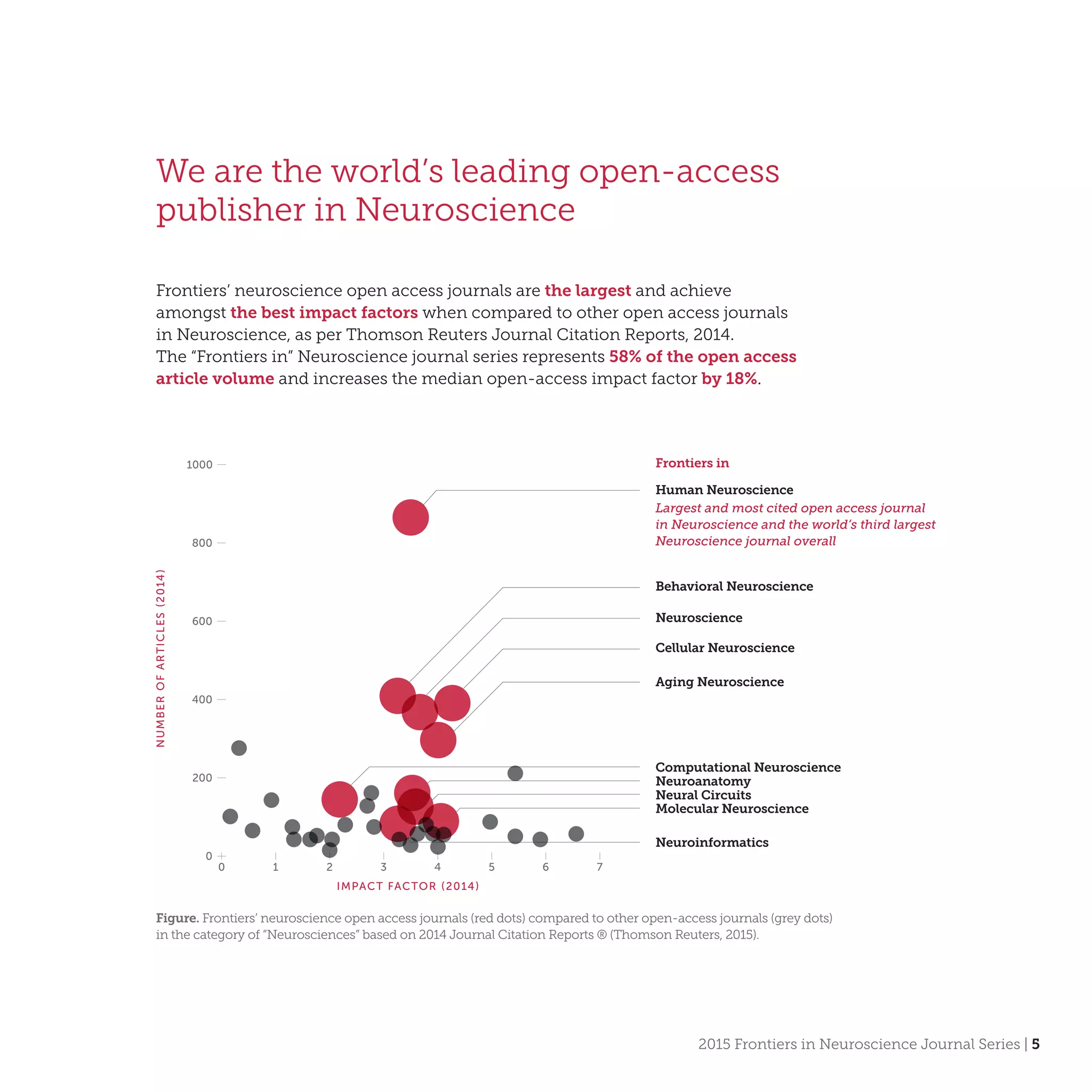
Frontiers’ neuroscience open access journals are the largest and achieve
amongst the best impact factors when compared to other open access journals
in Neuroscience, as per Thomson Reuters Journal Citation Reports, 2014.
The “Frontiers in” Neuroscience journal series represents 58% of the open access
article volume and increases the median open-access impact factor by 18%.
Figure. Frontiers’ neuroscience open access journals (red dots) compared to other open-access journals (grey dots)
in the category of “Neurosciences” based on 2014 Journal Citation Reports ® (Thomson Reuters, 2015).
Human Neuroscience
Behavioral Neuroscience
Neuroscience
Cellular Neuroscience
Aging Neuroscience
Computational Neuroscience
Neuroanatomy
Neural Circuits
Molecular Neuroscience
Neuroinformatics
Frontiers in
IMPACT FACTOR (2014)
NUMBEROFARTICLES(2014)
0 1 2 3 4 5 6 7
1000
800
600
400
200
0
Largest and most cited open access journal
in Neuroscience and the world’s third largest
Neuroscience journal overall
6 | 2015 Frontiers in Neuroscience Journal Series
Mission Statement
These are historical times for brain research. The convergence of novel molecular
and optical techniques paves the way to the era of causation neuroscience, and the
behavioral and functional consequences of these manipulations are being explored.
It is also a new era of anatomical neuroscience, as recently developed techniques
become more widely used. New research fields have recently emerged and new
informatics-based methods are being developed to store the enormous amount of
data produced. Theoretical and computational approaches have also been developed
for deriving principles of brain operations. As the field is growing fast, we integrate
and link studies in related subfields, providing an overview of the state-of-the-art
research. This journal aims to look at the brain from particular standpoints all the way
from genes to behavior.
1’600+
Articles
published
1’300+
Editors
5’420’000+
Total article
views
1’020’000+
Total article
downloads
3.7
Impact Factor
2015 Frontiers in Neuroscience Journal Series | 7
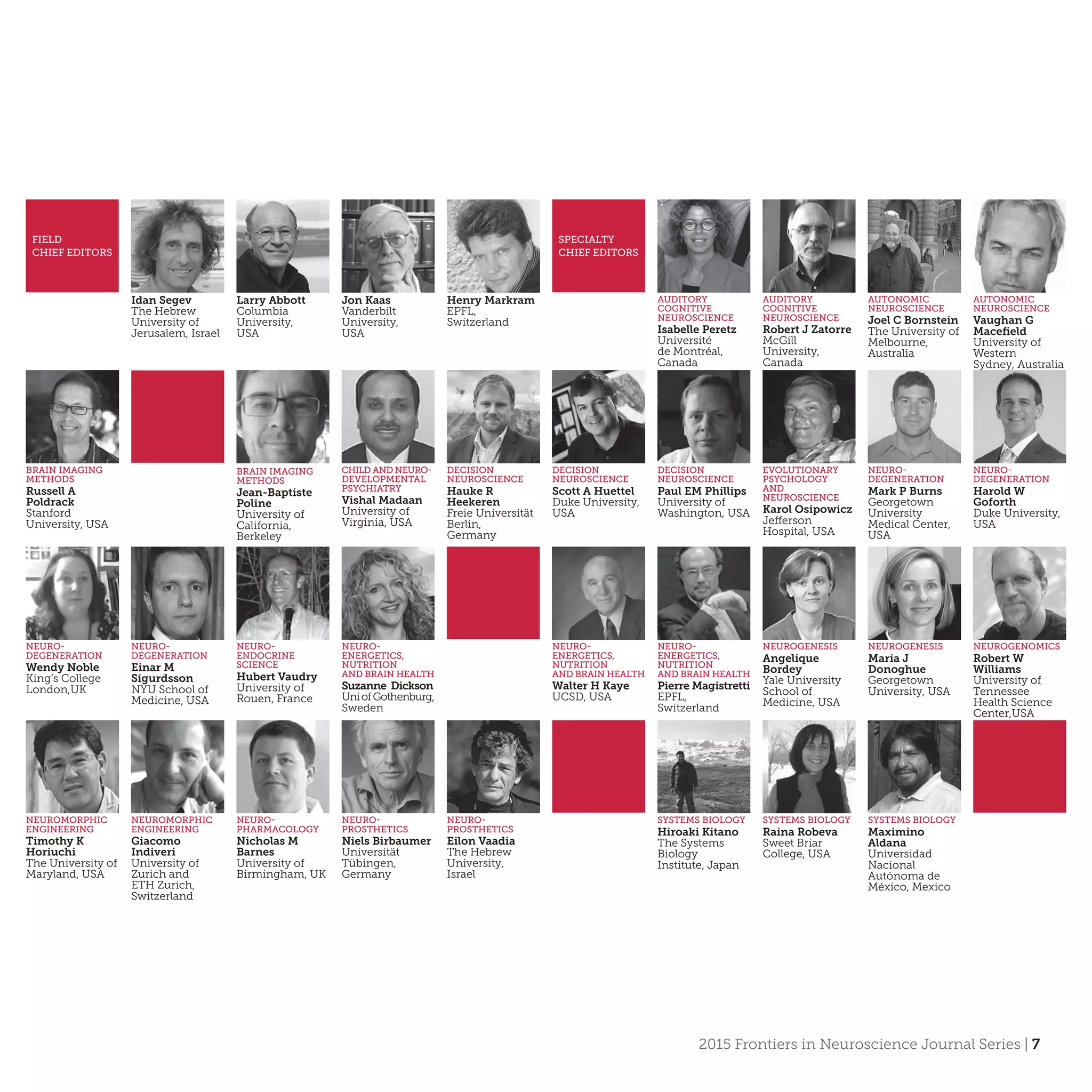
FIELD
CHIEF EDITORS
Jon Kaas
Vanderbilt
University,
USA
Idan Segev
The Hebrew
University of
Jerusalem, Israel
Larry Abbott
Columbia
University,
USA
Henry Markram
EPFL,
Switzerland
SPECIALTY
CHIEF EDITORS
AUDITORY
COGNITIVE
NEUROSCIENCE
Isabelle Peretz
Université
de Montréal,
Canada
AUDITORY
COGNITIVE
NEUROSCIENCE
Robert J Zatorre
McGill
University,
Canada
AUTONOMIC
NEUROSCIENCE
Joel C Bornstein
The University of
Melbourne,
Australia
AUTONOMIC
NEUROSCIENCE
Vaughan G
Macefield
University of
Western
Sydney, Australia
BRAIN IMAGING
METHODS
Russell A
Poldrack
Stanford
University, USA
CHILD AND NEURO-
DEVELOPMENTAL
PSYCHIATRY
Vishal Madaan
University of
Virginia, USA
BRAIN IMAGING
METHODS
Jean-Baptiste
Poline
University of
California,
Berkeley
DECISION
NEUROSCIENCE
Hauke R
Heekeren
Freie Universität
Berlin,
Germany
DECISION
NEUROSCIENCE
Scott A Huettel
Duke University,
USA
DECISION
NEUROSCIENCE
Paul EM Phillips
University of
Washington, USA
EVOLUTIONARY
PSYCHOLOGY
AND
NEUROSCIENCE
Karol Osipowicz
Jefferson
Hospital, USA
NEURO-
DEGENERATION
Wendy Noble
King’s College
London,UK
NEURO-
DEGENERATION
Mark P Burns
Georgetown
University
Medical Center,
USA
NEURO-
DEGENERATION
Harold W
Goforth
Duke University,
USA
NEURO-
DEGENERATION
Einar M
Sigurdsson
NYU School of
Medicine, USA
NEURO-
ENDOCRINE
SCIENCE
Hubert Vaudry
University of
Rouen, France
NEURO-
ENERGETICS,
NUTRITION
AND BRAIN HEALTH
Suzanne Dickson
UniofGothenburg,
Sweden
NEURO-
ENERGETICS,
NUTRITION
AND BRAIN HEALTH
Pierre Magistretti
EPFL,
Switzerland
NEURO-
ENERGETICS,
NUTRITION
AND BRAIN HEALTH
Walter H Kaye
UCSD, USA
NEUROMORPHIC
ENGINEERING
Timothy K
Horiuchi
The University of
Maryland, USA
NEUROGENOMICS
Robert W
Williams
University of
Tennessee
Health Science
Center,USA
NEUROGENESIS
Maria J
Donoghue
Georgetown
University, USA
NEUROGENESIS
Angelique
Bordey
Yale University
School of
Medicine, USA
NEUROMORPHIC
ENGINEERING
Giacomo
Indiveri
University of
Zurich and
ETH Zurich,
Switzerland
NEURO-
PROSTHETICS
Eilon Vaadia
The Hebrew
University,
Israel
NEURO-
PROSTHETICS
Niels Birbaumer
Universität
Tübingen,
Germany
SYSTEMS BIOLOGY
Raina Robeva
Sweet Briar
College, USA
SYSTEMS BIOLOGY
Hiroaki Kitano
The Systems
Biology
Institute, Japan
NEURO-
PHARMACOLOGY
Nicholas M
Barnes
University of
Birmingham, UK
SYSTEMS BIOLOGY
Maximino
Aldana
Universidad
Nacional
Autónoma de
México, Mexico
8 | 2015 Frontiers in Neuroscience Journal Series
Mission Statement
Frontiers in Aging Neuroscience is a cutting-edge journal aimed at fostering the
understanding of mechanistic processes associated with CNS aging and age-related
neuronal diseases. Our role is to bring cohesion between disciplines and theories
focused on understanding the fundamental processes of senescence. Special
emphasis is placed on integrating findings of various sub disciplines in neuroscience
to yield translational insight to the aging process and neurological diseases associated
with senescence, and developing treatment strategies aimed at the conservation
of neuronal function. This aspect is critical to advance our ability to understand,
manage, and treat conditions associated with aging. We welcome work elucidating
genetic, biophysical, genomic, proteomic, cellular, molecular, biochemical, endocrinal,
immunological, physiological, pharmacological, and psychological/behavioral aspects
of CNS aging and neurological diseases and pathological events connected to this
process. Neuroimaging studies and clinical studies targeted to mechanistic aspects of
neuronal aging/disease are also welcome.
730+
Articles
published
380+
Editors
1’720’000+
Total article
views
430’000+
Total article
downloads
4.0
Impact Factor
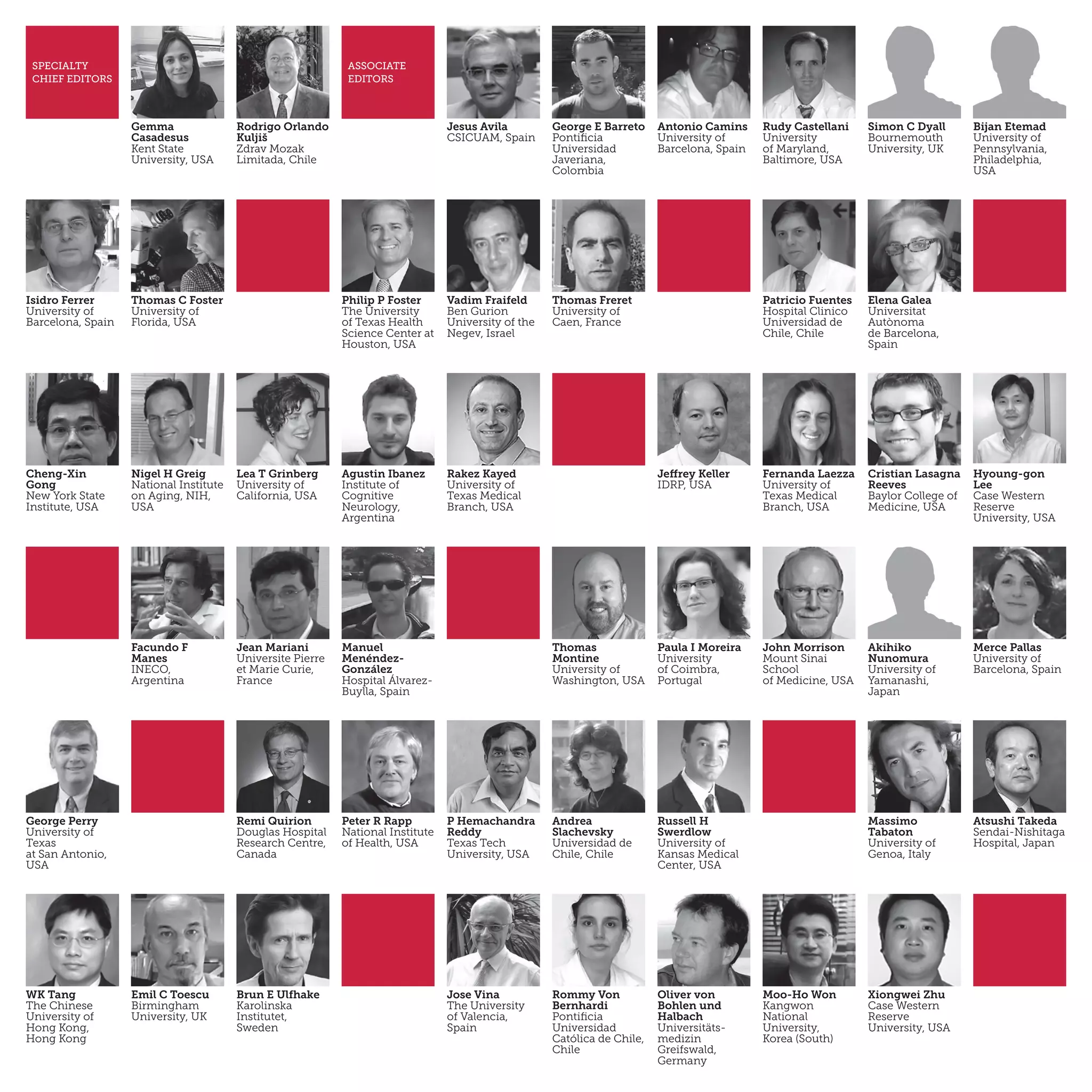
Manuel
Menéndez-
González
Hospital Álvarez-
Buylla, Spain
Thomas
Montine
University of
Washington, USA
George Perry
University of
Texas
at San Antonio,
USA
Remi Quirion
Douglas Hospital
Research Centre,
Canada
Massimo
Tabaton
University of
Genoa, Italy
Atsushi Takeda
Sendai-Nishitaga
Hospital, Japan
Gemma
Casadesus
Kent State
University, USA
Rodrigo Orlando
Kuljiš
Zdrav Mozak
Limitada, Chile
Jesus Avila
CSIC­UAM, Spain
George E Barreto
Pontificia
Universidad
Javeriana,
Colombia
Antonio Camins
University of
Barcelona, Spain
Rudy Castellani
University
of Maryland,
Baltimore, USA
Simon C Dyall
Bournemouth
University, UK
Bijan Etemad
University of
Pennsylvania,
Philadelphia,
USA
Isidro Ferrer
University of
Barcelona, Spain
Thomas C Foster
University of
Florida, USA
Philip P Foster
The University
of Texas Health
Science Center at
Houston, USA
Vadim Fraifeld
Ben Gurion
University of the
Negev, Israel
Thomas Freret
University of
Caen, France
Patricio Fuentes
Hospital Clinico
Universidad de
Chile, Chile
Elena Galea
Universitat
Autònoma
de Barcelona,
Spain
Cheng-Xin
Gong
New York State
Institute, USA
Nigel H Greig
National Institute
on Aging, NIH,
USA
Lea T Grinberg
University of
California, USA
Agustin Ibanez
Institute of
Cognitive
Neurology,
Argentina
Rakez Kayed
University of
Texas Medical
Branch, USA
Jeffrey Keller
IDRP, USA
Fernanda Laezza
University of
Texas Medical
Branch, USA
SPECIALTY
CHIEF EDITORS
ASSOCIATE
EDITORS
Hyoung-gon
Lee
Case Western
Reserve
University, USA
Cristian Lasagna
Reeves
Baylor College of
Medicine, USA
Facundo F
Manes
INECO,
Argentina
Jean Mariani
Universite Pierre
et Marie Curie,
France
Paula I Moreira
University
of Coimbra,
Portugal
John Morrison
Mount Sinai
School
of Medicine, USA
Akihiko
Nunomura
University of
Yamanashi,
Japan
Merce Pallas
University of
Barcelona, Spain
Peter R Rapp
National Institute
of Health, USA
P Hemachandra
Reddy
Texas Tech
University, USA
Andrea
Slachevsky
Universidad de
Chile, Chile
Russell H
Swerdlow
University of
Kansas Medical
Center, USA
WK Tang
The Chinese
University of
Hong Kong,
Hong Kong
Emil C Toescu
Birmingham
University, UK
Brun E Ulfhake
Karolinska
Institutet,
Sweden
Jose Vina
The University
of Valencia,
Spain
Rommy Von
Bernhardi
Pontificia
Universidad
Católica de Chile,
Chile
Oliver von
Bohlen und
Halbach
Universitäts-
medizin
Greifswald,
Germany
Moo-Ho Won
Kangwon
National
University,
Korea (South)
Xiongwei Zhu
Case Western
Reserve
University, USA
10 | 2015 Frontiers in Neuroscience Journal Series
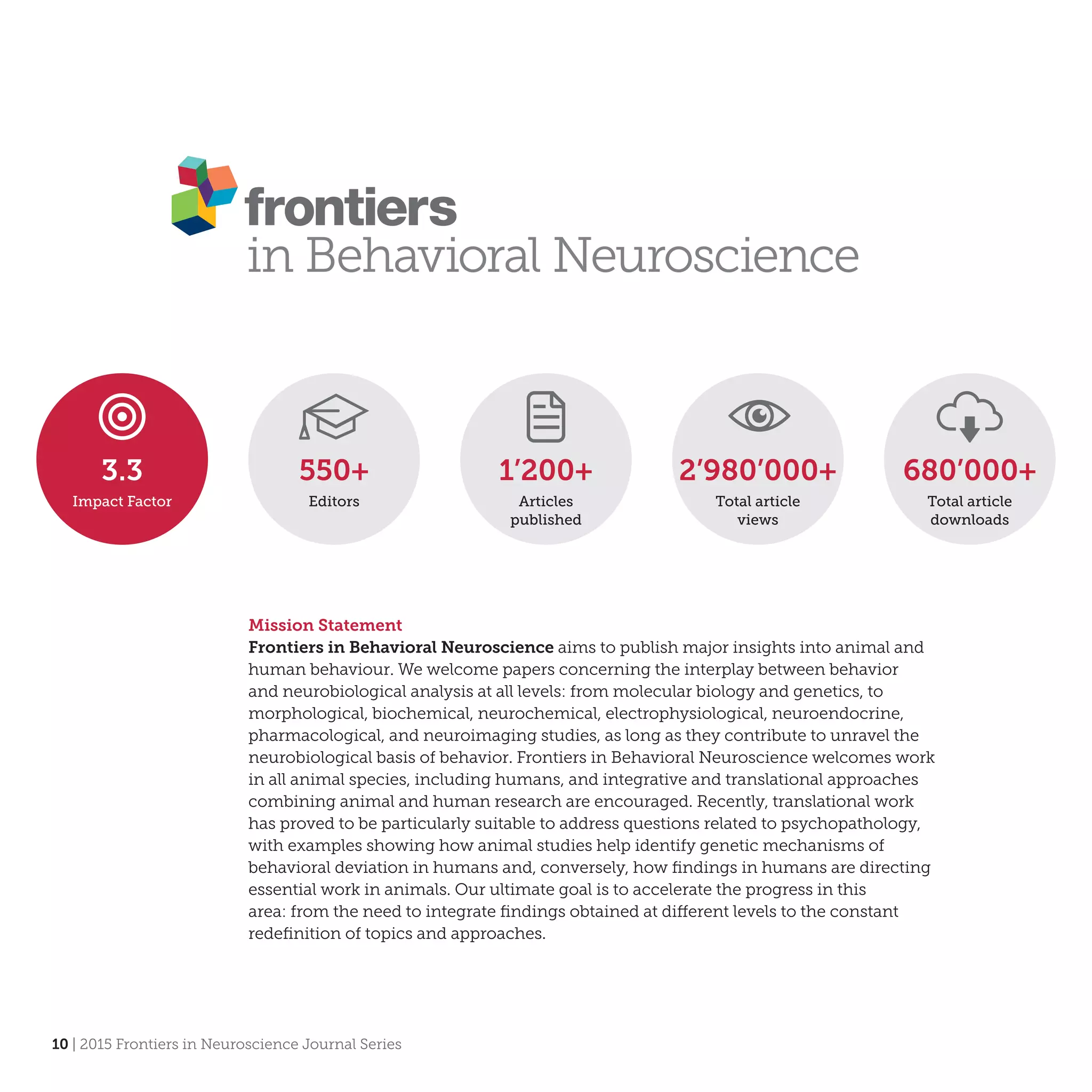
Mission Statement
Frontiers in Behavioral Neuroscience aims to publish major insights into animal and
human behaviour. We welcome papers concerning the interplay between behavior
and neurobiological analysis at all levels: from molecular biology and genetics, to
morphological, biochemical, neurochemical, electrophysiological, neuroendocrine,
pharmacological, and neuroimaging studies, as long as they contribute to unravel the
neurobiological basis of behavior. Frontiers in Behavioral Neuroscience welcomes work
in all animal species, including humans, and integrative and translational approaches
combining animal and human research are encouraged. Recently, translational work
has proved to be particularly suitable to address questions related to psychopathology,
with examples showing how animal studies help identify genetic mechanisms of
behavioral deviation in humans and, conversely, how findings in humans are directing
essential work in animals. Our ultimate goal is to accelerate the progress in this
area: from the need to integrate findings obtained at different levels to the constant
redefinition of topics and approaches.
1’200+
Articles
published
550+
Editors
2’980’000+
Total article
views
680’000+
Total article
downloads
3.3
Impact Factor
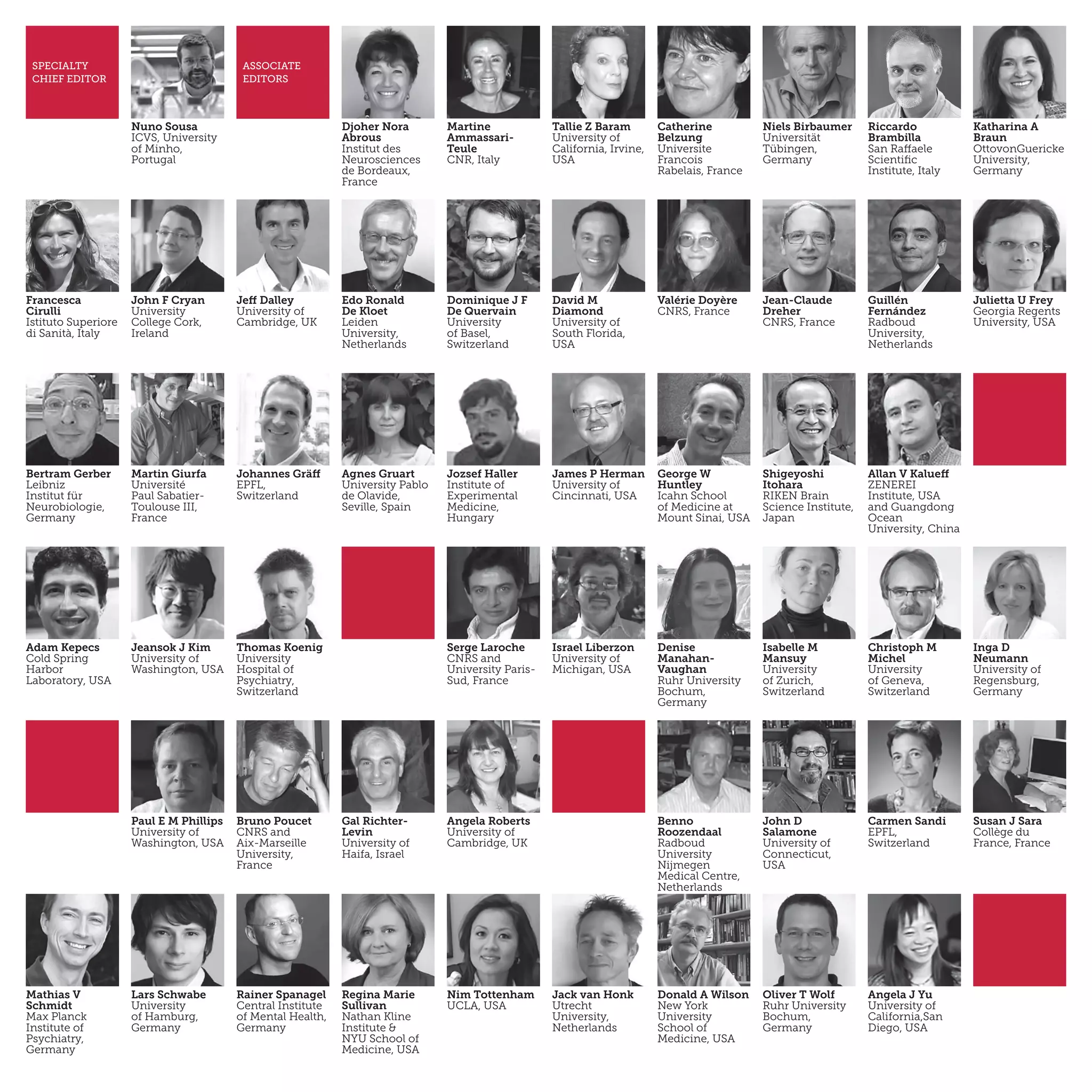
SPECIALTY
CHIEF EDITOR
Nuno Sousa
ICVS, University
of Minho,
Portugal
ASSOCIATE
EDITORS
Djoher Nora
Abrous
Institut des
Neurosciences
de Bordeaux,
France
Martine
Ammassari-
Teule
CNR, Italy
Tallie Z Baram
University of
California, Irvine,
USA
Catherine
Belzung
Universite
Francois
Rabelais, France
Niels Birbaumer
Universität
Tübingen,
Germany
Riccardo
Brambilla
San Raffaele
Scientific
Institute, Italy
Katharina A
Braun
Otto­von­Guericke
University,
Germany
Francesca
Cirulli
Istituto Superiore
di Sanità, Italy
John F Cryan
University
College Cork,
Ireland
Jeff Dalley
University of
Cambridge, UK
Edo Ronald
De Kloet
Leiden
University,
Netherlands
Dominique J F
De Quervain
University
of Basel,
Switzerland
David M
Diamond
University of
South Florida,
USA
Valérie Doyère
CNRS, France
Jean-Claude
Dreher
CNRS, France
Guillén
Fernández
Radboud
University,
Netherlands
Julietta U Frey
Georgia Regents
University, USA
Bertram Gerber
Leibniz
Institut für
Neurobiologie,
Germany
Martin Giurfa
Université
Paul Sabatier-
Toulouse III,
France
Johannes Gräff
EPFL,
Switzerland
Agnes Gruart
University Pablo
de Olavide,
Seville, Spain
Jozsef Haller
Institute of
Experimental
Medicine,
Hungary
James P Herman
University of
Cincinnati, USA
George W
Huntley
Icahn School
of Medicine at
Mount Sinai, USA
Shigeyoshi
Itohara
RIKEN Brain
Science Institute,
Japan
Allan V Kalueff
ZENEREI
Institute, USA
and Guangdong
Ocean
University, China
Adam Kepecs
Cold Spring
Harbor
Laboratory, USA
Jeansok J Kim
University of
Washington, USA
Thomas Koenig
University
Hospital of
Psychiatry,
Switzerland
Serge Laroche
CNRS and
University Paris-
Sud, France
Israel Liberzon
University of
Michigan, USA
Denise
Manahan-
Vaughan
Ruhr University
Bochum,
Germany
Isabelle M
Mansuy
University
of Zurich,
Switzerland
Christoph M
Michel
University
of Geneva,
Switzerland
Inga D
Neumann
University of
Regensburg,
Germany
Paul E M Phillips
University of
Washington, USA
Bruno Poucet
CNRS and
Aix-Marseille
University,
France
Gal Richter-
Levin
University of
Haifa, Israel
Angela Roberts
University of
Cambridge, UK
Benno
Roozendaal
Radboud
University
Nijmegen
Medical Centre,
Netherlands
John D
Salamone
University of
Connecticut,
USA
Carmen Sandi
EPFL,
Switzerland
Susan J Sara
Collège du
France, France
Mathias V
Schmidt
Max Planck
Institute of
Psychiatry,
Germany
Lars Schwabe
University
of Hamburg,
Germany
Rainer Spanagel
Central Institute
of Mental Health,
Germany
Regina Marie
Sullivan
Nathan Kline
Institute &
NYU School of
Medicine, USA
Nim Tottenham
UCLA, USA
Jack van Honk
Utrecht
University,
Netherlands
Donald A Wilson
New York
University
School of
Medicine, USA
Oliver T Wolf
Ruhr University
Bochum,
Germany
Angela J Yu
University of
California,San
Diego, USA
12 | 2015 Frontiers in Neuroscience Journal Series
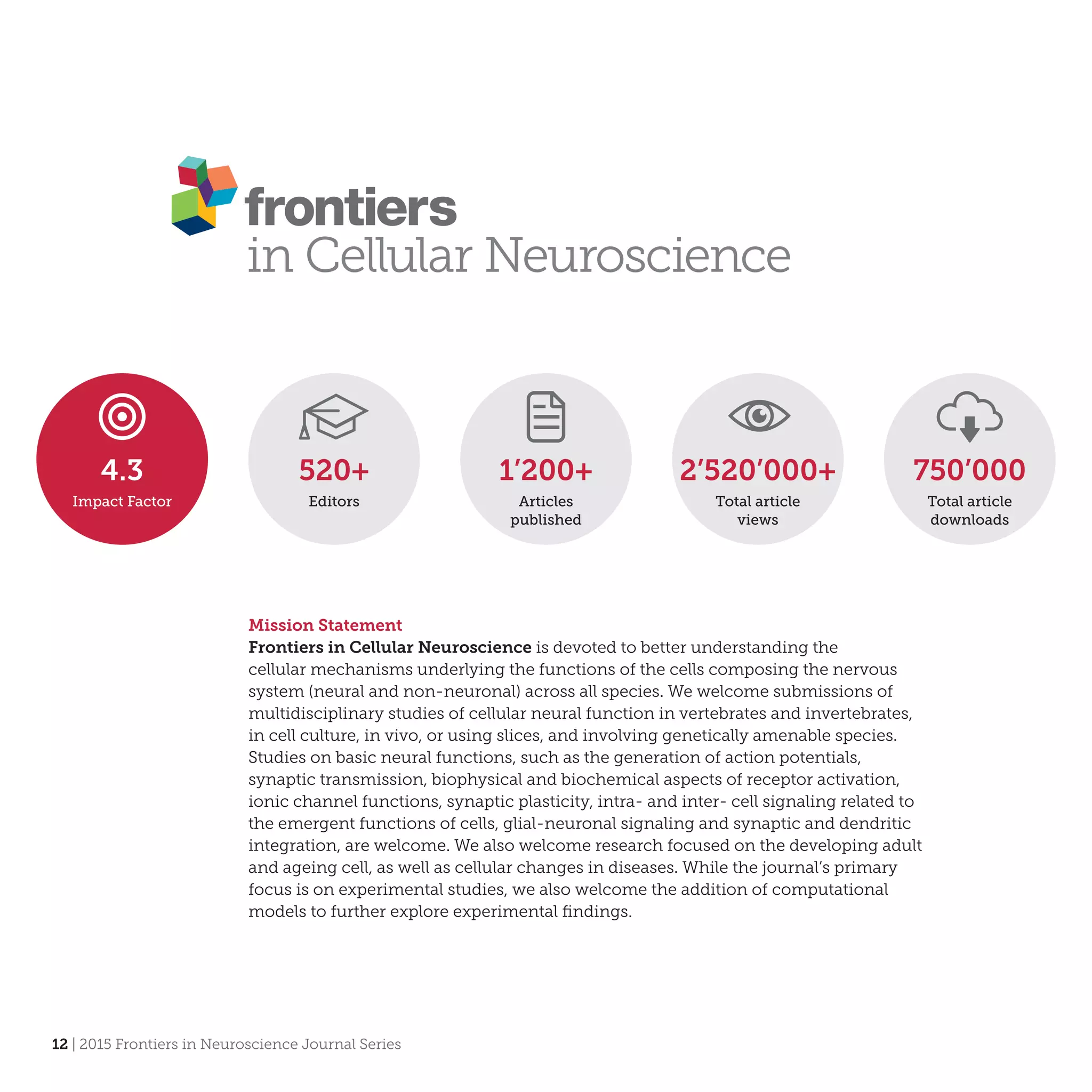
Mission Statement
Frontiers in Cellular Neuroscience is devoted to better understanding the
cellular mechanisms underlying the functions of the cells composing the nervous
system (neural and non-neuronal) across all species. We welcome submissions of
multidisciplinary studies of cellular neural function in vertebrates and invertebrates,
in cell culture, in vivo, or using slices, and involving genetically amenable species.
Studies on basic neural functions, such as the generation of action potentials,
synaptic transmission, biophysical and biochemical aspects of receptor activation,
ionic channel functions, synaptic plasticity, intra- and inter- cell signaling related to
the emergent functions of cells, glial-neuronal signaling and synaptic and dendritic
integration, are welcome. We also welcome research focused on the developing adult
and ageing cell, as well as cellular changes in diseases. While the journal’s primary
focus is on experimental studies, we also welcome the addition of computational
models to further explore experimental findings.
1’200+
Articles
published
520+
Editors
2’520’000+
Total article
views
750’000
Total article
downloads
4.3
Impact Factor
Egidio D‘Angelo
University of
Pavia, Italy
Christian Hansel
University of
Chicago, United
States of America
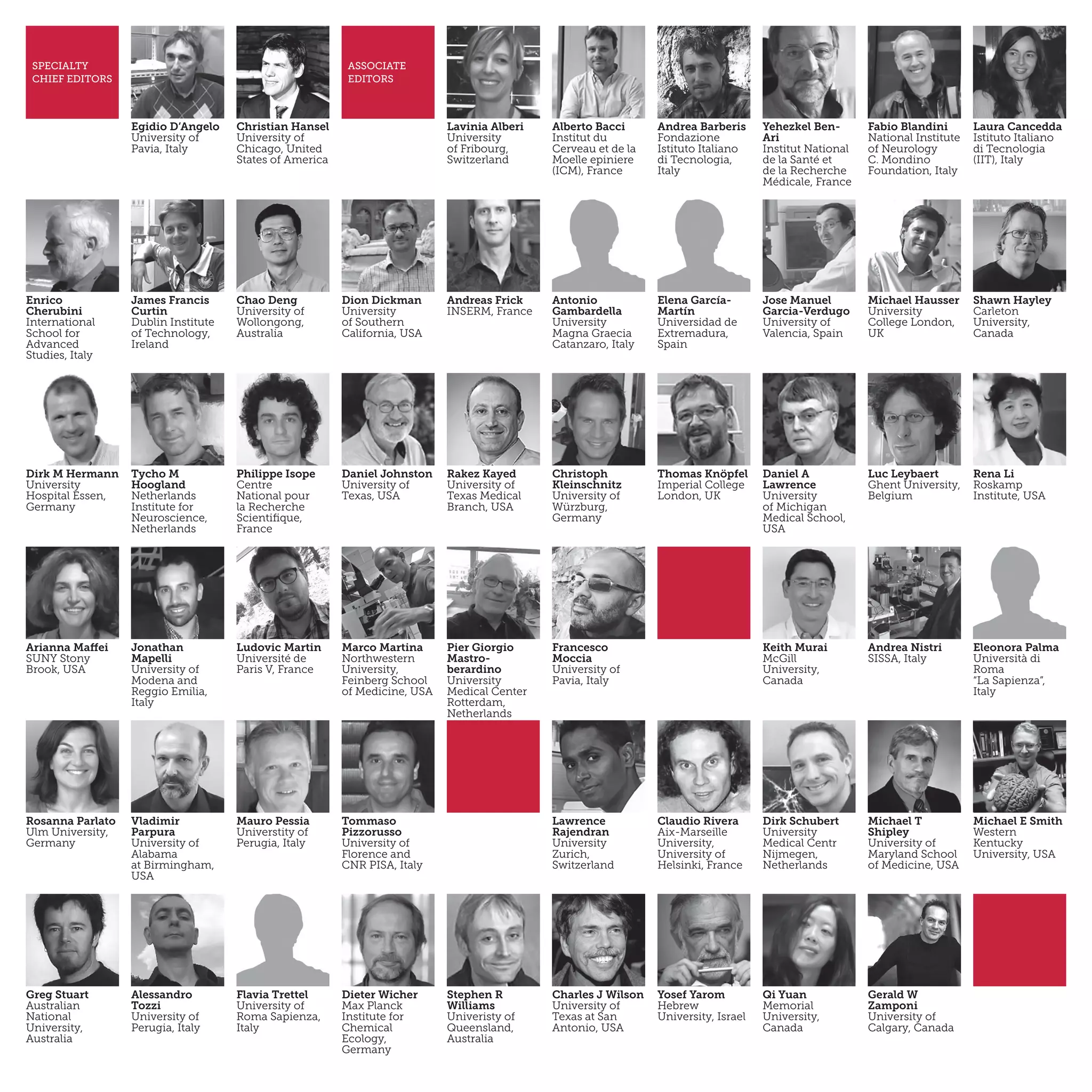
SPECIALTY
CHIEF EDITORS
ASSOCIATE
EDITORS
Lavinia Alberi
University
of Fribourg,
Switzerland
Alberto Bacci
Institut du
Cerveau et de la
Moelle epiniere
(ICM), France
Andrea Barberis
Fondazione
Istituto Italiano
di Tecnologia,
Italy
Yehezkel Ben-
Ari
Institut National
de la Santé et
de la Recherche
Médicale, France
Fabio Blandini
National Institute
of Neurology
C. Mondino
Foundation, Italy
Laura Cancedda
Istituto Italiano
di Tecnologia
(IIT), Italy
Enrico
Cherubini
International
School for
Advanced
Studies, Italy
James Francis
Curtin
Dublin Institute
of Technology,
Ireland
Chao Deng
University of
Wollongong,
Australia
Dion Dickman
University
of Southern
California, USA
Andreas Frick
INSERM, France
Antonio
Gambardella
University
Magna Graecia
Catanzaro, Italy
Elena García-
Martín
Universidad de
Extremadura,
Spain
Jose Manuel
Garcia-Verdugo
University of
Valencia, Spain
Michael Hausser
University
College London,
UK
Shawn Hayley
Carleton
University,
Canada
Dirk M Hermann
University
Hospital Essen,
Germany
Tycho M
Hoogland
Netherlands
Institute for
Neuroscience,
Netherlands
Philippe Isope
Centre
National pour
la Recherche
Scientifique,
France
Daniel Johnston
University of
Texas, USA
Rakez Kayed
University of
Texas Medical
Branch, USA
Christoph
Kleinschnitz
University of
Würzburg,
Germany
Thomas Knöpfel
Imperial College
London, UK
Daniel A
Lawrence
University
of Michigan
Medical School,
USA
Luc Leybaert
Ghent University,
Belgium
Rena Li
Roskamp
Institute, USA
Arianna Maffei
SUNY Stony
Brook, USA
Jonathan
Mapelli
University of
Modena and
Reggio Emilia,
Italy
Ludovic Martin
Université de
Paris V, France
Marco Martina
Northwestern
University,
Feinberg School
of Medicine, USA
Pier Giorgio
Mastro-
berardino
University
Medical Center
Rotterdam,
Netherlands
Francesco
Moccia
University of
Pavia, Italy
Keith Murai
McGill
University,
Canada
Andrea Nistri
SISSA, Italy
Eleonora Palma
Università di
Roma
“La Sapienza”,
Italy
Rosanna Parlato
Ulm University,
Germany
Vladimir
Parpura
University of
Alabama
at Birmingham,
USA
Mauro Pessia
Universtity of
Perugia, Italy
Tommaso
Pizzorusso
University of
Florence and
CNR PISA, Italy
Lawrence
Rajendran
University
Zurich,
Switzerland
Claudio Rivera
Aix-Marseille
University,
University of
Helsinki, France
Dirk Schubert
University
Medical Centr
Nijmegen,
Netherlands
Michael T
Shipley
University of
Maryland School
of Medicine, USA
Michael E Smith
Western
Kentucky
University, USA
Greg Stuart
Australian
National
University,
Australia
Alessandro
Tozzi
University of
Perugia, Italy
Flavia Trettel
University of
Roma Sapienza,
Italy
Dieter Wicher
Max Planck
Institute for
Chemical
Ecology,
Germany
Stephen R
Williams
Univeristy of
Queensland,
Australia
Charles J Wilson
University of
Texas at San
Antonio, USA
Yosef Yarom
Hebrew
University, Israel
Qi Yuan
Memorial
University,
Canada
Gerald W
Zamponi
University of
Calgary, Canada
14 | 2015 Frontiers in Neuroscience Journal Series
Mission Statement
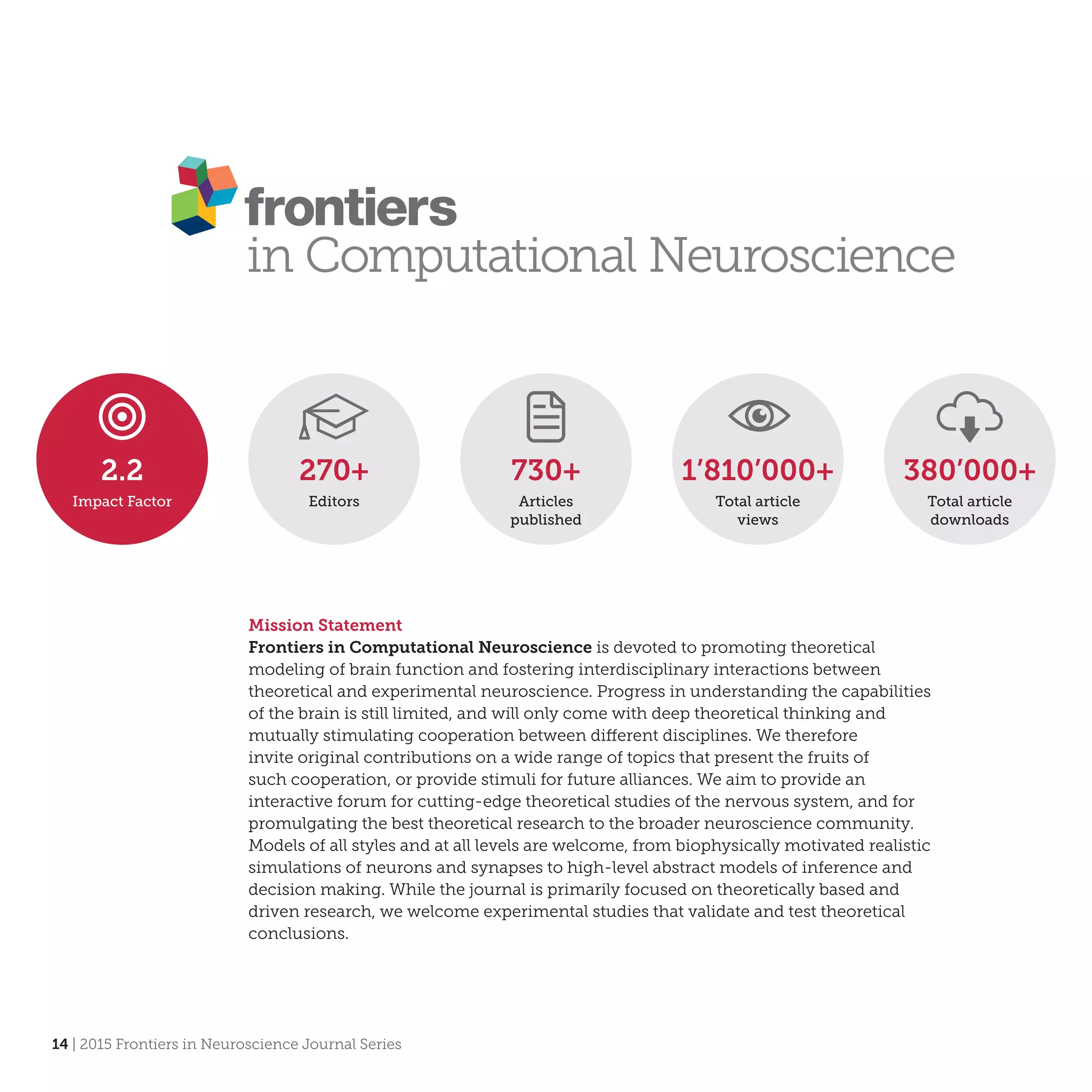
Frontiers in Computational Neuroscience is devoted to promoting theoretical
modeling of brain function and fostering interdisciplinary interactions between
theoretical and experimental neuroscience. Progress in understanding the capabilities
of the brain is still limited, and will only come with deep theoretical thinking and
mutually stimulating cooperation between different disciplines. We therefore
invite original contributions on a wide range of topics that present the fruits of
such cooperation, or provide stimuli for future alliances. We aim to provide an
interactive forum for cutting-edge theoretical studies of the nervous system, and for
promulgating the best theoretical research to the broader neuroscience community.
Models of all styles and at all levels are welcome, from biophysically motivated realistic
simulations of neurons and synapses to high-level abstract models of inference and
decision making. While the journal is primarily focused on theoretically based and
driven research, we welcome experimental studies that validate and test theoretical
conclusions.
730+
Articles
published
270+
Editors
1’810’000+
Total article
views
380’000+
Total article
downloads
2.2
Impact Factor
2015 Frontiers in Neuroscience Journal Series | 15
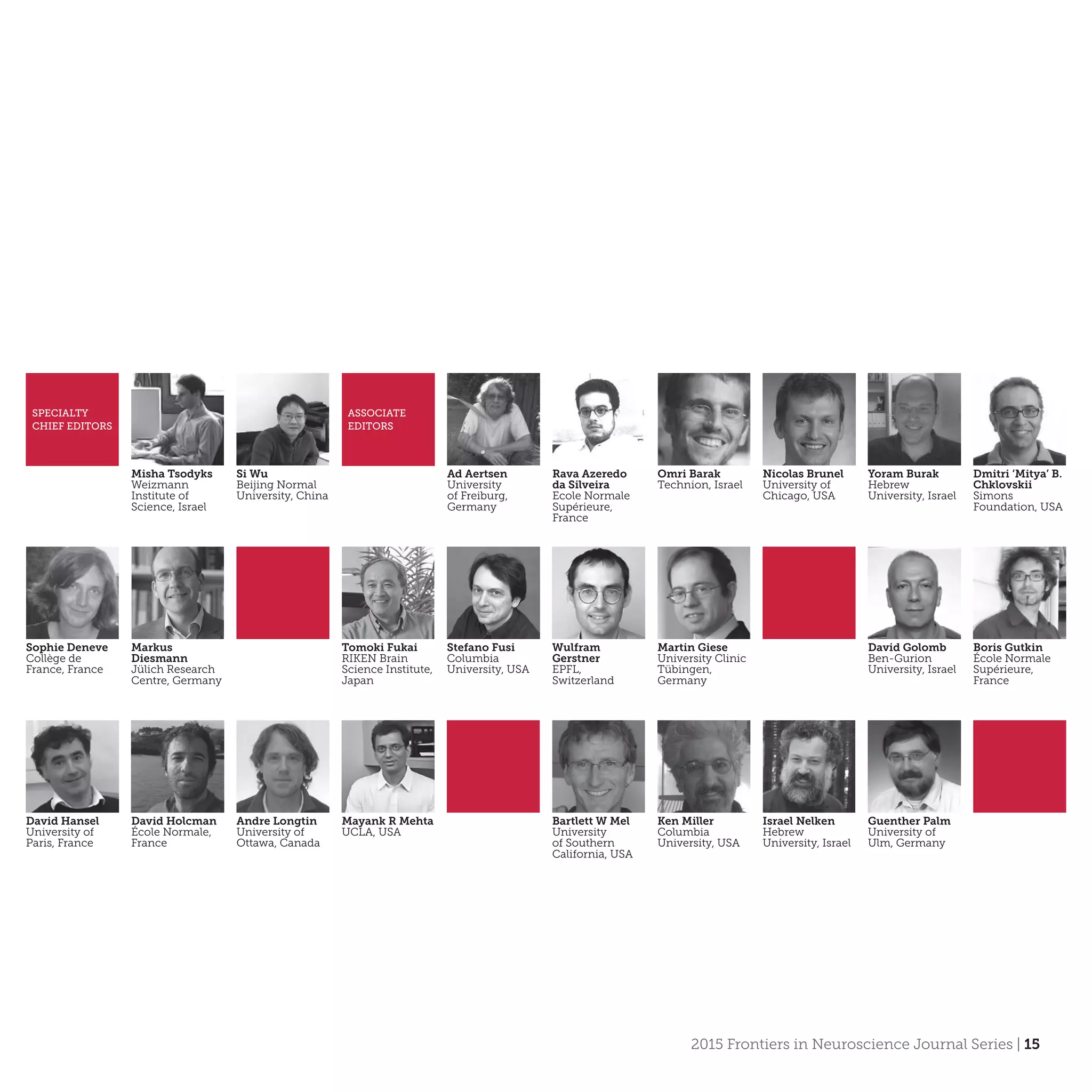
Misha Tsodyks
Weizmann
Institute of
Science, Israel
SPECIALTY
CHIEF EDITORS
ASSOCIATE
EDITORS
Si Wu
Beijing Normal
University, China
Ad Aertsen
University
of Freiburg,
Germany
Rava Azeredo
da Silveira
Ecole Normale
Supérieure,
France
Omri Barak
Technion, Israel
Nicolas Brunel
University of
Chicago, USA
Yoram Burak
Hebrew
University, Israel
Dmitri ‘Mitya’ B.
Chklovskii
Simons
Foundation, USA
Sophie Deneve
Collège de
France, France
Markus
Diesmann
Jülich Research
Centre, Germany
Tomoki Fukai
RIKEN Brain
Science Institute,
Japan
Stefano Fusi
Columbia
University, USA
Wulfram
Gerstner
EPFL,
Switzerland
Martin Giese
University Clinic
Tübingen,
Germany
David Golomb
Ben-Gurion
University, Israel
Boris Gutkin
École Normale
Supérieure,
France
David Hansel
University of
Paris, France
David Holcman
École Normale,
France
Andre Longtin
University of
Ottawa, Canada
Mayank R Mehta
UCLA, USA
Ken Miller
Columbia
University, USA
Bartlett W Mel
University
of Southern
California, USA
Guenther Palm
University of
Ulm, Germany
Israel Nelken
Hebrew
University, Israel
Mission Statement
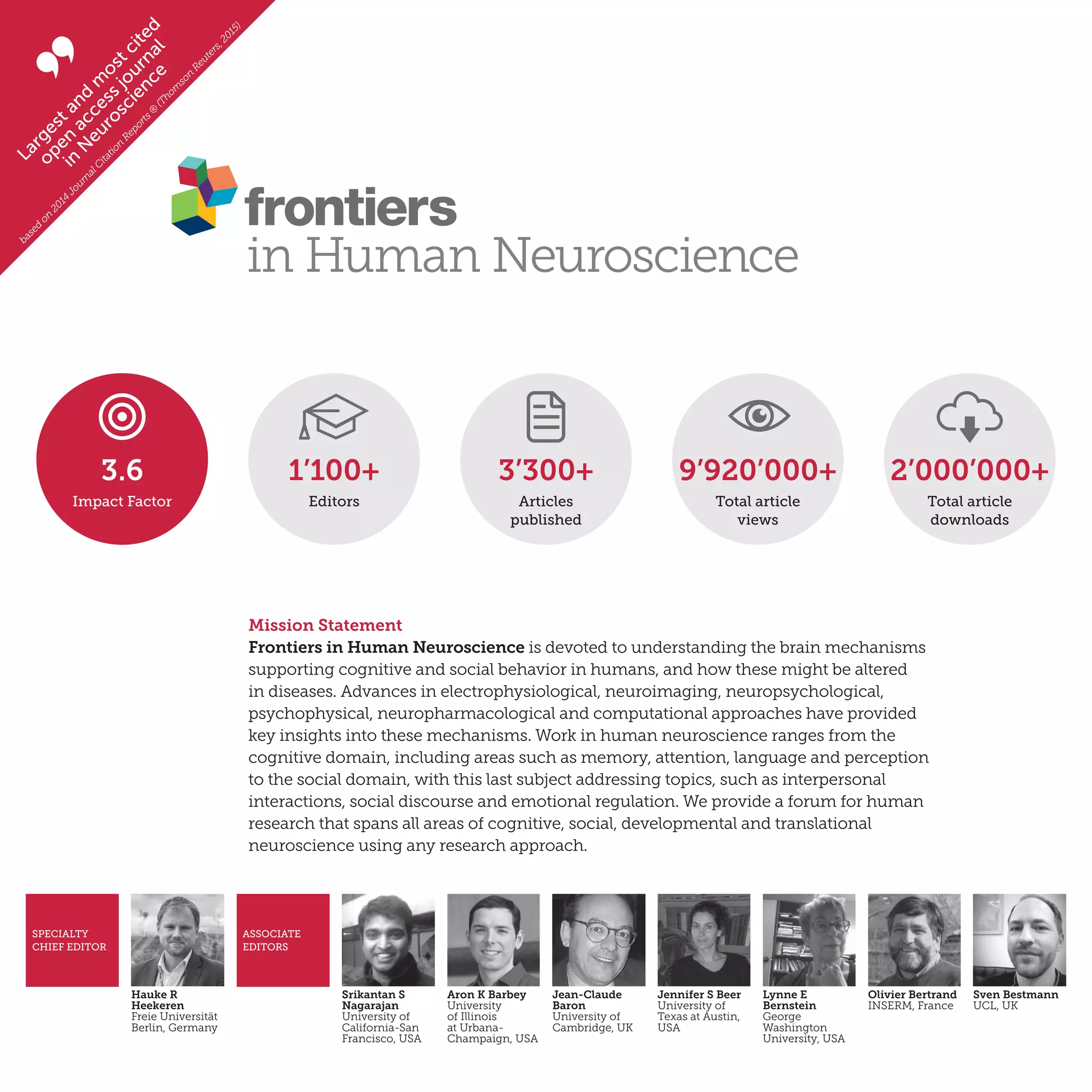
Frontiers in Human Neuroscience is devoted to understanding the brain mechanisms
supporting cognitive and social behavior in humans, and how these might be altered
in diseases. Advances in electrophysiological, neuroimaging, neuropsychological,
psychophysical, neuropharmacological and computational approaches have provided
key insights into these mechanisms. Work in human neuroscience ranges from the
cognitive domain, including areas such as memory, attention, language and perception
to the social domain, with this last subject addressing topics, such as interpersonal
interactions, social discourse and emotional regulation. We provide a forum for human
research that spans all areas of cognitive, social, developmental and translational
neuroscience using any research approach.
3’300+
Articles
published
1’100+
Editors
9’920’000+
Total article
views
2’000’000+
Total article
downloads
Hauke R
Heekeren
Freie Universität
Berlin, Germany
SPECIALTY
CHIEF EDITOR
ASSOCIATE
EDITORS
Srikantan S
Nagarajan
University of
California-San
Francisco, USA
Aron K Barbey
University
of Illinois
at Urbana-
Champaign, USA
Jean-Claude
Baron
University of
Cambridge, UK
Jennifer S Beer
University of
Texas at Austin,
USA
Lynne E
Bernstein
George
Washington
University, USA
Olivier Bertrand
INSERM, France
Sven Bestmann
UCL, UK
Largestand
m
ostcited
open
accessjournal
in
N
euroscience
3.6
Impact Factor
based
on
2014
JournalC
itation
Reports®
(Thom
son
Reuters,2015)
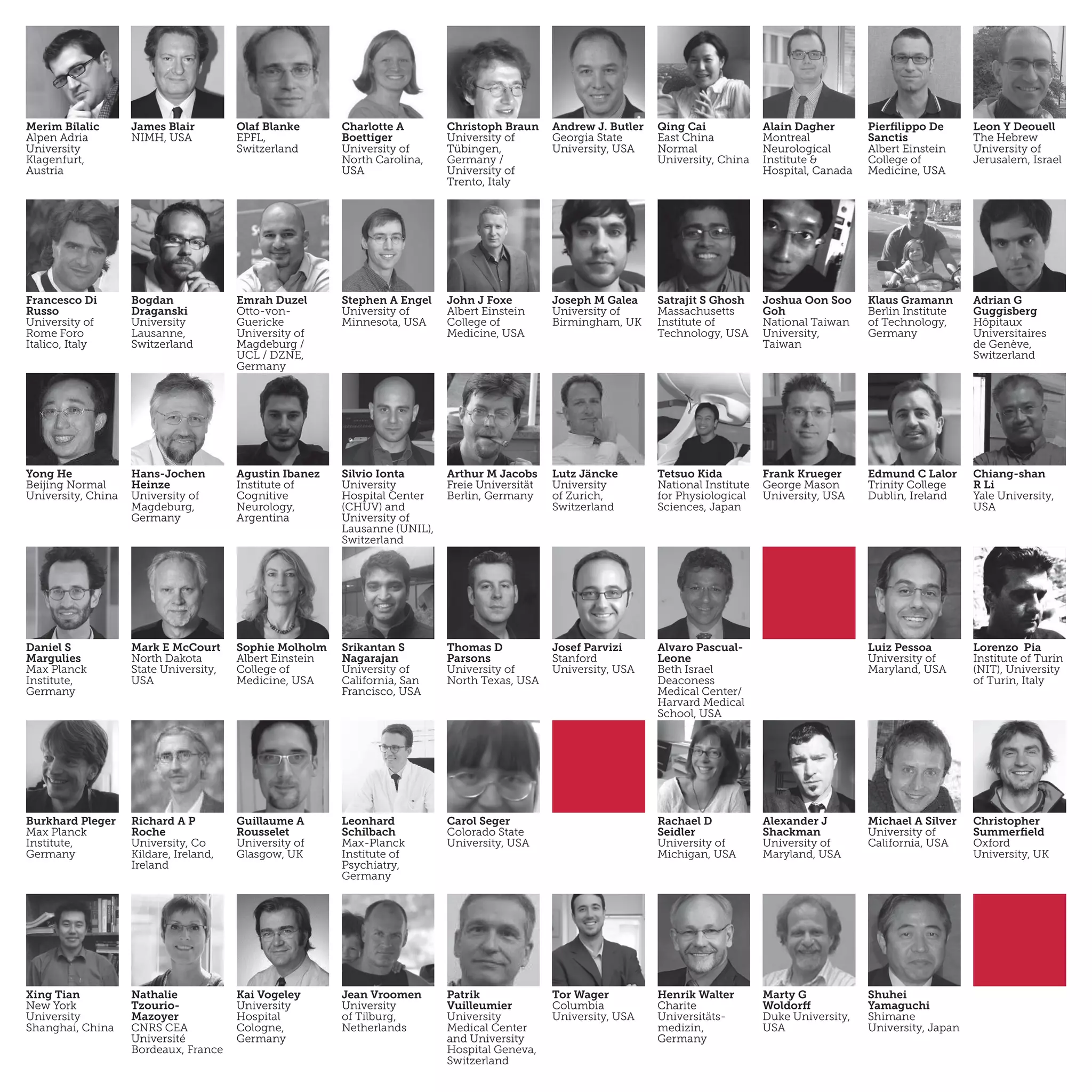
Merim Bilalic
Alpen Adria
University
Klagenfurt,
Austria
James Blair
NIMH, USA
Olaf Blanke
EPFL,
Switzerland
Charlotte A
Boettiger
University of
North Carolina,
USA
Christoph Braun
University of
Tübingen,
Germany /
University of
Trento, Italy
Andrew J. Butler
Georgia State
University, USA
Qing Cai
East China
Normal
University, China
Alain Dagher
Montreal
Neurological
Institute &
Hospital, Canada
Pierfilippo De
Sanctis
Albert Einstein
College of
Medicine, USA
Leon Y Deouell
The Hebrew
University of
Jerusalem, Israel
Francesco Di
Russo
University of
Rome Foro
Italico, Italy
Bogdan
Draganski
University
Lausanne,
Switzerland
Emrah Duzel
Otto-von-
Guericke
University of
Magdeburg /
UCL / DZNE,
Germany
Stephen A Engel
University of
Minnesota, USA
John J Foxe
Albert Einstein
College of
Medicine, USA
Joseph M Galea
University of
Birmingham, UK
Satrajit S Ghosh
Massachusetts
Institute of
Technology, USA
Joshua Oon Soo
Goh
National Taiwan
University,
Taiwan
Klaus Gramann
Berlin Institute
of Technology,
Germany
Adrian G
Guggisberg
Hôpitaux
Universitaires
de Genève,
Switzerland
Yong He
Beijing Normal
University, China
Hans-Jochen
Heinze
University of
Magdeburg,
Germany
Agustin Ibanez
Institute of
Cognitive
Neurology,
Argentina
Silvio Ionta
University
Hospital Center
(CHUV) and
University of
Lausanne (UNIL),
Switzerland
Arthur M Jacobs
Freie Universität
Berlin, Germany
Lutz Jäncke
University
of Zurich,
Switzerland
Tetsuo Kida
National Institute
for Physiological
Sciences, Japan
Frank Krueger
George Mason
University, USA
Edmund C Lalor
Trinity College
Dublin, Ireland
Chiang-shan
R Li
Yale University,
USA
Daniel S
Margulies
Max Planck
Institute,
Germany
Mark E McCourt
North Dakota
State University,
USA
Sophie Molholm
Albert Einstein
College of
Medicine, USA
Srikantan S
Nagarajan
University of
California, San
Francisco, USA
Thomas D
Parsons
University of
North Texas, USA
Josef Parvizi
Stanford
University, USA
Alvaro Pascual-
Leone
Beth Israel
Deaconess
Medical Center/
Harvard Medical
School, USA
Luiz Pessoa
University of
Maryland, USA
Lorenzo Pia
Institute of Turin
(NIT), University
of Turin, Italy
Burkhard Pleger
Max Planck
Institute,
Germany
Richard A P
Roche
University, Co
Kildare, Ireland,
Ireland
Guillaume A
Rousselet
University of
Glasgow, UK
Carol Seger
Colorado State
University, USA
Rachael D
Seidler
University of
Michigan, USA
Alexander J
Shackman
University of
Maryland, USA
Michael A Silver
University of
California, USA
Christopher
Summerfield
Oxford
University, UK
Xing Tian
New York
University
Shanghai, China
Nathalie
Tzourio-
Mazoyer
CNRS CEA
Université
Bordeaux, France
Kai Vogeley
University
Hospital
Cologne,
Germany
Jean Vroomen
University
of Tilburg,
Netherlands
Patrik
Vuilleumier
University
Medical Center
and University
Hospital Geneva,
Switzerland
Leonhard
Schilbach
Max-Planck
Institute of
Psychiatry,
Germany
Tor Wager
Columbia
University, USA
Henrik Walter
Charite
Universitäts-
medizin,
Germany
Marty G
Woldorff
Duke University,
USA
Shuhei
Yamaguchi
Shimane
University, Japan
18 | 2015 Frontiers in Neuroscience Journal Series
Mission Statement
Frontiers in Integrative Neuroscience is focused on synthesizing multiple
facets of brain structure and function to understand how multiple functions are
integrated to produce complex behaviors. Our goal is to publish research related
to furthering the understanding of the integrative mechanisms underlying brain
functioning across one or more interacting levels of neural organization.
In most real life experiences, sensory inputs from several modalities converge and
interact in a manner that influences perception and behavior. We are therefore
focused on the primary questions of how multiple sensory, cognitive and emotional
processes merge to produce coordinated complex behavior. In Frontiers in Integrative
Neuroscience we welcome in vitro or in vivo investigations across the molecular,
cellular, and systems and behavioral level. Research in any species and at any stage
of development and aging that are focused at understanding integration mechanisms
underlying emergent properties of the brain and behavior are welcome.
540+
Articles
published
390+
Editors
1’580’000+
Total article
views
350’000+
Total article
downloads
2015 Frontiers in Neuroscience Journal Series | 19
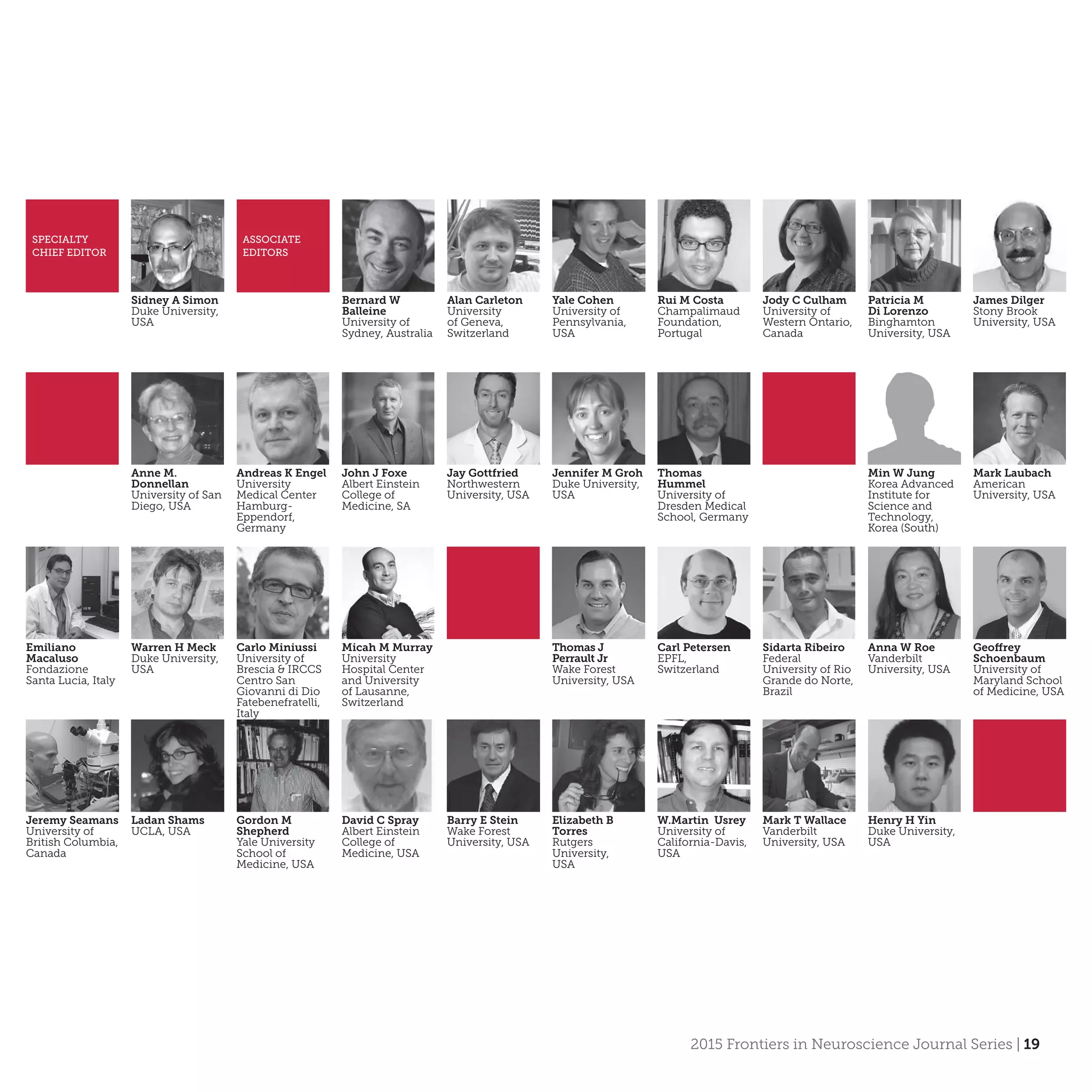
Sidney A Simon
Duke University,
USA
SPECIALTY
CHIEF EDITOR
ASSOCIATE
EDITORS
Bernard W
Balleine
University of
Sydney, Australia
Alan Carleton
University
of Geneva,
Switzerland
Yale Cohen
University of
Pennsylvania,
USA
Rui M Costa
Champalimaud
Foundation,
Portugal
Jody C Culham
University of
Western Ontario,
Canada
Patricia M
Di Lorenzo
Binghamton
University, USA
James Dilger
Stony Brook
University, USA
Anne M.
Donnellan
University of San
Diego, USA
Andreas K Engel
University
Medical Center
Hamburg-
Eppendorf,
Germany
John J Foxe
Albert Einstein
College of
Medicine, SA
Jay Gottfried
Northwestern
University, USA
Jennifer M Groh
Duke University,
USA
Thomas
Hummel
University of
Dresden Medical
School, Germany
Min W Jung
Korea Advanced
Institute for
Science and
Technology,
Korea (South)
Mark Laubach
American
University, USA
Emiliano
Macaluso
Fondazione
Santa Lucia, Italy
Warren H Meck
Duke University,
USA
Carlo Miniussi
University of
Brescia & IRCCS
Centro San
Giovanni di Dio
Fatebenefratelli,
Italy
Micah M Murray
University
Hospital Center
and University
of Lausanne,
Switzerland
Carl Petersen
EPFL,
Switzerland
Thomas J
Perrault Jr
Wake Forest
University, USA
Anna W Roe
Vanderbilt
University, USA
Sidarta Ribeiro
Federal
University of Rio
Grande do Norte,
Brazil
Geoffrey
Schoenbaum
University of
Maryland School
of Medicine, USA
Jeremy Seamans
University of
British Columbia,
Canada
Ladan Shams
UCLA, USA
Gordon M
Shepherd
Yale University
School of
Medicine, USA
David C Spray
Albert Einstein
College of
Medicine, USA
Barry E Stein
Wake Forest
University, USA
Elizabeth B
Torres
Rutgers
University,
USA
W.Martin Usrey
University of
California-Davis,
USA
Mark T Wallace
Vanderbilt
University, USA
Henry H Yin
Duke University,
USA
Mission Statement
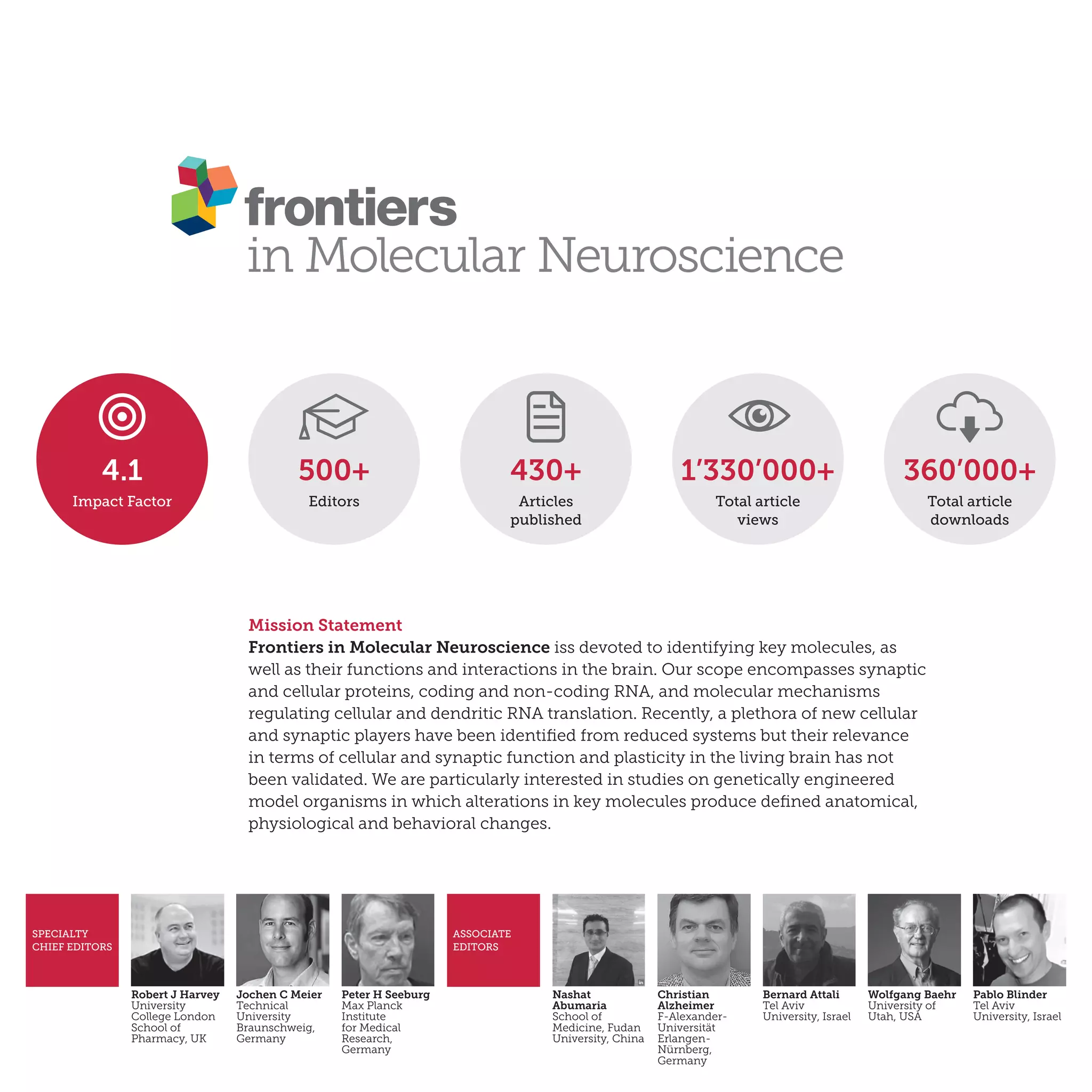
Frontiers in Molecular Neuroscience iss devoted to identifying key molecules, as
well as their functions and interactions in the brain. Our scope encompasses synaptic
and cellular proteins, coding and non-coding RNA, and molecular mechanisms
regulating cellular and dendritic RNA translation. Recently, a plethora of new cellular
and synaptic players have been identified from reduced systems but their relevance
in terms of cellular and synaptic function and plasticity in the living brain has not
been validated. We are particularly interested in studies on genetically engineered
model organisms in which alterations in key molecules produce defined anatomical,
physiological and behavioral changes.
430+
Articles
published
500+
Editors
1’330’000+
Total article
views
360’000+
Total article
downloads
4.1
Impact Factor
Robert J Harvey
University
College London
School of
Pharmacy, UK
SPECIALTY
CHIEF EDITORS
ASSOCIATE
EDITORS
Jochen C Meier
Technical
University
Braunschweig,
Germany
Peter H Seeburg
Max Planck
Institute
for Medical
Research,
Germany
Nashat
Abumaria
School of
Medicine, Fudan
University, China
Christian
Alzheimer
F-Alexander-
Universität
Erlangen-
Nürnberg,
Germany
Bernard Attali
Tel Aviv
University, Israel
Wolfgang Baehr
University of
Utah, USA
Pablo Blinder
Tel Aviv
University, Israel
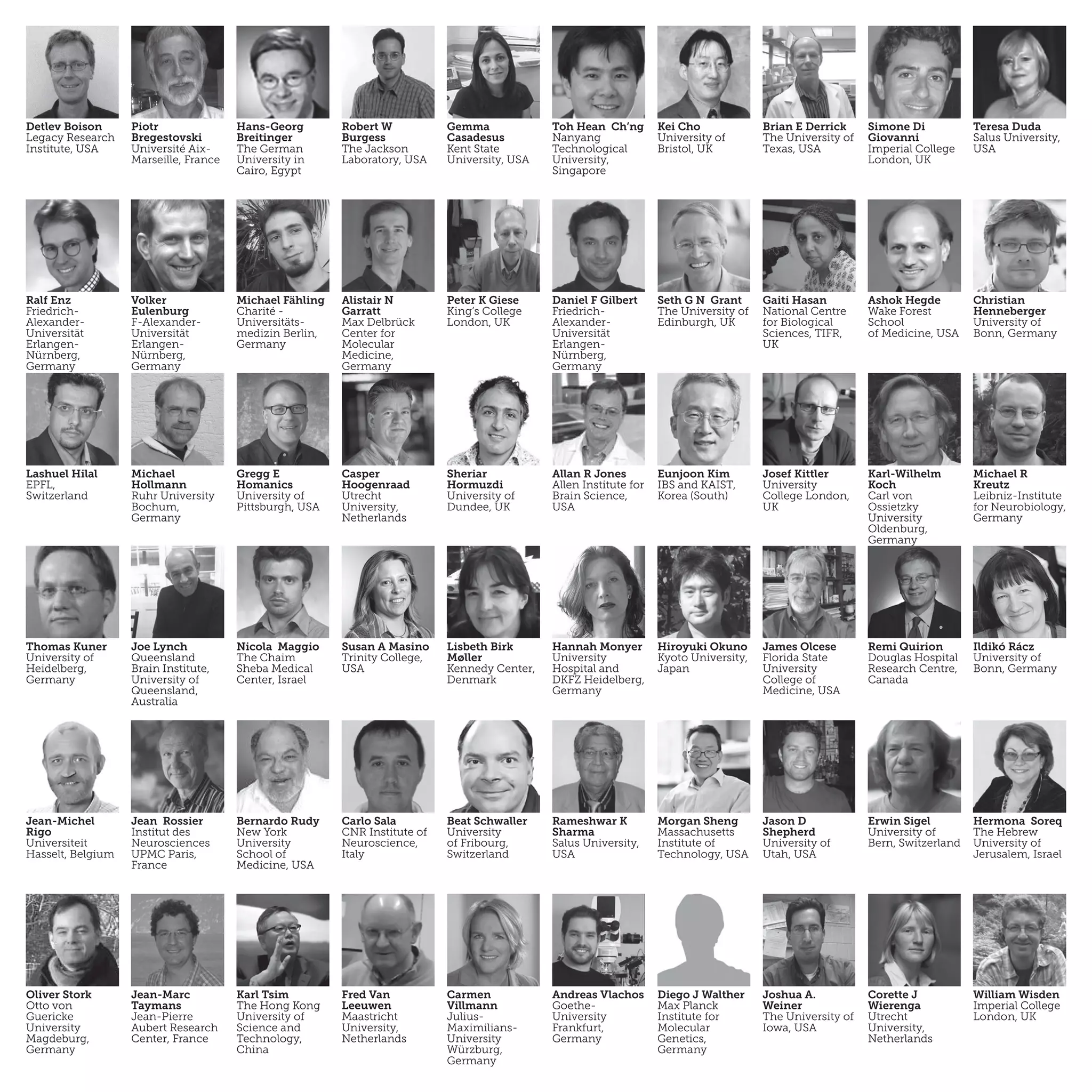
Detlev Boison
Legacy Research
Institute, USA
Piotr
Bregestovski
Université Aix-
Marseille, France
Hans-Georg
Breitinger
The German
University in
Cairo, Egypt
Robert W
Burgess
The Jackson
Laboratory, USA
Gemma
Casadesus
Kent State
University, USA
Toh Hean Ch’ng
Nanyang
Technological
University,
Singapore
Kei Cho
University of
Bristol, UK
Brian E Derrick
The University of
Texas, USA
Simone Di
Giovanni
Imperial College
London, UK
Teresa Duda
Salus University,
USA
Ralf Enz
Friedrich-
Alexander-
Universität
Erlangen-
Nürnberg,
Germany
Volker
Eulenburg
F-Alexander-
Universität
Erlangen-
Nürnberg,
Germany
Michael Fähling
Charité -
Universitäts-
medizin Berlin,
Germany
Alistair N
Garratt
Max Delbrück
Center for
Molecular
Medicine,
Germany
Seth G N Grant
The University of
Edinburgh, UK
Gaiti Hasan
National Centre
for Biological
Sciences, TIFR,
UK 
Ashok Hegde
Wake Forest
School
of Medicine, USA
Christian
Henneberger
University of
Bonn, Germany
Daniel F Gilbert
Friedrich-
Alexander-
Universität
Erlangen-
Nürnberg,
Germany
Peter K Giese
King’s College
London, UK
Lashuel Hilal
EPFL,
Switzerland
Michael
Hollmann
Ruhr University
Bochum,
Germany
Gregg E
Homanics
University of
Pittsburgh, USA
Casper
Hoogenraad
Utrecht
University,
Netherlands
Sheriar
Hormuzdi
University of
Dundee, UK
Allan R Jones
Allen Institute for
Brain Science,
USA
Eunjoon Kim
IBS and KAIST,
Korea (South)
Josef Kittler
University
College London,
UK
Karl-Wilhelm
Koch
Carl von
Ossietzky
University
Oldenburg,
Germany
Michael R
Kreutz
Leibniz-Institute
for Neurobiology,
Germany
Thomas Kuner
University of
Heidelberg,
Germany
Joe Lynch
Queensland
Brain Institute,
University of
Queensland,
Australia
Nicola Maggio
The Chaim
Sheba Medical
Center, Israel
Susan A Masino
Trinity College,
USA
Lisbeth Birk
Møller
Kennedy Center,
Denmark
Hannah Monyer
University
Hospital and
DKFZ Heidelberg,
Germany
Hiroyuki Okuno
Kyoto University,
Japan
James Olcese
Florida State
University
College of
Medicine, USA
Remi Quirion
Douglas Hospital
Research Centre,
Canada
Ildikó Rácz
University of
Bonn, Germany
Jean-Michel
Rigo
Universiteit
Hasselt, Belgium
Jean Rossier
Institut des
Neurosciences
UPMC Paris,
France
Bernardo Rudy
New York
University
School of
Medicine, USA
Carlo Sala
CNR Institute of
Neuroscience,
Italy
Beat Schwaller
University
of Fribourg,
Switzerland
Rameshwar K
Sharma
Salus University,
USA
Morgan Sheng
Massachusetts
Institute of
Technology, USA
Jason D
Shepherd
University of
Utah, USA
Erwin Sigel
University of
Bern, Switzerland
Hermona Soreq
The Hebrew
University of
Jerusalem, Israel
Oliver Stork
Otto von
Guericke
University
Magdeburg,
Germany
Jean-Marc
Taymans
Jean-Pierre
Aubert Research
Center, France
Karl Tsim
The Hong Kong
University of
Science and
Technology,
China
Fred Van
Leeuwen
Maastricht
University,
Netherlands
Carmen
Villmann
Julius-
Maximilians-
University
Würzburg,
Germany
Andreas Vlachos
Goethe-
University
Frankfurt,
Germany
Diego J Walther
Max Planck
Institute for
Molecular
Genetics,
Germany
Joshua A.
Weiner
The University of
Iowa, USA
Corette J
Wierenga
Utrecht
University,
Netherlands
William Wisden
Imperial College
London, UK
Mission Statement
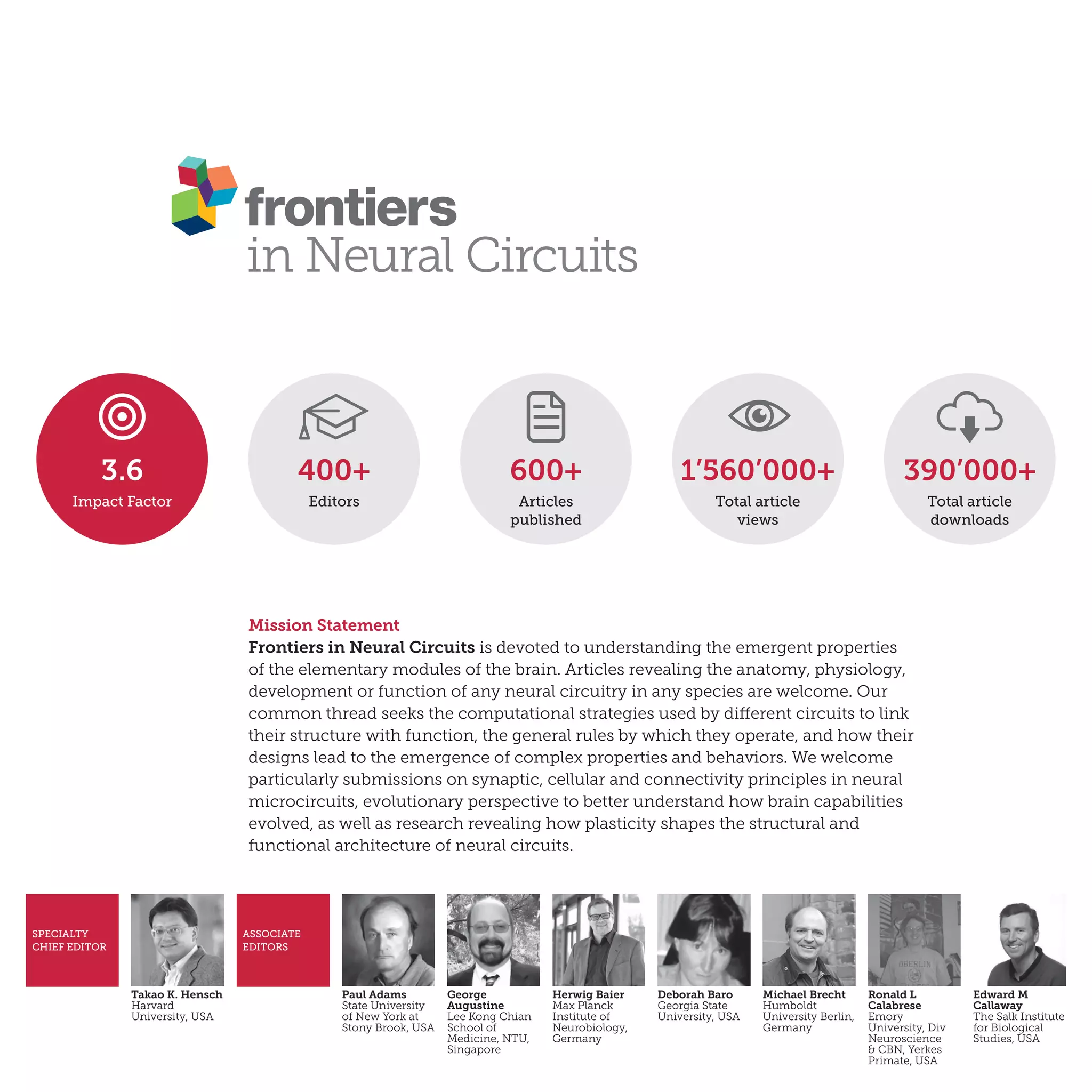
Frontiers in Neural Circuits is devoted to understanding the emergent properties
of the elementary modules of the brain. Articles revealing the anatomy, physiology,
development or function of any neural circuitry in any species are welcome. Our
common thread seeks the computational strategies used by different circuits to link
their structure with function, the general rules by which they operate, and how their
designs lead to the emergence of complex properties and behaviors. We welcome
particularly submissions on synaptic, cellular and connectivity principles in neural
microcircuits, evolutionary perspective to better understand how brain capabilities
evolved, as well as research revealing how plasticity shapes the structural and
functional architecture of neural circuits.
600+
Articles
published
400+
Editors
1’560’000+
Total article
views
390’000+
Total article
downloads
3.6
Impact Factor
Takao K. Hensch
Harvard
University, USA
SPECIALTY
CHIEF EDITOR
ASSOCIATE
EDITORS
Paul Adams
State University
of New York at
Stony Brook, USA
George
Augustine
Lee Kong Chian
School of
Medicine, NTU,
Singapore
Herwig Baier
Max Planck
Institute of
Neurobiology,
Germany
Deborah Baro
Georgia State
University, USA
Michael Brecht
Humboldt
University Berlin,
Germany
Ronald L
Calabrese
Emory
University, Div
Neuroscience
& CBN, Yerkes
Primate, USA
Edward M
Callaway
The Salk Institute
for Biological
Studies, USA
Jessica Cardin
Yale University
School of
Medicine, USA
Catherine Carr
University of
Maryland, USA
Bruno Cauli
CNRS & UPMC,
France
Dmitri ‘Mitya’ B.
Chklovskii
Simons
Foundation, USA
Hollis Cline
The Scripps
Research
Institute, USA
Luis de Lecea
Stanford
University, USA
Karl Deisseroth
Stanford
University, USA
Claude Desplan
NYU, USA
Abdel El Manira
Karolinska
Institute, Sweden
Florian Engert
Harvard
University, USA
Yves Frégnac
CNRS, UNIC,
France
Rainer W
Friedrich
Friedrich
Miescher
Institute for
Biomedical
Research, CH
Robert C
Froemke
New York
University
School of
Medicine, USA
Mark A Frye
UCLA, USA
Ronald M
Harris-Warrick
Cornell
University, USA
Nathaniel
Heintz
The Rockefeller
University, USA
Fritjof
Helmchen
University
of Zurich,
Switzerland
Masanobu Kano
The University of
Tokyo, Japan
Martyn
Goulding
Salk Institute,
USA
Joshua Gordon
Columbia
University, USA
Patrick O Kanold
University of
Maryland, USA
Yasuo
Kawaguchi
National Institute
for Physiological
Sciences, Japan
Ole Kiehn
Karolinska
Institutet,
Sweden
Yoshiyuki
Kubota
National Institute
for Physiological
Sciences, Japan
Gilles Laurent
Max Planck
Institute for
Brain Research,
Germany
David Linden
Johns Hopkins
University, USA
Rodolfo R Llinas
New York
University
School of
Medicine, USA
Liqun Luo
Stanford
University, USA
Manuel S
Malmierca
University of
Salamanca, Spain
David J Margolis
Rutgers
University, USA
Gero
Miesenboeck
Oxford
University, UK
Thomas Mrsic-
Flogel
University
College London,
UK
Michael
Nitabach
Yale University
School
of Medicine, USA
Dennis O’Leary
Salk Institute,
USA
David Parker
Cambridge
University, UK
Tommaso
Pizzorusso
University of
Florence and
CNR PISA, Italy
Daniel B Polley
Harvard
Medical School,
Massachusetts
Eye and Ear
Infirmary, USA
Franck Polleux
Columbia
University in
New York City,
France
Bernardo Rudy
New York
University
School of
Medicine, USA
Dario L Ringach
UCLA, USA
Edward S
Ruthazer
McGill
University,
Canada
Timothy A Ryan
Weill Medical
College
of Cornell
University, USA
Aravinthan
Samuel
Harvard, USA
Erin M Schuman
Caltech/Howard
Hughes Medical
Institute, USA
Allen Selverston
UC San Diego,
USA
Alexey
Semyanov
University
of Nizhny
Novgorod,
Russia
Gordon M
Shepherd
Yale University
School
of Medicine, USA
Nicholas C
Spitzer
UC San Diego,
USA
Charles F
Stevens
The Salk Institute
for Biological
Studies, USA
Gábor Tamás
University of
Szeged, Hungary
Matthew Charles
Walker
University
College London,
UK
Miles A
Whittington
University of
York, UK
Stephen R
Williams
Univeristy of
Queensland,
Australia
Charles J Wilson
University of
Texas at San
Antonio, USA
Donald A Wilson
New York
University
School of
Medicine, USA
Rachel O Wong
University of
Washington, USA
Claire Wyart
Brain and Spinal
cord Institute
(ICM), France
24 | 2015 Frontiers in Neuroscience Journal Series
Mission Statement
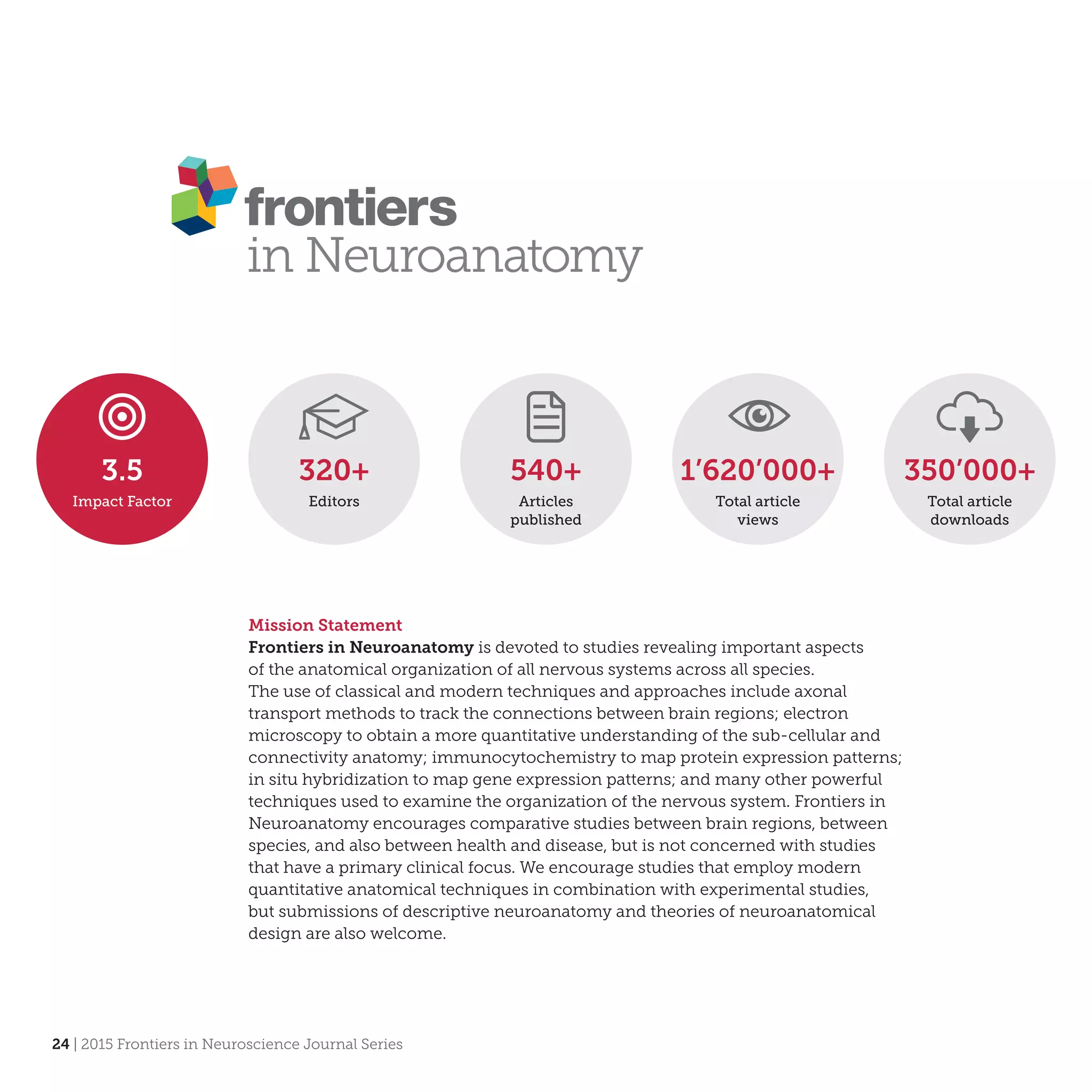
Frontiers in Neuroanatomy is devoted to studies revealing important aspects
of the anatomical organization of all nervous systems across all species.
The use of classical and modern techniques and approaches include axonal
transport methods to track the connections between brain regions; electron
microscopy to obtain a more quantitative understanding of the sub-cellular and
connectivity anatomy; immunocytochemistry to map protein expression patterns;
in situ hybridization to map gene expression patterns; and many other powerful
techniques used to examine the organization of the nervous system. Frontiers in
Neuroanatomy encourages comparative studies between brain regions, between
species, and also between health and disease, but is not concerned with studies
that have a primary clinical focus. We encourage studies that employ modern
quantitative anatomical techniques in combination with experimental studies,
but submissions of descriptive neuroanatomy and theories of neuroanatomical
design are also welcome.
540+
Articles
published
320+
Editors
1’620’000+
Total article
views
350’000+
Total article
downloads
3.5
Impact Factor
2015 Frontiers in Neuroscience Journal Series | 25
Javier DeFelipe
Cajal Institute,
Spain
SPECIALTY
CHIEF EDITOR
ASSOCIATE
EDITORS
James A Bourne
Australian
Regenerative
Medicine
Institute,
Australia
Patrik Brundin
Nordic Center
of Excellence,
Norway
Andreas H
Burkhalter
Washington
University
School of
Medicine, USA
Nicolás Cuenca
University of
Alicante, Spain
Michael
Frotscher
University
Medical Center
Hamburg-
Eppendorf,
Germany
Jose Manuel
Garcia-Verdugo
University of
Valencia, Spain
Agustín
González
Universida
Complutense de
Madrid, Spain
Kristen M Harris
The University of
Texas at Austin,
USA
Patrick R Hof
Mount Sinai
School
of Medicine, USA
Ricardo Insausti
University of
Castilla ­
la Mancha, Spain
Zoltan F
Kisvarday
University
of Debrecen,
Hungary
Jose L Lanciego
University of
Navarra, Spain
Yun-Qing Li
The Fourth
Military Medical
University, China
Paul J May
University of
Mississippi
Medical Center,
USA
Shawn Mikula
Max Planck
Institute for
Neurobiology,
Germany
John Morrison
Mount Sinai
School of
Medicine, USA
Enrico
Mugnaini
Northwestern
University, USA
Zoltan Nusser
Institute of
Experimental
Medicine,
Hungary
George Paxinos
University of
New South
Wales, Australia
Luis Puelles
Universidad de
Murcia, Spain
Kathleen S
Rockland
Boston
University
School Medicine,
USA
Angel Rodriguez
Universidad
Politécnica de
Madrid (UPM),
Spain
Ryuichi
Shigemoto
National Institute
for Physiological
Sciences, Japan
Constantino
Sotelo
University Pierre
and Marie Curie,
France
Larry W
Swanson
University
of Southern
California, USA
Masahiko
Watanabe
Hokkaido
University, Japan
Menno P Witter
NTNU, Norway
26 | 2015 Frontiers in Neuroscience Journal Series
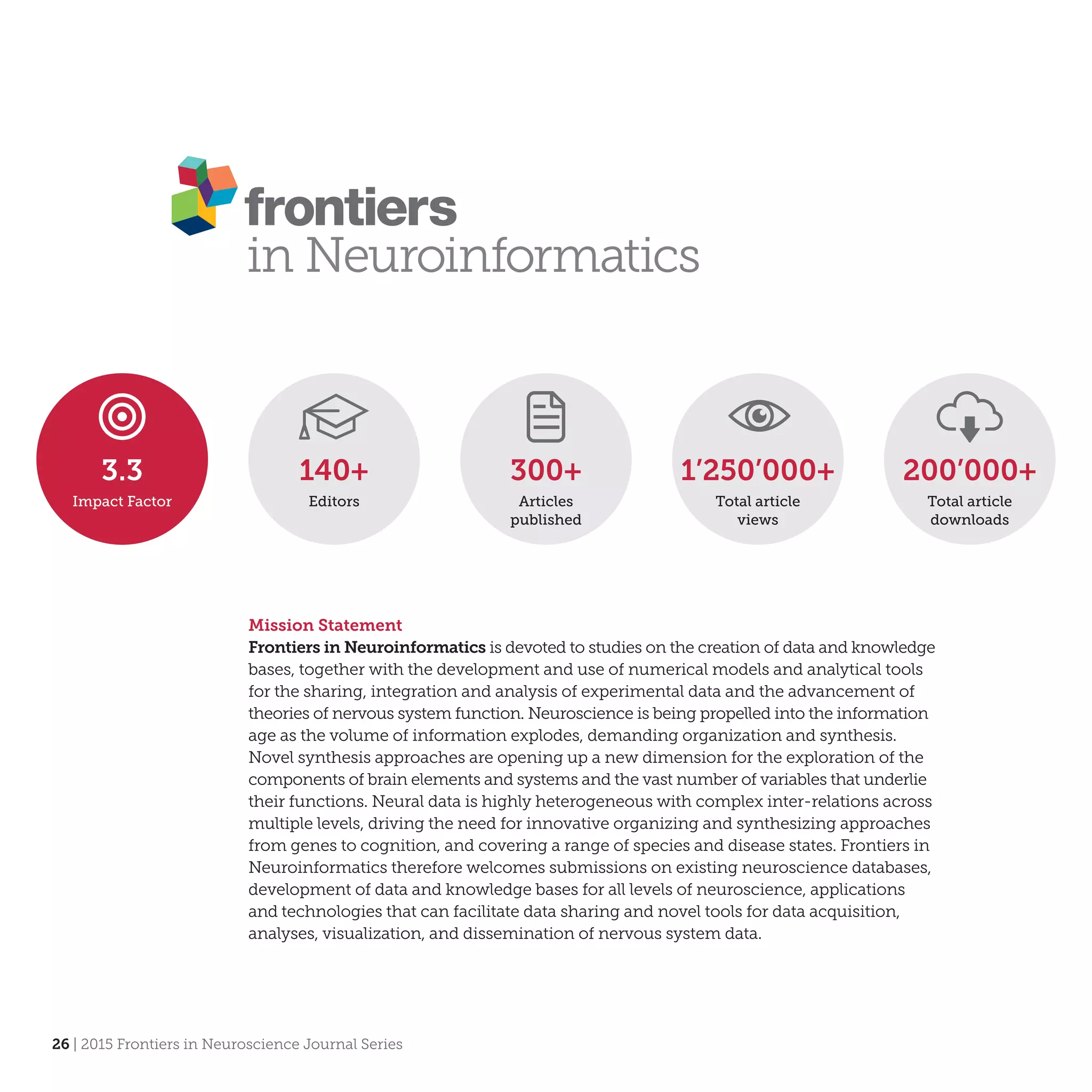
Mission Statement
Frontiers in Neuroinformatics is devoted to studies on the creation of data and knowledge
bases, together with the development and use of numerical models and analytical tools
for the sharing, integration and analysis of experimental data and the advancement of
theories of nervous system function. Neuroscience is being propelled into the information
age as the volume of information explodes, demanding organization and synthesis.
Novel synthesis approaches are opening up a new dimension for the exploration of the
components of brain elements and systems and the vast number of variables that underlie
their functions. Neural data is highly heterogeneous with complex inter-relations across
multiple levels, driving the need for innovative organizing and synthesizing approaches
from genes to cognition, and covering a range of species and disease states. Frontiers in
Neuroinformatics therefore welcomes submissions on existing neuroscience databases,
development of data and knowledge bases for all levels of neuroscience, applications
and technologies that can facilitate data sharing and novel tools for data acquisition,
analyses, visualization, and dissemination of nervous system data.
300+
Articles
published
140+
Editors
1’250’000+
Total article
views
200’000+
Total article
downloads
3.3
Impact Factor
2015 Frontiers in Neuroscience Journal Series | 27
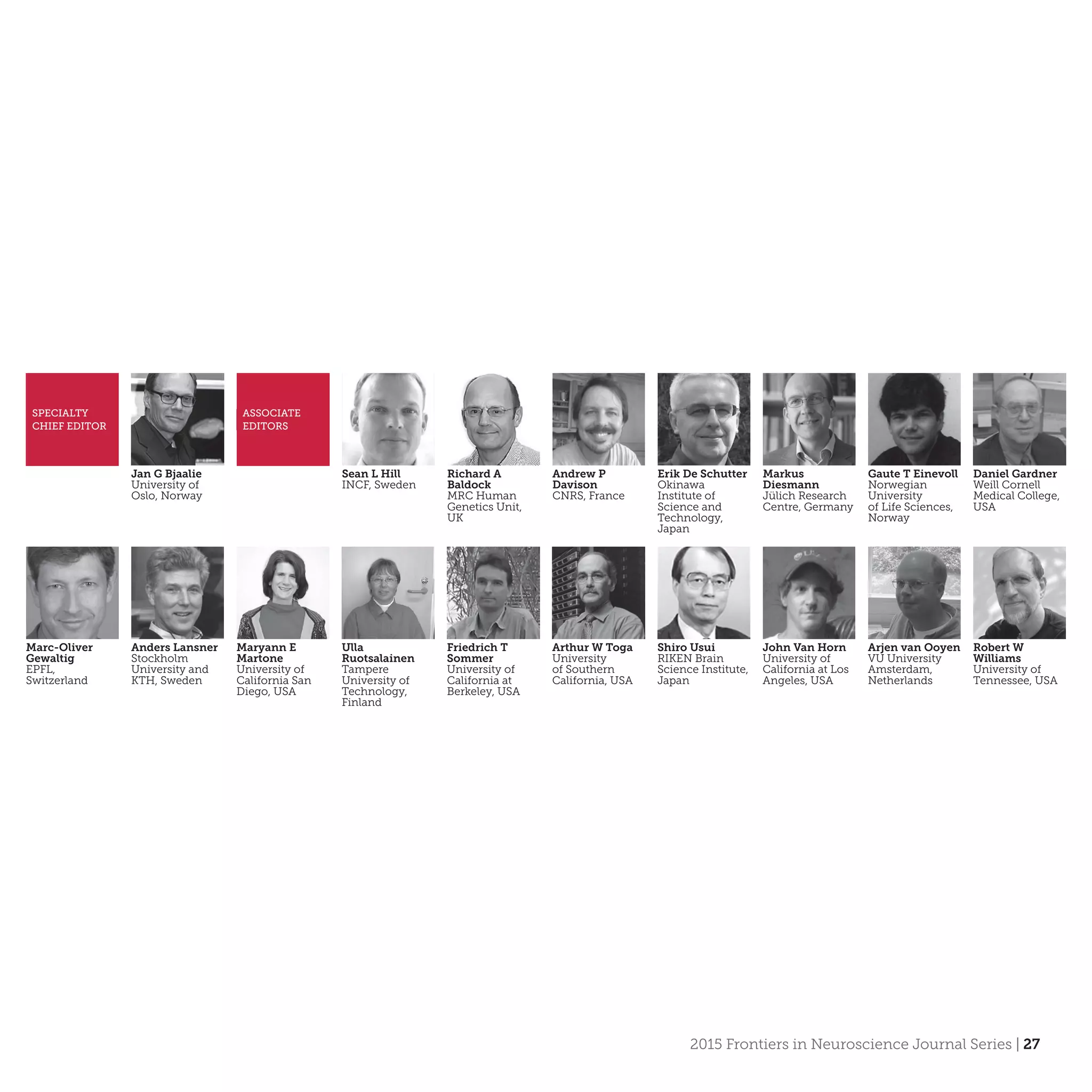
Jan G Bjaalie
University of
Oslo, Norway
SPECIALTY
CHIEF EDITOR
ASSOCIATE
EDITORS
Sean L Hill
INCF, Sweden
Richard A
Baldock
MRC Human
Genetics Unit,
UK
Andrew P
Davison
CNRS, France
Erik De Schutter
Okinawa
Institute of
Science and
Technology,
Japan
Markus
Diesmann
Jülich Research
Centre, Germany
Gaute T Einevoll
Norwegian
University
of Life Sciences,
Norway
Daniel Gardner
Weill Cornell
Medical College,
USA
Marc-Oliver
Gewaltig
EPFL,
Switzerland
Anders Lansner
Stockholm
University and
KTH, Sweden
Maryann E
Martone
University of
California San
Diego, USA
Ulla
Ruotsalainen
Tampere
University of
Technology,
Finland
Friedrich T
Sommer
University of
California at
Berkeley, USA
Arthur W Toga
University
of Southern
California, USA
Shiro Usui
RIKEN Brain
Science Institute,
Japan
John Van Horn
University of
California at Los
Angeles, USA
Arjen van Ooyen
VU University
Amsterdam,
Netherlands
Robert W
Williams
University of
Tennessee, USA
28 | 2015 Frontiers in Neuroscience Journal Series
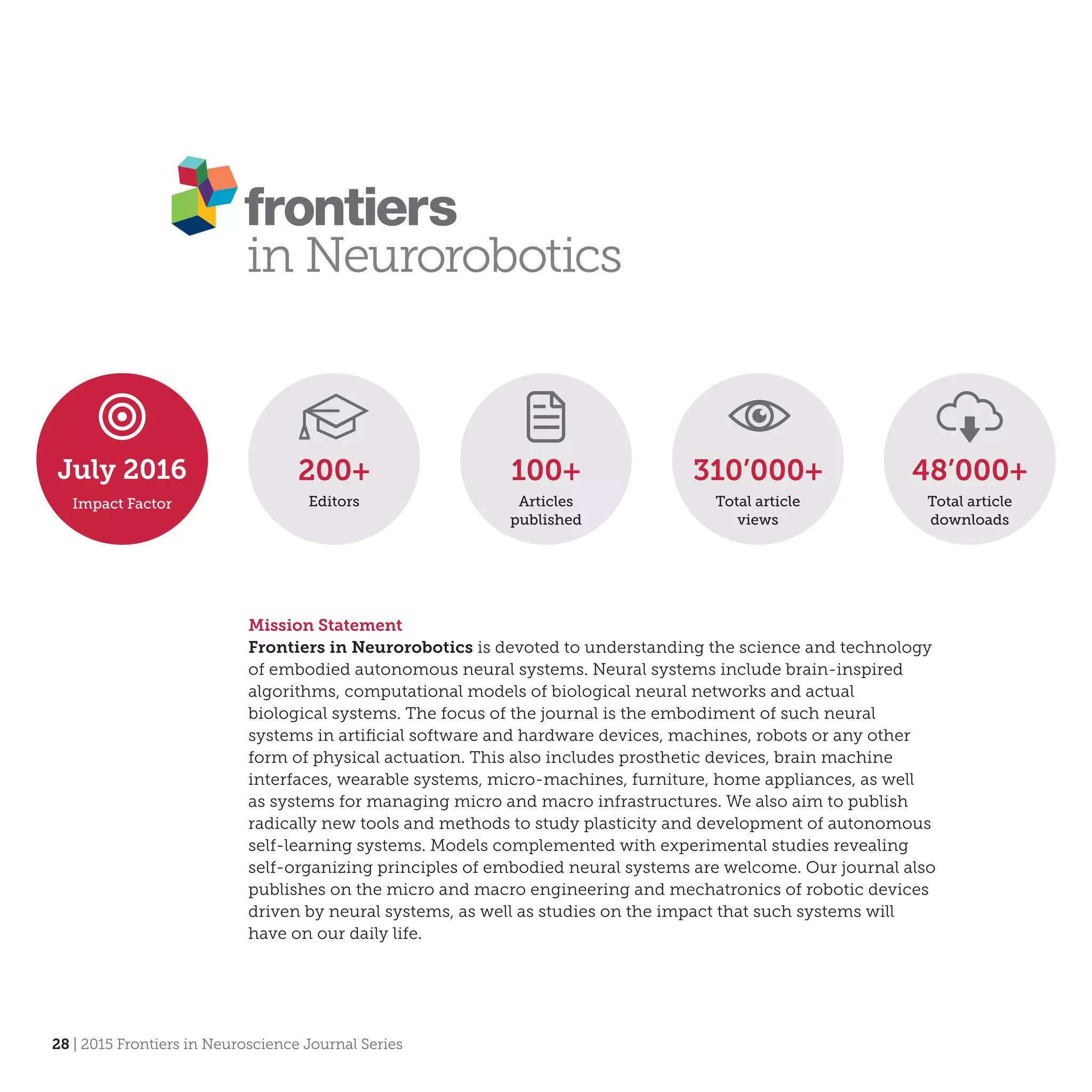
Mission Statement
Frontiers in Neurorobotics is devoted to understanding the science and technology
of embodied autonomous neural systems. Neural systems include brain-inspired
algorithms, computational models of biological neural networks and actual
biological systems. The focus of the journal is the embodiment of such neural
systems in artificial software and hardware devices, machines, robots or any other
form of physical actuation. This also includes prosthetic devices, brain machine
interfaces, wearable systems, micro-machines, furniture, home appliances, as well
as systems for managing micro and macro infrastructures. We also aim to publish
radically new tools and methods to study plasticity and development of autonomous
self-learning systems. Models complemented with experimental studies revealing
self-organizing principles of embodied neural systems are welcome. Our journal also
publishes on the micro and macro engineering and mechatronics of robotic devices
driven by neural systems, as well as studies on the impact that such systems will
have on our daily life.
100+
Articles
published
200+
Editors
310’000+
Total article
views
48’000+
Total article
downloads
July 2016
Impact Factor
2015 Frontiers in Neuroscience Journal Series | 29
SPECIALTY
CHIEF EDITORS
ASSOCIATE
EDITORS
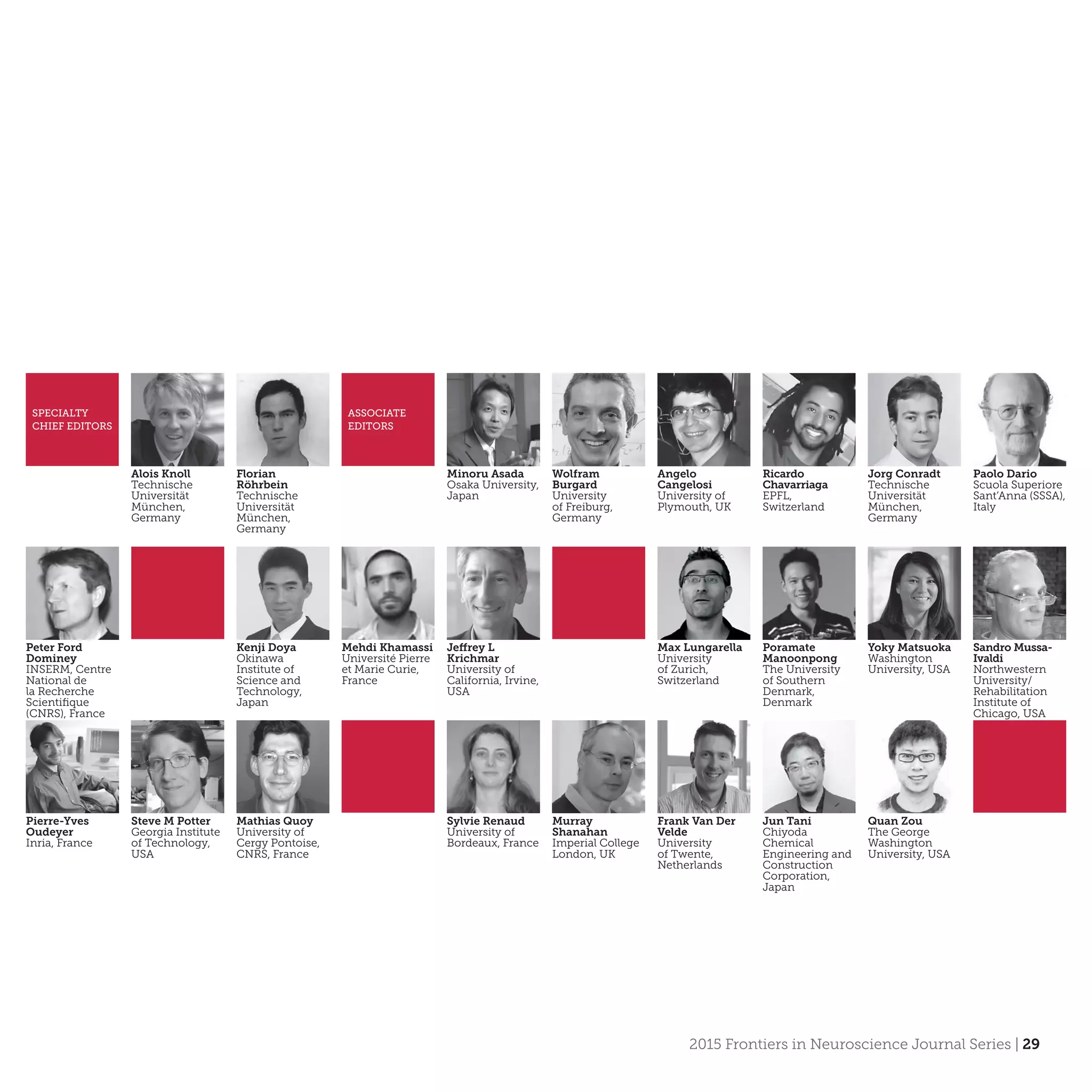
Alois Knoll
Technische
Universität
München,
Germany
Florian
Röhrbein
Technische
Universität
München,
Germany
Minoru Asada
Osaka University,
Japan
Wolfram
Burgard
University
of Freiburg,
Germany
Ricardo
Chavarriaga
EPFL,
Switzerland
Jorg Conradt
Technische
Universität
München,
Germany
Angelo
Cangelosi
University of
Plymouth, UK
Paolo Dario
Scuola Superiore
Sant’Anna (SSSA),
Italy
Peter Ford
Dominey
INSERM, Centre
National de
la Recherche
Scientifique
(CNRS), France
Kenji Doya
Okinawa
Institute of
Science and
Technology,
Japan
Yoky Matsuoka
Washington
University, USA
Jeffrey L
Krichmar
University of
California, Irvine,
USA
Poramate
Manoonpong
The University
of Southern
Denmark,
Denmark
Mehdi Khamassi
Université Pierre
et Marie Curie,
France
Sandro Mussa-
Ivaldi
Northwestern
University/
Rehabilitation
Institute of
Chicago, USA
Max Lungarella
University
of Zurich,
Switzerland
Pierre-Yves
Oudeyer
Inria, France
Steve M Potter
Georgia Institute
of Technology,
USA
Sylvie Renaud
University of
Bordeaux, France
Mathias Quoy
University of
Cergy Pontoise,
CNRS, France
Murray
Shanahan
Imperial College
London, UK
Frank Van Der
Velde
University
of Twente,
Netherlands
Jun Tani
Chiyoda
Chemical
Engineering and
Construction
Corporation,
Japan
Quan Zou
The George
Washington
University, USA
30 | 2015 Frontiers in Neuroscience Journal Series
Mission Statement
Frontiers in Synaptic Neuroscience aims to bring together the most outstanding
work on synapses to better understand their structure, function, plasticity
and alterations in diseases. The journal will consider original research articles
on synaptic transmission and plasticity in all relevant areas including the
ultrastructure, physiology and biophysics of synaptic transmission, molecular
composition of synapses, molecular-molecular interactions, and biochemical,
biophysical and structural mechanisms involved in forming, maintaining and
altering synaptic properties. The journal will also publish work on the genetic
determination of synaptic properties and the impact of genetically induced
synaptic alterations. Frontiers in Synaptic Neuroscience invites review articles
that synthesize knowledge on various aspects of synapses and also perspective
and opinion articles to discuss and debate hot topics in synaptic neuroscience.
120+
Articles
published
220+
Editors
430’000+
Total article
views
95’000+
Total article
downloads
2015 Frontiers in Neuroscience Journal Series | 31
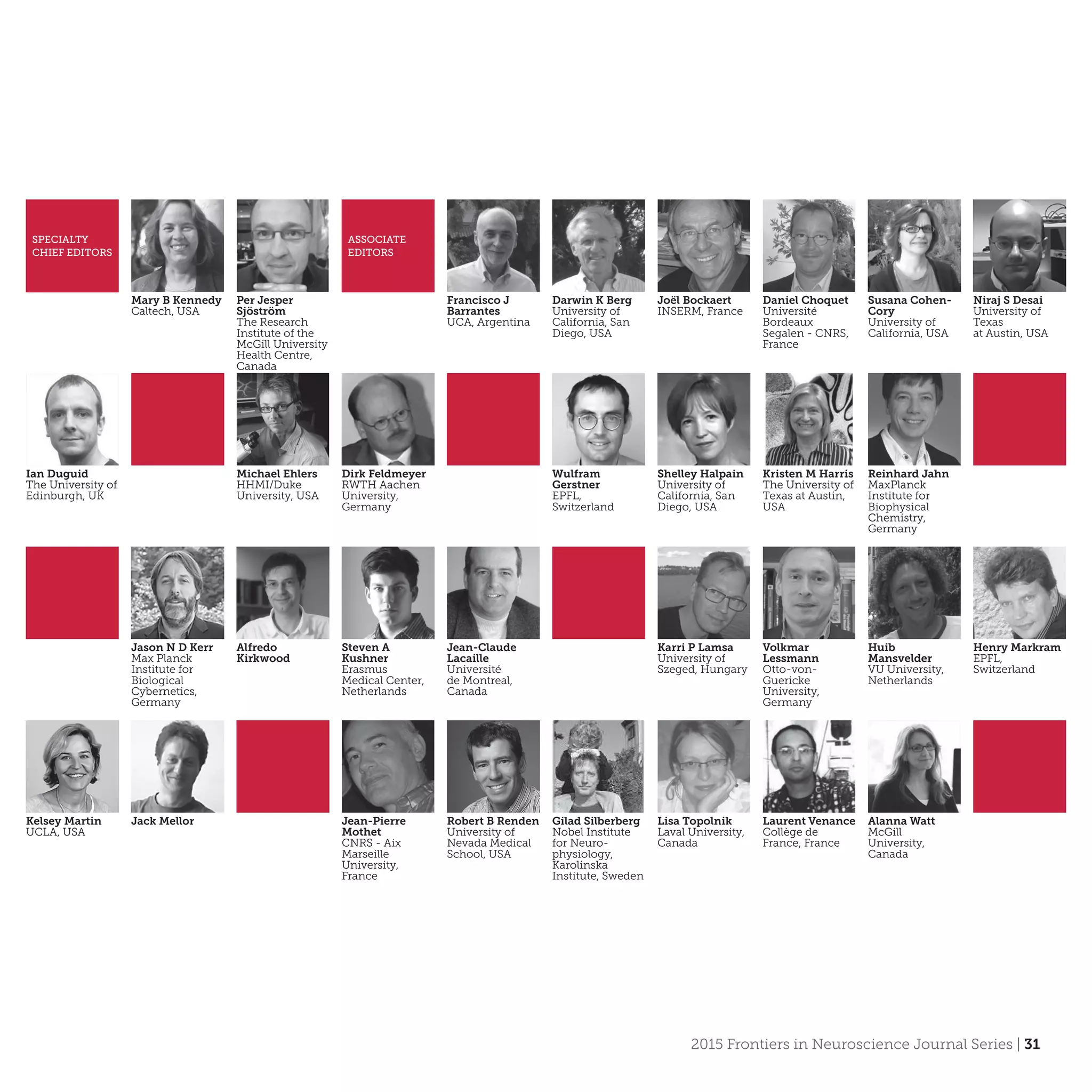
SPECIALTY
CHIEF EDITORS
Mary B Kennedy
Caltech, USA
Per Jesper
Sjöström
The Research
Institute of the
McGill University
Health Centre,
Canada
ASSOCIATE
EDITORS
Francisco J
Barrantes
UCA, Argentina
Darwin K Berg
University of
California, San
Diego, USA
Joël Bockaert
INSERM, France
Daniel Choquet
Université
Bordeaux
Segalen - CNRS,
France
Susana Cohen-
Cory
University of
California, USA
Niraj S Desai
University of
Texas
at Austin, USA
Ian Duguid
The University of
Edinburgh, UK
Michael Ehlers
HHMI/Duke
University, USA
Dirk Feldmeyer
RWTH Aachen
University,
Germany
Wulfram
Gerstner
EPFL,
Switzerland
Shelley Halpain
University of
California, San
Diego, USA
Kristen M Harris
The University of
Texas at Austin,
USA
Reinhard Jahn
Max­Planck
Institute for
Biophysical
Chemistry,
Germany
Jason N D Kerr
Max Planck
Institute for
Biological
Cybernetics,
Germany
Alfredo
Kirkwood
Steven A
Kushner
Erasmus
Medical Center,
Netherlands
Jean-Claude
Lacaille
Université
de Montreal,
Canada
Karri P Lamsa
University of
Szeged, Hungary
Volkmar
Lessmann
Otto-von-
Guericke
University,
Germany
Huib
Mansvelder
VU University,
Netherlands
Henry Markram
EPFL,
Switzerland
Kelsey Martin
UCLA, USA
Jack Mellor Jean-Pierre
Mothet
CNRS - Aix
Marseille
University,
France
Robert B Renden
University of
Nevada Medical
School, USA
Gilad Silberberg
Nobel Institute
for Neuro-
physiology,
Karolinska
Institute, Sweden
Lisa Topolnik
Laval University,
Canada
Laurent Venance
Collège de
France, France
Alanna Watt
McGill
University,
Canada
32 | 2015 Frontiers in Neuroscience Journal Series
Mission Statement
Frontiers in Systems Neuroscience is devoted to understanding the systems of the
brain such as sensation, movement, learning and memory, attention, reward, decision-
making, reasoning, executive functions, and emotions. We welcome papers addressing
the brain’s structural and functional architecture and information processing, storage
and retrieval systems. We represent all research: from information flow analysis to
neuronal circuits that transform simple inputs to complex outputs; short- and long-
term changes in circuits; the dynamics of neuronal networks; and cognitive modules
engaged in specific tasks. Systems neuroscience relies on approaches spanning single-
cell response studies to cellular analyses that leave intact key computational elements.
Advances in brain activity imaging and network, cellular and sub-cellular level structure,
plus the application of molecular tools, are transforming systems neuroscience. We
admit computational studies complimenting experiments to better understand brain
systems, and studies with multiple analysis approaches to better understand brain
function during information processing, in the normal and diseased brain.
770+
Articles
published
300+
Editors
2’280’000+
Total article
views
480’000+
Total article
downloads
2015 Frontiers in Neuroscience Journal Series | 33
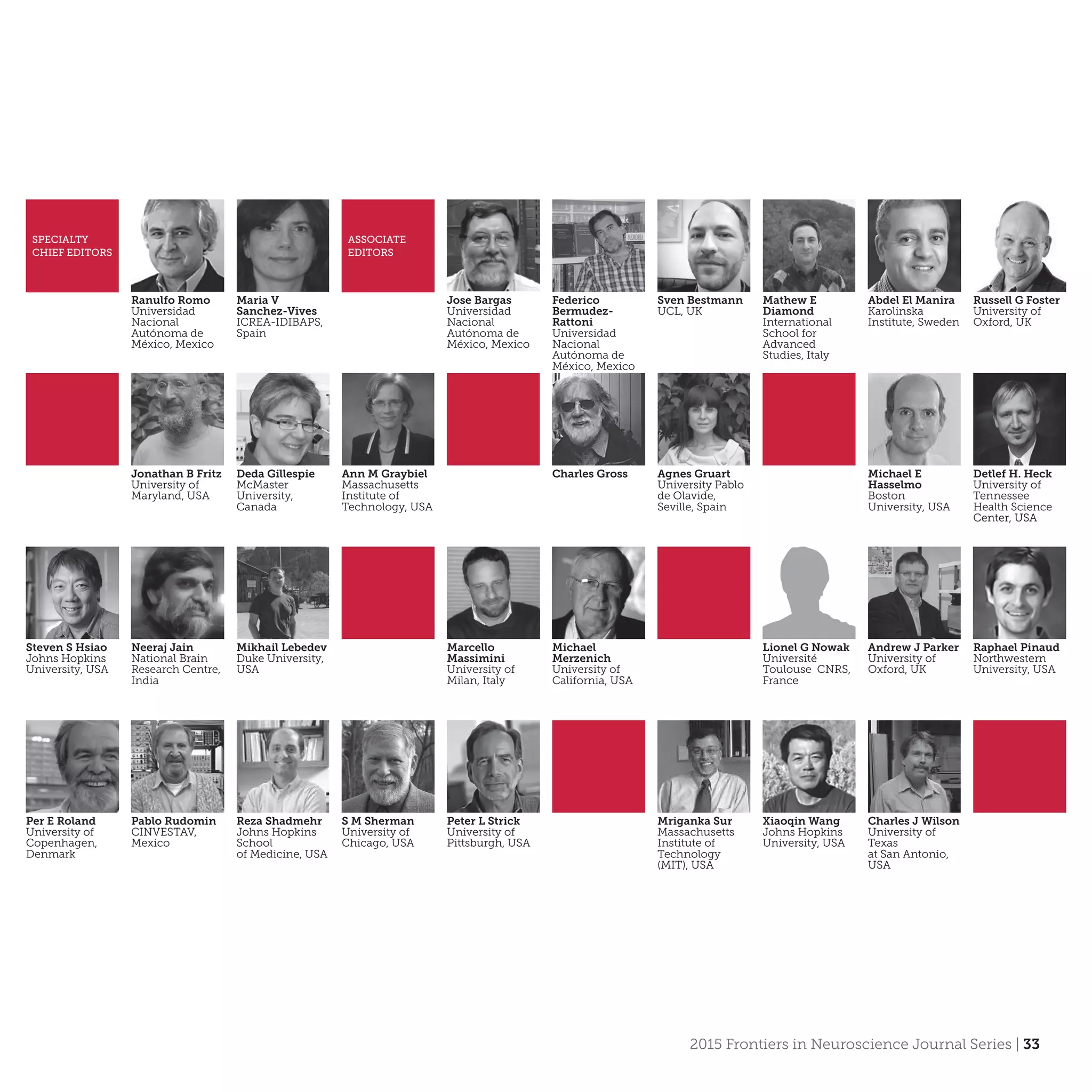
SPECIALTY
CHIEF EDITORS
Ranulfo Romo
Universidad
Nacional
Autónoma de
México, Mexico
Maria V
Sanchez-Vives
ICREA-IDIBAPS,
Spain
ASSOCIATE
EDITORS
Jose Bargas
Universidad
Nacional
Autónoma de
México, Mexico
Federico
Bermudez-
Rattoni
Universidad
Nacional
Autónoma de
México, Mexico
Sven Bestmann
UCL, UK
Mathew E
Diamond
International
School for
Advanced
Studies, Italy
Abdel El Manira
Karolinska
Institute, Sweden
Russell G Foster
University of
Oxford, UK
Jonathan B Fritz
University of
Maryland, USA
Deda Gillespie
McMaster
University,
Canada
Ann M Graybiel
Massachusetts
Institute of
Technology, USA
Charles Gross Agnes Gruart
University Pablo
de Olavide,
Seville, Spain
Michael E
Hasselmo
Boston
University, USA
Detlef H. Heck
University of
Tennessee
Health Science
Center, USA
Steven S Hsiao
Johns Hopkins
University, USA
Neeraj Jain
National Brain
Research Centre,
India
Mikhail Lebedev
Duke University,
USA
Marcello
Massimini
University of
Milan, Italy
Michael
Merzenich
University of
California, USA
Lionel G Nowak
Université
Toulouse ­CNRS,
France
Andrew J Parker
University of
Oxford, UK
Raphael Pinaud
Northwestern
University, USA
Per E Roland
University of
Copenhagen,
Denmark
Pablo Rudomin
CINVESTAV,
Mexico
Reza Shadmehr
Johns Hopkins
School
of Medicine, USA
S M Sherman
University of
Chicago, USA
Peter L Strick
University of
Pittsburgh, USA
Mriganka Sur
Massachusetts
Institute of
Technology
(MIT), USA
Xiaoqin Wang
Johns Hopkins
University, USA
Charles J Wilson
University of
Texas
at San Antonio,
USA
ADVANTAGES OF PUBLISHING IN FRONTIERS
TRANSPARENT
Editors and reviewers
acknowledged by name
on published articles
GLOBAL SPREAD
4’000’000 monthly
page views worldwide
SUPPORT
By our Swiss-based
editorial team
COPYRIGHT TO AUTHORS
No limit to article
distribution and re-use
IMPACT METRICS
Advanced metrics
track your article’s impact
LOOP RESEARCH NETWORK
Our network
increases readership
for your article
COLLABORATIVE PEER-REVIEW
Designed to be rigorous
– yet also collaborative,
fair and constructive
Frontiers
EPFL Innovation Park, Building I ∞ 1015 Lausanne ∞ Switzerland
Tel +41 21 510 17 00 ∞ Fax +41 21 510 17 01 ∞ info@frontiersin.org
www.frontiersin.org
Find us on
FAST PUBLICATION
Average 85 days
from submission
to publication
OPEN ACCESS
Articles are free to read,
for greatest visibility

Frontiers in Neuroscience Brochure 2015

  • 1.
  • 3.
    Table of contents AboutFrontiers..........................................................................................4 Frontiers in Neuroscience.....................................................................6 Frontiers in Aging Neuroscience........................................................8 Frontiers in Behavioral Neuroscience.............................................10 Frontiers in Cellular Neuroscience................................................... 12 Frontiers in Computational Neuroscience.................................... 14 Frontiers in Human Neuroscience................................................... 16 Frontiers in Integrative Neuroscience............................................. 18 Frontiers in Molecular Neuroscience...............................................20 Frontiers in Neural Circuits.................................................................22 Frontiers in Neuroanatomy.................................................................24 Frontiers in Neuroinformatics...........................................................26 Frontiers in Neurorobotics..................................................................28 Frontiers in Synaptic Neuroscience.................................................30 Frontiers in Systems Neuroscience..................................................32
  • 4.
    4 | 2015Frontiers in Neuroscience Journal Series About Frontiers F rontiers is a community-rooted open access publisher that has attracted over 200’000 researchers as authors and editors. By taking publishing entirely online, we drive innovation and develop new technologies to make peer review more efficient and transparent, provide impact metrics for articles and researchers, merge open access publishing with a research network platform to catalyze research dissemination and we popularize research to the public, including children. Our mission is to increase the reach and impact of research articles and their authors. Founded by scientists in 2007, Frontiers is today one of the 5 largest open access publishers and has received the ALPSP Gold Award for Innovation in Publishing in 2014.
  • 5.
    2015 Frontiers inNeuroscience Journal Series | 5 We are the world’s leading open-access publisher in Neuroscience Frontiers’ neuroscience open access journals are the largest and achieve amongst the best impact factors when compared to other open access journals in Neuroscience, as per Thomson Reuters Journal Citation Reports, 2014. The “Frontiers in” Neuroscience journal series represents 58% of the open access article volume and increases the median open-access impact factor by 18%. Figure. Frontiers’ neuroscience open access journals (red dots) compared to other open-access journals (grey dots) in the category of “Neurosciences” based on 2014 Journal Citation Reports ® (Thomson Reuters, 2015). Human Neuroscience Behavioral Neuroscience Neuroscience Cellular Neuroscience Aging Neuroscience Computational Neuroscience Neuroanatomy Neural Circuits Molecular Neuroscience Neuroinformatics Frontiers in IMPACT FACTOR (2014) NUMBEROFARTICLES(2014) 0 1 2 3 4 5 6 7 1000 800 600 400 200 0 Largest and most cited open access journal in Neuroscience and the world’s third largest Neuroscience journal overall
  • 6.
    6 | 2015Frontiers in Neuroscience Journal Series Mission Statement These are historical times for brain research. The convergence of novel molecular and optical techniques paves the way to the era of causation neuroscience, and the behavioral and functional consequences of these manipulations are being explored. It is also a new era of anatomical neuroscience, as recently developed techniques become more widely used. New research fields have recently emerged and new informatics-based methods are being developed to store the enormous amount of data produced. Theoretical and computational approaches have also been developed for deriving principles of brain operations. As the field is growing fast, we integrate and link studies in related subfields, providing an overview of the state-of-the-art research. This journal aims to look at the brain from particular standpoints all the way from genes to behavior. 1’600+ Articles published 1’300+ Editors 5’420’000+ Total article views 1’020’000+ Total article downloads 3.7 Impact Factor
  • 7.
    2015 Frontiers inNeuroscience Journal Series | 7 FIELD CHIEF EDITORS Jon Kaas Vanderbilt University, USA Idan Segev The Hebrew University of Jerusalem, Israel Larry Abbott Columbia University, USA Henry Markram EPFL, Switzerland SPECIALTY CHIEF EDITORS AUDITORY COGNITIVE NEUROSCIENCE Isabelle Peretz Université de Montréal, Canada AUDITORY COGNITIVE NEUROSCIENCE Robert J Zatorre McGill University, Canada AUTONOMIC NEUROSCIENCE Joel C Bornstein The University of Melbourne, Australia AUTONOMIC NEUROSCIENCE Vaughan G Macefield University of Western Sydney, Australia BRAIN IMAGING METHODS Russell A Poldrack Stanford University, USA CHILD AND NEURO- DEVELOPMENTAL PSYCHIATRY Vishal Madaan University of Virginia, USA BRAIN IMAGING METHODS Jean-Baptiste Poline University of California, Berkeley DECISION NEUROSCIENCE Hauke R Heekeren Freie Universität Berlin, Germany DECISION NEUROSCIENCE Scott A Huettel Duke University, USA DECISION NEUROSCIENCE Paul EM Phillips University of Washington, USA EVOLUTIONARY PSYCHOLOGY AND NEUROSCIENCE Karol Osipowicz Jefferson Hospital, USA NEURO- DEGENERATION Wendy Noble King’s College London,UK NEURO- DEGENERATION Mark P Burns Georgetown University Medical Center, USA NEURO- DEGENERATION Harold W Goforth Duke University, USA NEURO- DEGENERATION Einar M Sigurdsson NYU School of Medicine, USA NEURO- ENDOCRINE SCIENCE Hubert Vaudry University of Rouen, France NEURO- ENERGETICS, NUTRITION AND BRAIN HEALTH Suzanne Dickson UniofGothenburg, Sweden NEURO- ENERGETICS, NUTRITION AND BRAIN HEALTH Pierre Magistretti EPFL, Switzerland NEURO- ENERGETICS, NUTRITION AND BRAIN HEALTH Walter H Kaye UCSD, USA NEUROMORPHIC ENGINEERING Timothy K Horiuchi The University of Maryland, USA NEUROGENOMICS Robert W Williams University of Tennessee Health Science Center,USA NEUROGENESIS Maria J Donoghue Georgetown University, USA NEUROGENESIS Angelique Bordey Yale University School of Medicine, USA NEUROMORPHIC ENGINEERING Giacomo Indiveri University of Zurich and ETH Zurich, Switzerland NEURO- PROSTHETICS Eilon Vaadia The Hebrew University, Israel NEURO- PROSTHETICS Niels Birbaumer Universität Tübingen, Germany SYSTEMS BIOLOGY Raina Robeva Sweet Briar College, USA SYSTEMS BIOLOGY Hiroaki Kitano The Systems Biology Institute, Japan NEURO- PHARMACOLOGY Nicholas M Barnes University of Birmingham, UK SYSTEMS BIOLOGY Maximino Aldana Universidad Nacional Autónoma de México, Mexico
  • 8.
    8 | 2015Frontiers in Neuroscience Journal Series Mission Statement Frontiers in Aging Neuroscience is a cutting-edge journal aimed at fostering the understanding of mechanistic processes associated with CNS aging and age-related neuronal diseases. Our role is to bring cohesion between disciplines and theories focused on understanding the fundamental processes of senescence. Special emphasis is placed on integrating findings of various sub disciplines in neuroscience to yield translational insight to the aging process and neurological diseases associated with senescence, and developing treatment strategies aimed at the conservation of neuronal function. This aspect is critical to advance our ability to understand, manage, and treat conditions associated with aging. We welcome work elucidating genetic, biophysical, genomic, proteomic, cellular, molecular, biochemical, endocrinal, immunological, physiological, pharmacological, and psychological/behavioral aspects of CNS aging and neurological diseases and pathological events connected to this process. Neuroimaging studies and clinical studies targeted to mechanistic aspects of neuronal aging/disease are also welcome. 730+ Articles published 380+ Editors 1’720’000+ Total article views 430’000+ Total article downloads 4.0 Impact Factor
  • 9.
    Manuel Menéndez- González Hospital Álvarez- Buylla, Spain Thomas Montine Universityof Washington, USA George Perry University of Texas at San Antonio, USA Remi Quirion Douglas Hospital Research Centre, Canada Massimo Tabaton University of Genoa, Italy Atsushi Takeda Sendai-Nishitaga Hospital, Japan Gemma Casadesus Kent State University, USA Rodrigo Orlando Kuljiš Zdrav Mozak Limitada, Chile Jesus Avila CSIC­UAM, Spain George E Barreto Pontificia Universidad Javeriana, Colombia Antonio Camins University of Barcelona, Spain Rudy Castellani University of Maryland, Baltimore, USA Simon C Dyall Bournemouth University, UK Bijan Etemad University of Pennsylvania, Philadelphia, USA Isidro Ferrer University of Barcelona, Spain Thomas C Foster University of Florida, USA Philip P Foster The University of Texas Health Science Center at Houston, USA Vadim Fraifeld Ben Gurion University of the Negev, Israel Thomas Freret University of Caen, France Patricio Fuentes Hospital Clinico Universidad de Chile, Chile Elena Galea Universitat Autònoma de Barcelona, Spain Cheng-Xin Gong New York State Institute, USA Nigel H Greig National Institute on Aging, NIH, USA Lea T Grinberg University of California, USA Agustin Ibanez Institute of Cognitive Neurology, Argentina Rakez Kayed University of Texas Medical Branch, USA Jeffrey Keller IDRP, USA Fernanda Laezza University of Texas Medical Branch, USA SPECIALTY CHIEF EDITORS ASSOCIATE EDITORS Hyoung-gon Lee Case Western Reserve University, USA Cristian Lasagna Reeves Baylor College of Medicine, USA Facundo F Manes INECO, Argentina Jean Mariani Universite Pierre et Marie Curie, France Paula I Moreira University of Coimbra, Portugal John Morrison Mount Sinai School of Medicine, USA Akihiko Nunomura University of Yamanashi, Japan Merce Pallas University of Barcelona, Spain Peter R Rapp National Institute of Health, USA P Hemachandra Reddy Texas Tech University, USA Andrea Slachevsky Universidad de Chile, Chile Russell H Swerdlow University of Kansas Medical Center, USA WK Tang The Chinese University of Hong Kong, Hong Kong Emil C Toescu Birmingham University, UK Brun E Ulfhake Karolinska Institutet, Sweden Jose Vina The University of Valencia, Spain Rommy Von Bernhardi Pontificia Universidad Católica de Chile, Chile Oliver von Bohlen und Halbach Universitäts- medizin Greifswald, Germany Moo-Ho Won Kangwon National University, Korea (South) Xiongwei Zhu Case Western Reserve University, USA
  • 10.
    10 | 2015Frontiers in Neuroscience Journal Series Mission Statement Frontiers in Behavioral Neuroscience aims to publish major insights into animal and human behaviour. We welcome papers concerning the interplay between behavior and neurobiological analysis at all levels: from molecular biology and genetics, to morphological, biochemical, neurochemical, electrophysiological, neuroendocrine, pharmacological, and neuroimaging studies, as long as they contribute to unravel the neurobiological basis of behavior. Frontiers in Behavioral Neuroscience welcomes work in all animal species, including humans, and integrative and translational approaches combining animal and human research are encouraged. Recently, translational work has proved to be particularly suitable to address questions related to psychopathology, with examples showing how animal studies help identify genetic mechanisms of behavioral deviation in humans and, conversely, how findings in humans are directing essential work in animals. Our ultimate goal is to accelerate the progress in this area: from the need to integrate findings obtained at different levels to the constant redefinition of topics and approaches. 1’200+ Articles published 550+ Editors 2’980’000+ Total article views 680’000+ Total article downloads 3.3 Impact Factor
  • 11.
    SPECIALTY CHIEF EDITOR Nuno Sousa ICVS,University of Minho, Portugal ASSOCIATE EDITORS Djoher Nora Abrous Institut des Neurosciences de Bordeaux, France Martine Ammassari- Teule CNR, Italy Tallie Z Baram University of California, Irvine, USA Catherine Belzung Universite Francois Rabelais, France Niels Birbaumer Universität Tübingen, Germany Riccardo Brambilla San Raffaele Scientific Institute, Italy Katharina A Braun Otto­von­Guericke University, Germany Francesca Cirulli Istituto Superiore di Sanità, Italy John F Cryan University College Cork, Ireland Jeff Dalley University of Cambridge, UK Edo Ronald De Kloet Leiden University, Netherlands Dominique J F De Quervain University of Basel, Switzerland David M Diamond University of South Florida, USA Valérie Doyère CNRS, France Jean-Claude Dreher CNRS, France Guillén Fernández Radboud University, Netherlands Julietta U Frey Georgia Regents University, USA Bertram Gerber Leibniz Institut für Neurobiologie, Germany Martin Giurfa Université Paul Sabatier- Toulouse III, France Johannes Gräff EPFL, Switzerland Agnes Gruart University Pablo de Olavide, Seville, Spain Jozsef Haller Institute of Experimental Medicine, Hungary James P Herman University of Cincinnati, USA George W Huntley Icahn School of Medicine at Mount Sinai, USA Shigeyoshi Itohara RIKEN Brain Science Institute, Japan Allan V Kalueff ZENEREI Institute, USA and Guangdong Ocean University, China Adam Kepecs Cold Spring Harbor Laboratory, USA Jeansok J Kim University of Washington, USA Thomas Koenig University Hospital of Psychiatry, Switzerland Serge Laroche CNRS and University Paris- Sud, France Israel Liberzon University of Michigan, USA Denise Manahan- Vaughan Ruhr University Bochum, Germany Isabelle M Mansuy University of Zurich, Switzerland Christoph M Michel University of Geneva, Switzerland Inga D Neumann University of Regensburg, Germany Paul E M Phillips University of Washington, USA Bruno Poucet CNRS and Aix-Marseille University, France Gal Richter- Levin University of Haifa, Israel Angela Roberts University of Cambridge, UK Benno Roozendaal Radboud University Nijmegen Medical Centre, Netherlands John D Salamone University of Connecticut, USA Carmen Sandi EPFL, Switzerland Susan J Sara Collège du France, France Mathias V Schmidt Max Planck Institute of Psychiatry, Germany Lars Schwabe University of Hamburg, Germany Rainer Spanagel Central Institute of Mental Health, Germany Regina Marie Sullivan Nathan Kline Institute & NYU School of Medicine, USA Nim Tottenham UCLA, USA Jack van Honk Utrecht University, Netherlands Donald A Wilson New York University School of Medicine, USA Oliver T Wolf Ruhr University Bochum, Germany Angela J Yu University of California,San Diego, USA
  • 12.
    12 | 2015Frontiers in Neuroscience Journal Series Mission Statement Frontiers in Cellular Neuroscience is devoted to better understanding the cellular mechanisms underlying the functions of the cells composing the nervous system (neural and non-neuronal) across all species. We welcome submissions of multidisciplinary studies of cellular neural function in vertebrates and invertebrates, in cell culture, in vivo, or using slices, and involving genetically amenable species. Studies on basic neural functions, such as the generation of action potentials, synaptic transmission, biophysical and biochemical aspects of receptor activation, ionic channel functions, synaptic plasticity, intra- and inter- cell signaling related to the emergent functions of cells, glial-neuronal signaling and synaptic and dendritic integration, are welcome. We also welcome research focused on the developing adult and ageing cell, as well as cellular changes in diseases. While the journal’s primary focus is on experimental studies, we also welcome the addition of computational models to further explore experimental findings. 1’200+ Articles published 520+ Editors 2’520’000+ Total article views 750’000 Total article downloads 4.3 Impact Factor
  • 13.
    Egidio D‘Angelo University of Pavia,Italy Christian Hansel University of Chicago, United States of America SPECIALTY CHIEF EDITORS ASSOCIATE EDITORS Lavinia Alberi University of Fribourg, Switzerland Alberto Bacci Institut du Cerveau et de la Moelle epiniere (ICM), France Andrea Barberis Fondazione Istituto Italiano di Tecnologia, Italy Yehezkel Ben- Ari Institut National de la Santé et de la Recherche Médicale, France Fabio Blandini National Institute of Neurology C. Mondino Foundation, Italy Laura Cancedda Istituto Italiano di Tecnologia (IIT), Italy Enrico Cherubini International School for Advanced Studies, Italy James Francis Curtin Dublin Institute of Technology, Ireland Chao Deng University of Wollongong, Australia Dion Dickman University of Southern California, USA Andreas Frick INSERM, France Antonio Gambardella University Magna Graecia Catanzaro, Italy Elena García- Martín Universidad de Extremadura, Spain Jose Manuel Garcia-Verdugo University of Valencia, Spain Michael Hausser University College London, UK Shawn Hayley Carleton University, Canada Dirk M Hermann University Hospital Essen, Germany Tycho M Hoogland Netherlands Institute for Neuroscience, Netherlands Philippe Isope Centre National pour la Recherche Scientifique, France Daniel Johnston University of Texas, USA Rakez Kayed University of Texas Medical Branch, USA Christoph Kleinschnitz University of Würzburg, Germany Thomas Knöpfel Imperial College London, UK Daniel A Lawrence University of Michigan Medical School, USA Luc Leybaert Ghent University, Belgium Rena Li Roskamp Institute, USA Arianna Maffei SUNY Stony Brook, USA Jonathan Mapelli University of Modena and Reggio Emilia, Italy Ludovic Martin Université de Paris V, France Marco Martina Northwestern University, Feinberg School of Medicine, USA Pier Giorgio Mastro- berardino University Medical Center Rotterdam, Netherlands Francesco Moccia University of Pavia, Italy Keith Murai McGill University, Canada Andrea Nistri SISSA, Italy Eleonora Palma Università di Roma “La Sapienza”, Italy Rosanna Parlato Ulm University, Germany Vladimir Parpura University of Alabama at Birmingham, USA Mauro Pessia Universtity of Perugia, Italy Tommaso Pizzorusso University of Florence and CNR PISA, Italy Lawrence Rajendran University Zurich, Switzerland Claudio Rivera Aix-Marseille University, University of Helsinki, France Dirk Schubert University Medical Centr Nijmegen, Netherlands Michael T Shipley University of Maryland School of Medicine, USA Michael E Smith Western Kentucky University, USA Greg Stuart Australian National University, Australia Alessandro Tozzi University of Perugia, Italy Flavia Trettel University of Roma Sapienza, Italy Dieter Wicher Max Planck Institute for Chemical Ecology, Germany Stephen R Williams Univeristy of Queensland, Australia Charles J Wilson University of Texas at San Antonio, USA Yosef Yarom Hebrew University, Israel Qi Yuan Memorial University, Canada Gerald W Zamponi University of Calgary, Canada
  • 14.
    14 | 2015Frontiers in Neuroscience Journal Series Mission Statement Frontiers in Computational Neuroscience is devoted to promoting theoretical modeling of brain function and fostering interdisciplinary interactions between theoretical and experimental neuroscience. Progress in understanding the capabilities of the brain is still limited, and will only come with deep theoretical thinking and mutually stimulating cooperation between different disciplines. We therefore invite original contributions on a wide range of topics that present the fruits of such cooperation, or provide stimuli for future alliances. We aim to provide an interactive forum for cutting-edge theoretical studies of the nervous system, and for promulgating the best theoretical research to the broader neuroscience community. Models of all styles and at all levels are welcome, from biophysically motivated realistic simulations of neurons and synapses to high-level abstract models of inference and decision making. While the journal is primarily focused on theoretically based and driven research, we welcome experimental studies that validate and test theoretical conclusions. 730+ Articles published 270+ Editors 1’810’000+ Total article views 380’000+ Total article downloads 2.2 Impact Factor
  • 15.
    2015 Frontiers inNeuroscience Journal Series | 15 Misha Tsodyks Weizmann Institute of Science, Israel SPECIALTY CHIEF EDITORS ASSOCIATE EDITORS Si Wu Beijing Normal University, China Ad Aertsen University of Freiburg, Germany Rava Azeredo da Silveira Ecole Normale Supérieure, France Omri Barak Technion, Israel Nicolas Brunel University of Chicago, USA Yoram Burak Hebrew University, Israel Dmitri ‘Mitya’ B. Chklovskii Simons Foundation, USA Sophie Deneve Collège de France, France Markus Diesmann Jülich Research Centre, Germany Tomoki Fukai RIKEN Brain Science Institute, Japan Stefano Fusi Columbia University, USA Wulfram Gerstner EPFL, Switzerland Martin Giese University Clinic Tübingen, Germany David Golomb Ben-Gurion University, Israel Boris Gutkin École Normale Supérieure, France David Hansel University of Paris, France David Holcman École Normale, France Andre Longtin University of Ottawa, Canada Mayank R Mehta UCLA, USA Ken Miller Columbia University, USA Bartlett W Mel University of Southern California, USA Guenther Palm University of Ulm, Germany Israel Nelken Hebrew University, Israel
  • 16.
    Mission Statement Frontiers inHuman Neuroscience is devoted to understanding the brain mechanisms supporting cognitive and social behavior in humans, and how these might be altered in diseases. Advances in electrophysiological, neuroimaging, neuropsychological, psychophysical, neuropharmacological and computational approaches have provided key insights into these mechanisms. Work in human neuroscience ranges from the cognitive domain, including areas such as memory, attention, language and perception to the social domain, with this last subject addressing topics, such as interpersonal interactions, social discourse and emotional regulation. We provide a forum for human research that spans all areas of cognitive, social, developmental and translational neuroscience using any research approach. 3’300+ Articles published 1’100+ Editors 9’920’000+ Total article views 2’000’000+ Total article downloads Hauke R Heekeren Freie Universität Berlin, Germany SPECIALTY CHIEF EDITOR ASSOCIATE EDITORS Srikantan S Nagarajan University of California-San Francisco, USA Aron K Barbey University of Illinois at Urbana- Champaign, USA Jean-Claude Baron University of Cambridge, UK Jennifer S Beer University of Texas at Austin, USA Lynne E Bernstein George Washington University, USA Olivier Bertrand INSERM, France Sven Bestmann UCL, UK Largestand m ostcited open accessjournal in N euroscience 3.6 Impact Factor based on 2014 JournalC itation Reports® (Thom son Reuters,2015)
  • 17.
    Merim Bilalic Alpen Adria University Klagenfurt, Austria JamesBlair NIMH, USA Olaf Blanke EPFL, Switzerland Charlotte A Boettiger University of North Carolina, USA Christoph Braun University of Tübingen, Germany / University of Trento, Italy Andrew J. Butler Georgia State University, USA Qing Cai East China Normal University, China Alain Dagher Montreal Neurological Institute & Hospital, Canada Pierfilippo De Sanctis Albert Einstein College of Medicine, USA Leon Y Deouell The Hebrew University of Jerusalem, Israel Francesco Di Russo University of Rome Foro Italico, Italy Bogdan Draganski University Lausanne, Switzerland Emrah Duzel Otto-von- Guericke University of Magdeburg / UCL / DZNE, Germany Stephen A Engel University of Minnesota, USA John J Foxe Albert Einstein College of Medicine, USA Joseph M Galea University of Birmingham, UK Satrajit S Ghosh Massachusetts Institute of Technology, USA Joshua Oon Soo Goh National Taiwan University, Taiwan Klaus Gramann Berlin Institute of Technology, Germany Adrian G Guggisberg Hôpitaux Universitaires de Genève, Switzerland Yong He Beijing Normal University, China Hans-Jochen Heinze University of Magdeburg, Germany Agustin Ibanez Institute of Cognitive Neurology, Argentina Silvio Ionta University Hospital Center (CHUV) and University of Lausanne (UNIL), Switzerland Arthur M Jacobs Freie Universität Berlin, Germany Lutz Jäncke University of Zurich, Switzerland Tetsuo Kida National Institute for Physiological Sciences, Japan Frank Krueger George Mason University, USA Edmund C Lalor Trinity College Dublin, Ireland Chiang-shan R Li Yale University, USA Daniel S Margulies Max Planck Institute, Germany Mark E McCourt North Dakota State University, USA Sophie Molholm Albert Einstein College of Medicine, USA Srikantan S Nagarajan University of California, San Francisco, USA Thomas D Parsons University of North Texas, USA Josef Parvizi Stanford University, USA Alvaro Pascual- Leone Beth Israel Deaconess Medical Center/ Harvard Medical School, USA Luiz Pessoa University of Maryland, USA Lorenzo Pia Institute of Turin (NIT), University of Turin, Italy Burkhard Pleger Max Planck Institute, Germany Richard A P Roche University, Co Kildare, Ireland, Ireland Guillaume A Rousselet University of Glasgow, UK Carol Seger Colorado State University, USA Rachael D Seidler University of Michigan, USA Alexander J Shackman University of Maryland, USA Michael A Silver University of California, USA Christopher Summerfield Oxford University, UK Xing Tian New York University Shanghai, China Nathalie Tzourio- Mazoyer CNRS CEA Université Bordeaux, France Kai Vogeley University Hospital Cologne, Germany Jean Vroomen University of Tilburg, Netherlands Patrik Vuilleumier University Medical Center and University Hospital Geneva, Switzerland Leonhard Schilbach Max-Planck Institute of Psychiatry, Germany Tor Wager Columbia University, USA Henrik Walter Charite Universitäts- medizin, Germany Marty G Woldorff Duke University, USA Shuhei Yamaguchi Shimane University, Japan
  • 18.
    18 | 2015Frontiers in Neuroscience Journal Series Mission Statement Frontiers in Integrative Neuroscience is focused on synthesizing multiple facets of brain structure and function to understand how multiple functions are integrated to produce complex behaviors. Our goal is to publish research related to furthering the understanding of the integrative mechanisms underlying brain functioning across one or more interacting levels of neural organization. In most real life experiences, sensory inputs from several modalities converge and interact in a manner that influences perception and behavior. We are therefore focused on the primary questions of how multiple sensory, cognitive and emotional processes merge to produce coordinated complex behavior. In Frontiers in Integrative Neuroscience we welcome in vitro or in vivo investigations across the molecular, cellular, and systems and behavioral level. Research in any species and at any stage of development and aging that are focused at understanding integration mechanisms underlying emergent properties of the brain and behavior are welcome. 540+ Articles published 390+ Editors 1’580’000+ Total article views 350’000+ Total article downloads
  • 19.
    2015 Frontiers inNeuroscience Journal Series | 19 Sidney A Simon Duke University, USA SPECIALTY CHIEF EDITOR ASSOCIATE EDITORS Bernard W Balleine University of Sydney, Australia Alan Carleton University of Geneva, Switzerland Yale Cohen University of Pennsylvania, USA Rui M Costa Champalimaud Foundation, Portugal Jody C Culham University of Western Ontario, Canada Patricia M Di Lorenzo Binghamton University, USA James Dilger Stony Brook University, USA Anne M. Donnellan University of San Diego, USA Andreas K Engel University Medical Center Hamburg- Eppendorf, Germany John J Foxe Albert Einstein College of Medicine, SA Jay Gottfried Northwestern University, USA Jennifer M Groh Duke University, USA Thomas Hummel University of Dresden Medical School, Germany Min W Jung Korea Advanced Institute for Science and Technology, Korea (South) Mark Laubach American University, USA Emiliano Macaluso Fondazione Santa Lucia, Italy Warren H Meck Duke University, USA Carlo Miniussi University of Brescia & IRCCS Centro San Giovanni di Dio Fatebenefratelli, Italy Micah M Murray University Hospital Center and University of Lausanne, Switzerland Carl Petersen EPFL, Switzerland Thomas J Perrault Jr Wake Forest University, USA Anna W Roe Vanderbilt University, USA Sidarta Ribeiro Federal University of Rio Grande do Norte, Brazil Geoffrey Schoenbaum University of Maryland School of Medicine, USA Jeremy Seamans University of British Columbia, Canada Ladan Shams UCLA, USA Gordon M Shepherd Yale University School of Medicine, USA David C Spray Albert Einstein College of Medicine, USA Barry E Stein Wake Forest University, USA Elizabeth B Torres Rutgers University, USA W.Martin Usrey University of California-Davis, USA Mark T Wallace Vanderbilt University, USA Henry H Yin Duke University, USA
  • 20.
    Mission Statement Frontiers inMolecular Neuroscience iss devoted to identifying key molecules, as well as their functions and interactions in the brain. Our scope encompasses synaptic and cellular proteins, coding and non-coding RNA, and molecular mechanisms regulating cellular and dendritic RNA translation. Recently, a plethora of new cellular and synaptic players have been identified from reduced systems but their relevance in terms of cellular and synaptic function and plasticity in the living brain has not been validated. We are particularly interested in studies on genetically engineered model organisms in which alterations in key molecules produce defined anatomical, physiological and behavioral changes. 430+ Articles published 500+ Editors 1’330’000+ Total article views 360’000+ Total article downloads 4.1 Impact Factor Robert J Harvey University College London School of Pharmacy, UK SPECIALTY CHIEF EDITORS ASSOCIATE EDITORS Jochen C Meier Technical University Braunschweig, Germany Peter H Seeburg Max Planck Institute for Medical Research, Germany Nashat Abumaria School of Medicine, Fudan University, China Christian Alzheimer F-Alexander- Universität Erlangen- Nürnberg, Germany Bernard Attali Tel Aviv University, Israel Wolfgang Baehr University of Utah, USA Pablo Blinder Tel Aviv University, Israel
  • 21.
    Detlev Boison Legacy Research Institute,USA Piotr Bregestovski Université Aix- Marseille, France Hans-Georg Breitinger The German University in Cairo, Egypt Robert W Burgess The Jackson Laboratory, USA Gemma Casadesus Kent State University, USA Toh Hean Ch’ng Nanyang Technological University, Singapore Kei Cho University of Bristol, UK Brian E Derrick The University of Texas, USA Simone Di Giovanni Imperial College London, UK Teresa Duda Salus University, USA Ralf Enz Friedrich- Alexander- Universität Erlangen- Nürnberg, Germany Volker Eulenburg F-Alexander- Universität Erlangen- Nürnberg, Germany Michael Fähling Charité - Universitäts- medizin Berlin, Germany Alistair N Garratt Max Delbrück Center for Molecular Medicine, Germany Seth G N Grant The University of Edinburgh, UK Gaiti Hasan National Centre for Biological Sciences, TIFR, UK  Ashok Hegde Wake Forest School of Medicine, USA Christian Henneberger University of Bonn, Germany Daniel F Gilbert Friedrich- Alexander- Universität Erlangen- Nürnberg, Germany Peter K Giese King’s College London, UK Lashuel Hilal EPFL, Switzerland Michael Hollmann Ruhr University Bochum, Germany Gregg E Homanics University of Pittsburgh, USA Casper Hoogenraad Utrecht University, Netherlands Sheriar Hormuzdi University of Dundee, UK Allan R Jones Allen Institute for Brain Science, USA Eunjoon Kim IBS and KAIST, Korea (South) Josef Kittler University College London, UK Karl-Wilhelm Koch Carl von Ossietzky University Oldenburg, Germany Michael R Kreutz Leibniz-Institute for Neurobiology, Germany Thomas Kuner University of Heidelberg, Germany Joe Lynch Queensland Brain Institute, University of Queensland, Australia Nicola Maggio The Chaim Sheba Medical Center, Israel Susan A Masino Trinity College, USA Lisbeth Birk Møller Kennedy Center, Denmark Hannah Monyer University Hospital and DKFZ Heidelberg, Germany Hiroyuki Okuno Kyoto University, Japan James Olcese Florida State University College of Medicine, USA Remi Quirion Douglas Hospital Research Centre, Canada Ildikó Rácz University of Bonn, Germany Jean-Michel Rigo Universiteit Hasselt, Belgium Jean Rossier Institut des Neurosciences UPMC Paris, France Bernardo Rudy New York University School of Medicine, USA Carlo Sala CNR Institute of Neuroscience, Italy Beat Schwaller University of Fribourg, Switzerland Rameshwar K Sharma Salus University, USA Morgan Sheng Massachusetts Institute of Technology, USA Jason D Shepherd University of Utah, USA Erwin Sigel University of Bern, Switzerland Hermona Soreq The Hebrew University of Jerusalem, Israel Oliver Stork Otto von Guericke University Magdeburg, Germany Jean-Marc Taymans Jean-Pierre Aubert Research Center, France Karl Tsim The Hong Kong University of Science and Technology, China Fred Van Leeuwen Maastricht University, Netherlands Carmen Villmann Julius- Maximilians- University Würzburg, Germany Andreas Vlachos Goethe- University Frankfurt, Germany Diego J Walther Max Planck Institute for Molecular Genetics, Germany Joshua A. Weiner The University of Iowa, USA Corette J Wierenga Utrecht University, Netherlands William Wisden Imperial College London, UK
  • 22.
    Mission Statement Frontiers inNeural Circuits is devoted to understanding the emergent properties of the elementary modules of the brain. Articles revealing the anatomy, physiology, development or function of any neural circuitry in any species are welcome. Our common thread seeks the computational strategies used by different circuits to link their structure with function, the general rules by which they operate, and how their designs lead to the emergence of complex properties and behaviors. We welcome particularly submissions on synaptic, cellular and connectivity principles in neural microcircuits, evolutionary perspective to better understand how brain capabilities evolved, as well as research revealing how plasticity shapes the structural and functional architecture of neural circuits. 600+ Articles published 400+ Editors 1’560’000+ Total article views 390’000+ Total article downloads 3.6 Impact Factor Takao K. Hensch Harvard University, USA SPECIALTY CHIEF EDITOR ASSOCIATE EDITORS Paul Adams State University of New York at Stony Brook, USA George Augustine Lee Kong Chian School of Medicine, NTU, Singapore Herwig Baier Max Planck Institute of Neurobiology, Germany Deborah Baro Georgia State University, USA Michael Brecht Humboldt University Berlin, Germany Ronald L Calabrese Emory University, Div Neuroscience & CBN, Yerkes Primate, USA Edward M Callaway The Salk Institute for Biological Studies, USA
  • 23.
    Jessica Cardin Yale University Schoolof Medicine, USA Catherine Carr University of Maryland, USA Bruno Cauli CNRS & UPMC, France Dmitri ‘Mitya’ B. Chklovskii Simons Foundation, USA Hollis Cline The Scripps Research Institute, USA Luis de Lecea Stanford University, USA Karl Deisseroth Stanford University, USA Claude Desplan NYU, USA Abdel El Manira Karolinska Institute, Sweden Florian Engert Harvard University, USA Yves Frégnac CNRS, UNIC, France Rainer W Friedrich Friedrich Miescher Institute for Biomedical Research, CH Robert C Froemke New York University School of Medicine, USA Mark A Frye UCLA, USA Ronald M Harris-Warrick Cornell University, USA Nathaniel Heintz The Rockefeller University, USA Fritjof Helmchen University of Zurich, Switzerland Masanobu Kano The University of Tokyo, Japan Martyn Goulding Salk Institute, USA Joshua Gordon Columbia University, USA Patrick O Kanold University of Maryland, USA Yasuo Kawaguchi National Institute for Physiological Sciences, Japan Ole Kiehn Karolinska Institutet, Sweden Yoshiyuki Kubota National Institute for Physiological Sciences, Japan Gilles Laurent Max Planck Institute for Brain Research, Germany David Linden Johns Hopkins University, USA Rodolfo R Llinas New York University School of Medicine, USA Liqun Luo Stanford University, USA Manuel S Malmierca University of Salamanca, Spain David J Margolis Rutgers University, USA Gero Miesenboeck Oxford University, UK Thomas Mrsic- Flogel University College London, UK Michael Nitabach Yale University School of Medicine, USA Dennis O’Leary Salk Institute, USA David Parker Cambridge University, UK Tommaso Pizzorusso University of Florence and CNR PISA, Italy Daniel B Polley Harvard Medical School, Massachusetts Eye and Ear Infirmary, USA Franck Polleux Columbia University in New York City, France Bernardo Rudy New York University School of Medicine, USA Dario L Ringach UCLA, USA Edward S Ruthazer McGill University, Canada Timothy A Ryan Weill Medical College of Cornell University, USA Aravinthan Samuel Harvard, USA Erin M Schuman Caltech/Howard Hughes Medical Institute, USA Allen Selverston UC San Diego, USA Alexey Semyanov University of Nizhny Novgorod, Russia Gordon M Shepherd Yale University School of Medicine, USA Nicholas C Spitzer UC San Diego, USA Charles F Stevens The Salk Institute for Biological Studies, USA Gábor Tamás University of Szeged, Hungary Matthew Charles Walker University College London, UK Miles A Whittington University of York, UK Stephen R Williams Univeristy of Queensland, Australia Charles J Wilson University of Texas at San Antonio, USA Donald A Wilson New York University School of Medicine, USA Rachel O Wong University of Washington, USA Claire Wyart Brain and Spinal cord Institute (ICM), France
  • 24.
    24 | 2015Frontiers in Neuroscience Journal Series Mission Statement Frontiers in Neuroanatomy is devoted to studies revealing important aspects of the anatomical organization of all nervous systems across all species. The use of classical and modern techniques and approaches include axonal transport methods to track the connections between brain regions; electron microscopy to obtain a more quantitative understanding of the sub-cellular and connectivity anatomy; immunocytochemistry to map protein expression patterns; in situ hybridization to map gene expression patterns; and many other powerful techniques used to examine the organization of the nervous system. Frontiers in Neuroanatomy encourages comparative studies between brain regions, between species, and also between health and disease, but is not concerned with studies that have a primary clinical focus. We encourage studies that employ modern quantitative anatomical techniques in combination with experimental studies, but submissions of descriptive neuroanatomy and theories of neuroanatomical design are also welcome. 540+ Articles published 320+ Editors 1’620’000+ Total article views 350’000+ Total article downloads 3.5 Impact Factor
  • 25.
    2015 Frontiers inNeuroscience Journal Series | 25 Javier DeFelipe Cajal Institute, Spain SPECIALTY CHIEF EDITOR ASSOCIATE EDITORS James A Bourne Australian Regenerative Medicine Institute, Australia Patrik Brundin Nordic Center of Excellence, Norway Andreas H Burkhalter Washington University School of Medicine, USA Nicolás Cuenca University of Alicante, Spain Michael Frotscher University Medical Center Hamburg- Eppendorf, Germany Jose Manuel Garcia-Verdugo University of Valencia, Spain Agustín González Universida Complutense de Madrid, Spain Kristen M Harris The University of Texas at Austin, USA Patrick R Hof Mount Sinai School of Medicine, USA Ricardo Insausti University of Castilla ­ la Mancha, Spain Zoltan F Kisvarday University of Debrecen, Hungary Jose L Lanciego University of Navarra, Spain Yun-Qing Li The Fourth Military Medical University, China Paul J May University of Mississippi Medical Center, USA Shawn Mikula Max Planck Institute for Neurobiology, Germany John Morrison Mount Sinai School of Medicine, USA Enrico Mugnaini Northwestern University, USA Zoltan Nusser Institute of Experimental Medicine, Hungary George Paxinos University of New South Wales, Australia Luis Puelles Universidad de Murcia, Spain Kathleen S Rockland Boston University School Medicine, USA Angel Rodriguez Universidad Politécnica de Madrid (UPM), Spain Ryuichi Shigemoto National Institute for Physiological Sciences, Japan Constantino Sotelo University Pierre and Marie Curie, France Larry W Swanson University of Southern California, USA Masahiko Watanabe Hokkaido University, Japan Menno P Witter NTNU, Norway
  • 26.
    26 | 2015Frontiers in Neuroscience Journal Series Mission Statement Frontiers in Neuroinformatics is devoted to studies on the creation of data and knowledge bases, together with the development and use of numerical models and analytical tools for the sharing, integration and analysis of experimental data and the advancement of theories of nervous system function. Neuroscience is being propelled into the information age as the volume of information explodes, demanding organization and synthesis. Novel synthesis approaches are opening up a new dimension for the exploration of the components of brain elements and systems and the vast number of variables that underlie their functions. Neural data is highly heterogeneous with complex inter-relations across multiple levels, driving the need for innovative organizing and synthesizing approaches from genes to cognition, and covering a range of species and disease states. Frontiers in Neuroinformatics therefore welcomes submissions on existing neuroscience databases, development of data and knowledge bases for all levels of neuroscience, applications and technologies that can facilitate data sharing and novel tools for data acquisition, analyses, visualization, and dissemination of nervous system data. 300+ Articles published 140+ Editors 1’250’000+ Total article views 200’000+ Total article downloads 3.3 Impact Factor
  • 27.
    2015 Frontiers inNeuroscience Journal Series | 27 Jan G Bjaalie University of Oslo, Norway SPECIALTY CHIEF EDITOR ASSOCIATE EDITORS Sean L Hill INCF, Sweden Richard A Baldock MRC Human Genetics Unit, UK Andrew P Davison CNRS, France Erik De Schutter Okinawa Institute of Science and Technology, Japan Markus Diesmann Jülich Research Centre, Germany Gaute T Einevoll Norwegian University of Life Sciences, Norway Daniel Gardner Weill Cornell Medical College, USA Marc-Oliver Gewaltig EPFL, Switzerland Anders Lansner Stockholm University and KTH, Sweden Maryann E Martone University of California San Diego, USA Ulla Ruotsalainen Tampere University of Technology, Finland Friedrich T Sommer University of California at Berkeley, USA Arthur W Toga University of Southern California, USA Shiro Usui RIKEN Brain Science Institute, Japan John Van Horn University of California at Los Angeles, USA Arjen van Ooyen VU University Amsterdam, Netherlands Robert W Williams University of Tennessee, USA
  • 28.
    28 | 2015Frontiers in Neuroscience Journal Series Mission Statement Frontiers in Neurorobotics is devoted to understanding the science and technology of embodied autonomous neural systems. Neural systems include brain-inspired algorithms, computational models of biological neural networks and actual biological systems. The focus of the journal is the embodiment of such neural systems in artificial software and hardware devices, machines, robots or any other form of physical actuation. This also includes prosthetic devices, brain machine interfaces, wearable systems, micro-machines, furniture, home appliances, as well as systems for managing micro and macro infrastructures. We also aim to publish radically new tools and methods to study plasticity and development of autonomous self-learning systems. Models complemented with experimental studies revealing self-organizing principles of embodied neural systems are welcome. Our journal also publishes on the micro and macro engineering and mechatronics of robotic devices driven by neural systems, as well as studies on the impact that such systems will have on our daily life. 100+ Articles published 200+ Editors 310’000+ Total article views 48’000+ Total article downloads July 2016 Impact Factor
  • 29.
    2015 Frontiers inNeuroscience Journal Series | 29 SPECIALTY CHIEF EDITORS ASSOCIATE EDITORS Alois Knoll Technische Universität München, Germany Florian Röhrbein Technische Universität München, Germany Minoru Asada Osaka University, Japan Wolfram Burgard University of Freiburg, Germany Ricardo Chavarriaga EPFL, Switzerland Jorg Conradt Technische Universität München, Germany Angelo Cangelosi University of Plymouth, UK Paolo Dario Scuola Superiore Sant’Anna (SSSA), Italy Peter Ford Dominey INSERM, Centre National de la Recherche Scientifique (CNRS), France Kenji Doya Okinawa Institute of Science and Technology, Japan Yoky Matsuoka Washington University, USA Jeffrey L Krichmar University of California, Irvine, USA Poramate Manoonpong The University of Southern Denmark, Denmark Mehdi Khamassi Université Pierre et Marie Curie, France Sandro Mussa- Ivaldi Northwestern University/ Rehabilitation Institute of Chicago, USA Max Lungarella University of Zurich, Switzerland Pierre-Yves Oudeyer Inria, France Steve M Potter Georgia Institute of Technology, USA Sylvie Renaud University of Bordeaux, France Mathias Quoy University of Cergy Pontoise, CNRS, France Murray Shanahan Imperial College London, UK Frank Van Der Velde University of Twente, Netherlands Jun Tani Chiyoda Chemical Engineering and Construction Corporation, Japan Quan Zou The George Washington University, USA
  • 30.
    30 | 2015Frontiers in Neuroscience Journal Series Mission Statement Frontiers in Synaptic Neuroscience aims to bring together the most outstanding work on synapses to better understand their structure, function, plasticity and alterations in diseases. The journal will consider original research articles on synaptic transmission and plasticity in all relevant areas including the ultrastructure, physiology and biophysics of synaptic transmission, molecular composition of synapses, molecular-molecular interactions, and biochemical, biophysical and structural mechanisms involved in forming, maintaining and altering synaptic properties. The journal will also publish work on the genetic determination of synaptic properties and the impact of genetically induced synaptic alterations. Frontiers in Synaptic Neuroscience invites review articles that synthesize knowledge on various aspects of synapses and also perspective and opinion articles to discuss and debate hot topics in synaptic neuroscience. 120+ Articles published 220+ Editors 430’000+ Total article views 95’000+ Total article downloads
  • 31.
    2015 Frontiers inNeuroscience Journal Series | 31 SPECIALTY CHIEF EDITORS Mary B Kennedy Caltech, USA Per Jesper Sjöström The Research Institute of the McGill University Health Centre, Canada ASSOCIATE EDITORS Francisco J Barrantes UCA, Argentina Darwin K Berg University of California, San Diego, USA Joël Bockaert INSERM, France Daniel Choquet Université Bordeaux Segalen - CNRS, France Susana Cohen- Cory University of California, USA Niraj S Desai University of Texas at Austin, USA Ian Duguid The University of Edinburgh, UK Michael Ehlers HHMI/Duke University, USA Dirk Feldmeyer RWTH Aachen University, Germany Wulfram Gerstner EPFL, Switzerland Shelley Halpain University of California, San Diego, USA Kristen M Harris The University of Texas at Austin, USA Reinhard Jahn Max­Planck Institute for Biophysical Chemistry, Germany Jason N D Kerr Max Planck Institute for Biological Cybernetics, Germany Alfredo Kirkwood Steven A Kushner Erasmus Medical Center, Netherlands Jean-Claude Lacaille Université de Montreal, Canada Karri P Lamsa University of Szeged, Hungary Volkmar Lessmann Otto-von- Guericke University, Germany Huib Mansvelder VU University, Netherlands Henry Markram EPFL, Switzerland Kelsey Martin UCLA, USA Jack Mellor Jean-Pierre Mothet CNRS - Aix Marseille University, France Robert B Renden University of Nevada Medical School, USA Gilad Silberberg Nobel Institute for Neuro- physiology, Karolinska Institute, Sweden Lisa Topolnik Laval University, Canada Laurent Venance Collège de France, France Alanna Watt McGill University, Canada
  • 32.
    32 | 2015Frontiers in Neuroscience Journal Series Mission Statement Frontiers in Systems Neuroscience is devoted to understanding the systems of the brain such as sensation, movement, learning and memory, attention, reward, decision- making, reasoning, executive functions, and emotions. We welcome papers addressing the brain’s structural and functional architecture and information processing, storage and retrieval systems. We represent all research: from information flow analysis to neuronal circuits that transform simple inputs to complex outputs; short- and long- term changes in circuits; the dynamics of neuronal networks; and cognitive modules engaged in specific tasks. Systems neuroscience relies on approaches spanning single- cell response studies to cellular analyses that leave intact key computational elements. Advances in brain activity imaging and network, cellular and sub-cellular level structure, plus the application of molecular tools, are transforming systems neuroscience. We admit computational studies complimenting experiments to better understand brain systems, and studies with multiple analysis approaches to better understand brain function during information processing, in the normal and diseased brain. 770+ Articles published 300+ Editors 2’280’000+ Total article views 480’000+ Total article downloads
  • 33.
    2015 Frontiers inNeuroscience Journal Series | 33 SPECIALTY CHIEF EDITORS Ranulfo Romo Universidad Nacional Autónoma de México, Mexico Maria V Sanchez-Vives ICREA-IDIBAPS, Spain ASSOCIATE EDITORS Jose Bargas Universidad Nacional Autónoma de México, Mexico Federico Bermudez- Rattoni Universidad Nacional Autónoma de México, Mexico Sven Bestmann UCL, UK Mathew E Diamond International School for Advanced Studies, Italy Abdel El Manira Karolinska Institute, Sweden Russell G Foster University of Oxford, UK Jonathan B Fritz University of Maryland, USA Deda Gillespie McMaster University, Canada Ann M Graybiel Massachusetts Institute of Technology, USA Charles Gross Agnes Gruart University Pablo de Olavide, Seville, Spain Michael E Hasselmo Boston University, USA Detlef H. Heck University of Tennessee Health Science Center, USA Steven S Hsiao Johns Hopkins University, USA Neeraj Jain National Brain Research Centre, India Mikhail Lebedev Duke University, USA Marcello Massimini University of Milan, Italy Michael Merzenich University of California, USA Lionel G Nowak Université Toulouse ­CNRS, France Andrew J Parker University of Oxford, UK Raphael Pinaud Northwestern University, USA Per E Roland University of Copenhagen, Denmark Pablo Rudomin CINVESTAV, Mexico Reza Shadmehr Johns Hopkins School of Medicine, USA S M Sherman University of Chicago, USA Peter L Strick University of Pittsburgh, USA Mriganka Sur Massachusetts Institute of Technology (MIT), USA Xiaoqin Wang Johns Hopkins University, USA Charles J Wilson University of Texas at San Antonio, USA
  • 36.
    ADVANTAGES OF PUBLISHINGIN FRONTIERS TRANSPARENT Editors and reviewers acknowledged by name on published articles GLOBAL SPREAD 4’000’000 monthly page views worldwide SUPPORT By our Swiss-based editorial team COPYRIGHT TO AUTHORS No limit to article distribution and re-use IMPACT METRICS Advanced metrics track your article’s impact LOOP RESEARCH NETWORK Our network increases readership for your article COLLABORATIVE PEER-REVIEW Designed to be rigorous – yet also collaborative, fair and constructive Frontiers EPFL Innovation Park, Building I ∞ 1015 Lausanne ∞ Switzerland Tel +41 21 510 17 00 ∞ Fax +41 21 510 17 01 ∞ info@frontiersin.org www.frontiersin.org Find us on FAST PUBLICATION Average 85 days from submission to publication OPEN ACCESS Articles are free to read, for greatest visibility