Few Government agencies touch the
lives of as many people as the Social
Security Administration (SSA)
SSA administers:
Old-Age, Survivors & Disability Insurance
(OASDI), commonly referred to as
“Social Security”
► monthly benefits are
financed through payroll
taxes paid by workers &
by self-employed workers
► benefit payments are
based on an individual’s
taxable earnings during
his/her lifetime
SSA also administers:
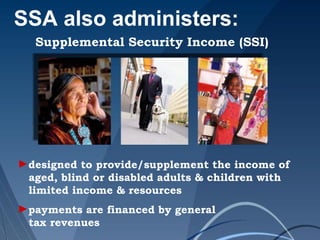
Supplemental Security Income (SSI)
►designed to provide/supplement the income of
aged, blind or disabled adults & children with
limited income & resources
►payments are financed by general
tax revenues
The Statistics:
► Over 54 million people
receive monthly Social
Security or SSI benefits
► Through their tax revenue,
163 million are earning
valuable Social Security
coverage for themselves
and their families
► During the last 10 years,
the number of OASI bene-
ficiaries has grown by 8%
► Disability Insurance has
grown by 40% & SSI by 11%
Applying for Benefits:
► To receive benefits, the claimant must fill out
an application; this may be done via the
internet, telephone or at the local office
► Once the application is received, the process
begins with review of the application
Social Security Benefits:
► Receiving benefits depends on how soon the
claimant will be retiring
► Claimant must be 61 years and 9 months or
older & plan to start receiving retirement
benefits within 4 months
Disability Benefits:
► SSA reviews submissions to
ensure all information is complete
► SSA sends forms to the State’s
office
► The State office requests medical
records
► The State office then reviews
all the medical records when they
are received
Determination of Benefits
► Change in status
► The process of a claim
► Payment and
Accounting Branch
Payment & Accounting Branch
► 14 employees in the Division
► Nine Analysts
► Four Certifying Officers
Payment & Accounting Branch
► Disbursement of payments
► Government-Wide Accounting System
► Information on the report
Certification of Benefits
► Included Excel spreadsheets and
Access Databases
► Involved a great amount of time/
manpower, requiring more people
in order to complete the job at hand
Beginning
of Automation
In 2005, we began a journey of automation
through a web-based system developed by the
“web heads” that are located in our area
• Quality Service • Human Error
Benefits of Certification System
► Uses latest web technology
► Designed with a flexible
environment
► Audit trail capabilities included
► Increase of internal control
► Enhanced Report Capability
using a data mining tool
► Easy to use – which will result in
ease of training new staff
Operations Branch
After PAB certifies a beneficiary’s payment,
if a beneficiary claims they did not receive an
SSI payment (non-receipt), TOB receives
notification from Treasury
Exception Processing
► These transactions are called “exceptions”
► Consists of 8 analysts
► Approximately 25,000 SSR exceptions annually
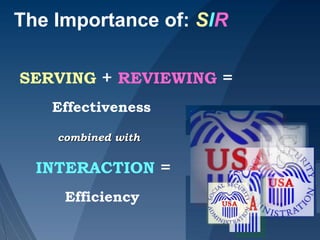
The Importance of: SIR
SERVING ++ REVIEWING ==
Effectiveness
combined withcombined with
INTERACTION ==
Efficiency
Building Relationships
► Brainstorm & find ways to develop a more
productive method
► With consistent & loyal teamwork, we can build a
relationship that will be beneficial to both agencies
Finaldbca

Finaldbca

  • 2.
    Few Government agenciestouch the lives of as many people as the Social Security Administration (SSA)
  • 3.
    SSA administers: Old-Age, Survivors& Disability Insurance (OASDI), commonly referred to as “Social Security” ► monthly benefits are financed through payroll taxes paid by workers & by self-employed workers ► benefit payments are based on an individual’s taxable earnings during his/her lifetime
  • 4.
    SSA also administers: SupplementalSecurity Income (SSI) ►designed to provide/supplement the income of aged, blind or disabled adults & children with limited income & resources ►payments are financed by general tax revenues
  • 5.
    The Statistics: ► Over54 million people receive monthly Social Security or SSI benefits ► Through their tax revenue, 163 million are earning valuable Social Security coverage for themselves and their families ► During the last 10 years, the number of OASI bene- ficiaries has grown by 8% ► Disability Insurance has grown by 40% & SSI by 11%
  • 6.
    Applying for Benefits: ►To receive benefits, the claimant must fill out an application; this may be done via the internet, telephone or at the local office ► Once the application is received, the process begins with review of the application
  • 7.
    Social Security Benefits: ►Receiving benefits depends on how soon the claimant will be retiring ► Claimant must be 61 years and 9 months or older & plan to start receiving retirement benefits within 4 months
  • 8.
    Disability Benefits: ► SSAreviews submissions to ensure all information is complete ► SSA sends forms to the State’s office ► The State office requests medical records ► The State office then reviews all the medical records when they are received
  • 9.
    Determination of Benefits ►Change in status ► The process of a claim ► Payment and Accounting Branch
  • 10.
    Payment & AccountingBranch ► 14 employees in the Division ► Nine Analysts ► Four Certifying Officers
  • 11.
    Payment & AccountingBranch ► Disbursement of payments ► Government-Wide Accounting System ► Information on the report
  • 12.
    Certification of Benefits ►Included Excel spreadsheets and Access Databases ► Involved a great amount of time/ manpower, requiring more people in order to complete the job at hand
  • 13.
    Beginning of Automation In 2005,we began a journey of automation through a web-based system developed by the “web heads” that are located in our area • Quality Service • Human Error
  • 14.
    Benefits of CertificationSystem ► Uses latest web technology ► Designed with a flexible environment ► Audit trail capabilities included ► Increase of internal control ► Enhanced Report Capability using a data mining tool ► Easy to use – which will result in ease of training new staff
  • 15.
    Operations Branch After PABcertifies a beneficiary’s payment, if a beneficiary claims they did not receive an SSI payment (non-receipt), TOB receives notification from Treasury
  • 16.
    Exception Processing ► Thesetransactions are called “exceptions” ► Consists of 8 analysts ► Approximately 25,000 SSR exceptions annually
  • 17.
    The Importance of:SIR SERVING ++ REVIEWING == Effectiveness combined withcombined with INTERACTION == Efficiency
  • 18.
    Building Relationships ► Brainstorm& find ways to develop a more productive method ► With consistent & loyal teamwork, we can build a relationship that will be beneficial to both agencies

Editor's Notes

  • #2 Opening slide; leave on screen until speaker is ready to begin.
  • #7 Let’s start at the beginning of the process to see how a person receives benefits.
  • #9 (claimant may be contacted for missing/unclear information) that determines if the applicant is disabled under the Social Security law from hospitals, doctors & other treatment sources listed
  • #10 Once the determination is made that the claimant is eligible and will be receiving benefits, the status of the claimant changes to a beneficiary. The process filters through the administration and ends in our branch which is the Payment and Accounting Branch (PAB). PAB certifies and accounts for all benefit payments (i.e., Social Security and Disability) authorized under the Social Security Act. The branch is responsible for recording, analyzing, verifying, and reporting all program data for accounting audit trail purposes. PAB maintains the accuracy of programmatic records that support general ledger activity.
  • #11 Would you believe that an area this small certifies an estimated 200 daily and monthly payments for beneficiaries? 9 of the analysts are responsible of assuring the payments files are accurate and certified in a timely manner. We have 4 certifying officers who give DT the go ahead to pay out the payments to claimants; if PAB doesn’t certify the payments the checks will not be disbursed.
  • #12 When DT disburses the payments to the beneficiaries we receive a confirmation report through the Government Wide Accounting System (GWA). This report tells us how much was disbursed as checks, electronic funds transfers, the date the payment was made, and if any checks were held because of a change in the beneficiaries information. We look forward to working with the DT in the future to possibly have an interface with the GWA System and our new web based automated system. I will display the new web-based system in a few slides.
  • #13 Certification of benefits has been a manual process which included an abundance of spreadsheets that were mandatory in order to get totals for reports that were very divided by segments, access databases were also used to gather data and generate reports and totals. Annually, resources have decreased leaving us with less money and people to accomplish the goal. Human error from keying was an obstacle that had to be overcome for our records to be as accurate as possible
  • #14 Automation for us has since been evolving, allowing us to be more efficient with less resources of money and people, due to retirements. We are able to assure that the beneficiaries are receiving quality service that is accurate in a timely fashion. The hours that were spent keying data into multiple programs are now used analyzing data more extensively.
  • #17 TOB consists of only 8 analyst who process these exceptions daily AND these 8 analyst are responsible for the resolution of approximately 25,000 SSR exceptions annually These exceptions include New Remittance Deposits, Double Check Negotiations, Un-Negotiated Checks, Payment History Corrections, Returned Checks
  • #18 So for a minute, let’s take it back to SIR &. “READ TITLE”…… The “S” and the “R” Serving other agencies and reviewing processes and procedure allows us to be effective at our job. Our preferred result, as a whole, is to not only be effective at our job, but to be efficient as well. So, in order for us to get this desired result, it is essential that we interact.
  • #19 TOB interacts with a lot of different Agency components whose work interfaces with our operations. Treasury has a great impact on our workloads so we feel that the relationship between us & Treasury is imperative.
  • #20 Ends with the words “Shaping Our Future”