PORTFOLIO INVESTOR
WHAT IS A PORTFOLIO INVESTMENT?
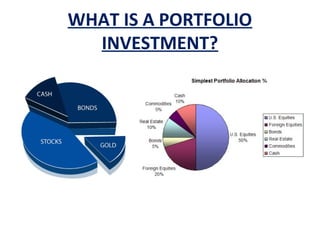
• A  portfolio  investment  is  a  basket  of  financial  assets  / 
investments  such  as  stocks,  bonds,  commodities,  currencies 
and cash equivalents including mutual, exchange-traded and 
closed funds. 
• A portfolio can also consist of non-publicly 
tradable securities, like real estate, art, and 
private investments.
• Investors  should  construct  an  investment  portfolio  in 
accordance with their risk tolerance and investing strategies.
• Securities can build a diversified portfolio, but [stocks, bonds, 
and cash] are generally considered a portfolio's core building 
blocks. 
WHAT IS A PORTFOLIO
INVESTMENT?
Risk Tolerance on Portfolio Allocations
• Financial  advisor/  Fund  Manager  can  develop  a 
generic  portfolio  model  for  an  individual,  an 
investor's  risk  tolerance  should  have  a  significant 
impact on what a portfolio looks like.
Time Horizon on Portfolio Allocations
•   Investors  should  consider  how  long  they  have  to 
invest  while  building  a  portfolio.  Investors  should 
generally  conserve  Asset  allocation  as  the  goal 
approaches.
INVESTMENT POLICY AND PROMOTION
• The World Bank Group helps countries
establish a competitive investment climate 
that is favorable for attracting, retaining and
leveraging investment for business-led growth.
• The Investment Policy and Promotion (IPP) define their value 
proposition as an attractive investment strategy. Investment 
policies  must  be  tailored  to  fit  client  needs  be  continually 
revised to take into account economic and business changes.
• Investment  Policy  &  Promotion  (IPP)  advisory  services  can 
help  countries  attract,  retain  and  grow  foreign  direct 
investment (FDI) to link to the global economy, and maximize 
the positive spillovers of FDI for the local economy.
SUSTAINABLE INVESTING OPPORTUNITY
• Sustainable  investing  opportunity  directs  investment  capital 
to  companies  that  seek  to  combat  climate  change, 
environmental  destruction,  while  promoting  corporate 
responsibility.
• Environmental, social and governance (ESG) criteria are a set 
of  standards  for  a  company’s  operations  that  socially 
conscious investors use to screen potential investments. 
• ESG  investing  is  referred  to  as  sustainable  investing, 
responsible investing, impact investing, or socially responsible 
investing.
• Renewable energy sources like solar, wind, and hydropower 
are  impacting  our  fossil-fuel–based  economy  and  creating 
investing opportunities.
SUSTAINABLE INVESTING OPPORTUNITY
• The World Bank Group (IBRD, IDA, IFC, MIGA and ICSID) works toward the
twin goals and Sustainable Development Goals and is the largest source of
development finance with over 70 years of experience.
• All sustainable development bonds are World Bank (IBRD) bonds. IBRD
lends to middle-income countries, issues bonds, and advises countries on
capital markets.
• Washington, D.C, April 4, 2019—The World Bank launched a Sustainable
Development Bond to draw attention to the challenge of plastic waste
pollution in oceans. This bond is part of an ongoing initiative by the World
Bank to engage with investors on highlighting the vital role of fresh and
saltwater resources.
• Washington, D.C., April 8, 2019— The World Bank Group and Japan’s
Government Pension Investment Fund (GPIF) have expanded their
partnership to grow markets for sustainable investing. GPIF asset
managers are strategically investing in Green, Social and Sustainable
Development Bonds issued by the World Bank
SUSTAINABLE INVESTING OPPORTUNITY
WHAT LONG TERM, SUSTAINABLE INVESTMENT
OPPORTUNITIES DO YOU WANT TO GAIN EXPOSURE TO?
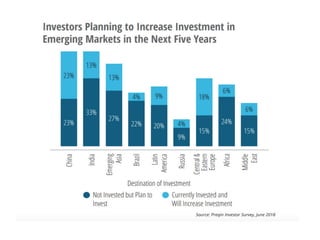
• We believe EMDE’s offer the potential for competitive returns
over the long term, across a variety of countries and
industries, and represent an important diversifier for investor
portfolios. The below are reasons for Sustainable Investment
Opportunities
– Robust Debt Market
– GDP Growth in Emerging Markets Outpaces Developed Markets
– Diverse Emerging Market Equity Universe
– Growing Middle Class
– Improving Education
– Advances in Technology
– Growing Emerging Market Consumption
WHAT ASSET CLASSES ARE BEST TO
PROVIDE YOU THAT EXPOSURE?
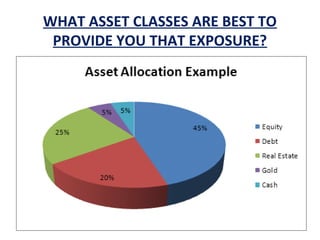
Four Classes of Assets helps in building Portfolio Investment
• The four classes of assets are generally considered to be:
– Stocks or equities
– Fixed Income or bonds
– Money market or cash equivalents
– Real estate or other tangible assets
A portfolio that contains only one or two asset classes is not
diversified and may not be prepared to take advantage of
all the swings in the market. But diversification—or at
least the degree to which you diversify—is a decision that
depends to some extent on your goals and your tolerance
on risk.
• Stocks, equity funds, index funds and equity Portfolio
Management Services have a historic high risk-high return
profile and offer long-term growth to the portfolio.
• Debt instruments like bonds, FDs, debt funds generate a
regular return and provide income to the portfolio.
• Cash and equivalents like savings account balance, liquid
funds provide liquidity to the portfolio.
• Commodities like gold, silver, oil, etc and real estate provide
an inflation hedge to the portfolio.
• Assets like international funds, which have low correlation to
domestic markets, provide international diversification to the
portfolio.
WHAT ASSET CLASSES ARE BEST TO
PROVIDE YOU THAT EXPOSURE?
WHAT ASSET CLASSES ARE BEST TO
PROVIDE YOU THAT EXPOSURE?
FUND MANAGER
• A fund manager is responsible for implementing a fund's
investment strategy and managing its trading activities.
• Most fund managers are highly educated, have professional
credentials, and possess management experience.
• Incorporate ESG Factors into investment analysis and
decision-making processes.
• Fund Manager should fully review and incorporate ESG issues
into ownership of policies and practices, the investment style
before they consider investment decision in a fund.
• The main benefit of investing in a fund is trusting the investment
decision makers. Fund managers play an important role in the
investment and financial world. They provide investors with peace
of mind knowing their money is in the hands of an expert.
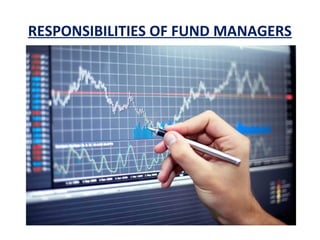
RESPONSIBILITIES OF FUND MANAGERS
• Fund managers primarily research and determine the best stocks,
bonds, or other securities to fit the strategy of the fund as outlined
in the prospectus, ESG Rules, then buy and sell them.
• The fund manager typically has a support staff of ESG analysts and
traders who perform some of these activities. Multiple managers at
some investment companies oversee client money, and each may
be responsible for a portion or make investment decisions via
committee.
• Fund manager prepare reports on how well the fund is performing,
developing reports for potential clients to know the risks and
objectives of the fund, and identifying good fits to the clients.
• “Complying with the Sustainable Development Goals will
enhance returns in the medium to long term.”
RESPONSIBILITIES OF FUND MANAGERS
WHAT FUND MANAGERS SHOULD YOU
COMMIT YOUR FUNDING TO?
• Fund managers are very important for the effectiveness and
performance of your funds and so it is relevant that you take
certain factors into consideration when choosing manager.
• The Portfolio must be handled as per the ESG Rules set out by
the governing body.
• Manager have to keep track of the Institutional investors, ESG
Analysis and Strategy in buying and selling of stocks?
• Monitoring the Portfolio on regular basis.
• Giving out yearly reports, gathering capital Information.
• The objectives of the investment must be converted as to the
investment decisions of the Portfolio.
HOW WILL YOU EVALUATE THESE FUND MANAGERS
FOR THEIR PERFORMANCE AND IMPACT?
• Besides extensive knowledge on the subject and relevant
market insights, a fund manager has to gather important
insights from the research team. Some considerations
include:
– Does follow an ESG benchmark or index?
– ESG information to identify investment risks and opportunities?
– Integration of ESG factors into investment decisions?
– Checking for shifts in the stock market to analyze the volume of the
shifts.
– An in-depth analysis of the yearly outputs of the companies that the
fund manager wants to take decisions on investing.
– How often the manager is willing to share the fact of a potential risk
with you?
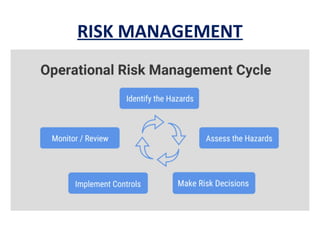
RISK MANAGEMENT
WHAT RISKS SHOULD YOU CONSIDER?
1) Financial Risk Management
• IBRD, IDA stand-alone hedging products for risk management
are available to help clients manage their financial risks using
standard risk management techniques.
2) Disaster Risk Management
• The WorldBank Treasury offers financial solutions for
contingent, crisis financing and disaster-risk transfer
intermediation.
• Contingent & Crisis Financing – IBRD, IDA Development Policy
Loan with Catastrophe Drawdown Option (DPL Cat DDO)
• Disaster Risk Transfer Intermediation - Catastrophe Bonds,
Derivatives, Insurance & Reinsurance.
WHAT RISKS SHOULD YOU CONSIDER?
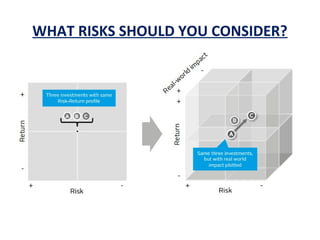
• Investments always have several real world impacts that can be
positive or negative (for example generate corporate and income
taxes, support employment, create discrimination or be inclusive,
etc.) and are intertwined with long term prosperity.
• Asset owners and the investment chain more generally that limit
analysis to the two main dimensions covered in the Risk and Return
elements in their portfolio’s contribution to end beneficiaries and
society as a whole.
• The Portfolio allocation could be divided equally, weighted towards
names with better or even worse ESG scores, or with a lower
carbon footprint; names with the highest correlation to the stocks
removed from the index; or derivatives can be used to create
exposures, etc.
WHAT RISKS SHOULD YOU CONSIDER?
LINKS
• The World's First Green Bond
• https://www.youtube.com/watch?
v=i3gIJrABLSc&list=PLuz9mCSZhLGlRp5Qa_ZSX0DJd_xNB8ZGj
&index=2
• http://treasury.worldbank.org/en/about/unit/treasury
THANK YOU

Final project portfolio investor

  • 1.
  • 2.
    WHAT IS APORTFOLIO INVESTMENT? • A  portfolio  investment  is  a  basket  of  financial  assets  /  investments  such  as  stocks,  bonds,  commodities,  currencies  and cash equivalents including mutual, exchange-traded and  closed funds.  • A portfolio can also consist of non-publicly  tradable securities, like real estate, art, and  private investments. • Investors  should  construct  an  investment  portfolio  in  accordance with their risk tolerance and investing strategies. • Securities can build a diversified portfolio, but [stocks, bonds,  and cash] are generally considered a portfolio's core building  blocks. 
  • 3.
    WHAT IS APORTFOLIO INVESTMENT?
  • 4.
    Risk Tolerance on Portfolio Allocations • Financial advisor/  Fund  Manager  can  develop  a  generic  portfolio  model  for  an  individual,  an  investor's  risk  tolerance  should  have  a  significant  impact on what a portfolio looks like. Time Horizon on Portfolio Allocations •   Investors  should  consider  how  long  they  have  to  invest  while  building  a  portfolio.  Investors  should  generally  conserve  Asset  allocation  as  the  goal  approaches.
  • 5.
    INVESTMENT POLICY ANDPROMOTION • The World Bank Group helps countries establish a competitive investment climate  that is favorable for attracting, retaining and leveraging investment for business-led growth. • The Investment Policy and Promotion (IPP) define their value  proposition as an attractive investment strategy. Investment  policies  must  be  tailored  to  fit  client  needs  be  continually  revised to take into account economic and business changes. • Investment  Policy  &  Promotion  (IPP)  advisory  services  can  help  countries  attract,  retain  and  grow  foreign  direct  investment (FDI) to link to the global economy, and maximize  the positive spillovers of FDI for the local economy.
  • 6.
    SUSTAINABLE INVESTING OPPORTUNITY •Sustainable  investing  opportunity  directs  investment  capital  to  companies  that  seek  to  combat  climate  change,  environmental  destruction,  while  promoting  corporate  responsibility. • Environmental, social and governance (ESG) criteria are a set  of  standards  for  a  company’s  operations  that  socially  conscious investors use to screen potential investments.  • ESG  investing  is  referred  to  as  sustainable  investing,  responsible investing, impact investing, or socially responsible  investing. • Renewable energy sources like solar, wind, and hydropower  are  impacting  our  fossil-fuel–based  economy  and  creating  investing opportunities.
  • 7.
  • 8.
    • The WorldBank Group (IBRD, IDA, IFC, MIGA and ICSID) works toward the twin goals and Sustainable Development Goals and is the largest source of development finance with over 70 years of experience. • All sustainable development bonds are World Bank (IBRD) bonds. IBRD lends to middle-income countries, issues bonds, and advises countries on capital markets. • Washington, D.C, April 4, 2019—The World Bank launched a Sustainable Development Bond to draw attention to the challenge of plastic waste pollution in oceans. This bond is part of an ongoing initiative by the World Bank to engage with investors on highlighting the vital role of fresh and saltwater resources. • Washington, D.C., April 8, 2019— The World Bank Group and Japan’s Government Pension Investment Fund (GPIF) have expanded their partnership to grow markets for sustainable investing. GPIF asset managers are strategically investing in Green, Social and Sustainable Development Bonds issued by the World Bank SUSTAINABLE INVESTING OPPORTUNITY
  • 9.
    WHAT LONG TERM,SUSTAINABLE INVESTMENT OPPORTUNITIES DO YOU WANT TO GAIN EXPOSURE TO? • We believe EMDE’s offer the potential for competitive returns over the long term, across a variety of countries and industries, and represent an important diversifier for investor portfolios. The below are reasons for Sustainable Investment Opportunities – Robust Debt Market – GDP Growth in Emerging Markets Outpaces Developed Markets – Diverse Emerging Market Equity Universe – Growing Middle Class – Improving Education – Advances in Technology – Growing Emerging Market Consumption
  • 11.
    WHAT ASSET CLASSESARE BEST TO PROVIDE YOU THAT EXPOSURE? Four Classes of Assets helps in building Portfolio Investment • The four classes of assets are generally considered to be: – Stocks or equities – Fixed Income or bonds – Money market or cash equivalents – Real estate or other tangible assets A portfolio that contains only one or two asset classes is not diversified and may not be prepared to take advantage of all the swings in the market. But diversification—or at least the degree to which you diversify—is a decision that depends to some extent on your goals and your tolerance on risk.
  • 12.
    • Stocks, equityfunds, index funds and equity Portfolio Management Services have a historic high risk-high return profile and offer long-term growth to the portfolio. • Debt instruments like bonds, FDs, debt funds generate a regular return and provide income to the portfolio. • Cash and equivalents like savings account balance, liquid funds provide liquidity to the portfolio. • Commodities like gold, silver, oil, etc and real estate provide an inflation hedge to the portfolio. • Assets like international funds, which have low correlation to domestic markets, provide international diversification to the portfolio. WHAT ASSET CLASSES ARE BEST TO PROVIDE YOU THAT EXPOSURE?
  • 13.
    WHAT ASSET CLASSESARE BEST TO PROVIDE YOU THAT EXPOSURE?
  • 14.
    FUND MANAGER • Afund manager is responsible for implementing a fund's investment strategy and managing its trading activities. • Most fund managers are highly educated, have professional credentials, and possess management experience. • Incorporate ESG Factors into investment analysis and decision-making processes. • Fund Manager should fully review and incorporate ESG issues into ownership of policies and practices, the investment style before they consider investment decision in a fund. • The main benefit of investing in a fund is trusting the investment decision makers. Fund managers play an important role in the investment and financial world. They provide investors with peace of mind knowing their money is in the hands of an expert.
  • 15.
    RESPONSIBILITIES OF FUNDMANAGERS • Fund managers primarily research and determine the best stocks, bonds, or other securities to fit the strategy of the fund as outlined in the prospectus, ESG Rules, then buy and sell them. • The fund manager typically has a support staff of ESG analysts and traders who perform some of these activities. Multiple managers at some investment companies oversee client money, and each may be responsible for a portion or make investment decisions via committee. • Fund manager prepare reports on how well the fund is performing, developing reports for potential clients to know the risks and objectives of the fund, and identifying good fits to the clients. • “Complying with the Sustainable Development Goals will enhance returns in the medium to long term.”
  • 16.
  • 17.
    WHAT FUND MANAGERSSHOULD YOU COMMIT YOUR FUNDING TO? • Fund managers are very important for the effectiveness and performance of your funds and so it is relevant that you take certain factors into consideration when choosing manager. • The Portfolio must be handled as per the ESG Rules set out by the governing body. • Manager have to keep track of the Institutional investors, ESG Analysis and Strategy in buying and selling of stocks? • Monitoring the Portfolio on regular basis. • Giving out yearly reports, gathering capital Information. • The objectives of the investment must be converted as to the investment decisions of the Portfolio.
  • 18.
    HOW WILL YOUEVALUATE THESE FUND MANAGERS FOR THEIR PERFORMANCE AND IMPACT? • Besides extensive knowledge on the subject and relevant market insights, a fund manager has to gather important insights from the research team. Some considerations include: – Does follow an ESG benchmark or index? – ESG information to identify investment risks and opportunities? – Integration of ESG factors into investment decisions? – Checking for shifts in the stock market to analyze the volume of the shifts. – An in-depth analysis of the yearly outputs of the companies that the fund manager wants to take decisions on investing. – How often the manager is willing to share the fact of a potential risk with you?
  • 19.
  • 20.
    WHAT RISKS SHOULDYOU CONSIDER? 1) Financial Risk Management • IBRD, IDA stand-alone hedging products for risk management are available to help clients manage their financial risks using standard risk management techniques. 2) Disaster Risk Management • The WorldBank Treasury offers financial solutions for contingent, crisis financing and disaster-risk transfer intermediation. • Contingent & Crisis Financing – IBRD, IDA Development Policy Loan with Catastrophe Drawdown Option (DPL Cat DDO) • Disaster Risk Transfer Intermediation - Catastrophe Bonds, Derivatives, Insurance & Reinsurance.
  • 21.
    WHAT RISKS SHOULDYOU CONSIDER?
  • 22.
    • Investments alwayshave several real world impacts that can be positive or negative (for example generate corporate and income taxes, support employment, create discrimination or be inclusive, etc.) and are intertwined with long term prosperity. • Asset owners and the investment chain more generally that limit analysis to the two main dimensions covered in the Risk and Return elements in their portfolio’s contribution to end beneficiaries and society as a whole. • The Portfolio allocation could be divided equally, weighted towards names with better or even worse ESG scores, or with a lower carbon footprint; names with the highest correlation to the stocks removed from the index; or derivatives can be used to create exposures, etc. WHAT RISKS SHOULD YOU CONSIDER?
  • 23.
    LINKS • The World'sFirst Green Bond • https://www.youtube.com/watch? v=i3gIJrABLSc&list=PLuz9mCSZhLGlRp5Qa_ZSX0DJd_xNB8ZGj &index=2 • http://treasury.worldbank.org/en/about/unit/treasury
  • 24.