Isolated Air Conditioning System
Taylor Bontz
Josiah Bujanda
Christopher Hubbard
Adam Mengestab
Edgar Vazquez
Faculty Advisor: Dr. Yong X Tao
Industry Sponsor: Peterbilt
Abstract/Objective
 Total fuel used by idling trucks: estimated at over 2 billion gallons/year
 Currently 3.5 million truckers on the road
 Each requiring 10 hours of rest per day.
 To regulate comfort, drivers currently have limited options
 Leave the truck on all night
 Deal with the intense heat/cold
 Rising costs in fuel, as well as the emphasis on green energy
 Our solution:
 Create a canopy system that dramatically reduces the overall area that a truck’s AC
has to cool.
 Quicken cooling times while also entrapping cool air
Inspiration
 Our approach:
 Inspired by the capsule hotel designs; very popular in countries like Japan
 Containing cool air while also improving the overall sleeping experience,
without interfering with the original functionality of the sleeper.
 Identical wall dimensions
 A retractable, portable hotel experience
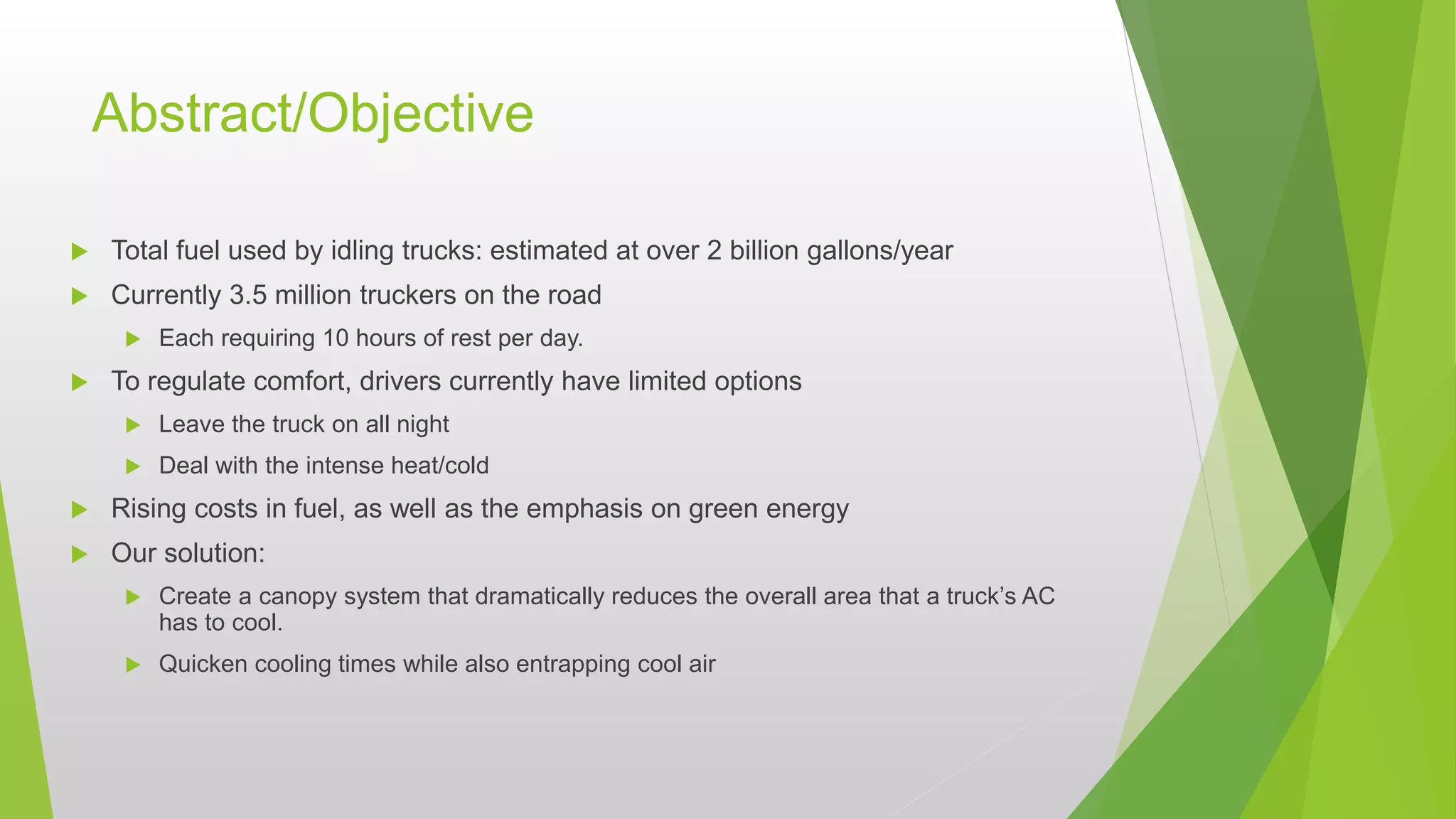
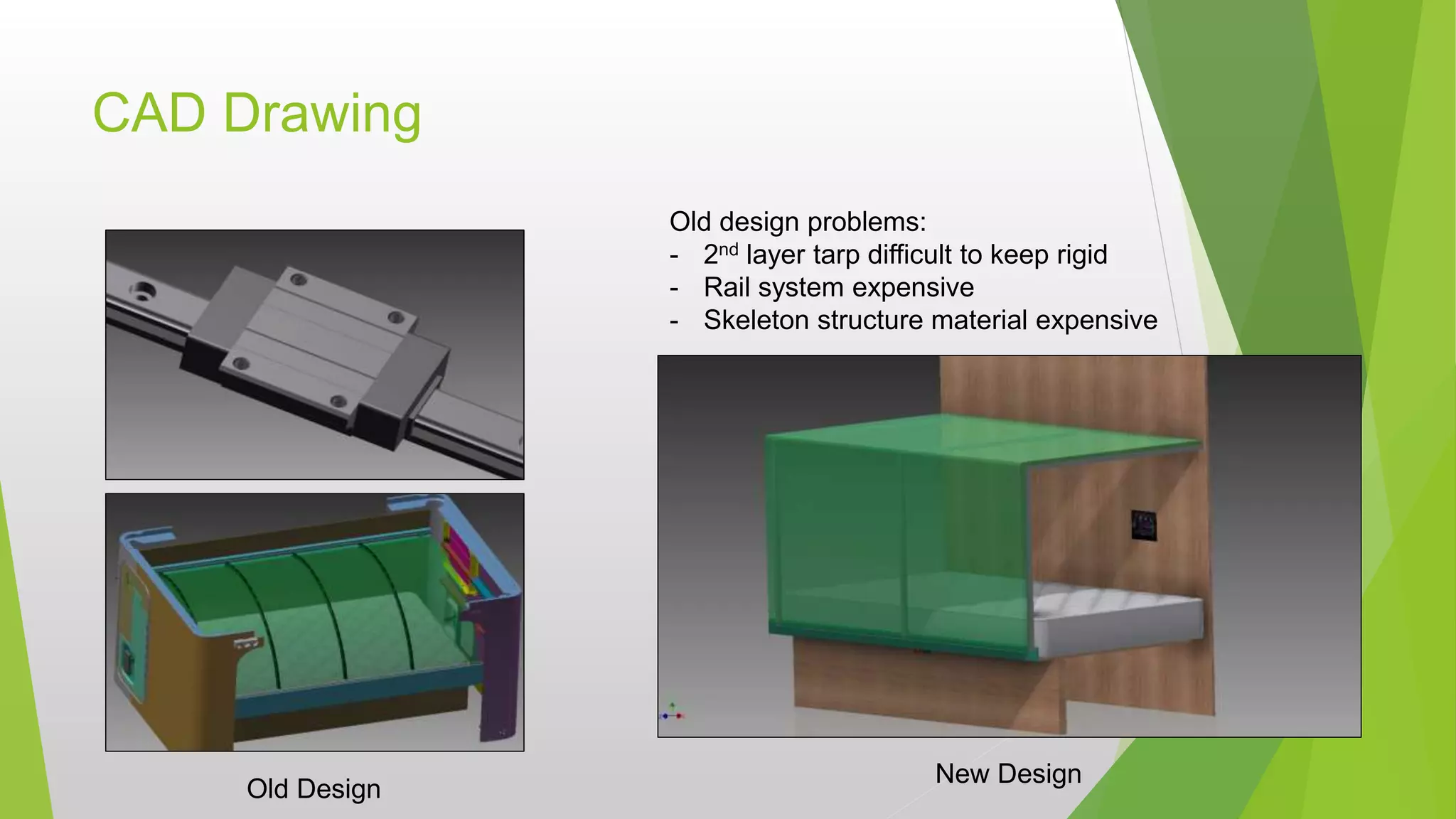
CAD Drawing
Old Design
New Design
Old design problems:
- 2nd layer tarp difficult to keep rigid
- Rail system expensive
- Skeleton structure material expensive
Materials
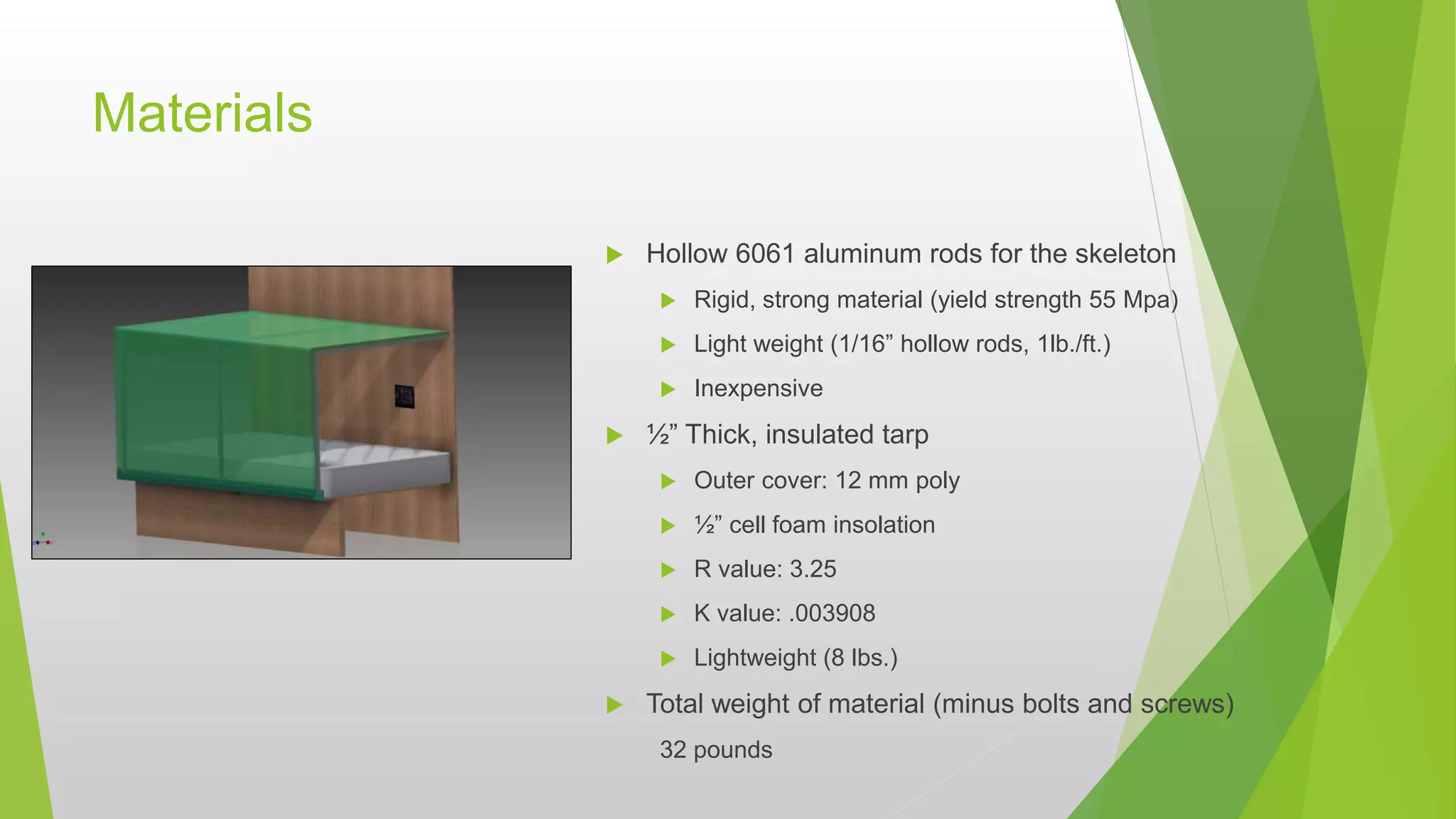
 Hollow 6061 aluminum rods for the skeleton
 Rigid, strong material (yield strength 55 Mpa)
 Light weight (1/16” hollow rods, 1lb./ft.)
 Inexpensive
 ½” Thick, insulated tarp
 Outer cover: 12 mm poly
 ½” cell foam insolation
 R value: 3.25
 K value: .003908
 Lightweight (8 lbs.)
 Total weight of material (minus bolts and screws)
32 pounds
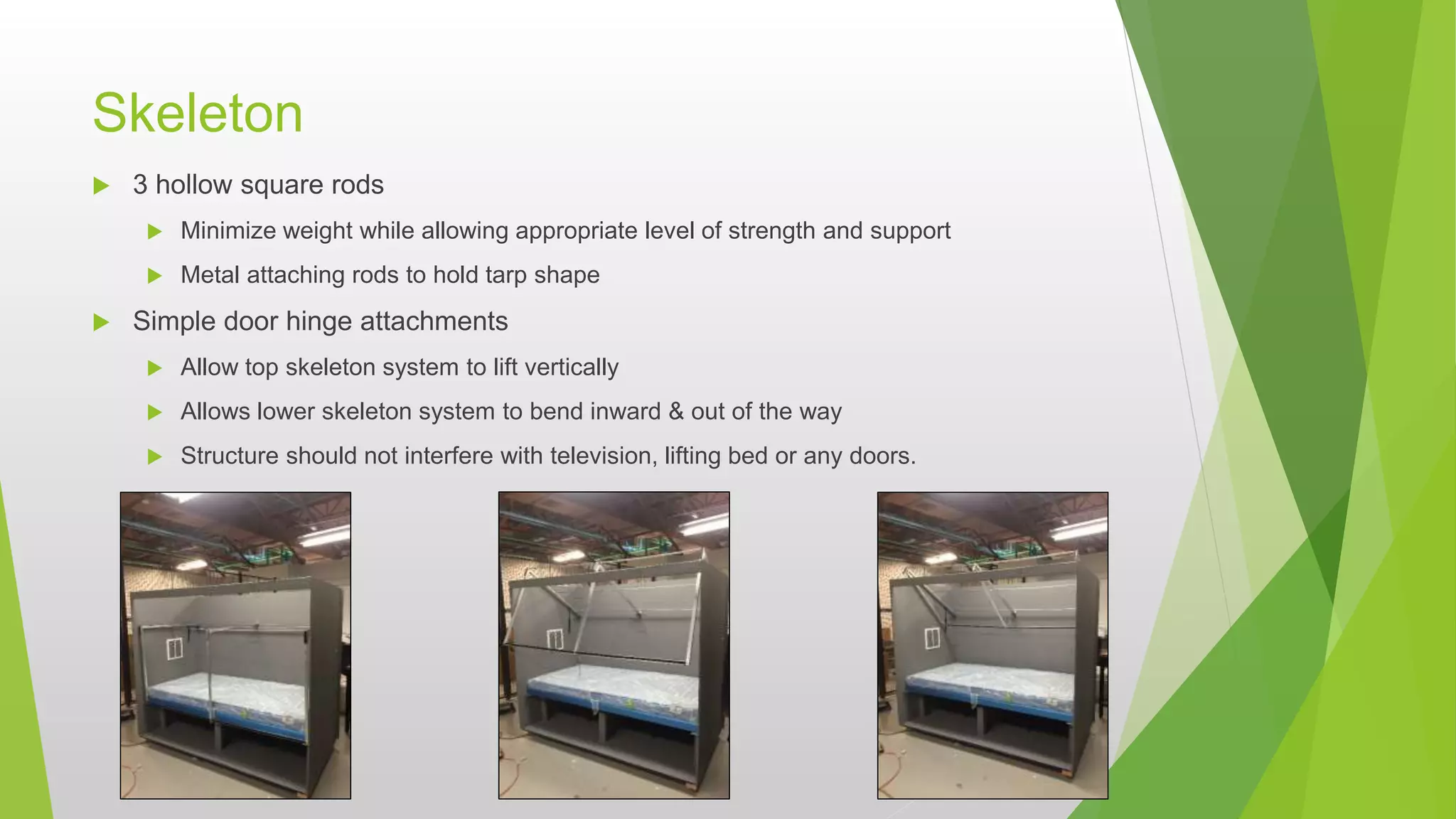
Skeleton
 3 hollow square rods
 Minimize weight while allowing appropriate level of strength and support
 Metal attaching rods to hold tarp shape
 Simple door hinge attachments
 Allow top skeleton system to lift vertically
 Allows lower skeleton system to bend inward & out of the way
 Structure should not interfere with television, lifting bed or any doors.
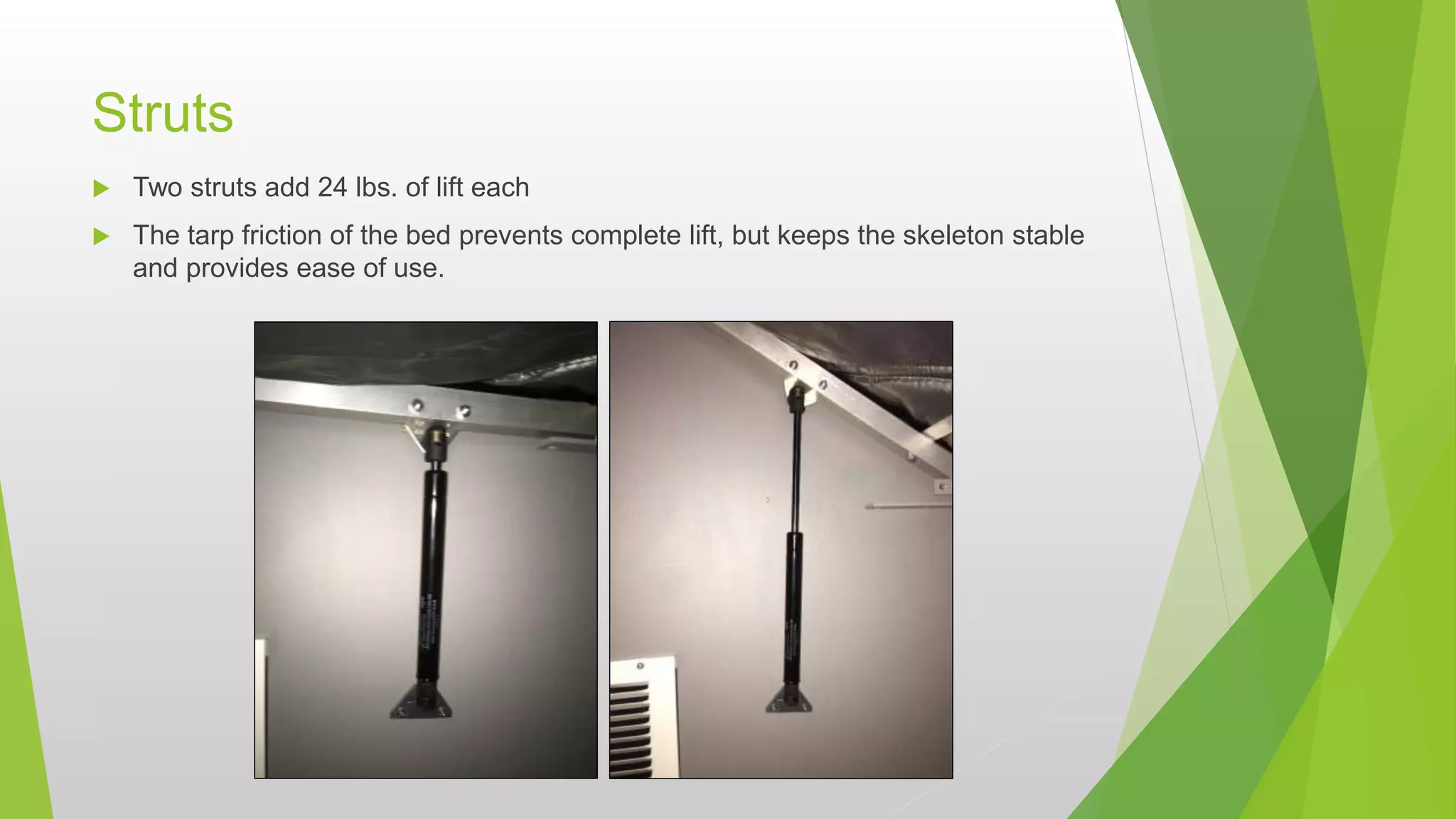
Struts
 Two struts add 24 lbs. of lift each
 The tarp friction of the bed prevents complete lift, but keeps the skeleton stable
and provides ease of use.
Magnets
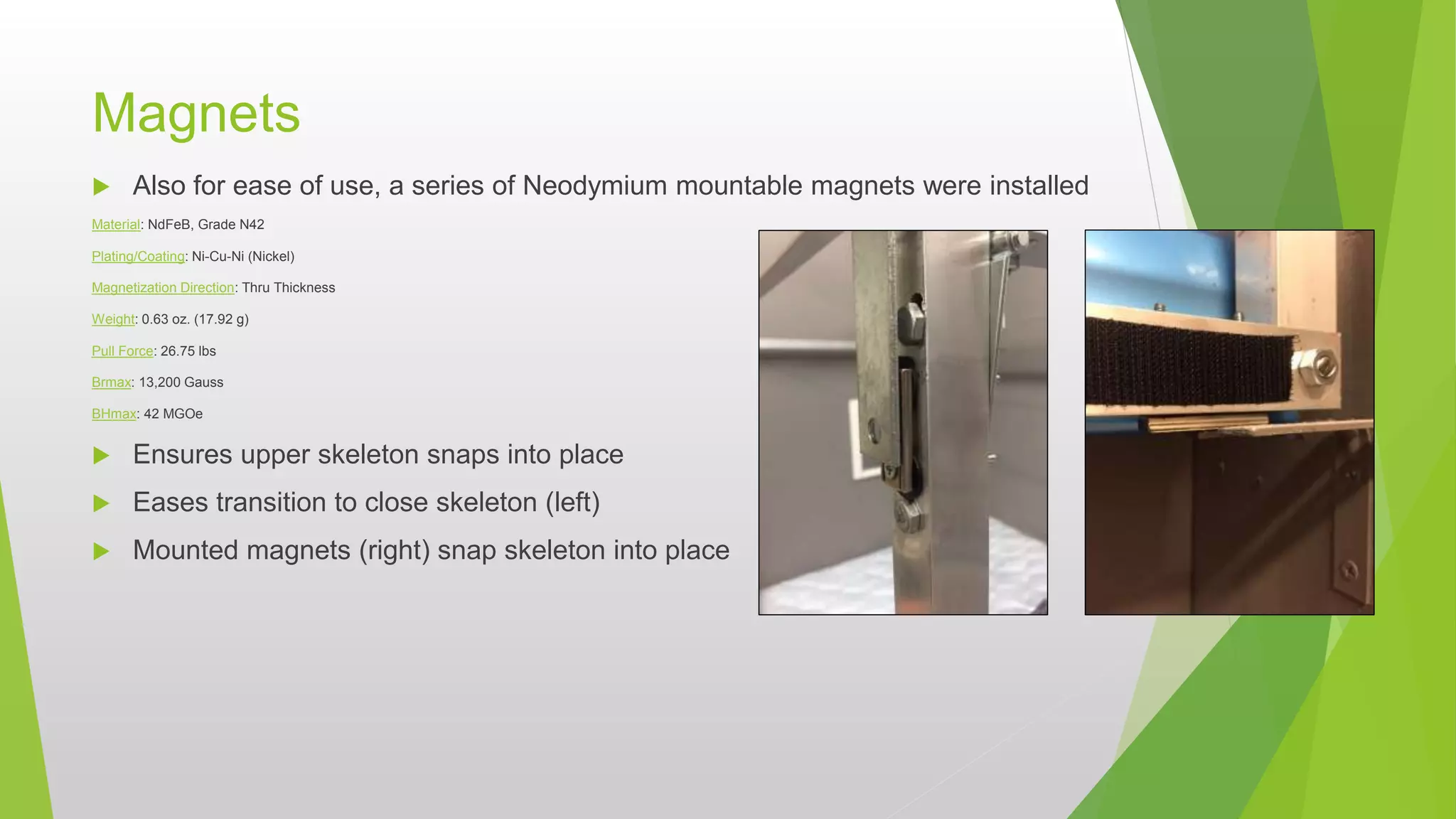
 Also for ease of use, a series of Neodymium mountable magnets were installed
Material: NdFeB, Grade N42
Plating/Coating: Ni-Cu-Ni (Nickel)
Magnetization Direction: Thru Thickness
Weight: 0.63 oz. (17.92 g)
Pull Force: 26.75 lbs
Brmax: 13,200 Gauss
BHmax: 42 MGOe
 Ensures upper skeleton snaps into place
 Eases transition to close skeleton (left)
 Mounted magnets (right) snap skeleton into place
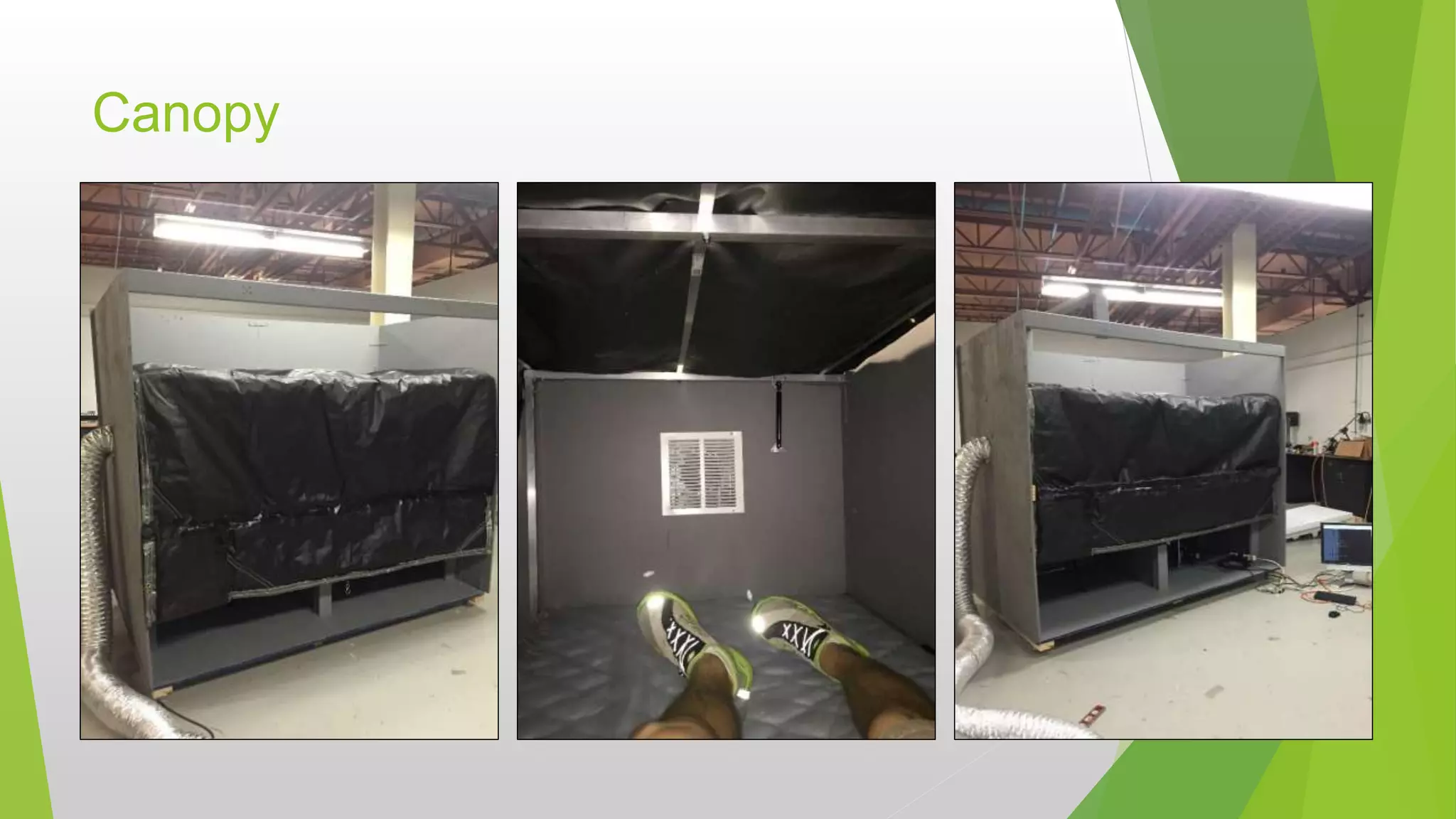
Canopy
Velcro
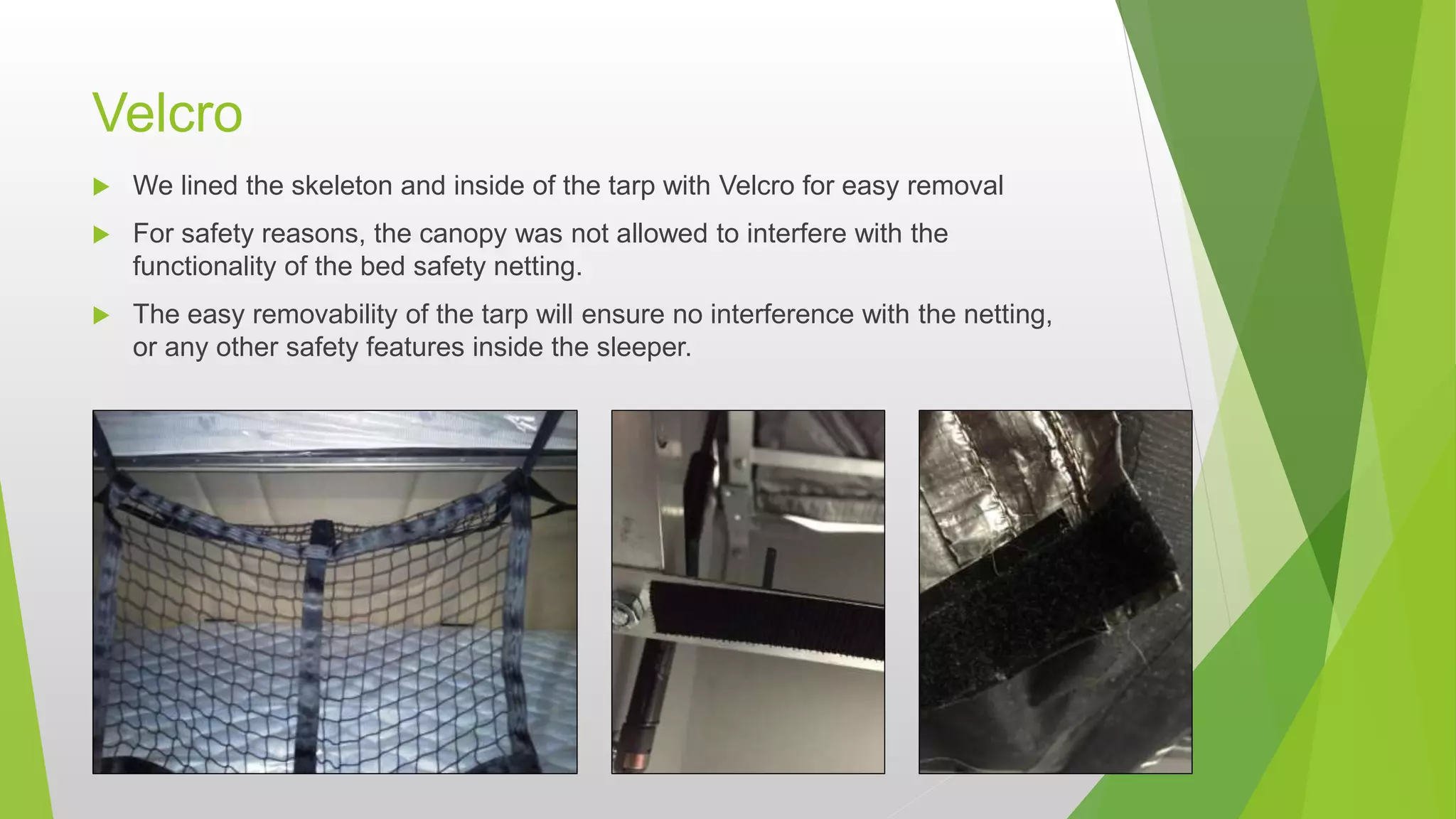
 We lined the skeleton and inside of the tarp with Velcro for easy removal
 For safety reasons, the canopy was not allowed to interfere with the
functionality of the bed safety netting.
 The easy removability of the tarp will ensure no interference with the netting,
or any other safety features inside the sleeper.
HVAC Design
HVAC Design
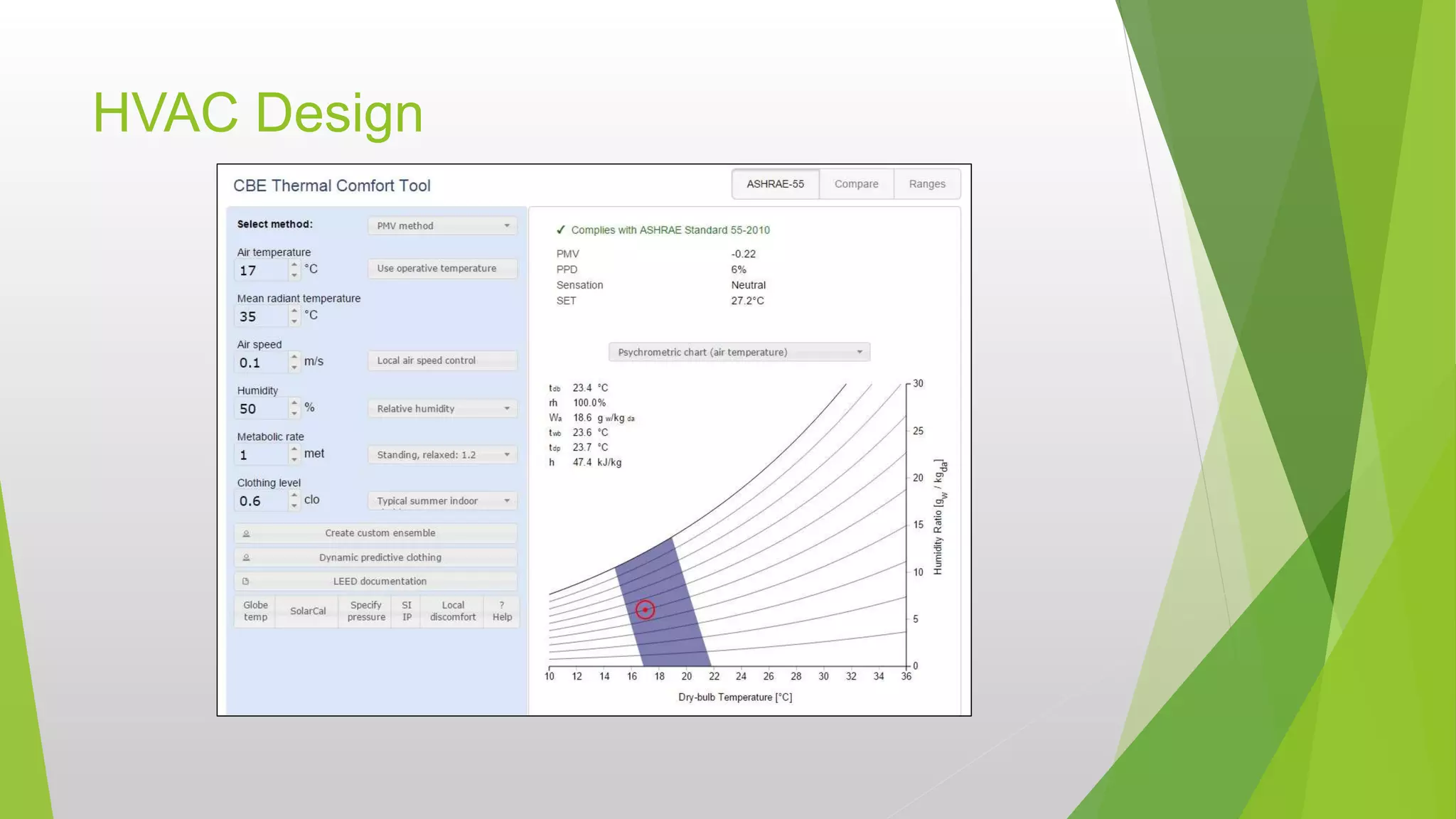
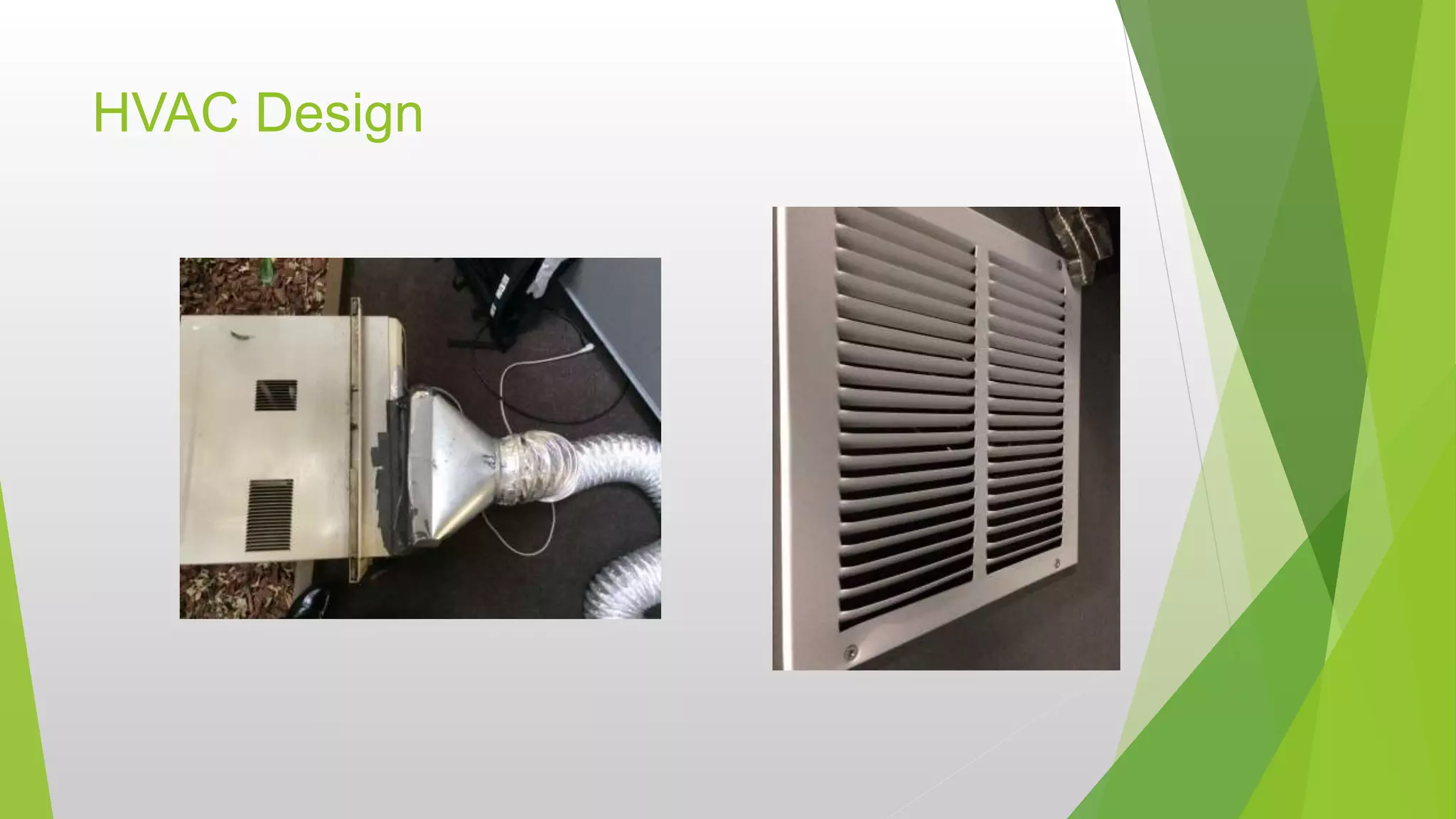
 Used a window A/C unit
 Cooling Capacity: 3516 W (12000 Btu/hr)
 Cooling Load Approx 500 W
Peterbilt has a 700 W A/C unit
available for use.
 Exit Air Temp: 16°C
 Air Speed: 4.5 m/s at vent
 Volumetric Flow Rate: 0.2757 m3/s
HVAC Design
Energy Analysis
 The amount of energy required to cool air can by calculated by
 𝑄 = 𝜌𝑉𝑐∆𝑇
 𝑄𝑙𝑎𝑟𝑔𝑒 = 206kJ
 𝑄𝑠𝑚𝑎𝑙𝑙 = 41.2kJ
 80% difference
Energy Analysis
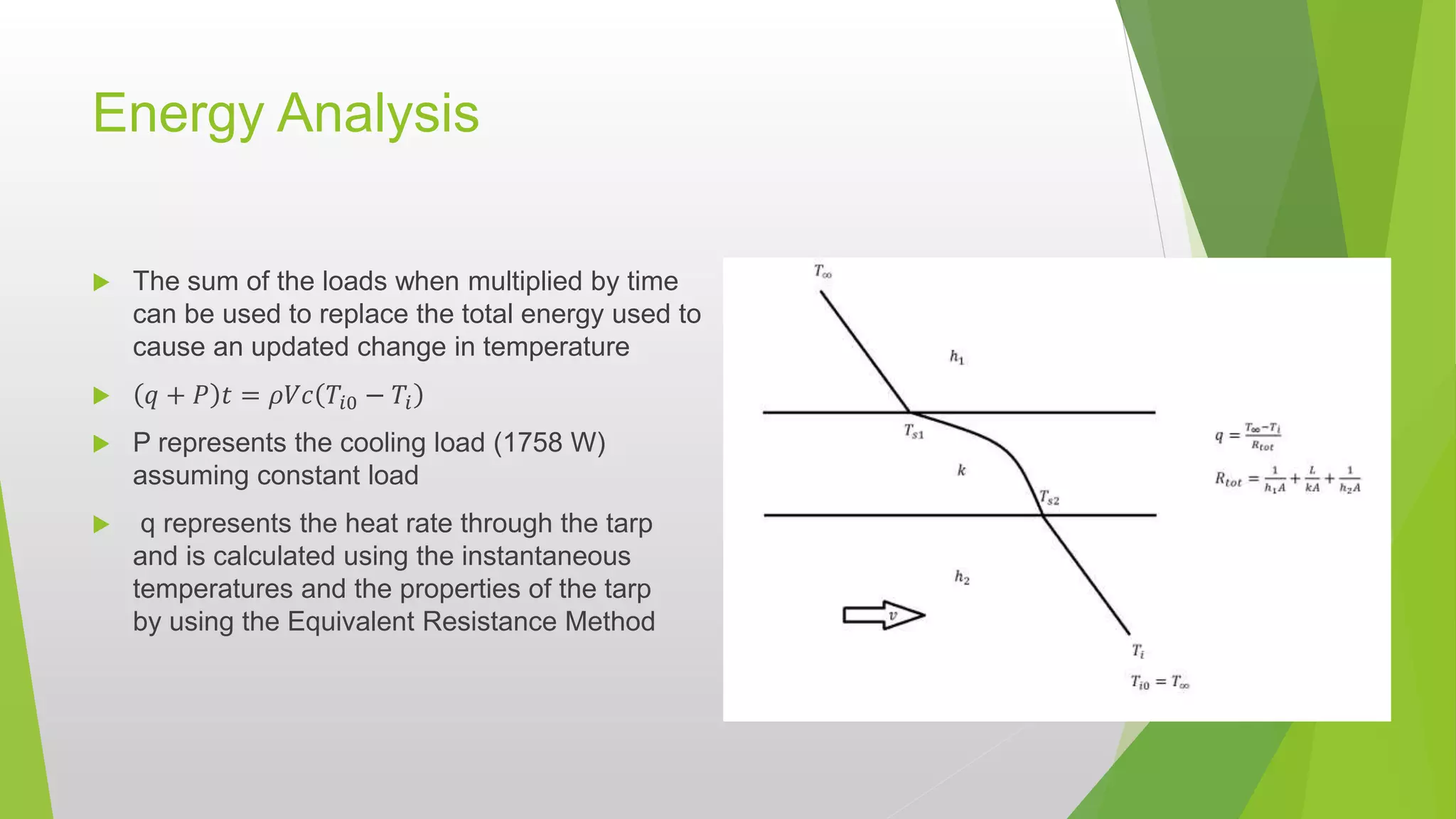
 The sum of the loads when multiplied by time
can be used to replace the total energy used to
cause an updated change in temperature
 𝑞 + 𝑃 𝑡 = 𝜌𝑉𝑐 𝑇𝑖0 − 𝑇𝑖
 P represents the cooling load (1758 W)
assuming constant load
 q represents the heat rate through the tarp
and is calculated using the instantaneous
temperatures and the properties of the tarp
by using the Equivalent Resistance Method
Energy Analysis
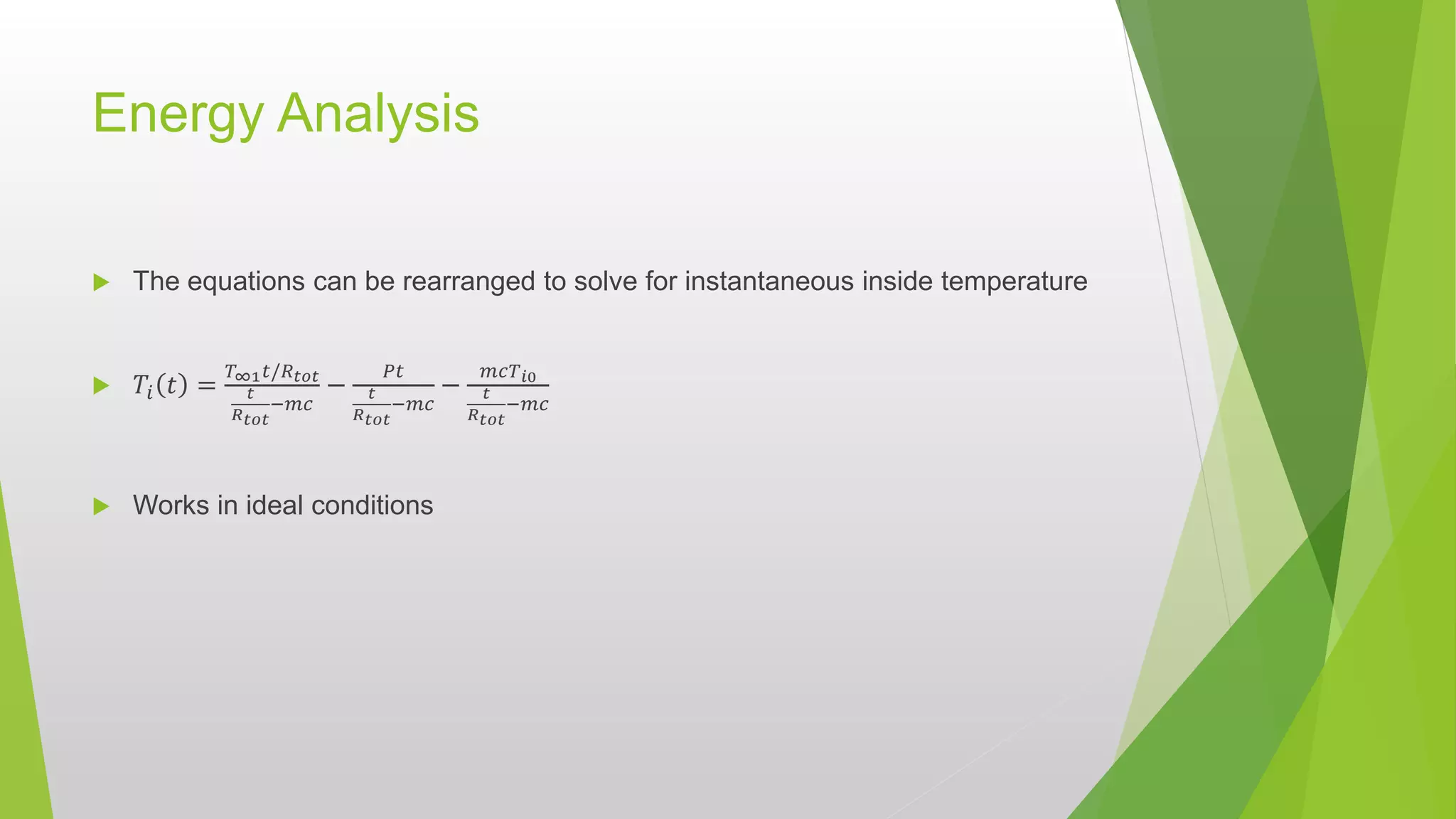
 The equations can be rearranged to solve for instantaneous inside temperature
 𝑇𝑖 𝑡 =
𝑇∞1 𝑡/𝑅 𝑡𝑜𝑡
𝑡
𝑅 𝑡𝑜𝑡
−𝑚𝑐
−
𝑃𝑡
𝑡
𝑅 𝑡𝑜𝑡
−𝑚𝑐
−
𝑚𝑐𝑇 𝑖0
𝑡
𝑅 𝑡𝑜𝑡
−𝑚𝑐
 Works in ideal conditions
Testing
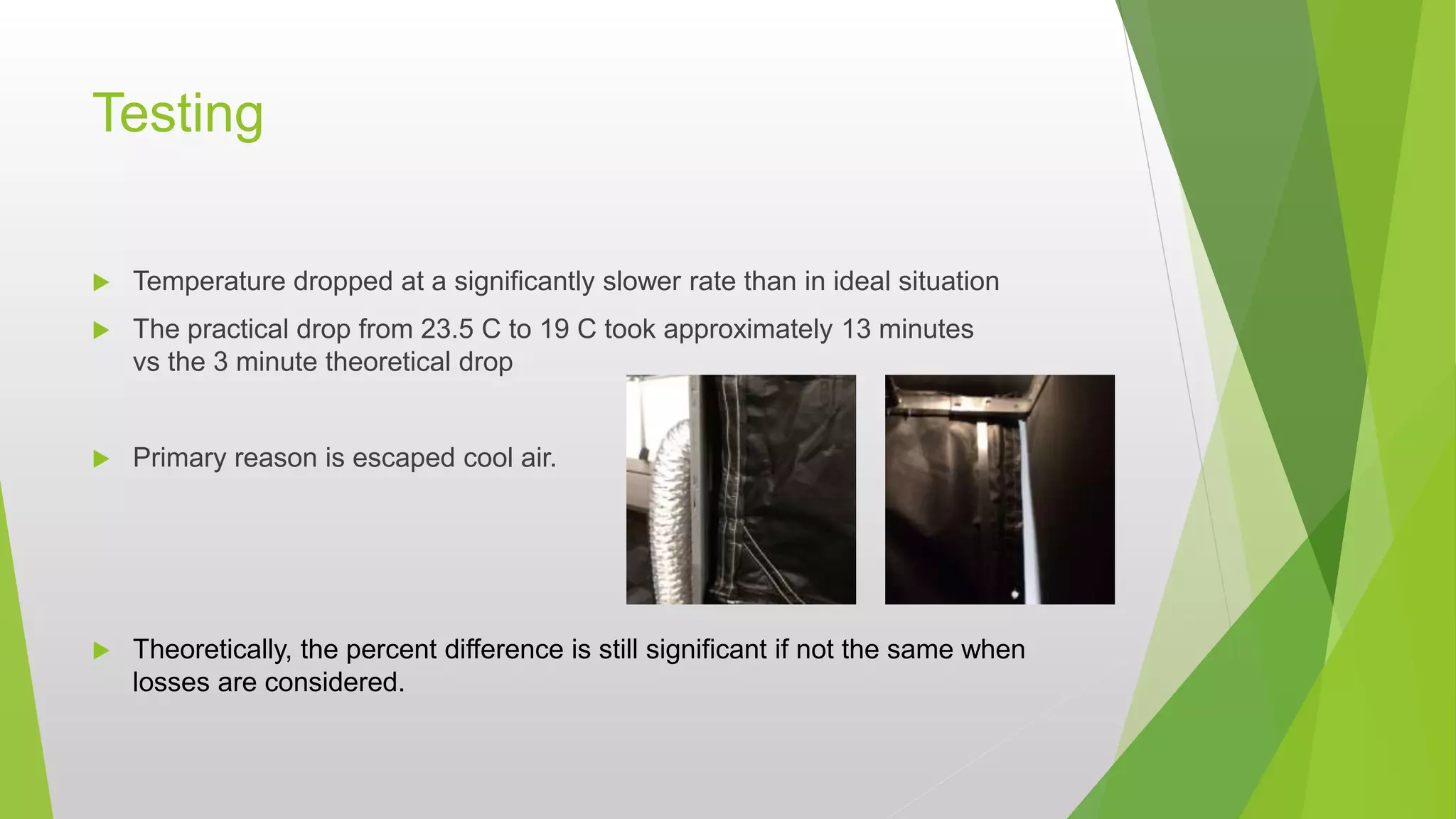
 Temperature dropped at a significantly slower rate than in ideal situation
 The practical drop from 23.5 C to 19 C took approximately 13 minutes
vs the 3 minute theoretical drop
 Primary reason is escaped cool air.
 Theoretically, the percent difference is still significant if not the same when
losses are considered.
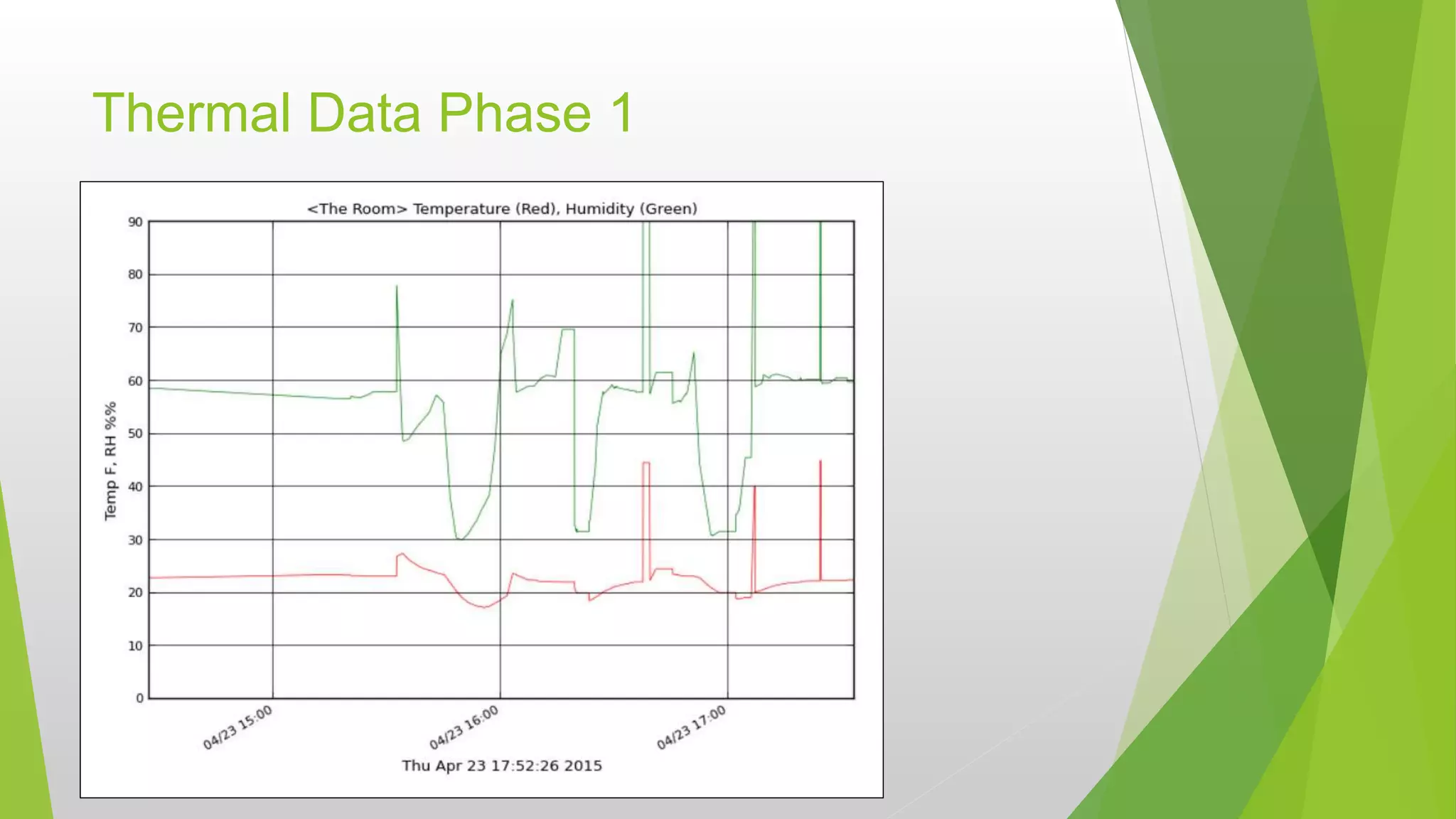
Thermal Data Phase 1
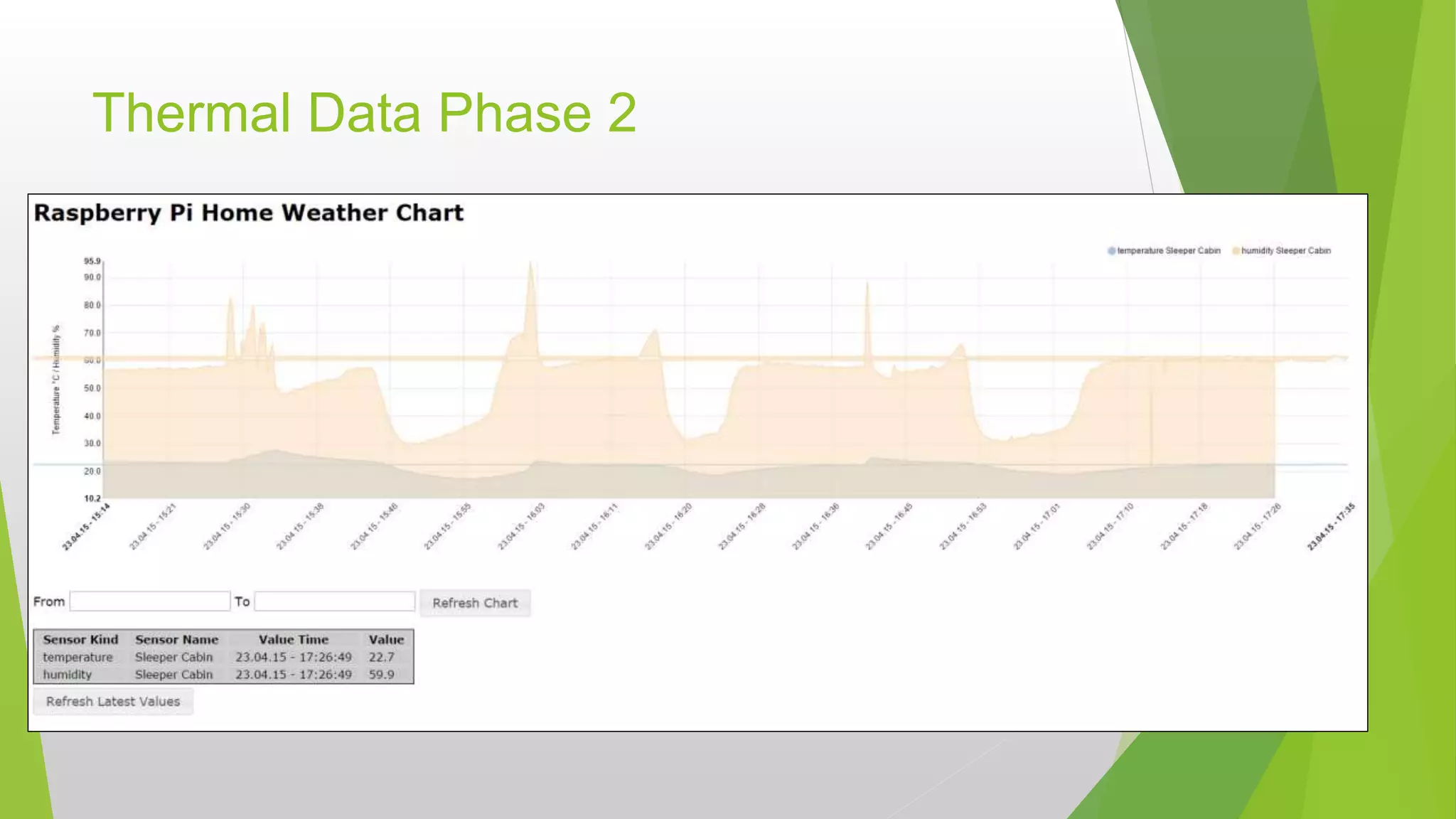
Thermal Data Phase 2
Why Automation?
 Provides functionality and flexibility
 Real time monitoring system, data analysis
 Improve comfort levels while reducing energy loads
 Cost effective
 Create a database of information, for processing, analyzing, and improving
 Ease of use and high level of compatibility with existing infrastructure
Control System
The control system is based off of open source technologies and user generated
content, this provides a high level flexibility and adaptation
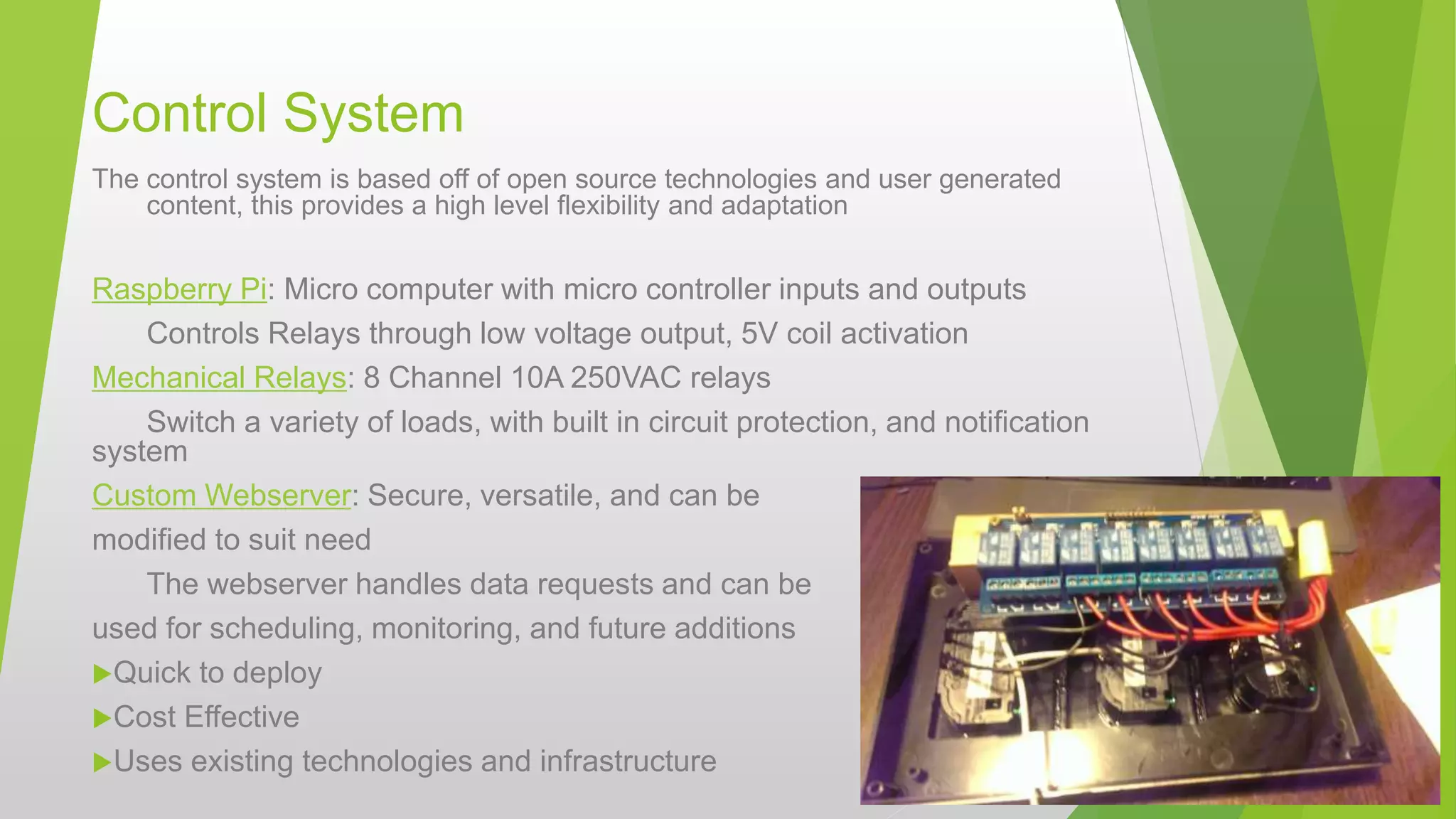
Raspberry Pi: Micro computer with micro controller inputs and outputs
Controls Relays through low voltage output, 5V coil activation
Mechanical Relays: 8 Channel 10A 250VAC relays
Switch a variety of loads, with built in circuit protection, and notification
system
Custom Webserver: Secure, versatile, and can be
modified to suit need
The webserver handles data requests and can be
used for scheduling, monitoring, and future additions
Quick to deploy
Cost Effective
Uses existing technologies and infrastructure
Control System
The control system is based off of open source technologies and user generated
content, this provides a high level flexibility and adaptation
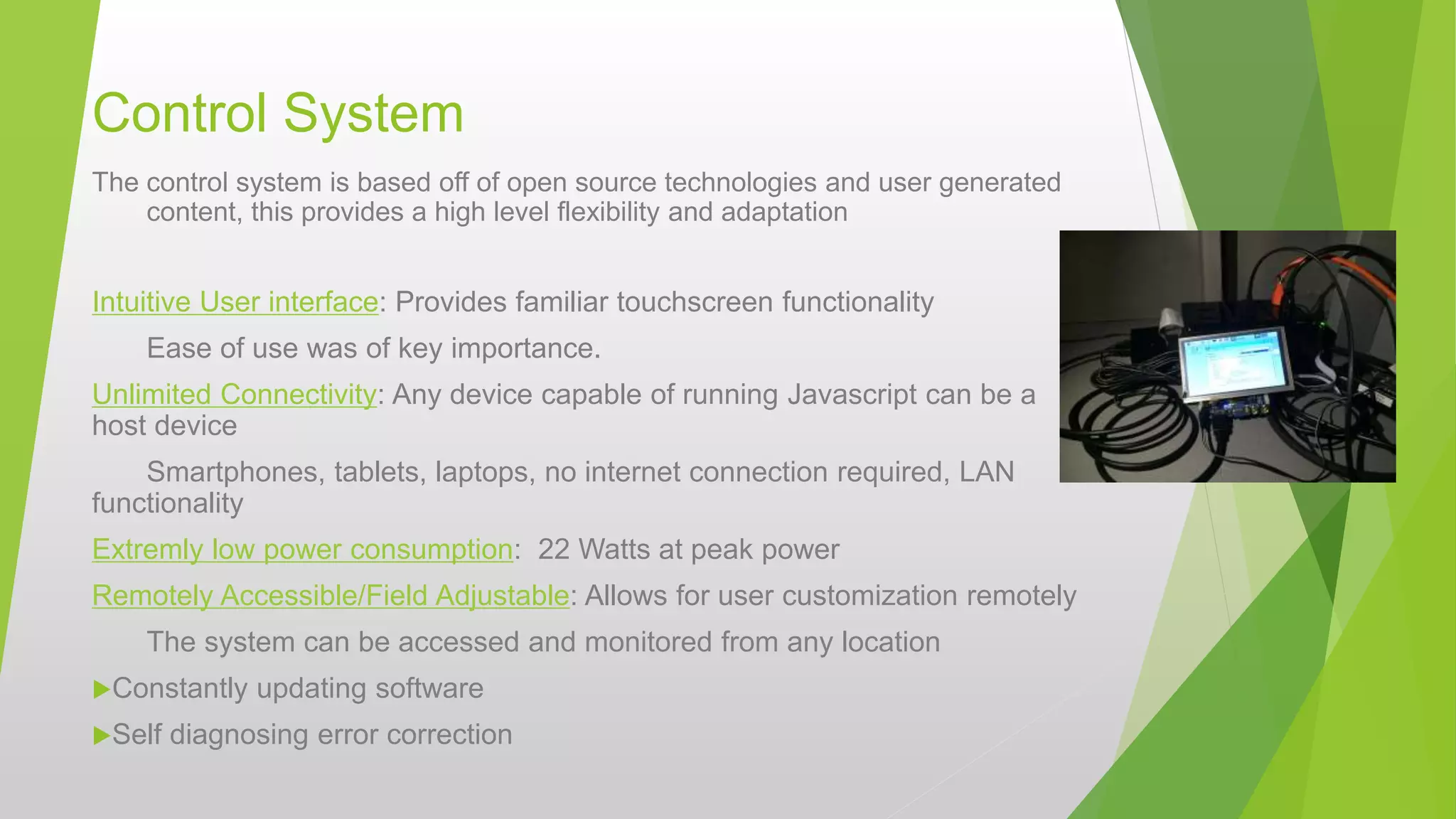
Intuitive User interface: Provides familiar touchscreen functionality
Ease of use was of key importance.
Unlimited Connectivity: Any device capable of running Javascript can be a
host device
Smartphones, tablets, laptops, no internet connection required, LAN
functionality
Extremly low power consumption: 22 Watts at peak power
Remotely Accessible/Field Adjustable: Allows for user customization remotely
The system can be accessed and monitored from any location
Constantly updating software
Self diagnosing error correction
Expandability
 Rapid Cooling
 Scheduled persistent cooling
 Sustained temperature control
 Hysteresis to maintain efficiency and control
 Reducing Comfort Priority
 Based on user activity
 Reduce cooling load to save power
 Monitor Sleep patterns to assess comfort level
 Can be coupled with existing API to develop new ways of approaching
efficiency
 Increase cooling load before user wakes up
 Provides added comfort when user is aware
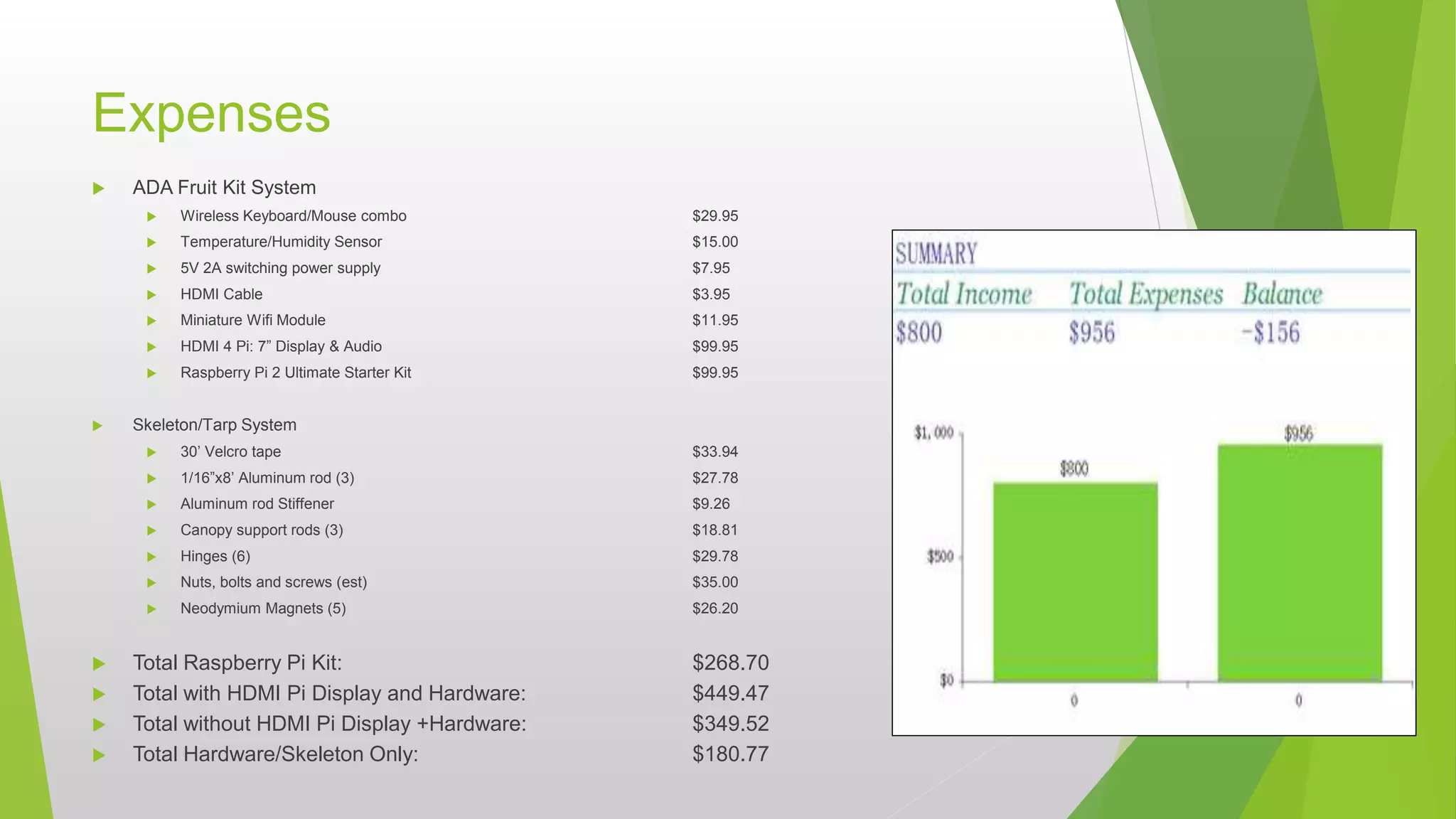
Expenses
 ADA Fruit Kit System
 Wireless Keyboard/Mouse combo $29.95
 Temperature/Humidity Sensor $15.00
 5V 2A switching power supply $7.95
 HDMI Cable $3.95
 Miniature Wifi Module $11.95
 HDMI 4 Pi: 7” Display & Audio $99.95
 Raspberry Pi 2 Ultimate Starter Kit $99.95
 Skeleton/Tarp System
 30’ Velcro tape $33.94
 1/16”x8’ Aluminum rod (3) $27.78
 Aluminum rod Stiffener $9.26
 Canopy support rods (3) $18.81
 Hinges (6) $29.78
 Nuts, bolts and screws (est) $35.00
 Neodymium Magnets (5) $26.20
 Total Raspberry Pi Kit: $268.70
 Total with HDMI Pi Display and Hardware: $449.47
 Total without HDMI Pi Display +Hardware: $349.52
 Total Hardware/Skeleton Only: $180.77
Future Opportunities for Improvements
 Remove air leakage (utilize bulb seal)
 Make skeleton out of molded plastic (lighter)
 More testing (with a live sleeper)
 New material for the frame (custom molded for
manufacturing)
 Improve strut strength
 Test Raspberry Pi with an actual Peterbilt AC
unit

Final Presentation

  • 1.
    Isolated Air ConditioningSystem Taylor Bontz Josiah Bujanda Christopher Hubbard Adam Mengestab Edgar Vazquez Faculty Advisor: Dr. Yong X Tao Industry Sponsor: Peterbilt
  • 2.
    Abstract/Objective  Total fuelused by idling trucks: estimated at over 2 billion gallons/year  Currently 3.5 million truckers on the road  Each requiring 10 hours of rest per day.  To regulate comfort, drivers currently have limited options  Leave the truck on all night  Deal with the intense heat/cold  Rising costs in fuel, as well as the emphasis on green energy  Our solution:  Create a canopy system that dramatically reduces the overall area that a truck’s AC has to cool.  Quicken cooling times while also entrapping cool air
  • 3.
    Inspiration  Our approach: Inspired by the capsule hotel designs; very popular in countries like Japan  Containing cool air while also improving the overall sleeping experience, without interfering with the original functionality of the sleeper.  Identical wall dimensions  A retractable, portable hotel experience
  • 4.
    CAD Drawing Old Design NewDesign Old design problems: - 2nd layer tarp difficult to keep rigid - Rail system expensive - Skeleton structure material expensive
  • 5.
    Materials  Hollow 6061aluminum rods for the skeleton  Rigid, strong material (yield strength 55 Mpa)  Light weight (1/16” hollow rods, 1lb./ft.)  Inexpensive  ½” Thick, insulated tarp  Outer cover: 12 mm poly  ½” cell foam insolation  R value: 3.25  K value: .003908  Lightweight (8 lbs.)  Total weight of material (minus bolts and screws) 32 pounds
  • 6.
    Skeleton  3 hollowsquare rods  Minimize weight while allowing appropriate level of strength and support  Metal attaching rods to hold tarp shape  Simple door hinge attachments  Allow top skeleton system to lift vertically  Allows lower skeleton system to bend inward & out of the way  Structure should not interfere with television, lifting bed or any doors.
  • 7.
    Struts  Two strutsadd 24 lbs. of lift each  The tarp friction of the bed prevents complete lift, but keeps the skeleton stable and provides ease of use.
  • 8.
    Magnets  Also forease of use, a series of Neodymium mountable magnets were installed Material: NdFeB, Grade N42 Plating/Coating: Ni-Cu-Ni (Nickel) Magnetization Direction: Thru Thickness Weight: 0.63 oz. (17.92 g) Pull Force: 26.75 lbs Brmax: 13,200 Gauss BHmax: 42 MGOe  Ensures upper skeleton snaps into place  Eases transition to close skeleton (left)  Mounted magnets (right) snap skeleton into place
  • 9.
  • 10.
    Velcro  We linedthe skeleton and inside of the tarp with Velcro for easy removal  For safety reasons, the canopy was not allowed to interfere with the functionality of the bed safety netting.  The easy removability of the tarp will ensure no interference with the netting, or any other safety features inside the sleeper.
  • 11.
  • 12.
    HVAC Design  Useda window A/C unit  Cooling Capacity: 3516 W (12000 Btu/hr)  Cooling Load Approx 500 W Peterbilt has a 700 W A/C unit available for use.  Exit Air Temp: 16°C  Air Speed: 4.5 m/s at vent  Volumetric Flow Rate: 0.2757 m3/s
  • 13.
  • 14.
    Energy Analysis  Theamount of energy required to cool air can by calculated by  𝑄 = 𝜌𝑉𝑐∆𝑇  𝑄𝑙𝑎𝑟𝑔𝑒 = 206kJ  𝑄𝑠𝑚𝑎𝑙𝑙 = 41.2kJ  80% difference
  • 15.
    Energy Analysis  Thesum of the loads when multiplied by time can be used to replace the total energy used to cause an updated change in temperature  𝑞 + 𝑃 𝑡 = 𝜌𝑉𝑐 𝑇𝑖0 − 𝑇𝑖  P represents the cooling load (1758 W) assuming constant load  q represents the heat rate through the tarp and is calculated using the instantaneous temperatures and the properties of the tarp by using the Equivalent Resistance Method
  • 16.
    Energy Analysis  Theequations can be rearranged to solve for instantaneous inside temperature  𝑇𝑖 𝑡 = 𝑇∞1 𝑡/𝑅 𝑡𝑜𝑡 𝑡 𝑅 𝑡𝑜𝑡 −𝑚𝑐 − 𝑃𝑡 𝑡 𝑅 𝑡𝑜𝑡 −𝑚𝑐 − 𝑚𝑐𝑇 𝑖0 𝑡 𝑅 𝑡𝑜𝑡 −𝑚𝑐  Works in ideal conditions
  • 17.
    Testing  Temperature droppedat a significantly slower rate than in ideal situation  The practical drop from 23.5 C to 19 C took approximately 13 minutes vs the 3 minute theoretical drop  Primary reason is escaped cool air.  Theoretically, the percent difference is still significant if not the same when losses are considered.
  • 18.
  • 19.
  • 20.
    Why Automation?  Providesfunctionality and flexibility  Real time monitoring system, data analysis  Improve comfort levels while reducing energy loads  Cost effective  Create a database of information, for processing, analyzing, and improving  Ease of use and high level of compatibility with existing infrastructure
  • 21.
    Control System The controlsystem is based off of open source technologies and user generated content, this provides a high level flexibility and adaptation Raspberry Pi: Micro computer with micro controller inputs and outputs Controls Relays through low voltage output, 5V coil activation Mechanical Relays: 8 Channel 10A 250VAC relays Switch a variety of loads, with built in circuit protection, and notification system Custom Webserver: Secure, versatile, and can be modified to suit need The webserver handles data requests and can be used for scheduling, monitoring, and future additions Quick to deploy Cost Effective Uses existing technologies and infrastructure
  • 22.
    Control System The controlsystem is based off of open source technologies and user generated content, this provides a high level flexibility and adaptation Intuitive User interface: Provides familiar touchscreen functionality Ease of use was of key importance. Unlimited Connectivity: Any device capable of running Javascript can be a host device Smartphones, tablets, laptops, no internet connection required, LAN functionality Extremly low power consumption: 22 Watts at peak power Remotely Accessible/Field Adjustable: Allows for user customization remotely The system can be accessed and monitored from any location Constantly updating software Self diagnosing error correction
  • 23.
    Expandability  Rapid Cooling Scheduled persistent cooling  Sustained temperature control  Hysteresis to maintain efficiency and control  Reducing Comfort Priority  Based on user activity  Reduce cooling load to save power  Monitor Sleep patterns to assess comfort level  Can be coupled with existing API to develop new ways of approaching efficiency  Increase cooling load before user wakes up  Provides added comfort when user is aware
  • 24.
    Expenses  ADA FruitKit System  Wireless Keyboard/Mouse combo $29.95  Temperature/Humidity Sensor $15.00  5V 2A switching power supply $7.95  HDMI Cable $3.95  Miniature Wifi Module $11.95  HDMI 4 Pi: 7” Display & Audio $99.95  Raspberry Pi 2 Ultimate Starter Kit $99.95  Skeleton/Tarp System  30’ Velcro tape $33.94  1/16”x8’ Aluminum rod (3) $27.78  Aluminum rod Stiffener $9.26  Canopy support rods (3) $18.81  Hinges (6) $29.78  Nuts, bolts and screws (est) $35.00  Neodymium Magnets (5) $26.20  Total Raspberry Pi Kit: $268.70  Total with HDMI Pi Display and Hardware: $449.47  Total without HDMI Pi Display +Hardware: $349.52  Total Hardware/Skeleton Only: $180.77
  • 25.
    Future Opportunities forImprovements  Remove air leakage (utilize bulb seal)  Make skeleton out of molded plastic (lighter)  More testing (with a live sleeper)  New material for the frame (custom molded for manufacturing)  Improve strut strength  Test Raspberry Pi with an actual Peterbilt AC unit