NPRC
Within establishments in the UK where research on
animals is conducted, there must be a named person
responsible for compliance (NPRC).
This is especially so where the establishment licence
holder is a corporate entity.
This role was previously termed the Certificate
Holder prior to January 2013, but was changed due
to transition of the EU Directive. The NPRC is now
termed the Procedure Establishment Licence
Holder (PEL) or Compliance Officer.
NPCR/PEL Roles and Responsibilities
Establish and maintain an AWERB within the
establishment
Have suitable systems in place to prevent unauthorised
procedures
Staffing and animal accommodation
Appoint suitable named persons and be responsible for
their conduct
NPCR/PEL Roles and Responsibilities
Maintain suitable records of animal source, use and disposal
Arrange appropriate and mandatory identification of animals
according to species held in the establishment
Maintain a Register of individuals competent to humanely kill
animals
Pay the annual fees to the Home Office for both the Establishment
Licence, and all Personal Licences
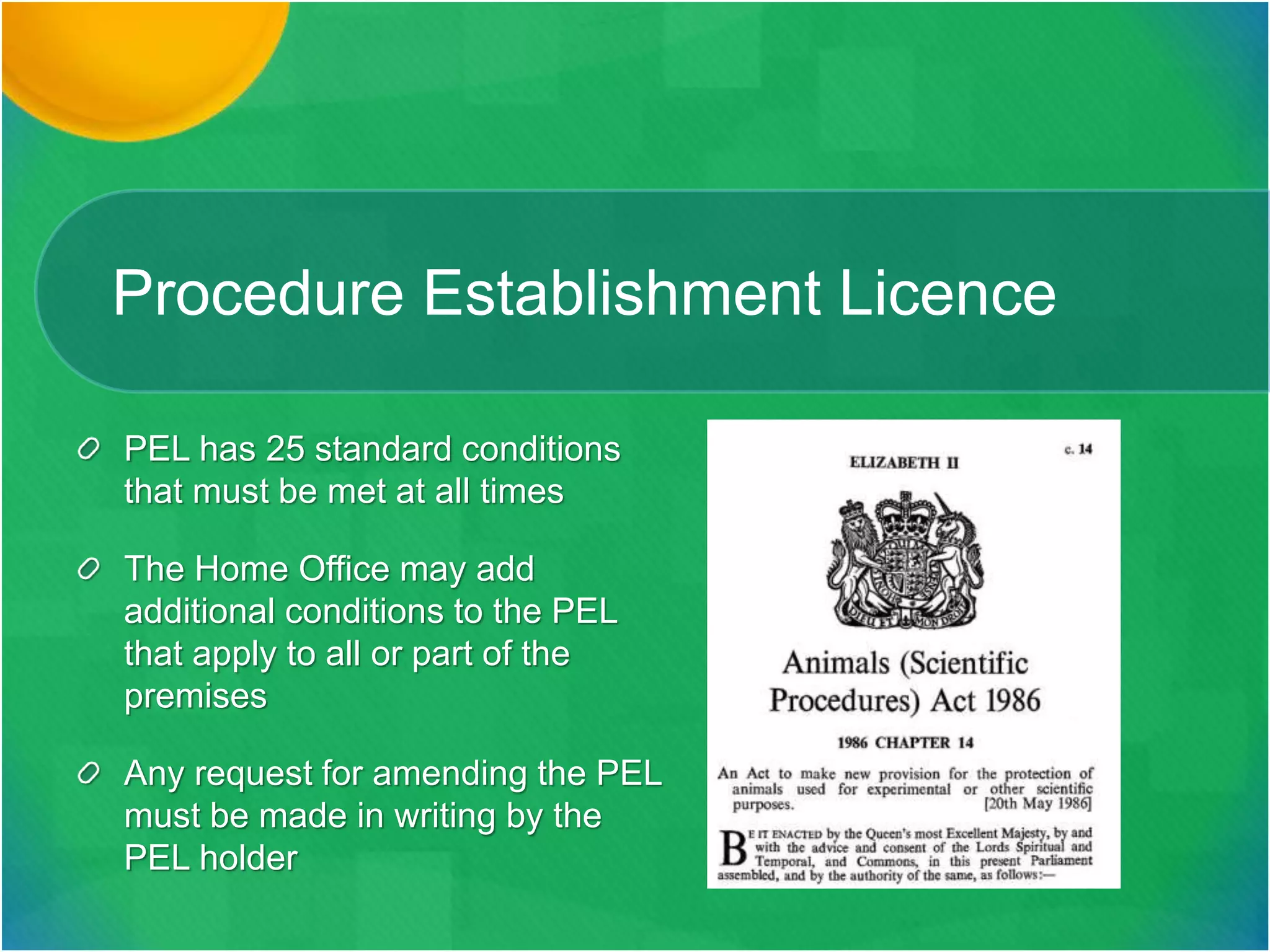
Procedure Establishment Licence
PEL has 25 standard conditions
that must be met at all times
The Home Office may add
additional conditions to the PEL
that apply to all or part of the
premises
Any request for amending the PEL
must be made in writing by the
PEL holder
Named Persons
ASPA requires the Procedure Establishment Licence
Holder to nominate various Named Persons. These
individual roles are:
Named Animal Care and Welfare Officer (NACWO)
Named Veterinary Surgeon (NVS)
Named Information Officer (NIO)
Named Training & Competency Officer (NTCO)
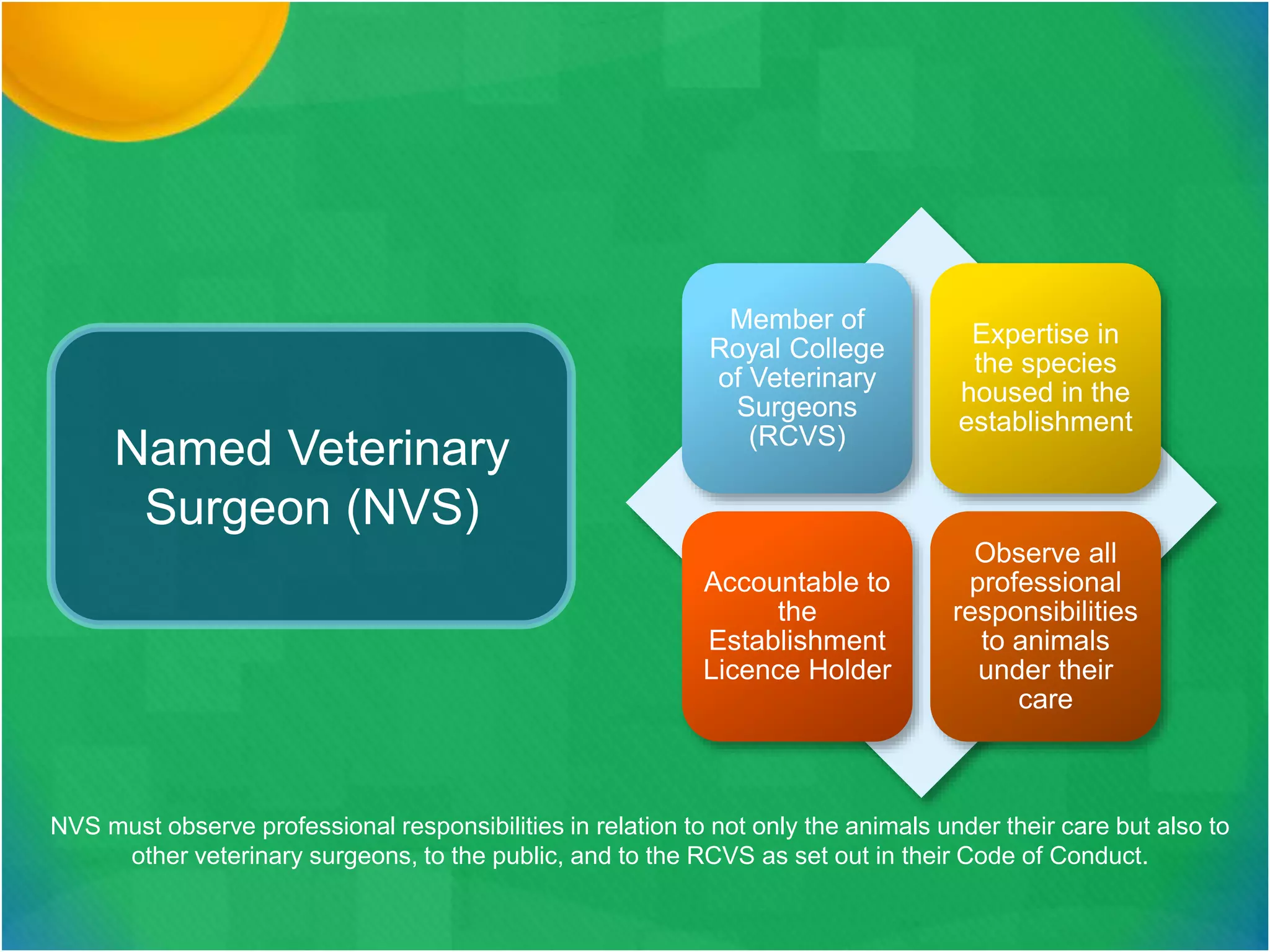
Named Veterinary
Surgeon (NVS)
Member of
Royal College
of Veterinary
Surgeons
(RCVS)
Expertise in
the species
housed in the
establishment
Accountable to
the
Establishment
Licence Holder
Observe all
professional
responsibilities
to animals
under their
care
NVS must observe professional responsibilities in relation to not only the animals under their care but also to
other veterinary surgeons, to the public, and to the RCVS as set out in their Code of Conduct.
RCVS Register
The RCVS maintains a register of veterinary
surgeons holding specialist and higher
qualifications and maintains a Register of
Members which can be searched by location on
the RCVS website:
http://findavet.rcvs.org.uk/check-the-registers/
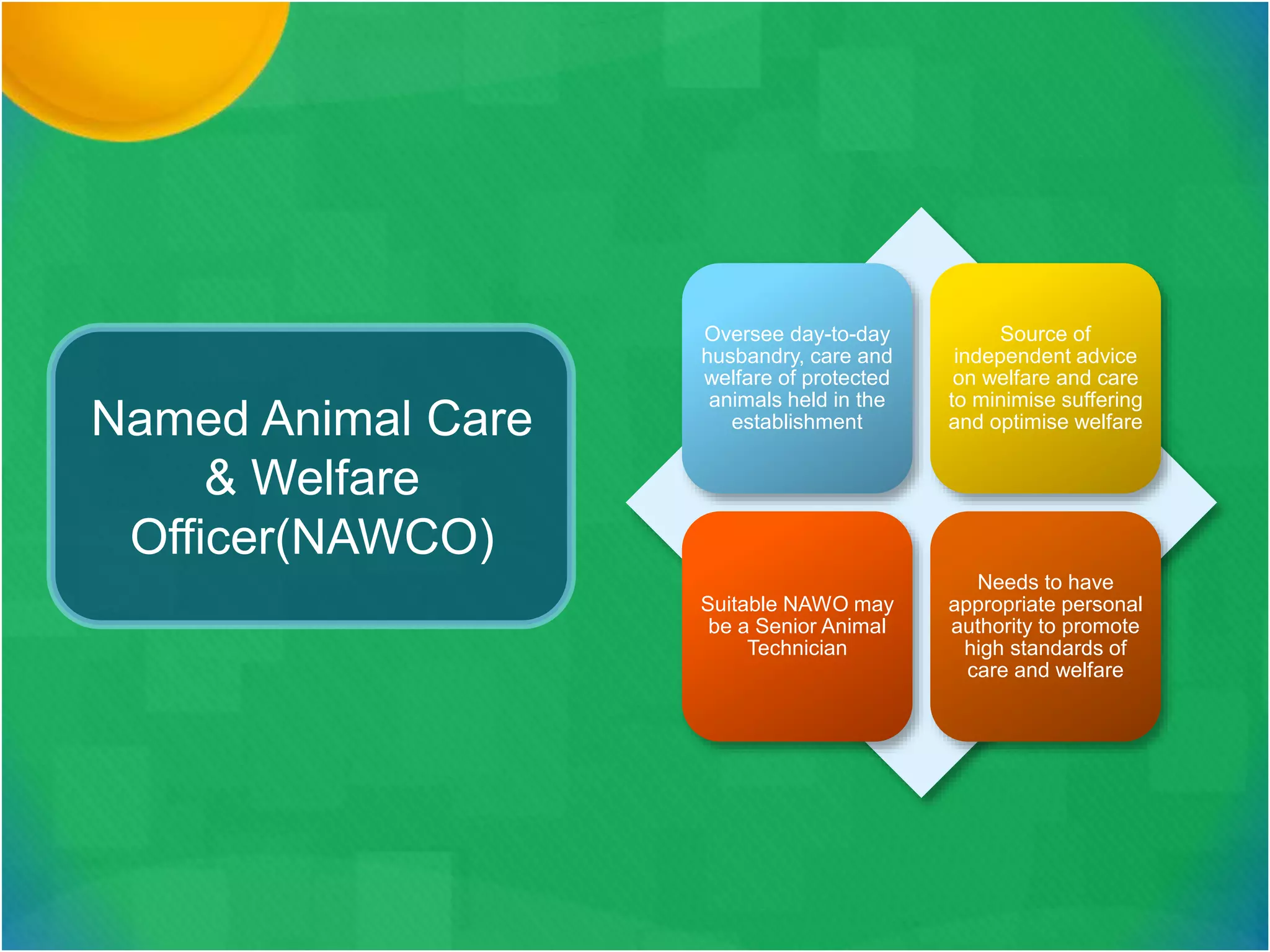
Named Animal Care
& Welfare
Officer(NAWCO)
Oversee day-to-day
husbandry, care and
welfare of protected
animals held in the
establishment
Source of
independent advice
on welfare and care
to minimise suffering
and optimise welfare
Suitable NAWO may
be a Senior Animal
Technician
Needs to have
appropriate personal
authority to promote
high standards of
care and welfare
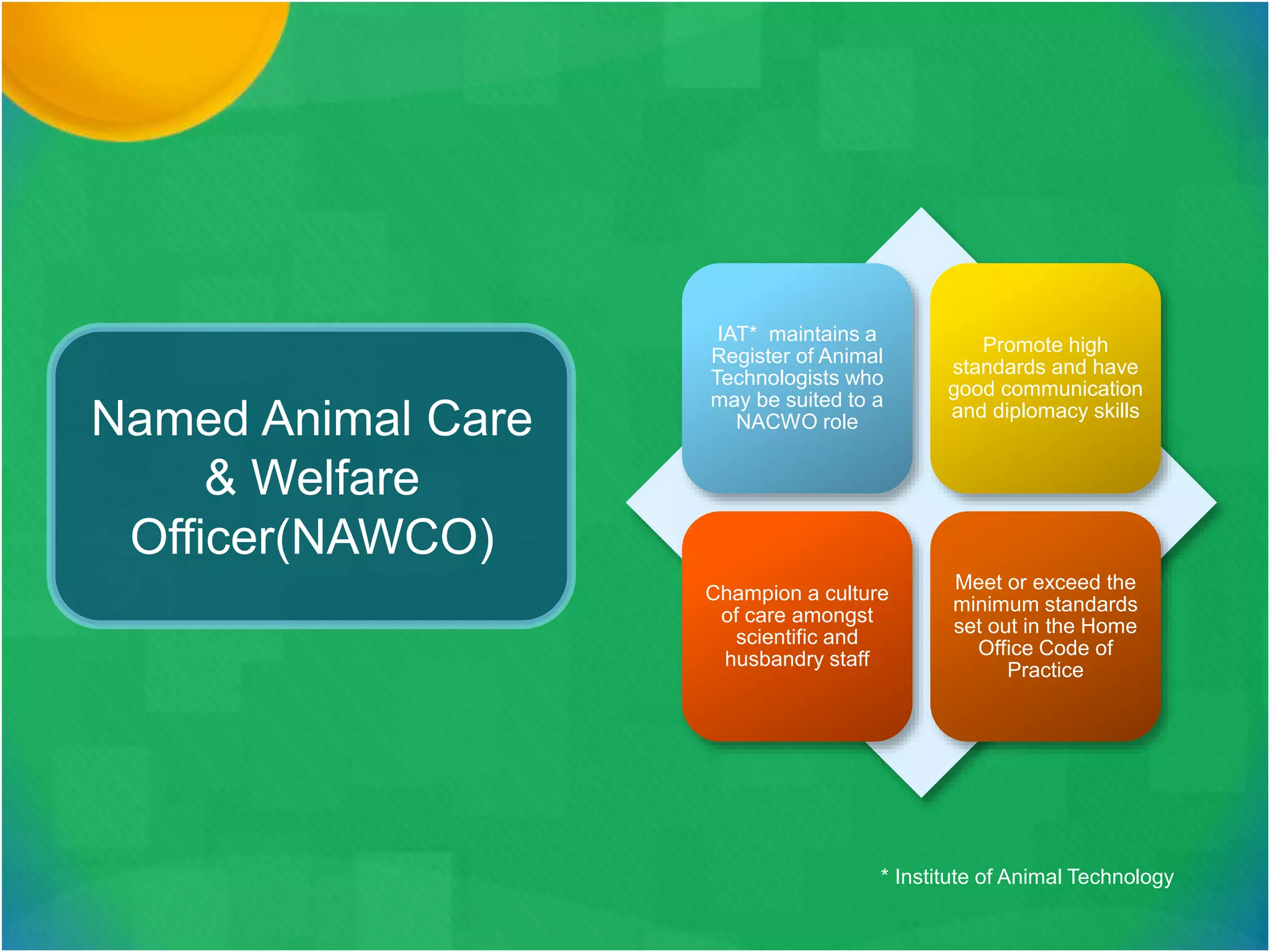
Named Animal Care
& Welfare
Officer(NAWCO)
IAT* maintains a
Register of Animal
Technologists who
may be suited to a
NACWO role
Promote high
standards and have
good communication
and diplomacy skills
Champion a culture
of care amongst
scientific and
husbandry staff
Meet or exceed the
minimum standards
set out in the Home
Office Code of
Practice
* Institute of Animal Technology
NACWO Role
Be familiar with the main provisions of ASPA
Have up-to-date knowledge and experience of relevant animal
technology and a thorough knowledge of the husbandry and welfare
needs of the species kept in the establishment
Be aware of the standards of care, accommodation, husbandry and
welfare set out in the Code of Practice and take appropriate steps to
develop and maintain high standards of care and husbandry
appropriate to the species
Know about relevant methods of humane killing listed in ASPA
Schedule 1 and any additional approved methods specified on the
establishment licence, and either be competent in their use or be able
to contact others, who are named on the establishment’s register of
qualified persons
NACWO Role
Be able to recognise the signs of pain, suffering, distress or lasting harm in the
species for which you care and ensure that there is available expertise to
monitor all animals to recognise any variation from normal health and
behaviour
Know which areas of the establishment are listed in the ‘Schedule of
Premises’ on the establishment licence
Establish a system to ensure that a competent person sees and checks every
animal kept in an approved holding area at least once daily
Know how to contact, at any time, the Named Veterinary Surgeon or their
deputy, and the establishment licence holder or their nominee. At user
establishments the NACWO should also know how to contact project and
personal licence holders
NACWO Role
Pro-actively, working with the NVS as appropriate, promote implementation
of refinements in animal care, husbandry and use
Be familiar with the main provisions of project licences, particularly the
adverse effects expected for each protocol, the control measures and
humane end-points specified and the methods of killing specified in licences
Champion a culture of care at the establishment acting as a role model for all
those who care for, and use, animals
Help the establishment licence holder to keep suitable records of the health
of the animals (under the supervision of the Named Veterinary Surgeon); of
the environmental conditions in the approved areas in which animals are
held; and of the source and disposal of animals
NACWO Role
The NAWCO must be an active member of the AWERB at the establishment, and advise applicants for
licences, and licence holders on practical opportunities for implementing the 3Rs. (At least one NACWO at
the establishment must be a full member of the AWERB).
If the health or welfare of an animal is giving cause for concern the NAWCO must tell the personal
licence holder who is responsible for the welfare of that animal. If that person is unavailable, they must
ensure that the animal is cared for, and, if necessary, that it is humanely killed using a Schedule 1
method, or another method approved in the establishment licence as per ASPA section 2C(7). If they
have any doubt about what they should do, they should contact the Named Veterinary Surgeon or the
assigned inspector as per ASPA section 2C(8).
Where a NACWO is also a project licence holder or a personal licence holder, another person should be
nominated to fulfill the role of NACWO for providing advice on the welfare of animals being used under
that project or personal licence. Alternatively, the arrangement may be overseen by the AWERB, on
behalf of the establishment licence holder, to ensure there is no conflict of interest.
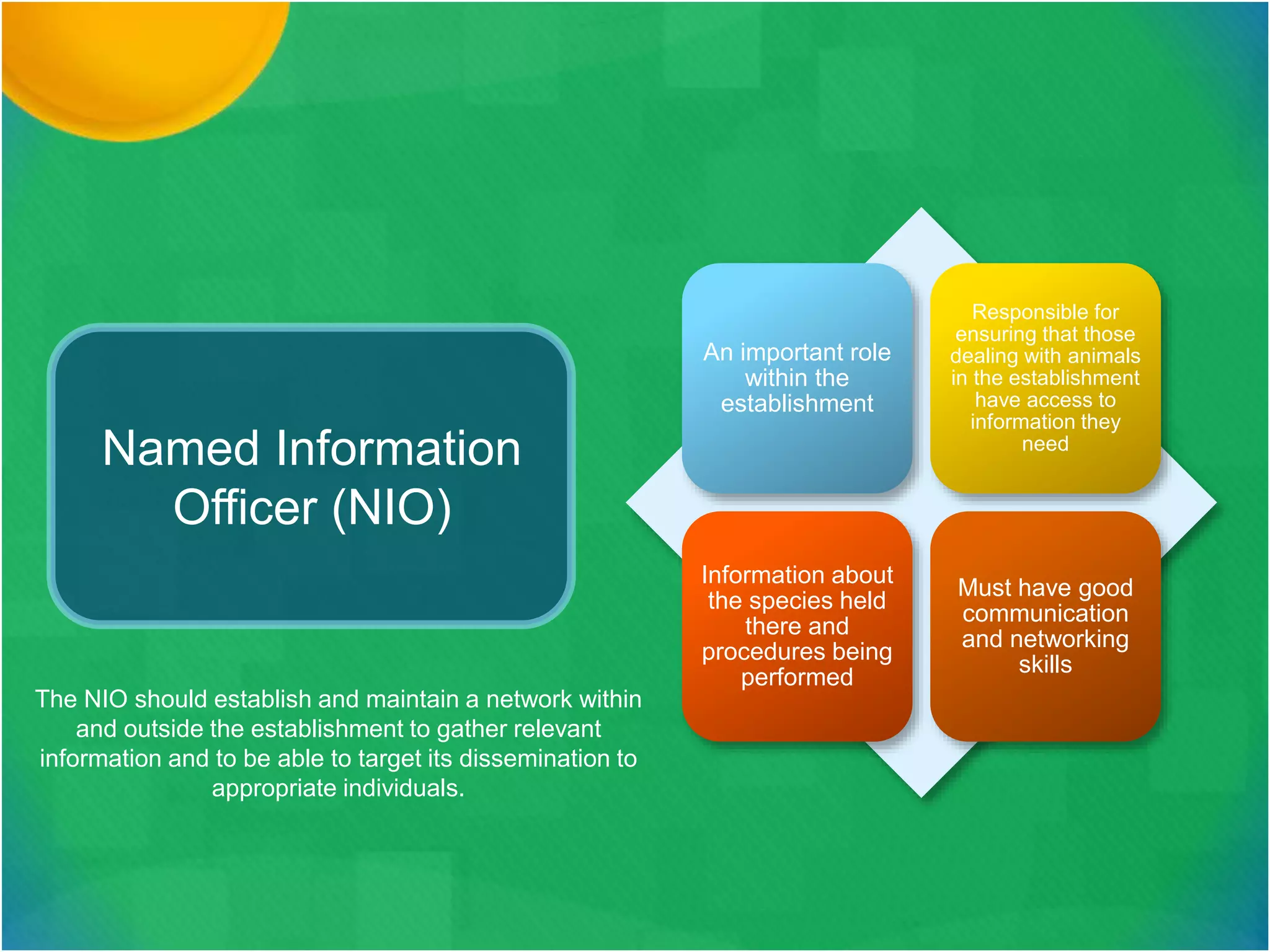
Named Information
Officer (NIO)
An important role
within the
establishment
Responsible for
ensuring that those
dealing with animals
in the establishment
have access to
information they
need
Information about
the species held
there and
procedures being
performed
Must have good
communication
and networking
skills
The NIO should establish and maintain a network within
and outside the establishment to gather relevant
information and to be able to target its dissemination to
appropriate individuals.
Named Information
Officer (NIO)
Be familiar with
the main
provisions of
ASPA
Be familiar with the
species used and
the types of
research performed
in the establishment
Proactively search
for and disseminate
relevant up-to-date
information,
including information
on implementing the
3Rs
Be a single point
of contact in the
establishment for
advice and
information
The NIO should establish and maintain a network within
and outside the establishment to gather relevant
information and to be able to target its dissemination to
appropriate individuals.
NIO Roles and Responsibilities
Have systems in place to ensure
that up-to-date information
relevant to the needs of those
dealing with animals is readily
available.
The information that is provided
may be in hard copy or electronic
format.
NIO Role
Be actively involved with, and provide advice to, the AWERB at your establishment, in particular
relating to the gathering and dissemination of information
Maintain contacts for information sharing (e.g. with the Home Office and specialist groups and
bodies such as the ASC (Animal Science Committee), LASA (Laboratory Animal Science
Association), NC3Rs (National Centre for 3Rs) and animal welfare organisations)
Maintain local contacts based, for example, on function, role and research interests in order to
be able to direct information proactively and towards relevant individuals
Assist project licence holders to secure information relevant to their projects
Provide guidance on where and how to search for relevant information
NIO Information examples
Guidance on the Act and local rules and information
Biology of the species used at the establishment
Provision of appropriate animal care and husbandry
Animal welfare and implementing the 3Rs
NIO Information examples
Relevant guiding principles for good practice (e.g. reports and other publications
produced by organisations such as the ASC (and its predecessor, the APC), LASA,
LAVA, IAT, NC3Rs, RSPCA, etc.)
New scientific initiatives, technical advances and good practice relevant to types of work
and species at the establishment
Implementing the 3Rs in ways which may encourage replacement, reduction and
refinement of the use of animals throughout the establishment
Sources of further information on any of these topics.
Named Training &
Competency Officer
(NTCO)
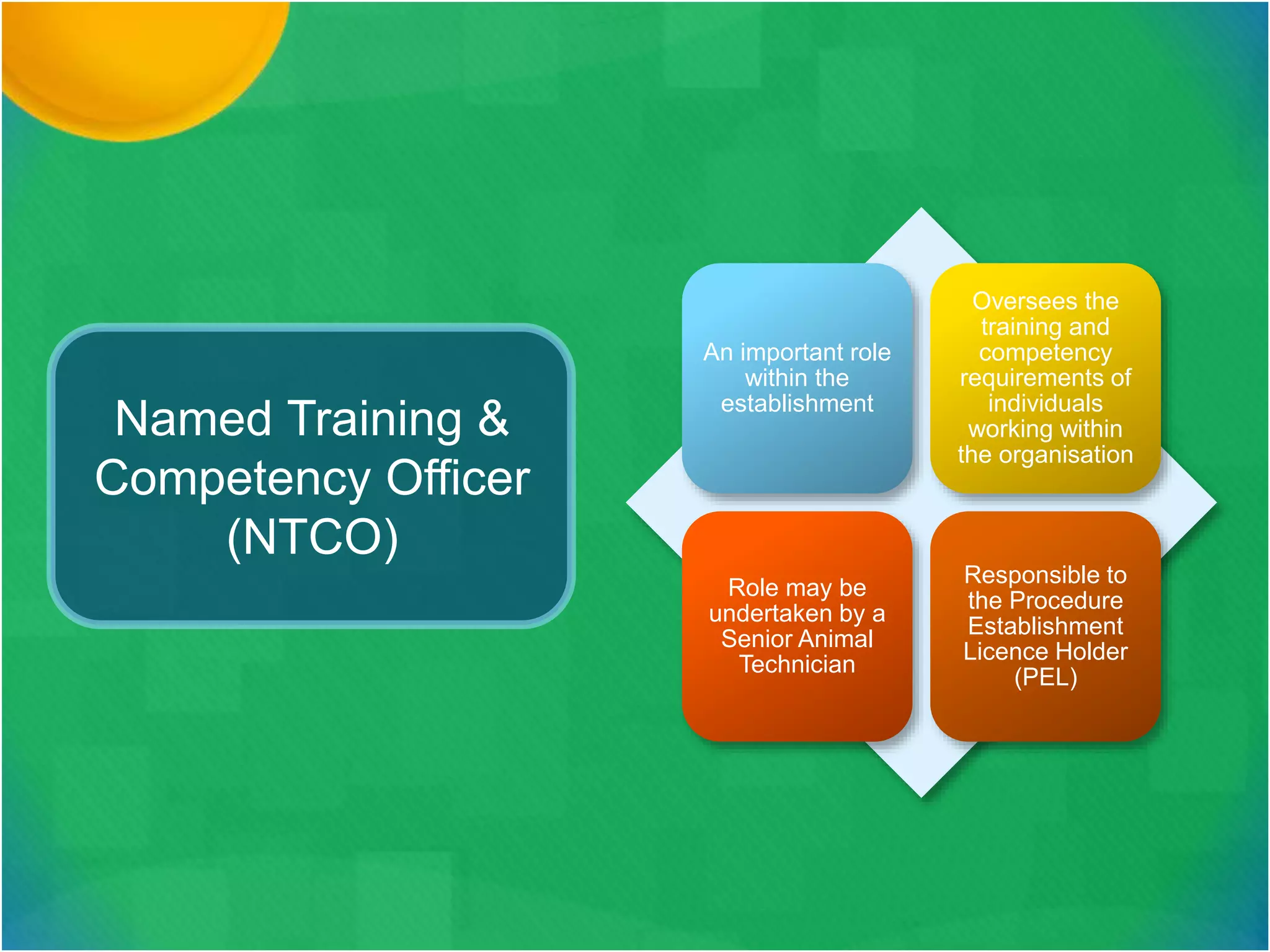
An important role
within the
establishment
Oversees the
training and
competency
requirements of
individuals
working within
the organisation
Role may be
undertaken by a
Senior Animal
Technician
Responsible to
the Procedure
Establishment
Licence Holder
(PEL)
NTCO Role
The Named Training and Competency Officer (NTCO) is responsible for
ensuring that all those dealing with animals are adequately educated,
trained and supervised until they are competent and that they continue to
undertake appropriate further training to maintain their expertise.
The role may be undertaken by a single person or by a number of people
at a large establishment.
It is important that all tasked with this role at an establishment should work
to the same principles and standards and that, where more than one
person in an establishment is an NTCO, each understands their own
individual responsibilities, e.g. for a particular animal unit, species or type
of work.
NTCO Role
The NTCO needs to be sufficiently senior to influence others and make
decisions on training issues. It is likely that this role will require significant
resource and the support of senior management.
An NTCO may or may not be directly involved in the provision of training;
their role is to oversee the process, making sure that training is taking
place, that standards are acceptable and that a consistent approach is
being adopted and delivered. NTCOs require good communication,
management and organisational skills.
An NTCO is required to endorse each application for a new or amended
personal licence which is requesting primary availability at the
establishment. However, they may not endorse their own application for a
personal licence or amendment. If the NTCO wishes to hold a personal
licence, the establishment licence holder must nominate a second NTCO
to independently endorse any applications made.
NTCO Role
Be familiar with the main provisions of ASPA
Be familiar with relevant training courses available either in-house or commercially
Ensure everyone planning to work with animals under ASPA (including non-
licensed people such as study directors, people undertaking Schedule 1 killing,
those caring for animals) at your establishment is made known to you at an early
stage in order that you can discuss their training needs with them
Advise individuals on the training they will need to have completed in order to be
issued with the licence(s) they seek and on any practical training and supervision
they will need after they have received their licence
Advise individuals how supervision and assessment of competence is managed in
the establishment
NTCO Role
Ensure provision is made for appropriate supervision to support formal training as a means
to achieve competence
Identify trainers for specialist procedures or techniques
Ensure assessment of competence is conscientiously performed and properly recorded
Ensure records, including certification, are maintained of training provided and
competence assessments for all individuals working with animals under ASPA
Set local standards for training, supervision, competence and continuing professional
development for those carrying out procedures, designing projects and studies, taking care
of and killing animals in line with national expectations
Communicate local requirements and expectations to all relevant staff;
NTCO Role
Endorse personal licence applications and applications for
amendment to a personal licence
Ensure that individuals working with animals under ASPA
participate in appropriate continuous training to supplement
their basic training; and that this is recorded as evidence that
their competence is maintained
Be familiar with the species used and types of research
performed at the establishment so that you can recommend
appropriate basic and further training courses and identify
appropriate supervisors
Develop local training and assessment records and ensure
that they are kept up to date
NTCO Role
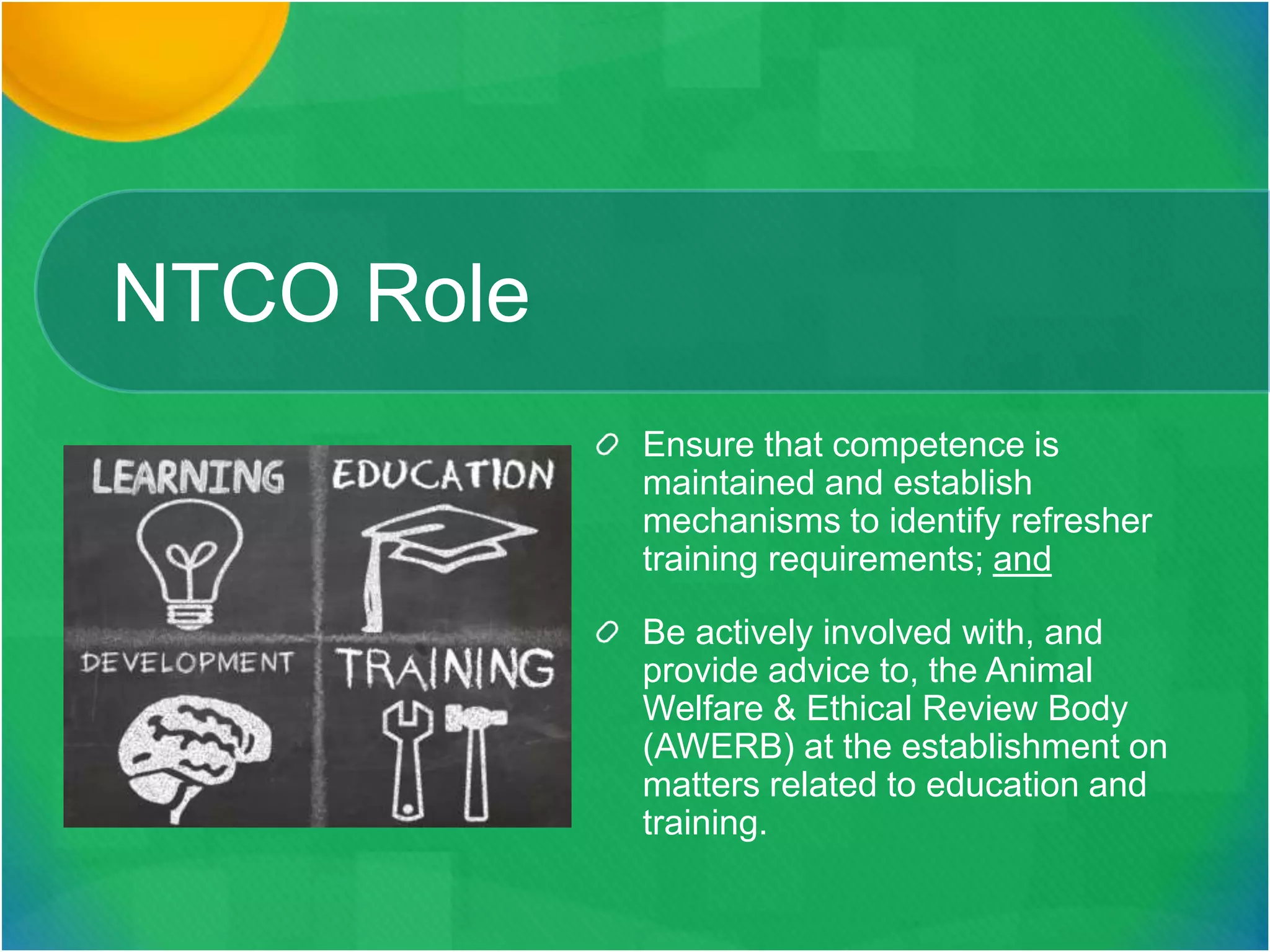
Ensure that competence is
maintained and establish
mechanisms to identify refresher
training requirements; and
Be actively involved with, and
provide advice to, the Animal
Welfare & Ethical Review Body
(AWERB) at the establishment on
matters related to education and
training.
The NTCO must be an active member of
the AWERB at the establishment, and
advise applicants for licences and licence
holders on practical opportunities for
implementing the 3Rs.
https://www.gov.uk/government/pu
blications/operation-of-aspa
Information sources
https://www.gov.uk/government/publications/operation-of-aspa
https://www.gov.uk/government/publications/consolidated-version-of-aspa-1986
https://www.gov.uk/guidance/research-and-testing-using-animals
Information sources
https://www.gov.uk/government/publications/code-of-
practice-for-the-housing-and-care-of-animals-bred-
supplied-or-used-for-scientific-purposes

Final named personsfeb2017

  • 2.
    NPRC Within establishments inthe UK where research on animals is conducted, there must be a named person responsible for compliance (NPRC). This is especially so where the establishment licence holder is a corporate entity. This role was previously termed the Certificate Holder prior to January 2013, but was changed due to transition of the EU Directive. The NPRC is now termed the Procedure Establishment Licence Holder (PEL) or Compliance Officer.
  • 3.
    NPCR/PEL Roles andResponsibilities Establish and maintain an AWERB within the establishment Have suitable systems in place to prevent unauthorised procedures Staffing and animal accommodation Appoint suitable named persons and be responsible for their conduct
  • 4.
    NPCR/PEL Roles andResponsibilities Maintain suitable records of animal source, use and disposal Arrange appropriate and mandatory identification of animals according to species held in the establishment Maintain a Register of individuals competent to humanely kill animals Pay the annual fees to the Home Office for both the Establishment Licence, and all Personal Licences
  • 5.
    Procedure Establishment Licence PELhas 25 standard conditions that must be met at all times The Home Office may add additional conditions to the PEL that apply to all or part of the premises Any request for amending the PEL must be made in writing by the PEL holder
  • 6.
    Named Persons ASPA requiresthe Procedure Establishment Licence Holder to nominate various Named Persons. These individual roles are: Named Animal Care and Welfare Officer (NACWO) Named Veterinary Surgeon (NVS) Named Information Officer (NIO) Named Training & Competency Officer (NTCO)
  • 8.
    Named Veterinary Surgeon (NVS) Memberof Royal College of Veterinary Surgeons (RCVS) Expertise in the species housed in the establishment Accountable to the Establishment Licence Holder Observe all professional responsibilities to animals under their care NVS must observe professional responsibilities in relation to not only the animals under their care but also to other veterinary surgeons, to the public, and to the RCVS as set out in their Code of Conduct.
  • 9.
    RCVS Register The RCVSmaintains a register of veterinary surgeons holding specialist and higher qualifications and maintains a Register of Members which can be searched by location on the RCVS website: http://findavet.rcvs.org.uk/check-the-registers/
  • 11.
    Named Animal Care &Welfare Officer(NAWCO) Oversee day-to-day husbandry, care and welfare of protected animals held in the establishment Source of independent advice on welfare and care to minimise suffering and optimise welfare Suitable NAWO may be a Senior Animal Technician Needs to have appropriate personal authority to promote high standards of care and welfare
  • 12.
    Named Animal Care &Welfare Officer(NAWCO) IAT* maintains a Register of Animal Technologists who may be suited to a NACWO role Promote high standards and have good communication and diplomacy skills Champion a culture of care amongst scientific and husbandry staff Meet or exceed the minimum standards set out in the Home Office Code of Practice * Institute of Animal Technology
  • 13.
    NACWO Role Be familiarwith the main provisions of ASPA Have up-to-date knowledge and experience of relevant animal technology and a thorough knowledge of the husbandry and welfare needs of the species kept in the establishment Be aware of the standards of care, accommodation, husbandry and welfare set out in the Code of Practice and take appropriate steps to develop and maintain high standards of care and husbandry appropriate to the species Know about relevant methods of humane killing listed in ASPA Schedule 1 and any additional approved methods specified on the establishment licence, and either be competent in their use or be able to contact others, who are named on the establishment’s register of qualified persons
  • 14.
    NACWO Role Be ableto recognise the signs of pain, suffering, distress or lasting harm in the species for which you care and ensure that there is available expertise to monitor all animals to recognise any variation from normal health and behaviour Know which areas of the establishment are listed in the ‘Schedule of Premises’ on the establishment licence Establish a system to ensure that a competent person sees and checks every animal kept in an approved holding area at least once daily Know how to contact, at any time, the Named Veterinary Surgeon or their deputy, and the establishment licence holder or their nominee. At user establishments the NACWO should also know how to contact project and personal licence holders
  • 15.
    NACWO Role Pro-actively, workingwith the NVS as appropriate, promote implementation of refinements in animal care, husbandry and use Be familiar with the main provisions of project licences, particularly the adverse effects expected for each protocol, the control measures and humane end-points specified and the methods of killing specified in licences Champion a culture of care at the establishment acting as a role model for all those who care for, and use, animals Help the establishment licence holder to keep suitable records of the health of the animals (under the supervision of the Named Veterinary Surgeon); of the environmental conditions in the approved areas in which animals are held; and of the source and disposal of animals
  • 16.
    NACWO Role The NAWCOmust be an active member of the AWERB at the establishment, and advise applicants for licences, and licence holders on practical opportunities for implementing the 3Rs. (At least one NACWO at the establishment must be a full member of the AWERB). If the health or welfare of an animal is giving cause for concern the NAWCO must tell the personal licence holder who is responsible for the welfare of that animal. If that person is unavailable, they must ensure that the animal is cared for, and, if necessary, that it is humanely killed using a Schedule 1 method, or another method approved in the establishment licence as per ASPA section 2C(7). If they have any doubt about what they should do, they should contact the Named Veterinary Surgeon or the assigned inspector as per ASPA section 2C(8). Where a NACWO is also a project licence holder or a personal licence holder, another person should be nominated to fulfill the role of NACWO for providing advice on the welfare of animals being used under that project or personal licence. Alternatively, the arrangement may be overseen by the AWERB, on behalf of the establishment licence holder, to ensure there is no conflict of interest.
  • 17.
    Named Information Officer (NIO) Animportant role within the establishment Responsible for ensuring that those dealing with animals in the establishment have access to information they need Information about the species held there and procedures being performed Must have good communication and networking skills The NIO should establish and maintain a network within and outside the establishment to gather relevant information and to be able to target its dissemination to appropriate individuals.
  • 18.
    Named Information Officer (NIO) Befamiliar with the main provisions of ASPA Be familiar with the species used and the types of research performed in the establishment Proactively search for and disseminate relevant up-to-date information, including information on implementing the 3Rs Be a single point of contact in the establishment for advice and information The NIO should establish and maintain a network within and outside the establishment to gather relevant information and to be able to target its dissemination to appropriate individuals.
  • 19.
    NIO Roles andResponsibilities Have systems in place to ensure that up-to-date information relevant to the needs of those dealing with animals is readily available. The information that is provided may be in hard copy or electronic format.
  • 20.
    NIO Role Be activelyinvolved with, and provide advice to, the AWERB at your establishment, in particular relating to the gathering and dissemination of information Maintain contacts for information sharing (e.g. with the Home Office and specialist groups and bodies such as the ASC (Animal Science Committee), LASA (Laboratory Animal Science Association), NC3Rs (National Centre for 3Rs) and animal welfare organisations) Maintain local contacts based, for example, on function, role and research interests in order to be able to direct information proactively and towards relevant individuals Assist project licence holders to secure information relevant to their projects Provide guidance on where and how to search for relevant information
  • 21.
    NIO Information examples Guidanceon the Act and local rules and information Biology of the species used at the establishment Provision of appropriate animal care and husbandry Animal welfare and implementing the 3Rs
  • 22.
    NIO Information examples Relevantguiding principles for good practice (e.g. reports and other publications produced by organisations such as the ASC (and its predecessor, the APC), LASA, LAVA, IAT, NC3Rs, RSPCA, etc.) New scientific initiatives, technical advances and good practice relevant to types of work and species at the establishment Implementing the 3Rs in ways which may encourage replacement, reduction and refinement of the use of animals throughout the establishment Sources of further information on any of these topics.
  • 23.
    Named Training & CompetencyOfficer (NTCO) An important role within the establishment Oversees the training and competency requirements of individuals working within the organisation Role may be undertaken by a Senior Animal Technician Responsible to the Procedure Establishment Licence Holder (PEL)
  • 24.
    NTCO Role The NamedTraining and Competency Officer (NTCO) is responsible for ensuring that all those dealing with animals are adequately educated, trained and supervised until they are competent and that they continue to undertake appropriate further training to maintain their expertise. The role may be undertaken by a single person or by a number of people at a large establishment. It is important that all tasked with this role at an establishment should work to the same principles and standards and that, where more than one person in an establishment is an NTCO, each understands their own individual responsibilities, e.g. for a particular animal unit, species or type of work.
  • 25.
    NTCO Role The NTCOneeds to be sufficiently senior to influence others and make decisions on training issues. It is likely that this role will require significant resource and the support of senior management. An NTCO may or may not be directly involved in the provision of training; their role is to oversee the process, making sure that training is taking place, that standards are acceptable and that a consistent approach is being adopted and delivered. NTCOs require good communication, management and organisational skills. An NTCO is required to endorse each application for a new or amended personal licence which is requesting primary availability at the establishment. However, they may not endorse their own application for a personal licence or amendment. If the NTCO wishes to hold a personal licence, the establishment licence holder must nominate a second NTCO to independently endorse any applications made.
  • 26.
    NTCO Role Be familiarwith the main provisions of ASPA Be familiar with relevant training courses available either in-house or commercially Ensure everyone planning to work with animals under ASPA (including non- licensed people such as study directors, people undertaking Schedule 1 killing, those caring for animals) at your establishment is made known to you at an early stage in order that you can discuss their training needs with them Advise individuals on the training they will need to have completed in order to be issued with the licence(s) they seek and on any practical training and supervision they will need after they have received their licence Advise individuals how supervision and assessment of competence is managed in the establishment
  • 27.
    NTCO Role Ensure provisionis made for appropriate supervision to support formal training as a means to achieve competence Identify trainers for specialist procedures or techniques Ensure assessment of competence is conscientiously performed and properly recorded Ensure records, including certification, are maintained of training provided and competence assessments for all individuals working with animals under ASPA Set local standards for training, supervision, competence and continuing professional development for those carrying out procedures, designing projects and studies, taking care of and killing animals in line with national expectations Communicate local requirements and expectations to all relevant staff;
  • 28.
    NTCO Role Endorse personallicence applications and applications for amendment to a personal licence Ensure that individuals working with animals under ASPA participate in appropriate continuous training to supplement their basic training; and that this is recorded as evidence that their competence is maintained Be familiar with the species used and types of research performed at the establishment so that you can recommend appropriate basic and further training courses and identify appropriate supervisors Develop local training and assessment records and ensure that they are kept up to date
  • 29.
    NTCO Role Ensure thatcompetence is maintained and establish mechanisms to identify refresher training requirements; and Be actively involved with, and provide advice to, the Animal Welfare & Ethical Review Body (AWERB) at the establishment on matters related to education and training.
  • 30.
    The NTCO mustbe an active member of the AWERB at the establishment, and advise applicants for licences and licence holders on practical opportunities for implementing the 3Rs. https://www.gov.uk/government/pu blications/operation-of-aspa
  • 31.
  • 32.