My Initial Ideas
BY: Ermira Gashi
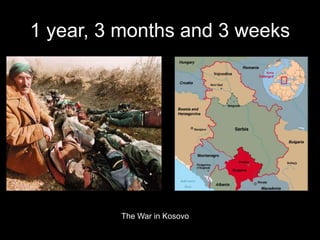
1 year, 3 months and 3 weeks
The War in Kosovo
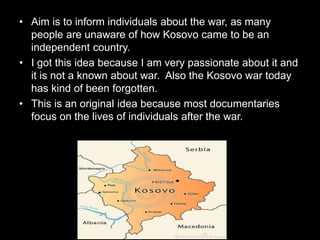
• Aim is to inform individuals about the war, as many
people are unaware of how Kosovo came to be an
independent country.
• I got this idea because I am very passionate about it and
it is not a known about war. Also the Kosovo war today
has kind of been forgotten.
• This is an original idea because most documentaries
focus on the lives of individuals after the war.
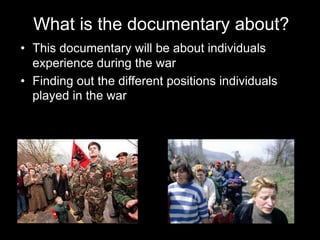
• This documentary will be about individuals
experience during the war
• Finding out the different positions individuals
played in the war
What is the documentary about?
What will be in it?
• Start with news report filmed during the war when
the Serbs first invaded Kosovo.
• Relection of ‘a day in the life of’ through interviews
and vox pops. – All of the participants telling their
story.
• Cutaways of footage from the war, or pictures from
the war.
• Pictures of the damage caused by the war.
Locations
• Park – a vey reflective place
• House – where there is a Kosovan flag and
different Kosovan books.
• Next to a TV with Kosovan news playing or
documentary on the war.
Target Audience:
• 18 – 35 year olds because they would find interest in learning
about how Kosovo started their path on becoming its own
independent country. Also they would find interest because they
may not know that England played a part in this war.
• May appeal more to those who came to England from other
countries because of war, this would appeal to them because
they may be able to relate to the stories that the individuals tell.
• Individuals who are interested in History or Geography, this
would appeal to them because it has a lot to do with how
different countries that are so close together because rivals.
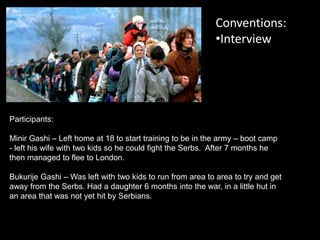
Participants:
Minir Gashi – Left home at 18 to start training to be in the army – boot camp
- left his wife with two kids so he could fight the Serbs. After 7 months he
then managed to flee to London.
Bukurije Gashi – Was left with two kids to run from area to area to try and get
away from the Serbs. Had a daughter 6 months into the war, in a little hut in
an area that was not yet hit by Serbians.
Conventions:
•Interview
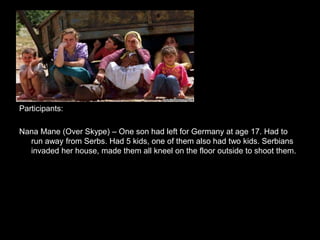
Participants:
Nana Mane (Over Skype) – One son had left for Germany at age 17. Had to
run away from Serbs. Had 5 kids, one of them also had two kids. Serbians
invaded her house, made them all kneel on the floor outside to shoot them.
Music and Sound
• Music – slow music, piano – this would set
the scene, emotional – represents the
emotion of interviewees.
• Sounds – Bombs going off, guns going off,
screaming and crying.
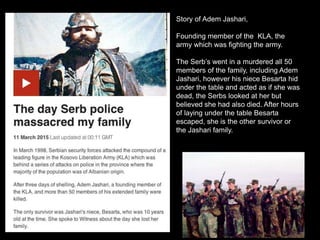
Story of Adem Jashari,
Founding member of the KLA, the
army which was fighting the army.
The Serb’s went in a murdered all 50
members of the family, including Adem
Jashari, however his niece Besarta hid
under the table and acted as if she was
dead, the Serbs looked at her but
believed she had also died. After hours
of laying under the table Besarta
escaped, she is the other survivor or
the Jashari family.
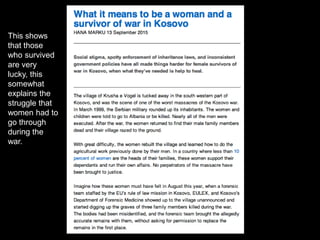
This shows
that those
who survived
are very
lucky, this
somewhat
explains the
struggle that
women had to
go through
during the
war.
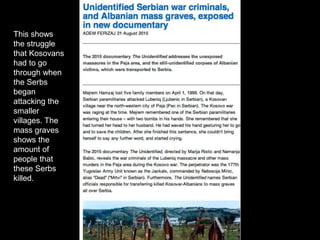
This shows
the struggle
that Kosovans
had to go
through when
the Serbs
began
attacking the
smaller
villages. The
mass graves
shows the
amount of
people that
these Serbs
killed.
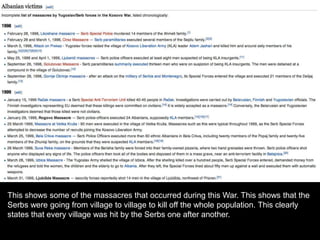
This shows some of the massacres that occurred during this War. This shows that the
Serbs were going from village to village to kill off the whole population. This clearly
states that every village was hit by the Serbs one after another.
Appeal to Audience
• Music – will make the audience feel a specific
way about the topic.
• Style – Cut-away footage, to keep the audiences
attention throughout the documentary.
• Sound – Bombs going off, explosions.
• Topic is appealing because it is a topic that is
forgotten about, which means that not a lot of
people are aware of it.
Channel and Distribution
• This documentary would be on BBC TWO, this is because BBC Two
usually has stories from the past so my documentary would be
good on this channel. This is a documentary that would inform the
public about an issue that the may not have heard of. When asking
most people they were unaware of the country Kosovo, so they
must be unaware of the part that Britain played in the success of
the war. However this could also be on BBC One because this
channel tends to show stories about Britain, so my documentary
could be played on this channel too because many Kosovan
refugees settled in Britain.
• I would also put this documentary Youtube as this has many users
and would bring in a wider audience.
Contacts
• Minir Gashi – Ask him to tell his story
• Bukurije Gashi – Ask her to tell her story
• Nana Mane – Try and get contact through
facetime of skype
Primary Research - Interview
Interview with Bukurije Gashi
• I waiting in Baran with my husbands family for the Serbs to come.
• There was about 40 people staying in the house, all the men would sleep with
guns under their bed.
• My water broke a few days after the Serbs invaded the local area of Lupjan.
• I had to go to the a nearby area of Prapaqan where we found a doctor named Dr
Ibrahimi and I gave birth in a little shed.
• I left Baran and went to stay with my parents and siblings in Pej. Shortly after the
Serbs hit the our village. We had to escape in the cold weather on foot.
• We walked up the mountains to get to areas that were not yet hit so we could stay
out of danger.
• We slept at different peoples house, whoever would take us in, until the Serbs hit
those areas too, then we would have to escape from the area.
• After my daughter was born I didn’t see my husband for 11 months, then he sent
us a visa to come to London.
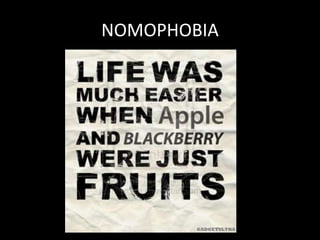
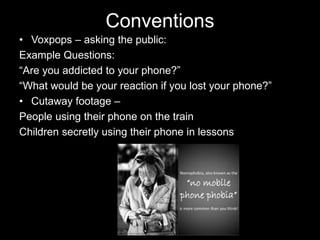
NOMOPHOBIA
Topic
• What is nomophobia?
• How does it effect the UK’s Population?
• How many people are affected?
• This idea came about from observation and
seeing how individuals act with their mobile
phones.
• This is an original idea because it is an
unspoken about issue which people do not
understand unless they are told.
Target Audience
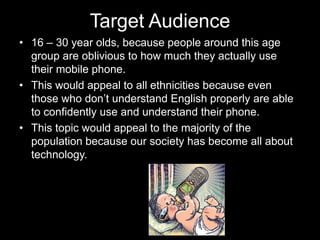
• 16 – 30 year olds, because people around this age
group are oblivious to how much they actually use
their mobile phone.
• This would appeal to all ethnicities because even
those who don’t understand English properly are able
to confidently use and understand their phone.
• This topic would appeal to the majority of the
population because our society has become all about
technology.
Conventions
• Voxpops – asking the public:
Example Questions:
“Are you addicted to your phone?”
“What would be your reaction if you lost your phone?”
• Cutaway footage –
People using their phone on the train
Children secretly using their phone in lessons
What will be in it?
• Presenter – introducing the topic, giving facts
about nomophobia.
• Cut aways showing the amount that people
use their phones, on transport and in schools.
• Social Experiment.
Social Experiment
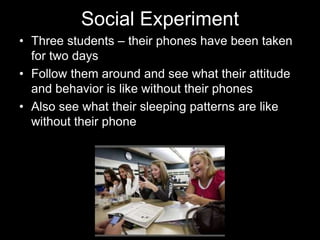
• Three students – their phones have been taken
for two days
• Follow them around and see what their attitude
and behavior is like without their phones
• Also see what their sleeping patterns are like
without their phone
Locations
• Public transport – to show how many people
really use their mobile phones
• In different schools to show students using
their phone.
• On a public street. – crossing the road on their
phones.
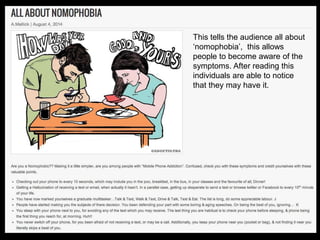
This tells the audience all about
‘nomophobia’, this allows
people to become aware of the
symptoms. After reading this
individuals are able to notice
that they may have it.
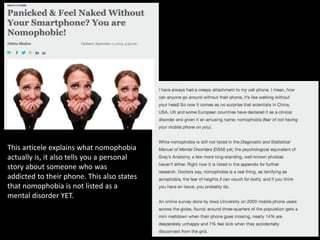
This articele explains what nomophobia
actually is, it also tells you a personal
story about someone who was
addicted to their phone. This also states
that nomophobia is not listed as a
mental disorder YET.
Appeal to Audience
• Music – fast pace to intrigue the audience to the
issue.
• Sounds – IPhone noises as non-diegetic sounds
matching to edits, this would appeal because
90% of students have Iphones, so they would be
able to relate.
Channel and Distribution
• I would put this documentary on BBC Three because many young
people tune into this channel and they are my target audience.
BBC Three is aimed at young and edgy audience and they want to
make controversial and more original programs this is why my
documentary would be well suited to this channel.
• I would also put this documentary on different social networking
sites because this is where my target audience browse.
Contacts
• Talking to different people who believe that
they have nomophobia.
• Contacting the public, to see if they believe
that they have nomophobia.
Primary Research
Focus Group – 5 People.
• None of the individuals knew what nomophobia
was at all.
• When told what it meant they were all puzzled as
to how you can be addicted to your mobile phone
– whilst doing this two of them used their
phones.
• When asked if they believe that they are addicted
to their phones they all said no.
CATFISH
• The aim of this documentary is to make people
aware of the affect fake profiles can have on
individuals lives.
• I got this idea from a recent story I heard about in
the news which has puzzled me and others, so I
found an interest in this topic.
• This is an original idea because many people are
effected by fake profiles and are not even aware of it,
and their stories are not told or heard about.
What is the documentary about?
• This documentary is allowing people to see
the affect that fake profiles have on people.
• How fake profiles have affected different
people.
What will be in it?
• Presenter – Informing everyone about fake
profiles and the things that they can do to
people.
• Cutaway – articles and stories about those
affected by fake profiles.
• Speak to someone who owns a fake profile and
ask why they have one – identity hidden.
• Contacting a fake profile online and see how they
respond once being caught out.
Location
• Black Room – hidden identity interview of
someone who owns a fake profile.
• Streets of London – when presenter is
speaking about the issues behind hidden
profiles and meeting people online.
Target Audience
• 16 – 30 year olds, because these are the people who enjoy
meeting people off social media and also these are the
individuals who do not really question profiles, as I have
found out through primary research.
• This would appeal to both females and males because both
genders could be affected by fake profiles.
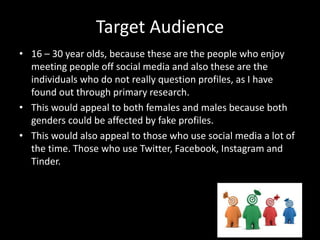
• This would also appeal to those who use social media a lot of
the time. Those who use Twitter, Facebook, Instagram and
Tinder.
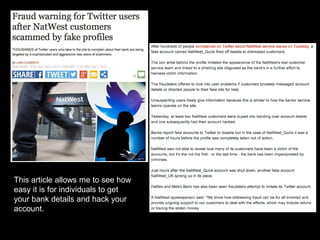
This article allows me to see how
easy it is for individuals to get
your bank details and hack your
account.
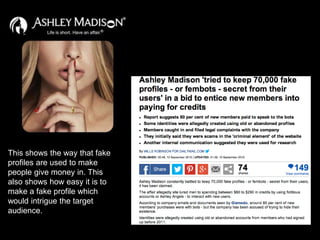
This shows the way that fake
profiles are used to make
people give money in. This
also shows how easy it is to
make a fake profile which
would intrigue the target
audience.
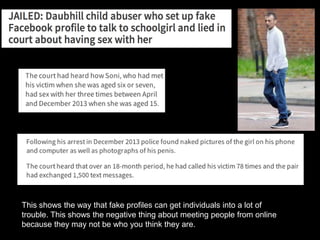
This shows the way that fake profiles can get individuals into a lot of
trouble. This shows the negative thing about meeting people from online
because they may not be who you think they are.
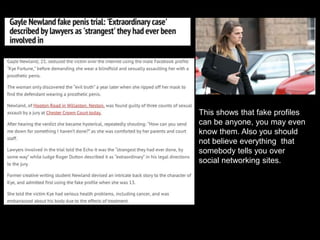
This shows that fake profiles
can be anyone, you may even
know them. Also you should
not believe everything that
somebody tells you over
social networking sites.
Appeal to target audience
• Using stories from apps that a lot of people use would appeal
to target audience because they may be able to relate to the
situation.
• The language used will be more informal so it would appeal to
the target audience.
• Cutaway footage of the different individuals affected by fake
profiles may make them reflect on their own personal
situations.
Channel and distribution
• I would have this documentary on BBC Three because this is
where young people tune in a lot, this channel would allow
me to reach out to my target audience. BBC Three are also
really up on trends of society so this would also capture the
attention of my target audience.
• I would also post this on all social networking sites because
the documentary is about fake accents which can be made on
these sites.
Contacts
• Individual with a fake account.
• Ashley Madison – affairs account, fake profiles
to bring in customers.
• Alisa Berisha – fake account made of her to
make men give in money or buy things.
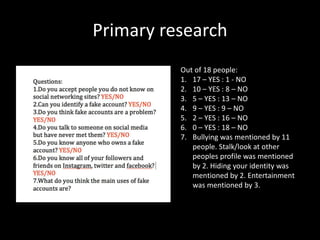
Primary research
Out of 18 people:
1. 17 – YES : 1 - NO
2. 10 – YES : 8 – NO
3. 5 – YES : 13 – NO
4. 9 – YES : 9 – NO
5. 2 – YES : 16 – NO
6. 0 – YES : 18 – NO
7. Bullying was mentioned by 11
people. Stalk/look at other
peoples profile was mentioned
by 2. Hiding your identity was
mentioned by 2. Entertainment
was mentioned by 3.
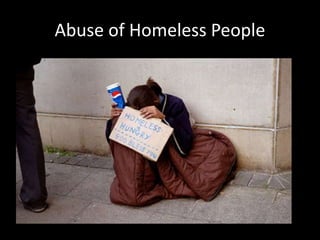
Abuse of Homeless People
• Aim is to allow the audience to become aware of
the way that homeless people are treated as
they are oblivious to it.
• I discovered this idea from observation of day to
day life.
• This is an original idea because people are
unaware that they say one thing about homeless
people and act another way which contradicts
what they said.
What is the documentary about?
• Showing the abuse that homeless people
suffer.
• Asking the public about what they feel
about homeless people and then filming
the way they act when the see a homeless
person.
What will be in it?
• Participant lead – Finding an ex homeless person
to lead the documentary.
• VoxPops – One camera filming the publics answer
to the question “How do you feel about homeless
people?” than another camera filming their
actions when walking past a homeless person.
• Cutaway footage – abuse against homeless.
• Montage of street sleepers with permission.
Location
• Central London – Filming a homeless person
and filming vox pops
• Homeless shelter - 4 Garrett Street, London
EC1Y 0TY
Target Audience
• This documentary would appeal to 16 to 25 year olds
because they are the people that are oblivious to the
issue.
• This would also appeal to those who have an interest in
homeless people, those who give to charities.
• This topic however has a very wide target audience
because it would make everybody aware of things that
they may be doing that they are not aware of.
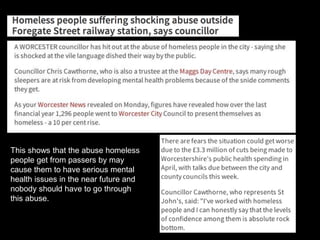
This shows that the abuse homeless
people get from passers by may
cause them to have serious mental
health issues in the near future and
nobody should have to go through
this abuse.
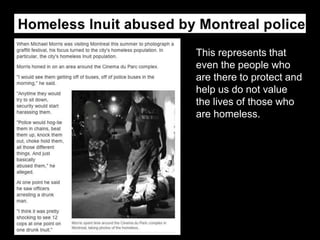
This represents that
even the people who
are there to protect and
help us do not value
the lives of those who
are homeless.
Similar Documentaries
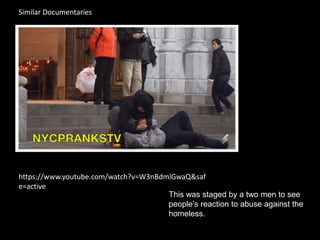
https://www.youtube.com/watch?v=W3nBdmlGwaQ&saf
e=active
This was staged by a two men to see
people’s reaction to abuse against the
homeless.
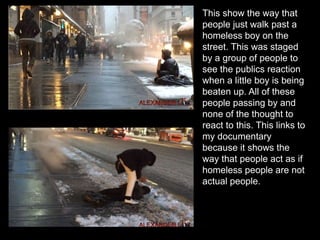
This show the way that
people just walk past a
homeless boy on the
street. This was staged
by a group of people to
see the publics reaction
when a little boy is being
beaten up. All of these
people passing by and
none of the thought to
react to this. This links to
my documentary
because it shows the
way that people act as if
homeless people are not
actual people.
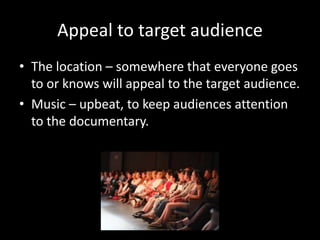
Appeal to target audience
• The location – somewhere that everyone goes
to or knows will appeal to the target audience.
• Music – upbeat, to keep audiences attention
to the documentary.
Channel and distribution
• I would put this documentary on BBC One, this is where I
could reach my target audience and this would also appeal to
my secondary audience because this is an issue that not a lot
of people are aware of. BBC One also shows current affairs
issues, so this documentary would be best suited for this
channel.
• Distribution – I would also post this documentary on
Facebook because it would also reach a lot of my target
audience.
Contacts
• Homeless Link, Gateway House, Milverton St,
London SE11 4AP –
Email: info@homelesslink.org.uk
Phone: 020 7840 4430
• Griffin House, 161 Hammersmith Road, London
W6 8BS
Email: info@mungosbroadway.org.uk
Phone: 020 8762 5500
Primary Research
• Focus Group – 5 people
All of the participants said that they feel awkward
when homeless people say ‘hello’ or ‘good
morning’ and they do not know what to reply.
All of the participants said that if they say a
homeless person being attacked then they would
help them out.
2 people said that they have given money to a
homeless person before

Final my ideas 1.pptx.

  • 1.
  • 2.
    1 year, 3months and 3 weeks The War in Kosovo
  • 3.
    • Aim isto inform individuals about the war, as many people are unaware of how Kosovo came to be an independent country. • I got this idea because I am very passionate about it and it is not a known about war. Also the Kosovo war today has kind of been forgotten. • This is an original idea because most documentaries focus on the lives of individuals after the war.
  • 4.
    • This documentarywill be about individuals experience during the war • Finding out the different positions individuals played in the war What is the documentary about?
  • 5.
    What will bein it? • Start with news report filmed during the war when the Serbs first invaded Kosovo. • Relection of ‘a day in the life of’ through interviews and vox pops. – All of the participants telling their story. • Cutaways of footage from the war, or pictures from the war. • Pictures of the damage caused by the war.
  • 6.
    Locations • Park –a vey reflective place • House – where there is a Kosovan flag and different Kosovan books. • Next to a TV with Kosovan news playing or documentary on the war.
  • 7.
    Target Audience: • 18– 35 year olds because they would find interest in learning about how Kosovo started their path on becoming its own independent country. Also they would find interest because they may not know that England played a part in this war. • May appeal more to those who came to England from other countries because of war, this would appeal to them because they may be able to relate to the stories that the individuals tell. • Individuals who are interested in History or Geography, this would appeal to them because it has a lot to do with how different countries that are so close together because rivals.
  • 8.
    Participants: Minir Gashi –Left home at 18 to start training to be in the army – boot camp - left his wife with two kids so he could fight the Serbs. After 7 months he then managed to flee to London. Bukurije Gashi – Was left with two kids to run from area to area to try and get away from the Serbs. Had a daughter 6 months into the war, in a little hut in an area that was not yet hit by Serbians. Conventions: •Interview
  • 9.
    Participants: Nana Mane (OverSkype) – One son had left for Germany at age 17. Had to run away from Serbs. Had 5 kids, one of them also had two kids. Serbians invaded her house, made them all kneel on the floor outside to shoot them.
  • 10.
    Music and Sound •Music – slow music, piano – this would set the scene, emotional – represents the emotion of interviewees. • Sounds – Bombs going off, guns going off, screaming and crying.
  • 11.
    Story of AdemJashari, Founding member of the KLA, the army which was fighting the army. The Serb’s went in a murdered all 50 members of the family, including Adem Jashari, however his niece Besarta hid under the table and acted as if she was dead, the Serbs looked at her but believed she had also died. After hours of laying under the table Besarta escaped, she is the other survivor or the Jashari family.
  • 12.
    This shows that those whosurvived are very lucky, this somewhat explains the struggle that women had to go through during the war.
  • 13.
    This shows the struggle thatKosovans had to go through when the Serbs began attacking the smaller villages. The mass graves shows the amount of people that these Serbs killed.
  • 14.
    This shows someof the massacres that occurred during this War. This shows that the Serbs were going from village to village to kill off the whole population. This clearly states that every village was hit by the Serbs one after another.
  • 15.
    Appeal to Audience •Music – will make the audience feel a specific way about the topic. • Style – Cut-away footage, to keep the audiences attention throughout the documentary. • Sound – Bombs going off, explosions. • Topic is appealing because it is a topic that is forgotten about, which means that not a lot of people are aware of it.
  • 16.
    Channel and Distribution •This documentary would be on BBC TWO, this is because BBC Two usually has stories from the past so my documentary would be good on this channel. This is a documentary that would inform the public about an issue that the may not have heard of. When asking most people they were unaware of the country Kosovo, so they must be unaware of the part that Britain played in the success of the war. However this could also be on BBC One because this channel tends to show stories about Britain, so my documentary could be played on this channel too because many Kosovan refugees settled in Britain. • I would also put this documentary Youtube as this has many users and would bring in a wider audience.
  • 17.
    Contacts • Minir Gashi– Ask him to tell his story • Bukurije Gashi – Ask her to tell her story • Nana Mane – Try and get contact through facetime of skype
  • 18.
    Primary Research -Interview Interview with Bukurije Gashi • I waiting in Baran with my husbands family for the Serbs to come. • There was about 40 people staying in the house, all the men would sleep with guns under their bed. • My water broke a few days after the Serbs invaded the local area of Lupjan. • I had to go to the a nearby area of Prapaqan where we found a doctor named Dr Ibrahimi and I gave birth in a little shed. • I left Baran and went to stay with my parents and siblings in Pej. Shortly after the Serbs hit the our village. We had to escape in the cold weather on foot. • We walked up the mountains to get to areas that were not yet hit so we could stay out of danger. • We slept at different peoples house, whoever would take us in, until the Serbs hit those areas too, then we would have to escape from the area. • After my daughter was born I didn’t see my husband for 11 months, then he sent us a visa to come to London.
  • 19.
  • 20.
    Topic • What isnomophobia? • How does it effect the UK’s Population? • How many people are affected?
  • 21.
    • This ideacame about from observation and seeing how individuals act with their mobile phones. • This is an original idea because it is an unspoken about issue which people do not understand unless they are told.
  • 22.
    Target Audience • 16– 30 year olds, because people around this age group are oblivious to how much they actually use their mobile phone. • This would appeal to all ethnicities because even those who don’t understand English properly are able to confidently use and understand their phone. • This topic would appeal to the majority of the population because our society has become all about technology.
  • 23.
    Conventions • Voxpops –asking the public: Example Questions: “Are you addicted to your phone?” “What would be your reaction if you lost your phone?” • Cutaway footage – People using their phone on the train Children secretly using their phone in lessons
  • 24.
    What will bein it? • Presenter – introducing the topic, giving facts about nomophobia. • Cut aways showing the amount that people use their phones, on transport and in schools. • Social Experiment.
  • 25.
    Social Experiment • Threestudents – their phones have been taken for two days • Follow them around and see what their attitude and behavior is like without their phones • Also see what their sleeping patterns are like without their phone
  • 26.
    Locations • Public transport– to show how many people really use their mobile phones • In different schools to show students using their phone. • On a public street. – crossing the road on their phones.
  • 27.
    This tells theaudience all about ‘nomophobia’, this allows people to become aware of the symptoms. After reading this individuals are able to notice that they may have it.
  • 28.
    This articele explainswhat nomophobia actually is, it also tells you a personal story about someone who was addicted to their phone. This also states that nomophobia is not listed as a mental disorder YET.
  • 29.
    Appeal to Audience •Music – fast pace to intrigue the audience to the issue. • Sounds – IPhone noises as non-diegetic sounds matching to edits, this would appeal because 90% of students have Iphones, so they would be able to relate.
  • 30.
    Channel and Distribution •I would put this documentary on BBC Three because many young people tune into this channel and they are my target audience. BBC Three is aimed at young and edgy audience and they want to make controversial and more original programs this is why my documentary would be well suited to this channel. • I would also put this documentary on different social networking sites because this is where my target audience browse.
  • 31.
    Contacts • Talking todifferent people who believe that they have nomophobia. • Contacting the public, to see if they believe that they have nomophobia.
  • 32.
    Primary Research Focus Group– 5 People. • None of the individuals knew what nomophobia was at all. • When told what it meant they were all puzzled as to how you can be addicted to your mobile phone – whilst doing this two of them used their phones. • When asked if they believe that they are addicted to their phones they all said no.
  • 33.
  • 34.
    • The aimof this documentary is to make people aware of the affect fake profiles can have on individuals lives. • I got this idea from a recent story I heard about in the news which has puzzled me and others, so I found an interest in this topic. • This is an original idea because many people are effected by fake profiles and are not even aware of it, and their stories are not told or heard about.
  • 35.
    What is thedocumentary about? • This documentary is allowing people to see the affect that fake profiles have on people. • How fake profiles have affected different people.
  • 36.
    What will bein it? • Presenter – Informing everyone about fake profiles and the things that they can do to people. • Cutaway – articles and stories about those affected by fake profiles. • Speak to someone who owns a fake profile and ask why they have one – identity hidden. • Contacting a fake profile online and see how they respond once being caught out.
  • 37.
    Location • Black Room– hidden identity interview of someone who owns a fake profile. • Streets of London – when presenter is speaking about the issues behind hidden profiles and meeting people online.
  • 38.
    Target Audience • 16– 30 year olds, because these are the people who enjoy meeting people off social media and also these are the individuals who do not really question profiles, as I have found out through primary research. • This would appeal to both females and males because both genders could be affected by fake profiles. • This would also appeal to those who use social media a lot of the time. Those who use Twitter, Facebook, Instagram and Tinder.
  • 39.
    This article allowsme to see how easy it is for individuals to get your bank details and hack your account.
  • 40.
    This shows theway that fake profiles are used to make people give money in. This also shows how easy it is to make a fake profile which would intrigue the target audience.
  • 41.
    This shows theway that fake profiles can get individuals into a lot of trouble. This shows the negative thing about meeting people from online because they may not be who you think they are.
  • 42.
    This shows thatfake profiles can be anyone, you may even know them. Also you should not believe everything that somebody tells you over social networking sites.
  • 43.
    Appeal to targetaudience • Using stories from apps that a lot of people use would appeal to target audience because they may be able to relate to the situation. • The language used will be more informal so it would appeal to the target audience. • Cutaway footage of the different individuals affected by fake profiles may make them reflect on their own personal situations.
  • 44.
    Channel and distribution •I would have this documentary on BBC Three because this is where young people tune in a lot, this channel would allow me to reach out to my target audience. BBC Three are also really up on trends of society so this would also capture the attention of my target audience. • I would also post this on all social networking sites because the documentary is about fake accents which can be made on these sites.
  • 45.
    Contacts • Individual witha fake account. • Ashley Madison – affairs account, fake profiles to bring in customers. • Alisa Berisha – fake account made of her to make men give in money or buy things.
  • 46.
    Primary research Out of18 people: 1. 17 – YES : 1 - NO 2. 10 – YES : 8 – NO 3. 5 – YES : 13 – NO 4. 9 – YES : 9 – NO 5. 2 – YES : 16 – NO 6. 0 – YES : 18 – NO 7. Bullying was mentioned by 11 people. Stalk/look at other peoples profile was mentioned by 2. Hiding your identity was mentioned by 2. Entertainment was mentioned by 3.
  • 47.
  • 48.
    • Aim isto allow the audience to become aware of the way that homeless people are treated as they are oblivious to it. • I discovered this idea from observation of day to day life. • This is an original idea because people are unaware that they say one thing about homeless people and act another way which contradicts what they said.
  • 49.
    What is thedocumentary about? • Showing the abuse that homeless people suffer. • Asking the public about what they feel about homeless people and then filming the way they act when the see a homeless person.
  • 50.
    What will bein it? • Participant lead – Finding an ex homeless person to lead the documentary. • VoxPops – One camera filming the publics answer to the question “How do you feel about homeless people?” than another camera filming their actions when walking past a homeless person. • Cutaway footage – abuse against homeless. • Montage of street sleepers with permission.
  • 51.
    Location • Central London– Filming a homeless person and filming vox pops • Homeless shelter - 4 Garrett Street, London EC1Y 0TY
  • 52.
    Target Audience • Thisdocumentary would appeal to 16 to 25 year olds because they are the people that are oblivious to the issue. • This would also appeal to those who have an interest in homeless people, those who give to charities. • This topic however has a very wide target audience because it would make everybody aware of things that they may be doing that they are not aware of.
  • 53.
    This shows thatthe abuse homeless people get from passers by may cause them to have serious mental health issues in the near future and nobody should have to go through this abuse.
  • 54.
    This represents that eventhe people who are there to protect and help us do not value the lives of those who are homeless.
  • 55.
    Similar Documentaries https://www.youtube.com/watch?v=W3nBdmlGwaQ&saf e=active This wasstaged by a two men to see people’s reaction to abuse against the homeless.
  • 56.
    This show theway that people just walk past a homeless boy on the street. This was staged by a group of people to see the publics reaction when a little boy is being beaten up. All of these people passing by and none of the thought to react to this. This links to my documentary because it shows the way that people act as if homeless people are not actual people.
  • 57.
    Appeal to targetaudience • The location – somewhere that everyone goes to or knows will appeal to the target audience. • Music – upbeat, to keep audiences attention to the documentary.
  • 58.
    Channel and distribution •I would put this documentary on BBC One, this is where I could reach my target audience and this would also appeal to my secondary audience because this is an issue that not a lot of people are aware of. BBC One also shows current affairs issues, so this documentary would be best suited for this channel. • Distribution – I would also post this documentary on Facebook because it would also reach a lot of my target audience.
  • 59.
    Contacts • Homeless Link,Gateway House, Milverton St, London SE11 4AP – Email: info@homelesslink.org.uk Phone: 020 7840 4430 • Griffin House, 161 Hammersmith Road, London W6 8BS Email: info@mungosbroadway.org.uk Phone: 020 8762 5500
  • 60.
    Primary Research • FocusGroup – 5 people All of the participants said that they feel awkward when homeless people say ‘hello’ or ‘good morning’ and they do not know what to reply. All of the participants said that if they say a homeless person being attacked then they would help them out. 2 people said that they have given money to a homeless person before