Navigating Through Oceans of Data: -Being Part of and Competing in the ACO & Bundled Payment Reforms! 
Presenter: John Sheridan, MHSA, FACHE 
Navigating the Perils of Care Transition 
New Jersey Long Term Care Leadership Coalition 
2014 Annual Conference
2 
| 10/5/2014 | © eHealth Data Solutions 
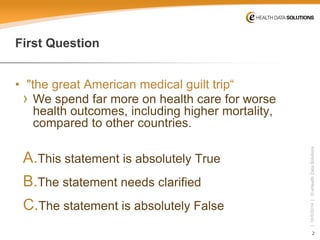
First Question 
• 
"the great American medical guilt trip“ 
› 
We spend far more on health care for worse health outcomes, including higher mortality, compared to other countries. 
A. 
This statement is absolutely True 
B. 
The statement needs clarified 
C. 
The statement is absolutely False
3 
| 10/5/2014 | © eHealth Data Solutions 
Why must we face and know Data? Or The Question that is the “Elephant in the room.” “Are we appropriately Doctored”? / Are we well served? 
• 
"the great American medical guilt trip“ 
› 
We spend far more on health care for allegedly worse health outcomes, including higher mortality, compared to other countries. 
› 
This is an apples-to-oranges comparison of vastly different geographies, social structures and cultures. After subtracting homicides and automobile fatalities, the mortality discrepancies largely disappear. 
 
We cannot cure homicide and automobile fatalities once they have happened 
• 
Medicine, like life [or “Big Data”], inevitably consists of messiness, error, tedium, unresolvable dilemmas and contradictory trade-offs. 
› 
Book Review: 'Doctored' by Sandeep Jauhar 
 
ByTHOMAS P. STOSSEL, MD –Wall Street Journal Aug. 25, 2014
4 
| 10/5/2014 | © eHealth Data Solutions 
Objectives 
1. 
Describe key elements of post-acute care organization's operations 
2. 
Identify metrics for quality and reimbursement influenced by relationships between acute and post-acute care providers 
3. 
Describe how better data and a coordinated process can improve decision making 
4. 
Apply disease state management, EMR, and analytics within your QAPI programs
5 
| 10/5/2014 | © eHealth Data Solutions 
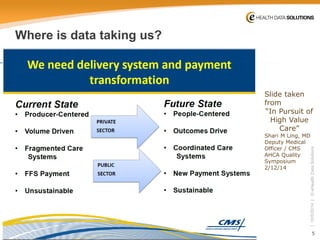
Where is data taking us? 
Slide taken from 
“In Pursuit of High Value Care” 
Shari M Ling, MD 
Deputy Medical Officer / CMS 
AHCA Quality Symposium 2/12/14
6 
| 10/5/2014 | © eHealth Data Solutions 
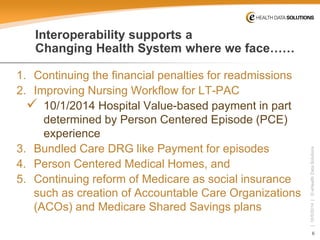
Interoperability supports a Changing Health System where we face…… 
1. 
Continuing the financial penalties for readmissions 
2. 
Improving Nursing Workflow for LT-PAC 
 
10/1/2014 Hospital Value-based payment in part determined by Person Centered Episode (PCE) experience 
3. 
Bundled Care DRG like Payment for episodes 
4. 
Person Centered Medical Homes, and 
5. 
Continuing reform of Medicare as social insurance such as creation of Accountable Care Organizations (ACOs) and Medicare Shared Savings plans
7 
| 10/5/2014 | © eHealth Data Solutions 
Today’s Topics and Lessons 
• 
Part 1 
› 
Describe New Jersey -Bundled Payments, Who, What, Why, How 
 
Conclude part 1 with Summary of Programs 
• 
Part 2 
› 
Describe New Jersey –ACOs, Who, What, Why, How 
 
Conclude part 2 with Summary of NJ ACOs 
• 
Part 3 & Conclusion 
› 
Review what we have as data and what is coming! 
• 
Questions
8 
| 10/5/2014 | © eHealth Data Solutions 
Key elements of post-acute care organization's operations 
• 
Who is served? 
• 
Who are the acute and post-acute providers? 
• 
What funds are expended and are at risk? 
• 
What about ACOs and Bundled Payment options & conveners? 
• 
What might we measure?
9 
| 10/5/2014 | © eHealth Data Solutions 
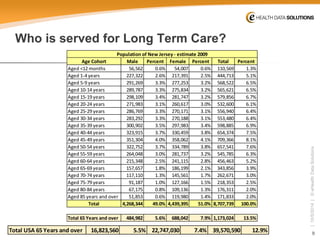
Who is served for Long Term Care? 
Age CohortMalePercentFemalePercentTotalPercentAged <12 months56,5620.6%54,0070.6%110,5691.3% Aged 1-4 years227,3222.6%217,3912.5%444,7135.1% Aged 5-9 years291,2693.3%277,2533.2%568,5226.5% Aged 10-14 years289,7873.3%275,8343.2%565,6216.5% Aged 15-19 years298,1093.4%281,7473.2%579,8566.7% Aged 20-24 years271,9833.1%260,6173.0%532,6006.1% Aged 25-29 years286,7693.3%270,1713.1%556,9406.4% Aged 30-34 years283,2923.3%270,1883.1%553,4806.4% Aged 35-39 years300,9023.5%297,9833.4%598,8856.9% Aged 40-44 years323,9153.7%330,4593.8%654,3747.5% Aged 45-49 years351,3044.0%358,0624.1%709,3668.1% Aged 50-54 years322,7523.7%334,7893.8%657,5417.6% Aged 55-59 years264,0483.0%281,7373.2%545,7856.3% Aged 60-64 years215,3482.5%241,1152.8%456,4635.2% Aged 65-69 years157,6571.8%186,1992.1%343,8563.9% Aged 70-74 years117,1101.3%145,5611.7%262,6713.0% Aged 75-79 years91,1871.0%127,1661.5%218,3532.5% Aged 80-84 years67,1750.8%109,1361.3%176,3112.0% Aged 85 years and over51,8530.6%119,9801.4%171,8332.0% Total4,268,34449.0%4,439,39551.0%8,707,739100.0% Total 65 Years and over484,9825.6%688,0427.9%1,173,02413.5% Population of New Jersey - estimate 2009Total USA 65 Years and over16,823,5605.5%22,747,0307.4%39,570,59012.9%
10 
| 10/5/2014 | © eHealth Data Solutions 
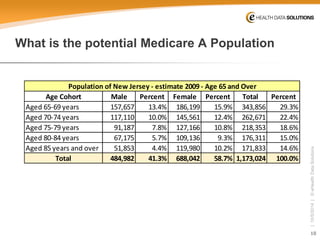
What is the potential Medicare A Population 
Age CohortMalePercentFemalePercentTotalPercentAged 65-69 years157,65713.4%186,19915.9%343,85629.3% Aged 70-74 years117,11010.0%145,56112.4%262,67122.4% Aged 75-79 years91,1877.8%127,16610.8%218,35318.6% Aged 80-84 years67,1755.7%109,1369.3%176,31115.0% Aged 85 years and over51,8534.4%119,98010.2%171,83314.6% Total484,98241.3%688,04258.7%1,173,024100.0% Population of New Jersey - estimate 2009 - Age 65 and Over
11 
| 10/5/2014 | © eHealth Data Solutions 
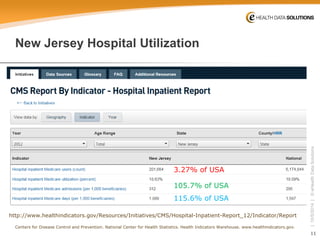
New Jersey Hospital Utilization 
http://www.healthindicators.gov/Resources/Initiatives/CMS/Hospital-Inpatient-Report_12/Indicator/Report 
3.27% of USA 
115.6% of USA 
105.7% of USA 
Centers for Disease Control and Prevention. National Center for Health Statistics. Health Indicators Warehouse. www.healthindicators.gov.
12 
| 10/5/2014 | © eHealth Data Solutions 
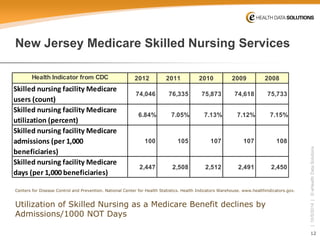
New Jersey Medicare Skilled Nursing Services 
Health Indicator from CDC20122011201020092008Skilled nursing facility Medicare users (count) 74,04676,33575,87374,61875,733Skilled nursing facility Medicare utilization (percent) 6.84%7.05%7.13%7.12%7.15% Skilled nursing facility Medicare admissions (per 1,000 beneficiaries) 100105107107108Skilled nursing facility Medicare days (per 1,000 beneficiaries) 2,4472,5082,5122,4912,450 
Centers for Disease Control and Prevention. National Center for Health Statistics. Health Indicators Warehouse. www.healthindicators.gov. 
Utilization of Skilled Nursing as a Medicare Benefit declines by Admissions/1000 NOT Days
13 
| 10/5/2014 | © eHealth Data Solutions 
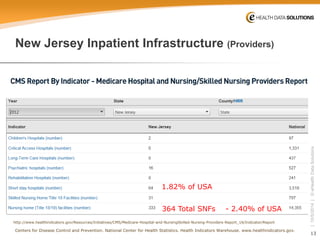
New Jersey Inpatient Infrastructure (Providers) 
http://www.healthindicators.gov/Resources/Initiatives/CMS/Medicare-Hospital-and-NursingSkilled-Nursing-Providers-Report_16/Indicator/Report 
1.82% of USA 
364 Total SNFs -2.40% of USA 
Centers for Disease Control and Prevention. National Center for Health Statistics. Health Indicators Warehouse. www.healthindicators.gov.
14 
| 10/5/2014 | © eHealth Data Solutions 
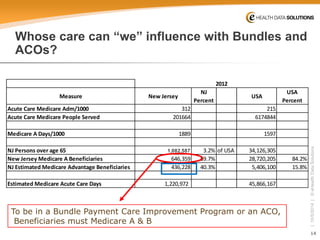
Whose care can “we” influence with Bundles and ACOs? 
MeasureNew JerseyNJ PercentUSAUSA PercentAcute Care Medicare Adm/1000312215Acute Care Medicare People Served2016646174844Medicare A Days/100018891597NJ Persons over age 651,082,5873.2%of USA34,126,305New Jersey Medicare A Beneficiaries646,35959.7%28,720,20584.2% NJ Estimated Medicare Advantage Beneficiaries436,22840.3%5,406,10015.8% Estimated Medicare Acute Care Days1,220,972 45,866,1672012 
To be in a Bundle Payment Care Improvement Program or an ACO, 
Beneficiaries must Medicare A & B
15 
| 10/5/2014 | © eHealth Data Solutions 
What is a Bundled Payment for Care Improvement (BPCI) Bundle? 
• 
Episode-based payment aggregates Medicare payments to multiple providers and suppliersfor services that are related to particular clinical conditions for a period of time (time defines episode length) 
• 
Episode-based payments measurepatient experience of care, process, outcomes, and cost of care 
• 
The goals of BPCI are: 
› 
align payment incentives among providers & suppliers 
› 
improve the health care experience of Medicare beneficiaries who undergo episodes of treatment for clinical conditions
16 
| 10/5/2014 | © eHealth Data Solutions 
What is a BPCI Bundle as 10/2/2014 ? 
• 
48 distinct Person Centered Episodes (PCE) 
• 
Each episode combines related MS-DRGs 
• 
Episodes are linked to an acute care hospital inpatient stay for one of the included MS-DRGs 
› 
A hospital admission for the anchor MS-DRG triggers or initiates a beneficiary’s episode. 
• 
Episodes are broadly defined with few exceptions 
• 
PCEs include most services covered under Medicare Part A and Part B that are provided to a beneficiary throughout the duration of the episode
17 
| 10/5/2014 | © eHealth Data Solutions 
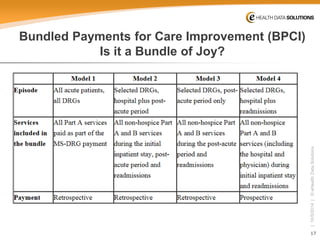
Bundled Payments for Care Improvement (BPCI) Is it a Bundle of Joy?
18 
| 10/5/2014 | © eHealth Data Solutions 
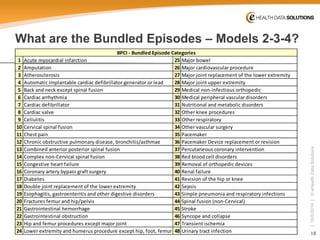
What are the Bundled Episodes –Models 2-3-4? 
1Acute myocardial infarction 25Major bowel 2Amputation 26Major cardiovascular procedure 3Atherosclerosis 27Major joint replacement of the lower extremity 4Automatic implantable cardiac defibrillator generator or lead 28Major joint upper extremity 5Back and neck except spinal fusion 29Medical non-infectious orthopedic 6Cardiac arrhythmia 30Medical peripheral vascular disorders 7Cardiac defibrillator 31Nutritional and metabolic disorders 8Cardiac valve 32Other knee procedures 9Cellulitis 33Other respiratory 10Cervical spinal fusion 34Other vascular surgery 11Chest pain 35Pacemaker 12Chronic obstructive pulmonary disease, bronchitis/asthmae 36Pacemaker Device replacement or revision 13Combined anterior posterior spinal fusion 37Percutaneous coronary intervention 14Complex non-Cervical spinal fusion 38Red blood cell disorders 15Congestive heart failure 39Removal of orthopedic devices 16Coronary artery bypass graft surgery 40Renal failure 17Diabetes 41Revision of the hip or knee 18Double joint replacement of the lower extremity 42Sepsis 19Esophagitis, gastroenteritis and other digestive disorders 43Simple pneumonia and respiratory infections 20Fractures femur and hip/pelvis 44Spinal fusion (non-Cervical) 21Gastrointestinal hemorrhage 45Stroke 22Gastrointestinal obstruction 46Syncope and collapse23Hip and femur procedures except major joint 47Transient ischemia 24Lower extremity and humerus procedure except hip, foot, femur 48Urinary tract infection BPCI - Bundled Episode Categories
19 
| 10/5/2014 | © eHealth Data Solutions 
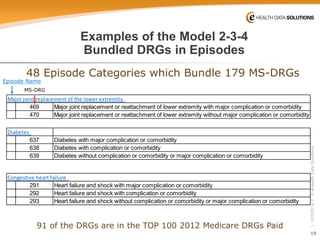
Examples of the Model 2-3-4 Bundled DRGs in Episodes 
48 Episode Categories which Bundle 179 MS-DRGs 
Major joint replacement of the lower extremity 469Major joint replacement or reattachment of lower extremity with major complication or comorbidity470Major joint replacement or reattachment of lower extremity without major complication or comorbidity 
Diabetes 637Diabetes with major complication or comorbidity638Diabetes with complication or comorbidity639Diabetes without complication or comorbidity or major complication or comorbidityCongestive heart failure 291Heart failure and shock with major complication or comorbidity292Heart failure and shock with complication or comorbidity293Heart failure and shock without complication or comorbidity or major complication or comorbidity 
Episode Name 
MS-DRG 
91 of the DRGs are in the TOP 100 2012 Medicare DRGs Paid
20 
| 10/5/2014 | © eHealth Data Solutions 
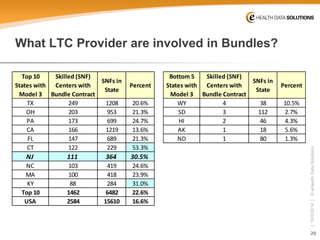
What LTC Provider are involved in Bundles? 
Top 10 States with Model 3Skilled (SNF) Centers with Bundle ContractSNFs in StatePercentTX249120820.6% OH20395321.3% PA17369924.7% CA166121913.6% FL14768921.3% CT12222953.3% NJ11136430.5% NC10341924.6% MA10041823.9% KY8828431.0% Top 101462648222.6% USA25841561016.6% Bottom 5 States with Model 3Skilled (SNF) Centers with Bundle ContractSNFs in StatePercentWY43810.5% SD31122.7% HI2464.3% AK1185.6% ND1801.3%
21 
| 10/5/2014 | © eHealth Data Solutions 
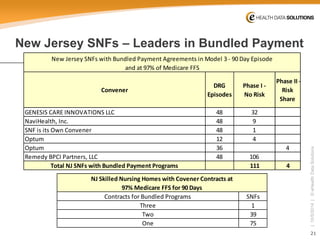
New Jersey SNFs –Leaders in Bundled Payment 
ConvenerDRG EpisodesPhase I - No RiskPhase II - Risk ShareGENESIS CARE INNOVATIONS LLC4832NaviHealth, Inc.489SNF is its Own Convener481Optum124Optum364Remedy BPCI Partners, LLC48106Total NJ SNFs with Bundled Payment Programs1114New Jersey SNFs with Bundled Payment Agreements in Model 3 - 90 Day Episode and at 97% of Medicare FFSContracts for Bundled ProgramsSNFsThree1Two39One75NJ Skilled Nursing Homes with Covener Contracts at 97% Medicare FFS for 90 Days
22 
| 10/5/2014 | © eHealth Data Solutions 
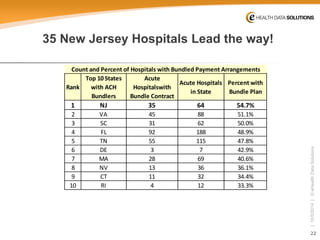
35 New Jersey Hospitals Lead the way! 
RankTop 10 States with ACH BundlersAcute Hospitalswith Bundle ContractAcute Hospitals in StatePercent with Bundle Plan1NJ356454.7% 2VA458851.1% 3SC316250.0% 4FL9218848.9% 5TN5511547.8% 6DE3742.9% 7MA286940.6% 8NV133636.1% 9CT113234.4% 10RI41233.3% Count and Percent of Hospitals with Bundled Payment Arrangements
23 
| 10/5/2014 | © eHealth Data Solutions 
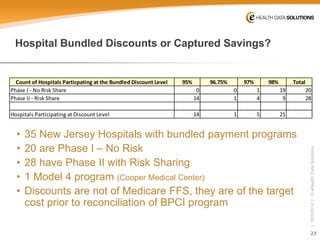
Hospital Bundled Discounts or Captured Savings? 
• 
35 New Jersey Hospitals with bundled payment programs 
• 
20 are Phase I –No Risk 
• 
28 have Phase II with Risk Sharing 
• 
1 Model 4 program (Cooper Medical Center) 
• 
Discounts are not of Medicare FFS, they are of the target cost prior to reconciliation of BPCI program 
Count of Hospitals Particpating at the Bundled Discount Level95%96.75%97%98%TotalPhase I - No Risk Share0011920Phase II - Risk Share1414928Hospitals Participating at Discount Level141521
24 
| 10/5/2014 | © eHealth Data Solutions 
How does Bundled Risk Work? The Triple Crown! 
• 
Risk Tracks, for each episode. 
› 
Awardee may opt to bear risk up to the 75th, 95th, or 99th percentile. Awardees bear 100 percent of the risk up to the risk track threshold and 20 percent of payments above the threshold for a given risk track. 
› 
Risk tracks may be changed quarterly. 
• 
Medicare pays the Awardee the difference between the target price and the actual cost of care for an episode if the actual cost is less than the target price. 
• 
If the actual cost of care exceeds the target price, the Awardee pays Medicare the difference between the target price and actual spending. 
• 
Supporting Awardee preparation, CMS provides Phase 1 participants with monthly beneficiary-level claims data for episodes of care. 
› 
Phase 1 participants also engage in a variety of learning activities 
› 
Phase 1 and Phase 2 participants and receive target pricing information to inform their assessment of opportunities under BPCI.
25 
| 10/5/2014 | © eHealth Data Solutions 
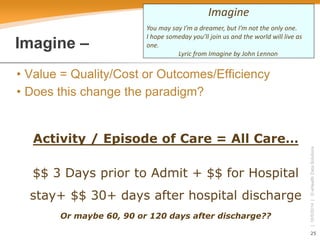
Imagine – 
• 
Value = Quality/Cost or Outcomes/Efficiency 
• 
Does this change the paradigm? 
Activity / Episode of Care = All Care… 
$$ 3 Days prior to Admit + $$ for Hospital stay+ $$ 30+ days after hospital discharge 
Or maybe 60, 90 or 120 days after discharge?? 
Imagine 
You may say I’m a dreamer, but I’m not the only one. 
I hope someday you’ll join us and the world will live as one. 
Lyric from Imagine by John Lennon
26 
| 10/5/2014 | © eHealth Data Solutions 
BPCI Revenue is Data Driven 
• 
Bundled (data defined) Payment 
› 
Like DRG: 
 
Defined by clinical and quality parameters 
– 
the difference in patient before and after treatment 
 
Admissions and length of stay are central measures 
– 
Do you know the LOS / admission combination for your SNF? 
› 
Operators’ Strategy 
 
More thorough assessment of patient 
 
Core measures of clinical practice 
– 
Best practice supported by literature (QAPI) 
 
Better Treatment at each step of the episode = Better Payment 
– 
And Better Outcomes….
27 
| 10/5/2014 | © eHealth Data Solutions 
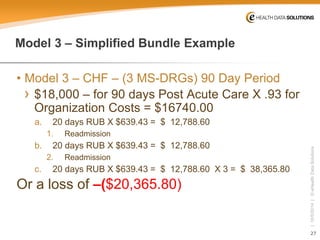
Model 3 –Simplified Bundle Example 
• 
Model 3 –CHF –(3 MS-DRGs) 90 Day Period 
› 
$18,000 –for 90 days Post Acute Care X .93 for Organization Costs = $16740.00 
a. 
20 days RUB X $639.43 = $ 12,788.60 
1. 
Readmission 
b. 
20 days RUB X $639.43 = $ 12,788.60 
2. 
Readmission 
c. 
20 days RUB X $639.43 = $ 12,788.60 X 3 = $ 38,365.80 
Or a loss of –($20,365.80)
28 
| 10/5/2014 | © eHealth Data Solutions 
Alternate Model 3 Examples 
• 
Model 3 –CHF –(3 MS-DRGs) 90 Day Period 
› 
40 days RLA X $265.27 = $ 10,610.80 + 60 Days Home Care = $3,000 + supplemented 30 Treatment Days Out Patient Therapy = $3,000 –Total Medicare FFS Cost = $ 16,610.80 
Or SNF profit of $1,389.20 –Who has oversight for 90 Days? 
• 
OR 
› 
20 days RUB X $639.43 = $ 12,788.60 
› 
60 days Home Health = $3,000.00 
› 
10 days outpatient rehab $1100.00 
Total FFS Cost = $16,888.6 
Or profit of $ 1,111.40 –Who has oversight for 90 Days?
29 
| 10/5/2014 | © eHealth Data Solutions 
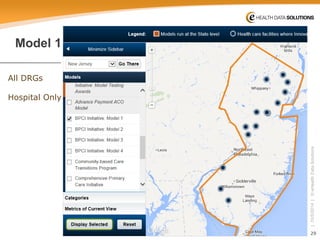
Model 1 
All DRGs 
Hospital Only
30 
| 10/5/2014 | © eHealth Data Solutions 
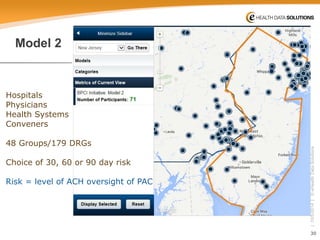
Model 2 
Hospitals 
Physicians 
Health Systems 
Conveners 
48 Groups/179 DRGs 
Choice of 30, 60 or 90 day risk 
Risk = level of ACH oversight of PAC
31 
| 10/5/2014 | © eHealth Data Solutions 
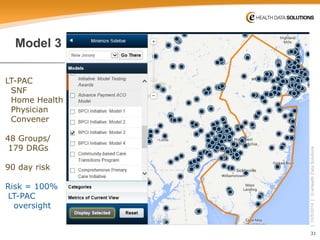
Model 3 
LT-PAC 
SNF 
Home Health 
Physician 
Convener 
48 Groups/ 
179 DRGs 
90 day risk 
Risk = 100% 
LT-PAC 
oversight
32 
| 10/5/2014 | © eHealth Data Solutions 
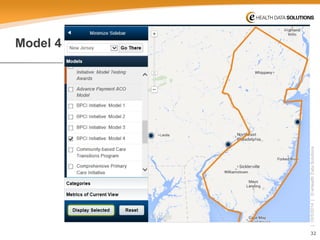
Model 4
33 
| 10/5/2014 | © eHealth Data Solutions 
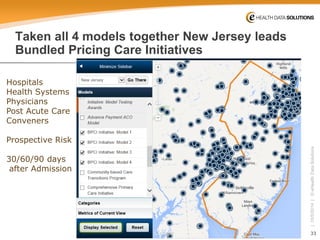
Taken all 4 models together New Jersey leads Bundled Pricing Care Initiatives 
Hospitals 
Health Systems 
Physicians 
Post Acute Care 
Conveners 
Prospective Risk 
30/60/90 days 
after Admission
34 
| 10/5/2014 | © eHealth Data Solutions 
Bundled Payment Care Initiative Summary-1 
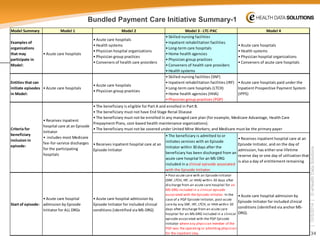
Model SummaryModel 1Model 2Model 3 - LTC-PACModel 4Examples of organizations that may participate in Model: • Acute care hospitals• Acute care hospitals• Health systems• Physician hospital organizations• Physician group practices• Conveners of health care providers• Skilled nursing facilities• Inpatient rehabilitation facilities• Long-term care hospitals• Home health agencies• Physician group practices• Conveners of health care providers• Health systems• Acute care hospitals• Health systems• Physician hospital organizations• Conveners of acute care hospitalsEntities that can initiate episodes in Model: • Acute care hospitals• Acute care hospitals• Physician group practices• Skilled nursing facilities (SNF) • Inpatient rehabilitation facilities (IRF) • Long-term care hospitals (LTCH) • Home health agencies (HHA) • Physician group practices (PGP) • Acute care hospitals paid under the Inpatient Prospective Payment System (IPPS) • Receives inpatient hospital care at an Episode Initiator• The beneficiary is admitted to or initiates services with an Episode Initiator within 30 days after the beneficiary has been discharged from an acute care hospital for an MS-DRG included in a clinical episode associated with the Episode Initiator. • Receives inpatient hospital care at an Episode Initiator, and on the day of admission, has either one lifetime reserve day or one day of utilization that is also a day of entitlement remainingStart of episode: • Acute care hospital admission by Episode Initiator for ALL DRGs• Acute care hospital admission by Episode Initiator for included clinical conditions (identified via MS-DRG) • Post-acute care with an Episode Initiator (SNF, LTCH, IRF, or HHA) within 30 days after discharge from an acute care hospital for an MS-DRG included in a clinical episode associated with the Episode Initiator. In the case of a PGP Episode Initiator, post-acute care by any SNF, IRF, LTCH, or HHA within 30 days after discharge from an acute care hospital for an MS-DRG included in a clinical episode associated with the PGP Episode Initiator where any physician member of the PGP was the operating or admitting physician for the inpatient stay. • Acute care hospital admission by Episode Initiator for included clinicalconditions (identified via anchor MS- DRG). • The beneficiary is eligible for Part A and enrolled in Part B. • The beneficiary must not have End Stage Renal Disease• The beneficiary must not be enrolled in any managed care plan (for example, Medicare Advantage, Health Care Prepayment Plans, cost-based health maintenance organizations). • The beneficiary must not be covered under United Mine Workers; and Medicare must be the primary payerCriteria for beneficiaryinclusion in episode: • Receives inpatient hospital care at an Episode Initiator• includes most Medicare fee-for-service discharges for the participating hospitals
35 
| 10/5/2014 | © eHealth Data Solutions 
Bundled Payment Care Initiative Summary-2 
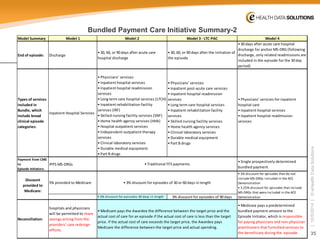
Model SummaryModel 1Model 2Model 3 - LTC-PACModel 4End of episode:Discharge• 30, 60, or 90 days after acute care hospital discharge• 30, 60, or 90 days after the initiation of the episode• 30 days after acute care hospital discharge for anchor MS-DRG (following discharge, only related readmissions are included in the episode for the 30 day period) Types of services included inBundle, which include broad clinical episode categories: Inpatient Hospital Services• Physicians’ services• Inpatient hospital services• Inpatient hospital readmission services• Long term care hospital services (LTCH) • Inpatient rehabilitation facility services (IRF) • Skilled nursing facility services (SNF) • Home health agency services (HHA) • Hospital outpatient services• Independent outpatient therapy services• Clinical laboratory services• Durable medical equipment• Part B drugs• Physicians’ services• Inpatient post-acute care services• Inpatient hospital readmission services• Long term care hospital services• Inpatient rehabilitation facility services• Skilled nursing facility services• Home health agency services• Clinical laboratory services• Durable medical equipment• Part B drugs• Physicians’ services for inpatient hospital care• Inpatient hospital services• Inpatient hospital readmission servicesPayment from CMS toEpisode Initiators: IPPS MS-DRGs• Single prospectively determined bundled payment5% provided to Medicare• 2% discount for episodes 90 days in length3% discount for episodes of 90 daysReconciliation: hospitals and physicians will be permitted to share savings arising from the providers’ care redesign efforts. • Medicare pays a predetermined bundled payment amount to the Episode Initiator, which is responsible for paying physicians and non-physician practitioners that furnished services to the beneficiary during the episode. • Medicare pays the Awardee the difference between the target price and the actual cost of care for an episode if the actual cost of care is less than the target price. If the actual cost of care exceeds the target price, the Awardee pays Medicare the difference between the target price and actual spending. • 3% discount for episodes of 30 or 60 days in lengthDiscount provided toMedicare: • 3% discount for episodes that do not include MS-DRGs included in the ACE Demonstration• 3.25% discount for episodes that include MS-DRGs that were included in the ACE Demonstration• Traditional FFS payments
36 
| 10/5/2014 | © eHealth Data Solutions 
Question 2 
• 
As a New Jersey Care Provider, I would describe my experience in bundled payment as 
A. 
Examine, treat or see a bundled service combination almost daily 
B. 
Examine, treat or see a bundled service so little I would not know I had done so 
C. 
I have no idea what this bundled payment is about and am now hopelessly confused
37 
| 10/5/2014 | © eHealth Data Solutions 
Bundles and ACOs have “Big Data” in common 
• 
CMS uses FFS Beneficiary Part A and B claims to establish a target cost for Bundled Episodes and for ACOs 
• 
Target cost = 3 year history X trend factor minus the CMS Episode Discount 
• 
The ACO and Bundle target dollars are a CMS determination by use of data to forecast and determine expected future payments. 
• 
In this theory for innovation… 
› 
Healthcare cost is predicted & controlled
38 
| 10/5/2014 | © eHealth Data Solutions 
New Jersey Acute and Post Acute Expenditures (2012) [3 days prior to index Admission + 30 days PAC] 
Total Costs per PeriodReported%Calculated* Day 1-3 Prior to Adm$66,205,5221.3%$66,205,522Index Admission$2,563,702,94651.2%$2,563,702,946Days 1-30 post Index AdmissionLong Term Care$2,379,987,73047.5%$2,379,987,730Complete Episode Costs$5,009,841,634100.0%$5,009,896,198 Medicare A Episodes of Care249919Medicare Beneficiaries Served201664 Estimated Medicare A Episodes per Person Served1.24New Jersey Medicare Part A Expenditures for 2012Transitions per person per year*Note Addition differences reported by CMS as rounding errors 
If all Medicare A Episodes were set for 2012, targeted cost would be 
$4,859,546,385 –or $150,295,249 less than spent 
Ideally savings will be greater than 3%
39 
| 10/5/2014 | © eHealth Data Solutions 
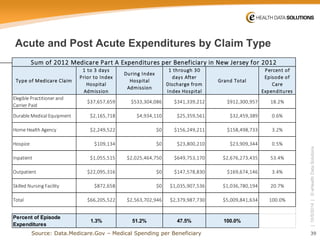
Type of Medicare Claim1 to 3 days Prior to Index Hospital AdmissionDuring Index Hospital Admission1 through 30 days After Discharge from Index HospitalGrand TotalPercent of Episode of Care ExpendituresElegible Practitioner and Carrier Paid$37,657,659$533,304,086$341,339,212$912,300,95718.2% Durable Medical Equipment$2,165,718$4,934,110$25,359,561$32,459,3890.6% Home Health Agency$2,249,522$0$156,249,211$158,498,7333.2% Hospice$109,134$0$23,800,210$23,909,3440.5% Inpatient$1,055,515$2,025,464,750$649,753,170$2,676,273,43553.4% Outpatient$22,095,316$0$147,578,830$169,674,1463.4% Skilled Nursing Facility$872,658$0$1,035,907,536$1,036,780,19420.7% Total$66,205,522$2,563,702,946$2,379,987,730$5,009,841,634100.0% Percent of Episode Expenditures1.3%51.2%47.5%100.0% Sum of 2012 Medicare Part A Expenditures per Beneficiary in New Jersey for 2012 
Acute and Post Acute Expenditures by Claim Type 
Source: Data.Medicare.Gov–Medical Spending per Beneficiary
40 
| 10/5/2014 | © eHealth Data Solutions 
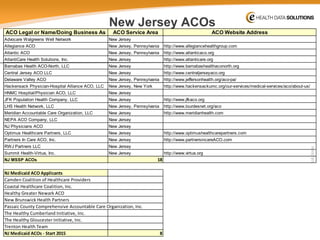
New Jersey ACOs 
ACO Legal or Name/Doing Business AsACO Service AreaACO Website AddressAdvocare Walgreens Well NetworkNew Jersey Allegiance ACONew Jersey, Pennsylvania http://www.allegiancehealthgroup.comAtlantic ACONew Jersey, Pennsylvania http://www.atlanticaco.orgAtlantiCare Health Solutions, Inc.New Jersey http://www.atlanticare.orgBarnabas Health ACO-North, LLCNew Jersey http://www.barnabashealthaconorth.orgCentral Jersey ACO LLCNew Jersey http://www.centraljerseyaco.orgDelaware Valley ACONew Jersey, Pennsylvania http://www.jeffersonhealth.org/aco-pa/ Hackensack Physician-Hospital Alliance ACO, LLCNew Jersey, New York http://www.hackensackumc.org/our-services/medical-services/aco/about-us/ HNMC Hospital/Physician ACO, LLCNew Jersey JFK Population Health Company, LLCNew Jersey http://www.jfkaco.orgLHS Health Network, LLCNew Jersey, Pennsylvania http://www.lourdesnet.org/acoMeridian Accountable Care Organization, LLCNew Jersey http://www.meridianhealth.comNEPA ACO Company, LLCNew Jersey NJ Physicians ACONew Jersey Optimus Healthcare Partners, LLCNew Jersey http://www.optimushealthcarepartners.comPartners In Care ACO, Inc.New Jersey http://www.partnersincareACO.comRWJ Partners LLCNew Jersey Summit Health-Virtua, Inc.New Jersey http://www.virtua.orgNJ MSSP ACOs18NJ Medicaid ACO ApplicantsCamden Coalition of Healthcare ProvidersCoastal Healthcare Coalition, Inc. Healthy Greater Newark ACONew Brunswick Health PartnersPassaic County Comprehensive Accountable Care Organization, Inc. The Healthy Cumberland Initiative, Inc. The Healthy Gloucester Initiative, Inc. Trenton Health TeamNJ Medicaid ACOs - Start 20158
41 
| 10/5/2014 | © eHealth Data Solutions 
ACO Payment –determined by targets and quality 
• 
One Sided ACO –shared savings with Medicare 
• 
Two Sided ACO –share risk with Medicare –the greater the savings the greater the shared savings 
• 
New Jersey –3 Years Federal FFS Cost data = 183,267,328 bytes = 174 MB 
• 
2010, 2011, 2012 Inpatient, Physician and Outpatient/ASC data on Claims for 750 New Jersey distinct zip codes 
• 
ACO has data from CMS shared quarterly 
• 
Strategy effort for ACOs 
› 
Find and refer to Providers –who are effective, efficient and are efficacious!
42 
| 10/5/2014 | © eHealth Data Solutions 
ACO Beneficiary Assignment and Cost 
• 
Based on where services are received 
› 
Chosen ACO = Primary Care Services 
 
From ACO Physicians (FP, IM, GP, Geriatrics) 
 
And/or (PA, NP, Clinical Nurse Specialist or Non PCP physician) 
› 
Beneficiary Cost 3 yrs. risk adjusted for health status & demographic factors 
 
Year 1 = 10%, Year 2 = 30%, Year 3 = 60% -trend forward 
– 
(Yr. 1 = $10K, Yr. 2 = $11K, Yr. 3 = $12K ) = $11.5K X Trend X discount 
– 
Claims exceeding a threshold are excluded 
– 
Medicare saves twice?
43 
| 10/5/2014 | © eHealth Data Solutions 
ACO Payment, Risk and Reward 
• 
ACO providers are paid Fee For Service 
• 
Payments are made by Medicare when claims are received 
• 
Providers participating in an ACO may share risk according to their provider agreements 
• 
No Risk ACO = 
› 
Savings capped 10% of total Benchmarked Expenditures 
• 
Risk Share determination 
› 
Share –ACO meets Minimum Savings Rate (MSR) & quality standard goals 
 
Risk Sharing ACO = Savings capped at 15% of Benchmark / Losses 5% Yr. 1, 7.5% Yr. 2 and 10% YR. 3 (We are expected to get better in each succeeding year)
44 
| 10/5/2014 | © eHealth Data Solutions 
Revenue Management ACO/MSSP Contract with LTPAC Providers 
• 
Episode initiator / ACO incentive is to influence census toward high value providers 
- 
ACO Exclusive Contract (i.e. Sharp Health Care and SheaFamily Homes) 
- 
Risk share determinants: 
- 
Discount @ 70% Medicare Rate 
- 
Readmissions not to exceed X % 
- 
Mortality not to exceed X % 
- 
Length of Stay not to exceed X days 
• 
Result: 
› 
Reward to ACO/MSSP/Bundling providers for directing care to high quality, low cost receiving providers 
› 
Risk Share by LT-PAC Provider
45 
| 10/5/2014 | © eHealth Data Solutions 
What happened with Sharp and Shea 
• 
Between 2010 and 2013, SheaFamily Homes increased Medicare payment from @ $50 million to $85 Million 
• 
Sharp reduced readmissions, LOS, increased satisfaction and all providers work diligently 
• 
60,000 Medicare Beneficiaries were served 
• 
AND…
46 
| 10/5/2014 | © eHealth Data Solutions 
What happened with the Sharp Health Care (SHC) ACO? 
• 
SHC holds a one third percentage interest in Sharp ACO. 
• 
For 2012 and 2013, Sharp ACO’s performance was under a defined 2% and 1.9% minimum threshold, respectively, so no shared savings payments were earned and no increased cost payments were due. 
• 
SHC re-evaluated participation for the year ended December 31, 2014 (“Performance Year 3”), Sharp ACO determined it was at risk for a significant shared loss, despite meaningful reductions in readmission rates and hospital and skilled nursing utilization. 
• 
In June 2014, Sharp ACO determined it would not continue in the Pioneer ACO Program for Performance Year 3 and notified CMMI of its decision on June 20, 2014.
47 
| 10/5/2014 | © eHealth Data Solutions 
What’s Next? 
• 
More than the Elephant 
in the room! 
• 
Bundles / ACOs – 
› 
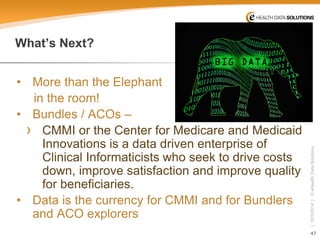
CMMI or the Center for Medicare and Medicaid Innovations is a data driven enterprise of Clinical Informaticists who seek to drive costs down, improve satisfaction and improve quality for beneficiaries. 
• 
Data is the currency for CMMI and for Bundlers and ACO explorers
48 
| 10/5/2014 | © eHealth Data Solutions 
What should LTC Leaders do? What might we ask? / What are we asked? 
• 
How can we end up differently than Sharp? 
• 
Long Term Care Leaders may want to make better use of the data gathered and focus on two things: 
1. 
Training IDT to increase their data literacy and more efficiently incorporate information into decision making. 
2. 
Giving IDT team the right tools 
3. 
Use the MDS / OASIS data you have to prove outcomes 
Therefore –is it your mission to place the right tools into the hands of staff and facilitate both data literacy and its use in making decisions?
49 
| 10/5/2014 | © eHealth Data Solutions 
Beyond 2014:Alternatives 
• 
Pursuit of Sustainable Care 
› 
Affordable Care Act 
 
Moved CMS from payer to policy maker 
 
CMS Actuary simulation predicts Medicare rates 1/3 those of private pay and ½ of Medicaid in 75 years 
› 
Therefore / ACOs (420+ ACOs serving 5.0 to 7.0+ Million Beneficiaries) –Savings so far estimated at $1.00 per Beneficiary/Yr. 
• 
Deficit Reduction Act 2005 
› 
Bundled payments 
› 
Person centered episodes –4 models –just getting started. 
› 
CMS using Hospital Value Based Payment (HVBP) to “bundle” Episodes of 30-60 days care services
50 
| 10/5/2014 | © eHealth Data Solutions 
In the end Critical Thinking, Judgment and Action…. 
• 
Recent financial and business events show all too plainly what can happen when rich data and analytics collide with gaps in knowledge or lapses in judgment. 
…So… 
› 
Leaders need to ensure that their processes and human capabilities keep pace with the computing firepower and information they import. 
› 
To overcome the insight deficit, Big Data—no matter how comprehensive or well analyzed—needs to be complemented by Big Judgment. 
Good Data Won't Guarantee Good Decisions by ShvetankShah, Andrew Horne, and Jaime Capellá-Harvard Business Review, April 2012
51 
| 10/5/2014 | © eHealth Data Solutions 
StartingToday it is clear that 
• 
Every enterprise needs to fully understand health care event data 
› 
what it is, what is does, what it means –and the potential ofdata-driven decisionsat each part of the episode 
• 
Waiting for someone else to generate the data will only delay the inevitable and make it even more difficult to prevent financial loss 
• 
Once you start tackling all the health data from the episode care processes, you’ll learn what you don’t know, and you’ll be inspired to take steps to resolve any problems. 
• 
You can use the insights gathered at each step along the way to start improving your stakeholder engagement strategies;
52 
| 10/5/2014 | © eHealth Data Solutions 
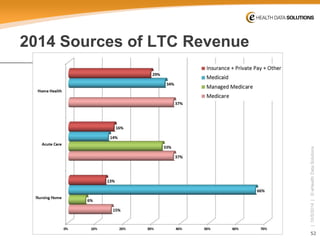
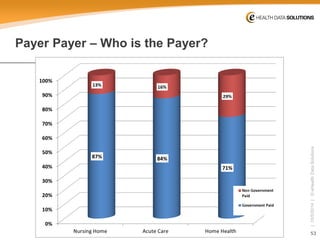
2014 Sources of LTC Revenue
53 
| 10/5/2014 | © eHealth Data Solutions 
Payer Payer –Who is the Payer?
54 
| 10/5/2014 | © eHealth Data Solutions 
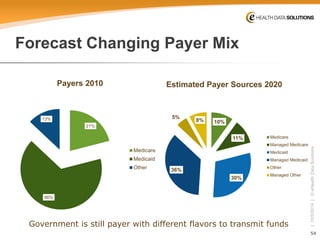
Forecast Changing Payer Mix 
21% 
66% 
13% 
Payers 2010 
Medicare 
Medicaid 
Other 
10% 
11% 
30% 
36% 
5% 
8% 
Estimated Payer Sources 2020 
Medicare 
Managed Medicare 
Medicaid 
Managed Medicaid 
Other 
Managed Other 
Government is still payer with different flavors to transmit funds
55 
| 10/5/2014 | © eHealth Data Solutions 
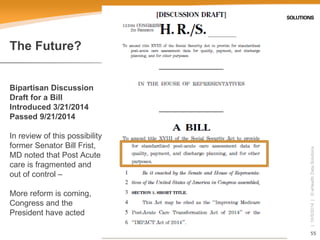
The Future? Bipartisan DiscussionDraft for a BillIntroduced 3/21/2014Passed 9/21/2014In review of this possibility, former Senator Bill Frist, MD noted that Post Acute care is fragmented and out of control – More reform is coming, Congress and the President have acted
56 
| 10/5/2014 | © eHealth Data Solutions 
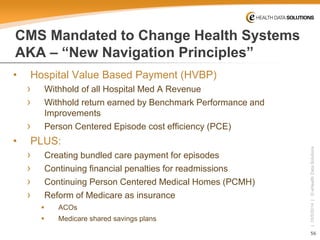
CMS Mandated to Change Health SystemsAKA –“New Navigation Principles” 
• 
Hospital Value Based Payment (HVBP) 
› 
Withhold of all Hospital Med A Revenue 
› 
Withhold return earned by Benchmark Performance and Improvements 
› 
Person Centered Episode cost efficiency (PCE) 
• 
PLUS: 
› 
Creating bundled care payment for episodes 
› 
Continuing financial penalties for readmissions 
› 
Continuing Person Centered Medical Homes (PCMH) 
› 
Reform of Medicare as insurance 
 
ACOs 
 
Medicare shared savings plans
57 
| 10/5/2014 | © eHealth Data Solutions 
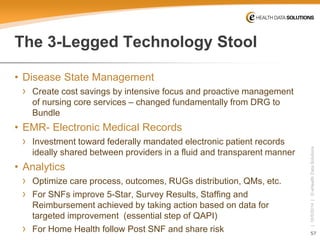
The 3-Legged Technology Stool 
• 
Disease State Management 
› 
Create cost savings by intensive focus and proactive management of nursing core services –changed fundamentally from DRG to Bundle 
• 
EMR-Electronic Medical Records 
› 
Investment toward federally mandated electronic patient records ideally shared between providers in a fluid and transparent manner 
• 
Analytics 
› 
Optimize care process, outcomes, RUGs distribution, QMs, etc. 
› 
For SNFs improve 5-Star, Survey Results, Staffing and Reimbursement achieved by taking action based on data for targeted improvement (essential step of QAPI) 
› 
For Home Health follow Post SNF and share risk
58 
| 10/5/2014 | © eHealth Data Solutions 
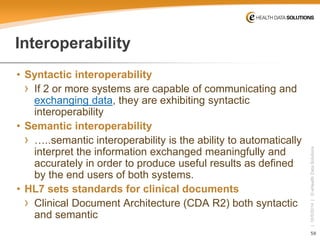
Interoperability 
• 
Syntactic interoperability 
› 
If 2 or more systems are capable of communicating and exchanging data, they are exhibiting syntactic interoperability 
• 
Semantic interoperability 
› 
…..semantic interoperability is the ability to automatically interpret the information exchanged meaningfully and accurately in order to produce useful results as defined by the end users of both systems. 
• 
HL7 sets standards for clinical documents 
› 
Clinical Document Architecture (CDA R2) both syntactic and semantic
59 
| 10/5/2014 | © eHealth Data Solutions 
S&I [Standards & Interoperability] 
CDA Templates 
S&I Framework CEDD 
Care Transition Datasets 
Patient Assessments 
Encounter Summaries 
Longitudinal Plan of Care 
CEDD 
[Common Element Data Dictionary] 
CDA 
[Clinical Document Architecture] 
What is “the” EHR? 
Congress made the laws for MU2 
CMS will act 
Providers 
comply
60 
| 10/5/2014 | © eHealth Data Solutions 
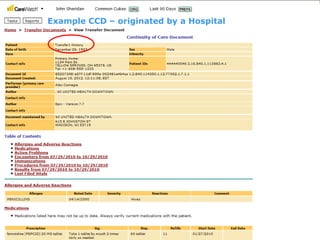
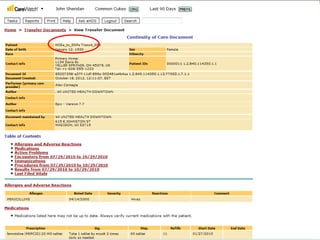
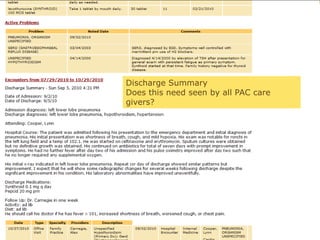
Example CCD –originated by a Hospital
61 
| 10/5/2014 | © eHealth Data Solutions
62 
| 10/5/2014 | © eHealth Data Solutions 
Discharge Summary 
Does this need seen by all PAC care givers?
63 
| 10/5/2014 | © eHealth Data Solutions 
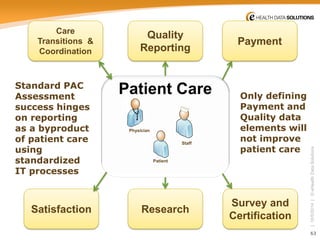
Patient Care 
Physician 
Staff 
Patient 
Care Transitions & Coordination 
Quality Reporting 
Payment 
Research 
Survey and Certification 
Satisfaction 
Standard PAC Assessment success hinges on reporting as a byproduct of patient care using standardized IT processes 
Only defining Payment and Quality data elements will not improve patient care
64 
| 10/5/2014 | © eHealth Data Solutions 
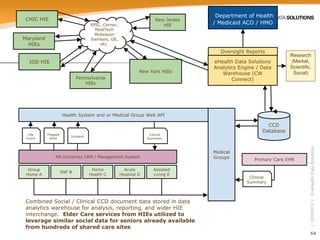
Group Home A 
SNF B 
Home Health C 
Acute Hospital D 
Assisted Living E 
MS Dynamics CRM / Management System 
Health System and or Medical Group Web API 
Life Event 
Flagged Note 
Incident 
Clinical Summary 
Medical Groups 
Combined Social / Clinical CCD document data stored in data analytics warehouse for analysis, reporting, and wider HIE interchange. Elder Care services from HIEs utilized to leverage similar social data for seniors already available from hundreds of shared care sites 
Primary Care EHR 
Clinical Summary 
CCD Database 
eHealth Data Solutions 
Analytics Engine / Data Warehouse (CW Connect) 
New York HIEs 
Department of Health / Medicaid ACO / HMO 
Oversight Reports 
EPIC, Cerner, MediTech 
McKesson 
Siemens, GE, etc. 
CHIC HIE 
Maryland HIEs 
IOD HIE 
Pennsylvania HIEs 
New Jersey HIE 
Research(Market, Scientific, Social)
65 
| 10/5/2014 | © eHealth Data Solutions 
Why does this matter? 
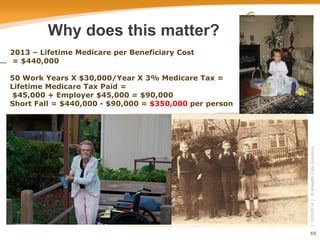
2013 –Lifetime Medicare per Beneficiary Cost 
= $440,000 
50 Work Years X $30,000/Year X 3% Medicare Tax = 
Lifetime Medicare Tax Paid = 
$45,000 + Employer $45,000 = $90,000 
Short Fall = $440,000 -$90,000 = $350,000 per person
66 
| 10/5/2014 | © eHealth Data Solutions 
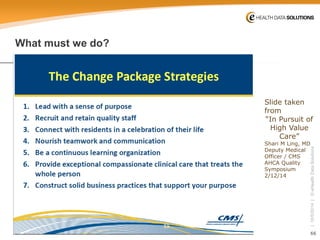
What must we do? 
Slide taken from 
“In Pursuit of High Value Care” 
Shari M Ling, MD 
Deputy Medical Officer / CMS 
AHCA Quality Symposium 2/12/14
67 
| 10/5/2014 | © eHealth Data Solutions 
Questions?
68 
| 10/5/2014 | © eHealth Data Solutions 
References 
• 
Centers for Disease Control and Prevention. National Center for Health Statistics. Health Indicators Warehouse. www.healthindicators.gov 
•http://innovation.cms.gov/initiatives/Bundled- Payments/index.html 
• 
Source: “What is Big Data?” Lisa Arthur Contributor 8/15/2013 http://www.forbes.com/sites/lisaarthur/2013/08/15/what-is-big-data/ 
• 
Wall Street Journal Aug. 25, 2014

Navigating Oceans of Data - Being Part of and Competing in the ACO & Bundled Payment Reforms!

  • 1.
    Navigating Through Oceansof Data: -Being Part of and Competing in the ACO & Bundled Payment Reforms! Presenter: John Sheridan, MHSA, FACHE Navigating the Perils of Care Transition New Jersey Long Term Care Leadership Coalition 2014 Annual Conference
  • 2.
    2 | 10/5/2014| © eHealth Data Solutions First Question • "the great American medical guilt trip“ › We spend far more on health care for worse health outcomes, including higher mortality, compared to other countries. A. This statement is absolutely True B. The statement needs clarified C. The statement is absolutely False
  • 3.
    3 | 10/5/2014| © eHealth Data Solutions Why must we face and know Data? Or The Question that is the “Elephant in the room.” “Are we appropriately Doctored”? / Are we well served? • "the great American medical guilt trip“ › We spend far more on health care for allegedly worse health outcomes, including higher mortality, compared to other countries. › This is an apples-to-oranges comparison of vastly different geographies, social structures and cultures. After subtracting homicides and automobile fatalities, the mortality discrepancies largely disappear.  We cannot cure homicide and automobile fatalities once they have happened • Medicine, like life [or “Big Data”], inevitably consists of messiness, error, tedium, unresolvable dilemmas and contradictory trade-offs. › Book Review: 'Doctored' by Sandeep Jauhar  ByTHOMAS P. STOSSEL, MD –Wall Street Journal Aug. 25, 2014
  • 4.
    4 | 10/5/2014| © eHealth Data Solutions Objectives 1. Describe key elements of post-acute care organization's operations 2. Identify metrics for quality and reimbursement influenced by relationships between acute and post-acute care providers 3. Describe how better data and a coordinated process can improve decision making 4. Apply disease state management, EMR, and analytics within your QAPI programs
  • 5.
    5 | 10/5/2014| © eHealth Data Solutions Where is data taking us? Slide taken from “In Pursuit of High Value Care” Shari M Ling, MD Deputy Medical Officer / CMS AHCA Quality Symposium 2/12/14
  • 6.
    6 | 10/5/2014| © eHealth Data Solutions Interoperability supports a Changing Health System where we face…… 1. Continuing the financial penalties for readmissions 2. Improving Nursing Workflow for LT-PAC  10/1/2014 Hospital Value-based payment in part determined by Person Centered Episode (PCE) experience 3. Bundled Care DRG like Payment for episodes 4. Person Centered Medical Homes, and 5. Continuing reform of Medicare as social insurance such as creation of Accountable Care Organizations (ACOs) and Medicare Shared Savings plans
  • 7.
    7 | 10/5/2014| © eHealth Data Solutions Today’s Topics and Lessons • Part 1 › Describe New Jersey -Bundled Payments, Who, What, Why, How  Conclude part 1 with Summary of Programs • Part 2 › Describe New Jersey –ACOs, Who, What, Why, How  Conclude part 2 with Summary of NJ ACOs • Part 3 & Conclusion › Review what we have as data and what is coming! • Questions
  • 8.
    8 | 10/5/2014| © eHealth Data Solutions Key elements of post-acute care organization's operations • Who is served? • Who are the acute and post-acute providers? • What funds are expended and are at risk? • What about ACOs and Bundled Payment options & conveners? • What might we measure?
  • 9.
    9 | 10/5/2014| © eHealth Data Solutions Who is served for Long Term Care? Age CohortMalePercentFemalePercentTotalPercentAged <12 months56,5620.6%54,0070.6%110,5691.3% Aged 1-4 years227,3222.6%217,3912.5%444,7135.1% Aged 5-9 years291,2693.3%277,2533.2%568,5226.5% Aged 10-14 years289,7873.3%275,8343.2%565,6216.5% Aged 15-19 years298,1093.4%281,7473.2%579,8566.7% Aged 20-24 years271,9833.1%260,6173.0%532,6006.1% Aged 25-29 years286,7693.3%270,1713.1%556,9406.4% Aged 30-34 years283,2923.3%270,1883.1%553,4806.4% Aged 35-39 years300,9023.5%297,9833.4%598,8856.9% Aged 40-44 years323,9153.7%330,4593.8%654,3747.5% Aged 45-49 years351,3044.0%358,0624.1%709,3668.1% Aged 50-54 years322,7523.7%334,7893.8%657,5417.6% Aged 55-59 years264,0483.0%281,7373.2%545,7856.3% Aged 60-64 years215,3482.5%241,1152.8%456,4635.2% Aged 65-69 years157,6571.8%186,1992.1%343,8563.9% Aged 70-74 years117,1101.3%145,5611.7%262,6713.0% Aged 75-79 years91,1871.0%127,1661.5%218,3532.5% Aged 80-84 years67,1750.8%109,1361.3%176,3112.0% Aged 85 years and over51,8530.6%119,9801.4%171,8332.0% Total4,268,34449.0%4,439,39551.0%8,707,739100.0% Total 65 Years and over484,9825.6%688,0427.9%1,173,02413.5% Population of New Jersey - estimate 2009Total USA 65 Years and over16,823,5605.5%22,747,0307.4%39,570,59012.9%
  • 10.
    10 | 10/5/2014| © eHealth Data Solutions What is the potential Medicare A Population Age CohortMalePercentFemalePercentTotalPercentAged 65-69 years157,65713.4%186,19915.9%343,85629.3% Aged 70-74 years117,11010.0%145,56112.4%262,67122.4% Aged 75-79 years91,1877.8%127,16610.8%218,35318.6% Aged 80-84 years67,1755.7%109,1369.3%176,31115.0% Aged 85 years and over51,8534.4%119,98010.2%171,83314.6% Total484,98241.3%688,04258.7%1,173,024100.0% Population of New Jersey - estimate 2009 - Age 65 and Over
  • 11.
    11 | 10/5/2014| © eHealth Data Solutions New Jersey Hospital Utilization http://www.healthindicators.gov/Resources/Initiatives/CMS/Hospital-Inpatient-Report_12/Indicator/Report 3.27% of USA 115.6% of USA 105.7% of USA Centers for Disease Control and Prevention. National Center for Health Statistics. Health Indicators Warehouse. www.healthindicators.gov.
  • 12.
    12 | 10/5/2014| © eHealth Data Solutions New Jersey Medicare Skilled Nursing Services Health Indicator from CDC20122011201020092008Skilled nursing facility Medicare users (count) 74,04676,33575,87374,61875,733Skilled nursing facility Medicare utilization (percent) 6.84%7.05%7.13%7.12%7.15% Skilled nursing facility Medicare admissions (per 1,000 beneficiaries) 100105107107108Skilled nursing facility Medicare days (per 1,000 beneficiaries) 2,4472,5082,5122,4912,450 Centers for Disease Control and Prevention. National Center for Health Statistics. Health Indicators Warehouse. www.healthindicators.gov. Utilization of Skilled Nursing as a Medicare Benefit declines by Admissions/1000 NOT Days
  • 13.
    13 | 10/5/2014| © eHealth Data Solutions New Jersey Inpatient Infrastructure (Providers) http://www.healthindicators.gov/Resources/Initiatives/CMS/Medicare-Hospital-and-NursingSkilled-Nursing-Providers-Report_16/Indicator/Report 1.82% of USA 364 Total SNFs -2.40% of USA Centers for Disease Control and Prevention. National Center for Health Statistics. Health Indicators Warehouse. www.healthindicators.gov.
  • 14.
    14 | 10/5/2014| © eHealth Data Solutions Whose care can “we” influence with Bundles and ACOs? MeasureNew JerseyNJ PercentUSAUSA PercentAcute Care Medicare Adm/1000312215Acute Care Medicare People Served2016646174844Medicare A Days/100018891597NJ Persons over age 651,082,5873.2%of USA34,126,305New Jersey Medicare A Beneficiaries646,35959.7%28,720,20584.2% NJ Estimated Medicare Advantage Beneficiaries436,22840.3%5,406,10015.8% Estimated Medicare Acute Care Days1,220,972 45,866,1672012 To be in a Bundle Payment Care Improvement Program or an ACO, Beneficiaries must Medicare A & B
  • 15.
    15 | 10/5/2014| © eHealth Data Solutions What is a Bundled Payment for Care Improvement (BPCI) Bundle? • Episode-based payment aggregates Medicare payments to multiple providers and suppliersfor services that are related to particular clinical conditions for a period of time (time defines episode length) • Episode-based payments measurepatient experience of care, process, outcomes, and cost of care • The goals of BPCI are: › align payment incentives among providers & suppliers › improve the health care experience of Medicare beneficiaries who undergo episodes of treatment for clinical conditions
  • 16.
    16 | 10/5/2014| © eHealth Data Solutions What is a BPCI Bundle as 10/2/2014 ? • 48 distinct Person Centered Episodes (PCE) • Each episode combines related MS-DRGs • Episodes are linked to an acute care hospital inpatient stay for one of the included MS-DRGs › A hospital admission for the anchor MS-DRG triggers or initiates a beneficiary’s episode. • Episodes are broadly defined with few exceptions • PCEs include most services covered under Medicare Part A and Part B that are provided to a beneficiary throughout the duration of the episode
  • 17.
    17 | 10/5/2014| © eHealth Data Solutions Bundled Payments for Care Improvement (BPCI) Is it a Bundle of Joy?
  • 18.
    18 | 10/5/2014| © eHealth Data Solutions What are the Bundled Episodes –Models 2-3-4? 1Acute myocardial infarction 25Major bowel 2Amputation 26Major cardiovascular procedure 3Atherosclerosis 27Major joint replacement of the lower extremity 4Automatic implantable cardiac defibrillator generator or lead 28Major joint upper extremity 5Back and neck except spinal fusion 29Medical non-infectious orthopedic 6Cardiac arrhythmia 30Medical peripheral vascular disorders 7Cardiac defibrillator 31Nutritional and metabolic disorders 8Cardiac valve 32Other knee procedures 9Cellulitis 33Other respiratory 10Cervical spinal fusion 34Other vascular surgery 11Chest pain 35Pacemaker 12Chronic obstructive pulmonary disease, bronchitis/asthmae 36Pacemaker Device replacement or revision 13Combined anterior posterior spinal fusion 37Percutaneous coronary intervention 14Complex non-Cervical spinal fusion 38Red blood cell disorders 15Congestive heart failure 39Removal of orthopedic devices 16Coronary artery bypass graft surgery 40Renal failure 17Diabetes 41Revision of the hip or knee 18Double joint replacement of the lower extremity 42Sepsis 19Esophagitis, gastroenteritis and other digestive disorders 43Simple pneumonia and respiratory infections 20Fractures femur and hip/pelvis 44Spinal fusion (non-Cervical) 21Gastrointestinal hemorrhage 45Stroke 22Gastrointestinal obstruction 46Syncope and collapse23Hip and femur procedures except major joint 47Transient ischemia 24Lower extremity and humerus procedure except hip, foot, femur 48Urinary tract infection BPCI - Bundled Episode Categories
  • 19.
    19 | 10/5/2014| © eHealth Data Solutions Examples of the Model 2-3-4 Bundled DRGs in Episodes 48 Episode Categories which Bundle 179 MS-DRGs Major joint replacement of the lower extremity 469Major joint replacement or reattachment of lower extremity with major complication or comorbidity470Major joint replacement or reattachment of lower extremity without major complication or comorbidity Diabetes 637Diabetes with major complication or comorbidity638Diabetes with complication or comorbidity639Diabetes without complication or comorbidity or major complication or comorbidityCongestive heart failure 291Heart failure and shock with major complication or comorbidity292Heart failure and shock with complication or comorbidity293Heart failure and shock without complication or comorbidity or major complication or comorbidity Episode Name MS-DRG 91 of the DRGs are in the TOP 100 2012 Medicare DRGs Paid
  • 20.
    20 | 10/5/2014| © eHealth Data Solutions What LTC Provider are involved in Bundles? Top 10 States with Model 3Skilled (SNF) Centers with Bundle ContractSNFs in StatePercentTX249120820.6% OH20395321.3% PA17369924.7% CA166121913.6% FL14768921.3% CT12222953.3% NJ11136430.5% NC10341924.6% MA10041823.9% KY8828431.0% Top 101462648222.6% USA25841561016.6% Bottom 5 States with Model 3Skilled (SNF) Centers with Bundle ContractSNFs in StatePercentWY43810.5% SD31122.7% HI2464.3% AK1185.6% ND1801.3%
  • 21.
    21 | 10/5/2014| © eHealth Data Solutions New Jersey SNFs –Leaders in Bundled Payment ConvenerDRG EpisodesPhase I - No RiskPhase II - Risk ShareGENESIS CARE INNOVATIONS LLC4832NaviHealth, Inc.489SNF is its Own Convener481Optum124Optum364Remedy BPCI Partners, LLC48106Total NJ SNFs with Bundled Payment Programs1114New Jersey SNFs with Bundled Payment Agreements in Model 3 - 90 Day Episode and at 97% of Medicare FFSContracts for Bundled ProgramsSNFsThree1Two39One75NJ Skilled Nursing Homes with Covener Contracts at 97% Medicare FFS for 90 Days
  • 22.
    22 | 10/5/2014| © eHealth Data Solutions 35 New Jersey Hospitals Lead the way! RankTop 10 States with ACH BundlersAcute Hospitalswith Bundle ContractAcute Hospitals in StatePercent with Bundle Plan1NJ356454.7% 2VA458851.1% 3SC316250.0% 4FL9218848.9% 5TN5511547.8% 6DE3742.9% 7MA286940.6% 8NV133636.1% 9CT113234.4% 10RI41233.3% Count and Percent of Hospitals with Bundled Payment Arrangements
  • 23.
    23 | 10/5/2014| © eHealth Data Solutions Hospital Bundled Discounts or Captured Savings? • 35 New Jersey Hospitals with bundled payment programs • 20 are Phase I –No Risk • 28 have Phase II with Risk Sharing • 1 Model 4 program (Cooper Medical Center) • Discounts are not of Medicare FFS, they are of the target cost prior to reconciliation of BPCI program Count of Hospitals Particpating at the Bundled Discount Level95%96.75%97%98%TotalPhase I - No Risk Share0011920Phase II - Risk Share1414928Hospitals Participating at Discount Level141521
  • 24.
    24 | 10/5/2014| © eHealth Data Solutions How does Bundled Risk Work? The Triple Crown! • Risk Tracks, for each episode. › Awardee may opt to bear risk up to the 75th, 95th, or 99th percentile. Awardees bear 100 percent of the risk up to the risk track threshold and 20 percent of payments above the threshold for a given risk track. › Risk tracks may be changed quarterly. • Medicare pays the Awardee the difference between the target price and the actual cost of care for an episode if the actual cost is less than the target price. • If the actual cost of care exceeds the target price, the Awardee pays Medicare the difference between the target price and actual spending. • Supporting Awardee preparation, CMS provides Phase 1 participants with monthly beneficiary-level claims data for episodes of care. › Phase 1 participants also engage in a variety of learning activities › Phase 1 and Phase 2 participants and receive target pricing information to inform their assessment of opportunities under BPCI.
  • 25.
    25 | 10/5/2014| © eHealth Data Solutions Imagine – • Value = Quality/Cost or Outcomes/Efficiency • Does this change the paradigm? Activity / Episode of Care = All Care… $$ 3 Days prior to Admit + $$ for Hospital stay+ $$ 30+ days after hospital discharge Or maybe 60, 90 or 120 days after discharge?? Imagine You may say I’m a dreamer, but I’m not the only one. I hope someday you’ll join us and the world will live as one. Lyric from Imagine by John Lennon
  • 26.
    26 | 10/5/2014| © eHealth Data Solutions BPCI Revenue is Data Driven • Bundled (data defined) Payment › Like DRG:  Defined by clinical and quality parameters – the difference in patient before and after treatment  Admissions and length of stay are central measures – Do you know the LOS / admission combination for your SNF? › Operators’ Strategy  More thorough assessment of patient  Core measures of clinical practice – Best practice supported by literature (QAPI)  Better Treatment at each step of the episode = Better Payment – And Better Outcomes….
  • 27.
    27 | 10/5/2014| © eHealth Data Solutions Model 3 –Simplified Bundle Example • Model 3 –CHF –(3 MS-DRGs) 90 Day Period › $18,000 –for 90 days Post Acute Care X .93 for Organization Costs = $16740.00 a. 20 days RUB X $639.43 = $ 12,788.60 1. Readmission b. 20 days RUB X $639.43 = $ 12,788.60 2. Readmission c. 20 days RUB X $639.43 = $ 12,788.60 X 3 = $ 38,365.80 Or a loss of –($20,365.80)
  • 28.
    28 | 10/5/2014| © eHealth Data Solutions Alternate Model 3 Examples • Model 3 –CHF –(3 MS-DRGs) 90 Day Period › 40 days RLA X $265.27 = $ 10,610.80 + 60 Days Home Care = $3,000 + supplemented 30 Treatment Days Out Patient Therapy = $3,000 –Total Medicare FFS Cost = $ 16,610.80 Or SNF profit of $1,389.20 –Who has oversight for 90 Days? • OR › 20 days RUB X $639.43 = $ 12,788.60 › 60 days Home Health = $3,000.00 › 10 days outpatient rehab $1100.00 Total FFS Cost = $16,888.6 Or profit of $ 1,111.40 –Who has oversight for 90 Days?
  • 29.
    29 | 10/5/2014| © eHealth Data Solutions Model 1 All DRGs Hospital Only
  • 30.
    30 | 10/5/2014| © eHealth Data Solutions Model 2 Hospitals Physicians Health Systems Conveners 48 Groups/179 DRGs Choice of 30, 60 or 90 day risk Risk = level of ACH oversight of PAC
  • 31.
    31 | 10/5/2014| © eHealth Data Solutions Model 3 LT-PAC SNF Home Health Physician Convener 48 Groups/ 179 DRGs 90 day risk Risk = 100% LT-PAC oversight
  • 32.
    32 | 10/5/2014| © eHealth Data Solutions Model 4
  • 33.
    33 | 10/5/2014| © eHealth Data Solutions Taken all 4 models together New Jersey leads Bundled Pricing Care Initiatives Hospitals Health Systems Physicians Post Acute Care Conveners Prospective Risk 30/60/90 days after Admission
  • 34.
    34 | 10/5/2014| © eHealth Data Solutions Bundled Payment Care Initiative Summary-1 Model SummaryModel 1Model 2Model 3 - LTC-PACModel 4Examples of organizations that may participate in Model: • Acute care hospitals• Acute care hospitals• Health systems• Physician hospital organizations• Physician group practices• Conveners of health care providers• Skilled nursing facilities• Inpatient rehabilitation facilities• Long-term care hospitals• Home health agencies• Physician group practices• Conveners of health care providers• Health systems• Acute care hospitals• Health systems• Physician hospital organizations• Conveners of acute care hospitalsEntities that can initiate episodes in Model: • Acute care hospitals• Acute care hospitals• Physician group practices• Skilled nursing facilities (SNF) • Inpatient rehabilitation facilities (IRF) • Long-term care hospitals (LTCH) • Home health agencies (HHA) • Physician group practices (PGP) • Acute care hospitals paid under the Inpatient Prospective Payment System (IPPS) • Receives inpatient hospital care at an Episode Initiator• The beneficiary is admitted to or initiates services with an Episode Initiator within 30 days after the beneficiary has been discharged from an acute care hospital for an MS-DRG included in a clinical episode associated with the Episode Initiator. • Receives inpatient hospital care at an Episode Initiator, and on the day of admission, has either one lifetime reserve day or one day of utilization that is also a day of entitlement remainingStart of episode: • Acute care hospital admission by Episode Initiator for ALL DRGs• Acute care hospital admission by Episode Initiator for included clinical conditions (identified via MS-DRG) • Post-acute care with an Episode Initiator (SNF, LTCH, IRF, or HHA) within 30 days after discharge from an acute care hospital for an MS-DRG included in a clinical episode associated with the Episode Initiator. In the case of a PGP Episode Initiator, post-acute care by any SNF, IRF, LTCH, or HHA within 30 days after discharge from an acute care hospital for an MS-DRG included in a clinical episode associated with the PGP Episode Initiator where any physician member of the PGP was the operating or admitting physician for the inpatient stay. • Acute care hospital admission by Episode Initiator for included clinicalconditions (identified via anchor MS- DRG). • The beneficiary is eligible for Part A and enrolled in Part B. • The beneficiary must not have End Stage Renal Disease• The beneficiary must not be enrolled in any managed care plan (for example, Medicare Advantage, Health Care Prepayment Plans, cost-based health maintenance organizations). • The beneficiary must not be covered under United Mine Workers; and Medicare must be the primary payerCriteria for beneficiaryinclusion in episode: • Receives inpatient hospital care at an Episode Initiator• includes most Medicare fee-for-service discharges for the participating hospitals
  • 35.
    35 | 10/5/2014| © eHealth Data Solutions Bundled Payment Care Initiative Summary-2 Model SummaryModel 1Model 2Model 3 - LTC-PACModel 4End of episode:Discharge• 30, 60, or 90 days after acute care hospital discharge• 30, 60, or 90 days after the initiation of the episode• 30 days after acute care hospital discharge for anchor MS-DRG (following discharge, only related readmissions are included in the episode for the 30 day period) Types of services included inBundle, which include broad clinical episode categories: Inpatient Hospital Services• Physicians’ services• Inpatient hospital services• Inpatient hospital readmission services• Long term care hospital services (LTCH) • Inpatient rehabilitation facility services (IRF) • Skilled nursing facility services (SNF) • Home health agency services (HHA) • Hospital outpatient services• Independent outpatient therapy services• Clinical laboratory services• Durable medical equipment• Part B drugs• Physicians’ services• Inpatient post-acute care services• Inpatient hospital readmission services• Long term care hospital services• Inpatient rehabilitation facility services• Skilled nursing facility services• Home health agency services• Clinical laboratory services• Durable medical equipment• Part B drugs• Physicians’ services for inpatient hospital care• Inpatient hospital services• Inpatient hospital readmission servicesPayment from CMS toEpisode Initiators: IPPS MS-DRGs• Single prospectively determined bundled payment5% provided to Medicare• 2% discount for episodes 90 days in length3% discount for episodes of 90 daysReconciliation: hospitals and physicians will be permitted to share savings arising from the providers’ care redesign efforts. • Medicare pays a predetermined bundled payment amount to the Episode Initiator, which is responsible for paying physicians and non-physician practitioners that furnished services to the beneficiary during the episode. • Medicare pays the Awardee the difference between the target price and the actual cost of care for an episode if the actual cost of care is less than the target price. If the actual cost of care exceeds the target price, the Awardee pays Medicare the difference between the target price and actual spending. • 3% discount for episodes of 30 or 60 days in lengthDiscount provided toMedicare: • 3% discount for episodes that do not include MS-DRGs included in the ACE Demonstration• 3.25% discount for episodes that include MS-DRGs that were included in the ACE Demonstration• Traditional FFS payments
  • 36.
    36 | 10/5/2014| © eHealth Data Solutions Question 2 • As a New Jersey Care Provider, I would describe my experience in bundled payment as A. Examine, treat or see a bundled service combination almost daily B. Examine, treat or see a bundled service so little I would not know I had done so C. I have no idea what this bundled payment is about and am now hopelessly confused
  • 37.
    37 | 10/5/2014| © eHealth Data Solutions Bundles and ACOs have “Big Data” in common • CMS uses FFS Beneficiary Part A and B claims to establish a target cost for Bundled Episodes and for ACOs • Target cost = 3 year history X trend factor minus the CMS Episode Discount • The ACO and Bundle target dollars are a CMS determination by use of data to forecast and determine expected future payments. • In this theory for innovation… › Healthcare cost is predicted & controlled
  • 38.
    38 | 10/5/2014| © eHealth Data Solutions New Jersey Acute and Post Acute Expenditures (2012) [3 days prior to index Admission + 30 days PAC] Total Costs per PeriodReported%Calculated* Day 1-3 Prior to Adm$66,205,5221.3%$66,205,522Index Admission$2,563,702,94651.2%$2,563,702,946Days 1-30 post Index AdmissionLong Term Care$2,379,987,73047.5%$2,379,987,730Complete Episode Costs$5,009,841,634100.0%$5,009,896,198 Medicare A Episodes of Care249919Medicare Beneficiaries Served201664 Estimated Medicare A Episodes per Person Served1.24New Jersey Medicare Part A Expenditures for 2012Transitions per person per year*Note Addition differences reported by CMS as rounding errors If all Medicare A Episodes were set for 2012, targeted cost would be $4,859,546,385 –or $150,295,249 less than spent Ideally savings will be greater than 3%
  • 39.
    39 | 10/5/2014| © eHealth Data Solutions Type of Medicare Claim1 to 3 days Prior to Index Hospital AdmissionDuring Index Hospital Admission1 through 30 days After Discharge from Index HospitalGrand TotalPercent of Episode of Care ExpendituresElegible Practitioner and Carrier Paid$37,657,659$533,304,086$341,339,212$912,300,95718.2% Durable Medical Equipment$2,165,718$4,934,110$25,359,561$32,459,3890.6% Home Health Agency$2,249,522$0$156,249,211$158,498,7333.2% Hospice$109,134$0$23,800,210$23,909,3440.5% Inpatient$1,055,515$2,025,464,750$649,753,170$2,676,273,43553.4% Outpatient$22,095,316$0$147,578,830$169,674,1463.4% Skilled Nursing Facility$872,658$0$1,035,907,536$1,036,780,19420.7% Total$66,205,522$2,563,702,946$2,379,987,730$5,009,841,634100.0% Percent of Episode Expenditures1.3%51.2%47.5%100.0% Sum of 2012 Medicare Part A Expenditures per Beneficiary in New Jersey for 2012 Acute and Post Acute Expenditures by Claim Type Source: Data.Medicare.Gov–Medical Spending per Beneficiary
  • 40.
    40 | 10/5/2014| © eHealth Data Solutions New Jersey ACOs ACO Legal or Name/Doing Business AsACO Service AreaACO Website AddressAdvocare Walgreens Well NetworkNew Jersey Allegiance ACONew Jersey, Pennsylvania http://www.allegiancehealthgroup.comAtlantic ACONew Jersey, Pennsylvania http://www.atlanticaco.orgAtlantiCare Health Solutions, Inc.New Jersey http://www.atlanticare.orgBarnabas Health ACO-North, LLCNew Jersey http://www.barnabashealthaconorth.orgCentral Jersey ACO LLCNew Jersey http://www.centraljerseyaco.orgDelaware Valley ACONew Jersey, Pennsylvania http://www.jeffersonhealth.org/aco-pa/ Hackensack Physician-Hospital Alliance ACO, LLCNew Jersey, New York http://www.hackensackumc.org/our-services/medical-services/aco/about-us/ HNMC Hospital/Physician ACO, LLCNew Jersey JFK Population Health Company, LLCNew Jersey http://www.jfkaco.orgLHS Health Network, LLCNew Jersey, Pennsylvania http://www.lourdesnet.org/acoMeridian Accountable Care Organization, LLCNew Jersey http://www.meridianhealth.comNEPA ACO Company, LLCNew Jersey NJ Physicians ACONew Jersey Optimus Healthcare Partners, LLCNew Jersey http://www.optimushealthcarepartners.comPartners In Care ACO, Inc.New Jersey http://www.partnersincareACO.comRWJ Partners LLCNew Jersey Summit Health-Virtua, Inc.New Jersey http://www.virtua.orgNJ MSSP ACOs18NJ Medicaid ACO ApplicantsCamden Coalition of Healthcare ProvidersCoastal Healthcare Coalition, Inc. Healthy Greater Newark ACONew Brunswick Health PartnersPassaic County Comprehensive Accountable Care Organization, Inc. The Healthy Cumberland Initiative, Inc. The Healthy Gloucester Initiative, Inc. Trenton Health TeamNJ Medicaid ACOs - Start 20158
  • 41.
    41 | 10/5/2014| © eHealth Data Solutions ACO Payment –determined by targets and quality • One Sided ACO –shared savings with Medicare • Two Sided ACO –share risk with Medicare –the greater the savings the greater the shared savings • New Jersey –3 Years Federal FFS Cost data = 183,267,328 bytes = 174 MB • 2010, 2011, 2012 Inpatient, Physician and Outpatient/ASC data on Claims for 750 New Jersey distinct zip codes • ACO has data from CMS shared quarterly • Strategy effort for ACOs › Find and refer to Providers –who are effective, efficient and are efficacious!
  • 42.
    42 | 10/5/2014| © eHealth Data Solutions ACO Beneficiary Assignment and Cost • Based on where services are received › Chosen ACO = Primary Care Services  From ACO Physicians (FP, IM, GP, Geriatrics)  And/or (PA, NP, Clinical Nurse Specialist or Non PCP physician) › Beneficiary Cost 3 yrs. risk adjusted for health status & demographic factors  Year 1 = 10%, Year 2 = 30%, Year 3 = 60% -trend forward – (Yr. 1 = $10K, Yr. 2 = $11K, Yr. 3 = $12K ) = $11.5K X Trend X discount – Claims exceeding a threshold are excluded – Medicare saves twice?
  • 43.
    43 | 10/5/2014| © eHealth Data Solutions ACO Payment, Risk and Reward • ACO providers are paid Fee For Service • Payments are made by Medicare when claims are received • Providers participating in an ACO may share risk according to their provider agreements • No Risk ACO = › Savings capped 10% of total Benchmarked Expenditures • Risk Share determination › Share –ACO meets Minimum Savings Rate (MSR) & quality standard goals  Risk Sharing ACO = Savings capped at 15% of Benchmark / Losses 5% Yr. 1, 7.5% Yr. 2 and 10% YR. 3 (We are expected to get better in each succeeding year)
  • 44.
    44 | 10/5/2014| © eHealth Data Solutions Revenue Management ACO/MSSP Contract with LTPAC Providers • Episode initiator / ACO incentive is to influence census toward high value providers - ACO Exclusive Contract (i.e. Sharp Health Care and SheaFamily Homes) - Risk share determinants: - Discount @ 70% Medicare Rate - Readmissions not to exceed X % - Mortality not to exceed X % - Length of Stay not to exceed X days • Result: › Reward to ACO/MSSP/Bundling providers for directing care to high quality, low cost receiving providers › Risk Share by LT-PAC Provider
  • 45.
    45 | 10/5/2014| © eHealth Data Solutions What happened with Sharp and Shea • Between 2010 and 2013, SheaFamily Homes increased Medicare payment from @ $50 million to $85 Million • Sharp reduced readmissions, LOS, increased satisfaction and all providers work diligently • 60,000 Medicare Beneficiaries were served • AND…
  • 46.
    46 | 10/5/2014| © eHealth Data Solutions What happened with the Sharp Health Care (SHC) ACO? • SHC holds a one third percentage interest in Sharp ACO. • For 2012 and 2013, Sharp ACO’s performance was under a defined 2% and 1.9% minimum threshold, respectively, so no shared savings payments were earned and no increased cost payments were due. • SHC re-evaluated participation for the year ended December 31, 2014 (“Performance Year 3”), Sharp ACO determined it was at risk for a significant shared loss, despite meaningful reductions in readmission rates and hospital and skilled nursing utilization. • In June 2014, Sharp ACO determined it would not continue in the Pioneer ACO Program for Performance Year 3 and notified CMMI of its decision on June 20, 2014.
  • 47.
    47 | 10/5/2014| © eHealth Data Solutions What’s Next? • More than the Elephant in the room! • Bundles / ACOs – › CMMI or the Center for Medicare and Medicaid Innovations is a data driven enterprise of Clinical Informaticists who seek to drive costs down, improve satisfaction and improve quality for beneficiaries. • Data is the currency for CMMI and for Bundlers and ACO explorers
  • 48.
    48 | 10/5/2014| © eHealth Data Solutions What should LTC Leaders do? What might we ask? / What are we asked? • How can we end up differently than Sharp? • Long Term Care Leaders may want to make better use of the data gathered and focus on two things: 1. Training IDT to increase their data literacy and more efficiently incorporate information into decision making. 2. Giving IDT team the right tools 3. Use the MDS / OASIS data you have to prove outcomes Therefore –is it your mission to place the right tools into the hands of staff and facilitate both data literacy and its use in making decisions?
  • 49.
    49 | 10/5/2014| © eHealth Data Solutions Beyond 2014:Alternatives • Pursuit of Sustainable Care › Affordable Care Act  Moved CMS from payer to policy maker  CMS Actuary simulation predicts Medicare rates 1/3 those of private pay and ½ of Medicaid in 75 years › Therefore / ACOs (420+ ACOs serving 5.0 to 7.0+ Million Beneficiaries) –Savings so far estimated at $1.00 per Beneficiary/Yr. • Deficit Reduction Act 2005 › Bundled payments › Person centered episodes –4 models –just getting started. › CMS using Hospital Value Based Payment (HVBP) to “bundle” Episodes of 30-60 days care services
  • 50.
    50 | 10/5/2014| © eHealth Data Solutions In the end Critical Thinking, Judgment and Action…. • Recent financial and business events show all too plainly what can happen when rich data and analytics collide with gaps in knowledge or lapses in judgment. …So… › Leaders need to ensure that their processes and human capabilities keep pace with the computing firepower and information they import. › To overcome the insight deficit, Big Data—no matter how comprehensive or well analyzed—needs to be complemented by Big Judgment. Good Data Won't Guarantee Good Decisions by ShvetankShah, Andrew Horne, and Jaime Capellá-Harvard Business Review, April 2012
  • 51.
    51 | 10/5/2014| © eHealth Data Solutions StartingToday it is clear that • Every enterprise needs to fully understand health care event data › what it is, what is does, what it means –and the potential ofdata-driven decisionsat each part of the episode • Waiting for someone else to generate the data will only delay the inevitable and make it even more difficult to prevent financial loss • Once you start tackling all the health data from the episode care processes, you’ll learn what you don’t know, and you’ll be inspired to take steps to resolve any problems. • You can use the insights gathered at each step along the way to start improving your stakeholder engagement strategies;
  • 52.
    52 | 10/5/2014| © eHealth Data Solutions 2014 Sources of LTC Revenue
  • 53.
    53 | 10/5/2014| © eHealth Data Solutions Payer Payer –Who is the Payer?
  • 54.
    54 | 10/5/2014| © eHealth Data Solutions Forecast Changing Payer Mix 21% 66% 13% Payers 2010 Medicare Medicaid Other 10% 11% 30% 36% 5% 8% Estimated Payer Sources 2020 Medicare Managed Medicare Medicaid Managed Medicaid Other Managed Other Government is still payer with different flavors to transmit funds
  • 55.
    55 | 10/5/2014| © eHealth Data Solutions The Future? Bipartisan DiscussionDraft for a BillIntroduced 3/21/2014Passed 9/21/2014In review of this possibility, former Senator Bill Frist, MD noted that Post Acute care is fragmented and out of control – More reform is coming, Congress and the President have acted
  • 56.
    56 | 10/5/2014| © eHealth Data Solutions CMS Mandated to Change Health SystemsAKA –“New Navigation Principles” • Hospital Value Based Payment (HVBP) › Withhold of all Hospital Med A Revenue › Withhold return earned by Benchmark Performance and Improvements › Person Centered Episode cost efficiency (PCE) • PLUS: › Creating bundled care payment for episodes › Continuing financial penalties for readmissions › Continuing Person Centered Medical Homes (PCMH) › Reform of Medicare as insurance  ACOs  Medicare shared savings plans
  • 57.
    57 | 10/5/2014| © eHealth Data Solutions The 3-Legged Technology Stool • Disease State Management › Create cost savings by intensive focus and proactive management of nursing core services –changed fundamentally from DRG to Bundle • EMR-Electronic Medical Records › Investment toward federally mandated electronic patient records ideally shared between providers in a fluid and transparent manner • Analytics › Optimize care process, outcomes, RUGs distribution, QMs, etc. › For SNFs improve 5-Star, Survey Results, Staffing and Reimbursement achieved by taking action based on data for targeted improvement (essential step of QAPI) › For Home Health follow Post SNF and share risk
  • 58.
    58 | 10/5/2014| © eHealth Data Solutions Interoperability • Syntactic interoperability › If 2 or more systems are capable of communicating and exchanging data, they are exhibiting syntactic interoperability • Semantic interoperability › …..semantic interoperability is the ability to automatically interpret the information exchanged meaningfully and accurately in order to produce useful results as defined by the end users of both systems. • HL7 sets standards for clinical documents › Clinical Document Architecture (CDA R2) both syntactic and semantic
  • 59.
    59 | 10/5/2014| © eHealth Data Solutions S&I [Standards & Interoperability] CDA Templates S&I Framework CEDD Care Transition Datasets Patient Assessments Encounter Summaries Longitudinal Plan of Care CEDD [Common Element Data Dictionary] CDA [Clinical Document Architecture] What is “the” EHR? Congress made the laws for MU2 CMS will act Providers comply
  • 60.
    60 | 10/5/2014| © eHealth Data Solutions Example CCD –originated by a Hospital
  • 61.
    61 | 10/5/2014| © eHealth Data Solutions
  • 62.
    62 | 10/5/2014| © eHealth Data Solutions Discharge Summary Does this need seen by all PAC care givers?
  • 63.
    63 | 10/5/2014| © eHealth Data Solutions Patient Care Physician Staff Patient Care Transitions & Coordination Quality Reporting Payment Research Survey and Certification Satisfaction Standard PAC Assessment success hinges on reporting as a byproduct of patient care using standardized IT processes Only defining Payment and Quality data elements will not improve patient care
  • 64.
    64 | 10/5/2014| © eHealth Data Solutions Group Home A SNF B Home Health C Acute Hospital D Assisted Living E MS Dynamics CRM / Management System Health System and or Medical Group Web API Life Event Flagged Note Incident Clinical Summary Medical Groups Combined Social / Clinical CCD document data stored in data analytics warehouse for analysis, reporting, and wider HIE interchange. Elder Care services from HIEs utilized to leverage similar social data for seniors already available from hundreds of shared care sites Primary Care EHR Clinical Summary CCD Database eHealth Data Solutions Analytics Engine / Data Warehouse (CW Connect) New York HIEs Department of Health / Medicaid ACO / HMO Oversight Reports EPIC, Cerner, MediTech McKesson Siemens, GE, etc. CHIC HIE Maryland HIEs IOD HIE Pennsylvania HIEs New Jersey HIE Research(Market, Scientific, Social)
  • 65.
    65 | 10/5/2014| © eHealth Data Solutions Why does this matter? 2013 –Lifetime Medicare per Beneficiary Cost = $440,000 50 Work Years X $30,000/Year X 3% Medicare Tax = Lifetime Medicare Tax Paid = $45,000 + Employer $45,000 = $90,000 Short Fall = $440,000 -$90,000 = $350,000 per person
  • 66.
    66 | 10/5/2014| © eHealth Data Solutions What must we do? Slide taken from “In Pursuit of High Value Care” Shari M Ling, MD Deputy Medical Officer / CMS AHCA Quality Symposium 2/12/14
  • 67.
    67 | 10/5/2014| © eHealth Data Solutions Questions?
  • 68.
    68 | 10/5/2014| © eHealth Data Solutions References • Centers for Disease Control and Prevention. National Center for Health Statistics. Health Indicators Warehouse. www.healthindicators.gov •http://innovation.cms.gov/initiatives/Bundled- Payments/index.html • Source: “What is Big Data?” Lisa Arthur Contributor 8/15/2013 http://www.forbes.com/sites/lisaarthur/2013/08/15/what-is-big-data/ • Wall Street Journal Aug. 25, 2014