ACADEMIC
ORIENTATION GUIDEBOOK
2015-2016
Table of Contents
Welcome to the College of Arts and Letters..................................................................2
Academic Advising Information......................................................................................3
Majors, Minors, and College Requirements...................................................................4
University Requirements and Academic Integrity........................................................5
Experiential Education and Undergraduate Research..................................................6
Internships..........................................................................................................................7
Transitioning from High School to College...................................................................8
Majors by Department and Minors...............................................................................10
Online Academic Resources...........................................................................................11
Campus Resources..........................................................................................................13
Integrative Studies Course Descriptions......................................................................15
Welcome
Welcome Spartans!
Welcome to Michigan State University (MSU) and the College of Arts and Letters (CAL)! We are pleased that
you have decided to become part of a college that educates passionate actors, artists, designers, filmmakers,
linguists, philosophers, poets, teachers, translators, writers, and much more in a creative and nurturing learning
environment.
Academic Advisors in CAL are the coordinators of your undergraduate experience and provide critical informa-
tion about study abroad, leadership development, major choices, career options, university policies and proce-
dures, and campus resources. Advisors should be your first and last contact for information within the College
of Arts and Letters. They will serve as a reference if they know you well, certify you for graduation, and work
with the administrations of both the College and the University on your behalf. We look forward to serving you
and getting to know you!
Undergraduate Academic Service Staff
Assistant Dean of
Undergraduate Affairs and
Study Abroad
Beth Judge
200 Linton Hall
(517)355-0366
judgebe@msu.edu
Director of Undergraduate
Affairs
Quinn Moreno
200 Linton Hall
(517)355-0366
qmoreno@msu.edu
Coordinator of Undergraduate
Student Affairs
Sarah Whitaker
200 Linton Hall
(517)355-0366
whitak41@msu.edu
Field Career Consultant
Becky Brewer
200 Linton Hall
(517)355-0366
brewerre@msu.edu
Academic Advisors
Britta Urness
Ruth Mowry
Cindy Walter
Jennifer Gansler
Dionne O’Dell
Dori Hopkins
Jon Ritz
Laura Essig
Faculty Advisors
Debra Nails
Arthur Versluis
Arthur Versluis Religious Studies
Britta Urness Studio Art
History of Art
Art Education
Cindy Walter Arabic
Chinese
German
Global Studies in the Arts and Humanities
Japanese
Linguistics
Russian
Debra Nails Philosophy
Dionne O’Dell Theatre
Dori Hopkins Women and Gender Studies
Jennifer Gansler French
Spanish
Jon Ritz Professional Writing
Laura Essig Experience Architecture
Humanities - Prelaw
Interdisciplinary Humanities
Ruth Mowry English
Film Studies
Advisors by Major
Academic Advisors Offer:
•	 Course planning appropriate for your major and
career goals
•	 Assistance in selection of a major field of study
•	 Review of degree and/or minor requirements
•	 Planning toward career goals
•	 Referral to campus resources
•	 Enrollment and registration information
•	 Information about experiential education op-
portunities including study abroad, international
opportunities, study away, independent studies,
research, and more
•	 A person to share any high and low points in
your college career
Academic Advising Appointments:
We encourage you to see your Academic Advisor
at least once per semester. If you are interested in
multiple areas, you should meet with each respective
advisor. To set up an appointment, visit the Advisors
Calendar at https://www.egr.msu.edu/adcalendar/.
Advisors by Email:
If you have any questions that you think have simple
answers, feel free to reach out to your advisor via
email. Most of the time, an advisor will be able to
respond to email within 48 hours. An advisor may
suggest scheduling an appointment if they feel the
question requires further discussion.
Honors College Students:
Honors College students are assigned an advisor in
their major department as well as an advisor in the
Honors College. It is important to meet with each
of your advisors to plan your academic program or
handle advising inquiries.
Advising Options
Majors and Minors
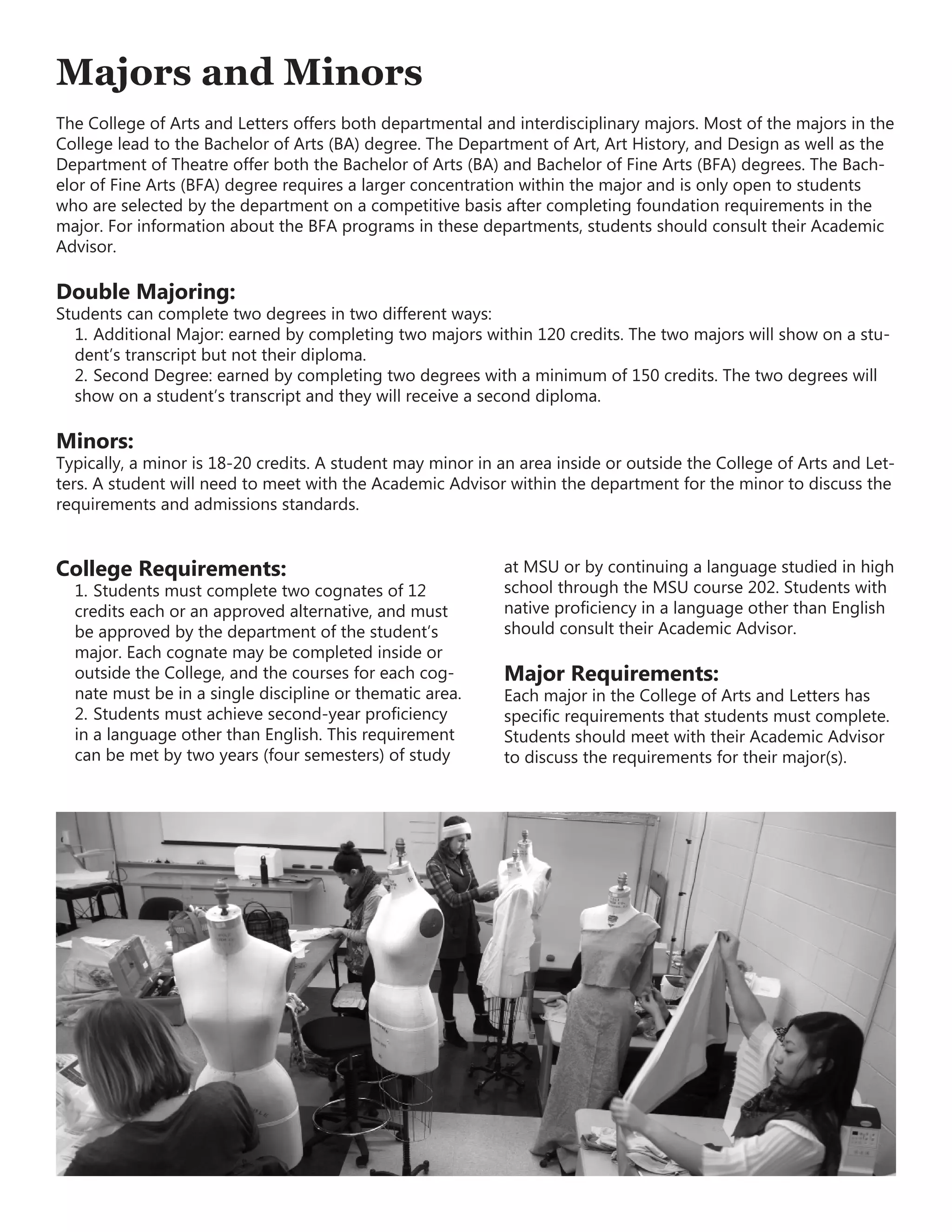
The College of Arts and Letters offers both departmental and interdisciplinary majors. Most of the majors in the
College lead to the Bachelor of Arts (BA) degree. The Department of Art, Art History, and Design as well as the
Department of Theatre offer both the Bachelor of Arts (BA) and Bachelor of Fine Arts (BFA) degrees. The Bach-
elor of Fine Arts (BFA) degree requires a larger concentration within the major and is only open to students
who are selected by the department on a competitive basis after completing foundation requirements in the
major. For information about the BFA programs in these departments, students should consult their Academic
Advisor.
Double Majoring:
Students can complete two degrees in two different ways:
1.	Additional Major: earned by completing two majors within 120 credits. The two majors will show on a stu-
dent’s transcript but not their diploma.
2.	Second Degree: earned by completing two degrees with a minimum of 150 credits. The two degrees will
show on a student’s transcript and they will receive a second diploma.
Minors:
Typically, a minor is 18-20 credits. A student may minor in an area inside or outside the College of Arts and Let-
ters. A student will need to meet with the Academic Advisor within the department for the minor to discuss the
requirements and admissions standards.
College Requirements:
1.	Students must complete two cognates of 12
credits each or an approved alternative, and must
be approved by the department of the student’s
major. Each cognate may be completed inside or
outside the College, and the courses for each cog-
nate must be in a single discipline or thematic area.
2.	Students must achieve second-year proficiency
in a language other than English. This requirement
can be met by two years (four semesters) of study
at MSU or by continuing a language studied in high
school through the MSU course 202. Students with
native proficiency in a language other than English
should consult their Academic Advisor.
Major Requirements:
Each major in the College of Arts and Letters has
specific requirements that students must complete.
Students should meet with their Academic Advisor
to discuss the requirements for their major(s).
Academic honesty and integrity are fundamental
values in a community of scholars. Students and
faculty share a commitment to and responsibility for
“maintaining the integrity of scholarship, grades, and
professional standards.” To abuse these values is to
compromise one’s own personal integrity and char-
acter, yet cheating occurs on every college campus.
The best way to protect yourself from an allegation of
academic honesty is simple: don’t cheat.
Students should NOT:
•	 Turn in an exam, paper, or project that is not
wholly their own work
•	 Copy answers from another student’s exam,
paper, or project
•	 Get questions and/or answers from students
who have already taken an exam they are sched-
uled to take
•	 Have another person take a test for them
•	 Submit the same paper for multiple classes
•	 Use another authors’ ideas, words, or phrases
without proper attribution
•	 Collaborate with other students on projects or
assignments without the instructor’s permission
•	 Falsify their academic and/or admissions records
Writing (4 credits):
	 ___ WRA 110-150 (4) Writing, Rhetoric, and American Cultures
Integrative Studies (24 credits):
	 ___ ISB 200 level (3) Biological Science
	 ___ ISP 200 level (3) Physical Science
	 ___ ISB or ISP lab (2) Biological/Physical Science Lab
	 ___ IAH 201-210 (4) Arts and Humanities
	 ___ IAH 211-241 (4) Arts and Humanities
	 ___ ISS 200 level (4) Social Science
	 ___ ISS 300 level (4) Social Science
Students must include at least one National (N) and one International/Multicultural (I) course in their Integra-
tive studies program. A (D) course may meet either an (N) or an (I) requirement, but one class will not suffice
for both. See course details for descriptions.
A minimum of 120 credits is required for graduation, or 123 credits if MTH 1825 was completed at MSU.
University Requirements
Academic Integrity:
Experiential Education
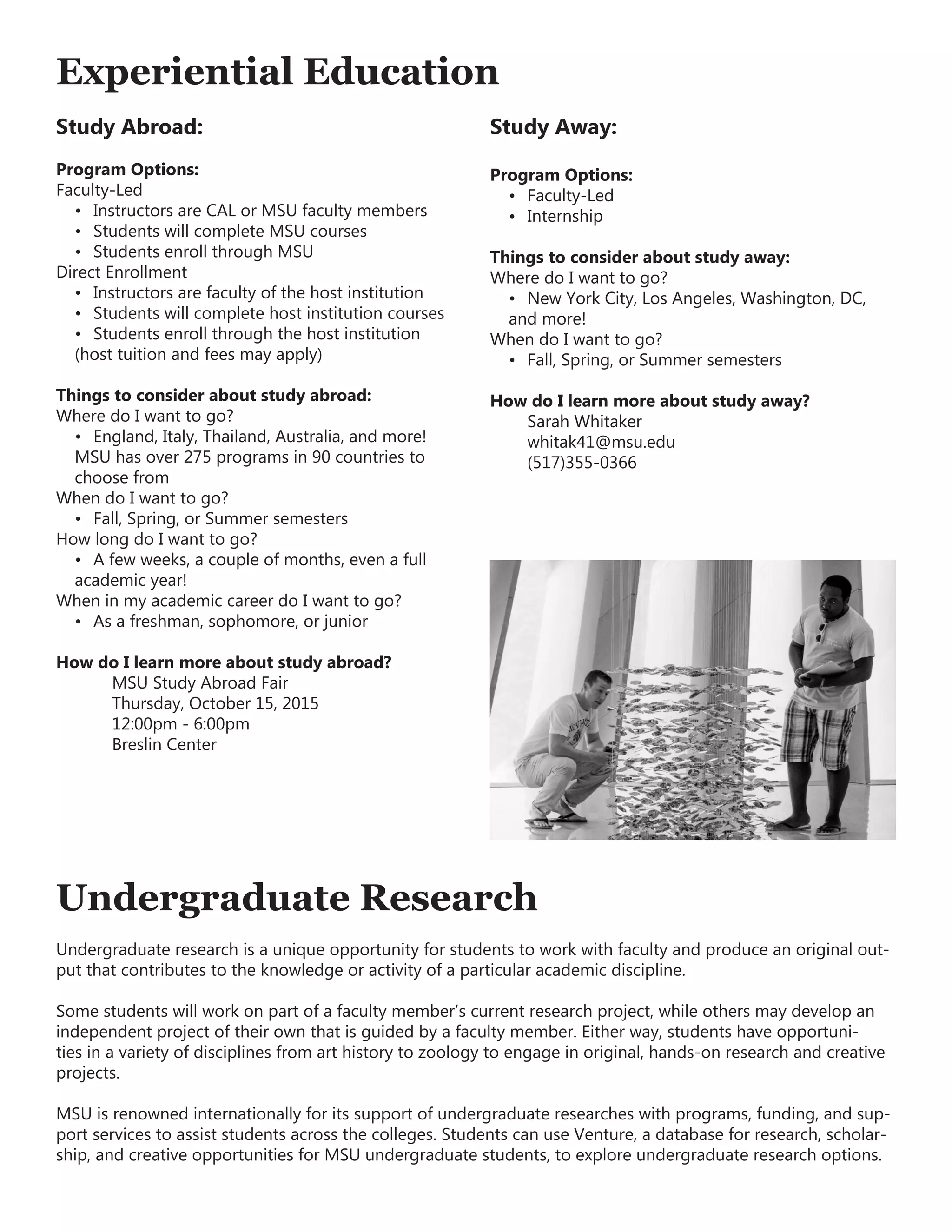
Study Abroad:
Program Options:
Faculty-Led
•	 Instructors are CAL or MSU faculty members
•	 Students will complete MSU courses
•	 Students enroll through MSU
Direct Enrollment
•	 Instructors are faculty of the host institution
•	 Students will complete host institution courses
•	 Students enroll through the host institution
(host tuition and fees may apply)
Things to consider about study abroad:
Where do I want to go?
•	 England, Italy, Thailand, Australia, and more!
MSU has over 275 programs in 90 countries to
choose from
When do I want to go?
•	 Fall, Spring, or Summer semesters
How long do I want to go?
•	 A few weeks, a couple of months, even a full
academic year!
When in my academic career do I want to go?
•	 As a freshman, sophomore, or junior
How do I learn more about study abroad?
	 MSU Study Abroad Fair
	 Thursday, October 15, 2015
	 12:00pm - 6:00pm
	 Breslin Center
Study Away:
Program Options:
•	 Faculty-Led
•	 Internship
Things to consider about study away:
Where do I want to go?
•	 New York City, Los Angeles, Washington, DC,
and more!
When do I want to go?
•	 Fall, Spring, or Summer semesters
How do I learn more about study away?
	 Sarah Whitaker
	whitak41@msu.edu
	(517)355-0366
Undergraduate Research
Undergraduate research is a unique opportunity for students to work with faculty and produce an original out-
put that contributes to the knowledge or activity of a particular academic discipline.
Some students will work on part of a faculty member’s current research project, while others may develop an
independent project of their own that is guided by a faculty member. Either way, students have opportuni-
ties in a variety of disciplines from art history to zoology to engage in original, hands-on research and creative
projects.
MSU is renowned internationally for its support of undergraduate researches with programs, funding, and sup-
port services to assist students across the colleges. Students can use Venture, a database for research, scholar-
ship, and creative opportunities for MSU undergraduate students, to explore undergraduate research options.
Benefits of internship experiences:
•	 Honing your skills: internship experiences show
employers that you have already developed re-
lated skills and experience in your field, worked in
a professional environment, and are serious about
your field
•	 Zeroing in on your interests: it’s better to learn
that something isn’t right for you during an intern-
ship rather than in your firrst job after graduation.
Internships allow you to explore different career
options so you can find the right fit
•	 Recruiting for full-time work: many employers
use internships as a recruitment tool, so intern-
ships are a great way to get your foot in the door.
Employers often hire directly from their internship
pool
Some of our students have interned at:
•	 Late Night with Jimmy Fallon as a
	 writing/blogging intern
•	 The White House
•	 Target as a merchandise planning
	 business analyst intern
•	 Washtenaw County Public Defender’s Office
	 as a student investigator
•	 TechSmith as a user experience intern
•	 General Motors as a sculpting intern
Internships
Internships are an important resume-building experience and opportunity to gain real-world experience in
a field of your interest. Employers like to see at least one internship throughout your undergraduate college
career, but it is becoming increasingly popular to take advantage of multiple internship opportunities during
your time at MSU. CAL Spartans have taken advantage of a variety of amazing internship opportunities, some
of which are listed below!
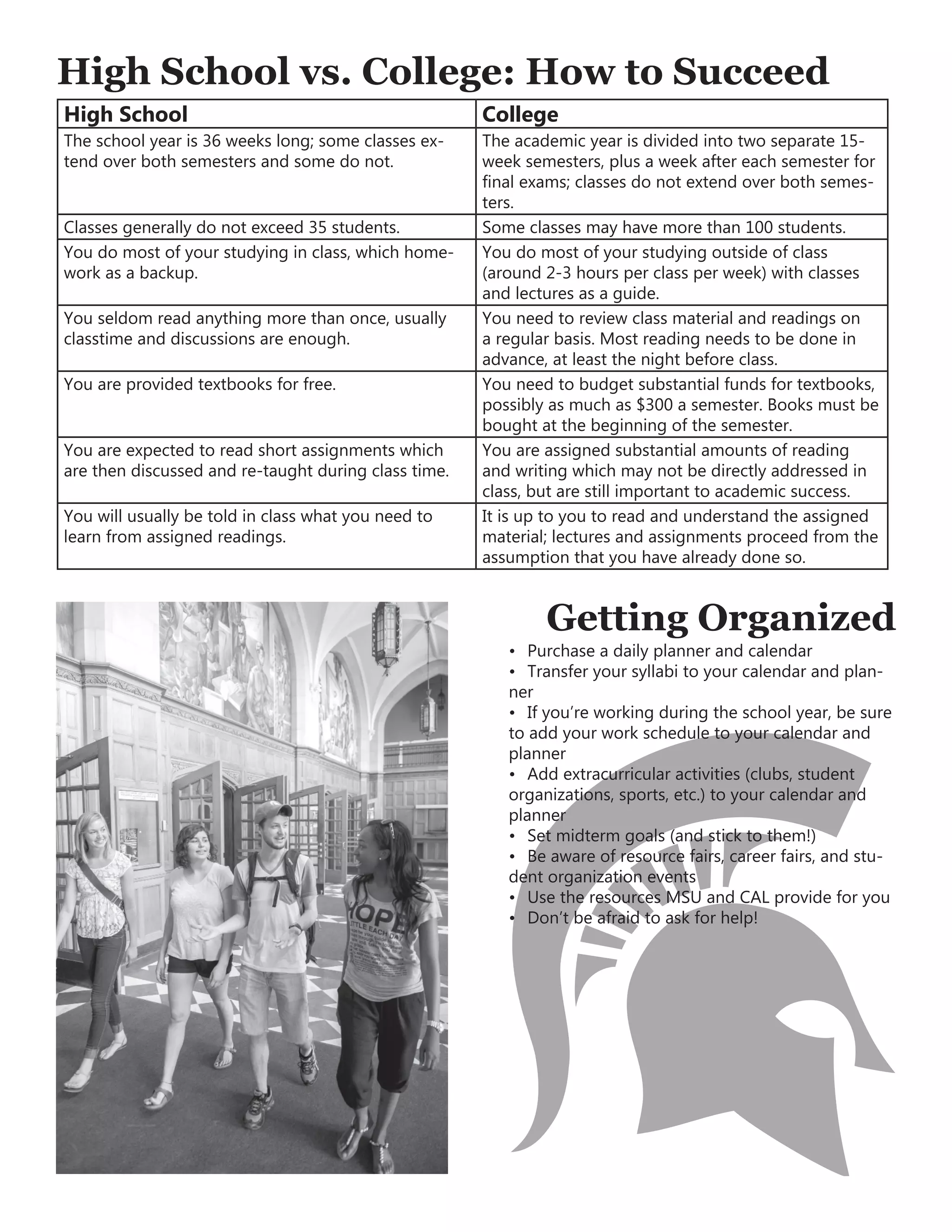
High School College
The school year is 36 weeks long; some classes ex-
tend over both semesters and some do not.
The academic year is divided into two separate 15-
week semesters, plus a week after each semester for
final exams; classes do not extend over both semes-
ters.
Classes generally do not exceed 35 students. Some classes may have more than 100 students.
You do most of your studying in class, which home-
work as a backup.
You do most of your studying outside of class
(around 2-3 hours per class per week) with classes
and lectures as a guide.
You seldom read anything more than once, usually
classtime and discussions are enough.
You need to review class material and readings on
a regular basis. Most reading needs to be done in
advance, at least the night before class.
You are provided textbooks for free. You need to budget substantial funds for textbooks,
possibly as much as $300 a semester. Books must be
bought at the beginning of the semester.
You are expected to read short assignments which
are then discussed and re-taught during class time.
You are assigned substantial amounts of reading
and writing which may not be directly addressed in
class, but are still important to academic success.
You will usually be told in class what you need to
learn from assigned readings.
It is up to you to read and understand the assigned
material; lectures and assignments proceed from the
assumption that you have already done so.
High School vs. College: How to Succeed
Getting Organized
•	 Purchase a daily planner and calendar
•	 Transfer your syllabi to your calendar and plan-
ner
•	 If you’re working during the school year, be sure
to add your work schedule to your calendar and
planner
•	 Add extracurricular activities (clubs, student
organizations, sports, etc.) to your calendar and
planner
•	 Set midterm goals (and stick to them!)
•	 Be aware of resource fairs, career fairs, and stu-
dent organization events
•	 Use the resources MSU and CAL provide for you
•	 Don’t be afraid to ask for help!
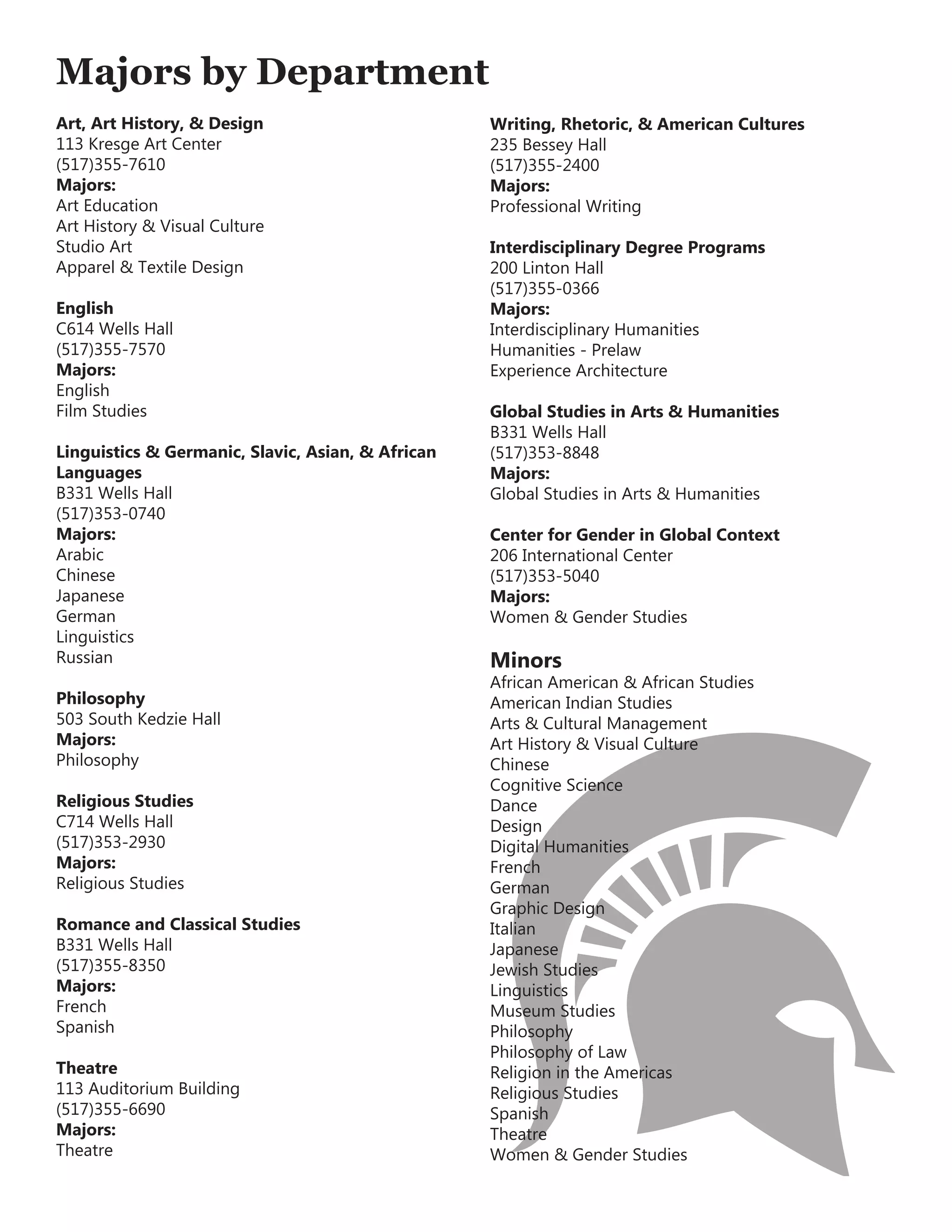
Majors by Department
Art, Art History, & Design
113 Kresge Art Center
(517)355-7610
Majors:
Art Education
Art History & Visual Culture
Studio Art
Apparel & Textile Design
English
C614 Wells Hall
(517)355-7570
Majors:
English
Film Studies
Linguistics & Germanic, Slavic, Asian, & African
Languages
B331 Wells Hall
(517)353-0740
Majors:
Arabic
Chinese
Japanese
German
Linguistics
Russian
Philosophy
503 South Kedzie Hall
Majors:
Philosophy
Religious Studies
C714 Wells Hall
(517)353-2930
Majors:
Religious Studies
Romance and Classical Studies
B331 Wells Hall
(517)355-8350
Majors:
French
Spanish
Theatre
113 Auditorium Building
(517)355-6690
Majors:
Theatre
Writing, Rhetoric, & American Cultures
235 Bessey Hall
(517)355-2400
Majors:
Professional Writing
Interdisciplinary Degree Programs
200 Linton Hall
(517)355-0366
Majors:
Interdisciplinary Humanities
Humanities - Prelaw
Experience Architecture
Global Studies in Arts & Humanities
B331 Wells Hall
(517)353-8848
Majors:
Global Studies in Arts & Humanities
Center for Gender in Global Context
206 International Center
(517)353-5040
Majors:
Women & Gender Studies
Minors
African American & African Studies
American Indian Studies
Arts & Cultural Management
Art History & Visual Culture
Chinese
Cognitive Science
Dance
Design
Digital Humanities
French
German
Graphic Design
Italian
Japanese
Jewish Studies
Linguistics
Museum Studies
Philosophy
Philosophy of Law
Religion in the Americas
Religious Studies
Spanish
Theatre
Women & Gender Studies
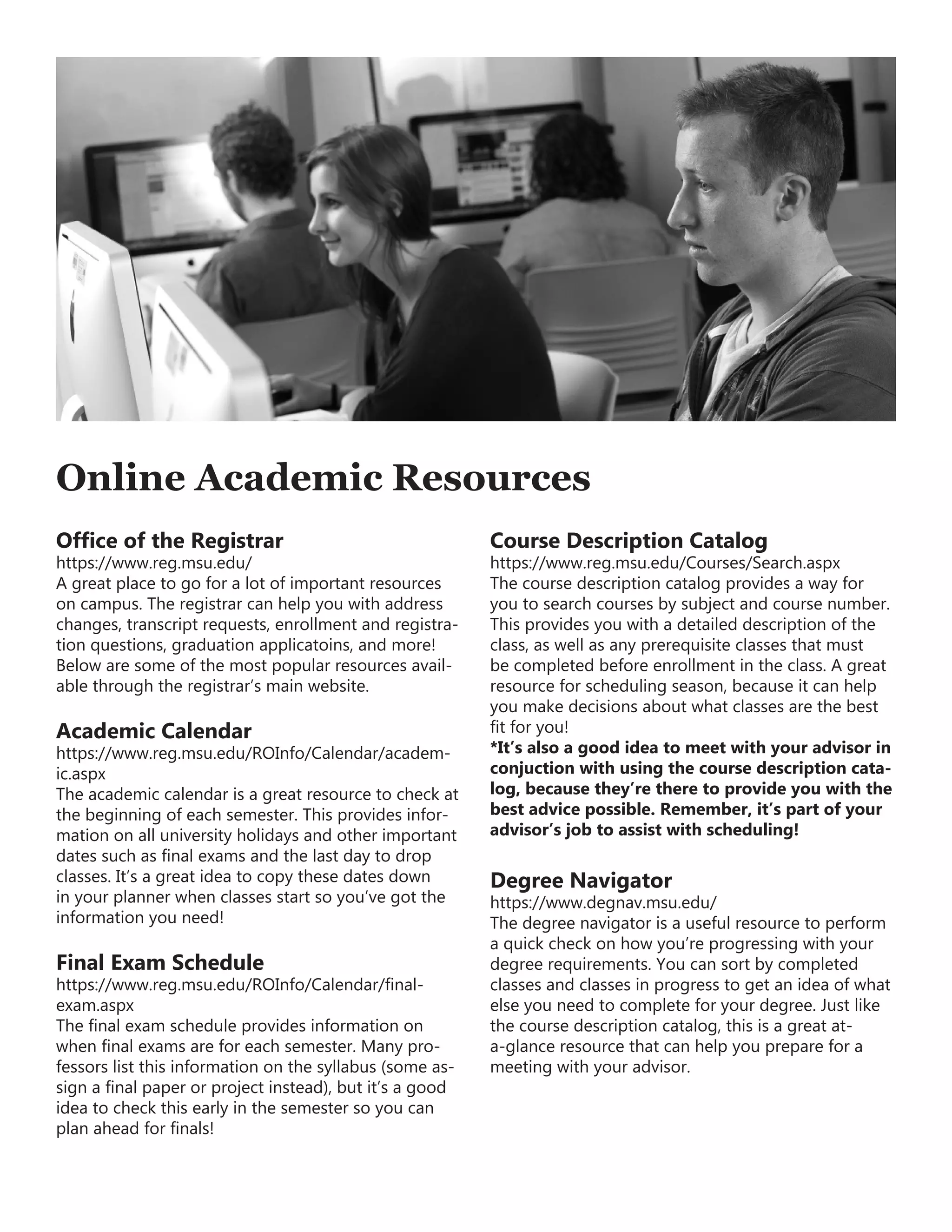
Online Academic Resources
Office of the Registrar
https://www.reg.msu.edu/
A great place to go for a lot of important resources
on campus. The registrar can help you with address
changes, transcript requests, enrollment and registra-
tion questions, graduation applicatoins, and more!
Below are some of the most popular resources avail-
able through the registrar’s main website.
Academic Calendar
https://www.reg.msu.edu/ROInfo/Calendar/academ-
ic.aspx
The academic calendar is a great resource to check at
the beginning of each semester. This provides infor-
mation on all university holidays and other important
dates such as final exams and the last day to drop
classes. It’s a great idea to copy these dates down
in your planner when classes start so you’ve got the
information you need!
Final Exam Schedule
https://www.reg.msu.edu/ROInfo/Calendar/final-
exam.aspx
The final exam schedule provides information on
when final exams are for each semester. Many pro-
fessors list this information on the syllabus (some as-
sign a final paper or project instead), but it’s a good
idea to check this early in the semester so you can
plan ahead for finals!
Course Description Catalog
https://www.reg.msu.edu/Courses/Search.aspx
The course description catalog provides a way for
you to search courses by subject and course number.
This provides you with a detailed description of the
class, as well as any prerequisite classes that must
be completed before enrollment in the class. A great
resource for scheduling season, because it can help
you make decisions about what classes are the best
fit for you!
*It’s also a good idea to meet with your advisor in
conjuction with using the course description cata-
log, because they’re there to provide you with the
best advice possible. Remember, it’s part of your
advisor’s job to assist with scheduling!
Degree Navigator
https://www.degnav.msu.edu/
The degree navigator is a useful resource to perform
a quick check on how you’re progressing with your
degree requirements. You can sort by completed
classes and classes in progress to get an idea of what
else you need to complete for your degree. Just like
the course description catalog, this is a great at-
a-glance resource that can help you prepare for a
meeting with your advisor.
Schedule of Courses
https://www.schedule.msu.edu/
The schedule of courses provides you with an up-to-
datelisting of current courses and past courses you
have enrolled in. This provides you with class times,
room numbers, professor names, and a visual print-
friendly calendar of your class schedule. You can add
non-academic entries to block out work time and
regular meetings, and it’s helpful to keep a copy in
your planner (especially at the beginning of the se-
mester). This is also the site you will use to plan and
enroll in future semesters, which you will be guided
through at your academic orientation program.
StuInfo
https://www.stuinfo.msu..edu/
The StuInfo page is a one-stop shop for many differ-
ent aspects of your student account at MSU. Among
the things you can check on your StuInfo page are
financial aid application and award status, current
and past billing statements, full account detail with
bills paid and charges rendered, credits completed to
date, unofficial transcript with semester and cumula-
tive GPA, enrollment status for current and future
semesters, the academic calendar, and more! When in
doubt, check the StuInfo page first.
Campus Resources
Career Services Network
113 Student Services Building
(517)355-9510
https://www.careernetwork.msu.edu/
The Career Services Network (CSN) serves students
from freshman year through graduation and beyond.
These are just some of the services offered by CSN:
career and job search advising, skill and interest as-
sessment, graduate school planning, interview prepa-
ration, resume and cover letter reivew, and more!
Counseling Center
207 Student Services Building
(517)355-8270
https://www.counseling.msu.edu/
The counseling center provides a variety of resources
in helping students and staff reduce their levels of
stress, and provide students with a healthy environ-
ment in which they can focus on themselves and
their goals. One-on-one counseling to help students
address any number of issues from depression, anxi-
ety, substance abuse, stress management, relation-
ship concerns, cultural or LGBTQ issues, to sexual as-
sualt and more. For any student registered in at least
one credit, an initial consultation is provided as well
as additional services based on that consultation.
Couple’s counseling, group counseling, substance
abuse counseling, and sexual assault counseling are
available as well. The counseling center also provides
psychiatry, a safe space for students, community
engagement, and testing services.
Learning Resource Center
202 Bessey Hall
(517)355-2363
https://www.lrc.msu.edu/
The learning resource center (LRC) is available to
students to assist in and assure their success at MSU.
The LRC staff is available to help with any academic-
related concern, from understanding difficult class
texts to programing your graphing calculator. The
LRC also provides tutoring services, a computer lab,
study groups, and preparation for the GRE and MCAT.
LGBTQ Resource Center
302 Student Services Building
https://www.lbgtrc.msu.edu/
A great place for student who are members of the
LGBTQ community to find resources to help make
the most of their time at MSU. Most importantly,
it provides all students with a safe place to turn to
when they want to ask questions, study, connect with
members of the community, share a cup of coffee,
vent about frustrations, and just have fun together.
Math Learning Center
C-Wing Wells Hall
138 Brody Hall
30 Union Building
C133 Holden Hall
129 Hubbard Hall
45 McDonel Hall
https://www1.math.msu.edu/mlc/Default.aspx
Office of Supportive Services
209 Bessey Hall
(517)353-5210
https://www.oss.msu.edu/
The primary purpose of the Office of Supportive Ser-
vices (OSS) is to assist students in preparation for the
challenges of higher education. OSS works to enable
students to develop coping and self-management
survival skills for success within the university. OSS
also provides motivation, academic advising, social
counseling, personal planning, career guidance, and
skill-enrichment seminars.
Office of the Registrar
150 Hannah Administration Building
(517)355-3300
https://www.reg.msu.edu/
Office of Financial Aid
252 Student Services Building
(517)353-5940
https://www.finaid.msu.edu/
Resource Center for Persons with
Disabilities
120 Bessey Hall
(517)884-7273
The Resource Center for Persons with Disabilities
(RCPD) provides resources for students with cogni-
tive and/or physical disabilities and all students in
between. MSU is committed to providing students
with any and all resources possible to make their
academic and social success as easy as possible.
Center for Service Learning & Civic
Engagement
345 Student Services Building
(517)353-4400
https://www.servicelearning.msu.edu/
Women’s Resource Center
332 Union Building
(517)353-1635
https://wrc.msu.edu/
The Women’s Resource Center (WRC) is the first
point of contact for women’s issues on campus. The
center focuses on gender equity within leadership,
social justice, and personal/professional develop-
ment. Some resources available through the WRC
include access to scholarships and fellowships, guest
speakers, conferences, newsletters, a resource library,
and the student groups Successful Black Women of
of MSU (SBW) and the Women’s Initiative for Leader-
ship Development (WILD). Most of all, the WRC works
from a women-led agenda and employs passionate
professionals who can point you in the direction of
the best on-campus resources for you as a woman
and beyond.
Writing Center
300 Bessey Hall
(517)432-3610
https://www.writing.msu.edu/
The Writing Center at MSU provides one-on-one and
group writing consultations, various writing-specific
workshops, and writing groups for graduate students
and faculty. There are Writing Center locations across
campus, including within the main library and each
residence hall neighborhood, so students are never
far from a place to get feedback on their academic
work.
Integrative Studies Course Descriptions
Lower Level IAH Courses
IAH 201 United States and the World (D)
Major issues in development of U.S. society and
culture, presented in international and comparative
context. Influences from Native Americans, Europe-
ans, Africans, and Asians. Organized historically, with
thematic emphasis on literature and the arts.
IAH 202 Europe and the World (I)
Cultural encounters and political relationships be-
tween Europeans and people(s) from other regions
of the world since 1500 as shown through study of
written texts, literature, the visual arts, music, and
other forms of expression.
IAH 203 Latin America and the World (I)
Major issues in the development of Latin American
societies and cultures, presented in global perspec-
tive. Influences from indigenous peoples, Europeans,
Africans, and others. Organized thematically and
historically, through study of written texts, literature,
and the arts.
IAH 204 Asia and the World (I)
Major issues in the development of Asian societies
and cultures and their interaction with other regions
of the world since 1600. Topics from East, Southeast,
and South Asia. Organized thematically and histori-
cally, through study of written texts, the arts, and
other forms of expression.
IAH 205 Africa and the World (I)
Major issues in the development of African societies
and their interaction with other regions of the world
since 600 through study of written texts, the arts, and
other forms of expression. Topics from West, East,
North, and Southern Africa. Organized thematically
and historically.
IAH 206 Self, Society, and Technology (D)
Exploration in how technology affects and is affected
by our conceptions of ourselves, relations with oth-
ers, and our ideals. Approaches and materials from
philosophy, literature, art, music, and history as well
as the natural sciences.
IAH 207 Literatures, Cultures, Identities (I)
Explorations in how literature reflects, creates, and
challenges cultural and individual identities. Ap-
proaches and materials from literature, philosophy,
the arts, religion, and history. Selected themes and
issues, variable by term.
IAH 208 Music and Culture (I)
Relationships between music and culture. Organized
historically, geographically, or thematically, through
study of written texts, music, the visual arts, and other
forms of expression. Selected topics, variable by term
in content and approach.
IAH 221C Great Ages: The Modern World (I)
Arts and humanities of the modern world, examined
through the frame of urban and intellectual life.
Literature, visual arts, music, religion, and philosophy
presented in historical context. Selected regions and
themes. Variable by term.
IAH 231A Themes and Issues: Human Values and
the Arts and Humanities (D)
Values of individualism, responsibility, love, com-
munity, and rationality. Students are introduced to
diverse methods and materials from the arts and
humanities.
IAH 231B Themes and Issues: Moral Issues and
the Arts and Humanities (D)
Human conflict and moral dilemmas, addressed
through diverse methods and materials from the arts
and humanities.
IAH 231C Themes and Issues: Roles of Language
in Society (D)
Language as the medium of culture in various societ-
ies. Power and social identity as manifested through
language. Students are introduced to diverse meth-
ods and materials from the arts and humanities.
IAH 241A Creative Arts and Humanities: Music
and Society in the Modern World (D)
The arts and humanities of the modern world
through the prism of music. Music traditions and
methodologies in their historic context. Relationship
of music creativity to societies in which it has been
produced.
IAH 241B Creative Arts and Humanities:
Philosophy in Literature (D)
Philosophy and literature, relationships to each
other and to societies in which they were produced.
Themes such as the meaning of life, God and the
problem of evil, and the nature of knowledge. Au-
thors such as Voltaire, Dostoevsky, Wright, and
Atwood examined from a variety of perspectives.
IAH 241C Creative Arts and Humanities: Cultural
and Artistic Traditions of Europe (I)
European artistic and cultural movements and styles,
introduced through works of art, music, literature,
philosophy, and religion. Presented in historical con-
text. Specific eras and works variable by term.
IAH 209 Art, the Visual, and Culture (D)
Exploration of art and visual culture in historical and
cultural contexts. Reading and analysis of images. Ap-
proaches and materials from art history, anthropol-
ogy, history, literature, philosophy, religious studies,
economics, and natural science in cross-cultural and
international perspective. Content variable by term.
Upper Level IAH Courses
IAH 210 Middle East and the World (I)
Major issues in the development of Middle Eastern
societies and cultures, presented in global perspec-
tive. Influences from Europeans, Africans, Asians,
and others. Organized thematically and historically,
through study of written texts, literature, and the arts.
IAH 211B Area Studies and Multicultural
Civilizations: Asia (I)
Arts and humanities of Asia: literature, visual arts,
music, religion and philosophy presented in historical
context. Selected regions, cultures, and themes. Vari-
able by term.
IAH 211C Area Studies and Multicultural
Civilizations: The Americas (D)
Arts and humanities of the Americas: literature, visual
arts, music, religion, and philosophy presented in
historical context. Selected regions, cultures, and
themes. Variable by term.
IAH 211D Area Studies and Multicultural
Civilizations: The Middle East (I)
Arts and humanities of the Middle East: literature,
visual arts, music, religion, and philosophy presented
in historical context. Themes variable by term.
IAH 221A Great Ages: The Ancient World (I)
Arts and humanities of the ancient world examined
through the frame of urban and intellectual life.
Literature, visual arts, music, religion, and philosophy
presented in historical context. Selected regions and
themes. Variable by term.
IAH 221B Great Ages: The Medieval and Early
Modern Worlds (I)
Arts and humanities of the medieval and early mod-
ern worlds: literature, visual arts, music, religion, and
philosophy presented in historical context. Selected
themes. Variable by term.
ISS 230 Government and the Individual (D)
Critical examination of the role of government in reg-
ulating individual behavior. Implications for cultural
values and beliefs and modes of behavior. Analysis
of consequences of different theories for resolving or
creating problems in public policy.
ISS 235 Liberal Democracy as a Way of Life (D)
Cultural tendencies of liberal democracy that form
the characters and constitute the ways of life of indi-
viduals in liberal democracies.
Upper Level ISS Courses
ISS 305 Evaluating Evidence: Becoming a Smart
Research Consumer (D)
Statistical and methodological principles from the
perspective of a critical consumer of social science
research results. Recognizing non-empirical asser-
tions, necessary bases for inferring relationships and
causal relationships, common threats to research
validity, and pertinent biases in human judgment.
ISS 308 Social Science Approaches to Law (D)
Law theories, practices, methodologies. Social, cul-
tural, institutional, global, environmental, family, or
historical context.
ISS 310 People and Environment (I)
Contemporary issues related to the interaction of
sociocultural and ecological systems. Global, region-
al, national, and local environmental problems and
responses.
ISS 315 Global Diversity and Interdependence (I)
Contemporary issues in global political economy.
Social forces and competing ideologies in a world
context. Global resource distribution and develop-
ment strategies. National identities and transnational
linkages. First-and Third-World dichotomies.
ISS 318 Lifespan Development Across Cultures (I)
Cultural aspects of biopsychosocial development
across the lifespan. Physical development, health
and healing. Cognition and language socialization.
Views of self, gender, family, and social relationships.
Adult development and intergenerational relation-
ships within the context of culture. National and
international issues related to human development.
IAH 241D Creative Arts and Humanities: Theatre
and Society in the West (I)
Artistic creativity seen through the prism of theater,
presented in historical context. Influences from art,
literature, music, and religion. Focus on translation
of social visions into dramatic art. Plays and themes
variable by term.
IAH 241E Creative Arts and Humanities: The Cre-
ative Process (D)
Philosophical, religious and historical foundations for
understanding the process of creation in visual arts,
theatre, music, and literature. Variations across eras
and societies.
IAH 241F Creative Arts and Humanities: Traditions
in World Art (I)
Aesthetic qualities of painting, sculpture, and archi-
tecture within historical contexts across major civiliza-
tions. Visual forms in relation to belief systems and
musical and literary traditions.
Lower Level ISS Courses
ISS 210 Society and the Individual (D)
Evolution of human behavior with an emphasis on
the individual and society. Family and kinship, social
organization. Societal types, personality, and the life
cycle.
ISS 215 Social Differentiation and Inequality (D)

Types, causes, and consequences of social stratifica-
tion in human societies. Age, class, gender, race, and
other factors that define social position. Education,
occupation, political economy.
ISS 220 Time, Space and Change in Human Society
(D)
Evolutionary, ecological, and spatial theories of adap-
tation and change. Cultural evolution from prehistoric
foraging to the post-industrial age. Continuity and
change in the emergence and development of con-
temporary ways of life.
ISS 225 Power, Authority, and Exchange (D)

Power, authority, and exchange in organizing societ-
ies. Costs and limitations of power. Institutionalization
of authority. Systems of exchange: planned vs. market
economies.
ISS 320 World Urban Systems (I)
Patterns of urbanization in various areas of the world
over time. Linkage within and between urban centers.
Economic, political, and social/behavioral accommo-
dation and adaptation to urban growth and change.
ISS 325 War and Revolution (I)
Social conflict, wars, and revolutions. Patterns of
individual and collective action. Violence and conflict
resolution.
ISS 327 Risk and Society (D)
Assessment, management, and communication of
risk. Role of media in amplifying risk. Topics may
include gangs, terrorism, health, stock markets, job
markets, sports, food, and traffic. Similarities and dif-
ferences in understanding risk among scientists and
the public, and between natural and social scientists.
ISS 328 The Social Science of Sports (I)
Contemporary issues in sports. Critical examination
of the industrial organization, public finance, labor
relations, earnings, discrimination, and historical con-
text of sports in society. Analysis of sports gambling,
performance enhancement, and strategic decision-
making.
ISS 330A Africa: Social Science Perspectives (I)
Comparative study of geography, cultures, politics,
and economies of Africa. Diversity and change.
ISS 330B Asia: Social Science Perspectives (I)
Comparative study of geography, cultures, politics,
and economies of Asia. Diversity and change.
ISS 330C Latin America: Social Science
Perspectives (I)
Comparative study of geography, cultures, poli-
tics, and economies of Latin America. Diversity and
change.
ISS 335 National Diversity and Change: United
States (N)
Racial, ethnic, class, gender, and other forms of diver-
sity in the United States. Systems of dominant-mi-
nority relations and forms of prejudice and discrimi-
nation. Scope of and responses to group inequalities.
ISS 336 Canada: Social Science Perspectives (I)
Canadian political, economic, and social institutions.
Ethnic and other forms of diversity in Canada. North
American national comparisons.
ISB Courses
ISB 200 History of Life
Life from its origin to the dawn of human history.
Living things as both the products of evolutionary
processes and as a major force driving evolution and
altering the environment of Earth.
ISB 201 Insects, Globalization, and Sustainability
The relationship between insects, human society, and
the environment with an emphasis on ecological and
evolutionary processes. Critical evaluation of current
regional and global environmental problems and how
they are affecting the development of a sustainable
society.
ISB 201L Insects, Globalization, and Sustainability
Laboratory
Problem-based learning activities involved with ob-
serving, hypothesizing, experimenting, and analysis of
data related to environmental science.
ISB 204 Applications of Biomedical Sciences
Historical and recent development of knowledge
about cellular developmental or genetic processes.
Critical evaluation of the use and misuse of scientific
discoveries in these areas.
ISB 208L Applications in Biological Science
Laboratory
Problem solving activities based on observation and
interpretation of selected biological systems.
ISP Courses
ISP 203B Understanding Earth: Natural Hazards
and the Environment
Science as a way of knowing about natural hazards,
as well as natural and anthropogenic environmental
change. Implications for societies.
ISP 203L Geology of the Human Environment
Laboratory
Exercises in the scientific method applied to earth
materials and their impact on society.
ISP 205 Visions of the Universe
Role of observation, theory, philosophy, and technol-
ogy in the development of the modern conception
of the universe. The Copernican Revolution. Birth and
death of stars. Spaceship Earth. Cosmology and time.
ISP 205L Visions of the Universe Laboratory
Observations of the sky, laboratory experiments, and
computer simulations exploring the development of
the modern conception of the universe.
ISP 207 World of Chemistry
The language, concepts, models, and techniques of
chemical science, including atomic theory; nuclear
energy; acids; chemicals in air, water, food, and bio-
logical systems.
ISP 207L World of Chemistry Laboratory
Chemical combinations and reactivity with respect
to such materials as acids, bases, dyes, foods, and
detergents.
ISP 209 The Mystery of the Physical World
Laws of physics through demonstrations and analy-
ses of every-day phenomena. Optics, mechanical
systems, and electromagnetic phenomena.
ISP 209L The Mystery of the Physical World
Laboratory
Physical phenomena: optics, mechanical systems,
and electromagnetics.
ISP 213H Navigating the Universe
Philosophical and biographical history of phys-
ics. Comparing physics of fields, relativity, quantum
mechanics, elementary particle physics, and cosmol-
ogy to art as an alternate way of understanding and
representing the world.
ISP 215 The Science of Sound
The science of speech, communication, musical
instruments, room acoustics, and analog and digital
audio. Integrating the physical, physiological, and
psychological principles involved.
ISP 217 Water and the Environment
Application of the scientific method to identification
and solution of environmental problems related to
water.
ISP 217L Water and the Environment Lab
Application of the scientific method to identification
and solution of environmental problems related to
water.
ISP 220 Quarks, Space, Time, and the Big Bang
Elementary particle physics and the Big Bang for non-
scientists. A survey of particles and forces in the early
universe as it is recreated at high-energy particle col-
liders in laboratories around the world.
ISP 221 Earth Environment and Energy
Flow of energy into, through, and out of, Earth’s litho-
sphere, hydrosphere, atmosphere, and biosphere.
Energy, entropy, and life processes. Global warming,
greenhouse effect, and contemporary issues.
CAL.MSU.EDU
CALMSU @CALMSU MSU COLLEGE OF
ARTS & LETTERS
CALMSU#

Final Handbook

  • 1.
  • 2.
    Table of Contents Welcometo the College of Arts and Letters..................................................................2 Academic Advising Information......................................................................................3 Majors, Minors, and College Requirements...................................................................4 University Requirements and Academic Integrity........................................................5 Experiential Education and Undergraduate Research..................................................6 Internships..........................................................................................................................7 Transitioning from High School to College...................................................................8 Majors by Department and Minors...............................................................................10 Online Academic Resources...........................................................................................11 Campus Resources..........................................................................................................13 Integrative Studies Course Descriptions......................................................................15
  • 4.
    Welcome Welcome Spartans! Welcome toMichigan State University (MSU) and the College of Arts and Letters (CAL)! We are pleased that you have decided to become part of a college that educates passionate actors, artists, designers, filmmakers, linguists, philosophers, poets, teachers, translators, writers, and much more in a creative and nurturing learning environment. Academic Advisors in CAL are the coordinators of your undergraduate experience and provide critical informa- tion about study abroad, leadership development, major choices, career options, university policies and proce- dures, and campus resources. Advisors should be your first and last contact for information within the College of Arts and Letters. They will serve as a reference if they know you well, certify you for graduation, and work with the administrations of both the College and the University on your behalf. We look forward to serving you and getting to know you! Undergraduate Academic Service Staff Assistant Dean of Undergraduate Affairs and Study Abroad Beth Judge 200 Linton Hall (517)355-0366 judgebe@msu.edu Director of Undergraduate Affairs Quinn Moreno 200 Linton Hall (517)355-0366 qmoreno@msu.edu Coordinator of Undergraduate Student Affairs Sarah Whitaker 200 Linton Hall (517)355-0366 whitak41@msu.edu Field Career Consultant Becky Brewer 200 Linton Hall (517)355-0366 brewerre@msu.edu Academic Advisors Britta Urness Ruth Mowry Cindy Walter Jennifer Gansler Dionne O’Dell Dori Hopkins Jon Ritz Laura Essig Faculty Advisors Debra Nails Arthur Versluis
  • 5.
    Arthur Versluis ReligiousStudies Britta Urness Studio Art History of Art Art Education Cindy Walter Arabic Chinese German Global Studies in the Arts and Humanities Japanese Linguistics Russian Debra Nails Philosophy Dionne O’Dell Theatre Dori Hopkins Women and Gender Studies Jennifer Gansler French Spanish Jon Ritz Professional Writing Laura Essig Experience Architecture Humanities - Prelaw Interdisciplinary Humanities Ruth Mowry English Film Studies Advisors by Major Academic Advisors Offer: • Course planning appropriate for your major and career goals • Assistance in selection of a major field of study • Review of degree and/or minor requirements • Planning toward career goals • Referral to campus resources • Enrollment and registration information • Information about experiential education op- portunities including study abroad, international opportunities, study away, independent studies, research, and more • A person to share any high and low points in your college career Academic Advising Appointments: We encourage you to see your Academic Advisor at least once per semester. If you are interested in multiple areas, you should meet with each respective advisor. To set up an appointment, visit the Advisors Calendar at https://www.egr.msu.edu/adcalendar/. Advisors by Email: If you have any questions that you think have simple answers, feel free to reach out to your advisor via email. Most of the time, an advisor will be able to respond to email within 48 hours. An advisor may suggest scheduling an appointment if they feel the question requires further discussion. Honors College Students: Honors College students are assigned an advisor in their major department as well as an advisor in the Honors College. It is important to meet with each of your advisors to plan your academic program or handle advising inquiries. Advising Options
  • 6.
    Majors and Minors TheCollege of Arts and Letters offers both departmental and interdisciplinary majors. Most of the majors in the College lead to the Bachelor of Arts (BA) degree. The Department of Art, Art History, and Design as well as the Department of Theatre offer both the Bachelor of Arts (BA) and Bachelor of Fine Arts (BFA) degrees. The Bach- elor of Fine Arts (BFA) degree requires a larger concentration within the major and is only open to students who are selected by the department on a competitive basis after completing foundation requirements in the major. For information about the BFA programs in these departments, students should consult their Academic Advisor. Double Majoring: Students can complete two degrees in two different ways: 1. Additional Major: earned by completing two majors within 120 credits. The two majors will show on a stu- dent’s transcript but not their diploma. 2. Second Degree: earned by completing two degrees with a minimum of 150 credits. The two degrees will show on a student’s transcript and they will receive a second diploma. Minors: Typically, a minor is 18-20 credits. A student may minor in an area inside or outside the College of Arts and Let- ters. A student will need to meet with the Academic Advisor within the department for the minor to discuss the requirements and admissions standards. College Requirements: 1. Students must complete two cognates of 12 credits each or an approved alternative, and must be approved by the department of the student’s major. Each cognate may be completed inside or outside the College, and the courses for each cog- nate must be in a single discipline or thematic area. 2. Students must achieve second-year proficiency in a language other than English. This requirement can be met by two years (four semesters) of study at MSU or by continuing a language studied in high school through the MSU course 202. Students with native proficiency in a language other than English should consult their Academic Advisor. Major Requirements: Each major in the College of Arts and Letters has specific requirements that students must complete. Students should meet with their Academic Advisor to discuss the requirements for their major(s).
  • 7.
    Academic honesty andintegrity are fundamental values in a community of scholars. Students and faculty share a commitment to and responsibility for “maintaining the integrity of scholarship, grades, and professional standards.” To abuse these values is to compromise one’s own personal integrity and char- acter, yet cheating occurs on every college campus. The best way to protect yourself from an allegation of academic honesty is simple: don’t cheat. Students should NOT: • Turn in an exam, paper, or project that is not wholly their own work • Copy answers from another student’s exam, paper, or project • Get questions and/or answers from students who have already taken an exam they are sched- uled to take • Have another person take a test for them • Submit the same paper for multiple classes • Use another authors’ ideas, words, or phrases without proper attribution • Collaborate with other students on projects or assignments without the instructor’s permission • Falsify their academic and/or admissions records Writing (4 credits): ___ WRA 110-150 (4) Writing, Rhetoric, and American Cultures Integrative Studies (24 credits): ___ ISB 200 level (3) Biological Science ___ ISP 200 level (3) Physical Science ___ ISB or ISP lab (2) Biological/Physical Science Lab ___ IAH 201-210 (4) Arts and Humanities ___ IAH 211-241 (4) Arts and Humanities ___ ISS 200 level (4) Social Science ___ ISS 300 level (4) Social Science Students must include at least one National (N) and one International/Multicultural (I) course in their Integra- tive studies program. A (D) course may meet either an (N) or an (I) requirement, but one class will not suffice for both. See course details for descriptions. A minimum of 120 credits is required for graduation, or 123 credits if MTH 1825 was completed at MSU. University Requirements Academic Integrity:
  • 8.
    Experiential Education Study Abroad: ProgramOptions: Faculty-Led • Instructors are CAL or MSU faculty members • Students will complete MSU courses • Students enroll through MSU Direct Enrollment • Instructors are faculty of the host institution • Students will complete host institution courses • Students enroll through the host institution (host tuition and fees may apply) Things to consider about study abroad: Where do I want to go? • England, Italy, Thailand, Australia, and more! MSU has over 275 programs in 90 countries to choose from When do I want to go? • Fall, Spring, or Summer semesters How long do I want to go? • A few weeks, a couple of months, even a full academic year! When in my academic career do I want to go? • As a freshman, sophomore, or junior How do I learn more about study abroad? MSU Study Abroad Fair Thursday, October 15, 2015 12:00pm - 6:00pm Breslin Center Study Away: Program Options: • Faculty-Led • Internship Things to consider about study away: Where do I want to go? • New York City, Los Angeles, Washington, DC, and more! When do I want to go? • Fall, Spring, or Summer semesters How do I learn more about study away? Sarah Whitaker whitak41@msu.edu (517)355-0366 Undergraduate Research Undergraduate research is a unique opportunity for students to work with faculty and produce an original out- put that contributes to the knowledge or activity of a particular academic discipline. Some students will work on part of a faculty member’s current research project, while others may develop an independent project of their own that is guided by a faculty member. Either way, students have opportuni- ties in a variety of disciplines from art history to zoology to engage in original, hands-on research and creative projects. MSU is renowned internationally for its support of undergraduate researches with programs, funding, and sup- port services to assist students across the colleges. Students can use Venture, a database for research, scholar- ship, and creative opportunities for MSU undergraduate students, to explore undergraduate research options.
  • 9.
    Benefits of internshipexperiences: • Honing your skills: internship experiences show employers that you have already developed re- lated skills and experience in your field, worked in a professional environment, and are serious about your field • Zeroing in on your interests: it’s better to learn that something isn’t right for you during an intern- ship rather than in your firrst job after graduation. Internships allow you to explore different career options so you can find the right fit • Recruiting for full-time work: many employers use internships as a recruitment tool, so intern- ships are a great way to get your foot in the door. Employers often hire directly from their internship pool Some of our students have interned at: • Late Night with Jimmy Fallon as a writing/blogging intern • The White House • Target as a merchandise planning business analyst intern • Washtenaw County Public Defender’s Office as a student investigator • TechSmith as a user experience intern • General Motors as a sculpting intern Internships Internships are an important resume-building experience and opportunity to gain real-world experience in a field of your interest. Employers like to see at least one internship throughout your undergraduate college career, but it is becoming increasingly popular to take advantage of multiple internship opportunities during your time at MSU. CAL Spartans have taken advantage of a variety of amazing internship opportunities, some of which are listed below!
  • 10.
    High School College Theschool year is 36 weeks long; some classes ex- tend over both semesters and some do not. The academic year is divided into two separate 15- week semesters, plus a week after each semester for final exams; classes do not extend over both semes- ters. Classes generally do not exceed 35 students. Some classes may have more than 100 students. You do most of your studying in class, which home- work as a backup. You do most of your studying outside of class (around 2-3 hours per class per week) with classes and lectures as a guide. You seldom read anything more than once, usually classtime and discussions are enough. You need to review class material and readings on a regular basis. Most reading needs to be done in advance, at least the night before class. You are provided textbooks for free. You need to budget substantial funds for textbooks, possibly as much as $300 a semester. Books must be bought at the beginning of the semester. You are expected to read short assignments which are then discussed and re-taught during class time. You are assigned substantial amounts of reading and writing which may not be directly addressed in class, but are still important to academic success. You will usually be told in class what you need to learn from assigned readings. It is up to you to read and understand the assigned material; lectures and assignments proceed from the assumption that you have already done so. High School vs. College: How to Succeed Getting Organized • Purchase a daily planner and calendar • Transfer your syllabi to your calendar and plan- ner • If you’re working during the school year, be sure to add your work schedule to your calendar and planner • Add extracurricular activities (clubs, student organizations, sports, etc.) to your calendar and planner • Set midterm goals (and stick to them!) • Be aware of resource fairs, career fairs, and stu- dent organization events • Use the resources MSU and CAL provide for you • Don’t be afraid to ask for help!
  • 12.
    Majors by Department Art,Art History, & Design 113 Kresge Art Center (517)355-7610 Majors: Art Education Art History & Visual Culture Studio Art Apparel & Textile Design English C614 Wells Hall (517)355-7570 Majors: English Film Studies Linguistics & Germanic, Slavic, Asian, & African Languages B331 Wells Hall (517)353-0740 Majors: Arabic Chinese Japanese German Linguistics Russian Philosophy 503 South Kedzie Hall Majors: Philosophy Religious Studies C714 Wells Hall (517)353-2930 Majors: Religious Studies Romance and Classical Studies B331 Wells Hall (517)355-8350 Majors: French Spanish Theatre 113 Auditorium Building (517)355-6690 Majors: Theatre Writing, Rhetoric, & American Cultures 235 Bessey Hall (517)355-2400 Majors: Professional Writing Interdisciplinary Degree Programs 200 Linton Hall (517)355-0366 Majors: Interdisciplinary Humanities Humanities - Prelaw Experience Architecture Global Studies in Arts & Humanities B331 Wells Hall (517)353-8848 Majors: Global Studies in Arts & Humanities Center for Gender in Global Context 206 International Center (517)353-5040 Majors: Women & Gender Studies Minors African American & African Studies American Indian Studies Arts & Cultural Management Art History & Visual Culture Chinese Cognitive Science Dance Design Digital Humanities French German Graphic Design Italian Japanese Jewish Studies Linguistics Museum Studies Philosophy Philosophy of Law Religion in the Americas Religious Studies Spanish Theatre Women & Gender Studies
  • 13.
    Online Academic Resources Officeof the Registrar https://www.reg.msu.edu/ A great place to go for a lot of important resources on campus. The registrar can help you with address changes, transcript requests, enrollment and registra- tion questions, graduation applicatoins, and more! Below are some of the most popular resources avail- able through the registrar’s main website. Academic Calendar https://www.reg.msu.edu/ROInfo/Calendar/academ- ic.aspx The academic calendar is a great resource to check at the beginning of each semester. This provides infor- mation on all university holidays and other important dates such as final exams and the last day to drop classes. It’s a great idea to copy these dates down in your planner when classes start so you’ve got the information you need! Final Exam Schedule https://www.reg.msu.edu/ROInfo/Calendar/final- exam.aspx The final exam schedule provides information on when final exams are for each semester. Many pro- fessors list this information on the syllabus (some as- sign a final paper or project instead), but it’s a good idea to check this early in the semester so you can plan ahead for finals! Course Description Catalog https://www.reg.msu.edu/Courses/Search.aspx The course description catalog provides a way for you to search courses by subject and course number. This provides you with a detailed description of the class, as well as any prerequisite classes that must be completed before enrollment in the class. A great resource for scheduling season, because it can help you make decisions about what classes are the best fit for you! *It’s also a good idea to meet with your advisor in conjuction with using the course description cata- log, because they’re there to provide you with the best advice possible. Remember, it’s part of your advisor’s job to assist with scheduling! Degree Navigator https://www.degnav.msu.edu/ The degree navigator is a useful resource to perform a quick check on how you’re progressing with your degree requirements. You can sort by completed classes and classes in progress to get an idea of what else you need to complete for your degree. Just like the course description catalog, this is a great at- a-glance resource that can help you prepare for a meeting with your advisor.
  • 14.
    Schedule of Courses https://www.schedule.msu.edu/ Theschedule of courses provides you with an up-to- datelisting of current courses and past courses you have enrolled in. This provides you with class times, room numbers, professor names, and a visual print- friendly calendar of your class schedule. You can add non-academic entries to block out work time and regular meetings, and it’s helpful to keep a copy in your planner (especially at the beginning of the se- mester). This is also the site you will use to plan and enroll in future semesters, which you will be guided through at your academic orientation program. StuInfo https://www.stuinfo.msu..edu/ The StuInfo page is a one-stop shop for many differ- ent aspects of your student account at MSU. Among the things you can check on your StuInfo page are financial aid application and award status, current and past billing statements, full account detail with bills paid and charges rendered, credits completed to date, unofficial transcript with semester and cumula- tive GPA, enrollment status for current and future semesters, the academic calendar, and more! When in doubt, check the StuInfo page first.
  • 15.
    Campus Resources Career ServicesNetwork 113 Student Services Building (517)355-9510 https://www.careernetwork.msu.edu/ The Career Services Network (CSN) serves students from freshman year through graduation and beyond. These are just some of the services offered by CSN: career and job search advising, skill and interest as- sessment, graduate school planning, interview prepa- ration, resume and cover letter reivew, and more! Counseling Center 207 Student Services Building (517)355-8270 https://www.counseling.msu.edu/ The counseling center provides a variety of resources in helping students and staff reduce their levels of stress, and provide students with a healthy environ- ment in which they can focus on themselves and their goals. One-on-one counseling to help students address any number of issues from depression, anxi- ety, substance abuse, stress management, relation- ship concerns, cultural or LGBTQ issues, to sexual as- sualt and more. For any student registered in at least one credit, an initial consultation is provided as well as additional services based on that consultation. Couple’s counseling, group counseling, substance abuse counseling, and sexual assault counseling are available as well. The counseling center also provides psychiatry, a safe space for students, community engagement, and testing services. Learning Resource Center 202 Bessey Hall (517)355-2363 https://www.lrc.msu.edu/ The learning resource center (LRC) is available to students to assist in and assure their success at MSU. The LRC staff is available to help with any academic- related concern, from understanding difficult class texts to programing your graphing calculator. The LRC also provides tutoring services, a computer lab, study groups, and preparation for the GRE and MCAT. LGBTQ Resource Center 302 Student Services Building https://www.lbgtrc.msu.edu/ A great place for student who are members of the LGBTQ community to find resources to help make the most of their time at MSU. Most importantly, it provides all students with a safe place to turn to when they want to ask questions, study, connect with members of the community, share a cup of coffee, vent about frustrations, and just have fun together. Math Learning Center C-Wing Wells Hall 138 Brody Hall 30 Union Building C133 Holden Hall 129 Hubbard Hall 45 McDonel Hall https://www1.math.msu.edu/mlc/Default.aspx
  • 16.
    Office of SupportiveServices 209 Bessey Hall (517)353-5210 https://www.oss.msu.edu/ The primary purpose of the Office of Supportive Ser- vices (OSS) is to assist students in preparation for the challenges of higher education. OSS works to enable students to develop coping and self-management survival skills for success within the university. OSS also provides motivation, academic advising, social counseling, personal planning, career guidance, and skill-enrichment seminars. Office of the Registrar 150 Hannah Administration Building (517)355-3300 https://www.reg.msu.edu/ Office of Financial Aid 252 Student Services Building (517)353-5940 https://www.finaid.msu.edu/ Resource Center for Persons with Disabilities 120 Bessey Hall (517)884-7273 The Resource Center for Persons with Disabilities (RCPD) provides resources for students with cogni- tive and/or physical disabilities and all students in between. MSU is committed to providing students with any and all resources possible to make their academic and social success as easy as possible. Center for Service Learning & Civic Engagement 345 Student Services Building (517)353-4400 https://www.servicelearning.msu.edu/ Women’s Resource Center 332 Union Building (517)353-1635 https://wrc.msu.edu/ The Women’s Resource Center (WRC) is the first point of contact for women’s issues on campus. The center focuses on gender equity within leadership, social justice, and personal/professional develop- ment. Some resources available through the WRC include access to scholarships and fellowships, guest speakers, conferences, newsletters, a resource library, and the student groups Successful Black Women of of MSU (SBW) and the Women’s Initiative for Leader- ship Development (WILD). Most of all, the WRC works from a women-led agenda and employs passionate professionals who can point you in the direction of the best on-campus resources for you as a woman and beyond. Writing Center 300 Bessey Hall (517)432-3610 https://www.writing.msu.edu/ The Writing Center at MSU provides one-on-one and group writing consultations, various writing-specific workshops, and writing groups for graduate students and faculty. There are Writing Center locations across campus, including within the main library and each residence hall neighborhood, so students are never far from a place to get feedback on their academic work.
  • 17.
    Integrative Studies CourseDescriptions Lower Level IAH Courses IAH 201 United States and the World (D) Major issues in development of U.S. society and culture, presented in international and comparative context. Influences from Native Americans, Europe- ans, Africans, and Asians. Organized historically, with thematic emphasis on literature and the arts. IAH 202 Europe and the World (I) Cultural encounters and political relationships be- tween Europeans and people(s) from other regions of the world since 1500 as shown through study of written texts, literature, the visual arts, music, and other forms of expression. IAH 203 Latin America and the World (I) Major issues in the development of Latin American societies and cultures, presented in global perspec- tive. Influences from indigenous peoples, Europeans, Africans, and others. Organized thematically and historically, through study of written texts, literature, and the arts. IAH 204 Asia and the World (I) Major issues in the development of Asian societies and cultures and their interaction with other regions of the world since 1600. Topics from East, Southeast, and South Asia. Organized thematically and histori- cally, through study of written texts, the arts, and other forms of expression. IAH 205 Africa and the World (I) Major issues in the development of African societies and their interaction with other regions of the world since 600 through study of written texts, the arts, and other forms of expression. Topics from West, East, North, and Southern Africa. Organized thematically and historically. IAH 206 Self, Society, and Technology (D) Exploration in how technology affects and is affected by our conceptions of ourselves, relations with oth- ers, and our ideals. Approaches and materials from philosophy, literature, art, music, and history as well as the natural sciences. IAH 207 Literatures, Cultures, Identities (I) Explorations in how literature reflects, creates, and challenges cultural and individual identities. Ap- proaches and materials from literature, philosophy, the arts, religion, and history. Selected themes and issues, variable by term. IAH 208 Music and Culture (I) Relationships between music and culture. Organized historically, geographically, or thematically, through study of written texts, music, the visual arts, and other forms of expression. Selected topics, variable by term in content and approach.
  • 18.
    IAH 221C GreatAges: The Modern World (I) Arts and humanities of the modern world, examined through the frame of urban and intellectual life. Literature, visual arts, music, religion, and philosophy presented in historical context. Selected regions and themes. Variable by term. IAH 231A Themes and Issues: Human Values and the Arts and Humanities (D) Values of individualism, responsibility, love, com- munity, and rationality. Students are introduced to diverse methods and materials from the arts and humanities. IAH 231B Themes and Issues: Moral Issues and the Arts and Humanities (D) Human conflict and moral dilemmas, addressed through diverse methods and materials from the arts and humanities. IAH 231C Themes and Issues: Roles of Language in Society (D) Language as the medium of culture in various societ- ies. Power and social identity as manifested through language. Students are introduced to diverse meth- ods and materials from the arts and humanities. IAH 241A Creative Arts and Humanities: Music and Society in the Modern World (D) The arts and humanities of the modern world through the prism of music. Music traditions and methodologies in their historic context. Relationship of music creativity to societies in which it has been produced. IAH 241B Creative Arts and Humanities: Philosophy in Literature (D) Philosophy and literature, relationships to each other and to societies in which they were produced. Themes such as the meaning of life, God and the problem of evil, and the nature of knowledge. Au- thors such as Voltaire, Dostoevsky, Wright, and Atwood examined from a variety of perspectives. IAH 241C Creative Arts and Humanities: Cultural and Artistic Traditions of Europe (I) European artistic and cultural movements and styles, introduced through works of art, music, literature, philosophy, and religion. Presented in historical con- text. Specific eras and works variable by term. IAH 209 Art, the Visual, and Culture (D) Exploration of art and visual culture in historical and cultural contexts. Reading and analysis of images. Ap- proaches and materials from art history, anthropol- ogy, history, literature, philosophy, religious studies, economics, and natural science in cross-cultural and international perspective. Content variable by term. Upper Level IAH Courses IAH 210 Middle East and the World (I) Major issues in the development of Middle Eastern societies and cultures, presented in global perspec- tive. Influences from Europeans, Africans, Asians, and others. Organized thematically and historically, through study of written texts, literature, and the arts. IAH 211B Area Studies and Multicultural Civilizations: Asia (I) Arts and humanities of Asia: literature, visual arts, music, religion and philosophy presented in historical context. Selected regions, cultures, and themes. Vari- able by term. IAH 211C Area Studies and Multicultural Civilizations: The Americas (D) Arts and humanities of the Americas: literature, visual arts, music, religion, and philosophy presented in historical context. Selected regions, cultures, and themes. Variable by term. IAH 211D Area Studies and Multicultural Civilizations: The Middle East (I) Arts and humanities of the Middle East: literature, visual arts, music, religion, and philosophy presented in historical context. Themes variable by term. IAH 221A Great Ages: The Ancient World (I) Arts and humanities of the ancient world examined through the frame of urban and intellectual life. Literature, visual arts, music, religion, and philosophy presented in historical context. Selected regions and themes. Variable by term. IAH 221B Great Ages: The Medieval and Early Modern Worlds (I) Arts and humanities of the medieval and early mod- ern worlds: literature, visual arts, music, religion, and philosophy presented in historical context. Selected themes. Variable by term.
  • 19.
    ISS 230 Governmentand the Individual (D) Critical examination of the role of government in reg- ulating individual behavior. Implications for cultural values and beliefs and modes of behavior. Analysis of consequences of different theories for resolving or creating problems in public policy. ISS 235 Liberal Democracy as a Way of Life (D) Cultural tendencies of liberal democracy that form the characters and constitute the ways of life of indi- viduals in liberal democracies. Upper Level ISS Courses ISS 305 Evaluating Evidence: Becoming a Smart Research Consumer (D) Statistical and methodological principles from the perspective of a critical consumer of social science research results. Recognizing non-empirical asser- tions, necessary bases for inferring relationships and causal relationships, common threats to research validity, and pertinent biases in human judgment. ISS 308 Social Science Approaches to Law (D) Law theories, practices, methodologies. Social, cul- tural, institutional, global, environmental, family, or historical context. ISS 310 People and Environment (I) Contemporary issues related to the interaction of sociocultural and ecological systems. Global, region- al, national, and local environmental problems and responses. ISS 315 Global Diversity and Interdependence (I) Contemporary issues in global political economy. Social forces and competing ideologies in a world context. Global resource distribution and develop- ment strategies. National identities and transnational linkages. First-and Third-World dichotomies. ISS 318 Lifespan Development Across Cultures (I) Cultural aspects of biopsychosocial development across the lifespan. Physical development, health and healing. Cognition and language socialization. Views of self, gender, family, and social relationships. Adult development and intergenerational relation- ships within the context of culture. National and international issues related to human development. IAH 241D Creative Arts and Humanities: Theatre and Society in the West (I) Artistic creativity seen through the prism of theater, presented in historical context. Influences from art, literature, music, and religion. Focus on translation of social visions into dramatic art. Plays and themes variable by term. IAH 241E Creative Arts and Humanities: The Cre- ative Process (D) Philosophical, religious and historical foundations for understanding the process of creation in visual arts, theatre, music, and literature. Variations across eras and societies. IAH 241F Creative Arts and Humanities: Traditions in World Art (I) Aesthetic qualities of painting, sculpture, and archi- tecture within historical contexts across major civiliza- tions. Visual forms in relation to belief systems and musical and literary traditions. Lower Level ISS Courses ISS 210 Society and the Individual (D) Evolution of human behavior with an emphasis on the individual and society. Family and kinship, social organization. Societal types, personality, and the life cycle. ISS 215 Social Differentiation and Inequality (D)
 Types, causes, and consequences of social stratifica- tion in human societies. Age, class, gender, race, and other factors that define social position. Education, occupation, political economy. ISS 220 Time, Space and Change in Human Society (D) Evolutionary, ecological, and spatial theories of adap- tation and change. Cultural evolution from prehistoric foraging to the post-industrial age. Continuity and change in the emergence and development of con- temporary ways of life. ISS 225 Power, Authority, and Exchange (D)
 Power, authority, and exchange in organizing societ- ies. Costs and limitations of power. Institutionalization of authority. Systems of exchange: planned vs. market economies.
  • 20.
    ISS 320 WorldUrban Systems (I) Patterns of urbanization in various areas of the world over time. Linkage within and between urban centers. Economic, political, and social/behavioral accommo- dation and adaptation to urban growth and change. ISS 325 War and Revolution (I) Social conflict, wars, and revolutions. Patterns of individual and collective action. Violence and conflict resolution. ISS 327 Risk and Society (D) Assessment, management, and communication of risk. Role of media in amplifying risk. Topics may include gangs, terrorism, health, stock markets, job markets, sports, food, and traffic. Similarities and dif- ferences in understanding risk among scientists and the public, and between natural and social scientists. ISS 328 The Social Science of Sports (I) Contemporary issues in sports. Critical examination of the industrial organization, public finance, labor relations, earnings, discrimination, and historical con- text of sports in society. Analysis of sports gambling, performance enhancement, and strategic decision- making. ISS 330A Africa: Social Science Perspectives (I) Comparative study of geography, cultures, politics, and economies of Africa. Diversity and change. ISS 330B Asia: Social Science Perspectives (I) Comparative study of geography, cultures, politics, and economies of Asia. Diversity and change. ISS 330C Latin America: Social Science Perspectives (I) Comparative study of geography, cultures, poli- tics, and economies of Latin America. Diversity and change. ISS 335 National Diversity and Change: United States (N) Racial, ethnic, class, gender, and other forms of diver- sity in the United States. Systems of dominant-mi- nority relations and forms of prejudice and discrimi- nation. Scope of and responses to group inequalities. ISS 336 Canada: Social Science Perspectives (I) Canadian political, economic, and social institutions. Ethnic and other forms of diversity in Canada. North American national comparisons. ISB Courses ISB 200 History of Life Life from its origin to the dawn of human history. Living things as both the products of evolutionary processes and as a major force driving evolution and altering the environment of Earth. ISB 201 Insects, Globalization, and Sustainability The relationship between insects, human society, and the environment with an emphasis on ecological and evolutionary processes. Critical evaluation of current regional and global environmental problems and how they are affecting the development of a sustainable society. ISB 201L Insects, Globalization, and Sustainability Laboratory Problem-based learning activities involved with ob- serving, hypothesizing, experimenting, and analysis of data related to environmental science. ISB 204 Applications of Biomedical Sciences Historical and recent development of knowledge about cellular developmental or genetic processes. Critical evaluation of the use and misuse of scientific discoveries in these areas. ISB 208L Applications in Biological Science Laboratory Problem solving activities based on observation and interpretation of selected biological systems. ISP Courses ISP 203B Understanding Earth: Natural Hazards and the Environment Science as a way of knowing about natural hazards, as well as natural and anthropogenic environmental change. Implications for societies. ISP 203L Geology of the Human Environment Laboratory Exercises in the scientific method applied to earth materials and their impact on society. ISP 205 Visions of the Universe Role of observation, theory, philosophy, and technol- ogy in the development of the modern conception of the universe. The Copernican Revolution. Birth and death of stars. Spaceship Earth. Cosmology and time.
  • 21.
    ISP 205L Visionsof the Universe Laboratory Observations of the sky, laboratory experiments, and computer simulations exploring the development of the modern conception of the universe. ISP 207 World of Chemistry The language, concepts, models, and techniques of chemical science, including atomic theory; nuclear energy; acids; chemicals in air, water, food, and bio- logical systems. ISP 207L World of Chemistry Laboratory Chemical combinations and reactivity with respect to such materials as acids, bases, dyes, foods, and detergents. ISP 209 The Mystery of the Physical World Laws of physics through demonstrations and analy- ses of every-day phenomena. Optics, mechanical systems, and electromagnetic phenomena. ISP 209L The Mystery of the Physical World Laboratory Physical phenomena: optics, mechanical systems, and electromagnetics. ISP 213H Navigating the Universe Philosophical and biographical history of phys- ics. Comparing physics of fields, relativity, quantum mechanics, elementary particle physics, and cosmol- ogy to art as an alternate way of understanding and representing the world. ISP 215 The Science of Sound The science of speech, communication, musical instruments, room acoustics, and analog and digital audio. Integrating the physical, physiological, and psychological principles involved. ISP 217 Water and the Environment Application of the scientific method to identification and solution of environmental problems related to water. ISP 217L Water and the Environment Lab Application of the scientific method to identification and solution of environmental problems related to water. ISP 220 Quarks, Space, Time, and the Big Bang Elementary particle physics and the Big Bang for non- scientists. A survey of particles and forces in the early universe as it is recreated at high-energy particle col- liders in laboratories around the world. ISP 221 Earth Environment and Energy Flow of energy into, through, and out of, Earth’s litho- sphere, hydrosphere, atmosphere, and biosphere. Energy, entropy, and life processes. Global warming, greenhouse effect, and contemporary issues.
  • 22.
    CAL.MSU.EDU CALMSU @CALMSU MSUCOLLEGE OF ARTS & LETTERS CALMSU#