Film Trailer Overview
Majority of horror films tend to share similar conventions,
which can always be easily identified by the target
audience. These conventions allow the film to fall into the
horror genre as they compel to the norms, all of which
add to the scare factor for the audience, allowing them
to become engaged fully within the narrative of the film.
The mise-en-scene within horror films are key features with
bring key attention to detail in order to make the film a
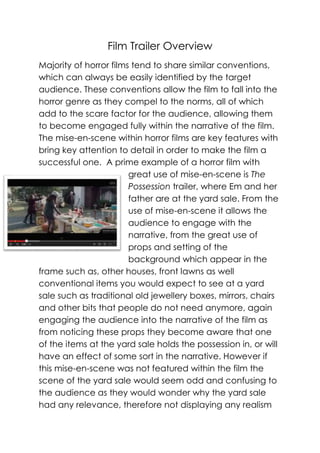
successful one. A prime example of a horror film with
great use of mise-en-scene is The
Possession trailer, where Em and her
father are at the yard sale. From the
use of mise-en-scene it allows the
audience to engage with the
narrative, from the great use of
props and setting of the
background which appear in the
frame such as, other houses, front lawns as well
conventional items you would expect to see at a yard
sale such as traditional old jewellery boxes, mirrors, chairs
and other bits that people do not need anymore, again
engaging the audience into the narrative of the film as
from noticing these props they become aware that one
of the items at the yard sale holds the possession in, or will
have an effect of some sort in the narrative. However if
this mise-en-scene was not featured within the film the
scene of the yard sale would seem odd and confusing to
the audience as they would wonder why the yard sale
had any relevance, therefore not displaying any realism
at all making the film unsuccessful in the aim they wish to
achieve,
A convention that particularly occurs in almost every
supernatural horror film is the use of stock loaction and
setting. The all tend to base their narratives around a
suburban household to create more emphasis to the
audience’s fear of what happens in the household
happening to them. The use of this setting is used in the
films ‘The Conjuring’, The Possession’, and ‘Insidious’ all of
which are successful Possession films. However this setting
does not appear within the film ‘The Devil Inside’ proving
that not all supernatural/possession films use the same
setting however most supernatural films use this particular
setting to target the audience’s
fear, allowing them to feel insure
about the safety of their own
homes. Whereas if the setting was in
a mental hospital or institution such
as ‘The Devil Inside’ the audience
may not feel as frightened as they
would if the setting was in a
suburban household within a rural
area as it is not common for
people to live in insititutions such
as the ones they feature within
horror films, making the sense of
realism to be lost.
Although most supernatural horror films use the stock
location of a suburban house within a rural area, others
still use the setting of a suburban household yet these type
of households have been deserted and abandoned with
nothing but land and nature around them, again
targeting the audience’s fear of safety as they themselves
soon realise that the safety of the characters within the
household has been lost and disturbed. An example of a
Supernatural horror film that does this is ‘The Conjuring’
Furthermore, the connotations and dennotations of the
‘abandoned household’ automatically allow the
audience to feel pity for the characters and it becomes
clear that there will soon be a threat of an evil, demonic
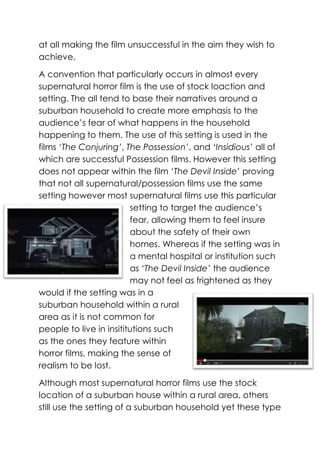
creature or spirit. The use of an establishing shot within the
image below from the film ‘The Conjuring’ not only
displays the stock location of the film to the audience but
reveals to them where majority of the actions of events
will take place.
The use of ambient lighting within the shot not only tells
the audience the house is abandoned within a natural
enviroment, traditionally making the the audience feel
more relaxed, yet this comfort is soon to be disturbed as
the use of setting reminds the audience that normality is
soon to be disrupted, leading the audience to feel on
edge with suspense awaiting. This suburban house setting
is common within horror films and becomes a convention
that many horror film trailers choose to follow. All of the
print screens below taken from films such as Insidious, The
Conjuring and The Possession all include and feature a
suburban household setting
which destroys the audience’s
perception and idealisation of
a perfect and safe home in a rural area.

A strong and effective use of sound are also common
conventions within all supernatural horror trailers in order
to achieve there aim in drawing in the attention to detail
but also to draw in the audience’s attention. A common
convention which I have discovered when carrying out
my research of horror trailers are fast and jumpy moments.
This convention has an extreme effect in continuosly
frightening the audience whilst watching the trailer,
adding to the memorability of the trailer as moments like
these allow the audience to remember how terrified the
trailer made them. As these are the type of conventions
which make the audience question their friends about
whether they have seen it themselves.
Another common convention is the use of a sting at the
end of the trailer, these series of fast montagues scare the
audience the most. The sting is always featured at the
end of the trailer roughly at about two minutes, 10
seoncds and leaves the audience with the final scare in
order to fulfill their aim in engaging the audience. Below
is the link to the trailer of ‘The Possession’ where the final
sting starts at 1.20, however compard to the sting of ‘The
Conjuring’ within this trailer the sting has a different aim of
trying to creep the audience out more than make them
jump in order to fully engage them to see what happens
next, making them want to watch the film further.
https://www.youtube.com/watch?v=wN-5z708dpE
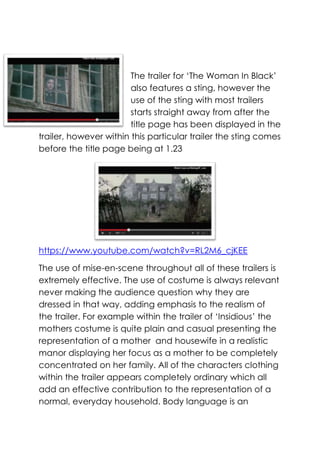
The trailer for ‘The Woman In Black’
also features a sting, however the
use of the sting with most trailers
starts straight away from after the
title page has been displayed in the
trailer, however within this particular trailer the sting comes
before the title page being at 1.23

https://www.youtube.com/watch?v=RL2M6_cjKEE
The use of mise-en-scene throughout all of these trailers is
extremely effective. The use of costume is always relevant
never making the audience question why they are
dressed in that way, adding emphasis to the realism of
the trailer. For example within the trailer of ‘Insidious’ the
mothers costume is quite plain and casual presenting the
representation of a mother and housewife in a realistic
manor displaying her focus as a mother to be completely
concentrated on her family. All of the characters clothing
within the trailer appears completely ordinary which all
add an effective contribution to the representation of a
normal, everyday household. Body language is an
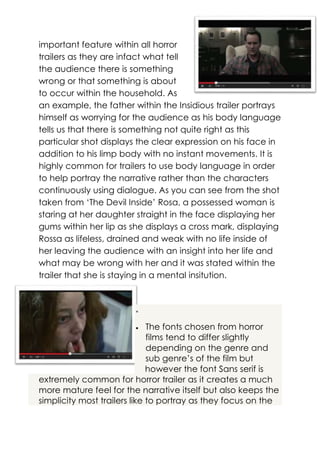
important feature within all horror
trailers as they are infact what tell
the audience there is something
wrong or that something is about
to occur within the household. As
an example, the father within the Insidious trailer portrays
himself as worrying for the audience as his body language
tells us that there is something not quite right as this
particular shot displays the clear expression on his face in
addition to his limp body with no instant movements. It is
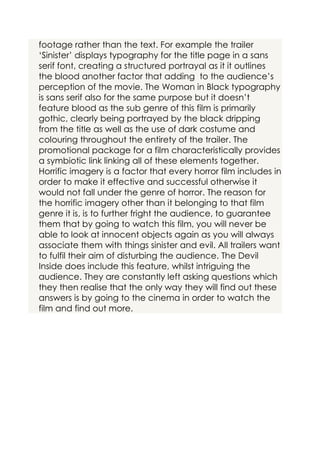
highly common for trailers to use body language in order
to help portray the narrative rather than the characters
continuously using dialogue. As you can see from the shot
taken from ‘The Devil Inside’ Rosa, a possessed woman is
staring at her daughter straight in the face displaying her
gums within her lip as she displays a cross mark, displaying
Rossa as lifeless, drained and weak with no life inside of
her leaving the audience with an insight into her life and
what may be wrong with her and it was stated within the
trailer that she is staying in a mental insitution.



The fonts chosen from horror
films tend to differ slightly
depending on the genre and
sub genre’s of the film but
however the font Sans serif is
extremely common for horror trailer as it creates a much
more mature feel for the narrative itself but also keeps the
simplicity most trailers like to portray as they focus on the

footage rather than the text. For example the trailer
‘Sinister’ displays typography for the title page in a sans
serif font, creating a structured portrayal as it it outlines
the blood another factor that adding to the audience’s
perception of the movie. The Woman in Black typography
is sans serif also for the same purpose but it doesn’t
feature blood as the sub genre of this film is primarily
gothic, clearly being portrayed by the black dripping
from the title as well as the use of dark costume and
colouring throughout the entirety of the trailer. The
promotional package for a film characteristically provides
a symbiotic link linking all of these elements together.
Horrific imagery is a factor that every horror film includes in
order to make it effective and successful otherwise it
would not fall under the genre of horror. The reason for
the horrific imagery other than it belonging to that film
genre it is, is to further fright the audience, to guarantee
them that by going to watch this film, you will never be
able to look at innocent objects again as you will always
associate them with things sinister and evil. All trailers want
to fulfil their aim of disturbing the audience. The Devil
Inside does include this feature, whilst intriguing the
audience. They are constantly left asking questions which
they then realise that the only way they will find out these
answers is by going to the cinema in order to watch the
film and find out more.
Film trailer overview

Film trailer overview

  • 1.
    Film Trailer Overview Majorityof horror films tend to share similar conventions, which can always be easily identified by the target audience. These conventions allow the film to fall into the horror genre as they compel to the norms, all of which add to the scare factor for the audience, allowing them to become engaged fully within the narrative of the film. The mise-en-scene within horror films are key features with bring key attention to detail in order to make the film a successful one. A prime example of a horror film with great use of mise-en-scene is The Possession trailer, where Em and her father are at the yard sale. From the use of mise-en-scene it allows the audience to engage with the narrative, from the great use of props and setting of the background which appear in the frame such as, other houses, front lawns as well conventional items you would expect to see at a yard sale such as traditional old jewellery boxes, mirrors, chairs and other bits that people do not need anymore, again engaging the audience into the narrative of the film as from noticing these props they become aware that one of the items at the yard sale holds the possession in, or will have an effect of some sort in the narrative. However if this mise-en-scene was not featured within the film the scene of the yard sale would seem odd and confusing to the audience as they would wonder why the yard sale had any relevance, therefore not displaying any realism
  • 2.
    at all makingthe film unsuccessful in the aim they wish to achieve, A convention that particularly occurs in almost every supernatural horror film is the use of stock loaction and setting. The all tend to base their narratives around a suburban household to create more emphasis to the audience’s fear of what happens in the household happening to them. The use of this setting is used in the films ‘The Conjuring’, The Possession’, and ‘Insidious’ all of which are successful Possession films. However this setting does not appear within the film ‘The Devil Inside’ proving that not all supernatural/possession films use the same setting however most supernatural films use this particular setting to target the audience’s fear, allowing them to feel insure about the safety of their own homes. Whereas if the setting was in a mental hospital or institution such as ‘The Devil Inside’ the audience may not feel as frightened as they would if the setting was in a suburban household within a rural area as it is not common for people to live in insititutions such as the ones they feature within horror films, making the sense of realism to be lost. Although most supernatural horror films use the stock location of a suburban house within a rural area, others still use the setting of a suburban household yet these type
  • 3.
    of households havebeen deserted and abandoned with nothing but land and nature around them, again targeting the audience’s fear of safety as they themselves soon realise that the safety of the characters within the household has been lost and disturbed. An example of a Supernatural horror film that does this is ‘The Conjuring’ Furthermore, the connotations and dennotations of the ‘abandoned household’ automatically allow the audience to feel pity for the characters and it becomes clear that there will soon be a threat of an evil, demonic creature or spirit. The use of an establishing shot within the image below from the film ‘The Conjuring’ not only displays the stock location of the film to the audience but reveals to them where majority of the actions of events will take place. The use of ambient lighting within the shot not only tells the audience the house is abandoned within a natural enviroment, traditionally making the the audience feel more relaxed, yet this comfort is soon to be disturbed as the use of setting reminds the audience that normality is soon to be disrupted, leading the audience to feel on edge with suspense awaiting. This suburban house setting is common within horror films and becomes a convention that many horror film trailers choose to follow. All of the print screens below taken from films such as Insidious, The Conjuring and The Possession all include and feature a suburban household setting which destroys the audience’s perception and idealisation of
  • 4.
    a perfect andsafe home in a rural area. A strong and effective use of sound are also common conventions within all supernatural horror trailers in order to achieve there aim in drawing in the attention to detail but also to draw in the audience’s attention. A common convention which I have discovered when carrying out my research of horror trailers are fast and jumpy moments. This convention has an extreme effect in continuosly frightening the audience whilst watching the trailer, adding to the memorability of the trailer as moments like these allow the audience to remember how terrified the trailer made them. As these are the type of conventions which make the audience question their friends about whether they have seen it themselves. Another common convention is the use of a sting at the end of the trailer, these series of fast montagues scare the audience the most. The sting is always featured at the end of the trailer roughly at about two minutes, 10 seoncds and leaves the audience with the final scare in order to fulfill their aim in engaging the audience. Below is the link to the trailer of ‘The Possession’ where the final sting starts at 1.20, however compard to the sting of ‘The Conjuring’ within this trailer the sting has a different aim of trying to creep the audience out more than make them jump in order to fully engage them to see what happens next, making them want to watch the film further. https://www.youtube.com/watch?v=wN-5z708dpE
  • 5.
    The trailer for‘The Woman In Black’ also features a sting, however the use of the sting with most trailers starts straight away from after the title page has been displayed in the trailer, however within this particular trailer the sting comes before the title page being at 1.23 https://www.youtube.com/watch?v=RL2M6_cjKEE The use of mise-en-scene throughout all of these trailers is extremely effective. The use of costume is always relevant never making the audience question why they are dressed in that way, adding emphasis to the realism of the trailer. For example within the trailer of ‘Insidious’ the mothers costume is quite plain and casual presenting the representation of a mother and housewife in a realistic manor displaying her focus as a mother to be completely concentrated on her family. All of the characters clothing within the trailer appears completely ordinary which all add an effective contribution to the representation of a normal, everyday household. Body language is an
  • 6.
    important feature withinall horror trailers as they are infact what tell the audience there is something wrong or that something is about to occur within the household. As an example, the father within the Insidious trailer portrays himself as worrying for the audience as his body language tells us that there is something not quite right as this particular shot displays the clear expression on his face in addition to his limp body with no instant movements. It is highly common for trailers to use body language in order to help portray the narrative rather than the characters continuously using dialogue. As you can see from the shot taken from ‘The Devil Inside’ Rosa, a possessed woman is staring at her daughter straight in the face displaying her gums within her lip as she displays a cross mark, displaying Rossa as lifeless, drained and weak with no life inside of her leaving the audience with an insight into her life and what may be wrong with her and it was stated within the trailer that she is staying in a mental insitution.  The fonts chosen from horror films tend to differ slightly depending on the genre and sub genre’s of the film but however the font Sans serif is extremely common for horror trailer as it creates a much more mature feel for the narrative itself but also keeps the simplicity most trailers like to portray as they focus on the 
  • 7.
    footage rather thanthe text. For example the trailer ‘Sinister’ displays typography for the title page in a sans serif font, creating a structured portrayal as it it outlines the blood another factor that adding to the audience’s perception of the movie. The Woman in Black typography is sans serif also for the same purpose but it doesn’t feature blood as the sub genre of this film is primarily gothic, clearly being portrayed by the black dripping from the title as well as the use of dark costume and colouring throughout the entirety of the trailer. The promotional package for a film characteristically provides a symbiotic link linking all of these elements together. Horrific imagery is a factor that every horror film includes in order to make it effective and successful otherwise it would not fall under the genre of horror. The reason for the horrific imagery other than it belonging to that film genre it is, is to further fright the audience, to guarantee them that by going to watch this film, you will never be able to look at innocent objects again as you will always associate them with things sinister and evil. All trailers want to fulfil their aim of disturbing the audience. The Devil Inside does include this feature, whilst intriguing the audience. They are constantly left asking questions which they then realise that the only way they will find out these answers is by going to the cinema in order to watch the film and find out more.