People use social network sites to
communicate with the people
that they know and express
themselves and voice their
thoughts.
Facebook has subcautiously
become a world wide dating
service without any intention
Image: MoneyBlogNewz (Flickr)
Image: kasiastock (Flickr)
Do you feel
social media
has a strong
impact on
relationships
today?
“Most people use social network sites
to with the people that they know,”
INSTAGRAM
FACEBOOK
MY SPACE
TUMBLR
TWITTER
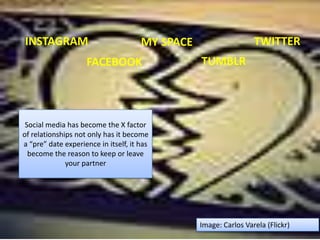
Social media has become the X factor
of relationships not only has it become
a “pre” date experience in itself, it has
become the reason to keep or leave
your partner
Image: Carlos Varela (Flickr)
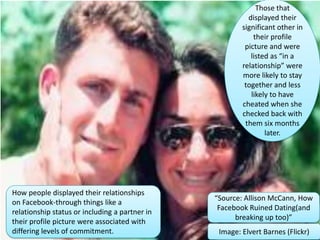
Those that
displayed their
significant other in
their profile
picture and were
listed as “in a
relationship” were
more likely to stay
together and less
likely to have
cheated when she
checked back with
them six months
later.
How people displayed their relationships
on Facebook-through things like a
relationship status or including a partner in
their profile picture were associated with
differing levels of commitment. Image: Elvert Barnes (Flickr)
“Source: Allison McCann, How
Facebook Ruined Dating(and
breaking up too)”
Image: Marty Pouwelse (Flickr)
Which leads
to constant
fighting and
problems
between
both
partners
What you say and do on
these sites stick and
determine who people
see you as
Image: Tony Alter (Flickr)
Being able to see your
facebook along with
other sites allow possible
partners and friends to
judge you
Seemingly insignificant
PDFAs (public displays of
Facebook affection) such
as choosing to include your
partner in your profile
picture and listing your
relationship status
reflected how committed
people really were IN REAL
LIFE.”
Image: Tammra McCauley (Flickr)
“Source: Allison McCann, How
Facebook Ruined Dating(and
breaking up too)”
People feel more pressure
from friends and family to
stay together when they
have their partner in profile
picture and relationship
status
Image: Fumika Harukaze (Flickr)
“Source: Allison McCann, How
Facebook Ruined Dating(and breaking
up too)”
“At each stage of a relationship, even before it really
begins and when it needs to end, Facebook has
created a whole new slew of obstacles and awkward
conversations that previously didn’t exist for people in
the dreadful world of dating.”
“Source: Allison McCann, How Facebook
Ruined Dating(and breaking up too)”
Facebook has become one of the
primary dating services without
any intention
The constant access along with the
billions of people registered allows
for the perfect playing field
Image: Timothy Krause (Flickr)
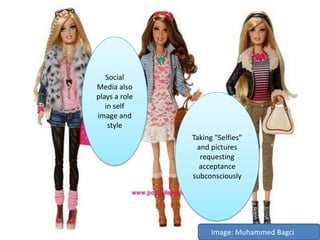
Image: Muhammed Bagci
Social
Media also
plays a role
in self
image and
style
Taking “Selfies”
and pictures
requesting
acceptance
subconsciously
Image:
Jhaymesisviphotography
(Flickr)
Texting and e-mail
and posting let us
present the self
we want to be.
This means we
can edit. And if
we wish to, we
can delete. Or
retouch: the
voice, the
flesh, the
face, the body.
Not too
much, not too
little — just right.
“Source: SHERRY TURKLE, The Flight From Conversation”
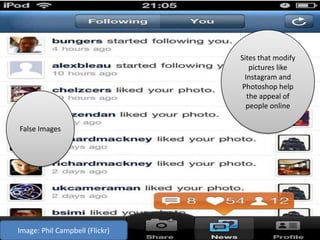
Sites that modify
pictures like
Instagram and
Photoshop help
the appeal of
people online
Image: Phil Campbell (Flickr)
False Images
Can Social Media help benefit Relationships?
Facebook is a positive factor for
young people in the dating
aspect. It allows you to acquire
information about a potential
partner.
Image: Davi Sommerfeld (Flickr)
Facebook allows for “slower progression,” Fox and her
colleagues write, “as liking could be developed over time
before the gamble of asking someone out.” Conversely, if
a potential mate is of no interest, turning down their
friend request is simple, easy, and much more
comfortable—for both parties—than telling someone
“I’m not that into you.”
“Source: Tom Jacobs, I Now Pronounce You
FBO: Facebook Official,”
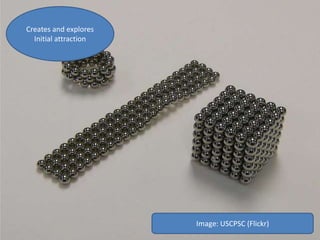
Creates and explores
Initial attraction
Image: USCPSC (Flickr)
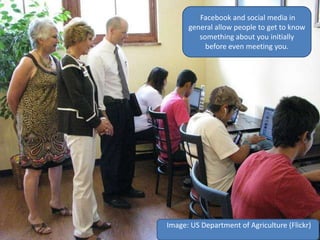
Facebook and social media in
general allow people to get to know
something about you initially
before even meeting you.
Image: US Department of Agriculture (Flickr)
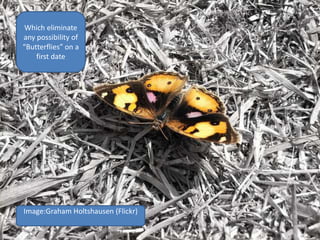
Image:Graham Holtshausen (Flickr)
Which eliminate
any possibility of
“Butterflies” on a
first date
Is Social Media good for the
progression relationships or
merely one of the causes that
prevent growth and structure?
“All images are licensed
under the creative
commons agreement and
are sourced from Flickr.”
Refernces
• Bernstein, Elizabeth. "He Texts, She Tweets—Are They E-Compatible?" The
Wall Street Journal (2012): 1. Http://online.wsj.com/. 3 July 2012. Web. 16
May 2013.
• Erickson, Christine. "The Social Psychology of the Selfie." Mashable Feb. 2013:
1. Print.
• Jacobs, Tom. "I Now Pronounce You FBO: Facebook Official." Pacific Standard.
N.p., 8 Jan. 2013. Web. 17 May 2013.
• Kosner, Anthony Wing. "From Bullying to Relationships: Mapping Our Online
Communications." E! Science News. N.p., July 2012. Web. 17 May 2013.
• Makice, Kevin. "Coming of Age in the Digital Age." Weird Magazine (2013): 1.
Print.
• McCann, Allison. "How Facebook Ruined Dating (And Breaking Up Too)."
BuzzFeed. N.p., 18 Oct. 2012. Web. 17 May 2013.
• McHugh, Jillian. "'Selfies' Just as Much for the Insecure as Show-offs."
BusinessDay (2012): 1. 3 Apr. 2013. Web. 16 May 2013.
• Mills, Carys. "‘Facebook Fatigue’ and the Aging Social Network." The Toronto
Star (2013): 1. Www.thestar.com. 5 Apr. 2013. Web. 16 May 2013.
• Turkle, Sherry. "The Flight From Conversation." The New York Times [New
York] n.d.: 1. Http://www.nytimes.com/. 21 Apr. 2012. Web. 16 May 2013.

Film slideshow

  • 1.
    People use socialnetwork sites to communicate with the people that they know and express themselves and voice their thoughts. Facebook has subcautiously become a world wide dating service without any intention Image: MoneyBlogNewz (Flickr)
  • 2.
    Image: kasiastock (Flickr) Doyou feel social media has a strong impact on relationships today?
  • 3.
    “Most people usesocial network sites to with the people that they know,” INSTAGRAM FACEBOOK MY SPACE TUMBLR TWITTER Social media has become the X factor of relationships not only has it become a “pre” date experience in itself, it has become the reason to keep or leave your partner Image: Carlos Varela (Flickr)
  • 4.
    Those that displayed their significantother in their profile picture and were listed as “in a relationship” were more likely to stay together and less likely to have cheated when she checked back with them six months later. How people displayed their relationships on Facebook-through things like a relationship status or including a partner in their profile picture were associated with differing levels of commitment. Image: Elvert Barnes (Flickr) “Source: Allison McCann, How Facebook Ruined Dating(and breaking up too)”
  • 5.
    Image: Marty Pouwelse(Flickr) Which leads to constant fighting and problems between both partners
  • 6.
    What you sayand do on these sites stick and determine who people see you as Image: Tony Alter (Flickr) Being able to see your facebook along with other sites allow possible partners and friends to judge you
  • 7.
    Seemingly insignificant PDFAs (publicdisplays of Facebook affection) such as choosing to include your partner in your profile picture and listing your relationship status reflected how committed people really were IN REAL LIFE.” Image: Tammra McCauley (Flickr) “Source: Allison McCann, How Facebook Ruined Dating(and breaking up too)”
  • 8.
    People feel morepressure from friends and family to stay together when they have their partner in profile picture and relationship status Image: Fumika Harukaze (Flickr) “Source: Allison McCann, How Facebook Ruined Dating(and breaking up too)”
  • 9.
    “At each stageof a relationship, even before it really begins and when it needs to end, Facebook has created a whole new slew of obstacles and awkward conversations that previously didn’t exist for people in the dreadful world of dating.” “Source: Allison McCann, How Facebook Ruined Dating(and breaking up too)”
  • 10.
    Facebook has becomeone of the primary dating services without any intention The constant access along with the billions of people registered allows for the perfect playing field Image: Timothy Krause (Flickr)
  • 11.
    Image: Muhammed Bagci Social Mediaalso plays a role in self image and style Taking “Selfies” and pictures requesting acceptance subconsciously
  • 12.
    Image: Jhaymesisviphotography (Flickr) Texting and e-mail andposting let us present the self we want to be. This means we can edit. And if we wish to, we can delete. Or retouch: the voice, the flesh, the face, the body. Not too much, not too little — just right. “Source: SHERRY TURKLE, The Flight From Conversation”
  • 13.
    Sites that modify pictureslike Instagram and Photoshop help the appeal of people online Image: Phil Campbell (Flickr) False Images
  • 14.
    Can Social Mediahelp benefit Relationships?
  • 15.
    Facebook is apositive factor for young people in the dating aspect. It allows you to acquire information about a potential partner. Image: Davi Sommerfeld (Flickr)
  • 16.
    Facebook allows for“slower progression,” Fox and her colleagues write, “as liking could be developed over time before the gamble of asking someone out.” Conversely, if a potential mate is of no interest, turning down their friend request is simple, easy, and much more comfortable—for both parties—than telling someone “I’m not that into you.” “Source: Tom Jacobs, I Now Pronounce You FBO: Facebook Official,”
  • 17.
    Creates and explores Initialattraction Image: USCPSC (Flickr)
  • 18.
    Facebook and socialmedia in general allow people to get to know something about you initially before even meeting you. Image: US Department of Agriculture (Flickr)
  • 19.
    Image:Graham Holtshausen (Flickr) Whicheliminate any possibility of “Butterflies” on a first date
  • 20.
    Is Social Mediagood for the progression relationships or merely one of the causes that prevent growth and structure?
  • 21.
    “All images arelicensed under the creative commons agreement and are sourced from Flickr.”
  • 22.
    Refernces • Bernstein, Elizabeth."He Texts, She Tweets—Are They E-Compatible?" The Wall Street Journal (2012): 1. Http://online.wsj.com/. 3 July 2012. Web. 16 May 2013. • Erickson, Christine. "The Social Psychology of the Selfie." Mashable Feb. 2013: 1. Print. • Jacobs, Tom. "I Now Pronounce You FBO: Facebook Official." Pacific Standard. N.p., 8 Jan. 2013. Web. 17 May 2013. • Kosner, Anthony Wing. "From Bullying to Relationships: Mapping Our Online Communications." E! Science News. N.p., July 2012. Web. 17 May 2013. • Makice, Kevin. "Coming of Age in the Digital Age." Weird Magazine (2013): 1. Print. • McCann, Allison. "How Facebook Ruined Dating (And Breaking Up Too)." BuzzFeed. N.p., 18 Oct. 2012. Web. 17 May 2013. • McHugh, Jillian. "'Selfies' Just as Much for the Insecure as Show-offs." BusinessDay (2012): 1. 3 Apr. 2013. Web. 16 May 2013. • Mills, Carys. "‘Facebook Fatigue’ and the Aging Social Network." The Toronto Star (2013): 1. Www.thestar.com. 5 Apr. 2013. Web. 16 May 2013. • Turkle, Sherry. "The Flight From Conversation." The New York Times [New York] n.d.: 1. Http://www.nytimes.com/. 21 Apr. 2012. Web. 16 May 2013.