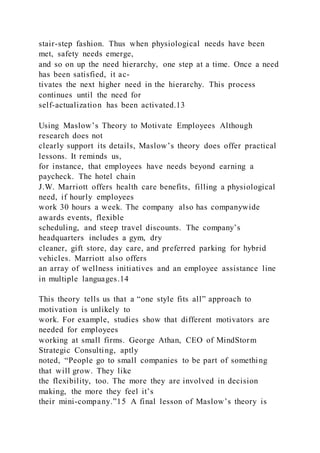
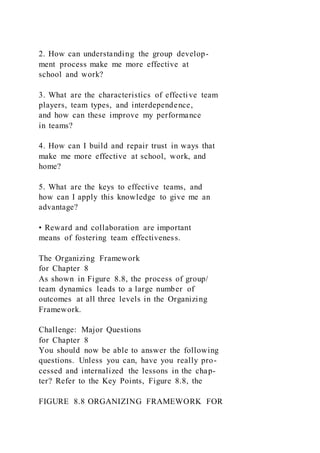
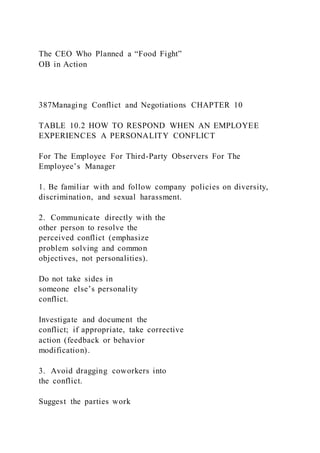
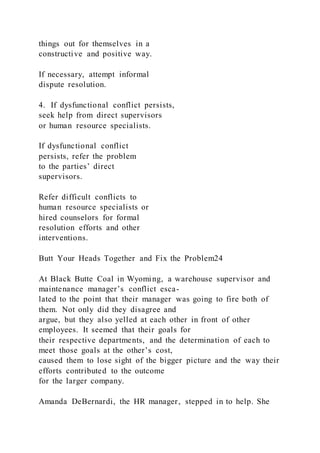
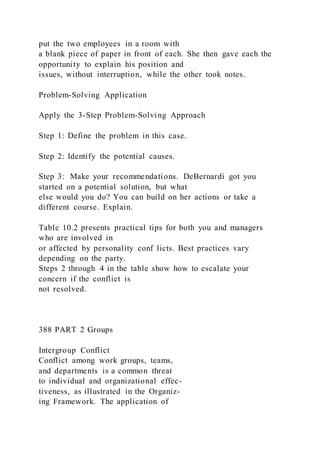
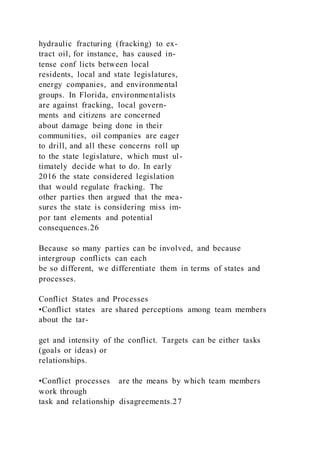
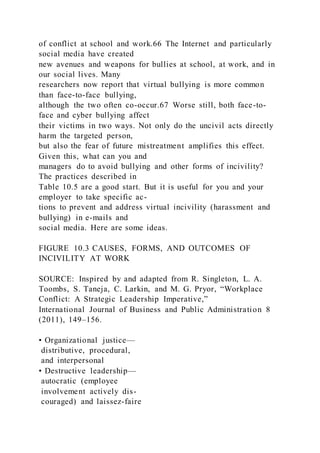
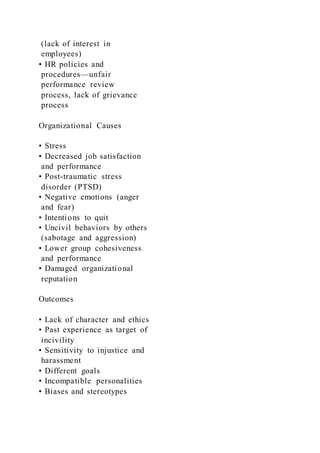
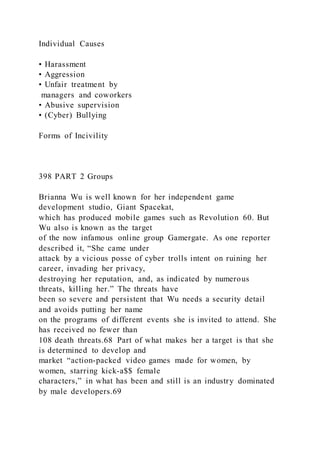
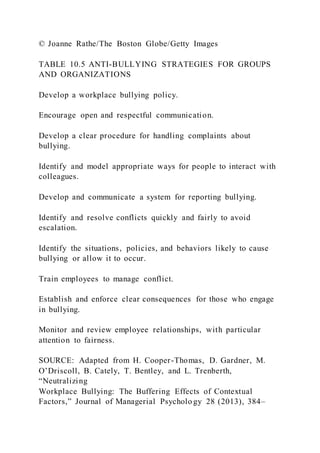
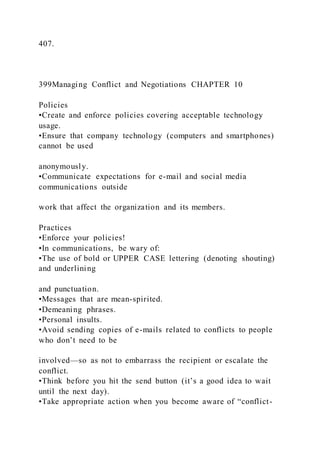
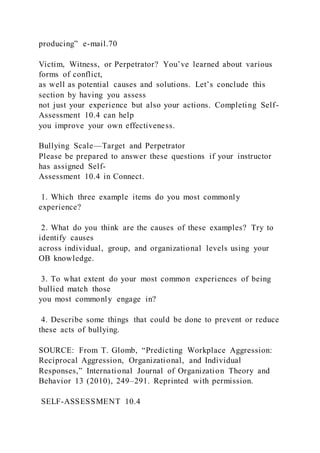
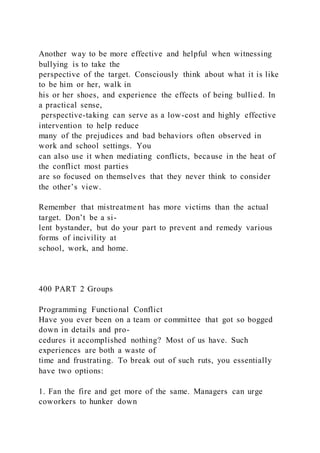
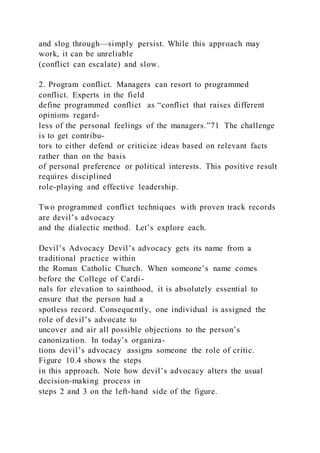
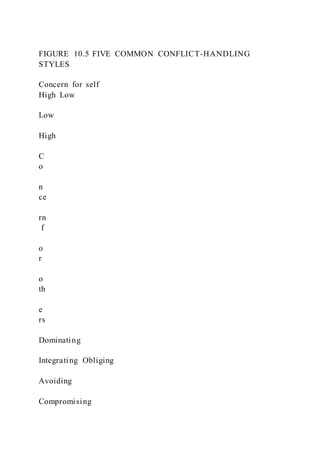
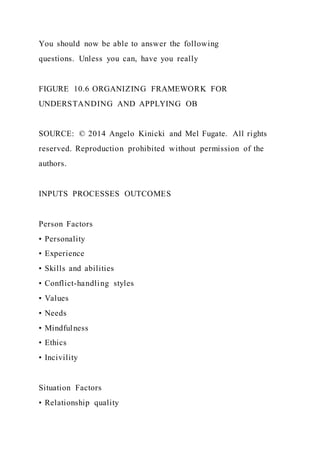
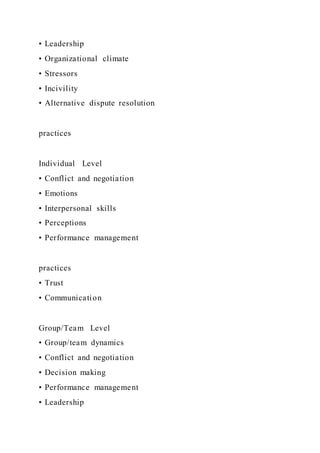
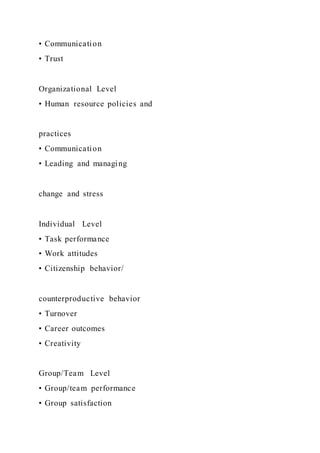
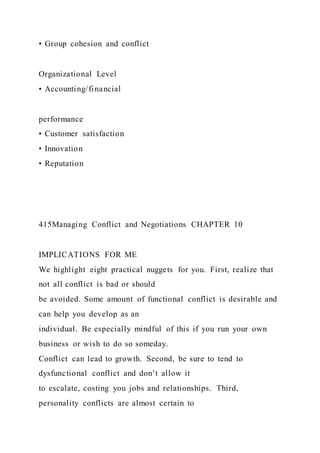
FIGURE 5.1 ORGANIZING FRAMEWORK FOR
UNDERSTANDING AND APPLYING OB
© 2014 Angelo Kinicki and Mel Fugate. All rights reserved.
Reproduction prohibited without permission of the authors
INPUTS PROCESSES OUTCOMES
Person Factors
• Personality
• Personal attitudes
• Values—Theory X/Y
• Needs
Situation Factors
• Hygiene factors
• Motivating factors
• Job characteristics
• Job design
• Leadership
• Organizational climate
Individual Level
• Equity/justice
• Expectancy processes
• Goal setting processes
• Voice
Group/Team Level
• Climate for justice
Organizational Level
• Climate for justice
Individual Level
• Intrinsic and extrinsic
motivation
• Task performance
• Work attitudes
• Citizenship behavior/
counterproductive behavior
• Turnover
Group/Team Level
• Group/team performance
Organizational Level
• Customer satisfaction
5
Major Topics I’ll Learn and Questions I Should Be Able to
Answer
5.1 The What and Why of Motivation
MAJOR QUESTION: What is motivation and how does it affect
my behavior?
5.2 Content Theories of Motivation
MAJOR QUESTION: How would I compare and contrast the
content theories of
motivation?
5.3 Process Theories of Motivation
MAJOR QUESTION: How would I compare and contrast the
process theories of
motivation?
5.4 Motivating Employees Through Job Design
MAJOR QUESTION: How are top-down approaches, bottom-up
approaches,
and “idiosyncratic deals” similar and different?
How Can I Apply Motivation Theories?
FOUNDATIONS OF
EMPLOYEE MOTIVATION
The Organizing Framework for Understanding and Applying OB
shown in Figure 5.1 summa-
rizes what you will learn in this chapter. Although Chapter 5
focuses on motivation, an individual-
level process, a host of person and situation factors influence it.
There are more situation than
person factors in the figure. This reinforces the simple fact that
managers significantly affect our
motivation because they have more control over situation than
person factors. Figure 5.1 further
shows that processes across the individual, group/team, and
organizational level influence a
variety of important outcomes.
161
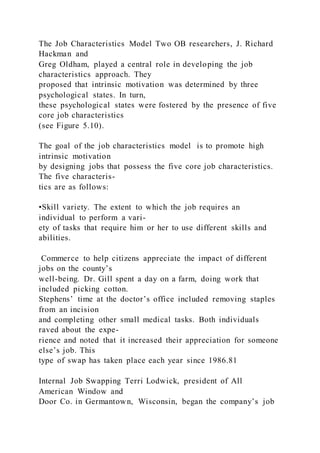
Winning at Work
Discussing Pay at Work
What’s Ahead in This Chapter
There are far too many dysfunctional organizations
where managers don’t seem to have a clue about how
to motivate workers. OB supplies proven methods of
how to motivate employees. These aren’t just abstract
theories. All spring from observation and study of the
workplace, and they have been validated in real-life
testing. Business professionals treasure them as tools
for making work better and more productive. We’ll show
you how these methods operate and give practical tips
and suggestions for implementing them.
The Wall Street Journal recently
offered advice for how companies
should handle pay secrecy. Based
on OB research covered in this
chapter, the writer suggested com-
panies should open up about pay
and allow employees to freely talk
about their pay concerns. This in-
cludes showing pay data on com-
pany intranets and performance
information by unit. Showing the link
between pay and performance is one way to make pay de-
cisions transparent.4
Should You Discuss Pay While at Work?
The answer depends on your role and position. Experts
contend that the National Labor Relations Act prohibits
companies from stopping the rank and file (employees paid
by the hour) from discussing salary and benefits packages
outside work time. “Outside work time” means on social
media as well. T-Mobile was recently found guilt of violating
national labor laws by prohibiting employees from talking
with each other about wages. The rules are different, how -
ever, for managers and supervisors, who can legally be
prevented from discussing their pay.5
If you decide to discuss pay at work, keep the following
recommendations in mind: (1) understand your company’s
policy on the matter, (2) restrict your conversations to peo-
ple you trust, and (3) don’t brag about your pay.
Ever wonder how your pay com-
pares to that of a coworker? Brian
Bader did. Bader had just been
hired for a technology-support job at
Apple for $12 per hour and was told
not to discuss salary with other em-
ployees. This requirement made him
curious, so he decided to ask co-
workers about their salary and found
that most people were being paid
between $10 and $12 per hour.
Pay Inequity
Bader was not upset about his relative pay level at first, but
it later became the reason he decided to quit his job. He
learned from performance data shared with work teams
that he was twice as productive as the lowest performer on
the team yet earned only 20 percent more. “It irked me.
If I’m doing double the work, why am I not seeing double
the pay?” he said when interviewed for The Wall Street
Journal.1 In OB we see Bader’s situation as an example of
pay inequity.
How do Companies Handle Decisions
about Pay?
Many companies tell employees not to discuss pay with
coworkers. Some threaten to fire those who do. Why?
Quite simply, when such disparities become public, they
lead to feelings of inequity, which in turn lowers employee
engagement, motivation, and performance. Dr. Kevin
Hallock, dean of industrial and labor relations at Cornell
University, said companies keep pay secret because they
“aren’t very good at explaining to employees why they’re
being paid what they’re paid, or what they must do to earn
more.”2
Pay secrecy does not sit well with younger employees
like Millennials, who are more willing than earlier genera-
tions to talk about pay and even discuss it on social media.
Some companies, such as Whole Foods Market, SumAll,
and Buffer, are less secretive. Buffer, a small social media
marketing and analytics firm, posts all employees’ salaries
online, including their names, along with revenue, sales,
and the company’s formula for setting salaries.3 Would you
like to work at Buffer?
162 PART 1 Individual Behavior
5.1 THE WHAT AND WHY OF MOTIVATION
Motivation theories help us understand our own behaviors in
organizational settings and
provide us tools for motivating others.
Motivation: What Is It?
Motivation explains why we do the things we do. It explains
why you are dressed the way
you are right now, and it can account for what you plan to do
this evening.
How Does It Work? The term motivation derives from the Latin
word movere, mean-
ing “to move.” In the present context, motivation  describes the
psychological pro-
cesses “that underlie the direction, intensity, and persistence of
behavior or
thought.”6 “Direction pertains to what an individual is attending
to at a given time, inten-
sity represents the amount of effort being invested in the
activity, and persistence repre-
sents for how long that activity is the focus of one’s
attention.”7
There are two types of motivation: extrinsic and intrinsic.
•Extrinsic motivation  results from the potential or actual
receipt of external
rewards. Extrinsic rewards such as recognition, money, or a
promotion represent a
payoff we receive from others for performing a particular task.
For example, the
Air Force is offering a bonus to drone pilots if they extend their
commitment to
remain in the military. These pilots can earn a $15,000 annual
bonus by extending
for either five or nine years, and they have the option to receive
half the total bonus
up front. The Air Force is doing this because the demand for
drone pilots exceeds
the supply.8
•Intrinsic motivation  occurs when an individual is inspired by
“the positive
internal feelings that are generated by doing well, rather than
being dependent
on external factors (such as incentive pay or compliments from
the boss) for the
motivation to work effectively.”9 We create our own intrinsic
motivation by giving
ourselves intrinsic rewards such as positive emotions,
satisfaction, and self-praise.
Consider the intrinsic motivation of the 2015 winners of
Dancing with the Stars—
Bindi Irwin and Derek Hough. The joy on their faces
demonstrates the engagement
and fun they are having while dancing.
M A J O R Q U E S T I O N
What is motivation and how does it affect
my behavior?
T H E B I G G E R P I C T U R E
Motivation is a key process within the Organizing Framework
for Understanding and Apply-
ing OB. Understanding the principles of motivation can help
you both achieve personal goals
and manage others in the pursuit of organizational goals.
163Foundations of Employee Motivation CHAPTER 5
The Two Fundamental Perspectives on Motivation:
An Overview
Researchers have proposed two general categories of motivation
theories: content theo-
ries and process theories. Content theories identify internal
factors such as needs and
satisfaction that energize employee motivation. Process theories
explain the process by
which internal factors and situational factors influence
employee motivation.10 It’s impor-
tant to understand both motivational perspectives because they
offer different solutions
for handling motivational problems. The following two sections
discuss several theories
for each theoretical perspective.
Bindi Irwin, on the left, and Derek Hough won the 2015
Dancing with the Stars competition. The smiles on their faces
show the intrinsic motivation that performers in many fields
feel during and after competing. Performers in many arenas—
not just competitive dancing—are motivated to excel by
extrinsic factors, such as prize money, praise, recognition from
others, and titles. However, often the key motivators are also,
or instead, intrinsic, like a feeling of challenge and
accomplishment. © Amanda Edwards/WireImage/Getty Images
164 PART 1 Individual Behavior
M A J O R Q U E S T I O N
How would I compare and contrast the content
theories of motivation?
T H E B I G G E R P I C T U R E
Five OB theories deal with the internal factors that motivate
individuals. Several come from
other disciplines. So you may have already encountered
Maslow’s hierarchy of needs and
related content theories such as McGregor’s Theory X and
Theory Y, acquired needs theory,
self-determination theory, and Herzberg’s motivator-hygiene
theory.
5.2 CONTENT THEORIES OF MOTIVATION
Most content theories of motivation  are based on the idea that
an employee’s
needs influence his or her motivation. Content theorists ask,
“What are the different
needs that activate motivation’s direction, intensity, and
persistence?” Needs  are de-
fined as physiological or psychological deficiencies that arouse
behavior. They can
be strong or weak and are influenced by environmental factors.
This tells you that human
needs vary over time and place.
Content theories include:
•McGregor’s Theory X and Theory Y.
•Maslow’s need hierarchy theory.
•Acquired needs theory.
•Self-determination theory.
•Herzberg’s motivator-hygiene theory.
McGregor’s Theory X and Theory Y
Douglas McGregor outlined his theory in his book The Human
Side of Enterprise.11 Draw-
ing on his experience as a management consultant, McGregor
formulated two sharply
contrasting sets of assumptions about human nature. Theory X 
is a pessimistic view of
employees: They dislike work, must be monitored, and can be
motivated only with
rewards and punishment (“carrots and sticks”). McGregor felt
this was the typical per-
spective held by managers. To help them break with this
negative tradition, McGregor
formulated his own Theory Y. Theory Y  is a modern and
positive set of assumptions
about people at work: They are self-engaged, committed,
responsible, and creative.
Consider the value of adopting a Theory Y approach toward
people. One recent study
demonstrated that employees and teams had higher performance
when their managers
displayed Theory Y behaviors. A second study uncovered higher
levels of job satisfac-
tion, organizational commitment, and organizational citizenship
when managers engaged
in Theory Y behaviors.12
Maslow’s Need Hierarchy Theory:
Five Levels of Needs
In 1943, psychologist Abraham Maslow published his now-
famous need hierarchy theory
of motivation. Although the theory was based on his clinical
observation of a few neurotic
individuals, it has subsequently been used to explain the entire
spectrum of human
165Foundations of Employee Motivation CHAPTER 5
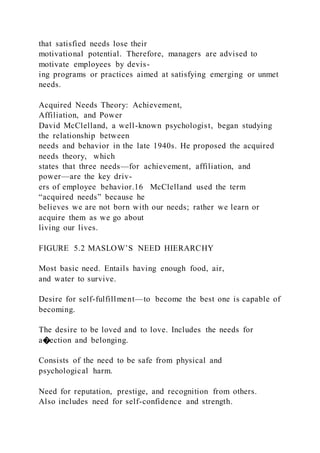
behavior. The need hierarchy theory  states that motivation is a
function of five ba-
sic needs: physiological, safety, love, esteem, and self-
actualization. See Figure 5.2
for an explanation.
The Five Levels Maslow proposed that the five needs are met
sequentially and relate
to each other in a “prepotent” hierarchy (see Figure 5.2).
Prepotent means the current
most-pressing need will be met before the next need becomes
the most powerful or po-
tent. In other words, Maslow believed human needs generally
emerge in a predictable
stair-step fashion. Thus when physiological needs have been
met, safety needs emerge,
and so on up the need hierarchy, one step at a time. Once a need
has been satisfied, it ac-
tivates the next higher need in the hierarchy. This process
continues until the need for
self-actualization has been activated.13
Using Maslow’s Theory to Motivate Employees Although
research does not
clearly support its details, Maslow’s theory does offer practical
lessons. It reminds us,
for instance, that employees have needs beyond earning a
paycheck. The hotel chain
J.W. Marriott offers health care benefits, filling a physiological
need, if hourly employees
work 30 hours a week. The company also has companywide
awards events, flexible
scheduling, and steep travel discounts. The company’s
headquarters includes a gym, dry
cleaner, gift store, day care, and preferred parking for hybrid
vehicles. Marriott also offers
an array of wellness initiatives and an employee assistance line
in multiple languages.14
This theory tells us that a “one style fits all” approach to
motivation is unlikely to
work. For example, studies show that different motivators are
needed for employees
working at small firms. George Athan, CEO of MindStorm
Strategic Consulting, aptly
noted, “People go to small companies to be part of something
that will grow. They like
the flexibility, too. The more they are involved in decision
making, the more they feel it’s
their mini-company.”15 A final lesson of Maslow’s theory is
that satisfied needs lose their
motivational potential. Therefore, managers are advised to
motivate employees by devis-
ing programs or practices aimed at satisfying emerging or unmet
needs.
Acquired Needs Theory: Achievement,
Affiliation, and Power
David McClelland, a well-known psychologist, began studying
the relationship between
needs and behavior in the late 1940s. He proposed the acquired
needs theory,  which
states that three needs—for achievement, affiliation, and
power—are the key driv-
ers of employee behavior.16 McClelland used the term
“acquired needs” because he
believes we are not born with our needs; rather we learn or
acquire them as we go about
living our lives.
FIGURE 5.2 MASLOW’S NEED HIERARCHY
Most basic need. Entails having enough food, air,
and water to survive.
Desire for self-fulfillment—to become the best one is capable of
becoming.
The desire to be loved and to love. Includes the needs for
a�ection and belonging.
Consists of the need to be safe from physical and
psychological harm.
Need for reputation, prestige, and recognition from others.
Also includes need for self-confidence and strength.
Esteem
Love
Safety
Physiological
Self-
Actualization
166 PART 1 Individual Behavior
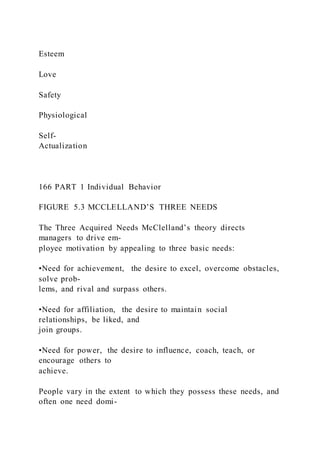
FIGURE 5.3 MCCLELLAND’S THREE NEEDS
The Three Acquired Needs McClelland’s theory directs
managers to drive em-
ployee motivation by appealing to three basic needs:
•Need for achievement,  the desire to excel, overcome obstacles,
solve prob-
lems, and rival and surpass others.
•Need for affiliation,  the desire to maintain social
relationships, be liked, and
join groups.
•Need for power,  the desire to influence, coach, teach, or
encourage others to
achieve.
People vary in the extent to which they possess these needs, and
often one need domi-
nates the other two (see Figure 5.3).
McClelland identified a positive and negative form of the power
need. The positive
side is called the need for institutional power. It manifests in
the desire to organize people
in the pursuit of organizational goals and help people obtain the
feeling of competence.
The negative face of power is called the need for personal
power. People with this need
want to control others, and they often manipulate people for
their own gratification.
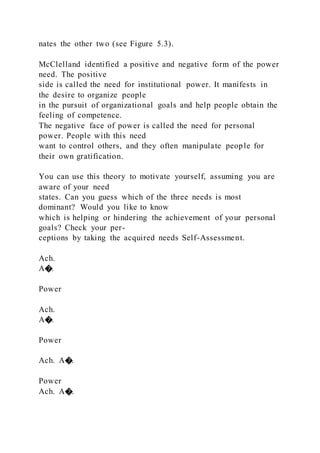
You can use this theory to motivate yourself, assuming you are
aware of your need
states. Can you guess which of the three needs is most
dominant? Would you like to know
which is helping or hindering the achievement of your personal
goals? Check your per-
ceptions by taking the acquired needs Self-Assessment.
Ach.
A�.
Power
Ach.
A�.
Power
Ach. A�.
Power
Ach. A�.
Power
Balanced Needs Achievement Orientation A�liation Orientation
Power Orientation
Assessing Your Acquired Needs
Please be prepared to answer these questions if your instructor
has assigned Self-
Assessment 5.1 in Connect.
1. Which of the three needs is dominant for you? Are you
surprised by this result?
2. Which is/are helping you to achieve your goals?
3. Are any of the needs affecting your level of well -being?
Should you make any
changes in your need states?
SELF-ASSESSMENT 5.1
Using Acquired Needs Theory to Motivate Others The following
OB in Action
box illustrates how Cameron Mitchell’s acquired needs affected
the way he ran his suc-
cessful restaurant business.
You can apply acquired needs theory by appealing to the
preferences associated with
each need when you (1) set goals, (2) provide feedback, (3)
assign tasks, and (4) design
the job.17 Let’s consider how the theory applies to Cameron
Mitchell.
•Need for achievement. People motivated by the need for
achievement, like Cam-
eron Mitchell, prefer working on challenging, but not
impossible, tasks or projects.
They like situations in which good performance relies on effort
and ability rather
than luck, and they like to be rewarded for their efforts. High
achievers also want to
167Foundations of Employee Motivation CHAPTER 5
Cameron Mitchell has achieved his childhood
dream of running a successful restaurant
business. He currently runs 48 upscale res-
taurants such as Hudson 29 and Ocean
Prime in 18 cities. His business earns about
$250 million in annual revenue.
Mitchell’s primary goal was “to create an
extraordinary restaurant company known for
great people delivering genuine hospitality.”
He says, “In order to achieve this goal, I could
not do it on my own! In fact, our past, present,
and future success is directly attributed to
our associates.”18
You might not have foreseen Mitchell’s
success based on his difficult childhood. His
parents divorced when he was 9, and he be-
gan drinking alcohol and trying drugs in middle
school. When he started dealing drugs in high
school, his mom threatened to call child pro-
tective services. Mitchell decided to run away.
He moved into a one-room apartment with other teens and
sometimes went
days without food. He decided to return home at 16 when he
found himself think-
ing about suicide. He went back to high school and took a job as
a dishwasher at
a local steak house. He loved the job and concluded, “The
restaurant business
was where I wanted to be the rest of my life.”
When Mitchell’s application to the Culinary Institute of
America was rejected
due to his poor grades, he became more driven. He started
working double shifts
so he could pay for community college. He eventually graduated
from culinary
school and began working as a sous chef. Mitchell opened his
first restaurant in
1993 in Columbus, Ohio. It was a success!19
The growth of Mitchell’s business was based on an underlying
philosophy of
“people first.” The company’s website states that it “doesn’t
just hire great people,
it also treats them well. This inspires them to radiate a genuine
hospitality that
guests, vendors, and the community at large can feel and
appreciate.”20
The company’s commitment to its employees shows in the wide
array of ben-
efits it offers, which exceed industry standards. It also rewards
restaurant manag-
ers who support and develop their teams. Mitchell believes
associates should
have trusting, caring relationships with each other. He
encourages managers’ au-
tonomy by allowing them to provide input on menu and wine
selection decisions.
The company further reinforces the value of autonomy and
effective decision
making with leadership training programs. Managers are taught
“how to think
(rather than ‘how to do’). The goal is to encourage creative,
appropriate problem-
solving and idea generation,” according to the company’s
website.”21
YOUR THOUGHTS?
1. Which of the three acquired needs is most pronounced in this
example?
2. Would you like to work for someone like Cameron Mitchell?
Why?
Cameron Mitchell, Founder and CEO of Cameron
Mitchell Restaurants, Exemplifies Acquired Needs
OB in Action
Cameron Mitchell
Courtesy of Cameron Mitchell Restaurants
168 PART 1 Individual Behavior
receive a fair and balanced amount of positive and negative
feedback. This enables
them to improve their performance.
•Need for affiliation. People motivated by the need for
affiliation like to work in
teams and in organizational climates characterized as
cooperative and collegial.
You clearly see this theme at work in Cameron Mitchell’s
restaurants.
•Need for power. People with a high need for power like to be
in charge. They
enjoy coaching and helping others develop. Cameron Mitchell
seems to exemplify
this need.
Self-Determination Theory: Competence, Autonomy,
and Relatedness
Self-determination theory was developed by psychologists
Edward Deci and Richard
Ryan. In contrast to McClelland’s belief that needs are learned
over time, this theory
identifies innate needs that must be satisfied for us to flourish.
Self-determination
theory  assumes that three innate needs influence our behavior
and well-being—the
needs for competence, autonomy, and relatedness.22
Self-Determination Theory Focuses on Intrinsic Motivation
Self-determination
theory focuses on the needs that drive intrinsic motivation.
Intrinsic motivation is longer
lasting and has a more positive impact on task performance than
extrinsic motivation.23
The theory proposes that our needs for competence, autonomy,
and relatedness produce
intrinsic motivation, which in turn enhances our task
performance. Research supports this
proposition.24
The Three Innate Needs An innate need is a need we are born
with. The three in-
nate needs are:
1. Competence—“I need to feel efficacious.” This is the desire
to feel qualified,
knowledgeable, and capable to complete an act, task, or goal.
2. Autonomy—“I need to feel independent to influence my
environment.” This is
the desire to have freedom and discretion in determining what
you want to do and
how you want to do it.
3. Relatedness—“I want to be connected with others.” This is
the desire to feel part
of a group, to belong, and to be connected with others.
Although the above needs are assumed to be innate, according
to Deci and Ryan their
relative value can change over our lives and vary across
cultures.
Using Self-Determination Theory to Motivate Employees
Managers can apply
self-determination theory by trying to create work environments
that support and encour-
age the opportunity to experience competence, autonomy, and
relatedness. Here are some
specific suggestions:
•Competence. Managers can provide tangible resources, time,
contacts, and coach-
ing to improve employee competence. They can make sure
employees have the
knowledge and information they need to perform their jobs. The
J.W. Marriott ho-
tel chain instills competence by providing employees
developmental opportunities
and training. Daniel Nadeau, general manager of the Marriott
Marquis Washington,
D.C., said, “The biggest perk is the opportunity.” He started at
Marriott busing
tables in high school and then worked his way up through sales,
marketing, and
operations. “A culture of mentorship is what pulled him along,”
according to
Nadeau.25
•Autonomy. Managers can empower employees and delegate
meaningful assign-
ments and tasks to enhance feelings of autonomy. This in turn
suggests they should
169Foundations of Employee Motivation CHAPTER 5
support decisions their employees make. A recent study
confirmed this conclusion.
Employees’ intrinsic motivation was higher when they
perceived that their man-
ager supported them.26 Unilever implemented the Agile
Working program in sup-
port of autonomy. According to a writer for HR Magazine, the
program allows
“100,000 employees—everyone except factory production
workers—to work any-
time, anywhere, as long as they meet business needs. To support
the effort, the
company is investing in laptops, videoconferencing, soft-phones
and smartphones,
remote networks, webcams, and other technologies that help
curtail travel.”27
•Relatedness. Many companies use fun and camaraderie to
foster relatedness. Nug-
get Market, an upscale supermarket chain in Sacramento, builds
relatedness by
creating a family-type work environment. One employee
described the climate in
this way: “The company doesn’t see this as a workplace; they
see it as a family.
This is our home, where customers are treated as guests.”28 A
positive and inspir-
ing corporate vision also can create a feeling of commitment to
a common pur-
pose. For example, Lars Sørensen, CEO of Novo Nordisk, a
global health care
company specializing in diabetes treatments, believes his
employees are intrinsi-
cally motivated by the thought of saving lives. “Without our
medication,” he said,
“24 million people would suffer. There is nothing more
motivating for people than
to go to work and save people’s lives.”29
Herzberg’s Motivator-Hygiene Theory:
Two Ways to Improve Satisfaction
Frederick Herzberg’s theory is based on a landmark study in
which he interviewed
203 accountants and engineers.30 These interviews, meant to
determine the factors re-
sponsible for job satisfaction and dissatisfaction, uncovered
separate and distinct clusters
of factors associated with each. This pattern led to the
motivator-hygiene theory,  which
proposes that job satisfaction and dissatisfaction arise from two
different sets of
John Willard Marriott, Jr., is the executive chairman and
chairman of the
board of Marriott International. He joined the company in 1956
and was
promoted to president in 1964 and CEO in 1972. His leadership
philosophy is one of being a servant leader. This belief focuses
on placing
the needs of others above self-interests. We suspect this is one
reason
Marriott International has a progressive stance toward
developing and
improving the lives of its employees. He has been married for
over 50 years.
© Nikki Kahn/The Washington Post/Getty Images
170 PART 1 Individual Behavior
factors—satisfaction comes from motivating factors and
dissatisfaction from
hygiene factors.
•Hygiene factors—What makes employees
dissatisfied? Jobdissatisfactionwas
associatedprimarilywithfactorsintheworkcontextorenvironment.
Herzberg
hypothesizedthatsuchhygiene factors—including company
policy and admin-
istration, technical supervision, salary, interpersonal
relationships with super-
visors, and working conditions—cause a person to move from a
state of no
dissatisfaction to
dissatisfaction.Hedidnotbelievetheirremovalcreatedan
immediateimpactonsatisfactionormotivation(forthat,seemotivati
ngfactors
following).Atbest,Herzbergproposedthatindividualswillexperien
cetheab-
senceofjobdissatisfactionwhentheyhavenogrievancesabouthygien
efactors.
•Motivating factors—What makes employees
satisfied? Jobsatisfactionwas
morefrequentlyassociatedwithfactorsintheworkcontentofthetaskb
eingper-
formed.Herzberglabeledthesemotivating factorsor
motivatorsbecauseeachwas
associatedwithstrongeffortandgoodperformance.Hehypothesizedt
hatsuch
motivating factors, or motivators—including achievement,
recognition,
characteristics of the work, responsibility, and advancement—
cause a person
to move from a state of no satisfaction to
satisfaction.Therefore,Herzberg’s
theorypredictsmanagerscanmotivateindividualsbyincorporatingm
otivators
intoanindividual’sjob.
ForHerzberg,thegroupsofhygieneandmotivatingfactorsdidnotinte
ract.“Theop-
positeofjobsatisfactionisnotjobdissatisfaction,butrathernojobsati
sfaction;and
similarly,theoppositeofjobdissatisfactionisnotjobsatisfaction,but
nodissatisfac-
tion.”31Herzbergconceptualizesdissatisfactionandsatisfactionast
woparallelcontin-
uums.Thestartingpointisanullstateinwhichbothdissatisfactionand
satisfactionare
absent.Theoreticallyanorganizationmembercouldhavegoodsuperv
ision,pay,and
workingconditions(nodissatisfaction)butatediousandunchallengi
ngtaskwithlittle
chanceofadvancement(nosatisfaction),asillustratedin Figure5.4.
Managerial View of Job Satisfaction and Dissatisfaction
Insights from
Herzberg’stheoryallowmanagerstoconsiderthedimensionsofbothj
obcontentandjob
contextsotheycanmanageforgreateroveralljobsatisfaction.Thereis
oneaspectofthis
theorywethinkiswrong,however.Webelieveyoucansatisfyandmoti
vatepeopleby
providinggoodhygienefactors.TheContainerStore,regularlyrateda
soneofthetop
fivecompaniestoworkforbyFortune,
isagoodexample.Thecompanypaysretail
hourlysalespeopleroughlydoubletheindustryavera ge,approximate
ly$50,000ayearin
FIGURE 5.4 ROLE OF JOB CONTENT AND JOB CONTEXT
IN JOB SATISFACTION
AND DISSATISFACTION
No Satisfaction
Jobs that do not
o�er achievement,
recognition,
stimulating work,
responsibility,
and advancement.
Jobs o�ering
achievement,
recognition,
stimulating work,
responsibility,
and advancement.
Jobs with good
company policies
and administration,
technical supervision,
salary, interpersonal
relationships with
supervisors, and
working conditions.
Jobs with poor
company policies
and administration,
technical supervision,
salary, interpersonal
relationships with
supervisors, and
working conditions.
Satisfaction
Motivators
No Dissatisfaction Dissatisfaction
Hygiene Factors
Job Content Job Context
SOURCE: Adapted from D. A. Whitsett and E. K. Winslow, “An
Analysis of Studies Critical of the Motivator-Hygiene Theory,”
Personnel Psychology, Winter 1997, 391–415.
171Foundations of Employee Motivation CHAPTER 5
2014.32 Its rate of employee turnover, about 5.7 percent, is
significantly lower than the
industry average of 74.9.33
Other companies seem to agree with our conclusion, because
they have been offering
a host of hygiene factors in an attempt to attract and retain
Millennials. A recent survey of
463 human resource managers revealed that “some 21 percent of
employers offer on-site
fitness centers, 22 percent provide free snacks and drinks, and
48 percent offer
community-volunteer programs.”34
Using Herzberg’s Theory to Motivate Employees Research does
not support the
two-factor aspect of Herzberg’s theory, nor the proposition that
hygiene factors are unre-
lated to job satisfaction. However, three practical applications
of the theory help explain
why it remains important in OB.
1. Hygiene first. There are practical reasons to eliminate
dissatisfaction before trying to
use motivators to increase motivation and performance. You
will have a harder time
motivating someone who is experiencing pay dissatisfaction or
otherwise struggling
with Herzberg’s hygiene factors.
2. Motivation next. Once you remove dissatisfaction, you can
hardly go wrong by
building motivators into someone’s job. This suggestion
represents the core idea be-
hind the technique of job design that is discussed in the final
section of this chapter.
3. A few well-chosen words. Finally, don’t underestimate the
power of verbal recogni-
tion to reinforce good performance. Savvy managers supplement
Herzberg’s motiva-
tors with communication. Positive recognition can fuel intrinsic
motivation,
particularly for people who are engaged in their work.
What’s Going on at the Arizona Department of Child Safety?
The Arizona Department of Child Safety (DCS) is having
motivational issues with its employees. The
agency defines itself as “a human service organization
dedicated to achieving safety, well-being and
permanency for children, youth, and families through leadership
and the provision of quality services in
partnership with communities.”35
The overall turnover rate at the agency is 24.5 percent. It’s even
higher for caseworkers (36 per-
cent), the people who directly work with the children and
families. Among those who stay, the number
taking time off under the federal Family and Medical Leave Act
recently increased 68 percent over the
preceding year.
Current and former employees complain about “crushing
workloads and fear-based management.”
Former employees said they quit because of stress associated
with growing caseloads and unrealistic
expectations from management. As of December 2015 casel oads
were 30 to 50 percent higher than
the agency’s standard.
When Greg McKay was hired to head the agency in 2015, he
fired almost all senior managers and
brought in his own team, promoting some from within. McKay
is trying to make changes to reduce the
caseload burden. The Arizona Republic reported that he is
“seeking more support staff in the upcoming
state budget to free caseworkers from some of the more clerical
aspects of their jobs. He’s revamping
the pay system to keep tenured staff on board, and has restored
a training program in Tucson.”
Pay raises might help retain staff. The entry-level salary for
caseworkers is $33,000. Overall, the
average agency salary is $41,360.36
A study by the Annie E. Casey Foundation ranked Arizona’s
child welfare system 46th in the nation.
The ranking was based on the number of children that are
experiencing out-of-home care. According to
a Phoenix New Times reporter, this rating is partly due to the
fact that “few frontline employees last
Problem-Solving Application
172 PART 1 Individual Behavior
beyond three years, and there are never enough caseworkers to
meet demand. There’s a lack of funding
for preventative and poverty-assistance programs, and because
of a perpetual shortage of foster homes,
kids frequently end up sleeping in DCS offices for a night or
two before being placed with families.”37
The Phoenix New Times investigative report on the DCS
revealed that problems may have gotten
worse under McKay’s leadership. According to the office of
state senator Debbie McCune Davis, she has
received “all sorts of phone calls from all sorts of people who
have been pushed out of the agency or
have left voluntarily and just can’t believe what’s going on. We
hear a lot about people leaving the agency
out of frustration, about firings or other changes at the top.”
McCune Davis said employees “are afraid to
make decisions based on professional judgment because they’re
scared of becoming scapegoats.”38
New Times quoted current and former employees who said
McKay was “retaliatory and vindictive.”
The report also noted that “DCS has become a place where
people are regularly fired for unexplained
reasons and where those remaining tiptoe around, waiting and
wondering when they’ll be let go.”39
New Times concluded that McKay has a passion for child
welfare. But it questioned “whether he has
the skills and personality to make DCS succeed.”40
Apply the 3-Step Problem-Solving Approach
Step 1: Define the problem in this case.
Step 2: Identify the key causes of this problem.
Step 3: Make your top two recommendations for fixing the
problem at the DCS.
FIGURE 5.5 A COMPARISON OF NEED AND
SATISFACTION THEORIES
Maslow
Higher-level
needs
Lower-level
needs
Achievement
Power
A�liation
Motivating factors
Hygiene factors
Competence
Autonomy
Relatedness
Self-actualization
Esteem
Love
Safety
Physiological
Acquired Needs Self-Determination Herzberg
Figure 5.5 illustrates the overlap among the need and
satisfaction theories discussed
in this section. As you can see, the acquired needs and self-
determination theories do not
include lower-level needs. Remember, higher-level need
satisfaction is more likely to fos-
ter well-being and flourishing.
TAKE-AWAY APPLICATION
Increasing My Higher-Level Needs
Consider the content theories of motivation.
1. Which ones include your highest needs?
2. Which needs are most important for your success in school?
How about in terms
of your current/last/most-desired job?
3. Given that flourishing is related to satisfying higher-order
needs, what can you
do to increase the degree to which you are satisfying your
higher-level needs?
173Foundations of Employee Motivation CHAPTER 5
M A J O R Q U E S T I O N
How would I compare and contrast the process
theories of motivation?
T H E B I G G E R P I C T U R E
Process theories examine the way personal factors and situation
factors influence employee
motivation. You’ll be considering three major process theories:
equity/justice theory, expectancy
theory, and goal-setting theory. Each offers unique ideas for
motivating yourself or employees.
5.3 PROCESS THEORIES OF MOTIVATION
Process theories of motivation  describe how various person
factors and situation
factors in the Organizing Framework affect motivation. They go
beyond content theo-
ries by helping you understand why people with different needs
and levels of satisfaction
behave the way they do at work.
In this section we discuss three process theories of motivation:
•Equity/justice theory
•Expectancy theory
•Goal-setting theory
Equity/Justice Theory: Am I Being Treated Fairly?
Defined generally, equity theory  is a model of motivation that
explains how people
strive for fairness and justice in social exchanges or give -and-
take relationships. Ac-
cording to this theory, people are motivated to maintain
consistency between their beliefs
and their behavior. Perceived inconsis-
tencies create cognitive dissonance (or
psychological discomfort), which in turn
motivates corrective action. When we feel
victimized by unfair social exchanges, the
resulting cognitive dissonance prompts us
to correct the situation. This can result in
a change of attitude or behavior. Consider
what happened when Michelle Fields, a
former reporter for Breitbart News, a con-
servative news and opinion website and
radio program, was covering a press con-
ference for Donald Trump during the
2016 presidential campaign.
After the conference concluded, Fields
approached Trump to ask him a question.
She alleges that Trump campaign manager
Corey Lewandowski “grabbed her by the
arm and yanked her away as she attempted
to ask her question.” Photos revealed
bruises on the reporter’s arm. Ben Terris,
a reporter from The Washington Post,
witnessed the incident and confirmed that
Lewandowski grabbed Fields.
On November 18, 2015, Michelle Fields, on the left of Donald
Trump, approached Trump to ask a question. She was
allegedly grabbed by Trump’s then campaign manager, Corey
Lewandowski, shown behind and right of Trump, following a
press conference. The response from Breitbart, her employer,
created such feelings of inequity that Fields ultimately
resigned. Feelings of inequity can stimulate high levels of
motivation to resolve the inequity. © Richard
Graulich/Newscom
174 PART 1 Individual Behavior
A senior editor-at-large from Breitbart concluded the event
could not have taken
place the way Fields described it, despite the eyewitness
account and Lewandowski’s
admission that he had grabbed her. The editor then instructed
Breitbart staffers “not to
publicly defend their colleague,” according to The Washington
Post. Fields felt betrayed.
This created dissonance between her positive views of the
organization and the lack of
support she received from management. She told a Post
reporter, “I don’t think they
[management] took my side. They were protecting Trump more
than me.”41 She resigned,
as did her managing editor in support of Fields.
Psychologist J. Stacy Adams pioneered the use of equity theory
in the workplace. Let
us begin by discussing his ideas and their current application.
We then discuss the exten-
sion of equity theory into justice theory and conclude by
discussing how to motivate
employees with both these tools.
The Elements of Equity Theory: Comparing My Outputs and
Inputs with
Those of Others The key elements of equity theory are outputs,
inputs, and a com-
parison of the ratio of outputs to inputs (see Figure 5.6).
•Outputs—“What do I perceive that I’m getting out of my job?”
Organizations
provide a variety of outcomes for our work, including
pay/bonuses, medical
benefits, challenging assignments, job security, promotions,
status symbols,
FIGURE 5.6 ELEMENTS OF EQUITY THEORY
Equity theory compares how well you are doing to how well
others are doing in similar
jobs. Instead of focusing just on what you get out of the job
(outputs) or what you put into
the job (inputs), equity theory compares your ratio of outputs to
inputs to those of others.
Outp
uts
Pay, b
enefi
ts,
assig
nmen
ts, et
c.
Input
s
Time
, skill
s,
educ
ation
, etc.
Resu
lts
What am I
getting out of
my job?
My Ratio
My Perceptions
What are others
getting out of
their jobs?
What am I
putting into my
job?
What are others
putting into their
jobs?
Equity
I’m satisfied.
I see myself as
faring comparably
with others.
Negative Inequity
I’m dissatisfied.
I see myself as
faring worse than
others.
Positive Inequity
Am I satisfied?
I see myself as
faring better than
others.
(See note.)
Others’ Ratio
vs.
Note: Does positive inequity result in satisfaction? Some of us
may feel so. But J. Stacy Adams recognized that employees
often
feel guilty about positive inequity, just as they might become
angry about negative inequity. Your positive inequity is other s’
neg-
ative inequity. If your coworkers saw you as being favored
unfairly in a major way, wouldn’t they be outraged? How
effective
could you be in your job then?
175Foundations of Employee Motivation CHAPTER 5
recognition, and participation in important decisions. Outcomes
vary widely, de-
pending on the organization and our rank in it.
•Inputs—“What do I perceive that I’m putting into my job?” An
employee’s
inputs, for which he or she expects a just return, include
education/training, skills,
creativity, seniority, age, personality traits, effort expended,
experience, and per-
sonal appearance.
•Comparison—“How does my ratio of outputs to inputs compare
with those of
relevant others?” Your feelings of equity come from your
evaluation of whether
you are receiving adequate rewards to compensate for your
collective inputs. In
practice people perform these evaluations by comparing the
perceived fairness of
their output-to-input ratio to that of relevant others (see Figure
5.6). They divide
outputs by inputs, and the larger the ratio, the greater the
expected benefit. This
comparative process was found to generalize across
personalities and countries.42
People tend to compare themselves to other individuals with
whom they have close
interpersonal ties, such as friends, and to whom they are
similar, such as people perform-
ing the same job or individuals of the same gender or
educational level, rather than to
dissimilar others. For example, we work for universities, so we
consider our pay relative
to that of other business professors, not the head football
coach.
The Outcomes of an Equity Comparison Figure 5.6 shows the
three different
equity relationships resulting from an equity comparison:
equity, negative inequity, and
positive inequity. Because equity is based on comparing ratios
of outcomes to inputs, we
will not necessarily perceive inequity just because someone else
receives greater rewards.
If the other person’s additional outcomes are due to his or her
greater inputs, a sense of
equity may still exist. However, if the comparison person enjoys
greater outcomes for
similar inputs, negative inequity will be perceived. On the other
hand, a person will expe-
rience positive inequity when his or her outcome-to-input ratio
is greater than that of a
relevant comparison person.
People tend to have misconceptions about how their pay
compares to that of their col-
leagues. These misconceptions can create problems for
employers. Consider the implications
of results from a recent study of 71,000 employees. Thirty-five
percent of those who were
paid above the market—positive inequity—believed they were
underpaid, while only 20 per-
cent correctly perceived that they were overpaid. Similarly, 64
percent of the people paid at
the market rate—equity—believed they were underpaid.43 In
both these cases, significant
numbers of equitably treated people perceived a state of
inequity. If management fails to cor-
rect these perceptions, it should expect lower job satisfaction,
commitment, and performance.
The Elements of Justice Theory: Distributive, Procedural, and
Interactional
Justice Beginning in the later 1970s, researchers began to
expand the role of equity
theory in explaining employee attitudes and behavior. This led
to a domain of research
called organizational justice. Organizational justice reflects the
extent to which people
perceive they are treated fairly at work. This, in turn, led to the
identification of three dif-
ferent components of organizational justice: distributive,
procedural, and interactional.44
•Distributive justice  reflects the perceived fairness of the way
resources and
rewards are distributed or allocated. Do you think fairness
matters when it
comes to the size of people’s offices? Robert W. Baird & Co., a
financial services
firm ranked as Fortune’s sixth-best place to work in 2016, did.
The company de-
cided to make everyone’s office the same size in its newly
renovated headquarters.45
•Procedural justice  is the perceived fairness of the process and
procedures
used to make allocation decisions.
•Interactional justice  describes the “quality of the interpersonal
treatment
people receive when procedures are implemented.”46
Interactional justice does
not pertain to the outcomes or procedures associated with
decision making. Instead
it focuses on whether people believe they are treated fairly
when decisions are be-
ing implemented.
176 PART 1 Individual Behavior
Tools exist to help us improve our ability to gauge the level of
fairness or justice that
exists in a current or past job. Try Self-Assessment 5.2. It
contains part of a survey devel-
oped to measure employees’ perceptions of fair interpersonal
treatment. If you perceive
your work organization as interpersonally unfair, you are
probably dissatisfied and have
contemplated quitting. In contrast, your organizational loyalty
and attachment are likely
greater if you believe you are treated fairly at work.
Measuring Perceived Interpersonal Treatment
Please be prepared to answer these questions if your instructor
has assigned Self-
Assessment 5.2 in Connect.
1. Does the level of fairness you perceive correlate to your
work attitudes such as
job satisfaction and organizational commitment?
2. What is causing your lowest level of perceived fairness ? Can
you do anything to
change these feelings?
3. What do these results suggest about the type of company you
would like to
work for after graduation?
SELF-ASSESSMENT 5.2
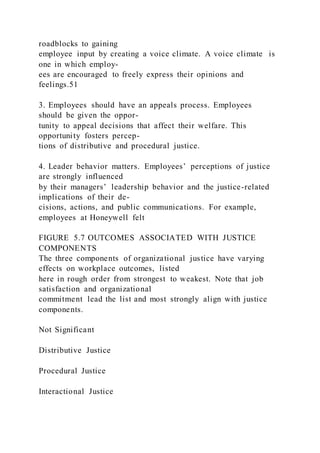
The Outcomes Associated with Justice Doesn’t it make sense
that your perceptions
of justice are related to outcomes in the Organizing Framework?
Of course! This realization
has generated much research into organizational justice over the
last 25 years. We created
Figure 5.7 to summarize these research findings. The figure
shows the strength of relation-
ships between nine individual-level outcomes and the three
components of organizational
justice. By and large, distributive and procedural justice have
consistently stronger relation-
ships with outcomes. This suggests that managers would be
better off paying attention to these
two forms of justice. In contrast, interactional justice is not a
leading indicator in any instance.
You can also see that certain outcomes, such as job satisfaction
and organizational
commitment, have stronger relationships with justice. All told,
however, the majority of
relationships between justice and important OB outcomes are
weak. This reinforces the
conclusion that motivating people via justice works for some
outcomes but not for others.
Using Equity and Justice Theories to Motivate Employees
Figure 5.7 not-
withstanding, managers can’t go wrong by paying attention to
employees’ perceptions of
equity and justice at work. Here are five practical lessons to
help you apply equity and
justice theories.
1. Employee perceptions count. No matter how fair management
thinks the organiza-
tion’s policies, procedures, and reward system are, each
employee’s perception of the
equity of those factors is what counts. For example, females
were found to be more
sensitive to injustice when it came to procedural and
distributive issues regarding
rewards.47 Further, justice perceptions can change over
time.48 This implies that it is
important for managers to regularly assess employees’ justice
beliefs. Companies
tend to do this by using annual employee work attitude surveys.
2. Employees want a voice in decisions that affect them.
Employees’ perceptions of jus-
tice are enhanced when they have a voice in the decision-
making process. Voice  is “the
discretionary or formal expression of ideas, opinions,
suggestions, or alternative
approaches directed to a specific target inside or outside of the
organization with
the intent to change an objectionable state of affairs and to
improve the current
functioning of the organization.”49 Managers are encouraged to
seek employee input
on organizational issues that are important to employees, even
though many employees
are reluctant to use their “voice.” Mission Produce Inc., a large
producer of avocados,
took this recommendation to heart. According to HR chief Tracy
Malmos, the company
177Foundations of Employee Motivation CHAPTER 5
“implemented a pay structure in response to young employees’
requests to ‘take the
mystery out of compensation.’”50 Managers can overcome these
roadblocks to gaining
employee input by creating a voice climate. A voice climate  is
one in which employ-
ees are encouraged to freely express their opinions and
feelings.51
3. Employees should have an appeals process. Employees
should be given the oppor-
tunity to appeal decisions that affect their welfare. This
opportunity fosters percep-
tions of distributive and procedural justice.
4. Leader behavior matters. Employees’ perceptions of justice
are strongly influenced
by their managers’ leadership behavior and the justice-related
implications of their de-
cisions, actions, and public communications. For example,
employees at Honeywell felt
FIGURE 5.7 OUTCOMES ASSOCIATED WITH JUSTICE
COMPONENTS
The three components of organizational justice have varying
effects on workplace outcomes, listed
here in rough order from strongest to weakest. Note that job
satisfaction and organizational
commitment lead the list and most strongly align with justice
components.
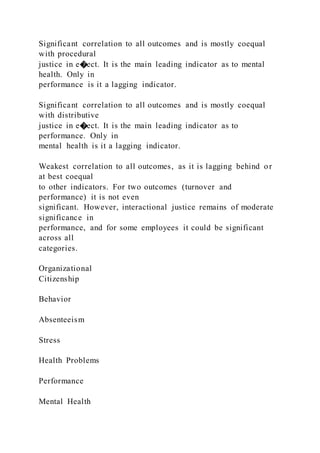
Not Significant
Distributive Justice
Procedural Justice
Interactional Justice
Significant correlation to all outcomes and is mostly coequal
with procedural
justice in e�ect. It is the main leading indicator as to mental
health. Only in
performance is it a lagging indicator.
Significant correlation to all outcomes and is mostly coequal
with distributive
justice in e�ect. It is the main leading indicator as to
performance. Only in
mental health is it a lagging indicator.
Weakest correlation to all outcomes, as it is lagging behind or
at best coequal
to other indicators. For two outcomes (turnover and
performance) it is not even
significant. However, interactional justice remains of moderate
significance in
performance, and for some employees it could be significant
across all
categories.
Organizational
Citizenship
Behavior
Absenteeism
Stress
Health Problems
Performance
Mental Health
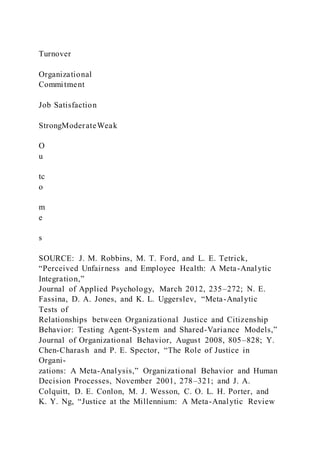
Turnover
Organizational
Commitment
Job Satisfaction
StrongModerateWeak
O
u
tc
o
m
e
s
SOURCE: J. M. Robbins, M. T. Ford, and L. E. Tetrick,
“Perceived Unfairness and Employee Health: A Meta-Analytic
Integration,”
Journal of Applied Psychology, March 2012, 235–272; N. E.
Fassina, D. A. Jones, and K. L. Uggerslev, “Meta-Analytic
Tests of
Relationships between Organizational Justice and Citizenship
Behavior: Testing Agent-System and Shared-Variance Models,”
Journal of Organizational Behavior, August 2008, 805–828; Y.
Chen-Charash and P. E. Spector, “The Role of Justice in
Organi-
zations: A Meta-Analysis,” Organizational Behavior and Human
Decision Processes, November 2001, 278–321; and J. A.
Colquitt, D. E. Conlon, M. J. Wesson, C. O. L. H. Porter, and
K. Y. Ng, “Justice at the Millennium: A Meta-Analytic Review
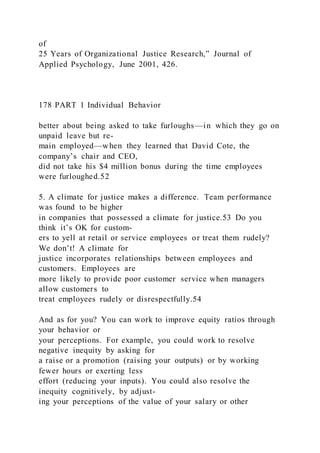
of
25 Years of Organizational Justice Research,” Journal of
Applied Psychology, June 2001, 426.
178 PART 1 Individual Behavior
better about being asked to take furloughs—in which they go on
unpaid leave but re-
main employed—when they learned that David Cote, the
company’s chair and CEO,
did not take his $4 million bonus during the time employees
were furloughed.52
5. A climate for justice makes a difference. Team performance
was found to be higher
in companies that possessed a climate for justice.53 Do you
think it’s OK for custom-
ers to yell at retail or service employees or treat them rudely?
We don’t! A climate for
justice incorporates relationships between employees and
customers. Employees are
more likely to provide poor customer service when managers
allow customers to
treat employees rudely or disrespectfully.54
And as for you? You can work to improve equity ratios through
your behavior or
your perceptions. For example, you could work to resolve
negative inequity by asking for
a raise or a promotion (raising your outputs) or by working
fewer hours or exerting less
effort (reducing your inputs). You could also resolve the
inequity cognitively, by adjust-
ing your perceptions of the value of your salary or other
benefits (outcomes) or the value
of the actual work you and your coworkers do (inputs).
Expectancy Theory: Does My Effort Lead
to Desired Outcomes?
Expectancy theory  holds that people are motivated to behave in
ways that produce
desired combinations of expected outcomes. Generally,
expectancy theory can pre-
dict behavior in any situation in which a choice between two or
more alternatives must be
made. For instance, it can predict whether we should quit or
stay at a job, exert substantial
or minimal effort at a task, and major in management, computer
science, accounting,
marketing, psychology, or communication.
Are you motivated to climb Mt. Everest? Expectancy theory
suggests you would not be motivated
to pursue this task unless you believed you could do it and you
believed the rewards were worth
the effort and risks. Erik Weihenmayer, shown climbing, was
motivated to pursue his quest to
become the first blind person to reach the summit. He made it!
It is truly amazing what one can
achieve when motivation is coupled with ability. © AF
archive/Alamy
179Foundations of Employee Motivation CHAPTER 5
The most widely used version of expectancy theory was
proposed by Yale professor
Victor Vroom. We now consider the theory’s key elements and
recommendations for its
application.
The Elements of Vroom’s Expectancy Theory: Expectancy,
Instrumentality,
and Valence Motivation, according to Vroom, boils down to
deciding how much
effort to exert in a specific task situation. This choice is based
on a two-stage sequence of
expectations—moving from effort to performance and then from
performance to out-
come. Figure 5.8 shows the major components of this theory.
Let us consider the three key elements of Vroom’s theory.
1. Expectancy—“Can I achieve my desired level of
performance?” An expectancy
represents an individual’s belief that a particular degree of
effort will be followed
by a particular level of performance. Expectancies take the form
of subjective proba-
bilities. As you may recall from a course in statistics,
probabilities range from zero to
one. An expectancy of zero indicates that effort has no
anticipated impact on perfor-
mance, while an expectancy of one suggests performance is
totally dependent on effort.
EXAMPLE Suppose you do not know how to use Excel. No
matter how much effort
you exert, your perceived probability of creating compl ex
spreadsheets that com-
pute correlations will be zero. If you decide to take an Excel
training course and
practice using the program a couple of hours a day for a few
weeks (high effort), the
probability that you will be able to create spreadsheets that
compute correlations will
rise close to one.
Research reveals that employees’ expectancies are affected by
a host of factors.
Some of the more important ones include self-efficacy, time
pressures, task diffi-
culty, ability and knowledge, resources, support from peers,
leader behavior, and or-
ganizational climate.55
2. Instrumentality—“What intrinsic and extrinsic rewards will I
receive if I achieve
my desired level of performance?” Instrumentality  is the
perceived relationship
between performance and outcomes. It reflects a person’s belief
that a particular
outcome is contingent on accomplishing a specific level of
performance. Passing
exams, for instance, is instrumental in graduating from college,
or put another way,
graduation is contingent on passing exams. Twitter decided to
make bonuses instru-
mental in employees’ staying around. That’s right! Because too
many employees were
leaving, some were offered bonuses ranging from $50,000 to
$200,000 just for
remaining at the company for six to 12 months.56 The
Problem-Solving Application
FIGURE 5.8 MAJOR ELEMENTS OF EXPECTANCY THEORY
ValenceInstrumentality
“What are the
chances of reaching
my performance
goal?”
“What are the
chances of receiving
various outcomes if
I achieve my
performance
goals?”
“How much do I
value the outcomes
I will receive by
achieving my
performance
goals?”
Expectancy
E�ort
Performance
Goal Outcomes
PART 1 Individual Behavior180
box illustrates how various boards of directors are reducing the
instrumentality be-
tween CEO pay and corporate performance. Do you think this is
a good idea?
3. Valence—“How much do I value the rewards I receive?”
Valence  describes the
positive or negative value people place on outcomes. Valence
mirrors our per-
sonal preferences. For example, most employees have a positive
valence for receiv-
ing additional money or recognition. In contrast, being laid off
or being ridiculed for
making a suggestion would likely be negative valence for most
individuals. In
Vroom’s expectancy model, outcomes are consequences that are
contingent on per-
formance, such as pay, promotions, recognition, or celebratory
events. For example,
Aflac hosted a six-day appreciation week for employees that
included theme park
visits, movie screenings, and daily gifts.57 Would you value
these rewards? Your
answer will depend on your individual needs.
Corporate Boards Decide to Lower the Instrumentalities
between
CEO Performance and Pay
Alpha Natural Resources, a coal producer, gave CEO Kevin
Crutchfield a $528,000 bonus after having
the largest financial loss in the company’s history. The board
said it wanted to reward him for his “tre-
mendous efforts” in improving worker safety. This “safety
bonus” was not tied to any corporate goals,
and the company had never before paid a specific bonus just for
safety.
The board at generic drugmaker Mylan made a similar decision,
giving CEO Robert Coury a
$900,000 bonus despite poor financial results. The board felt
the results were due to factors like the
European sovereign-debt crisis and natural disasters in Japan.
Not to be outdone, the board at Nation-
wide Mutual Insurance doubled its CEO’s bonus, “declaring that
claims from U.S. tornadoes shouldn’t
count against his performance metrics.”
The New York Times reported that former Walmart US CEO
Bill Simon also was rewarded for miss-
ing his goals. He was promised a bonus of $1.5 million if US
net sales grew by 2 percent. Net sales ulti-
mately grew by 1.8 percent, but the company still paid the
bonus. The Times said this occurred because
the company “corrected for a series of factors that it said were
beyond Simon’s control.” Hourly wage
bonuses for Walmart associates who perform below expectations
are zero. Apparently, what’s good for
the company’s CEO is not good for associates.58
Is It Good to Relax Instrumentalities between Performance and
Pay? Companies relax instrumentalities
between performance and pay because they want to protect
executives from being accountable for things
outside their control, like a tornado or rising costs in natural
resources. While this may make sense, it leaves
open the question of what to do when good luck occurs instead
of bad. Companies do not typically con-
strain CEO pay when financial results are due to good luck.
Blair Jones, an expert on executive compensa-
tion, noted that changing instrumentalities after the fact “only
works if a board is willing to use it on the
upside and the downside. . . . If it’s only used for the downside,
it calls into question the process.”59
Problem-Solving Application
Apply the 3-Step Problem-Solving Approach
Step 1: Define the problem in this case.
Step 2: Identify the cause of the problem. Did the companies
featured in this case use the principles
of expectancy theory?
Step 3: Make a recommendation to the compensation
committees at these companies. Should CEOs
and hourly workers be held to similar rules regarding bonuses?
181Foundations of Employee Motivation CHAPTER 5
According to expectancy theory, your motivatio n will be high
when all three ele-
ments in the model are high. If any element is near zero, your
motivation will be low.
Whether you apply this theory to yourself or managers apply it
to their employees, the
point is to simultaneously consider the status of all three
elements.
TAKE-AWAY APPLICATION
Applying Expectancy Theory
This activity focuses on a past work- or school-related project
that was unsuccessful
or that you consider a failure. Identify one such project and
answer the following
questions.
1. What was your expectancy for successfully completing the
failed project? Use a
scale from 1 (very low) to 5 (very high).
2. What were the chances you would receive outcomes you
valued had you success-
fully completed the project? Again use a scale from 1 (very
low) to 5 (very high).
3. Considering the above two answers, what was your level of
motivation? Was it
high enough to achieve your performance goals?
4. What does expectancy theory suggest you could have done to
improve your
chances of successfully completing the project? Provide specific
suggestions.
5. How might you use the above steps to motivate yourself in
the future?
Using Expectancy Theory to Motivate Employees There is
widespread agree-
ment that attitudes and behavior are influenced when
organizations link rewards to tar-
geted behaviors. For example, a study of college students
working on group projects
showed that group members put more effort into their projects
when instructors “clearly
and forcefully” explained how high levels of effort lead to
higher performance—an
expectancy—and that higher performance results in positive
outcomes like higher grades
and better camaraderie—instrumentalities and valence
outcomes.60
Expectancy theory has important practical implications for
individual managers and
organizations as a whole (see Table 5.1). Three additional
recommendations are often
TABLE 5.1 MANAGERIAL AND ORGANIZATIONAL
IMPLICATIONS OF EXPECTANCY THEORY
For Managers For Organizations
• Determinetheoutcomes employeesvalue. •
Rewardpeoplefordesiredperformance,anddo
not keep pay decisions secret.
• Identifygoodperformancesoappropriate
behaviors can be rewarded.
• Designchallengingjobs.
• Makesureemployeescanachievetargeted
performance levels.
• Tiesomerewardstogroupaccomplishmentsto
build teamwork and encourage cooperation.
• Linkdesiredoutcomestotargetedlevelsof
performance.
• Rewardmanagersforcreating,monitoring,and
maintaining expectancies, instrumentalities, and
outcomes that lead to high effort and goal
attainment.
• Makesurechangesinoutcomesarelargeenough
to motivate high effort.
• Monitoremployeemotivationthroughinterviewsor
anonymous questionnaires.
• Monitortherewardsystemforinequities. •
Accommodateindividualdifferencesbybuilding
flexibility into the motivation program.
PART 1 Individual Behavior182
overlooked. First, establish the right goal. Our consulting
experience reveals that people
fail at this task more often than you might imagine. Second,
remember that you can better
keep behavior and performance on track by creating more
opportunities to link perfor-
mance and pay. Shutterfly Inc. makes it possible for employees
to receive bonuses four
times a year. App designer Solstice Mobile also uses quarterly
(not annual) reviews to
reward high performers with promotions and
bonuses.61 Finally, monetary rewards must
be large enough to generate motivation, and this may not be the
case for annual merit
raises in the U.S. The average merit raise was around 3 percent
the last five years. To
overcome this limitation, organizations are starting to eliminate
merit raises and replace
them with bonuses only for high performers.62
The following Problem-Solving Application illustrates
expectancy theory in action at
Westwood High School in Mesa, Arizona.
A High School Principal Uses Principles of Expectancy
Theory to Motivate Students
Tim Richard, principal at Westwood High School, decided to
use a motivational program he called
“Celebration” to improve the grades of 1,200 students who
were failing one or more courses. The
school has a total of 3,000 students.
How Does the Program Work? “Students are allowed to go
outside and have fun with their friends for
28 minutes on four mornings a week,” the principal explained to
the local newspaper. “But those who
have even one F must stay inside for ‘remediation’ —28 minutes
of extra study, help from peer tutors, or
meetings with teachers.” Richard, who successfully
implemented the program at a smaller high school,
believes the key to motivating students is to link a highly
valued reward—socializing with friends out-
side—with grades. Socializing includes playing organized
games, dancing and listening to music, eating
snacks, and just plain hanging out. Results suggest the program
is working.
Positive results were found within two to three months of the
motivation program’s start. The num-
ber of students with failing grades dropped to 900. The
principal’s goal is to achieve zero failing grades
by the end of the year.
What Is the Student Reaction? Students like the program. Ivana
Baltazar, a 17-year-old senior, said,
“You really appreciate Celebration after you have been in
remediation.” She raised an F in economics
to a B after receiving help. Good academic students like Joseph
Leung also like the program. Leung
is a tutor to students with failing grades. He believes that “the
tricky part is getting people out of the
mind-set that they can’t succeed. . . . A lot of times they just
haven’t done their homework. I try to help
them understand that the difference between a person passing
and failing is their work ethic.”63
Problem-Solving Application
Apply the 3-Step Problem-Solving Approach
Step 1: Define the problem Tim Richard is trying to address.
Step 2: Identify the causes. What OB concepts or theories are
consistent with Richard’s motivational
program?
Step 3: Make recommendations for fixing the problem. Do you
agree with Richard’s approach to im-
proving student performance? Why or why not?
183Foundations of Employee Motivation CHAPTER 5
Goal-Setting Theory: How
Can I Harness the Power of
Goal Setting?
Regardless of the nature of their specific
achievements, successful people tend to have
one thing in common: Their lives are goal-
oriented. This is as true for politicians seeking
votes as it is for world-class athletes like
Michael Phelps. Research also supports this
conclusion. The results of more than 1,000
studies from a wide range of countries clearly
show that goal setting helps individuals,
teams, and organizations to achieve success.64
Next we review goal setting within a work
context and then explain the mechanisms that
make goal setting so effective. We will discuss
the practical applications of goal setting in
Chapter 6.
Edwin Locke and Gary Latham’s Theory of Goal Setting After
studying four
decades of research on goal setting, two OB experts, Edwin
Locke and Gary Latham,
proposed a straightforward theory of goal setting. Here is how it
works.65
•Goals that are specific and difficult lead to higher performance
than general
goals like “Do your best” or “Improve performance.” This is
why it is essential
to set specific, challenging goals. Goal specificity  means
whether a goal has
been quantified. For example, a goal of increasing the score on
your next OB test
by 10 percent is more specific than the goal of trying to
improve your grade on the
next test.
•Certain conditions are necessary for goal setting to work.
People must have the
ability and resources needed to achieve the goal, and they need
to be committed to
the goal. If these conditions are not met, goal setting does not
lead to higher perfor-
mance. Be sure these conditions are in place as you pursue your
goals.
•Performance feedback and participation in deciding how to
achieve goals are
necessary but not sufficient for goal setting to work. Feedback
and participation
enhance performance only when they lead employees to set and
commit to a spe-
cific, difficult goal. Take Jim’s Formal Wear, a tuxedo
wholesaler in Illinois. “Once
a week, employees meet with their teams to discuss their efforts
and what changes
should be made the next week. Employees frequently suggest
ways to improve ef-
ficiency or save money, such as reusing shipping boxes and
hangers.”66 Goals lead
to higher performance when you use feedback and participation
to stay focused and
committed to a specific goal.
•Goal achievement leads to job satisfaction, which in turn
motivates employees
to set and commit to even higher levels of performance. Goal
setting puts in mo-
tion a positive cycle of upward performance.
In sum, it takes more than setting specific, difficult goals to
motivate yourself or others.
You also want to fight the urge to set impossible goals. They
typically lead to poor perfor-
mance or unethical behavior, as they did at Volkswagen. The
company has admitted to
installing software on over 11 million cars that manipulated
emission test results.67 Its
engineers claimed they tampered with emissions data because
targets set by Martin
Winterkorn, the former Volkswagen chief executive, were too
difficult to achieve.68 Set
challenging but attainable goals for yourself and others.
Michael Phelps, seen here at the FINA Swimming
World Championships in Melbourne, Australia in
2007, set a goal for the 2016 Rio Olympics that
included winning more gold medals. His goal was
achieved and he now has 28 medals, including
23 gold. Phelps is the most decorated Olympian in
history. © Patrick B. Kraemer/EPA/Newscom
184 PART 1 Individual Behavior
What Are the Mechanisms Behind the Power of Goal Setting?
Edwin Locke
and Gary Latham, the same OB scholars who developed the
motivational theory of goal
setting just discussed, also identified the underlying
mechanisms that explain how goals
affect performance. There are four.
1. Goals direct attention. Goals direct our attention and effort
toward goal-relevant
activities and away from goal-irrelevant activities. If, for
example, you have a term
project due in a few days, your thoughts and actions tend to
revolve around complet-
ing that project. In reality, however, we often work on multiple
goals at once. Pri-
oritize your goals so you can effectively allocate your efforts
over time.69 For
example, NuStar Energy, one of the largest asphalt refiners and
operators of petro-
leum pipelines and product terminals in the United States, has
decided to give safety
greater priority than profits in its goals. This prioritization paid
off when the com-
pany celebrated three years of zero time off due to injuries, and
corporate profits are
doing just fine.70
2. Goals regulate effort. Goals have an energizing function in
that they motivate us to
act. As you might expect, harder goals foster greater effort than
easy ones. Deadlines
also factor into the motivational equation. We expend greater
effort on projects and
tasks when time is running out. For example, an instructor’s
deadline for turning in
your term project would prompt you to complete it instead of
going out with friends,
watching television, or studying for another course.
3. Goals increase persistence. Within the context of goal
setting, persistence repre-
sents the effort expended on a task over an extended period of
time. It takes effort
to run 100 meters; it takes persistence to run a 26-mile
marathon. One of your
textbook authors—Angelo Kinicki—knows this because he ran a
marathon. What
an experience! His goal was to finish in 3 hours 30 minutes. A
difficult goal like
this served as a reminder to keep training hard over a three-
month period. When-
ever he wanted to stop training or run slow sprints, his desire to
achieve the goal
motivated him. Although he missed his goal by 11 minutes, it
still is one of his
proudest accomplishments. This type of persistence happens
when the goal is per-
sonally important.
4. Goals foster the development and application of task
strategies and action plans.
Goals prompt us to figure out how we can accomplish them.
This begins a cognitive
process in which we develop a plan outlining the steps, tasks, or
activities we must
undertake. For example, teams of employees at Tornier, a
medical device manufac-
turer in Amsterdam, meet every 45, 60, or 90 days to create
action plans for complet-
ing their goals. Implementation of the plans can take between
six and 18 months
depending on the complexity of the goal.71 Setting and using
action plans also re-
duces procrastination. If this is sometimes a problem for you,
break your goals into
smaller and more specific subgoals.72 That will get you going.
TAKE-AWAY APPLICATION
Increasing My Success via Goal Setting
1. Set a goal for performance on the next exam in this class by
filling in the follow-
ing statement. “I want to increase my score on my next exam by
___ percent
over the score on my previous exam.” If you have not had an
exam yet, pick a
percentage grade you would like to achieve on your first exam.
2. Create a short action plan by listing four or five necessary
tasks or activities to
help you achieve your goal. Identify actions that go beyond just
reading the text.
3. Identify how you will assess your progress in completing the
tasks or activities in
your action plan.
4. Now work the plan, and get ready for success.
185Foundations of Employee Motivation CHAPTER 5
M A J O R Q U E S T I O N
How are top-down approaches, bottom-up approaches, and
“idiosyncratic deals” similar and different?
T H E B I G G E R P I C T U R E
Job design focuses on motivating employees by considering the
situation factors within the
Organizing Framework for Understanding and Applying OB.
Objectively, the goal of job de-
sign is to structure jobs and the tasks needed to complete them
in a way that creates intrinsic
motivation. We’ll look at how potential motivation varies
depending on who designs the job:
management, you, or you in negotiation with management.
5.4 MOTIVATING EMPLOYEES THROUGH JOB DESIGN
“Ten hours [a day] is a long time just doing this. . . . I’ve had
three years in here and
I’m like, I’m going to get the hell out. . . . It’s just the most
boring work you can do.”
—Ford autoworker
“I love my job. . . . I’ve learned so much. . . . I can talk with
biochemists, software
engineers, all these interesting people. . . . I love being
independent, relying on
myself.
—Corporate headhunter
“We see about a hundred injuries a year and I’m amazed there
aren’t more. The main
causes are inexperience and repetition. . . . People work the
same job all the time and
they stop thinking.”
—Slaughterhouse human resources director
These quotations reflect the different outcomes that can result
from job design.73 Job
design,  also referred to as job redesign or work design, refers
to any set of activi-
ties that alter jobs to improve the quality of employee
experience and level of pro-
ductivity. As you can see from this definition, job design
focuses on motivating employees
by considering the situation factors within the Organizing
Framework.
Figure 5.9 summarizes the approaches to job design that have
developed over time.74
•Top-down. Managers changed employees’ tasks with the intent
of increasing mo-
tivation and productivity. In other words, job design was
management led.
FIGURE 5.9 HISTORICAL MODELS OF JOB DESIGN
Employee or
Work Teams
Design Job
Employee and
Management Design Job
Idiosyncratic Deals
(I-Deals) Approach
Bottom-Up
Approach
Management
Designs Job
Top-Down
Approach
Historical Recent Emerging
186 PART 1 Individual Behavior
•Bottom-up. In the last 10 years, the top-down perspective gave
way to bottom-up
processes, based on the idea that employees can change or
redesign their own jobs
and boost their own motivation and engagement. Job design is
then driven by em-
ployees rather than managers.
•I-deals. The latest approach to job design, idiosyncratic deals,
attempts to merge
the two historical perspectives. It envisions job design as a
process in which em-
ployees and individual managers jointly negotiate the types of
tasks employees
complete at work.
This section provides an overview of these three conceptually
different approaches to
job design.75 We give more coverage to top-down techniques
and models because they
have been used for longer periods of time and more research is
available to evaluate their
effectiveness.
Top-Down Approaches—
Management Designs Your Job
In top-down approaches, management creates efficient and
meaningful combinations of
work tasks for employees. If it is done correctly, in theory,
employees will display higher
performance, job satisfaction, and engagement, and lower
absenteeism and turnover. The
five principal top-down approaches are scientific management,
job enlargement, job rota-
tion, job enrichment, and the job characteristics model.
Scientific Management Scientific management draws from
research in industrial
engineering and is most heavily influenced by the work of
Frederick Taylor (1856–1915).
Taylor, a mechanical engineer, developed the principles of
scientific management based
on research and experimentation to determine the most efficient
way to perform jobs.
Scientific management  is “that kind of management which
conducts a business or
affairs by standards established by facts or truths gained
through systematic ob-
servation, experiment, or reasoning.”76
Designing jobs according to the principles of scientific
management has both posi-
tive and negative consequences. Positively, employee efficiency
and productivity are in-
creased. On the other hand, research reveals that simplified,
repetitive jobs also lead
to job dissatisfaction, poor mental health, higher levels of
stress, and a low sense of
This automotive assembly line, which is using robotics, is a
great
example of scientific management. The principles of scientific
management have aided auto manufacturers to produce cars
more
efficiently and with higher quality. © Glow Images RF
187Foundations of Employee Motivation CHAPTER 5
accomplishment and personal growth.77 Recognition of these
negative consequences
paved the way for the next four top-down approaches.
Job Enlargement Companies first used job enlargement in the
late 1940s in re-
sponse to complaints about tedious and overspecialized jobs
created from the prin-
ciples of scientific management. Job enlargement  puts more
variety into a
worker’s job by combining specialized tasks of comparable
difficulty. Some call
this strategy horizontally loading the job. Researchers
recommend using job en-
largement as part of a broader approach that uses multiple
motivational methods,
because by itself job enlargement does not have a significant
and lasting positive
effect on job performance.78
Job Rotation Like job enlargement, job rotation gives
employees greater variety in
their work. Job rotation  calls for moving employees from one
specialized job to an-
other. Rather than performing only one job, workers are trained
and given the opportu-
nity to perform two or more separate jobs on a rotating basis.
Proposed benefits of job
rotation include the following:79
•Increased engagement and motivation because employees have
a broader perspec-
tive on the organization.
•Increased worker flexibility and easier scheduling because
employees are cross-
trained to perform different jobs.
•Increased employee knowledge and abilities, which improves
employees’ promot-
ability and builds a pipeline of internal talent.
More companies are now hiring new college graduates into
“rotational programs,”
which allow them to work in different functional areas for short
periods and learn many
different parts of the business along the way. Finally, the
technique of job rotation has
evolved into job swapping, more common among senior-level
managers. (See the OB in
Action box.)
Job swapping can take place both externally, when people from
different firms
swap jobs, and internally, when employees within one company
exchange
jobs.
External Job Swapping Nadim Hossain, vice president of
marketing at San
Francisco-based PowerReviews, went to a recent meeting in
which he met with a
marketing team and provided input on a proposed ad.
Interestingly, he did not do
this for his employer. Fortune magazine reported on what he
was up to: “He traded
roles for the day with Jon Miller, VP of marketing and co-
founder of San Mateo,
California, software firm Marketo, hoping to gain some insight
into his own role by
experiencing someone else’s.” This experiment is an example of
an external job
swap. Both individuals felt they benefited from the experience.
Hossain said he
got many ideas about how to motivate his sales team, and Miller
left with a better
idea of the challenges faced by chief marketing officers.80
Another swap exchanged Rick Gill, a medical doctor, and Kevin
Stephens, a
farmer. The program was initiated by the Pike County,
Alabama, Chamber of
Job Swapping Is the Latest Application
of Job Rotation
OB in Action
188 PART 1 Individual Behavior
Job Enrichment Job enrichment is the practical application of
Frederick Herzberg’s
motivator-hygiene theory of job satisfaction, discussed earlier
in this chapter. Specifi-
cally, job enrichment  modifies a job such that an employee has
the opportunity to
experience achievement, recognition, stimulating work,
responsibility, and ad-
vancement. These characteristics are incorporated into a job
through vertical loading.
Rather than giving employees additional tasks of similar
difficulty (horizontal load-
ing), vertical loading gives them more autonomy and
responsibility. Intuit, for example,
encourages employees “to spend 10 percent of their working
time on projects and ideas
of their own, even if they are not related to their
assignments,” according to Fortune.
The company finds that this practice has led to the creation of
several successful new
products.83
The Job Characteristics Model Two OB researchers, J. Richard
Hackman and
Greg Oldham, played a central role in developing the job
characteristics approach. They
proposed that intrinsic motivation was determined by three
psychological states. In turn,
these psychological states were fostered by the presence of five
core job characteristics
(see Figure 5.10).
The goal of the job characteristics model  is to promote high
intrinsic motivation
by designing jobs that possess the five core job characteristics.
The five characteris-
tics are as follows:
•Skill variety. The extent to which the job requires an
individual to perform a vari-
ety of tasks that require him or her to use different skills and
abilities.
Commerce to help citizens appreciate the impact of different
jobs on the county’s
well-being. Dr. Gill spent a day on a farm, doing work that
included picking cotton.
Stephens’ time at the doctor’s office included removing staples
from an incision
and completing other small medical tasks. Both individuals
raved about the expe-
rience and noted that it increased their appreciation for someone
else’s job. This
type of swap has taken place each year since 1986.81
Internal Job Swapping Terri Lodwick, president of All
American Window and
Door Co. in Germantown, Wisconsin, began the company’s job
swap program in
2001. Her reason? “We wanted to give everybody a hands-on
view of each oth-
ers’ job duties, [so they could gain] a greater appreciation and
understanding of
each team member. We also wanted to strengthen our customer
service and take
[our company] to the next level of excellence,” she said.
All Lodwick’s employees ultimately swap jobs for up to 40
hours per year. A
typical swap lasts four hours, and employees are encouraged to
swap with people
across all company departments. The company attempts to make
the process
meaningful and practical by having employees complete a short
questionnaire
after each swap. Sample questions include: “What did you
learn/observe today?
What suggestions do you have for the process you observed?”
Lodwick noted that the program led to increased productivity,
teamwork, and
customer service. It also was a prime contributor to the
company’s receipt of sev-
eral business awards.82
YOUR THOUGHTS?
1. What are the pros and cons of job swaps?
2. What would be your ideal job swap?
3. If you managed a business, how would you feel about this
option for your
employees?
189Foundations of Employee Motivation CHAPTER 5
•Task identity. The extent to which the job requires an
individual to perform a
whole or completely identifiable piece of work. Task identity is
high when a
person works on a product or project from beginning to end and
sees a tangible
result.
•Task significance. The extent to which the job affects the lives
of other people
within or outside the organization.
•Autonomy. The extent to which the job enables an individual to
experience free-
dom, independence, and discretion in both scheduling and
determining the proce-
dures used in completing the job.
•Feedback. The extent to which an individual receives direct
and clear information
about how effectively he or she is performing the job.84
Moderators. A moderator is a variable that changes the
relationship between two
other variables. Hackman and Oldham proposed that there are
moderators that affect the
success of job design, and they are shown in the moderator box
of Figure 5.10.
•Knowledge and skill (representing whether or not the person
has the knowledge
and skills to perform the enriched job).
•Growth need strength (representing the desire to grow and
develop as an individual).
•Context satisfactions (representing the extent to which
employees are satisfied with
various aspects of their job, such as pay, coworkers, and
supervision).
FIGURE 5.10 THE JOB CHARACTERISTICS MODEL
• Experienced
meaningfulness
of the work
• Experienced
responsibility for
outcomes of the work
• Gained knowledge of
the actual results of
the work activities
• High intrinsic
work motivation
• High growth
satisfaction
• High general
job satisfaction
• High work
e�ectiveness
Outcomes
• Skill variety
• Task identity
• Task significance
• Autonomy
• Feedback from job
Core job
characteristics
Critical
psychological
states
Moderators
Not everyone wants a job
covering all five
characteristics. Job design is
moderated by:
These moderators will a�ect
or moderate both the critical
psychological states and the
outcomes.
1. Knowledge and skill
2. Growth need strength
3. Context satisfactions
SOURCE: J. Richard Hackman and Greg R. Oldham, Work
Redesign (Prentice Hall Organizational Development Series),
© 1980, 90.
190 PART 1 Individual Behavior
The takeaway is that job design is more likely to work when
people have the required
knowledge and skills, when they want to develop, and when
they are satisfied with their
jobs. Job design is not for everyone.
In Practice. Research identifies three practical implications of
applying the job char-
acteristics model.
1. Managers can increase employee job satisfaction.85
2. Managers can enhance employees’ intrinsic motivation and
performance, while re-
ducing absenteeism and stress.86
EXAMPLE Wegmans Food Markets, rated as the fourth best
place to work by For-
tune in 2016, increases autonomy by allowing employees “to
write their own weekly
schedule or take time off at the spur of the moment, no
questions asked.” Medical
device maker Stryker is interested in increasing the
psychological state of meaning-
fulness. It does this by encouraging employees to observe how
customers use its
products. Employees observe surgeries and attend trade shows,
which enables them
to see the products being applied in the field.87
3. Managers can find noticeable increases in the quality of
performance after a job
redesign program. Results from 21 experimental studies
revealed that job redesign
resulted in a median increase of 28 percent in the quality of
performance.88
Bottom-Up Approaches—
You Design Your Own Job
As its name suggests, bottom-up job design is driven by
employees rather than managers; it is also referred to as
job crafting. Job crafting  represents employees’ at-
tempts to proactively shape their work characteris-
tics.89 The goal of job crafting is to help employees
experience a sense of meaning in their jobs. This is more
important than you might think. A recent survey of
20,000 employees revealed that only 36 percent felt they
had meaningful work.90
Forms of Job Crafting Employees are viewed as
“job crafters” according to the bottom-up model because
they are expected to define and create their own job
boundaries. Table 5.2 illustrates three forms of job craft-
ing. The first changes the job’s task boundaries. You can
do this by taking on more or fewer tasks or by altering
their scope or nature. The second form changes the rela-
tional nature of the job. Specifically, you can alter the
quantity or quality of interactions you have with others at
work, or you can establish new relationships. The third
method is cognitive crafting. In this strategy you perceive
or think differently about the existing tasks and relation-
ships associated with your job.
Outcomes of Job Crafting The right-hand column
in Table 5.2 outlines the potential impact of job crafting
on employee motivation and performance. You can see
that job crafting is expected to change the way employees
This employee of Swiss-based computer
device producer Logitech is working on a
computer mouse. He looks very focused on
the task at hand. It may be that job crafting is
partly behind his engagement. The company
is using job crafting to increase employee
engagement and job satisfaction. As part
of this effort the company created a
90-minute workshop to help employees
learn how to align their strengths and
interests with tasks contained in their jobs.
© epa european pressphoto agency b.v./Alamy
191Foundations of Employee Motivation CHAPTER 5
perceive their jobs. It should also result in more positive
attitudes about the job, which is
expected to increase employee motivation, engagement, and
performance. Preliminary
research supports this proposition.91
Computer accessories maker Logitech Inc. successfully
implemented a job crafting
pilot program. Jessica Amortegui, senior director of learning
and development, said,
“The company hopes helping employees find more intrinsic
motivation in their work will
be a powerful hiring draw. Logitech plans to begin using the
[program] with all 3,000 of
its workers.”92
Given that job crafting can lead to higher levels of engagement
and satisfaction, you
may be interested in understanding how you can apply the
technique to a former, current,
or future job. The Self-Assessment 5.3 explores the extent to
which you are applying job
crafting to reduce job demands, seek resources, or seek
challenges.
TABLE 5.2 FORMS OF JOB CRAFTING
Changes in Approach Example Changes in Results
Task boundaries:
Number, scope, and type
of job tasks.
Design engineers
engage in relational
activities that move
a project to
completion.
Engineers are now guardians
or movers of projects; they
complete work in a more
timely fashion.
Relational nature:
Quality and/or amount
of interaction with others
encountered in a job.
Hospital cleaners
actively care for
patients and families
and integrate
themselves into the
workflow of their floor
units.
Cleaners are now helpers of
the sick; they see the work of
the floor unit as a vital part of
an integrated whole.
Cognitive crafting:
Perception of or thinking
about tasks and
relationships in your job.
Nurses take
responsibility for all
information and
“insignificant” tasks so
they can care more
appropriately for a
patient.
Nurses are now patient
advocates; they provide
high-quality, technical care.
SOURCE: Adapted from A. Wrzesniewski and J. E. Dutton,
“Crafting a Job: Revisioning Employees as Active Crafters of
Their
Work,” Academy of Management Review, April 2001, 185.
To What Extent Have I Used Job Crafting?
Please be prepared to answer these questions if your instructor
has assigned Self-
Assessment 5.3 in Connect.
1. What are your strengths and weaknesses in terms of job
crafting?
2. Were you happy in the job under consideration?
3. Do you think the average employee can affect all the
suggestions measured in
the survey? Explain.
SELF-ASSESSMENT 5.3
192 PART 1 Individual Behavior
Idiosyncratic Deals (I-Deals)—
You Negotiate the Design of Your Job
The last approach to job design, idiosyncratic deals, represents
a middle ground between
top-down and bottom-up methods and attempts to overcome
their limitations. For exam-
ple, top-down approaches are constrained by the fact that
managers cannot always create
changes in task characteristics that are optimal for everyone.
Similarly, job crafting is
limited by the amount of latitude people have to change their
own jobs. Idiosyncratic
deals (i-deals)  represent “employment terms individuals
negotiate for themselves,
taking myriad forms from flexible schedules to career
development.”93 Although
“star performers” have long negotiated special employment
contracts or deals, demo-
graphic trends and the changing nature of work have created
increased opportunities for
more employees to negotiate i-deals.
I-deals tend to affect task and work responsibilities, schedule
flexibility, location
flexibility, and compensation.94 The goal of such deals is to
increase employee intrinsic
motivation and productivity by allowing employees the
flexibility to negotiate employ-
ment relationships that meet their own specific needs and
values. RSM promotes and
encourages the creation of i-deals among its 8,000 employees.
The focus of its program is
to create innovative and flexible ways of working.95
This relatively new approach to job design has begun to
generate much research.
Results confirm that i-deals are associated with higher
perceived organizational support,
job satisfaction, and perceived voice. Employees also are less
likely to quit when they
negotiate i-deals.96 Future study is needed to determine the
generalizability of these en-
couraging results.
Consider how you might one day create an i-deal for yourself.
Self-Assessment 5.4
will help you think through the process.
Creating an I-Deal
Please be prepared to answer these questions if your instructor
has assigned
Self-Assessment 5.4 in Connect.
1. What are your strengths and weaknesses in terms of creating
an i-deal?
2. Assume you are applying for a job after graduation and you
want to create an
i-deal. What do your results suggest that you should discuss
with your potential
employer?
SELF-ASSESSMENT 5.4
TAKE-AWAY APPLICATION
Increasing My Motivation with Job Crafting
Use the results from Self-Assessment 5.3 to complete the
following:
1. Identify three job-crafting ideas you might use to increase
your intrinsic motivation.
2. Using Table 5.2, identify two additional job-crafting ideas.
3. What are the roadblocks to implementing the ideas identified
in the above two
steps?
193Foundations of Employee Motivation CHAPTER 5
You learned that motivation, a key individual-level
process, is influenced by inputs such as needs,
perceptions of justice, expectancies and instru-
mentalities, goals, and job design. You learned
how various theories and models of motivation
can be applied by managers to improve multiple
outcomes. Reinforce your learning with the Key
Points below. Consolidate your learning using the
Organizing Framework. Then challenge your mas-
tery of the material by answering the Major Ques-
tions in your own words.
Key Points for Understanding
Chapter 5
You learned the following key points.
5.1 THE WHAT AND WHY OF
MOTIVATION
• There are two types of motivation: intrinsic
and extrinsic.
• Extrinsic motivation results from the potential
or actual receipt of external rewards.
• Intrinsic motivation is driven by positive inter-
nal feelings generated by doing well.
5.2 CONTENT THEORIES OF
MOTIVATION
• Content theories are based on the idea that
an employee’s needs influence motivation.
There are five key content theories.
• Douglas McGregor proposed a theory of mo-
tivation based on two opposing views of em-
ployees. Theory X people believe employees
dislike work and are motivated by rewards
and punishment. Theory Y people believe
employees are self-engaged, committed, and
responsible.
• Abraham Maslow proposed that motivation is
a function of five basic needs—physiological,
safety, love, esteem, and self-actualization—
arranged in a prepotent hierarchy.
• David McClelland’s acquired needs theory is
based on the idea that motivation is a func-
tion of three basic needs: achievement, affilia-
tion, and power.
• Self-determination theory assumes that three
innate needs influence motivation: compe-
tence, autonomy, and relatedness.
• Frederick Herzberg’s motivator-hygiene the-
ory is based on the premise that job satisfac-
tion comes from motivating factors and
dissatisfaction from hygiene factors.
5.3 PROCESS THEORIES OF
MOTIVATION
• Process theories attempt to describe how
various person factors and situation factors
affect motivation.
• Equity theory explains how people strive for
fairness and justice in social exchanges. Fair-
ness or equity is determined by comparing
our outputs and inputs with those of others.
• Three key types of justice are distributive,
procedural, and interactive.
• Expectancy theory assumes that motivation is
determined by our perceived chances of
achieving valued outcomes. The three key el-
ements of this theory are expectancies, in-
strumentalities, and valence of outcomes.
• Goal-setting theory proposes that goals affect
performance because they (1) direct our at-
tention, (2) regulate effort, (3) increase persis-
tence, and (4) encourage the development of
action plans.
5.4 MOTIVATING EMPLOYEES
THROUGH JOB DESIGN
• Job design theories are based on the idea
that motivation is primarily influenced by the
tasks people perform and the characteristics
of the immediate work environment.
• Three broad approaches to job design are
top-down, bottom-up, and emerging.
What Did I Learn?
194 PART 1 Individual Behavior
voice and justice. Figure 5.11 further illustrates
that motivational processes affect outcomes
across the individual, group/team, and organiza-
tional levels.
Challenge: Major Questions for
Chapter 5
You should now be able to answer the following
questions. Unless you can, have you really pro-
cessed and internalized the lessons in the
chapter? Review relevant portions of the text
and your notes to answer the following major
questions. With Figure 5.11 as your guide, look
for inputs, processes, and outputs specific to
each:
1. What is motivation and how does it affect my
behavior?
2. How would I compare and contrast the con-
tent theories of motivation?
3. How would I compare and contrast the pro-
cess theories of motivation?
4. How are top-down approaches, bottom-up
approaches, and “idiosyncratic deals” similar
and different?
• The premise of top-down approaches is that
management is responsible for creating effi-
cient and meaningful combinations of work
tasks for employees. Top-down approaches
include scientific management, job enlarge-
ment, job rotation, job enrichment, and the
job characteristics model.
• Bottom-up approaches, also referred to as
job crafting, are driven by employees rather
than managers. Employees create their own
job boundaries.
• Emerging approaches include idiosyncratic
deals (i-deals). This approach views job de-
sign as a process in which employees and
managers jointly negotiate the types of tasks
employees complete at work.
The Organizing Framework for
Chapter 5
As shown in Figure 5.11, both person and situa-
tion factors influence the process of motivation.
You can also see that there are more situational
than personal factors influencing motivation.
This underscores the importance of leadership
and creating a work environment that reinforces
FIGURE 5.11 INTEGRATIVE FRAMEWORK FOR
UNDERSTANDING AND APPLYING OB
© 2014 Angelo Kinicki and Mel Fugate. All rights reserved.
Reproduction prohibited without permission of the authors.
INPUTS PROCESSES OUTCOMES
Person Factors
• Personality
• Personal attitudes
• Values—Theory X/Y
• Needs
Situation Factors
• Hygiene factors
• Motivating factors
• Job characteristics
• Job design
• Leadership
• Organizational climate
Individual Level
• Equity/justice
• Expectancy processes
• Goal-setting processes
• Voice
Group/Team Level
• Climate for justice
Organizational Level
• Climate for justice
Individual Level
• Intrinsic and extrinsic
motivation
• Task performance
• Work attitudes
• Citizenship behavior/
counterproductive behavior
• Turnover
Group/Team Level
• Group/team performance
Organizational Level
• Customer satisfaction
195Foundations of Employee Motivation CHAPTER 5
IMPLICATIONS FOR ME
You can do five things to personally apply the material from
this chapter. First, identify
the needs that are important to you today, recognizing they may
change over time. This
can help you identify the type of work you would like to do
before and after graduation.
Second, if your current job is low on hygiene or motivating
factors, reflect on what you
can do to change this situation. You may be able to create
change by talking to your
boss, asking for new work assignments, or getting a different
job. Third, because fes-
tering feelings of inequity are not good for you or those you
interact with on a regular
basis, make a plan to correct any feelings of inequity that exist
in your life. Fourth, set
specific, measurable goals for things you want to accomplish in
your life. Develop an
action plan that outlines the path to success, then be sure to
reward yourself for ac-
complishing the goals. Finally, if your current job is
unfulfilling, try to find ways to incor-
porate job crafting or i-deals into your work. If this does not
work, you might consider
changing jobs.
IMPLICATIONS FOR MANAGERS
There are seven key implications for managers. First, recognize
that intrinsic motivation
can have longer-lasting effects than extrinsic motivation. Try to
build Herzberg’s motiva-
tors into employees’ work experiences. Second, acknowledging
that needs drive em-
ployee motivation, find a way to determine employee needs,
such as employee surveys
or one-on-one meetings. Third, because some needs are innate,
consider people’s
needs when they are first hired. Validated tests exist that will
identify these. Fourth, un-
cover employees’ perceptions about equity and justice and then
correct any deficien-
cies, such as by administering employee surveys or exit
interviews. Fifth, incorporate
the principles of expectancy theory by (1) ensuring that
employees believe they can
accomplish their goals and (2) linking performance to rewards
that individual employees
value. Sixth, participate with employees in setting challenging
yet attainable goals and
then establish action plans. Be sure employees have the
resources needed to achieve
the goals. Finally, consider different ways to design jobs so
they foster intrinsic motiva-
tion and meaningfulness.
196 PART 1 Individual Behavior
Dan Price grew up in a family of seven, whose
evangelical Christian parents homeschooled him and
his siblings until they were 12. The family had
strong roots in reading and studying the Bible, which
was a daily activity. Price was very interested in
learning the scriptures and reached the finals of a
Bible-memorization contest in the fifth and sixth
grades.97
In 2004 Price, then 19, started Gravity Payments
with his brother Lucas. The brothers initially had a
50-50 stake in the company, but about 18 months
later Lucas Price ended his direct involvement in
the company and Dan Price became the majority
owner.
Gravity Payments is a credit card processing com-
pany. According to an article about the company in
Bloomberg Businessweek, “The day-to-day work at
Gravity Payments is pretty unglamorous. Gravity is a
middleman between merchants and payment net-
works, namely Visa and MasterCard, which in turn con-
nect to banks that issue credit cards.”98 The office is a
conglomerate of “desks and computers in bland
cubicles—but the space is reorganized every six
months so people can sit near different colleagues.”
Price does this because he doesn’t want people to get
too comfortable.99
The corporate home page describes the com-
pany as follows: “‘Take care of your team, and
they’ll take care of your clients.’ Gravity Payments
recognizes the value in establishing an entrepre-
neurial, goal-oriented, rewarding, honest, and inno-
vative culture, which is what makes our company
such a remarkable place to work. We believe in a
holistic and balanced lifestyle, supporting our team
members with:
• $70,000 minimum wage
• Unlimited paid time off
• Medical, dental, and vision insurance
• Bonus opportunities
• Flannel Fridays
• Company-sponsored outings
• Volunteer opportunities
• Catered breakfasts and lunches”100
A survey of comments on Glassdoor reveals a combi-
nation of pros and cons about working at Gravity. A
sampling of comments include the following:
Pros:
• “I have never worked for a company that cares for
their customers more than Gravity. Company cul-
ture is the best I have worked with.”
• “The company is built on a foundation of
community and teamwork. I have built some
long-lasting friendships. We are a community of
people who are competitive, love to learn, and
want to grow.”
• “I love the team of people I work with! They value
the unique skills and experience that I have, sup-
port me in accomplishing my goals, challenge me
to bring my best, and inspire me to push to new
heights.”
• “Gravity Payments offers an incredible opportunity
for employees to seize responsibility and grow per-
sonally and professionally. . . . You really do get out
what you put in as far as effort being rewarded with
additional responsibilities and trust.”
• “Management genuinely cares about your success
and professional growth. Even though people work
hard . . . the environment is fun and social.”
Cons:
• “It can be intimidating to work with such high
quality and capable people. Personal sacrifice is
often necessary to provide a high level of service
and support for our customers and teammates.”
• “It’s no secret that this industry is tough. As a rep
you have to be very driven and handle plenty of
rejection.”
• “Be prepared to work long hours . . .”
• “Many days are filled with rejection and apathy.”
• “This is not easy work. Anyone who is just looking
to do the minimum and collect their paycheck will
not be happy nor successful here. Be prepared to
operate at 100 percent at all times, as there is
rarely down time.”101
PROBLEM-SOLVING APPLICATION CASE
Dan Price, CEO of Gravity Payments, Established
a Minimum Salary of $70,000 for All Employees
197Foundations of Employee Motivation CHAPTER 5
size” and profitability. The company’s profit was $2.2
million in 2014. Bloomberg Businessweek reported
that “at private companies with sales like Gravity’s total
revenue, salary and bonus for the top quartile of CEOs
is $710,000. . . . At companies with sales like Gravity’s
net revenue, the top quartile pay falls to about
$373,000. At those with a similar number of employ-
ees as Gravity, the top quartile of CEOs makes
$470,000 in salary and bonus.”105
Price told a CNBC anchor in 2011 that he was mak-
ing “probably $50,000” in 2011, which he noted was
the “most I’d ever made in my life.” This statement con-
trasts with data reported in a lawsuit filed by Lucas
Price, who retains a 30 percent stake in the company.
According to a reporter for Geekwire.com, “The filing
discloses Price’s compensation as CEO dating back
five years. It says Price received $957,811 in compen-
sation in 2010, $908,950 in 2011, and more than
$2 million in 2012, which represented more than
20 percent of Gravity Payment’s $9.9 million in sales
that year.”106
Price’s compensation is at the heart of his brother’s
lawsuit, filed about a month before the wage increase
was announced. Lucas Price claims Dan Price was tak-
ing millions out of the company, detracting from the fi-
nancial benefits of being a minority owner.
Bloomberg Businessweek reviewed court papers
and stated that the lawsuit claims Price “‘improperly
used his majority control of the company’ to overpay
himself, in the process reducing what Lucas was due.
‘Daniel’s actions have been burdensome, harsh and
wrongful, and have shown a lack of fair dealing toward
Lucas,’ the suit alleges.”107 Lucas Price wants his
brother to pay for damages and buy him out.
A judge ruled in July 2016 that Lucas Price had
failed to “prove his claims that Dan had overpaid him-
self and inappropriately used a corporate credit card
for personal expenses. The judge also ordered Lucas
to pay Dan’s legal fees,” according to a reporter for
The New York Times.108
APPLY THE 3-STEP PROBLEM-
SOLVING APPROACH TO OB
Step 1: Define the problem.
A. Look first at the Outcome box of the Organizing
Framework in Figure 5.11 to help identify the
important problem(s) in this case. Remember
that a problem is a gap between a desired and a
current state. State your problem as a gap, and
be sure to consider problems at all three levels.
If more than one desired outcome is not being
accomplished, decide which one is most
important and focus on it for steps 2 and 3.
Price made international headlines in 2015 when
he announced his plan to raise the minimum salary of
his 120 employees to $70,000. At the time, the aver-
age employee salary was $48,000.
He decided to phase in the salary increase over
three years. The minimum starting salary became
$50,000 in 2015 and $60,000 by December 2016
and $70,000 by December 2017. Price plans to pay
for this increase without raising prices to customers by
reducing his own salary from about $1 million to
$70,000, and by diverting about 80 percent of com-
pany profits for 2015. This strategy is critically impor-
tant because profit margins are slim in this industry,
and any price increases are likely to result in a loss of
customers.102
Many employees were ecstatic at the news of the
salary rise. One hundred received an immediate pay
increase, and 30 saw their pay double. Others were
not so happy and perceived the decision as inequita-
ble. Maisey McMaster, a 26-year-old financial manager,
said, “He gave raises to people who have the least
skills and are the least equipped to do the job, and the
ones who were taking on the most didn’t get much of a
bump.” She felt it would have been fairer to give
smaller increases with the opportunity to earn a future
raise with more experience.
McMaster told Price about her feelings, and accord-
ing to an interview in The New York Times, he sug-
gested she was being selfish. She quit.
Grant Morgan had a similar reaction in his Times in-
terview. “I had a lot of mixed emotions,” he said. His
salary was raised to $50,000 from $41,000. “Now the
people who were just clocking in and out were making
the same as me. It shackles high performers to less
motivated team members.” He also quit.
Some customers left the company because they
viewed the pay increase as a political statement or a
prelude to higher fees.103
A few key events seem to have prompted Price’s
decision to raise wages. One was a 2011 conversa-
tion with Jason Haley, a phone technician making
about $35,000 a year. Haley told Price, “You’re rip-
ping me off.” A surprised Price said, “Your pay is
based on market rates.” Haley shot back that “the
data doesn’t matter. I know your intentions are bad.
You brag about how financially disciplined you are,
but that just translates into me not making enough
money to lead a decent life.”104 Price was shocked
and upset.
Price also came to feel that pay inequality between
himself and his employees was simply wrong. He told
a reporter from The New York Times that income in-
equality “just eats at me inside.”
According to Bloomberg Businessweek, Price’s
original pay was “atypical for a company of Gravity’s
198 PART 1 Individual Behavior
C. Now consider the Processes box in Figure 5.11.
Consider concepts listed at all three levels. For
any concept that might be a cause, ask yourself,
Why is this a cause? Again, do this for several
iterations to arrive at root causes.
D. To check the accuracy or appropriateness of the
causes, be sure to map them onto the defined
problem.
Step 3: Make recommendations for solving the
problem. Consider whether you want to resolve it,
solve it, or dissolve it (see Section 1.5). Which recom-
mendation is desirable and feasible?
A. Given the causes identified in Step 2, what are
your best recommendations? Use the content in
Chapter 5 or one of the earlier chapters to
propose a solution.
B. You may find potential solutions in the OB in
Action boxes and Applying OB boxes within this
chapter. These features provide insights into
what other individuals or companies are doing in
relationship to the topic at hand.
C. Create an action plan for implementing your
recommendations.
B. Cases have protagonists (key players), and
problems are generally viewed from a particular
protagonist’s perspective. Identify the perspective
from which you’re defining the problem—is it that
of Dan Price, Lucas Price, or Gravity employees?
C. Use details in the case to identify the key
problem. Don’t assume, infer, or create problems
that are not included in the case.
D. To refine your choice, ask yourself, Why is this
a problem? Explaining why helps refine and
focus your thinking. Focus on topics in the current
chapter, because we generally select cases that
illustrate concepts in the current chapter.
Step 2: Identify causes of the problem by using ma-
terial from this chapter, summarized in the Organizing
Framework shown in Figure 5.11. Causes will appear
in either the Inputs box or the Processes box.
A. Start by looking at Figure 5.11 to identify which
person factors, if any, are most likely causes to the
defined problem. For each cause, ask, Why is this a
cause of the problem? Asking why multiple times is
more likely to lead you to root causes of the problem.
B. Follow the same process for the situation factors.
LEGAL/ETHICAL CHALLENGE
Should Senior Executives Receive Bonuses for
Navigating a Company through Bankruptcy?
Consider this report from The Wall Street Journal: “On
the way to bankruptcy court, Lear Corp., a car-parts
supplier, closed 28 factories, cut more than 20,000
jobs, and wiped out shareholders. Still, Lear sought
$20.6 million in bonuses for key executives and other
employees, including an eventual payout of more than
$5.4 million for then-chief executive Robert Rossiter.”
Does this seem appropriate from a justice or expec-
tancy theory perspective?
The US Justice Department objected to these bo-
nuses, arguing that they violated a federal law estab-
lished in 2005. The goal of the law was to restrict
companies from paying bonuses to executives before
and during a bankruptcy process. However, a judge
ruled that the bonuses were legal because they were
tied to the individuals’ meeting specific earning mile-
stones. A company spokesperson further commented
that the bonuses were “customary” and “fully market
competitive.” Lear has subsequently rebounded,
adding 23,000 jobs since completing the bankruptcy
process.
The practice of giving bonuses to senior executives
who navigate a company through bankruptcy is quite
common. A Wall Street Journal study of 12 of the 100
biggest corporate bankruptcies revealed that CEOs
from these firms were paid more than $350 million in
various forms of compensation.
“Over the past few years, fights have erupted dur-
ing a handful of Chapter 11 bankruptcy cases,” the
newspaper reported. “The central argument has been
over whether companies are adhering to federal laws
when giving their executives the extra pay.” While judi-
cial decisions regarding this issue have been mixed,
consider the ethics of paying executives large bonuses
199Foundations of Employee Motivation CHAPTER 5
2. Yes, if all employees receive some sort of bonus
for staying through a bankruptcy process. In
other words, executives should be paid the
same as other surviving employees. If everyone
took a 10 percent pay cut or gets a 10 percent
bonus, so should executives. What’s fair for one
is fair for all.
3. Absolutely not. It just is not right to close plants,
displace employees, and eliminate retirement
benefits while simultaneously giving executives
hefty bonuses.
What is your ideal resolution to the challenge?
when laying off workers, closing plants, and eliminat-
ing health care and retirement benefits to retirees.109
Does this seem fair or just?
Finding Answers to Solve the Challenge
Is it ethical to pay these bonuses? Respond to each of
the following options.
1. Yes. Navigating a company through bankruptcy
is hard work and requires hard decisions.
Executives at Lear, for example, earned those
bonuses by staying with the company to
shepherd it through tough times, helping to turn
it around.
8
Major Topics I’ll Learn and Questions I Should Be Able
to Answer
8.1 Group Characteristics
MAJOR QUESTION: How can knowledge of groups and their
key
characteristics make me more successful?
8.2 The Group Development Process
MAJOR QUESTION: How can understandi ng the group
development
process make me more effective at school and work?
8.3 Teams and the Power of Common Purpose
MAJOR QUESTION: What are the characteristics of effective
team players,
team types, and interdependence, and how can these improve my
performance in teams?
8.4 Trust Building and Repair—Essential Tools for Success
MAJOR QUESTION: How can I build and repair trust in ways
that make
me more effective at school, work, and home?
8.5 Keys to Team Effectiveness
MAJOR QUESTION: What are the keys to effective teams, and
how can
I apply this knowledge to give me an advantage?
How Can Working with Others Increase
Everybody’s Performance?
GROUPS AND TEAMS
Figure 8.1 summarizes what you will learn in this chapter. The
main focus is on
groups and teams and associated processes within the
Organizing Framework.
You’ll see that group and team dynamics affect outcomes across
all levels of OB. For
instance, groups and teams powerfully affect the individual -
level outcomes of their
members such as task performance, work attitudes, turnover,
flourishing, and cre-
ativity. Groups and teams similarly affect their own collective
outcomes, such as
group/team performance, group satisfaction, and group cohesion
and conflict. Fi-
nally, because many organizations consist of teams, they also
affect organization-
level outcomes like financial performance, organizational
performance, customer
satisfaction, and innovation.
295
FIGURE 8.1 ORGANIZING FRAMEWORK FOR
UNDERSTANDING AND APPLYING OB
© 2014 Angelo Kinicki and Mel Fugate. All rights reserved.
Reproduction prohibited without permission of the authors.
INPUTS PROCESSES OUTCOMES
Person Factors
Situation Factors
Individual Level
Group/Team Level
• Group/team dynamics
Organizational Level
Individual Level
• Task performance
• Work attitudes
• Turnover
• Career outcomes
• Creativity
Group/Team Level
• Group/team performance
• Group satisfaction
• Group cohesion and conflict
Organizational Level
• Accounting/financial
performance
• Customer satisfaction
• Innovation
In addition to being responsible for important outcomes, such as
rescuing the injured or even
saving their lives, military medical teams illustrate many team
concepts covered in this chapter.
These medical teams, for instance, serve both organizational
and individual functions. They
complete complex tasks that individuals alone simply cannot,
and they also confirm individual
team member’s self-esteem and sense of identity. The members
of military medical teams fulfill
various task and maintenance roles essential to effective team
dynamics and functioning, such as
information seeker and encourager, respectively. Fundamental
to all of this are the teamwork
competencies of the team members, such as possessing and
applying their relevant knowledge
and skills in constructive ways for the benefit of the soldiers
they save and the overall team.
SOURCE: Sgt. Daniel Schroeder/U.S. Army
Winning at Work
Using Team Charters to Boost Effectiveness
What’s Ahead in This Chapter
We begin Part Two of this book with a discussion of
groups and teams. Your performance at work and school
improves when you understand the differences be-
tween formal and informal groups, because the two
have different functions, roles, norms, and dynamics.
Next we describe the group and team development pro-
cess, and then we differentiate groups from teams and
explore important team concepts, such as different
types of teams and the nature of their interdependence.
A number of key team characteristics also are explored,
including team competencies and teamwork. The value
of trust is covered next, because trust is a critical
element for group and team functioning. We close by
exploring facilitators for team effectiveness—common
purpose, composition, collaboration, and rewards.
4. Boundaries: Boundaries identify the values, such as
timely and quality work, to which team members will
commit. Many effective teams also describe the legiti-
mate activities of the team, which are details about
what the team will and will not do and what members
will and will not do in the name of the team. It also is
important to agree to and describe the key stakehold-
ers affected by the team’s activities. This clarifies who
the team does and does not serve.
5. Operating guidelines: Describe the team structure and
processes, including how leadership and other roles
will function, how decisions will be made, how work
will be allocated, and how members will communicate
with each other and with those outside the team. It
also can be very helpful to describe how conflict will
be managed, both processes and consequences.
6. Performance norms and consequences: Team research-
ers have shown that effective teams often outline the
performance expectations, including: how team and
member performance will be assessed; how members
are expected to interact with each other; how dysfunc-
tional behaviors will be managed; how team members
will be disciplined for not adhering to team norms; the
process for terminating a member from the team; ex-
pectations for team meetings; expectations for member
contributions to team projects; consequences for work
that is late or of poor quality; how great for team proj -
ects will be allocated to individual team members.2
7. Charter endorsement: Every team member should sign
an endorsement signifying commitment to the ele-
ments of the charter.
When working in teams, most students and employees
hurry into the task at hand. While this works sometimes,
social scientists and OB professionals have identified a
better approach. They recommend that individuals in the
team create team charters  that detail members’ mutual
expectations about how the team will operate, allocate
resources, resolve conflict, and meet its commitments.1
This process may include identifying member strengths,
setting goals, agreeing on processes for communication
and decision making, and deciding how to measure and
use contributions from members.
In OB concept the situation always matters. The same is
true for teams. The implication is that every team is com-
prised of unique individuals and operates within a particu-
lar context. This means that each team will be confronted
with its own opportunities and challenges. It is during the
team charter process that team members are encouraged
to anticipate the opportunities, needs, and challenges
of the team. For instance, the team charter process provide
the chance to determine and agree upon expectations
for the team and its members. Creating charters also is a
way to anticipate and then avoid and overcome potential
and consequential conflicts.
1. Mission statement: Like organization mission state-
ments, team charter mission statements describe why
a team exists—its overarching purpose. Be careful not
to describe this in terms of a goal, such as get a good
grade. Missions focus on and articulate a higher pur-
pose. For example, the American Humane Society’s is:
“Celebrating animals, confronting cruelty.”
2. Team vision: Vision statements are forward-looking and
describe what the team looks like when functioning at its
best. A vision has more detail than a mission statement
and describes how its actions and deliverables (products
and services) affect specific outcomes and stakeholders,
such as other team members, customers, professors,
other students and coworkers, and suppliers.
3. Team identity: It helps to create a team name and per-
haps a logo or to help signify membership. These can
serve as important ways for team members to connect
to the team and to distinguish the team and its mem-
bers from other individuals and teams. Think of the
names and mascots of sports teams and the functions
they serve. It can be helpful to use the same elements
in your own teams at school and work. Team rosters
including each member’s name, email address, phone
number, and schedule can make communicating and
planning teamwork much more efficient. This task
becomes even more useful if each member’s team-
related strengths and responsibilities are included.
296
297Groups and Teams CHAPTER 8
Drawing from the field of sociology, we define a group  as (1)
two or more freely
interacting individuals who (2) share norms and (3) goals and
(4) have a common
identity. These criteria are illustrated in Figure 8.2. Think of
the various groups to which
you belong. Does each group satisfy the four criteria in our
definition?
A group is different from a crowd or organization. Here is how
organizational
psychologist E. H. Schein helps make the distinctions clear:
The size of a group is . . . limited by the possibilities of mutual
interaction and mutual
awareness. Mere aggregates of people do not fit this definition
[of a group] because
they do not interact and do not perceive themselves to be a
group even if they are
aware of each other as, for instance, a crowd on a street corner
watching some
event. A total department, a union, or a whole organization
would not be a group in
spite of thinking of themselves as “we,” because they generally
do not all interact
and are not all aware of each other. However, work teams,
committees, subparts of
departments, cliques, and various other informal associations
among organizational
members would fit this definition of a group.3
The size of a group is thus limited by the potential for mutual
interaction and mutual
awareness.4 People form groups for many reasons. Most
fundamental is that groups usu-
ally accomplish more than individuals. It seems, for instance,
that simply interacting with
others improves both individual and team accuracy.
The performance benefits increase further still if the team
receives feedback that de-
scribes which member’s approach is most effective. The
rationale is that the team be-
comes more efficient, focuses on the best approach, and then
applies and improves it,
which raises performance even more.5
How do we differentiate between formal and informal groups?
M A J O R Q U E S T I O N
How can knowledge of groups and their key characteristics
make me more successful?
T H E B I G G E R P I C T U R E
Groups can be formal or informal, and they serve multiple
functions. As a group member you
can play many different roles. Group roles and norms are the
means by which expectations
are communicated to groups and their members. They are
powerful forms of social control
that influence group and member behavior. They also influence
a number of important out-
comes across the levels in the Organizing Framework.
8.1 GROUP CHARACTERISTICS
1
Two or more
freely interacting
individuals
2
Collective
norms
3
Collective
goals
4
Common
identity
FIGURE 8.2 FOUR CRITERIA OF A GROUP
298 PART 2 Groups
Formal and Informal Groups
Individuals join or are assigned to groups for various purposes.
A formal group  is as-
signed by an organization or its managers to accomplish
specific goals. Such groups
often have labels: work group, team, committee, or task force.
An informal group  exists
when the members’ overriding purpose in getting together is
friendship or a com-
mon interest.6 Formal and informal groups often overlap, such
as when a team of ana-
lysts plays tennis after work.
New Types and Functions of Informal Groups In an era of job
hopping, reorga-
nizations, and mass layoffs, friendships forged at work often
outlast a particular job or
employer. For example, numerous successful companies—
McKinsey & Co., Ernst &
Young, and SAP—have developed and maintained corporate
alumni groups. Instead of
parting forever with former employees, organizations are
increasingly using them as
sources of new business, referrals for new job candidates, and
even boomerang talent
(former employees who eventually return to the firm).7
Functions of Formal Groups Formal groups fulfill two basic
functions: organiza-
tional and individual (see Table 8.1). Complex combinations of
these functions can be
found in formal groups at any given time.
TAKE-AWAY APPLICATION
Understanding Individual and Organizational Functions of
Groups
1. Think of a formal group in which you’re a member.
2. Describe how being a member of that group fulfills at least
three of the five indi-
vidual functions listed in Table 8.1. Be specific and use
concrete examples.
3. Now describe in detail how the team fulfills at least two of
the organizational
functions.
TABLE 8.1 FORMAL GROUPS FULFILL ORGANIZATIONAL
AND INDIVIDUAL FUNCTIONS
Organizational Functions Individual Functions
1. Accomplish complex, interdependent tasks that are
beyond the capabilities of individuals.
1. Satisfy the individual’s need for affiliation.
2. Generate new or creative ideas and solutions. 2. Develop,
enhance, and confirm the individual’s
self-esteem and sense of identity.
3. Coordinate interdepartmental efforts. 3. Give individuals an
opportunity to test and share
their perceptions of social reality.
4. Provide a problem-solving mechanism for complex
problems requiring varied information and
assessments.
4. Reduce the individual’s anxieties and feelings of
insecurity and powerlessness.
5. Implement complex decisions. 5. Provide a problem-solving
mechanism for
personal and interpersonal problems.
6. Socialize and train newcomers.
SOURCE: Adapted from E. H. Schein, Organizational
Psychology, 3rd ed. (Englewood Cliffs, NJ: Prentice-Hall,
1980), 149–151.
299Groups and Teams CHAPTER 8
Law firm Baker Donelson highly values community service and
has doubled its
number of pro bono hours each year since 2008. The firm’s
attorneys provided
20,000 hours of free legal assistance (worth over $22.5 million)
in 2014 alone.8 To
formalize their commitment to such work, they appointed a pro
bono shareholder
and created a pro bono committee.9 Not only does this
committee show the firm’s
alignment of cultural values and norms, but it also illustrates
both the organiza-
tional and individual functions of formal groups.
Specifically, the committee helps coordinate pro bono work
across the many
offices and practice areas of the firm (an organizational
function). And free ser-
vices support Baker Donelson’s organizational values and goals
of being a good
citizen in the communities and increasing attorney satisfaction
(also organizational
functions).
In addition, realizing opportunities to provide legal assistance
to people, orga-
nizations, and causes that attorneys personally value can fulfill
individual func-
tions, such as confirming an attorney’s sense of identity as a
caring individual,
building strong work relationships, and living according to his
or her values.
YOUR THOUGHTS?
1. What do you think are the three greatest benefits to the firm
of its pro bono
work? Try to rank them in value.
2. Its pro bono work costs the firm tens of millions of dollars
each year. How
could this work lead to more paid business?
3. Most law firms do some amount of pro bono work. Why do
you think Baker
Donelson chooses to do so much? What difference does it make
in terms of
the firm’s competitiveness?
Baker Donelson Gives It Away to Make a Difference
OB in Action
The pro bono efforts of law firm Baker Donelson, detailed in
the OB in Action box,
illustrate the individual and organizational functions of formal
groups.
Next, let’s learn about roles and norms, two of the most
powerful influences on indi-
vidual behavior in groups.
Roles and Norms: The Social Building Blocks of
Group and Organizational Behavior
Groups transform individuals into functioning organizational
members through subtle yet
powerful social forces. These social forces, in effect, turn “I”
into “we” and “me” into
“us.” Group influence weaves individuals into the
organization’s social fabric by com-
municating and enforcing both role expectations and norms.
That is, group members
positively reinforce those who adhere to roles and norms with
friendship and acceptance.
However, nonconformists experience criticism and even
ostracism or rejection by group
members. Anyone who has experienced the “silent treatment”
from a group of friends
knows what a potent social weapon ostracism can be. Let’s look
at how roles and norms
develop and why they are enforced.
300 PART 2 Groups
TABLE 8.2 TASK AND MAINTENANCE ROLES
Task Roles Description
Initiator Suggests new goals or ideas
Information seeker/giver Clarifies key issues
Opinion seeker/giver Clarifies pertinent values
Elaborator Promotes greater understanding through examples or
exploration of implications
Coordinator Pulls together ideas and suggestions
Orienter Keeps group headed toward its stated goal(s)
Evaluator Tests group’s accomplishments with various criteria
such
as logic and practicality
Energizer Prods group to move along or to accomplish more
Procedural technician Performs routine duties (handing out
materials or
rearranging seats)
Recorder Performs a “group memory” function by documenting
discussion and outcomes
Maintenance Roles Description
Encourager Fosters group solidarity by accepting and praising
various
points of view
Harmonizer Mediates conflict through reconciliation or humor
Compromiser Helps resolve conflict by meeting others halfway
Gatekeeper Encourages all group members to participate
Standard setter Evaluates the quality of group processes
Commentator Records and comments on group
processes/dynamics
Follower Serves as a passive audience
SOURCE: Adapted from discussion in K. D. Benne and P.
Sheats, “Functional Roles of Group Members,” Journal of
Social Issues,
Spring 1948, 41–49.
What Are Roles and Why Do They Matter? A role  is a set of
expected behav-
iors for a particular position, and a group role  is a set of
expected behaviors for
members of the group as a whole.10 Each role you play is
defined in part by the
expectations of that role. As a student, you are expected to be
motivated to learn,
conscientious, participative, and attentive. Professors are
expected to be knowledge-
able, prepared, and genuinely interested in student learning.
Sociologists view roles
and their associated expectations as a fundamental basis of
human interaction and
experience.
Two types of roles are particularly important—task and
maintenance. Effective
groups ensure that both are being fulfilled (see Table 8.2). Task
roles  enable the work
group to define, clarify, and pursue a common purpose, and
maintenance roles 
foster supportive and constructive interpersonal relationships.
Task roles keep the
301Groups and Teams CHAPTER 8
TAKE-AWAY APPLICATION
Applying My Knowledge of Task and Maintenance Roles
1. Think of a formal or informal group of which you’re a
member.
2. Describe the way at least three task roles are fulfilled, using
examples of specific
people and behaviors.
3. Do the same for at least three maintenance roles.
(Note: If necessary use more than one group to which you
belong, but be sure to de-
scribe at least three task and three maintenance roles.)
group on track, while maintenance roles keep the
group together. Members can play more than one
role at a time, or over time.
A project team member is performing a task
function when he or she says at a meeting, “What
is the real issue here? We don’t we seem to be get-
ting anywhere.” Another individual who says,
“Let’s hear from those who oppose this plan,” is
performing a maintenance function. The group’s
leader or any of its members can play any of the
task and maintenance roles in combination or in
sequence.
The task and maintenance roles listed in
Table 8.2 can serve as a handy checklist for
managers and group leaders who wish to ensure
group development (discussed in the next sec-
tion of this chapter) and effectiveness (the last
section of this chapter).
Leaders can further ensure that roles are being
fulfilled by clarifying specifically what is expected
of employees in the group. In 2009 Sallie Kraw-
check, whom Fortune magazine had named one of
the most powerful women on Wall Street and in
business, took over as president of the Global
Wealth and Investment Management group at Bank
of America (BoA) and was quick to fulfill both task
and maintenance roles.
At the then-embattled bank, Krawcheck
quickly tended to task roles by appointing eight
executives to oversee various operations within
the group, such as heading the US brokerage
force and private wealth management. New goals were set, and
she also worked dili-
gently on the maintenance role of integrating the culture of
Merrill Lynch, which BoA
had just acquired at the height of the financial crisis.12
Learn about your own group role preferences by completing
Self-Assessment 8.1.
This knowledge can help you understand why you might have
been more or less satis-
fied with a particular group or team of which you’ve been a
member. Playing roles
that don’t match your preferences is likely to be less satisfying.
Furthermore, under-
standing your own preferences can enable you to set yourself up
to be happy and
productive in future groups, because you can volunteer for or
position yourself to
play the roles you prefer.
Sallie Krawcheck is one of the most influential
women in business. She made her name on Wall
Street but is now on her fourth career, starting a
digital investment platform for women called
Ellevest.11 © Brad Barket/Getty Images
302 PART 2 Groups
What Are Norms and Why Do They Matter? “A norm  is an
attitude, opinion,
feeling, or action—shared by two or more people—that guides
behavior.”13 Norms
help create order and allow groups to function more efficiently
because they save groups
from having to figure out how to do the same things each time
they meet. Norms also
help groups move through the development process. Can you
imagine having to establish
guidelines over and over again?
Norms are more encompassing than roles, which tend to be at
the individual level in
the Organizing Framework and pertain to a specific job or
situation. Norms, in contrast,
are shared and apply to the group, team, or organization.
Although norms are typically unwritten and are seldom
discussed openly, they have a
powerful influence on group and organizational behavior. Like
organizational culture, in-
dividual and group behavior are guided in part by shared
expectations and norms. For ex-
ample, the 3M Co. has a norm whereby employees devote 15
percent of their time to
thinking big, pursuing new ideas, or further developing
something spawned from their
other work. The “15 percent time” program, as it is called, was
started in 1948 and sup-
ports the culture of innovation 3M is known for. Google, as well
as other tech companies,
has implemented a similar program allowing employees to
allocate 20 percent of their time
to ideas and projects beyond their own jobs. It is rumored, but
not confirmed, that among
the projects employees developed during this time were Gmail
and Google Earth.14
Norms serve many purposes and are thus reinforced by the
group. Some of these
reasons are listed in Table 8.3.
TABLE 8.3 WHY NORMS ARE REINFORCED
Norm Reason Example of Reinforcement
“Make our department look
good in top management’s
eyes.”
Group/organization survival A staff specialist vigorously
defends the vital role
of her department at a divisional meeting and is
later complimented by her boss.
“Work hard and don’t make
waves.”
Clarification of behavioral
expectations
A senior manager takes a young associate aside
and cautions him to be a bit more patient with
coworkers who see things differently.
“Be a team player, not a
star.”
Avoidance of
embarrassment
A project team member is ridiculed by her peers
for dominating the discussion during a progress
report to top management.
“Make customer service our
top priority.”
Clarification of central
values
Two sales representatives are given a surprise
Friday afternoon party for winning best-in-the-
industry customer service awards from an
industry association.
Group and Team Role Preference Scale
Please be prepared to answer these questions if your instructor
has assigned
Self-Assessment 8.1 in Connect.
1. Does your preferred role (the one with the highest score)
match your percep-
tions? Justify your answer using examples of your behavior.
2. Given your preferred role, how can you be most effective in
group assignments?
What challenges might playing your preferred role cause for
you? For your group?
3. Describe how playing your least preferred role (the one with
the lowest score) has
been problematic for you and one of your teams. Explain two
ways you could im-
prove your performance and that of your team by working on
this deficiency.
SELF-ASSESSMENT 8.1
303Groups and Teams CHAPTER 8
Finally, another way to think about roles and norms is as peer
pressure. Peer pressure
is about expectations, and we all know how effective or
problematic expectations can be.
But at its root, peer pressure is simply the influence of the
group on the individual, and
the expectations of associated roles and norms are the means of
this influence.
Applying OB
The mission of the World Health Organization (WHO) is to
improve health for peo-
ple around the world. This includes improving surgical
outcomes. So WHO created
the Safe Surgery Checklist, identifying three stages of surgery
and the important
tasks associated with each. The aim is to “minimize the most
common and avoid-
able risks endangering the lives and well-being of surgical
patients.”15 The check-
list recommends that a surgery coordinator (a specific task role)
be assigned to
ensure that each task is complete before the surgical team
moves to the next
stage.16
Stage 1—(Sign In) Before Administering Anesthesia: Confirm
patient identity, site,
procedure, and consent; mark the site of the surgery; perform
anesthesia safety check;
turn pulse oximeter on.
Stage 2—(Time Out) Before Incision: Confirm all team
members have introduced
themselves by name and role; surgeon, anesthesiologist, and
nurse confirm pa-
tient, procedure, and site; surgeon reviews critical steps and
potential challenges;
anesthesiologist checks for potential problems; nursing team
reviews that all
equipment and personnel are in place. Confirm appropriate
medications have
been administered.
Stage 3—(Sign Out) Before Patient Leaves Operating Room:
Nurse verbally con-
firms with the team—name of procedure has been recorded;
instrument, sponge,
and needle counts are correct; specimen is labeled and includes
patient’s name;
surgeon, anesthesiologist, and nurse review post-op concerns,
medications, and
pain management.
Health Norms—The Safe Surgery Checklist
Norms can emerge on their own over time. For instance, think
of the group of
friends you hung out with on Friday night. What were some of
the unspoken norms of
behavior? Were these norms the result of discussion and explicit
agreement, or did they
just happen?
In contrast, norms can also be purposefully created, which is
what we advocate. Why
leave things to chance, especially at work, when you can
directly influence them for the
better? The World Health Organization (WHO) sets norms, as
described in the Applying
OB box. While these recommendations are written, they are not
formally required, which
would make them actual rules.
304 PART 2 Groups
M A J O R Q U E S T I O N
How can understanding the group development process make
me more effective at school and work?
T H E B I G G E R P I C T U R E
You’ll find working in groups and teams much easier when you
recognize that they often fol-
low a development process. One such process has five stages,
and the other is called punctu-
ated equilibrium. We explore both and help you understand the
problems and benefits
common to groups and teams as they evolve. Your application
of this knowledge will enable
you to more effectively manage individual- and group-level
outcomes in the Organizing
Framework and perform more successfully in work and school
groups.
8.2 THE GROUP DEVELOPMENT PROCESS
At work and school, groups and teams go through a
development process. Sometimes this
development is like the life cycle of products in marketing or
like human development in
biology. That is, it consists of stages of a specific number,
sequence, length, and na-
ture.17 Other kinds of groups form, progress in a stable manner
for a while, but then re-
spond to an event by radically changing their approach. We’ll
discuss models of both
development processes in this chapter, beginning with the most
popular—Tuckman’s
five-stage model (see Figure 8.3).18
Tuckman’s Five-Stage Model of Group Development
Tuckman’s five-stage model of group development—forming,
storming, norming, per-
forming, adjourning—has great practical appeal because it is
easy to remember and ap-
ply. Notice in the top part of Figure 8.3 how individuals give up
an increasing amount of
their independence as a group develops. The lower box of the
figure also describes some
of the issues faced by individual members and the larger group
as it develops.
TAKE-AWAY APPLICATION
Applying My Knowledge of Group Development
Use the information in Figure 8.3 to understand and explain
your experiences of
group development.
1. Think of a group to which you belong, such as a work group,
athletic team,
fraternity/sorority, or class project team.
2. Identify the stage of development that group is in today.
3. Compare the individual and group issues described in Figure
8.3 to what you
and the group you identified in No. 1 are actually experiencing.
4. Repeat this application for a group that no longer exists—a
disbanded project
team from work or a project team from last term are good
choices. Then try to
trace any issues back to the various stages of development in
the model.
The five stages are not necessarily of the same duration or
intensity. For instance, the
storming stage may be practically nonexistent or painfully long,
depending on the goal
clarity, commitment, and maturity of the members.
305Groups and Teams CHAPTER 8
Stage 1: Forming During the ice-breaking forming stage, group
members tend to be
uncertain and anxious about such unknowns as their roles, the
people in charge, and the
group’s goals. Mutual trust is low, and there is a good deal of
holding back to see who
takes charge and how.
Some research shows that conflict among group members is
actually beneficial dur-
ing this stage. For instance, early conflict in product
development teams can boost cre-
ativity.19 However, the results can also be quite different. For
example, in the life-and-death
situations sometimes faced by surgical teams and airline cockpit
crews, the uncertainty
inherent in the early stages of development (forming and
storming) can be dangerous.
Stage 2: Storming The storming stage is a time of testing.
Individuals test the leader’s
policies and assumptions as they try to decide how they fit into
the power structure. Sub-
groups may form and resist the current direction of a leader or
another subgroup. In fact,
some management experts say the reason many new CEOs don’t
survive is that they never
get beyond the storming stage. For instance, Ron Johnson joined
JCPenney after leaving
Apple, and he never convinced employees and top managers to
accept his radical rebranding
of the aging retailer. As CEO he fired thousands of employees,
and much of the old guard,
but many of those who remained resisted his plan, as did the
board of directors.20 Marissa
Mayer has had a similar experience at Yahoo. She took the helm
of a struggling company,
changed strategies, fired thousands, and never really gained
support from important stake-
holders, such as investors, industry partners, and the remaining
employees.21 Many groups
stall in Stage 2 because of the way the use of power and politics
can erupt into open rebellion.
Stage 3: Norming Groups that make it through Stage 2 generally
do so because a
respected member, other than the leader, challenges the group to
resolve its power strug-
gles so work can be accomplished. Questions about authority
and power are best resolved
through unemotional, matter-of-fact group discussion. A feeling
of team spirit is
FIGURE 8.3 TUCKMAN’S FIVE-STAGE MODEL OF GROUP
DEVELOPMENT
Te
am
E
�
ec
ti
ve
n
es
s
Adjourning
Independence
Dependence/
Interdependence
Return to
Independence
Performing
Norming
Storming
Forming
Individual
issues
“How do I
fit in?”
“What’s my
role here?”
“What do the
others expect
me to do?”
“How can I
best perform
my role?”
“What’s
next?”
Group
Issues
“Why are we
here?”
“Why are we
fighting over
who is in
charge and
who does
what?”
“Can we agree
on roles and
work as a
team?”
“Can we do
the job
properly?”
“Can we help
members
transition
out?”
Time
306 PART 2 Groups
sometimes experienced during this stage because
members believe they have found their proper roles.
Group cohesiveness,  defined as the “we feeling”
that binds members of a group together, is the
principal by-product of Stage 3.22
Stage 4: Performing Activity during this vital
stage is focused on solving task problems, as con-
tributors get their work done without hampering oth-
ers. This stage is often characterized by a climate of
open communication, strong cooperation, and lots of
helping behavior. Conflicts and job boundary dis-
putes are handled constructively and efficiently. Co-
hesiveness and personal commitment to group goals
help the group achieve more than could any one in-
dividual acting alone.
Stage 5: Adjourning The group’s work is done; it
is time to move on to other things. The return to inde-
pendence can be eased by rituals such as parties and
award ceremonies celebrating the end and new begin-
nings. During the adjourning stage, leaders need to em-
phasize valuable lessons learned.
Punctuated Equilibrium
In contrast to the discrete stages of Tuckman’s model,
some groups follow a form of development called
punctuated equilibrium.  Groups establish periods
of stable functioning until an event causes a dra-
matic change in norms, roles, and/or objectives.
The group then establishes and maintains new
norms of functioning, returning to equilibrium (see
Figure 8.4). Extreme examples of punctuated equilib-
rium often occur because of disruptive technologies,
such as Apple’s introduction of iTunes. This innova-
tion caused all players in the music industry to radi-
cally change their approaches from digital to streaming
and from purchasing entire albums to buying individ-
ual songs and subscriptions. Walmart’s low-price ap-
proach to big-box retailing also
revolutionized an industry. In such
scenarios companies and teams
that can adapt will realize tremen-
dous new opportunities, but those
that don’t often find themselves
obsolete and go out of business.
This phenomenon plays out at all
levels of OB. Many individual’s
careers have been ignited due to
punctuated equilibrium. This
means that punctuated equilibrium
at the organizational level drives
significant change, development,
and opportunity at the group and
individual levels too. Apply your
new knowledge of OB to be sure
your career is one of them.
Target CEO Brian Cornell made dramatic changes
to the executive suite when he took the helm. In the
midst of struggling performance he removed the
chief stores officer and head merchant. He then
hired a new chief information officer and made the
former CFO the chief operations officer. These
staffing moves were intended not only to provide
new leadership, but also to align the senior
leadership team and boost its performance.
Another way to look at this is that perhaps the
previous team had “normed” but just wasn’t
performing. So Cornell started over with a largely
new group. © Andrew Burton/Getty Images
FIGURE 8.4 PUNCTUATED EQUILIBRIUM
Time
Abrupt change
C
h
a
n
g
e
Abrupt change
307Groups and Teams CHAPTER 8
M A J O R Q U E S T I O N
What are the characteristics of effective team players, team
types, and interdependence, and how can these improve my
performance in teams?
T H E B I G G E R P I C T U R E
When you better understand the difference between groups and
teams, you’ll be well equipped
to perform better in both. You’ll find practical tips in our
discussion of critical teamwork compe-
tencies, along with a description of various types of teams. This
section concludes with a discus-
sion of team interdependence, a characteristic that is
fundamental to the functioning of teams.
8.3 TEAMS AND THE POWER OF COMMON PURPOSE
A team  is a small number of people who are committed to a
common purpose, per-
formance goals, and approach for which they hold themselves
collectively account-
able. Besides being a central component of the Organizing
Framework, teams are a
cornerstone of work life. General Electric CEO Jeffrey Immel t
offers this blunt overview:
You lead today by building teams and placing others first. It’s
not about you.23
This means practically all employees need to develop their
skills related to being good
team players and building effective teams. It also means that in
today’s team-focused
work environment, organizations need leaders who are adept at
teamwork themselves and
can cultivate the level of trust necessary to foster constructive
teamwork. Employees re-
ported that the three traits of their most admired bosses were
trust in employees, honesty/
authenticity, and great team-building skills.24 To help you be
more effective in the team
context, let’s begin by differentiating groups and teams.
A Team Is More than Just a Group
Management consultants at McKinsey & Co. say it is a mistake
to use the terms group
and team interchangeably. After studying many different kinds
of teams—from athletic to
corporate to military—they concluded that successful teams
tend to take on a life of their
own. A group becomes a team when it meets the criteria in
Table 8.4.
Bob Lane, the former CEO of Deere & Co., emphasized the
purpose and effective-
ness of teams when he talked about his company being a team,
not a family. A reporter
TABLE 8.4 CHARACTERISTICS OF TEAMS
A Group Becomes a Team When . . .
Leadership becomes a shared activity.
Accountability shifts from strictly individual to both individual
and collective.
The group develops its own purpose or mission.
Problem solving becomes a way of life, not a part-time activity.
Effectiveness is measured by the group’s collective outcomes
and products.
SOURCE: R. Rico, M. Sánchez-Manzanares, F. Gil, and C.
Gibson, “Team Implicit Coordination Processes: A Team
Knowledge-Based
Approach,” Academy of Management Review, January 2008,
163–184.
308 PART 2 Groups
summarized his words this way: “While family members who
don’t pull their weight may
not be welcome at the Thanksgiving dinner table, they remain
members of the family. But
if you’re not pulling your weight here, I’m sorry, you’re not
part of the team.”25 Lane
clearly has strong views on the difference between groups and
teams.
Despite the differences, both groups and teams can perform at a
high level. Think of
your experiences. As you know, well-functioning groups or
teams can be incredibly ef-
fective in achieving goals and quite fulfilling for members. You
may also know that when
not working well they can be a tremendous waste of time. Some
experts describe team
effectiveness in terms of maturity.
Mature groups are more effective. Completing Self-Assessment
8.2 will help you
better understand the maturity level of a current or past team of
which you’re a member.
Is This a Mature Work Group or a Team?
Please be prepared to answer these questions if your instructor
has assigned
Self-Assessment 8.2 in Connect.
1. Does your evaluation help explain why the group or team
was successful or not?
Explain.
2. Was (or is) there anything you could have done (or can do)
to increase the
maturity of this group? Explain.
3. How will this evaluation help you be a more effective group
member or leader in
the future?
SELF-ASSESSMENT 8.2
The following OB in Action box describes how important
building an effective team
is to leading Internet entrepreneur Kevin Ryan. Ryan clearly
acknowledges that teams
take time to develop. But he also is clear that he expects
managers to control the process.
Kevin Ryan knows a bit about building successful
teams. He’s done it at a number of companies, such
as DoubleClick, Gilt Groupe, Business Insider, Zola,
and most recently Kontor. His leadership style em-
phasizes talent management, which he sees as the
No. 1 responsibility of CEOs, and rigorous perfor-
mance management. Both converge in his expecta-
tions of managers’ ability to build effective teams.
These views are illustrated in his description of a
conversation with a new manager.
Clear Expectations “Five months from now, you
need to have a great team. Earlier would be better,
but five months is the goal. To do that, you’ll need
to spend the next month evaluating the people
you have right now. I hope they’re good. But if
they’re not, we’ll make changes to replace them. If
Team Building Is an Important Part of Talent
Management26
OB in Action
© Michael Nagle/Getty Images
309Groups and Teams CHAPTER 8
Being a Team Player Instead of a Free Rider
Teams collaborate and perform most effectively when
companies develop and encourage
teamwork competencies. Fair enough, but if these competencies
are important, how can
you measure them? Researchers have distilled five common
teamwork competencies out-
lined in Table 8.5. The examples listed for each suggest ways
they can be measured.
Notice that all these competencies are action-oriented. This
means being a team
player is more than a state of mind: It’s about action!
Evaluating Teamwork Competencies There are at least two ways
to use Table 8.5
and your knowledge of teamwork competencies. The first is as
tools to enhance your self-
awareness. The second is as a means to measure your
performance and that of other
members of your team. Self-Assessment 8.3 can be useful for
both.
you need to promote people internally, we’ll do that. If you
need to go outside,
we’ll do that. You also need to make sure you retain your best
people. I’m going
to be really disturbed if I see that people we wanted to keep
have started leav-
ing your area.”
Consequences Sadly, the manager in this case didn’t build a
strong team. At
four months, two key positions were still open and two key
individuals had left.
Ryan then asked, “Tell us what we can do to help. . . . If you
need us to double your
recruiting resources, we’ll do that.” At six months the situation
had not improved.
Ryan then said, “We’re done.”
YOUR THOUGHTS?
1. What are the benefits to Kevin Ryan’s approach to team
building?
2. What are the potential shortcomings?
3. Explain why you would or would not want to be a manager
for Kevin Ryan.
TABLE 8.5 COMMON TEAMWORK COMPETENCIES
Competency Examples of Member Behaviors
1. Contributes to the team’s
work
∙ Completed work in a timely manner
∙ Came to meetings prepared
∙ Did complete and accurate work
2. Constructively interacts with
team members
∙ Communicated effectively
∙ Listened to teammates
∙ Accepted feedback
3. Keeps team on track ∙ Helped team plan and organize work
∙ Stayed aware of team members’ progress
∙ Provided constructive feedback
4. Expects high-quality work ∙ Expected team to succeed
∙ Cared that the team produced high-quality work
5. Possesses relevant
knowledge, skills, and abilities
(KSAs) for team’s
responsibilities
∙ Possessed necessary KSAs to contribute
meaningfully to the team
∙ Applied knowledge and skill to fill in as needed
for other members’ roles
310 PART 2 Groups
Many of your business courses require team assignments and
some require peer eval-
uations. Complete Self-Assessment 8.3 to learn about your own
teamwork competencies
and/or to evaluate the performance of the members of one of
your teams at school (for a
class, sport, club, or fraternity/sorority). Knowledge of your
teamwork competencies can
help you determine which competencies are your strongest and
those that are opportuni-
ties for improvement. You can then choose to play to your
strengths and/or develop your
deficiencies.
Evaluate Your Team Member Effectiveness
Please be prepared to answer these questions if your instructor
has assigned
Self-Assessment 8.3 in Connect.
1. Which competencies are your strongest (have the highest
average scores)?
2. Do these scores match your own impressions of your
teamwork competencies?
3. Which competency is your lowest? Describe two things you
can do to further de-
velop and display this competency.
4. Which competency do you feel low performers most often
lack in the teams of
which you’re a member?
5. Describe the pros and cons of using this tool to do peer
evaluations for team as-
signments in school.
Adapted from M. W. Ohland, M. L. Loughry, D. J. Woehr, L. G.
Bullard, R. M. Felder, C. J. Finelli, R. A. Layton, H. R.
Pomeranz,
and D. G. Schmucker, “The Comprehensive Assessment of
Team Member Effectiveness: Development of a Behaviorally
Anchored Rating Scale for Self- and Peer Evaluation,” Academy
of Management Learning & Education, 2012, 609–30.
Reprinted with permission of Academy of Management.
SELF-ASSESSMENT 8.3
What Does It Mean to Be a Team Player? Understanding and
exhibiting the com-
petencies noted in Table 8.5 is an excellent start on becoming a
team player. And while
everybody has her or his own ideas of the characteristics that
are most important, most
people likely include the three Cs of team players:
Committed
Collaborative
Competent27
Think of it this way: The three Cs are the “cover charge” or the
bare minimum to be
considered a team player. Effective team players don’t just feel
the three Cs—they display
them. Think of somebody on one of your teams who clearly
displays the three Cs and
somebody who does not. How do the differences affect you?
The team?
While there are many potential reasons some people are not
team players, a particu-
larly common and problematic one is social loafing. Let’s see
what that means.
What Is Social Loafing? Social loafing  is the tendency for
individual effort to
decline as group size increases. To illustrate the point, consider
a group or team of
which you’re a member and ask yourself: “Is group performance
less than, equal to, or
greater than the sum of its parts?” Can three people working
together, for example, ac-
complish less than, the same as, or more than they would
working separately? A study
conducted more than a half-century ago found the answer to be
less than. In a tug-of-war
exercise, three people pulling together achieved only two-and-a-
half times the average
individual rate. Eight pullers achieved less than four times the
individual rate.28
Social loafing is problematic because it typically consists of
more than simply slack-
ing off. Free riders (loafers) not only produce low -quality work,
which causes others to
work harder to compensate, but they often also distract or
disrupt the work of other team
311Groups and Teams CHAPTER 8
members. And they often expect the same rewards as those who
do their work. You un-
doubtedly have many examples from your own experiences.
Given social loafing is so
common and problematic, let’s look at how to guard against it.
1. Limit group size.
2. Ensure equity of effort to reduce the possibility that a
member can say, “Everyone
else is goofing off, so why shouldn’t I?”
3. Hold people accountable. Don’t allow members to feel they
are lost in the crowd and
can think, “Who cares?”
TAKE-AWAY APPLICATION
Guarding against Social Loafing
1. Think of a group or team situation in which one of the
members was loafing.
2. Given what you just learned, what do you think was the
cause of the free riding
or loafing?
3. Describe in detail two things you could have done to prevent
loafing from
happening.
4. Describe what you can do in a future group assignment in
school to avoid or
reduce social loafing. Be specific.
Now let’s discuss various types of teams. Understanding the
differences can make
you a more effective team member and leader.
Types of Teams
As the world of work becomes more complex, so too do the
types of teams. We can dif-
ferentiate some common ones by particular characteristics, such
as:
1. Purpose of the team.
2. Duration of the team’s existence.
3. Level of member commitment.
Work Teams Work teams have a well-defined and common
purpose, are more or less
permanent, and require complete commitment of their members.
Professional sports
teams’ top priority is to win games, which they hope will also
lead to higher ticket sales
and more television viewers. The same teams exist from season
to season, and member-
ship is a full-time, all-consuming job for each player. An audit
team at work is the same:
It is full of auditors who work full time auditing.
Project Teams Project teams are assembled to tackle a particular
problem, task, or
project. Depending on their purpose, their duration can vary
immensely, from one meet-
ing to many years. For instance, your employer may assemble a
team to brainstorm ideas
for generating more business with a certain customer. This
project team may be limited to
only one meeting, whether virtual or face-to-face. Or a project
team may be responsible
not only for creating ideas for more business with that
customer, but also for executing
the ideas over the course of one or more years.
Members of project teams most often divide their time between
the team and their
primary jobs and responsibilities. They may be from the same
department, product,
customer, or service area in an organization, or they may be
from different functional
disciplines such as finance, operations, or marketing. And as
you may have already expe-
rienced, any given employee may be a member of multiple
project teams at one time.
312 PART 2 Groups
Cross-Functional Teams Cross-functional  teams are created
with members from
different disciplines within an organization, such as finance,
operations, and R&D.
Cross-functional teams can be used for any purpose, they can be
work or project teams, and
they may have a short or indefinite duration. New-product
development is an area in which
many organizations utilize cross-functional teams. Brian
Walker, CEO of furniture maker
Herman Miller, described how the company uses cross-
functional teams to leverage the
talents of employees in product development and boost company
performance:
We’re big believers in putting teams together . . . we’re very
willing to move folks
around between departments. In our design process, for
example, we deliberately
create tension by putting together a cross-functional team that
includes people
from manufacturing, finance, research, ergonomics, marketing
and sales. The
manufacturing guys want something they know they can make
easily and fits their
processes. The salespeople want what their customers have been
asking for. The
tension comes from finding the right balance, being willing to
follow those creative
leaps to the new place, and convincing the organization it’s
worth the risk.29
Self-Managed Teams Self-managed teams  are groups of
workers who have ad-
ministrative oversight over their work domains. Administrative
oversight consists of ac-
tivities such as planning, scheduling, monitoring, and staffing.
These are normally performed
by managers, but in self-managed teams employees act as their
own supervisors. Self-
managed teams have a defined purpose and their duration can
vary, along with the level of
member commitment. Cross-functional, work, and project teams
can all be self-managed.
Leadership responsibilities often are shared and shift as the
demands on and mem-
bers of self-managed teams change.30 Outside managers and
leaders maintain indirect
accountability. This contrasts with the hierarchical or
centralized types of management
historically found in teams. The vast majority of major US
companies use self-managed
teams.31 The OB in Action box describes some potential
benefits of self-managed teams.
Many argue, and some convincingly, that great teams don’t last.
Many disas-
semble because their members move on to other opportunities.
One implication
of this fact is that organizations and their leaders obsess too
much over choos-
ing the best members—chances are they will leave. However,
companies
W.L. Gore, Worthington Industries, Semco, and Morning Star
provide insights
into how to overcome this common hurdle and continually
create top-perform-
ing self-managed teams.
The Opposite of Chaos Some managers fear teams that are not
under direct
managerial control. But effective self-managed teams are not
free-wheeling, un-
disciplined, or chaotic. They instead are focused and more
effective than many
conventional teams over time. Company founder Bill Gore says,
“At Gore we don’t
manage people. . . . We expect people to manage
themselves.”33
Self-managed teams at these companies share three
characteristics:
1. Competence Rules the Day. Most employees and team
members do not have
job titles. However, that does not mean a lack of leadership.
Everybody knows
who the leaders are, and they typically are those who have
“served their
colleagues best, have offered the most useful ideas, and have
worked the
The Art of the Self-Managing Team32
OB in Action
313Groups and Teams CHAPTER 8
Self-managed does not mean workers are simply turned loose to
do their own thing.
Indeed, an organization embracing self-managed teams should
be prepared to undergo
revolutionary changes in its management philosophy, structure,
staffing and training
practices, and reward systems. Managers sometimes resist self-
managed teams, due to the
perceived threat to their authority and job security.
Now that you’ve learned about some common team types and
their characteristics,
we turn our attention to virtual teams. Virtual teams are a
common and critically impor-
tant type of team with unique characteristics.
Virtual Teams
Virtual teams  work together over time
and distance via electronic media to
combine effort and achieve common
goals.35 Traditional team meetings are lo-
cation-specific. You and other team mem-
bers are either physically present or absent.
Members of virtual teams, in contrast, re-
port in from different locations, different
organizations, and often different time
zones and countries.
Advocates say virtual teams are very
f lexible and efficient because they are
driven by information and skills, not by
time and location. People with needed in-
formation and/or skills can be team mem-
bers, regardless of where or when they
actually do their work.36 Nevertheless, vir-
tual teams have pros and cons like every
other type of team.
hardest and most effectively for the team’s success. At W.L.
Gore, they say you
find out if you’re a leader by calling a meeting and seeing if
anyone comes.”
Even assigned or explicit leaders are “transparently
competence-based.”34 A
strict hierarchy is followed by most emergency room teams—
attending physi-
cians, fellows, and finally residents.
2. Clear Goals and Expectations. Most organizations do goal
setting poorly, and
even those that do it well can do it better. That said, each
employee at Morn-
ing Star, a tomato processor, creates a “letter of understanding”
with col-
leagues who are most affected by his or her work. This letter
explains in great
detail what each person can expect of the other. It not only
clarifies goals and
expectations, but it also boosts goal commitment.
3. Shared Values. Effective self-managed teams are clear about
what they value.
Surgical teams are keenly focused on patient safety and good
medical out-
comes. This focus is shared by everyone on the team despite the
fact that
members routinely come and go.
YOUR THOUGHTS?
1. These organizations make self-managed teams look simple
and effective. If
this is true, why do you think more organizations don’t use
them?
2. Assume you’re a founder and CEO of a company. Argue both
for and against
using self-managed teams in your organization.
Technology not only allows people to communicate
where, when, and with whom they wish, but it also
allows many people and organizations to work without
offices. What are the advantages and disadvantages for
you personally of telecommuting and virtual work?
© Image Source/Getty Images RF
314 PART 2 Groups
Best Uses of Virtual Teams Virtual teams and distributed
workers present many
potential benefits: reduced real estate costs (limited or no office
space); ability to lever-
age diverse knowledge, skills, and experience across geography
and time (you don’t have
to have an SAP expert in every office); ability to share
knowledge of diverse markets; and
reduced commuting and travel expenses. The flexibility often
afforded by virtual teams
also can reduce work–life conflicts for employees, which some
employers contend makes
it easier for them to attract and retain talent.37
Obstacles for Virtual Teams Virtual teams have challenges, too.
It is more diffi-
cult for them than for face-to-face teams to establish team
cohesion, work satisfaction,
trust, cooperative behavior, and commitment to team
goals.38 Many of these are im-
portant elements in the Organizing Framework. So virtual teams
should be used with
caution. It should be no surprise that building team
relationships is more difficult
when members are geographically distributed. This hurdle and
time zone differences
are challenges reported by nearly 50 percent of companies using
virtual teams. Mem-
bers of virtual teams also reported being unable to observe the
nonverbal cues of other
members and a lack of collegiality.39 These challenges apply to
virtual teams more
generally, as does the difficulty of leading such teams.40 When
virtual teams cross
country borders, cultural differences, holidays, and local laws
and customs also can
cause problems.
Effective Virtual Team Participation and Management We put
together a
collection of best practices to help focus your efforts and
accelerate your success as a
member or leader of a virtual team:41
1. Adapt your communications. Learn how the various remote
workers function,
including their preferences for e-mail, texts, and phone calls. It
often is advisable
to have regularly scheduled calls (via Skype). Be strategic and
talk to the right
people at the right times about the right topics. Don’t just
blanket everybody via
e-mail—focus your message. Accommodate the different time
zones in a fair and
consistent manner.
2. Share the love. Use your company’s intranet or other
technology to keep distributed
workers in the loop. Acknowledging birthdays and recognizing
accomplishments are
especially important for those who are not regularly in the
office. Newsletters also
can help and serve as a touch point and vehicle for
communicating best practices and
success stories.
3. Develop productive relationships with key people on the
team. This may re-
quire extra attention, communication, and travel, but do what it
takes. Key people
are the ones you can lean on and the ones who will make or
break the team
assignment.
4. Be a good partner. Often members of virtual teams are not
direct employees of your
employer but are independent contractors. Nevertheless, your
success and that of
your team depend on them. Treat them like true partners and not
hired help. You
need them and presumably they need you.
5. Be available. Managers and remote workers all need to know
when people can be
reached, where, and how. Let people know and make yourself
available.
6. Document the work. Because of different time zones, some
projects can receive at-
tention around the clock, as they are handed off from one zone
to the next. Doing this
effectively requires that both senders and receivers clearly
specify what they have
completed and what they need in each transfer.
7. Provide updates. Even if you are not the boss, or your boss
doesn’t ask for them, be
sure to provide regular updates on your progress to the
necessary team members.42
8. Select the right people. Effective virtual workers generally
prefer and do well in
interdependent work relationships. They also tend to be self
starters and willing to
315Groups and Teams CHAPTER 8
take initiative. Such independent thought contrasts starkly with
people who prefer to
wait for instructions before taking action.43
9. Use your communication skills. Because so much
communication is written, virtual
team members must have excellent communication skills and
write well in easy-to-
understand and to-the-point language.
Face Time Researchers and consultants agree about one aspect
of virtual teams—
there is no substitute for face-to-face contact. Meeting in person
is especially beneficial
early in virtual team development, and team leaders are
encouraged to meet even more
frequently with key members.44 Face-to-face interactions can
be as simple as lunch,
water-cooler conversations, social events, or periodic meetings.
Whatever the case, such
interactions enable people to get familiar with each other and
build credibility, trust, and
understanding. This reduces misunderstandings and makes
subsequent virtual interac-
tions more efficient and effective, and it also increases job
performance and reduces con-
flict and intentions to quit.45
Face-to-face interactions enable people to get real-time
feedback, forge meaning-
ful and real connections, and get a better sense of what others
actually think and
feel.46 Moreover, virtual teams cannot succeed without
additional and old-fashioned
factors, such as effective decision making, good
communication, training, a clear
mission and specific objectives, effective leadership, schedules,
and deadlines.47 Un-
derlying many of these is one of the truly essential elements to
effective teams of all
types—trust. You’ll learn more about this in the next section.
But first let’s explore
interdependence.
Team Interdependence
One of the most important aspects of teams is
interdependence, or the extent to which
members are dependent on each other to accomplish their
work.48 We discuss two com-
mon forms of interdependence—task and outcome. Task
interdependence  is the de-
gree to which team members depend on each other for
information, materials, and
other resources to complete their job tasks. The degree of task
interdependence is
determined by the degree of interaction between members and
the amount of coordina-
tion required among them. There are four basic types of task
interdependence, ranked by
how much team member interaction and coordination are
required. The types are illus-
trated in Figure 8.5.
1. Pooled. Many pharmaceutical and other sales teams illustrate
pooled interdepen-
dence. Each member sells a chosen drug to his or her customers,
which requires little
or no interaction or coordination with other representatives. At
the end of the month
all reps’ sales are added together to arrive at a team sales total.
2. Sequential. Manufacturing or assembly processes are
typically sequential. PCs man-
ufacturing teams, for example, require that motherboards and
hard drives be installed
before the box can be closed and fastened.
3. Reciprocal. Hiring processes sometimes use reciprocal
interdependence. Candidates
are interviewed by members of HR and then separately
interviewed by the hiring
manager or members of that department, and the two
communicate and decide to
whom to make the offer.
4. Comprehensive. Product development teams often utilize
comprehensive interdepen-
dence. Online games, for instance, require significant back and
forth between those
who create the idea, write the code, test, and market the game.
It isn’t just a linear or
sequential process.
Outcome interdependence  is “the degree to which the outcomes
of task work
are measured, rewarded, and communicated at the group level
so as to
emphasize collective outputs rather than individual
contributions.”49 Outcome
316 PART 2 Groups
Sales Team
Total
Pooled
Interdependence
Hiring
Decision
Reciprocal
Interdependence
Team
Output
Comprehensive
Interdependence
Team
Product Output
Sequential
Interdependence
Sales
Rep 1
Sales
Rep 2
Sales
Rep 3
Dept
Members
HR
Dept
Manager
Game
Programmer
Game
Marketer
Game
Story
Writer
Assembly
Worker 1
Assembly
Worker 2
Assembly
Worker 3
FIGURE 8.5 TYPES OF TEAM INTERDEPENDENCE
interdependence is determined by the extent to which team
members’ objectives and
rewards are aligned.
Task interdependence provides opportunities for interaction,
sharing, and coor-
dination.50 The form of interdependence should match what the
team requires to
achieve its goals. A common mission or purpose helps a team
and its members see
how their own efforts and outcomes contribute to the larger
department or organi-
zation.51 And rewarding teamwork is likely to further enhance
actual teamwork and
team performance.
317Groups and Teams CHAPTER 8
M A J O R Q U E S T I O N
How can I build and repair trust in ways that make me more
effective at school, work, and home?
T H E B I G G E R P I C T U R E
Trust sometimes seems like a rare commodity in today’s
turbulent workplace. But you’re
about to see why it’s so important at all levels of the Organizing
Framework. Moreover, in the
context of teams, trust is essential because it facilitates all
interactions within and between
teams. With this understanding you’ll be empowered to apply
your knowledge to build trust
and to repair it when it has been damaged or diminished.
8.4 TRUST BUILDING AND REPAIR—
ESSENTIAL TOOLS FOR SUCCESS
Trust  is the willingness to be vulnerable to another person, and
the belief that the
other person will consider the impact of how his or her
intentions and behaviors
will affect you.52 We can hardly overstate the value of trust in
organizational life. Only
respectful treatment was rated higher as a predictor of employee
job satisfaction,53 and
many would see trust and respect as highly correlated.
Trust is the lubricant of interpersonal relationships within and
between all organi-
zational levels in the Organizing Framework, and thus it also
drives performance
across levels (see Figure 8.6). Lack of trust, for example, is a
key factor in employee
turnover. One study found that 59 percent of employees quit
their jobs due to trust is-
sues, which were linked to a lack of leader communication and
honesty.54 Trust within
groups of hospitality employees was also associated with
increased motivation and
performance.55
Arthur Gensler, founder of a leading global architecture and
design firm, said this
about trust:
Trust in business enjoys two main benefits. The first is with
your clients. If they
know you are honest and direct with them, they usually are
willing to work through
challenges with you, and they won’t hesitate to be a referral
source when things
go well. The second benefit is that authentic collaboration will
take root within
your firm. Your people can trust each other to act honorably and
to fulfill their
defined roles on a project assignment or company initiative
according to shared
company values.56
Yet these have not been good times for trust in the business
world. As Richard
Edelman, whose company produces the famous Trust Barometer
each year, said, the sad
state of trust “is directly linked to the failure of key institutions
to provide answers or
leadership in response to events such as the refugee crisis, data
breaches, China’s stock
market downturn, Ebola in west Africa, the invasion of Ukraine,
the FIFA bribery
318 PART 2 Groups
scandal, VW’s manipulation of emissions data, massive
corruption at Petrobras, and
exchange-rate manipulation by the world’s largest banks.”57
Given this grim commentary, and because trust is so important,
we will explore ways
in which to build trust and to repair it when it has been
damaged. But let’s first learn
about different forms of trust.
Three Forms of Trust
For our purposes in OB, we discuss three particular forms of
trust:
1. Contractual trust. Trust of character. Do people do what they
say they are
going to do? Do managers and employees make clear what they
expect of one
another?
2. Communication trust. Trust of disclosure. How well do
people share information and
tell the truth?
3. Competence trust. Trust of capability. How effectively do
people meet or perform
their responsibilities and acknowledge other people’s skills and
abilities?58
Answering these questions provides both a good assessment of
trustworthiness and a
guide for building trust.
Trust Matters
Percent who engage in each behavior based on trust
10
0
20
30
40
50
60
70
Re
fu
se
d
to
b
uy
pr
od
uc
ts
/s
er
vic
es
48
Cr
iti
ciz
ed
co
m
pa
ni
es
42
Sh
ar
ed
n
eg
at
ive
op
in
io
ns
26
Di
sa
gr
ee
d
wi
th
ot
he
rs
35
Pa
id
m
or
e
th
an
wa
nt
ed
20
So
ld
sh
ar
es
Behaviors for Distrusted Companies
12
10
0
20
30
40
50
60
70
Bo
ug
ht
sh
ar
es
Pa
id
m
or
e
De
fe
nd
ed
co
m
pa
ny
Sh
ar
ed
p
os
iti
ve
op
in
io
ns
o
nl
in
e
Re
co
m
m
en
de
d
th
em
to
a
fri
en
d/
co
lle
ag
ue
Ch
os
e
to
b
uy
pr
od
uc
ts
/s
er
vic
es
Behaviors for Trusted Companies
68
59
41
38 37
18
#1 most trusted
content creators:
Friends and
Family
#1 most trusted
media source:
Online Search
Engines
FIGURE 8.6 PERCENT OF PEOPLE WHO ENGAGE IN EACH
BEHAVIOR BASED ON TRUST
SOURCE: 2016 Edelman Trust Barometer Global Report,
Edelman.com, January 17,
2016, http://www.edelman.com/news/2016-edelman-trust-
barometer-release/.
319Groups and Teams CHAPTER 8
TAKE-AWAY APPLICATION
Applying My Knowledge of Trust
1. Describe a person with whom you have a high level of
contractual trust, then a
person with whom you have a low level. What are the
implications for your rela-
tionship with each?
2. Think of an instance when you demonstrated communication
trust by making an
admission that was difficult, perhaps even costly for you, but
you did it anyway.
Now think of a time when somebody violated this type of trust
with you. What
were your reactions in each case?
3. Describe an instance when competence trust was violated, by
you or somebody else.
What was the result? (Hint: Group assignments in school often
provide examples.)
How Much Do You Trust Another?
Please be prepared to answer these questions if your instructor
has assigned
Self-Assessment 8.4 in Connect.
1. Which particular items in this questionnaire are most central
to your idea of trust? Why?
2. Does your score accurately depict the degree to which you
trust (or distrust) the
target person?
3. Why do you trust (or distrust) this individual?
4. If you trust this person to a high degree, how hard was it to
build that trust? Explain.
5. Given your inclination to trust others (your score on the
assessment), describe
three implications for your work in group assignments and
project teams at school.
SELF-ASSESSMENT 8.4
Building Trust
You may already believe that to get trust you must give trust.
The practical application of
this view, and of new knowledge we’ve gained about trust, is to
act in ways that demon-
strate each of the three types of trust. Doing so builds trust. You
can also benefit by prac-
ticing the following behaviors for building and maintaining
trust:
Communication. Keep team members and employees informed
by explaining poli-
cies and decisions and providing accurate feedback. Be candid
about your own
problems and limitations. Tell the truth.59
Support. Be available and approachable. Provide help, advice,
coaching, and support
for team members’ ideas.
Respect. Delegation, in the form of real decision-making
authority, is the most important
expression of managerial respect. Delegating meaningful
responsibilities to somebody
shows trust in him or her. Actively listening to the ideas of
others is a close second.
Fairness. Be quick to give credit and recognition to those who
deserve it. Make sure
all performance appraisals and evaluations are objective and
impartial.
Predictability. Be consistent and predictable in your daily
affairs. Keep both ex-
pressed and implied promises.
Competence. Enhance your credibility by demonstrating good
business sense, techni-
cal ability, and professionalism.60
If trust is a matter of give and take, it will be helpful to know
how trusting you are of oth-
ers. Self-Assessment 8.4 can help you learn about different
aspects of your interpersonal
trust. Besides improving your self-awareness, knowledge of
your interpersonal trust can
also provide guidance for how you can more effectively build
trust with others—friends,
classmates, coworkers, and bosses.
320 PART 2 Groups
Repairing Trust
Just as trust can be built, so can it be eroded. The violation of
trust, or even the perception
of it, can diminish trust and lead to distrust. As you probably
know from personal experi-
ence, trust is violated in many ways—sometimes deliberately
and sometimes unwittingly.
In any case, it is important to repair trust when it has been
damaged.
Regardless of who is responsible for eroding or damaging trust,
both parties need
to be active in the repair of trust. Dennis and Michelle Reina
studied thousands of
instances of broken trust in business and developed seven steps
for regaining it.
Figure 8.7 illustrates their recommendations as an upward
staircase, to show how
individuals must work their way back from distrust, one step at
a time, to finally re-
gain what they have lost. This seven-step process can help
whether you are the perpe-
trator or the victim.
We conclude this section with an observation about trust from
Lars Dalgaard, a gen-
eral partner at the venture capital firm Andreesen Horowitz and
the founder and former
CEO of SuccessFactors, a human capital consulting firm:
The funny thing is that you’re actually a stronger leader and
more trustworthy if
you’re able to be vulnerable and you’re able to show your real
personality. It’s a trust
multiplier, and people really will want to work for you and be
on a mission together
with you.61
Acknowledge what caused trust to be compromised.
Forgive yourself and others.
Let go and move on.
Trust Restored
Distrust
Allow feelings and emotions to be discussed, constructively.
Get and give support to others in the process.
Reframe the experience and shift from being a victim to taking
a look at options and choices.
Take responsibility. Ask, “What did I do or not do that
caused this to happen?”
2.
1.
3.
4.
5.
6.
7.
FIGURE 8.7 REINA SEVEN-STEP MODEL FOR
REBUILDING TRUST
SOURCE: Adapted from D. Reina and M. Reina, Rebuilding
Trust in the Workplace: Seven Steps to Renew Confidence,
Commitment, and Energy (San Francisco, CA:
Berrett-Koehler, 2010), 13.
321Groups and Teams CHAPTER 8
Characteristics of High-Performing Teams
Current research and practice have identified the following
eight attributes of high-
performance teams:
1. Shared leadership—interdependence created by empowering,
freeing up, and serving
others.
2. Strong sense of accountability—an environment in which all
team members feel as
responsible as the manager for the performance of the work
unit.
3. Alignment on purpose—a sense of common purpose about
why the team exists and
the function it serves.
4. Open communication—a climate of open and honest
communication.
5 . High trust—belief that member actions and intentions focus
on what’s best for the
team and its members.
6. Clear role and operational expectations —defined individual
member responsibilities
and team processes.
7. Early conflict resolution—resolution of conflicts as they
arise, rather than avoidance
or delay.
8. Collaboration—cooperative effort to achieve team goals.62
The 3 Cs of Effective Teams
With the above characteristics in mind, you might ask: How do
you build a high-
performing team? The short answer is to use the three Cs.
(Note: These three Cs are at the
team level, in contrast to the three Cs of effective team players
discussed earlier that focus
on the individual or team member level.) The three Cs are:
Charters and strategies
Composition
Capacity
Charters and Strategies Both researchers and practitioners urge
groups and
teams to plan before tackling their tasks, early in the group
development process (the
M A J O R Q U E S T I O N
What are the keys to effective teams, and how can I apply this
knowledge to give me an advantage?
T H E B I G G E R P I C T U R E
You will thrive in team settings when you better understand the
characteristics of high-
performing teams. You can use these characteristics as
facilitators to function more success-
fully in group and team settings. You will also benefit from the
practical suggestions,
supported by research and practice, with which we conclude the
chapter, such as how to fos-
ter and reward collaboration and teamwork.
8.5 KEYS TO TEAM EFFECTIVENESS
322 PART 2 Groups
storming stage). These plans should include team charters  that
describe how the
team will operate, such as through processes for sharing
information and deci-
sion making (teamwork).63 Team charters were discussed in the
Winning at Work
feature at the beginning of this chapter. Teams should also
create and implement
team performance strategies,  deliberate plans that outline what
exactly the
team is to do, such as goal setting and defining particular
member roles, tasks,
and responsibilities.64
Composition Team composition  describes the collection of
jobs, personalities,
knowledge, skills, abilities, and experience levels of team
members. When we think
of it this way, it is no surprise that team composition can and
does affect team perfor-
mance. Team member characteristics should fit the
responsibilities of the team if the
team is to be effective. Fit facilitates effectiveness and misfit
impedes it—you need the
right people on your team.
Research shows that in the early stages of team development
(forming and storming),
teams perform better when members have a high tolerance for
uncertainty (a personality
trait). This same finding applies to self-managed and virtual
teams, due to their relative
lack of imposed direction and face-to-face
communication.65 Team research also shows
that teams with members who possess high levels of openness or
emotional stability deal
with task conflict better than those without these composition
characteristics.66 Finally, in
the university context, top management teams (presidents, vice
presidents, and chancel-
lors) who were more diverse in terms of educational and
disciplinary backgrounds gener-
ated more funding for research and improved school
reputations.67
The bottom line: Create teams with the composition to match
the desired objectives.
Knowledge of OB and the Organizing Framework, in particular,
can be very helpful in
this regard.
Recent research on Tour de France cycling teams revealed that
teams with greater diversity in
tenure—with some new riders, some longtime riders, and some
in between—had better team
performance, measured as the number of riders finishing in
Paris. What makes this finding
intriguing is that diversity in terms of members’ skills, previous
Tour stage wins, age, and
experience had no effect on team performance!68 © Jean
Catuffe/Getty Images
323Groups and Teams CHAPTER 8
Capacity Team adaptive capacity  (adaptability) is the ability to
make needed
changes in response to demands put on the team. It is fostered
by team members
who are both willing and able to adapt to achieve the team’s
objectives. Described in this
way, team adaptive capacity is a matter of team composition—
the characteristics of indi-
vidual team members. And it is an input in the Organizing
Framework that influences
team-level outcomes.69
Collaboration and Team Rewards
Collaboration  is the act of sharing information and coordinating
efforts to achieve
a collective outcome. It’s safe to assume that teams whose
members collaborate are
more effective than those whose members don’t.70
Collaboration is what enables teams to
produce more than the sum of their parts.71 Many factors can
influence collaboration,
including how teams are rewarded. In this final section we’ll
explore how to foster col-
laboration and the role rewards can play.
Collaboration—The Lifeblood of Teamwork As interdependence
increases,
so too does the need for and value of collaboration. Today’s
business landscape, char-
acterized by globalization, outsourcing, strategic partnering,
and virtual teams,
makes collaboration ever more important.72 That said, many
things can interfere with
collaboration. To help foster collaboration, we recommend the
following as a starting
point:
1. Communicate expectations. Clarifying roles and
responsibilities for each team
member is essential. Identify and communicate both individual
and team
accountability.
2. Set team goals. SMART goals for teams are a good place to
start, but also review
goals regularly as a team (weekly, monthly, or quarterly). Be
sure individual roles
and responsibilities align with team goals.
3. Encourage creativity. Create a safe environment where
employees can take risks
without fear of humiliation or career damage. Nurture a “can
do” attitude within the
team, and foster it by asking why or why not instead of saying
yes or no.
4. Build work flow rhythm. Technology can be of great
assistance. Project manage-
ment software as well as other scheduling tools can help team
members know exactly
what they need to do and when. This can greatly assist in their
coordination efforts
and help assure that interdependent needs of team members are
met.
5. Leverage team member strengths. Set individuals up to win
by identifying and
utilizing their strengths. The key to realizing the benefits of the
team is to appropri-
ately utilize the strengths of its individual members.73
Reward Collaboration and Teamwork Rewards matter, and
dissatisfaction with
rewards is a common cause for suboptimal team performance.
Despite the need to work
collaboratively, many if not most professional service firms
(law, accounting, and con-
sulting practices) measure and reward individual contributions,
such as billable hours,
up-or-out promotion systems (either qualify for partner or find
another job), and competi-
tion between team members.74 In contrast, Whole Foods Market
uses teams extensively
throughout the organization, and most incentives are team-
based, not individual. If a
team’s department or store reduces costs and/or boosts
revenues, then the team earns a
share of the financial benefits.75
Organizations that foster the greatest collaboration and
assemble the most effective
teams typically use hybrid reward systems that recognize both
individual and team per-
formance. Table 8.6 provides guidance on how to reward
performance in teams, based on
the desired outcome (speed or accuracy) and the degree of
interdependence (low, moder-
ate, high). These guidelines can give you a tremendous head
start in determining how
best to reward and motivate team performance.76
PART 2 Groups324
Appropriate rewards for collaboration and teamwork motivate at
both the individual
and team levels, and they also positively influence many
important outcomes across all
levels in the Organizing Framework. The following Problem-
Solving Application illus-
trates how collaboration, teamwork, and performance
management were applied in hos-
pitals and nursing homes to improve patient and financial
outcomes.
LOW
INTERDEPENDENCE
MODERATE
INTERDEPENDENCE
HIGH
INTERDEPENDENCE
Speed Relay Teams Road Cycling Teams Crew Teams
What to measure:
Individual performance
What to measure: Individual
performance
What to measure: Team
performance
How to measure:
Managerial assessment
How to measure: Managerial
assessment
How to measure:
Managerial and peer
assessment
How to Reward:
Competitive rewards
How to reward: Competitive
rewards
How to reward:
Cooperative rewards
Accuracy
Gymnastics Teams
Basketball Teams
Synchronized
Swimming Teams
What to measure:
Individual performance
What to measure:
Team performance
What to measure:
Team performance
How to measure:
Managerial assessment
How to measure: Managerial and
peer assessment
How to measure:
Managerial and peer
assessment
How to reward:
Competitive rewards
How to reward: Cooperative
rewards
How to reward:
Cooperative rewards
TABLE 8.6 RECOMMENDATIONS FOR IMPROVING THE
COORDINATION AND MOTIVATION OF TEAMS
AND TEAM MEMBERS
SOURCE: R. K. Gottfredson, “How to Get Your Teams to
Work,” Industrial Management, July/August 2015, 25–30.
Together, Hospitals Combat a Common Foe77
The Foe Clostridium difficile, or C. difficile for short, is an
antibiotic-resistant bacteria. The vast majority
of people infected are patients in hospitals and nursing homes.
Some enter the facility with the infec-
tion, but it also is common for people admitted for other reasons
to acquire it once there. Another com-
mon source of infection is patients who are transferred from one
facility to another and bring the
bacteria with them, introducing it to a new patient population.
How It Does Its Damage Overuse and inappropriate use of
antibiotics is largely responsible for this
resistant bacteria. It is extremely difficult to kill and can live on
bed rails, call buttons, and doorknobs for
up to five months if they are not cleaned effectively.
Patients must ingest C. difficile to become infected. Typically
they must also be on antibiotics that
wipe out the good bacteria in their gut, allowing C. difficile to
thrive there. This means prevention is
Problem-Solving Application
325Groups and Teams CHAPTER 8
We conclude the chapter with perhaps the most incredible and
challenging application of
teamwork—the International Space Station. Teamwork in this
context is literally out of
this world!
partly a matter of hygiene among care providers and in nursing
home and hospital environments, and
partly a matter of prescribing practices.
Costs and Responsibilities The C. difficile problem occurs
across the United States, but a number of
hospitals and nursing homes in the Rochester, New York, area
had a particular problem. For instance, a
group of hospitals was spending an additional $4 million to $5
million a year to deal with C. difficile-
related problems. Moreover, Medicare is increasingly rewarding
or punishing hospitals based on perfor-
mance outcomes, such as infection rates and readmissions. The
organizations therefore had both moral
and financial incentives to act. Potential solutions were made
more difficult because these same hospi-
tals and nursing homes in the area compete on a daily basis for
patients, doctors, and dollars.
Apply the 3-Step Problem-Solving Approach
Step 1: Define the problem(s) confronting the hospitals and
nursing homes.
Step 2: Identify the major causes of the problem(s).
Step 3: Make your recommendations.
The US National Aeronautics and
Space Administration (NASA) epit-
omizes teamwork. NASA epito-
mizes the effective structure and
implementation of multi-team
teams. They have to be experts,
as controlling space craft is obvi-
ously incredibly complex and diffi-
cult. Today, the organization’s
challenges related to the Interna-
tional Space Station (ISS) are sub-
stantially greater. This is due to
the fact that NASA is one of five
space agencies around the globe
that jointly control the Interna-
tional Space Station. These agen-
cies have rotated responsibilities
24 hours a day, 365 days a year, since 2000! The space station
itself was built
and is maintained by the five space agencies, which represent
23 countries. Yet
effective coordination and collaboration occur almost
seamlessly, even as team
members come and go and responsibilities repeatedly cross
international bor-
ders. As part of the space station’s crew, NASA overcomes
common challenges
faced by many teams today.
Exemplary Teamwork at NASA
OB in Action
Crew members of Expedition 30 pose for an in-flight
crew portrait in the European Space Agency’s
Automated Transfer Vehicle Edoardo Amaldi (ATV-3)
while docked with the International Space Station.
© Rex Features/AP Photo
326 PART 2 Groups
Your work life, and life more generally, is awash in teams.
Apply the OB knowledge
and tools gained in this chapter to be more successful and
fulfilled when you work
with others.
Dynamic Composition The members of the various teams
continually change.
Astronauts from several countries routinely come and go, for
example, because
their time on board the ISS is limited for their safety. Imagine
the time and re-
sources required to continually prepare new members to live on
the space station.
Technical, physical, and cultural training requirements are
immense, not least be-
cause all team members must effectively execute their
responsibilities when on
board.
Technology and Distance Communication is critical and an
ever-present chal-
lenge. Ground control must communicate with both the ISS and
its various loca-
tions on the ground. It’s not as simple as making a cell phone
call or Skyping.
Distance is an obvious obstacle. NASA, and its partners, must
overcome the “us”
versus “them” dynamic between the flight crew and mission
control. In addition to
language differences at both mission control and the ISS,
isolation is a problem.
Astronauts can be on board the station for up to a year at a time.
The confined
spaces and lack of communication with family and friends are
incredibly stressful.
Thankfully, new technology enables the flight crew to
communicate more fre-
quently and privately with others on the ground.
The Ultimate Telecommuters An interesting way to think of
astronauts and cos-
monauts, is to think of them as the most extreme
telecommuters! Most if not all the
challenges discussed in this chapter are experienced by those
involved in the
ISS—both on the ground and in space.78
YOUR THOUGHTS?
Imagine you’re a leader of the ISS flight crew.
1. What team challenges do you think would be most enjoyable
for you?
2. What team challenges do you think would be most
problematic for you?
3. What would you do to ensure the team works effectively and
safely?
327Groups and Teams CHAPTER 8
You learned that working with others can increase
everybody’s performance because groups and
teams can, and often do, accomplish more than
individuals. You learned that roles and norms are
the building blocks of group and team behavior.
We explored group development processes,
along with ways to differentiate groups and teams
and the characteristics of effective team players.
We saw the different types of teams and the value
of interdependence. You learned how to boost
your personal effectiveness further still by under-
standing trust and knowing how to repair it. Fi-
nally, we addressed the elements that foster team
effectiveness and collaboration. Reinforce your
learning with the Key Points below and consoli-
date it using the Organizing Framework. Chal-
lenge your mastery of the material by answering
the Major Questions in your own words.
Key Points for Understanding
Chapter 8
You learned the following key points:
8.1 GROUP CHARACTERISTICS
• Groups consist of two or more individuals
who share norms, goals, and identity.
• Both formal and informal groups are useful.
• Roles are expected behaviors for a particular
job or position, and group roles set expecta-
tions for members of a group.
• Norms are shared attitudes, opinions, feel-
ings, or actions that help govern the behav-
iors of groups and their members.
8.2 THE GROUP DEVELOPMENT
PROCESS
• Groups often evolve or develop along five
defined steps: forming, storming, norming,
performing, and adjourning.
• Punctuated equilibrium is another form
of group development, in which normal
functioning is disrupted by an event that
causes the group to change the way it oper-
ates. It then settles into this new mode of op-
eration or equilibrium.
• Knowledge of group development can help
you understand group dynamics and be more
effective in groups and teams.
8.3 TEAMS AND THE POWER OF
COMMON PURPOSE
• Teams differ from groups in terms of shared
leadership, collective accountability, collec-
tive purpose, and a focus on problem solving
and collective effectiveness.
• Team players are committed, collaborative,
and competent.
• Common forms of teams are work, project,
cross-functional, self-managed, and virtual.
• Team interdependence describes the degree
to which members depend on each other for
information, materials, and other resources to
complete their job tasks.
8.4 TRUST BUILDING AND
REPAIR—ESSENTIAL TOOLS
FOR SUCCESS
• Trust is a belief that another person will con-
sider the way his or her intentions and behav-
iors will affect you.
• Three common forms of trust are contractual,
communication, and competence.
• Trust is critical to your short- and long-term
success and, if damaged, can be repaired us-
ing a seven-step process.
8.5 KEYS TO TEAM
EFFECTIVENESS
• High-performing teams have several charac-
teristics, such as participative leadership,
aligned purpose, future focused, and creativity.
• Charters and strategies, composition, and ca-
pacity are the three Cs of effective teams.
What Did I Learn?
328 PART 2 Groups
chapter itself, and your notes to revisit and an-
swer the following major questions:
1. How can knowledge of groups and teams
and their key characteristics make me more
successful?
2. How can understanding the group develop-
ment process make me more effective at
school and work?
3. What are the characteristics of effective team
players, team types, and interdependence,
and how can these improve my performance
in teams?
4. How can I build and repair trust in ways that
make me more effective at school, work, and
home?
5. What are the keys to effective teams, and
how can I apply this knowledge to give me an
advantage?
• Reward and collaboration are important
means of fostering team effectiveness.
The Organizing Framework
for Chapter 8
As shown in Figure 8.8, the process of group/
team dynamics leads to a large number of
outcomes at all three levels in the Organizing
Framework.
Challenge: Major Questions
for Chapter 8
You should now be able to answer the following
questions. Unless you can, have you really pro-
cessed and internalized the lessons in the chap-
ter? Refer to the Key Points, Figure 8.8, the
FIGURE 8.8 ORGANIZING FRAMEWORK FOR
UNDERSTANDING AND APPLYING OB
© 2014 Angelo Kinicki and Mel Fugate. All rights reserved.
Reproduction prohibited without permission of the authors.
INPUTS PROCESSES OUTCOMES
Person Factors
Situation Factors
Individual Level
Group/Team Level
• Group/team dynamics
Organizational Level
Individual Level
• Task performance
• Work attitudes
• Turnover
• Career outcomes
• Creativity
Group/Team Level
• Group/team performance
• Group satisfaction
• Group cohesion and conflict
Organizational Level
• Accounting/financial
performance
• Customer satisfaction
• Innovation
329Groups and Teams CHAPTER 8
IMPLICATIONS FOR ME
There are five practical ways you can apply the material in this
chapter. First, learn which
individual functions of groups are most important to you. This
knowledge can help you un-
derstand why you are more satisfied in some groups than others.
Knowledge of organiza-
tional functions can help you diagnose conflict and/or
underperformance in some of the
groups in which you are a member. Second, apply your
knowledge of task and maintenance
roles to identify ways you can make meaningful contributions to
your groups and teams. If a
role is missing and important, use your knowledge to fulfill it.
Third, develop your teamwork
competencies. Table 8.5 provides examples of how to do it.
These competencies will serve
you in any group or team and increase your value throughout
your career. Fourth, apply your
knowledge to combat social loafing. Don’t let free riders add to
or undermine your hard
work. Fifth, your trustworthiness will make or break you. Pay
attention to communication,
support, respect, fairness, predictability, and your competence
to boost your own trustwor-
thiness. And when trust is diminished or violated, use Figure
8.7 to repair it.
IMPLICATIONS FOR MANAGERS
There are six practical implications that will benefit you as a
manager. First, identify the im-
portant task and maintenance roles in the various teams you
manage or belong to. Be sure
these important roles are fulfilled effectively (not always by
you). Second, you can reduce
frustrations when working in teams by understanding the group
development process.
Identify the particular stage of development the group is in, and
then apply your knowl-
edge to advance it to the next. Third, evaluate those you manage
in terms of the three Cs
of a team player—committed, collaborative, competent. These
can help you explain both
top performers and underperformers. Fourth, always be mindful
of trust, both how trusting
you are of your people and how trusting they are of you.
Managing people is infinitely more
difficult when trust is an issue—never underestimate its
importance. Apply the knowledge
you gained in this chapter to both build and repair trust (see
Figure 8.7). Fifth, Use team
charters to set up your various teams to win. Doing this work
early can pay great dividends
and avoid conflict throughout the team’s existence. Last but not
least, be sure the tangible
and intangible rewards you offer support collaboration and
teamwork.
330 PART 2 Groups
Google is well on its way to ruling the universe.
Whether this is its actual goal or not, the company’s
short- and long-term success depend on the perfor-
mance of its work teams. Realizing this, Google ap-
plied its immense human, technological, and financial
resources to finding out what makes top-performing
teams so effective. Despite its legendary achieve-
ments, the company knew that teams vary consider-
ably in terms of their performance, member satisfaction,
and level of cohesion and conflict. To understand why,
it did what it does best—collect and analyze data. It
created Project Aristotle and spent millions of dollars
to gather mountains of data from 180 teams across the
company. The only thing more surprising than what it
found was what it didn’t find.
What Did Google Expect to Find?
Google sliced and diced the team data looking for
patterns that would distinguish the most successful
from the less successful teams. It expected that
some combination of team member characteristics
would reveal the optimal team profile. Such a profile
or pattern never emerged. Google examined seem-
ingly everything, such as team composition (team
member personality, experience, age, gender, and
education), how frequently teammates ate lunch to-
gether and with whom, their social networks within
the company, how often they socialized outside the
office, whether they shared hobbies, and team man-
agers’ leadership styles.
It also tested the belief that the best teams were
made up of the best individual contributors, or that
they paired introverts with introverts and friends with
friends. To the researchers’ amazement, these as-
sumptions were simply popular wisdom. In sum, “the
‘who’ part of the equation didn’t seem to matter.”
Even more puzzling was that “two teams might have
nearly identical makeups, with overlapping member-
ships, but radically different levels of effective-
ness,”80 said Abeer Dubey, a manager in Google’s
People Analytics division.
What Did the Company Actually Find?
It turned out it wasn’t so much who was in the group
but the way the group functioned or operated that
made the performance difference. Group norms—
expected behaviors for individuals and the larger
team—helped explain why two groups with similar
membership function very differently. But this finding
was only the beginning. Now Google needed to iden-
tify the operative norms.
Members of the Project Aristotle team began look-
ing for team member data referring to factors such as
unwritten rules, treatment of fellow team members,
ways they communicated in meetings, and ways they
expressed value and concern for one another. Dozens
of potential norms emerged, but unfortunately the
norms of one successful team often conflicted with
those of another.
To help explain this finding, the Project Aristotle
team reviewed existing research on teams and
learned that work teams that showed success on
one task often succeed at most. Those that per-
formed poorly on one task typically performed poorly
on others. This helped confirm their conclusion that
norms were the key. However, they still couldn’t
identify the particular norms that boosted perfor-
mance or explain the seemingly conflicting norms of
similarly successful teams.
Then came a breakthrough. After intense analysis,
two behaviors emerged. First, all high-functioning
teams allowed members to speak in roughly the same
proportion. Granted, they did this in many different
ways, from taking turns to having a moderator orches-
trate discussions, but the end result was the same—
everybody got a turn. Second, the members of suc-
cessful teams seemed to be good at sensing other
team members’ emotions, through either their tone of
voice, their expressions, or other nonverbal cues.
Having identified these two key norms, the Proj-
ect Aristotle team was able to conclude that many
other team inputs and processes were far less im-
portant or didn’t matter at all. Put another way,
teams could be very different in a host of ways, but
so long as everybody got and took a turn when
communicating, and members were sensitive to
each other, then each had a chance of being a top-
performing team. With this knowledge in hand, now
came the hard part. How to instill these norms in
work teams at Google?
How could Google instill the appropriate communi-
cation practices, as well as build empathy into their
teams’ dynamics?
PROBLEM-SOLVING APPLICATION CASE
Optimizing Team Performance at Google79
331Groups and Teams CHAPTER 8
if any, are most likely causes to the defined
problem. For each cause, explain why this is a
cause of the problem. Asking why multiple times
is more likely to lead you to root causes of the
problem. For example, do particular team
member characteristics help explain the problem
you defined in Step 1?
B. Follow the same process for the situation
factors. For each ask yourself, Why is this a
cause? By asking why multiple times you are
likely to arrive at a more complete and accurate
list of causes. Again, look to the Organizing
Framework for this chapter for guidance.
C. Now consider the Processes box in the
Organizing Framework. Are any processes at
the individual, group/team, or organizational
level potential causes of your defined problem?
For any process you consider, ask yourself, Why
is this a cause? Again, do this for several
iterations to arrive at the root causes.
D. To check the accuracy or appropriateness of the
causes, map them onto the defined problem.
Step 3: Make your recommendations for solving the
problem. Consider whether you want to resolve it,
solve it, or dissolve it (see Section 1.5). Which recom-
mendation is desirable and feasible?
A. Given the causes identified in Step 2, what are
your best recommendations? Use the material in
the current chapter that best suits the cause.
Remember to consider the OB in Action and
Applying OB boxes, because these contain
insights into what others have done. These
insights might be especially useful for this case.
B. Be sure to consider the Organizing Framework—
both person and situation factors, as well as
processes at different levels.
C. Create an action plan for implementing your
recommendations.
APPLY THE 3-STEP PROBLEM-
SOLVING APPROACH TO OB
Use the Organizing Framework in Figure 8.8 and the
3-Step Problem-Solving Approach to help identify in-
puts, processes, and outcomes relative to this case.
Step 1: Define the problem.
A. Look first to the Outcomes box of the Organizing
Framework to help identify the important
problem(s) in this case. Remember that a
problem is a gap between a desired and current
state. State your problem as a gap, and be sure
to consider problems at all three levels. If more
than one desired outcome is not being
accomplished, decide which one is most
important and focus on it for steps 2 and 3.
B. Cases have protagonists (key players), and
problems are generally viewed from a particular
protagonist’s perspective. You therefore need to
determine from whose perspective—employee,
manager, team, or the organization—you’re
defining the problem. As in other cases, whether
you choose the individual or organizational level
in this case can make a difference.
C. Use details in the case to determine the key
problem. Don’t assume, infer, or create problems
that are not included in the case.
D. To refine your choice, ask yourself, Why is this a
problem? Focus on topics in the current chapter,
because we generally select cases that illustrate
concepts in the current chapter. (Reminder:
Chapter 8 is the first chapter in the Groups/
Teams section of the book. Perhaps particular
attention at this level is warranted.)
Step 2: Identify causes of the problem by using ma-
terial from this chapter, which has been summarized in
the Organizing Framework for Chapter 8 and is shown
in Figure 8.8. Causes will tend to show up in either
the Inputs box or the Processes box.
A. Start by looking at the Organizing Framework
(Figure 8.8) and determine which person factors,
332 PART 2 Groups
LEGAL/ETHICAL CHALLENGE
When Would You Fire the Coach? The President?
The National Collegiate Athletic Association (NCAA)
routinely hands down sanctions for violations of rules
on recruiting, academic eligibility, and illegal payments.
At some schools violations occur repeatedly. Such pat-
terns suggest that current efforts to prevent unethical
conduct in college sports are ineffective, despite the
severity of some NCAA sanctions. With this as back-
ground, the point of this Legal/Ethical Challenge is de-
termining who should bear the consequences of such
misconduct. Currently, it seems that leaders at differ-
ent levels of universities reap the benefits of wins and
championships, but that not all suffer the conse-
quences of misconduct, even misconduct they (should)
know about.
If you agree this is a problem that needs to be ad-
dressed, then despite its intentions and efforts, the
NCAA is only part of the solution. Perhaps the ultimate
solution lies in the quality of university-level leadership
by boards of trustees, presidents, and athletic direc-
tors.81 The NCAA gives college presidents wide
latitude to govern sports programs. They have official
authority, and they typically report to boards of trust-
ees who are in effect their bosses and thus responsi -
ble for their conduct.
The Current and Prevailing View
There are at least two views on misconduct in col-
lege sports programs. One perspective, the prevail-
ing view today, is that infractions are just part of
doing business in college sports, and that sanctions
are an unfortunate but nonetheless expected “busi-
ness expense.” Economically this makes sense.
Neither coaches, athletic directors, presidents, nor
trustees want unethical activity to jeopardize the
sometimes hundreds of millions of dollars of revenue
generated by sports programs. For perspective, the
top five revenue-generating college football teams
netted over $300 million in profits in 2015.82 (That’s
just five schools, and just profits.) Nor do leaders
want to risk long-term damage to the reputation of
the particular sports program or the larger university.
For example, when Southern Methodist University
football was found to be paying players, among other
offenses, the NCAA imposed the “death penalty” by
canceling the team’s 1987 season. The school was
unable to field a team the following year and missed
that season as well. Many argue it has never recov-
ered.83 Such consequences, the death penalty, have
never been used by the NCAA since.
An Alternative View
But what if sanctions did extend to university leaders?
For instance, what if the board of trustees at a given
university said that if a player is suspended, so are the
coach and athletic director, without pay. If the player is
dismissed, so are the coach and athletic director, and
perhaps even the college president. Business execu-
tives and managers are fired every day when their
conduct jeopardizes far less money than is at stake in
major college sports programs.
While this solution may seem extreme and even un-
realistic, it would certainly motivate presidents, athletic
directors, and trustees to take greater responsibility for
and oversight of the ethical conduct of their sports
teams and programs. These leaders often bask in the
rewards when their teams win championships, but they
are able to contain or even avoid the costs of their mis-
conduct. If both the rewards and the punishments ex-
tended beyond individual players, however, that
behavior would likely change. It also is more likely that
leaders such as university presidents and trustees
would be more proactive.
For instance, if these practices had been in place,
perhaps Southern Methodist would not have hired
men’s basketball coach Larry Brown in 2012. Yes,
Brown had legendary success at both the college
and professional levels. But his UCLA championship
team had also been stripped of its title because of
NCAA violations, and when he later coached the
University of Kansas it was banned from the post-
season play for a year and placed on probation for
three.
If one of those universities’ presidents had been
fired, along with the athletic directors and coaches,
perhaps SMU might have more carefully considered
hiring coach Brown.84 Now that Brown and SMU
have both been slammed with sanctions by the
NCAA, for Brown’s third set of violations, should oth-
ers be held accountable—the president, the board of
trustees, the athletic director? After all, they know-
ingly took the chance that it wouldn’t happen again,
and it did. Making matters worse, SMU President R.
333Groups and Teams CHAPTER 8
What Should Be Done About the
Unethical Conduct in College Sports?
1. Don’t change anything. The current means for
dealing with misconduct, including NCAA
sanctions, are sufficient. Justify.
2. Modify the NCAA authority and sanctions,
but keep the system more or less as it is.
Explain.
3. Hold university leadership accountable—some
combination of coaches, their bosses the
athletic directors, their bosses the presidents,
and their bosses the boards of trustees.
Explain.
4. Invent another alternative and explain.
Gerald Turner is co-chair of the Knight Commission
on Intercollegiate Athletics whose stated mission is
“to ensure that intercollegiate athletics programs op-
erate within the educational mission of their colleges
and universities.”85 It thus seems that they should
have been especially tuned in to potential miscon-
duct in athletic programs.
Does this offer guidance for Syracuse and
Jim Boeheim, Louisville and Rick Pitino, or other col-
lege basketball or sports programs more generally,
when dealing with their own scandals and long pat-
terns of unethical conduct? In the current system, if
anybody pays penalties in a meaningful way it is the
players who lose postseason opportunities and
scholarships, compared to a token few game sus-
pensions for coaches who are already wealthy. But
what about the other leaders—athletic directors,
presidents, trustees?86
10
Major Topics I’ll Learn and Questions I Should Be Able to
Answer
10.1 A Contemporary View of Conflict
MAJOR QUESTION: How can a contemporary perspective on
conflict
make me more effective at school, work, and home?
10.2 Conventional Forms of Conflict
MAJOR QUESTION: What are some types of conflict and how
can I manage them to my benefit?
10.3 Forms of Conflict Intensified by Technology
MAJOR QUESTION: What can I do to manage work–family
conflict and incivility to make me more effective at school,
work,
and home?
10.4 Effectively Managing Conflict
MAJOR QUESTION: What can I do to prevent, reduce, or even
overcome
conflict?
10.5 Negotiation
MAJOR QUESTION: What are some best practices for effective
negotiation?
How Can These Skills Give Me an Advantage?
MANAGING CONFLICT
AND NEGOTIATIONS
377
The Organizing Framework in Figure 10.1 summarizes the key
concepts you’ll learn in
this chapter. You’ll notice a large number of person factors,
such as your personality,
experience, conflict-handling styles, mindfulness, and civility
influence the type, fre-
quency, and intensity of conflict you have in all arenas of your
life. Many of these same
factors influence how you negotiate. You’ve also undoubtedly
expect relationship
quality, leadership, organizational climate, as well as a number
of norms and practices
to shape conflict and negotiations at work. The importance of
these factors notwith-
standing, our primary focus in this chapter is understanding
conflict and negotiation
processes themselves, and how they in turn impact nearly every
outcome in the Orga-
nizing Framework. This complexity and broad impact of
conflict, in particular, high-
lights the critical importance of managing conflict for your own
satisfaction and
performance at work.
FIGURE 10.1 ORGANIZING FRAMEWORK FOR
UNDERSTANDING AND APPLYING OB
SOURCE: © 2014 Angelo Kinicki and Mel Fugate. All rights
reserved. Reproduction prohibited without permission of the
authors.
INPUTS PROCESSES OUTCOMES
Person Factors
• Personality
• Experience
• Skills and abilities
• Conflict-handling styles
• Values
• Needs
• Mindfulness
• Ethics
• Incivility
Situation Factors
• Relationship quality
• Leadership
• Organizational climate
• Stressors
• Incivility
• Alternative dispute resolution
practices
Individual Level
• Conflict and negotiation
• Emotions
• Interpersonal skills
• Perceptions
• Performance management
practices
• Trust
• Communication
Group/Team Level
• Group/team dynamics
• Conflict and negotiation
• Decision making
• Performance management
• Leadership
• Communication
• Trust
Organizational Level
• Human resource policies and
practices
• Communication
• Leading and managing
change and stress
Individual Level
• Task performance
• Work attitudes
• Citizenship behavior/
counterproductive behavior
• Turnover
• Career outcomes
• Creativity
Group/Team Level
• Group/team performance
• Group satisfaction
• Group cohesion and conflict
Organizational Level
• Accounting/financial
performance
• Customer satisfaction
• Innovation
• Reputation
Winning at Work
Negotiating Salaries and Raises
What’s Ahead in This Chapter
We continue our discussion of the group and team level
in the Organizing Framework and address conflict and
negotiation in this chapter. Conflict is an inevitable part
of organizational life. We describe both positive and
negative forms of conflict—yes, there are both. We also
explore common forms of conflict at work, such as per-
sonality and intergroup. Significant attention is given to
work–life conflict and cyberbullying, problems created
and intensified by Internet technology and social media.
We then provide practical guidance on how to manage
various forms of conflict, followed by an explanation of
negotiation, including types of negotiations and ethical
pitfalls.
honest and say: “I’m not sure my salary reflects mar-
ket value, so I’m checking with colleagues to find
out what the current salary range is in our field.
Would you be willing to talk about compensation?”
Assure them you’ll keep it confidential, and then, if
they’re willing, start by giving them a range where
your salary falls and asking them how it compares
with theirs.
• Query former colleagues. Ask former coworkers
what they think is an appropriate range for your
job in a company of your employer’s size and in-
dustry. It may help to keep the discussion in the
third person: “What do you think is a competitive
or appropriate salary for a solid performer doing X
type of work in a company like mine (or a company
like yours)?”
• Give to get. Another effective approach is to offer
your salary and then ask: “Does that sound compet-
itive with what you’re making or what your company
offers?”
• Ask recruiters. One of the very best sources is re-
cruiters who place people in jobs and companies
like yours. Salary is almost always part of their dis-
cussions. So, if you’re going to build out your net-
work, adding a recruiter or two who will share such
info can be extremely valuable. But you need the
relationship first. It’s no use cold calling a recruiter
and expecting him or her to answer your
questions—that expertise is part of what recruiters
get paid for!2
Experts offer this advice for getting the best compensati on
you can.
Negotiating Your Salary for a New Job
• Know the market rate. Research what companies
are paying other employees with similar jobs in the
same area. Glassdoor.com often can help.
• Know your own value. Can you justify asking for more
than the market rate? If yes, then be prepared to justify
this premium with compelling examples of your perfor-
mance and accomplishments. Whether asking for pre-
mium or not, it is always a good idea to focus on how
you benefited your past or present employers.
• What’s in it for them? Of course, like everybody else
you pursue particular jobs because of how they will
benefit you. However, during interviews and negoti-
ations for a new job you are best served by focusing
on the ways you can benefit your new employer,
help the hiring manager reach her goals, and what a
positive impact you’ll have in work teams.
• Be honest. Don’t exaggerate your current or past
pay, your actual value, or accomplishments.
• Don’t go first. Try to wait for the other person to
name a number. If you feel you must say something
first, then you might say you want to be paid the rate
of a top performer with your qualifications. If you
have to give an answer, give a range, not a specific
dollar figure.
• Consider benefits, too. Some of the most valuable
parts of your compensation package may be insur-
ance, retirement savings, vacation time, or the abil-
ity to work from home a certain percentage of time.
Retirement may seem like eons away, but an em-
ployer matching your 5 percent contribution to your
401(k) plan is like giving you an extra 5 percent of
pay—without an immediate tax bite.
• Look at the long term. If you can’t get a big pay
package, consider whether you can ask for some-
thing else that will help your long-term career,
for example, a chance to work on an important
assignment.1
Negotiating a Pay Raise
Preparation is critical. You need information, and the
following are some valuable sources and techniques for
acquiring it.
• Ask current colleagues. Peers are the best but also
the toughest source. The best strategy is to be
378
379Managing Conflict and Negotiations CHAPTER 10
Because conflicts occur between people, a good place to begin
is for you to learn about your
own tendencies for conflicts with others. You likely believe you
have relatively few and are
easy to get along with, which may be true. However, even the
most problematic bosses think
so of themselves. Test your impressions of yourself by
completing Self- Assessment 10.1.
M A J O R Q U E S T I O N
How can a contemporary perspective on conflict make me more
effective at school, work, and home?
T H E B I G G E R P I C T U R E
Conflict is an ever-present part of your life and an important
group-level process in the Orga-
nizing Framework. To help you better understand and manage
conflict, we explore several
common causes of conflict at school and work. Then you’ll
learn about what it means to have
too little, too much, and just enough conflict (the conflict
continuum). We explain why not all
conflict is bad or dysfunctional; some forms are functional or
desirable. Next, we describe
some desired outcomes of functional conflict.
10.1 A CONTEMPORARY VIEW OF CONFLICT
Interpersonal Conflict Tendencies
Please be prepared to answer these questions if your instructor
has assigned Self-
Assessment 10.1 in Connect.
1. Does your score match your perception of yourself?
2. The assessment measures how well you get along with others
and how they treat
you; both are sources of conflict. If you were to improve the
measure, what other
factors do you think should be included?
SELF-ASSESSMENT 10.1
Conflict Is Everywhere and It Matters
Conflict is a pervasive part of the human experience. Some
surveys report that employees
spend two or more hours per week, or one day per month,
dealing with some type of con-
flict at work. Not only is conflict time consuming, but
employees also report many other
undesirable consequences, such as
•25 percent call in sick.
•24 percent avoid work-related events.
•18 percent quit.
•16 percent say they’ve been fired.
•9 percent attribute project failures to conflict.3
Whether these statistics move you or not, you can safely assume
that all forms of
conflict at work are underreported. Due to these consequences,
and the fact that conflict
occurs both within and between levels in the Organizing
Framework for OB, managing it
effectively is essential for individual, departmental, and
organizational effectiveness.
380 PART 2 Groups
However, it is important to realize conflict has both positive
and negative conse-
quences. The goal of this chapter is to help you understand how
to avoid the negatives
while also gaining from conflict’s positive outcomes. Let’s
begin by defining conflict,
describing the conflict continuum, and then explaining the
difference between functional
and dysfunctional conflict.
A Modern View of Conflict
Conflict  occurs when one “party perceives that its interests are
being opposed or
negatively affected by another party.”4 The word perceives
reminds us that sources of
conflict and issues can be real or imagined, just like perceptions
of fairness. A lack of
fairness, perceived or real, is a major source of conflict at
work.
A Conflict Continuum
Ideas about managing conflict underwent an interesting
evolution during the 20th cen-
tury. Initially, management experts believed all conflict
ultimately threatened manage-
ment’s authority, reduced productivity, and thus had to be
avoided or quickly resolved.
They later recognized the inevitability of conflict and advised
managers to learn to live
with it. Emphasis, nevertheless, remained on resolving conflict
whenever possible. Be-
ginning in the 1970s, OB specialists realized conflict had both
positive and negative out-
comes. This perspective introduced the revolutionary idea that
organizations can suffer
from either too much conflict or too little. Neither is desirable.
Appropriate types and levels of conflict energize people to
move in constructive
directions.5 The relationship between conflict intensity and
outcomes is illustrated in
Figure 10.2. The differences between types and levels of
conflict lead to the distinction
between functional and dysfunctional conflict discussed next.
Functional vs. Dysfunctional Conflict
The distinction between functional conflict and dysfunctional
conflict pivots on whether
the organization’s interests are being served. Functional
conflict,  commonly referred
to as constructive or cooperative conflict, is characterized
by consultative interac-
tions, a focus on the issues, mutual respect, and useful give-
and-take. In such situa-
tions people often feel comfortable disagreeing and presenting
opposing views. Positive
outcomes frequently result.
FIGURE 10.2 RELATIONSHIP BETWEEN CONFLICT
INTENSITY AND OUTCOMES
SOURCE: C. G. Donald, J. D. Ralston, and S. F. Webb,
“Arbitral Views of Fighting: An Analysis of Arbitration Cases,
1989–2003,”
Journal of Academic and Business Ethics, July 2009, 1–19.
Positive
Neutral
Negative
Intensity
O
u
tc
o
m
e
s
Too little
conflict
Too much
conflict
Appropriate
conflict
HighModerateLow
Characterized by
apathy, lack of
creativity, indecision,
and missed deadlines
Characterized by eroding
performance, political
infighting, dissatisfaction,
lack of teamwork, and
agression.
381Managing Conflict and Negotiations CHAPTER 10
Each of these factors is lacking in cases of dysfunctional
conflict,  disagreements that
threaten or diminish an organization’s interests.6 This danger
highlights the valuable role
of management, and your own actions, in determining whether
conflict is positive. To effec-
tively deal with any kind of conflict, we need to understand
some of the common causes.
Common Causes of Conflict
Certain situations produce more conflict than others. Knowing
the causes can help you
and managers anticipate conflict and take steps to resolve it if it
becomes dysfunctional.
Table 10.1 lists many of the situations that tend to produce
either functional or dysfunc-
tional conflict. Which have happened to you?
Proactive managers look for these early warnings and take
appropriate action. For
example, we can sometimes reduce conflict by making decisions
on the basis of majority
approval rather than striving for a consensus. However, if
conflict is unnoticed or allowed
to continue, it can and does escalate.
Escalation of Conflict
When conflict escalates, the intensity increases and often leads
to cycles of provocation
and counter-provocation. The conflicting parties then often
replace meaningful exchange
and debate with increasingly destructive and negative attacks,
which are often more about
undermining or hurting the other party than advancing one’s
own interests.7 People then
take positions that are increasingly extreme and hard to justify.
Conflict escalation often
exhibits these five characteristics:
1. Tactics change. Parties often move from “light tactics,” such
as persuasive argu-
ments, promises, and efforts to please the other side, to “heavy
tactics” that include
threats, power plays, and even violence.
2. Number of issues grows. More issues that bother each party
are raised and included
in the conflict.
3. Issues move from specific to general. Small and specific
concerns often become more
vague or general and can evolve into a general dislike of or
intolerance for the other party.
4. Number of parties grows. More people and groups are drawn
into the conflict.
5. Goals change. Parties change their focus from “doing well”
or resolving conflict to
winning and even hurting the other party.8
Which of the five characteristics are present in the following
OB in Action box?
TABLE 10.1 SITUATIONS THAT COMMONLY PRODUCE
CONFLICT
Incompatible personalities or value systems Inadequate
communication
Overlapping or unclear job boundaries
Interdepartment/intergroup competition
Competition for limited resources Unreasonable deadlines or
extreme time pressure
Unreasonable or unclear policies, standards, or
rules
Decision making by consensus (dissenters may feel
coerced)
Organizational complexity (conflict tends to
increase as the number of hierarchical layers
and specialized tasks increases)
Collective decision making (the greater the number of
people participating in a decision, the greater the
potential for conflict)
Interdependent tasks (one person cannot
complete his or her assignment until others
have completed their work)
Unmet expectations (employees who have unrealistic
expectations about job assignments, pay, or promotions
are more prone to conflict)
SOURCE: Adapted in part from discussion in A. C. Filley,
Interpersonal Conflict Resolution (Glenview, IL: Scott,
Foresman, 1975), 9–12; and B. Fortado, “The
Accumulation of Grievance Conflict,” Journal of Management
Inquiry, December 1992, 288–303. See also D. Tjosvold and M.
Poon, “Dealing with Scarce
Resources: Open-Minded Interaction for Resolving Budget
Conflicts,” Group & Organization Management, September
1998, 237–255.
382 PART 2 Groups
Since 9/11, heightened airline secu-
rity has increased frustrations for
both airline employees and passen-
gers. Passengers have to abide by
ever more rules that employees must
enforce. For instance, on a flight from
Europe to the United States, a simple
passenger request escalated quickly.
“Bill Pollock asked a flight attendant
about a sign telling passengers not
to venture beyond the curtain sepa-
rating economy class from the rest of
the plane,” The New York Times re-
ported. “He wanted to stretch his
legs and visit his wife seated on the
opposite aisle, using the passageway behind the galley in the
plane’s midsection.
But when he questioned a flight attendant on the policy and
began recording their
conversation using his cell phone, the situation quickly
escalated: The flight atten-
dant grabbed his phone and nearby federal air marshals
intervened.”
The marshals held him against the wall with his hands behind
his back. Pollock
said, “I wasn’t violent, I didn’t use four-letter words. All I did
was ask this guy about
the sign on the curtain and they flipped out.” Afterward Pollock
wondered about
his rights and the rules, such as being restricted to particular
cabins and not just
bathrooms, as well as the right to video/audio record flight
crew. A spokesperson
for the Federal Aviation Administration responded that there is
no rule limiting
passenger movement on planes, but “no person may assault,
threaten, intimidate,
or interfere with a crew member in the performance of the crew
member’s duties.”
YOUR THOUGHTS?
1. What is your reaction?
2. Why do you think the situation escalated?
3. What could the flight attendant have done differently to
prevent escalation?
4. What could the passenger have done differently to avoid
escalation?
First a Question, Then a Major Altercation9
OB in Action
Heightened airline security since 9/11 has
increased frustrations and conflicts for passengers
and employees. © Jim West/Alamy
Why People Avoid Conflict
Are you uncomfortable with conflict? Do you go out of your
way to avoid it? If so, you’re
not alone. Many of us avoid conflict for a variety of reasons
both good and bad. Some of
the most common are the following:
•Fear of harm to ourselves.
•Fear of rejection.
•Fear of damage to or loss of relationships.
•Anger.
•Desire not to be seen as selfish.
•Desire to avoid saying the wrong thing.
•Fear of failure.
383Managing Conflict and Negotiations CHAPTER 10
•Fear of hurting someone else.
•Fear of getting what you want.10
This list is self-explanatory, except for the last item. It refers to
people who, for per-
sonal reasons, feel undeserving or fear the consequences of
success and thus tend to sabo-
tage themselves.
Of course, avoiding conflict doesn’t make it go away. It may
continue or even esca-
late. Moreover, avoiding conflict can cost you a promoti on.
Many otherwise qualified
employees are passed over for management and executive
positions because they avoid
making tough decisions, confronting poor performance, or
challenging weak or faulty
ideas. This suggests that conflict-handling, not conflict-
avoiding, skills are in high de-
mand.11 Southwest Airlines took this to heart.
Leaders wanted to shake up what they viewed as a culture of
“artificial harmony”
among staffers. The company now promotes middle managers to
executive positions
partly based on their ability to spark conflict among staffers,
says Elizabeth Bryant,
vice president of training. During a five-week training program,
these high-potential
managers learn to foster vigorous but respectful internal
debates.12
This view is reinforced by noted management consultant Patrick
Lencioni, who said:
“The only thing worse than engaging in conflict is not to do
so.”13
What is the alternative? The Applying OB box below provides
useful suggestions.
For our purposes, it is enough to become aware of our fears and
practice overcoming
them, as the rest of this chapter will show.
Applying OB
When you’re tempted to avoid conflict, you may be wise to do
the following instead.
1. Stop ignoring a conflict. Ignoring or working around a
conflict won’t make it go
away and may cause further escalation. Instead, bring both sides
together to ad-
dress the issues.
2. Act decisively to improve the outcome. Delay only causes the
problem, real or
perceived, to fester. Addressing a conflict in short order can
help unveil misunder-
standings or simple oversights before they grow into something
more or spread.
3. Make the path to resolution open and honest. Involve all
relevant parties, collect
information, and determine a desired outcome. Doing so helps
resolve misunder-
standings and focuses everybody on the end state instead of
wallowing in the
(alleged) offenses.
4. Use descriptive language instead of evaluative. Beware of
accusations and judg-
mental language. Both put people on the defensive and impede
progress. Instead,
focus on the problem (behaviors, feelings, implications) and
solution rather than
the perpetrator.
5. Make the process a team-building opportunity. If the problem
affects the team,
then it may be beneficial to approach the conflict and its
solution as a team. Such
resolutions may improve relationships in such a way that the
team functions even
better than it did before the conflict.
6. Keep the upside in mind. Effective conflict resolution creates
“success
momentum.” In other words, conflicts are signs along the road
to the final and
desired destination. Don’t get bogged down and lose sight of the
ultimate goal
or bigger picture.
Avoiding Conflict Makes It Grow14
384 PART 2 Groups
Let’s remind ourselves what we get for our conflict-solving
efforts. After all, embrac-
ing conflict or taking a more functional and constructive view
can be difficult if not
counterintuitive. What are the outcomes we seek?
Desired Outcomes of Conflict Management
Conflict management is more than simply a quest for agreement,
nor should it be a quest
for victory. If progress is to be made and dysfunctional conflict
minimized, we need a
broader goal. An influential model of cooperative conflict
outlines these three desired
outcomes:
1. Agreement. Equitable and fair agreements are best. An
agreement that leaves one
party feeling exploited or defeated will tend to breed resentment
and subsequent
conflict.
2. Stronger relationships. Good agreements enable conflicting
parties to build bridges
of goodwill and trust for future use. Moreover, conflicting
parties who trust each
other are more likely to keep their end of the bargain they have
made.
3. Learning. Functional conflict can promote greater self-
awareness and creative
problem solving. Like the practice of management itself,
successful conflict han-
dling is learned primarily by doing. Knowledge of the concepts
and techniques in
this chapter is a necessary first step, but there is no substitute
for hands-on prac-
tice. There are plenty of opportunities to practice conflict
management in today’s
world.15
We therefore encourage you, when possible, to look at conflict
not as a war or a battle,
but instead as an opportunity or a journey. Keep the following
observation in mind for the
balance of this chapter:
Conflict gives you an opportunity to deepen your capacity for
empathy and intimacy
with your opponent. Your anger transforms the “other” into a
stereotyped demon or
villain. Similarly, defensiveness will prevent you from
communicating openly with
your opponents, or listening carefully to what they are saying.
On the other hand,
once you engage in dialogue with that person, you will resurrect
the human side of
his/her personality—and express your own as well.16
TAKE-AWAY APPLICATION
Practicing Functional Conflict
1. Think of a conflict or a strained situation that you either
haven’t addressed or
have purposefully avoided.
2. Describe how you could apply suggestions 2, 3, and 4 from
the Applying OB box
above.
3. If the situation involves a team or a group of people,
describe how you might use
this as an opportunity for team building (suggestion 5).
4. Identify and focus on the upside (suggestion 6), because it
will help
motivate you to follow the other suggestions and prevent you
from getting
discouraged.
385Managing Conflict and Negotiations CHAPTER 10
As we discussed in the first section, opposition isn’t necessarily
a problem. It can be a
constructive way of challenging the status quo and improving
behaviors, processes,
and outcomes. New ideas by definition contrast with old ideas
or ways of doing things.
However, opposition becomes an issue if it turns into
dysfunctional conflict and im-
pedes progress and performance. Personality conflict and
intergroup conflict can both
cause a number of undesirable outcomes across levels of the
Organizing Framework
for OB.
Personality Conflicts
Given the many possible combinations of personality traits, it is
clear why personality
conflicts are inevitable. How many times have you said or
heard, “I just don’t like him [or
her]. We don’t get along.” One of the many reasons for these
feelings and statements is
personality conflicts. We define a personality conflict  as
interpersonal opposition
based on personal dislike or disagreement. Like other conflicts,
personality conflicts
often escalate if not addressed. Think of personality conflicts
you’ve had at work or
school. What were the consequences for you? The other person?
Members of your team,
department, or class? Did they escalate? If the source of a
conflict really is personalities,
it is particularly troublesome since personality traits are by
definition stable and resistant
to change.
Research shows that conflicts over work tasks can turn into
personal conflicts and
escalate into bullying.17 But they have other undesirable
outcomes too, such as negative
emotions related to particular coworkers and to work in general.
If these feelings persist
beyond work, employees can ruminate and fail to recover
appropriately. The result can
harm their health and non-work relationships.18
A particularly troublesome form of conflict that is too often
attributed to per-
sonalities is sexual harassment and other forms of
discrimination. Such conf licts
have nothing to do with personalities and are unethical if not
also illegal.19 But the
accused often attribute the target’s resistance and complaints to
personality: “She’s
too sensitive,” or “He can’t take a joke.” It is critically
important to identify and
remedy such conflicts.
M A J O R Q U E S T I O N
What are some types of conflict and how can I manage them to
my benefit?
T H E B I G G E R P I C T U R E
You can probably think of many types of conflicts from your
own life, and you likely have a
good idea what caused most of them. But in this section we
focus on two of the most com-
mon and consequential types of conflict in organizations—
personality and intergroup. The
first occurs at the individual level and the other at the group
level. Understanding both types
will make you more effective at managing an extremely
valuable group-level process in the
Organizing Framework.
10.2 CONVENTIONAL FORMS OF CONFLICT
386 PART 2 Groups
How to Deal with Personality Conflicts
Bill Gross is the billionaire investor long known as the bond
king. Beginning in the early 1970s
he worked at PIMCO and built a $2 trillion empire. His stern,
domineering, “my way or the
highway” approach caused many conflicts. But in recent years
these conflicts with noted
individuals within the firm, including then-CEO Mohammed El-
Erian, became intolerable.
El-Erian and others left, and Gross tried to fire more.
Eventually the board fired Gross. The
troubles didn’t stop there. Investors have pulled nearly $400
billion since Gross’s departure,
and he is suing PIMCO for $200 million more. He now works
just down the street at a
competitor—Janus.20 © Patrick T. Fallon/Bloomberg/Getty
Images
Kevin Reddy, the chair and CEO of Noodles & Co. Restaurants
and former COO of
Chipotle Mexican Grill, hired Dan Fogarty as chief marketing
officer knowing
Fogarty’s personality clashed with that of the company’s
president, Keith Kinsey.
(Fogarty and Kinsey had previously worked together at
Chipotle.)
Reddy knew that Kinsey was analytical and pragmatic, while
Fogarty was un-
structured and creative. The CEO counted on and took
advantage of their differ-
ent personalities and heated debates. Reddy believed executives
who challenge
one another—rather than validating each others’ ideas—
produced the best think-
ing. He said, “I don’t mind if it gets a little bloody as long as
it’s merely a flesh
wound.”21
How successful his strategy proved is hard to say. But it is
worth noting that in
2015 Fogarty left in March, citing “personal reasons,”22 and
Kinsey left in June to
become CEO of Portillo’s Hot Dogs.23
The CEO Who Planned a “Food Fight”
OB in Action
387Managing Conflict and Negotiations CHAPTER 10
TABLE 10.2 HOW TO RESPOND WHEN AN EMPLOYEE
EXPERIENCES A PERSONALITY CONFLICT
For The Employee For Third-Party Observers For The
Employee’s Manager
1. Be familiar with and follow company policies on diversity,
discrimination, and sexual harassment.
2. Communicate directly with the
other person to resolve the
perceived conflict (emphasize
problem solving and common
objectives, not personalities).
Do not take sides in
someone else’s personality
conflict.
Investigate and document the
conflict; if appropriate, take corrective
action (feedback or behavior
modification).
3. Avoid dragging coworkers into
the conflict.
Suggest the parties work
things out for themselves in a
constructive and positive way.
If necessary, attempt informal
dispute resolution.
4. If dysfunctional conflict persists,
seek help from direct supervisors
or human resource specialists.
If dysfunctional conflict
persists, refer the problem
to the parties’ direct
supervisors.
Refer difficult conflicts to
human resource specialists or
hired counselors for formal
resolution efforts and other
interventions.
Butt Your Heads Together and Fix the Problem24
At Black Butte Coal in Wyoming, a warehouse supervisor and
maintenance manager’s conflict esca-
lated to the point that their manager was going to fire both of
them. Not only did they disagree and
argue, but they also yelled at each other in front of other
employees. It seemed that their goals for
their respective departments, and the determination of each to
meet those goals at the other’s cost,
caused them to lose sight of the bigger picture and the way their
efforts contributed to the outcome
for the larger company.
Amanda DeBernardi, the HR manager, stepped in to help. She
put the two employees in a room with
a blank piece of paper in front of each. She then gave each the
opportunity to explain his position and
issues, without interruption, while the other took notes.
Problem-Solving Application
Apply the 3-Step Problem-Solving Approach
Step 1: Define the problem in this case.
Step 2: Identify the potential causes.
Step 3: Make your recommendations. DeBernardi got you
started on a potential solution, but what
else would you do? You can build on her actions or take a
different course. Explain.
Table 10.2 presents practical tips for both you and managers
who are involved in
or affected by personality conf licts. Best practices vary
depending on the party.
Steps 2 through 4 in the table show how to escalate your
concern if the conflict is
not resolved.
388 PART 2 Groups
Intergroup Conflict
Conflict among work groups, teams,
and departments is a common threat
to individual and organizational effec-
tiveness, as illustrated in the Organiz-
ing Framework. The application of
hydraulic fracturing (fracking) to ex-
tract oil, for instance, has caused in-
tense conf licts between local
residents, local and state legislatures,
energy companies, and environmental
groups. In Florida, environmentalists
are against fracking, local govern-
ments and citizens are concerned
about damage being done in their
communities, oil companies are eager
to drill, and all these concerns roll up
to the state legislature, which must ul-
timately decide what to do. In early
2016 the state considered legislation
that would regulate fracking. The
other parties then argued that the mea-
sures the state is considering miss im-
por tant elements and potential
consequences.26
Because so many parties can be involved, and because
intergroup conflicts can each
be so different, we differentiate them in terms of states and
processes.
Conflict States and Processes
•Conflict states  are shared perceptions among team members
about the tar-
get and intensity of the conflict. Targets can be either tasks
(goals or ideas) or
relationships.
•Conflict processes  are the means by which team members
work through
task and relationship disagreements.27
Recent research strongly supports what you likely suspect,
that conflict processes, or
the ways teams manage differences, matter. Much like the case
in ensuring distributive
and procedural justice, process always matters!28 So much so
that a leading expert and
her colleagues concluded this about conflict processes: “How
teams interact regarding
their differences are at least as important as conflict states, that
is, the source and inten-
sity of their perceived incompatibilities.”29
The importance of conflict states and processes is commonly
highlighted in mergers,
such as those in the telecom industry where consumers,
regulators, content providers, and
telecom companies themselves often have opposing interests
and views. When Comcast
offered to buy Time Warner, for instance, consumers and
regulators argued that this
merger would result in less competition, fewer choices, and
higher prices. Content pro-
viders, companies that make TV shows and movies, were
concerned that fewer providers
would enable those that do remain to charge higher fees to
distribute their content.30 The
opposition won; the merger didn’t happen. We address conflict
states (targets) in more
detail in the next two sections of this chapter.
In-Group Thinking—“Us vs. Them” Cohesiveness—a “we
feeling” that binds
group members together—can be a good thing or a bad thing. A
certain amount of
The exponential growth of Uber and other ride-sharing
companies has caused tremendous conflicts between taxi
drivers,
as well as between ride-sharing companies and the local and
federal officials who regulate transportation around the world.
For instance, violent protests in Paris and other French cities by
drivers opposed to ride sharing brought traffic to a standstill.25
The way Uber and other such companies deal with and resolve
these conflicts will be critical to their future success. Some
cities
and countries have outlawed their services and others have
restricted them. The road to this industry’s future expansion is
not so smooth. © Marcio Fernandes/AP Photo
389Managing Conflict and Negotiations CHAPTER 10
cohesiveness can turn a group of individuals into a smooth-
running team. Too much
cohesiveness, however, can breed groupthink, because a desire
to get along pushes aside
critical thinking and challenges to existing or inferior ideas.
The study of in-groups has
revealed an array of challenges associated with increased group
cohesiveness and in-
group thinking. Specifically,
•Members of in-groups view themselves as a collection of
unique individuals, while
they stereotype members of other groups as being “all alike.”
•In-group members see themselves positively and as morally
correct, while they
view members of other groups negatively and as immoral.
•In-groups view outsiders as a threat.
•In-group members exaggerate the differences between their
group and other
groups, which typically leads them to a distorted perception of
reality.31
Managers cannot eliminate in-group thinking, but they certainly
should not ignore
it when handling intergroup conflicts. Let’s explore some
options for managers—
and you.
How to Handle Intergroup Conflict
How have you attempted to solve conflicts between a group of
which you are a member
and another group? While many techniques are successful in
particular situations, re-
search and practice support three specific approaches:
•Contact hypothesis.
•Conflict reduction.
•The creation of psychologically safe climates.
Making an effort to understand and appreciate differing
company, industry, or cultural
customs is an effective way to avoid conflicts and make all
parties more comfortable.
© Blend Images/Alamy RF
390 PART 2 Groups
Contact Hypothesis The contact hypothesis  suggests that the
more members
of different groups interact, the less intergroup conflict they
will experience. Those
interested in improving race, international, and union–
management relations typically
encourage cross-group interaction. The hope is that any type of
interaction, short of ac-
tual conflict, will reduce stereotyping and combat in-group
thinking.
But research has shown this approach to be naive and limited.
For example, a study
of ethnic majority (in-group) and ethnic minority (out-group)
students from Germany,
Belgium, and England revealed that contact did reduce
prejudice. Specifically, contact
over time resulted in a lower desire for social distance and
fewer negative emotions re-
lated to the out-group. The quality of contacts mattered too,
especially regarding equal
status, cooperation, and closeness. It wasn’t enough simply to
encounter members of the
out-group (to just be introduced, for example).
However, prejudice also reduced contact. Those in the out-
group were more reluc-
tant to engage with or contact the in-group. Contact had no
effect on reducing prejudice
of the minority out-group toward the majority in-group.32 One
interpretation of these re-
sults is that contact matters, high-quality contact matters more,
but both matter the most
from the in-group’s perspective.
Nevertheless, intergroup friendships are still desirable, as many
studies document.33
But they are readily overpowered by negative intergroup
interactions. Thus the top pri-
ority for managers faced with intergroup conflict is to identify
and root out specific
negative linkages between or among groups. More specifically,
focusing on the per-
ceived security and quality of the interactions matters. If you
and/or your managers can
make the out-group feel there is nothing at stake (they are not
being evaluated), they are
more likely to feel secure and satisfied with the interaction.
This reassurance can also
reduce both groups’ prejudices about the other. We can achieve
such benefits by sharing
social interests or social events where the focus is not on work,
particularly the out-
group’s work.34
Conflict Reduction Considering this evidence, managers are
wise to note negative
interactions between members and groups and consider options
for reducing conflict.
Several actions are recommended:
•Eliminate specific negative interactions (obvious enough).
•Conduct team building to reduce intra-group conflict and
prepare for cross-
functional teamwork.
•Encourage and facilitate friendships via social events (happy
hours, sports leagues,
and book clubs).
•Foster positive attitudes (empathy and compassion).
•Avoid or neutralize negative gossip.
•Practice the above—be a role model.35
TAKE-AWAY APPLICATION
Handling Intergroup Conflict
1. Think of an intergroup conflict in your own life. Your
example should include a
description of a group, team, or department of which you are or
were a member,
as well as the nature of the conflict state (task or relationship).
2. Then describe how the conflict was handled. Was it
resolved?
3. Regardless of your answer to question 2, explain how one or
more of the above
recommendations could have been applied to reduce, eliminate,
or even prevent
the conflict described in question 1.
391Managing Conflict and Negotiations CHAPTER 10
Creating a Psychologically Safe Climate As we’ve discussed,
conflict occurs at
all levels in the Organizing Framework. This means the causes
and remedies can also oc-
cur at individual, group, and organizational levels. One such
organizational-level cause
and remedy is a climate of psychological safety.
A psychological safety climate  repre-
sents a shared belief among team members that it is safe to
engage in risky behav-
iors, such as questioning current practices without retribution or
negative
consequences.36 When employees feel psychologically safe,
they are more likely to
speak up and present their ideas and less likely to take
disagreements personally. This
interaction results in increased team creativity,37 less conflict
within and between teams,
and higher individual and team performance.38 Psychological
safety climates also help
improve employee turnover, safe work behaviors, and job
satisfaction.39
How can you and your employers create or foster a climate for
psychological safety?
Here are three fundamental and widely applicable practices:
1. Ensure leaders are inclusive and accessible.
2. Hire and develop employees who are comfortable expressing
their own ideas, and
receptive and constructive to those expressed by others.
3. Celebrate and even reinforce the value of differences between
group members and
their ideas.40
Find out the level of psychological safety in one of your groups,
teams, or organiza-
tions by completing Self-Assessment 10.2. It’s a quick,
accurate, and valuable way to get
a sense of this important environmental characteristic. Knowing
the level of psychologi-
cal safety can help you understand why some conflicts occur
and how effectively you can
handle them.
Psychological Safety Climate
Please be prepared to answer these questions if your instructor
has assigned Self-
Assessment 10.2 in Connect.
1. Identify a group at school or work of which you are a
member. It helps if the one
you choose has to deal with opposing views and make decisions.
Complete
Self-Assessment 10.2 focusing on this group.
2. Which items help you understand why the group deals with
conflicts as it
does?
3. Explain three things you and your group members can do to
increase psycho-
logical safety and reduce conflict.
SOURCE: Excerpted from A. Edmondson, “Psychological
Safety and Learning Behavior in Work Teams,” Administrative
Sci-
ence Quarterly 44 (1999), 350–383. Copyright © 1999.
Reproduced with permission of Sage Publications, Inc. via
Copy-
right Clearance Center.
SELF-ASSESSMENT 10.2
392 PART 2 Groups
Students, employees, and people everywhere have always
experienced conflicts be-
tween the various arenas of their lives, notably between work,
school, and home. But
historically, various activities and their demands were confined
to the physical loca-
tions in which they occurred—work happened largely at the
office. Not anymore.
Technology has blurred the old boundaries—and also extended
mistreatment to every
place and every arena. The Internet and social media are new
and devastating tools
for bullies and other bad actors. For these reasons we give
special attention to these
forms of conflict.
Work–Family Conflict
Work–family conflict  occurs when the demands or pressures
from work and
family domains are mutually incompatible.41 Work–family
conflict can take two
distinct forms: work interference with family and family
interference with work.42
For example, suppose two managers in the same department
have daughters playing
on the same soccer team. One manager misses the big soccer
game to attend a last-
minute department meeting (work interferes with family), while
the other manager
skips the meeting to attend the game (family interferes with
work). Both kinds of con-
flicts matter, because they can negatively affect many important
outcomes in the Or-
ganizing Framework and your larger life domain (see Table
10.3). As research
accumulates, it is also becoming clear that work interfering with
family is the far
more frequent and consequential problem.43
What about you? What level of conflict do you think you
experience between school
and other domains of your life? Self-Assessment 10.3 will help
you see such conflicts
from the point of view of others, not just your own perceptions.
It can also help you iden-
tify which conflicts are the most and least serious, and this
knowledge can assist you in
deciding what to do about them.
M A J O R Q U E S T I O N
What can I do to manage work–family conflict and
incivility to make me more effective at school, work,
and home?
T H E B I G G E R P I C T U R E
We focus our discussion on two particular forms of conflict:
work–family conflict and incivility.
You face demands at school and other arenas of your life—
work, social life, and perhaps a
family—and these demands can compete with each other and
cause conflicts for you. Such
conflicts, along with uncivil behavior or mistreatment, can have
dramatic and undesirable ef-
fects on your personal health, well-being, opportunities, and
other outcomes in the Organiz-
ing Framework.
10.3 FORMS OF CONFLICT INTENSIFIED BY
TECHNOLOGY
393Managing Conflict and Negotiations CHAPTER 10
TABLE 10.3 NEGATIVE CONSEQUENCES OF CONFLICTS
BETWEEN WORK,
FAMILY, AND OTHER LIFE DOMAINS
Work Interferes
With Family
Family Interferes
Outcomes Linked to Life
More Generally
Job satisfaction Marital satisfaction Life satisfaction
Intentions to quit Family satisfaction Health problems
Absenteeism Family-related strain Depression
Performance Family-related performance Substance use/abuse
SOURCE: Adapted from F. T. Amstad, L. L. Meier, U. Fasel, A.
Elfering, and N. K. Semmer, “A Meta-Analysis of Work-Family
Conflict and Various Outcomes with a Special Emphasis on
Cross-Domain versus Matching Domain Relations,” Journal of
Occupational Health Psychology, 2011, 151–169.
School–Non-School Conflict
Please be prepared to answer these questions if your instructor
has assigned
Self-Assessment 10.3 in Connect.
1. What is your reaction?
2. Do any of your responses and sources of conflict surprise
you?
3. Which do you think is greater, the social dimension
(questions 1–6) or the cogni-
tive dimension (questions 7–9)?
4. What can you do to prevent or reduce the conflicts you
identified?
SOURCE: Adapted from S. R. Ezzedeen and P. M. Swiercz,
“Development and Initial Validation of a Cognitive-Based
Work-
Nonwork Conflict Scale,” Psychological Reports, 2007, 979–99.
Reprinted with permission of Ammons Scientific Ltd.
SELF-ASSESSMENT 10.3
Making many conflicts worse is the spillover effect. This
means, for instance, that
hostilities in one life domain can manifest in other domains.44
Because these and other
consequences can be numerous and troublesome, researchers
and managers alike have
devoted extensive attention and effort to understanding and
reducing conflicts and their
spillover effects. From a practical perspective, it is helpful to
think of balance.
Balance Is the Key to Reducing Conflict A survey asked
employees to list the
biggest factors that damage work–life balance:
The leading answer by a mile was “bad bosses”—defined as
“demanding, overbearing,
and mean.” Tied for second, constantly working beyond
standard business hours and
inflexibility in scheduling work hours and off time. A not-so-
distant third were
incompetent colleagues and long commutes.45
It is therefore no surprise that 46 percent of employees in
another survey said work–
life balance was the thing they valued most when looking for a
new job (second only to
salary, cited by 57 percent).46 Ideally, you will be able to avoid
or remove conflicts com-
pletely. But more often than not you will have to balance
demands coming from the dif-
ferent domains of your life. Here are some ideas to consider.
•Work–family balance begins at home. Case studies of
successful executives reveal
that family and spousal support is critical for reaching senior -
level positions.47 This
suggests that both men and women need help with domestic
responsibilities if
there is any chance of achieving work–family balance.
394 PART 2 Groups
Sheryl Sandberg, chief operating officer of Facebook, moved
the issue of work–life balance to the front pages with her
celebrity and her book Lean In. She championed the belief that
women can have it all, including rising to the C-suite in
corporate America. But having it all, according to Sandberg,
requires a husband or partner who can help balance the load.
In her own book, Unfinished Business, Anne-Marie Slaughter,
former Princeton dean and State Department official, agrees
with Sandberg that women can indeed climb to the top rungs of
corporate ladders. However, she claims that women can’t
have it all unless they are superhuman, rich, or self-employed.
The system needs to change—men need to have the same
responsibilities as women and vice versa—in order for there to
be balance and for the career trajectories of women to be
similar to those of men.48 (Left): © Spencer Platt/Getty Images;
(right): © Paul Morigi/Getty Images
A number of companies have taken work–life balance to another
level. For in-
stance, United Shore Financial Services in Troy, Michigan,
requires that employ-
ees work only 40 hours per week. Sure, plenty of companies
talk about such
limits, but it’s a reality at this mortgage wholesaler. Mat Ishbia,
the CEO, claims the
“firm 40” policy makes employees more efficient and focused
when at work,
knowing they must be completely unplugged when they leave.
There is no after-
hours e-mailing or coming in on weekends.
Ishbia also claims that since word about the policy has gotten
out, the firm has
attracted more talented employees than in the past. He describes
the policy this
way: “5:55 p.m. on a Friday is no different from 10:55 a.m. on a
Tuesday—taking
At United Shore Financial—Give Me Only 40
or You’re Fired!50
OB in Action
•An employer’s family-supportive philosophy is more important
than specific
programs. Organizational culture must support the use of
family-friendly pro-
grams in order for employees to benefit from them. For
instance, it’s not enough
to simply provide child care; employees must also feel
supported and comfort-
able using it. The same goes for leaving work early to attend a
child’s sporting
event or recital.
•The importance of work–family balance varies across
generations. A study of the
work values of 16,000 adults of all ages suggests that
organizations should consider
implementing work policies targeted toward different
generational groups.49 For
example, flextime and compressed work programs can attract
and retain both Gen
Ys and Gen Xers, while job enrichment may be a more effective
way to motivate
baby boomers.
395Managing Conflict and Negotiations CHAPTER 10
Flex Space vs. Flextime and Your Supervisor Balance requires
flexibility, which
is a key aspect of many efforts to eliminate or reduce conflicts.
That said, not all flexibil-
ity is the same.
Flex space,  such as telecommuting, occurs when policies enable
employees to
do their work from different locations besides the office (coffee
shops, home,
or the beach).
Flextime  is flexible scheduling, covering either the time when
work must be
completed (deadlines) or the limits of the workday (9–5, 10-4,
or any time
today).
Understanding the differences can help you better balance your
own demands be-
tween not only work and family, but school and the rest of your
life too. At first you
might think more is better—more flex space and more flextime
will make you happier if
not also more productive. Research shows that this is not true.
There can be benefits to
greater flexibility, but flex space in particular can end up
further blurring the boundaries
between work and other arenas of your life and consequently
adding to conflicts.52 Flex,
but beware.
One final caution: The value of most flexible work
arrangements can be undermined
if your immediate supervisor isn’t supportive. Put another way,
supportive policies mat-
ter, but what good is a policy if you aren’t allowed to use it?53
Fully half of companies
surveyed offer some sort of flexible work arrangements, yet the
same companies report
that only a third of employees utilize them.54
Now let’s turn our attention to a different category of conflict—
incivility.
Incivility—Treating Others Poorly Has Real Costs
Incivility  is any form of socially harmful behavior, such as
aggression, interper-
sonal deviance, social undermining, interactional injustice,
harassment, abusive
supervision, and bullying.55 Like other OB concepts, incivility
is perceptual—it is in
the eyes of the beholder.56 If you feel you’ve been treated
poorly, then you’ve been
treated poorly, and this feeling is what affects numerous
outcomes across levels of the
Organizing Framework.
Recent research reports that 98 percent of employees reported
experiencing some
form of incivility, and 50 percent said they had been treated
rudely at least once a week!57
no breaks for Facebook or online shopping. But once the day is
done, employees
are off duty until the next morning.” Laura Lawson, the
company’s chief people of-
ficer, says this: “You give us 40. Everything else is yours.”51
The premise, sup-
ported by research, is that everybody needs time to recover.
More hours do not
necessarily translate into more productivity. Some studies in
fact show that any
more than 48 hours of work per week results in a dramatic
decrease in productiv-
ity per hour.
United Shore’s practices are quite different from those of many
companies
trying to better integrate work and life and in the process often
further blurring the
lines between these two arenas and increasing conflict.
YOUR THOUGHTS?
1. What do you think are the benefits of United Shore’s “firm
40” practice for the
firm?
2. What do you think are some of the likely challenges for the
firm or its employees?
3. What would you most appreciate about a “firm 40” policy?
396 PART 2 Groups
Table 10.4 describes common employee responses to incivility
and their frequencies.
Besides the obvious—that no one likes to be mistreated—
experts on the topic describe
the costs of incivility this way:
The costs chip away at the bottom line. Nearly everybody who
experiences workplace
incivility responds in a negative way, in some cases overtly
retaliating. Employees are
less creative when they feel disrespected, and many get fed up
and leave.58
Even more shocking is the prevalence and impact of incivility
in health care. For in-
stance, hospital workers whose supervisors mistreated them
were less likely to share
knowledge and information, which diminished their team’s
performance.59 Another study
found that almost 25 percent of physicians said incivility led to
patient harm, and nearly
75 percent of those physicians said bad behavior in their team
caused medical errors,
even contributing to patient deaths.60
Finally, one estimate is that 13 percent of executives’ time at
Fortune 1000 compa-
nies is spent dealing with incivility. This equates to seven
weeks per year!61 Now that
you’re clear on the magnitude of the problem, let’s explore
some causes and solutions.
Causes of Incivility It’s no surprise that both individuals and
their employers can be
the root cause of mistreatment at work. Figure 10.3 illustrates
common causes of various
forms of incivility.
Note that the causes, just like the outcomes, can occur at all
three levels in the
Organizing Framework. Also note that incivility is contagious,
like emotions, and if
unchecked it can escalate. If your boss is rude to you, then you
are more likely to
look for rude behavior in your interactions with others and
respond accordingly (neg-
atively). This may help explain why incivility has been shown
to be catastrophic to
teamwork, because it undermines collaboration and individual
member perfor-
mance.62 This means bad behavior is truly an organizational
problem, even if it starts
with a single individual.
Bullying Bullying occurs at multiple levels in OB. Recall our
discussion of counter-
productive work behaviors and bullying in Chapter 2, where the
Winning at Work section
and a Problem-Solving Application box addressed bullying from
the target’s or
individual’s perspective. We build on these here and explore
the implications of bullying
at the group and organization levels. Bullying is different from
other forms of mistreat-
ment or incivility in at least three ways.63
1. Bullying is usually evident to others. Bullies at work don’t
have to push you down or
take your lunch money, like they do in elementary school. But
even when the bully-
ing is less obvious and nonviolent, coworkers are commonly
aware through either
TABLE 10.4 EMPLOYEES’ RESPONSES TO AND THE
COSTS OF INCIVILITY AT WORK
48% intentionally decreased their work effort
47% intentionally decreased the time spent at work
38% intentionally decreased the quality of their work
63% lost work time avoiding the offender
66% said performance declined
25% admitted to taking frustration out on customers
12% said they left their job because of it
SOURCE: C. Porath and C. Pearson, “The Price of Incivility—
Lack of Respect Hurts Morale and the Bottom Line,” Harvard
Business
Review, January–February 2013.
397Managing Conflict and Negotiations CHAPTER 10
gossip or other forms of communication (meetings, e-mail, and
social media) that
someone is being bullied.
2. Bullying affects even those who are NOT bullied. Research
shows that employees
who are simply aware of bullying of colleagues but are not
themselves a target are
more likely to quit their jobs. This means bullying has costs that
extend well beyond
the harm to the person being bullied.64 Simply witnessing or
being aware that one of
your colleagues is mistreated has negative effects on you.
3. Bullying has group-level implications. Because even those
who are not targeted by
bullies can be affected, bullying often negatively affects group
dynamics and group
satisfaction and performance,65 important processes and
outcomes in the Organizing
Framework.
Given the costs of bullying, what can you and employers do?
Table 10.5 provides a
collection of best practices from business and research.
Cyber Bullying and Harassment Advances in technology have
changed the nature
of conflict at school and work.66 The Internet and particularly
social media have created
new avenues and weapons for bullies at school, at work, and in
our social lives. Many
researchers now report that virtual bullying is more common
than face-to-face bullying,
although the two often co-occur.67 Worse still, both face-to-
face and cyber bullying affect
their victims in two ways. Not only do the uncivil acts directly
harm the targeted person,
but also the fear of future mistreatment amplifies this effect.
Given this, what can you and
managers do to avoid bullying and other forms of incivility?
The practices described in
Table 10.5 are a good start. But it is useful for you and your
employer to take specific ac-
tions to prevent and address virtual incivility (harassment and
bullying) in e-mails and
social media. Here are some ideas.
FIGURE 10.3 CAUSES, FORMS, AND OUTCOMES OF
INCIVILITY AT WORK
SOURCE: Inspired by and adapted from R. Singleton, L. A.
Toombs, S. Taneja, C. Larkin, and M. G. Pryor, “Workplace
Conflict: A Strategic Leadership Imperative,”
International Journal of Business and Public Administration 8
(2011), 149–156.
• Organizational justice—
distributive, procedural,
and interpersonal
• Destructive leadership—
autocratic (employee
involvement actively dis-
couraged) and laissez-faire
(lack of interest in
employees)
• HR policies and
procedures—unfair
performance review
process, lack of grievance
process
Organizational Causes
• Stress
• Decreased job satisfaction
and performance
• Post-traumatic stress
disorder (PTSD)
• Negative emotions (anger
and fear)
• Intentions to quit
• Uncivil behaviors by others
(sabotage and aggression)
• Lower group cohesiveness
and performance
• Damaged organizational
reputation
Outcomes
• Lack of character and ethics
• Past experience as target of
incivility
• Sensitivity to injustice and
harassment
• Different goals
• Incompatible personalities
• Biases and stereotypes
Individual Causes
• Harassment
• Aggression
• Unfair treatment by
managers and coworkers
• Abusive supervision
• (Cyber) Bullying
Forms of Incivility
398 PART 2 Groups
Brianna Wu is well known for her independent game
development studio, Giant Spacekat,
which has produced mobile games such as Revolution 60. But
Wu also is known as the target
of the now infamous online group Gamergate. As one reporter
described it, “She came under
attack by a vicious posse of cyber trolls intent on ruining her
career, invading her privacy,
destroying her reputation, and, as indicated by numerous
threats, killing her.” The threats have
been so severe and persistent that Wu needs a security detail
and avoids putting her name
on the programs of different events she is invited to attend. She
has received no fewer than
108 death threats.68 Part of what makes her a target is that she
is determined to develop and
market “action-packed video games made for women, by
women, starring kick-a$$ female
characters,” in what has been and still is an industry dominated
by male developers.69
© Joanne Rathe/The Boston Globe/Getty Images
TABLE 10.5 ANTI-BULLYING STRATEGIES FOR GROUPS
AND ORGANIZATIONS
Develop a workplace bullying policy.
Encourage open and respectful communication.
Develop a clear procedure for handling complaints about
bullying.
Identify and model appropriate ways for people to interact with
colleagues.
Develop and communicate a system for reporting bullying.
Identify and resolve conflicts quickly and fairly to avoid
escalation.
Identify the situations, policies, and behaviors likely to cause
bullying or allow it to occur.
Train employees to manage conflict.
Establish and enforce clear consequences for those who engage
in bullying.
Monitor and review employee relationships, with particular
attention to fairness.
SOURCE: Adapted from H. Cooper-Thomas, D. Gardner, M.
O’Driscoll, B. Cately, T. Bentley, and L. Trenberth,
“Neutralizing
Workplace Bullying: The Buffering Effects of Contextual
Factors,” Journal of Managerial Psycholo gy 28 (2013), 384–
407.
399Managing Conflict and Negotiations CHAPTER 10
Policies
•Create and enforce policies covering acceptable technology
usage.
•Ensure that company technology (computers and smartphones)
cannot be used
anonymously.
•Communicate expectations for e-mail and social media
communications outside
work that affect the organization and its members.
Practices
•Enforce your policies!
•In communications, be wary of:
•The use of bold or UPPER CASE lettering (denoting shouting)
and underlining
and punctuation.
•Messages that are mean-spirited.
•Demeaning phrases.
•Personal insults.
•Avoid sending copies of e-mails related to conflicts to people
who don’t need to be
involved—so as not to embarrass the recipient or escalate the
conflict.
•Think before you hit the send button (it’s a good idea to wait
until the next day).
•Take appropriate action when you become aware of “conflict-
producing” e-mail.70
Victim, Witness, or Perpetrator? You’ve learned about various
forms of conflict,
as well as potential causes and solutions. Let’s conclude this
section by having you assess
not just your experience but also your actions. Completing Self-
Assessment 10.4 can help
you improve your own effectiveness.
Bullying Scale—Target and Perpetrator
Please be prepared to answer these questions if your instructor
has assigned Self-
Assessment 10.4 in Connect.
1. Which three example items do you most commonly
experience?
2. What do you think are the causes of these examples? Try to
identify causes
across individual, group, and organizational levels using your
OB knowledge.
3. To what extent do your most common experiences of being
bullied match those
you most commonly engage in?
4. Describe some things that could be done to prevent or reduce
these acts of bullying.
SOURCE: From T. Glomb, “Predicting Workplace Aggression:
Reciprocal Aggression, Organizational, and Individual
Responses,” International Journal of Organization Theory and
Behavior 13 (2010), 249–291. Reprinted with permission.
SELF-ASSESSMENT 10.4
Another way to be more effective and helpful when witnessing
bullying is to take the
perspective of the target. Consciously think about what it is like
to be him or her, walk in
his or her shoes, and experience the effects of being bullied. In
a practical sense,
perspective-taking can serve as a low-cost and highly effective
intervention to help reduce
many of the prejudices and bad behaviors often observed in
work and school settings. You
can also use it when mediating conflicts, because in the heat of
the conflict most parties
are so focused on themselves that they never think to consider
the other’s view.
Remember that mistreatment has more victims than the actual
target. Don’t be a si-
lent bystander, but do your part to prevent and remedy various
forms of incivility at
school, work, and home.
400 PART 2 Groups
Programming Functional Conflict
Have you ever been on a team or committee that got so bogged
down in details and pro-
cedures it accomplished nothing? Most of us have. Such
experiences are both a waste of
time and frustrating. To break out of such ruts, you essentially
have two options:
1. Fan the fire and get more of the same. Managers can urge
coworkers to hunker down
and slog through—simply persist. While this approach may
work, it can be unreliable
(conflict can escalate) and slow.
2. Program conflict. Managers can resort to programmed
conflict. Experts in the field
define programmed conflict  as “conflict that raises different
opinions regard-
less of the personal feelings of the managers.”71 The challenge
is to get contribu-
tors to either defend or criticize ideas based on relevant facts
rather than on the basis
of personal preference or political interests. This positive result
requires disciplined
role-playing and effective leadership.
Two programmed conflict techniques with proven track records
are devil’s advocacy
and the dialectic method. Let’s explore each.
Devil’s Advocacy Devil’s advocacy gets its name from a
traditional practice within
the Roman Catholic Church. When someone’s name comes
before the College of Cardi-
nals for elevation to sainthood, it is absolutely essential to
ensure that the person had a
spotless record. Consequently, one individual is assigned the
role of devil’s advocate to
uncover and air all possible objections to the person’s
canonization. In today’s organiza-
tions devil’s advocacy  assigns someone the role of critic.
Figure 10.4 shows the steps
in this approach. Note how devil’s advocacy alters the usual
decision-making process in
steps 2 and 3 on the left-hand side of the figure.
The Dialectic Method Like devil’s advocacy, the dialectic
method is a time-honored
practice, going all the way back to ancient Greece. Plato and his
followers attempted to
identify truths, called thesis, by exploring opposite positions,
called antithesis. Court sys-
tems in the United States and elsewhere today rely on hearing
directly opposing points
of view to establish guilt or innocence. Accordingly, the
dialectic method  calls for
M A J O R Q U E S T I O N
What can I do to prevent, reduce, or even overcome conflict?
T H E B I G G E R P I C T U R E
We extend your knowledge in this section by introducing a
number of practical means for
dealing with a variety of conflicts. Specifically, we explore
ways to program or create func-
tional conflict. You also will learn about various conflict-
handling styles and when to use
them. We then explore how to implement alternative forms of
dispute resolution (ADR). The
practical knowledge in this section will enable you to better
manage conflicts and in turn
yield many important outcomes in the Organizing Framework.
10.4 EFFECTIVELY MANAGING CONFLICT
401Managing Conflict and Negotiations CHAPTER 10
managers to foster a structured dialogue or debate of opposing
viewpoints prior to
making a decision.72 Steps 3 and 4 in the right-hand side of
Figure 10.4 set the dialectic
approach apart from common decision-making processes.
Pros, Cons, and Practical Advice on Programmed Conflict It is a
good idea to
rotate the job of devil’s advocate so no one person or group
develops an undeserved
negative reputation. Moreover, periodically playing the devil’s
advocacy role is good
training for developing analytical and communication skills and
emotional intelligence.
As for the dialectic method, it is intended to generate critical
thinking and reality
testing. A major drawback is that the goal of “winning the
debate” might overshadow
the issue at hand. The dialectic method also requires more
skilled training than does
devil’s advocacy. Research on the relative effectiveness of the
two methods ended in
a tie, although both methods were more effective than consensus
decision making.73
FIGURE 10.4 TECHNIQUES FOR STIMULATING
FUNCTIONAL CONFLICT: DEVIL’S
ADVOCACY AND THE DIALECTIC METHOD
A devil’s advocate decision program The dialectic decision
method
6
The decision is monitored.
5
The decision to adopt, modify, or
discontinue the proposed course
of action is taken.
4
Any additional information
relevant to the issues is gathered.
3
The critique is presented to
key decision makers.
2
A devil's advocate (individual
or group) is assigned to criticize
the proposal.
1
A proposed course of action
is generated.
6
The decision is monitored.
5
The decision to adopt either position,
or some other position, e.g., a
compromise, is taken.
4
Advocates of each position present
and debate the merits of their
proposals before key decision makers.
3
A conflicting counterproposal is
generated based on di-erent
assumptions.
2
Assumptions underlying the proposal
are identified.
1
A proposed course of action
is generated.
SOURCE: From R. A. Casler and R. C. Schwenk, “Agreement
and Thinking Alike: Ingredients for Poor Decisions,” Academy
of
Management Executive, February 1990, 72–73. Reproduced
with permission of The Academy of Management, via Copyright
Clearance Center.
402 PART 2 Groups
However, another study showed that devil’s advocacy produced
more potential solu-
tions and made better recommendations for a case problem than
did the dialectic
method.74
In light of this mixed evidence, you have some latitude in
choosing a method for
pumping creative life back into stalled deliberations. Personal
preference and the
role-players’ experience may well be the deciding factors in
your decision. The important
thing is to actively stimulate functional conflict when
necessary, such as when the risk of
blind conformity or groupthink is high.
Conflict-Handling Styles
People tend to handle (negative) conflict in similar ways,
referred to as styles. Figure 10.5
shows that five of the most common styles are distinguished by
the combatants’ relative
concern for others (x-axis) and for self (y-axis). The
combinations of these two character-
istics produce the conflict-handling styles called integrating,
obliging, dominating, avoid-
ing, and compromising.75
Integrating (also called problem solving): When using an
integrating style,  inter-
ested parties confront the issue and cooperatively identify it,
generate and
weigh alternatives, and select a solution.
Obliging (also called smoothing): If you have an obliging style, 
you tend to show
low concern for yourself and a great concern for others. Such
people tend to
minimize differences and highlight similarities to please the
other party.
Dominating: Those with a dominating style  have a high concern
for self and
low concern for others, often characterized by “I win, you lose”
tactics. The other
party’s needs are largely ignored. This style is often called
forcing because it relies
on formal authority to force compliance.
Avoiding: With an avoiding style,  passive withdrawal from the
problem and ac-
tive suppression of the issue are common. We addressed the
pitfalls of avoiding
conflict earlier.
Compromising: The compromising  style is a give-and-take
approach with a
moderate concern for both self and others. Compromise is
appropriate when
parties have opposite goals or possess equal power.
Before you learn about the characteristics of these styles and
the best situations
in which to use each one, take Self-Assessment 10.5 to learn
your own style. Then
you’ll be able to see whether what you learn matches your style.
Better still, you’ll
know the situations in which your preferred style helps you and
when it hurts you in
handling conflict. For instance, wouldn’t you like to know when
an avoiding style is
most effective?
FIGURE 10.5 FIVE COMMON CONFLICT-HANDLING
STYLES
Concern for self
High Low
Low
High
C
o
n
ce
rn
f
o
r
o
th
e
rs
Dominating
Integrating Obliging
Avoiding
Compromising
SOURCE: From M. A. Rahim, “A Strategy for Managing
Conflict in Complex Organizations,” Human Relations, 1985,
84.
Reproduced with permission of Sage Publications Ltd. via
Copyright Clearance Center.
403Managing Conflict and Negotiations CHAPTER 10
When to Apply the Various Conflict-Handling Styles Consistent
with the con-
tingency approach described throughout this book, conflict
resolution has no “one style
fits all” approach. Research and practice thankfully provide
some guidance indicating
which styles seem to work best in particular situations (see
Table 10.6).
Preferred Conflict-Handling Style
Please be prepared to answer these questions if your instructor
has assigned Self-
Assessment 10.5 in Connect.
1. What is your style? On the surface, before reading below,
does this make sense
to you? Why or why not?
2. Describe a conflict you’ve experienced in which your
conflict-handling style
helped you.
3. Describe a conflict in which your style didn’t serve you
well. Explain why.
4. Which style do you think would have been best for that
particular conflict?
SOURCE: The complete instrument may be found in M. A.
Rahim, “A Measure of Styles of Handling Interpersonal
Conflict,” Academy of Management Journal, June 1983, 368–
376. Copyright © 1983. Reproduced with permission
of Academy of management via Copyright Clearance Center.
SELF-ASSESSMENT 10.5
TAKE-AWAY APPLICATION
Reflecting on My Conflict-Handling Styles
1. Think of a conflict in your own life.
2. Which style best describes the way you handled the conflict?
Was it the appropri-
ate style?
3. Explain which style would have been most appropriate and
why.
When to Avoid Pamela Valencia, an organizational development
consultant and
trainer to Fortune 500 companies, recommends avoiding when:
You decide that the conflict has no value, and that you’re better
off saving your time
and energy for other matters. Additionally, this can be a good
temporary solution if
you need more time to gather facts, refocus, take a break, or
simply change the
setting of the conflict. However, be sure not to avoid people in
your attempt to avoid
conflict—don’t be evasive.76
Why Styles Matter Because conflict is so pervasive, it is no
surprise that researchers
and managers have both devoted considerable attention to the
topic. Key points about
conflict-handling styles follow:
1. Culture. Conflict-handling styles are not just an individual-
level phenomenon.
Departments and entire organizations can develop the same
styles—integrating,
dominating, and avoiding. And leaders’ own styles have the
greatest influence in
determining which style gets embedded in the group or
organization.
2. Results. Cooperative styles (integrating and obliging)
improved new-product devel-
opment performance between buyers and suppliers across
several industries in Hong
Kong. In contrast, uncooperative styles (dominating and
avoiding) increased numer-
ous types of conflicts and hampered new-product development.
Compromising had
404 PART 2 Groups
TABLE 10.6 STYLES FOR HANDLING INTERPERSONAL
CONFLICT AND THE SITUATIONS WHERE THEY
ARE APPROPRIATE AND INAPPROPRIATE
Style Appropriate Inappropriate
Integrating 1. Issues are complex.
2. Synthesis of ideas is needed to come up
with better solutions.
3. Commitment is needed from other parties
for successful implementation.
4. Time is available for problem solving.
5. One party alone cannot solve the problem.
6. Resources possessed by different parties
are needed to solve their common
problem.
1. Task or problem is simple.
2. Immediate decision is required.
3. Other parties are unconcerned
about outcome.
4. Other parties do not have problem-
solving skills.
Obliging 1. You believe that you may be wrong.
2. Issue is more important to the other party.
3. You are willing to give up something in
exchange for something from the other
party in the future.
4. You are dealing from a position of
weakness.
5. Preserving relationship is important.
1. Issue is important to you.
2. You believe that you are right.
3. The other party is wrong or
unethical.
Dominating 1. Issue is trivial.
2. Speedy decision is needed.
3. Unpopular course of action is
implemented.
4. Necessary to overcome assertive
subordinates.
5. Unfavorable decision by the other party
may be costly to you.
6. Subordinates lack expertise to make
technical decisions.
7. Issue is important to you.
1. Issue is complex.
2. Issue is not important to you.
3. Both parties are equally powerful.
4. Decision does not have to be made
quickly.
5. Subordinates possess high degree
of competence.
Avoiding 1. Issue is trivial.
2. Potential dysfunctional effect of
confronting the other party outweighs
benefits of resolution.
3. Cooling-off period is needed.
1. Issue is important to you.
2. It is your responsibility to make
decision.
3. Parties are unwilling to defer.
4. Prompt attention is needed.
Compromising 1. Goals of parties are mutually exclusive.
2. Parties are equally powerful.
3. Consensus cannot be reached.
4. Integrating or dominating style is not
successful.
5. Temporary solution to a complex problem is
needed.
1. One party is more powerful.
2. Problem is complex enough to need
problem-solving approach.
SOURCE: M. A. Rahim, “Toward a Theory of Managing
Organizational Conflict,” The International Journal of Conflict
Management 13 (2002), 206–235.
405Managing Conflict and Negotiations CHAPTER 10
no effect on performance in these same situations.77 New-
product development rela-
tionships are increasingly important in the global economy.
Give careful consider-
ation to the styles you use when working with such partners.
3. Reduced turnover. Research with nurses showed that those
with high levels of emo-
tional intelligence were more inclined to use collaborative
styles and less likely to use
accommodating conflict-handling styles.78 Given the intense
shortage of nurses in
many parts of the world, turnover is a critical and top-of-the-
mind issue for nursing
managers and health care administrators alike. Therefore,
reducing conflict (bully-
ing) is an important and effective means for reducing turnover.
4. Contingency approach. No one style is best for every
situation. Employees and
managers are both well served to apply a contingency approach
to conflict-handling
styles.
Third-Party Interventions: Alternative Dispute
Resolution
Disputes between employees, between employees and their
managers or employers, and
between companies too often end up in lengthy and costly court
battles. US businesses
spend hundreds of billions of dollars per year on direct legal
costs. But this number is
puny when compared to indirect legal costs, such as
opportunities not pursued due to liti-
gation concerns, disclaimers, and extra testing. All such costs
are ultimately passed on to
consumers in the form of higher prices.79
A more constructive, less expensive approach called alternative
dispute resolution has
grown rapidly in recent years. The benefit of alternative dispute
resolution (ADR)  is
that it “uses faster, more user-friendly methods of dispute
resolution, instead of tra-
ditional, adversarial approaches, such as unilateral decision
making or litigation.”80
The Many Forms and Progression of ADR You may not realize
it, but you al-
ready know of many forms of ADR, such as peer review,
arbitration, and mediation. We
will discuss these and more in a moment. These techniques
represent a progression of
steps third parties can take to resolve organizational
conflicts.81 ADRs have four general
benefits over litigation:
1. Speed. Mediation, for example, often takes only a few hours
and has a 70 to 80 per-
cent success rate. This track record is in stark contrast to the
months or even years
litigation often requires, not to mention the numerous other
costs.
2. Low cost. Research shows that ADRs generally cost 90
percent less than litigation.
3. Confidentiality. Because of the discovery process and other
legal requirements,
confidentiality is limited in legal proceedings. However, ADRs
often provide near-
complete control over what’s disclosed and what’s not.
Moreover, decisions of ADRs
are rarely formalized like the outcomes of lawsuits, which
means there is no record to
be made public or to use as precedent in future conflicts.
4. Winning solutions. Courts rule based on the law, and their
decisions are almost al-
ways win or lose, with one party writing a check to the other.
ADRs, in contrast, can
often reach win–win solutions arranged by the parties
themselves.82
The benefits of alternative dispute resolution are clearly
acknowledged in the
business world; 97 percent of Fortune 1000 companies use
mediation (a form of ADR)
for some purpose.83 Now that you know the benefits of ADRs,
let’s learn about the
various forms. Table 10.7 ranks them from easiest and least
expensive to most diffi-
cult and costly.
We close this section with a reminder. The time to consider the
various forms of
ADR is when a conflict first comes to light. Regardless of the
issue, you are wise to
evaluate likely costs and opportunities associated with conflict
before it escalates, caus-
ing legal action, fees, and anger to foreclose more functional or
constructive outcomes.
406 PART 2 Groups
TABLE 10.7 DIFFERENT FORMS OF ALTERNATIVE
DISPUTE RESOLUTION (ADR)
Form of ADR Description
Facilitation A third party, usually a manager, informally urges
disputing
parties to deal directly with each other in a positive and
constructive manner.
Conciliation A neutral third party informally acts as a
communication
conduit between disputing parties. This is appropriate
when conflicting parties refuse to meet face-to-face. The
immediate goal is to establish direct communication, with the
broader aim of finding common ground and a constructive
solution.
Peer Review A panel of trustworthy coworkers, selected for
their ability to
remain objective, hears both sides of a dispute in an informal
and confidential meeting. A decision by the review panel
may or may not be binding, depending on the company’s
ADR policy. Membership on the peer review panel often is
rotated among employees.84
Ombudsman Someone who works for the organization, and is
widely
respected and trusted by his or her coworkers, hears
grievances on a confidential basis and attempts to arrange a
solution. This approach, more common in Europe than in
North America, permits someone to get help from above
without relying on the formal chain of hierarchy.
Mediation A neutral and trained third party guides the others to
find
innovative solutions to the conflict. To ensure neutrality, most
organizations hired ADR qualified outsiders.85 Unlike an
arbitrator, a mediator does not render a decision. It is up
to the disputants to reach a mutually acceptable decision.
The Equal Employment Opportunity Commission (EEOC)
implemented mediation in the 1990s and cut the average
time to resolution by 80 percent!86
Arbitration Disputing parties agree ahead of time to accept the
decision
of a neutral arbitrator in a formal courtlike setting, often
complete with evidence and witnesses. Statements are
confidential, and decisions are based on the legal merits of
the case. Trained arbitrators, typically from outside agencies
such as the American Arbitration Association, are versed in
relevant laws and case precedents. In many instances,
employee arbitration is mandatory for resolving disputes.
Heated debate has occurred over the past several years,
however, regarding mandatory versus voluntary arbitration.
On the one hand, many employers have not reaped the time
and cost savings promised by arbitration and now prefer to
litigate. On the other, many employees feel arbitration
unfairly benefits employers, who hire skilled arbitrators
whose job it is to handle such disputes.87
407Managing Conflict and Negotiations CHAPTER 10
M A J O R Q U E S T I O N
What are some best practices for effective negotiation?
T H E B I G G E R P I C T U R E
Life is an endless series of negotiations. It therefore is valuable
to better understand negotia-
tion and related strategies. We discuss different forms and
tactics of negotiation in this sec-
tion because they are both the cause and remedy of many
conflicts. And they can influence
outcomes across all three levels of the Organizing Framework.
10.5 NEGOTIATION
Negotiation  is a give-and-take decision-making process
between two or more par-
ties with different preferences. A common example is labor –
management negotiations
over wages, hours, and working conditions. Negotiation is even
more important today
given the increasingly complex and competitive workplace.
More personally, you’ll nego-
tiate many job salaries and promotions and other factors related
to your own jobs and
career. And you’ll be expected to accomplish more things, in
more places, with more
people, which increases the value of your negotiation skills.
Two Basic Types of Negotiation
Negotiation experts often distinguish between two fundamental
types of negotiation—
position-based or distributive, and interest-based or integrative.
Understanding the differ-
ence has great practical value.
Position-Based vs. Interest-Based A distributive negotiation 
usually con-
cerns a single issue—a “fixed pie”—in which one person gains
at the expense of
another.88 This win–lose approach is arguably the most
common type of negotiation
and is characterized by dividing up the pieces of a pie. There is
only so much pie to go
around, and two (or more) parties negotiate over who gets how
much or which parts.
Haggling over the price of a car is a position-based or
distributive negotiation. You
have a particular price you want, and you get it only if the seller
compromises on the
price he or she desires.
However, many conflicts bring together a variety of interests
(not just the price of
a car), and each party in the negotiation values those interests
differently. The out-
come is no longer a fixed pie distributed among all parties.
Instead, a host of interests
are integrated into a mutually satisfying solution. Such
scenarios call for integrative
negotiation,  in which a host of interests are considered,
resulting in an agree-
ment that is satisfactory for both parties.89 This kind of
interest-based negotiation
is a more collaborative, problem-solving approach. As one
group of researchers puts
it, instead of dividing a pie, as in position-based negotiation,
interest-based negotia-
tions often generate win–win outcomes—one party gets the
crusts and the other the
fruit (the part each prefers). Interest-based negotiations may
even lead to creative so-
lutions. The parties may decide to build a pie factory together
instead of negotiating
over individual pies.90
Table 10.8 describes some key differences between
conventional position-based ne-
gotiation and the more collaborative interest-based process.
408 PART 2 Groups
Applying a Collaborative Interest-Based Approach The
collaborative,
interest-based approach is explicitly based on problem solving,
and it can be applied
between two or more individuals, between an individual and a
group, or between two
or more groups. The following protocol is followed by
renowned negotiator Christina
Merchant.91
1. Define and frame the issue in terms of parties’ interests.
2. Explain the respective interests (listen, learn, and share).
3. Explore expanding the pie (create value rather than claiming
it).
4. Create options.
5. Evaluate options in light of the interest described in step 1.
6. Choose the option that best meets the interest described.
7. Develop and agree on a plan of implementation.
Factors to Consider in All Negotiations Regardless of your
negotiation approach,
finding areas of common ground can be difficult. Successful
negotiators are able to weigh
multiple issues and gather information about which are most
important to the other par-
ties and why. Research and practice provide some helpful hints:
•Know who you are. Personality matters. Research shows that
people with high
levels of agreeableness are best suited for integrative
negotiations, whereas those
low in this personality characteristic are better at distributive
negotiations.92 Why
do you think this is?
•Manage outcome expectations. In most negotiations, each party
has an expected
outcome and compares it to the actual outcome.93 Skilled
negotiators manage ex-
pectations in advance of actual negotiations. For example, if
two people paid
$35,000 for a car, then the one who expected to pay $33,000
was disappointed and
the one who expected to pay $37,000 was delighted. Similarly,
managers will often
TABLE 10.8 KEY CHARACTERISTICS OF THE TWO
FUNDAMENTAL FORMS OF
NEGOTIATION
Position-Based Negotiation Interest-Based Negotiation
Adversarial Partner
Focus on winning Focus on challenge to be met
Acquire the most value Create value for all parties
Personal goal focused
Solution
focused
Impose or sell your own position Find mutual interests and
satisfaction
Use salesmanship and manipulation Make honest disclosure of
respective
interests
Choose between relationship and
achieving goals
Emphasize relationship and substance
Yield reluctantly to other positions/
interests
Be open and willing to yield
Outcomes are win–lose or compromise Win–win collaborative
outcomes are possible
SOURCE: Adapted from K. Campbell and R. O’Leary, “Big
Ideas for Big Problems: Lessons from Conflict Resolution for
Public
Administration,” Conflict Resolution Quarterly, Winter 2015,
http://onlinelibrary.wiley.com/doi/10.1002/crq.21146/abstract.
409Managing Conflict and Negotiations CHAPTER 10
send out a message saying, “It’s been a tough year” in advance
of annual reviews
and salary discussions.
•Consider the other person’s outcome.94 Of course you
negotiate for your own
benefit. But it also matters how the other party fares—is he or
she satisfied?
•Adhere to standards of justice.95 Not only do the outcomes
need to be per-
ceived as fair (distributive justice), but so too do the processes
by which they
were attained. For instance, nobody likes to be taken advantage
of, such as by
having incomplete information. Again, think of buying a new
car. The dealer
knows all the numbers, and despite the best information the web
has to offer,
you are still never as well informed.
•Remember your reputation.96 You may “win” today, only to
foreclose oppor-
tunities in the future. Put another way, winning at all costs
often has significant
costs!
Considering these factors can help you decide whether you
should pursue a particular
position (you win, they lose), or whether you’re better off
reaching a collaborative,
interest-based agreement that leaves both parties satisfied.
Emotions and Negotiations
Many people believe good negotiators show no emotion, like
Roger Federer on the tennis
court. But as you’ve learned, emotions are an integral part of
the human experience and
of almost everything we do. Negotiation experts and researchers
acknowledge this and
provide guidance on how to use emotions to your advantage.
Remember that emotions
are contagious. If you want the other party to be calm, creative,
or energetic, consider
showing these emotions yourself.
Preparation is critical to effective negotiations. The following
tips can help you pre-
pare emotionally for an upcoming negotiation.
1. Identify your ideal emotions. How do you want to feel going
into the negotiation?
Why? Many people answer this question quickly and say, “Calm
but assertive,” but
Many people say we are negotiating all the time and throughout
our lives. Buying a car is one such instance. These transactions
are excellent opportunities to apply your OB knowledge and
improve your outcomes—more car for less money.
© OJO Images Ltd/Alamy RF
410 PART 2 Groups
when probed further they reveal other, if not competing,
emotions. The challenge is
to realize which emotions will best suit your objectives, and be
mindful of them
while negotiating.
2. Manage your emotions. What can you do in advance to put
yourself in the ideal
emotional state? Promote positive emotions. Choose
appropriately—meditation to
calm you down or perhaps music that pumps you up. If you are
ambushed or put on
the spot, such as by an unexpected phone call or somebody
stopping by your office,
buy some time and say to your negotiating partner, “I just need
to wrap up what I’m
doing, and I’ll call you back in 10 minutes.” This will give you
time to regain the ap-
propriate emotional state.
Negotiating a pay raise or the price of a new car is stressful.
But if you had
Christopher Voss’s former job, you would be negotiating on
behalf of the FBI for
the safe return of hostages in many of the most unstable, war-
torn parts of the
world. That is an entirely different type of stress. Voss is
therefore eminently
qualified to teach us all something special about effective
negotiations. He of-
fers the following advice:
• Be likable! People are six times more likely to make a deal
with someone they
like.
• Confirm your understanding. Ask questions of the other side
to be sure your
perceptions of their position are accurate.
• Let the other side go first. Regardless of how important the
outcome is to
you, you’ll benefit from learning the other parties’ interests.
What is their posi-
tion? What do they want? What challenges do they see? You’ll
never have all
the facts, but do what you can to learn what you can early in the
process.
• Don’t make too much of body language. Look for all
nonverbal cues, such as
tone and volume of voice and facial expressions; sometimes
they are quite
telling. But don’t rush to conclude that folded arms or crossed
legs mean
resistance.
• Mind your emotions. Anger most often generates resistance
and defensive-
ness, which never help your cause. Anger can be used
strategically, but be-
ware of it and of other unintended and unproductive emotions.
• Be ready to say, “That doesn’t work for me.” It is important to
be willing to
say no and walk away. Just be sure to do it gracefully; you
don’t want to burn
bridges unnecessarily. Says Voss, “If you’re not willing to say
no, you’ve taken
yourself hostage.”
YOUR THOUGHTS?
1. Which of Voss’s recommendations do you most often
follow?
2. Which do you never use? Why?
3. What are two specific things you can do to be more likable
during a negotiation?
4. Think of two questions you can use to confirm your accurate
understanding of
the other’s position.
Take It from an FBI International Hostage
Negotiator97
OB in Action
411Managing Conflict and Negotiations CHAPTER 10
3. Know your hot buttons. What can throw you off balance?
Some people seem eter-
nally patient, while others get frustrated easily. And some
negotiators try to push
your hot buttons as a deliberate tactic. Know your own
tendencies and be sure to
manage them appropriately.
4. Keep your balance. Everyone loses balance once in a while.
How will you regain it
if lost? Taking a break is a good idea. Stepping out, going to the
restroom, or simply
calling a “time-out” can provide a break in the action and
enable you to regroup.
These same tactics can redirect a negotiation that has gone in
the wrong direction.
You also may want to redirect to higher-level issues, especially
if you are getting
bogged down in details.
5. Identify your take-away emotions. How do you want to feel
when you’re finished?
Many people say, “Relieved,” which signifies the stress many of
us feel while nego-
tiating. Others say, “Satisfied,” which speaks more to
performance. Whatever the
case for you, set goals for emotions just as you do for other
outcomes in negotiations
(and in the Organizing Framework).98
TAKE-AWAY APPLICATION
Planning My Negotiations
Identify an upcoming negotiation or an existing conflict that
you need to address.
1. Make a plan using the guidelines above.
2. What do you anticipate the benefits of the guidelines will be
for the situation you
chose?
3. After implementing your plan, reflect on the outcome. Which
of the above tips
were most helpful?
Do emotions affect position-based and interest-based
negotiations differently?
The answer appears to be yes. Recent research showed that
expressing emotional
ambivalence—not clearly positive or clearly negative—can be
detrimental in position-
based negotiations. The rationale is that it invites the other side
to be assertive and take
advantage of you. However, in interest-based negotiations,
emotional ambivalence was
shown to increase value creation. Being ambivalent, rather than
clearly positive or nega-
tive emotionally, tends to facilitate cooperation and allow you
the opportunity to integrate
the negotiators’ interests.99
Nonverbal communications also help convey your emotions
during negotiations. You
can smile, laugh, or flinch in reaction to a first offer, for
example. This signals to your
counterpart that his or her proposal is outside your zone of
possible agreement or
ZOPA —the range of possible outcomes you are willing to
accept.100 Be clear about
your ZOPA regardless of the form of negotiation you choose.
Now let’s close this section
and chapter with a discussion of ethics and negotiations.
Ethics and Negotiations
The success of negotiations is often influenced to a large extent
by the quality of
information exchanged. Telling lies, hiding key facts, and
engaging in other poten-
tially unethical tactics erodes trust and goodwill, both of which
are vital in success-
ful negotiations. Awareness of these dirty tricks can keep good-
faith bargainers from
being unfairly exploited. See Table 10.9 for a list and
description of unethical nego-
tiating tactics. These behaviors also need to be factored into
organizational codes of
ethics, and every employee from the top to the bottom of the
organization must
adhere to them.
412 PART 2 Groups
TABLE 10.9 QUESTIONABLE AND UNETHICAL TACTICS
IN NEGOTIATIONS
Tactic Description/Clarification/Range
Lies Subject matter for lies can include limits, alternatives,
the negotiator’s intent, authority to bargain, other
commitments, acceptability of the opponent’s offers,
time pressures, and available resources.
Puffery Among the items that can be puffed up are the value of
one’s payoffs to the opponent, the negotiator’s own
alternatives, the costs of what one is giving up or is
prepared to yield, importance of issues, and attributes of
the products or services.
Deception Acts and statements may include promises or threats,
excessive initial demands, careless misstatements of
facts, or asking for concessions not wanted.
Weakening the opponent The negotiator here may cut off or
eliminate some of
the opponent’s alternatives, blame the opponent for his
own actions, use personally abrasive statements to or
about the opponent, or undermine the opponent’s
alliances.
Strengthening one’s own
position
This tactic includes building one’s own resources,
including expertise, finances, and alliances. It also
includes presentations of persuasive rationales to the
opponent or third parties (e.g., the public, the media) or
getting mandates for one’s position.
Nondisclosure Includes partial disclosure of facts, failure to
disclose
a hidden fact, failure to correct the opponents’
misperceptions or ignorance, and concealment
of the negotiator’s own position or circumstances.
Information exploitation Information provided by the opponent
can be used
to exploit his weaknesses, close off his alternatives,
generate demands against him, or weaken his
alliances.
Maximization Includes demanding the opponent make
concessions
that result in the negotiator’s gain and the opponent’s
equal or greater loss. Also entails converting a win–win
situation into win–lose.
SOURCE: From H. J. Reitz, J. A. Wall Jr., and M. S. Love,
“Ethics in Negotiation: Oil and Water or Good Lubrication?”
Business
Horizons, May–June 1998.
As we’ve noted, conflict and negotiations are affected by and in
turn influence many
elements in the Organizing Framework. They can determine
your personal satisfaction
and performance throughout your professional life. Apply your
knowledge of conflict and
negotiation to realize its true value.
413Managing Conflict and Negotiations CHAPTER 10
In this chapter you learned that by managing con-
flict and applying sound principles in negotiation,
you gain an advantage in working for better out-
comes at work, school, and home, and across all
levels of organizations. Reinforce what you
learned with the Key Points below. Then consoli-
date your learning using the Organizing Frame-
work. Finally, challenge your mastery of this
chapter by answering the Major Questions in your
own words.
Key Points for Understanding
Chapter 10
You learned the following key points.
10.1 A CONTEMPORARY VIEW
OF CONFLICT
• Conflict occurs when one party perceives that
its interests are opposed or negatively af-
fected by another.
• Conflict can be either functional or dysfunc-
tional.
• People avoid conflict for many reasons, but
doing so can cause it to escalate.
• Positive outcomes of conflict often fit into
three categories: agreement, stronger rela-
tionships, and learning.
10.2 CONVENTIONAL FORMS
OF CONFLICT
• Common forms of conflict are personality and
intergroup.
• We can avoid or overcome personality con-
flicts by communicating directly with the other
party(ies), avoiding needlessly involving oth-
ers, and, if necessary, pursuing help from su-
periors or human resource specialists.
• Intergroup conflicts can be avoided or over-
come if we distinguish between conflict states
and processes, apply the contact hypothesis,
and create a psychologically safe climate.
10.3 FORMS OF CONFLICT
INTENSIFIED BY
TECHNOLOGY
• Work–family conflict occurs when the de-
mands or pressures from work and family do-
mains are mutually incompatible.
• Work–family conflict can be addressed in many
ways, such as by balancing demands between
the different domains and implementing sup-
portive employee policies and managerial
practices, including flex space and flextime.
• Incivility (bullying and harassment) has nega-
tive consequences not only for targeted em-
ployees but also for coworkers who witness it.
• Cyber bullying is a particularly problematic form
of incivility that must be monitored and ad-
dressed by organizational policies and practices.
10.4 EFFECTIVELY MANAGING
CONFLICT
• Functional conflict can be fostered using sev-
eral approaches, such as programmed conflict,
devil’s advocacy, and the dialectic method.
• Five common conflict-handling styles are inte-
grating, obliging, dominating, avoiding, and
compromising.
• Forms of alternative dispute resolution (ADR)
include facilitation, conciliation, peer-review,
ombudsman, mediation, and arbitration.
10.5 NEGOTIATION
• Negotiation is a give-and-take decision-
making process involving two or more parties
with different preferences.
• Position-based negotiation usually focuses on
a single issue—dividing a “fixed pie”—in which
one person gains at the expense of another.
• Interest-based negotiation seeks agreements
that are better for both parties than they
would have reached through position-based
negotiation.
• Emotions and ethics affect any and all
negotiations.
What Did I Learn?
414 PART 2 Groups
processed and internalized the lessons in the
chapter? Refer to the Key Points, Figure 10.6, the
chapter itself, and your notes to revisit and answer
the following major questions:
1. How can a contemporary perspective on con-
flict make me more effective at school, work,
and home?
2. What are some types of conflict and how can
I manage them to my benefit?
3. What can I do to manage work–family conflict
and incivility to make me more effective at
school, work, and home?
4. What can I do to prevent, reduce, or even
overcome conflict?
5. What are some best practices for effective
negotiation?
The Organizing Framework for
Chapter 10
As shown in Figure 10.6, you learned that con-
flict is an inevitable part of organizational life and
serves as an especially important group/team-
level process in the Organizing Framework. The
way you manage conflict can influence outcomes
across all levels of OB. You also learned that the
process of negotiation is a valuable tool for pre-
venting and managing conflict, as well as achiev-
ing goals.
Challenge: Major Questions for
Chapter 10
You should now be able to answer the following
questions. Unless you can, have you really
FIGURE 10.6 ORGANIZING FRAMEWORK FOR
UNDERSTANDING AND APPLYING OB
SOURCE: © 2014 Angelo Kinicki and Mel Fugate. All rights
reserved. Reproduction prohibited without permission of the
authors.
INPUTS PROCESSES OUTCOMES
Person Factors
• Personality
• Experience
• Skills and abilities
• Conflict-handling styles
• Values
• Needs
• Mindfulness
• Ethics
• Incivility
Situation Factors
• Relationship quality
• Leadership
• Organizational climate
• Stressors
• Incivility
• Alternative dispute resolution
practices
Individual Level
• Conflict and negotiation
• Emotions
• Interpersonal skills
• Perceptions
• Performance management
practices
• Trust
• Communication
Group/Team Level
• Group/team dynamics
• Conflict and negotiation
• Decision making
• Performance management
• Leadership
• Communication
• Trust
Organizational Level
• Human resource policies and
practices
• Communication
• Leading and managing
change and stress
Individual Level
• Task performance
• Work attitudes
• Citizenship behavior/
counterproductive behavior
• Turnover
• Career outcomes
• Creativity
Group/Team Level
• Group/team performance
• Group satisfaction
• Group cohesion and conflict
Organizational Level
• Accounting/financial
performance
• Customer satisfaction
• Innovation
• Reputation
415Managing Conflict and Negotiations CHAPTER 10
IMPLICATIONS FOR ME
We highlight eight practical nuggets for you. First, realize that
not all conflict is bad or should
be avoided. Some amount of functional conflict is desirable and
can help you develop as an
individual. Be especially mindful of this if you run your own
business or wish to do so someday.
Conflict can lead to growth. Second, be sure to tend to
dysfunctional conflict and don’t allow it
to escalate, costing you jobs and relationships. Third,
personality conflicts are almost certain to
happen. Table 10.2 can be very helpful in dealing with them.
Fourth, be mindful of work–
school–family conflicts. The way you manage them can
dramatically affect your personal fulfill-
ment and flourishing in life. Do what you can to balance
demands from the various arenas of
your life, and look for companies that are also mindful of this
and have family-friendly policies
and leaders. Fifth, beware of the many forms of incivility at
work. Don’t underestimate their
causes and effects. Beyond what your employer requires
through policies and practices, civil-
ity, like ethical conduct, starts with the behavior of individuals.
Table 10.5 can help clarify what
to do. Sixth, use your knowledge of conflict-handling styles and
your own preferences to be
more effective when dealing with groups and teams. Table 10.6
is an excellent guide to which
style to use given the situation. Seventh, continue to expand
your knowledge and skill using
interest-based negotiations. Doing so can help you avoid and
overcome the resistance com-
mon in position-based negotiations. You’re often better off to
approach the other parties as
partners than adversaries. Finally, the knowledge and tools in
this chapter are essential if you
hope to manage people effectively. Apply your knowledge and
build your skills!
IMPLICATIONS FOR MANAGERS
We provide seven practical steps for you as a manager. First,
distinguish between conflict
states and conflict processes. Doing so will make you more
effective at avoiding and remedy-
ing conflict as a manager. Second, managing intergroup conflict
can make or break your own
opportunities and successes. Perhaps the single best way to
avoid such conflicts, as well as to
deal with them, is to create a psychologically safe climate.
Third, beware of the many forms of
incivility at work. As a manager you are responsible for
knowing what is happening and inter-
vening and following up. Do not underestimate how destructive
incivility is to individuals, your
team, and your larger organization. Not only the targets suffer.
Your own actions are the single
most powerful tool you have. Don’t tolerate bad behavior. Use
Table 10.5 as a guide. Fourth,
utilize devil’s advocacy and the dialectic method to arrive at
better decisions and be more in-
clusive. Fifth, use your knowledge of conflict-handling styles
and of your own preferences to
become more effective when dealing with groups and teams.
Table 10.6 is an excellent guide
for which style to use in a given situation. Sixth, become
familiar with the alternative dispute
resolution choices and use the appropriate remedy (Table 10.7).
Seventh, taking an interest-
based approach to negotiating with those you manage, and more
generally with those with
whom you work, can improve their level of trust in you and thus
boost your effectiveness.
416 PART 2 Groups
Last but not least, if the movement to boost mini-
mum wages to $15 across the country succeeds,
the burden will fall on the franchisees. McDonald’s
decided to raise wages in all its corporate-owned
restaurants to $1 above the minimum wage. The
move was presumably intended to help keep up
with similar wage hikes by Walmart and Target,107
with whom the company often competes for employ-
ees. The problem? Corporate stores compete with
franchisees too and don’t bear the costs outlined
above. A wage hike will likely have a much smaller
impact on the corporate-owned stores versus the
franchisees.
IMPACT AND POTENTIAL CAUSES
The franchise model has worked very well for
McDonald’s and the majority of its franchisees. Rev-
enues have exceeded expenses and many franchi-
sees have become quite wealthy, which explains
why many own multiple restaurants. However, fran-
chisee satisfaction and performance have steadily
declined. In 2015, for the first time McDonald’s
closed more stores than it opened, and the level of
same-store sales (a key performance measure) also
declined. Franchisees and Wall Street analysts attri -
bute much of the lackluster performance and conflict
to poor corporate leadership and policies. Corporate
leaders dictate menu items, pricing, and strategy to
franchisees. The addition of McWraps, salads, yogurt
parfait, and specialty coffees, for instance, were
meant to compete with the likes of Chipotle, Burger
King, Shake Shack, and Wendy’s, as well as to keep
up with evolving customer tastes.108
Boosted sales is certainly a good outcome for the
corporate arm of the company, given it takes a cut of
all revenues, but franchisees argue that enough
money isn’t left over for them. Some initiatives, like
the dollar menu, are actually money losers for some
franchisees, yet it is difficult not to offer them be-
cause of national advertising that promotes them,
not to mention pressure from regional and corporate
representatives. Another franchisee provided an ex-
ample. “One time our coffee price was a nickel over
BACKGROUND AND SCALE
Sixty-nine million. That is the number of customers
McDonald’s serves per day around the world! The
company does a staggering volume of business. But
it might surprise you that despite the brand’s global
reach and incredible staying power, it is in the midst
of a serious conflict with its other important
customers—its franchisees. McDonald’s has 5,000
franchisees around the world who run 82 percent of
the chain’s 36,000 restaurants, accounting for just
under $30 billion or a third of the company’s total
revenue and employing 90 percent of its employees.
This means the average franchisee operates six to
seven restaurants, and the company lives or dies by
their performance.101
TROUBLE UNDER THE GOLDEN
ARCHES
The relationship between the company and its franchi-
sees is very complicated and increasingly strained.
While franchisees own their respective businesses,
McDonald’s owns the land and buildings they use.
That means the company is the landlord and has ulti-
mate say over whether particular restaurants open or
close. The company also largely dictates menu items,
required equipment, and most other details, including
pricing in many instances. (One franchisee said he
controls the price of fewer than 20 of 100 menu
items.)102
Franchisees must follow directions from the com-
pany and pay an assortment of expenses and fees,
such as rent of 15 percent of revenues, a royalty of
5 percent of revenues, and 5 percent of revenues for
advertising.103 On top of this, various additions to the
menu require new equipment. The McCafe coffee and
espresso equipment can cost up to $20,000 per ma-
chine, expanding grill space to accommodate all-day
breakfast takes another $5,000, and installing a
second drive-thru window can cost $100,000.104
A milkshake machine costs $20,000, and a new grill
$15,000.105 While the corporation focuses on the res-
taurants’ top line, operators worry about what’s left af-
ter paying rent, payroll, royalties, and other expenses.106
PROBLEM-SOLVING APPLICATION CASE
What About McDonald’s Other Customers?
417Managing Conflict and Negotiations CHAPTER 10
identify inputs, processes, and outcomes relative to
this case.
Step 1: Define the problem.
A. Look first at the Outcomes box of the
Organizing Framework to help identify the
important problem(s) in this case. Remember
that a problem is a gap between a desired
and current state. State your problem as a
gap, and be sure to consider problems at
all three levels. If more than one desired
outcome is not being accomplished, decide
which one is most important and focus on it
for steps 2 and 3.
B. Cases have protagonists (key players), and
problems are generally viewed from a particular
protagonist’s perspective. In this case you’re
asked to assume the role of CEO.
C. Use details in the case to determine the key
problem. Don’t assume, infer, or create problems
that are not included in the case.
D. To refine your choice, ask yourself, Why is this a
problem? Focus on topics in the current chapter,
because we generally select cases that illustrate
concepts in the current chapter.
Step 2: Identify causes of the problem by using
material from this chapter, which has been summa-
rized in the Organizing Framework for Chapter 10
and is shown in Figure 10.6. Causes will tend to
show up in either the Inputs box or the Processes
box.
A. Start by looking at the Organizing Framework
(Figure 10.6) and decide which person factors,
if any, are most likely causes of the defined
problem. For each cause, explain why this is
a cause of the problem. Asking why multiple
times is more likely to lead you to root causes
of the problem. For example, do employee
characteristics help explain the problem you
defined in Step 1?
B. Follow the same process for the situation
factors. For each ask yourself, Why is this a
cause? By asking why multiple times, you are
likely to arrive at a more complete and
accurate list of causes. Again, look to the
Organizing Framework for this chapter for
guidance.
C. Now consider the Processes box in the
Organizing Framework. Are any processes at
the individual, group/team, or organizational
level potential causes of your defined
what the advertising price was and the head of the
McDonald’s region came in and he said: ‘You are
over. You can’t do this.’ That was the first time he told
us to sell our business.”109
Beyond the financial implications, many franchi-
sees also feel various initiatives have eroded the
McDonald’s brand, which makes “the promise of
serving good-tasting food fast.” The company re-
quires that any order be filled in 90 seconds or less,
which many franchisees say is unrealistic for many
(new) menu items. These standards will be put to the
test yet again with the “Create Your Taste” initiative,
which allows customers to personalize their burgers.
One longtime but now former franchisee, Al Jarvis,
said in an interview that he “loves the taste, but the
complexities of making it came to epitomize his disil-
lusionment with McD’s. ‘The service times went up
because of the expansion of the menu . . . I think they
went a little overboard. When I would . . . see cars
backed up at the drive-thru my stomach would just
knot up. The people were different, the company
was different. It became very frustrating . . . I wanted
to get the hell out.’” And he did.110
There is evidence to support Jarvis’s concerns. The
American Customer Care Satisfaction Index Restaurant
Report for 2015 ranked McDonald’s dead last among
all fast-food restaurants. This index measures staff
courtesy, speed of checkout or delivery, food quality,
and order accuracy.111 The frustration Jarvis expressed
is increasingly common and has generated an “us vs.
them” dynamic between franchisees and McDonald’s
corporate staff.
Franchisees also perceive that McDonald’s is using
them as a shield, for instance, in deflecting the ques-
tion of wages by saying it is up to franchisees to do as
they see fit. Doing one thing at corporate-owned
stores, which account for only 10 percent of employ-
ees, and doing something else at franchise stores has
the potential of creating more intense conflicts. Steve
Easterbrook, relatively new as CEO, is aware of the
performance challenges and determined to make sig-
nificant changes. It will be up to McDonald’s employ-
ees and franchisees at all locations to effectively
implement them.112
If you were CEO, what would you do to help over-
come the challenges raised by franchisees while meet-
ing McDonald’s goals?
APPLY THE 3-STEP PROBLEM-
SOLVING APPROACH TO OB
Use the Organizing Framework in Figure 10.6 and
the 3-Step Problem-Solving Approach to help
418 PART 2 Groups
LEGAL/ETHICAL CHALLENGE
Arbitration and a Snowball’s Chance113
As you likely knew before you read this chapter, arbi-
tration is an alternative form of dispute resolution. In
theory and in practice it often is intended to save time
and money and achieve better outcomes than going
to court. If you haven’t actually been involved in arbi-
tration, you might be surprised to know you have
likely agreed to it many times without knowing it. Most
cell phone, cable, Internet, online shopping, and credit
card agreements now contain arbitration clauses. In
the fine print of their service agreements are buried
the words, “The company may elect to resolve any
claim by individual arbitration.” This means the com-
pany reserves the right to settle any dispute you raise
as an individual, or as a group via class-action, using
arbitration. You essentially forfeit your constitutional
rights to sue and agree to be bound by the decision of
a third party, often hired by the company against
which you have a complaint.
A 2015 investigation by The New York Times re-
vealed that such clauses are increasingly inserted in
consumer and employment contracts as a way to
work around the courts, limiting consumers’ recourse
both as individuals and collectively in class-action
suits. Proponents of the bans say arbitration clauses
work just as intended: They save time and money by
protecting companies from frivolous lawsuits, while
at the same time providing a less costly, faster, and
less resource-intensive route to potential satisfaction
for customers.
Opponents also have much to say. They often refer
to such clauses as “get out of jail free cards” for large
corporations. Moreover, many critics claim that rules of
arbitration favor companies, which have skill and expe-
rience in arbitrating, as well as financial resources, that
the vast majority of consumers lack. The deck seems
stacked in the big companies’ favor.
The purpose of class-action suits is to allow indi-
viduals with relatively small claims to band together
and achieve some sort of recourse against an of-
fending company. But courts have thrown out numer-
ous class-action claims because of arbitration
clauses, including a complaint against a travel-
booking website for conspiring to fix hotel prices, an-
other against Goldman Sachs claiming sex
discrimination, and still another against Taco Bell for
discriminating against African American employees.
William Young, a federal judge in Boston, said of arbi -
tration clauses, “Ominously, business has a good
chance of opting out of the legal system altogether
and misbehaving without reproach.”114
There is no official tracking system for arbitration
that tallies the number of cases, success rates, or
problem? For any process you consider, ask
yourself, Why is this a cause? Again, do this
for several iterations to arrive at the root
causes.
D. To check the accuracy or appropriateness of
the causes, map them onto the defined
problem.
Step 3: Make your recommendations for solving the
problem. Consider whether you want to resolve it,
solve it, or dissolve it (see Section 1.5). Which recom-
mendation is desirable and feasible?
A. Given the causes you identified in Step 2, what
are your best recommendations? Use the
material in the current chapter that best suits the
cause. Consider the OB in Action and Applying
OB boxes, because these contain insights into
what others have done that might be especially
useful for this case.
B. Be sure to consider the Organizing Framework—
both person and situation factors—as well as
processes at different levels.
C. Create an action plan for implementing your
recommendations.
419Managing Conflict and Negotiations CHAPTER 10
it, and groups of consumers have no choice but to
do so.
What Should Be Done?
1. Nothing. Allow companies to include arbitration
clauses in consumer agreements and contracts
as they choose. Explain your reasoning.
2. Modify the clauses to better protect consumers.
Explain your recommended modifications.
3. Do away with arbitration clauses. Justify.
4. Create and explain other alternatives.
amount of money awarded. But the Times investiga-
tion revealed that between 2010 and 2014 a total of
1,179 class-action suits were filed against compa-
nies. Eighty percent were pushed to arbitration by
judges. In a single year, 2014, judges ruled against
134 of 162 class-action filings, moving them to arbi-
tration or causing the plaintiffs to drop the cases.
The story of individual consumer plaintiffs is even
more telling. Between 2010 and 2014, Verizon
faced only 65 consumer arbitrations, despite having
125 million subscribers. Time Warner Cable had
only seven from among its 15 million customers. It
thus seems that while arbitration is a contractual
possibility, relatively few individual consumers utilize
1
Major Topics I’ll Learn and Questions I Should Be Able
to Answer
1.1 The Value of OB to My Job and Career
MAJOR QUESTION: How can I use knowledge of OB to
enhance my job
performance and career?
1.2 Right vs. Wrong—Ethics and My Performance
MAJOR QUESTION: Why do people engage in unethical
behavior, even
unwittingly, and what lessons can I learn from that?
1.3 Applying OB to Solving Problems
MAJOR QUESTION: How can I apply OB in practical ways to
increase my
effectiveness?
1.4 Structure and Rigor in Solving Problems
MAJOR QUESTION: How could I explain to a fellow student
the practical
relevance and power of OB to help solve problems?
1.5 The Organizing Framework for Understanding and Applying
OB
MAJOR QUESTION: How can the Organizing Framework help
me
understand and apply OB knowledge to solve problems?
1.6 Preview and Application of What I Will Learn
MAJOR QUESTION: How can I use my knowledge about OB to
help me
achieve professional and personal effectiveness?
What Is OB and Why Is It Important?
MAKING OB WORK FOR ME
In this chapter you’ll learn that the study and practice of OB
often organizes the work-
place into three levels—the individual, the group or team, and
the organization. Thus
we’ve structured this book the same way—Part One is devoted
to individual-level phe-
nomena ( job satisfaction), Part Two to groups and teams (team
cohesiveness), and
Part Three to the organizational level (innovation). Make sure
you read the final sec-
tion of Chapter 1 for a preview of the many concepts you’l l
learn in the book. You’ll
also find a summary and application of the Organizing
Framework for Understanding
and Applying OB and the 3-Step Problem-Solving Approach.
These are fundamental
tools we created not only to help you learn more effectively, but
also to help you apply
and realize the true value of OB for you personally.
3
Winning at Work
Your Future
What’s Ahead in This Chapter
You’ll learn how OB can drive your job and career suc-
cess. You’ll grasp the difference between hard and soft
skills and the value of developing both, as well as the
importance of self-awareness. We’ll show that ethics are
integral to long-term individual and organizational suc-
cess, and we’ll introduce a problem-solving approach
you can use in a wide variety of situations at school, at
work, and in life. But what really powers this book is our
Organizing Framework for Understanding and Applying
OB, which we introduce mid-chapter. This framework
will help you organize and apply OB concepts and tools
as you learn them. To show you the power of the Orga-
nizing Framework, we conclude the chapter with a pre-
view of the many concepts, theories, and tools you will
learn. We then show you how to apply this knowledge
using our 3-Step Problem-Solving Approach. We think
you’ll be intrigued by this glimpse into all that you will
learn in this book and course. Let’s get started!
critical thinking, ethical decision making, and problem
solving. However, no more than 37 percent of employers
thought students were well prepared in any of these skills,
though many students believe they are (especially in criti -
cal thinking and oral communication).2 This skill gap has
motivated companies such as Mindtree, a digital solutions
firm, to build its own $20 million learning center. Krishnan
KS, head of culture and competence, said the center is in-
tended to teach its engineers “21st century skills: commu-
nication, collaboration, cooperation, management, decision
making, and problem solving.”3
Employers Want Problem Solving
and Critical Thinking
Regardless of your area of study, arguably the greatest
benefit of your education is developing problem-solving
and critical-thinking skills. A recent National Association of
Colleges and Employers (NACE) survey revealed the three
skills most valued by employers: critical thinking, problem
solving, and teamwork.4 Building your skills in these areas
and others is the overarching goal of this book.
Imagine you are about to walk in the door and start your
first full-time job. It’s the job you’ve always wanted. Or, if
you are currently employed, imagine you’ve finally won the
promotion you’ve worked so hard for, and you’re about to
enter your new office, new department, or new work area.
Either case is full of excitement—your professional life has
so much promise!
Now take stock of your existing knowledge, skills, expe-
riences, and other qualities. Even if these are well devel -
oped at this point in your career, wouldn’t you want to give
yourself an even greater advantage and translate your tal-
ent into better performance and opportunities? Of course
you would, and this is why we study OB.
Knowledge Is Not Enough
Knowledge alone does not solve business problems. For de-
cades, managers believed that if workers had the necessary
knowledge and technical training, results would automati-
cally follow. But organizations have realized that knowledge
and training alone do not guarantee success—what people
know and what they do often don’t align. Experts label this
disparity the knowing-doing gap.1 The  knowing-doing gap 
is the difference between what people know and what
they actually do. For instance, everybody knows that treat-
ing people with respect is a good idea, but some managers
don’t always do this. Closing such gaps is an important ele-
ment of your own success at school, work, and home. It
also is a major focus of OB and this book.
The Limits of Common Sense
You may feel that common sense will go a long way toward
solving most business and career challenges. But if com-
mon sense were all that mattered, managers would always
treat employees fairly, businesses would never make “stu-
pid” decisions, and you and other (new) employees would
make very few mistakes. Everybody would perform better
and be happier. However, this certainly isn’t true of all
employers and managers. And for their part, entry-level
employees are often ill-prepared and thus underperform.
Where Employers Say New Hires Fall Short
Results published by the Association of American Colleges
and Universities showed that employers and students
largely agree on the most important skills, such as teamwork,
4 PART 1 Individual Behavior
1.1 THE VALUE OF OB TO MY JOB AND CAREER
The term  organizational behavior (OB)  describes an
interdisciplinary field dedicated
to understanding and managing people at work. To achieve this
goal, OB draws on
research and practice from many disciplines, including:
•Anthropology •Politicalscience
•Economics •Psychology
•Ethics •Sociology
•Management •Statistics
•Organizationaltheory •Vocationalcounseling
From this list you can see that OB is very much an applied
discipline that
draws from many sources. This book will make it as relevant
and useful for you as
possible.
Let’s look at how OB compares to your other courses, explain
the contingency per-
spective (the premise of contemporary OB), and explore the
importance of both hard and
soft skills.
M A J O R Q U E S T I O N
How can I use knowledge of OB to enhance my job performance
and career?
T H E B I G G E R P I C T U R E
Are you uncertain about the value of organizational behavior
(OB) and how it fits into your
school curriculum or your professional life? This section will
explain how OB can be valuable
to you. You’ll see how OB knowledge and tools go far beyond
common sense and can en-
hance your personal job performance and career success. For
instance, you will learn about
what it takes to get hired versus what it takes to get promoted,
the importance of both hard
and soft skills, and the role of self-awareness in your success.
Our professional lives are
extremely busy and challenging.
Effectiveness requires a host of
both hard and soft skills. Your
understanding and application of
OB concepts and tools will help
you meet the many challenges,
perform better, and create more
attractive opportunities throughout
your career.
© Stuart McCall/Photographer’s Choice/Getty
Images
5Making OB Work for Me CHAPTER 1
How OB Fits into My Curriculum and
Influences My Success
Organizational behavior is an academic discipline focused on
understanding and managing
people at work. This includes managing yourself, as well as
others up, down, and sideways
in the organization. But unlike jobs associated with functional
disciplines such as account-
ing, marketing, and finance, you will not get a job in OB.
What, then, is the benefit to learning about OB? The answer is
that the effective ap-
plication of OB is critical to your success in all disciplines of
work and all job levels. As
you’ll learn, technical knowledge associated with any given job
is important, but your
ability to influence, get along with, manage, and get things done
through others is what
makesthedifference.Peopleskills!
Applying OB knowledge and tools gives you opportunities, sets
you apart from your
peers and competition, and contributes to your success. An
important part of your success
is your ability to know which tools to use and under what
circumstances. This is de-
scribed as a contingency approach to managing people and is
the foundation of contem-
porary OB.
A Contingency Perspective—The Contemporary Foundation of
OB
A  contingency approach  calls for using the OB concepts and
tools that best suit
the situation, instead of trying to rely on “one best way.” This
means there is no single
best way to manage people, teams, or organizations. A
particular management practice
that worked today may not work tomorrow. What worked with
one employee may not
work with another. The best or most effective course of action
instead depends on the
situation.
Harvard’s Clayton Christensen puts it like this: “Many of the
widely accepted prin-
ciples of good management are only situationally appropriate.”5
In other words, don’t use
a hammer unless the job involves nails. You’ll learn in Chapter
13, for instance, that there
is no single best style of leadership. In this way, OB differs
from many of your other
courses in that answers here are rarely black and white, right or
wrong, but instead the
best answer—the most appropriate behavior—depends on the
situation. The explicit con-
sideration of situational factors is fundamental to OB and is
emphasized throughout this
book.
Thus, to be effective you need to do what is appropriate given
the situation, rather
than adhering to hard-and-fast rules or defaulting to personal
preferences or organizational
norms. Organizational behavior specialists, and many effective
managers, embrace the
contingency approach because it helps them consider the many
factors that influence the
behavior and performance of individuals, groups, and
organizations. Taking a broader,
contingent perspective like this is a fundamental key to your
success in the short and the
long term.
The following OB in Action box illustrates how Google has
applied the contingency
approach and changed some of its benefits to more precisely
meet employees’ preferences
for work–life balance and parenthood.
Effectively applying the contingency approach requires knowing
yourself—your own
skills,abilities,weaknesses,strengths,andpreferences.Suchknowle
dgeiscalledself-
awareness, and it is key to your success in both the short and
long term.
How Self-Awareness Can Help You Build a Fulfilling Career
TheStanford
GraduateSchoolofBusinessaskedthemembersofitsAdvisoryCounc
ilwhichskillsare
most important for their MBA students to learn. The most
frequent answer was self-
awareness.6 The implication is that to have a successful career
you need to know who
you are, what you want, and how others perceive you. Larry
Bossidy (former CEO of
Honeywell) and Ram Charan (world-renowned management
expert) said it best in their
book Execution: “When you know yourself, you are comfortable
with your strengths and
notcrippledbyyourshortcomings....Self-
awarenessgivesyouthecapacitytolearn
6 PART 1 Individual Behavior
from your mistakes as well as your successes. It enables you to
keep growing.”9 They
also argue that you need to know yourself in order to be
authentic—real and not fake, the
same on the outside as the inside. Authenticity is essential to
influencing others, which
wediscussindetailinChapter12.Peopledon’ttrustfakes,anditisdiffi
culttoinfluence
or manage others if they don’t trust you.
Asprofessors,consultants,andauthors,wecouldn’tagreemore!Tohe
lpyouin-
creaseyourself-awarenessweincludemultipleSelf-
Assessmentsineverychapter.These
are an excellent way to learn about yourself and see how OB
can be applied at school, at
work, and in your personal life. Go to Connect, complete the
assessments, and then an-
swerthequestionsincludedineachoftheSelf-Assessmentboxes.
Let’s start with your motivation to manage others. Many
employees never manage
others.Somedon’tchooseto,andsomedon’tgetthechance.Butwhata
boutyou?
Howmotivatedareyoutomanageothers?Gotoconnect.mheducation.
comandSelf-
Assessment 1.1 to learn about your motivation for managing
others. What you learn
might surprise you. Whether it does or not, more precisely
understanding your motivation
to manage others can guide your course selection in college and
your job choices in the
marketplace.
While Google’s talent is constantly being poached by its
competitors, some em-
ployees simply quit, especially women. The company noticed
that many women
were leaving, or more precisely, not returning after maternity
leave. Some chose
to stay home with their children. But they were leaving at twice
the average rate of
all employees. So Google explored the possibility that its
policies might be playing
a role.
The Industry Standard Generally, the tech industry, Silicon
Valley firms in par-
ticular, offers 12 weeks of paid time off for maternity leave and
seven weeks for
employees outside California.
New Plan Google’s response was to begin offering five months
of full pay and
full benefits, exceeding the industry standard. Better still, new
mothers can split
the time, taking some before the birth, some after, and some
later still when the
child is older.
New Plan Plus Improved benefits were extended to all Google
employees, even
those outside of Silicon valley, including fathers. All new
fathers, and new mothers
outside of Silicon valley, now enjoy seven weeks of new -parent
leave. This en-
ables new mothers and fathers the opportunity to manage their
time and focus on
the new baby.7 Many companies now have similar practices.
For example, Alston
& Bird, an Atlanta-based law firm, provides employees $10,000
and 90 days of
paid leave for adoptive parents and covers infertility treatment
in its health plan.8
YOUR THOUGHTS?
1. If you alone could make policies at Google (or your
workplace), what would
you do to keep valuable employees?
2. How could you apply the contingency approach to make these
and other
policies more effective?
3. What else would you do? Why?
Google Search: How Can We Keep Talented
Employees?
OB in Action
7Making OB Work for Me CHAPTER 1
A central feature of most any successful development program
is self-
awareness. Knowing who you are and your preferences are
important
considerations in personal development. © Lana Isabella/Getty
Images RF
How Strong Is My Motivation to Manage?
Please be prepared to answer these questions if your instructor
has assigned
Self-Assessment 1.1 in Connect.
1. Does this instrument accurately assess your potential as a
manager? Explain.
2. Which of the seven dimensions do you think is likely the
best predictor of
managerial success? Which is the least? Explain.
3. The instrument emphasizes competition with others in a win-
lose mentality.
Describe the pros and cons of this approach to management.
SELF-ASSESSMENT 1.1
Uncommon Sense Let’s return to common sense. At first glance
the contingency
perspective may look like simple common sense. But it’s
different. Common sense is of-
ten based on experience or logic, both of which have limits, and
it suffers three major
weaknesses you need to be aware of and avoid:
•Overreliance on hindsight. Common sense works best in well -
known or stable
situations with predictable outcomes—what worked before
should work again. But
modern business situations are complex and uncertain and
require adapting to
change. Common sense is especially weak in responding to the
unknown or unex-
pected. And because it focuses on the past, common sense lacks
vision for the future.
•Lack of rigor.Peoplecomfortablewithcommon-
senseresponsesmaynotapply
the effort required to appropriately analyze and solve problems.
If you lack rigor,
then you are unlikely to define the problem accurately, identify
the true causes, or
recommend the right courses of action.
•Lack of objectivity. Common sense can be overly subjective
and lack a basis in
science. In such cases we are not always able to explain or
justify our reasoning to
others, which is a sign that common sense lacks objectivity.
In BusinessNewsDaily, Microsoft researcher Duncan Watts says
we love common sense
because we prefer narrative: “You have a story that sounds right
and there’s nothing to
8 PART 1 Individual Behavior
contradict it.” Watts contrasts a more effective, scientific
approach in his book Everything
Is Obvious Once You Know the Answer: How Common Sense
Fails Us. “The difference
[in a scientific approach] is we test the stories and modify them
when they don’t work,”
hesays.“Storytellingisausefulstartingpoint.Therealquestioniswha
twedonext.”10
OB is a scientific means for overcoming the limits and
weaknesses of common sense.
The contingency approach in OB means you don’t settle for
options based simply on ex-
perience or common practice if another solution may be more
effective. Thus the goal of
OB is to give you more than common sense and thus enhance
your understanding of situ-
ations at work and guide your behaviors. This in turn will make
you more attractive to
potential employers and more effective once hired. Let’s
explore this idea in more detail,
beginning with the importance of possessing and developing
both hard and soft skills.
Employers Want Both Hard and Soft Skills
Most of us know the difference between hard and soft skills.
•  Hard skills  are the technical expertise and knowledge
required to do a par-
ticular task or job function, such as financial analysis,
accounting, or operations.
•  Soft skills  relate to human interactions and include both
interpersonal skills
and personal attributes.
“Peopleriseinorganizationsbecauseoftheirhardskillsandfalldueto
adearthof
soft skills.”11 Maybe that’s why firms tend to weigh soft skills
so heavily when hiring for
top positions. The most sought-after skills for MBA graduates
are problem solving, lead-
ership, and communication.12 These skills also are the most
difficult to find.
And results from a recent CareerBuilder survey tell a similar
story for undergraduates
and entry-level positions:
The problem isn’t that new grads don’t have the right degrees or
technical know-how.
Only 10% of employers said there weren’t enough graduates
with the appropriate
degrees and just 13% said students lacked computer or technical
skills. But employers
are troubled by graduates’ lack of soft skills. Many report that
college grads are lacking
in people skills and have trouble solving problems and thinking
creatively. . . .
Having a college degree and technical skills isn’t enough to
land their first job.13
TAKE-AWAY APPLICATION
Learning about My Soft and Hard Skills
You just learned that soft and hard skills both affect your
success. Take a moment to
apply this new knowledge and make it personal and relevant for
you.
1. List what you think are your two strongest soft skills. Also
briefly, and specifically,
explain how they can or do benefit you at school and work.
2. List what you think are your two strongest hard skills.
Explain specifically how
they can or do benefit you at work and school.
Table 1.1 shows four sought-after skills, along with a brief
explanation of how we
directly address them in this book.
Whatdoyounoticeaboutthesefouritems?Whicharehardskills?None
!Instead,all
are soft skills, the skills you need to interact with, influence,
and perform effectively
when working with others. Debra Eckersley, a managing partner
of human capital at
PricewaterhouseCoopers,saystheriseofsoftskillsisaconsequenceo
fmanagers“listen-
ing to clients and what they value.”14
One other key aspect of soft skills is that they are not job
specific. They are instead
 portable skills,  more or less relevant in every job, at every
level, and throughout
9Making OB Work for Me CHAPTER 1
TABLE 1.1 FOUR SKILLS MOST DESIRED BY EMPLOYERS
Skill Description This Book
1. Critical thinking Using logic and reasoning to identify the
strengths and weaknesses of alternate
solutions, conclusions, or approaches to
problems.
Fundamental to this book and woven
throughout. We designed features and
exercises to help you think critically and
apply your OB knowledge and tools.
2. Problem solving Identifying complex problems and
reviewing related information to
develop and evaluate options and
implement solutions.
Our problem-solving approach is used
throughout the book. We repeatedly ask
you to apply your knowledge to solve
problems at school, at work, and in life.
3. Judgment and
decision making
Considering the relative costs and
benefits of potential actions to choose
the most appropriate ones.
Integral to problem solving and success.
We integrate judgment and decision making
in all problem-solving content and devote
an entire chapter to these soft skills.
4. Active listening Giving full attention to what other people
are saying; taking time to understand
the points being made; asking questions
as appropriate and not interrupting.
Key success factor at work. We address
this directly in the chapters on influencing
others and leadership.
Adapted from M. Elliott, “5 Skills College Grads Need to Get a
Job,” May 1, 2015, CheatSheet.com,
http://www.cheatsheet.com/personal-finance/5-skills-todays-
college-grads-need-to-get-a-job.html/?a=viewall.
your career.15 All these and many more soft skills are
represented by OB topics covered
in this book, whether as personal or interpersonal attributes:
Personal attributes Interpersonal skills
(with which we build goodwill and (with which we foster
respectful
trust and demonstrate integrity) interactions)
•Attitudes (Chapter 2) • Active listening (Chapters 12 and 13)
•Personality (Chapter 3) • Positive attitudes (Chapters 2 and 7)
•Teamwork (Chapter 8) • Effective communication (Chapter 9)
•Leadership (Chapter 13)
The take-away for you? Good interpersonal skills can make
even a candidate with a less-
marketable degree an appealing hire, while a lack of people
skills may doom a college
grad to unemployment.16
How OB Fits into My Career
Hard skills are of course important. For instance, accountants
need to understand debits
and credits, financial analysts need to derive net present value,
and both need to under-
stand cash flows. However, to be competitive and give
employers what they want, you
need to develop your soft skills as well. In fact, some soft skills
will increase in impor-
tance over your career and help set you apart from your
competition.17 To highlight this
point, think about the criteria used for hiring workers versus
promoting them.
What It Takes to Get Hired Regardless of where you are in your
career today, ask
yourself: What criteria were used to hire you for your first job?
What factors did your hir-
ing manager consider? (If your first job is still ahead of you,
what factors do you think
will be most important?) You and most of your peers will
identify things like education,
grades, interpersonal skills, and internship or other experience.
In short, for most jobs
you are selected for your technical skills, your ability to do the
given job.
10 PART 1 Individual Behavior
Applying OB
Everybody knows that jobs are won or lost during interviews.
Here are a few simple
tips to help you finish on top.
1. Create an elevator pitch. Imagine you’re in the elevator with
the interviewer and
have only 60 seconds to sell yourself. Select your three best
selling points
(strengths) and concisely explain how each would benefit the
company. Stay
focused—keep your pitch short and meaningful.
2. Finish strong. At the end of the interview state and show
your enthusiasm for the
opportunity. Also restate your one or two best selling points and
how they will
benefit the company.
3. Prepare for situational questions. Anticipate questions such
as, “Why do you
want this job?” and, “Tell me about a time when you had a
conflict at work and
what you did about it.” Be prepared to answer them by
describing the situation,
your behavior, and the resulting impact. Also consider
describing what you
learned in that situation.
4. Make your research social. Reach out to your network,
privately (you don’t want
everybody to know you’re looking), and learn whether anybody
has worked for or
interviewed with your target company. Learn about the person
you’re interviewing
with on LinkedIn—education, past jobs, positions within the
target company.
Glassdoor.com and other sites can be a wealth of information on
employee expe-
riences and compensation.
5. Don’t trip up on the money. It’s generally best to wait until
you have a formal offer
in hand before discussing pay. If asked about your salary
requirement during the
interview, respond by saying, “Are you making me an offer?”
The answer will likely
be, “No, not yet.” But if the interviewer persists, say, “I would
prefer to have all the
details in hand in order to determine what would be most
appropriate and fair.
Once I have those, I will happily discuss compensation.”18
How to Ace Your Next Interview
An understanding of OB can give you extremely valuable
knowledge and tools to help “sell” yourself during job
interviews. Applying OB knowledge can also enhance your
chances for promotions. © Chris Ryan/agefotostock RF
What It Takes to Get Promoted Now
ask yourself, what criteria are being used
for promotions? Of course, performance in
your current job is often a primary consid-
eration. However, you and many other em-
ployees may fail to realize that your
perceived ability to get things done through
others and to manage people will be an-
other important deciding factor. If you and
three of your coworkers are all vying for
an open job in management, then it’s likely
all four of you perform at a high level.
Therefore, performance isn’t the only de-
ciding factor. Instead, it may be your per-
ceived ability to directly or indirectly
manageothers!
Roxanne Hori, an associate dean at
New York University’s Stern School of
Business, echoes this argument: “Yes, your
knowledge of the functional area you’re
11Making OB Work for Me CHAPTER 1
pursuing is important. But to succeed longer term . . . having
strong team skills and
knowing how to build and manage relationships were seen as
just as important.” One
executive she interviewed suggested that students should “take
as much organizational
behavior coursework as possible . . . because as you move into
leadership roles, the key
skills that will determine your success will be around your
ability to interact with others
in a highly effective fashion.”19
Somecareerexperts,suchasChrissyScivicque,theCEOofacareerde
velop-
ment and training firm and writer for Forbes and The Wall
Street Journal, go so far
as to say that most people have the technical skills to succeed at
higher-level jobs.
And even if some new technical knowledge is needed, it
generally is easy to learn.
However, as you rise through the hierarchy, your job generally
will require a more
developedsetofsoftskills.Skillslikecommunication,emotionalinte
lligence,eth-
ics, and stress management.20 And mentions of critical thinking
in job postings have
doubled since 2009.21
We make this point visually in Figure 1.1. It illustrates how
technical or job-specific
skills decline in importance as you move to levels of higher
responsibility, while personal
skills increase.
Performance Gives Me Credibility
Performancemattersbecauseitgivesyoucred-
ibility with your peers and those you may manage. Just be aware
that early in your career
your bosses will be looking for more. They will evaluate your
management potential, and
theiropinionwillaffectyouropportunities.Soeveninaline(nonmana
gement)position,
you need to know how to:
•Apply different motivational tools (Chapter 5).
•Provideconstructivefeedback(Chapter6).
•Develop and lead productive teams (Chapters 8 and 13).
•Understand and manage organizational culture and change
(Chapters 14 and 16).
Knowledge of OB, therefore, is critical to your individual
performance, your ability
to work with and manage others, and your career success
(promotions, pay raises, in-
creased opportunities). And because ethics can similarly make
or break you at every step
of your career, we cover it next.
FIGURE 1.1 RELATIVE IMPORTANCE OF DIFFERENT
SKILLS BASED ON JOB LEVEL
High
Low Job
Level
Importance Personal Skills
Technical Skills
ExecutiveManagementFront-line
SOURCE: Adapted from M. Lombardo and R. Eichinger,
Preventing Derailment: What to Do Before It’s Too Late
(Greensboro, NC:
Center for Creative Leadership, 1989).
12 PART 1 Individual Behavior
 Ethics  guides behavior by identifying right, wrong, and the
many shades of gray in
between. We will weave discussions of ethics throughout the
book for three key reasons.
1. Employees are confronted with ethical challenges at all levels
of organizations and
throughout their careers.
2. Unethical behavior damages relationships, erodes trust, and
thus makes it difficult to
influence others and conduct business.
3. Unethical behavior also reduces cooperation, loyalty, and
contribution, which hurts
the performance of individuals, teams, and organizations.
Ethics also gets priority because many OB topics have a direct
and substantial
influence on the conduct of individuals and organizations.
Notably, reward systems
(Chapter 6), decision making (Chapter 11), leader behavior
(Chapter 13), and organi-
zational culture (Chapter 14) all can powerfully call upon our
ethical standards at
work. Let’s begin by describing cheating and other forms of
unethical conduct at
school and work.
Cheating
The news now routinely reports about cheating in sports, such
as alleged match-fixing by
a number of professional tennis players and scores of instances
of the use of performance-
enhancing drugs: the Russian Olympic team’s systematic use
and cover-up, cyclist Lance
Armstrong’s public confession of drug use during each of his
Tour de France victories
(legal charges were ultimately filed), and Major League
Baseball’s lifetime ban of pitcher
Jenrry Mejia for three separate steroid violations. But cheating
occurs in every other area
of our lives too.
What about cheating at school? Anonymous surveys by the
Josephson Institute of
morethan23,000studentsatprivateandpublichighschoolsacrossthe
UnitedStates
found 59 percent admitted cheating on a test in the past
academic year, and 32 percent
reported plagiarizing material found on the Internet.22 Fifty-
seven percent of participating
high school students agreed with the statement “In the real
world, successful people do
what they have to do to win, even if others consider it
cheating.”23
M A J O R Q U E S T I O N
Why do people engage in unethical behavior, even unwittingly,
and what lessons can I learn from that?
T H E B I G G E R P I C T U R E
If you were asked, “Do you know right from wrong? Are you
secure in your ethics?” you would
likely answer yes to both questions. What’s interesting is that
most people who suffer ethical
lapses also answer yes. OB can teach you about the drivers of
unethical behavior and, in the
process, improve your awareness and enable you to reduce your
risk. You’ll learn that even
though most unethical behavior is not illegal, it still causes
tremendous damage to people,
their jobs and careers, and their employers. Fortunately, the OB
concepts and tools you pick
up through this course will help you recognize and navigate
ethical challenges.
1.2 RIGHT VS. WRONG—ETHICS AND MY PERFORMANCE
13Making OB Work for Me CHAPTER 1
The story doesn’t get any better in college. Turnitin.com, the
plagiarism-checking
service, reported finding 156 million matches between college
student papers and previ-
ously published Internet material. The two top sources?
Wikipedia and Yahoo Answers.
As an example, 125 of 279 members of a particular government
class at Harvard Univer-
sity were suspected of cheating on a take-home final.24 These
are just a few examples and
statistics of a very long list. What percentage of students at
your school do you think
cheat on homework assignments? Exams? Take-home finals?
Cheating isn’t limited to students. Nearly three dozen Atlanta-
area school administra-
tors and teachers were indicted for changing, fabricating, or
otherwise falsifying student
scoresonstatewideaptitudetestsfromatleast2001to2009.Sometook
pleadealsand
others are serving prison
time.25GoldmanSachsfired20analystsin2015forcheatingon
internaltrainingexams,andJPMorganChasereportedthatitterminat
ed10employees
for similar offenses.26
Now let’s explore other forms of unethical conduct and their
legality, frequency,
causes, and solutions.
Ethical Lapses—Legality, Frequency,
Causes, and

FIGURE 5.1 ORGANIZING FRAMEWORK FOR UNDERSTANDING AND APPLYING

  • 1.
    FIGURE 5.1 ORGANIZINGFRAMEWORK FOR UNDERSTANDING AND APPLYING OB © 2014 Angelo Kinicki and Mel Fugate. All rights reserved. Reproduction prohibited without permission of the authors INPUTS PROCESSES OUTCOMES Person Factors • Personality • Personal attitudes • Values—Theory X/Y • Needs Situation Factors • Hygiene factors • Motivating factors • Job characteristics • Job design • Leadership • Organizational climate Individual Level • Equity/justice • Expectancy processes • Goal setting processes • Voice Group/Team Level • Climate for justice Organizational Level • Climate for justice Individual Level
  • 2.
    • Intrinsic andextrinsic motivation • Task performance • Work attitudes • Citizenship behavior/ counterproductive behavior • Turnover Group/Team Level • Group/team performance Organizational Level • Customer satisfaction 5 Major Topics I’ll Learn and Questions I Should Be Able to Answer 5.1 The What and Why of Motivation MAJOR QUESTION: What is motivation and how does it affect my behavior? 5.2 Content Theories of Motivation MAJOR QUESTION: How would I compare and contrast the content theories of motivation? 5.3 Process Theories of Motivation MAJOR QUESTION: How would I compare and contrast the process theories of motivation? 5.4 Motivating Employees Through Job Design MAJOR QUESTION: How are top-down approaches, bottom-up approaches, and “idiosyncratic deals” similar and different?
  • 3.
    How Can IApply Motivation Theories? FOUNDATIONS OF EMPLOYEE MOTIVATION The Organizing Framework for Understanding and Applying OB shown in Figure 5.1 summa- rizes what you will learn in this chapter. Although Chapter 5 focuses on motivation, an individual- level process, a host of person and situation factors influence it. There are more situation than person factors in the figure. This reinforces the simple fact that managers significantly affect our motivation because they have more control over situation than person factors. Figure 5.1 further shows that processes across the individual, group/team, and organizational level influence a variety of important outcomes. 161 Winning at Work Discussing Pay at Work What’s Ahead in This Chapter There are far too many dysfunctional organizations where managers don’t seem to have a clue about how to motivate workers. OB supplies proven methods of how to motivate employees. These aren’t just abstract theories. All spring from observation and study of the workplace, and they have been validated in real-life testing. Business professionals treasure them as tools for making work better and more productive. We’ll show
  • 4.
    you how thesemethods operate and give practical tips and suggestions for implementing them. The Wall Street Journal recently offered advice for how companies should handle pay secrecy. Based on OB research covered in this chapter, the writer suggested com- panies should open up about pay and allow employees to freely talk about their pay concerns. This in- cludes showing pay data on com- pany intranets and performance information by unit. Showing the link between pay and performance is one way to make pay de- cisions transparent.4 Should You Discuss Pay While at Work? The answer depends on your role and position. Experts contend that the National Labor Relations Act prohibits companies from stopping the rank and file (employees paid by the hour) from discussing salary and benefits packages outside work time. “Outside work time” means on social media as well. T-Mobile was recently found guilt of violating national labor laws by prohibiting employees from talking with each other about wages. The rules are different, how - ever, for managers and supervisors, who can legally be prevented from discussing their pay.5 If you decide to discuss pay at work, keep the following recommendations in mind: (1) understand your company’s policy on the matter, (2) restrict your conversations to peo- ple you trust, and (3) don’t brag about your pay. Ever wonder how your pay com-
  • 5.
    pares to thatof a coworker? Brian Bader did. Bader had just been hired for a technology-support job at Apple for $12 per hour and was told not to discuss salary with other em- ployees. This requirement made him curious, so he decided to ask co- workers about their salary and found that most people were being paid between $10 and $12 per hour. Pay Inequity Bader was not upset about his relative pay level at first, but it later became the reason he decided to quit his job. He learned from performance data shared with work teams that he was twice as productive as the lowest performer on the team yet earned only 20 percent more. “It irked me. If I’m doing double the work, why am I not seeing double the pay?” he said when interviewed for The Wall Street Journal.1 In OB we see Bader’s situation as an example of pay inequity. How do Companies Handle Decisions about Pay? Many companies tell employees not to discuss pay with coworkers. Some threaten to fire those who do. Why? Quite simply, when such disparities become public, they lead to feelings of inequity, which in turn lowers employee engagement, motivation, and performance. Dr. Kevin Hallock, dean of industrial and labor relations at Cornell University, said companies keep pay secret because they “aren’t very good at explaining to employees why they’re being paid what they’re paid, or what they must do to earn more.”2 Pay secrecy does not sit well with younger employees
  • 6.
    like Millennials, whoare more willing than earlier genera- tions to talk about pay and even discuss it on social media. Some companies, such as Whole Foods Market, SumAll, and Buffer, are less secretive. Buffer, a small social media marketing and analytics firm, posts all employees’ salaries online, including their names, along with revenue, sales, and the company’s formula for setting salaries.3 Would you like to work at Buffer? 162 PART 1 Individual Behavior 5.1 THE WHAT AND WHY OF MOTIVATION Motivation theories help us understand our own behaviors in organizational settings and provide us tools for motivating others. Motivation: What Is It? Motivation explains why we do the things we do. It explains why you are dressed the way you are right now, and it can account for what you plan to do this evening. How Does It Work? The term motivation derives from the Latin word movere, mean- ing “to move.” In the present context, motivation  describes the psychological pro- cesses “that underlie the direction, intensity, and persistence of behavior or thought.”6 “Direction pertains to what an individual is attending to at a given time, inten- sity represents the amount of effort being invested in the activity, and persistence repre- sents for how long that activity is the focus of one’s
  • 7.
    attention.”7 There are twotypes of motivation: extrinsic and intrinsic. •Extrinsic motivation  results from the potential or actual receipt of external rewards. Extrinsic rewards such as recognition, money, or a promotion represent a payoff we receive from others for performing a particular task. For example, the Air Force is offering a bonus to drone pilots if they extend their commitment to remain in the military. These pilots can earn a $15,000 annual bonus by extending for either five or nine years, and they have the option to receive half the total bonus up front. The Air Force is doing this because the demand for drone pilots exceeds the supply.8 •Intrinsic motivation  occurs when an individual is inspired by “the positive internal feelings that are generated by doing well, rather than being dependent on external factors (such as incentive pay or compliments from the boss) for the motivation to work effectively.”9 We create our own intrinsic motivation by giving ourselves intrinsic rewards such as positive emotions, satisfaction, and self-praise. Consider the intrinsic motivation of the 2015 winners of Dancing with the Stars— Bindi Irwin and Derek Hough. The joy on their faces demonstrates the engagement and fun they are having while dancing.
  • 8.
    M A JO R Q U E S T I O N What is motivation and how does it affect my behavior? T H E B I G G E R P I C T U R E Motivation is a key process within the Organizing Framework for Understanding and Apply- ing OB. Understanding the principles of motivation can help you both achieve personal goals and manage others in the pursuit of organizational goals. 163Foundations of Employee Motivation CHAPTER 5 The Two Fundamental Perspectives on Motivation: An Overview Researchers have proposed two general categories of motivation theories: content theo- ries and process theories. Content theories identify internal factors such as needs and satisfaction that energize employee motivation. Process theories explain the process by which internal factors and situational factors influence employee motivation.10 It’s impor- tant to understand both motivational perspectives because they offer different solutions for handling motivational problems. The following two sections discuss several theories for each theoretical perspective. Bindi Irwin, on the left, and Derek Hough won the 2015
  • 9.
    Dancing with theStars competition. The smiles on their faces show the intrinsic motivation that performers in many fields feel during and after competing. Performers in many arenas— not just competitive dancing—are motivated to excel by extrinsic factors, such as prize money, praise, recognition from others, and titles. However, often the key motivators are also, or instead, intrinsic, like a feeling of challenge and accomplishment. © Amanda Edwards/WireImage/Getty Images 164 PART 1 Individual Behavior M A J O R Q U E S T I O N How would I compare and contrast the content theories of motivation? T H E B I G G E R P I C T U R E Five OB theories deal with the internal factors that motivate individuals. Several come from other disciplines. So you may have already encountered Maslow’s hierarchy of needs and related content theories such as McGregor’s Theory X and Theory Y, acquired needs theory, self-determination theory, and Herzberg’s motivator-hygiene theory. 5.2 CONTENT THEORIES OF MOTIVATION Most content theories of motivation  are based on the idea that an employee’s
  • 10.
    needs influence hisor her motivation. Content theorists ask, “What are the different needs that activate motivation’s direction, intensity, and persistence?” Needs  are de- fined as physiological or psychological deficiencies that arouse behavior. They can be strong or weak and are influenced by environmental factors. This tells you that human needs vary over time and place. Content theories include: •McGregor’s Theory X and Theory Y. •Maslow’s need hierarchy theory. •Acquired needs theory. •Self-determination theory. •Herzberg’s motivator-hygiene theory. McGregor’s Theory X and Theory Y Douglas McGregor outlined his theory in his book The Human Side of Enterprise.11 Draw- ing on his experience as a management consultant, McGregor formulated two sharply contrasting sets of assumptions about human nature. Theory X  is a pessimistic view of employees: They dislike work, must be monitored, and can be motivated only with rewards and punishment (“carrots and sticks”). McGregor felt this was the typical per- spective held by managers. To help them break with this negative tradition, McGregor formulated his own Theory Y. Theory Y  is a modern and positive set of assumptions about people at work: They are self-engaged, committed, responsible, and creative. Consider the value of adopting a Theory Y approach toward
  • 11.
    people. One recentstudy demonstrated that employees and teams had higher performance when their managers displayed Theory Y behaviors. A second study uncovered higher levels of job satisfac- tion, organizational commitment, and organizational citizenship when managers engaged in Theory Y behaviors.12 Maslow’s Need Hierarchy Theory: Five Levels of Needs In 1943, psychologist Abraham Maslow published his now- famous need hierarchy theory of motivation. Although the theory was based on his clinical observation of a few neurotic individuals, it has subsequently been used to explain the entire spectrum of human 165Foundations of Employee Motivation CHAPTER 5 behavior. The need hierarchy theory  states that motivation is a function of five ba- sic needs: physiological, safety, love, esteem, and self- actualization. See Figure 5.2 for an explanation. The Five Levels Maslow proposed that the five needs are met sequentially and relate to each other in a “prepotent” hierarchy (see Figure 5.2). Prepotent means the current most-pressing need will be met before the next need becomes the most powerful or po- tent. In other words, Maslow believed human needs generally emerge in a predictable
  • 12.
    stair-step fashion. Thuswhen physiological needs have been met, safety needs emerge, and so on up the need hierarchy, one step at a time. Once a need has been satisfied, it ac- tivates the next higher need in the hierarchy. This process continues until the need for self-actualization has been activated.13 Using Maslow’s Theory to Motivate Employees Although research does not clearly support its details, Maslow’s theory does offer practical lessons. It reminds us, for instance, that employees have needs beyond earning a paycheck. The hotel chain J.W. Marriott offers health care benefits, filling a physiological need, if hourly employees work 30 hours a week. The company also has companywide awards events, flexible scheduling, and steep travel discounts. The company’s headquarters includes a gym, dry cleaner, gift store, day care, and preferred parking for hybrid vehicles. Marriott also offers an array of wellness initiatives and an employee assistance line in multiple languages.14 This theory tells us that a “one style fits all” approach to motivation is unlikely to work. For example, studies show that different motivators are needed for employees working at small firms. George Athan, CEO of MindStorm Strategic Consulting, aptly noted, “People go to small companies to be part of something that will grow. They like the flexibility, too. The more they are involved in decision making, the more they feel it’s their mini-company.”15 A final lesson of Maslow’s theory is
  • 13.
    that satisfied needslose their motivational potential. Therefore, managers are advised to motivate employees by devis- ing programs or practices aimed at satisfying emerging or unmet needs. Acquired Needs Theory: Achievement, Affiliation, and Power David McClelland, a well-known psychologist, began studying the relationship between needs and behavior in the late 1940s. He proposed the acquired needs theory,  which states that three needs—for achievement, affiliation, and power—are the key driv- ers of employee behavior.16 McClelland used the term “acquired needs” because he believes we are not born with our needs; rather we learn or acquire them as we go about living our lives. FIGURE 5.2 MASLOW’S NEED HIERARCHY Most basic need. Entails having enough food, air, and water to survive. Desire for self-fulfillment—to become the best one is capable of becoming. The desire to be loved and to love. Includes the needs for a�ection and belonging. Consists of the need to be safe from physical and psychological harm. Need for reputation, prestige, and recognition from others. Also includes need for self-confidence and strength.
  • 14.
    Esteem Love Safety Physiological Self- Actualization 166 PART 1Individual Behavior FIGURE 5.3 MCCLELLAND’S THREE NEEDS The Three Acquired Needs McClelland’s theory directs managers to drive em- ployee motivation by appealing to three basic needs: •Need for achievement,  the desire to excel, overcome obstacles, solve prob- lems, and rival and surpass others. •Need for affiliation,  the desire to maintain social relationships, be liked, and join groups. •Need for power,  the desire to influence, coach, teach, or encourage others to achieve. People vary in the extent to which they possess these needs, and often one need domi-
  • 15.
    nates the othertwo (see Figure 5.3). McClelland identified a positive and negative form of the power need. The positive side is called the need for institutional power. It manifests in the desire to organize people in the pursuit of organizational goals and help people obtain the feeling of competence. The negative face of power is called the need for personal power. People with this need want to control others, and they often manipulate people for their own gratification. You can use this theory to motivate yourself, assuming you are aware of your need states. Can you guess which of the three needs is most dominant? Would you like to know which is helping or hindering the achievement of your personal goals? Check your per- ceptions by taking the acquired needs Self-Assessment. Ach. A�. Power Ach. A�. Power Ach. A�. Power Ach. A�.
  • 16.
    Power Balanced Needs AchievementOrientation A�liation Orientation Power Orientation Assessing Your Acquired Needs Please be prepared to answer these questions if your instructor has assigned Self- Assessment 5.1 in Connect. 1. Which of the three needs is dominant for you? Are you surprised by this result? 2. Which is/are helping you to achieve your goals? 3. Are any of the needs affecting your level of well -being? Should you make any changes in your need states? SELF-ASSESSMENT 5.1 Using Acquired Needs Theory to Motivate Others The following OB in Action box illustrates how Cameron Mitchell’s acquired needs affected the way he ran his suc- cessful restaurant business. You can apply acquired needs theory by appealing to the preferences associated with each need when you (1) set goals, (2) provide feedback, (3) assign tasks, and (4) design the job.17 Let’s consider how the theory applies to Cameron Mitchell. •Need for achievement. People motivated by the need for achievement, like Cam-
  • 17.
    eron Mitchell, preferworking on challenging, but not impossible, tasks or projects. They like situations in which good performance relies on effort and ability rather than luck, and they like to be rewarded for their efforts. High achievers also want to 167Foundations of Employee Motivation CHAPTER 5 Cameron Mitchell has achieved his childhood dream of running a successful restaurant business. He currently runs 48 upscale res- taurants such as Hudson 29 and Ocean Prime in 18 cities. His business earns about $250 million in annual revenue. Mitchell’s primary goal was “to create an extraordinary restaurant company known for great people delivering genuine hospitality.” He says, “In order to achieve this goal, I could not do it on my own! In fact, our past, present, and future success is directly attributed to our associates.”18 You might not have foreseen Mitchell’s success based on his difficult childhood. His parents divorced when he was 9, and he be- gan drinking alcohol and trying drugs in middle school. When he started dealing drugs in high school, his mom threatened to call child pro- tective services. Mitchell decided to run away. He moved into a one-room apartment with other teens and sometimes went
  • 18.
    days without food.He decided to return home at 16 when he found himself think- ing about suicide. He went back to high school and took a job as a dishwasher at a local steak house. He loved the job and concluded, “The restaurant business was where I wanted to be the rest of my life.” When Mitchell’s application to the Culinary Institute of America was rejected due to his poor grades, he became more driven. He started working double shifts so he could pay for community college. He eventually graduated from culinary school and began working as a sous chef. Mitchell opened his first restaurant in 1993 in Columbus, Ohio. It was a success!19 The growth of Mitchell’s business was based on an underlying philosophy of “people first.” The company’s website states that it “doesn’t just hire great people, it also treats them well. This inspires them to radiate a genuine hospitality that guests, vendors, and the community at large can feel and appreciate.”20 The company’s commitment to its employees shows in the wide array of ben- efits it offers, which exceed industry standards. It also rewards restaurant manag- ers who support and develop their teams. Mitchell believes associates should have trusting, caring relationships with each other. He encourages managers’ au- tonomy by allowing them to provide input on menu and wine
  • 19.
    selection decisions. The companyfurther reinforces the value of autonomy and effective decision making with leadership training programs. Managers are taught “how to think (rather than ‘how to do’). The goal is to encourage creative, appropriate problem- solving and idea generation,” according to the company’s website.”21 YOUR THOUGHTS? 1. Which of the three acquired needs is most pronounced in this example? 2. Would you like to work for someone like Cameron Mitchell? Why? Cameron Mitchell, Founder and CEO of Cameron Mitchell Restaurants, Exemplifies Acquired Needs OB in Action Cameron Mitchell Courtesy of Cameron Mitchell Restaurants 168 PART 1 Individual Behavior receive a fair and balanced amount of positive and negative feedback. This enables them to improve their performance. •Need for affiliation. People motivated by the need for affiliation like to work in teams and in organizational climates characterized as
  • 20.
    cooperative and collegial. Youclearly see this theme at work in Cameron Mitchell’s restaurants. •Need for power. People with a high need for power like to be in charge. They enjoy coaching and helping others develop. Cameron Mitchell seems to exemplify this need. Self-Determination Theory: Competence, Autonomy, and Relatedness Self-determination theory was developed by psychologists Edward Deci and Richard Ryan. In contrast to McClelland’s belief that needs are learned over time, this theory identifies innate needs that must be satisfied for us to flourish. Self-determination theory  assumes that three innate needs influence our behavior and well-being—the needs for competence, autonomy, and relatedness.22 Self-Determination Theory Focuses on Intrinsic Motivation Self-determination theory focuses on the needs that drive intrinsic motivation. Intrinsic motivation is longer lasting and has a more positive impact on task performance than extrinsic motivation.23 The theory proposes that our needs for competence, autonomy, and relatedness produce intrinsic motivation, which in turn enhances our task performance. Research supports this proposition.24 The Three Innate Needs An innate need is a need we are born with. The three in-
  • 21.
    nate needs are: 1.Competence—“I need to feel efficacious.” This is the desire to feel qualified, knowledgeable, and capable to complete an act, task, or goal. 2. Autonomy—“I need to feel independent to influence my environment.” This is the desire to have freedom and discretion in determining what you want to do and how you want to do it. 3. Relatedness—“I want to be connected with others.” This is the desire to feel part of a group, to belong, and to be connected with others. Although the above needs are assumed to be innate, according to Deci and Ryan their relative value can change over our lives and vary across cultures. Using Self-Determination Theory to Motivate Employees Managers can apply self-determination theory by trying to create work environments that support and encour- age the opportunity to experience competence, autonomy, and relatedness. Here are some specific suggestions: •Competence. Managers can provide tangible resources, time, contacts, and coach- ing to improve employee competence. They can make sure employees have the knowledge and information they need to perform their jobs. The J.W. Marriott ho- tel chain instills competence by providing employees
  • 22.
    developmental opportunities and training.Daniel Nadeau, general manager of the Marriott Marquis Washington, D.C., said, “The biggest perk is the opportunity.” He started at Marriott busing tables in high school and then worked his way up through sales, marketing, and operations. “A culture of mentorship is what pulled him along,” according to Nadeau.25 •Autonomy. Managers can empower employees and delegate meaningful assign- ments and tasks to enhance feelings of autonomy. This in turn suggests they should 169Foundations of Employee Motivation CHAPTER 5 support decisions their employees make. A recent study confirmed this conclusion. Employees’ intrinsic motivation was higher when they perceived that their man- ager supported them.26 Unilever implemented the Agile Working program in sup- port of autonomy. According to a writer for HR Magazine, the program allows “100,000 employees—everyone except factory production workers—to work any- time, anywhere, as long as they meet business needs. To support the effort, the company is investing in laptops, videoconferencing, soft-phones and smartphones, remote networks, webcams, and other technologies that help curtail travel.”27
  • 23.
    •Relatedness. Many companiesuse fun and camaraderie to foster relatedness. Nug- get Market, an upscale supermarket chain in Sacramento, builds relatedness by creating a family-type work environment. One employee described the climate in this way: “The company doesn’t see this as a workplace; they see it as a family. This is our home, where customers are treated as guests.”28 A positive and inspir- ing corporate vision also can create a feeling of commitment to a common pur- pose. For example, Lars Sørensen, CEO of Novo Nordisk, a global health care company specializing in diabetes treatments, believes his employees are intrinsi- cally motivated by the thought of saving lives. “Without our medication,” he said, “24 million people would suffer. There is nothing more motivating for people than to go to work and save people’s lives.”29 Herzberg’s Motivator-Hygiene Theory: Two Ways to Improve Satisfaction Frederick Herzberg’s theory is based on a landmark study in which he interviewed 203 accountants and engineers.30 These interviews, meant to determine the factors re- sponsible for job satisfaction and dissatisfaction, uncovered separate and distinct clusters of factors associated with each. This pattern led to the motivator-hygiene theory,  which proposes that job satisfaction and dissatisfaction arise from two different sets of
  • 24.
    John Willard Marriott,Jr., is the executive chairman and chairman of the board of Marriott International. He joined the company in 1956 and was promoted to president in 1964 and CEO in 1972. His leadership philosophy is one of being a servant leader. This belief focuses on placing the needs of others above self-interests. We suspect this is one reason Marriott International has a progressive stance toward developing and improving the lives of its employees. He has been married for over 50 years. © Nikki Kahn/The Washington Post/Getty Images 170 PART 1 Individual Behavior factors—satisfaction comes from motivating factors and dissatisfaction from hygiene factors. •Hygiene factors—What makes employees dissatisfied? Jobdissatisfactionwas associatedprimarilywithfactorsintheworkcontextorenvironment. Herzberg hypothesizedthatsuchhygiene factors—including company policy and admin- istration, technical supervision, salary, interpersonal relationships with super- visors, and working conditions—cause a person to move from a state of no dissatisfaction to dissatisfaction.Hedidnotbelievetheirremovalcreatedan immediateimpactonsatisfactionormotivation(forthat,seemotivati
  • 25.
    ngfactors following).Atbest,Herzbergproposedthatindividualswillexperien cetheab- senceofjobdissatisfactionwhentheyhavenogrievancesabouthygien efactors. •Motivating factors—What makesemployees satisfied? Jobsatisfactionwas morefrequentlyassociatedwithfactorsintheworkcontentofthetaskb eingper- formed.Herzberglabeledthesemotivating factorsor motivatorsbecauseeachwas associatedwithstrongeffortandgoodperformance.Hehypothesizedt hatsuch motivating factors, or motivators—including achievement, recognition, characteristics of the work, responsibility, and advancement— cause a person to move from a state of no satisfaction to satisfaction.Therefore,Herzberg’s theorypredictsmanagerscanmotivateindividualsbyincorporatingm otivators intoanindividual’sjob. ForHerzberg,thegroupsofhygieneandmotivatingfactorsdidnotinte ract.“Theop- positeofjobsatisfactionisnotjobdissatisfaction,butrathernojobsati sfaction;and similarly,theoppositeofjobdissatisfactionisnotjobsatisfaction,but nodissatisfac- tion.”31Herzbergconceptualizesdissatisfactionandsatisfactionast woparallelcontin- uums.Thestartingpointisanullstateinwhichbothdissatisfactionand satisfactionare absent.Theoreticallyanorganizationmembercouldhavegoodsuperv ision,pay,and
  • 26.
    workingconditions(nodissatisfaction)butatediousandunchallengi ngtaskwithlittle chanceofadvancement(nosatisfaction),asillustratedin Figure5.4. Managerial Viewof Job Satisfaction and Dissatisfaction Insights from Herzberg’stheoryallowmanagerstoconsiderthedimensionsofbothj obcontentandjob contextsotheycanmanageforgreateroveralljobsatisfaction.Thereis oneaspectofthis theorywethinkiswrong,however.Webelieveyoucansatisfyandmoti vatepeopleby providinggoodhygienefactors.TheContainerStore,regularlyrateda soneofthetop fivecompaniestoworkforbyFortune, isagoodexample.Thecompanypaysretail hourlysalespeopleroughlydoubletheindustryavera ge,approximate ly$50,000ayearin FIGURE 5.4 ROLE OF JOB CONTENT AND JOB CONTEXT IN JOB SATISFACTION AND DISSATISFACTION No Satisfaction Jobs that do not o�er achievement, recognition, stimulating work, responsibility, and advancement. Jobs o�ering achievement, recognition, stimulating work,
  • 27.
    responsibility, and advancement. Jobs withgood company policies and administration, technical supervision, salary, interpersonal relationships with supervisors, and working conditions. Jobs with poor company policies and administration, technical supervision, salary, interpersonal relationships with supervisors, and working conditions. Satisfaction Motivators No Dissatisfaction Dissatisfaction Hygiene Factors Job Content Job Context SOURCE: Adapted from D. A. Whitsett and E. K. Winslow, “An Analysis of Studies Critical of the Motivator-Hygiene Theory,” Personnel Psychology, Winter 1997, 391–415. 171Foundations of Employee Motivation CHAPTER 5
  • 28.
    2014.32 Its rateof employee turnover, about 5.7 percent, is significantly lower than the industry average of 74.9.33 Other companies seem to agree with our conclusion, because they have been offering a host of hygiene factors in an attempt to attract and retain Millennials. A recent survey of 463 human resource managers revealed that “some 21 percent of employers offer on-site fitness centers, 22 percent provide free snacks and drinks, and 48 percent offer community-volunteer programs.”34 Using Herzberg’s Theory to Motivate Employees Research does not support the two-factor aspect of Herzberg’s theory, nor the proposition that hygiene factors are unre- lated to job satisfaction. However, three practical applications of the theory help explain why it remains important in OB. 1. Hygiene first. There are practical reasons to eliminate dissatisfaction before trying to use motivators to increase motivation and performance. You will have a harder time motivating someone who is experiencing pay dissatisfaction or otherwise struggling with Herzberg’s hygiene factors. 2. Motivation next. Once you remove dissatisfaction, you can hardly go wrong by building motivators into someone’s job. This suggestion represents the core idea be- hind the technique of job design that is discussed in the final
  • 29.
    section of thischapter. 3. A few well-chosen words. Finally, don’t underestimate the power of verbal recogni- tion to reinforce good performance. Savvy managers supplement Herzberg’s motiva- tors with communication. Positive recognition can fuel intrinsic motivation, particularly for people who are engaged in their work. What’s Going on at the Arizona Department of Child Safety? The Arizona Department of Child Safety (DCS) is having motivational issues with its employees. The agency defines itself as “a human service organization dedicated to achieving safety, well-being and permanency for children, youth, and families through leadership and the provision of quality services in partnership with communities.”35 The overall turnover rate at the agency is 24.5 percent. It’s even higher for caseworkers (36 per- cent), the people who directly work with the children and families. Among those who stay, the number taking time off under the federal Family and Medical Leave Act recently increased 68 percent over the preceding year. Current and former employees complain about “crushing workloads and fear-based management.” Former employees said they quit because of stress associated with growing caseloads and unrealistic expectations from management. As of December 2015 casel oads were 30 to 50 percent higher than the agency’s standard.
  • 30.
    When Greg McKaywas hired to head the agency in 2015, he fired almost all senior managers and brought in his own team, promoting some from within. McKay is trying to make changes to reduce the caseload burden. The Arizona Republic reported that he is “seeking more support staff in the upcoming state budget to free caseworkers from some of the more clerical aspects of their jobs. He’s revamping the pay system to keep tenured staff on board, and has restored a training program in Tucson.” Pay raises might help retain staff. The entry-level salary for caseworkers is $33,000. Overall, the average agency salary is $41,360.36 A study by the Annie E. Casey Foundation ranked Arizona’s child welfare system 46th in the nation. The ranking was based on the number of children that are experiencing out-of-home care. According to a Phoenix New Times reporter, this rating is partly due to the fact that “few frontline employees last Problem-Solving Application 172 PART 1 Individual Behavior beyond three years, and there are never enough caseworkers to meet demand. There’s a lack of funding for preventative and poverty-assistance programs, and because of a perpetual shortage of foster homes, kids frequently end up sleeping in DCS offices for a night or two before being placed with families.”37 The Phoenix New Times investigative report on the DCS
  • 31.
    revealed that problemsmay have gotten worse under McKay’s leadership. According to the office of state senator Debbie McCune Davis, she has received “all sorts of phone calls from all sorts of people who have been pushed out of the agency or have left voluntarily and just can’t believe what’s going on. We hear a lot about people leaving the agency out of frustration, about firings or other changes at the top.” McCune Davis said employees “are afraid to make decisions based on professional judgment because they’re scared of becoming scapegoats.”38 New Times quoted current and former employees who said McKay was “retaliatory and vindictive.” The report also noted that “DCS has become a place where people are regularly fired for unexplained reasons and where those remaining tiptoe around, waiting and wondering when they’ll be let go.”39 New Times concluded that McKay has a passion for child welfare. But it questioned “whether he has the skills and personality to make DCS succeed.”40 Apply the 3-Step Problem-Solving Approach Step 1: Define the problem in this case. Step 2: Identify the key causes of this problem. Step 3: Make your top two recommendations for fixing the problem at the DCS. FIGURE 5.5 A COMPARISON OF NEED AND SATISFACTION THEORIES Maslow
  • 32.
  • 33.
    satisfaction theories discussed inthis section. As you can see, the acquired needs and self- determination theories do not include lower-level needs. Remember, higher-level need satisfaction is more likely to fos- ter well-being and flourishing. TAKE-AWAY APPLICATION Increasing My Higher-Level Needs Consider the content theories of motivation. 1. Which ones include your highest needs? 2. Which needs are most important for your success in school? How about in terms of your current/last/most-desired job? 3. Given that flourishing is related to satisfying higher-order needs, what can you do to increase the degree to which you are satisfying your higher-level needs? 173Foundations of Employee Motivation CHAPTER 5 M A J O R Q U E S T I O N How would I compare and contrast the process theories of motivation? T H E B I G G E R P I C T U R E Process theories examine the way personal factors and situation
  • 34.
    factors influence employee motivation.You’ll be considering three major process theories: equity/justice theory, expectancy theory, and goal-setting theory. Each offers unique ideas for motivating yourself or employees. 5.3 PROCESS THEORIES OF MOTIVATION Process theories of motivation  describe how various person factors and situation factors in the Organizing Framework affect motivation. They go beyond content theo- ries by helping you understand why people with different needs and levels of satisfaction behave the way they do at work. In this section we discuss three process theories of motivation: •Equity/justice theory •Expectancy theory •Goal-setting theory Equity/Justice Theory: Am I Being Treated Fairly? Defined generally, equity theory  is a model of motivation that explains how people strive for fairness and justice in social exchanges or give -and- take relationships. Ac- cording to this theory, people are motivated to maintain consistency between their beliefs and their behavior. Perceived inconsis- tencies create cognitive dissonance (or psychological discomfort), which in turn motivates corrective action. When we feel victimized by unfair social exchanges, the resulting cognitive dissonance prompts us
  • 35.
    to correct thesituation. This can result in a change of attitude or behavior. Consider what happened when Michelle Fields, a former reporter for Breitbart News, a con- servative news and opinion website and radio program, was covering a press con- ference for Donald Trump during the 2016 presidential campaign. After the conference concluded, Fields approached Trump to ask him a question. She alleges that Trump campaign manager Corey Lewandowski “grabbed her by the arm and yanked her away as she attempted to ask her question.” Photos revealed bruises on the reporter’s arm. Ben Terris, a reporter from The Washington Post, witnessed the incident and confirmed that Lewandowski grabbed Fields. On November 18, 2015, Michelle Fields, on the left of Donald Trump, approached Trump to ask a question. She was allegedly grabbed by Trump’s then campaign manager, Corey Lewandowski, shown behind and right of Trump, following a press conference. The response from Breitbart, her employer, created such feelings of inequity that Fields ultimately resigned. Feelings of inequity can stimulate high levels of motivation to resolve the inequity. © Richard Graulich/Newscom 174 PART 1 Individual Behavior A senior editor-at-large from Breitbart concluded the event could not have taken
  • 36.
    place the wayFields described it, despite the eyewitness account and Lewandowski’s admission that he had grabbed her. The editor then instructed Breitbart staffers “not to publicly defend their colleague,” according to The Washington Post. Fields felt betrayed. This created dissonance between her positive views of the organization and the lack of support she received from management. She told a Post reporter, “I don’t think they [management] took my side. They were protecting Trump more than me.”41 She resigned, as did her managing editor in support of Fields. Psychologist J. Stacy Adams pioneered the use of equity theory in the workplace. Let us begin by discussing his ideas and their current application. We then discuss the exten- sion of equity theory into justice theory and conclude by discussing how to motivate employees with both these tools. The Elements of Equity Theory: Comparing My Outputs and Inputs with Those of Others The key elements of equity theory are outputs, inputs, and a com- parison of the ratio of outputs to inputs (see Figure 5.6). •Outputs—“What do I perceive that I’m getting out of my job?” Organizations provide a variety of outcomes for our work, including pay/bonuses, medical benefits, challenging assignments, job security, promotions, status symbols, FIGURE 5.6 ELEMENTS OF EQUITY THEORY
  • 37.
    Equity theory compareshow well you are doing to how well others are doing in similar jobs. Instead of focusing just on what you get out of the job (outputs) or what you put into the job (inputs), equity theory compares your ratio of outputs to inputs to those of others. Outp uts Pay, b enefi ts, assig nmen ts, et c. Input s Time , skill s, educ ation , etc. Resu lts
  • 38.
    What am I gettingout of my job? My Ratio My Perceptions What are others getting out of their jobs? What am I putting into my job? What are others putting into their jobs? Equity I’m satisfied. I see myself as faring comparably with others. Negative Inequity I’m dissatisfied. I see myself as
  • 39.
    faring worse than others. PositiveInequity Am I satisfied? I see myself as faring better than others. (See note.) Others’ Ratio vs. Note: Does positive inequity result in satisfaction? Some of us may feel so. But J. Stacy Adams recognized that employees often feel guilty about positive inequity, just as they might become angry about negative inequity. Your positive inequity is other s’ neg- ative inequity. If your coworkers saw you as being favored unfairly in a major way, wouldn’t they be outraged? How effective could you be in your job then? 175Foundations of Employee Motivation CHAPTER 5 recognition, and participation in important decisions. Outcomes vary widely, de- pending on the organization and our rank in it.
  • 40.
    •Inputs—“What do Iperceive that I’m putting into my job?” An employee’s inputs, for which he or she expects a just return, include education/training, skills, creativity, seniority, age, personality traits, effort expended, experience, and per- sonal appearance. •Comparison—“How does my ratio of outputs to inputs compare with those of relevant others?” Your feelings of equity come from your evaluation of whether you are receiving adequate rewards to compensate for your collective inputs. In practice people perform these evaluations by comparing the perceived fairness of their output-to-input ratio to that of relevant others (see Figure 5.6). They divide outputs by inputs, and the larger the ratio, the greater the expected benefit. This comparative process was found to generalize across personalities and countries.42 People tend to compare themselves to other individuals with whom they have close interpersonal ties, such as friends, and to whom they are similar, such as people perform- ing the same job or individuals of the same gender or educational level, rather than to dissimilar others. For example, we work for universities, so we consider our pay relative to that of other business professors, not the head football coach. The Outcomes of an Equity Comparison Figure 5.6 shows the three different
  • 41.
    equity relationships resultingfrom an equity comparison: equity, negative inequity, and positive inequity. Because equity is based on comparing ratios of outcomes to inputs, we will not necessarily perceive inequity just because someone else receives greater rewards. If the other person’s additional outcomes are due to his or her greater inputs, a sense of equity may still exist. However, if the comparison person enjoys greater outcomes for similar inputs, negative inequity will be perceived. On the other hand, a person will expe- rience positive inequity when his or her outcome-to-input ratio is greater than that of a relevant comparison person. People tend to have misconceptions about how their pay compares to that of their col- leagues. These misconceptions can create problems for employers. Consider the implications of results from a recent study of 71,000 employees. Thirty-five percent of those who were paid above the market—positive inequity—believed they were underpaid, while only 20 per- cent correctly perceived that they were overpaid. Similarly, 64 percent of the people paid at the market rate—equity—believed they were underpaid.43 In both these cases, significant numbers of equitably treated people perceived a state of inequity. If management fails to cor- rect these perceptions, it should expect lower job satisfaction, commitment, and performance. The Elements of Justice Theory: Distributive, Procedural, and Interactional Justice Beginning in the later 1970s, researchers began to
  • 42.
    expand the roleof equity theory in explaining employee attitudes and behavior. This led to a domain of research called organizational justice. Organizational justice reflects the extent to which people perceive they are treated fairly at work. This, in turn, led to the identification of three dif- ferent components of organizational justice: distributive, procedural, and interactional.44 •Distributive justice  reflects the perceived fairness of the way resources and rewards are distributed or allocated. Do you think fairness matters when it comes to the size of people’s offices? Robert W. Baird & Co., a financial services firm ranked as Fortune’s sixth-best place to work in 2016, did. The company de- cided to make everyone’s office the same size in its newly renovated headquarters.45 •Procedural justice  is the perceived fairness of the process and procedures used to make allocation decisions. •Interactional justice  describes the “quality of the interpersonal treatment people receive when procedures are implemented.”46 Interactional justice does not pertain to the outcomes or procedures associated with decision making. Instead it focuses on whether people believe they are treated fairly when decisions are be- ing implemented.
  • 43.
    176 PART 1Individual Behavior Tools exist to help us improve our ability to gauge the level of fairness or justice that exists in a current or past job. Try Self-Assessment 5.2. It contains part of a survey devel- oped to measure employees’ perceptions of fair interpersonal treatment. If you perceive your work organization as interpersonally unfair, you are probably dissatisfied and have contemplated quitting. In contrast, your organizational loyalty and attachment are likely greater if you believe you are treated fairly at work. Measuring Perceived Interpersonal Treatment Please be prepared to answer these questions if your instructor has assigned Self- Assessment 5.2 in Connect. 1. Does the level of fairness you perceive correlate to your work attitudes such as job satisfaction and organizational commitment? 2. What is causing your lowest level of perceived fairness ? Can you do anything to change these feelings? 3. What do these results suggest about the type of company you would like to work for after graduation? SELF-ASSESSMENT 5.2 The Outcomes Associated with Justice Doesn’t it make sense that your perceptions
  • 44.
    of justice arerelated to outcomes in the Organizing Framework? Of course! This realization has generated much research into organizational justice over the last 25 years. We created Figure 5.7 to summarize these research findings. The figure shows the strength of relation- ships between nine individual-level outcomes and the three components of organizational justice. By and large, distributive and procedural justice have consistently stronger relation- ships with outcomes. This suggests that managers would be better off paying attention to these two forms of justice. In contrast, interactional justice is not a leading indicator in any instance. You can also see that certain outcomes, such as job satisfaction and organizational commitment, have stronger relationships with justice. All told, however, the majority of relationships between justice and important OB outcomes are weak. This reinforces the conclusion that motivating people via justice works for some outcomes but not for others. Using Equity and Justice Theories to Motivate Employees Figure 5.7 not- withstanding, managers can’t go wrong by paying attention to employees’ perceptions of equity and justice at work. Here are five practical lessons to help you apply equity and justice theories. 1. Employee perceptions count. No matter how fair management thinks the organiza- tion’s policies, procedures, and reward system are, each employee’s perception of the
  • 45.
    equity of thosefactors is what counts. For example, females were found to be more sensitive to injustice when it came to procedural and distributive issues regarding rewards.47 Further, justice perceptions can change over time.48 This implies that it is important for managers to regularly assess employees’ justice beliefs. Companies tend to do this by using annual employee work attitude surveys. 2. Employees want a voice in decisions that affect them. Employees’ perceptions of jus- tice are enhanced when they have a voice in the decision- making process. Voice  is “the discretionary or formal expression of ideas, opinions, suggestions, or alternative approaches directed to a specific target inside or outside of the organization with the intent to change an objectionable state of affairs and to improve the current functioning of the organization.”49 Managers are encouraged to seek employee input on organizational issues that are important to employees, even though many employees are reluctant to use their “voice.” Mission Produce Inc., a large producer of avocados, took this recommendation to heart. According to HR chief Tracy Malmos, the company 177Foundations of Employee Motivation CHAPTER 5 “implemented a pay structure in response to young employees’ requests to ‘take the mystery out of compensation.’”50 Managers can overcome these
  • 46.
    roadblocks to gaining employeeinput by creating a voice climate. A voice climate  is one in which employ- ees are encouraged to freely express their opinions and feelings.51 3. Employees should have an appeals process. Employees should be given the oppor- tunity to appeal decisions that affect their welfare. This opportunity fosters percep- tions of distributive and procedural justice. 4. Leader behavior matters. Employees’ perceptions of justice are strongly influenced by their managers’ leadership behavior and the justice-related implications of their de- cisions, actions, and public communications. For example, employees at Honeywell felt FIGURE 5.7 OUTCOMES ASSOCIATED WITH JUSTICE COMPONENTS The three components of organizational justice have varying effects on workplace outcomes, listed here in rough order from strongest to weakest. Note that job satisfaction and organizational commitment lead the list and most strongly align with justice components. Not Significant Distributive Justice Procedural Justice Interactional Justice
  • 47.
    Significant correlation toall outcomes and is mostly coequal with procedural justice in e�ect. It is the main leading indicator as to mental health. Only in performance is it a lagging indicator. Significant correlation to all outcomes and is mostly coequal with distributive justice in e�ect. It is the main leading indicator as to performance. Only in mental health is it a lagging indicator. Weakest correlation to all outcomes, as it is lagging behind or at best coequal to other indicators. For two outcomes (turnover and performance) it is not even significant. However, interactional justice remains of moderate significance in performance, and for some employees it could be significant across all categories. Organizational Citizenship Behavior Absenteeism Stress Health Problems Performance Mental Health
  • 48.
    Turnover Organizational Commitment Job Satisfaction StrongModerateWeak O u tc o m e s SOURCE: J.M. Robbins, M. T. Ford, and L. E. Tetrick, “Perceived Unfairness and Employee Health: A Meta-Analytic Integration,” Journal of Applied Psychology, March 2012, 235–272; N. E. Fassina, D. A. Jones, and K. L. Uggerslev, “Meta-Analytic Tests of Relationships between Organizational Justice and Citizenship Behavior: Testing Agent-System and Shared-Variance Models,” Journal of Organizational Behavior, August 2008, 805–828; Y. Chen-Charash and P. E. Spector, “The Role of Justice in Organi- zations: A Meta-Analysis,” Organizational Behavior and Human Decision Processes, November 2001, 278–321; and J. A. Colquitt, D. E. Conlon, M. J. Wesson, C. O. L. H. Porter, and K. Y. Ng, “Justice at the Millennium: A Meta-Analytic Review
  • 49.
    of 25 Years ofOrganizational Justice Research,” Journal of Applied Psychology, June 2001, 426. 178 PART 1 Individual Behavior better about being asked to take furloughs—in which they go on unpaid leave but re- main employed—when they learned that David Cote, the company’s chair and CEO, did not take his $4 million bonus during the time employees were furloughed.52 5. A climate for justice makes a difference. Team performance was found to be higher in companies that possessed a climate for justice.53 Do you think it’s OK for custom- ers to yell at retail or service employees or treat them rudely? We don’t! A climate for justice incorporates relationships between employees and customers. Employees are more likely to provide poor customer service when managers allow customers to treat employees rudely or disrespectfully.54 And as for you? You can work to improve equity ratios through your behavior or your perceptions. For example, you could work to resolve negative inequity by asking for a raise or a promotion (raising your outputs) or by working fewer hours or exerting less effort (reducing your inputs). You could also resolve the inequity cognitively, by adjust- ing your perceptions of the value of your salary or other
  • 50.
    benefits (outcomes) orthe value of the actual work you and your coworkers do (inputs). Expectancy Theory: Does My Effort Lead to Desired Outcomes? Expectancy theory  holds that people are motivated to behave in ways that produce desired combinations of expected outcomes. Generally, expectancy theory can pre- dict behavior in any situation in which a choice between two or more alternatives must be made. For instance, it can predict whether we should quit or stay at a job, exert substantial or minimal effort at a task, and major in management, computer science, accounting, marketing, psychology, or communication. Are you motivated to climb Mt. Everest? Expectancy theory suggests you would not be motivated to pursue this task unless you believed you could do it and you believed the rewards were worth the effort and risks. Erik Weihenmayer, shown climbing, was motivated to pursue his quest to become the first blind person to reach the summit. He made it! It is truly amazing what one can achieve when motivation is coupled with ability. © AF archive/Alamy 179Foundations of Employee Motivation CHAPTER 5 The most widely used version of expectancy theory was proposed by Yale professor Victor Vroom. We now consider the theory’s key elements and recommendations for its
  • 51.
    application. The Elements ofVroom’s Expectancy Theory: Expectancy, Instrumentality, and Valence Motivation, according to Vroom, boils down to deciding how much effort to exert in a specific task situation. This choice is based on a two-stage sequence of expectations—moving from effort to performance and then from performance to out- come. Figure 5.8 shows the major components of this theory. Let us consider the three key elements of Vroom’s theory. 1. Expectancy—“Can I achieve my desired level of performance?” An expectancy represents an individual’s belief that a particular degree of effort will be followed by a particular level of performance. Expectancies take the form of subjective proba- bilities. As you may recall from a course in statistics, probabilities range from zero to one. An expectancy of zero indicates that effort has no anticipated impact on perfor- mance, while an expectancy of one suggests performance is totally dependent on effort. EXAMPLE Suppose you do not know how to use Excel. No matter how much effort you exert, your perceived probability of creating compl ex spreadsheets that com- pute correlations will be zero. If you decide to take an Excel training course and practice using the program a couple of hours a day for a few weeks (high effort), the probability that you will be able to create spreadsheets that
  • 52.
    compute correlations will riseclose to one. Research reveals that employees’ expectancies are affected by a host of factors. Some of the more important ones include self-efficacy, time pressures, task diffi- culty, ability and knowledge, resources, support from peers, leader behavior, and or- ganizational climate.55 2. Instrumentality—“What intrinsic and extrinsic rewards will I receive if I achieve my desired level of performance?” Instrumentality  is the perceived relationship between performance and outcomes. It reflects a person’s belief that a particular outcome is contingent on accomplishing a specific level of performance. Passing exams, for instance, is instrumental in graduating from college, or put another way, graduation is contingent on passing exams. Twitter decided to make bonuses instru- mental in employees’ staying around. That’s right! Because too many employees were leaving, some were offered bonuses ranging from $50,000 to $200,000 just for remaining at the company for six to 12 months.56 The Problem-Solving Application FIGURE 5.8 MAJOR ELEMENTS OF EXPECTANCY THEORY ValenceInstrumentality “What are the chances of reaching
  • 53.
    my performance goal?” “What arethe chances of receiving various outcomes if I achieve my performance goals?” “How much do I value the outcomes I will receive by achieving my performance goals?” Expectancy E�ort Performance Goal Outcomes PART 1 Individual Behavior180 box illustrates how various boards of directors are reducing the instrumentality be- tween CEO pay and corporate performance. Do you think this is
  • 54.
    a good idea? 3.Valence—“How much do I value the rewards I receive?” Valence  describes the positive or negative value people place on outcomes. Valence mirrors our per- sonal preferences. For example, most employees have a positive valence for receiv- ing additional money or recognition. In contrast, being laid off or being ridiculed for making a suggestion would likely be negative valence for most individuals. In Vroom’s expectancy model, outcomes are consequences that are contingent on per- formance, such as pay, promotions, recognition, or celebratory events. For example, Aflac hosted a six-day appreciation week for employees that included theme park visits, movie screenings, and daily gifts.57 Would you value these rewards? Your answer will depend on your individual needs. Corporate Boards Decide to Lower the Instrumentalities between CEO Performance and Pay Alpha Natural Resources, a coal producer, gave CEO Kevin Crutchfield a $528,000 bonus after having the largest financial loss in the company’s history. The board said it wanted to reward him for his “tre- mendous efforts” in improving worker safety. This “safety bonus” was not tied to any corporate goals, and the company had never before paid a specific bonus just for safety. The board at generic drugmaker Mylan made a similar decision,
  • 55.
    giving CEO RobertCoury a $900,000 bonus despite poor financial results. The board felt the results were due to factors like the European sovereign-debt crisis and natural disasters in Japan. Not to be outdone, the board at Nation- wide Mutual Insurance doubled its CEO’s bonus, “declaring that claims from U.S. tornadoes shouldn’t count against his performance metrics.” The New York Times reported that former Walmart US CEO Bill Simon also was rewarded for miss- ing his goals. He was promised a bonus of $1.5 million if US net sales grew by 2 percent. Net sales ulti- mately grew by 1.8 percent, but the company still paid the bonus. The Times said this occurred because the company “corrected for a series of factors that it said were beyond Simon’s control.” Hourly wage bonuses for Walmart associates who perform below expectations are zero. Apparently, what’s good for the company’s CEO is not good for associates.58 Is It Good to Relax Instrumentalities between Performance and Pay? Companies relax instrumentalities between performance and pay because they want to protect executives from being accountable for things outside their control, like a tornado or rising costs in natural resources. While this may make sense, it leaves open the question of what to do when good luck occurs instead of bad. Companies do not typically con- strain CEO pay when financial results are due to good luck. Blair Jones, an expert on executive compensa- tion, noted that changing instrumentalities after the fact “only works if a board is willing to use it on the upside and the downside. . . . If it’s only used for the downside, it calls into question the process.”59
  • 56.
    Problem-Solving Application Apply the3-Step Problem-Solving Approach Step 1: Define the problem in this case. Step 2: Identify the cause of the problem. Did the companies featured in this case use the principles of expectancy theory? Step 3: Make a recommendation to the compensation committees at these companies. Should CEOs and hourly workers be held to similar rules regarding bonuses? 181Foundations of Employee Motivation CHAPTER 5 According to expectancy theory, your motivatio n will be high when all three ele- ments in the model are high. If any element is near zero, your motivation will be low. Whether you apply this theory to yourself or managers apply it to their employees, the point is to simultaneously consider the status of all three elements. TAKE-AWAY APPLICATION Applying Expectancy Theory This activity focuses on a past work- or school-related project that was unsuccessful or that you consider a failure. Identify one such project and answer the following questions.
  • 57.
    1. What wasyour expectancy for successfully completing the failed project? Use a scale from 1 (very low) to 5 (very high). 2. What were the chances you would receive outcomes you valued had you success- fully completed the project? Again use a scale from 1 (very low) to 5 (very high). 3. Considering the above two answers, what was your level of motivation? Was it high enough to achieve your performance goals? 4. What does expectancy theory suggest you could have done to improve your chances of successfully completing the project? Provide specific suggestions. 5. How might you use the above steps to motivate yourself in the future? Using Expectancy Theory to Motivate Employees There is widespread agree- ment that attitudes and behavior are influenced when organizations link rewards to tar- geted behaviors. For example, a study of college students working on group projects showed that group members put more effort into their projects when instructors “clearly and forcefully” explained how high levels of effort lead to higher performance—an expectancy—and that higher performance results in positive outcomes like higher grades and better camaraderie—instrumentalities and valence outcomes.60
  • 58.
    Expectancy theory hasimportant practical implications for individual managers and organizations as a whole (see Table 5.1). Three additional recommendations are often TABLE 5.1 MANAGERIAL AND ORGANIZATIONAL IMPLICATIONS OF EXPECTANCY THEORY For Managers For Organizations • Determinetheoutcomes employeesvalue. • Rewardpeoplefordesiredperformance,anddo not keep pay decisions secret. • Identifygoodperformancesoappropriate behaviors can be rewarded. • Designchallengingjobs. • Makesureemployeescanachievetargeted performance levels. • Tiesomerewardstogroupaccomplishmentsto build teamwork and encourage cooperation. • Linkdesiredoutcomestotargetedlevelsof performance. • Rewardmanagersforcreating,monitoring,and maintaining expectancies, instrumentalities, and outcomes that lead to high effort and goal attainment. • Makesurechangesinoutcomesarelargeenough to motivate high effort.
  • 59.
    • Monitoremployeemotivationthroughinterviewsor anonymous questionnaires. •Monitortherewardsystemforinequities. • Accommodateindividualdifferencesbybuilding flexibility into the motivation program. PART 1 Individual Behavior182 overlooked. First, establish the right goal. Our consulting experience reveals that people fail at this task more often than you might imagine. Second, remember that you can better keep behavior and performance on track by creating more opportunities to link perfor- mance and pay. Shutterfly Inc. makes it possible for employees to receive bonuses four times a year. App designer Solstice Mobile also uses quarterly (not annual) reviews to reward high performers with promotions and bonuses.61 Finally, monetary rewards must be large enough to generate motivation, and this may not be the case for annual merit raises in the U.S. The average merit raise was around 3 percent the last five years. To overcome this limitation, organizations are starting to eliminate merit raises and replace them with bonuses only for high performers.62 The following Problem-Solving Application illustrates expectancy theory in action at Westwood High School in Mesa, Arizona.
  • 60.
    A High SchoolPrincipal Uses Principles of Expectancy Theory to Motivate Students Tim Richard, principal at Westwood High School, decided to use a motivational program he called “Celebration” to improve the grades of 1,200 students who were failing one or more courses. The school has a total of 3,000 students. How Does the Program Work? “Students are allowed to go outside and have fun with their friends for 28 minutes on four mornings a week,” the principal explained to the local newspaper. “But those who have even one F must stay inside for ‘remediation’ —28 minutes of extra study, help from peer tutors, or meetings with teachers.” Richard, who successfully implemented the program at a smaller high school, believes the key to motivating students is to link a highly valued reward—socializing with friends out- side—with grades. Socializing includes playing organized games, dancing and listening to music, eating snacks, and just plain hanging out. Results suggest the program is working. Positive results were found within two to three months of the motivation program’s start. The num- ber of students with failing grades dropped to 900. The principal’s goal is to achieve zero failing grades by the end of the year. What Is the Student Reaction? Students like the program. Ivana Baltazar, a 17-year-old senior, said, “You really appreciate Celebration after you have been in remediation.” She raised an F in economics to a B after receiving help. Good academic students like Joseph Leung also like the program. Leung
  • 61.
    is a tutorto students with failing grades. He believes that “the tricky part is getting people out of the mind-set that they can’t succeed. . . . A lot of times they just haven’t done their homework. I try to help them understand that the difference between a person passing and failing is their work ethic.”63 Problem-Solving Application Apply the 3-Step Problem-Solving Approach Step 1: Define the problem Tim Richard is trying to address. Step 2: Identify the causes. What OB concepts or theories are consistent with Richard’s motivational program? Step 3: Make recommendations for fixing the problem. Do you agree with Richard’s approach to im- proving student performance? Why or why not? 183Foundations of Employee Motivation CHAPTER 5 Goal-Setting Theory: How Can I Harness the Power of Goal Setting? Regardless of the nature of their specific achievements, successful people tend to have one thing in common: Their lives are goal- oriented. This is as true for politicians seeking votes as it is for world-class athletes like Michael Phelps. Research also supports this conclusion. The results of more than 1,000 studies from a wide range of countries clearly
  • 62.
    show that goalsetting helps individuals, teams, and organizations to achieve success.64 Next we review goal setting within a work context and then explain the mechanisms that make goal setting so effective. We will discuss the practical applications of goal setting in Chapter 6. Edwin Locke and Gary Latham’s Theory of Goal Setting After studying four decades of research on goal setting, two OB experts, Edwin Locke and Gary Latham, proposed a straightforward theory of goal setting. Here is how it works.65 •Goals that are specific and difficult lead to higher performance than general goals like “Do your best” or “Improve performance.” This is why it is essential to set specific, challenging goals. Goal specificity  means whether a goal has been quantified. For example, a goal of increasing the score on your next OB test by 10 percent is more specific than the goal of trying to improve your grade on the next test. •Certain conditions are necessary for goal setting to work. People must have the ability and resources needed to achieve the goal, and they need to be committed to the goal. If these conditions are not met, goal setting does not lead to higher perfor- mance. Be sure these conditions are in place as you pursue your goals.
  • 63.
    •Performance feedback andparticipation in deciding how to achieve goals are necessary but not sufficient for goal setting to work. Feedback and participation enhance performance only when they lead employees to set and commit to a spe- cific, difficult goal. Take Jim’s Formal Wear, a tuxedo wholesaler in Illinois. “Once a week, employees meet with their teams to discuss their efforts and what changes should be made the next week. Employees frequently suggest ways to improve ef- ficiency or save money, such as reusing shipping boxes and hangers.”66 Goals lead to higher performance when you use feedback and participation to stay focused and committed to a specific goal. •Goal achievement leads to job satisfaction, which in turn motivates employees to set and commit to even higher levels of performance. Goal setting puts in mo- tion a positive cycle of upward performance. In sum, it takes more than setting specific, difficult goals to motivate yourself or others. You also want to fight the urge to set impossible goals. They typically lead to poor perfor- mance or unethical behavior, as they did at Volkswagen. The company has admitted to installing software on over 11 million cars that manipulated emission test results.67 Its engineers claimed they tampered with emissions data because targets set by Martin Winterkorn, the former Volkswagen chief executive, were too
  • 64.
    difficult to achieve.68Set challenging but attainable goals for yourself and others. Michael Phelps, seen here at the FINA Swimming World Championships in Melbourne, Australia in 2007, set a goal for the 2016 Rio Olympics that included winning more gold medals. His goal was achieved and he now has 28 medals, including 23 gold. Phelps is the most decorated Olympian in history. © Patrick B. Kraemer/EPA/Newscom 184 PART 1 Individual Behavior What Are the Mechanisms Behind the Power of Goal Setting? Edwin Locke and Gary Latham, the same OB scholars who developed the motivational theory of goal setting just discussed, also identified the underlying mechanisms that explain how goals affect performance. There are four. 1. Goals direct attention. Goals direct our attention and effort toward goal-relevant activities and away from goal-irrelevant activities. If, for example, you have a term project due in a few days, your thoughts and actions tend to revolve around complet- ing that project. In reality, however, we often work on multiple goals at once. Pri- oritize your goals so you can effectively allocate your efforts over time.69 For example, NuStar Energy, one of the largest asphalt refiners and operators of petro- leum pipelines and product terminals in the United States, has
  • 65.
    decided to givesafety greater priority than profits in its goals. This prioritization paid off when the com- pany celebrated three years of zero time off due to injuries, and corporate profits are doing just fine.70 2. Goals regulate effort. Goals have an energizing function in that they motivate us to act. As you might expect, harder goals foster greater effort than easy ones. Deadlines also factor into the motivational equation. We expend greater effort on projects and tasks when time is running out. For example, an instructor’s deadline for turning in your term project would prompt you to complete it instead of going out with friends, watching television, or studying for another course. 3. Goals increase persistence. Within the context of goal setting, persistence repre- sents the effort expended on a task over an extended period of time. It takes effort to run 100 meters; it takes persistence to run a 26-mile marathon. One of your textbook authors—Angelo Kinicki—knows this because he ran a marathon. What an experience! His goal was to finish in 3 hours 30 minutes. A difficult goal like this served as a reminder to keep training hard over a three- month period. When- ever he wanted to stop training or run slow sprints, his desire to achieve the goal motivated him. Although he missed his goal by 11 minutes, it still is one of his proudest accomplishments. This type of persistence happens
  • 66.
    when the goalis per- sonally important. 4. Goals foster the development and application of task strategies and action plans. Goals prompt us to figure out how we can accomplish them. This begins a cognitive process in which we develop a plan outlining the steps, tasks, or activities we must undertake. For example, teams of employees at Tornier, a medical device manufac- turer in Amsterdam, meet every 45, 60, or 90 days to create action plans for complet- ing their goals. Implementation of the plans can take between six and 18 months depending on the complexity of the goal.71 Setting and using action plans also re- duces procrastination. If this is sometimes a problem for you, break your goals into smaller and more specific subgoals.72 That will get you going. TAKE-AWAY APPLICATION Increasing My Success via Goal Setting 1. Set a goal for performance on the next exam in this class by filling in the follow- ing statement. “I want to increase my score on my next exam by ___ percent over the score on my previous exam.” If you have not had an exam yet, pick a percentage grade you would like to achieve on your first exam. 2. Create a short action plan by listing four or five necessary tasks or activities to help you achieve your goal. Identify actions that go beyond just
  • 67.
    reading the text. 3.Identify how you will assess your progress in completing the tasks or activities in your action plan. 4. Now work the plan, and get ready for success. 185Foundations of Employee Motivation CHAPTER 5 M A J O R Q U E S T I O N How are top-down approaches, bottom-up approaches, and “idiosyncratic deals” similar and different? T H E B I G G E R P I C T U R E Job design focuses on motivating employees by considering the situation factors within the Organizing Framework for Understanding and Applying OB. Objectively, the goal of job de- sign is to structure jobs and the tasks needed to complete them in a way that creates intrinsic motivation. We’ll look at how potential motivation varies depending on who designs the job: management, you, or you in negotiation with management. 5.4 MOTIVATING EMPLOYEES THROUGH JOB DESIGN “Ten hours [a day] is a long time just doing this. . . . I’ve had
  • 68.
    three years inhere and I’m like, I’m going to get the hell out. . . . It’s just the most boring work you can do.” —Ford autoworker “I love my job. . . . I’ve learned so much. . . . I can talk with biochemists, software engineers, all these interesting people. . . . I love being independent, relying on myself. —Corporate headhunter “We see about a hundred injuries a year and I’m amazed there aren’t more. The main causes are inexperience and repetition. . . . People work the same job all the time and they stop thinking.” —Slaughterhouse human resources director These quotations reflect the different outcomes that can result from job design.73 Job design,  also referred to as job redesign or work design, refers to any set of activi- ties that alter jobs to improve the quality of employee experience and level of pro- ductivity. As you can see from this definition, job design focuses on motivating employees by considering the situation factors within the Organizing Framework. Figure 5.9 summarizes the approaches to job design that have developed over time.74 •Top-down. Managers changed employees’ tasks with the intent
  • 69.
    of increasing mo- tivationand productivity. In other words, job design was management led. FIGURE 5.9 HISTORICAL MODELS OF JOB DESIGN Employee or Work Teams Design Job Employee and Management Design Job Idiosyncratic Deals (I-Deals) Approach Bottom-Up Approach Management Designs Job Top-Down Approach Historical Recent Emerging 186 PART 1 Individual Behavior •Bottom-up. In the last 10 years, the top-down perspective gave way to bottom-up processes, based on the idea that employees can change or redesign their own jobs
  • 70.
    and boost theirown motivation and engagement. Job design is then driven by em- ployees rather than managers. •I-deals. The latest approach to job design, idiosyncratic deals, attempts to merge the two historical perspectives. It envisions job design as a process in which em- ployees and individual managers jointly negotiate the types of tasks employees complete at work. This section provides an overview of these three conceptually different approaches to job design.75 We give more coverage to top-down techniques and models because they have been used for longer periods of time and more research is available to evaluate their effectiveness. Top-Down Approaches— Management Designs Your Job In top-down approaches, management creates efficient and meaningful combinations of work tasks for employees. If it is done correctly, in theory, employees will display higher performance, job satisfaction, and engagement, and lower absenteeism and turnover. The five principal top-down approaches are scientific management, job enlargement, job rota- tion, job enrichment, and the job characteristics model. Scientific Management Scientific management draws from research in industrial engineering and is most heavily influenced by the work of Frederick Taylor (1856–1915).
  • 71.
    Taylor, a mechanicalengineer, developed the principles of scientific management based on research and experimentation to determine the most efficient way to perform jobs. Scientific management  is “that kind of management which conducts a business or affairs by standards established by facts or truths gained through systematic ob- servation, experiment, or reasoning.”76 Designing jobs according to the principles of scientific management has both posi- tive and negative consequences. Positively, employee efficiency and productivity are in- creased. On the other hand, research reveals that simplified, repetitive jobs also lead to job dissatisfaction, poor mental health, higher levels of stress, and a low sense of This automotive assembly line, which is using robotics, is a great example of scientific management. The principles of scientific management have aided auto manufacturers to produce cars more efficiently and with higher quality. © Glow Images RF 187Foundations of Employee Motivation CHAPTER 5 accomplishment and personal growth.77 Recognition of these negative consequences paved the way for the next four top-down approaches. Job Enlargement Companies first used job enlargement in the late 1940s in re-
  • 72.
    sponse to complaintsabout tedious and overspecialized jobs created from the prin- ciples of scientific management. Job enlargement  puts more variety into a worker’s job by combining specialized tasks of comparable difficulty. Some call this strategy horizontally loading the job. Researchers recommend using job en- largement as part of a broader approach that uses multiple motivational methods, because by itself job enlargement does not have a significant and lasting positive effect on job performance.78 Job Rotation Like job enlargement, job rotation gives employees greater variety in their work. Job rotation  calls for moving employees from one specialized job to an- other. Rather than performing only one job, workers are trained and given the opportu- nity to perform two or more separate jobs on a rotating basis. Proposed benefits of job rotation include the following:79 •Increased engagement and motivation because employees have a broader perspec- tive on the organization. •Increased worker flexibility and easier scheduling because employees are cross- trained to perform different jobs. •Increased employee knowledge and abilities, which improves employees’ promot- ability and builds a pipeline of internal talent.
  • 73.
    More companies arenow hiring new college graduates into “rotational programs,” which allow them to work in different functional areas for short periods and learn many different parts of the business along the way. Finally, the technique of job rotation has evolved into job swapping, more common among senior-level managers. (See the OB in Action box.) Job swapping can take place both externally, when people from different firms swap jobs, and internally, when employees within one company exchange jobs. External Job Swapping Nadim Hossain, vice president of marketing at San Francisco-based PowerReviews, went to a recent meeting in which he met with a marketing team and provided input on a proposed ad. Interestingly, he did not do this for his employer. Fortune magazine reported on what he was up to: “He traded roles for the day with Jon Miller, VP of marketing and co- founder of San Mateo, California, software firm Marketo, hoping to gain some insight into his own role by experiencing someone else’s.” This experiment is an example of an external job swap. Both individuals felt they benefited from the experience. Hossain said he got many ideas about how to motivate his sales team, and Miller left with a better idea of the challenges faced by chief marketing officers.80
  • 74.
    Another swap exchangedRick Gill, a medical doctor, and Kevin Stephens, a farmer. The program was initiated by the Pike County, Alabama, Chamber of Job Swapping Is the Latest Application of Job Rotation OB in Action 188 PART 1 Individual Behavior Job Enrichment Job enrichment is the practical application of Frederick Herzberg’s motivator-hygiene theory of job satisfaction, discussed earlier in this chapter. Specifi- cally, job enrichment  modifies a job such that an employee has the opportunity to experience achievement, recognition, stimulating work, responsibility, and ad- vancement. These characteristics are incorporated into a job through vertical loading. Rather than giving employees additional tasks of similar difficulty (horizontal load- ing), vertical loading gives them more autonomy and responsibility. Intuit, for example, encourages employees “to spend 10 percent of their working time on projects and ideas of their own, even if they are not related to their assignments,” according to Fortune. The company finds that this practice has led to the creation of several successful new products.83
  • 75.
    The Job CharacteristicsModel Two OB researchers, J. Richard Hackman and Greg Oldham, played a central role in developing the job characteristics approach. They proposed that intrinsic motivation was determined by three psychological states. In turn, these psychological states were fostered by the presence of five core job characteristics (see Figure 5.10). The goal of the job characteristics model  is to promote high intrinsic motivation by designing jobs that possess the five core job characteristics. The five characteris- tics are as follows: •Skill variety. The extent to which the job requires an individual to perform a vari- ety of tasks that require him or her to use different skills and abilities. Commerce to help citizens appreciate the impact of different jobs on the county’s well-being. Dr. Gill spent a day on a farm, doing work that included picking cotton. Stephens’ time at the doctor’s office included removing staples from an incision and completing other small medical tasks. Both individuals raved about the expe- rience and noted that it increased their appreciation for someone else’s job. This type of swap has taken place each year since 1986.81 Internal Job Swapping Terri Lodwick, president of All American Window and Door Co. in Germantown, Wisconsin, began the company’s job
  • 76.
    swap program in 2001.Her reason? “We wanted to give everybody a hands-on view of each oth- ers’ job duties, [so they could gain] a greater appreciation and understanding of each team member. We also wanted to strengthen our customer service and take [our company] to the next level of excellence,” she said. All Lodwick’s employees ultimately swap jobs for up to 40 hours per year. A typical swap lasts four hours, and employees are encouraged to swap with people across all company departments. The company attempts to make the process meaningful and practical by having employees complete a short questionnaire after each swap. Sample questions include: “What did you learn/observe today? What suggestions do you have for the process you observed?” Lodwick noted that the program led to increased productivity, teamwork, and customer service. It also was a prime contributor to the company’s receipt of sev- eral business awards.82 YOUR THOUGHTS? 1. What are the pros and cons of job swaps? 2. What would be your ideal job swap? 3. If you managed a business, how would you feel about this option for your employees?
  • 77.
    189Foundations of EmployeeMotivation CHAPTER 5 •Task identity. The extent to which the job requires an individual to perform a whole or completely identifiable piece of work. Task identity is high when a person works on a product or project from beginning to end and sees a tangible result. •Task significance. The extent to which the job affects the lives of other people within or outside the organization. •Autonomy. The extent to which the job enables an individual to experience free- dom, independence, and discretion in both scheduling and determining the proce- dures used in completing the job. •Feedback. The extent to which an individual receives direct and clear information about how effectively he or she is performing the job.84 Moderators. A moderator is a variable that changes the relationship between two other variables. Hackman and Oldham proposed that there are moderators that affect the success of job design, and they are shown in the moderator box of Figure 5.10. •Knowledge and skill (representing whether or not the person has the knowledge and skills to perform the enriched job).
  • 78.
    •Growth need strength(representing the desire to grow and develop as an individual). •Context satisfactions (representing the extent to which employees are satisfied with various aspects of their job, such as pay, coworkers, and supervision). FIGURE 5.10 THE JOB CHARACTERISTICS MODEL • Experienced meaningfulness of the work • Experienced responsibility for outcomes of the work • Gained knowledge of the actual results of the work activities • High intrinsic work motivation • High growth satisfaction • High general job satisfaction • High work e�ectiveness Outcomes • Skill variety • Task identity • Task significance
  • 79.
    • Autonomy • Feedbackfrom job Core job characteristics Critical psychological states Moderators Not everyone wants a job covering all five characteristics. Job design is moderated by: These moderators will a�ect or moderate both the critical psychological states and the outcomes. 1. Knowledge and skill 2. Growth need strength 3. Context satisfactions SOURCE: J. Richard Hackman and Greg R. Oldham, Work Redesign (Prentice Hall Organizational Development Series), © 1980, 90.
  • 80.
    190 PART 1Individual Behavior The takeaway is that job design is more likely to work when people have the required knowledge and skills, when they want to develop, and when they are satisfied with their jobs. Job design is not for everyone. In Practice. Research identifies three practical implications of applying the job char- acteristics model. 1. Managers can increase employee job satisfaction.85 2. Managers can enhance employees’ intrinsic motivation and performance, while re- ducing absenteeism and stress.86 EXAMPLE Wegmans Food Markets, rated as the fourth best place to work by For- tune in 2016, increases autonomy by allowing employees “to write their own weekly schedule or take time off at the spur of the moment, no questions asked.” Medical device maker Stryker is interested in increasing the psychological state of meaning- fulness. It does this by encouraging employees to observe how customers use its products. Employees observe surgeries and attend trade shows, which enables them to see the products being applied in the field.87 3. Managers can find noticeable increases in the quality of performance after a job redesign program. Results from 21 experimental studies revealed that job redesign
  • 81.
    resulted in amedian increase of 28 percent in the quality of performance.88 Bottom-Up Approaches— You Design Your Own Job As its name suggests, bottom-up job design is driven by employees rather than managers; it is also referred to as job crafting. Job crafting  represents employees’ at- tempts to proactively shape their work characteris- tics.89 The goal of job crafting is to help employees experience a sense of meaning in their jobs. This is more important than you might think. A recent survey of 20,000 employees revealed that only 36 percent felt they had meaningful work.90 Forms of Job Crafting Employees are viewed as “job crafters” according to the bottom-up model because they are expected to define and create their own job boundaries. Table 5.2 illustrates three forms of job craft- ing. The first changes the job’s task boundaries. You can do this by taking on more or fewer tasks or by altering their scope or nature. The second form changes the rela- tional nature of the job. Specifically, you can alter the quantity or quality of interactions you have with others at work, or you can establish new relationships. The third method is cognitive crafting. In this strategy you perceive or think differently about the existing tasks and relation- ships associated with your job. Outcomes of Job Crafting The right-hand column in Table 5.2 outlines the potential impact of job crafting on employee motivation and performance. You can see that job crafting is expected to change the way employees This employee of Swiss-based computer device producer Logitech is working on a
  • 82.
    computer mouse. Helooks very focused on the task at hand. It may be that job crafting is partly behind his engagement. The company is using job crafting to increase employee engagement and job satisfaction. As part of this effort the company created a 90-minute workshop to help employees learn how to align their strengths and interests with tasks contained in their jobs. © epa european pressphoto agency b.v./Alamy 191Foundations of Employee Motivation CHAPTER 5 perceive their jobs. It should also result in more positive attitudes about the job, which is expected to increase employee motivation, engagement, and performance. Preliminary research supports this proposition.91 Computer accessories maker Logitech Inc. successfully implemented a job crafting pilot program. Jessica Amortegui, senior director of learning and development, said, “The company hopes helping employees find more intrinsic motivation in their work will be a powerful hiring draw. Logitech plans to begin using the [program] with all 3,000 of its workers.”92 Given that job crafting can lead to higher levels of engagement and satisfaction, you may be interested in understanding how you can apply the technique to a former, current, or future job. The Self-Assessment 5.3 explores the extent to
  • 83.
    which you areapplying job crafting to reduce job demands, seek resources, or seek challenges. TABLE 5.2 FORMS OF JOB CRAFTING Changes in Approach Example Changes in Results Task boundaries: Number, scope, and type of job tasks. Design engineers engage in relational activities that move a project to completion. Engineers are now guardians or movers of projects; they complete work in a more timely fashion. Relational nature: Quality and/or amount of interaction with others encountered in a job. Hospital cleaners actively care for patients and families and integrate themselves into the workflow of their floor units.
  • 84.
    Cleaners are nowhelpers of the sick; they see the work of the floor unit as a vital part of an integrated whole. Cognitive crafting: Perception of or thinking about tasks and relationships in your job. Nurses take responsibility for all information and “insignificant” tasks so they can care more appropriately for a patient. Nurses are now patient advocates; they provide high-quality, technical care. SOURCE: Adapted from A. Wrzesniewski and J. E. Dutton, “Crafting a Job: Revisioning Employees as Active Crafters of Their Work,” Academy of Management Review, April 2001, 185. To What Extent Have I Used Job Crafting? Please be prepared to answer these questions if your instructor has assigned Self- Assessment 5.3 in Connect. 1. What are your strengths and weaknesses in terms of job crafting? 2. Were you happy in the job under consideration?
  • 85.
    3. Do youthink the average employee can affect all the suggestions measured in the survey? Explain. SELF-ASSESSMENT 5.3 192 PART 1 Individual Behavior Idiosyncratic Deals (I-Deals)— You Negotiate the Design of Your Job The last approach to job design, idiosyncratic deals, represents a middle ground between top-down and bottom-up methods and attempts to overcome their limitations. For exam- ple, top-down approaches are constrained by the fact that managers cannot always create changes in task characteristics that are optimal for everyone. Similarly, job crafting is limited by the amount of latitude people have to change their own jobs. Idiosyncratic deals (i-deals)  represent “employment terms individuals negotiate for themselves, taking myriad forms from flexible schedules to career development.”93 Although “star performers” have long negotiated special employment contracts or deals, demo- graphic trends and the changing nature of work have created increased opportunities for more employees to negotiate i-deals. I-deals tend to affect task and work responsibilities, schedule flexibility, location flexibility, and compensation.94 The goal of such deals is to
  • 86.
    increase employee intrinsic motivationand productivity by allowing employees the flexibility to negotiate employ- ment relationships that meet their own specific needs and values. RSM promotes and encourages the creation of i-deals among its 8,000 employees. The focus of its program is to create innovative and flexible ways of working.95 This relatively new approach to job design has begun to generate much research. Results confirm that i-deals are associated with higher perceived organizational support, job satisfaction, and perceived voice. Employees also are less likely to quit when they negotiate i-deals.96 Future study is needed to determine the generalizability of these en- couraging results. Consider how you might one day create an i-deal for yourself. Self-Assessment 5.4 will help you think through the process. Creating an I-Deal Please be prepared to answer these questions if your instructor has assigned Self-Assessment 5.4 in Connect. 1. What are your strengths and weaknesses in terms of creating an i-deal? 2. Assume you are applying for a job after graduation and you want to create an i-deal. What do your results suggest that you should discuss with your potential employer?
  • 87.
    SELF-ASSESSMENT 5.4 TAKE-AWAY APPLICATION IncreasingMy Motivation with Job Crafting Use the results from Self-Assessment 5.3 to complete the following: 1. Identify three job-crafting ideas you might use to increase your intrinsic motivation. 2. Using Table 5.2, identify two additional job-crafting ideas. 3. What are the roadblocks to implementing the ideas identified in the above two steps? 193Foundations of Employee Motivation CHAPTER 5 You learned that motivation, a key individual-level process, is influenced by inputs such as needs, perceptions of justice, expectancies and instru- mentalities, goals, and job design. You learned how various theories and models of motivation can be applied by managers to improve multiple outcomes. Reinforce your learning with the Key Points below. Consolidate your learning using the Organizing Framework. Then challenge your mas- tery of the material by answering the Major Ques- tions in your own words. Key Points for Understanding
  • 88.
    Chapter 5 You learnedthe following key points. 5.1 THE WHAT AND WHY OF MOTIVATION • There are two types of motivation: intrinsic and extrinsic. • Extrinsic motivation results from the potential or actual receipt of external rewards. • Intrinsic motivation is driven by positive inter- nal feelings generated by doing well. 5.2 CONTENT THEORIES OF MOTIVATION • Content theories are based on the idea that an employee’s needs influence motivation. There are five key content theories. • Douglas McGregor proposed a theory of mo- tivation based on two opposing views of em- ployees. Theory X people believe employees dislike work and are motivated by rewards and punishment. Theory Y people believe employees are self-engaged, committed, and responsible. • Abraham Maslow proposed that motivation is a function of five basic needs—physiological, safety, love, esteem, and self-actualization— arranged in a prepotent hierarchy. • David McClelland’s acquired needs theory is
  • 89.
    based on theidea that motivation is a func- tion of three basic needs: achievement, affilia- tion, and power. • Self-determination theory assumes that three innate needs influence motivation: compe- tence, autonomy, and relatedness. • Frederick Herzberg’s motivator-hygiene the- ory is based on the premise that job satisfac- tion comes from motivating factors and dissatisfaction from hygiene factors. 5.3 PROCESS THEORIES OF MOTIVATION • Process theories attempt to describe how various person factors and situation factors affect motivation. • Equity theory explains how people strive for fairness and justice in social exchanges. Fair- ness or equity is determined by comparing our outputs and inputs with those of others. • Three key types of justice are distributive, procedural, and interactive. • Expectancy theory assumes that motivation is determined by our perceived chances of achieving valued outcomes. The three key el- ements of this theory are expectancies, in- strumentalities, and valence of outcomes. • Goal-setting theory proposes that goals affect performance because they (1) direct our at-
  • 90.
    tention, (2) regulateeffort, (3) increase persis- tence, and (4) encourage the development of action plans. 5.4 MOTIVATING EMPLOYEES THROUGH JOB DESIGN • Job design theories are based on the idea that motivation is primarily influenced by the tasks people perform and the characteristics of the immediate work environment. • Three broad approaches to job design are top-down, bottom-up, and emerging. What Did I Learn? 194 PART 1 Individual Behavior voice and justice. Figure 5.11 further illustrates that motivational processes affect outcomes across the individual, group/team, and organiza- tional levels. Challenge: Major Questions for Chapter 5 You should now be able to answer the following questions. Unless you can, have you really pro- cessed and internalized the lessons in the chapter? Review relevant portions of the text and your notes to answer the following major questions. With Figure 5.11 as your guide, look for inputs, processes, and outputs specific to each:
  • 91.
    1. What ismotivation and how does it affect my behavior? 2. How would I compare and contrast the con- tent theories of motivation? 3. How would I compare and contrast the pro- cess theories of motivation? 4. How are top-down approaches, bottom-up approaches, and “idiosyncratic deals” similar and different? • The premise of top-down approaches is that management is responsible for creating effi- cient and meaningful combinations of work tasks for employees. Top-down approaches include scientific management, job enlarge- ment, job rotation, job enrichment, and the job characteristics model. • Bottom-up approaches, also referred to as job crafting, are driven by employees rather than managers. Employees create their own job boundaries. • Emerging approaches include idiosyncratic deals (i-deals). This approach views job de- sign as a process in which employees and managers jointly negotiate the types of tasks employees complete at work. The Organizing Framework for Chapter 5 As shown in Figure 5.11, both person and situa-
  • 92.
    tion factors influencethe process of motivation. You can also see that there are more situational than personal factors influencing motivation. This underscores the importance of leadership and creating a work environment that reinforces FIGURE 5.11 INTEGRATIVE FRAMEWORK FOR UNDERSTANDING AND APPLYING OB © 2014 Angelo Kinicki and Mel Fugate. All rights reserved. Reproduction prohibited without permission of the authors. INPUTS PROCESSES OUTCOMES Person Factors • Personality • Personal attitudes • Values—Theory X/Y • Needs Situation Factors • Hygiene factors • Motivating factors • Job characteristics • Job design • Leadership • Organizational climate Individual Level • Equity/justice • Expectancy processes • Goal-setting processes • Voice Group/Team Level • Climate for justice Organizational Level • Climate for justice
  • 93.
    Individual Level • Intrinsicand extrinsic motivation • Task performance • Work attitudes • Citizenship behavior/ counterproductive behavior • Turnover Group/Team Level • Group/team performance Organizational Level • Customer satisfaction 195Foundations of Employee Motivation CHAPTER 5 IMPLICATIONS FOR ME You can do five things to personally apply the material from this chapter. First, identify the needs that are important to you today, recognizing they may change over time. This can help you identify the type of work you would like to do before and after graduation. Second, if your current job is low on hygiene or motivating factors, reflect on what you can do to change this situation. You may be able to create change by talking to your boss, asking for new work assignments, or getting a different job. Third, because fes- tering feelings of inequity are not good for you or those you interact with on a regular basis, make a plan to correct any feelings of inequity that exist
  • 94.
    in your life.Fourth, set specific, measurable goals for things you want to accomplish in your life. Develop an action plan that outlines the path to success, then be sure to reward yourself for ac- complishing the goals. Finally, if your current job is unfulfilling, try to find ways to incor- porate job crafting or i-deals into your work. If this does not work, you might consider changing jobs. IMPLICATIONS FOR MANAGERS There are seven key implications for managers. First, recognize that intrinsic motivation can have longer-lasting effects than extrinsic motivation. Try to build Herzberg’s motiva- tors into employees’ work experiences. Second, acknowledging that needs drive em- ployee motivation, find a way to determine employee needs, such as employee surveys or one-on-one meetings. Third, because some needs are innate, consider people’s needs when they are first hired. Validated tests exist that will identify these. Fourth, un- cover employees’ perceptions about equity and justice and then correct any deficien- cies, such as by administering employee surveys or exit interviews. Fifth, incorporate the principles of expectancy theory by (1) ensuring that employees believe they can accomplish their goals and (2) linking performance to rewards that individual employees value. Sixth, participate with employees in setting challenging yet attainable goals and then establish action plans. Be sure employees have the resources needed to achieve
  • 95.
    the goals. Finally,consider different ways to design jobs so they foster intrinsic motiva- tion and meaningfulness. 196 PART 1 Individual Behavior Dan Price grew up in a family of seven, whose evangelical Christian parents homeschooled him and his siblings until they were 12. The family had strong roots in reading and studying the Bible, which was a daily activity. Price was very interested in learning the scriptures and reached the finals of a Bible-memorization contest in the fifth and sixth grades.97 In 2004 Price, then 19, started Gravity Payments with his brother Lucas. The brothers initially had a 50-50 stake in the company, but about 18 months later Lucas Price ended his direct involvement in the company and Dan Price became the majority owner. Gravity Payments is a credit card processing com- pany. According to an article about the company in Bloomberg Businessweek, “The day-to-day work at Gravity Payments is pretty unglamorous. Gravity is a middleman between merchants and payment net- works, namely Visa and MasterCard, which in turn con- nect to banks that issue credit cards.”98 The office is a conglomerate of “desks and computers in bland cubicles—but the space is reorganized every six months so people can sit near different colleagues.” Price does this because he doesn’t want people to get too comfortable.99
  • 96.
    The corporate homepage describes the com- pany as follows: “‘Take care of your team, and they’ll take care of your clients.’ Gravity Payments recognizes the value in establishing an entrepre- neurial, goal-oriented, rewarding, honest, and inno- vative culture, which is what makes our company such a remarkable place to work. We believe in a holistic and balanced lifestyle, supporting our team members with: • $70,000 minimum wage • Unlimited paid time off • Medical, dental, and vision insurance • Bonus opportunities • Flannel Fridays • Company-sponsored outings • Volunteer opportunities • Catered breakfasts and lunches”100 A survey of comments on Glassdoor reveals a combi- nation of pros and cons about working at Gravity. A sampling of comments include the following: Pros: • “I have never worked for a company that cares for their customers more than Gravity. Company cul- ture is the best I have worked with.” • “The company is built on a foundation of community and teamwork. I have built some long-lasting friendships. We are a community of people who are competitive, love to learn, and want to grow.”
  • 97.
    • “I lovethe team of people I work with! They value the unique skills and experience that I have, sup- port me in accomplishing my goals, challenge me to bring my best, and inspire me to push to new heights.” • “Gravity Payments offers an incredible opportunity for employees to seize responsibility and grow per- sonally and professionally. . . . You really do get out what you put in as far as effort being rewarded with additional responsibilities and trust.” • “Management genuinely cares about your success and professional growth. Even though people work hard . . . the environment is fun and social.” Cons: • “It can be intimidating to work with such high quality and capable people. Personal sacrifice is often necessary to provide a high level of service and support for our customers and teammates.” • “It’s no secret that this industry is tough. As a rep you have to be very driven and handle plenty of rejection.” • “Be prepared to work long hours . . .” • “Many days are filled with rejection and apathy.” • “This is not easy work. Anyone who is just looking to do the minimum and collect their paycheck will not be happy nor successful here. Be prepared to operate at 100 percent at all times, as there is rarely down time.”101
  • 98.
    PROBLEM-SOLVING APPLICATION CASE DanPrice, CEO of Gravity Payments, Established a Minimum Salary of $70,000 for All Employees 197Foundations of Employee Motivation CHAPTER 5 size” and profitability. The company’s profit was $2.2 million in 2014. Bloomberg Businessweek reported that “at private companies with sales like Gravity’s total revenue, salary and bonus for the top quartile of CEOs is $710,000. . . . At companies with sales like Gravity’s net revenue, the top quartile pay falls to about $373,000. At those with a similar number of employ- ees as Gravity, the top quartile of CEOs makes $470,000 in salary and bonus.”105 Price told a CNBC anchor in 2011 that he was mak- ing “probably $50,000” in 2011, which he noted was the “most I’d ever made in my life.” This statement con- trasts with data reported in a lawsuit filed by Lucas Price, who retains a 30 percent stake in the company. According to a reporter for Geekwire.com, “The filing discloses Price’s compensation as CEO dating back five years. It says Price received $957,811 in compen- sation in 2010, $908,950 in 2011, and more than $2 million in 2012, which represented more than 20 percent of Gravity Payment’s $9.9 million in sales that year.”106 Price’s compensation is at the heart of his brother’s lawsuit, filed about a month before the wage increase was announced. Lucas Price claims Dan Price was tak- ing millions out of the company, detracting from the fi-
  • 99.
    nancial benefits ofbeing a minority owner. Bloomberg Businessweek reviewed court papers and stated that the lawsuit claims Price “‘improperly used his majority control of the company’ to overpay himself, in the process reducing what Lucas was due. ‘Daniel’s actions have been burdensome, harsh and wrongful, and have shown a lack of fair dealing toward Lucas,’ the suit alleges.”107 Lucas Price wants his brother to pay for damages and buy him out. A judge ruled in July 2016 that Lucas Price had failed to “prove his claims that Dan had overpaid him- self and inappropriately used a corporate credit card for personal expenses. The judge also ordered Lucas to pay Dan’s legal fees,” according to a reporter for The New York Times.108 APPLY THE 3-STEP PROBLEM- SOLVING APPROACH TO OB Step 1: Define the problem. A. Look first at the Outcome box of the Organizing Framework in Figure 5.11 to help identify the important problem(s) in this case. Remember that a problem is a gap between a desired and a current state. State your problem as a gap, and be sure to consider problems at all three levels. If more than one desired outcome is not being accomplished, decide which one is most important and focus on it for steps 2 and 3. Price made international headlines in 2015 when he announced his plan to raise the minimum salary of his 120 employees to $70,000. At the time, the aver-
  • 100.
    age employee salarywas $48,000. He decided to phase in the salary increase over three years. The minimum starting salary became $50,000 in 2015 and $60,000 by December 2016 and $70,000 by December 2017. Price plans to pay for this increase without raising prices to customers by reducing his own salary from about $1 million to $70,000, and by diverting about 80 percent of com- pany profits for 2015. This strategy is critically impor- tant because profit margins are slim in this industry, and any price increases are likely to result in a loss of customers.102 Many employees were ecstatic at the news of the salary rise. One hundred received an immediate pay increase, and 30 saw their pay double. Others were not so happy and perceived the decision as inequita- ble. Maisey McMaster, a 26-year-old financial manager, said, “He gave raises to people who have the least skills and are the least equipped to do the job, and the ones who were taking on the most didn’t get much of a bump.” She felt it would have been fairer to give smaller increases with the opportunity to earn a future raise with more experience. McMaster told Price about her feelings, and accord- ing to an interview in The New York Times, he sug- gested she was being selfish. She quit. Grant Morgan had a similar reaction in his Times in- terview. “I had a lot of mixed emotions,” he said. His salary was raised to $50,000 from $41,000. “Now the people who were just clocking in and out were making the same as me. It shackles high performers to less motivated team members.” He also quit.
  • 101.
    Some customers leftthe company because they viewed the pay increase as a political statement or a prelude to higher fees.103 A few key events seem to have prompted Price’s decision to raise wages. One was a 2011 conversa- tion with Jason Haley, a phone technician making about $35,000 a year. Haley told Price, “You’re rip- ping me off.” A surprised Price said, “Your pay is based on market rates.” Haley shot back that “the data doesn’t matter. I know your intentions are bad. You brag about how financially disciplined you are, but that just translates into me not making enough money to lead a decent life.”104 Price was shocked and upset. Price also came to feel that pay inequality between himself and his employees was simply wrong. He told a reporter from The New York Times that income in- equality “just eats at me inside.” According to Bloomberg Businessweek, Price’s original pay was “atypical for a company of Gravity’s 198 PART 1 Individual Behavior C. Now consider the Processes box in Figure 5.11. Consider concepts listed at all three levels. For any concept that might be a cause, ask yourself, Why is this a cause? Again, do this for several iterations to arrive at root causes. D. To check the accuracy or appropriateness of the
  • 102.
    causes, be sureto map them onto the defined problem. Step 3: Make recommendations for solving the problem. Consider whether you want to resolve it, solve it, or dissolve it (see Section 1.5). Which recom- mendation is desirable and feasible? A. Given the causes identified in Step 2, what are your best recommendations? Use the content in Chapter 5 or one of the earlier chapters to propose a solution. B. You may find potential solutions in the OB in Action boxes and Applying OB boxes within this chapter. These features provide insights into what other individuals or companies are doing in relationship to the topic at hand. C. Create an action plan for implementing your recommendations. B. Cases have protagonists (key players), and problems are generally viewed from a particular protagonist’s perspective. Identify the perspective from which you’re defining the problem—is it that of Dan Price, Lucas Price, or Gravity employees? C. Use details in the case to identify the key problem. Don’t assume, infer, or create problems that are not included in the case. D. To refine your choice, ask yourself, Why is this a problem? Explaining why helps refine and focus your thinking. Focus on topics in the current chapter, because we generally select cases that
  • 103.
    illustrate concepts inthe current chapter. Step 2: Identify causes of the problem by using ma- terial from this chapter, summarized in the Organizing Framework shown in Figure 5.11. Causes will appear in either the Inputs box or the Processes box. A. Start by looking at Figure 5.11 to identify which person factors, if any, are most likely causes to the defined problem. For each cause, ask, Why is this a cause of the problem? Asking why multiple times is more likely to lead you to root causes of the problem. B. Follow the same process for the situation factors. LEGAL/ETHICAL CHALLENGE Should Senior Executives Receive Bonuses for Navigating a Company through Bankruptcy? Consider this report from The Wall Street Journal: “On the way to bankruptcy court, Lear Corp., a car-parts supplier, closed 28 factories, cut more than 20,000 jobs, and wiped out shareholders. Still, Lear sought $20.6 million in bonuses for key executives and other employees, including an eventual payout of more than $5.4 million for then-chief executive Robert Rossiter.” Does this seem appropriate from a justice or expec- tancy theory perspective? The US Justice Department objected to these bo- nuses, arguing that they violated a federal law estab- lished in 2005. The goal of the law was to restrict companies from paying bonuses to executives before and during a bankruptcy process. However, a judge ruled that the bonuses were legal because they were
  • 104.
    tied to theindividuals’ meeting specific earning mile- stones. A company spokesperson further commented that the bonuses were “customary” and “fully market competitive.” Lear has subsequently rebounded, adding 23,000 jobs since completing the bankruptcy process. The practice of giving bonuses to senior executives who navigate a company through bankruptcy is quite common. A Wall Street Journal study of 12 of the 100 biggest corporate bankruptcies revealed that CEOs from these firms were paid more than $350 million in various forms of compensation. “Over the past few years, fights have erupted dur- ing a handful of Chapter 11 bankruptcy cases,” the newspaper reported. “The central argument has been over whether companies are adhering to federal laws when giving their executives the extra pay.” While judi- cial decisions regarding this issue have been mixed, consider the ethics of paying executives large bonuses 199Foundations of Employee Motivation CHAPTER 5 2. Yes, if all employees receive some sort of bonus for staying through a bankruptcy process. In other words, executives should be paid the same as other surviving employees. If everyone took a 10 percent pay cut or gets a 10 percent bonus, so should executives. What’s fair for one is fair for all. 3. Absolutely not. It just is not right to close plants,
  • 105.
    displace employees, andeliminate retirement benefits while simultaneously giving executives hefty bonuses. What is your ideal resolution to the challenge? when laying off workers, closing plants, and eliminat- ing health care and retirement benefits to retirees.109 Does this seem fair or just? Finding Answers to Solve the Challenge Is it ethical to pay these bonuses? Respond to each of the following options. 1. Yes. Navigating a company through bankruptcy is hard work and requires hard decisions. Executives at Lear, for example, earned those bonuses by staying with the company to shepherd it through tough times, helping to turn it around. 8 Major Topics I’ll Learn and Questions I Should Be Able to Answer 8.1 Group Characteristics MAJOR QUESTION: How can knowledge of groups and their key characteristics make me more successful? 8.2 The Group Development Process MAJOR QUESTION: How can understandi ng the group development process make me more effective at school and work?
  • 106.
    8.3 Teams andthe Power of Common Purpose MAJOR QUESTION: What are the characteristics of effective team players, team types, and interdependence, and how can these improve my performance in teams? 8.4 Trust Building and Repair—Essential Tools for Success MAJOR QUESTION: How can I build and repair trust in ways that make me more effective at school, work, and home? 8.5 Keys to Team Effectiveness MAJOR QUESTION: What are the keys to effective teams, and how can I apply this knowledge to give me an advantage? How Can Working with Others Increase Everybody’s Performance? GROUPS AND TEAMS Figure 8.1 summarizes what you will learn in this chapter. The main focus is on groups and teams and associated processes within the Organizing Framework. You’ll see that group and team dynamics affect outcomes across all levels of OB. For instance, groups and teams powerfully affect the individual - level outcomes of their members such as task performance, work attitudes, turnover, flourishing, and cre- ativity. Groups and teams similarly affect their own collective outcomes, such as group/team performance, group satisfaction, and group cohesion and conflict. Fi-
  • 107.
    nally, because manyorganizations consist of teams, they also affect organization- level outcomes like financial performance, organizational performance, customer satisfaction, and innovation. 295 FIGURE 8.1 ORGANIZING FRAMEWORK FOR UNDERSTANDING AND APPLYING OB © 2014 Angelo Kinicki and Mel Fugate. All rights reserved. Reproduction prohibited without permission of the authors. INPUTS PROCESSES OUTCOMES Person Factors Situation Factors Individual Level Group/Team Level • Group/team dynamics Organizational Level Individual Level • Task performance • Work attitudes • Turnover • Career outcomes • Creativity Group/Team Level • Group/team performance • Group satisfaction • Group cohesion and conflict
  • 108.
    Organizational Level • Accounting/financial performance •Customer satisfaction • Innovation In addition to being responsible for important outcomes, such as rescuing the injured or even saving their lives, military medical teams illustrate many team concepts covered in this chapter. These medical teams, for instance, serve both organizational and individual functions. They complete complex tasks that individuals alone simply cannot, and they also confirm individual team member’s self-esteem and sense of identity. The members of military medical teams fulfill various task and maintenance roles essential to effective team dynamics and functioning, such as information seeker and encourager, respectively. Fundamental to all of this are the teamwork competencies of the team members, such as possessing and applying their relevant knowledge and skills in constructive ways for the benefit of the soldiers they save and the overall team. SOURCE: Sgt. Daniel Schroeder/U.S. Army Winning at Work Using Team Charters to Boost Effectiveness What’s Ahead in This Chapter We begin Part Two of this book with a discussion of groups and teams. Your performance at work and school improves when you understand the differences be-
  • 109.
    tween formal andinformal groups, because the two have different functions, roles, norms, and dynamics. Next we describe the group and team development pro- cess, and then we differentiate groups from teams and explore important team concepts, such as different types of teams and the nature of their interdependence. A number of key team characteristics also are explored, including team competencies and teamwork. The value of trust is covered next, because trust is a critical element for group and team functioning. We close by exploring facilitators for team effectiveness—common purpose, composition, collaboration, and rewards. 4. Boundaries: Boundaries identify the values, such as timely and quality work, to which team members will commit. Many effective teams also describe the legiti- mate activities of the team, which are details about what the team will and will not do and what members will and will not do in the name of the team. It also is important to agree to and describe the key stakehold- ers affected by the team’s activities. This clarifies who the team does and does not serve. 5. Operating guidelines: Describe the team structure and processes, including how leadership and other roles will function, how decisions will be made, how work will be allocated, and how members will communicate with each other and with those outside the team. It also can be very helpful to describe how conflict will be managed, both processes and consequences. 6. Performance norms and consequences: Team research- ers have shown that effective teams often outline the performance expectations, including: how team and member performance will be assessed; how members are expected to interact with each other; how dysfunc-
  • 110.
    tional behaviors willbe managed; how team members will be disciplined for not adhering to team norms; the process for terminating a member from the team; ex- pectations for team meetings; expectations for member contributions to team projects; consequences for work that is late or of poor quality; how great for team proj - ects will be allocated to individual team members.2 7. Charter endorsement: Every team member should sign an endorsement signifying commitment to the ele- ments of the charter. When working in teams, most students and employees hurry into the task at hand. While this works sometimes, social scientists and OB professionals have identified a better approach. They recommend that individuals in the team create team charters  that detail members’ mutual expectations about how the team will operate, allocate resources, resolve conflict, and meet its commitments.1 This process may include identifying member strengths, setting goals, agreeing on processes for communication and decision making, and deciding how to measure and use contributions from members. In OB concept the situation always matters. The same is true for teams. The implication is that every team is com- prised of unique individuals and operates within a particu- lar context. This means that each team will be confronted with its own opportunities and challenges. It is during the team charter process that team members are encouraged to anticipate the opportunities, needs, and challenges of the team. For instance, the team charter process provide the chance to determine and agree upon expectations for the team and its members. Creating charters also is a way to anticipate and then avoid and overcome potential and consequential conflicts.
  • 111.
    1. Mission statement:Like organization mission state- ments, team charter mission statements describe why a team exists—its overarching purpose. Be careful not to describe this in terms of a goal, such as get a good grade. Missions focus on and articulate a higher pur- pose. For example, the American Humane Society’s is: “Celebrating animals, confronting cruelty.” 2. Team vision: Vision statements are forward-looking and describe what the team looks like when functioning at its best. A vision has more detail than a mission statement and describes how its actions and deliverables (products and services) affect specific outcomes and stakeholders, such as other team members, customers, professors, other students and coworkers, and suppliers. 3. Team identity: It helps to create a team name and per- haps a logo or to help signify membership. These can serve as important ways for team members to connect to the team and to distinguish the team and its mem- bers from other individuals and teams. Think of the names and mascots of sports teams and the functions they serve. It can be helpful to use the same elements in your own teams at school and work. Team rosters including each member’s name, email address, phone number, and schedule can make communicating and planning teamwork much more efficient. This task becomes even more useful if each member’s team- related strengths and responsibilities are included. 296 297Groups and Teams CHAPTER 8
  • 112.
    Drawing from thefield of sociology, we define a group  as (1) two or more freely interacting individuals who (2) share norms and (3) goals and (4) have a common identity. These criteria are illustrated in Figure 8.2. Think of the various groups to which you belong. Does each group satisfy the four criteria in our definition? A group is different from a crowd or organization. Here is how organizational psychologist E. H. Schein helps make the distinctions clear: The size of a group is . . . limited by the possibilities of mutual interaction and mutual awareness. Mere aggregates of people do not fit this definition [of a group] because they do not interact and do not perceive themselves to be a group even if they are aware of each other as, for instance, a crowd on a street corner watching some event. A total department, a union, or a whole organization would not be a group in spite of thinking of themselves as “we,” because they generally do not all interact and are not all aware of each other. However, work teams, committees, subparts of departments, cliques, and various other informal associations among organizational members would fit this definition of a group.3 The size of a group is thus limited by the potential for mutual interaction and mutual awareness.4 People form groups for many reasons. Most fundamental is that groups usu-
  • 113.
    ally accomplish morethan individuals. It seems, for instance, that simply interacting with others improves both individual and team accuracy. The performance benefits increase further still if the team receives feedback that de- scribes which member’s approach is most effective. The rationale is that the team be- comes more efficient, focuses on the best approach, and then applies and improves it, which raises performance even more.5 How do we differentiate between formal and informal groups? M A J O R Q U E S T I O N How can knowledge of groups and their key characteristics make me more successful? T H E B I G G E R P I C T U R E Groups can be formal or informal, and they serve multiple functions. As a group member you can play many different roles. Group roles and norms are the means by which expectations are communicated to groups and their members. They are powerful forms of social control that influence group and member behavior. They also influence a number of important out- comes across the levels in the Organizing Framework. 8.1 GROUP CHARACTERISTICS
  • 114.
    1 Two or more freelyinteracting individuals 2 Collective norms 3 Collective goals 4 Common identity FIGURE 8.2 FOUR CRITERIA OF A GROUP 298 PART 2 Groups Formal and Informal Groups Individuals join or are assigned to groups for various purposes. A formal group  is as- signed by an organization or its managers to accomplish specific goals. Such groups often have labels: work group, team, committee, or task force. An informal group  exists when the members’ overriding purpose in getting together is friendship or a com-
  • 115.
    mon interest.6 Formaland informal groups often overlap, such as when a team of ana- lysts plays tennis after work. New Types and Functions of Informal Groups In an era of job hopping, reorga- nizations, and mass layoffs, friendships forged at work often outlast a particular job or employer. For example, numerous successful companies— McKinsey & Co., Ernst & Young, and SAP—have developed and maintained corporate alumni groups. Instead of parting forever with former employees, organizations are increasingly using them as sources of new business, referrals for new job candidates, and even boomerang talent (former employees who eventually return to the firm).7 Functions of Formal Groups Formal groups fulfill two basic functions: organiza- tional and individual (see Table 8.1). Complex combinations of these functions can be found in formal groups at any given time. TAKE-AWAY APPLICATION Understanding Individual and Organizational Functions of Groups 1. Think of a formal group in which you’re a member. 2. Describe how being a member of that group fulfills at least three of the five indi- vidual functions listed in Table 8.1. Be specific and use concrete examples.
  • 116.
    3. Now describein detail how the team fulfills at least two of the organizational functions. TABLE 8.1 FORMAL GROUPS FULFILL ORGANIZATIONAL AND INDIVIDUAL FUNCTIONS Organizational Functions Individual Functions 1. Accomplish complex, interdependent tasks that are beyond the capabilities of individuals. 1. Satisfy the individual’s need for affiliation. 2. Generate new or creative ideas and solutions. 2. Develop, enhance, and confirm the individual’s self-esteem and sense of identity. 3. Coordinate interdepartmental efforts. 3. Give individuals an opportunity to test and share their perceptions of social reality. 4. Provide a problem-solving mechanism for complex problems requiring varied information and assessments. 4. Reduce the individual’s anxieties and feelings of insecurity and powerlessness. 5. Implement complex decisions. 5. Provide a problem-solving mechanism for personal and interpersonal problems. 6. Socialize and train newcomers. SOURCE: Adapted from E. H. Schein, Organizational
  • 117.
    Psychology, 3rd ed.(Englewood Cliffs, NJ: Prentice-Hall, 1980), 149–151. 299Groups and Teams CHAPTER 8 Law firm Baker Donelson highly values community service and has doubled its number of pro bono hours each year since 2008. The firm’s attorneys provided 20,000 hours of free legal assistance (worth over $22.5 million) in 2014 alone.8 To formalize their commitment to such work, they appointed a pro bono shareholder and created a pro bono committee.9 Not only does this committee show the firm’s alignment of cultural values and norms, but it also illustrates both the organiza- tional and individual functions of formal groups. Specifically, the committee helps coordinate pro bono work across the many offices and practice areas of the firm (an organizational function). And free ser- vices support Baker Donelson’s organizational values and goals of being a good citizen in the communities and increasing attorney satisfaction (also organizational functions). In addition, realizing opportunities to provide legal assistance to people, orga- nizations, and causes that attorneys personally value can fulfill individual func- tions, such as confirming an attorney’s sense of identity as a
  • 118.
    caring individual, building strongwork relationships, and living according to his or her values. YOUR THOUGHTS? 1. What do you think are the three greatest benefits to the firm of its pro bono work? Try to rank them in value. 2. Its pro bono work costs the firm tens of millions of dollars each year. How could this work lead to more paid business? 3. Most law firms do some amount of pro bono work. Why do you think Baker Donelson chooses to do so much? What difference does it make in terms of the firm’s competitiveness? Baker Donelson Gives It Away to Make a Difference OB in Action The pro bono efforts of law firm Baker Donelson, detailed in the OB in Action box, illustrate the individual and organizational functions of formal groups. Next, let’s learn about roles and norms, two of the most powerful influences on indi- vidual behavior in groups. Roles and Norms: The Social Building Blocks of Group and Organizational Behavior Groups transform individuals into functioning organizational members through subtle yet
  • 119.
    powerful social forces.These social forces, in effect, turn “I” into “we” and “me” into “us.” Group influence weaves individuals into the organization’s social fabric by com- municating and enforcing both role expectations and norms. That is, group members positively reinforce those who adhere to roles and norms with friendship and acceptance. However, nonconformists experience criticism and even ostracism or rejection by group members. Anyone who has experienced the “silent treatment” from a group of friends knows what a potent social weapon ostracism can be. Let’s look at how roles and norms develop and why they are enforced. 300 PART 2 Groups TABLE 8.2 TASK AND MAINTENANCE ROLES Task Roles Description Initiator Suggests new goals or ideas Information seeker/giver Clarifies key issues Opinion seeker/giver Clarifies pertinent values Elaborator Promotes greater understanding through examples or exploration of implications Coordinator Pulls together ideas and suggestions Orienter Keeps group headed toward its stated goal(s)
  • 120.
    Evaluator Tests group’saccomplishments with various criteria such as logic and practicality Energizer Prods group to move along or to accomplish more Procedural technician Performs routine duties (handing out materials or rearranging seats) Recorder Performs a “group memory” function by documenting discussion and outcomes Maintenance Roles Description Encourager Fosters group solidarity by accepting and praising various points of view Harmonizer Mediates conflict through reconciliation or humor Compromiser Helps resolve conflict by meeting others halfway Gatekeeper Encourages all group members to participate Standard setter Evaluates the quality of group processes Commentator Records and comments on group processes/dynamics Follower Serves as a passive audience SOURCE: Adapted from discussion in K. D. Benne and P. Sheats, “Functional Roles of Group Members,” Journal of Social Issues,
  • 121.
    Spring 1948, 41–49. WhatAre Roles and Why Do They Matter? A role  is a set of expected behav- iors for a particular position, and a group role  is a set of expected behaviors for members of the group as a whole.10 Each role you play is defined in part by the expectations of that role. As a student, you are expected to be motivated to learn, conscientious, participative, and attentive. Professors are expected to be knowledge- able, prepared, and genuinely interested in student learning. Sociologists view roles and their associated expectations as a fundamental basis of human interaction and experience. Two types of roles are particularly important—task and maintenance. Effective groups ensure that both are being fulfilled (see Table 8.2). Task roles  enable the work group to define, clarify, and pursue a common purpose, and maintenance roles  foster supportive and constructive interpersonal relationships. Task roles keep the 301Groups and Teams CHAPTER 8 TAKE-AWAY APPLICATION Applying My Knowledge of Task and Maintenance Roles 1. Think of a formal or informal group of which you’re a
  • 122.
    member. 2. Describe theway at least three task roles are fulfilled, using examples of specific people and behaviors. 3. Do the same for at least three maintenance roles. (Note: If necessary use more than one group to which you belong, but be sure to de- scribe at least three task and three maintenance roles.) group on track, while maintenance roles keep the group together. Members can play more than one role at a time, or over time. A project team member is performing a task function when he or she says at a meeting, “What is the real issue here? We don’t we seem to be get- ting anywhere.” Another individual who says, “Let’s hear from those who oppose this plan,” is performing a maintenance function. The group’s leader or any of its members can play any of the task and maintenance roles in combination or in sequence. The task and maintenance roles listed in Table 8.2 can serve as a handy checklist for managers and group leaders who wish to ensure group development (discussed in the next sec- tion of this chapter) and effectiveness (the last section of this chapter). Leaders can further ensure that roles are being fulfilled by clarifying specifically what is expected of employees in the group. In 2009 Sallie Kraw-
  • 123.
    check, whom Fortunemagazine had named one of the most powerful women on Wall Street and in business, took over as president of the Global Wealth and Investment Management group at Bank of America (BoA) and was quick to fulfill both task and maintenance roles. At the then-embattled bank, Krawcheck quickly tended to task roles by appointing eight executives to oversee various operations within the group, such as heading the US brokerage force and private wealth management. New goals were set, and she also worked dili- gently on the maintenance role of integrating the culture of Merrill Lynch, which BoA had just acquired at the height of the financial crisis.12 Learn about your own group role preferences by completing Self-Assessment 8.1. This knowledge can help you understand why you might have been more or less satis- fied with a particular group or team of which you’ve been a member. Playing roles that don’t match your preferences is likely to be less satisfying. Furthermore, under- standing your own preferences can enable you to set yourself up to be happy and productive in future groups, because you can volunteer for or position yourself to play the roles you prefer. Sallie Krawcheck is one of the most influential women in business. She made her name on Wall Street but is now on her fourth career, starting a digital investment platform for women called Ellevest.11 © Brad Barket/Getty Images
  • 124.
    302 PART 2Groups What Are Norms and Why Do They Matter? “A norm  is an attitude, opinion, feeling, or action—shared by two or more people—that guides behavior.”13 Norms help create order and allow groups to function more efficiently because they save groups from having to figure out how to do the same things each time they meet. Norms also help groups move through the development process. Can you imagine having to establish guidelines over and over again? Norms are more encompassing than roles, which tend to be at the individual level in the Organizing Framework and pertain to a specific job or situation. Norms, in contrast, are shared and apply to the group, team, or organization. Although norms are typically unwritten and are seldom discussed openly, they have a powerful influence on group and organizational behavior. Like organizational culture, in- dividual and group behavior are guided in part by shared expectations and norms. For ex- ample, the 3M Co. has a norm whereby employees devote 15 percent of their time to thinking big, pursuing new ideas, or further developing something spawned from their other work. The “15 percent time” program, as it is called, was started in 1948 and sup- ports the culture of innovation 3M is known for. Google, as well
  • 125.
    as other techcompanies, has implemented a similar program allowing employees to allocate 20 percent of their time to ideas and projects beyond their own jobs. It is rumored, but not confirmed, that among the projects employees developed during this time were Gmail and Google Earth.14 Norms serve many purposes and are thus reinforced by the group. Some of these reasons are listed in Table 8.3. TABLE 8.3 WHY NORMS ARE REINFORCED Norm Reason Example of Reinforcement “Make our department look good in top management’s eyes.” Group/organization survival A staff specialist vigorously defends the vital role of her department at a divisional meeting and is later complimented by her boss. “Work hard and don’t make waves.” Clarification of behavioral expectations A senior manager takes a young associate aside and cautions him to be a bit more patient with coworkers who see things differently. “Be a team player, not a
  • 126.
    star.” Avoidance of embarrassment A projectteam member is ridiculed by her peers for dominating the discussion during a progress report to top management. “Make customer service our top priority.” Clarification of central values Two sales representatives are given a surprise Friday afternoon party for winning best-in-the- industry customer service awards from an industry association. Group and Team Role Preference Scale Please be prepared to answer these questions if your instructor has assigned Self-Assessment 8.1 in Connect. 1. Does your preferred role (the one with the highest score) match your percep- tions? Justify your answer using examples of your behavior. 2. Given your preferred role, how can you be most effective in group assignments? What challenges might playing your preferred role cause for you? For your group? 3. Describe how playing your least preferred role (the one with the lowest score) has
  • 127.
    been problematic foryou and one of your teams. Explain two ways you could im- prove your performance and that of your team by working on this deficiency. SELF-ASSESSMENT 8.1 303Groups and Teams CHAPTER 8 Finally, another way to think about roles and norms is as peer pressure. Peer pressure is about expectations, and we all know how effective or problematic expectations can be. But at its root, peer pressure is simply the influence of the group on the individual, and the expectations of associated roles and norms are the means of this influence. Applying OB The mission of the World Health Organization (WHO) is to improve health for peo- ple around the world. This includes improving surgical outcomes. So WHO created the Safe Surgery Checklist, identifying three stages of surgery and the important tasks associated with each. The aim is to “minimize the most common and avoid- able risks endangering the lives and well-being of surgical patients.”15 The check- list recommends that a surgery coordinator (a specific task role) be assigned to ensure that each task is complete before the surgical team moves to the next
  • 128.
    stage.16 Stage 1—(Sign In)Before Administering Anesthesia: Confirm patient identity, site, procedure, and consent; mark the site of the surgery; perform anesthesia safety check; turn pulse oximeter on. Stage 2—(Time Out) Before Incision: Confirm all team members have introduced themselves by name and role; surgeon, anesthesiologist, and nurse confirm pa- tient, procedure, and site; surgeon reviews critical steps and potential challenges; anesthesiologist checks for potential problems; nursing team reviews that all equipment and personnel are in place. Confirm appropriate medications have been administered. Stage 3—(Sign Out) Before Patient Leaves Operating Room: Nurse verbally con- firms with the team—name of procedure has been recorded; instrument, sponge, and needle counts are correct; specimen is labeled and includes patient’s name; surgeon, anesthesiologist, and nurse review post-op concerns, medications, and pain management. Health Norms—The Safe Surgery Checklist Norms can emerge on their own over time. For instance, think of the group of friends you hung out with on Friday night. What were some of the unspoken norms of
  • 129.
    behavior? Were thesenorms the result of discussion and explicit agreement, or did they just happen? In contrast, norms can also be purposefully created, which is what we advocate. Why leave things to chance, especially at work, when you can directly influence them for the better? The World Health Organization (WHO) sets norms, as described in the Applying OB box. While these recommendations are written, they are not formally required, which would make them actual rules. 304 PART 2 Groups M A J O R Q U E S T I O N How can understanding the group development process make me more effective at school and work? T H E B I G G E R P I C T U R E You’ll find working in groups and teams much easier when you recognize that they often fol- low a development process. One such process has five stages, and the other is called punctu- ated equilibrium. We explore both and help you understand the problems and benefits common to groups and teams as they evolve. Your application of this knowledge will enable
  • 130.
    you to moreeffectively manage individual- and group-level outcomes in the Organizing Framework and perform more successfully in work and school groups. 8.2 THE GROUP DEVELOPMENT PROCESS At work and school, groups and teams go through a development process. Sometimes this development is like the life cycle of products in marketing or like human development in biology. That is, it consists of stages of a specific number, sequence, length, and na- ture.17 Other kinds of groups form, progress in a stable manner for a while, but then re- spond to an event by radically changing their approach. We’ll discuss models of both development processes in this chapter, beginning with the most popular—Tuckman’s five-stage model (see Figure 8.3).18 Tuckman’s Five-Stage Model of Group Development Tuckman’s five-stage model of group development—forming, storming, norming, per- forming, adjourning—has great practical appeal because it is easy to remember and ap- ply. Notice in the top part of Figure 8.3 how individuals give up an increasing amount of their independence as a group develops. The lower box of the figure also describes some of the issues faced by individual members and the larger group as it develops. TAKE-AWAY APPLICATION
  • 131.
    Applying My Knowledgeof Group Development Use the information in Figure 8.3 to understand and explain your experiences of group development. 1. Think of a group to which you belong, such as a work group, athletic team, fraternity/sorority, or class project team. 2. Identify the stage of development that group is in today. 3. Compare the individual and group issues described in Figure 8.3 to what you and the group you identified in No. 1 are actually experiencing. 4. Repeat this application for a group that no longer exists—a disbanded project team from work or a project team from last term are good choices. Then try to trace any issues back to the various stages of development in the model. The five stages are not necessarily of the same duration or intensity. For instance, the storming stage may be practically nonexistent or painfully long, depending on the goal clarity, commitment, and maturity of the members. 305Groups and Teams CHAPTER 8 Stage 1: Forming During the ice-breaking forming stage, group members tend to be
  • 132.
    uncertain and anxiousabout such unknowns as their roles, the people in charge, and the group’s goals. Mutual trust is low, and there is a good deal of holding back to see who takes charge and how. Some research shows that conflict among group members is actually beneficial dur- ing this stage. For instance, early conflict in product development teams can boost cre- ativity.19 However, the results can also be quite different. For example, in the life-and-death situations sometimes faced by surgical teams and airline cockpit crews, the uncertainty inherent in the early stages of development (forming and storming) can be dangerous. Stage 2: Storming The storming stage is a time of testing. Individuals test the leader’s policies and assumptions as they try to decide how they fit into the power structure. Sub- groups may form and resist the current direction of a leader or another subgroup. In fact, some management experts say the reason many new CEOs don’t survive is that they never get beyond the storming stage. For instance, Ron Johnson joined JCPenney after leaving Apple, and he never convinced employees and top managers to accept his radical rebranding of the aging retailer. As CEO he fired thousands of employees, and much of the old guard, but many of those who remained resisted his plan, as did the board of directors.20 Marissa Mayer has had a similar experience at Yahoo. She took the helm of a struggling company, changed strategies, fired thousands, and never really gained
  • 133.
    support from importantstake- holders, such as investors, industry partners, and the remaining employees.21 Many groups stall in Stage 2 because of the way the use of power and politics can erupt into open rebellion. Stage 3: Norming Groups that make it through Stage 2 generally do so because a respected member, other than the leader, challenges the group to resolve its power strug- gles so work can be accomplished. Questions about authority and power are best resolved through unemotional, matter-of-fact group discussion. A feeling of team spirit is FIGURE 8.3 TUCKMAN’S FIVE-STAGE MODEL OF GROUP DEVELOPMENT Te am E � ec ti ve n es s Adjourning Independence
  • 134.
    Dependence/ Interdependence Return to Independence Performing Norming Storming Forming Individual issues “How doI fit in?” “What’s my role here?” “What do the others expect me to do?” “How can I best perform my role?” “What’s next?”
  • 135.
    Group Issues “Why are we here?” “Whyare we fighting over who is in charge and who does what?” “Can we agree on roles and work as a team?” “Can we do the job properly?” “Can we help members transition out?” Time
  • 136.
    306 PART 2Groups sometimes experienced during this stage because members believe they have found their proper roles. Group cohesiveness,  defined as the “we feeling” that binds members of a group together, is the principal by-product of Stage 3.22 Stage 4: Performing Activity during this vital stage is focused on solving task problems, as con- tributors get their work done without hampering oth- ers. This stage is often characterized by a climate of open communication, strong cooperation, and lots of helping behavior. Conflicts and job boundary dis- putes are handled constructively and efficiently. Co- hesiveness and personal commitment to group goals help the group achieve more than could any one in- dividual acting alone. Stage 5: Adjourning The group’s work is done; it is time to move on to other things. The return to inde- pendence can be eased by rituals such as parties and award ceremonies celebrating the end and new begin- nings. During the adjourning stage, leaders need to em- phasize valuable lessons learned. Punctuated Equilibrium In contrast to the discrete stages of Tuckman’s model, some groups follow a form of development called punctuated equilibrium.  Groups establish periods of stable functioning until an event causes a dra- matic change in norms, roles, and/or objectives. The group then establishes and maintains new norms of functioning, returning to equilibrium (see Figure 8.4). Extreme examples of punctuated equilib-
  • 137.
    rium often occurbecause of disruptive technologies, such as Apple’s introduction of iTunes. This innova- tion caused all players in the music industry to radi- cally change their approaches from digital to streaming and from purchasing entire albums to buying individ- ual songs and subscriptions. Walmart’s low-price ap- proach to big-box retailing also revolutionized an industry. In such scenarios companies and teams that can adapt will realize tremen- dous new opportunities, but those that don’t often find themselves obsolete and go out of business. This phenomenon plays out at all levels of OB. Many individual’s careers have been ignited due to punctuated equilibrium. This means that punctuated equilibrium at the organizational level drives significant change, development, and opportunity at the group and individual levels too. Apply your new knowledge of OB to be sure your career is one of them. Target CEO Brian Cornell made dramatic changes to the executive suite when he took the helm. In the midst of struggling performance he removed the chief stores officer and head merchant. He then hired a new chief information officer and made the former CFO the chief operations officer. These staffing moves were intended not only to provide new leadership, but also to align the senior leadership team and boost its performance. Another way to look at this is that perhaps the previous team had “normed” but just wasn’t
  • 138.
    performing. So Cornellstarted over with a largely new group. © Andrew Burton/Getty Images FIGURE 8.4 PUNCTUATED EQUILIBRIUM Time Abrupt change C h a n g e Abrupt change 307Groups and Teams CHAPTER 8 M A J O R Q U E S T I O N What are the characteristics of effective team players, team types, and interdependence, and how can these improve my performance in teams? T H E B I G G E R P I C T U R E When you better understand the difference between groups and teams, you’ll be well equipped to perform better in both. You’ll find practical tips in our
  • 139.
    discussion of criticalteamwork compe- tencies, along with a description of various types of teams. This section concludes with a discus- sion of team interdependence, a characteristic that is fundamental to the functioning of teams. 8.3 TEAMS AND THE POWER OF COMMON PURPOSE A team  is a small number of people who are committed to a common purpose, per- formance goals, and approach for which they hold themselves collectively account- able. Besides being a central component of the Organizing Framework, teams are a cornerstone of work life. General Electric CEO Jeffrey Immel t offers this blunt overview: You lead today by building teams and placing others first. It’s not about you.23 This means practically all employees need to develop their skills related to being good team players and building effective teams. It also means that in today’s team-focused work environment, organizations need leaders who are adept at teamwork themselves and can cultivate the level of trust necessary to foster constructive teamwork. Employees re- ported that the three traits of their most admired bosses were trust in employees, honesty/ authenticity, and great team-building skills.24 To help you be more effective in the team context, let’s begin by differentiating groups and teams.
  • 140.
    A Team IsMore than Just a Group Management consultants at McKinsey & Co. say it is a mistake to use the terms group and team interchangeably. After studying many different kinds of teams—from athletic to corporate to military—they concluded that successful teams tend to take on a life of their own. A group becomes a team when it meets the criteria in Table 8.4. Bob Lane, the former CEO of Deere & Co., emphasized the purpose and effective- ness of teams when he talked about his company being a team, not a family. A reporter TABLE 8.4 CHARACTERISTICS OF TEAMS A Group Becomes a Team When . . . Leadership becomes a shared activity. Accountability shifts from strictly individual to both individual and collective. The group develops its own purpose or mission. Problem solving becomes a way of life, not a part-time activity. Effectiveness is measured by the group’s collective outcomes and products. SOURCE: R. Rico, M. Sánchez-Manzanares, F. Gil, and C. Gibson, “Team Implicit Coordination Processes: A Team Knowledge-Based Approach,” Academy of Management Review, January 2008, 163–184.
  • 141.
    308 PART 2Groups summarized his words this way: “While family members who don’t pull their weight may not be welcome at the Thanksgiving dinner table, they remain members of the family. But if you’re not pulling your weight here, I’m sorry, you’re not part of the team.”25 Lane clearly has strong views on the difference between groups and teams. Despite the differences, both groups and teams can perform at a high level. Think of your experiences. As you know, well-functioning groups or teams can be incredibly ef- fective in achieving goals and quite fulfilling for members. You may also know that when not working well they can be a tremendous waste of time. Some experts describe team effectiveness in terms of maturity. Mature groups are more effective. Completing Self-Assessment 8.2 will help you better understand the maturity level of a current or past team of which you’re a member. Is This a Mature Work Group or a Team? Please be prepared to answer these questions if your instructor has assigned Self-Assessment 8.2 in Connect. 1. Does your evaluation help explain why the group or team was successful or not?
  • 142.
    Explain. 2. Was (oris) there anything you could have done (or can do) to increase the maturity of this group? Explain. 3. How will this evaluation help you be a more effective group member or leader in the future? SELF-ASSESSMENT 8.2 The following OB in Action box describes how important building an effective team is to leading Internet entrepreneur Kevin Ryan. Ryan clearly acknowledges that teams take time to develop. But he also is clear that he expects managers to control the process. Kevin Ryan knows a bit about building successful teams. He’s done it at a number of companies, such as DoubleClick, Gilt Groupe, Business Insider, Zola, and most recently Kontor. His leadership style em- phasizes talent management, which he sees as the No. 1 responsibility of CEOs, and rigorous perfor- mance management. Both converge in his expecta- tions of managers’ ability to build effective teams. These views are illustrated in his description of a conversation with a new manager. Clear Expectations “Five months from now, you need to have a great team. Earlier would be better, but five months is the goal. To do that, you’ll need to spend the next month evaluating the people you have right now. I hope they’re good. But if they’re not, we’ll make changes to replace them. If
  • 143.
    Team Building Isan Important Part of Talent Management26 OB in Action © Michael Nagle/Getty Images 309Groups and Teams CHAPTER 8 Being a Team Player Instead of a Free Rider Teams collaborate and perform most effectively when companies develop and encourage teamwork competencies. Fair enough, but if these competencies are important, how can you measure them? Researchers have distilled five common teamwork competencies out- lined in Table 8.5. The examples listed for each suggest ways they can be measured. Notice that all these competencies are action-oriented. This means being a team player is more than a state of mind: It’s about action! Evaluating Teamwork Competencies There are at least two ways to use Table 8.5 and your knowledge of teamwork competencies. The first is as tools to enhance your self- awareness. The second is as a means to measure your performance and that of other members of your team. Self-Assessment 8.3 can be useful for both. you need to promote people internally, we’ll do that. If you
  • 144.
    need to gooutside, we’ll do that. You also need to make sure you retain your best people. I’m going to be really disturbed if I see that people we wanted to keep have started leav- ing your area.” Consequences Sadly, the manager in this case didn’t build a strong team. At four months, two key positions were still open and two key individuals had left. Ryan then asked, “Tell us what we can do to help. . . . If you need us to double your recruiting resources, we’ll do that.” At six months the situation had not improved. Ryan then said, “We’re done.” YOUR THOUGHTS? 1. What are the benefits to Kevin Ryan’s approach to team building? 2. What are the potential shortcomings? 3. Explain why you would or would not want to be a manager for Kevin Ryan. TABLE 8.5 COMMON TEAMWORK COMPETENCIES Competency Examples of Member Behaviors 1. Contributes to the team’s work ∙ Completed work in a timely manner ∙ Came to meetings prepared ∙ Did complete and accurate work
  • 145.
    2. Constructively interactswith team members ∙ Communicated effectively ∙ Listened to teammates ∙ Accepted feedback 3. Keeps team on track ∙ Helped team plan and organize work ∙ Stayed aware of team members’ progress ∙ Provided constructive feedback 4. Expects high-quality work ∙ Expected team to succeed ∙ Cared that the team produced high-quality work 5. Possesses relevant knowledge, skills, and abilities (KSAs) for team’s responsibilities ∙ Possessed necessary KSAs to contribute meaningfully to the team ∙ Applied knowledge and skill to fill in as needed for other members’ roles 310 PART 2 Groups Many of your business courses require team assignments and some require peer eval- uations. Complete Self-Assessment 8.3 to learn about your own teamwork competencies and/or to evaluate the performance of the members of one of your teams at school (for a class, sport, club, or fraternity/sorority). Knowledge of your
  • 146.
    teamwork competencies can helpyou determine which competencies are your strongest and those that are opportuni- ties for improvement. You can then choose to play to your strengths and/or develop your deficiencies. Evaluate Your Team Member Effectiveness Please be prepared to answer these questions if your instructor has assigned Self-Assessment 8.3 in Connect. 1. Which competencies are your strongest (have the highest average scores)? 2. Do these scores match your own impressions of your teamwork competencies? 3. Which competency is your lowest? Describe two things you can do to further de- velop and display this competency. 4. Which competency do you feel low performers most often lack in the teams of which you’re a member? 5. Describe the pros and cons of using this tool to do peer evaluations for team as- signments in school. Adapted from M. W. Ohland, M. L. Loughry, D. J. Woehr, L. G. Bullard, R. M. Felder, C. J. Finelli, R. A. Layton, H. R. Pomeranz, and D. G. Schmucker, “The Comprehensive Assessment of Team Member Effectiveness: Development of a Behaviorally Anchored Rating Scale for Self- and Peer Evaluation,” Academy
  • 147.
    of Management Learning& Education, 2012, 609–30. Reprinted with permission of Academy of Management. SELF-ASSESSMENT 8.3 What Does It Mean to Be a Team Player? Understanding and exhibiting the com- petencies noted in Table 8.5 is an excellent start on becoming a team player. And while everybody has her or his own ideas of the characteristics that are most important, most people likely include the three Cs of team players: Committed Collaborative Competent27 Think of it this way: The three Cs are the “cover charge” or the bare minimum to be considered a team player. Effective team players don’t just feel the three Cs—they display them. Think of somebody on one of your teams who clearly displays the three Cs and somebody who does not. How do the differences affect you? The team? While there are many potential reasons some people are not team players, a particu- larly common and problematic one is social loafing. Let’s see what that means. What Is Social Loafing? Social loafing  is the tendency for individual effort to decline as group size increases. To illustrate the point, consider a group or team of which you’re a member and ask yourself: “Is group performance
  • 148.
    less than, equalto, or greater than the sum of its parts?” Can three people working together, for example, ac- complish less than, the same as, or more than they would working separately? A study conducted more than a half-century ago found the answer to be less than. In a tug-of-war exercise, three people pulling together achieved only two-and-a- half times the average individual rate. Eight pullers achieved less than four times the individual rate.28 Social loafing is problematic because it typically consists of more than simply slack- ing off. Free riders (loafers) not only produce low -quality work, which causes others to work harder to compensate, but they often also distract or disrupt the work of other team 311Groups and Teams CHAPTER 8 members. And they often expect the same rewards as those who do their work. You un- doubtedly have many examples from your own experiences. Given social loafing is so common and problematic, let’s look at how to guard against it. 1. Limit group size. 2. Ensure equity of effort to reduce the possibility that a member can say, “Everyone else is goofing off, so why shouldn’t I?” 3. Hold people accountable. Don’t allow members to feel they are lost in the crowd and
  • 149.
    can think, “Whocares?” TAKE-AWAY APPLICATION Guarding against Social Loafing 1. Think of a group or team situation in which one of the members was loafing. 2. Given what you just learned, what do you think was the cause of the free riding or loafing? 3. Describe in detail two things you could have done to prevent loafing from happening. 4. Describe what you can do in a future group assignment in school to avoid or reduce social loafing. Be specific. Now let’s discuss various types of teams. Understanding the differences can make you a more effective team member and leader. Types of Teams As the world of work becomes more complex, so too do the types of teams. We can dif- ferentiate some common ones by particular characteristics, such as: 1. Purpose of the team. 2. Duration of the team’s existence. 3. Level of member commitment.
  • 150.
    Work Teams Workteams have a well-defined and common purpose, are more or less permanent, and require complete commitment of their members. Professional sports teams’ top priority is to win games, which they hope will also lead to higher ticket sales and more television viewers. The same teams exist from season to season, and member- ship is a full-time, all-consuming job for each player. An audit team at work is the same: It is full of auditors who work full time auditing. Project Teams Project teams are assembled to tackle a particular problem, task, or project. Depending on their purpose, their duration can vary immensely, from one meet- ing to many years. For instance, your employer may assemble a team to brainstorm ideas for generating more business with a certain customer. This project team may be limited to only one meeting, whether virtual or face-to-face. Or a project team may be responsible not only for creating ideas for more business with that customer, but also for executing the ideas over the course of one or more years. Members of project teams most often divide their time between the team and their primary jobs and responsibilities. They may be from the same department, product, customer, or service area in an organization, or they may be from different functional disciplines such as finance, operations, or marketing. And as you may have already expe- rienced, any given employee may be a member of multiple project teams at one time.
  • 151.
    312 PART 2Groups Cross-Functional Teams Cross-functional  teams are created with members from different disciplines within an organization, such as finance, operations, and R&D. Cross-functional teams can be used for any purpose, they can be work or project teams, and they may have a short or indefinite duration. New-product development is an area in which many organizations utilize cross-functional teams. Brian Walker, CEO of furniture maker Herman Miller, described how the company uses cross- functional teams to leverage the talents of employees in product development and boost company performance: We’re big believers in putting teams together . . . we’re very willing to move folks around between departments. In our design process, for example, we deliberately create tension by putting together a cross-functional team that includes people from manufacturing, finance, research, ergonomics, marketing and sales. The manufacturing guys want something they know they can make easily and fits their processes. The salespeople want what their customers have been asking for. The tension comes from finding the right balance, being willing to follow those creative leaps to the new place, and convincing the organization it’s worth the risk.29
  • 152.
    Self-Managed Teams Self-managedteams  are groups of workers who have ad- ministrative oversight over their work domains. Administrative oversight consists of ac- tivities such as planning, scheduling, monitoring, and staffing. These are normally performed by managers, but in self-managed teams employees act as their own supervisors. Self- managed teams have a defined purpose and their duration can vary, along with the level of member commitment. Cross-functional, work, and project teams can all be self-managed. Leadership responsibilities often are shared and shift as the demands on and mem- bers of self-managed teams change.30 Outside managers and leaders maintain indirect accountability. This contrasts with the hierarchical or centralized types of management historically found in teams. The vast majority of major US companies use self-managed teams.31 The OB in Action box describes some potential benefits of self-managed teams. Many argue, and some convincingly, that great teams don’t last. Many disas- semble because their members move on to other opportunities. One implication of this fact is that organizations and their leaders obsess too much over choos- ing the best members—chances are they will leave. However, companies W.L. Gore, Worthington Industries, Semco, and Morning Star provide insights into how to overcome this common hurdle and continually
  • 153.
    create top-perform- ing self-managedteams. The Opposite of Chaos Some managers fear teams that are not under direct managerial control. But effective self-managed teams are not free-wheeling, un- disciplined, or chaotic. They instead are focused and more effective than many conventional teams over time. Company founder Bill Gore says, “At Gore we don’t manage people. . . . We expect people to manage themselves.”33 Self-managed teams at these companies share three characteristics: 1. Competence Rules the Day. Most employees and team members do not have job titles. However, that does not mean a lack of leadership. Everybody knows who the leaders are, and they typically are those who have “served their colleagues best, have offered the most useful ideas, and have worked the The Art of the Self-Managing Team32 OB in Action 313Groups and Teams CHAPTER 8 Self-managed does not mean workers are simply turned loose to do their own thing. Indeed, an organization embracing self-managed teams should
  • 154.
    be prepared toundergo revolutionary changes in its management philosophy, structure, staffing and training practices, and reward systems. Managers sometimes resist self- managed teams, due to the perceived threat to their authority and job security. Now that you’ve learned about some common team types and their characteristics, we turn our attention to virtual teams. Virtual teams are a common and critically impor- tant type of team with unique characteristics. Virtual Teams Virtual teams  work together over time and distance via electronic media to combine effort and achieve common goals.35 Traditional team meetings are lo- cation-specific. You and other team mem- bers are either physically present or absent. Members of virtual teams, in contrast, re- port in from different locations, different organizations, and often different time zones and countries. Advocates say virtual teams are very f lexible and efficient because they are driven by information and skills, not by time and location. People with needed in- formation and/or skills can be team mem- bers, regardless of where or when they actually do their work.36 Nevertheless, vir- tual teams have pros and cons like every other type of team. hardest and most effectively for the team’s success. At W.L.
  • 155.
    Gore, they sayyou find out if you’re a leader by calling a meeting and seeing if anyone comes.” Even assigned or explicit leaders are “transparently competence-based.”34 A strict hierarchy is followed by most emergency room teams— attending physi- cians, fellows, and finally residents. 2. Clear Goals and Expectations. Most organizations do goal setting poorly, and even those that do it well can do it better. That said, each employee at Morn- ing Star, a tomato processor, creates a “letter of understanding” with col- leagues who are most affected by his or her work. This letter explains in great detail what each person can expect of the other. It not only clarifies goals and expectations, but it also boosts goal commitment. 3. Shared Values. Effective self-managed teams are clear about what they value. Surgical teams are keenly focused on patient safety and good medical out- comes. This focus is shared by everyone on the team despite the fact that members routinely come and go. YOUR THOUGHTS? 1. These organizations make self-managed teams look simple and effective. If this is true, why do you think more organizations don’t use them?
  • 156.
    2. Assume you’rea founder and CEO of a company. Argue both for and against using self-managed teams in your organization. Technology not only allows people to communicate where, when, and with whom they wish, but it also allows many people and organizations to work without offices. What are the advantages and disadvantages for you personally of telecommuting and virtual work? © Image Source/Getty Images RF 314 PART 2 Groups Best Uses of Virtual Teams Virtual teams and distributed workers present many potential benefits: reduced real estate costs (limited or no office space); ability to lever- age diverse knowledge, skills, and experience across geography and time (you don’t have to have an SAP expert in every office); ability to share knowledge of diverse markets; and reduced commuting and travel expenses. The flexibility often afforded by virtual teams also can reduce work–life conflicts for employees, which some employers contend makes it easier for them to attract and retain talent.37 Obstacles for Virtual Teams Virtual teams have challenges, too. It is more diffi- cult for them than for face-to-face teams to establish team cohesion, work satisfaction, trust, cooperative behavior, and commitment to team goals.38 Many of these are im- portant elements in the Organizing Framework. So virtual teams
  • 157.
    should be usedwith caution. It should be no surprise that building team relationships is more difficult when members are geographically distributed. This hurdle and time zone differences are challenges reported by nearly 50 percent of companies using virtual teams. Mem- bers of virtual teams also reported being unable to observe the nonverbal cues of other members and a lack of collegiality.39 These challenges apply to virtual teams more generally, as does the difficulty of leading such teams.40 When virtual teams cross country borders, cultural differences, holidays, and local laws and customs also can cause problems. Effective Virtual Team Participation and Management We put together a collection of best practices to help focus your efforts and accelerate your success as a member or leader of a virtual team:41 1. Adapt your communications. Learn how the various remote workers function, including their preferences for e-mail, texts, and phone calls. It often is advisable to have regularly scheduled calls (via Skype). Be strategic and talk to the right people at the right times about the right topics. Don’t just blanket everybody via e-mail—focus your message. Accommodate the different time zones in a fair and consistent manner. 2. Share the love. Use your company’s intranet or other
  • 158.
    technology to keepdistributed workers in the loop. Acknowledging birthdays and recognizing accomplishments are especially important for those who are not regularly in the office. Newsletters also can help and serve as a touch point and vehicle for communicating best practices and success stories. 3. Develop productive relationships with key people on the team. This may re- quire extra attention, communication, and travel, but do what it takes. Key people are the ones you can lean on and the ones who will make or break the team assignment. 4. Be a good partner. Often members of virtual teams are not direct employees of your employer but are independent contractors. Nevertheless, your success and that of your team depend on them. Treat them like true partners and not hired help. You need them and presumably they need you. 5. Be available. Managers and remote workers all need to know when people can be reached, where, and how. Let people know and make yourself available. 6. Document the work. Because of different time zones, some projects can receive at- tention around the clock, as they are handed off from one zone to the next. Doing this effectively requires that both senders and receivers clearly specify what they have
  • 159.
    completed and whatthey need in each transfer. 7. Provide updates. Even if you are not the boss, or your boss doesn’t ask for them, be sure to provide regular updates on your progress to the necessary team members.42 8. Select the right people. Effective virtual workers generally prefer and do well in interdependent work relationships. They also tend to be self starters and willing to 315Groups and Teams CHAPTER 8 take initiative. Such independent thought contrasts starkly with people who prefer to wait for instructions before taking action.43 9. Use your communication skills. Because so much communication is written, virtual team members must have excellent communication skills and write well in easy-to- understand and to-the-point language. Face Time Researchers and consultants agree about one aspect of virtual teams— there is no substitute for face-to-face contact. Meeting in person is especially beneficial early in virtual team development, and team leaders are encouraged to meet even more frequently with key members.44 Face-to-face interactions can be as simple as lunch, water-cooler conversations, social events, or periodic meetings. Whatever the case, such
  • 160.
    interactions enable peopleto get familiar with each other and build credibility, trust, and understanding. This reduces misunderstandings and makes subsequent virtual interac- tions more efficient and effective, and it also increases job performance and reduces con- flict and intentions to quit.45 Face-to-face interactions enable people to get real-time feedback, forge meaning- ful and real connections, and get a better sense of what others actually think and feel.46 Moreover, virtual teams cannot succeed without additional and old-fashioned factors, such as effective decision making, good communication, training, a clear mission and specific objectives, effective leadership, schedules, and deadlines.47 Un- derlying many of these is one of the truly essential elements to effective teams of all types—trust. You’ll learn more about this in the next section. But first let’s explore interdependence. Team Interdependence One of the most important aspects of teams is interdependence, or the extent to which members are dependent on each other to accomplish their work.48 We discuss two com- mon forms of interdependence—task and outcome. Task interdependence  is the de- gree to which team members depend on each other for information, materials, and other resources to complete their job tasks. The degree of task interdependence is determined by the degree of interaction between members and
  • 161.
    the amount ofcoordina- tion required among them. There are four basic types of task interdependence, ranked by how much team member interaction and coordination are required. The types are illus- trated in Figure 8.5. 1. Pooled. Many pharmaceutical and other sales teams illustrate pooled interdepen- dence. Each member sells a chosen drug to his or her customers, which requires little or no interaction or coordination with other representatives. At the end of the month all reps’ sales are added together to arrive at a team sales total. 2. Sequential. Manufacturing or assembly processes are typically sequential. PCs man- ufacturing teams, for example, require that motherboards and hard drives be installed before the box can be closed and fastened. 3. Reciprocal. Hiring processes sometimes use reciprocal interdependence. Candidates are interviewed by members of HR and then separately interviewed by the hiring manager or members of that department, and the two communicate and decide to whom to make the offer. 4. Comprehensive. Product development teams often utilize comprehensive interdepen- dence. Online games, for instance, require significant back and forth between those who create the idea, write the code, test, and market the game. It isn’t just a linear or sequential process.
  • 162.
    Outcome interdependence  is“the degree to which the outcomes of task work are measured, rewarded, and communicated at the group level so as to emphasize collective outputs rather than individual contributions.”49 Outcome 316 PART 2 Groups Sales Team Total Pooled Interdependence Hiring Decision Reciprocal Interdependence Team Output Comprehensive Interdependence Team Product Output Sequential Interdependence
  • 163.
    Sales Rep 1 Sales Rep 2 Sales Rep3 Dept Members HR Dept Manager Game Programmer Game Marketer Game Story Writer Assembly Worker 1 Assembly Worker 2 Assembly Worker 3
  • 164.
    FIGURE 8.5 TYPESOF TEAM INTERDEPENDENCE interdependence is determined by the extent to which team members’ objectives and rewards are aligned. Task interdependence provides opportunities for interaction, sharing, and coor- dination.50 The form of interdependence should match what the team requires to achieve its goals. A common mission or purpose helps a team and its members see how their own efforts and outcomes contribute to the larger department or organi- zation.51 And rewarding teamwork is likely to further enhance actual teamwork and team performance. 317Groups and Teams CHAPTER 8 M A J O R Q U E S T I O N How can I build and repair trust in ways that make me more effective at school, work, and home? T H E B I G G E R P I C T U R E Trust sometimes seems like a rare commodity in today’s turbulent workplace. But you’re about to see why it’s so important at all levels of the Organizing Framework. Moreover, in the context of teams, trust is essential because it facilitates all
  • 165.
    interactions within andbetween teams. With this understanding you’ll be empowered to apply your knowledge to build trust and to repair it when it has been damaged or diminished. 8.4 TRUST BUILDING AND REPAIR— ESSENTIAL TOOLS FOR SUCCESS Trust  is the willingness to be vulnerable to another person, and the belief that the other person will consider the impact of how his or her intentions and behaviors will affect you.52 We can hardly overstate the value of trust in organizational life. Only respectful treatment was rated higher as a predictor of employee job satisfaction,53 and many would see trust and respect as highly correlated. Trust is the lubricant of interpersonal relationships within and between all organi- zational levels in the Organizing Framework, and thus it also drives performance across levels (see Figure 8.6). Lack of trust, for example, is a key factor in employee turnover. One study found that 59 percent of employees quit their jobs due to trust is- sues, which were linked to a lack of leader communication and honesty.54 Trust within groups of hospitality employees was also associated with increased motivation and performance.55 Arthur Gensler, founder of a leading global architecture and design firm, said this
  • 166.
    about trust: Trust inbusiness enjoys two main benefits. The first is with your clients. If they know you are honest and direct with them, they usually are willing to work through challenges with you, and they won’t hesitate to be a referral source when things go well. The second benefit is that authentic collaboration will take root within your firm. Your people can trust each other to act honorably and to fulfill their defined roles on a project assignment or company initiative according to shared company values.56 Yet these have not been good times for trust in the business world. As Richard Edelman, whose company produces the famous Trust Barometer each year, said, the sad state of trust “is directly linked to the failure of key institutions to provide answers or leadership in response to events such as the refugee crisis, data breaches, China’s stock market downturn, Ebola in west Africa, the invasion of Ukraine, the FIFA bribery 318 PART 2 Groups scandal, VW’s manipulation of emissions data, massive corruption at Petrobras, and exchange-rate manipulation by the world’s largest banks.”57 Given this grim commentary, and because trust is so important,
  • 167.
    we will exploreways in which to build trust and to repair it when it has been damaged. But let’s first learn about different forms of trust. Three Forms of Trust For our purposes in OB, we discuss three particular forms of trust: 1. Contractual trust. Trust of character. Do people do what they say they are going to do? Do managers and employees make clear what they expect of one another? 2. Communication trust. Trust of disclosure. How well do people share information and tell the truth? 3. Competence trust. Trust of capability. How effectively do people meet or perform their responsibilities and acknowledge other people’s skills and abilities?58 Answering these questions provides both a good assessment of trustworthiness and a guide for building trust. Trust Matters Percent who engage in each behavior based on trust 10 0 20
  • 168.
  • 169.
  • 170.
  • 171.
    ld sh ar es Behaviors for DistrustedCompanies 12 10 0 20 30 40 50 60 70 Bo ug ht sh ar es Pa
  • 172.
  • 173.
  • 174.
    e to b uy pr od uc ts /s er vic es Behaviors for TrustedCompanies 68 59 41 38 37 18 #1 most trusted content creators: Friends and Family #1 most trusted media source:
  • 175.
    Online Search Engines FIGURE 8.6PERCENT OF PEOPLE WHO ENGAGE IN EACH BEHAVIOR BASED ON TRUST SOURCE: 2016 Edelman Trust Barometer Global Report, Edelman.com, January 17, 2016, http://www.edelman.com/news/2016-edelman-trust- barometer-release/. 319Groups and Teams CHAPTER 8 TAKE-AWAY APPLICATION Applying My Knowledge of Trust 1. Describe a person with whom you have a high level of contractual trust, then a person with whom you have a low level. What are the implications for your rela- tionship with each? 2. Think of an instance when you demonstrated communication trust by making an admission that was difficult, perhaps even costly for you, but you did it anyway. Now think of a time when somebody violated this type of trust with you. What were your reactions in each case? 3. Describe an instance when competence trust was violated, by you or somebody else.
  • 176.
    What was theresult? (Hint: Group assignments in school often provide examples.) How Much Do You Trust Another? Please be prepared to answer these questions if your instructor has assigned Self-Assessment 8.4 in Connect. 1. Which particular items in this questionnaire are most central to your idea of trust? Why? 2. Does your score accurately depict the degree to which you trust (or distrust) the target person? 3. Why do you trust (or distrust) this individual? 4. If you trust this person to a high degree, how hard was it to build that trust? Explain. 5. Given your inclination to trust others (your score on the assessment), describe three implications for your work in group assignments and project teams at school. SELF-ASSESSMENT 8.4 Building Trust You may already believe that to get trust you must give trust. The practical application of this view, and of new knowledge we’ve gained about trust, is to act in ways that demon- strate each of the three types of trust. Doing so builds trust. You can also benefit by prac- ticing the following behaviors for building and maintaining trust:
  • 177.
    Communication. Keep teammembers and employees informed by explaining poli- cies and decisions and providing accurate feedback. Be candid about your own problems and limitations. Tell the truth.59 Support. Be available and approachable. Provide help, advice, coaching, and support for team members’ ideas. Respect. Delegation, in the form of real decision-making authority, is the most important expression of managerial respect. Delegating meaningful responsibilities to somebody shows trust in him or her. Actively listening to the ideas of others is a close second. Fairness. Be quick to give credit and recognition to those who deserve it. Make sure all performance appraisals and evaluations are objective and impartial. Predictability. Be consistent and predictable in your daily affairs. Keep both ex- pressed and implied promises. Competence. Enhance your credibility by demonstrating good business sense, techni- cal ability, and professionalism.60 If trust is a matter of give and take, it will be helpful to know how trusting you are of oth- ers. Self-Assessment 8.4 can help you learn about different aspects of your interpersonal trust. Besides improving your self-awareness, knowledge of
  • 178.
    your interpersonal trustcan also provide guidance for how you can more effectively build trust with others—friends, classmates, coworkers, and bosses. 320 PART 2 Groups Repairing Trust Just as trust can be built, so can it be eroded. The violation of trust, or even the perception of it, can diminish trust and lead to distrust. As you probably know from personal experi- ence, trust is violated in many ways—sometimes deliberately and sometimes unwittingly. In any case, it is important to repair trust when it has been damaged. Regardless of who is responsible for eroding or damaging trust, both parties need to be active in the repair of trust. Dennis and Michelle Reina studied thousands of instances of broken trust in business and developed seven steps for regaining it. Figure 8.7 illustrates their recommendations as an upward staircase, to show how individuals must work their way back from distrust, one step at a time, to finally re- gain what they have lost. This seven-step process can help whether you are the perpe- trator or the victim. We conclude this section with an observation about trust from Lars Dalgaard, a gen- eral partner at the venture capital firm Andreesen Horowitz and
  • 179.
    the founder andformer CEO of SuccessFactors, a human capital consulting firm: The funny thing is that you’re actually a stronger leader and more trustworthy if you’re able to be vulnerable and you’re able to show your real personality. It’s a trust multiplier, and people really will want to work for you and be on a mission together with you.61 Acknowledge what caused trust to be compromised. Forgive yourself and others. Let go and move on. Trust Restored Distrust Allow feelings and emotions to be discussed, constructively. Get and give support to others in the process. Reframe the experience and shift from being a victim to taking a look at options and choices. Take responsibility. Ask, “What did I do or not do that caused this to happen?” 2. 1. 3.
  • 180.
    4. 5. 6. 7. FIGURE 8.7 REINASEVEN-STEP MODEL FOR REBUILDING TRUST SOURCE: Adapted from D. Reina and M. Reina, Rebuilding Trust in the Workplace: Seven Steps to Renew Confidence, Commitment, and Energy (San Francisco, CA: Berrett-Koehler, 2010), 13. 321Groups and Teams CHAPTER 8 Characteristics of High-Performing Teams Current research and practice have identified the following eight attributes of high- performance teams: 1. Shared leadership—interdependence created by empowering, freeing up, and serving others. 2. Strong sense of accountability—an environment in which all team members feel as responsible as the manager for the performance of the work unit. 3. Alignment on purpose—a sense of common purpose about
  • 181.
    why the teamexists and the function it serves. 4. Open communication—a climate of open and honest communication. 5 . High trust—belief that member actions and intentions focus on what’s best for the team and its members. 6. Clear role and operational expectations —defined individual member responsibilities and team processes. 7. Early conflict resolution—resolution of conflicts as they arise, rather than avoidance or delay. 8. Collaboration—cooperative effort to achieve team goals.62 The 3 Cs of Effective Teams With the above characteristics in mind, you might ask: How do you build a high- performing team? The short answer is to use the three Cs. (Note: These three Cs are at the team level, in contrast to the three Cs of effective team players discussed earlier that focus on the individual or team member level.) The three Cs are: Charters and strategies Composition Capacity Charters and Strategies Both researchers and practitioners urge groups and teams to plan before tackling their tasks, early in the group development process (the
  • 182.
    M A JO R Q U E S T I O N What are the keys to effective teams, and how can I apply this knowledge to give me an advantage? T H E B I G G E R P I C T U R E You will thrive in team settings when you better understand the characteristics of high- performing teams. You can use these characteristics as facilitators to function more success- fully in group and team settings. You will also benefit from the practical suggestions, supported by research and practice, with which we conclude the chapter, such as how to fos- ter and reward collaboration and teamwork. 8.5 KEYS TO TEAM EFFECTIVENESS 322 PART 2 Groups storming stage). These plans should include team charters  that describe how the team will operate, such as through processes for sharing information and deci- sion making (teamwork).63 Team charters were discussed in the Winning at Work feature at the beginning of this chapter. Teams should also create and implement
  • 183.
    team performance strategies, deliberate plans that outline what exactly the team is to do, such as goal setting and defining particular member roles, tasks, and responsibilities.64 Composition Team composition  describes the collection of jobs, personalities, knowledge, skills, abilities, and experience levels of team members. When we think of it this way, it is no surprise that team composition can and does affect team perfor- mance. Team member characteristics should fit the responsibilities of the team if the team is to be effective. Fit facilitates effectiveness and misfit impedes it—you need the right people on your team. Research shows that in the early stages of team development (forming and storming), teams perform better when members have a high tolerance for uncertainty (a personality trait). This same finding applies to self-managed and virtual teams, due to their relative lack of imposed direction and face-to-face communication.65 Team research also shows that teams with members who possess high levels of openness or emotional stability deal with task conflict better than those without these composition characteristics.66 Finally, in the university context, top management teams (presidents, vice presidents, and chancel- lors) who were more diverse in terms of educational and disciplinary backgrounds gener- ated more funding for research and improved school reputations.67
  • 184.
    The bottom line:Create teams with the composition to match the desired objectives. Knowledge of OB and the Organizing Framework, in particular, can be very helpful in this regard. Recent research on Tour de France cycling teams revealed that teams with greater diversity in tenure—with some new riders, some longtime riders, and some in between—had better team performance, measured as the number of riders finishing in Paris. What makes this finding intriguing is that diversity in terms of members’ skills, previous Tour stage wins, age, and experience had no effect on team performance!68 © Jean Catuffe/Getty Images 323Groups and Teams CHAPTER 8 Capacity Team adaptive capacity  (adaptability) is the ability to make needed changes in response to demands put on the team. It is fostered by team members who are both willing and able to adapt to achieve the team’s objectives. Described in this way, team adaptive capacity is a matter of team composition— the characteristics of indi- vidual team members. And it is an input in the Organizing Framework that influences team-level outcomes.69 Collaboration and Team Rewards Collaboration  is the act of sharing information and coordinating
  • 185.
    efforts to achieve acollective outcome. It’s safe to assume that teams whose members collaborate are more effective than those whose members don’t.70 Collaboration is what enables teams to produce more than the sum of their parts.71 Many factors can influence collaboration, including how teams are rewarded. In this final section we’ll explore how to foster col- laboration and the role rewards can play. Collaboration—The Lifeblood of Teamwork As interdependence increases, so too does the need for and value of collaboration. Today’s business landscape, char- acterized by globalization, outsourcing, strategic partnering, and virtual teams, makes collaboration ever more important.72 That said, many things can interfere with collaboration. To help foster collaboration, we recommend the following as a starting point: 1. Communicate expectations. Clarifying roles and responsibilities for each team member is essential. Identify and communicate both individual and team accountability. 2. Set team goals. SMART goals for teams are a good place to start, but also review goals regularly as a team (weekly, monthly, or quarterly). Be sure individual roles and responsibilities align with team goals. 3. Encourage creativity. Create a safe environment where
  • 186.
    employees can takerisks without fear of humiliation or career damage. Nurture a “can do” attitude within the team, and foster it by asking why or why not instead of saying yes or no. 4. Build work flow rhythm. Technology can be of great assistance. Project manage- ment software as well as other scheduling tools can help team members know exactly what they need to do and when. This can greatly assist in their coordination efforts and help assure that interdependent needs of team members are met. 5. Leverage team member strengths. Set individuals up to win by identifying and utilizing their strengths. The key to realizing the benefits of the team is to appropri- ately utilize the strengths of its individual members.73 Reward Collaboration and Teamwork Rewards matter, and dissatisfaction with rewards is a common cause for suboptimal team performance. Despite the need to work collaboratively, many if not most professional service firms (law, accounting, and con- sulting practices) measure and reward individual contributions, such as billable hours, up-or-out promotion systems (either qualify for partner or find another job), and competi- tion between team members.74 In contrast, Whole Foods Market uses teams extensively throughout the organization, and most incentives are team- based, not individual. If a team’s department or store reduces costs and/or boosts
  • 187.
    revenues, then theteam earns a share of the financial benefits.75 Organizations that foster the greatest collaboration and assemble the most effective teams typically use hybrid reward systems that recognize both individual and team per- formance. Table 8.6 provides guidance on how to reward performance in teams, based on the desired outcome (speed or accuracy) and the degree of interdependence (low, moder- ate, high). These guidelines can give you a tremendous head start in determining how best to reward and motivate team performance.76 PART 2 Groups324 Appropriate rewards for collaboration and teamwork motivate at both the individual and team levels, and they also positively influence many important outcomes across all levels in the Organizing Framework. The following Problem- Solving Application illus- trates how collaboration, teamwork, and performance management were applied in hos- pitals and nursing homes to improve patient and financial outcomes. LOW INTERDEPENDENCE MODERATE INTERDEPENDENCE
  • 188.
    HIGH INTERDEPENDENCE Speed Relay TeamsRoad Cycling Teams Crew Teams What to measure: Individual performance What to measure: Individual performance What to measure: Team performance How to measure: Managerial assessment How to measure: Managerial assessment How to measure: Managerial and peer assessment How to Reward: Competitive rewards How to reward: Competitive rewards How to reward: Cooperative rewards Accuracy
  • 189.
    Gymnastics Teams Basketball Teams Synchronized SwimmingTeams What to measure: Individual performance What to measure: Team performance What to measure: Team performance How to measure: Managerial assessment How to measure: Managerial and peer assessment How to measure: Managerial and peer assessment How to reward: Competitive rewards How to reward: Cooperative rewards How to reward: Cooperative rewards
  • 190.
    TABLE 8.6 RECOMMENDATIONSFOR IMPROVING THE COORDINATION AND MOTIVATION OF TEAMS AND TEAM MEMBERS SOURCE: R. K. Gottfredson, “How to Get Your Teams to Work,” Industrial Management, July/August 2015, 25–30. Together, Hospitals Combat a Common Foe77 The Foe Clostridium difficile, or C. difficile for short, is an antibiotic-resistant bacteria. The vast majority of people infected are patients in hospitals and nursing homes. Some enter the facility with the infec- tion, but it also is common for people admitted for other reasons to acquire it once there. Another com- mon source of infection is patients who are transferred from one facility to another and bring the bacteria with them, introducing it to a new patient population. How It Does Its Damage Overuse and inappropriate use of antibiotics is largely responsible for this resistant bacteria. It is extremely difficult to kill and can live on bed rails, call buttons, and doorknobs for up to five months if they are not cleaned effectively. Patients must ingest C. difficile to become infected. Typically they must also be on antibiotics that wipe out the good bacteria in their gut, allowing C. difficile to thrive there. This means prevention is Problem-Solving Application 325Groups and Teams CHAPTER 8
  • 191.
    We conclude thechapter with perhaps the most incredible and challenging application of teamwork—the International Space Station. Teamwork in this context is literally out of this world! partly a matter of hygiene among care providers and in nursing home and hospital environments, and partly a matter of prescribing practices. Costs and Responsibilities The C. difficile problem occurs across the United States, but a number of hospitals and nursing homes in the Rochester, New York, area had a particular problem. For instance, a group of hospitals was spending an additional $4 million to $5 million a year to deal with C. difficile- related problems. Moreover, Medicare is increasingly rewarding or punishing hospitals based on perfor- mance outcomes, such as infection rates and readmissions. The organizations therefore had both moral and financial incentives to act. Potential solutions were made more difficult because these same hospi- tals and nursing homes in the area compete on a daily basis for patients, doctors, and dollars. Apply the 3-Step Problem-Solving Approach Step 1: Define the problem(s) confronting the hospitals and nursing homes. Step 2: Identify the major causes of the problem(s). Step 3: Make your recommendations. The US National Aeronautics and
  • 192.
    Space Administration (NASA)epit- omizes teamwork. NASA epito- mizes the effective structure and implementation of multi-team teams. They have to be experts, as controlling space craft is obvi- ously incredibly complex and diffi- cult. Today, the organization’s challenges related to the Interna- tional Space Station (ISS) are sub- stantially greater. This is due to the fact that NASA is one of five space agencies around the globe that jointly control the Interna- tional Space Station. These agen- cies have rotated responsibilities 24 hours a day, 365 days a year, since 2000! The space station itself was built and is maintained by the five space agencies, which represent 23 countries. Yet effective coordination and collaboration occur almost seamlessly, even as team members come and go and responsibilities repeatedly cross international bor- ders. As part of the space station’s crew, NASA overcomes common challenges faced by many teams today. Exemplary Teamwork at NASA OB in Action Crew members of Expedition 30 pose for an in-flight crew portrait in the European Space Agency’s Automated Transfer Vehicle Edoardo Amaldi (ATV-3) while docked with the International Space Station. © Rex Features/AP Photo
  • 193.
    326 PART 2Groups Your work life, and life more generally, is awash in teams. Apply the OB knowledge and tools gained in this chapter to be more successful and fulfilled when you work with others. Dynamic Composition The members of the various teams continually change. Astronauts from several countries routinely come and go, for example, because their time on board the ISS is limited for their safety. Imagine the time and re- sources required to continually prepare new members to live on the space station. Technical, physical, and cultural training requirements are immense, not least be- cause all team members must effectively execute their responsibilities when on board. Technology and Distance Communication is critical and an ever-present chal- lenge. Ground control must communicate with both the ISS and its various loca- tions on the ground. It’s not as simple as making a cell phone call or Skyping. Distance is an obvious obstacle. NASA, and its partners, must overcome the “us” versus “them” dynamic between the flight crew and mission control. In addition to language differences at both mission control and the ISS,
  • 194.
    isolation is aproblem. Astronauts can be on board the station for up to a year at a time. The confined spaces and lack of communication with family and friends are incredibly stressful. Thankfully, new technology enables the flight crew to communicate more fre- quently and privately with others on the ground. The Ultimate Telecommuters An interesting way to think of astronauts and cos- monauts, is to think of them as the most extreme telecommuters! Most if not all the challenges discussed in this chapter are experienced by those involved in the ISS—both on the ground and in space.78 YOUR THOUGHTS? Imagine you’re a leader of the ISS flight crew. 1. What team challenges do you think would be most enjoyable for you? 2. What team challenges do you think would be most problematic for you? 3. What would you do to ensure the team works effectively and safely? 327Groups and Teams CHAPTER 8 You learned that working with others can increase everybody’s performance because groups and teams can, and often do, accomplish more than individuals. You learned that roles and norms are
  • 195.
    the building blocksof group and team behavior. We explored group development processes, along with ways to differentiate groups and teams and the characteristics of effective team players. We saw the different types of teams and the value of interdependence. You learned how to boost your personal effectiveness further still by under- standing trust and knowing how to repair it. Fi- nally, we addressed the elements that foster team effectiveness and collaboration. Reinforce your learning with the Key Points below and consoli- date it using the Organizing Framework. Chal- lenge your mastery of the material by answering the Major Questions in your own words. Key Points for Understanding Chapter 8 You learned the following key points: 8.1 GROUP CHARACTERISTICS • Groups consist of two or more individuals who share norms, goals, and identity. • Both formal and informal groups are useful. • Roles are expected behaviors for a particular job or position, and group roles set expecta- tions for members of a group. • Norms are shared attitudes, opinions, feel- ings, or actions that help govern the behav- iors of groups and their members. 8.2 THE GROUP DEVELOPMENT PROCESS
  • 196.
    • Groups oftenevolve or develop along five defined steps: forming, storming, norming, performing, and adjourning. • Punctuated equilibrium is another form of group development, in which normal functioning is disrupted by an event that causes the group to change the way it oper- ates. It then settles into this new mode of op- eration or equilibrium. • Knowledge of group development can help you understand group dynamics and be more effective in groups and teams. 8.3 TEAMS AND THE POWER OF COMMON PURPOSE • Teams differ from groups in terms of shared leadership, collective accountability, collec- tive purpose, and a focus on problem solving and collective effectiveness. • Team players are committed, collaborative, and competent. • Common forms of teams are work, project, cross-functional, self-managed, and virtual. • Team interdependence describes the degree to which members depend on each other for information, materials, and other resources to complete their job tasks. 8.4 TRUST BUILDING AND
  • 197.
    REPAIR—ESSENTIAL TOOLS FOR SUCCESS •Trust is a belief that another person will con- sider the way his or her intentions and behav- iors will affect you. • Three common forms of trust are contractual, communication, and competence. • Trust is critical to your short- and long-term success and, if damaged, can be repaired us- ing a seven-step process. 8.5 KEYS TO TEAM EFFECTIVENESS • High-performing teams have several charac- teristics, such as participative leadership, aligned purpose, future focused, and creativity. • Charters and strategies, composition, and ca- pacity are the three Cs of effective teams. What Did I Learn? 328 PART 2 Groups chapter itself, and your notes to revisit and an- swer the following major questions: 1. How can knowledge of groups and teams and their key characteristics make me more successful?
  • 198.
    2. How canunderstanding the group develop- ment process make me more effective at school and work? 3. What are the characteristics of effective team players, team types, and interdependence, and how can these improve my performance in teams? 4. How can I build and repair trust in ways that make me more effective at school, work, and home? 5. What are the keys to effective teams, and how can I apply this knowledge to give me an advantage? • Reward and collaboration are important means of fostering team effectiveness. The Organizing Framework for Chapter 8 As shown in Figure 8.8, the process of group/ team dynamics leads to a large number of outcomes at all three levels in the Organizing Framework. Challenge: Major Questions for Chapter 8 You should now be able to answer the following questions. Unless you can, have you really pro- cessed and internalized the lessons in the chap- ter? Refer to the Key Points, Figure 8.8, the FIGURE 8.8 ORGANIZING FRAMEWORK FOR
  • 199.
    UNDERSTANDING AND APPLYINGOB © 2014 Angelo Kinicki and Mel Fugate. All rights reserved. Reproduction prohibited without permission of the authors. INPUTS PROCESSES OUTCOMES Person Factors Situation Factors Individual Level Group/Team Level • Group/team dynamics Organizational Level Individual Level • Task performance • Work attitudes • Turnover • Career outcomes • Creativity Group/Team Level • Group/team performance • Group satisfaction • Group cohesion and conflict Organizational Level • Accounting/financial performance • Customer satisfaction • Innovation 329Groups and Teams CHAPTER 8
  • 200.
    IMPLICATIONS FOR ME Thereare five practical ways you can apply the material in this chapter. First, learn which individual functions of groups are most important to you. This knowledge can help you un- derstand why you are more satisfied in some groups than others. Knowledge of organiza- tional functions can help you diagnose conflict and/or underperformance in some of the groups in which you are a member. Second, apply your knowledge of task and maintenance roles to identify ways you can make meaningful contributions to your groups and teams. If a role is missing and important, use your knowledge to fulfill it. Third, develop your teamwork competencies. Table 8.5 provides examples of how to do it. These competencies will serve you in any group or team and increase your value throughout your career. Fourth, apply your knowledge to combat social loafing. Don’t let free riders add to or undermine your hard work. Fifth, your trustworthiness will make or break you. Pay attention to communication, support, respect, fairness, predictability, and your competence to boost your own trustwor- thiness. And when trust is diminished or violated, use Figure 8.7 to repair it. IMPLICATIONS FOR MANAGERS There are six practical implications that will benefit you as a manager. First, identify the im- portant task and maintenance roles in the various teams you manage or belong to. Be sure these important roles are fulfilled effectively (not always by you). Second, you can reduce frustrations when working in teams by understanding the group
  • 201.
    development process. Identify theparticular stage of development the group is in, and then apply your knowl- edge to advance it to the next. Third, evaluate those you manage in terms of the three Cs of a team player—committed, collaborative, competent. These can help you explain both top performers and underperformers. Fourth, always be mindful of trust, both how trusting you are of your people and how trusting they are of you. Managing people is infinitely more difficult when trust is an issue—never underestimate its importance. Apply the knowledge you gained in this chapter to both build and repair trust (see Figure 8.7). Fifth, Use team charters to set up your various teams to win. Doing this work early can pay great dividends and avoid conflict throughout the team’s existence. Last but not least, be sure the tangible and intangible rewards you offer support collaboration and teamwork. 330 PART 2 Groups Google is well on its way to ruling the universe. Whether this is its actual goal or not, the company’s short- and long-term success depend on the perfor- mance of its work teams. Realizing this, Google ap- plied its immense human, technological, and financial resources to finding out what makes top-performing teams so effective. Despite its legendary achieve- ments, the company knew that teams vary consider- ably in terms of their performance, member satisfaction, and level of cohesion and conflict. To understand why,
  • 202.
    it did whatit does best—collect and analyze data. It created Project Aristotle and spent millions of dollars to gather mountains of data from 180 teams across the company. The only thing more surprising than what it found was what it didn’t find. What Did Google Expect to Find? Google sliced and diced the team data looking for patterns that would distinguish the most successful from the less successful teams. It expected that some combination of team member characteristics would reveal the optimal team profile. Such a profile or pattern never emerged. Google examined seem- ingly everything, such as team composition (team member personality, experience, age, gender, and education), how frequently teammates ate lunch to- gether and with whom, their social networks within the company, how often they socialized outside the office, whether they shared hobbies, and team man- agers’ leadership styles. It also tested the belief that the best teams were made up of the best individual contributors, or that they paired introverts with introverts and friends with friends. To the researchers’ amazement, these as- sumptions were simply popular wisdom. In sum, “the ‘who’ part of the equation didn’t seem to matter.” Even more puzzling was that “two teams might have nearly identical makeups, with overlapping member- ships, but radically different levels of effective- ness,”80 said Abeer Dubey, a manager in Google’s People Analytics division. What Did the Company Actually Find? It turned out it wasn’t so much who was in the group but the way the group functioned or operated that
  • 203.
    made the performancedifference. Group norms— expected behaviors for individuals and the larger team—helped explain why two groups with similar membership function very differently. But this finding was only the beginning. Now Google needed to iden- tify the operative norms. Members of the Project Aristotle team began look- ing for team member data referring to factors such as unwritten rules, treatment of fellow team members, ways they communicated in meetings, and ways they expressed value and concern for one another. Dozens of potential norms emerged, but unfortunately the norms of one successful team often conflicted with those of another. To help explain this finding, the Project Aristotle team reviewed existing research on teams and learned that work teams that showed success on one task often succeed at most. Those that per- formed poorly on one task typically performed poorly on others. This helped confirm their conclusion that norms were the key. However, they still couldn’t identify the particular norms that boosted perfor- mance or explain the seemingly conflicting norms of similarly successful teams. Then came a breakthrough. After intense analysis, two behaviors emerged. First, all high-functioning teams allowed members to speak in roughly the same proportion. Granted, they did this in many different ways, from taking turns to having a moderator orches- trate discussions, but the end result was the same— everybody got a turn. Second, the members of suc- cessful teams seemed to be good at sensing other
  • 204.
    team members’ emotions,through either their tone of voice, their expressions, or other nonverbal cues. Having identified these two key norms, the Proj- ect Aristotle team was able to conclude that many other team inputs and processes were far less im- portant or didn’t matter at all. Put another way, teams could be very different in a host of ways, but so long as everybody got and took a turn when communicating, and members were sensitive to each other, then each had a chance of being a top- performing team. With this knowledge in hand, now came the hard part. How to instill these norms in work teams at Google? How could Google instill the appropriate communi- cation practices, as well as build empathy into their teams’ dynamics? PROBLEM-SOLVING APPLICATION CASE Optimizing Team Performance at Google79 331Groups and Teams CHAPTER 8 if any, are most likely causes to the defined problem. For each cause, explain why this is a cause of the problem. Asking why multiple times is more likely to lead you to root causes of the problem. For example, do particular team member characteristics help explain the problem you defined in Step 1? B. Follow the same process for the situation
  • 205.
    factors. For eachask yourself, Why is this a cause? By asking why multiple times you are likely to arrive at a more complete and accurate list of causes. Again, look to the Organizing Framework for this chapter for guidance. C. Now consider the Processes box in the Organizing Framework. Are any processes at the individual, group/team, or organizational level potential causes of your defined problem? For any process you consider, ask yourself, Why is this a cause? Again, do this for several iterations to arrive at the root causes. D. To check the accuracy or appropriateness of the causes, map them onto the defined problem. Step 3: Make your recommendations for solving the problem. Consider whether you want to resolve it, solve it, or dissolve it (see Section 1.5). Which recom- mendation is desirable and feasible? A. Given the causes identified in Step 2, what are your best recommendations? Use the material in the current chapter that best suits the cause. Remember to consider the OB in Action and Applying OB boxes, because these contain insights into what others have done. These insights might be especially useful for this case. B. Be sure to consider the Organizing Framework— both person and situation factors, as well as processes at different levels. C. Create an action plan for implementing your recommendations.
  • 206.
    APPLY THE 3-STEPPROBLEM- SOLVING APPROACH TO OB Use the Organizing Framework in Figure 8.8 and the 3-Step Problem-Solving Approach to help identify in- puts, processes, and outcomes relative to this case. Step 1: Define the problem. A. Look first to the Outcomes box of the Organizing Framework to help identify the important problem(s) in this case. Remember that a problem is a gap between a desired and current state. State your problem as a gap, and be sure to consider problems at all three levels. If more than one desired outcome is not being accomplished, decide which one is most important and focus on it for steps 2 and 3. B. Cases have protagonists (key players), and problems are generally viewed from a particular protagonist’s perspective. You therefore need to determine from whose perspective—employee, manager, team, or the organization—you’re defining the problem. As in other cases, whether you choose the individual or organizational level in this case can make a difference. C. Use details in the case to determine the key problem. Don’t assume, infer, or create problems that are not included in the case. D. To refine your choice, ask yourself, Why is this a problem? Focus on topics in the current chapter, because we generally select cases that illustrate concepts in the current chapter. (Reminder:
  • 207.
    Chapter 8 isthe first chapter in the Groups/ Teams section of the book. Perhaps particular attention at this level is warranted.) Step 2: Identify causes of the problem by using ma- terial from this chapter, which has been summarized in the Organizing Framework for Chapter 8 and is shown in Figure 8.8. Causes will tend to show up in either the Inputs box or the Processes box. A. Start by looking at the Organizing Framework (Figure 8.8) and determine which person factors, 332 PART 2 Groups LEGAL/ETHICAL CHALLENGE When Would You Fire the Coach? The President? The National Collegiate Athletic Association (NCAA) routinely hands down sanctions for violations of rules on recruiting, academic eligibility, and illegal payments. At some schools violations occur repeatedly. Such pat- terns suggest that current efforts to prevent unethical conduct in college sports are ineffective, despite the severity of some NCAA sanctions. With this as back- ground, the point of this Legal/Ethical Challenge is de- termining who should bear the consequences of such misconduct. Currently, it seems that leaders at differ- ent levels of universities reap the benefits of wins and championships, but that not all suffer the conse- quences of misconduct, even misconduct they (should) know about.
  • 208.
    If you agreethis is a problem that needs to be ad- dressed, then despite its intentions and efforts, the NCAA is only part of the solution. Perhaps the ultimate solution lies in the quality of university-level leadership by boards of trustees, presidents, and athletic direc- tors.81 The NCAA gives college presidents wide latitude to govern sports programs. They have official authority, and they typically report to boards of trust- ees who are in effect their bosses and thus responsi - ble for their conduct. The Current and Prevailing View There are at least two views on misconduct in col- lege sports programs. One perspective, the prevail- ing view today, is that infractions are just part of doing business in college sports, and that sanctions are an unfortunate but nonetheless expected “busi- ness expense.” Economically this makes sense. Neither coaches, athletic directors, presidents, nor trustees want unethical activity to jeopardize the sometimes hundreds of millions of dollars of revenue generated by sports programs. For perspective, the top five revenue-generating college football teams netted over $300 million in profits in 2015.82 (That’s just five schools, and just profits.) Nor do leaders want to risk long-term damage to the reputation of the particular sports program or the larger university. For example, when Southern Methodist University football was found to be paying players, among other offenses, the NCAA imposed the “death penalty” by canceling the team’s 1987 season. The school was unable to field a team the following year and missed that season as well. Many argue it has never recov- ered.83 Such consequences, the death penalty, have never been used by the NCAA since.
  • 209.
    An Alternative View Butwhat if sanctions did extend to university leaders? For instance, what if the board of trustees at a given university said that if a player is suspended, so are the coach and athletic director, without pay. If the player is dismissed, so are the coach and athletic director, and perhaps even the college president. Business execu- tives and managers are fired every day when their conduct jeopardizes far less money than is at stake in major college sports programs. While this solution may seem extreme and even un- realistic, it would certainly motivate presidents, athletic directors, and trustees to take greater responsibility for and oversight of the ethical conduct of their sports teams and programs. These leaders often bask in the rewards when their teams win championships, but they are able to contain or even avoid the costs of their mis- conduct. If both the rewards and the punishments ex- tended beyond individual players, however, that behavior would likely change. It also is more likely that leaders such as university presidents and trustees would be more proactive. For instance, if these practices had been in place, perhaps Southern Methodist would not have hired men’s basketball coach Larry Brown in 2012. Yes, Brown had legendary success at both the college and professional levels. But his UCLA championship team had also been stripped of its title because of NCAA violations, and when he later coached the University of Kansas it was banned from the post- season play for a year and placed on probation for three.
  • 210.
    If one ofthose universities’ presidents had been fired, along with the athletic directors and coaches, perhaps SMU might have more carefully considered hiring coach Brown.84 Now that Brown and SMU have both been slammed with sanctions by the NCAA, for Brown’s third set of violations, should oth- ers be held accountable—the president, the board of trustees, the athletic director? After all, they know- ingly took the chance that it wouldn’t happen again, and it did. Making matters worse, SMU President R. 333Groups and Teams CHAPTER 8 What Should Be Done About the Unethical Conduct in College Sports? 1. Don’t change anything. The current means for dealing with misconduct, including NCAA sanctions, are sufficient. Justify. 2. Modify the NCAA authority and sanctions, but keep the system more or less as it is. Explain. 3. Hold university leadership accountable—some combination of coaches, their bosses the athletic directors, their bosses the presidents, and their bosses the boards of trustees. Explain. 4. Invent another alternative and explain. Gerald Turner is co-chair of the Knight Commission on Intercollegiate Athletics whose stated mission is
  • 211.
    “to ensure thatintercollegiate athletics programs op- erate within the educational mission of their colleges and universities.”85 It thus seems that they should have been especially tuned in to potential miscon- duct in athletic programs. Does this offer guidance for Syracuse and Jim Boeheim, Louisville and Rick Pitino, or other col- lege basketball or sports programs more generally, when dealing with their own scandals and long pat- terns of unethical conduct? In the current system, if anybody pays penalties in a meaningful way it is the players who lose postseason opportunities and scholarships, compared to a token few game sus- pensions for coaches who are already wealthy. But what about the other leaders—athletic directors, presidents, trustees?86 10 Major Topics I’ll Learn and Questions I Should Be Able to Answer 10.1 A Contemporary View of Conflict MAJOR QUESTION: How can a contemporary perspective on conflict make me more effective at school, work, and home? 10.2 Conventional Forms of Conflict MAJOR QUESTION: What are some types of conflict and how can I manage them to my benefit? 10.3 Forms of Conflict Intensified by Technology MAJOR QUESTION: What can I do to manage work–family conflict and incivility to make me more effective at school,
  • 212.
    work, and home? 10.4 EffectivelyManaging Conflict MAJOR QUESTION: What can I do to prevent, reduce, or even overcome conflict? 10.5 Negotiation MAJOR QUESTION: What are some best practices for effective negotiation? How Can These Skills Give Me an Advantage? MANAGING CONFLICT AND NEGOTIATIONS 377 The Organizing Framework in Figure 10.1 summarizes the key concepts you’ll learn in this chapter. You’ll notice a large number of person factors, such as your personality, experience, conflict-handling styles, mindfulness, and civility influence the type, fre- quency, and intensity of conflict you have in all arenas of your life. Many of these same factors influence how you negotiate. You’ve also undoubtedly expect relationship quality, leadership, organizational climate, as well as a number of norms and practices to shape conflict and negotiations at work. The importance of these factors notwith- standing, our primary focus in this chapter is understanding
  • 213.
    conflict and negotiation processesthemselves, and how they in turn impact nearly every outcome in the Orga- nizing Framework. This complexity and broad impact of conflict, in particular, high- lights the critical importance of managing conflict for your own satisfaction and performance at work. FIGURE 10.1 ORGANIZING FRAMEWORK FOR UNDERSTANDING AND APPLYING OB SOURCE: © 2014 Angelo Kinicki and Mel Fugate. All rights reserved. Reproduction prohibited without permission of the authors. INPUTS PROCESSES OUTCOMES Person Factors • Personality • Experience • Skills and abilities • Conflict-handling styles • Values • Needs • Mindfulness • Ethics • Incivility Situation Factors • Relationship quality • Leadership • Organizational climate • Stressors • Incivility • Alternative dispute resolution
  • 214.
    practices Individual Level • Conflictand negotiation • Emotions • Interpersonal skills • Perceptions • Performance management practices • Trust • Communication Group/Team Level • Group/team dynamics • Conflict and negotiation • Decision making • Performance management • Leadership • Communication • Trust Organizational Level • Human resource policies and practices • Communication • Leading and managing change and stress Individual Level • Task performance • Work attitudes • Citizenship behavior/
  • 215.
    counterproductive behavior • Turnover •Career outcomes • Creativity Group/Team Level • Group/team performance • Group satisfaction • Group cohesion and conflict Organizational Level • Accounting/financial performance • Customer satisfaction • Innovation • Reputation Winning at Work Negotiating Salaries and Raises What’s Ahead in This Chapter We continue our discussion of the group and team level in the Organizing Framework and address conflict and negotiation in this chapter. Conflict is an inevitable part of organizational life. We describe both positive and negative forms of conflict—yes, there are both. We also explore common forms of conflict at work, such as per- sonality and intergroup. Significant attention is given to work–life conflict and cyberbullying, problems created and intensified by Internet technology and social media. We then provide practical guidance on how to manage various forms of conflict, followed by an explanation of
  • 216.
    negotiation, including typesof negotiations and ethical pitfalls. honest and say: “I’m not sure my salary reflects mar- ket value, so I’m checking with colleagues to find out what the current salary range is in our field. Would you be willing to talk about compensation?” Assure them you’ll keep it confidential, and then, if they’re willing, start by giving them a range where your salary falls and asking them how it compares with theirs. • Query former colleagues. Ask former coworkers what they think is an appropriate range for your job in a company of your employer’s size and in- dustry. It may help to keep the discussion in the third person: “What do you think is a competitive or appropriate salary for a solid performer doing X type of work in a company like mine (or a company like yours)?” • Give to get. Another effective approach is to offer your salary and then ask: “Does that sound compet- itive with what you’re making or what your company offers?” • Ask recruiters. One of the very best sources is re- cruiters who place people in jobs and companies like yours. Salary is almost always part of their dis- cussions. So, if you’re going to build out your net- work, adding a recruiter or two who will share such info can be extremely valuable. But you need the relationship first. It’s no use cold calling a recruiter and expecting him or her to answer your questions—that expertise is part of what recruiters get paid for!2
  • 217.
    Experts offer thisadvice for getting the best compensati on you can. Negotiating Your Salary for a New Job • Know the market rate. Research what companies are paying other employees with similar jobs in the same area. Glassdoor.com often can help. • Know your own value. Can you justify asking for more than the market rate? If yes, then be prepared to justify this premium with compelling examples of your perfor- mance and accomplishments. Whether asking for pre- mium or not, it is always a good idea to focus on how you benefited your past or present employers. • What’s in it for them? Of course, like everybody else you pursue particular jobs because of how they will benefit you. However, during interviews and negoti- ations for a new job you are best served by focusing on the ways you can benefit your new employer, help the hiring manager reach her goals, and what a positive impact you’ll have in work teams. • Be honest. Don’t exaggerate your current or past pay, your actual value, or accomplishments. • Don’t go first. Try to wait for the other person to name a number. If you feel you must say something first, then you might say you want to be paid the rate of a top performer with your qualifications. If you have to give an answer, give a range, not a specific dollar figure. • Consider benefits, too. Some of the most valuable
  • 218.
    parts of yourcompensation package may be insur- ance, retirement savings, vacation time, or the abil- ity to work from home a certain percentage of time. Retirement may seem like eons away, but an em- ployer matching your 5 percent contribution to your 401(k) plan is like giving you an extra 5 percent of pay—without an immediate tax bite. • Look at the long term. If you can’t get a big pay package, consider whether you can ask for some- thing else that will help your long-term career, for example, a chance to work on an important assignment.1 Negotiating a Pay Raise Preparation is critical. You need information, and the following are some valuable sources and techniques for acquiring it. • Ask current colleagues. Peers are the best but also the toughest source. The best strategy is to be 378 379Managing Conflict and Negotiations CHAPTER 10 Because conflicts occur between people, a good place to begin is for you to learn about your own tendencies for conflicts with others. You likely believe you have relatively few and are easy to get along with, which may be true. However, even the most problematic bosses think so of themselves. Test your impressions of yourself by completing Self- Assessment 10.1.
  • 219.
    M A JO R Q U E S T I O N How can a contemporary perspective on conflict make me more effective at school, work, and home? T H E B I G G E R P I C T U R E Conflict is an ever-present part of your life and an important group-level process in the Orga- nizing Framework. To help you better understand and manage conflict, we explore several common causes of conflict at school and work. Then you’ll learn about what it means to have too little, too much, and just enough conflict (the conflict continuum). We explain why not all conflict is bad or dysfunctional; some forms are functional or desirable. Next, we describe some desired outcomes of functional conflict. 10.1 A CONTEMPORARY VIEW OF CONFLICT Interpersonal Conflict Tendencies Please be prepared to answer these questions if your instructor has assigned Self- Assessment 10.1 in Connect. 1. Does your score match your perception of yourself? 2. The assessment measures how well you get along with others and how they treat
  • 220.
    you; both aresources of conflict. If you were to improve the measure, what other factors do you think should be included? SELF-ASSESSMENT 10.1 Conflict Is Everywhere and It Matters Conflict is a pervasive part of the human experience. Some surveys report that employees spend two or more hours per week, or one day per month, dealing with some type of con- flict at work. Not only is conflict time consuming, but employees also report many other undesirable consequences, such as •25 percent call in sick. •24 percent avoid work-related events. •18 percent quit. •16 percent say they’ve been fired. •9 percent attribute project failures to conflict.3 Whether these statistics move you or not, you can safely assume that all forms of conflict at work are underreported. Due to these consequences, and the fact that conflict occurs both within and between levels in the Organizing Framework for OB, managing it effectively is essential for individual, departmental, and organizational effectiveness. 380 PART 2 Groups However, it is important to realize conflict has both positive and negative conse-
  • 221.
    quences. The goalof this chapter is to help you understand how to avoid the negatives while also gaining from conflict’s positive outcomes. Let’s begin by defining conflict, describing the conflict continuum, and then explaining the difference between functional and dysfunctional conflict. A Modern View of Conflict Conflict  occurs when one “party perceives that its interests are being opposed or negatively affected by another party.”4 The word perceives reminds us that sources of conflict and issues can be real or imagined, just like perceptions of fairness. A lack of fairness, perceived or real, is a major source of conflict at work. A Conflict Continuum Ideas about managing conflict underwent an interesting evolution during the 20th cen- tury. Initially, management experts believed all conflict ultimately threatened manage- ment’s authority, reduced productivity, and thus had to be avoided or quickly resolved. They later recognized the inevitability of conflict and advised managers to learn to live with it. Emphasis, nevertheless, remained on resolving conflict whenever possible. Be- ginning in the 1970s, OB specialists realized conflict had both positive and negative out- comes. This perspective introduced the revolutionary idea that organizations can suffer from either too much conflict or too little. Neither is desirable. Appropriate types and levels of conflict energize people to
  • 222.
    move in constructive directions.5The relationship between conflict intensity and outcomes is illustrated in Figure 10.2. The differences between types and levels of conflict lead to the distinction between functional and dysfunctional conflict discussed next. Functional vs. Dysfunctional Conflict The distinction between functional conflict and dysfunctional conflict pivots on whether the organization’s interests are being served. Functional conflict,  commonly referred to as constructive or cooperative conflict, is characterized by consultative interac- tions, a focus on the issues, mutual respect, and useful give- and-take. In such situa- tions people often feel comfortable disagreeing and presenting opposing views. Positive outcomes frequently result. FIGURE 10.2 RELATIONSHIP BETWEEN CONFLICT INTENSITY AND OUTCOMES SOURCE: C. G. Donald, J. D. Ralston, and S. F. Webb, “Arbitral Views of Fighting: An Analysis of Arbitration Cases, 1989–2003,” Journal of Academic and Business Ethics, July 2009, 1–19. Positive Neutral Negative Intensity
  • 223.
    O u tc o m e s Too little conflict Too much conflict Appropriate conflict HighModerateLow Characterizedby apathy, lack of creativity, indecision, and missed deadlines Characterized by eroding performance, political infighting, dissatisfaction, lack of teamwork, and agression. 381Managing Conflict and Negotiations CHAPTER 10
  • 224.
    Each of thesefactors is lacking in cases of dysfunctional conflict,  disagreements that threaten or diminish an organization’s interests.6 This danger highlights the valuable role of management, and your own actions, in determining whether conflict is positive. To effec- tively deal with any kind of conflict, we need to understand some of the common causes. Common Causes of Conflict Certain situations produce more conflict than others. Knowing the causes can help you and managers anticipate conflict and take steps to resolve it if it becomes dysfunctional. Table 10.1 lists many of the situations that tend to produce either functional or dysfunc- tional conflict. Which have happened to you? Proactive managers look for these early warnings and take appropriate action. For example, we can sometimes reduce conflict by making decisions on the basis of majority approval rather than striving for a consensus. However, if conflict is unnoticed or allowed to continue, it can and does escalate. Escalation of Conflict When conflict escalates, the intensity increases and often leads to cycles of provocation and counter-provocation. The conflicting parties then often replace meaningful exchange and debate with increasingly destructive and negative attacks, which are often more about undermining or hurting the other party than advancing one’s own interests.7 People then
  • 225.
    take positions thatare increasingly extreme and hard to justify. Conflict escalation often exhibits these five characteristics: 1. Tactics change. Parties often move from “light tactics,” such as persuasive argu- ments, promises, and efforts to please the other side, to “heavy tactics” that include threats, power plays, and even violence. 2. Number of issues grows. More issues that bother each party are raised and included in the conflict. 3. Issues move from specific to general. Small and specific concerns often become more vague or general and can evolve into a general dislike of or intolerance for the other party. 4. Number of parties grows. More people and groups are drawn into the conflict. 5. Goals change. Parties change their focus from “doing well” or resolving conflict to winning and even hurting the other party.8 Which of the five characteristics are present in the following OB in Action box? TABLE 10.1 SITUATIONS THAT COMMONLY PRODUCE CONFLICT Incompatible personalities or value systems Inadequate communication Overlapping or unclear job boundaries
  • 226.
    Interdepartment/intergroup competition Competition forlimited resources Unreasonable deadlines or extreme time pressure Unreasonable or unclear policies, standards, or rules Decision making by consensus (dissenters may feel coerced) Organizational complexity (conflict tends to increase as the number of hierarchical layers and specialized tasks increases) Collective decision making (the greater the number of people participating in a decision, the greater the potential for conflict) Interdependent tasks (one person cannot complete his or her assignment until others have completed their work) Unmet expectations (employees who have unrealistic expectations about job assignments, pay, or promotions are more prone to conflict) SOURCE: Adapted in part from discussion in A. C. Filley, Interpersonal Conflict Resolution (Glenview, IL: Scott, Foresman, 1975), 9–12; and B. Fortado, “The Accumulation of Grievance Conflict,” Journal of Management Inquiry, December 1992, 288–303. See also D. Tjosvold and M. Poon, “Dealing with Scarce Resources: Open-Minded Interaction for Resolving Budget Conflicts,” Group & Organization Management, September 1998, 237–255.
  • 227.
    382 PART 2Groups Since 9/11, heightened airline secu- rity has increased frustrations for both airline employees and passen- gers. Passengers have to abide by ever more rules that employees must enforce. For instance, on a flight from Europe to the United States, a simple passenger request escalated quickly. “Bill Pollock asked a flight attendant about a sign telling passengers not to venture beyond the curtain sepa- rating economy class from the rest of the plane,” The New York Times re- ported. “He wanted to stretch his legs and visit his wife seated on the opposite aisle, using the passageway behind the galley in the plane’s midsection. But when he questioned a flight attendant on the policy and began recording their conversation using his cell phone, the situation quickly escalated: The flight atten- dant grabbed his phone and nearby federal air marshals intervened.” The marshals held him against the wall with his hands behind his back. Pollock said, “I wasn’t violent, I didn’t use four-letter words. All I did was ask this guy about the sign on the curtain and they flipped out.” Afterward Pollock wondered about his rights and the rules, such as being restricted to particular
  • 228.
    cabins and notjust bathrooms, as well as the right to video/audio record flight crew. A spokesperson for the Federal Aviation Administration responded that there is no rule limiting passenger movement on planes, but “no person may assault, threaten, intimidate, or interfere with a crew member in the performance of the crew member’s duties.” YOUR THOUGHTS? 1. What is your reaction? 2. Why do you think the situation escalated? 3. What could the flight attendant have done differently to prevent escalation? 4. What could the passenger have done differently to avoid escalation? First a Question, Then a Major Altercation9 OB in Action Heightened airline security since 9/11 has increased frustrations and conflicts for passengers and employees. © Jim West/Alamy Why People Avoid Conflict Are you uncomfortable with conflict? Do you go out of your way to avoid it? If so, you’re not alone. Many of us avoid conflict for a variety of reasons both good and bad. Some of the most common are the following: •Fear of harm to ourselves. •Fear of rejection. •Fear of damage to or loss of relationships.
  • 229.
    •Anger. •Desire not tobe seen as selfish. •Desire to avoid saying the wrong thing. •Fear of failure. 383Managing Conflict and Negotiations CHAPTER 10 •Fear of hurting someone else. •Fear of getting what you want.10 This list is self-explanatory, except for the last item. It refers to people who, for per- sonal reasons, feel undeserving or fear the consequences of success and thus tend to sabo- tage themselves. Of course, avoiding conflict doesn’t make it go away. It may continue or even esca- late. Moreover, avoiding conflict can cost you a promoti on. Many otherwise qualified employees are passed over for management and executive positions because they avoid making tough decisions, confronting poor performance, or challenging weak or faulty ideas. This suggests that conflict-handling, not conflict- avoiding, skills are in high de- mand.11 Southwest Airlines took this to heart. Leaders wanted to shake up what they viewed as a culture of “artificial harmony” among staffers. The company now promotes middle managers to executive positions partly based on their ability to spark conflict among staffers, says Elizabeth Bryant,
  • 230.
    vice president oftraining. During a five-week training program, these high-potential managers learn to foster vigorous but respectful internal debates.12 This view is reinforced by noted management consultant Patrick Lencioni, who said: “The only thing worse than engaging in conflict is not to do so.”13 What is the alternative? The Applying OB box below provides useful suggestions. For our purposes, it is enough to become aware of our fears and practice overcoming them, as the rest of this chapter will show. Applying OB When you’re tempted to avoid conflict, you may be wise to do the following instead. 1. Stop ignoring a conflict. Ignoring or working around a conflict won’t make it go away and may cause further escalation. Instead, bring both sides together to ad- dress the issues. 2. Act decisively to improve the outcome. Delay only causes the problem, real or perceived, to fester. Addressing a conflict in short order can help unveil misunder- standings or simple oversights before they grow into something more or spread. 3. Make the path to resolution open and honest. Involve all relevant parties, collect
  • 231.
    information, and determinea desired outcome. Doing so helps resolve misunder- standings and focuses everybody on the end state instead of wallowing in the (alleged) offenses. 4. Use descriptive language instead of evaluative. Beware of accusations and judg- mental language. Both put people on the defensive and impede progress. Instead, focus on the problem (behaviors, feelings, implications) and solution rather than the perpetrator. 5. Make the process a team-building opportunity. If the problem affects the team, then it may be beneficial to approach the conflict and its solution as a team. Such resolutions may improve relationships in such a way that the team functions even better than it did before the conflict. 6. Keep the upside in mind. Effective conflict resolution creates “success momentum.” In other words, conflicts are signs along the road to the final and desired destination. Don’t get bogged down and lose sight of the ultimate goal or bigger picture. Avoiding Conflict Makes It Grow14 384 PART 2 Groups
  • 232.
    Let’s remind ourselveswhat we get for our conflict-solving efforts. After all, embrac- ing conflict or taking a more functional and constructive view can be difficult if not counterintuitive. What are the outcomes we seek? Desired Outcomes of Conflict Management Conflict management is more than simply a quest for agreement, nor should it be a quest for victory. If progress is to be made and dysfunctional conflict minimized, we need a broader goal. An influential model of cooperative conflict outlines these three desired outcomes: 1. Agreement. Equitable and fair agreements are best. An agreement that leaves one party feeling exploited or defeated will tend to breed resentment and subsequent conflict. 2. Stronger relationships. Good agreements enable conflicting parties to build bridges of goodwill and trust for future use. Moreover, conflicting parties who trust each other are more likely to keep their end of the bargain they have made. 3. Learning. Functional conflict can promote greater self- awareness and creative problem solving. Like the practice of management itself, successful conflict han- dling is learned primarily by doing. Knowledge of the concepts and techniques in this chapter is a necessary first step, but there is no substitute for hands-on prac-
  • 233.
    tice. There areplenty of opportunities to practice conflict management in today’s world.15 We therefore encourage you, when possible, to look at conflict not as a war or a battle, but instead as an opportunity or a journey. Keep the following observation in mind for the balance of this chapter: Conflict gives you an opportunity to deepen your capacity for empathy and intimacy with your opponent. Your anger transforms the “other” into a stereotyped demon or villain. Similarly, defensiveness will prevent you from communicating openly with your opponents, or listening carefully to what they are saying. On the other hand, once you engage in dialogue with that person, you will resurrect the human side of his/her personality—and express your own as well.16 TAKE-AWAY APPLICATION Practicing Functional Conflict 1. Think of a conflict or a strained situation that you either haven’t addressed or have purposefully avoided. 2. Describe how you could apply suggestions 2, 3, and 4 from the Applying OB box above. 3. If the situation involves a team or a group of people, describe how you might use
  • 234.
    this as anopportunity for team building (suggestion 5). 4. Identify and focus on the upside (suggestion 6), because it will help motivate you to follow the other suggestions and prevent you from getting discouraged. 385Managing Conflict and Negotiations CHAPTER 10 As we discussed in the first section, opposition isn’t necessarily a problem. It can be a constructive way of challenging the status quo and improving behaviors, processes, and outcomes. New ideas by definition contrast with old ideas or ways of doing things. However, opposition becomes an issue if it turns into dysfunctional conflict and im- pedes progress and performance. Personality conflict and intergroup conflict can both cause a number of undesirable outcomes across levels of the Organizing Framework for OB. Personality Conflicts Given the many possible combinations of personality traits, it is clear why personality conflicts are inevitable. How many times have you said or heard, “I just don’t like him [or her]. We don’t get along.” One of the many reasons for these feelings and statements is personality conflicts. We define a personality conflict  as interpersonal opposition based on personal dislike or disagreement. Like other conflicts,
  • 235.
    personality conflicts often escalateif not addressed. Think of personality conflicts you’ve had at work or school. What were the consequences for you? The other person? Members of your team, department, or class? Did they escalate? If the source of a conflict really is personalities, it is particularly troublesome since personality traits are by definition stable and resistant to change. Research shows that conflicts over work tasks can turn into personal conflicts and escalate into bullying.17 But they have other undesirable outcomes too, such as negative emotions related to particular coworkers and to work in general. If these feelings persist beyond work, employees can ruminate and fail to recover appropriately. The result can harm their health and non-work relationships.18 A particularly troublesome form of conflict that is too often attributed to per- sonalities is sexual harassment and other forms of discrimination. Such conf licts have nothing to do with personalities and are unethical if not also illegal.19 But the accused often attribute the target’s resistance and complaints to personality: “She’s too sensitive,” or “He can’t take a joke.” It is critically important to identify and remedy such conflicts. M A J O R Q U E S T I O N What are some types of conflict and how can I manage them to
  • 236.
    my benefit? T HE B I G G E R P I C T U R E You can probably think of many types of conflicts from your own life, and you likely have a good idea what caused most of them. But in this section we focus on two of the most com- mon and consequential types of conflict in organizations— personality and intergroup. The first occurs at the individual level and the other at the group level. Understanding both types will make you more effective at managing an extremely valuable group-level process in the Organizing Framework. 10.2 CONVENTIONAL FORMS OF CONFLICT 386 PART 2 Groups How to Deal with Personality Conflicts Bill Gross is the billionaire investor long known as the bond king. Beginning in the early 1970s he worked at PIMCO and built a $2 trillion empire. His stern, domineering, “my way or the highway” approach caused many conflicts. But in recent years these conflicts with noted individuals within the firm, including then-CEO Mohammed El-
  • 237.
    Erian, became intolerable. El-Erianand others left, and Gross tried to fire more. Eventually the board fired Gross. The troubles didn’t stop there. Investors have pulled nearly $400 billion since Gross’s departure, and he is suing PIMCO for $200 million more. He now works just down the street at a competitor—Janus.20 © Patrick T. Fallon/Bloomberg/Getty Images Kevin Reddy, the chair and CEO of Noodles & Co. Restaurants and former COO of Chipotle Mexican Grill, hired Dan Fogarty as chief marketing officer knowing Fogarty’s personality clashed with that of the company’s president, Keith Kinsey. (Fogarty and Kinsey had previously worked together at Chipotle.) Reddy knew that Kinsey was analytical and pragmatic, while Fogarty was un- structured and creative. The CEO counted on and took advantage of their differ- ent personalities and heated debates. Reddy believed executives who challenge one another—rather than validating each others’ ideas— produced the best think- ing. He said, “I don’t mind if it gets a little bloody as long as it’s merely a flesh wound.”21 How successful his strategy proved is hard to say. But it is worth noting that in 2015 Fogarty left in March, citing “personal reasons,”22 and Kinsey left in June to become CEO of Portillo’s Hot Dogs.23
  • 238.
    The CEO WhoPlanned a “Food Fight” OB in Action 387Managing Conflict and Negotiations CHAPTER 10 TABLE 10.2 HOW TO RESPOND WHEN AN EMPLOYEE EXPERIENCES A PERSONALITY CONFLICT For The Employee For Third-Party Observers For The Employee’s Manager 1. Be familiar with and follow company policies on diversity, discrimination, and sexual harassment. 2. Communicate directly with the other person to resolve the perceived conflict (emphasize problem solving and common objectives, not personalities). Do not take sides in someone else’s personality conflict. Investigate and document the conflict; if appropriate, take corrective action (feedback or behavior modification). 3. Avoid dragging coworkers into the conflict. Suggest the parties work
  • 239.
    things out forthemselves in a constructive and positive way. If necessary, attempt informal dispute resolution. 4. If dysfunctional conflict persists, seek help from direct supervisors or human resource specialists. If dysfunctional conflict persists, refer the problem to the parties’ direct supervisors. Refer difficult conflicts to human resource specialists or hired counselors for formal resolution efforts and other interventions. Butt Your Heads Together and Fix the Problem24 At Black Butte Coal in Wyoming, a warehouse supervisor and maintenance manager’s conflict esca- lated to the point that their manager was going to fire both of them. Not only did they disagree and argue, but they also yelled at each other in front of other employees. It seemed that their goals for their respective departments, and the determination of each to meet those goals at the other’s cost, caused them to lose sight of the bigger picture and the way their efforts contributed to the outcome for the larger company. Amanda DeBernardi, the HR manager, stepped in to help. She
  • 240.
    put the twoemployees in a room with a blank piece of paper in front of each. She then gave each the opportunity to explain his position and issues, without interruption, while the other took notes. Problem-Solving Application Apply the 3-Step Problem-Solving Approach Step 1: Define the problem in this case. Step 2: Identify the potential causes. Step 3: Make your recommendations. DeBernardi got you started on a potential solution, but what else would you do? You can build on her actions or take a different course. Explain. Table 10.2 presents practical tips for both you and managers who are involved in or affected by personality conf licts. Best practices vary depending on the party. Steps 2 through 4 in the table show how to escalate your concern if the conflict is not resolved. 388 PART 2 Groups Intergroup Conflict Conflict among work groups, teams, and departments is a common threat to individual and organizational effec- tiveness, as illustrated in the Organiz- ing Framework. The application of
  • 241.
    hydraulic fracturing (fracking)to ex- tract oil, for instance, has caused in- tense conf licts between local residents, local and state legislatures, energy companies, and environmental groups. In Florida, environmentalists are against fracking, local govern- ments and citizens are concerned about damage being done in their communities, oil companies are eager to drill, and all these concerns roll up to the state legislature, which must ul- timately decide what to do. In early 2016 the state considered legislation that would regulate fracking. The other parties then argued that the mea- sures the state is considering miss im- por tant elements and potential consequences.26 Because so many parties can be involved, and because intergroup conflicts can each be so different, we differentiate them in terms of states and processes. Conflict States and Processes •Conflict states  are shared perceptions among team members about the tar- get and intensity of the conflict. Targets can be either tasks (goals or ideas) or relationships. •Conflict processes  are the means by which team members work through task and relationship disagreements.27
  • 242.
    Recent research stronglysupports what you likely suspect, that conflict processes, or the ways teams manage differences, matter. Much like the case in ensuring distributive and procedural justice, process always matters!28 So much so that a leading expert and her colleagues concluded this about conflict processes: “How teams interact regarding their differences are at least as important as conflict states, that is, the source and inten- sity of their perceived incompatibilities.”29 The importance of conflict states and processes is commonly highlighted in mergers, such as those in the telecom industry where consumers, regulators, content providers, and telecom companies themselves often have opposing interests and views. When Comcast offered to buy Time Warner, for instance, consumers and regulators argued that this merger would result in less competition, fewer choices, and higher prices. Content pro- viders, companies that make TV shows and movies, were concerned that fewer providers would enable those that do remain to charge higher fees to distribute their content.30 The opposition won; the merger didn’t happen. We address conflict states (targets) in more detail in the next two sections of this chapter. In-Group Thinking—“Us vs. Them” Cohesiveness—a “we feeling” that binds group members together—can be a good thing or a bad thing. A certain amount of
  • 243.
    The exponential growthof Uber and other ride-sharing companies has caused tremendous conflicts between taxi drivers, as well as between ride-sharing companies and the local and federal officials who regulate transportation around the world. For instance, violent protests in Paris and other French cities by drivers opposed to ride sharing brought traffic to a standstill.25 The way Uber and other such companies deal with and resolve these conflicts will be critical to their future success. Some cities and countries have outlawed their services and others have restricted them. The road to this industry’s future expansion is not so smooth. © Marcio Fernandes/AP Photo 389Managing Conflict and Negotiations CHAPTER 10 cohesiveness can turn a group of individuals into a smooth- running team. Too much cohesiveness, however, can breed groupthink, because a desire to get along pushes aside critical thinking and challenges to existing or inferior ideas. The study of in-groups has revealed an array of challenges associated with increased group cohesiveness and in- group thinking. Specifically, •Members of in-groups view themselves as a collection of unique individuals, while they stereotype members of other groups as being “all alike.” •In-group members see themselves positively and as morally correct, while they view members of other groups negatively and as immoral.
  • 244.
    •In-groups view outsidersas a threat. •In-group members exaggerate the differences between their group and other groups, which typically leads them to a distorted perception of reality.31 Managers cannot eliminate in-group thinking, but they certainly should not ignore it when handling intergroup conflicts. Let’s explore some options for managers— and you. How to Handle Intergroup Conflict How have you attempted to solve conflicts between a group of which you are a member and another group? While many techniques are successful in particular situations, re- search and practice support three specific approaches: •Contact hypothesis. •Conflict reduction. •The creation of psychologically safe climates. Making an effort to understand and appreciate differing company, industry, or cultural customs is an effective way to avoid conflicts and make all parties more comfortable. © Blend Images/Alamy RF 390 PART 2 Groups Contact Hypothesis The contact hypothesis  suggests that the more members
  • 245.
    of different groupsinteract, the less intergroup conflict they will experience. Those interested in improving race, international, and union– management relations typically encourage cross-group interaction. The hope is that any type of interaction, short of ac- tual conflict, will reduce stereotyping and combat in-group thinking. But research has shown this approach to be naive and limited. For example, a study of ethnic majority (in-group) and ethnic minority (out-group) students from Germany, Belgium, and England revealed that contact did reduce prejudice. Specifically, contact over time resulted in a lower desire for social distance and fewer negative emotions re- lated to the out-group. The quality of contacts mattered too, especially regarding equal status, cooperation, and closeness. It wasn’t enough simply to encounter members of the out-group (to just be introduced, for example). However, prejudice also reduced contact. Those in the out- group were more reluc- tant to engage with or contact the in-group. Contact had no effect on reducing prejudice of the minority out-group toward the majority in-group.32 One interpretation of these re- sults is that contact matters, high-quality contact matters more, but both matter the most from the in-group’s perspective. Nevertheless, intergroup friendships are still desirable, as many studies document.33 But they are readily overpowered by negative intergroup
  • 246.
    interactions. Thus thetop pri- ority for managers faced with intergroup conflict is to identify and root out specific negative linkages between or among groups. More specifically, focusing on the per- ceived security and quality of the interactions matters. If you and/or your managers can make the out-group feel there is nothing at stake (they are not being evaluated), they are more likely to feel secure and satisfied with the interaction. This reassurance can also reduce both groups’ prejudices about the other. We can achieve such benefits by sharing social interests or social events where the focus is not on work, particularly the out- group’s work.34 Conflict Reduction Considering this evidence, managers are wise to note negative interactions between members and groups and consider options for reducing conflict. Several actions are recommended: •Eliminate specific negative interactions (obvious enough). •Conduct team building to reduce intra-group conflict and prepare for cross- functional teamwork. •Encourage and facilitate friendships via social events (happy hours, sports leagues, and book clubs). •Foster positive attitudes (empathy and compassion). •Avoid or neutralize negative gossip. •Practice the above—be a role model.35
  • 247.
    TAKE-AWAY APPLICATION Handling IntergroupConflict 1. Think of an intergroup conflict in your own life. Your example should include a description of a group, team, or department of which you are or were a member, as well as the nature of the conflict state (task or relationship). 2. Then describe how the conflict was handled. Was it resolved? 3. Regardless of your answer to question 2, explain how one or more of the above recommendations could have been applied to reduce, eliminate, or even prevent the conflict described in question 1. 391Managing Conflict and Negotiations CHAPTER 10 Creating a Psychologically Safe Climate As we’ve discussed, conflict occurs at all levels in the Organizing Framework. This means the causes and remedies can also oc- cur at individual, group, and organizational levels. One such organizational-level cause and remedy is a climate of psychological safety. A psychological safety climate  repre- sents a shared belief among team members that it is safe to engage in risky behav- iors, such as questioning current practices without retribution or negative consequences.36 When employees feel psychologically safe,
  • 248.
    they are morelikely to speak up and present their ideas and less likely to take disagreements personally. This interaction results in increased team creativity,37 less conflict within and between teams, and higher individual and team performance.38 Psychological safety climates also help improve employee turnover, safe work behaviors, and job satisfaction.39 How can you and your employers create or foster a climate for psychological safety? Here are three fundamental and widely applicable practices: 1. Ensure leaders are inclusive and accessible. 2. Hire and develop employees who are comfortable expressing their own ideas, and receptive and constructive to those expressed by others. 3. Celebrate and even reinforce the value of differences between group members and their ideas.40 Find out the level of psychological safety in one of your groups, teams, or organiza- tions by completing Self-Assessment 10.2. It’s a quick, accurate, and valuable way to get a sense of this important environmental characteristic. Knowing the level of psychologi- cal safety can help you understand why some conflicts occur and how effectively you can handle them. Psychological Safety Climate Please be prepared to answer these questions if your instructor
  • 249.
    has assigned Self- Assessment10.2 in Connect. 1. Identify a group at school or work of which you are a member. It helps if the one you choose has to deal with opposing views and make decisions. Complete Self-Assessment 10.2 focusing on this group. 2. Which items help you understand why the group deals with conflicts as it does? 3. Explain three things you and your group members can do to increase psycho- logical safety and reduce conflict. SOURCE: Excerpted from A. Edmondson, “Psychological Safety and Learning Behavior in Work Teams,” Administrative Sci- ence Quarterly 44 (1999), 350–383. Copyright © 1999. Reproduced with permission of Sage Publications, Inc. via Copy- right Clearance Center. SELF-ASSESSMENT 10.2 392 PART 2 Groups Students, employees, and people everywhere have always experienced conflicts be- tween the various arenas of their lives, notably between work, school, and home. But historically, various activities and their demands were confined
  • 250.
    to the physicalloca- tions in which they occurred—work happened largely at the office. Not anymore. Technology has blurred the old boundaries—and also extended mistreatment to every place and every arena. The Internet and social media are new and devastating tools for bullies and other bad actors. For these reasons we give special attention to these forms of conflict. Work–Family Conflict Work–family conflict  occurs when the demands or pressures from work and family domains are mutually incompatible.41 Work–family conflict can take two distinct forms: work interference with family and family interference with work.42 For example, suppose two managers in the same department have daughters playing on the same soccer team. One manager misses the big soccer game to attend a last- minute department meeting (work interferes with family), while the other manager skips the meeting to attend the game (family interferes with work). Both kinds of con- flicts matter, because they can negatively affect many important outcomes in the Or- ganizing Framework and your larger life domain (see Table 10.3). As research accumulates, it is also becoming clear that work interfering with family is the far more frequent and consequential problem.43 What about you? What level of conflict do you think you experience between school
  • 251.
    and other domainsof your life? Self-Assessment 10.3 will help you see such conflicts from the point of view of others, not just your own perceptions. It can also help you iden- tify which conflicts are the most and least serious, and this knowledge can assist you in deciding what to do about them. M A J O R Q U E S T I O N What can I do to manage work–family conflict and incivility to make me more effective at school, work, and home? T H E B I G G E R P I C T U R E We focus our discussion on two particular forms of conflict: work–family conflict and incivility. You face demands at school and other arenas of your life— work, social life, and perhaps a family—and these demands can compete with each other and cause conflicts for you. Such conflicts, along with uncivil behavior or mistreatment, can have dramatic and undesirable ef- fects on your personal health, well-being, opportunities, and other outcomes in the Organiz- ing Framework. 10.3 FORMS OF CONFLICT INTENSIFIED BY TECHNOLOGY
  • 252.
    393Managing Conflict andNegotiations CHAPTER 10 TABLE 10.3 NEGATIVE CONSEQUENCES OF CONFLICTS BETWEEN WORK, FAMILY, AND OTHER LIFE DOMAINS Work Interferes With Family Family Interferes Outcomes Linked to Life More Generally Job satisfaction Marital satisfaction Life satisfaction Intentions to quit Family satisfaction Health problems Absenteeism Family-related strain Depression Performance Family-related performance Substance use/abuse SOURCE: Adapted from F. T. Amstad, L. L. Meier, U. Fasel, A. Elfering, and N. K. Semmer, “A Meta-Analysis of Work-Family Conflict and Various Outcomes with a Special Emphasis on Cross-Domain versus Matching Domain Relations,” Journal of Occupational Health Psychology, 2011, 151–169. School–Non-School Conflict Please be prepared to answer these questions if your instructor has assigned Self-Assessment 10.3 in Connect.
  • 253.
    1. What isyour reaction? 2. Do any of your responses and sources of conflict surprise you? 3. Which do you think is greater, the social dimension (questions 1–6) or the cogni- tive dimension (questions 7–9)? 4. What can you do to prevent or reduce the conflicts you identified? SOURCE: Adapted from S. R. Ezzedeen and P. M. Swiercz, “Development and Initial Validation of a Cognitive-Based Work- Nonwork Conflict Scale,” Psychological Reports, 2007, 979–99. Reprinted with permission of Ammons Scientific Ltd. SELF-ASSESSMENT 10.3 Making many conflicts worse is the spillover effect. This means, for instance, that hostilities in one life domain can manifest in other domains.44 Because these and other consequences can be numerous and troublesome, researchers and managers alike have devoted extensive attention and effort to understanding and reducing conflicts and their spillover effects. From a practical perspective, it is helpful to think of balance. Balance Is the Key to Reducing Conflict A survey asked employees to list the biggest factors that damage work–life balance: The leading answer by a mile was “bad bosses”—defined as
  • 254.
    “demanding, overbearing, and mean.”Tied for second, constantly working beyond standard business hours and inflexibility in scheduling work hours and off time. A not-so- distant third were incompetent colleagues and long commutes.45 It is therefore no surprise that 46 percent of employees in another survey said work– life balance was the thing they valued most when looking for a new job (second only to salary, cited by 57 percent).46 Ideally, you will be able to avoid or remove conflicts com- pletely. But more often than not you will have to balance demands coming from the dif- ferent domains of your life. Here are some ideas to consider. •Work–family balance begins at home. Case studies of successful executives reveal that family and spousal support is critical for reaching senior - level positions.47 This suggests that both men and women need help with domestic responsibilities if there is any chance of achieving work–family balance. 394 PART 2 Groups Sheryl Sandberg, chief operating officer of Facebook, moved the issue of work–life balance to the front pages with her celebrity and her book Lean In. She championed the belief that women can have it all, including rising to the C-suite in corporate America. But having it all, according to Sandberg, requires a husband or partner who can help balance the load. In her own book, Unfinished Business, Anne-Marie Slaughter,
  • 255.
    former Princeton deanand State Department official, agrees with Sandberg that women can indeed climb to the top rungs of corporate ladders. However, she claims that women can’t have it all unless they are superhuman, rich, or self-employed. The system needs to change—men need to have the same responsibilities as women and vice versa—in order for there to be balance and for the career trajectories of women to be similar to those of men.48 (Left): © Spencer Platt/Getty Images; (right): © Paul Morigi/Getty Images A number of companies have taken work–life balance to another level. For in- stance, United Shore Financial Services in Troy, Michigan, requires that employ- ees work only 40 hours per week. Sure, plenty of companies talk about such limits, but it’s a reality at this mortgage wholesaler. Mat Ishbia, the CEO, claims the “firm 40” policy makes employees more efficient and focused when at work, knowing they must be completely unplugged when they leave. There is no after- hours e-mailing or coming in on weekends. Ishbia also claims that since word about the policy has gotten out, the firm has attracted more talented employees than in the past. He describes the policy this way: “5:55 p.m. on a Friday is no different from 10:55 a.m. on a Tuesday—taking At United Shore Financial—Give Me Only 40 or You’re Fired!50 OB in Action
  • 256.
    •An employer’s family-supportivephilosophy is more important than specific programs. Organizational culture must support the use of family-friendly pro- grams in order for employees to benefit from them. For instance, it’s not enough to simply provide child care; employees must also feel supported and comfort- able using it. The same goes for leaving work early to attend a child’s sporting event or recital. •The importance of work–family balance varies across generations. A study of the work values of 16,000 adults of all ages suggests that organizations should consider implementing work policies targeted toward different generational groups.49 For example, flextime and compressed work programs can attract and retain both Gen Ys and Gen Xers, while job enrichment may be a more effective way to motivate baby boomers. 395Managing Conflict and Negotiations CHAPTER 10 Flex Space vs. Flextime and Your Supervisor Balance requires flexibility, which is a key aspect of many efforts to eliminate or reduce conflicts. That said, not all flexibil- ity is the same. Flex space,  such as telecommuting, occurs when policies enable employees to
  • 257.
    do their workfrom different locations besides the office (coffee shops, home, or the beach). Flextime  is flexible scheduling, covering either the time when work must be completed (deadlines) or the limits of the workday (9–5, 10-4, or any time today). Understanding the differences can help you better balance your own demands be- tween not only work and family, but school and the rest of your life too. At first you might think more is better—more flex space and more flextime will make you happier if not also more productive. Research shows that this is not true. There can be benefits to greater flexibility, but flex space in particular can end up further blurring the boundaries between work and other arenas of your life and consequently adding to conflicts.52 Flex, but beware. One final caution: The value of most flexible work arrangements can be undermined if your immediate supervisor isn’t supportive. Put another way, supportive policies mat- ter, but what good is a policy if you aren’t allowed to use it?53 Fully half of companies surveyed offer some sort of flexible work arrangements, yet the same companies report that only a third of employees utilize them.54 Now let’s turn our attention to a different category of conflict— incivility.
  • 258.
    Incivility—Treating Others PoorlyHas Real Costs Incivility  is any form of socially harmful behavior, such as aggression, interper- sonal deviance, social undermining, interactional injustice, harassment, abusive supervision, and bullying.55 Like other OB concepts, incivility is perceptual—it is in the eyes of the beholder.56 If you feel you’ve been treated poorly, then you’ve been treated poorly, and this feeling is what affects numerous outcomes across levels of the Organizing Framework. Recent research reports that 98 percent of employees reported experiencing some form of incivility, and 50 percent said they had been treated rudely at least once a week!57 no breaks for Facebook or online shopping. But once the day is done, employees are off duty until the next morning.” Laura Lawson, the company’s chief people of- ficer, says this: “You give us 40. Everything else is yours.”51 The premise, sup- ported by research, is that everybody needs time to recover. More hours do not necessarily translate into more productivity. Some studies in fact show that any more than 48 hours of work per week results in a dramatic decrease in productiv- ity per hour. United Shore’s practices are quite different from those of many companies trying to better integrate work and life and in the process often
  • 259.
    further blurring the linesbetween these two arenas and increasing conflict. YOUR THOUGHTS? 1. What do you think are the benefits of United Shore’s “firm 40” practice for the firm? 2. What do you think are some of the likely challenges for the firm or its employees? 3. What would you most appreciate about a “firm 40” policy? 396 PART 2 Groups Table 10.4 describes common employee responses to incivility and their frequencies. Besides the obvious—that no one likes to be mistreated— experts on the topic describe the costs of incivility this way: The costs chip away at the bottom line. Nearly everybody who experiences workplace incivility responds in a negative way, in some cases overtly retaliating. Employees are less creative when they feel disrespected, and many get fed up and leave.58 Even more shocking is the prevalence and impact of incivility in health care. For in- stance, hospital workers whose supervisors mistreated them were less likely to share knowledge and information, which diminished their team’s performance.59 Another study
  • 260.
    found that almost25 percent of physicians said incivility led to patient harm, and nearly 75 percent of those physicians said bad behavior in their team caused medical errors, even contributing to patient deaths.60 Finally, one estimate is that 13 percent of executives’ time at Fortune 1000 compa- nies is spent dealing with incivility. This equates to seven weeks per year!61 Now that you’re clear on the magnitude of the problem, let’s explore some causes and solutions. Causes of Incivility It’s no surprise that both individuals and their employers can be the root cause of mistreatment at work. Figure 10.3 illustrates common causes of various forms of incivility. Note that the causes, just like the outcomes, can occur at all three levels in the Organizing Framework. Also note that incivility is contagious, like emotions, and if unchecked it can escalate. If your boss is rude to you, then you are more likely to look for rude behavior in your interactions with others and respond accordingly (neg- atively). This may help explain why incivility has been shown to be catastrophic to teamwork, because it undermines collaboration and individual member perfor- mance.62 This means bad behavior is truly an organizational problem, even if it starts with a single individual. Bullying Bullying occurs at multiple levels in OB. Recall our
  • 261.
    discussion of counter- productivework behaviors and bullying in Chapter 2, where the Winning at Work section and a Problem-Solving Application box addressed bullying from the target’s or individual’s perspective. We build on these here and explore the implications of bullying at the group and organization levels. Bullying is different from other forms of mistreat- ment or incivility in at least three ways.63 1. Bullying is usually evident to others. Bullies at work don’t have to push you down or take your lunch money, like they do in elementary school. But even when the bully- ing is less obvious and nonviolent, coworkers are commonly aware through either TABLE 10.4 EMPLOYEES’ RESPONSES TO AND THE COSTS OF INCIVILITY AT WORK 48% intentionally decreased their work effort 47% intentionally decreased the time spent at work 38% intentionally decreased the quality of their work 63% lost work time avoiding the offender 66% said performance declined 25% admitted to taking frustration out on customers 12% said they left their job because of it SOURCE: C. Porath and C. Pearson, “The Price of Incivility—
  • 262.
    Lack of RespectHurts Morale and the Bottom Line,” Harvard Business Review, January–February 2013. 397Managing Conflict and Negotiations CHAPTER 10 gossip or other forms of communication (meetings, e-mail, and social media) that someone is being bullied. 2. Bullying affects even those who are NOT bullied. Research shows that employees who are simply aware of bullying of colleagues but are not themselves a target are more likely to quit their jobs. This means bullying has costs that extend well beyond the harm to the person being bullied.64 Simply witnessing or being aware that one of your colleagues is mistreated has negative effects on you. 3. Bullying has group-level implications. Because even those who are not targeted by bullies can be affected, bullying often negatively affects group dynamics and group satisfaction and performance,65 important processes and outcomes in the Organizing Framework. Given the costs of bullying, what can you and employers do? Table 10.5 provides a collection of best practices from business and research. Cyber Bullying and Harassment Advances in technology have changed the nature
  • 263.
    of conflict atschool and work.66 The Internet and particularly social media have created new avenues and weapons for bullies at school, at work, and in our social lives. Many researchers now report that virtual bullying is more common than face-to-face bullying, although the two often co-occur.67 Worse still, both face-to- face and cyber bullying affect their victims in two ways. Not only do the uncivil acts directly harm the targeted person, but also the fear of future mistreatment amplifies this effect. Given this, what can you and managers do to avoid bullying and other forms of incivility? The practices described in Table 10.5 are a good start. But it is useful for you and your employer to take specific ac- tions to prevent and address virtual incivility (harassment and bullying) in e-mails and social media. Here are some ideas. FIGURE 10.3 CAUSES, FORMS, AND OUTCOMES OF INCIVILITY AT WORK SOURCE: Inspired by and adapted from R. Singleton, L. A. Toombs, S. Taneja, C. Larkin, and M. G. Pryor, “Workplace Conflict: A Strategic Leadership Imperative,” International Journal of Business and Public Administration 8 (2011), 149–156. • Organizational justice— distributive, procedural, and interpersonal • Destructive leadership— autocratic (employee involvement actively dis- couraged) and laissez-faire
  • 264.
    (lack of interestin employees) • HR policies and procedures—unfair performance review process, lack of grievance process Organizational Causes • Stress • Decreased job satisfaction and performance • Post-traumatic stress disorder (PTSD) • Negative emotions (anger and fear) • Intentions to quit • Uncivil behaviors by others (sabotage and aggression) • Lower group cohesiveness and performance • Damaged organizational reputation Outcomes • Lack of character and ethics • Past experience as target of incivility • Sensitivity to injustice and harassment • Different goals • Incompatible personalities • Biases and stereotypes
  • 265.
    Individual Causes • Harassment •Aggression • Unfair treatment by managers and coworkers • Abusive supervision • (Cyber) Bullying Forms of Incivility 398 PART 2 Groups Brianna Wu is well known for her independent game development studio, Giant Spacekat, which has produced mobile games such as Revolution 60. But Wu also is known as the target of the now infamous online group Gamergate. As one reporter described it, “She came under attack by a vicious posse of cyber trolls intent on ruining her career, invading her privacy, destroying her reputation, and, as indicated by numerous threats, killing her.” The threats have been so severe and persistent that Wu needs a security detail and avoids putting her name on the programs of different events she is invited to attend. She has received no fewer than 108 death threats.68 Part of what makes her a target is that she is determined to develop and market “action-packed video games made for women, by women, starring kick-a$$ female characters,” in what has been and still is an industry dominated by male developers.69
  • 266.
    © Joanne Rathe/TheBoston Globe/Getty Images TABLE 10.5 ANTI-BULLYING STRATEGIES FOR GROUPS AND ORGANIZATIONS Develop a workplace bullying policy. Encourage open and respectful communication. Develop a clear procedure for handling complaints about bullying. Identify and model appropriate ways for people to interact with colleagues. Develop and communicate a system for reporting bullying. Identify and resolve conflicts quickly and fairly to avoid escalation. Identify the situations, policies, and behaviors likely to cause bullying or allow it to occur. Train employees to manage conflict. Establish and enforce clear consequences for those who engage in bullying. Monitor and review employee relationships, with particular attention to fairness. SOURCE: Adapted from H. Cooper-Thomas, D. Gardner, M. O’Driscoll, B. Cately, T. Bentley, and L. Trenberth, “Neutralizing Workplace Bullying: The Buffering Effects of Contextual Factors,” Journal of Managerial Psycholo gy 28 (2013), 384–
  • 267.
    407. 399Managing Conflict andNegotiations CHAPTER 10 Policies •Create and enforce policies covering acceptable technology usage. •Ensure that company technology (computers and smartphones) cannot be used anonymously. •Communicate expectations for e-mail and social media communications outside work that affect the organization and its members. Practices •Enforce your policies! •In communications, be wary of: •The use of bold or UPPER CASE lettering (denoting shouting) and underlining and punctuation. •Messages that are mean-spirited. •Demeaning phrases. •Personal insults. •Avoid sending copies of e-mails related to conflicts to people who don’t need to be involved—so as not to embarrass the recipient or escalate the conflict. •Think before you hit the send button (it’s a good idea to wait until the next day). •Take appropriate action when you become aware of “conflict-
  • 268.
    producing” e-mail.70 Victim, Witness,or Perpetrator? You’ve learned about various forms of conflict, as well as potential causes and solutions. Let’s conclude this section by having you assess not just your experience but also your actions. Completing Self- Assessment 10.4 can help you improve your own effectiveness. Bullying Scale—Target and Perpetrator Please be prepared to answer these questions if your instructor has assigned Self- Assessment 10.4 in Connect. 1. Which three example items do you most commonly experience? 2. What do you think are the causes of these examples? Try to identify causes across individual, group, and organizational levels using your OB knowledge. 3. To what extent do your most common experiences of being bullied match those you most commonly engage in? 4. Describe some things that could be done to prevent or reduce these acts of bullying. SOURCE: From T. Glomb, “Predicting Workplace Aggression: Reciprocal Aggression, Organizational, and Individual Responses,” International Journal of Organization Theory and Behavior 13 (2010), 249–291. Reprinted with permission. SELF-ASSESSMENT 10.4
  • 269.
    Another way tobe more effective and helpful when witnessing bullying is to take the perspective of the target. Consciously think about what it is like to be him or her, walk in his or her shoes, and experience the effects of being bullied. In a practical sense, perspective-taking can serve as a low-cost and highly effective intervention to help reduce many of the prejudices and bad behaviors often observed in work and school settings. You can also use it when mediating conflicts, because in the heat of the conflict most parties are so focused on themselves that they never think to consider the other’s view. Remember that mistreatment has more victims than the actual target. Don’t be a si- lent bystander, but do your part to prevent and remedy various forms of incivility at school, work, and home. 400 PART 2 Groups Programming Functional Conflict Have you ever been on a team or committee that got so bogged down in details and pro- cedures it accomplished nothing? Most of us have. Such experiences are both a waste of time and frustrating. To break out of such ruts, you essentially have two options: 1. Fan the fire and get more of the same. Managers can urge coworkers to hunker down
  • 270.
    and slog through—simplypersist. While this approach may work, it can be unreliable (conflict can escalate) and slow. 2. Program conflict. Managers can resort to programmed conflict. Experts in the field define programmed conflict  as “conflict that raises different opinions regard- less of the personal feelings of the managers.”71 The challenge is to get contribu- tors to either defend or criticize ideas based on relevant facts rather than on the basis of personal preference or political interests. This positive result requires disciplined role-playing and effective leadership. Two programmed conflict techniques with proven track records are devil’s advocacy and the dialectic method. Let’s explore each. Devil’s Advocacy Devil’s advocacy gets its name from a traditional practice within the Roman Catholic Church. When someone’s name comes before the College of Cardi- nals for elevation to sainthood, it is absolutely essential to ensure that the person had a spotless record. Consequently, one individual is assigned the role of devil’s advocate to uncover and air all possible objections to the person’s canonization. In today’s organiza- tions devil’s advocacy  assigns someone the role of critic. Figure 10.4 shows the steps in this approach. Note how devil’s advocacy alters the usual decision-making process in steps 2 and 3 on the left-hand side of the figure.
  • 271.
    The Dialectic MethodLike devil’s advocacy, the dialectic method is a time-honored practice, going all the way back to ancient Greece. Plato and his followers attempted to identify truths, called thesis, by exploring opposite positions, called antithesis. Court sys- tems in the United States and elsewhere today rely on hearing directly opposing points of view to establish guilt or innocence. Accordingly, the dialectic method  calls for M A J O R Q U E S T I O N What can I do to prevent, reduce, or even overcome conflict? T H E B I G G E R P I C T U R E We extend your knowledge in this section by introducing a number of practical means for dealing with a variety of conflicts. Specifically, we explore ways to program or create func- tional conflict. You also will learn about various conflict- handling styles and when to use them. We then explore how to implement alternative forms of dispute resolution (ADR). The practical knowledge in this section will enable you to better manage conflicts and in turn yield many important outcomes in the Organizing Framework. 10.4 EFFECTIVELY MANAGING CONFLICT
  • 272.
    401Managing Conflict andNegotiations CHAPTER 10 managers to foster a structured dialogue or debate of opposing viewpoints prior to making a decision.72 Steps 3 and 4 in the right-hand side of Figure 10.4 set the dialectic approach apart from common decision-making processes. Pros, Cons, and Practical Advice on Programmed Conflict It is a good idea to rotate the job of devil’s advocate so no one person or group develops an undeserved negative reputation. Moreover, periodically playing the devil’s advocacy role is good training for developing analytical and communication skills and emotional intelligence. As for the dialectic method, it is intended to generate critical thinking and reality testing. A major drawback is that the goal of “winning the debate” might overshadow the issue at hand. The dialectic method also requires more skilled training than does devil’s advocacy. Research on the relative effectiveness of the two methods ended in a tie, although both methods were more effective than consensus decision making.73 FIGURE 10.4 TECHNIQUES FOR STIMULATING FUNCTIONAL CONFLICT: DEVIL’S ADVOCACY AND THE DIALECTIC METHOD A devil’s advocate decision program The dialectic decision method
  • 273.
    6 The decision ismonitored. 5 The decision to adopt, modify, or discontinue the proposed course of action is taken. 4 Any additional information relevant to the issues is gathered. 3 The critique is presented to key decision makers. 2 A devil's advocate (individual or group) is assigned to criticize the proposal. 1 A proposed course of action is generated. 6 The decision is monitored. 5 The decision to adopt either position,
  • 274.
    or some otherposition, e.g., a compromise, is taken. 4 Advocates of each position present and debate the merits of their proposals before key decision makers. 3 A conflicting counterproposal is generated based on di-erent assumptions. 2 Assumptions underlying the proposal are identified. 1 A proposed course of action is generated. SOURCE: From R. A. Casler and R. C. Schwenk, “Agreement and Thinking Alike: Ingredients for Poor Decisions,” Academy of Management Executive, February 1990, 72–73. Reproduced with permission of The Academy of Management, via Copyright Clearance Center. 402 PART 2 Groups
  • 275.
    However, another studyshowed that devil’s advocacy produced more potential solu- tions and made better recommendations for a case problem than did the dialectic method.74 In light of this mixed evidence, you have some latitude in choosing a method for pumping creative life back into stalled deliberations. Personal preference and the role-players’ experience may well be the deciding factors in your decision. The important thing is to actively stimulate functional conflict when necessary, such as when the risk of blind conformity or groupthink is high. Conflict-Handling Styles People tend to handle (negative) conflict in similar ways, referred to as styles. Figure 10.5 shows that five of the most common styles are distinguished by the combatants’ relative concern for others (x-axis) and for self (y-axis). The combinations of these two character- istics produce the conflict-handling styles called integrating, obliging, dominating, avoid- ing, and compromising.75 Integrating (also called problem solving): When using an integrating style,  inter- ested parties confront the issue and cooperatively identify it, generate and weigh alternatives, and select a solution. Obliging (also called smoothing): If you have an obliging style,  you tend to show
  • 276.
    low concern foryourself and a great concern for others. Such people tend to minimize differences and highlight similarities to please the other party. Dominating: Those with a dominating style  have a high concern for self and low concern for others, often characterized by “I win, you lose” tactics. The other party’s needs are largely ignored. This style is often called forcing because it relies on formal authority to force compliance. Avoiding: With an avoiding style,  passive withdrawal from the problem and ac- tive suppression of the issue are common. We addressed the pitfalls of avoiding conflict earlier. Compromising: The compromising  style is a give-and-take approach with a moderate concern for both self and others. Compromise is appropriate when parties have opposite goals or possess equal power. Before you learn about the characteristics of these styles and the best situations in which to use each one, take Self-Assessment 10.5 to learn your own style. Then you’ll be able to see whether what you learn matches your style. Better still, you’ll know the situations in which your preferred style helps you and when it hurts you in handling conflict. For instance, wouldn’t you like to know when an avoiding style is most effective?
  • 277.
    FIGURE 10.5 FIVECOMMON CONFLICT-HANDLING STYLES Concern for self High Low Low High C o n ce rn f o r o th e rs Dominating Integrating Obliging Avoiding Compromising
  • 278.
    SOURCE: From M.A. Rahim, “A Strategy for Managing Conflict in Complex Organizations,” Human Relations, 1985, 84. Reproduced with permission of Sage Publications Ltd. via Copyright Clearance Center. 403Managing Conflict and Negotiations CHAPTER 10 When to Apply the Various Conflict-Handling Styles Consistent with the con- tingency approach described throughout this book, conflict resolution has no “one style fits all” approach. Research and practice thankfully provide some guidance indicating which styles seem to work best in particular situations (see Table 10.6). Preferred Conflict-Handling Style Please be prepared to answer these questions if your instructor has assigned Self- Assessment 10.5 in Connect. 1. What is your style? On the surface, before reading below, does this make sense to you? Why or why not? 2. Describe a conflict you’ve experienced in which your conflict-handling style helped you. 3. Describe a conflict in which your style didn’t serve you well. Explain why.
  • 279.
    4. Which styledo you think would have been best for that particular conflict? SOURCE: The complete instrument may be found in M. A. Rahim, “A Measure of Styles of Handling Interpersonal Conflict,” Academy of Management Journal, June 1983, 368– 376. Copyright © 1983. Reproduced with permission of Academy of management via Copyright Clearance Center. SELF-ASSESSMENT 10.5 TAKE-AWAY APPLICATION Reflecting on My Conflict-Handling Styles 1. Think of a conflict in your own life. 2. Which style best describes the way you handled the conflict? Was it the appropri- ate style? 3. Explain which style would have been most appropriate and why. When to Avoid Pamela Valencia, an organizational development consultant and trainer to Fortune 500 companies, recommends avoiding when: You decide that the conflict has no value, and that you’re better off saving your time and energy for other matters. Additionally, this can be a good temporary solution if you need more time to gather facts, refocus, take a break, or simply change the setting of the conflict. However, be sure not to avoid people in your attempt to avoid
  • 280.
    conflict—don’t be evasive.76 WhyStyles Matter Because conflict is so pervasive, it is no surprise that researchers and managers have both devoted considerable attention to the topic. Key points about conflict-handling styles follow: 1. Culture. Conflict-handling styles are not just an individual- level phenomenon. Departments and entire organizations can develop the same styles—integrating, dominating, and avoiding. And leaders’ own styles have the greatest influence in determining which style gets embedded in the group or organization. 2. Results. Cooperative styles (integrating and obliging) improved new-product devel- opment performance between buyers and suppliers across several industries in Hong Kong. In contrast, uncooperative styles (dominating and avoiding) increased numer- ous types of conflicts and hampered new-product development. Compromising had 404 PART 2 Groups TABLE 10.6 STYLES FOR HANDLING INTERPERSONAL CONFLICT AND THE SITUATIONS WHERE THEY ARE APPROPRIATE AND INAPPROPRIATE Style Appropriate Inappropriate
  • 281.
    Integrating 1. Issuesare complex. 2. Synthesis of ideas is needed to come up with better solutions. 3. Commitment is needed from other parties for successful implementation. 4. Time is available for problem solving. 5. One party alone cannot solve the problem. 6. Resources possessed by different parties are needed to solve their common problem. 1. Task or problem is simple. 2. Immediate decision is required. 3. Other parties are unconcerned about outcome. 4. Other parties do not have problem- solving skills. Obliging 1. You believe that you may be wrong. 2. Issue is more important to the other party. 3. You are willing to give up something in exchange for something from the other party in the future. 4. You are dealing from a position of weakness. 5. Preserving relationship is important. 1. Issue is important to you.
  • 282.
    2. You believethat you are right. 3. The other party is wrong or unethical. Dominating 1. Issue is trivial. 2. Speedy decision is needed. 3. Unpopular course of action is implemented. 4. Necessary to overcome assertive subordinates. 5. Unfavorable decision by the other party may be costly to you. 6. Subordinates lack expertise to make technical decisions. 7. Issue is important to you. 1. Issue is complex. 2. Issue is not important to you. 3. Both parties are equally powerful. 4. Decision does not have to be made quickly. 5. Subordinates possess high degree of competence. Avoiding 1. Issue is trivial. 2. Potential dysfunctional effect of confronting the other party outweighs benefits of resolution.
  • 283.
    3. Cooling-off periodis needed. 1. Issue is important to you. 2. It is your responsibility to make decision. 3. Parties are unwilling to defer. 4. Prompt attention is needed. Compromising 1. Goals of parties are mutually exclusive. 2. Parties are equally powerful. 3. Consensus cannot be reached. 4. Integrating or dominating style is not successful. 5. Temporary solution to a complex problem is needed. 1. One party is more powerful. 2. Problem is complex enough to need problem-solving approach. SOURCE: M. A. Rahim, “Toward a Theory of Managing Organizational Conflict,” The International Journal of Conflict Management 13 (2002), 206–235. 405Managing Conflict and Negotiations CHAPTER 10 no effect on performance in these same situations.77 New- product development rela- tionships are increasingly important in the global economy.
  • 284.
    Give careful consider- ationto the styles you use when working with such partners. 3. Reduced turnover. Research with nurses showed that those with high levels of emo- tional intelligence were more inclined to use collaborative styles and less likely to use accommodating conflict-handling styles.78 Given the intense shortage of nurses in many parts of the world, turnover is a critical and top-of-the- mind issue for nursing managers and health care administrators alike. Therefore, reducing conflict (bully- ing) is an important and effective means for reducing turnover. 4. Contingency approach. No one style is best for every situation. Employees and managers are both well served to apply a contingency approach to conflict-handling styles. Third-Party Interventions: Alternative Dispute Resolution Disputes between employees, between employees and their managers or employers, and between companies too often end up in lengthy and costly court battles. US businesses spend hundreds of billions of dollars per year on direct legal costs. But this number is puny when compared to indirect legal costs, such as opportunities not pursued due to liti- gation concerns, disclaimers, and extra testing. All such costs are ultimately passed on to consumers in the form of higher prices.79 A more constructive, less expensive approach called alternative
  • 285.
    dispute resolution has grownrapidly in recent years. The benefit of alternative dispute resolution (ADR)  is that it “uses faster, more user-friendly methods of dispute resolution, instead of tra- ditional, adversarial approaches, such as unilateral decision making or litigation.”80 The Many Forms and Progression of ADR You may not realize it, but you al- ready know of many forms of ADR, such as peer review, arbitration, and mediation. We will discuss these and more in a moment. These techniques represent a progression of steps third parties can take to resolve organizational conflicts.81 ADRs have four general benefits over litigation: 1. Speed. Mediation, for example, often takes only a few hours and has a 70 to 80 per- cent success rate. This track record is in stark contrast to the months or even years litigation often requires, not to mention the numerous other costs. 2. Low cost. Research shows that ADRs generally cost 90 percent less than litigation. 3. Confidentiality. Because of the discovery process and other legal requirements, confidentiality is limited in legal proceedings. However, ADRs often provide near- complete control over what’s disclosed and what’s not. Moreover, decisions of ADRs are rarely formalized like the outcomes of lawsuits, which means there is no record to
  • 286.
    be made publicor to use as precedent in future conflicts. 4. Winning solutions. Courts rule based on the law, and their decisions are almost al- ways win or lose, with one party writing a check to the other. ADRs, in contrast, can often reach win–win solutions arranged by the parties themselves.82 The benefits of alternative dispute resolution are clearly acknowledged in the business world; 97 percent of Fortune 1000 companies use mediation (a form of ADR) for some purpose.83 Now that you know the benefits of ADRs, let’s learn about the various forms. Table 10.7 ranks them from easiest and least expensive to most diffi- cult and costly. We close this section with a reminder. The time to consider the various forms of ADR is when a conflict first comes to light. Regardless of the issue, you are wise to evaluate likely costs and opportunities associated with conflict before it escalates, caus- ing legal action, fees, and anger to foreclose more functional or constructive outcomes. 406 PART 2 Groups TABLE 10.7 DIFFERENT FORMS OF ALTERNATIVE DISPUTE RESOLUTION (ADR) Form of ADR Description
  • 287.
    Facilitation A thirdparty, usually a manager, informally urges disputing parties to deal directly with each other in a positive and constructive manner. Conciliation A neutral third party informally acts as a communication conduit between disputing parties. This is appropriate when conflicting parties refuse to meet face-to-face. The immediate goal is to establish direct communication, with the broader aim of finding common ground and a constructive solution. Peer Review A panel of trustworthy coworkers, selected for their ability to remain objective, hears both sides of a dispute in an informal and confidential meeting. A decision by the review panel may or may not be binding, depending on the company’s ADR policy. Membership on the peer review panel often is rotated among employees.84 Ombudsman Someone who works for the organization, and is widely respected and trusted by his or her coworkers, hears grievances on a confidential basis and attempts to arrange a solution. This approach, more common in Europe than in North America, permits someone to get help from above without relying on the formal chain of hierarchy. Mediation A neutral and trained third party guides the others to find innovative solutions to the conflict. To ensure neutrality, most organizations hired ADR qualified outsiders.85 Unlike an arbitrator, a mediator does not render a decision. It is up to the disputants to reach a mutually acceptable decision.
  • 288.
    The Equal EmploymentOpportunity Commission (EEOC) implemented mediation in the 1990s and cut the average time to resolution by 80 percent!86 Arbitration Disputing parties agree ahead of time to accept the decision of a neutral arbitrator in a formal courtlike setting, often complete with evidence and witnesses. Statements are confidential, and decisions are based on the legal merits of the case. Trained arbitrators, typically from outside agencies such as the American Arbitration Association, are versed in relevant laws and case precedents. In many instances, employee arbitration is mandatory for resolving disputes. Heated debate has occurred over the past several years, however, regarding mandatory versus voluntary arbitration. On the one hand, many employers have not reaped the time and cost savings promised by arbitration and now prefer to litigate. On the other, many employees feel arbitration unfairly benefits employers, who hire skilled arbitrators whose job it is to handle such disputes.87 407Managing Conflict and Negotiations CHAPTER 10 M A J O R Q U E S T I O N What are some best practices for effective negotiation? T H E B I G G E R P I C T U R E Life is an endless series of negotiations. It therefore is valuable to better understand negotia- tion and related strategies. We discuss different forms and tactics of negotiation in this sec-
  • 289.
    tion because theyare both the cause and remedy of many conflicts. And they can influence outcomes across all three levels of the Organizing Framework. 10.5 NEGOTIATION Negotiation  is a give-and-take decision-making process between two or more par- ties with different preferences. A common example is labor – management negotiations over wages, hours, and working conditions. Negotiation is even more important today given the increasingly complex and competitive workplace. More personally, you’ll nego- tiate many job salaries and promotions and other factors related to your own jobs and career. And you’ll be expected to accomplish more things, in more places, with more people, which increases the value of your negotiation skills. Two Basic Types of Negotiation Negotiation experts often distinguish between two fundamental types of negotiation— position-based or distributive, and interest-based or integrative. Understanding the differ- ence has great practical value. Position-Based vs. Interest-Based A distributive negotiation  usually con- cerns a single issue—a “fixed pie”—in which one person gains at the expense of another.88 This win–lose approach is arguably the most common type of negotiation and is characterized by dividing up the pieces of a pie. There is
  • 290.
    only so muchpie to go around, and two (or more) parties negotiate over who gets how much or which parts. Haggling over the price of a car is a position-based or distributive negotiation. You have a particular price you want, and you get it only if the seller compromises on the price he or she desires. However, many conflicts bring together a variety of interests (not just the price of a car), and each party in the negotiation values those interests differently. The out- come is no longer a fixed pie distributed among all parties. Instead, a host of interests are integrated into a mutually satisfying solution. Such scenarios call for integrative negotiation,  in which a host of interests are considered, resulting in an agree- ment that is satisfactory for both parties.89 This kind of interest-based negotiation is a more collaborative, problem-solving approach. As one group of researchers puts it, instead of dividing a pie, as in position-based negotiation, interest-based negotia- tions often generate win–win outcomes—one party gets the crusts and the other the fruit (the part each prefers). Interest-based negotiations may even lead to creative so- lutions. The parties may decide to build a pie factory together instead of negotiating over individual pies.90 Table 10.8 describes some key differences between conventional position-based ne- gotiation and the more collaborative interest-based process.
  • 291.
    408 PART 2Groups Applying a Collaborative Interest-Based Approach The collaborative, interest-based approach is explicitly based on problem solving, and it can be applied between two or more individuals, between an individual and a group, or between two or more groups. The following protocol is followed by renowned negotiator Christina Merchant.91 1. Define and frame the issue in terms of parties’ interests. 2. Explain the respective interests (listen, learn, and share). 3. Explore expanding the pie (create value rather than claiming it). 4. Create options. 5. Evaluate options in light of the interest described in step 1. 6. Choose the option that best meets the interest described. 7. Develop and agree on a plan of implementation. Factors to Consider in All Negotiations Regardless of your negotiation approach, finding areas of common ground can be difficult. Successful negotiators are able to weigh multiple issues and gather information about which are most important to the other par- ties and why. Research and practice provide some helpful hints: •Know who you are. Personality matters. Research shows that people with high levels of agreeableness are best suited for integrative negotiations, whereas those
  • 292.
    low in thispersonality characteristic are better at distributive negotiations.92 Why do you think this is? •Manage outcome expectations. In most negotiations, each party has an expected outcome and compares it to the actual outcome.93 Skilled negotiators manage ex- pectations in advance of actual negotiations. For example, if two people paid $35,000 for a car, then the one who expected to pay $33,000 was disappointed and the one who expected to pay $37,000 was delighted. Similarly, managers will often TABLE 10.8 KEY CHARACTERISTICS OF THE TWO FUNDAMENTAL FORMS OF NEGOTIATION Position-Based Negotiation Interest-Based Negotiation Adversarial Partner Focus on winning Focus on challenge to be met Acquire the most value Create value for all parties Personal goal focused Solution focused
  • 293.
    Impose or sellyour own position Find mutual interests and satisfaction Use salesmanship and manipulation Make honest disclosure of respective interests Choose between relationship and achieving goals Emphasize relationship and substance Yield reluctantly to other positions/ interests Be open and willing to yield Outcomes are win–lose or compromise Win–win collaborative outcomes are possible SOURCE: Adapted from K. Campbell and R. O’Leary, “Big Ideas for Big Problems: Lessons from Conflict Resolution for Public Administration,” Conflict Resolution Quarterly, Winter 2015, http://onlinelibrary.wiley.com/doi/10.1002/crq.21146/abstract.
  • 294.
    409Managing Conflict andNegotiations CHAPTER 10 send out a message saying, “It’s been a tough year” in advance of annual reviews and salary discussions. •Consider the other person’s outcome.94 Of course you negotiate for your own benefit. But it also matters how the other party fares—is he or she satisfied? •Adhere to standards of justice.95 Not only do the outcomes need to be per- ceived as fair (distributive justice), but so too do the processes by which they were attained. For instance, nobody likes to be taken advantage of, such as by having incomplete information. Again, think of buying a new car. The dealer knows all the numbers, and despite the best information the web has to offer, you are still never as well informed.
  • 295.
    •Remember your reputation.96You may “win” today, only to foreclose oppor- tunities in the future. Put another way, winning at all costs often has significant costs! Considering these factors can help you decide whether you should pursue a particular position (you win, they lose), or whether you’re better off reaching a collaborative, interest-based agreement that leaves both parties satisfied. Emotions and Negotiations Many people believe good negotiators show no emotion, like Roger Federer on the tennis court. But as you’ve learned, emotions are an integral part of the human experience and of almost everything we do. Negotiation experts and researchers acknowledge this and provide guidance on how to use emotions to your advantage. Remember that emotions are contagious. If you want the other party to be calm, creative, or energetic, consider showing these emotions yourself.
  • 296.
    Preparation is criticalto effective negotiations. The following tips can help you pre- pare emotionally for an upcoming negotiation. 1. Identify your ideal emotions. How do you want to feel going into the negotiation? Why? Many people answer this question quickly and say, “Calm but assertive,” but Many people say we are negotiating all the time and throughout our lives. Buying a car is one such instance. These transactions are excellent opportunities to apply your OB knowledge and improve your outcomes—more car for less money. © OJO Images Ltd/Alamy RF 410 PART 2 Groups when probed further they reveal other, if not competing, emotions. The challenge is to realize which emotions will best suit your objectives, and be mindful of them while negotiating.
  • 297.
    2. Manage youremotions. What can you do in advance to put yourself in the ideal emotional state? Promote positive emotions. Choose appropriately—meditation to calm you down or perhaps music that pumps you up. If you are ambushed or put on the spot, such as by an unexpected phone call or somebody stopping by your office, buy some time and say to your negotiating partner, “I just need to wrap up what I’m doing, and I’ll call you back in 10 minutes.” This will give you time to regain the ap- propriate emotional state. Negotiating a pay raise or the price of a new car is stressful. But if you had Christopher Voss’s former job, you would be negotiating on behalf of the FBI for the safe return of hostages in many of the most unstable, war- torn parts of the world. That is an entirely different type of stress. Voss is therefore eminently qualified to teach us all something special about effective negotiations. He of-
  • 298.
    fers the followingadvice: • Be likable! People are six times more likely to make a deal with someone they like. • Confirm your understanding. Ask questions of the other side to be sure your perceptions of their position are accurate. • Let the other side go first. Regardless of how important the outcome is to you, you’ll benefit from learning the other parties’ interests. What is their posi- tion? What do they want? What challenges do they see? You’ll never have all the facts, but do what you can to learn what you can early in the process. • Don’t make too much of body language. Look for all nonverbal cues, such as tone and volume of voice and facial expressions; sometimes they are quite telling. But don’t rush to conclude that folded arms or crossed legs mean
  • 299.
    resistance. • Mind youremotions. Anger most often generates resistance and defensive- ness, which never help your cause. Anger can be used strategically, but be- ware of it and of other unintended and unproductive emotions. • Be ready to say, “That doesn’t work for me.” It is important to be willing to say no and walk away. Just be sure to do it gracefully; you don’t want to burn bridges unnecessarily. Says Voss, “If you’re not willing to say no, you’ve taken yourself hostage.” YOUR THOUGHTS? 1. Which of Voss’s recommendations do you most often follow? 2. Which do you never use? Why? 3. What are two specific things you can do to be more likable during a negotiation? 4. Think of two questions you can use to confirm your accurate understanding of
  • 300.
    the other’s position. TakeIt from an FBI International Hostage Negotiator97 OB in Action 411Managing Conflict and Negotiations CHAPTER 10 3. Know your hot buttons. What can throw you off balance? Some people seem eter- nally patient, while others get frustrated easily. And some negotiators try to push your hot buttons as a deliberate tactic. Know your own tendencies and be sure to manage them appropriately. 4. Keep your balance. Everyone loses balance once in a while. How will you regain it if lost? Taking a break is a good idea. Stepping out, going to the restroom, or simply calling a “time-out” can provide a break in the action and
  • 301.
    enable you toregroup. These same tactics can redirect a negotiation that has gone in the wrong direction. You also may want to redirect to higher-level issues, especially if you are getting bogged down in details. 5. Identify your take-away emotions. How do you want to feel when you’re finished? Many people say, “Relieved,” which signifies the stress many of us feel while nego- tiating. Others say, “Satisfied,” which speaks more to performance. Whatever the case for you, set goals for emotions just as you do for other outcomes in negotiations (and in the Organizing Framework).98 TAKE-AWAY APPLICATION Planning My Negotiations Identify an upcoming negotiation or an existing conflict that you need to address. 1. Make a plan using the guidelines above.
  • 302.
    2. What doyou anticipate the benefits of the guidelines will be for the situation you chose? 3. After implementing your plan, reflect on the outcome. Which of the above tips were most helpful? Do emotions affect position-based and interest-based negotiations differently? The answer appears to be yes. Recent research showed that expressing emotional ambivalence—not clearly positive or clearly negative—can be detrimental in position- based negotiations. The rationale is that it invites the other side to be assertive and take advantage of you. However, in interest-based negotiations, emotional ambivalence was shown to increase value creation. Being ambivalent, rather than clearly positive or nega- tive emotionally, tends to facilitate cooperation and allow you the opportunity to integrate the negotiators’ interests.99
  • 303.
    Nonverbal communications alsohelp convey your emotions during negotiations. You can smile, laugh, or flinch in reaction to a first offer, for example. This signals to your counterpart that his or her proposal is outside your zone of possible agreement or ZOPA —the range of possible outcomes you are willing to accept.100 Be clear about your ZOPA regardless of the form of negotiation you choose. Now let’s close this section and chapter with a discussion of ethics and negotiations. Ethics and Negotiations The success of negotiations is often influenced to a large extent by the quality of information exchanged. Telling lies, hiding key facts, and engaging in other poten- tially unethical tactics erodes trust and goodwill, both of which are vital in success- ful negotiations. Awareness of these dirty tricks can keep good- faith bargainers from being unfairly exploited. See Table 10.9 for a list and description of unethical nego- tiating tactics. These behaviors also need to be factored into organizational codes of
  • 304.
    ethics, and everyemployee from the top to the bottom of the organization must adhere to them. 412 PART 2 Groups TABLE 10.9 QUESTIONABLE AND UNETHICAL TACTICS IN NEGOTIATIONS Tactic Description/Clarification/Range Lies Subject matter for lies can include limits, alternatives, the negotiator’s intent, authority to bargain, other commitments, acceptability of the opponent’s offers, time pressures, and available resources. Puffery Among the items that can be puffed up are the value of one’s payoffs to the opponent, the negotiator’s own alternatives, the costs of what one is giving up or is prepared to yield, importance of issues, and attributes of the products or services. Deception Acts and statements may include promises or threats,
  • 305.
    excessive initial demands,careless misstatements of facts, or asking for concessions not wanted. Weakening the opponent The negotiator here may cut off or eliminate some of the opponent’s alternatives, blame the opponent for his own actions, use personally abrasive statements to or about the opponent, or undermine the opponent’s alliances. Strengthening one’s own position This tactic includes building one’s own resources, including expertise, finances, and alliances. It also includes presentations of persuasive rationales to the opponent or third parties (e.g., the public, the media) or getting mandates for one’s position. Nondisclosure Includes partial disclosure of facts, failure to disclose a hidden fact, failure to correct the opponents’ misperceptions or ignorance, and concealment of the negotiator’s own position or circumstances.
  • 306.
    Information exploitation Informationprovided by the opponent can be used to exploit his weaknesses, close off his alternatives, generate demands against him, or weaken his alliances. Maximization Includes demanding the opponent make concessions that result in the negotiator’s gain and the opponent’s equal or greater loss. Also entails converting a win–win situation into win–lose. SOURCE: From H. J. Reitz, J. A. Wall Jr., and M. S. Love, “Ethics in Negotiation: Oil and Water or Good Lubrication?” Business Horizons, May–June 1998. As we’ve noted, conflict and negotiations are affected by and in turn influence many elements in the Organizing Framework. They can determine your personal satisfaction and performance throughout your professional life. Apply your knowledge of conflict and negotiation to realize its true value.
  • 307.
    413Managing Conflict andNegotiations CHAPTER 10 In this chapter you learned that by managing con- flict and applying sound principles in negotiation, you gain an advantage in working for better out- comes at work, school, and home, and across all levels of organizations. Reinforce what you learned with the Key Points below. Then consoli- date your learning using the Organizing Frame- work. Finally, challenge your mastery of this chapter by answering the Major Questions in your own words. Key Points for Understanding Chapter 10 You learned the following key points. 10.1 A CONTEMPORARY VIEW OF CONFLICT • Conflict occurs when one party perceives that its interests are opposed or negatively af- fected by another.
  • 308.
    • Conflict canbe either functional or dysfunc- tional. • People avoid conflict for many reasons, but doing so can cause it to escalate. • Positive outcomes of conflict often fit into three categories: agreement, stronger rela- tionships, and learning. 10.2 CONVENTIONAL FORMS OF CONFLICT • Common forms of conflict are personality and intergroup. • We can avoid or overcome personality con- flicts by communicating directly with the other party(ies), avoiding needlessly involving oth- ers, and, if necessary, pursuing help from su- periors or human resource specialists. • Intergroup conflicts can be avoided or over- come if we distinguish between conflict states
  • 309.
    and processes, applythe contact hypothesis, and create a psychologically safe climate. 10.3 FORMS OF CONFLICT INTENSIFIED BY TECHNOLOGY • Work–family conflict occurs when the de- mands or pressures from work and family do- mains are mutually incompatible. • Work–family conflict can be addressed in many ways, such as by balancing demands between the different domains and implementing sup- portive employee policies and managerial practices, including flex space and flextime. • Incivility (bullying and harassment) has nega- tive consequences not only for targeted em- ployees but also for coworkers who witness it. • Cyber bullying is a particularly problematic form of incivility that must be monitored and ad- dressed by organizational policies and practices.
  • 310.
    10.4 EFFECTIVELY MANAGING CONFLICT •Functional conflict can be fostered using sev- eral approaches, such as programmed conflict, devil’s advocacy, and the dialectic method. • Five common conflict-handling styles are inte- grating, obliging, dominating, avoiding, and compromising. • Forms of alternative dispute resolution (ADR) include facilitation, conciliation, peer-review, ombudsman, mediation, and arbitration. 10.5 NEGOTIATION • Negotiation is a give-and-take decision- making process involving two or more parties with different preferences. • Position-based negotiation usually focuses on a single issue—dividing a “fixed pie”—in which one person gains at the expense of another.
  • 311.
    • Interest-based negotiationseeks agreements that are better for both parties than they would have reached through position-based negotiation. • Emotions and ethics affect any and all negotiations. What Did I Learn? 414 PART 2 Groups processed and internalized the lessons in the chapter? Refer to the Key Points, Figure 10.6, the chapter itself, and your notes to revisit and answer the following major questions: 1. How can a contemporary perspective on con- flict make me more effective at school, work, and home? 2. What are some types of conflict and how can I manage them to my benefit?
  • 312.
    3. What canI do to manage work–family conflict and incivility to make me more effective at school, work, and home? 4. What can I do to prevent, reduce, or even overcome conflict? 5. What are some best practices for effective negotiation? The Organizing Framework for Chapter 10 As shown in Figure 10.6, you learned that con- flict is an inevitable part of organizational life and serves as an especially important group/team- level process in the Organizing Framework. The way you manage conflict can influence outcomes across all levels of OB. You also learned that the process of negotiation is a valuable tool for pre- venting and managing conflict, as well as achiev- ing goals. Challenge: Major Questions for Chapter 10
  • 313.
    You should nowbe able to answer the following questions. Unless you can, have you really FIGURE 10.6 ORGANIZING FRAMEWORK FOR UNDERSTANDING AND APPLYING OB SOURCE: © 2014 Angelo Kinicki and Mel Fugate. All rights reserved. Reproduction prohibited without permission of the authors. INPUTS PROCESSES OUTCOMES Person Factors • Personality • Experience • Skills and abilities • Conflict-handling styles • Values • Needs • Mindfulness • Ethics • Incivility Situation Factors • Relationship quality
  • 314.
    • Leadership • Organizationalclimate • Stressors • Incivility • Alternative dispute resolution practices Individual Level • Conflict and negotiation • Emotions • Interpersonal skills • Perceptions • Performance management practices • Trust • Communication Group/Team Level • Group/team dynamics • Conflict and negotiation • Decision making • Performance management • Leadership
  • 315.
    • Communication • Trust OrganizationalLevel • Human resource policies and practices • Communication • Leading and managing change and stress Individual Level • Task performance • Work attitudes • Citizenship behavior/ counterproductive behavior • Turnover • Career outcomes • Creativity Group/Team Level • Group/team performance • Group satisfaction
  • 316.
    • Group cohesionand conflict Organizational Level • Accounting/financial performance • Customer satisfaction • Innovation • Reputation 415Managing Conflict and Negotiations CHAPTER 10 IMPLICATIONS FOR ME We highlight eight practical nuggets for you. First, realize that not all conflict is bad or should be avoided. Some amount of functional conflict is desirable and can help you develop as an individual. Be especially mindful of this if you run your own business or wish to do so someday. Conflict can lead to growth. Second, be sure to tend to dysfunctional conflict and don’t allow it to escalate, costing you jobs and relationships. Third, personality conflicts are almost certain to
  • 317.
    happen. Table 10.2can be very helpful in dealing with them. Fourth, be mindful of work– school–family conflicts. The way you manage them can dramatically affect your personal fulfill- ment and flourishing in life. Do what you can to balance demands from the various arenas of your life, and look for companies that are also mindful of this and have family-friendly policies and leaders. Fifth, beware of the many forms of incivility at work. Don’t underestimate their causes and effects. Beyond what your employer requires through policies and practices, civil- ity, like ethical conduct, starts with the behavior of individuals. Table 10.5 can help clarify what to do. Sixth, use your knowledge of conflict-handling styles and your own preferences to be more effective when dealing with groups and teams. Table 10.6 is an excellent guide to which style to use given the situation. Seventh, continue to expand your knowledge and skill using interest-based negotiations. Doing so can help you avoid and overcome the resistance com- mon in position-based negotiations. You’re often better off to approach the other parties as partners than adversaries. Finally, the knowledge and tools in
  • 318.
    this chapter areessential if you hope to manage people effectively. Apply your knowledge and build your skills! IMPLICATIONS FOR MANAGERS We provide seven practical steps for you as a manager. First, distinguish between conflict states and conflict processes. Doing so will make you more effective at avoiding and remedy- ing conflict as a manager. Second, managing intergroup conflict can make or break your own opportunities and successes. Perhaps the single best way to avoid such conflicts, as well as to deal with them, is to create a psychologically safe climate. Third, beware of the many forms of incivility at work. As a manager you are responsible for knowing what is happening and inter- vening and following up. Do not underestimate how destructive incivility is to individuals, your team, and your larger organization. Not only the targets suffer. Your own actions are the single most powerful tool you have. Don’t tolerate bad behavior. Use Table 10.5 as a guide. Fourth, utilize devil’s advocacy and the dialectic method to arrive at better decisions and be more in-
  • 319.
    clusive. Fifth, useyour knowledge of conflict-handling styles and of your own preferences to become more effective when dealing with groups and teams. Table 10.6 is an excellent guide for which style to use in a given situation. Sixth, become familiar with the alternative dispute resolution choices and use the appropriate remedy (Table 10.7). Seventh, taking an interest- based approach to negotiating with those you manage, and more generally with those with whom you work, can improve their level of trust in you and thus boost your effectiveness. 416 PART 2 Groups Last but not least, if the movement to boost mini- mum wages to $15 across the country succeeds, the burden will fall on the franchisees. McDonald’s decided to raise wages in all its corporate-owned restaurants to $1 above the minimum wage. The move was presumably intended to help keep up with similar wage hikes by Walmart and Target,107 with whom the company often competes for employ-
  • 320.
    ees. The problem?Corporate stores compete with franchisees too and don’t bear the costs outlined above. A wage hike will likely have a much smaller impact on the corporate-owned stores versus the franchisees. IMPACT AND POTENTIAL CAUSES The franchise model has worked very well for McDonald’s and the majority of its franchisees. Rev- enues have exceeded expenses and many franchi- sees have become quite wealthy, which explains why many own multiple restaurants. However, fran- chisee satisfaction and performance have steadily declined. In 2015, for the first time McDonald’s closed more stores than it opened, and the level of same-store sales (a key performance measure) also declined. Franchisees and Wall Street analysts attri - bute much of the lackluster performance and conflict to poor corporate leadership and policies. Corporate leaders dictate menu items, pricing, and strategy to franchisees. The addition of McWraps, salads, yogurt parfait, and specialty coffees, for instance, were meant to compete with the likes of Chipotle, Burger King, Shake Shack, and Wendy’s, as well as to keep up with evolving customer tastes.108
  • 321.
    Boosted sales iscertainly a good outcome for the corporate arm of the company, given it takes a cut of all revenues, but franchisees argue that enough money isn’t left over for them. Some initiatives, like the dollar menu, are actually money losers for some franchisees, yet it is difficult not to offer them be- cause of national advertising that promotes them, not to mention pressure from regional and corporate representatives. Another franchisee provided an ex- ample. “One time our coffee price was a nickel over BACKGROUND AND SCALE Sixty-nine million. That is the number of customers McDonald’s serves per day around the world! The company does a staggering volume of business. But it might surprise you that despite the brand’s global reach and incredible staying power, it is in the midst of a serious conflict with its other important customers—its franchisees. McDonald’s has 5,000 franchisees around the world who run 82 percent of the chain’s 36,000 restaurants, accounting for just under $30 billion or a third of the company’s total revenue and employing 90 percent of its employees. This means the average franchisee operates six to
  • 322.
    seven restaurants, andthe company lives or dies by their performance.101 TROUBLE UNDER THE GOLDEN ARCHES The relationship between the company and its franchi- sees is very complicated and increasingly strained. While franchisees own their respective businesses, McDonald’s owns the land and buildings they use. That means the company is the landlord and has ulti- mate say over whether particular restaurants open or close. The company also largely dictates menu items, required equipment, and most other details, including pricing in many instances. (One franchisee said he controls the price of fewer than 20 of 100 menu items.)102 Franchisees must follow directions from the com- pany and pay an assortment of expenses and fees, such as rent of 15 percent of revenues, a royalty of 5 percent of revenues, and 5 percent of revenues for advertising.103 On top of this, various additions to the menu require new equipment. The McCafe coffee and espresso equipment can cost up to $20,000 per ma- chine, expanding grill space to accommodate all-day
  • 323.
    breakfast takes another$5,000, and installing a second drive-thru window can cost $100,000.104 A milkshake machine costs $20,000, and a new grill $15,000.105 While the corporation focuses on the res- taurants’ top line, operators worry about what’s left af- ter paying rent, payroll, royalties, and other expenses.106 PROBLEM-SOLVING APPLICATION CASE What About McDonald’s Other Customers? 417Managing Conflict and Negotiations CHAPTER 10 identify inputs, processes, and outcomes relative to this case. Step 1: Define the problem. A. Look first at the Outcomes box of the Organizing Framework to help identify the important problem(s) in this case. Remember that a problem is a gap between a desired and current state. State your problem as a
  • 324.
    gap, and besure to consider problems at all three levels. If more than one desired outcome is not being accomplished, decide which one is most important and focus on it for steps 2 and 3. B. Cases have protagonists (key players), and problems are generally viewed from a particular protagonist’s perspective. In this case you’re asked to assume the role of CEO. C. Use details in the case to determine the key problem. Don’t assume, infer, or create problems that are not included in the case. D. To refine your choice, ask yourself, Why is this a problem? Focus on topics in the current chapter, because we generally select cases that illustrate concepts in the current chapter. Step 2: Identify causes of the problem by using material from this chapter, which has been summa- rized in the Organizing Framework for Chapter 10 and is shown in Figure 10.6. Causes will tend to show up in either the Inputs box or the Processes
  • 325.
    box. A. Start bylooking at the Organizing Framework (Figure 10.6) and decide which person factors, if any, are most likely causes of the defined problem. For each cause, explain why this is a cause of the problem. Asking why multiple times is more likely to lead you to root causes of the problem. For example, do employee characteristics help explain the problem you defined in Step 1? B. Follow the same process for the situation factors. For each ask yourself, Why is this a cause? By asking why multiple times, you are likely to arrive at a more complete and accurate list of causes. Again, look to the Organizing Framework for this chapter for guidance. C. Now consider the Processes box in the Organizing Framework. Are any processes at the individual, group/team, or organizational level potential causes of your defined
  • 326.
    what the advertisingprice was and the head of the McDonald’s region came in and he said: ‘You are over. You can’t do this.’ That was the first time he told us to sell our business.”109 Beyond the financial implications, many franchi- sees also feel various initiatives have eroded the McDonald’s brand, which makes “the promise of serving good-tasting food fast.” The company re- quires that any order be filled in 90 seconds or less, which many franchisees say is unrealistic for many (new) menu items. These standards will be put to the test yet again with the “Create Your Taste” initiative, which allows customers to personalize their burgers. One longtime but now former franchisee, Al Jarvis, said in an interview that he “loves the taste, but the complexities of making it came to epitomize his disil- lusionment with McD’s. ‘The service times went up because of the expansion of the menu . . . I think they went a little overboard. When I would . . . see cars backed up at the drive-thru my stomach would just knot up. The people were different, the company was different. It became very frustrating . . . I wanted to get the hell out.’” And he did.110
  • 327.
    There is evidenceto support Jarvis’s concerns. The American Customer Care Satisfaction Index Restaurant Report for 2015 ranked McDonald’s dead last among all fast-food restaurants. This index measures staff courtesy, speed of checkout or delivery, food quality, and order accuracy.111 The frustration Jarvis expressed is increasingly common and has generated an “us vs. them” dynamic between franchisees and McDonald’s corporate staff. Franchisees also perceive that McDonald’s is using them as a shield, for instance, in deflecting the ques- tion of wages by saying it is up to franchisees to do as they see fit. Doing one thing at corporate-owned stores, which account for only 10 percent of employ- ees, and doing something else at franchise stores has the potential of creating more intense conflicts. Steve Easterbrook, relatively new as CEO, is aware of the performance challenges and determined to make sig- nificant changes. It will be up to McDonald’s employ- ees and franchisees at all locations to effectively implement them.112 If you were CEO, what would you do to help over- come the challenges raised by franchisees while meet-
  • 328.
    ing McDonald’s goals? APPLYTHE 3-STEP PROBLEM- SOLVING APPROACH TO OB Use the Organizing Framework in Figure 10.6 and the 3-Step Problem-Solving Approach to help 418 PART 2 Groups LEGAL/ETHICAL CHALLENGE Arbitration and a Snowball’s Chance113 As you likely knew before you read this chapter, arbi- tration is an alternative form of dispute resolution. In theory and in practice it often is intended to save time and money and achieve better outcomes than going to court. If you haven’t actually been involved in arbi- tration, you might be surprised to know you have likely agreed to it many times without knowing it. Most cell phone, cable, Internet, online shopping, and credit card agreements now contain arbitration clauses. In the fine print of their service agreements are buried
  • 329.
    the words, “Thecompany may elect to resolve any claim by individual arbitration.” This means the com- pany reserves the right to settle any dispute you raise as an individual, or as a group via class-action, using arbitration. You essentially forfeit your constitutional rights to sue and agree to be bound by the decision of a third party, often hired by the company against which you have a complaint. A 2015 investigation by The New York Times re- vealed that such clauses are increasingly inserted in consumer and employment contracts as a way to work around the courts, limiting consumers’ recourse both as individuals and collectively in class-action suits. Proponents of the bans say arbitration clauses work just as intended: They save time and money by protecting companies from frivolous lawsuits, while at the same time providing a less costly, faster, and less resource-intensive route to potential satisfaction for customers. Opponents also have much to say. They often refer to such clauses as “get out of jail free cards” for large corporations. Moreover, many critics claim that rules of
  • 330.
    arbitration favor companies,which have skill and expe- rience in arbitrating, as well as financial resources, that the vast majority of consumers lack. The deck seems stacked in the big companies’ favor. The purpose of class-action suits is to allow indi- viduals with relatively small claims to band together and achieve some sort of recourse against an of- fending company. But courts have thrown out numer- ous class-action claims because of arbitration clauses, including a complaint against a travel- booking website for conspiring to fix hotel prices, an- other against Goldman Sachs claiming sex discrimination, and still another against Taco Bell for discriminating against African American employees. William Young, a federal judge in Boston, said of arbi - tration clauses, “Ominously, business has a good chance of opting out of the legal system altogether and misbehaving without reproach.”114 There is no official tracking system for arbitration that tallies the number of cases, success rates, or problem? For any process you consider, ask yourself, Why is this a cause? Again, do this
  • 331.
    for several iterationsto arrive at the root causes. D. To check the accuracy or appropriateness of the causes, map them onto the defined problem. Step 3: Make your recommendations for solving the problem. Consider whether you want to resolve it, solve it, or dissolve it (see Section 1.5). Which recom- mendation is desirable and feasible? A. Given the causes you identified in Step 2, what are your best recommendations? Use the material in the current chapter that best suits the cause. Consider the OB in Action and Applying OB boxes, because these contain insights into what others have done that might be especially useful for this case. B. Be sure to consider the Organizing Framework— both person and situation factors—as well as processes at different levels.
  • 332.
    C. Create anaction plan for implementing your recommendations. 419Managing Conflict and Negotiations CHAPTER 10 it, and groups of consumers have no choice but to do so. What Should Be Done? 1. Nothing. Allow companies to include arbitration clauses in consumer agreements and contracts as they choose. Explain your reasoning. 2. Modify the clauses to better protect consumers. Explain your recommended modifications. 3. Do away with arbitration clauses. Justify. 4. Create and explain other alternatives. amount of money awarded. But the Times investiga- tion revealed that between 2010 and 2014 a total of
  • 333.
    1,179 class-action suitswere filed against compa- nies. Eighty percent were pushed to arbitration by judges. In a single year, 2014, judges ruled against 134 of 162 class-action filings, moving them to arbi- tration or causing the plaintiffs to drop the cases. The story of individual consumer plaintiffs is even more telling. Between 2010 and 2014, Verizon faced only 65 consumer arbitrations, despite having 125 million subscribers. Time Warner Cable had only seven from among its 15 million customers. It thus seems that while arbitration is a contractual possibility, relatively few individual consumers utilize 1 Major Topics I’ll Learn and Questions I Should Be Able to Answer 1.1 The Value of OB to My Job and Career MAJOR QUESTION: How can I use knowledge of OB to enhance my job performance and career?
  • 334.
    1.2 Right vs.Wrong—Ethics and My Performance MAJOR QUESTION: Why do people engage in unethical behavior, even unwittingly, and what lessons can I learn from that? 1.3 Applying OB to Solving Problems MAJOR QUESTION: How can I apply OB in practical ways to increase my effectiveness? 1.4 Structure and Rigor in Solving Problems MAJOR QUESTION: How could I explain to a fellow student the practical relevance and power of OB to help solve problems? 1.5 The Organizing Framework for Understanding and Applying OB MAJOR QUESTION: How can the Organizing Framework help me understand and apply OB knowledge to solve problems? 1.6 Preview and Application of What I Will Learn MAJOR QUESTION: How can I use my knowledge about OB to help me achieve professional and personal effectiveness?
  • 335.
    What Is OBand Why Is It Important? MAKING OB WORK FOR ME In this chapter you’ll learn that the study and practice of OB often organizes the work- place into three levels—the individual, the group or team, and the organization. Thus we’ve structured this book the same way—Part One is devoted to individual-level phe- nomena ( job satisfaction), Part Two to groups and teams (team cohesiveness), and Part Three to the organizational level (innovation). Make sure you read the final sec- tion of Chapter 1 for a preview of the many concepts you’l l learn in the book. You’ll also find a summary and application of the Organizing Framework for Understanding and Applying OB and the 3-Step Problem-Solving Approach. These are fundamental tools we created not only to help you learn more effectively, but also to help you apply and realize the true value of OB for you personally.
  • 336.
    3 Winning at Work YourFuture What’s Ahead in This Chapter You’ll learn how OB can drive your job and career suc- cess. You’ll grasp the difference between hard and soft skills and the value of developing both, as well as the importance of self-awareness. We’ll show that ethics are integral to long-term individual and organizational suc- cess, and we’ll introduce a problem-solving approach you can use in a wide variety of situations at school, at work, and in life. But what really powers this book is our Organizing Framework for Understanding and Applying OB, which we introduce mid-chapter. This framework will help you organize and apply OB concepts and tools as you learn them. To show you the power of the Orga- nizing Framework, we conclude the chapter with a pre- view of the many concepts, theories, and tools you will learn. We then show you how to apply this knowledge using our 3-Step Problem-Solving Approach. We think you’ll be intrigued by this glimpse into all that you will
  • 337.
    learn in thisbook and course. Let’s get started! critical thinking, ethical decision making, and problem solving. However, no more than 37 percent of employers thought students were well prepared in any of these skills, though many students believe they are (especially in criti - cal thinking and oral communication).2 This skill gap has motivated companies such as Mindtree, a digital solutions firm, to build its own $20 million learning center. Krishnan KS, head of culture and competence, said the center is in- tended to teach its engineers “21st century skills: commu- nication, collaboration, cooperation, management, decision making, and problem solving.”3 Employers Want Problem Solving and Critical Thinking Regardless of your area of study, arguably the greatest benefit of your education is developing problem-solving and critical-thinking skills. A recent National Association of Colleges and Employers (NACE) survey revealed the three skills most valued by employers: critical thinking, problem solving, and teamwork.4 Building your skills in these areas and others is the overarching goal of this book. Imagine you are about to walk in the door and start your
  • 338.
    first full-time job.It’s the job you’ve always wanted. Or, if you are currently employed, imagine you’ve finally won the promotion you’ve worked so hard for, and you’re about to enter your new office, new department, or new work area. Either case is full of excitement—your professional life has so much promise! Now take stock of your existing knowledge, skills, expe- riences, and other qualities. Even if these are well devel - oped at this point in your career, wouldn’t you want to give yourself an even greater advantage and translate your tal- ent into better performance and opportunities? Of course you would, and this is why we study OB. Knowledge Is Not Enough Knowledge alone does not solve business problems. For de- cades, managers believed that if workers had the necessary knowledge and technical training, results would automati- cally follow. But organizations have realized that knowledge and training alone do not guarantee success—what people know and what they do often don’t align. Experts label this disparity the knowing-doing gap.1 The  knowing-doing gap  is the difference between what people know and what they actually do. For instance, everybody knows that treat- ing people with respect is a good idea, but some managers
  • 339.
    don’t always dothis. Closing such gaps is an important ele- ment of your own success at school, work, and home. It also is a major focus of OB and this book. The Limits of Common Sense You may feel that common sense will go a long way toward solving most business and career challenges. But if com- mon sense were all that mattered, managers would always treat employees fairly, businesses would never make “stu- pid” decisions, and you and other (new) employees would make very few mistakes. Everybody would perform better and be happier. However, this certainly isn’t true of all employers and managers. And for their part, entry-level employees are often ill-prepared and thus underperform. Where Employers Say New Hires Fall Short Results published by the Association of American Colleges and Universities showed that employers and students largely agree on the most important skills, such as teamwork, 4 PART 1 Individual Behavior 1.1 THE VALUE OF OB TO MY JOB AND CAREER
  • 340.
    The term  organizationalbehavior (OB)  describes an interdisciplinary field dedicated to understanding and managing people at work. To achieve this goal, OB draws on research and practice from many disciplines, including: •Anthropology •Politicalscience •Economics •Psychology •Ethics •Sociology •Management •Statistics •Organizationaltheory •Vocationalcounseling From this list you can see that OB is very much an applied discipline that draws from many sources. This book will make it as relevant and useful for you as possible. Let’s look at how OB compares to your other courses, explain the contingency per- spective (the premise of contemporary OB), and explore the importance of both hard and soft skills.
  • 341.
    M A JO R Q U E S T I O N How can I use knowledge of OB to enhance my job performance and career? T H E B I G G E R P I C T U R E Are you uncertain about the value of organizational behavior (OB) and how it fits into your school curriculum or your professional life? This section will explain how OB can be valuable to you. You’ll see how OB knowledge and tools go far beyond common sense and can en- hance your personal job performance and career success. For instance, you will learn about what it takes to get hired versus what it takes to get promoted, the importance of both hard and soft skills, and the role of self-awareness in your success. Our professional lives are
  • 342.
    extremely busy andchallenging. Effectiveness requires a host of both hard and soft skills. Your understanding and application of OB concepts and tools will help you meet the many challenges, perform better, and create more attractive opportunities throughout your career. © Stuart McCall/Photographer’s Choice/Getty Images 5Making OB Work for Me CHAPTER 1 How OB Fits into My Curriculum and Influences My Success Organizational behavior is an academic discipline focused on understanding and managing people at work. This includes managing yourself, as well as others up, down, and sideways in the organization. But unlike jobs associated with functional disciplines such as account- ing, marketing, and finance, you will not get a job in OB.
  • 343.
    What, then, isthe benefit to learning about OB? The answer is that the effective ap- plication of OB is critical to your success in all disciplines of work and all job levels. As you’ll learn, technical knowledge associated with any given job is important, but your ability to influence, get along with, manage, and get things done through others is what makesthedifference.Peopleskills! Applying OB knowledge and tools gives you opportunities, sets you apart from your peers and competition, and contributes to your success. An important part of your success is your ability to know which tools to use and under what circumstances. This is de- scribed as a contingency approach to managing people and is the foundation of contem- porary OB. A Contingency Perspective—The Contemporary Foundation of OB A  contingency approach  calls for using the OB concepts and tools that best suit
  • 344.
    the situation, insteadof trying to rely on “one best way.” This means there is no single best way to manage people, teams, or organizations. A particular management practice that worked today may not work tomorrow. What worked with one employee may not work with another. The best or most effective course of action instead depends on the situation. Harvard’s Clayton Christensen puts it like this: “Many of the widely accepted prin- ciples of good management are only situationally appropriate.”5 In other words, don’t use a hammer unless the job involves nails. You’ll learn in Chapter 13, for instance, that there is no single best style of leadership. In this way, OB differs from many of your other courses in that answers here are rarely black and white, right or wrong, but instead the best answer—the most appropriate behavior—depends on the situation. The explicit con- sideration of situational factors is fundamental to OB and is emphasized throughout this book.
  • 345.
    Thus, to beeffective you need to do what is appropriate given the situation, rather than adhering to hard-and-fast rules or defaulting to personal preferences or organizational norms. Organizational behavior specialists, and many effective managers, embrace the contingency approach because it helps them consider the many factors that influence the behavior and performance of individuals, groups, and organizations. Taking a broader, contingent perspective like this is a fundamental key to your success in the short and the long term. The following OB in Action box illustrates how Google has applied the contingency approach and changed some of its benefits to more precisely meet employees’ preferences for work–life balance and parenthood. Effectively applying the contingency approach requires knowing yourself—your own skills,abilities,weaknesses,strengths,andpreferences.Suchknowle dgeiscalledself-
  • 346.
    awareness, and itis key to your success in both the short and long term. How Self-Awareness Can Help You Build a Fulfilling Career TheStanford GraduateSchoolofBusinessaskedthemembersofitsAdvisoryCounc ilwhichskillsare most important for their MBA students to learn. The most frequent answer was self- awareness.6 The implication is that to have a successful career you need to know who you are, what you want, and how others perceive you. Larry Bossidy (former CEO of Honeywell) and Ram Charan (world-renowned management expert) said it best in their book Execution: “When you know yourself, you are comfortable with your strengths and notcrippledbyyourshortcomings....Self- awarenessgivesyouthecapacitytolearn 6 PART 1 Individual Behavior from your mistakes as well as your successes. It enables you to
  • 347.
    keep growing.”9 They alsoargue that you need to know yourself in order to be authentic—real and not fake, the same on the outside as the inside. Authenticity is essential to influencing others, which wediscussindetailinChapter12.Peopledon’ttrustfakes,anditisdiffi culttoinfluence or manage others if they don’t trust you. Asprofessors,consultants,andauthors,wecouldn’tagreemore!Tohe lpyouin- creaseyourself-awarenessweincludemultipleSelf- Assessmentsineverychapter.These are an excellent way to learn about yourself and see how OB can be applied at school, at work, and in your personal life. Go to Connect, complete the assessments, and then an- swerthequestionsincludedineachoftheSelf-Assessmentboxes. Let’s start with your motivation to manage others. Many employees never manage others.Somedon’tchooseto,andsomedon’tgetthechance.Butwhata boutyou? Howmotivatedareyoutomanageothers?Gotoconnect.mheducation. comandSelf-
  • 348.
    Assessment 1.1 tolearn about your motivation for managing others. What you learn might surprise you. Whether it does or not, more precisely understanding your motivation to manage others can guide your course selection in college and your job choices in the marketplace. While Google’s talent is constantly being poached by its competitors, some em- ployees simply quit, especially women. The company noticed that many women were leaving, or more precisely, not returning after maternity leave. Some chose to stay home with their children. But they were leaving at twice the average rate of all employees. So Google explored the possibility that its policies might be playing a role. The Industry Standard Generally, the tech industry, Silicon Valley firms in par- ticular, offers 12 weeks of paid time off for maternity leave and seven weeks for employees outside California.
  • 349.
    New Plan Google’sresponse was to begin offering five months of full pay and full benefits, exceeding the industry standard. Better still, new mothers can split the time, taking some before the birth, some after, and some later still when the child is older. New Plan Plus Improved benefits were extended to all Google employees, even those outside of Silicon valley, including fathers. All new fathers, and new mothers outside of Silicon valley, now enjoy seven weeks of new -parent leave. This en- ables new mothers and fathers the opportunity to manage their time and focus on the new baby.7 Many companies now have similar practices. For example, Alston & Bird, an Atlanta-based law firm, provides employees $10,000 and 90 days of paid leave for adoptive parents and covers infertility treatment in its health plan.8 YOUR THOUGHTS?
  • 350.
    1. If youalone could make policies at Google (or your workplace), what would you do to keep valuable employees? 2. How could you apply the contingency approach to make these and other policies more effective? 3. What else would you do? Why? Google Search: How Can We Keep Talented Employees? OB in Action 7Making OB Work for Me CHAPTER 1 A central feature of most any successful development program is self- awareness. Knowing who you are and your preferences are important considerations in personal development. © Lana Isabella/Getty
  • 351.
    Images RF How StrongIs My Motivation to Manage? Please be prepared to answer these questions if your instructor has assigned Self-Assessment 1.1 in Connect. 1. Does this instrument accurately assess your potential as a manager? Explain. 2. Which of the seven dimensions do you think is likely the best predictor of managerial success? Which is the least? Explain. 3. The instrument emphasizes competition with others in a win- lose mentality. Describe the pros and cons of this approach to management. SELF-ASSESSMENT 1.1 Uncommon Sense Let’s return to common sense. At first glance the contingency perspective may look like simple common sense. But it’s different. Common sense is of- ten based on experience or logic, both of which have limits, and
  • 352.
    it suffers threemajor weaknesses you need to be aware of and avoid: •Overreliance on hindsight. Common sense works best in well - known or stable situations with predictable outcomes—what worked before should work again. But modern business situations are complex and uncertain and require adapting to change. Common sense is especially weak in responding to the unknown or unex- pected. And because it focuses on the past, common sense lacks vision for the future. •Lack of rigor.Peoplecomfortablewithcommon- senseresponsesmaynotapply the effort required to appropriately analyze and solve problems. If you lack rigor, then you are unlikely to define the problem accurately, identify the true causes, or recommend the right courses of action. •Lack of objectivity. Common sense can be overly subjective and lack a basis in science. In such cases we are not always able to explain or
  • 353.
    justify our reasoningto others, which is a sign that common sense lacks objectivity. In BusinessNewsDaily, Microsoft researcher Duncan Watts says we love common sense because we prefer narrative: “You have a story that sounds right and there’s nothing to 8 PART 1 Individual Behavior contradict it.” Watts contrasts a more effective, scientific approach in his book Everything Is Obvious Once You Know the Answer: How Common Sense Fails Us. “The difference [in a scientific approach] is we test the stories and modify them when they don’t work,” hesays.“Storytellingisausefulstartingpoint.Therealquestioniswha twedonext.”10 OB is a scientific means for overcoming the limits and weaknesses of common sense. The contingency approach in OB means you don’t settle for options based simply on ex-
  • 354.
    perience or commonpractice if another solution may be more effective. Thus the goal of OB is to give you more than common sense and thus enhance your understanding of situ- ations at work and guide your behaviors. This in turn will make you more attractive to potential employers and more effective once hired. Let’s explore this idea in more detail, beginning with the importance of possessing and developing both hard and soft skills. Employers Want Both Hard and Soft Skills Most of us know the difference between hard and soft skills. •  Hard skills  are the technical expertise and knowledge required to do a par- ticular task or job function, such as financial analysis, accounting, or operations. •  Soft skills  relate to human interactions and include both interpersonal skills and personal attributes. “Peopleriseinorganizationsbecauseoftheirhardskillsandfalldueto adearthof
  • 355.
    soft skills.”11 Maybethat’s why firms tend to weigh soft skills so heavily when hiring for top positions. The most sought-after skills for MBA graduates are problem solving, lead- ership, and communication.12 These skills also are the most difficult to find. And results from a recent CareerBuilder survey tell a similar story for undergraduates and entry-level positions: The problem isn’t that new grads don’t have the right degrees or technical know-how. Only 10% of employers said there weren’t enough graduates with the appropriate degrees and just 13% said students lacked computer or technical skills. But employers are troubled by graduates’ lack of soft skills. Many report that college grads are lacking in people skills and have trouble solving problems and thinking creatively. . . . Having a college degree and technical skills isn’t enough to land their first job.13 TAKE-AWAY APPLICATION
  • 356.
    Learning about MySoft and Hard Skills You just learned that soft and hard skills both affect your success. Take a moment to apply this new knowledge and make it personal and relevant for you. 1. List what you think are your two strongest soft skills. Also briefly, and specifically, explain how they can or do benefit you at school and work. 2. List what you think are your two strongest hard skills. Explain specifically how they can or do benefit you at work and school. Table 1.1 shows four sought-after skills, along with a brief explanation of how we directly address them in this book. Whatdoyounoticeaboutthesefouritems?Whicharehardskills?None !Instead,all are soft skills, the skills you need to interact with, influence, and perform effectively when working with others. Debra Eckersley, a managing partner
  • 357.
    of human capitalat PricewaterhouseCoopers,saystheriseofsoftskillsisaconsequenceo fmanagers“listen- ing to clients and what they value.”14 One other key aspect of soft skills is that they are not job specific. They are instead  portable skills,  more or less relevant in every job, at every level, and throughout 9Making OB Work for Me CHAPTER 1 TABLE 1.1 FOUR SKILLS MOST DESIRED BY EMPLOYERS Skill Description This Book 1. Critical thinking Using logic and reasoning to identify the strengths and weaknesses of alternate solutions, conclusions, or approaches to problems. Fundamental to this book and woven throughout. We designed features and
  • 358.
    exercises to helpyou think critically and apply your OB knowledge and tools. 2. Problem solving Identifying complex problems and reviewing related information to develop and evaluate options and implement solutions. Our problem-solving approach is used throughout the book. We repeatedly ask you to apply your knowledge to solve problems at school, at work, and in life. 3. Judgment and decision making Considering the relative costs and benefits of potential actions to choose the most appropriate ones. Integral to problem solving and success. We integrate judgment and decision making in all problem-solving content and devote an entire chapter to these soft skills.
  • 359.
    4. Active listeningGiving full attention to what other people are saying; taking time to understand the points being made; asking questions as appropriate and not interrupting. Key success factor at work. We address this directly in the chapters on influencing others and leadership. Adapted from M. Elliott, “5 Skills College Grads Need to Get a Job,” May 1, 2015, CheatSheet.com, http://www.cheatsheet.com/personal-finance/5-skills-todays- college-grads-need-to-get-a-job.html/?a=viewall. your career.15 All these and many more soft skills are represented by OB topics covered in this book, whether as personal or interpersonal attributes: Personal attributes Interpersonal skills (with which we build goodwill and (with which we foster respectful trust and demonstrate integrity) interactions) •Attitudes (Chapter 2) • Active listening (Chapters 12 and 13) •Personality (Chapter 3) • Positive attitudes (Chapters 2 and 7) •Teamwork (Chapter 8) • Effective communication (Chapter 9)
  • 360.
    •Leadership (Chapter 13) Thetake-away for you? Good interpersonal skills can make even a candidate with a less- marketable degree an appealing hire, while a lack of people skills may doom a college grad to unemployment.16 How OB Fits into My Career Hard skills are of course important. For instance, accountants need to understand debits and credits, financial analysts need to derive net present value, and both need to under- stand cash flows. However, to be competitive and give employers what they want, you need to develop your soft skills as well. In fact, some soft skills will increase in impor- tance over your career and help set you apart from your competition.17 To highlight this point, think about the criteria used for hiring workers versus promoting them. What It Takes to Get Hired Regardless of where you are in your career today, ask yourself: What criteria were used to hire you for your first job?
  • 361.
    What factors didyour hir- ing manager consider? (If your first job is still ahead of you, what factors do you think will be most important?) You and most of your peers will identify things like education, grades, interpersonal skills, and internship or other experience. In short, for most jobs you are selected for your technical skills, your ability to do the given job. 10 PART 1 Individual Behavior Applying OB Everybody knows that jobs are won or lost during interviews. Here are a few simple tips to help you finish on top. 1. Create an elevator pitch. Imagine you’re in the elevator with the interviewer and have only 60 seconds to sell yourself. Select your three best selling points (strengths) and concisely explain how each would benefit the
  • 362.
    company. Stay focused—keep yourpitch short and meaningful. 2. Finish strong. At the end of the interview state and show your enthusiasm for the opportunity. Also restate your one or two best selling points and how they will benefit the company. 3. Prepare for situational questions. Anticipate questions such as, “Why do you want this job?” and, “Tell me about a time when you had a conflict at work and what you did about it.” Be prepared to answer them by describing the situation, your behavior, and the resulting impact. Also consider describing what you learned in that situation. 4. Make your research social. Reach out to your network, privately (you don’t want everybody to know you’re looking), and learn whether anybody has worked for or interviewed with your target company. Learn about the person you’re interviewing
  • 363.
    with on LinkedIn—education,past jobs, positions within the target company. Glassdoor.com and other sites can be a wealth of information on employee expe- riences and compensation. 5. Don’t trip up on the money. It’s generally best to wait until you have a formal offer in hand before discussing pay. If asked about your salary requirement during the interview, respond by saying, “Are you making me an offer?” The answer will likely be, “No, not yet.” But if the interviewer persists, say, “I would prefer to have all the details in hand in order to determine what would be most appropriate and fair. Once I have those, I will happily discuss compensation.”18 How to Ace Your Next Interview An understanding of OB can give you extremely valuable knowledge and tools to help “sell” yourself during job interviews. Applying OB knowledge can also enhance your chances for promotions. © Chris Ryan/agefotostock RF
  • 364.
    What It Takesto Get Promoted Now ask yourself, what criteria are being used for promotions? Of course, performance in your current job is often a primary consid- eration. However, you and many other em- ployees may fail to realize that your perceived ability to get things done through others and to manage people will be an- other important deciding factor. If you and three of your coworkers are all vying for an open job in management, then it’s likely all four of you perform at a high level. Therefore, performance isn’t the only de- ciding factor. Instead, it may be your per- ceived ability to directly or indirectly manageothers! Roxanne Hori, an associate dean at New York University’s Stern School of Business, echoes this argument: “Yes, your knowledge of the functional area you’re 11Making OB Work for Me CHAPTER 1
  • 365.
    pursuing is important.But to succeed longer term . . . having strong team skills and knowing how to build and manage relationships were seen as just as important.” One executive she interviewed suggested that students should “take as much organizational behavior coursework as possible . . . because as you move into leadership roles, the key skills that will determine your success will be around your ability to interact with others in a highly effective fashion.”19 Somecareerexperts,suchasChrissyScivicque,theCEOofacareerde velop- ment and training firm and writer for Forbes and The Wall Street Journal, go so far as to say that most people have the technical skills to succeed at higher-level jobs. And even if some new technical knowledge is needed, it generally is easy to learn. However, as you rise through the hierarchy, your job generally will require a more developedsetofsoftskills.Skillslikecommunication,emotionalinte lligence,eth-
  • 366.
    ics, and stressmanagement.20 And mentions of critical thinking in job postings have doubled since 2009.21 We make this point visually in Figure 1.1. It illustrates how technical or job-specific skills decline in importance as you move to levels of higher responsibility, while personal skills increase. Performance Gives Me Credibility Performancemattersbecauseitgivesyoucred- ibility with your peers and those you may manage. Just be aware that early in your career your bosses will be looking for more. They will evaluate your management potential, and theiropinionwillaffectyouropportunities.Soeveninaline(nonmana gement)position, you need to know how to: •Apply different motivational tools (Chapter 5). •Provideconstructivefeedback(Chapter6). •Develop and lead productive teams (Chapters 8 and 13). •Understand and manage organizational culture and change (Chapters 14 and 16).
  • 367.
    Knowledge of OB,therefore, is critical to your individual performance, your ability to work with and manage others, and your career success (promotions, pay raises, in- creased opportunities). And because ethics can similarly make or break you at every step of your career, we cover it next. FIGURE 1.1 RELATIVE IMPORTANCE OF DIFFERENT SKILLS BASED ON JOB LEVEL High Low Job Level Importance Personal Skills Technical Skills ExecutiveManagementFront-line SOURCE: Adapted from M. Lombardo and R. Eichinger, Preventing Derailment: What to Do Before It’s Too Late
  • 368.
    (Greensboro, NC: Center forCreative Leadership, 1989). 12 PART 1 Individual Behavior  Ethics  guides behavior by identifying right, wrong, and the many shades of gray in between. We will weave discussions of ethics throughout the book for three key reasons. 1. Employees are confronted with ethical challenges at all levels of organizations and throughout their careers. 2. Unethical behavior damages relationships, erodes trust, and thus makes it difficult to influence others and conduct business. 3. Unethical behavior also reduces cooperation, loyalty, and contribution, which hurts the performance of individuals, teams, and organizations. Ethics also gets priority because many OB topics have a direct
  • 369.
    and substantial influence onthe conduct of individuals and organizations. Notably, reward systems (Chapter 6), decision making (Chapter 11), leader behavior (Chapter 13), and organi- zational culture (Chapter 14) all can powerfully call upon our ethical standards at work. Let’s begin by describing cheating and other forms of unethical conduct at school and work. Cheating The news now routinely reports about cheating in sports, such as alleged match-fixing by a number of professional tennis players and scores of instances of the use of performance- enhancing drugs: the Russian Olympic team’s systematic use and cover-up, cyclist Lance Armstrong’s public confession of drug use during each of his Tour de France victories (legal charges were ultimately filed), and Major League Baseball’s lifetime ban of pitcher Jenrry Mejia for three separate steroid violations. But cheating occurs in every other area of our lives too.
  • 370.
    What about cheatingat school? Anonymous surveys by the Josephson Institute of morethan23,000studentsatprivateandpublichighschoolsacrossthe UnitedStates found 59 percent admitted cheating on a test in the past academic year, and 32 percent reported plagiarizing material found on the Internet.22 Fifty- seven percent of participating high school students agreed with the statement “In the real world, successful people do what they have to do to win, even if others consider it cheating.”23 M A J O R Q U E S T I O N Why do people engage in unethical behavior, even unwittingly, and what lessons can I learn from that? T H E B I G G E R P I C T U R E If you were asked, “Do you know right from wrong? Are you secure in your ethics?” you would likely answer yes to both questions. What’s interesting is that
  • 371.
    most people whosuffer ethical lapses also answer yes. OB can teach you about the drivers of unethical behavior and, in the process, improve your awareness and enable you to reduce your risk. You’ll learn that even though most unethical behavior is not illegal, it still causes tremendous damage to people, their jobs and careers, and their employers. Fortunately, the OB concepts and tools you pick up through this course will help you recognize and navigate ethical challenges. 1.2 RIGHT VS. WRONG—ETHICS AND MY PERFORMANCE 13Making OB Work for Me CHAPTER 1 The story doesn’t get any better in college. Turnitin.com, the plagiarism-checking
  • 372.
    service, reported finding156 million matches between college student papers and previ- ously published Internet material. The two top sources? Wikipedia and Yahoo Answers. As an example, 125 of 279 members of a particular government class at Harvard Univer- sity were suspected of cheating on a take-home final.24 These are just a few examples and statistics of a very long list. What percentage of students at your school do you think cheat on homework assignments? Exams? Take-home finals? Cheating isn’t limited to students. Nearly three dozen Atlanta- area school administra- tors and teachers were indicted for changing, fabricating, or otherwise falsifying student scoresonstatewideaptitudetestsfromatleast2001to2009.Sometook pleadealsand others are serving prison time.25GoldmanSachsfired20analystsin2015forcheatingon internaltrainingexams,andJPMorganChasereportedthatitterminat ed10employees for similar offenses.26 Now let’s explore other forms of unethical conduct and their
  • 373.
    legality, frequency, causes, andsolutions. Ethical Lapses—Legality, Frequency, Causes, and