Figurative
Language
How can figurative language affect the
meaning of a text?
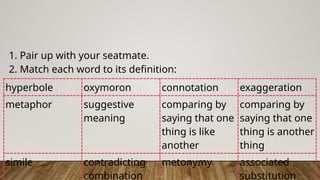
1. Pair up with your seatmate.
2. Match each word to its definition:
hyperbole oxymoron connotation exaggeration
metaphor suggestive
meaning
comparing by
saying that one
thing is like
another
comparing by
saying that one
thing is another
thing
simile contradicting
combination
metonymy associated
substitution
After all the pairs have finished the activity, discuss the following
questions as a class:
1. What helped you match the terms to their definitions?
2. Which words were you already familiar with?
3. How can we use these when we write?
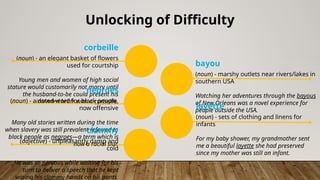
Unlocking of Difficulty
corbeille
(noun) - an elegant basket of flowers
used for courtship
Young men and women of high social
stature would customarily not marry until
the husband-to-be could present his
intended bride with a corbeille.
negroes
(noun) - a dated word for black people,
now offensive
Many old stories written during the time
when slavery was still prevalent referred to
black people as negroes—a term which is
now a racial slur.
clammy
(adjective) - unpleasantly damp and
cold
He was so nervous while waiting for his
turn to deliver a speech that he kept
wiping his clammy hands on his pants.
bayou
(noun) - marshy outlets near rivers/lakes in
southern USA
Watching her adventures through the bayous
of New Orleans was a novel experience for
people outside the USA.
layette
(noun) - sets of clothing and linens for
infants
For my baby shower, my grandmother sent
me a beautiful layette she had preserved
since my mother was still an infant.
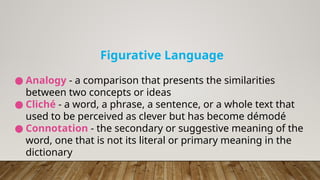
Figurative Language
● Analogy - a comparison that presents the similarities
between two concepts or ideas
● Cliché - a word, a phrase, a sentence, or a whole text that
used to be perceived as clever but has become démodé
● Connotation - the secondary or suggestive meaning of the
word, one that is not its literal or primary meaning in the
dictionary
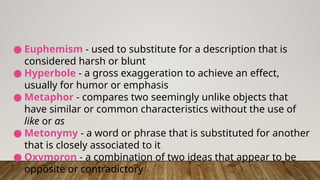
● Euphemism - used to substitute for a description that is
considered harsh or blunt
● Hyperbole - a gross exaggeration to achieve an effect,
usually for humor or emphasis
● Metaphor - compares two seemingly unlike objects that
have similar or common characteristics without the use of
like or as
● Metonymy - a word or phrase that is substituted for another
that is closely associated to it
● Oxymoron - a combination of two ideas that appear to be
opposite or contradictory
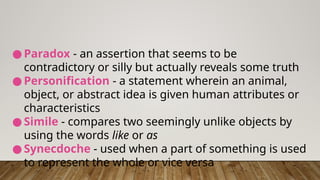
● Paradox - an assertion that seems to be
contradictory or silly but actually reveals some truth
● Personification - a statement wherein an animal,
object, or abstract idea is given human attributes or
characteristics
● Simile - compares two seemingly unlike objects by
using the words like or as
● Synecdoche - used when a part of something is used
to represent the whole or vice versa
Désirée’s Baby
by Kate Chopin
Guide Questions
1. How does the use of figurative language help the writer
convey her intent to the reader?
a. How does it help convey emotion?
b. How does it help convey meaning?
2. How do you think a writer decides which types of
figurative language to use in a poem?
Guide Questions
3. Imagine that the author did not use figures of speech
and used purely literal language. How do you think the
story would be affected?
4. Reread the story carefully. See if you can give other
examples of figurative language and their purposes in
the story.
Read the poem carefully and answer the following questions.
Cite textual evidence.
To Rhea
by Ralph Waldo Emerson
Guide Questions
1. Which types of figurative language were used in the poem?
Enumerate and interpret them by filling in the following table.
a. Take note that the poet may have used multiple types of
figurative language in the same line/verse/stanza.
b. Try to keep your explanation of the meaning within 2-3
sentences. If you feel that an entire stanza needs to be
examined to glean meaning, you may use up to 5 sentences.
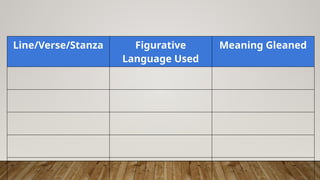
Line/Verse/Stanza Figurative
Language Used
Meaning Gleaned
2. Do you think the use of figurative language enriched the
poem? Why or why not? How would using literal instead of
figurative language impact the literary value of the piece?
3. Taking into account the elements of poetry and the figurative
language used, what do you think was the author trying to
convey with this poem? How do you think the meaning of the
poem would change if the poet used literal instead of figurative
language?
Values Integration
How will understanding figurative language help you
become a better writer of poetry and/or prose?
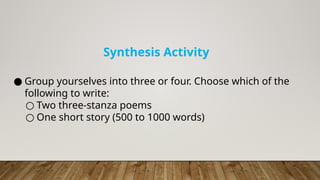
● Group yourselves into three or four. Choose which of the
following to write:
○ Two three-stanza poems
○ One short story (500 to 1000 words)
Synthesis Activity
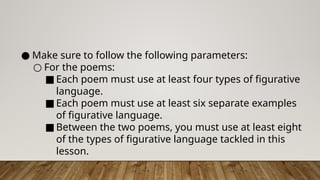
● Make sure to follow the following parameters:
○ For the poems:
■ Each poem must use at least four types of figurative
language.
■ Each poem must use at least six separate examples
of figurative language.
■ Between the two poems, you must use at least eight
of the types of figurative language tackled in this
lesson.
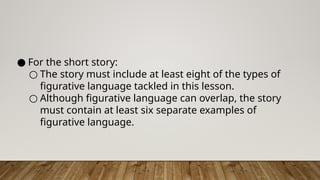
● For the short story:
○ The story must include at least eight of the types of
figurative language tackled in this lesson.
○ Although figurative language can overlap, the story
must contain at least six separate examples of
figurative language.
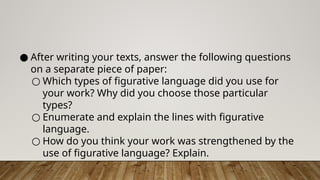
● After writing your texts, answer the following questions
on a separate piece of paper:
○ Which types of figurative language did you use for
your work? Why did you choose those particular
types?
○ Enumerate and explain the lines with figurative
language.
○ How do you think your work was strengthened by the
use of figurative language? Explain.
Assignment
Do research on short stories in the library or online. Choose a
story you like that makes use of at least 8 types of figurative
language.
On a separate piece of paper, answer the following questions:
1. Which types of figurative language were used in the story?
Enumerate and interpret them using the table in the next
slide.
2. Do you think the use of figurative language enriched the
story? Why or why not?
Assignment
3. If the story was written with only literal language, how
would the overall quality of the work change?
4. Taking into account the sound devices and figurative
language used, what do you think was the author trying to
convey with this short story?

figurative language use in literary term

  • 1.
  • 2.
    How can figurativelanguage affect the meaning of a text?
  • 3.
    1. Pair upwith your seatmate. 2. Match each word to its definition: hyperbole oxymoron connotation exaggeration metaphor suggestive meaning comparing by saying that one thing is like another comparing by saying that one thing is another thing simile contradicting combination metonymy associated substitution
  • 4.
    After all thepairs have finished the activity, discuss the following questions as a class: 1. What helped you match the terms to their definitions? 2. Which words were you already familiar with? 3. How can we use these when we write?
  • 5.
    Unlocking of Difficulty corbeille (noun)- an elegant basket of flowers used for courtship Young men and women of high social stature would customarily not marry until the husband-to-be could present his intended bride with a corbeille. negroes (noun) - a dated word for black people, now offensive Many old stories written during the time when slavery was still prevalent referred to black people as negroes—a term which is now a racial slur. clammy (adjective) - unpleasantly damp and cold He was so nervous while waiting for his turn to deliver a speech that he kept wiping his clammy hands on his pants. bayou (noun) - marshy outlets near rivers/lakes in southern USA Watching her adventures through the bayous of New Orleans was a novel experience for people outside the USA. layette (noun) - sets of clothing and linens for infants For my baby shower, my grandmother sent me a beautiful layette she had preserved since my mother was still an infant.
  • 6.
    Figurative Language ● Analogy- a comparison that presents the similarities between two concepts or ideas ● Cliché - a word, a phrase, a sentence, or a whole text that used to be perceived as clever but has become démodé ● Connotation - the secondary or suggestive meaning of the word, one that is not its literal or primary meaning in the dictionary
  • 7.
    ● Euphemism -used to substitute for a description that is considered harsh or blunt ● Hyperbole - a gross exaggeration to achieve an effect, usually for humor or emphasis ● Metaphor - compares two seemingly unlike objects that have similar or common characteristics without the use of like or as ● Metonymy - a word or phrase that is substituted for another that is closely associated to it ● Oxymoron - a combination of two ideas that appear to be opposite or contradictory
  • 8.
    ● Paradox -an assertion that seems to be contradictory or silly but actually reveals some truth ● Personification - a statement wherein an animal, object, or abstract idea is given human attributes or characteristics ● Simile - compares two seemingly unlike objects by using the words like or as ● Synecdoche - used when a part of something is used to represent the whole or vice versa
  • 9.
  • 10.
    Guide Questions 1. Howdoes the use of figurative language help the writer convey her intent to the reader? a. How does it help convey emotion? b. How does it help convey meaning? 2. How do you think a writer decides which types of figurative language to use in a poem?
  • 11.
    Guide Questions 3. Imaginethat the author did not use figures of speech and used purely literal language. How do you think the story would be affected? 4. Reread the story carefully. See if you can give other examples of figurative language and their purposes in the story.
  • 12.
    Read the poemcarefully and answer the following questions. Cite textual evidence. To Rhea by Ralph Waldo Emerson
  • 13.
    Guide Questions 1. Whichtypes of figurative language were used in the poem? Enumerate and interpret them by filling in the following table. a. Take note that the poet may have used multiple types of figurative language in the same line/verse/stanza. b. Try to keep your explanation of the meaning within 2-3 sentences. If you feel that an entire stanza needs to be examined to glean meaning, you may use up to 5 sentences.
  • 14.
  • 15.
    2. Do youthink the use of figurative language enriched the poem? Why or why not? How would using literal instead of figurative language impact the literary value of the piece? 3. Taking into account the elements of poetry and the figurative language used, what do you think was the author trying to convey with this poem? How do you think the meaning of the poem would change if the poet used literal instead of figurative language?
  • 16.
    Values Integration How willunderstanding figurative language help you become a better writer of poetry and/or prose?
  • 17.
    ● Group yourselvesinto three or four. Choose which of the following to write: ○ Two three-stanza poems ○ One short story (500 to 1000 words) Synthesis Activity
  • 18.
    ● Make sureto follow the following parameters: ○ For the poems: ■ Each poem must use at least four types of figurative language. ■ Each poem must use at least six separate examples of figurative language. ■ Between the two poems, you must use at least eight of the types of figurative language tackled in this lesson.
  • 19.
    ● For theshort story: ○ The story must include at least eight of the types of figurative language tackled in this lesson. ○ Although figurative language can overlap, the story must contain at least six separate examples of figurative language.
  • 20.
    ● After writingyour texts, answer the following questions on a separate piece of paper: ○ Which types of figurative language did you use for your work? Why did you choose those particular types? ○ Enumerate and explain the lines with figurative language. ○ How do you think your work was strengthened by the use of figurative language? Explain.
  • 21.
    Assignment Do research onshort stories in the library or online. Choose a story you like that makes use of at least 8 types of figurative language. On a separate piece of paper, answer the following questions: 1. Which types of figurative language were used in the story? Enumerate and interpret them using the table in the next slide. 2. Do you think the use of figurative language enriched the story? Why or why not?
  • 22.
    Assignment 3. If thestory was written with only literal language, how would the overall quality of the work change? 4. Taking into account the sound devices and figurative language used, what do you think was the author trying to convey with this short story?

Editor's Notes

  • #1 SLIDE 1
  • #3 WARM-UP
  • #4 WARM-UP
  • #5 Unlocking of Difficulty (Reading/Listening/Viewing/Vocabulary) Review (Grammar/Writing)
  • #6 The teacher may give more examples of literal VS figurative language.
  • #7 LEARN ABOUT IT/DISCUSSION
  • #8 LEARN ABOUT IT/DISCUSSION
  • #9 LEARN ABOUT IT/DISCUSSION
  • #10 LEARN ABOUT IT/DISCUSSION
  • #11 LEARN ABOUT IT/DISCUSSION
  • #16 ASSIGNMENT/AGREEMENT
  • #17 SYNTHESIS ACTIVITY
  • #18 SYNTHESIS ACTIVITY
  • #19 SYNTHESIS ACTIVITY
  • #20 SYNTHESIS ACTIVITY
  • #21 ASSIGNMENT/AGREEMENT
  • #22 ASSIGNMENT/AGREEMENT