FIGURES OF SPEECH
REVIEW: LITERAL LANGUAGE
Literal language uses words in their ordinary senses. It is the opposite of figurative
language.
Example:
If you tell someone is standing on a diving board to jump in the pool, you are
speaking literally.
WHAT IS FIGURATIVE LANGUAGE?
• The Figurative language is the opposite of Literal language. Figurative Language is a
writing or speech not meant to be interpreted literally.
• It is often to create vivid impressions by setting up comparisons between dissimilar
things.
• It makes the reader or listener use their imagination and understand much more
than the plain words.
SIMILE
- compares two unlike subjects using like or as
Examples:
She is as beautiful as a rose.
For a thousand years in your sight are like a day that has gone by, or like a watch
in the night. (Psalm 90:4)
METAPHOR
- compares two unlike subjects directly, without using like or as
Examples:
She is a rose.
But you are a shield around me, O Lord;
you bestow your glory on me and lift up my head. (Psalm 3:3)
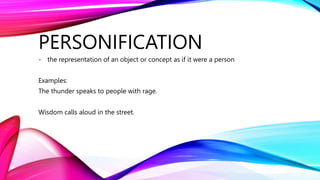
PERSONIFICATION
- the representation of an object or concept as if it were a person
Examples:
The thunder speaks to people with rage.
Wisdom calls aloud in the street.
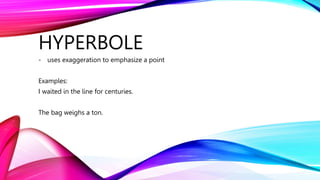
HYPERBOLE
- uses exaggeration to emphasize a point
Examples:
I waited in the line for centuries.
The bag weighs a ton.
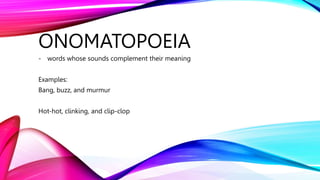
ONOMATOPOEIA
- words whose sounds complement their meaning
Examples:
Bang, buzz, and murmur
Hot-hot, clinking, and clip-clop
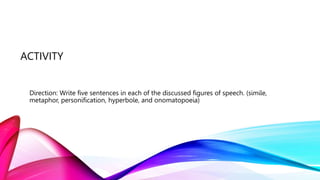
ACTIVITY
Direction: Write five sentences in each of the discussed figures of speech. (simile,
metaphor, personification, hyperbole, and onomatopoeia)
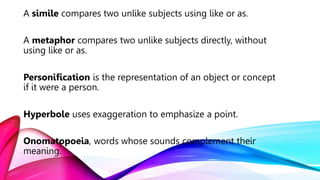
A simile compares two unlike subjects using like or as.
A metaphor compares two unlike subjects directly, without
using like or as.
Personification is the representation of an object or concept
if it were a person.
Hyperbole uses exaggeration to emphasize a point.
Onomatopoeia, words whose sounds complement their
meaning.
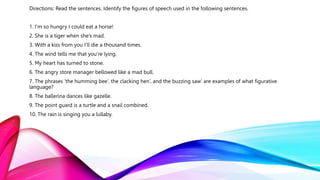
Directions: Read the sentences. Identify the figures of speech used in the following sentences.
1. I’m so hungry I could eat a horse!
2. She is a tiger when she’s mad.
3. With a kiss from you I’ll die a thousand times.
4. The wind tells me that you’re lying.
5. My heart has turned to stone.
6. The angry store manager bellowed like a mad bull.
7. The phrases ‘the humming bee’, the clacking hen’, and the buzzing saw’ are examples of what figurative
language?
8. The ballerina dances like gazelle.
9. The point guard is a turtle and a snail combined.
10. The rain is singing you a lullaby.
ASSIGNMENT
Select a figurative speech phrase and create a drawing that illustrates it. For example,
you might choose the simile that a person is ‘smart as a whip’. Draw a picture that
portrays that simile. Display your artwork along with the phrase that matches it.

FIGURES OF SPEECH.pptx

  • 1.
  • 2.
    REVIEW: LITERAL LANGUAGE Literallanguage uses words in their ordinary senses. It is the opposite of figurative language. Example: If you tell someone is standing on a diving board to jump in the pool, you are speaking literally.
  • 5.
    WHAT IS FIGURATIVELANGUAGE? • The Figurative language is the opposite of Literal language. Figurative Language is a writing or speech not meant to be interpreted literally. • It is often to create vivid impressions by setting up comparisons between dissimilar things. • It makes the reader or listener use their imagination and understand much more than the plain words.
  • 6.
    SIMILE - compares twounlike subjects using like or as Examples: She is as beautiful as a rose. For a thousand years in your sight are like a day that has gone by, or like a watch in the night. (Psalm 90:4)
  • 7.
    METAPHOR - compares twounlike subjects directly, without using like or as Examples: She is a rose. But you are a shield around me, O Lord; you bestow your glory on me and lift up my head. (Psalm 3:3)
  • 8.
    PERSONIFICATION - the representationof an object or concept as if it were a person Examples: The thunder speaks to people with rage. Wisdom calls aloud in the street.
  • 9.
    HYPERBOLE - uses exaggerationto emphasize a point Examples: I waited in the line for centuries. The bag weighs a ton.
  • 10.
    ONOMATOPOEIA - words whosesounds complement their meaning Examples: Bang, buzz, and murmur Hot-hot, clinking, and clip-clop
  • 11.
    ACTIVITY Direction: Write fivesentences in each of the discussed figures of speech. (simile, metaphor, personification, hyperbole, and onomatopoeia)
  • 12.
    A simile comparestwo unlike subjects using like or as. A metaphor compares two unlike subjects directly, without using like or as. Personification is the representation of an object or concept if it were a person. Hyperbole uses exaggeration to emphasize a point. Onomatopoeia, words whose sounds complement their meaning.
  • 13.
    Directions: Read thesentences. Identify the figures of speech used in the following sentences. 1. I’m so hungry I could eat a horse! 2. She is a tiger when she’s mad. 3. With a kiss from you I’ll die a thousand times. 4. The wind tells me that you’re lying. 5. My heart has turned to stone. 6. The angry store manager bellowed like a mad bull. 7. The phrases ‘the humming bee’, the clacking hen’, and the buzzing saw’ are examples of what figurative language? 8. The ballerina dances like gazelle. 9. The point guard is a turtle and a snail combined. 10. The rain is singing you a lullaby.
  • 14.
    ASSIGNMENT Select a figurativespeech phrase and create a drawing that illustrates it. For example, you might choose the simile that a person is ‘smart as a whip’. Draw a picture that portrays that simile. Display your artwork along with the phrase that matches it.