Study funded by
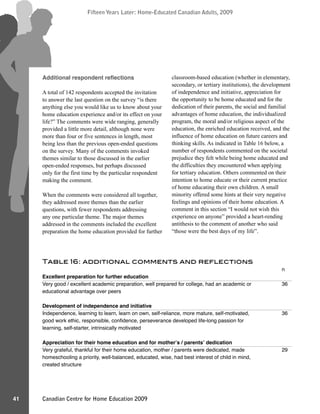
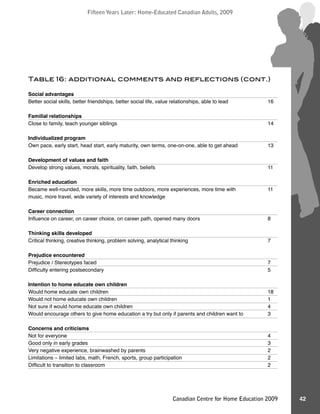
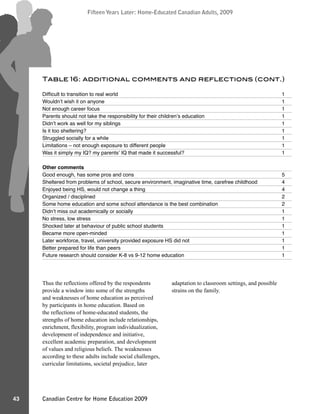
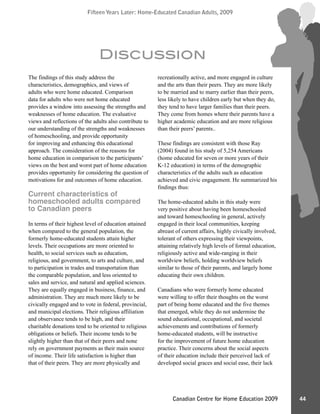
Canadian Centre for Home Education 2009
By Deani A. Neven Van Pelt, Ph.D.,
Patricia A. Allison, M.Ed.,
and Derek J. Allison, Ph.D.
Fifteen years later:
Home-Educated Canadian Adults
Canadian Centre for Home Education 2009
Fifteen Years Later: Home-Educated Canadian Adults, 2009
1
Fifteen Years Later: Home-Educated Canadian Adults, 2009
Abstract
Background and research questions
Research questions
Theoretical or conceptual explanation
Review of the literature
Approach to inquiry
Study design
Distribution of questionnaires
Instrument
Results
Current situation
Education
Occupation
Organization and civic participation
Religious affiliation and observance
Charitable donations
Income
Life satisfaction
Recreational pursuits
Marital and family status
Family background
Parental education and occupation
Home environment
Home education experience
Province
Duration and grades covered
Curriculum and other experiences
Immediate postsecondary activities
Reasons for choosing home education
Reflections
Views on being home educated
Limitations of being home educated
Preparation for further education and for
life
Best part about being home educated
Worst part about being home educated
Opportunity for socialization with other
children
Additional respondent reflections
Discussion
Current characteristics of homeschooled adults
compared to Canadian peers
Reasons for home educating and outcomes of
home education
Delimitations and limitations of the study
Implications for future research
References
Appendices
Appendix A Ethical Review Approval
Appendix B Transcription of telephone script
inviting cooperation from 1994 participating
parents
Appendix C Letter of Information to Parents
Appendix D Letter of Information for
Respondents
Appendix E Questionnaire
Acknowledgements
About the authors
Contents
2
3
4
5
7
44
48
49
7
27
30
36
•
•
•
•
•
•
•
•
•
•
•
•
•
•
•
•
•
•
•
•
•
•
•
•
•
•
•
•
•
•
•
•
•
•
•
•
•
Fifteen Years Later: Home-Educated Canadian Adults, 2009Fifteen Years Later: Home-Educated Canadian Adults, 2009
2Canadian Centre for Home Education 2009
First-generation Canadian graduates of home-
based education, who were involved in the 1994
study of their homeschooling experiences, were
invited to respond to a survey addressing their
economic, educational, occupational, social, civic,
life satisfaction, and lifestyle characteristics. Their
views on their experience with home education
were also collected. Where possible, responses
were compared with extant information (from
public sources) relating to their school-educated
peers.
Homeschooled adults who participated in this study
were more likely than the comparable Canadian
population to have completed an undergraduate
degree, to be civically engaged, to value their
religious beliefs, to have multiple income sources,
to report income from self-employment, and to
report high satisfaction with life. They were found
to be physically active, to have higher average
incomes than their peers, and were notably more
engaged than the comparable population in a wide
variety of cultural and leisure activities. They were
equally as likely not to be married but, unlike their
Canadian counterparts, did not live in common-
law arrangements, and they were less likely to
have children early but tended to have larger than
average families when they did have children. More
than half of the respondents perceived that they
were “very well” prepared for both future education
and for life. The respondents described the most
positive aspects about being homeschooled as rich
relationships, opportunity for enrichment, schedule
flexibility, individualization of pace and programs,
development of their independence, and the
superior education received. The negative aspects
identified by some respondents included the social
prejudice and, for a number of respondents, social
challenges, some curricular limitations, some later
difficulty adapting to classroom settings, and some
wondered about possible strains on their family.
In general, the respondents conveyed appreciation
for their home education and the opportunities
offered to them. The educational attainments,
occupational achievements, and societal
engagement of these adults indicate the success
of late twentieth and early twenty-first century
Canadian home education and suggest that diverse
approaches to education should continue to be
probed for their future promise.
Abstract
Canadian Centre for Home Education 2009
Fifteen Years Later: Home-Educated Canadian Adults, 2009
3
Fifteen Years Later: Home-Educated Canadian Adults, 2009
The first generation of contemporary home-
educated K-12 students has graduated and moved
on to their early adult years. Tracking these
graduates with a view to describing their economic,
educational, occupational, social, civic, and lifestyle
characteristics provides valuable indicators of the
potential, as well as the strengths and weaknesses
of home education.
The research is limited to adults who were formerly
home-educated students. A recent American study
(Ray, 2004) surveyed over 7,300 adults who had
been homeschooled, and reported on the education,
occupation, community activities, style of living,
civic involvement, and enjoyment of life of these
American adults. Van Pelt (2004) asked older
siblings who had completed their home education
to complete a section of a questionnaire which,
in the main, studied currently home-educating
students and their families. It was intended as
a preliminary study, undertaken because of
convenient access to participants. A total of 182
adults participated. A further study was necessary
as this sample would only include older siblings of
long-term home-educating families.
Little is known of Canadians who were home
educated as students, particularly as they compare
to their Canadian adult peers who were educated
in publicly-funded and private schools. It is not
known, for example, whether formerly home-
educated students demonstrate a similar level
of engagement in democratic, cultural, and
economically productive activities as their peers.
Their income levels and income sources have
not been compared. Do students who were home
educated demonstrate a religious commitment
similar to or different from regular school
graduates? Are graduates of home education more
or less likely to pursue postsecondary education,
more or less likely to be involved in their
communities, more or less likely to be physically
active? How do graduates of home education
evaluate the advantages and disadvantages of their
education experience? Through the preparation of a
demographic and lifestyle snapshot of these young
adults via economic, educational, occupational,
social, civic, and lifestyle indicators, this study
offers an initial description of some of the
indicators of the outcomes of the first generation of
home education in Canada.
Research questions
This study followed up with Canadian survey
participants 15 years after they first shared
information about their home education practices,
family demographics, and academic achievements
(Ray, 1994). It sought to describe their current
situation including their education level,
occupation, organizational and civic participation,
religious affiliation and observance, charitable
donations, income, life satisfaction, recreational
pursuits, marital and family status, and to compare
these demographic characteristics with those of
the general adult population of Canadians in the
same age group. This study also sought to describe
aspects of the formerly home-educated students’
family backgrounds, their parents’ education and
occupation, and their home environment. We
looked at the home education experience of the
graduates including their province of residence,
the duration and grades covered, their curriculum
and other educational experiences, their immediate
postsecondary activities, and their family’s reasons
for choosing home education. The final set of
questions asked home education graduates to
reflect on the experience of being home educated,
and whether it limited them or prepared them for
further education and for life. We inquired about the
best and the worst part of being home educated, as
Background and
Research Questions
Fifteen Years Later: Home-Educated Canadian Adults, 2009Fifteen Years Later: Home-Educated Canadian Adults, 2009
4Canadian Centre for Home Education 2009
While the practice of home education began
to grow in the 1960’s and 1970’s, it especially
grew in Western countries throughout the 1980’s
and 1990’s. The numbers may now be growing
slightly or leveling during this first decade of
the new century. The regulation and history of
home education, motivations for home education,
characteristics of home-educating families, and
academic achievement test scores of home-
educated students have been studied and reported
over the years. Considering how contested the
practice of home education has been particularly in
its twentieth-century advent, the outcomes of home
education particularly as it affects the adult lives of
formerly home-educated students has not yet been
widely studied.
Analysis of the growth of home education over the
last 50 years suggests three distinct phases. The
parents that chose home education in the 1960’s
and 1970’s were part of a “counter cultural Left,
principally advocates of New Age philosophies,
hippies, and homesteaders” while “by the mid-
1980’s...most home schooling parents could
be accurately described as part of the Christian
Right” (Basham, 2007, p. 8). The first phase
was more pedagogically oriented, questioning
if schools were necessary or if participation in
formal schooling should be delayed (Illich, 1971;
Moore, 1969; Holt, 1964, 1981), and the second
phase more ideologically oriented, questioning
the secularization of public schooling. The adult
participants in this study would be more likely to
have been situated in the second phase given that
they were being home educated in 1994.
The third phase of distinct motivations in the
contemporary renaissance of home education
would be situated in the late years of the 1990’s
Review of the Literature
well as their views on opportunities for socializing
with other children during their home education
years. We also offered an opportunity for additional
reflections.
Theoretical or conceptual
explanation
Expectations for education in our time include
becoming citizens who are productive, who
contribute to the social good, and who have
developed a sense of their autonomy to design,
identify, and pursue their idea of a satisfactory
life. Criticisms against home education have
suggested that home education is the ultimate act of
selfishness on the part of the parents (Apple, 2001),
and that it fragments society by creating graduates
who are not engaged and do not contribute to
society. The first criticism assumes that the aims
and objectives of the state with respect to the
education of children should supersede those of
parents, and this merits considerable debate in
another forum. The second criticism is often based
on anecdotal, and often apocryphal, evidence and
the main purpose of this study is to provide a more
solid basis on which to assess this claim.
Canadian Centre for Home Education 2009
Fifteen Years Later: Home-Educated Canadian Adults, 2009
5
Fifteen Years Later: Home-Educated Canadian Adults, 2009
and the first decade of the twenty-first century.
Parents in this era of home educating have had
the luxury of analyzing the contemporary practice
of home education and evaluating its strengths
and weaknesses. The current motivations for
home education are in part based on evaluation
of measured or perceived outcomes of home
education in our times. This pragmatic motivation
for home education stands in contrast to the
earlier pedagogical and ideological orientations.
A recent study of parental motivations for home
educating in Canada (Van Pelt, 2004) based on
the input of over 1,600 families found that while
parents overwhelmingly chose to home educate so
that they could teach their child particular beliefs
and values (84%), they also home educated for
social (enhanced family relationships and safety
of the child) and academic reasons (such as
individualizing and customizing the program), and
almost half reported that they were encouraged by
the results of other home-educating families (p. 49).
Ray (2003), in summarizing his findings on
the demographics, characteristics, and views of
formerly home-educated Americans, claimed
“the results show...that homeschooling produces
successful adults who are actively involved in their
communities and who continue to value education
for themselves and their children” (p.7). In her
summary of a preliminary study of Canadian home-
educated adults, Van Pelt (2004) states: “Although
still young (mean age was 20.9 years), all of the
homeschool graduates sampled engaged in either
education or employment following their home
education. Forty percent had participated in cross-
cultural exchange programs. Almost all hold at least
one volunteer position, the majority have voted
within the last five years, none have ever received
social security assistance, and only 6.7% have
received unemployment insurance benefits. This
sample reports a higher average life satisfaction
score than most other normed sub-groups in
Western society” (p. 89). A more comprehensive
and comparative study of Canadian home-educated
adults was needed to further understand the
strengths and weaknesses of home education in
terms of its outcomes.
This study of Canadian adults formerly home
educated will extend the literature in this area
particularly as it not only considers various
characteristics of its graduates but also probes their
views about being home educated.
Approach to Inquiry
Study design
In 1994, 620 of the 808 families who participated
in a Canadian home education study (Ray, 1994)
indicated that they would be interested in being
approached for future participation in further
longitudinal study. These parents represented a
total of 2,129 children (of the 2,594 children that
participated in the 1994 study). Contact information
was provided by these families with the original
1994 questionnaires. Participants in the original
study created unique identification code numbers
(based on a combination of birthdates) and these
Fifteen Years Later: Home-Educated Canadian Adults, 2009Fifteen Years Later: Home-Educated Canadian Adults, 2009
6Canadian Centre for Home Education 2009
code numbers were the only identification available
to the researchers. The agency, therefore, had
contact information for families who had expressed
their willingness to be approached, but no access to
specific information about these participants, and
the researchers had access to information based
on code numbers but no knowledge of names or
contact information. In order to preserve this state
of affairs, the researchers provided the agency
with a master copy of the questionnaire and of the
Letters of Information, and the agency duplicated
the necessary number and mailed them out, along
with pre-paid return envelopes, to the families on
their contact list.
The first Letter of Information, addressed to the
parents who completed the original 1994 survey,
explained the study and asked them to pass along
the questionnaires to those of their children (now
adult) who were being home educated at the time
the family participated in the original study. The
second Letter of Information was addressed to
the now-adult children, inviting participation in
the current study by completing the questionnaire
and returning it in the pre-paid envelope provided.
The completed questionnaires, identified only by
the re-created identification code numbers, were
forwarded to the researchers.
Distribution of questionnaires
Participating 1994 survey families who indicated
their willingness to be contacted in the future
for possible further research participation were
contacted in October and November of 2008 by
the agency which sponsored that study. A total of
285 of the original 620 families were found, and
281 accepted the telephone invitation to receive
and pass on questionnaires to their children.
(See Appendix B for transcription of telephone
conversation.) The agency mailed packages of
questionnaires to the families and invited them to
pass along the copies to those of their children who
were being home educated when they participated
in the original study. By December 22, 2008, the
questionnaire packages were mailed to the parents
of prospective participants. The parents in turn
were to pass them along to their adult children. By
June 22, 2009, a total of 226 questionnaires were
received and passed along for analysis. A small
number of parents contacted the researchers after
receiving the package to ask whether they might
distribute copies of the questionnaire to children
who were too young to participate in the 1994 study
but who had subsequently been home educated, and
we encouraged them to do so, with the intention of
deciding later whether to include these data.
Instrument
The questionnaire included three types of
questions: (1) items which have been used in
studies of similar populations elsewhere, and can
thus provide direct comparisons; (2) items which
have been used in surveys of the population at
large to address questions of lifestyle, achievement,
satisfaction, and so on, and can thus provide direct
comparisons with the public at large; and (3) items
which were specifically constructed for this study
to best address the questions under investigation.
Most data generated by the questionnaire were
analyzed quantitatively, but the data generated
from the open-ended questions were transcribed
and analyzed qualitatively. Questionnaires were
distributed in the fall of 2008 and returned by April
2009. Data were transcribed and analyzed in the
spring and summer of 2009. Funding for the data
collection and data analysis were provided by the
Canadian Centre for Home Education.
Canadian Centre for Home Education 2009
Fifteen Years Later: Home-Educated Canadian Adults, 2009
7
Fifteen Years Later: Home-Educated Canadian Adults, 2009
A total of 226 completed questionnaires were
received, representing 128 of the 281 families who
said they would pass along a survey to their now
adult children. These families ranged in size from
one child to 14, with an average of four per family.
About two-thirds (65%) of the respondents were
either first or second in birth order in their families.
Just over half (55%) of the respondents were
female.
Although it was intended that respondents should
be drawn only from those who were already
being home educated at the time of the original
survey, some families distributed the surveys
to all of their children, and we received a small
number of completed questionnaires (N=11) from
respondents who were 15 to 17 years of age. Only
one of these younger respondents had completed
secondary education and was currently employed.
The remaining ten were all engaged in secondary
education, five of them in public school, four
at home and one in a private school. Because
the original survey went to families who were
actively involved in home education in 1994, these
younger respondents were younger siblings, at that
time often infants, in homes in which their older
siblings were being home educated. Furthermore,
every one of them reported subsequently being
homeschooled themselves. This being so, and after
some deliberation, we felt that it was reasonable to
include all cases in our analysis, particularly since
the age groups in the data sets to which we were
comparing our respondents all included 15- to 17-
year-olds, making a more accurate match of 15 to
34 years of age for the purpose of comparisons.
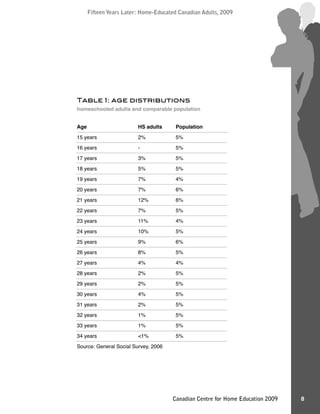
Our respondents ranged from 15 to 34 years of age,
with an average of 23.3 and a median of 23.
Table 1 shows the distribution by age in comparison
with one of the data sets used for comparative
purposes. As the table shows, the distribution of our
respondents was somewhat less even than that of
the comparative set, but not seriously so.
The largest group of respondents (36%) lived
in Ontario at the time they completed the
questionnaire. The next largest group (28%)
lived in Alberta. The remaining respondents were
scattered across six other provinces: 13% in British
Columbia; 6% in Saskatchewan; 4% in Quebec;
4% in Manitoba, 1% in New Brunswick, and 1%
in Nova Scotia. In addition, 5% were living in the
United States, and one respondent each in Australia
and Mexico.
Current Situation
Education
Sixteen (7%) of the respondents had not completed
secondary education, or the equivalent. All but three
of these were 18 or under and currently engaged
in secondary education. The remaining three
were all older, fully employed, and not pursuing
their education at this time. More than half of the
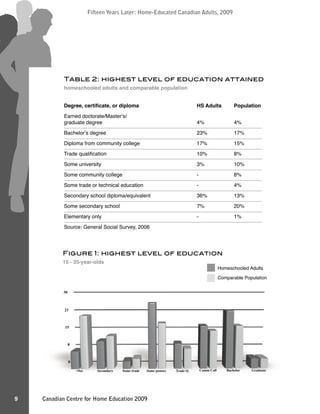
respondents (57%) had completed some form of
postsecondary education, which, as Table 2 shows,
is a higher proportion than the comparable Canadian
population. Homeschooled adults were more
likely to have undergraduate degrees, and equally
likely to have graduate degrees. The proportion of
homeschooled adults with a secondary education
as their highest achievement to date was much
greater than the comparable population, and far
fewer had not yet completed secondary school.
Furthermore, as noted above, most of those who had
not yet completed secondary school were currently
actively doing so, and about half of those who had
completed secondary school were currently enrolled
in postsecondary programs.
Results
Fifteen Years Later: Home-Educated Canadian Adults, 2009Fifteen Years Later: Home-Educated Canadian Adults, 2009
8Canadian Centre for Home Education 2009
Table 1: age distributions
homeschooled adults and comparable population
Age HS adults Population
15 years 2% 5%
16 years - 5%
17 years 3% 5%
18 years 5% 5%
19 years 7% 4%
20 years 7% 6%
21 years 12% 6%
22 years 7% 5%
23 years 11% 4%
24 years 10% 5%
25 years 9% 6%
26 years 8% 5%
27 years 4% 4%
28 years 2% 5%
29 years 2% 5%
30 years 4% 5%
31 years 2% 5%
32 years 1% 5%
33 years 1% 5%
34 years <1% 5%
Source: General Social Survey, 2006
Canadian Centre for Home Education 2009
Fifteen Years Later: Home-Educated Canadian Adults, 2009
9
Fifteen Years Later: Home-Educated Canadian Adults, 2009
Table 2: highest level of education attained
homeschooled adults and comparable population
Degree, certificate, or diploma HS Adults Population
Earned doctorate/Master’s/
graduate degree 4% 4%
Bachelor’s degree 23% 17%
Diploma from community college 17% 15%
Trade qualification 10% 8%
Some university 3% 10%
Some community college - 8%
Some trade or technical education - 4%
Secondary school diploma/equivalent 36% 13%
Some secondary school 7% 20%
Elementary only - 1%
Source: General Social Survey, 2006
Figure 1: highest level of education
15 - 35-year-olds
Homeschooled Adults
Comparable Population
�
�
��
��
��
�
�
��
��
��
���� ��������� ���������� ������������ �������� ��������� �������� ��������
Fifteen Years Later: Home-Educated Canadian Adults, 2009Fifteen Years Later: Home-Educated Canadian Adults, 2009
10Canadian Centre for Home Education 2009
The following combinations of educational
achievement were also recorded.
Of the 61 respondents (27%) who held
Bachelor’s degrees, ten were currently pursuing
graduate studies, two at the doctoral level. One
had also completed a post-graduate diploma,
five had completed college diplomas, six had
undergraduate diplomas, and five also had trade
qualifications.
Of the eight respondents (4%) who held
Master’s degrees, two were currently engaged
in doctoral studies.
Of the 27 respondents (12%) who held trade
qualifications, included five who also had
Bachelor’s degrees, and 10 who had completed
college diplomas.
Of the 59 respondents (26%) who had college
diplomas, there were ten who also held trade
qualifications, and 11 who also had university-
level degrees or diplomas.
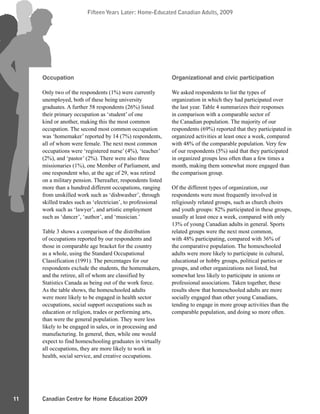
Overall, young adults who had been
homeschooled were better educated than
similarly aged Canadians. This is particularly
notable with respect to postsecondary
education, where greater proportions of
homeschooling graduates have attained
Bachelors’ and graduate degrees.
•
•
•
•
•
Figure 2: highest level of education
24 - 35-year-olds
Homeschooled Adults
Comparable Population
�
��
��
��
��
�
��
��
��
��
���� ��������� ���������� ������������ �������� ��������� �������� ��������
Canadian Centre for Home Education 2009
Fifteen Years Later: Home-Educated Canadian Adults, 2009
11
Fifteen Years Later: Home-Educated Canadian Adults, 2009
Occupation
Only two of the respondents (1%) were currently
unemployed, both of these being university
graduates. A further 58 respondents (26%) listed
their primary occupation as ‘student’ of one
kind or another, making this the most common
occupation. The second most common occupation
was ‘homemaker’ reported by 14 (7%) respondents,
all of whom were female. The next most common
occupations were ‘registered nurse’ (4%), ‘teacher’
(2%), and ‘pastor’ (2%). There were also three
missionaries (1%), one Member of Parliament, and
one respondent who, at the age of 29, was retired
on a military pension. Thereafter, respondents listed
more than a hundred different occupations, ranging
from unskilled work such as ‘dishwasher’, through
skilled trades such as ‘electrician’, to professional
work such as ‘lawyer’, and artistic employment
such as ‘dancer’, ‘author’, and ‘musician.’
Table 3 shows a comparison of the distribution
of occupations reported by our respondents and
those in comparable age bracket for the country
as a whole, using the Standard Occupational
Classification (1991). The percentages for our
respondents exclude the students, the homemakers,
and the retiree, all of whom are classified by
Statistics Canada as being out of the work force.
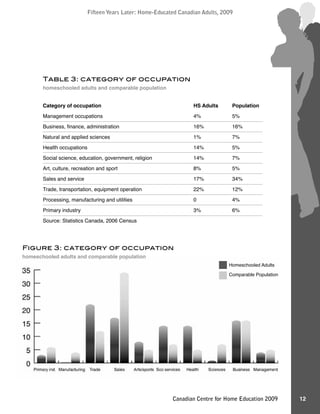
As the table shows, the homeschooled adults
were more likely to be engaged in health sector
occupations, social support occupations such as
education or religion, trades or performing arts,
than were the general population. They were less
likely to be engaged in sales, or in processing and
manufacturing. In general, then, while one would
expect to find homeschooling graduates in virtually
all occupations, they are more likely to work in
health, social service, and creative occupations.
Organizational and civic participation
We asked respondents to list the types of
organization in which they had participated over
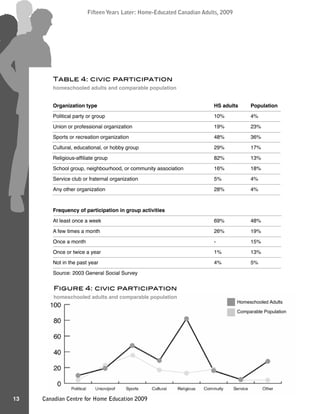
the last year. Table 4 summarizes their responses
in comparison with a comparable sector of
the Canadian population. The majority of our
respondents (69%) reported that they participated in
organized activities at least once a week, compared
with 48% of the comparable population. Very few
of our respondents (5%) said that they participated
in organized groups less often than a few times a
month, making them somewhat more engaged than
the comparison group.
Of the different types of organization, our
respondents were most frequently involved in
religiously related groups, such as church choirs
and youth groups: 82% participated in these groups,
usually at least once a week, compared with only
13% of young Canadian adults in general. Sports
related groups were the next most common,
with 48% participating, compared with 36% of
the comparative population. The homeschooled
adults were more likely to participate in cultural,
educational or hobby groups, political parties or
groups, and other organizations not listed, but
somewhat less likely to participate in unions or
professional associations. Taken together, these
results show that homeschooled adults are more
socially engaged than other young Canadians,
tending to engage in more group activities than the
comparable population, and doing so more often.
Fifteen Years Later: Home-Educated Canadian Adults, 2009Fifteen Years Later: Home-Educated Canadian Adults, 2009
12Canadian Centre for Home Education 2009
Table 3: category of occupation
homeschooled adults and comparable population
Category of occupation HS Adults Population
Management occupations 4% 5%
Business, finance, administration 16% 16%
Natural and applied sciences 1% 7%
Health occupations 14% 5%
Social science, education, government, religion 14% 7%
Art, culture, recreation and sport 8% 5%
Sales and service 17% 34%
Trade, transportation, equipment operation 22% 12%
Processing, manufacturing and utilities 0 4%
Primary industry 3% 6%
Source: Statistics Canada, 2006 Census
Figure 3: category of occupation
homeschooled adults and comparable population
Homeschooled Adults
Comparable Population
Canadian Centre for Home Education 2009
Fifteen Years Later: Home-Educated Canadian Adults, 2009
13
Fifteen Years Later: Home-Educated Canadian Adults, 2009
Table 4: civic participation
homeschooled adults and comparable population
Organization type HS adults Population
Political party or group 10% 4%
Union or professional organization 19% 23%
Sports or recreation organization 48% 36%
Cultural, educational, or hobby group 29% 17%
Religious-affiliate group 82% 13%
School group, neighbourhood, or community association 16% 18%
Service club or fraternal organization 5% 4%
Any other organization 28% 4%
Frequency of participation in group activities
At least once a week 69% 48%
A few times a month 26% 19%
Once a month - 15%
Once or twice a year 1% 13%
Not in the past year 4% 5%
Source: 2003 General Social Survey
Figure 4: civic participation
homeschooled adults and comparable population
Homeschooled Adults
Comparable Population
Fifteen Years Later: Home-Educated Canadian Adults, 2009Fifteen Years Later: Home-Educated Canadian Adults, 2009
14Canadian Centre for Home Education 2009
Organizational and civic participation (cont.)
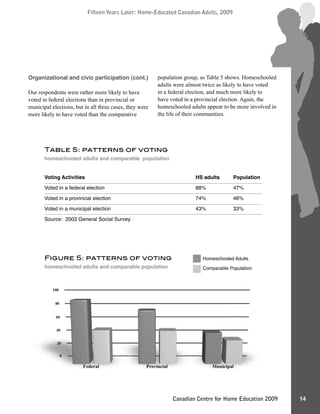
Our respondents were rather more likely to have
voted in federal elections than in provincial or
municipal elections, but in all three cases, they were
more likely to have voted than the comparative
population group, as Table 5 shows. Homeschooled
adults were almost twice as likely to have voted
in a federal election, and much more likely to
have voted in a provincial election. Again, the
homeschooled adults appear to be more involved in
the life of their communities.
Table 5: patterns of voting
homeschooled adults and comparable population
Voting Activities HS adults Population
Voted in a federal election 88% 47%
Voted in a provincial election 74% 46%
Voted in a municipal election 43% 33%
Source: 2003 General Social Survey
Figure 5: patterns of voting
homeschooled adults and comparable population
Homeschooled Adults
Comparable Population
�
��
��
��
��
���
�
��
��
��
��
���
������� ���������� ���������
Canadian Centre for Home Education 2009
Fifteen Years Later: Home-Educated Canadian Adults, 2009
15
Fifteen Years Later: Home-Educated Canadian Adults, 2009
Religious affiliation and observance
Only eight of our respondents (4%) reported
that they had no religious affiliation of any kind,
three describing themselves as atheists. All of the
remaining respondents (95%) reported that they
were Christians. Many simply wrote “Christian”,
but many others wrote in a specific denomination
or definition. These included Roman Catholic (of
which there were 13), Evangelical, Protestant,
Baptist, Adventist, Mennonite, Pentecostal,
Lutheran, Anglican, Presbyterian, Methodist, and
one respondent who wrote ‘Christian/Buddhist.’
This compares with a distribution in the general
population in which 29% declare no religion at all,
60% describe themselves as Christian, and 11% as
belonging to other religions.
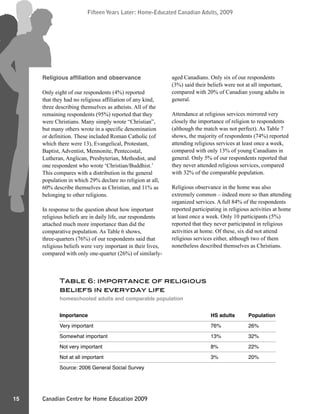
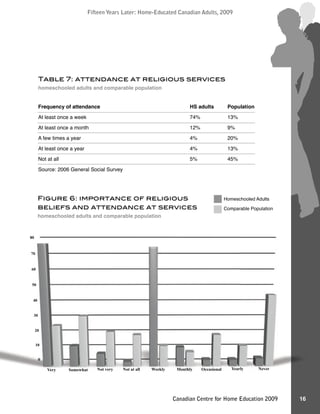
In response to the question about how important
religious beliefs are in daily life, our respondents
attached much more importance than did the
comparative population. As Table 6 shows,
three-quarters (76%) of our respondents said that
religious beliefs were very important in their lives,
compared with only one-quarter (26%) of similarly-
aged Canadians. Only six of our respondents
(3%) said their beliefs were not at all important,
compared with 20% of Canadian young adults in
general.
Attendance at religious services mirrored very
closely the importance of religion to respondents
(although the match was not perfect). As Table 7
shows, the majority of respondents (74%) reported
attending religious services at least once a week,
compared with only 13% of young Canadians in
general. Only 5% of our respondents reported that
they never attended religious services, compared
with 32% of the comparable population.
Religious observance in the home was also
extremely common – indeed more so than attending
organized services. A full 84% of the respondents
reported participating in religious activities at home
at least once a week. Only 10 participants (5%)
reported that they never participated in religious
activities at home. Of these, six did not attend
religious services either, although two of them
nonetheless described themselves as Christians.
Importance HS adults Population
Very important 76% 26%
Somewhat important 13% 32%
Not very important 8% 22%
Not at all important 3% 20%
Source: 2006 General Social Survey
Table 6: importance of religious
beliefs in everyday life
homeschooled adults and comparable population
Fifteen Years Later: Home-Educated Canadian Adults, 2009Fifteen Years Later: Home-Educated Canadian Adults, 2009
16Canadian Centre for Home Education 2009
Table 7: attendance at religious services
homeschooled adults and comparable population
Frequency of attendance HS adults Population
At least once a week 74% 13%
At least once a month 12% 9%
A few times a year 4% 20%
At least once a year 4% 13%
Not at all 5% 45%
Source: 2006 General Social Survey
Figure 6: importance of religious
beliefs and attendance at services
homeschooled adults and comparable population
Homeschooled Adults
Comparable Population
�
��
��
��
��
��
��
��
��
beliefs and attendance at services
homeschooled adults and comparable population
ComparableComparable Population
�
��
��
��
��
��
��
��
��
���� �������� �������� ���������� ������ ������� ���������� ������ �����
Canadian Centre for Home Education 2009
Fifteen Years Later: Home-Educated Canadian Adults, 2009
17
Fifteen Years Later: Home-Educated Canadian Adults, 2009
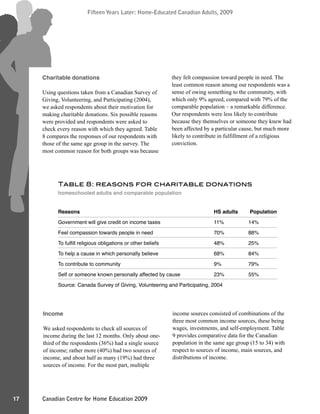
Charitable donations
Using questions taken from a Canadian Survey of
Giving, Volunteering, and Participating (2004),
we asked respondents about their motivation for
making charitable donations. Six possible reasons
were provided and respondents were asked to
check every reason with which they agreed. Table
8 compares the responses of our respondents with
those of the same age group in the survey. The
most common reason for both groups was because
they felt compassion toward people in need. The
least common reason among our respondents was a
sense of owing something to the community, with
which only 9% agreed, compared with 79% of the
comparable population – a remarkable difference.
Our respondents were less likely to contribute
because they themselves or someone they knew had
been affected by a particular cause, but much more
likely to contribute in fulfillment of a religious
conviction.
Table 8: reasons for charitable donations
homeschooled adults and comparable population
Reasons HS adults Population
Government will give credit on income taxes 11% 14%
Feel compassion towards people in need 70% 88%
To fulfill religious obligations or other beliefs 48% 25%
To help a cause in which personally believe 68% 84%
To contribute to community 9% 79%
Self or someone known personally affected by cause 23% 55%
Source: Canada Survey of Giving, Volunteering and Participating, 2004
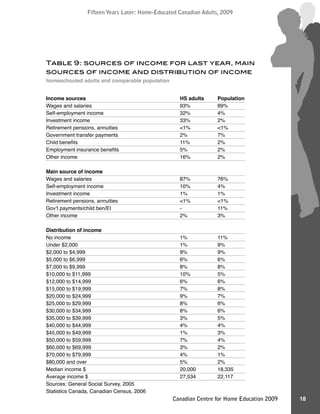
Income
We asked respondents to check all sources of
income during the last 12 months. Only about one-
third of the respondents (36%) had a single source
of income; rather more (40%) had two sources of
income, and about half as many (19%) had three
sources of income. For the most part, multiple
income sources consisted of combinations of the
three most common income sources, these being
wages, investments, and self-employment. Table
9 provides comparative data for the Canadian
population in the same age group (15 to 34) with
respect to sources of income, main sources, and
distributions of income.
Fifteen Years Later: Home-Educated Canadian Adults, 2009Fifteen Years Later: Home-Educated Canadian Adults, 2009
18Canadian Centre for Home Education 2009
Table 9: sources of income for last year, main
sources of income and distribution of income
homeschooled adults and comparable population
Income sources HS adults Population
Wages and salaries 93% 89%
Self-employment income 32% 4%
Investment income 33% 2%
Retirement pensions, annuities <1% <1%
Government transfer payments 2% 7%
Child benefits 11% 2%
Employment insurance benefits 5% 2%
Other income 16% 2%
Main source of income
Wages and salaries 87% 76%
Self-employment income 10% 4%
Investment income 1% 1%
Retirement pensions, annuities <1% <1%
Gov’t payments/child ben/EI - 11%
Other income 2% 3%
Distribution of income
No income 1% 11%
Under $2,000 1% 9%
$2,000 to $4,999 9% 9%
$5,000 to $6,999 6% 6%
$7,000 to $9,999 8% 8%
$10,000 to $11,999 10% 5%
$12,000 to $14,999 6% 6%
$15,000 to $19,999 7% 8%
$20,000 to $24,999 9% 7%
$25,000 to $29,999 8% 6%
$30,000 to $34,999 8% 6%
$35,000 to $39,999 3% 5%
$40,000 to $44,999 4% 4%
$45,000 to $49,999 1% 3%
$50,000 to $59,999 7% 4%
$60,000 to $69,999 3% 2%
$70,000 to $79,999 4% 1%
$80,000 and over 5% 2%
Median income $ 20,000 18,335
Average income $ 27,534 22,117
Sources: General Social Survey, 2005
Statistics Canada, Canadian Census, 2006
Canadian Centre for Home Education 2009
Fifteen Years Later: Home-Educated Canadian Adults, 2009
19
Fifteen Years Later: Home-Educated Canadian Adults, 2009
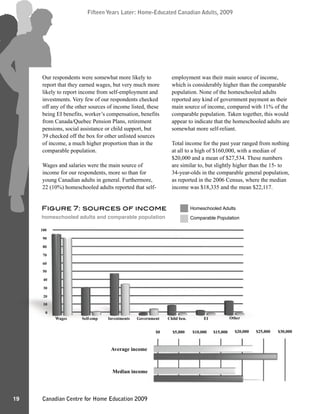
Our respondents were somewhat more likely to
report that they earned wages, but very much more
likely to report income from self-employment and
investments. Very few of our respondents checked
off any of the other sources of income listed, these
being EI benefits, worker’s compensation, benefits
from Canada/Quebec Pension Plans, retirement
pensions, social assistance or child support, but
39 checked off the box for other unlisted sources
of income, a much higher proportion than in the
comparable population.
Wages and salaries were the main source of
income for our respondents, more so than for
young Canadian adults in general. Furthermore,
22 (10%) homeschooled adults reported that self-
employment was their main source of income,
which is considerably higher than the comparable
population. None of the homeschooled adults
reported any kind of government payment as their
main source of income, compared with 11% of the
comparable population. Taken together, this would
appear to indicate that the homeschooled adults are
somewhat more self-reliant.
Total income for the past year ranged from nothing
at all to a high of $160,000, with a median of
$20,000 and a mean of $27,534. These numbers
are similar to, but slightly higher than the 15- to
34-year-olds in the comparable general population,
as reported in the 2006 Census, where the median
income was $18,335 and the mean $22,117.
Figure 7: sources of income
homeschooled adults and comparable population
Homeschooled Adults
Comparable Population
�
��
��
��
��
��
��
��
��
��
���
�
��
��
��
��
��
��
��
��
��
���
����� �������� ����������� ���������� ���������� �� �����
�� ������ ������� ������� ������� ������� ��������� ������ ������� ������� ������� ������� �������
��������������
�������������
Fifteen Years Later: Home-Educated Canadian Adults, 2009Fifteen Years Later: Home-Educated Canadian Adults, 2009
20Canadian Centre for Home Education 2009
Life satisfaction
We asked a sequence of questions relating to
general life satisfaction. The first question asked
respondents how satisfied they were with the work
that they were currently performing. About half
(52%) said that they were ‘very satisfied’ with
their work, and the addition of those who said they
were ‘moderately satisfied’ (44%), accounts for
almost all of the respondents. The remaining few
(4%) reported that they were ‘not very satisfied’
but no one at all reported being ‘dissatisfied’. In the
General Social Survey of 2006, the same question
elicited a similar response from 15- to 34-year-olds,
in that 88% rated themselves on the positive side
of satisfaction with their current work. Overall, the
homeschooled adults were slightly more likely to
be satisfied with their current work.
The second question asked respondents how happy
they were with their lives, all things considered.
In response to an identical question in the General
Social Survey of Canada of 2003, close to half
(49.7%) of all Canadians surveyed said they were
very happy, slightly less (45.7%) saying they were
happy, and only a handful (4.1%) saying they
were somewhat or very unhappy. Canadians in our
comparative age group (15-34) reported slightly
higher levels of happiness, a total of 97.2% stating
they were fairly or very happy, only 2.8% saying
they were somewhat or very unhappy. National data
from 2005 showed a slight decline for the 15–34
age group, 43.8% stating that they were very happy,
52.5% that they were somewhat happy, and 3.8%
reporting unhappiness. Overall, our home-educated
adults reported that they were happier with their
lives than the comparative population: all but one
respondent was either ‘very happy’ (67.3%) or
‘fairly happy’ (32.3%). The one respondent who
reported being ‘not very happy’ was a 26-year-old
university graduate who was currently working in
an unskilled and low-paying position.
The next question asked specifically about
satisfaction with the family’s present financial
situation, and levels of satisfaction here were
markedly lower than in the two previous questions.
Considerably less than half of our respondents
(38%) selected the highest level of satisfaction,
while half of the respondents (50%) were only
‘mostly satisfied.’A rough comparison with people
the same age in the General Social Survey of 2005
shows quite consistent results: about 88% of the
homeschooled adults rated their satisfaction with
their financial situation as being on the positive
side, compared with about 80% of the general
population, and the proportions of individuals who
were quite dissatisfied were almost identical (4%
in both cases). No discernible pattern was evident
among the dissatisfied respondents, by age, gender,
educational achievement, type of employment, size
of income, or marital status. In short, there was no
discernible pattern amongst those who were not
happy with their financial situation.
Our questionnaire included the five questions
which comprise the Satisfaction with Life Scale
(Pavot & Diener, 1993). More than half of all
respondents, and sometimes more than two-thirds
or even three-quarters of our respondents, agreed or
strongly agreed with all of the first five statements,
all of which were very positive: “In most ways my
life is close to my ideal” (64%); “The conditions of
my life are excellent” (78%); “I am satisfied with
my life” (76%); “So far I have gotten the important
things I want in life” (67%); and “If I could live
my life over, I would change almost nothing”
(53%). For all five questions, most of the remaining
respondents said that they would “agree somewhat”
Canadian Centre for Home Education 2009
Fifteen Years Later: Home-Educated Canadian Adults, 2009
21
Fifteen Years Later: Home-Educated Canadian Adults, 2009
with the statement, leaving very few who disagreed
at all.
When the scores for the five questions were
given numerical values and totaled, a single
score, ranging from a possible low of 5 to a
possible high of 35, was derived which provided
a summary satisfaction scale. Our respondents,
for the most part, scored quite high overall
satisfaction ratings. The lowest rating was 11,
which only one respondent scored. The highest
rating was the highest possible of 35, scored by 14
respondents. Overall, the mean score was 28.5, with
a standard deviation of 4.8, and a median of 30.
This is a notably higher rating than the normative
satisfaction levels for other populations (see Pavot
& Diener, 1993, p. 166 and Pavot & Diener, 2008,
p. 143) but entirely consistent with the high levels
of life satisfaction among homeschooled adults
reported in an earlier work (Van Pelt, 2003, p.82).
We added one further question to the sequence,
with respect to home education specifically.
Only 10% of the respondents agreed with the
statement “If I could live my life over, I would
want a different education” and most of them could
only “agree somewhat.” The greater majority
(75%) disagreed with the statement or disagreed
strongly. Evidently, very few of the home education
graduates are less than very satisfied with their
current lives, and hardly any of them regret being
homeschooled.
Overall, homeschooling graduates appear to be very
content with the education they received, as well
as being happier and more satisfied with their work
and life than similarly aged Canadians, and, indeed,
young citizens of other countries.
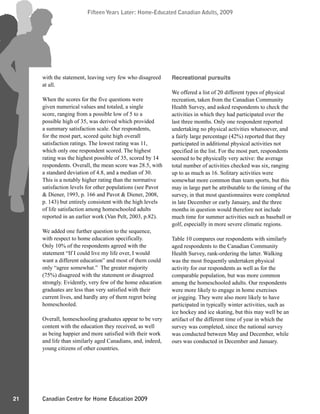
Recreational pursuits
We offered a list of 20 different types of physical
recreation, taken from the Canadian Community
Health Survey, and asked respondents to check the
activities in which they had participated over the
last three months. Only one respondent reported
undertaking no physical activities whatsoever, and
a fairly large percentage (42%) reported that they
participated in additional physical activities not
specified in the list. For the most part, respondents
seemed to be physically very active: the average
total number of activities checked was six, ranging
up to as much as 16. Solitary activities were
somewhat more common than team sports, but this
may in large part be attributable to the timing of the
survey, in that most questionnaires were completed
in late December or early January, and the three
months in question would therefore not include
much time for summer activities such as baseball or
golf, especially in more severe climatic regions.
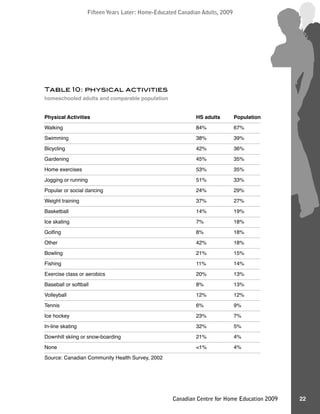
Table 10 compares our respondents with similarly
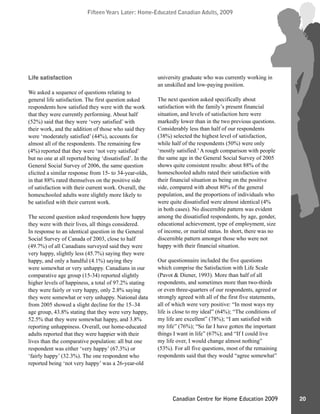
aged respondents to the Canadian Community
Health Survey, rank-ordering the latter. Walking
was the most frequently undertaken physical
activity for our respondents as well as for the
comparable population, but was more common
among the homeschooled adults. Our respondents
were more likely to engage in home exercises
or jogging. They were also more likely to have
participated in typically winter activities, such as
ice hockey and ice skating, but this may well be an
artifact of the different time of year in which the
survey was completed, since the national survey
was conducted between May and December, while
ours was conducted in December and January.
Fifteen Years Later: Home-Educated Canadian Adults, 2009Fifteen Years Later: Home-Educated Canadian Adults, 2009
22Canadian Centre for Home Education 2009
Table 10: physical activities
homeschooled adults and comparable population
Physical Activities HS adults Population
Walking 84% 67%
Swimming 38% 39%
Bicycling 42% 36%
Gardening 45% 35%
Home exercises 53% 35%
Jogging or running 51% 33%
Popular or social dancing 24% 29%
Weight training 37% 27%
Basketball 14% 19%
Ice skating 7% 18%
Golfing 8% 18%
Other 42% 18%
Bowling 21% 15%
Fishing 11% 14%
Exercise class or aerobics 20% 13%
Baseball or softball 8% 13%
Volleyball 12% 12%
Tennis 6% 9%
Ice hockey 23% 7%
In-line skating 32% 5%
Downhill skiing or snow-boarding 21% 4%
None <1% 4%
Source: Canadian Community Health Survey, 2002
Canadian Centre for Home Education 2009
Fifteen Years Later: Home-Educated Canadian Adults, 2009
23
Fifteen Years Later: Home-Educated Canadian Adults, 2009
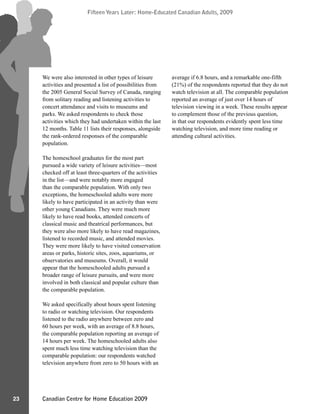
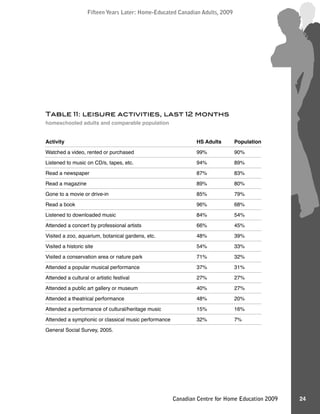
We were also interested in other types of leisure
activities and presented a list of possibilities from
the 2005 General Social Survey of Canada, ranging
from solitary reading and listening activities to
concert attendance and visits to museums and
parks. We asked respondents to check those
activities which they had undertaken within the last
12 months. Table 11 lists their responses, alongside
the rank-ordered responses of the comparable
population.
The homeschool graduates for the most part
pursued a wide variety of leisure activities—most
checked off at least three-quarters of the activities
in the list—and were notably more engaged
than the comparable population. With only two
exceptions, the homeschooled adults were more
likely to have participated in an activity than were
other young Canadians. They were much more
likely to have read books, attended concerts of
classical music and theatrical performances, but
they were also more likely to have read magazines,
listened to recorded music, and attended movies.
They were more likely to have visited conservation
areas or parks, historic sites, zoos, aquariums, or
observatories and museums. Overall, it would
appear that the homeschooled adults pursued a
broader range of leisure pursuits, and were more
involved in both classical and popular culture than
the comparable population.
We asked specifically about hours spent listening
to radio or watching television. Our respondents
listened to the radio anywhere between zero and
60 hours per week, with an average of 8.8 hours,
the comparable population reporting an average of
14 hours per week. The homeschooled adults also
spent much less time watching television than the
comparable population: our respondents watched
television anywhere from zero to 50 hours with an
average if 6.8 hours, and a remarkable one-fifth
(21%) of the respondents reported that they do not
watch television at all. The comparable population
reported an average of just over 14 hours of
television viewing in a week. These results appear
to complement those of the previous question,
in that our respondents evidently spent less time
watching television, and more time reading or
attending cultural activities.
Fifteen Years Later: Home-Educated Canadian Adults, 2009Fifteen Years Later: Home-Educated Canadian Adults, 2009
24Canadian Centre for Home Education 2009
Table 11: leisure activities, last 12 months
homeschooled adults and comparable population
Activity HS Adults Population
Watched a video, rented or purchased 99% 90%
Listened to music on CD/s, tapes, etc. 94% 89%
Read a newspaper 87% 83%
Read a magazine 89% 80%
Gone to a movie or drive-in 85% 79%
Read a book 96% 68%
Listened to downloaded music 84% 54%
Attended a concert by professional artists 66% 45%
Visited a zoo, aquarium, botanical gardens, etc. 48% 39%
Visited a historic site 54% 33%
Visited a conservation area or nature park 71% 32%
Attended a popular musical performance 37% 31%
Attended a cultural or artistic festival 27% 27%
Attended a public art gallery or museum 40% 27%
Attended a theatrical performance 48% 20%
Attended a performance of cultural/heritage music 15% 16%
Attended a symphonic or classical music performance 32% 7%
General Social Survey, 2005.
Canadian Centre for Home Education 2009
Fifteen Years Later: Home-Educated Canadian Adults, 2009
25
Fifteen Years Later: Home-Educated Canadian Adults, 2009
Marital and family status
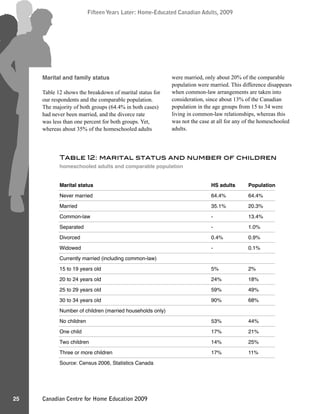
Table 12 shows the breakdown of marital status for
our respondents and the comparable population.
The majority of both groups (64.4% in both cases)
had never been married, and the divorce rate
was less than one percent for both groups. Yet,
whereas about 35% of the homeschooled adults
were married, only about 20% of the comparable
population were married. This difference disappears
when common-law arrangements are taken into
consideration, since about 13% of the Canadian
population in the age groups from 15 to 34 were
living in common-law relationships, whereas this
was not the case at all for any of the homeschooled
adults.
Table 12: marital status and number of children
homeschooled adults and comparable population
Marital status HS adults Population
Never married 64.4% 64.4%
Married 35.1% 20.3%
Common-law - 13.4%
Separated - 1.0%
Divorced 0.4% 0.9%
Widowed - 0.1%
Currently married (including common-law)
15 to 19 years old 5% 2%
20 to 24 years old 24% 18%
25 to 29 years old 59% 49%
30 to 34 years old 90% 68%
Number of children (married households only)
No children 53% 44%
One child 17% 21%
Two children 14% 25%
Three or more children 17% 11%
Source: Census 2006, Statistics Canada
Fifteen Years Later: Home-Educated Canadian Adults, 2009Fifteen Years Later: Home-Educated Canadian Adults, 2009
26Canadian Centre for Home Education 2009
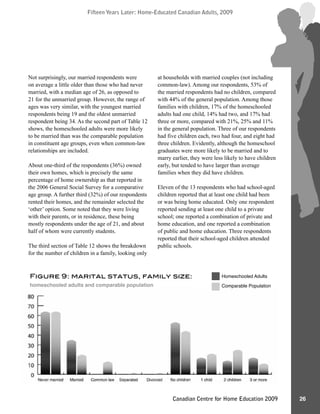
Not surprisingly, our married respondents were
on average a little older than those who had never
married, with a median age of 26, as opposed to
21 for the unmarried group. However, the range of
ages was very similar, with the youngest married
respondents being 19 and the oldest unmarried
respondent being 34. As the second part of Table 12
shows, the homeschooled adults were more likely
to be married than was the comparable population
in constituent age groups, even when common-law
relationships are included.
About one-third of the respondents (36%) owned
their own homes, which is precisely the same
percentage of home ownership as that reported in
the 2006 General Social Survey for a comparative
age group. A further third (32%) of our respondents
rented their homes, and the remainder selected the
‘other’ option. Some noted that they were living
with their parents, or in residence, these being
mostly respondents under the age of 21, and about
half of whom were currently students.
The third section of Table 12 shows the breakdown
for the number of children in a family, looking only
at households with married couples (not including
common-law). Among our respondents, 53% of
the married respondents had no children, compared
with 44% of the general population. Among those
families with children, 17% of the homeschooled
adults had one child, 14% had two, and 17% had
three or more, compared with 21%, 25% and 11%
in the general population. Three of our respondents
had five children each, two had four, and eight had
three children. Evidently, although the homeschool
graduates were more likely to be married and to
marry earlier, they were less likely to have children
early, but tended to have larger than average
families when they did have children.
Eleven of the 13 respondents who had school-aged
children reported that at least one child had been
or was being home educated. Only one respondent
reported sending at least one child to a private
school; one reported a combination of private and
home education, and one reported a combination
of public and home education. Three respondents
reported that their school-aged children attended
public schools.
Figure 9: marital status, family size:
homeschooled adults and comparable population
Homeschooled Adults
Comparable Population
Canadian Centre for Home Education 2009
Fifteen Years Later: Home-Educated Canadian Adults, 2009
27
Fifteen Years Later: Home-Educated Canadian Adults, 2009
Family Background
Parental education and occupation
Focusing on the 128 different families of our
respondents, we asked several questions about
family background, beginning with the level of
education attained by their parents. While it was
by no means universal, the majority of parents had
some postsecondary education, and there was a
slight tendency for fathers to be somewhat more
qualified than mothers.
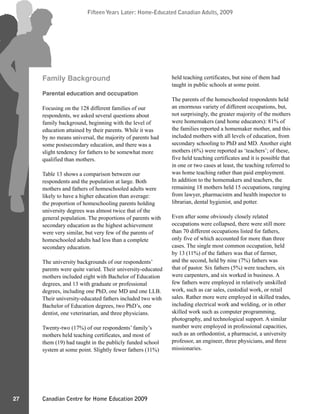
Table 13 shows a comparison between our
respondents and the population at large. Both
mothers and fathers of homeschooled adults were
likely to have a higher education than average:
the proportion of homeschooling parents holding
university degrees was almost twice that of the
general population. The proportions of parents with
secondary education as the highest achievement
were very similar, but very few of the parents of
homeschooled adults had less than a complete
secondary education.
The university backgrounds of our respondents’
parents were quite varied. Their university-educated
mothers included eight with Bachelor of Education
degrees, and 13 with graduate or professional
degrees, including one PhD, one MD and one LLB.
Their university-educated fathers included two with
Bachelor of Education degrees, two PhD’s, one
dentist, one veterinarian, and three physicians.
Twenty-two (17%) of our respondents’ family’s
mothers held teaching certificates, and most of
them (19) had taught in the publicly funded school
system at some point. Slightly fewer fathers (11%)
held teaching certificates, but nine of them had
taught in public schools at some point.
The parents of the homeschooled respondents held
an enormous variety of different occupations, but,
not surprisingly, the greater majority of the mothers
were homemakers (and home educators): 81% of
the families reported a homemaker mother, and this
included mothers with all levels of education, from
secondary schooling to PhD and MD. Another eight
mothers (6%) were reported as ‘teachers’; of these,
five held teaching certificates and it is possible that
in one or two cases at least, the teaching referred to
was home teaching rather than paid employment.
In addition to the homemakers and teachers, the
remaining 18 mothers held 15 occupations, ranging
from lawyer, pharmacistm and health inspector to
librarian, dental hygienist, and potter.
Even after some obviously closely related
occupations were collapsed, there were still more
than 70 different occupations listed for fathers,
only five of which accounted for more than three
cases. The single most common occupation, held
by 13 (11%) of the fathers was that of farmer,
and the second, held by nine (7%) fathers was
that of pastor. Six fathers (5%) were teachers, six
were carpenters, and six worked in business. A
few fathers were employed in relatively unskilled
work, such as car sales, custodial work, or retail
sales. Rather more were employed in skilled trades,
including electrical work and welding, or in other
skilled work such as computer programming,
photography, and technological support. A similar
number were employed in professional capacities,
such as an orthodontist, a pharmacist, a university
professor, an engineer, three physicians, and three
missionaries.
Fifteen Years Later: Home-Educated Canadian Adults, 2009Fifteen Years Later: Home-Educated Canadian Adults, 2009
28Canadian Centre for Home Education 2009
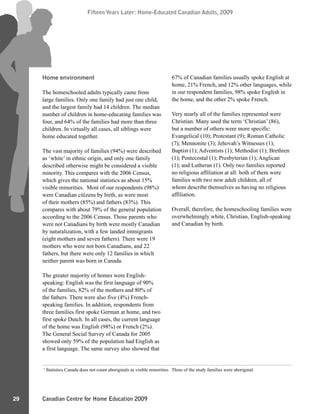
Table 13: parents’ levels of education
homeschooled adults and comparable population
Level of Education HS Adults Population
Highest Level Father Mother Father Mother
University degree 50% 41% 27% 22%
Community College diploma 17% 25% 17% 18%
Some postsecondary 9% 1% 8% 10%
Secondary school diploma 22% 32% 28% 33%
Less than secondary 2% 2% 20% 17%
General Social Survey, 2006
Comparisons between the occupations of
homeschooled adults’ parents and those of the
population at large using the Standard Occupational
Classification (1991) present a difficulty. The
occupations of mothers cannot be compared,
since the official classification does not include
‘homemaker’ and therefore excludes most of
our cases. With respect to the occupations of
fathers, the data are too generalized to offer much
meaningful comparison, other than to say that the
fathers of homeschooled adults were more likely to
be occupied in social support types of employment
such as education and religion, and less likely to
be occupied in sales and service, or manufacturing
employment.
Figure 10: parents’ levels
of education
homeschooled adults and comparable population
Homeschool Mothers Comparable Mothers
Comparable FathersHomeschool Fathers
�
��
��
��
��
��
�
��
��
��
��
��
����������� ��������� ������������� ������� ����������
Canadian Centre for Home Education 2009
Fifteen Years Later: Home-Educated Canadian Adults, 2009
29
Fifteen Years Later: Home-Educated Canadian Adults, 2009
Home environment
The homeschooled adults typically came from
large families. Only one family had just one child,
and the largest family had 14 children. The median
number of children in home-educating families was
four, and 64% of the families had more than three
children. In virtually all cases, all siblings were
home educated together.
The vast majority of families (94%) were described
as ‘white’ in ethnic origin, and only one family
described otherwise might be considered a visible
minority. This compares with the 2006 Census,
which gives the national statistics as about 15%
visible minorities. Most of our respondents (98%)
were Canadian citizens by birth, as were most
of their mothers (85%) and fathers (83%). This
compares with about 79% of the general population
according to the 2006 Census. Those parents who
were not Canadians by birth were mostly Canadian
by naturalization, with a few landed immigrants
(eight mothers and seven fathers). There were 19
mothers who were not born Canadians, and 22
fathers, but there were only 12 families in which
neither parent was born in Canada.
The greater majority of homes were English-
speaking: English was the first language of 90%
of the families, 82% of the mothers and 80% of
the fathers. There were also five (4%) French-
speaking families. In addition, respondents from
three families first spoke German at home, and two
first spoke Dutch. In all cases, the current language
of the home was English (98%) or French (2%).
The General Social Survey of Canada for 2005
showed only 59% of the population had English as
a first language. The same survey also showed that
67% of Canadian families usually spoke English at
home, 21% French, and 12% other languages, while
in our respondent families, 98% spoke English in
the home, and the other 2% spoke French.
Very nearly all of the families represented were
Christian. Many used the term ‘Christian’ (86),
but a number of others were more specific:
Evangelical (10); Protestant (9); Roman Catholic
(7); Mennonite (3); Jehovah’s Witnesses (1);
Baptist (1); Adventists (1); Methodist (1); Brethren
(1); Pentecostal (1); Presbyterian (1); Anglican
(1); and Lutheran (1). Only two families reported
no religious affiliation at all: both of them were
families with two now adult children, all of
whom describe themselves as having no religious
affiliation.
Overall, therefore, the homeschooling families were
overwhelmingly white, Christian, English-speaking
and Canadian by birth.
1
Statistics Canada does not count aboriginals as visible minorities. Three of the study families were aboriginal.
Fifteen Years Later: Home-Educated Canadian Adults, 2009Fifteen Years Later: Home-Educated Canadian Adults, 2009
30Canadian Centre for Home Education 2009
Home education experience
Province
Most of the respondents (85%) still lived in the
province in which they had received their home
education. The largest group (36%) lived in Ontario
when they were home educated and the second
largest group (26%) lived in Alberta. A smaller
group (14%) lived in British Columbia, and a few
lived in Manitoba (2%), New Brunswick (1%),
Nova Scotia (1%), Quebec (4%) or Saskatchewan
(8%). Eighteen respondents (8%) reported living
in two or more different provinces during their
homeschooling years.
Duration and grades covered
Although there were many respondents who were
homeschooled for periods as short as a single year,
the typical pattern of homeschooling covered the
entire period from the ages of 5 to 18. The median
number of years spent in homeschooling between
the ages of 5 and 18 was 11 years, and the average
was 9.9 years with a standard deviation of 2.9, but
the mode was 12 or 13 years, reported by 42% of
the respondents, who also told us that they had
never attended either a private or a public school at
all.
������
�������
��������
��������
���������
�����������
�����������
������������
0 10 20 30 40 50
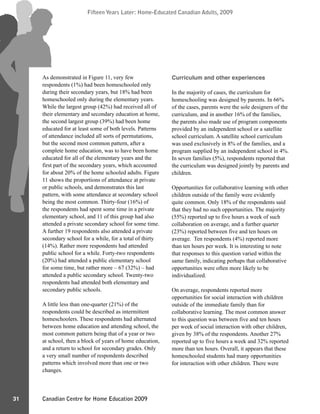
Figure 11: school experiences
homeschooled adults
Canadian Centre for Home Education 2009
Fifteen Years Later: Home-Educated Canadian Adults, 2009
31
Fifteen Years Later: Home-Educated Canadian Adults, 2009
As demonstrated in Figure 11, very few
respondents (1%) had been homeschooled only
during their secondary years, but 18% had been
homeschooled only during the elementary years.
While the largest group (42%) had received all of
their elementary and secondary education at home,
the second largest group (39%) had been home
educated for at least some of both levels. Patterns
of attendance included all sorts of permutations,
but the second most common pattern, after a
complete home education, was to have been home
educated for all of the elementary years and the
first part of the secondary years, which accounted
for about 20% of the home schooled adults. Figure
11 shows the proportions of attendance at private
or public schools, and demonstrates this last
pattern, with some attendance at secondary school
being the most common. Thirty-four (16%) of
the respondents had spent some time in a private
elementary school, and 11 of this group had also
attended a private secondary school for some time.
A further 19 respondents also attended a private
secondary school for a while, for a total of thirty
(14%). Rather more respondents had attended
public school for a while. Forty-two respondents
(20%) had attended a public elementary school
for some time, but rather more – 67 (32%) – had
attended a public secondary school. Twenty-two
respondents had attended both elementary and
secondary public schools.
A little less than one-quarter (21%) of the
respondents could be described as intermittent
homeschoolers. These respondents had alternated
between home education and attending school, the
most common pattern being that of a year or two
at school, then a block of years of home education,
and a return to school for secondary grades. Only
a very small number of respondents described
patterns which involved more than one or two
changes.
Curriculum and other experiences
In the majority of cases, the curriculum for
homeschooling was designed by parents. In 66%
of the cases, parents were the sole designers of the
curriculum, and in another 16% of the families,
the parents also made use of program components
provided by an independent school or a satellite
school curriculum. A satellite school curriculum
was used exclusively in 8% of the families, and a
program supplied by an independent school in 4%.
In seven families (5%), respondents reported that
the curriculum was designed jointly by parents and
children.
Opportunities for collaborative learning with other
children outside of the family were evidently
quite common. Only 18% of the respondents said
that they had no such opportunities. The majority
(55%) reported up to five hours a week of such
collaboration on average, and a further quarter
(23%) reported between five and ten hours on
average. Ten respondents (4%) reported more
than ten hours per week. It is interesting to note
that responses to this question varied within the
same family, indicating perhaps that collaborative
opportunities were often more likely to be
individualized.
On average, respondents reported more
opportunities for social interaction with children
outside of the immediate family than for
collaborative learning. The most common answer
to this question was between five and ten hours
per week of social interaction with other children,
given by 38% of the respondents. Another 27%
reported up to five hours a week and 32% reported
more than ten hours. Overall, it appears that these
homeschooled students had many opportunities
for interaction with other children. There were
Fifteen Years Later: Home-Educated Canadian Adults, 2009Fifteen Years Later: Home-Educated Canadian Adults, 2009
32Canadian Centre for Home Education 2009
40 respondents (18%) who reported no social
contact with other children, but only eight of these
had also reported no collaborative opportunities.
Furthermore, in several of these cases, other
children in the same family reported several hours
a week of such opportunities, indicating that, while
one of the children might not have perceived many
opportunities to interact, the families themselves
were not isolated. Indeed, it appears quite evident
that these homeschooled children and their families
were most certainly not isolated in any sense.
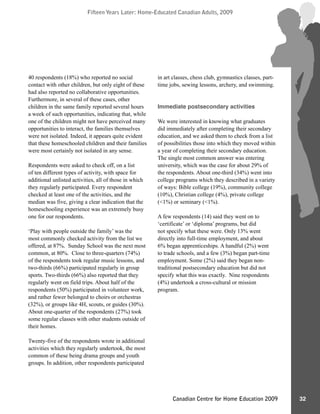
Respondents were asked to check off, on a list
of ten different types of activity, with space for
additional unlisted activities, all of those in which
they regularly participated. Every respondent
checked at least one of the activities, and the
median was five, giving a clear indication that the
homeschooling experience was an extremely busy
one for our respondents.
‘Play with people outside the family’ was the
most commonly checked activity from the list we
offered, at 87%. Sunday School was the next most
common, at 80%. Close to three-quarters (74%)
of the respondents took regular music lessons, and
two-thirds (66%) participated regularly in group
sports. Two-thirds (66%) also reported that they
regularly went on field trips. About half of the
respondents (50%) participated in volunteer work,
and rather fewer belonged to choirs or orchestras
(32%), or groups like 4H, scouts, or guides (30%).
About one-quarter of the respondents (27%) took
some regular classes with other students outside of
their homes.
Twenty-five of the respondents wrote in additional
activities which they regularly undertook, the most
common of these being drama groups and youth
groups. In addition, other respondents participated
in art classes, chess club, gymnastics classes, part-
time jobs, sewing lessons, archery, and swimming.
Immediate postsecondary activities
We were interested in knowing what graduates
did immediately after completing their secondary
education, and we asked them to check from a list
of possibilities those into which they moved within
a year of completing their secondary education.
The single most common answer was entering
university, which was the case for about 29% of
the respondents. About one-third (34%) went into
college programs which they described in a variety
of ways: Bible college (19%), community college
(10%), Christian college (4%), private college
(<1%) or seminary (<1%).
A few respondents (14) said they went on to
‘certificate’ or ‘diploma’ programs, but did
not specify what these were. Only 13% went
directly into full-time employment, and about
6% began apprenticeships. A handful (2%) went
to trade schools, and a few (3%) began part-time
employment. Some (2%) said they began non-
traditional postsecondary education but did not
specify what this was exactly. Nine respondents
(4%) undertook a cross-cultural or mission
program.
Canadian Centre for Home Education 2009
Fifteen Years Later: Home-Educated Canadian Adults, 2009
33
Fifteen Years Later: Home-Educated Canadian Adults, 2009
Reasons for choosing home education
• 186 (83%) The belief that a child receives a better education at home
• 149 (66%) A poor learning environment in the school
• 66 (29%) A lack of challenge at school
Religious and moral reasons also were indicated by three-quarters of the respondents:
• 184 (82%) A better environment for developing character and morality
• 169 (75%) Religious reasons
• 153 (68%) To teach a particular worldview, set of beliefs, and values
• 146 (65%) An objection to what was being taught in schools
Less common, but still quite frequent, were reasons which are family specific:
• 118 (52%) A desire for more parent-child contact
• 92 (41%) A belief that parents are the best educators of their children
• 80 (36%) A desire for more sibling-sibling contact
• 66 (29%) Family reasons
Focus on the child’s individual academic potentials, interests, and needs also was
indicated by more than one-third of the respondents:
• 96 (43%) In order to individualize the curriculum
• 80 (36%) In order to individualize the learning environment
Social reasons were mentioned by about one-fifth of the respondents:
• 51 (23%) A desire to closely supervise social interactions
• 37 (16%) Social and/or behavioural problems in the school
Reasons for choosing home education
A list of 22 possible reasons for choosing
homeschooling was offered and respondents were
asked to check those which applied. Most checked
several answers. Only one respondent checked a
single reason, and quite a few checked more than
ten. The median number of reasons checked was
eight, ranging upwards to 16.
There was considerable agreement on the main
reasons, with the desire for a better education at
the very top of the list in terms of most frequently
selected:
Fifteen Years Later: Home-Educated Canadian Adults, 2009Fifteen Years Later: Home-Educated Canadian Adults, 2009
34Canadian Centre for Home Education 2009
• 16 (7%) Wanted a private education but could not afford private school
• 10 (4%) For safety reasons
• 9 (4%) Special needs / disabilities not being met in school
• 9 (4%) Transportation / distance problems
• 6 (3%) Parent’s career
• 5 (2%) A temporary illness
• 1 (<1%) Could not get into a preferred school
Finally, the least chosen reasons seem to be those
that are more family specific, and do seem to
challenge some of the more obvious expectations.
Very few, it seems, chose homeschooling because
of a parent’s career or because of an illness. Very
few families were concerned about safety which,
in another context (Van Pelt, Allison and Allison,
2007), was found to be a very common reason for
choosing private schooling over public schooling.
Space was provided for respondents to write
in reasons which they felt were not adequately
covered in the list. In all, 29 respondents indicated
another reason, although in many cases they were
amplifications of reasons already checked in the
list provided. These items were noted by no more
than four respondents each, and topics mentioned
in addition to those listed above included child’s
preference, health and safety reasons, slow or
stifling academic progress in school, freedom and
flexibility, bullied in school, wanted an English
education in Quebec, parents’ negative experience
in school, good pace, and time for extra-curricular
activities.
Single most important reason for being
home educated
Given that so many reasons were possible, we
thought it would be valuable to ask respondents
what was the single most important reason for the
choice of homeschooling. Respondents expressed
the main reason in many different ways, but it
is possible to reduce them to essentially four
categories: educational reasons, religious reasons,
family reasons, and other, large idiosyncratic,
reasons. Educational reasons were by far the most
commonly given main reasons, with 111 variations,
for 53% of the responses.
59 gave the main reason as providing a better,
or the best, educational environment, including
academic and social factors, as well as the
formation of character and morality.
25 had a problem with the public school
environment, either in general or with respect
to specific local schools; often there was a
particular objection to the school curriculum
and/or the values espoused in the public
system.
•
•
Canadian Centre for Home Education 2009
Fifteen Years Later: Home-Educated Canadian Adults, 2009
35
Fifteen Years Later: Home-Educated Canadian Adults, 2009
six chose homeschooling primarily because
it allowed them to pursue a particular
approach to education: “To grow naturally
as God intended”; “To promote wonder and
questioning”; “Wanted us to love learning”; “To
tailor education to abilities”; “To use different
modes of education”; “Positive interactive
learning”; “More emphasis on basics.”
six felt that the education provided in schools is
too boring, wastes too much time, offers little
challenge, and is too limiting: “School teaches
colouring inside the lines.”
six quite simply believed that parents were
better equipped to teach their children.
five considered that home education gave
scope to follow a better curriculum and to
individualize curriculum.
two noted social problems at school as the main
reason for choosing home education.
two gave very individual academic problems:
“I didn’t learn well in school”; “My grades
dropped in junior high.”
The second most common main reason was one of
a religious nature. Sixty-five of the responses (31%)
could be categorized this way. Many respondents
gave only a single word answer, but some expanded
upon this point.
55 either cited “Religion” in general or referred
specifically to teaching a Biblical and/or
Christian perspective, worldview, or values.
five said their parents wanted to keep them
“away from sin”, “out of the world” or
“removed from secular influence”.
Three gave the main reason as a desire
to provide a specifically Roman Catholic
education. All three of these families were in
provinces which have publicly-funded Roman
Catholic schools systems.
two families regarded it as God’s mandate to
parents to educate their children.
Family reasons accounted for only 21 (10%)
responses. Here, the main reasons for home
education were given as providing more parent and
child contact, more sibling contact, more family
time, and/or more opportunities for family bonding.
Five respondents merely said that it was parental
preference, without further specifics, and three gave
the main reason as ensuring that parents would
be the primary influence on their children. One
expressed this as “So as not to give children’s day
to strangers.”
In addition, there were 13 (6%) very idiosyncratic
main reasons. These included two who cited
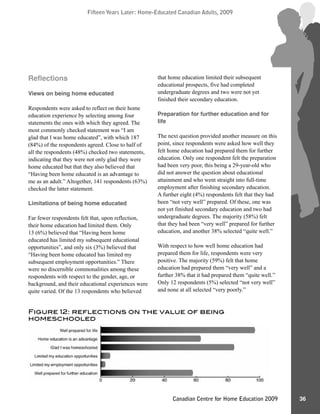
“safety” but without details, one student who was
“Kicked out of independent school”, one with
transportation problems, and one who “Could not
afford private school.”
Thus educational reasons, religious reasons, family
reasons, and finally a variety of idiosyncratic
reasons were reported as motivation for the parents
of the respondents to home educate.
•
•
•
•
•
•
•
•
•
•
Fifteen Years Later: Home-Educated Canadian Adults, 2009Fifteen Years Later: Home-Educated Canadian Adults, 2009
36Canadian Centre for Home Education 2009
Reflections
Views on being home educated
Respondents were asked to reflect on their home
education experience by selecting among four
statements the ones with which they agreed. The
most commonly checked statement was “I am
glad that I was home educated”, with which 187
(84%) of the respondents agreed. Close to half of
all the respondents (48%) checked two statements,
indicating that they were not only glad they were
home educated but that they also believed that
“Having been home educated is an advantage to
me as an adult.” Altogether, 141 respondents (63%)
checked the latter statement.
Limitations of being home educated
Far fewer respondents felt that, upon reflection,
their home education had limited them. Only
13 (6%) believed that “Having been home
educated has limited my subsequent educational
opportunities”, and only six (3%) believed that
“Having been home educated has limited my
subsequent employment opportunities.” There
were no discernible commonalities among these
respondents with respect to the gender, age, or
background, and their educational experiences were
quite varied. Of the 13 respondents who believed
that home education limited their subsequent
educational prospects, five had completed
undergraduate degrees and two were not yet
finished their secondary education.
Preparation for further education and for
life
The next question provided another measure on this
point, since respondents were asked how well they
felt home education had prepared them for further
education. Only one respondent felt the preparation
had been very poor, this being a 29-year-old who
did not answer the question about educational
attainment and who went straight into full-time
employment after finishing secondary education.
A further eight (4%) respondents felt that they had
been “not very well” prepared. Of these, one was
not yet finished secondary education and two had
undergraduate degrees. The majority (58%) felt
that they had been “very well” prepared for further
education, and another 38% selected “quite well.”
With respect to how well home education had
prepared them for life, respondents were very
positive. The majority (59%) felt that home
education had prepared them “very well” and a
further 38% that it had prepared them “quite well.”
Only 12 respondents (5%) selected “not very well”
and none at all selected “very poorly.”
Figure 12: reflections on the value of being
homeschooled
Canadian Centre for Home Education 2009
Fifteen Years Later: Home-Educated Canadian Adults, 2009
37
Fifteen Years Later: Home-Educated Canadian Adults, 2009
Best part about being home educated
Respondents were asked what they felt was the
“best part about being home educated”. A total of
216 answers were submitted to this open-ended
question. Home-educated adults reported that
they felt the best part about being homeschooled
included the rich relational aspects, the opportunity
for extensive curricular enrichment, the
flexibility especially in terms of the schedule, the
individualized pace and programs, the development
of their own independence and confidence, and
the superior education received. The number
and types of responses in each category are
listed in Table 14. In summary, it was these six
features—relationships, enrichment, flexibility,
individualization, independence, and superior
academics—that home-educated adults found best
about their education.
Worst part about being home educated
When asked what they felt “was the worst part
about being home educated” a total of 208
respondents provided an answer. More than one-
third mentioned an aspect of the social challenges
of being home educated. These comments ranged
from simple reflections such as “I feel I could have
had more social interaction” to more angst filled
ones such as “[I was] so different from others my
age and [felt] somewhat awkward”. More than one-
fifth indicated that their curriculum was limited in
some manner, particularly in terms of sports. More
than one-sixth mentioned the difficulties of living
with societal stereotypes towards their education
including those embedded in postsecondary
institutional policies. “People [were] always
watching, looking for something wrong” said one.
“[People asking] ignorant or judgmental questions”,
said another. More than one-tenth mentioned the
difficulties adjusting later to the expectations of
education provided in classroom settings. More
than one-tenth also mentioned their concerns about
how home education may have strained their family
relationships. Several (n=12) were concerned
that on occasion boredom or lack of motivation
set in, and almost as many (n=11) mentioned
that the worst part of being home educated was
the lack of snow days or P.D. days, or the irritant
of having a slow internet connection. Table 15
lists the number of time items in each category
were noted. In summary, while in no case did the
majority of respondents agree on any specific
challenge, in order of most commonly noted, the
worst part of being home educated included the
social challenges, curricular limitations, societal
prejudice, later adaptation to classroom settings,
and possible strains on family.
Fifteen Years Later: Home-Educated Canadian Adults, 2009Fifteen Years Later: Home-Educated Canadian Adults, 2009
38Canadian Centre for Home Education 2009
Table 14: best part about being home educated
n
Relational
Build deeper relationships with family and with friends 64
Enriched curriculum
Developed and pursued a variety of interests, hobbies, and perspectives within 60
and beyond the usual school curriculum including gardening, farming, forestry,
household management, reading/literary exposure, music, art, and religious integration
Flexibility of schedule
Ability to travel, take time off, sleep in, play more; participate in several schools 50
simultaneously, run businesses, hold jobs, volunteer
Individualized pace
Could proceed at own pace, not held back by class, could use time efficiently, 48
did not have to wait for others
Individualized program
Individualized attention, individualized curriculum, one-on-one instruction 35
Developed independent approach to learning
Develop independence in learning, self-directed learner, love for learning 34
Developed independence
Develop independence, confidence, maturity, goal-oriented attitude, work ethic, 33
develop as an individual with solid values
Superior education
High standards, superior education, able to be accelerated when back to school, 16
better understanding than when attended school
Social freedom
Freedom from bullying, teasing, and peer pressure 12
Other
Other miscellaneous factors such as creating a home culture of learning, low stress 25
environment, eating lunch at home, no grades, no homework, provided a good foundation
for life and career, and provided unique learning opportunities, experiences and approaches
Canadian Centre for Home Education 2009
Fifteen Years Later: Home-Educated Canadian Adults, 2009
39
Fifteen Years Later: Home-Educated Canadian Adults, 2009
Table 15: worst part about being home educated
n
Social challenges
Such as being excluded by others, developing poor social graces, feeling isolated 77
from peers, having limited social interaction, having little opportunity to meet diverse
peers, being lonely, still feeling like an outsider, didn’t or still don’t fit, missed
exposure to opposite gender
Curricular limitations and concerns
Lack of sports or team participation 23
Lack of specialized classes such as computers, various extra-curriculars, 8
international baccalaureate and advanced placement courses, co-operative
education, and peer tutoring
Lack of science laboratories and math program deficiencies 7
Poor French or second language learning 3
Curriculum became too similar over time, kept changing, poor, arrived late 6
Living with hurtful societal and academic institutional stereotypes
Being stereotyped by others 19
Lack of Grade 12 certification, trouble entering postsecondary due to accreditation 13
anomalies
Later adjustment to classroom-based education
Difficulty adjusting to expectations of classroom-based education later (such as 28
meeting due dates, working in groups, meeting demands of others, general
adjustment troubles, not used to being compared to others)
Parental / Familial Concerns
Strained relationship with mother or with both parents, too much sibling contact, parents 26
too controlling, expected to be like family, parents were a limiting educational factor
Motivation
Lacking in motivation, being bored, felt they were home too much 12
Irritants
No snow days, no days off due to teacher professional development days, slow internet 11
No concerns
The education provided good preparation 15
Fifteen Years Later: Home-Educated Canadian Adults, 2009Fifteen Years Later: Home-Educated Canadian Adults, 2009
40Canadian Centre for Home Education 2009
Opportunity for socialization with other
children
Respondents were presented with the statement
“A common criticism of home education is that
children have too few opportunities for socialization
with other children” and were asked “to what extent
was this the case in your experience?” Fully 214
respondents commented. The vast majority said
this was not the case for them; 150 claimed that
they had plenty of opportunities for socializing
with other children. One, for example, stated “In
my experience [my siblings and I] had ample
opportunity for socialization with other children.
Between homeschooling group activities (such
as art lessons, soccer, swimming lessons), piano
and voice lessons, choir, guitar, cello and violin
lessons and activities in the parish, we had a great
deal of socialization”. Another stated “To no extent
[was this the case]. I was schooled at home, I was
not dead. There were kids in the neighbourhood,
other homeschool kids. Depending on what is
meant by socialization, I received a wide variety
of socialization [opportunities] that extended well
beyond my peer group”. Another stated, “I feel
that I had a very social childhood, interacting with
all kinds of groups of people.” Yet, at least 41
respondents were a little ambivalent, saying it may
have been slightly or somewhat accurate to their
situation, or “not too much of an issue”. One such
respondent said, “my social contact was less [than
others], though my parents did ensure that we had
as much social interaction as possible. With a lot of
what goes on at schools, I don’t think having less
social interaction was at all a bad thing”. One said,
“I didn’t feel poorly socialized, but I would have
enjoyed more time with peers”. Others, a total of
23, were more definitive, claiming that the criticism
was most certainly the case in their situation. One
stated, “Very much so. Most of my friends lived in
other areas of town and I wasn’t very close with
anyone in my neighbourhood”. Another reflected:
“It was true and when given chances to interact I
was generally too shy because I didn’t know how to
act”.
Several respondents offered additional comments
or thoughts about their socialization. Even though
they felt the criticism about lack of contact with
other children was not accurate for their case,
upon evaluation did opine about the possible
social influences of being home educated. One
very strong comment makes the point here. “This
was not the case for me [that I lacked contact with
other children]. Also, I believe that this is a bullshit
[sic] criticism usually only proposed by people
who know relatively little about homeschooling.
However, I do find that as an adult I don’t tend to
go out and seek social interaction. If I could just
stay in my house with my husband that would
be ideal [for me]”. Another said, “I had plenty of
opportunities to socialize (within my own peer
group and other age groups)” and yet went on to
comment “I do wonder if I might have developed
more guy friendships sooner in a private [or] public
school setting.” One stated, “My parents made the
effort to bring me to as many social events with
my peers as possible, but I found that there was
a lot of adjustment necessary in order to ‘fit in’
upon entering public high school. It took me half
a year to get the hang of it; then everything was
fine.” In contrast, others claimed that the concern
about too few opportunities for socialization with
other children was accurate, and yet felt that this
contributed to a healthier social life. “Yes, it’s true”
stated one respondent. “It is [also] true that this is
not the end of the world though. I am remarkably
well adjusted and very good in social situations.
Also, I was better at communicating with adults
as a child than most children, which I consider a
bonus.”
Canadian Centre for Home Education 2009
Fifteen Years Later: Home-Educated Canadian Adults, 2009
41
Fifteen Years Later: Home-Educated Canadian Adults, 2009
Additional respondent reflections
A total of 142 respondents accepted the invitation
to answer the last question on the survey “is there
anything else you would like us to know about your
home education experience and/or its effect on your
life?” The comments were wide ranging, generally
provided a little more detail, although none were
more than four or five sentences in length, most
being less than the previous open-ended questions
on the survey. Many of the comments invoked
themes similar to those discussed in the earlier
open-ended responses, but perhaps discussed
only for the first time by the particular respondent
making the comment.
When the comments were considered all together,
they addressed more themes than the earlier
questions, with fewer respondents addressing
any one particular theme. The major themes
addressed in the comments included the excellent
preparation the home education provided for further
classroom-based education (whether in elementary,
secondary, or tertiary institutions), the development
of independence and initiative, appreciation for
the opportunity to be home educated and for the
dedication of their parents, the social and familial
advantages of home education, the individualized
program, the moral and/or religious aspect of the
education, the enriched education received, and the
influence of home education on future careers and
thinking skills. As indicated in Table 16 below, a
number of respondents commented on the societal
prejudice they felt while being home educated and
the difficulties they encountered when applying
for tertiary education. Others commented on their
intention to home educate or their current practice
of home educating their own children. A small
minority offered some hints at their very negative
feelings and opinions of their home education. A
comment in this section “I would not wish this
experience on anyone” provided a heart-rending
antithesis to the comment of another who said
“those were the best days of my life”.
Table 16: additional comments and reflections
n
Excellent preparation for further education
Very good / excellent academic preparation, well prepared for college, had an academic or 36
educational advantage over peers
Development of independence and initiative
Independence, learning to learn, learn on own, self-reliance, more mature, self-motivated, 36
good work ethic, responsible, confidence, perseverance developed life-long passion for
learning, self-starter, intrinsically motivated
Appreciation for their home education and for mother’s / parents’ dedication
Very grateful, thankful for their home education, mother / parents were dedicated, made 29
homeschooling a priority, well-balanced, educated, wise, had best interest of child in mind,
created structure
Fifteen Years Later: Home-Educated Canadian Adults, 2009Fifteen Years Later: Home-Educated Canadian Adults, 2009
42Canadian Centre for Home Education 2009
Table 16: additional comments and reflections (cont.)
Social advantages
Better social skills, better friendships, better social life, value relationships, able to lead 16
Familial relationships
Close to family, teach younger siblings 14
Individualized program
Own pace, early start, head start, early maturity, own terms, one-on-one, able to get ahead 13
Development of values and faith
Develop strong values, morals, spirituality, faith, beliefs 11
Enriched education
Became well-rounded, more skills, more time outdoors, more experiences, more time with 11
music, more travel, wide variety of interests and knowledge
Career connection
Influence on career, on career choice, on career path, opened many doors 8
Thinking skills developed
Critical thinking, creative thinking, problem solving, analytical thinking 7
Prejudice encountered
Prejudice / Stereotypes faced 7
Difficulty entering postsecondary 5
Intention to home educate own children
Would home educate own children 18
Would not home educate own children 1
Not sure if would home educate own children 4
Would encourage others to give home education a try but only if parents and children want to 3
Concerns and criticisms
Not for everyone 4
Good only in early grades 3
Very negative experience, brainwashed by parents 2
Limitations – limited labs, math, French, sports, group participation 2
Difficult to transition to classroom 2
Canadian Centre for Home Education 2009
Fifteen Years Later: Home-Educated Canadian Adults, 2009
43
Fifteen Years Later: Home-Educated Canadian Adults, 2009
Table 16: additional comments and reflections (cont.)
Difficult to transition to real world 1
Wouldn’t wish it on anyone 1
Not enough career focus 1
Parents should not take the responsibility for their children’s education 1
Didn’t work as well for my siblings 1
Is it too sheltering? 1
Struggled socially for a while 1
Limitations – not enough exposure to different people 1
Was it simply my IQ? my parents’ IQ that made it successful? 1
Other comments
Good enough, has some pros and cons 5
Sheltered from problems of school, secure environment, imaginative time, carefree childhood 4
Enjoyed being HS, would not change a thing 4
Organized / disciplined 2
Some home education and some school attendance is the best combination 2
Didn’t miss out academically or socially 1
No stress, low stress 1
Shocked later at behaviour of public school students 1
Became more open-minded 1
Later workforce, travel, university provided exposure HS did not 1
Better prepared for life than peers 1
Future research should consider K-8 vs 9-12 home education 1
Thus the reflections offered by the respondents
provide a window into some of the strengths
and weaknesses of home education as perceived
by participants in home education. Based on
the reflections of home-educated students, the
strengths of home education include relationships,
enrichment, flexibility, program individualization,
development of independence and initiative,
excellent academic preparation, and development
of values and religious beliefs. The weaknesses
according to these adults include social challenges,
curricular limitations, societal prejudice, later
adaptation to classroom settings, and possible
strains on the family.
Fifteen Years Later: Home-Educated Canadian Adults, 2009Fifteen Years Later: Home-Educated Canadian Adults, 2009
44Canadian Centre for Home Education 2009
The findings of this study address the
characteristics, demographics, and views of
adults who were home educated. Comparison
data for adults who were not home educated
provides a window into assessing the strengths and
weaknesses of home education. The evaluative
views and reflections of the adults also contribute to
our understanding of the strengths and weaknesses
of homeschooling, and provide opportunity
for improving and enhancing this educational
approach. The consideration of the reasons for
home education in comparison to the participants’
views on the best and worst part of home education
provides opportunity for considering the question of
motivations for and outcomes of home education.
Current characteristics of
homeschooled adults compared
to Canadian peers
In terms of their highest level of education attained
when compared to the general population, the
formerly home-educated students attain higher
levels. Their occupations are more oriented to
health, to social services such as education,
religious, and government, to arts and culture, and
to participation in trades and transportation than
the comparable population, and less oriented to
sales and service, and natural and applied sciences.
They are equally engaged in business, finance, and
administration. They are much more likely to be
civically engaged and to vote in federal, provincial,
and municipal elections. Their religious affiliation
and observance tends to be high, and their
charitable donations tend to be oriented to religious
obligations or beliefs. Their income tends to be
slightly higher than that of their peers and none
rely on government payments as their main source
of income. Their life satisfaction is higher than
that of their peers. They are more physically and
recreationally active, and more engaged in culture
and the arts than their peers. They are more likely
to be married and to marry earlier than their peers,
less likely to have children early but when they do,
they tend to have larger families than their peers.
They come from homes where their parents have a
higher academic education and are more religious
than their peers’ parents..
These findings are consistent with those Ray
(2004) found in his study of 5,254 Americans
(home educated for seven or more years of their
K-12 education) in terms of the demographic
characteristics of the adults such as education
achieved and civic engagement. He summarized his
findings thus:
The home-educated adults in this study were
very positive about having been homeschooled
and toward homeschooling in general, actively
engaged in their local communities, keeping
abreast of current affairs, highly civically involved,
tolerant of others expressing their viewpoints,
attaining relatively high levels of formal education,
religiously active and wide-ranging in their
worldview beliefs, holding worldview beliefs
similar to those of their parents, and largely home
educating their own children.
Canadians who were formerly home educated
were willing to offer their thoughts on the worst
part of being home educated and the five themes
that emerged, while they do not undermine the
sound educational, occupational, and societal
achievements and contributions of formerly
home-educated students, will be instructive
for the improvement of future home education
practice. Their concerns about the social aspects
of their education include their perceived lack of
developed social graces and social ease, their lack
Discussion
Canadian Centre for Home Education 2009
Fifteen Years Later: Home-Educated Canadian Adults, 2009
45
Fifteen Years Later: Home-Educated Canadian Adults, 2009
of team sports participation and poorly developed
skills in these areas, the stigmatization awarded
them by others particularly in tertiary educational
institutions, and the perceived hurdles involved
in acclimatizing to later expectations of education
provided in classroom settings. The eradication of
social prejudice against those currently being home
educated and against those formerly home educated
could be achieved through concerted efforts to
inform of the achievements of home education,
through creating an awareness that stigmatizing
those educated differently is a form of intolerance,
and through creating awareness of the multiple
alternative community-specific educational
opportunities that are offered in our times,
specifically that non classroom-based education is
merely one of those forms.
Reasons for home educating and
outcomes of home education
The approach used in this study to eliciting
reasons for choosing home education is unique.
The adults were asked to identify why they were
homeschooled as children. Yet it would hardly
seem that the precise and accurate identification
of motivations for choosing home education
would be possible. Not only has much time
passed, with experience perhaps altering reasons
for the continuation of home educating different
from initial reasons for home educating, but
the respondents were asked to identify why a
third party (their parents) made the decision to
homeschool. Because Ray in the first study of this
group (1994) had not asked the parents for their
reasons for home educating, this was the most
convenient route to establishing some baseline for
motivations for these adults being home educated.
While we may not have precisely identified initial
parental motivations for home educating, we have
captured how these formerly home-educated adults
account for the motivation behind their education.
The literature has shown that reasons for home
educating over the last five decades have moved
from pedagogical (educational) to ideological
(religious), and that currently, parents and students
are choosing home education, even on a short,
intermittent basis, because of its demonstrated
positive benefits in addressing specific individual
needs or interests.
This changing orientation for motivations to
home educate, from second-phase to third phase
motivations, can be found by comparing these
respondents’ reports of why their parents home
educated with what they felt was the best part
about being home educated. When pushed for
the single most important reason that they were
home educated, they claimed first most frequently,
educational reasons, second, religious reasons,
third, family reasons and fourth, other, largely
idiosyncratic, reasons. Note the slight move
away from the dominance of ideological and/or
religious motivations. This can then be compared
with what the respondents said was the best
part about being home educated. They claim
that rich relationships, extensive enrichment,
schedule flexibility, individualization of pace
and program, development of independence and
superior academics were the best aspects of home
education. Thus, as they reflect, it is not the strong
ideological and/or worldview that emerges as a best
aspect of home education, but rather the academic
opportunities and the personal enrichment.
Nevertheless, 89% of them also said that religion
was somewhat or very important to how they live
their daily lives. Thus, the religious motivations of
their parents for home educating must also have
had an influence although it did not emerge as the
“best” part about being home educated.
Fifteen Years Later: Home-Educated Canadian Adults, 2009Fifteen Years Later: Home-Educated Canadian Adults, 2009
46Canadian Centre for Home Education 2009
This subtle move towards a pragmatic orientation
for identifying the benefits of being home educated
is similarly mirrored in the growing choice
for private schooling where parents seek such
opportunities and outcomes for their children. A
study of why parents choose private schools in
Ontario found that programs with an individualized
orientation embodying opportunity for enrichment
and academic excellence were sought by parents
choosing academically-defined schools (Van Pelt,
Allison and Allison, 2007). What adults found
through their being home educated—an enriched
individualized education—is what today’s parents
are expecting from academically-defined private
schools. Those choosing private religiously-defined
schools in the same province were not as concerned
with opportunities for individualized advancement
and flourishing as they were for the chance for
their children to experience an opportunity for
enculturation into a religious perspective and
community. Thus home education, when selected
by parents with religious orientations, seems to
provide opportunity for an enriched individualized
education usually available only to those students
who attend costly “elite” type academically-
defined schools, begging the question of whether
home education is a path to both an elite education
for the not so very wealthy while also offering a
religiously-oriented focus.
Delimitations and limitations of
the study
While the population for this study includes all
the home-educated children of the participants
in a 1994 Canadian study and would total 2,129
possible participants, we were only able to contact
the parents of 1,015 of these formerly home-
educated students. The eventual participation of
less than one-quarter of these adults could, in
part, be explained by the cumbersome approach
we took to locating and inviting participation. It
was our view that it would be inappropriate to ask
parents who had participated in 1994 to supply us
with names and contact information of their adult
children. Our decision to ask the parents to act as
“middle persons” was to respect the anonymous
identity of these adults, but we knew it would add
one more potential place for the questionnaires to
be forgotten or neglected. Had we contacted and
invited the adults to participate directly, this could
have increased the participation rate.
Because of the design of this study, the
generalization of its findings to the population of
all Canadians who were ever home educated is not
possible. Only those persons home educated in
1994 and whose parents participated in the study
at that time were eligible to receive an invitation
to participate. It is clear though that many were
home educated for the majority of their years of
K-12 education, and this makes some connections
between their being home educated and various
outcomes stronger than if they had only been home
educated for a year or two.
Implications for future research
While studies such as this one only provide a
starting point for considering the outcomes of home
education, they do provide helpful benchmarks.
Future research should probe more deeply into
addressing the various questions.
2
A marked difference in average income exists between private school families and home-educating families as in 2003 less than
one-third of Canadian home-educating families had an income above $65,000 (Van Pelt, 2004, p. 38) while in 2006, for example,
82% of Ontario private school families had an income above $60,000 (Van Pelt, Allison & Allison, 2007, p. 21).
Canadian Centre for Home Education 2009
Fifteen Years Later: Home-Educated Canadian Adults, 2009
47
Fifteen Years Later: Home-Educated Canadian Adults, 2009
Both this study and the earlier preliminary study of
Canadian homeschooled adults found that scores to
measure subjective well-being were very high. This
should be studied further without adults realizing
they are being distinguished for having been home
educated. If the high scores continue to hold, then
this should be further studied since home education
may be positioned as a predictor of well being.
More in-depth conversations with individuals and
focus groups should take place to further probe for
the strengths and weaknesses of home education.
These adults should continue to be tracked and,
once they are settled into their middle years, again
compared with their peers. Perhaps even more
effort and money should be allocated to locating as
many of the original respondents as possible. An
open call to all Canadians ever previously home
educated to also participate would provide a further
comparison group and perhaps a more accurate
understanding.
If home education seems to achieve the positive
results that are reported here in general, more
comparative study of the outcomes of the various
versions of home education such as non classroom-
based charter schools, cyber schools, partial day
school attendance, and funded approaches should
be undertaken with a view to preparing proposals
for further improving other forms of education.
Fifteen Years Later: Home-Educated Canadian Adults, 2009Fifteen Years Later: Home-Educated Canadian Adults, 2009
48Canadian Centre for Home Education 2009
Apple, M. (2001). Educating the “Right” Way:
Markets, Standards, God, and Inequality. New
York: Routledge.
Basham, P., Merrifield, J. & Hepburn, C. (2007).
Home Schooling: From the Extreme to the
Mainstream 2nd Edition. Vancouver, B.C.: Fraser
Institute Occasional Paper.
Illich, I. (1976). Deschooling Society.
Harmondsworth: Penguin.
Holt, J.C. (1969). The Underachieving School.
New York, NY: Dell Publishing Co., Inc.
Holt, J.C. (1978). John Holt on “Growing Without
Schooling”. The Ratcliffer Quarterly, 64(1).
Holt, J.C. (1981). Teach Your Own: A Hopeful
Path for Education. New York, NY: Delacorte
Press/Seymour Lawrence.
Holt, J. (1983). How Children Learn (Revised Ed.).
New York, NY: Delta/Seymour Lawrence.
Moore, R.S. & Moore, D.N. (1972). The Dangers
of Early Schooling. Harper’s Magazine, 245, 58-62.
Moore, R.S. & Moore, D.N. (1979). School Can
Wait: The Natural Child, The First Years. Provo,
UT: Brigham Young University Press.
Moore, R.S. & Moore, D. N. (1981). Home-Grown
Kids. Beaverton, OR: Word Books.
Moore, R.S. & Moore, D.N. (1982). Home-Spun
Schools. Beaverton, OR: Word Books.
Pavot, W. & Diener, E. (1993). Review of
Satisfaction with Life Scale. Psychological
Assessment, 5, 164-172.
Pavot, W. & Diener, E. (2008). The Satisfaction
with Life Scale and the Emerging Construct of Life
Satisfaction. The Journal of Positive Psychology,
3(2), 137-152.
Ray, B. (2004). Home Educated and Now Adults:
Their Community and Civic Involvement, Views
about Homeschooling, and Other Traits. Salem,
Oregon: National Home Education Research
Institute.
Ray, B. (1994). A Nationwide Study of Home
Education in Canada: Family Characteristics,
Student Achievement, and Other Topics. Salem,
Oregon: National Home Education Research
Institute.
Statistics Canada. (2009). 2002 Canadian
Community Health Survey, Mental Health and
Well-Being [Machine readable data file]. Ottawa:
Statistics Canada.
Statistics Canada. (2009). 2005 General Social
Survey. [Machine readable data file]. Ottawa:
Statistics Canada.
Statistics Canada. (2009). 2006 Census. [Machine
readable data file]. Ottawa: Statistics Canada.
Van Pelt, D. A. (2004). Home Education in
Canada: A Report on the Pan-Canadian Study
on Home Education 2003. Medicine Hat, AB:
Canadian Centre for Home Education.
Van Pelt, D.A., Allison, P.A. and Allison D. J.
(2007 May 3). Ontario’s Private Schools: Who
Chooses Them and Why? Toronto, ON: Fraser
Institute Occasional Paper.
References
Canadian Centre for Home Education 2009
Fifteen Years Later: Home-Educated Canadian Adults, 2009
49
Fifteen Years Later: Home-Educated Canadian Adults, 2009
Appendices
AppendixA
EthicalReviewApproval
RedeemerUniversityCollege
Availablefromtheauthorsuponrequest
AppendixB
Transcriptionoftelephonescriptinvitingcooperation
from1994participatingparents
Fifteen Years Later: Home-Educated Canadian Adults, 2009Fifteen Years Later: Home-Educated Canadian Adults, 2009
50Canadian Centre for Home Education 2009
AppendixC
LetterofInformationtoParents
AppendixD
LetterofInformationforRespondents
Canadian Centre for Home Education 2009
Fifteen Years Later: Home-Educated Canadian Adults, 2009
51
Fifteen Years Later: Home-Educated Canadian Adults, 2009
AppendixE
Questionnaire
Fifteen Years Later: Home-Educated Canadian Adults, 2009Fifteen Years Later: Home-Educated Canadian Adults, 2009
52Canadian Centre for Home Education 2009
AppendixE(cont.)
Questionnaire
Canadian Centre for Home Education 2009
Fifteen Years Later: Home-Educated Canadian Adults, 2009
53
Fifteen Years Later: Home-Educated Canadian Adults, 2009
AppendixE(cont.)
Questionnaire
Fifteen Years Later: Home-Educated Canadian Adults, 2009Fifteen Years Later: Home-Educated Canadian Adults, 2009
54Canadian Centre for Home Education 2009
AppendixE(cont.)
Questionnaire
Fifteen years later:
Home-Educated Canadian Adults
Canadian Centre for Home Education
32B-980 Adelaide Street South
London, Ontario N6E 1R3
Phone: 519-913-0318
Fax: 519-913-0321
Email: info@hslda.ca
For more information about CCHE visit: www.hslda.ca/cche
Acknowledgements
The authors would like to acknowledge with sincere appreciation the contributions of many individuals without
whose vision, energy, insights, and time, this project would not have begun or been completed. Thank you
to Dallas Miller whose dream this study was, to Paul Faris who put legs on the dream, to Naomi Baribeau for
skillfully locating original study participants, to Carole Cardinal for tirelessly editing this work, and to Suzanne
Faris for the artful approach to presenting this research. Thank you to each of the original study participants
for passing along the invitations to take part in this new study to your adult children. And finally, a sincere
thank you to each person who participated in this study by completing a questionnaire. Your contributions
have made this research possible.
About the Authors
Deani A. Neven Van Pelt, B.Comm. (McMaster), B.Ed. (Toronto), M.Ed. (UWO), Ph.D. (UWO) is Assistant
Professor in the Department of Education at Redeemer University College, Hamilton, Ontario. Her
international research collaborations, funded by the Social Sciences and Humanities Research Council of
Canada and others, centre on private schooling, religious schooling, home schooling and Charlotte Mason’s
educational philosophy. A former teacher in the math and business departments of public and private
secondary schools, she and her husband home educated their three children for more than a decade.
Patricia A. Allison, B.Ed. (Alberta), M.Ed. (UWO) recently retired from the Faculty of Education at The
University of Western Ontario, where she worked for over thirty years as a teacher, administrator, and
researcher. Prior to joining the Faculty, she taught elementary school, secondary school. and pre-school. In
the Faculty’s teacher education program, she taught the social, legal. and policy foundations of professional
practice, and also developed and taught an elective on private and independent schools. She has over thirty
years’ experience as an educational researcher.
Derek J. Allison, B.Ed., M.Ed., Ph.D. (Alberta) has taught in the Faculty of Education at The University of
Western Ontario for over thirty years, specializing in educational administration, organization, and law. He
has taught the social and legal foundations of education to thousands of teacher education candidates, and
guided hundreds of graduate students through advanced research and study. Prior to beginning his academic
career, he was a teacher and principal, in England and northern Alberta. He has an extensive publication and
research record.
Funding
Canadian Centre for Home Education (CCHE) was formed in order to fill the void on a national scale for the
need to do quality research in the area of home education and to train volunteer homeschool leaders from
across the country. CCHE is a charitable organization.

Fifteen years later

  • 1.
    Study funded by CanadianCentre for Home Education 2009 By Deani A. Neven Van Pelt, Ph.D., Patricia A. Allison, M.Ed., and Derek J. Allison, Ph.D. Fifteen years later: Home-Educated Canadian Adults
  • 2.
    Canadian Centre forHome Education 2009 Fifteen Years Later: Home-Educated Canadian Adults, 2009 1 Fifteen Years Later: Home-Educated Canadian Adults, 2009 Abstract Background and research questions Research questions Theoretical or conceptual explanation Review of the literature Approach to inquiry Study design Distribution of questionnaires Instrument Results Current situation Education Occupation Organization and civic participation Religious affiliation and observance Charitable donations Income Life satisfaction Recreational pursuits Marital and family status Family background Parental education and occupation Home environment Home education experience Province Duration and grades covered Curriculum and other experiences Immediate postsecondary activities Reasons for choosing home education Reflections Views on being home educated Limitations of being home educated Preparation for further education and for life Best part about being home educated Worst part about being home educated Opportunity for socialization with other children Additional respondent reflections Discussion Current characteristics of homeschooled adults compared to Canadian peers Reasons for home educating and outcomes of home education Delimitations and limitations of the study Implications for future research References Appendices Appendix A Ethical Review Approval Appendix B Transcription of telephone script inviting cooperation from 1994 participating parents Appendix C Letter of Information to Parents Appendix D Letter of Information for Respondents Appendix E Questionnaire Acknowledgements About the authors Contents 2 3 4 5 7 44 48 49 7 27 30 36 • • • • • • • • • • • • • • • • • • • • • • • • • • • • • • • • • • • • •
  • 3.
    Fifteen Years Later:Home-Educated Canadian Adults, 2009Fifteen Years Later: Home-Educated Canadian Adults, 2009 2Canadian Centre for Home Education 2009 First-generation Canadian graduates of home- based education, who were involved in the 1994 study of their homeschooling experiences, were invited to respond to a survey addressing their economic, educational, occupational, social, civic, life satisfaction, and lifestyle characteristics. Their views on their experience with home education were also collected. Where possible, responses were compared with extant information (from public sources) relating to their school-educated peers. Homeschooled adults who participated in this study were more likely than the comparable Canadian population to have completed an undergraduate degree, to be civically engaged, to value their religious beliefs, to have multiple income sources, to report income from self-employment, and to report high satisfaction with life. They were found to be physically active, to have higher average incomes than their peers, and were notably more engaged than the comparable population in a wide variety of cultural and leisure activities. They were equally as likely not to be married but, unlike their Canadian counterparts, did not live in common- law arrangements, and they were less likely to have children early but tended to have larger than average families when they did have children. More than half of the respondents perceived that they were “very well” prepared for both future education and for life. The respondents described the most positive aspects about being homeschooled as rich relationships, opportunity for enrichment, schedule flexibility, individualization of pace and programs, development of their independence, and the superior education received. The negative aspects identified by some respondents included the social prejudice and, for a number of respondents, social challenges, some curricular limitations, some later difficulty adapting to classroom settings, and some wondered about possible strains on their family. In general, the respondents conveyed appreciation for their home education and the opportunities offered to them. The educational attainments, occupational achievements, and societal engagement of these adults indicate the success of late twentieth and early twenty-first century Canadian home education and suggest that diverse approaches to education should continue to be probed for their future promise. Abstract
  • 4.
    Canadian Centre forHome Education 2009 Fifteen Years Later: Home-Educated Canadian Adults, 2009 3 Fifteen Years Later: Home-Educated Canadian Adults, 2009 The first generation of contemporary home- educated K-12 students has graduated and moved on to their early adult years. Tracking these graduates with a view to describing their economic, educational, occupational, social, civic, and lifestyle characteristics provides valuable indicators of the potential, as well as the strengths and weaknesses of home education. The research is limited to adults who were formerly home-educated students. A recent American study (Ray, 2004) surveyed over 7,300 adults who had been homeschooled, and reported on the education, occupation, community activities, style of living, civic involvement, and enjoyment of life of these American adults. Van Pelt (2004) asked older siblings who had completed their home education to complete a section of a questionnaire which, in the main, studied currently home-educating students and their families. It was intended as a preliminary study, undertaken because of convenient access to participants. A total of 182 adults participated. A further study was necessary as this sample would only include older siblings of long-term home-educating families. Little is known of Canadians who were home educated as students, particularly as they compare to their Canadian adult peers who were educated in publicly-funded and private schools. It is not known, for example, whether formerly home- educated students demonstrate a similar level of engagement in democratic, cultural, and economically productive activities as their peers. Their income levels and income sources have not been compared. Do students who were home educated demonstrate a religious commitment similar to or different from regular school graduates? Are graduates of home education more or less likely to pursue postsecondary education, more or less likely to be involved in their communities, more or less likely to be physically active? How do graduates of home education evaluate the advantages and disadvantages of their education experience? Through the preparation of a demographic and lifestyle snapshot of these young adults via economic, educational, occupational, social, civic, and lifestyle indicators, this study offers an initial description of some of the indicators of the outcomes of the first generation of home education in Canada. Research questions This study followed up with Canadian survey participants 15 years after they first shared information about their home education practices, family demographics, and academic achievements (Ray, 1994). It sought to describe their current situation including their education level, occupation, organizational and civic participation, religious affiliation and observance, charitable donations, income, life satisfaction, recreational pursuits, marital and family status, and to compare these demographic characteristics with those of the general adult population of Canadians in the same age group. This study also sought to describe aspects of the formerly home-educated students’ family backgrounds, their parents’ education and occupation, and their home environment. We looked at the home education experience of the graduates including their province of residence, the duration and grades covered, their curriculum and other educational experiences, their immediate postsecondary activities, and their family’s reasons for choosing home education. The final set of questions asked home education graduates to reflect on the experience of being home educated, and whether it limited them or prepared them for further education and for life. We inquired about the best and the worst part of being home educated, as Background and Research Questions
  • 5.
    Fifteen Years Later:Home-Educated Canadian Adults, 2009Fifteen Years Later: Home-Educated Canadian Adults, 2009 4Canadian Centre for Home Education 2009 While the practice of home education began to grow in the 1960’s and 1970’s, it especially grew in Western countries throughout the 1980’s and 1990’s. The numbers may now be growing slightly or leveling during this first decade of the new century. The regulation and history of home education, motivations for home education, characteristics of home-educating families, and academic achievement test scores of home- educated students have been studied and reported over the years. Considering how contested the practice of home education has been particularly in its twentieth-century advent, the outcomes of home education particularly as it affects the adult lives of formerly home-educated students has not yet been widely studied. Analysis of the growth of home education over the last 50 years suggests three distinct phases. The parents that chose home education in the 1960’s and 1970’s were part of a “counter cultural Left, principally advocates of New Age philosophies, hippies, and homesteaders” while “by the mid- 1980’s...most home schooling parents could be accurately described as part of the Christian Right” (Basham, 2007, p. 8). The first phase was more pedagogically oriented, questioning if schools were necessary or if participation in formal schooling should be delayed (Illich, 1971; Moore, 1969; Holt, 1964, 1981), and the second phase more ideologically oriented, questioning the secularization of public schooling. The adult participants in this study would be more likely to have been situated in the second phase given that they were being home educated in 1994. The third phase of distinct motivations in the contemporary renaissance of home education would be situated in the late years of the 1990’s Review of the Literature well as their views on opportunities for socializing with other children during their home education years. We also offered an opportunity for additional reflections. Theoretical or conceptual explanation Expectations for education in our time include becoming citizens who are productive, who contribute to the social good, and who have developed a sense of their autonomy to design, identify, and pursue their idea of a satisfactory life. Criticisms against home education have suggested that home education is the ultimate act of selfishness on the part of the parents (Apple, 2001), and that it fragments society by creating graduates who are not engaged and do not contribute to society. The first criticism assumes that the aims and objectives of the state with respect to the education of children should supersede those of parents, and this merits considerable debate in another forum. The second criticism is often based on anecdotal, and often apocryphal, evidence and the main purpose of this study is to provide a more solid basis on which to assess this claim.
  • 6.
    Canadian Centre forHome Education 2009 Fifteen Years Later: Home-Educated Canadian Adults, 2009 5 Fifteen Years Later: Home-Educated Canadian Adults, 2009 and the first decade of the twenty-first century. Parents in this era of home educating have had the luxury of analyzing the contemporary practice of home education and evaluating its strengths and weaknesses. The current motivations for home education are in part based on evaluation of measured or perceived outcomes of home education in our times. This pragmatic motivation for home education stands in contrast to the earlier pedagogical and ideological orientations. A recent study of parental motivations for home educating in Canada (Van Pelt, 2004) based on the input of over 1,600 families found that while parents overwhelmingly chose to home educate so that they could teach their child particular beliefs and values (84%), they also home educated for social (enhanced family relationships and safety of the child) and academic reasons (such as individualizing and customizing the program), and almost half reported that they were encouraged by the results of other home-educating families (p. 49). Ray (2003), in summarizing his findings on the demographics, characteristics, and views of formerly home-educated Americans, claimed “the results show...that homeschooling produces successful adults who are actively involved in their communities and who continue to value education for themselves and their children” (p.7). In her summary of a preliminary study of Canadian home- educated adults, Van Pelt (2004) states: “Although still young (mean age was 20.9 years), all of the homeschool graduates sampled engaged in either education or employment following their home education. Forty percent had participated in cross- cultural exchange programs. Almost all hold at least one volunteer position, the majority have voted within the last five years, none have ever received social security assistance, and only 6.7% have received unemployment insurance benefits. This sample reports a higher average life satisfaction score than most other normed sub-groups in Western society” (p. 89). A more comprehensive and comparative study of Canadian home-educated adults was needed to further understand the strengths and weaknesses of home education in terms of its outcomes. This study of Canadian adults formerly home educated will extend the literature in this area particularly as it not only considers various characteristics of its graduates but also probes their views about being home educated. Approach to Inquiry Study design In 1994, 620 of the 808 families who participated in a Canadian home education study (Ray, 1994) indicated that they would be interested in being approached for future participation in further longitudinal study. These parents represented a total of 2,129 children (of the 2,594 children that participated in the 1994 study). Contact information was provided by these families with the original 1994 questionnaires. Participants in the original study created unique identification code numbers (based on a combination of birthdates) and these
  • 7.
    Fifteen Years Later:Home-Educated Canadian Adults, 2009Fifteen Years Later: Home-Educated Canadian Adults, 2009 6Canadian Centre for Home Education 2009 code numbers were the only identification available to the researchers. The agency, therefore, had contact information for families who had expressed their willingness to be approached, but no access to specific information about these participants, and the researchers had access to information based on code numbers but no knowledge of names or contact information. In order to preserve this state of affairs, the researchers provided the agency with a master copy of the questionnaire and of the Letters of Information, and the agency duplicated the necessary number and mailed them out, along with pre-paid return envelopes, to the families on their contact list. The first Letter of Information, addressed to the parents who completed the original 1994 survey, explained the study and asked them to pass along the questionnaires to those of their children (now adult) who were being home educated at the time the family participated in the original study. The second Letter of Information was addressed to the now-adult children, inviting participation in the current study by completing the questionnaire and returning it in the pre-paid envelope provided. The completed questionnaires, identified only by the re-created identification code numbers, were forwarded to the researchers. Distribution of questionnaires Participating 1994 survey families who indicated their willingness to be contacted in the future for possible further research participation were contacted in October and November of 2008 by the agency which sponsored that study. A total of 285 of the original 620 families were found, and 281 accepted the telephone invitation to receive and pass on questionnaires to their children. (See Appendix B for transcription of telephone conversation.) The agency mailed packages of questionnaires to the families and invited them to pass along the copies to those of their children who were being home educated when they participated in the original study. By December 22, 2008, the questionnaire packages were mailed to the parents of prospective participants. The parents in turn were to pass them along to their adult children. By June 22, 2009, a total of 226 questionnaires were received and passed along for analysis. A small number of parents contacted the researchers after receiving the package to ask whether they might distribute copies of the questionnaire to children who were too young to participate in the 1994 study but who had subsequently been home educated, and we encouraged them to do so, with the intention of deciding later whether to include these data. Instrument The questionnaire included three types of questions: (1) items which have been used in studies of similar populations elsewhere, and can thus provide direct comparisons; (2) items which have been used in surveys of the population at large to address questions of lifestyle, achievement, satisfaction, and so on, and can thus provide direct comparisons with the public at large; and (3) items which were specifically constructed for this study to best address the questions under investigation. Most data generated by the questionnaire were analyzed quantitatively, but the data generated from the open-ended questions were transcribed and analyzed qualitatively. Questionnaires were distributed in the fall of 2008 and returned by April 2009. Data were transcribed and analyzed in the spring and summer of 2009. Funding for the data collection and data analysis were provided by the Canadian Centre for Home Education.
  • 8.
    Canadian Centre forHome Education 2009 Fifteen Years Later: Home-Educated Canadian Adults, 2009 7 Fifteen Years Later: Home-Educated Canadian Adults, 2009 A total of 226 completed questionnaires were received, representing 128 of the 281 families who said they would pass along a survey to their now adult children. These families ranged in size from one child to 14, with an average of four per family. About two-thirds (65%) of the respondents were either first or second in birth order in their families. Just over half (55%) of the respondents were female. Although it was intended that respondents should be drawn only from those who were already being home educated at the time of the original survey, some families distributed the surveys to all of their children, and we received a small number of completed questionnaires (N=11) from respondents who were 15 to 17 years of age. Only one of these younger respondents had completed secondary education and was currently employed. The remaining ten were all engaged in secondary education, five of them in public school, four at home and one in a private school. Because the original survey went to families who were actively involved in home education in 1994, these younger respondents were younger siblings, at that time often infants, in homes in which their older siblings were being home educated. Furthermore, every one of them reported subsequently being homeschooled themselves. This being so, and after some deliberation, we felt that it was reasonable to include all cases in our analysis, particularly since the age groups in the data sets to which we were comparing our respondents all included 15- to 17- year-olds, making a more accurate match of 15 to 34 years of age for the purpose of comparisons. Our respondents ranged from 15 to 34 years of age, with an average of 23.3 and a median of 23. Table 1 shows the distribution by age in comparison with one of the data sets used for comparative purposes. As the table shows, the distribution of our respondents was somewhat less even than that of the comparative set, but not seriously so. The largest group of respondents (36%) lived in Ontario at the time they completed the questionnaire. The next largest group (28%) lived in Alberta. The remaining respondents were scattered across six other provinces: 13% in British Columbia; 6% in Saskatchewan; 4% in Quebec; 4% in Manitoba, 1% in New Brunswick, and 1% in Nova Scotia. In addition, 5% were living in the United States, and one respondent each in Australia and Mexico. Current Situation Education Sixteen (7%) of the respondents had not completed secondary education, or the equivalent. All but three of these were 18 or under and currently engaged in secondary education. The remaining three were all older, fully employed, and not pursuing their education at this time. More than half of the respondents (57%) had completed some form of postsecondary education, which, as Table 2 shows, is a higher proportion than the comparable Canadian population. Homeschooled adults were more likely to have undergraduate degrees, and equally likely to have graduate degrees. The proportion of homeschooled adults with a secondary education as their highest achievement to date was much greater than the comparable population, and far fewer had not yet completed secondary school. Furthermore, as noted above, most of those who had not yet completed secondary school were currently actively doing so, and about half of those who had completed secondary school were currently enrolled in postsecondary programs. Results
  • 9.
    Fifteen Years Later:Home-Educated Canadian Adults, 2009Fifteen Years Later: Home-Educated Canadian Adults, 2009 8Canadian Centre for Home Education 2009 Table 1: age distributions homeschooled adults and comparable population Age HS adults Population 15 years 2% 5% 16 years - 5% 17 years 3% 5% 18 years 5% 5% 19 years 7% 4% 20 years 7% 6% 21 years 12% 6% 22 years 7% 5% 23 years 11% 4% 24 years 10% 5% 25 years 9% 6% 26 years 8% 5% 27 years 4% 4% 28 years 2% 5% 29 years 2% 5% 30 years 4% 5% 31 years 2% 5% 32 years 1% 5% 33 years 1% 5% 34 years <1% 5% Source: General Social Survey, 2006
  • 10.
    Canadian Centre forHome Education 2009 Fifteen Years Later: Home-Educated Canadian Adults, 2009 9 Fifteen Years Later: Home-Educated Canadian Adults, 2009 Table 2: highest level of education attained homeschooled adults and comparable population Degree, certificate, or diploma HS Adults Population Earned doctorate/Master’s/ graduate degree 4% 4% Bachelor’s degree 23% 17% Diploma from community college 17% 15% Trade qualification 10% 8% Some university 3% 10% Some community college - 8% Some trade or technical education - 4% Secondary school diploma/equivalent 36% 13% Some secondary school 7% 20% Elementary only - 1% Source: General Social Survey, 2006 Figure 1: highest level of education 15 - 35-year-olds Homeschooled Adults Comparable Population � � �� �� �� � � �� �� �� ���� ��������� ���������� ������������ �������� ��������� �������� ��������
  • 11.
    Fifteen Years Later:Home-Educated Canadian Adults, 2009Fifteen Years Later: Home-Educated Canadian Adults, 2009 10Canadian Centre for Home Education 2009 The following combinations of educational achievement were also recorded. Of the 61 respondents (27%) who held Bachelor’s degrees, ten were currently pursuing graduate studies, two at the doctoral level. One had also completed a post-graduate diploma, five had completed college diplomas, six had undergraduate diplomas, and five also had trade qualifications. Of the eight respondents (4%) who held Master’s degrees, two were currently engaged in doctoral studies. Of the 27 respondents (12%) who held trade qualifications, included five who also had Bachelor’s degrees, and 10 who had completed college diplomas. Of the 59 respondents (26%) who had college diplomas, there were ten who also held trade qualifications, and 11 who also had university- level degrees or diplomas. Overall, young adults who had been homeschooled were better educated than similarly aged Canadians. This is particularly notable with respect to postsecondary education, where greater proportions of homeschooling graduates have attained Bachelors’ and graduate degrees. • • • • • Figure 2: highest level of education 24 - 35-year-olds Homeschooled Adults Comparable Population � �� �� �� �� � �� �� �� �� ���� ��������� ���������� ������������ �������� ��������� �������� ��������
  • 12.
    Canadian Centre forHome Education 2009 Fifteen Years Later: Home-Educated Canadian Adults, 2009 11 Fifteen Years Later: Home-Educated Canadian Adults, 2009 Occupation Only two of the respondents (1%) were currently unemployed, both of these being university graduates. A further 58 respondents (26%) listed their primary occupation as ‘student’ of one kind or another, making this the most common occupation. The second most common occupation was ‘homemaker’ reported by 14 (7%) respondents, all of whom were female. The next most common occupations were ‘registered nurse’ (4%), ‘teacher’ (2%), and ‘pastor’ (2%). There were also three missionaries (1%), one Member of Parliament, and one respondent who, at the age of 29, was retired on a military pension. Thereafter, respondents listed more than a hundred different occupations, ranging from unskilled work such as ‘dishwasher’, through skilled trades such as ‘electrician’, to professional work such as ‘lawyer’, and artistic employment such as ‘dancer’, ‘author’, and ‘musician.’ Table 3 shows a comparison of the distribution of occupations reported by our respondents and those in comparable age bracket for the country as a whole, using the Standard Occupational Classification (1991). The percentages for our respondents exclude the students, the homemakers, and the retiree, all of whom are classified by Statistics Canada as being out of the work force. As the table shows, the homeschooled adults were more likely to be engaged in health sector occupations, social support occupations such as education or religion, trades or performing arts, than were the general population. They were less likely to be engaged in sales, or in processing and manufacturing. In general, then, while one would expect to find homeschooling graduates in virtually all occupations, they are more likely to work in health, social service, and creative occupations. Organizational and civic participation We asked respondents to list the types of organization in which they had participated over the last year. Table 4 summarizes their responses in comparison with a comparable sector of the Canadian population. The majority of our respondents (69%) reported that they participated in organized activities at least once a week, compared with 48% of the comparable population. Very few of our respondents (5%) said that they participated in organized groups less often than a few times a month, making them somewhat more engaged than the comparison group. Of the different types of organization, our respondents were most frequently involved in religiously related groups, such as church choirs and youth groups: 82% participated in these groups, usually at least once a week, compared with only 13% of young Canadian adults in general. Sports related groups were the next most common, with 48% participating, compared with 36% of the comparative population. The homeschooled adults were more likely to participate in cultural, educational or hobby groups, political parties or groups, and other organizations not listed, but somewhat less likely to participate in unions or professional associations. Taken together, these results show that homeschooled adults are more socially engaged than other young Canadians, tending to engage in more group activities than the comparable population, and doing so more often.
  • 13.
    Fifteen Years Later:Home-Educated Canadian Adults, 2009Fifteen Years Later: Home-Educated Canadian Adults, 2009 12Canadian Centre for Home Education 2009 Table 3: category of occupation homeschooled adults and comparable population Category of occupation HS Adults Population Management occupations 4% 5% Business, finance, administration 16% 16% Natural and applied sciences 1% 7% Health occupations 14% 5% Social science, education, government, religion 14% 7% Art, culture, recreation and sport 8% 5% Sales and service 17% 34% Trade, transportation, equipment operation 22% 12% Processing, manufacturing and utilities 0 4% Primary industry 3% 6% Source: Statistics Canada, 2006 Census Figure 3: category of occupation homeschooled adults and comparable population Homeschooled Adults Comparable Population
  • 14.
    Canadian Centre forHome Education 2009 Fifteen Years Later: Home-Educated Canadian Adults, 2009 13 Fifteen Years Later: Home-Educated Canadian Adults, 2009 Table 4: civic participation homeschooled adults and comparable population Organization type HS adults Population Political party or group 10% 4% Union or professional organization 19% 23% Sports or recreation organization 48% 36% Cultural, educational, or hobby group 29% 17% Religious-affiliate group 82% 13% School group, neighbourhood, or community association 16% 18% Service club or fraternal organization 5% 4% Any other organization 28% 4% Frequency of participation in group activities At least once a week 69% 48% A few times a month 26% 19% Once a month - 15% Once or twice a year 1% 13% Not in the past year 4% 5% Source: 2003 General Social Survey Figure 4: civic participation homeschooled adults and comparable population Homeschooled Adults Comparable Population
  • 15.
    Fifteen Years Later:Home-Educated Canadian Adults, 2009Fifteen Years Later: Home-Educated Canadian Adults, 2009 14Canadian Centre for Home Education 2009 Organizational and civic participation (cont.) Our respondents were rather more likely to have voted in federal elections than in provincial or municipal elections, but in all three cases, they were more likely to have voted than the comparative population group, as Table 5 shows. Homeschooled adults were almost twice as likely to have voted in a federal election, and much more likely to have voted in a provincial election. Again, the homeschooled adults appear to be more involved in the life of their communities. Table 5: patterns of voting homeschooled adults and comparable population Voting Activities HS adults Population Voted in a federal election 88% 47% Voted in a provincial election 74% 46% Voted in a municipal election 43% 33% Source: 2003 General Social Survey Figure 5: patterns of voting homeschooled adults and comparable population Homeschooled Adults Comparable Population � �� �� �� �� ��� � �� �� �� �� ��� ������� ���������� ���������
  • 16.
    Canadian Centre forHome Education 2009 Fifteen Years Later: Home-Educated Canadian Adults, 2009 15 Fifteen Years Later: Home-Educated Canadian Adults, 2009 Religious affiliation and observance Only eight of our respondents (4%) reported that they had no religious affiliation of any kind, three describing themselves as atheists. All of the remaining respondents (95%) reported that they were Christians. Many simply wrote “Christian”, but many others wrote in a specific denomination or definition. These included Roman Catholic (of which there were 13), Evangelical, Protestant, Baptist, Adventist, Mennonite, Pentecostal, Lutheran, Anglican, Presbyterian, Methodist, and one respondent who wrote ‘Christian/Buddhist.’ This compares with a distribution in the general population in which 29% declare no religion at all, 60% describe themselves as Christian, and 11% as belonging to other religions. In response to the question about how important religious beliefs are in daily life, our respondents attached much more importance than did the comparative population. As Table 6 shows, three-quarters (76%) of our respondents said that religious beliefs were very important in their lives, compared with only one-quarter (26%) of similarly- aged Canadians. Only six of our respondents (3%) said their beliefs were not at all important, compared with 20% of Canadian young adults in general. Attendance at religious services mirrored very closely the importance of religion to respondents (although the match was not perfect). As Table 7 shows, the majority of respondents (74%) reported attending religious services at least once a week, compared with only 13% of young Canadians in general. Only 5% of our respondents reported that they never attended religious services, compared with 32% of the comparable population. Religious observance in the home was also extremely common – indeed more so than attending organized services. A full 84% of the respondents reported participating in religious activities at home at least once a week. Only 10 participants (5%) reported that they never participated in religious activities at home. Of these, six did not attend religious services either, although two of them nonetheless described themselves as Christians. Importance HS adults Population Very important 76% 26% Somewhat important 13% 32% Not very important 8% 22% Not at all important 3% 20% Source: 2006 General Social Survey Table 6: importance of religious beliefs in everyday life homeschooled adults and comparable population
  • 17.
    Fifteen Years Later:Home-Educated Canadian Adults, 2009Fifteen Years Later: Home-Educated Canadian Adults, 2009 16Canadian Centre for Home Education 2009 Table 7: attendance at religious services homeschooled adults and comparable population Frequency of attendance HS adults Population At least once a week 74% 13% At least once a month 12% 9% A few times a year 4% 20% At least once a year 4% 13% Not at all 5% 45% Source: 2006 General Social Survey Figure 6: importance of religious beliefs and attendance at services homeschooled adults and comparable population Homeschooled Adults Comparable Population � �� �� �� �� �� �� �� �� beliefs and attendance at services homeschooled adults and comparable population ComparableComparable Population � �� �� �� �� �� �� �� �� ���� �������� �������� ���������� ������ ������� ���������� ������ �����
  • 18.
    Canadian Centre forHome Education 2009 Fifteen Years Later: Home-Educated Canadian Adults, 2009 17 Fifteen Years Later: Home-Educated Canadian Adults, 2009 Charitable donations Using questions taken from a Canadian Survey of Giving, Volunteering, and Participating (2004), we asked respondents about their motivation for making charitable donations. Six possible reasons were provided and respondents were asked to check every reason with which they agreed. Table 8 compares the responses of our respondents with those of the same age group in the survey. The most common reason for both groups was because they felt compassion toward people in need. The least common reason among our respondents was a sense of owing something to the community, with which only 9% agreed, compared with 79% of the comparable population – a remarkable difference. Our respondents were less likely to contribute because they themselves or someone they knew had been affected by a particular cause, but much more likely to contribute in fulfillment of a religious conviction. Table 8: reasons for charitable donations homeschooled adults and comparable population Reasons HS adults Population Government will give credit on income taxes 11% 14% Feel compassion towards people in need 70% 88% To fulfill religious obligations or other beliefs 48% 25% To help a cause in which personally believe 68% 84% To contribute to community 9% 79% Self or someone known personally affected by cause 23% 55% Source: Canada Survey of Giving, Volunteering and Participating, 2004 Income We asked respondents to check all sources of income during the last 12 months. Only about one- third of the respondents (36%) had a single source of income; rather more (40%) had two sources of income, and about half as many (19%) had three sources of income. For the most part, multiple income sources consisted of combinations of the three most common income sources, these being wages, investments, and self-employment. Table 9 provides comparative data for the Canadian population in the same age group (15 to 34) with respect to sources of income, main sources, and distributions of income.
  • 19.
    Fifteen Years Later:Home-Educated Canadian Adults, 2009Fifteen Years Later: Home-Educated Canadian Adults, 2009 18Canadian Centre for Home Education 2009 Table 9: sources of income for last year, main sources of income and distribution of income homeschooled adults and comparable population Income sources HS adults Population Wages and salaries 93% 89% Self-employment income 32% 4% Investment income 33% 2% Retirement pensions, annuities <1% <1% Government transfer payments 2% 7% Child benefits 11% 2% Employment insurance benefits 5% 2% Other income 16% 2% Main source of income Wages and salaries 87% 76% Self-employment income 10% 4% Investment income 1% 1% Retirement pensions, annuities <1% <1% Gov’t payments/child ben/EI - 11% Other income 2% 3% Distribution of income No income 1% 11% Under $2,000 1% 9% $2,000 to $4,999 9% 9% $5,000 to $6,999 6% 6% $7,000 to $9,999 8% 8% $10,000 to $11,999 10% 5% $12,000 to $14,999 6% 6% $15,000 to $19,999 7% 8% $20,000 to $24,999 9% 7% $25,000 to $29,999 8% 6% $30,000 to $34,999 8% 6% $35,000 to $39,999 3% 5% $40,000 to $44,999 4% 4% $45,000 to $49,999 1% 3% $50,000 to $59,999 7% 4% $60,000 to $69,999 3% 2% $70,000 to $79,999 4% 1% $80,000 and over 5% 2% Median income $ 20,000 18,335 Average income $ 27,534 22,117 Sources: General Social Survey, 2005 Statistics Canada, Canadian Census, 2006
  • 20.
    Canadian Centre forHome Education 2009 Fifteen Years Later: Home-Educated Canadian Adults, 2009 19 Fifteen Years Later: Home-Educated Canadian Adults, 2009 Our respondents were somewhat more likely to report that they earned wages, but very much more likely to report income from self-employment and investments. Very few of our respondents checked off any of the other sources of income listed, these being EI benefits, worker’s compensation, benefits from Canada/Quebec Pension Plans, retirement pensions, social assistance or child support, but 39 checked off the box for other unlisted sources of income, a much higher proportion than in the comparable population. Wages and salaries were the main source of income for our respondents, more so than for young Canadian adults in general. Furthermore, 22 (10%) homeschooled adults reported that self- employment was their main source of income, which is considerably higher than the comparable population. None of the homeschooled adults reported any kind of government payment as their main source of income, compared with 11% of the comparable population. Taken together, this would appear to indicate that the homeschooled adults are somewhat more self-reliant. Total income for the past year ranged from nothing at all to a high of $160,000, with a median of $20,000 and a mean of $27,534. These numbers are similar to, but slightly higher than the 15- to 34-year-olds in the comparable general population, as reported in the 2006 Census, where the median income was $18,335 and the mean $22,117. Figure 7: sources of income homeschooled adults and comparable population Homeschooled Adults Comparable Population � �� �� �� �� �� �� �� �� �� ��� � �� �� �� �� �� �� �� �� �� ��� ����� �������� ����������� ���������� ���������� �� ����� �� ������ ������� ������� ������� ������� ��������� ������ ������� ������� ������� ������� ������� �������������� �������������
  • 21.
    Fifteen Years Later:Home-Educated Canadian Adults, 2009Fifteen Years Later: Home-Educated Canadian Adults, 2009 20Canadian Centre for Home Education 2009 Life satisfaction We asked a sequence of questions relating to general life satisfaction. The first question asked respondents how satisfied they were with the work that they were currently performing. About half (52%) said that they were ‘very satisfied’ with their work, and the addition of those who said they were ‘moderately satisfied’ (44%), accounts for almost all of the respondents. The remaining few (4%) reported that they were ‘not very satisfied’ but no one at all reported being ‘dissatisfied’. In the General Social Survey of 2006, the same question elicited a similar response from 15- to 34-year-olds, in that 88% rated themselves on the positive side of satisfaction with their current work. Overall, the homeschooled adults were slightly more likely to be satisfied with their current work. The second question asked respondents how happy they were with their lives, all things considered. In response to an identical question in the General Social Survey of Canada of 2003, close to half (49.7%) of all Canadians surveyed said they were very happy, slightly less (45.7%) saying they were happy, and only a handful (4.1%) saying they were somewhat or very unhappy. Canadians in our comparative age group (15-34) reported slightly higher levels of happiness, a total of 97.2% stating they were fairly or very happy, only 2.8% saying they were somewhat or very unhappy. National data from 2005 showed a slight decline for the 15–34 age group, 43.8% stating that they were very happy, 52.5% that they were somewhat happy, and 3.8% reporting unhappiness. Overall, our home-educated adults reported that they were happier with their lives than the comparative population: all but one respondent was either ‘very happy’ (67.3%) or ‘fairly happy’ (32.3%). The one respondent who reported being ‘not very happy’ was a 26-year-old university graduate who was currently working in an unskilled and low-paying position. The next question asked specifically about satisfaction with the family’s present financial situation, and levels of satisfaction here were markedly lower than in the two previous questions. Considerably less than half of our respondents (38%) selected the highest level of satisfaction, while half of the respondents (50%) were only ‘mostly satisfied.’A rough comparison with people the same age in the General Social Survey of 2005 shows quite consistent results: about 88% of the homeschooled adults rated their satisfaction with their financial situation as being on the positive side, compared with about 80% of the general population, and the proportions of individuals who were quite dissatisfied were almost identical (4% in both cases). No discernible pattern was evident among the dissatisfied respondents, by age, gender, educational achievement, type of employment, size of income, or marital status. In short, there was no discernible pattern amongst those who were not happy with their financial situation. Our questionnaire included the five questions which comprise the Satisfaction with Life Scale (Pavot & Diener, 1993). More than half of all respondents, and sometimes more than two-thirds or even three-quarters of our respondents, agreed or strongly agreed with all of the first five statements, all of which were very positive: “In most ways my life is close to my ideal” (64%); “The conditions of my life are excellent” (78%); “I am satisfied with my life” (76%); “So far I have gotten the important things I want in life” (67%); and “If I could live my life over, I would change almost nothing” (53%). For all five questions, most of the remaining respondents said that they would “agree somewhat”
  • 22.
    Canadian Centre forHome Education 2009 Fifteen Years Later: Home-Educated Canadian Adults, 2009 21 Fifteen Years Later: Home-Educated Canadian Adults, 2009 with the statement, leaving very few who disagreed at all. When the scores for the five questions were given numerical values and totaled, a single score, ranging from a possible low of 5 to a possible high of 35, was derived which provided a summary satisfaction scale. Our respondents, for the most part, scored quite high overall satisfaction ratings. The lowest rating was 11, which only one respondent scored. The highest rating was the highest possible of 35, scored by 14 respondents. Overall, the mean score was 28.5, with a standard deviation of 4.8, and a median of 30. This is a notably higher rating than the normative satisfaction levels for other populations (see Pavot & Diener, 1993, p. 166 and Pavot & Diener, 2008, p. 143) but entirely consistent with the high levels of life satisfaction among homeschooled adults reported in an earlier work (Van Pelt, 2003, p.82). We added one further question to the sequence, with respect to home education specifically. Only 10% of the respondents agreed with the statement “If I could live my life over, I would want a different education” and most of them could only “agree somewhat.” The greater majority (75%) disagreed with the statement or disagreed strongly. Evidently, very few of the home education graduates are less than very satisfied with their current lives, and hardly any of them regret being homeschooled. Overall, homeschooling graduates appear to be very content with the education they received, as well as being happier and more satisfied with their work and life than similarly aged Canadians, and, indeed, young citizens of other countries. Recreational pursuits We offered a list of 20 different types of physical recreation, taken from the Canadian Community Health Survey, and asked respondents to check the activities in which they had participated over the last three months. Only one respondent reported undertaking no physical activities whatsoever, and a fairly large percentage (42%) reported that they participated in additional physical activities not specified in the list. For the most part, respondents seemed to be physically very active: the average total number of activities checked was six, ranging up to as much as 16. Solitary activities were somewhat more common than team sports, but this may in large part be attributable to the timing of the survey, in that most questionnaires were completed in late December or early January, and the three months in question would therefore not include much time for summer activities such as baseball or golf, especially in more severe climatic regions. Table 10 compares our respondents with similarly aged respondents to the Canadian Community Health Survey, rank-ordering the latter. Walking was the most frequently undertaken physical activity for our respondents as well as for the comparable population, but was more common among the homeschooled adults. Our respondents were more likely to engage in home exercises or jogging. They were also more likely to have participated in typically winter activities, such as ice hockey and ice skating, but this may well be an artifact of the different time of year in which the survey was completed, since the national survey was conducted between May and December, while ours was conducted in December and January.
  • 23.
    Fifteen Years Later:Home-Educated Canadian Adults, 2009Fifteen Years Later: Home-Educated Canadian Adults, 2009 22Canadian Centre for Home Education 2009 Table 10: physical activities homeschooled adults and comparable population Physical Activities HS adults Population Walking 84% 67% Swimming 38% 39% Bicycling 42% 36% Gardening 45% 35% Home exercises 53% 35% Jogging or running 51% 33% Popular or social dancing 24% 29% Weight training 37% 27% Basketball 14% 19% Ice skating 7% 18% Golfing 8% 18% Other 42% 18% Bowling 21% 15% Fishing 11% 14% Exercise class or aerobics 20% 13% Baseball or softball 8% 13% Volleyball 12% 12% Tennis 6% 9% Ice hockey 23% 7% In-line skating 32% 5% Downhill skiing or snow-boarding 21% 4% None <1% 4% Source: Canadian Community Health Survey, 2002
  • 24.
    Canadian Centre forHome Education 2009 Fifteen Years Later: Home-Educated Canadian Adults, 2009 23 Fifteen Years Later: Home-Educated Canadian Adults, 2009 We were also interested in other types of leisure activities and presented a list of possibilities from the 2005 General Social Survey of Canada, ranging from solitary reading and listening activities to concert attendance and visits to museums and parks. We asked respondents to check those activities which they had undertaken within the last 12 months. Table 11 lists their responses, alongside the rank-ordered responses of the comparable population. The homeschool graduates for the most part pursued a wide variety of leisure activities—most checked off at least three-quarters of the activities in the list—and were notably more engaged than the comparable population. With only two exceptions, the homeschooled adults were more likely to have participated in an activity than were other young Canadians. They were much more likely to have read books, attended concerts of classical music and theatrical performances, but they were also more likely to have read magazines, listened to recorded music, and attended movies. They were more likely to have visited conservation areas or parks, historic sites, zoos, aquariums, or observatories and museums. Overall, it would appear that the homeschooled adults pursued a broader range of leisure pursuits, and were more involved in both classical and popular culture than the comparable population. We asked specifically about hours spent listening to radio or watching television. Our respondents listened to the radio anywhere between zero and 60 hours per week, with an average of 8.8 hours, the comparable population reporting an average of 14 hours per week. The homeschooled adults also spent much less time watching television than the comparable population: our respondents watched television anywhere from zero to 50 hours with an average if 6.8 hours, and a remarkable one-fifth (21%) of the respondents reported that they do not watch television at all. The comparable population reported an average of just over 14 hours of television viewing in a week. These results appear to complement those of the previous question, in that our respondents evidently spent less time watching television, and more time reading or attending cultural activities.
  • 25.
    Fifteen Years Later:Home-Educated Canadian Adults, 2009Fifteen Years Later: Home-Educated Canadian Adults, 2009 24Canadian Centre for Home Education 2009 Table 11: leisure activities, last 12 months homeschooled adults and comparable population Activity HS Adults Population Watched a video, rented or purchased 99% 90% Listened to music on CD/s, tapes, etc. 94% 89% Read a newspaper 87% 83% Read a magazine 89% 80% Gone to a movie or drive-in 85% 79% Read a book 96% 68% Listened to downloaded music 84% 54% Attended a concert by professional artists 66% 45% Visited a zoo, aquarium, botanical gardens, etc. 48% 39% Visited a historic site 54% 33% Visited a conservation area or nature park 71% 32% Attended a popular musical performance 37% 31% Attended a cultural or artistic festival 27% 27% Attended a public art gallery or museum 40% 27% Attended a theatrical performance 48% 20% Attended a performance of cultural/heritage music 15% 16% Attended a symphonic or classical music performance 32% 7% General Social Survey, 2005.
  • 26.
    Canadian Centre forHome Education 2009 Fifteen Years Later: Home-Educated Canadian Adults, 2009 25 Fifteen Years Later: Home-Educated Canadian Adults, 2009 Marital and family status Table 12 shows the breakdown of marital status for our respondents and the comparable population. The majority of both groups (64.4% in both cases) had never been married, and the divorce rate was less than one percent for both groups. Yet, whereas about 35% of the homeschooled adults were married, only about 20% of the comparable population were married. This difference disappears when common-law arrangements are taken into consideration, since about 13% of the Canadian population in the age groups from 15 to 34 were living in common-law relationships, whereas this was not the case at all for any of the homeschooled adults. Table 12: marital status and number of children homeschooled adults and comparable population Marital status HS adults Population Never married 64.4% 64.4% Married 35.1% 20.3% Common-law - 13.4% Separated - 1.0% Divorced 0.4% 0.9% Widowed - 0.1% Currently married (including common-law) 15 to 19 years old 5% 2% 20 to 24 years old 24% 18% 25 to 29 years old 59% 49% 30 to 34 years old 90% 68% Number of children (married households only) No children 53% 44% One child 17% 21% Two children 14% 25% Three or more children 17% 11% Source: Census 2006, Statistics Canada
  • 27.
    Fifteen Years Later:Home-Educated Canadian Adults, 2009Fifteen Years Later: Home-Educated Canadian Adults, 2009 26Canadian Centre for Home Education 2009 Not surprisingly, our married respondents were on average a little older than those who had never married, with a median age of 26, as opposed to 21 for the unmarried group. However, the range of ages was very similar, with the youngest married respondents being 19 and the oldest unmarried respondent being 34. As the second part of Table 12 shows, the homeschooled adults were more likely to be married than was the comparable population in constituent age groups, even when common-law relationships are included. About one-third of the respondents (36%) owned their own homes, which is precisely the same percentage of home ownership as that reported in the 2006 General Social Survey for a comparative age group. A further third (32%) of our respondents rented their homes, and the remainder selected the ‘other’ option. Some noted that they were living with their parents, or in residence, these being mostly respondents under the age of 21, and about half of whom were currently students. The third section of Table 12 shows the breakdown for the number of children in a family, looking only at households with married couples (not including common-law). Among our respondents, 53% of the married respondents had no children, compared with 44% of the general population. Among those families with children, 17% of the homeschooled adults had one child, 14% had two, and 17% had three or more, compared with 21%, 25% and 11% in the general population. Three of our respondents had five children each, two had four, and eight had three children. Evidently, although the homeschool graduates were more likely to be married and to marry earlier, they were less likely to have children early, but tended to have larger than average families when they did have children. Eleven of the 13 respondents who had school-aged children reported that at least one child had been or was being home educated. Only one respondent reported sending at least one child to a private school; one reported a combination of private and home education, and one reported a combination of public and home education. Three respondents reported that their school-aged children attended public schools. Figure 9: marital status, family size: homeschooled adults and comparable population Homeschooled Adults Comparable Population
  • 28.
    Canadian Centre forHome Education 2009 Fifteen Years Later: Home-Educated Canadian Adults, 2009 27 Fifteen Years Later: Home-Educated Canadian Adults, 2009 Family Background Parental education and occupation Focusing on the 128 different families of our respondents, we asked several questions about family background, beginning with the level of education attained by their parents. While it was by no means universal, the majority of parents had some postsecondary education, and there was a slight tendency for fathers to be somewhat more qualified than mothers. Table 13 shows a comparison between our respondents and the population at large. Both mothers and fathers of homeschooled adults were likely to have a higher education than average: the proportion of homeschooling parents holding university degrees was almost twice that of the general population. The proportions of parents with secondary education as the highest achievement were very similar, but very few of the parents of homeschooled adults had less than a complete secondary education. The university backgrounds of our respondents’ parents were quite varied. Their university-educated mothers included eight with Bachelor of Education degrees, and 13 with graduate or professional degrees, including one PhD, one MD and one LLB. Their university-educated fathers included two with Bachelor of Education degrees, two PhD’s, one dentist, one veterinarian, and three physicians. Twenty-two (17%) of our respondents’ family’s mothers held teaching certificates, and most of them (19) had taught in the publicly funded school system at some point. Slightly fewer fathers (11%) held teaching certificates, but nine of them had taught in public schools at some point. The parents of the homeschooled respondents held an enormous variety of different occupations, but, not surprisingly, the greater majority of the mothers were homemakers (and home educators): 81% of the families reported a homemaker mother, and this included mothers with all levels of education, from secondary schooling to PhD and MD. Another eight mothers (6%) were reported as ‘teachers’; of these, five held teaching certificates and it is possible that in one or two cases at least, the teaching referred to was home teaching rather than paid employment. In addition to the homemakers and teachers, the remaining 18 mothers held 15 occupations, ranging from lawyer, pharmacistm and health inspector to librarian, dental hygienist, and potter. Even after some obviously closely related occupations were collapsed, there were still more than 70 different occupations listed for fathers, only five of which accounted for more than three cases. The single most common occupation, held by 13 (11%) of the fathers was that of farmer, and the second, held by nine (7%) fathers was that of pastor. Six fathers (5%) were teachers, six were carpenters, and six worked in business. A few fathers were employed in relatively unskilled work, such as car sales, custodial work, or retail sales. Rather more were employed in skilled trades, including electrical work and welding, or in other skilled work such as computer programming, photography, and technological support. A similar number were employed in professional capacities, such as an orthodontist, a pharmacist, a university professor, an engineer, three physicians, and three missionaries.
  • 29.
    Fifteen Years Later:Home-Educated Canadian Adults, 2009Fifteen Years Later: Home-Educated Canadian Adults, 2009 28Canadian Centre for Home Education 2009 Table 13: parents’ levels of education homeschooled adults and comparable population Level of Education HS Adults Population Highest Level Father Mother Father Mother University degree 50% 41% 27% 22% Community College diploma 17% 25% 17% 18% Some postsecondary 9% 1% 8% 10% Secondary school diploma 22% 32% 28% 33% Less than secondary 2% 2% 20% 17% General Social Survey, 2006 Comparisons between the occupations of homeschooled adults’ parents and those of the population at large using the Standard Occupational Classification (1991) present a difficulty. The occupations of mothers cannot be compared, since the official classification does not include ‘homemaker’ and therefore excludes most of our cases. With respect to the occupations of fathers, the data are too generalized to offer much meaningful comparison, other than to say that the fathers of homeschooled adults were more likely to be occupied in social support types of employment such as education and religion, and less likely to be occupied in sales and service, or manufacturing employment. Figure 10: parents’ levels of education homeschooled adults and comparable population Homeschool Mothers Comparable Mothers Comparable FathersHomeschool Fathers � �� �� �� �� �� � �� �� �� �� �� ����������� ��������� ������������� ������� ����������
  • 30.
    Canadian Centre forHome Education 2009 Fifteen Years Later: Home-Educated Canadian Adults, 2009 29 Fifteen Years Later: Home-Educated Canadian Adults, 2009 Home environment The homeschooled adults typically came from large families. Only one family had just one child, and the largest family had 14 children. The median number of children in home-educating families was four, and 64% of the families had more than three children. In virtually all cases, all siblings were home educated together. The vast majority of families (94%) were described as ‘white’ in ethnic origin, and only one family described otherwise might be considered a visible minority. This compares with the 2006 Census, which gives the national statistics as about 15% visible minorities. Most of our respondents (98%) were Canadian citizens by birth, as were most of their mothers (85%) and fathers (83%). This compares with about 79% of the general population according to the 2006 Census. Those parents who were not Canadians by birth were mostly Canadian by naturalization, with a few landed immigrants (eight mothers and seven fathers). There were 19 mothers who were not born Canadians, and 22 fathers, but there were only 12 families in which neither parent was born in Canada. The greater majority of homes were English- speaking: English was the first language of 90% of the families, 82% of the mothers and 80% of the fathers. There were also five (4%) French- speaking families. In addition, respondents from three families first spoke German at home, and two first spoke Dutch. In all cases, the current language of the home was English (98%) or French (2%). The General Social Survey of Canada for 2005 showed only 59% of the population had English as a first language. The same survey also showed that 67% of Canadian families usually spoke English at home, 21% French, and 12% other languages, while in our respondent families, 98% spoke English in the home, and the other 2% spoke French. Very nearly all of the families represented were Christian. Many used the term ‘Christian’ (86), but a number of others were more specific: Evangelical (10); Protestant (9); Roman Catholic (7); Mennonite (3); Jehovah’s Witnesses (1); Baptist (1); Adventists (1); Methodist (1); Brethren (1); Pentecostal (1); Presbyterian (1); Anglican (1); and Lutheran (1). Only two families reported no religious affiliation at all: both of them were families with two now adult children, all of whom describe themselves as having no religious affiliation. Overall, therefore, the homeschooling families were overwhelmingly white, Christian, English-speaking and Canadian by birth. 1 Statistics Canada does not count aboriginals as visible minorities. Three of the study families were aboriginal.
  • 31.
    Fifteen Years Later:Home-Educated Canadian Adults, 2009Fifteen Years Later: Home-Educated Canadian Adults, 2009 30Canadian Centre for Home Education 2009 Home education experience Province Most of the respondents (85%) still lived in the province in which they had received their home education. The largest group (36%) lived in Ontario when they were home educated and the second largest group (26%) lived in Alberta. A smaller group (14%) lived in British Columbia, and a few lived in Manitoba (2%), New Brunswick (1%), Nova Scotia (1%), Quebec (4%) or Saskatchewan (8%). Eighteen respondents (8%) reported living in two or more different provinces during their homeschooling years. Duration and grades covered Although there were many respondents who were homeschooled for periods as short as a single year, the typical pattern of homeschooling covered the entire period from the ages of 5 to 18. The median number of years spent in homeschooling between the ages of 5 and 18 was 11 years, and the average was 9.9 years with a standard deviation of 2.9, but the mode was 12 or 13 years, reported by 42% of the respondents, who also told us that they had never attended either a private or a public school at all. ������ ������� �������� �������� ��������� ����������� ����������� ������������ 0 10 20 30 40 50 Figure 11: school experiences homeschooled adults
  • 32.
    Canadian Centre forHome Education 2009 Fifteen Years Later: Home-Educated Canadian Adults, 2009 31 Fifteen Years Later: Home-Educated Canadian Adults, 2009 As demonstrated in Figure 11, very few respondents (1%) had been homeschooled only during their secondary years, but 18% had been homeschooled only during the elementary years. While the largest group (42%) had received all of their elementary and secondary education at home, the second largest group (39%) had been home educated for at least some of both levels. Patterns of attendance included all sorts of permutations, but the second most common pattern, after a complete home education, was to have been home educated for all of the elementary years and the first part of the secondary years, which accounted for about 20% of the home schooled adults. Figure 11 shows the proportions of attendance at private or public schools, and demonstrates this last pattern, with some attendance at secondary school being the most common. Thirty-four (16%) of the respondents had spent some time in a private elementary school, and 11 of this group had also attended a private secondary school for some time. A further 19 respondents also attended a private secondary school for a while, for a total of thirty (14%). Rather more respondents had attended public school for a while. Forty-two respondents (20%) had attended a public elementary school for some time, but rather more – 67 (32%) – had attended a public secondary school. Twenty-two respondents had attended both elementary and secondary public schools. A little less than one-quarter (21%) of the respondents could be described as intermittent homeschoolers. These respondents had alternated between home education and attending school, the most common pattern being that of a year or two at school, then a block of years of home education, and a return to school for secondary grades. Only a very small number of respondents described patterns which involved more than one or two changes. Curriculum and other experiences In the majority of cases, the curriculum for homeschooling was designed by parents. In 66% of the cases, parents were the sole designers of the curriculum, and in another 16% of the families, the parents also made use of program components provided by an independent school or a satellite school curriculum. A satellite school curriculum was used exclusively in 8% of the families, and a program supplied by an independent school in 4%. In seven families (5%), respondents reported that the curriculum was designed jointly by parents and children. Opportunities for collaborative learning with other children outside of the family were evidently quite common. Only 18% of the respondents said that they had no such opportunities. The majority (55%) reported up to five hours a week of such collaboration on average, and a further quarter (23%) reported between five and ten hours on average. Ten respondents (4%) reported more than ten hours per week. It is interesting to note that responses to this question varied within the same family, indicating perhaps that collaborative opportunities were often more likely to be individualized. On average, respondents reported more opportunities for social interaction with children outside of the immediate family than for collaborative learning. The most common answer to this question was between five and ten hours per week of social interaction with other children, given by 38% of the respondents. Another 27% reported up to five hours a week and 32% reported more than ten hours. Overall, it appears that these homeschooled students had many opportunities for interaction with other children. There were
  • 33.
    Fifteen Years Later:Home-Educated Canadian Adults, 2009Fifteen Years Later: Home-Educated Canadian Adults, 2009 32Canadian Centre for Home Education 2009 40 respondents (18%) who reported no social contact with other children, but only eight of these had also reported no collaborative opportunities. Furthermore, in several of these cases, other children in the same family reported several hours a week of such opportunities, indicating that, while one of the children might not have perceived many opportunities to interact, the families themselves were not isolated. Indeed, it appears quite evident that these homeschooled children and their families were most certainly not isolated in any sense. Respondents were asked to check off, on a list of ten different types of activity, with space for additional unlisted activities, all of those in which they regularly participated. Every respondent checked at least one of the activities, and the median was five, giving a clear indication that the homeschooling experience was an extremely busy one for our respondents. ‘Play with people outside the family’ was the most commonly checked activity from the list we offered, at 87%. Sunday School was the next most common, at 80%. Close to three-quarters (74%) of the respondents took regular music lessons, and two-thirds (66%) participated regularly in group sports. Two-thirds (66%) also reported that they regularly went on field trips. About half of the respondents (50%) participated in volunteer work, and rather fewer belonged to choirs or orchestras (32%), or groups like 4H, scouts, or guides (30%). About one-quarter of the respondents (27%) took some regular classes with other students outside of their homes. Twenty-five of the respondents wrote in additional activities which they regularly undertook, the most common of these being drama groups and youth groups. In addition, other respondents participated in art classes, chess club, gymnastics classes, part- time jobs, sewing lessons, archery, and swimming. Immediate postsecondary activities We were interested in knowing what graduates did immediately after completing their secondary education, and we asked them to check from a list of possibilities those into which they moved within a year of completing their secondary education. The single most common answer was entering university, which was the case for about 29% of the respondents. About one-third (34%) went into college programs which they described in a variety of ways: Bible college (19%), community college (10%), Christian college (4%), private college (<1%) or seminary (<1%). A few respondents (14) said they went on to ‘certificate’ or ‘diploma’ programs, but did not specify what these were. Only 13% went directly into full-time employment, and about 6% began apprenticeships. A handful (2%) went to trade schools, and a few (3%) began part-time employment. Some (2%) said they began non- traditional postsecondary education but did not specify what this was exactly. Nine respondents (4%) undertook a cross-cultural or mission program.
  • 34.
    Canadian Centre forHome Education 2009 Fifteen Years Later: Home-Educated Canadian Adults, 2009 33 Fifteen Years Later: Home-Educated Canadian Adults, 2009 Reasons for choosing home education • 186 (83%) The belief that a child receives a better education at home • 149 (66%) A poor learning environment in the school • 66 (29%) A lack of challenge at school Religious and moral reasons also were indicated by three-quarters of the respondents: • 184 (82%) A better environment for developing character and morality • 169 (75%) Religious reasons • 153 (68%) To teach a particular worldview, set of beliefs, and values • 146 (65%) An objection to what was being taught in schools Less common, but still quite frequent, were reasons which are family specific: • 118 (52%) A desire for more parent-child contact • 92 (41%) A belief that parents are the best educators of their children • 80 (36%) A desire for more sibling-sibling contact • 66 (29%) Family reasons Focus on the child’s individual academic potentials, interests, and needs also was indicated by more than one-third of the respondents: • 96 (43%) In order to individualize the curriculum • 80 (36%) In order to individualize the learning environment Social reasons were mentioned by about one-fifth of the respondents: • 51 (23%) A desire to closely supervise social interactions • 37 (16%) Social and/or behavioural problems in the school Reasons for choosing home education A list of 22 possible reasons for choosing homeschooling was offered and respondents were asked to check those which applied. Most checked several answers. Only one respondent checked a single reason, and quite a few checked more than ten. The median number of reasons checked was eight, ranging upwards to 16. There was considerable agreement on the main reasons, with the desire for a better education at the very top of the list in terms of most frequently selected:
  • 35.
    Fifteen Years Later:Home-Educated Canadian Adults, 2009Fifteen Years Later: Home-Educated Canadian Adults, 2009 34Canadian Centre for Home Education 2009 • 16 (7%) Wanted a private education but could not afford private school • 10 (4%) For safety reasons • 9 (4%) Special needs / disabilities not being met in school • 9 (4%) Transportation / distance problems • 6 (3%) Parent’s career • 5 (2%) A temporary illness • 1 (<1%) Could not get into a preferred school Finally, the least chosen reasons seem to be those that are more family specific, and do seem to challenge some of the more obvious expectations. Very few, it seems, chose homeschooling because of a parent’s career or because of an illness. Very few families were concerned about safety which, in another context (Van Pelt, Allison and Allison, 2007), was found to be a very common reason for choosing private schooling over public schooling. Space was provided for respondents to write in reasons which they felt were not adequately covered in the list. In all, 29 respondents indicated another reason, although in many cases they were amplifications of reasons already checked in the list provided. These items were noted by no more than four respondents each, and topics mentioned in addition to those listed above included child’s preference, health and safety reasons, slow or stifling academic progress in school, freedom and flexibility, bullied in school, wanted an English education in Quebec, parents’ negative experience in school, good pace, and time for extra-curricular activities. Single most important reason for being home educated Given that so many reasons were possible, we thought it would be valuable to ask respondents what was the single most important reason for the choice of homeschooling. Respondents expressed the main reason in many different ways, but it is possible to reduce them to essentially four categories: educational reasons, religious reasons, family reasons, and other, large idiosyncratic, reasons. Educational reasons were by far the most commonly given main reasons, with 111 variations, for 53% of the responses. 59 gave the main reason as providing a better, or the best, educational environment, including academic and social factors, as well as the formation of character and morality. 25 had a problem with the public school environment, either in general or with respect to specific local schools; often there was a particular objection to the school curriculum and/or the values espoused in the public system. • •
  • 36.
    Canadian Centre forHome Education 2009 Fifteen Years Later: Home-Educated Canadian Adults, 2009 35 Fifteen Years Later: Home-Educated Canadian Adults, 2009 six chose homeschooling primarily because it allowed them to pursue a particular approach to education: “To grow naturally as God intended”; “To promote wonder and questioning”; “Wanted us to love learning”; “To tailor education to abilities”; “To use different modes of education”; “Positive interactive learning”; “More emphasis on basics.” six felt that the education provided in schools is too boring, wastes too much time, offers little challenge, and is too limiting: “School teaches colouring inside the lines.” six quite simply believed that parents were better equipped to teach their children. five considered that home education gave scope to follow a better curriculum and to individualize curriculum. two noted social problems at school as the main reason for choosing home education. two gave very individual academic problems: “I didn’t learn well in school”; “My grades dropped in junior high.” The second most common main reason was one of a religious nature. Sixty-five of the responses (31%) could be categorized this way. Many respondents gave only a single word answer, but some expanded upon this point. 55 either cited “Religion” in general or referred specifically to teaching a Biblical and/or Christian perspective, worldview, or values. five said their parents wanted to keep them “away from sin”, “out of the world” or “removed from secular influence”. Three gave the main reason as a desire to provide a specifically Roman Catholic education. All three of these families were in provinces which have publicly-funded Roman Catholic schools systems. two families regarded it as God’s mandate to parents to educate their children. Family reasons accounted for only 21 (10%) responses. Here, the main reasons for home education were given as providing more parent and child contact, more sibling contact, more family time, and/or more opportunities for family bonding. Five respondents merely said that it was parental preference, without further specifics, and three gave the main reason as ensuring that parents would be the primary influence on their children. One expressed this as “So as not to give children’s day to strangers.” In addition, there were 13 (6%) very idiosyncratic main reasons. These included two who cited “safety” but without details, one student who was “Kicked out of independent school”, one with transportation problems, and one who “Could not afford private school.” Thus educational reasons, religious reasons, family reasons, and finally a variety of idiosyncratic reasons were reported as motivation for the parents of the respondents to home educate. • • • • • • • • • •
  • 37.
    Fifteen Years Later:Home-Educated Canadian Adults, 2009Fifteen Years Later: Home-Educated Canadian Adults, 2009 36Canadian Centre for Home Education 2009 Reflections Views on being home educated Respondents were asked to reflect on their home education experience by selecting among four statements the ones with which they agreed. The most commonly checked statement was “I am glad that I was home educated”, with which 187 (84%) of the respondents agreed. Close to half of all the respondents (48%) checked two statements, indicating that they were not only glad they were home educated but that they also believed that “Having been home educated is an advantage to me as an adult.” Altogether, 141 respondents (63%) checked the latter statement. Limitations of being home educated Far fewer respondents felt that, upon reflection, their home education had limited them. Only 13 (6%) believed that “Having been home educated has limited my subsequent educational opportunities”, and only six (3%) believed that “Having been home educated has limited my subsequent employment opportunities.” There were no discernible commonalities among these respondents with respect to the gender, age, or background, and their educational experiences were quite varied. Of the 13 respondents who believed that home education limited their subsequent educational prospects, five had completed undergraduate degrees and two were not yet finished their secondary education. Preparation for further education and for life The next question provided another measure on this point, since respondents were asked how well they felt home education had prepared them for further education. Only one respondent felt the preparation had been very poor, this being a 29-year-old who did not answer the question about educational attainment and who went straight into full-time employment after finishing secondary education. A further eight (4%) respondents felt that they had been “not very well” prepared. Of these, one was not yet finished secondary education and two had undergraduate degrees. The majority (58%) felt that they had been “very well” prepared for further education, and another 38% selected “quite well.” With respect to how well home education had prepared them for life, respondents were very positive. The majority (59%) felt that home education had prepared them “very well” and a further 38% that it had prepared them “quite well.” Only 12 respondents (5%) selected “not very well” and none at all selected “very poorly.” Figure 12: reflections on the value of being homeschooled
  • 38.
    Canadian Centre forHome Education 2009 Fifteen Years Later: Home-Educated Canadian Adults, 2009 37 Fifteen Years Later: Home-Educated Canadian Adults, 2009 Best part about being home educated Respondents were asked what they felt was the “best part about being home educated”. A total of 216 answers were submitted to this open-ended question. Home-educated adults reported that they felt the best part about being homeschooled included the rich relational aspects, the opportunity for extensive curricular enrichment, the flexibility especially in terms of the schedule, the individualized pace and programs, the development of their own independence and confidence, and the superior education received. The number and types of responses in each category are listed in Table 14. In summary, it was these six features—relationships, enrichment, flexibility, individualization, independence, and superior academics—that home-educated adults found best about their education. Worst part about being home educated When asked what they felt “was the worst part about being home educated” a total of 208 respondents provided an answer. More than one- third mentioned an aspect of the social challenges of being home educated. These comments ranged from simple reflections such as “I feel I could have had more social interaction” to more angst filled ones such as “[I was] so different from others my age and [felt] somewhat awkward”. More than one- fifth indicated that their curriculum was limited in some manner, particularly in terms of sports. More than one-sixth mentioned the difficulties of living with societal stereotypes towards their education including those embedded in postsecondary institutional policies. “People [were] always watching, looking for something wrong” said one. “[People asking] ignorant or judgmental questions”, said another. More than one-tenth mentioned the difficulties adjusting later to the expectations of education provided in classroom settings. More than one-tenth also mentioned their concerns about how home education may have strained their family relationships. Several (n=12) were concerned that on occasion boredom or lack of motivation set in, and almost as many (n=11) mentioned that the worst part of being home educated was the lack of snow days or P.D. days, or the irritant of having a slow internet connection. Table 15 lists the number of time items in each category were noted. In summary, while in no case did the majority of respondents agree on any specific challenge, in order of most commonly noted, the worst part of being home educated included the social challenges, curricular limitations, societal prejudice, later adaptation to classroom settings, and possible strains on family.
  • 39.
    Fifteen Years Later:Home-Educated Canadian Adults, 2009Fifteen Years Later: Home-Educated Canadian Adults, 2009 38Canadian Centre for Home Education 2009 Table 14: best part about being home educated n Relational Build deeper relationships with family and with friends 64 Enriched curriculum Developed and pursued a variety of interests, hobbies, and perspectives within 60 and beyond the usual school curriculum including gardening, farming, forestry, household management, reading/literary exposure, music, art, and religious integration Flexibility of schedule Ability to travel, take time off, sleep in, play more; participate in several schools 50 simultaneously, run businesses, hold jobs, volunteer Individualized pace Could proceed at own pace, not held back by class, could use time efficiently, 48 did not have to wait for others Individualized program Individualized attention, individualized curriculum, one-on-one instruction 35 Developed independent approach to learning Develop independence in learning, self-directed learner, love for learning 34 Developed independence Develop independence, confidence, maturity, goal-oriented attitude, work ethic, 33 develop as an individual with solid values Superior education High standards, superior education, able to be accelerated when back to school, 16 better understanding than when attended school Social freedom Freedom from bullying, teasing, and peer pressure 12 Other Other miscellaneous factors such as creating a home culture of learning, low stress 25 environment, eating lunch at home, no grades, no homework, provided a good foundation for life and career, and provided unique learning opportunities, experiences and approaches
  • 40.
    Canadian Centre forHome Education 2009 Fifteen Years Later: Home-Educated Canadian Adults, 2009 39 Fifteen Years Later: Home-Educated Canadian Adults, 2009 Table 15: worst part about being home educated n Social challenges Such as being excluded by others, developing poor social graces, feeling isolated 77 from peers, having limited social interaction, having little opportunity to meet diverse peers, being lonely, still feeling like an outsider, didn’t or still don’t fit, missed exposure to opposite gender Curricular limitations and concerns Lack of sports or team participation 23 Lack of specialized classes such as computers, various extra-curriculars, 8 international baccalaureate and advanced placement courses, co-operative education, and peer tutoring Lack of science laboratories and math program deficiencies 7 Poor French or second language learning 3 Curriculum became too similar over time, kept changing, poor, arrived late 6 Living with hurtful societal and academic institutional stereotypes Being stereotyped by others 19 Lack of Grade 12 certification, trouble entering postsecondary due to accreditation 13 anomalies Later adjustment to classroom-based education Difficulty adjusting to expectations of classroom-based education later (such as 28 meeting due dates, working in groups, meeting demands of others, general adjustment troubles, not used to being compared to others) Parental / Familial Concerns Strained relationship with mother or with both parents, too much sibling contact, parents 26 too controlling, expected to be like family, parents were a limiting educational factor Motivation Lacking in motivation, being bored, felt they were home too much 12 Irritants No snow days, no days off due to teacher professional development days, slow internet 11 No concerns The education provided good preparation 15
  • 41.
    Fifteen Years Later:Home-Educated Canadian Adults, 2009Fifteen Years Later: Home-Educated Canadian Adults, 2009 40Canadian Centre for Home Education 2009 Opportunity for socialization with other children Respondents were presented with the statement “A common criticism of home education is that children have too few opportunities for socialization with other children” and were asked “to what extent was this the case in your experience?” Fully 214 respondents commented. The vast majority said this was not the case for them; 150 claimed that they had plenty of opportunities for socializing with other children. One, for example, stated “In my experience [my siblings and I] had ample opportunity for socialization with other children. Between homeschooling group activities (such as art lessons, soccer, swimming lessons), piano and voice lessons, choir, guitar, cello and violin lessons and activities in the parish, we had a great deal of socialization”. Another stated “To no extent [was this the case]. I was schooled at home, I was not dead. There were kids in the neighbourhood, other homeschool kids. Depending on what is meant by socialization, I received a wide variety of socialization [opportunities] that extended well beyond my peer group”. Another stated, “I feel that I had a very social childhood, interacting with all kinds of groups of people.” Yet, at least 41 respondents were a little ambivalent, saying it may have been slightly or somewhat accurate to their situation, or “not too much of an issue”. One such respondent said, “my social contact was less [than others], though my parents did ensure that we had as much social interaction as possible. With a lot of what goes on at schools, I don’t think having less social interaction was at all a bad thing”. One said, “I didn’t feel poorly socialized, but I would have enjoyed more time with peers”. Others, a total of 23, were more definitive, claiming that the criticism was most certainly the case in their situation. One stated, “Very much so. Most of my friends lived in other areas of town and I wasn’t very close with anyone in my neighbourhood”. Another reflected: “It was true and when given chances to interact I was generally too shy because I didn’t know how to act”. Several respondents offered additional comments or thoughts about their socialization. Even though they felt the criticism about lack of contact with other children was not accurate for their case, upon evaluation did opine about the possible social influences of being home educated. One very strong comment makes the point here. “This was not the case for me [that I lacked contact with other children]. Also, I believe that this is a bullshit [sic] criticism usually only proposed by people who know relatively little about homeschooling. However, I do find that as an adult I don’t tend to go out and seek social interaction. If I could just stay in my house with my husband that would be ideal [for me]”. Another said, “I had plenty of opportunities to socialize (within my own peer group and other age groups)” and yet went on to comment “I do wonder if I might have developed more guy friendships sooner in a private [or] public school setting.” One stated, “My parents made the effort to bring me to as many social events with my peers as possible, but I found that there was a lot of adjustment necessary in order to ‘fit in’ upon entering public high school. It took me half a year to get the hang of it; then everything was fine.” In contrast, others claimed that the concern about too few opportunities for socialization with other children was accurate, and yet felt that this contributed to a healthier social life. “Yes, it’s true” stated one respondent. “It is [also] true that this is not the end of the world though. I am remarkably well adjusted and very good in social situations. Also, I was better at communicating with adults as a child than most children, which I consider a bonus.”
  • 42.
    Canadian Centre forHome Education 2009 Fifteen Years Later: Home-Educated Canadian Adults, 2009 41 Fifteen Years Later: Home-Educated Canadian Adults, 2009 Additional respondent reflections A total of 142 respondents accepted the invitation to answer the last question on the survey “is there anything else you would like us to know about your home education experience and/or its effect on your life?” The comments were wide ranging, generally provided a little more detail, although none were more than four or five sentences in length, most being less than the previous open-ended questions on the survey. Many of the comments invoked themes similar to those discussed in the earlier open-ended responses, but perhaps discussed only for the first time by the particular respondent making the comment. When the comments were considered all together, they addressed more themes than the earlier questions, with fewer respondents addressing any one particular theme. The major themes addressed in the comments included the excellent preparation the home education provided for further classroom-based education (whether in elementary, secondary, or tertiary institutions), the development of independence and initiative, appreciation for the opportunity to be home educated and for the dedication of their parents, the social and familial advantages of home education, the individualized program, the moral and/or religious aspect of the education, the enriched education received, and the influence of home education on future careers and thinking skills. As indicated in Table 16 below, a number of respondents commented on the societal prejudice they felt while being home educated and the difficulties they encountered when applying for tertiary education. Others commented on their intention to home educate or their current practice of home educating their own children. A small minority offered some hints at their very negative feelings and opinions of their home education. A comment in this section “I would not wish this experience on anyone” provided a heart-rending antithesis to the comment of another who said “those were the best days of my life”. Table 16: additional comments and reflections n Excellent preparation for further education Very good / excellent academic preparation, well prepared for college, had an academic or 36 educational advantage over peers Development of independence and initiative Independence, learning to learn, learn on own, self-reliance, more mature, self-motivated, 36 good work ethic, responsible, confidence, perseverance developed life-long passion for learning, self-starter, intrinsically motivated Appreciation for their home education and for mother’s / parents’ dedication Very grateful, thankful for their home education, mother / parents were dedicated, made 29 homeschooling a priority, well-balanced, educated, wise, had best interest of child in mind, created structure
  • 43.
    Fifteen Years Later:Home-Educated Canadian Adults, 2009Fifteen Years Later: Home-Educated Canadian Adults, 2009 42Canadian Centre for Home Education 2009 Table 16: additional comments and reflections (cont.) Social advantages Better social skills, better friendships, better social life, value relationships, able to lead 16 Familial relationships Close to family, teach younger siblings 14 Individualized program Own pace, early start, head start, early maturity, own terms, one-on-one, able to get ahead 13 Development of values and faith Develop strong values, morals, spirituality, faith, beliefs 11 Enriched education Became well-rounded, more skills, more time outdoors, more experiences, more time with 11 music, more travel, wide variety of interests and knowledge Career connection Influence on career, on career choice, on career path, opened many doors 8 Thinking skills developed Critical thinking, creative thinking, problem solving, analytical thinking 7 Prejudice encountered Prejudice / Stereotypes faced 7 Difficulty entering postsecondary 5 Intention to home educate own children Would home educate own children 18 Would not home educate own children 1 Not sure if would home educate own children 4 Would encourage others to give home education a try but only if parents and children want to 3 Concerns and criticisms Not for everyone 4 Good only in early grades 3 Very negative experience, brainwashed by parents 2 Limitations – limited labs, math, French, sports, group participation 2 Difficult to transition to classroom 2
  • 44.
    Canadian Centre forHome Education 2009 Fifteen Years Later: Home-Educated Canadian Adults, 2009 43 Fifteen Years Later: Home-Educated Canadian Adults, 2009 Table 16: additional comments and reflections (cont.) Difficult to transition to real world 1 Wouldn’t wish it on anyone 1 Not enough career focus 1 Parents should not take the responsibility for their children’s education 1 Didn’t work as well for my siblings 1 Is it too sheltering? 1 Struggled socially for a while 1 Limitations – not enough exposure to different people 1 Was it simply my IQ? my parents’ IQ that made it successful? 1 Other comments Good enough, has some pros and cons 5 Sheltered from problems of school, secure environment, imaginative time, carefree childhood 4 Enjoyed being HS, would not change a thing 4 Organized / disciplined 2 Some home education and some school attendance is the best combination 2 Didn’t miss out academically or socially 1 No stress, low stress 1 Shocked later at behaviour of public school students 1 Became more open-minded 1 Later workforce, travel, university provided exposure HS did not 1 Better prepared for life than peers 1 Future research should consider K-8 vs 9-12 home education 1 Thus the reflections offered by the respondents provide a window into some of the strengths and weaknesses of home education as perceived by participants in home education. Based on the reflections of home-educated students, the strengths of home education include relationships, enrichment, flexibility, program individualization, development of independence and initiative, excellent academic preparation, and development of values and religious beliefs. The weaknesses according to these adults include social challenges, curricular limitations, societal prejudice, later adaptation to classroom settings, and possible strains on the family.
  • 45.
    Fifteen Years Later:Home-Educated Canadian Adults, 2009Fifteen Years Later: Home-Educated Canadian Adults, 2009 44Canadian Centre for Home Education 2009 The findings of this study address the characteristics, demographics, and views of adults who were home educated. Comparison data for adults who were not home educated provides a window into assessing the strengths and weaknesses of home education. The evaluative views and reflections of the adults also contribute to our understanding of the strengths and weaknesses of homeschooling, and provide opportunity for improving and enhancing this educational approach. The consideration of the reasons for home education in comparison to the participants’ views on the best and worst part of home education provides opportunity for considering the question of motivations for and outcomes of home education. Current characteristics of homeschooled adults compared to Canadian peers In terms of their highest level of education attained when compared to the general population, the formerly home-educated students attain higher levels. Their occupations are more oriented to health, to social services such as education, religious, and government, to arts and culture, and to participation in trades and transportation than the comparable population, and less oriented to sales and service, and natural and applied sciences. They are equally engaged in business, finance, and administration. They are much more likely to be civically engaged and to vote in federal, provincial, and municipal elections. Their religious affiliation and observance tends to be high, and their charitable donations tend to be oriented to religious obligations or beliefs. Their income tends to be slightly higher than that of their peers and none rely on government payments as their main source of income. Their life satisfaction is higher than that of their peers. They are more physically and recreationally active, and more engaged in culture and the arts than their peers. They are more likely to be married and to marry earlier than their peers, less likely to have children early but when they do, they tend to have larger families than their peers. They come from homes where their parents have a higher academic education and are more religious than their peers’ parents.. These findings are consistent with those Ray (2004) found in his study of 5,254 Americans (home educated for seven or more years of their K-12 education) in terms of the demographic characteristics of the adults such as education achieved and civic engagement. He summarized his findings thus: The home-educated adults in this study were very positive about having been homeschooled and toward homeschooling in general, actively engaged in their local communities, keeping abreast of current affairs, highly civically involved, tolerant of others expressing their viewpoints, attaining relatively high levels of formal education, religiously active and wide-ranging in their worldview beliefs, holding worldview beliefs similar to those of their parents, and largely home educating their own children. Canadians who were formerly home educated were willing to offer their thoughts on the worst part of being home educated and the five themes that emerged, while they do not undermine the sound educational, occupational, and societal achievements and contributions of formerly home-educated students, will be instructive for the improvement of future home education practice. Their concerns about the social aspects of their education include their perceived lack of developed social graces and social ease, their lack Discussion
  • 46.
    Canadian Centre forHome Education 2009 Fifteen Years Later: Home-Educated Canadian Adults, 2009 45 Fifteen Years Later: Home-Educated Canadian Adults, 2009 of team sports participation and poorly developed skills in these areas, the stigmatization awarded them by others particularly in tertiary educational institutions, and the perceived hurdles involved in acclimatizing to later expectations of education provided in classroom settings. The eradication of social prejudice against those currently being home educated and against those formerly home educated could be achieved through concerted efforts to inform of the achievements of home education, through creating an awareness that stigmatizing those educated differently is a form of intolerance, and through creating awareness of the multiple alternative community-specific educational opportunities that are offered in our times, specifically that non classroom-based education is merely one of those forms. Reasons for home educating and outcomes of home education The approach used in this study to eliciting reasons for choosing home education is unique. The adults were asked to identify why they were homeschooled as children. Yet it would hardly seem that the precise and accurate identification of motivations for choosing home education would be possible. Not only has much time passed, with experience perhaps altering reasons for the continuation of home educating different from initial reasons for home educating, but the respondents were asked to identify why a third party (their parents) made the decision to homeschool. Because Ray in the first study of this group (1994) had not asked the parents for their reasons for home educating, this was the most convenient route to establishing some baseline for motivations for these adults being home educated. While we may not have precisely identified initial parental motivations for home educating, we have captured how these formerly home-educated adults account for the motivation behind their education. The literature has shown that reasons for home educating over the last five decades have moved from pedagogical (educational) to ideological (religious), and that currently, parents and students are choosing home education, even on a short, intermittent basis, because of its demonstrated positive benefits in addressing specific individual needs or interests. This changing orientation for motivations to home educate, from second-phase to third phase motivations, can be found by comparing these respondents’ reports of why their parents home educated with what they felt was the best part about being home educated. When pushed for the single most important reason that they were home educated, they claimed first most frequently, educational reasons, second, religious reasons, third, family reasons and fourth, other, largely idiosyncratic, reasons. Note the slight move away from the dominance of ideological and/or religious motivations. This can then be compared with what the respondents said was the best part about being home educated. They claim that rich relationships, extensive enrichment, schedule flexibility, individualization of pace and program, development of independence and superior academics were the best aspects of home education. Thus, as they reflect, it is not the strong ideological and/or worldview that emerges as a best aspect of home education, but rather the academic opportunities and the personal enrichment. Nevertheless, 89% of them also said that religion was somewhat or very important to how they live their daily lives. Thus, the religious motivations of their parents for home educating must also have had an influence although it did not emerge as the “best” part about being home educated.
  • 47.
    Fifteen Years Later:Home-Educated Canadian Adults, 2009Fifteen Years Later: Home-Educated Canadian Adults, 2009 46Canadian Centre for Home Education 2009 This subtle move towards a pragmatic orientation for identifying the benefits of being home educated is similarly mirrored in the growing choice for private schooling where parents seek such opportunities and outcomes for their children. A study of why parents choose private schools in Ontario found that programs with an individualized orientation embodying opportunity for enrichment and academic excellence were sought by parents choosing academically-defined schools (Van Pelt, Allison and Allison, 2007). What adults found through their being home educated—an enriched individualized education—is what today’s parents are expecting from academically-defined private schools. Those choosing private religiously-defined schools in the same province were not as concerned with opportunities for individualized advancement and flourishing as they were for the chance for their children to experience an opportunity for enculturation into a religious perspective and community. Thus home education, when selected by parents with religious orientations, seems to provide opportunity for an enriched individualized education usually available only to those students who attend costly “elite” type academically- defined schools, begging the question of whether home education is a path to both an elite education for the not so very wealthy while also offering a religiously-oriented focus. Delimitations and limitations of the study While the population for this study includes all the home-educated children of the participants in a 1994 Canadian study and would total 2,129 possible participants, we were only able to contact the parents of 1,015 of these formerly home- educated students. The eventual participation of less than one-quarter of these adults could, in part, be explained by the cumbersome approach we took to locating and inviting participation. It was our view that it would be inappropriate to ask parents who had participated in 1994 to supply us with names and contact information of their adult children. Our decision to ask the parents to act as “middle persons” was to respect the anonymous identity of these adults, but we knew it would add one more potential place for the questionnaires to be forgotten or neglected. Had we contacted and invited the adults to participate directly, this could have increased the participation rate. Because of the design of this study, the generalization of its findings to the population of all Canadians who were ever home educated is not possible. Only those persons home educated in 1994 and whose parents participated in the study at that time were eligible to receive an invitation to participate. It is clear though that many were home educated for the majority of their years of K-12 education, and this makes some connections between their being home educated and various outcomes stronger than if they had only been home educated for a year or two. Implications for future research While studies such as this one only provide a starting point for considering the outcomes of home education, they do provide helpful benchmarks. Future research should probe more deeply into addressing the various questions. 2 A marked difference in average income exists between private school families and home-educating families as in 2003 less than one-third of Canadian home-educating families had an income above $65,000 (Van Pelt, 2004, p. 38) while in 2006, for example, 82% of Ontario private school families had an income above $60,000 (Van Pelt, Allison & Allison, 2007, p. 21).
  • 48.
    Canadian Centre forHome Education 2009 Fifteen Years Later: Home-Educated Canadian Adults, 2009 47 Fifteen Years Later: Home-Educated Canadian Adults, 2009 Both this study and the earlier preliminary study of Canadian homeschooled adults found that scores to measure subjective well-being were very high. This should be studied further without adults realizing they are being distinguished for having been home educated. If the high scores continue to hold, then this should be further studied since home education may be positioned as a predictor of well being. More in-depth conversations with individuals and focus groups should take place to further probe for the strengths and weaknesses of home education. These adults should continue to be tracked and, once they are settled into their middle years, again compared with their peers. Perhaps even more effort and money should be allocated to locating as many of the original respondents as possible. An open call to all Canadians ever previously home educated to also participate would provide a further comparison group and perhaps a more accurate understanding. If home education seems to achieve the positive results that are reported here in general, more comparative study of the outcomes of the various versions of home education such as non classroom- based charter schools, cyber schools, partial day school attendance, and funded approaches should be undertaken with a view to preparing proposals for further improving other forms of education.
  • 49.
    Fifteen Years Later:Home-Educated Canadian Adults, 2009Fifteen Years Later: Home-Educated Canadian Adults, 2009 48Canadian Centre for Home Education 2009 Apple, M. (2001). Educating the “Right” Way: Markets, Standards, God, and Inequality. New York: Routledge. Basham, P., Merrifield, J. & Hepburn, C. (2007). Home Schooling: From the Extreme to the Mainstream 2nd Edition. Vancouver, B.C.: Fraser Institute Occasional Paper. Illich, I. (1976). Deschooling Society. Harmondsworth: Penguin. Holt, J.C. (1969). The Underachieving School. New York, NY: Dell Publishing Co., Inc. Holt, J.C. (1978). John Holt on “Growing Without Schooling”. The Ratcliffer Quarterly, 64(1). Holt, J.C. (1981). Teach Your Own: A Hopeful Path for Education. New York, NY: Delacorte Press/Seymour Lawrence. Holt, J. (1983). How Children Learn (Revised Ed.). New York, NY: Delta/Seymour Lawrence. Moore, R.S. & Moore, D.N. (1972). The Dangers of Early Schooling. Harper’s Magazine, 245, 58-62. Moore, R.S. & Moore, D.N. (1979). School Can Wait: The Natural Child, The First Years. Provo, UT: Brigham Young University Press. Moore, R.S. & Moore, D. N. (1981). Home-Grown Kids. Beaverton, OR: Word Books. Moore, R.S. & Moore, D.N. (1982). Home-Spun Schools. Beaverton, OR: Word Books. Pavot, W. & Diener, E. (1993). Review of Satisfaction with Life Scale. Psychological Assessment, 5, 164-172. Pavot, W. & Diener, E. (2008). The Satisfaction with Life Scale and the Emerging Construct of Life Satisfaction. The Journal of Positive Psychology, 3(2), 137-152. Ray, B. (2004). Home Educated and Now Adults: Their Community and Civic Involvement, Views about Homeschooling, and Other Traits. Salem, Oregon: National Home Education Research Institute. Ray, B. (1994). A Nationwide Study of Home Education in Canada: Family Characteristics, Student Achievement, and Other Topics. Salem, Oregon: National Home Education Research Institute. Statistics Canada. (2009). 2002 Canadian Community Health Survey, Mental Health and Well-Being [Machine readable data file]. Ottawa: Statistics Canada. Statistics Canada. (2009). 2005 General Social Survey. [Machine readable data file]. Ottawa: Statistics Canada. Statistics Canada. (2009). 2006 Census. [Machine readable data file]. Ottawa: Statistics Canada. Van Pelt, D. A. (2004). Home Education in Canada: A Report on the Pan-Canadian Study on Home Education 2003. Medicine Hat, AB: Canadian Centre for Home Education. Van Pelt, D.A., Allison, P.A. and Allison D. J. (2007 May 3). Ontario’s Private Schools: Who Chooses Them and Why? Toronto, ON: Fraser Institute Occasional Paper. References
  • 50.
    Canadian Centre forHome Education 2009 Fifteen Years Later: Home-Educated Canadian Adults, 2009 49 Fifteen Years Later: Home-Educated Canadian Adults, 2009 Appendices AppendixA EthicalReviewApproval RedeemerUniversityCollege Availablefromtheauthorsuponrequest AppendixB Transcriptionoftelephonescriptinvitingcooperation from1994participatingparents
  • 51.
    Fifteen Years Later:Home-Educated Canadian Adults, 2009Fifteen Years Later: Home-Educated Canadian Adults, 2009 50Canadian Centre for Home Education 2009 AppendixC LetterofInformationtoParents AppendixD LetterofInformationforRespondents
  • 52.
    Canadian Centre forHome Education 2009 Fifteen Years Later: Home-Educated Canadian Adults, 2009 51 Fifteen Years Later: Home-Educated Canadian Adults, 2009 AppendixE Questionnaire
  • 53.
    Fifteen Years Later:Home-Educated Canadian Adults, 2009Fifteen Years Later: Home-Educated Canadian Adults, 2009 52Canadian Centre for Home Education 2009 AppendixE(cont.) Questionnaire
  • 54.
    Canadian Centre forHome Education 2009 Fifteen Years Later: Home-Educated Canadian Adults, 2009 53 Fifteen Years Later: Home-Educated Canadian Adults, 2009 AppendixE(cont.) Questionnaire
  • 55.
    Fifteen Years Later:Home-Educated Canadian Adults, 2009Fifteen Years Later: Home-Educated Canadian Adults, 2009 54Canadian Centre for Home Education 2009 AppendixE(cont.) Questionnaire
  • 56.
    Fifteen years later: Home-EducatedCanadian Adults Canadian Centre for Home Education 32B-980 Adelaide Street South London, Ontario N6E 1R3 Phone: 519-913-0318 Fax: 519-913-0321 Email: info@hslda.ca For more information about CCHE visit: www.hslda.ca/cche Acknowledgements The authors would like to acknowledge with sincere appreciation the contributions of many individuals without whose vision, energy, insights, and time, this project would not have begun or been completed. Thank you to Dallas Miller whose dream this study was, to Paul Faris who put legs on the dream, to Naomi Baribeau for skillfully locating original study participants, to Carole Cardinal for tirelessly editing this work, and to Suzanne Faris for the artful approach to presenting this research. Thank you to each of the original study participants for passing along the invitations to take part in this new study to your adult children. And finally, a sincere thank you to each person who participated in this study by completing a questionnaire. Your contributions have made this research possible. About the Authors Deani A. Neven Van Pelt, B.Comm. (McMaster), B.Ed. (Toronto), M.Ed. (UWO), Ph.D. (UWO) is Assistant Professor in the Department of Education at Redeemer University College, Hamilton, Ontario. Her international research collaborations, funded by the Social Sciences and Humanities Research Council of Canada and others, centre on private schooling, religious schooling, home schooling and Charlotte Mason’s educational philosophy. A former teacher in the math and business departments of public and private secondary schools, she and her husband home educated their three children for more than a decade. Patricia A. Allison, B.Ed. (Alberta), M.Ed. (UWO) recently retired from the Faculty of Education at The University of Western Ontario, where she worked for over thirty years as a teacher, administrator, and researcher. Prior to joining the Faculty, she taught elementary school, secondary school. and pre-school. In the Faculty’s teacher education program, she taught the social, legal. and policy foundations of professional practice, and also developed and taught an elective on private and independent schools. She has over thirty years’ experience as an educational researcher. Derek J. Allison, B.Ed., M.Ed., Ph.D. (Alberta) has taught in the Faculty of Education at The University of Western Ontario for over thirty years, specializing in educational administration, organization, and law. He has taught the social and legal foundations of education to thousands of teacher education candidates, and guided hundreds of graduate students through advanced research and study. Prior to beginning his academic career, he was a teacher and principal, in England and northern Alberta. He has an extensive publication and research record. Funding Canadian Centre for Home Education (CCHE) was formed in order to fill the void on a national scale for the need to do quality research in the area of home education and to train volunteer homeschool leaders from across the country. CCHE is a charitable organization.