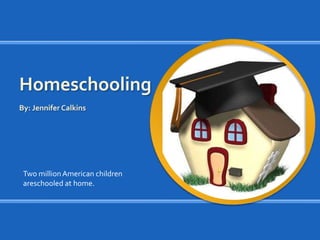
HomeschoolingBy: Jennifer CalkinsTwo million American childrenareschooled at home.
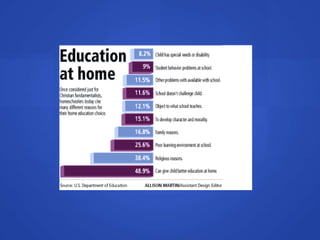
Why Parents HomeschoolParents feel they can do a better job.Parents feel that time is wasted in school - not enough learning occurs.  Homeschooling removes the child from peer pressure and bullying situations. Homeschooling allows the parent to determine the best learning style for each child.  Certain religious views encourage homeschooling.
VideoClick
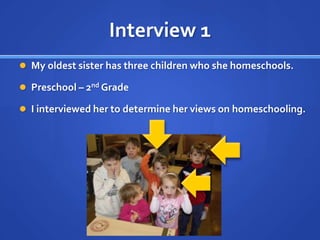
Interview 1My oldest sister has three children who she homeschools.Preschool – 2nd GradeI interviewed her to determine her views on homeschooling.
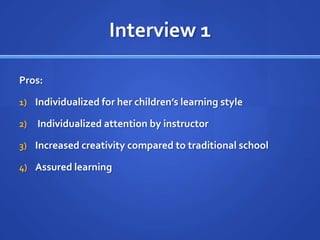
Interview 1Pros:Individualized for her children’s learning style Individualized attention by instructorIncreased creativity compared to traditional schoolAssured learning
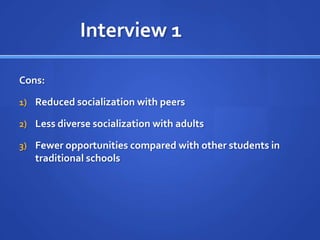
Interview 1 		Cons:Reduced socialization with peersLess diverse socialization with adultsFewer opportunities compared with other students in traditional schools
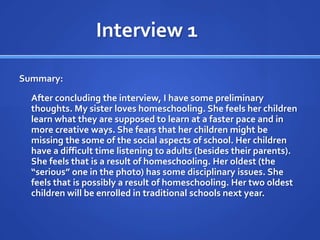
Interview 1	Summary:	After concluding the interview, I have some preliminary thoughts. My sister loves homeschooling. She feels her children learn what they are supposed to learn at a faster pace and in more creative ways. She fears that her children might be missing the some of the social aspects of school. Her children have a difficult time listening to adults (besides their parents). She feels that is a result of homeschooling. Her oldest (the “serious” one in the photo) has some disciplinary issues. She feels that is possibly a result of homeschooling. Her two oldest children will be enrolled in traditional schools next year.
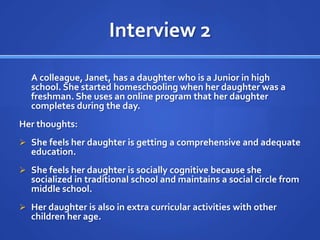
Interview 2	A colleague, Janet, has a daughter who is a Junior in high school. She started homeschooling when her daughter was a freshman. She uses an online program that her daughter completes during the day.Her thoughts:She feels her daughter is getting a comprehensive and adequate education.
She feels her daughter is socially cognitive because she socialized in traditional school and maintains a social circle from middle school.
Her daughter is also in extra curricular activities with other children her age.Video:One student’s day of homeschooling.ClickClick here if videoIsn’t working
Of interest…While researching homeschooling, I found out:Any parent can teach their own child no matter what education they have had themselves.
A parent is not required to register a homeschool program with their home state.
http://www.isbe.state.il.us/HomeSchool/Of interest…Homeschooling Registration Bill Hearing (Illinois)February 15th, 2011	ClickClick hereif video is not working.
Effects of Homeschooling (Research findings)Homeschooled children have an increased respect for teachers and parents.
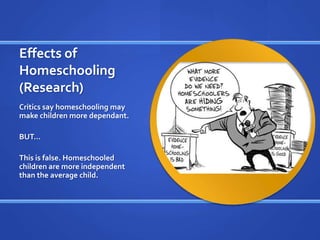
Homeschooled children have higher levels of self respect than students in traditional school settings.Effects of Homeschooling (Research)Critics say homeschooling may make children more dependant.BUT…This is false. Homeschooled children are more independent than the average child.
Effects of Homeschooling (Research)	Some critics of homeschooling feel homeschooled children may develop fewer social skills. 				……………………	This does not seem to be accurate. Homeschool groups are common allowing homeschooled students to take advantage of sports, dance and other opportunities.
Effects of Home Schooling (Research)	Some feel children are rejected by peers because they are homeschooled. 				………………......	Research has shown that although some homeschooled children may be targets of bullies, the threat is not any more than the average student at a public school. Experts say that homeschooled children interact well with homeschooled and traditionally schooled children.
Brown University Study	16 homeschooled (HS) children and 48 traditionally-schooled (TS) were asked the same questions on a socialization topic. Researchers found:“On average, both groups of children had the same number of close friends.”
“Both groups have been exposed to equal levels of peer victimization, both as victims and bystanders.”
HS children report less distress when victimized because it does not threaten their social status the way it effects TS students’. http://www.childresearch.net/RESOURCE/NEWS/2005/200509.HTM
Brown University Study“Though both groups reported having friendships of similar quality, those relationships were more closely related to the psychological adjustment of HS children.”
“HS appear to be more vulnerable to psychological distress in the absence of a high quality friendship.”

Home schooling

  • 1.
    HomeschoolingBy: Jennifer CalkinsTwomillion American childrenareschooled at home.
  • 2.
    Why Parents HomeschoolParentsfeel they can do a better job.Parents feel that time is wasted in school - not enough learning occurs. Homeschooling removes the child from peer pressure and bullying situations. Homeschooling allows the parent to determine the best learning style for each child. Certain religious views encourage homeschooling.
  • 4.
  • 5.
    Interview 1My oldestsister has three children who she homeschools.Preschool – 2nd GradeI interviewed her to determine her views on homeschooling.
  • 6.
    Interview 1Pros:Individualized forher children’s learning style Individualized attention by instructorIncreased creativity compared to traditional schoolAssured learning
  • 7.
    Interview 1 Cons:Reducedsocialization with peersLess diverse socialization with adultsFewer opportunities compared with other students in traditional schools
  • 8.
    Interview 1 Summary: After concludingthe interview, I have some preliminary thoughts. My sister loves homeschooling. She feels her children learn what they are supposed to learn at a faster pace and in more creative ways. She fears that her children might be missing the some of the social aspects of school. Her children have a difficult time listening to adults (besides their parents). She feels that is a result of homeschooling. Her oldest (the “serious” one in the photo) has some disciplinary issues. She feels that is possibly a result of homeschooling. Her two oldest children will be enrolled in traditional schools next year.
  • 9.
    Interview 2 A colleague,Janet, has a daughter who is a Junior in high school. She started homeschooling when her daughter was a freshman. She uses an online program that her daughter completes during the day.Her thoughts:She feels her daughter is getting a comprehensive and adequate education.
  • 10.
    She feels herdaughter is socially cognitive because she socialized in traditional school and maintains a social circle from middle school.
  • 11.
    Her daughter isalso in extra curricular activities with other children her age.Video:One student’s day of homeschooling.ClickClick here if videoIsn’t working
  • 12.
    Of interest…While researchinghomeschooling, I found out:Any parent can teach their own child no matter what education they have had themselves.
  • 13.
    A parent isnot required to register a homeschool program with their home state.
  • 14.
    http://www.isbe.state.il.us/HomeSchool/Of interest…Homeschooling RegistrationBill Hearing (Illinois)February 15th, 2011 ClickClick hereif video is not working.
  • 15.
    Effects of Homeschooling(Research findings)Homeschooled children have an increased respect for teachers and parents.
  • 16.
    Homeschooled children havehigher levels of self respect than students in traditional school settings.Effects of Homeschooling (Research)Critics say homeschooling may make children more dependant.BUT…This is false. Homeschooled children are more independent than the average child.
  • 17.
    Effects of Homeschooling(Research) Some critics of homeschooling feel homeschooled children may develop fewer social skills. …………………… This does not seem to be accurate. Homeschool groups are common allowing homeschooled students to take advantage of sports, dance and other opportunities.
  • 18.
    Effects of HomeSchooling (Research) Some feel children are rejected by peers because they are homeschooled. ………………...... Research has shown that although some homeschooled children may be targets of bullies, the threat is not any more than the average student at a public school. Experts say that homeschooled children interact well with homeschooled and traditionally schooled children.
  • 19.
    Brown University Study 16homeschooled (HS) children and 48 traditionally-schooled (TS) were asked the same questions on a socialization topic. Researchers found:“On average, both groups of children had the same number of close friends.”
  • 20.
    “Both groups havebeen exposed to equal levels of peer victimization, both as victims and bystanders.”
  • 21.
    HS children reportless distress when victimized because it does not threaten their social status the way it effects TS students’. http://www.childresearch.net/RESOURCE/NEWS/2005/200509.HTM
  • 22.
    Brown University Study“Thoughboth groups reported having friendships of similar quality, those relationships were more closely related to the psychological adjustment of HS children.”
  • 23.
    “HS appear tobe more vulnerable to psychological distress in the absence of a high quality friendship.”