HOMESCHOOL
BECCA LYNN
EDUC 522-82
SPRING 2012
WHAT I KNOW
an alternative to public school
options for curriculum
great skills gained based on real-life
experience
caring educator
WHAT I WANT TO
KNOW
MORE ABOUT HOMESCHOOL & HISTORY
WHO IS BEING HOMESCHOOLED?
WHY ARE THE BEING HOMESCHOOLED?
CURRICULUM?
HOW IS IT LIKED BY PARENTS AND STUDENTS?
HOW DO THEY COMPARE TO CHILDREN EDUCATED IN
SCHOOLS?
WHAT I LEARNED:
EDUCATION VS. SCHOOLING
ed·u·ca·tion [ej-oo-key-shuhn]
• 1.the act or process of imparting or acquiring general knowledge, developing the powers of
reasoning and judgment, and generally of preparing oneself or others intellectually for
mature life.
• 2.the act or process of imparting or acquiring particular knowledge or skills, as for a profession.
• 3.a degree, level, or kind of schooling: a university education.
• 4.the result produced by instruction, training, or study: to show one's education.
• 5.the science or art of teaching; pedagogics.
school·ing [skoo-ling]
• 1.the process of being taught in a school.
• 2.instruction, education, or training, especially when received in a school.
• 3.the act of teaching.
• 4. Archaic . a reprimand.
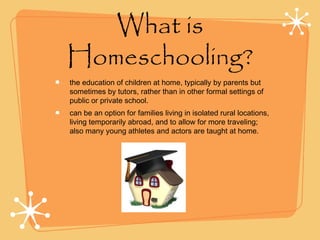
What is
Homeschooling?
the education of children at home, typically by parents but
sometimes by tutors, rather than in other formal settings of
public or private school.
can be an option for families living in isolated rural locations,
living temporarily abroad, and to allow for more traveling;
also many young athletes and actors are taught at home.
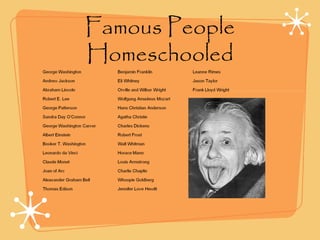
Famous People
Homeschooled
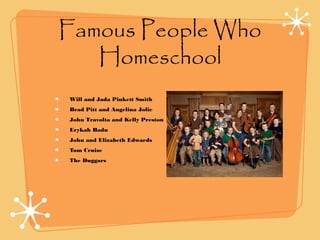
Famous People Who
Homeschool
Will and Jada Pinkett Smith
Brad Pitt and Angelina Jolie
John Travolta and Kelly Preston
Erykah Badu
John and Elizabeth Edwards
Tom Cruise
The Duggars
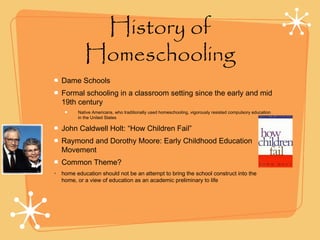
History of
Homeschooling
Dame Schools
Formal schooling in a classroom setting since the early and mid
19th century
Native Americans, who traditionally used homeschooling, vigorously resisted compulsory education
in the United States
John Caldwell Holt: “How Children Fail”
Raymond and Dorothy Moore: Early Childhood Education
Movement
Common Theme?
• home education should not be an attempt to bring the school construct into the
home, or a view of education as an academic preliminary to life
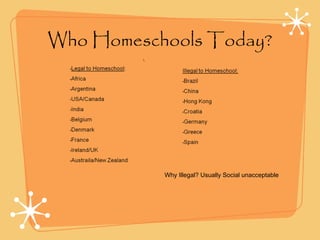
Who Homeschools Today?
Why Illegal? Usually Social unacceptable
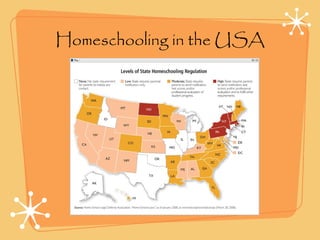
Homeschooling in the USA
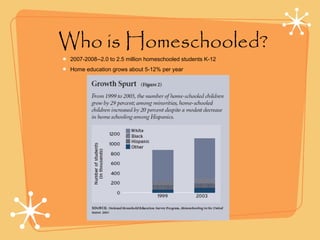
Who is Homeschooled?
2007-2008--2.0 to 2.5 million homeschooled students K-12
Home education grows about 5-12% per year
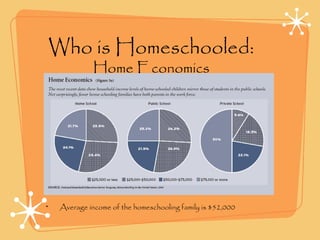
Who is Homeschooled:
Home Economics
• Average income of the homeschooling family is $52,000
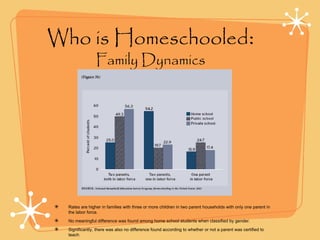
Who is Homeschooled:
Family Dynamics
✴ Rates are higher in families with three or more children in two parent households with only one parent in
the labor force.
✴ No meaningful difference was found among home school students when classified by gender.
✴ Significantly, there was also no difference found according to whether or not a parent was certified to
teach.
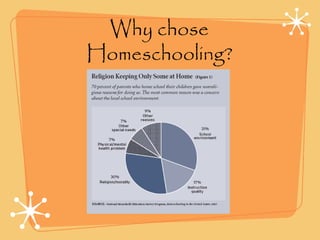
Why chose
Homeschooling?
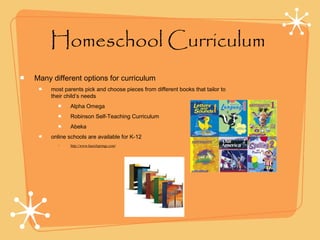
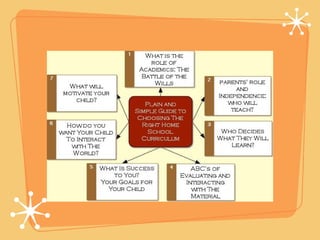
Homeschool Curriculum
Many different options for curriculum
most parents pick and choose pieces from different books that tailor to
their child’s needs
Alpha Omega
Robinson Self-Teaching Curriculum
Abeka
online schools are available for K-12
• http://www.laurelsprings.com/
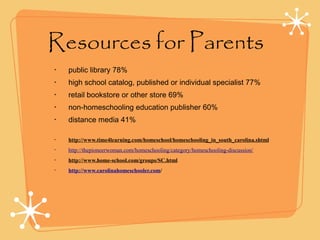
Resources for Parents
• public library 78%
• high school catalog, published or individual specialist 77%
• retail bookstore or other store 69%
• non-homeschooling education publisher 60%
• distance media 41%
• http://www.time4learning.com/homeschool/homeschooling_in_south_carolina.shtml
• http://thepioneerwoman.com/homeschooling/category/homeschooling-discussion/
• http://www.home-school.com/groups/SC.html
• http://www.carolinahomeschooler.com/
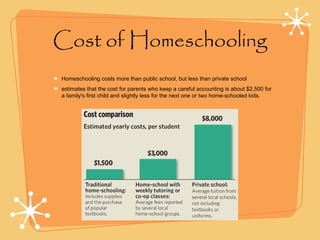
Cost of Homeschooling
Homeschooling costs more than public school, but less than private school
estimates that the cost for parents who keep a careful accounting is about $2,500 for
a family's first child and slightly less for the next one or two home-schooled kids.
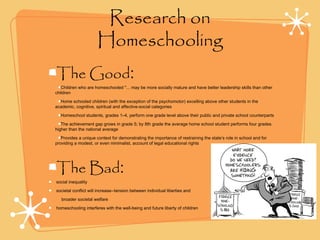
Research on
Homeschooling
The Good:
Children who are homeschooled "... may be more socially mature and have better leadership skills than other
children
Home schooled children (with the exception of the psychomotor) excelling above other students in the
academic, cognitive, spiritual and affective-social categories
Homeschool students, grades 1–4, perform one grade level above their public and private school counterparts
The achievement gap grows in grade 5; by 8th grade the average home school student performs four grades
higher than the national average
Provides a unique context for demonstrating the importance of restraining the state’s role in school and for
providing a modest, or even minimalist, account of legal educational rights
The Bad:
social inequality
societal conflict will increase--tension between individual liberties and
broader societal welfare
homeschooling interferes with the well-being and future liberty of children
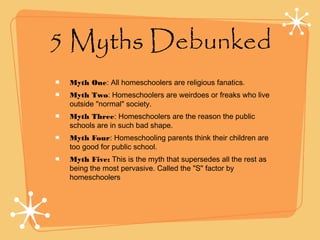
5 Myths Debunked
Myth One: All homeschoolers are religious fanatics.
Myth Two: Homeschoolers are weirdoes or freaks who live
outside "normal" society.
Myth Three: Homeschoolers are the reason the public
schools are in such bad shape.
Myth Four: Homeschooling parents think their children are
too good for public school.
Myth Five: This is the myth that supersedes all the rest as
being the most pervasive. Called the "S" factor by
homeschoolers
Why Parents support
homeschooling
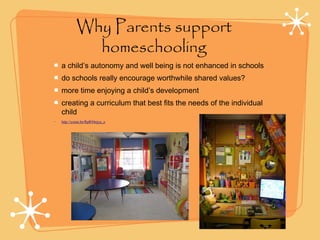
a child’s autonomy and well being is not enhanced in schools
do schools really encourage worthwhile shared values?
more time enjoying a child’s development
creating a curriculum that best fits the needs of the individual
child
• http://youtu.be/RpR94ejyu_o
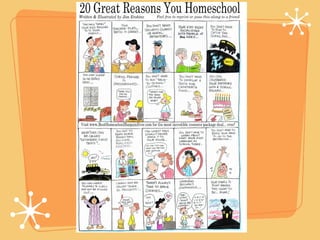
Why kids support
homeschooling?
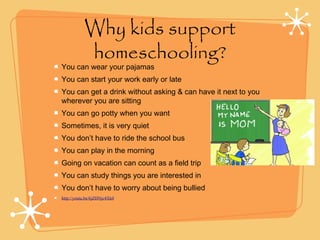
You can wear your pajamas
You can start your work early or late
You can get a drink without asking & can have it next to you
wherever you are sitting
You can go potty when you want
Sometimes, it is very quiet
You don’t have to ride the school bus
You can play in the morning
Going on vacation can count as a field trip
You can study things you are interested in
You don’t have to worry about being bullied
http://youtu.be/6jZHNjc4Xk0
Homeschooler’s transition
to CollegeACT: (2002 and 2003) homeschool average was 22.5, national average was
20.8.
SAT ( 2002) homeschool average was 1092, national average, 1020.
higher GPA’s freshman year
Advantages of homeschoolers in college: highly motivated, strong sense of self-
discipline
Admission officers were asked questions concerning their attitudes towards
homeschool students.
All respondents either strongly agreed (45%) or agreed (55%) that they expected homeschooled
graduates to be as successful academically as students who had graduated from an accredited
high school.
Special Services
transition of homeschoolers vs. regular students to college
Homeschoolers in the
Community
More than 74% of home schooled adults 18-24 years-old
have taken college classes as opposed to 46% of the
general population.
94% said home education prepared them to be independent
persons,
79% said it helped them interact with individuals from
different levels of society, and they strongly supported the
home education method.
Homeschooling statistics show 71% of home taught adults
participate in at least one on-going community service/37%
of similar general population
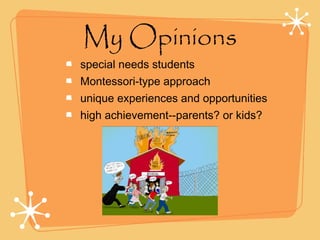
My Opinions
special needs students
Montessori-type approach
unique experiences and opportunities
high achievement--parents? or kids?
ReferencesBielick, S., Chandler, K., & Broughman, S. P. (2001). Homeschooling in the United States: 1999
       (NCES 2001-003). National Center for Education Statistics, U.S. Department of Education.
Washington, D.C.
Bolle, B., Wessel, R. D., Mulvihill, T. M. (2007). Experiences of first-year college
students who were homeschooled. Journal of College Student Development,
48(6), 637-653.
Kunzman, R. (2012). Education, schooling, and children’s rights: The complexity of homeschooling.
       Educational Theory, 62(1), 75-88.
Merry, M. S., Karsten, S. (2010). Restricted liberty, parental choice, and homschooling.
Journal of Philosophy and Education, 44(4), 497-514.
Newman, A., Stitzlein, S. M. (2012). Rethinking educational rights: Implications for
philosophy and policy. Educational Theory, 62(1), 1-6.
Sorey, K., Duggan, M. H. (2008). Homeschoolers entering community colleges: Perceptions of
admission officers. Journal of College Admission, 3, 22-28.

Hs presentation

  • 1.
  • 2.
    WHAT I KNOW analternative to public school options for curriculum great skills gained based on real-life experience caring educator
  • 3.
    WHAT I WANTTO KNOW MORE ABOUT HOMESCHOOL & HISTORY WHO IS BEING HOMESCHOOLED? WHY ARE THE BEING HOMESCHOOLED? CURRICULUM? HOW IS IT LIKED BY PARENTS AND STUDENTS? HOW DO THEY COMPARE TO CHILDREN EDUCATED IN SCHOOLS?
  • 4.
    WHAT I LEARNED: EDUCATIONVS. SCHOOLING ed·u·ca·tion [ej-oo-key-shuhn] • 1.the act or process of imparting or acquiring general knowledge, developing the powers of reasoning and judgment, and generally of preparing oneself or others intellectually for mature life. • 2.the act or process of imparting or acquiring particular knowledge or skills, as for a profession. • 3.a degree, level, or kind of schooling: a university education. • 4.the result produced by instruction, training, or study: to show one's education. • 5.the science or art of teaching; pedagogics. school·ing [skoo-ling] • 1.the process of being taught in a school. • 2.instruction, education, or training, especially when received in a school. • 3.the act of teaching. • 4. Archaic . a reprimand.
  • 5.
    What is Homeschooling? the educationof children at home, typically by parents but sometimes by tutors, rather than in other formal settings of public or private school. can be an option for families living in isolated rural locations, living temporarily abroad, and to allow for more traveling; also many young athletes and actors are taught at home.
  • 6.
  • 7.
    Famous People Who Homeschool Willand Jada Pinkett Smith Brad Pitt and Angelina Jolie John Travolta and Kelly Preston Erykah Badu John and Elizabeth Edwards Tom Cruise The Duggars
  • 8.
    History of Homeschooling Dame Schools Formalschooling in a classroom setting since the early and mid 19th century Native Americans, who traditionally used homeschooling, vigorously resisted compulsory education in the United States John Caldwell Holt: “How Children Fail” Raymond and Dorothy Moore: Early Childhood Education Movement Common Theme? • home education should not be an attempt to bring the school construct into the home, or a view of education as an academic preliminary to life
  • 9.
    Who Homeschools Today? WhyIllegal? Usually Social unacceptable
  • 10.
  • 11.
    Who is Homeschooled? 2007-2008--2.0to 2.5 million homeschooled students K-12 Home education grows about 5-12% per year
  • 12.
    Who is Homeschooled: HomeEconomics • Average income of the homeschooling family is $52,000
  • 13.
    Who is Homeschooled: FamilyDynamics ✴ Rates are higher in families with three or more children in two parent households with only one parent in the labor force. ✴ No meaningful difference was found among home school students when classified by gender. ✴ Significantly, there was also no difference found according to whether or not a parent was certified to teach.
  • 14.
  • 16.
    Homeschool Curriculum Many differentoptions for curriculum most parents pick and choose pieces from different books that tailor to their child’s needs Alpha Omega Robinson Self-Teaching Curriculum Abeka online schools are available for K-12 • http://www.laurelsprings.com/
  • 18.
    Resources for Parents •public library 78% • high school catalog, published or individual specialist 77% • retail bookstore or other store 69% • non-homeschooling education publisher 60% • distance media 41% • http://www.time4learning.com/homeschool/homeschooling_in_south_carolina.shtml • http://thepioneerwoman.com/homeschooling/category/homeschooling-discussion/ • http://www.home-school.com/groups/SC.html • http://www.carolinahomeschooler.com/
  • 19.
    Cost of Homeschooling Homeschoolingcosts more than public school, but less than private school estimates that the cost for parents who keep a careful accounting is about $2,500 for a family's first child and slightly less for the next one or two home-schooled kids.
  • 20.
    Research on Homeschooling The Good: Childrenwho are homeschooled "... may be more socially mature and have better leadership skills than other children Home schooled children (with the exception of the psychomotor) excelling above other students in the academic, cognitive, spiritual and affective-social categories Homeschool students, grades 1–4, perform one grade level above their public and private school counterparts The achievement gap grows in grade 5; by 8th grade the average home school student performs four grades higher than the national average Provides a unique context for demonstrating the importance of restraining the state’s role in school and for providing a modest, or even minimalist, account of legal educational rights The Bad: social inequality societal conflict will increase--tension between individual liberties and broader societal welfare homeschooling interferes with the well-being and future liberty of children
  • 21.
    5 Myths Debunked MythOne: All homeschoolers are religious fanatics. Myth Two: Homeschoolers are weirdoes or freaks who live outside "normal" society. Myth Three: Homeschoolers are the reason the public schools are in such bad shape. Myth Four: Homeschooling parents think their children are too good for public school. Myth Five: This is the myth that supersedes all the rest as being the most pervasive. Called the "S" factor by homeschoolers
  • 22.
    Why Parents support homeschooling achild’s autonomy and well being is not enhanced in schools do schools really encourage worthwhile shared values? more time enjoying a child’s development creating a curriculum that best fits the needs of the individual child • http://youtu.be/RpR94ejyu_o
  • 23.
    Why kids support homeschooling? Youcan wear your pajamas You can start your work early or late You can get a drink without asking & can have it next to you wherever you are sitting You can go potty when you want Sometimes, it is very quiet You don’t have to ride the school bus You can play in the morning Going on vacation can count as a field trip You can study things you are interested in You don’t have to worry about being bullied http://youtu.be/6jZHNjc4Xk0
  • 24.
    Homeschooler’s transition to CollegeACT:(2002 and 2003) homeschool average was 22.5, national average was 20.8. SAT ( 2002) homeschool average was 1092, national average, 1020. higher GPA’s freshman year Advantages of homeschoolers in college: highly motivated, strong sense of self- discipline Admission officers were asked questions concerning their attitudes towards homeschool students. All respondents either strongly agreed (45%) or agreed (55%) that they expected homeschooled graduates to be as successful academically as students who had graduated from an accredited high school. Special Services transition of homeschoolers vs. regular students to college
  • 25.
    Homeschoolers in the Community Morethan 74% of home schooled adults 18-24 years-old have taken college classes as opposed to 46% of the general population. 94% said home education prepared them to be independent persons, 79% said it helped them interact with individuals from different levels of society, and they strongly supported the home education method. Homeschooling statistics show 71% of home taught adults participate in at least one on-going community service/37% of similar general population
  • 26.
    My Opinions special needsstudents Montessori-type approach unique experiences and opportunities high achievement--parents? or kids?
  • 27.
    ReferencesBielick, S., Chandler,K., & Broughman, S. P. (2001). Homeschooling in the United States: 1999        (NCES 2001-003). National Center for Education Statistics, U.S. Department of Education. Washington, D.C. Bolle, B., Wessel, R. D., Mulvihill, T. M. (2007). Experiences of first-year college students who were homeschooled. Journal of College Student Development, 48(6), 637-653. Kunzman, R. (2012). Education, schooling, and children’s rights: The complexity of homeschooling.        Educational Theory, 62(1), 75-88. Merry, M. S., Karsten, S. (2010). Restricted liberty, parental choice, and homschooling. Journal of Philosophy and Education, 44(4), 497-514. Newman, A., Stitzlein, S. M. (2012). Rethinking educational rights: Implications for philosophy and policy. Educational Theory, 62(1), 1-6. Sorey, K., Duggan, M. H. (2008). Homeschoolers entering community colleges: Perceptions of admission officers. Journal of College Admission, 3, 22-28.