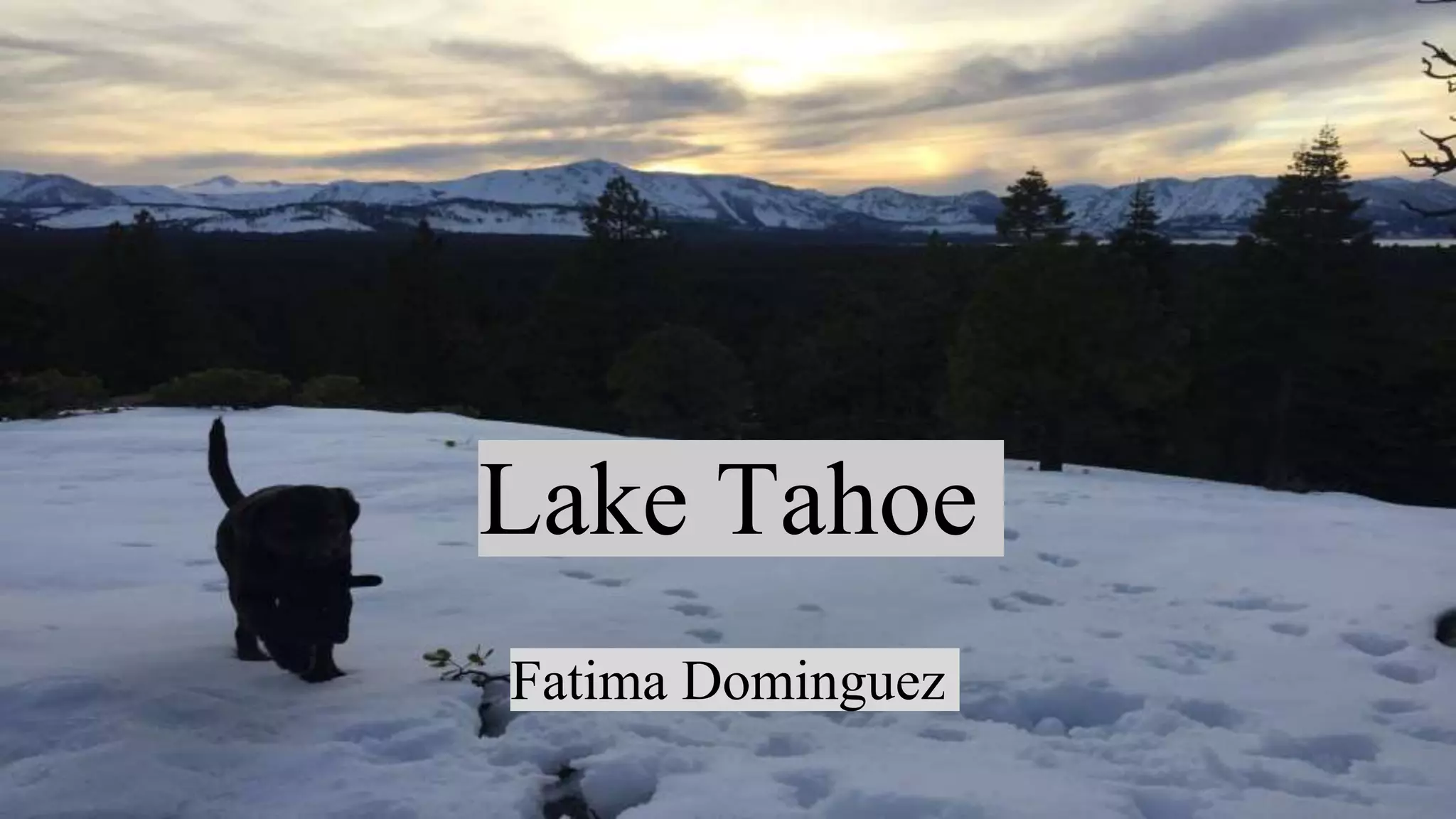
Lake Tahoe
Fatima Dominguez
Introduction
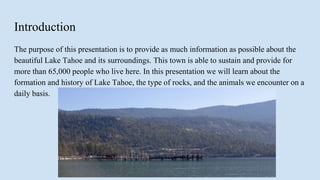
The purpose of this presentation is to provide as much information as possible about the
beautiful Lake Tahoe and its surroundings. This town is able to sustain and provide for
more than 65,000 people who live here. In this presentation we will learn about the
formation and history of Lake Tahoe, the type of rocks, and the animals we encounter on a
daily basis.
History
● What many of us call home now, was
formed through faulting of Earth’s crust,
volcanic and glaciation. Which happened
approximately 3.7 million years ago which
was during the Pliocene epoch era.
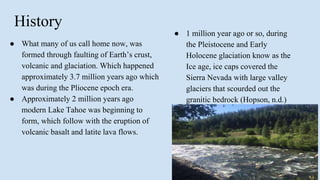
● Approximately 2 million years ago
modern Lake Tahoe was beginning to
form, which follow with the eruption of
volcanic basalt and latite lava flows.
● 1 million year ago or so, during
the Pleistocene and Early
Holocene glaciation know as the
Ice age, ice caps covered the
Sierra Nevada with large valley
glaciers that scourded out the
granitic bedrock (Hopson, n.d.)
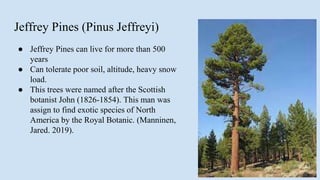
Jeffrey Pines (Pinus Jeffreyi)
● Jeffrey Pines can live for more than 500
years
● Can tolerate poor soil, altitude, heavy snow
load.
● This trees were named after the Scottish
botanist John (1826-1854). This man was
assign to find exotic species of North
America by the Royal Botanic. (Manninen,
Jared. 2019).
Jeffrey Pines
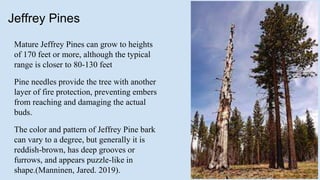
Mature Jeffrey Pines can grow to heights
of 170 feet or more, although the typical
range is closer to 80-130 feet
Pine needles provide the tree with another
layer of fire protection, preventing embers
from reaching and damaging the actual
buds.
The color and pattern of Jeffrey Pine bark
can vary to a degree, but generally it is
reddish-brown, has deep grooves or
furrows, and appears puzzle-like in
shape.(Manninen, Jared. 2019).
Coyotes
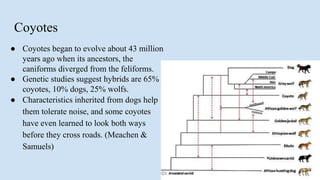
● Coyotes began to evolve about 43 million
years ago when its ancestors, the
caniforms diverged from the feliforms.
● Genetic studies suggest hybrids are 65%
coyotes, 10% dogs, 25% wolfs.
● Characteristics inherited from dogs help
them tolerate noise, and some coyotes
have even learned to look both ways
before they cross roads. (Meachen &
Samuels)
Coyotes
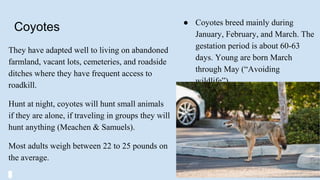
They have adapted well to living on abandoned
farmland, vacant lots, cemeteries, and roadside
ditches where they have frequent access to
roadkill.
Hunt at night, coyotes will hunt small animals
if they are alone, if traveling in groups they will
hunt anything (Meachen & Samuels).
Most adults weigh between 22 to 25 pounds on
the average.
● Coyotes breed mainly during
January, February, and March. The
gestation period is about 60-63
days. Young are born March
through May (“Avoiding
wildlife”).
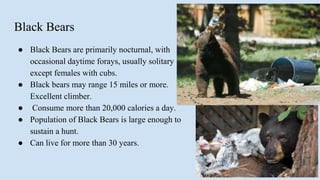
Black Bears
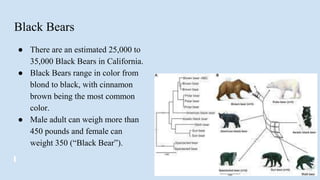
● There are an estimated 25,000 to
35,000 Black Bears in California.
● Black Bears range in color from
blond to black, with cinnamon
brown being the most common
color.
● Male adult can weigh more than
450 pounds and female can
weight 350 (“Black Bear”).
Black Bears
● Black Bears are primarily nocturnal, with
occasional daytime forays, usually solitary
except females with cubs.
● Black bears may range 15 miles or more.
Excellent climber.
● Consume more than 20,000 calories a day.
● Population of Black Bears is large enough to
sustain a hunt.
● Can live for more than 30 years.
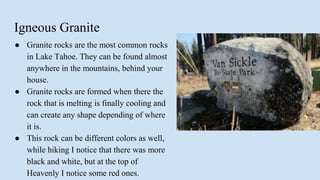
Igneous Granite
● Granite rocks are the most common rocks
in Lake Tahoe. They can be found almost
anywhere in the mountains, behind your
house.
● Granite rocks are formed when there the
rock that is melting is finally cooling and
can create any shape depending of where
it is.
● This rock can be different colors as well,
while hiking I notice that there was more
black and white, but at the top of
Heavenly I notice some red ones.
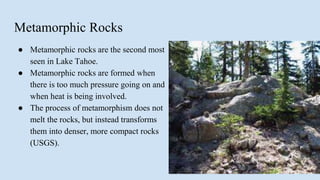
Metamorphic Rocks
● Metamorphic rocks are the second most
seen in Lake Tahoe.
● Metamorphic rocks are formed when
there is too much pressure going on and
when heat is being involved.
● The process of metamorphism does not
melt the rocks, but instead transforms
them into denser, more compact rocks
(USGS).
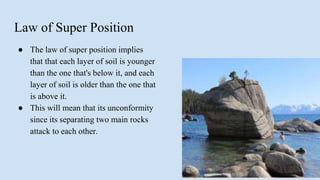
Law of Super Position
● The law of super position implies
that that each layer of soil is younger
than the one that's below it, and each
layer of soil is older than the one that
is above it.
● This will mean that its unconformity
since its separating two main rocks
attack to each other.
References
Agriculture. (n.d.). Retrieved June 11, 2019, from
https://www.edcgov.us/Government/ag/pages/coyotes.aspx
Black Bear. (n.d.). Retrieved June 14, 2019, from http://www.ndow.org/Species/F
urbearer/Black_Bear/
Coyote (Canis latrans) Evolution. (2017, March 02). Retrieved June 11, 2019, from
https://markgelbart.wordpress.com/2017/03/02/coyote-canis-latrans-evolution
Hopson, Forrest. (2012, August 12). Travel in Geology: Lake Tahoe Jewel of the Sierra
Nevada. Retrieved June 10, 2019. From https://www.earthmagazine.org/article/travels-
geology-lake-tahoe-jewel-sierra-nevada#ab
References
Manninen, Jared. (2018, January 12) Jeffrey Pine( Pinus Jeffreyi). Retrieved June 10,
2019. From https://tahoetrailguide.com/jeffrey-pine-pinus-jeffreyi/
Unconformities. (n.d.). Retrieved June 15, 2019, from http://www.indiana.edu/~
geol105b/images/gaia_ chapter_6/unconformities.htm
USGS(n.d.). Retrieved June 15, 2019, from https://www.usgs.gov/faqs/what-are-
metamorphic-rocks-0?qt-news_science_products=0#qt-news_science_products

Field assignment south lake tahoe

  • 1.
  • 2.
    Introduction The purpose ofthis presentation is to provide as much information as possible about the beautiful Lake Tahoe and its surroundings. This town is able to sustain and provide for more than 65,000 people who live here. In this presentation we will learn about the formation and history of Lake Tahoe, the type of rocks, and the animals we encounter on a daily basis.
  • 3.
    History ● What manyof us call home now, was formed through faulting of Earth’s crust, volcanic and glaciation. Which happened approximately 3.7 million years ago which was during the Pliocene epoch era. ● Approximately 2 million years ago modern Lake Tahoe was beginning to form, which follow with the eruption of volcanic basalt and latite lava flows. ● 1 million year ago or so, during the Pleistocene and Early Holocene glaciation know as the Ice age, ice caps covered the Sierra Nevada with large valley glaciers that scourded out the granitic bedrock (Hopson, n.d.)
  • 4.
    Jeffrey Pines (PinusJeffreyi) ● Jeffrey Pines can live for more than 500 years ● Can tolerate poor soil, altitude, heavy snow load. ● This trees were named after the Scottish botanist John (1826-1854). This man was assign to find exotic species of North America by the Royal Botanic. (Manninen, Jared. 2019).
  • 5.
    Jeffrey Pines Mature JeffreyPines can grow to heights of 170 feet or more, although the typical range is closer to 80-130 feet Pine needles provide the tree with another layer of fire protection, preventing embers from reaching and damaging the actual buds. The color and pattern of Jeffrey Pine bark can vary to a degree, but generally it is reddish-brown, has deep grooves or furrows, and appears puzzle-like in shape.(Manninen, Jared. 2019).
  • 6.
    Coyotes ● Coyotes beganto evolve about 43 million years ago when its ancestors, the caniforms diverged from the feliforms. ● Genetic studies suggest hybrids are 65% coyotes, 10% dogs, 25% wolfs. ● Characteristics inherited from dogs help them tolerate noise, and some coyotes have even learned to look both ways before they cross roads. (Meachen & Samuels)
  • 7.
    Coyotes They have adaptedwell to living on abandoned farmland, vacant lots, cemeteries, and roadside ditches where they have frequent access to roadkill. Hunt at night, coyotes will hunt small animals if they are alone, if traveling in groups they will hunt anything (Meachen & Samuels). Most adults weigh between 22 to 25 pounds on the average. ● Coyotes breed mainly during January, February, and March. The gestation period is about 60-63 days. Young are born March through May (“Avoiding wildlife”).
  • 8.
    Black Bears ● Thereare an estimated 25,000 to 35,000 Black Bears in California. ● Black Bears range in color from blond to black, with cinnamon brown being the most common color. ● Male adult can weigh more than 450 pounds and female can weight 350 (“Black Bear”).
  • 9.
    Black Bears ● BlackBears are primarily nocturnal, with occasional daytime forays, usually solitary except females with cubs. ● Black bears may range 15 miles or more. Excellent climber. ● Consume more than 20,000 calories a day. ● Population of Black Bears is large enough to sustain a hunt. ● Can live for more than 30 years.
  • 10.
    Igneous Granite ● Graniterocks are the most common rocks in Lake Tahoe. They can be found almost anywhere in the mountains, behind your house. ● Granite rocks are formed when there the rock that is melting is finally cooling and can create any shape depending of where it is. ● This rock can be different colors as well, while hiking I notice that there was more black and white, but at the top of Heavenly I notice some red ones.
  • 11.
    Metamorphic Rocks ● Metamorphicrocks are the second most seen in Lake Tahoe. ● Metamorphic rocks are formed when there is too much pressure going on and when heat is being involved. ● The process of metamorphism does not melt the rocks, but instead transforms them into denser, more compact rocks (USGS).
  • 12.
    Law of SuperPosition ● The law of super position implies that that each layer of soil is younger than the one that's below it, and each layer of soil is older than the one that is above it. ● This will mean that its unconformity since its separating two main rocks attack to each other.
  • 13.
    References Agriculture. (n.d.). RetrievedJune 11, 2019, from https://www.edcgov.us/Government/ag/pages/coyotes.aspx Black Bear. (n.d.). Retrieved June 14, 2019, from http://www.ndow.org/Species/F urbearer/Black_Bear/ Coyote (Canis latrans) Evolution. (2017, March 02). Retrieved June 11, 2019, from https://markgelbart.wordpress.com/2017/03/02/coyote-canis-latrans-evolution Hopson, Forrest. (2012, August 12). Travel in Geology: Lake Tahoe Jewel of the Sierra Nevada. Retrieved June 10, 2019. From https://www.earthmagazine.org/article/travels- geology-lake-tahoe-jewel-sierra-nevada#ab
  • 14.
    References Manninen, Jared. (2018,January 12) Jeffrey Pine( Pinus Jeffreyi). Retrieved June 10, 2019. From https://tahoetrailguide.com/jeffrey-pine-pinus-jeffreyi/ Unconformities. (n.d.). Retrieved June 15, 2019, from http://www.indiana.edu/~ geol105b/images/gaia_ chapter_6/unconformities.htm USGS(n.d.). Retrieved June 15, 2019, from https://www.usgs.gov/faqs/what-are- metamorphic-rocks-0?qt-news_science_products=0#qt-news_science_products