Survey of Western Art II (Art History 2)
                                        FIDM OC, Spring 2010

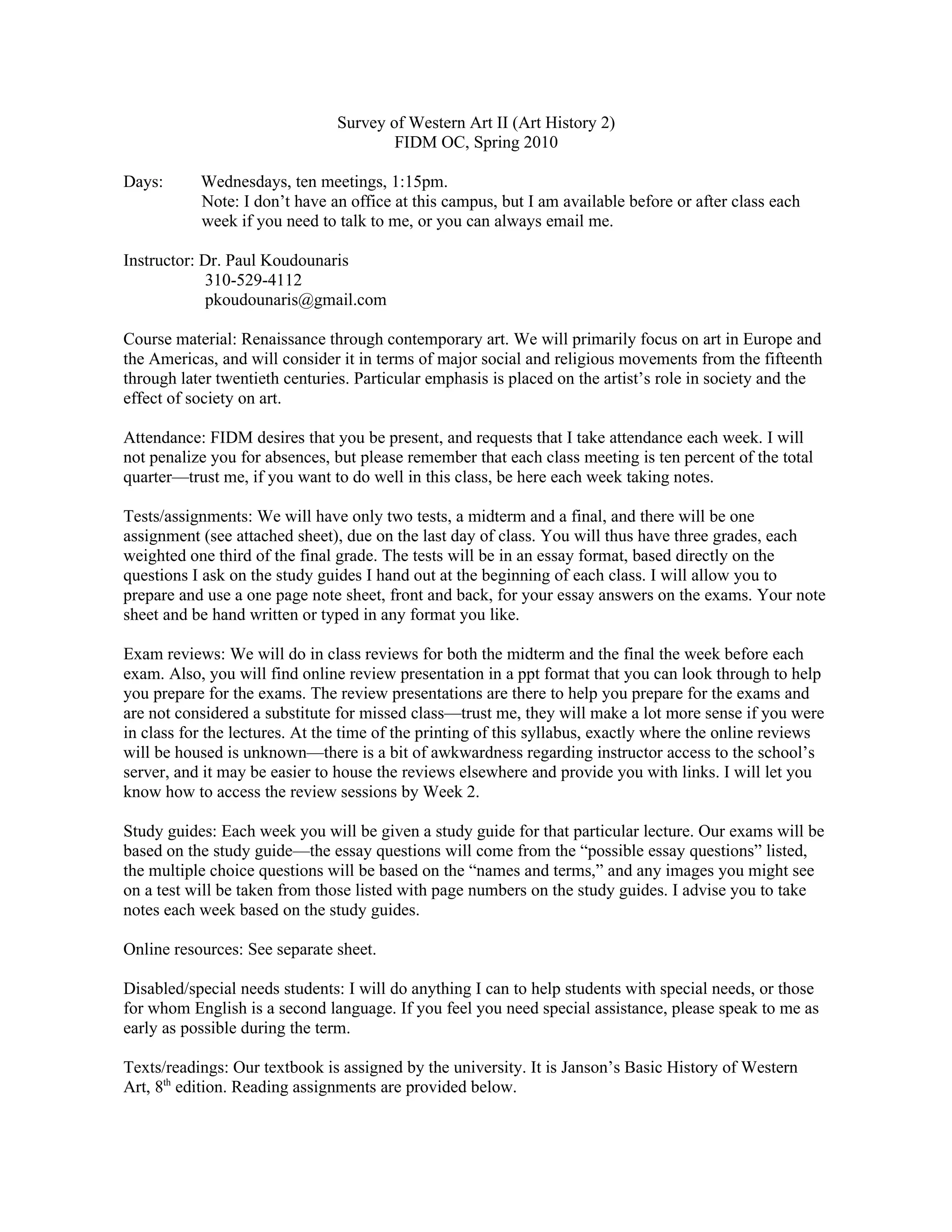
Days:      Wednesdays, ten meetings, 1:15pm.
           Note: I don’t have an office at this campus, but I am available before or after class each
           week if you need to talk to me, or you can always email me.

Instructor: Dr. Paul Koudounaris
            310-529-4112
            pkoudounaris@gmail.com

Course material: Renaissance through contemporary art. We will primarily focus on art in Europe and
the Americas, and will consider it in terms of major social and religious movements from the fifteenth
through later twentieth centuries. Particular emphasis is placed on the artist’s role in society and the
effect of society on art.

Attendance: FIDM desires that you be present, and requests that I take attendance each week. I will
not penalize you for absences, but please remember that each class meeting is ten percent of the total
quarter—trust me, if you want to do well in this class, be here each week taking notes.

Tests/assignments: We will have only two tests, a midterm and a final, and there will be one
assignment (see attached sheet), due on the last day of class. You will thus have three grades, each
weighted one third of the final grade. The tests will be in an essay format, based directly on the
questions I ask on the study guides I hand out at the beginning of each class. I will allow you to
prepare and use a one page note sheet, front and back, for your essay answers on the exams. Your note
sheet and be hand written or typed in any format you like.

Exam reviews: We will do in class reviews for both the midterm and the final the week before each
exam. Also, you will find online review presentation in a ppt format that you can look through to help
you prepare for the exams. The review presentations are there to help you prepare for the exams and
are not considered a substitute for missed class—trust me, they will make a lot more sense if you were
in class for the lectures. At the time of the printing of this syllabus, exactly where the online reviews
will be housed is unknown—there is a bit of awkwardness regarding instructor access to the school’s
server, and it may be easier to house the reviews elsewhere and provide you with links. I will let you
know how to access the review sessions by Week 2.

Study guides: Each week you will be given a study guide for that particular lecture. Our exams will be
based on the study guide—the essay questions will come from the “possible essay questions” listed,
the multiple choice questions will be based on the “names and terms,” and any images you might see
on a test will be taken from those listed with page numbers on the study guides. I advise you to take
notes each week based on the study guides.

Online resources: See separate sheet.

Disabled/special needs students: I will do anything I can to help students with special needs, or those
for whom English is a second language. If you feel you need special assistance, please speak to me as
early as possible during the term.

Texts/readings: Our textbook is assigned by the university. It is Janson’s Basic History of Western
Art, 8th edition. Reading assignments are provided below.
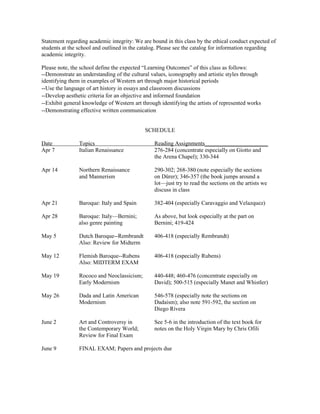
Statement regarding academic integrity: We are bound in this class by the ethical conduct expected of
students at the school and outlined in the catalog. Please see the catalog for information regarding
academic integrity.

Please note, the school define the expected “Learning Outcomes” of this class as follows:
--Demonstrate an understanding of the cultural values, iconography and artistic styles through
identifying them in examples of Western art through major historical periods
--Use the language of art history in essays and classroom discussions
--Develop aesthetic criteria for an objective and informed foundation
--Exhibit general knowledge of Western art through identifying the artists of represented works
--Demonstrating effective written communication


                                            SCHEDULE

Date            Topics                          Reading Assignments______________________
Apr 7           Italian Renaissance             276-284 (concentrate especially on Giotto and
                                                the Arena Chapel); 330-344

Apr 14          Northern Renaissance            290-302; 268-380 (note especially the sections
                and Mannerism                   on Dürer); 346-357 (the book jumps around a
                                                lot—just try to read the sections on the artists we
                                                discuss in class

Apr 21          Baroque: Italy and Spain        382-404 (especially Caravaggio and Velazquez)

Apr 28          Baroque: Italy—Bernini;         As above, but look especially at the part on
                also genre painting             Bernini; 419-424

May 5           Dutch Baroque--Rembrandt        406-418 (especially Rembrandt)
                Also: Review for Midterm

May 12          Flemish Baroque--Rubens         406-418 (especially Rubens)
                Also: MIDTERM EXAM

May 19          Rococo and Neoclassicism;       440-448; 460-476 (concentrate especially on
                Early Modernism                 David); 500-515 (especially Manet and Whistler)

May 26          Dada and Latin American         546-578 (especially note the sections on
                Modernism                       Dadaism); also note 591-592, the section on
                                                Diego Rivera

June 2          Art and Controversy in          See 5-6 in the introduction of the text book for
                the Contemporary World;         notes on the Holy Virgin Mary by Chris Ofili
                Review for Final Exam

June 9          FINAL EXAM; Papers and projects due
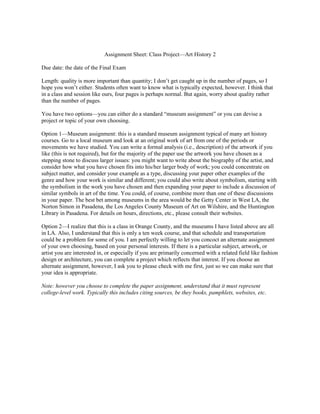
Assignment Sheet: Class Project—Art History 2

Due date: the date of the Final Exam

Length: quality is more important than quantity; I don’t get caught up in the number of pages, so I
hope you won’t either. Students often want to know what is typically expected, however. I think that
in a class and session like ours, four pages is perhaps normal. But again, worry about quality rather
than the number of pages.

You have two options—you can either do a standard “museum assignment” or you can devise a
project or topic of your own choosing.

Option 1—Museum assignment: this is a standard museum assignment typical of many art history
courses. Go to a local museum and look at an original work of art from one of the periods or
movements we have studied. You can write a formal analysis (i.e., description) of the artwork if you
like (this is not required), but for the majority of the paper use the artwork you have chosen as a
stepping stone to discuss larger issues: you might want to write about the biography of the artist, and
consider how what you have chosen fits into his/her larger body of work; you could concentrate on
subject matter, and consider your example as a type, discussing your paper other examples of the
genre and how your work is similar and different; you could also write about symbolism, starting with
the symbolism in the work you have chosen and then expanding your paper to include a discussion of
similar symbols in art of the time. You could, of course, combine more than one of these discussions
in your paper. The best bet among museums in the area would be the Getty Center in West LA, the
Norton Simon in Pasadena, the Los Angeles County Museum of Art on Wilshire, and the Huntington
Library in Pasadena. For details on hours, directions, etc., please consult their websites.

Option 2—I realize that this is a class in Orange County, and the museums I have listed above are all
in LA. Also, I understand that this is only a ten week course, and that schedule and transportation
could be a problem for some of you. I am perfectly willing to let you concoct an alternate assignment
of your own choosing, based on your personal interests. If there is a particular subject, artwork, or
artist you are interested in, or especially if you are primarily concerned with a related field like fashion
design or architecture, you can complete a project which reflects that interest. If you choose an
alternate assignment, however, I ask you to please check with me first, just so we can make sure that
your idea is appropriate.

Note: however you choose to complete the paper assignment, understand that it must represent
college-level work. Typically this includes citing sources, be they books, pamphlets, websites, etc.

Fidm Ah 2 Syl Spr

  • 1.
    Survey of WesternArt II (Art History 2) FIDM OC, Spring 2010 Days: Wednesdays, ten meetings, 1:15pm. Note: I don’t have an office at this campus, but I am available before or after class each week if you need to talk to me, or you can always email me. Instructor: Dr. Paul Koudounaris 310-529-4112 pkoudounaris@gmail.com Course material: Renaissance through contemporary art. We will primarily focus on art in Europe and the Americas, and will consider it in terms of major social and religious movements from the fifteenth through later twentieth centuries. Particular emphasis is placed on the artist’s role in society and the effect of society on art. Attendance: FIDM desires that you be present, and requests that I take attendance each week. I will not penalize you for absences, but please remember that each class meeting is ten percent of the total quarter—trust me, if you want to do well in this class, be here each week taking notes. Tests/assignments: We will have only two tests, a midterm and a final, and there will be one assignment (see attached sheet), due on the last day of class. You will thus have three grades, each weighted one third of the final grade. The tests will be in an essay format, based directly on the questions I ask on the study guides I hand out at the beginning of each class. I will allow you to prepare and use a one page note sheet, front and back, for your essay answers on the exams. Your note sheet and be hand written or typed in any format you like. Exam reviews: We will do in class reviews for both the midterm and the final the week before each exam. Also, you will find online review presentation in a ppt format that you can look through to help you prepare for the exams. The review presentations are there to help you prepare for the exams and are not considered a substitute for missed class—trust me, they will make a lot more sense if you were in class for the lectures. At the time of the printing of this syllabus, exactly where the online reviews will be housed is unknown—there is a bit of awkwardness regarding instructor access to the school’s server, and it may be easier to house the reviews elsewhere and provide you with links. I will let you know how to access the review sessions by Week 2. Study guides: Each week you will be given a study guide for that particular lecture. Our exams will be based on the study guide—the essay questions will come from the “possible essay questions” listed, the multiple choice questions will be based on the “names and terms,” and any images you might see on a test will be taken from those listed with page numbers on the study guides. I advise you to take notes each week based on the study guides. Online resources: See separate sheet. Disabled/special needs students: I will do anything I can to help students with special needs, or those for whom English is a second language. If you feel you need special assistance, please speak to me as early as possible during the term. Texts/readings: Our textbook is assigned by the university. It is Janson’s Basic History of Western Art, 8th edition. Reading assignments are provided below.
  • 2.
    Statement regarding academicintegrity: We are bound in this class by the ethical conduct expected of students at the school and outlined in the catalog. Please see the catalog for information regarding academic integrity. Please note, the school define the expected “Learning Outcomes” of this class as follows: --Demonstrate an understanding of the cultural values, iconography and artistic styles through identifying them in examples of Western art through major historical periods --Use the language of art history in essays and classroom discussions --Develop aesthetic criteria for an objective and informed foundation --Exhibit general knowledge of Western art through identifying the artists of represented works --Demonstrating effective written communication SCHEDULE Date Topics Reading Assignments______________________ Apr 7 Italian Renaissance 276-284 (concentrate especially on Giotto and the Arena Chapel); 330-344 Apr 14 Northern Renaissance 290-302; 268-380 (note especially the sections and Mannerism on Dürer); 346-357 (the book jumps around a lot—just try to read the sections on the artists we discuss in class Apr 21 Baroque: Italy and Spain 382-404 (especially Caravaggio and Velazquez) Apr 28 Baroque: Italy—Bernini; As above, but look especially at the part on also genre painting Bernini; 419-424 May 5 Dutch Baroque--Rembrandt 406-418 (especially Rembrandt) Also: Review for Midterm May 12 Flemish Baroque--Rubens 406-418 (especially Rubens) Also: MIDTERM EXAM May 19 Rococo and Neoclassicism; 440-448; 460-476 (concentrate especially on Early Modernism David); 500-515 (especially Manet and Whistler) May 26 Dada and Latin American 546-578 (especially note the sections on Modernism Dadaism); also note 591-592, the section on Diego Rivera June 2 Art and Controversy in See 5-6 in the introduction of the text book for the Contemporary World; notes on the Holy Virgin Mary by Chris Ofili Review for Final Exam June 9 FINAL EXAM; Papers and projects due
  • 3.
    Assignment Sheet: ClassProject—Art History 2 Due date: the date of the Final Exam Length: quality is more important than quantity; I don’t get caught up in the number of pages, so I hope you won’t either. Students often want to know what is typically expected, however. I think that in a class and session like ours, four pages is perhaps normal. But again, worry about quality rather than the number of pages. You have two options—you can either do a standard “museum assignment” or you can devise a project or topic of your own choosing. Option 1—Museum assignment: this is a standard museum assignment typical of many art history courses. Go to a local museum and look at an original work of art from one of the periods or movements we have studied. You can write a formal analysis (i.e., description) of the artwork if you like (this is not required), but for the majority of the paper use the artwork you have chosen as a stepping stone to discuss larger issues: you might want to write about the biography of the artist, and consider how what you have chosen fits into his/her larger body of work; you could concentrate on subject matter, and consider your example as a type, discussing your paper other examples of the genre and how your work is similar and different; you could also write about symbolism, starting with the symbolism in the work you have chosen and then expanding your paper to include a discussion of similar symbols in art of the time. You could, of course, combine more than one of these discussions in your paper. The best bet among museums in the area would be the Getty Center in West LA, the Norton Simon in Pasadena, the Los Angeles County Museum of Art on Wilshire, and the Huntington Library in Pasadena. For details on hours, directions, etc., please consult their websites. Option 2—I realize that this is a class in Orange County, and the museums I have listed above are all in LA. Also, I understand that this is only a ten week course, and that schedule and transportation could be a problem for some of you. I am perfectly willing to let you concoct an alternate assignment of your own choosing, based on your personal interests. If there is a particular subject, artwork, or artist you are interested in, or especially if you are primarily concerned with a related field like fashion design or architecture, you can complete a project which reflects that interest. If you choose an alternate assignment, however, I ask you to please check with me first, just so we can make sure that your idea is appropriate. Note: however you choose to complete the paper assignment, understand that it must represent college-level work. Typically this includes citing sources, be they books, pamphlets, websites, etc.