Papanikolas, Stathopoulos-Vlamis, Panagis, 3rd
fib International Congress – 2010
Pecker, Infanti
THE BEHAVIOR OF RION – ANTIRION BRIDGE DURING THE EARTHQUAKE
OF “ACHAIA-ILIA” ON JUNE 8, 2008
Panayotis Papanikolas, Vice-Chairman and Managing Director, GEFYRA S.A. –
Concession Company for the Rion-Antirion Bridge, Greece
Aris Stathopoulos-Vlamis, Structural Maintenance Manager, GEFYRA S.A. –
Concession Company for the Rion-Antirion Bridge, Greece
Akis Panagis, Monitoring Engineer, GEFYRA S.A. –
Concession Company for the Rion-Antirion Bridge, Greece
Alain Pecker, Geotechnical Consultant, Geodynamique et Structure, France
Samuele Infanti, R & D Department Manager, FIP Industriale S.p.A., Italy
ABSTRACT
On June 08, 2008 at 15:25 a strong earthquake with moment magnitude
Mw=6.5, named “Achaia-Ilia” occurred in Greece. The focal depth was
estimated to be around 30 km and the epicenter was located at a distance of
36 km SW from the Rion Antirion bridge.
The Rion Antirion bridge, a five-span cable stay bridge
(286m+560m+560m+560m+286m), has been designed to withstand
earthquakes with p.g.a. of 0.48g and tectonic movements up to 2m between
consecutive pylons. In order to satisfy the above requirements the deck
superstructure was made continuous for the full length of 2252m and fully
suspended from the four pylons. An innovative energy dissipation system
connects the deck to the pylons and limits the lateral movement of the deck
during an earthquake, while dissipating the seismic energy with huge -never
built before- viscous dampers.
The bridge is also equipped with a complete monitoring system capable of
collecting high frequency data at critical elements of the structure during a
seismic or wind dynamic event.
From the analysis of the monitoring data collected during the event and the
thorough inspections performed after, it was confirmed that the behavior of
the bridge was well within the serviceability limit states, without permanent
damages. The paper also presents evidences of the good performance of the
dissipation system during the above mentioned earthquake.
Keywords: Cable Stayed Bridge, Fuse restrainers, Seismic Dissipation, Earthquake
characterization, condition evaluation.
Papanikolas, Stathopoulos-Vlamis, Panagis, 3rd
fib International Congress – 2010
Pecker, Infanti
1
INTRODUCTION
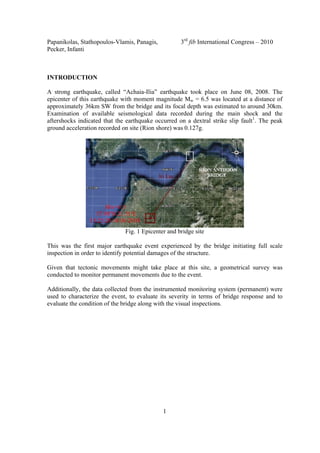
A strong earthquake, called “Achaia-Ilia” earthquake took place on June 08, 2008. The
epicenter of this earthquake with moment magnitude Mw = 6.5 was located at a distance of
approximately 36km SW from the bridge and its focal depth was estimated to around 30km.
Examination of available seismological data recorded during the main shock and the
aftershocks indicated that the earthquake occurred on a dextral strike slip fault1
. The peak
ground acceleration recorded on site (Rion shore) was 0.127g.
Fig. 1 Epicenter and bridge site
This was the first major earthquake event experienced by the bridge initiating full scale
inspection in order to identify potential damages of the structure.
Given that tectonic movements might take place at this site, a geometrical survey was
conducted to monitor permanent movements due to the event.
Additionally, the data collected from the instrumented monitoring system (permanent) were
used to characterize the event, to evaluate its severity in terms of bridge response and to
evaluate the condition of the bridge along with the visual inspections.
Papanikolas, Stathopoulos-Vlamis, Panagis, 3rd
fib International Congress – 2010
Pecker, Infanti
2
BRIDGE DESCRIPTION AND EARTHQUAKE DESIGN
Fig. 2 Bridge elevation
Rion-Antirion Bridge is a five span cable-stay bridge located in the western Greece linking
Peloponnese with the continental Greece.
The harsh environmental conditions of the area which determined the design of the bridge are
the:
• Large water depth
• Deep soil strata of weak alluviums
• High seismicity & strong winds
• Tectonic movements
The specified2
high return period (2000 years) of the design earthquake yields to a response
spectrum (fig. 3) with P.G.A. of 0.48g, which is greater than that specified by the National
seismic code3
(475 year return period) for the particular seismic risk zone III.
0
0,3
0,6
0,9
1,2
1,5
0,0 1,0 2,0 3,0 4,0 5,0Period [s]
pseudoacceleration[g]
EAK 2000
Seismic risk zone III
Soil cat "Γ "
5% damping
Importance factor I = 1,3
RION-ANTIRION
E.A.K.
Fig. 3 Design earthquake spectrum
Papanikolas, Stathopoulos-Vlamis, Panagis, 3rd
fib International Congress – 2010
Pecker, Infanti
3
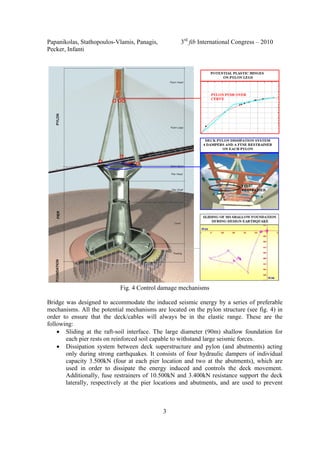
Fig. 4 Control damage mechanisms
Bridge was designed to accommodate the induced seismic energy by a series of preferable
mechanisms. All the potential mechanisms are located on the pylon structure (see fig. 4) in
order to ensure that the deck/cables will always be in the elastic range. These are the
following:
• Sliding at the raft-soil interface. The large diameter (90m) shallow foundation for
each pier rests on reinforced soil capable to withstand large seismic forces.
• Dissipation system between deck superstructure and pylon (and abutments) acting
only during strong earthquakes. It consists of four hydraulic dampers of individual
capacity 3.500kN (four at each pier location and two at the abutments), which are
used in order to dissipate the energy induced and controls the deck movement.
Additionally, fuse restrainers of 10.500kN and 3.400kN resistance support the deck
laterally, respectively at the pier locations and abutments, and are used to prevent
Papanikolas, Stathopoulos-Vlamis, Panagis, 3rd
fib International Congress – 2010
Pecker, Infanti
4
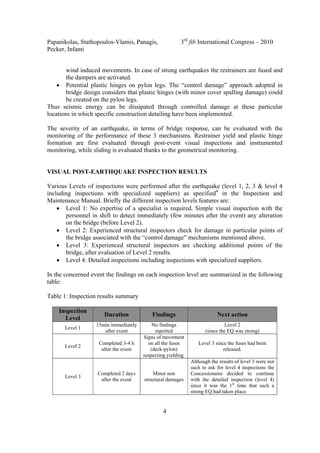
wind induced movements. In case of strong earthquakes the restrainers are fused and
the dampers are activated.
• Potential plastic hinges on pylon legs. The “control damage” approach adopted in
bridge design considers that plastic hinges (with minor cover spalling damage) could
be created on the pylon legs.
Thus seismic energy can be dissipated through controlled damage at these particular
locations in which specific construction detailing have been implemented.
The severity of an earthquake, in terms of bridge response, can be evaluated with the
monitoring of the performance of these 3 mechanisms. Restrainer yield and plastic hinge
formation are first evaluated through post-event visual inspections and instrumented
monitoring, while sliding is evaluated thanks to the geometrical monitoring.
VISUAL POST-EARTHQUAKE INSPECTION RESULTS
Various Levels of inspections were performed after the earthquake (level 1, 2, 3 & level 4
including inspections with specialized suppliers) as specified4
in the Inspection and
Maintenance Manual. Briefly the different inspection levels features are:
• Level 1: No expertise of a specialist is required. Simple visual inspection with the
personnel in shift to detect immediately (few minutes after the event) any alteration
on the bridge (before Level 2).
• Level 2: Experienced structural inspectors check for damage in particular points of
the bridge associated with the “control damage” mechanisms mentioned above.
• Level 3: Experienced structural inspectors are checking additional points of the
bridge, after evaluation of Level 2 results.
• Level 4: Detailed inspections including inspections with specialized suppliers.
In the concerned event the findings on each inspection level are summarized in the following
table:
Table 1: Inspection results summary
Inspection
Level
Duration Findings Next action
Level 1
15min immediately
after event
No findings
reported
Level 2
(since the EQ was strong)
Level 2
Completed 3-4 h
after the event
Signs of movement
on all the fuses
(deck-pylon)
suspecting yielding.
Level 3 since the fuses had been
released.
Level 3
Completed 2 days
after the event
Minor non
structural damages
Although the results of level 3 were not
such to ask for level 4 inspections the
Concessionaire decided to continue
with the detailed inspection (level 4)
since it was the 1st
time that such a
strong EQ had taken place.
Papanikolas, Stathopoulos-Vlamis, Panagis, 3rd
fib International Congress – 2010
Pecker, Infanti
5
Level 4
11/06/2008 to
14/08/2008
1) It was confirmed
with the supplier,
the yielding of all
restrainers (6)
2) Minor non
structural damages
The visual post-earthquake inspections confirmed the good overall condition of the bridge
since no structural damages had been observed although the seismic event was strong. The
lateral restrainers, sacrificial elements, were fused as predicted from the design for a strong
earthquake in order to prevent structural damages and activate the dissipation system.
MONITORING DATA RESULTS
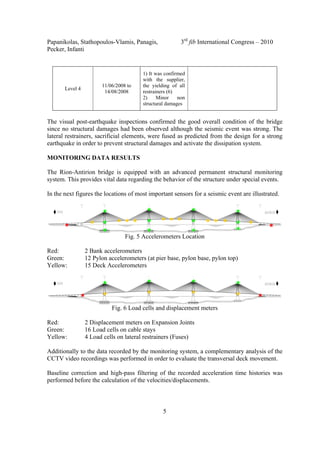
The Rion-Antirion bridge is equipped with an advanced permanent structural monitoring
system. This provides vital data regarding the behavior of the structure under special events.
In the next figures the locations of most important sensors for a seismic event are illustrated.
Fig. 5 Accelerometers Location
Red: 2 Bank accelerometers
Green: 12 Pylon accelerometers (at pier base, pylon base, pylon top)
Yellow: 15 Deck Accelerometers
Fig. 6 Load cells and displacement meters
Red: 2 Displacement meters on Expansion Joints
Green: 16 Load cells on cable stays
Yellow: 4 Load cells on lateral restrainers (Fuses)
Additionally to the data recorded by the monitoring system, a complementary analysis of the
CCTV video recordings was performed in order to evaluate the transversal deck movement.
Baseline correction and high-pass filtering of the recorded acceleration time histories was
performed before the calculation of the velocities/displacements.
Papanikolas, Stathopoulos-Vlamis, Panagis, 3rd
fib International Congress – 2010
Pecker, Infanti
6
The characterization of the event and the estimation of the free field motion, on piers
locations, as well as the return period calculation of the event were possible since the detailed
soil profile was known.
STRUCTURE RESPONSE
The dynamic records (accelerations) of the event were processed in order to retrieve velocity
and displacement information. The processing involves:
• Baseline correction (removal of pre-trigger mean)
• High pass filtering with 0.2 Hz corner frequency (3rd
order Butterworth)
The load on cable stays and the EJ opening/closing are raw values.
Hereunder a synoptic presentation of the recorded bridge response is given.
On shore (free-field)
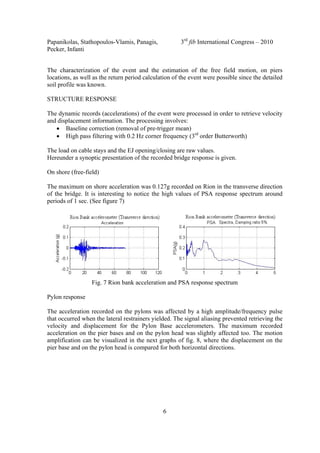
The maximum on shore acceleration was 0.127g recorded on Rion in the transverse direction
of the bridge. It is interesting to notice the high values of PSA response spectrum around
periods of 1 sec. (See figure 7)
Fig. 7 Rion bank acceleration and PSA response spectrum
Pylon response
The acceleration recorded on the pylons was affected by a high amplitude/frequency pulse
that occurred when the lateral restrainers yielded. The signal aliasing prevented retrieving the
velocity and displacement for the Pylon Base accelerometers. The maximum recorded
acceleration on the pier bases and on the pylon head was slightly affected too. The motion
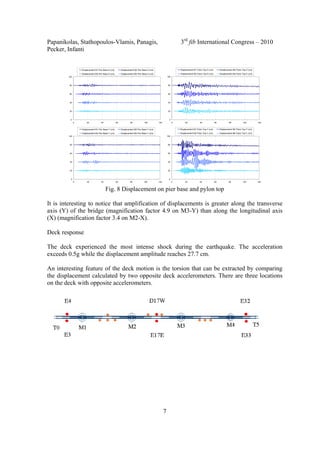
amplification can be visualized in the next graphs of fig. 8, where the displacement on the
pier base and on the pylon head is compared for both horizontal directions.
Papanikolas, Stathopoulos-Vlamis, Panagis, 3rd
fib International Congress – 2010
Pecker, Infanti
7
0
20
40
60
80
100
0 20 40 60 80 100 120
Displacement M1 Pier Base-X (cm) Displacement M2 Pier Base-X (cm)
Displacement M3 Pier Base-X (cm) Displacement M4 Pier Base-X (cm)
0
20
40
60
80
100
0 20 40 60 80 100 120
Displacement M1 Pylon Top-X (cm) Displacement M2 Pylon Top-X (cm)
Displacement M3 Pylon Top-X (cm) Displacement M4 Pylon Top-X (cm)
0
20
40
60
80
100
0 20 40 60 80 100 120
Displacement M1 Pier Base-Y (cm) Displacement M2 Pier Base-Y (cm)
Displacement M3 Pier Base-Y (cm) Displacement M4 Pier Base-Y (cm)
0
20
40
60
80
100
0 20 40 60 80 100 120
Displacement M1 Pylon Top-Y (cm) Displacement M2 Pylon Top-Y (cm)
Displacement M3 Pylon Top-Y (cm) Displacement M4 Pylon Top-Y (cm)
Fig. 8 Displacement on pier base and pylon top
It is interesting to notice that amplification of displacements is greater along the transverse
axis (Y) of the bridge (magnification factor 4.9 on M3-Y) than along the longitudinal axis
(X) (magnification factor 3.4 on M2-X).
Deck response
The deck experienced the most intense shock during the earthquake. The acceleration
exceeds 0.5g while the displacement amplitude reaches 27.7 cm.
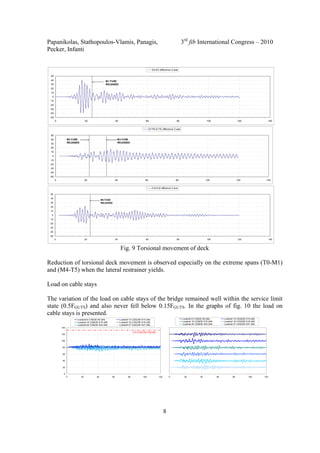
An interesting feature of the deck motion is the torsion that can be extracted by comparing
the displacement calculated by two opposite deck accelerometers. There are three locations
on the deck with opposite accelerometers.
Papanikolas, Stathopoulos-Vlamis, Panagis, 3rd
fib International Congress – 2010
Pecker, Infanti
8
-50
-40
-30
-20
-10
0
10
20
30
40
50
0 20 40 60 80 100 120 140
E4-E3 difference Z axis
M1 FUSE
RELEASED
-50
-40
-30
-20
-10
0
10
20
30
40
50
0 20 40 60 80 100 120 140
D17W-E17E difference Z axis
M2 FUSE
RELEASED
M3 FUSE
RELEASED
-50
-40
-30
-20
-10
0
10
20
30
40
50
0 20 40 60 80 100 120 140
E33-E32 difference Z axis
M4 FUSE
RELEASED
Fig. 9 Torsional movement of deck
Reduction of torsional deck movement is observed especially on the extreme spans (T0-M1)
and (M4-T5) when the lateral restrainer yields.
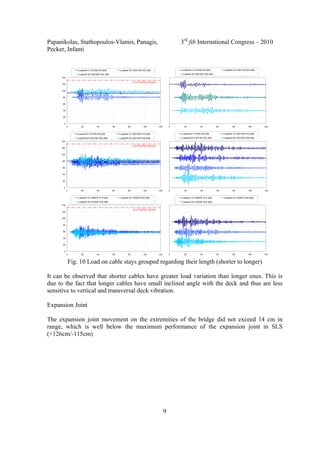
Load on cable stays
The variation of the load on cable stays of the bridge remained well within the service limit
state (0.5FGUTS) and also never fell below 0.15FGUTS. In the graphs of fig. 10 the load on
cable stays is presented.
0
20
40
60
80
100
120
140
0 20 40 60 80 100 120
Loadcell 8 C1N23E K8 (kN) Loadcell 10 C2S23W K10 (kN)
Loadcell 16 C2N23E K16 (kN) Loadcell 18 C3S23W K18 (kN)
Loadcell 25 C3N23E K25 (kN) Loadcell 27 C4S23W K27 (kN)
0.5 FGUTS=132 kN
0 20 40 60 80 100 120
Loadcell 8 C1N23E K8 (kN) Loadcell 10 C2S23W K10 (kN)
Loadcell 16 C2N23E K16 (kN) Loadcell 18 C3S23W K18 (kN)
Loadcell 25 C3N23E K25 (kN) Loadcell 27 C4S23W K27 (kN)
Papanikolas, Stathopoulos-Vlamis, Panagis, 3rd
fib International Congress – 2010
Pecker, Infanti
9
0
20
40
60
80
100
120
140
0 20 40 60 80 100 120
Loadcell 4 C1S18W K4 (kN) Loadcell 23 C3N17W K23 (kN)
Loadcell 32 C4N18W K32 (kN)
0.5 FGUTS=132 kN
0 20 40 60 80 100 120
Loadcell 4 C1S18W K4 (kN) Loadcell 23 C3N17W K23 (kN)
Loadcell 32 C4N18W K32 (kN)
0
20
40
60
80
100
120
140
0 20 40 60 80 100 120
Loadcell 6 C1N10E K6 (kN) Loadcell 12 C2S10W K12 (kN)
Loadcell 20 C3S10E K20 (kN) Loadcell 29 C4S10W K29 (kN)
0.5 FGUTS=132 kN
0 20 40 60 80 100 120
Loadcell 6 C1N10E K6 (kN) Loadcell 12 C2S10W K12 (kN)
Loadcell 20 C3S10E K20 (kN) Loadcell 29 C4S10W K29 (kN)
0
20
40
60
80
100
120
140
0 20 40 60 80 100 120
Loadcell 14 C2N07E K14 (kN) Loadcell 22 C3N07E K22 (kN)
Loadcell 30 C4S05E K30 (kN)
0.5 FGUTS=132 kN
0 20 40 60 80 100 120
Loadcell 14 C2N07E K14 (kN) Loadcell 22 C3N07E K22 (kN)
Loadcell 30 C4S05E K30 (kN)
Fig. 10 Load on cable stays grouped regarding their length (shorter to longer)
It can be observed that shorter cables have greater load variation than longer ones. This is
due to the fact that longer cables have small inclined angle with the deck and thus are less
sensitive to vertical and transversal deck vibration.
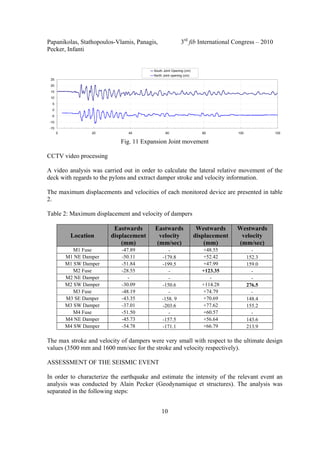
Expansion Joint
The expansion joint movement on the extremities of the bridge did not exceed 14 cm in
range, which is well below the maximum performance of the expansion joint in SLS
(+126cm/-115cm)
Papanikolas, Stathopoulos-Vlamis, Panagis, 3rd
fib International Congress – 2010
Pecker, Infanti
10
-15
-10
-5
0
5
10
15
20
25
0 20 40 60 80 100 120
South Joint Opening (cm)
North Joint opening (cm)
Fig. 11 Expansion Joint movement
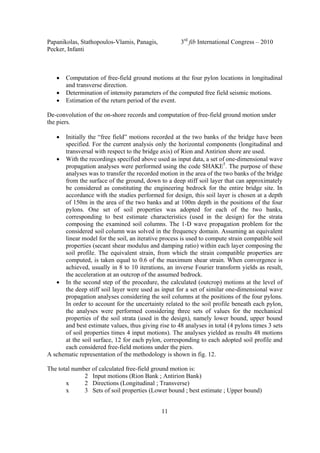
CCTV video processing
A video analysis was carried out in order to calculate the lateral relative movement of the
deck with regards to the pylons and extract damper stroke and velocity information.
The maximum displacements and velocities of each monitored device are presented in table
2.
Table 2: Maximum displacement and velocity of dampers
Location
Eastwards
displacement
(mm)
Eastwards
velocity
(mm/sec)
Westwards
displacement
(mm)
Westwards
velocity
(mm/sec)
M1 Fuse -47.89 - +48.55 -
M1 NE Damper -50.11 -179.8 +52.42 152.3
M1 SW Damper -51.84 -199.5 +47.99 159.0
M2 Fuse -28.55 - +123.35 -
M2 NE Damper - - - -
M2 SW Damper -30.09 -150.6 +114.28 276.5
M3 Fuse -48.19 - +74.79 -
M3 SE Damper -43.35 -158. 9 +70.69 148.4
M3 SW Damper -37.01 -203.6 +77.62 155.2
M4 Fuse -51.50 - +60.57 -
M4 NE Damper -45.73 -157.5 +56.64 143.6
M4 SW Damper -54.78 -171.1 +66.79 213.9
The max stroke and velocity of dampers were very small with respect to the ultimate design
values (3500 mm and 1600 mm/sec for the stroke and velocity respectively).
ASSESSMENT OF THE SEISMIC EVENT
In order to characterize the earthquake and estimate the intensity of the relevant event an
analysis was conducted by Alain Pecker (Geodynamique et structures). The analysis was
separated in the following steps:
Papanikolas, Stathopoulos-Vlamis, Panagis, 3rd
fib International Congress – 2010
Pecker, Infanti
11
• Computation of free-field ground motions at the four pylon locations in longitudinal
and transverse direction.
• Determination of intensity parameters of the computed free field seismic motions.
• Estimation of the return period of the event.
De-convolution of the on-shore records and computation of free-field ground motion under
the piers.
• Initially the “free field” motions recorded at the two banks of the bridge have been
specified. For the current analysis only the horizontal components (longitudinal and
transversal with respect to the bridge axis) of Rion and Antirion shore are used.
• With the recordings specified above used as input data, a set of one-dimensional wave
propagation analyses were performed using the code SHAKE5
. The purpose of these
analyses was to transfer the recorded motion in the area of the two banks of the bridge
from the surface of the ground, down to a deep stiff soil layer that can approximately
be considered as constituting the engineering bedrock for the entire bridge site. In
accordance with the studies performed for design, this soil layer is chosen at a depth
of 150m in the area of the two banks and at 100m depth in the positions of the four
pylons. One set of soil properties was adopted for each of the two banks,
corresponding to best estimate characteristics (used in the design) for the strata
composing the examined soil columns. The 1-D wave propagation problem for the
considered soil column was solved in the frequency domain. Assuming an equivalent
linear model for the soil, an iterative process is used to compute strain compatible soil
properties (secant shear modulus and damping ratio) within each layer composing the
soil profile. The equivalent strain, from which the strain compatible properties are
computed, is taken equal to 0.6 of the maximum shear strain. When convergence is
achieved, usually in 8 to 10 iterations, an inverse Fourier transform yields as result,
the acceleration at an outcrop of the assumed bedrock.
• In the second step of the procedure, the calculated (outcrop) motions at the level of
the deep stiff soil layer were used as input for a set of similar one-dimensional wave
propagation analyses considering the soil columns at the positions of the four pylons.
In order to account for the uncertainty related to the soil profile beneath each pylon,
the analyses were performed considering three sets of values for the mechanical
properties of the soil strata (used in the design), namely lower bound, upper bound
and best estimate values, thus giving rise to 48 analyses in total (4 pylons times 3 sets
of soil properties times 4 input motions). The analyses yielded as results 48 motions
at the soil surface, 12 for each pylon, corresponding to each adopted soil profile and
each considered free-field motions under the piers.
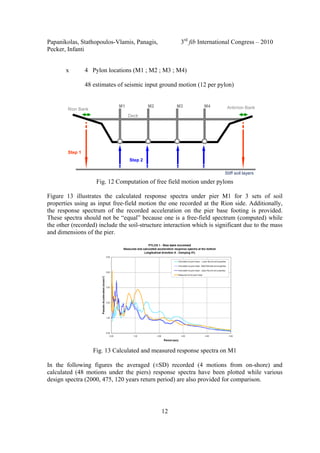
A schematic representation of the methodology is shown in fig. 12.
The total number of calculated free-field ground motion is:
2 Input motions (Rion Bank ; Antirion Bank)
x 2 Directions (Longitudinal ; Transverse)
x 3 Sets of soil properties (Lower bound ; best estimate ; Upper bound)
Papanikolas, Stathopoulos-Vlamis, Panagis, 3rd
fib International Congress – 2010
Pecker, Infanti
12
x 4 Pylon locations (M1 ; M2 ; M3 ; M4)
48 estimates of seismic input ground motion (12 per pylon)
Fig. 12 Computation of free field motion under pylons
Figure 13 illustrates the calculated response spectra under pier M1 for 3 sets of soil
properties using as input free-field motion the one recorded at the Rion side. Additionally,
the response spectrum of the recorded acceleration on the pier base footing is provided.
These spectra should not be “equal” because one is a free-field spectrum (computed) while
the other (recorded) include the soil-structure interaction which is significant due to the mass
and dimensions of the pier.
Fig. 13 Calculated and measured response spectra on M1
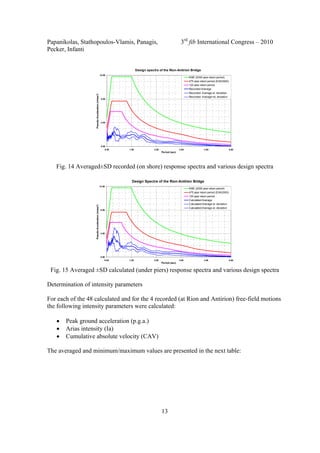
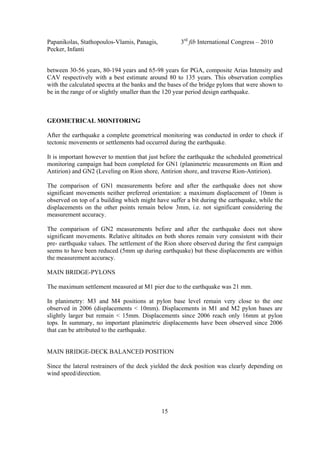
In the following figures the averaged (±SD) recorded (4 motions from on-shore) and
calculated (48 motions under the piers) response spectra have been plotted while various
design spectra (2000, 475, 120 years return period) are also provided for comparison.
Stiff soil layers
Deck
M1 M2 M3 M4
Rion Bank Antirrion Bank
Step 2
Step 1
Papanikolas, Stathopoulos-Vlamis, Panagis, 3rd
fib International Congress – 2010
Pecker, Infanti
13
Design spectra of the Rion-Antirion Bridge
0.00
4.00
8.00
12.00
0.00 1.00 2.00 3.00 4.00 5.00
Period (sec)
Pseudo-Acceleration(m/sec²)
KME (2000 year return period)
475 year return period (EAK2000)
120 year return period
Recorded:Average
Recorded: Average-st. deviation
Recorded: Average+st. deviation
Fig. 14 Averaged±SD recorded (on shore) response spectra and various design spectra
Design Spectra of the Rion-Antirion Bridge
0.00
4.00
8.00
12.00
0.00 1.00 2.00 3.00 4.00 5.00
Period (sec)
Pseudo-Acceleration(m/sec²)
KME (2000 year return period)
475 year return period (EAK2000)
120 year return period
Calculated:Average
Calculated:Average-st. deviation
Fig. 15 Averaged ±SD calculated (under piers) response spectra and various design spectra
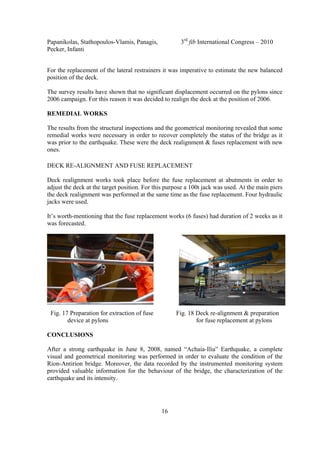
Determination of intensity parameters
For each of the 48 calculated and for the 4 recorded (at Rion and Antirion) free-field motions
the following intensity parameters were calculated:
• Peak ground acceleration (p.g.a.)
• Arias intensity (Ia)
• Cumulative absolute velocity (CAV)
The averaged and minimum/maximum values are presented in the next table:
Papanikolas, Stathopoulos-Vlamis, Panagis, 3rd
fib International Congress – 2010
Pecker, Infanti
14
Table 3: Calculated intensity parameters (average, extreme values)
Intensity
parameters for:
PGA
Arias
Intensity
CAV
4 Recorded
Rion/Antirion
0.11g
(0.093g-0.127g)
0.39 [m/s]
(0.38-0.40)
5.31 [m/s]
(5.10-5.76)
48 Calculated
under piers
0.123g
(0.071g-0.189g)
0.55 [m/s]
(0.34-0.84)
5.92 [m/s]
(4.50-8.39)
Estimation of return period
Using the calculated intensity parameters, an estimate (upper and lower limit) of the return
period of the earthquake is performed using recurrence relationships established for PGA,
Arias Intensity and CAV6
.
Fig. 16 Estimation of return periods based on upper and lower limit of each intensity
parameter
Examination of the figures and consideration of the measured values of the ground motion
parameters leads to the conclusion that the return period of the examined earthquake is
Papanikolas, Stathopoulos-Vlamis, Panagis, 3rd
fib International Congress – 2010
Pecker, Infanti
15
between 30-56 years, 80-194 years and 65-98 years for PGA, composite Arias Intensity and
CAV respectively with a best estimate around 80 to 135 years. This observation complies
with the calculated spectra at the banks and the bases of the bridge pylons that were shown to
be in the range of or slightly smaller than the 120 year period design earthquake.
GEOMETRICAL MONITORING
After the earthquake a complete geometrical monitoring was conducted in order to check if
tectonic movements or settlements had occurred during the earthquake.
It is important however to mention that just before the earthquake the scheduled geometrical
monitoring campaign had been completed for GN1 (planimetric measurements on Rion and
Antirion) and GN2 (Leveling on Rion shore, Antirion shore, and traverse Rion-Antirion).
The comparison of GN1 measurements before and after the earthquake does not show
significant movements neither preferred orientation: a maximum displacement of 10mm is
observed on top of a building which might have suffer a bit during the earthquake, while the
displacements on the other points remain below 3mm, i.e. not significant considering the
measurement accuracy.
The comparison of GN2 measurements before and after the earthquake does not show
significant movements. Relative altitudes on both shores remain very consistent with their
pre- earthquake values. The settlement of the Rion shore observed during the first campaign
seems to have been reduced (5mm up during earthquake) but these displacements are within
the measurement accuracy.
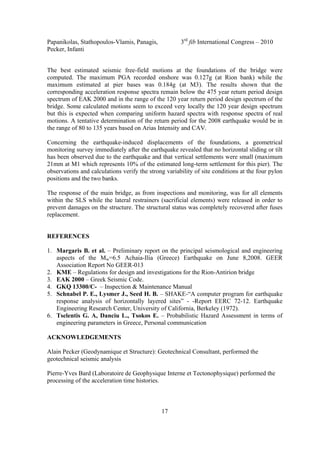
MAIN BRIDGE-PYLONS
The maximum settlement measured at M1 pier due to the earthquake was 21 mm.
In planimetry: M3 and M4 positions at pylon base level remain very close to the one
observed in 2006 (displacements < 10mm). Displacements in M1 and M2 pylon bases are
slightly larger but remain < 15mm. Displacements since 2006 reach only 16mm at pylon
tops. In summary, no important planimetric displacements have been observed since 2006
that can be attributed to the earthquake.
MAIN BRIDGE-DECK BALANCED POSITION
Since the lateral restrainers of the deck yielded the deck position was clearly depending on
wind speed/direction.
Papanikolas, Stathopoulos-Vlamis, Panagis, 3rd
fib International Congress – 2010
Pecker, Infanti
16
For the replacement of the lateral restrainers it was imperative to estimate the new balanced
position of the deck.
The survey results have shown that no significant displacement occurred on the pylons since
2006 campaign. For this reason it was decided to realign the deck at the position of 2006.
REMEDIAL WORKS
The results from the structural inspections and the geometrical monitoring revealed that some
remedial works were necessary in order to recover completely the status of the bridge as it
was prior to the earthquake. These were the deck realignment & fuses replacement with new
ones.
DECK RE-ALIGNMENT AND FUSE REPLACEMENT
Deck realignment works took place before the fuse replacement at abutments in order to
adjust the deck at the target position. For this purpose a 100t jack was used. At the main piers
the deck realignment was performed at the same time as the fuse replacement. Four hydraulic
jacks were used.
It’s worth-mentioning that the fuse replacement works (6 fuses) had duration of 2 weeks as it
was forecasted.
Fig. 17 Preparation for extraction of fuse Fig. 18 Deck re-alignment & preparation
device at pylons for fuse replacement at pylons
CONCLUSIONS
After a strong earthquake in June 8, 2008, named “Achaia-Ilia” Earthquake, a complete
visual and geometrical monitoring was performed in order to evaluate the condition of the
Rion-Antirion bridge. Moreover, the data recorded by the instrumented monitoring system
provided valuable information for the behaviour of the bridge, the characterization of the
earthquake and its intensity.
Papanikolas, Stathopoulos-Vlamis, Panagis, 3rd
fib International Congress – 2010
Pecker, Infanti
17
The best estimated seismic free-field motions at the foundations of the bridge were
computed. The maximum PGA recorded onshore was 0.127g (at Rion bank) while the
maximum estimated at pier bases was 0.184g (at M3). The results shown that the
corresponding acceleration response spectra remain below the 475 year return period design
spectrum of EAK 2000 and in the range of the 120 year return period design spectrum of the
bridge. Some calculated motions seem to exceed very locally the 120 year design spectrum
but this is expected when comparing uniform hazard spectra with response spectra of real
motions. A tentative determination of the return period for the 2008 earthquake would be in
the range of 80 to 135 years based on Arias Intensity and CAV.
Concerning the earthquake-induced displacements of the foundations, a geometrical
monitoring survey immediately after the earthquake revealed that no horizontal sliding or tilt
has been observed due to the earthquake and that vertical settlements were small (maximum
21mm at M1 which represents 10% of the estimated long-term settlement for this pier). The
observations and calculations verify the strong variability of site conditions at the four pylon
positions and the two banks.
The response of the main bridge, as from inspections and monitoring, was for all elements
within the SLS while the lateral restrainers (sacrificial elements) were released in order to
prevent damages on the structure. The structural status was completely recovered after fuses
replacement.
REFERENCES
1. Margaris B. et al. – Preliminary report on the principal seismological and engineering
aspects of the Mw=6.5 Achaia-Ilia (Greece) Earthquake on June 8,2008. GEER
Association Report No GEER-013
2. KME – Regulations for design and investigations for the Rion-Antirion bridge
3. EAK 2000 – Greek Seismic Code.
4. GKQ 13300/C- – Inspection & Maintenance Manual
5. Schnabel P. E., Lysmer J., Seed H. B. – SHAKE-“A computer program for earthquake
response analysis of horizontally layered sites” - -Report EERC 72-12. Earthquake
Engineering Research Center, University of California, Berkeley (1972).
6. Tselentis G. A, Danciu L., Tsokos E. – Probabilistic Hazard Assessment in terms of
engineering parameters in Greece, Personal communication
ACKNOWLEDGEMENTS
Alain Pecker (Geodynamique et Structure): Geotechnical Consultant, performed the
geotechnical seismic analysis
Pierre-Yves Bard (Laboratoire de Geophysique Interne et Tectonophysique) performed the
processing of the acceleration time histories.
Papanikolas, Stathopoulos-Vlamis, Panagis, 3rd
fib International Congress – 2010
Pecker, Infanti
18
Advitam S.A.S performed the analysis of the CCTV videos and the calculation of the lateral
deck movement at pier location.
FIP Industriale SpA: Supplier of Dissipation system and in charge of fuse restrainers
replacement works.

Fib2010 article269 june 2008 eq case study_rev_a

  • 1.
    Papanikolas, Stathopoulos-Vlamis, Panagis,3rd fib International Congress – 2010 Pecker, Infanti THE BEHAVIOR OF RION – ANTIRION BRIDGE DURING THE EARTHQUAKE OF “ACHAIA-ILIA” ON JUNE 8, 2008 Panayotis Papanikolas, Vice-Chairman and Managing Director, GEFYRA S.A. – Concession Company for the Rion-Antirion Bridge, Greece Aris Stathopoulos-Vlamis, Structural Maintenance Manager, GEFYRA S.A. – Concession Company for the Rion-Antirion Bridge, Greece Akis Panagis, Monitoring Engineer, GEFYRA S.A. – Concession Company for the Rion-Antirion Bridge, Greece Alain Pecker, Geotechnical Consultant, Geodynamique et Structure, France Samuele Infanti, R & D Department Manager, FIP Industriale S.p.A., Italy ABSTRACT On June 08, 2008 at 15:25 a strong earthquake with moment magnitude Mw=6.5, named “Achaia-Ilia” occurred in Greece. The focal depth was estimated to be around 30 km and the epicenter was located at a distance of 36 km SW from the Rion Antirion bridge. The Rion Antirion bridge, a five-span cable stay bridge (286m+560m+560m+560m+286m), has been designed to withstand earthquakes with p.g.a. of 0.48g and tectonic movements up to 2m between consecutive pylons. In order to satisfy the above requirements the deck superstructure was made continuous for the full length of 2252m and fully suspended from the four pylons. An innovative energy dissipation system connects the deck to the pylons and limits the lateral movement of the deck during an earthquake, while dissipating the seismic energy with huge -never built before- viscous dampers. The bridge is also equipped with a complete monitoring system capable of collecting high frequency data at critical elements of the structure during a seismic or wind dynamic event. From the analysis of the monitoring data collected during the event and the thorough inspections performed after, it was confirmed that the behavior of the bridge was well within the serviceability limit states, without permanent damages. The paper also presents evidences of the good performance of the dissipation system during the above mentioned earthquake. Keywords: Cable Stayed Bridge, Fuse restrainers, Seismic Dissipation, Earthquake characterization, condition evaluation.
  • 2.
    Papanikolas, Stathopoulos-Vlamis, Panagis,3rd fib International Congress – 2010 Pecker, Infanti 1 INTRODUCTION A strong earthquake, called “Achaia-Ilia” earthquake took place on June 08, 2008. The epicenter of this earthquake with moment magnitude Mw = 6.5 was located at a distance of approximately 36km SW from the bridge and its focal depth was estimated to around 30km. Examination of available seismological data recorded during the main shock and the aftershocks indicated that the earthquake occurred on a dextral strike slip fault1 . The peak ground acceleration recorded on site (Rion shore) was 0.127g. Fig. 1 Epicenter and bridge site This was the first major earthquake event experienced by the bridge initiating full scale inspection in order to identify potential damages of the structure. Given that tectonic movements might take place at this site, a geometrical survey was conducted to monitor permanent movements due to the event. Additionally, the data collected from the instrumented monitoring system (permanent) were used to characterize the event, to evaluate its severity in terms of bridge response and to evaluate the condition of the bridge along with the visual inspections.
  • 3.
    Papanikolas, Stathopoulos-Vlamis, Panagis,3rd fib International Congress – 2010 Pecker, Infanti 2 BRIDGE DESCRIPTION AND EARTHQUAKE DESIGN Fig. 2 Bridge elevation Rion-Antirion Bridge is a five span cable-stay bridge located in the western Greece linking Peloponnese with the continental Greece. The harsh environmental conditions of the area which determined the design of the bridge are the: • Large water depth • Deep soil strata of weak alluviums • High seismicity & strong winds • Tectonic movements The specified2 high return period (2000 years) of the design earthquake yields to a response spectrum (fig. 3) with P.G.A. of 0.48g, which is greater than that specified by the National seismic code3 (475 year return period) for the particular seismic risk zone III. 0 0,3 0,6 0,9 1,2 1,5 0,0 1,0 2,0 3,0 4,0 5,0Period [s] pseudoacceleration[g] EAK 2000 Seismic risk zone III Soil cat "Γ " 5% damping Importance factor I = 1,3 RION-ANTIRION E.A.K. Fig. 3 Design earthquake spectrum
  • 4.
    Papanikolas, Stathopoulos-Vlamis, Panagis,3rd fib International Congress – 2010 Pecker, Infanti 3 Fig. 4 Control damage mechanisms Bridge was designed to accommodate the induced seismic energy by a series of preferable mechanisms. All the potential mechanisms are located on the pylon structure (see fig. 4) in order to ensure that the deck/cables will always be in the elastic range. These are the following: • Sliding at the raft-soil interface. The large diameter (90m) shallow foundation for each pier rests on reinforced soil capable to withstand large seismic forces. • Dissipation system between deck superstructure and pylon (and abutments) acting only during strong earthquakes. It consists of four hydraulic dampers of individual capacity 3.500kN (four at each pier location and two at the abutments), which are used in order to dissipate the energy induced and controls the deck movement. Additionally, fuse restrainers of 10.500kN and 3.400kN resistance support the deck laterally, respectively at the pier locations and abutments, and are used to prevent
  • 5.
    Papanikolas, Stathopoulos-Vlamis, Panagis,3rd fib International Congress – 2010 Pecker, Infanti 4 wind induced movements. In case of strong earthquakes the restrainers are fused and the dampers are activated. • Potential plastic hinges on pylon legs. The “control damage” approach adopted in bridge design considers that plastic hinges (with minor cover spalling damage) could be created on the pylon legs. Thus seismic energy can be dissipated through controlled damage at these particular locations in which specific construction detailing have been implemented. The severity of an earthquake, in terms of bridge response, can be evaluated with the monitoring of the performance of these 3 mechanisms. Restrainer yield and plastic hinge formation are first evaluated through post-event visual inspections and instrumented monitoring, while sliding is evaluated thanks to the geometrical monitoring. VISUAL POST-EARTHQUAKE INSPECTION RESULTS Various Levels of inspections were performed after the earthquake (level 1, 2, 3 & level 4 including inspections with specialized suppliers) as specified4 in the Inspection and Maintenance Manual. Briefly the different inspection levels features are: • Level 1: No expertise of a specialist is required. Simple visual inspection with the personnel in shift to detect immediately (few minutes after the event) any alteration on the bridge (before Level 2). • Level 2: Experienced structural inspectors check for damage in particular points of the bridge associated with the “control damage” mechanisms mentioned above. • Level 3: Experienced structural inspectors are checking additional points of the bridge, after evaluation of Level 2 results. • Level 4: Detailed inspections including inspections with specialized suppliers. In the concerned event the findings on each inspection level are summarized in the following table: Table 1: Inspection results summary Inspection Level Duration Findings Next action Level 1 15min immediately after event No findings reported Level 2 (since the EQ was strong) Level 2 Completed 3-4 h after the event Signs of movement on all the fuses (deck-pylon) suspecting yielding. Level 3 since the fuses had been released. Level 3 Completed 2 days after the event Minor non structural damages Although the results of level 3 were not such to ask for level 4 inspections the Concessionaire decided to continue with the detailed inspection (level 4) since it was the 1st time that such a strong EQ had taken place.
  • 6.
    Papanikolas, Stathopoulos-Vlamis, Panagis,3rd fib International Congress – 2010 Pecker, Infanti 5 Level 4 11/06/2008 to 14/08/2008 1) It was confirmed with the supplier, the yielding of all restrainers (6) 2) Minor non structural damages The visual post-earthquake inspections confirmed the good overall condition of the bridge since no structural damages had been observed although the seismic event was strong. The lateral restrainers, sacrificial elements, were fused as predicted from the design for a strong earthquake in order to prevent structural damages and activate the dissipation system. MONITORING DATA RESULTS The Rion-Antirion bridge is equipped with an advanced permanent structural monitoring system. This provides vital data regarding the behavior of the structure under special events. In the next figures the locations of most important sensors for a seismic event are illustrated. Fig. 5 Accelerometers Location Red: 2 Bank accelerometers Green: 12 Pylon accelerometers (at pier base, pylon base, pylon top) Yellow: 15 Deck Accelerometers Fig. 6 Load cells and displacement meters Red: 2 Displacement meters on Expansion Joints Green: 16 Load cells on cable stays Yellow: 4 Load cells on lateral restrainers (Fuses) Additionally to the data recorded by the monitoring system, a complementary analysis of the CCTV video recordings was performed in order to evaluate the transversal deck movement. Baseline correction and high-pass filtering of the recorded acceleration time histories was performed before the calculation of the velocities/displacements.
  • 7.
    Papanikolas, Stathopoulos-Vlamis, Panagis,3rd fib International Congress – 2010 Pecker, Infanti 6 The characterization of the event and the estimation of the free field motion, on piers locations, as well as the return period calculation of the event were possible since the detailed soil profile was known. STRUCTURE RESPONSE The dynamic records (accelerations) of the event were processed in order to retrieve velocity and displacement information. The processing involves: • Baseline correction (removal of pre-trigger mean) • High pass filtering with 0.2 Hz corner frequency (3rd order Butterworth) The load on cable stays and the EJ opening/closing are raw values. Hereunder a synoptic presentation of the recorded bridge response is given. On shore (free-field) The maximum on shore acceleration was 0.127g recorded on Rion in the transverse direction of the bridge. It is interesting to notice the high values of PSA response spectrum around periods of 1 sec. (See figure 7) Fig. 7 Rion bank acceleration and PSA response spectrum Pylon response The acceleration recorded on the pylons was affected by a high amplitude/frequency pulse that occurred when the lateral restrainers yielded. The signal aliasing prevented retrieving the velocity and displacement for the Pylon Base accelerometers. The maximum recorded acceleration on the pier bases and on the pylon head was slightly affected too. The motion amplification can be visualized in the next graphs of fig. 8, where the displacement on the pier base and on the pylon head is compared for both horizontal directions.
  • 8.
    Papanikolas, Stathopoulos-Vlamis, Panagis,3rd fib International Congress – 2010 Pecker, Infanti 7 0 20 40 60 80 100 0 20 40 60 80 100 120 Displacement M1 Pier Base-X (cm) Displacement M2 Pier Base-X (cm) Displacement M3 Pier Base-X (cm) Displacement M4 Pier Base-X (cm) 0 20 40 60 80 100 0 20 40 60 80 100 120 Displacement M1 Pylon Top-X (cm) Displacement M2 Pylon Top-X (cm) Displacement M3 Pylon Top-X (cm) Displacement M4 Pylon Top-X (cm) 0 20 40 60 80 100 0 20 40 60 80 100 120 Displacement M1 Pier Base-Y (cm) Displacement M2 Pier Base-Y (cm) Displacement M3 Pier Base-Y (cm) Displacement M4 Pier Base-Y (cm) 0 20 40 60 80 100 0 20 40 60 80 100 120 Displacement M1 Pylon Top-Y (cm) Displacement M2 Pylon Top-Y (cm) Displacement M3 Pylon Top-Y (cm) Displacement M4 Pylon Top-Y (cm) Fig. 8 Displacement on pier base and pylon top It is interesting to notice that amplification of displacements is greater along the transverse axis (Y) of the bridge (magnification factor 4.9 on M3-Y) than along the longitudinal axis (X) (magnification factor 3.4 on M2-X). Deck response The deck experienced the most intense shock during the earthquake. The acceleration exceeds 0.5g while the displacement amplitude reaches 27.7 cm. An interesting feature of the deck motion is the torsion that can be extracted by comparing the displacement calculated by two opposite deck accelerometers. There are three locations on the deck with opposite accelerometers.
  • 9.
    Papanikolas, Stathopoulos-Vlamis, Panagis,3rd fib International Congress – 2010 Pecker, Infanti 8 -50 -40 -30 -20 -10 0 10 20 30 40 50 0 20 40 60 80 100 120 140 E4-E3 difference Z axis M1 FUSE RELEASED -50 -40 -30 -20 -10 0 10 20 30 40 50 0 20 40 60 80 100 120 140 D17W-E17E difference Z axis M2 FUSE RELEASED M3 FUSE RELEASED -50 -40 -30 -20 -10 0 10 20 30 40 50 0 20 40 60 80 100 120 140 E33-E32 difference Z axis M4 FUSE RELEASED Fig. 9 Torsional movement of deck Reduction of torsional deck movement is observed especially on the extreme spans (T0-M1) and (M4-T5) when the lateral restrainer yields. Load on cable stays The variation of the load on cable stays of the bridge remained well within the service limit state (0.5FGUTS) and also never fell below 0.15FGUTS. In the graphs of fig. 10 the load on cable stays is presented. 0 20 40 60 80 100 120 140 0 20 40 60 80 100 120 Loadcell 8 C1N23E K8 (kN) Loadcell 10 C2S23W K10 (kN) Loadcell 16 C2N23E K16 (kN) Loadcell 18 C3S23W K18 (kN) Loadcell 25 C3N23E K25 (kN) Loadcell 27 C4S23W K27 (kN) 0.5 FGUTS=132 kN 0 20 40 60 80 100 120 Loadcell 8 C1N23E K8 (kN) Loadcell 10 C2S23W K10 (kN) Loadcell 16 C2N23E K16 (kN) Loadcell 18 C3S23W K18 (kN) Loadcell 25 C3N23E K25 (kN) Loadcell 27 C4S23W K27 (kN)
  • 10.
    Papanikolas, Stathopoulos-Vlamis, Panagis,3rd fib International Congress – 2010 Pecker, Infanti 9 0 20 40 60 80 100 120 140 0 20 40 60 80 100 120 Loadcell 4 C1S18W K4 (kN) Loadcell 23 C3N17W K23 (kN) Loadcell 32 C4N18W K32 (kN) 0.5 FGUTS=132 kN 0 20 40 60 80 100 120 Loadcell 4 C1S18W K4 (kN) Loadcell 23 C3N17W K23 (kN) Loadcell 32 C4N18W K32 (kN) 0 20 40 60 80 100 120 140 0 20 40 60 80 100 120 Loadcell 6 C1N10E K6 (kN) Loadcell 12 C2S10W K12 (kN) Loadcell 20 C3S10E K20 (kN) Loadcell 29 C4S10W K29 (kN) 0.5 FGUTS=132 kN 0 20 40 60 80 100 120 Loadcell 6 C1N10E K6 (kN) Loadcell 12 C2S10W K12 (kN) Loadcell 20 C3S10E K20 (kN) Loadcell 29 C4S10W K29 (kN) 0 20 40 60 80 100 120 140 0 20 40 60 80 100 120 Loadcell 14 C2N07E K14 (kN) Loadcell 22 C3N07E K22 (kN) Loadcell 30 C4S05E K30 (kN) 0.5 FGUTS=132 kN 0 20 40 60 80 100 120 Loadcell 14 C2N07E K14 (kN) Loadcell 22 C3N07E K22 (kN) Loadcell 30 C4S05E K30 (kN) Fig. 10 Load on cable stays grouped regarding their length (shorter to longer) It can be observed that shorter cables have greater load variation than longer ones. This is due to the fact that longer cables have small inclined angle with the deck and thus are less sensitive to vertical and transversal deck vibration. Expansion Joint The expansion joint movement on the extremities of the bridge did not exceed 14 cm in range, which is well below the maximum performance of the expansion joint in SLS (+126cm/-115cm)
  • 11.
    Papanikolas, Stathopoulos-Vlamis, Panagis,3rd fib International Congress – 2010 Pecker, Infanti 10 -15 -10 -5 0 5 10 15 20 25 0 20 40 60 80 100 120 South Joint Opening (cm) North Joint opening (cm) Fig. 11 Expansion Joint movement CCTV video processing A video analysis was carried out in order to calculate the lateral relative movement of the deck with regards to the pylons and extract damper stroke and velocity information. The maximum displacements and velocities of each monitored device are presented in table 2. Table 2: Maximum displacement and velocity of dampers Location Eastwards displacement (mm) Eastwards velocity (mm/sec) Westwards displacement (mm) Westwards velocity (mm/sec) M1 Fuse -47.89 - +48.55 - M1 NE Damper -50.11 -179.8 +52.42 152.3 M1 SW Damper -51.84 -199.5 +47.99 159.0 M2 Fuse -28.55 - +123.35 - M2 NE Damper - - - - M2 SW Damper -30.09 -150.6 +114.28 276.5 M3 Fuse -48.19 - +74.79 - M3 SE Damper -43.35 -158. 9 +70.69 148.4 M3 SW Damper -37.01 -203.6 +77.62 155.2 M4 Fuse -51.50 - +60.57 - M4 NE Damper -45.73 -157.5 +56.64 143.6 M4 SW Damper -54.78 -171.1 +66.79 213.9 The max stroke and velocity of dampers were very small with respect to the ultimate design values (3500 mm and 1600 mm/sec for the stroke and velocity respectively). ASSESSMENT OF THE SEISMIC EVENT In order to characterize the earthquake and estimate the intensity of the relevant event an analysis was conducted by Alain Pecker (Geodynamique et structures). The analysis was separated in the following steps:
  • 12.
    Papanikolas, Stathopoulos-Vlamis, Panagis,3rd fib International Congress – 2010 Pecker, Infanti 11 • Computation of free-field ground motions at the four pylon locations in longitudinal and transverse direction. • Determination of intensity parameters of the computed free field seismic motions. • Estimation of the return period of the event. De-convolution of the on-shore records and computation of free-field ground motion under the piers. • Initially the “free field” motions recorded at the two banks of the bridge have been specified. For the current analysis only the horizontal components (longitudinal and transversal with respect to the bridge axis) of Rion and Antirion shore are used. • With the recordings specified above used as input data, a set of one-dimensional wave propagation analyses were performed using the code SHAKE5 . The purpose of these analyses was to transfer the recorded motion in the area of the two banks of the bridge from the surface of the ground, down to a deep stiff soil layer that can approximately be considered as constituting the engineering bedrock for the entire bridge site. In accordance with the studies performed for design, this soil layer is chosen at a depth of 150m in the area of the two banks and at 100m depth in the positions of the four pylons. One set of soil properties was adopted for each of the two banks, corresponding to best estimate characteristics (used in the design) for the strata composing the examined soil columns. The 1-D wave propagation problem for the considered soil column was solved in the frequency domain. Assuming an equivalent linear model for the soil, an iterative process is used to compute strain compatible soil properties (secant shear modulus and damping ratio) within each layer composing the soil profile. The equivalent strain, from which the strain compatible properties are computed, is taken equal to 0.6 of the maximum shear strain. When convergence is achieved, usually in 8 to 10 iterations, an inverse Fourier transform yields as result, the acceleration at an outcrop of the assumed bedrock. • In the second step of the procedure, the calculated (outcrop) motions at the level of the deep stiff soil layer were used as input for a set of similar one-dimensional wave propagation analyses considering the soil columns at the positions of the four pylons. In order to account for the uncertainty related to the soil profile beneath each pylon, the analyses were performed considering three sets of values for the mechanical properties of the soil strata (used in the design), namely lower bound, upper bound and best estimate values, thus giving rise to 48 analyses in total (4 pylons times 3 sets of soil properties times 4 input motions). The analyses yielded as results 48 motions at the soil surface, 12 for each pylon, corresponding to each adopted soil profile and each considered free-field motions under the piers. A schematic representation of the methodology is shown in fig. 12. The total number of calculated free-field ground motion is: 2 Input motions (Rion Bank ; Antirion Bank) x 2 Directions (Longitudinal ; Transverse) x 3 Sets of soil properties (Lower bound ; best estimate ; Upper bound)
  • 13.
    Papanikolas, Stathopoulos-Vlamis, Panagis,3rd fib International Congress – 2010 Pecker, Infanti 12 x 4 Pylon locations (M1 ; M2 ; M3 ; M4) 48 estimates of seismic input ground motion (12 per pylon) Fig. 12 Computation of free field motion under pylons Figure 13 illustrates the calculated response spectra under pier M1 for 3 sets of soil properties using as input free-field motion the one recorded at the Rion side. Additionally, the response spectrum of the recorded acceleration on the pier base footing is provided. These spectra should not be “equal” because one is a free-field spectrum (computed) while the other (recorded) include the soil-structure interaction which is significant due to the mass and dimensions of the pier. Fig. 13 Calculated and measured response spectra on M1 In the following figures the averaged (±SD) recorded (4 motions from on-shore) and calculated (48 motions under the piers) response spectra have been plotted while various design spectra (2000, 475, 120 years return period) are also provided for comparison. Stiff soil layers Deck M1 M2 M3 M4 Rion Bank Antirrion Bank Step 2 Step 1
  • 14.
    Papanikolas, Stathopoulos-Vlamis, Panagis,3rd fib International Congress – 2010 Pecker, Infanti 13 Design spectra of the Rion-Antirion Bridge 0.00 4.00 8.00 12.00 0.00 1.00 2.00 3.00 4.00 5.00 Period (sec) Pseudo-Acceleration(m/sec²) KME (2000 year return period) 475 year return period (EAK2000) 120 year return period Recorded:Average Recorded: Average-st. deviation Recorded: Average+st. deviation Fig. 14 Averaged±SD recorded (on shore) response spectra and various design spectra Design Spectra of the Rion-Antirion Bridge 0.00 4.00 8.00 12.00 0.00 1.00 2.00 3.00 4.00 5.00 Period (sec) Pseudo-Acceleration(m/sec²) KME (2000 year return period) 475 year return period (EAK2000) 120 year return period Calculated:Average Calculated:Average-st. deviation Calculated:Average-st. deviation Fig. 15 Averaged ±SD calculated (under piers) response spectra and various design spectra Determination of intensity parameters For each of the 48 calculated and for the 4 recorded (at Rion and Antirion) free-field motions the following intensity parameters were calculated: • Peak ground acceleration (p.g.a.) • Arias intensity (Ia) • Cumulative absolute velocity (CAV) The averaged and minimum/maximum values are presented in the next table:
  • 15.
    Papanikolas, Stathopoulos-Vlamis, Panagis,3rd fib International Congress – 2010 Pecker, Infanti 14 Table 3: Calculated intensity parameters (average, extreme values) Intensity parameters for: PGA Arias Intensity CAV 4 Recorded Rion/Antirion 0.11g (0.093g-0.127g) 0.39 [m/s] (0.38-0.40) 5.31 [m/s] (5.10-5.76) 48 Calculated under piers 0.123g (0.071g-0.189g) 0.55 [m/s] (0.34-0.84) 5.92 [m/s] (4.50-8.39) Estimation of return period Using the calculated intensity parameters, an estimate (upper and lower limit) of the return period of the earthquake is performed using recurrence relationships established for PGA, Arias Intensity and CAV6 . Fig. 16 Estimation of return periods based on upper and lower limit of each intensity parameter Examination of the figures and consideration of the measured values of the ground motion parameters leads to the conclusion that the return period of the examined earthquake is
  • 16.
    Papanikolas, Stathopoulos-Vlamis, Panagis,3rd fib International Congress – 2010 Pecker, Infanti 15 between 30-56 years, 80-194 years and 65-98 years for PGA, composite Arias Intensity and CAV respectively with a best estimate around 80 to 135 years. This observation complies with the calculated spectra at the banks and the bases of the bridge pylons that were shown to be in the range of or slightly smaller than the 120 year period design earthquake. GEOMETRICAL MONITORING After the earthquake a complete geometrical monitoring was conducted in order to check if tectonic movements or settlements had occurred during the earthquake. It is important however to mention that just before the earthquake the scheduled geometrical monitoring campaign had been completed for GN1 (planimetric measurements on Rion and Antirion) and GN2 (Leveling on Rion shore, Antirion shore, and traverse Rion-Antirion). The comparison of GN1 measurements before and after the earthquake does not show significant movements neither preferred orientation: a maximum displacement of 10mm is observed on top of a building which might have suffer a bit during the earthquake, while the displacements on the other points remain below 3mm, i.e. not significant considering the measurement accuracy. The comparison of GN2 measurements before and after the earthquake does not show significant movements. Relative altitudes on both shores remain very consistent with their pre- earthquake values. The settlement of the Rion shore observed during the first campaign seems to have been reduced (5mm up during earthquake) but these displacements are within the measurement accuracy. MAIN BRIDGE-PYLONS The maximum settlement measured at M1 pier due to the earthquake was 21 mm. In planimetry: M3 and M4 positions at pylon base level remain very close to the one observed in 2006 (displacements < 10mm). Displacements in M1 and M2 pylon bases are slightly larger but remain < 15mm. Displacements since 2006 reach only 16mm at pylon tops. In summary, no important planimetric displacements have been observed since 2006 that can be attributed to the earthquake. MAIN BRIDGE-DECK BALANCED POSITION Since the lateral restrainers of the deck yielded the deck position was clearly depending on wind speed/direction.
  • 17.
    Papanikolas, Stathopoulos-Vlamis, Panagis,3rd fib International Congress – 2010 Pecker, Infanti 16 For the replacement of the lateral restrainers it was imperative to estimate the new balanced position of the deck. The survey results have shown that no significant displacement occurred on the pylons since 2006 campaign. For this reason it was decided to realign the deck at the position of 2006. REMEDIAL WORKS The results from the structural inspections and the geometrical monitoring revealed that some remedial works were necessary in order to recover completely the status of the bridge as it was prior to the earthquake. These were the deck realignment & fuses replacement with new ones. DECK RE-ALIGNMENT AND FUSE REPLACEMENT Deck realignment works took place before the fuse replacement at abutments in order to adjust the deck at the target position. For this purpose a 100t jack was used. At the main piers the deck realignment was performed at the same time as the fuse replacement. Four hydraulic jacks were used. It’s worth-mentioning that the fuse replacement works (6 fuses) had duration of 2 weeks as it was forecasted. Fig. 17 Preparation for extraction of fuse Fig. 18 Deck re-alignment & preparation device at pylons for fuse replacement at pylons CONCLUSIONS After a strong earthquake in June 8, 2008, named “Achaia-Ilia” Earthquake, a complete visual and geometrical monitoring was performed in order to evaluate the condition of the Rion-Antirion bridge. Moreover, the data recorded by the instrumented monitoring system provided valuable information for the behaviour of the bridge, the characterization of the earthquake and its intensity.
  • 18.
    Papanikolas, Stathopoulos-Vlamis, Panagis,3rd fib International Congress – 2010 Pecker, Infanti 17 The best estimated seismic free-field motions at the foundations of the bridge were computed. The maximum PGA recorded onshore was 0.127g (at Rion bank) while the maximum estimated at pier bases was 0.184g (at M3). The results shown that the corresponding acceleration response spectra remain below the 475 year return period design spectrum of EAK 2000 and in the range of the 120 year return period design spectrum of the bridge. Some calculated motions seem to exceed very locally the 120 year design spectrum but this is expected when comparing uniform hazard spectra with response spectra of real motions. A tentative determination of the return period for the 2008 earthquake would be in the range of 80 to 135 years based on Arias Intensity and CAV. Concerning the earthquake-induced displacements of the foundations, a geometrical monitoring survey immediately after the earthquake revealed that no horizontal sliding or tilt has been observed due to the earthquake and that vertical settlements were small (maximum 21mm at M1 which represents 10% of the estimated long-term settlement for this pier). The observations and calculations verify the strong variability of site conditions at the four pylon positions and the two banks. The response of the main bridge, as from inspections and monitoring, was for all elements within the SLS while the lateral restrainers (sacrificial elements) were released in order to prevent damages on the structure. The structural status was completely recovered after fuses replacement. REFERENCES 1. Margaris B. et al. – Preliminary report on the principal seismological and engineering aspects of the Mw=6.5 Achaia-Ilia (Greece) Earthquake on June 8,2008. GEER Association Report No GEER-013 2. KME – Regulations for design and investigations for the Rion-Antirion bridge 3. EAK 2000 – Greek Seismic Code. 4. GKQ 13300/C- – Inspection & Maintenance Manual 5. Schnabel P. E., Lysmer J., Seed H. B. – SHAKE-“A computer program for earthquake response analysis of horizontally layered sites” - -Report EERC 72-12. Earthquake Engineering Research Center, University of California, Berkeley (1972). 6. Tselentis G. A, Danciu L., Tsokos E. – Probabilistic Hazard Assessment in terms of engineering parameters in Greece, Personal communication ACKNOWLEDGEMENTS Alain Pecker (Geodynamique et Structure): Geotechnical Consultant, performed the geotechnical seismic analysis Pierre-Yves Bard (Laboratoire de Geophysique Interne et Tectonophysique) performed the processing of the acceleration time histories.
  • 19.
    Papanikolas, Stathopoulos-Vlamis, Panagis,3rd fib International Congress – 2010 Pecker, Infanti 18 Advitam S.A.S performed the analysis of the CCTV videos and the calculation of the lateral deck movement at pier location. FIP Industriale SpA: Supplier of Dissipation system and in charge of fuse restrainers replacement works.