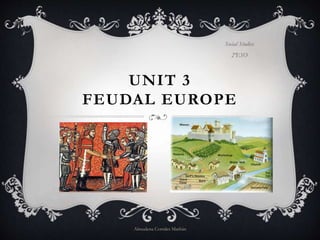
UNIT 3
FEUDAL EUROPE
Social Studies
2ºESO
Almudena Corrales Marbán
1. THE FEUDAL SYSTEM
1.1. INTRODUCTION
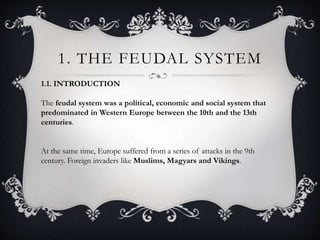
The feudal system was a political, economic and social system that
predominated in Western Europe between the 10th and the 13th
centuries.
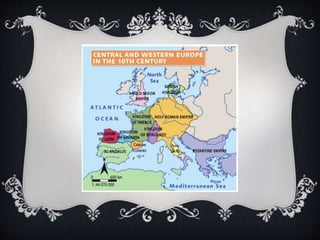
At the same time, Europe suffered from a series of attacks in the 9th
century. Foreign invaders like Muslims, Magyars and Vikings.
1.2. THE ACT OF HOMAGE
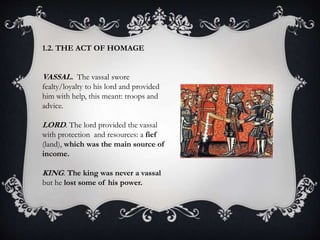
VASSAL. The vassal swore
fealty/loyalty to his lord and provided
him with help, this meant: troops and
advice.
LORD. The lord provided the vassal
with protection and resources: a fief
(land), which was the main source of
income.
KING. The king was never a vassal
but he lost some of his power.
2. THE FIEF
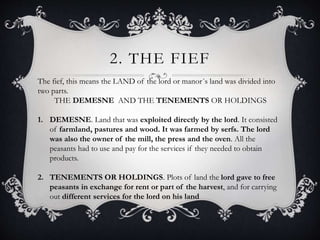
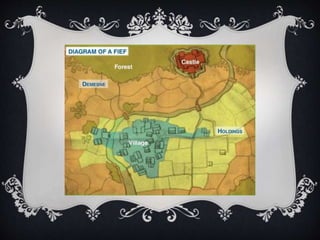
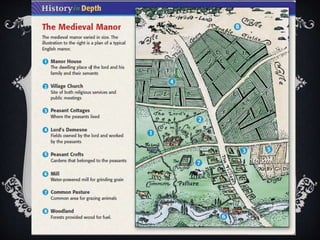
The fief, this means the LAND of the lord or manor´s land was divided into
two parts.
THE DEMESNE AND THE TENEMENTS OR HOLDINGS
1. DEMESNE. Land that was exploited directly by the lord. It consisted
of farmland, pastures and wood. It was farmed by serfs. The lord
was also the owner of the mill, the press and the oven. All the
peasants had to use and pay for the services if they needed to obtain
products.
2. TENEMENTS OR HOLDINGS. Plots of land the lord gave to free
peasants in exchange for rent or part of the harvest, and for carrying
out different services for the lord on his land
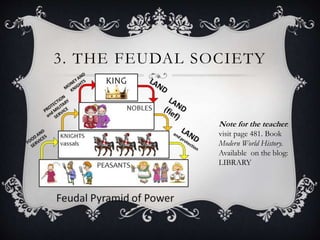
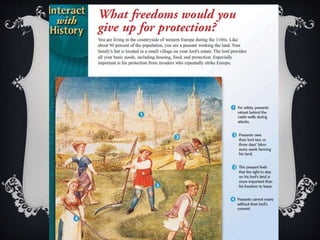
3. THE FEUDAL SOCIETY
Note for the teacher:
visit page 481. Book
Modern World History.
Available on the blog:
LIBRARY
THE LIFE OF A…..
LORD RELIGIOUS ORDER PEASANT
• The lord lived in a castle.
• The castle had a wall
around and it was reinforced
by towers.
• The keep (homage tower)
was his residence. And the
main rooms were covered
with tapestries. He slept in a
bed while the rest on straw
mattresses placed on the
floor.
• The lord’s entertainment
consisted on hunting and
joustng.
• The Church was very
important in medieval life.
• The first monasteries
were founded from the
5th century ownwards.
• The life of the monks
were determined by
regulations, which cover
every aspect of their
lives.
• Monks shared their
time between prayer,
manual labour
(cultivate drops) and
intellectual work (copy
ancient manuscripts)
• The life of a peasant was
very hard.
• He spent most of his life
time working in the fields.
• They lived in small houses
made of clay and straw for
the roof.
• They rested on the floor,
that was covered with straw
as well. Some animals were
kept inside, like mules
(mulas) to warm the rooms.
• Food was scarce. They
didn’t eat meat regularly.
4. ECONOMY
• The economy was mainly based on agriculture and livestock and
both activities were organised around the fiefs.
• Trade was not very active because communications were cut off
due to the frequent wars.
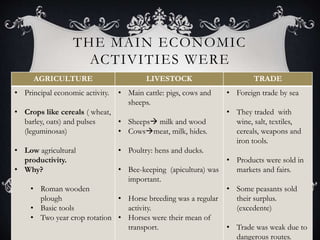
THE MAIN ECONOMIC
ACTIVITIES WERE
AGRICULTURE LIVESTOCK TRADE
• Principal economic activity.
• Crops like cereals ( wheat,
barley, oats) and pulses
(leguminosas)
• Low agricultural
productivity.
• Why?
• Roman wooden
plough
• Basic tools
• Two year crop rotation
• Main cattle: pigs, cows and
sheeps.
• Sheeps milk and wood
• Cowsmeat, milk, hides.
• Poultry: hens and ducks.
• Bee-keeping (apicultura) was
important.
• Horse breeding was a regular
activity.
• Horses were their mean of
transport.
• Foreign trade by sea
• They traded with
wine, salt, textiles,
cereals, weapons and
iron tools.
• Products were sold in
markets and fairs.
• Some peasants sold
their surplus.
(excedente)
• Trade was weak due to
dangerous routes.

Feudal europe

  • 1.
    UNIT 3 FEUDAL EUROPE SocialStudies 2ºESO Almudena Corrales Marbán
  • 2.
    1. THE FEUDALSYSTEM 1.1. INTRODUCTION The feudal system was a political, economic and social system that predominated in Western Europe between the 10th and the 13th centuries. At the same time, Europe suffered from a series of attacks in the 9th century. Foreign invaders like Muslims, Magyars and Vikings.
  • 4.
    1.2. THE ACTOF HOMAGE VASSAL. The vassal swore fealty/loyalty to his lord and provided him with help, this meant: troops and advice. LORD. The lord provided the vassal with protection and resources: a fief (land), which was the main source of income. KING. The king was never a vassal but he lost some of his power.
  • 5.
    2. THE FIEF Thefief, this means the LAND of the lord or manor´s land was divided into two parts. THE DEMESNE AND THE TENEMENTS OR HOLDINGS 1. DEMESNE. Land that was exploited directly by the lord. It consisted of farmland, pastures and wood. It was farmed by serfs. The lord was also the owner of the mill, the press and the oven. All the peasants had to use and pay for the services if they needed to obtain products. 2. TENEMENTS OR HOLDINGS. Plots of land the lord gave to free peasants in exchange for rent or part of the harvest, and for carrying out different services for the lord on his land
  • 8.
    3. THE FEUDALSOCIETY Note for the teacher: visit page 481. Book Modern World History. Available on the blog: LIBRARY
  • 10.
    THE LIFE OFA….. LORD RELIGIOUS ORDER PEASANT • The lord lived in a castle. • The castle had a wall around and it was reinforced by towers. • The keep (homage tower) was his residence. And the main rooms were covered with tapestries. He slept in a bed while the rest on straw mattresses placed on the floor. • The lord’s entertainment consisted on hunting and joustng. • The Church was very important in medieval life. • The first monasteries were founded from the 5th century ownwards. • The life of the monks were determined by regulations, which cover every aspect of their lives. • Monks shared their time between prayer, manual labour (cultivate drops) and intellectual work (copy ancient manuscripts) • The life of a peasant was very hard. • He spent most of his life time working in the fields. • They lived in small houses made of clay and straw for the roof. • They rested on the floor, that was covered with straw as well. Some animals were kept inside, like mules (mulas) to warm the rooms. • Food was scarce. They didn’t eat meat regularly.
  • 11.
    4. ECONOMY • Theeconomy was mainly based on agriculture and livestock and both activities were organised around the fiefs. • Trade was not very active because communications were cut off due to the frequent wars.
  • 12.
    THE MAIN ECONOMIC ACTIVITIESWERE AGRICULTURE LIVESTOCK TRADE • Principal economic activity. • Crops like cereals ( wheat, barley, oats) and pulses (leguminosas) • Low agricultural productivity. • Why? • Roman wooden plough • Basic tools • Two year crop rotation • Main cattle: pigs, cows and sheeps. • Sheeps milk and wood • Cowsmeat, milk, hides. • Poultry: hens and ducks. • Bee-keeping (apicultura) was important. • Horse breeding was a regular activity. • Horses were their mean of transport. • Foreign trade by sea • They traded with wine, salt, textiles, cereals, weapons and iron tools. • Products were sold in markets and fairs. • Some peasants sold their surplus. (excedente) • Trade was weak due to dangerous routes.