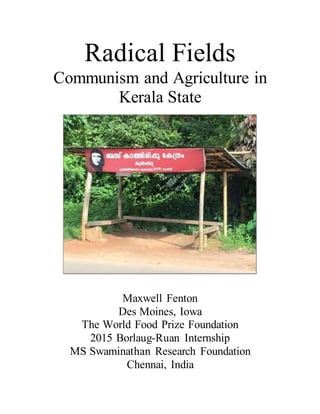
Radical Fields
Communism and Agriculture in
Kerala State
Maxwell Fenton
Des Moines, Iowa
The World Food Prize Foundation
2015 Borlaug-Ruan Internship
MS Swaminathan Research Foundation
Chennai, India
2
Table of Contents
Acknowledgments……………………………………………..…….3
Personal Introduction………………………………………..………4
The MS Swaminathan Research
Foundation…………………………………………………….……..4
Abstract………………………………………………………………5
Findings………………………………………………………………5
I. A Brief History of Keralite Radicalism………………………………5
II. Stagnation: Kerala’s Economic Development in the 21st Century….9
III. Strides: Social-Agrarian Development Under Communism……….13
IV. Keralite Communism as Radical Agrarian Democracy…………….15
V. Concluding Remarks and Policy Recommendations………………..17
Personal Reflection………………………………………………….19
Photographs………………………………………………………….20
Bibliography…………………………………………………………21
3
Acknowledgments
First, I would like to thank Dr. Norman Borlaug and John Ruan III. Their faith in youth as the
future leaders of global agriculture was the inspiration for this program, and their continued
legacies can still be felt not only through agriculture but the world itself.
Lisa Fleming, Ambassador Kenneth Quinn, and the whole of the World Food Prize Foundation
staff also deserve my hearty thanks for their logistical, practical, and general support. I could not
have had this opportunity without their great assistance.
Thank you to all of the staff (that are too numerous to name here) at the MS Swaminathan
Research Foundation. All of you assisted me in my endeavors in India. Without your support, my
project would not have had the same depth in writing or in topic.
I would like to thank my supervisors at the MSSRF, Drs. Rajalakshmi Swaminathan and CS
Chandrika for their assistance in organizing both practical and cultural excursions. Both of your
analyses were essential in forming my paper.
My greatest thanks go to MS Swaminathan himself, who was kind enough to let me come to
Chennai after my first internship assignment to Nepal fell through due to the tragic earthquake.
His kindness, generosity, vivacity, and intelligence remain an inspiration.
Thank you to Neena Hayreh, Barbara Hemann, Nancy Holsapple, and Erin Pommrehn for their
assistance in teaching me how to write academically and providing excellent recommendations,
both in this program and elsewhere.
Thank you to all of my friends. You were very supportive and encouraging of my participation in
this program, and were always interested in my adventures in India.
And finally, I thank my staunchest allies and harshest critics - my family. Without your
emotional, moral, and economic support, I could not be where I am today.
4
Personal Introduction
I do not come from a farm. The closest that actual agriculturalists of any sort are to my
bloodline goes back several generations to hardscrabble pioneers on the Colorado prairie and
poultry farmers in southern Iowa. In contrast to this dearth of a close agricultural background, I
have always found the subject fascinating, especially as it pertains to global development issues
and political movements. When I heard about the World Food Prize program, I was only
tangentially aware of the great opportunity that it provided to students from across the United
States to study agriculture overseas. I’d always enjoyed talking about the world’s issues, but the
Borlaug-Ruan program provides the opportunity to see them up close.
I feared during the application process, however, that I would be pigeonholed into
researching a scientific or technological topic - something that is by no means my forte.
However, I was pleasantly surprised that my policy studies background was not only appreciated
at the MS Swaminathan Research Foundation, but encouraged. This paper is the culmination of
my several research interests colliding at once - labor history, critical theory, political ideologies,
and, of course, agriculture. It is very cliche, but if someone had told me that when I applied for
this program junior year of high school that I’d have the opportunity to construct a project of this
magnitude, I’d have laughed in their face. But it is for that very reason why the Borlaug-Ruan
Program is so important to me - that it not only encourages the development of these interests,
but expects it. And for that, I am eternally grateful.
With that, the academic section of this paper begins.
The MS Swaminathan Research Foundation
The MS Swaminathan Research Foundation was developed in 1988 by its namesake, MS
Swaminathan. An agriculture scientist by profession, he used the money he received from
winning the first World Food Prize to found his organization. It has a multitude of regional
programs in Chennai, Kerala, Puducherry, and Orissa, among smaller local efforts. It follows a
“pro-poor, pro-woman, pro-sustainable development” approach in its recommendations in the
scientific and policy worlds. It plays a significant role in promoting positive agricultural change
in India, specifically targeting that nation’s most marginalized groups - tribal people, dalits, and
women to name a few. Researchers at the MSSRF have made significant strides in combatting
continued food scarcity and security issues not only in India, but worldwide.
5
Abstract
The Indian state of Kerala is noted by experts as a sort of “puzzle” in the field of global
development. While its social development is often on par with that of the developed world, the
economy continues to lag far behind many of its less advanced neighbors. In contrast to other
Indian states, Kerala’s specific model of development was representative of a great
decentralization of power into local hands. Particularly “left-wing” sentiments – notably,
sponsorship of trade unions and extensive land reforms – were a major aspect of this political-
economic model. With this decentralization came the rise of militant trade unions and rural
organizations as sources of power and legitimacy for disenfranchised and disaffected sectors of
Keralite society. Groups like agricultural workers, dalits, and landless people all used
organizations such as these to broadcast their demands to the society at large. However, such
militancy has often led to open revolts and a breakdown of rural labor relations. Even as
organizations have abandoned their confrontational pasts, the commonplace nature of labor
militancy in Kerala has had substantial effects on the socio-economics of the state. But can labor
militancy be exclusively blamed for this puzzling development crisis? And can Kerala be
considered a “radical democracy” as a result of its insurgent politics? Through the dual lenses of
political philosophy and analysis, a meaningful study of Kerala’s agrarian revolts shall be
created.
I. A Brief History of Keralite Agrarian
Radicalism
Kerala’s history as a hotbed of rural
militancy is not a particularly recent
occurrence. Among the earliest sentiments
of such direct action come from the British
Raj and a peasant1 revolt known as the
Malabar Rebellion. In 1921, fed up with
repressive British rule and the intransigence
of their higher-caste Hindu Brahmin jenmi
(landlords), thousands of Mappila Muslims,
the majority of which were kudiyaan,
(tenants), rose up in massive scale to throw
off this oppressive yoke. Government
offices and treasuries were sacked, courts
were held hostage, and landlords’ records
were burned. Mappilas attacked Hindu
tenants, believing they were in league with
British-sponsored police forces. Revolting
1
“Peasant” is not usedhere as a disparagingterm.Modern
historians andprofessionals specializingin rural studies use it as a
term referringto poor landless people.Examples include the
respectedJournal of Peasant Studies.
Mappilas were reported to have forced at
least 100,000 Hindus to convert or face
death2. Smaller demonstrations had certainly
occurred, but the Malabar Rebellion was the
culmination of a series of riots in the area
that were largely for the same purpose3. It
was the first such large-scale revolt in
Kerala’s history, and a tough act to follow –
no demonstration since has captured the
following of so many people. While actions
against Hindus must be considered
atrocities, and the true nature of Malabar as
a religious or agrarian conflict is up for
debate, no historian can deny the impact of
the Malabar Rebellion on Kerala’s labor
history. It set the stage for a history of open
rural revolts, and is still considered a
touchstone for many peasant leaders. In fact,
in 1971, the Kerala state government
2
Besant,Annie.The Future of IndianPolitics: A Contributionto
the Understanding of Present-DayProblems.Whitefish: Kessinger
Publishing,2006.Reprint.
3
Panikkar,K.N.,Against Lordand State:Religionand Peasant
Uprisings in Malabar 1836–1921.Oxford: OxfordUniversity
Press,1989.
6
recognized the Mappila revolutionaries as
“freedom fighters.”4 Malabar’s impact is
still resonating throughout modern religious
and class conflicts in Kerala, and its legacy
is still a matter of concern.
But at its core, Malabar was an illegal action
of class warfare. Such a massive uprising
was by no means sanctioned by the ruling
British-Brahmin bourgeoisie. It was nearly
40 years later that class conflicts became
“institutionalized” – essentially,
incorporated into policy implementation. In
1957, the voters of Kerala became the first
people in the world to democratically elect a
Communist government5. Led by E. M. S.
Namboodiripad, the Party’s victory
represented the convergence of a number of
social and political movements among
peasants and the rural poor6. Multiple small
parties with hazy ideologies were formed
representing the needs of low-caste,
landless, and rural people, including groups
like the All India Kisan Sabha (All India
Peasant Union), founded in 1936 by a group
of landless workers. More general parties,
like the Congress Socialist Party founded in
the early 1930’s, sought to emulate the
socialist revolution that had swept the Soviet
Union a decade earlier7. These parties, along
with other, more regional factions in Kerala,
became the foundations for political
organization on the behalf of the
Communists.
4
Miller,Roland.The Encyclopediaof Islam,Vol.VI.Leiden:
Brill Publishers,1988.
5
Patel,Raj.Stuffed andStarved:Markets,Power andthe Hidden
Battle for the World Food System.London: PortobelloBooks
Ltd.,2008.
6
Heller,Patrick.The Labor of Development.Ithaca: Cornell
UniversityPress,1999.
7
“PartyHistory”.Communist Partyof India (Marxist).
http://www.cpimkerala.org/eng/history-2.php?n=1 Accessed20
July 2015.
Another inspirational movement was found
in Kerala’s early trade unions. With the
stock crash in 1929 and the onset of the
Great Depression, India’s economy was still
lashed to a poorly performing British
Empire. Similar economic problems faced
India’s workers. In response, laborers began
to organize and founded regional groups for
a variety of industries, including agriculture.
A plethora of organizations, including the
newly-founded Travancore Agricultural
Labourers’ Union and Cochin Sterling
Workers’ Union became particularly
militant as time went on, sponsoring the idea
of “labour brotherhood” and agitating for
better working conditions8. These unions
were in large part recruiting centers and
“vote banks” for the Communists – the CPI
was seen in large part as the only party to
sponsor organized labor and gained massive
amounts of votes from labor sponsorship9.
Third and perhaps most important was the
socioeconomic situation that existed in
Kerala at this point. Kerala had the most
internecine caste system of any province in
India. A tiny priestly ruling class of Brahmin
considered all others outside of their caste to
be untouchable10. This complex system grew
into outright exploitation under the Raj, as
superior British military firepower alleviated
any anxieties about a peasant uprising11. The
caste system grew into landlording and
abuse of tenants, using the already thin
patina of caste to add a sense of legitimacy
to this victimization. The colonial abuses of
8
Ibid.
9
Menon,Ramesh.“Labour pangs - Militant trade unionismdrives
companies out ofKerala”March15,1990.IndiaToday.
10
Nossiter,Thomas Johnson.Communism in Kerala: a study in
political adaptation.Oakland: Universityof CaliforniaPress,
1982.
11
Barendse,Rene J.,ArabianSeas 1700-1763:The Western
Indian Oceanin the eighteenthcentury.Leiden: Brill Publishers.
2009.
7
the past were coupled with rampant
inequality as well, especially among
agrarian communities. Kerala in the 1950’s
had the highest proportion of low-caste
agriculture workers anywhere in India, who
tended to be in crushing poverty. This
substantial majority of Keralites stands in
direct contrast to the tiny Brahmin landlord
community, who tended to be fabulously
wealthy by Indian standards12. Such is the
situation in many jurisdictions with a
substantial Communist presence. Simple
electoral calculus prevailed, and as the
primary platform of the CPI was to reduce
income inequality, the overwhelming
majority of agrarian workers supported their
cause. It was a perfect storm for far-left
victory.
In 1957, with a Communist government
freshly elected, the institutionalization of
class warfare and labor militancy was in full
swing. Riding into power on a tsunami of
rural discontent, the Communist government
swiftly enacted a number of substantial land
and social reforms. First among them was
the controversial Kerala Agrarian Relations
Bill, passed in 195713. Using the slogan
“Land for the Tiller!” the Act accomplished
a number of very radical goals. First, the
eviction of people and collection of rents
was made illegal. Second, a ceiling was
placed on the amount of land any given
family or individual could own. Finally,
surplus lands were assigned and their
owners were granted proprietary rights14.
12
Nossiter,supraat 10.
13
The government issuedthe lawas an ordinance – essentially an
executive order.Thestate parliament laterdebatedit andpassedit
as a Bill. It shall be referredtoas thelatter here.
14
The Kerala Agrarian Relations Bill.Kerala,India.Government
of Kerala.Passed1957.http://kerala.gov.in/docs/pdf/agrn_rln.pdf
. Accessed21 July 2015.
15
Nair,K.Ramachandran.Thehistory of trade union movement
in Kerala.Kerala Instituteof LabourandEmployment.Delhi:
Manak Publications.2006.
Such a drastic series of reforms sent seismic
shockwaves through the wealthy landlord
community. A coalition of decidedly
bourgeois forces was formed to end
Communist rule. It involved major
opposition parties like the Indian Congress,
religious forces like the Catholic Church and
wealthy Syrian Christians15, a number of
Nair16 rights groups, and even the CIA,
which sought to prevent “additional
Keralas” sprouting from Indian rural
discontent17. Social strife ensued for a brief
period, and the Nehru government invoked
Article 356 of the Indian Constitution,
which allows the central government to
dismiss the government of a state if it is
determined to be unfit to rule18. Kerala was
ruled directly by the then-Presidents of
India, Dr. Rajendra Prasad and his successor
Sarvepalli Radhakrishnan until 1967,
excepting the relative quiet of 1960-1964.
Abortive elections resulted in further strife,
and the state was yet again put under
President’s Rule in 196519. In 1967, a
Communist government under E.M.S.
Namboodiripad was yet again elected, and
began the process of reworking many of the
land reforms that it had passed a decade
earlier. By 1969, an updated version of the
earlier Agrarian Relations Bill had been
passed. Due to a number of political
scandals and the split of the Communist
Party into two separate entities (CPI
(Marxist) and CPI), Namboodiripad
resigned later that year. He was replaced by
C. Achutha Menon, head of the CPI wing of
16
The Nair are a small caste in Kerala withunique family
structures.Theirconcern was in preservingtheir traditions.
17
Moynihan,Sen.Daniel Patrick.A Dangerous Place.NewYork
City: Little,Brown,andCompany.1978
18
Nossiter,supraat 10.
19
“Historyof Kerala Legislature”.Government ofKerala.
http://kerala.gov.in/index.php?option=com_content&view=article
&id=3776:history-of-kerala-legislature .Accessed21 July 2015.
8
India’s Communists20 who headed a
coalition government with India’s Congress
Party.
By the late 1970’s, labor militancy was at its
absolute zenith in Kerala. Relations between
farmers and laborers had reached a nadir,
largely in part to a number of shifting labor
dynamics. Farmers began to cultivate less
labor-intensive crops – trees like coconut
and rubber became more commonplace than
rice paddies21. In response, laborers took to
agitation and radical strategies meant to
disrupt these changing economies of scale.
Conflicts and violence became increasingly
commonplace as the disputes between labor
and managers grew. State attempts to
mediate the conflict only worsened the
economic impacts of this provocation, and
created a business-hostile environment that
persists into the 21st century through failed
central economic planning and poorly
managed Keynesian strategies22.
Nonetheless, class mobilization in large part
only led to stalemates with managerial
concerns, and organized labor had to adapt
itself for the 21st century23. By 1981, the
Communist Party and its many unions had
accepted the politics of class compromise.
Militancy was on a slow downswing for the
next two decades24. Since the apex of labor
violence in the 1970’s, the number of strikes
and days lost due to labor activity has
dropped steeply.
20
“Political Background”.Government ofKerala.
http://kerala.gov.in/index.php?option=com_content&view=article
&id=3064&Itemid=2378 .Accessed21 July 2015.
21
Heller,supra at 6.
22
Ibid.
23
Payaril,Govindra “Kerala: theDevelopment Experience:
Reflections on Sustainability and Replicability”.London: Zed
Books.2000.
24 Ibid.
At this point, labor militancy was
abandoned in large scale by 2000, but its
impacts continued to reverberate throughout
Kerala25. Policymakers attempted to draft
solutions to put the final nail in the coffin
for radical labor. In 2001, the government
sought to force unions to abandon many of
the more drastic policies, like occupying
workplaces and attacking managers’
houses26.
While the sheer number of strikes went
down from 1970-1996, militant labor
activity is persistent in Kerala nearly two
decades later. Bellicose unions continue to
push radical ideologies and refuse to change
with the prevailing notions of labor markets,
especially in agricultural areas. Because
agriculture is an especially job-heavy sector,
union militancy continues to have a
profound effect27. As there are (a) more
workers, (b) less income, (c) and a tradition
of agrarian organization, militant unions
have been able to hold back progress in
agricultural development, and in some cases,
downgrade it. Many also argue that labor
militancy is back and here to stay in Kerala.
As a matter of fact, from 2005-2012 there
were 363 hartal - large scale labor strikes –
pushed both by the Communists and trade
unions. On average, this means about one
such action per week28. A recent hartal in
April of 2015 by the farming and fishing
industry succeeded in grinding Keralite
business to a screeching halt. In spite of
25
“Kerala’s trade unions begin toshun labour militancy”.New
Trade UnionInitiative.20 August 2010.http://ntui.org.in/labour-
news/item/keralas-trade-unions-begin-to-shun-labour-militancy/
26
“Kerala to takesteps toendlabour militancy”.The Times of
India.2 December 2001.Accessed21 July 2015.
timesofindia.indiatimes.com/city/thiruvananthapuram/Kerala-to-
take-steps-to-end-labour-militancy/articleshow/753838513.cms
27
Ibid.
28
“363hartals in 7 years in Kerala!” AsianAge.16 September
2012.Accessed21 July 2015.archive.asianage.com/india/363-
hartals-7-years-kerala-357
9
2001-era efforts to curtail the rise of radical
labor, multiple accounts exist of strikers
throwing rocks and damaging property in
this particular action29. Whatever the
circumstances, radical labor continues to
have a presence in Kerala regardless of an
earlier statistical downswing. Even when the
Communists are not in power, their
pervasive legacy of promoting rural
militancy has lasting impacts on Kerala’s
development and its organized labor.
Kerala’s modern history is one of great
upheaval. From the Malabar Rebellion to the
Communists to the distress of the 1970’s,
Keralite labor is certainly still the best
organized of any Indian state. While many
argue the Keralite organization and
development dream has failed, one cannot
discount the impact radical, meaningful,
organized labor has had on the
socioeconomic trends of what was once a
colonial rural backwater.
II. Stagnation: Kerala’s Economic
Development in the 21st Century
Kerala’s labor unions have played a
significant role in fostering the major agro-
economic programs that plague the state
even today. Through their strident politics
and distrust of modernization, they have
significantly crippled agriculture in that
state. An over-reliance upon cash crops has
been compounded by a significant decline in
the production of rice. A hostility to modern
agricultural practices has caused massive
labor shortages for those that can find work.
The vast unemployed population has turned
29
“Strike,hartals toshut down Kerala today”.TheHindu.8 April
2015.Accessed21 July 2015.
http://www.thehindu.com/news/national/andhra-pradesh/strike-
hartals-to-shut-down-kerala-today/article7079389.ece
30
Williams,Michelle.The Roots of Participatory Democracy.
London: Palgrave Macmillan.2008.
31
“Agriculture”.Government of Kerala.
http://www.kerala.gov.in/economy/agri.htm.Accessed22 July
2015
to remittances as a source of income, and the
state’s budget remains reliant upon foreign
money.
Much of the Keralite economy is hugely
reliant upon agriculture, especially in the
production of spice and tree crops. At least
50% of the state’s population is directly
dependent on agriculture for their
livelihood30 Kerala produces 97% of Indian
pepper. 85% of rubber output comes from
Kerala as well. Spice crops like vanilla,
nutmeg, and cardamom are the locus of
much of Kerala’s agricultural activity31. A
major agricultural staple is rice, with over
six hundred separate varieties grown in the
state alone32. Rice is also a huge part of the
Keralite diet, typically served with a variety
of side dishes and eaten with the hands33.
But the underlying issues with agriculture in
Kerala are not with the crops per se – they
primarily lie with the means in which crops
are grown. Under the terms of the Agrarian
Relations Bill in 1957 and its update a
decade later, ceilings were placed on the
amount of land that a given family or
individual could own. 15 acres was set as
the limit for the former and 7.5 acres for the
latter34. These limitations, coupled with the
redistribution of surplus lands and the
relative poverty and size of the agricultural
worker base, created a situation in which
Keralite farms are desperately fragmented.
The average farm size in Kerala in general is
0.24 hectares – about 0.6 acres. This stands
in direct contrast to the Indian state of
Gujarat, which has experienced huge growth
32
Sreedharan,TP.“Biological Diversity of Kerala:A survey of
Kalliasseri panchayat,Kannur district"Kerala Research
Programme onLocal Level Development (Centre for Development
Studies). 2004.
33
“WhyPeople Eat With Their Hands in Kerala”.NDTVFood.
16 Feb2015.http://food.ndtv.com/opinions/why-people-eat-with-
their-hands-in-kerala-694675Accessed22July 2015.
34
Kerala AgrarianRelations Bill,supraat 14.
10
rates in agriculture. Its average farm size is
closer to 2.33 hectares – roughly 5.3 acres35.
But how specifically does the fragmentation
of farms impact agriculture? The presence of
too many small farms with little
consolidation has a number of severe
repercussions not only on agricultural
productivity, but food security as well. The
vast majority of these small landholdings are
owned by families, who rely upon their own
labor to harvest and produce crops for
market. While the families on these small
farms are able to harvest all their crops and
do not experience labor shortages, the sheer
tininess of their farms prevents meaningful
harvests due to the shortage of land. This
hypothesis has been noted in many Indian
states, including the economically and
politically similar state of West Bengal36.
Because these farmers have such little land,
they are unable to focus on multiple crops.
In an attempt to make more money (despite
the efforts of the government at developing
a welfare state), many farmers focus almost
exclusively on growing cash crops like
rubber, coconut, or spices. Also, as they are
so reliant upon a single crop for their
livelihood, and are often in extreme poverty
anyway, they are especially affected by
massive fluctuations in volatile commodity
prices. A sharp drop in rubber prices by the
year 2014 in response to cheaper crude oil
distressed many Indian smallholders,
especially in places like Kerala37. Because
cheaper oil means synthetic rubber is easier
to produce, auto companies were
abandoning organic rubber in favor of its
artificial counterpart. Prices dropped 24% as
35
Dev,S. Mahendra.“Small Farmers in India: Challenges and
Opportunities.”Indira Gandhi Instituteof Development Research.
June 2012.http://www.igidr.ac.in/pdf/publication/WP-2012-
014.pdf .Accessed22 July 2015.
36
Ghosh Madhusudan “Changes in the Agrarian Structure ofWest
Bengal”,Productivity,Vol.30,October-December,No.3.1989.
37
Nayak,Depiprasad.“FallingCrude Upsets India’s Rubber
Farmers”.Wall Street Journal.14November 2014.Accessed22
a result of shifting demands, and natural
rubber’s share of the market fell from 75%
to 66%38. Without a sufficient demand
relative to the toil of harvesting rubber,
Kerala’s rubber farmers were left without a
leg to stand on. Regi Paul, a rubber farmer,
was interviewed by the Wall Street Journal
during the crisis in 2014. He said: “We
never faced this kind of situation. I am
planning to give up most of my rubber
plantation and switch to banana, nutmeg or
coconut.” Fortunately for Mr. Paul, he owns
a fairly large rubber plantation39. He was
able to stave off much of the crisis simply
by switching crops or utilizing fallow land.
Unfortunately for many of Kerala’s rubber
growers, smallholder farmers who likely
grow nothing else but a home garden, there
are few options. In July of 2015, the Kerala
state government approved a law creating a
minimum price support and subsidy for
impoverished small scale rubber growers,
including repealing the value added tax on
natural rubber to spur domestic tire makers
to buy Keralite product40. Unfortunately,
that will not tackle the underpinning issues
that rubber growers in Kerala face. Despite
the apparent advantages the government has
granted rubber farmers in marketing to tire
manufacturers, companies still may not
purchase natural rubber, considering it
inferior to synthetic. The government also
has to pay more out of an already stretched
budget due to the repeal of the VAT41. And
there is no guarantee prices will improve –
the plan was drafted in the first place to
encourage the continued growth of rubber
crops. Because more rubber will flood the
July 2015.http://blogs.wsj.com/indiarealtime/2014/11/17/falling-
crude-upsets-indias-rubber-farmers/
38
Ibid.
39
Ibid.
40
Krishnakumar,PK.“Kerala government's Rs 300 crore subsidy
to rubber farmers mayincrease production”.The Hindu.9 July
2015.Accessed22 July 2015.
41
Ibid.
11
market as a result of these plans, prices will
likely remain stagnant, or more likely, drop
again. While this policy may seem useful in
.an agrarian and humanitarian sense, its
hamhandedness in remedying the concerns
of Keralite rubber growers is obvious.
Rubber growers – and farmers in general –
face a number of issues that tie back to
Kerala’s original land reform package.
Because farmers are on such fragmented
parcels of land and are still facing problems
with rural poverty and economic
disenfranchisement, they are largely unable
to escape their situations despite the best
efforts of government policy and business
cooperation. In Wayanad District alone,
30% of the population lives in abject
poverty42.
But the issue does not lie solely with
smallholders. Larger growers face issues
with radical labor unions meddling in labor
markets. In contrast to smaller growers,
larger growers have enough land but not
enough labor to harvest substantial rubber
crops. Radical unionization has prevented
large-scale rubber growers from obtaining
necessary labor to work their fields. While
the worker protections that such unions have
created have resulted in a humanitarian net
positive, their tightening of labor markets
and unreasonable requests have hurt larger
growers that cannot afford to keep up with
union demands43.
42
Spatial poverty in Kerala”.LiveMint.24 November2014.
Accessed22 July 2015.
http://www.livemint.com/Politics/FJwyzCLIJU1DrOR00aFmDK/
Spatial-poverty-in-kerala.html
43
Ghosh,supra at 36.
44
Jaiswal, Binita.“Agri mechanization stressed”.The Times of
India.3 March2013.Accessed23July 2015.
http://timesofindia.indiatimes.com/city/bhubaneswar/Agri-
mechanization-stressed/articleshow/18771792.cms
Rubber is not the only crop affected by this
stripe of labor extremism, however. Even
Kerala’s primary food crop, rice, has not
been spared from these static views.
Because the primary motive of survival for
unions is to maintain substantial
membership rolls, they need as many
workers as possible to have jobs in a certain
field. Thus, unions often will oppose
necessary technological and social
developments in order to maintain an
artificially larger membership. The key
example of this in Kerala is rice production.
The central government often stresses the
importance of agricultural mechanization to
increase the size of yields, especially with a
dwindling number of people interested in
agriculture due to its drudgery44. Despite the
best efforts of the central government and its
agricultural policymakers in introducing
new technologies, Kerala’s agricultural
unions have strangled any hope of progress
in rice production. Considering rice
harvesters to be "bourgeois farm machines",
these organizations have pressured rice
growers into maintaining the use of sickles
to harvest rice – the same practice used for
hundreds of years45. Until 2004, the
Communist Party and its allied unions were
able to prevent the use of any farm
machinery46. By 2008, however, their grip
had weakened and some farmers introduced
technology like basic threshing machines to
their rice farms. Unfortunately, the farmers
either had to stop using or sell their new
45
Rajeev,PI.“In Kerala’s rice bowl,comrades hammer it to
farmers: sticktosickle,machines make profits”.The Indian
Express.10 April 2007.Accessed23 July 2015.
http://archive.indianexpress.com/news/in-kerala-s-rice-bowl-
comrades-hammer-it-to-farmers-stick-to-sickle-machines-make-
profits/27959/0
46
Balachandran,Pillai G.Constraints on DiffusionandAdoption
of Agro-mechanical Technologyin Rice Cultivationin Kerala.
2004.Centrefor Development Studies.
12
equipment because of union threats to
destroy them47.
The result of this radical activity is twofold.
First, farmers are unable to obtain the labor
they need to harvest rice. The crop is an
especially difficult one to grow due to the
intensity of its growth and harvest –
flooding paddies and threshing grains from
rice plants is an especially hard task, even
by agricultural standards48. Because few
people want to work in this drudgery,
especially using old-school technology like
sickles, unemployed or landless people have
taken to other jobs, like laying down roads
or construction. These jobs will often pay
more (albeit due to radical union activity in
other sectors) and are less strenuous49. This
is especially ironic considering the
unemployment rate in Kerala is the highest
of any major Indian state, at 7.4%50. Even
more shocking is that the same rate among
youth sits closer to 22%51. Even jobless
people living in rice growing areas are
avoiding the drudgery associated with rice
work. The blame can be laid upon union
pressures to fight mechanization, which has
led to a downturn not only in productivity
but in agricultural jobs. Even as young
people abandon agriculture for other
professions, unions cling to traditional
means of harvest to swell their own
membership rolls, failing all the while52.
Second, the production of rice has fallen
steadily. The crop is Kerala’s primary food
47
Ibid.
48
Jaiswal, supra at 44.
49
Rajeev,supra at 45.
50
Binduraj,J. “Kerala unemployment rate falls,but still highest
amonglarger states: Economic Review”.IndiaToday.23January
2014.Accessed23 July 2015.
http://indiatoday.intoday.in/story/kerala-leads-in-unemployment-
60-percent-of-them-are-women-says-state-economic-
review/1/339218.html
51
Rao,Kirthi V.“Unemployment amongrural youth at highest
level since 93-94”.LiveMint.31January 2014.Accessed23 July
staple, and union actions to discourage
modernization in agriculture have resulted in
a striking decline in the sheer amount of rice
produced. Owing to a lack of modern
agriculture practices and labor, the state can
only produce enough rice to last itself two
months53. The state receives 84% of its rice
from other Indian states, notably Andhra
Pradesh and Tamil Nadu. The gap between
production and necessity continues to
starkly grow, and prognosis for food
security in the future is incredibly grim54. In
addition to issues of antiquated practices and
labor shortages, the drive to remain a farmer
is practically zero. In 1981, 41% of the
state’s population was made up of
agriculture laborers and farmers. By 2001,
that number stood at 23% and continues to
drop55. Radical labor activity, despite its
interest in promoting egalitarianism and
social justice, has an inverse effect on
protecting basic rights to food security.
Since the state has become so reliant upon
other parts of India for food, it is widely
speculated that if agriculture suffers
elsewhere, Kerala may be hit the hardest as
it has no food reserves of its own56. Radical
labor militancy continues to hamstring food
production, and the state may be forced into
starvation if agriculture collapses elsewhere
in India.
But how does Kerala create revenue, even in
the face of decaying agriculture? The
economy of the state has become a “money
2015.http://www.livemint.com/Politics/rmxquBMhnmzwwXtxW
m9m1H/Unemployment-among-rural-youth-at-highest-level-since-
9394.html
52
Rajeev,supra at 45.
53
"Kerala Faces Grim FoodScarcity."OWSA.Accessed
November 1,2015.http://southasia.oneworld.net/news/kerala-
faces-grim-food-scarcity#.VjWMHq6rQgp
54
Ibid.
55
Ibid.
56
Ibid.
13
order” system, reliant upon remittances from
migrant workers. By the early 1980’s, a
substantial number of Malayalis, the
dominant ethnic group in Kerala, left their
state for the Persian Gulf in search of
greener economic pastures57. By 2008, the
number of so-called “Gulf Keralites” had
reached 2.5 million, spread out among Saudi
Arabia, Qatar, and the United Arab
Emirates. This number remains constant
even in 201558. Combined, they sent back
nearly ₹44.6 billion ($6.81 billion) that was
promptly pumped into the economy59. The
money these workers send home makes up
roughly 36% of the state’s GDP60. The
majority of these migrants served in menial
positions, either as domestics or manual
laborers. Many of the new buildings
constructed in Dubai’s real estate boom
were built by Keralite laborers, who face
human rights abuses and a lack of ability to
organize61. The vast majority of these
workers are from agricultural areas,
unwilling to work in agrarian drudgery
forced by the radical labor activists. Thus,
the Keralite economy is lashed to the unfair
and abusive labor practices of Arab Gulf
states. The irony of Communist activists
promoting labor rights while forcing their
own into abusive situations is palpable.
Given the deep economic ties between the
Gulf and Kerala, any given economic
slowdown in the former will have drastic
effects on the latter62. The International
57
Gulf Dream: For Indians The Golden Beaches Still Gleam.
Malayala Manorama Yearbook1990.
58
"Like Manna fromHeaven."The Economist.September 5,
2015.AccessedOctober28,2015.
http://www.economist.com/news/finance-and-
economics/21663264-how-torrent-money-workers-abroad-
reshapes-economy-manna.
59
Govind,Biju.GCC residency cap mayforce lakhs toreturn.
The Hindu.August 19,2008 Accessed30 October2015.
http://www.hindu.com/2008/08/19/stories/2008081954710500.ht
m
60
"Like Manna fromHeaven”,supraat 58.
Monetary fund predicts a significant
slowdown in the economic growth of Gulf
nations due to conflict and oil price
fluctuations in the near future63. This
economic lifeline will dry up, as building
booms slow down and Gulf states tighten
their belts, they’ll require fewer migrant
workers. The decline of agriculture in the
state has had a pointed effect on this
economic phenomenon, as a pervasive
dearth of modernization and radical union
activity have culminated in the decline of
opportunity for unskilled agricultural work
in Kerala.
III. Strides: Social-Agrarian Development
Under Communism
Radical labor militancy’s continued
presence in Kerala certainly has hamstrung a
number of major economic sectors.
Nonetheless, the presence of well-organized
radical groups has promoted a number of
beneficial social causes, especially in rural
areas. In contrast to other rural Indian states,
Kerala has multiple development indicators
on par with the developed world.
Women’s/reproductive rights are
significantly better in Kerala than other
Indian states. Communist labor-agrarian
unions have agitated for large-scale literacy,
education, and health programs and the
construction of a well-buttressed welfare
state.
61
Malik,Nesrine."Dubai's Skyscrapers,Stainedby the Bloodof
Migrant Workers."TheGuardian.May 27,2011.Accessed
October 30,2015.
http://www.theguardian.com/commentisfree/2011/may/27/dubai-
migrant-worker-deaths.
62
Govind,supra at 59.
63
Kerr,Simeon."IMF Warns onGulf States Growth amidOil
Price Fall andConflict - FT.com."Financial Times.October 21,
2015.AccessedOctober30,2015.
http://www.ft.com/intl/cms/s/0/863d2112-774b-11e5-933d-
efcdc3c11c89.html#axzz3qD7VgMPK.
14
The state of women’s rights in modern India
is truly deplorable. Across the nation, honor
killings, dowry practices, rape, and child
marriage remain endemic problems64.
Hardly a day goes by that Indian media
reports on a new instance of violence against
women in rural areas. However, Kerala is
one of a few beacons of hope for women’s,
rights. Thanks to the radical activities of
labor unions in promoting social change, the
women of Kerala enjoy substantially better
rights than those in other states, especially in
rural areas. Communist-tailored social
programs promote the social and economic
rights of women. The noted
“Kudumbashree” program, specifically
aimed at improving the standing of rural
women and families, is one such example.
The policy, implemented in 1998, has
created a number of women’s self-help
groups with the purpose of poverty
reduction through empowerment65. It seeks
to promote collective action as a means of
bettering the state of women in Kerala. So
far, it has been successful - through its
implementation, women are more engaged
in communities and have acted as a
powerful panacea to absolute poverty in
rural areas. Unlike many other government
schemes that throw money at the poor
without tailoring them to specific
development goals, Kudumbashree has
architected a specific program of
empowerment of rural women to achieve
self-development66. So far, they have had
marked success. The program has allowed
64
Kumar,Sanjay."India's Shame: Women's Rights."The
Diplomat.June 6,2014.AccessedOctober 24,2015.
http://thediplomat.com/2014/06/indias-shame-womens-rights/.
65
"The Mission ofKudumbashree."AccessedNovember 1,2015.
http://www.kudumbashree.org/?q=vision.
66
John,Jacob."A Study on Kudumbashree Project A Poverty
EradicationProgramme in Kerala Performance,Impact and
Lessons for OtherStates." May1,2009.AccessedOctober24,
2015.
for significant decentralization of
development to a women-centric community
based system, as opposed to other Indian
development initiatives that did not take
gender or centralization into account67. It
has resulted in a long-lasting system of
development for rural women who
otherwise could not find work in farm labor.
Inversely, self-help organizations under the
program often utilize agricultural products
grown in Kerala to generate revenue through
the manufacture of products. The program
also is essential in educating rural women
who otherwise likely would have no
recourse68. The program itself was the direct
result of Communist political activity. In
1998, when Kudumbashree was enacted, the
then-Chief Minister of Kerala, E.K.
Nayanar, was a member of the Communist
Party. Communist rule and labor agitation
has had other significant benefits to the
women of Kerala. The state boasts an
impressive 91.8% literacy rate for women,
in contrast to the 65.5% same rate for India
in general69. Maternal health and
reproductive rights are a priority, and the
state has a significantly lower infant
mortality rate than an aggregate of other
developing countries - 12 per 1,000 as
compared to 91 per 1,00070. While the state,
like the rest of India, has a significant way to
go on women’s rights issues, it is certainly a
ray of hope in an otherwise bleak set of
prospects.
http://planningcommission.nic.in/reports/sereport/ser/ser_kudu.pd
f.
67
“Mission ofKudumbashree”,supraat 65.
68
Ibid.
69
"Literacy Rate ofIndia 2011."Indiafactsin.2011.Accessed
October 29,2015.http://indiafacts.in/india-census-2011/literacy-
rate-india-2011/.
70
"State-Wise Infant MortalityRate." 2011.AccessedOctober 27,
2015.http://indiabudget.nic.in/es2006-07/chapt2007/tab95.pdf.
15
In the package of legislation proposed by
Kerala’s first Communist government in
1957 was the Kerala Education Act 1958, a
sweeping reform of school policy in that
state. It proposed a standardization of
education and pay, among other substantial
changes. Although it did not pass through
the state legislature, a myriad of its policies
were implemented later under further
legislative acts71. Specifically, provisions for
rural education initiatives have been
introduced in Kerala. A major problem in
rural India as a whole is the phenomenon of
dropping out. Children are needed as labor
on family farms, and leave school before
secondary education to pursue agricultural
work. Among the poorest 40% of Indians,
the majority of whom are rural dwellers, this
problem is exacerbated. However, Kerala’s
strongly-reinforced rural education
initiatives have largely prevented this issue.
Primary education, especially in rural areas,
has created a strong foundation for learning
and has cemented schooling as an essential
for Keralite families72. In rural areas,
Kerala’s fifth grade students, on average,
could answer 81% of standardized testing
questions73. This owes to a number of
strongly backed rural education programs
agitated by the Communists as a means of
rural uplift. Even more striking is the rate of
rural literacy in Kerala - in every single one
of its 14 districts, the rate is above 85%74 .
But why is this so? In my interview with
P.A. Mohamed, a noted trade union activist,
he explained that Communists pushed for
71
Kerala Development Report.NewDelhi: Academic Foundation,
2008.
72
Pritchett,Lant,andVaradPande.MakingPrimary Education
Work forIndia’s Rural Poor.Vol.95.Washington,District of
Columbia: South Asia Development Papers,2006.
73
Ibid. Indian standardizedtestingoperates differentlythan
American programs.Students are given a batteryof questions to
answer in a given time insteadof fillingin multiple-choice
questions.
literacy because education was originally a
means of dividing caste. Given Kerala’s
complex colonial caste system, the
Communists sought to destroy it by pushing
for universal education, thereby stripping the
bourgeoisie of its power in one respect75.
Perhaps a more nuanced view comes from
noted developmental expert Robin Jeffrey’s
interview with the former maharajah of
Travancore, a princely state that now makes
up part of southern Kerala. He explained: “a
government which has to deal with an
educated population is by far stronger than
one which has to control ignorant and
disorderly masses. Hence education is a
twice-blessed thing – it benefits those who
give it and those who receive it.76” Whatever
the case, Communist initiatives in education
policy have proven extremely beneficial to
rural Keralites in the long run.
The final key social development that
occurred under Keralite Communism has
taken place in rural health initiatives.
Through the application of extensive social
programs, healthcare in rural Kerala is
significantly better than in the rest of India.
Rural healthcare indicators are on par with
much of the developed world. For example,
the life expectancy at birth in Kerala is 75
years old. This stands in contrast to 64 years
in the rest of India and compares to 77 years
in the US77. As previously mentioned, infant
mortality rates are low owing to decent
74
"State of Literacyof Rural-UrbanPopulation." 2011.Accessed
October 21,2015.http://www.censusindia.gov.in/2011-prov-
results/paper2-vol2/data_files/kerala/Chapter_VI.pdf.
75
Mohamed,P.A."Interviewwith Trade Union Official."
Interviewby author.July 30,2015.
76
Jeffrey,Robin.Politics,Women,andWell-being: HowKerala
Became “a Model” NewDelhi: OxfordUP,1992.Print.
77
McKibben,Bill."Kerala: A Case Study." Kerala: A Case
Study. AccessedOctober 13,2015.
16
maternal health practices78. Perhaps most
striking is Kerala’s low fertility rate - 1.8
average per woman. This compares to
Finland, a nation noted for its strong social
development79. Kerala is the only state in
India that offers palliative care as well,
funded by a well-structured healthcare
system80. These are just a few of the positive
health indicators present in the Keralite
development model. Similar to education
and women’s rights, Kerala’s Communists
have agitated for beneficial healthcare
policies. The state’s healthcare professionals
are under the watchful eye of government
monitors constantly to ensure there is no
discrimination in who receives care,
especially in rural areas that face issues with
accessibility elsewhere in India81. Perhaps
most radical was a 1996 Communist-
proposed policy that decentralized
healthcare and governance and made local
communities responsible for its
implementation. Regional healthcare
initiatives are better suited to tailor their
resources to specific problems. Huge
amounts of funds have been earmarked by
Communist local governments to ensure
universal healthcare, and the central
government has guaranteed effective rural
healthcare through a similar process82.
Again, Communist rule has been the catalyst
to meaningful social development in Kerala.
Unfortunately, Kerala is an exception to the
general development rule of joint social-
economic growth. Communist rule has
78
“State-Wise Infant MortalityRate”,supraat 70.
79
Vital Statistics of India,Estimates of FertilityIndicators,Census
of India,Government of India.2013
80
Mehta,Jubin."Whythe Palliative Healthcare Model ofKerala
Needs to Be ExtendedtoOtherStates.” Ashoka India.2011.
AccessedOctober 24,2015.http://india.ashoka.org/why-
palliative-healthcare-model-kerala-needs-be-extended-other-states.
81
Filmer,Deon,JeffreyHammer,andLant Pritchett."Weak
Links in the Chain: A Diagnosis ofHealth Policyin Poor
Countries." 2000.AccessedOctober 22,2015.
certainly inspired substantial strides in the
former, but has disabled the latter.
IV. Keralite Communism as Radical
Agrarian Democracy
As with any large-scale rural movement of
note, Kerala’s agrarian labor struggle is
worthy of a significant critical analysis
through the lens of several political, social,
and developmental theories.
Keralite Communism fits into a long
tradition of radical social movements as
proposed by Ernesto Laclau and Chantal
Mouffe in their seminal 1985 work
Hegemony and Socialist Strategy83. Their
conception of radical democracy was that it
rejects both neoliberal and neoconservative
ideals in favor of meaningful leftist
discourse and a decentralized system of
radical governance.
But first it is important to explore the
explicit notion of the radically democratic
system as defined by Laclau and Mouffe.
They see the radical democracy as a system
that stands in direct opposition to the
modern hegemony of oppressive state
structures. The authors propose a “radical
and plural system” - that is, one that ensures
social and political liberties without giving
into consensus-style liberal democratic
procedures that smother meaningful
guarantees of rights. Kerala’s agrarian
radicals and the Communist Party’s electoral
history fits well with this idea of the
democracy.
http://www1.worldbank.org/publicsector/LearningProgram/PEAM
/Hammer1.pdf.
82
Nabae,Koji."The HealthCare Systemin Kerala- Its Past
Accomplishments andNewChallenges."Journalof the National
Institute of Public Health 52,no.2 (2003): 140-45.Accessed
October 28,2015.https://www.niph.go.jp/journal/data/52-
2/200352020010.pdf.
83
Laclau,Ernesto,andChantal Mouffe.HegemonyandSocialist
Strategy: Towards a Radical Democratic Politics.London: Verso,
1985.
17
Specific policies implemented by the
Keralite Communists have ensured local
liberties while promoting an effective
radically democratic system. As previously
mentioned, in 1996, the government allowed
a massive decentralization of power to local
communities84. What this ensured was a
Laclau-Mouffe movement towards the
radical democracy, in that it removed an
oppressive system of state hegemonic
authority. By allowing more local
community decisions, the Communists
ensured a greater leftist discourse by
allowing a significant move towards
inclusive politics. When power is
decentralized to a local level, Laclau and
Mouffe believe that it inherently becomes
more democratic as a system85. Community
engagement sponsored by formerly
dominant central authorities devolving their
power to local government systems has
since ensured a great deal of participation in
the Keralite political system, especially in
rural areas.
Insurgency and institutionalized class
warfare has been the basis of radical
political-social-agrarian reforms in Kerala.
From the earliest incarnations of peasant
rebellion in the Malabar Revolt to
contemporary labor actions, radical
conceptions of democracy remain alive in a
local sense through direct action. These
political-social measures contain loaded and
substantial challenges to colonialism,
landlording, and other oppressive practices
all suggest a casting-off of hegemonic power
structures in favor of a more democratic
system86. Belief systems are asserted
through overtly radical actions - the
84
Nabae,supra at 82.
85
LaclauandMouffe,supraat 83.
86
Desai,Manali.State FormationandRadical Democracyin
India.London: Routledge,2007.
destruction of farm machinery and hardline
labor strategies are but a few examples87. In
his controversial Reflections on Violence,
theorist Georges Sorel offers a vindication
of extreme measures such as these to birth a
democratic, radical workers’ state88. He
argues that violence and radical behavior in
would-be insurgents assists in the formation
of radical, revolutionary “syndicates” -
essentially, labor unions with significant
political power. Radical policy choices -
land reform, power decentralization, and
substantial government programs are a
product of this stripe of labor activism in
rural areas89. The Keralite labor activists fit
into these traditions of radicalism in that
their radical measures have ensured the
political-social say of unions in the leftist
discourse, for better or worse.
These strident conceptions of the radical
democracy can be seen within Kerala’s
contemporary politics, as radical union
action coupled with a decentralization of
authority to local governance have ensured a
great role for organizations and people in the
political system. Continued activity by
Communists and labor unions has ensured a
radically democratic politics is here to stay
in Kerala, at least for the time being.
V. Concluding Remarks and Policy
Recommendations on the Struggle
It is certainly difficult to close any work on
a topic of such incredible breadth.
Nevertheless, a number of policy
recommendations and general statements are
true concerning Kerala’s continued labor
struggle. Despite their best efforts, Kerala’s
Communists do not have a particularly good
electoral future. Globalization has opened
87
Balachandran,supraat 46.
88
Sorel,Georges,andJeremy Jennings.Reflections on Violence.
London: Cambridge UniversityPress,1999.
89
Desai,supra at 86.
18
huge portions of the state to the rest of the
world, and has introduced a desire for
consumer goods to which the Communists
stand in direct opposition90. The probable
political and economic direction for India is
one of immense deregulation and
modernization, especially in agriculture.
Facing an increasingly globalized world, the
Communists can either reform themselves or
become irrelevant. In the interest of
pragmatism, the former choice is inarguably
the better one.
To maintain the social development dream
in Kerala, a number of very hard choices
must be made. The well-organized social
welfare programs has inarguably bettered
the lives of all Keralites, but it is
unsustainable given current economic-
political trends. The state is hemorrhaging
money. Because of the state’s inability to
collect enough revenue to fund social
welfare programs – not only due to a failing
domestic economy, but also because of a
future without remittances91 – it will no
longer be able to foot the bill for its
extensive social developments. In order to
improve the economy in their state, Kerala’s
Communists must make a number of
political concessions regarding agriculture.
As a result of particularly radical elements
within the party, harvest practices are not
modernized. The disallowing of
mechanization and other such practices has
inarguably wounded Kerala’s agricultural
prospects92. The primary concern of the
90
"RedandBuried; India's VanishingCommunists.(theDecline
andFall of India's Communist Party in Kerala andWest Bengal)."
The Economist,April 23,2011.
http://www.economist.com/node/18587059
91
Kerr,supra at 63.
92
Rajeev,supra at 45.
93
Carino,Conrad."FarmMechanizationtoCreate NewJobs."
The ManilaTimes,October 26,2013.
http://www.manilatimes.net/farm-mechanization-to-create-new-
jobs/47956/
Communists in allowing such programs is
that less people will be able to work.
However, this is certainly not the case. In
the Philippines, when mechanization was
introduced in regions with similar
geographical and political climates, it caused
a resurgence of new jobs in agriculture93.
While it is generally true that less people are
needed to work unmechanized farms, given
the already bleak economic prospects of the
state, getting people legitimate jobs must be
a priority. In general, however, Kerala must
undergo the same sort of agricultural
reforms other Communist Indian states have
experienced. West Bengal, which was also
ruled by Communists for several decades,
chose a more center-left path to its
agricultural development. In 1979, the so-
called “Operation Barga,” a series of
tenancy reforms, was enacted. It proposed a
more nuanced method of land policy -
tenants would be protected from eviction,
and would receive their fair share of produce
they grew94. It did not severely redistribute
land in the same way Keralite policy did, but
merely ensured that tenants would be safe
from abuse and allowed for modest shuffling
of land rights95. Since, West Bengal’s
programs have been hailed as a success, and
a major reason why that state experienced
such spectacular growth in the 1980’s96.
Kerala’s Communists must look to more
balanced agricultural programs as a solution
to their state’s economic struggles.
94
Hanstad,TimandRobin Nielsen,West Bengal's Bargadars and
Landownership,Rural Development Institute,21February2004.
95
Bandyopadhyay,D."LandReforms andAgriculture: The West
Bengal Experience."Economic andPoliticalWeekly38,no.9
(2003): 879-84.AccessedOctober21,2015.
http://www.jstor.org/stable/4413274?seq=1#page_scan_tab_conte
nts.
96
Ibid.
19
But all of these pragmatic political changes
must be accompanied by the birth of a new
kind of politics in Kerala - one that is not
reliant upon shocking strategies or labor
unrest. Specific policy recommendations are
not enough to remedy Kerala’s continued
economic struggles. Rather, a softening of
edges and political compromise must be
achieved for the state to function properly.
Its leftist ideologues can ill afford to
continue speaking of class warfare amidst
national economic reforms that have lifted
millions from rural poverty97. In the interest
of political pragmatism, politicians and
leaders in Kerala must be more diplomatic if
they wish for the amazing strides they have
made to continue. While they have achieved
in promoting meaningful social reforms,
especially in agrarian areas, economic
development has fallen by the wayside as a
result of this stripe of hard-leftism. This is
not to say that Keralite Communism has
been an abject failure, but merely to critique
its ideological underpinnings that have
drastically affected domestic affairs in that
state. Their continued efforts in promoting
the radical conception of democracy are
noble. The belief for a better future is a
universal one. But in order for Kerala’s
development to avoid the reliquary of
history, its leaders must learn to change for
the better.
97
Ninan,KN."Economic Reforms in India: Impact on thePoor
andPovertyReduction."Institute ofDevelopment Studies,2000.
29 Oct.2015.https://www.ids.ac.uk/files/Wp102.pdf
20
Personal Reflection
Few experiences are more life-changing than international travel. Seeing the world as it
truly is rather than how it is perceived through the lens of media or stereotypes changes one’s
entire perspective not only on world affairs, but on life in general. Before I went to India, I tried
to immerse myself in the culture through reading. All of the Salman Rushdie and travel guides in
the world could not prepare me for the shock of the real India as opposed to the stylized one.
When I first landed after a 10-hour flight, I was greeted with a swelling of pure humidity. Exiting
the airport in to the torrid Chennai air, I was immediately struck by the noise and clamor of
millions of Indians living their own lives. The sheer vastness of population halfway around the
world was a shock in and of itself. As I climbed into the MSSRF’s company car, I saw the two
halves of India for the first time: crushing poverty and fabulous wealth. A man with no legs
sleeping in a cardboard box next to a massive billboard for Coca-Cola. Children pushing
shopping carts of rags past the glittering edifices of new technology firms. I knew the statistics of
India’s social-economic divides by heart, but seeing them in the first person – the people that had
been analyzed rather than blurry pictures or statistical data was at first shocking. It would take
some time to realize the import of what I was seeing through my excursions within India.
At one point or another this summer, I was in four separate Indian states. Most of my time
was spent at the MSSRF’s headquarters in Tamil Nadu, but my research was done in Kerala. I
also spent some time in Puducherry and a brief spell in Karnataka. In each of those states, I
experienced a starkly different culture. The best explanation I heard for this came from my
supervisor, Dr. Rajalakshmi, who compared India’s states to Europe. The moment one crosses a
border, they enter into an entirely different value system, language, and experience. My time in
Tamil Nadu, Karnataka and Puducherry was almost exclusively urban, but life in rural Kerala
was the most rewarding. Speaking to actual Communists and radicals about their ideologies was
an experience in and of itself – all of them were quite surprised that I, a white American, would
be interested in their story. Nonetheless, every single activist that I spoke to treated me with true
kindness and authenticity, even when I asked them a pointed question or two.
But perhaps the greatest influence on me was Professor Swaminathan. His deep love of the
world has been a constant source of inspiration since meeting him in June. At the World Food
Prize events, he met my mother and World Food Prize coordinator. He told them that I was a
“beautiful human being” and that I was one of the best interns that he had seen at the Foundation.
When my mother told me this, I foolishly chalked it up to his natural kindness. But I was quickly
proven wrong in a private conversation after he watched my final presentation. He was bound for
his hotel, but beckoned me over to talk to me. He held my hand and told me that I must come
back to the Foundation. After finishing this work of scholarship and reflecting on my visit I now
know that he was correct. The MSSRF has had a lasting impact on my life and my understanding
of global agricultural issues that I’ll carry with me into my future career and view of the world.
And two and a half months later there’s nothing I’d like to do more than return.
21
Photographs
22
Bibliography
“363 hartals in 7 years in Kerala!” AsianAge. 16 September 2012. Accessed 21 July
2015. archive.asianage.com/india/363-hartals-7-years-kerala-357
“Agriculture”. Government of Kerala. http://www.kerala.gov.in/economy/agri.htm .
Accessed 22 July 2015
Balachandran, Pillai G. Constraints on Diffusion and Adoption of Agro-mechanical
Technology in Rice Cultivation in Kerala. 2004. Centre for Development Studies.
Bandyopadhyay, D. "Land Reforms and Agriculture: The West Bengal Experience." Economic and Political
Weekly 38, no. 9 (2003): 879-84. Accessed October 21, 2015.
http://www.jstor.org/stable/4413274?seq=1#page_scan_tab_contents.
Barendse, Rene J., Arabian Seas 1700-1763: The Western Indian Ocean in the eighteenth century. Leiden:
Brill Publishers. 2009.
Besant, Annie. The Future of Indian Politics: A Contribution to the Understanding of Present-Day Problems.
Whitefish: Kessinger
Publishing, 2006. Reprint.
Binduraj, J. “Kerala unemployment rate falls, but still highest among larger states:
Economic Review”. IndiaToday. 23 January 2014. Accessed 23 July 2015.
httindiatoday.intoday.in/story/kerala-leads-in-unemployment- 60-percent-of-them-are- women-says-
state-economic- review/1/339218.html
Carino, Conrad. "Farm Mechanization to Create New Jobs." The Manila Times, October 26, 2013.
Desai, Manali. State Formation and Radical Democracy in India. London: Routledge, 2007.
Dev, S. Mahendra. “Small Farmers in India: Challenges and Opportunities.” Indira
Gandhi Institute of Development Research. June 2012.
Filmer, Deon, Jeffrey Hammer, and Lant Pritchett. "Weak Links in the Chain: A Diagnosis of Health Policy in
Poor Countries." 2000. Accessed October 22, 2015.
http://www1.worldbank.org/publicsector/LearningProgram/PEAM/Hammer1.pdf.
Ghosh Madhusudan “Changes in the Agrarian Structure of West Bengal”, Productivity,
Vol.30, October-December, No.3. 1989.
Govind, Biju. GCC residency cap may force lakhs to return. The Hindu. August 19, 2008
Accessed 30 October 2015. http://www.hindu.com/2008/08/19/stories/2008081954710500.htm
Gulf Dream: For Indians The Golden Beaches Still Gleam. Malayala Manorama Yearbook 1990.
Hanstad, Tim and Robin Nielsen, West Bengal's Bargadars and Landownership, Rural
23
Development Institute, 21 February 2004.
“History of Kerala Legislature”. Government of Kerala. http://kerala.gov.in/index.php?
option=com_content&view=article&id=3776:history-of-kerala-legislature .
Accessed 21 July 2015.
Heller, Patrick. The Labor of Development. Ithaca: Cornell University Press, 1999.
Jaiswal, Binita. “Agri mechanization stressed”. The Times of India. 3 March 2013.
Accessed 23 July 2015. http://timesofindia.indiatimes.com/city/bhubaneswar/
Agri- mechanization-stressed/articleshow/18771792.cms
John, Jacob. "A Study on Kudumbashree Project A Poverty Eradication Programme in Kerala Performance,
Impact and Lessons for Other States." May 1, 2009. Accessed October 24, 2015.
http://planningcommission.nic.in/reports/sereport/ser/ser_kudu.pdf.
The Kerala Agrarian Relations Bill. Kerala, India. Government of Kerala. Passed 1957.
http://kerala.gov.in/docs/pdf/agrn_rln.pdf . Accessed 21 July 2015.
Kerala Development Report. New Delhi: Academic Foundation, 2008.
"Kerala Faces Grim Food Scarcity." OWSA. Accessed November 1, 2015.
“Kerala to take steps to end labour militancy”. The Times of India. 2 December 2001.
Accessed 21 July 2015. www.timesofindia.indiatimes.com/city/
thiruvananthapuram/Kerala-to-take-steps-to-end-labour-militancy/articleshow/
753838513.cms
“Kerala’s trade unions begin to shun labour militancy”. New Trade Union Initiative. 20
August 2010. http://ntui.org.in/labour-news/item/keralas-trade-unions-begin-to-shun-labour-
militancy/
Kerr, Simeon. "IMF Warns on Gulf States Growth amid Oil Price Fall and Conflict - FT.com." Financial
Times. October 21, 2015. Accessed October 30, 2015. http://www.ft.com/intl/cms/s/0/863d2112-
774b-11e5-933d-efcdc3c11c89.html#axzz3qD7VgMPK.
Krishnakumar, PK. “Kerala government's Rs 300 crore subsidy to rubber farmers may increase
production”. The Hindu. 9 July 2015. Accessed 22 July 2015.
Kumar, Sanjay. "India's Shame: Women's Rights." The Diplomat. June 6, 2014. Accessed October 24, 2015.
http://thediplomat.com/2014/06/indias-shame-womens-rights/.
Laclau, Ernesto, and Chantal Mouffe. Hegemony and Socialist Strategy: Towards a Radical Democratic
Politics. London: Verso, 1985.
24
"Like Manna from Heaven." The Economist. September 5, 2015. Accessed October 28, 2015.
http://www.economist.com/news/finance-and-economics/21663264-how-torrent-money-workers-
abroad-reshapes-economy-manna.
"Literacy Rate of India 2011." Indiafactsin. 2011. Accessed October 29, 2015. http://indiafacts.in/india-
census-2011/literacy-rate-india-2011/.
Malik, Nesrine. "Dubai's Skyscrapers, Stained by the Blood of Migrant Workers." The Guardian. May 27,
2011. Accessed October 30, 2015. http://www.theguardian.com/commentisfree/2011/may/27/dubai-
migrant-worker-deaths.
Miller, Roland. The Encyclopedia of Islam, Vol. VI. Leiden: Brill Publishers, 1988.
McKibben, Bill. "Kerala: A Case Study." Kerala: A Case Study. Accessed October 13, 2015.
Mehta, Rubin. "Why the Palliative Healthcare Model of Kerala Needs to Be Extended to Other States." Why
the Palliative Healthcare Model of Kerala Needs to Be Extended to Other States. 2011. Accessed
October 24, 2015. http://india.ashoka.org/why-palliative-healthcare-model-kerala-needs-be-
extended-other-states.
Menon, Ramesh. “Labour pangs - Militant trade unionism drives companies out of Kerala” March 15, 1990.
IndiaToday.
Mohamed, P.A. "Interview with Trade Union Official." Interview by author. July 30, 2015.
Moynihan, Sen. Daniel Patrick. A Dangerous Place. New York City: Little, Brown, and
Company. 1978
Nabae, Koji. "The Health Care System in Kerala - Its Past Accomplishments and New Challenges." Journal of
the National Institute of Public Health 52, no. 2 (2003): 140-45. Accessed October 28, 2015.
https://www.niph.go.jp/journal/data/52-2/200352020010.pdf.
Nair, K. Ramachandran. The history of trade union movement in Kerala. Kerala Institute
of Labour and Employment. Delhi: Manak Publications. 2006.
Nayak, Depiprasad. “Falling Crude Upsets India’s Rubber Farmers”. Wall Street
Journal. 14 November 2014. Accessed 22 July 2015. http://blogs.wsj.com/
indiarealtime/2014/11/17/falling-crude-upsets-indias-rubber-farmers/
Nossiter, Thomas Johnson. Communism in Kerala: a study in political adaptation. Oakland: University of
California Press, 1982.
Ninan, KN. "Economic Reforms in India: Impact on the Poor and Poverty Reduction." Institute of
Development Studies, 2000. 29 Oct. 2015. https://www.ids.ac.uk/files/Wp102.pdf
25
“Party History”. Communist Party of India (Marxist). http://www.cpimkerala.org/eng/history-2.php?n=1
Accessed 20 July 2015.
Panikkar, K. N., Against Lord and State: Religion and Peasant Uprisings in Malabar 1836–1921. Oxford:
Oxford University Press, 1989.
Patel, Raj. Stuffed and Starved: Markets, Power and the Hidden Battle for the World Food System. London:
Portobello Books Ltd., 2008.
Payaril, Govindra “Kerala: the Development Experience: Reflections on Sustainability
and Replicability”. London: Zed Books. 2000.
“Political Background”. Government of Kerala. http://kerala.gov.in/index.php?
option=com_content&view=article&id=3064&Itemid=2378 . Accessed 21 July
2015.
Pritchett, Lant, and Varad Pande. Making Primary Education Work for India’s Rural Poor. Vol. 95.
Washington, District of Columbia: South Asia Development Papers, 2006.
Rajeev, PI. “In Kerala’s rice bowl, comrades hammer it to farmers: stick to sickle,
machines make profits”. The Indian Express. 10 April 2007. Accessed 23 July
2015. http://archive.indianexpress.com/news/in-kerala-s-rice-bowl-comrades-
hammer-it-to-farmers-stick-to-sickle-machines-make-profits/27959/0
Rao, Kirthi V. “Unemployment among rural youth at highest level since 93-94”. LiveMint.
31 January 2014. Accessed 23 July 2015.http://www.livemint.com/Politics/
rmxquBMhnmzwwXtxWm 9m1H/Unemployment-among-rural-youth-at-highest-
level-since- 9394.html
"Red and Buried; India's Vanishing Communists.(the Decline and Fall of India's Communist Party in Kerala
and West Bengal)." The Economist, April 23, 2011.
Sreedharan, TP. “Biological Diversity of Kerala: A survey of Kalliasseri panchayat,
Kannur district" Kerala Research Programme on Local Level Development
(Centre for Development Studies). 2004.
Sorel, Georges, and Jeremy Jennings. Reflections on Violence. London: Cambridge University Press, 1999.
"State of Literacy of Rural-Urban Population." 2011. Accessed October 21, 2015.
http://www.censusindia.gov.in/2011-prov-results/paper2-vol2/data_files/kerala/Chapter_VI.pdf.
“Spatial poverty in Kerala”. LiveMint. 24 November 2014. Accessed 22 July 2015. http://
www.livemint.com/Politics/ FJwyzCLIJU1DrOR00aFmDK/S patial-poverty-in-
kerala.html
26
"State-Wise Infant Mortality Rate." 2011. Accessed October 27, 2015. http://indiabudget.nic.in/es2006-
07/chapt2007/tab95.pdf.
“Strike, hartals to shut down Kerala today”. The Hindu. 8 April 2015. Accessed 21 July
2015. http://www.thehindu.com/news/national/ andhra-pradesh/strike-hartals-to-
shut-down-kerala-today/article7079389.ece
"The Mission of Kudumbashree." Accessed November 1, 2015. http://www.kudumbashree.org/?q=vision.
“Why People Eat With Their Hands in Kerala”. NDTV Food. 16 Feb 2015. http://
food.ndtv.com/opinions/why-people-eat-with-their-hands-in-kerala-694675
Accessed 22 July 2015
Williams, Michelle. The Roots of Participatory Democracy. London: Palgrave Macmillan.
2008.

fenton paper (3) (1) (1) (1)

  • 1.
    Radical Fields Communism andAgriculture in Kerala State Maxwell Fenton Des Moines, Iowa The World Food Prize Foundation 2015 Borlaug-Ruan Internship MS Swaminathan Research Foundation Chennai, India
  • 2.
    2 Table of Contents Acknowledgments……………………………………………..…….3 PersonalIntroduction………………………………………..………4 The MS Swaminathan Research Foundation…………………………………………………….……..4 Abstract………………………………………………………………5 Findings………………………………………………………………5 I. A Brief History of Keralite Radicalism………………………………5 II. Stagnation: Kerala’s Economic Development in the 21st Century….9 III. Strides: Social-Agrarian Development Under Communism……….13 IV. Keralite Communism as Radical Agrarian Democracy…………….15 V. Concluding Remarks and Policy Recommendations………………..17 Personal Reflection………………………………………………….19 Photographs………………………………………………………….20 Bibliography…………………………………………………………21
  • 3.
    3 Acknowledgments First, I wouldlike to thank Dr. Norman Borlaug and John Ruan III. Their faith in youth as the future leaders of global agriculture was the inspiration for this program, and their continued legacies can still be felt not only through agriculture but the world itself. Lisa Fleming, Ambassador Kenneth Quinn, and the whole of the World Food Prize Foundation staff also deserve my hearty thanks for their logistical, practical, and general support. I could not have had this opportunity without their great assistance. Thank you to all of the staff (that are too numerous to name here) at the MS Swaminathan Research Foundation. All of you assisted me in my endeavors in India. Without your support, my project would not have had the same depth in writing or in topic. I would like to thank my supervisors at the MSSRF, Drs. Rajalakshmi Swaminathan and CS Chandrika for their assistance in organizing both practical and cultural excursions. Both of your analyses were essential in forming my paper. My greatest thanks go to MS Swaminathan himself, who was kind enough to let me come to Chennai after my first internship assignment to Nepal fell through due to the tragic earthquake. His kindness, generosity, vivacity, and intelligence remain an inspiration. Thank you to Neena Hayreh, Barbara Hemann, Nancy Holsapple, and Erin Pommrehn for their assistance in teaching me how to write academically and providing excellent recommendations, both in this program and elsewhere. Thank you to all of my friends. You were very supportive and encouraging of my participation in this program, and were always interested in my adventures in India. And finally, I thank my staunchest allies and harshest critics - my family. Without your emotional, moral, and economic support, I could not be where I am today.
  • 4.
    4 Personal Introduction I donot come from a farm. The closest that actual agriculturalists of any sort are to my bloodline goes back several generations to hardscrabble pioneers on the Colorado prairie and poultry farmers in southern Iowa. In contrast to this dearth of a close agricultural background, I have always found the subject fascinating, especially as it pertains to global development issues and political movements. When I heard about the World Food Prize program, I was only tangentially aware of the great opportunity that it provided to students from across the United States to study agriculture overseas. I’d always enjoyed talking about the world’s issues, but the Borlaug-Ruan program provides the opportunity to see them up close. I feared during the application process, however, that I would be pigeonholed into researching a scientific or technological topic - something that is by no means my forte. However, I was pleasantly surprised that my policy studies background was not only appreciated at the MS Swaminathan Research Foundation, but encouraged. This paper is the culmination of my several research interests colliding at once - labor history, critical theory, political ideologies, and, of course, agriculture. It is very cliche, but if someone had told me that when I applied for this program junior year of high school that I’d have the opportunity to construct a project of this magnitude, I’d have laughed in their face. But it is for that very reason why the Borlaug-Ruan Program is so important to me - that it not only encourages the development of these interests, but expects it. And for that, I am eternally grateful. With that, the academic section of this paper begins. The MS Swaminathan Research Foundation The MS Swaminathan Research Foundation was developed in 1988 by its namesake, MS Swaminathan. An agriculture scientist by profession, he used the money he received from winning the first World Food Prize to found his organization. It has a multitude of regional programs in Chennai, Kerala, Puducherry, and Orissa, among smaller local efforts. It follows a “pro-poor, pro-woman, pro-sustainable development” approach in its recommendations in the scientific and policy worlds. It plays a significant role in promoting positive agricultural change in India, specifically targeting that nation’s most marginalized groups - tribal people, dalits, and women to name a few. Researchers at the MSSRF have made significant strides in combatting continued food scarcity and security issues not only in India, but worldwide.
  • 5.
    5 Abstract The Indian stateof Kerala is noted by experts as a sort of “puzzle” in the field of global development. While its social development is often on par with that of the developed world, the economy continues to lag far behind many of its less advanced neighbors. In contrast to other Indian states, Kerala’s specific model of development was representative of a great decentralization of power into local hands. Particularly “left-wing” sentiments – notably, sponsorship of trade unions and extensive land reforms – were a major aspect of this political- economic model. With this decentralization came the rise of militant trade unions and rural organizations as sources of power and legitimacy for disenfranchised and disaffected sectors of Keralite society. Groups like agricultural workers, dalits, and landless people all used organizations such as these to broadcast their demands to the society at large. However, such militancy has often led to open revolts and a breakdown of rural labor relations. Even as organizations have abandoned their confrontational pasts, the commonplace nature of labor militancy in Kerala has had substantial effects on the socio-economics of the state. But can labor militancy be exclusively blamed for this puzzling development crisis? And can Kerala be considered a “radical democracy” as a result of its insurgent politics? Through the dual lenses of political philosophy and analysis, a meaningful study of Kerala’s agrarian revolts shall be created. I. A Brief History of Keralite Agrarian Radicalism Kerala’s history as a hotbed of rural militancy is not a particularly recent occurrence. Among the earliest sentiments of such direct action come from the British Raj and a peasant1 revolt known as the Malabar Rebellion. In 1921, fed up with repressive British rule and the intransigence of their higher-caste Hindu Brahmin jenmi (landlords), thousands of Mappila Muslims, the majority of which were kudiyaan, (tenants), rose up in massive scale to throw off this oppressive yoke. Government offices and treasuries were sacked, courts were held hostage, and landlords’ records were burned. Mappilas attacked Hindu tenants, believing they were in league with British-sponsored police forces. Revolting 1 “Peasant” is not usedhere as a disparagingterm.Modern historians andprofessionals specializingin rural studies use it as a term referringto poor landless people.Examples include the respectedJournal of Peasant Studies. Mappilas were reported to have forced at least 100,000 Hindus to convert or face death2. Smaller demonstrations had certainly occurred, but the Malabar Rebellion was the culmination of a series of riots in the area that were largely for the same purpose3. It was the first such large-scale revolt in Kerala’s history, and a tough act to follow – no demonstration since has captured the following of so many people. While actions against Hindus must be considered atrocities, and the true nature of Malabar as a religious or agrarian conflict is up for debate, no historian can deny the impact of the Malabar Rebellion on Kerala’s labor history. It set the stage for a history of open rural revolts, and is still considered a touchstone for many peasant leaders. In fact, in 1971, the Kerala state government 2 Besant,Annie.The Future of IndianPolitics: A Contributionto the Understanding of Present-DayProblems.Whitefish: Kessinger Publishing,2006.Reprint. 3 Panikkar,K.N.,Against Lordand State:Religionand Peasant Uprisings in Malabar 1836–1921.Oxford: OxfordUniversity Press,1989.
  • 6.
    6 recognized the Mappilarevolutionaries as “freedom fighters.”4 Malabar’s impact is still resonating throughout modern religious and class conflicts in Kerala, and its legacy is still a matter of concern. But at its core, Malabar was an illegal action of class warfare. Such a massive uprising was by no means sanctioned by the ruling British-Brahmin bourgeoisie. It was nearly 40 years later that class conflicts became “institutionalized” – essentially, incorporated into policy implementation. In 1957, the voters of Kerala became the first people in the world to democratically elect a Communist government5. Led by E. M. S. Namboodiripad, the Party’s victory represented the convergence of a number of social and political movements among peasants and the rural poor6. Multiple small parties with hazy ideologies were formed representing the needs of low-caste, landless, and rural people, including groups like the All India Kisan Sabha (All India Peasant Union), founded in 1936 by a group of landless workers. More general parties, like the Congress Socialist Party founded in the early 1930’s, sought to emulate the socialist revolution that had swept the Soviet Union a decade earlier7. These parties, along with other, more regional factions in Kerala, became the foundations for political organization on the behalf of the Communists. 4 Miller,Roland.The Encyclopediaof Islam,Vol.VI.Leiden: Brill Publishers,1988. 5 Patel,Raj.Stuffed andStarved:Markets,Power andthe Hidden Battle for the World Food System.London: PortobelloBooks Ltd.,2008. 6 Heller,Patrick.The Labor of Development.Ithaca: Cornell UniversityPress,1999. 7 “PartyHistory”.Communist Partyof India (Marxist). http://www.cpimkerala.org/eng/history-2.php?n=1 Accessed20 July 2015. Another inspirational movement was found in Kerala’s early trade unions. With the stock crash in 1929 and the onset of the Great Depression, India’s economy was still lashed to a poorly performing British Empire. Similar economic problems faced India’s workers. In response, laborers began to organize and founded regional groups for a variety of industries, including agriculture. A plethora of organizations, including the newly-founded Travancore Agricultural Labourers’ Union and Cochin Sterling Workers’ Union became particularly militant as time went on, sponsoring the idea of “labour brotherhood” and agitating for better working conditions8. These unions were in large part recruiting centers and “vote banks” for the Communists – the CPI was seen in large part as the only party to sponsor organized labor and gained massive amounts of votes from labor sponsorship9. Third and perhaps most important was the socioeconomic situation that existed in Kerala at this point. Kerala had the most internecine caste system of any province in India. A tiny priestly ruling class of Brahmin considered all others outside of their caste to be untouchable10. This complex system grew into outright exploitation under the Raj, as superior British military firepower alleviated any anxieties about a peasant uprising11. The caste system grew into landlording and abuse of tenants, using the already thin patina of caste to add a sense of legitimacy to this victimization. The colonial abuses of 8 Ibid. 9 Menon,Ramesh.“Labour pangs - Militant trade unionismdrives companies out ofKerala”March15,1990.IndiaToday. 10 Nossiter,Thomas Johnson.Communism in Kerala: a study in political adaptation.Oakland: Universityof CaliforniaPress, 1982. 11 Barendse,Rene J.,ArabianSeas 1700-1763:The Western Indian Oceanin the eighteenthcentury.Leiden: Brill Publishers. 2009.
  • 7.
    7 the past werecoupled with rampant inequality as well, especially among agrarian communities. Kerala in the 1950’s had the highest proportion of low-caste agriculture workers anywhere in India, who tended to be in crushing poverty. This substantial majority of Keralites stands in direct contrast to the tiny Brahmin landlord community, who tended to be fabulously wealthy by Indian standards12. Such is the situation in many jurisdictions with a substantial Communist presence. Simple electoral calculus prevailed, and as the primary platform of the CPI was to reduce income inequality, the overwhelming majority of agrarian workers supported their cause. It was a perfect storm for far-left victory. In 1957, with a Communist government freshly elected, the institutionalization of class warfare and labor militancy was in full swing. Riding into power on a tsunami of rural discontent, the Communist government swiftly enacted a number of substantial land and social reforms. First among them was the controversial Kerala Agrarian Relations Bill, passed in 195713. Using the slogan “Land for the Tiller!” the Act accomplished a number of very radical goals. First, the eviction of people and collection of rents was made illegal. Second, a ceiling was placed on the amount of land any given family or individual could own. Finally, surplus lands were assigned and their owners were granted proprietary rights14. 12 Nossiter,supraat 10. 13 The government issuedthe lawas an ordinance – essentially an executive order.Thestate parliament laterdebatedit andpassedit as a Bill. It shall be referredtoas thelatter here. 14 The Kerala Agrarian Relations Bill.Kerala,India.Government of Kerala.Passed1957.http://kerala.gov.in/docs/pdf/agrn_rln.pdf . Accessed21 July 2015. 15 Nair,K.Ramachandran.Thehistory of trade union movement in Kerala.Kerala Instituteof LabourandEmployment.Delhi: Manak Publications.2006. Such a drastic series of reforms sent seismic shockwaves through the wealthy landlord community. A coalition of decidedly bourgeois forces was formed to end Communist rule. It involved major opposition parties like the Indian Congress, religious forces like the Catholic Church and wealthy Syrian Christians15, a number of Nair16 rights groups, and even the CIA, which sought to prevent “additional Keralas” sprouting from Indian rural discontent17. Social strife ensued for a brief period, and the Nehru government invoked Article 356 of the Indian Constitution, which allows the central government to dismiss the government of a state if it is determined to be unfit to rule18. Kerala was ruled directly by the then-Presidents of India, Dr. Rajendra Prasad and his successor Sarvepalli Radhakrishnan until 1967, excepting the relative quiet of 1960-1964. Abortive elections resulted in further strife, and the state was yet again put under President’s Rule in 196519. In 1967, a Communist government under E.M.S. Namboodiripad was yet again elected, and began the process of reworking many of the land reforms that it had passed a decade earlier. By 1969, an updated version of the earlier Agrarian Relations Bill had been passed. Due to a number of political scandals and the split of the Communist Party into two separate entities (CPI (Marxist) and CPI), Namboodiripad resigned later that year. He was replaced by C. Achutha Menon, head of the CPI wing of 16 The Nair are a small caste in Kerala withunique family structures.Theirconcern was in preservingtheir traditions. 17 Moynihan,Sen.Daniel Patrick.A Dangerous Place.NewYork City: Little,Brown,andCompany.1978 18 Nossiter,supraat 10. 19 “Historyof Kerala Legislature”.Government ofKerala. http://kerala.gov.in/index.php?option=com_content&view=article &id=3776:history-of-kerala-legislature .Accessed21 July 2015.
  • 8.
    8 India’s Communists20 whoheaded a coalition government with India’s Congress Party. By the late 1970’s, labor militancy was at its absolute zenith in Kerala. Relations between farmers and laborers had reached a nadir, largely in part to a number of shifting labor dynamics. Farmers began to cultivate less labor-intensive crops – trees like coconut and rubber became more commonplace than rice paddies21. In response, laborers took to agitation and radical strategies meant to disrupt these changing economies of scale. Conflicts and violence became increasingly commonplace as the disputes between labor and managers grew. State attempts to mediate the conflict only worsened the economic impacts of this provocation, and created a business-hostile environment that persists into the 21st century through failed central economic planning and poorly managed Keynesian strategies22. Nonetheless, class mobilization in large part only led to stalemates with managerial concerns, and organized labor had to adapt itself for the 21st century23. By 1981, the Communist Party and its many unions had accepted the politics of class compromise. Militancy was on a slow downswing for the next two decades24. Since the apex of labor violence in the 1970’s, the number of strikes and days lost due to labor activity has dropped steeply. 20 “Political Background”.Government ofKerala. http://kerala.gov.in/index.php?option=com_content&view=article &id=3064&Itemid=2378 .Accessed21 July 2015. 21 Heller,supra at 6. 22 Ibid. 23 Payaril,Govindra “Kerala: theDevelopment Experience: Reflections on Sustainability and Replicability”.London: Zed Books.2000. 24 Ibid. At this point, labor militancy was abandoned in large scale by 2000, but its impacts continued to reverberate throughout Kerala25. Policymakers attempted to draft solutions to put the final nail in the coffin for radical labor. In 2001, the government sought to force unions to abandon many of the more drastic policies, like occupying workplaces and attacking managers’ houses26. While the sheer number of strikes went down from 1970-1996, militant labor activity is persistent in Kerala nearly two decades later. Bellicose unions continue to push radical ideologies and refuse to change with the prevailing notions of labor markets, especially in agricultural areas. Because agriculture is an especially job-heavy sector, union militancy continues to have a profound effect27. As there are (a) more workers, (b) less income, (c) and a tradition of agrarian organization, militant unions have been able to hold back progress in agricultural development, and in some cases, downgrade it. Many also argue that labor militancy is back and here to stay in Kerala. As a matter of fact, from 2005-2012 there were 363 hartal - large scale labor strikes – pushed both by the Communists and trade unions. On average, this means about one such action per week28. A recent hartal in April of 2015 by the farming and fishing industry succeeded in grinding Keralite business to a screeching halt. In spite of 25 “Kerala’s trade unions begin toshun labour militancy”.New Trade UnionInitiative.20 August 2010.http://ntui.org.in/labour- news/item/keralas-trade-unions-begin-to-shun-labour-militancy/ 26 “Kerala to takesteps toendlabour militancy”.The Times of India.2 December 2001.Accessed21 July 2015. timesofindia.indiatimes.com/city/thiruvananthapuram/Kerala-to- take-steps-to-end-labour-militancy/articleshow/753838513.cms 27 Ibid. 28 “363hartals in 7 years in Kerala!” AsianAge.16 September 2012.Accessed21 July 2015.archive.asianage.com/india/363- hartals-7-years-kerala-357
  • 9.
    9 2001-era efforts tocurtail the rise of radical labor, multiple accounts exist of strikers throwing rocks and damaging property in this particular action29. Whatever the circumstances, radical labor continues to have a presence in Kerala regardless of an earlier statistical downswing. Even when the Communists are not in power, their pervasive legacy of promoting rural militancy has lasting impacts on Kerala’s development and its organized labor. Kerala’s modern history is one of great upheaval. From the Malabar Rebellion to the Communists to the distress of the 1970’s, Keralite labor is certainly still the best organized of any Indian state. While many argue the Keralite organization and development dream has failed, one cannot discount the impact radical, meaningful, organized labor has had on the socioeconomic trends of what was once a colonial rural backwater. II. Stagnation: Kerala’s Economic Development in the 21st Century Kerala’s labor unions have played a significant role in fostering the major agro- economic programs that plague the state even today. Through their strident politics and distrust of modernization, they have significantly crippled agriculture in that state. An over-reliance upon cash crops has been compounded by a significant decline in the production of rice. A hostility to modern agricultural practices has caused massive labor shortages for those that can find work. The vast unemployed population has turned 29 “Strike,hartals toshut down Kerala today”.TheHindu.8 April 2015.Accessed21 July 2015. http://www.thehindu.com/news/national/andhra-pradesh/strike- hartals-to-shut-down-kerala-today/article7079389.ece 30 Williams,Michelle.The Roots of Participatory Democracy. London: Palgrave Macmillan.2008. 31 “Agriculture”.Government of Kerala. http://www.kerala.gov.in/economy/agri.htm.Accessed22 July 2015 to remittances as a source of income, and the state’s budget remains reliant upon foreign money. Much of the Keralite economy is hugely reliant upon agriculture, especially in the production of spice and tree crops. At least 50% of the state’s population is directly dependent on agriculture for their livelihood30 Kerala produces 97% of Indian pepper. 85% of rubber output comes from Kerala as well. Spice crops like vanilla, nutmeg, and cardamom are the locus of much of Kerala’s agricultural activity31. A major agricultural staple is rice, with over six hundred separate varieties grown in the state alone32. Rice is also a huge part of the Keralite diet, typically served with a variety of side dishes and eaten with the hands33. But the underlying issues with agriculture in Kerala are not with the crops per se – they primarily lie with the means in which crops are grown. Under the terms of the Agrarian Relations Bill in 1957 and its update a decade later, ceilings were placed on the amount of land that a given family or individual could own. 15 acres was set as the limit for the former and 7.5 acres for the latter34. These limitations, coupled with the redistribution of surplus lands and the relative poverty and size of the agricultural worker base, created a situation in which Keralite farms are desperately fragmented. The average farm size in Kerala in general is 0.24 hectares – about 0.6 acres. This stands in direct contrast to the Indian state of Gujarat, which has experienced huge growth 32 Sreedharan,TP.“Biological Diversity of Kerala:A survey of Kalliasseri panchayat,Kannur district"Kerala Research Programme onLocal Level Development (Centre for Development Studies). 2004. 33 “WhyPeople Eat With Their Hands in Kerala”.NDTVFood. 16 Feb2015.http://food.ndtv.com/opinions/why-people-eat-with- their-hands-in-kerala-694675Accessed22July 2015. 34 Kerala AgrarianRelations Bill,supraat 14.
  • 10.
    10 rates in agriculture.Its average farm size is closer to 2.33 hectares – roughly 5.3 acres35. But how specifically does the fragmentation of farms impact agriculture? The presence of too many small farms with little consolidation has a number of severe repercussions not only on agricultural productivity, but food security as well. The vast majority of these small landholdings are owned by families, who rely upon their own labor to harvest and produce crops for market. While the families on these small farms are able to harvest all their crops and do not experience labor shortages, the sheer tininess of their farms prevents meaningful harvests due to the shortage of land. This hypothesis has been noted in many Indian states, including the economically and politically similar state of West Bengal36. Because these farmers have such little land, they are unable to focus on multiple crops. In an attempt to make more money (despite the efforts of the government at developing a welfare state), many farmers focus almost exclusively on growing cash crops like rubber, coconut, or spices. Also, as they are so reliant upon a single crop for their livelihood, and are often in extreme poverty anyway, they are especially affected by massive fluctuations in volatile commodity prices. A sharp drop in rubber prices by the year 2014 in response to cheaper crude oil distressed many Indian smallholders, especially in places like Kerala37. Because cheaper oil means synthetic rubber is easier to produce, auto companies were abandoning organic rubber in favor of its artificial counterpart. Prices dropped 24% as 35 Dev,S. Mahendra.“Small Farmers in India: Challenges and Opportunities.”Indira Gandhi Instituteof Development Research. June 2012.http://www.igidr.ac.in/pdf/publication/WP-2012- 014.pdf .Accessed22 July 2015. 36 Ghosh Madhusudan “Changes in the Agrarian Structure ofWest Bengal”,Productivity,Vol.30,October-December,No.3.1989. 37 Nayak,Depiprasad.“FallingCrude Upsets India’s Rubber Farmers”.Wall Street Journal.14November 2014.Accessed22 a result of shifting demands, and natural rubber’s share of the market fell from 75% to 66%38. Without a sufficient demand relative to the toil of harvesting rubber, Kerala’s rubber farmers were left without a leg to stand on. Regi Paul, a rubber farmer, was interviewed by the Wall Street Journal during the crisis in 2014. He said: “We never faced this kind of situation. I am planning to give up most of my rubber plantation and switch to banana, nutmeg or coconut.” Fortunately for Mr. Paul, he owns a fairly large rubber plantation39. He was able to stave off much of the crisis simply by switching crops or utilizing fallow land. Unfortunately for many of Kerala’s rubber growers, smallholder farmers who likely grow nothing else but a home garden, there are few options. In July of 2015, the Kerala state government approved a law creating a minimum price support and subsidy for impoverished small scale rubber growers, including repealing the value added tax on natural rubber to spur domestic tire makers to buy Keralite product40. Unfortunately, that will not tackle the underpinning issues that rubber growers in Kerala face. Despite the apparent advantages the government has granted rubber farmers in marketing to tire manufacturers, companies still may not purchase natural rubber, considering it inferior to synthetic. The government also has to pay more out of an already stretched budget due to the repeal of the VAT41. And there is no guarantee prices will improve – the plan was drafted in the first place to encourage the continued growth of rubber crops. Because more rubber will flood the July 2015.http://blogs.wsj.com/indiarealtime/2014/11/17/falling- crude-upsets-indias-rubber-farmers/ 38 Ibid. 39 Ibid. 40 Krishnakumar,PK.“Kerala government's Rs 300 crore subsidy to rubber farmers mayincrease production”.The Hindu.9 July 2015.Accessed22 July 2015. 41 Ibid.
  • 11.
    11 market as aresult of these plans, prices will likely remain stagnant, or more likely, drop again. While this policy may seem useful in .an agrarian and humanitarian sense, its hamhandedness in remedying the concerns of Keralite rubber growers is obvious. Rubber growers – and farmers in general – face a number of issues that tie back to Kerala’s original land reform package. Because farmers are on such fragmented parcels of land and are still facing problems with rural poverty and economic disenfranchisement, they are largely unable to escape their situations despite the best efforts of government policy and business cooperation. In Wayanad District alone, 30% of the population lives in abject poverty42. But the issue does not lie solely with smallholders. Larger growers face issues with radical labor unions meddling in labor markets. In contrast to smaller growers, larger growers have enough land but not enough labor to harvest substantial rubber crops. Radical unionization has prevented large-scale rubber growers from obtaining necessary labor to work their fields. While the worker protections that such unions have created have resulted in a humanitarian net positive, their tightening of labor markets and unreasonable requests have hurt larger growers that cannot afford to keep up with union demands43. 42 Spatial poverty in Kerala”.LiveMint.24 November2014. Accessed22 July 2015. http://www.livemint.com/Politics/FJwyzCLIJU1DrOR00aFmDK/ Spatial-poverty-in-kerala.html 43 Ghosh,supra at 36. 44 Jaiswal, Binita.“Agri mechanization stressed”.The Times of India.3 March2013.Accessed23July 2015. http://timesofindia.indiatimes.com/city/bhubaneswar/Agri- mechanization-stressed/articleshow/18771792.cms Rubber is not the only crop affected by this stripe of labor extremism, however. Even Kerala’s primary food crop, rice, has not been spared from these static views. Because the primary motive of survival for unions is to maintain substantial membership rolls, they need as many workers as possible to have jobs in a certain field. Thus, unions often will oppose necessary technological and social developments in order to maintain an artificially larger membership. The key example of this in Kerala is rice production. The central government often stresses the importance of agricultural mechanization to increase the size of yields, especially with a dwindling number of people interested in agriculture due to its drudgery44. Despite the best efforts of the central government and its agricultural policymakers in introducing new technologies, Kerala’s agricultural unions have strangled any hope of progress in rice production. Considering rice harvesters to be "bourgeois farm machines", these organizations have pressured rice growers into maintaining the use of sickles to harvest rice – the same practice used for hundreds of years45. Until 2004, the Communist Party and its allied unions were able to prevent the use of any farm machinery46. By 2008, however, their grip had weakened and some farmers introduced technology like basic threshing machines to their rice farms. Unfortunately, the farmers either had to stop using or sell their new 45 Rajeev,PI.“In Kerala’s rice bowl,comrades hammer it to farmers: sticktosickle,machines make profits”.The Indian Express.10 April 2007.Accessed23 July 2015. http://archive.indianexpress.com/news/in-kerala-s-rice-bowl- comrades-hammer-it-to-farmers-stick-to-sickle-machines-make- profits/27959/0 46 Balachandran,Pillai G.Constraints on DiffusionandAdoption of Agro-mechanical Technologyin Rice Cultivationin Kerala. 2004.Centrefor Development Studies.
  • 12.
    12 equipment because ofunion threats to destroy them47. The result of this radical activity is twofold. First, farmers are unable to obtain the labor they need to harvest rice. The crop is an especially difficult one to grow due to the intensity of its growth and harvest – flooding paddies and threshing grains from rice plants is an especially hard task, even by agricultural standards48. Because few people want to work in this drudgery, especially using old-school technology like sickles, unemployed or landless people have taken to other jobs, like laying down roads or construction. These jobs will often pay more (albeit due to radical union activity in other sectors) and are less strenuous49. This is especially ironic considering the unemployment rate in Kerala is the highest of any major Indian state, at 7.4%50. Even more shocking is that the same rate among youth sits closer to 22%51. Even jobless people living in rice growing areas are avoiding the drudgery associated with rice work. The blame can be laid upon union pressures to fight mechanization, which has led to a downturn not only in productivity but in agricultural jobs. Even as young people abandon agriculture for other professions, unions cling to traditional means of harvest to swell their own membership rolls, failing all the while52. Second, the production of rice has fallen steadily. The crop is Kerala’s primary food 47 Ibid. 48 Jaiswal, supra at 44. 49 Rajeev,supra at 45. 50 Binduraj,J. “Kerala unemployment rate falls,but still highest amonglarger states: Economic Review”.IndiaToday.23January 2014.Accessed23 July 2015. http://indiatoday.intoday.in/story/kerala-leads-in-unemployment- 60-percent-of-them-are-women-says-state-economic- review/1/339218.html 51 Rao,Kirthi V.“Unemployment amongrural youth at highest level since 93-94”.LiveMint.31January 2014.Accessed23 July staple, and union actions to discourage modernization in agriculture have resulted in a striking decline in the sheer amount of rice produced. Owing to a lack of modern agriculture practices and labor, the state can only produce enough rice to last itself two months53. The state receives 84% of its rice from other Indian states, notably Andhra Pradesh and Tamil Nadu. The gap between production and necessity continues to starkly grow, and prognosis for food security in the future is incredibly grim54. In addition to issues of antiquated practices and labor shortages, the drive to remain a farmer is practically zero. In 1981, 41% of the state’s population was made up of agriculture laborers and farmers. By 2001, that number stood at 23% and continues to drop55. Radical labor activity, despite its interest in promoting egalitarianism and social justice, has an inverse effect on protecting basic rights to food security. Since the state has become so reliant upon other parts of India for food, it is widely speculated that if agriculture suffers elsewhere, Kerala may be hit the hardest as it has no food reserves of its own56. Radical labor militancy continues to hamstring food production, and the state may be forced into starvation if agriculture collapses elsewhere in India. But how does Kerala create revenue, even in the face of decaying agriculture? The economy of the state has become a “money 2015.http://www.livemint.com/Politics/rmxquBMhnmzwwXtxW m9m1H/Unemployment-among-rural-youth-at-highest-level-since- 9394.html 52 Rajeev,supra at 45. 53 "Kerala Faces Grim FoodScarcity."OWSA.Accessed November 1,2015.http://southasia.oneworld.net/news/kerala- faces-grim-food-scarcity#.VjWMHq6rQgp 54 Ibid. 55 Ibid. 56 Ibid.
  • 13.
    13 order” system, reliantupon remittances from migrant workers. By the early 1980’s, a substantial number of Malayalis, the dominant ethnic group in Kerala, left their state for the Persian Gulf in search of greener economic pastures57. By 2008, the number of so-called “Gulf Keralites” had reached 2.5 million, spread out among Saudi Arabia, Qatar, and the United Arab Emirates. This number remains constant even in 201558. Combined, they sent back nearly ₹44.6 billion ($6.81 billion) that was promptly pumped into the economy59. The money these workers send home makes up roughly 36% of the state’s GDP60. The majority of these migrants served in menial positions, either as domestics or manual laborers. Many of the new buildings constructed in Dubai’s real estate boom were built by Keralite laborers, who face human rights abuses and a lack of ability to organize61. The vast majority of these workers are from agricultural areas, unwilling to work in agrarian drudgery forced by the radical labor activists. Thus, the Keralite economy is lashed to the unfair and abusive labor practices of Arab Gulf states. The irony of Communist activists promoting labor rights while forcing their own into abusive situations is palpable. Given the deep economic ties between the Gulf and Kerala, any given economic slowdown in the former will have drastic effects on the latter62. The International 57 Gulf Dream: For Indians The Golden Beaches Still Gleam. Malayala Manorama Yearbook1990. 58 "Like Manna fromHeaven."The Economist.September 5, 2015.AccessedOctober28,2015. http://www.economist.com/news/finance-and- economics/21663264-how-torrent-money-workers-abroad- reshapes-economy-manna. 59 Govind,Biju.GCC residency cap mayforce lakhs toreturn. The Hindu.August 19,2008 Accessed30 October2015. http://www.hindu.com/2008/08/19/stories/2008081954710500.ht m 60 "Like Manna fromHeaven”,supraat 58. Monetary fund predicts a significant slowdown in the economic growth of Gulf nations due to conflict and oil price fluctuations in the near future63. This economic lifeline will dry up, as building booms slow down and Gulf states tighten their belts, they’ll require fewer migrant workers. The decline of agriculture in the state has had a pointed effect on this economic phenomenon, as a pervasive dearth of modernization and radical union activity have culminated in the decline of opportunity for unskilled agricultural work in Kerala. III. Strides: Social-Agrarian Development Under Communism Radical labor militancy’s continued presence in Kerala certainly has hamstrung a number of major economic sectors. Nonetheless, the presence of well-organized radical groups has promoted a number of beneficial social causes, especially in rural areas. In contrast to other rural Indian states, Kerala has multiple development indicators on par with the developed world. Women’s/reproductive rights are significantly better in Kerala than other Indian states. Communist labor-agrarian unions have agitated for large-scale literacy, education, and health programs and the construction of a well-buttressed welfare state. 61 Malik,Nesrine."Dubai's Skyscrapers,Stainedby the Bloodof Migrant Workers."TheGuardian.May 27,2011.Accessed October 30,2015. http://www.theguardian.com/commentisfree/2011/may/27/dubai- migrant-worker-deaths. 62 Govind,supra at 59. 63 Kerr,Simeon."IMF Warns onGulf States Growth amidOil Price Fall andConflict - FT.com."Financial Times.October 21, 2015.AccessedOctober30,2015. http://www.ft.com/intl/cms/s/0/863d2112-774b-11e5-933d- efcdc3c11c89.html#axzz3qD7VgMPK.
  • 14.
    14 The state ofwomen’s rights in modern India is truly deplorable. Across the nation, honor killings, dowry practices, rape, and child marriage remain endemic problems64. Hardly a day goes by that Indian media reports on a new instance of violence against women in rural areas. However, Kerala is one of a few beacons of hope for women’s, rights. Thanks to the radical activities of labor unions in promoting social change, the women of Kerala enjoy substantially better rights than those in other states, especially in rural areas. Communist-tailored social programs promote the social and economic rights of women. The noted “Kudumbashree” program, specifically aimed at improving the standing of rural women and families, is one such example. The policy, implemented in 1998, has created a number of women’s self-help groups with the purpose of poverty reduction through empowerment65. It seeks to promote collective action as a means of bettering the state of women in Kerala. So far, it has been successful - through its implementation, women are more engaged in communities and have acted as a powerful panacea to absolute poverty in rural areas. Unlike many other government schemes that throw money at the poor without tailoring them to specific development goals, Kudumbashree has architected a specific program of empowerment of rural women to achieve self-development66. So far, they have had marked success. The program has allowed 64 Kumar,Sanjay."India's Shame: Women's Rights."The Diplomat.June 6,2014.AccessedOctober 24,2015. http://thediplomat.com/2014/06/indias-shame-womens-rights/. 65 "The Mission ofKudumbashree."AccessedNovember 1,2015. http://www.kudumbashree.org/?q=vision. 66 John,Jacob."A Study on Kudumbashree Project A Poverty EradicationProgramme in Kerala Performance,Impact and Lessons for OtherStates." May1,2009.AccessedOctober24, 2015. for significant decentralization of development to a women-centric community based system, as opposed to other Indian development initiatives that did not take gender or centralization into account67. It has resulted in a long-lasting system of development for rural women who otherwise could not find work in farm labor. Inversely, self-help organizations under the program often utilize agricultural products grown in Kerala to generate revenue through the manufacture of products. The program also is essential in educating rural women who otherwise likely would have no recourse68. The program itself was the direct result of Communist political activity. In 1998, when Kudumbashree was enacted, the then-Chief Minister of Kerala, E.K. Nayanar, was a member of the Communist Party. Communist rule and labor agitation has had other significant benefits to the women of Kerala. The state boasts an impressive 91.8% literacy rate for women, in contrast to the 65.5% same rate for India in general69. Maternal health and reproductive rights are a priority, and the state has a significantly lower infant mortality rate than an aggregate of other developing countries - 12 per 1,000 as compared to 91 per 1,00070. While the state, like the rest of India, has a significant way to go on women’s rights issues, it is certainly a ray of hope in an otherwise bleak set of prospects. http://planningcommission.nic.in/reports/sereport/ser/ser_kudu.pd f. 67 “Mission ofKudumbashree”,supraat 65. 68 Ibid. 69 "Literacy Rate ofIndia 2011."Indiafactsin.2011.Accessed October 29,2015.http://indiafacts.in/india-census-2011/literacy- rate-india-2011/. 70 "State-Wise Infant MortalityRate." 2011.AccessedOctober 27, 2015.http://indiabudget.nic.in/es2006-07/chapt2007/tab95.pdf.
  • 15.
    15 In the packageof legislation proposed by Kerala’s first Communist government in 1957 was the Kerala Education Act 1958, a sweeping reform of school policy in that state. It proposed a standardization of education and pay, among other substantial changes. Although it did not pass through the state legislature, a myriad of its policies were implemented later under further legislative acts71. Specifically, provisions for rural education initiatives have been introduced in Kerala. A major problem in rural India as a whole is the phenomenon of dropping out. Children are needed as labor on family farms, and leave school before secondary education to pursue agricultural work. Among the poorest 40% of Indians, the majority of whom are rural dwellers, this problem is exacerbated. However, Kerala’s strongly-reinforced rural education initiatives have largely prevented this issue. Primary education, especially in rural areas, has created a strong foundation for learning and has cemented schooling as an essential for Keralite families72. In rural areas, Kerala’s fifth grade students, on average, could answer 81% of standardized testing questions73. This owes to a number of strongly backed rural education programs agitated by the Communists as a means of rural uplift. Even more striking is the rate of rural literacy in Kerala - in every single one of its 14 districts, the rate is above 85%74 . But why is this so? In my interview with P.A. Mohamed, a noted trade union activist, he explained that Communists pushed for 71 Kerala Development Report.NewDelhi: Academic Foundation, 2008. 72 Pritchett,Lant,andVaradPande.MakingPrimary Education Work forIndia’s Rural Poor.Vol.95.Washington,District of Columbia: South Asia Development Papers,2006. 73 Ibid. Indian standardizedtestingoperates differentlythan American programs.Students are given a batteryof questions to answer in a given time insteadof fillingin multiple-choice questions. literacy because education was originally a means of dividing caste. Given Kerala’s complex colonial caste system, the Communists sought to destroy it by pushing for universal education, thereby stripping the bourgeoisie of its power in one respect75. Perhaps a more nuanced view comes from noted developmental expert Robin Jeffrey’s interview with the former maharajah of Travancore, a princely state that now makes up part of southern Kerala. He explained: “a government which has to deal with an educated population is by far stronger than one which has to control ignorant and disorderly masses. Hence education is a twice-blessed thing – it benefits those who give it and those who receive it.76” Whatever the case, Communist initiatives in education policy have proven extremely beneficial to rural Keralites in the long run. The final key social development that occurred under Keralite Communism has taken place in rural health initiatives. Through the application of extensive social programs, healthcare in rural Kerala is significantly better than in the rest of India. Rural healthcare indicators are on par with much of the developed world. For example, the life expectancy at birth in Kerala is 75 years old. This stands in contrast to 64 years in the rest of India and compares to 77 years in the US77. As previously mentioned, infant mortality rates are low owing to decent 74 "State of Literacyof Rural-UrbanPopulation." 2011.Accessed October 21,2015.http://www.censusindia.gov.in/2011-prov- results/paper2-vol2/data_files/kerala/Chapter_VI.pdf. 75 Mohamed,P.A."Interviewwith Trade Union Official." Interviewby author.July 30,2015. 76 Jeffrey,Robin.Politics,Women,andWell-being: HowKerala Became “a Model” NewDelhi: OxfordUP,1992.Print. 77 McKibben,Bill."Kerala: A Case Study." Kerala: A Case Study. AccessedOctober 13,2015.
  • 16.
    16 maternal health practices78.Perhaps most striking is Kerala’s low fertility rate - 1.8 average per woman. This compares to Finland, a nation noted for its strong social development79. Kerala is the only state in India that offers palliative care as well, funded by a well-structured healthcare system80. These are just a few of the positive health indicators present in the Keralite development model. Similar to education and women’s rights, Kerala’s Communists have agitated for beneficial healthcare policies. The state’s healthcare professionals are under the watchful eye of government monitors constantly to ensure there is no discrimination in who receives care, especially in rural areas that face issues with accessibility elsewhere in India81. Perhaps most radical was a 1996 Communist- proposed policy that decentralized healthcare and governance and made local communities responsible for its implementation. Regional healthcare initiatives are better suited to tailor their resources to specific problems. Huge amounts of funds have been earmarked by Communist local governments to ensure universal healthcare, and the central government has guaranteed effective rural healthcare through a similar process82. Again, Communist rule has been the catalyst to meaningful social development in Kerala. Unfortunately, Kerala is an exception to the general development rule of joint social- economic growth. Communist rule has 78 “State-Wise Infant MortalityRate”,supraat 70. 79 Vital Statistics of India,Estimates of FertilityIndicators,Census of India,Government of India.2013 80 Mehta,Jubin."Whythe Palliative Healthcare Model ofKerala Needs to Be ExtendedtoOtherStates.” Ashoka India.2011. AccessedOctober 24,2015.http://india.ashoka.org/why- palliative-healthcare-model-kerala-needs-be-extended-other-states. 81 Filmer,Deon,JeffreyHammer,andLant Pritchett."Weak Links in the Chain: A Diagnosis ofHealth Policyin Poor Countries." 2000.AccessedOctober 22,2015. certainly inspired substantial strides in the former, but has disabled the latter. IV. Keralite Communism as Radical Agrarian Democracy As with any large-scale rural movement of note, Kerala’s agrarian labor struggle is worthy of a significant critical analysis through the lens of several political, social, and developmental theories. Keralite Communism fits into a long tradition of radical social movements as proposed by Ernesto Laclau and Chantal Mouffe in their seminal 1985 work Hegemony and Socialist Strategy83. Their conception of radical democracy was that it rejects both neoliberal and neoconservative ideals in favor of meaningful leftist discourse and a decentralized system of radical governance. But first it is important to explore the explicit notion of the radically democratic system as defined by Laclau and Mouffe. They see the radical democracy as a system that stands in direct opposition to the modern hegemony of oppressive state structures. The authors propose a “radical and plural system” - that is, one that ensures social and political liberties without giving into consensus-style liberal democratic procedures that smother meaningful guarantees of rights. Kerala’s agrarian radicals and the Communist Party’s electoral history fits well with this idea of the democracy. http://www1.worldbank.org/publicsector/LearningProgram/PEAM /Hammer1.pdf. 82 Nabae,Koji."The HealthCare Systemin Kerala- Its Past Accomplishments andNewChallenges."Journalof the National Institute of Public Health 52,no.2 (2003): 140-45.Accessed October 28,2015.https://www.niph.go.jp/journal/data/52- 2/200352020010.pdf. 83 Laclau,Ernesto,andChantal Mouffe.HegemonyandSocialist Strategy: Towards a Radical Democratic Politics.London: Verso, 1985.
  • 17.
    17 Specific policies implementedby the Keralite Communists have ensured local liberties while promoting an effective radically democratic system. As previously mentioned, in 1996, the government allowed a massive decentralization of power to local communities84. What this ensured was a Laclau-Mouffe movement towards the radical democracy, in that it removed an oppressive system of state hegemonic authority. By allowing more local community decisions, the Communists ensured a greater leftist discourse by allowing a significant move towards inclusive politics. When power is decentralized to a local level, Laclau and Mouffe believe that it inherently becomes more democratic as a system85. Community engagement sponsored by formerly dominant central authorities devolving their power to local government systems has since ensured a great deal of participation in the Keralite political system, especially in rural areas. Insurgency and institutionalized class warfare has been the basis of radical political-social-agrarian reforms in Kerala. From the earliest incarnations of peasant rebellion in the Malabar Revolt to contemporary labor actions, radical conceptions of democracy remain alive in a local sense through direct action. These political-social measures contain loaded and substantial challenges to colonialism, landlording, and other oppressive practices all suggest a casting-off of hegemonic power structures in favor of a more democratic system86. Belief systems are asserted through overtly radical actions - the 84 Nabae,supra at 82. 85 LaclauandMouffe,supraat 83. 86 Desai,Manali.State FormationandRadical Democracyin India.London: Routledge,2007. destruction of farm machinery and hardline labor strategies are but a few examples87. In his controversial Reflections on Violence, theorist Georges Sorel offers a vindication of extreme measures such as these to birth a democratic, radical workers’ state88. He argues that violence and radical behavior in would-be insurgents assists in the formation of radical, revolutionary “syndicates” - essentially, labor unions with significant political power. Radical policy choices - land reform, power decentralization, and substantial government programs are a product of this stripe of labor activism in rural areas89. The Keralite labor activists fit into these traditions of radicalism in that their radical measures have ensured the political-social say of unions in the leftist discourse, for better or worse. These strident conceptions of the radical democracy can be seen within Kerala’s contemporary politics, as radical union action coupled with a decentralization of authority to local governance have ensured a great role for organizations and people in the political system. Continued activity by Communists and labor unions has ensured a radically democratic politics is here to stay in Kerala, at least for the time being. V. Concluding Remarks and Policy Recommendations on the Struggle It is certainly difficult to close any work on a topic of such incredible breadth. Nevertheless, a number of policy recommendations and general statements are true concerning Kerala’s continued labor struggle. Despite their best efforts, Kerala’s Communists do not have a particularly good electoral future. Globalization has opened 87 Balachandran,supraat 46. 88 Sorel,Georges,andJeremy Jennings.Reflections on Violence. London: Cambridge UniversityPress,1999. 89 Desai,supra at 86.
  • 18.
    18 huge portions ofthe state to the rest of the world, and has introduced a desire for consumer goods to which the Communists stand in direct opposition90. The probable political and economic direction for India is one of immense deregulation and modernization, especially in agriculture. Facing an increasingly globalized world, the Communists can either reform themselves or become irrelevant. In the interest of pragmatism, the former choice is inarguably the better one. To maintain the social development dream in Kerala, a number of very hard choices must be made. The well-organized social welfare programs has inarguably bettered the lives of all Keralites, but it is unsustainable given current economic- political trends. The state is hemorrhaging money. Because of the state’s inability to collect enough revenue to fund social welfare programs – not only due to a failing domestic economy, but also because of a future without remittances91 – it will no longer be able to foot the bill for its extensive social developments. In order to improve the economy in their state, Kerala’s Communists must make a number of political concessions regarding agriculture. As a result of particularly radical elements within the party, harvest practices are not modernized. The disallowing of mechanization and other such practices has inarguably wounded Kerala’s agricultural prospects92. The primary concern of the 90 "RedandBuried; India's VanishingCommunists.(theDecline andFall of India's Communist Party in Kerala andWest Bengal)." The Economist,April 23,2011. http://www.economist.com/node/18587059 91 Kerr,supra at 63. 92 Rajeev,supra at 45. 93 Carino,Conrad."FarmMechanizationtoCreate NewJobs." The ManilaTimes,October 26,2013. http://www.manilatimes.net/farm-mechanization-to-create-new- jobs/47956/ Communists in allowing such programs is that less people will be able to work. However, this is certainly not the case. In the Philippines, when mechanization was introduced in regions with similar geographical and political climates, it caused a resurgence of new jobs in agriculture93. While it is generally true that less people are needed to work unmechanized farms, given the already bleak economic prospects of the state, getting people legitimate jobs must be a priority. In general, however, Kerala must undergo the same sort of agricultural reforms other Communist Indian states have experienced. West Bengal, which was also ruled by Communists for several decades, chose a more center-left path to its agricultural development. In 1979, the so- called “Operation Barga,” a series of tenancy reforms, was enacted. It proposed a more nuanced method of land policy - tenants would be protected from eviction, and would receive their fair share of produce they grew94. It did not severely redistribute land in the same way Keralite policy did, but merely ensured that tenants would be safe from abuse and allowed for modest shuffling of land rights95. Since, West Bengal’s programs have been hailed as a success, and a major reason why that state experienced such spectacular growth in the 1980’s96. Kerala’s Communists must look to more balanced agricultural programs as a solution to their state’s economic struggles. 94 Hanstad,TimandRobin Nielsen,West Bengal's Bargadars and Landownership,Rural Development Institute,21February2004. 95 Bandyopadhyay,D."LandReforms andAgriculture: The West Bengal Experience."Economic andPoliticalWeekly38,no.9 (2003): 879-84.AccessedOctober21,2015. http://www.jstor.org/stable/4413274?seq=1#page_scan_tab_conte nts. 96 Ibid.
  • 19.
    19 But all ofthese pragmatic political changes must be accompanied by the birth of a new kind of politics in Kerala - one that is not reliant upon shocking strategies or labor unrest. Specific policy recommendations are not enough to remedy Kerala’s continued economic struggles. Rather, a softening of edges and political compromise must be achieved for the state to function properly. Its leftist ideologues can ill afford to continue speaking of class warfare amidst national economic reforms that have lifted millions from rural poverty97. In the interest of political pragmatism, politicians and leaders in Kerala must be more diplomatic if they wish for the amazing strides they have made to continue. While they have achieved in promoting meaningful social reforms, especially in agrarian areas, economic development has fallen by the wayside as a result of this stripe of hard-leftism. This is not to say that Keralite Communism has been an abject failure, but merely to critique its ideological underpinnings that have drastically affected domestic affairs in that state. Their continued efforts in promoting the radical conception of democracy are noble. The belief for a better future is a universal one. But in order for Kerala’s development to avoid the reliquary of history, its leaders must learn to change for the better. 97 Ninan,KN."Economic Reforms in India: Impact on thePoor andPovertyReduction."Institute ofDevelopment Studies,2000. 29 Oct.2015.https://www.ids.ac.uk/files/Wp102.pdf
  • 20.
    20 Personal Reflection Few experiencesare more life-changing than international travel. Seeing the world as it truly is rather than how it is perceived through the lens of media or stereotypes changes one’s entire perspective not only on world affairs, but on life in general. Before I went to India, I tried to immerse myself in the culture through reading. All of the Salman Rushdie and travel guides in the world could not prepare me for the shock of the real India as opposed to the stylized one. When I first landed after a 10-hour flight, I was greeted with a swelling of pure humidity. Exiting the airport in to the torrid Chennai air, I was immediately struck by the noise and clamor of millions of Indians living their own lives. The sheer vastness of population halfway around the world was a shock in and of itself. As I climbed into the MSSRF’s company car, I saw the two halves of India for the first time: crushing poverty and fabulous wealth. A man with no legs sleeping in a cardboard box next to a massive billboard for Coca-Cola. Children pushing shopping carts of rags past the glittering edifices of new technology firms. I knew the statistics of India’s social-economic divides by heart, but seeing them in the first person – the people that had been analyzed rather than blurry pictures or statistical data was at first shocking. It would take some time to realize the import of what I was seeing through my excursions within India. At one point or another this summer, I was in four separate Indian states. Most of my time was spent at the MSSRF’s headquarters in Tamil Nadu, but my research was done in Kerala. I also spent some time in Puducherry and a brief spell in Karnataka. In each of those states, I experienced a starkly different culture. The best explanation I heard for this came from my supervisor, Dr. Rajalakshmi, who compared India’s states to Europe. The moment one crosses a border, they enter into an entirely different value system, language, and experience. My time in Tamil Nadu, Karnataka and Puducherry was almost exclusively urban, but life in rural Kerala was the most rewarding. Speaking to actual Communists and radicals about their ideologies was an experience in and of itself – all of them were quite surprised that I, a white American, would be interested in their story. Nonetheless, every single activist that I spoke to treated me with true kindness and authenticity, even when I asked them a pointed question or two. But perhaps the greatest influence on me was Professor Swaminathan. His deep love of the world has been a constant source of inspiration since meeting him in June. At the World Food Prize events, he met my mother and World Food Prize coordinator. He told them that I was a “beautiful human being” and that I was one of the best interns that he had seen at the Foundation. When my mother told me this, I foolishly chalked it up to his natural kindness. But I was quickly proven wrong in a private conversation after he watched my final presentation. He was bound for his hotel, but beckoned me over to talk to me. He held my hand and told me that I must come back to the Foundation. After finishing this work of scholarship and reflecting on my visit I now know that he was correct. The MSSRF has had a lasting impact on my life and my understanding of global agricultural issues that I’ll carry with me into my future career and view of the world. And two and a half months later there’s nothing I’d like to do more than return.
  • 21.
  • 22.
    22 Bibliography “363 hartals in7 years in Kerala!” AsianAge. 16 September 2012. Accessed 21 July 2015. archive.asianage.com/india/363-hartals-7-years-kerala-357 “Agriculture”. Government of Kerala. http://www.kerala.gov.in/economy/agri.htm . Accessed 22 July 2015 Balachandran, Pillai G. Constraints on Diffusion and Adoption of Agro-mechanical Technology in Rice Cultivation in Kerala. 2004. Centre for Development Studies. Bandyopadhyay, D. "Land Reforms and Agriculture: The West Bengal Experience." Economic and Political Weekly 38, no. 9 (2003): 879-84. Accessed October 21, 2015. http://www.jstor.org/stable/4413274?seq=1#page_scan_tab_contents. Barendse, Rene J., Arabian Seas 1700-1763: The Western Indian Ocean in the eighteenth century. Leiden: Brill Publishers. 2009. Besant, Annie. The Future of Indian Politics: A Contribution to the Understanding of Present-Day Problems. Whitefish: Kessinger Publishing, 2006. Reprint. Binduraj, J. “Kerala unemployment rate falls, but still highest among larger states: Economic Review”. IndiaToday. 23 January 2014. Accessed 23 July 2015. httindiatoday.intoday.in/story/kerala-leads-in-unemployment- 60-percent-of-them-are- women-says- state-economic- review/1/339218.html Carino, Conrad. "Farm Mechanization to Create New Jobs." The Manila Times, October 26, 2013. Desai, Manali. State Formation and Radical Democracy in India. London: Routledge, 2007. Dev, S. Mahendra. “Small Farmers in India: Challenges and Opportunities.” Indira Gandhi Institute of Development Research. June 2012. Filmer, Deon, Jeffrey Hammer, and Lant Pritchett. "Weak Links in the Chain: A Diagnosis of Health Policy in Poor Countries." 2000. Accessed October 22, 2015. http://www1.worldbank.org/publicsector/LearningProgram/PEAM/Hammer1.pdf. Ghosh Madhusudan “Changes in the Agrarian Structure of West Bengal”, Productivity, Vol.30, October-December, No.3. 1989. Govind, Biju. GCC residency cap may force lakhs to return. The Hindu. August 19, 2008 Accessed 30 October 2015. http://www.hindu.com/2008/08/19/stories/2008081954710500.htm Gulf Dream: For Indians The Golden Beaches Still Gleam. Malayala Manorama Yearbook 1990. Hanstad, Tim and Robin Nielsen, West Bengal's Bargadars and Landownership, Rural
  • 23.
    23 Development Institute, 21February 2004. “History of Kerala Legislature”. Government of Kerala. http://kerala.gov.in/index.php? option=com_content&view=article&id=3776:history-of-kerala-legislature . Accessed 21 July 2015. Heller, Patrick. The Labor of Development. Ithaca: Cornell University Press, 1999. Jaiswal, Binita. “Agri mechanization stressed”. The Times of India. 3 March 2013. Accessed 23 July 2015. http://timesofindia.indiatimes.com/city/bhubaneswar/ Agri- mechanization-stressed/articleshow/18771792.cms John, Jacob. "A Study on Kudumbashree Project A Poverty Eradication Programme in Kerala Performance, Impact and Lessons for Other States." May 1, 2009. Accessed October 24, 2015. http://planningcommission.nic.in/reports/sereport/ser/ser_kudu.pdf. The Kerala Agrarian Relations Bill. Kerala, India. Government of Kerala. Passed 1957. http://kerala.gov.in/docs/pdf/agrn_rln.pdf . Accessed 21 July 2015. Kerala Development Report. New Delhi: Academic Foundation, 2008. "Kerala Faces Grim Food Scarcity." OWSA. Accessed November 1, 2015. “Kerala to take steps to end labour militancy”. The Times of India. 2 December 2001. Accessed 21 July 2015. www.timesofindia.indiatimes.com/city/ thiruvananthapuram/Kerala-to-take-steps-to-end-labour-militancy/articleshow/ 753838513.cms “Kerala’s trade unions begin to shun labour militancy”. New Trade Union Initiative. 20 August 2010. http://ntui.org.in/labour-news/item/keralas-trade-unions-begin-to-shun-labour- militancy/ Kerr, Simeon. "IMF Warns on Gulf States Growth amid Oil Price Fall and Conflict - FT.com." Financial Times. October 21, 2015. Accessed October 30, 2015. http://www.ft.com/intl/cms/s/0/863d2112- 774b-11e5-933d-efcdc3c11c89.html#axzz3qD7VgMPK. Krishnakumar, PK. “Kerala government's Rs 300 crore subsidy to rubber farmers may increase production”. The Hindu. 9 July 2015. Accessed 22 July 2015. Kumar, Sanjay. "India's Shame: Women's Rights." The Diplomat. June 6, 2014. Accessed October 24, 2015. http://thediplomat.com/2014/06/indias-shame-womens-rights/. Laclau, Ernesto, and Chantal Mouffe. Hegemony and Socialist Strategy: Towards a Radical Democratic Politics. London: Verso, 1985.
  • 24.
    24 "Like Manna fromHeaven." The Economist. September 5, 2015. Accessed October 28, 2015. http://www.economist.com/news/finance-and-economics/21663264-how-torrent-money-workers- abroad-reshapes-economy-manna. "Literacy Rate of India 2011." Indiafactsin. 2011. Accessed October 29, 2015. http://indiafacts.in/india- census-2011/literacy-rate-india-2011/. Malik, Nesrine. "Dubai's Skyscrapers, Stained by the Blood of Migrant Workers." The Guardian. May 27, 2011. Accessed October 30, 2015. http://www.theguardian.com/commentisfree/2011/may/27/dubai- migrant-worker-deaths. Miller, Roland. The Encyclopedia of Islam, Vol. VI. Leiden: Brill Publishers, 1988. McKibben, Bill. "Kerala: A Case Study." Kerala: A Case Study. Accessed October 13, 2015. Mehta, Rubin. "Why the Palliative Healthcare Model of Kerala Needs to Be Extended to Other States." Why the Palliative Healthcare Model of Kerala Needs to Be Extended to Other States. 2011. Accessed October 24, 2015. http://india.ashoka.org/why-palliative-healthcare-model-kerala-needs-be- extended-other-states. Menon, Ramesh. “Labour pangs - Militant trade unionism drives companies out of Kerala” March 15, 1990. IndiaToday. Mohamed, P.A. "Interview with Trade Union Official." Interview by author. July 30, 2015. Moynihan, Sen. Daniel Patrick. A Dangerous Place. New York City: Little, Brown, and Company. 1978 Nabae, Koji. "The Health Care System in Kerala - Its Past Accomplishments and New Challenges." Journal of the National Institute of Public Health 52, no. 2 (2003): 140-45. Accessed October 28, 2015. https://www.niph.go.jp/journal/data/52-2/200352020010.pdf. Nair, K. Ramachandran. The history of trade union movement in Kerala. Kerala Institute of Labour and Employment. Delhi: Manak Publications. 2006. Nayak, Depiprasad. “Falling Crude Upsets India’s Rubber Farmers”. Wall Street Journal. 14 November 2014. Accessed 22 July 2015. http://blogs.wsj.com/ indiarealtime/2014/11/17/falling-crude-upsets-indias-rubber-farmers/ Nossiter, Thomas Johnson. Communism in Kerala: a study in political adaptation. Oakland: University of California Press, 1982. Ninan, KN. "Economic Reforms in India: Impact on the Poor and Poverty Reduction." Institute of Development Studies, 2000. 29 Oct. 2015. https://www.ids.ac.uk/files/Wp102.pdf
  • 25.
    25 “Party History”. CommunistParty of India (Marxist). http://www.cpimkerala.org/eng/history-2.php?n=1 Accessed 20 July 2015. Panikkar, K. N., Against Lord and State: Religion and Peasant Uprisings in Malabar 1836–1921. Oxford: Oxford University Press, 1989. Patel, Raj. Stuffed and Starved: Markets, Power and the Hidden Battle for the World Food System. London: Portobello Books Ltd., 2008. Payaril, Govindra “Kerala: the Development Experience: Reflections on Sustainability and Replicability”. London: Zed Books. 2000. “Political Background”. Government of Kerala. http://kerala.gov.in/index.php? option=com_content&view=article&id=3064&Itemid=2378 . Accessed 21 July 2015. Pritchett, Lant, and Varad Pande. Making Primary Education Work for India’s Rural Poor. Vol. 95. Washington, District of Columbia: South Asia Development Papers, 2006. Rajeev, PI. “In Kerala’s rice bowl, comrades hammer it to farmers: stick to sickle, machines make profits”. The Indian Express. 10 April 2007. Accessed 23 July 2015. http://archive.indianexpress.com/news/in-kerala-s-rice-bowl-comrades- hammer-it-to-farmers-stick-to-sickle-machines-make-profits/27959/0 Rao, Kirthi V. “Unemployment among rural youth at highest level since 93-94”. LiveMint. 31 January 2014. Accessed 23 July 2015.http://www.livemint.com/Politics/ rmxquBMhnmzwwXtxWm 9m1H/Unemployment-among-rural-youth-at-highest- level-since- 9394.html "Red and Buried; India's Vanishing Communists.(the Decline and Fall of India's Communist Party in Kerala and West Bengal)." The Economist, April 23, 2011. Sreedharan, TP. “Biological Diversity of Kerala: A survey of Kalliasseri panchayat, Kannur district" Kerala Research Programme on Local Level Development (Centre for Development Studies). 2004. Sorel, Georges, and Jeremy Jennings. Reflections on Violence. London: Cambridge University Press, 1999. "State of Literacy of Rural-Urban Population." 2011. Accessed October 21, 2015. http://www.censusindia.gov.in/2011-prov-results/paper2-vol2/data_files/kerala/Chapter_VI.pdf. “Spatial poverty in Kerala”. LiveMint. 24 November 2014. Accessed 22 July 2015. http:// www.livemint.com/Politics/ FJwyzCLIJU1DrOR00aFmDK/S patial-poverty-in- kerala.html
  • 26.
    26 "State-Wise Infant MortalityRate." 2011. Accessed October 27, 2015. http://indiabudget.nic.in/es2006- 07/chapt2007/tab95.pdf. “Strike, hartals to shut down Kerala today”. The Hindu. 8 April 2015. Accessed 21 July 2015. http://www.thehindu.com/news/national/ andhra-pradesh/strike-hartals-to- shut-down-kerala-today/article7079389.ece "The Mission of Kudumbashree." Accessed November 1, 2015. http://www.kudumbashree.org/?q=vision. “Why People Eat With Their Hands in Kerala”. NDTV Food. 16 Feb 2015. http:// food.ndtv.com/opinions/why-people-eat-with-their-hands-in-kerala-694675 Accessed 22 July 2015 Williams, Michelle. The Roots of Participatory Democracy. London: Palgrave Macmillan. 2008.