HA1104 Current Issues in Fine Art II Re-Performing Feminism
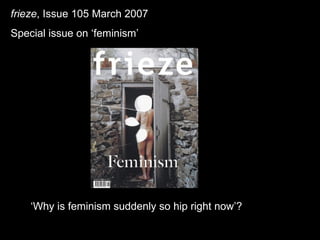
frieze , Issue 105 March 2007 Special issue on ‘feminism’ ‘ Why is feminism suddenly so hip right now’?
- History of feminist art - The ‘legacy’ of feminism:  how is that legacy ‘dealt’ with today?  how does it persists and informs contemporary art practice? why has it become increasingly visible in the last few years?
What is  your  relationship to feminist movement and the art produced as part of its political activism? What does it mean to be a feminist in 2010?  What does it mean to make feminist art? If you  are  a feminist does that mean that the art you make is by definition feminist?  Reflectio n
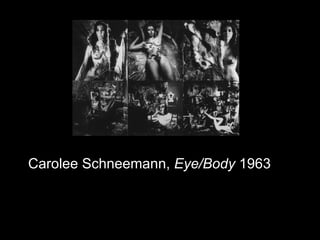
Carolee Schneemann,  Eye/Body  1963
By the year 2000...our future student will be in touch with a continuous feminine creative history--often produced against impossible odds--from her present, to the Renaissance and beyond. In the year 2000 books and courses will only be called 'Man and His Image', 'Man and His Symbols', 'Art History of Man'.... Carolee Schneemann (1975)
Oriana Fox Our Bodies, Ourselves  (2003)  http://orianafox.com/video/
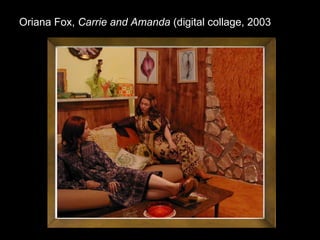
Oriana Fox - Artist’s Statement:  I admit it, I want to be like and look like many of the women I see on TV and in the movies, yet I am highly critical of them. I want them to more accurately represent my self and the women I know and admire. I feel similarly about the feminist artists of the 1970s. I respect the way they sought to own their own image, to be defined from within instead of without, but the 70s was a long time ago, so I cannot fully embrace their ethos either. I have to find my own, and that is what I try to do in my practice. By taking varied sources from films and TV, I explore my own perceived reflection in the images I see day to day, re-enacting them and altering them to further define myself and my place in representation and the history of art.
“ Appropriating gestures, language and concepts from the history of feminist performance art the event highlighted the legacy of the field’s forerunners and commented on how their work has been reinterpreted, subverted or perhaps even ignored by contemporary women’s performance practice” Once More with Feeling, Tate Modern, 2009
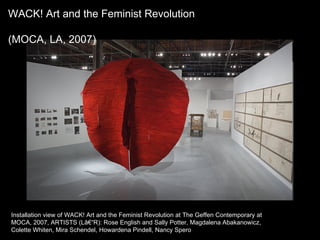
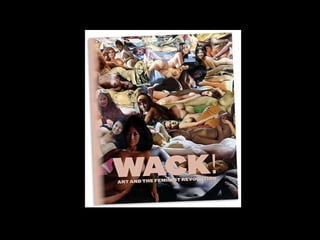
Installation view of WACK! Art and the Feminist Revolution at The Geffen Contemporary at MOCA, 2007, ARTISTS (L–R): Rose English and Sally Potter, Magdalena Abakanowicz, Colette Whiten, Mira Schendel, Howardena Pindell, Nancy Spero  WACK! Art and the Feminist Revolution (MOCA, LA, 2007)
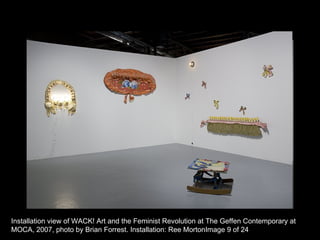
Installation view of WACK! Art and the Feminist Revolution at The Geffen Contemporary at MOCA, 2007, photo by Brian Forrest. Installation: Ree MortonImage 9 of 24
 
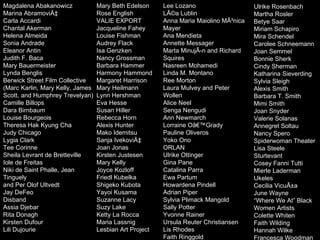
Magdalena Abakanowicz Marina Abramović Carla Accardi Chantal Akerman Helena Almeida Sonia Andrade Eleanor Antin Judith F. Baca Mary Bauermeister Lynda Benglis Berwick Street Film Collective (Marc Karlin, Mary Kelly, James Scott, and Humphrey Trevelyan) Camille Billops Dara Birnbaum Louise Bourgeois Theresa Hak Kyung Cha Judy Chicago Lygia Clark Tee Corinne Sheila Levrant de Bretteville Iole de Freitas Niki de Saint Phalle, Jean Tinguely and Per Olof Ultvedt Jay DeFeo Disband Assia Djebar Rita Donagh Kirsten Dufour Lili Dujourie Mary Beth Edelson Rose English VALIE EXPORT Jacqueline Fahey Louise Fishman Audrey Flack Isa Genzken Nancy Grossman Barbara Hammer Harmony Hammond Margaret Harrison Mary Heilmann Lynn Hershman Eva Hesse Susan Hiller Rebecca Horn Alexis Hunter Mako Idemitsu Sanja Iveković Joan Jonas Kirsten Justesen Mary Kelly Joyce Kozloff Friedl Kubelka Shigeko Kubota Yayoi Kusama Suzanne Lacy Suzy Lake Ketty La Rocca Maria Lassnig Lesbian Art Project Lee Lozano Léa Lublin Anna Maria Maiolino Mònica Mayer Ana Mendieta Annette Messager Marta Minujín and Richard Squires Nasreen Mohamedi Linda M. Montano Ree Morton Laura Mulvey and Peter Wollen Alice Neel Senga Nengudi Ann Newmarch Lorraine O’Grady Pauline Oliveros Yoko Ono ORLAN Ulrike Ottinger Gina Pane Catalina Parra Ewa Partum Howardena Pindell Adrian Piper Sylvia Plimack Mangold Sally Potter Yvonne Rainer Ursula Reuter Christiansen Lis Rhodes Faith Ringgold Ulrike Rosenbach Martha Rosler Betye Saar Miriam Schapiro Mira Schendel Carolee Schneemann Joan Semmel Bonnie Sherk Cindy Sherman Katharina Sieverding Sylvia Sleigh Alexis Smith Barbara T. Smith Mimi Smith Joan Snyder Valerie Solanas Annegret Soltau Nancy Spero Spiderwoman Theater Lisa Steele Sturtevant Cosey Fanni Tutti Mierle Laderman Ukeles Cecilia Vicuña June Wayne “Where We At” Black Women Artists Colette Whiten Faith Wilding Hannah Wilke Francesca Woodman
The Elizabeth A Sackler Center for Feminist Art - At the Brooklyn Museum, New York - opened in 2007  Mission statement:  The Center's mission is to raise awareness of feminism's cultural contributions, to educate new generations about the meaning of feminist art, to maintain a dynamic and welcoming learning facility, and to present feminism in an approachable and relevant way
“ Its goal is not only to showcase a large sampling of contemporary feminist art from a global perspective but also to move beyond the specifically Western brand of feminism that has been perceived as the dominant voice of feminist and artistic practice since the early 1970s.” Global Feminisms:  New Directions in  Contemporary Art
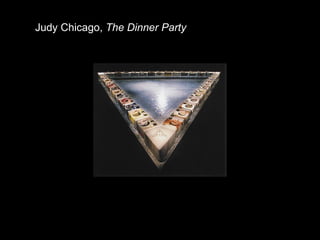
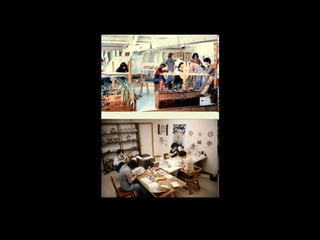
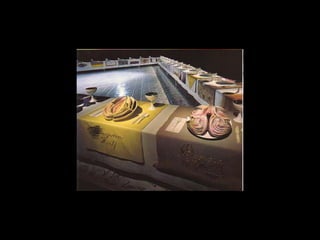
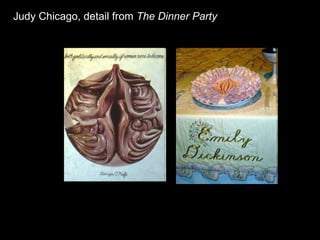
Judy Chicago,  The Dinner Party
 
 
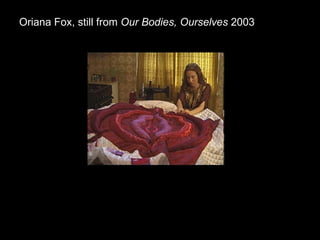
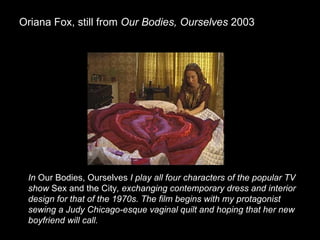
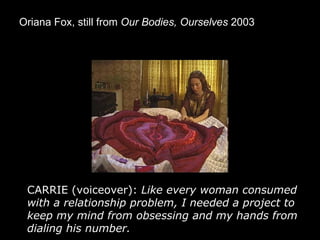
Oriana Fox, still from  Our Bodies, Ourselves  2003
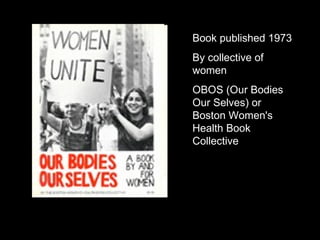
Book published 1973 By collective of women OBOS (Our Bodies Our Selves) or Boston Women's Health Book Collective
Oriana Fox,  Carrie and Amanda  (digital collage, 2003
Oriana Fox, still from  Our Bodies, Ourselves  2003   In  Our Bodies, Ourselves  I play all four characters of the popular TV show  Sex and the City , exchanging contemporary dress and interior design for that of the 1970s. The film begins with my protagonist sewing a Judy Chicago-esque vaginal quilt and hoping that her new boyfriend will call.
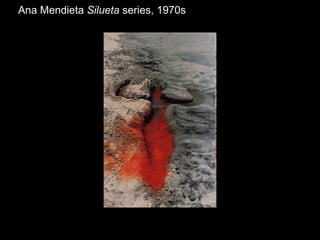
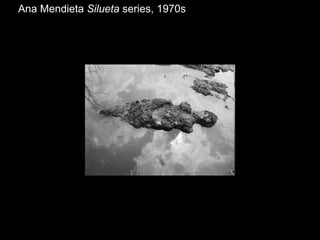
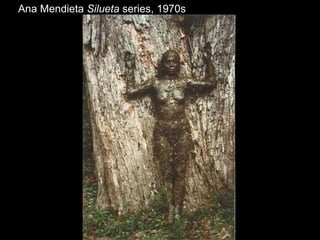
Ana Mendieta  Silueta  series, 1970s
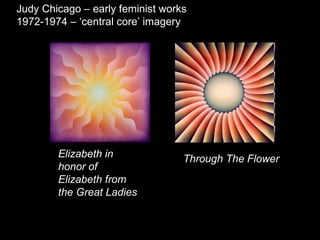
Judy Chicago – early feminist works 1972-1974 – ‘central core’ imagery  Through The Flower  Elizabeth in honor of Elizabeth from the Great Ladies
Inside this enclave I observed the transition from ‘first-generation’ Feminism – improvisatory, rooted in the art world, aesthetically pluralist no matter how ‘gynocentric’, and surprisingly optimistic no matter how angry (change had to come and therefore must be possible) – to ‘second-generation’ Feminism – theoretical, rooted in the academy, generally anti-pluralist and sceptical of the ‘naive’ enthusiasms of some of their elders (such as goddess cults and guerrilla tactics) and basically pessimistic. (‘Late capitalism’ could be critiqued, but its amorphous power could never be challenged.)  Robert Storr, ‘How as Feminism in the Art World Changed’?  Frieze, special issue on Feminism, 2007
Mary Kelly,  Post- Partum Document: Documentation VI: Prewriting Alphabet Exerque & Diary,  1976-1977
Mary Kelly Post-Partum Document: Documentation IV: Transitional Objects, 1976
Mary Kelly Post-Partum Document: Documentation I Analysed faecal stains and feeding charts (prototype) 1974
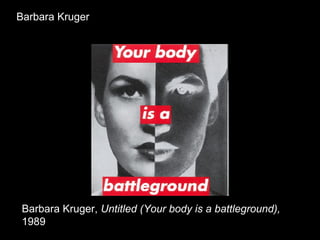
Barbara Kruger Barbara Kruger,  Untitled (Your body is a battleground),  1989
Judy Chicago, detail from  The Dinner Party
Oriana Fox, still from  Our Bodies, Ourselves  2003   CARRIE (voiceover):  Like every woman consumed with a relationship problem, I needed a project to keep my mind from obsessing and my hands from dialing his number.
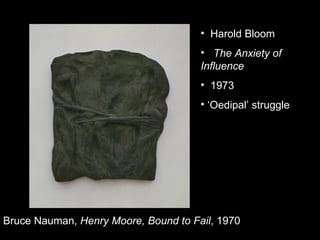
Bruce Nauman,  Henry Moore, Bound to Fail , 1970  Harold Bloom The Anxiety of Influence 1973  ‘ Oedipal’ struggle
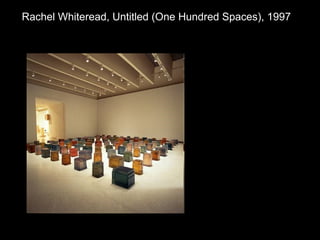
Rachel Whiteread, Untitled (One Hundred Spaces), 1997
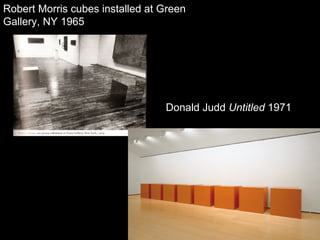
Robert Morris cubes installed at Green Gallery, NY 1965 Donald Judd  Untitled  1971
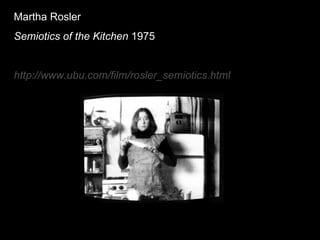
Martha Rosler Semiotics of the Kitchen  1975 http://www.ubu.com/film/rosler_semiotics.html
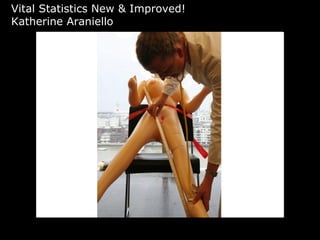
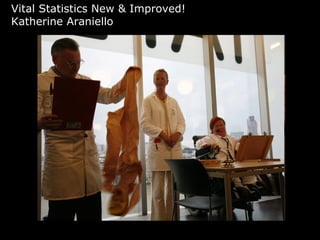
Vital Statistics New & Improved! Katherine Araniello
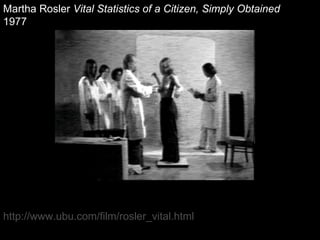
Martha Rosler  Vital Statistics of a Citizen, Simply Obtained  1977 http://www.ubu.com/film/rosler_vital.html
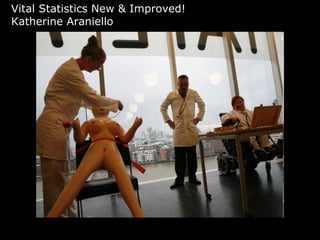
Vital Statistics New & Improved! Katherine Araniello
Catherine Grant, ‘Reaching for the Moon: Replaying Feminist Art and Activism’:  ‘ Fans’ of Feminism: ‘ The fan is a figure which seemed to allow for the passion, humour, aggression and attachment that I find in this contemporary artwork embracing both the ‘fanatical’ (the word fan derives from fanatic) and the dedicatedly scholarly.’
a ‘rogue reader’  “ Being a fan both means having an intense engagement with the object of fandom, but also a lack of fear in reworking the original material to take on whatever form is needed by the particular fan.”   “ ...fans of feminism have reworked the tenets and beliefs of feminist art and activism to make them relevant to the contemporary art scene, in which you might watch  Sex and the City  avidly whilst reading Laura Mulvey and being entranced by Cindy Sherman.”
I AM a FAN of FEMINISM
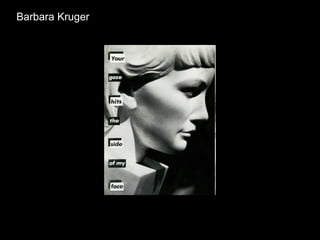
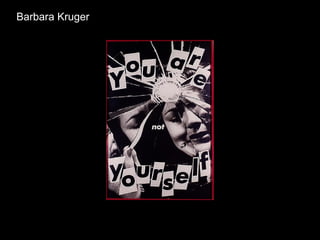
Barbara Kruger
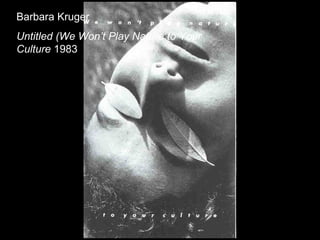
Barbara Kruger Untitled (We Won’t Play Nature to Your Culture  1983
Barbara Kruger
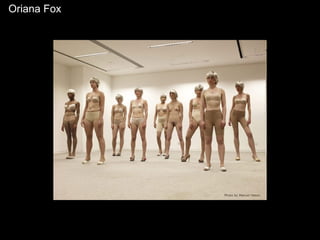
Oriana Fox
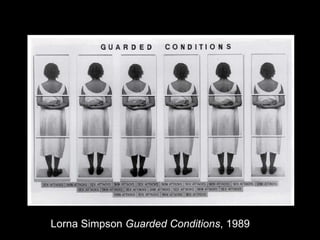
Lorna Simpson  Guarded Conditions , 1989
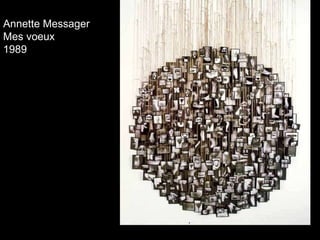
Annette Messager Mes voeux 1989
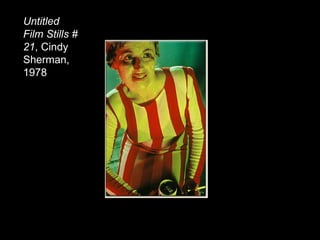
Untitled Film Stills # 21 , Cindy Sherman, 1978
 

Feminism

  • 1.
    HA1104 Current Issuesin Fine Art II Re-Performing Feminism
  • 2.
    frieze , Issue105 March 2007 Special issue on ‘feminism’ ‘ Why is feminism suddenly so hip right now’?
  • 3.
    - History offeminist art - The ‘legacy’ of feminism: how is that legacy ‘dealt’ with today? how does it persists and informs contemporary art practice? why has it become increasingly visible in the last few years?
  • 4.
    What is your relationship to feminist movement and the art produced as part of its political activism? What does it mean to be a feminist in 2010? What does it mean to make feminist art? If you are a feminist does that mean that the art you make is by definition feminist? Reflectio n
  • 5.
    Carolee Schneemann, Eye/Body 1963
  • 6.
    By the year2000...our future student will be in touch with a continuous feminine creative history--often produced against impossible odds--from her present, to the Renaissance and beyond. In the year 2000 books and courses will only be called 'Man and His Image', 'Man and His Symbols', 'Art History of Man'.... Carolee Schneemann (1975)
  • 7.
    Oriana Fox OurBodies, Ourselves (2003) http://orianafox.com/video/
  • 8.
    Oriana Fox -Artist’s Statement: I admit it, I want to be like and look like many of the women I see on TV and in the movies, yet I am highly critical of them. I want them to more accurately represent my self and the women I know and admire. I feel similarly about the feminist artists of the 1970s. I respect the way they sought to own their own image, to be defined from within instead of without, but the 70s was a long time ago, so I cannot fully embrace their ethos either. I have to find my own, and that is what I try to do in my practice. By taking varied sources from films and TV, I explore my own perceived reflection in the images I see day to day, re-enacting them and altering them to further define myself and my place in representation and the history of art.
  • 9.
    “ Appropriating gestures,language and concepts from the history of feminist performance art the event highlighted the legacy of the field’s forerunners and commented on how their work has been reinterpreted, subverted or perhaps even ignored by contemporary women’s performance practice” Once More with Feeling, Tate Modern, 2009
  • 10.
    Installation view ofWACK! Art and the Feminist Revolution at The Geffen Contemporary at MOCA, 2007, ARTISTS (L–R): Rose English and Sally Potter, Magdalena Abakanowicz, Colette Whiten, Mira Schendel, Howardena Pindell, Nancy Spero WACK! Art and the Feminist Revolution (MOCA, LA, 2007)
  • 11.
    Installation view ofWACK! Art and the Feminist Revolution at The Geffen Contemporary at MOCA, 2007, photo by Brian Forrest. Installation: Ree MortonImage 9 of 24
  • 12.
  • 13.
    Magdalena Abakanowicz MarinaAbramović Carla Accardi Chantal Akerman Helena Almeida Sonia Andrade Eleanor Antin Judith F. Baca Mary Bauermeister Lynda Benglis Berwick Street Film Collective (Marc Karlin, Mary Kelly, James Scott, and Humphrey Trevelyan) Camille Billops Dara Birnbaum Louise Bourgeois Theresa Hak Kyung Cha Judy Chicago Lygia Clark Tee Corinne Sheila Levrant de Bretteville Iole de Freitas Niki de Saint Phalle, Jean Tinguely and Per Olof Ultvedt Jay DeFeo Disband Assia Djebar Rita Donagh Kirsten Dufour Lili Dujourie Mary Beth Edelson Rose English VALIE EXPORT Jacqueline Fahey Louise Fishman Audrey Flack Isa Genzken Nancy Grossman Barbara Hammer Harmony Hammond Margaret Harrison Mary Heilmann Lynn Hershman Eva Hesse Susan Hiller Rebecca Horn Alexis Hunter Mako Idemitsu Sanja Iveković Joan Jonas Kirsten Justesen Mary Kelly Joyce Kozloff Friedl Kubelka Shigeko Kubota Yayoi Kusama Suzanne Lacy Suzy Lake Ketty La Rocca Maria Lassnig Lesbian Art Project Lee Lozano Léa Lublin Anna Maria Maiolino Mònica Mayer Ana Mendieta Annette Messager Marta Minujín and Richard Squires Nasreen Mohamedi Linda M. Montano Ree Morton Laura Mulvey and Peter Wollen Alice Neel Senga Nengudi Ann Newmarch Lorraine O’Grady Pauline Oliveros Yoko Ono ORLAN Ulrike Ottinger Gina Pane Catalina Parra Ewa Partum Howardena Pindell Adrian Piper Sylvia Plimack Mangold Sally Potter Yvonne Rainer Ursula Reuter Christiansen Lis Rhodes Faith Ringgold Ulrike Rosenbach Martha Rosler Betye Saar Miriam Schapiro Mira Schendel Carolee Schneemann Joan Semmel Bonnie Sherk Cindy Sherman Katharina Sieverding Sylvia Sleigh Alexis Smith Barbara T. Smith Mimi Smith Joan Snyder Valerie Solanas Annegret Soltau Nancy Spero Spiderwoman Theater Lisa Steele Sturtevant Cosey Fanni Tutti Mierle Laderman Ukeles Cecilia Vicuña June Wayne “Where We At” Black Women Artists Colette Whiten Faith Wilding Hannah Wilke Francesca Woodman
  • 14.
    The Elizabeth ASackler Center for Feminist Art - At the Brooklyn Museum, New York - opened in 2007 Mission statement: The Center's mission is to raise awareness of feminism's cultural contributions, to educate new generations about the meaning of feminist art, to maintain a dynamic and welcoming learning facility, and to present feminism in an approachable and relevant way
  • 15.
    “ Its goalis not only to showcase a large sampling of contemporary feminist art from a global perspective but also to move beyond the specifically Western brand of feminism that has been perceived as the dominant voice of feminist and artistic practice since the early 1970s.” Global Feminisms: New Directions in Contemporary Art
  • 16.
    Judy Chicago, The Dinner Party
  • 17.
  • 18.
  • 19.
    Oriana Fox, stillfrom Our Bodies, Ourselves 2003
  • 20.
    Book published 1973By collective of women OBOS (Our Bodies Our Selves) or Boston Women's Health Book Collective
  • 21.
    Oriana Fox, Carrie and Amanda (digital collage, 2003
  • 22.
    Oriana Fox, stillfrom Our Bodies, Ourselves 2003 In Our Bodies, Ourselves I play all four characters of the popular TV show Sex and the City , exchanging contemporary dress and interior design for that of the 1970s. The film begins with my protagonist sewing a Judy Chicago-esque vaginal quilt and hoping that her new boyfriend will call.
  • 23.
    Ana Mendieta Silueta series, 1970s
  • 24.
    Ana Mendieta Silueta series, 1970s
  • 25.
    Ana Mendieta Silueta series, 1970s
  • 26.
    Judy Chicago –early feminist works 1972-1974 – ‘central core’ imagery Through The Flower Elizabeth in honor of Elizabeth from the Great Ladies
  • 27.
    Inside this enclaveI observed the transition from ‘first-generation’ Feminism – improvisatory, rooted in the art world, aesthetically pluralist no matter how ‘gynocentric’, and surprisingly optimistic no matter how angry (change had to come and therefore must be possible) – to ‘second-generation’ Feminism – theoretical, rooted in the academy, generally anti-pluralist and sceptical of the ‘naive’ enthusiasms of some of their elders (such as goddess cults and guerrilla tactics) and basically pessimistic. (‘Late capitalism’ could be critiqued, but its amorphous power could never be challenged.) Robert Storr, ‘How as Feminism in the Art World Changed’? Frieze, special issue on Feminism, 2007
  • 28.
    Mary Kelly, Post- Partum Document: Documentation VI: Prewriting Alphabet Exerque & Diary, 1976-1977
  • 29.
    Mary Kelly Post-PartumDocument: Documentation IV: Transitional Objects, 1976
  • 30.
    Mary Kelly Post-PartumDocument: Documentation I Analysed faecal stains and feeding charts (prototype) 1974
  • 31.
    Barbara Kruger BarbaraKruger, Untitled (Your body is a battleground), 1989
  • 32.
    Judy Chicago, detailfrom The Dinner Party
  • 33.
    Oriana Fox, stillfrom Our Bodies, Ourselves 2003 CARRIE (voiceover): Like every woman consumed with a relationship problem, I needed a project to keep my mind from obsessing and my hands from dialing his number.
  • 34.
    Bruce Nauman, Henry Moore, Bound to Fail , 1970 Harold Bloom The Anxiety of Influence 1973 ‘ Oedipal’ struggle
  • 35.
    Rachel Whiteread, Untitled(One Hundred Spaces), 1997
  • 36.
    Robert Morris cubesinstalled at Green Gallery, NY 1965 Donald Judd Untitled 1971
  • 37.
    Martha Rosler Semioticsof the Kitchen 1975 http://www.ubu.com/film/rosler_semiotics.html
  • 38.
    Vital Statistics New& Improved! Katherine Araniello
  • 39.
    Martha Rosler Vital Statistics of a Citizen, Simply Obtained 1977 http://www.ubu.com/film/rosler_vital.html
  • 40.
    Vital Statistics New& Improved! Katherine Araniello
  • 41.
    Vital Statistics New& Improved! Katherine Araniello
  • 42.
    Catherine Grant, ‘Reachingfor the Moon: Replaying Feminist Art and Activism’: ‘ Fans’ of Feminism: ‘ The fan is a figure which seemed to allow for the passion, humour, aggression and attachment that I find in this contemporary artwork embracing both the ‘fanatical’ (the word fan derives from fanatic) and the dedicatedly scholarly.’
  • 43.
    a ‘rogue reader’ “ Being a fan both means having an intense engagement with the object of fandom, but also a lack of fear in reworking the original material to take on whatever form is needed by the particular fan.”   “ ...fans of feminism have reworked the tenets and beliefs of feminist art and activism to make them relevant to the contemporary art scene, in which you might watch Sex and the City avidly whilst reading Laura Mulvey and being entranced by Cindy Sherman.”
  • 44.
    I AM aFAN of FEMINISM
  • 45.
  • 46.
    Barbara Kruger Untitled(We Won’t Play Nature to Your Culture 1983
  • 47.
  • 48.
  • 49.
    Lorna Simpson Guarded Conditions , 1989
  • 50.
  • 51.
    Untitled Film Stills# 21 , Cindy Sherman, 1978
  • 52.