www.pshe-association.org.uk
Female Genital
Mutilation
Warning Signs
www.pshe-association.org.uk
Using This Presentation
This presentation is designed for awareness raising amongst
school staff and other relevant professionals to help highlight
girls at imminent risk of FGM.
We recommend that FGM should be addressed through PSHE
as a means to prevent it before it happens and empower
young people to speak out about it.
Please see our guidance: www.bit.ly/FGMguidancePSHE
These slides are not designed for use in the classroom
www.pshe-association.org.uk
FGM – Key Facts
• FGM includes procedures that intentionally alter or cause injury
to the female genital organs for non-medical reasons.
• The procedure has no health benefits for girls and women.
• Procedures can cause severe bleeding and problems urinating,
and later cysts, infections, infertility as well as complications in
childbirth and increased risk of newborn deaths.
• More than 125 million girls and women alive today have been
cut in the 29 countries in Africa and Middle East where FGM is
concentrated.
• FGM is mostly carried out on young girls sometime between
infancy and age 15.
• FGM is a violation of the human rights of girls and women.
www.pshe-association.org.uk
Why is it practised?
Reasons given include:
• Control over women’s sexuality
• Hygiene
• Gender based factors (removal of ‘male’ parts)
• Cultural identity
• Religion
www.pshe-association.org.uk
Who is it practised by?
FGM is a deeply rooted tradition, widely
practised among specific ethnic populations in
Africa and parts of the Middle East and Asia.
FGM has also been documented in communities
in Iraq, Israel, Oman, the united Arab emirates, the
occupied Palestinian territories, India, Indonesia,
Malaysia and Pakistan.
www.pshe-association.org.uk
What should we do?
FGM is child abuse and if you
suspect a child is at risk, you
should always follow the
school’s safeguarding procedures
immediately.
www.pshe-association.org.uk
Summer Holidays are High Risk
The summer holidays are a high risk time so
we need to be extra vigilant of the risk factors
and warning signs presented in the next few
slides and present all concerns to the school’s
safeguarding officer.
www.pshe-association.org.uk
Girls Most at Risk
• Member of a community whose country of
origin practises FGM and that is less
integrated into UK society
• A girl whose sister or other relatives have
undergone FGM
• A girl whose parents have withdrawn her
from lessons featuring FGM (where other
warning signs are also present)
www.pshe-association.org.uk
www.pshe-association.org.ukwww.pshe-association.org.uk
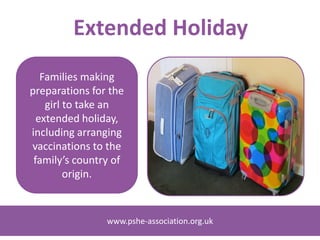
Families making
preparations for the
girl to take an
extended holiday,
including arranging
vaccinations to the
family’s country of
origin.
Extended Holiday
www.pshe-association.org.ukwww.pshe-association.org.uk
‘Special Procedure’
A girl talking about a
special procedure or
ceremony that is going to
take place or that she is
going to ‘become a
woman’
www.pshe-association.org.ukwww.pshe-association.org.uk
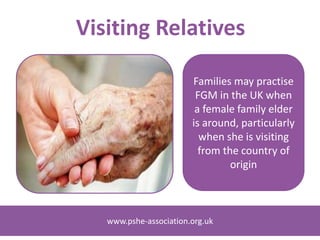
Families may practise
FGM in the UK when
a female family elder
is around, particularly
when she is visiting
from the country of
origin
Visiting Relatives
www.pshe-association.org.ukwww.pshe-association.org.uk
Mention of FGM
You may hear reference to
FGM in conversation, for
example a girl may tell
other children about it
www.pshe-association.org.uk
Remember…
FGM is child abuse and if you
suspect a child is at risk, you
should always follow the
school’s safeguarding procedures
immediately.
www.pshe-association.org.uk
NSPCC FGM Helpline
0800 028 3550
24-hour advice and support for
anyone who may have questions
about FGM or to report
suspected cases
www.pshe-association.org.uk

Female Genital Mutilation Warning Signs

  • 1.
  • 2.
    www.pshe-association.org.uk Using This Presentation Thispresentation is designed for awareness raising amongst school staff and other relevant professionals to help highlight girls at imminent risk of FGM. We recommend that FGM should be addressed through PSHE as a means to prevent it before it happens and empower young people to speak out about it. Please see our guidance: www.bit.ly/FGMguidancePSHE These slides are not designed for use in the classroom www.pshe-association.org.uk
  • 3.
    www.pshe-association.org.uk FGM – KeyFacts • FGM includes procedures that intentionally alter or cause injury to the female genital organs for non-medical reasons. • The procedure has no health benefits for girls and women. • Procedures can cause severe bleeding and problems urinating, and later cysts, infections, infertility as well as complications in childbirth and increased risk of newborn deaths. • More than 125 million girls and women alive today have been cut in the 29 countries in Africa and Middle East where FGM is concentrated. • FGM is mostly carried out on young girls sometime between infancy and age 15. • FGM is a violation of the human rights of girls and women. www.pshe-association.org.uk
  • 4.
    www.pshe-association.org.uk Why is itpractised? Reasons given include: • Control over women’s sexuality • Hygiene • Gender based factors (removal of ‘male’ parts) • Cultural identity • Religion www.pshe-association.org.uk
  • 5.
    www.pshe-association.org.uk Who is itpractised by? FGM is a deeply rooted tradition, widely practised among specific ethnic populations in Africa and parts of the Middle East and Asia. FGM has also been documented in communities in Iraq, Israel, Oman, the united Arab emirates, the occupied Palestinian territories, India, Indonesia, Malaysia and Pakistan. www.pshe-association.org.uk
  • 6.
    www.pshe-association.org.uk What should wedo? FGM is child abuse and if you suspect a child is at risk, you should always follow the school’s safeguarding procedures immediately. www.pshe-association.org.uk
  • 7.
    www.pshe-association.org.uk Summer Holidays areHigh Risk The summer holidays are a high risk time so we need to be extra vigilant of the risk factors and warning signs presented in the next few slides and present all concerns to the school’s safeguarding officer. www.pshe-association.org.uk
  • 8.
    www.pshe-association.org.uk Girls Most atRisk • Member of a community whose country of origin practises FGM and that is less integrated into UK society • A girl whose sister or other relatives have undergone FGM • A girl whose parents have withdrawn her from lessons featuring FGM (where other warning signs are also present) www.pshe-association.org.uk
  • 9.
    www.pshe-association.org.ukwww.pshe-association.org.uk Families making preparations forthe girl to take an extended holiday, including arranging vaccinations to the family’s country of origin. Extended Holiday
  • 10.
    www.pshe-association.org.ukwww.pshe-association.org.uk ‘Special Procedure’ A girltalking about a special procedure or ceremony that is going to take place or that she is going to ‘become a woman’
  • 11.
    www.pshe-association.org.ukwww.pshe-association.org.uk Families may practise FGMin the UK when a female family elder is around, particularly when she is visiting from the country of origin Visiting Relatives
  • 12.
    www.pshe-association.org.ukwww.pshe-association.org.uk Mention of FGM Youmay hear reference to FGM in conversation, for example a girl may tell other children about it
  • 13.
    www.pshe-association.org.uk Remember… FGM is childabuse and if you suspect a child is at risk, you should always follow the school’s safeguarding procedures immediately. www.pshe-association.org.uk
  • 14.
    www.pshe-association.org.uk NSPCC FGM Helpline 0800028 3550 24-hour advice and support for anyone who may have questions about FGM or to report suspected cases www.pshe-association.org.uk