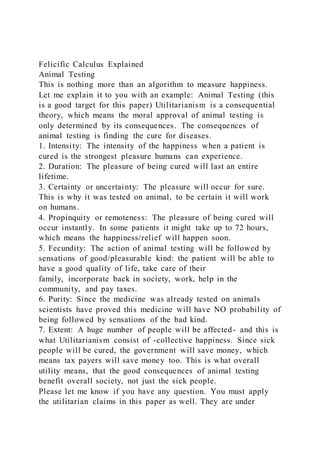
Felicific Calculus Explained
Animal Testing
This is nothing more than an algorithm to measure happiness.
Let me explain it to you with an example: Animal Testing (this
is a good target for this paper) Utilitarianism is a consequential

theory, which means the moral approval of animal testing is
only determined by its consequences. The consequences of
animal testing is finding the cure for diseases.
1. Intensity: The intensity of the happiness when a patient is
cured is the strongest pleasure humans can experience.
2. Duration: The pleasure of being cured will last an entire
lifetime.
3. Certainty or uncertainty: The pleasure will occur for sure.
This is why it was tested on animal, to be certain it will work
on humans.
4. Propinquity or remoteness: The pleasure of being cured will
occur instantly. In some patients it might take up to 72 hours,
which means the happiness/relief will happen soon.
5. Fecundity: The action of animal testing will be followed by
sensations of good/pleasurable kind: the patient will be able to
have a good quality of life, take care of their
family, incorporate back in society, work, help in the
community, and pay taxes.
6. Purity: Since the medicine was already tested on animals
scientists have proved this medicine will have NO probability of
being followed by sensations of the bad kind.
7. Extent: A huge number of people will be affected- and this is
what Utilitarianism consist of -collective happiness. Since sick
people will be cured, the government will save money, which
means tax payers will save money too. This is what overall
utility means, that the good consequences of animal testing
benefit overall society, not just the sick people.
Please let me know if you have any question. You must apply
the utilitarian claims in this paper as well. They are under
Course Materials
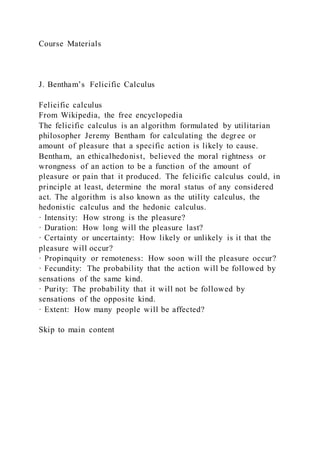
J. Bentham’s Felicific Calculus
Felicific calculus
From Wikipedia, the free encyclopedia
The felicific calculus is an algorithm formulated by utilitarian
philosopher Jeremy Bentham for calculating the degree or
amount of pleasure that a specific action is likely to cause.
Bentham, an ethicalhedonist, believed the moral rightness or
wrongness of an action to be a function of the amount of
pleasure or pain that it produced. The felicific calculus could, in
principle at least, determine the moral status of any considered
act. The algorithm is also known as the utility calculus, the
hedonistic calculus and the hedonic calculus.
· Intensity: How strong is the pleasure?
· Duration: How long will the pleasure last?
· Certainty or uncertainty: How likely or unlikely is it that the
pleasure will occur?
· Propinquity or remoteness: How soon will the pleasure occur?
· Fecundity: The probability that the action will be followed by
sensations of the same kind.
· Purity: The probability that it will not be followed by
sensations of the opposite kind.
· Extent: How many people will be affected?
Skip to main content
Close
Organization Page
Yuvislay Alvarez
Activity Stream
Courses
Departments
Calendar
Messages
Results
Tools
Sign Out
PrivacyTerms
Menu
Courses
Course Catalog
2021 Summer - Term B
Current Courses
Upcoming Courses
Current Courses
2021 Summer - Term B
Upcoming Courses
View Course List
View Course Grid
Search and filter to find your courses quickly.
Filter
All Courses
All courses
Courses I am taking
Open courses
Completed courses
25
items per page
Assorted Dates
21SUMB-PHI1600-DL-B
Ethics-DL-B Daylen Elosegui
Multiple Instructors
View all
Multiple Instructors
More info
Add a course to your favorites for quick access.
Ethics-DL-B Daylen Elosegui was moved to your favorites
Ethics-DL-B Daylen Elosegui was removed from your
favorites
×
Welcome to Learner Preview
21SUMB-PHI1600-DL-B
Menu
Ethics-DL-B Daylen Elosegui
Menu
Skip to main content
Search
Daylen Elosegui
Instructor
Multiple Instructors
View all
Multiple Instructors
Details & Actions
Learner List
View everyone in your course
Course Description
View the course description
Course is open
Learners can access this course
Virtual Classroom
Join the classroom
Blackboard Collaborate
Join session
Course Room
Attendance
View your attendance
Groups
New
View groups to join
Announcements
View archive
Books & Tools
View course & organization tools
Course Content
Content is on the way!
While you wait, check out the learner list to
connect with your classmates or contact your instructor.
First Academic Assignment
Due date:
7/4/21, 11:59 PM
Hidden from learners
Visible to learners
Hidden from learners
Each semester, students enrolled in online courses must
complete the MANDATORY First Academic Assignment for
each course. FAILURE TO DO SO MAY RESULT IN BEING
DROPPED! Study your course syllabus to find the answers to
the ten questions.
Blackboard Support
Hidden from learners
Visible to learners
Hidden from learners
The Distance Learning department can be reached through the
form in the link to assist with technical difficulties pertaining to
Blackboard. They can also be reached by email at
[email protected]
Student Resources
Hidden from learners
Visible to learners
Hidden from learners
This link contains information regarding university student
resources including the library, academic advising, job
placement, student services, the writing lab, and more.
Syllabus
Hidden from learners
Visible to learners
Hidden from learners
Cloud Storage
Textbook ISBN 13: 978-0133804058
Hidden from learners
Visible to learners
Hidden from learners
Instructor
Hidden from learners
Visible to learners
Hidden from learners
Course Material and Lectures
Hidden from learners
Visible to learners
Hidden from learners
Cloud Storage
Week 1 (June 27-July 3)

Hidden from learners
Visible to learners
Hidden from learners
Cloud Storage
Week 2 (July 4th-July11)
Hidden from learners
Visible to learners
Hidden from learners
Cloud Storage
Week 3 (July 11-July18)
Hidden from learners
Visible to learners
Hidden from learners
Textbook Powerpoint
Hidden from learners
Visible to learners
Hidden from learners
Week 3- Lecture
Hidden from learners
Visible to learners
Hidden from learners
Watch Video
https://www.youtube.com/watch?v=JdtWu4Cqx1Y&t=26s
Four major points of Utilitarianism.
You must apply them in your 1st written assignment due on
week 3.Bentham's Principle of Utility
Hidden from learners
Visible to learners
Hidden from learners
Principle of Utility
Hidden from learners
Visible to learners
Hidden from learners
Utilitarianism- J. Bentham's Felicific Calculus
Hidden from learners
Visible to learners
Hidden from learners
Utilitarian Claims
Hidden from learners
Visible to learners
Hidden from learners
List of Contemporary Moral Issues
Hidden from learners
Visible to learners
Hidden from learners
Week 3: Utilitarianism
Hidden from learners
Visible to learners
Hidden from learners
https://www.youtube.com/watch?v=7IB-tFBTqds&t=11s Collect
all the facts/arguments in favor and against (pros and cons) the
Bakum Dam project in Malaysia. Apply Utilitarianism to be in
favor of this project. Calculate all possible utility and net
...Quiz 3: Chapter 2
Due date:
7/18/21, 11:59 PM
Hidden from learners
Visible to learners
Hidden from learners
Read chapter 2 in the textbook to complete quiz 3. You only
have one attempt to complete this quiz.Utilitarianism Paper
Due date:
7/18/21, 11:59 PM
Hidden from learners
Visible to learners
Hidden from learners
No more content items to load
Cloud Storage
Week 4 (July 18-July25)
Content isn't available
You can access this content after 7/18/21, 12:09 AM
Hidden from learners
Visible to learners
Hidden from learners
Cloud Storage
Week 5 (July 25-August 1)
Hidden from learners
Visible to learners
Hidden from learners
Cloud Storage
Getting Started...
Hidden from learners
Visible to learners
Hidden from learners
Please review the information in this folder first, before starting
the course.
Cloud Storage
Plagiarism (student must complete if student commits
plagiarism)
Hidden from learners
Visible to learners
Hidden from learners
This folder includes resources regarding plagiarism for student
and professor use.
Cloud Storage
Blackboard Support and Student Resources
Hidden from learners
Visible to learners
Hidden from learners
Cloud Storage
Ask Your Instructor or Peers Questions: Here
Hidden from learners
Visible to learners
Hidden from learners
This is an open forum where you can ask your instructor and
peers questions and receive quicker responses.
Week 1
Overview - This week we are going to cover:
Cloud Storage
Week 2
Overview - This week we are going to cover:
Cloud Storage
Week 3
Overview - This week we are going to cover:
Cloud Storage
Week 4
Overview - This week we are going to cover:
Cloud Storage
Load 4 more content items
Focus
×
Menu
Document
Ethics-DL-B Daylen Elosegui
List of Contemporary Moral IssuesList of Contemporary
Moral Issues
New Document 7/12/21
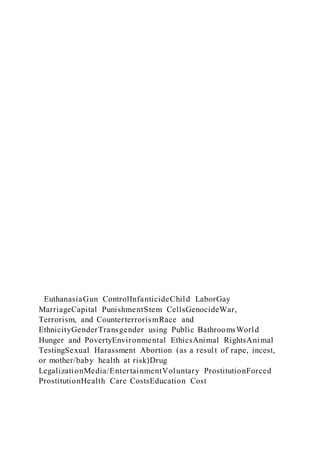
EuthanasiaGun ControlInfanticideChild LaborGay
MarriageCapital PunishmentStem CellsGenocideWar,
Terrorism, and CounterterrorismRace and
EthnicityGenderTransgender using Public BathroomsWorld
Hunger and PovertyEnvironmental EthicsAnimal RightsAnimal
TestingSexual Harassment Abortion (as a result of rape, incest,
or mother/baby health at risk)Drug
LegalizationMedia/EntertainmentVoluntary ProstitutionForced
ProstitutionHealth Care CostsEducation Cost
Focus
Help for current page
Courses loaded successfully
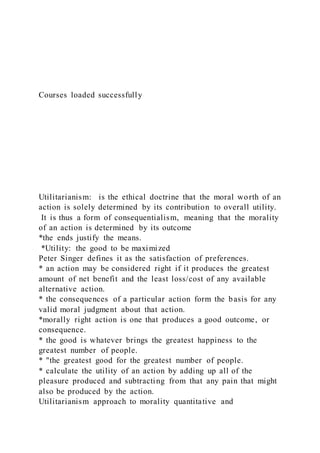
Utilitarianism: is the ethical doctrine that the moral worth of an
action is solely determined by its contribution to overall utility.
It is thus a form of consequentialism, meaning that the morality
of an action is determined by its outcome
*the ends justify the means.
*Utility: the good to be maximized
Peter Singer defines it as the satisfaction of preferences.
* an action may be considered right if it produces the greatest
amount of net benefit and the least loss/cost of any available
alternative action.
* the consequences of a particular action form the basis for any
valid moral judgment about that action.
*morally right action is one that produces a good outcome, or
consequence.
* the good is whatever brings the greatest happiness to the
greatest number of people.
* "the greatest good for the greatest number of people.
* calculate the utility of an action by adding up all of the
pleasure produced and subtracting from that any pain that might
also be produced by the action.
Utilitarianism approach to morality quantitative and
reductionistic
Utilitarianism can be contrasted with deontological ethics -
focuses on the action itself rather than its consequences
In general use the term utilitarian often refers to a somewhat
narrow economic or pragmatic viewpoint.

Felicific Calculus ExplainedAnimal TestingThis is nothing more