Communicating assessmentresults is an integral
part of classroom assessment. Teachers are
responsible for providing feedback to learners,
parents, and other intended stakeholders. Teacher's
understanding and practices of recording and
reporting embedded in the assessment knowledge
and experience that they had acquired over the
course of her teaching life is necessary.
Feedback is pivotal to helping teachers improve the
day-to-day assessment of their students, because it
improves learning and gives learners specific
guidance on their strengths and weaknesses. This
module includes topics on qualitative and
quantitative evaluation and principles of
constructive feed backing. Self-assessment and peer
assessment are also included.
3.
MODULE LEARNING OBJECTIVES
Atthe end of this Module, you should be able to
1. make value judgments on assessment results
based on empirical evidence, and
2. demonstrate strategies to communicate learner
needs, progress and achievement to intended
stakeholders.
4.
QUALITATIVE EVALUATION
Qualitativeand quantitative information are
valuable forms of evidence about student outcomes.
Quantitative evidence consists of data that are
represented numerically. For instance, performance
on a test of responses to a questionnaire may be
scored so that a number represents the degree to
which an individual performed or agreed disagreed
with a certain concept. Because quantitative data are
expressed in numbers, they can be compared directly
or subjected to statistical analysis, and they can
enable the researcher to make certain assumptions
when comparing one data point to another.
5.
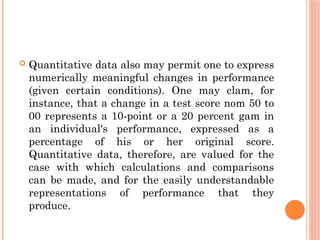
Quantitative dataalso may permit one to express
numerically meaningful changes in performance
(given certain conditions). One may clam, for
instance, that a change in a test score nom 50 to
00 represents a 10-point or a 20 percent gam in
an individual's performance, expressed as a
percentage of his or her original score.
Quantitative data, therefore, are valued for the
case with which calculations and comparisons
can be made, and for the easily understandable
representations of performance that they
produce.
6.
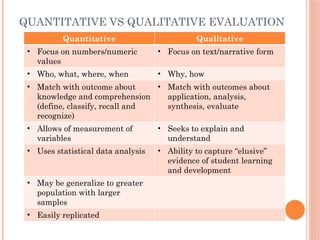
QUANTITATIVE VS QUALITATIVEEVALUATION
Quantitative Qualitative
• Focus on numbers/numeric
values
• Focus on text/narrative form
• Who, what, where, when • Why, how
• Match with outcome about
knowledge and comprehension
(define, classify, recall and
recognize)
• Match with outcomes about
application, analysis,
synthesis, evaluate
• Allows of measurement of
variables
• Seeks to explain and
understand
• Uses statistical data analysis • Ability to capture “elusive”
evidence of student learning
and development
• May be generalize to greater
population with larger
samples
• Easily replicated
7.
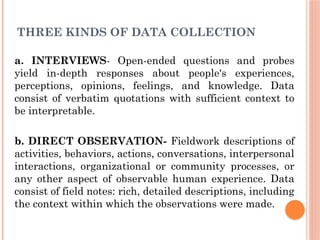
THREE KINDS OFDATA COLLECTION
a. INTERVIEWS- Open-ended questions and probes
yield in-depth responses about people's experiences,
perceptions, opinions, feelings, and knowledge. Data
consist of verbatim quotations with sufficient context to
be interpretable.
b. DIRECT OBSERVATION- Fieldwork descriptions of
activities, behaviors, actions, conversations, interpersonal
interactions, organizational or community processes, or
any other aspect of observable human experience. Data
consist of field notes: rich, detailed descriptions, including
the context within which the observations were made.
8.
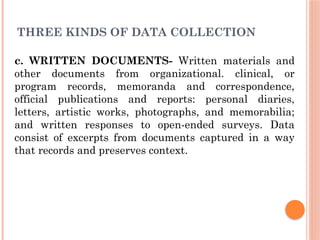
THREE KINDS OFDATA COLLECTION
c. WRITTEN DOCUMENTS- Written materials and
other documents from organizational. clinical, or
program records, memoranda and correspondence,
official publications and reports: personal diaries,
letters, artistic works, photographs, and memorabilia;
and written responses to open-ended surveys. Data
consist of excerpts from documents captured in a way
that records and preserves context.
9.
CONSTRUCTIVE FEEDBACKING
Inorder for student assessment information to
improve curriculum, instruction, and student
learning, accurate analysis of assessment results
must be followed by feedback to the student and
teacher.
Constructive feedback is providing useful comments
and suggestions that contribute to a positive
outcome, a better process or improved behaviors.
10.
CONSTRUCTIVE FEEDBACKING
Itprovides encouragement, support, corrective
measures and direction to the person receiving it.
Knowing how to give constructive feedback is a
valuable skill.
Constructive feedback can be positive letting
someone know they're doing well), negative (letting
people know about ways in which things could be
improved), or neutral (just an objective observation).
11.
There areTWO elements that make feedback
constructive:
The content of the feedback- Constructive feedback is
specific, issue-focused (rather than a value judgment
about the individual) and based on what is observable
(rather than assuming anything about the person's
attitude or motivation). It also includes some specific
direction on how to make improvements (where needed).
How the feedback is delivered- To be constructive,
feedback should not be delivered in a way that provokes
hurt feelings, shame, defensiveness, resistance or a sense
of failure. Honest does not mean tactless.
12.
TWELVE (12) PRINCIPLESOF
EFFECTIVE FEEDBACK
1. Identifies where students are doing well.
2. Identifies where students' areas of improvement are,
and offers ideas and suggestions about how. to
approach these
3. Is clearly related to future assessment tasks, and is
designed to help students prepare for them.
4. Wherever possible, is formative and not summative.
5. Is explicit.
6. is constructive, and treats student learning as a
developmental rather than a delicit issue.
13.
TWELVE (12) PRINCIPLESOF
EFFECTIVE FEEDBACK
7. Is timely enough so that it can be used by students in
preparing for future assessment and in engaging with
the subject matter.
8. Is provided in sufficient amount of detail.
9. is provided in contexts where students can ask
questions about the feedback, provide it to each other,
and discuss their interpretation of it with each other.
10. Is pitched at an appropriate level.
11. Is stated clearly and, if written, is legible.
12. Explains how and why students received the mark
they did in assessment tasks
14.
CHARACTERISTICS OF
CONSTRUCTIVE FEEDBACK
1.It is descriptive rather than evaluative. By
describing one's own reactions, it leaves the individual
free to use it or not to use it as they see fit. By avoiding
evaluative language, it reduces the need for the
individual to respond defensively.
2. It is specific rather than general. To be told that
one is "dominating" will probably not be as useful as to
be told that "in the conversation that just took place,
you did not appear to be listening to what others were
saying, and I felt forced to accept your arguments."
15.
CHARACTERISTICS OF
CONSTRUCTIVE FEEDBACK
3.It is focused on behavior rather than on the
person. it is important that we refer to what a person
does rather than to who we think or imagine they are.
Thus, we might say that a person "talked more than
anyone else in this meeting" rather than that they are
a "loud-mouth." The former allows for the possibility of
change: the latter implies a fixed personality trait.
16.
CHARACTERISTICS OF
CONSTRUCTIVE FEEDBACK
4.It takes into account the needs of both the
receiver and over of feedback. Feedback can be
destructive when it serves only our own needs and tails
to consider the needs of the person on the receiving
end. It should be given to help, not to hurt. We too
often give feedback because it makes us feel better or
gives us a psychological advantage.
17.
CHARACTERISTICS OF
CONSTRUCTIVE FEEDBACK
5.It is directed toward behavior, which the
receiver can do something about. Frustration is
only increased when a person is reminded of some
shortcoming over which they have no control.
6. It is solicited rather than imposed. Feedback is
most useful when the receiver has formulated the kind
of question which those observing can answer, or when
they actively seek feedback.
18.
CHARACTERISTICS OF
CONSTRUCTIVE FEEDBACK
7.It is well-timed. In general, feedback is most useful
at the earliest opportunity after the given behavior.
The reception and use of feedback involves many
possible emotional reactions. Excellent feedback
presented at an inappropriate time may do more harm
than good.
19.
CHARACTERISTICS OF
CONSTRUCTIVE FEEDBACK
8.It involves sharing of information rather than
giving advice. By sharing information, we leave a
person free to decide for themselves, in accordance
with their own goals and needs. When we give advice,
we tell them what to do, and to some degree take away
their freedom to decide for themselves.
20.
CHARACTERISTICS OF
CONSTRUCTIVE FEEDBACK
9.It involves the amount of information the
receiver con use rather than the amount we
would like to give. To overload a person with
feedback is to reduce the possibility that they may be
able to use what they receive effectively. When we give
more than can be used, we are more often than not
satisfying some need of our own rather than helping
the other person.
21.
CHARACTERISTICS OF
CONSTRUCTIVE FEEDBACK
10.It concerns what is said and done or how not
why. The "why" takes us from the observable to the
inferred and involves assumptions regarding motive or
intent. Telling a person what their motivations or
intentions are more often than not tends to result in a
defensive response.
22.
FORMS OF FEEDBACK
Oral and Written Feedback
Evaluative and Descriptive Feedback
Informal and Formal Feedback
Peer and Self-feedback
23.
Oral and writtenfeedback
Oral feedback is usually given during a lesson while
written feedback tends to be given after a task.
Oral feedback is sometimes underestimated because
it is less formal, but it can be a very powerful and
effective tool as it can be provided easily in the
‘teachable moment’ and in a timely way. Asking
students 'What do you notice about ____?' or 'How
does this match the criteria?' stimulates their
thinking about their learning.
24.
Oral and writtenfeedback
Effective written feedback provides students with a
record of what they are doing well, what needs
improvement and suggested next steps.
Effective written feedback also needs to be timely,
written in a manner that is understandable to the
student and actionable so that the student can make
revisions.
Written feedback needs to include information about
where the student has met the learning intentions
and/or success criteria and where improvement is
still required.
25.
Evaluative and descriptivefeedback
Feedback can also be either evaluative, involving a
value judgment, or descriptive, providing guidance
for improvement.
Evaluative feedback, in the form of grades or brief
general comments, for example 'well done', provides
some information about learning, but does not
convey the information and guidance that students
can use to improve.
26.
Evaluative and descriptivefeedback
In attempting to create a positive climate for
learning, many teachers increase the level of praise
they give during feedback sessions. Research shows,
however, that praise needs to be realistic if the
feedback is to be meaningful. To be really effective,
praise needs to confirm a child's own sense of reality.
The impact of feedback on learning achievement has
been found to be low when it is focused on praise,
rewards and punishment.
27.
Evaluative and descriptivefeedback
Descriptive feedback provides students with detailed,
specific information about improving their learning.
So this means descriptive feedback is linked to the
learning that is expected, addresses faulty
interpretations and lack of understanding and
provides students with visible and manageable ‘next
steps’. These ‘next steps’ are based on an assessment
of the work at hand and an image of what ‘good work
looks like’ so that they can begin to take on the
responsibility of self-assessing and self-correcting.
28.
Evaluative and descriptivefeedback
An example of descriptive feedback is: 'That’s a good
introduction because you have covered the main
points we discussed at the beginning. Now … which
points do you think you should expand on?'
29.
Informal and FormalFeedback
Informal check-ins can be used to see how students
are progressing and usually occur during the
learning. 'Check ins are considered informal and are
vitally important to providing effective feedback.
They occur when the teacher visits students as they
are engaged in a task to make sure they are on the
right track, can quickly and effectively steer students
in the right direction and enhance learning.
Formal feedback is often written or a combination of
oral and written, and usually occurs at the end of a
task. It can be provided through structured
conferences with specific goals.
30.
Peer and Self-feedback
Peer feedback occurs when students offer each other
advice and suggestions in relation to each other's
work.
Self-feedback must be taught explicitly to ensure
students have the skills to apply this to their Own
work.
One way to facilitate peer feedback is through the
use of structured peer conferences. This provide
students with the opportunity to give and receive
feedback about ongoing work and a positive aspect is
that students get to see other students' work which
can also deepen understanding of the learning goals.
31.
Peer and Self-feedback
Self-feedback is the ultimate goal of feedback for
learning. Teachers can help students to become more
independent through explicit modeling and
instruction, and teaching the skills of self-
assessment and goal setting.
32.
WHAT IS SELF-ASSESSMENT?
Student self-assessment involves students describing
and evaluating the processes and products of their
learning.
Students evaluate the work they have produced and
reflect on processes, actions and activities that
contributed to the production of the work.
Student self-assessment can support students to
regulate their own learning by requiring them to
motor how they are working, and encouraging them
to modify their approach if something is not working
as well as it could.
33.
WHAT IS SELF-ASSESSMENT?
Self-assessment can also enhance students' self-
efficacy (a student's belief that they are able to
succeed at a given task) and support ownership of
learning. The capacity for self-regulation is linked to
higher achievement as well as improved motivation
and engagement
Effective learners tend to self-assess the quality of
their work more regularly than less effective learners
and are also better able to incorporate evidence from
other sources to make judgments on their learning
34.
WHAT IS SELF-ASSESSMENT?
Self-assessment is a key part of Assessment for
Learning where reflection during the flow of learning
is used to improve learning and teaching.
35.
WHAT IS PEERASSESSMENT?
Peer assessment is the assessment of students' work
by other students of equal status. Students often
undertake peer assessment in conjunction with formal
self-assessment. They reflect on their own efforts, and
extend and enrich this reflection by exchanging
feedback on their own and their peers’ work.
Peer assessment is a powerful meta-cognitive tool. It
engages students in the learning process and develops
their capacity to reflect on and critically evaluate their
own learning and skill development. It supports the
development of critical thinking, interpersonal and
other skills, as well as enhancing understanding
within the field of knowledge of a discipline.
36.
WHAT IS PEERASSESSMENT?
Peer and group assessment are also often undertaken
together. Typically, the members of a group assess
the performance of their peers in terms of their
contribution to the group's work.
37.
BENEFITS OF SELFAND PEER
ASSESSMENT
Increase student engagement and empower students,
and enable greater autonomy from the teacher.
Improve learning outcomes: quality feedback in
particular is associated with substantial learning
gains.
Reduce the gap between the highest and lowest
achievers, while raising achievement overall.
Support more equitable outcomes for all students.
·Improve motivation and perseverance, and
encourage students to seek and know where to find
help.
Develop students' self-regulation skills and
metacognition (understanding how they learn best).
38.
BENEFITS OF SELFAND PEER
ASSESSMENT
Give students a strong sense of self-efficacy for
developing their own effective study habits.
Enrich students reasoning and improve their
communication skills. ·
Help students understand and apply quality criteria
to their work. ·Create a more egalitarian and
supportive classroom environment.
39.
HOW TO SETUP SUCCESSFUL SELF-
ASSESSMENT
1. Explain the benefits of self-assessment. Students
who are more convinced of the learning benefits of self-
assessment and feel supported to undertake self-
assessments are more likely to be rigorous and
accurate when undertaking self-assessments.
2. Explicitly teach students how to self-assess and
provide ongoing support. Many students do not
innately know how to self-assess. Teachers need to
directly teach students how to self-assess and provide
opportunities for students to practice self-assessment
and receive feedback and assistance.
40.
HOW TO SETUP SUCCESSFUL SELF-
ASSESSMENT
Students, particularly lower-achieving students, tend
to need support to reflect on their learning and often
benefit from guidelines or instructions that they can
follow. Providing students with feedback on their
progress enhances the impact of self-assessment. Also,
providing opportunities for students to engage in group
discussions and evaluation supports the accuracy and
impact of self-assessment.
41.
HOW TO SETUP SUCCESSFUL SELF-
ASSESSMENT
3. Allow students to contribute to creating standards or
criteria. When students contribute to the creation of
standards or criteria, they tend to be more engaged and
more invested in the self-assessment process. They also
will spend more time, and are more rigorous, in
undertaking their own self- assessment.
4. Create a positive, trusting classroom culture.
Students are more likely to accurately self assess when
they feel their classroom is a safe space and that they
will not be judged. Consider keeping self-assessments
private
42.
HOW TO SETUP SUCCESSFUL SELF-
ASSESSMENT
5. Use self-assessment as a formative not a summative
assessment tool. Self-assessment is most successful when
it is used as a formative assessment tool and students
know it won't count towards their grades. Students are
more likely to accurately self-assess, and it also provides
opportunities for students to adapt and revise their
approach to learning.
6. Consider using a rubric. Research has found greater
learning results from self-assessment when more complex
judgments are used. Rubrics are one way of achieving
this. However, students tend to require explicit
instruction around how to effectively interpret and use
rubrics. Combining criteria and performance standards
with specific examples of the final product, or worked
examples, can also support the impact of rubrics.
43.
HOW TO SETUP SUCCESSFUL SELF-
ASSESSMENT
7. Follow up self-assessments with student-teacher
learning conversations. Providing opportunities for
students to discuss their self-assessments with a
teacher enhances the impact of self-assessment.
Discussing any differences between the student's self-
assessment and their teacher's assessment can be a
powerful pedagogical approach to enhancing a
student's learning.
44.
PITFALLS TO AVOIDIN SELF-ASSESSMENT
1. A lack of trust and social pressure – If self-
assessment is made public, some students will over-
estimate their level of understanding or their grades to
avoid public shame, or to enhance or protect their self-
worth.
2. Over- or under – estimating one's ability. Most
people have a tendency to be unrealistically optimistic
about our own abilities and to believe that we are
above average. In general, higher- performing students
tend to be more humble in self-assessment than lower-
performing students. And in certain cultures, giving
oneself a positive self-assessment can be considered
boastful.
45.
PITFALLS TO AVOIDIN SELF-ASSESSMENT
3. Insufficient knowledge to accurately self-assess –
Without sufficient knowledge it is difficult for students
to accurately self-assess. This is particularly the case
for novice learners who do not yet have the knowledge
base to accurately self-assess their current learning or
the work they are producing. Even if novices recognize
that something is not working, they frequently struggle
to change their actions and behaviors without external
support.
4. Students may not be old enough – Younger students
might be less able to accurately self-assess. Research
has found that secondary school and university
students appear to be able to judge more accurately
how they have done in formal tests and assessments.
46.
PITFALLS TO AVOIDIN SELF-ASSESSMENT
5. Students willingness to self-assess – Students
sometimes are unwilling to self-assess. This might be
because they feel they lack the necessary skills to
accurately judge their work, they are afraid of being
wrong or they prefer an expert to assess their progress
and work. Research also suggests that students often
do not understand the benefits of self-assessment or do
not see it as a valuable exercise and so do not put much
effort into the self-assessment process.
47.
ASSESSMENT TOOLS FORPEER AND SELF
ASSESSMENT
1. Rubrics
Rubrics are an assessment tool which include two types of
information
a list of enterna for assessing the important goals of the
task
a scale for grading the different levels of achievement in
each of the criteria, with a description for each qualitative
level.
Using a rubric, students can compare their work
against the criteria and assess the standard they have
reached.
48.
ASSESSMENT TOOLS FORPEER AND SELF
ASSESSMENT
Although rubrics are designed to evaluate a final
product, if they are given to students at the beginning
of a task rubrics can support students to plan their
work, and review and adjust it during its production.
Students can also be encouraged to rewrite or even
create their own rubrics. You need to support your
students in the use of rubrics just handing them out is
no guarantee of success.
49.
ASSESSMENT TOOLS FORPEER AND SELF
ASSESSMENT
2. Script
Scripts consist of specific questions that are
structured into a clear progression of steps, to guide
learners in how best to achieve a task. They explicitly
detail the 'self-talk' that accompanies working through
a task. A script is useful for students to follow
throughout a task, but it can also be used to analyze
the final outcome. A script can help students to assess
whether they are on the night track to completing the
task, and supports them to adjust their learning
behavior according to the directions of the scripted
questions.
50.
ASSESSMENT TOOLS FORPEER AND SELF
ASSESSMENT
You can also ask students to use scripts to analyze
their or their peers' work after production, e.g. by
reviewing whether each step was satisfactorily
completed.
51.
ASSESSMENT TOOLS FORPEER AND SELF
ASSESSMENT
4. Journals
A learning journal is a place for students to reflect in
writing about how their learning is going. what they
need help with, and the effectiveness of different
strategies for learning. Teachers need to provide
regular, short periods of time for writing in the journal,
with guiding questions to support self- assessment,
goal setting, and metacognitive knowledge
(understanding their thinking). For example, you
might ask students to respond to questions such as
these in their journals.
52.
ASSESSMENT TOOLS FORPEER AND SELF
ASSESSMENT
I Think about your work in relation to the success
criteria and write in your journals what you noticed
you were able to do well and two things you need to
work on next.
How well are different strategies working? How does
what you are doing help you? ·
What one thing will you remember long after this
lesson and why?
What question are you still trying to understand and
why might this be?
53.
ASSESSMENT TOOLS FORPEER AND SELF
ASSESSMENT
4. Portfolio
A portfolio is a student-managed collection of work
which demonstrates the student's learning and
developing competence. Portfolios help students in self-
assessment skills such as understanding progress
through record keeping, documenting interests and
strengths, and identifying choices and preferences.
Portfolios can form a shared focus to assessment
discussions and goal setting with teachers. Some ways
you could support students to build up their portfolios
include:
54.
ASSESSMENT TOOLS FORPEER AND SELF
ASSESSMENT
4. Portfolio
Reminding students, every lesson, that they can decide
whether to include their work from this lesson in their
portfolio.
Sharing with students the outcomes and success criteria
they are expected to achieve and then give them the
responsibility to determine their own evidence. ·
Providing a list of what students need to add to their
portfolio each term one piece of writing. one mathematics
test or activity, one project, one artwork, and so on.
Asking students to consider what others (such as parents,
employers and other educational institutions) would need
for proof of meeting learning goals.
55.
ASSESSMENT TOOLS FORPEER AND SELF
ASSESSMENT
4. Portfolio
Providing a range of examples such as taking photos,
videoing themselves undertaking tasks, screenshots
of internet search histories, a progression of drafts
and peer feedback reports. You can ask students
"Which work will you choose to show what you know?
or you can ask them to collect a set of work that
shows different stages in development
56.
ASSESSMENT TOOLS FORPEER AND SELF
ASSESSMENT
4. Portfolio
Portfolios can be digital, rather than paper-based,
which solves issues of storage and the risk of loss or
damage. Students should engage in summarizing and
reflecting upon their evidence, for example, identifying
areas of strength or of growth, what they enjoyed or
were most proud of, where they have made progress
and why, and what else they could do to improve. You
can provide prompts for self-evaluation and goal
setting, in the form of an evaluation sheet. For
example:
57.
ASSESSMENT TOOLS FORPEER AND SELF
ASSESSMENT
4. Portfolio
Did I ensure that each paragraph had a topic
sentence?
Did I include an introduction, main body and
conclusion in my story report?
Did I proofread my story report carefully, e.g. by
checking the spelling of difficult words and making
sure I used the correct punctuation?
Did I avoid repeating the same words?
58.
ASSESSMENT TOOLS FORPEER AND SELF
ASSESSMENT
4. Portfolio
What did I like best about my story/report? Why?
What would I do next time to improve my writing?
Students are likely to enjoy amassing a collection of
their work, and will begin to assume increasing
responsibility for collecting. reflecting, and
organizing the work.
59.
ASSESSMENT TOOLS FORPEER AND SELF
ASSESSMENT
5. Traffic light
Traffic lights are a simple system for students to use
to indicate their perceived understanding of particular
work. Using a traffic light icon, students label their
work green, yellow, or red according to whether they
think they have good (green), partial (yellow), or little
(red) understanding. This can be useful for determining
groupings or activities for the next part of the lesson.
The teacher might pair the green students with the
yellow students while he or she works with the reds. Or
students can select a follow-up activity matched to
their traffic light color.
60.
ASSESSMENT TOOLS FORPEER AND SELF
ASSESSMENT
6. Exit Card
An exit card is a small piece of card or a post-it given
to each student at the end of a lesson, on which they
write a comment to self-assess what they have learned in
the lesson and what they need more help with. This
helps in planning the next lesson. This only takes a few
minutes for the student to complete and is handed to the
teacher as the students leave the class.
You can ask students to summarize the lesson or,
alternatively, ask a generic question such as "What are
the three most important bits of information you have
learned today? You can then check how well these
responses match the learning objectives for the lesson.
61.
ASSESSMENT TOOLS FORPEER AND SELF
ASSESSMENT
7. Paired making
In paired marking, pairs of students interchange and
assess work. This might mean using a rubric, or
applying success criteria to each other's work. Paired
marking gives student opportunities to practice
assessment skills, and opens up dialogue about the
purpose of assessment, what information is useful as
feedback from an assessor, and for reflection on success
criteria and what they mean. These discussions can
take place between the paired students or with the
whole class after a paired marking session.
62.
ASSESSMENT TOOLS FORPEER AND SELF
ASSESSMENT
The objectivity and assessment skills developed in peer
assessment can help in improving the quality of
students self-assessments. Students might be given
scripts and exemplars to support their peer-
assessments or they might be offered formulas for
providing feedback, such as 'two stars and a wish" (two
positive comments and one suggestion to improve it), or
one specific thing that met the criteria, and one
question.
63.
ASSESSMENT TOOLS FORPEER AND SELF
ASSESSMENT
8. Dedicated Improvement and Reflection Time (DIRT)
This is a time in the lesson in which the only goal is
for students to read and make use of feedback they
have received. Every student will need to have plenty
of documented feedback (from themselves, the teacher,
and peers) that they can respond to. You might like to
sometimes after feedback on the students' response to
feedback and use of LIKI tune too.