Fedora in the Enterprise


 This presentation is licensed under a Creative Commons
        Attribution-ShareAlike (BY-SA) 3.0 license.
Who is that guy?


  Jeroen van Meeuwen, 25 years young
                     ●   Dutch
               ● Sr. System Engineer

               ● Fedora Project Ninja

       ● Fedora EMEA (NPO) - Vice-President

     ● Red Hat Certified Engineer of the Year
What is the Fedora Project?


        Freedom, First, Features, Friends

       Free, open and transparent culture

        Leading Free Software innovation

       Development, innovation, upstream

               ~13 million users
Why this talk?
Volunteers spend more time on development and innovation then
   any company can ever afford. Why?

   - because it's fun
   - because it improves their skills
   - because it's good for society

The Fedora Project spends lots of time and resources to advance
   and integrate technology on the development end

Free Software vendors like Red Hat spend a lot of resources all
   over Free Software support and innovation, their supply chain

Governments shift their resources to being spent at increased
   efficiency through collaboration

You spend lots of time and resources to make Free Software
   work for you, just the way you want it, on the consuming end
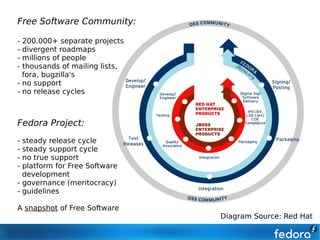
Free Software Community:

- 200.000+ separate projects
- divergent roadmaps
- millions of people
- thousands of mailing lists,
  fora, bugzilla's
- no support
- no release cycles


Fedora Project:
- steady release cycle
- steady support cycle
- no true support
- platform for Free Software
  development
- governance (meritocracy)
- guidelines

A snapshot of Free Software
                                Diagram Source: Red Hat
How does this work?
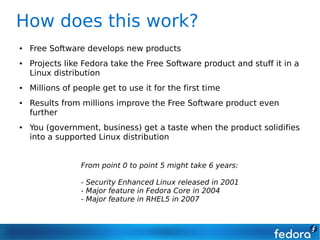
●   Free Software develops new products
●   Projects like Fedora take the Free Software product and stuff it in a
    Linux distribution
●   Millions of people get to use it for the first time
●   Results from millions improve the Free Software product even
    further
●   You (government, business) get a taste when the product solidifies
    into a supported Linux distribution


                 From point 0 to point 5 might take 6 years:

                 - Security Enhanced Linux released in 2001
                 - Major feature in Fedora Core in 2004
                 - Major feature in RHEL5 in 2007
What does Fedora do?
 The Fedora Project adopts new products and new technologies
    and releases those often and early

 The Fedora Project thrives innovation by being a platform for
    developers, while ensuring users and consumers can cope
    with the changes fashionably

 The Fedora Project strongly commits to upstream ensuring
    continued long-term sustainability, continued development,
    less diverging product releases, efficiency and awesomeness
    for everyone, not just Fedora
What can you do?
 Participate!

 -   ensure the future meets your needs and expectations
 -   have your voice be heard and directly influence development
 -   ensure your needs and expectations are met with future products
 -   assign (some of) your resources to participate in:

       -   testing (Fedora) releases
       -   developing (Fedora) components
       -   maintaining (RPM) packages
       -   troubleshooting software
       -   fixing software

 Innovate!

 - think of Free Software as yours already
 - think of innovation as a service
Why should you care?
 You are a consumer of Free and Open Source Software and rely on
 the larger Free Software community as a core competency

 Your participation:

 - gets us a different perspective

     The enterprise perspective vs. the user perspective

 - gets you a sneak preview of what to expect for the (near) future
 - gets you to participate efficiently, effectively
 - ensures the next generation of supported Linux distributions meets
   your needs and expectations
 - makes you pro-active in pursuing your goals instead of reactive to
   your software vendor
 - enables you to take control of what you care about

 - gets you / your employees ahead of the game
So what?
 Studies show:

     - 49% over 31% of students prefer creativity & innovation in
       their future jobs rather then stability & security[1]

     - Being on MySpace is more important then the way you sound[2]

     - The proprietary software model limits innovation to 1/6th of it's
       potential[3]

     - I could go on and on and on..., but


Free Software has obsoleted traditional industrialization processes
                  within the software industry.

      What the top industrialists could not achieve with proprietary
                      software and financial capital,
            free software has demonstrated with community
                  development and intellectual capital.
References:

- http://www.vkbanen.nl/werkgevers/725364/Starter-wenst-afwisseling.html

- http://people.redhat.com/tiemann/STS-Forum-Tiemann-2006.pdf

- http://www.kennislink.nl/publicaties/professioneel-netwerk-maakt- muzikanten-s

Contact Information:

Jeroen van Meeuwen <kanarip@fedoraproject.org>

Fedora In The Enterprise

  • 1.
    Fedora in theEnterprise This presentation is licensed under a Creative Commons Attribution-ShareAlike (BY-SA) 3.0 license.
  • 2.
    Who is thatguy? Jeroen van Meeuwen, 25 years young ● Dutch ● Sr. System Engineer ● Fedora Project Ninja ● Fedora EMEA (NPO) - Vice-President ● Red Hat Certified Engineer of the Year
  • 3.
    What is theFedora Project? Freedom, First, Features, Friends Free, open and transparent culture Leading Free Software innovation Development, innovation, upstream ~13 million users
  • 4.
    Why this talk? Volunteersspend more time on development and innovation then any company can ever afford. Why? - because it's fun - because it improves their skills - because it's good for society The Fedora Project spends lots of time and resources to advance and integrate technology on the development end Free Software vendors like Red Hat spend a lot of resources all over Free Software support and innovation, their supply chain Governments shift their resources to being spent at increased efficiency through collaboration You spend lots of time and resources to make Free Software work for you, just the way you want it, on the consuming end
  • 5.
    Free Software Community: -200.000+ separate projects - divergent roadmaps - millions of people - thousands of mailing lists, fora, bugzilla's - no support - no release cycles Fedora Project: - steady release cycle - steady support cycle - no true support - platform for Free Software development - governance (meritocracy) - guidelines A snapshot of Free Software Diagram Source: Red Hat
  • 6.
    How does thiswork? ● Free Software develops new products ● Projects like Fedora take the Free Software product and stuff it in a Linux distribution ● Millions of people get to use it for the first time ● Results from millions improve the Free Software product even further ● You (government, business) get a taste when the product solidifies into a supported Linux distribution From point 0 to point 5 might take 6 years: - Security Enhanced Linux released in 2001 - Major feature in Fedora Core in 2004 - Major feature in RHEL5 in 2007
  • 7.
    What does Fedorado? The Fedora Project adopts new products and new technologies and releases those often and early The Fedora Project thrives innovation by being a platform for developers, while ensuring users and consumers can cope with the changes fashionably The Fedora Project strongly commits to upstream ensuring continued long-term sustainability, continued development, less diverging product releases, efficiency and awesomeness for everyone, not just Fedora
  • 8.
    What can youdo? Participate! - ensure the future meets your needs and expectations - have your voice be heard and directly influence development - ensure your needs and expectations are met with future products - assign (some of) your resources to participate in: - testing (Fedora) releases - developing (Fedora) components - maintaining (RPM) packages - troubleshooting software - fixing software Innovate! - think of Free Software as yours already - think of innovation as a service
  • 9.
    Why should youcare? You are a consumer of Free and Open Source Software and rely on the larger Free Software community as a core competency Your participation: - gets us a different perspective The enterprise perspective vs. the user perspective - gets you a sneak preview of what to expect for the (near) future - gets you to participate efficiently, effectively - ensures the next generation of supported Linux distributions meets your needs and expectations - makes you pro-active in pursuing your goals instead of reactive to your software vendor - enables you to take control of what you care about - gets you / your employees ahead of the game
  • 10.
    So what? Studiesshow: - 49% over 31% of students prefer creativity & innovation in their future jobs rather then stability & security[1] - Being on MySpace is more important then the way you sound[2] - The proprietary software model limits innovation to 1/6th of it's potential[3] - I could go on and on and on..., but Free Software has obsoleted traditional industrialization processes within the software industry. What the top industrialists could not achieve with proprietary software and financial capital, free software has demonstrated with community development and intellectual capital.
  • 11.
    References: - http://www.vkbanen.nl/werkgevers/725364/Starter-wenst-afwisseling.html - http://people.redhat.com/tiemann/STS-Forum-Tiemann-2006.pdf -http://www.kennislink.nl/publicaties/professioneel-netwerk-maakt- muzikanten-s Contact Information: Jeroen van Meeuwen <kanarip@fedoraproject.org>