Powers of the Federal Court
                     Ch. 11, sec. 1
Jurisdiction of the courts
       Jurisdiction- the authority to hear a
        certain case (which type of courts get to
        try which cases).
       State Courts
         Each state has its own system of courts
         Tries cases involving state laws

       Federal Courts
         Supreme Court
         Lower federal courts
         Tries cases involving federal laws
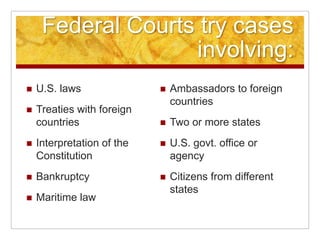
Federal Courts try cases
                   involving:
   U.S. laws                  Ambassadors to foreign
                                countries
   Treaties with foreign
    countries                  Two or more states
   Interpretation of the      U.S. govt. office or
    Constitution                agency
   Bankruptcy                 Citizens from different
                                states
   Maritime law
Concurrent Jurisdiction
   In some cases, both state and federal courts have
    jurisdiction.
     Ex: disputes between people from different states
       can choose a state or federal court if it is over
       $75,000.
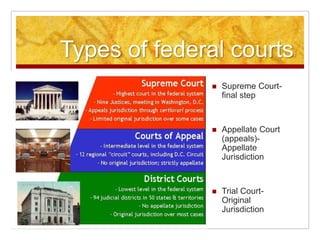
Types of federal courts
                 Supreme Court-
                  final step


                 Appellate Court
                  (appeals)-
                  Appellate
                  Jurisdiction


                 Trial Court-
                  Original
                  Jurisdiction
Supreme Court Power
         The court cannot go looking
          for an issue
           They must wait until
            litigants (people filing a
            lawsuit) come before them.
         Courts cannot answer
          questions about broad issues
           They can only make
            decisions on specific
            individual cases.
Marbury vs. Madison
Dred Scott vs. Sandford
Slaughterhouse Cases
Plessy vs. Ferguson
Brown vs. Board of
        Education

Federalcourts

  • 1.
    Powers of theFederal Court Ch. 11, sec. 1
  • 2.
    Jurisdiction of thecourts  Jurisdiction- the authority to hear a certain case (which type of courts get to try which cases).  State Courts  Each state has its own system of courts  Tries cases involving state laws  Federal Courts  Supreme Court  Lower federal courts  Tries cases involving federal laws
  • 3.
    Federal Courts trycases involving:  U.S. laws  Ambassadors to foreign countries  Treaties with foreign countries  Two or more states  Interpretation of the  U.S. govt. office or Constitution agency  Bankruptcy  Citizens from different states  Maritime law
  • 4.
    Concurrent Jurisdiction  In some cases, both state and federal courts have jurisdiction.  Ex: disputes between people from different states can choose a state or federal court if it is over $75,000.
  • 5.
    Types of federalcourts  Supreme Court- final step  Appellate Court (appeals)- Appellate Jurisdiction  Trial Court- Original Jurisdiction
  • 6.
    Supreme Court Power  The court cannot go looking for an issue  They must wait until litigants (people filing a lawsuit) come before them.  Courts cannot answer questions about broad issues  They can only make decisions on specific individual cases.
  • 7.
  • 8.
  • 9.
  • 10.
  • 11.
    Brown vs. Boardof Education