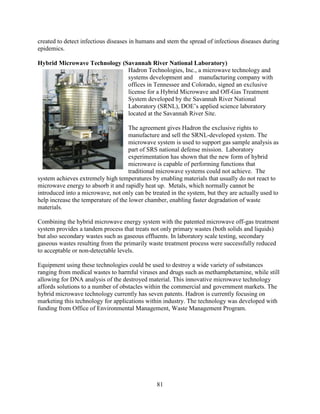
FEDERAL LABORATORY
TECHNOLOGY TRANSFER
Fiscal Year 2014
Summary Report to The President and the Congress
Federal Laboratory Technology Transfer
Fiscal Year 2014
Summary Report to the President and the Congress
Prepared by:
National Institute of
Standards and Technology
U.S. Department of Commerce
October 2016
i
This page intentionally left blank
ii
FOREWORD
The Department of Commerce is pleased to submit this Fiscal Year 2014 Technology Transfer
Summary Report to the President and the Congress. This report illustrates the continuing efforts
of Federal laboratories to ensure that the Nation’s investment in innovative research is
transferred from our laboratories to the American people.
Federal laboratories, through their basic and mission-oriented research and development (R&D)
investments, have historically been at the forefront of scientific discovery, invention, and
technological innovation. Technology transfer facilitates the practical application of Federal
research directly through the transfer of laboratory results and by providing non-federal entities
opportunities to partner with Federal laboratories on innovative research of mutual interest. Over
the years, new products, services, and the formation of new companies have occurred through
technology transfer initiatives.
The Presidential Memorandum (PM), Accelerating Technology Transfer and Commercialization
of Federal Research in Support of High-Growth Businesses, (October 2011)1
and the
Administration’s Lab-to-Market initiative2
have emphasized the important role that innovation
plays in accelerating the development of new industries, products, and services that lead to
economic growth and job creation. In response to these directives, agencies have engaged in
efforts to accelerate technology transfer activities, improved and expanded the collection of
technology transfer metrics, and established performance goals and evaluation methods to
enhance the efficiency and impact of their technology transfer activities.
This report fulfills the requirement of Title 15 of the United States
Code, Section 3710(g) (2), for an annual report summarizing the use of
technology transfer authorities by Federal agencies. It highlights the
achievements of Federal technology transfer and includes data on the
use of specific transfer authorities. Future editions of this report will be
used to continue to keep the President and the Congress informed of the
on-going efforts of Federal laboratories to expand our technology
transfer efforts in partnership with U.S. industry, academic institutions,
non-profit foundations, and state, local and tribal governments. These
efforts will continue to play a vital role in building the Nation’s
economic strength.
Willie E. May
Under Secretary of Commerce for Standards and Technology &
Director, National Institute of Standards and Technology
1
https://www.whitehouse.gov/the-press-office/2011/10/28/presidential-memorandum-accelerating-technology-
transfer-and-commerciali
2
https://www.whitehouse.gov/blog/2014/03/14/lab-market-accelerating-research-breakthroughs-and-economic-
growth
iii
Table of Contents
Chapter 1 Overview of Federal Technology Transfer.................................................................... 1
Federal Technology Transfer Summary...................................................................................... 4
Chapter 2 Agency Performance in FY 2014................................................................................. 30
Department of Agriculture (USDA).......................................................................................... 31
Department of Commerce (DOC) ............................................................................................. 40
Department of Defense (DoD) .................................................................................................. 54
Department of Energy (DOE) ................................................................................................... 62
Department of Health and Human Services (HHS) .................................................................. 82
Department of Homeland Security (DHS) ................................................................................ 91
Department of the Interior (DOI) .............................................................................................. 98
Department of Transportation (DOT) ..................................................................................... 109
Department of Veteran Affairs (VA) ...................................................................................... 121
Environmental Protection Agency (EPA) ............................................................................... 133
National Aeronautics and Space Administration (NASA)...................................................... 143
Chapter 3 Conclusion.................................................................................................................. 152
Appendix A................................................................................................................................. 154
Appendix B................................................................................................................................. 162
Appendix C................................................................................................................................. 168
iv
This page intentionally left blank
1
Chapter 1 Overview of Federal Technology Transfer
Many Federal agencies conduct R&D activities that result in the creation of new technologies. In
most cases, these technologies are created to support specific needs of an agency’s mission. In
other cases, they are spontaneous creations of ongoing research. Regardless of how they are
created, Federal technologies often have significant value that goes beyond an agency’s mission.
It is the role of an agency’s technology transfer office to identify this value and provide the most
effective means to transfer it outside of the agency.
Federal legislation provides a variety of vehicles through which Federal technologies can be
transferred.3
These vehicles facilitate the potential commercialization of inventions, enable the
use of Federal laboratory facilities by non-Federal entities, and allow for the establishment of
research partnerships between Federal government laboratories and other entities. This includes
the processing of patent applications and licenses as well as Cooperative Research Agreements
(CRADAs) and other mechanisms that convey knowledge, ownership rights, or establish formal
research agreements.
Collaborative research is particularly important to the technology transfer process and in many
ways is fundamental to every agency’s mission. By bringing together thousands of highly
qualified researchers and world class research facilities, collaborative research between Federal
and non-Federal organizations greatly enhances research capabilities, core competencies, and
creativity. This in turn leads to the flow of new ideas, new tools, more efficient techniques, new
processes and products, and new businesses. Collaborative research also helps agencies attract
and retain talented scientific personnel through rewards and royalty sharing opportunities.
The Presidential Memorandum (PM), Accelerating Technology Transfer and Commercialization
of Federal Research in Support of High-Growth Businesses, (October 2011)4
specifically
addresses the need to improve technology transfer operations in order to better address the needs
of businesses and, in particular, of small businesses that are especially vulnerable to a slow-
moving bureaucratic system.5
The PM and the more recent Lab-to-Market initiative,6
have led
agencies to review their operations and propose new ways to improve overall customer
3
The primary legislation addressing Federal technology transfer includes the Stevenson-Wydler Technology
Innovation Act of 1980 (P.L. 96-480), Patent and Trademark Act Amendments of 1980 (P.L. 96-517) (Bayh-Dole
Act), Small Business Innovation Development Act of 1982 (P.L. 97-219), Federal Technology Transfer Act of 1986
(P.L. 99-502), Omnibus Trade and Competitiveness Act of 1988 (P.L. 100-418), National Competitiveness
Technology Transfer Act of 1989 (P.L. 101-189), American Technology Preeminence Act of 1991 (P.L. 102-245),
Small Business Research and Development Enhancement Act of 1992 (P.L. 102-564), National Department of
Defense Authorization Act for 1994 (P.L. 103-160), National Technology Transfer and Advancement Act of 1995
(P.L. 104-113), Technology Transfer Commercialization Act of 2000 (P.L. 106-404), Energy Policy Act of 2005
(P.L. 109-58), and the America COMPETES Act of 2007 (P.L. 110-69). Numerous other acts indirectly affect
federal technology transfer activities.
4
https://www.whitehouse.gov/the-press-office/2011/10/28/presidential-memorandum-accelerating-technology-
transfer-and-commerciali
5
https://www.whitehouse.gov/the-press-office/2011/10/28/presidential-memorandum-accelerating-technology-
transfer-and-commerciali
6
https://www.whitehouse.gov/blog/2014/03/14/lab-market-accelerating-research-breakthroughs-and-economic-
growth
2
experience. These improvements include efforts to streamline operations in order to open doors
to more efficient technology transfer opportunities. Other improvements target the way
customers interact with the federal system.
This annual report summarizes the technology transfer activities and transfer vehicles used by 11
Federal agencies that have significant Federal laboratory operations: 7
Department of Agriculture (USDA)
Department of Commerce (DOC)
Department of Defense (DoD)
Department of Energy (DOE)
Department of Health and Human Services (HHS)
Department of Homeland Security (DHS)
Department of the Interior (DOI)
Department of Transportation (DOT)
Department of Veterans Affairs (VA)
Environmental Protection Agency (EPA)
National Aeronautics and Space
Administration (NASA)
Each of these agencies has established programs for promoting the transfer and
commercialization of technologies developed in its R&D laboratories and has provided the data
contained in this report. The DOC’s National Institute of Standards and Technology (NIST)
prepared and organized this report. An electronic version of this report is available at
http://nist.gov/tpo/publications/federal-laboratory-techtransfer-reports.cfm.
Federal R&D Spending
Spending on R&D by the Federal government supports a wide variety of agency-specific
missions, e.g., military objectives, health and human services issues, energy development, space
exploration, etc. In FY 2014, the total Federal budget for R&D was $130,847 million. Of this,
$88,870 million (68%) was used to support R&D activities that occurred outside of Federal
laboratories. This includes funding for grants, cooperative agreements, awards, etc. The
remainder, $41,977 million (32%) supported R&D activities that occurred inside Federal
laboratories. This includes $32,514 to support intramural activities and $9,463 million to support
federally funded R&D centers (FFRDCs).8
These funds constitute the amount of Federal funds
that can be used to support research that creates technologies developed in Federal laboratories
and the accompanying technology transfer activities which are the focus of this report. As
shown in the table below, the percent of an agency’s budget that was available to support the
development and transference of Federal technologies varied significantly among agencies.
7
In this report, the term ā€œFederal laboratoryā€ refers to any laboratory, any federally funded research and
development center, or any center established under section 7 or section 9 of 15 U.S.C. § 3705 or § 3707 that is
owned, leased, or otherwise used by a Federal agency and funded by the Federal Government, whether operated by
the Government or by a contractor.
8
For a list of FFRDCs see http://www.nsf.gov/statistics/nsf06316/
3
Federal Obligations for R&D
By Agency FY 2014 ($ million)9
(a) Intramural activities cover costs associated with the administration of intramural and extramural programs by Federal
personnel as well as actual intramural performance.
(b) FFRDC = federally funded research and development center.
In FY 2014, DoD spent the largest amount of funding for intramural activities and FFRDCs,
$19,663 million (30% of its R&D budget). HHS was second with $6,904 million (22% of its
R&D budget) and DOE was third with $6,883 million (72% of its R&D budget).
9
National Science Foundation (NSF), National Center for Science and Engineering Statistics, Survey of Federal
Funds for Research and Development, Preliminary Results for FY 2014, Table 10.
http://www.nsf.gov/statistics/nsf14316/content.cfm?pub_id=4418&id=2
Total R&D Intramural(a)
FFRDCs
(b)
Intramural
and
FFRDCs Percent
All Agencies $130,847 $32,514 $9,463 $41,977 32%
Ā Ā Ā Ā Ā Ā DoD $65,841 $18,296 $1,367 $19,663 30%
Ā Ā Ā Ā Ā Ā HHS $31,490 $6,523 $381 $6,904 22%
Ā Ā Ā Ā Ā Ā DOE $9,604 $906 $5,977 $6,883 72%
Ā Ā Ā Ā Ā Ā NASA $9,635 $1,458 $1,268 $2,726 28%
Ā Ā Ā Ā Ā Ā USDA $2,372 $1,514 $0 $1,514 64%
Ā Ā Ā Ā Ā Ā DOC $1,613 $1,145 $2 $1,147 71%
Ā Ā Other Agencies $6,718 $540 $254 $794 12%
Ā Ā Ā Ā Ā Ā DOI $836 $721 $13 $734 88%
Ā Ā Ā Ā Ā Ā VA $600 $600 $0 $600 100%
Ā Ā Ā Ā Ā Ā DHS $615 $261 $120 $381 62%
Ā Ā Ā Ā Ā Ā DOT $973 $286 $81 $367 38%
Ā Ā Ā Ā Ā Ā EPA $550 $264 $0 $264 48%
4
Federal Technology Transfer Summary
Every Federal agency that conducts R&D to improve the results from its technology transfer and
commercialization activities is required to prepare and submit an annual report of its technology
transfer activities as described in 15 U.S.C. § 3710(f). These reports contain details on each
agency’s technology transfer program as well as agency plans to use technology transfer to
advance the agency’s mission and to promote U.S. competitiveness.10
The following tables
summarize Federal technology transfer activities for the five-year period from FY 2010 through
FY 2014.11
In addition to data provided by agencies, this report uses selected information
derived from data provided by the National Science Foundation to provide additional details
about the nature of work conducted.
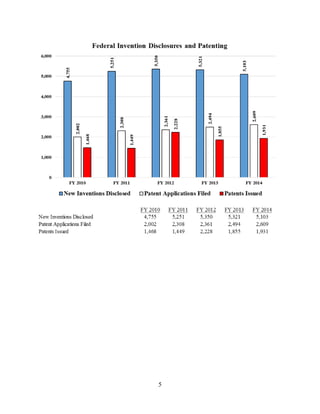
Federal Invention Disclosures and Patenting
The protection of intellectual property can be vital to attracting the additional investment and
product development resources necessary for early stage research products to be brought to their
full commercial potential. Federal laboratory achievements in the areas of invention disclosures
and patents issued are often cited as metrics of the active management of intellectual assets and
technical know-how by Federal agencies.
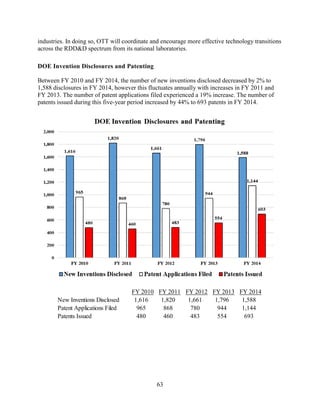
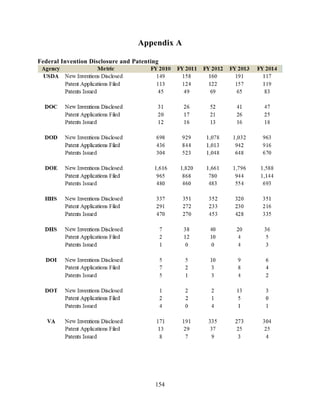
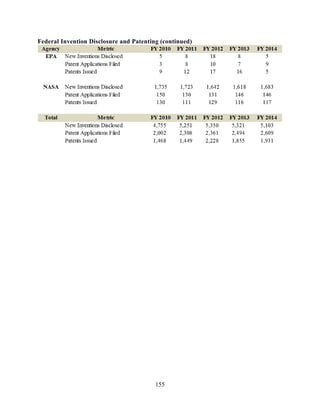
Between FY 2010 and FY 2014, the number of invention disclosures reported by Federal
agencies increased by 7% to 5,103. The number of patent applications filed increased by 30% to
2,609, and the number of patents issued increased by 32% to 1,931. NASA reported the largest
number of invention disclosures (1,683) in FY 2014, followed by DOE (1,588) and DoD (963).
These three agencies accounted for 83% of all invention disclosures reported in this fiscal year.
In FY 2014, DOE reported the largest number of patent applications (1,144) and patents issued
(693). DoD was second in both categories (916 and 670) and HHS was third (216 and 335).
These three agencies accounted for 87% of patent applications and 88% of patents issued.
10
For a list of agency technology transfer reports see http://nist.gov/tpo/publications/agency-technology-transfer-
reports.cfm
11
Technology transfer data are routinely adjusted over time to account for new information resulting from changes
in reporting procedures, patent decisions, programmatic changes, etc. Throughout this report, data prior to FY 2014
have been adjusted where necessary, to reflect the most accurate estimates for each year reported.
5
6
Technical Area Summary of U.S. Federal Agency Patents
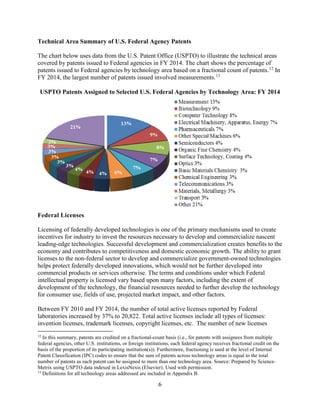
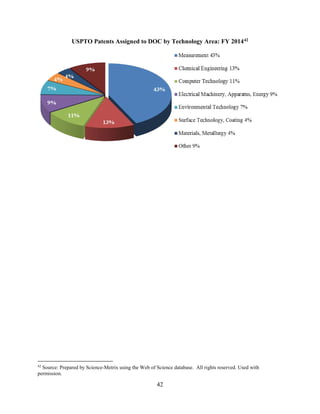
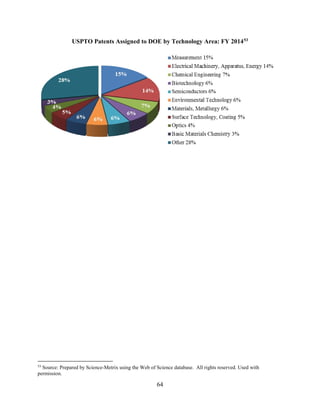
The chart below uses data from the U.S. Patent Office (USPTO) to illustrate the technical areas
covered by patents issued to Federal agencies in FY 2014. The chart shows the percentage of
patents issued to Federal agencies by technology area based on a fractional count of patents.12
In
FY 2014, the largest number of patents issued involved measurements.13
USPTO Patents Assigned to Selected U.S. Federal Agencies by Technology Area: FY 2014
Federal Licenses
Licensing of federally developed technologies is one of the primary mechanisms used to create
incentives for industry to invest the resources necessary to develop and commercialize nascent
leading-edge technologies. Successful development and commercialization creates benefits to the
economy and contributes to competitiveness and domestic economic growth. The ability to grant
licenses to the non-federal sector to develop and commercialize government-owned technologies
helps protect federally developed innovations, which would not be further developed into
commercial products or services otherwise. The terms and conditions under which Federal
intellectual property is licensed vary based upon many factors, including the extent of
development of the technology, the financial resources needed to further develop the technology
for consumer use, fields of use, projected market impact, and other factors.
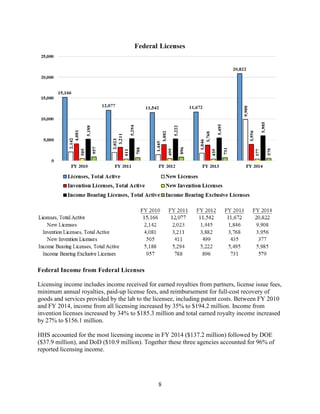
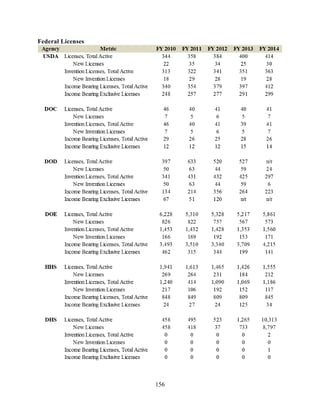
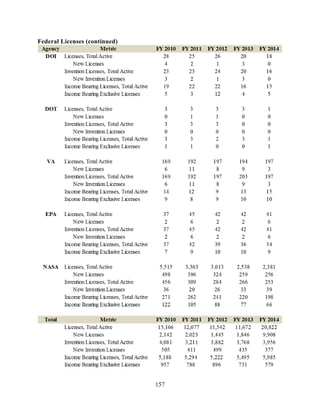
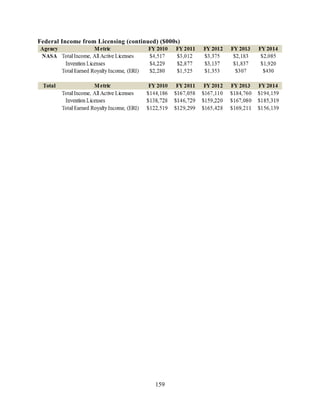
Between FY 2010 and FY 2014, the number of total active licenses reported by Federal
laboratories increased by 37% to 20,822. Total active licenses include all types of licenses:
invention licenses, trademark licenses, copyright licenses, etc. The number of new licenses
12
In this summary, patents are credited on a fractional-count basis (i.e., for patents with assignees from multiple
federal agencies, other U.S. institutions, or foreign institutions, each federal agency receives fractional credit on the
basis of the proportion of its participating institution(s)). Furthermore, fractioning is used at the level of Internal
Patent Classification (IPC) codes to ensure that the sum of patents across technology areas is equal to the total
number of patents as each patent can be assigned to more than one technology area. Source: Prepared by Science-
Metrix using USPTO data indexed in LexisNexis (Elsevier). Used with permission.
13
Definitions for all technology areas addressed are included in Appendix B.
7
increased by 363% to 9,908. A significant part of this increase is due to a large number of
trademark licenses issued by DHS. The number of invention licenses decreased by 3% to 3,956.
Invention licenses refers to inventions that are patented or could be patented. The number of new
invention licenses decreased by 25% to 377. The number of income-bearing licenses increased
by 15.4% to 5,985, and the number of exclusive licenses decreased by 40% to 579.
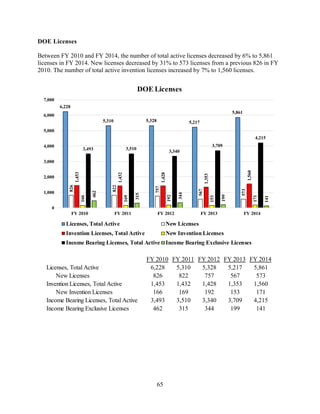
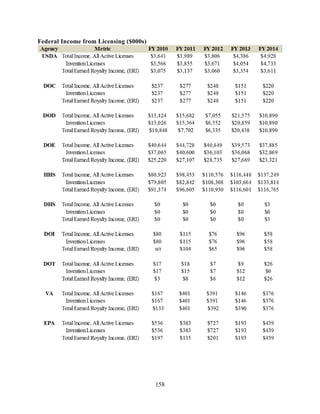
DHS reported the largest number of total active licenses, 10,313. All of these licenses were
trademark licenses. DOE was second with 5,861 licenses and NASA was third with 2,381
licenses. These three agencies accounted for 89% of all licenses reported in FY 2014.
DOE reported the largest number of invention licenses (1,560), followed by HHS (1,186) and
USDA (363). Together these three agencies accounted for 79% of invention licenses.
DOE reported the largest number of income-bearing licenses (4,215), which was significantly
higher than all other agencies combined. HHS was second (845) followed by USDA (412).
Together these three agencies accounted for 91% of income-bearing licenses.
USDA reported the largest number of income-bearing exclusive licenses (299), followed by
DOE (141) and NASA (66). Together these three agencies accounted for 87% of income-bearing
exclusive licenses.
8
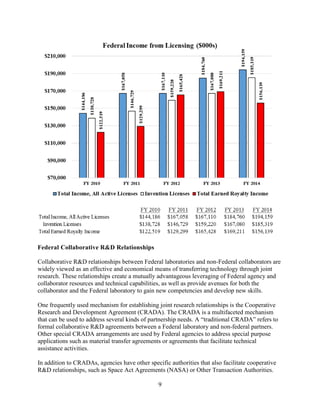
Federal Income from Federal Licenses
Licensing income includes income received for earned royalties from partners, license issue fees,
minimum annual royalties, paid-up license fees, and reimbursement for full-cost recovery of
goods and services provided by the lab to the licensee, including patent costs. Between FY 2010
and FY 2014, income from all licensing increased by 35% to $194.2 million. Income from
invention licenses increased by 34% to $185.3 million and total earned royalty income increased
by 27% to $156.1 million.
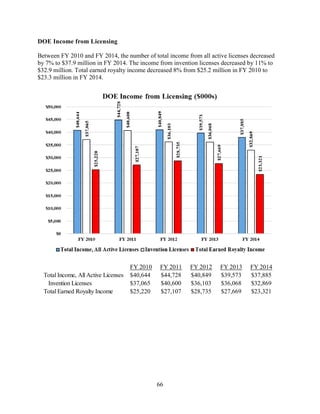
HHS accounted for the most licensing income in FY 2014 ($137.2 million) followed by DOE
($37.9 million), and DoD ($10.9 million). Together these three agencies accounted for 96% of
reported licensing income.
9
Federal Collaborative R&D Relationships
Collaborative R&D relationships between Federal laboratories and non-Federal collaborators are
widely viewed as an effective and economical means of transferring technology through joint
research. These relationships create a mutually advantageous leveraging of Federal agency and
collaborator resources and technical capabilities, as well as provide avenues for both the
collaborator and the Federal laboratory to gain new competencies and develop new skills.
One frequently used mechanism for establishing joint research relationships is the Cooperative
Research and Development Agreement (CRADA). The CRADA is a multifaceted mechanism
that can be used to address several kinds of partnership needs. A ā€œtraditional CRADAā€ refers to
formal collaborative R&D agreements between a Federal laboratory and non-federal partners.
Other special CRADA arrangements are used by Federal agencies to address special purpose
applications such as material transfer agreements or agreements that facilitate technical
assistance activities.
In addition to CRADAs, agencies have other specific authorities that also facilitate cooperative
R&D relationships, such as Space Act Agreements (NASA) or Other Transaction Authorities.
10
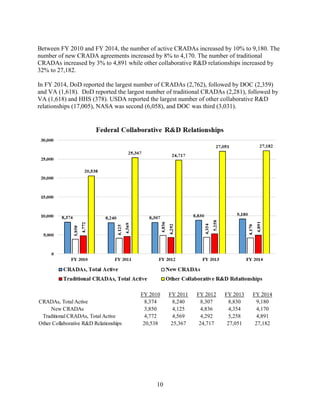
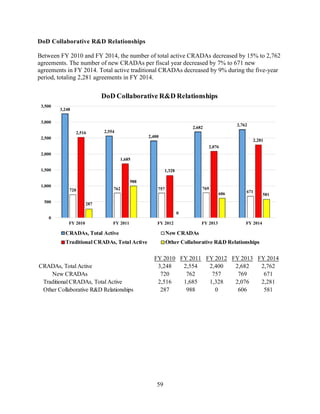
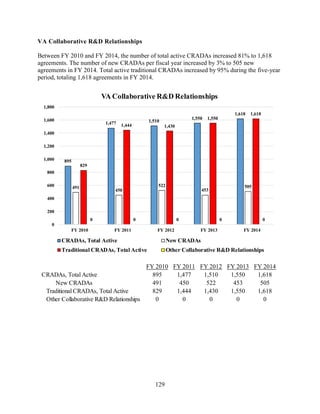
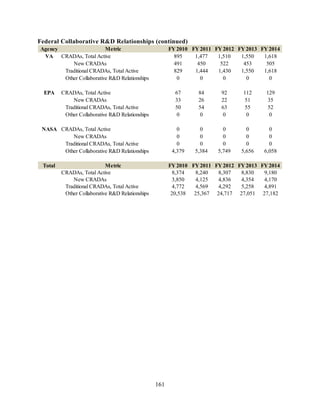
Between FY 2010 and FY 2014, the number of active CRADAs increased by 10% to 9,180. The
number of new CRADA agreements increased by 8% to 4,170. The number of traditional
CRADAs increased by 3% to 4,891 while other collaborative R&D relationships increased by
32% to 27,182.
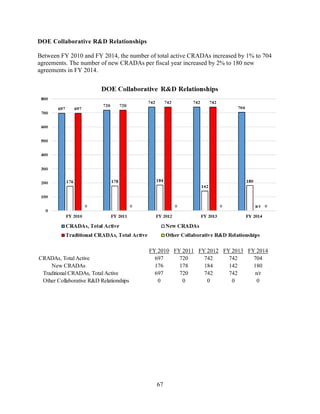
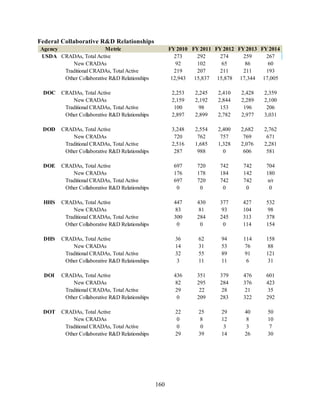
In FY 2014, DoD reported the largest number of CRADAs (2,762), followed by DOC (2,359)
and VA (1,618). DoD reported the largest number of traditional CRADAs (2,281), followed by
VA (1,618) and HHS (378). USDA reported the largest number of other collaborative R&D
relationships (17,005), NASA was second (6,058), and DOC was third (3,031).
FY 2010 FY 2011 FY 2012 FY 2013 FY 2014
CRADAs, Total Active 8,374 8,240 8,307 8,830 9,180
New CRADAs 3,850 4,125 4,836 4,354 4,170
Traditional CRADAs, Total Active 4,772 4,569 4,292 5,258 4,891
Other Collaborative R&D Relationships 20,538 25,367 24,717 27,051 27,182
11
Trends in Federal Technology Transfer Activities
Technology transfer activities are not spontaneous events. Inventions typically require years, if
not decades of research effort before they are disclosed. A review of a patent application may
take five years or more before the patent is awarded. It may also take several years to license a
Federal patent or form the collaborative commitment behind a CRADA. To get an understanding
of how technology transfer activities are performing over time, it is helpful to view the trends in
key metrics. Unfortunately, it is not always easy to isolate trends from raw data because
technology transfer metrics fluctuate widely. However, by converting metric values to a
common scale or index, we can develop a simple tool to illustrate trends.
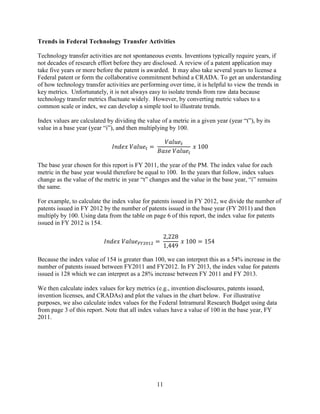
Index values are calculated by dividing the value of a metric in a given year (year ā€œtā€), by its
value in a base year (year ā€œiā€), and then multiplying by 100.
š¼š¼š¼š¼š¼š¼š¼š¼š¼š¼ š‘‰š‘‰š‘‰š‘‰š‘‰š‘‰š‘‰š‘‰š‘‰š‘‰š‘”š‘” =
š‘‰š‘‰š‘‰š‘‰š‘‰š‘‰š‘‰š‘‰š‘‰š‘‰š‘”š‘”
šµšµšµšµšµšµšµšµ š‘‰š‘‰š‘‰š‘‰š‘‰š‘‰š‘‰š‘‰š‘‰š‘‰š‘–š‘–
š‘„š‘„ 100
The base year chosen for this report is FY 2011, the year of the PM. The index value for each
metric in the base year would therefore be equal to 100. In the years that follow, index values
change as the value of the metric in year ā€œtā€ changes and the value in the base year, ā€œiā€ remains
the same.
For example, to calculate the index value for patents issued in FY 2012, we divide the number of
patents issued in FY 2012 by the number of patents issued in the base year (FY 2011) and then
multiply by 100. Using data from the table on page 6 of this report, the index value for patents
issued in FY 2012 is 154.
š¼š¼š¼š¼š¼š¼š¼š¼š¼š¼ š‘‰š‘‰š‘‰š‘‰š‘‰š‘‰š‘‰š‘‰š‘‰š‘‰š¹š¹š¹š¹2012 =
2,228
1,449
š‘„š‘„ 100 = 154
Because the index value of 154 is greater than 100, we can interpret this as a 54% increase in the
number of patents issued between FY2011 and FY2012. In FY 2013, the index value for patents
issued is 128 which we can interpret as a 28% increase between FY 2011 and FY 2013.
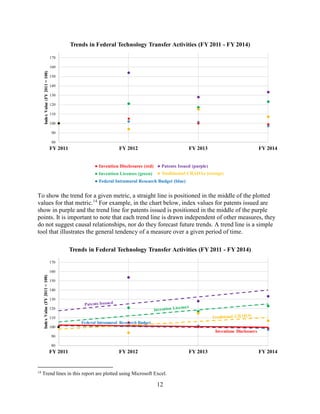
We then calculate index values for key metrics (e.g., invention disclosures, patents issued,
invention licenses, and CRADAs) and plot the values in the chart below. For illustrative
purposes, we also calculate index values for the Federal Intramural Research Budget using data
from page 3 of this report. Note that all index values have a value of 100 in the base year, FY
2011.
12
To show the trend for a given metric, a straight line is positioned in the middle of the plotted
values for that metric.14
For example, in the chart below, index values for patents issued are
show in purple and the trend line for patents issued is positioned in the middle of the purple
points. It is important to note that each trend line is drawn independent of other measures, they
do not suggest causal relationships, nor do they forecast future trends. A trend line is a simple
tool that illustrates the general tendency of a measure over a given period of time.
14
Trend lines in this report are plotted using Microsoft Excel.
80
90
100
110
120
130
140
150
160
170
FY 2011 FY 2012 FY 2013 FY 2014
Index
Value
(FY
2011
=
100) Trends in Federal Technology Transfer Activities (FY 2011 - FY 2014)
ā— Invention Disclosures (red) ā— Patents Issued (purple)
ā— Invention Licenses (green) ā— Traditionial CRADAs (orange)
ā— Federal Intramural Research Budget (blue)
80
90
100
110
120
130
140
150
160
170
FY 2011 FY 2012 FY 2013 FY 2014
Index
Value
(FY
2011
=
100)
Trends in Federal Technology Transfer Activities (FY 2011 - FY 2014)
Inventions Disclosures
Federal Intramural Research Budget
13
Trend lines plotted for patents issued, invention licenses, and traditional CRADAs all have a
positive slope which means that the reporting of these activities, which stem from past and
present efforts, have been increasing during this period of time. In other words, Federal agencies
have been promoting the transfer of technologies from Federal laboratories using these transfer
mechanisms.
The trend line for invention disclosures is relatively flat indicating the that during this period, the
reporting of new inventions has been consistent with no significant increases or decreases. The
trend line for the Federal Intramural Research Budget, which includes the budget for intramural
programs as well as the budget for FFRDCs, has also been relatively consistent over these years.
Science and Engineering (S&E) Articles
Although intellectual property has traditionally been tracked in terms of the number of patents,
licenses, and collaborative efforts, most Federal research results are transferred through
publication of S&E articles. Unfortunately, a uniform tracking system for S&E articles across all
Federal agencies does not exist; however, data from Thomson Reuters’ Web of Science database
can provide insight into the nature of S&E articles published by technology area even though not
all articles published by Federal agencies are included in the publications covered by these
databases. For example, in FY 2014, Thomson Reuters reports that Federal researchers authored
or coauthored 39,438 articles using a whole-count basis (where each agency gets full credit for
each article even if the article has co-authors from different agencies). Using additional data
provided by agencies in their annual reports on technology transfer activities that takes into
account publications not included in the Thomson Reuters’ database, the number of publications
increases to 44,378.15
The Thomson Reuters’ databases provide the additional benefit of identifying publications by
their science and engineering categories. Using a fractional-count basis, the number of
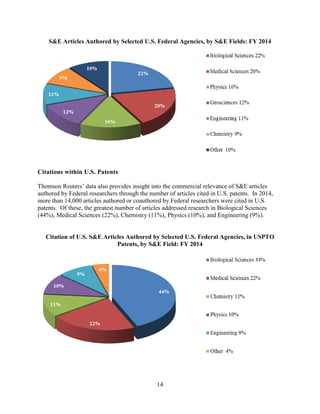
publications reported by Thomson Reuters was 16,769 articles. Of this, the greatest number of
articles address research in Biological Sciences (22%), Medical Sciences (20%), Physics (16%),
Geosciences (12%), Engineering (11%), and Chemistry (9%).16
15
Thomson Reuters’ data was prepared by Science-Metrix under the direction of NSF.
16
Articles are credited on a fractional-count basis (i.e., for articles with collaborating institutions from multiple
Federal agencies, other U.S. institutions, or foreign institutions, each Federal agency receives fractional credit on the
basis of the proportion of its participating institution(s)) and are classified by the year they entered the database,
rather than the year of publication, and are assigned to a Federal agency on the basis of the institutional address(es)
listed in the article. Source: Prepared by Science-Metrix using Thomson Reuters’ Web of Science database. All
rights reserved. Used with permission.
14
S&E Articles Authored by Selected U.S. Federal Agencies, by S&E Fields: FY 2014
Citations within U.S. Patents
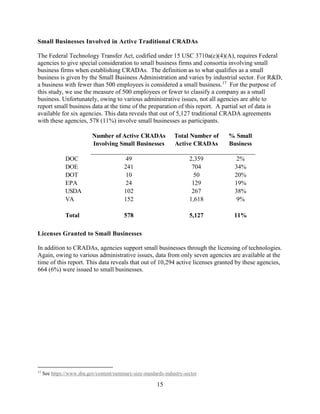
Thomson Reuters’ data also provides insight into the commercial relevance of S&E articles
authored by Federal researchers through the number of articles cited in U.S. patents. In 2014,
more than 14,000 articles authored or coauthored by Federal researchers were cited in U.S.
patents. Of these, the greatest number of articles addressed research in Biological Sciences
(44%), Medical Sciences (22%), Chemistry (11%), Physics (10%), and Engineering (9%).
Citation of U.S. S&E Articles Authored by Selected U.S. Federal Agencies, in USPTO
Patents, by S&E Field: FY 2014
15
Small Businesses Involved in Active Traditional CRADAs
The Federal Technology Transfer Act, codified under 15 USC 3710a(c)(4)(A), requires Federal
agencies to give special consideration to small business firms and consortia involving small
business firms when establishing CRADAs. The definition as to what qualifies as a small
business is given by the Small Business Administration and varies by industrial sector. For R&D,
a business with fewer than 500 employees is considered a small business.17
For the purpose of
this study, we use the measure of 500 employees or fewer to classify a company as a small
business. Unfortunately, owing to various administrative issues, not all agencies are able to
report small business data at the time of the preparation of this report. A partial set of data is
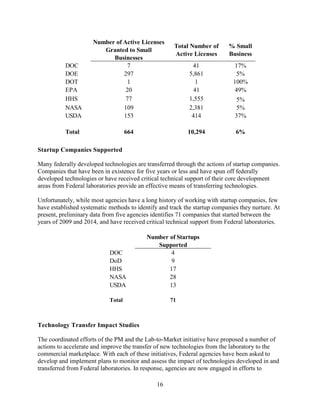
available for six agencies. This data reveals that out of 5,127 traditional CRADA agreements
with these agencies, 578 (11%) involve small businesses as participants.
Licenses Granted to Small Businesses
In addition to CRADAs, agencies support small businesses through the licensing of technologies.
Again, owing to various administrative issues, data from only seven agencies are available at the
time of this report. This data reveals that out of 10,294 active licenses granted by these agencies,
664 (6%) were issued to small businesses.
17
See https://www.sba.gov/content/summary-size-standards-industry-sector
Number of Active CRADAs
Involving Small Businesses
Total Number of
Active CRADAs
% Small
Business
DOC 49 2,359 2%
DOE 241 704 34%
DOT 10 50 20%
EPA 24 129 19%
USDA 102 267 38%
VA 152 1,618 9%
Total 578 5,127 11%
16
Startup Companies Supported
Many federally developed technologies are transferred through the actions of startup companies.
Companies that have been in existence for five years or less and have spun off federally
developed technologies or have received critical technical support of their core development
areas from Federal laboratories provide an effective means of transferring technologies.
Unfortunately, while most agencies have a long history of working with startup companies, few
have established systematic methods to identify and track the startup companies they nurture. At
present, preliminary data from five agencies identifies 71 companies that started between the
years of 2009 and 2014, and have received critical technical support from Federal laboratories.
Technology Transfer Impact Studies
The coordinated efforts of the PM and the Lab-to-Market initiative have proposed a number of
actions to accelerate and improve the transfer of new technologies from the laboratory to the
commercial marketplace. With each of these initiatives, Federal agencies have been asked to
develop and implement plans to monitor and assess the impact of technologies developed in and
transferred from Federal laboratories. In response, agencies are now engaged in efforts to
Number of Active Licenses
Granted to Small
Businesses
Total Number of
Active Licenses
% Small
Business
DOC 7 41 17%
DOE 297 5,861 5%
DOT 1 1 100%
EPA 20 41 49%
HHS 77 1,555 5%
NASA 109 2,381 5%
USDA 153 414 37%
Total 664 10,294 6%
Number of Startups
Supported
DOC 4
DoD 9
HHS 17
NASA 28
USDA 13
Total 71
17
monitor and analyze the impact of their current and future technology transfer efforts on the
economy. The economy can refer to specific end users (e.g. licensees, consumers), companies,
industries, markets, neighborhoods, regions, or the entire globe. The measured impact can
involve changes in economic measures (such as net benefits, business revenue, business profits,
personal wages, and/or jobs), physical measures (such as performance or efficiency), or social
measures (such as training performance, communications, or behavior).
Over the past 40 years, hundreds if not thousands of impact studies have been commissioned by
Federal agencies. Unfortunately, few of these studies have actually assessed the impact of
Federal technologies18
or the efficacy of mechanisms used to transfer technologies outside of a
Federal agency.19
Most federally commissioned impact studies have focused on regulatory
impacts20
or on the impacts of extramural programs.21
Only a few studies have actually assessed
the impact of technologies developed in and transferred from Federal laboratories. The following
examples illustrate the extent to which Federal technology transfer impacts have been assessed to
date.
DOC
Between 2000 and 2011, DOC commissioned sixteen impact studies for specific technologies
developed and transferred from NIST.22
These studies measured impact in terms of net benefits
received over time. Impact measures include net present value (NPV), which is the value of
net benefits discounted over time; internal rate of return (IRR), which is the return on the
investment achieved by the agency (e.g. NIST); social rate of return (SRR), which is the return
on investment achieved by society; and benefits to cost ratio (BCR), which is the ratio of the
net present value of benefits to the net present value of costs.23
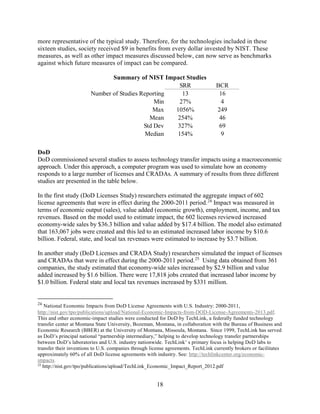
Results from these studies are summarized in the table below. For thirteen of these studies, the
SRR values ranged from a low of 27% to a high of 1,056% and had a mean value of 254%.
However, given the standard deviation is rather large (327%), the median value of 154% is
more representative of the typical study. In other words, for the technologies included in these
thirteen studies, society experienced a typical return of 154%. Sixteen studies calculated
BCRs. The BCR values ranged from a low of 4 to a high of 249 and had a mean value of 46.
Once again, given the large standard deviation for the sample (69), the median value of 9 is
18
Measuring the Impacts of Federal Investments in Research, A Workshop Summary, Committee on Measuring
Economic and Other Returns on Federal Research Investments, The National Academies, 2011,
http://www.nap.edu/catalog/13208/measuring-the-impacts-of-federal-investments-in-research-a-workshop
19
The evolving state-of-the-art in technology transfer research: Revisiting the contingent effectiveness model, Barry
Bozeman, http://www.sciencedirect.com/science/article/pii/S0048733314001127
20
https://www.whitehouse.gov/sites/default/files/omb/inforeg/regpol/circular-a-4_regulatory-impact-analysis-a-
primer.pdf
21
See https://www.whitehouse.gov/omb/mgmt-gpra/index-gpra
22
See http://nist.gov/tpo/economic-impact-studies.cfm
23
The IRR is often called the private rate of return (PRR) when applied to a single firm and the social rate of return
(SRR) when applied to the innovator, subsequent imitators, and the users of the technology (i.e., one or more
industries or even the entire economy). The difference between the two in terms of economic benefits realized is a
rough measure of the degree of diffusion of the technology beyond the innovator. The SRR is usually the main
metric for government research programs because the impact target is at least the industry level. For additional
information on how net benefits are measured see http://nist.gov/director/planning/upload/report03-1.pdf
18
more representative of the typical study. Therefore, for the technologies included in these
sixteen studies, society received $9 in benefits from every dollar invested by NIST. These
measures, as well as other impact measures discussed below, can now serve as benchmarks
against which future measures of impact can be compared.
Summary of NIST Impact Studies
DoD
DoD commissioned several studies to assess technology transfer impacts using a macroeconomic
approach. Under this approach, a computer program was used to simulate how an economy
responds to a large number of licenses and CRADAs. A summary of results from three different
studies are presented in the table below.
In the first study (DoD Licenses Study) researchers estimated the aggregate impact of 602
license agreements that were in effect during the 2000-2011 period.24
Impact was measured in
terms of economic output (sales), value added (economic growth), employment, income, and tax
revenues. Based on the model used to estimate impact, the 602 licenses reviewed increased
economy-wide sales by $36.3 billion and value added by $17.4 billion. The model also estimated
that 163,067 jobs were created and this led to an estimated increased labor income by $10.6
billion. Federal, state, and local tax revenues were estimated to increase by $3.7 billion.
In another study (DoD Licenses and CRADA Study) researchers simulated the impact of licenses
and CRADAs that were in effect during the 2000-2011 period.25
Using data obtained from 361
companies, the study estimated that economy-wide sales increased by $2.9 billion and value
added increased by $1.6 billion. There were 17,818 jobs created that increased labor income by
$1.0 billion. Federal state and local tax revenues increased by $331 million.
24
National Economic Impacts from DoD License Agreements with U.S. Industry: 2000-2011,
http://nist.gov/tpo/publications/upload/National-Economic-Impacts-from-DOD-License-Agreements-2013.pdf.
This and other economic-impact studies were conducted for DoD by TechLink, a federally funded technology
transfer center at Montana State University, Bozeman, Montana, in collaboration with the Bureau of Business and
Economic Research (BBER) at the University of Montana, Missoula, Montana. Since 1999, TechLink has served
as DoD’s principal national ā€œpartnership intermediary,ā€ helping to develop technology transfer partnerships
between DoD’s laboratories and U.S. industry nationwide. TechLink’ s primary focus is helping DoD labs to
transfer their inventions to U.S. companies through license agreements. TechLink currently brokers or facilitates
approximately 60% of all DoD license agreements with industry. See: http://techlinkcenter.org/economic-
impacts.
25
http://nist.gov/tpo/publications/upload/TechLink_Economic_Impact_Report_2012.pdf
SRR BCR
Number of Studies Reporting 13 16
Min 27% 4
Max 1056% 249
Mean 254% 46
Std Dev 327% 69
Median 154% 9
19
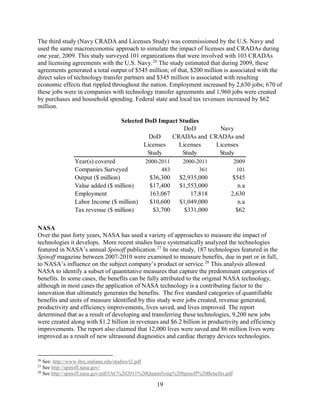
The third study (Navy CRADA and Licenses Study) was commissioned by the U.S. Navy and
used the same macroeconomic approach to simulate the impact of licenses and CRADAs during
one year, 2009. This study surveyed 101 organizations that were involved with 103 CRADAs
and licensing agreements with the U.S. Navy.26
The study estimated that during 2009, these
agreements generated a total output of $545 million; of that, $200 million is associated with the
direct sales of technology transfer partners and $345 million is associated with resulting
economic effects that rippled throughout the nation. Employment increased by 2,630 jobs; 670 of
these jobs were in companies with technology transfer agreements and 1,960 jobs were created
by purchases and household spending. Federal state and local tax revenues increased by $62
million.
Selected DoD Impact Studies
NASA
Over the past forty years, NASA has used a variety of approaches to measure the impact of
technologies it develops. More recent studies have systematically analyzed the technologies
featured in NASA’s annual Spinoff publication.27
In one study, 187 technologies featured in the
Spinoff magazine between 2007-2010 were examined to measure benefits, due in part or in full,
to NASA’s influence on the subject company’s product or service.28
This analysis allowed
NASA to identify a subset of quantitative measures that capture the predominant categories of
benefits. In some cases, the benefits can be fully attributed to the original NASA technology,
although in most cases the application of NASA technology is a contributing factor to the
innovation that ultimately generates the benefits. The five standard categories of quantifiable
benefits and units of measure identified by this study were jobs created, revenue generated,
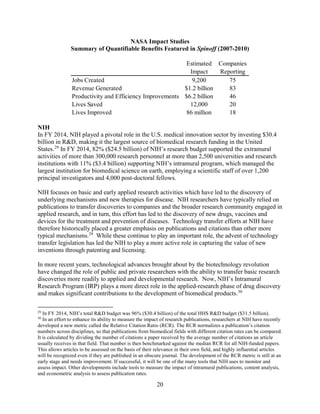
productivity and efficiency improvements, lives saved, and lives improved. The report
determined that as a result of developing and transferring these technologies, 9,200 new jobs
were created along with $1.2 billion in revenues and $6.2 billion in productivity and efficiency
improvements. The report also claimed that 12,000 lives were saved and 86 million lives were
improved as a result of new ultrasound diagnostics and cardiac therapy devices technologies.
26
See: http://www.ibrc.indiana.edu/studies/t2.pdf
27
See http://spinoff.nasa.gov/
28
See http://spinoff.nasa.gov/pdf/IAC%202011%20Quantifying%20Spinoff%20Benefits.pdf
DoD
Licenses
Study
DoD
CRADAs and
Licenses
Study
Navy
CRADAs and
Licenses
Study
Year(s) covered 2000-2011 2000-2011 2009
Companies Surveyed 483 361 101
Output ($ million) $36,300 $2,935,000 $545
Value added ($ million) $17,400 $1,553,000 n.a
Employment 163,067 17,818 2,630
Labor Income ($ million) $10,600 $1,049,000 n.a
Tax revenue ($ million) $3,700 $331,000 $62
20
NASA Impact Studies
Summary of Quantifiable Benefits Featured in Spinoff (2007-2010)
NIH
In FY 2014, NIH played a pivotal role in the U.S. medical innovation sector by investing $30.4
billion in R&D, making it the largest source of biomedical research funding in the United
States.29
In FY 2014, 82% ($24.5 billion) of NIH’s research budget supported the extramural
activities of more than 300,000 research personnel at more than 2,500 universities and research
institutions with 11% ($3.4 billion) supporting NIH’s intramural program, which managed the
largest institution for biomedical science on earth, employing a scientific staff of over 1,200
principal investigators and 4,000 post-doctoral fellows.
NIH focuses on basic and early applied research activities which have led to the discovery of
underlying mechanisms and new therapies for disease. NIH researchers have typically relied on
publications to transfer discoveries to companies and the broader research community engaged in
applied research, and in turn, this effort has led to the discovery of new drugs, vaccines and
devices for the treatment and prevention of diseases. Technology transfer efforts at NIH have
therefore historically placed a greater emphasis on publications and citations than other more
typical mechanisms.29
While these continue to play an important role, the advent of technology
transfer legislation has led the NIH to play a more active role in capturing the value of new
inventions through patenting and licensing.
In more recent years, technological advances brought about by the biotechnology revolution
have changed the role of public and private researchers with the ability to transfer basic research
discoveries more readily to applied and developmental research. Now, NIH’s Intramural
Research Program (IRP) plays a more direct role in the applied-research phase of drug discovery
and makes significant contributions to the development of biomedical products.30
29
In FY 2014, NIH’s total R&D budget was 96% ($30.4 billion) of the total HHS R&D budget ($31.5 billion).
30
In an effort to enhance its ability to measure the impact of research publications, researchers at NIH have recently
developed a new metric called the Relative Citation Ratio (RCR). The RCR normalizes a publication’s citation
numbers across disciplines, so that publications from biomedical fields with different citation rates can be compared.
It is calculated by dividing the number of citations a paper received by the average number of citations an article
usually receives in that field. That number is then benchmarked against the median RCR for all NIH-funded papers.
This allows articles to be assessed on the basis of their relevance in their own field, and highly influential articles
will be recognized even if they are published in an obscure journal. The development of the RCR metric is still at an
early stage and needs improvement. If successful, it will be one of the many tools that NIH uses to monitor and
assess impact. Other developments include tools to measure the impact of intramural publications, content analysis,
and econometric analysis to assess publication rates.
Estimated
Impact
Companies
Reporting
Jobs Created 9,200 75
Revenue Generated $1.2 billion 83
Productivity and Efficiency Improvements $6.2 billion 46
Lives Saved 12,000 20
Lives Improved 86 million 18
21
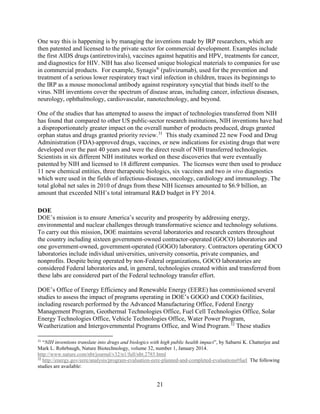
One way this is happening is by managing the inventions made by IRP researchers, which are
then patented and licensed to the private sector for commercial development. Examples include
the first AIDS drugs (antiretrovirals), vaccines against hepatitis and HPV, treatments for cancer,
and diagnostics for HIV. NIH has also licensed unique biological materials to companies for use
in commercial products. For example, SynagisĀ®
(palivizumab), used for the prevention and
treatment of a serious lower respiratory tract viral infection in children, traces its beginnings to
the IRP as a mouse monoclonal antibody against respiratory syncytial that binds itself to the
virus. NIH inventions cover the spectrum of disease areas, including cancer, infectious diseases,
neurology, ophthalmology, cardiovascular, nanotechnology, and beyond.
One of the studies that has attempted to assess the impact of technologies transferred from NIH
has found that compared to other US public-sector research institutions, NIH inventions have had
a disproportionately greater impact on the overall number of products produced, drugs granted
orphan status and drugs granted priority review.31
This study examined 22 new Food and Drug
Administration (FDA)-approved drugs, vaccines, or new indications for existing drugs that were
developed over the past 40 years and were the direct result of NIH transferred technologies.
Scientists in six different NIH institutes worked on these discoveries that were eventually
patented by NIH and licensed to 18 different companies. The licenses were then used to produce
11 new chemical entities, three therapeutic biologics, six vaccines and two in vivo diagnostics
which were used in the fields of infectious-diseases, oncology, cardiology and immunology. The
total global net sales in 2010 of drugs from these NIH licenses amounted to $6.9 billion, an
amount that exceeded NIH’s total intramural R&D budget in FY 2014.
DOE
DOE’s mission is to ensure America’s security and prosperity by addressing energy,
environmental and nuclear challenges through transformative science and technology solutions.
To carry out this mission, DOE maintains several laboratories and research centers throughout
the country including sixteen government-owned contractor-operated (GOCO) laboratories and
one government-owned, government-operated (GOGO) laboratory. Contractors operating GOCO
laboratories include individual universities, university consortia, private companies, and
nonprofits. Despite being operated by non-Federal organizations, GOCO laboratories are
considered Federal laboratories and, in general, technologies created within and transferred from
these labs are considered part of the Federal technology transfer effort.
DOE’s Office of Energy Efficiency and Renewable Energy (EERE) has commissioned several
studies to assess the impact of programs operating in DOE’s GOGO and COGO facilities,
including research performed by the Advanced Manufacturing Office, Federal Energy
Management Program, Geothermal Technologies Office, Fuel Cell Technologies Office, Solar
Energy Technologies Office, Vehicle Technologies Office, Water Power Program,
Weatherization and Intergovernmental Programs Office, and Wind Program.32
These studies
31
ā€œNIH inventions translate into drugs and biologics with high public health impactā€, by Sabarni K. Chatterjee and
Mark L. Rohrbaugh, Nature Biotechnology, volume 32, number 1, January 2014.
http://www.nature.com/nbt/journal/v32/n1/full/nbt.2785.html
32
http://energy.gov/eere/analysis/program-evaluation-eere-planned-and-completed-evaluations#fuel The following
studies are available:
22
provide a rich assessment of program-attributed outcomes, such as energy saved, power plant
capacity, emissions reduction, health benefits, economic performance, and knowledge diffusion.
These studies were commissioned prior to the Administration’s initiatives to assess technology
transfer impact and are primarily focused on impacts of extramural research done by companies
collaborating with DOE researchers. The technologies assessed were, for the most part,
developed outside of DOE laboratories and are not considered part of Federal technology
transfer activities. However, these studies identify the important role that Federal technologies
play in the success of these programs and attribute a portion of the assessed benefits to DOE.
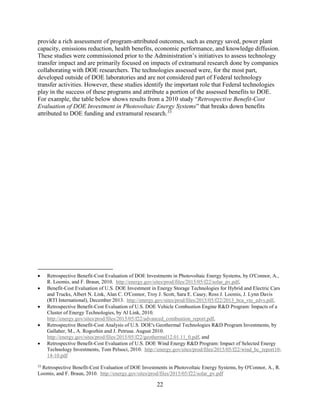
For example, the table below shows results from a 2010 study ā€œRetrospective Benefit-Cost
Evaluation of DOE Investment in Photovoltaic Energy Systemsā€ that breaks down benefits
attributed to DOE funding and extramural research.33
• Retrospective Benefit-Cost Evaluation of DOE Investments in Photovoltaic Energy Systems, by O'Connor, A.,
R. Loomis, and F. Braun, 2010. http://energy.gov/sites/prod/files/2015/05/f22/solar_pv.pdf,
• Benefit-Cost Evaluation of U.S. DOE Investment in Energy Storage Technologies for Hybrid and Electric Cars
and Trucks, Albert N. Link, Alan C. O'Connor, Troy J. Scott, Sara E. Casey, Ross J. Loomis, J. Lynn Davis
(RTI International), December 2013. http://energy.gov/sites/prod/files/2015/05/f22/2013_bca_vto_edvs.pdf,
• Retrospective Benefit-Cost Evaluation of U.S. DOE Vehicle Combustion Engine R&D Program: Impacts of a
Cluster of Energy Technologies, by Al Link, 2010.
http://energy.gov/sites/prod/files/2015/05/f22/advanced_combustion_report.pdf,
• Retrospective Benefit-Cost Analysis of U.S. DOE's Geothermal Technologies R&D Program Investments, by
Gallaher, M., A. Rogozhin and J. Petrusa. August 2010.
http://energy.gov/sites/prod/files/2015/05/f22/geothermal12.01.11_0.pdf, and
• Retrospective Benefit-Cost Evaluation of U.S. DOE Wind Energy R&D Program: Impact of Selected Energy
Technology Investments, Tom Pelsoci, 2010. http://energy.gov/sites/prod/files/2015/05/f22/wind_bc_report10-
14-10.pdf
33
Retrospective Benefit-Cost Evaluation of DOE Investments in Photovoltaic Energy Systems, by O'Connor, A., R.
Loomis, and F. Braun, 2010. http://energy.gov/sites/prod/files/2015/05/f22/solar_pv.pdf
23
(a) EPA’s Co-Benefits Risk Assessment (COBRA) model is a tool used to estimate the health and economic benefits of air quality
policies.
Another DOE study which does focus on Federally developed technologies illustrates the
important role of different types of technology transfer mechanisms. This study assessed the
impact of DOE’s effort to support the development of Polycrystalline Diamond Compact (PDC)
drill bits. Until the late 1970s, most oil and gas wells were drilled using a device called the roller-
cone drill bit. In 1977, a new drill bit design, using a synthetic material made of diamond grains,
was invented by General Electric. This Polycrystalline Diamond Compact (PDC) drill bit was
Quantified
Benefit
Minimum
Attribution to DOE
Unit of
Measure
Economic Benefits
Net economic benefits $15,024.90 $15,024.90 Million, 2008$
Public rate of return 17%
Net present value at 7% [Base year = 1975] $1,458.90 Million, 2008$
Net present value at 3% [Base year = 1975] $5,724.70 Million, 2008$
Benefit-to-cost ratio at 7% 1.83
Benefit-to-cost ratio at 3% 3.24
Environmental Health Benefits
Monetized via COBRA
(a)
$237.23 $39.80 Million, 2008$
Avoided mortality 32.65 5.48 Deaths
Avoided infant mortality 0.07 0.01 Deaths
Avoided chronic bronchitis 21.98 3.69 Cases
Avoided nonfatal heart attacks 51.03 8.57 Attacks
Avoided resp. hospital admissions 7.63 1.28 Admissions
Avoided CDV hospital admissions 15.88 2.67 Admissions
Avoided acute bronchitis 54.87 9.2 Cases
Avoided upper respiratory symptoms 490.69 82.29 Episodes
Avoided lower respiratory symptoms 650.84 109.15 Episodes
Avoided asthma ER visits 29.52 4.99 Visits
Avoided minor restriced activity (MRAD) days 27,036.52 4,535.47 Incidences
Avoided work loss days 685.87 123 Days
Greenhouse Gas Emissions Benefits
Avoided carbon dioxide emissions (CO2) 6,815,103 1,062,473 Tons
Avoided methane emissions (CH4) 132 21 Tons
Avoided nitrous oxide emissions (N2O) 583 90 Tons
Avoided particulate matter emissions (PM) 1,232 207 Tons
Avoided sulfur dioxide emissions (SO2) 2,634 463 Tons
Avoided ammonia emissions (NH3) 16 3 Tons
Avoided volatile organic compounds emissions (VOCs) 1,090 181 Tons
Energy Security Benefits
Equivalent avoided petroleum consumption 4,790,478 827,189 Barrels of oil
equivalent
Knowledge Benefits
DOE-attributed patent families in photovoltaics 274 Patent families
DOE publications in photovoltaics 900 Publications
Percentage of leading U.S. PV company patents linked to DOE 30%
Evaluation of DOE's Investment in Photovoltaic Energy System
Summary Cost-Benefit Analysis Results, 1975-2008
24
superior in design to existing roller-cone drill bits and had the potential to significantly reduce
the time and cost of drilling wells, especially through hard or rocky materials.34
From the very beginning, DOE played an important role in developing and helping industry
adopt the new PDC drill bit technology. DOE researchers made significant contributions to
improving bit design, overcoming performance flaws and limitations, and spurring the
innovation that resulted in overall market success of PDC drill bits. As part of the effort, DOE’s
Sandia National Laboratory (SNL) provided numerous field tests and researched fundamental
studies of rock-cutter interaction and frictional heating of the cutters. This research advanced the
general understanding of how cutters induce failure in the rock. SNL also analyzed chip
formation using finite-element modeling in rock using an advanced two-dimensional software
program that they also developed. Other technologies that SNL developed and transferred to
industry include:
• a wide range of thermal and stress models for a variety of cutter configurations, materials,
and rock properties;
• analytical procedures for predicting the temperature of PDC cutters over a wide range of
downhole conditions;
• a variety of single-cutter tests with an advanced milling machine modified to record
three-axis forces;
• advanced software tools that compares bit designs, and gains detailed information on
individual cutters so that the bit design could optimally place the cutters to produce
uniform cutter wear; and
• full-scale bit tests that supported several field tests of experimental and commercial bits.
In addition to the many reports and test results that were delivered to industry customers, SNL
researchers published a series of papers that examined the effects of bit design, weight-on bit
issues, rotary speed, bit bounce, drilling fluids, etc.; all of which helped develop and quantify
critical design and performance characteristics of the new PDC technology.
In addition, a CRADA agreement was signed between DOE and four drill bit companies that led
to full-scale field tests of drill bits using SNL’s Diagnostics-While-Drilling system. These tests
demonstrated that real time knowledge and control of drilling conditions greatly benefited bit
performance in hard rock, which is a necessity for PDC applications in geothermal drilling. SNL
transferred full data sets from these tests to each CRADA partner to support their separate
developments. All test bits provided valuable information to their respective manufacturers for
further development of hard-rock PDC bits. As a result of this research, the superior wear
performance of PDC bits gradually increased and the use of PDC bits now dominates the oil and
gas drilling industry.
34
U.S. Department of Energy, Energy Efficiency and Renewable Energy, Geothermal Technologies Program,
ā€œDrilling 1976-2006 A History of Geothermal Energy Research and Development in the United States,ā€
http://energy.gov/sites/prod/files/2014/02/f7/geothermal_history_2_drilling_0.pdf
25
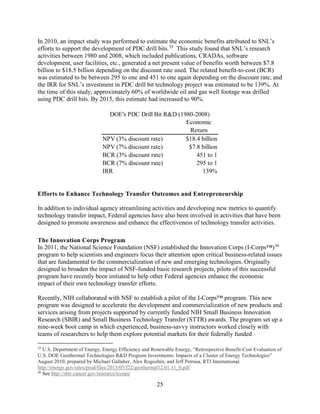
In 2010, an impact study was performed to estimate the economic benefits attributed to SNL’s
efforts to support the development of PDC drill bits.35
This study found that SNL’s research
activities between 1980 and 2008, which included publications, CRADAs, software
development, user facilities, etc., generated a net present value of benefits worth between $7.8
billion to $18.5 billion depending on the discount rate used. The related benefit-to-cost (BCR)
was estimated to be between 295 to one and 451 to one again depending on the discount rate, and
the IRR for SNL’s investment in PDC drill bit technology project was estimated to be 139%. At
the time of this study, approximately 60% of worldwide oil and gas well footage was drilled
using PDC drill bits. By 2015, this estimate had increased to 90%.
Efforts to Enhance Technology Transfer Outcomes and Entrepreneurship
In addition to individual agency streamlining activities and developing new metrics to quantify
technology transfer impact, Federal agencies have also been involved in activities that have been
designed to promote awareness and enhance the effectiveness of technology transfer activities.
The Innovation Corps Program
In 2011, the National Science Foundation (NSF) established the Innovation Corps (I-Corpsā„¢)36
program to help scientists and engineers focus their attention upon critical business-related issues
that are fundamental to the commercialization of new and emerging technologies. Originally
designed to broaden the impact of NSF-funded basic research projects, pilots of this successful
program have recently been initiated to help other Federal agencies enhance the economic
impact of their own technology transfer efforts.
Recently, NIH collaborated with NSF to establish a pilot of the I-Corpsā„¢ program. This new
program was designed to accelerate the development and commercialization of new products and
services arising from projects supported by currently funded NIH Small Business Innovation
Research (SBIR) and Small Business Technology Transfer (STTR) awards. The program set up a
nine-week boot camp in which experienced, business-savvy instructors worked closely with
teams of researchers to help them explore potential markets for their federally funded
35
U.S. Department of Energy, Energy Efficiency and Renewable Energy, ā€œRetrospective Benefit-Cost Evaluation of
U.S. DOE Geothermal Technologies R&D Program Investments: Impacts of a Cluster of Energy Technologiesā€
August 2010, prepared by Michael Gallaher, Alex Rogozhin, and Jeff Petrusa, RTI International.
http://energy.gov/sites/prod/files/2015/05/f22/geothermal12.01.11_0.pdf
36
See http://sbir.cancer.gov/resource/icorps/
Economic
Return
NPV (3% discount rate) $18.4 billion
NPV (7% discount rate) $7.8 billion
BCR (3% discount rate) 451 to 1
BCR (7% discount rate) 295 to 1
IRR 139%
DOE's PDC Drill Bit R&D (1980-2008)
26
innovations. Researchers learned how to build scalable business models around new
technologies, protect intellectual property, and develop regulatory and reimbursement strategies.
Four NIH institutes participated in the pilot program: the National Cancer Institute; the National
Heart, Lung and Blood Institute; the National Institute of Neurological Disorders and Stroke; and
the National Center for Advancing Translational Sciences.
DOE has launched a similar pilot program to accelerate the transfer of innovative clean energy
technologies from the DOE’s National Laboratories into the commercial marketplace. This
program, known as Lab-Corps,37
aims to better train and empower DOE national lab researchers
to transition their discoveries into high-impact, real world technologies in the private sector. Lab-
Corps, which builds on the I-Corpsā„¢ model, is designed to provide a specialized technology
accelerator and training curriculum for the national laboratories that enables lab-based teams to
gain direct market feedback on their technologies and pursue the development of startup
companies, industry partnerships, licensing agreements, and other business opportunities. Six
DOE national laboratories have been selected to participate in the Lab-Corps pilot program. Over
the next year, these labs will assemble, train, and support entrepreneurial teams to identify
private sector opportunities for commercializing promising sustainable transportation, renewable
power, and energy efficiency lab technologies.
Entrepreneur in Residence Programs
Several agencies have established Entrepreneur in Residence (EIR) programs that mentor
technical researchers on the fundamentals of commercializing new technologies. While these
programs vary across agencies, the common goal is to provide sound entrepreneurial advice from
experienced business experts to accelerate technology transfer. Topics that are common to these
programs include methods of establishing market values, managing intellectual property rights,
performing due diligence, fund raising, and requirements for starting a new business.
DOE's EIR initiative was started in 2007 by the Office of Energy Efficiency & Renewable
Energy to address long-standing concerns that national laboratory inventions were not being
sufficiently transferred into the marketplace. By placing venture capital-sponsored entrepreneurs
at key national laboratories, the program accelerated laboratory technology transfer by enabling
start-up entrepreneurs to work directly with the laboratories and bridge the gap between leading
scientific and business talent – conducting technology assessments and proposing business
structures to commercialize promising technologies. Entrepreneurs worked directly with
laboratory staff for a hands-on look at various inventions and potentially viable technologies.
The NIH Office of Technology Transfer began its first EIR program in 2012. The EIRs are
charged with three key activities: 1) review NIH technologies to assess commercial relevance; 2)
work with the private sector to facilitate commercialization of the NIH technologies into
marketable products; and 3) educate scientists on life science product development and
commercialization.
37
See http://energy.gov/articles/energy-department-announces-new-lab-program-accelerate-commercialization-
clean-energy
27
USDA’s Agricultural Research Service (ARS) has seven Technology Transfer Coordinators
(TTCs) stationed in different geographical areas around the country. Each TTC acts as a type of
EIR. The TTCs are engaged in numerous activities including planning, administrating,
coordinating, and evaluating technology transfer activities of their assigned geographic region’s
research programs in order to effect the optimum transfer of research for development and
commercialization. They work closely with ARS researchers to select the most beneficial and
expeditious mechanism(s) for technology transfer on a case-by-case basis. They participate in the
planning of research programs and preparing material that illustrates ARS research results and
accomplishments.
NIST has also initiated an EIR program in cooperation with the Maryland Technology
Development Corporation. Through this initiative experienced EIRs and NIST researchers come
together to identify commercial opportunities for technologies emerging from NIST’s
laboratories. NIST EIRs are not full-time paid positions; rather, they are guest researchers who
undertake a variety of tasks to identify the commercial value of NIST technologies and mentor
and educate NIST researchers on career opportunities in technological entrepreneurship.
Lab-to-Market Initiative
Building on the Administration’s Startup America initiative to promote high-growth
entrepreneurship, as well as the ongoing implementation of the PM, the Lab-to-Market initiative
has proposed a number of actions to accelerate and improve the transfer of new technologies
from the laboratory to the commercial marketplace. Implementation, including the preparation of
government-wide plans, is being coordinated as a Cross Agency Priority goal under the
Government Performance and Results Act (GPRA) Modernization Act (P.L. #111-352).
Developing Human Capital
Research agencies will finalize a government-wide plan to develop the Nation’s human
capital assets for promoting technology transfer, including:
1. Significantly expanding the number of individuals with private-sector experience in
technology transfer who serve within the research agencies for limited-term
fellowships and ā€œEntrepreneur in Residenceā€ engagements;
2. Establishing clear ethical and policy guidelines that enable and encourage Federal
researchers to work outside government for limited periods on
industrial/entrepreneurial detail, as appropriate; and
3. Providing widespread opportunities for experiential entrepreneurship education
among both students and investigators who work on federally funded R&D projects,
including by expanding eligibility for competitive programs such as the NSF
Innovation Corps across research agencies.
Empowering Effective Collaborations
Research agencies will finalize a government-wide plan to implement new policies that
further streamline and promote technology transfer collaborations, including:
1. Increasing the priority level of R&D commercialization activities and outcomes at
Federal laboratories, consistent with agency mission and commercialization strategy,
including:
28
a. institutionally through Management and Operating contracts with
government-owned contractor-operated labs; and
b. individually through the annual performance plans of relevant Federal
employees, including Senior Executive Service personnel with R&D
responsibilities, where appropriate;
2. Optimizing technology transfer authorities and best practices across Federal
laboratories in order to remove barriers to collaboration with external entities, as
appropriate, including efficient CRADA authorities, updated intellectual property
policies, effective Laboratory-Directed R&D programs, and relatively low patent fees
for small businesses and universities; and
3. Increasing the impact of technology transfer activities by fully utilizing existing
authority for all research agencies to (a) co-fund joint projects between agencies, and
(b) leverage charitable gifts to advance R&D commercialization.
Opening R&D Assets
Research agencies will work with the Federal Laboratory Consortium, the National Technical
Information Service, and the Presidential Innovation Fellows program to implement a
national framework for (a) all intellectual property developed by Federal laboratories to be
easily discovered, reasonably understood, and rapidly licensed by U.S. entrepreneurs and
innovators, wherever appropriate; and (b) all research agencies to maximize their ability to
provide U.S. entrepreneurs and innovators with access to federally funded research facilities
and equipment, where appropriate and consistent with agency mission, including by:
1. Fully including relevant data about both (a) Federal laboratory intellectual property
and (b) R&D facilities, equipment, use policies, and agency contact information in
the implementation of the Open Data Executive Order (EO 13642) and Open Data
Policy (OMB Memorandum M-13-13), such that this data is open and machine-
readable, available to third parties through application programming interfaces, and
tagged with concise summaries and other relevant metadata;
2. Dramatically reducing the time, cost, and complexity of executing intellectual
property licenses, by adopting the most innovative and effective approaches from
industry, universities, and Federal agencies;
3. Improving agencies’ abilities to (a) transfer excess/surplus property to innovators and
entrepreneurs, through a combination of effective platforms, policies, and outreach;
(b) facilitate the use of core facilities, including clarifying policies for partnership
agreements to access underutilized facilities and use of third-party platforms to
streamline access; and (c) facilitate direct use of equipment and facilities that are not
part of core facilities, including authority to provide temporary access on a cost
recovery basis; and
4. Working with university stakeholders to achieve these outcomes to the maximum
extent possible for university inventions and facilities as well as Federal laboratory
inventions and facilities, with an emphasis on the broad-based economic and social
impact of federally funded R&D.
29
Fueling Small Business Innovation
Research agencies with SBIR and STTR programs will work with the Small Business
Administration (SBA) and the Presidential Innovation Fellows program to finalize a
government-wide plan to maximize the economic impact of these programs, consistent with
the SBIR/STTR Reauthorization Act of 2011 and subsequent SBA policy memoranda,
including by:
1. Ensuring that all SBIR/STTR solicitations are open and machine-readable, available
to third parties in real time through application programming interfaces, and
discoverable through at least one unified and comprehensive Federal government
search tool;
2. Streamlining the SBIR/STTR application process for small businesses by allowing
submissions to multiple agencies based on a common small business profile, reducing
the time from application to award to below the current cross-agency median,
allowing small businesses to predictably track the progress of their applications, and
reducing or eliminating lag time between successful Phase I completion and Phase II
awards for meritorious applicants, wherever possible;
3. Reducing undue burdens on small businesses during the award performance period,
wherever appropriate, including by streamlining accounting and reporting
requirements and allowing flexibility for small businesses to adapt their performance
benchmarks based on new commercialization pathways discovered during the
performance period;
4. Publishing and sharing best practices for Phase III commercialization from all
agencies on a regular basis, based on relevant commercialization data, and
encouraging small business awardees to commercialize federally funded R&D; and
5. Encouraging alignment of SBIR/STTR solicitation topics with the annual
memorandum from the Director of OMB and the Director of OSTP describing multi-
agency science and technology priorities.
Evaluating Impact
The Interagency Workgroup on Technology Transfer will finalize a plan to develop and
report the following R&D commercialization metrics:
1. Building on the implementation of the PM, which includes new metrics tracking
commercialization outputs (e.g., number of intellectual property licenses, number of
CRADAs, number of new startups created), developing additional metrics that track
the goals set forth in this executive actions’ plan, such as reducing the processing
time required to complete intellectual property licensing agreements, increasing the
number of federally-funded researchers who receive experiential entrepreneurship
education, and increasing the percentage of federally funded intellectual property and
facilities that can be discovered through open and machine-readable data; and
2. Working with the research community to develop outcome metrics that capture
longer-term economic impact (e.g., dollars of follow-on capital attracted, revenue
generated, jobs created, and new products developed by companies commercializing
federally funded R&D).
30
Chapter 2 Agency Performance in FY 2014
Each Federal agency prepares and submits an annual report covering data on technology transfer
as described in 15 USC 3710(f). These reports include details on each agency’s technology
transfer program and plans to use technology transfer to advance the agency’s mission and
promote U.S. competitiveness.38
This chapter provides a comparable summary of the content of these 11 Federal agency reports.
Three main topic areas are addressed:
• Statistical data on the agency’s technology transfer activity levels for a number of
measures (e.g., cooperative R&D relationships, invention disclosure and patenting, and
intellectual property licensing) for the most recently closed fiscal year (FY 2014) and
several prior years (chiefly, FY 2010-2014);
• Reported examples of successful downstream outcomes arising from the agency’s
technology transfer activities, such as new products or improved industrial processes
available in the marketplace that arise from the transfer and commercialization of
Federal lab inventions; and
• Streamlining activities at each agency to lower administrative burden and make
technology more accessible.
38
See http://nist.gov/tpo/publications/agency-technology-transfer-reports.cfm
31
Department of Agriculture (USDA)
President Abraham Lincoln coined the phrase ā€œthe People’s Departmentā€ acknowledging the role
of USDA in solving problems that benefits all people every day. Thus, well before the coining of
the modern day phrase of ā€œtechnology transfer,ā€ it was the culture of USDA to deliver solutions
to the people of the United States. Today, USDA broadly defines technology transfer as the
adoption of research outcomes (i.e., solutions) for public benefit. A seemingly simple statement,
the process of adoption is complicated, requiring integration of many assets from disparate
sources in the successful delivery of solutions. ā€œPublic benefitā€ is achieved through many
mechanisms including public release of information, tools, and solutions (e.g., germplasm,
plants, and other materials), adoption and enhancement of research outcomes by partners through
collaborative research, formal CRADAs authorized by the Federal Technology Transfer Act
(1986), direct federal, state, or local technical assistance, or through licensing of biological
materials or protected intellectual property directly to not-for-profit entities and for-profit private
sector firms. Additionally, successful adoption of USDA knowledge and research outcomes
typically requires complementary assets and services provided by multiple agencies in USDA,
including agencies that are not primarily engaged in direct research in the physical and life
science arenas.
Private sector involvement in technology transfer adds the benefits of creating new or expanded
businesses, jobs, and economic prosperity. Science-based innovations from USDA intramural
research - often developed through public-private partnerships (PPPs) - create new or improved
technologies, processes, products, and services that benefit the nation by increasing productivity,
increasing efficiency (keeping costs low), and enhancing global competitiveness for the U.S.
agriculture sector. Thus, technology transfer functions are critical to accelerating utility of public
R & D investments, creating economic activity, and in job creation and sustainable economic
development.
The ARS has been delegated authority by the Secretary of Agriculture to administer the patent
program for ARS, and to review CRADAs and administer technology licensing programs for all
intramural research conducted by USDA. These activities are housed in the Office of
Technology Transfer.
On October 28, 2011, following a series of reports identifying the status of technology transfer
from Federal funds and Federal laboratories, the White House issued the PM – ā€œAccelerating
Technology Transfer and Commercialization of Federal Research in Support of High-Growth
Businesses.ā€ Issuance of this PM provided an unprecedented opportunity for unifying technology
transfer across USDA S&T agencies as the mechanism to deliver these outcomes for public
good. In the USDA’s response to the PM (http://www.nist.gov/tpo/publications/upload/USDA-
Tech-Transfer-Plan.pdf), several initiatives were identified to promote technology transfer and
commercialization. These initiatives will usher in a new era of unprecedented collaboration
among agencies of USDA to enhance services and opportunities to the customers and
stakeholders of the USDA.
32
USDA Invention Disclosures and Patenting
Between FY 2010 and FY 2014, the number of invention disclosures received decreased by 21%,
from 149 to 117. The number of patent applications filed has been somewhat volatile over the
five-year period. The number of patents issued increased by 84% from 45 to 83 in FY 2014. A
principal reason for the significant increase in the number of issued patents is due to changes in
the operation of the invention disclosure review committees. These changes have improved the
quality of the committee discussion, which has led to an improvement in the quality of patent
applications, as well as more vigorous and successful patent prosecution.
FY 2010 FY 2011 FY 2012 FY 2013 FY 2014
New Inventions Disclosed 149 158 160 191 117
Patent Applications Filed 113 124 122 157 119
Patents Issued 45 49 69 65 83
33
USPTO Patents Assigned to USDA by Technology Area: FY 201439
39
Source: Prepared by Science-Metrix using the Web of Science database. All rights reserved. Used with
permission.
34
USDA Licenses
Between FY 2010 and FY 2014, the number of total active licenses increased by 20% to 414
licenses in FY 2014. New licenses increased by 36% to 30 licenses from a previous 22 in FY
2010. The number of total active invention licenses increased by 16% to 363 licenses.
FY 2010 FY 2011 FY 2012 FY 2013 FY 2014
Licenses, Total Active 344 358 384 400 414
New Licenses 22 35 34 25 30
Invention Licenses, Total Active 313 322 341 351 363
New Invention Licenses 18 29 28 19 28
Income Bearing Licenses, Total Active 340 354 379 397 412
Income Bearing Exclusive Licenses 248 257 277 291 299
35
USDA Income from Licensing
Between FY 2010 and FY 2014, the number of total income from all active licenses increased by
35% to $4.9 million in FY 2014. The income from invention licenses increased by 33% to $4.7
million. Total earned royalty income increased 17% from $3 million in FY 2010 to $3.6 million
in FY 2014.
FY 2010 FY 2011 FY 2012 FY 2013 FY 2014
Total Income, All Active Licenses $3,641 $3,989 $3,806 $4,386 $4,928
Invention Licenses $3,566 $3,855 $3,671 $4,054 $4,733
Total Earned Royalty Income $3,075 $3,137 $3,060 $3,354 $3,611
36
USDA Collaborative R&D Relationships
Between FY 2010 and FY 2014, the number of total active CRADAs decreased by 2% to 267
agreements. The number of new CRADAs per fiscal year decreased by 35% to 60 new
agreements in FY 2014. Total active traditional CRADAs decreased by 12% during the five-year
period, totaling 193 agreements in FY 2014. Other collaborative R&D relationships increased by
32%, totaling 17,005 relationships in FY 2014.
USDA Efforts to Streamline Technology Transfer Operations
The Office of Technology Transfer (OTT) within the USDA’s ARS put into place two different
interagency funded agreements to provide technology transfer services (policy advice, agreement
review, patenting / licensing services, etc.) to the USDA’s Animal and Plant Health Inspection
Service’s (APHIS) and USDA’s Forest Service.
273 292 274 259 267
92 102 65 86 60
219 207 211 211 193
12,943
15,837 15,878
17,344 17,005
0
2,000
4,000
6,000
8,000
10,000
12,000
14,000
16,000
18,000
20,000
FY 2010 FY 2011 FY 2012 FY 2013 FY 2014
USDA Collaborative R&D Relationships
CRADAs, Total Active New CRADAs
Traditional CRADAs, Total Active Other Collaborative R&D Relationships
FY 2010 FY 2011 FY 2012 FY 2013 FY 2014
CRADAs, Total Active 273 292 274 259 267
New CRADAs 92 102 65 86 60
Traditional CRADAs, Total Active 219 207 211 211 193
Other Collaborative R&D Relationships 12,943 15,837 15,878 17,344 17,005
37
Changes were made to ARS’s National Patent Committee invention disclosure review process to
more effectively and efficiently utilize limited resources. These changes have improved the
quality of the committee discussions to determine the most appropriate approach for getting
research results adopted. Patent protection is only pursued if a patent-license is required to
transfer the research results.
OTT and the USDA’s National Institute of Food and Agriculture, who manages the SBIR
program for USDA, initiated a collaboration where SBIR applicants that need research expertise
are encouraged to contact ARS for help; ARS encourages its CRADA partners to submit SBIR
grant proposals.
USDA Downstream Success Stories
Food Environment Atlas
Local officials throughout the country can now easily gauge the characteristics of their food
environment and target actions that alleviate problems with the availability of healthy food
options for the people in their counties or State using the Economic Research Service (ERS)
Food Environment Atlas (http://www.ers.usda.gov/data-products/food-environment-atlas.aspx).
The Atlas maps 211 indicators that contribute to U.S. counties’ and States’ food environments –
from the number of fast food outlets per capita, to average food prices for various products, and
the rate of diabetes. Because ERS determined the location and derived the characteristics of the
nation’s food deserts – places where grocery stores do not exist or are not easy to get to --
national, State and local governments can target food access investments so that the 29.7 million
people with low access (those who live in low-income areas more than 1 mile from a
supermarket) will have better choices and better health in the future. In FY 2014, ERS released
an update of the Atlas, with all variables updated to the most recent date at the time (2012 and
2013). In addition, new variables include Supplemental Nutrition Assistance program (SNAP)
policy variables, the Food Distribution Program on Indian Reservations (FDPIR), very low
household food security, characteristics of farmers’ markets, and State-level obesity rates for
2012.
Portable Method for Identifying Harmful Bacteria from Food
Rapid detection of harmful bacteria in food is necessary to prevent foodborne illness and
safeguard public health. The Bacterial Rapid Detection using Optical Scattering Technology
(BARDOT) developed by the ARS funded researchers at Purdue University’s Center for Food
Safety Engineering (CFSE) in West Lafayette, Indiana, is easy to use and allows rapid
identification of bacteria. A new portable BARDOT instrument was developed by CFSE
scientists and was evaluated by ARS scientists in Wyndmoor, Pennsylvania. The system is able
to identify known pathogenic bacteria, including pathogenic E. coli, Salmonella, and Listeria
monocytogenes. The pathogen identification capabilities coupled with the portability of this new
BARDOT instrument have tremendous potential for improving the response to foodborne illness
outbreaks because the method can travel to the source, thereby reducing the time to detection.
The utility of the BARDOT system was demonstrated by its ability to detect Salmonella in
peanut butter within 24 hours with an accuracy of 98%. This is comparable to the current
USDA, Food Safety and Inspection Service method, which requires about 72 hours. The
38
patented BARDOT system is licensed and available for use worldwide. Because this method is
faster and more efficient, it is very likely to be quickly adapted by industry.
New Soil Nitrogen Test Helps to Reduce Fertilizer Applications
Current soil nutrient tests do not account for all sources of plant available nitrogen. Fertilizer
recommendations based on these tests frequently overestimate application amounts, leading to a
financial loss for the farmer and an increased environmental impact from the excess amounts.
Cooperation between ARS scientists in Temple, Texas, and industry has led to the development
and commercialization of a method to rapidly and inexpensively determine the total plant
available nitrogen in soils. Since its introduction in September 2010, the new testing method,
known as the "Haney Soil Health Test," has been adopted by 40 university and commercial soil
testing laboratories. The estimated nitrogen fertilizer savings realized from reduced application
recommendations based on analysis of 3,000 soil samples was $2.5 million.
Soil Health Management Systems Increase Soil Productivity and Resilience
USDA’s Natural Resources Conservation Service (NRCS) has been a leading advocate in
promoting increased awareness of soil health on agricultural lands and facilitating the adoption
of soil health management systems by its clients and partners. With the role out of the ā€œUnlock
the Secrets of the Soilā€ campaign in the fall of 2012, farmers and ranchers across the country
have responded with great interest, seeking ways to implement the soil health planning principles
that NRCS is promoting. Farmers are contributing their ingenuity and innovation as they adapt
information and technology for soil health management systems, with the help of NRCS
technical assistance, to fit into their varied cropping systems. As producers adjust their
management systems to include more soil and crop management practice and activities that add
diversity, minimize soil disturbance, keep living roots growing and maintain residue cover, many
are reporting decreased vulnerability to extreme rainfall and drought episodes, and higher quality
and quantity of production. NRCS remains committed to leading the effort to provide precise
science-based, effective assistance and leadership for the land users to increase their soils’
sustained productivity and contributions to critical ecosystem services such as water quality, air
quality, biodiversity, wildlife habitat, and food security.
Release of the Newest Version of the Free Mobile Forestry Software, i-Tree 2014
The Forest Service is making it easier than ever for homeowners and urban planners to discover
the economic and ecological value of their trees, with the release of the free mobile software tool
i-Tree 2014. Since it was first released in 2006, the free tools found in the i-Tree suite have made
it possible for communities, non-profit organizations, consultants and students to analyze
individual trees, parcels, neighborhoods, cities and entire states. The software has also become a
global ambassador for the Forest Service – the world’s largest forest research organization –
where it is put to work in more than 100 countries. In 2014, two of i-Tree’s most popular tools,
Design and Canopy, were expanded with new features and another tool, Hydro, has been
redesigned. i-Tree Design allows users to evaluate the benefits of a single tree or multiple trees
using Google Maps. Design currently allows users to identify location, species and size of trees
on the property and get a snapshot of how that tree is benefiting the homeowner today. In the
new version, Design also allows homeowners to estimate not only current benefits, but also
potential future benefits and the benefits they have received over the life of the tree. These
benefits include energy savings, pollution removal and rainfall interception. One of i-Tree’s most
39
popular tools, Canopy, is used in many countries to create quick estimates of tree canopy cover.
In the 2014 version, Canopy includes estimates of ecosystem services and values related to
carbon sequestration and storage, and pollution removal. Hydro, one of i-Tree’s most
sophisticated tools, estimates tree impacts on stream flow and water quality. Receiving a
thorough make-over in the new version, the tool was made more user-friendly and its capabilities
were broadened from only watershed level analyses to city scale analyses. Users will also be able
to produce new reports and an executive summary of hydrologic results. The Northern Research
Station of the Forest Service, Davey Tree Expert Company, the National Arbor Day Foundation,
the Society of Municipal Arborists, the International Society of Arboriculture, and Casey Trees
established a cooperative partnership to further develop, disseminate and provide technical
support for the i-Tree suite.
Food Safety and Inspection Service (FSIS) Uses Science-Based Food Safety Information to
Educate Consumers
FSIS plans, coordinates, conducts, and updates consumer food safety education campaigns and
related outreach activities. Key components of FSIS’ consumer educational program operation
include the USDA Meat and Poultry Hotline, the USDA Food Safety Discovery Zone traveling
exhibit, and the FSIS web-based virtual representative initiative "Ask Karenā€. Social media also
is an integral part of the agency’s educational outreach. The Agency uses YouTube, Twitter, and
Facebook, to communicate to customers, stakeholders and consumers throughout the year. The
@USDAFoodSafety Twitter account saw significant growth this year due to a new effort to
communicate on non-traditional topics. FSIS amplified our food safety message using pop
culture events like the premier of Sharknado 2 and National Cheeseburger Day to engage
audiences in discussion about those topics. The FoodSafety.gov Facebook account also
experienced a surge in growth this year through the complimentary advertising donated by the
Ad Council. Because of this campaign, the account gained 80,000 more ā€˜likes’, and the page
reached more than 6 million views this year.
Functional Analysis of the Potato Aphid Transcriptome
University of California, Riverside scientists with support from National Institute of Food and
Agriculture’s Agriculture and Food Research Initiative have undertaken a functional analysis of
the potato aphid transcriptome. Plant resistance is the paramount method for controlling pests
and pathogens as pesticides are harmful to the environment. It is clear that gene-mediated
defenses in plants profoundly affect microbial pathogen survival and alter feeding behavior and
survival of piercing-sucking insects. However, the precise effects of plant defenses on these
microbes and insect pests are not well understood. UC Riverside researchers achieved several
impacts: 1) Developed potato aphid transcript sequence resources which are now accessible to
the scientific community at public universities and in private industry. In addition, they produced
de novo assembly programs to assemble the transcriptomes of several insects including the
potato aphid, a devastating pest of potato and tomato. This program is now being utilized by
researchers to assemble the transcriptome of any organism. In addition, they produced a high-
throughput gene silencing approach for piercing-sucking insects to understand the functions of
specific genes. As a result, a powerful tool has greatly impacted the research community (in
universities and private industry) and has established the foundation for novel technologies to
engineer novel plant defense genes into crops.
40
Department of Commerce (DOC)
Technology transfer plays an important role in DOC’s mission to promote job creation,
economic growth, sustainable development, and improved standards of living for all Americans.
DOC works in partnership with businesses, universities, state, tribal and local governments, and
communities to promote innovation and improve the nation’s overall competitiveness in the
global economy. DOC pursues these objectives through policies and programs directed at
strengthening the nation’s economic infrastructure, facilitating the development of cutting-edge
science and technology, providing critical scientific information and data, and managing national
resources.
DOC conducts R&D in areas of science and technology at the laboratory facilities of NIST, the
National Oceanic and Atmospheric Administration (NOAA), and the National
Telecommunications and Information Administration (NTIA)’s Institute for Telecommunication
Sciences (ITS). Technology transfer, which is a key part of the programmatic activities in these
laboratories, connects technological advances of DOC’s science and engineering programs to the
American economy.
In addition to the technology transfer efforts of DOC laboratories, DOC is responsible for
coordinating technology transfer activities across federal agencies. DOC coordinates the
Interagency Workgroup for Technology Transfer (IAWGTT) through NIST, which facilitates
interagency discussion on policy, new approaches to technology transfer, and lessons learned
from agency technology transfer programs. 40
NIST also serves as the host agency for the Federal
Laboratory Consortium for Technology Transfer (FLC), which is a nationwide network of
federal laboratories that provides a forum to develop strategies and opportunities for linking
laboratory mission technologies and expertise with the marketplace.
DOC’s role in coordinating technology transfer activities across federal agencies was further
expanded by the PM. The purpose of the PM is to foster innovation by increasing the rate of
technology transfer and the economic and societal impact from federal investments in R&D. The
PM directs agencies with federal laboratories to take actions to establish goals to measure
performance, streamline administrative processes, and facilitate local and regional partnerships
in order to accelerate technology transfer and support private sector commercialization. The aim
is to increase the successful outcomes of agency technology transfer and commercialization
activities significantly over the next 5 years, while simultaneously achieving excellence in each
agency’s focused research activities.
Section 2 of the PM calls for establishing performance goals, metrics, and evaluation methods, as
well as implementing and tracking progress relative to those goals, specifically directing that
ā€œ[the Secretary of Commerce, in consultation with other agencies, including the National Center
for Science and Engineering Statistics, shall improve and expand, where appropriate, its
collection of metrics in DOC’s annual technology transfer summary report, submitted pursuant
to 15 U.S.C. Section 3710(g)(2).ā€ 41
40
Agencies participating in the IAWGTT, established pursuant to Executive Order 12591 of April 10, 1987, include
USDA, DOC, DoD, DOE, HHS, DHS, DOI, DOT, VA, EPA, and NASA.
41
For a list of available reports see http://www.nist.gov/tpo/publications/doc-annual-reports-techtransfer.cfm
41
More information about DOC technology transfer is available on the following websites:
NIST: http://www.nist.gov/tpo/index.cfm;
NOAA: http://www.noaa.gov/; and
ITS: http://www.its.bldrdoc.gov.
DOC Invention Disclosures and Patenting
Between FY 2010 and FY 2014, the number of new inventions disclosed increased by 52% to 47
disclosures in FY 2014. The number of patent applications filed experienced a 25% increase to
25 applications filed. The number of patents issued during this five-year period increased by
50% to 18 patents in FY 2014.
FY 2010 FY 2011 FY 2012 FY 2013 FY 2014
New Inventions Disclosed 31 26 52 41 47
Patent Applications Filed 20 17 21 26 25
Patents Issued 12 16 13 16 18
42
USPTO Patents Assigned to DOC by Technology Area: FY 201442
42
Source: Prepared by Science-Metrix using the Web of Science database. All rights reserved. Used with
permission.
43
DOC Licenses
Between FY 2010 and FY 2014, the number of total active licenses decreased by 11% to 41
licenses in FY 2014. New licenses remained constant at 7 licenses in both FY 2010 and FY
2014.
46
40 41 40 41
7
5 6 5
7
46
40 41
39
41
7
5 6 5
7
29
26 25
28
26
12 12 12
15 14
0
5
10
15
20
25
30
35
40
45
50
FY 2010 FY 2011 FY 2012 FY 2013 FY 2014
DOC Licenses
Licenses, Total Active New Licenses
Invention Licenses, Total Active New Invention Licenses
Income Bearing Licenses, Total Active Income Bearing Exclusive Licenses
FY 2010 FY 2011 FY 2012 FY 2013 FY 2014
Licenses, Total Active 46 40 41 40 41
New Licenses 7 5 6 5 7
Invention Licenses, Total Active 46 40 41 39 41
New Invention Licenses 7 5 6 5 7
Income Bearing Licenses, Total Active 29 26 25 28 26
Income Bearing Exclusive Licenses 12 12 12 15 14
44
DOC Income from Licensing
All income from licensing comes from invention licenses. During the five-year period, from FY
2010 to FY 2014, there was a 7% decrease in total income from all active licenses, from $237
thousand in FY 2010 to $220 thousand in FY 2014.
FY 2010 FY 2011 FY 2012 FY 2013 FY 2014
Total Income, All Active Licenses $237 $277 $248 $151 $220
Invention Licenses $237 $277 $248 $151 $220
Total Earned Royalty Income $237 $277 $248 $151 $220
45
DOC Collaborative R&D Relationships
Between FY 2010 and FY 2014, the number of total active CRADAs increased by 5% to 2,359
agreements. The number of new CRADAs per fiscal year decreased by 3% to 2,100 new
agreements in FY 2014. Total active traditional CRADAs increased by 106% during the five-
year period, totaling 206 traditional agreements in FY 2014.
DOC Efforts to Streamline Technology Transfer Operations
NIST has undertaken several efforts to streamline and simplify the technology transfer process.
NIST has revised its standard CRADA documents, reducing that document’s overall size by
approximately one third. This effort has helped to expedite the CRADA negotiation and review
process by eliminating provisions not needed for the great majority of NIST collaborations.
NIST has also set up a website to enhance communications with outside parties who are
interested in developing partnerships with NIST, and implemented several new licensing
programs to encourage small businesses to participate. These programs lay out key terms in
FY 2010 FY 2011 FY 2012 FY 2013 FY 2014
CRADAs, Total Active 2,253 2,245 2,410 2,428 2,359
New CRADAs 2,159 2,192 2,844 2,289 2,100
Traditional CRADAs, Total Active 100 98 153 196 206
Other Collaborative R&D Relationships 2,897 2,899 2,782 2,977 3,031
46
advance to ease concerns of small businesses about overall licensing costs. NIST is conducting
detailed analysis of the flow of documents to understand where significant delays occur within
its system. In many cases, these delays are with the partner and NIST does not have direct
control. However, through ongoing efforts to identify and understand issues experienced its
partners, NIST will continue to identify new ways to simplify and streamline technology transfer
practices.
DOC Downstream Success Stories
NIST: US Companies Commercializing NIST Chip-Scale Atomic Magnetometer
Technologies
Geometrix, the world leader in commercial atomic magnetometers, recently announced a
Technology License and Development Agreement with leading semiconductor manufacturer
Texas Instruments (TI) to develop and produce chip-scale atomic magnetometers based on
technology invented by NIST. Geometrix and other companies use atom-based magnetometers
for ultraprecise measurements of magnetic fields for everything from detecting concealed
weapons, to locating underwater pipes and cables, to remote detection of vehicles and
monitoring perimeters, to unique medical imaging of the heart and brain, and for fundamental
research about the earth and other planets.
Atom-based magnetometers are among the most sensitive and accurate ways to measure
magnetic fields, but have previously been relatively large, high-power devices, limiting their
deployment and use in the field. NIST pioneered chip-scale atomic magnetometers about the size
of sugar cube and using the equivalent of AA battery power. Geometrix and TI plan to use the
NIST technology to develop commercial chip-scale magnetometers that can be deployed on
unmanned aerial vehicles, made into large arrays for medical imaging, inserted into small spaces
such as pipes, and for many other field applications not possible with existing large, power-
hungry magnetometers. The partnership combines Geometrix’s expertise in commercial
magnetometer applications with TI’s microfabrication capabilities.
NIST scientists consulted directly with Geometrix and TI on the NIST technology, and the
companies are also using NIST chip-scale atomic magnetometer patents that NIST placed in the
public domain to encourage tech transfer. NIST scientists Drs. John Kitching (NIST Fellow),
Svenja Knappe and Elizabeth Donley lead the NIST chip-scale atomic magnetometer technology
development program and their accomplishments were recognized with a 2014 DOC team Gold
Medal.
NIST: Mouse Cell Line Authentication
In 2013, NIST signed a CRADA with DNA Diagnostics Center, Inc. and has been working
collaboratively with the company during 2014 to further develop NIST’s mouse cell
authentication technology invented by Dr. Jamie Almeida and Dr. Kenneth Cole. DNA
Diagnostics Center has also obtained a non-exclusive license to commercially develop mouse
cell line authentication test kits that use STR DNA technology to characterize mouse DNA. This
product will provide researchers the appropriate quality control measures to ensure cell line
integrity. NIST has also granted a research license to a cell biorepository so that further research
47
can be done regarding the application of NIST’s technology to cell authentication and quality
control.
NIST: nSoft Consortium
In 2014, NIST extended the CRADAs of the partners in NIST’s nSoft Consortium. The
consortium was started in 2012 to further NIST’s mission to promote U.S. innovation and
industrial competitiveness by advancing measurement science and reducing barriers for
industrial research programs at peer-review based user facilities. Current partners include
Chevron Phillips, Dow Chemical, DuPont, Genentech, Kimberly-Clark, MedImmune, and
Solvay. Through engagement of its partners, in the planning, development, and execution of
research programs, nSoft is providing (1) predictable and timely access to neutron facilities, (2)
R&D programs focused on high impact issues in soft materials manufacturing, and (3) increased
scientific capacity through training programs and collaborative activities. The consortium is led
by the NIST Polymers Division, featuring a long history of service to the U.S. economy through
advanced characterizations of soft materials, and the NIST Center for Neutron Research
(NCNR), a world leading neutron facility.
NIST: World’s Smallest Reference Material is Big Plus for Nanotechnology
NIST recently issued Reference Material (RM) 8027, the smallest known reference material ever
created for validating measurements of these man-made, ultrafine particles between 1 and 100
nanometers (billionths of a meter) in size.
RM 8027 consists of five hermetically sealed ampoules containing one milliliter of silicon
nanoparticles—all certified to be close to 2 nanometers in diameter—suspended in toluene. To
yield the appropriate sizes for the new RM, the nanocrystals are etched from a silicon wafer,
separated using ultrasound and then stabilized within an organic shell.
"For anyone working with nanomaterials at dimensions 5 nanometers or less, our well-
characterized nanoparticles can ensure confidence that their measurements are accurate," says
NIST research chemist Vytas Reipa, leader of the team that developed and qualified RM 8027.
Silicon nanoparticles such as those in RM 8027 are being studied as alternative semiconductor
materials for next-generation photovoltaic solar cells and solid-state lighting, and as a
replacement for carbon in the cathodes of lithium batteries. Another potential application comes
from the fact that silicon crystals at dimensions of 5 nanometers or less fluoresce under
ultraviolet light. Because of this property, silicon nanoparticles may one day serve as easily
detectable "tags" for tracking nanosized substances in biological, environmental or other
dynamic systems.
NIST: Reliable RNA Analysis Now Easier with NIST 'Dashboard' Tool
A new, innovative ā€œdashboardā€ from NIST won’t help you drive your car, but it will help enable
reproducible research in biology.
In a recent paper in the journal Nature Communications, an international multi-laboratory team
demonstrates a new software tool, the ā€œerccdashboard,ā€ to evaluate the performance of
experimental methods used to study gene expression. The analysis tool is designed for use with
48
RNA spike-in controls developed by the NIST-hosted External RNA Controls Consortium
(ERCC**). These ERCC controls are produced from the DNA Sequence Library for External
RNA Controls (Standard Reference Material 2374) that was issued by the agency in 2013.
ā€œIn gene expression experiments, scientists try to understand how a cell’s biological activities
arise from the genetic information contained in its genome by simultaneously quantifying the
thousands of RNA molecules expressed by that genome,ā€ says Sarah Munro, lead author on the
Nature Communications paper.
Munro says that the validation provided by the ā€œerccdashboardā€ is essential to ensure that these
complex experiments are reproducible. ā€œThe results of gene expression experiments are often
used in making medical decisions such as identifying which drug is best for a particular patient,ā€
she explains. ā€œOur new software tool gives researchers the ability to gauge the performance of
their methods for any experiment, evaluate repeatability and reproducibility of experiments over
time and between laboratories, and provide confidence that the results can be trusted.ā€
Previously, Munro says, there was no standard, technology-independent approach for analyzing
the data obtained from gene expression experiments. ā€œThe ERCC control materials made the
development of our new method validation tool, the ā€œerccdashboardā€ possible,ā€ she explains.
The new NIST software, Munro says, provides a simple ā€˜turnkey’ mechanism for biologists to
assess any gene expression experiment. ā€œIts performance metrics are designed to be independent
of the type of measurement technology used for an experiment, so results can be compared as
technologies improve over time,ā€ she says. ā€œUsing the dashboard will enable reproducible
research and prevent researchers from drawing erroneous conclusions from low-quality
experimental data.ā€
NIST: Standardized Performance Testing for Emergency Response Robots
With support from DHS, engineers in NIST’s Intelligent Systems Division pioneered the use of
standardized performance testing for emergency response robots used in bomb-response and for
urban search-and-rescue operations. Since 2005, 15 NIST tests have been adopted as standards
by ASTM International, and about 40 more are under various stages of development or review.
To date, more than 100 response robots, both experimental and commercial, have run the
gauntlet of NIST test methods at Response Robot Evaluation Exercises and in support of robot
procurements. Over the last few years, the suite of performance tests has been duplicated at sites
around the United States and in Germany, Japan, and soon, Australia.
NIST: Advanced Computer Fire Modeling and Visualization Software
NIST’s Fire Research Division scientists and engineers recently enhanced the capabilities of
NIST's advanced computer fire modeling and visualization software suite, the NIST Fire
Dynamics Simulator (FDS) and Smokeview (SMV). This powerful suite of tools is used
worldwide in research, fire investigation, firefighter training, and development of fire-protection
design and standards. The just-released sixth version of the software features improved physics
and more accurate numerical methods for predicting smoke concentrations and soot deposition, a
new turbulence model, and other significant improvements. Since they were first issued for
public use in 2000, FDS and Smokeview have proven to be a disruptive technology and the most
49
important advance in the field of fire protection research and engineering in the last decade. In
presenting the prestigious Sjƶlin Award to the FDS team, the International Forum of Fire
Research Directors said that FDS "has become the tool of choice by both the fire research and
fire engineering communities.ā€
NIST: Automated Fault Detection in Building Heating, Ventilating, and Air-Conditioning
Systems
NIST enabled technology is now a requirement in the newest California building energy code
(Title 24, Part 6), which became effective on July 1, 2014. One of the largest uses of energy in
buildings is the heating, ventilating, and air-conditioning (HVAC) system. HVAC systems
sometimes operate with mechanical faults and control logic errors that significantly increase the
energy consumption because the problems are masked by the fact that comfort conditions are
still met or nearly met. NIST researchers, supported in part by the California Energy
Commission, have developed and demonstrated fault detection and diagnostic (FDD) algorithms
suitable for implementation in existing building control equipment. These algorithms use data
from sensors already installed in building systems to identify faults and alert building operators
so that corrective action can be taken. Commercial products that implement FDD techniques
based on NIST research are now available.
NIST: Awards
Three scientists from NIST’s Center for Nanoscale Science and Technology (CNST) have won
the Joseph F. Keithley Award for Advances in Measurement Science. This award recognizes
ā€œphysicists who have been instrumental in the development of measurement techniques or
equipment that have impact on the physics community by providing better measurements.ā€
• John Unguris
• Robert J. Celotta
• Daniel T. Pierce
Physicists John Kitching and Svenja Knappe of NIST’s Time and Frequency Division received
2014 Rank Prizes in optoelectronics "for the creation and demonstration of the first chip-scale
atomic clock." Also sharing the prize is Leo Hollberg, who led their research group in 2004
when the chip-scale atomic clock was invented. The Rank Prizes are presented every two years
by the charitable Rank Foundation in the United Kingdom. The prizes are awarded in London to
individuals who have made a significant contribution to certain scientific fields, including
optoelectronics, "where an initial idea has been carried through to practical applications that
have, or will, demonstrably benefit mankind."
50
NOAA: Funding Expands Uses of Commercial Environmental Sample Processor
The Environmental Sample Processor (ESP) provides in situ
robotic collection and analysis of subsurface water samples for
harmful algae, their toxins and other microorganisms. Funding
from NOAA’s National Centers for Coastal Ocean Science,
Center for Sponsored Coastal Ocean Research (CSCOR)
supports agency and partner expansion of the utility of the ESP,
which was initially developed by the Monterey Bay Aquarium
Research Institute (MBARI),43
CSCOR sponsored projects are
piloting ESP deployments to advance operational harmful algal
bloom forecasting in the Gulf of Maine,44
Puget Sound,45
and
Southern California Bight.46
Other CSCOR funding is reducing
ESP production costs and increasing its robustness under field
conditions.47
In October 2014 McLane Research Laboratories,
Inc. was licensed by MBARI to manufacture, sell, and service the ESP.48
NOAA: New Coastal Survey Technique Aids Coastal Managers and Navigation
After Tropical Cyclone (later termed Hurricane) Arthur roared up the coast of North Carolina
and Virginia this summer, NOAA’s National Geodetic Survey began flying survey missions to
take aerial photographs to document damage, erosion, and potential impacts to navigation. This
collection of coastline imagery, now available online, employs new photographic techniques that
NGS experts expect will lead to better post-storm surveys in the future.49
For the first time, NGS
surveyors collected oblique imagery, or images taken at an angle rather than straight down. The
advantage to this type of approach is that it allows the team to photograph a wider area and also
improves the visibility of vertical structures, such as the sides of buildings, as opposed to only
the tops of buildings as typically seen in traditional imagery. This new layered approach provides
better visual context than the imagery gathered by surveyors in past missions.
In the aftermath of events such as hurricanes, data contained in NOAA aerial photos provide
emergency and coastal managers with the information they need to develop recovery strategies,
facilitate search-and-rescue efforts, identify hazards to navigation and hazardous materials
(HAZMAT) spills, locate errant vessels, and provide documentation necessary for damage
assessment through the comparison of before-and-after imagery.
NOAA: Space Weather Data and Products in Commercial Enterprises
The American Commercial Space Weather Association (ACSWA) is an association of
companies that promotes space weather risk mitigation for critical national infrastructure related
to national daily life, economic strength, and national security.50
ACSWA, in conjunction with
its member companies, is playing a vital role by identifying important data and technology gaps
43
http://www.mbari.org/esp/
44
http://coastalscience.noaa.gov/projects/detail?key=137
45
http://coastalscience.noaa.gov/projects/detail?key=148
46
http://coastalscience.noaa.gov/projects/detail?key=152
47
http://coastalscience.noaa.gov/projects/detail?key=118
48
http://www.mclanelabs.com/news_article/mclane-sells-esp-direct-researchers
49
http://storms.ngs.noaa.gov/storms/arthur/oblique/index.html
50
http://www.acswa.us/
51
that can be filled by private or government actions and by developing value-added products and
services for the benefit of human and property safety as well as for vibrant commerce.
NOAA: Awards and Recognition
Climate.gov Wins two Webby Awards and a People’s Voice
Award in 2014
NOAA’s Climate.gov website was selected by the International
Academy of the Digital Arts & Sciences to receive two Webby
Awards in the "Government" and "Green" categories. They also
garnered a People's Voice Award in the "Green" category (placing
second overall in the "Government" category).
NOAA Technology Transfer Awards
NOAA selected four projects to receive the Agency’s Technology
Transfer Award in 2014. These projects exemplified the highest
standard for developing a new technology in cooperation with
private sector partners in the service of NOAA’s mission.
• Ralph Ferraro, Limin Zhao, Robert Kuligowski, and Donna McNamara,
National Environmental Satellite, Data, & Information Service
For greatly increasing the usefulness of state-of-the-art NOAA polar satellite
information to the television broadcast community.
• James Farr, National Ocean Service
For providing the chemical industry, first responders, and emergency planners with
comprehensive access to critical chemical compatibility predictions.
• Frances VanDolah, National Ocean Service
For the commercialization and regulatory approval of NOAA biotechnology ensuring
the safety of U.S. shellfish and reducing impediments to international trade.
• Petrus Tans, Oceanic and Atmospheric Research
For developing and successfully transferring the revolutionary AirCore technology a
revolutionary technology for collecting air continuously from 100,000 ft. to the
surface with exceptional data resolution.
ITS: Telecommunication Standards
ITS participated in and substantially contributed to the 2014 ITU Radio Communication Sector
(ITU-R) Study Group 3 meetings. ITS engineers led the Correspondence Group on Building
Entry Loss which was critical to Long-Term Evolution (LTE) deployment of standards across
the world and represents millions, if not billions of dollars, in potential commercial development.
Intense participation by ITS staff in the 3rd Generation Partnership Project (3GPP) standards
development process on behalf of the First Responder Network Authority (First Net) resulted in
Proximity Services and Group Communications requirements being included in the final agenda
52
for 3GPP Release 12 and Mission Critical Push to Talk being included in the final agenda for
3GPP Release 13. These features are critical to ensuring that LTE can meet public safety’s
requirements and a prerequisite to allowing FirstNet to offer mission-critical voice on the new
Band Class 14 nationwide interoperable public safety communications network when these
capabilities become available.
ITS: Table Mountain Research
The Table Mountain Field Site and Radio Quiet Zone supports fundamental research in the
nature, interaction, and evaluation of telecommunication devices, systems, and services. Each
year, private companies, universities and other organizations conduct research at Table Mountain
under CRADAs.
• In FY 2014, several companies used the Table Mountain site under a CRADA to
safely test and demonstrate Laser Detection and Ranging (LADAR) technologies
under development in atmospheric conditions and at distances relevant to potential
applications, to fully test the functionality of new antenna designs during product
development, and to safely and accurately test an Adaptive Tactical Laser System
(ATLAS) compensated beacon adaptive optics (CBAO) system under development.
• For the past eight years, the University of Colorado’s Research and Engineering
Center for Unmanned Vehicles safely and accurately tested collective and
autonomous sensing and communication technologies for small unmanned aircraft at
Table Mountain.
• Lockheed Martin Coherent Technologies is in its fourteenth year of field-testing and
characterizing components, subsystems and systems for eye-safe coherent laser radar.
This has benefited NTIA and DoD.
ITS: Video Quality Research
Both Consumer Digital Video Library (CDVL) and the Video Quality Metric (VQM) tools are
used by industry and academia for research into new techniques for transmitting video. These
video clips may be used to test codes, to evaluate new display technologies, or for validation
testing of new standards. For example, ITU-T Study Group 12 has used CDVL clips for research
into the development of parametric models and tools for multimedia quality assessment and the
MPEG committee opened a conversation with ITS about using the CDVL video clips for
validation testing of new video coding standards.
ITS: Public Safety Broadband Demonstration Network
ITS’ Public Safety Broadband (PSBB) Demonstration Network facilitates accelerated
development of testing for emerging LTE broadband equipment specific to public safety. The
PSBB Demonstration Network was established in the ITS labs in FY 2010 by the Public Safety
Communications Research program. This network provides a central and independent test
bed/laboratory to help public safety understand 3GPP Band 14 LTE. Through CRADAs that
protect their intellectual property, manufacturers and carriers test the deployment of 700 MHz
systems under development in this multi-vendor environment and execute public-safety specific
test cases to provide proof of concepts and improve the quality of future systems. This
cooperative program provides ITS with guidance to develop technical contributions toward LTE
standards to support public safety and FirstNet requirements. This work advances the
53
development of new public safety communications equipment that will eventually operate on the
nationwide public safety broadband network.
54
Department of Defense (DoD)
The Defense Laboratory Office (DLO) provides overall policy guidance for and oversight of
Department-wide technology transfer efforts. DLO ensures, to the maximum extent practicable,
that DoD developed technologies demonstrating commercial viability are integrated into the
private sector; that technologies developed outside of the DoD that demonstrate national security
utility are transferred into the Defense acquisition process; and that those technologies
demonstrating both commercial and national security applications are made available to the DoD
as well as industry and academia.
DoD is unique in applying the principles, practices, and tools of technology transfer in the
execution of its mission. DoD funds and develops mission-focused technology, and technology
transfer statutory authorities enable it to promote and facilitate the commercialization of that
technology for both military and civilian purposes. Concurrently, DoD is a technology buyer as it
strives to purchase new technology embodied in products and systems to meet the challenges
faced by our warfighters. In many instances, technology transfer and technology transition are
becoming a seamless path to fielding new technology critical to responding to the new and
dynamic threats of asymmetric warfare, the global war on terrorism, and the ever expanding role
of civil assistance and disaster recovery worldwide. In the 1980’s, when much of the technology
transfer legislation was enacted, the Federal government, including DoD, was the principle
funding source for R&D. Consequently, technology transfer was viewed as a ā€œspin outā€ to the
marketplace, a stimulus to the domestic economy, and a return on investment for taxpayer
funded R&D. Today, the majority of U.S. R&D is industry funded. This shift in funding has led
to a greater emphasis on technology transfer as a collaborative effort between DoD labs and their
partners in industry, academia, and state and local government.
Each of the Military Services, Defense Agencies, and Office of the Secretary of Defense (OSD)
maintain technology transfer websites to inform the public and make available general
information. The websites are:
• http://www.acq.osd.mil/chieftechnologist/index.html;
• http://www.arl.army.mil/main/Main/default.cfm?Action=6;
• http://www.onr.navy.mil/en/Science-
Technology/Directorates/Transition/Technology-Transfer-T2.aspx;
• http://www.mda.mil/business/opportunities.html.
55
DoD Invention Disclosures and Patenting
Between FY 2010 and FY 2014, the number of new inventions disclosed increased by 38% to
963 disclosures in FY 2014. The number of patent applications filed experienced a 110%
increase. The number of patents issued during this five-year period increased by 120% to 670
patents in FY 2014.
FY 2010 FY 2011 FY 2012 FY 2013 FY 2014
New Inventions Disclosed 698 929 1,078 1,032 963
Patent Applications Filed 436 844 1,013 942 916
Patents Issued 304 523 1,048 648 670
56
USPTO Patents Assigned to DoD by Technology Area: FY 201451
51
Source: Prepared by Science-Metrix using the Web of Science database. All rights reserved. Used with
permission.
57
DoD Licenses
New licenses decreased by 52% to 24 licenses from a previous 50 in FY 2010. The number of
total active invention licenses decreased by 13% to 297 licenses. Total active income bearing
licenses increased by 66%, from 134 licenses in FY 2010 to 223 licenses in FY 2014.
FY 2010 FY 2011 FY 2012 FY 2013 FY 2014
Licenses, Total Active 397 633 520 527 n/r
New Licenses 50 63 44 59 24
Invention Licenses, Total Active 341 431 432 425 297
New Invention Licenses 50 63 44 59 6
Income Bearing Licenses, Total Active 134 214 356 264 223
Income Bearing Exclusive Licenses 67 51 120 n/r n/r
58
DoD Income from Licensing
Between FY 2010 and FY 2014, the number of total income from all active licenses decreased
by 19% to $10.9 million in FY 2014. The income from invention licenses decreased by 16% to
$10.9 million.
FY 2010 FY 2011 FY 2012 FY 2013 FY 2014
Total Income, All Active Licenses $13,424 $15,682 $7,055 $21,575 $10,890
Invention Licenses $13,026 $15,364 $6,552 $20,859 $10,890
Total Earned Royalty Income $10,848 $7,702 $6,335 $20,438 $10,890
59
DoD Collaborative R&D Relationships
Between FY 2010 and FY 2014, the number of total active CRADAs decreased by 15% to 2,762
agreements. The number of new CRADAs per fiscal year decreased by 7% to 671 new
agreements in FY 2014. Total active traditional CRADAs decreased by 9% during the five-year
period, totaling 2,281 agreements in FY 2014.
3,248
2,554
2,400
2,682
2,762
720 762 757 769
671
2,516
1,685
1,328
2,076
2,281
287
988
0
606 581
0
500
1,000
1,500
2,000
2,500
3,000
3,500
FY 2010 FY 2011 FY 2012 FY 2013 FY 2014
DoD Collaborative R&D Relationships
CRADAs, Total Active New CRADAs
Traditional CRADAs, Total Active Other Collaborative R&D Relationships
FY 2010 FY 2011 FY 2012 FY 2013 FY 2014
CRADAs, Total Active 3,248 2,554 2,400 2,682 2,762
New CRADAs 720 762 757 769 671
Traditional CRADAs, Total Active 2,516 1,685 1,328 2,076 2,281
Other Collaborative R&D Relationships 287 988 0 606 581
60
DoD Downstream Success Stories
Navy Dive Mask Enables Sailors and Civilian Divers to Safely Operate in Prohibitive
Conditions
The Naval Surface Warfare Center, Panama City Division (NSWC PCD) negotiated a
technology partnership via a CRADA, and partially exclusive patent licensing agreement with
Sound Metrics Corporation, based in Lake Forest Park, Washington, for the Advanced Diver’s
Mask-Mounted Display System (ADMMDS).
The ADMMDS enhances the viewing area for divers working in dark murky waters to
effectively survey and assess their surroundings. The transformational flip-up, flip-down device
is like an ā€œunderwater night visionā€ system that allows divers to see what they are doing,
whether they are looking for mines, scanning for intruders, inspecting ship hulls, recovering a
body, searching for evidence, or studying fish behavior.
Army: The Hardened Alternative Trailer System (HATS)
HATS was developed through collaborative efforts between the Army Engineer Research and
Development Center's (ERDC) Geotechnical and Structural Laboratory and the Department of
State's (DOS) Bureau of Diplomatic Security. HATS is a hardened structure intended for high
threat, expeditionary non-permanent deployment with the capability of re-deployment post
original installation. It is a blast, forced entry (FE) and ballistic resistant (BR) expeditionary
structure. It is designed to meet ISO certification and is an intermodal system. It does not require
"armoring" but rather simply uses only mild steel plate and common hollow steel shapes and
accompanied with the appropriate level of FE and BR commercial products (doors, windows,
louvers, and utility/other penetration types). It is scalable to meet increasing or decreasing threat
levels and is flexible in that it can be configured for just about any function. The HATS concepts
include stacked units for multi-story requirements and removing walls so that multiple units can
be ganged together to create large open floor plan areas.
The HATS has been tested to meet and exceed DOS design basis threat levels. Currently there
are 177 units are in various stages of fabrication, completion and installation.
Air Force
Since the summer of 2013, the Air Force Research Laboratory’s (AFRL) Information Directorate
has planted the seeds for two new, innovative commercialization initiatives to allow a broad
spectrum of potential startup candidates to harvest the Directorate’s intellectual property
portfolio for potential startup activities. It consists of two integral parts. First is the
Commercialization Academy a three-stage experiential education and technology acceleration
program run by the Directorate and its collaborators. The goal of the Academy is to develop
student entrepreneurs who can contribute meaningfully to startups and industry. Students are
paired with the Directorate’s intellectual property portfolio and inventors to develop investor-
grade commercialization plans. The Academy attracted 24 students from 11 New York colleges
and universities. After an intense semester of business modeling and venture development, an
impressive five Academy teams formed new startup companies, licensed their AFRL
technologies and will continue development via local seed funds and business accelerators that
were attracted to invest in the AFRL commercialization effort.
61
The Technology Transfer Accelerator program is the second initiative. Partnering with DOD,
AFR managed this new, innovative startup accelerator, called New York Furnace, contracted
through Arizona State University, and designed to form, fund, incubate and launch new
companies. Furnace is an intensive, nine-month accelerator experience for startups, which
provides seed funding, office space, and access to top industry mentors to commercialize
discoveries made in Air Force laboratories. This new process helps entrepreneurs to create new
startup companies, while also offering some technologies to existing companies in the New York
region to help them grow and develop. Through AFRL initiatives, the program attracted the
support of a wide range of local, regional, and state-wide economic development organizations,
colleges and universities, startup incubators, accelerators, angel investors, and venture capitalists.
State and local economic development organizations pledged $400K and venture capitalists
offered the potential of $1.5M in seed funds. New York Furnace has 8 teams proceeding to
create small businesses and competing for funding and entry into future markets. Of those eight
teams, five are the ones referenced earlier.
The Commercialization Academy and the Technology Transfer Accelerator programs are a win-
win for the students, the labs and the community. Students have the opportunity to work with
real-world technologies and have unique access to the lab and researchers. The labs have
increased visibility into their portfolio of technologies and other resources, leading to more
licenses, better access to talent, and more innovative thinking. The Commercialization Academy
and Technology Transfer Accelerator programs benefit the community through new
entrepreneurial ventures, more innovative homegrown talent, and a new channel into the
goldmine of laboratory technologies previously seen as inaccessible.
62
Department of Energy (DOE)
DOE plays a key role in moving innovative energy technologies developed in research labs
across the country into the commercial marketplace, fueling the innovation engine that powers
the U.S. economy. Bridging the gap between R&D and commercial deployment is crucial to the
DOE’s mission, because it creates globally competitive industries in the United States, enables
significant cost-savings for industries and consumers, and creates jobs for Americans.
DOE's National Labs tackle the critical scientific challenges of our time -- from combating
climate change to discovering the origins of our universe -- and possess unique instruments and
facilities, many of which are found nowhere else in the world. They address large scale, complex
R&D challenges with a multidisciplinary approach that places an emphasis on translating basic
science to innovation. Specifically, the National Laboratories:
• Conduct research of the highest caliber in physical, chemical, biological, and
computational and information sciences that advances our understanding of the world
around us;
• Advance U.S. energy independence and leadership in energy technologies to ensure the
ready availability of clean, reliable, and affordable energy;
• Enhance global, national, and homeland security by ensuring the safety and reliability of
the U.S. nuclear deterrent, helping to prevent the proliferation of weapons of mass
destruction, and securing the nation’s borders; and
• Design, build, and operate distinctive scientific instrumentation and facilities, and make
these resources available to the research community.
DOE oversees the construction and operation of some of the Nation’s most advanced R&D user
facilities, located at national laboratories and universities. These state-of-the-art facilities are
shared with the science community worldwide and offer some technologies and instrumentation
that are available nowhere else. In fiscal year 2014, these facilities were used by over 30,000
researchers from universities, national laboratories, private industry, and other federal science
agencies.52
Science and engineering are not linear, nor are they uniform, but the DOE’s system of National
Labs, user facilities, research centers and shared research facilities, makes the pursuit of
discovery -- and the many solutions that result -- both a collaborative enterprise and a shared
national resource. Collaboration with industry and academia is essential to develop, demonstrate,
deploy and commercialize the output from DOE’s broad R&D investments.
In February of 2015, DOE’s Office of Technology Transitions (OTT) was established to expand
the commercial impact of DOE’s portfolio of Research, Development, Demonstration and
Deployment (RDD&D) activities over the short, medium and long term. The OTT will work
closely with the national laboratories and engage with industry to promote scientific and
technological innovation to advance the economic, energy, and national security interests of U.S.
52
Department of Energy, Office of Science. User Facilities. http://science.energy.gov/user-facilities/
63
industries. In doing so, OTT will coordinate and encourage more effective technology transitions
across the RDD&D spectrum from its national laboratories.
DOE Invention Disclosures and Patenting
Between FY 2010 and FY 2014, the number of new inventions disclosed decreased by 2% to
1,588 disclosures in FY 2014, however this fluctuates annually with increases in FY 2011 and
FY 2013. The number of patent applications filed experienced a 19% increase. The number of
patents issued during this five-year period increased by 44% to 693 patents in FY 2014.
FY 2010 FY 2011 FY 2012 FY 2013 FY 2014
New Inventions Disclosed 1,616 1,820 1,661 1,796 1,588
Patent Applications Filed 965 868 780 944 1,144
Patents Issued 480 460 483 554 693
64
USPTO Patents Assigned to DOE by Technology Area: FY 201453
53
Source: Prepared by Science-Metrix using the Web of Science database. All rights reserved. Used with
permission.
65
DOE Licenses
Between FY 2010 and FY 2014, the number of total active licenses decreased by 6% to 5,861
licenses in FY 2014. New licenses decreased by 31% to 573 licenses from a previous 826 in FY
2010. The number of total active invention licenses increased by 7% to 1,560 licenses.
6,228
5,310 5,328 5,217
5,861
826
822
757
567
573
1,453
1,432
1,428
1,353
1,560
166
169
192
153
171
3,493 3,510
3,340
3,709
4,215
462
315
344
199
141
0
1,000
2,000
3,000
4,000
5,000
6,000
7,000
FY 2010 FY 2011 FY 2012 FY 2013 FY 2014
DOE Licenses
Licenses, Total Active New Licenses
Invention Licenses, Total Active New Invention Licenses
Income Bearing Licenses, Total Active Income Bearing Exclusive Licenses
FY 2010 FY 2011 FY 2012 FY 2013 FY 2014
Licenses, Total Active 6,228 5,310 5,328 5,217 5,861
New Licenses 826 822 757 567 573
Invention Licenses, Total Active 1,453 1,432 1,428 1,353 1,560
New Invention Licenses 166 169 192 153 171
Income Bearing Licenses, Total Active 3,493 3,510 3,340 3,709 4,215
Income Bearing Exclusive Licenses 462 315 344 199 141
66
DOE Income from Licensing
Between FY 2010 and FY 2014, the number of total income from all active licenses decreased
by 7% to $37.9 million in FY 2014. The income from invention licenses decreased by 11% to
$32.9 million. Total earned royalty income decreased 8% from $25.2 million in FY 2010 to
$23.3 million in FY 2014.
FY 2010 FY 2011 FY 2012 FY 2013 FY 2014
Total Income, All Active Licenses $40,644 $44,728 $40,849 $39,573 $37,885
Invention Licenses $37,065 $40,600 $36,103 $36,068 $32,869
Total Earned Royalty Income $25,220 $27,107 $28,735 $27,669 $23,321
67
DOE Collaborative R&D Relationships
Between FY 2010 and FY 2014, the number of total active CRADAs increased by 1% to 704
agreements. The number of new CRADAs per fiscal year increased by 2% to 180 new
agreements in FY 2014.
FY 2010 FY 2011 FY 2012 FY 2013 FY 2014
CRADAs, Total Active 697 720 742 742 704
New CRADAs 176 178 184 142 180
Traditional CRADAs, Total Active 697 720 742 742 n/r
Other Collaborative R&D Relationships 0 0 0 0 0
68
DOE Downstream Success Stories
Gas Atomization Process Used for Titanium Parts Production (Ames Laboratory)
Titanium’s strength, light weight, biocompatibility
and resistance to corrosion makes it ideal for use in
a variety of parts — from components for artificial
limbs like those used by wounded veterans
returning from Iraq and Afghanistan to military
vehicle components, biomedical implants, and
aerospace fasteners. Working with titanium can be
difficult when casting parts because molten
titanium tends to react with the materials used for
machine molds.
The gas atomization process makes a fine, spherical powder form of titanium. Manufacturers can
then press the powder together at high temperatures. The process is ten times more efficient than
traditional powder-making methods thereby significantly lowering the cost of the powder to
manufacturers. Utilizing titanium powder has the benefits of conserving processing time and
energy, and it produces less waste material.
To make titanium powder, titanium metal is melted using a standard commercial process, then it
is heated and precisely guided by an Ames Laboratory-patented pour tube into a high-intensity
atomization nozzle, also patented at Ames Laboratory. The metal is then sprayed out in a fine
droplet mist. Each droplet quickly cools and solidifies, creating a collection of many tiny
spheres, forming fine titanium powder.
The Laboratory’s patents were exclusively licensed to Iowa Powder Atomization Technologies
(IPAT), a start-up company founded by two former Ames Laboratory employees. IPAT was one
of three winners of DOE’s America’s Next Top Energy Innovator Challenge in 2012. The
challenge recognized some of the most innovative and promising startup companies that took an
option to license DOE-funded technologies. IPAT also won the 2012 Iowa Business Plan
Competition, honoring top business plans of companies in business for four years or less, with an
aim of stimulating business development. In FY 2014, IPAT was acquired by a large U.S.
company.
The technology was developed with funding from DOE’s Office of Science, Basic Energy
Science and Office of Fossil Energy, Cross-Cutting Materials Program. Other R&D funds were
provided by the U.S. Army, Armament Research, Development and Engineering Center and the
State of Iowa through Iowa State University.
69
Sulfur Concrete (Brookhaven National Laboratory)
Sulfur concrete was developed more than
thirty years ago by the United States
Bureau of Mines. Sulfur concrete is made
by mixing sulfur, an inexpensive waste
by-product of the petrochemical industry
with dicyclopentadiene, a fairly expensive
organic modifier, with limited availability.
This has kept the cost of sulfur concrete
high and therefore, sulfur concrete has not
been widely used. Brookhaven National
Laboratory (BNL) together with partners
from Kazakhstan, have devised an alternative concrete composition and method for making it
through a process known as stabilized sulfur binder using activated fillers (SSBAF).
The SSBAF method uses an organic component waste by-product from the petrochemical
industry, mixed with and coated on filler, such as sand, before being energetically mixed with
sulfur. This green process recycles industrial byproducts and unlike the process for making
conventional concrete, does not produce carbon dioxide. This improved sulfur concrete is less
expensive than conventional sulfur polymer cement, requires no water, and is highly resistant to
corrosive environments. This sulfur concrete can be used in a number of applications including
precast concrete products such as pipes, tanks, containers, blocks and slabs.
In 2012, Brookhaven Science Associates, LLC. (BSA), contractor/operator of BNL entered into
an Option Agreement with Green Sulfcrete, a Long Island NY based company that was formed
to commercialize the BNL’s sulfur concrete technology. Green Sulfcrete was granted an option
under the DOE Startup America program. The option was granted for the company to make, use
and sell sulfur concrete made by the BNL process in certain territories. Recently in 2014, the
company changed its name from Green Sulfcrete to Sulfcrete and has entered into a license
agreement with BSA.
The company was awarded the Phase I SBIR NSF grant. Under sponsored research agreements,
the company continues to collaborate with BNL to develop the product further. The company
anticipates entering the market with a product in 2016. The idea for the work was a result of the
collaboration developed by BNL’s Dr. Kalb with scientists from Kazakhstan during a previous
DOE Initiative for Proliferation Prevention (IPP) program. The work for this project was funded
by the laboratory’s technology maturation fund.
70
Electrocatalyst Technology for Fuel Cells in Electric Vehicles (Brookhaven National
Laboratory)
DOE’s BNL executed a pre-commercial
license with N.E. Chemcat Corporation,
Japan’s leading catalyst and precious metal
compound manufacturer, for electrocatalysts
that can reduce the use of costly platinum and
increase the effectiveness of fuel cells for use
in electric vehicles. The license also includes
access to innovative methods for making the
catalysts and an apparatus used to
manufacture them. The pre-commercial license allowed market and technical development to
proceed in parallel.
Platinum is the most efficient electrocatalyst for fuel cell reactions, but platinum-based catalysts
are expensive, unstable, and short-lived. The newly licensed electrocatalysts have high activity,
stability, and durability, while containing only about one-tenth the platinum of conventional
catalysts used in fuel cells, reducing overall costs.
The electrocatalysts consist of a palladium or a palladium alloy nanoparticle core covered with a
monolayer— one-atom thick—platinum shell. This palladium-platinum combination notably
improves the rate of oxygen reduction at the cathode of a hydrogen/oxygen fuel cell. This type of
fuel cell produces electricity using hydrogen as fuel, and forms water as the only byproduct.
Radoslav Adzic, the BNL senior chemist who led the team that developed the catalysts, said,
ā€œWe are delighted that N.E. Chemcat Corporation has licensed our platinum monolayer
electrocatalyst technology. We hope that it will facilitate the development of affordable and
reliable fuel cell electric vehicles, which would be very beneficial for the environment since they
produce no harmful emissions. Also, the use of nonrenewable fossil fuels for transportation that
contribute to global warming would be greatly reduced.ā€
DOE’s Office of Science, Basic Energy Sciences Office and the Office of Energy Efficiency and
Renewable Energy through its Fuel Cell Technology Office funded research that contributed to
these technologies.
Modular Positron Emission Tomography Detector (Brookhaven National Laboratory)
A team of scientists from the medical, instrumentation and physics departments at BNL have
developed a compact modular Positron Emission Tomography (PET) detector. The PET is a
major diagnostic imaging tool used predominantly in clinical oncology for staging various
cancers, assessing treatment strategies, and monitoring the effects of therapies.
Emerging new diagnostic radiopharmaceutical agents that have applications in cardiology and
neurology will further expand the use of PET. The technology is covered by four United States
patents. The initial invention, named RatCAP (Rat Conscious Animal PET), allows the
simultaneous study of neurochemistry and conscious movement. This high-tech, wearable PET
scanner that monitors brain chemistry enables correlation of the brain’s chemical information
71
with the animal’s activity. The measurement of chemical messengers in the brain is important to
understanding many different diseases and conditions such as drug addiction and movement
disorders like Parkinson’s disease.
The research team has applied the same compact modular PET technology to produce PET
scanners for various important preclinical and clinical imaging applications. The preclinical
applications include PET insert for small animal research magnetic resonance imaging (MRI)
systems that allows dual PET –MRI imaging. The clinical applications include the compact
wrist PET scanner, a non-invasive tool to determine the arterial input function required in
bringing quantitative PET to the bedside and the breast PET insert for breast MRI systems that
facilitate functional evaluation of detected lesions to reduce unnecessary biopsies of false
positives.
SynchroPET, a Long Island, NY based startup
company, entered into an option agreement
with Brookhaven Science Associates (BSA) the
contractor/operator of BNL to commercialize
the technology. SynchroPET was the first BNL
start- up that was formed under the DOE
Startup America Program. Recently, BSA has
entered into a commercial license agreement
with SynchroPET. The company anticipates
entering the market with a product in 2016. The
initial RatCAP technology was developed with
funding from the DOE Office of Science,
Biological Systems Science Division.
Nanosys Quantum Dot Enhancement Filmā„¢ for Electronic Displays (Lawrence Berkeley
National Laboratory)
Nanosys, a startup based on quantum dot
technology developed at Lawrence Berkeley
National Laboratory (LBNL), partnered with
3M and LG Innotek to develop Quantum
Dot Enhancement Filmā„¢ (QDEF), an
energy efficient electronic display offering a
50% wider color spectrum than a standard
liquid crystal display (LCD) at a price
comparable to LCDs and without requiring
additional power.
QDEF is the source of the high color
accuracy displays in the Kindle Fire HDX7
and Asus NX500 Notebook PC, released in 2014. The technology is also being demonstrated in
new high definition (HD) TVs. Widespread use of devices with electronic displays – from tablets
and smartphones to laptops and HDTVs – means increased energy usage internationally. More
72
energy efficient displays with uncompromised color accuracy and brightness, as provided by
QDEF, meet an important energy need.
The Nanosys display is an engineered sheet with a liquid crystal module and backlight unit
sandwiching QDEF, a layer of quantum dots (semiconductor crystals only 50 atoms wide) that
emit light when excited by electricity. The quantum dots’ narrow emission line width – around
30 nanometers – yields their extremely pure color. Their core shell structure achieves nearly
100% photon conversion efficiency, creating a more efficient display.
Researchers at LBNL discovered that quantum dot crystals of different sizes could be made to
emit multiple colors of light. With further research, LBNL scientists learned to manipulate
nanocrystals, ultimately forming shapes with improved optical qualities. The foundational
quantum dot technology was funded by DOE’s Office of Science, Basic Energy Sciences.
Nanosys and its partners 3M and LG Innotek commercialized the technology after licensing
LBNL’s breakthrough nanotechnologies in 2001 in the electronic display field of use. Nanosys is
based in Milpitas, California and employs approximately 100 people. Its new factory produces
25 tons of quantum dots annually, enough for 10 million big screen TVs.
Proving the Manufacturability of Malonic Acid from Biomass (Lawrence Berkeley
National Laboratory)
Lygos, a start-up biotechnology
company, discovered a new
environmentally benign way to
manufacture malonic acid using
synthetic biology. In less than four years
from this initial discovery, the
innovators from Lygos, working with
experts from the Advanced Biofuels
Process Demonstration Unit (ABPDU)
at the LBNL, proved the scalability of
the new malonic acid biomanufacturing
process, and at estimated production
costs that are competitive to
conventional technologies.
Malonic acid is a high value three
carbon chemical used for applications in
a variety of industries, from pharmaceuticals to metals manufacturing. Until recently, the only
way to make malonic acid and its derivative compounds was from petroleum using toxic
chemicals such as cyanide and chloroacetate. The Lygos bioprocess is based on a genetically
engineered microbe producing a non-native enzyme called acyl-CoA hydrolase that can convert
a cellular precursor to the desired renewable chemical. While the fundamental genetic pathway
was described in a recent patent, whether the engineered microbe could use sustainable sugars
from biomass or be up-scaled economically from bench to larger industrial fermentation systems
was unknown. The expertise and unique facilities at the LBNL ABPDU proved to be critical to
73
demonstrating that the innovative technology works as envisioned, allowing Lygos to provide
samples of renewable malonic acid to potential customers and to generate datasets that could be
used for engineering designs or techno-economic assessments of a future manufacturing plant.
The journey from malonic acid bioprocess concept to pilot-scale production is emblematic of
how an innovation can be nurtured at its formative stages by DOE and other federal agency
support, and the pivotal role that DOE National Laboratories play in bringing innovations to the
marketplace. Lygos itself was founded based on technologies catalyzed by the DOE Office of
Science as a part of the Joint BioEnergy Institute (JBEI) and support for LBNL. The malonic
acid bioprocess was further developed with SBIR grants from DOE and USDA, as well as other
financial assistance provided by the DOE Office of Energy Efficiency and Renewable Energy’s
Bioenergy Technologies Office. While not the inventors of the technology, the facilities and the
people at the ABPDU are supported by DOE’s Office of Energy Efficiency and Renewable
Energy’s Bioenergy Technologies Office.
Advancing Storage and Fueling Technologies of Hydrogen Vehicles (Lawrence Livermore
National Laboratory)
Hydrogen is not new in the pantheon of
petroleum fuel alternatives, but it remains a
strong contender. It promises zero tailpipe
emissions, a long driving range and fast
refueling times. Many scientists and engineers
are optimistic that hydrogen vehicles will reduce
the nation’s energy consumption and curb the
release of greenhouse gases such as carbon
dioxide. ā€œIncreasing use efficiency is an
important first step but may not be enough for
steep reductions in petroleum dependence and
greenhouse-gas emissions,ā€ says Lawrence Livermore National Laboratory (LLNL) scientist,
Salvador Aceves. ā€œWe need to advance to a carbonless energy system using hydrogen fuel.ā€
As California rolls out more hydrogen fueling stations and new hydrogen vehicles roll into
showrooms, technical issues such as storage, metering and supply chain remain. Because of
hydrogen’s low density, it is difficult to store the quantities of hydrogen needed to provide the
driving range achieved by gasoline- and diesel-powered vehicles, despite hydrogen’s stellar fuel
efficiency. Most prototype hydrogen vehicles use compressed hydrogen stored at room
temperature and high pressure. Cryocompressed hydrogen storage developed at LLNL has the
potential to meet DOE targets for volumetric and gravimetric efficiency and exceed the
capacities in today’s compressed tanks.
As a DOE national laboratory, LLNL has long been involved in R&D of alternative energy
technologies for transportation, including hydrogen fuel. LLNL began research in the 1990s on
pressurized cryogenic hydrogen storage tank designs and laid the groundwork for several
CRADA collaborations between 2008 and 2013, including long term collaboration with BMW.
The BMW collaboration began in 2008. Successes have included an experimental Toyota Prius
fueled with cryocompressed stored hydrogen. Recent hydrogen delivery advancements at LLNL
74
include the installation, demonstration, and performance validation of a liquid hydrogen pump to
fuel cryocompressed systems. These performances analyses are guiding cost projections of
cyrocompressed dispensing. BMW has since demonstrated integration of hydrogen technology
into their prototype vehicles. In 2014, LLNL and BMW Group renewed their commitment to
hydrogen transportation with another CRADA to make the future hydrogen economy a reality.
This project was funded by the Energy Efficiency and Renewable Energy’s Fuel Cell
Technologies Office.
Quantum Computing Goes to Market in Technology Transfer Agreement with Allied
Minds (Los Alamos National Laboratory)
Researchers at Los Alamos National
Laboratory (LANL) have made great strides
over the past two decades in exploiting
unusual features of quantum mechanics to
secure information against hackers. Originally
funded by the Defense Advanced Research
Projects Agency and Laboratory Directed
Research and Development Program, the
technology works by harnessing the quantum
properties of light to create and manage
cryptographic keys with unprecedented
security. Unlike current encryption systems,
which rely on the assumed difficulty of solving a hard math problem, quantum cryptography
systems base their security on immutable laws of physics. Consequently, the system will remain
secure even as adversaries’ skill and computing power grow. This technology enables a
completely new commercial platform for real-time encryption at high data rates.
In addition, the LANL team has developed a compact random-number-generation technology
that seeds cryptographic key generation based on the truly random quantum-optical states of
light particles known as photons. Because the randomness of this optical state is based on
quantum mechanics, an adversary cannot predict the outcome of this random number generator.
This represents a vast improvement over current "random-number" generators that are based on
mathematical formulas that can be broken by a computer with sufficient speed and power.
This past year LANL signed an exclusive license agreement with Whitewood Encryption
Systems, Inc. of Boston, Mass., a wholly owned subsidiary of Allied Minds for several Los
Alamos-created quantum-encryption patents in exchange for consideration in the form of
licensing fees. Whitewood plans to bring the potential for truly secure data encryption to the
marketplace after nearly 20 years of development at the nation's premier national-security
science laboratory.
Whitewood will be addressing scalability, one of the most difficult problems in securing modern
communications. The company must do this at low-cost, low-latency, and within high-security
systems to effectively service increasingly complex data security needs.
75
Probing Fukushima with Cosmic Rays Should Help Speed Cleanup of Damaged Plant (Los
Alamos National Laboratory)
LANL, in partnership Toshiba Corporation, is using a Los Alamos technique called muon
tomography to safely peer inside, the cores of the Fukushima Daiichi reactors to create high-
resolution images of the damaged nuclear material inside without ever breaching the cores
themselves. Muon tomography and development of its application at Fukushima was made
possible in part through Los Alamos’ Laboratory Directed Research and Development Program.
DOE supported work of the Los Alamos team with other research groups, including several
Japanese institutions and the University of Texas.
Muon radiography (also called cosmic-ray radiography) uses secondary particles generated when
cosmic rays collide with upper regions of Earth’s atmosphere to create images of the objects that
the particles, called muons, penetrate. The process is analogous to an X-ray image, except muons
are produced naturally and do not damage
the materials they contact.
In developing muon tomography, Los
Alamos researchers found that by placing
a pair of muon detectors in front of and
behind an object, and measuring the
degree of scatter the muons underwent as
they interacted with the materials they
penetrated, they could gather detailed
images. The method works particularly
well with highly interfering materials (so-called ā€œhigh Zā€ materials) such as uranium. Because
the muon scattering angle increases with atomic number, core materials within a reactor show up
more clearly than the surrounding containment building, plumbing and other objects.
Consequently, the Los Alamos muon tomography method shows tremendous promise for
pinpointing the exact location of materials within the Fukushima reactor buildings.
As part of the partnership, Los Alamos will assist Toshiba in developing a Muon Tracker for use
at the Fukushima plant. The initiative could reduce the time required to clean up the disabled
complex by at least a decade and greatly reduce radiation exposure to personnel working at the
plant.
Under an exclusive licensing agreement, Los Alamos’s muon tomography technology also been
deployed by Decision Sciences International Corporation in portal monitors that use muon
tomography at a major seaport for cargo-container scanning as well as at other locations.
76
Cerium Oxide Coating for Alloy Protection Solutions (National Energy Technology
Laboratory)
The National Energy Technology Laboratory’s
(NETL) novel coating provides an easy,
inexpensive way to apply a protective coating to
complex metal parts of varying shapes and sizes.
The coating, developed by researchers at NETL’s
Albany, Oregon site, helps to increase the
oxidation resistance of nickel-based superalloys,
as well as ferritic and austenitic stainless steels, by
diffusing into the metal. In most cases, this
coating improves metal oxidation resistance by a
factor of two to three.
The coating has applications in markets such as advanced, next-generation power plant
components; solid oxide fuel cells; heaters and heat exchangers; or any other application where
oxidation-resistant metals are needed. In order to produce power more efficiently and cleanly,
the next generation of power plant boilers, turbines, solid oxide fuel cells (SOFCs) and other
essential equipment will have to be operated at extreme pressures and temperatures, in what is
known as the "ultra- supercritical" range. This range involves pressures up to 5,400 psi and
temperatures up to 1,400°F. Even nickel-based superalloys and stainless steels suffer from
excessive oxidation at these conditions, leading to the premature failure of components. Coating
the metallic components with this coating, followed by thermally treating the alloy so that the
cerium diffuses into the surface of the bulk metal alloy, is a solution for the prevention of
excessive oxidation.
Researchers at NETL have developed a simple and robust method of applying a Cerium Oxide
(CeO2) slurry with an activator compound to the surface of a metal component by brushing,
spraying, or dipping. This low-cost process ensures a uniform coating on parts of complex
shapes that are difficult to coat using sputtering, vapor deposition, or traditional pack
cementation. Analysis of the coatings after thermal treatment showed that the CeO2 reacts with
the metal surface to form a Ce-rich layer, with a Cr-Mn sublayer, resulting in a protective surface
layer with a microstructure that greatly slows the oxidation rate. In most cases, the cerium
surface treatment improved oxidation resistance by a factor of 2 to 3, and in a few alloys it
resulted in to an order of magnitude improvement in performance.
As a result of a partnership with the Oregon State University (OSU) Advantage Accelerator,
NETL licensed its patented, R&D award-winning Cerium Oxide Coating in 2014 to an OSU
researcher. The researcher in turn founded Oregon startup, Total Alloy Protection Solutions
(TAPS) and has been exploring key markets and finalizing a business model to develop the ideal
path for the coating’s commercialization. Plans are underway to selling the coating to heat
exchanger fabrication companies. The Cerium Oxide Coating technology was developed with
funding from the Office of Fossil Energy, Fuel Cell Program. This technology was a project in
the Solid State Energy Conversion Alliance which is collaboration between the Federal
Government, private industry, academic institutions and national laboratories devoted to the
77
development of low-cost, modular, and fuel-flexible solid oxide fuel cell technology suitable for
a variety of power generation applications.
Building-Integrated Supercomputer Provides Heating and Efficient Computing (National
Renewable Energy Laboratory)
The new Energy Systems Integration Facility
(ESIF) at the National Renewable Energy
Laboratory (NREL) is meant to investigate
new ways to integrate energy sources so they
work together efficiently. One of the key tools
to that investigation – a new supercomputer, is
itself a prime example of energy systems
integration. NREL teamed with Hewlett-
Packard (HP) and Intel to develop the
innovative warm-water, liquid-cooled
Peregrine supercomputer, which not only
operates efficiently but also provides hot
water to the ESIF, meeting all of the building's heating needs.
Peregrine is the first installation of the new HP Apollo Liquid-Cooled Supercomputing Platform.
It provides the foundation for numerical models and simulations that are enabling NREL
scientists to gain new insights into a wide range of energy systems integration issues. This
innovative high-performance computer (HPC) can do more than a quadrillion calculations per
second as part of the world's most energy-efficient HPC data center.
As HPC systems are scaling up by orders of magnitude, energy consumption and heat dissipation
issues are starting to stress the supporting systems and the facilities in which they are housed.
But unlike most other computers that are air-cooled, Peregrine is cooled directly with warm
water, allowing much greater performance density, cutting energy consumption in half, and
creating efficiencies with other building energy systems. Peregrine’s warm-water cooling system
eliminates the need for expensive data center chillers and heats the water to 103°F, allowing it to
help meet building heating loads. At least 90% of the computer's waste heat is captured and
reused as the primary heat source for the ESIF offices and laboratory space. The remaining waste
heat is dissipated efficiently via evaporative cooling towers.
The ESIF is designed to address the key challenge of delivering distributed energy to the grid
while maintaining reliability. It’s a complex problem involving systems within systems and
leveraging Big Data—and the Peregrine serves as a powerful new tool in NREL’s ongoing work
to find a solution. But although it's a cutting-edge facility, the ESIF is not some esoteric
experimental building tucked away from the public. It was designed for partners—and since it
opened for business, NREL’s world-class facility has attracted many commercial partners.
The ultra-efficient HPC data center earned a 2014 R&D 100 Award and helped the ESIF earn
R&D Magazine’s 2014 Laboratory of the Year award and DOE’s 2013 Sustainability Award.
The technology was developed with funding from Office of Energy Efficiency and Renewable
Energy.
78
Hawaiian Electric Advances Solar Inverters (National Renewable Energy Laboratory)
Thanks to a SunShot collaboration at DOE’s
NREL, more than 2,500 additional Hawaiian
Electric customers will connect solar power
to the electrical grid later this spring, with
potentially many more to follow. This
partnership between NREL, Hawaiian
Electric Company, and SolarCity is funded
by DOE’s SunShot Initiative and is helping
researchers and utilities better understand
how to use solar technologies in a safe,
reliable and cost effective way.
Currently, solar power customers across Hawaii are feeding about 20 times more solar power on
average into Hawaii’s electric grid compared to those on the mainland United States.
Unfortunately, there are 2,700 solar-powered homes on circuits that are currently exceeding the
minimum day-time load and are unable to be connected to the grid. In order to resolve this issue,
Hawaiian Electric and SolarCity have been testing advanced inverters at the Energy Systems
Integration Facility (ESIF) at NREL in Golden, Colorado.
The project uses advanced computer modeling software to analyze and address these high-
penetration solar scenarios. Power inverters convert the direct-current power (in this case, solar
energy) into alternating currents which are then used by an electrical grid. The advanced
inverters used in this project include features that allow Hawaiian Electric’s power grid respond
to electrical disturbances, such as the loss of a power plant or a large load tripping offline.
Advanced solar inverters and power electronics are increasingly enabling solar generation to be
deployed on a major scale, lowering the cost of electricity and environmental impact of
electricity generation. Researchers at NREL’s ESIF Facility completed testing of load rejection
overvoltage last fall and have been a testing ground fault overvoltage since. This research will
result in computer models that allow Hawaiian Electric to connect new customers’ solar power
systems to the electrical grid.
This is not the first collaboration for SolarCity and Hawaiian Electric either. Hawaiian Electric,
SolarCity, and the University of Hawaii demonstrated smart inverters in the field previously, also
with the support of the SunShot Initiative.
Catalytic Ethanol Upgrading: A Technology to Breach the Blend Wall (Oak Ridge
National Laboratory)
Bio-Ethanol is the leading renewable transportation fuel in use today, accounting for 10% by
volume of gasoline blends sold in the United States. Unfortunately, the lower energy density of
ethanol and limitations in the existing transportation fuel infrastructure create a ā€œblend wallā€ that
limits ethanol adoption to approximately its current level. Oak Ridge National Laboratory
(ORNL) has developed a catalytic ethanol upgrading technology that efficiently and cost-
effectively converts ethanol into drop-in replacements for gasoline, diesel fuel and jet fuel,
79
enabling the nation to breach the blend wall and increase the adoption of this renewable fuel
source.
Unlike other conversion technologies that typically operate at high temperatures and pressures
and require 2 to 2.5 ethanol molecules to produce 1 molecule of hydrocarbon blend-stock, the
ORNL process occurs at relatively low temperature and at atmospheric pressure and requires
only 1.6 ethanol molecules to produce 1 molecule of blend-stock. By increasing the yield and
reducing the process cost, this revolutionary
technology is expected to help the United
States meet its renewable fuel standard targets
and help the European Union achieve its
Sustainable Aviation Fuel goals.
In 2014, ORNL licensed the technology to
Vertimass, LLC, an entrepreneurial startup
company whose management team includes
seasoned entrepreneurs, bio-fuel experts, and
scientists. Vertimass is now raising capital to
continue product development and build its
first facility. In October 2014, DOE
announced Vertimass had been awarded a grant to accelerate its commercial development of the
technology.
The ethanol upgrading technology was initially conceived in the DOE Bioenergy Science Center,
and developed with support from the ORNL Laboratory Directed Research and Development
program, DOE Bioenergy Technologies Office, Office of Energy Efficiency and Renewable
Energy, and the ORNL Technology Transfer royalty fund.
Friction Stir Welding for Fuel-Efficient Vehicles (Pacific Northwest National Laboratory)
To reduce the weight of vehicles for greater fuel efficiency and fewer emissions, a joining
process called friction stir welding was transferred to industry for creating quality lighter-weight
welded panels made of aluminum. A team including Pacific Northwest National Laboratory
(PNNL), General Motors, TWB Company LLC, and Alcoa developed and deployed the
technology for high-volume automotive use. This research was funded by DOE’s Office of
Energy Efficiency and Renewable Energy-Vehicle Technologies Office.
Conventional laser welding technologies have been used for welding steel blanks, which are
ā€œstampedā€ to create vehicle parts. Laser welding, however, has proven to be more problematic
for joining the more lightweight aluminum alloys.
The DOE-PNNL industry team turned to friction stir welding, which was originally patented by
others in the early 1990s for the aerospace industry. Over a three-year period, the team devised a
way to use the same technology to join aluminum sheets of various thicknesses at much higher
welding speeds to support the high volume required by the automotive sector, without melting
the material or compromising the integrity of the vehicle or passenger safety.
80
What made this technology transfer so successful was involving the entire supply chain in the
development and transfer, including R&D partners, the material supplier, the component
supplier, and the end user/vehicle manufacturer. The partnership resulted in this technology
being used for the first time for both equal- and dissimilar-thickness joining of aluminum alloys
at welding velocities that support high-volume production.
Since this technology was transferred to TWB Company LLC, the company now can join more
than 200,000 automotive components on a single machine and can provide welded aluminum
blanks to the domestic automotive market in support of production of lighter, more efficient
vehicles. Alcoa was able to expand automotive product lines supporting production of aluminum
welded blanks. GM gained significant technical knowledge for how the company could apply the
technology to future vehicle production. Additionally, it now has a qualified supplier for
aluminum welded blanks.
The technology transfer advances U. S. economic competitiveness while supporting the goal of
more energy-efficient and environmentally friendly highway transportation technologies that will
enable the nation to use less petroleum.
Bacillus Anthracis Diagnostics (Sandia National Laboratory)
Bacillus anthracis, the bacteria that causes anthrax, is
commonly found in soils all over the world and can cause
serious, and often fatal, illness in both humans and
animals. The bacteria can survive in harsh conditions for
decades. Current detection technology of the bacteria
requires that samples be propagated in a laboratory that
uses specialized tools and require a consistent power
supply, which is not always available in the developing
world. Another disadvantage of the current technology is
cost. The average diagnostic test for anthrax is about $30,
which is out of the reach of many farmers, who face the consequences of not testing their
animals including spread of infection and loss of their livestock.
Sandia’s new technology BaDx (Bacillus anthracis Diagnostic) was inspired by the laboratories’
International Biological Threat Reduction Program. The new device, which is more like a
pocket-sized laboratory, could cost around $5-7 and does not require specialized tools to use.
BaDx provides enhanced sensitivity with no requirement for batteries or electric power to
operate. The device is hardy against wide temperature variations making it especially useful in
parts of the world where anthrax is prevalent, but refrigeration and lab facilities are lacking.
Sandia’s BaDx technology was developed with funding from Sandia’s Laboratory Directed
Research and Development Program and licensed in 2014 to a New Mexico small business that
specializes in the design and manufacture of technologies and services for nuclear security and
international safeguards. Sandia researchers hope to expand the BaDx technology and use the
basic device design to develop tests for other types of disease-carrying bacteria such as
salmonella and group A streptococcus, which causes strep throat. Future devices could be
81
created to detect infectious diseases in humans and stem the spread of infectious diseases during
epidemics.
Hybrid Microwave Technology (Savannah River National Laboratory)
Hadron Technologies, Inc., a microwave technology and
systems development and manufacturing company with
offices in Tennessee and Colorado, signed an exclusive
license for a Hybrid Microwave and Off-Gas Treatment
System developed by the Savannah River National
Laboratory (SRNL), DOE’s applied science laboratory
located at the Savannah River Site.
The agreement gives Hadron the exclusive rights to
manufacture and sell the SRNL-developed system. The
microwave system is used to support gas sample analysis as
part of SRS national defense mission. Laboratory
experimentation has shown that the new form of hybrid
microwave is capable of performing functions that
traditional microwave systems could not achieve. The
system achieves extremely high temperatures by enabling materials that usually do not react to
microwave energy to absorb it and rapidly heat up. Metals, which normally cannot be
introduced into a microwave, not only can be treated in the system, but they are actually used to
help increase the temperature of the lower chamber, enabling faster degradation of waste
materials.
Combining the hybrid microwave energy system with the patented microwave off-gas treatment
system provides a tandem process that treats not only primary wastes (both solids and liquids)
but also secondary wastes such as gaseous effluents. In laboratory scale testing, secondary
gaseous wastes resulting from the primarily waste treatment process were successfully reduced
to acceptable or non-detectable levels.
Equipment using these technologies could be used to destroy a wide variety of substances
ranging from medical wastes to harmful viruses and drugs such as methamphetamine, while still
allowing for DNA analysis of the destroyed material. This innovative microwave technology
affords solutions to a number of obstacles within the commercial and government markets. The
hybrid microwave technology currently has seven patents. Hadron is currently focusing on
marketing this technology for applications within industry. The technology was developed with
funding from Office of Environmental Management, Waste Management Program.
82
Department of Health and Human Services (HHS)
Research at HHS is conducted by the Centers for Disease Control and Prevention (CDC), the
Food and Drug Administration (FDA), and the National Institutes of Health (NIH).
The NIH has as its mission to conduct and support of biomedical research to improve the public
health. The NIH Office of Technology Transfer (OTT) is responsible for identifying, evaluating,
protecting, and marketing technologies derived in NIH intramural laboratories. OTT transfers
these technologies through licenses to the private sector, where they can be further developed
into products used in the prevention, diagnosis, or treatment of disease.
NIH’s annual technology transfer report is available online at:
http://www.ott.nih.gov/sites/default/files/documents/pdfs/AR2014.pdf.
More information about HHS technology transfer activities is available on the following
websites:
• CDC: http://www.cdc.gov/od/science/technology/;
• NIH: http://www.ott.nih.gov/; and
• FDA: http://www.fda.gov/ScienceResearch/CollaborativeOpportunities /default.htm.
Effectively measuring the public health outcomes that result from such technologies is
challenging and complex. Traditionally, efforts to measure the effect of technology transfer
activities focus on outputs such as the number of patents and licenses or the amount of royalties
generated. However, this approach does not depict the full scope of activities and may distort the
importance of ensuring that novel biomedical inventions are commercialized.
83
HHS Invention Disclosures and Patenting
Between FY 2010 and FY 2014, the number of new inventions disclosed increased by 4% to 351
disclosures in FY 2014. The number of patent applications filed experienced a 26% decrease.
The number of patents issued during this five-year period decreased by 29% to 335 patents in FY
2014.
337
351 352
320
351
291
272
233 230
216
470
270
453
428
335
0
50
100
150
200
250
300
350
400
450
500
FY 2010 FY 2011 FY 2012 FY 2013 FY 2014
HHS Invention Disclosuresand Patenting
New Inventions Disclosed Patent Applications Filed Patents Issued
FY 2010 FY 2011 FY 2012 FY 2013 FY 2014
New Inventions Disclosed 337 351 352 320 351
Patent Applications Filed 291 272 233 230 216
Patents Issued 470 270 453 428 335
84
USPTO Patents Assigned to HHS by Technology Area: FY 201454
54
Source: Prepared by Science-Metrix using the Web of Science database. All rights reserved. Used with
permission.
85
HHS Licenses
Between FY 2010 and FY 2014, the number of total active licenses decreased by 20% to 1,555
licenses in FY 2014. New licenses decreased by 21% to 212 licenses from a previous 269 in FY
2010. The number of total active invention licenses decreased by 4% to 1,186 licenses.
1,941
1,613
1,465
1,426
1,555
269
264
231
184
212
1,240
414
1,090
1,069
1,186
217
106
192
152
117
848
849
809
809
845
24
27
24
125
34
0
500
1,000
1,500
2,000
2,500
FY 2010 FY 2011 FY 2012 FY 2013 FY 2014
HHS Licenses
Licenses, Total Active New Licenses
Invention Licenses, Total Active New Invention Licenses
Income Bearing Licenses, Total Active Income Bearing Exclusive Licenses
FY 2010 FY 2011 FY 2012 FY 2013 FY 2014
Licenses, Total Active 1,941 1,613 1,465 1,426 1,555
New Licenses 269 264 231 184 212
Invention Licenses, Total Active 1,240 414 1,090 1,069 1,186
New Invention Licenses 217 106 192 152 117
Income Bearing Licenses, Total Active 848 849 809 809 845
Income Bearing Exclusive Licenses 24 27 24 125 34
86
HHS Income from Licensing
Between FY 2010 and FY 2014, the number of total income from all active licenses increased by
70% to $137.2 million in FY 2014. The income from invention licenses increased by 68% to
$133.8 million. Total earned royalty income increased 28% from $91.4 million in FY 2010 to
$116.8 million in FY 2014.
$80,923
$98,453
$110,576
$116,448
$137,249
$79,805
$82,842
$108,308
$103,664
$133,814
$91,374
$96,605
$110,930
$116,601
$116,765
$0
$20,000
$40,000
$60,000
$80,000
$100,000
$120,000
$140,000
$160,000
FY 2010 FY 2011 FY 2012 FY 2013 FY 2014
HHS Income from Licensing ($000s)
Total Income, All Active Licenses Invention Licenses Total Earned Royalty Income
FY 2010 FY 2011 FY 2012 FY 2013 FY 2014
Total Income, All Active Licenses $80,923 $98,453 $110,576 $116,448 $137,249
Invention Licenses $79,805 $82,842 $108,308 $103,664 $133,814
Total Earned Royalty Income $91,374 $96,605 $110,930 $116,601 $116,765
87
HHS Collaborative R&D Relationships
Between FY 2010 and FY 2014, the number of total active CRADAs increased by 19% to 532
agreements. The number of new CRADAs per fiscal year increased by 18% to 98 new
agreements in FY 2014. Total active traditional CRADAs increased by 26% during the five-year
period, totaling 378 agreements in FY 2014.
447
430
377
427
532
83 81
93 104 98
300
284
245
313
378
0 0 0
114
154
0
100
200
300
400
500
600
FY 2010 FY 2011 FY 2012 FY 2013 FY 2014
HHS Collaborative R&D Relationships
CRADAs, Total Active New CRADAs
Traditional CRADAs, Total Active Other Collaborative R&D Relationships
FY 2010 FY 2011 FY 2012 FY 2013 FY 2014
CRADAs, Total Active 447 430 377 427 532
New CRADAs 83 81 93 104 98
Traditional CRADAs, Total Active 300 284 245 313 378
Other Collaborative R&D Relationships 0 0 0 114 154
88
HHS Efforts to Streamline Technology Transfer Operations
Technology transfer at NIH was carried out in 2014 by its component Institutes and Centers
(ICs) through the offices of their respective Technology Development Coordinators (TDCs) and
by the central NIH Office of Technology Transfer (OTT), collectively the NIH Technology
Transfer Community. The efforts of the TDCs and OTT, which include complementary and
coordinated activities, together comprise the NIH Technology Transfer Program.
The OTT also manages the patenting and licensing of inventions made by FDA scientists and,
beginning in 2013, inventions made by intramural scientists working at the Centers for Disease
Control and Prevention (CDC). Thus, the OTT activities, but not the IC activities, apply to NIH
as well as FDA and CDC intramural inventions.
In 2013, the Advisory Committee to the NIH Deputy Director for Intramural Research
(ACDDIR) established an ad hoc committee to assess the OTT to determine how this office
function relates to and services the overall technology transfer needs at NIH. In 2014, this
committee, along with the NIH Technology Transfer Steering Committee (TTSC), made up of
senior NIH leadership, provided recommendations for improvements. The principal
recommendation was to align authority and responsibility for the implementation and execution
of patenting and licensing within the NIH Institutes and Centers. In September 2014, the NIH
Steering Committee accepted the recommendation that direct patenting and licensing functions
and associated staff be decentralized and aligned with the NIH ICs effective October 1, 2015.
The FDA and the CDC were considering how they want to manage their patenting and licensing
activities. Another recommendation under review is to establish a central technology transfer
enterprise web-based system to better share data in real time between the various components of
NIH technology transfer operations.
HHS Downstream Success Stories
NIH: The Breast Cancer Startup Challenge
The Breast Cancer Startup Challenge (BSSC) is a partnership between the National
Cancer Institute, the OTT, the Center for Advancing Innovation (CAI) and the Avon
Foundation for Women. The primary goals of the BCSC are to accelerate the process of
bringing emerging breast cancer technologies to market and to stimulate the creation of startup
businesses around the inventions. The BCSC was comprised of nine patented technologies from
the NCI intramural program and one from an Avon funded research facility judged appropriate
for startups and showing great promise to advance breast cancer research. Teams of business,
legal, medical/scientific, engineering, computer science students, seasoned entrepreneurs as well
as others from industry competed by creating business plans, performing live pitches and
developing elevator speeches focused on developing and commercializing the inventions. In
March 2014, the challenge winners and finalists launched their startups, began to raise funding
and negotiate a license for the invention. As a result of the BCSC, more than 270 challenge
competitors received startup and entrepreneurship training, 10 breast cancer-related
inventions are being advanced, and 11 startups that can help create new jobs were
launched. In recognition of this innovative program, NCI and OTT staff received
89
a group award from the National Cancer Institute and an HHS innovates Secretary’s Pick
Award.
Based on the successful BSSC model, the Neuro Startup Challenge (NSC) was launched
in September 2014, centered around 16 unlicensed brain- related inventions from
multiple NIH institutes. In this challenge, 61 teams comprised of graduate-level
medical and business students and postdocs, as well as seasoned entrepreneurs, were
accepted into the competition to create strategic business plans and launch
startups to develop and commercialize the selected inventions. The CAI is continuing its
partnership role with NIH Technology Transfer in this new challenge, and Heritage
Provider Network is engaged as the philanthropic partner.
NIH: Expansion of Carey Business School Project
NIH expanded its project with the Carey Business School at Johns Hopkins University in
Baltimore, which conducts graduate level business educational programs with a specific focus on
healthcare and health technology development. Operating under a Memorandum of
Understanding (MOU) Agreement, OTT staff worked with MBA students and faculty in their
ā€œDiscovery 2 Marketā€ classes for feasibility analysis and recommendations regarding
technologies from the portfolio of NIH and FDA intramural inventions.
In FY14, this program was expanded to include MBA students in classes at both the Baltimore,
MD, and Washington, DC, campuses of the university. By providing actual current healthcare-
related inventions for student analysis, OTT licensing and patenting managers receive
additional feedback and insight into the market dynamics and commercial potential
associated with inventions in their portfolios. As a result, NIH technology managers
received several promising leads for both licensing and research collaborations with
industry. OTT efforts with this program in FY14 were recognized with an FLC
Mid-Atlantic Regional Award and was selected as a Semi-Finalist in the ā€œHHS Innovatesā€
award program.
NIH: Noted Publications
ā€œLeveraging Public Private Partnerships to Innovate Under Challenging Budget Times,ā€ Portilla,
L.M. and Rohrbaugh, M.L. Current Topics in Medicinal Chemistry, Vol. 14, pp. 326-329 (2014).
ā€œNIH Inventions Translate into Drugs and Biologics with High Public Health Impact,ā€
Chatterjee, S.K. and Rohrbaugh, M.L., Nature Biotechnology, Vol. 32, pp. 52-58 (2014).
ā€œLicensing the Technology: Biotechnology Commercialization Strategies Using University and
Federal Labsā€ Steven M. Ferguson and Uma S. Kaundinya In: Craig Shimasaki, ed.
Biotechnology Entrepreneurship: Starting, Managing, and Leading Biotech Companies, pp.185-
206, Elsevier Inc. (2014).
NIH: CRADAs
NIH continued its efforts to improve the efficiency of the NIH CRADA program. A trans-NIH
CRADA Working Group completed its efforts to develop clearer model terms to be used in
CRADAs. This language is being used in a newly developed automated system called ā€œCRADA
90
Builder.ā€ A contract was awarded to a vendor to automate the process to ā€œbuildā€ CRADAs
customized to the needs of the collaboration (ā€œCRADA Builderā€). The goal of CRADA Builder
is to create a document that best reflects the intent of the research and moves away from the use
of one-size-fits-all model agreements that often require extensive and time consuming revisions.
At the end of 2014 the system was in its beta phase of design and is expected to be launched
more broadly in 2015.
91
Department of Homeland Security (DHS)
The DHS’s Office of Research and Technology Applications (ORTA) resides within the Science
and Technology Directorate. The ORTA develops and institutes policies to facilitate technology
transfer in accordance with 15 U.S.C. § 3710 in consultation with and assisted by the Office of
the General Counsel’s Technology Programs Law Division supporting S&T and the Department.
These policies are applicable throughout the Department and its laboratories. The ORTA’s
responsibilities include the following:
• Standardizes, reviews, negotiates and approves DHS CRADAs, licensing, and other
technology transfer agreements in collaboration with the Office of the General Counsel’s
Technology Programs Law Division;
• Prepares application assessments for selected R&D projects in which the DHS Laboratory
is involved and may have commercial applications;
• Provides and disseminates information on federally owned or originated technologies
which have potential application to State and local governments and private industry;
• Prepares and provides an annual report to Congress and the President through submission
to NIST;
• Develops training programs on technology transfer and intellectual property for DHS
employees; and
• Establishes an intellectual property program for DHS to track and prosecute patents and
other intellectual property and to develop a royalty and rewards policy.
More information about DHS technology transfer activities is available on the following website:
http://www.dhs.gov/technology-transfer-program.
92
DHS Invention Disclosures and Patenting
Between FY 2010 and FY 2014, the number of new inventions disclosed increased by 414% to
36 disclosures in FY 2014. The number of patent applications filed experienced a 150% increase.
The number of patents issued during this five-year period increased by 200% to 3 patents in FY
2014.
Data from the USPTO identifies the patent(s) issued to DHS are in the technology areas of
Analysis of Biological Materials (34%), Measurement (33%), and Transport (33%).55
55
Source: Prepared by Science-Metrix using the Web of Science database. All rights reserved. Used with
permission.
FY 2010 FY 2011 FY 2012 FY 2013 FY 2014
New Inventions Disclosed 7 38 40 20 36
Patent Applications Filed 2 12 10 4 5
Patents Issued 1 0 0 4 3
93
DHS Licenses
All DHS licenses in FY 2014 were trademark licenses. Between FY 2010 and FY 2014, the
number of total active licenses increased dramatically by 2,152% to 10,313 licenses in FY 2014.
New licenses increased by 1,821% to 8,797 licenses from a previous 458 in FY 2010. The
number of trademark licenses increased significantly in FY 2014 as a result of several, new
public-private initiatives including ā€œAmerica’s PrepareAthon!ā€ campaign run by the Federal
Emergency Management Agency (FEMA), the Customs-Trade Partnership Against Terrorism
(C-TPAT) program led by U.S. Customs and Border Protection (CBP) agency, the Electronic
Immigration System (ELIS), ā€œSELF-CHECKā€ and ā€œE-VERIFYā€ programs run by the U.S.
Citizenship and Immigration Services (USCIS). Each of these programs involve hundreds of
users who have signed license agreements.
FY 2010 FY 2011 FY 2012 FY 2013 FY 2014
Licenses, Total Active 458 495 523 1,265 10,313
New Licenses 458 418 37 733 8,797
Invention Licenses, Total Active 0 0 0 0 2
New Invention Licenses 0 0 0 0 0
Income Bearing Licenses, Total Active 0 0 0 0 1
Income Bearing Exclusive Licenses 0 0 0 0 0
94
DHS Income from Licensing
In FY 2014, DHS reported $3,000 in income from licenses.
DHS Collaborative R&D Relationships
Between FY 2010 and FY 2014, the number of total active CRADAs increased by 339% to 158
agreements. The number of new CRADAs per fiscal year increased by 529% to 88 new
agreements in FY 2014. Total active traditional CRADAs increased by 278% during the five-
year period, totaling 121 agreements in FY 2014.
FY 2010 FY 2011 FY 2012 FY 2013 FY 2014
CRADAs, Total Active 36 62 94 114 158
New CRADAs 14 31 53 76 88
Traditional CRADAs, Total Active 32 55 89 91 121
Other Collaborative R&D Relationships 3 11 11 6 31
95
DHS Downstream Success Stories
Plum Island Animal Disease Center (PIADC)
Conditional License Renewed for Foot-and-Mouth Disease (FMD) Vaccine that can be
Produced on U.S. Mainland
The DHS S&T HSARPA CBD Agro-defense program and ONL PIADC worked together with
the U.S. Department of Agriculture (USDA) Agriculture Research Service at PIADC on a novel
recombinant FMD cattle vaccine that was licensed by the USDA Center for Veterinary Biologics
in 2012. In 2014, the conditional license was granted a two-year renewal and an expanded FMD
vaccine development agreement was signed with the global animal health leader in FMD vaccine
manufacturing and sales. The FMD vaccine is molecular-based and because highly contagious
FMD virus is not used in the manufacturing process, it can be produced safety in the United
States. Another advantage is that this is a DIVA vaccine, which provides the optional capability
to vaccinate livestock to live versus be disposed in the event of widespread or catastrophic FMD
outbreak.
Chemical Security Analysis Center (CSAC)
Food Defense Modeling and Simulation Capability Improvements with Archer-Daniels-
Midland (ADM)
In September the CSAC and ADM entered into a CRADA to jointly improve Food Defense
modeling and simulation capability available to both the food industry and to the Federal
Government. The ADM and CSAC collaborative model draws upon ADM’s extensive expertise
in food processing unit operations modeling, and CSAC’s ground breaking toxicological
modeling. Together, a joint model was developed and made available to the entire food industry
through the University of Minnesota's National Center for Food Protection and Defense’s
website. This activity provides industry and the Federal Government with new tools that will
greatly assist in meeting the requirements being promulgated under the Food Safety
Modernization Act (FSMA).
Chemical Terrorism Risk Assessment Desktop Tool Transition
The CSAC has successfully transitioned the Chemical Terrorism Risk Assessment (CTRA)
Desktop Tool software to the HHS Biomedical Advanced Research and Development Authority
(BARDA). The Tool, which was developed based on the detailed and compressive models and
input data sets from the CTRA, has been adapted from a high performance computing (HPC)
platform to a desktop computer allowing individual users to quickly explore specific elements of
the full CTRA. The Tool permits an in depth, detailed analysis of the individual factors that
impact the threat, vulnerabilities, consequence, and ultimately the risk, associated with a
chemical terrorism event or an accidental catastrophic chemical release. Transition to additional
partners is planned in FY15.
Continued Success in Partnership Between CSAC and Chlorine Institute
The CSAC has continued and expanded its partnership with the Chlorine Institute (CI), through
the Cooperative Research and Development Agreement (CRADA) established in 2013, with a
string of successful transition and collaborative activities in 2014. Using experimental data and
findings from CSAC’s Project Jack Rabbit chlorine release trials, the CSAC conducted new
modeling and updated the chlorine release scenarios in CI’s Pamphlet 74, which is the industrial
96
best-practices guidance for the safe handling of chlorine. Additionally, CSAC transitioned the
new findings and modeling to the chemical and rail industries and the emergency response
community through several national-level events and training sessions hosted by CI and the
Association of American Railroads.
The CRADA partnership significantly expanded in 2014 to include CI’s contribution of hundreds
of tons of chlorine for use in CSAC’s Jack Rabbit II program where a series of 5 to 20-ton
chlorine releases will be conducted in the Fall of 2015 and 2016 at the US Army’s Dugway
Proving Ground, UT, to fill key data gaps and improve the understanding of catastrophic toxic
chemical releases of this nature. CI will also participate directly in the experiments by providing
emergency response contractors to safely conduct all chlorine transport and handling operations.
Borders and Maritime Security Division (BMD)
Ground Based Technologies: Canada-U.S. Sensor Sharing Pilot
The BMD developed and tested a correlated surveillance picture using complementary U.S. and
Canadian sensors to provide a joint surveillance picture simultaneously to both U.S. Customs
and Border Protection (CBP) and the Royal Canadian Mounted Police (RCMP). This joint
surveillance picture improves CBP’s and RCMP’s ability to secure the U.S.-Canada terrestrial
borders by achieving complete awareness of high-risk border areas (eliminating blind spots)
while providing a model for future border surveillance sensor sharing opportunities with
international partners.
Air Based Technologies: Robotic Aircraft for Public Safety (RAPS)
The BMD partnered with industry to assess 30 commercial-off-the-shelf Small Unmanned
Aircraft System (SUAS) platforms in emergency response and law enforcement scenarios
resulting in a full set of Test Reports available on www.firstresponder.gov. The test reports
inform potential SUAS users of the utility of these systems, best practices for safe and effective
use, and save on the cost of performing their own evaluation while helping guide potential SUAS
acquisition decisions. This is facilitating and accelerating the use of SUAS to fill capability gaps
for both DHS operational components (CBP, FEMA, U.S. Coast Guard) and First Responders
(fire services, search and rescue, law enforcement, and major disaster responders). It is estimated
that thousands of first responder organizations will now not need to conduct their own SUAS
field testing, saving in excess of $30M while also accelerating the acquisition and integration of
SUAS into their operations.
Cargo Container Security: National Capital Region Secure Delivery
The BMD partnered with industry to initiate a pilot with the Federal Protective Service (FPS) to
use commercial off-the-shelf electronic security devices to secure and track deliveries (packages,
cargoes) between federal facilities in the National Capital Region. The pilot involves evaluating
an array of commercially available security devices and their associated supply chain
management system for tracking deliveries. During the pilot, the electronic security devices are
used to monitor deliveries after first being screened for explosives and firearms at the Remote
Delivery Screening facility. The devices detect unauthorized door openings, off-route
deviations, and excessive delays along delivery routes to federal facilities. The pilot automates
current manual processes, saving government resources while increasing the security of and
expediting the flow of deliveries around the National Capital Region.
97
Cargo Container Security: Secure Hybrid Composite Container
The BMD successfully completed the development and testing of the Hybrid Composite
Container (constructed of both steel and composite materials) with embedded sensors to detect
and report tampering or unauthorized intrusion. The container improves the security of the global
supply chain while simultaneously expediting the flow of commerce by reducing/eliminating the
need for CBP to scan or manually inspect the container’s contents. The initial development was
done in partnership with the Singapore Ministry of Home Affairs and currently DoD and DOS
are investigating the use of the composite container to meet their unique cargo security needs.
Development of a production line for the composite container provides government and industry
the opportunity to perform a more detailed cost/benefit analysis, bolstering future
commercialization opportunities.
98
Department of the Interior (DOI)
Technology transfer for DOI includes a range of activities designed to disseminate scientific and
technical information and knowledge within DOI and to other Federal and non-Federal entities,
including the public. It includes but is not limited to publications, exchange of scientific and
technical information, protecting and licensing intellectual property rights, and sharing or
otherwise making available for scientific or technical purposes the expertise and specialized
scientific material and resources that DOI manages. In general, technology transfer activities
within DOI are consistent with its mission to protect and manage the Nation’s natural resources
and cultural heritage; to make available scientific and other information about those resources; to
honor trust responsibilities to Tribes; and to supply energy for the future.
This section draws on DOI’s annual technology transfer report for FY 2014, which describes the
actions DOI took in FY 2014 to advance technology transfer. These range from developing and
distributing new technologies to provide earthquake early warning alerts to developing systems
to help reduce collisions between birds and man-made objects to testing new coatings
technologies to protect water infrastructure from invasive mussels. It also describes progress on
meeting the objectives of DOI’s Technology Transfer Plan, submitted to the Office of
Management and Budget, to advance its technology transfer activities. These activities
demonstrate the innovation, expertise and dedication of the DOI’s employees, including its many
scientists and engineers.
The FY 2014 enacted budget for DOI included $828.4 million for research and development.
Much of the funding was for applied research ($665.7 million), while basic R&D received $52.2
million and $110.5 million, respectively. The programs supported through these funds generate
large amounts of knowledge, information, and technology, which help DOI meet its mission
objectives and are transferred to resource managers, stakeholders, and the general public.
DOI’s bureaus have varying levels of involvement with scientific and technical research and
innovation, and technology transfer. In FY 2014, as in previous years, the majority of
technology transfer activities being reported by DOI under the Federal Technology Transfer Act
of 1986 (FTTA) was undertaken by the U.S. Geological Survey (USGS). It is the largest R&D
organization within the DOI, both in terms of budget and personnel, and typically accounts for
almost 80% of DOI’s R&D budget.
DOI’s scientists, engineers and other technical personnel advance the state of knowledge related
to DOI’s resources, and ensure that this information is accessible to resource managers, private
industry, and the general public. The vast majority of DOI’s technology transfer activities use
traditional technology transfer mechanisms such as publications of peer reviewed papers and
reports, webpage postings, fact sheets, and presentations at meetings and conferences. In 2014,
USGS and U.S. Fish and Wildlife Service (FWS) personnel, for example, authored or co-
authored over 7,500 reports, books, fact sheets, and other publications, including over 2,200
scientific journal articles. Bureaus also use other conventional approaches to share scientific and
technical resources and expertise with each other, universities and other entities to address
resource management issues. For example, six bureaus are active participants in the network of
Cooperative Ecosystem Studies Units (CESUs), a collaboration among 358 partners, including
99
14 Federal agencies and over 300 non-Federal partners (including universities, Tribes and tribal
organizations, State agencies, museums, aquariums, arboretums, and conservation organizations)
organized into 17 CESUs, each hosted by a university.
Bureaus that are active in R&D, or have research capabilities that complement U.S. commercial
interests, may also utilize technology transfer agreements authorized by the FTTA to join forces
with non-Federal partners. Such agreements allow DOI’s bureaus and private sector industries to
pool their expertise and resources to jointly create and advance technologies that could help
fulfill agency missions while helping U.S. industries innovate and commercialize technologies
that can strengthen our national economy and create jobs.
• DOI's annual technology transfer report is available online at:
https://www.doi.gov/techtransfer/annual-doi-reports-on-technology-transfer
• More information about DOI technology transfer activities is available on the
following website: https://www.doi.gov/techtransfer/.
100
DOI Invention Disclosures and Patenting
From FY 2010 to FY 2014, the number of new inventions disclosed increased to six disclosures.
The number of patent applications filed experienced a 43% decrease. The number of patents
issued decreased by 60% to two patents in FY 2014. The percent changes in invention
disclosures and patents seem relatively large because their absolute numbers are low for DOI.
This is because DOI’s technology transfer focus has been on acquiring and spreading knowledge
and information rather than inventions and patents.
Data from the USPTO identifies the patent(s) issued to DOI are in the technology areas of Other
Special Machines (50%), Materials, Metallurgy (33%), and Measurement (17%).56
56
Source: Prepared by Science-Metrix using the Web of Science database. All rights reserved. Used with
permission.
101
DOI Licenses
From FY 2010 to FY 2014, the number of total active licenses decreased by 36% to 18 licenses
in FY 2014. There were no new licenses in FY 2014. The number of total active invention
licenses decreased by 30% to 16 licenses.
102
DOI Income from Licensing
Between FY 2010 and FY 2014, the number of total income from all active licenses decreased
by 28% to $58 thousand in FY 2014. The income from invention licenses decreased by the same
amount, as all income received came from invention licenses. Total earned royalty income was
$58 thousand in FY 2014.
103
DOI Collaborative R&D Relationships
From FY 2010 to FY 2014, the number of total active CRADAs increased by 38% to 601
agreements. The number of new CRADAs per fiscal year increased by 416% to 423 new
agreements in FY 2014. Total active traditional CRADAs increased by 21% during the five-year
period, totaling 35 agreements in FY 2014.
104
DOI Efforts to Streamline Technology Transfer Operations
In FY 2014, the Department continued to build on actions initiated in FY 2011, to institutionalize
technology transfer programs within the Department and to enable all bureaus to more
effectively and efficiently implement the FTTA and related legislation while maintaining focus
on their missions. These actions included:
• Adoption of the new Departmental Manual chapter establishing policy and procedures for
implementing and administering technology transfer agreements.
• Development of a technology transfer website to provide information on relevant bureau
programs and activities, as well as opportunities for other agencies, and private and non-
profit institutions to cooperate with the Department’s scientists, engineers and technical
personnel. The website will be updated, as necessary.
• The National Park Service (NPS) issued its benefits-sharing policy on December 19,
2013, and the benefits-sharing handbook on September 29, 2014.
• Following significant interest within bureaus to use prize competition authority under the
America COMPETES Reauthorization Act of 2010 to advance innovations to fulfill
mission goals, the Department initiated the development of policy and procedural
guidance for offering and administering prize challenges and competitions.
DOI Downstream Success Stories
Seconds Matter — Earthquake Early Warning System
Earthquakes pose a national challenge
because 75 million Americans live in
areas of significant seismic risk across
39 states. Most of our Nation’s
earthquake risk is concentrated on the
West Coast of the United States. In the
next 30 years, California has an
estimated 99.7% chance of a magnitude
6.7 or larger earthquake. Today, the
technology exists to detect earthquakes
so quickly that an alert can reach some
areas before strong shaking arrives.
Seconds matter in earthquake safety.
Advance warnings of 20 to 40 seconds
can give enough time to slow and stop
trains and taxiing planes, to prevent cars
from entering bridges and tunnels, to
move away from dangerous machines
or chemicals in work environments
and to take cover under a desk, or to
Schematic illustrating the principle behind USGS’s
ShakeAlert Earthquake Early Warning System.
Illustration Courtesy -- USGS
105
automatically shut down and isolate industrial systems. Taking such actions before shaking
starts can reduce damage and casualties during an earthquake. It can also prevent cascading
failures in the aftermath of an event. For example, isolating utilities before shaking starts can
reduce the number of fire initiations.
The principle behind the earthquake early warning
system is that information can be sent through
electronic communication systems virtually
instantaneously, whereas seismic waves travel
through the shallow Earth at speeds ranging from
one to a few kilometers per second (0.5-3
miles/sec). When an earthquake occurs, both
compressional (P) waves and transverse (S) waves
radiate outward from the epicenter. The P wave,
which travels fastest, trips sensors placed in the
landscape, causing alert signals to be sent ahead,
giving people and automated electronic systems
some time (seconds to minutes) to take
precautionary actions before damage can begin
with the arrival of the slower but stronger S waves
and later-arriving surface waves.
The United States Geological Survey (USGS), in
partnership through a CRADA with Early
Warning Labs (EWL) of Santa Monica, CA, is
working to distribute earthquake early warning
alerts. USGS and EWL researchers aim to
improve the distribution of alerts, and initiate
automated actions to earthquake early warning alerts using data from the USGS ShakeAlert
system.
EWL is developing new technologies and a robust cloud server environment able to handle low
cost mass distribution of these warnings. In addition, EWL is researching and developing
automated response standards and systems that will allow public and private users to take pre-
defined automated actions to protect lives and assets.
As part of its ongoing research, EWL is developing working prototype installations in California
to demonstrate its findings in real-life scenarios while allowing the USGS and partners the
opportunity to conduct hands-on testing and demonstrations. As a result of this partnership,
limited market ready solutions will be available pending partial or full rollout of the ShakeAlert
system. These new technologies will help alert to the public to prepare for an impending
earthquake and allow time for emergency responders to react more quickly.
Development of a System to Reduce Collisions between Birds and Aircraft
USGS has long conducted research involving the movement, survival, and behavior of birds.
Bird strikes occur when birds come into contact with moving or fixed objects. Collisions with
Screenshot of a computer screen with an early
warning alert sent via the ShakeAlert system.
Illustrations: Courtesy — USGS.
106
aircraft, for instance, usually kill the birds while also potentially posing a danger to aircraft and
any passengers. In order to minimize such collisions, the USGS Geology, Minerals, Energy and
Geophysics Science Center (GMEGSC) is collaborating with Technology International
Incorporated of Virginia, a private entity, to develop a bird deterrence method and system.
Recent GMEGSC research into avian navigation has shown that birds use naturally occurring
infrasonic (low frequency) acoustic signals within the atmosphere below the range of human
hearing (<20 Hz) for determining the direction and, possibly, distance of their navigational goal.
The objective of the CRADA project is to develop a cost effective system for repelling birds
from areas around aircraft and other high value targets in order to eliminate any potential for
aircraft or facility damage. This will be accomplished by producing an infrasonic beam within
the target area that would repel birds by either jamming their navigational signal, or by
producing a sound pressure level high enough to cause discomfort and avoidance. The
infrasound frequency and intensity should be at levels that preclude harm to the birds (or
humans). In addition, the infrasound frequency range should not interfere with any current
operational aircraft of ground-based sensor systems. Although the primary purpose of the
system is collision avoidance between aircraft and birds during daily flight operations without
impacting mission requirements, the system will also prevent other forms of damage caused by
birds nesting and perching in unwanted areas. If the demonstration projects yield positive
results, this technique will potentially improve bird and aircraft safety.
Reducing Bat Fatalities from Wind Turbines
Prior to the late 1990’s, fatal collisions of bats with tall man-made structures such as buildings
and communication towers were extremely rare events. Since then a large and growing number
of utility scale wind turbines have increased bat fatalities to the point that they could
detrimentally impact bat populations. In addition, legally protected species, such as the
endangered Indiana bat (Myotis sodalis) and the Hawaiian hoary bat (Lasiurus cinereus
semotus), are also falling victim to turbines. The phenomenon of bat collisions with wind
turbines is new and needs to be studied scientifically to help reduce, if not prevent, such
collisions in the future. As part of this effort, scientists from five USGS science centers
partnered with industry (BP Alternative Energy) using a Technical Assistance Agreement, and a
conservation organization (Bat Conservation International) to conduct a field experiment to test
whether bats are attracted to wind turbines. The research involved manipulation of turbine blade
speeds, then simultaneously combining and comparing different methods of monitoring bat
fatalities (carcass searches) and activity (radar, acoustic monitoring, and video surveillance)
among the different blade speeds. This effort included development of a novel video
surveillance method using thermal videography for remotely imaging bats and birds flying in the
dark at the heights of wind turbines (greater than 30-story buildings).
107
Left (A): Field technicians conducting fatality searches around wind turbine. Center (B): Carcass of hoary
bat (Lasiurus cinereus) found beneath turbine on bare ground. Right (C): Footage from the thermal
videography system revealed that bats approach and interact with wind turbines in consistent and
predictable ways. Photo credits: Paul Cryan.
Videography revealed that bats more often approached wind turbines high above the ground and
from the downwind side when the wind was blowing. This strong pattern strengthened as wind
speed increased and when turbine blades were experimentally prevented from turning at full
speed, but decreased in high winds when turbine blades spun normally. Bats also appeared at
turbines more often during bright moonlit nights. These patterns suggest that bats might follow
air currents around tree-like structures and use visual cues at night, but may not be able to tell a
tree from a wind turbine with slow or stopped blades. Bats may be more likely to approach
turbines when they sense airflow patterns resembling trees, but then might be put at risk if wind
speed rapidly increases and pushes turbine blades to speeds faster than bats can perceive or
outmaneuver. The new findings may have practical implications toward the goal of reducing or
avoiding bat fatalities at wind turbines. By identifying and substantiating the causes of bat
mortality, solutions may be developed to reduce bat mortality while minimizing costs to the
wind-energy industry.
Mobile Condition Assessments for Cultural Resources
The National Park Service (NPS) provides technical information and tools to
Federal/State/local/Tribal agencies to assist in response and recovery efforts for natural and
cultural resources damaged by natural disasters. To facilitate recovery of historic buildings and
other cultural sites, the National Center for Preservation Technology and Training (NCPTT) has
developed a mobile system to inventory damaged resources and assess their condition. This
system, called MoCA (Mobile Condition Assessments), can be used on iPad, iPhone, and
Android devices. Response and recovery teams can quickly conduct assessments in the field.
When an Internet connection is available, data is synchronized between devices and a server.
MoCA enables responders to assess impacts and allocate recovery resources more effectively.
This system uses open source software. Each survey is designed for rapid assessment in areas
with no data connection. The first release includes a building damage assessment. Surveys for
archeological sites, trees, and other cultural landscape features will follow in subsequent
releases.
North Slope Coastal Imagery Initiative
The North Slope of Alaska is a region of both onshore and offshore oil development and
stretches 6,000 km (4,000 mi) from Cape Lisburne, Alaska, to the Canadian border. The
A B C
108
shoreline is entirely permafrost and, as a result, includes unique coastal processes and habitats.
Because of its extreme environment, were an oil spill to occur in that area clean up would be a
significant challenge. The objective of this Bureau of Safety and Environmental Enforcement
(BSEE) project is to develop a coastal imagery-based response tool that could be implemented
on the North Slope and used to assist the Federal On-Scene Coordinator and Incident Command
with a decision-support system for spill response. This tool provides online access to over 30
hours of geo-referenced high-definition videography and more than 16,000 high resolutions, geo-
referenced photographs. The provision of geo-referenced, high resolution imagery provides the
Federal On-Scene Coordinator and Incident Command with invaluable information to support
their decision-making during an oil spill incident.
109
Department of Transportation (DOT)
DOT is the Federal steward of the nation’s transportation system. DOT consists of multiple
modal Operating Administrations, which carry out mission-related Research, Development, and
Technology (RD&T) programs in support of the DOT strategic goals: Safety, Quality of Life in
Communities, Environmental Sustainability, State of Good Repair, Economic Competitiveness,
and Environmental Sustainability. In 2004, the Research and Innovative Technology
Administration (RITA) was charged by its enabling legislation with coordination of DOT-wide
RD&T and technology transfer activities. In the Omnibus Bill of 2014, RITA was elevated to the
Office of the Secretary and given a new name – the Office of the Assistant Secretary for
Research and Technology.
DOT defines technology transfer as the process of transferring and disseminating transportation
related scientific information to stakeholders who may apply it for public or private use. DOT’s
current approach to technology transfer is diverse and unique to each mode of transportation.
Each modal Operating Administration conducts mission specific deployment activities tailored to
its mode and type of research.
Technology Transfer activities are executed by DOT agencies and include the following
laboratories:
• Federal Aviation Administration (FAA): The FAA’s Federal laboratory is the William J.
Hughes Technical Center (Atlantic City International Airport, New Jersey);
• Federal Highway Administration (FHWA): Turner-Fairbank Highway Research Center
(McLean, VA);
• Office of the Assistant Secretary for Research and Technology (OST-R): John A. Volpe
National Transportation Systems Center (Volpe Center, Cambridge, MA);
• National Highway Traffic Safety Administration (NHTSA): Vehicle Research and Test
Center (VRTC).
DOT’s annual technology transfer report is available online at:
http://www.transportation.gov/open/research-facilities.
More information about DOT technology transfer activities is available on the following
websites:
• FAA: http://faa.gov/go/techtran
• FHWA: http://www.fhwa.dot.gov/everydaycounts and
https://www.fhwa.dot.gov/goshrp2
• OST-R: https://www.volpe.dot.gov/work-with-us/technology-transfer
110
DOT Invention Disclosures and Patenting
Between FY 2010 and FY 2014, the number of new inventions disclosed increased from one
disclosure in FY 2010 to three disclosures in FY 2014. The number of patent applications filed
went from two in FY 2010, to five in FY 2013 and zero in FY 2014. The number of patents
issued during this five-year period went from four in FY 2010 to one in FY 2014.
Data from the USPTO identifies the patent(s) issued to DOT are in the technology area of
Measurement.57
57
Source: Prepared by Science-Metrix using the Web of Science database. All rights reserved. Used with
permission.
1
2 2
13
3
2 2
1
5
0
4
0
4
1 1
0
1
2
3
4
5
6
7
8
9
10
11
12
13
14
FY 2010 FY 2011 FY 2012 FY 2013 FY 2014
DOT Invention Disclosuresand Patenting
New Inventions Disclosed Patent Applications Filed Patents Issued
FY 2010 FY 2011 FY 2012 FY 2013 FY 2014
New Inventions Disclosed 1 2 2 13 3
Patent Applications Filed 2 2 1 5 0
Patents Issued 4 0 4 1 1
111
DOT Licenses
Between FY 2010 and FY 2014, the number of total active licenses decreased from three in FY
2010 to one license in FY 2014. There were no new invention licenses reported in FY 2014. The
total active invention licenses decreased from three licenses in FY 2010 to zero in FY 2013 and
FY 2014.
3 3 3 3
1
0
1 1
0 0
3 3 3
0 0
0 0 0 0 0
3 3
2
3
1
1 1
0 0
1
0
1
1
2
2
3
3
4
FY 2010 FY 2011 FY 2012 FY 2013 FY 2014
DOT Licenses
Licenses, Total Active New Licenses
Invention Licenses, Total Active New Invention Licenses
Income Bearing Licenses, Total Active Income Bearing Exclusive Licenses
FY 2010 FY 2011 FY 2012 FY 2013 FY 2014
Licenses, Total Active 3 3 3 3 1
New Licenses 0 1 1 0 0
Invention Licenses, Total Active 3 3 3 0 0
New Invention Licenses 0 0 0 0 0
Income Bearing Licenses, Total Active 3 3 2 3 1
Income Bearing Exclusive Licenses 1 1 0 0 1
112
DOT Income from Licensing
Between FY 2010 and FY 2014, total income from all active licenses increased by 53% to $26
thousand in FY 2014. In FY 2014, there was no income from invention licenses, a 100%
decrease. The total earned royalty income increased from $3 thousand in FY 2010 to $26
thousand in FY 2014.
FY 2010 FY 2011 FY 2012 FY 2013 FY 2014
Total Income, All Active Licenses $17 $18 $7 $9 $26
Invention Licenses $17 $15 $7 $12 $0
Total Earned Royalty Income $3 $8 $6 $12 $26
113
DOT Collaborative R&D Relationships
Between FY 2010 and FY 2014, the number of total active CRADAs increased by 127% to 50
agreements. The number of new CRADAs was 10 in FY 2014.
DOT Efforts to Streamline Technology Transfer Operations
DOT is increasing coordination between Operating Administrations (OA) through the
designation of identified technology transfer points of contact from each OA R&D program.
These efforts are already providing enhanced efficiencies in the collection of intellectual
property and technology transfer information necessary for the completion of the annual
Technology Transfer Performance Report. Other efforts for streamlining its operations include:
22
25
29
40
50
0
8
12
8
10
0 0
3 3
7
29
39
14
26
30
0
10
20
30
40
50
60
FY 2010 FY 2011 FY 2012 FY 2013 FY 2014
DOT Collaborative R&D Relationships
CRADAs, Total Active New CRADAs
Traditional CRADAs, Total Active Other Collaborative R&D Relationships
FY 2010 FY 2011 FY 2012 FY 2013 FY 2014
CRADAs, Total Active 22 25 29 40 50
New CRADAs 0 8 12 8 10
Traditional CRADAs, Total Active 0 0 3 3 7
Other Collaborative R&D Relationships 29 39 14 26 30
114
• increasing its federal laboratory participation in Lab-to-Market directives through the
development of a website that will improve public awareness and access to information
on DOT’s technology transfer operations;
• developing training materials to assist R&D personnel to incorporate various technology
transfer best practices into their research programs;
• developing a new DOT intellectual property policy, which will include streamlined
procedures for the submission and review of potential invention disclosures, as well as
improving total effectiveness and reductions in cost;
• preparing simplified model agreements for use or adoption by the OAs and/or DOT’s
Federal laboratories to reduce resources and time spent on negotiation; and
• reviewing the possibility of entering into an agreement with a third party intermediary for
further improving the visibility of DOT’s research facilities and equipment, its research
capabilities, and the technologies available for licensing.
DOT Downstream Success Stories
Partnering with States for Better, Faster, and Smarter Ways to Build Highways
Every Day Counts (EDC) is the Federal Highway
Administration’s (FHWA) initiative to advance a
culture of innovation in the highway community in
partnership with States. Through this collaborative,
State-based effort, FHWA coordinates rapid
deployment of proven, market-ready strategies and
technologies to shorten the project delivery process,
enhance roadway safety, and improve environmental
sustainability. The initiative is designed to create a new
sense of urgency in pursuing better, faster, and smarter
ways to build highway infrastructure. Through the EDC initiative, the highway community has
created a national innovation deployment network and established the foundation for a culture
committed to innovation.
Since EDC’s inception, every State Department of Transportation (DOT) has utilized at least two
of the promoted innovations. For example, transportation agencies have designed or constructed
more than 2,500 replacement bridges using Accelerated Bridge Construction (ABC) technologies
since the inception of this program. ABC is a suite of technologies (innovative planning and
construction methods, designs, and materials) that allow for accelerated construction of bridges,
significantly reducing traffic delays and road closures and often reducing project costs. Using
ABC, transportation agencies have been able to replace bridges in as little as 48 to 72 hours and
reduce the planning and construction of bridge projects by years. The Nevada DOT replaced two
bridges in Mesquite using Slide-in Bridge Construction (SIBC) method. The roadway was shut
down for just 56 hours compared to the months of construction zone delays under traditional
construction methods. The SIBC approach translated into saving an estimated $12.7 million in
time and fuel costs for commuters. When a span of the I-5 Skagit River Bridge in Washington
collapsed after being struck by a truck carrying an oversize load, a temporary bridge was quickly
115
put in place while a new bridge was built adjacent to the original alignment, out of the way of
traffic. In one night, the temporary bridge was removed and the new bridge was slid into place.
As the bridge sector increasingly moves towards the use of ABC technologies, researchers at the
FHWA’s Turner-Fairbank Highway Research Center (TFHRC) in McLean, VA, continue
studying materials, structural performance, and novel connection details to address the needs of
bridge owners and highway stakeholders. TFHRC-developed solutions are being deployed today
to rapidly and safely construct bridges while minimizing the impact on the traveling public.
More examples of EDC success stories can be found at www.fhwa.dot.gov/everydaycounts/
FHWA Sustainability Tool Facilitates Local Partnerships for More Sustainable Highways
FHWA launched the
Infrastructure Voluntary
Evaluation Sustainability
Tool (INVEST), FHWA’s
sustainability self-
assessment tool that enables
State Departments of
Transportation (DOTs) and
Metropolitan Planning
Organizations (MPOs) to
evaluate and improve the
sustainability of their
transportation plans,
projects, and programs.
INVEST is helping State
DOTs, MPOs, and others
consider sustainability through every phase of the transportation infrastructure lifecycle,
including system planning, project design and construction, maintenance, and operation. The
tool helps transportation agencies make informed decisions with limited resources to balance
economic, social, and environmental factors.
For example, INVEST helped the Ohio Department of Transportation (ODOT) improve the
sustainability of the largest project in ODOT history, the replacement of the Cleveland Innerbelt
Bridge on I-90, now called the George V. Voinovich Bridge. The high priority bridge
replacement project involves a coast-to-coast interstate highway and affects a historic district and
a high traffic sports complex. As such, ODOT saw achieving sustainability goals as critical and
targeted major savings in fuel, steel, water, and waste. ODOT used INVEST to validate
sustainability achievements and found that the project was meeting and exceeding its goals. In
fact, the project:
• Saved more than 100,419 gallons of diesel fuel – enough to power a big-rig from
Cleveland to Salt Lake City… and back, 145times.
• Recycled more than 5,658,078 pounds of steel. About the weight of 1,414 average-size
sedans.
• Saved 22 million gallons of water. Enough to power a shower around the clock for
almost eight years.
116
• Prevented more than 125,143 cubic yards of waste from entering landfills – more than
twice the concrete it took to build First Energy Stadium – home of the Cleveland
Browns.
• Separated storm water from combined sewers draining 20 acres, treating the separated
runoff with extended detention basins and reducing pollution to the Cuyahoga River.
Many more INVEST case studies can be found at www.sustainablehighways.org.
FHWA Provides Incentives to States to Field Test Research Results
In coordination with the American Association of State Highway and Transportation Officials
(AASHTO) and the Transportation Research Board, FHWA is encouraging transportation
agencies to field test and deploy research results, referred to as SHRP2 Solutions, to determine if
they will ultimately be adopted as standard business processes and practices. SHRP2 is the
second Strategic Highway Research Program, which was established by Congress in 2005 to
undertake highway research to address critical state and local challenges, such as aging
infrastructure, congestion, and safety. The research results are now being made available in a
series of effective solutions that will improve the way transportation professionals plan, operate,
maintain, and ensure safety on America’s roadways.
Through the SHRP2 Implementation Assistance Program (IAP), FHWA provides financial and
technical assistance to eligible State Departments of Transportation (DOTs), Metropolitan
Planning Organizations, local transportation entities and others to help offset the costs and risks
of early adoption of innovation.
For example, more than 60,000 traffic incident
responders in 45 states and the District of Columbia
have been trained using a new curriculum developed
through SHRP2. The National Traffic Incident
Management (TIM) Responder Training program was
designed to build teams of well-trained responders,
including police, fire, highway workers, emergency
medical, towing and public works, who collaborate on-
scene. Participants learn ā€œsafe quick clearanceā€
techniques such as the correct placement of response
equipment and traffic control devices and how to
create a safer work area. This SHRP2 program will enable responders to more quickly clear
crashes, which will reduce secondary accidents and traveler delays due to resulting congestion.
So convinced of its value, several States are now requiring their law enforcement, fire/rescue,
emergency medical services, DOT, towers, and other emergency responders to take the training.
More examples of SHRP2 solutions in action can be found at www.fhwa.dot.gov/goshrp2.
NHTSA’s Vehicle-to-Vehicle (V2V) Communications Technology
The National Highway Traffic Safety Administration’s (NHTSA) Vehicle-to-Vehicle
Communications Program, in collaboration with Intelligent Transportation Joint Program Office,
developed, tested, and evaluated this new communications safety technology that is now ready to
deploy. A broad range of stakeholders including vehicle manufacturers, other USDOT modes,
academia, industry associations, state and local transportation departments, and equipment
117
suppliers collaborated with NHTSA in this effort. This program led to a decision by USDOT to
issue a proposal to require the technology in all new vehicles in a future year. Manufacturers are
announcing plans that they are ready to deploy the technology in conjunction with the rule.
The program deployed roughly 3,000 vehicles in the Ann Arbor, MI area to demonstrate the real-
world interoperability of Dedicated Short Range Communication (DSRC) radios, whether
original equipment or retrofit, from multiple vendors installed in different vehicle types (cars,
trucks, tractor-trailers, buses) from different vehicle manufacturers. As part of establishing
DSRC interoperability, the program demonstrated the feasibility of using automotive grade GPS
receivers for positioning; completed initial scalability testing via simulation and real world tests
to show the technology could ā€œscaleā€ to potentially millions of vehicles in the future when
deployed; and showcased the feasibility of the technology in a variety of real world
environments via performance testing in multiple urban and rural settings. To address security
and privacy concerns associated with DSRC, the approach leveraged proven public key
infrastructure (PKI) technology, adapting PKI for a mobile environment. And finally, the
program also evaluated the performance of several safety applications using DSRC information
as inputs for driver warnings, such as Intersection Movement Assist and Left Turn Assist, and
gathered information on drivers’ reactions to those applications.
SafetyHAT: Successful and Rapid Transfer of a
New Transportation System Safety Hazard
Analysis Tool
In March 2014, Volpe, the National Transportation
Systems Center, released for licensing the Safety
Hazard Analysis Tool (SafetyHAT). This software
tool facilitates hazard analysis using the System-
Theoretic Process Analysis (STPA). STPA is a
hazard identification method based on a top-down
system engineering approach and control systems theory. While some familiarity with STPA is
expected before using this tool, one of the primary goals of SafetyHAT is to help safety analysts
become proficient with the STPA method. It includes transportation-oriented guide phrases and
causal factors that tailor the STPA method to transportation systems.
SafetyHAT guides analysts through the preparatory and analysis steps of STPA, and leverages
the power of a relational database to organize and manage the large quantity of data that the
analysis may produce. It facilitates the documentation of hazard analysis. It has also prompted
inquiries on how STPA might be used for assessing human behavior as part of railroad grade
crossing safety systems, cyber-security threats, and infrastructure safety hazards arising from
extreme weather events.
SafetyHAT is available for public use and can be downloaded for free at
http://www.volpe.dot.gov/advanced-transportation-technologies/advanced-vehicle-
technology/safetyhat-transportation-system Diverse SafetyHAT users include span all
transportation sectors, as well as in energy, healthcare, insurance industries, and the military. In
the first nine months since its public release, SafetyHAT attracted more than 200 users
worldwide, distributed across industry (41%), the public sector (36%), and academia (23%).
118
Wake Turbulence Research Increases Airport Capacity and Is Making Air Travel Safer,
Greener
As airplanes move through the air, counter-rotating horizontal tornadoes are generated off the
wings. This phenomenon, known as wake turbulence, creates a potentially dangerous situation
for trailing aircraft. The Federal Aviation Administration (FAA) counts on experts at Volpe
Center to understand the behavior of wake turbulence and to recommend adjustments to aircraft
separation standards. Volpe’s experts performed the following research:
• Collecting data at or near airports, often
pioneering methods and equipment used to
conduct the observations.
• Analyzing the data, systems, and
procedures to inform FAA policies and
regulations.
• Supporting efforts to implement new wake
turbulence procedures around the globe
• Volpe Center research on aircraft wake
turbulence in support of FAA was instrumental in increasing capacity at Memphis
International Airport by 19%, as well as making air traffic safer and greener. A new
infographic at http://www.volpe.dot.gov/content/infographic-wake-turbulence-
separation-standards- aircraft provides an easy-to-read data visualization describing
how our improved understanding of wake turbulence results in airspace efficiencies.
FAA Beam Structure Test Article and Fixture
The FAA William J. Hughes
Technical Center federal laboratory
(WJHTC) is the research arm of the
FAA and supports its core mission
areas of air traffic management,
airport technology and aircraft safety.
Among the many capabilities at the
WJHTC, supporting aircraft safety
initiatives is a major national
resource: the Full-Scale Aircraft
Structural Test Evaluation and
Research (FASTER) facility is a
state-of-the-art core capability developed to perform structural testing of legacy and next
generation fuselage structures. Since its inception, the test fixture features a unique adaptation of
mechanical, fluid, hydraulic, and electronic components capable of applying synchronous
mechanical-temperature and humidity loading profiles which simulate the operational loads that
fuselage structures are subjected to while in flight, Figure 1. Numerous test programs have been
successfully completed through partnerships with other government agencies, industry and
academia. The data obtained from the tests are used to analyze, calibrate and verify methods for
fatigue and damage tolerance assessments.
119
In a joint effort under a CRADA, the FAA and
Boeing have been investigating the reliability and
performance aspects of adhesive bonded
technology through test and analysis of bonded
repairs on metallic fuselage panels using the
FASTER facility. To date, the focus has been on
fuselage structure applications which are relatively
thin and are subjected primarily to in-plane loads.
Additional future efforts have been identified for
bonded repairs of thicker structures such as
primary beam component structure representative
of typical wing and stabilizer components which
are subjected to much more complex loads.
To further leverage resources and to take advantage of the experience and expertise of both
Boeing and the FAA, the current CRADA will be extended to include bonded repairs to generic
primary beam structures (metallic and composite). As a first step, Boeing and the FAA have
partnered in establishing test capabilities at the WJHTC for beam structures. Moving towards
that goal, Boeing has furnished over $500K worth of instrumentation and test equipment to the
FAA.
Aircraft Geometric Height Measurement Element (AGHME)
The United States and global economies are heavily impacted by the ability of the FAA and the
aviation industry to maintain safe and cost-effective transportation of people and cargo.
CRADA No. 09-CRADA-0257 facilitates the research of new
procedures that will result in significant airline industry
savings, which can then be passed onto aviation users. The
ā€œAGHMEā€ capability increases the number of flights that can
fly at any given time and decreases the global problems of
flight delays, congestion, and pollution.
In-flight aircraft are required to maintain a minimum vertical
separation, while at the same time, maintaining safety and
security in the flight space. The Reduced Vertical Separation
Minimum (RVSM) Program was developed to institute
minimum separations in both the United States and abroad. A
benefit of RVSM is cost per flight fuel burn savings, which are
projected to be approximately $5.3 billion over the eleven-year
period between 2005 and 2016, with $393 million in savings in
the first year increasing at a rate of 2% per year. This amounts
to an approximate 2% savings for U.S. domestic air fleet
operations. With the rise in jet fuel prices, the savings will exceed $13.4 billion; a 152%
increase. Fuel burn savings are directly attributable to RVSM’s improved routing, altitude
selection, and delay reductions. FAA regulations and International Civil Aviation Organization
(ICAO) treaties require aircraft and operators to be approved for participation in the RVSM
120
program and, to this end, onboard altitude equipment must be verified as accurate. Continued
joint work between the WJHTC and Diakon within the CRDA is necessary to complete
development of the AGHME’s capability and reach full commercialization potential.
Train Energy and Dynamics Simulator
The Federal Railroad Administration (FRA) has funded the development of a Train Energy and
Dynamics Simulator (TEDS) computer program for conducting longitudinal train dynamics
simulations. Longitudinal train dynamics affect several elements of train performance, including
stopping distances, run-in/run-out forces, schedules and energy efficiency. An effective set of
tools to study longitudinal train performance is therefore essential to the FRA’s mission to
improve the safety and performance of train operations. Such simulations offer invaluable
opportunities for conducting safety and risk evaluations, energy consumption studies, incident
investigations, and train operation studies. TEDS is a state-of-the-art software program designed
and developed by the FRA, for studying and simulating train safety and performance.
TEDS can be used for a variety of studies, including:
• Incident investigations, energy consumption studies, and evaluating operating rules;
• Examining the impact of proposed speed limits on rail line capacity;
• Evaluating of mixed equipment consists and operating practices on safety and
efficiency;
• Studying of the effect of new equipment design on train operations;
• Train handling parametric studies;
• Developing Positive Train Control (PTC) braking algorithms;
• Motive power optimization for trains and routes; and
• Evaluating the effects of train braking systems, such as electronically controlled
pneumatic brakes, on train operations.
Recent Applications
TEDS has been used for several accident investigations, including:
• Lac-MĆ©gantic – July 6, 2013;
• Union Pacific train derailment, Colfax, CA – January 20, 2013;
• Derailment at Ellicott City, MD – August 21, 2012;
• Derailment of BNSF intermodal train, Doublea, AZ – April 7, 2012;
• Derailment of long heavy UP train, Colton, CA – October 18, 2011; and
• Rear-end collision of BNSF coal train, Red Oak, IA – April 26, 2011.
FRA used this software program extensively used for the analysis of alternative braking
arrangements to support Pipeline and Hazardous Materials Safety Administration’s current
rulemaking efforts related to trains carrying flammable, hazardous materials.
A small group of transportation experts, the National Transportation Safety Board, Transport
Canada, and some consultants/contractors are also using the TEDS software program. This
limited release has been successful with the users exercising multiple elements of TEDS for
generating results that are critical to their application/study.
121
Department of Veteran Affairs (VA)
The VA, through the Veterans Health Administration’s (VHA) Office of Research and
Development (ORD), conducts a robust research program whose fundamental mission is to
advance the healthcare of Veterans. The Office of Research and Development (ORD) aspires to
discover knowledge, develop VA researchers and health care leaders, and create innovations that
advance health care for our veterans and the nation. VA’s Technology Transfer Program (TTP)
operates within ORD. TTP has three main areas of focus 1) protection and commercialization of
intellectual property, 2) facilitating technology transfer and CRADAs between academic
partners, local VAMC’s and industry and 3) educating investigators within VA about their rights
and obligations regarding intellectual property management and cooperative research activities.
Technology Transfer within the VA involves multiple players nationwide, including
investigators within VA Medical Centers (VAMC), academic affiliates, Non-profit Corporations
and commercial partners. The VA conducts basic and applied clinical research to discover new
treatments and therapies for diseases that affect our nation’s Veterans at more than 100
VAMC’s, each of which is a federal laboratory. The majority of investigators at these
laboratories also have appointments with their local academic affiliate, usually a medical school.
Consequently, the majority of VA inventions are jointly owned by VA and its academic
affiliates. Most jointly owned inventions are managed under cooperative invention management
agreements with these affiliates. The agreements allow the affiliates to take the lead in
commercializing jointly owned inventions. TTP cooperates with local academic affiliates in the
patenting and licensing of jointly owned technologies. TTP works closely with the Office of
General Counsel (OGC) Specialty Team Advising Research (STAR) attorneys on intellectual
property management issues and cooperative research agreement review. TTP receives invention
disclosures and conducts a review and evaluation of the inventions. This evaluation is then
provided to STAR attorneys who issue a determination of rights (DOR) decision to the inventors
regarding the government’s interest in such invention. After the DOR is issued, TTP seeks
patent protection where appropriate, and begins efforts to find commercialization partners for
any VA owned invention. TTP also works closely with local VA-affiliated nonprofit research
and education corporations (NPC). NPCs were authorized by Congress to provide flexible
funding mechanisms for the conduct of research and education at VA facilities nationwide.
Currently there are over 80 NPCs. Research agreements, including CRADAs, are initiated by the
local VAMC with the negotiation and administration of such agreements being handled by a
local NPC. TTP and STAR collaboratively provide a review such of such research agreements
prior to signature.
Explanation of the Agency’s FY Results and Plans for Conducting its Tech Transfer
Function Mission:
This year TTP lost two people resulting in a redistribution of work load and focus. TTP
concentrated its effort on five key initiatives: increasing the quantity and quality of Invention
Disclosures (ID); streamlining the DOR process by which the Federal Government determines its
ownership rights in any invention; evaluating existing mechanisms for coordinating intellectual
property management activities with affiliates; management of the CRADA review process;
selection and implementation of new contracts to improve office operations.
122
Initiative-Intellectual Property Management
This year TTP saw an increase in the number of invention disclosure submissions. This increase
is the result of outreach activities performed by the technology transfer specialists (TTS) within
TTP. This year training was held for six VA Centers of Excellence on the protection of
intellectual property. These Centers of Excellence are the sites of rehabilitation research that
attract scientists from academia, industry, and medicine into the VA to focus on finding research
solutions to the needs of Veterans with disabilities. Such visits to the VA Centers of Excellence
have historically resulted in the generation of new invention disclosures. For example, a new
disclosure came out of a visit to the National Center for Rehabilitative Auditory Research at the
VA Portland Health Care System. The invention, OtoID, is an extended frequency portable
audiometer for ototoxicity monitoring. A patent application has been filed and prototypes have
been made. TTP is now in negotiations with a company which is a world leader in hearing
healthcare diagnostics who can develop a product which will benefit Veterans.
Many researchers work at both VA and an academic affiliate, making ownership determinations
a more complicated process than at other Federal agencies. A new process for making ownership
determinations was implemented this year that outlines the role of TTP and OGC and clarifies
the information that is required to formulate a recommendation regarding Government rights in
an invention. The implementation of this new process has already resulted in an increase in the
number of DORs issued this year. Streamlining the DOR process allows the VA and our
academic affiliates to more effectively engage in the commercialization of the technology.
Initiative-Coordination of Intellectual Property Management with Affiliates
Due to the fact that most VA researchers also have academic appointments the VA has
negotiated Cooperative Technology Administration Agreements (CTAAs) with the majority of
its larger academic affiliates. The CTAAs describe a mechanism for handling jointly-owned
inventions, including a formula for sharing revenue and expenses from patenting and licensing
activities. Under the CTAA, the affiliate always has the right to take the lead in developing an
invention, except for inventions made pursuant to a VA CRADA, which are rare. TTP has
developed a new Intellectual Management Agreement (IMA). This new agreement is compliant
with current federal regulations and will insure VAs contribution to commercialization of new
technologies is recognized. TTP focused this year on contacting affiliates whose existing CTAA
required updating. Active negotiations are underway with these affiliates with a goal to finalize
the updating of these agreements in FY 2015.
Initiative-Licensing Activities
Potential commercialization partners often desire to have a brief period to test new technologies
prior to committing to a standard license agreement. Therefore, TTP developed a new
Commercial Evaluation License model this year. This agreement is a short-term non-exclusive
license agreement to allow a licensee to conduct feasibility testing, but not sell products based
upon a new VA technology. TTP then negotiated its first Commercial Evaluation License this
year for an invention developed by a nurse at the San Diego VA Medical Center. VA’s patient
care focus often provides the opportunity for our patient care providers to develop technologies
that benefit our veterans and the public health. The invention is for universal sterile drapes to
cover large patient handling machinery in the operating room. This invention helps maintain
123
sterility during patient prepping and clinical procedures using patient lift systems, therefore
minimizing the risk of transmitting nosocomial infections. Based on the successful testing of the
licensed technology, the licensee is now in the process of negotiating an exclusive license. TTP
also negotiated a number of new non-exclusive licenses for internal use of research tools. These
non-exclusive licenses for patented or unpatented technologies, provide companies with access
to reagents and tools that help accelerate their internal development programs.
Initiative-CRADA Process
VA Medical Centers conduct hundreds of clinical trials each in collaboration with
pharmaceutical companies, the National Institutes of Health, and universities. These trials seek to
find new therapies that will improve Veterans health. The VA has executed over 400 CRADAs
per year over the past five years. Over 70% of these CRADAs are clinical trial CRADAs. VA
has negotiated 16 Master CRADAs primarily with large pharmaceutical companies for clinical
studies. These agreements can be signed at the local level with minimal review by central office
staff. This year VA updated 3 of these Masters and finalized one new agreement. Currently an
additional 5 new Master agreements are in negotiation. A new master Start up Agreement was
also finalized this year that allows the local Non-profit Corporation (NPC) to recover expenses
associated with initiation of a clinical study even if a CRADA is not ultimately signed. Master
Agreements are important in that they expedite and facilitate the negotiation process on these
complicated agreements ultimately benefiting VA’s ability to conduct research and participate in
clinical studies.
In FY 2014 VA had 1,618 active CRADA and 505 new CRADA’s were negotiated.
Approximately 75% of these CRADAs were for clinical studies. These CRADAs represent over
$35 million in sponsored research dollars available to VA research centers in FY14, up from $34
million in FY 2013 and $32 million in FY12. This positive trend is expected to continue in FY
2015 as industry sponsored research involving Veterans participation in clinical studies
involving experimental therapies grows.
Initiative-Office Operations Support
In FY 2014 TTP awarded a database contract for a knowledge management system. This new
system will improve TTPs ability to track invention disclosures, patent prosecution activities,
commercialization efforts, and agreement processing. It will also provide the office with the
ability to track royalty receipt and distribution. The implementation of this system required the
combined efforts of everyone in the office and is expected to facilitate TTP’s management of
technology transfer activities more effectively in the coming years.
Initiative -Education of Investigators and Partners
One of TTP’s most significant challenges is to ensure that VA inventors themselves disclose
their inventions to VA. TTP continued to conduct informational programs for VAMCs and their
academic affiliates to educate investigators on the proper reporting of VA inventions, and
enhance the commercialization of inventions made by VA researchers. This year TTP staff
conducted training at six VA Centers of Excellence on the basics of intellectual property
protection and the VA Technology Transfer Program.
124
The NPCs play a significant role in facilitating VA research activities by negotiating CRADAs
on behalf of the VA for research conducted at the affiliated VAMCs. This year TTP participated
in three two-day training sessions held for new Executive Directors of regional NPCs. The
training provided the new directors with information about the CRADA process, and an
overview of permitted modifications to such agreements. STAR and TTP conducted town hall
meetings with the NPCs to explain the CRADA review process and the respective roles of STAR
and TTP in this important activity.
125
VA Invention Disclosures and Patenting
Between FY 2010 and FY 2014, the number of new inventions disclosed increased by 78% to
304 disclosures in FY 2014. The number of patent applications filed experienced a 92% increase.
The number of patents issued during this five-year period decreased by 50% to 4 patents in FY
2014.
171
191
335
273
304
13
29
37
25 25
8 7 9 3 4
0
50
100
150
200
250
300
350
400
FY 2010 FY 2011 FY 2012 FY 2013 FY 2014
VA Invention Disclosures andPatenting
New Inventions Disclosed Patent Applications Filed Patents Issued
FY 2010 FY 2011 FY 2012 FY 2013 FY 2014
New Inventions Disclosed 171 191 335 273 304
Patent Applications Filed 13 29 37 25 25
Patents Issued 8 7 9 3 4
126
USPTO Patents Assigned to VA by Technology Area: FY 201458
58
Source: Prepared by Science-Metrix using the Web of Science database. All rights reserved. Used with
permission.
127
VA Licenses
Between FY 2010 and FY 2014, the number of total active licenses increased by 17% to 197
licenses in FY 2014. New licenses decreased by 50% to 3 licenses from a previous 6 in FY 2010.
FY 2010 FY 2011 FY 2012 FY 2013 FY 2014
Licenses, Total Active 169 192 197 194 197
New Licenses 6 11 8 9 3
Invention Licenses, Total Active 169 192 197 203 197
New Invention Licenses 6 11 8 9 3
Income Bearing Licenses, Total Active 14 12 9 13 15
Income Bearing Exclusive Licenses 9 8 9 10 10
128
VA Income from Licensing
Between FY 2010 and FY 2014, the number of total income from all active licenses increased by
125% to $376,000 in FY 2014. The income from invention licenses was the same as income
from all active licenses. Total earned royalty income increased 183% from $133,000 in FY 2010
to $376,000 in FY 2014.
FY 2010 FY 2011 FY 2012 FY 2013 FY 2014
Total Income, All Active Licenses $167 $401 $391 $146 $376
Invention Licenses $167 $401 $391 $146 $376
Total Earned Royalty Income $133 $401 $392 $390 $376
129
VA Collaborative R&D Relationships
Between FY 2010 and FY 2014, the number of total active CRADAs increased 81% to 1,618
agreements. The number of new CRADAs per fiscal year increased by 3% to 505 new
agreements in FY 2014. Total active traditional CRADAs increased by 95% during the five-year
period, totaling 1,618 agreements in FY 2014.
895
1,477 1,510
1,550
1,618
491
450
522
453
505
829
1,444 1,430
1,550
1,618
0 0 0 0 0
0
200
400
600
800
1,000
1,200
1,400
1,600
1,800
FY 2010 FY 2011 FY 2012 FY 2013 FY 2014
VA Collaborative R&D Relationships
CRADAs, Total Active New CRADAs
Traditional CRADAs, Total Active Other Collaborative R&D Relationships
FY 2010 FY 2011 FY 2012 FY 2013 FY 2014
CRADAs, Total Active 895 1,477 1,510 1,550 1,618
New CRADAs 491 450 522 453 505
Traditional CRADAs, Total Active 829 1,444 1,430 1,550 1,618
Other Collaborative R&D Relationships 0 0 0 0 0
130
VA Efforts to Streamline Technology Transfer Operations
The goal of VA’s technology transfer plan is to increase the number and pace of effective
technology transfer and commercialization activities in partnership with non-federal entities,
including companies, academic research organizations, and nonprofit entities. In fiscal year (FY)
2012, the agency set ambitious goals for itself. However, FY 2013 became a re-building year for
VAs technology transfer program with changes in personnel, and hiring of a new Director and an
additional technology transfer specialist. This year, OGC, a key partner in VA’s technology
transfer activates, initiated a pilot program, the Specialty Team Advising Research (STAR). The
STAR team consisted of eight attorneys in regional offices specifically designated to support
local VAMC research activities including technology transfer activities such as the review of
research agreements, such as CRADAs, and intellectual property activities, such as approval of
intellectual property licenses and inventors’ determination of rights.
Ultimately TTP narrowed its focus this year to addressing five key initiatives: increasing the
number and quality of Invention Disclosures (ID); streamlining the determination of rights
(DOR) process by which the Federal Government determines its ownership rights in any
invention; evaluating existing mechanisms for coordinating intellectual property management
activities with affiliates; management of the CRADA review process; and selection and
implementation of new contracts for office operations.
• Invention Disclosure Management
TTP established a goal in FY 2012 of improving the number and quality of invention
disclosures (IDs). One of TTP’s most significant challenges is to ensure that VA
inventors themselves disclose their inventions to VA. While inventors invariably disclose
their inventions to VA academic affiliates, they are often not aware of their duty to
disclose their inventions to VA. Academic affiliates should make VA investigators aware
of this requirement, but there is no consistency in the affiliates’ actions in this area. As a
result, in FY 2012 TTP began to make site visits to VAMCs and academic affiliates to
raise awareness of TTP itself and of the procedures and regulations inventors are required
to follow regarding disclosing inventions to VA. This outreach resulted in significant
increases in both our ID rate and royalty revenues. Current travel restrictions have led us
to explore remote educational techniques such as webinars. The initial seminars were
well received and will be continued and expanded in the FY14.
• Streamlining the DOR Process
Increasing the number and quality of TTP inventions requires close cooperation with our
academic affiliates. Many researchers work at both VA and an academic affiliate, making
ownership determinations a more complicated process than at other Federal agencies.
Because the decision to take ownership of an invention made by a Federal employee is a
legal determination, TTP works with STAR, which formally issues a legal Determination
of Rights memorandum, based upon an invention evaluation recommendation by TTP.
Patents are then filed by the VA for those inventions that 1) VA has asserted rights 2) the
academic affiliate is not taking the lead on intellectual property management. TTP
identified administrative impediments to the development of an effective invention
evaluation and subsequent DOR. By working with STAR, a new process has been
131
developed that will permit more timely processing of IDs and lead to an increase in the
number of potential VA inventions. Clarity in the government’s position on ownership of
jointly developed intellectual property will also support our affiliate’s ability to seek
licensing partners.
• Coordination of Intellectual Property Management with Affiliates
More than 10 years ago, when VA began its technology transfer activities, TTP negotiated
CTAAs with the majority of its high volume academic affiliates. The CTAAs describe a
mechanism for handling jointly owned inventions, including a formula for sharing revenue
and expenses from patenting and licensing activities. Over time, several significant
limitations to the CTAA have become apparent, including:
• A requirement in CTAAs that the academic affiliate report to VA any activity taking
place with jointly owned technologies. These agreements are not consistent with
regards to the date such report must be provided to VA and they do not describe data
elements or a report format. As a result, the timing, nature, format, and quality of the
data TTP receive are highly variable;
• Under the CTAA, the affiliate always has the right to take the lead in developing an
invention, except for inventions made pursuant to a VA CRADA, which are rare.
TTP has found many inventions where all work was done at VA (often the case with
inventions made under Center of Excellence funding), but since one of the VA
researchers also has an affiliate appointment, the affiliate can, and usually does, take
the lead. This leads to fragmentation of the intellectual property estate and worse, a
loss of control over intellectual property that could complicate the successful
commercialization of VA’s research. Often, a commercial product is an effective
way for Veterans and the public to see direct benefit from research; and
• CTAAs currently contain a mechanism by which VA’s share of patent expenses are
offset against income generated by a license. Unfortunately, CTAAs give VA no
voice in patenting decisions. As a result, some affiliates have undertaken expensive
international patent filing campaigns to which VA would not have agreed had VA
held some control over the decision.
TTP will develop and implement a revised CTAA model to address these and other issues.
Having identified these issues with the existing CTAAs TTP determined that development
of a new invention management agreement (IMA) was necessary. Working with OGC
TTP has developed a new IMA and is discussing implementation of the new agreement
with various academic affiliates. This new agreement is compliant with Federal
regulations and will insure VAs contribution to commercialization of new technologies is
recognized.
• CRADA Review Process
For the past five years, the VA has executed over 400 CRADAs per year, the majority of
which are clinical CRADAs, which permit VA researchers to collaborate with
pharmaceutical and biomedical companies to develop new solutions to health care
132
challenges facing veterans. These studies ultimately lead to the development of new
commercial products that benefit the public’s health.
Historically the VA has relied on Model and Master agreements with selected
pharmaceutical companies to manage these cooperative studies. Model agreements are
templates for general use with specific types of research activities such as basic research,
principal investigator initiated clinical research, data collection studies, company
sponsored clinical studies phase 1,2 and clinical studies phase 3,4 and investigational
device studies. Master agreements are templates, which may not be modified and are
negotiated with selected industry partners for specific types of research projects.
Unmodified agreements based upon a VA Model Agreement are generally reviewed and
approved by STAR without TTP review. However, increasingly these agreements are
significantly modified by the industry partner resulting in more CRADAs coming to TTP
for review. TTP focuses its review on those elements of the agreement involving
intellectual property rights.
This year, considerable effort was spent training the new staff within TTP and STAR on
Federal technology transfer policies and regulations as well as VA policies and
regulations regarding the conduct of clinical studies. Since both TTP and STAR are
involved in the review of these CRADAs, coordination of this review is critical. The
teams have begun an evaluation of the CRADA review process based upon the past
years’ experience directed at streamlining the review process. In FY 2014, VA will seek
to update existing Masters and negotiate new Masters with the goal of reducing the
number of modified agreements that need significant review by TTP and STAR. In
addition, existing model agreements will be evaluated and updated as necessary to reflect
current policy and regulations.
• Office Operations Support
TTP completed its analysis of workflow early in FY 2013 and determined that the
existing database did not adequately support the scope of its technology transfer
activities. A functional, intuitive database is critical to managing the various phases of the
technology transfer lifecycle. A contract for a new database was finally awarded in
September. When operational, this software will enhance the program’s capabilities in
portfolio management; improve our ability to track metrics and provide deliverables to
academic affiliates and increase accountability and the ability to manage data.
In FY 12 TTP was required to replace existing contracts with its outside law firms who
had been managing its intellectual property portfolio with new contracts. The VA will
solicit additional contractors to assist in the management of new patent applications.
VA TTP is an important link in the process of ensuring Veterans receive access to the
latest technologies developed by VA researchers. The program also helps VA and the
American public to receive their fair share of royalties from patents and joint ventures
with non-governmental agencies and private companies. VA is proud to support the
President’s goal of using technology transfer as a driver of successful innovation in the
United States.
133
Environmental Protection Agency (EPA)
EPA’s Federal Technology Transfer Act (FTTA) Program was established to promote
collaboration between private sector and Federal researchers. EPA offers exceptional
opportunities to develop and commercialize new technologies. Through the authority given to
EPA by the Federal Technology Transfer Act of 1986 (Public Law 99-502), EPA facilitates the
transfer of new technologies to the marketplace while protecting intellectual property rights of all
parties.
Partners in the FTTA Program have the benefit of collaborating with world-class EPA scientists
involved in leading-edge research. Collaboration enhances the quality of research projects and
helps move environmental technologies into the marketplace, resulting in better protection of
human health and the environment.
• EPA’s annual technology transfer report is available online at:
http://www2.epa.gov/ftta/epa-reports-congress-technology-transfer
• More information about EPA technology transfer activities is available on the
following website:
http://www2.epa.gov/ftta.
134
EPA Invention Disclosures and Patenting
Between FY 2010 and FY 2014, the number of new inventions disclosed changed greatly, ending
the way it began with 5 disclosures in both FY 2010 and FY 2014. The number of patent
applications filed experienced a 200% increase. The number of patents issued during this five-
year period decreased by 44% to 5 patents in FY 2014.
5
8
18
8
5
3
8
10
7
9
9
12
17
16
5
0
2
4
6
8
10
12
14
16
18
20
FY 2010 FY 2011 FY 2012 FY 2013 FY 2014
EPAInvention DisclosuresandPatenting
New Inventions Disclosed Patent Applications Filed Patents Issued
FY 2010 FY 2011 FY 2012 FY 2013 FY 2014
New Inventions Disclosed 5 8 18 8 5
Patent Applications Filed 3 8 10 7 9
Patents Issued 9 12 17 16 5
135
USPTO Patents Assigned to EPA by Technology Area: FY 201459
59
Source: Prepared by Science-Metrix using the Web of Science database. All rights reserved. Used with
permission.
136
EPA Licenses
Between FY 2010 and FY 2014, the number of total active licenses increased by 11% to 41
licenses in FY 2014. New licenses increased by 200% to 6 licenses from a previous 2 in FY
2010. The metrics remain fairly stable throughout the five-year period.
FY 2010 FY 2011 FY 2012 FY 2013 FY 2014
Licenses, Total Active 37 45 42 42 41
New Licenses 2 6 2 2 6
Invention Licenses, Total Active 37 45 42 42 41
New Invention Licenses 2 6 2 2 6
Income Bearing Licenses, Total Active 37 42 39 36 34
Income Bearing Exclusive Licenses 7 9 10 10 9
137
EPA Income from Licensing
Between FY 2010 and FY 2014, the number of total income from all active licenses decreased
by 18% to $439 thousand in FY 2014. The income from invention licenses decreased by the
same amount, as all income from licenses come from invention licenses. Total earned royalty
income increased 123% from $197 thousand in FY 2010 to $439 thousand in FY 2014.
FY 2010 FY 2011 FY 2012 FY 2013 FY 2014
Total Income, All Active Licenses $536 $383 $727 $193 $439
Invention Licenses $536 $383 $727 $193 $439
Total Earned Royalty Income $197 $135 $201 $193 $439
138
EPA Collaborative R&D Relationships
Between FY 2010 and FY 2014, the number of total active CRADAs increased 93% to 129
agreements from a previous 67 in FY 2010. The number of new CRADAs per fiscal year
increased by 6% to 35 new agreements in FY 2014. Total active traditional CRADAs increased
by 4% during the five-year period, totaling 52 agreements in FY 2014.
EPA Efforts to Streamline Technology Transfer Operations
In its response to the Presidential Memo of 2011 on Accelerating Technology Transfer, EPA
committed to enhancing its training outreach, including through virtual methods. The inclusion
of FTTA in the annual ethics training, conducted via the computer for nearly all staff, upheld this
commitment to enhanced technology transfer training.
67
84
92
112
129
33
26
22
51
35
50
54
63
55
52
0 0 0 0 0
0
20
40
60
80
100
120
140
FY 2010 FY 2011 FY 2012 FY 2013 FY 2014
EPACollaborative R&D Relationships
CRADAs, Total Active New CRADAs
Traditional CRADAs, Total Active Other Collaborative R&D Relationships
FY 2010 FY 2011 FY 2012 FY 2013 FY 2014
CRADAs, Total Active 67 84 92 112 129
New CRADAs 33 26 22 51 35
Traditional CRADAs, Total Active 50 54 63 55 52
Other Collaborative R&D Relationships 0 0 0 0 0
139
EPA Ethics Training for All Staff Incorporates FTTA and Protection of Intellectual
Property
In the fall of 2012, EPA’s annual online ethics training was released. This training meets the
government-wide requirement at 5 CFR 2638.704. Each year, a different focus area is selected,
around which the training is structured. For 2012, the training focused on collaborations and
agreements with external parties. Recognizing that this topic intersected neatly with EPA’s work
under the Federal Technology Transfer Act (FTTA), the FTTA staff worked closely with the
ethics staff to incorporate a module dedicated to the Federal Technology Transfer Act,
development and protection of intellectual property, and patenting. This made-to-order module
included information on CRADAs and other FTTA agreements, such as Materials Transfer
Agreements; discussed how to identify intellectual property and established that intellectual
property belongs to the Federal government if it was developed during the course of work; and
highlighted protection of intellectual property through patents and licensing of patents.
EPA employees who file financial disclosure reports are required to take annual ethics training.
However, at EPA, many more people take the training than are required. Typically, more than
13,000 of EPA’s 16,000 employees take the training. By seizing the opportunity to insert training
into the annual ethics course, FTTA staff capitalized on reaching a broad audience. While the
FTTA staff conducts training every year for various EPA laboratories and offices, this was the
first time that FTTA principles and mechanisms have been presented to the EPA workforce so
broadly. At this critical time of diminishing budgets and an evolving research structure at the
Agency, the knowledge of tools available under the FTTA statute can be very valuable to staff
looking for opportunities to collaborate or leverage research dollars.
EPA Downstream Success Stories
EPA Collaborated with the Kellogg Foundation and Calhoun County, MI to Ensure Safe
Drinking Water at Schools and Childcare Facilities
Water is essential to our lives, and plays an important role in overall health. Accessible drinking
water in schools and child care facilities is important and it offers children a healthy drinking
option. As we encourage our children to drink tap water we need to ensure that the water they
are drinking is safe.
The EPA partnered with the W.K. Kellogg Foundation and Calhoun County, MI in a three-year
project to reduce children’s exposure to lead in drinking water. This CRADA project involved
multiple EPA offices; it was spearheaded by the Office of Water (OW), and was supported by
the Office of Research and Development (ORD) and numerous regional laboratories.
EPA focused attention on lead as the contaminant of concern, because young children are at
particular risk from lead exposure. The best way to know whether a school or early childhood
facility might have elevated levels of lead in its drinking water is by testing the water at the tap.
Testing water in schools and childcare facilities is especially important because children spend a
significant portion of their day in these facilities where they are likely to consume water.
Under the CRADA, the Calhoun County Public Health Department tested for lead in drinking
water at 82 (of 132 eligible) schools and childcare facilities in the Calhoun County, MI area.
140
EPA’s OW and ORD provided technical assistance, and Regions 2, 3, 5, 6, 9, and 10 conducted
the analyses on the samples collected. The W.K. Kellogg Foundation provided financial support
to Calhoun County for this effort. Where unsafe lead levels were discovered, various
technologies were implemented to remediate or mitigate the contamination. These remediation
efforts included flushing and plumbing component replacement. ORD and OW assisted in the
identification of the appropriate remediation technology.
There are numerous benefits to this collaboration. The data collected for this project provide
valuable information on lead variability in schools and childcare facilities, before and after
remediation. The data helps inform other schools across the nation about the frequency with
which they should conduct lead testing. The project also highlights cost-effective remediation
practices and technologies that schools can implement to reduce lead in drinking water,
providing EPA and the early childhood education community valuable information on
remediation options and costs. Overall, the project resulted in a decrease in lead exposure to
children and teaching staff at the facilities where these children spend a significant portion of
their day.
The final document, Managing Lead in Drinking Water at Schools and Early Childhood
Education Facilities, was published in February 2016 (Link 1). This document is one of many
tools EPA shares with school decision makers to assist them in developing a lead testing
program. The agency will continue to work with partners to promote research in key areas and
on efforts to protect children from lead.
EPA’s Water Cluster Initiative Advances Goal of Moving Water Technologies out of EPA’s
Labs and into the Marketplace
In 2010, the Environmental Protection Agency’s National Risk Management Research
Laboratory (NRMRL) formed the water technology cluster team (Cluster Team) to move water
technology out of EPA’s Cincinnati laboratory and into the private sector. The Cluster Team
encouraged the development of a water technology innovation cluster in the Greater Cincinnati
area to help achieve this goal. It also facilitates technology transfer efforts of EPA researchers in
Cincinnati.
In 2014 the Cluster Team received the FLC’s Midwest Region Award for Excellence in
Technology Transfer. In early 2010, the Cluster Team took the lead in catalyzing the
development of a water technology cluster – a grouping of businesses and other organizations in
water – in the southwest Ohio, northern Kentucky, and southeast Indiana area. This area was
selected because of its solid water-related R&D infrastructure as well as a large grouping of
water-related businesses. These efforts led to the January 18, 2011 launch of the Confluence
water technology innovation cluster (www.watercluster.org).
The Confluence group supports technology transfer by locating regional companies with
business interests that complement EPA-developed technologies in order to transfer the
technology into the private sector. Confluence also champions and highlights EPA technology
research, development, and deployment (RD&D) in the cluster region. EPA and Confluence
complement one another by coordinating joint activities for technology transfer events and
leveraging test bed and water-related protocol efforts to expedite technology acceptance.
141
In addition to the Cluster Team’s work with Confluence, it fosters, promotes, and supports the
technology transfer efforts of EPA researchers in Cincinnati by:
• Seeking opportunities to transfer EPA technologies into the marketplace and sponsoring
collaborative efforts through RD&D with industry, consortia, academia, etc.;
• Matching potential partner collaborators with the appropriate EPA Cincinnati
researchers;
• Assisting management and researcher staff with designing and developing CRADAs or
MOUs;
• Hosting training forums, workshops and seminars on patenting, collaboration, and more;
• Working with management and staff to negotiate access to EPA laboratories and research
facilities;
• Supporting EPA Cincinnati research staff in identifying and protecting intellectual
property (IP); and
• Coordinating with private partners to assure confidential business information and IP is
protected.
Through these activities, the Cluster Team fosters critical linkages between the EPA and private
industry. The Cluster Team supports and facilitates RD&D and economic development of
organizations within the Cluster Region, creating much clearer pathways for collaboration and
the commercialization of innovations developed from the collaborations between EPA research
staff and private industry.
The Cluster Team has supported technology innovation through the funding of 17 water
technology collaborative research projects and workshops/events from fiscal years 2011 to 2013.
All of these projects involve regional collaborations with utilities, regional technology R&D
companies, universities, etc., and include joint research, patenting, and/or new technology
development and commercialization.
The Cluster Team has developed numerous agreements to support collaboration between EPA
and the private sector. The Cluster Team has facilitated eight CRADAs for water-related
technologies, with an additional six CRADAs proposed or in progress. In FY 2012-13 the
Cluster Team also helped to design and develop nine MOUs, nine Non-Disclosure
ā€œconfidentialityā€ Agreements (NDAs), and six reports of invention.
The Cluster Team has involved other federal agencies in water technology transfer in the greater
Cincinnati area by:
• Coordinating a partnership between EPA and DOC, the State Department, and EPA’s
Export Initiatives Workgroup to help link EPA researchers and local companies to
international technology RD&D opportunities;
• Establishing a working relationship with the DOC for the purpose of international
technology transfer, leading to an EPA roundtable discussion with experts regarding IP;
and
• Designing and implementing two SBIR proposal preparation and regional resources
workshops to help technology transfer partners take advantage of available federal funds.
142
The Cluster Team has made significant steps toward bringing EPA-developed technology into
widespread use by fostering commercialization through public-private partnerships. The Cluster
Team has brought focus on the use of CRADAs as a major tool to accommodate innovation,
technology transfer, and commercialization to support regional economic development while
fulfilling EPA’s primary mission of protecting human health and the environment.
143
National Aeronautics and Space Administration (NASA)
NASA’s Technology Transfer program is a true national asset. It brings together the Agency’s
most capable problem-solvers with America’s brightest commercial and entrepreneurial leaders
in partnerships that transfer groundbreaking NASA technologies to the public. It provides
solutions for challenges in the fields of health and medicine, industrial production,
communication, transportation, consumer goods, public safety, and many more. And, in so
doing, it helps create new products, new markets, and new jobs that enhance the quality of life in
America and fuel the U.S. economy.
The program has two primary objectives: identification, protection, and transfer of agency
intellectual property assets, and communication of the societal benefits related to NASA
technology transfer. It supports an office at each of NASA’s ten field centers, an intellectual
property management tool, the NASA Technology Transfer System (NTTS), and the Spinoff
Program Office.
This year, NASA’s Technology Transfer program proved extremely successful with many
significant advances in numerous key areas. Multiple new initiatives were launched to expedite
work, enable more efficient operations, and ensure more NASA technologies make their way
into the private sector.
An agency-wide software catalog was published containing well over 1,000 technologies from
all the NASA field centers. It is available both on-line and in hardcopy at no cost to the public at
large. NASA is proud to be the first federal agency to produce such a comprehensive offering.
And we are heartened by the enthusiastic public interest and extensive media coverage the
catalog release received, including two Wired magazine articles in one month, a first!
The program also made significant advances in developing a new approach to agency-level
portfolio management for all of NASA’s patented and patent-pending technologies. In addition,
new and modernized agency technology transfer polices have been written and published. The
new technology transfer portal has gone live online. And cross-agency working groups have
been created that are providing a coordinated, one-NASA approach based on lessons-learned to
challenges and concerns in the areas of outreach, invention disclosure reporting, and all other key
technology transfer-related areas.
This year, NASA Technology Transfer program was the recipient of several major awards, most
notably from the Federal Laboratory Consortium and R&D magazine. Finally, significant
increases in the quantitative metrics used to measure federal technology transfer were made.
Invention capture was up 4%; there was an 18% increase in the volume of software transferred;
and the number of Space Act agreements increased by 38%. Clearly, NASA’s new and
innovative approaches to technology transfer are paying important and measurable dividends –
for the Agency, the U.S. economy, and the American public.
Response to the President’s Call to Accelerate Technology Transfer
NASA’s Technology Transfer program has very successfully completed the second year of its
five-year plan for accelerating technology transfer. As called for by the President in the October
2011 memorandum ā€œAccelerating Technology Transfer and Commercialization of Federal
144
Research in Support of High-Growth Businesses,ā€ NASA developed a framework for increasing
the rate, quality, and quantity of its technology transfer activities. This framework includes seven
core objectives that cover the waterfront of NASA’s technology transfer activities. The
objectives are as follows:
• Revise Agency policies to ensure alignment with NASA’s commitment to technology
transfer best practices;
• Identify strategies to build partnerships for technology development, transfer, and mutual
benefit;
• Strategically acquire and manage intellectual property;
• Increase the number of new technologies reported by NASA civil servants and
contractors;
• Develop and implement innovative methods for technology licensing;
• Increase Agency use of CRADA authority to accelerate licensing of resulting
technologies; and
• Increase the release of NASA-developed software to new users.
NASA’s Technology Transfer program uses these objectives as the framework for defining
specific annual agency-level goals. Each summer, a team of program managers meets to review
the objectives and determine what types of initiatives should be worked within each of the topic
areas. Then, these proposed initiatives are presented to the broader NASA technology transfer
community, who come to consensus on the approved initiatives, which then become that year’s
goals. Schedules are drafted and milestones are set. Progress against the annual goals is
reviewed at least monthly.
In addition to the framework of the objectives, several core principles have been established: (1)
streamline and automate as many features as possible; (2) create a seamless and integrated way
for the outside world to interact with NASA; and (3) minimize competition between the NASA
field centers in order to work as a coordinated, strategic and intentional program.
At the conclusion of the 2014 fiscal year, NASA’s Technology Transfer program has made
significant progress and has ambitious plans for 2015.
145
NASA Invention Disclosures and Patenting
Between FY 2010 and FY 2014, the number of new inventions disclosed decreased by 3% to
1,683 disclosures in FY 2014. The number of patent applications filed experienced a 3%
decrease. The number of patents issued during this five-year period decreased by 10% to 117
patents in FY 2014.
FY 2010 FY 2011 FY 2012 FY 2013 FY 2014
New Inventions Disclosed 1,735 1,723 1,642 1,618 1,683
Patent Applications Filed 150 130 131 146 146
Patents Issued 130 111 129 116 117
146
USPTO Patents Assigned to NASA by Technology Area: FY 201460
60
Source: Prepared by Science-Metrix using the Web of Science database. All rights reserved. Used with
permission.
147
NASA Licenses
Between FY 2010 and FY 2014, the number of total active licenses decreased by 57% to 2,381
licenses in FY 2014. New licenses decreased by 49% to 256 licenses from a previous 498 in FY
2010. The number of total active invention licenses decreased by 45% to 253 licenses.
FY 2010 FY 2011 FY 2012 FY 2013 FY 2014
Licenses, Total Active 5,515 3,363 3,013 2,538 2,381
New Licenses 498 396 324 259 256
Invention Licenses, Total Active 456 309 284 266 253
New Invention Licenses 36 20 26 33 39
Income Bearing Licenses, Total Active 271 262 241 220 198
Income Bearing Exclusive Licenses 122 105 88 77 66
148
NASA Income from Licensing
Between FY 2010 and FY 2014, the number of total income from all active licenses decreased
by 54% to $2.1 million in FY 2014. The income from invention licenses decreased by 55% to
$1.9 million. Total earned royalty income decreased 81% from $2.3 million in FY 2010 to $430
thousand in FY 2014.
FY 2010 FY 2011 FY 2012 FY 2013 FY 2014
Total Income, All Active Licenses $4,517 $3,012 $3,375 $2,183 $2,085
Invention Licenses $4,229 $2,877 $3,137 $1,837 $1,920
Total Earned Royalty Income $2,280 $1,525 $1,353 $307 $430
149
NASA Collaborative R&D Relationships
Between FY 2010 and FY 2014, the number of Space Act Agreements increased 38% from
4,379 agreements in FY 2010 to 6,058 in FY 2014.
FY 2010 FY 2011 FY 2012 FY 2013 FY 2014
CRADAs, Total Active 0 0 0 0 0
New CRADAs 0 0 0 0 0
Traditional CRADAs, Total Active 0 0 0 0 0
Other Collaborative R&D Relationships 4,379 5,384 5,749 5,656 6,058
(Space Act Agreements)
150
NASA Downstream Success Stories
Every year since 1976, NASA has been publishing the prestigious Spinoff report, a compendium
of successfully commercialized NASA technologies. This year, NASA highlights 44 different
technologies commercialized by companies from over 20 states. With the release of this, its 38th
issue, NASA has now recorded over 2,000 stories related to how specific, mission-driven
technologies have found second lives outside of NASA and ā€œcome back down to Earthā€ to
benefit our nation’s daily lives. These stories exemplify NASA’s best and brightest engineers
and scientists sharing NASA-developed technologies with U.S. industry, which in turn helps
America maintain its economic competitive edge.
The NASA technologies featured in Spinoff help create jobs, produce billions of dollars in
revenue, save lives, and improve the quality of lives in countless other ways. These feature
stories also illustrate to the American taxpayer that an investment in NASA yields numerous
positive returns. The following Spinoff summaries highlight this year’s accomplishments. The
full text version of these stories, and more, can be found on the NASA Spinoff website, at
http://spinoff/nasa/gov.
New Engine to Save Billions in Fuel Costs
Through collaboration with NASA, its personnel and facilities, Pratt & Whitney has developed a
geared turbofan engine that is up to 16% more fuel-efficient than other models and up to 75%
quieter. The primary innovation is a gearbox that allows an engine’s fan and turbine to spin at
different speeds—fans are more efficient when they turn slowly, and turbines are more efficient
when they spin quickly. (This has been called the ā€œparadoxā€ of modern engine design, as these
two components have always run on the same shaft and therefore couldn’t run at different
speeds.) This technology not only helps to reduce carbon dioxide emissions, but also saves
airlines millions of dollars in fuel costs every year.
Vast Water Reserves Found in Drought-Prone Northern Kenya
Using NASA Landsat satellite and other remote sensing topographical data, Radar Technologies
International (RTI) developed an algorithm-based software tool called WATEX that can locate
areas likely to hold underground water sources. In September 2013, RTI announced an incredible
discovery: beneath the surface of a nearly dry area in northern Kenya, at least 66 trillion gallons
of deep water was found. Combined with the 898 billion gallons of rainfall diverted into the
basin annually, the previously untapped catchment system has the potential to improve the lives
of future generations. RTI has also successfully used WATEX to locate water in other locations,
including Sudan and Afghanistan.
World’s First 3D Endoscope Suitable for Brain Surgery
A joint effort between NASA’s Jet Propulsion Lab (JPL) and the Skull Base Institute in Los
Angeles produced the Multi-Angle Rear-Viewing Endoscopic Tool (MARVEL), the first
endoscope suitable for brain surgery that is capable of producing three-dimensional imagery.
MARVEL provides surgeons with a visually more comprehensive understanding of the tight
working space within the human skull. Additionally, it is the first device of its kind that can steer
its lens back and forth, further enhancing visibility. It is anticipated that MARVEL will find
broad applications for the use of this instrument with numerous types of surgical procedures,
151
which could potentially improve safety, expedite patient recovery, and ultimately reduce medical
costs.
NASA Wing Design Now Ubiquitous in Commercial Aircraft
In the 1960s and ’70s, NASA’s Richard Whitcomb nearly single-handedly developed an airplane
wing that operated more efficiently near the speed of sound than any wing design that existed.
The ā€œsupercriticalā€ airfoil turned out to be more efficient at subsonic speeds and since then has
become ubiquitous in use, saving airlines billions of dollars every year in fuel costs while
simultaneously reducing engine emissions. Though present now in almost every single aircraft
flying today, Whitcomb’s supercritical wing was given its first feature article in Spinoff in 2015.
Amazon Web Services Makes NASA Data and Models Available to All
Agency data is in high demand but isn’t always publicly available. An effort called NASA Earth
Exchange data sets (NEX) enabled data access to numerous scientists; however, this availability
was still restrictive, serving only about a thousand scientists. Amazon entered into a Space Act
Agreement with NASA to make NEX publicly available (OpenNEX) as well as provide
supercomputing resources. In this way, scientists can not only make use of the data, but also
have the ability to run simulations using NASA models. The White House highlighted the
partnership for its contributions to administration initiatives: Open Data, Big Data, and Climate
Data.
152
Chapter 3 Conclusion
Technology transfer is an active and essential mission of Federal R&D laboratories. By
leveraging our Nation’s innovative nature and investing in science and technology, we
strengthen our economy and American competitiveness in world markets. In recent years,
agencies have engaged in efforts to increase the rate and efficacy of technology transfer activities
and thereby improve the economic and societal impact from Federal R&D investments.
This report provides a summary of the technology transfer activities of all 11 Federal agencies
that are actively involved in R&D. This summary is derived from each agency’s annual
technology transfer reports that are located online at http://nist.gov/tpo/publications/agency-
technology-transfer-reports.cfm
Statistical data provided in this report indicate that there has been an increase in invention
disclosures and patenting activities over the five-year span from FY 2010 through FY 2014.
During this period, Federal invention disclosures increased by 7%, patent applications increased
by 30% and patents issued increased by 32%. In FY 2013, the top four technical areas in which
Federal patents were awarded were Measurement Techniques (13%), Biotechnology (9%),
Computer Technology (8%), and Electrical Machinery (7%).
Between FY 2010 and FY 2014, total active licenses increased by 37%, new licenses increased
by 363%, invention licenses decreased by 3%, new invention licenses decreased by 25%,
income-bearing licenses increased by 15%, and exclusive licenses decreased by 40%. Income
from all licensing increased by 35%, income from invention licenses increased by 34%, and total
earned royalty income increased by 27%.
Federal collaborative R&D relationships increased by 10%, new CRADA agreements increased
by 8%, and non-traditional CRADA agreements increased by 32%.
In FY 2014, Federal researchers published 44,378 papers. More than half of these papers were in
the fields of biological sciences (22%), medical sciences (20%) and physics (16%). In FY 2014,
more than 14,000 papers cited in U.S. patents were authored or coauthored by Federal
researchers. Of these papers, 77% involved research in the fields of biological sciences (44%),
medical sciences (22%), and physics (11%).
Initial effort to determine the number of small businesses involved in Federal CRADA
agreements reveals that out of the 5,127 traditional, Federal CRADA agreements from agencies
that tracked small business participation, 11% involve small businesses as participants. Federal
agencies also support small businesses through the licensing of technologies. Initial data reveal
that of the 10,294 active, Federal licenses from agencies that were able to identify company size,
6% were issued to small businesses.
Federally developed technologies are also transferred through the actions of young startup
companies. Companies that have been in existence for five years or less and have spun off
federally developed technologies or have received critical technical support for their core
development areas from Federal laboratories evidence the effective transfer of Federal
153
technologies. Review of preliminary data from four agencies identifies 71 companies that started
between the years of 2009 and 2014, and have received critical technical support from Federal
laboratories.
Finally, in response to the PM and Lab-to-Market initiative, this report shows that agencies have
made steady progress in their efforts to improve the transfer of technologies from Federal
laboratories. By projecting trend lines for patents, invention licenses and CRADAs over the
years since the PM was issued, there is clear evidence that efforts to streamline and improve
processes have been successful. Agencies are now engaged in efforts to assess the impact of
these efforts to determine the extent to which Federal technology transfer promotes economic
growth, the creation of new products, and employment opportunities.
154
Appendix A
Federal Invention Disclosure and Patenting
155
Federal Invention Disclosure and Patenting (continued)
156
Federal Licenses
157
Federal Licenses (continued)
158
Federal Income from Licensing ($000s)
159
Federal Income from Licensing (continued) ($000s)
160
Federal Collaborative R&D Relationships
Agency Metric FY 2010 FY 2011 FY 2012 FY 2013 FY 2014
USDA CRADAs, Total Active 273 292 274 259 267
New CRADAs 92 102 65 86 60
Traditional CRADAs, Total Active 219 207 211 211 193
Other Collaborative R&D Relationships 12,943 15,837 15,878 17,344 17,005
DOC CRADAs, Total Active 2,253 2,245 2,410 2,428 2,359
New CRADAs 2,159 2,192 2,844 2,289 2,100
Traditional CRADAs, Total Active 100 98 153 196 206
Other Collaborative R&D Relationships 2,897 2,899 2,782 2,977 3,031
DOD CRADAs, Total Active 3,248 2,554 2,400 2,682 2,762
New CRADAs 720 762 757 769 671
Traditional CRADAs, Total Active 2,516 1,685 1,328 2,076 2,281
Other Collaborative R&D Relationships 287 988 0 606 581
DOE CRADAs, Total Active 697 720 742 742 704
New CRADAs 176 178 184 142 180
Traditional CRADAs, Total Active 697 720 742 742 n/r
Other Collaborative R&D Relationships 0 0 0 0 0
HHS CRADAs, Total Active 447 430 377 427 532
New CRADAs 83 81 93 104 98
Traditional CRADAs, Total Active 300 284 245 313 378
Other Collaborative R&D Relationships 0 0 0 114 154
DHS CRADAs, Total Active 36 62 94 114 158
New CRADAs 14 31 53 76 88
Traditional CRADAs, Total Active 32 55 89 91 121
Other Collaborative R&D Relationships 3 11 11 6 31
DOI CRADAs, Total Active 436 351 379 476 601
New CRADAs 82 295 284 376 423
Traditional CRADAs, Total Active 29 22 28 21 35
Other Collaborative R&D Relationships 0 209 283 322 292
DOT CRADAs, Total Active 22 25 29 40 50
New CRADAs 0 8 12 8 10
Traditional CRADAs, Total Active 0 0 3 3 7
Other Collaborative R&D Relationships 29 39 14 26 30
161
Federal Collaborative R&D Relationships (continued)
Agency Metric FY 2010 FY 2011 FY 2012 FY 2013 FY 2014
VA CRADAs, Total Active 895 1,477 1,510 1,550 1,618
New CRADAs 491 450 522 453 505
Traditional CRADAs, Total Active 829 1,444 1,430 1,550 1,618
Other Collaborative R&D Relationships 0 0 0 0 0
EPA CRADAs, Total Active 67 84 92 112 129
New CRADAs 33 26 22 51 35
Traditional CRADAs, Total Active 50 54 63 55 52
Other Collaborative R&D Relationships 0 0 0 0 0
NASA CRADAs, Total Active 0 0 0 0 0
New CRADAs 0 0 0 0 0
Traditional CRADAs, Total Active 0 0 0 0 0
Other Collaborative R&D Relationships 4,379 5,384 5,749 5,656 6,058
Total Metric FY 2010 FY 2011 FY 2012 FY 2013 FY 2014
CRADAs, Total Active 8,374 8,240 8,307 8,830 9,180
New CRADAs 3,850 4,125 4,836 4,354 4,170
Traditional CRADAs, Total Active 4,772 4,569 4,292 5,258 4,891
Other Collaborative R&D Relationships 20,538 25,367 24,717 27,051 27,182
162
Appendix B
Technology Area Classifications
Mapping of International Patent Classifications to Technology Area61
Analysis of Biological Materials – Includes the investigation or analysis of specific methods not
covered by other groups. Materials analyzed include: food, water, metals, explosives, oils, paints,
paper, textiles, concrete, resins, wood, and biological material.
Audio-Visual Technology – Includes but is not limited to: advertising, signs, labels or name-
plates, seals, arrangements or circuits for control of indicating devices using static means to
present variable information, scanning details of television systems, color television systems, still
video cameras, loudspeakers, microphones, stereophonic systems, and printed circuits.
Basic Communication Processes – Includes but is not limited to: generation of oscillations,
modulation, amplifiers, control of amplification, impedance networks, tuning resonant circuits,
pulse technique, and general coding, decoding, or code conversion.
Basic Materials Chemistry – Includes but is not limited to: preservation of bodies of humans or
animals or plants, nitrogenous fertilizers, explosive or thermic compositions, detonating or
priming devices, means for generating smoke or mist, manufacture of matches, organic dyes,
coating compositions, natural resins, preparation of glue, adhesives, drying or working-up or
peat, cracking hydrocarbon oils, production of acetylene by wet methods, lubrication
compositions, and detergent compositions.
Biotechnology – Includes but is not limited to: compounds of unknown constitution, peptides,
apparatus for enzymology or microbiology, micro-organisms or enzymes, fermentation or
enzyme-using processes to synthesis a desired chemical compound or composition or to separate
optical isomers from a racemic mixture, and measuring or testing processes involving enzymes
or micro-organisms.
Chemical Engineering – Includes but is not limited to: boiling, evaporating, sublimation, cold
traps, crystallization, solvent extraction, displacing liquid, degasification of liquids, filters
comprising of loose filtering material, cartridge filters of the throw-away type, processes of
filtration, regeneration of the filtering material or filter elements outside the filter for liquid or
gaseous fluids, separation of different isotopes of the same chemical element, chemical or
physical laboratory apparatus for general use, separating solid materials using liquids or using
pneumatic tables or jigs, centrifuges, flotation, spraying apparatus, treating textile materials by
liquids, bleaching, drying solid materials or objects by removing liquid therefrom, and plasma
technique.
61
Derived from The World Intellectual Property Organization’s International Patent Classification (IPC)
Correspondence Table (http://www.wipo.int/export/sites/www/ipstats/en/statistics/patents/xls/ipc_technology.xls)
and IPC Searchable Classification Database, Version 2016.01
(http://web2.wipo.int/classifications/ipc/ipcpub/#refresh=page).
163
Civil Engineering – Includes but is not limited to: construction of roads, sports ground,
platforms and refuge islands, landing stages for helicopters, machines for making railways,
bridges, devices providing protection against weather, street cleaning, ship-lifting devices,
foundations, excavations, embankments, dredging, water installation, sewers, water-closets or
urinals with flushing devices, general building constructions, building materials, skylights,
gutters, stairs, floors, locks, handcuffs, swimming pools, hinges for doors, windows, or wings,
safes or strong-rooms for valuables, bank protection devices, ladders, earth or rock drilling,
mining or quarrying, large underground chambers, and safety devices.
Computer Technology – Includes but is not limited to: digital computers in which all of the
computation is effected mechanically, digital fluid-pressure computing devices, optical
computing devices, electric digital data processing, analog computers, recognition of data,
counting mechanisms, image data processing or generation, speech analysis or synthesis, speech
recognition, and static stores.
Control – Includes but is not limited to: systems for controlling or regulating non-electric
variables, ticket-issuing apparatus, time or attendance registers, handling or coins or of paper
currency or similar valuable papers, con-freed or like apparatus, signaling or calling systems,
traffic control systems, educational or demonstration appliances, ciphering or deciphering
apparatus for cryptographic or other purposes involving the need for secrecy, and railway or like
time or fare tables.
Digital Communication – Includes but is not limited to: transmission of digital information,
selective content distribution, and wireless communication networks.
Electrical Machinery, Apparatus, Energy – Includes but is not limited to: incandescent
mantles, lighting devices or systems, non-portable lighting devices or systems, cables,
conductors, insulators, magnets, inductances, transformers, capacitors, electric switches, electric
discharge tubes or discharge lamps, electric incandescent lamps, spark gaps, emergency
protective circuit arrangements, dynamo-electric machines, electric heating, static electricity, and
generation of electric power by conversion of Ingra-red radiation, visible light, or ultraviolet
light.
Engines, Pumps, Turbines – Includes but is not limited to: steam engines, rotary-piston or
oscillating-piston machines or engines, steam engine plants, cyclically operating valves for
machines or engines, lubricating of machines or engines in general, cooling of machines or
engines in general, internal-combustion piston engines, gas-turbine plants, jet-propulsion plants,
starting of combustion engines, machines or engines for liquids, wind motors, positive- and non-
positive displacement pumps, generating combustion products of high pressure or high velocity,
fusion reactors, nuclear reactors, nuclear power plant, conversion of chemical elements,
obtaining energy from radioactive sources, and nuclear explosives.
Environmental Technology – Includes but is not limited to: fire-fighting, separating dispersed
particles from gases, combinations of devices for separating particles from gases or vapors,
disposal of solid waste, reclamation of contaminated soil, gathering or removal of domestic or
like refuse, water treatment, cremation furnaces, and measurement of nuclear or x-radiation.
164
Food Chemistry – Includes but is not limited to: new plants or processes for obtaining them,
treatment of flour or dough for baking, preserving by canning, dairy products, edible oils or pats,
coffee, tea, cocoa, coca products, protein compositions for foodstuffs, feeding-stuffs specially
adapted for animals, brewing of beer, recovery of by-products of fermented solutions, wine,
preparation of vinegar, production of sugar juices, extraction of sucrose from molasses, and
drying sugar.
Furniture, Games – Includes but is not limited to: tables, desks, office furniture, chairs, child
furniture, special furniture, household or table equipment, furnishings for windows or doors,
kitchen equipment, sanitary equipment, toilet accessories, domestic washing or cleaning,
apparatus for physical training, design or layout of courts, bowling games, card games, indoor
games, merry-go-rounds, swings, toys, devices for theaters and circuses, racing and riding sports
equipment and accessories.
Handling – Includes but is not limited to: labeling or tagging machines, containers for storage or
transport of articles of materials, transport or storage devices, handling think or filamentary
material, elevators, escalators, moving walkways, cranes, capstans, winches, tackles, pulley
blocks, hoists, applying closure members to bottles, and filling or emptying of bottles, jars, cans,
casks, barrels, or similar containers.
IT Methods for Management – Includes data processing systems or methods, specially adapted
for administrative, commercial, financial, managerial, supervisory or forecasting purposes.
Machine Tools – Includes but is not limited to: chemical means for extinguishing fires, rolling
of metal, working or processing of metal wire, making forged or pressed metal products, making
metal chains, making gears or toothed racks, thread cutting, soldering, welding, abrasive or
related blasting with particulate material, tools for grinding, hand-held nailing or stapling tools,
handles for hand implements, workshop equipment, saws for wood or similar material, working
veneer or plywood, dovetailed work, removing bark or vestiges of branches, and accessory
machines or apparatus for working wood or similar materials.
Macromolecular Chemistry, Polymers – Includes but is not limited to: polysaccharides,
treatment or chemical modification of rubbers, derivatives of natural macromolecular
compounds, use of inorganic or non-macromolecular organic substances as compounding
ingredients, and compositions of macromolecular compounds.
Materials, Metallurgy – Includes but is not limited to: foundry molding, casting of metals,
working metallic powder, non-metallic elements, ammonia compounds, cyanogen compounds,
compounds of alkali metals, chemical composition of glasses, manufacture of iron or steel,
processing of pig-iron, production or refining of metals, alloys, and changing the physical
structure of non-ferrous metals or non-ferrous alloys.
Measurement – Includes but is not limited to: measuring linear dimensions, measuring
distances, surveying, navigation, gyroscopic instruments, measuring volume, weighing,
measurement of mechanical vibrations, measurement of intensity or velocity, measuring
165
temperature or quantity of heat, measuring force, testing static or dynamic balance of machines
or structures, sampling, investigating strength properties of solid materials by application of
mechanical stress, investigating density or specific gravity of materials; investigating flow
properties of materials, investigating or analyzing materials by use of optical or thermal means,
and investigating or analyzing materials by the use of nuclear magnetic resonance, electron
paramagnetic resonance or other spin effects.
Mechanical Elements – Includes but is not limited to: fluid-pressure actuators, fluid dynamics,
devices for fastening or securing constructional elements or machine parts, shafts, couplings for
transmitting rotation, springs, means for damping vibration, belts, cables, ropes, chains, fittings,
gearing, pistons, cylinders, pressure vessels, valves, devices for venting or aerating, pipes,
frames, casing, lubricating, safety devices in general, steam traps, gas-holders of variable
capacity, vessels for containing or storing compressed gases, pipe-line systems, and control
devices or systems insofar as characterized by mechanical features.
Medical Technology – Includes but is not limited to: diagnosis, surgery, identification, dentistry,
veterinary instruments, filters implantable into blood vessels, physical therapy apparatus,
containers specially adapted for medical or pharmaceutical purposes, methods or apparatus for
sterilizing materials, devices for introducing media into or onto the body, electrotherapy,
radiation therapy, ultrasound therapy, and x-ray technique.
Micro-Structural and Nano-Technology –Includes but is not limited to: micro-structural
devices or systems, processes or apparatus specially adapted for the manufacture or treatment of
micro-structural devices or systems, specific uses or applications of nano-structures, and nano-
structures formed by manipulation of individual atoms, molecules, or limited collections of
atoms or molecules as discrete units.
Optics – Includes but is not limited to: optical elements, spectacles, apparatus or arrangements or
taking photographs, photosensitive materials for photographic purposes, apparatus for processing
exposed photographic materials, photomechanical production of textured or patterned surfaces,
electrography, devices used stimulated emission, and holographic processes or apparatus.
Organic Fine Chemistry – Includes but is not limited to: cosmetics or similar toilet
preparations, general methods of organic chemistry, acyclic or carbocyclic compounds,
heterocyclic compounds, steroids, derivatives or sugars, nucleosides, nucleic acids, and
combinatorial chemistry.
Other Consumer Goods – Includes but is not limited to: machines for making cigars, smoke
filters, match boxes, shirts, corsets, outwear, suspenders, artificial flowers, wigs, masks, feathers,
hats and head coverings, characteristic features of footwear, buttons, pins, buckles, jewelry,
coins, walking sticks, umbrellas, purses, luggage, hairdressing or shaving equipment, apparatus
or methods for life-saving, bookbinding, filing appliances, implements for writing or drawing,
apparatus or tools for artistic work, saddles, stirrups, upholstering methods, ropes or cables in
general, musical instruments with associated blowing apparatus, and methods or devices for
protecting against, or for damping, noise or other acoustic waves in general.
166
Other Special Machines – Includes but is not limited to: soil working in agriculture or forestry,
planting, sowing, fertilizing, harvesting, mowing, threshing, cultivation of vegetables,
manufacture of dairy products, animal husbandry, shoeing of animals, machines or equipment
for making, slaughtering, processing meat, machines or apparatus for treating harvested fruit,
preparing grain for milling, shaping clay or other ceramic compositions, working stone or stone-
like materials, shaping or joining of plastics, additive manufacturing, manufacturing or shaping
of glass, sugar extraction, weapons for projecting missiles without the use of explosive or
combustible propellant charge, small arms, apparatus for launching projectiles or missiles from
barrels, weapon sights, targets, explosive charges, blasting, and ammunition fuses.
Pharmaceuticals – Includes but is not limited to: preparations for dentistry, medicinal
preparations characterized by special physical form, medicinal preparations containing organic
and inorganic active ingredients, medicinal preparations containing peptides, preparations for
testing in vivo, electrically conductive preparations for use in therapy or testing in vivo,
radioactive non-metals and metals, specific therapeutic activity of chemical compounds or
medicinal preparations, and containing or obtained from roots, bulbs, leaves, bark, seeds, grains,
flowers, stems, branches, or twigs.
Semiconductors – Includes semiconductor devices and electric solid state devices not otherwise
provided.
Surface Technology, Coating – Includes but is not limited to: apparatus and processes for
applying liquids or other fluent materials to surfaces, layered products, coating metallic material,
enameling of metals, non-mechanical removal of metallic material from surfaces, cleaning or de-
greasing of metallic material by chemical methods other than electrolysis, and single-crystal
growth.
Telecommunications – Includes but is not limited to: transmission systems for measured values,
waveguides, resonators, aerials, transmission, broadcast communication, multiplex
communication, secret communication, jamming of communication, telephonic communication,
and scanning, transmitting, or reproducing documents.
Textile and Paper Machines – Includes but is not limited to: appliances or methods for making
clothes, manufacture of brushes, making articles of paper or cardboard, processes for the
manufacture or reproduction of printing surfaces, typewriters, stamps, printing plates or foils,
mechanical treatment of processing of leather in general, preliminary treatment of fibers,
spinning or twisting, crimping or curling fibers, shedding mechanisms, auxiliary weaving
apparatus, knitting, braiding or manufacturing of lace, sewing, embroidering, mechanical or
pressure cleaning of carpets, decorating textiles, and paper-making machines.
Thermal Processes and Apparatus – Includes but is not limited to: methods of steam
generation, superheating of steam, methods or apparatus for combustion using fluid or solid fuel,
burners, grates, feeding fuel to combustion apparatus, regulating or controlling combustion,
ignition, domestic stoves or ranges, air-conditioning, fluid heaters, ice production, steam or
vapor condensers, other heat exchange apparatus, and cleaning of internal or external surfaces of
heat-exchange or heat-transfer conduits.
167
Transport – Includes but is not limited to: vehicle wheels, vehicle tires, vehicle suspension
arrangements, windows, windscreens, arrangement or mounting of propulsion units or of
transmissions in vehicles, propulsion of electrically-propelled vehicles, power supply lines or
devices along rails for electrically-propelled vehicles, vehicles adapted for load transportation,
arrangement of signaling or lighting devices, vehicle brake control systems, air-cushion vehicles,
locomotives, body details or kinds of railway vehicles, rail vehicle suspensions, shifting or
shunting of rail vehicles, guiding railway traffic, hand-propelled vehicles, vehicles drawn by
animals, trailers, cycle stands, cycle saddles or seats, brakes specially adapted for cycles, rider
propulsion of wheeled vehicles or sledges, ships or other waterborne vessels, offensive or
defensive arrangements on vessels, marine propulsion or steering, auxiliaries on vessels, lighter-
than-air aircraft, airplanes, helicopters, equipment for fitting in or to aircraft, flying suites,
parachutes, and cosmonautics.
168
Appendix C
Fields and Subfields of S&E Publications Data62
Agricultural Sciences: dairy animal sciences, agricultural and food sciences
Astronomy
Biological sciences: general biomedical research, miscellaneous biomedical research,
biophysics, botany, anatomy and morphology, cell biology, cytology, and histology, ecology,
entomology, immunology, microbiology, nutrition and dietetics, parasitology, genetics and
heredity, pathology, pharmacology, physiology, general zoology, miscellaneous zoology, general
biology, miscellaneous biology, biochemistry and molecular biology, virology
Chemistry: analytical chemistry, organic chemistry, physical chemistry, polymers, general
chemistry, applied chemistry, inorganic and nuclear chemistry
Computer sciences
Engineering: aerospace engineering, chemical engineering, civil engineering, electrical
engineering, mechanical engineering, metals and metallurgy, materials engineering, industrial
engineering, operations research and management, biomedical engineering, nuclear technology,
general engineering, miscellaneous engineering and technology
Geosciences: meteorology and atmospheric sciences, geology, earth and planetary sciences,
oceanography and limnology, marine biology and hydrobiology, environmental sciences
Mathematics: applied mathematics, probability and statistics, general mathematics,
miscellaneous mathematics
Medical sciences: endocrinology, neurology and neurosurgery, dentistry, environmental and
occupational health, public health, surgery, general and internal medicine, ophthalmology,
pharmacy, veterinary medicine, miscellaneous clinical medicine, anesthesiology, cardiovascular
system, cancer, gastroenterology, hematology, obstetrics and gynecology, otorhinolaryngology,
pediatrics, psychiatry, radiology and nuclear medicine, dermatology and venereal disease,
orthopedics, arthritis and rheumatism, respiratory system, urology, nephrology, allergy, fertility,
geriatrics, embryology, tropical medicine, addictive diseases, microscopy
Other of life sciences: speech/language pathology and audiology, nursing, rehabilitation, health
policy and services
62
SOURCES: The Patent Boardā„¢, and National Science Foundation, National Center for Science and Engineering
Statistics, Integrated Science and Engineering Resources Data System (WebCASPAR) database system,
http://webcaspar.nsf.gov. Science and Engineering Indicators 2012. Used with permission.
169
Physics: acoustics, chemical physics, nuclear and particle physics, optics, solid state physics,
applied physics, fluids and plasmas, general physics, miscellaneous physics
Social sciences: economics, international relations, political science and public administration,
demography, sociology, anthropology and archaeology, area studies, criminology, geography
and regional sciences, planning and urban studies, general social sciences, science studies,
gerontology and aging, social studies of medicine
The cover image is derived from an image of a twelve-vortex array in a rotating Bose-Einstein condensate. The complete image
appears in ā€œVolume Visualization of Bose-Einstein Condensatesā€ by P. M. Ketcham, D. L. Feder, C. W. Clark, S. G. Satterfield, T.
J. Griffin, W. L. George, B. I. Schneider and W. P. Reinhardt. National Institute of Standards and Technology, NISTIR 6739, April
2001. Dr. Eric A. Cornell of the National Institute of Standards and Technology, along with a team of other scientists, won the
2001 Nobel Prize in Physics for research leading to the landmark 1995 creation of the Bose-Einstein condensate and early
studies of its properties. The Bose-Einstein condensate is a new form of matter that occurs at just a few hundred billionths of a
degree above absolute zero.

Federal Laboratory Technology Transfer Report_FY2014.pdf

  • 1.
    FEDERAL LABORATORY TECHNOLOGY TRANSFER FiscalYear 2014 Summary Report to The President and the Congress
  • 2.
    Federal Laboratory TechnologyTransfer Fiscal Year 2014 Summary Report to the President and the Congress Prepared by: National Institute of Standards and Technology U.S. Department of Commerce October 2016
  • 3.
  • 4.
    ii FOREWORD The Department ofCommerce is pleased to submit this Fiscal Year 2014 Technology Transfer Summary Report to the President and the Congress. This report illustrates the continuing efforts of Federal laboratories to ensure that the Nation’s investment in innovative research is transferred from our laboratories to the American people. Federal laboratories, through their basic and mission-oriented research and development (R&D) investments, have historically been at the forefront of scientific discovery, invention, and technological innovation. Technology transfer facilitates the practical application of Federal research directly through the transfer of laboratory results and by providing non-federal entities opportunities to partner with Federal laboratories on innovative research of mutual interest. Over the years, new products, services, and the formation of new companies have occurred through technology transfer initiatives. The Presidential Memorandum (PM), Accelerating Technology Transfer and Commercialization of Federal Research in Support of High-Growth Businesses, (October 2011)1 and the Administration’s Lab-to-Market initiative2 have emphasized the important role that innovation plays in accelerating the development of new industries, products, and services that lead to economic growth and job creation. In response to these directives, agencies have engaged in efforts to accelerate technology transfer activities, improved and expanded the collection of technology transfer metrics, and established performance goals and evaluation methods to enhance the efficiency and impact of their technology transfer activities. This report fulfills the requirement of Title 15 of the United States Code, Section 3710(g) (2), for an annual report summarizing the use of technology transfer authorities by Federal agencies. It highlights the achievements of Federal technology transfer and includes data on the use of specific transfer authorities. Future editions of this report will be used to continue to keep the President and the Congress informed of the on-going efforts of Federal laboratories to expand our technology transfer efforts in partnership with U.S. industry, academic institutions, non-profit foundations, and state, local and tribal governments. These efforts will continue to play a vital role in building the Nation’s economic strength. Willie E. May Under Secretary of Commerce for Standards and Technology & Director, National Institute of Standards and Technology 1 https://www.whitehouse.gov/the-press-office/2011/10/28/presidential-memorandum-accelerating-technology- transfer-and-commerciali 2 https://www.whitehouse.gov/blog/2014/03/14/lab-market-accelerating-research-breakthroughs-and-economic- growth
  • 5.
    iii Table of Contents Chapter1 Overview of Federal Technology Transfer.................................................................... 1 Federal Technology Transfer Summary...................................................................................... 4 Chapter 2 Agency Performance in FY 2014................................................................................. 30 Department of Agriculture (USDA).......................................................................................... 31 Department of Commerce (DOC) ............................................................................................. 40 Department of Defense (DoD) .................................................................................................. 54 Department of Energy (DOE) ................................................................................................... 62 Department of Health and Human Services (HHS) .................................................................. 82 Department of Homeland Security (DHS) ................................................................................ 91 Department of the Interior (DOI) .............................................................................................. 98 Department of Transportation (DOT) ..................................................................................... 109 Department of Veteran Affairs (VA) ...................................................................................... 121 Environmental Protection Agency (EPA) ............................................................................... 133 National Aeronautics and Space Administration (NASA)...................................................... 143 Chapter 3 Conclusion.................................................................................................................. 152 Appendix A................................................................................................................................. 154 Appendix B................................................................................................................................. 162 Appendix C................................................................................................................................. 168
  • 6.
  • 7.
    1 Chapter 1 Overviewof Federal Technology Transfer Many Federal agencies conduct R&D activities that result in the creation of new technologies. In most cases, these technologies are created to support specific needs of an agency’s mission. In other cases, they are spontaneous creations of ongoing research. Regardless of how they are created, Federal technologies often have significant value that goes beyond an agency’s mission. It is the role of an agency’s technology transfer office to identify this value and provide the most effective means to transfer it outside of the agency. Federal legislation provides a variety of vehicles through which Federal technologies can be transferred.3 These vehicles facilitate the potential commercialization of inventions, enable the use of Federal laboratory facilities by non-Federal entities, and allow for the establishment of research partnerships between Federal government laboratories and other entities. This includes the processing of patent applications and licenses as well as Cooperative Research Agreements (CRADAs) and other mechanisms that convey knowledge, ownership rights, or establish formal research agreements. Collaborative research is particularly important to the technology transfer process and in many ways is fundamental to every agency’s mission. By bringing together thousands of highly qualified researchers and world class research facilities, collaborative research between Federal and non-Federal organizations greatly enhances research capabilities, core competencies, and creativity. This in turn leads to the flow of new ideas, new tools, more efficient techniques, new processes and products, and new businesses. Collaborative research also helps agencies attract and retain talented scientific personnel through rewards and royalty sharing opportunities. The Presidential Memorandum (PM), Accelerating Technology Transfer and Commercialization of Federal Research in Support of High-Growth Businesses, (October 2011)4 specifically addresses the need to improve technology transfer operations in order to better address the needs of businesses and, in particular, of small businesses that are especially vulnerable to a slow- moving bureaucratic system.5 The PM and the more recent Lab-to-Market initiative,6 have led agencies to review their operations and propose new ways to improve overall customer 3 The primary legislation addressing Federal technology transfer includes the Stevenson-Wydler Technology Innovation Act of 1980 (P.L. 96-480), Patent and Trademark Act Amendments of 1980 (P.L. 96-517) (Bayh-Dole Act), Small Business Innovation Development Act of 1982 (P.L. 97-219), Federal Technology Transfer Act of 1986 (P.L. 99-502), Omnibus Trade and Competitiveness Act of 1988 (P.L. 100-418), National Competitiveness Technology Transfer Act of 1989 (P.L. 101-189), American Technology Preeminence Act of 1991 (P.L. 102-245), Small Business Research and Development Enhancement Act of 1992 (P.L. 102-564), National Department of Defense Authorization Act for 1994 (P.L. 103-160), National Technology Transfer and Advancement Act of 1995 (P.L. 104-113), Technology Transfer Commercialization Act of 2000 (P.L. 106-404), Energy Policy Act of 2005 (P.L. 109-58), and the America COMPETES Act of 2007 (P.L. 110-69). Numerous other acts indirectly affect federal technology transfer activities. 4 https://www.whitehouse.gov/the-press-office/2011/10/28/presidential-memorandum-accelerating-technology- transfer-and-commerciali 5 https://www.whitehouse.gov/the-press-office/2011/10/28/presidential-memorandum-accelerating-technology- transfer-and-commerciali 6 https://www.whitehouse.gov/blog/2014/03/14/lab-market-accelerating-research-breakthroughs-and-economic- growth
  • 8.
    2 experience. These improvementsinclude efforts to streamline operations in order to open doors to more efficient technology transfer opportunities. Other improvements target the way customers interact with the federal system. This annual report summarizes the technology transfer activities and transfer vehicles used by 11 Federal agencies that have significant Federal laboratory operations: 7 Department of Agriculture (USDA) Department of Commerce (DOC) Department of Defense (DoD) Department of Energy (DOE) Department of Health and Human Services (HHS) Department of Homeland Security (DHS) Department of the Interior (DOI) Department of Transportation (DOT) Department of Veterans Affairs (VA) Environmental Protection Agency (EPA) National Aeronautics and Space Administration (NASA) Each of these agencies has established programs for promoting the transfer and commercialization of technologies developed in its R&D laboratories and has provided the data contained in this report. The DOC’s National Institute of Standards and Technology (NIST) prepared and organized this report. An electronic version of this report is available at http://nist.gov/tpo/publications/federal-laboratory-techtransfer-reports.cfm. Federal R&D Spending Spending on R&D by the Federal government supports a wide variety of agency-specific missions, e.g., military objectives, health and human services issues, energy development, space exploration, etc. In FY 2014, the total Federal budget for R&D was $130,847 million. Of this, $88,870 million (68%) was used to support R&D activities that occurred outside of Federal laboratories. This includes funding for grants, cooperative agreements, awards, etc. The remainder, $41,977 million (32%) supported R&D activities that occurred inside Federal laboratories. This includes $32,514 to support intramural activities and $9,463 million to support federally funded R&D centers (FFRDCs).8 These funds constitute the amount of Federal funds that can be used to support research that creates technologies developed in Federal laboratories and the accompanying technology transfer activities which are the focus of this report. As shown in the table below, the percent of an agency’s budget that was available to support the development and transference of Federal technologies varied significantly among agencies. 7 In this report, the term ā€œFederal laboratoryā€ refers to any laboratory, any federally funded research and development center, or any center established under section 7 or section 9 of 15 U.S.C. § 3705 or § 3707 that is owned, leased, or otherwise used by a Federal agency and funded by the Federal Government, whether operated by the Government or by a contractor. 8 For a list of FFRDCs see http://www.nsf.gov/statistics/nsf06316/
  • 9.
    3 Federal Obligations forR&D By Agency FY 2014 ($ million)9 (a) Intramural activities cover costs associated with the administration of intramural and extramural programs by Federal personnel as well as actual intramural performance. (b) FFRDC = federally funded research and development center. In FY 2014, DoD spent the largest amount of funding for intramural activities and FFRDCs, $19,663 million (30% of its R&D budget). HHS was second with $6,904 million (22% of its R&D budget) and DOE was third with $6,883 million (72% of its R&D budget). 9 National Science Foundation (NSF), National Center for Science and Engineering Statistics, Survey of Federal Funds for Research and Development, Preliminary Results for FY 2014, Table 10. http://www.nsf.gov/statistics/nsf14316/content.cfm?pub_id=4418&id=2 Total R&D Intramural(a) FFRDCs (b) Intramural and FFRDCs Percent All Agencies $130,847 $32,514 $9,463 $41,977 32% Ā Ā Ā Ā Ā Ā DoD $65,841 $18,296 $1,367 $19,663 30% Ā Ā Ā Ā Ā Ā HHS $31,490 $6,523 $381 $6,904 22% Ā Ā Ā Ā Ā Ā DOE $9,604 $906 $5,977 $6,883 72% Ā Ā Ā Ā Ā Ā NASA $9,635 $1,458 $1,268 $2,726 28% Ā Ā Ā Ā Ā Ā USDA $2,372 $1,514 $0 $1,514 64% Ā Ā Ā Ā Ā Ā DOC $1,613 $1,145 $2 $1,147 71% Ā Ā Other Agencies $6,718 $540 $254 $794 12% Ā Ā Ā Ā Ā Ā DOI $836 $721 $13 $734 88% Ā Ā Ā Ā Ā Ā VA $600 $600 $0 $600 100% Ā Ā Ā Ā Ā Ā DHS $615 $261 $120 $381 62% Ā Ā Ā Ā Ā Ā DOT $973 $286 $81 $367 38% Ā Ā Ā Ā Ā Ā EPA $550 $264 $0 $264 48%
  • 10.
    4 Federal Technology TransferSummary Every Federal agency that conducts R&D to improve the results from its technology transfer and commercialization activities is required to prepare and submit an annual report of its technology transfer activities as described in 15 U.S.C. § 3710(f). These reports contain details on each agency’s technology transfer program as well as agency plans to use technology transfer to advance the agency’s mission and to promote U.S. competitiveness.10 The following tables summarize Federal technology transfer activities for the five-year period from FY 2010 through FY 2014.11 In addition to data provided by agencies, this report uses selected information derived from data provided by the National Science Foundation to provide additional details about the nature of work conducted. Federal Invention Disclosures and Patenting The protection of intellectual property can be vital to attracting the additional investment and product development resources necessary for early stage research products to be brought to their full commercial potential. Federal laboratory achievements in the areas of invention disclosures and patents issued are often cited as metrics of the active management of intellectual assets and technical know-how by Federal agencies. Between FY 2010 and FY 2014, the number of invention disclosures reported by Federal agencies increased by 7% to 5,103. The number of patent applications filed increased by 30% to 2,609, and the number of patents issued increased by 32% to 1,931. NASA reported the largest number of invention disclosures (1,683) in FY 2014, followed by DOE (1,588) and DoD (963). These three agencies accounted for 83% of all invention disclosures reported in this fiscal year. In FY 2014, DOE reported the largest number of patent applications (1,144) and patents issued (693). DoD was second in both categories (916 and 670) and HHS was third (216 and 335). These three agencies accounted for 87% of patent applications and 88% of patents issued. 10 For a list of agency technology transfer reports see http://nist.gov/tpo/publications/agency-technology-transfer- reports.cfm 11 Technology transfer data are routinely adjusted over time to account for new information resulting from changes in reporting procedures, patent decisions, programmatic changes, etc. Throughout this report, data prior to FY 2014 have been adjusted where necessary, to reflect the most accurate estimates for each year reported.
  • 11.
  • 12.
    6 Technical Area Summaryof U.S. Federal Agency Patents The chart below uses data from the U.S. Patent Office (USPTO) to illustrate the technical areas covered by patents issued to Federal agencies in FY 2014. The chart shows the percentage of patents issued to Federal agencies by technology area based on a fractional count of patents.12 In FY 2014, the largest number of patents issued involved measurements.13 USPTO Patents Assigned to Selected U.S. Federal Agencies by Technology Area: FY 2014 Federal Licenses Licensing of federally developed technologies is one of the primary mechanisms used to create incentives for industry to invest the resources necessary to develop and commercialize nascent leading-edge technologies. Successful development and commercialization creates benefits to the economy and contributes to competitiveness and domestic economic growth. The ability to grant licenses to the non-federal sector to develop and commercialize government-owned technologies helps protect federally developed innovations, which would not be further developed into commercial products or services otherwise. The terms and conditions under which Federal intellectual property is licensed vary based upon many factors, including the extent of development of the technology, the financial resources needed to further develop the technology for consumer use, fields of use, projected market impact, and other factors. Between FY 2010 and FY 2014, the number of total active licenses reported by Federal laboratories increased by 37% to 20,822. Total active licenses include all types of licenses: invention licenses, trademark licenses, copyright licenses, etc. The number of new licenses 12 In this summary, patents are credited on a fractional-count basis (i.e., for patents with assignees from multiple federal agencies, other U.S. institutions, or foreign institutions, each federal agency receives fractional credit on the basis of the proportion of its participating institution(s)). Furthermore, fractioning is used at the level of Internal Patent Classification (IPC) codes to ensure that the sum of patents across technology areas is equal to the total number of patents as each patent can be assigned to more than one technology area. Source: Prepared by Science- Metrix using USPTO data indexed in LexisNexis (Elsevier). Used with permission. 13 Definitions for all technology areas addressed are included in Appendix B.
  • 13.
    7 increased by 363%to 9,908. A significant part of this increase is due to a large number of trademark licenses issued by DHS. The number of invention licenses decreased by 3% to 3,956. Invention licenses refers to inventions that are patented or could be patented. The number of new invention licenses decreased by 25% to 377. The number of income-bearing licenses increased by 15.4% to 5,985, and the number of exclusive licenses decreased by 40% to 579. DHS reported the largest number of total active licenses, 10,313. All of these licenses were trademark licenses. DOE was second with 5,861 licenses and NASA was third with 2,381 licenses. These three agencies accounted for 89% of all licenses reported in FY 2014. DOE reported the largest number of invention licenses (1,560), followed by HHS (1,186) and USDA (363). Together these three agencies accounted for 79% of invention licenses. DOE reported the largest number of income-bearing licenses (4,215), which was significantly higher than all other agencies combined. HHS was second (845) followed by USDA (412). Together these three agencies accounted for 91% of income-bearing licenses. USDA reported the largest number of income-bearing exclusive licenses (299), followed by DOE (141) and NASA (66). Together these three agencies accounted for 87% of income-bearing exclusive licenses.
  • 14.
    8 Federal Income fromFederal Licenses Licensing income includes income received for earned royalties from partners, license issue fees, minimum annual royalties, paid-up license fees, and reimbursement for full-cost recovery of goods and services provided by the lab to the licensee, including patent costs. Between FY 2010 and FY 2014, income from all licensing increased by 35% to $194.2 million. Income from invention licenses increased by 34% to $185.3 million and total earned royalty income increased by 27% to $156.1 million. HHS accounted for the most licensing income in FY 2014 ($137.2 million) followed by DOE ($37.9 million), and DoD ($10.9 million). Together these three agencies accounted for 96% of reported licensing income.
  • 15.
    9 Federal Collaborative R&DRelationships Collaborative R&D relationships between Federal laboratories and non-Federal collaborators are widely viewed as an effective and economical means of transferring technology through joint research. These relationships create a mutually advantageous leveraging of Federal agency and collaborator resources and technical capabilities, as well as provide avenues for both the collaborator and the Federal laboratory to gain new competencies and develop new skills. One frequently used mechanism for establishing joint research relationships is the Cooperative Research and Development Agreement (CRADA). The CRADA is a multifaceted mechanism that can be used to address several kinds of partnership needs. A ā€œtraditional CRADAā€ refers to formal collaborative R&D agreements between a Federal laboratory and non-federal partners. Other special CRADA arrangements are used by Federal agencies to address special purpose applications such as material transfer agreements or agreements that facilitate technical assistance activities. In addition to CRADAs, agencies have other specific authorities that also facilitate cooperative R&D relationships, such as Space Act Agreements (NASA) or Other Transaction Authorities.
  • 16.
    10 Between FY 2010and FY 2014, the number of active CRADAs increased by 10% to 9,180. The number of new CRADA agreements increased by 8% to 4,170. The number of traditional CRADAs increased by 3% to 4,891 while other collaborative R&D relationships increased by 32% to 27,182. In FY 2014, DoD reported the largest number of CRADAs (2,762), followed by DOC (2,359) and VA (1,618). DoD reported the largest number of traditional CRADAs (2,281), followed by VA (1,618) and HHS (378). USDA reported the largest number of other collaborative R&D relationships (17,005), NASA was second (6,058), and DOC was third (3,031). FY 2010 FY 2011 FY 2012 FY 2013 FY 2014 CRADAs, Total Active 8,374 8,240 8,307 8,830 9,180 New CRADAs 3,850 4,125 4,836 4,354 4,170 Traditional CRADAs, Total Active 4,772 4,569 4,292 5,258 4,891 Other Collaborative R&D Relationships 20,538 25,367 24,717 27,051 27,182
  • 17.
    11 Trends in FederalTechnology Transfer Activities Technology transfer activities are not spontaneous events. Inventions typically require years, if not decades of research effort before they are disclosed. A review of a patent application may take five years or more before the patent is awarded. It may also take several years to license a Federal patent or form the collaborative commitment behind a CRADA. To get an understanding of how technology transfer activities are performing over time, it is helpful to view the trends in key metrics. Unfortunately, it is not always easy to isolate trends from raw data because technology transfer metrics fluctuate widely. However, by converting metric values to a common scale or index, we can develop a simple tool to illustrate trends. Index values are calculated by dividing the value of a metric in a given year (year ā€œtā€), by its value in a base year (year ā€œiā€), and then multiplying by 100. š¼š¼š¼š¼š¼š¼š¼š¼š¼š¼ š‘‰š‘‰š‘‰š‘‰š‘‰š‘‰š‘‰š‘‰š‘‰š‘‰š‘”š‘” = š‘‰š‘‰š‘‰š‘‰š‘‰š‘‰š‘‰š‘‰š‘‰š‘‰š‘”š‘” šµšµšµšµšµšµšµšµ š‘‰š‘‰š‘‰š‘‰š‘‰š‘‰š‘‰š‘‰š‘‰š‘‰š‘–š‘– š‘„š‘„ 100 The base year chosen for this report is FY 2011, the year of the PM. The index value for each metric in the base year would therefore be equal to 100. In the years that follow, index values change as the value of the metric in year ā€œtā€ changes and the value in the base year, ā€œiā€ remains the same. For example, to calculate the index value for patents issued in FY 2012, we divide the number of patents issued in FY 2012 by the number of patents issued in the base year (FY 2011) and then multiply by 100. Using data from the table on page 6 of this report, the index value for patents issued in FY 2012 is 154. š¼š¼š¼š¼š¼š¼š¼š¼š¼š¼ š‘‰š‘‰š‘‰š‘‰š‘‰š‘‰š‘‰š‘‰š‘‰š‘‰š¹š¹š¹š¹2012 = 2,228 1,449 š‘„š‘„ 100 = 154 Because the index value of 154 is greater than 100, we can interpret this as a 54% increase in the number of patents issued between FY2011 and FY2012. In FY 2013, the index value for patents issued is 128 which we can interpret as a 28% increase between FY 2011 and FY 2013. We then calculate index values for key metrics (e.g., invention disclosures, patents issued, invention licenses, and CRADAs) and plot the values in the chart below. For illustrative purposes, we also calculate index values for the Federal Intramural Research Budget using data from page 3 of this report. Note that all index values have a value of 100 in the base year, FY 2011.
  • 18.
    12 To show thetrend for a given metric, a straight line is positioned in the middle of the plotted values for that metric.14 For example, in the chart below, index values for patents issued are show in purple and the trend line for patents issued is positioned in the middle of the purple points. It is important to note that each trend line is drawn independent of other measures, they do not suggest causal relationships, nor do they forecast future trends. A trend line is a simple tool that illustrates the general tendency of a measure over a given period of time. 14 Trend lines in this report are plotted using Microsoft Excel. 80 90 100 110 120 130 140 150 160 170 FY 2011 FY 2012 FY 2013 FY 2014 Index Value (FY 2011 = 100) Trends in Federal Technology Transfer Activities (FY 2011 - FY 2014) ā— Invention Disclosures (red) ā— Patents Issued (purple) ā— Invention Licenses (green) ā— Traditionial CRADAs (orange) ā— Federal Intramural Research Budget (blue) 80 90 100 110 120 130 140 150 160 170 FY 2011 FY 2012 FY 2013 FY 2014 Index Value (FY 2011 = 100) Trends in Federal Technology Transfer Activities (FY 2011 - FY 2014) Inventions Disclosures Federal Intramural Research Budget
  • 19.
    13 Trend lines plottedfor patents issued, invention licenses, and traditional CRADAs all have a positive slope which means that the reporting of these activities, which stem from past and present efforts, have been increasing during this period of time. In other words, Federal agencies have been promoting the transfer of technologies from Federal laboratories using these transfer mechanisms. The trend line for invention disclosures is relatively flat indicating the that during this period, the reporting of new inventions has been consistent with no significant increases or decreases. The trend line for the Federal Intramural Research Budget, which includes the budget for intramural programs as well as the budget for FFRDCs, has also been relatively consistent over these years. Science and Engineering (S&E) Articles Although intellectual property has traditionally been tracked in terms of the number of patents, licenses, and collaborative efforts, most Federal research results are transferred through publication of S&E articles. Unfortunately, a uniform tracking system for S&E articles across all Federal agencies does not exist; however, data from Thomson Reuters’ Web of Science database can provide insight into the nature of S&E articles published by technology area even though not all articles published by Federal agencies are included in the publications covered by these databases. For example, in FY 2014, Thomson Reuters reports that Federal researchers authored or coauthored 39,438 articles using a whole-count basis (where each agency gets full credit for each article even if the article has co-authors from different agencies). Using additional data provided by agencies in their annual reports on technology transfer activities that takes into account publications not included in the Thomson Reuters’ database, the number of publications increases to 44,378.15 The Thomson Reuters’ databases provide the additional benefit of identifying publications by their science and engineering categories. Using a fractional-count basis, the number of publications reported by Thomson Reuters was 16,769 articles. Of this, the greatest number of articles address research in Biological Sciences (22%), Medical Sciences (20%), Physics (16%), Geosciences (12%), Engineering (11%), and Chemistry (9%).16 15 Thomson Reuters’ data was prepared by Science-Metrix under the direction of NSF. 16 Articles are credited on a fractional-count basis (i.e., for articles with collaborating institutions from multiple Federal agencies, other U.S. institutions, or foreign institutions, each Federal agency receives fractional credit on the basis of the proportion of its participating institution(s)) and are classified by the year they entered the database, rather than the year of publication, and are assigned to a Federal agency on the basis of the institutional address(es) listed in the article. Source: Prepared by Science-Metrix using Thomson Reuters’ Web of Science database. All rights reserved. Used with permission.
  • 20.
    14 S&E Articles Authoredby Selected U.S. Federal Agencies, by S&E Fields: FY 2014 Citations within U.S. Patents Thomson Reuters’ data also provides insight into the commercial relevance of S&E articles authored by Federal researchers through the number of articles cited in U.S. patents. In 2014, more than 14,000 articles authored or coauthored by Federal researchers were cited in U.S. patents. Of these, the greatest number of articles addressed research in Biological Sciences (44%), Medical Sciences (22%), Chemistry (11%), Physics (10%), and Engineering (9%). Citation of U.S. S&E Articles Authored by Selected U.S. Federal Agencies, in USPTO Patents, by S&E Field: FY 2014
  • 21.
    15 Small Businesses Involvedin Active Traditional CRADAs The Federal Technology Transfer Act, codified under 15 USC 3710a(c)(4)(A), requires Federal agencies to give special consideration to small business firms and consortia involving small business firms when establishing CRADAs. The definition as to what qualifies as a small business is given by the Small Business Administration and varies by industrial sector. For R&D, a business with fewer than 500 employees is considered a small business.17 For the purpose of this study, we use the measure of 500 employees or fewer to classify a company as a small business. Unfortunately, owing to various administrative issues, not all agencies are able to report small business data at the time of the preparation of this report. A partial set of data is available for six agencies. This data reveals that out of 5,127 traditional CRADA agreements with these agencies, 578 (11%) involve small businesses as participants. Licenses Granted to Small Businesses In addition to CRADAs, agencies support small businesses through the licensing of technologies. Again, owing to various administrative issues, data from only seven agencies are available at the time of this report. This data reveals that out of 10,294 active licenses granted by these agencies, 664 (6%) were issued to small businesses. 17 See https://www.sba.gov/content/summary-size-standards-industry-sector Number of Active CRADAs Involving Small Businesses Total Number of Active CRADAs % Small Business DOC 49 2,359 2% DOE 241 704 34% DOT 10 50 20% EPA 24 129 19% USDA 102 267 38% VA 152 1,618 9% Total 578 5,127 11%
  • 22.
    16 Startup Companies Supported Manyfederally developed technologies are transferred through the actions of startup companies. Companies that have been in existence for five years or less and have spun off federally developed technologies or have received critical technical support of their core development areas from Federal laboratories provide an effective means of transferring technologies. Unfortunately, while most agencies have a long history of working with startup companies, few have established systematic methods to identify and track the startup companies they nurture. At present, preliminary data from five agencies identifies 71 companies that started between the years of 2009 and 2014, and have received critical technical support from Federal laboratories. Technology Transfer Impact Studies The coordinated efforts of the PM and the Lab-to-Market initiative have proposed a number of actions to accelerate and improve the transfer of new technologies from the laboratory to the commercial marketplace. With each of these initiatives, Federal agencies have been asked to develop and implement plans to monitor and assess the impact of technologies developed in and transferred from Federal laboratories. In response, agencies are now engaged in efforts to Number of Active Licenses Granted to Small Businesses Total Number of Active Licenses % Small Business DOC 7 41 17% DOE 297 5,861 5% DOT 1 1 100% EPA 20 41 49% HHS 77 1,555 5% NASA 109 2,381 5% USDA 153 414 37% Total 664 10,294 6% Number of Startups Supported DOC 4 DoD 9 HHS 17 NASA 28 USDA 13 Total 71
  • 23.
    17 monitor and analyzethe impact of their current and future technology transfer efforts on the economy. The economy can refer to specific end users (e.g. licensees, consumers), companies, industries, markets, neighborhoods, regions, or the entire globe. The measured impact can involve changes in economic measures (such as net benefits, business revenue, business profits, personal wages, and/or jobs), physical measures (such as performance or efficiency), or social measures (such as training performance, communications, or behavior). Over the past 40 years, hundreds if not thousands of impact studies have been commissioned by Federal agencies. Unfortunately, few of these studies have actually assessed the impact of Federal technologies18 or the efficacy of mechanisms used to transfer technologies outside of a Federal agency.19 Most federally commissioned impact studies have focused on regulatory impacts20 or on the impacts of extramural programs.21 Only a few studies have actually assessed the impact of technologies developed in and transferred from Federal laboratories. The following examples illustrate the extent to which Federal technology transfer impacts have been assessed to date. DOC Between 2000 and 2011, DOC commissioned sixteen impact studies for specific technologies developed and transferred from NIST.22 These studies measured impact in terms of net benefits received over time. Impact measures include net present value (NPV), which is the value of net benefits discounted over time; internal rate of return (IRR), which is the return on the investment achieved by the agency (e.g. NIST); social rate of return (SRR), which is the return on investment achieved by society; and benefits to cost ratio (BCR), which is the ratio of the net present value of benefits to the net present value of costs.23 Results from these studies are summarized in the table below. For thirteen of these studies, the SRR values ranged from a low of 27% to a high of 1,056% and had a mean value of 254%. However, given the standard deviation is rather large (327%), the median value of 154% is more representative of the typical study. In other words, for the technologies included in these thirteen studies, society experienced a typical return of 154%. Sixteen studies calculated BCRs. The BCR values ranged from a low of 4 to a high of 249 and had a mean value of 46. Once again, given the large standard deviation for the sample (69), the median value of 9 is 18 Measuring the Impacts of Federal Investments in Research, A Workshop Summary, Committee on Measuring Economic and Other Returns on Federal Research Investments, The National Academies, 2011, http://www.nap.edu/catalog/13208/measuring-the-impacts-of-federal-investments-in-research-a-workshop 19 The evolving state-of-the-art in technology transfer research: Revisiting the contingent effectiveness model, Barry Bozeman, http://www.sciencedirect.com/science/article/pii/S0048733314001127 20 https://www.whitehouse.gov/sites/default/files/omb/inforeg/regpol/circular-a-4_regulatory-impact-analysis-a- primer.pdf 21 See https://www.whitehouse.gov/omb/mgmt-gpra/index-gpra 22 See http://nist.gov/tpo/economic-impact-studies.cfm 23 The IRR is often called the private rate of return (PRR) when applied to a single firm and the social rate of return (SRR) when applied to the innovator, subsequent imitators, and the users of the technology (i.e., one or more industries or even the entire economy). The difference between the two in terms of economic benefits realized is a rough measure of the degree of diffusion of the technology beyond the innovator. The SRR is usually the main metric for government research programs because the impact target is at least the industry level. For additional information on how net benefits are measured see http://nist.gov/director/planning/upload/report03-1.pdf
  • 24.
    18 more representative ofthe typical study. Therefore, for the technologies included in these sixteen studies, society received $9 in benefits from every dollar invested by NIST. These measures, as well as other impact measures discussed below, can now serve as benchmarks against which future measures of impact can be compared. Summary of NIST Impact Studies DoD DoD commissioned several studies to assess technology transfer impacts using a macroeconomic approach. Under this approach, a computer program was used to simulate how an economy responds to a large number of licenses and CRADAs. A summary of results from three different studies are presented in the table below. In the first study (DoD Licenses Study) researchers estimated the aggregate impact of 602 license agreements that were in effect during the 2000-2011 period.24 Impact was measured in terms of economic output (sales), value added (economic growth), employment, income, and tax revenues. Based on the model used to estimate impact, the 602 licenses reviewed increased economy-wide sales by $36.3 billion and value added by $17.4 billion. The model also estimated that 163,067 jobs were created and this led to an estimated increased labor income by $10.6 billion. Federal, state, and local tax revenues were estimated to increase by $3.7 billion. In another study (DoD Licenses and CRADA Study) researchers simulated the impact of licenses and CRADAs that were in effect during the 2000-2011 period.25 Using data obtained from 361 companies, the study estimated that economy-wide sales increased by $2.9 billion and value added increased by $1.6 billion. There were 17,818 jobs created that increased labor income by $1.0 billion. Federal state and local tax revenues increased by $331 million. 24 National Economic Impacts from DoD License Agreements with U.S. Industry: 2000-2011, http://nist.gov/tpo/publications/upload/National-Economic-Impacts-from-DOD-License-Agreements-2013.pdf. This and other economic-impact studies were conducted for DoD by TechLink, a federally funded technology transfer center at Montana State University, Bozeman, Montana, in collaboration with the Bureau of Business and Economic Research (BBER) at the University of Montana, Missoula, Montana. Since 1999, TechLink has served as DoD’s principal national ā€œpartnership intermediary,ā€ helping to develop technology transfer partnerships between DoD’s laboratories and U.S. industry nationwide. TechLink’ s primary focus is helping DoD labs to transfer their inventions to U.S. companies through license agreements. TechLink currently brokers or facilitates approximately 60% of all DoD license agreements with industry. See: http://techlinkcenter.org/economic- impacts. 25 http://nist.gov/tpo/publications/upload/TechLink_Economic_Impact_Report_2012.pdf SRR BCR Number of Studies Reporting 13 16 Min 27% 4 Max 1056% 249 Mean 254% 46 Std Dev 327% 69 Median 154% 9
  • 25.
    19 The third study(Navy CRADA and Licenses Study) was commissioned by the U.S. Navy and used the same macroeconomic approach to simulate the impact of licenses and CRADAs during one year, 2009. This study surveyed 101 organizations that were involved with 103 CRADAs and licensing agreements with the U.S. Navy.26 The study estimated that during 2009, these agreements generated a total output of $545 million; of that, $200 million is associated with the direct sales of technology transfer partners and $345 million is associated with resulting economic effects that rippled throughout the nation. Employment increased by 2,630 jobs; 670 of these jobs were in companies with technology transfer agreements and 1,960 jobs were created by purchases and household spending. Federal state and local tax revenues increased by $62 million. Selected DoD Impact Studies NASA Over the past forty years, NASA has used a variety of approaches to measure the impact of technologies it develops. More recent studies have systematically analyzed the technologies featured in NASA’s annual Spinoff publication.27 In one study, 187 technologies featured in the Spinoff magazine between 2007-2010 were examined to measure benefits, due in part or in full, to NASA’s influence on the subject company’s product or service.28 This analysis allowed NASA to identify a subset of quantitative measures that capture the predominant categories of benefits. In some cases, the benefits can be fully attributed to the original NASA technology, although in most cases the application of NASA technology is a contributing factor to the innovation that ultimately generates the benefits. The five standard categories of quantifiable benefits and units of measure identified by this study were jobs created, revenue generated, productivity and efficiency improvements, lives saved, and lives improved. The report determined that as a result of developing and transferring these technologies, 9,200 new jobs were created along with $1.2 billion in revenues and $6.2 billion in productivity and efficiency improvements. The report also claimed that 12,000 lives were saved and 86 million lives were improved as a result of new ultrasound diagnostics and cardiac therapy devices technologies. 26 See: http://www.ibrc.indiana.edu/studies/t2.pdf 27 See http://spinoff.nasa.gov/ 28 See http://spinoff.nasa.gov/pdf/IAC%202011%20Quantifying%20Spinoff%20Benefits.pdf DoD Licenses Study DoD CRADAs and Licenses Study Navy CRADAs and Licenses Study Year(s) covered 2000-2011 2000-2011 2009 Companies Surveyed 483 361 101 Output ($ million) $36,300 $2,935,000 $545 Value added ($ million) $17,400 $1,553,000 n.a Employment 163,067 17,818 2,630 Labor Income ($ million) $10,600 $1,049,000 n.a Tax revenue ($ million) $3,700 $331,000 $62
  • 26.
    20 NASA Impact Studies Summaryof Quantifiable Benefits Featured in Spinoff (2007-2010) NIH In FY 2014, NIH played a pivotal role in the U.S. medical innovation sector by investing $30.4 billion in R&D, making it the largest source of biomedical research funding in the United States.29 In FY 2014, 82% ($24.5 billion) of NIH’s research budget supported the extramural activities of more than 300,000 research personnel at more than 2,500 universities and research institutions with 11% ($3.4 billion) supporting NIH’s intramural program, which managed the largest institution for biomedical science on earth, employing a scientific staff of over 1,200 principal investigators and 4,000 post-doctoral fellows. NIH focuses on basic and early applied research activities which have led to the discovery of underlying mechanisms and new therapies for disease. NIH researchers have typically relied on publications to transfer discoveries to companies and the broader research community engaged in applied research, and in turn, this effort has led to the discovery of new drugs, vaccines and devices for the treatment and prevention of diseases. Technology transfer efforts at NIH have therefore historically placed a greater emphasis on publications and citations than other more typical mechanisms.29 While these continue to play an important role, the advent of technology transfer legislation has led the NIH to play a more active role in capturing the value of new inventions through patenting and licensing. In more recent years, technological advances brought about by the biotechnology revolution have changed the role of public and private researchers with the ability to transfer basic research discoveries more readily to applied and developmental research. Now, NIH’s Intramural Research Program (IRP) plays a more direct role in the applied-research phase of drug discovery and makes significant contributions to the development of biomedical products.30 29 In FY 2014, NIH’s total R&D budget was 96% ($30.4 billion) of the total HHS R&D budget ($31.5 billion). 30 In an effort to enhance its ability to measure the impact of research publications, researchers at NIH have recently developed a new metric called the Relative Citation Ratio (RCR). The RCR normalizes a publication’s citation numbers across disciplines, so that publications from biomedical fields with different citation rates can be compared. It is calculated by dividing the number of citations a paper received by the average number of citations an article usually receives in that field. That number is then benchmarked against the median RCR for all NIH-funded papers. This allows articles to be assessed on the basis of their relevance in their own field, and highly influential articles will be recognized even if they are published in an obscure journal. The development of the RCR metric is still at an early stage and needs improvement. If successful, it will be one of the many tools that NIH uses to monitor and assess impact. Other developments include tools to measure the impact of intramural publications, content analysis, and econometric analysis to assess publication rates. Estimated Impact Companies Reporting Jobs Created 9,200 75 Revenue Generated $1.2 billion 83 Productivity and Efficiency Improvements $6.2 billion 46 Lives Saved 12,000 20 Lives Improved 86 million 18
  • 27.
    21 One way thisis happening is by managing the inventions made by IRP researchers, which are then patented and licensed to the private sector for commercial development. Examples include the first AIDS drugs (antiretrovirals), vaccines against hepatitis and HPV, treatments for cancer, and diagnostics for HIV. NIH has also licensed unique biological materials to companies for use in commercial products. For example, SynagisĀ® (palivizumab), used for the prevention and treatment of a serious lower respiratory tract viral infection in children, traces its beginnings to the IRP as a mouse monoclonal antibody against respiratory syncytial that binds itself to the virus. NIH inventions cover the spectrum of disease areas, including cancer, infectious diseases, neurology, ophthalmology, cardiovascular, nanotechnology, and beyond. One of the studies that has attempted to assess the impact of technologies transferred from NIH has found that compared to other US public-sector research institutions, NIH inventions have had a disproportionately greater impact on the overall number of products produced, drugs granted orphan status and drugs granted priority review.31 This study examined 22 new Food and Drug Administration (FDA)-approved drugs, vaccines, or new indications for existing drugs that were developed over the past 40 years and were the direct result of NIH transferred technologies. Scientists in six different NIH institutes worked on these discoveries that were eventually patented by NIH and licensed to 18 different companies. The licenses were then used to produce 11 new chemical entities, three therapeutic biologics, six vaccines and two in vivo diagnostics which were used in the fields of infectious-diseases, oncology, cardiology and immunology. The total global net sales in 2010 of drugs from these NIH licenses amounted to $6.9 billion, an amount that exceeded NIH’s total intramural R&D budget in FY 2014. DOE DOE’s mission is to ensure America’s security and prosperity by addressing energy, environmental and nuclear challenges through transformative science and technology solutions. To carry out this mission, DOE maintains several laboratories and research centers throughout the country including sixteen government-owned contractor-operated (GOCO) laboratories and one government-owned, government-operated (GOGO) laboratory. Contractors operating GOCO laboratories include individual universities, university consortia, private companies, and nonprofits. Despite being operated by non-Federal organizations, GOCO laboratories are considered Federal laboratories and, in general, technologies created within and transferred from these labs are considered part of the Federal technology transfer effort. DOE’s Office of Energy Efficiency and Renewable Energy (EERE) has commissioned several studies to assess the impact of programs operating in DOE’s GOGO and COGO facilities, including research performed by the Advanced Manufacturing Office, Federal Energy Management Program, Geothermal Technologies Office, Fuel Cell Technologies Office, Solar Energy Technologies Office, Vehicle Technologies Office, Water Power Program, Weatherization and Intergovernmental Programs Office, and Wind Program.32 These studies 31 ā€œNIH inventions translate into drugs and biologics with high public health impactā€, by Sabarni K. Chatterjee and Mark L. Rohrbaugh, Nature Biotechnology, volume 32, number 1, January 2014. http://www.nature.com/nbt/journal/v32/n1/full/nbt.2785.html 32 http://energy.gov/eere/analysis/program-evaluation-eere-planned-and-completed-evaluations#fuel The following studies are available:
  • 28.
    22 provide a richassessment of program-attributed outcomes, such as energy saved, power plant capacity, emissions reduction, health benefits, economic performance, and knowledge diffusion. These studies were commissioned prior to the Administration’s initiatives to assess technology transfer impact and are primarily focused on impacts of extramural research done by companies collaborating with DOE researchers. The technologies assessed were, for the most part, developed outside of DOE laboratories and are not considered part of Federal technology transfer activities. However, these studies identify the important role that Federal technologies play in the success of these programs and attribute a portion of the assessed benefits to DOE. For example, the table below shows results from a 2010 study ā€œRetrospective Benefit-Cost Evaluation of DOE Investment in Photovoltaic Energy Systemsā€ that breaks down benefits attributed to DOE funding and extramural research.33 • Retrospective Benefit-Cost Evaluation of DOE Investments in Photovoltaic Energy Systems, by O'Connor, A., R. Loomis, and F. Braun, 2010. http://energy.gov/sites/prod/files/2015/05/f22/solar_pv.pdf, • Benefit-Cost Evaluation of U.S. DOE Investment in Energy Storage Technologies for Hybrid and Electric Cars and Trucks, Albert N. Link, Alan C. O'Connor, Troy J. Scott, Sara E. Casey, Ross J. Loomis, J. Lynn Davis (RTI International), December 2013. http://energy.gov/sites/prod/files/2015/05/f22/2013_bca_vto_edvs.pdf, • Retrospective Benefit-Cost Evaluation of U.S. DOE Vehicle Combustion Engine R&D Program: Impacts of a Cluster of Energy Technologies, by Al Link, 2010. http://energy.gov/sites/prod/files/2015/05/f22/advanced_combustion_report.pdf, • Retrospective Benefit-Cost Analysis of U.S. DOE's Geothermal Technologies R&D Program Investments, by Gallaher, M., A. Rogozhin and J. Petrusa. August 2010. http://energy.gov/sites/prod/files/2015/05/f22/geothermal12.01.11_0.pdf, and • Retrospective Benefit-Cost Evaluation of U.S. DOE Wind Energy R&D Program: Impact of Selected Energy Technology Investments, Tom Pelsoci, 2010. http://energy.gov/sites/prod/files/2015/05/f22/wind_bc_report10- 14-10.pdf 33 Retrospective Benefit-Cost Evaluation of DOE Investments in Photovoltaic Energy Systems, by O'Connor, A., R. Loomis, and F. Braun, 2010. http://energy.gov/sites/prod/files/2015/05/f22/solar_pv.pdf
  • 29.
    23 (a) EPA’s Co-BenefitsRisk Assessment (COBRA) model is a tool used to estimate the health and economic benefits of air quality policies. Another DOE study which does focus on Federally developed technologies illustrates the important role of different types of technology transfer mechanisms. This study assessed the impact of DOE’s effort to support the development of Polycrystalline Diamond Compact (PDC) drill bits. Until the late 1970s, most oil and gas wells were drilled using a device called the roller- cone drill bit. In 1977, a new drill bit design, using a synthetic material made of diamond grains, was invented by General Electric. This Polycrystalline Diamond Compact (PDC) drill bit was Quantified Benefit Minimum Attribution to DOE Unit of Measure Economic Benefits Net economic benefits $15,024.90 $15,024.90 Million, 2008$ Public rate of return 17% Net present value at 7% [Base year = 1975] $1,458.90 Million, 2008$ Net present value at 3% [Base year = 1975] $5,724.70 Million, 2008$ Benefit-to-cost ratio at 7% 1.83 Benefit-to-cost ratio at 3% 3.24 Environmental Health Benefits Monetized via COBRA (a) $237.23 $39.80 Million, 2008$ Avoided mortality 32.65 5.48 Deaths Avoided infant mortality 0.07 0.01 Deaths Avoided chronic bronchitis 21.98 3.69 Cases Avoided nonfatal heart attacks 51.03 8.57 Attacks Avoided resp. hospital admissions 7.63 1.28 Admissions Avoided CDV hospital admissions 15.88 2.67 Admissions Avoided acute bronchitis 54.87 9.2 Cases Avoided upper respiratory symptoms 490.69 82.29 Episodes Avoided lower respiratory symptoms 650.84 109.15 Episodes Avoided asthma ER visits 29.52 4.99 Visits Avoided minor restriced activity (MRAD) days 27,036.52 4,535.47 Incidences Avoided work loss days 685.87 123 Days Greenhouse Gas Emissions Benefits Avoided carbon dioxide emissions (CO2) 6,815,103 1,062,473 Tons Avoided methane emissions (CH4) 132 21 Tons Avoided nitrous oxide emissions (N2O) 583 90 Tons Avoided particulate matter emissions (PM) 1,232 207 Tons Avoided sulfur dioxide emissions (SO2) 2,634 463 Tons Avoided ammonia emissions (NH3) 16 3 Tons Avoided volatile organic compounds emissions (VOCs) 1,090 181 Tons Energy Security Benefits Equivalent avoided petroleum consumption 4,790,478 827,189 Barrels of oil equivalent Knowledge Benefits DOE-attributed patent families in photovoltaics 274 Patent families DOE publications in photovoltaics 900 Publications Percentage of leading U.S. PV company patents linked to DOE 30% Evaluation of DOE's Investment in Photovoltaic Energy System Summary Cost-Benefit Analysis Results, 1975-2008
  • 30.
    24 superior in designto existing roller-cone drill bits and had the potential to significantly reduce the time and cost of drilling wells, especially through hard or rocky materials.34 From the very beginning, DOE played an important role in developing and helping industry adopt the new PDC drill bit technology. DOE researchers made significant contributions to improving bit design, overcoming performance flaws and limitations, and spurring the innovation that resulted in overall market success of PDC drill bits. As part of the effort, DOE’s Sandia National Laboratory (SNL) provided numerous field tests and researched fundamental studies of rock-cutter interaction and frictional heating of the cutters. This research advanced the general understanding of how cutters induce failure in the rock. SNL also analyzed chip formation using finite-element modeling in rock using an advanced two-dimensional software program that they also developed. Other technologies that SNL developed and transferred to industry include: • a wide range of thermal and stress models for a variety of cutter configurations, materials, and rock properties; • analytical procedures for predicting the temperature of PDC cutters over a wide range of downhole conditions; • a variety of single-cutter tests with an advanced milling machine modified to record three-axis forces; • advanced software tools that compares bit designs, and gains detailed information on individual cutters so that the bit design could optimally place the cutters to produce uniform cutter wear; and • full-scale bit tests that supported several field tests of experimental and commercial bits. In addition to the many reports and test results that were delivered to industry customers, SNL researchers published a series of papers that examined the effects of bit design, weight-on bit issues, rotary speed, bit bounce, drilling fluids, etc.; all of which helped develop and quantify critical design and performance characteristics of the new PDC technology. In addition, a CRADA agreement was signed between DOE and four drill bit companies that led to full-scale field tests of drill bits using SNL’s Diagnostics-While-Drilling system. These tests demonstrated that real time knowledge and control of drilling conditions greatly benefited bit performance in hard rock, which is a necessity for PDC applications in geothermal drilling. SNL transferred full data sets from these tests to each CRADA partner to support their separate developments. All test bits provided valuable information to their respective manufacturers for further development of hard-rock PDC bits. As a result of this research, the superior wear performance of PDC bits gradually increased and the use of PDC bits now dominates the oil and gas drilling industry. 34 U.S. Department of Energy, Energy Efficiency and Renewable Energy, Geothermal Technologies Program, ā€œDrilling 1976-2006 A History of Geothermal Energy Research and Development in the United States,ā€ http://energy.gov/sites/prod/files/2014/02/f7/geothermal_history_2_drilling_0.pdf
  • 31.
    25 In 2010, animpact study was performed to estimate the economic benefits attributed to SNL’s efforts to support the development of PDC drill bits.35 This study found that SNL’s research activities between 1980 and 2008, which included publications, CRADAs, software development, user facilities, etc., generated a net present value of benefits worth between $7.8 billion to $18.5 billion depending on the discount rate used. The related benefit-to-cost (BCR) was estimated to be between 295 to one and 451 to one again depending on the discount rate, and the IRR for SNL’s investment in PDC drill bit technology project was estimated to be 139%. At the time of this study, approximately 60% of worldwide oil and gas well footage was drilled using PDC drill bits. By 2015, this estimate had increased to 90%. Efforts to Enhance Technology Transfer Outcomes and Entrepreneurship In addition to individual agency streamlining activities and developing new metrics to quantify technology transfer impact, Federal agencies have also been involved in activities that have been designed to promote awareness and enhance the effectiveness of technology transfer activities. The Innovation Corps Program In 2011, the National Science Foundation (NSF) established the Innovation Corps (I-Corpsā„¢)36 program to help scientists and engineers focus their attention upon critical business-related issues that are fundamental to the commercialization of new and emerging technologies. Originally designed to broaden the impact of NSF-funded basic research projects, pilots of this successful program have recently been initiated to help other Federal agencies enhance the economic impact of their own technology transfer efforts. Recently, NIH collaborated with NSF to establish a pilot of the I-Corpsā„¢ program. This new program was designed to accelerate the development and commercialization of new products and services arising from projects supported by currently funded NIH Small Business Innovation Research (SBIR) and Small Business Technology Transfer (STTR) awards. The program set up a nine-week boot camp in which experienced, business-savvy instructors worked closely with teams of researchers to help them explore potential markets for their federally funded 35 U.S. Department of Energy, Energy Efficiency and Renewable Energy, ā€œRetrospective Benefit-Cost Evaluation of U.S. DOE Geothermal Technologies R&D Program Investments: Impacts of a Cluster of Energy Technologiesā€ August 2010, prepared by Michael Gallaher, Alex Rogozhin, and Jeff Petrusa, RTI International. http://energy.gov/sites/prod/files/2015/05/f22/geothermal12.01.11_0.pdf 36 See http://sbir.cancer.gov/resource/icorps/ Economic Return NPV (3% discount rate) $18.4 billion NPV (7% discount rate) $7.8 billion BCR (3% discount rate) 451 to 1 BCR (7% discount rate) 295 to 1 IRR 139% DOE's PDC Drill Bit R&D (1980-2008)
  • 32.
    26 innovations. Researchers learnedhow to build scalable business models around new technologies, protect intellectual property, and develop regulatory and reimbursement strategies. Four NIH institutes participated in the pilot program: the National Cancer Institute; the National Heart, Lung and Blood Institute; the National Institute of Neurological Disorders and Stroke; and the National Center for Advancing Translational Sciences. DOE has launched a similar pilot program to accelerate the transfer of innovative clean energy technologies from the DOE’s National Laboratories into the commercial marketplace. This program, known as Lab-Corps,37 aims to better train and empower DOE national lab researchers to transition their discoveries into high-impact, real world technologies in the private sector. Lab- Corps, which builds on the I-Corpsā„¢ model, is designed to provide a specialized technology accelerator and training curriculum for the national laboratories that enables lab-based teams to gain direct market feedback on their technologies and pursue the development of startup companies, industry partnerships, licensing agreements, and other business opportunities. Six DOE national laboratories have been selected to participate in the Lab-Corps pilot program. Over the next year, these labs will assemble, train, and support entrepreneurial teams to identify private sector opportunities for commercializing promising sustainable transportation, renewable power, and energy efficiency lab technologies. Entrepreneur in Residence Programs Several agencies have established Entrepreneur in Residence (EIR) programs that mentor technical researchers on the fundamentals of commercializing new technologies. While these programs vary across agencies, the common goal is to provide sound entrepreneurial advice from experienced business experts to accelerate technology transfer. Topics that are common to these programs include methods of establishing market values, managing intellectual property rights, performing due diligence, fund raising, and requirements for starting a new business. DOE's EIR initiative was started in 2007 by the Office of Energy Efficiency & Renewable Energy to address long-standing concerns that national laboratory inventions were not being sufficiently transferred into the marketplace. By placing venture capital-sponsored entrepreneurs at key national laboratories, the program accelerated laboratory technology transfer by enabling start-up entrepreneurs to work directly with the laboratories and bridge the gap between leading scientific and business talent – conducting technology assessments and proposing business structures to commercialize promising technologies. Entrepreneurs worked directly with laboratory staff for a hands-on look at various inventions and potentially viable technologies. The NIH Office of Technology Transfer began its first EIR program in 2012. The EIRs are charged with three key activities: 1) review NIH technologies to assess commercial relevance; 2) work with the private sector to facilitate commercialization of the NIH technologies into marketable products; and 3) educate scientists on life science product development and commercialization. 37 See http://energy.gov/articles/energy-department-announces-new-lab-program-accelerate-commercialization- clean-energy
  • 33.
    27 USDA’s Agricultural ResearchService (ARS) has seven Technology Transfer Coordinators (TTCs) stationed in different geographical areas around the country. Each TTC acts as a type of EIR. The TTCs are engaged in numerous activities including planning, administrating, coordinating, and evaluating technology transfer activities of their assigned geographic region’s research programs in order to effect the optimum transfer of research for development and commercialization. They work closely with ARS researchers to select the most beneficial and expeditious mechanism(s) for technology transfer on a case-by-case basis. They participate in the planning of research programs and preparing material that illustrates ARS research results and accomplishments. NIST has also initiated an EIR program in cooperation with the Maryland Technology Development Corporation. Through this initiative experienced EIRs and NIST researchers come together to identify commercial opportunities for technologies emerging from NIST’s laboratories. NIST EIRs are not full-time paid positions; rather, they are guest researchers who undertake a variety of tasks to identify the commercial value of NIST technologies and mentor and educate NIST researchers on career opportunities in technological entrepreneurship. Lab-to-Market Initiative Building on the Administration’s Startup America initiative to promote high-growth entrepreneurship, as well as the ongoing implementation of the PM, the Lab-to-Market initiative has proposed a number of actions to accelerate and improve the transfer of new technologies from the laboratory to the commercial marketplace. Implementation, including the preparation of government-wide plans, is being coordinated as a Cross Agency Priority goal under the Government Performance and Results Act (GPRA) Modernization Act (P.L. #111-352). Developing Human Capital Research agencies will finalize a government-wide plan to develop the Nation’s human capital assets for promoting technology transfer, including: 1. Significantly expanding the number of individuals with private-sector experience in technology transfer who serve within the research agencies for limited-term fellowships and ā€œEntrepreneur in Residenceā€ engagements; 2. Establishing clear ethical and policy guidelines that enable and encourage Federal researchers to work outside government for limited periods on industrial/entrepreneurial detail, as appropriate; and 3. Providing widespread opportunities for experiential entrepreneurship education among both students and investigators who work on federally funded R&D projects, including by expanding eligibility for competitive programs such as the NSF Innovation Corps across research agencies. Empowering Effective Collaborations Research agencies will finalize a government-wide plan to implement new policies that further streamline and promote technology transfer collaborations, including: 1. Increasing the priority level of R&D commercialization activities and outcomes at Federal laboratories, consistent with agency mission and commercialization strategy, including:
  • 34.
    28 a. institutionally throughManagement and Operating contracts with government-owned contractor-operated labs; and b. individually through the annual performance plans of relevant Federal employees, including Senior Executive Service personnel with R&D responsibilities, where appropriate; 2. Optimizing technology transfer authorities and best practices across Federal laboratories in order to remove barriers to collaboration with external entities, as appropriate, including efficient CRADA authorities, updated intellectual property policies, effective Laboratory-Directed R&D programs, and relatively low patent fees for small businesses and universities; and 3. Increasing the impact of technology transfer activities by fully utilizing existing authority for all research agencies to (a) co-fund joint projects between agencies, and (b) leverage charitable gifts to advance R&D commercialization. Opening R&D Assets Research agencies will work with the Federal Laboratory Consortium, the National Technical Information Service, and the Presidential Innovation Fellows program to implement a national framework for (a) all intellectual property developed by Federal laboratories to be easily discovered, reasonably understood, and rapidly licensed by U.S. entrepreneurs and innovators, wherever appropriate; and (b) all research agencies to maximize their ability to provide U.S. entrepreneurs and innovators with access to federally funded research facilities and equipment, where appropriate and consistent with agency mission, including by: 1. Fully including relevant data about both (a) Federal laboratory intellectual property and (b) R&D facilities, equipment, use policies, and agency contact information in the implementation of the Open Data Executive Order (EO 13642) and Open Data Policy (OMB Memorandum M-13-13), such that this data is open and machine- readable, available to third parties through application programming interfaces, and tagged with concise summaries and other relevant metadata; 2. Dramatically reducing the time, cost, and complexity of executing intellectual property licenses, by adopting the most innovative and effective approaches from industry, universities, and Federal agencies; 3. Improving agencies’ abilities to (a) transfer excess/surplus property to innovators and entrepreneurs, through a combination of effective platforms, policies, and outreach; (b) facilitate the use of core facilities, including clarifying policies for partnership agreements to access underutilized facilities and use of third-party platforms to streamline access; and (c) facilitate direct use of equipment and facilities that are not part of core facilities, including authority to provide temporary access on a cost recovery basis; and 4. Working with university stakeholders to achieve these outcomes to the maximum extent possible for university inventions and facilities as well as Federal laboratory inventions and facilities, with an emphasis on the broad-based economic and social impact of federally funded R&D.
  • 35.
    29 Fueling Small BusinessInnovation Research agencies with SBIR and STTR programs will work with the Small Business Administration (SBA) and the Presidential Innovation Fellows program to finalize a government-wide plan to maximize the economic impact of these programs, consistent with the SBIR/STTR Reauthorization Act of 2011 and subsequent SBA policy memoranda, including by: 1. Ensuring that all SBIR/STTR solicitations are open and machine-readable, available to third parties in real time through application programming interfaces, and discoverable through at least one unified and comprehensive Federal government search tool; 2. Streamlining the SBIR/STTR application process for small businesses by allowing submissions to multiple agencies based on a common small business profile, reducing the time from application to award to below the current cross-agency median, allowing small businesses to predictably track the progress of their applications, and reducing or eliminating lag time between successful Phase I completion and Phase II awards for meritorious applicants, wherever possible; 3. Reducing undue burdens on small businesses during the award performance period, wherever appropriate, including by streamlining accounting and reporting requirements and allowing flexibility for small businesses to adapt their performance benchmarks based on new commercialization pathways discovered during the performance period; 4. Publishing and sharing best practices for Phase III commercialization from all agencies on a regular basis, based on relevant commercialization data, and encouraging small business awardees to commercialize federally funded R&D; and 5. Encouraging alignment of SBIR/STTR solicitation topics with the annual memorandum from the Director of OMB and the Director of OSTP describing multi- agency science and technology priorities. Evaluating Impact The Interagency Workgroup on Technology Transfer will finalize a plan to develop and report the following R&D commercialization metrics: 1. Building on the implementation of the PM, which includes new metrics tracking commercialization outputs (e.g., number of intellectual property licenses, number of CRADAs, number of new startups created), developing additional metrics that track the goals set forth in this executive actions’ plan, such as reducing the processing time required to complete intellectual property licensing agreements, increasing the number of federally-funded researchers who receive experiential entrepreneurship education, and increasing the percentage of federally funded intellectual property and facilities that can be discovered through open and machine-readable data; and 2. Working with the research community to develop outcome metrics that capture longer-term economic impact (e.g., dollars of follow-on capital attracted, revenue generated, jobs created, and new products developed by companies commercializing federally funded R&D).
  • 36.
    30 Chapter 2 AgencyPerformance in FY 2014 Each Federal agency prepares and submits an annual report covering data on technology transfer as described in 15 USC 3710(f). These reports include details on each agency’s technology transfer program and plans to use technology transfer to advance the agency’s mission and promote U.S. competitiveness.38 This chapter provides a comparable summary of the content of these 11 Federal agency reports. Three main topic areas are addressed: • Statistical data on the agency’s technology transfer activity levels for a number of measures (e.g., cooperative R&D relationships, invention disclosure and patenting, and intellectual property licensing) for the most recently closed fiscal year (FY 2014) and several prior years (chiefly, FY 2010-2014); • Reported examples of successful downstream outcomes arising from the agency’s technology transfer activities, such as new products or improved industrial processes available in the marketplace that arise from the transfer and commercialization of Federal lab inventions; and • Streamlining activities at each agency to lower administrative burden and make technology more accessible. 38 See http://nist.gov/tpo/publications/agency-technology-transfer-reports.cfm
  • 37.
    31 Department of Agriculture(USDA) President Abraham Lincoln coined the phrase ā€œthe People’s Departmentā€ acknowledging the role of USDA in solving problems that benefits all people every day. Thus, well before the coining of the modern day phrase of ā€œtechnology transfer,ā€ it was the culture of USDA to deliver solutions to the people of the United States. Today, USDA broadly defines technology transfer as the adoption of research outcomes (i.e., solutions) for public benefit. A seemingly simple statement, the process of adoption is complicated, requiring integration of many assets from disparate sources in the successful delivery of solutions. ā€œPublic benefitā€ is achieved through many mechanisms including public release of information, tools, and solutions (e.g., germplasm, plants, and other materials), adoption and enhancement of research outcomes by partners through collaborative research, formal CRADAs authorized by the Federal Technology Transfer Act (1986), direct federal, state, or local technical assistance, or through licensing of biological materials or protected intellectual property directly to not-for-profit entities and for-profit private sector firms. Additionally, successful adoption of USDA knowledge and research outcomes typically requires complementary assets and services provided by multiple agencies in USDA, including agencies that are not primarily engaged in direct research in the physical and life science arenas. Private sector involvement in technology transfer adds the benefits of creating new or expanded businesses, jobs, and economic prosperity. Science-based innovations from USDA intramural research - often developed through public-private partnerships (PPPs) - create new or improved technologies, processes, products, and services that benefit the nation by increasing productivity, increasing efficiency (keeping costs low), and enhancing global competitiveness for the U.S. agriculture sector. Thus, technology transfer functions are critical to accelerating utility of public R & D investments, creating economic activity, and in job creation and sustainable economic development. The ARS has been delegated authority by the Secretary of Agriculture to administer the patent program for ARS, and to review CRADAs and administer technology licensing programs for all intramural research conducted by USDA. These activities are housed in the Office of Technology Transfer. On October 28, 2011, following a series of reports identifying the status of technology transfer from Federal funds and Federal laboratories, the White House issued the PM – ā€œAccelerating Technology Transfer and Commercialization of Federal Research in Support of High-Growth Businesses.ā€ Issuance of this PM provided an unprecedented opportunity for unifying technology transfer across USDA S&T agencies as the mechanism to deliver these outcomes for public good. In the USDA’s response to the PM (http://www.nist.gov/tpo/publications/upload/USDA- Tech-Transfer-Plan.pdf), several initiatives were identified to promote technology transfer and commercialization. These initiatives will usher in a new era of unprecedented collaboration among agencies of USDA to enhance services and opportunities to the customers and stakeholders of the USDA.
  • 38.
    32 USDA Invention Disclosuresand Patenting Between FY 2010 and FY 2014, the number of invention disclosures received decreased by 21%, from 149 to 117. The number of patent applications filed has been somewhat volatile over the five-year period. The number of patents issued increased by 84% from 45 to 83 in FY 2014. A principal reason for the significant increase in the number of issued patents is due to changes in the operation of the invention disclosure review committees. These changes have improved the quality of the committee discussion, which has led to an improvement in the quality of patent applications, as well as more vigorous and successful patent prosecution. FY 2010 FY 2011 FY 2012 FY 2013 FY 2014 New Inventions Disclosed 149 158 160 191 117 Patent Applications Filed 113 124 122 157 119 Patents Issued 45 49 69 65 83
  • 39.
    33 USPTO Patents Assignedto USDA by Technology Area: FY 201439 39 Source: Prepared by Science-Metrix using the Web of Science database. All rights reserved. Used with permission.
  • 40.
    34 USDA Licenses Between FY2010 and FY 2014, the number of total active licenses increased by 20% to 414 licenses in FY 2014. New licenses increased by 36% to 30 licenses from a previous 22 in FY 2010. The number of total active invention licenses increased by 16% to 363 licenses. FY 2010 FY 2011 FY 2012 FY 2013 FY 2014 Licenses, Total Active 344 358 384 400 414 New Licenses 22 35 34 25 30 Invention Licenses, Total Active 313 322 341 351 363 New Invention Licenses 18 29 28 19 28 Income Bearing Licenses, Total Active 340 354 379 397 412 Income Bearing Exclusive Licenses 248 257 277 291 299
  • 41.
    35 USDA Income fromLicensing Between FY 2010 and FY 2014, the number of total income from all active licenses increased by 35% to $4.9 million in FY 2014. The income from invention licenses increased by 33% to $4.7 million. Total earned royalty income increased 17% from $3 million in FY 2010 to $3.6 million in FY 2014. FY 2010 FY 2011 FY 2012 FY 2013 FY 2014 Total Income, All Active Licenses $3,641 $3,989 $3,806 $4,386 $4,928 Invention Licenses $3,566 $3,855 $3,671 $4,054 $4,733 Total Earned Royalty Income $3,075 $3,137 $3,060 $3,354 $3,611
  • 42.
    36 USDA Collaborative R&DRelationships Between FY 2010 and FY 2014, the number of total active CRADAs decreased by 2% to 267 agreements. The number of new CRADAs per fiscal year decreased by 35% to 60 new agreements in FY 2014. Total active traditional CRADAs decreased by 12% during the five-year period, totaling 193 agreements in FY 2014. Other collaborative R&D relationships increased by 32%, totaling 17,005 relationships in FY 2014. USDA Efforts to Streamline Technology Transfer Operations The Office of Technology Transfer (OTT) within the USDA’s ARS put into place two different interagency funded agreements to provide technology transfer services (policy advice, agreement review, patenting / licensing services, etc.) to the USDA’s Animal and Plant Health Inspection Service’s (APHIS) and USDA’s Forest Service. 273 292 274 259 267 92 102 65 86 60 219 207 211 211 193 12,943 15,837 15,878 17,344 17,005 0 2,000 4,000 6,000 8,000 10,000 12,000 14,000 16,000 18,000 20,000 FY 2010 FY 2011 FY 2012 FY 2013 FY 2014 USDA Collaborative R&D Relationships CRADAs, Total Active New CRADAs Traditional CRADAs, Total Active Other Collaborative R&D Relationships FY 2010 FY 2011 FY 2012 FY 2013 FY 2014 CRADAs, Total Active 273 292 274 259 267 New CRADAs 92 102 65 86 60 Traditional CRADAs, Total Active 219 207 211 211 193 Other Collaborative R&D Relationships 12,943 15,837 15,878 17,344 17,005
  • 43.
    37 Changes were madeto ARS’s National Patent Committee invention disclosure review process to more effectively and efficiently utilize limited resources. These changes have improved the quality of the committee discussions to determine the most appropriate approach for getting research results adopted. Patent protection is only pursued if a patent-license is required to transfer the research results. OTT and the USDA’s National Institute of Food and Agriculture, who manages the SBIR program for USDA, initiated a collaboration where SBIR applicants that need research expertise are encouraged to contact ARS for help; ARS encourages its CRADA partners to submit SBIR grant proposals. USDA Downstream Success Stories Food Environment Atlas Local officials throughout the country can now easily gauge the characteristics of their food environment and target actions that alleviate problems with the availability of healthy food options for the people in their counties or State using the Economic Research Service (ERS) Food Environment Atlas (http://www.ers.usda.gov/data-products/food-environment-atlas.aspx). The Atlas maps 211 indicators that contribute to U.S. counties’ and States’ food environments – from the number of fast food outlets per capita, to average food prices for various products, and the rate of diabetes. Because ERS determined the location and derived the characteristics of the nation’s food deserts – places where grocery stores do not exist or are not easy to get to -- national, State and local governments can target food access investments so that the 29.7 million people with low access (those who live in low-income areas more than 1 mile from a supermarket) will have better choices and better health in the future. In FY 2014, ERS released an update of the Atlas, with all variables updated to the most recent date at the time (2012 and 2013). In addition, new variables include Supplemental Nutrition Assistance program (SNAP) policy variables, the Food Distribution Program on Indian Reservations (FDPIR), very low household food security, characteristics of farmers’ markets, and State-level obesity rates for 2012. Portable Method for Identifying Harmful Bacteria from Food Rapid detection of harmful bacteria in food is necessary to prevent foodborne illness and safeguard public health. The Bacterial Rapid Detection using Optical Scattering Technology (BARDOT) developed by the ARS funded researchers at Purdue University’s Center for Food Safety Engineering (CFSE) in West Lafayette, Indiana, is easy to use and allows rapid identification of bacteria. A new portable BARDOT instrument was developed by CFSE scientists and was evaluated by ARS scientists in Wyndmoor, Pennsylvania. The system is able to identify known pathogenic bacteria, including pathogenic E. coli, Salmonella, and Listeria monocytogenes. The pathogen identification capabilities coupled with the portability of this new BARDOT instrument have tremendous potential for improving the response to foodborne illness outbreaks because the method can travel to the source, thereby reducing the time to detection. The utility of the BARDOT system was demonstrated by its ability to detect Salmonella in peanut butter within 24 hours with an accuracy of 98%. This is comparable to the current USDA, Food Safety and Inspection Service method, which requires about 72 hours. The
  • 44.
    38 patented BARDOT systemis licensed and available for use worldwide. Because this method is faster and more efficient, it is very likely to be quickly adapted by industry. New Soil Nitrogen Test Helps to Reduce Fertilizer Applications Current soil nutrient tests do not account for all sources of plant available nitrogen. Fertilizer recommendations based on these tests frequently overestimate application amounts, leading to a financial loss for the farmer and an increased environmental impact from the excess amounts. Cooperation between ARS scientists in Temple, Texas, and industry has led to the development and commercialization of a method to rapidly and inexpensively determine the total plant available nitrogen in soils. Since its introduction in September 2010, the new testing method, known as the "Haney Soil Health Test," has been adopted by 40 university and commercial soil testing laboratories. The estimated nitrogen fertilizer savings realized from reduced application recommendations based on analysis of 3,000 soil samples was $2.5 million. Soil Health Management Systems Increase Soil Productivity and Resilience USDA’s Natural Resources Conservation Service (NRCS) has been a leading advocate in promoting increased awareness of soil health on agricultural lands and facilitating the adoption of soil health management systems by its clients and partners. With the role out of the ā€œUnlock the Secrets of the Soilā€ campaign in the fall of 2012, farmers and ranchers across the country have responded with great interest, seeking ways to implement the soil health planning principles that NRCS is promoting. Farmers are contributing their ingenuity and innovation as they adapt information and technology for soil health management systems, with the help of NRCS technical assistance, to fit into their varied cropping systems. As producers adjust their management systems to include more soil and crop management practice and activities that add diversity, minimize soil disturbance, keep living roots growing and maintain residue cover, many are reporting decreased vulnerability to extreme rainfall and drought episodes, and higher quality and quantity of production. NRCS remains committed to leading the effort to provide precise science-based, effective assistance and leadership for the land users to increase their soils’ sustained productivity and contributions to critical ecosystem services such as water quality, air quality, biodiversity, wildlife habitat, and food security. Release of the Newest Version of the Free Mobile Forestry Software, i-Tree 2014 The Forest Service is making it easier than ever for homeowners and urban planners to discover the economic and ecological value of their trees, with the release of the free mobile software tool i-Tree 2014. Since it was first released in 2006, the free tools found in the i-Tree suite have made it possible for communities, non-profit organizations, consultants and students to analyze individual trees, parcels, neighborhoods, cities and entire states. The software has also become a global ambassador for the Forest Service – the world’s largest forest research organization – where it is put to work in more than 100 countries. In 2014, two of i-Tree’s most popular tools, Design and Canopy, were expanded with new features and another tool, Hydro, has been redesigned. i-Tree Design allows users to evaluate the benefits of a single tree or multiple trees using Google Maps. Design currently allows users to identify location, species and size of trees on the property and get a snapshot of how that tree is benefiting the homeowner today. In the new version, Design also allows homeowners to estimate not only current benefits, but also potential future benefits and the benefits they have received over the life of the tree. These benefits include energy savings, pollution removal and rainfall interception. One of i-Tree’s most
  • 45.
    39 popular tools, Canopy,is used in many countries to create quick estimates of tree canopy cover. In the 2014 version, Canopy includes estimates of ecosystem services and values related to carbon sequestration and storage, and pollution removal. Hydro, one of i-Tree’s most sophisticated tools, estimates tree impacts on stream flow and water quality. Receiving a thorough make-over in the new version, the tool was made more user-friendly and its capabilities were broadened from only watershed level analyses to city scale analyses. Users will also be able to produce new reports and an executive summary of hydrologic results. The Northern Research Station of the Forest Service, Davey Tree Expert Company, the National Arbor Day Foundation, the Society of Municipal Arborists, the International Society of Arboriculture, and Casey Trees established a cooperative partnership to further develop, disseminate and provide technical support for the i-Tree suite. Food Safety and Inspection Service (FSIS) Uses Science-Based Food Safety Information to Educate Consumers FSIS plans, coordinates, conducts, and updates consumer food safety education campaigns and related outreach activities. Key components of FSIS’ consumer educational program operation include the USDA Meat and Poultry Hotline, the USDA Food Safety Discovery Zone traveling exhibit, and the FSIS web-based virtual representative initiative "Ask Karenā€. Social media also is an integral part of the agency’s educational outreach. The Agency uses YouTube, Twitter, and Facebook, to communicate to customers, stakeholders and consumers throughout the year. The @USDAFoodSafety Twitter account saw significant growth this year due to a new effort to communicate on non-traditional topics. FSIS amplified our food safety message using pop culture events like the premier of Sharknado 2 and National Cheeseburger Day to engage audiences in discussion about those topics. The FoodSafety.gov Facebook account also experienced a surge in growth this year through the complimentary advertising donated by the Ad Council. Because of this campaign, the account gained 80,000 more ā€˜likes’, and the page reached more than 6 million views this year. Functional Analysis of the Potato Aphid Transcriptome University of California, Riverside scientists with support from National Institute of Food and Agriculture’s Agriculture and Food Research Initiative have undertaken a functional analysis of the potato aphid transcriptome. Plant resistance is the paramount method for controlling pests and pathogens as pesticides are harmful to the environment. It is clear that gene-mediated defenses in plants profoundly affect microbial pathogen survival and alter feeding behavior and survival of piercing-sucking insects. However, the precise effects of plant defenses on these microbes and insect pests are not well understood. UC Riverside researchers achieved several impacts: 1) Developed potato aphid transcript sequence resources which are now accessible to the scientific community at public universities and in private industry. In addition, they produced de novo assembly programs to assemble the transcriptomes of several insects including the potato aphid, a devastating pest of potato and tomato. This program is now being utilized by researchers to assemble the transcriptome of any organism. In addition, they produced a high- throughput gene silencing approach for piercing-sucking insects to understand the functions of specific genes. As a result, a powerful tool has greatly impacted the research community (in universities and private industry) and has established the foundation for novel technologies to engineer novel plant defense genes into crops.
  • 46.
    40 Department of Commerce(DOC) Technology transfer plays an important role in DOC’s mission to promote job creation, economic growth, sustainable development, and improved standards of living for all Americans. DOC works in partnership with businesses, universities, state, tribal and local governments, and communities to promote innovation and improve the nation’s overall competitiveness in the global economy. DOC pursues these objectives through policies and programs directed at strengthening the nation’s economic infrastructure, facilitating the development of cutting-edge science and technology, providing critical scientific information and data, and managing national resources. DOC conducts R&D in areas of science and technology at the laboratory facilities of NIST, the National Oceanic and Atmospheric Administration (NOAA), and the National Telecommunications and Information Administration (NTIA)’s Institute for Telecommunication Sciences (ITS). Technology transfer, which is a key part of the programmatic activities in these laboratories, connects technological advances of DOC’s science and engineering programs to the American economy. In addition to the technology transfer efforts of DOC laboratories, DOC is responsible for coordinating technology transfer activities across federal agencies. DOC coordinates the Interagency Workgroup for Technology Transfer (IAWGTT) through NIST, which facilitates interagency discussion on policy, new approaches to technology transfer, and lessons learned from agency technology transfer programs. 40 NIST also serves as the host agency for the Federal Laboratory Consortium for Technology Transfer (FLC), which is a nationwide network of federal laboratories that provides a forum to develop strategies and opportunities for linking laboratory mission technologies and expertise with the marketplace. DOC’s role in coordinating technology transfer activities across federal agencies was further expanded by the PM. The purpose of the PM is to foster innovation by increasing the rate of technology transfer and the economic and societal impact from federal investments in R&D. The PM directs agencies with federal laboratories to take actions to establish goals to measure performance, streamline administrative processes, and facilitate local and regional partnerships in order to accelerate technology transfer and support private sector commercialization. The aim is to increase the successful outcomes of agency technology transfer and commercialization activities significantly over the next 5 years, while simultaneously achieving excellence in each agency’s focused research activities. Section 2 of the PM calls for establishing performance goals, metrics, and evaluation methods, as well as implementing and tracking progress relative to those goals, specifically directing that ā€œ[the Secretary of Commerce, in consultation with other agencies, including the National Center for Science and Engineering Statistics, shall improve and expand, where appropriate, its collection of metrics in DOC’s annual technology transfer summary report, submitted pursuant to 15 U.S.C. Section 3710(g)(2).ā€ 41 40 Agencies participating in the IAWGTT, established pursuant to Executive Order 12591 of April 10, 1987, include USDA, DOC, DoD, DOE, HHS, DHS, DOI, DOT, VA, EPA, and NASA. 41 For a list of available reports see http://www.nist.gov/tpo/publications/doc-annual-reports-techtransfer.cfm
  • 47.
    41 More information aboutDOC technology transfer is available on the following websites: NIST: http://www.nist.gov/tpo/index.cfm; NOAA: http://www.noaa.gov/; and ITS: http://www.its.bldrdoc.gov. DOC Invention Disclosures and Patenting Between FY 2010 and FY 2014, the number of new inventions disclosed increased by 52% to 47 disclosures in FY 2014. The number of patent applications filed experienced a 25% increase to 25 applications filed. The number of patents issued during this five-year period increased by 50% to 18 patents in FY 2014. FY 2010 FY 2011 FY 2012 FY 2013 FY 2014 New Inventions Disclosed 31 26 52 41 47 Patent Applications Filed 20 17 21 26 25 Patents Issued 12 16 13 16 18
  • 48.
    42 USPTO Patents Assignedto DOC by Technology Area: FY 201442 42 Source: Prepared by Science-Metrix using the Web of Science database. All rights reserved. Used with permission.
  • 49.
    43 DOC Licenses Between FY2010 and FY 2014, the number of total active licenses decreased by 11% to 41 licenses in FY 2014. New licenses remained constant at 7 licenses in both FY 2010 and FY 2014. 46 40 41 40 41 7 5 6 5 7 46 40 41 39 41 7 5 6 5 7 29 26 25 28 26 12 12 12 15 14 0 5 10 15 20 25 30 35 40 45 50 FY 2010 FY 2011 FY 2012 FY 2013 FY 2014 DOC Licenses Licenses, Total Active New Licenses Invention Licenses, Total Active New Invention Licenses Income Bearing Licenses, Total Active Income Bearing Exclusive Licenses FY 2010 FY 2011 FY 2012 FY 2013 FY 2014 Licenses, Total Active 46 40 41 40 41 New Licenses 7 5 6 5 7 Invention Licenses, Total Active 46 40 41 39 41 New Invention Licenses 7 5 6 5 7 Income Bearing Licenses, Total Active 29 26 25 28 26 Income Bearing Exclusive Licenses 12 12 12 15 14
  • 50.
    44 DOC Income fromLicensing All income from licensing comes from invention licenses. During the five-year period, from FY 2010 to FY 2014, there was a 7% decrease in total income from all active licenses, from $237 thousand in FY 2010 to $220 thousand in FY 2014. FY 2010 FY 2011 FY 2012 FY 2013 FY 2014 Total Income, All Active Licenses $237 $277 $248 $151 $220 Invention Licenses $237 $277 $248 $151 $220 Total Earned Royalty Income $237 $277 $248 $151 $220
  • 51.
    45 DOC Collaborative R&DRelationships Between FY 2010 and FY 2014, the number of total active CRADAs increased by 5% to 2,359 agreements. The number of new CRADAs per fiscal year decreased by 3% to 2,100 new agreements in FY 2014. Total active traditional CRADAs increased by 106% during the five- year period, totaling 206 traditional agreements in FY 2014. DOC Efforts to Streamline Technology Transfer Operations NIST has undertaken several efforts to streamline and simplify the technology transfer process. NIST has revised its standard CRADA documents, reducing that document’s overall size by approximately one third. This effort has helped to expedite the CRADA negotiation and review process by eliminating provisions not needed for the great majority of NIST collaborations. NIST has also set up a website to enhance communications with outside parties who are interested in developing partnerships with NIST, and implemented several new licensing programs to encourage small businesses to participate. These programs lay out key terms in FY 2010 FY 2011 FY 2012 FY 2013 FY 2014 CRADAs, Total Active 2,253 2,245 2,410 2,428 2,359 New CRADAs 2,159 2,192 2,844 2,289 2,100 Traditional CRADAs, Total Active 100 98 153 196 206 Other Collaborative R&D Relationships 2,897 2,899 2,782 2,977 3,031
  • 52.
    46 advance to easeconcerns of small businesses about overall licensing costs. NIST is conducting detailed analysis of the flow of documents to understand where significant delays occur within its system. In many cases, these delays are with the partner and NIST does not have direct control. However, through ongoing efforts to identify and understand issues experienced its partners, NIST will continue to identify new ways to simplify and streamline technology transfer practices. DOC Downstream Success Stories NIST: US Companies Commercializing NIST Chip-Scale Atomic Magnetometer Technologies Geometrix, the world leader in commercial atomic magnetometers, recently announced a Technology License and Development Agreement with leading semiconductor manufacturer Texas Instruments (TI) to develop and produce chip-scale atomic magnetometers based on technology invented by NIST. Geometrix and other companies use atom-based magnetometers for ultraprecise measurements of magnetic fields for everything from detecting concealed weapons, to locating underwater pipes and cables, to remote detection of vehicles and monitoring perimeters, to unique medical imaging of the heart and brain, and for fundamental research about the earth and other planets. Atom-based magnetometers are among the most sensitive and accurate ways to measure magnetic fields, but have previously been relatively large, high-power devices, limiting their deployment and use in the field. NIST pioneered chip-scale atomic magnetometers about the size of sugar cube and using the equivalent of AA battery power. Geometrix and TI plan to use the NIST technology to develop commercial chip-scale magnetometers that can be deployed on unmanned aerial vehicles, made into large arrays for medical imaging, inserted into small spaces such as pipes, and for many other field applications not possible with existing large, power- hungry magnetometers. The partnership combines Geometrix’s expertise in commercial magnetometer applications with TI’s microfabrication capabilities. NIST scientists consulted directly with Geometrix and TI on the NIST technology, and the companies are also using NIST chip-scale atomic magnetometer patents that NIST placed in the public domain to encourage tech transfer. NIST scientists Drs. John Kitching (NIST Fellow), Svenja Knappe and Elizabeth Donley lead the NIST chip-scale atomic magnetometer technology development program and their accomplishments were recognized with a 2014 DOC team Gold Medal. NIST: Mouse Cell Line Authentication In 2013, NIST signed a CRADA with DNA Diagnostics Center, Inc. and has been working collaboratively with the company during 2014 to further develop NIST’s mouse cell authentication technology invented by Dr. Jamie Almeida and Dr. Kenneth Cole. DNA Diagnostics Center has also obtained a non-exclusive license to commercially develop mouse cell line authentication test kits that use STR DNA technology to characterize mouse DNA. This product will provide researchers the appropriate quality control measures to ensure cell line integrity. NIST has also granted a research license to a cell biorepository so that further research
  • 53.
    47 can be doneregarding the application of NIST’s technology to cell authentication and quality control. NIST: nSoft Consortium In 2014, NIST extended the CRADAs of the partners in NIST’s nSoft Consortium. The consortium was started in 2012 to further NIST’s mission to promote U.S. innovation and industrial competitiveness by advancing measurement science and reducing barriers for industrial research programs at peer-review based user facilities. Current partners include Chevron Phillips, Dow Chemical, DuPont, Genentech, Kimberly-Clark, MedImmune, and Solvay. Through engagement of its partners, in the planning, development, and execution of research programs, nSoft is providing (1) predictable and timely access to neutron facilities, (2) R&D programs focused on high impact issues in soft materials manufacturing, and (3) increased scientific capacity through training programs and collaborative activities. The consortium is led by the NIST Polymers Division, featuring a long history of service to the U.S. economy through advanced characterizations of soft materials, and the NIST Center for Neutron Research (NCNR), a world leading neutron facility. NIST: World’s Smallest Reference Material is Big Plus for Nanotechnology NIST recently issued Reference Material (RM) 8027, the smallest known reference material ever created for validating measurements of these man-made, ultrafine particles between 1 and 100 nanometers (billionths of a meter) in size. RM 8027 consists of five hermetically sealed ampoules containing one milliliter of silicon nanoparticles—all certified to be close to 2 nanometers in diameter—suspended in toluene. To yield the appropriate sizes for the new RM, the nanocrystals are etched from a silicon wafer, separated using ultrasound and then stabilized within an organic shell. "For anyone working with nanomaterials at dimensions 5 nanometers or less, our well- characterized nanoparticles can ensure confidence that their measurements are accurate," says NIST research chemist Vytas Reipa, leader of the team that developed and qualified RM 8027. Silicon nanoparticles such as those in RM 8027 are being studied as alternative semiconductor materials for next-generation photovoltaic solar cells and solid-state lighting, and as a replacement for carbon in the cathodes of lithium batteries. Another potential application comes from the fact that silicon crystals at dimensions of 5 nanometers or less fluoresce under ultraviolet light. Because of this property, silicon nanoparticles may one day serve as easily detectable "tags" for tracking nanosized substances in biological, environmental or other dynamic systems. NIST: Reliable RNA Analysis Now Easier with NIST 'Dashboard' Tool A new, innovative ā€œdashboardā€ from NIST won’t help you drive your car, but it will help enable reproducible research in biology. In a recent paper in the journal Nature Communications, an international multi-laboratory team demonstrates a new software tool, the ā€œerccdashboard,ā€ to evaluate the performance of experimental methods used to study gene expression. The analysis tool is designed for use with
  • 54.
    48 RNA spike-in controlsdeveloped by the NIST-hosted External RNA Controls Consortium (ERCC**). These ERCC controls are produced from the DNA Sequence Library for External RNA Controls (Standard Reference Material 2374) that was issued by the agency in 2013. ā€œIn gene expression experiments, scientists try to understand how a cell’s biological activities arise from the genetic information contained in its genome by simultaneously quantifying the thousands of RNA molecules expressed by that genome,ā€ says Sarah Munro, lead author on the Nature Communications paper. Munro says that the validation provided by the ā€œerccdashboardā€ is essential to ensure that these complex experiments are reproducible. ā€œThe results of gene expression experiments are often used in making medical decisions such as identifying which drug is best for a particular patient,ā€ she explains. ā€œOur new software tool gives researchers the ability to gauge the performance of their methods for any experiment, evaluate repeatability and reproducibility of experiments over time and between laboratories, and provide confidence that the results can be trusted.ā€ Previously, Munro says, there was no standard, technology-independent approach for analyzing the data obtained from gene expression experiments. ā€œThe ERCC control materials made the development of our new method validation tool, the ā€œerccdashboardā€ possible,ā€ she explains. The new NIST software, Munro says, provides a simple ā€˜turnkey’ mechanism for biologists to assess any gene expression experiment. ā€œIts performance metrics are designed to be independent of the type of measurement technology used for an experiment, so results can be compared as technologies improve over time,ā€ she says. ā€œUsing the dashboard will enable reproducible research and prevent researchers from drawing erroneous conclusions from low-quality experimental data.ā€ NIST: Standardized Performance Testing for Emergency Response Robots With support from DHS, engineers in NIST’s Intelligent Systems Division pioneered the use of standardized performance testing for emergency response robots used in bomb-response and for urban search-and-rescue operations. Since 2005, 15 NIST tests have been adopted as standards by ASTM International, and about 40 more are under various stages of development or review. To date, more than 100 response robots, both experimental and commercial, have run the gauntlet of NIST test methods at Response Robot Evaluation Exercises and in support of robot procurements. Over the last few years, the suite of performance tests has been duplicated at sites around the United States and in Germany, Japan, and soon, Australia. NIST: Advanced Computer Fire Modeling and Visualization Software NIST’s Fire Research Division scientists and engineers recently enhanced the capabilities of NIST's advanced computer fire modeling and visualization software suite, the NIST Fire Dynamics Simulator (FDS) and Smokeview (SMV). This powerful suite of tools is used worldwide in research, fire investigation, firefighter training, and development of fire-protection design and standards. The just-released sixth version of the software features improved physics and more accurate numerical methods for predicting smoke concentrations and soot deposition, a new turbulence model, and other significant improvements. Since they were first issued for public use in 2000, FDS and Smokeview have proven to be a disruptive technology and the most
  • 55.
    49 important advance inthe field of fire protection research and engineering in the last decade. In presenting the prestigious Sjƶlin Award to the FDS team, the International Forum of Fire Research Directors said that FDS "has become the tool of choice by both the fire research and fire engineering communities.ā€ NIST: Automated Fault Detection in Building Heating, Ventilating, and Air-Conditioning Systems NIST enabled technology is now a requirement in the newest California building energy code (Title 24, Part 6), which became effective on July 1, 2014. One of the largest uses of energy in buildings is the heating, ventilating, and air-conditioning (HVAC) system. HVAC systems sometimes operate with mechanical faults and control logic errors that significantly increase the energy consumption because the problems are masked by the fact that comfort conditions are still met or nearly met. NIST researchers, supported in part by the California Energy Commission, have developed and demonstrated fault detection and diagnostic (FDD) algorithms suitable for implementation in existing building control equipment. These algorithms use data from sensors already installed in building systems to identify faults and alert building operators so that corrective action can be taken. Commercial products that implement FDD techniques based on NIST research are now available. NIST: Awards Three scientists from NIST’s Center for Nanoscale Science and Technology (CNST) have won the Joseph F. Keithley Award for Advances in Measurement Science. This award recognizes ā€œphysicists who have been instrumental in the development of measurement techniques or equipment that have impact on the physics community by providing better measurements.ā€ • John Unguris • Robert J. Celotta • Daniel T. Pierce Physicists John Kitching and Svenja Knappe of NIST’s Time and Frequency Division received 2014 Rank Prizes in optoelectronics "for the creation and demonstration of the first chip-scale atomic clock." Also sharing the prize is Leo Hollberg, who led their research group in 2004 when the chip-scale atomic clock was invented. The Rank Prizes are presented every two years by the charitable Rank Foundation in the United Kingdom. The prizes are awarded in London to individuals who have made a significant contribution to certain scientific fields, including optoelectronics, "where an initial idea has been carried through to practical applications that have, or will, demonstrably benefit mankind."
  • 56.
    50 NOAA: Funding ExpandsUses of Commercial Environmental Sample Processor The Environmental Sample Processor (ESP) provides in situ robotic collection and analysis of subsurface water samples for harmful algae, their toxins and other microorganisms. Funding from NOAA’s National Centers for Coastal Ocean Science, Center for Sponsored Coastal Ocean Research (CSCOR) supports agency and partner expansion of the utility of the ESP, which was initially developed by the Monterey Bay Aquarium Research Institute (MBARI),43 CSCOR sponsored projects are piloting ESP deployments to advance operational harmful algal bloom forecasting in the Gulf of Maine,44 Puget Sound,45 and Southern California Bight.46 Other CSCOR funding is reducing ESP production costs and increasing its robustness under field conditions.47 In October 2014 McLane Research Laboratories, Inc. was licensed by MBARI to manufacture, sell, and service the ESP.48 NOAA: New Coastal Survey Technique Aids Coastal Managers and Navigation After Tropical Cyclone (later termed Hurricane) Arthur roared up the coast of North Carolina and Virginia this summer, NOAA’s National Geodetic Survey began flying survey missions to take aerial photographs to document damage, erosion, and potential impacts to navigation. This collection of coastline imagery, now available online, employs new photographic techniques that NGS experts expect will lead to better post-storm surveys in the future.49 For the first time, NGS surveyors collected oblique imagery, or images taken at an angle rather than straight down. The advantage to this type of approach is that it allows the team to photograph a wider area and also improves the visibility of vertical structures, such as the sides of buildings, as opposed to only the tops of buildings as typically seen in traditional imagery. This new layered approach provides better visual context than the imagery gathered by surveyors in past missions. In the aftermath of events such as hurricanes, data contained in NOAA aerial photos provide emergency and coastal managers with the information they need to develop recovery strategies, facilitate search-and-rescue efforts, identify hazards to navigation and hazardous materials (HAZMAT) spills, locate errant vessels, and provide documentation necessary for damage assessment through the comparison of before-and-after imagery. NOAA: Space Weather Data and Products in Commercial Enterprises The American Commercial Space Weather Association (ACSWA) is an association of companies that promotes space weather risk mitigation for critical national infrastructure related to national daily life, economic strength, and national security.50 ACSWA, in conjunction with its member companies, is playing a vital role by identifying important data and technology gaps 43 http://www.mbari.org/esp/ 44 http://coastalscience.noaa.gov/projects/detail?key=137 45 http://coastalscience.noaa.gov/projects/detail?key=148 46 http://coastalscience.noaa.gov/projects/detail?key=152 47 http://coastalscience.noaa.gov/projects/detail?key=118 48 http://www.mclanelabs.com/news_article/mclane-sells-esp-direct-researchers 49 http://storms.ngs.noaa.gov/storms/arthur/oblique/index.html 50 http://www.acswa.us/
  • 57.
    51 that can befilled by private or government actions and by developing value-added products and services for the benefit of human and property safety as well as for vibrant commerce. NOAA: Awards and Recognition Climate.gov Wins two Webby Awards and a People’s Voice Award in 2014 NOAA’s Climate.gov website was selected by the International Academy of the Digital Arts & Sciences to receive two Webby Awards in the "Government" and "Green" categories. They also garnered a People's Voice Award in the "Green" category (placing second overall in the "Government" category). NOAA Technology Transfer Awards NOAA selected four projects to receive the Agency’s Technology Transfer Award in 2014. These projects exemplified the highest standard for developing a new technology in cooperation with private sector partners in the service of NOAA’s mission. • Ralph Ferraro, Limin Zhao, Robert Kuligowski, and Donna McNamara, National Environmental Satellite, Data, & Information Service For greatly increasing the usefulness of state-of-the-art NOAA polar satellite information to the television broadcast community. • James Farr, National Ocean Service For providing the chemical industry, first responders, and emergency planners with comprehensive access to critical chemical compatibility predictions. • Frances VanDolah, National Ocean Service For the commercialization and regulatory approval of NOAA biotechnology ensuring the safety of U.S. shellfish and reducing impediments to international trade. • Petrus Tans, Oceanic and Atmospheric Research For developing and successfully transferring the revolutionary AirCore technology a revolutionary technology for collecting air continuously from 100,000 ft. to the surface with exceptional data resolution. ITS: Telecommunication Standards ITS participated in and substantially contributed to the 2014 ITU Radio Communication Sector (ITU-R) Study Group 3 meetings. ITS engineers led the Correspondence Group on Building Entry Loss which was critical to Long-Term Evolution (LTE) deployment of standards across the world and represents millions, if not billions of dollars, in potential commercial development. Intense participation by ITS staff in the 3rd Generation Partnership Project (3GPP) standards development process on behalf of the First Responder Network Authority (First Net) resulted in Proximity Services and Group Communications requirements being included in the final agenda
  • 58.
    52 for 3GPP Release12 and Mission Critical Push to Talk being included in the final agenda for 3GPP Release 13. These features are critical to ensuring that LTE can meet public safety’s requirements and a prerequisite to allowing FirstNet to offer mission-critical voice on the new Band Class 14 nationwide interoperable public safety communications network when these capabilities become available. ITS: Table Mountain Research The Table Mountain Field Site and Radio Quiet Zone supports fundamental research in the nature, interaction, and evaluation of telecommunication devices, systems, and services. Each year, private companies, universities and other organizations conduct research at Table Mountain under CRADAs. • In FY 2014, several companies used the Table Mountain site under a CRADA to safely test and demonstrate Laser Detection and Ranging (LADAR) technologies under development in atmospheric conditions and at distances relevant to potential applications, to fully test the functionality of new antenna designs during product development, and to safely and accurately test an Adaptive Tactical Laser System (ATLAS) compensated beacon adaptive optics (CBAO) system under development. • For the past eight years, the University of Colorado’s Research and Engineering Center for Unmanned Vehicles safely and accurately tested collective and autonomous sensing and communication technologies for small unmanned aircraft at Table Mountain. • Lockheed Martin Coherent Technologies is in its fourteenth year of field-testing and characterizing components, subsystems and systems for eye-safe coherent laser radar. This has benefited NTIA and DoD. ITS: Video Quality Research Both Consumer Digital Video Library (CDVL) and the Video Quality Metric (VQM) tools are used by industry and academia for research into new techniques for transmitting video. These video clips may be used to test codes, to evaluate new display technologies, or for validation testing of new standards. For example, ITU-T Study Group 12 has used CDVL clips for research into the development of parametric models and tools for multimedia quality assessment and the MPEG committee opened a conversation with ITS about using the CDVL video clips for validation testing of new video coding standards. ITS: Public Safety Broadband Demonstration Network ITS’ Public Safety Broadband (PSBB) Demonstration Network facilitates accelerated development of testing for emerging LTE broadband equipment specific to public safety. The PSBB Demonstration Network was established in the ITS labs in FY 2010 by the Public Safety Communications Research program. This network provides a central and independent test bed/laboratory to help public safety understand 3GPP Band 14 LTE. Through CRADAs that protect their intellectual property, manufacturers and carriers test the deployment of 700 MHz systems under development in this multi-vendor environment and execute public-safety specific test cases to provide proof of concepts and improve the quality of future systems. This cooperative program provides ITS with guidance to develop technical contributions toward LTE standards to support public safety and FirstNet requirements. This work advances the
  • 59.
    53 development of newpublic safety communications equipment that will eventually operate on the nationwide public safety broadband network.
  • 60.
    54 Department of Defense(DoD) The Defense Laboratory Office (DLO) provides overall policy guidance for and oversight of Department-wide technology transfer efforts. DLO ensures, to the maximum extent practicable, that DoD developed technologies demonstrating commercial viability are integrated into the private sector; that technologies developed outside of the DoD that demonstrate national security utility are transferred into the Defense acquisition process; and that those technologies demonstrating both commercial and national security applications are made available to the DoD as well as industry and academia. DoD is unique in applying the principles, practices, and tools of technology transfer in the execution of its mission. DoD funds and develops mission-focused technology, and technology transfer statutory authorities enable it to promote and facilitate the commercialization of that technology for both military and civilian purposes. Concurrently, DoD is a technology buyer as it strives to purchase new technology embodied in products and systems to meet the challenges faced by our warfighters. In many instances, technology transfer and technology transition are becoming a seamless path to fielding new technology critical to responding to the new and dynamic threats of asymmetric warfare, the global war on terrorism, and the ever expanding role of civil assistance and disaster recovery worldwide. In the 1980’s, when much of the technology transfer legislation was enacted, the Federal government, including DoD, was the principle funding source for R&D. Consequently, technology transfer was viewed as a ā€œspin outā€ to the marketplace, a stimulus to the domestic economy, and a return on investment for taxpayer funded R&D. Today, the majority of U.S. R&D is industry funded. This shift in funding has led to a greater emphasis on technology transfer as a collaborative effort between DoD labs and their partners in industry, academia, and state and local government. Each of the Military Services, Defense Agencies, and Office of the Secretary of Defense (OSD) maintain technology transfer websites to inform the public and make available general information. The websites are: • http://www.acq.osd.mil/chieftechnologist/index.html; • http://www.arl.army.mil/main/Main/default.cfm?Action=6; • http://www.onr.navy.mil/en/Science- Technology/Directorates/Transition/Technology-Transfer-T2.aspx; • http://www.mda.mil/business/opportunities.html.
  • 61.
    55 DoD Invention Disclosuresand Patenting Between FY 2010 and FY 2014, the number of new inventions disclosed increased by 38% to 963 disclosures in FY 2014. The number of patent applications filed experienced a 110% increase. The number of patents issued during this five-year period increased by 120% to 670 patents in FY 2014. FY 2010 FY 2011 FY 2012 FY 2013 FY 2014 New Inventions Disclosed 698 929 1,078 1,032 963 Patent Applications Filed 436 844 1,013 942 916 Patents Issued 304 523 1,048 648 670
  • 62.
    56 USPTO Patents Assignedto DoD by Technology Area: FY 201451 51 Source: Prepared by Science-Metrix using the Web of Science database. All rights reserved. Used with permission.
  • 63.
    57 DoD Licenses New licensesdecreased by 52% to 24 licenses from a previous 50 in FY 2010. The number of total active invention licenses decreased by 13% to 297 licenses. Total active income bearing licenses increased by 66%, from 134 licenses in FY 2010 to 223 licenses in FY 2014. FY 2010 FY 2011 FY 2012 FY 2013 FY 2014 Licenses, Total Active 397 633 520 527 n/r New Licenses 50 63 44 59 24 Invention Licenses, Total Active 341 431 432 425 297 New Invention Licenses 50 63 44 59 6 Income Bearing Licenses, Total Active 134 214 356 264 223 Income Bearing Exclusive Licenses 67 51 120 n/r n/r
  • 64.
    58 DoD Income fromLicensing Between FY 2010 and FY 2014, the number of total income from all active licenses decreased by 19% to $10.9 million in FY 2014. The income from invention licenses decreased by 16% to $10.9 million. FY 2010 FY 2011 FY 2012 FY 2013 FY 2014 Total Income, All Active Licenses $13,424 $15,682 $7,055 $21,575 $10,890 Invention Licenses $13,026 $15,364 $6,552 $20,859 $10,890 Total Earned Royalty Income $10,848 $7,702 $6,335 $20,438 $10,890
  • 65.
    59 DoD Collaborative R&DRelationships Between FY 2010 and FY 2014, the number of total active CRADAs decreased by 15% to 2,762 agreements. The number of new CRADAs per fiscal year decreased by 7% to 671 new agreements in FY 2014. Total active traditional CRADAs decreased by 9% during the five-year period, totaling 2,281 agreements in FY 2014. 3,248 2,554 2,400 2,682 2,762 720 762 757 769 671 2,516 1,685 1,328 2,076 2,281 287 988 0 606 581 0 500 1,000 1,500 2,000 2,500 3,000 3,500 FY 2010 FY 2011 FY 2012 FY 2013 FY 2014 DoD Collaborative R&D Relationships CRADAs, Total Active New CRADAs Traditional CRADAs, Total Active Other Collaborative R&D Relationships FY 2010 FY 2011 FY 2012 FY 2013 FY 2014 CRADAs, Total Active 3,248 2,554 2,400 2,682 2,762 New CRADAs 720 762 757 769 671 Traditional CRADAs, Total Active 2,516 1,685 1,328 2,076 2,281 Other Collaborative R&D Relationships 287 988 0 606 581
  • 66.
    60 DoD Downstream SuccessStories Navy Dive Mask Enables Sailors and Civilian Divers to Safely Operate in Prohibitive Conditions The Naval Surface Warfare Center, Panama City Division (NSWC PCD) negotiated a technology partnership via a CRADA, and partially exclusive patent licensing agreement with Sound Metrics Corporation, based in Lake Forest Park, Washington, for the Advanced Diver’s Mask-Mounted Display System (ADMMDS). The ADMMDS enhances the viewing area for divers working in dark murky waters to effectively survey and assess their surroundings. The transformational flip-up, flip-down device is like an ā€œunderwater night visionā€ system that allows divers to see what they are doing, whether they are looking for mines, scanning for intruders, inspecting ship hulls, recovering a body, searching for evidence, or studying fish behavior. Army: The Hardened Alternative Trailer System (HATS) HATS was developed through collaborative efforts between the Army Engineer Research and Development Center's (ERDC) Geotechnical and Structural Laboratory and the Department of State's (DOS) Bureau of Diplomatic Security. HATS is a hardened structure intended for high threat, expeditionary non-permanent deployment with the capability of re-deployment post original installation. It is a blast, forced entry (FE) and ballistic resistant (BR) expeditionary structure. It is designed to meet ISO certification and is an intermodal system. It does not require "armoring" but rather simply uses only mild steel plate and common hollow steel shapes and accompanied with the appropriate level of FE and BR commercial products (doors, windows, louvers, and utility/other penetration types). It is scalable to meet increasing or decreasing threat levels and is flexible in that it can be configured for just about any function. The HATS concepts include stacked units for multi-story requirements and removing walls so that multiple units can be ganged together to create large open floor plan areas. The HATS has been tested to meet and exceed DOS design basis threat levels. Currently there are 177 units are in various stages of fabrication, completion and installation. Air Force Since the summer of 2013, the Air Force Research Laboratory’s (AFRL) Information Directorate has planted the seeds for two new, innovative commercialization initiatives to allow a broad spectrum of potential startup candidates to harvest the Directorate’s intellectual property portfolio for potential startup activities. It consists of two integral parts. First is the Commercialization Academy a three-stage experiential education and technology acceleration program run by the Directorate and its collaborators. The goal of the Academy is to develop student entrepreneurs who can contribute meaningfully to startups and industry. Students are paired with the Directorate’s intellectual property portfolio and inventors to develop investor- grade commercialization plans. The Academy attracted 24 students from 11 New York colleges and universities. After an intense semester of business modeling and venture development, an impressive five Academy teams formed new startup companies, licensed their AFRL technologies and will continue development via local seed funds and business accelerators that were attracted to invest in the AFRL commercialization effort.
  • 67.
    61 The Technology TransferAccelerator program is the second initiative. Partnering with DOD, AFR managed this new, innovative startup accelerator, called New York Furnace, contracted through Arizona State University, and designed to form, fund, incubate and launch new companies. Furnace is an intensive, nine-month accelerator experience for startups, which provides seed funding, office space, and access to top industry mentors to commercialize discoveries made in Air Force laboratories. This new process helps entrepreneurs to create new startup companies, while also offering some technologies to existing companies in the New York region to help them grow and develop. Through AFRL initiatives, the program attracted the support of a wide range of local, regional, and state-wide economic development organizations, colleges and universities, startup incubators, accelerators, angel investors, and venture capitalists. State and local economic development organizations pledged $400K and venture capitalists offered the potential of $1.5M in seed funds. New York Furnace has 8 teams proceeding to create small businesses and competing for funding and entry into future markets. Of those eight teams, five are the ones referenced earlier. The Commercialization Academy and the Technology Transfer Accelerator programs are a win- win for the students, the labs and the community. Students have the opportunity to work with real-world technologies and have unique access to the lab and researchers. The labs have increased visibility into their portfolio of technologies and other resources, leading to more licenses, better access to talent, and more innovative thinking. The Commercialization Academy and Technology Transfer Accelerator programs benefit the community through new entrepreneurial ventures, more innovative homegrown talent, and a new channel into the goldmine of laboratory technologies previously seen as inaccessible.
  • 68.
    62 Department of Energy(DOE) DOE plays a key role in moving innovative energy technologies developed in research labs across the country into the commercial marketplace, fueling the innovation engine that powers the U.S. economy. Bridging the gap between R&D and commercial deployment is crucial to the DOE’s mission, because it creates globally competitive industries in the United States, enables significant cost-savings for industries and consumers, and creates jobs for Americans. DOE's National Labs tackle the critical scientific challenges of our time -- from combating climate change to discovering the origins of our universe -- and possess unique instruments and facilities, many of which are found nowhere else in the world. They address large scale, complex R&D challenges with a multidisciplinary approach that places an emphasis on translating basic science to innovation. Specifically, the National Laboratories: • Conduct research of the highest caliber in physical, chemical, biological, and computational and information sciences that advances our understanding of the world around us; • Advance U.S. energy independence and leadership in energy technologies to ensure the ready availability of clean, reliable, and affordable energy; • Enhance global, national, and homeland security by ensuring the safety and reliability of the U.S. nuclear deterrent, helping to prevent the proliferation of weapons of mass destruction, and securing the nation’s borders; and • Design, build, and operate distinctive scientific instrumentation and facilities, and make these resources available to the research community. DOE oversees the construction and operation of some of the Nation’s most advanced R&D user facilities, located at national laboratories and universities. These state-of-the-art facilities are shared with the science community worldwide and offer some technologies and instrumentation that are available nowhere else. In fiscal year 2014, these facilities were used by over 30,000 researchers from universities, national laboratories, private industry, and other federal science agencies.52 Science and engineering are not linear, nor are they uniform, but the DOE’s system of National Labs, user facilities, research centers and shared research facilities, makes the pursuit of discovery -- and the many solutions that result -- both a collaborative enterprise and a shared national resource. Collaboration with industry and academia is essential to develop, demonstrate, deploy and commercialize the output from DOE’s broad R&D investments. In February of 2015, DOE’s Office of Technology Transitions (OTT) was established to expand the commercial impact of DOE’s portfolio of Research, Development, Demonstration and Deployment (RDD&D) activities over the short, medium and long term. The OTT will work closely with the national laboratories and engage with industry to promote scientific and technological innovation to advance the economic, energy, and national security interests of U.S. 52 Department of Energy, Office of Science. User Facilities. http://science.energy.gov/user-facilities/
  • 69.
    63 industries. In doingso, OTT will coordinate and encourage more effective technology transitions across the RDD&D spectrum from its national laboratories. DOE Invention Disclosures and Patenting Between FY 2010 and FY 2014, the number of new inventions disclosed decreased by 2% to 1,588 disclosures in FY 2014, however this fluctuates annually with increases in FY 2011 and FY 2013. The number of patent applications filed experienced a 19% increase. The number of patents issued during this five-year period increased by 44% to 693 patents in FY 2014. FY 2010 FY 2011 FY 2012 FY 2013 FY 2014 New Inventions Disclosed 1,616 1,820 1,661 1,796 1,588 Patent Applications Filed 965 868 780 944 1,144 Patents Issued 480 460 483 554 693
  • 70.
    64 USPTO Patents Assignedto DOE by Technology Area: FY 201453 53 Source: Prepared by Science-Metrix using the Web of Science database. All rights reserved. Used with permission.
  • 71.
    65 DOE Licenses Between FY2010 and FY 2014, the number of total active licenses decreased by 6% to 5,861 licenses in FY 2014. New licenses decreased by 31% to 573 licenses from a previous 826 in FY 2010. The number of total active invention licenses increased by 7% to 1,560 licenses. 6,228 5,310 5,328 5,217 5,861 826 822 757 567 573 1,453 1,432 1,428 1,353 1,560 166 169 192 153 171 3,493 3,510 3,340 3,709 4,215 462 315 344 199 141 0 1,000 2,000 3,000 4,000 5,000 6,000 7,000 FY 2010 FY 2011 FY 2012 FY 2013 FY 2014 DOE Licenses Licenses, Total Active New Licenses Invention Licenses, Total Active New Invention Licenses Income Bearing Licenses, Total Active Income Bearing Exclusive Licenses FY 2010 FY 2011 FY 2012 FY 2013 FY 2014 Licenses, Total Active 6,228 5,310 5,328 5,217 5,861 New Licenses 826 822 757 567 573 Invention Licenses, Total Active 1,453 1,432 1,428 1,353 1,560 New Invention Licenses 166 169 192 153 171 Income Bearing Licenses, Total Active 3,493 3,510 3,340 3,709 4,215 Income Bearing Exclusive Licenses 462 315 344 199 141
  • 72.
    66 DOE Income fromLicensing Between FY 2010 and FY 2014, the number of total income from all active licenses decreased by 7% to $37.9 million in FY 2014. The income from invention licenses decreased by 11% to $32.9 million. Total earned royalty income decreased 8% from $25.2 million in FY 2010 to $23.3 million in FY 2014. FY 2010 FY 2011 FY 2012 FY 2013 FY 2014 Total Income, All Active Licenses $40,644 $44,728 $40,849 $39,573 $37,885 Invention Licenses $37,065 $40,600 $36,103 $36,068 $32,869 Total Earned Royalty Income $25,220 $27,107 $28,735 $27,669 $23,321
  • 73.
    67 DOE Collaborative R&DRelationships Between FY 2010 and FY 2014, the number of total active CRADAs increased by 1% to 704 agreements. The number of new CRADAs per fiscal year increased by 2% to 180 new agreements in FY 2014. FY 2010 FY 2011 FY 2012 FY 2013 FY 2014 CRADAs, Total Active 697 720 742 742 704 New CRADAs 176 178 184 142 180 Traditional CRADAs, Total Active 697 720 742 742 n/r Other Collaborative R&D Relationships 0 0 0 0 0
  • 74.
    68 DOE Downstream SuccessStories Gas Atomization Process Used for Titanium Parts Production (Ames Laboratory) Titanium’s strength, light weight, biocompatibility and resistance to corrosion makes it ideal for use in a variety of parts — from components for artificial limbs like those used by wounded veterans returning from Iraq and Afghanistan to military vehicle components, biomedical implants, and aerospace fasteners. Working with titanium can be difficult when casting parts because molten titanium tends to react with the materials used for machine molds. The gas atomization process makes a fine, spherical powder form of titanium. Manufacturers can then press the powder together at high temperatures. The process is ten times more efficient than traditional powder-making methods thereby significantly lowering the cost of the powder to manufacturers. Utilizing titanium powder has the benefits of conserving processing time and energy, and it produces less waste material. To make titanium powder, titanium metal is melted using a standard commercial process, then it is heated and precisely guided by an Ames Laboratory-patented pour tube into a high-intensity atomization nozzle, also patented at Ames Laboratory. The metal is then sprayed out in a fine droplet mist. Each droplet quickly cools and solidifies, creating a collection of many tiny spheres, forming fine titanium powder. The Laboratory’s patents were exclusively licensed to Iowa Powder Atomization Technologies (IPAT), a start-up company founded by two former Ames Laboratory employees. IPAT was one of three winners of DOE’s America’s Next Top Energy Innovator Challenge in 2012. The challenge recognized some of the most innovative and promising startup companies that took an option to license DOE-funded technologies. IPAT also won the 2012 Iowa Business Plan Competition, honoring top business plans of companies in business for four years or less, with an aim of stimulating business development. In FY 2014, IPAT was acquired by a large U.S. company. The technology was developed with funding from DOE’s Office of Science, Basic Energy Science and Office of Fossil Energy, Cross-Cutting Materials Program. Other R&D funds were provided by the U.S. Army, Armament Research, Development and Engineering Center and the State of Iowa through Iowa State University.
  • 75.
    69 Sulfur Concrete (BrookhavenNational Laboratory) Sulfur concrete was developed more than thirty years ago by the United States Bureau of Mines. Sulfur concrete is made by mixing sulfur, an inexpensive waste by-product of the petrochemical industry with dicyclopentadiene, a fairly expensive organic modifier, with limited availability. This has kept the cost of sulfur concrete high and therefore, sulfur concrete has not been widely used. Brookhaven National Laboratory (BNL) together with partners from Kazakhstan, have devised an alternative concrete composition and method for making it through a process known as stabilized sulfur binder using activated fillers (SSBAF). The SSBAF method uses an organic component waste by-product from the petrochemical industry, mixed with and coated on filler, such as sand, before being energetically mixed with sulfur. This green process recycles industrial byproducts and unlike the process for making conventional concrete, does not produce carbon dioxide. This improved sulfur concrete is less expensive than conventional sulfur polymer cement, requires no water, and is highly resistant to corrosive environments. This sulfur concrete can be used in a number of applications including precast concrete products such as pipes, tanks, containers, blocks and slabs. In 2012, Brookhaven Science Associates, LLC. (BSA), contractor/operator of BNL entered into an Option Agreement with Green Sulfcrete, a Long Island NY based company that was formed to commercialize the BNL’s sulfur concrete technology. Green Sulfcrete was granted an option under the DOE Startup America program. The option was granted for the company to make, use and sell sulfur concrete made by the BNL process in certain territories. Recently in 2014, the company changed its name from Green Sulfcrete to Sulfcrete and has entered into a license agreement with BSA. The company was awarded the Phase I SBIR NSF grant. Under sponsored research agreements, the company continues to collaborate with BNL to develop the product further. The company anticipates entering the market with a product in 2016. The idea for the work was a result of the collaboration developed by BNL’s Dr. Kalb with scientists from Kazakhstan during a previous DOE Initiative for Proliferation Prevention (IPP) program. The work for this project was funded by the laboratory’s technology maturation fund.
  • 76.
    70 Electrocatalyst Technology forFuel Cells in Electric Vehicles (Brookhaven National Laboratory) DOE’s BNL executed a pre-commercial license with N.E. Chemcat Corporation, Japan’s leading catalyst and precious metal compound manufacturer, for electrocatalysts that can reduce the use of costly platinum and increase the effectiveness of fuel cells for use in electric vehicles. The license also includes access to innovative methods for making the catalysts and an apparatus used to manufacture them. The pre-commercial license allowed market and technical development to proceed in parallel. Platinum is the most efficient electrocatalyst for fuel cell reactions, but platinum-based catalysts are expensive, unstable, and short-lived. The newly licensed electrocatalysts have high activity, stability, and durability, while containing only about one-tenth the platinum of conventional catalysts used in fuel cells, reducing overall costs. The electrocatalysts consist of a palladium or a palladium alloy nanoparticle core covered with a monolayer— one-atom thick—platinum shell. This palladium-platinum combination notably improves the rate of oxygen reduction at the cathode of a hydrogen/oxygen fuel cell. This type of fuel cell produces electricity using hydrogen as fuel, and forms water as the only byproduct. Radoslav Adzic, the BNL senior chemist who led the team that developed the catalysts, said, ā€œWe are delighted that N.E. Chemcat Corporation has licensed our platinum monolayer electrocatalyst technology. We hope that it will facilitate the development of affordable and reliable fuel cell electric vehicles, which would be very beneficial for the environment since they produce no harmful emissions. Also, the use of nonrenewable fossil fuels for transportation that contribute to global warming would be greatly reduced.ā€ DOE’s Office of Science, Basic Energy Sciences Office and the Office of Energy Efficiency and Renewable Energy through its Fuel Cell Technology Office funded research that contributed to these technologies. Modular Positron Emission Tomography Detector (Brookhaven National Laboratory) A team of scientists from the medical, instrumentation and physics departments at BNL have developed a compact modular Positron Emission Tomography (PET) detector. The PET is a major diagnostic imaging tool used predominantly in clinical oncology for staging various cancers, assessing treatment strategies, and monitoring the effects of therapies. Emerging new diagnostic radiopharmaceutical agents that have applications in cardiology and neurology will further expand the use of PET. The technology is covered by four United States patents. The initial invention, named RatCAP (Rat Conscious Animal PET), allows the simultaneous study of neurochemistry and conscious movement. This high-tech, wearable PET scanner that monitors brain chemistry enables correlation of the brain’s chemical information
  • 77.
    71 with the animal’sactivity. The measurement of chemical messengers in the brain is important to understanding many different diseases and conditions such as drug addiction and movement disorders like Parkinson’s disease. The research team has applied the same compact modular PET technology to produce PET scanners for various important preclinical and clinical imaging applications. The preclinical applications include PET insert for small animal research magnetic resonance imaging (MRI) systems that allows dual PET –MRI imaging. The clinical applications include the compact wrist PET scanner, a non-invasive tool to determine the arterial input function required in bringing quantitative PET to the bedside and the breast PET insert for breast MRI systems that facilitate functional evaluation of detected lesions to reduce unnecessary biopsies of false positives. SynchroPET, a Long Island, NY based startup company, entered into an option agreement with Brookhaven Science Associates (BSA) the contractor/operator of BNL to commercialize the technology. SynchroPET was the first BNL start- up that was formed under the DOE Startup America Program. Recently, BSA has entered into a commercial license agreement with SynchroPET. The company anticipates entering the market with a product in 2016. The initial RatCAP technology was developed with funding from the DOE Office of Science, Biological Systems Science Division. Nanosys Quantum Dot Enhancement Filmā„¢ for Electronic Displays (Lawrence Berkeley National Laboratory) Nanosys, a startup based on quantum dot technology developed at Lawrence Berkeley National Laboratory (LBNL), partnered with 3M and LG Innotek to develop Quantum Dot Enhancement Filmā„¢ (QDEF), an energy efficient electronic display offering a 50% wider color spectrum than a standard liquid crystal display (LCD) at a price comparable to LCDs and without requiring additional power. QDEF is the source of the high color accuracy displays in the Kindle Fire HDX7 and Asus NX500 Notebook PC, released in 2014. The technology is also being demonstrated in new high definition (HD) TVs. Widespread use of devices with electronic displays – from tablets and smartphones to laptops and HDTVs – means increased energy usage internationally. More
  • 78.
    72 energy efficient displayswith uncompromised color accuracy and brightness, as provided by QDEF, meet an important energy need. The Nanosys display is an engineered sheet with a liquid crystal module and backlight unit sandwiching QDEF, a layer of quantum dots (semiconductor crystals only 50 atoms wide) that emit light when excited by electricity. The quantum dots’ narrow emission line width – around 30 nanometers – yields their extremely pure color. Their core shell structure achieves nearly 100% photon conversion efficiency, creating a more efficient display. Researchers at LBNL discovered that quantum dot crystals of different sizes could be made to emit multiple colors of light. With further research, LBNL scientists learned to manipulate nanocrystals, ultimately forming shapes with improved optical qualities. The foundational quantum dot technology was funded by DOE’s Office of Science, Basic Energy Sciences. Nanosys and its partners 3M and LG Innotek commercialized the technology after licensing LBNL’s breakthrough nanotechnologies in 2001 in the electronic display field of use. Nanosys is based in Milpitas, California and employs approximately 100 people. Its new factory produces 25 tons of quantum dots annually, enough for 10 million big screen TVs. Proving the Manufacturability of Malonic Acid from Biomass (Lawrence Berkeley National Laboratory) Lygos, a start-up biotechnology company, discovered a new environmentally benign way to manufacture malonic acid using synthetic biology. In less than four years from this initial discovery, the innovators from Lygos, working with experts from the Advanced Biofuels Process Demonstration Unit (ABPDU) at the LBNL, proved the scalability of the new malonic acid biomanufacturing process, and at estimated production costs that are competitive to conventional technologies. Malonic acid is a high value three carbon chemical used for applications in a variety of industries, from pharmaceuticals to metals manufacturing. Until recently, the only way to make malonic acid and its derivative compounds was from petroleum using toxic chemicals such as cyanide and chloroacetate. The Lygos bioprocess is based on a genetically engineered microbe producing a non-native enzyme called acyl-CoA hydrolase that can convert a cellular precursor to the desired renewable chemical. While the fundamental genetic pathway was described in a recent patent, whether the engineered microbe could use sustainable sugars from biomass or be up-scaled economically from bench to larger industrial fermentation systems was unknown. The expertise and unique facilities at the LBNL ABPDU proved to be critical to
  • 79.
    73 demonstrating that theinnovative technology works as envisioned, allowing Lygos to provide samples of renewable malonic acid to potential customers and to generate datasets that could be used for engineering designs or techno-economic assessments of a future manufacturing plant. The journey from malonic acid bioprocess concept to pilot-scale production is emblematic of how an innovation can be nurtured at its formative stages by DOE and other federal agency support, and the pivotal role that DOE National Laboratories play in bringing innovations to the marketplace. Lygos itself was founded based on technologies catalyzed by the DOE Office of Science as a part of the Joint BioEnergy Institute (JBEI) and support for LBNL. The malonic acid bioprocess was further developed with SBIR grants from DOE and USDA, as well as other financial assistance provided by the DOE Office of Energy Efficiency and Renewable Energy’s Bioenergy Technologies Office. While not the inventors of the technology, the facilities and the people at the ABPDU are supported by DOE’s Office of Energy Efficiency and Renewable Energy’s Bioenergy Technologies Office. Advancing Storage and Fueling Technologies of Hydrogen Vehicles (Lawrence Livermore National Laboratory) Hydrogen is not new in the pantheon of petroleum fuel alternatives, but it remains a strong contender. It promises zero tailpipe emissions, a long driving range and fast refueling times. Many scientists and engineers are optimistic that hydrogen vehicles will reduce the nation’s energy consumption and curb the release of greenhouse gases such as carbon dioxide. ā€œIncreasing use efficiency is an important first step but may not be enough for steep reductions in petroleum dependence and greenhouse-gas emissions,ā€ says Lawrence Livermore National Laboratory (LLNL) scientist, Salvador Aceves. ā€œWe need to advance to a carbonless energy system using hydrogen fuel.ā€ As California rolls out more hydrogen fueling stations and new hydrogen vehicles roll into showrooms, technical issues such as storage, metering and supply chain remain. Because of hydrogen’s low density, it is difficult to store the quantities of hydrogen needed to provide the driving range achieved by gasoline- and diesel-powered vehicles, despite hydrogen’s stellar fuel efficiency. Most prototype hydrogen vehicles use compressed hydrogen stored at room temperature and high pressure. Cryocompressed hydrogen storage developed at LLNL has the potential to meet DOE targets for volumetric and gravimetric efficiency and exceed the capacities in today’s compressed tanks. As a DOE national laboratory, LLNL has long been involved in R&D of alternative energy technologies for transportation, including hydrogen fuel. LLNL began research in the 1990s on pressurized cryogenic hydrogen storage tank designs and laid the groundwork for several CRADA collaborations between 2008 and 2013, including long term collaboration with BMW. The BMW collaboration began in 2008. Successes have included an experimental Toyota Prius fueled with cryocompressed stored hydrogen. Recent hydrogen delivery advancements at LLNL
  • 80.
    74 include the installation,demonstration, and performance validation of a liquid hydrogen pump to fuel cryocompressed systems. These performances analyses are guiding cost projections of cyrocompressed dispensing. BMW has since demonstrated integration of hydrogen technology into their prototype vehicles. In 2014, LLNL and BMW Group renewed their commitment to hydrogen transportation with another CRADA to make the future hydrogen economy a reality. This project was funded by the Energy Efficiency and Renewable Energy’s Fuel Cell Technologies Office. Quantum Computing Goes to Market in Technology Transfer Agreement with Allied Minds (Los Alamos National Laboratory) Researchers at Los Alamos National Laboratory (LANL) have made great strides over the past two decades in exploiting unusual features of quantum mechanics to secure information against hackers. Originally funded by the Defense Advanced Research Projects Agency and Laboratory Directed Research and Development Program, the technology works by harnessing the quantum properties of light to create and manage cryptographic keys with unprecedented security. Unlike current encryption systems, which rely on the assumed difficulty of solving a hard math problem, quantum cryptography systems base their security on immutable laws of physics. Consequently, the system will remain secure even as adversaries’ skill and computing power grow. This technology enables a completely new commercial platform for real-time encryption at high data rates. In addition, the LANL team has developed a compact random-number-generation technology that seeds cryptographic key generation based on the truly random quantum-optical states of light particles known as photons. Because the randomness of this optical state is based on quantum mechanics, an adversary cannot predict the outcome of this random number generator. This represents a vast improvement over current "random-number" generators that are based on mathematical formulas that can be broken by a computer with sufficient speed and power. This past year LANL signed an exclusive license agreement with Whitewood Encryption Systems, Inc. of Boston, Mass., a wholly owned subsidiary of Allied Minds for several Los Alamos-created quantum-encryption patents in exchange for consideration in the form of licensing fees. Whitewood plans to bring the potential for truly secure data encryption to the marketplace after nearly 20 years of development at the nation's premier national-security science laboratory. Whitewood will be addressing scalability, one of the most difficult problems in securing modern communications. The company must do this at low-cost, low-latency, and within high-security systems to effectively service increasingly complex data security needs.
  • 81.
    75 Probing Fukushima withCosmic Rays Should Help Speed Cleanup of Damaged Plant (Los Alamos National Laboratory) LANL, in partnership Toshiba Corporation, is using a Los Alamos technique called muon tomography to safely peer inside, the cores of the Fukushima Daiichi reactors to create high- resolution images of the damaged nuclear material inside without ever breaching the cores themselves. Muon tomography and development of its application at Fukushima was made possible in part through Los Alamos’ Laboratory Directed Research and Development Program. DOE supported work of the Los Alamos team with other research groups, including several Japanese institutions and the University of Texas. Muon radiography (also called cosmic-ray radiography) uses secondary particles generated when cosmic rays collide with upper regions of Earth’s atmosphere to create images of the objects that the particles, called muons, penetrate. The process is analogous to an X-ray image, except muons are produced naturally and do not damage the materials they contact. In developing muon tomography, Los Alamos researchers found that by placing a pair of muon detectors in front of and behind an object, and measuring the degree of scatter the muons underwent as they interacted with the materials they penetrated, they could gather detailed images. The method works particularly well with highly interfering materials (so-called ā€œhigh Zā€ materials) such as uranium. Because the muon scattering angle increases with atomic number, core materials within a reactor show up more clearly than the surrounding containment building, plumbing and other objects. Consequently, the Los Alamos muon tomography method shows tremendous promise for pinpointing the exact location of materials within the Fukushima reactor buildings. As part of the partnership, Los Alamos will assist Toshiba in developing a Muon Tracker for use at the Fukushima plant. The initiative could reduce the time required to clean up the disabled complex by at least a decade and greatly reduce radiation exposure to personnel working at the plant. Under an exclusive licensing agreement, Los Alamos’s muon tomography technology also been deployed by Decision Sciences International Corporation in portal monitors that use muon tomography at a major seaport for cargo-container scanning as well as at other locations.
  • 82.
    76 Cerium Oxide Coatingfor Alloy Protection Solutions (National Energy Technology Laboratory) The National Energy Technology Laboratory’s (NETL) novel coating provides an easy, inexpensive way to apply a protective coating to complex metal parts of varying shapes and sizes. The coating, developed by researchers at NETL’s Albany, Oregon site, helps to increase the oxidation resistance of nickel-based superalloys, as well as ferritic and austenitic stainless steels, by diffusing into the metal. In most cases, this coating improves metal oxidation resistance by a factor of two to three. The coating has applications in markets such as advanced, next-generation power plant components; solid oxide fuel cells; heaters and heat exchangers; or any other application where oxidation-resistant metals are needed. In order to produce power more efficiently and cleanly, the next generation of power plant boilers, turbines, solid oxide fuel cells (SOFCs) and other essential equipment will have to be operated at extreme pressures and temperatures, in what is known as the "ultra- supercritical" range. This range involves pressures up to 5,400 psi and temperatures up to 1,400°F. Even nickel-based superalloys and stainless steels suffer from excessive oxidation at these conditions, leading to the premature failure of components. Coating the metallic components with this coating, followed by thermally treating the alloy so that the cerium diffuses into the surface of the bulk metal alloy, is a solution for the prevention of excessive oxidation. Researchers at NETL have developed a simple and robust method of applying a Cerium Oxide (CeO2) slurry with an activator compound to the surface of a metal component by brushing, spraying, or dipping. This low-cost process ensures a uniform coating on parts of complex shapes that are difficult to coat using sputtering, vapor deposition, or traditional pack cementation. Analysis of the coatings after thermal treatment showed that the CeO2 reacts with the metal surface to form a Ce-rich layer, with a Cr-Mn sublayer, resulting in a protective surface layer with a microstructure that greatly slows the oxidation rate. In most cases, the cerium surface treatment improved oxidation resistance by a factor of 2 to 3, and in a few alloys it resulted in to an order of magnitude improvement in performance. As a result of a partnership with the Oregon State University (OSU) Advantage Accelerator, NETL licensed its patented, R&D award-winning Cerium Oxide Coating in 2014 to an OSU researcher. The researcher in turn founded Oregon startup, Total Alloy Protection Solutions (TAPS) and has been exploring key markets and finalizing a business model to develop the ideal path for the coating’s commercialization. Plans are underway to selling the coating to heat exchanger fabrication companies. The Cerium Oxide Coating technology was developed with funding from the Office of Fossil Energy, Fuel Cell Program. This technology was a project in the Solid State Energy Conversion Alliance which is collaboration between the Federal Government, private industry, academic institutions and national laboratories devoted to the
  • 83.
    77 development of low-cost,modular, and fuel-flexible solid oxide fuel cell technology suitable for a variety of power generation applications. Building-Integrated Supercomputer Provides Heating and Efficient Computing (National Renewable Energy Laboratory) The new Energy Systems Integration Facility (ESIF) at the National Renewable Energy Laboratory (NREL) is meant to investigate new ways to integrate energy sources so they work together efficiently. One of the key tools to that investigation – a new supercomputer, is itself a prime example of energy systems integration. NREL teamed with Hewlett- Packard (HP) and Intel to develop the innovative warm-water, liquid-cooled Peregrine supercomputer, which not only operates efficiently but also provides hot water to the ESIF, meeting all of the building's heating needs. Peregrine is the first installation of the new HP Apollo Liquid-Cooled Supercomputing Platform. It provides the foundation for numerical models and simulations that are enabling NREL scientists to gain new insights into a wide range of energy systems integration issues. This innovative high-performance computer (HPC) can do more than a quadrillion calculations per second as part of the world's most energy-efficient HPC data center. As HPC systems are scaling up by orders of magnitude, energy consumption and heat dissipation issues are starting to stress the supporting systems and the facilities in which they are housed. But unlike most other computers that are air-cooled, Peregrine is cooled directly with warm water, allowing much greater performance density, cutting energy consumption in half, and creating efficiencies with other building energy systems. Peregrine’s warm-water cooling system eliminates the need for expensive data center chillers and heats the water to 103°F, allowing it to help meet building heating loads. At least 90% of the computer's waste heat is captured and reused as the primary heat source for the ESIF offices and laboratory space. The remaining waste heat is dissipated efficiently via evaporative cooling towers. The ESIF is designed to address the key challenge of delivering distributed energy to the grid while maintaining reliability. It’s a complex problem involving systems within systems and leveraging Big Data—and the Peregrine serves as a powerful new tool in NREL’s ongoing work to find a solution. But although it's a cutting-edge facility, the ESIF is not some esoteric experimental building tucked away from the public. It was designed for partners—and since it opened for business, NREL’s world-class facility has attracted many commercial partners. The ultra-efficient HPC data center earned a 2014 R&D 100 Award and helped the ESIF earn R&D Magazine’s 2014 Laboratory of the Year award and DOE’s 2013 Sustainability Award. The technology was developed with funding from Office of Energy Efficiency and Renewable Energy.
  • 84.
    78 Hawaiian Electric AdvancesSolar Inverters (National Renewable Energy Laboratory) Thanks to a SunShot collaboration at DOE’s NREL, more than 2,500 additional Hawaiian Electric customers will connect solar power to the electrical grid later this spring, with potentially many more to follow. This partnership between NREL, Hawaiian Electric Company, and SolarCity is funded by DOE’s SunShot Initiative and is helping researchers and utilities better understand how to use solar technologies in a safe, reliable and cost effective way. Currently, solar power customers across Hawaii are feeding about 20 times more solar power on average into Hawaii’s electric grid compared to those on the mainland United States. Unfortunately, there are 2,700 solar-powered homes on circuits that are currently exceeding the minimum day-time load and are unable to be connected to the grid. In order to resolve this issue, Hawaiian Electric and SolarCity have been testing advanced inverters at the Energy Systems Integration Facility (ESIF) at NREL in Golden, Colorado. The project uses advanced computer modeling software to analyze and address these high- penetration solar scenarios. Power inverters convert the direct-current power (in this case, solar energy) into alternating currents which are then used by an electrical grid. The advanced inverters used in this project include features that allow Hawaiian Electric’s power grid respond to electrical disturbances, such as the loss of a power plant or a large load tripping offline. Advanced solar inverters and power electronics are increasingly enabling solar generation to be deployed on a major scale, lowering the cost of electricity and environmental impact of electricity generation. Researchers at NREL’s ESIF Facility completed testing of load rejection overvoltage last fall and have been a testing ground fault overvoltage since. This research will result in computer models that allow Hawaiian Electric to connect new customers’ solar power systems to the electrical grid. This is not the first collaboration for SolarCity and Hawaiian Electric either. Hawaiian Electric, SolarCity, and the University of Hawaii demonstrated smart inverters in the field previously, also with the support of the SunShot Initiative. Catalytic Ethanol Upgrading: A Technology to Breach the Blend Wall (Oak Ridge National Laboratory) Bio-Ethanol is the leading renewable transportation fuel in use today, accounting for 10% by volume of gasoline blends sold in the United States. Unfortunately, the lower energy density of ethanol and limitations in the existing transportation fuel infrastructure create a ā€œblend wallā€ that limits ethanol adoption to approximately its current level. Oak Ridge National Laboratory (ORNL) has developed a catalytic ethanol upgrading technology that efficiently and cost- effectively converts ethanol into drop-in replacements for gasoline, diesel fuel and jet fuel,
  • 85.
    79 enabling the nationto breach the blend wall and increase the adoption of this renewable fuel source. Unlike other conversion technologies that typically operate at high temperatures and pressures and require 2 to 2.5 ethanol molecules to produce 1 molecule of hydrocarbon blend-stock, the ORNL process occurs at relatively low temperature and at atmospheric pressure and requires only 1.6 ethanol molecules to produce 1 molecule of blend-stock. By increasing the yield and reducing the process cost, this revolutionary technology is expected to help the United States meet its renewable fuel standard targets and help the European Union achieve its Sustainable Aviation Fuel goals. In 2014, ORNL licensed the technology to Vertimass, LLC, an entrepreneurial startup company whose management team includes seasoned entrepreneurs, bio-fuel experts, and scientists. Vertimass is now raising capital to continue product development and build its first facility. In October 2014, DOE announced Vertimass had been awarded a grant to accelerate its commercial development of the technology. The ethanol upgrading technology was initially conceived in the DOE Bioenergy Science Center, and developed with support from the ORNL Laboratory Directed Research and Development program, DOE Bioenergy Technologies Office, Office of Energy Efficiency and Renewable Energy, and the ORNL Technology Transfer royalty fund. Friction Stir Welding for Fuel-Efficient Vehicles (Pacific Northwest National Laboratory) To reduce the weight of vehicles for greater fuel efficiency and fewer emissions, a joining process called friction stir welding was transferred to industry for creating quality lighter-weight welded panels made of aluminum. A team including Pacific Northwest National Laboratory (PNNL), General Motors, TWB Company LLC, and Alcoa developed and deployed the technology for high-volume automotive use. This research was funded by DOE’s Office of Energy Efficiency and Renewable Energy-Vehicle Technologies Office. Conventional laser welding technologies have been used for welding steel blanks, which are ā€œstampedā€ to create vehicle parts. Laser welding, however, has proven to be more problematic for joining the more lightweight aluminum alloys. The DOE-PNNL industry team turned to friction stir welding, which was originally patented by others in the early 1990s for the aerospace industry. Over a three-year period, the team devised a way to use the same technology to join aluminum sheets of various thicknesses at much higher welding speeds to support the high volume required by the automotive sector, without melting the material or compromising the integrity of the vehicle or passenger safety.
  • 86.
    80 What made thistechnology transfer so successful was involving the entire supply chain in the development and transfer, including R&D partners, the material supplier, the component supplier, and the end user/vehicle manufacturer. The partnership resulted in this technology being used for the first time for both equal- and dissimilar-thickness joining of aluminum alloys at welding velocities that support high-volume production. Since this technology was transferred to TWB Company LLC, the company now can join more than 200,000 automotive components on a single machine and can provide welded aluminum blanks to the domestic automotive market in support of production of lighter, more efficient vehicles. Alcoa was able to expand automotive product lines supporting production of aluminum welded blanks. GM gained significant technical knowledge for how the company could apply the technology to future vehicle production. Additionally, it now has a qualified supplier for aluminum welded blanks. The technology transfer advances U. S. economic competitiveness while supporting the goal of more energy-efficient and environmentally friendly highway transportation technologies that will enable the nation to use less petroleum. Bacillus Anthracis Diagnostics (Sandia National Laboratory) Bacillus anthracis, the bacteria that causes anthrax, is commonly found in soils all over the world and can cause serious, and often fatal, illness in both humans and animals. The bacteria can survive in harsh conditions for decades. Current detection technology of the bacteria requires that samples be propagated in a laboratory that uses specialized tools and require a consistent power supply, which is not always available in the developing world. Another disadvantage of the current technology is cost. The average diagnostic test for anthrax is about $30, which is out of the reach of many farmers, who face the consequences of not testing their animals including spread of infection and loss of their livestock. Sandia’s new technology BaDx (Bacillus anthracis Diagnostic) was inspired by the laboratories’ International Biological Threat Reduction Program. The new device, which is more like a pocket-sized laboratory, could cost around $5-7 and does not require specialized tools to use. BaDx provides enhanced sensitivity with no requirement for batteries or electric power to operate. The device is hardy against wide temperature variations making it especially useful in parts of the world where anthrax is prevalent, but refrigeration and lab facilities are lacking. Sandia’s BaDx technology was developed with funding from Sandia’s Laboratory Directed Research and Development Program and licensed in 2014 to a New Mexico small business that specializes in the design and manufacture of technologies and services for nuclear security and international safeguards. Sandia researchers hope to expand the BaDx technology and use the basic device design to develop tests for other types of disease-carrying bacteria such as salmonella and group A streptococcus, which causes strep throat. Future devices could be
  • 87.
    81 created to detectinfectious diseases in humans and stem the spread of infectious diseases during epidemics. Hybrid Microwave Technology (Savannah River National Laboratory) Hadron Technologies, Inc., a microwave technology and systems development and manufacturing company with offices in Tennessee and Colorado, signed an exclusive license for a Hybrid Microwave and Off-Gas Treatment System developed by the Savannah River National Laboratory (SRNL), DOE’s applied science laboratory located at the Savannah River Site. The agreement gives Hadron the exclusive rights to manufacture and sell the SRNL-developed system. The microwave system is used to support gas sample analysis as part of SRS national defense mission. Laboratory experimentation has shown that the new form of hybrid microwave is capable of performing functions that traditional microwave systems could not achieve. The system achieves extremely high temperatures by enabling materials that usually do not react to microwave energy to absorb it and rapidly heat up. Metals, which normally cannot be introduced into a microwave, not only can be treated in the system, but they are actually used to help increase the temperature of the lower chamber, enabling faster degradation of waste materials. Combining the hybrid microwave energy system with the patented microwave off-gas treatment system provides a tandem process that treats not only primary wastes (both solids and liquids) but also secondary wastes such as gaseous effluents. In laboratory scale testing, secondary gaseous wastes resulting from the primarily waste treatment process were successfully reduced to acceptable or non-detectable levels. Equipment using these technologies could be used to destroy a wide variety of substances ranging from medical wastes to harmful viruses and drugs such as methamphetamine, while still allowing for DNA analysis of the destroyed material. This innovative microwave technology affords solutions to a number of obstacles within the commercial and government markets. The hybrid microwave technology currently has seven patents. Hadron is currently focusing on marketing this technology for applications within industry. The technology was developed with funding from Office of Environmental Management, Waste Management Program.
  • 88.
    82 Department of Healthand Human Services (HHS) Research at HHS is conducted by the Centers for Disease Control and Prevention (CDC), the Food and Drug Administration (FDA), and the National Institutes of Health (NIH). The NIH has as its mission to conduct and support of biomedical research to improve the public health. The NIH Office of Technology Transfer (OTT) is responsible for identifying, evaluating, protecting, and marketing technologies derived in NIH intramural laboratories. OTT transfers these technologies through licenses to the private sector, where they can be further developed into products used in the prevention, diagnosis, or treatment of disease. NIH’s annual technology transfer report is available online at: http://www.ott.nih.gov/sites/default/files/documents/pdfs/AR2014.pdf. More information about HHS technology transfer activities is available on the following websites: • CDC: http://www.cdc.gov/od/science/technology/; • NIH: http://www.ott.nih.gov/; and • FDA: http://www.fda.gov/ScienceResearch/CollaborativeOpportunities /default.htm. Effectively measuring the public health outcomes that result from such technologies is challenging and complex. Traditionally, efforts to measure the effect of technology transfer activities focus on outputs such as the number of patents and licenses or the amount of royalties generated. However, this approach does not depict the full scope of activities and may distort the importance of ensuring that novel biomedical inventions are commercialized.
  • 89.
    83 HHS Invention Disclosuresand Patenting Between FY 2010 and FY 2014, the number of new inventions disclosed increased by 4% to 351 disclosures in FY 2014. The number of patent applications filed experienced a 26% decrease. The number of patents issued during this five-year period decreased by 29% to 335 patents in FY 2014. 337 351 352 320 351 291 272 233 230 216 470 270 453 428 335 0 50 100 150 200 250 300 350 400 450 500 FY 2010 FY 2011 FY 2012 FY 2013 FY 2014 HHS Invention Disclosuresand Patenting New Inventions Disclosed Patent Applications Filed Patents Issued FY 2010 FY 2011 FY 2012 FY 2013 FY 2014 New Inventions Disclosed 337 351 352 320 351 Patent Applications Filed 291 272 233 230 216 Patents Issued 470 270 453 428 335
  • 90.
    84 USPTO Patents Assignedto HHS by Technology Area: FY 201454 54 Source: Prepared by Science-Metrix using the Web of Science database. All rights reserved. Used with permission.
  • 91.
    85 HHS Licenses Between FY2010 and FY 2014, the number of total active licenses decreased by 20% to 1,555 licenses in FY 2014. New licenses decreased by 21% to 212 licenses from a previous 269 in FY 2010. The number of total active invention licenses decreased by 4% to 1,186 licenses. 1,941 1,613 1,465 1,426 1,555 269 264 231 184 212 1,240 414 1,090 1,069 1,186 217 106 192 152 117 848 849 809 809 845 24 27 24 125 34 0 500 1,000 1,500 2,000 2,500 FY 2010 FY 2011 FY 2012 FY 2013 FY 2014 HHS Licenses Licenses, Total Active New Licenses Invention Licenses, Total Active New Invention Licenses Income Bearing Licenses, Total Active Income Bearing Exclusive Licenses FY 2010 FY 2011 FY 2012 FY 2013 FY 2014 Licenses, Total Active 1,941 1,613 1,465 1,426 1,555 New Licenses 269 264 231 184 212 Invention Licenses, Total Active 1,240 414 1,090 1,069 1,186 New Invention Licenses 217 106 192 152 117 Income Bearing Licenses, Total Active 848 849 809 809 845 Income Bearing Exclusive Licenses 24 27 24 125 34
  • 92.
    86 HHS Income fromLicensing Between FY 2010 and FY 2014, the number of total income from all active licenses increased by 70% to $137.2 million in FY 2014. The income from invention licenses increased by 68% to $133.8 million. Total earned royalty income increased 28% from $91.4 million in FY 2010 to $116.8 million in FY 2014. $80,923 $98,453 $110,576 $116,448 $137,249 $79,805 $82,842 $108,308 $103,664 $133,814 $91,374 $96,605 $110,930 $116,601 $116,765 $0 $20,000 $40,000 $60,000 $80,000 $100,000 $120,000 $140,000 $160,000 FY 2010 FY 2011 FY 2012 FY 2013 FY 2014 HHS Income from Licensing ($000s) Total Income, All Active Licenses Invention Licenses Total Earned Royalty Income FY 2010 FY 2011 FY 2012 FY 2013 FY 2014 Total Income, All Active Licenses $80,923 $98,453 $110,576 $116,448 $137,249 Invention Licenses $79,805 $82,842 $108,308 $103,664 $133,814 Total Earned Royalty Income $91,374 $96,605 $110,930 $116,601 $116,765
  • 93.
    87 HHS Collaborative R&DRelationships Between FY 2010 and FY 2014, the number of total active CRADAs increased by 19% to 532 agreements. The number of new CRADAs per fiscal year increased by 18% to 98 new agreements in FY 2014. Total active traditional CRADAs increased by 26% during the five-year period, totaling 378 agreements in FY 2014. 447 430 377 427 532 83 81 93 104 98 300 284 245 313 378 0 0 0 114 154 0 100 200 300 400 500 600 FY 2010 FY 2011 FY 2012 FY 2013 FY 2014 HHS Collaborative R&D Relationships CRADAs, Total Active New CRADAs Traditional CRADAs, Total Active Other Collaborative R&D Relationships FY 2010 FY 2011 FY 2012 FY 2013 FY 2014 CRADAs, Total Active 447 430 377 427 532 New CRADAs 83 81 93 104 98 Traditional CRADAs, Total Active 300 284 245 313 378 Other Collaborative R&D Relationships 0 0 0 114 154
  • 94.
    88 HHS Efforts toStreamline Technology Transfer Operations Technology transfer at NIH was carried out in 2014 by its component Institutes and Centers (ICs) through the offices of their respective Technology Development Coordinators (TDCs) and by the central NIH Office of Technology Transfer (OTT), collectively the NIH Technology Transfer Community. The efforts of the TDCs and OTT, which include complementary and coordinated activities, together comprise the NIH Technology Transfer Program. The OTT also manages the patenting and licensing of inventions made by FDA scientists and, beginning in 2013, inventions made by intramural scientists working at the Centers for Disease Control and Prevention (CDC). Thus, the OTT activities, but not the IC activities, apply to NIH as well as FDA and CDC intramural inventions. In 2013, the Advisory Committee to the NIH Deputy Director for Intramural Research (ACDDIR) established an ad hoc committee to assess the OTT to determine how this office function relates to and services the overall technology transfer needs at NIH. In 2014, this committee, along with the NIH Technology Transfer Steering Committee (TTSC), made up of senior NIH leadership, provided recommendations for improvements. The principal recommendation was to align authority and responsibility for the implementation and execution of patenting and licensing within the NIH Institutes and Centers. In September 2014, the NIH Steering Committee accepted the recommendation that direct patenting and licensing functions and associated staff be decentralized and aligned with the NIH ICs effective October 1, 2015. The FDA and the CDC were considering how they want to manage their patenting and licensing activities. Another recommendation under review is to establish a central technology transfer enterprise web-based system to better share data in real time between the various components of NIH technology transfer operations. HHS Downstream Success Stories NIH: The Breast Cancer Startup Challenge The Breast Cancer Startup Challenge (BSSC) is a partnership between the National Cancer Institute, the OTT, the Center for Advancing Innovation (CAI) and the Avon Foundation for Women. The primary goals of the BCSC are to accelerate the process of bringing emerging breast cancer technologies to market and to stimulate the creation of startup businesses around the inventions. The BCSC was comprised of nine patented technologies from the NCI intramural program and one from an Avon funded research facility judged appropriate for startups and showing great promise to advance breast cancer research. Teams of business, legal, medical/scientific, engineering, computer science students, seasoned entrepreneurs as well as others from industry competed by creating business plans, performing live pitches and developing elevator speeches focused on developing and commercializing the inventions. In March 2014, the challenge winners and finalists launched their startups, began to raise funding and negotiate a license for the invention. As a result of the BCSC, more than 270 challenge competitors received startup and entrepreneurship training, 10 breast cancer-related inventions are being advanced, and 11 startups that can help create new jobs were launched. In recognition of this innovative program, NCI and OTT staff received
  • 95.
    89 a group awardfrom the National Cancer Institute and an HHS innovates Secretary’s Pick Award. Based on the successful BSSC model, the Neuro Startup Challenge (NSC) was launched in September 2014, centered around 16 unlicensed brain- related inventions from multiple NIH institutes. In this challenge, 61 teams comprised of graduate-level medical and business students and postdocs, as well as seasoned entrepreneurs, were accepted into the competition to create strategic business plans and launch startups to develop and commercialize the selected inventions. The CAI is continuing its partnership role with NIH Technology Transfer in this new challenge, and Heritage Provider Network is engaged as the philanthropic partner. NIH: Expansion of Carey Business School Project NIH expanded its project with the Carey Business School at Johns Hopkins University in Baltimore, which conducts graduate level business educational programs with a specific focus on healthcare and health technology development. Operating under a Memorandum of Understanding (MOU) Agreement, OTT staff worked with MBA students and faculty in their ā€œDiscovery 2 Marketā€ classes for feasibility analysis and recommendations regarding technologies from the portfolio of NIH and FDA intramural inventions. In FY14, this program was expanded to include MBA students in classes at both the Baltimore, MD, and Washington, DC, campuses of the university. By providing actual current healthcare- related inventions for student analysis, OTT licensing and patenting managers receive additional feedback and insight into the market dynamics and commercial potential associated with inventions in their portfolios. As a result, NIH technology managers received several promising leads for both licensing and research collaborations with industry. OTT efforts with this program in FY14 were recognized with an FLC Mid-Atlantic Regional Award and was selected as a Semi-Finalist in the ā€œHHS Innovatesā€ award program. NIH: Noted Publications ā€œLeveraging Public Private Partnerships to Innovate Under Challenging Budget Times,ā€ Portilla, L.M. and Rohrbaugh, M.L. Current Topics in Medicinal Chemistry, Vol. 14, pp. 326-329 (2014). ā€œNIH Inventions Translate into Drugs and Biologics with High Public Health Impact,ā€ Chatterjee, S.K. and Rohrbaugh, M.L., Nature Biotechnology, Vol. 32, pp. 52-58 (2014). ā€œLicensing the Technology: Biotechnology Commercialization Strategies Using University and Federal Labsā€ Steven M. Ferguson and Uma S. Kaundinya In: Craig Shimasaki, ed. Biotechnology Entrepreneurship: Starting, Managing, and Leading Biotech Companies, pp.185- 206, Elsevier Inc. (2014). NIH: CRADAs NIH continued its efforts to improve the efficiency of the NIH CRADA program. A trans-NIH CRADA Working Group completed its efforts to develop clearer model terms to be used in CRADAs. This language is being used in a newly developed automated system called ā€œCRADA
  • 96.
    90 Builder.ā€ A contractwas awarded to a vendor to automate the process to ā€œbuildā€ CRADAs customized to the needs of the collaboration (ā€œCRADA Builderā€). The goal of CRADA Builder is to create a document that best reflects the intent of the research and moves away from the use of one-size-fits-all model agreements that often require extensive and time consuming revisions. At the end of 2014 the system was in its beta phase of design and is expected to be launched more broadly in 2015.
  • 97.
    91 Department of HomelandSecurity (DHS) The DHS’s Office of Research and Technology Applications (ORTA) resides within the Science and Technology Directorate. The ORTA develops and institutes policies to facilitate technology transfer in accordance with 15 U.S.C. § 3710 in consultation with and assisted by the Office of the General Counsel’s Technology Programs Law Division supporting S&T and the Department. These policies are applicable throughout the Department and its laboratories. The ORTA’s responsibilities include the following: • Standardizes, reviews, negotiates and approves DHS CRADAs, licensing, and other technology transfer agreements in collaboration with the Office of the General Counsel’s Technology Programs Law Division; • Prepares application assessments for selected R&D projects in which the DHS Laboratory is involved and may have commercial applications; • Provides and disseminates information on federally owned or originated technologies which have potential application to State and local governments and private industry; • Prepares and provides an annual report to Congress and the President through submission to NIST; • Develops training programs on technology transfer and intellectual property for DHS employees; and • Establishes an intellectual property program for DHS to track and prosecute patents and other intellectual property and to develop a royalty and rewards policy. More information about DHS technology transfer activities is available on the following website: http://www.dhs.gov/technology-transfer-program.
  • 98.
    92 DHS Invention Disclosuresand Patenting Between FY 2010 and FY 2014, the number of new inventions disclosed increased by 414% to 36 disclosures in FY 2014. The number of patent applications filed experienced a 150% increase. The number of patents issued during this five-year period increased by 200% to 3 patents in FY 2014. Data from the USPTO identifies the patent(s) issued to DHS are in the technology areas of Analysis of Biological Materials (34%), Measurement (33%), and Transport (33%).55 55 Source: Prepared by Science-Metrix using the Web of Science database. All rights reserved. Used with permission. FY 2010 FY 2011 FY 2012 FY 2013 FY 2014 New Inventions Disclosed 7 38 40 20 36 Patent Applications Filed 2 12 10 4 5 Patents Issued 1 0 0 4 3
  • 99.
    93 DHS Licenses All DHSlicenses in FY 2014 were trademark licenses. Between FY 2010 and FY 2014, the number of total active licenses increased dramatically by 2,152% to 10,313 licenses in FY 2014. New licenses increased by 1,821% to 8,797 licenses from a previous 458 in FY 2010. The number of trademark licenses increased significantly in FY 2014 as a result of several, new public-private initiatives including ā€œAmerica’s PrepareAthon!ā€ campaign run by the Federal Emergency Management Agency (FEMA), the Customs-Trade Partnership Against Terrorism (C-TPAT) program led by U.S. Customs and Border Protection (CBP) agency, the Electronic Immigration System (ELIS), ā€œSELF-CHECKā€ and ā€œE-VERIFYā€ programs run by the U.S. Citizenship and Immigration Services (USCIS). Each of these programs involve hundreds of users who have signed license agreements. FY 2010 FY 2011 FY 2012 FY 2013 FY 2014 Licenses, Total Active 458 495 523 1,265 10,313 New Licenses 458 418 37 733 8,797 Invention Licenses, Total Active 0 0 0 0 2 New Invention Licenses 0 0 0 0 0 Income Bearing Licenses, Total Active 0 0 0 0 1 Income Bearing Exclusive Licenses 0 0 0 0 0
  • 100.
    94 DHS Income fromLicensing In FY 2014, DHS reported $3,000 in income from licenses. DHS Collaborative R&D Relationships Between FY 2010 and FY 2014, the number of total active CRADAs increased by 339% to 158 agreements. The number of new CRADAs per fiscal year increased by 529% to 88 new agreements in FY 2014. Total active traditional CRADAs increased by 278% during the five- year period, totaling 121 agreements in FY 2014. FY 2010 FY 2011 FY 2012 FY 2013 FY 2014 CRADAs, Total Active 36 62 94 114 158 New CRADAs 14 31 53 76 88 Traditional CRADAs, Total Active 32 55 89 91 121 Other Collaborative R&D Relationships 3 11 11 6 31
  • 101.
    95 DHS Downstream SuccessStories Plum Island Animal Disease Center (PIADC) Conditional License Renewed for Foot-and-Mouth Disease (FMD) Vaccine that can be Produced on U.S. Mainland The DHS S&T HSARPA CBD Agro-defense program and ONL PIADC worked together with the U.S. Department of Agriculture (USDA) Agriculture Research Service at PIADC on a novel recombinant FMD cattle vaccine that was licensed by the USDA Center for Veterinary Biologics in 2012. In 2014, the conditional license was granted a two-year renewal and an expanded FMD vaccine development agreement was signed with the global animal health leader in FMD vaccine manufacturing and sales. The FMD vaccine is molecular-based and because highly contagious FMD virus is not used in the manufacturing process, it can be produced safety in the United States. Another advantage is that this is a DIVA vaccine, which provides the optional capability to vaccinate livestock to live versus be disposed in the event of widespread or catastrophic FMD outbreak. Chemical Security Analysis Center (CSAC) Food Defense Modeling and Simulation Capability Improvements with Archer-Daniels- Midland (ADM) In September the CSAC and ADM entered into a CRADA to jointly improve Food Defense modeling and simulation capability available to both the food industry and to the Federal Government. The ADM and CSAC collaborative model draws upon ADM’s extensive expertise in food processing unit operations modeling, and CSAC’s ground breaking toxicological modeling. Together, a joint model was developed and made available to the entire food industry through the University of Minnesota's National Center for Food Protection and Defense’s website. This activity provides industry and the Federal Government with new tools that will greatly assist in meeting the requirements being promulgated under the Food Safety Modernization Act (FSMA). Chemical Terrorism Risk Assessment Desktop Tool Transition The CSAC has successfully transitioned the Chemical Terrorism Risk Assessment (CTRA) Desktop Tool software to the HHS Biomedical Advanced Research and Development Authority (BARDA). The Tool, which was developed based on the detailed and compressive models and input data sets from the CTRA, has been adapted from a high performance computing (HPC) platform to a desktop computer allowing individual users to quickly explore specific elements of the full CTRA. The Tool permits an in depth, detailed analysis of the individual factors that impact the threat, vulnerabilities, consequence, and ultimately the risk, associated with a chemical terrorism event or an accidental catastrophic chemical release. Transition to additional partners is planned in FY15. Continued Success in Partnership Between CSAC and Chlorine Institute The CSAC has continued and expanded its partnership with the Chlorine Institute (CI), through the Cooperative Research and Development Agreement (CRADA) established in 2013, with a string of successful transition and collaborative activities in 2014. Using experimental data and findings from CSAC’s Project Jack Rabbit chlorine release trials, the CSAC conducted new modeling and updated the chlorine release scenarios in CI’s Pamphlet 74, which is the industrial
  • 102.
    96 best-practices guidance forthe safe handling of chlorine. Additionally, CSAC transitioned the new findings and modeling to the chemical and rail industries and the emergency response community through several national-level events and training sessions hosted by CI and the Association of American Railroads. The CRADA partnership significantly expanded in 2014 to include CI’s contribution of hundreds of tons of chlorine for use in CSAC’s Jack Rabbit II program where a series of 5 to 20-ton chlorine releases will be conducted in the Fall of 2015 and 2016 at the US Army’s Dugway Proving Ground, UT, to fill key data gaps and improve the understanding of catastrophic toxic chemical releases of this nature. CI will also participate directly in the experiments by providing emergency response contractors to safely conduct all chlorine transport and handling operations. Borders and Maritime Security Division (BMD) Ground Based Technologies: Canada-U.S. Sensor Sharing Pilot The BMD developed and tested a correlated surveillance picture using complementary U.S. and Canadian sensors to provide a joint surveillance picture simultaneously to both U.S. Customs and Border Protection (CBP) and the Royal Canadian Mounted Police (RCMP). This joint surveillance picture improves CBP’s and RCMP’s ability to secure the U.S.-Canada terrestrial borders by achieving complete awareness of high-risk border areas (eliminating blind spots) while providing a model for future border surveillance sensor sharing opportunities with international partners. Air Based Technologies: Robotic Aircraft for Public Safety (RAPS) The BMD partnered with industry to assess 30 commercial-off-the-shelf Small Unmanned Aircraft System (SUAS) platforms in emergency response and law enforcement scenarios resulting in a full set of Test Reports available on www.firstresponder.gov. The test reports inform potential SUAS users of the utility of these systems, best practices for safe and effective use, and save on the cost of performing their own evaluation while helping guide potential SUAS acquisition decisions. This is facilitating and accelerating the use of SUAS to fill capability gaps for both DHS operational components (CBP, FEMA, U.S. Coast Guard) and First Responders (fire services, search and rescue, law enforcement, and major disaster responders). It is estimated that thousands of first responder organizations will now not need to conduct their own SUAS field testing, saving in excess of $30M while also accelerating the acquisition and integration of SUAS into their operations. Cargo Container Security: National Capital Region Secure Delivery The BMD partnered with industry to initiate a pilot with the Federal Protective Service (FPS) to use commercial off-the-shelf electronic security devices to secure and track deliveries (packages, cargoes) between federal facilities in the National Capital Region. The pilot involves evaluating an array of commercially available security devices and their associated supply chain management system for tracking deliveries. During the pilot, the electronic security devices are used to monitor deliveries after first being screened for explosives and firearms at the Remote Delivery Screening facility. The devices detect unauthorized door openings, off-route deviations, and excessive delays along delivery routes to federal facilities. The pilot automates current manual processes, saving government resources while increasing the security of and expediting the flow of deliveries around the National Capital Region.
  • 103.
    97 Cargo Container Security:Secure Hybrid Composite Container The BMD successfully completed the development and testing of the Hybrid Composite Container (constructed of both steel and composite materials) with embedded sensors to detect and report tampering or unauthorized intrusion. The container improves the security of the global supply chain while simultaneously expediting the flow of commerce by reducing/eliminating the need for CBP to scan or manually inspect the container’s contents. The initial development was done in partnership with the Singapore Ministry of Home Affairs and currently DoD and DOS are investigating the use of the composite container to meet their unique cargo security needs. Development of a production line for the composite container provides government and industry the opportunity to perform a more detailed cost/benefit analysis, bolstering future commercialization opportunities.
  • 104.
    98 Department of theInterior (DOI) Technology transfer for DOI includes a range of activities designed to disseminate scientific and technical information and knowledge within DOI and to other Federal and non-Federal entities, including the public. It includes but is not limited to publications, exchange of scientific and technical information, protecting and licensing intellectual property rights, and sharing or otherwise making available for scientific or technical purposes the expertise and specialized scientific material and resources that DOI manages. In general, technology transfer activities within DOI are consistent with its mission to protect and manage the Nation’s natural resources and cultural heritage; to make available scientific and other information about those resources; to honor trust responsibilities to Tribes; and to supply energy for the future. This section draws on DOI’s annual technology transfer report for FY 2014, which describes the actions DOI took in FY 2014 to advance technology transfer. These range from developing and distributing new technologies to provide earthquake early warning alerts to developing systems to help reduce collisions between birds and man-made objects to testing new coatings technologies to protect water infrastructure from invasive mussels. It also describes progress on meeting the objectives of DOI’s Technology Transfer Plan, submitted to the Office of Management and Budget, to advance its technology transfer activities. These activities demonstrate the innovation, expertise and dedication of the DOI’s employees, including its many scientists and engineers. The FY 2014 enacted budget for DOI included $828.4 million for research and development. Much of the funding was for applied research ($665.7 million), while basic R&D received $52.2 million and $110.5 million, respectively. The programs supported through these funds generate large amounts of knowledge, information, and technology, which help DOI meet its mission objectives and are transferred to resource managers, stakeholders, and the general public. DOI’s bureaus have varying levels of involvement with scientific and technical research and innovation, and technology transfer. In FY 2014, as in previous years, the majority of technology transfer activities being reported by DOI under the Federal Technology Transfer Act of 1986 (FTTA) was undertaken by the U.S. Geological Survey (USGS). It is the largest R&D organization within the DOI, both in terms of budget and personnel, and typically accounts for almost 80% of DOI’s R&D budget. DOI’s scientists, engineers and other technical personnel advance the state of knowledge related to DOI’s resources, and ensure that this information is accessible to resource managers, private industry, and the general public. The vast majority of DOI’s technology transfer activities use traditional technology transfer mechanisms such as publications of peer reviewed papers and reports, webpage postings, fact sheets, and presentations at meetings and conferences. In 2014, USGS and U.S. Fish and Wildlife Service (FWS) personnel, for example, authored or co- authored over 7,500 reports, books, fact sheets, and other publications, including over 2,200 scientific journal articles. Bureaus also use other conventional approaches to share scientific and technical resources and expertise with each other, universities and other entities to address resource management issues. For example, six bureaus are active participants in the network of Cooperative Ecosystem Studies Units (CESUs), a collaboration among 358 partners, including
  • 105.
    99 14 Federal agenciesand over 300 non-Federal partners (including universities, Tribes and tribal organizations, State agencies, museums, aquariums, arboretums, and conservation organizations) organized into 17 CESUs, each hosted by a university. Bureaus that are active in R&D, or have research capabilities that complement U.S. commercial interests, may also utilize technology transfer agreements authorized by the FTTA to join forces with non-Federal partners. Such agreements allow DOI’s bureaus and private sector industries to pool their expertise and resources to jointly create and advance technologies that could help fulfill agency missions while helping U.S. industries innovate and commercialize technologies that can strengthen our national economy and create jobs. • DOI's annual technology transfer report is available online at: https://www.doi.gov/techtransfer/annual-doi-reports-on-technology-transfer • More information about DOI technology transfer activities is available on the following website: https://www.doi.gov/techtransfer/.
  • 106.
    100 DOI Invention Disclosuresand Patenting From FY 2010 to FY 2014, the number of new inventions disclosed increased to six disclosures. The number of patent applications filed experienced a 43% decrease. The number of patents issued decreased by 60% to two patents in FY 2014. The percent changes in invention disclosures and patents seem relatively large because their absolute numbers are low for DOI. This is because DOI’s technology transfer focus has been on acquiring and spreading knowledge and information rather than inventions and patents. Data from the USPTO identifies the patent(s) issued to DOI are in the technology areas of Other Special Machines (50%), Materials, Metallurgy (33%), and Measurement (17%).56 56 Source: Prepared by Science-Metrix using the Web of Science database. All rights reserved. Used with permission.
  • 107.
    101 DOI Licenses From FY2010 to FY 2014, the number of total active licenses decreased by 36% to 18 licenses in FY 2014. There were no new licenses in FY 2014. The number of total active invention licenses decreased by 30% to 16 licenses.
  • 108.
    102 DOI Income fromLicensing Between FY 2010 and FY 2014, the number of total income from all active licenses decreased by 28% to $58 thousand in FY 2014. The income from invention licenses decreased by the same amount, as all income received came from invention licenses. Total earned royalty income was $58 thousand in FY 2014.
  • 109.
    103 DOI Collaborative R&DRelationships From FY 2010 to FY 2014, the number of total active CRADAs increased by 38% to 601 agreements. The number of new CRADAs per fiscal year increased by 416% to 423 new agreements in FY 2014. Total active traditional CRADAs increased by 21% during the five-year period, totaling 35 agreements in FY 2014.
  • 110.
    104 DOI Efforts toStreamline Technology Transfer Operations In FY 2014, the Department continued to build on actions initiated in FY 2011, to institutionalize technology transfer programs within the Department and to enable all bureaus to more effectively and efficiently implement the FTTA and related legislation while maintaining focus on their missions. These actions included: • Adoption of the new Departmental Manual chapter establishing policy and procedures for implementing and administering technology transfer agreements. • Development of a technology transfer website to provide information on relevant bureau programs and activities, as well as opportunities for other agencies, and private and non- profit institutions to cooperate with the Department’s scientists, engineers and technical personnel. The website will be updated, as necessary. • The National Park Service (NPS) issued its benefits-sharing policy on December 19, 2013, and the benefits-sharing handbook on September 29, 2014. • Following significant interest within bureaus to use prize competition authority under the America COMPETES Reauthorization Act of 2010 to advance innovations to fulfill mission goals, the Department initiated the development of policy and procedural guidance for offering and administering prize challenges and competitions. DOI Downstream Success Stories Seconds Matter — Earthquake Early Warning System Earthquakes pose a national challenge because 75 million Americans live in areas of significant seismic risk across 39 states. Most of our Nation’s earthquake risk is concentrated on the West Coast of the United States. In the next 30 years, California has an estimated 99.7% chance of a magnitude 6.7 or larger earthquake. Today, the technology exists to detect earthquakes so quickly that an alert can reach some areas before strong shaking arrives. Seconds matter in earthquake safety. Advance warnings of 20 to 40 seconds can give enough time to slow and stop trains and taxiing planes, to prevent cars from entering bridges and tunnels, to move away from dangerous machines or chemicals in work environments and to take cover under a desk, or to Schematic illustrating the principle behind USGS’s ShakeAlert Earthquake Early Warning System. Illustration Courtesy -- USGS
  • 111.
    105 automatically shut downand isolate industrial systems. Taking such actions before shaking starts can reduce damage and casualties during an earthquake. It can also prevent cascading failures in the aftermath of an event. For example, isolating utilities before shaking starts can reduce the number of fire initiations. The principle behind the earthquake early warning system is that information can be sent through electronic communication systems virtually instantaneously, whereas seismic waves travel through the shallow Earth at speeds ranging from one to a few kilometers per second (0.5-3 miles/sec). When an earthquake occurs, both compressional (P) waves and transverse (S) waves radiate outward from the epicenter. The P wave, which travels fastest, trips sensors placed in the landscape, causing alert signals to be sent ahead, giving people and automated electronic systems some time (seconds to minutes) to take precautionary actions before damage can begin with the arrival of the slower but stronger S waves and later-arriving surface waves. The United States Geological Survey (USGS), in partnership through a CRADA with Early Warning Labs (EWL) of Santa Monica, CA, is working to distribute earthquake early warning alerts. USGS and EWL researchers aim to improve the distribution of alerts, and initiate automated actions to earthquake early warning alerts using data from the USGS ShakeAlert system. EWL is developing new technologies and a robust cloud server environment able to handle low cost mass distribution of these warnings. In addition, EWL is researching and developing automated response standards and systems that will allow public and private users to take pre- defined automated actions to protect lives and assets. As part of its ongoing research, EWL is developing working prototype installations in California to demonstrate its findings in real-life scenarios while allowing the USGS and partners the opportunity to conduct hands-on testing and demonstrations. As a result of this partnership, limited market ready solutions will be available pending partial or full rollout of the ShakeAlert system. These new technologies will help alert to the public to prepare for an impending earthquake and allow time for emergency responders to react more quickly. Development of a System to Reduce Collisions between Birds and Aircraft USGS has long conducted research involving the movement, survival, and behavior of birds. Bird strikes occur when birds come into contact with moving or fixed objects. Collisions with Screenshot of a computer screen with an early warning alert sent via the ShakeAlert system. Illustrations: Courtesy — USGS.
  • 112.
    106 aircraft, for instance,usually kill the birds while also potentially posing a danger to aircraft and any passengers. In order to minimize such collisions, the USGS Geology, Minerals, Energy and Geophysics Science Center (GMEGSC) is collaborating with Technology International Incorporated of Virginia, a private entity, to develop a bird deterrence method and system. Recent GMEGSC research into avian navigation has shown that birds use naturally occurring infrasonic (low frequency) acoustic signals within the atmosphere below the range of human hearing (<20 Hz) for determining the direction and, possibly, distance of their navigational goal. The objective of the CRADA project is to develop a cost effective system for repelling birds from areas around aircraft and other high value targets in order to eliminate any potential for aircraft or facility damage. This will be accomplished by producing an infrasonic beam within the target area that would repel birds by either jamming their navigational signal, or by producing a sound pressure level high enough to cause discomfort and avoidance. The infrasound frequency and intensity should be at levels that preclude harm to the birds (or humans). In addition, the infrasound frequency range should not interfere with any current operational aircraft of ground-based sensor systems. Although the primary purpose of the system is collision avoidance between aircraft and birds during daily flight operations without impacting mission requirements, the system will also prevent other forms of damage caused by birds nesting and perching in unwanted areas. If the demonstration projects yield positive results, this technique will potentially improve bird and aircraft safety. Reducing Bat Fatalities from Wind Turbines Prior to the late 1990’s, fatal collisions of bats with tall man-made structures such as buildings and communication towers were extremely rare events. Since then a large and growing number of utility scale wind turbines have increased bat fatalities to the point that they could detrimentally impact bat populations. In addition, legally protected species, such as the endangered Indiana bat (Myotis sodalis) and the Hawaiian hoary bat (Lasiurus cinereus semotus), are also falling victim to turbines. The phenomenon of bat collisions with wind turbines is new and needs to be studied scientifically to help reduce, if not prevent, such collisions in the future. As part of this effort, scientists from five USGS science centers partnered with industry (BP Alternative Energy) using a Technical Assistance Agreement, and a conservation organization (Bat Conservation International) to conduct a field experiment to test whether bats are attracted to wind turbines. The research involved manipulation of turbine blade speeds, then simultaneously combining and comparing different methods of monitoring bat fatalities (carcass searches) and activity (radar, acoustic monitoring, and video surveillance) among the different blade speeds. This effort included development of a novel video surveillance method using thermal videography for remotely imaging bats and birds flying in the dark at the heights of wind turbines (greater than 30-story buildings).
  • 113.
    107 Left (A): Fieldtechnicians conducting fatality searches around wind turbine. Center (B): Carcass of hoary bat (Lasiurus cinereus) found beneath turbine on bare ground. Right (C): Footage from the thermal videography system revealed that bats approach and interact with wind turbines in consistent and predictable ways. Photo credits: Paul Cryan. Videography revealed that bats more often approached wind turbines high above the ground and from the downwind side when the wind was blowing. This strong pattern strengthened as wind speed increased and when turbine blades were experimentally prevented from turning at full speed, but decreased in high winds when turbine blades spun normally. Bats also appeared at turbines more often during bright moonlit nights. These patterns suggest that bats might follow air currents around tree-like structures and use visual cues at night, but may not be able to tell a tree from a wind turbine with slow or stopped blades. Bats may be more likely to approach turbines when they sense airflow patterns resembling trees, but then might be put at risk if wind speed rapidly increases and pushes turbine blades to speeds faster than bats can perceive or outmaneuver. The new findings may have practical implications toward the goal of reducing or avoiding bat fatalities at wind turbines. By identifying and substantiating the causes of bat mortality, solutions may be developed to reduce bat mortality while minimizing costs to the wind-energy industry. Mobile Condition Assessments for Cultural Resources The National Park Service (NPS) provides technical information and tools to Federal/State/local/Tribal agencies to assist in response and recovery efforts for natural and cultural resources damaged by natural disasters. To facilitate recovery of historic buildings and other cultural sites, the National Center for Preservation Technology and Training (NCPTT) has developed a mobile system to inventory damaged resources and assess their condition. This system, called MoCA (Mobile Condition Assessments), can be used on iPad, iPhone, and Android devices. Response and recovery teams can quickly conduct assessments in the field. When an Internet connection is available, data is synchronized between devices and a server. MoCA enables responders to assess impacts and allocate recovery resources more effectively. This system uses open source software. Each survey is designed for rapid assessment in areas with no data connection. The first release includes a building damage assessment. Surveys for archeological sites, trees, and other cultural landscape features will follow in subsequent releases. North Slope Coastal Imagery Initiative The North Slope of Alaska is a region of both onshore and offshore oil development and stretches 6,000 km (4,000 mi) from Cape Lisburne, Alaska, to the Canadian border. The A B C
  • 114.
    108 shoreline is entirelypermafrost and, as a result, includes unique coastal processes and habitats. Because of its extreme environment, were an oil spill to occur in that area clean up would be a significant challenge. The objective of this Bureau of Safety and Environmental Enforcement (BSEE) project is to develop a coastal imagery-based response tool that could be implemented on the North Slope and used to assist the Federal On-Scene Coordinator and Incident Command with a decision-support system for spill response. This tool provides online access to over 30 hours of geo-referenced high-definition videography and more than 16,000 high resolutions, geo- referenced photographs. The provision of geo-referenced, high resolution imagery provides the Federal On-Scene Coordinator and Incident Command with invaluable information to support their decision-making during an oil spill incident.
  • 115.
    109 Department of Transportation(DOT) DOT is the Federal steward of the nation’s transportation system. DOT consists of multiple modal Operating Administrations, which carry out mission-related Research, Development, and Technology (RD&T) programs in support of the DOT strategic goals: Safety, Quality of Life in Communities, Environmental Sustainability, State of Good Repair, Economic Competitiveness, and Environmental Sustainability. In 2004, the Research and Innovative Technology Administration (RITA) was charged by its enabling legislation with coordination of DOT-wide RD&T and technology transfer activities. In the Omnibus Bill of 2014, RITA was elevated to the Office of the Secretary and given a new name – the Office of the Assistant Secretary for Research and Technology. DOT defines technology transfer as the process of transferring and disseminating transportation related scientific information to stakeholders who may apply it for public or private use. DOT’s current approach to technology transfer is diverse and unique to each mode of transportation. Each modal Operating Administration conducts mission specific deployment activities tailored to its mode and type of research. Technology Transfer activities are executed by DOT agencies and include the following laboratories: • Federal Aviation Administration (FAA): The FAA’s Federal laboratory is the William J. Hughes Technical Center (Atlantic City International Airport, New Jersey); • Federal Highway Administration (FHWA): Turner-Fairbank Highway Research Center (McLean, VA); • Office of the Assistant Secretary for Research and Technology (OST-R): John A. Volpe National Transportation Systems Center (Volpe Center, Cambridge, MA); • National Highway Traffic Safety Administration (NHTSA): Vehicle Research and Test Center (VRTC). DOT’s annual technology transfer report is available online at: http://www.transportation.gov/open/research-facilities. More information about DOT technology transfer activities is available on the following websites: • FAA: http://faa.gov/go/techtran • FHWA: http://www.fhwa.dot.gov/everydaycounts and https://www.fhwa.dot.gov/goshrp2 • OST-R: https://www.volpe.dot.gov/work-with-us/technology-transfer
  • 116.
    110 DOT Invention Disclosuresand Patenting Between FY 2010 and FY 2014, the number of new inventions disclosed increased from one disclosure in FY 2010 to three disclosures in FY 2014. The number of patent applications filed went from two in FY 2010, to five in FY 2013 and zero in FY 2014. The number of patents issued during this five-year period went from four in FY 2010 to one in FY 2014. Data from the USPTO identifies the patent(s) issued to DOT are in the technology area of Measurement.57 57 Source: Prepared by Science-Metrix using the Web of Science database. All rights reserved. Used with permission. 1 2 2 13 3 2 2 1 5 0 4 0 4 1 1 0 1 2 3 4 5 6 7 8 9 10 11 12 13 14 FY 2010 FY 2011 FY 2012 FY 2013 FY 2014 DOT Invention Disclosuresand Patenting New Inventions Disclosed Patent Applications Filed Patents Issued FY 2010 FY 2011 FY 2012 FY 2013 FY 2014 New Inventions Disclosed 1 2 2 13 3 Patent Applications Filed 2 2 1 5 0 Patents Issued 4 0 4 1 1
  • 117.
    111 DOT Licenses Between FY2010 and FY 2014, the number of total active licenses decreased from three in FY 2010 to one license in FY 2014. There were no new invention licenses reported in FY 2014. The total active invention licenses decreased from three licenses in FY 2010 to zero in FY 2013 and FY 2014. 3 3 3 3 1 0 1 1 0 0 3 3 3 0 0 0 0 0 0 0 3 3 2 3 1 1 1 0 0 1 0 1 1 2 2 3 3 4 FY 2010 FY 2011 FY 2012 FY 2013 FY 2014 DOT Licenses Licenses, Total Active New Licenses Invention Licenses, Total Active New Invention Licenses Income Bearing Licenses, Total Active Income Bearing Exclusive Licenses FY 2010 FY 2011 FY 2012 FY 2013 FY 2014 Licenses, Total Active 3 3 3 3 1 New Licenses 0 1 1 0 0 Invention Licenses, Total Active 3 3 3 0 0 New Invention Licenses 0 0 0 0 0 Income Bearing Licenses, Total Active 3 3 2 3 1 Income Bearing Exclusive Licenses 1 1 0 0 1
  • 118.
    112 DOT Income fromLicensing Between FY 2010 and FY 2014, total income from all active licenses increased by 53% to $26 thousand in FY 2014. In FY 2014, there was no income from invention licenses, a 100% decrease. The total earned royalty income increased from $3 thousand in FY 2010 to $26 thousand in FY 2014. FY 2010 FY 2011 FY 2012 FY 2013 FY 2014 Total Income, All Active Licenses $17 $18 $7 $9 $26 Invention Licenses $17 $15 $7 $12 $0 Total Earned Royalty Income $3 $8 $6 $12 $26
  • 119.
    113 DOT Collaborative R&DRelationships Between FY 2010 and FY 2014, the number of total active CRADAs increased by 127% to 50 agreements. The number of new CRADAs was 10 in FY 2014. DOT Efforts to Streamline Technology Transfer Operations DOT is increasing coordination between Operating Administrations (OA) through the designation of identified technology transfer points of contact from each OA R&D program. These efforts are already providing enhanced efficiencies in the collection of intellectual property and technology transfer information necessary for the completion of the annual Technology Transfer Performance Report. Other efforts for streamlining its operations include: 22 25 29 40 50 0 8 12 8 10 0 0 3 3 7 29 39 14 26 30 0 10 20 30 40 50 60 FY 2010 FY 2011 FY 2012 FY 2013 FY 2014 DOT Collaborative R&D Relationships CRADAs, Total Active New CRADAs Traditional CRADAs, Total Active Other Collaborative R&D Relationships FY 2010 FY 2011 FY 2012 FY 2013 FY 2014 CRADAs, Total Active 22 25 29 40 50 New CRADAs 0 8 12 8 10 Traditional CRADAs, Total Active 0 0 3 3 7 Other Collaborative R&D Relationships 29 39 14 26 30
  • 120.
    114 • increasing itsfederal laboratory participation in Lab-to-Market directives through the development of a website that will improve public awareness and access to information on DOT’s technology transfer operations; • developing training materials to assist R&D personnel to incorporate various technology transfer best practices into their research programs; • developing a new DOT intellectual property policy, which will include streamlined procedures for the submission and review of potential invention disclosures, as well as improving total effectiveness and reductions in cost; • preparing simplified model agreements for use or adoption by the OAs and/or DOT’s Federal laboratories to reduce resources and time spent on negotiation; and • reviewing the possibility of entering into an agreement with a third party intermediary for further improving the visibility of DOT’s research facilities and equipment, its research capabilities, and the technologies available for licensing. DOT Downstream Success Stories Partnering with States for Better, Faster, and Smarter Ways to Build Highways Every Day Counts (EDC) is the Federal Highway Administration’s (FHWA) initiative to advance a culture of innovation in the highway community in partnership with States. Through this collaborative, State-based effort, FHWA coordinates rapid deployment of proven, market-ready strategies and technologies to shorten the project delivery process, enhance roadway safety, and improve environmental sustainability. The initiative is designed to create a new sense of urgency in pursuing better, faster, and smarter ways to build highway infrastructure. Through the EDC initiative, the highway community has created a national innovation deployment network and established the foundation for a culture committed to innovation. Since EDC’s inception, every State Department of Transportation (DOT) has utilized at least two of the promoted innovations. For example, transportation agencies have designed or constructed more than 2,500 replacement bridges using Accelerated Bridge Construction (ABC) technologies since the inception of this program. ABC is a suite of technologies (innovative planning and construction methods, designs, and materials) that allow for accelerated construction of bridges, significantly reducing traffic delays and road closures and often reducing project costs. Using ABC, transportation agencies have been able to replace bridges in as little as 48 to 72 hours and reduce the planning and construction of bridge projects by years. The Nevada DOT replaced two bridges in Mesquite using Slide-in Bridge Construction (SIBC) method. The roadway was shut down for just 56 hours compared to the months of construction zone delays under traditional construction methods. The SIBC approach translated into saving an estimated $12.7 million in time and fuel costs for commuters. When a span of the I-5 Skagit River Bridge in Washington collapsed after being struck by a truck carrying an oversize load, a temporary bridge was quickly
  • 121.
    115 put in placewhile a new bridge was built adjacent to the original alignment, out of the way of traffic. In one night, the temporary bridge was removed and the new bridge was slid into place. As the bridge sector increasingly moves towards the use of ABC technologies, researchers at the FHWA’s Turner-Fairbank Highway Research Center (TFHRC) in McLean, VA, continue studying materials, structural performance, and novel connection details to address the needs of bridge owners and highway stakeholders. TFHRC-developed solutions are being deployed today to rapidly and safely construct bridges while minimizing the impact on the traveling public. More examples of EDC success stories can be found at www.fhwa.dot.gov/everydaycounts/ FHWA Sustainability Tool Facilitates Local Partnerships for More Sustainable Highways FHWA launched the Infrastructure Voluntary Evaluation Sustainability Tool (INVEST), FHWA’s sustainability self- assessment tool that enables State Departments of Transportation (DOTs) and Metropolitan Planning Organizations (MPOs) to evaluate and improve the sustainability of their transportation plans, projects, and programs. INVEST is helping State DOTs, MPOs, and others consider sustainability through every phase of the transportation infrastructure lifecycle, including system planning, project design and construction, maintenance, and operation. The tool helps transportation agencies make informed decisions with limited resources to balance economic, social, and environmental factors. For example, INVEST helped the Ohio Department of Transportation (ODOT) improve the sustainability of the largest project in ODOT history, the replacement of the Cleveland Innerbelt Bridge on I-90, now called the George V. Voinovich Bridge. The high priority bridge replacement project involves a coast-to-coast interstate highway and affects a historic district and a high traffic sports complex. As such, ODOT saw achieving sustainability goals as critical and targeted major savings in fuel, steel, water, and waste. ODOT used INVEST to validate sustainability achievements and found that the project was meeting and exceeding its goals. In fact, the project: • Saved more than 100,419 gallons of diesel fuel – enough to power a big-rig from Cleveland to Salt Lake City… and back, 145times. • Recycled more than 5,658,078 pounds of steel. About the weight of 1,414 average-size sedans. • Saved 22 million gallons of water. Enough to power a shower around the clock for almost eight years.
  • 122.
    116 • Prevented morethan 125,143 cubic yards of waste from entering landfills – more than twice the concrete it took to build First Energy Stadium – home of the Cleveland Browns. • Separated storm water from combined sewers draining 20 acres, treating the separated runoff with extended detention basins and reducing pollution to the Cuyahoga River. Many more INVEST case studies can be found at www.sustainablehighways.org. FHWA Provides Incentives to States to Field Test Research Results In coordination with the American Association of State Highway and Transportation Officials (AASHTO) and the Transportation Research Board, FHWA is encouraging transportation agencies to field test and deploy research results, referred to as SHRP2 Solutions, to determine if they will ultimately be adopted as standard business processes and practices. SHRP2 is the second Strategic Highway Research Program, which was established by Congress in 2005 to undertake highway research to address critical state and local challenges, such as aging infrastructure, congestion, and safety. The research results are now being made available in a series of effective solutions that will improve the way transportation professionals plan, operate, maintain, and ensure safety on America’s roadways. Through the SHRP2 Implementation Assistance Program (IAP), FHWA provides financial and technical assistance to eligible State Departments of Transportation (DOTs), Metropolitan Planning Organizations, local transportation entities and others to help offset the costs and risks of early adoption of innovation. For example, more than 60,000 traffic incident responders in 45 states and the District of Columbia have been trained using a new curriculum developed through SHRP2. The National Traffic Incident Management (TIM) Responder Training program was designed to build teams of well-trained responders, including police, fire, highway workers, emergency medical, towing and public works, who collaborate on- scene. Participants learn ā€œsafe quick clearanceā€ techniques such as the correct placement of response equipment and traffic control devices and how to create a safer work area. This SHRP2 program will enable responders to more quickly clear crashes, which will reduce secondary accidents and traveler delays due to resulting congestion. So convinced of its value, several States are now requiring their law enforcement, fire/rescue, emergency medical services, DOT, towers, and other emergency responders to take the training. More examples of SHRP2 solutions in action can be found at www.fhwa.dot.gov/goshrp2. NHTSA’s Vehicle-to-Vehicle (V2V) Communications Technology The National Highway Traffic Safety Administration’s (NHTSA) Vehicle-to-Vehicle Communications Program, in collaboration with Intelligent Transportation Joint Program Office, developed, tested, and evaluated this new communications safety technology that is now ready to deploy. A broad range of stakeholders including vehicle manufacturers, other USDOT modes, academia, industry associations, state and local transportation departments, and equipment
  • 123.
    117 suppliers collaborated withNHTSA in this effort. This program led to a decision by USDOT to issue a proposal to require the technology in all new vehicles in a future year. Manufacturers are announcing plans that they are ready to deploy the technology in conjunction with the rule. The program deployed roughly 3,000 vehicles in the Ann Arbor, MI area to demonstrate the real- world interoperability of Dedicated Short Range Communication (DSRC) radios, whether original equipment or retrofit, from multiple vendors installed in different vehicle types (cars, trucks, tractor-trailers, buses) from different vehicle manufacturers. As part of establishing DSRC interoperability, the program demonstrated the feasibility of using automotive grade GPS receivers for positioning; completed initial scalability testing via simulation and real world tests to show the technology could ā€œscaleā€ to potentially millions of vehicles in the future when deployed; and showcased the feasibility of the technology in a variety of real world environments via performance testing in multiple urban and rural settings. To address security and privacy concerns associated with DSRC, the approach leveraged proven public key infrastructure (PKI) technology, adapting PKI for a mobile environment. And finally, the program also evaluated the performance of several safety applications using DSRC information as inputs for driver warnings, such as Intersection Movement Assist and Left Turn Assist, and gathered information on drivers’ reactions to those applications. SafetyHAT: Successful and Rapid Transfer of a New Transportation System Safety Hazard Analysis Tool In March 2014, Volpe, the National Transportation Systems Center, released for licensing the Safety Hazard Analysis Tool (SafetyHAT). This software tool facilitates hazard analysis using the System- Theoretic Process Analysis (STPA). STPA is a hazard identification method based on a top-down system engineering approach and control systems theory. While some familiarity with STPA is expected before using this tool, one of the primary goals of SafetyHAT is to help safety analysts become proficient with the STPA method. It includes transportation-oriented guide phrases and causal factors that tailor the STPA method to transportation systems. SafetyHAT guides analysts through the preparatory and analysis steps of STPA, and leverages the power of a relational database to organize and manage the large quantity of data that the analysis may produce. It facilitates the documentation of hazard analysis. It has also prompted inquiries on how STPA might be used for assessing human behavior as part of railroad grade crossing safety systems, cyber-security threats, and infrastructure safety hazards arising from extreme weather events. SafetyHAT is available for public use and can be downloaded for free at http://www.volpe.dot.gov/advanced-transportation-technologies/advanced-vehicle- technology/safetyhat-transportation-system Diverse SafetyHAT users include span all transportation sectors, as well as in energy, healthcare, insurance industries, and the military. In the first nine months since its public release, SafetyHAT attracted more than 200 users worldwide, distributed across industry (41%), the public sector (36%), and academia (23%).
  • 124.
    118 Wake Turbulence ResearchIncreases Airport Capacity and Is Making Air Travel Safer, Greener As airplanes move through the air, counter-rotating horizontal tornadoes are generated off the wings. This phenomenon, known as wake turbulence, creates a potentially dangerous situation for trailing aircraft. The Federal Aviation Administration (FAA) counts on experts at Volpe Center to understand the behavior of wake turbulence and to recommend adjustments to aircraft separation standards. Volpe’s experts performed the following research: • Collecting data at or near airports, often pioneering methods and equipment used to conduct the observations. • Analyzing the data, systems, and procedures to inform FAA policies and regulations. • Supporting efforts to implement new wake turbulence procedures around the globe • Volpe Center research on aircraft wake turbulence in support of FAA was instrumental in increasing capacity at Memphis International Airport by 19%, as well as making air traffic safer and greener. A new infographic at http://www.volpe.dot.gov/content/infographic-wake-turbulence- separation-standards- aircraft provides an easy-to-read data visualization describing how our improved understanding of wake turbulence results in airspace efficiencies. FAA Beam Structure Test Article and Fixture The FAA William J. Hughes Technical Center federal laboratory (WJHTC) is the research arm of the FAA and supports its core mission areas of air traffic management, airport technology and aircraft safety. Among the many capabilities at the WJHTC, supporting aircraft safety initiatives is a major national resource: the Full-Scale Aircraft Structural Test Evaluation and Research (FASTER) facility is a state-of-the-art core capability developed to perform structural testing of legacy and next generation fuselage structures. Since its inception, the test fixture features a unique adaptation of mechanical, fluid, hydraulic, and electronic components capable of applying synchronous mechanical-temperature and humidity loading profiles which simulate the operational loads that fuselage structures are subjected to while in flight, Figure 1. Numerous test programs have been successfully completed through partnerships with other government agencies, industry and academia. The data obtained from the tests are used to analyze, calibrate and verify methods for fatigue and damage tolerance assessments.
  • 125.
    119 In a jointeffort under a CRADA, the FAA and Boeing have been investigating the reliability and performance aspects of adhesive bonded technology through test and analysis of bonded repairs on metallic fuselage panels using the FASTER facility. To date, the focus has been on fuselage structure applications which are relatively thin and are subjected primarily to in-plane loads. Additional future efforts have been identified for bonded repairs of thicker structures such as primary beam component structure representative of typical wing and stabilizer components which are subjected to much more complex loads. To further leverage resources and to take advantage of the experience and expertise of both Boeing and the FAA, the current CRADA will be extended to include bonded repairs to generic primary beam structures (metallic and composite). As a first step, Boeing and the FAA have partnered in establishing test capabilities at the WJHTC for beam structures. Moving towards that goal, Boeing has furnished over $500K worth of instrumentation and test equipment to the FAA. Aircraft Geometric Height Measurement Element (AGHME) The United States and global economies are heavily impacted by the ability of the FAA and the aviation industry to maintain safe and cost-effective transportation of people and cargo. CRADA No. 09-CRADA-0257 facilitates the research of new procedures that will result in significant airline industry savings, which can then be passed onto aviation users. The ā€œAGHMEā€ capability increases the number of flights that can fly at any given time and decreases the global problems of flight delays, congestion, and pollution. In-flight aircraft are required to maintain a minimum vertical separation, while at the same time, maintaining safety and security in the flight space. The Reduced Vertical Separation Minimum (RVSM) Program was developed to institute minimum separations in both the United States and abroad. A benefit of RVSM is cost per flight fuel burn savings, which are projected to be approximately $5.3 billion over the eleven-year period between 2005 and 2016, with $393 million in savings in the first year increasing at a rate of 2% per year. This amounts to an approximate 2% savings for U.S. domestic air fleet operations. With the rise in jet fuel prices, the savings will exceed $13.4 billion; a 152% increase. Fuel burn savings are directly attributable to RVSM’s improved routing, altitude selection, and delay reductions. FAA regulations and International Civil Aviation Organization (ICAO) treaties require aircraft and operators to be approved for participation in the RVSM
  • 126.
    120 program and, tothis end, onboard altitude equipment must be verified as accurate. Continued joint work between the WJHTC and Diakon within the CRDA is necessary to complete development of the AGHME’s capability and reach full commercialization potential. Train Energy and Dynamics Simulator The Federal Railroad Administration (FRA) has funded the development of a Train Energy and Dynamics Simulator (TEDS) computer program for conducting longitudinal train dynamics simulations. Longitudinal train dynamics affect several elements of train performance, including stopping distances, run-in/run-out forces, schedules and energy efficiency. An effective set of tools to study longitudinal train performance is therefore essential to the FRA’s mission to improve the safety and performance of train operations. Such simulations offer invaluable opportunities for conducting safety and risk evaluations, energy consumption studies, incident investigations, and train operation studies. TEDS is a state-of-the-art software program designed and developed by the FRA, for studying and simulating train safety and performance. TEDS can be used for a variety of studies, including: • Incident investigations, energy consumption studies, and evaluating operating rules; • Examining the impact of proposed speed limits on rail line capacity; • Evaluating of mixed equipment consists and operating practices on safety and efficiency; • Studying of the effect of new equipment design on train operations; • Train handling parametric studies; • Developing Positive Train Control (PTC) braking algorithms; • Motive power optimization for trains and routes; and • Evaluating the effects of train braking systems, such as electronically controlled pneumatic brakes, on train operations. Recent Applications TEDS has been used for several accident investigations, including: • Lac-MĆ©gantic – July 6, 2013; • Union Pacific train derailment, Colfax, CA – January 20, 2013; • Derailment at Ellicott City, MD – August 21, 2012; • Derailment of BNSF intermodal train, Doublea, AZ – April 7, 2012; • Derailment of long heavy UP train, Colton, CA – October 18, 2011; and • Rear-end collision of BNSF coal train, Red Oak, IA – April 26, 2011. FRA used this software program extensively used for the analysis of alternative braking arrangements to support Pipeline and Hazardous Materials Safety Administration’s current rulemaking efforts related to trains carrying flammable, hazardous materials. A small group of transportation experts, the National Transportation Safety Board, Transport Canada, and some consultants/contractors are also using the TEDS software program. This limited release has been successful with the users exercising multiple elements of TEDS for generating results that are critical to their application/study.
  • 127.
    121 Department of VeteranAffairs (VA) The VA, through the Veterans Health Administration’s (VHA) Office of Research and Development (ORD), conducts a robust research program whose fundamental mission is to advance the healthcare of Veterans. The Office of Research and Development (ORD) aspires to discover knowledge, develop VA researchers and health care leaders, and create innovations that advance health care for our veterans and the nation. VA’s Technology Transfer Program (TTP) operates within ORD. TTP has three main areas of focus 1) protection and commercialization of intellectual property, 2) facilitating technology transfer and CRADAs between academic partners, local VAMC’s and industry and 3) educating investigators within VA about their rights and obligations regarding intellectual property management and cooperative research activities. Technology Transfer within the VA involves multiple players nationwide, including investigators within VA Medical Centers (VAMC), academic affiliates, Non-profit Corporations and commercial partners. The VA conducts basic and applied clinical research to discover new treatments and therapies for diseases that affect our nation’s Veterans at more than 100 VAMC’s, each of which is a federal laboratory. The majority of investigators at these laboratories also have appointments with their local academic affiliate, usually a medical school. Consequently, the majority of VA inventions are jointly owned by VA and its academic affiliates. Most jointly owned inventions are managed under cooperative invention management agreements with these affiliates. The agreements allow the affiliates to take the lead in commercializing jointly owned inventions. TTP cooperates with local academic affiliates in the patenting and licensing of jointly owned technologies. TTP works closely with the Office of General Counsel (OGC) Specialty Team Advising Research (STAR) attorneys on intellectual property management issues and cooperative research agreement review. TTP receives invention disclosures and conducts a review and evaluation of the inventions. This evaluation is then provided to STAR attorneys who issue a determination of rights (DOR) decision to the inventors regarding the government’s interest in such invention. After the DOR is issued, TTP seeks patent protection where appropriate, and begins efforts to find commercialization partners for any VA owned invention. TTP also works closely with local VA-affiliated nonprofit research and education corporations (NPC). NPCs were authorized by Congress to provide flexible funding mechanisms for the conduct of research and education at VA facilities nationwide. Currently there are over 80 NPCs. Research agreements, including CRADAs, are initiated by the local VAMC with the negotiation and administration of such agreements being handled by a local NPC. TTP and STAR collaboratively provide a review such of such research agreements prior to signature. Explanation of the Agency’s FY Results and Plans for Conducting its Tech Transfer Function Mission: This year TTP lost two people resulting in a redistribution of work load and focus. TTP concentrated its effort on five key initiatives: increasing the quantity and quality of Invention Disclosures (ID); streamlining the DOR process by which the Federal Government determines its ownership rights in any invention; evaluating existing mechanisms for coordinating intellectual property management activities with affiliates; management of the CRADA review process; selection and implementation of new contracts to improve office operations.
  • 128.
    122 Initiative-Intellectual Property Management Thisyear TTP saw an increase in the number of invention disclosure submissions. This increase is the result of outreach activities performed by the technology transfer specialists (TTS) within TTP. This year training was held for six VA Centers of Excellence on the protection of intellectual property. These Centers of Excellence are the sites of rehabilitation research that attract scientists from academia, industry, and medicine into the VA to focus on finding research solutions to the needs of Veterans with disabilities. Such visits to the VA Centers of Excellence have historically resulted in the generation of new invention disclosures. For example, a new disclosure came out of a visit to the National Center for Rehabilitative Auditory Research at the VA Portland Health Care System. The invention, OtoID, is an extended frequency portable audiometer for ototoxicity monitoring. A patent application has been filed and prototypes have been made. TTP is now in negotiations with a company which is a world leader in hearing healthcare diagnostics who can develop a product which will benefit Veterans. Many researchers work at both VA and an academic affiliate, making ownership determinations a more complicated process than at other Federal agencies. A new process for making ownership determinations was implemented this year that outlines the role of TTP and OGC and clarifies the information that is required to formulate a recommendation regarding Government rights in an invention. The implementation of this new process has already resulted in an increase in the number of DORs issued this year. Streamlining the DOR process allows the VA and our academic affiliates to more effectively engage in the commercialization of the technology. Initiative-Coordination of Intellectual Property Management with Affiliates Due to the fact that most VA researchers also have academic appointments the VA has negotiated Cooperative Technology Administration Agreements (CTAAs) with the majority of its larger academic affiliates. The CTAAs describe a mechanism for handling jointly-owned inventions, including a formula for sharing revenue and expenses from patenting and licensing activities. Under the CTAA, the affiliate always has the right to take the lead in developing an invention, except for inventions made pursuant to a VA CRADA, which are rare. TTP has developed a new Intellectual Management Agreement (IMA). This new agreement is compliant with current federal regulations and will insure VAs contribution to commercialization of new technologies is recognized. TTP focused this year on contacting affiliates whose existing CTAA required updating. Active negotiations are underway with these affiliates with a goal to finalize the updating of these agreements in FY 2015. Initiative-Licensing Activities Potential commercialization partners often desire to have a brief period to test new technologies prior to committing to a standard license agreement. Therefore, TTP developed a new Commercial Evaluation License model this year. This agreement is a short-term non-exclusive license agreement to allow a licensee to conduct feasibility testing, but not sell products based upon a new VA technology. TTP then negotiated its first Commercial Evaluation License this year for an invention developed by a nurse at the San Diego VA Medical Center. VA’s patient care focus often provides the opportunity for our patient care providers to develop technologies that benefit our veterans and the public health. The invention is for universal sterile drapes to cover large patient handling machinery in the operating room. This invention helps maintain
  • 129.
    123 sterility during patientprepping and clinical procedures using patient lift systems, therefore minimizing the risk of transmitting nosocomial infections. Based on the successful testing of the licensed technology, the licensee is now in the process of negotiating an exclusive license. TTP also negotiated a number of new non-exclusive licenses for internal use of research tools. These non-exclusive licenses for patented or unpatented technologies, provide companies with access to reagents and tools that help accelerate their internal development programs. Initiative-CRADA Process VA Medical Centers conduct hundreds of clinical trials each in collaboration with pharmaceutical companies, the National Institutes of Health, and universities. These trials seek to find new therapies that will improve Veterans health. The VA has executed over 400 CRADAs per year over the past five years. Over 70% of these CRADAs are clinical trial CRADAs. VA has negotiated 16 Master CRADAs primarily with large pharmaceutical companies for clinical studies. These agreements can be signed at the local level with minimal review by central office staff. This year VA updated 3 of these Masters and finalized one new agreement. Currently an additional 5 new Master agreements are in negotiation. A new master Start up Agreement was also finalized this year that allows the local Non-profit Corporation (NPC) to recover expenses associated with initiation of a clinical study even if a CRADA is not ultimately signed. Master Agreements are important in that they expedite and facilitate the negotiation process on these complicated agreements ultimately benefiting VA’s ability to conduct research and participate in clinical studies. In FY 2014 VA had 1,618 active CRADA and 505 new CRADA’s were negotiated. Approximately 75% of these CRADAs were for clinical studies. These CRADAs represent over $35 million in sponsored research dollars available to VA research centers in FY14, up from $34 million in FY 2013 and $32 million in FY12. This positive trend is expected to continue in FY 2015 as industry sponsored research involving Veterans participation in clinical studies involving experimental therapies grows. Initiative-Office Operations Support In FY 2014 TTP awarded a database contract for a knowledge management system. This new system will improve TTPs ability to track invention disclosures, patent prosecution activities, commercialization efforts, and agreement processing. It will also provide the office with the ability to track royalty receipt and distribution. The implementation of this system required the combined efforts of everyone in the office and is expected to facilitate TTP’s management of technology transfer activities more effectively in the coming years. Initiative -Education of Investigators and Partners One of TTP’s most significant challenges is to ensure that VA inventors themselves disclose their inventions to VA. TTP continued to conduct informational programs for VAMCs and their academic affiliates to educate investigators on the proper reporting of VA inventions, and enhance the commercialization of inventions made by VA researchers. This year TTP staff conducted training at six VA Centers of Excellence on the basics of intellectual property protection and the VA Technology Transfer Program.
  • 130.
    124 The NPCs playa significant role in facilitating VA research activities by negotiating CRADAs on behalf of the VA for research conducted at the affiliated VAMCs. This year TTP participated in three two-day training sessions held for new Executive Directors of regional NPCs. The training provided the new directors with information about the CRADA process, and an overview of permitted modifications to such agreements. STAR and TTP conducted town hall meetings with the NPCs to explain the CRADA review process and the respective roles of STAR and TTP in this important activity.
  • 131.
    125 VA Invention Disclosuresand Patenting Between FY 2010 and FY 2014, the number of new inventions disclosed increased by 78% to 304 disclosures in FY 2014. The number of patent applications filed experienced a 92% increase. The number of patents issued during this five-year period decreased by 50% to 4 patents in FY 2014. 171 191 335 273 304 13 29 37 25 25 8 7 9 3 4 0 50 100 150 200 250 300 350 400 FY 2010 FY 2011 FY 2012 FY 2013 FY 2014 VA Invention Disclosures andPatenting New Inventions Disclosed Patent Applications Filed Patents Issued FY 2010 FY 2011 FY 2012 FY 2013 FY 2014 New Inventions Disclosed 171 191 335 273 304 Patent Applications Filed 13 29 37 25 25 Patents Issued 8 7 9 3 4
  • 132.
    126 USPTO Patents Assignedto VA by Technology Area: FY 201458 58 Source: Prepared by Science-Metrix using the Web of Science database. All rights reserved. Used with permission.
  • 133.
    127 VA Licenses Between FY2010 and FY 2014, the number of total active licenses increased by 17% to 197 licenses in FY 2014. New licenses decreased by 50% to 3 licenses from a previous 6 in FY 2010. FY 2010 FY 2011 FY 2012 FY 2013 FY 2014 Licenses, Total Active 169 192 197 194 197 New Licenses 6 11 8 9 3 Invention Licenses, Total Active 169 192 197 203 197 New Invention Licenses 6 11 8 9 3 Income Bearing Licenses, Total Active 14 12 9 13 15 Income Bearing Exclusive Licenses 9 8 9 10 10
  • 134.
    128 VA Income fromLicensing Between FY 2010 and FY 2014, the number of total income from all active licenses increased by 125% to $376,000 in FY 2014. The income from invention licenses was the same as income from all active licenses. Total earned royalty income increased 183% from $133,000 in FY 2010 to $376,000 in FY 2014. FY 2010 FY 2011 FY 2012 FY 2013 FY 2014 Total Income, All Active Licenses $167 $401 $391 $146 $376 Invention Licenses $167 $401 $391 $146 $376 Total Earned Royalty Income $133 $401 $392 $390 $376
  • 135.
    129 VA Collaborative R&DRelationships Between FY 2010 and FY 2014, the number of total active CRADAs increased 81% to 1,618 agreements. The number of new CRADAs per fiscal year increased by 3% to 505 new agreements in FY 2014. Total active traditional CRADAs increased by 95% during the five-year period, totaling 1,618 agreements in FY 2014. 895 1,477 1,510 1,550 1,618 491 450 522 453 505 829 1,444 1,430 1,550 1,618 0 0 0 0 0 0 200 400 600 800 1,000 1,200 1,400 1,600 1,800 FY 2010 FY 2011 FY 2012 FY 2013 FY 2014 VA Collaborative R&D Relationships CRADAs, Total Active New CRADAs Traditional CRADAs, Total Active Other Collaborative R&D Relationships FY 2010 FY 2011 FY 2012 FY 2013 FY 2014 CRADAs, Total Active 895 1,477 1,510 1,550 1,618 New CRADAs 491 450 522 453 505 Traditional CRADAs, Total Active 829 1,444 1,430 1,550 1,618 Other Collaborative R&D Relationships 0 0 0 0 0
  • 136.
    130 VA Efforts toStreamline Technology Transfer Operations The goal of VA’s technology transfer plan is to increase the number and pace of effective technology transfer and commercialization activities in partnership with non-federal entities, including companies, academic research organizations, and nonprofit entities. In fiscal year (FY) 2012, the agency set ambitious goals for itself. However, FY 2013 became a re-building year for VAs technology transfer program with changes in personnel, and hiring of a new Director and an additional technology transfer specialist. This year, OGC, a key partner in VA’s technology transfer activates, initiated a pilot program, the Specialty Team Advising Research (STAR). The STAR team consisted of eight attorneys in regional offices specifically designated to support local VAMC research activities including technology transfer activities such as the review of research agreements, such as CRADAs, and intellectual property activities, such as approval of intellectual property licenses and inventors’ determination of rights. Ultimately TTP narrowed its focus this year to addressing five key initiatives: increasing the number and quality of Invention Disclosures (ID); streamlining the determination of rights (DOR) process by which the Federal Government determines its ownership rights in any invention; evaluating existing mechanisms for coordinating intellectual property management activities with affiliates; management of the CRADA review process; and selection and implementation of new contracts for office operations. • Invention Disclosure Management TTP established a goal in FY 2012 of improving the number and quality of invention disclosures (IDs). One of TTP’s most significant challenges is to ensure that VA inventors themselves disclose their inventions to VA. While inventors invariably disclose their inventions to VA academic affiliates, they are often not aware of their duty to disclose their inventions to VA. Academic affiliates should make VA investigators aware of this requirement, but there is no consistency in the affiliates’ actions in this area. As a result, in FY 2012 TTP began to make site visits to VAMCs and academic affiliates to raise awareness of TTP itself and of the procedures and regulations inventors are required to follow regarding disclosing inventions to VA. This outreach resulted in significant increases in both our ID rate and royalty revenues. Current travel restrictions have led us to explore remote educational techniques such as webinars. The initial seminars were well received and will be continued and expanded in the FY14. • Streamlining the DOR Process Increasing the number and quality of TTP inventions requires close cooperation with our academic affiliates. Many researchers work at both VA and an academic affiliate, making ownership determinations a more complicated process than at other Federal agencies. Because the decision to take ownership of an invention made by a Federal employee is a legal determination, TTP works with STAR, which formally issues a legal Determination of Rights memorandum, based upon an invention evaluation recommendation by TTP. Patents are then filed by the VA for those inventions that 1) VA has asserted rights 2) the academic affiliate is not taking the lead on intellectual property management. TTP identified administrative impediments to the development of an effective invention evaluation and subsequent DOR. By working with STAR, a new process has been
  • 137.
    131 developed that willpermit more timely processing of IDs and lead to an increase in the number of potential VA inventions. Clarity in the government’s position on ownership of jointly developed intellectual property will also support our affiliate’s ability to seek licensing partners. • Coordination of Intellectual Property Management with Affiliates More than 10 years ago, when VA began its technology transfer activities, TTP negotiated CTAAs with the majority of its high volume academic affiliates. The CTAAs describe a mechanism for handling jointly owned inventions, including a formula for sharing revenue and expenses from patenting and licensing activities. Over time, several significant limitations to the CTAA have become apparent, including: • A requirement in CTAAs that the academic affiliate report to VA any activity taking place with jointly owned technologies. These agreements are not consistent with regards to the date such report must be provided to VA and they do not describe data elements or a report format. As a result, the timing, nature, format, and quality of the data TTP receive are highly variable; • Under the CTAA, the affiliate always has the right to take the lead in developing an invention, except for inventions made pursuant to a VA CRADA, which are rare. TTP has found many inventions where all work was done at VA (often the case with inventions made under Center of Excellence funding), but since one of the VA researchers also has an affiliate appointment, the affiliate can, and usually does, take the lead. This leads to fragmentation of the intellectual property estate and worse, a loss of control over intellectual property that could complicate the successful commercialization of VA’s research. Often, a commercial product is an effective way for Veterans and the public to see direct benefit from research; and • CTAAs currently contain a mechanism by which VA’s share of patent expenses are offset against income generated by a license. Unfortunately, CTAAs give VA no voice in patenting decisions. As a result, some affiliates have undertaken expensive international patent filing campaigns to which VA would not have agreed had VA held some control over the decision. TTP will develop and implement a revised CTAA model to address these and other issues. Having identified these issues with the existing CTAAs TTP determined that development of a new invention management agreement (IMA) was necessary. Working with OGC TTP has developed a new IMA and is discussing implementation of the new agreement with various academic affiliates. This new agreement is compliant with Federal regulations and will insure VAs contribution to commercialization of new technologies is recognized. • CRADA Review Process For the past five years, the VA has executed over 400 CRADAs per year, the majority of which are clinical CRADAs, which permit VA researchers to collaborate with pharmaceutical and biomedical companies to develop new solutions to health care
  • 138.
    132 challenges facing veterans.These studies ultimately lead to the development of new commercial products that benefit the public’s health. Historically the VA has relied on Model and Master agreements with selected pharmaceutical companies to manage these cooperative studies. Model agreements are templates for general use with specific types of research activities such as basic research, principal investigator initiated clinical research, data collection studies, company sponsored clinical studies phase 1,2 and clinical studies phase 3,4 and investigational device studies. Master agreements are templates, which may not be modified and are negotiated with selected industry partners for specific types of research projects. Unmodified agreements based upon a VA Model Agreement are generally reviewed and approved by STAR without TTP review. However, increasingly these agreements are significantly modified by the industry partner resulting in more CRADAs coming to TTP for review. TTP focuses its review on those elements of the agreement involving intellectual property rights. This year, considerable effort was spent training the new staff within TTP and STAR on Federal technology transfer policies and regulations as well as VA policies and regulations regarding the conduct of clinical studies. Since both TTP and STAR are involved in the review of these CRADAs, coordination of this review is critical. The teams have begun an evaluation of the CRADA review process based upon the past years’ experience directed at streamlining the review process. In FY 2014, VA will seek to update existing Masters and negotiate new Masters with the goal of reducing the number of modified agreements that need significant review by TTP and STAR. In addition, existing model agreements will be evaluated and updated as necessary to reflect current policy and regulations. • Office Operations Support TTP completed its analysis of workflow early in FY 2013 and determined that the existing database did not adequately support the scope of its technology transfer activities. A functional, intuitive database is critical to managing the various phases of the technology transfer lifecycle. A contract for a new database was finally awarded in September. When operational, this software will enhance the program’s capabilities in portfolio management; improve our ability to track metrics and provide deliverables to academic affiliates and increase accountability and the ability to manage data. In FY 12 TTP was required to replace existing contracts with its outside law firms who had been managing its intellectual property portfolio with new contracts. The VA will solicit additional contractors to assist in the management of new patent applications. VA TTP is an important link in the process of ensuring Veterans receive access to the latest technologies developed by VA researchers. The program also helps VA and the American public to receive their fair share of royalties from patents and joint ventures with non-governmental agencies and private companies. VA is proud to support the President’s goal of using technology transfer as a driver of successful innovation in the United States.
  • 139.
    133 Environmental Protection Agency(EPA) EPA’s Federal Technology Transfer Act (FTTA) Program was established to promote collaboration between private sector and Federal researchers. EPA offers exceptional opportunities to develop and commercialize new technologies. Through the authority given to EPA by the Federal Technology Transfer Act of 1986 (Public Law 99-502), EPA facilitates the transfer of new technologies to the marketplace while protecting intellectual property rights of all parties. Partners in the FTTA Program have the benefit of collaborating with world-class EPA scientists involved in leading-edge research. Collaboration enhances the quality of research projects and helps move environmental technologies into the marketplace, resulting in better protection of human health and the environment. • EPA’s annual technology transfer report is available online at: http://www2.epa.gov/ftta/epa-reports-congress-technology-transfer • More information about EPA technology transfer activities is available on the following website: http://www2.epa.gov/ftta.
  • 140.
    134 EPA Invention Disclosuresand Patenting Between FY 2010 and FY 2014, the number of new inventions disclosed changed greatly, ending the way it began with 5 disclosures in both FY 2010 and FY 2014. The number of patent applications filed experienced a 200% increase. The number of patents issued during this five- year period decreased by 44% to 5 patents in FY 2014. 5 8 18 8 5 3 8 10 7 9 9 12 17 16 5 0 2 4 6 8 10 12 14 16 18 20 FY 2010 FY 2011 FY 2012 FY 2013 FY 2014 EPAInvention DisclosuresandPatenting New Inventions Disclosed Patent Applications Filed Patents Issued FY 2010 FY 2011 FY 2012 FY 2013 FY 2014 New Inventions Disclosed 5 8 18 8 5 Patent Applications Filed 3 8 10 7 9 Patents Issued 9 12 17 16 5
  • 141.
    135 USPTO Patents Assignedto EPA by Technology Area: FY 201459 59 Source: Prepared by Science-Metrix using the Web of Science database. All rights reserved. Used with permission.
  • 142.
    136 EPA Licenses Between FY2010 and FY 2014, the number of total active licenses increased by 11% to 41 licenses in FY 2014. New licenses increased by 200% to 6 licenses from a previous 2 in FY 2010. The metrics remain fairly stable throughout the five-year period. FY 2010 FY 2011 FY 2012 FY 2013 FY 2014 Licenses, Total Active 37 45 42 42 41 New Licenses 2 6 2 2 6 Invention Licenses, Total Active 37 45 42 42 41 New Invention Licenses 2 6 2 2 6 Income Bearing Licenses, Total Active 37 42 39 36 34 Income Bearing Exclusive Licenses 7 9 10 10 9
  • 143.
    137 EPA Income fromLicensing Between FY 2010 and FY 2014, the number of total income from all active licenses decreased by 18% to $439 thousand in FY 2014. The income from invention licenses decreased by the same amount, as all income from licenses come from invention licenses. Total earned royalty income increased 123% from $197 thousand in FY 2010 to $439 thousand in FY 2014. FY 2010 FY 2011 FY 2012 FY 2013 FY 2014 Total Income, All Active Licenses $536 $383 $727 $193 $439 Invention Licenses $536 $383 $727 $193 $439 Total Earned Royalty Income $197 $135 $201 $193 $439
  • 144.
    138 EPA Collaborative R&DRelationships Between FY 2010 and FY 2014, the number of total active CRADAs increased 93% to 129 agreements from a previous 67 in FY 2010. The number of new CRADAs per fiscal year increased by 6% to 35 new agreements in FY 2014. Total active traditional CRADAs increased by 4% during the five-year period, totaling 52 agreements in FY 2014. EPA Efforts to Streamline Technology Transfer Operations In its response to the Presidential Memo of 2011 on Accelerating Technology Transfer, EPA committed to enhancing its training outreach, including through virtual methods. The inclusion of FTTA in the annual ethics training, conducted via the computer for nearly all staff, upheld this commitment to enhanced technology transfer training. 67 84 92 112 129 33 26 22 51 35 50 54 63 55 52 0 0 0 0 0 0 20 40 60 80 100 120 140 FY 2010 FY 2011 FY 2012 FY 2013 FY 2014 EPACollaborative R&D Relationships CRADAs, Total Active New CRADAs Traditional CRADAs, Total Active Other Collaborative R&D Relationships FY 2010 FY 2011 FY 2012 FY 2013 FY 2014 CRADAs, Total Active 67 84 92 112 129 New CRADAs 33 26 22 51 35 Traditional CRADAs, Total Active 50 54 63 55 52 Other Collaborative R&D Relationships 0 0 0 0 0
  • 145.
    139 EPA Ethics Trainingfor All Staff Incorporates FTTA and Protection of Intellectual Property In the fall of 2012, EPA’s annual online ethics training was released. This training meets the government-wide requirement at 5 CFR 2638.704. Each year, a different focus area is selected, around which the training is structured. For 2012, the training focused on collaborations and agreements with external parties. Recognizing that this topic intersected neatly with EPA’s work under the Federal Technology Transfer Act (FTTA), the FTTA staff worked closely with the ethics staff to incorporate a module dedicated to the Federal Technology Transfer Act, development and protection of intellectual property, and patenting. This made-to-order module included information on CRADAs and other FTTA agreements, such as Materials Transfer Agreements; discussed how to identify intellectual property and established that intellectual property belongs to the Federal government if it was developed during the course of work; and highlighted protection of intellectual property through patents and licensing of patents. EPA employees who file financial disclosure reports are required to take annual ethics training. However, at EPA, many more people take the training than are required. Typically, more than 13,000 of EPA’s 16,000 employees take the training. By seizing the opportunity to insert training into the annual ethics course, FTTA staff capitalized on reaching a broad audience. While the FTTA staff conducts training every year for various EPA laboratories and offices, this was the first time that FTTA principles and mechanisms have been presented to the EPA workforce so broadly. At this critical time of diminishing budgets and an evolving research structure at the Agency, the knowledge of tools available under the FTTA statute can be very valuable to staff looking for opportunities to collaborate or leverage research dollars. EPA Downstream Success Stories EPA Collaborated with the Kellogg Foundation and Calhoun County, MI to Ensure Safe Drinking Water at Schools and Childcare Facilities Water is essential to our lives, and plays an important role in overall health. Accessible drinking water in schools and child care facilities is important and it offers children a healthy drinking option. As we encourage our children to drink tap water we need to ensure that the water they are drinking is safe. The EPA partnered with the W.K. Kellogg Foundation and Calhoun County, MI in a three-year project to reduce children’s exposure to lead in drinking water. This CRADA project involved multiple EPA offices; it was spearheaded by the Office of Water (OW), and was supported by the Office of Research and Development (ORD) and numerous regional laboratories. EPA focused attention on lead as the contaminant of concern, because young children are at particular risk from lead exposure. The best way to know whether a school or early childhood facility might have elevated levels of lead in its drinking water is by testing the water at the tap. Testing water in schools and childcare facilities is especially important because children spend a significant portion of their day in these facilities where they are likely to consume water. Under the CRADA, the Calhoun County Public Health Department tested for lead in drinking water at 82 (of 132 eligible) schools and childcare facilities in the Calhoun County, MI area.
  • 146.
    140 EPA’s OW andORD provided technical assistance, and Regions 2, 3, 5, 6, 9, and 10 conducted the analyses on the samples collected. The W.K. Kellogg Foundation provided financial support to Calhoun County for this effort. Where unsafe lead levels were discovered, various technologies were implemented to remediate or mitigate the contamination. These remediation efforts included flushing and plumbing component replacement. ORD and OW assisted in the identification of the appropriate remediation technology. There are numerous benefits to this collaboration. The data collected for this project provide valuable information on lead variability in schools and childcare facilities, before and after remediation. The data helps inform other schools across the nation about the frequency with which they should conduct lead testing. The project also highlights cost-effective remediation practices and technologies that schools can implement to reduce lead in drinking water, providing EPA and the early childhood education community valuable information on remediation options and costs. Overall, the project resulted in a decrease in lead exposure to children and teaching staff at the facilities where these children spend a significant portion of their day. The final document, Managing Lead in Drinking Water at Schools and Early Childhood Education Facilities, was published in February 2016 (Link 1). This document is one of many tools EPA shares with school decision makers to assist them in developing a lead testing program. The agency will continue to work with partners to promote research in key areas and on efforts to protect children from lead. EPA’s Water Cluster Initiative Advances Goal of Moving Water Technologies out of EPA’s Labs and into the Marketplace In 2010, the Environmental Protection Agency’s National Risk Management Research Laboratory (NRMRL) formed the water technology cluster team (Cluster Team) to move water technology out of EPA’s Cincinnati laboratory and into the private sector. The Cluster Team encouraged the development of a water technology innovation cluster in the Greater Cincinnati area to help achieve this goal. It also facilitates technology transfer efforts of EPA researchers in Cincinnati. In 2014 the Cluster Team received the FLC’s Midwest Region Award for Excellence in Technology Transfer. In early 2010, the Cluster Team took the lead in catalyzing the development of a water technology cluster – a grouping of businesses and other organizations in water – in the southwest Ohio, northern Kentucky, and southeast Indiana area. This area was selected because of its solid water-related R&D infrastructure as well as a large grouping of water-related businesses. These efforts led to the January 18, 2011 launch of the Confluence water technology innovation cluster (www.watercluster.org). The Confluence group supports technology transfer by locating regional companies with business interests that complement EPA-developed technologies in order to transfer the technology into the private sector. Confluence also champions and highlights EPA technology research, development, and deployment (RD&D) in the cluster region. EPA and Confluence complement one another by coordinating joint activities for technology transfer events and leveraging test bed and water-related protocol efforts to expedite technology acceptance.
  • 147.
    141 In addition tothe Cluster Team’s work with Confluence, it fosters, promotes, and supports the technology transfer efforts of EPA researchers in Cincinnati by: • Seeking opportunities to transfer EPA technologies into the marketplace and sponsoring collaborative efforts through RD&D with industry, consortia, academia, etc.; • Matching potential partner collaborators with the appropriate EPA Cincinnati researchers; • Assisting management and researcher staff with designing and developing CRADAs or MOUs; • Hosting training forums, workshops and seminars on patenting, collaboration, and more; • Working with management and staff to negotiate access to EPA laboratories and research facilities; • Supporting EPA Cincinnati research staff in identifying and protecting intellectual property (IP); and • Coordinating with private partners to assure confidential business information and IP is protected. Through these activities, the Cluster Team fosters critical linkages between the EPA and private industry. The Cluster Team supports and facilitates RD&D and economic development of organizations within the Cluster Region, creating much clearer pathways for collaboration and the commercialization of innovations developed from the collaborations between EPA research staff and private industry. The Cluster Team has supported technology innovation through the funding of 17 water technology collaborative research projects and workshops/events from fiscal years 2011 to 2013. All of these projects involve regional collaborations with utilities, regional technology R&D companies, universities, etc., and include joint research, patenting, and/or new technology development and commercialization. The Cluster Team has developed numerous agreements to support collaboration between EPA and the private sector. The Cluster Team has facilitated eight CRADAs for water-related technologies, with an additional six CRADAs proposed or in progress. In FY 2012-13 the Cluster Team also helped to design and develop nine MOUs, nine Non-Disclosure ā€œconfidentialityā€ Agreements (NDAs), and six reports of invention. The Cluster Team has involved other federal agencies in water technology transfer in the greater Cincinnati area by: • Coordinating a partnership between EPA and DOC, the State Department, and EPA’s Export Initiatives Workgroup to help link EPA researchers and local companies to international technology RD&D opportunities; • Establishing a working relationship with the DOC for the purpose of international technology transfer, leading to an EPA roundtable discussion with experts regarding IP; and • Designing and implementing two SBIR proposal preparation and regional resources workshops to help technology transfer partners take advantage of available federal funds.
  • 148.
    142 The Cluster Teamhas made significant steps toward bringing EPA-developed technology into widespread use by fostering commercialization through public-private partnerships. The Cluster Team has brought focus on the use of CRADAs as a major tool to accommodate innovation, technology transfer, and commercialization to support regional economic development while fulfilling EPA’s primary mission of protecting human health and the environment.
  • 149.
    143 National Aeronautics andSpace Administration (NASA) NASA’s Technology Transfer program is a true national asset. It brings together the Agency’s most capable problem-solvers with America’s brightest commercial and entrepreneurial leaders in partnerships that transfer groundbreaking NASA technologies to the public. It provides solutions for challenges in the fields of health and medicine, industrial production, communication, transportation, consumer goods, public safety, and many more. And, in so doing, it helps create new products, new markets, and new jobs that enhance the quality of life in America and fuel the U.S. economy. The program has two primary objectives: identification, protection, and transfer of agency intellectual property assets, and communication of the societal benefits related to NASA technology transfer. It supports an office at each of NASA’s ten field centers, an intellectual property management tool, the NASA Technology Transfer System (NTTS), and the Spinoff Program Office. This year, NASA’s Technology Transfer program proved extremely successful with many significant advances in numerous key areas. Multiple new initiatives were launched to expedite work, enable more efficient operations, and ensure more NASA technologies make their way into the private sector. An agency-wide software catalog was published containing well over 1,000 technologies from all the NASA field centers. It is available both on-line and in hardcopy at no cost to the public at large. NASA is proud to be the first federal agency to produce such a comprehensive offering. And we are heartened by the enthusiastic public interest and extensive media coverage the catalog release received, including two Wired magazine articles in one month, a first! The program also made significant advances in developing a new approach to agency-level portfolio management for all of NASA’s patented and patent-pending technologies. In addition, new and modernized agency technology transfer polices have been written and published. The new technology transfer portal has gone live online. And cross-agency working groups have been created that are providing a coordinated, one-NASA approach based on lessons-learned to challenges and concerns in the areas of outreach, invention disclosure reporting, and all other key technology transfer-related areas. This year, NASA Technology Transfer program was the recipient of several major awards, most notably from the Federal Laboratory Consortium and R&D magazine. Finally, significant increases in the quantitative metrics used to measure federal technology transfer were made. Invention capture was up 4%; there was an 18% increase in the volume of software transferred; and the number of Space Act agreements increased by 38%. Clearly, NASA’s new and innovative approaches to technology transfer are paying important and measurable dividends – for the Agency, the U.S. economy, and the American public. Response to the President’s Call to Accelerate Technology Transfer NASA’s Technology Transfer program has very successfully completed the second year of its five-year plan for accelerating technology transfer. As called for by the President in the October 2011 memorandum ā€œAccelerating Technology Transfer and Commercialization of Federal
  • 150.
    144 Research in Supportof High-Growth Businesses,ā€ NASA developed a framework for increasing the rate, quality, and quantity of its technology transfer activities. This framework includes seven core objectives that cover the waterfront of NASA’s technology transfer activities. The objectives are as follows: • Revise Agency policies to ensure alignment with NASA’s commitment to technology transfer best practices; • Identify strategies to build partnerships for technology development, transfer, and mutual benefit; • Strategically acquire and manage intellectual property; • Increase the number of new technologies reported by NASA civil servants and contractors; • Develop and implement innovative methods for technology licensing; • Increase Agency use of CRADA authority to accelerate licensing of resulting technologies; and • Increase the release of NASA-developed software to new users. NASA’s Technology Transfer program uses these objectives as the framework for defining specific annual agency-level goals. Each summer, a team of program managers meets to review the objectives and determine what types of initiatives should be worked within each of the topic areas. Then, these proposed initiatives are presented to the broader NASA technology transfer community, who come to consensus on the approved initiatives, which then become that year’s goals. Schedules are drafted and milestones are set. Progress against the annual goals is reviewed at least monthly. In addition to the framework of the objectives, several core principles have been established: (1) streamline and automate as many features as possible; (2) create a seamless and integrated way for the outside world to interact with NASA; and (3) minimize competition between the NASA field centers in order to work as a coordinated, strategic and intentional program. At the conclusion of the 2014 fiscal year, NASA’s Technology Transfer program has made significant progress and has ambitious plans for 2015.
  • 151.
    145 NASA Invention Disclosuresand Patenting Between FY 2010 and FY 2014, the number of new inventions disclosed decreased by 3% to 1,683 disclosures in FY 2014. The number of patent applications filed experienced a 3% decrease. The number of patents issued during this five-year period decreased by 10% to 117 patents in FY 2014. FY 2010 FY 2011 FY 2012 FY 2013 FY 2014 New Inventions Disclosed 1,735 1,723 1,642 1,618 1,683 Patent Applications Filed 150 130 131 146 146 Patents Issued 130 111 129 116 117
  • 152.
    146 USPTO Patents Assignedto NASA by Technology Area: FY 201460 60 Source: Prepared by Science-Metrix using the Web of Science database. All rights reserved. Used with permission.
  • 153.
    147 NASA Licenses Between FY2010 and FY 2014, the number of total active licenses decreased by 57% to 2,381 licenses in FY 2014. New licenses decreased by 49% to 256 licenses from a previous 498 in FY 2010. The number of total active invention licenses decreased by 45% to 253 licenses. FY 2010 FY 2011 FY 2012 FY 2013 FY 2014 Licenses, Total Active 5,515 3,363 3,013 2,538 2,381 New Licenses 498 396 324 259 256 Invention Licenses, Total Active 456 309 284 266 253 New Invention Licenses 36 20 26 33 39 Income Bearing Licenses, Total Active 271 262 241 220 198 Income Bearing Exclusive Licenses 122 105 88 77 66
  • 154.
    148 NASA Income fromLicensing Between FY 2010 and FY 2014, the number of total income from all active licenses decreased by 54% to $2.1 million in FY 2014. The income from invention licenses decreased by 55% to $1.9 million. Total earned royalty income decreased 81% from $2.3 million in FY 2010 to $430 thousand in FY 2014. FY 2010 FY 2011 FY 2012 FY 2013 FY 2014 Total Income, All Active Licenses $4,517 $3,012 $3,375 $2,183 $2,085 Invention Licenses $4,229 $2,877 $3,137 $1,837 $1,920 Total Earned Royalty Income $2,280 $1,525 $1,353 $307 $430
  • 155.
    149 NASA Collaborative R&DRelationships Between FY 2010 and FY 2014, the number of Space Act Agreements increased 38% from 4,379 agreements in FY 2010 to 6,058 in FY 2014. FY 2010 FY 2011 FY 2012 FY 2013 FY 2014 CRADAs, Total Active 0 0 0 0 0 New CRADAs 0 0 0 0 0 Traditional CRADAs, Total Active 0 0 0 0 0 Other Collaborative R&D Relationships 4,379 5,384 5,749 5,656 6,058 (Space Act Agreements)
  • 156.
    150 NASA Downstream SuccessStories Every year since 1976, NASA has been publishing the prestigious Spinoff report, a compendium of successfully commercialized NASA technologies. This year, NASA highlights 44 different technologies commercialized by companies from over 20 states. With the release of this, its 38th issue, NASA has now recorded over 2,000 stories related to how specific, mission-driven technologies have found second lives outside of NASA and ā€œcome back down to Earthā€ to benefit our nation’s daily lives. These stories exemplify NASA’s best and brightest engineers and scientists sharing NASA-developed technologies with U.S. industry, which in turn helps America maintain its economic competitive edge. The NASA technologies featured in Spinoff help create jobs, produce billions of dollars in revenue, save lives, and improve the quality of lives in countless other ways. These feature stories also illustrate to the American taxpayer that an investment in NASA yields numerous positive returns. The following Spinoff summaries highlight this year’s accomplishments. The full text version of these stories, and more, can be found on the NASA Spinoff website, at http://spinoff/nasa/gov. New Engine to Save Billions in Fuel Costs Through collaboration with NASA, its personnel and facilities, Pratt & Whitney has developed a geared turbofan engine that is up to 16% more fuel-efficient than other models and up to 75% quieter. The primary innovation is a gearbox that allows an engine’s fan and turbine to spin at different speeds—fans are more efficient when they turn slowly, and turbines are more efficient when they spin quickly. (This has been called the ā€œparadoxā€ of modern engine design, as these two components have always run on the same shaft and therefore couldn’t run at different speeds.) This technology not only helps to reduce carbon dioxide emissions, but also saves airlines millions of dollars in fuel costs every year. Vast Water Reserves Found in Drought-Prone Northern Kenya Using NASA Landsat satellite and other remote sensing topographical data, Radar Technologies International (RTI) developed an algorithm-based software tool called WATEX that can locate areas likely to hold underground water sources. In September 2013, RTI announced an incredible discovery: beneath the surface of a nearly dry area in northern Kenya, at least 66 trillion gallons of deep water was found. Combined with the 898 billion gallons of rainfall diverted into the basin annually, the previously untapped catchment system has the potential to improve the lives of future generations. RTI has also successfully used WATEX to locate water in other locations, including Sudan and Afghanistan. World’s First 3D Endoscope Suitable for Brain Surgery A joint effort between NASA’s Jet Propulsion Lab (JPL) and the Skull Base Institute in Los Angeles produced the Multi-Angle Rear-Viewing Endoscopic Tool (MARVEL), the first endoscope suitable for brain surgery that is capable of producing three-dimensional imagery. MARVEL provides surgeons with a visually more comprehensive understanding of the tight working space within the human skull. Additionally, it is the first device of its kind that can steer its lens back and forth, further enhancing visibility. It is anticipated that MARVEL will find broad applications for the use of this instrument with numerous types of surgical procedures,
  • 157.
    151 which could potentiallyimprove safety, expedite patient recovery, and ultimately reduce medical costs. NASA Wing Design Now Ubiquitous in Commercial Aircraft In the 1960s and ’70s, NASA’s Richard Whitcomb nearly single-handedly developed an airplane wing that operated more efficiently near the speed of sound than any wing design that existed. The ā€œsupercriticalā€ airfoil turned out to be more efficient at subsonic speeds and since then has become ubiquitous in use, saving airlines billions of dollars every year in fuel costs while simultaneously reducing engine emissions. Though present now in almost every single aircraft flying today, Whitcomb’s supercritical wing was given its first feature article in Spinoff in 2015. Amazon Web Services Makes NASA Data and Models Available to All Agency data is in high demand but isn’t always publicly available. An effort called NASA Earth Exchange data sets (NEX) enabled data access to numerous scientists; however, this availability was still restrictive, serving only about a thousand scientists. Amazon entered into a Space Act Agreement with NASA to make NEX publicly available (OpenNEX) as well as provide supercomputing resources. In this way, scientists can not only make use of the data, but also have the ability to run simulations using NASA models. The White House highlighted the partnership for its contributions to administration initiatives: Open Data, Big Data, and Climate Data.
  • 158.
    152 Chapter 3 Conclusion Technologytransfer is an active and essential mission of Federal R&D laboratories. By leveraging our Nation’s innovative nature and investing in science and technology, we strengthen our economy and American competitiveness in world markets. In recent years, agencies have engaged in efforts to increase the rate and efficacy of technology transfer activities and thereby improve the economic and societal impact from Federal R&D investments. This report provides a summary of the technology transfer activities of all 11 Federal agencies that are actively involved in R&D. This summary is derived from each agency’s annual technology transfer reports that are located online at http://nist.gov/tpo/publications/agency- technology-transfer-reports.cfm Statistical data provided in this report indicate that there has been an increase in invention disclosures and patenting activities over the five-year span from FY 2010 through FY 2014. During this period, Federal invention disclosures increased by 7%, patent applications increased by 30% and patents issued increased by 32%. In FY 2013, the top four technical areas in which Federal patents were awarded were Measurement Techniques (13%), Biotechnology (9%), Computer Technology (8%), and Electrical Machinery (7%). Between FY 2010 and FY 2014, total active licenses increased by 37%, new licenses increased by 363%, invention licenses decreased by 3%, new invention licenses decreased by 25%, income-bearing licenses increased by 15%, and exclusive licenses decreased by 40%. Income from all licensing increased by 35%, income from invention licenses increased by 34%, and total earned royalty income increased by 27%. Federal collaborative R&D relationships increased by 10%, new CRADA agreements increased by 8%, and non-traditional CRADA agreements increased by 32%. In FY 2014, Federal researchers published 44,378 papers. More than half of these papers were in the fields of biological sciences (22%), medical sciences (20%) and physics (16%). In FY 2014, more than 14,000 papers cited in U.S. patents were authored or coauthored by Federal researchers. Of these papers, 77% involved research in the fields of biological sciences (44%), medical sciences (22%), and physics (11%). Initial effort to determine the number of small businesses involved in Federal CRADA agreements reveals that out of the 5,127 traditional, Federal CRADA agreements from agencies that tracked small business participation, 11% involve small businesses as participants. Federal agencies also support small businesses through the licensing of technologies. Initial data reveal that of the 10,294 active, Federal licenses from agencies that were able to identify company size, 6% were issued to small businesses. Federally developed technologies are also transferred through the actions of young startup companies. Companies that have been in existence for five years or less and have spun off federally developed technologies or have received critical technical support for their core development areas from Federal laboratories evidence the effective transfer of Federal
  • 159.
    153 technologies. Review ofpreliminary data from four agencies identifies 71 companies that started between the years of 2009 and 2014, and have received critical technical support from Federal laboratories. Finally, in response to the PM and Lab-to-Market initiative, this report shows that agencies have made steady progress in their efforts to improve the transfer of technologies from Federal laboratories. By projecting trend lines for patents, invention licenses and CRADAs over the years since the PM was issued, there is clear evidence that efforts to streamline and improve processes have been successful. Agencies are now engaged in efforts to assess the impact of these efforts to determine the extent to which Federal technology transfer promotes economic growth, the creation of new products, and employment opportunities.
  • 160.
    154 Appendix A Federal InventionDisclosure and Patenting
  • 161.
    155 Federal Invention Disclosureand Patenting (continued)
  • 162.
  • 163.
  • 164.
    158 Federal Income fromLicensing ($000s)
  • 165.
    159 Federal Income fromLicensing (continued) ($000s)
  • 166.
    160 Federal Collaborative R&DRelationships Agency Metric FY 2010 FY 2011 FY 2012 FY 2013 FY 2014 USDA CRADAs, Total Active 273 292 274 259 267 New CRADAs 92 102 65 86 60 Traditional CRADAs, Total Active 219 207 211 211 193 Other Collaborative R&D Relationships 12,943 15,837 15,878 17,344 17,005 DOC CRADAs, Total Active 2,253 2,245 2,410 2,428 2,359 New CRADAs 2,159 2,192 2,844 2,289 2,100 Traditional CRADAs, Total Active 100 98 153 196 206 Other Collaborative R&D Relationships 2,897 2,899 2,782 2,977 3,031 DOD CRADAs, Total Active 3,248 2,554 2,400 2,682 2,762 New CRADAs 720 762 757 769 671 Traditional CRADAs, Total Active 2,516 1,685 1,328 2,076 2,281 Other Collaborative R&D Relationships 287 988 0 606 581 DOE CRADAs, Total Active 697 720 742 742 704 New CRADAs 176 178 184 142 180 Traditional CRADAs, Total Active 697 720 742 742 n/r Other Collaborative R&D Relationships 0 0 0 0 0 HHS CRADAs, Total Active 447 430 377 427 532 New CRADAs 83 81 93 104 98 Traditional CRADAs, Total Active 300 284 245 313 378 Other Collaborative R&D Relationships 0 0 0 114 154 DHS CRADAs, Total Active 36 62 94 114 158 New CRADAs 14 31 53 76 88 Traditional CRADAs, Total Active 32 55 89 91 121 Other Collaborative R&D Relationships 3 11 11 6 31 DOI CRADAs, Total Active 436 351 379 476 601 New CRADAs 82 295 284 376 423 Traditional CRADAs, Total Active 29 22 28 21 35 Other Collaborative R&D Relationships 0 209 283 322 292 DOT CRADAs, Total Active 22 25 29 40 50 New CRADAs 0 8 12 8 10 Traditional CRADAs, Total Active 0 0 3 3 7 Other Collaborative R&D Relationships 29 39 14 26 30
  • 167.
    161 Federal Collaborative R&DRelationships (continued) Agency Metric FY 2010 FY 2011 FY 2012 FY 2013 FY 2014 VA CRADAs, Total Active 895 1,477 1,510 1,550 1,618 New CRADAs 491 450 522 453 505 Traditional CRADAs, Total Active 829 1,444 1,430 1,550 1,618 Other Collaborative R&D Relationships 0 0 0 0 0 EPA CRADAs, Total Active 67 84 92 112 129 New CRADAs 33 26 22 51 35 Traditional CRADAs, Total Active 50 54 63 55 52 Other Collaborative R&D Relationships 0 0 0 0 0 NASA CRADAs, Total Active 0 0 0 0 0 New CRADAs 0 0 0 0 0 Traditional CRADAs, Total Active 0 0 0 0 0 Other Collaborative R&D Relationships 4,379 5,384 5,749 5,656 6,058 Total Metric FY 2010 FY 2011 FY 2012 FY 2013 FY 2014 CRADAs, Total Active 8,374 8,240 8,307 8,830 9,180 New CRADAs 3,850 4,125 4,836 4,354 4,170 Traditional CRADAs, Total Active 4,772 4,569 4,292 5,258 4,891 Other Collaborative R&D Relationships 20,538 25,367 24,717 27,051 27,182
  • 168.
    162 Appendix B Technology AreaClassifications Mapping of International Patent Classifications to Technology Area61 Analysis of Biological Materials – Includes the investigation or analysis of specific methods not covered by other groups. Materials analyzed include: food, water, metals, explosives, oils, paints, paper, textiles, concrete, resins, wood, and biological material. Audio-Visual Technology – Includes but is not limited to: advertising, signs, labels or name- plates, seals, arrangements or circuits for control of indicating devices using static means to present variable information, scanning details of television systems, color television systems, still video cameras, loudspeakers, microphones, stereophonic systems, and printed circuits. Basic Communication Processes – Includes but is not limited to: generation of oscillations, modulation, amplifiers, control of amplification, impedance networks, tuning resonant circuits, pulse technique, and general coding, decoding, or code conversion. Basic Materials Chemistry – Includes but is not limited to: preservation of bodies of humans or animals or plants, nitrogenous fertilizers, explosive or thermic compositions, detonating or priming devices, means for generating smoke or mist, manufacture of matches, organic dyes, coating compositions, natural resins, preparation of glue, adhesives, drying or working-up or peat, cracking hydrocarbon oils, production of acetylene by wet methods, lubrication compositions, and detergent compositions. Biotechnology – Includes but is not limited to: compounds of unknown constitution, peptides, apparatus for enzymology or microbiology, micro-organisms or enzymes, fermentation or enzyme-using processes to synthesis a desired chemical compound or composition or to separate optical isomers from a racemic mixture, and measuring or testing processes involving enzymes or micro-organisms. Chemical Engineering – Includes but is not limited to: boiling, evaporating, sublimation, cold traps, crystallization, solvent extraction, displacing liquid, degasification of liquids, filters comprising of loose filtering material, cartridge filters of the throw-away type, processes of filtration, regeneration of the filtering material or filter elements outside the filter for liquid or gaseous fluids, separation of different isotopes of the same chemical element, chemical or physical laboratory apparatus for general use, separating solid materials using liquids or using pneumatic tables or jigs, centrifuges, flotation, spraying apparatus, treating textile materials by liquids, bleaching, drying solid materials or objects by removing liquid therefrom, and plasma technique. 61 Derived from The World Intellectual Property Organization’s International Patent Classification (IPC) Correspondence Table (http://www.wipo.int/export/sites/www/ipstats/en/statistics/patents/xls/ipc_technology.xls) and IPC Searchable Classification Database, Version 2016.01 (http://web2.wipo.int/classifications/ipc/ipcpub/#refresh=page).
  • 169.
    163 Civil Engineering –Includes but is not limited to: construction of roads, sports ground, platforms and refuge islands, landing stages for helicopters, machines for making railways, bridges, devices providing protection against weather, street cleaning, ship-lifting devices, foundations, excavations, embankments, dredging, water installation, sewers, water-closets or urinals with flushing devices, general building constructions, building materials, skylights, gutters, stairs, floors, locks, handcuffs, swimming pools, hinges for doors, windows, or wings, safes or strong-rooms for valuables, bank protection devices, ladders, earth or rock drilling, mining or quarrying, large underground chambers, and safety devices. Computer Technology – Includes but is not limited to: digital computers in which all of the computation is effected mechanically, digital fluid-pressure computing devices, optical computing devices, electric digital data processing, analog computers, recognition of data, counting mechanisms, image data processing or generation, speech analysis or synthesis, speech recognition, and static stores. Control – Includes but is not limited to: systems for controlling or regulating non-electric variables, ticket-issuing apparatus, time or attendance registers, handling or coins or of paper currency or similar valuable papers, con-freed or like apparatus, signaling or calling systems, traffic control systems, educational or demonstration appliances, ciphering or deciphering apparatus for cryptographic or other purposes involving the need for secrecy, and railway or like time or fare tables. Digital Communication – Includes but is not limited to: transmission of digital information, selective content distribution, and wireless communication networks. Electrical Machinery, Apparatus, Energy – Includes but is not limited to: incandescent mantles, lighting devices or systems, non-portable lighting devices or systems, cables, conductors, insulators, magnets, inductances, transformers, capacitors, electric switches, electric discharge tubes or discharge lamps, electric incandescent lamps, spark gaps, emergency protective circuit arrangements, dynamo-electric machines, electric heating, static electricity, and generation of electric power by conversion of Ingra-red radiation, visible light, or ultraviolet light. Engines, Pumps, Turbines – Includes but is not limited to: steam engines, rotary-piston or oscillating-piston machines or engines, steam engine plants, cyclically operating valves for machines or engines, lubricating of machines or engines in general, cooling of machines or engines in general, internal-combustion piston engines, gas-turbine plants, jet-propulsion plants, starting of combustion engines, machines or engines for liquids, wind motors, positive- and non- positive displacement pumps, generating combustion products of high pressure or high velocity, fusion reactors, nuclear reactors, nuclear power plant, conversion of chemical elements, obtaining energy from radioactive sources, and nuclear explosives. Environmental Technology – Includes but is not limited to: fire-fighting, separating dispersed particles from gases, combinations of devices for separating particles from gases or vapors, disposal of solid waste, reclamation of contaminated soil, gathering or removal of domestic or like refuse, water treatment, cremation furnaces, and measurement of nuclear or x-radiation.
  • 170.
    164 Food Chemistry –Includes but is not limited to: new plants or processes for obtaining them, treatment of flour or dough for baking, preserving by canning, dairy products, edible oils or pats, coffee, tea, cocoa, coca products, protein compositions for foodstuffs, feeding-stuffs specially adapted for animals, brewing of beer, recovery of by-products of fermented solutions, wine, preparation of vinegar, production of sugar juices, extraction of sucrose from molasses, and drying sugar. Furniture, Games – Includes but is not limited to: tables, desks, office furniture, chairs, child furniture, special furniture, household or table equipment, furnishings for windows or doors, kitchen equipment, sanitary equipment, toilet accessories, domestic washing or cleaning, apparatus for physical training, design or layout of courts, bowling games, card games, indoor games, merry-go-rounds, swings, toys, devices for theaters and circuses, racing and riding sports equipment and accessories. Handling – Includes but is not limited to: labeling or tagging machines, containers for storage or transport of articles of materials, transport or storage devices, handling think or filamentary material, elevators, escalators, moving walkways, cranes, capstans, winches, tackles, pulley blocks, hoists, applying closure members to bottles, and filling or emptying of bottles, jars, cans, casks, barrels, or similar containers. IT Methods for Management – Includes data processing systems or methods, specially adapted for administrative, commercial, financial, managerial, supervisory or forecasting purposes. Machine Tools – Includes but is not limited to: chemical means for extinguishing fires, rolling of metal, working or processing of metal wire, making forged or pressed metal products, making metal chains, making gears or toothed racks, thread cutting, soldering, welding, abrasive or related blasting with particulate material, tools for grinding, hand-held nailing or stapling tools, handles for hand implements, workshop equipment, saws for wood or similar material, working veneer or plywood, dovetailed work, removing bark or vestiges of branches, and accessory machines or apparatus for working wood or similar materials. Macromolecular Chemistry, Polymers – Includes but is not limited to: polysaccharides, treatment or chemical modification of rubbers, derivatives of natural macromolecular compounds, use of inorganic or non-macromolecular organic substances as compounding ingredients, and compositions of macromolecular compounds. Materials, Metallurgy – Includes but is not limited to: foundry molding, casting of metals, working metallic powder, non-metallic elements, ammonia compounds, cyanogen compounds, compounds of alkali metals, chemical composition of glasses, manufacture of iron or steel, processing of pig-iron, production or refining of metals, alloys, and changing the physical structure of non-ferrous metals or non-ferrous alloys. Measurement – Includes but is not limited to: measuring linear dimensions, measuring distances, surveying, navigation, gyroscopic instruments, measuring volume, weighing, measurement of mechanical vibrations, measurement of intensity or velocity, measuring
  • 171.
    165 temperature or quantityof heat, measuring force, testing static or dynamic balance of machines or structures, sampling, investigating strength properties of solid materials by application of mechanical stress, investigating density or specific gravity of materials; investigating flow properties of materials, investigating or analyzing materials by use of optical or thermal means, and investigating or analyzing materials by the use of nuclear magnetic resonance, electron paramagnetic resonance or other spin effects. Mechanical Elements – Includes but is not limited to: fluid-pressure actuators, fluid dynamics, devices for fastening or securing constructional elements or machine parts, shafts, couplings for transmitting rotation, springs, means for damping vibration, belts, cables, ropes, chains, fittings, gearing, pistons, cylinders, pressure vessels, valves, devices for venting or aerating, pipes, frames, casing, lubricating, safety devices in general, steam traps, gas-holders of variable capacity, vessels for containing or storing compressed gases, pipe-line systems, and control devices or systems insofar as characterized by mechanical features. Medical Technology – Includes but is not limited to: diagnosis, surgery, identification, dentistry, veterinary instruments, filters implantable into blood vessels, physical therapy apparatus, containers specially adapted for medical or pharmaceutical purposes, methods or apparatus for sterilizing materials, devices for introducing media into or onto the body, electrotherapy, radiation therapy, ultrasound therapy, and x-ray technique. Micro-Structural and Nano-Technology –Includes but is not limited to: micro-structural devices or systems, processes or apparatus specially adapted for the manufacture or treatment of micro-structural devices or systems, specific uses or applications of nano-structures, and nano- structures formed by manipulation of individual atoms, molecules, or limited collections of atoms or molecules as discrete units. Optics – Includes but is not limited to: optical elements, spectacles, apparatus or arrangements or taking photographs, photosensitive materials for photographic purposes, apparatus for processing exposed photographic materials, photomechanical production of textured or patterned surfaces, electrography, devices used stimulated emission, and holographic processes or apparatus. Organic Fine Chemistry – Includes but is not limited to: cosmetics or similar toilet preparations, general methods of organic chemistry, acyclic or carbocyclic compounds, heterocyclic compounds, steroids, derivatives or sugars, nucleosides, nucleic acids, and combinatorial chemistry. Other Consumer Goods – Includes but is not limited to: machines for making cigars, smoke filters, match boxes, shirts, corsets, outwear, suspenders, artificial flowers, wigs, masks, feathers, hats and head coverings, characteristic features of footwear, buttons, pins, buckles, jewelry, coins, walking sticks, umbrellas, purses, luggage, hairdressing or shaving equipment, apparatus or methods for life-saving, bookbinding, filing appliances, implements for writing or drawing, apparatus or tools for artistic work, saddles, stirrups, upholstering methods, ropes or cables in general, musical instruments with associated blowing apparatus, and methods or devices for protecting against, or for damping, noise or other acoustic waves in general.
  • 172.
    166 Other Special Machines– Includes but is not limited to: soil working in agriculture or forestry, planting, sowing, fertilizing, harvesting, mowing, threshing, cultivation of vegetables, manufacture of dairy products, animal husbandry, shoeing of animals, machines or equipment for making, slaughtering, processing meat, machines or apparatus for treating harvested fruit, preparing grain for milling, shaping clay or other ceramic compositions, working stone or stone- like materials, shaping or joining of plastics, additive manufacturing, manufacturing or shaping of glass, sugar extraction, weapons for projecting missiles without the use of explosive or combustible propellant charge, small arms, apparatus for launching projectiles or missiles from barrels, weapon sights, targets, explosive charges, blasting, and ammunition fuses. Pharmaceuticals – Includes but is not limited to: preparations for dentistry, medicinal preparations characterized by special physical form, medicinal preparations containing organic and inorganic active ingredients, medicinal preparations containing peptides, preparations for testing in vivo, electrically conductive preparations for use in therapy or testing in vivo, radioactive non-metals and metals, specific therapeutic activity of chemical compounds or medicinal preparations, and containing or obtained from roots, bulbs, leaves, bark, seeds, grains, flowers, stems, branches, or twigs. Semiconductors – Includes semiconductor devices and electric solid state devices not otherwise provided. Surface Technology, Coating – Includes but is not limited to: apparatus and processes for applying liquids or other fluent materials to surfaces, layered products, coating metallic material, enameling of metals, non-mechanical removal of metallic material from surfaces, cleaning or de- greasing of metallic material by chemical methods other than electrolysis, and single-crystal growth. Telecommunications – Includes but is not limited to: transmission systems for measured values, waveguides, resonators, aerials, transmission, broadcast communication, multiplex communication, secret communication, jamming of communication, telephonic communication, and scanning, transmitting, or reproducing documents. Textile and Paper Machines – Includes but is not limited to: appliances or methods for making clothes, manufacture of brushes, making articles of paper or cardboard, processes for the manufacture or reproduction of printing surfaces, typewriters, stamps, printing plates or foils, mechanical treatment of processing of leather in general, preliminary treatment of fibers, spinning or twisting, crimping or curling fibers, shedding mechanisms, auxiliary weaving apparatus, knitting, braiding or manufacturing of lace, sewing, embroidering, mechanical or pressure cleaning of carpets, decorating textiles, and paper-making machines. Thermal Processes and Apparatus – Includes but is not limited to: methods of steam generation, superheating of steam, methods or apparatus for combustion using fluid or solid fuel, burners, grates, feeding fuel to combustion apparatus, regulating or controlling combustion, ignition, domestic stoves or ranges, air-conditioning, fluid heaters, ice production, steam or vapor condensers, other heat exchange apparatus, and cleaning of internal or external surfaces of heat-exchange or heat-transfer conduits.
  • 173.
    167 Transport – Includesbut is not limited to: vehicle wheels, vehicle tires, vehicle suspension arrangements, windows, windscreens, arrangement or mounting of propulsion units or of transmissions in vehicles, propulsion of electrically-propelled vehicles, power supply lines or devices along rails for electrically-propelled vehicles, vehicles adapted for load transportation, arrangement of signaling or lighting devices, vehicle brake control systems, air-cushion vehicles, locomotives, body details or kinds of railway vehicles, rail vehicle suspensions, shifting or shunting of rail vehicles, guiding railway traffic, hand-propelled vehicles, vehicles drawn by animals, trailers, cycle stands, cycle saddles or seats, brakes specially adapted for cycles, rider propulsion of wheeled vehicles or sledges, ships or other waterborne vessels, offensive or defensive arrangements on vessels, marine propulsion or steering, auxiliaries on vessels, lighter- than-air aircraft, airplanes, helicopters, equipment for fitting in or to aircraft, flying suites, parachutes, and cosmonautics.
  • 174.
    168 Appendix C Fields andSubfields of S&E Publications Data62 Agricultural Sciences: dairy animal sciences, agricultural and food sciences Astronomy Biological sciences: general biomedical research, miscellaneous biomedical research, biophysics, botany, anatomy and morphology, cell biology, cytology, and histology, ecology, entomology, immunology, microbiology, nutrition and dietetics, parasitology, genetics and heredity, pathology, pharmacology, physiology, general zoology, miscellaneous zoology, general biology, miscellaneous biology, biochemistry and molecular biology, virology Chemistry: analytical chemistry, organic chemistry, physical chemistry, polymers, general chemistry, applied chemistry, inorganic and nuclear chemistry Computer sciences Engineering: aerospace engineering, chemical engineering, civil engineering, electrical engineering, mechanical engineering, metals and metallurgy, materials engineering, industrial engineering, operations research and management, biomedical engineering, nuclear technology, general engineering, miscellaneous engineering and technology Geosciences: meteorology and atmospheric sciences, geology, earth and planetary sciences, oceanography and limnology, marine biology and hydrobiology, environmental sciences Mathematics: applied mathematics, probability and statistics, general mathematics, miscellaneous mathematics Medical sciences: endocrinology, neurology and neurosurgery, dentistry, environmental and occupational health, public health, surgery, general and internal medicine, ophthalmology, pharmacy, veterinary medicine, miscellaneous clinical medicine, anesthesiology, cardiovascular system, cancer, gastroenterology, hematology, obstetrics and gynecology, otorhinolaryngology, pediatrics, psychiatry, radiology and nuclear medicine, dermatology and venereal disease, orthopedics, arthritis and rheumatism, respiratory system, urology, nephrology, allergy, fertility, geriatrics, embryology, tropical medicine, addictive diseases, microscopy Other of life sciences: speech/language pathology and audiology, nursing, rehabilitation, health policy and services 62 SOURCES: The Patent Boardā„¢, and National Science Foundation, National Center for Science and Engineering Statistics, Integrated Science and Engineering Resources Data System (WebCASPAR) database system, http://webcaspar.nsf.gov. Science and Engineering Indicators 2012. Used with permission.
  • 175.
    169 Physics: acoustics, chemicalphysics, nuclear and particle physics, optics, solid state physics, applied physics, fluids and plasmas, general physics, miscellaneous physics Social sciences: economics, international relations, political science and public administration, demography, sociology, anthropology and archaeology, area studies, criminology, geography and regional sciences, planning and urban studies, general social sciences, science studies, gerontology and aging, social studies of medicine
  • 176.
    The cover imageis derived from an image of a twelve-vortex array in a rotating Bose-Einstein condensate. The complete image appears in ā€œVolume Visualization of Bose-Einstein Condensatesā€ by P. M. Ketcham, D. L. Feder, C. W. Clark, S. G. Satterfield, T. J. Griffin, W. L. George, B. I. Schneider and W. P. Reinhardt. National Institute of Standards and Technology, NISTIR 6739, April 2001. Dr. Eric A. Cornell of the National Institute of Standards and Technology, along with a team of other scientists, won the 2001 Nobel Prize in Physics for research leading to the landmark 1995 creation of the Bose-Einstein condensate and early studies of its properties. The Bose-Einstein condensate is a new form of matter that occurs at just a few hundred billionths of a degree above absolute zero.