ANG HINDI MARUNONG
LUMINGON SA
PINANGGALINGAN TIYAK
HINDI MAKAKARATING SA
PAROROONAN!
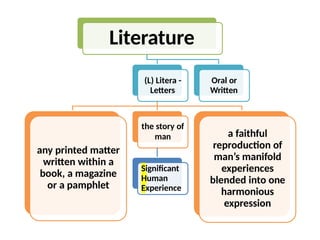
Literature
(L) Litera -
Letters
any printed matter
written within a
book, a magazine
or a pamphlet
the story of
man
Significant
Human
Experience
a faithful
reproduction of
man’s manifold
experiences
blended into one
harmonious
expression
Oral or
Written
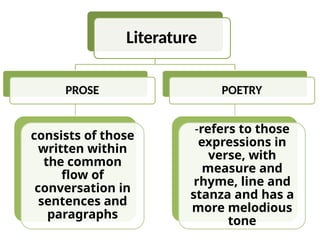
Literature
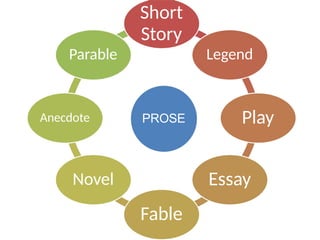
PROSE
consists of those
written within
the common
flow of
conversation in
sentences and
paragraphs
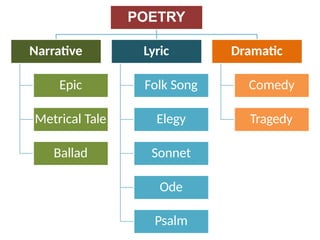
POETRY
-refers to those
expressions in
verse, with
measure and
rhyme, line and
stanza and has a
more melodious
tone
PROSE
Short
Story
Legend
Play
Essay
Fable
Novel
Anecdote
Parable
POETRY
Narrative
Epic
Metrical Tale
Ballad
Lyric
Folk Song
Elegy
Sonnet
Ode
Psalm
Dramatic
Comedy
Tragedy
POSTER TOUR
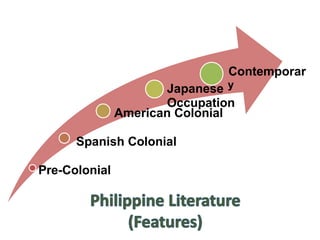
Contemporar
Japanese y
Occupation
American Colonial
Spanish Colonial
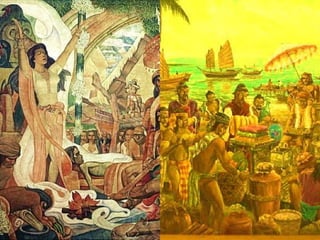
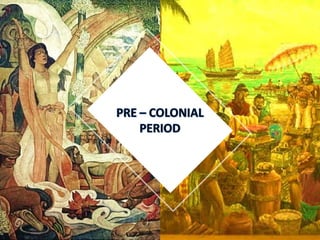
Pre-Colonial
I. Pre-Colonial Literature
Based on Traditions
and Customs
• Traditional and
Ritualistic
Handed down
ORALLY
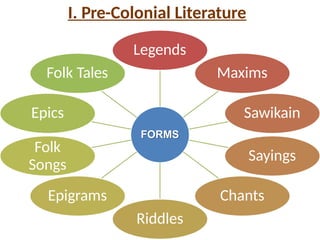
FORMS
Legends
Maxims
Sawikain
Sayings
Chants
Riddles
Epigrams
Folk
Songs
Epics
Folk Tales
I. Pre-Colonial Literature
A. LEGEND
• Legends are a form of prose
about the origin of a thing,
place, location or name.
The events are imaginary,
devoid of truth and
unbelievable.
• Example: THE LEGEND OF THE
MT. MAYON
I. Pre-Colonial Literature
B. FOLK TALES
• Folk tales are made up of
stories about life, adventure,
love, horror and humor where
one can derive lessons about
life.
• Example: THE MOON AND THE
SUN
I. Pre-Colonial Literature
C. EPICS
• Encompassing narratives that
recount the adventures of
tribal heroes
• Example: Biag ni Lam-ang
I. Pre-Colonial Literature
D. FOLK SONGS
• Folk songs are one of the oldest forms
of Philippine literature that emerged
in the pre-Spanish period. These
songs mirrored the early forms of
culture. Many of these have 12
syllables.
I. Pre-Colonial Literature
D. FOLK SONGS
• Examples:
 Ku n d im a n - traditional Filipino love s
o
n
g
Kumintang o Tagumpay – War song
 A n g Dalit o Imno - a religious song
 A n g Oyayi o Hele - lullaby or cradle s
o
n
g
 D i o n a - wedding song
Soliranin – boating or labor song
Talindaw - seafaring or boating song
I. Pre-Colonial Literature
E. EPIGRAMS (Salawikain)
• These served as laws or rules
on good behavior by our
ancestors. To others, these
are like allegories or parables
that impart lessons for the
young.
I. Pre-Colonial Literature
F. RIDDLES (Bugtong) or Palaisipan.
• A statement or question
that proposes a puzzle to
be solved.
I. Pre-Colonial Literature
G. CHANT (Bulong).
• Used in witchcraft or
enchantment.
I. Pre-Colonial Literature
H. MAXIMS.
• an expression of a
general truth or
principle
I. Pre-Colonial Literature
I. SAYINGS (Kasabihan).
• Often used in teasing or to
comment on a person’s
actuations.
I. Pre-Colonial Literature
J. SAWIKAIN
• Sayings with hidden
meanings
I. Pre-Colonial Literature
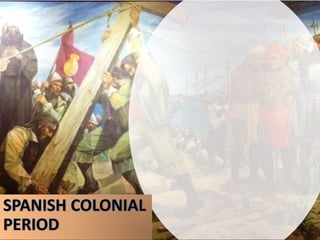
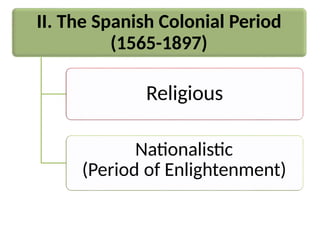
II. The Spanish Colonial Period
(1565-1897)
Religious
Nationalistic
(Period of Enlightenment)
II. The Spanish Colonial Period
(1565-1897)
Religious
DOCTRINA CHRISTIANA
O
R CHRISTIAN DOCTRINE
 - was the first book ever
printed in the Philippines in
1593 by the Dominican
press.
II. The Spanish Colonial Period
(1565-1897)
Religious
PASYON - This is the book
about the life and sufferings
of Jesus Christ. It is read
only during Lent.
CENACULO - This is a dramatic
performance to
commemorate the passion
and death of Jesus Christ
II. The Spanish Colonial Period
(1565-1897)
Religious
FOLK SONGS - These manifest
the artistic feelings of the
Filipinos and show their
innate appreciation for and
love of beauty.
II. The Spanish Colonial Period
(1565-1897)
Religious
DUNG-AW - This is a chant in
free verse by a bereaved
person or his representative
beside the corpse of the dead.
AWIT and CORRIDO - talked
about world of royals,
warriors, and lovers (the basic
concept in Florante at Laura).
II. The Spanish Colonial Period
(1565-1897)
Nationalistic
A. Propagandists
NOLI ME TANGERE and
 EL FILIBUSTERISMO
 – Dr. Jose Rizal
DASALAN AT TOCSOHAN
and
 KAIINGAT KAYO
 – Marcelo H. del Pilar
LA SOLIDARIDAD
II. The Spanish Colonial Period
(1565-1897)
Nationalistic
B. Revolutionists
ANG DAPAT MABATID NG MGA
TAGALOG and PAG-IBIG SA TINUBUAN
LUPA – Andres Bonifacio
KARTILYA NG KATIPUNAN
 – Emilio Jacinto
THE TRUE DECALOGUE
 – Apolinario Mabini
HIMNO NACIONAL FILIPINO
 – Jose Palma
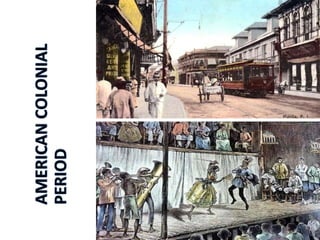
III. The American Colonial Period
(1898-1941)
* The Period of Apprenticeship
* The Period of Emergence
Americans influenced Filipino
writers to write using English
language.
Jose Garcia Villa became famous
for his free verse.
III. The American Colonial Period
(1898-1941)
Language used in Writing:
* Spanish – Nationalistic
*Tagalog – Lamentation
*English - Imitation
III. The American Colonial Period
(1898-1941)
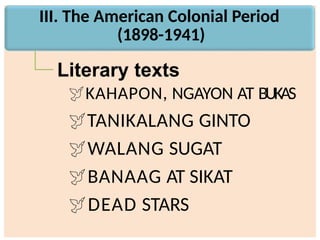
Literary texts
KAHAPON, NGAYON AT BUKAS
TANIKALANG GINTO
WALANG SUGAT
BANAAG AT SIKAT
DEAD STARS
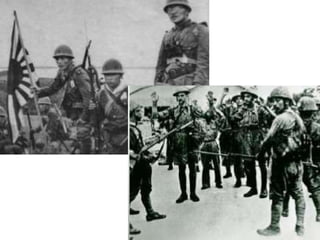
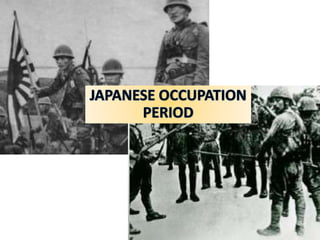
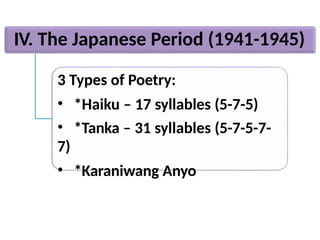
IV. The Japanese Period (1941-1945)
3 Types of Poetry:
• *Haiku – 17 syllables (5-7-5)
• *Tanka – 31 syllables (5-7-5-7-
7)
• *Karaniwang Anyo
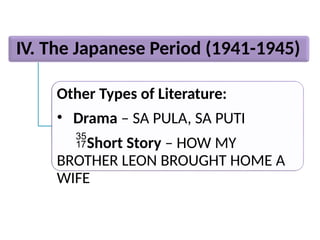
IV. The Japanese Period (1941-1945)
Other Types of Literature:
• Drama – SA PULA, SA PUTI
Short Story – HOW MY
BROTHER LEON BROUGHT HOME A
WIFE
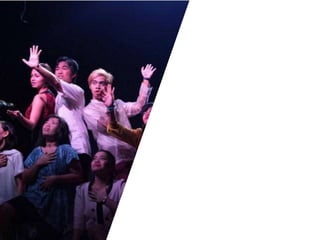
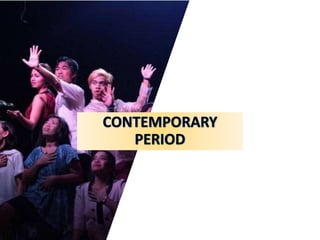
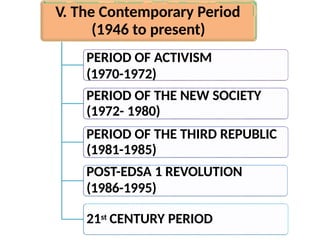
V. The Contemporary Period
(1946 to present)
PERIOD OF ACTIVISM
(1970-1972)
PERIOD OF THE NEW SOCIETY
(1972- 1980)
PERIOD OF THE THIRD REPUBLIC
(1981-1985)
POST-EDSA 1 REVOLUTION
(1986-1995)
21st CENTURY PERIOD
PERIOD OF ACTIVISM (1970-1972)
Youth activism in 1970-72 was due to domestic
and worldwide causes. Because of the ills of
society, the youth moved to seek reforms.
The Literary Revolution
The youth became vocal with their sentiments.
They demanded a change in the government. It
was manifested in bloody demonstrations ,
Placards and Street wall signs sidewalk
expressions but also in literature.
PERIOD OF THE NEW SOCIETY (1972- 1980)
- September 21, 1972
- The Carlos Palanca Awards continued to give
annual awards.
- Poems dealt with patience, regard for native
culture, customs, and the beauties of nature and
surroundings.
- News on economic progress, discipline, culture,
tourism, and the like were favored more than the
sensationalized reporting of killings, rape, and
robberies.
- Filipinos before were hooked in reading magazines
and comics.
PERIOD OF THE THIRD REPUBLIC (1981-1985)
 - After ten years of military rule and some changes
in the life of the Filipino, which started under the New
Society, Martial Rule was at last lifted on January 2,
1981.
- The Philippines became a new nation, and this;
former President Marcos called “The New Republic of
the Philippines.”
 - Poems during this period were romantic
and revolutionary.
 - Filipino songs dealt with themes that were true-to-
life like those of grief, poverty, aspirations for freedom,
love of God, of country and fellowmen.
POST-EDSA 1 REVOLUTION (1986-1995)
- History took another twist. Once more, the Filipino
people regained their independence, which they lost
twenty years ago. In four days from February 21-25,
1986, the so-called People Power (Lakas ng Bayan)
prevailed.
- New Filipino songs, newspapers, speeches, and
even in the television programs.
- The now crony newspapers that enjoyed an
overnight increase in circulation were THE INQUIRER,
MALAYA, and the PEOPLE’S JOURNAL.
21st CENTURY PERIOD
- The new trends have been used and
introduced to meet the need and tastes
of the new generation.
- 21st Century learners are demanded
to be ICT inclined to compete with the
style and format of writing as well.
- New codes or lingos are used to add
flavor in the literary pieces produced
nowadays.
Answer!!!
Explain and or describe the growth and
development of Philippine Literature in
English from the Pre-colonial Period to
the Contemporary Period.

featuresofphillit-21092103401535465.pptx

  • 2.
    ANG HINDI MARUNONG LUMINGONSA PINANGGALINGAN TIYAK HINDI MAKAKARATING SA PAROROONAN!
  • 3.
    Literature (L) Litera - Letters anyprinted matter written within a book, a magazine or a pamphlet the story of man Significant Human Experience a faithful reproduction of man’s manifold experiences blended into one harmonious expression Oral or Written
  • 4.
    Literature PROSE consists of those writtenwithin the common flow of conversation in sentences and paragraphs POETRY -refers to those expressions in verse, with measure and rhyme, line and stanza and has a more melodious tone
  • 5.
  • 6.
  • 7.
  • 18.
  • 19.
    I. Pre-Colonial Literature Basedon Traditions and Customs • Traditional and Ritualistic Handed down ORALLY
  • 20.
  • 21.
    A. LEGEND • Legendsare a form of prose about the origin of a thing, place, location or name. The events are imaginary, devoid of truth and unbelievable. • Example: THE LEGEND OF THE MT. MAYON I. Pre-Colonial Literature
  • 22.
    B. FOLK TALES •Folk tales are made up of stories about life, adventure, love, horror and humor where one can derive lessons about life. • Example: THE MOON AND THE SUN I. Pre-Colonial Literature
  • 23.
    C. EPICS • Encompassingnarratives that recount the adventures of tribal heroes • Example: Biag ni Lam-ang I. Pre-Colonial Literature
  • 24.
    D. FOLK SONGS •Folk songs are one of the oldest forms of Philippine literature that emerged in the pre-Spanish period. These songs mirrored the early forms of culture. Many of these have 12 syllables. I. Pre-Colonial Literature
  • 25.
    D. FOLK SONGS •Examples:  Ku n d im a n - traditional Filipino love s o n g Kumintang o Tagumpay – War song  A n g Dalit o Imno - a religious song  A n g Oyayi o Hele - lullaby or cradle s o n g  D i o n a - wedding song Soliranin – boating or labor song Talindaw - seafaring or boating song I. Pre-Colonial Literature
  • 26.
    E. EPIGRAMS (Salawikain) •These served as laws or rules on good behavior by our ancestors. To others, these are like allegories or parables that impart lessons for the young. I. Pre-Colonial Literature
  • 27.
    F. RIDDLES (Bugtong)or Palaisipan. • A statement or question that proposes a puzzle to be solved. I. Pre-Colonial Literature
  • 28.
    G. CHANT (Bulong). •Used in witchcraft or enchantment. I. Pre-Colonial Literature
  • 29.
    H. MAXIMS. • anexpression of a general truth or principle I. Pre-Colonial Literature
  • 30.
    I. SAYINGS (Kasabihan). •Often used in teasing or to comment on a person’s actuations. I. Pre-Colonial Literature
  • 31.
    J. SAWIKAIN • Sayingswith hidden meanings I. Pre-Colonial Literature
  • 32.
    II. The SpanishColonial Period (1565-1897) Religious Nationalistic (Period of Enlightenment)
  • 33.
    II. The SpanishColonial Period (1565-1897) Religious DOCTRINA CHRISTIANA O R CHRISTIAN DOCTRINE  - was the first book ever printed in the Philippines in 1593 by the Dominican press.
  • 34.
    II. The SpanishColonial Period (1565-1897) Religious PASYON - This is the book about the life and sufferings of Jesus Christ. It is read only during Lent. CENACULO - This is a dramatic performance to commemorate the passion and death of Jesus Christ
  • 35.
    II. The SpanishColonial Period (1565-1897) Religious FOLK SONGS - These manifest the artistic feelings of the Filipinos and show their innate appreciation for and love of beauty.
  • 36.
    II. The SpanishColonial Period (1565-1897) Religious DUNG-AW - This is a chant in free verse by a bereaved person or his representative beside the corpse of the dead. AWIT and CORRIDO - talked about world of royals, warriors, and lovers (the basic concept in Florante at Laura).
  • 37.
    II. The SpanishColonial Period (1565-1897) Nationalistic A. Propagandists NOLI ME TANGERE and  EL FILIBUSTERISMO  – Dr. Jose Rizal DASALAN AT TOCSOHAN and  KAIINGAT KAYO  – Marcelo H. del Pilar LA SOLIDARIDAD
  • 38.
    II. The SpanishColonial Period (1565-1897) Nationalistic B. Revolutionists ANG DAPAT MABATID NG MGA TAGALOG and PAG-IBIG SA TINUBUAN LUPA – Andres Bonifacio KARTILYA NG KATIPUNAN  – Emilio Jacinto THE TRUE DECALOGUE  – Apolinario Mabini HIMNO NACIONAL FILIPINO  – Jose Palma
  • 39.
    III. The AmericanColonial Period (1898-1941) * The Period of Apprenticeship * The Period of Emergence Americans influenced Filipino writers to write using English language. Jose Garcia Villa became famous for his free verse.
  • 40.
    III. The AmericanColonial Period (1898-1941) Language used in Writing: * Spanish – Nationalistic *Tagalog – Lamentation *English - Imitation
  • 41.
    III. The AmericanColonial Period (1898-1941) Literary texts KAHAPON, NGAYON AT BUKAS TANIKALANG GINTO WALANG SUGAT BANAAG AT SIKAT DEAD STARS
  • 42.
    IV. The JapanesePeriod (1941-1945) 3 Types of Poetry: • *Haiku – 17 syllables (5-7-5) • *Tanka – 31 syllables (5-7-5-7- 7) • *Karaniwang Anyo
  • 43.
    IV. The JapanesePeriod (1941-1945) Other Types of Literature: • Drama – SA PULA, SA PUTI Short Story – HOW MY BROTHER LEON BROUGHT HOME A WIFE
  • 44.
    V. The ContemporaryPeriod (1946 to present) PERIOD OF ACTIVISM (1970-1972) PERIOD OF THE NEW SOCIETY (1972- 1980) PERIOD OF THE THIRD REPUBLIC (1981-1985) POST-EDSA 1 REVOLUTION (1986-1995) 21st CENTURY PERIOD
  • 45.
    PERIOD OF ACTIVISM(1970-1972) Youth activism in 1970-72 was due to domestic and worldwide causes. Because of the ills of society, the youth moved to seek reforms. The Literary Revolution The youth became vocal with their sentiments. They demanded a change in the government. It was manifested in bloody demonstrations , Placards and Street wall signs sidewalk expressions but also in literature.
  • 46.
    PERIOD OF THENEW SOCIETY (1972- 1980) - September 21, 1972 - The Carlos Palanca Awards continued to give annual awards. - Poems dealt with patience, regard for native culture, customs, and the beauties of nature and surroundings. - News on economic progress, discipline, culture, tourism, and the like were favored more than the sensationalized reporting of killings, rape, and robberies. - Filipinos before were hooked in reading magazines and comics.
  • 47.
    PERIOD OF THETHIRD REPUBLIC (1981-1985)  - After ten years of military rule and some changes in the life of the Filipino, which started under the New Society, Martial Rule was at last lifted on January 2, 1981. - The Philippines became a new nation, and this; former President Marcos called “The New Republic of the Philippines.”  - Poems during this period were romantic and revolutionary.  - Filipino songs dealt with themes that were true-to- life like those of grief, poverty, aspirations for freedom, love of God, of country and fellowmen.
  • 48.
    POST-EDSA 1 REVOLUTION(1986-1995) - History took another twist. Once more, the Filipino people regained their independence, which they lost twenty years ago. In four days from February 21-25, 1986, the so-called People Power (Lakas ng Bayan) prevailed. - New Filipino songs, newspapers, speeches, and even in the television programs. - The now crony newspapers that enjoyed an overnight increase in circulation were THE INQUIRER, MALAYA, and the PEOPLE’S JOURNAL.
  • 49.
    21st CENTURY PERIOD -The new trends have been used and introduced to meet the need and tastes of the new generation. - 21st Century learners are demanded to be ICT inclined to compete with the style and format of writing as well. - New codes or lingos are used to add flavor in the literary pieces produced nowadays.
  • 50.
    Answer!!! Explain and ordescribe the growth and development of Philippine Literature in English from the Pre-colonial Period to the Contemporary Period.