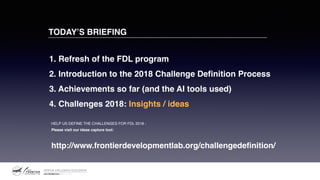
TODAY’S BRIEFING
1. Refresh of the FDL program
2. Introduction to the 2018 Challenge Definition Process
3. Achievements so far (and the AI tools used)
4. Challenges 2018: Insights / ideas
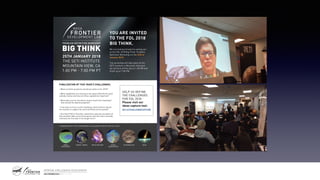
HELP US DEFINE THE CHALLENGES FOR FDL 2018 -
Please visit our ideas capture tool:
http://www.frontierdevelopmentlab.org/challengedefinition/
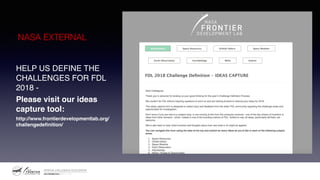
HELP US DEFINE THE
CHALLENGES FOR FDL
2018 -
Please visit our ideas
capture tool:
http://www.frontierdevelopmentlab.org/
challengedefinition/
NASA EXTERNAL
+ What makes a good FDL Challenge?

+ How has FDL applied AI so far? How could it be applied
going forward?

+ What are unresolved problems within the challenge areas?

+ Who should we be talking to?
DISCUSSION
FDL is an applied artificial intelligence program
that works with commercial and international
partners to utilize NASA’s data resources to
surface new knowledge and new capabilities…
…supporting humans to return to the Moon for
the long-term and assisting further exploration
missions across the solar system.
AI
APPLIED
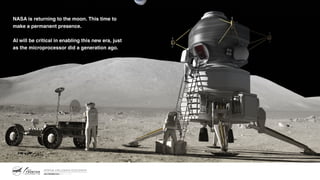
NASA is returning to the moon. This time to
make a permanent presence.
AI will be critical in enabling this new era, just
as the microprocessor did a generation ago.
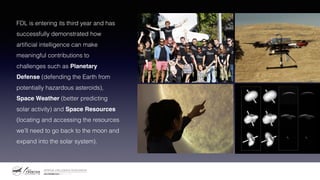
FDL is entering its third year and has
successfully demonstrated how
artificial intelligence can make
meaningful contributions to
challenges such as Planetary
Defense (defending the Earth from
potentially hazardous asteroids),
Space Weather (better predicting
solar activity) and Space Resources
(locating and accessing the resources
we’ll need to go back to the moon and
expand into the solar system).
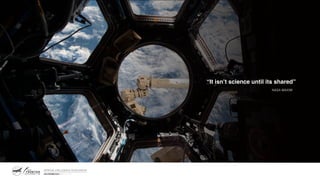
“It isn’t science until its shared”
NASA MAXIM
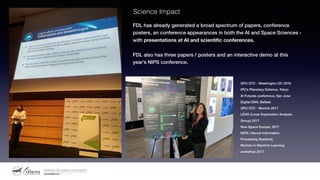
Science Impact
FDL has already generated a broad spectrum of papers, conference
posters, an conference appearances in both the AI and Space Sciences -
with presentations at AI and scientific conferences.
FDL also has three papers / posters and an interactive demo at this
year’s NIPS conference.
GPU GTC - Washington DC 2016
IPC’s Planetary Defence, Tokyo
AI Futures conference, San Jose
Digital DNA, Belfast
GPU GTC - Munich 2017
LEAG (Lunar Exploration Analysis
Group) 2017
New Space Europe, 2017
NIPS ( Neural Information
Processing Systems)
Women in Machine Learning
workshop 2017
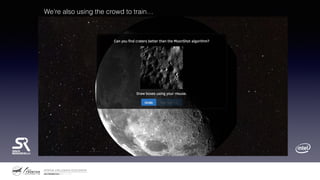
We’re also using the crowd to train…
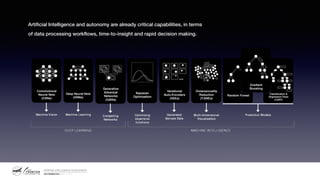
Artificial Intelligence and autonomy are already critical capabilities, in terms
of data processing workflows, time-to-insight and rapid decision making.
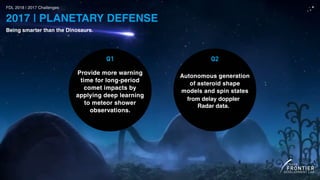
from delay doppler
Radar data.
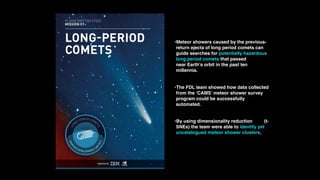
•Meteor showers caused by the previous-
return ejecta of long period comets can
guide searches for potentially hazardous
long period comets that passed
near Earth’s orbit in the past ten
millennia.
•The FDL team showed how data collected
from the ‘CAMS’ meteor shower survey
program could be successfully
automated.
•By using dimensionality reduction (t-
SNEs) the team were able to identify yet
uncatalogued meteor shower clusters. 
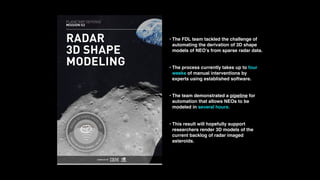
• The FDL team tackled the challenge of
automating the derivation of 3D shape
models of NEO’s from sparse radar data.
• The process currently takes up to four
weeks of manual interventions by
experts using established software.
• The team demonstrated a pipeline for
automation that allows NEOs to be
modeled in several hours.
• This result will hopefully support
researchers render 3D models of the
current backlog of radar imaged
asteroids.
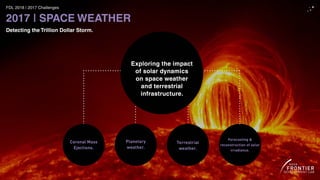
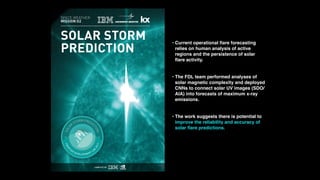
• Current operational flare forecasting
relies on human analysis of active
regions and the persistence of solar
flare activity.
• The FDL team performed analyses of
solar magnetic complexity and deployed
CNNs to connect solar UV images (SDO/
AIA) into forecasts of maximum x-ray
emissions.
• The work suggests there is potential to
improve the reliability and accuracy of
solar flare predictions.
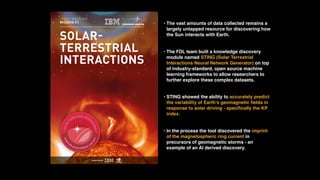
• The vast amounts of data collected remains a
largely untapped resource for discovering how
the Sun interacts with Earth.
• The FDL team built a knowledge discovery
module named STING (Solar Terrestrial
Interactions Neural Network Generator) on top
of industry-standard, open source machine
learning frameworks to allow researchers to
further explore these complex datasets.
• STING showed the ability to accurately predict
the variability of Earth’s geomagnetic fields in
response to solar driving - specifically the KP
index.
• In the process the tool discovered the imprint
of the magnetospheric ring current in
precursors of geomagnetic storms - an
example of an AI derived discovery.
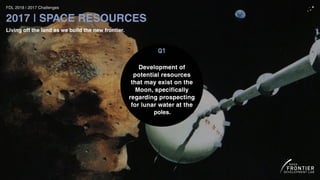
poles.
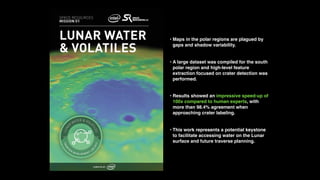
• Maps in the polar regions are plagued by
gaps and shadow variability.
• A large dataset was compiled for the south
polar region and high-level feature
extraction focused on crater detection was
performed.
• Results showed an impressive speed-up of
100x compared to human experts, with
more than 98.4% agreement when
approaching crater labeling.
• This work represents a potential keystone
to facilitate accessing water on the Lunar
surface and future traverse planning.
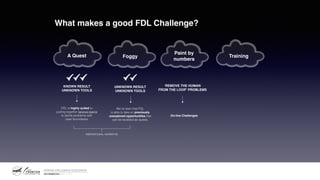
Foggy
UNKNOWN RESULT
UNKNOWN TOOLS
We’ve seen that FDL
is able to take on previously
unexplored opportunities that
can be revisited as quests.
A Quest
KNOWN RESULT
UNKNOWN TOOLS
FDL is highly suited to
pulling together tailored teams
to tackle problems with
clear boundaries.
Paint by
numbers
‘REMOVE THE HUMAN
FROM THE LOOP’ PROBLEMS
On-line Challenges
INSPIRATIONAL NARRATIVE
Training
What makes a good FDL Challenge?
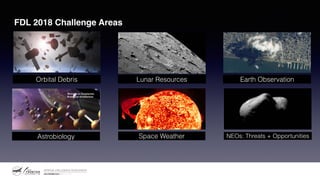
Lunar Resources
Astrobiology Space Weather NEOs: Threats + Opportunities
Orbital Debris Earth Observation
• Biohints on Exoplanets
• Biological Architecture
FDL 2018 Challenge Areas
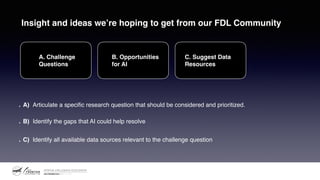
Insight and ideas we’re hoping to get from our FDL Community
. A)  Articulate a specific research question that should be considered and prioritized. 

. B)  Identify the gaps that AI could help resolve
. C)  Identify all available data sources relevant to the challenge question
A. Challenge
Questions
B. Opportunities
for AI
C. Suggest Data
Resources
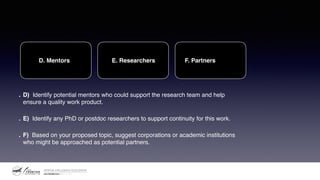
. D)  Identify potential mentors who could support the research team and help
ensure a quality work product. 

. E)  Identify any PhD or postdoc researchers to support continuity for this work.

. F)  Based on your proposed topic, suggest corporations or academic institutions
who might be approached as potential partners.
D. Mentors E. Researchers F. Partners
Orbital Debris / STM
A. Challenge
Questions
B. Opportunities
for AI
C. Suggest Data
Resources
D. Mentors E. Researchers F. Partners
A. Challenge
Questions
B. Opportunities
for AI
C. Suggest Data
Resources
D. Mentors E. Researchers F. Partners
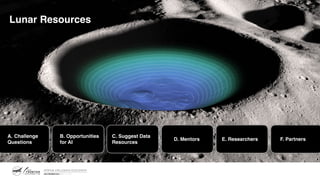
Lunar Resources
A. Challenge
Questions
B. Opportunities
for AI
C. Suggest Data
Resources
D. Mentors E. Researchers F. Partners
Earth Observation
A. Challenge
Questions
B. Opportunities
for AI
C. Suggest Data
Resources
D. Mentors E. Researchers F. Partners
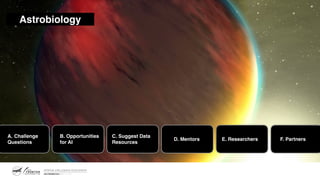
Astrobiology
A. Challenge
Questions
B. Opportunities
for AI
C. Suggest Data
Resources
D. Mentors E. Researchers F. Partners
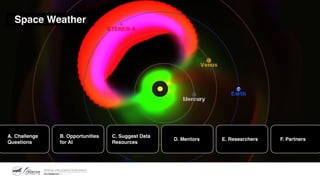
Space Weather
A. Challenge
Questions
B. Opportunities
for AI
C. Suggest Data
Resources
D. Mentors E. Researchers F. Partners
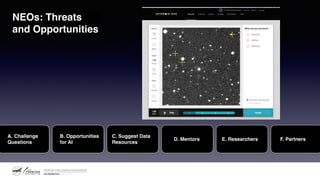
NEOs: Threats
and Opportunities
Thank you
Needless to say, we couldn’t do this without you and as such we’d like to extend an invitation to join
the ongoing development as co-creators and ‘thought-partners’ as we continue to build and grow.
Many thanks from the NASA FDL team.
Ad astra.
http://www.frontierdevelopmentlab.org/challengedefinition/
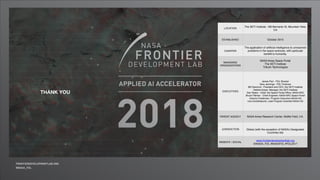
LOCATION
The SETI Institute, 189 Bernardo St, Mountain View,
CA
ESTABLISHED October 2015
CHARTER
The application of artificial intelligence to unresolved
problems in the space sciences, with particular
benefit to humanity.
MANAGING
ORGANIZATIONS
NASA Ames Space Portal
The SETI Institute
Trilluim Technologies
EXECUTIVES
James Parr - FDL Director
Sara Jennings - FDL Producer
Bill Diamond - President and CEO, the SETI Institute
Debbie Kolyer, Manager, the SETI Institute
Dan Rasky - Chief, the Space Portal Office, NASA ARC
Bruce Pittman - Chief Engineer, NASA ARC Space Portal
Victoria Friedensen, Program Executive NASA HQ
Lika Guhathakurta, Lead Program Scientist NASA HQ
PARENT AGENCY NASA Ames Research Center, Moffet Field, CA.
JURISDICTION Global (with the exception of NASA’s Designated
Countries list)
WEBSITE / SOCIAL
www.frontierdevelopmentlab.org
@NASA_FDL #NASAFDL #FDL2017
THANK YOU

FDL 2018 Virtual Briefing 1

  • 3.
    TODAY’S BRIEFING 1. Refreshof the FDL program 2. Introduction to the 2018 Challenge Definition Process 3. Achievements so far (and the AI tools used) 4. Challenges 2018: Insights / ideas HELP US DEFINE THE CHALLENGES FOR FDL 2018 - Please visit our ideas capture tool: http://www.frontierdevelopmentlab.org/challengedefinition/
  • 4.
    HELP US DEFINETHE CHALLENGES FOR FDL 2018 - Please visit our ideas capture tool: http://www.frontierdevelopmentlab.org/ challengedefinition/ NASA EXTERNAL
  • 5.
    + What makesa good FDL Challenge?
 + How has FDL applied AI so far? How could it be applied going forward?
 + What are unresolved problems within the challenge areas?
 + Who should we be talking to? DISCUSSION
  • 6.
    FDL is anapplied artificial intelligence program that works with commercial and international partners to utilize NASA’s data resources to surface new knowledge and new capabilities… …supporting humans to return to the Moon for the long-term and assisting further exploration missions across the solar system. AI APPLIED
  • 7.
    NASA is returningto the moon. This time to make a permanent presence. AI will be critical in enabling this new era, just as the microprocessor did a generation ago.
  • 8.
    FDL is enteringits third year and has successfully demonstrated how artificial intelligence can make meaningful contributions to challenges such as Planetary Defense (defending the Earth from potentially hazardous asteroids), Space Weather (better predicting solar activity) and Space Resources (locating and accessing the resources we’ll need to go back to the moon and expand into the solar system).
  • 9.
    “It isn’t scienceuntil its shared” NASA MAXIM
  • 10.
    Science Impact FDL hasalready generated a broad spectrum of papers, conference posters, an conference appearances in both the AI and Space Sciences - with presentations at AI and scientific conferences. FDL also has three papers / posters and an interactive demo at this year’s NIPS conference. GPU GTC - Washington DC 2016 IPC’s Planetary Defence, Tokyo AI Futures conference, San Jose Digital DNA, Belfast GPU GTC - Munich 2017 LEAG (Lunar Exploration Analysis Group) 2017 New Space Europe, 2017 NIPS ( Neural Information Processing Systems) Women in Machine Learning workshop 2017
  • 11.
    We’re also usingthe crowd to train…
  • 12.
    Artificial Intelligence andautonomy are already critical capabilities, in terms of data processing workflows, time-to-insight and rapid decision making.
  • 17.
  • 18.
    •Meteor showers caused by theprevious- return ejecta of long period comets can guide searches for potentially hazardous long period comets that passed near Earth’s orbit in the past ten millennia. •The FDL team showed how data collected from the ‘CAMS’ meteor shower survey program could be successfully automated. •By using dimensionality reduction (t- SNEs) the team were able to identify yet uncatalogued meteor shower clusters. 
  • 19.
    • The FDLteam tackled the challenge of automating the derivation of 3D shape models of NEO’s from sparse radar data. • The process currently takes up to four weeks of manual interventions by experts using established software. • The team demonstrated a pipeline for automation that allows NEOs to be modeled in several hours. • This result will hopefully support researchers render 3D models of the current backlog of radar imaged asteroids.
  • 21.
    • Current operationalflare forecasting relies on human analysis of active regions and the persistence of solar flare activity. • The FDL team performed analyses of solar magnetic complexity and deployed CNNs to connect solar UV images (SDO/ AIA) into forecasts of maximum x-ray emissions. • The work suggests there is potential to improve the reliability and accuracy of solar flare predictions.
  • 22.
    • The vastamounts of data collected remains a largely untapped resource for discovering how the Sun interacts with Earth. • The FDL team built a knowledge discovery module named STING (Solar Terrestrial Interactions Neural Network Generator) on top of industry-standard, open source machine learning frameworks to allow researchers to further explore these complex datasets. • STING showed the ability to accurately predict the variability of Earth’s geomagnetic fields in response to solar driving - specifically the KP index. • In the process the tool discovered the imprint of the magnetospheric ring current in precursors of geomagnetic storms - an example of an AI derived discovery.
  • 23.
  • 24.
    • Maps inthe polar regions are plagued by gaps and shadow variability. • A large dataset was compiled for the south polar region and high-level feature extraction focused on crater detection was performed. • Results showed an impressive speed-up of 100x compared to human experts, with more than 98.4% agreement when approaching crater labeling. • This work represents a potential keystone to facilitate accessing water on the Lunar surface and future traverse planning.
  • 28.
    Foggy UNKNOWN RESULT UNKNOWN TOOLS We’veseen that FDL is able to take on previously unexplored opportunities that can be revisited as quests. A Quest KNOWN RESULT UNKNOWN TOOLS FDL is highly suited to pulling together tailored teams to tackle problems with clear boundaries. Paint by numbers ‘REMOVE THE HUMAN FROM THE LOOP’ PROBLEMS On-line Challenges INSPIRATIONAL NARRATIVE Training What makes a good FDL Challenge?
  • 29.
    Lunar Resources Astrobiology SpaceWeather NEOs: Threats + Opportunities Orbital Debris Earth Observation • Biohints on Exoplanets • Biological Architecture FDL 2018 Challenge Areas
  • 30.
    Insight and ideaswe’re hoping to get from our FDL Community . A)  Articulate a specific research question that should be considered and prioritized. 
 . B)  Identify the gaps that AI could help resolve . C)  Identify all available data sources relevant to the challenge question A. Challenge Questions B. Opportunities for AI C. Suggest Data Resources
  • 31.
    . D)  Identifypotential mentors who could support the research team and help ensure a quality work product. 
 . E)  Identify any PhD or postdoc researchers to support continuity for this work.
 . F)  Based on your proposed topic, suggest corporations or academic institutions who might be approached as potential partners. D. Mentors E. Researchers F. Partners
  • 32.
    Orbital Debris /STM A. Challenge Questions B. Opportunities for AI C. Suggest Data Resources D. Mentors E. Researchers F. Partners
  • 33.
    A. Challenge Questions B. Opportunities forAI C. Suggest Data Resources D. Mentors E. Researchers F. Partners Lunar Resources
  • 34.
    A. Challenge Questions B. Opportunities forAI C. Suggest Data Resources D. Mentors E. Researchers F. Partners Earth Observation
  • 35.
    A. Challenge Questions B. Opportunities forAI C. Suggest Data Resources D. Mentors E. Researchers F. Partners Astrobiology
  • 36.
    A. Challenge Questions B. Opportunities forAI C. Suggest Data Resources D. Mentors E. Researchers F. Partners Space Weather
  • 37.
    A. Challenge Questions B. Opportunities forAI C. Suggest Data Resources D. Mentors E. Researchers F. Partners NEOs: Threats and Opportunities
  • 42.
    Thank you Needless tosay, we couldn’t do this without you and as such we’d like to extend an invitation to join the ongoing development as co-creators and ‘thought-partners’ as we continue to build and grow. Many thanks from the NASA FDL team. Ad astra. http://www.frontierdevelopmentlab.org/challengedefinition/
  • 43.
    LOCATION The SETI Institute,189 Bernardo St, Mountain View, CA ESTABLISHED October 2015 CHARTER The application of artificial intelligence to unresolved problems in the space sciences, with particular benefit to humanity. MANAGING ORGANIZATIONS NASA Ames Space Portal The SETI Institute Trilluim Technologies EXECUTIVES James Parr - FDL Director Sara Jennings - FDL Producer Bill Diamond - President and CEO, the SETI Institute Debbie Kolyer, Manager, the SETI Institute Dan Rasky - Chief, the Space Portal Office, NASA ARC Bruce Pittman - Chief Engineer, NASA ARC Space Portal Victoria Friedensen, Program Executive NASA HQ Lika Guhathakurta, Lead Program Scientist NASA HQ PARENT AGENCY NASA Ames Research Center, Moffet Field, CA. JURISDICTION Global (with the exception of NASA’s Designated Countries list) WEBSITE / SOCIAL www.frontierdevelopmentlab.org @NASA_FDL #NASAFDL #FDL2017 THANK YOU