2017/2018
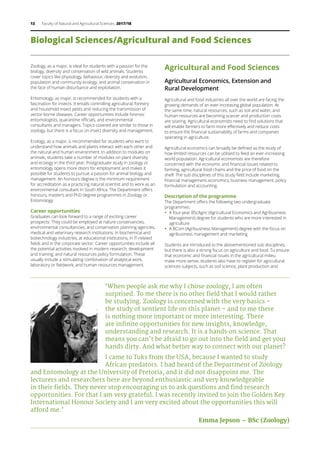
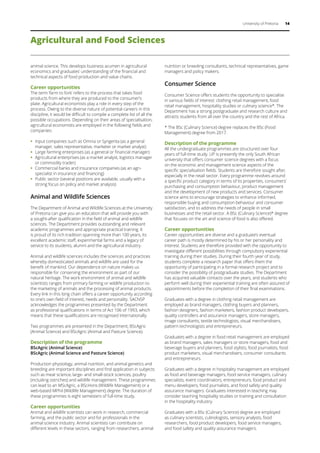
Undergraduate
faculty brochure
www.up.ac.za
Make today matter
ii Faculty of Natural and Agricultural Sciences 2017/18
Message from the Dean
Prof Jean Lubuma
Dean: Faculty of Natural and Agricultural Sciences
Have you ever wondered
who is responsible for the
quality of the chocolate,
canned beverages or pancake
mixture you buy in the
supermarket? What is the
science behind a cricket
ball or a cricket pitch? What
is nanotechnology? How
do specialists treat cancer
with nuclear technology,
or tuberculosis with
phytomedicine? Why are
actuaries the highest-paid
people in the world?
The Faculty of Natural and Agricultural
Sciences is one of the most diverse
science faculties in South Africa. It
hosts various disciplines within the
broader fields of agricultural, biological,
mathematical and physical sciences. The
Faculty offers degree programmes that
are not only at the forefront of the various
disciplines, but also equip graduates
to be leaders and problem solvers in
their chosen professions. The key to the
Faculty’s success is the high premium
it places on quality education, research
and innovation. This is embodied in
the Faculty’s approach to training and
research.
The University of Pretoria aims to be
internationally competitive and locally
relevant at the same time. Local relevance
is assured through close cooperation with
industry. The University has deployed
a number of innovations in this regard.
Its strategic alliance with the Council for
Scientific and Industrial Research (CSIR)
creates unequalled training and research
opportunities for students and staff, while
the Innovation Hub – located in close
proximity to the University’s Experimental
Farm – hosts the research and
development laboratories of some of the
world’s foremost high-technology firms.
The Faculty is currently associated
with nine research chairs under the
South African Research Chairs Initiative
(SARChI), and has the largest number of
researchers in any department at the
University to be recognised for excellence
by their peers through the National
Research Foundation (NRF), including
seven A-rated scientists. National and
international accreditation is the norm
for the Faculty’s academic programmes,
as well as its research laboratories. It is
serious about ensuring that the market
value of the degrees it awards will always
give its students a competitive advantage.
It adds value to its degrees, and has a
good reputation in the market, which
makes its students highly sought after.
The degree programmes of the Faculty
of Natural and Agricultural Sciences are
accessible to everybody who meets the
Faculty’s academic standards. Deserving
students are assisted with bursaries
and loans through various financial aid
schemes administered by the University.
The Faculty is involved in several outreach
programmes, such as the well-known
UP with Science programme and the
BSc – Extended programmes. Learners
with a love for the unknown, a curious
mind and a will to work hard are
welcome to apply.
Tel	 +27 (0)12 420 3201
Email	dean.nas@up.ac.za
University of Pretoria iii
Content
Message from the Dean........................................................................................................................................................................................................................ii
Introduction..............................................................................................................................................................................................................................................1
Undergraduate programmes..............................................................................................................................................................................................................2
BSc – Extended programmes..............................................................................................................................................................................................................9
Biological Sciences..................................................................................................................................................................................................................................9
	 Anatomy (Medical Sciences)........................................................................................................................................................................................................9
	Biochemistry.....................................................................................................................................................................................................................................9
	Genetics ..........................................................................................................................................................................................................................................11
	Biotechnology................................................................................................................................................................................................................................11
	 Human Physiology........................................................................................................................................................................................................................11
	Microbiology...................................................................................................................................................................................................................................12
	 Plant and Soil Sciences (Ecology and Plant Science)...........................................................................................................................................................12
	 Zoology and Entomology............................................................................................................................................................................................................12
Agricultural and Food Sciences.........................................................................................................................................................................................................13
	 Agricultural Economics, Extension and Rural Development............................................................................................................................................13
	 Animal and Wildlife Sciences.....................................................................................................................................................................................................14
	 Consumer Science........................................................................................................................................................................................................................14
	 Food Science..................................................................................................................................................................................................................................15
	 Plant and Soil Sciences (Plant Pathology and Applied Plant and Soil Sciences)..........................................................................................................15
Physical Sciences..................................................................................................................................................................................................................................17
	Chemistry........................................................................................................................................................................................................................................17
	Geology............................................................................................................................................................................................................................................18
	 Geography, Geoinformatics and Meteorology.....................................................................................................................................................................19
	Physics..............................................................................................................................................................................................................................................20
Mathematical Sciences........................................................................................................................................................................................................................21
	 Actuarial Science...........................................................................................................................................................................................................................21
	 Mathematics and Applied Mathematics.................................................................................................................................................................................21
	Statistics...........................................................................................................................................................................................................................................22
Community engagement initiatives.................................................................................................................................................................................................23
	Sci-Enza............................................................................................................................................................................................................................................23
General information.............................................................................................................................................................................................................................23
Cover photograph courtesy of Chris Oosthuizen.
Produced by the Department of Enrolment and Student Administration in December 2016.
Comments and queries can be directed to ssc@up.ac.za or tel: +27 (0)12 420 3111.
Disclaimer: This publication contains information about regulations, policies, tuition fees, curricula and programmes of the University of Pretoria applicable at
the time of printing. Amendments to or updating of the information in this publication may be effected from time to time without prior notification. The accuracy,
correctness or validity of the information contained in this publication is therefore not guaranteed by the University at any given time and is always subject to
verification. The user is kindly requested to verify the correctness of the published information with the University at all times. Failure to do so will not give rise to
any claim or action of any nature against the University by any party whatsoever.
1 Faculty of Natural and Agricultural Sciences 2017/18
Introduction
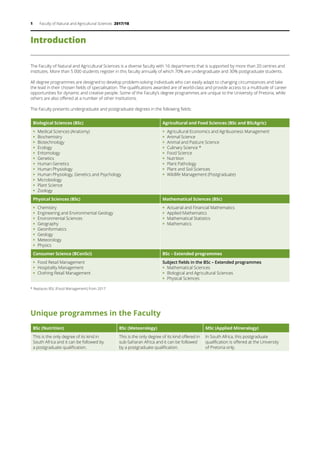
The Faculty of Natural and Agricultural Sciences is a diverse faculty with 16 departments that is supported by more than 20 centres and
institutes. More than 5 000 students register in this faculty annually of which 70% are undergraduate and 30% postgraduate students.
All degree programmes are designed to develop problem-solving individuals who can easily adapt to changing circumstances and take
the lead in their chosen fields of specialisation. The qualifications awarded are of world-class and provide access to a multitude of career
opportunities for dynamic and creative people. Some of the Faculty’s degree programmes are unique to the University of Pretoria, while
others are also offered at a number of other institutions.
The Faculty presents undergraduate and postgraduate degrees in the following fields:
Biological Sciences (BSc) Agricultural and Food Sciences (BSc and BScAgric)
ƒƒ Medical Sciences (Anatomy)
ƒƒ Biochemistry
ƒƒ Biotechnology
ƒƒ Ecology
ƒƒ Entomology
ƒƒ Genetics
ƒƒ Human Genetics
ƒƒ Human Physiology
ƒƒ Human Physiology, Genetics and Psychology
ƒƒ Microbiology
ƒƒ Plant Science
ƒƒ Zoology
ƒƒ Agricultural Economics and Agribusiness Management
ƒƒ Animal Science
ƒƒ Animal and Pasture Science
ƒƒ Culinary Science *
ƒƒ Food Science
ƒƒ Nutrition
ƒƒ Plant Pathology
ƒƒ Plant and Soil Sciences
ƒƒ Wildlife Management (Postgraduate)
Physical Sciences (BSc) Mathematical Sciences (BSc)
ƒƒ Chemistry
ƒƒ Engineering and Environmental Geology
ƒƒ Environmental Sciences
ƒƒ Geography
ƒƒ Geoinformatics
ƒƒ Geology
ƒƒ Meteorology
ƒƒ Physics
ƒƒ Actuarial and Financial Mathematics
ƒƒ Applied Mathematics
ƒƒ Mathematical Statistics
ƒƒ Mathematics
Consumer Science (BConSci) BSc – Extended programmes
ƒƒ Food Retail Management
ƒƒ Hospitality Management
ƒƒ Clothing Retail Management
Subject fields in the BSc – Extended programmes
ƒƒ Mathematical Sciences
ƒƒ Biological and Agricultural Sciences
ƒƒ Physical Sciences
* Replaces BSc (Food Management) from 2017
Unique programmes in the Faculty
BSc (Nutrition) BSc (Meteorology) MSc (Applied Mineralogy)
This is the only degree of its kind in
South Africa and it can be followed by
a postgraduate qualification.
This is the only degree of its kind offered in
sub-Saharan Africa and it can be followed
by a postgraduate qualification.
In South Africa, this postgraduate
qualification is offered at the University
of Pretoria only.
University of Pretoria 2
Undergraduate programmes
Important information on undergraduate programmes for 2018
ƒƒ The following persons will be considered for admission: a candidate who is in possession of a certificate that is deemed by the
University to be equivalent to the required Grade 12 certificate with university endorsement, a candidate who is a graduate from
another tertiary institution or has been granted the status of a graduate of such an institution, and a candidate who is a graduate of
another faculty at the University of Pretoria.
ƒƒ Life Orientation is excluded in the calculation of the Admission Point Score (APS).
ƒƒ Grade 11 results are used for the provisional admission of prospective students. Final admission is based on the Grade 12 results.
University of Pretoria website	 www.up.ac.za/nas
National Benchmark Test website 	 www.nbt.ac.za
Programmes
Minimum requirements for 2018
Achievement level
APS
BIOLOGICAL SCIENCES
Afrikaans or English Mathematics Physical Science
NSC/
IEB
HIGCSE
AS
Level
A
Level
NSC/
IEB
HIGCSE
AS
Level
A
Level
NSC/
IEB
HIGCSE
AS
Level
A
Level
BSc (Biochemistry)
[3 years]
Closing dates:
SA – 30 September
Non-SA – 31 August
5 3 C C 5 3 C C 5 3 C C 30
Careers: Biochemistry offers many opportunities for exciting and challenging careers in the food and pharmaceutical, fine chemicals and waste processing industries.
Careers at research councils, such as the Medical Research Council (MRC), the Agricultural Research Council (ARC), the Cancer Association of South Africa (CANSA)
and the Water Research Commission (WRC) are possibilities, as are academic institutions, the Council for Scientific and Industrial Research (CSIR), and forensic
and pathology laboratories. Career opportunities include those of researcher, teacher, lecturer and medical representative. Graduates are comfortable in work
environments such as universities, research institutes, pharmaceutical companies, biotechnology companies and related industries.
BSc (Biological Sciences)
Closing dates:
SA – 30 September
Non-SA – 31 August
5 3 C C 5 3 C C 5 3 C C 30
This is a generic first-year programme in Biological Sciences. Students who are not sure which specialisation degree programme to choose may apply for this
programme. Students who intend to apply for admission to MBChB or BChD in the second semester when places become available in those programmes may register
for BSc (Biological Sciences) modules in the first semester, replacing Mathematics (WTW 134) with Science and World Views (FIL 155), People and their Environment
(MGW 112) and Medical Terminology (MTL 180), with the provision that these students, should they not be selected and should they wish to continue with one of the
Biological Sciences programmes, must complete Mathematics (WTW 134) in the second semester of their first year.
Please note: The minimum admission requirement for MGW 112 is an APS score of 34 and a minimum of 70% for Grade 12 Mathematics.
BSc (Biotechnology)
[3 years]
Closing dates:
SA – 30 September
Non-SA – 31 August
5 3 C C 5 3 C C 5 3 C C 30
Careers: Graduates find work mostly as laboratory-based researchers or bio-entrepreneurs using medical, animal, plant or microbe-based technologies to develop
products and services. If students combine biotechnology with additional qualifications such as law, they will be equipped for success in careers such as patent law,
pharmaceutical sales and marketing, project management, computer programming (natural computation) and science journalism. Please note that the level of training
and qualification plays an important role in determining what type of work a qualified biotechnologist can become involved in.
BSc (Ecology)
[3 years]
Closing dates:
SA – 30 September
Non-SA – 31 August
5 3 C C 5 3 C C 5 3 C C 30
Careers: Graduates find work in environmentally based statutory and private conservation organisations, organisations involved in the direct or indirect use of natural
resources, and academic and training institutions.
BSc (Zoology)
[3 years]
Closing dates:
SA – 30 September
Non-SA – 31 August
5 3 C C 5 3 C C 5 3 C C 30
Careers: Graduates can look forward to a range of exciting career prospects. They could be employed at nature conservancies, environmental consultancies, and
conservation planning agencies, medical and veterinary research institutions, in biochemical and biotechnology industries, at educational institutions, in IT-related fields
and in the corporate sector. Career opportunities include all the potential activities involved in modern research, development and training. These range from full-time
involvement in the field or laboratory to full-time training activities, and usually include a stimulating combination of analytical work, fieldwork and human resources-
related work.
BSc (Entomology)
[3 years]
Closing dates:
SA – 30 September
Non-SA – 31 August
5 3 C C 5 3 C C 5 3 C C 30
Careers: Graduates could be employed at nature reserves, environmental consultancies, conservation planning agencies, medical and veterinary research institutions,
educational institutions and museums, pest management, quarantine and inspection services, in biochemical and biotechnology industries, in IT-related fields and
in the corporate sector. Graduates with expertise in entomology are particularly highly sought after in the agricultural sector as insect management specialists or
researchers.
3 Faculty of Natural and Agricultural Sciences 2017/18
Programmes
Minimum requirements for 2018
Achievement level
APS
BIOLOGICAL SCIENCES
Afrikaans or English Mathematics Physical Science
NSC/
IEB
HIGCSE
AS
Level
A
Level
NSC/
IEB
HIGCSE
AS
Level
A
Level
NSC/
IEB
HIGCSE
AS
Level
A
Level
BSc (Genetics)
BSc (Human Genetics)
[3 years]
Closing dates:
SA – 30 September
Non-SA – 31 August
5 3 C C 5 3 C C 5 3 C C 30
Careers: Graduates generally choose to work as molecular biologists, medical or clinical geneticists, cytogeneticists, biotechnologists, agricultural scientists, molecular
ecologists, forensic scientists, genetic counsellors, bioinformaticists and computational analysts, veterinary scientists, teachers or lecturers at various institutions and
in bioscience-related industries. If students combine genetics with additional qualifications such as law, they will be equipped for success in careers such as patent law,
pharmaceutical sales and marketing, project management, computer programming (natural computation) and science journalism. Please note that the level of training
and qualification plays an important role in determining what type of work a qualified geneticist can become involved in.
BSc (Human Physiology)
BSc (Human Physiology, Genetics
and Psychology)
[3 years]
Closing dates:
SA – 30 September
Non-SA – 31 August
5 3 C C 5 3 C C 5 3 C C 30
Careers: Research is performed in cooperation with medical teams in private and government research laboratories (such as the CSIR and the MRC), the South African
Bureau of Standards (SABS), pharmaceutical firms, universities, veterinary and industrial institutions and state departments (for example, the Department of Health).
Physiologists are also found in various other fields, such as education (teachers, lecturers and instructors), sport physiology, biostatistics, bioengineering, industrial
hygiene, journalism, medical technology and in the industry as representatives of pharmaceutical firms. Graduates with genetics and psychology as subjects also have
access to postgraduate programmes offered by the departments of Genetics and Psychology (in the Faculty of Humanities).
BSc (Medical Sciences)
[3 years]
Closing dates:
SA – 30 September
Non-SA – 31 August
5 3 C C 5 3 C C 5 3 C C 30
Careers: Postgraduate studies are highly recommended. Honours, master’s and doctoral degrees can be obtained in any of the sub disciplines of anatomy:
neuro-anatomy, clinical anatomy, cell biology, physical and forensic anthropology, histology and embryology. Students who obtain this degree can also continue
with postgraduate studies in Physiology, Genetics and Pharmacology. Career opportunities include research in any of the anatomy sub disciplines, in academia, in
forensic sciences and in the health science industry. Other careers that can be considered are in the sport sciences, virology, chemical pathology, immunology, health
administration or ergonomics. Technical careers, for example, in the Anatomy or Physiology departments of universities, are also possible. There are only 72 places in
the first year of BSc (Medical Sciences). Students who apply for BSc (Medical Sciences) as their first choice before 30 September and who meet the minimum entrance
requirements will be admitted until all the places are full.
BSc (Microbiology)
[3 years]
Closing dates:
SA – 30 September
Non-SA – 31 August
5 3 C C 5 3 C C 5 3 C C 30
Careers: Microbiologists can pursue a variety of careers from practical applications to basic research. Career opportunities are available in the food, dairy, beer, wine
and baker’s yeast industries, in the fermentation industry, and at mines working with corrosion control. Graduates can also follow careers as medical or veterinary
microbiologists, as researchers at organisations such as the CSIR, MRC or ARC, or as lecturers and researchers at various academic institutions.
BSc (Plant Science)
[3 years]
Closing dates:
SA – 30 September
Non-SA – 31 August
5 3 C C 5 3 C C 5 3 C C 30
Careers: Careers range from working in a laboratory to studying plants in their natural environment. Employment could be at biotechnology and pharmaceutical firms,
South African National Parks, private ecological companies, and research institutions such as the CSIR, ARC and South African National Biodiversity Institute (SANBI).
Candidates who do not comply with the minimum admission requirements for the abovementioned Biological Sciences programmes may be considered for admission
to the BSc – Extended programme for the Biological and Agricultural Sciences. This programme takes a year longer than the normal programmes to complete.
BSc – Extended programme for the
Biological and Agricultural Sciences
4 3 D D 4 3 D D 4 3 D D 24
Undergraduate programmes
University of Pretoria 4
Programmes
Minimum requirements for 2018
Achievement level
APS
AGRICULTURAL AND
FOOD SCIENCES
Afrikaans or English Mathematics Physical Science
NSC/
IEB
HIGCSE
AS
Level
A
Level
NSC/
IEB
HIGCSE
AS
Level
A
Level
NSC/
IEB
HIGCSE
AS
Level
A
Level
BSc (Culinary Science)*
[4 years]
Closing dates:
SA – 30 September
Non-SA – 31 August
*Replaces BSc (Food Management)
from 2017
5 3 C C 5 3 C C 5 3 C C 30
Careers: Graduates can be employed as culinary scientists, culinologists, sensory analysts, food researchers, food product developers, food safety and quality
assurance managers, and food service managers.
BSc (Food Science)
[3 years]
Closing dates:
SA – 30 September
Non-SA – 31 August
5 3 C C 5 3 C C 5 3 C C 30
Careers: Food scientists with highly marketable training and professional skills work as food risk investigators, quality and safety assurance managers, food chemists,
food microbiologists and biotechnologists, packaging and shelf life specialists, safety auditors, product and process development managers, technical sales and
marketing advisors, sensory scientists, food bio scientists (brew masters, flavourists) in the food, agro processing and related industries. The work environment of food
scientists includes laboratories, food production sites and business premises, training areas, retail, government institutions and research organisations. Food scientists
also work in industries and companies that manufacture and supply materials (packaging and food additives, such as colourants and flavourants) for the food industry
or that have secondary involvement in food production and sales.
BSc (Nutrition)
[4 years]
Closing dates:
SA – 30 September
Non-SA – 31 August
5 3 C C 5 3 C C 5 3 C C 30
Careers: The need for graduates with training in nutrition is driven by the worldwide recognition that food does not only meet basic nutritional needs, but also plays
a key role in the promotion and maintenance of long-term good health. Career opportunities include working in food or related industries (such as pharmaceutical
companies), government departments, international organisations (such as the United Nations Food and Agricultural Organisation (FAO) and the World Health
Organisation (WHO)) or research organisations, and as account managers and advisors in the food, health and consumer sectors.
BScAgric (Agricultural Economics
and Agribusiness Management)
[4 years]
Closing dates:
SA – 30 September
Non-SA – 31 August
5 3 C C 5 3 C C 5 3 C C 30
Careers: Agricultural economists are involved in many different areas of the economy. Some are involved in analysing and understanding consumers’ behaviour in
terms of their wants, needs and willingness to pay for food and clothing. Others are involved in environmental management and assisting government and businesses
to ensure the sustainable use of scarce resources such as water and arable land. Some agricultural economists are traders on global financial markets and work at the
Johannesburg Stock Exchange (JSE) in Sandton or at Wall Street in New York. Others work for banks and in finance, at food processors such as bakers and brewers,
or as advisors to farmers and input suppliers. Some agricultural economists work for the government, advising them on how to ensure that there is enough food for
all the people in the country, while others work in commercial banks, advising clients and managers how to manage finance, risk and commodity markets. Agricultural
economists also play a vital part in research and development in the agricultural sector. They travel a lot, both locally and to other parts of the world, such as Africa,
Australia, China, Europe, South America and the USA, and meet many interesting people. They travel to buy the best inputs to produce food and clothing, but also to
identify and understand markets for products. Therefore, an agricultural economist is somebody who is interested in people and their cultures, in nature, but also in
business and management. An agricultural economist must be able to interact with people, but must also be able to use statistics and mathematics to understand the
interaction between people, nature and the economy.
BScAgric (Animal Science)
BScAgric (Animal and Pasture
Science)
[4 years]
Closing dates:
SA – 30 September
Non-SA – 31 August
5 3 C C 5 3 C C 5 3 C C 30
Careers: Animal science is a career that makes an important contribution to agriculture in South Africa. This career is focused on the application of the scientific
aspects of animal production and the quality control of products to ensure consumer satisfaction. Two degrees are presented: BScAgric (Animal Science) and BScAgric
(Animal and Pasture Science). It is a field of science, subject to the most recent research and needs of both animals and humans, that focuses on the whole animal and
wildlife production value chain, from conception to consumption. There are numerous career opportunities for animal and wildlife scientists in research, commercial
farming and the public sector, and for professionals in the animal science industry. Animal scientists can work on different levels in these sectors, from researchers
to animal nutrition or breeding consultants, technical representatives, managers of intensive and extensive animal production systems, game managers and policy
makers. The BScAgric (Animal Science) degree is acknowledged as a professional qualification by SACNSP in terms of Act 106 of 1993, and is recognised internationally,
which means that graduates can register as professional animal scientists.
BScAgric (Plant Pathology)
[4 years]
Closing dates:
SA – 30 September
Non-SA – 31 August
5 3 C C 5 3 C C 5 3 C C 30
Careers: Graduates could be employed as seed cultivators, farmers, researchers, lecturers or consultants.
Undergraduate programmes
5 Faculty of Natural and Agricultural Sciences 2017/18
Undergraduate programmes
Programmes
Minimum requirements for 2018
Achievement level
APS
AGRICULTURAL AND
FOOD SCIENCES
Afrikaans or English Mathematics Physical Science
NSC/
IEB
HIGCSE
AS
Level
A
Level
NSC/
IEB
HIGCSE
AS
Level
A
Level
NSC/
IEB
HIGCSE
AS
Level
A
Level
BScAgric (Applied Plant and Soil
Sciences)
[4 years]
Closing dates:
SA – 30 September
Non-SA – 31 August
5 3 C C 5 3 C C 5 3 C C 30
Careers: Graduates could be employed as teachers and lecturers at schools and academic institutions, as well as researchers and managers at various public and
private institutions:
ƒƒ Public sector: The ARC, Department of Water and Sanitation, Department of Environmental Affairs, Department of Tourism, Department of Agriculture, Forestry
and Fisheries, Department of Mineral Resources, Department of Energy, the CSIR, provincial agriculture and nature conservation departments, SANBI, municipalities,
South African National Parks, national farming and food production agencies.
ƒƒ Private sector: Companies involved in seed, fertilizer and plant protection research and development, environmental planning and management, nurseries,
vegetable, fruit and ornamental cut-flower production and irrigation.
ƒƒ Extension services involving knowledge transfer: Nature conservation, national and provincial departments of agriculture and the environment, environmental
management and rehabilitation, nurseries, crop, turf grass and weed management, and private companies servicing field crops, vegetables, medicinal and aromatic
plants, fruit, ornamental and cut-flower production.
ƒƒ Entrepreneurial: Consultants in crop, pasture, vegetable, medicinal and aromatic plants, ornamental and cut flower production systems and landscaping
enterprises, managing own farms and nurseries for extensive (field) or intensive (tunnel/greenhouse) production systems involving various crops, and managing
companies specialising in irrigation, reclamation and soil conservation.
Candidates who do not comply with the minimum admission requirements for the abovementioned Agricultural and Food Sciences programmes may be considered for
admission to the BSc – Extended programme for the Biological and Agricultural Sciences. This programme takes a year longer than the normal programmes to complete.
BSc – Extended programme for the
Biological and Agricultural Sciences
4 3 D D 4 3 D D 4 3 D D 24
Programmes
Minimum requirements for 2018
Achievement level
APS
CONSUMER SCIENCE
Afrikaans or English Mathematics
NSC/
IEB
HIGCSE
AS
Level
A
Level
NSC/
IEB
HIGCSE
AS
Level
A
Level
BConSci (Clothing Retail Management)
[4 years]
Closing dates:
SA – 30 September
Non-SA – 31 August
5 3 C C 4 3 D D 28
Careers: Graduates can be employed in retail management as brand managers, clothing buyers and planners, fashion designers, fashion marketers, fashion product
developers, quality controllers and assurance managers, store managers, image consultants, textile technologists, visual merchandisers, pattern technologists and
entrepreneurs.
BConSci (Food Retail Management)
[4 years]
Closing dates:
SA – 30 September
Non-SA – 31 August
5 3 C C 4 3 D D 28
Careers: Graduates can be employed as brand managers, sales managers or store managers, food and beverage buyers and planners, food stylists, food journalists,
food product marketers, visual merchandisers, consumer consultants and entrepreneurs.
BConSci (Hospitality Management)
[4 years]
Closing dates:
SA – 30 September
Non-SA – 31 August
5 3 C C 4 3 D D 28
Careers: Graduates can be employed as food and beverage managers, food service managers, culinary specialists, event coordinators, entrepreneurs, food product
and menu developers, food journalists, food safety and quality assurance managers and food stylists.
University of Pretoria 6
Undergraduate programmes
Programmes
Minimum requirements for 2018
Achievement level
APS
PHYSICAL SCIENCES
Afrikaans or English Mathematics Physical Science
NSC/
IEB
HIGCSE
AS
Level
A
Level
NSC/
IEB
HIGCSE
AS
Level
A
Level
NSC/
IEB
HIGCSE
AS
Level
A
Level
BSc (Chemistry)
[3 years]
Closing dates:
SA – 30 September
Non-SA – 31 August
5 3 C C 5 3 C C 5 3 C C 32
Careers: Graduates are employed in most technology-based institutions and work in a laboratory environment as part of an industrial, research or academic
institution. A chemist must be able to participate in teamwork in a multidisciplinary environment in a wide variety of enterprises in both the private and public sectors. It
is important to note that the type of work available to a graduate in chemistry depends on the level of the qualification obtained. Advanced qualifications will eventually
lead to positions in research and/or production management and require management skills and financial planning. Many career opportunities are found in the
sectors of education, research, journalism, environmental protection, food and beverages, energy, water, health, sport, pharmaceutics and cosmetics, geology, mining
and law enforcement. These include the well-known professions of synthetic chemist, materials scientist, chemical pathologist, forensic chemist, analytical chemist, drug
analyst, patent lawyer, environmental chemist, geochemist, food chemist, polymer chemist and soil chemist.
BSc (Physics)
[3 years]
Closing dates:
SA – 30 September
Non-SA – 31 August
5 3 C C 5 3 C C 5 3 C C 32
Careers: Graduates could be employed as university academics, whose duties include lecturing, research and the supervision of postgraduate students, researchers
in national laboratories such as the Nuclear Energy Corporation of South Africa (NECSA), the South African Astronomical Observatory or iThemba LABS (Laboratory for
Accelerator-based Sciences), researchers in industry such as at the CSIR or Element Six, science advisors for non-governmental organisations, industry or government,
radiation scientists, medical scientists and biophysicists, atmospheric scientists and climatologists, developers of renewable energy sources, geophysicists, innovators
and entrepreneurs, and computational scientists. International collaboration also takes place with experts from abroad.
BSc (Geography)
[3 years]
Closing dates:
SA – 30 September
Non-SA – 31 August
5 3 C C 5 3 C C 5 3 C C 32
Careers: There are three main career fields in geography: teaching, research and the application of geographical knowledge and skills in practice. Geographers
can focus on environmental management, urban issues such as squatting, regional and rural development, or environmental issues, including pollution and the
destruction of ecosystems through activities such as mining, agriculture and tourism. Geographers in the private sector are generally employed by real estate, planning,
architecture and engineering firms, banks, tourism organisations, environmental conservation bodies and industry. Government departments involved in forestry,
water and land affairs, the environment, tourism and education employ Geography graduates. Parastatal organisations such as the SABS and the CSIR offer career
opportunities in the various specialised fields related to the earth and environmental sciences. Many geographers are self-employed. They are mainly involved in areas
such as marketing, planning, development, tourism, cartography, geographic information systems (GIS), remote sensing, environmental analysis and environmental
auditing. Graduates can also pursue academic careers.
BSc (Geoinformatics)
[3 years]
Closing dates:
SA – 30 September
Non-SA – 31 August
5 3 C C 5 3 C C 5 3 C C 32
Careers: Graduates are employed, among others, in agriculture, mineral exploration, engineering, forestry, water resource management, weather forecasting,
environmental impact assessment (EIA), land-use planning, land development, rural community development, transport planning, tourism, market research, crime
prevention, vehicle tracking, cartography, GIS technology, environmental planning and analysis, and disaster and environmental management. Graduates can apply for
professional registration as GIS technologists with the South African Council for Professional and Technical Surveyors (PLATO).
BSc (Geology)
[3 years]
Closing dates:
SA – 30 September
Non-SA – 31 August
5 3 C C 5 3 C C 5 3 C C 32
Careers: Large international mining companies are major employers of geologists and other geoscientists in research, exploration and mining projects. However,
employment is increasingly to be found in smaller, entrepreneurial firms (‘juniors’). Interesting careers are also offered by the Council for Geosciences, the CSIR, and
the Council for Mineral Technology (MINTEK), the Department of Water and Sanitation, and at museums, engineering firms and consulting companies. Graduates may
even operate as self-employed consultants in their own firms. Laboratory specialists like mineralogists identify and examine minerals using sophisticated instruments
and analytical equipment. Environmental and engineering geologists study the interaction between human activities and the geological environment, such as the
pollution of soil and groundwater. They investigate geological structures and soil, and rock properties at construction sites, for example, dams, tunnels and mines, in
order to provide valuable information prior to construction. They also locate and evaluate suitable construction materials. The task of the hydrogeologist is to look for
groundwater and monitor the responsible exploitation of that water.
7 Faculty of Natural and Agricultural Sciences 2017/18
Undergraduate programmes
Programmes
Minimum requirements for 2018
Achievement level
APS
PHYSICAL SCIENCES
Afrikaans or English Mathematics Physical Science
NSC/
IEB
HIGCSE
AS
Level
A
Level
NSC/
IEB
HIGCSE
AS
Level
A
Level
NSC/
IEB
HIGCSE
AS
Level
A
Level
BSc (Meteorology)
[3 years]
Closing dates:
SA – 30 September
Non-SA – 31 August
5 3 C C 5 3 C C 5 3 C C 32
Careers: Meteorologists are employed by institutions involved in the study, interpretation and prediction of weather and phenomena relating to the climate. The South
African Weather Service (SAWS), the CSIR, some universities, agricultural institutions and general industries employ meteorologists who mainly practise as specialists in
the following areas:
ƒƒ Researchers: They research all aspects of the weather and climate in order to improve understanding of atmospheric phenomena. Atmospheric modellers use
supercomputers to solve complex flow dynamic equations of the atmosphere. The monitoring of air quality and the modelling of the impact of air pollution on
society are two important aspects that need to be addressed. Research into climate change is receiving increasing attention.
ƒƒ Weather forecasters: It is the duty of the forecaster to analyse data and predict the weather by using models that are run on supercomputers. Weather forecasts
are issued on different time scales, from very short-range forecasting to forecasts that are valid for months ahead, as well as seasonal forecasts. There are also
some private weather forecasting positions, such as presenting the weather on television.
ƒƒ Climatologists: They manage important data sets that contain large volumes of information gathered by the SAWS and other organisations.
ƒƒ Consultants: Some meteorologists who work as consultants in the private sector and at universities provide specialised research services.
ƒƒ Lecturers: A few academic positions are available for meteorologists and climatologists at South African universities. They ensure that the training of meteorologists
meets international standards.
BSc (Environmental Sciences)
[3 years]
Closing dates:
SA – 30 September
Non-SA – 31 August
5 3 C C 5 3 C C 5 3 C C 32
Careers: Graduates could be employed as environmental consultants, air quality managers, environmental impact analysts, environmental protection agents,
hazardous materials specialists, public health educators, researchers, water quality specialists, natural resource managers, risk managers, environmental educators,
wetlands scientists, wildlife conservationists, environmental planners and analysts, wastewater treatment experts, programme and project managers, natural resources
experts and researchers.
BSc (Engineering and Environmental
Geology)
[3 years]
Closing dates:
SA – 30 September
Non-SA – 31 August
5 3 C C 5 3 C C 5 3 C C 32
Careers: Graduates could be employed as geologists, mineralogists, extraction metallurgists, economic geologists, geochemists, environmental and engineering
geologists, geohydrologists, laboratory specialists and consultants.
Candidates, who do not comply with the minimum admission requirements for the abovementioned Physical Sciences programmes, may be considered for admission
to the BSc – Extended programme for the Physical Sciences. This programme takes a year longer than the normal programmes to complete.
BSc – Extended programme for the
Physical Sciences
4 3 D D 4 3 D D 4 3 D D 26
Glossary of Acronyms
AECI African Explosives and Chemical Industries
ARC Agricultural Research Council
CANSA Cancer Association of South Africa
CSIR Council for Scientific Research
GIS Geographic Information Systems
GISc Geographic Information Science
HSRC Human Sciences Research Council
MRC Medical Research Council
NECSA Nuclear Energy Corporation of South Africa
NRF National Research Foundation
PLATO South African Council for Professional and Technical Surveyors
SABS South African Bureau of Standards
SACNSP South African Council for Natural Scientific Professions
SANBI South African National Biodiversity Institute
SANSA South African National Space Agency
SAWS South African Weather Service
WRC Water Research Commission
University of Pretoria 8
Programmes
Minimum requirements for 2018
Achievement level
APS
MATHEMATICAL SCIENCES
Afrikaans or English Mathematics
NSC/
IEB
HIGCSE
AS
Level
A
Level
NSC/
IEB
HIGCSE
AS
Level
A
Level
BSc (Actuarial and Financial Mathematics)
[3 years]
Closing dates:
SA – 30 September
Non-SA – 31 August
5 3 C C 7 1 A A 34
Careers: Actuarial and financial mathematics is a popular field, with career opportunities in the business market and at investment institutions like banks and
insurance companies. The skills of mathematicians are essential in portfolio management and the modelling of financial risk. This programme prepares students for
professional careers as actuaries or financial engineers. For actuaries or actuarial technicians, activities include long-term capital projects, designing the benefits of
medical schemes, the management of pension funds, the determination of contributions and financial management on a sound long-term basis, the evaluation of
investments in shares, property and other transactions, and the determination of the premiums and reserves for outstanding claims of insurers. Financial engineers
can be employed by banks and financial institutions, brokerage firms and investment institutions. The mathematical skills of financial engineers are essential in portfolio
and risk management. Activities include asset management (trading in bonds, futures and derivative instruments such as options), designing new financial products
and devising strategies to control credit risk.
BSc (Mathematics)
BSc (Applied Mathematics)
[3 years]
Closing dates:
SA – 30 September
Non-SA – 31 August
5 3 C C 6 2 B B 32
Careers: Graduates in mathematics and applied mathematics are employed by research institutions, educational bodies (universities and schools), the public sector
(government, medical institutions, etc.) and the private sector (engineering companies, financial institutions, the computer industry, etc.). These graduates’ training in
abstract, analytical and computational thinking provides them with the background to easily adjust to changing circumstances in the professional environment and to
construct mathematical models of natural, technological and financial phenomena. Mathematicians and applied mathematicians apply, evaluate and adapt existing
problem-solving techniques or develop new techniques to solve problems.
BSc (Mathematical Statistics)
[3 years]
Closing dates:
SA – 30 September
Non-SA – 31 August
5 3 C C 6 2 B B 32
Careers:
ƒƒ Financial institutions: Statisticians specialising in economic applications of statistics (econometrics) deal with aspects such as national production and expenditure,
international economic relations, employment, public finance and related issues. In the insurance business, statisticians are employed in areas such as actuarial
work, marketing, share investments and property investments. Market research organisations play an indispensable role in the gathering of information that is used
to improve the quality of decision making in various industries.
ƒƒ Industry: Statisticians are increasingly employed in industries such as mining and production, and government corporations, such as Eskom, Sasol, African
Explosives and Chemical Industries (AECI) and the pharmaceutical industry in general. Organised agriculture is another vitally important industry where sophisticated
statistical techniques are used to meet the growing demand for food and services.
ƒƒ Research councils: Research councils and educational institutions are well-known large employers of scientists of diverse disciplines and employ statisticians to
ensure scientifically founded research outputs. These include the MRC, CSIR, ARC and the Human Sciences Research Council (HSRC). Statisticians are also involved in
the training of students at universities. The challenges of modern education and good research are of great relevance, especially in South Africa.
ƒƒ The public sector: The government employs statistically proficient people in many of its departments, the most prominent being Statistics South Africa. This
department is responsible for the five-yearly population census and the calculation of well-known economic indicators like the inflation rate.
Candidates, who do not comply with the minimum admission requirements for the abovementioned Mathematical Sciences programmes, may be considered for
admission to the BSc – Extended programme for the Mathematical Sciences. This programme takes a year longer than the normal programmes to complete.
BSc – Extended programme for the Mathematical Sciences 4 3 D D 5 3 C C 26
BSc (Actuarial and Financial Mathematics)
Transfers from the BSc – Extended programme to the BSc (Actuarial and Financial Mathematics) programme will only be considered if students have passed all their
first-year modules with an average percentage of at least 60%, as well as a minimum percentage of 60% for WTW 143 and WTW 153.
Undergraduate programmes
9 Faculty of Natural and Agricultural Sciences 2017/18
BSc – Extended programmes/Biological Sciences
BSc – Extended programmes
The BSc – Extended programmes have lower entrance
requirements and are designed for students who are academically
not well prepared, but show the potential to succeed. The
programmes include an additional year of study that will enhance
students’ basic knowledge and skills before progressing to more
specialised studies later in the programme.
These programmes are gateways to science and science-
based programmes. Students admitted to the BSc – Extended
programmes will attend classes at the Mamelodi Campus during
their first year. Accommodation is available close to the Mamelodi
Campus at the Tuks Naledi Residence, situated in the Savannah
Estate. Students who successfully complete their first year
will attend lectures on the Hatfield Campus from their second
academic year onwards.
The programmes have two phases. The first phase lasts for 18
months (three semesters). During this phase, students are trained
and developed academically and psychologically for further
studies. Students who successfully complete the first phase will
obtain credits equivalent to the first semester of the first year
of the BSc and BScAgric programmes and may register for the
modules of the second semester of a preferred first year in BSc
or BScAgric. Transfer to the second year of these specific BSc or
BScAgric programmes takes place in the third year of registration.
Features of the BSc – Extended programmes
ƒƒ In the first phase, the academic content is delivered at a slower
pace than that of the regular degree programmes.
ƒƒ Extra modules and support help students cope with university
life.
ƒƒ Most of the teaching and learning take place in smaller groups.
ƒƒ A variety of methods are used to deliver content to remedy
possible gaps in foundational knowledge.
Subject fields in the BSc – Extended programmes
ƒƒ Mathematical Sciences
ƒƒ Biological and Agricultural Sciences
ƒƒ Physical Sciences
Students who wish to follow a career in engineering should apply
for the BSc – Extended programme for the Physical Sciences, and
those who wish to study health sciences or veterinary science
should apply for the BSc – Extended programme for the Biological
and Agricultural Sciences.
Biological Sciences
Anatomy (Medical Sciences)
The Department of Anatomy forms part of the School of Medicine
in the Faculty of Health Sciences and offers a BSc degree in
Medical Sciences in the Faculty of Natural and Agricultural
Sciences. The aim of this degree is to train students in the basic
medical sciences. This includes clinical anatomy, physical and
forensic anthropology, histology, cell biology and embryology.
Students can combine these subjects with elective modules from
physiology, pharmacology and genetics.
Career opportunities
Graduates are sought after by institutes in the academic,
government and private sectors. In these sectors, graduates
are employed as lecturers, researchers, medical and forensic
scientists, and sales representatives in the medical and
pharmacological industries. Several of our postgraduates are
studying at research facilities in North America and Europe.
Biochemistry
Life at the cellular and molecular level depends on the specific
interaction and cooperation of many individual biomolecules.
To understand life at a fundamental level, biochemists study
the role of individual biomolecules and relate this function to its
unique structure. Using flow cytometry, cell sorting, biophysical
analysis, protein crystallography, genome analysis, selective
gene expression and metabolic profiles, challenges of global
relevance, such as HIV/AIDS, malaria, tuberculosis and other
human or animal diseases, are addressed. Biochemists can work
in medicine, veterinary science, the food and pharmaceutical
industry and agriculture, among many other fields.
Description of the programme
First-year students start with a range of biological and physical
sciences to ensure a firm scientific basis. In the second and
third years, students delve deeper into biochemistry, combining
theoretical lectures with appropriate practical studies to learn
the principles and methodology of research. In the third year,
the study of the genome, transcriptome, proteome and lipidome
of living cells is pursued. Proteome analysis, crystallography,
xeno-biochemistry, enzymology and immunology are applied
to understand the molecular basis of disease. Biochemistry is
ideally combined with chemistry, microbiology, genetics, human
physiology and food science. All subjects include theoretical and
practical aspects. Students may choose elective modules related
to their studies.
Postgraduate studies in Biochemistry include honours, master’s
and doctoral degrees. The one-year honours degree is open
to students from biological or chemical sciences and includes
exposure to a range of technologies, some self-study, and a
research project. At master’s and doctoral degree level, students
conduct research in fields such as HIV/AIDS, malaria, tuberculosis,
other human and animal diseases, and plant-derived medicines.
Career opportunities
Biochemistry and bioinformatics offer many opportunities for
exciting and challenging careers in the food and pharmaceutical,
fine chemicals and waste processing industries. Careers at
research councils, such as the MRC, ARC, CANSA and WRC are
possibilities, as are academic institutions, the CSIR, and forensic
and pathology laboratories. Graduates can also be researchers,
teachers, lecturers and medical representatives. They are
comfortable in work environments such as universities, research
institutes, pharmaceutical companies, biotechnology companies
and related industries.
University of Pretoria 10
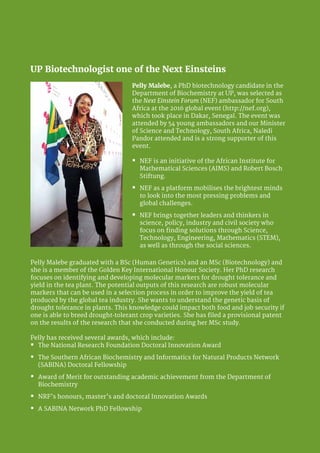
Pelly Malebe graduated with a BSc (Human Genetics) and an MSc (Biotechnology) and
she is a member of the Golden Key International Honour Society. Her PhD research
focuses on identifying and developing molecular markers for drought tolerance and
yield in the tea plant. The potential outputs of this research are robust molecular
markers that can be used in a selection process in order to improve the yield of tea
produced by the global tea industry. She wants to understand the genetic basis of
drought tolerance in plants. This knowledge could impact both food and job security if
one is able to breed drought-tolerant crop varieties. She has filed a provisional patent
on the results of the research that she conducted during her MSc study.
Pelly has received several awards, which include:
�	 The National Research Foundation Doctoral Innovation Award
�	 The Southern African Biochemistry and Informatics for Natural Products Network
(SABINA) Doctoral Fellowship
�	 Award of Merit for outstanding academic achievement from the Department of
Biochemistry
�	 NRF’s honours, master’s and doctoral Innovation Awards
�	 A SABINA Network PhD Fellowship
UP Biotechnologist one of the Next Einsteins
Pelly Malebe, a PhD biotechnology candidate in the
Department of Biochemistry at UP, was selected as
the Next Einstein Forum (NEF) ambassador for South
Africa at the 2016 global event (http://nef.org),
which took place in Dakar, Senegal. The event was
attended by 54 young ambassadors and our Minister
of Science and Technology, South Africa, Naledi
Pandor attended and is a strong supporter of this
event.
�	 NEF is an initiative of the African Institute for
Mathematical Sciences (AIMS) and Robert Bosch
Stiftung.
�	 NEF as a platform mobilises the brightest minds
to look into the most pressing problems and
global challenges.
�	 NEF brings together leaders and thinkers in
science, policy, industry and civil society who
focus on finding solutions through Science,
Technology, Engineering, Mathematics (STEM),
as well as through the social sciences.
11 Faculty of Natural and Agricultural Sciences 2017/18
Biotechnology
Molecular biotechnology involves the use of in vitro genetic
manipulation and recombinant DNA methods to genetically
alter plants, animals and microbes for commercial gain.
Molecular biotechnologists aim to correct, modify, enhance
or exploit specific genetic traits in their target organisms for a
wide range of practical purposes. This includes improving food
production, managing diseases, conservation and bioremediation.
Biotechnology will play a pivotal role in the future of the medical,
agricultural, veterinary and ecological sciences.
Description of the programme
The Biotechnology programme is an interdepartmental
programme aimed at empowering students to pursue their
interest in biotechnology with particular emphasis on molecular
biology. Undergraduate training includes exposure to aspects
of biochemistry, genetics and microbiology, in addition to the
other subjects of a student’s choice. Students are encouraged to
decide on their postgraduate research direction during the course
of their undergraduate studies and to choose their electives
accordingly.
Career opportunities
Graduates acquire skills in numeracy, analytical and critical
thinking, as well as creativity in problem solving and data handling,
all of which equips them for success in both scientific and non-
scientific careers.
Biotechnologists function in both the science and business
spheres, which gives graduates a competitive advantage in
the biological industries. There are an increasing number
of opportunities available in privately owned biotechnology
laboratories that specialise in contract work. Graduates are,
however, encouraged to advance their studies through honours,
master’s and doctoral degrees in Genetics or Biotechnology, as
such degrees are usually essential in scientific careers.
Genetics
Genetics and Human Genetics
Genetics is the study of how the genetic material in the cells
of all living organisms is transmitted from parent to offspring
across generations and how that genetic material is encoded
and decoded to provide the blueprint of all life on earth. This
pioneering discipline is at the core of the biological, agricultural,
veterinary and medical sciences and has become essential
in fields as diverse as virology and epidemiology, biodiversity
conservation and sustainable agriculture. The advent of advanced
technologies continues to enhance existing research strategies.
This allows for dynamic interdisciplinary collaboration, not only
within the life sciences, but also in fields such as informatics and
mathematics. The genomes of numerous animals, plants and
pathogens, as well as those of humans, have been decoded. This
has led to new informative methods for studying gene interactions
at various cellular levels. Computational modelling has proven
invaluable to novel gene discovery and understanding the origins
and spread of emerging viruses, such as the H1N1-virus.
Description of the programme
The Department of Genetics is an active player on the
international scientific stage and offers internationally recognised
undergraduate and postgraduate degrees. These degrees are
research oriented and have a strong emphasis on developing
analytical skills. The Department of Genetics offers both single-
and dual-major options in its Genetics and Human Genetics
programmes. This gives students the choice to specialise in
genetics as a single major, or to combine their genetics subjects
with a second multidisciplinary major, such as biochemistry,
microbiology, plant science or zoology, as well as human
physiology in the Human Genetics programme.
At undergraduate level, students are provided with a
thorough background in the principles of genetics, as well
as the applications of these principles in fields as diverse as
genomics, plant and animal biotechnology, diagnostics and risk
determination, bioethics and conservation ecology, as well as
population, behavioural and evolutionary studies.
Human Physiology
Physiologists study the mechanisms by which the body
functions – from molecular and cellular level through progressive
differentiation to tissues, organs, systems and eventually the
integrated interactions and control of the various body functions.
This knowledge is applied in the research investigations of normal
and abnormal life processes. Basic and clinical research can be
entered into at various levels, such as the molecular, cellular,
structural and diagnostic levels. Human physiology is a major for
two programmes in biological sciences: BSc (Human Physiology)
and BSc (Human Physiology, Genetics and Psychology). Other
special physiology modules form part of the training in medicine,
dentistry, nursing, dietetics, biokinetics, communication pathology,
food science, occupational therapy, physiotherapy, radiography
and some consumer science courses. In human physiology,
students study the functioning of the human body.
 
Description of the programme
During the first year of study for BSc (Human Physiology), students
are exposed to a generic, basic range of subjects in biological and
agricultural sciences. In the second year, various physiological
systems (neurophysiology, haematology, cardiovascular
physiology, pulmonary physiology, renal physiology, nutrition and
digestive physiology, endocrinology and reproductive physiology)
are studied with biochemistry as a compulsory subject. The
programme is concluded in the third year with a selection of
integrated physiology modules, such as sport physiology, nutrition
and development, psychoneuroimmunology and cell physiology,
as well as industrial physiology. At third-year level, students can
select some elective modules in the programme. Psychology and
genetics are compulsory subjects in all three years of study of
BSc (Human Physiology, Genetics and Psychology).
Career opportunities
Research is performed in cooperation with medical teams in
private and government research laboratories, such as the
CSIR, MRC, SABS, pharmaceutical firms, universities, veterinary
and industrial institutions, state departments (for example,
the Department of Health) and health farms. Physiologists are
also found in various other fields, such as education (teachers,
lecturers and instructors), sport physiology, biostatistics,
bioengineering, industrial hygiene, journalism, medical technology
and in the industry as representatives of pharmaceutical firms.
Graduates who completed their degrees with genetics and
psychology also have access to postgraduate programmes offered
by the departments of Genetics and Psychology (in the Faculty of
Humanities).
Biological Sciences
University of Pretoria 12
Microbiology
Microbiology provides a large diversity of interesting study
opportunities. Micro-organisms (viruses, bacteria and fungi) form
an essential part of our planet and students are trained to study
their functions and roles, as well as how microbes could be used
or controlled in our everyday lives.
Micro-organisms are important to health and agriculture due to
the diseases they cause. In this regard, microbiologists study the
pathogens responsible for serious infectious diseases of humans,
animals, wildlife and plants in order to treat and control them.
Microbiology also focuses on the different applications where
beneficial micro-organisms are used for food production, water
purification and other industrial applications.
Description of the programme
A microbiologist’s basic training is a three-year BSc degree. Apart
from exposure to a range of subjects in the biological sciences,
there is also a focus on specialised microbiology subjects, such
as mycology, bacteriology, virology, microbial ecology, clinical
microbiology, plant pathology, molecular microbiology, microbial
interactions and food microbiology. Students can combine
microbiology with genetics, biochemistry, zoology or plant
sciences as part of a dual-major degree.
Postgraduate studies are essential for a research career. The
University of Pretoria has several internationally recognised
research programmes of which postgraduate students form
an integral part. At the molecular and cellular level, the focus is
on issues such as the design of new vaccines, understanding
pathogenicity, and the development of new and improved ways to
detect and quickly identify microbes. There is also a focus on the
discovery and description of new micro-organisms, and gaining a
better understanding of their evolution and diversity.
Career opportunities
Microbiologists can pursue a variety of careers from practical
applications to basic research. Career opportunities are available
in the medical and veterinary sector, as well as in the food,
fermentation, agriculture, environmental and water sector.
Research can be conducted at organisations such as the CSIR,
MRC or ARC. Microbiologists are also employed as lecturers and
researchers at various academic institutions.
Plant and Soil Sciences
BSc (Ecology)
BSc (Plant Science)
Plants are fascinating organisms and very little is known about
all their potential uses. It is, however, well known that plants are
the best factories for synthesising valuable natural products. The
Department of Plant and Soil Sciences is a large department,
which offers both BSc and BScAgric degrees. (Information about
the BScAgric degree appears later in this document.)
The Department is dynamic, innovative, modern and relevant.
Staff members undertake world-class research and 70% of them
have NRF ratings. Much of the research is of an applied nature,
and contributes to the improvement of agricultural crops and
methods, plant diseases, the use of plant-derived compounds,
biodiversity and plant biotechnology.
In medicinal plant science, students learn about the discovery
and use of plant medicines and phytotherapeutically important
molecules obtained from plants. In plant biotechnology, molecular
tools and the use of model plants are discussed to study whole-
plant physiology. Gene and promoter identification, transfer
techniques for plant improvement and the analysis of plant
transcriptomes for plant improvement using micro-arrays are
investigated. In the study of plant diversity and ecology, students
learn about South Africa’s rich and diverse vegetation and how
to facilitate conservation and management strategies for future
generations.
Description of the programme
During the first two years of study, students are exposed to a
range of subjects in biological sciences. They can specialise during
their third year. The Department specialises in plant diversity and
ecology, plant biotechnology and medicinal plant science. In the
third year, students will get the opportunity to do several practical
sessions and experience plants in their natural habitat during
a field excursion. Postgraduate degrees are also offered. The
one-year full-time or two-year part-time internet-based honours
degree includes a research project and some theoretical modules.
At master’s and doctoral degree levels, students are required to
complete research projects in one of the Department’s research
fields.
Career opportunities
Career opportunities range from working in a laboratory to
studying plants in their natural environment. Employment could
be at biotechnology and pharmaceutical firms, South African
National Parks, private ecological companies, research institutions
such as the CSIR, ARC, SANBI and universities.
The undergraduate and postgraduate programmes focus on
the study of organisms that cause diseases, how plants are
affected by diseases and how plant diseases can be controlled.
Postgraduate students can specialise in areas such as postharvest
pathology, food safety and plant protection.
Zoology and Entomology
Zoology is the scientific study of animals. The majority of animals,
in terms of individuals and species, are insects, and their study is
termed entomology. Zoology and Entomology incorporates many
more specialised disciplines like anatomy, behaviour, conservation
biology, ecology, evolutionary biology, genetics, physiology, the
epidemiology of wildlife diseases and plant-insect interactions.
Zoologists and entomologists work closely with agriculturalists,
economists, engineers, mathematicians, physicists, plant scientists
and veterinarians, among others.
Description of the programme
In the BSc programmes, students are exposed to a range
of subjects during the first two years of study to provide a
firm foundation for further study. In the third year, students
take specified modules to qualify in zoology, entomology or
ecology. Laboratory- and field-based practical experience in
all the modules provide opportunities for students to engage
with the methods used to gain new knowledge in zoology or
entomology. They learn the skills required in the workplace and
for postgraduate study.
Biological Sciences
13 Faculty of Natural and Agricultural Sciences 2017/18
Biological Sciences/Agricultural and Food Sciences
Zoology, as a major, is ideal for students with a passion for the
biology, diversity and conservation of wild animals. Students
cover topics like physiology, behaviour, diversity and evolution,
population and community ecology, and animal conservation in
the face of human disturbance and exploitation.
Entomology, as major, is recommended for students with a
fascination for insects. It entails controlling agricultural, forestry
and household insect pests and reducing the transmission of
vector-borne diseases. Career opportunities include forensic
entomologists, quarantine officials, and environmental
consultants and managers. Topics covered are similar to those in
zoology, but there is a focus on insect diversity and management.
Ecology, as a major, is recommended for students who want to
understand how animals and plants interact with each other and
the natural and human environment. In addition to modules on
animals, students take a number of modules on plant diversity
and ecology in the third year. Postgraduate study in zoology or
entomology opens more doors for employment and makes it
possible for students to pursue a passion for animal biology and
management. An honours degree is the minimum requirement
for accreditation as a practicing natural scientist and to work as an
environmental consultant in South Africa. The Department offers
honours, master’s and PhD degree programmes in Zoology or
Entomology.
Career opportunities
Graduates can look forward to a range of exciting career
prospects. They could be employed at nature conservancies,
environmental consultancies, and conservation planning agencies,
medical and veterinary research institutions, in biochemical and
biotechnology industries, at educational institutions, in IT-related
fields and in the corporate sector. Career opportunities include all
the potential activities involved in modern research, development
and training, and natural resources policy formulation. These
usually include a stimulating combination of analytical work,
laboratory or fieldwork, and human resources management.
Agricultural and Food Sciences
Agricultural Economics, Extension and
Rural Development
Agricultural and food industries all over the world are facing the
growing demands of an ever-increasing global population. At
the same time, natural resources, such as soil and water, and
human resources are becoming scarcer and production costs
are soaring. Agricultural economists need to find solutions that
will enable farmers to farm more effectively and reduce costs
to ensure the financial sustainability of farms and companies
operating in agriculture.
Agricultural economics can broadly be defined as the study of
how limited resources can be utilised to feed an ever-increasing
world population. Agricultural economists are therefore
concerned with the economic and financial issues related to
farming, agricultural food chains and the price of food on the
shelf. The sub disciplines of this study field include marketing,
financial management, economics, business management, policy
formulation and accounting.
Description of the programme
The Department offers the following two undergraduate
programmes:
ƒƒ A four-year BScAgric (Agricultural Economics and Agribusiness
Management) degree for students who are more interested in
agriculture
ƒƒ A BCom (Agribusiness Management) degree with the focus on
agribusiness management and marketing
Students are introduced to the abovementioned sub disciplines,
but there is also a strong focus on agriculture and food. To ensure
that economic and financial issues in the agricultural milieu
make more sense, students also have to register for agricultural
sciences subjects, such as soil science, plant production and
‘When people ask me why I chose zoology, I am often
surprised. To me there is no other field that I would rather
be studying. Zoology is concerned with the very basics –
the study of sentient life on this planet – and to me there
is nothing more important or more interesting. There
are infinite opportunities for new insights, knowledge,
understanding and research. It is a hands-on science. That
means you can’t be afraid to go out into the field and get your
hands dirty. And what better way to connect with our planet?
I came to Tuks from the USA, because I wanted to study
African predators. I had heard of the Department of Zoology
and Entomology at the University of Pretoria, and it did not disappoint me. The
lecturers and researchers here are beyond enthusiastic and very knowledgeable
in their fields. They never stop encouraging us to ask questions and find research
opportunities. For that I am very grateful. I was recently invited to join the Golden Key
International Honour Society and I am very excited about the opportunities this will
afford me.’
Emma Jepson – BSc (Zoology)
University of Pretoria 14
Agricultural and Food Sciences
animal science. This develops business acumen in agricultural
economics and graduates’ understanding of the financial and
technical aspects of food production and value chains.
Career opportunities
The term ‘farm to fork’ refers to the process that takes food
products from where they are produced to the consumer’s
plate. Agricultural economists play a role in every step of the
process. Owing to the diverse nature of potential careers in this
discipline, it would be difficult to compile a complete list of all the
possible occupations. Depending on their areas of specialisation,
agricultural economists are employed in the following fields and
companies:
ƒƒ Input companies such as Omnia or Syngenta (as a general
manager, sales representative, marketer or market analyst)
ƒƒ Large farming enterprises (as a general or financial manager)
ƒƒ Agricultural enterprises (as a market analyst, logistics manager
or commodity trader)
ƒƒ Commercial banks and insurance companies (as an agri-
specialist in insurance and financing)
ƒƒ Public sector (several positions are available, usually with a
strong focus on policy and market analysis)
Animal and Wildlife Sciences
The Department of Animal and Wildlife Sciences at the University
of Pretoria can give you an education that will provide you with
a sought-after qualification in the field of animal and wildlife
sciences. The Department provides outstanding and relevant
academic programmes and appropriate practical training. It
is proud of its rich tradition spanning more than 100 years, its
excellent academic staff, experimental farms and a legacy of
service to its students, alumni and the agricultural industry.
Animal and wildlife sciences includes the sciences and practices
whereby domesticated animals and wildlife are used for the
benefit of mankind. Our dependence on nature makes us
responsible for conserving the environment as part of our
natural heritage. The work environment of animal and wildlife
scientists ranges from primary farming or wildlife production to
the marketing of animals and the processing of animal products.
Every link in this long chain offers a career opportunity according
to one’s own field of interest, needs and personality. SACNSP
acknowledges the programmes presented by the Department
as professional qualifications in terms of Act 106 of 1993, which
means that these qualifications are recognised internationally.
Two programmes are presented in the Department; BScAgric
(Animal Science) and BScAgric (Animal and Pasture Science).
Description of the programme
BScAgric (Animal Science)
BScAgric (Animal Science and Pasture Science)
Production physiology, animal nutrition, and animal genetics and
breeding are important disciplines and find application in subjects
such as meat science, large- and small-stock sciences, poultry
(including ostriches) and wildlife management. These programmes
can lead to an MScAgric, a BScHons (Wildlife Management) or a
web-based MPhil (Wildlife Management) degree. The duration of
these programmes is eight semesters of full-time study.
Career opportunities
Animal and wildlife scientists can work in research, commercial
farming, and the public sector and for professionals in the
animal science industry. Animal scientists can contribute on
different levels in these sectors, ranging from researchers, animal
nutrition or breeding consultants, technical representatives, game
managers and policy makers.
Consumer Science
Consumer Science offers students the opportunity to specialise
in various fields of interest: clothing retail management, food
retail management, hospitality studies or culinary science*. The
Department has a strong postgraduate and research culture and
attracts students from all over the country and the rest of Africa.
* The BSc (Culinary Science) degree replaces the BSc (Food
Management) degree from 2017.
Description of the programme
All the undergraduate programmes are structured over four
years of full-time study. UP is presently the only South African
university that offers consumer science degrees with a focus
on the economic and management science aspects of the
specific specialisation fields. Students are therefore sought after,
especially in the retail sector. Every programme revolves around
a specific product category in terms of its properties, consumers’
purchasing and consumption behaviour, product management
and the development of new products and services. Consumer
science aims to encourage strategies to enhance informed,
responsible buying and consumption behaviour and consumer
satisfaction, and to address the needs of people in small
businesses and the retail sector. A BSc (Culinary Science)* degree
that focuses on the art and science of food is also offered.
Career opportunities
Career opportunities are diverse and a graduate’s eventual
career path is mostly determined by his or her personality and
interest. Students are therefore provided with the opportunity to
investigate different possibilities through compulsory experiential
training during their studies. During their fourth year of study,
students complete a research paper that offers them the
opportunity of participating in a formal research project and to
consider the possibility of postgraduate studies. The Department
has acquired valuable contacts over the years, and students who
perform well during their experiential training are often assured of
appointments before the completion of their final examinations.
Graduates with a degree in clothing retail management are
employed as brand managers, clothing buyers and planners,
fashion designers, fashion marketers, fashion product developers,
quality controllers and assurance managers, store managers,
image consultants, textile technologists, visual merchandisers,
pattern technologists and entrepreneurs.
Graduates with a degree in food retail management are employed
as brand managers, sales managers or store managers, food and
beverage buyers and planners, food stylists, food journalists, food
product marketers, visual merchandisers, consumer consultants
and entrepreneurs.
Graduates with a degree in hospitality management are employed
as food and beverage managers, food service managers, culinary
specialists, event coordinators, entrepreneurs, food product and
menu developers, food journalists, and food safety and quality
assurance managers. Graduates interested in teaching may
consider teaching hospitality studies or training and consultation
in the hospitality industry.
Graduates with a BSc (Culinary Science) degree are employed
as culinary scientists, culinologists, sensory analysts, food
researchers, food product developers, food service managers,
and food safety and quality assurance managers.
15 Faculty of Natural and Agricultural Sciences 2017/18
Agricultural and Food Sciences
Food Science
The Department of Food Science focuses on the health and
well-being needs of the people of Africa. It provides the relevant,
world-class, education and training of future leaders in food
science and nutrition. It is a Centre of Excellence in integrated
food science and nutrition research.
Description of the programmes
The programmes are academic and practical and prepare
students for economically satisfying careers. Students also
undertake research projects. Nutrition deals with the human
requirements for food and the effects food has on the wellbeing
of individuals and communities in South Africa and elsewhere.
The four-year degree in Nutrition is presented jointly by the
Department of Food Science (Faculty of Natural and Agricultural
Sciences) and the Department of Human Nutrition (Faculty of
Health Sciences).
The Department boasts an internationally recognised
postgraduate research record driven by top-rated scientists.
Participation in national and international research programmes
attracts outstanding students from within and outside South
Africa. Research activities focus on food product safety, nutritious
and health-promoting African food and beverages, plant
biopolymer and bioplastic microstructures and nanomaterials,
and sensory science research.
Ample opportunities are provided to gain career exposure during
practical training sessions, visits to food companies, attending
conferences and events, and participating in competitions and
mentorship programmes. The Department is actively involved in
the South African Association for Food Science and Technology
(SAAFoST) and industry associations for meat, dairy and cereals.
Students organise education and social activities through a
student body called TUKSFoST.
Career opportunities
The food industry is South Africa’s largest manufacturing sector.
Nowadays, all food is processed to some extent. Food scientists
are concerned with the chemical composition, structure and
nutritional value of foods. They monitor chemical, physical
and biological changes that occur in foods during processing,
preservation and storage. Food scientists develop and supply
foods that comply with the ever-changing demands of modern
consumers. Food scientists also lead the fight against hunger
and malnutrition by developing affordable, nutritious foods.
Among other things, graduates of this department are employed
all over the world as food scientists, food microbiologists or
biotechnologists, food and nutrition analysts, food manufacturing
operation managers, food product or process developers, quality
and safety assurance specialists, food packaging or shelf life
specialists, academics, sensory scientists and key food category
managers.
Our graduates make a difference. All graduates may register as
natural scientists with SACNSP.
Plant and Soil Sciences
BScAgric (Plant Pathology)
BScAgric (Applied Plant and Soil Sciences)
Plants are fascinating organisms and very little is known about
all their potential uses. It is, however, well known that plants are
the best factories for synthesising valuable natural products. The
Department of Plant and Soil Sciences is a large department,
which offers both BSc and BScAgric degrees. (Information about
the BSc degree appears earlier in this document.)
The Department is dynamic, innovative, modern and relevant.
Staff members undertake world-class research and 70% of them
have NRF ratings. Much of the research is of an applied nature,
and contributes to the improvement of agricultural crops and
methods, plant diseases, use of plant-derived compounds,
biodiversity and plant biotechnology.
Ever-increasing human populations and increased
industrialisation exert pressure on our natural resources.
Some of the greatest challenges in developed and developing
countries around the world are sustainable food production
and soil utilisation, as well as the protection and reclamation of
soil and groundwater resources. These challenges can be met
through a broad understanding of plant and environmental
interactions and insight into soil chemical, physical and biological
processes. The agricultural component of the Department of
Plant and Soil Sciences consists of five broad disciplines:
agronomy, horticultural science, soil science, pasture science
and forestry science.
Applied Plant and Soil Sciences
The BScAgric (Applied Plant and Soil Sciences) programme is a
four-year, full-time degree. Each discipline has specific focus areas,
which involve crosscutting research projects in many instances.
Multidisciplinary training, as well as specialisation in agronomy,
horticultural science, pasture science and soil science, enables
graduates and postgraduates to embark on a diverse range of
careers in both the agricultural and environmental fields.
Students who have successfully completed their undergraduate
programmes have the option to register for a one-year honours
degree on a full-time basis.
Plant Pathology
Plant pathology is the study of plant diseases. Where the medical
or veterinary careers focus on human and animal health, the plant
pathologist focuses on plant health, which ensures healthy plants
and enough food for the increasing global population. The effect
of climate change, chemical residues and other toxic substances
on plant health are important aspects in plant pathology. Food
security and food safety are also important focus areas in modern
plant pathology studies. Cutting-edge technologies, such as
molecular biology, are applied in plant pathological research, for
example, to study phytobiomes and the interactions between
micro-organisms and plants. Plant pathology is indeed the field of
study of the future, which integrates various subject disciplines,
such as biotechnology, microbiology, molecular biology, genetics,
plant science and food science.
During the first two years of the BScAgric (Plant Pathology) degree,
students are exposed to a range of subjects in agricultural and
biological sciences, including more fundamental subjects such
as biochemistry, genetics and biotechnology, as well as the more
applied subjects in agriculture.
Specialisation occurs in the second year. Students take subjects
in plant biotechnology, microbiology, genetics, plant production,
entomology and plant pathology. During the third year, students
get the opportunity to study plant diseases directly and visit
various production systems, businesses and farms where they
observe plant protection in action. This takes place during field
excursions and holiday work. In the final year of study, students
do a research project and a number of theory modules.
University of Pretoria 16
Horticulture student scoops up awards
Mathew Banda, an MSc student in Horticulture in the
Department of Plant and Soil Sciences recently won
two prizes:
�	 Best oral presentation by a master’s student in
Horticulture from the South African Society for
Horticultural Sciences
�	 A travel grant worth R10 000 for the best overall
student presentation in Horticulture at the Joint
Congress of the Weed, Crop, Soil and Horticultural
Societies
Mathew’s presentation was titled ‘Validating sap flux
density measurement methods in Citrus sinensis’ and his
research focus is on citrus water use, which is relevant
because of the increase in citrus production in South
Africa which has resulted in a higher demand for
irrigation water. Farmers need to accurately schedule
daily irrigation needs to save water and also alleviate
the problem of nutrient leaching.
17 Faculty of Natural and Agricultural Sciences 2017/18
Agricultural and Food Sciences/Physical Sciences
Postgraduate studies in this programme include honours,
master’s and doctoral degrees. At master’s and doctoral degree
levels, students are expected to complete a research project in
one of the research areas in the Department.
The Department offers the following postgraduate programmes:
ƒƒ BScAgricHons (Crop Science)
ƒƒ BScHons (Environmental Soil Science)
ƒƒ MScAgric (Agronomy), MScAgric (Horticulture), MScAgric
(Pasture Science), MScAgric (Soil Science)
ƒƒ MSc (Soil Science), MSc (Biotechnology), MSc (Forest Science),
MSc (Forest Management and the Environment)
ƒƒ PhD (Agronomy), PhD (Horticulture), PhD (Pasture Science),
PhD (Soil Science), PhD (Forest Science), PhD (Biotechnology)
Career opportunities
Graduates from the various disciplines of the Department of Plant
and Soil Sciences have the following career opportunities:
ƒƒ Education and training: Graduates can work at universities,
colleges and schools.
ƒƒ Plant pathologists: Graduates are in demand in various
industries. Careers range from researchers to practitioners
who work in laboratories, on commercial farms (which includes
fieldwork) or in the food trade industry.
ƒƒ Research and management: Graduates are also hired at
research institutes, government departments, seed, fertilizer
and agro-chemical companies, municipalities and in the mining
industry.
ƒƒ Extension services for technology transfer: Grower
associations, national and provincial departments of
Agriculture, Forestry and Fisheries, Environmental Affairs,
Tourism, Mineral Resources, Energy, and Water Affairs and
Sanitation also hire graduates.
ƒƒ Entrepreneurial: Graduates can work as consultants or in
production.
Physical Sciences
Chemistry
Everything around us involves chemistry. Chemists recognise
the major role this science plays in supporting modern lifestyles.
Chemistry is responsible for many aspects of our lives: the clothes
we wear are made from synthetic fabrics produced by chemical
processes; the drugs used for curing many illnesses are the result
of intensive chemical research; a chemical process produces
the paper we write on, and the ink we write with is a mixture of
many chemicals. Chemistry assures the quality of the food we
eat, the air we breathe and the water we drink. Our body is a
complex mixture of chemicals, and the principles of chemistry
are fundamental to understanding the processes involved in the
functioning of all living organisms and the development of new
medications and materials. It is the interaction and collaboration
of chemistry with the other sciences and engineering that meet
the ever-increasing demands of a modern society.
Chemistry has been described as the central science as its impact
on our lives and society is all-pervasive. Since 1901, the Nobel
Prize for Chemistry has been awarded to 153 individuals for work
covering all aspects of the chemical sciences. The concepts of
sustainable growth, including the reduction of carbon emissions,
renewable fuels, secure food and fresh water supplies, recycled
materials, environmentally responsible manufacture and waste
disposal are all firmly embedded in chemical expertise. Chemistry
is also at the heart of cutting-edge research in biotechnology,
nanotechnology and new materials required for faster computers
and improved solar voltaic cells.
Description of the programme
This programme focuses on the fundamental aspects of
the discipline and aims to provide students with a thorough
background in the chemical sciences. Undergraduate training in
this programme provides an opportunity to combine chemistry
with other fields of interest, such as physics, geology, mathematics
and computer science, or subjects from the biological sciences,
such as biochemistry, microbiology and botany. In the first year of
study, students are introduced to chemistry. This is followed by a
more in-depth study of analytical, inorganic, organic and physical
chemistry in the second and third years of study. All subjects have
theoretical and practical components.
First-year modules in mathematics and physics are compulsory
subjects for the BSc (Chemistry) degree. More advanced modules
in mathematics and programming are recommended if students
want to pursue postgraduate studies in the computer modelling
of molecules, materials or processes.
Postgraduate degrees in chemistry-based programmes are
research orientated. The one-year honours degree consists of
advanced modules in analytical, organic, inorganic and physical
chemistry, including two practical projects with departmental
research teams of the student’s choice. MSc and PhD studies
involve research projects in the specialised fields of organic and
organometallic synthesis, electrochemistry, nanotechnology,
the computer modelling of compounds and materials, chemical
education and separation science, with the emphasis on
industrial, environmental, food, forensic and clinical applications.
Experienced research leaders and excellent research facilities
are available to expand the international research profile of the
Department and expose students to the frontiers of research in
their field of choice.
Career opportunities
Graduates are employed in most technology-based institutions
and work in a laboratory as part of an industrial, research or
academic institution. A chemist must be able to participate in
teamwork in a multidisciplinary environment in a wide variety of
enterprises in both the private and public sectors. It is important
to note that the type of work available in chemistry depends on
the level of the qualification obtained. Advanced qualifications
will eventually lead to positions in research and/or production
management and require management skills and financial
planning. Many career opportunities are found in the sectors of
education, research, journalism, environmental protection, food
and beverages, energy, water, health, sport, pharmaceutics and
cosmetics, geology, mining and law enforcement. These include
the well-known professions of synthetic chemist, materials
scientist, chemical pathologist, forensic chemist, analytical chemist,
drug analyst, patent lawyer, environmental chemist, geochemist,
food chemist, polymer chemist and soil chemist.
University of Pretoria 18
Physical Sciences
Geology
Geology is the scientific study of the dynamic system of the
earth and includes the atmosphere, hydrosphere, lithosphere
and biosphere. The study of geology integrates the principles
of physics and chemistry, as well as mathematics and biology,
in studying the history and processes of the earth. The ever-
growing human population continuously exerts pressure on
natural resources, such as water, energy, mineral deposits and
building materials that are required to meet the basic needs of
humankind.
Description of the programme
The programme is offered over three years on a full-time basis.
It has both practical and theoretical components and leads to
different fields of specialisation, such as mineralogy, igneous
petrology, metamorphic petrology, sedimentology, engineering
and environmental geology, geochemistry, hydrogeology,
economic geology, structural geology, as well as geophysics and
geostatistics. Studies are practical and require extensive work
in field camps, in areas that are often difficult to access, and in
mines, both underground and opencast operations.
Students who have successfully completed their undergraduate
programmes have the option to register for an honours degree
in Geology, Engineering Geology or Hydrogeology. The honours
degree is a one-year full-time programme that serves as a
minimum requirement for employment and to practise as a
professional geologist.
The Department offers two major undergraduate programmes:
BSc (Geology) and BSc (Engineering Geology and Hydrogeology).
Geology
Undergraduate studies cover diverse topics of importance
for our daily life and for the general well-being of our society.
This includes the study of minerals and rocks, mineral and
energy resources (such as iron, gold, coal, oil and gas), surface
water reservoirs (such as rivers, beaches, lakes and glaciers),
groundwater, volcanoes, earthquakes, plate tectonics, global
climate change and the evolution of life. Geologists investigate
the earth’s history of 4.5 billion years to find new resources and
better understand the past, present and future development of
the planet.
Engineering Geology and Hydrogeology
Engineering geology is the study of geological structures, as well
as soil and rock properties at construction sites (such as dams,
tunnels, mines, roads, buildings and stadiums) in order to provide
accurate information prior to the erection of such structures.
Hydrogeology is the study of water in the subsurface, and focuses
on groundwater and soil moisture, for example, water quality
(pollution, mine water), quantity for abstraction and the influence
of water on engineering projects.
Career opportunities
The honours degree is generally a minimum requirement
for permanent and successful employment in industry and
government. Independent consultation mostly requires master’s,
doctoral degrees, and professional recognition.
Geologists are involved in fieldwork, laboratory work, office work,
and computer modelling based on GIS, and require written and/
or oral reports on the completed task. Employment is often
offered by small exploration and larger mining companies, as well
as government, independent research laboratories, universities
and other tertiary educational institutions. In general, geologists
can work as environmentalists, mineralogists, geochemists,
and exploration geologists. They can also work in the mines (as
production geologists), in the ocean (as marine geologists), in
computer laboratories (working with databases, GIS and three-
dimensional modelling) and as independent consultants.
Engineering geologists are employed by organisations such as
the Council for Geosciences, CSIR and mining companies, usually
‘Geology is responsible for the technology on which society
is reliant. It reveals great insights into the past and will play
a significant role in our future. I love geology because it is a
multidisciplinary field, combining mathematics, physics and
chemistry and their practical use.
Geology allows one to understand and interact with the
environment around you. It allows you to see the world from
different perspectives. We unravel the mysteries of nature
and learn a diverse skill set. The people here are passionate
about what they do.
I made the Dean’s merit list in 2015 and received the
Department of Physics Prize for the best first-year student in Physics, as well as the
Jan F Cilliers Book Prize for the best first-year student in Geology. I am a member of
the Golden Key International Honour Society. I hope to specialise in one of the fields
of geology after my graduate studies.’
Sharon Ellman – BSc (Geology)
19 Faculty of Natural and Agricultural Sciences 2017/18
Physical Sciences
in the rock mechanics departments of these organisations.
Consulting civil engineering firms design dams, tunnels, roads,
bridges, railway lines and industry- or infrastructure-related
slopes. Graduates may operate their own consulting practices
where general site investigations for urban development and
infrastructure construction will comprise a large part of their work.
Hydrogeologists are employed by the government (Department
of Water Affairs and Sanitation), the Council for Geosciences,
CSIR, mining companies and consulting practices. The four major
focus areas are water resource evaluation, groundwater resource
development, modelling mine water and contaminant transport
problems. Consulting hydrogeologists are typically involved in
water supply, groundwater quality, monitoring and remediation,
and water licence applications.  
 
Geography, Geoinformatics and
Meteorology
Geography and Environmental Sciences
Geography, as a bridging science, is the link between the natural
and human components of our environment. Location and spatial
distribution of settlements and other human activities, such
as agriculture and tourism, as well as the processes, patterns,
problems and potential answers associated with these activities,
are also studied. Geography is a planning and management
science aimed at improving the quality of life of all communities.
Description of the programme
The BSc (Environmental Sciences) programme studies the
multitude of interactions between the living (including humans)
and non-living components of the earth. As a result of an
increase in human population and technological advances, our
impressions on the environment have become more widespread
and create complex challenges that are multidisciplinary, for
example, the impact on ecosystems, natural resources, human
health and wellbeing.
Both the BSc (Geography) and BSc (Environmental Sciences)
programmes comprise fundamental modules that develop
general skills. Training in spatial analytical techniques include GIS
and remote sensing, and enable graduates to analyse complex
environmental issues. Students can also select modules from
other disciplines.
Career opportunities
Geographers’ and environmental scientists’ main career fields
are in education, research and the application of geographical
knowledge and skills in practice.
Graduates are employed by private companies such as TomTom
South Africa, the Environmental Systems Research Institute
(ESRI) South Africa, CSIR, banks, tourism industries and other
environmental conservation bodies. Due to the geographer’s
holistic training, he or she is sought after for policymaking and
developing strategies on many managerial levels by government
departments such as Agriculture, Forestry and Fisheries, Water
Affairs and Sanitation, Environmental Affairs, Statistics South Africa
(StatsSA), the South African National Space Agency (SANSA) and
municipalities. Many geographers and environmental scientists
are self-employed in areas such as environmental planning,
analysis, risk and impact assessment, environmental auditing,
marketing, development, tourism, cartography and GIS, and
remote sensing. A master’s or doctoral degree is essential to
pursue an academic career.
Geoinformatics
Geoinformatics or Geoinformation Science integrates elements
of various disciplines dealing with geographical data, such
as geography, cartography, computer science, geodesy,
mathematics, remote sensing and statistical remote sensing.
Geoinformatics can measure and supply information on how
one’s behaviour impacts on one’s immediate environment, as well
as how the environment influences one’s wellbeing.
Description of the programme
There are two study options at undergraduate level. The
BSc (Geoinformatics) degree focuses on the general geographic
information science (GISc) profession with geographical thinking
and spatial analysis at the core, while the BSc IT (Geographical
Information Systems) degree focuses on computer science in
GIS applications. More information can be obtained at www.
up.ac.za/ebit. Students gain theoretical knowledge and practical
skills to create and apply GIS methods and techniques to
assist researchers and decision makers in a variety of fields.
Fundamental elements of developing and using these systems
are scientifically approached. Graduates are trained to identify
needs and apply problem-solving processes.
Career opportunities
After successful completion of the BSc (Geoinformatics) degree,
graduates can apply for professional registration as a GISc
technologist with PLATO. With appropriate work experience (work-
integrated learning) and PLATO examinations, graduates can
apply for registration as a candidate GISc practitioner to become a
registered professional GISc practitioner.
Graduates with a BSc (Geoinformatics) degree readily find work
with GIS vendors (ESRI or Integraph) or organisations such as
CSIR, GIS consultants (AfriGIS, GeoTerra lmage, GISCOE), civil
engineering consultants (Aurecon, SSI), SANSA, South Africa’s
National Mapping and National Geospatial Information (NGI) or
any municipality in the country. Many government departments,
such as Environmental Affairs, Science and Technology, Rural
Development and Land Reform, Water Affairs and Sanitation, and
Statistics South Africa, also employ GISc professionals.
Meteorology
Weather and climate is fundamental in people’s lives since daily
activities, such as agriculture, sport, travel and tourism, depend
on it. In the long term, it may even determine whether humankind
survives or not. There is increasing concern that people’s activities
may irreversibly change weather and climate. There are similar
concerns regarding air pollution. Meteorologists and atmospheric
scientists are interested in understanding how the physics and
dynamics of the atmosphere work.
Description of the programme
Undergraduate modules include physics and calculus,
atmospheric structures and processes, the climate and weather
of Southern Africa, physical meteorology, remote sensing,
geographic data analysis, dynamic meteorology, vector analysis
and a weather forecasting module. The practical component
is presented by a professional meteorologist using specialised
software. Additional electives can be chosen from mathematics
and applied mathematics, physics, statistics, chemistry, computer
science, geography and geology.
Career opportunities
Meteorologists are employed by institutions involved in the
study, interpretation and prediction of weather and phenomena
relating to the climate. SAWS, CSIR, some universities, agricultural
University of Pretoria 20
Physical Sciences
institutions, municipalities and industries employ meteorologists
who mainly practise as specialists in the following areas:
ƒƒ Researchers: All aspects of weather and climate are
researched to improve our understanding of atmospheric
phenomena. Atmospheric modellers use supercomputers
to simplify and solve complex flow dynamic equations of the
atmosphere. Air quality and the effect of air pollution on society
is constantly monitored, and the impact of climate change
receives increasing attention.
ƒƒ Weather forecasters: They analyse data and predict the
weather by using models run on supercomputers. Weather
forecasts are issued on different time scales from very short-
range forecasting to forecasts that are valid for months ahead,
as well as seasonal forecasts. Some private weather forecasting
positions, such as presenting the weather on television, are
available.
ƒƒ Climatologists: They manage important data sets that contain
large volumes of information gathered by SAWS and other
organisations.
ƒƒ Meteorologists: They work as consultants in the private sector
and at universities to provide specialised research services.
ƒƒ Academic positions: These are available at some South
African universities after obtaining a master’s or doctoral
degree in Meteorology. Academics ensure that the training of
meteorologists meets international standards.
Physics
Physics is the study of the laws of nature. Its principles form the
foundation of all the basic sciences, such as astronomy, biology,
chemistry and geology. Physics also forms the foundation of
applied science and engineering, which led to major technological
developments, from the horse-drawn cart to the supersonic
jet, from the candle to the laser, from smoke signals to satellite
transmission.
Description of the programme
Physics students will develop their creativity, inventiveness and
problem-solving abilities, which will enable them to advance
successfully to management positions at all levels of industry.
The Department of Physics is staffed with excellent physicists
in a wide range of physics sub-disciplines, such as astronomy,
biophysics, theoretical physics, material science and physics
education. Materials are studied for nuclear applications and
their properties investigated during irradiation. Materials for solar
cells and opto-electronics equipment, as well as carbon-based
magnetic systems, are also investigated. Furthermore, there are
active studies in biophysics, astronomy, mathematical physics,
high-energy theory, quantum theory (resonances and information
theory), solid-state physics, incorporating computational physics,
as well as the effect of symmetries. The Department has a high
international standing, with many international collaborators.
A postgraduate student committee oversees the interests of
postgraduate students, which includes organising social functions.
This helps create an inviting and supportive environment for
students to pursue their research degrees.
Students learn useful and transferable skills in experimental,
theoretical and computational physics that enable them to
become competent physicists. They can also use their skills in
a variety of career options outside academia, for example, in
commerce and industry.
Career opportunities
Graduates can work as university academics, whose duties include
lecturing, research and the supervision of postgraduate students.
They can also work as researchers in national laboratories, such as
NECSA, the South African Astronomical Observatory and iThemba
LABS (Laboratory for Accelerator-based Sciences). Graduates
can become researchers in industry, such as at CSIR or Element
Six, and science advisors for non-governmental organisations,
industry or government. They can also work as radiation scientists,
medical researchers and biophysicists, atmospheric scientists
and climatologists, developers of renewable energy sources,
geophysicists, innovators and entrepreneurs, and computational
scientists. For more information, please visit the Department of
Physics website at www.up.ac.za/physics.
‘There is an intrinsic artistic quality to physics that is not
always seen behind its mathematical confines. It is this
creativity in thought and ideas that motivates me. The strange
world of quantum mechanics is, in my mind, the closest we
have come to discovering true magic.
I am a second-year Physics student who has managed to
combine a love for mathematics with creativity, and I am at
home in the Department of Physics. I tutor other students and
prepare well for lectures and practical sessions.
One of the things I love about this degree and the Faculty of
Natural and Agricultural Sciences is the freedom one has in
choosing from a wide variety of electives. This allows individualism to grow and be
nurtured. I am a Golden Key member and appear on the Dean’s merit list. With a faculty
that is a constant inspiration and with such dedicated professors, I hope to one day be
able to add to the ever-growing field that is physics.’
Carrie-Anne Rubidge – BSc (Physics)
21 Faculty of Natural and Agricultural Sciences 2017/18
Mathematical Sciences
Actuarial Science
The Department of Actuarial Science is extremely proud of its
alumni. Former students occupy the highest positions in the
insurance and investment world, not only in South Africa, but also
abroad. It strives to keep its programme competitive and to afford
students the opportunity to leave the University with a number
of exemptions from the examinations of the Actuarial Society of
South Africa (ASSA). It has highly skilled academics who serve on
various committees of ASSA.
Description of the programme
Developments in the modern financial industry have led to a
rapidly changing financial world. These changes create a growing
need for graduates who are well skilled in the financial models
and quantitative techniques that are used in modern actuarial and
financial mathematical applications. Students who are enrolled
for a BSc (Actuarial and Financial Mathematics) degree can tailor
their coursework in either an actuarial or a financial mathematics
option throughout their three years of study. The programme
provides students with a broad education that will serve them
beyond what is usually expected of a graduate in these fields.
The actuarial programme is structured to provide the aspiring
actuary with the opportunity to fulfil the requirements needed for
exemption from the ASSA examinations in the shortest possible
time. In order to achieve the maximum exemptions, a follow-
up honours degree is recommended. Students who elect not
to complete the actuarial qualification will be well equipped to
enter the financial services industry or apply for a host of other
postgraduate degree options.
For aspiring financial analysts or engineers, the programme
provides depth and develops the student’s ability to design
and analyse financial products. The analytical techniques that
are essential for modelling the stochastic behaviour of financial
processes and analysing the resulting effects on investment
portfolios are studied.
Career opportunities
Many actuaries follow careers in the more traditional fields
of insurance and retirement funds. However, actuaries are
making headway in other fields due to the recognition they are
earning for their unique analytical skills. This includes healthcare,
financial consulting, risk management and banking. Because
of their unique skills, many actuaries are appointed to senior
management positions after their initial role in solving problems
with mathematical and statistical calculations and models.
Financial engineers can be employed by banks and financial
institutions, brokerage firms and investment institutions. They
are essential in portfolio management and risk management.
Activities include asset management (trading in bonds, futures
and derivative instruments such as options), designing new
financial products and devising strategies to control credit risk.
Mathematics and Applied Mathematics
Mathematics is the language of science and technology.
Mathematics, which originated from arithmetic and geometry, is
about pattern and structure. Applied mathematics is concerned
with the modelling and treatment of real-life problems in a variety
of fields, such as engineering, finance, statistics, physics and
biology. The power of mathematics and applied mathematics lies
in their abstract, analytical and computational nature. Nowadays,
mathematics is essential for all technological, financial and
managerial industries that form the backbone of the South African
economy.
The Department of Mathematics and Applied Mathematics is not
only one of the largest departments on the Hatfield Campus, but
also one of the largest Mathematics departments in the country,
with approximately 20 000 students enrolled for mathematics
modules. The Department prides itself on excelling in both
its teaching and research activities, and in community-based
activities.
The diverse and competent staff complement has expertise
in various fields. Researchers regularly travel abroad to attend
‘What I love about Actuarial Science is that it is a challenging
field. It takes time, strength and determination to complete
a task and achieve one’s goals; one has to plan and prioritise;
you have to try to balance exercise, academics, social activities
and relationships. I love the rewarding feeling I get when I
understand the work.
I was the top first-year student in Actuarial Science in 2015
and appeared fourth on the Dean’s merit list.
The Faculty gives us so many opportunities to advance our
academic skills and learn more about the world outside. The
lecturers are brilliant and passionate teachers in their fields
and do everything they can to help us.’
Julia Alsemgeest – BSc (Actuarial and Financial Mathematics)
University of Pretoria 22
Mathematical Sciences
conferences and to pay research visits. The Department has 18
researchers who are rated by the NRF in fields ranging from the
more traditional abstract analysis to contemporary epidemiology
where the modelling of biological phenomena leads to exciting
options. The Department regularly hosts illustrious visitors, such
as the Fields Medallist, Prof Laurent Lafforgue from France.
A degree in Mathematics trains students to apply, evaluate
and adapt existing problem-solving techniques, or to develop
new mathematical models and techniques to solve problems
stemming from natural, technological and financial phenomena.
The Department offers two undergraduate programmes:
BSc (Mathematics) and BSc (Applied Mathematics).
Description of the programmes
ƒƒ BSc (Mathematics): Compulsory subjects are analysis, abstract
algebra, geometry (third-year level), calculus, linear algebra,
differential equations, discrete structures (second-year level),
mathematical modelling, mathematical statistics, numerical
analysis and dynamical processes (first-year level).
ƒƒ BSc (Applied Mathematics): Compulsory subjects are analysis,
continuum mechanics, numerical analysis, partial differential
equations, dynamical systems (third-year level), calculus, linear
algebra, discrete structures, differential equations (second-year
level), mathematical modelling, mathematical statistics and
dynamical processes (first-year level).
Career opportunities
Graduates in Mathematics and Applied Mathematics are
employed by research institutions, educational bodies (universities
and schools), the public sector (government and medical
institutions) and the private sector (engineering companies,
financial institutions and the computer industry). The training of
these graduates in abstract, analytical and computational thinking
provides them with the background to easily adjust to changing
circumstances in the professional environment and to construct
mathematical models of natural, technological and financial
phenomena. Mathematicians and applied mathematicians apply,
evaluate and adapt existing problem-solving techniques or
develop new techniques to solve these problems.
Statistics
Statistics is the art of understanding what value large amounts
of data holds. It constitutes a collection of scientific methods
that is used to draw reliable conclusions about posed questions.
It is also one of the only scientific disciplines without which
most other specialities would struggle to survive. It facilitates
progress within interdisciplinary areas to levels previously thought
insurmountable.
Since you woke up this morning, you have encountered at
least five complex statistical models, from a traffic light system
to the cell phone in your pocket. With almost infinite possible
applications, statistics is a challenging, yet fun way to see how the
world around us unfolds scientifically.
Students are expected to have a knack for problem solving,
with special emphasis on numerical interests and software
programming abilities. Verbal and written communication skills
are preeminent within the field.
Description of the programme
The BSc (Mathematical Statistics) programme is offered over a
period of three years on a full-time basis. Students who have
successfully completed their undergraduate programme have
the option to register for an honours degree in Mathematical
Statistics. Subsequently, master’s and doctoral degrees can be
obtained.
Career opportunities
Learning from data is one of the most relevant and vital
challenges of the information age we live in, and it presents
exciting opportunities for those who work as professional
statisticians.
ƒƒ Financial institutions: Statisticians specialising in the economic
applications of statistics (econometrics) deal with aspects
such as national production and expenditure, international
economic relations, employment, public finance and related
issues. In the insurance business, statisticians are employed in
areas such as actuarial work, marketing, share investments and
property investments. Market research organisations play an
indispensable role in the gathering of information that is used
to improve the quality of decision making in various industries.
ƒƒ Industry: Statisticians are increasingly employed in industries,
such as mining and production, and government corporations,
for example, Eskom, Sasol, AECI and the pharmaceutical
industry. Organised agriculture is another vitally important
industry where sophisticated statistical techniques are used to
meet the growing demand for food and services.
ƒƒ Research councils and educational institutions: Research
councils are well-known large employers of scientists of diverse
disciplines, and employ statisticians to ensure scientifically
founded research outputs. These include MRC, CSIR, ARC and
HSRC. Statisticians are also involved in the training of students
at universities.
ƒƒ The public sector: Government employs statistically proficient
people in many of its departments, the most prominent being
Statistics South Africa.
23 Faculty of Natural and Agricultural Sciences 2017/18
General information
Community engagement
initiatives
Sci-Enza
Sci-Enza (previously known as the Exploratorium) is a science
centre where the general public, mostly groups of schoolchildren,
can discover aspects of science and technology. A variety of
interactive exhibits in physics, plant science, zoology, mathematics
and engineering are available. Organised groups visiting the
centre are given a science show, as well as a guided tour of
the botanical garden and a visit to the Camera Obscura on the
Hatfield Campus. A reading corner, containing popular scientific
books, magazines and video facilities, can be used by visitors.
Sci-Enza is open during office hours on weekdays.
Please contact +27 (0)12 420 2865/3767 for more information or
to make an appointment.
General information
Visit www.up.ac.za/admissioninfo for information on the
following:
ƒƒ Study information
ƒƒ Calculate your Admission Point Score (APS)
ƒƒ Closing dates
ƒƒ Fees and Funding
ƒƒ Special offer for top academic achievers
ƒƒ Apply at UP
ƒƒ Change or add a programme
ƒƒ National Benchmark Test (NBT)
ƒƒ Application status
ƒƒ Prepare to study at UP
ƒƒ Registration and start of the academic year

FB NAS 2017-18 (pdf10 - Final) 05.12.2016

  • 1.
  • 2.
    ii Faculty ofNatural and Agricultural Sciences 2017/18 Message from the Dean Prof Jean Lubuma Dean: Faculty of Natural and Agricultural Sciences Have you ever wondered who is responsible for the quality of the chocolate, canned beverages or pancake mixture you buy in the supermarket? What is the science behind a cricket ball or a cricket pitch? What is nanotechnology? How do specialists treat cancer with nuclear technology, or tuberculosis with phytomedicine? Why are actuaries the highest-paid people in the world? The Faculty of Natural and Agricultural Sciences is one of the most diverse science faculties in South Africa. It hosts various disciplines within the broader fields of agricultural, biological, mathematical and physical sciences. The Faculty offers degree programmes that are not only at the forefront of the various disciplines, but also equip graduates to be leaders and problem solvers in their chosen professions. The key to the Faculty’s success is the high premium it places on quality education, research and innovation. This is embodied in the Faculty’s approach to training and research. The University of Pretoria aims to be internationally competitive and locally relevant at the same time. Local relevance is assured through close cooperation with industry. The University has deployed a number of innovations in this regard. Its strategic alliance with the Council for Scientific and Industrial Research (CSIR) creates unequalled training and research opportunities for students and staff, while the Innovation Hub – located in close proximity to the University’s Experimental Farm – hosts the research and development laboratories of some of the world’s foremost high-technology firms. The Faculty is currently associated with nine research chairs under the South African Research Chairs Initiative (SARChI), and has the largest number of researchers in any department at the University to be recognised for excellence by their peers through the National Research Foundation (NRF), including seven A-rated scientists. National and international accreditation is the norm for the Faculty’s academic programmes, as well as its research laboratories. It is serious about ensuring that the market value of the degrees it awards will always give its students a competitive advantage. It adds value to its degrees, and has a good reputation in the market, which makes its students highly sought after. The degree programmes of the Faculty of Natural and Agricultural Sciences are accessible to everybody who meets the Faculty’s academic standards. Deserving students are assisted with bursaries and loans through various financial aid schemes administered by the University. The Faculty is involved in several outreach programmes, such as the well-known UP with Science programme and the BSc – Extended programmes. Learners with a love for the unknown, a curious mind and a will to work hard are welcome to apply. Tel +27 (0)12 420 3201 Email dean.nas@up.ac.za
  • 3.
    University of Pretoriaiii Content Message from the Dean........................................................................................................................................................................................................................ii Introduction..............................................................................................................................................................................................................................................1 Undergraduate programmes..............................................................................................................................................................................................................2 BSc – Extended programmes..............................................................................................................................................................................................................9 Biological Sciences..................................................................................................................................................................................................................................9 Anatomy (Medical Sciences)........................................................................................................................................................................................................9 Biochemistry.....................................................................................................................................................................................................................................9 Genetics ..........................................................................................................................................................................................................................................11 Biotechnology................................................................................................................................................................................................................................11 Human Physiology........................................................................................................................................................................................................................11 Microbiology...................................................................................................................................................................................................................................12 Plant and Soil Sciences (Ecology and Plant Science)...........................................................................................................................................................12 Zoology and Entomology............................................................................................................................................................................................................12 Agricultural and Food Sciences.........................................................................................................................................................................................................13 Agricultural Economics, Extension and Rural Development............................................................................................................................................13 Animal and Wildlife Sciences.....................................................................................................................................................................................................14 Consumer Science........................................................................................................................................................................................................................14 Food Science..................................................................................................................................................................................................................................15 Plant and Soil Sciences (Plant Pathology and Applied Plant and Soil Sciences)..........................................................................................................15 Physical Sciences..................................................................................................................................................................................................................................17 Chemistry........................................................................................................................................................................................................................................17 Geology............................................................................................................................................................................................................................................18 Geography, Geoinformatics and Meteorology.....................................................................................................................................................................19 Physics..............................................................................................................................................................................................................................................20 Mathematical Sciences........................................................................................................................................................................................................................21 Actuarial Science...........................................................................................................................................................................................................................21 Mathematics and Applied Mathematics.................................................................................................................................................................................21 Statistics...........................................................................................................................................................................................................................................22 Community engagement initiatives.................................................................................................................................................................................................23 Sci-Enza............................................................................................................................................................................................................................................23 General information.............................................................................................................................................................................................................................23 Cover photograph courtesy of Chris Oosthuizen. Produced by the Department of Enrolment and Student Administration in December 2016. Comments and queries can be directed to ssc@up.ac.za or tel: +27 (0)12 420 3111. Disclaimer: This publication contains information about regulations, policies, tuition fees, curricula and programmes of the University of Pretoria applicable at the time of printing. Amendments to or updating of the information in this publication may be effected from time to time without prior notification. The accuracy, correctness or validity of the information contained in this publication is therefore not guaranteed by the University at any given time and is always subject to verification. The user is kindly requested to verify the correctness of the published information with the University at all times. Failure to do so will not give rise to any claim or action of any nature against the University by any party whatsoever.
  • 4.
    1 Faculty ofNatural and Agricultural Sciences 2017/18 Introduction The Faculty of Natural and Agricultural Sciences is a diverse faculty with 16 departments that is supported by more than 20 centres and institutes. More than 5 000 students register in this faculty annually of which 70% are undergraduate and 30% postgraduate students. All degree programmes are designed to develop problem-solving individuals who can easily adapt to changing circumstances and take the lead in their chosen fields of specialisation. The qualifications awarded are of world-class and provide access to a multitude of career opportunities for dynamic and creative people. Some of the Faculty’s degree programmes are unique to the University of Pretoria, while others are also offered at a number of other institutions. The Faculty presents undergraduate and postgraduate degrees in the following fields: Biological Sciences (BSc) Agricultural and Food Sciences (BSc and BScAgric) ƒƒ Medical Sciences (Anatomy) ƒƒ Biochemistry ƒƒ Biotechnology ƒƒ Ecology ƒƒ Entomology ƒƒ Genetics ƒƒ Human Genetics ƒƒ Human Physiology ƒƒ Human Physiology, Genetics and Psychology ƒƒ Microbiology ƒƒ Plant Science ƒƒ Zoology ƒƒ Agricultural Economics and Agribusiness Management ƒƒ Animal Science ƒƒ Animal and Pasture Science ƒƒ Culinary Science * ƒƒ Food Science ƒƒ Nutrition ƒƒ Plant Pathology ƒƒ Plant and Soil Sciences ƒƒ Wildlife Management (Postgraduate) Physical Sciences (BSc) Mathematical Sciences (BSc) ƒƒ Chemistry ƒƒ Engineering and Environmental Geology ƒƒ Environmental Sciences ƒƒ Geography ƒƒ Geoinformatics ƒƒ Geology ƒƒ Meteorology ƒƒ Physics ƒƒ Actuarial and Financial Mathematics ƒƒ Applied Mathematics ƒƒ Mathematical Statistics ƒƒ Mathematics Consumer Science (BConSci) BSc – Extended programmes ƒƒ Food Retail Management ƒƒ Hospitality Management ƒƒ Clothing Retail Management Subject fields in the BSc – Extended programmes ƒƒ Mathematical Sciences ƒƒ Biological and Agricultural Sciences ƒƒ Physical Sciences * Replaces BSc (Food Management) from 2017 Unique programmes in the Faculty BSc (Nutrition) BSc (Meteorology) MSc (Applied Mineralogy) This is the only degree of its kind in South Africa and it can be followed by a postgraduate qualification. This is the only degree of its kind offered in sub-Saharan Africa and it can be followed by a postgraduate qualification. In South Africa, this postgraduate qualification is offered at the University of Pretoria only.
  • 5.
    University of Pretoria2 Undergraduate programmes Important information on undergraduate programmes for 2018 ƒƒ The following persons will be considered for admission: a candidate who is in possession of a certificate that is deemed by the University to be equivalent to the required Grade 12 certificate with university endorsement, a candidate who is a graduate from another tertiary institution or has been granted the status of a graduate of such an institution, and a candidate who is a graduate of another faculty at the University of Pretoria. ƒƒ Life Orientation is excluded in the calculation of the Admission Point Score (APS). ƒƒ Grade 11 results are used for the provisional admission of prospective students. Final admission is based on the Grade 12 results. University of Pretoria website www.up.ac.za/nas National Benchmark Test website www.nbt.ac.za Programmes Minimum requirements for 2018 Achievement level APS BIOLOGICAL SCIENCES Afrikaans or English Mathematics Physical Science NSC/ IEB HIGCSE AS Level A Level NSC/ IEB HIGCSE AS Level A Level NSC/ IEB HIGCSE AS Level A Level BSc (Biochemistry) [3 years] Closing dates: SA – 30 September Non-SA – 31 August 5 3 C C 5 3 C C 5 3 C C 30 Careers: Biochemistry offers many opportunities for exciting and challenging careers in the food and pharmaceutical, fine chemicals and waste processing industries. Careers at research councils, such as the Medical Research Council (MRC), the Agricultural Research Council (ARC), the Cancer Association of South Africa (CANSA) and the Water Research Commission (WRC) are possibilities, as are academic institutions, the Council for Scientific and Industrial Research (CSIR), and forensic and pathology laboratories. Career opportunities include those of researcher, teacher, lecturer and medical representative. Graduates are comfortable in work environments such as universities, research institutes, pharmaceutical companies, biotechnology companies and related industries. BSc (Biological Sciences) Closing dates: SA – 30 September Non-SA – 31 August 5 3 C C 5 3 C C 5 3 C C 30 This is a generic first-year programme in Biological Sciences. Students who are not sure which specialisation degree programme to choose may apply for this programme. Students who intend to apply for admission to MBChB or BChD in the second semester when places become available in those programmes may register for BSc (Biological Sciences) modules in the first semester, replacing Mathematics (WTW 134) with Science and World Views (FIL 155), People and their Environment (MGW 112) and Medical Terminology (MTL 180), with the provision that these students, should they not be selected and should they wish to continue with one of the Biological Sciences programmes, must complete Mathematics (WTW 134) in the second semester of their first year. Please note: The minimum admission requirement for MGW 112 is an APS score of 34 and a minimum of 70% for Grade 12 Mathematics. BSc (Biotechnology) [3 years] Closing dates: SA – 30 September Non-SA – 31 August 5 3 C C 5 3 C C 5 3 C C 30 Careers: Graduates find work mostly as laboratory-based researchers or bio-entrepreneurs using medical, animal, plant or microbe-based technologies to develop products and services. If students combine biotechnology with additional qualifications such as law, they will be equipped for success in careers such as patent law, pharmaceutical sales and marketing, project management, computer programming (natural computation) and science journalism. Please note that the level of training and qualification plays an important role in determining what type of work a qualified biotechnologist can become involved in. BSc (Ecology) [3 years] Closing dates: SA – 30 September Non-SA – 31 August 5 3 C C 5 3 C C 5 3 C C 30 Careers: Graduates find work in environmentally based statutory and private conservation organisations, organisations involved in the direct or indirect use of natural resources, and academic and training institutions. BSc (Zoology) [3 years] Closing dates: SA – 30 September Non-SA – 31 August 5 3 C C 5 3 C C 5 3 C C 30 Careers: Graduates can look forward to a range of exciting career prospects. They could be employed at nature conservancies, environmental consultancies, and conservation planning agencies, medical and veterinary research institutions, in biochemical and biotechnology industries, at educational institutions, in IT-related fields and in the corporate sector. Career opportunities include all the potential activities involved in modern research, development and training. These range from full-time involvement in the field or laboratory to full-time training activities, and usually include a stimulating combination of analytical work, fieldwork and human resources- related work. BSc (Entomology) [3 years] Closing dates: SA – 30 September Non-SA – 31 August 5 3 C C 5 3 C C 5 3 C C 30 Careers: Graduates could be employed at nature reserves, environmental consultancies, conservation planning agencies, medical and veterinary research institutions, educational institutions and museums, pest management, quarantine and inspection services, in biochemical and biotechnology industries, in IT-related fields and in the corporate sector. Graduates with expertise in entomology are particularly highly sought after in the agricultural sector as insect management specialists or researchers.
  • 6.
    3 Faculty ofNatural and Agricultural Sciences 2017/18 Programmes Minimum requirements for 2018 Achievement level APS BIOLOGICAL SCIENCES Afrikaans or English Mathematics Physical Science NSC/ IEB HIGCSE AS Level A Level NSC/ IEB HIGCSE AS Level A Level NSC/ IEB HIGCSE AS Level A Level BSc (Genetics) BSc (Human Genetics) [3 years] Closing dates: SA – 30 September Non-SA – 31 August 5 3 C C 5 3 C C 5 3 C C 30 Careers: Graduates generally choose to work as molecular biologists, medical or clinical geneticists, cytogeneticists, biotechnologists, agricultural scientists, molecular ecologists, forensic scientists, genetic counsellors, bioinformaticists and computational analysts, veterinary scientists, teachers or lecturers at various institutions and in bioscience-related industries. If students combine genetics with additional qualifications such as law, they will be equipped for success in careers such as patent law, pharmaceutical sales and marketing, project management, computer programming (natural computation) and science journalism. Please note that the level of training and qualification plays an important role in determining what type of work a qualified geneticist can become involved in. BSc (Human Physiology) BSc (Human Physiology, Genetics and Psychology) [3 years] Closing dates: SA – 30 September Non-SA – 31 August 5 3 C C 5 3 C C 5 3 C C 30 Careers: Research is performed in cooperation with medical teams in private and government research laboratories (such as the CSIR and the MRC), the South African Bureau of Standards (SABS), pharmaceutical firms, universities, veterinary and industrial institutions and state departments (for example, the Department of Health). Physiologists are also found in various other fields, such as education (teachers, lecturers and instructors), sport physiology, biostatistics, bioengineering, industrial hygiene, journalism, medical technology and in the industry as representatives of pharmaceutical firms. Graduates with genetics and psychology as subjects also have access to postgraduate programmes offered by the departments of Genetics and Psychology (in the Faculty of Humanities). BSc (Medical Sciences) [3 years] Closing dates: SA – 30 September Non-SA – 31 August 5 3 C C 5 3 C C 5 3 C C 30 Careers: Postgraduate studies are highly recommended. Honours, master’s and doctoral degrees can be obtained in any of the sub disciplines of anatomy: neuro-anatomy, clinical anatomy, cell biology, physical and forensic anthropology, histology and embryology. Students who obtain this degree can also continue with postgraduate studies in Physiology, Genetics and Pharmacology. Career opportunities include research in any of the anatomy sub disciplines, in academia, in forensic sciences and in the health science industry. Other careers that can be considered are in the sport sciences, virology, chemical pathology, immunology, health administration or ergonomics. Technical careers, for example, in the Anatomy or Physiology departments of universities, are also possible. There are only 72 places in the first year of BSc (Medical Sciences). Students who apply for BSc (Medical Sciences) as their first choice before 30 September and who meet the minimum entrance requirements will be admitted until all the places are full. BSc (Microbiology) [3 years] Closing dates: SA – 30 September Non-SA – 31 August 5 3 C C 5 3 C C 5 3 C C 30 Careers: Microbiologists can pursue a variety of careers from practical applications to basic research. Career opportunities are available in the food, dairy, beer, wine and baker’s yeast industries, in the fermentation industry, and at mines working with corrosion control. Graduates can also follow careers as medical or veterinary microbiologists, as researchers at organisations such as the CSIR, MRC or ARC, or as lecturers and researchers at various academic institutions. BSc (Plant Science) [3 years] Closing dates: SA – 30 September Non-SA – 31 August 5 3 C C 5 3 C C 5 3 C C 30 Careers: Careers range from working in a laboratory to studying plants in their natural environment. Employment could be at biotechnology and pharmaceutical firms, South African National Parks, private ecological companies, and research institutions such as the CSIR, ARC and South African National Biodiversity Institute (SANBI). Candidates who do not comply with the minimum admission requirements for the abovementioned Biological Sciences programmes may be considered for admission to the BSc – Extended programme for the Biological and Agricultural Sciences. This programme takes a year longer than the normal programmes to complete. BSc – Extended programme for the Biological and Agricultural Sciences 4 3 D D 4 3 D D 4 3 D D 24 Undergraduate programmes
  • 7.
    University of Pretoria4 Programmes Minimum requirements for 2018 Achievement level APS AGRICULTURAL AND FOOD SCIENCES Afrikaans or English Mathematics Physical Science NSC/ IEB HIGCSE AS Level A Level NSC/ IEB HIGCSE AS Level A Level NSC/ IEB HIGCSE AS Level A Level BSc (Culinary Science)* [4 years] Closing dates: SA – 30 September Non-SA – 31 August *Replaces BSc (Food Management) from 2017 5 3 C C 5 3 C C 5 3 C C 30 Careers: Graduates can be employed as culinary scientists, culinologists, sensory analysts, food researchers, food product developers, food safety and quality assurance managers, and food service managers. BSc (Food Science) [3 years] Closing dates: SA – 30 September Non-SA – 31 August 5 3 C C 5 3 C C 5 3 C C 30 Careers: Food scientists with highly marketable training and professional skills work as food risk investigators, quality and safety assurance managers, food chemists, food microbiologists and biotechnologists, packaging and shelf life specialists, safety auditors, product and process development managers, technical sales and marketing advisors, sensory scientists, food bio scientists (brew masters, flavourists) in the food, agro processing and related industries. The work environment of food scientists includes laboratories, food production sites and business premises, training areas, retail, government institutions and research organisations. Food scientists also work in industries and companies that manufacture and supply materials (packaging and food additives, such as colourants and flavourants) for the food industry or that have secondary involvement in food production and sales. BSc (Nutrition) [4 years] Closing dates: SA – 30 September Non-SA – 31 August 5 3 C C 5 3 C C 5 3 C C 30 Careers: The need for graduates with training in nutrition is driven by the worldwide recognition that food does not only meet basic nutritional needs, but also plays a key role in the promotion and maintenance of long-term good health. Career opportunities include working in food or related industries (such as pharmaceutical companies), government departments, international organisations (such as the United Nations Food and Agricultural Organisation (FAO) and the World Health Organisation (WHO)) or research organisations, and as account managers and advisors in the food, health and consumer sectors. BScAgric (Agricultural Economics and Agribusiness Management) [4 years] Closing dates: SA – 30 September Non-SA – 31 August 5 3 C C 5 3 C C 5 3 C C 30 Careers: Agricultural economists are involved in many different areas of the economy. Some are involved in analysing and understanding consumers’ behaviour in terms of their wants, needs and willingness to pay for food and clothing. Others are involved in environmental management and assisting government and businesses to ensure the sustainable use of scarce resources such as water and arable land. Some agricultural economists are traders on global financial markets and work at the Johannesburg Stock Exchange (JSE) in Sandton or at Wall Street in New York. Others work for banks and in finance, at food processors such as bakers and brewers, or as advisors to farmers and input suppliers. Some agricultural economists work for the government, advising them on how to ensure that there is enough food for all the people in the country, while others work in commercial banks, advising clients and managers how to manage finance, risk and commodity markets. Agricultural economists also play a vital part in research and development in the agricultural sector. They travel a lot, both locally and to other parts of the world, such as Africa, Australia, China, Europe, South America and the USA, and meet many interesting people. They travel to buy the best inputs to produce food and clothing, but also to identify and understand markets for products. Therefore, an agricultural economist is somebody who is interested in people and their cultures, in nature, but also in business and management. An agricultural economist must be able to interact with people, but must also be able to use statistics and mathematics to understand the interaction between people, nature and the economy. BScAgric (Animal Science) BScAgric (Animal and Pasture Science) [4 years] Closing dates: SA – 30 September Non-SA – 31 August 5 3 C C 5 3 C C 5 3 C C 30 Careers: Animal science is a career that makes an important contribution to agriculture in South Africa. This career is focused on the application of the scientific aspects of animal production and the quality control of products to ensure consumer satisfaction. Two degrees are presented: BScAgric (Animal Science) and BScAgric (Animal and Pasture Science). It is a field of science, subject to the most recent research and needs of both animals and humans, that focuses on the whole animal and wildlife production value chain, from conception to consumption. There are numerous career opportunities for animal and wildlife scientists in research, commercial farming and the public sector, and for professionals in the animal science industry. Animal scientists can work on different levels in these sectors, from researchers to animal nutrition or breeding consultants, technical representatives, managers of intensive and extensive animal production systems, game managers and policy makers. The BScAgric (Animal Science) degree is acknowledged as a professional qualification by SACNSP in terms of Act 106 of 1993, and is recognised internationally, which means that graduates can register as professional animal scientists. BScAgric (Plant Pathology) [4 years] Closing dates: SA – 30 September Non-SA – 31 August 5 3 C C 5 3 C C 5 3 C C 30 Careers: Graduates could be employed as seed cultivators, farmers, researchers, lecturers or consultants. Undergraduate programmes
  • 8.
    5 Faculty ofNatural and Agricultural Sciences 2017/18 Undergraduate programmes Programmes Minimum requirements for 2018 Achievement level APS AGRICULTURAL AND FOOD SCIENCES Afrikaans or English Mathematics Physical Science NSC/ IEB HIGCSE AS Level A Level NSC/ IEB HIGCSE AS Level A Level NSC/ IEB HIGCSE AS Level A Level BScAgric (Applied Plant and Soil Sciences) [4 years] Closing dates: SA – 30 September Non-SA – 31 August 5 3 C C 5 3 C C 5 3 C C 30 Careers: Graduates could be employed as teachers and lecturers at schools and academic institutions, as well as researchers and managers at various public and private institutions: ƒƒ Public sector: The ARC, Department of Water and Sanitation, Department of Environmental Affairs, Department of Tourism, Department of Agriculture, Forestry and Fisheries, Department of Mineral Resources, Department of Energy, the CSIR, provincial agriculture and nature conservation departments, SANBI, municipalities, South African National Parks, national farming and food production agencies. ƒƒ Private sector: Companies involved in seed, fertilizer and plant protection research and development, environmental planning and management, nurseries, vegetable, fruit and ornamental cut-flower production and irrigation. ƒƒ Extension services involving knowledge transfer: Nature conservation, national and provincial departments of agriculture and the environment, environmental management and rehabilitation, nurseries, crop, turf grass and weed management, and private companies servicing field crops, vegetables, medicinal and aromatic plants, fruit, ornamental and cut-flower production. ƒƒ Entrepreneurial: Consultants in crop, pasture, vegetable, medicinal and aromatic plants, ornamental and cut flower production systems and landscaping enterprises, managing own farms and nurseries for extensive (field) or intensive (tunnel/greenhouse) production systems involving various crops, and managing companies specialising in irrigation, reclamation and soil conservation. Candidates who do not comply with the minimum admission requirements for the abovementioned Agricultural and Food Sciences programmes may be considered for admission to the BSc – Extended programme for the Biological and Agricultural Sciences. This programme takes a year longer than the normal programmes to complete. BSc – Extended programme for the Biological and Agricultural Sciences 4 3 D D 4 3 D D 4 3 D D 24 Programmes Minimum requirements for 2018 Achievement level APS CONSUMER SCIENCE Afrikaans or English Mathematics NSC/ IEB HIGCSE AS Level A Level NSC/ IEB HIGCSE AS Level A Level BConSci (Clothing Retail Management) [4 years] Closing dates: SA – 30 September Non-SA – 31 August 5 3 C C 4 3 D D 28 Careers: Graduates can be employed in retail management as brand managers, clothing buyers and planners, fashion designers, fashion marketers, fashion product developers, quality controllers and assurance managers, store managers, image consultants, textile technologists, visual merchandisers, pattern technologists and entrepreneurs. BConSci (Food Retail Management) [4 years] Closing dates: SA – 30 September Non-SA – 31 August 5 3 C C 4 3 D D 28 Careers: Graduates can be employed as brand managers, sales managers or store managers, food and beverage buyers and planners, food stylists, food journalists, food product marketers, visual merchandisers, consumer consultants and entrepreneurs. BConSci (Hospitality Management) [4 years] Closing dates: SA – 30 September Non-SA – 31 August 5 3 C C 4 3 D D 28 Careers: Graduates can be employed as food and beverage managers, food service managers, culinary specialists, event coordinators, entrepreneurs, food product and menu developers, food journalists, food safety and quality assurance managers and food stylists.
  • 9.
    University of Pretoria6 Undergraduate programmes Programmes Minimum requirements for 2018 Achievement level APS PHYSICAL SCIENCES Afrikaans or English Mathematics Physical Science NSC/ IEB HIGCSE AS Level A Level NSC/ IEB HIGCSE AS Level A Level NSC/ IEB HIGCSE AS Level A Level BSc (Chemistry) [3 years] Closing dates: SA – 30 September Non-SA – 31 August 5 3 C C 5 3 C C 5 3 C C 32 Careers: Graduates are employed in most technology-based institutions and work in a laboratory environment as part of an industrial, research or academic institution. A chemist must be able to participate in teamwork in a multidisciplinary environment in a wide variety of enterprises in both the private and public sectors. It is important to note that the type of work available to a graduate in chemistry depends on the level of the qualification obtained. Advanced qualifications will eventually lead to positions in research and/or production management and require management skills and financial planning. Many career opportunities are found in the sectors of education, research, journalism, environmental protection, food and beverages, energy, water, health, sport, pharmaceutics and cosmetics, geology, mining and law enforcement. These include the well-known professions of synthetic chemist, materials scientist, chemical pathologist, forensic chemist, analytical chemist, drug analyst, patent lawyer, environmental chemist, geochemist, food chemist, polymer chemist and soil chemist. BSc (Physics) [3 years] Closing dates: SA – 30 September Non-SA – 31 August 5 3 C C 5 3 C C 5 3 C C 32 Careers: Graduates could be employed as university academics, whose duties include lecturing, research and the supervision of postgraduate students, researchers in national laboratories such as the Nuclear Energy Corporation of South Africa (NECSA), the South African Astronomical Observatory or iThemba LABS (Laboratory for Accelerator-based Sciences), researchers in industry such as at the CSIR or Element Six, science advisors for non-governmental organisations, industry or government, radiation scientists, medical scientists and biophysicists, atmospheric scientists and climatologists, developers of renewable energy sources, geophysicists, innovators and entrepreneurs, and computational scientists. International collaboration also takes place with experts from abroad. BSc (Geography) [3 years] Closing dates: SA – 30 September Non-SA – 31 August 5 3 C C 5 3 C C 5 3 C C 32 Careers: There are three main career fields in geography: teaching, research and the application of geographical knowledge and skills in practice. Geographers can focus on environmental management, urban issues such as squatting, regional and rural development, or environmental issues, including pollution and the destruction of ecosystems through activities such as mining, agriculture and tourism. Geographers in the private sector are generally employed by real estate, planning, architecture and engineering firms, banks, tourism organisations, environmental conservation bodies and industry. Government departments involved in forestry, water and land affairs, the environment, tourism and education employ Geography graduates. Parastatal organisations such as the SABS and the CSIR offer career opportunities in the various specialised fields related to the earth and environmental sciences. Many geographers are self-employed. They are mainly involved in areas such as marketing, planning, development, tourism, cartography, geographic information systems (GIS), remote sensing, environmental analysis and environmental auditing. Graduates can also pursue academic careers. BSc (Geoinformatics) [3 years] Closing dates: SA – 30 September Non-SA – 31 August 5 3 C C 5 3 C C 5 3 C C 32 Careers: Graduates are employed, among others, in agriculture, mineral exploration, engineering, forestry, water resource management, weather forecasting, environmental impact assessment (EIA), land-use planning, land development, rural community development, transport planning, tourism, market research, crime prevention, vehicle tracking, cartography, GIS technology, environmental planning and analysis, and disaster and environmental management. Graduates can apply for professional registration as GIS technologists with the South African Council for Professional and Technical Surveyors (PLATO). BSc (Geology) [3 years] Closing dates: SA – 30 September Non-SA – 31 August 5 3 C C 5 3 C C 5 3 C C 32 Careers: Large international mining companies are major employers of geologists and other geoscientists in research, exploration and mining projects. However, employment is increasingly to be found in smaller, entrepreneurial firms (‘juniors’). Interesting careers are also offered by the Council for Geosciences, the CSIR, and the Council for Mineral Technology (MINTEK), the Department of Water and Sanitation, and at museums, engineering firms and consulting companies. Graduates may even operate as self-employed consultants in their own firms. Laboratory specialists like mineralogists identify and examine minerals using sophisticated instruments and analytical equipment. Environmental and engineering geologists study the interaction between human activities and the geological environment, such as the pollution of soil and groundwater. They investigate geological structures and soil, and rock properties at construction sites, for example, dams, tunnels and mines, in order to provide valuable information prior to construction. They also locate and evaluate suitable construction materials. The task of the hydrogeologist is to look for groundwater and monitor the responsible exploitation of that water.
  • 10.
    7 Faculty ofNatural and Agricultural Sciences 2017/18 Undergraduate programmes Programmes Minimum requirements for 2018 Achievement level APS PHYSICAL SCIENCES Afrikaans or English Mathematics Physical Science NSC/ IEB HIGCSE AS Level A Level NSC/ IEB HIGCSE AS Level A Level NSC/ IEB HIGCSE AS Level A Level BSc (Meteorology) [3 years] Closing dates: SA – 30 September Non-SA – 31 August 5 3 C C 5 3 C C 5 3 C C 32 Careers: Meteorologists are employed by institutions involved in the study, interpretation and prediction of weather and phenomena relating to the climate. The South African Weather Service (SAWS), the CSIR, some universities, agricultural institutions and general industries employ meteorologists who mainly practise as specialists in the following areas: ƒƒ Researchers: They research all aspects of the weather and climate in order to improve understanding of atmospheric phenomena. Atmospheric modellers use supercomputers to solve complex flow dynamic equations of the atmosphere. The monitoring of air quality and the modelling of the impact of air pollution on society are two important aspects that need to be addressed. Research into climate change is receiving increasing attention. ƒƒ Weather forecasters: It is the duty of the forecaster to analyse data and predict the weather by using models that are run on supercomputers. Weather forecasts are issued on different time scales, from very short-range forecasting to forecasts that are valid for months ahead, as well as seasonal forecasts. There are also some private weather forecasting positions, such as presenting the weather on television. ƒƒ Climatologists: They manage important data sets that contain large volumes of information gathered by the SAWS and other organisations. ƒƒ Consultants: Some meteorologists who work as consultants in the private sector and at universities provide specialised research services. ƒƒ Lecturers: A few academic positions are available for meteorologists and climatologists at South African universities. They ensure that the training of meteorologists meets international standards. BSc (Environmental Sciences) [3 years] Closing dates: SA – 30 September Non-SA – 31 August 5 3 C C 5 3 C C 5 3 C C 32 Careers: Graduates could be employed as environmental consultants, air quality managers, environmental impact analysts, environmental protection agents, hazardous materials specialists, public health educators, researchers, water quality specialists, natural resource managers, risk managers, environmental educators, wetlands scientists, wildlife conservationists, environmental planners and analysts, wastewater treatment experts, programme and project managers, natural resources experts and researchers. BSc (Engineering and Environmental Geology) [3 years] Closing dates: SA – 30 September Non-SA – 31 August 5 3 C C 5 3 C C 5 3 C C 32 Careers: Graduates could be employed as geologists, mineralogists, extraction metallurgists, economic geologists, geochemists, environmental and engineering geologists, geohydrologists, laboratory specialists and consultants. Candidates, who do not comply with the minimum admission requirements for the abovementioned Physical Sciences programmes, may be considered for admission to the BSc – Extended programme for the Physical Sciences. This programme takes a year longer than the normal programmes to complete. BSc – Extended programme for the Physical Sciences 4 3 D D 4 3 D D 4 3 D D 26 Glossary of Acronyms AECI African Explosives and Chemical Industries ARC Agricultural Research Council CANSA Cancer Association of South Africa CSIR Council for Scientific Research GIS Geographic Information Systems GISc Geographic Information Science HSRC Human Sciences Research Council MRC Medical Research Council NECSA Nuclear Energy Corporation of South Africa NRF National Research Foundation PLATO South African Council for Professional and Technical Surveyors SABS South African Bureau of Standards SACNSP South African Council for Natural Scientific Professions SANBI South African National Biodiversity Institute SANSA South African National Space Agency SAWS South African Weather Service WRC Water Research Commission
  • 11.
    University of Pretoria8 Programmes Minimum requirements for 2018 Achievement level APS MATHEMATICAL SCIENCES Afrikaans or English Mathematics NSC/ IEB HIGCSE AS Level A Level NSC/ IEB HIGCSE AS Level A Level BSc (Actuarial and Financial Mathematics) [3 years] Closing dates: SA – 30 September Non-SA – 31 August 5 3 C C 7 1 A A 34 Careers: Actuarial and financial mathematics is a popular field, with career opportunities in the business market and at investment institutions like banks and insurance companies. The skills of mathematicians are essential in portfolio management and the modelling of financial risk. This programme prepares students for professional careers as actuaries or financial engineers. For actuaries or actuarial technicians, activities include long-term capital projects, designing the benefits of medical schemes, the management of pension funds, the determination of contributions and financial management on a sound long-term basis, the evaluation of investments in shares, property and other transactions, and the determination of the premiums and reserves for outstanding claims of insurers. Financial engineers can be employed by banks and financial institutions, brokerage firms and investment institutions. The mathematical skills of financial engineers are essential in portfolio and risk management. Activities include asset management (trading in bonds, futures and derivative instruments such as options), designing new financial products and devising strategies to control credit risk. BSc (Mathematics) BSc (Applied Mathematics) [3 years] Closing dates: SA – 30 September Non-SA – 31 August 5 3 C C 6 2 B B 32 Careers: Graduates in mathematics and applied mathematics are employed by research institutions, educational bodies (universities and schools), the public sector (government, medical institutions, etc.) and the private sector (engineering companies, financial institutions, the computer industry, etc.). These graduates’ training in abstract, analytical and computational thinking provides them with the background to easily adjust to changing circumstances in the professional environment and to construct mathematical models of natural, technological and financial phenomena. Mathematicians and applied mathematicians apply, evaluate and adapt existing problem-solving techniques or develop new techniques to solve problems. BSc (Mathematical Statistics) [3 years] Closing dates: SA – 30 September Non-SA – 31 August 5 3 C C 6 2 B B 32 Careers: ƒƒ Financial institutions: Statisticians specialising in economic applications of statistics (econometrics) deal with aspects such as national production and expenditure, international economic relations, employment, public finance and related issues. In the insurance business, statisticians are employed in areas such as actuarial work, marketing, share investments and property investments. Market research organisations play an indispensable role in the gathering of information that is used to improve the quality of decision making in various industries. ƒƒ Industry: Statisticians are increasingly employed in industries such as mining and production, and government corporations, such as Eskom, Sasol, African Explosives and Chemical Industries (AECI) and the pharmaceutical industry in general. Organised agriculture is another vitally important industry where sophisticated statistical techniques are used to meet the growing demand for food and services. ƒƒ Research councils: Research councils and educational institutions are well-known large employers of scientists of diverse disciplines and employ statisticians to ensure scientifically founded research outputs. These include the MRC, CSIR, ARC and the Human Sciences Research Council (HSRC). Statisticians are also involved in the training of students at universities. The challenges of modern education and good research are of great relevance, especially in South Africa. ƒƒ The public sector: The government employs statistically proficient people in many of its departments, the most prominent being Statistics South Africa. This department is responsible for the five-yearly population census and the calculation of well-known economic indicators like the inflation rate. Candidates, who do not comply with the minimum admission requirements for the abovementioned Mathematical Sciences programmes, may be considered for admission to the BSc – Extended programme for the Mathematical Sciences. This programme takes a year longer than the normal programmes to complete. BSc – Extended programme for the Mathematical Sciences 4 3 D D 5 3 C C 26 BSc (Actuarial and Financial Mathematics) Transfers from the BSc – Extended programme to the BSc (Actuarial and Financial Mathematics) programme will only be considered if students have passed all their first-year modules with an average percentage of at least 60%, as well as a minimum percentage of 60% for WTW 143 and WTW 153. Undergraduate programmes
  • 12.
    9 Faculty ofNatural and Agricultural Sciences 2017/18 BSc – Extended programmes/Biological Sciences BSc – Extended programmes The BSc – Extended programmes have lower entrance requirements and are designed for students who are academically not well prepared, but show the potential to succeed. The programmes include an additional year of study that will enhance students’ basic knowledge and skills before progressing to more specialised studies later in the programme. These programmes are gateways to science and science- based programmes. Students admitted to the BSc – Extended programmes will attend classes at the Mamelodi Campus during their first year. Accommodation is available close to the Mamelodi Campus at the Tuks Naledi Residence, situated in the Savannah Estate. Students who successfully complete their first year will attend lectures on the Hatfield Campus from their second academic year onwards. The programmes have two phases. The first phase lasts for 18 months (three semesters). During this phase, students are trained and developed academically and psychologically for further studies. Students who successfully complete the first phase will obtain credits equivalent to the first semester of the first year of the BSc and BScAgric programmes and may register for the modules of the second semester of a preferred first year in BSc or BScAgric. Transfer to the second year of these specific BSc or BScAgric programmes takes place in the third year of registration. Features of the BSc – Extended programmes ƒƒ In the first phase, the academic content is delivered at a slower pace than that of the regular degree programmes. ƒƒ Extra modules and support help students cope with university life. ƒƒ Most of the teaching and learning take place in smaller groups. ƒƒ A variety of methods are used to deliver content to remedy possible gaps in foundational knowledge. Subject fields in the BSc – Extended programmes ƒƒ Mathematical Sciences ƒƒ Biological and Agricultural Sciences ƒƒ Physical Sciences Students who wish to follow a career in engineering should apply for the BSc – Extended programme for the Physical Sciences, and those who wish to study health sciences or veterinary science should apply for the BSc – Extended programme for the Biological and Agricultural Sciences. Biological Sciences Anatomy (Medical Sciences) The Department of Anatomy forms part of the School of Medicine in the Faculty of Health Sciences and offers a BSc degree in Medical Sciences in the Faculty of Natural and Agricultural Sciences. The aim of this degree is to train students in the basic medical sciences. This includes clinical anatomy, physical and forensic anthropology, histology, cell biology and embryology. Students can combine these subjects with elective modules from physiology, pharmacology and genetics. Career opportunities Graduates are sought after by institutes in the academic, government and private sectors. In these sectors, graduates are employed as lecturers, researchers, medical and forensic scientists, and sales representatives in the medical and pharmacological industries. Several of our postgraduates are studying at research facilities in North America and Europe. Biochemistry Life at the cellular and molecular level depends on the specific interaction and cooperation of many individual biomolecules. To understand life at a fundamental level, biochemists study the role of individual biomolecules and relate this function to its unique structure. Using flow cytometry, cell sorting, biophysical analysis, protein crystallography, genome analysis, selective gene expression and metabolic profiles, challenges of global relevance, such as HIV/AIDS, malaria, tuberculosis and other human or animal diseases, are addressed. Biochemists can work in medicine, veterinary science, the food and pharmaceutical industry and agriculture, among many other fields. Description of the programme First-year students start with a range of biological and physical sciences to ensure a firm scientific basis. In the second and third years, students delve deeper into biochemistry, combining theoretical lectures with appropriate practical studies to learn the principles and methodology of research. In the third year, the study of the genome, transcriptome, proteome and lipidome of living cells is pursued. Proteome analysis, crystallography, xeno-biochemistry, enzymology and immunology are applied to understand the molecular basis of disease. Biochemistry is ideally combined with chemistry, microbiology, genetics, human physiology and food science. All subjects include theoretical and practical aspects. Students may choose elective modules related to their studies. Postgraduate studies in Biochemistry include honours, master’s and doctoral degrees. The one-year honours degree is open to students from biological or chemical sciences and includes exposure to a range of technologies, some self-study, and a research project. At master’s and doctoral degree level, students conduct research in fields such as HIV/AIDS, malaria, tuberculosis, other human and animal diseases, and plant-derived medicines. Career opportunities Biochemistry and bioinformatics offer many opportunities for exciting and challenging careers in the food and pharmaceutical, fine chemicals and waste processing industries. Careers at research councils, such as the MRC, ARC, CANSA and WRC are possibilities, as are academic institutions, the CSIR, and forensic and pathology laboratories. Graduates can also be researchers, teachers, lecturers and medical representatives. They are comfortable in work environments such as universities, research institutes, pharmaceutical companies, biotechnology companies and related industries.
  • 13.
    University of Pretoria10 Pelly Malebe graduated with a BSc (Human Genetics) and an MSc (Biotechnology) and she is a member of the Golden Key International Honour Society. Her PhD research focuses on identifying and developing molecular markers for drought tolerance and yield in the tea plant. The potential outputs of this research are robust molecular markers that can be used in a selection process in order to improve the yield of tea produced by the global tea industry. She wants to understand the genetic basis of drought tolerance in plants. This knowledge could impact both food and job security if one is able to breed drought-tolerant crop varieties. She has filed a provisional patent on the results of the research that she conducted during her MSc study. Pelly has received several awards, which include: � The National Research Foundation Doctoral Innovation Award � The Southern African Biochemistry and Informatics for Natural Products Network (SABINA) Doctoral Fellowship � Award of Merit for outstanding academic achievement from the Department of Biochemistry � NRF’s honours, master’s and doctoral Innovation Awards � A SABINA Network PhD Fellowship UP Biotechnologist one of the Next Einsteins Pelly Malebe, a PhD biotechnology candidate in the Department of Biochemistry at UP, was selected as the Next Einstein Forum (NEF) ambassador for South Africa at the 2016 global event (http://nef.org), which took place in Dakar, Senegal. The event was attended by 54 young ambassadors and our Minister of Science and Technology, South Africa, Naledi Pandor attended and is a strong supporter of this event. � NEF is an initiative of the African Institute for Mathematical Sciences (AIMS) and Robert Bosch Stiftung. � NEF as a platform mobilises the brightest minds to look into the most pressing problems and global challenges. � NEF brings together leaders and thinkers in science, policy, industry and civil society who focus on finding solutions through Science, Technology, Engineering, Mathematics (STEM), as well as through the social sciences.
  • 14.
    11 Faculty ofNatural and Agricultural Sciences 2017/18 Biotechnology Molecular biotechnology involves the use of in vitro genetic manipulation and recombinant DNA methods to genetically alter plants, animals and microbes for commercial gain. Molecular biotechnologists aim to correct, modify, enhance or exploit specific genetic traits in their target organisms for a wide range of practical purposes. This includes improving food production, managing diseases, conservation and bioremediation. Biotechnology will play a pivotal role in the future of the medical, agricultural, veterinary and ecological sciences. Description of the programme The Biotechnology programme is an interdepartmental programme aimed at empowering students to pursue their interest in biotechnology with particular emphasis on molecular biology. Undergraduate training includes exposure to aspects of biochemistry, genetics and microbiology, in addition to the other subjects of a student’s choice. Students are encouraged to decide on their postgraduate research direction during the course of their undergraduate studies and to choose their electives accordingly. Career opportunities Graduates acquire skills in numeracy, analytical and critical thinking, as well as creativity in problem solving and data handling, all of which equips them for success in both scientific and non- scientific careers. Biotechnologists function in both the science and business spheres, which gives graduates a competitive advantage in the biological industries. There are an increasing number of opportunities available in privately owned biotechnology laboratories that specialise in contract work. Graduates are, however, encouraged to advance their studies through honours, master’s and doctoral degrees in Genetics or Biotechnology, as such degrees are usually essential in scientific careers. Genetics Genetics and Human Genetics Genetics is the study of how the genetic material in the cells of all living organisms is transmitted from parent to offspring across generations and how that genetic material is encoded and decoded to provide the blueprint of all life on earth. This pioneering discipline is at the core of the biological, agricultural, veterinary and medical sciences and has become essential in fields as diverse as virology and epidemiology, biodiversity conservation and sustainable agriculture. The advent of advanced technologies continues to enhance existing research strategies. This allows for dynamic interdisciplinary collaboration, not only within the life sciences, but also in fields such as informatics and mathematics. The genomes of numerous animals, plants and pathogens, as well as those of humans, have been decoded. This has led to new informative methods for studying gene interactions at various cellular levels. Computational modelling has proven invaluable to novel gene discovery and understanding the origins and spread of emerging viruses, such as the H1N1-virus. Description of the programme The Department of Genetics is an active player on the international scientific stage and offers internationally recognised undergraduate and postgraduate degrees. These degrees are research oriented and have a strong emphasis on developing analytical skills. The Department of Genetics offers both single- and dual-major options in its Genetics and Human Genetics programmes. This gives students the choice to specialise in genetics as a single major, or to combine their genetics subjects with a second multidisciplinary major, such as biochemistry, microbiology, plant science or zoology, as well as human physiology in the Human Genetics programme. At undergraduate level, students are provided with a thorough background in the principles of genetics, as well as the applications of these principles in fields as diverse as genomics, plant and animal biotechnology, diagnostics and risk determination, bioethics and conservation ecology, as well as population, behavioural and evolutionary studies. Human Physiology Physiologists study the mechanisms by which the body functions – from molecular and cellular level through progressive differentiation to tissues, organs, systems and eventually the integrated interactions and control of the various body functions. This knowledge is applied in the research investigations of normal and abnormal life processes. Basic and clinical research can be entered into at various levels, such as the molecular, cellular, structural and diagnostic levels. Human physiology is a major for two programmes in biological sciences: BSc (Human Physiology) and BSc (Human Physiology, Genetics and Psychology). Other special physiology modules form part of the training in medicine, dentistry, nursing, dietetics, biokinetics, communication pathology, food science, occupational therapy, physiotherapy, radiography and some consumer science courses. In human physiology, students study the functioning of the human body.   Description of the programme During the first year of study for BSc (Human Physiology), students are exposed to a generic, basic range of subjects in biological and agricultural sciences. In the second year, various physiological systems (neurophysiology, haematology, cardiovascular physiology, pulmonary physiology, renal physiology, nutrition and digestive physiology, endocrinology and reproductive physiology) are studied with biochemistry as a compulsory subject. The programme is concluded in the third year with a selection of integrated physiology modules, such as sport physiology, nutrition and development, psychoneuroimmunology and cell physiology, as well as industrial physiology. At third-year level, students can select some elective modules in the programme. Psychology and genetics are compulsory subjects in all three years of study of BSc (Human Physiology, Genetics and Psychology). Career opportunities Research is performed in cooperation with medical teams in private and government research laboratories, such as the CSIR, MRC, SABS, pharmaceutical firms, universities, veterinary and industrial institutions, state departments (for example, the Department of Health) and health farms. Physiologists are also found in various other fields, such as education (teachers, lecturers and instructors), sport physiology, biostatistics, bioengineering, industrial hygiene, journalism, medical technology and in the industry as representatives of pharmaceutical firms. Graduates who completed their degrees with genetics and psychology also have access to postgraduate programmes offered by the departments of Genetics and Psychology (in the Faculty of Humanities). Biological Sciences
  • 15.
    University of Pretoria12 Microbiology Microbiology provides a large diversity of interesting study opportunities. Micro-organisms (viruses, bacteria and fungi) form an essential part of our planet and students are trained to study their functions and roles, as well as how microbes could be used or controlled in our everyday lives. Micro-organisms are important to health and agriculture due to the diseases they cause. In this regard, microbiologists study the pathogens responsible for serious infectious diseases of humans, animals, wildlife and plants in order to treat and control them. Microbiology also focuses on the different applications where beneficial micro-organisms are used for food production, water purification and other industrial applications. Description of the programme A microbiologist’s basic training is a three-year BSc degree. Apart from exposure to a range of subjects in the biological sciences, there is also a focus on specialised microbiology subjects, such as mycology, bacteriology, virology, microbial ecology, clinical microbiology, plant pathology, molecular microbiology, microbial interactions and food microbiology. Students can combine microbiology with genetics, biochemistry, zoology or plant sciences as part of a dual-major degree. Postgraduate studies are essential for a research career. The University of Pretoria has several internationally recognised research programmes of which postgraduate students form an integral part. At the molecular and cellular level, the focus is on issues such as the design of new vaccines, understanding pathogenicity, and the development of new and improved ways to detect and quickly identify microbes. There is also a focus on the discovery and description of new micro-organisms, and gaining a better understanding of their evolution and diversity. Career opportunities Microbiologists can pursue a variety of careers from practical applications to basic research. Career opportunities are available in the medical and veterinary sector, as well as in the food, fermentation, agriculture, environmental and water sector. Research can be conducted at organisations such as the CSIR, MRC or ARC. Microbiologists are also employed as lecturers and researchers at various academic institutions. Plant and Soil Sciences BSc (Ecology) BSc (Plant Science) Plants are fascinating organisms and very little is known about all their potential uses. It is, however, well known that plants are the best factories for synthesising valuable natural products. The Department of Plant and Soil Sciences is a large department, which offers both BSc and BScAgric degrees. (Information about the BScAgric degree appears later in this document.) The Department is dynamic, innovative, modern and relevant. Staff members undertake world-class research and 70% of them have NRF ratings. Much of the research is of an applied nature, and contributes to the improvement of agricultural crops and methods, plant diseases, the use of plant-derived compounds, biodiversity and plant biotechnology. In medicinal plant science, students learn about the discovery and use of plant medicines and phytotherapeutically important molecules obtained from plants. In plant biotechnology, molecular tools and the use of model plants are discussed to study whole- plant physiology. Gene and promoter identification, transfer techniques for plant improvement and the analysis of plant transcriptomes for plant improvement using micro-arrays are investigated. In the study of plant diversity and ecology, students learn about South Africa’s rich and diverse vegetation and how to facilitate conservation and management strategies for future generations. Description of the programme During the first two years of study, students are exposed to a range of subjects in biological sciences. They can specialise during their third year. The Department specialises in plant diversity and ecology, plant biotechnology and medicinal plant science. In the third year, students will get the opportunity to do several practical sessions and experience plants in their natural habitat during a field excursion. Postgraduate degrees are also offered. The one-year full-time or two-year part-time internet-based honours degree includes a research project and some theoretical modules. At master’s and doctoral degree levels, students are required to complete research projects in one of the Department’s research fields. Career opportunities Career opportunities range from working in a laboratory to studying plants in their natural environment. Employment could be at biotechnology and pharmaceutical firms, South African National Parks, private ecological companies, research institutions such as the CSIR, ARC, SANBI and universities. The undergraduate and postgraduate programmes focus on the study of organisms that cause diseases, how plants are affected by diseases and how plant diseases can be controlled. Postgraduate students can specialise in areas such as postharvest pathology, food safety and plant protection. Zoology and Entomology Zoology is the scientific study of animals. The majority of animals, in terms of individuals and species, are insects, and their study is termed entomology. Zoology and Entomology incorporates many more specialised disciplines like anatomy, behaviour, conservation biology, ecology, evolutionary biology, genetics, physiology, the epidemiology of wildlife diseases and plant-insect interactions. Zoologists and entomologists work closely with agriculturalists, economists, engineers, mathematicians, physicists, plant scientists and veterinarians, among others. Description of the programme In the BSc programmes, students are exposed to a range of subjects during the first two years of study to provide a firm foundation for further study. In the third year, students take specified modules to qualify in zoology, entomology or ecology. Laboratory- and field-based practical experience in all the modules provide opportunities for students to engage with the methods used to gain new knowledge in zoology or entomology. They learn the skills required in the workplace and for postgraduate study. Biological Sciences
  • 16.
    13 Faculty ofNatural and Agricultural Sciences 2017/18 Biological Sciences/Agricultural and Food Sciences Zoology, as a major, is ideal for students with a passion for the biology, diversity and conservation of wild animals. Students cover topics like physiology, behaviour, diversity and evolution, population and community ecology, and animal conservation in the face of human disturbance and exploitation. Entomology, as major, is recommended for students with a fascination for insects. It entails controlling agricultural, forestry and household insect pests and reducing the transmission of vector-borne diseases. Career opportunities include forensic entomologists, quarantine officials, and environmental consultants and managers. Topics covered are similar to those in zoology, but there is a focus on insect diversity and management. Ecology, as a major, is recommended for students who want to understand how animals and plants interact with each other and the natural and human environment. In addition to modules on animals, students take a number of modules on plant diversity and ecology in the third year. Postgraduate study in zoology or entomology opens more doors for employment and makes it possible for students to pursue a passion for animal biology and management. An honours degree is the minimum requirement for accreditation as a practicing natural scientist and to work as an environmental consultant in South Africa. The Department offers honours, master’s and PhD degree programmes in Zoology or Entomology. Career opportunities Graduates can look forward to a range of exciting career prospects. They could be employed at nature conservancies, environmental consultancies, and conservation planning agencies, medical and veterinary research institutions, in biochemical and biotechnology industries, at educational institutions, in IT-related fields and in the corporate sector. Career opportunities include all the potential activities involved in modern research, development and training, and natural resources policy formulation. These usually include a stimulating combination of analytical work, laboratory or fieldwork, and human resources management. Agricultural and Food Sciences Agricultural Economics, Extension and Rural Development Agricultural and food industries all over the world are facing the growing demands of an ever-increasing global population. At the same time, natural resources, such as soil and water, and human resources are becoming scarcer and production costs are soaring. Agricultural economists need to find solutions that will enable farmers to farm more effectively and reduce costs to ensure the financial sustainability of farms and companies operating in agriculture. Agricultural economics can broadly be defined as the study of how limited resources can be utilised to feed an ever-increasing world population. Agricultural economists are therefore concerned with the economic and financial issues related to farming, agricultural food chains and the price of food on the shelf. The sub disciplines of this study field include marketing, financial management, economics, business management, policy formulation and accounting. Description of the programme The Department offers the following two undergraduate programmes: ƒƒ A four-year BScAgric (Agricultural Economics and Agribusiness Management) degree for students who are more interested in agriculture ƒƒ A BCom (Agribusiness Management) degree with the focus on agribusiness management and marketing Students are introduced to the abovementioned sub disciplines, but there is also a strong focus on agriculture and food. To ensure that economic and financial issues in the agricultural milieu make more sense, students also have to register for agricultural sciences subjects, such as soil science, plant production and ‘When people ask me why I chose zoology, I am often surprised. To me there is no other field that I would rather be studying. Zoology is concerned with the very basics – the study of sentient life on this planet – and to me there is nothing more important or more interesting. There are infinite opportunities for new insights, knowledge, understanding and research. It is a hands-on science. That means you can’t be afraid to go out into the field and get your hands dirty. And what better way to connect with our planet? I came to Tuks from the USA, because I wanted to study African predators. I had heard of the Department of Zoology and Entomology at the University of Pretoria, and it did not disappoint me. The lecturers and researchers here are beyond enthusiastic and very knowledgeable in their fields. They never stop encouraging us to ask questions and find research opportunities. For that I am very grateful. I was recently invited to join the Golden Key International Honour Society and I am very excited about the opportunities this will afford me.’ Emma Jepson – BSc (Zoology)
  • 17.
    University of Pretoria14 Agricultural and Food Sciences animal science. This develops business acumen in agricultural economics and graduates’ understanding of the financial and technical aspects of food production and value chains. Career opportunities The term ‘farm to fork’ refers to the process that takes food products from where they are produced to the consumer’s plate. Agricultural economists play a role in every step of the process. Owing to the diverse nature of potential careers in this discipline, it would be difficult to compile a complete list of all the possible occupations. Depending on their areas of specialisation, agricultural economists are employed in the following fields and companies: ƒƒ Input companies such as Omnia or Syngenta (as a general manager, sales representative, marketer or market analyst) ƒƒ Large farming enterprises (as a general or financial manager) ƒƒ Agricultural enterprises (as a market analyst, logistics manager or commodity trader) ƒƒ Commercial banks and insurance companies (as an agri- specialist in insurance and financing) ƒƒ Public sector (several positions are available, usually with a strong focus on policy and market analysis) Animal and Wildlife Sciences The Department of Animal and Wildlife Sciences at the University of Pretoria can give you an education that will provide you with a sought-after qualification in the field of animal and wildlife sciences. The Department provides outstanding and relevant academic programmes and appropriate practical training. It is proud of its rich tradition spanning more than 100 years, its excellent academic staff, experimental farms and a legacy of service to its students, alumni and the agricultural industry. Animal and wildlife sciences includes the sciences and practices whereby domesticated animals and wildlife are used for the benefit of mankind. Our dependence on nature makes us responsible for conserving the environment as part of our natural heritage. The work environment of animal and wildlife scientists ranges from primary farming or wildlife production to the marketing of animals and the processing of animal products. Every link in this long chain offers a career opportunity according to one’s own field of interest, needs and personality. SACNSP acknowledges the programmes presented by the Department as professional qualifications in terms of Act 106 of 1993, which means that these qualifications are recognised internationally. Two programmes are presented in the Department; BScAgric (Animal Science) and BScAgric (Animal and Pasture Science). Description of the programme BScAgric (Animal Science) BScAgric (Animal Science and Pasture Science) Production physiology, animal nutrition, and animal genetics and breeding are important disciplines and find application in subjects such as meat science, large- and small-stock sciences, poultry (including ostriches) and wildlife management. These programmes can lead to an MScAgric, a BScHons (Wildlife Management) or a web-based MPhil (Wildlife Management) degree. The duration of these programmes is eight semesters of full-time study. Career opportunities Animal and wildlife scientists can work in research, commercial farming, and the public sector and for professionals in the animal science industry. Animal scientists can contribute on different levels in these sectors, ranging from researchers, animal nutrition or breeding consultants, technical representatives, game managers and policy makers. Consumer Science Consumer Science offers students the opportunity to specialise in various fields of interest: clothing retail management, food retail management, hospitality studies or culinary science*. The Department has a strong postgraduate and research culture and attracts students from all over the country and the rest of Africa. * The BSc (Culinary Science) degree replaces the BSc (Food Management) degree from 2017. Description of the programme All the undergraduate programmes are structured over four years of full-time study. UP is presently the only South African university that offers consumer science degrees with a focus on the economic and management science aspects of the specific specialisation fields. Students are therefore sought after, especially in the retail sector. Every programme revolves around a specific product category in terms of its properties, consumers’ purchasing and consumption behaviour, product management and the development of new products and services. Consumer science aims to encourage strategies to enhance informed, responsible buying and consumption behaviour and consumer satisfaction, and to address the needs of people in small businesses and the retail sector. A BSc (Culinary Science)* degree that focuses on the art and science of food is also offered. Career opportunities Career opportunities are diverse and a graduate’s eventual career path is mostly determined by his or her personality and interest. Students are therefore provided with the opportunity to investigate different possibilities through compulsory experiential training during their studies. During their fourth year of study, students complete a research paper that offers them the opportunity of participating in a formal research project and to consider the possibility of postgraduate studies. The Department has acquired valuable contacts over the years, and students who perform well during their experiential training are often assured of appointments before the completion of their final examinations. Graduates with a degree in clothing retail management are employed as brand managers, clothing buyers and planners, fashion designers, fashion marketers, fashion product developers, quality controllers and assurance managers, store managers, image consultants, textile technologists, visual merchandisers, pattern technologists and entrepreneurs. Graduates with a degree in food retail management are employed as brand managers, sales managers or store managers, food and beverage buyers and planners, food stylists, food journalists, food product marketers, visual merchandisers, consumer consultants and entrepreneurs. Graduates with a degree in hospitality management are employed as food and beverage managers, food service managers, culinary specialists, event coordinators, entrepreneurs, food product and menu developers, food journalists, and food safety and quality assurance managers. Graduates interested in teaching may consider teaching hospitality studies or training and consultation in the hospitality industry. Graduates with a BSc (Culinary Science) degree are employed as culinary scientists, culinologists, sensory analysts, food researchers, food product developers, food service managers, and food safety and quality assurance managers.
  • 18.
    15 Faculty ofNatural and Agricultural Sciences 2017/18 Agricultural and Food Sciences Food Science The Department of Food Science focuses on the health and well-being needs of the people of Africa. It provides the relevant, world-class, education and training of future leaders in food science and nutrition. It is a Centre of Excellence in integrated food science and nutrition research. Description of the programmes The programmes are academic and practical and prepare students for economically satisfying careers. Students also undertake research projects. Nutrition deals with the human requirements for food and the effects food has on the wellbeing of individuals and communities in South Africa and elsewhere. The four-year degree in Nutrition is presented jointly by the Department of Food Science (Faculty of Natural and Agricultural Sciences) and the Department of Human Nutrition (Faculty of Health Sciences). The Department boasts an internationally recognised postgraduate research record driven by top-rated scientists. Participation in national and international research programmes attracts outstanding students from within and outside South Africa. Research activities focus on food product safety, nutritious and health-promoting African food and beverages, plant biopolymer and bioplastic microstructures and nanomaterials, and sensory science research. Ample opportunities are provided to gain career exposure during practical training sessions, visits to food companies, attending conferences and events, and participating in competitions and mentorship programmes. The Department is actively involved in the South African Association for Food Science and Technology (SAAFoST) and industry associations for meat, dairy and cereals. Students organise education and social activities through a student body called TUKSFoST. Career opportunities The food industry is South Africa’s largest manufacturing sector. Nowadays, all food is processed to some extent. Food scientists are concerned with the chemical composition, structure and nutritional value of foods. They monitor chemical, physical and biological changes that occur in foods during processing, preservation and storage. Food scientists develop and supply foods that comply with the ever-changing demands of modern consumers. Food scientists also lead the fight against hunger and malnutrition by developing affordable, nutritious foods. Among other things, graduates of this department are employed all over the world as food scientists, food microbiologists or biotechnologists, food and nutrition analysts, food manufacturing operation managers, food product or process developers, quality and safety assurance specialists, food packaging or shelf life specialists, academics, sensory scientists and key food category managers. Our graduates make a difference. All graduates may register as natural scientists with SACNSP. Plant and Soil Sciences BScAgric (Plant Pathology) BScAgric (Applied Plant and Soil Sciences) Plants are fascinating organisms and very little is known about all their potential uses. It is, however, well known that plants are the best factories for synthesising valuable natural products. The Department of Plant and Soil Sciences is a large department, which offers both BSc and BScAgric degrees. (Information about the BSc degree appears earlier in this document.) The Department is dynamic, innovative, modern and relevant. Staff members undertake world-class research and 70% of them have NRF ratings. Much of the research is of an applied nature, and contributes to the improvement of agricultural crops and methods, plant diseases, use of plant-derived compounds, biodiversity and plant biotechnology. Ever-increasing human populations and increased industrialisation exert pressure on our natural resources. Some of the greatest challenges in developed and developing countries around the world are sustainable food production and soil utilisation, as well as the protection and reclamation of soil and groundwater resources. These challenges can be met through a broad understanding of plant and environmental interactions and insight into soil chemical, physical and biological processes. The agricultural component of the Department of Plant and Soil Sciences consists of five broad disciplines: agronomy, horticultural science, soil science, pasture science and forestry science. Applied Plant and Soil Sciences The BScAgric (Applied Plant and Soil Sciences) programme is a four-year, full-time degree. Each discipline has specific focus areas, which involve crosscutting research projects in many instances. Multidisciplinary training, as well as specialisation in agronomy, horticultural science, pasture science and soil science, enables graduates and postgraduates to embark on a diverse range of careers in both the agricultural and environmental fields. Students who have successfully completed their undergraduate programmes have the option to register for a one-year honours degree on a full-time basis. Plant Pathology Plant pathology is the study of plant diseases. Where the medical or veterinary careers focus on human and animal health, the plant pathologist focuses on plant health, which ensures healthy plants and enough food for the increasing global population. The effect of climate change, chemical residues and other toxic substances on plant health are important aspects in plant pathology. Food security and food safety are also important focus areas in modern plant pathology studies. Cutting-edge technologies, such as molecular biology, are applied in plant pathological research, for example, to study phytobiomes and the interactions between micro-organisms and plants. Plant pathology is indeed the field of study of the future, which integrates various subject disciplines, such as biotechnology, microbiology, molecular biology, genetics, plant science and food science. During the first two years of the BScAgric (Plant Pathology) degree, students are exposed to a range of subjects in agricultural and biological sciences, including more fundamental subjects such as biochemistry, genetics and biotechnology, as well as the more applied subjects in agriculture. Specialisation occurs in the second year. Students take subjects in plant biotechnology, microbiology, genetics, plant production, entomology and plant pathology. During the third year, students get the opportunity to study plant diseases directly and visit various production systems, businesses and farms where they observe plant protection in action. This takes place during field excursions and holiday work. In the final year of study, students do a research project and a number of theory modules.
  • 19.
    University of Pretoria16 Horticulture student scoops up awards Mathew Banda, an MSc student in Horticulture in the Department of Plant and Soil Sciences recently won two prizes: � Best oral presentation by a master’s student in Horticulture from the South African Society for Horticultural Sciences � A travel grant worth R10 000 for the best overall student presentation in Horticulture at the Joint Congress of the Weed, Crop, Soil and Horticultural Societies Mathew’s presentation was titled ‘Validating sap flux density measurement methods in Citrus sinensis’ and his research focus is on citrus water use, which is relevant because of the increase in citrus production in South Africa which has resulted in a higher demand for irrigation water. Farmers need to accurately schedule daily irrigation needs to save water and also alleviate the problem of nutrient leaching.
  • 20.
    17 Faculty ofNatural and Agricultural Sciences 2017/18 Agricultural and Food Sciences/Physical Sciences Postgraduate studies in this programme include honours, master’s and doctoral degrees. At master’s and doctoral degree levels, students are expected to complete a research project in one of the research areas in the Department. The Department offers the following postgraduate programmes: ƒƒ BScAgricHons (Crop Science) ƒƒ BScHons (Environmental Soil Science) ƒƒ MScAgric (Agronomy), MScAgric (Horticulture), MScAgric (Pasture Science), MScAgric (Soil Science) ƒƒ MSc (Soil Science), MSc (Biotechnology), MSc (Forest Science), MSc (Forest Management and the Environment) ƒƒ PhD (Agronomy), PhD (Horticulture), PhD (Pasture Science), PhD (Soil Science), PhD (Forest Science), PhD (Biotechnology) Career opportunities Graduates from the various disciplines of the Department of Plant and Soil Sciences have the following career opportunities: ƒƒ Education and training: Graduates can work at universities, colleges and schools. ƒƒ Plant pathologists: Graduates are in demand in various industries. Careers range from researchers to practitioners who work in laboratories, on commercial farms (which includes fieldwork) or in the food trade industry. ƒƒ Research and management: Graduates are also hired at research institutes, government departments, seed, fertilizer and agro-chemical companies, municipalities and in the mining industry. ƒƒ Extension services for technology transfer: Grower associations, national and provincial departments of Agriculture, Forestry and Fisheries, Environmental Affairs, Tourism, Mineral Resources, Energy, and Water Affairs and Sanitation also hire graduates. ƒƒ Entrepreneurial: Graduates can work as consultants or in production. Physical Sciences Chemistry Everything around us involves chemistry. Chemists recognise the major role this science plays in supporting modern lifestyles. Chemistry is responsible for many aspects of our lives: the clothes we wear are made from synthetic fabrics produced by chemical processes; the drugs used for curing many illnesses are the result of intensive chemical research; a chemical process produces the paper we write on, and the ink we write with is a mixture of many chemicals. Chemistry assures the quality of the food we eat, the air we breathe and the water we drink. Our body is a complex mixture of chemicals, and the principles of chemistry are fundamental to understanding the processes involved in the functioning of all living organisms and the development of new medications and materials. It is the interaction and collaboration of chemistry with the other sciences and engineering that meet the ever-increasing demands of a modern society. Chemistry has been described as the central science as its impact on our lives and society is all-pervasive. Since 1901, the Nobel Prize for Chemistry has been awarded to 153 individuals for work covering all aspects of the chemical sciences. The concepts of sustainable growth, including the reduction of carbon emissions, renewable fuels, secure food and fresh water supplies, recycled materials, environmentally responsible manufacture and waste disposal are all firmly embedded in chemical expertise. Chemistry is also at the heart of cutting-edge research in biotechnology, nanotechnology and new materials required for faster computers and improved solar voltaic cells. Description of the programme This programme focuses on the fundamental aspects of the discipline and aims to provide students with a thorough background in the chemical sciences. Undergraduate training in this programme provides an opportunity to combine chemistry with other fields of interest, such as physics, geology, mathematics and computer science, or subjects from the biological sciences, such as biochemistry, microbiology and botany. In the first year of study, students are introduced to chemistry. This is followed by a more in-depth study of analytical, inorganic, organic and physical chemistry in the second and third years of study. All subjects have theoretical and practical components. First-year modules in mathematics and physics are compulsory subjects for the BSc (Chemistry) degree. More advanced modules in mathematics and programming are recommended if students want to pursue postgraduate studies in the computer modelling of molecules, materials or processes. Postgraduate degrees in chemistry-based programmes are research orientated. The one-year honours degree consists of advanced modules in analytical, organic, inorganic and physical chemistry, including two practical projects with departmental research teams of the student’s choice. MSc and PhD studies involve research projects in the specialised fields of organic and organometallic synthesis, electrochemistry, nanotechnology, the computer modelling of compounds and materials, chemical education and separation science, with the emphasis on industrial, environmental, food, forensic and clinical applications. Experienced research leaders and excellent research facilities are available to expand the international research profile of the Department and expose students to the frontiers of research in their field of choice. Career opportunities Graduates are employed in most technology-based institutions and work in a laboratory as part of an industrial, research or academic institution. A chemist must be able to participate in teamwork in a multidisciplinary environment in a wide variety of enterprises in both the private and public sectors. It is important to note that the type of work available in chemistry depends on the level of the qualification obtained. Advanced qualifications will eventually lead to positions in research and/or production management and require management skills and financial planning. Many career opportunities are found in the sectors of education, research, journalism, environmental protection, food and beverages, energy, water, health, sport, pharmaceutics and cosmetics, geology, mining and law enforcement. These include the well-known professions of synthetic chemist, materials scientist, chemical pathologist, forensic chemist, analytical chemist, drug analyst, patent lawyer, environmental chemist, geochemist, food chemist, polymer chemist and soil chemist.
  • 21.
    University of Pretoria18 Physical Sciences Geology Geology is the scientific study of the dynamic system of the earth and includes the atmosphere, hydrosphere, lithosphere and biosphere. The study of geology integrates the principles of physics and chemistry, as well as mathematics and biology, in studying the history and processes of the earth. The ever- growing human population continuously exerts pressure on natural resources, such as water, energy, mineral deposits and building materials that are required to meet the basic needs of humankind. Description of the programme The programme is offered over three years on a full-time basis. It has both practical and theoretical components and leads to different fields of specialisation, such as mineralogy, igneous petrology, metamorphic petrology, sedimentology, engineering and environmental geology, geochemistry, hydrogeology, economic geology, structural geology, as well as geophysics and geostatistics. Studies are practical and require extensive work in field camps, in areas that are often difficult to access, and in mines, both underground and opencast operations. Students who have successfully completed their undergraduate programmes have the option to register for an honours degree in Geology, Engineering Geology or Hydrogeology. The honours degree is a one-year full-time programme that serves as a minimum requirement for employment and to practise as a professional geologist. The Department offers two major undergraduate programmes: BSc (Geology) and BSc (Engineering Geology and Hydrogeology). Geology Undergraduate studies cover diverse topics of importance for our daily life and for the general well-being of our society. This includes the study of minerals and rocks, mineral and energy resources (such as iron, gold, coal, oil and gas), surface water reservoirs (such as rivers, beaches, lakes and glaciers), groundwater, volcanoes, earthquakes, plate tectonics, global climate change and the evolution of life. Geologists investigate the earth’s history of 4.5 billion years to find new resources and better understand the past, present and future development of the planet. Engineering Geology and Hydrogeology Engineering geology is the study of geological structures, as well as soil and rock properties at construction sites (such as dams, tunnels, mines, roads, buildings and stadiums) in order to provide accurate information prior to the erection of such structures. Hydrogeology is the study of water in the subsurface, and focuses on groundwater and soil moisture, for example, water quality (pollution, mine water), quantity for abstraction and the influence of water on engineering projects. Career opportunities The honours degree is generally a minimum requirement for permanent and successful employment in industry and government. Independent consultation mostly requires master’s, doctoral degrees, and professional recognition. Geologists are involved in fieldwork, laboratory work, office work, and computer modelling based on GIS, and require written and/ or oral reports on the completed task. Employment is often offered by small exploration and larger mining companies, as well as government, independent research laboratories, universities and other tertiary educational institutions. In general, geologists can work as environmentalists, mineralogists, geochemists, and exploration geologists. They can also work in the mines (as production geologists), in the ocean (as marine geologists), in computer laboratories (working with databases, GIS and three- dimensional modelling) and as independent consultants. Engineering geologists are employed by organisations such as the Council for Geosciences, CSIR and mining companies, usually ‘Geology is responsible for the technology on which society is reliant. It reveals great insights into the past and will play a significant role in our future. I love geology because it is a multidisciplinary field, combining mathematics, physics and chemistry and their practical use. Geology allows one to understand and interact with the environment around you. It allows you to see the world from different perspectives. We unravel the mysteries of nature and learn a diverse skill set. The people here are passionate about what they do. I made the Dean’s merit list in 2015 and received the Department of Physics Prize for the best first-year student in Physics, as well as the Jan F Cilliers Book Prize for the best first-year student in Geology. I am a member of the Golden Key International Honour Society. I hope to specialise in one of the fields of geology after my graduate studies.’ Sharon Ellman – BSc (Geology)
  • 22.
    19 Faculty ofNatural and Agricultural Sciences 2017/18 Physical Sciences in the rock mechanics departments of these organisations. Consulting civil engineering firms design dams, tunnels, roads, bridges, railway lines and industry- or infrastructure-related slopes. Graduates may operate their own consulting practices where general site investigations for urban development and infrastructure construction will comprise a large part of their work. Hydrogeologists are employed by the government (Department of Water Affairs and Sanitation), the Council for Geosciences, CSIR, mining companies and consulting practices. The four major focus areas are water resource evaluation, groundwater resource development, modelling mine water and contaminant transport problems. Consulting hydrogeologists are typically involved in water supply, groundwater quality, monitoring and remediation, and water licence applications.     Geography, Geoinformatics and Meteorology Geography and Environmental Sciences Geography, as a bridging science, is the link between the natural and human components of our environment. Location and spatial distribution of settlements and other human activities, such as agriculture and tourism, as well as the processes, patterns, problems and potential answers associated with these activities, are also studied. Geography is a planning and management science aimed at improving the quality of life of all communities. Description of the programme The BSc (Environmental Sciences) programme studies the multitude of interactions between the living (including humans) and non-living components of the earth. As a result of an increase in human population and technological advances, our impressions on the environment have become more widespread and create complex challenges that are multidisciplinary, for example, the impact on ecosystems, natural resources, human health and wellbeing. Both the BSc (Geography) and BSc (Environmental Sciences) programmes comprise fundamental modules that develop general skills. Training in spatial analytical techniques include GIS and remote sensing, and enable graduates to analyse complex environmental issues. Students can also select modules from other disciplines. Career opportunities Geographers’ and environmental scientists’ main career fields are in education, research and the application of geographical knowledge and skills in practice. Graduates are employed by private companies such as TomTom South Africa, the Environmental Systems Research Institute (ESRI) South Africa, CSIR, banks, tourism industries and other environmental conservation bodies. Due to the geographer’s holistic training, he or she is sought after for policymaking and developing strategies on many managerial levels by government departments such as Agriculture, Forestry and Fisheries, Water Affairs and Sanitation, Environmental Affairs, Statistics South Africa (StatsSA), the South African National Space Agency (SANSA) and municipalities. Many geographers and environmental scientists are self-employed in areas such as environmental planning, analysis, risk and impact assessment, environmental auditing, marketing, development, tourism, cartography and GIS, and remote sensing. A master’s or doctoral degree is essential to pursue an academic career. Geoinformatics Geoinformatics or Geoinformation Science integrates elements of various disciplines dealing with geographical data, such as geography, cartography, computer science, geodesy, mathematics, remote sensing and statistical remote sensing. Geoinformatics can measure and supply information on how one’s behaviour impacts on one’s immediate environment, as well as how the environment influences one’s wellbeing. Description of the programme There are two study options at undergraduate level. The BSc (Geoinformatics) degree focuses on the general geographic information science (GISc) profession with geographical thinking and spatial analysis at the core, while the BSc IT (Geographical Information Systems) degree focuses on computer science in GIS applications. More information can be obtained at www. up.ac.za/ebit. Students gain theoretical knowledge and practical skills to create and apply GIS methods and techniques to assist researchers and decision makers in a variety of fields. Fundamental elements of developing and using these systems are scientifically approached. Graduates are trained to identify needs and apply problem-solving processes. Career opportunities After successful completion of the BSc (Geoinformatics) degree, graduates can apply for professional registration as a GISc technologist with PLATO. With appropriate work experience (work- integrated learning) and PLATO examinations, graduates can apply for registration as a candidate GISc practitioner to become a registered professional GISc practitioner. Graduates with a BSc (Geoinformatics) degree readily find work with GIS vendors (ESRI or Integraph) or organisations such as CSIR, GIS consultants (AfriGIS, GeoTerra lmage, GISCOE), civil engineering consultants (Aurecon, SSI), SANSA, South Africa’s National Mapping and National Geospatial Information (NGI) or any municipality in the country. Many government departments, such as Environmental Affairs, Science and Technology, Rural Development and Land Reform, Water Affairs and Sanitation, and Statistics South Africa, also employ GISc professionals. Meteorology Weather and climate is fundamental in people’s lives since daily activities, such as agriculture, sport, travel and tourism, depend on it. In the long term, it may even determine whether humankind survives or not. There is increasing concern that people’s activities may irreversibly change weather and climate. There are similar concerns regarding air pollution. Meteorologists and atmospheric scientists are interested in understanding how the physics and dynamics of the atmosphere work. Description of the programme Undergraduate modules include physics and calculus, atmospheric structures and processes, the climate and weather of Southern Africa, physical meteorology, remote sensing, geographic data analysis, dynamic meteorology, vector analysis and a weather forecasting module. The practical component is presented by a professional meteorologist using specialised software. Additional electives can be chosen from mathematics and applied mathematics, physics, statistics, chemistry, computer science, geography and geology. Career opportunities Meteorologists are employed by institutions involved in the study, interpretation and prediction of weather and phenomena relating to the climate. SAWS, CSIR, some universities, agricultural
  • 23.
    University of Pretoria20 Physical Sciences institutions, municipalities and industries employ meteorologists who mainly practise as specialists in the following areas: ƒƒ Researchers: All aspects of weather and climate are researched to improve our understanding of atmospheric phenomena. Atmospheric modellers use supercomputers to simplify and solve complex flow dynamic equations of the atmosphere. Air quality and the effect of air pollution on society is constantly monitored, and the impact of climate change receives increasing attention. ƒƒ Weather forecasters: They analyse data and predict the weather by using models run on supercomputers. Weather forecasts are issued on different time scales from very short- range forecasting to forecasts that are valid for months ahead, as well as seasonal forecasts. Some private weather forecasting positions, such as presenting the weather on television, are available. ƒƒ Climatologists: They manage important data sets that contain large volumes of information gathered by SAWS and other organisations. ƒƒ Meteorologists: They work as consultants in the private sector and at universities to provide specialised research services. ƒƒ Academic positions: These are available at some South African universities after obtaining a master’s or doctoral degree in Meteorology. Academics ensure that the training of meteorologists meets international standards. Physics Physics is the study of the laws of nature. Its principles form the foundation of all the basic sciences, such as astronomy, biology, chemistry and geology. Physics also forms the foundation of applied science and engineering, which led to major technological developments, from the horse-drawn cart to the supersonic jet, from the candle to the laser, from smoke signals to satellite transmission. Description of the programme Physics students will develop their creativity, inventiveness and problem-solving abilities, which will enable them to advance successfully to management positions at all levels of industry. The Department of Physics is staffed with excellent physicists in a wide range of physics sub-disciplines, such as astronomy, biophysics, theoretical physics, material science and physics education. Materials are studied for nuclear applications and their properties investigated during irradiation. Materials for solar cells and opto-electronics equipment, as well as carbon-based magnetic systems, are also investigated. Furthermore, there are active studies in biophysics, astronomy, mathematical physics, high-energy theory, quantum theory (resonances and information theory), solid-state physics, incorporating computational physics, as well as the effect of symmetries. The Department has a high international standing, with many international collaborators. A postgraduate student committee oversees the interests of postgraduate students, which includes organising social functions. This helps create an inviting and supportive environment for students to pursue their research degrees. Students learn useful and transferable skills in experimental, theoretical and computational physics that enable them to become competent physicists. They can also use their skills in a variety of career options outside academia, for example, in commerce and industry. Career opportunities Graduates can work as university academics, whose duties include lecturing, research and the supervision of postgraduate students. They can also work as researchers in national laboratories, such as NECSA, the South African Astronomical Observatory and iThemba LABS (Laboratory for Accelerator-based Sciences). Graduates can become researchers in industry, such as at CSIR or Element Six, and science advisors for non-governmental organisations, industry or government. They can also work as radiation scientists, medical researchers and biophysicists, atmospheric scientists and climatologists, developers of renewable energy sources, geophysicists, innovators and entrepreneurs, and computational scientists. For more information, please visit the Department of Physics website at www.up.ac.za/physics. ‘There is an intrinsic artistic quality to physics that is not always seen behind its mathematical confines. It is this creativity in thought and ideas that motivates me. The strange world of quantum mechanics is, in my mind, the closest we have come to discovering true magic. I am a second-year Physics student who has managed to combine a love for mathematics with creativity, and I am at home in the Department of Physics. I tutor other students and prepare well for lectures and practical sessions. One of the things I love about this degree and the Faculty of Natural and Agricultural Sciences is the freedom one has in choosing from a wide variety of electives. This allows individualism to grow and be nurtured. I am a Golden Key member and appear on the Dean’s merit list. With a faculty that is a constant inspiration and with such dedicated professors, I hope to one day be able to add to the ever-growing field that is physics.’ Carrie-Anne Rubidge – BSc (Physics)
  • 24.
    21 Faculty ofNatural and Agricultural Sciences 2017/18 Mathematical Sciences Mathematical Sciences Actuarial Science The Department of Actuarial Science is extremely proud of its alumni. Former students occupy the highest positions in the insurance and investment world, not only in South Africa, but also abroad. It strives to keep its programme competitive and to afford students the opportunity to leave the University with a number of exemptions from the examinations of the Actuarial Society of South Africa (ASSA). It has highly skilled academics who serve on various committees of ASSA. Description of the programme Developments in the modern financial industry have led to a rapidly changing financial world. These changes create a growing need for graduates who are well skilled in the financial models and quantitative techniques that are used in modern actuarial and financial mathematical applications. Students who are enrolled for a BSc (Actuarial and Financial Mathematics) degree can tailor their coursework in either an actuarial or a financial mathematics option throughout their three years of study. The programme provides students with a broad education that will serve them beyond what is usually expected of a graduate in these fields. The actuarial programme is structured to provide the aspiring actuary with the opportunity to fulfil the requirements needed for exemption from the ASSA examinations in the shortest possible time. In order to achieve the maximum exemptions, a follow- up honours degree is recommended. Students who elect not to complete the actuarial qualification will be well equipped to enter the financial services industry or apply for a host of other postgraduate degree options. For aspiring financial analysts or engineers, the programme provides depth and develops the student’s ability to design and analyse financial products. The analytical techniques that are essential for modelling the stochastic behaviour of financial processes and analysing the resulting effects on investment portfolios are studied. Career opportunities Many actuaries follow careers in the more traditional fields of insurance and retirement funds. However, actuaries are making headway in other fields due to the recognition they are earning for their unique analytical skills. This includes healthcare, financial consulting, risk management and banking. Because of their unique skills, many actuaries are appointed to senior management positions after their initial role in solving problems with mathematical and statistical calculations and models. Financial engineers can be employed by banks and financial institutions, brokerage firms and investment institutions. They are essential in portfolio management and risk management. Activities include asset management (trading in bonds, futures and derivative instruments such as options), designing new financial products and devising strategies to control credit risk. Mathematics and Applied Mathematics Mathematics is the language of science and technology. Mathematics, which originated from arithmetic and geometry, is about pattern and structure. Applied mathematics is concerned with the modelling and treatment of real-life problems in a variety of fields, such as engineering, finance, statistics, physics and biology. The power of mathematics and applied mathematics lies in their abstract, analytical and computational nature. Nowadays, mathematics is essential for all technological, financial and managerial industries that form the backbone of the South African economy. The Department of Mathematics and Applied Mathematics is not only one of the largest departments on the Hatfield Campus, but also one of the largest Mathematics departments in the country, with approximately 20 000 students enrolled for mathematics modules. The Department prides itself on excelling in both its teaching and research activities, and in community-based activities. The diverse and competent staff complement has expertise in various fields. Researchers regularly travel abroad to attend ‘What I love about Actuarial Science is that it is a challenging field. It takes time, strength and determination to complete a task and achieve one’s goals; one has to plan and prioritise; you have to try to balance exercise, academics, social activities and relationships. I love the rewarding feeling I get when I understand the work. I was the top first-year student in Actuarial Science in 2015 and appeared fourth on the Dean’s merit list. The Faculty gives us so many opportunities to advance our academic skills and learn more about the world outside. The lecturers are brilliant and passionate teachers in their fields and do everything they can to help us.’ Julia Alsemgeest – BSc (Actuarial and Financial Mathematics)
  • 25.
    University of Pretoria22 Mathematical Sciences conferences and to pay research visits. The Department has 18 researchers who are rated by the NRF in fields ranging from the more traditional abstract analysis to contemporary epidemiology where the modelling of biological phenomena leads to exciting options. The Department regularly hosts illustrious visitors, such as the Fields Medallist, Prof Laurent Lafforgue from France. A degree in Mathematics trains students to apply, evaluate and adapt existing problem-solving techniques, or to develop new mathematical models and techniques to solve problems stemming from natural, technological and financial phenomena. The Department offers two undergraduate programmes: BSc (Mathematics) and BSc (Applied Mathematics). Description of the programmes ƒƒ BSc (Mathematics): Compulsory subjects are analysis, abstract algebra, geometry (third-year level), calculus, linear algebra, differential equations, discrete structures (second-year level), mathematical modelling, mathematical statistics, numerical analysis and dynamical processes (first-year level). ƒƒ BSc (Applied Mathematics): Compulsory subjects are analysis, continuum mechanics, numerical analysis, partial differential equations, dynamical systems (third-year level), calculus, linear algebra, discrete structures, differential equations (second-year level), mathematical modelling, mathematical statistics and dynamical processes (first-year level). Career opportunities Graduates in Mathematics and Applied Mathematics are employed by research institutions, educational bodies (universities and schools), the public sector (government and medical institutions) and the private sector (engineering companies, financial institutions and the computer industry). The training of these graduates in abstract, analytical and computational thinking provides them with the background to easily adjust to changing circumstances in the professional environment and to construct mathematical models of natural, technological and financial phenomena. Mathematicians and applied mathematicians apply, evaluate and adapt existing problem-solving techniques or develop new techniques to solve these problems. Statistics Statistics is the art of understanding what value large amounts of data holds. It constitutes a collection of scientific methods that is used to draw reliable conclusions about posed questions. It is also one of the only scientific disciplines without which most other specialities would struggle to survive. It facilitates progress within interdisciplinary areas to levels previously thought insurmountable. Since you woke up this morning, you have encountered at least five complex statistical models, from a traffic light system to the cell phone in your pocket. With almost infinite possible applications, statistics is a challenging, yet fun way to see how the world around us unfolds scientifically. Students are expected to have a knack for problem solving, with special emphasis on numerical interests and software programming abilities. Verbal and written communication skills are preeminent within the field. Description of the programme The BSc (Mathematical Statistics) programme is offered over a period of three years on a full-time basis. Students who have successfully completed their undergraduate programme have the option to register for an honours degree in Mathematical Statistics. Subsequently, master’s and doctoral degrees can be obtained. Career opportunities Learning from data is one of the most relevant and vital challenges of the information age we live in, and it presents exciting opportunities for those who work as professional statisticians. ƒƒ Financial institutions: Statisticians specialising in the economic applications of statistics (econometrics) deal with aspects such as national production and expenditure, international economic relations, employment, public finance and related issues. In the insurance business, statisticians are employed in areas such as actuarial work, marketing, share investments and property investments. Market research organisations play an indispensable role in the gathering of information that is used to improve the quality of decision making in various industries. ƒƒ Industry: Statisticians are increasingly employed in industries, such as mining and production, and government corporations, for example, Eskom, Sasol, AECI and the pharmaceutical industry. Organised agriculture is another vitally important industry where sophisticated statistical techniques are used to meet the growing demand for food and services. ƒƒ Research councils and educational institutions: Research councils are well-known large employers of scientists of diverse disciplines, and employ statisticians to ensure scientifically founded research outputs. These include MRC, CSIR, ARC and HSRC. Statisticians are also involved in the training of students at universities. ƒƒ The public sector: Government employs statistically proficient people in many of its departments, the most prominent being Statistics South Africa.
  • 26.
    23 Faculty ofNatural and Agricultural Sciences 2017/18 General information Community engagement initiatives Sci-Enza Sci-Enza (previously known as the Exploratorium) is a science centre where the general public, mostly groups of schoolchildren, can discover aspects of science and technology. A variety of interactive exhibits in physics, plant science, zoology, mathematics and engineering are available. Organised groups visiting the centre are given a science show, as well as a guided tour of the botanical garden and a visit to the Camera Obscura on the Hatfield Campus. A reading corner, containing popular scientific books, magazines and video facilities, can be used by visitors. Sci-Enza is open during office hours on weekdays. Please contact +27 (0)12 420 2865/3767 for more information or to make an appointment. General information Visit www.up.ac.za/admissioninfo for information on the following: ƒƒ Study information ƒƒ Calculate your Admission Point Score (APS) ƒƒ Closing dates ƒƒ Fees and Funding ƒƒ Special offer for top academic achievers ƒƒ Apply at UP ƒƒ Change or add a programme ƒƒ National Benchmark Test (NBT) ƒƒ Application status ƒƒ Prepare to study at UP ƒƒ Registration and start of the academic year