Fault Tree Analysis
“Faultless to a fault.” - Robert Browning
Albert Hsu
Introduction
 Fault identification, correction and tolerance to
improve design
 Fault Tree Analysis
 “A method to decompose it and look for situation
that might lead to failure” (Software Engineering)
 Displayed the logical path from effect to cause
Fault Tree Analysis, Fall 2006
The Fault Tree
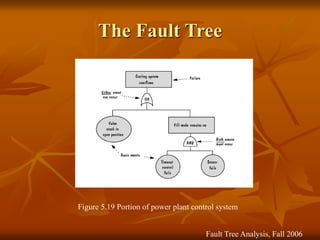
 Begin Fault Analysis by identifying possible failures
in design operation or maintenance
 Next build a graph whose nodes are failures
 Single contents
 System function
 Entire system
 Edge = relationship among nodes by logical
descriptor (AND,OR)
Fault Tree Analysis, Fall 2006
The Fault Tree
Figure 5.19 Portion of power plant control system
Fault Tree Analysis, Fall 2006
Cut-set Tree
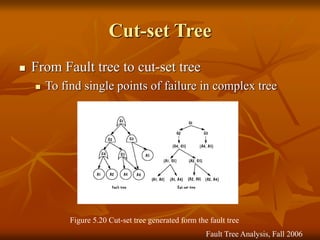
 From Fault tree to cut-set tree
 To find single points of failure in complex tree
Figure 5.20 Cut-set tree generated form the fault tree
Fault Tree Analysis, Fall 2006
Fixing the Failure
 Remove it
 Add components or conditions to prevent the
input condition that cause the fault to be
executed
 Add components that will recover from the
damage the failure will cause
Fault Tree Analysis, Fall 2006
Some faults…
 Time-consuming in constructing the graphs
 Many systems involve many dependencies
 Difficult to detect inconsistencies
 Difficult to focus only on the most critical parts of
the design on high coupling systems
 Not always easy to spot
Fault Tree Analysis, Fall 2006
Reference
 Atlee, Joanne, Software Engineering Theory
and Practice, Pearson Prentice Hall, New
Jersey, ©2006, pg264-266
Fault Tree Analysis, Fall 2006

Fault Tree Analysis Technique for problem solving.ppt

  • 1.
    Fault Tree Analysis “Faultlessto a fault.” - Robert Browning Albert Hsu
  • 2.
    Introduction  Fault identification,correction and tolerance to improve design  Fault Tree Analysis  “A method to decompose it and look for situation that might lead to failure” (Software Engineering)  Displayed the logical path from effect to cause Fault Tree Analysis, Fall 2006
  • 3.
    The Fault Tree Begin Fault Analysis by identifying possible failures in design operation or maintenance  Next build a graph whose nodes are failures  Single contents  System function  Entire system  Edge = relationship among nodes by logical descriptor (AND,OR) Fault Tree Analysis, Fall 2006
  • 4.
    The Fault Tree Figure5.19 Portion of power plant control system Fault Tree Analysis, Fall 2006
  • 5.
    Cut-set Tree  FromFault tree to cut-set tree  To find single points of failure in complex tree Figure 5.20 Cut-set tree generated form the fault tree Fault Tree Analysis, Fall 2006
  • 6.
    Fixing the Failure Remove it  Add components or conditions to prevent the input condition that cause the fault to be executed  Add components that will recover from the damage the failure will cause Fault Tree Analysis, Fall 2006
  • 7.
    Some faults…  Time-consumingin constructing the graphs  Many systems involve many dependencies  Difficult to detect inconsistencies  Difficult to focus only on the most critical parts of the design on high coupling systems  Not always easy to spot Fault Tree Analysis, Fall 2006
  • 8.
    Reference  Atlee, Joanne,Software Engineering Theory and Practice, Pearson Prentice Hall, New Jersey, ©2006, pg264-266 Fault Tree Analysis, Fall 2006