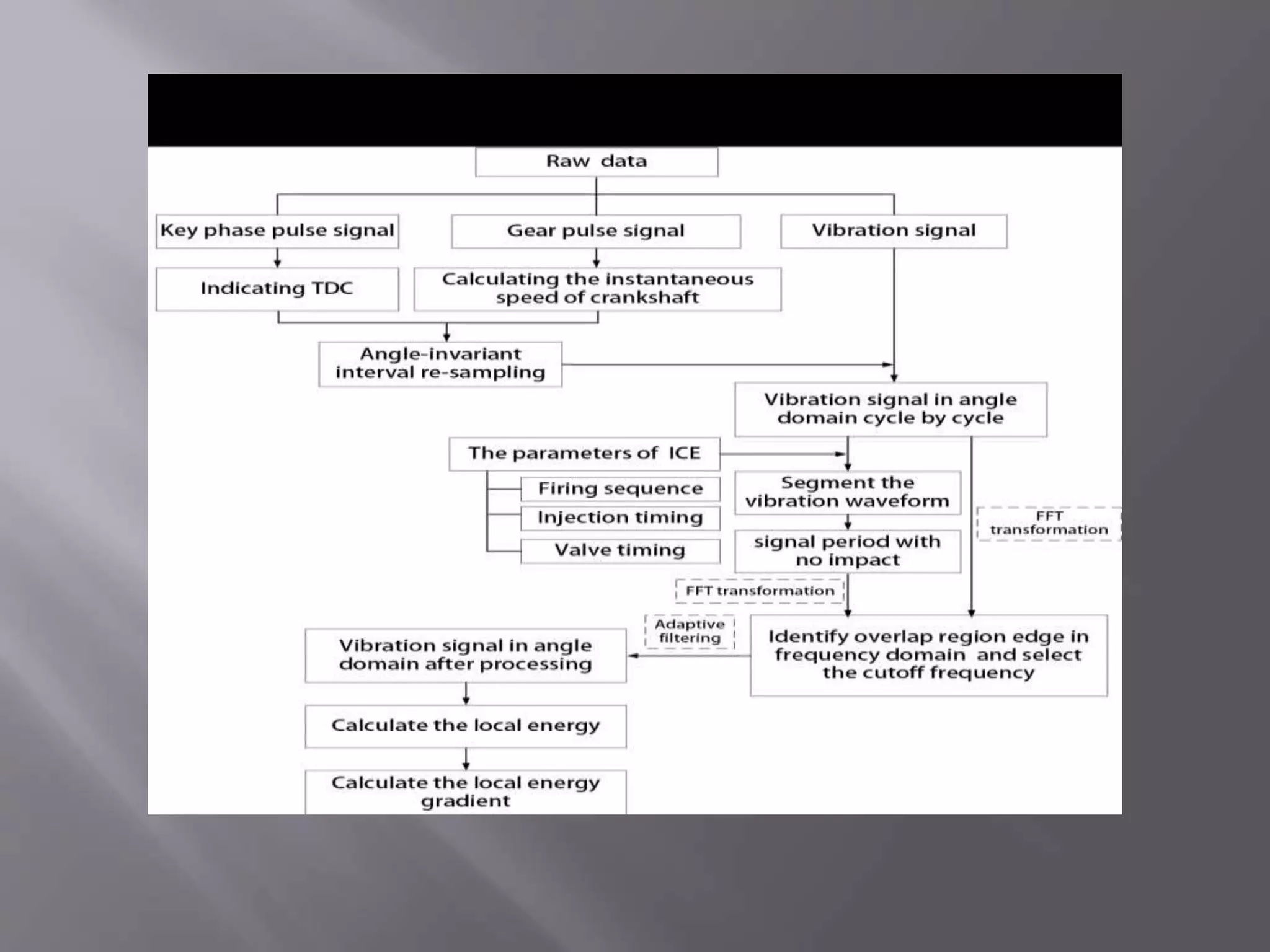
,
Abstract: Internal combustion engines (ICEs) are widely
used in many important fields. The valve train clearance of an ICE usually
exceeds the normal value due to wear or faulty adjustment. This work aims at
diagnosing the valve clearance fault based on the vibration signals measured on
the engine cylinder heads. The non-stationarity of the ICE operating condition
makes it difficult to obtain the nominal baseline, which is always an awkward
problem for fault diagnosis. This paper overcomes the problem by inspecting the
timing of valve closing impacts, of which the referenced baseline can be obtained
by referencing design parameters rather than extraction during healthy
conditions. To accurately detect the timing of valve closing impact from vibration
signals, we carry out a new method to detect and extract the commencement of
the impacts. The results of experiments conducted on a twelve-cylinder ICE test
rig show that the approach is capable of extracting the commencement of valve
closing impact accurately and using only one feature can give a superior
monitoring of valve clearance. With the help of this technique, the valve
clearance fault becomes detectable even without the comparison to the baseline,
and the changing trend of the clearance
could be trackable.
 Item
Number of cylinders
Shape
Firing sequence
Rating speed
Rating power
Intake valve train normal clearance
Exhaust valve train normal
clearance
Intake valve opening timing
Intake valve closing timing
Exhaust valve opening timing
Exhaust valve closing timing
Value
12
V-shaped 60
B1-A1-B5-A5-B3-A3-B6-A6-B1-A2-B4-A4
2100 rev/min
485 kW
0.3 mm
0.5 mm
26.5 2 before top dead center (TDC)
46.5 2 after bottom decenter (BDC)
47 2 before BDC
13 2 after TDC
Introduction to the Valve Train Faults of ICE
Valve Impacts Transmission Paths:
Changing this clearance would have an influence on the kinematic and
dynamic response of valve lifting. The valve impacts include an opening
impact generated from the collision between the rocker
and valve cap, and a closing impact generated from the collision between the
valve seat and cylinder head. The vibration transmission paths are shown in
Figure.
Simulation Study:
To study the movement characteristics of the valve train mechanism,
ADAMS, a multi-body dynamic simulation tool, is employed to
simulate and to obtain the dynamic influence of the valve clearance
and operating condition. The solid model used for simulation is shown
in Figure as previously mentioned. In order to keep the analysis simple
and to illustrate the dynamic behavior,
all the bodies are considered to be rigid. A contact pair model is
introduced to simulate the clearance [18]. Two sets of simulations are
performed: one is for a different valve clearance simulated
by setting a different valve clearance, and the other one is for different
operating conditions simulated
by changing the engine speed.
Conclusions:
In this study, an effective approach has been developed to detect and
diagnose the ICE valve train clearance based on the vibration signal
measured on the engine cylinder heads. This presented
method is capable of monitoring the clearance accurately with only one
feature—the commencement of valve closing impact—since the feature is
sensitive to the valve clearance and insensitive to working conditions.
Moreover, because this feature has clear physical significance, the baseline
acquired during
the healthy condition is no longer needed. Subsequently, a novel feature
extraction technique was carried out based on a newly proposed impact
detection method to meet the feature calculation
accuracy requirement. The experimental results proved that the selected
feature is indeed ideal for this fault detection, and the feature extraction
results are accurate enough. In addition, this method has potential for
application in real-time and the trend of the valve clearance may become
trackable, as the calculation processes are adaptable and automatic with
good robustness, and the implementation is simple. In the future, the new
impact detection method will be extended to diagnose other impulse
faults, and the valve clearance detection approach will be further studied
and finally built into a real-time monitoring system for an engine.

Fault diagnosis of internal combustion engine using iot

  • 1.
  • 2.
    Abstract: Internal combustionengines (ICEs) are widely used in many important fields. The valve train clearance of an ICE usually exceeds the normal value due to wear or faulty adjustment. This work aims at diagnosing the valve clearance fault based on the vibration signals measured on the engine cylinder heads. The non-stationarity of the ICE operating condition makes it difficult to obtain the nominal baseline, which is always an awkward problem for fault diagnosis. This paper overcomes the problem by inspecting the timing of valve closing impacts, of which the referenced baseline can be obtained by referencing design parameters rather than extraction during healthy conditions. To accurately detect the timing of valve closing impact from vibration signals, we carry out a new method to detect and extract the commencement of the impacts. The results of experiments conducted on a twelve-cylinder ICE test rig show that the approach is capable of extracting the commencement of valve closing impact accurately and using only one feature can give a superior monitoring of valve clearance. With the help of this technique, the valve clearance fault becomes detectable even without the comparison to the baseline, and the changing trend of the clearance could be trackable.
  • 3.
     Item Number ofcylinders Shape Firing sequence Rating speed Rating power Intake valve train normal clearance Exhaust valve train normal clearance Intake valve opening timing Intake valve closing timing Exhaust valve opening timing Exhaust valve closing timing Value 12 V-shaped 60 B1-A1-B5-A5-B3-A3-B6-A6-B1-A2-B4-A4 2100 rev/min 485 kW 0.3 mm 0.5 mm 26.5 2 before top dead center (TDC) 46.5 2 after bottom decenter (BDC) 47 2 before BDC 13 2 after TDC
  • 4.
    Introduction to theValve Train Faults of ICE
  • 5.
    Valve Impacts TransmissionPaths: Changing this clearance would have an influence on the kinematic and dynamic response of valve lifting. The valve impacts include an opening impact generated from the collision between the rocker and valve cap, and a closing impact generated from the collision between the valve seat and cylinder head. The vibration transmission paths are shown in Figure.
  • 6.
    Simulation Study: To studythe movement characteristics of the valve train mechanism, ADAMS, a multi-body dynamic simulation tool, is employed to simulate and to obtain the dynamic influence of the valve clearance and operating condition. The solid model used for simulation is shown in Figure as previously mentioned. In order to keep the analysis simple and to illustrate the dynamic behavior, all the bodies are considered to be rigid. A contact pair model is introduced to simulate the clearance [18]. Two sets of simulations are performed: one is for a different valve clearance simulated by setting a different valve clearance, and the other one is for different operating conditions simulated by changing the engine speed.
  • 13.
    Conclusions: In this study,an effective approach has been developed to detect and diagnose the ICE valve train clearance based on the vibration signal measured on the engine cylinder heads. This presented method is capable of monitoring the clearance accurately with only one feature—the commencement of valve closing impact—since the feature is sensitive to the valve clearance and insensitive to working conditions. Moreover, because this feature has clear physical significance, the baseline acquired during the healthy condition is no longer needed. Subsequently, a novel feature extraction technique was carried out based on a newly proposed impact detection method to meet the feature calculation accuracy requirement. The experimental results proved that the selected feature is indeed ideal for this fault detection, and the feature extraction results are accurate enough. In addition, this method has potential for application in real-time and the trend of the valve clearance may become trackable, as the calculation processes are adaptable and automatic with good robustness, and the implementation is simple. In the future, the new impact detection method will be extended to diagnose other impulse faults, and the valve clearance detection approach will be further studied and finally built into a real-time monitoring system for an engine.