Fat Is…
The most concentrated source
of food energy
There are 9 calories in
every gram of fat
Fats that are liquid at
room temperature are
called oils.
 Fats that are firm at
room temperature are
called solids.
(Examples: vegetable oil, canola oil, olive oil, etc.)
(Examples: lard, butter, shortening, etc.)
Functions of Fat
 Supplies Energy
 Carries Vitamins A, D, E and K through
the body
 Provides a reserve store of energy
 Promotes healthy skin
 Promotes normal cell growth
 Acts like a “cushion”and heat regulator
to protect your heart, liver and other vital
organs
 It helps you feel full longer
 Adds flavor to food
What is Cholesterol?
 Cholesterol is NOT fat.
 It is a “fat-like” substance present in all
body cells that is needed for many
essential body processes.
 It contributes to the digestion of fat and
the skin’s production of vitamin D.
 Adults manufacture all the cholesterol
they need, mostly in the liver.
 All animals also have the ability to
manufacture cholesterol.
Cholesterol In Foods
 Because all animals make cholesterol,
if you eat any animal product, including
meat, poultry and fish, you will be
consuming some “extra” cholesterol.
 Other foods high in cholesterol are:
– Egg Yolks
– Liver / Organ Meats
– Some Shellfish
Types of Fat
 Fatty Acids:
– Organic acid units that
make up fat. There are
three types…
1.Saturated
2.Polyunsaturated
3.Monounsaturated
Saturated Fatty Acids
 Appear to raise the level of
LDL (“bad”) cholesterol in
the bloodstream
– Food sources: meat, poultry
skin, whole-milk dairy
products, and the tropical
oils-coconut oil, palm oil, and
palm kernel oil.
Polyunsaturated Fatty Acids
 Fats that seem to lower
total cholesterol levels.
– Food sources: many
vegetable oils, such as
corn oil, soybean oil and
safflower oil.
Monounsaturated Fatty Acids
 Appear to lower LDL
(“bad”) cholesterol and
help raise levels of HDL
(“good”) cholesterol.
– Food sources: olives, olive
oil, avocados, peanuts,
peanut oil and canola oil.
 All fats include all 3
kinds of fatty acids, but
in varying amounts.
 Each type of fat has a
different effect on
cholesterol levels
Test for Fats
 Ethanol emulsion test
 Add the food sample to 2 cm3 of
ethanol, shake well. Allow to settle in a
test tube rack for 2 minutes for food to
dissolve in ethanol. Empty any clear
liquid into a test tube containing 2 cm3
of distilled H2O. A MILKY-WHITE
EMULSION is a positive result: lipid is
present.
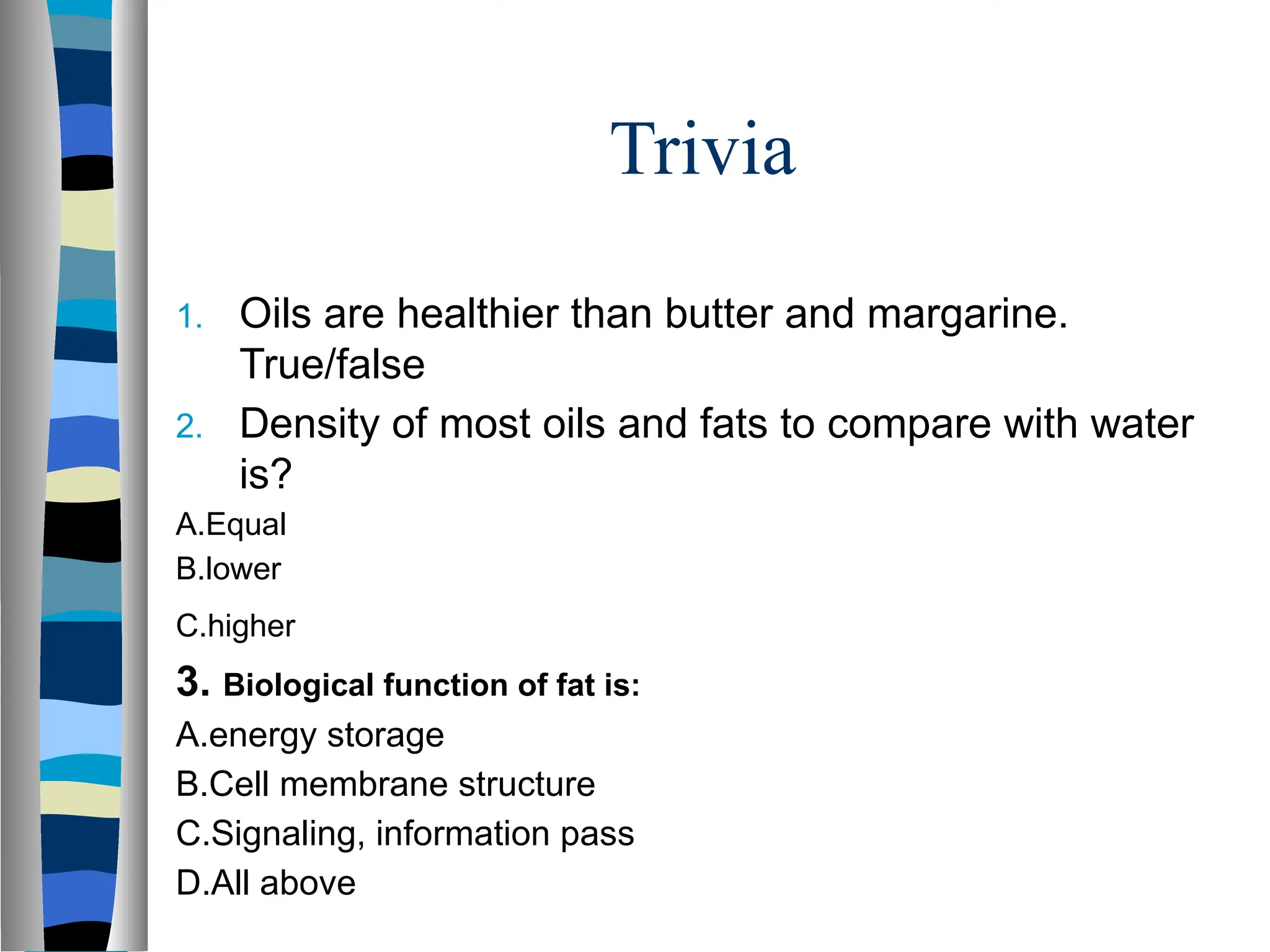
Trivia
1. Oils are healthier than butter and margarine.
True/false
2. Density of most oils and fats to compare with water
is?
A.Equal
B.​
​
​
​
​
​
​
lower
C.​
​
​
​
​
​
​
higher
3. Biological function of fat is:
A.​
​
​
​
​
​
​
energy storage
B.Cell membrane structure
C.Signaling, information pass
D.All above
Thank you

FATS AND OILS.pptx biology IGCSE notes to refer

  • 2.
    Fat Is… The mostconcentrated source of food energy There are 9 calories in every gram of fat
  • 3.
    Fats that areliquid at room temperature are called oils.  Fats that are firm at room temperature are called solids. (Examples: vegetable oil, canola oil, olive oil, etc.) (Examples: lard, butter, shortening, etc.)
  • 4.
    Functions of Fat Supplies Energy  Carries Vitamins A, D, E and K through the body  Provides a reserve store of energy  Promotes healthy skin  Promotes normal cell growth  Acts like a “cushion”and heat regulator to protect your heart, liver and other vital organs  It helps you feel full longer  Adds flavor to food
  • 5.
    What is Cholesterol? Cholesterol is NOT fat.  It is a “fat-like” substance present in all body cells that is needed for many essential body processes.  It contributes to the digestion of fat and the skin’s production of vitamin D.  Adults manufacture all the cholesterol they need, mostly in the liver.  All animals also have the ability to manufacture cholesterol.
  • 6.
    Cholesterol In Foods Because all animals make cholesterol, if you eat any animal product, including meat, poultry and fish, you will be consuming some “extra” cholesterol.  Other foods high in cholesterol are: – Egg Yolks – Liver / Organ Meats – Some Shellfish
  • 7.
    Types of Fat Fatty Acids: – Organic acid units that make up fat. There are three types… 1.Saturated 2.Polyunsaturated 3.Monounsaturated
  • 8.
    Saturated Fatty Acids Appear to raise the level of LDL (“bad”) cholesterol in the bloodstream – Food sources: meat, poultry skin, whole-milk dairy products, and the tropical oils-coconut oil, palm oil, and palm kernel oil.
  • 9.
    Polyunsaturated Fatty Acids Fats that seem to lower total cholesterol levels. – Food sources: many vegetable oils, such as corn oil, soybean oil and safflower oil.
  • 10.
    Monounsaturated Fatty Acids Appear to lower LDL (“bad”) cholesterol and help raise levels of HDL (“good”) cholesterol. – Food sources: olives, olive oil, avocados, peanuts, peanut oil and canola oil.
  • 11.
     All fatsinclude all 3 kinds of fatty acids, but in varying amounts.  Each type of fat has a different effect on cholesterol levels
  • 12.
    Test for Fats Ethanol emulsion test  Add the food sample to 2 cm3 of ethanol, shake well. Allow to settle in a test tube rack for 2 minutes for food to dissolve in ethanol. Empty any clear liquid into a test tube containing 2 cm3 of distilled H2O. A MILKY-WHITE EMULSION is a positive result: lipid is present.
  • 13.
    Trivia 1. Oils arehealthier than butter and margarine. True/false 2. Density of most oils and fats to compare with water is? A.Equal B.​ ​ ​ ​ ​ ​ ​ lower C.​ ​ ​ ​ ​ ​ ​ higher 3. Biological function of fat is: A.​ ​ ​ ​ ​ ​ ​ energy storage B.Cell membrane structure C.Signaling, information pass D.All above
  • 14.